Books On Books Collection – Thomas Stauss

Magic Metamorphosis (2025)
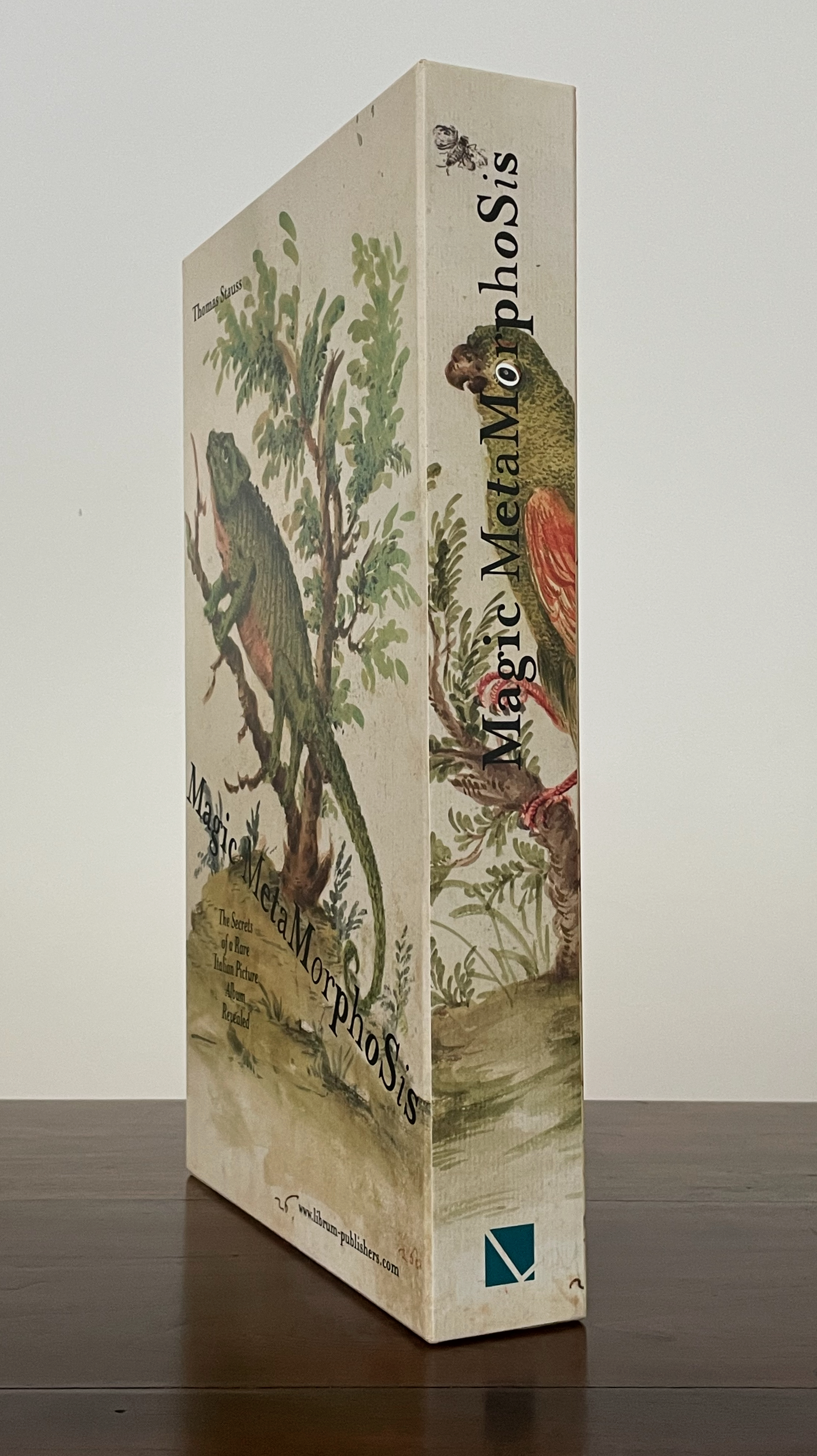
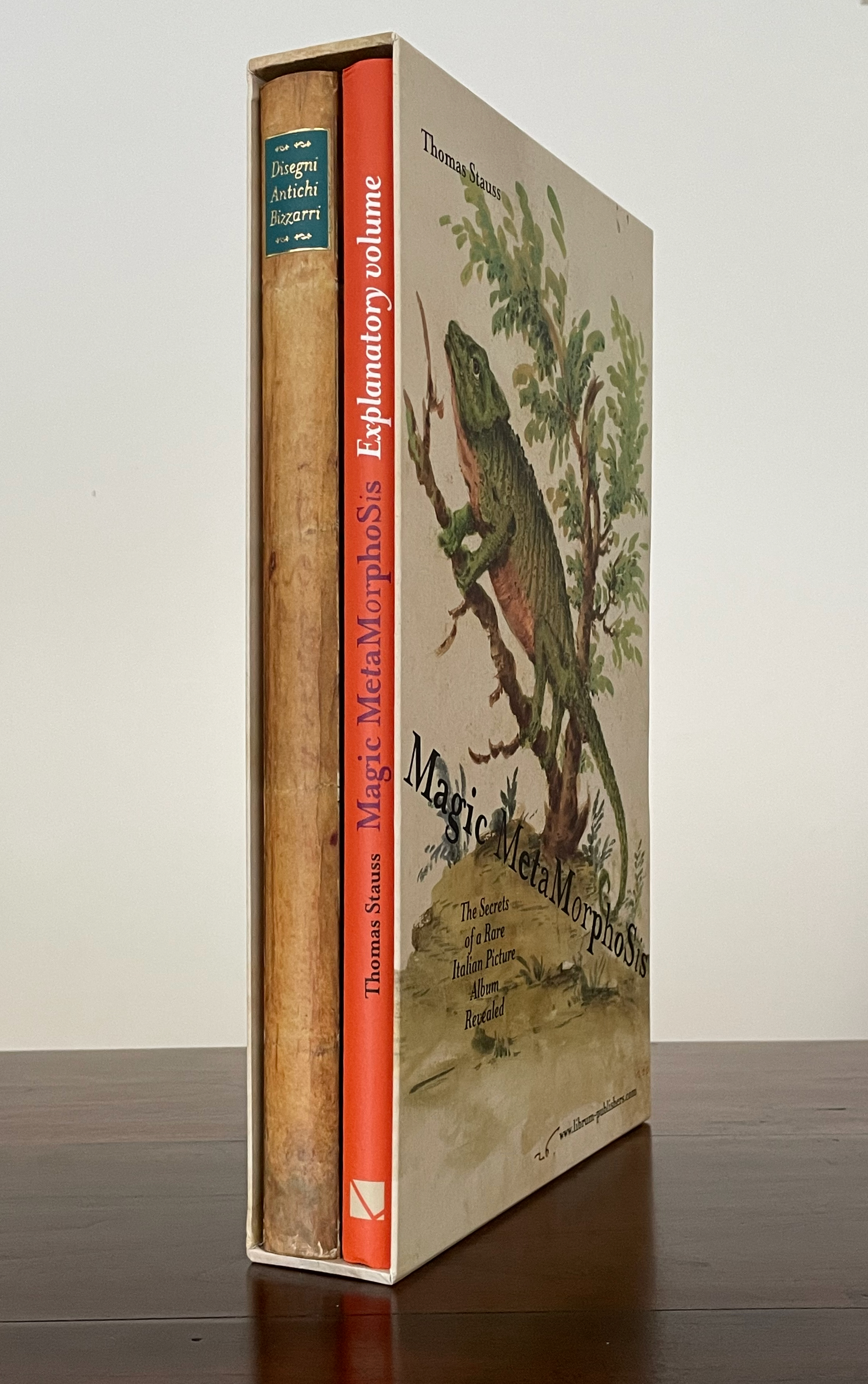
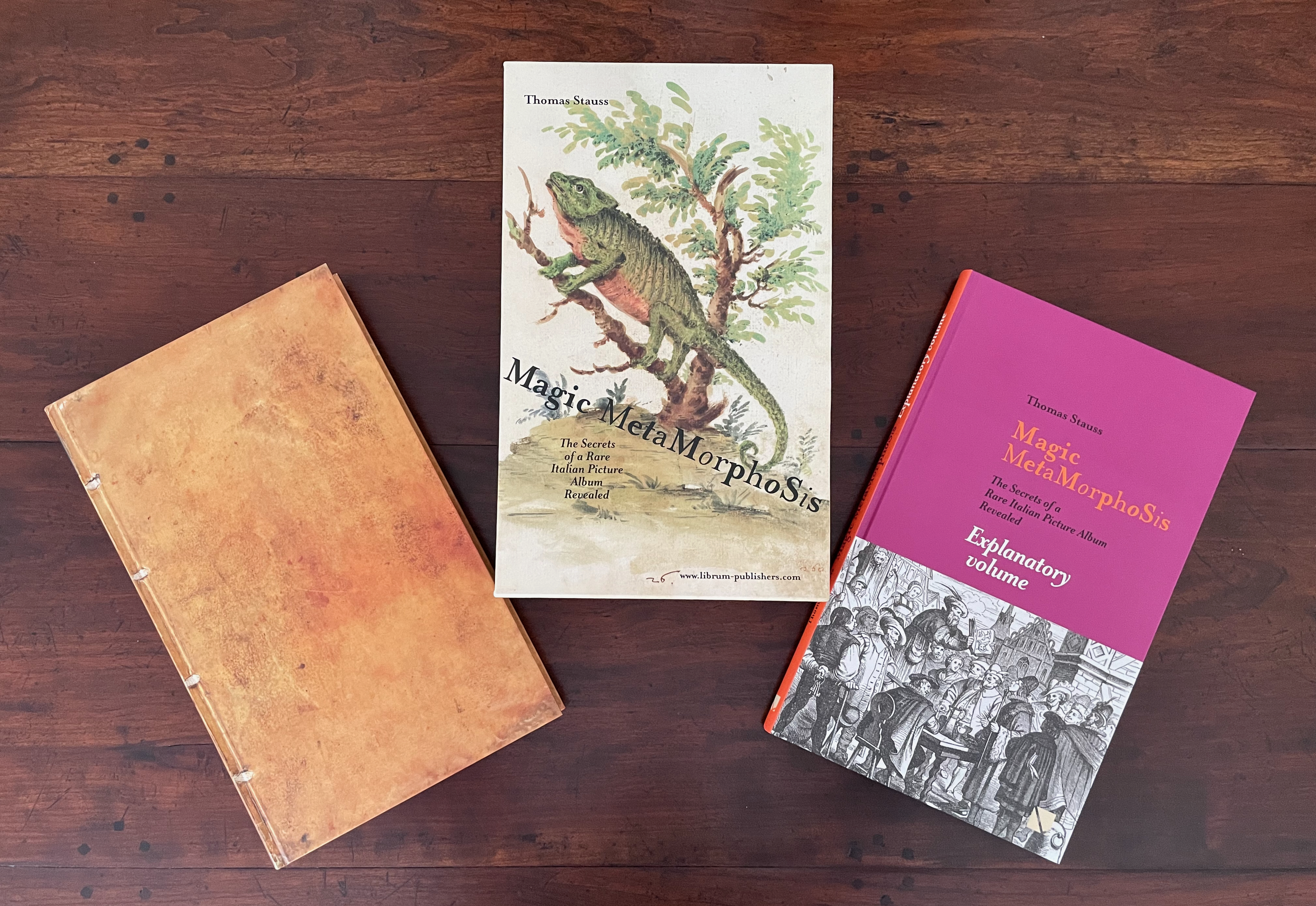
Three books are arranged on a wooden surface. The book on the left has a plain leather cover, the center book titled 'Magic MetaMorphoSis' features a colorful illustration of a lizard, and the right book is a pink cover with the same title and an intricate black and white image on the bottom.

Magic Metamorphosis : The Secrets of a Rare Italian Picture Album Revealed (2025)
Thomas Stauss
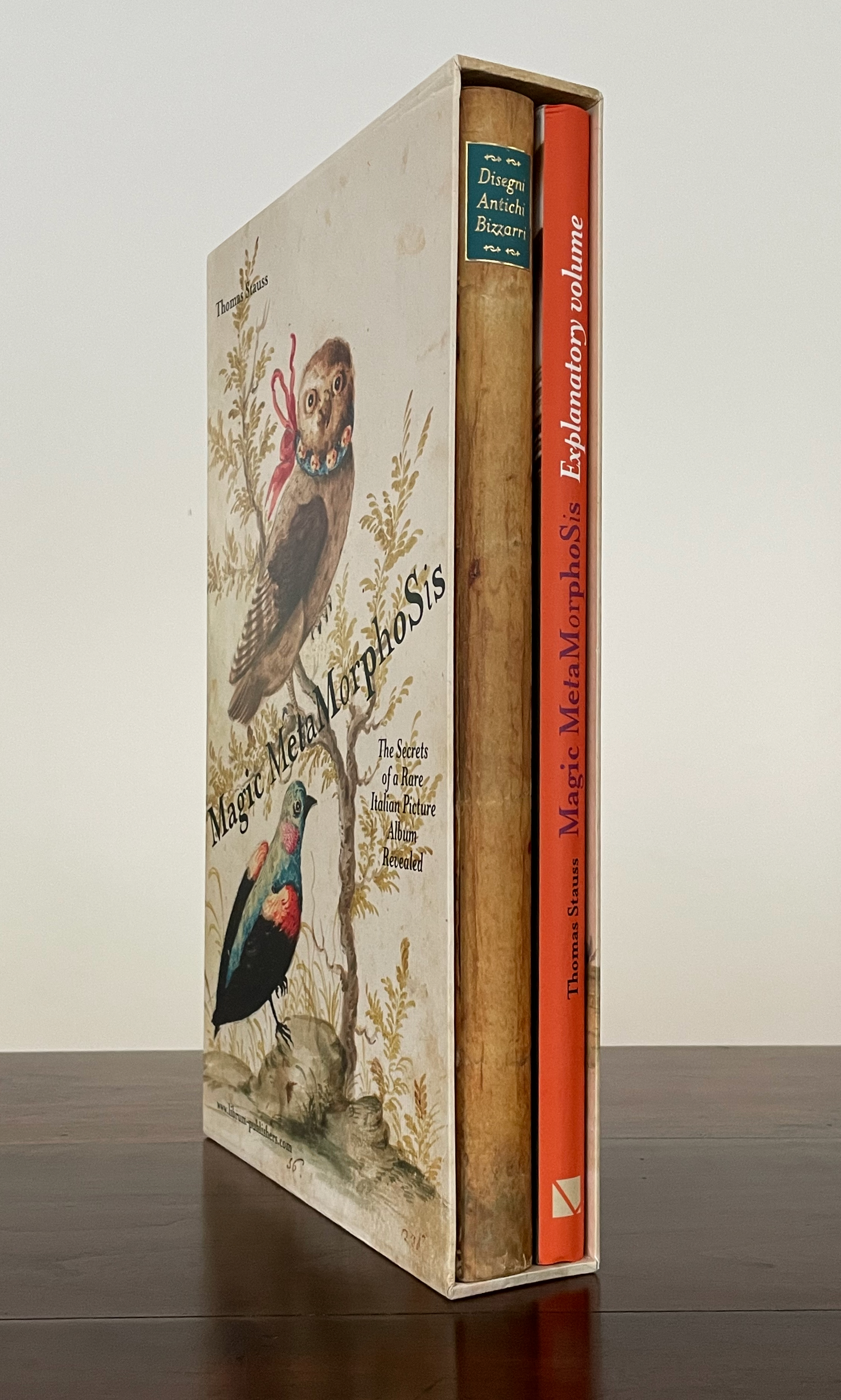
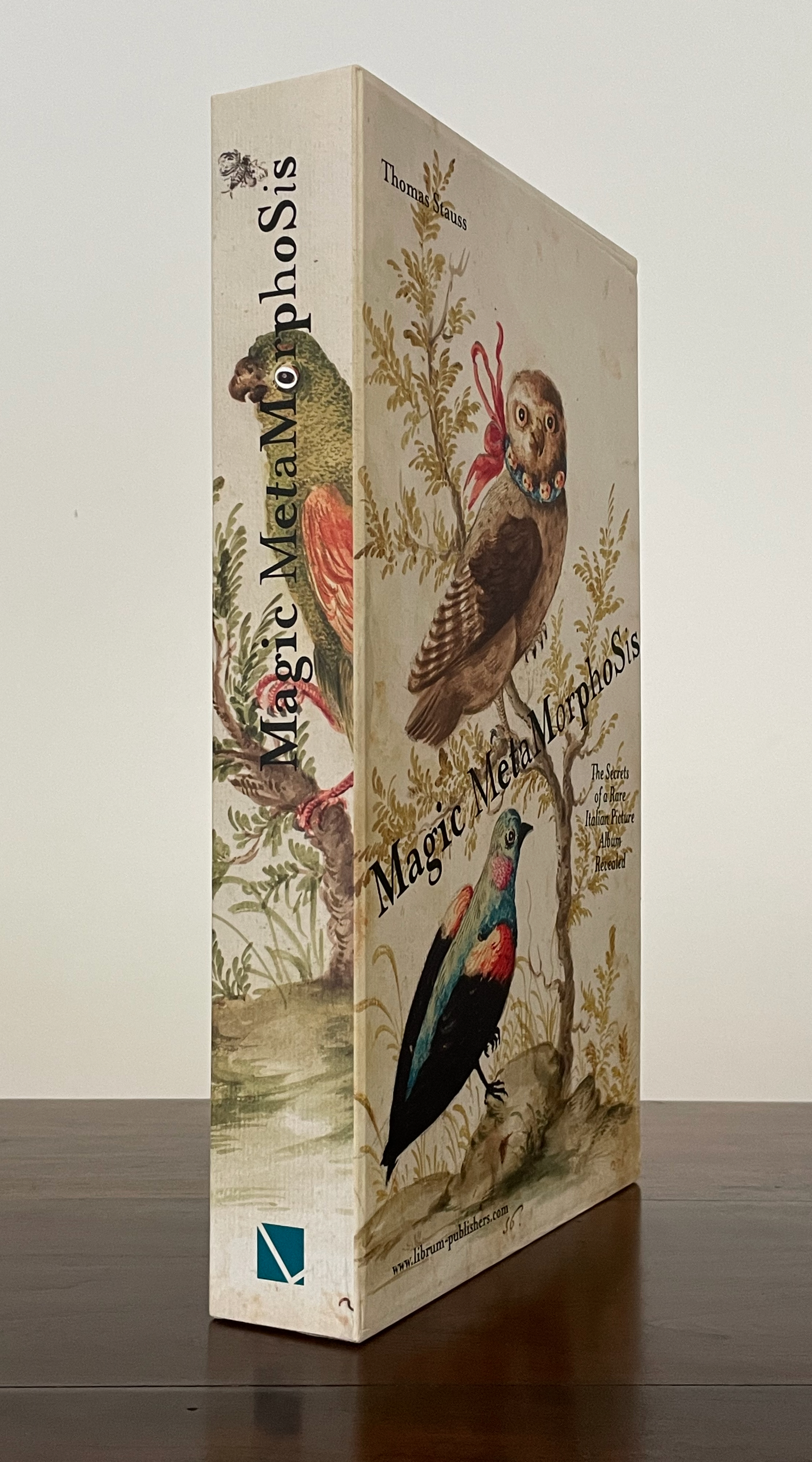
Slipcased two volumes. Slipcase: H375 x W230 x D53 mm. Both vols: H362 x W225 mm. Facsimile: [336] pages. Explanatory vol: 256 pages. Published by LIBRUM Publishers and Editors (Basel, Switzerland). Acquired from Amazon, 2 September 2026.
Photos: Books On Books Collection. See end of entry for credits to photographs in Magic Metamorphosis.

Collectors who can describe their collections and their searches without prompting yawns or worse are almost as rare as unicorn horns. Thomas Stauss knows how to tell a story. With his background in acquiring antique games and magicians’ apparatus, he was well equipped to recognize what the oddly organized portfolio volume presented to him in a Parisian book shop was meant to be — a “blow book”, a trick book that at first appears to be completely blank but then, with a magical breath blown over it, displays a set of themed images that, with another breath blown, changes into yet another set, and then another, and so on. But whoever commissioned these sets of watercolors in the 1600s had not had the finishing touches made before the sets were bound in a single volume. With a familiar and unassuming style, Stauss turns his discovery and its transformation into a page-turning read that is as magical as any blow book.
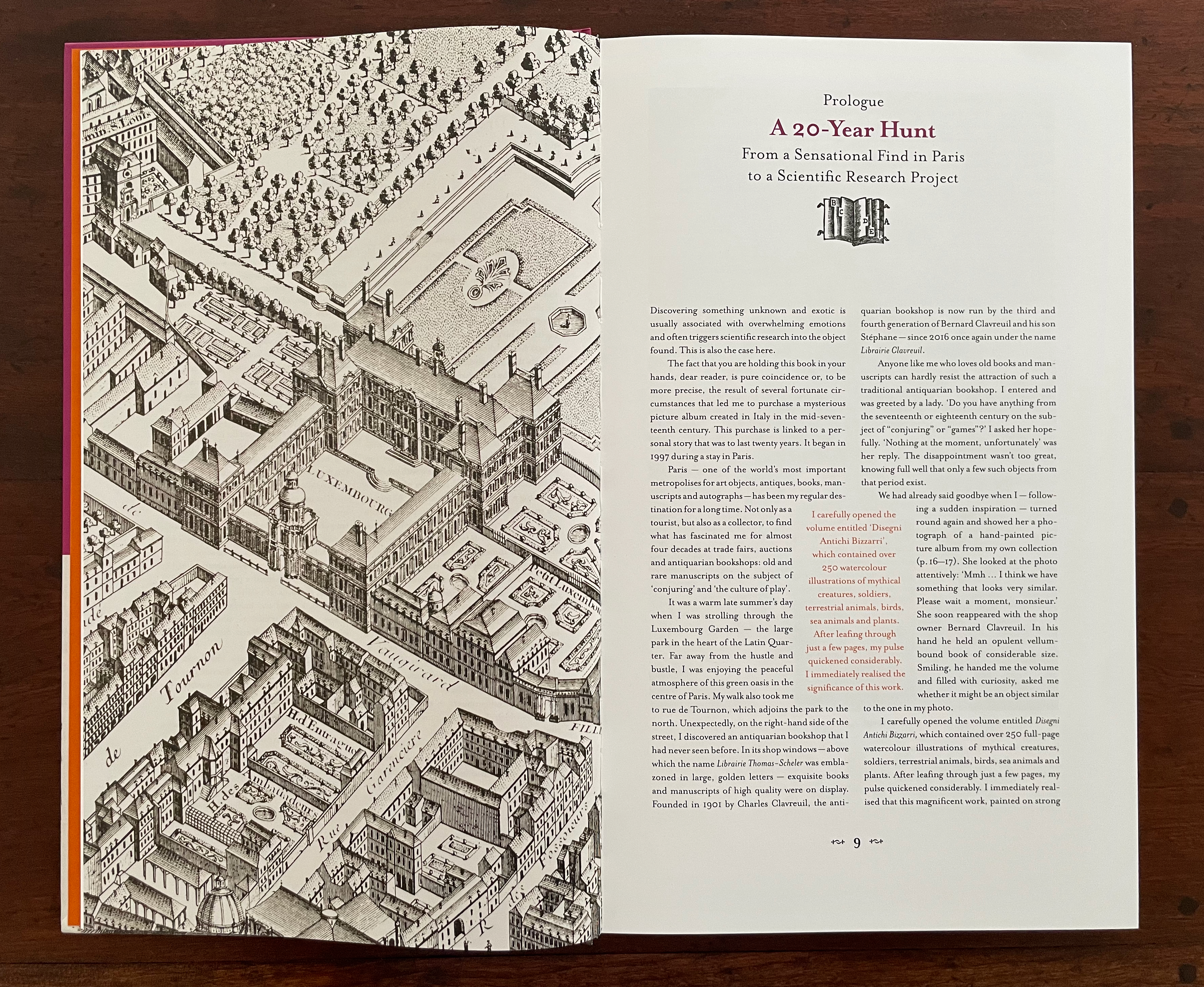
An open book with an illustrated map on the left page and text on the right page. The map depicts buildings and gardens, including the Luxembourg Gardens in Paris, while the text discusses a scientific research project related to a significant find in Paris.

Until now, Ricky Jay’s Magic Magic Book (1994) could be considered the definitive work on this book structure and conjuror’s apparatus that arose in the wake of Gutenberg’s printing press. Thomas Stauss’s study now takes center stage and assumes that leading role. Perhaps his training in hydrology and geology — as well as his collector’s focus — instilled the curiosity and patience to accomplish this. Also he has been studying the history of science for over 25 years and, somewhere along the way, acquired the skills in bibliographical science necessary for this project. Stauss wears his scholarship lightly though. Discovery, fact, explanation, and conjecture proceed with fine balance and an engaging pace.

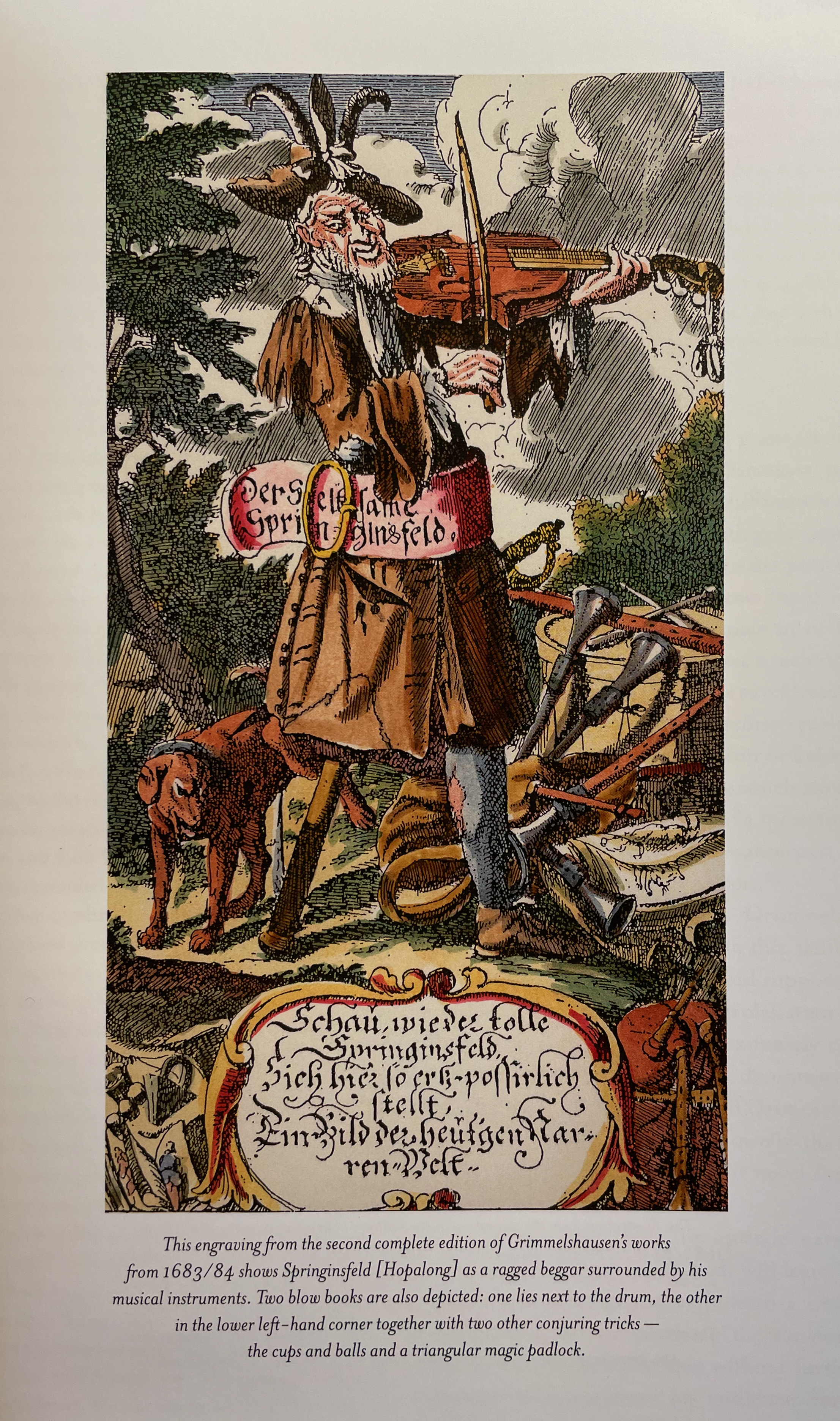
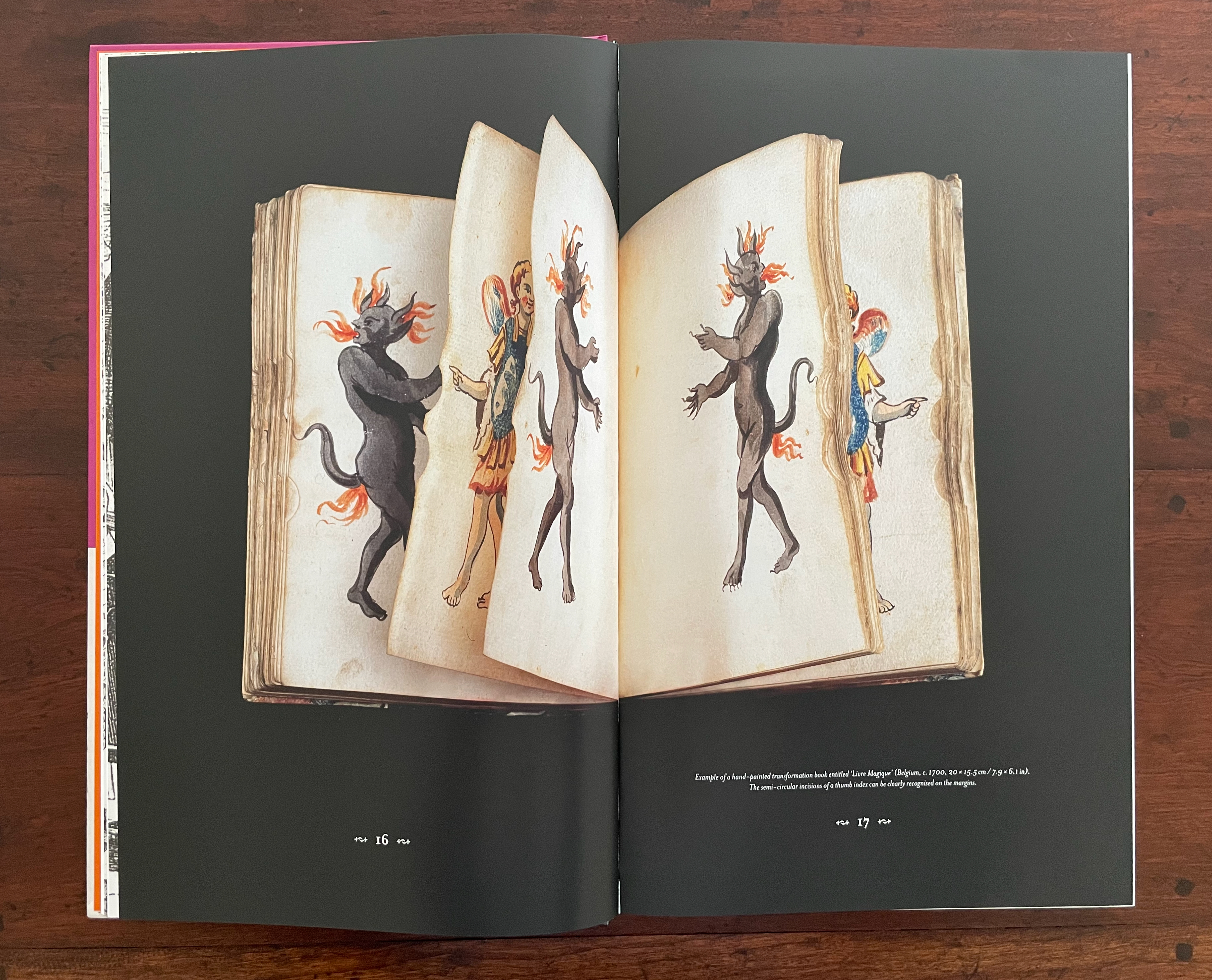
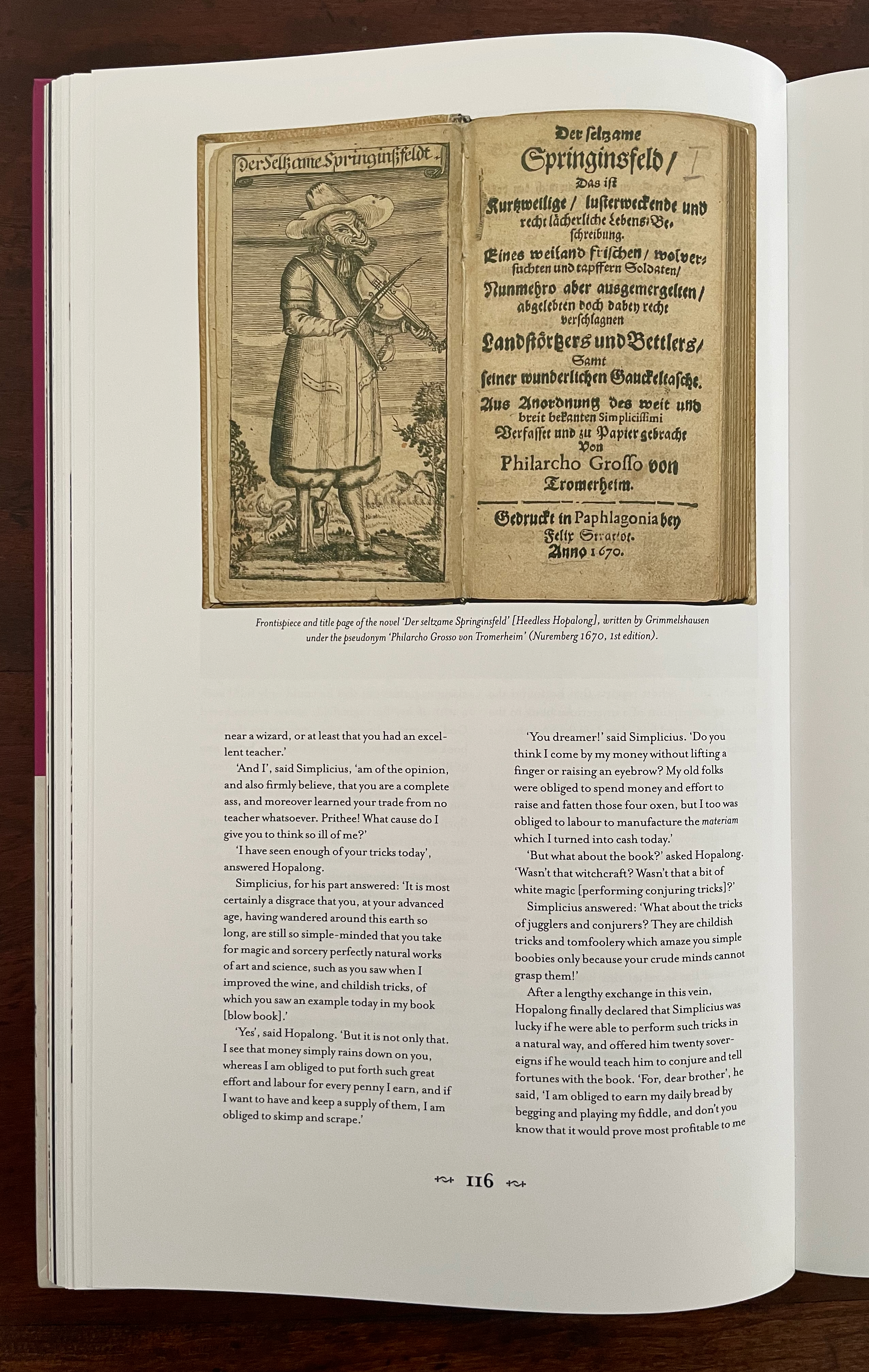
After the prologue recounting his discovery of Disegni Antichi Bizzarri [“Bizarre antique drawings”] Stauss’s first chapter introduces the history, nomenclature, structure, and working of the blow book. Its various methods of construction are clearly described and shown by diagram and photography, and the production team should be lauded for the quality and positioning of images with the explanatory text. No better description of how a performer worked the audience with a blow book has occurred since the mid-17th-century picaresque novel by Hans Jakob Christoffel von Grimmelshausen, and Stauss uses it to conclude the chapter.
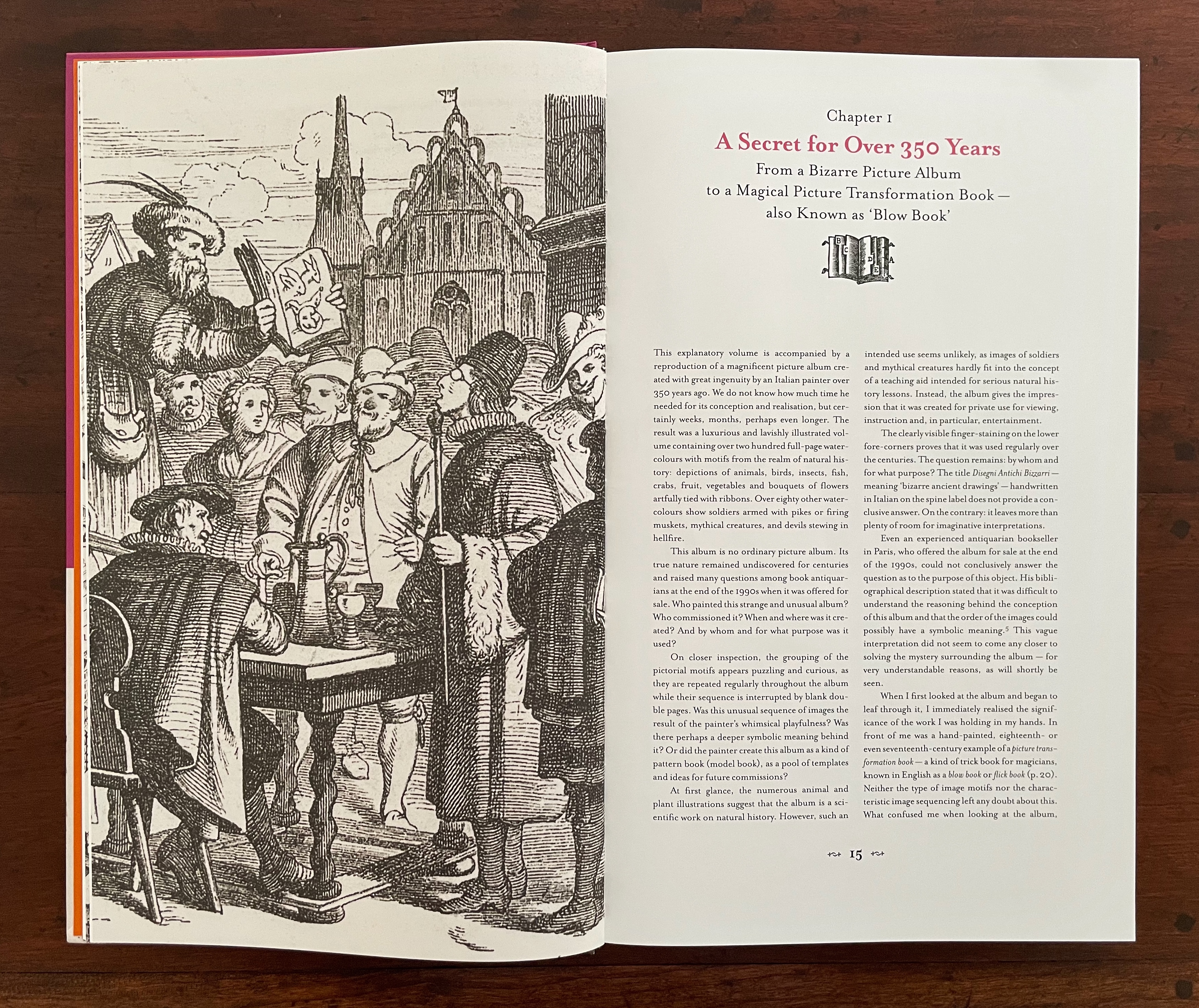
An illustrated engraving from the second complete edition of Grimmelhausen's works, depicting a ragged beggar named Springinsfeld playing a musical instrument. He is surrounded by various musical instruments and magical props, including cups, balls, and a triangular magic padlock.
From Magical Metamorphosis, p. 29.

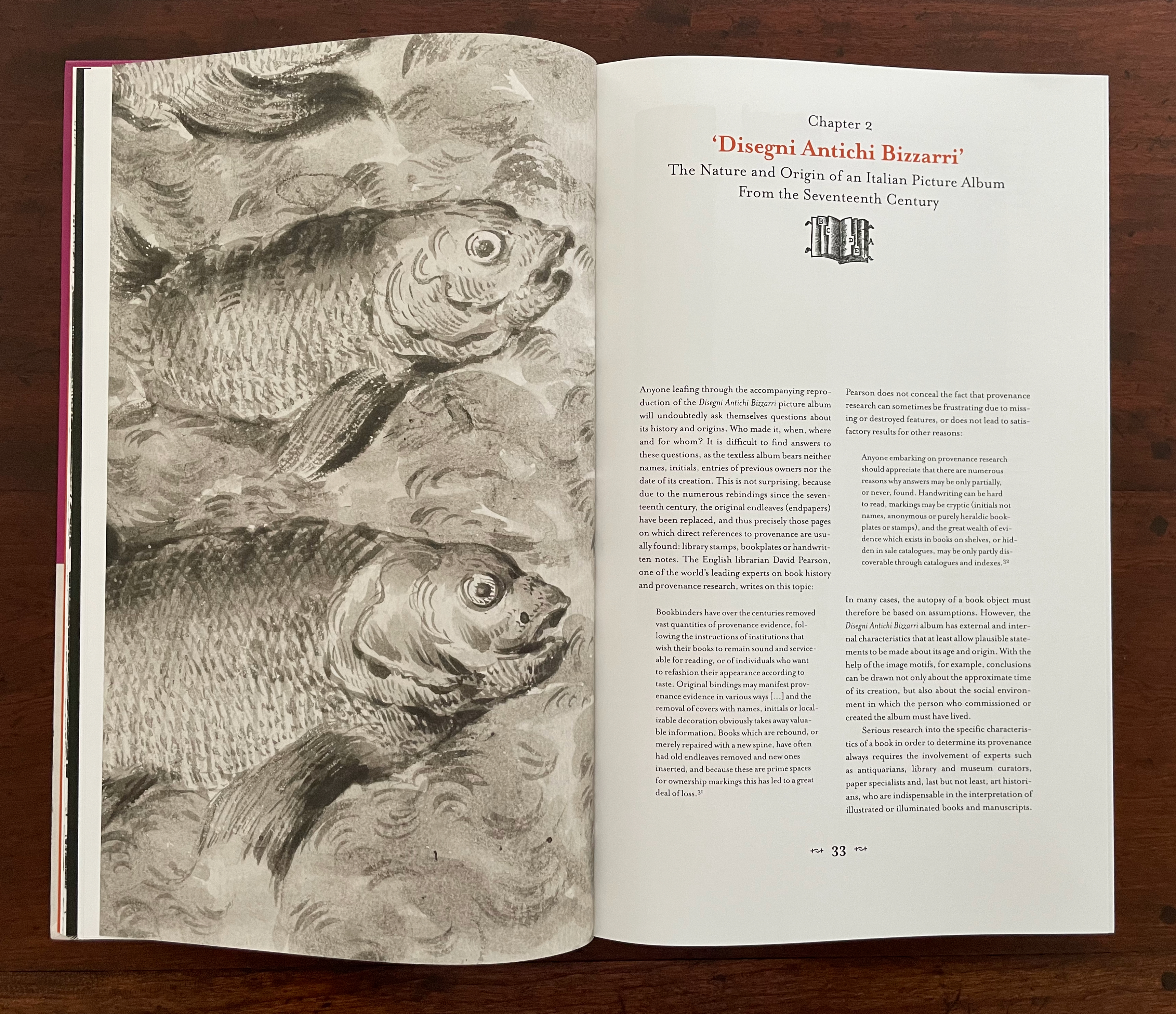
The second chapter delves into the history of Disegni Antichi Bizzarri itself and provides details on its collation, pagination, binding, geographical origins, dating, and provenance. The photography of the portfolio volume by Stauss and the Basel University Library is stunning.
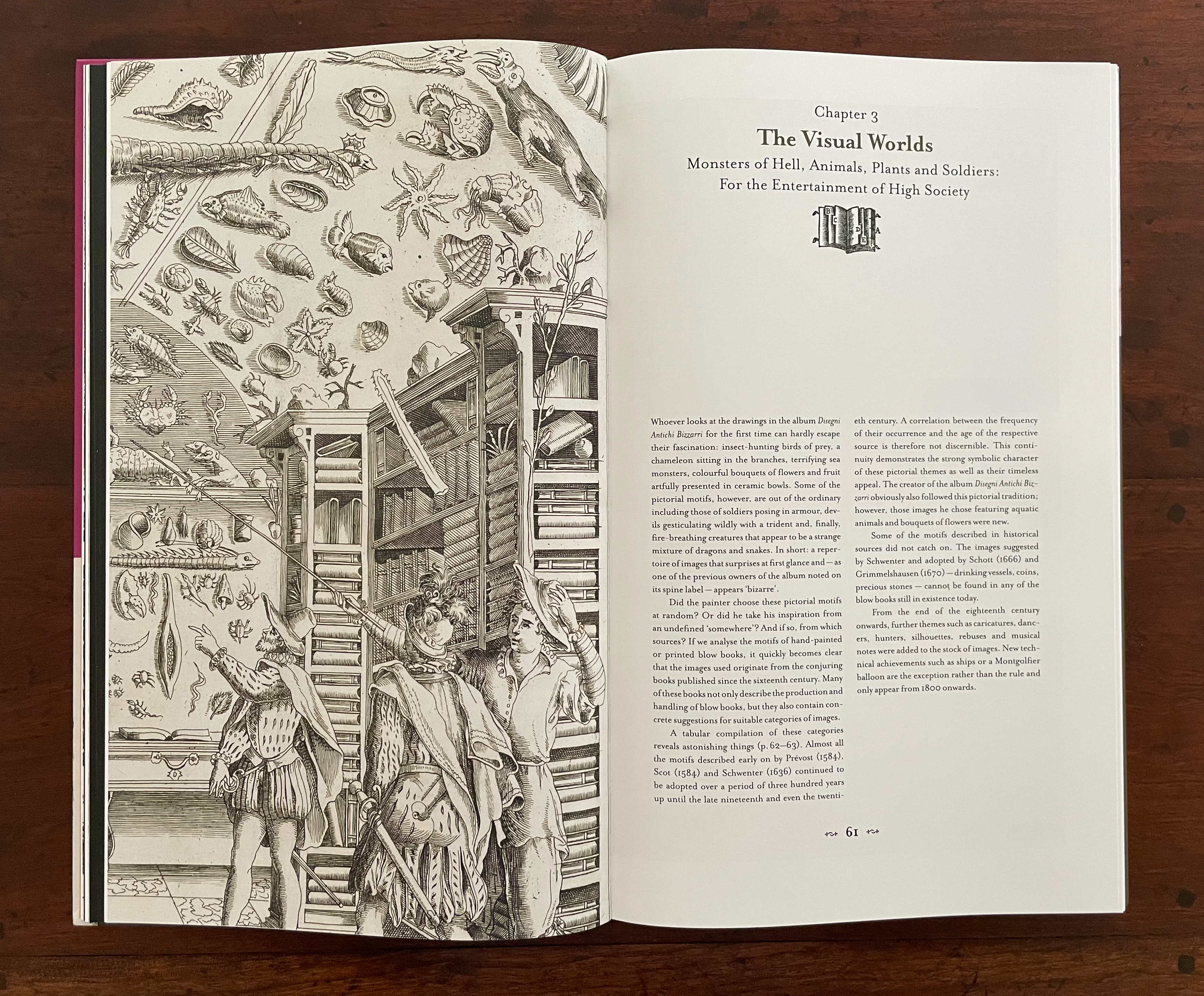
In the third chapter, Stauss rewards us with the results of his research into the pictorial motifs not only of Disegni Antichi Bizzarri but also of blow books pre-1670 up to 1870. Stauss provides visually convincing links of influence on the artist of Disegni Antichi Bizzarri from Hans Memling, Conrad Gessner, Ulisse Aldrovandi, Jan Jonston, Jacob de Gheyn II, Giovanni Battista Crescenzi, Giovanna Garzoni, Octavianus Monfort, Jean-Baptiste Monnoyer, Nicolas Robert, Guillaume Toulouze, and the album called Raccolta di disegni di animali (Modena, c. 1650).
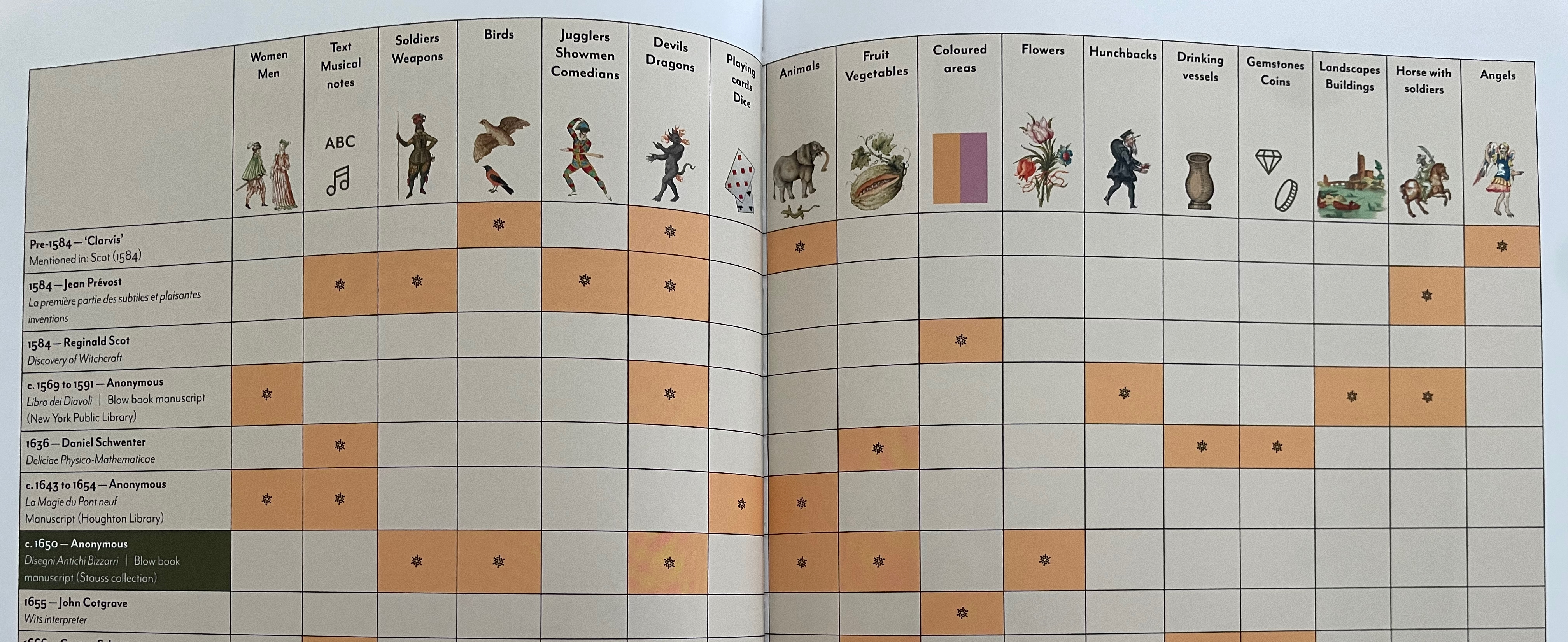
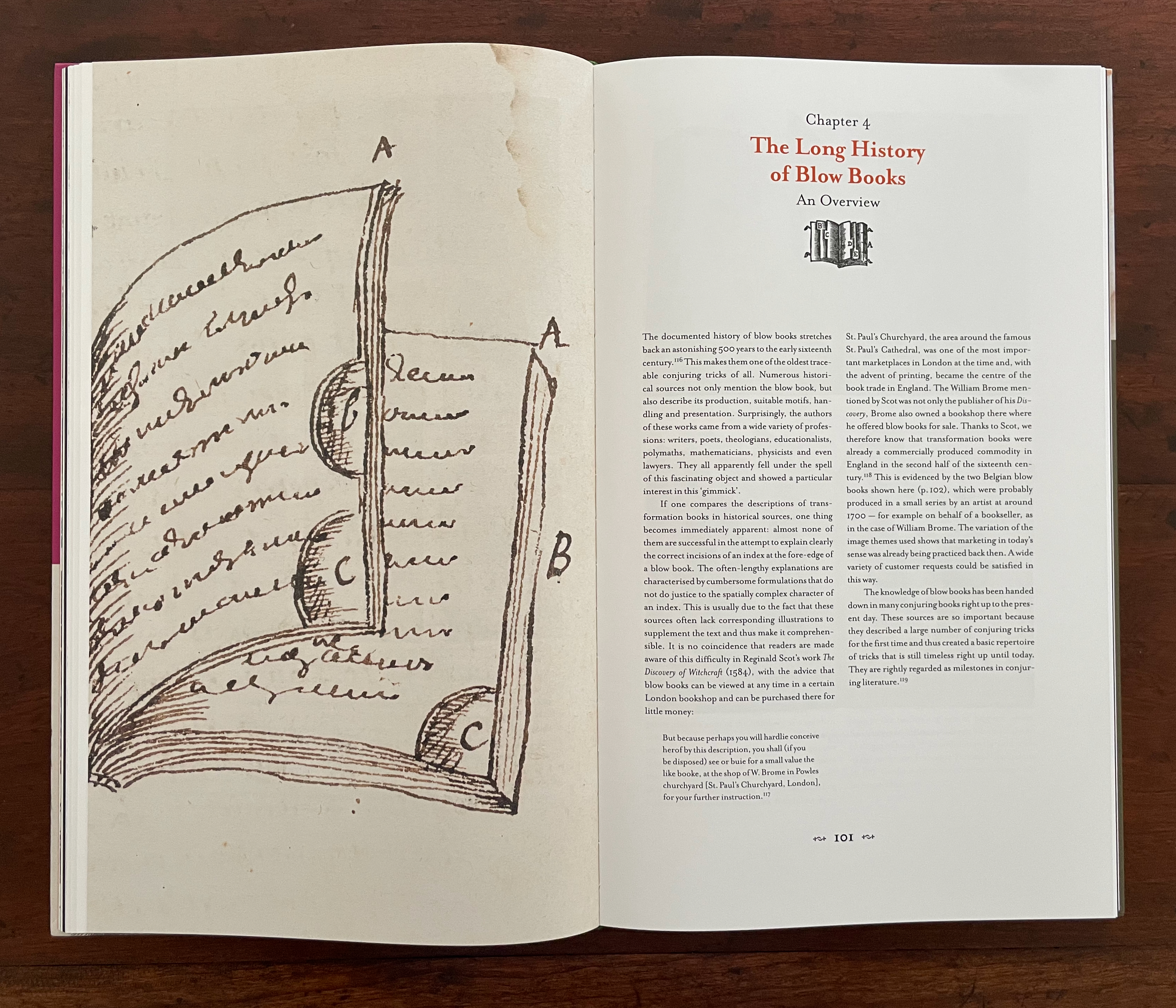
The fourth chapter presents the history of blow books from 1550 through 1870 in greater detail and extensive illustration.
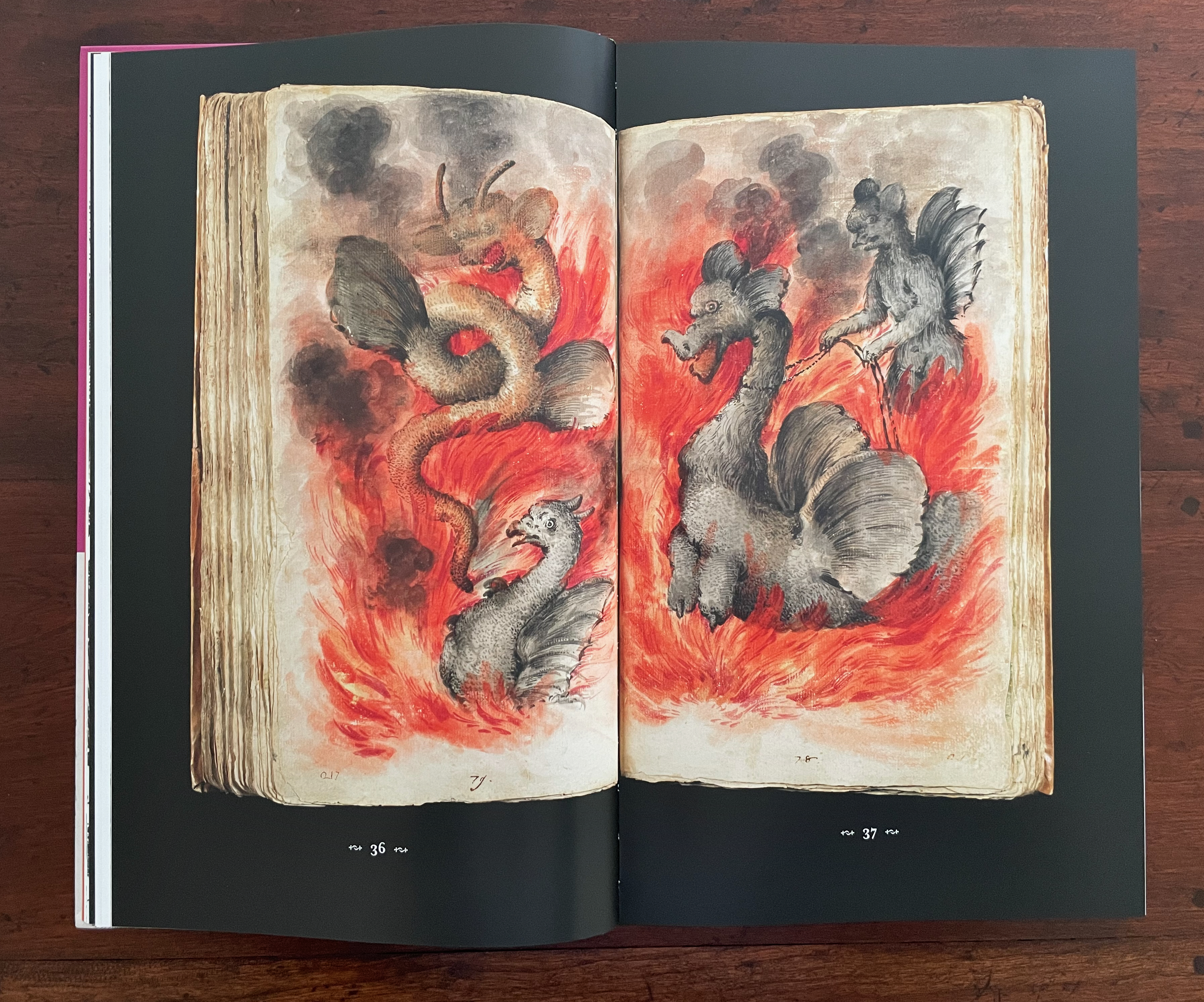
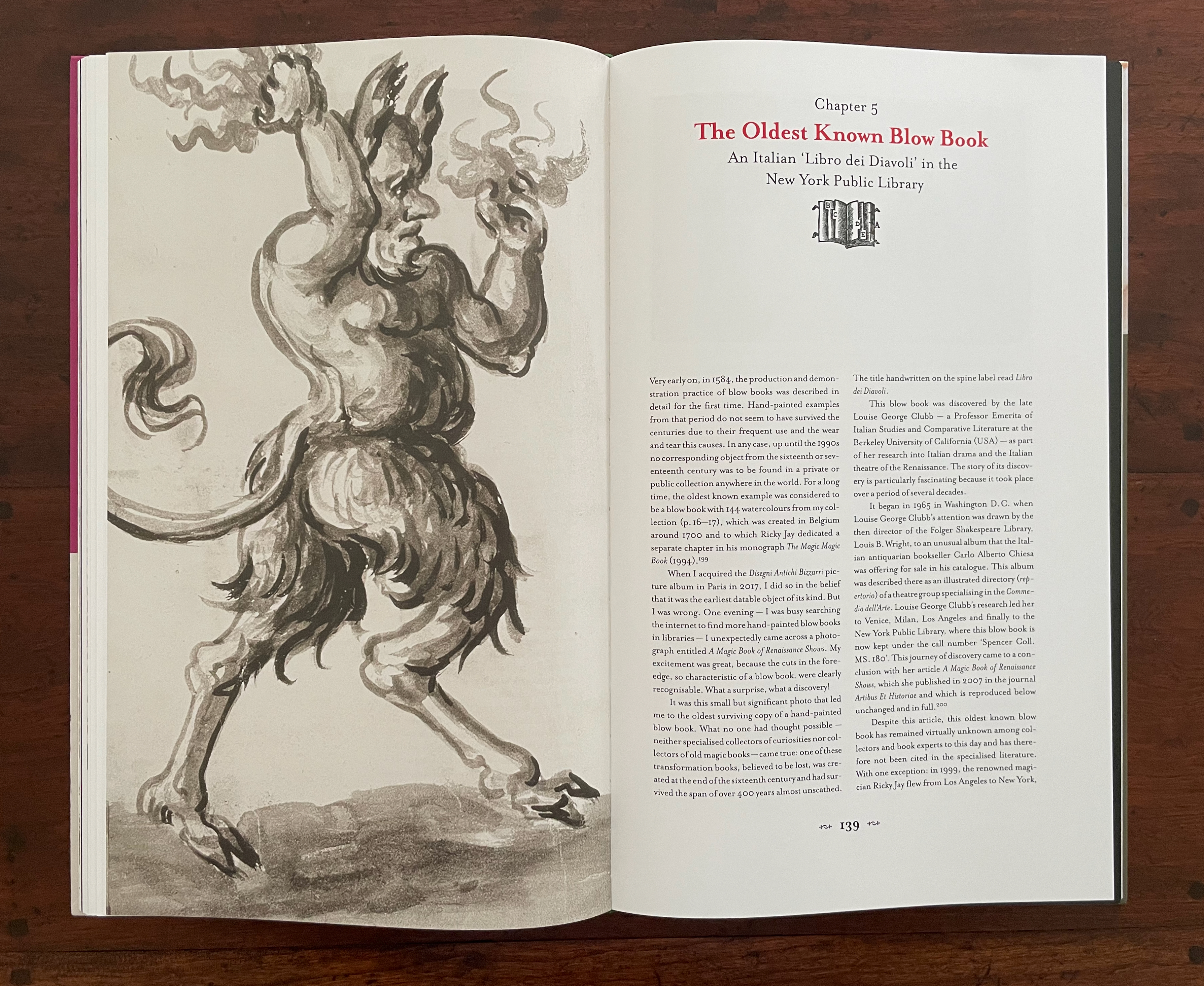
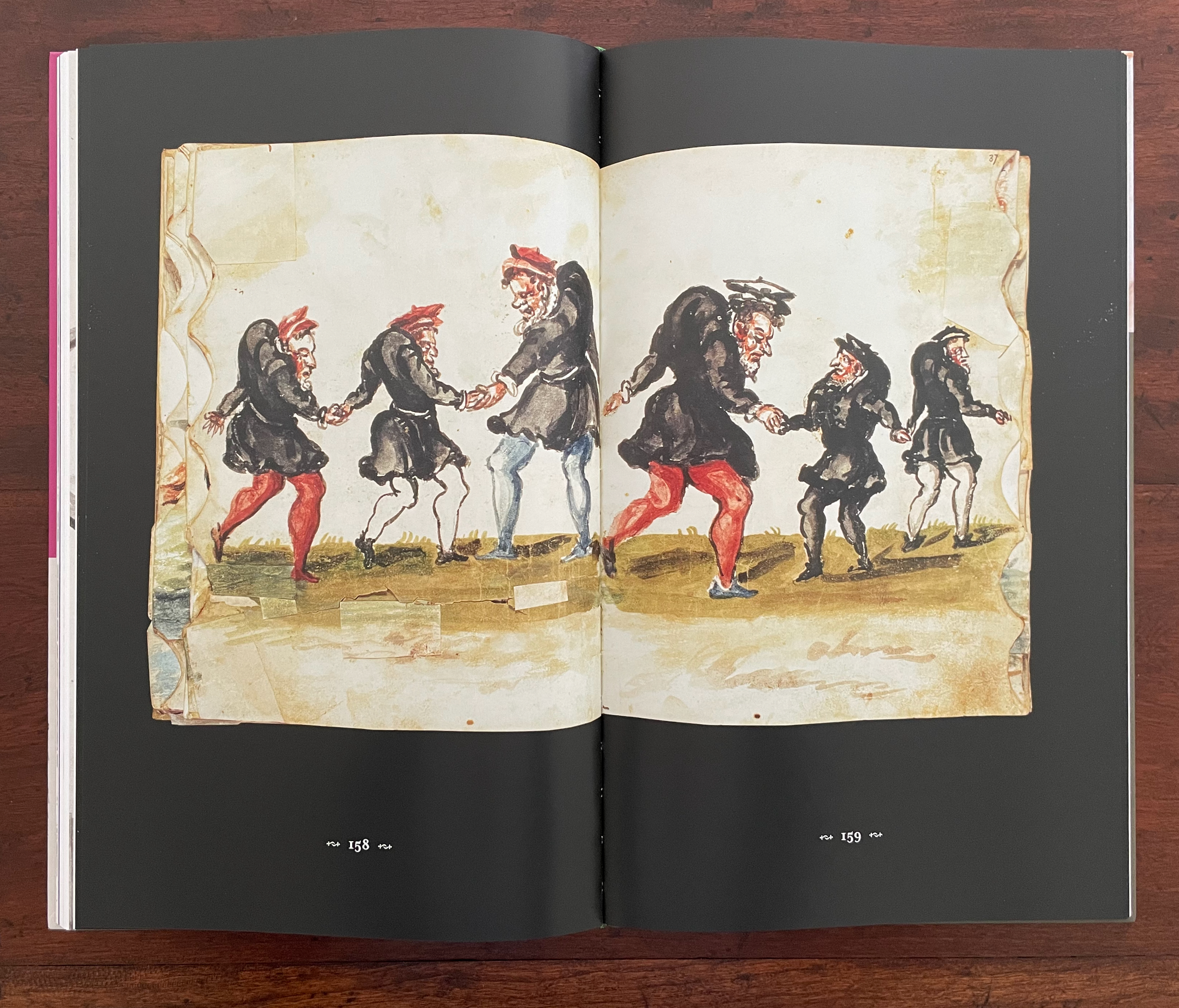
Adding to the definitive nature of Magic Metamorphosis, the fifth chapter delivers the surprise of over two hundred reproductions of the watercolor drawings from the oldest known blow book: Libro dei Diavolo (late 16th century), which resides in the New York Public Library. The images are accompanied by the entirety of Louise George Clubb’s essay that, similarly to Stauss’s rescue of Disegni Antichi Bizzarri, established the true nature of this work that had been misidentified for nearly half a century as a sampler of a commedia dell’arte troupe’s wares and repertoire.
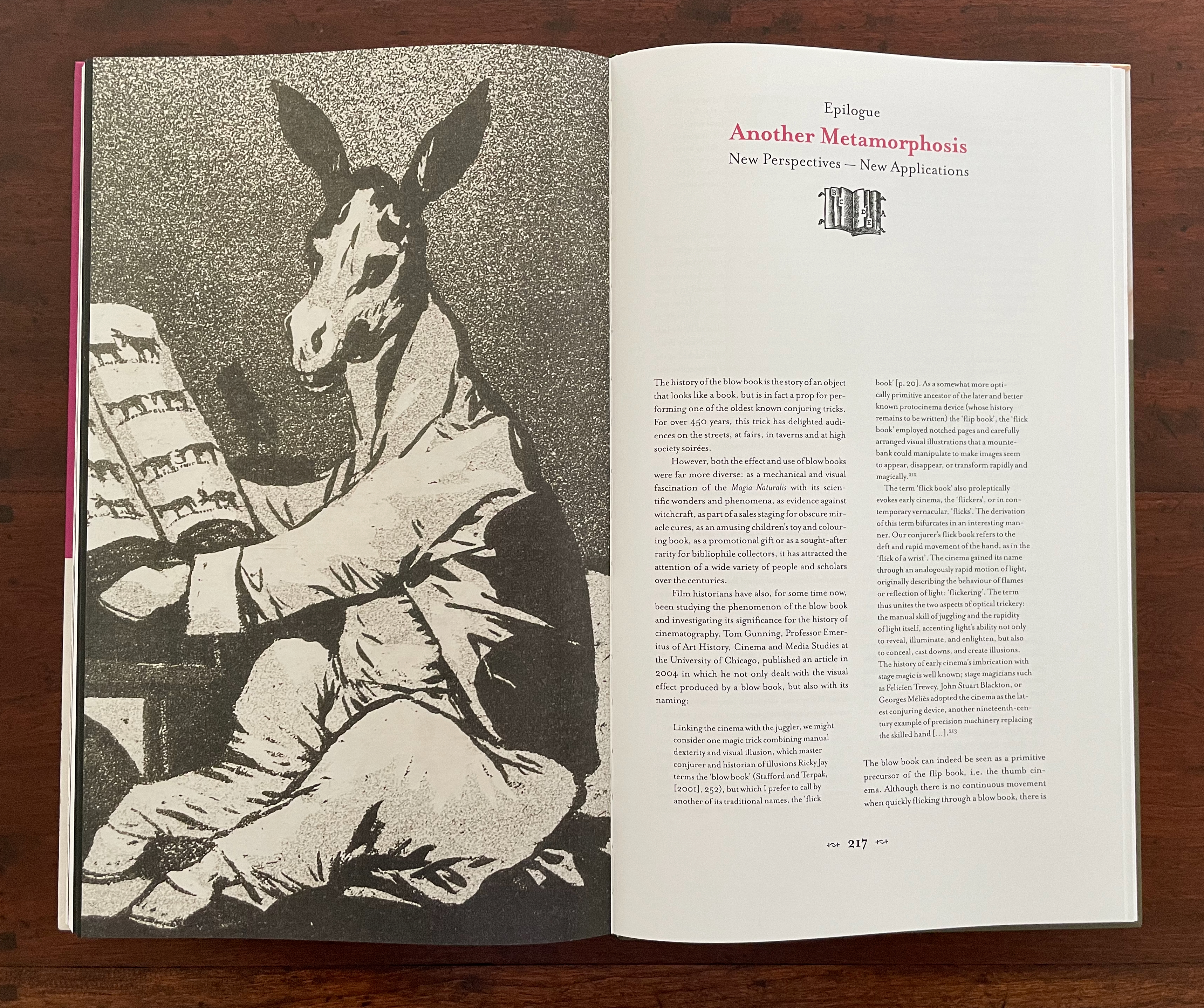
Stauss’s final chapter brings the blow book into the 21st century and his readers to the brink of enjoying his transformation of his discovered album into a facsimile working blow book. Although graciously giving ace-conjuror Ricky Jay the last word in the chapter, Stauss introduces his readers to the blow book’s possible transformation into an object of higher art.
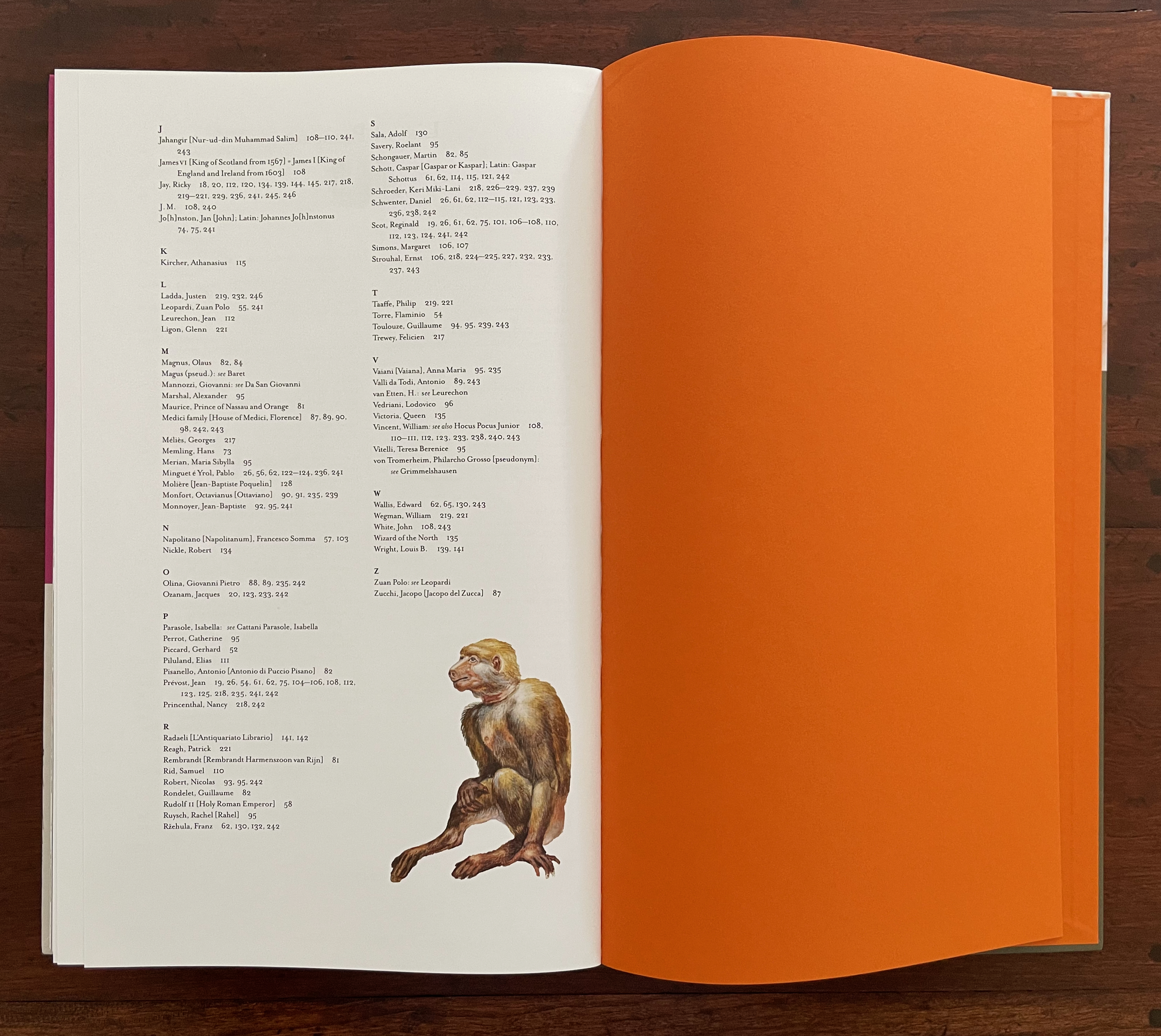
Stauss notes that art historian Nancy Princenthal looked at Jay’s The Magic Magic Book and wrote in 1996 of the blow book from an art historical perspective, but he notes it only in passing. Princenthal was dismissive of any kinship between the blow book and book art:

The magic book has only an incidental kinship to elaborately structured bookworks built around accordion folds and gatefolds, cutouts and pop-up elements, whether historical or contemporary (as in the recent work of Scott McCarney, Clifton Meador, Margot Lovejoy, or Carol Barton). — Princenthal, p. 186.

Stauss underplays his alert observation of two 21st century blow books that are works that Princenthal’s roll-call of book artists would appreciate. The first is Horst Antes’ Flickbuch (2000); the second, Julie Chen’s & Keri Miki-Lani Schroeder’s Book of Hours (2021). Both of these works — as well as Jay’s two-volume set and the other serious contemporary blow book Stauss mentions, Ernst Strouhal’s Gespräch mit einem Esel (2019) — are in the Books On Books Collection. As with all of the other chapters, the photography illustrating these works is superb. They will entice institutional and individual collectors of artists’ books.
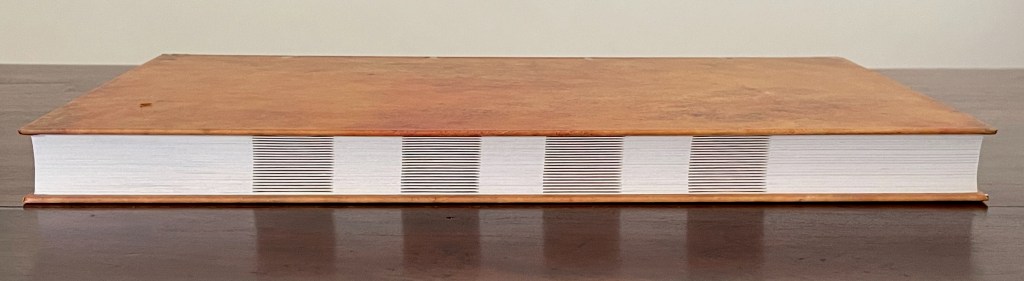
A side view of a closed book with a textured brown cover and a white spine featuring alternating striped patterns.

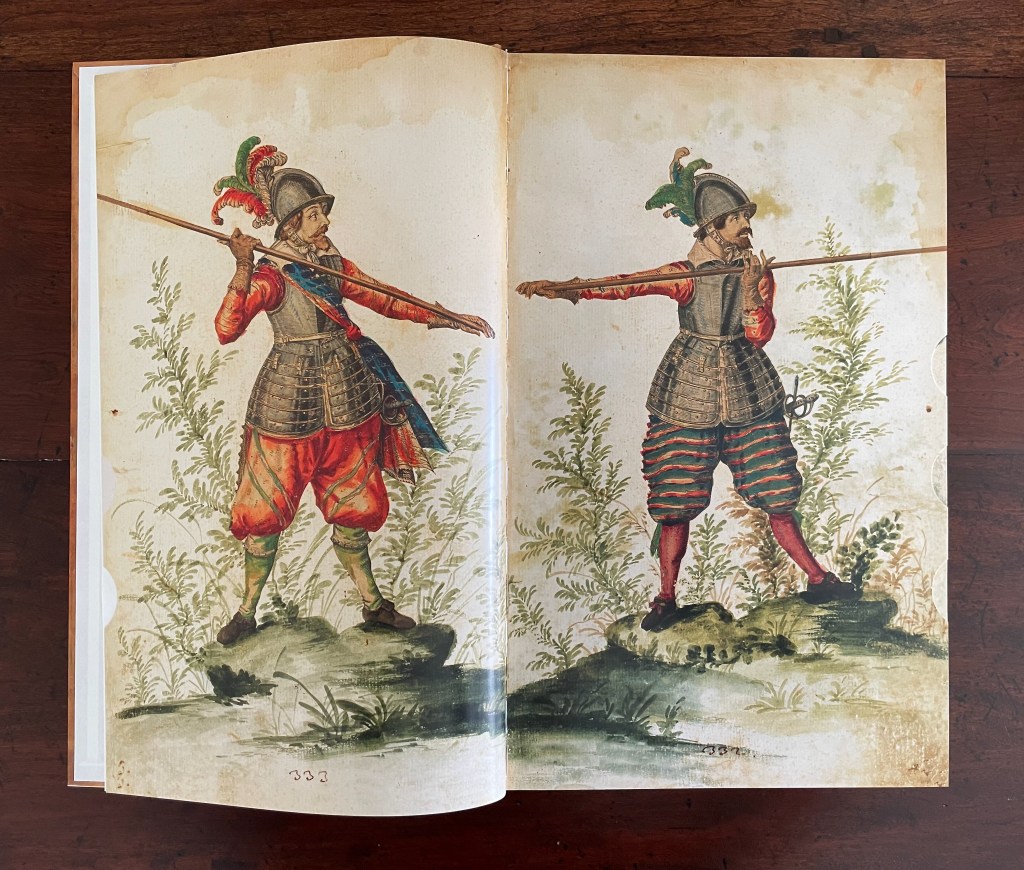
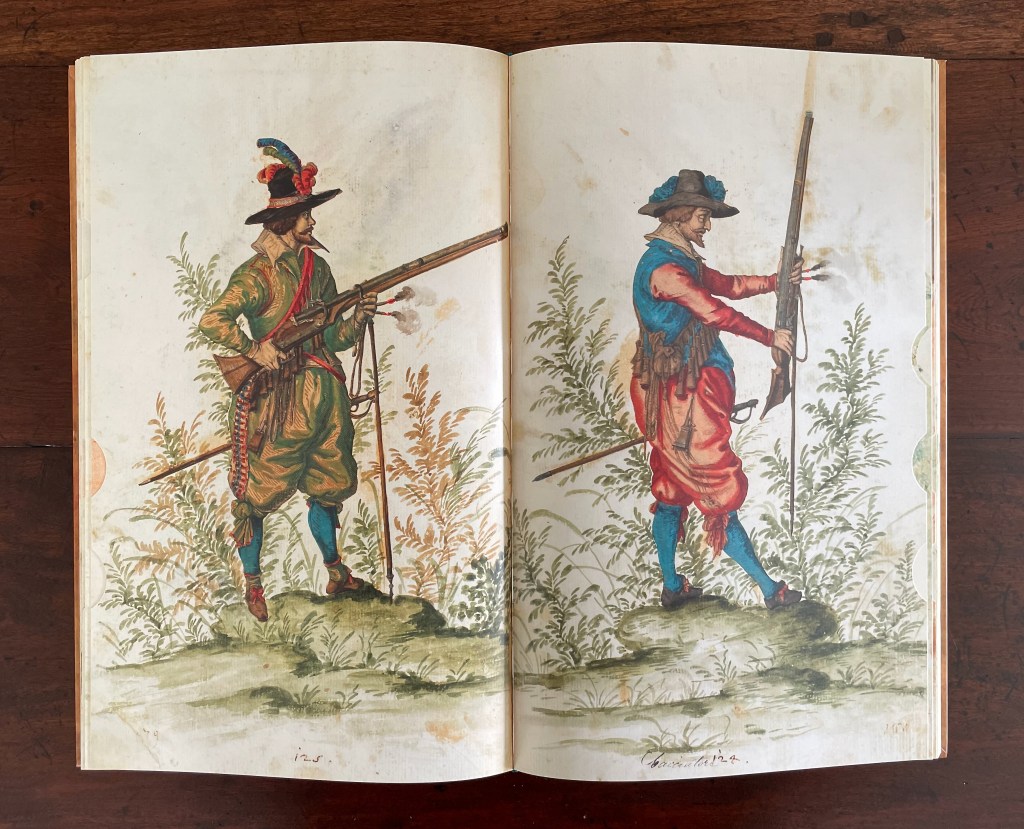
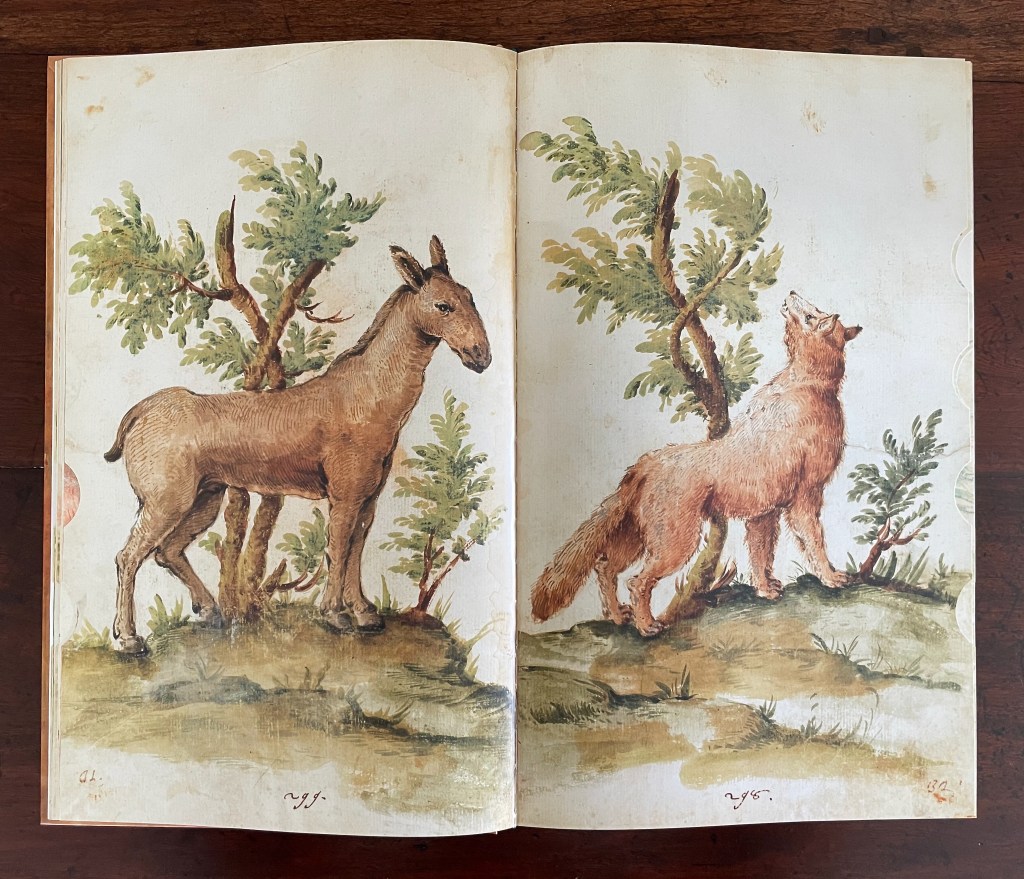
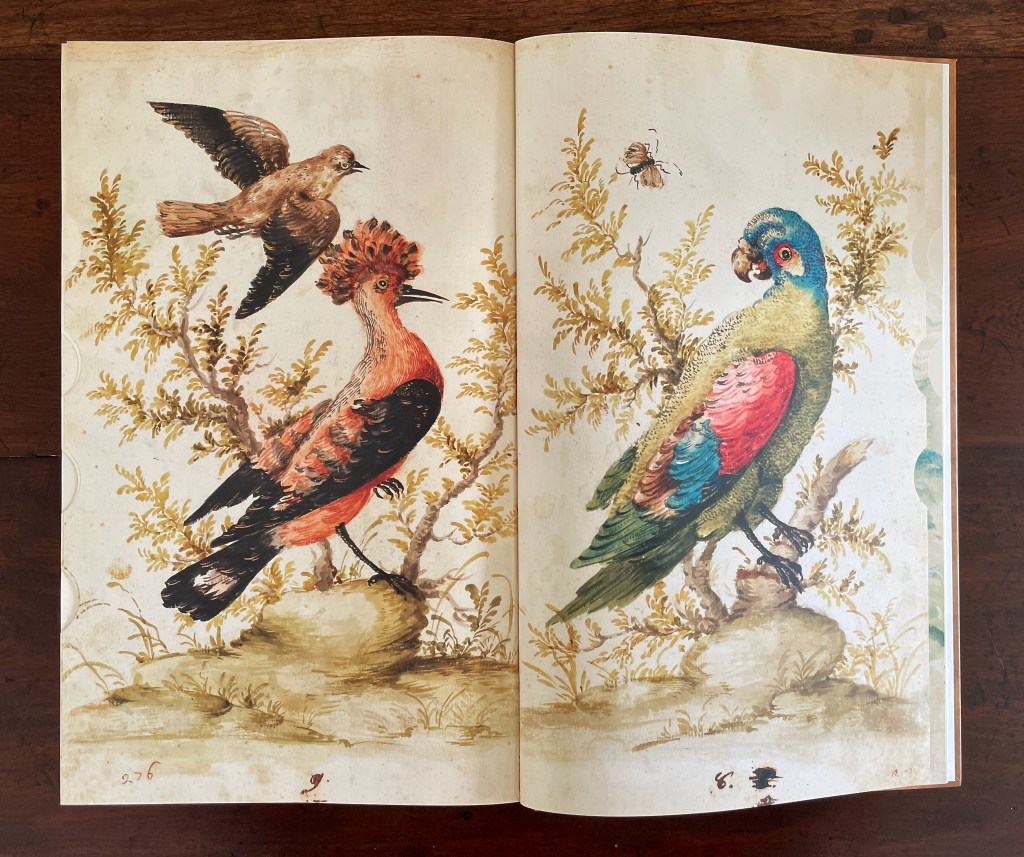
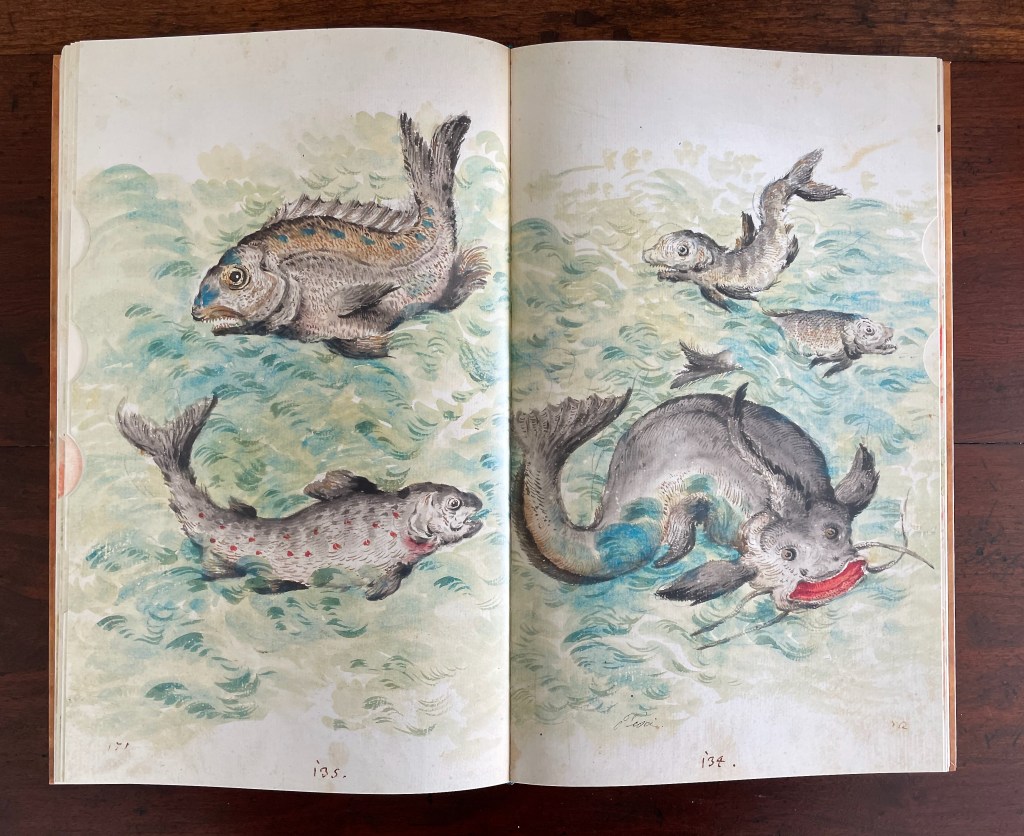
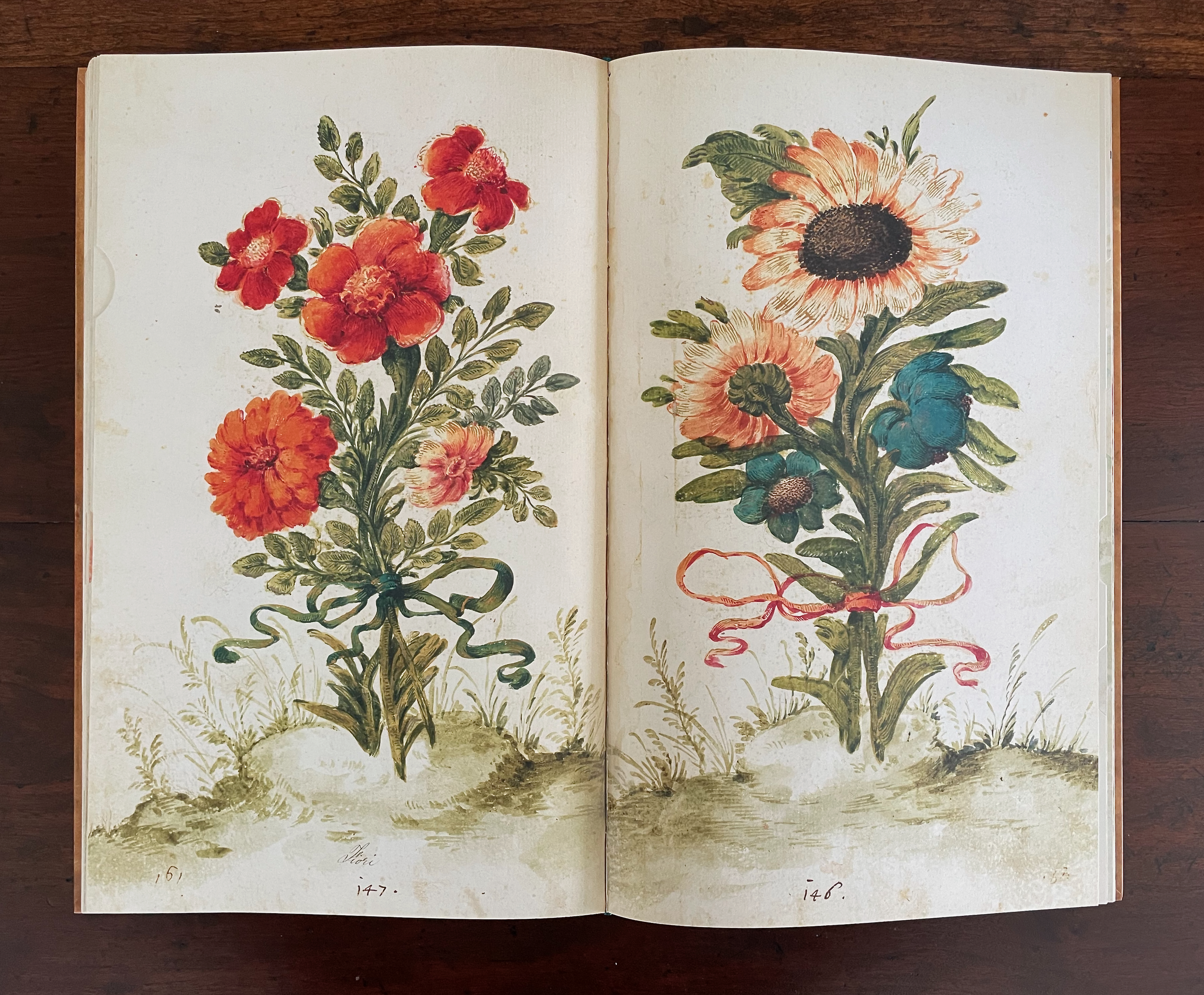
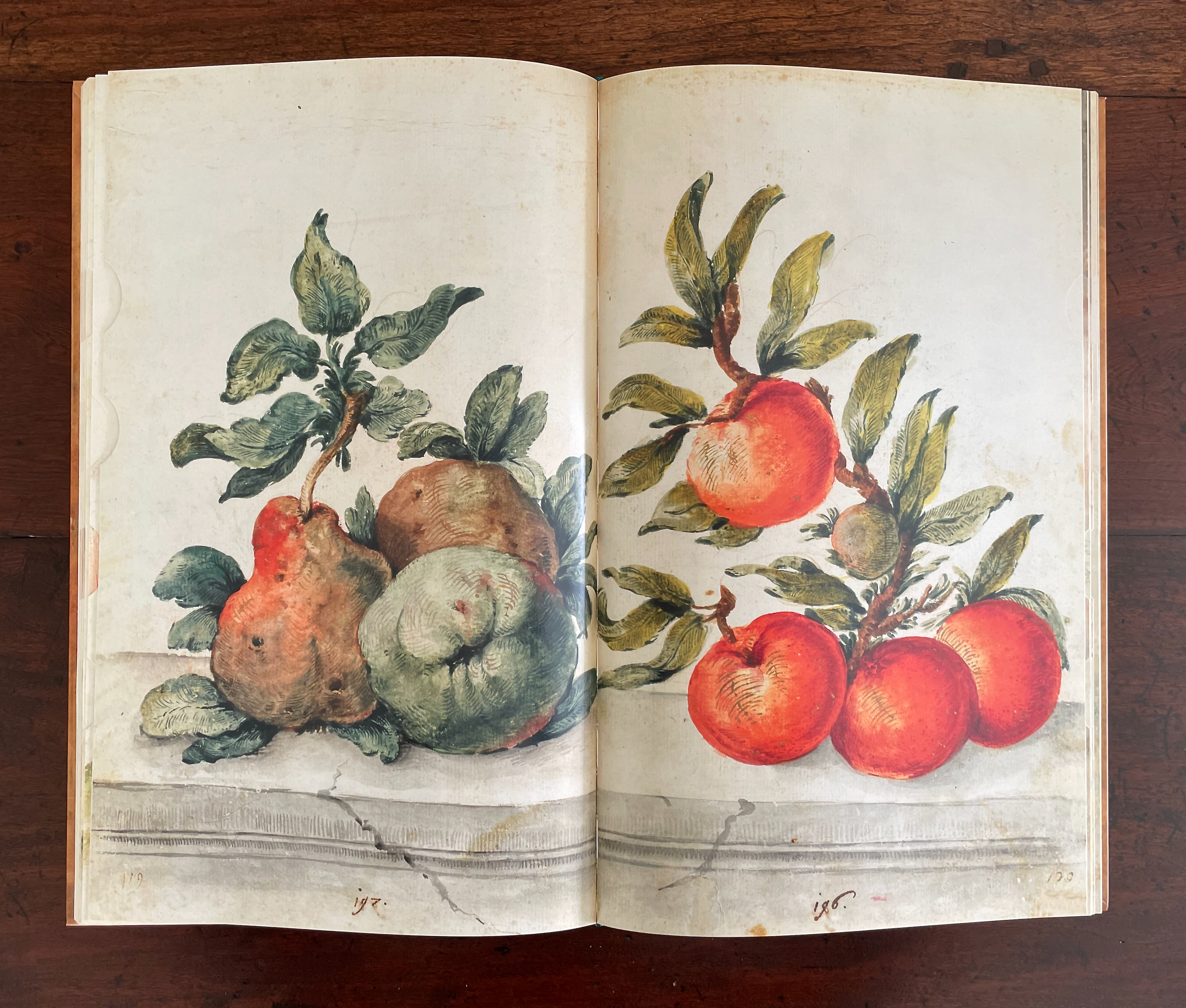
Including the spread of blank pages, there are eight transformations. Their printing order is 1) the spread of blank pages, 2) demons, 3) pike men and musketeers, 4) land animals, 5) birds and insects, 6) sea creatures, 7) fruit and vegetables, and 8) bouquets of flowers. Their order in performance would depend on the performer’s patter like that of Simplicius or Hopalong from the picaresque novel by Grimmelshausen, which Stauss excerpts in chapters two and four of the explanatory volume. Most likely, the performer would flip through the book showing only blank pages; then after blowing on the book, the performer might display spread after spread of bouquets of flowers; or with another magical breath, a variety of sea creatures.
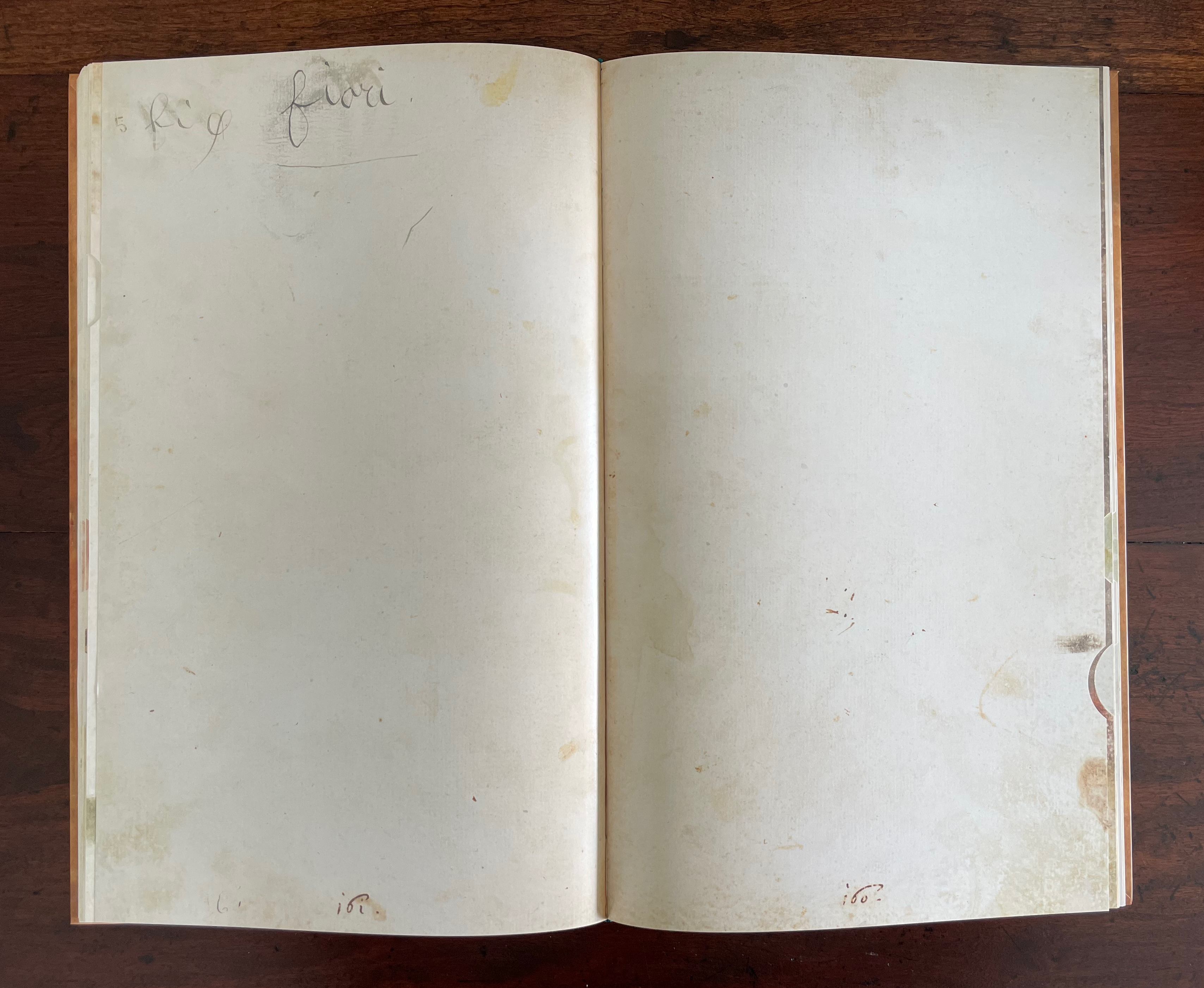
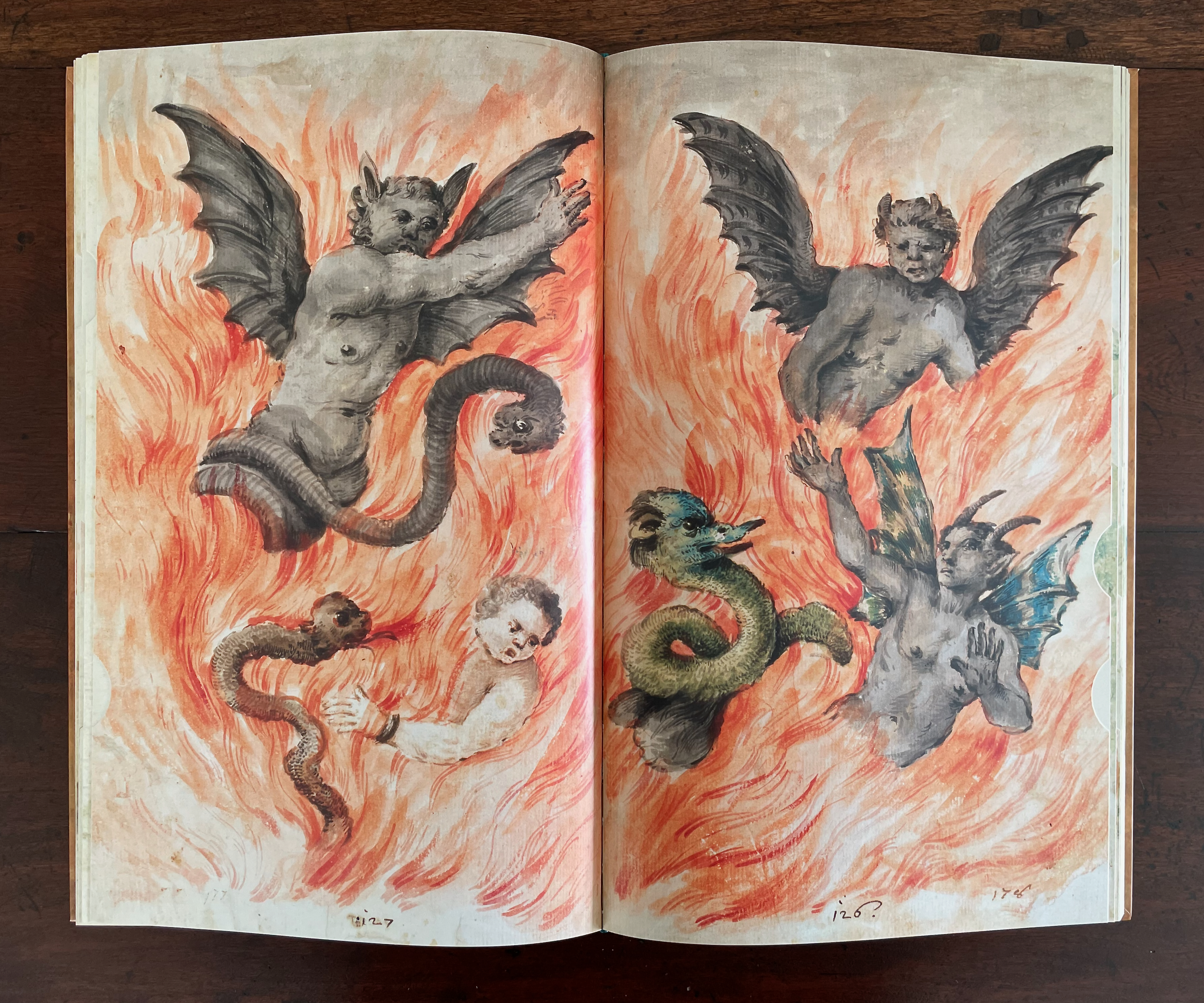
Collections that specialize in art history and book history will be drawn by both the explanatory and facsimile volumes in this definitive work. Hopefully, book artists will find their way to it for inspiration toward many more magical metamorphoses.

Further Reading and Viewing

“Horst Antes“. 2 September 2026. Books On Books Collection.

“Julie Chen & Keri Miki-Lani Schroeder“. 27 May 2025. Books On Books Collection.

“Ricky Jay“. 2 September 2026. Books On Books Collection.

“Nicholas Phillips“. 11 August 2020. Books On Books Collection. Phillips’ Egyptian Cards demonstrate a multiple image changes in a deck of cards.

“Ernst Strouhal“. In progress. Books On Books Collection.

Aling, Michael. n.d. “Publishing as Architectural Practice“. University of Greenwich. Architectural book designer Michael Aling put the “blow book” principle to work in Negative Equity: House Projects by Neil Spiller & Nic Clear. By adjusting the trim, Aling makes the book display only spreads with Spiller’s work if the codex is flicked through with the right thumb and only Clear’s spreads if flicked through with the left thumb. P. 6, Fig. 2.

Grimmelshausen, Hans Jakob Christoph von. 1981. The Singular Life Story of Heedless Hopalong. Translation by Robert Ludwig Hiller and John C. Osborne. Detroit: Wayne State University Press.

Grimmelshausen, Hans Jakob Christoffel von. 1670. Der seltzame Springinsfeld.

Princenthal, Nancy. 1996. “Now you see it, now you don’t : the magic, magic book“. Parkett. 47: 184-91.

Schroeder, Keri Miki-Lani. 24 May 2025. “Smoke & Mirrors: Using Stage Magic in Book Arts“. American Bookbinders Museum, San Francisco, CA. Video of webinar. “Magicians have been using illusionary techniques for centuries to intrigue or trick audiences. Many principles of stage illusions are relevant to book arts: sequencing and timing, hiding and revealing information, and curating an experience for the audience. In this talk I will discuss the connections between stage magic and illusionism to book arts. We will start with an overview of historical tricks and devices focusing on structures such as the magic blow book, magic wallet, and volvelles. I will reveal tricks of the trade and how I have researched and incorporated elements of magic to conjure creative content in my work and collaborations.”

Credits for Photographs in Magic Metamorphosis:

The page numbers given below refer to the pagination in Stauss’s Magic Metamorphosis:

[8]: Turgo map of Paris (1739): akg-images (AKG3090703).

[14]: From Huber, Volker & Antes, Horst. 2003 (p. 8). Fresh Breath on the Blow Book. Humble (Texas).

29: akg-images (AKG 573051)

60: University Library Basel (UBH HA II 2 Folio).

[100]: Houghton Library, Harvard University,
Cambridge, Massachusetts (MS Typ 530, p. 276)

116: Baden State Library, Karlsruhe (KK 408).

138, 158–159: New York Public Library (Spencer Collection MS. 180).

[216]: Zurich University of the Arts (9900-102).

Photographs from the original album Disegni Antichi Bizzarri: University Library, Basel (Switzerland)
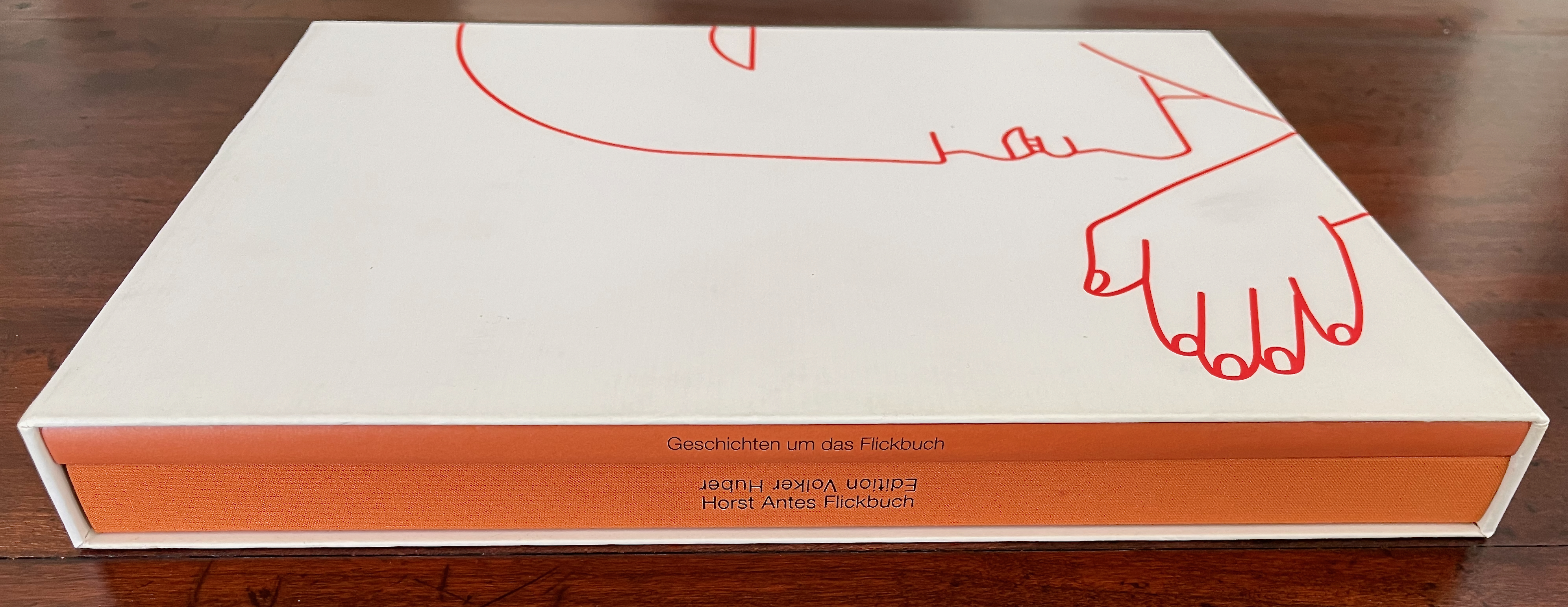
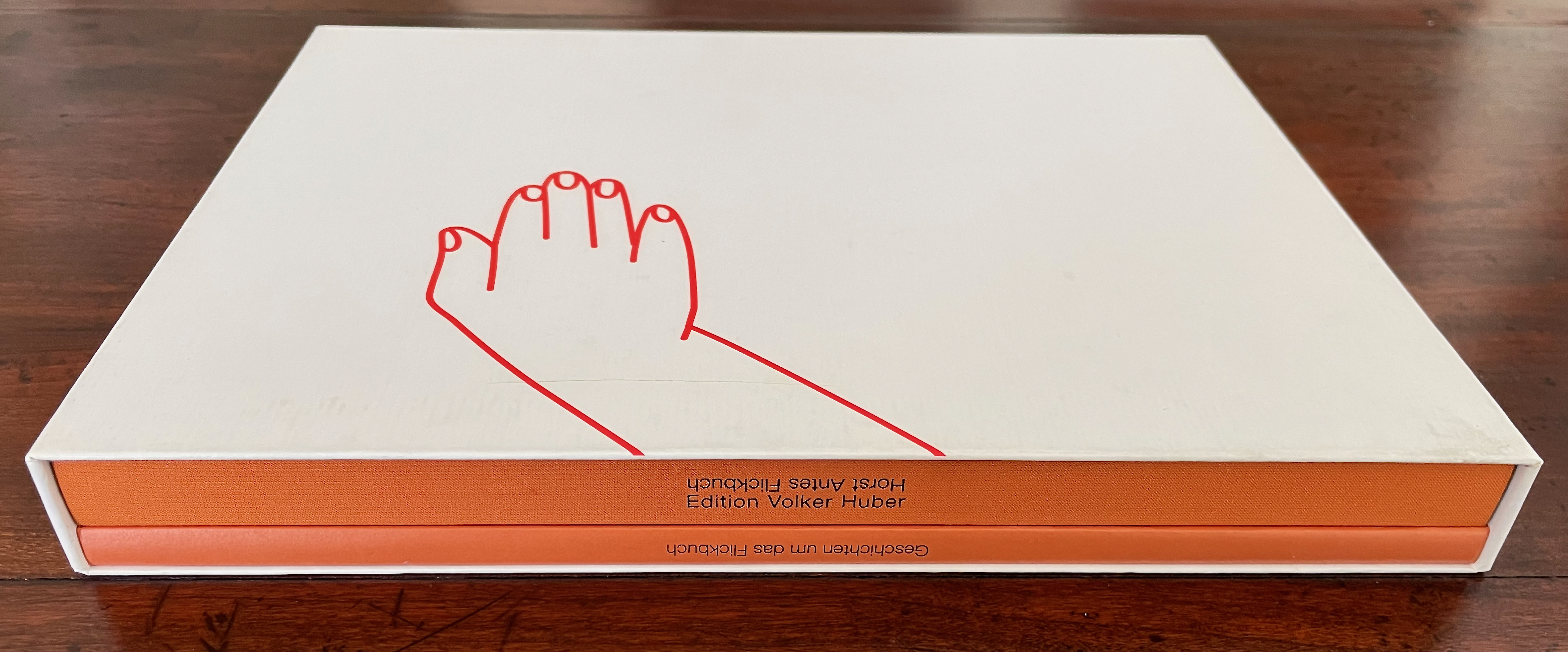
Books On Books Collection – Horst Antes

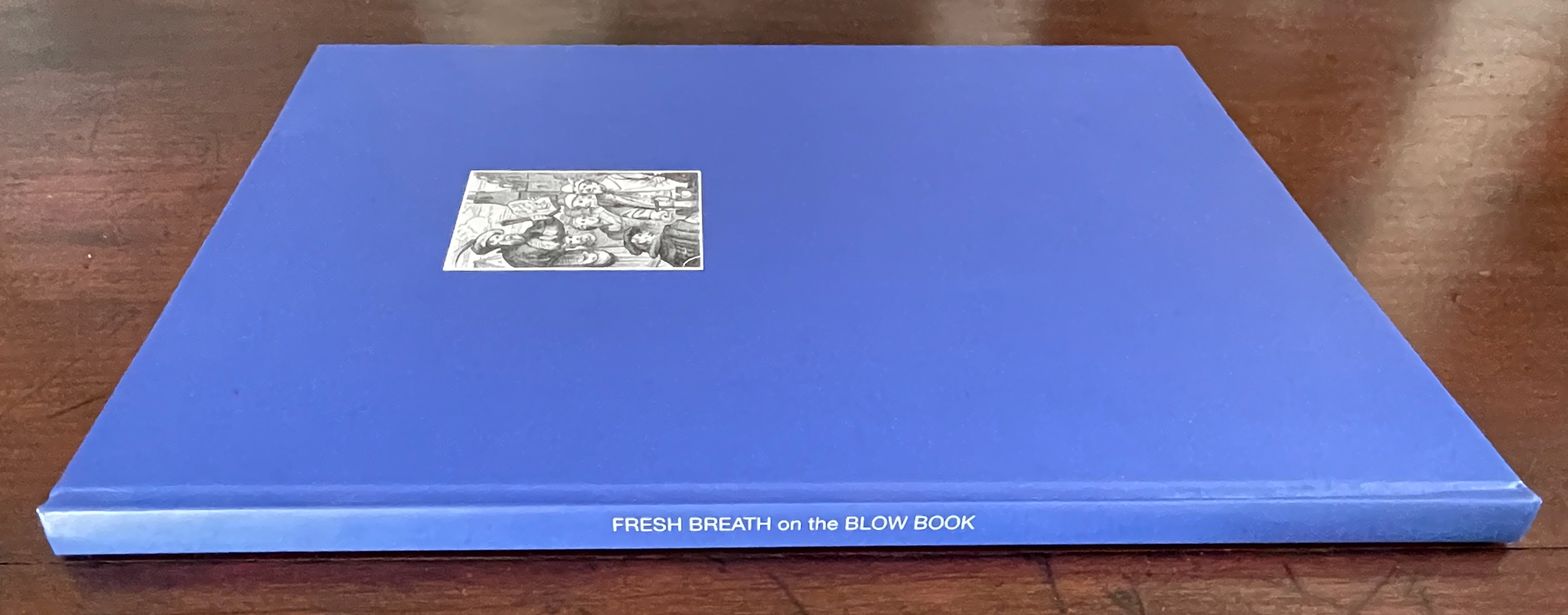
Flickbuch, Geschichten um das Flickbuch, and Fresh Breath on the Blow Book (2000, 2001, and 2003)

Flickbuch, Geschichten um das Flickbuch, and Fresh Breath on the Blow Book [trans] (2000, 2001, and 2003)
Horst Antes and Volker Huber [Translators: Ariel Frailich, Richard Hatch, and Sharon and Arno Ziesnitz]
Slipcase containing two volumes in German. Single volume in English. Slipcase: H276 x W212 mm. Books: H269 x W209 mm. [164] and 32 pages. Translation volume: H268 x W209 mm. 40 pages. Slipcased edition of 1000, unnumbered copy. Acquired from Ricky Jay Estate, 17 August 2024.
Photos: Books On Books Collection.

I had been looking for Ricky Jay’s The Magic Magic Book (1994) and hoped that the 2024 estate auction would yield a result. It did but an unexpected one. Like Jay, the namesake founder of Volker Huber Edition und Galerie in Offenbach was a collector of magic artifacts. He was also an honorary member of Germany’s Magic Circle, so his acquaintance with the celebrated magician and actor was no surprise. What was a surprise was that he had combined his art interests with those in magic to create a “blow book” with Horst Antes, one of the several well-known German artists he published.

The blow book is best known in its familiar incarnation as the “magic coloring book”. The performer flicks through the book of blank figures to be colored in, calls on an observer to blow on the closed book, and then reopens it to show all of the pictures colored in. Hard-to-see tabs or alternating page widths enable the performer to produce the effect. Jay’s work remains the definitive history of the blow book. It consists of two volumes, one of which is a working blow book with contemporary art by Vija Celmins, Jane Hammond, Glenn Ligon, Philip Taaffe, and William Wegman, the other being the history of the apparatus.

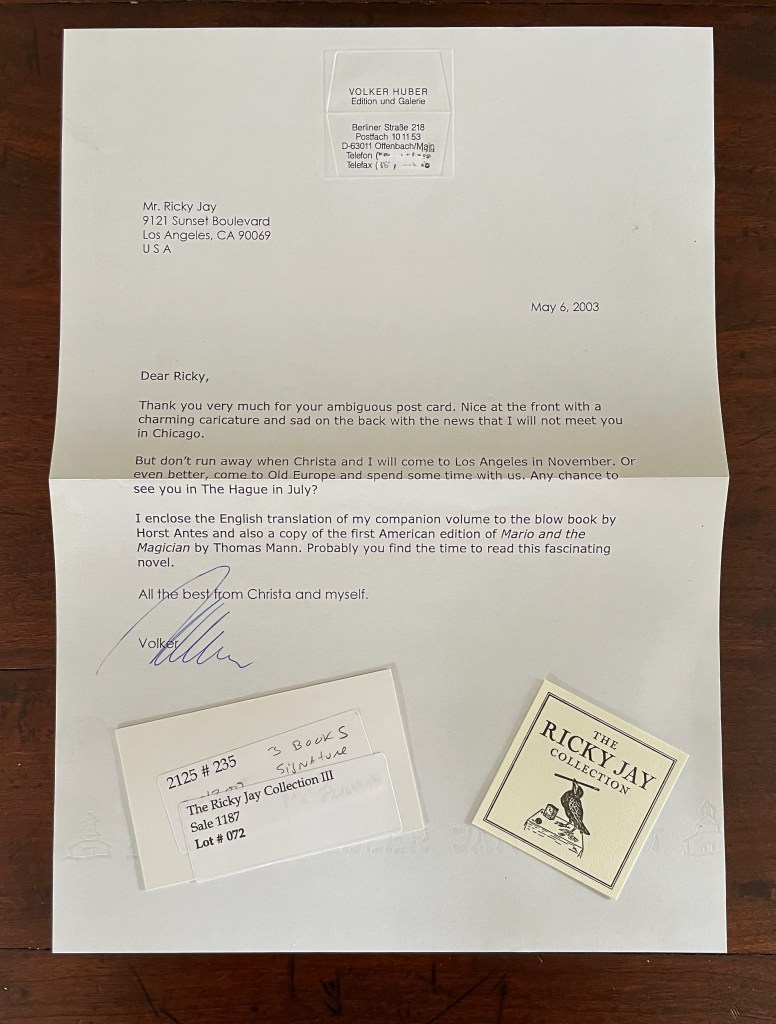
A handwritten letter addressed to Mr. Ricky Jay, dated May 6, 2003, from Volker Huber, expressing gratitude for a post card and discussing upcoming visits. Below the letter are two items: a small card related to 'The Ricky Jay Collection' and another card labeled with details about a sale.

Huber leads the list of acknowledgments in Jay’s book. From that and this piece of ephemera, there is no doubt of their close acquaintance. If, however, you have read the New Yorker profile on Ricky Jay, Huber’s reference to Jay’s “ambiguous post card” will raise an eyebrow. Both Jay’s and Huber’s productions are slipcased, both are in two volumes, both have a working blow book, and both have an accompanying history. Given the New Yorker anecdote about Jay’s harsh reaction to a magician who mentioned he had incorporated Jay’s famous “The Four Queens” routine in his act, might Jay’s “ambiguous post card” have implied that Huber had reperformed Jay’s book trick?

Huber’s Geschichten um das Flickbuch [“History of the Blow Book”*] naturally cites Jay’s book. But it has many of the same illustrations. Unsurprisingly it equally highlight the same source for the first detailed description of the blow book. The main difference is that Huber argues for the existence of a missing blow book that would have accompanied the source, whereas Jay considers it unlikely. As for the working volumes, both have dos-à-dos structures. Admittedly there are differences. Jay uses tabs to facilitate the performer’s switch from sequence to sequence; Huber uses a sloping trim of width. Jay’s has twelve sequences, six to each side of the dos-à-dos; Huber and Antes have only four, two to each side. Might Jay have been a little jealous that those differences are what give Huber and Antes the room to elevate the blow book from a worked example to an artist’s book?

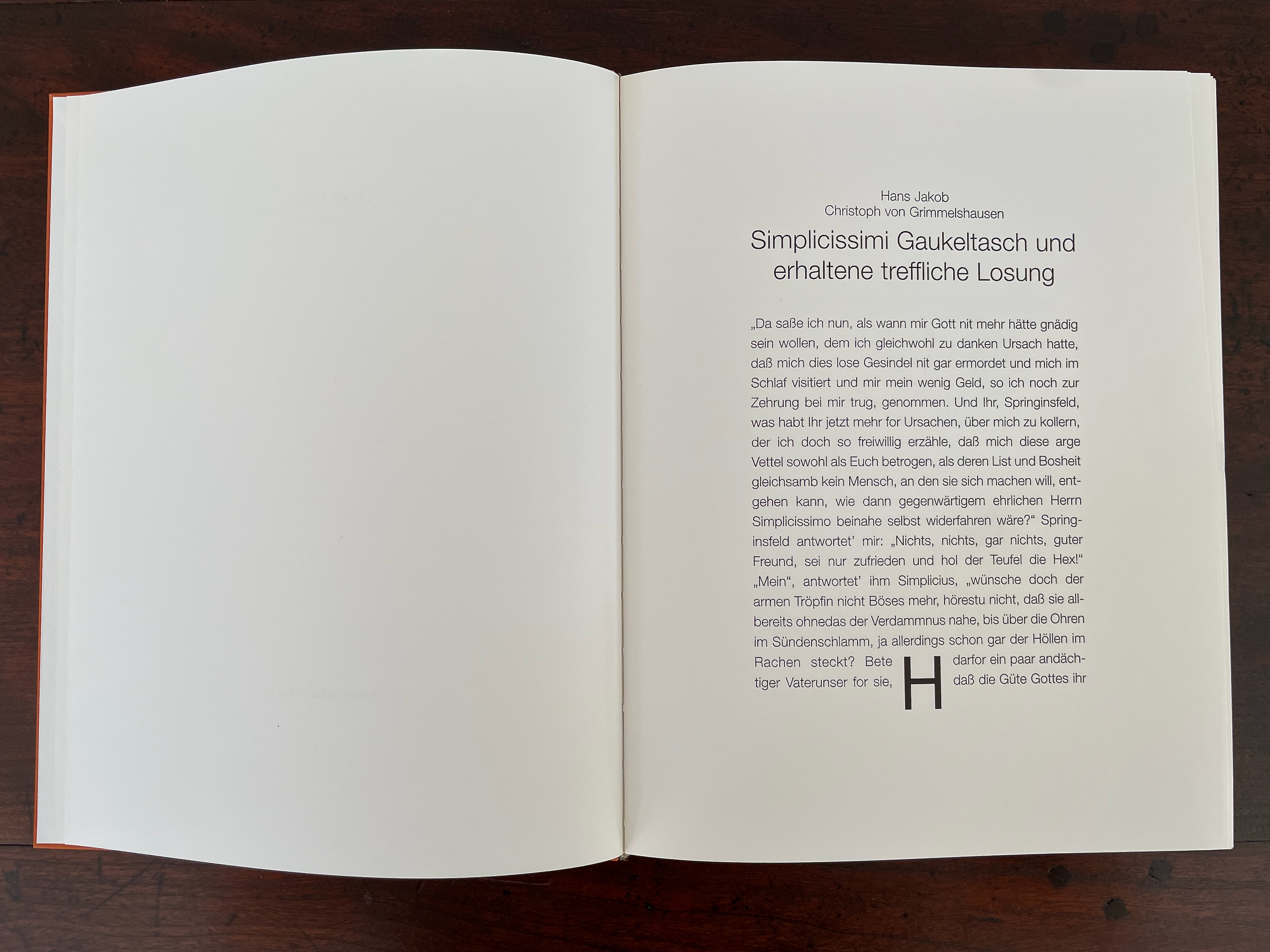
Holding the spine of Flickbuch with the left hand and placing the right thumb against the lower corner of the fore edge, the reader/performer riffles through the book. Twenty pages flip along, displaying the text of three selections from the mid-17th-century picaresque novel by Hans Jakob Christoffel von Grimmelshausen entitled “Simplicissimi Gaukeltasch und erhaltene treffliche Losung” [“Simplicissimus’ Magic Book and its Excellent Profits”]. At the bottom of the text block on each page, a large display letter appears: first H, then O, gradually spelling out HORSTANTES-FLICKBUCH. It is a clever way of appropriating the Simplicissimus tale for Antes.

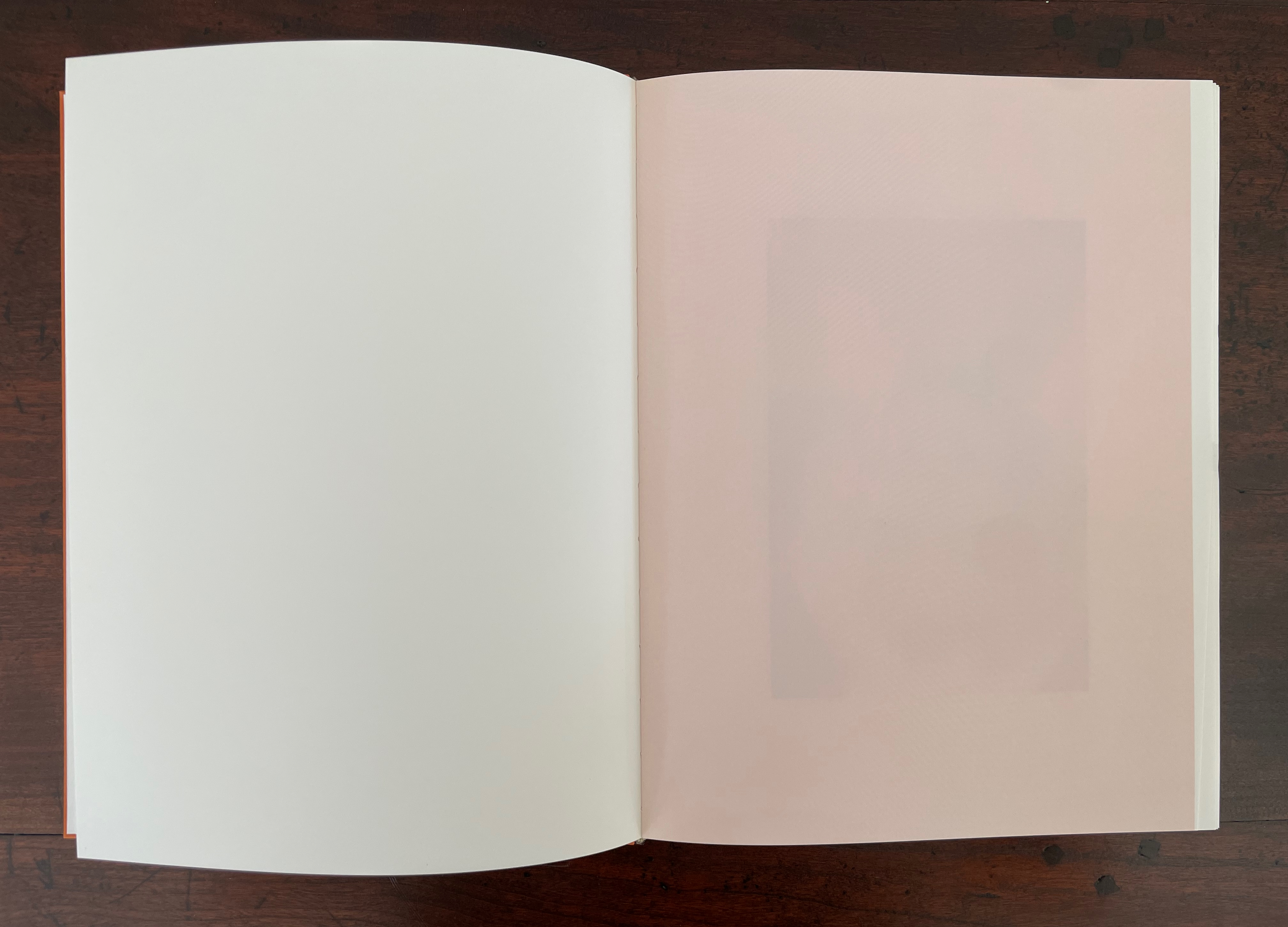
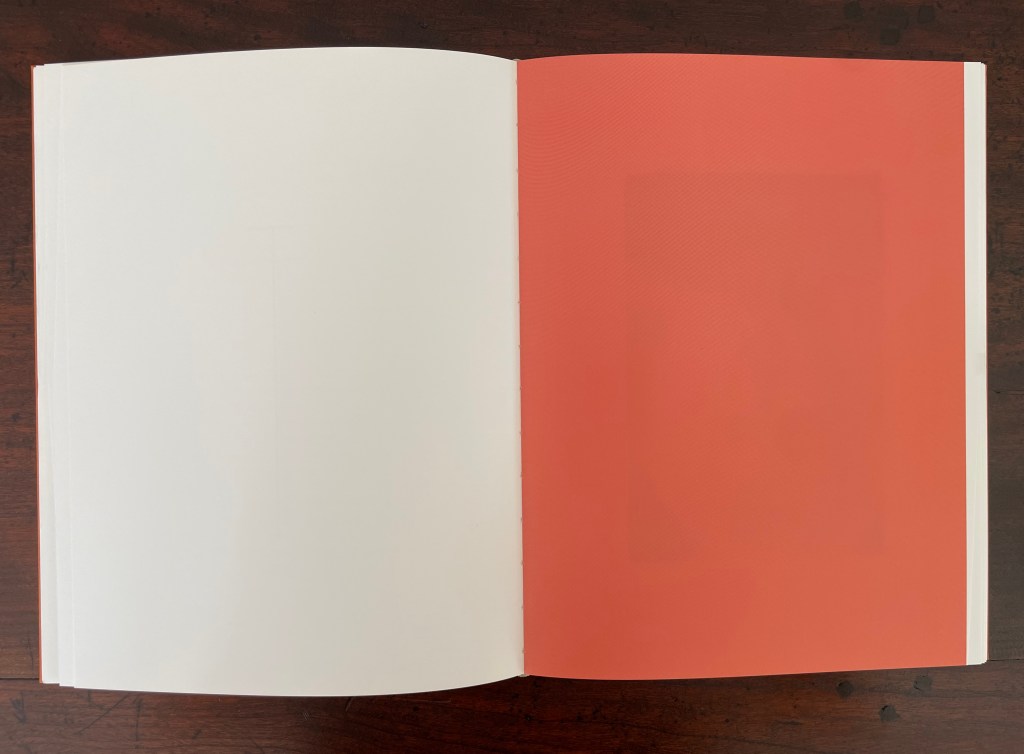
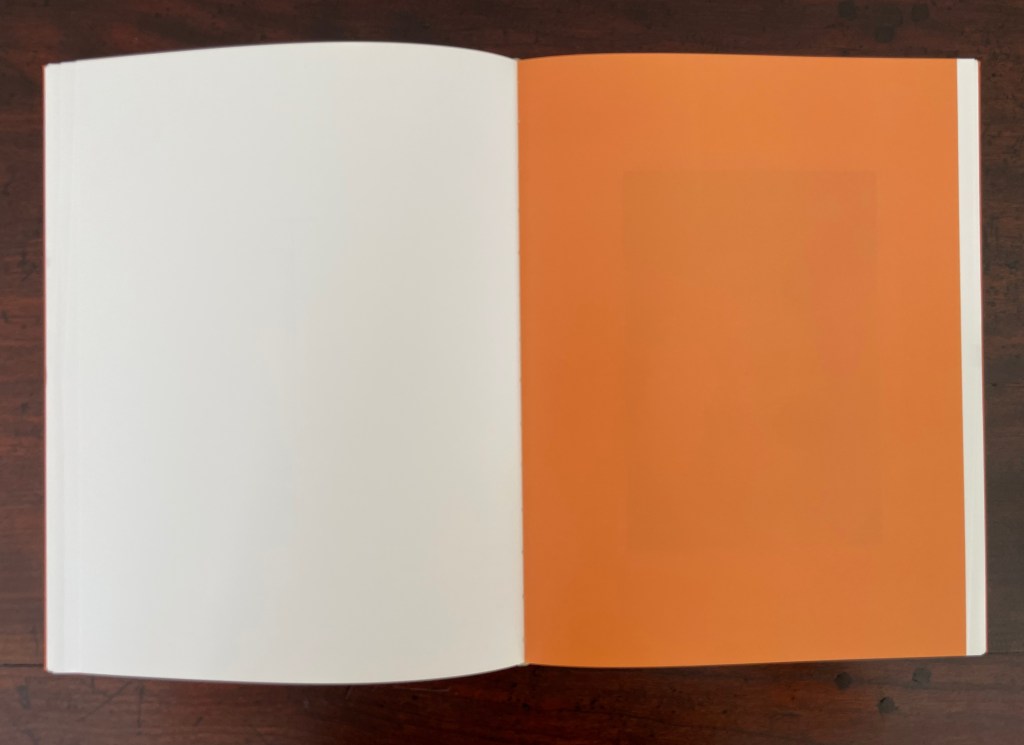
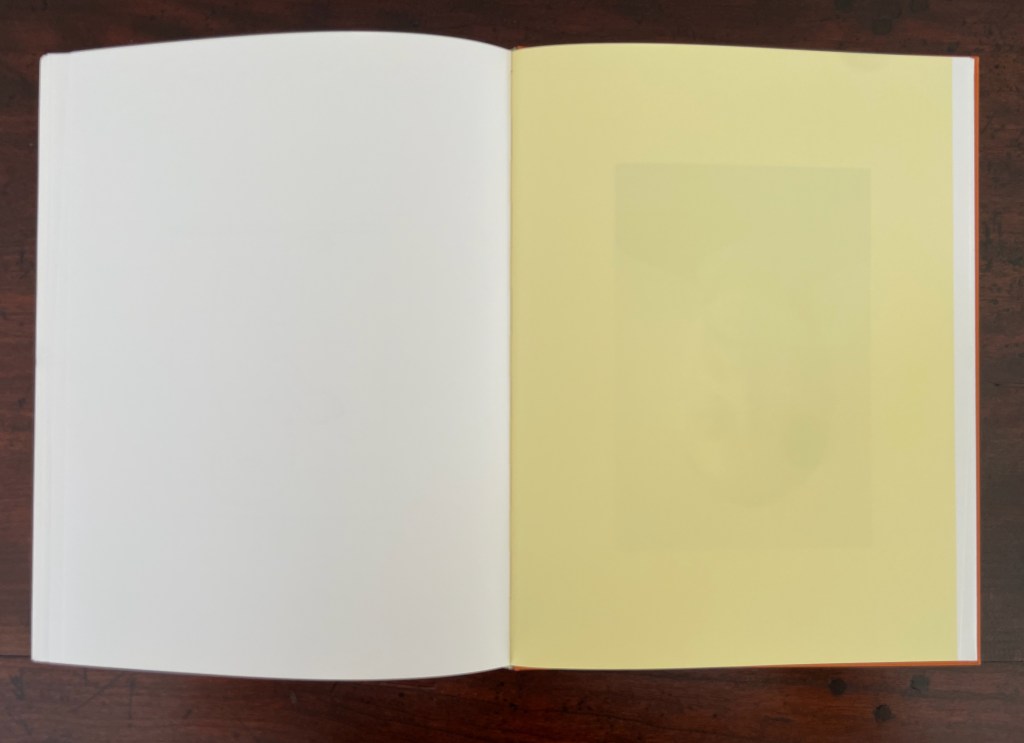
The next flick-through sequence is accessed by closing the book, shifting the right thumb to the upper corner of the fore edge, and again riffling through the book. “Magically” the text has disappeared, replaced by blank pages that change colors, gradually darkening from a light pink to coral to orange then lightening to yellow. This is another appropriation of the Simplicissimus tale. In the just-vanished text, Simplicissimus, the con artist, has arrayed six glasses of wine before the crowd of dupes gathered by his blow book patter. By adding one drop of magic elixir to the first glass, he changes the wine’s color and quality. The second glass receives two drops, the third three drops, and so on until Simplicissimus and his sidekick Hopalong are relieving their audience of their money in exchange for tins of the elixir that they believe will turn casks of plonk into the finest vintage.

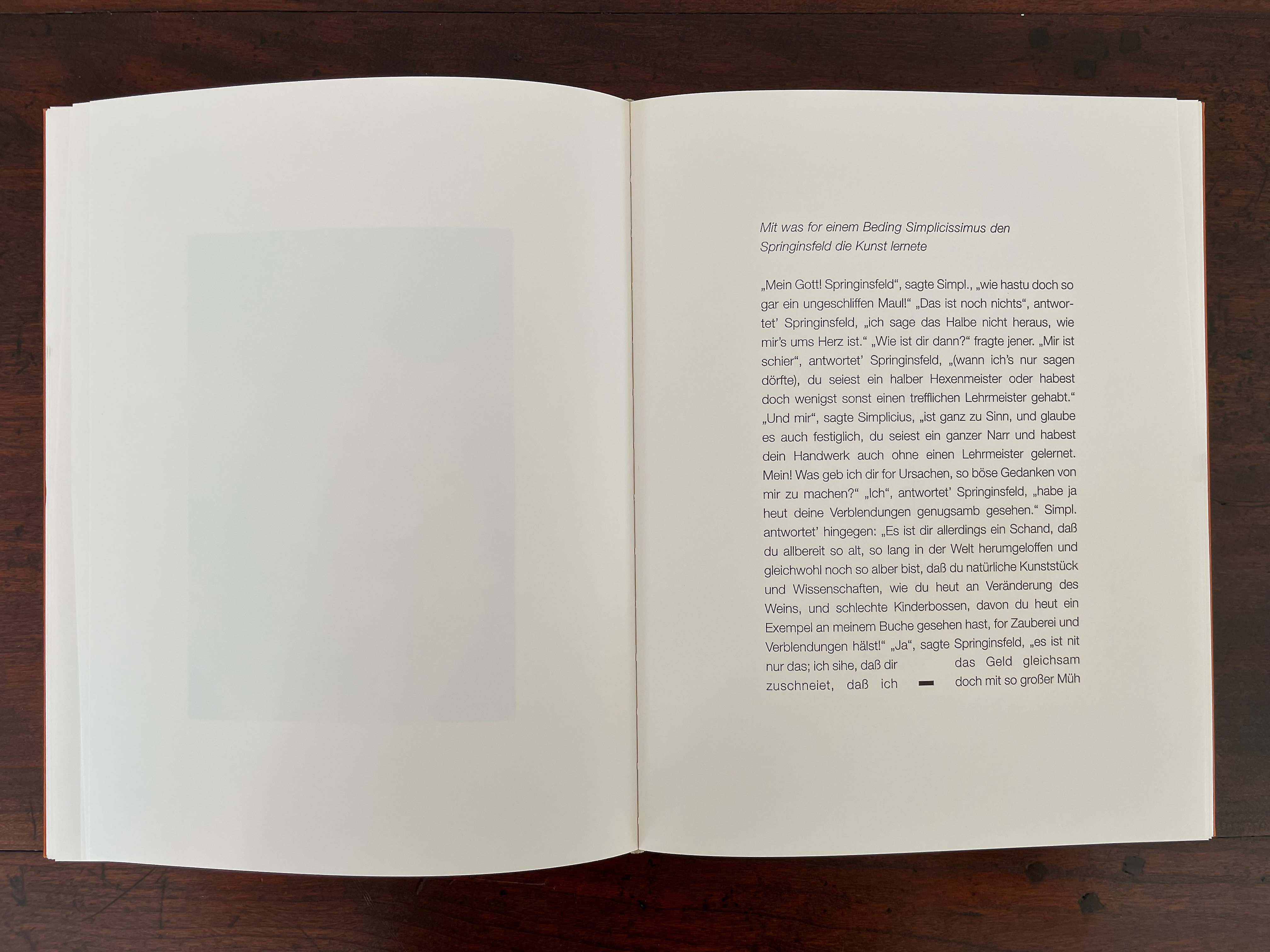
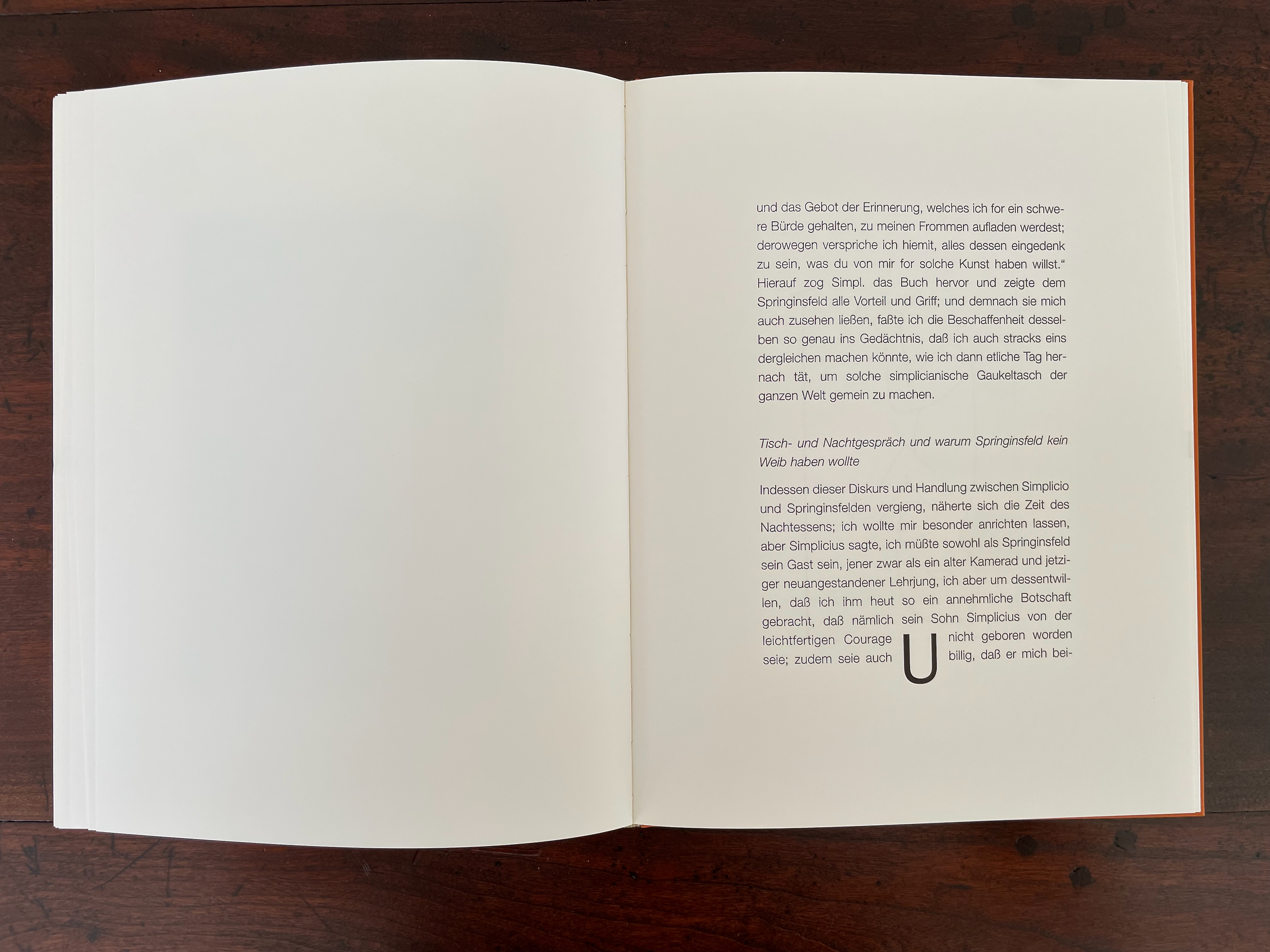
The opening pages of the three Simplicissimus excerpts. Note the display characters H, -, and U, three of the twenty that spell out HORSTANTES-FLICKBUCH.

The first, ninth, eleventh, and last spreads of colored blank pages.

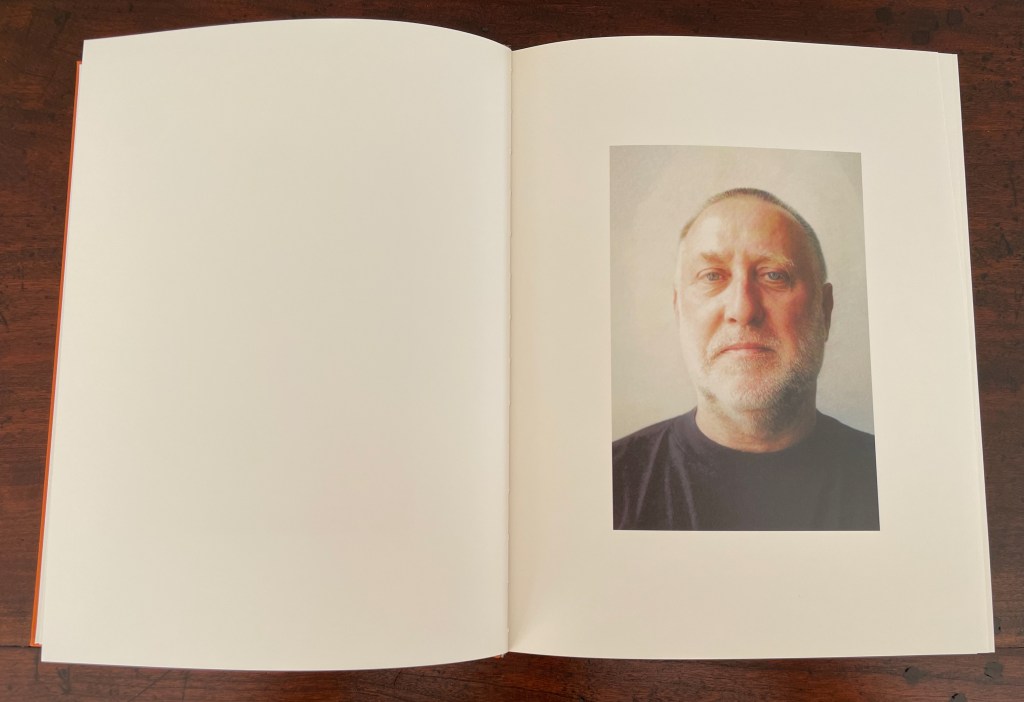
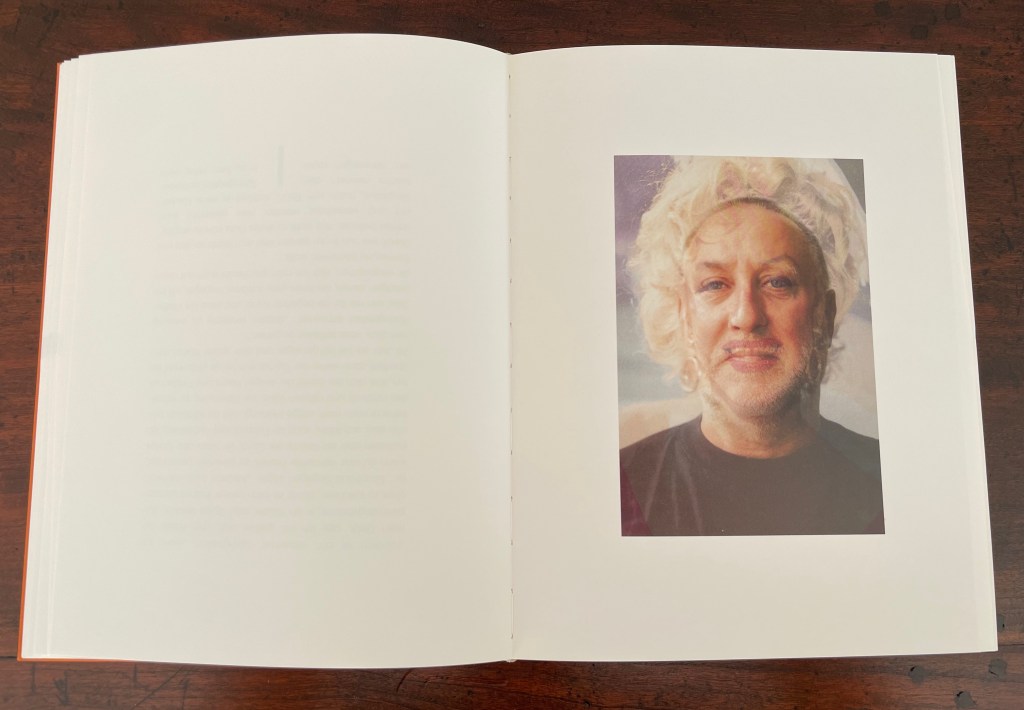
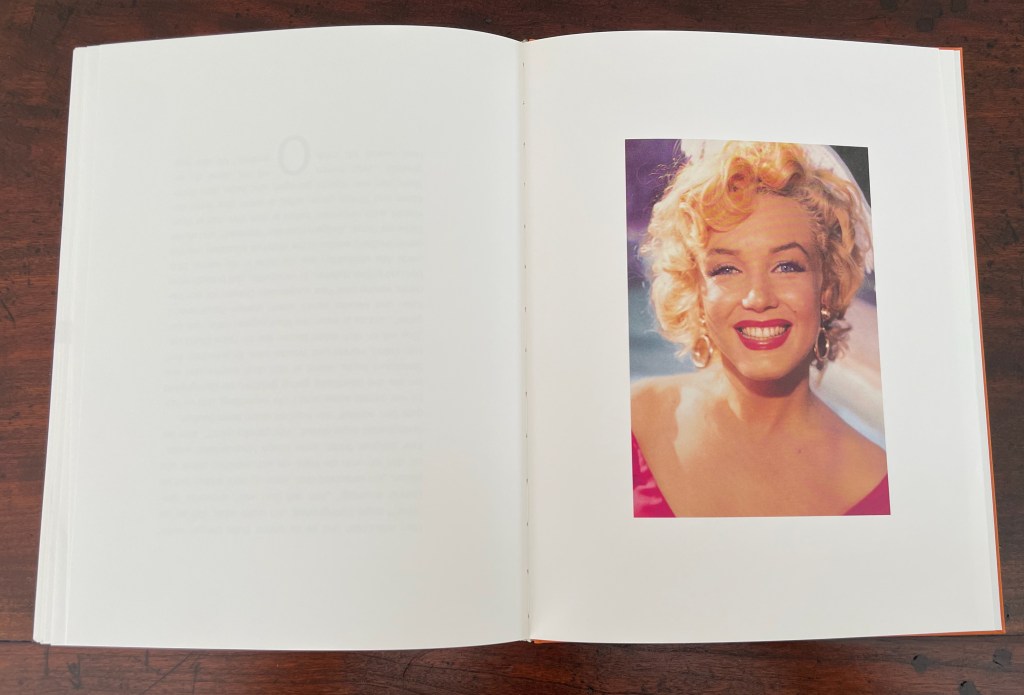
On the other side of the dos-à-dos structure, the first flick-through’s sequence of twenty images has Antes’ face morphing into Marilyn Monroe’s. It’s a curious transformation. Perhaps it’s in keeping with the carnivalesque barker Simplicissimus, and after all, the color of the paper does change from cream to white as the artist turns into the bearded lady and the latter turns into Marilyn. The sequence’s twenty-page length facilitates the gradation of the change.

The first portrait image, the mid-point image, and the final image.

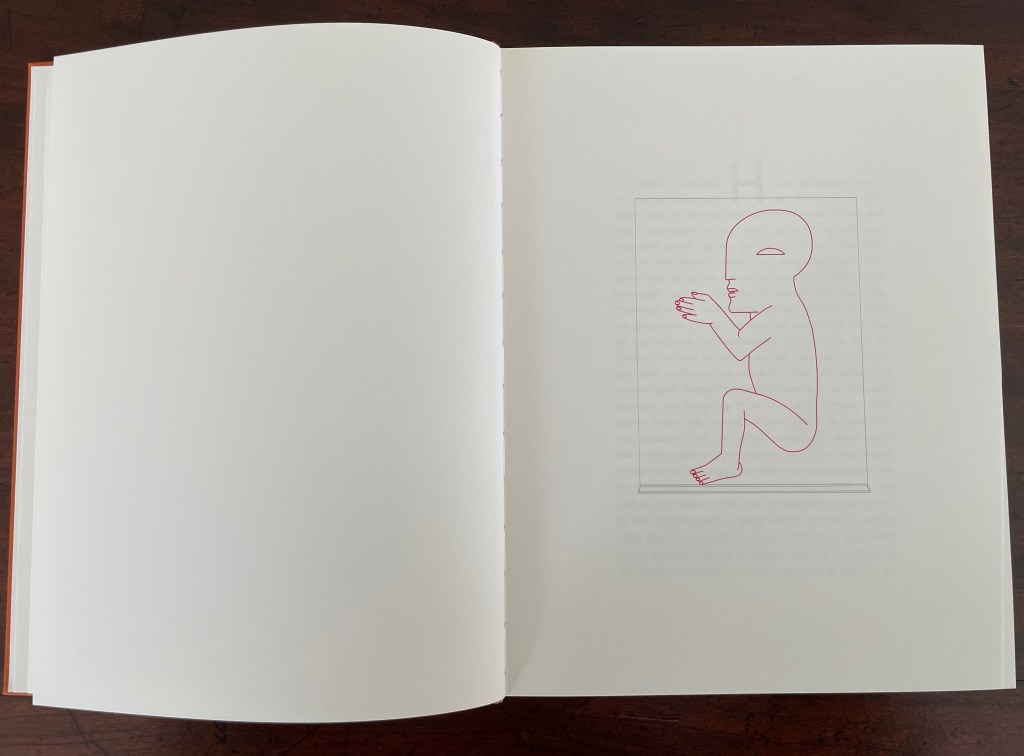
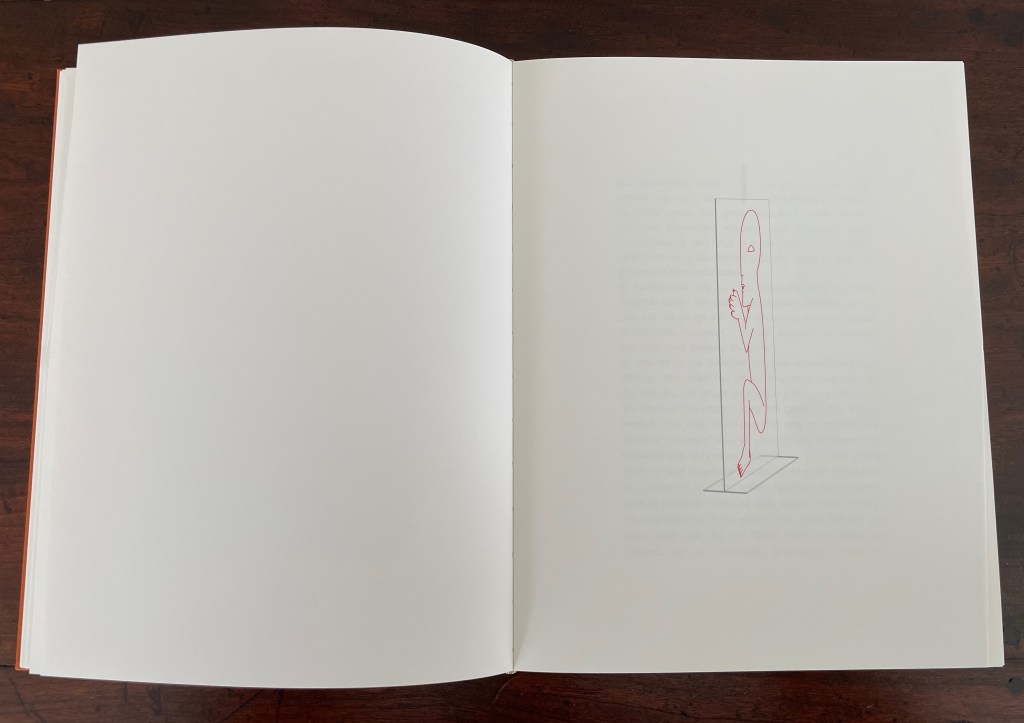
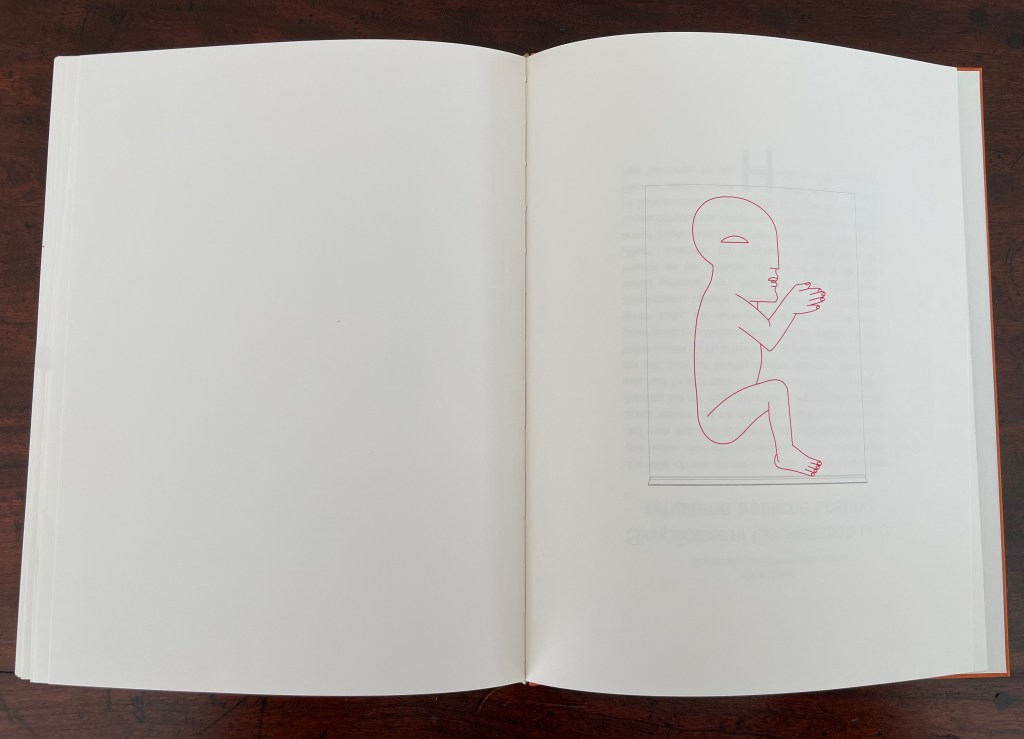
The second flick-through presents an ink drawing of one of Horst Antes’ clear acrylic sculptures called Die Figur (1995-97). A version of the sculpture rests in the rooftop foyer of Vienna’s Hofburg. Inscribed in a large plane of acrylic intersecting another plane of acrylic acting as its footing, Antes’ signature figure the Kopffüßler [“Head-Footer”] appears. In Flickbuch, the figure is drawn in red, and the plexiglas in grey ink. Across this flick-through’s twenty spreads, the drawing is animated, turning from the left, gradually showing an edge-on view, and ending up facing right. It captures Ante’s blend of the figurative and abstract for which he is known.

For some reason, Antes’ graphics often appear in German galleries alongside Andy Warhol’s images of Monroe, but here, perhaps it is a dig at Clement Greenberg. In the accompanying volume Geschichten um das Flickbuch, Huber explains how Antes’ work has been a counter-response to Greenberg’s avant gardist art theory that figurative, illusionistic painting belongs to a bygone era that has been superseded by high Abstract art that accepts and self-reflexively explores the nature of its two-dimensionality. In Huber’s view, Antes’ emphasis on two dimensions in his sculptures and paintings nevertheless restores the figurative and three-dimensionality to art, superseding Greenberg’s dicta.

Greenberg also placed photography as second fiddle to the self-reflexive and opaque surface of pure abstract painting.

The art in photography is literary art before it is anything else: its triumphs and monuments are historical, anecdotal, reportorial, observational before they are purely pictorial. Because of the transparency of the medium, the difference between the extra-artistic, real-life meaning of things and their artistic meaning is even narrower in photography than it is in prose. And as in prose, “form” in photography is reluctant to become “content,” and works best when it just barely succeeds in converting its subject into art—that is, when it calls the least attention to itself and lets the almost “practical” meaning of the subject come through. — Greenberg, 1964.

The photography in Flickbuch certainly calls attention to itself. Maybe using the flick book form to play with photos and allude to a literary text actually supports Greenberg’s formalism. Then again, the photography sequence seems to throw shade on another Greenberg polemic: his 1939 salvo for the avant-garde and against kitsch.

Kitsch, using for raw material the debased and academicized simulacra of genuine culture, welcomes and cultivates this insensibility. It is the source of its profits. Kitsch is mechanical and operates by formulas. Kitsch is vicarious experience and faked sensations. Kitsch changes according to style, but remains always the same. Kitsch is the epitome of all that is spurious in the life of our times. Kitsch pretends to demand nothing of its customers except their money—not even their time. — Greenberg, 1939.

There is something a bit tongue-in-cheek about this artist’s book and its creators. The idea of a blow book likely came from Huber to Antes. Together they must have enjoyed that spread placing the artist at one end of the spectrum and the image of Marilyn Monroe, goddess of high Pop and kitsch, at the other. Antes in particular must have enjoyed bringing the three-dimensional Kopffüßler into the two-dimensional confines of pages and, seizing on the blow book’s mechanics, creating a representational illusion of its original three-dimensional self, which of course emphasized an inherent two-dimensionality.

* The German term flichbuch translates as “flick book”. For most book historians and artists, that term and its alternates “flip book” and “flicker book” refer to the structure that creates an animation effect by gradually changing an image from one page to the next.

Further Reading

“Julie Chen & Keri Miki-Lani Schroeder“. 27 May 2025. Books On Books Collection.

“HAP Grieshaber“. 27 August 2023. Books On Books Collection.

“Ricky Jay“. 2 September 2026. Books On Books Collection.

“Nicholas Phillips“. 11 August 2020. Books On Books Collection. Phillips’ Egyptian Cards demonstrate a multiple image changes in a deck of cards.

Aling, Michael. n.d. “Publishing as Architectural Practice“. University of Greenwich. Architectural book designer Michael Aling put the “blow book” principle to work in Negative Equity: House Projects by Neil Spiller & Nic Clear. By adjusting the trim, Aling makes the book display only spreads with Spiller’s work if the codex is flicked through with the right thumb and only Clear’s spreads if flicked through with the left thumb. P. 6, Fig. 2.

Dunstan, Dominique. 10 October 2021. “Treasures of the Library: the magic of blow books“. State Library Victoria. Video.

Greenberg, Clement. 23 January 1964. “Four Photographers“. The New York Review.

Greenberg, Clement. 1939. “Avant-Garde and Kitsch.” Partisan Review. 6:5

Singer, Mark. 29 March 1993. “Secrets of the Magus“. New Yorker.

Stauss, Thomas. 2025. Magic Metamorphosis : The Secrets of a Rare Italian Picture Album Revealed. Basel: Librum Publishers and Editors LLC.