Books On Books Collection – Anja Lutz

Marginalia (2017)

Marginalia (2017)
Anja Lutz
Open back sewn spine with dust jacket 245 x 330 mm. 112 pages. Acquired from The Greenbox Press, 3 August 2022.
Photos: Books On Books Collection. Displayed with permission of the artist.

In 1964, the Fluxus artist George Brecht created a work called Book, which Michael Werner published in 1972 and which Moritz Küng reintroduced in facsimile in 2017. Also sometimes called This is the cover of the book, it proceeds to label each of the otherwise blank pages with its structural label: “These are the end pages of the book”; “This is the page before the title page of the book that tells you what the title is or was, or is going to be”; “This is the title page”; “This is the other side of the title page …” and so on. Like most self-referential or tautological artists’ books, it has its facetiousness. One page is labeled “This is the page with text on it”; another, “This the page that rustles when you turn it (maybe)”. Individual pages and perhaps the whole will lead to pauses to reflect on the thing being defined by labels and self-reference and how the mental funny-bone is being tickled. In the end, the structure or skeleton of the book as a thing — one thing — has been defined by the naming of parts.

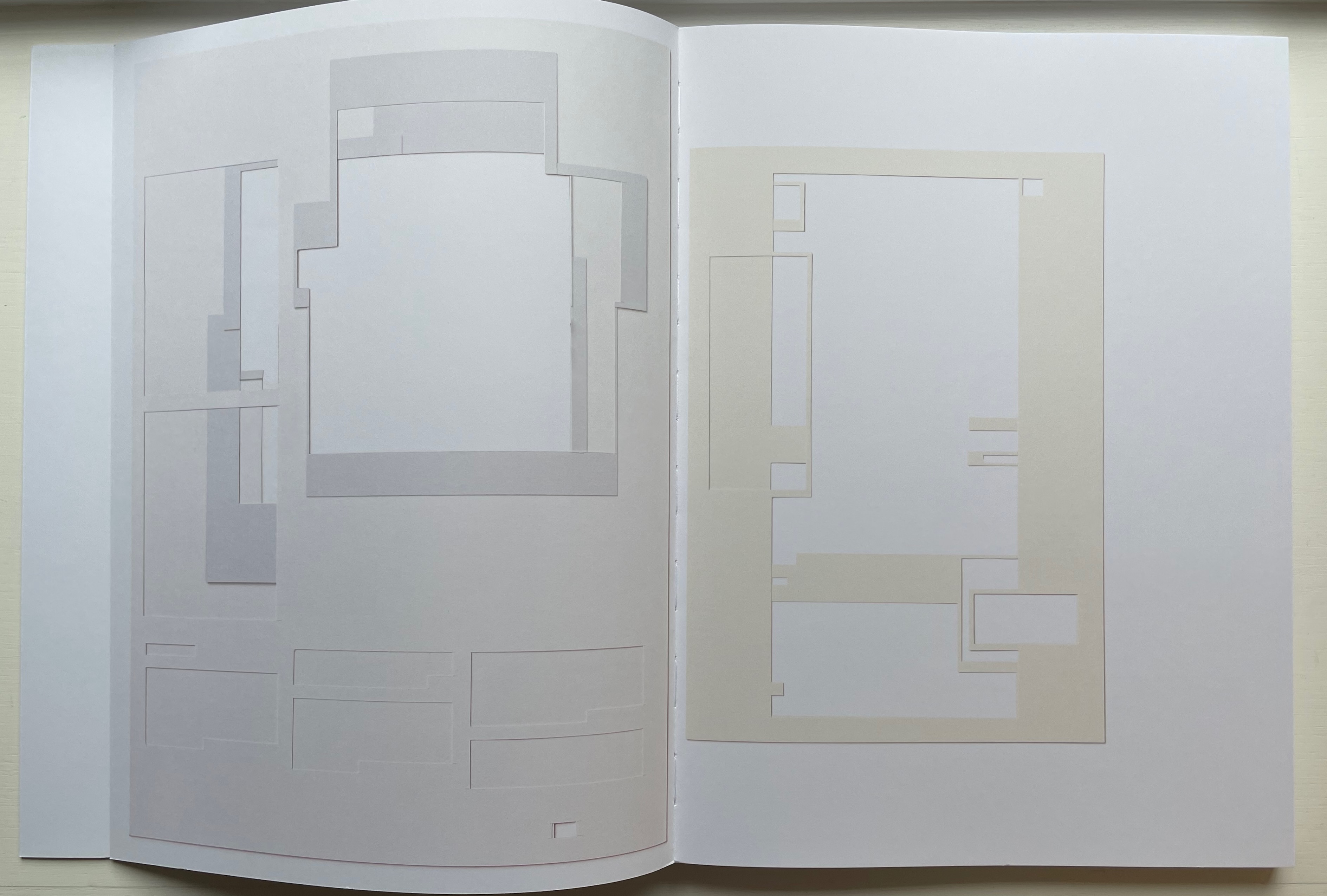
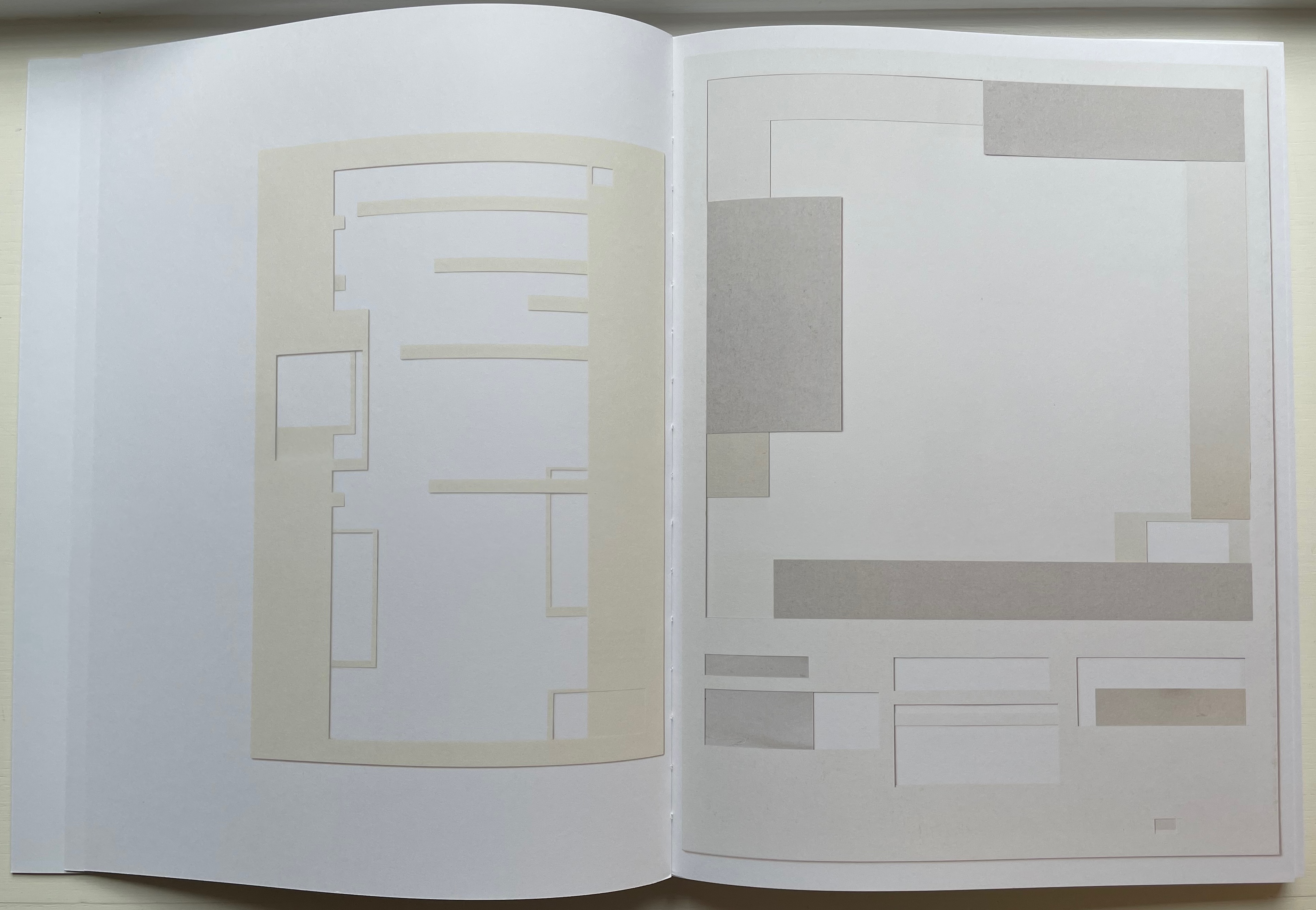
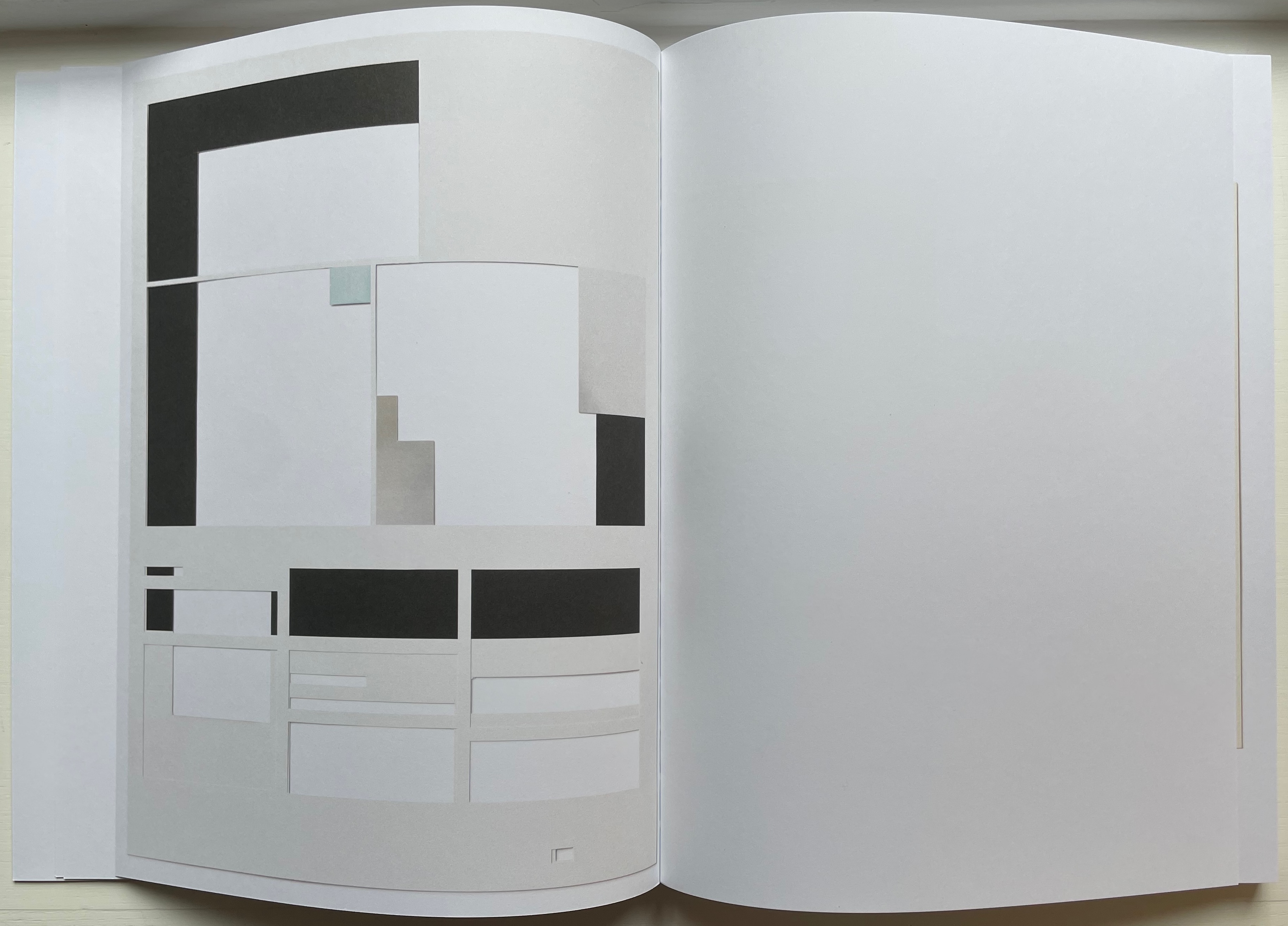
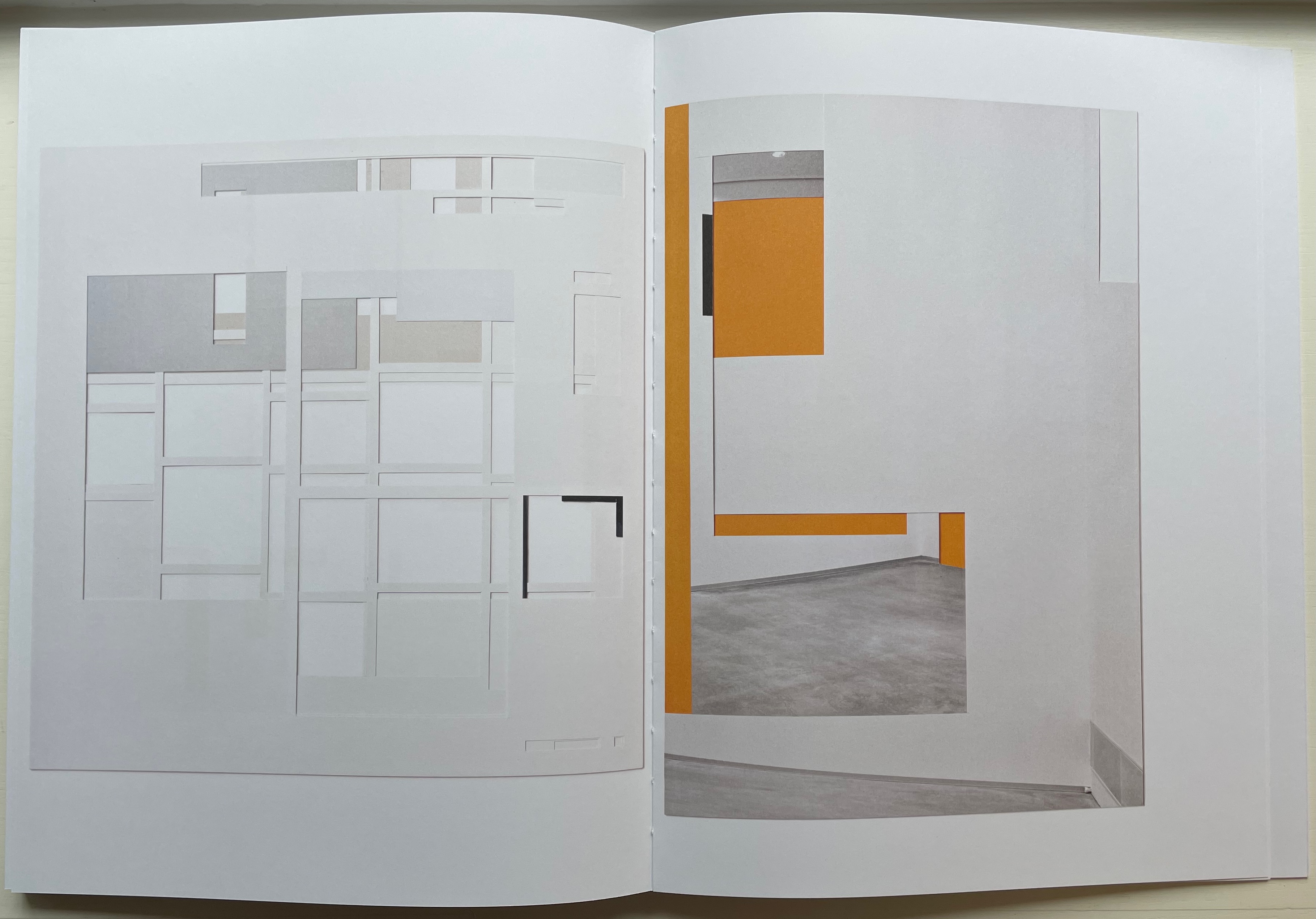
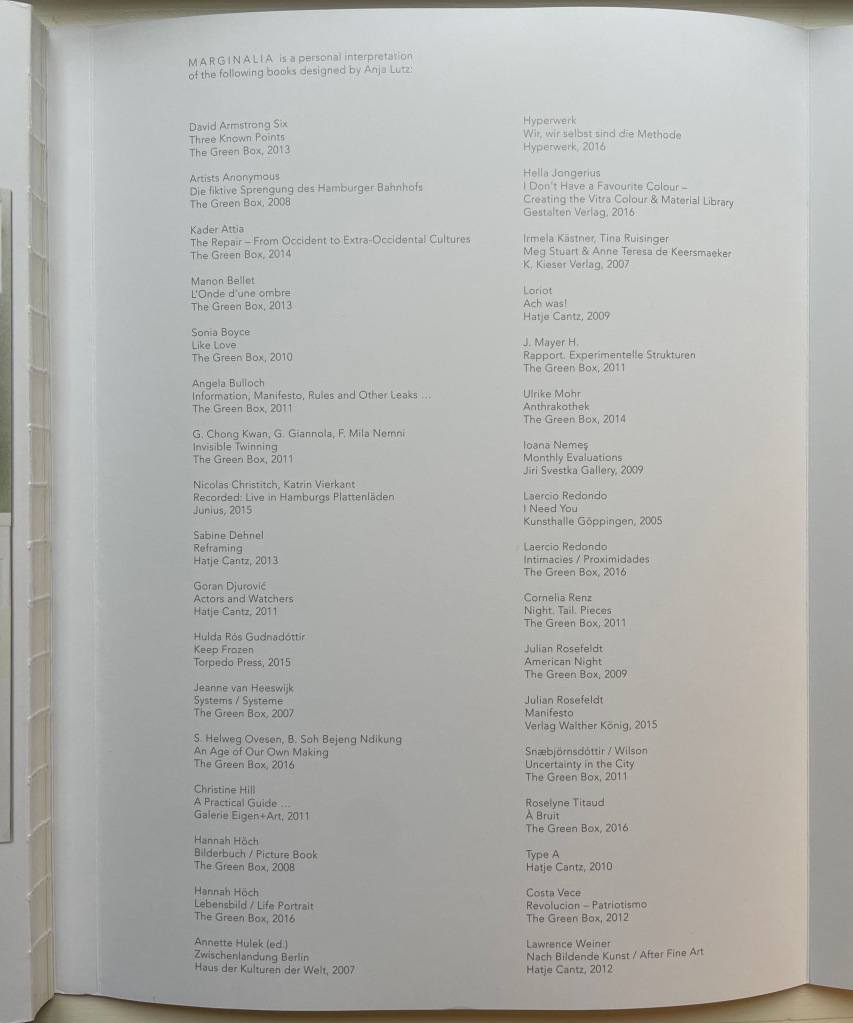
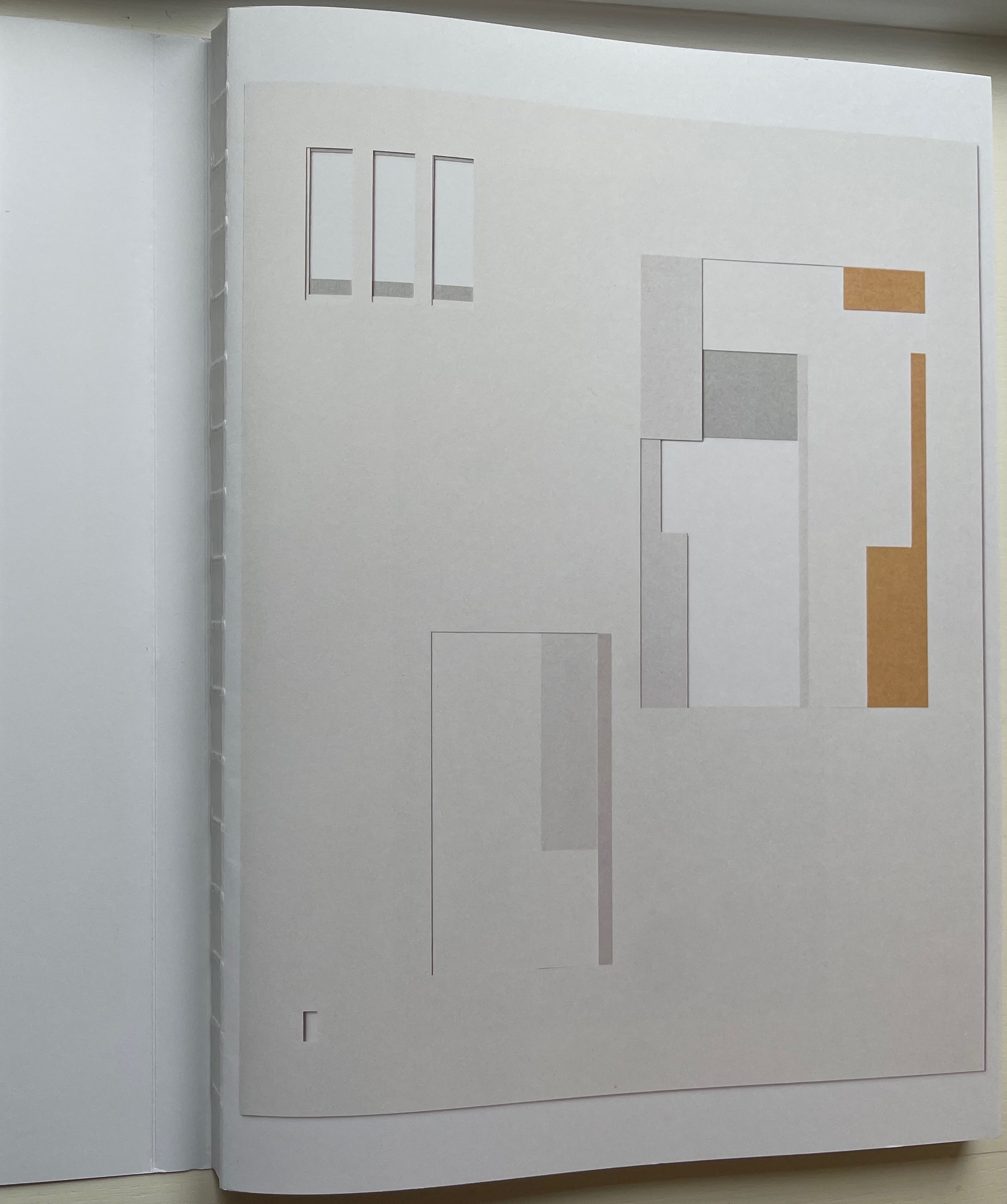
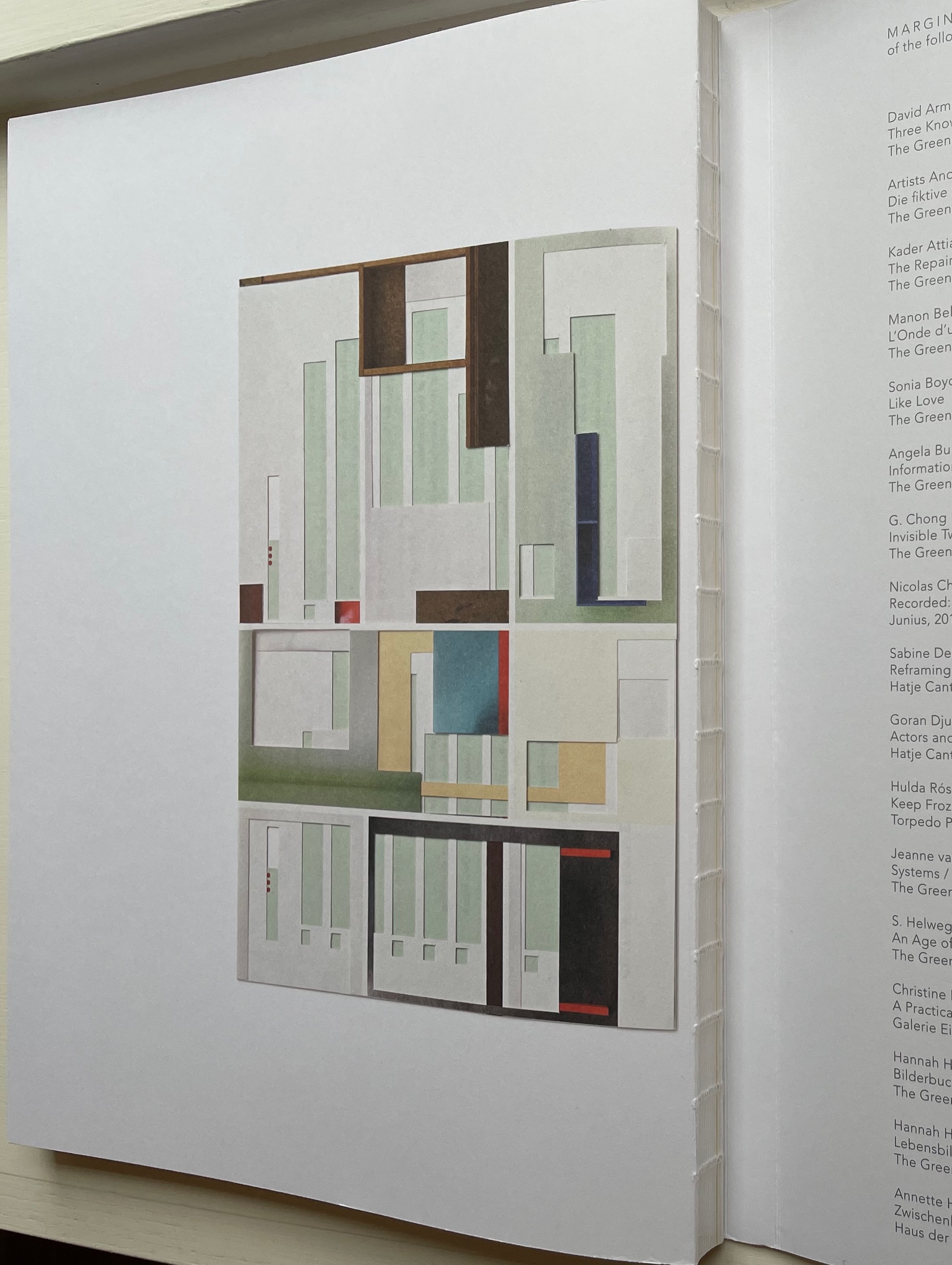
Anja Lutz ‘s Marginalia proceeds differently. Her pages are the pages without text on them — or images, running heads, page numbers, etc. Lutz has taken thirty-four of the books she has designed under her imprint The Greenbox Press and carefully excised from each the text and images layer by layer until the empty spaces define the blank spaces that previously supported the content. But this does not result in the definition of a generic book structure or skeleton.

While Lutz’s technique might be similar to that of other book artists who have altered books by excavating or strip mining them, she is not offering precisely the same invitation that, say, Brian Dettmer offers with Tristram Shandy (2014). Dettmer, too, has excised layers away from an underlying work — the Folio Society’s illustrated edition of Laurence Sterne’s The Life and Opinions of Tristram Shandy, Gentleman (1759-67). While both works invite us to think about the book as thing (or the guts and structure of this thing the book), Dettmer is inviting us to look into the specific underlying work in a different way or consider how the new shape is his response to the underlying work. Sterne’s novel remains present, and we can peer into its crevices and nooks to pick out words, sentences and images — to look into the novel in a new way. Lutz’s surgery does not leave enough of the underlying work to permit a “look in”. We look through instead. Even though she provides a list of the designed books she used, they are not present as Tristram Shandy is.

Each of the books with which Lutz start is, as she puts it, “unique in its choice of format, material, layout, composition, and rhythm”. Despite her nod and the listing of books, this does not mean that she wants us to respond to the results of her surgery with “before and after” comparisons. Rather she invites us to look only at the newly created works. In the end, each has its own structure or skeleton — the struts or bones of the marginal space defined by the negative space of removed content.

But the means of that invitation is this codex entitled Marginalia. With its dust-jacket-like wrapper around the exposed sewn spine, is Marginalia being offered as an artist’s book itself or a catalogue with artist’s book-like features? Beautifully produced, Marginalia is nevertheless not a limited edition. Besides the book, a limited number of collages shown in it are available, each framed floating between two panes of glass. They certainly qualify as works of sculptural book art, and if the artist were to turn her scalpel to copies of Marginalia itself, they too would surely qualify as artist’s books. A collection that held one of the collages, a copy of Marginalia and an altered copy of it would have won a trifecta.

Front and back of the book block, showing the exposed spine.

Neoangin: Das musikalische ABC (2014)

Neoangin: Das musikalische ABC (2014)
Jim Avignon and Anja Lutz
Paperback, saddle stitched, staples. H330 x W240 mm, 60 pages. Acquired from Gallix, 25 July 2022. Photos: Books On Books Collection.

For the entry on Neoangin and Further Reading, see “Jim Avignon & Anja Lutz“. 29 October 2022. Books On Books Collection.

Books On Books Collection – Jeremy Adler

Alphabet Music (2d ed., 1992)

Alphabet Music (2d ed. 1992)
Jeremy Adler
Loose folios. H252 x W354 mm. 7 folios. Edition of 25, of which this is #23. Acquired from Antiquariat Willi Braunert, 2 August 2022.
Photos: Books On Books Collection. Permission to display from the artist. © Jeremy Adler, 1992.

Clearly the alphabet has held an especially productive place in Jeremy Adler’s imagination.

From 1972 to 1977, he issued A: an envelope magazine of visual poetry. His Alphabox (1973) was the first issue in the Writers Forum Object Series, founded by Bob Cobbing, and he named his Alphabox Press after it. Alphabox consisted of four sheets, printed on one side only, each folded six times and fixed at three edges in total, folding out concertina-style to show twenty-eight panels with one letter of the alphabet per panel. The following years brought Alphabet Music (1st ed., 1974), two alphabet-themed exhibitions (1975-77), Vowel Jubilee (1979), Alphabet (1980), Soapbox (1991) including “Alphabet Spaghetti”, and The Electric Alphabet/Elektrická Abeceda (1996) with Jiří Šindler. What makes most of these works — and particularly Alphabet Music — stand out is their synesthetic suggestion and calculated complexity.

The colophon to Alphabet Music, a separate folio accompanying seven loose folios, says, “Each sheet of Alphabet Music contains 15 letters, either whole, or split up into fragments, except the last, where the sequence breaks off… For a full reading, the sheets should be laid out in sequence… Colour denotes key.”

In Oulipo-esque fashion, that limit appears to be determined by the sum of the first five letters’ numerical position in the alphabet (1+2+3+4+5 = 15, so sheet one has 1 A, 2Bs, 3Cs, 4Ds and 5Es). Sheet two, likewise, has 6Fs, 7 Gs, and 2Hs to make 15 letters. Sheet three continues with the remaining 6 Hs for this eighth letter in the alphabet plus 9 Is for the ninth letter, adding up to 15 letters. Sheet four includes 10 Js and 5 letter Ks, and sheet five continues with the remaining 6 Ks for the eleventh letter plus only 9Ls of the twelfth letter, leaving sheet six to pick up the remaining 3 Ls and 12 Ms of the thirteenth letter. Contrary to the explanation, the seventh and last sheet doesn’t break off the sequence; its 1 M and presumably 14 fractured Ns add up to 15.

But why does the music end there? The letters tumble, leap and cascade like musical notes or expressions on the page. Why not additional sheets? Having come this far with the constraint of 15, perhaps Adler worked out that no sum from any summative series from the start of the alphabet could provide a constraint that would work out “evenly” in the end. There would always be leftover or remainder Zs. Alphabet Music has always to be unfinishable — much like the textual expressions the alphabet can yield.

The first edition of Alphabet Music was published in 1974 in an edition of 130 copies by Adler’s Alphabox Press (London) and was first performed with Paul Burwell, Bob Cobbing, and Bill Griffiths at the Poetry Festival in Münster 1979. Extracts first appeared in Kroklok 3 (December 1972), Poetry Review 63:3 (Autumn 1972), and Typewriter (NY) 3 (1973). Although online searching has not uncovered any recording of this performance, or instructions for performing Alphabet Music, perhaps an impression can be gleaned from this recording of Alphabox. Given the title of Alphabet Music, the visual impression it makes, its expressed intent and its reported performance, Alphabet Music would seem an exemplar of Dick Higgins’ definition of an intermedial work: “a conceptual fusion of scenario, visuality and, often enough, audio elements”.

© Jeremy Adler, 1992.

Further Reading

Jim Avignon & Anja Lutz“. 29 October 2022. Books On Books Collection.

Ernest Fraenkel“. 30 October 2021. Books On Books Collection. Jeremy Adler’s uncle was Ernest Fraenkel, author of Les Dessins Trans-conscients de Stéphane Mallarmé à propos de la Typographie de Un Coup de Dés (1960), also in this collection.

Bernard Heidsieck“. 29 October 2022. Books On Books Collection.

Karl Kempton“. 29 October 2022. Books On Books Collection.

Adler, Jeremy D. 1972. A: an envelope magazine of visual poetry. London: Jeremy Adler.

Adler, Jeremy D. 1973. Alphabox. London: Jeremy Adler.

Adler, Jeremy D. 1979. Vowel Jubilee. Aachen: Fachhochschule, Fachbereich Design.

Higgins, Dick, and Hannah Higgins. 1965 / February 2001. “Intermedia“. Leonardo, Volume 34:1, pp. 49-54.

Sackner, Martin and Ruth. 2015. The Art of Typewriting : 570+ Illustrations. 2015. London: Thames & Hudson. Pp. 315-16.

Scholz, Christian, ed. 1987. Laut­poesie: Eine An­tho­lo­gie. Obermichel­bach: Ger­traud Scholz Ver­lag.

Shutes, Will. (April 2019). Test Centre Books Catalogue 12. Accessed 1 August 2022.

Books On Books Collection – Jim Avignon & Anja Lutz

Neoangin: Das musikalische ABC (2014)

Neoangin: Das musikalische ABC (2014)
Jim Avignon and Anja Lutz
Paperback, saddle stitched, staples. H330 x W240 mm, 60 pages. Acquired from Gallix, 25 July 2022. Photos: Books On Books Collection.

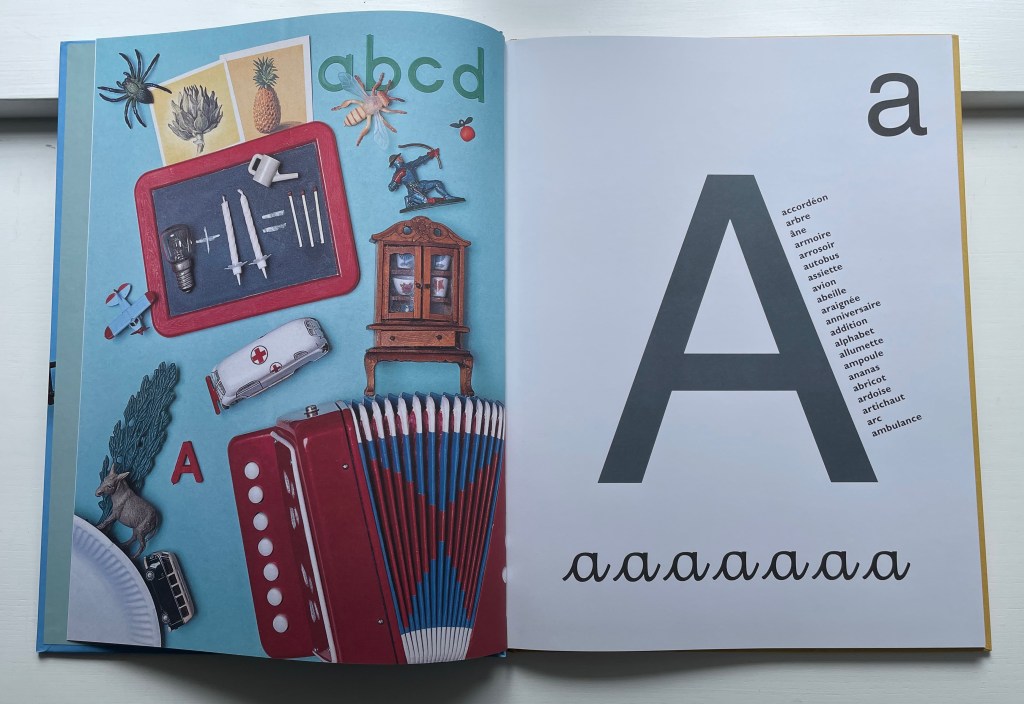
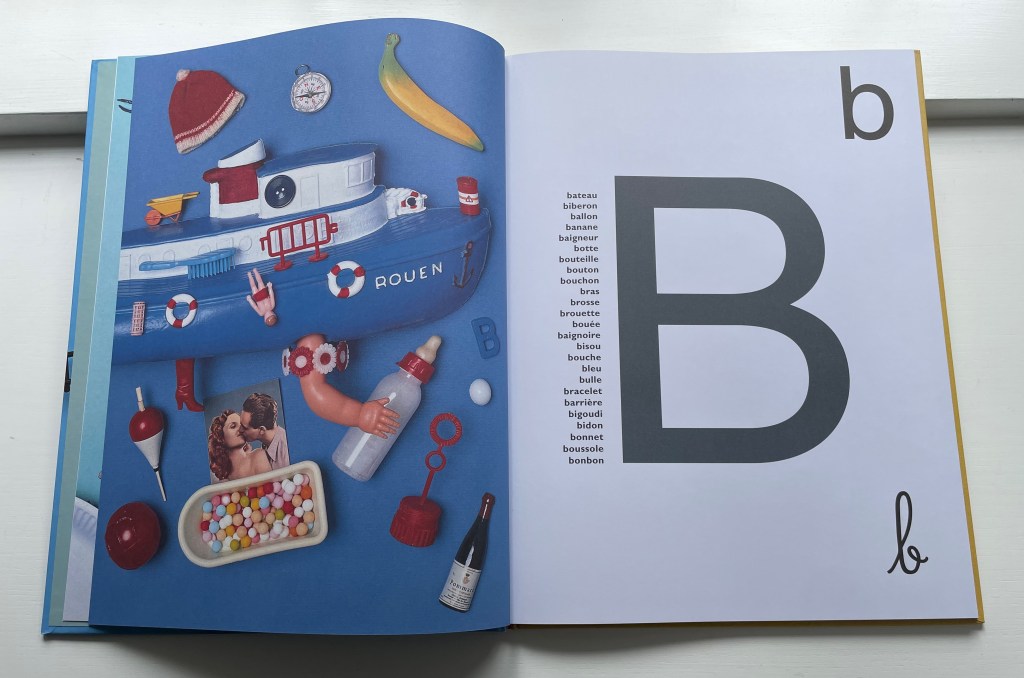
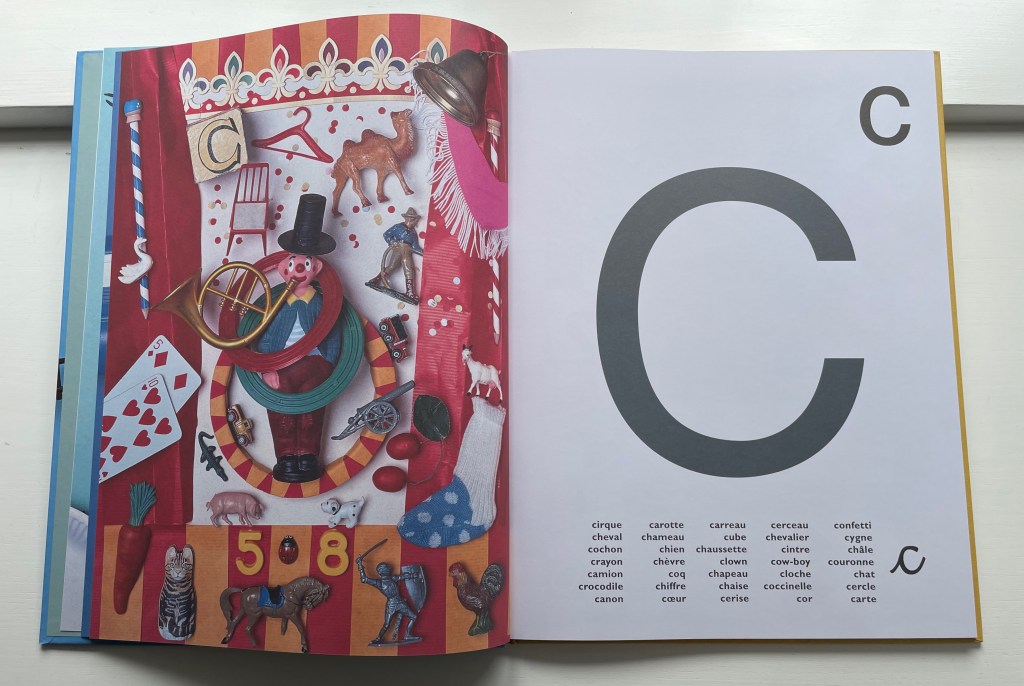
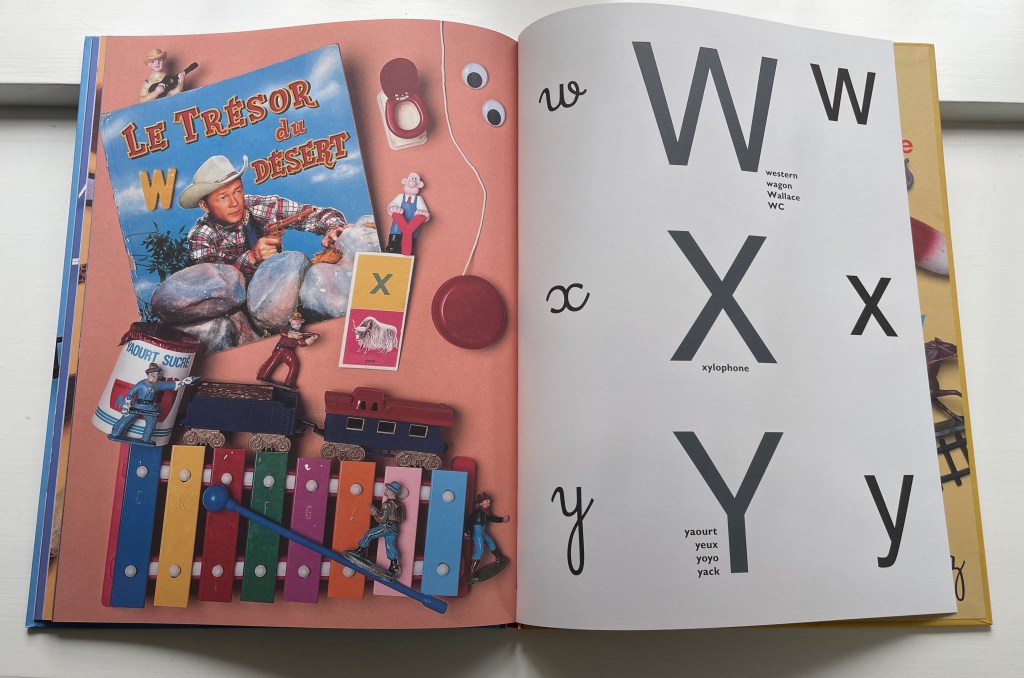
Jim Avignon’s website describes Neoangin: Das musikalische ABC (2014) as a “synaesthetic experiment, [on] which Lutz and Avignon have worked together again after almost 15 years, [in which] music, illustration and typography mix in the most cheerful and unsparing way”. For each letter of the alphabet, Avignon has written a song, presented on a double-page spread designed by Lutz and Avignon. The book and performance were prepared and premiered at Typo Berlin 2014.

Songs A through C are “Animal Hypnotist”, “Bad Photoshop” and “City of Strangers”.

The song for Q is “Q Typology of Letters”. The tails of various Qs straddle female, male and epicene symbols and characters as well as emotional quotients and characters.

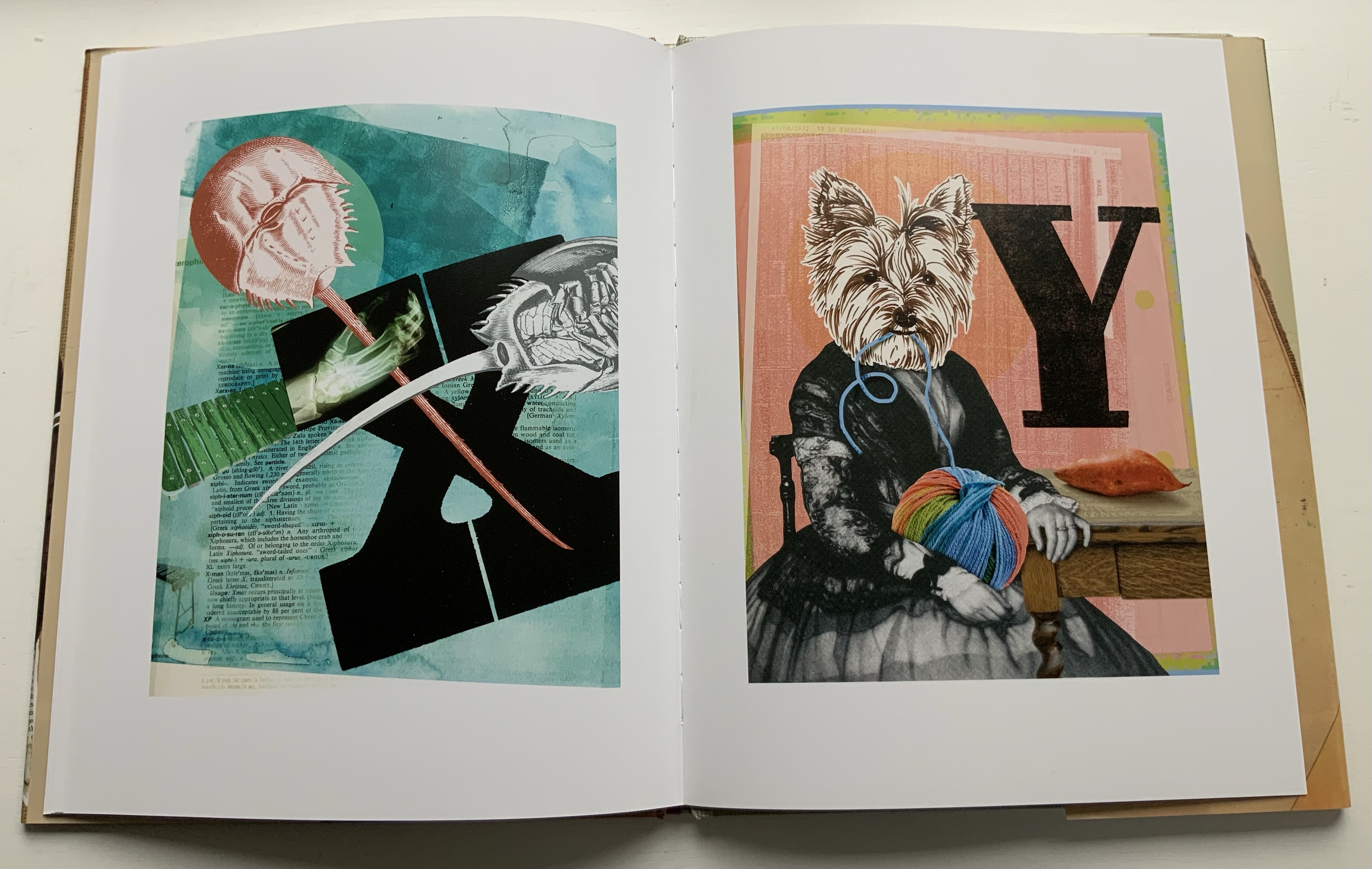
The songs for X, Y and Z are “X-Files: All Deleted Pages”, “Yeah” and “ZZZZZ”.

Synesthesia of the alphabet can be found elsewhere in the Books On Books Collection: Jean Holabird’s Vladimir Nabokov: AlphaBet in Color (2005) and Le Cadratin’s rendition of Rimbaud’s Voyelles (1871/1883/2012) under Jean-Renaud Dagon. And so can conjunctions of the alphabet and musical notation: Karl Kempton’s playground (2013-14) and Bernard Heidsieck’s Abécédaire n° 6 clef de sol : été 2007 (2015). But Avignon and Lutz have the claim to the only combination of the two and certainly when the musical performance is added.

Further Reading

Abecedaries I (in progress)“. Books On Books Collection.

Jeremy Adler“. 29 October 2022. Books On Books Collection.

Le Cadratin“. Books On Books Collection.

Bernard Heidsieck“. 29 October 2022. Books On Books Collection.

Jean Holabird“. 8 February 2022. Books On Books Collection.

William Joyce“. 18 June 2021. Books On Books Collection. For the more innocent end of literary synesthesia where the cold gray-black of numbers gives way to an alphabet of jelly bean colors.

Karl Kempton“. 29 October 2022. Books On Books Collection.

Cohut, Maria. 17 August 2018. “Synesthesia: Hearing colors and tasting sounds“. Medical News Today. Accessed 2 February 2022.

Campen, Crétien van. 26 July 2012. “Bibliography: Synesthesia in Art and Science“. Leonardo. Accessed 2 February 2022.

Cytowic, Richard E. 2018. Synesthesia. Cambridge, MA: MIT Press.

Books On Books Collection – Bernard Heidsieck

Abécédaire n° 6 clef de sol : été 2007 (2015)

Abécédaire n° 6 clef de sol : été 2007 (2015)
Bernard Heidsieck
Accordion book in slipcase. Closed: H230 x W170 mm. Open: W442 mm. 26 panels. Acquired from Gallix, 17 July 2022.
Photos: Books On Books Collection.

In French, wouldn’t an abecedary in the key of G (the fifth note “sol” in the Do-Re-Mi song) have to be associated with the summer (été) and sun (soleil)? That may be the nearest to the fixed association of letters with objects you will find in this work by one of the 1950s creators of Sound Poetry (Poésie sonore).

The collage mixes uppercase and lowercase, serif and sans serif and numerous families of type.

Like beauty and a Rohrshach test, any significance to the collage of each letter is left to the eye of the beholder. Or the ear. Do the positions of the main A, B and C suggest the opening notes of the ABC song?

The confetti-like N’s and n’s look like stemless notes being drawn up and down the staves. The O in the center of the staves surrounded by a rectangle of O’s resembles the sound hole in a cigar box guitar. The P’s are dripping in three dwindling streams of p’s. The Q’s and q’s seem bottled up and rising to spout onto the staves.

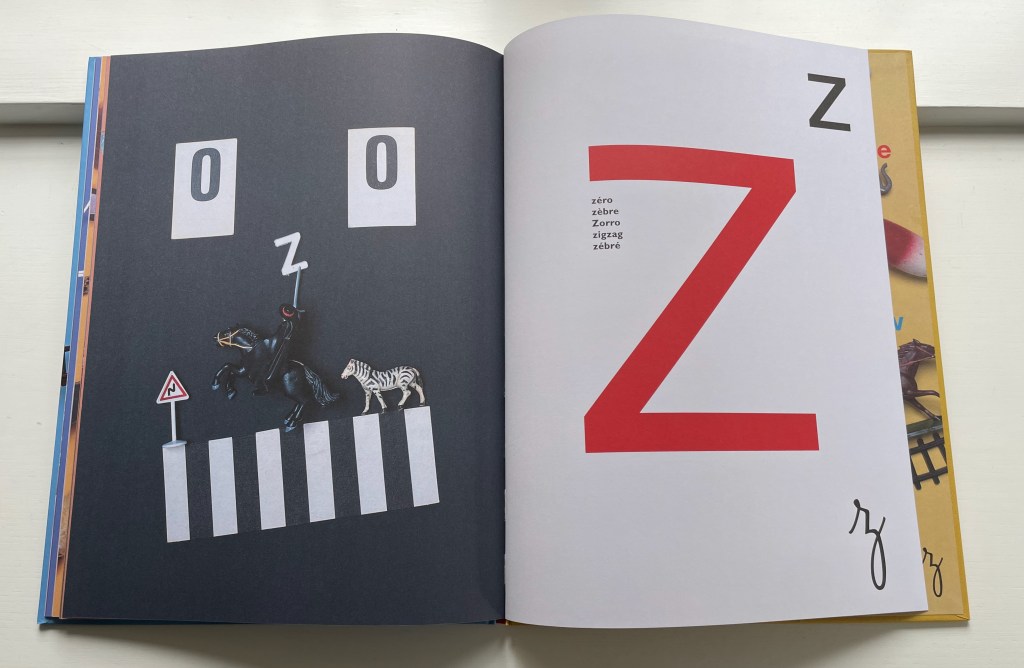
The X’s make an X, or perhaps the struts of a drum with a bass drum stick tucked in. Y forms a mosaic banjo. While Z looks like a bird of prey with its wings at the peak of an upbeat, readied for a powerful downbeat and lift off, it could the horned helmet of a nineteenth-century opera soprano.

Other artists in the collection have used the musical stave in their alphabet-related works: Karl Kempton and Jim Avignon & Anja Lutz. But Heidsieck uses the stave like a musical note and the leporello structure like a musical stave itself. Across its panels, the image of the stave sometimes keeps to the same position, sometimes descends or ascends across two or more panels — like musical notes. Sometimes it supports the letters, sometimes it suspends them, sometimes it embraces them, sometimes it embeds itself among them. The letters defy any expectation of behavior of notes fixed to the stave, but they are never independent of it. Rather than asserting synesthesia as Rimbaud or Nabokov do with words, Heidsieck’s work enacts it by conflating the structures and elements of musical notation, the alphabet, the accordion book and painting.

Further Reading

Abecedaries I (in progress)“. Books On Books Collection.

Jeremy Adler“. 29 October 2022. Books On Books Collection.

Jim Avignon and Anja Lutz“. 29 October 2022. Books On Books Collection.

Karl Kempton“. 29 October 2022. Books On Books Collection.

Alix, F. 2014. “Bernard Heidsieck, Tapuscrits – Poèmes – Partitions, Biopsies, Passe-partout“. Critique d’art.

Bobillot, J.-P. 1996. Bernard Heidsieck: Poésie action. Paris: J.M. Place.

Bobillot, J.-P. (2003). Trois essais sur la poésie littérale: De Rimbaud à Denis Roche, d’Apollinaire à Bernard Heidsieck. Romainville: Al Dante.

Collet, F. (2009). Bernard Heidsieck plastique. Lyon: Fage.

Froger, G. (2016). “Bernard Heidsieck, Abécédaire n°6 – « clef de sol » – été 2007 “. Critique d’art. Accessed 17 July 2022. 

Kempton, Karl. 2018. A History of Visual Text Arts. Berlin: Apple Pie Editions. Accessed 15 December 2020.

Sackner, Martin and Ruth. 2015. The Art of Typewriting : 570+ Illustrations. 2015. London: Thames & Hudson. P. 328.

Books On Books Collection – Karl Kempton

26 Voices / January Interlude (2020)

Front cover / Back cover

26 Voices / January Interlude (2020)
Karl Kempton
Sewn booklet. H190 x W177 mm. 28 pages. Edition of 60 unnumbered. Acquired from Derek Beaulieu, 4 January 2021.
Photos of the work: Books On Books Collection. Displayed with permission of the artist.

Derek Beaulieu deserves a vote of thanks for bringing this work back into print, even if for a limited edition. 26 Voices / January Interlude first appeared under the title Rune 2: 26 voices/ january interlude as number 10 in Robert Caldwell’s Typewriter series, published by Bird in the Bush Press (1980). In the Acknowledgements, Kempton writes that the series “was composed in January, 1978 in 28 days. After the letter K the flow stopped until a dream of L’s form arrived unblocking the flow”.

The series of patterns, each made from an upper case letter of the alphabet typed over and over, range in appearance — some like Amish quilts, some like Byzantine rugs, some like Celtic knots, but like snowflakes, no two alike. Given how some pairs of letters are mirror images of each other (bd, pq) or inverse (bp, dq), you would expect some close affinity in their two patterns, but no. No pairs of those patterns look at all alike. You would also be mistaken to expect a pattern to reflect the letter that constitutes it. Instead, you find one pattern resembling the letter X, but it is made of letter U’s. There are naturally some similarities between patterns at the broadest level — E and N, L and M or R and S — but these have little to do with the letters themselves, and the similarity recedes as details come to the fore or falls into the background with illusory three dimensionality. The shapes are not rune like, but individually and sequentially, they have the associative dream-like qualities of runes.

A close up

Double-page spread B&C

B close up

C close up

Center double-page spread N&O

Double-page spread X&Y

X close up

Y close up

Z close up

Actual runes appear in the following work, similarly in black and white and with similarly illusory three dimensionality. Not technically in the Books On Books Collection, playground (2013-14) can be found online. Surprisingly, it has not been in print.

playground (2013-14)

playground (2013-14)
karl kempton
Online, 78 pages (screens). Accessed 7 August 2022.
Screenshots reproduced with permission.

What an opportunity for collaborators to join with Kempton to produce playground in different editions varying in color (black and white, red and white, green and white, blue and white, etc.), in paper (handmade, watercolor, washi, high gloss, matte, etc.) and in binding (accordion, stab binding, case bound, scroll, etc.). Perhaps such an extravaganza is not in keeping with Kempton’s style and approach over the years, but this playground is such an invitation to play.

Games and sports are depicted together with letters and punctuation marks on platforms made of the musical staff or stave, all of which offer Kempton multiple means of metaphor. FIrst, inked martial arts figures break a K of karate boards. Then, a baseball player bats the dot of a lowercase i into the air. A basketball player jumps and aims at a basket formed of a half note. A golfer chips toward a half-note hole flagged with a pennant bearing the treble clef G. A boxer punches the bowl of a large P.

The images become more worked as the book proceeds. A weightlifter atop a lowercase e lifts a set of weights composed of the umlaut above the e, and the shadow of the image is cast across the stave lines behind the letter. Shadows of gymnasts appear behind an uppercase G, lowercase o and lowercase i.

Animation sequences occur, such as the platform diver leaping from the body of a lowercase i and creating an exclamation-point splash in a pool formed by a circle that widens across the stave as the diver submerges.

Around the same time of playground‘s inception, this combination of letters and musical notation found expression among other artists: for example, Jim Avignon & Anja Lutz in Neoangin: Das musikalische ABC (2014) and Bernard Heidsieck in Abécédaire n° 6 clef de sol : été 2007 (2015). Metaphorically linking textual expression, if not individual letters of the alphabet, with musical scores goes back at least as far as Stéphane Mallarmé’s Un Coup de Dés Jamais N’Abolira le Hasard (1897) and carries forward into explicit linkage by Michalis Pichler (2009) and Rainier Lericolais (2009) in their works of homage to Un Coup de Dés.

To return to Kempton’s playground, an interlude occurs to associate the alphabet with magnetism, then breaks off to return to the games motif, this time in the form of winter sports. The musical notation motif is still there, but Kempton modifies it with a piano keyboard at both ends of the stave and with manicules fingering the keyboards at both ends while articulating a variation on sign language. Musically and metaphorically, matters become more complex with the introduction of two pairs of staves, pyramids of squares and circles and one manicule using the lowercase i to bring back the magnetism interlude.

From here on, additional motifs are developed, and words and phrases appear: a physics experiment punningly labeled “period piece”, a night game lit by inverted question and exclamation marks, and juxtaposed opposites (“covered/uncovered” and “sunrise/sunset”).

All these motifs, textual and visual puns, and images seem concerned with the development of symbols for interpreting the world and communicating that interpretation. With the appearance on black background of an exclamation mark with an open book inside its point, then a pair of rectangles each suspended by the sentence “volumes lines speak / lines speak volumes”, an animated sequence begins an extended narrative drawing everything together.

After the descending hand squeezes out the yin yang symbol onto the stave from the image of an open book, Kempton joins this theme of interconnected opposite forces with the development of language, which is where the runes come in, held in an unclosed fist. Eventually the book concludes with an open pair of hands, centered on reversed-out stave/keyboards and holding a point of light radiant against the blackness.

Further Reading

Abecedaries I (in progress)“. Books On Books Collection.

Jeremy Adler“. 29 October 2022. Books On Books Collection.

Jim Avignon & Anja Lutz“. 29 October 2022. Books On Books Collection.

Bernard Heidsieck“. 29 October 2022. Books On Books Collection.

Kempton, Karl. 2018. A History of Visual Text Arts. Berlin: Apple Pie Editions. Accessed 15 December 2020.

Books On Books Collection – Mikko Kuorinki

The Order of Things:
An Archaeology of the Human Sciences

(2011)

The Order of Things: An Archaeology of the Human Sciences (2011)
Mikko Kuorinki and Michel Foucault
Paperback, perfect bound. H175 x W105 mm. 432 unnumbered pages. Edition of 500. Acquired from XYZ Books, 18 September 2022.
Photos: Books On Books Collection. Displayed with artist’s permission.

Kuorinki’s alphabetical ordering/disordering of one of the sacred texts for literary theorists — Michel Foucault’s 1967 Les Mots et Les Choses: Une Archéologie des Sciences Humaines in its later English translation — rises above that too-frequent result in book art and conceptual art: the one-trick pony. Kuorinki accomplishes this by his choice of appropriation, his choice to use a translation of it and his choice of the alphabet and book art as technique and material.

The alphabet’s arbitrariness and the codical illusion of order and fixity make them the ideal artistic tools with which to make an artwork responding to Foucault’s sweeping treatise on the contingency of knowledge and language. The hefty, tightly bound block of paper and its cover title evoke the memories of anticipation on first picking up any book promising a vision of the order of things. But this book does not even offer a contextualizing preface, an orderly table of contents, chapters, page numbers or index.

When a text becomes canonical — a sort of common expression — how else to respond to it as a visual artist than “to take the mickey”? Of course, as the book’s bellyband tips us off, Kuorinki’s The Order of Things is a joke. And of course, on further reflection, it is serious.

In creating his artist’s book, did Kuorinki know the term calque — the literal, word-for-word translation that becomes a common expression in the borrowing language as in the English it goes without saying from the French ça va sans dire or the English word-hoard from the Anglo-Saxon wordhord? If so, it goes without saying that his work of book art is a calque itself — a literal, word-for-word translation of une alphabétisation of Foucault’s word-hoard for Les Mots et Les Ordres. And if granted its appropriation of the status of calque as a means of appropriating Foucault’s canonical text, Kuorinki’s The Order of Things is a pony of many different colors and tricks. Or to visit another attraction in the fun fair, hasn’t Kuorinki turned Foucault’s sacred text into an artifactual carnival of mirrors?

Further Reading/Viewing

Küng, Moritz. 3 July 2020. Artists’ Books Clips por Moritz Küng. Episode 06 Alphabet Books. Accessed 18 September 2022.

Popper Simon and James Joyce. 2006. Ulysses. Belgium: Die Keure.

Videen Hana. 2022. The Wordhord : Daily Life in Old English. Princeton: Princeton University Press.

Bookmark – “Building the Book from the Ancient World to the Present Day: Five Decades of Rare Book School & The Book Arts Press”

In late 2022, the New York’s Grolier Club and Charlottesville’s Rare Book School/The Book Arts Press joined to create this online exhibition.

We have all been taught how to read books. But what can we learn by looking closely at their material forms? This exhibition celebrates the fiftieth anniversary of Rare Book School and the Book Arts Press, which teaches leading curators, librarians, conservators, book historians, and collectors how to analyze books as physical objects, along with the materials and equipment used to make them.

With its catalogue-esque subtitle and its outline in black-and-white body text, the exhibition might slip past the casual scroller. But ignore the eye-candy poster and the all-caps title/subtitle and look closely at that clear and logical outline. Behind each of the links from the outline, the curators Barbara Heritage (Associate Director & Curator of Collections) and Ruth-Ellen St. Onge (Associate Curator & Special Collections Librarian, Rare Book School at the University of Virginia) have provided definitions, explanations and illustrative images that will satisfy novice and expert alike interested in the evolution of the book.

Never mind if the text often reads as a lure to enroll in the Rare Book School. What is here is a companion to any general or specialist course. For the self-taught, it is a companion to any popular book on the subject (for example, Keith Houston’s The Book) or to specialist books (for example, Bamber Gascoigne’s How to Identify Prints).

The final topic in the outline feels like an outlier. Or perhaps only because it is the last. An additional section on book art (not just the book arts) and a section on the digital study and exploration of the book would be welcome.

Here is an archival link to the resource.

Books On Books Collection – Nick Wonham

The Charm of Magpies (2018)

The Charm of Magpies (2018)
Nick Wonham
Casebound, cloth spine and paper over boards with specially printed flyleaves from Roger Grech at his Papercut Bindery. H370 x W260 mm. 27 pages unnumbered. Edition of 160 copies, of which this is #98. Acquired from Incline Press, 1 August 2022.
Photos: Books On Books Collection.

A long admiration for magpies has always threatened to crowd the Books On Books Collection beyond this beautiful work from Nick Wonham and Incline Press and the relief sculpture in paper by Calvin Nichols below. But one pair of works will have to be enough for joy.

Iridescence(2016)
Calvin Nicholls
Acquired from the artist, 1 September 2016. Photo: Courtesy of the artist.

On the Incline Press website, Graham Moss and his team write:

Collective nouns A parliament of magpies has to be a favourite, especially if you’ve heard a group of them cackling together in the Springtime. But we prefer the alternative, a charm of magpies, which certainly suits this poem better. It is one version of a folk rhyme which has many local variants, all superstitiously foretelling the future through random occurrence.

Magpies are often known a thugs in the garden, stealing eggs and chasing off their more delicate rivals. As printers, though, we have a fondness for them because of their “ink on paper” plumage and their latin name pica pica, which recalls the printshop unit of measure.

In the interview under Further Reading, Wonham mentions Kurt Schwitters as a compositional influence, but in color and boldness, Joseph Crawhall‘s, William Nicholson‘s, C.B. Falls‘ and Christopher Wormell‘s alphabet books spring more to mind.

Left to right: Joseph Crawhall (1884), William Nicholson (1898), C.B. Falls (1930) and Christopher Wormell (1995).

As Moss and team point out on their site, the Oxford Dictionary of Nursery Rhymes does not include the magpies among the counting rhymes, which is odd with so many versions to be had. Birdspot, formerly British Bird Lovers, favors Nick Wonham’s chosen version. For magpies interested in shiny trivia, the site also provides a link to a BBC television program whose theme song was based on the magpie rhyme. It was “composed and played by the Spencer Davis Group under the alias The Murgatroyd Band, just after Steve Winwood had left to join the supergroup Blind Faith with Eric Clapton, Ginger Baker, and Ric Grech”.

And to note just one touch of Nick Wonham’s subtlety, here is the page before the colophon. In all the other images, the magpies are roosting. This one in flight is also the only one in black and white. A brilliant “The End”.

Postscript: In correspondence, the artist has provided further insight on influences and his handling of color:

A note on the colour – the biggest influence on this was Rigby Graham, whose work Graham Moss introduced me to through the Old Stile Press book Kippers and Sawdust. Graham had just printed my first book, which had black and white linocuts, and was trying to inspire me to try colour. It worked; I was blown away by the majestic woodcuts and aspired to create books in a similar vein. Rigby liked an unusually coloured sky, he also liked to position his illustrations through the book so that the colours of prints on adjacent pages contrasted with each other to create dynamism and visual interest, something I have attempted in my book. Correspondence with Books On Books Collection, 9 September 2022.

Wonham also adopts and owns a compositional feature from Rigby Graham’s Kippers and Sawdust: the juxtaposition of the mechanical and the natural. His ownership is particularly apparent in his setting for the rhyme’s seventh verse.

Rigby Graham’s flight formation over a landscape (from 2022 Provincial Booksellers Fairs Association);
Wonham’s surveillance cameras for a perch.

Further Reading

Enid Marx“. 1 August 2022. Books On Books Collection.

One For Sorrow … Magpie Nursery Rhyme“. November 2020. Birdspot. Accessed 5 August 2022.

Campbell, Gordon. July 2008. “Rigby Graham – Doctor of Letters – Artist“. University of Leicester, News and Events. Accessed 10 September 2022.

Nicholls, Calvin. 2005. Paper sculptures, 1995-2005. McHenry, IL: Follett Library Resources.

Opie, Iona Archibald, and Peter Opie. 1951. The Oxford dictionary of nursery rhymes. Oxford: Oxford UP.

Young, Richard. 15 December 2016. “Meet artist Nick Wonham“. Great British Life. Accessed 1 August 2022.

Books On Books Collection – Tommy Thompson

The ABC of Our Alphabet (1952)

The ABC of Our Alphabet: A primer of the lineal history of our present-day letters (1952)
Tommy Thompson
Casebound with doublures showing map of locations of alphabet development.
Acquired from St Luke’s Hospice, Sheffield, 6 August 2022. Photos: Books On Books Collection.

First appearing in 1942, Samuel Winfield (Tommy) Thompson’s somewhat forgotten children’s introduction to the history of the alphabet occupies an interesting position in that line of work that includes Oscar Ogg’s The 26 Letters (1964), Tiphaine Samoyault’s Alphabetical Order (1998), Renzo Rossi’s The Revolution of the Alphabet (2009) and Don Robb’s Ox, House, Stick (2010). For a collector of children’s alphabet books and alphabet-related artists’ books, the decision whether to acquire it balances on its interior design and content.

With its overlay of second-color illustrations on the text, Thompson’s book makes for an interesting forerunner to Lyn Davies’ fine press A is for Ox. Thompson falls prey to instances of illegibility from the technique, but both enjoy instances of brilliant juxtaposition of word and redrawn images.

Two-color illustration overlaying text. Right: Davies. Left: Thompson.

Among the primers of alphabet history, Thompson’s also stands out for the attention it gives to North American Indian pictorial writing. Rather than the usual Eurocentric sources, the Leni-Lenape, Dakota and Sioux Nations provide the bulk of examples of the method. The enlightened perspective, however, is undercut by a strain of cultural and historical supremacy apparent in several passages and, in particular, the perpetuation of the Walum Olum hoax and inclusion of a chapter from Longfellow’s Song of Hiawatha to stand in for the absence of any similar memorialization of painted grave posts. Although Thompson is point blank on how “the invasion of the white man” prevented the growth and development of this method of writing, consider this passage describing the Leni-Lenape Penn Treaty of 1682 that was woven with perforated shell beads (wampum):

The figures of a white man and an Indian are woven in the belt, clasping hands in a true gesture of friendship. The white man is portrayed wearing a hat, as the Indian always drew the symbol of the white man. This treaty of peace was never broken or forgotten.

Except that, in the 1860s, most of the Leni-Lenape Nation was forcibly displaced to Oklahoma.

It was not until the 1990s that the so-called Leni-Lenape cosmographical poems of Walum Olum were proven to be fake, but suspicions were strong in the 1930s. All this is compounded as the book laments the ephemerality of the “Walum Olum poems” and the custom of pictorial grave posts:

Pictorial epitaphs on Indian grave posts were quite common in the early days of the new world. But knowledge of this romantic custom as well as the knowledge of the Red Man’s art of picture writing will live forever, had there been no other record of him but the beautiful “Song of Hiawatha” by Henry Wadsworth Longfellow.

Thompson’s design skills and his side note of claim to fame as reportedly the first recipient of royalties for typeface design (Thompson Quill Script) nudged the balance toward acquisition. Maybe perversely the annoying cultural dissonance also nudged the balance in that direction. The book’s presence provides the opportunity to compare it line for line with the other primers and look harder for the signs of the cultural blinkers we are wearing now. Also, with authentic pictorial cosmography available from the Navajo (Diné) Nation and with new archaeological finds from the Middle East (see below for both), perhaps it is time for a new primer against which to compare Thompson and the rest.

Further Reading

Abecedaries I (in progress)“. Books On Books Collection.

Lyn Davies“. 7 August 2022. Books On Books Collection.

Grant, Richard. September 2021. “In the Land of the Ancient Ones“. Smithsonian Magazine. Accessed 20 August 2022.

A review of the film Canyon del Muerto about one of the first female archaeologists, Ann Axtell Morris. What has this to do with Thompson’s book? An ironic coincidence. Morris worked for the archaeologist Sylvanus G. Morley on his Yucatán expedition. Thompson cites Morley in his bibliography. With her husband, fellow archaeologist Earl Morris, and their Navajo team, Ann Morris went on to open the Canyon del Muerto to the discoveries that led to insights into the Ancestral Puebloans, the source of Navajo cosmography. Other than papers coauthored with Earl, Ann’s accounts could only find outlet as juvenile publications. While Sylvanus and Earl may have been the combined inspiration for Indiana Jones, Ann offers the status of artist, first female archaeologist and subject of a current movie as a role model to celebrate with a sidebar in a new history of writing.

Morris, Ann Axtell. 1931. Digging in Yucatan: Archaeological Explorations in 1924. Garden City, NY: Doubleday, Doran & Co.

_______________. 1934. Digging in the Southwest. Garden City, NY: Doubleday, Doran & Co.

Naveh, Joseph. 1975. Origins of the alphabet. London: Cassell.

Oestreicher, David M. 1994. Unmasking the Walum Olum: A 19th-century Hoax. South Orange, N.J.: Archaeological Society of New Jersey.

Ogg, Oscar. 1964. The 26 Letters. New York: T.Y. Crowell.

Robb, Don, and Anne Smith. 2010. Ox, House, Stick: The History of our Alphabet. Watertown, MA: Charlesbridge.

Rossi, Renzo. 2009. The revolution of the alphabet. New York: Marshall Cavendish Benchmark.

Sacks, David. 2003. Language visible unraveling the mystery of the alphabet from A to Z. New York: Broadway Books.

Samoyault, Tiphaine. 1998. Alphabetical Order: How the Alphabet Began. New York: Viking.

Shaw, Gary. 15 April 2021. “Ancient ABCs: The alphabet’s ‘missing link’ discovered in Israel“. The Art Newspaper.
Books On Books Collection – Felice Feliciano

Alphabetum Romanum (c. 1460)

Alphabetum Romanum: The Letterforms of Felice Feliciano
Felice Feliciano (c. 1460)
Jason Dewinetz, drafting/printing (2010) and Mark Cockram, bookbinding (2022)
Boxed and casebound, sewn. Box: 222 x 172 x 30 mm. Book: 202 x 155 mm. 82 pages. Sheets acquired from designer/publisher. Binding acquired from designer book binder.
Photos: Books On Books Collection.
One of the pleasures of collecting alphabet-related works and living close to Oxford University is the opportunity to place new work next to older ones. An added pleasure in this case is seeing a new work made newer by a designer bookbinder.

As the foreword and afterword to this work explain, Jason Dewinetz’s redrawing of Felice Feliciano’s letterforms (c. 1460) was in fact prompted by two 20th century responses to Feliciano’s original: the first being Giovanni Mardersteig’s edition in 1960 at Editiones Officinae Bodoni and the second, also overseen by Mardersteig, being the facsimile edition issued by Jaca Book Codici over 1985-87 and separately by Belser Verlag in 1985. The Bodleian Library has both the Officinae Bodoni and Belser editions. An opportunity too good to miss and one worth sharing.

Left: Dewinetz edition. Center: Feliciano’s original in the Vatican facsimile. Right: Officinae Bodoni edition. Photo: Books On Books.

Dewinetz does not reproduce Feliciano’s commentary. His aim is to focus attention entirely on the letters. Although he has restricted his re-presentation of the letters to the recto page (whereas in Feliciano’s original, the letters after A occupy the verso and recto), he is too clever a designer not to find a way to capture the one instance in which Feliciano’s letter drawing and double-page spread interact entertainingly.

For the opening of Paul F. Gehl’s foreword, Dewinetz captures the dramatic flourish of Feliciano’s Q,
whose tail crosses the double-page spread in his original. See below. Photos: Books On Books.

From the Vatican facsimile, Feliciano’s double-page spread with Q and S. Photo: Books On Books.

What happened to the letter R? Feliciano must have felt the need to give it its own double-page spread to show off a variation in coloring and tails. Like Mardersteig, Dewinetz gives the Rs each their own page. Unlike Mardersteig (and Feliciano), he places the Rs in correct alphabetical order.

Feliciano’s letter Rs from the Vatican facsimile. Photo: Books On Books.

Dewinetz’s re-drawing Q,R,R,S. Photo: Books On Books Collection.

Mardersteig follows Feliciano’s disrupted alphabetical order, but for Q and S to keep to a design that places each letter on a recto page facing a schematic drawing on the verso, Mardersteig has to forego the center-crossing tail of the Q and place S on a separate insert leaf.

Mardersteig’s QSRR sequence in the Ediciones Officinae Bodoni edition. Photo: Books On Books.

As a designer bookbinder, Mark Cockram has a deft eye and touch as he looks for and executes the designs inspired by the text. He could not resist Dewinetz’s cropped Q from the foreword by Paul F. Gehl. Taking his Q (as it were) however from the Goudy display font, he gives it a deserved prominence, stamped in black, on the double-trayed box’s spine. The choice of a different font reminds me of Eric Gill’s quip: “letter designing is still an occupation worthy of the enthusiasm of rational beings, and, though a Q which were all queue & no Q would be ‘past a joke’, it is difficult to say exactly where a tail should end”.

Left photo: Courtesy of Mark Cockram. Right photo: Books On Books Collection.

Apparently it was a tail of which Cockram could not let go. Further echoing Dewinetz’s cropping, truncated letter forms peek through the Palimpsest Parchment with which the book itself is bound (flat back). They are laserprinted on hand colored papers, colors inspired by those used in the book. Cockram also echoes the book’s color “ghosting” on the box by layering blank strips of hand colored papers beneath the cloth during the making process. The color-echoes between box and book continue with the box’s interior.

Photos: Books On Books Collection.

The handsome bindings of the Vatican facsimile and Mardersteig edition have stood up to their library existence. In muted tones and gilt, they speak to the design esthetics of a different era.

Vatican facsimile binding

Officinae Bodoni edition binding

When the Dewinetz/Cockram edition joins the Vatican facsimile and Officinae Bodoni edition at the Bodleian, students of lettering, type design, bookmaking and bookbinding and their history will have a feast of an opportunity to compare and contrast.

Further Reading

Abecedaries I (in progress)“. Books On Books Collection.

Gill, Eric. 1931. An essay on typography. London: Sheed & Ward.

Feliciano, Felice, & Mardersteig, Giovanni. 1985. Alphabetum romanum: Vat. Lat. 6852 : Aus der Bibliotheca Apostolica Vaticana (Codices e Vaticanis selecti ; v. 70). Zürich: Belser Verlag.

Feliciano, Felice, Mardersteig, G., & Ferrari, O. 1960. Alphabetum Romanum (Ital. ed.] ed., Biblioteca apostolica vaticana. Mss. (Cod. Vat. 6852)). Verona: Officinae Bodoni.