A Bookmark for February 2013 – from the British Library

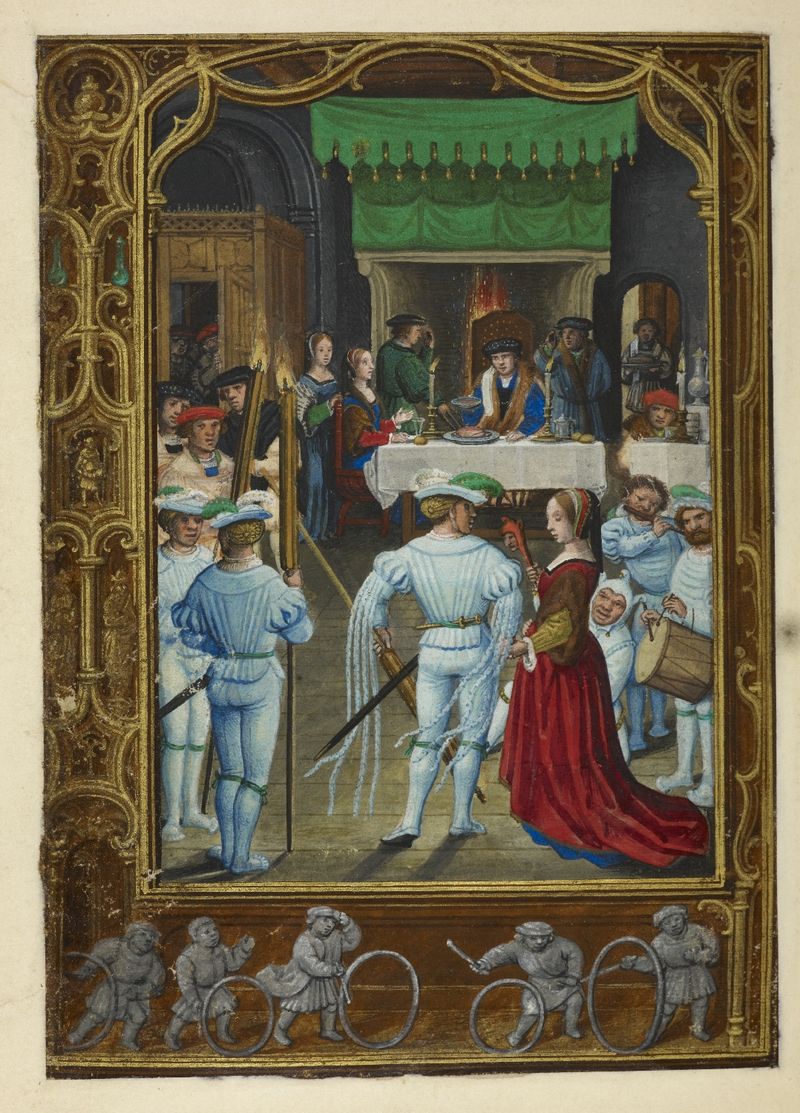
Calendar page for February with a feasting scene, from the Golf Book (Book of Hours, Use of Rome), workshop of Simon Bening, Netherlands (Bruges), c. 1540, Additional MS 24098, f. 19v


Are we over-thinking EPUB? – Tools of Change for Publishing

Are we over-thinking EPUB? – Tools of Change for Publishing.

The punning subtitle to this article indicates its subtext:  “The future of the book is inherently linked to the browser.”

Can Print and E-Books Coexist? Ceci n’est pas un signet!

grWJH

“So a video journalist goes into a bookstore …”  and finds little to report.  Beset by the BBC’s wallowing in non-events and the trivial, I am probably flailing out unfairly at the PBS’s “dog bites man” story or perhaps indigesting a bit of humbug this Christmas season.   MediaShift . VIDEO: Can Print and E-Books Coexist? | PBS.*

At least one commentator (gfrost; Gary Frost?), however, points out what video journalist Joshua Davis and his interviewees failed to explore:  “[M]issed is an inherent interdependence between print and screen books. An eerie complementary fit of the different affordances means that neither will flourish without the other.” Now there is a premise worth exploring, which Gary Frost does (see previous posting).

And what would Joshua Davis and his interviewees make of David Streitfield’s story in the NY Times that sales of e-reading devices seem to have reached a plateau?  “Even as prices fall, though, the dedicated e-reader is losing steam. The market peaked last year, with 23.2 million devices sold, IHS iSuppli said in a report this month. This year, sales will be 15 million. By 2016, the forecast is for seven million devices — as opposed to 340 million tablets, which allow for e-reading and so much more.”

Streitfield’s story actually begins with “the dog that didn’t bark”:  the prices for ebooks themselves have not fallen, despite the predicted result of the US Justice Department’s case against and settlements with six of the big publishers (five, now that two are merging).    For Frost’s premise that neither form — ebook or print — will flourish without the other, does that raise the question of whether either will decline without the other’s declining?   The rules of logic alone suggest otherwise, but consider Streitfield’s “more counterintuitive possibility … that the 2011 demise of Borders, the second-biggest chain, dealt a surprising blow to the e-book industry. Readers could no longer see what they wanted to go home and order.”

Perhaps the ebook and print are more intertwined than even Frost’s premise implies. Simba’s Jonathan Norris is quoted in Streitfield’s article:  “The print industry has been aiding and assisting the e-book industry since the beginning.”    Of course, someone needs to point this out with a cattle prod to the publishers withholding their ebooks from public and academic libraries.  The site TeachingDegree offers a succinct collection of data (PBS take notes) on the topic in a sort of dialectical digital poster.

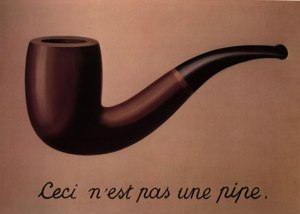
Perhaps the whole story is just “human reads book” and is not worth a bookmark, but then where would have been the fun of finding out in punning

Magritte-pipe

with Magritte’s painting that the French for bookmark is either un signet (digital) or un marque-page (print), and in English we can make no distinction?

*In fairness to PBS, readers should take a look at the series “Beyond the Book 2012.”

Still, Frost’s Future of the Book goes far deeper.

(A general indifference?) Towards the Digital Divide

How might we explain the ascent, pervasiveness and popular appeal of digital art?

A few months ago, Greg Smith, a  Toronto-based artist, reviewed Claire Bishop’s “Digital Divide” (Art Forum, September 2012).  The review and Bishop’s article touch on a recurrent theme in Books On Books:  the materiality and immateriality of books.

http://www.scoop.it/t/books-on-books/p/2204574815/expanded-artists-books-envisioning-the-future-of-the-book

http://www.scoop.it/t/books-on-books/p/2540958720/a-bookmark-for-letters-outside-themselves

http://www.scoop.it/t/books-on-books/p/2276808444/ebooks-do-we-really-want-our-literature-to-last-for-ever

http://www.scoop.it/t/books-on-books/p/2204732117/bookmarking-a-forthcoming-title

http://www.scoop.it/t/books-on-books/p/2213422701/the-bookless-library-and-what-will-become-of-the-paper-book

http://www.scoop.it/t/books-on-books/p/2173038714/and-there-you-have-it-the-kindle-of-the-late-eighteenth-century-mike-kelly-amherst-college

http://www.scoop.it/t/books-on-books/p/2182994587/this-is-for-you-in-support-of-libraries-books-words-ideas

http://www.scoop.it/t/books-on-books/p/2123229496/to-see-a-world-in-a-grain-of-sand-or-tobacco-leaf

http://www.scoop.it/t/books-on-books/p/2082258113/post-artifact-books-and-publishing

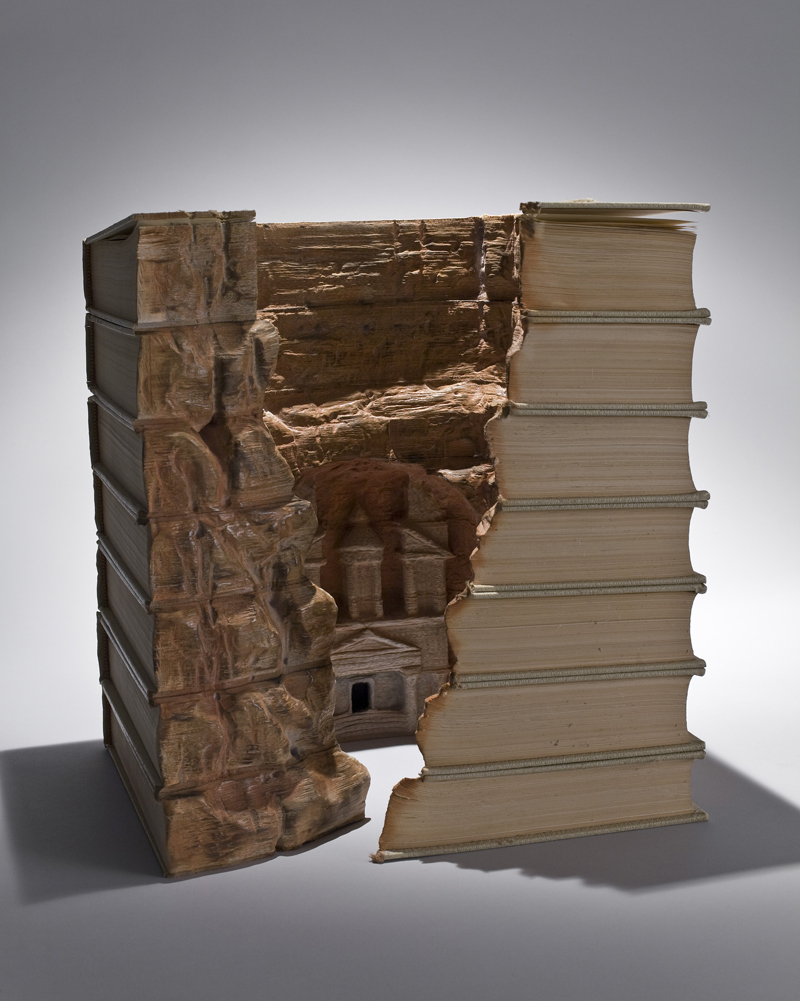
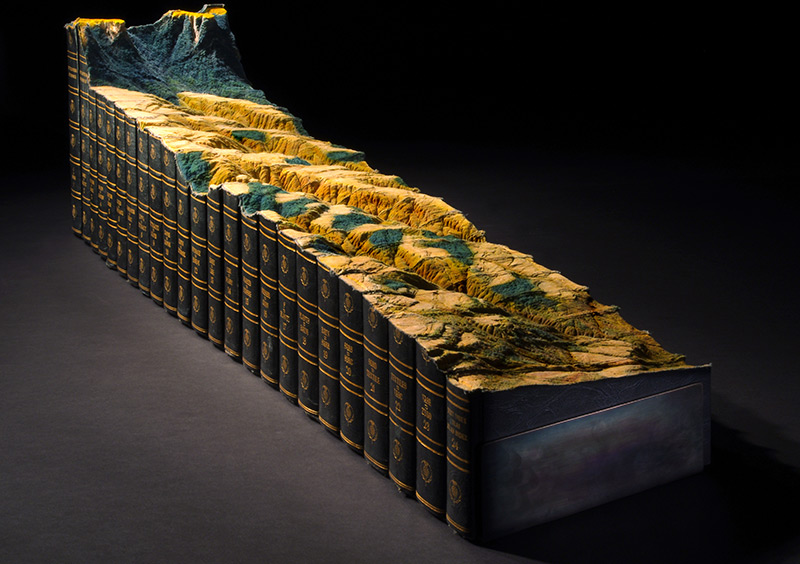
http://www.scoop.it/t/books-on-books/p/2079452417/the-making-unmaking-and-remaking-of-books-guy-laramee-s-book-art

But the review and Bishop’s article resonate with some more recent and popular seismic tremors in the world of ebooks.  With all but Macmillan caving into the US Justice Department, we are still left wondering where and when the consumer benefits in cheaper ebooks will be handed out.  The prices on e-reading devices have plummeted, but in the world of ebooks, a slight unease about the inevitability of e-readers is creeping in as tablets and mini-tablets seize the imaginations of some with the loudest digital megaphones.  “Are e-reading devices doomed?”  And by extension – given that tablets are far more than ebook devices — “Is the trajectory for ebooks leveling off?”   While the post-Xmas sales analysis will be more assiduously examined for the “evidence” than the equally predictive gizzards of our Xmas fowls,  as Greg Smith paraphrases Julian Oliver, “the New Aesthetician”:   material or immaterial, “we should all just keep focused on making stuff.”

Bookmarking Book Art – What is “Manuscripts Online”?

MSS Online

Elsewhere I have commented on this JISC-funded project rising like a medieval cathedral from busy hands at the universities of Sheffield, Leicester, Birmingham, Glasgow, York and Queen’s (Belfast) will warm the enlightened taxpayer’s cockles.  It is now coming to a summary conference to be held at the University of Leicester on 11 January 2013.

Everything about this ambitious project to enable full-text searching of literary manuscripts, historical documents and early printed books owned by libraries, archives, universities and publishers and now online is transparent and open to public scrutiny as it happens.

The researchers’ plan is to enable users to generate visualised search results using maps of medieval Britain, add their own annotations to the data for public consumption and contribute to a knowledge base that will surround and suffuse an outstanding body of primary sources:  Manuscripts Online: the resources.

You can follow the Project Plan and meeting minutes, preview site designs and the scholars’ tweets about the work and witness what appears to be a project run “by the book.”

“How important are paper books?” | TeleRead

In his Teleread article (11 October 2012), Dan Eldridge picks up on Associate Professor Justin Hollander’s New York Times op-ed piece protesting Education Secretary Arne Duncan’s  comment before the National Press Club that “over the next few years, [paper] textbooks should be obsolete.”

What makes his comments on comments on a comment bookmark-worthy are the comments they provoked from Gary Frost, Emeritus Conservator at the University of Iowa Libraries and the author of Future of the Book: A Way Forward (Coralville, IA: Iowa Book Works, 2012):

“The current rush of changes in print and ebook uses is dramatic evidence of our close relationship with books. A flood of digital reading devices and hybrid software and hardware designs are emerging as the print book is augmented by screen delivery and associated cloud libraries, ebook collection building, automated index and searching, and screen learning. While all screen book simulations deviate from print conventions the hybrids that emerge reference each other and often resonate with each other.  This rapidly developing book production and consumption landscape is dynamic and unique in media history, or is it?

It’s pretty amazing that little attention is paid to the emerging composite of print and screen delivery of books.  I mean looking directly between them and at an emergent functionality of all books. There you can now perceive the interdependence of print and screen and the likelihood that neither will flourish without the other. . . .  Also involved are other forums, other than the forum of current technologies, their products and marketing. These other disciplines include academic book studies, cognitive science aspects of reading, book sustainability within libraries and many vectors of book arts.”

One might single out the infiltration of the book by “the social web” from the vector of current technologies that Frost insightfully identifies as necessary to explore this moment in the book’s/ebook’s evolution in which those who buy ebooks buy yet more print books.  The ability to annotate and share print books is gradually being replicated, prodded as it were by the phenomenon of the social web.

So here you have it: a comment on comments on comments on comments on a comment.

“Of the making of comments, there is no end.”

Undefining the book

“By accident of history, we have applied the same word to pop-up illustrations for children, lavish art and architecture hardcovers, compendiums of home cooking recipes, telephone directories, multi-volume encyclopaedias, historically significant works of literature and poetry, and fun and exciting works of entertainment and pop culture. What we call a ‘book’ has always been loosely inclusive. The only common element to these kinds of content is the object through which they’re distributed: paper, ink, thread, glue.”

So writes Simon Groth, “writer, editor, and reader of both pixels and ink,” who leads if:book Australia,  a think-tank that is part of the Queensland Writers Centre and linked with an international fellowship of organisations exploring book futures, including the Institute for the Future of the Book in New York,  if:book London, and if:lire in Paris.

Willow Pattern by Angela Slatter and others, written as part of if:book’s experimental publishing project, the 24-Hour Book, gives Groth the opportunity to introduce yet another collision in this long accident of history.   The online publishing platform Angela Slatter used to write Willow Pattern is called Pressbooks.   It retains and timestamps the complete text of every saved version of the story.   As Groth puts it, this book “is not just the completed volume, it’s also the entire publishing process, the nuts and bolts and the broad range of information that went into creating it.”  The common element of paper, ink, thread, glue is optional.   What we have is a database offering other options:  the online text with comments, data to explore “to find new threads between stories within the book,” and more.  For Slatter’s thoughts on the experience, click here.

The if:book enterprise has a record of throwing down challenging bookmarks for the evolution of the book.  This looks like another.

Bookmarking Book Art – A comment on Norma Levarie’s “The Art & History of Books” (New York, 1968)

Norma Levarie (1920-1999) was a graphic designer and author of  children’s books, one a winner of a New York Herald Tribune award — Little People in a Big Country.   But, in addition to her design work for the National Audubon Society, The Jewish Museum, The University of Chicago Press, Oxford University Press, Random House and Harry N. Abrams, this Virginian’s most important gift to those interested in the evolution of the book and book arts is her volume The Art & History of the Book (New York: James H. Heineman, 1968).

The quality of her research and writing measures up to the best.  If only Heineman had been able to afford color reproductions, her ability to handle illustrations and her keen eye for selection of examples would have placed this book in good company with works such as Michael Olmert’s The Smithsonian Book of Books (Washington, D.C.: Smithsonian, 1992).  Still, Levarie’s book merits a bookmark for its overarching message, which is cleverly embodied in the book’s organization.

Facing the stark image of the Prism of Sennacherib on the opposite page, these words of Ashburnipal launch the book on the recto page:

Prism of Sennacherib. Assyrian, VII century B.C. Oriental Institute, University of Chicago. Height 15 in. Reproduced from Levarie, The Art & History of the Book (New York, 1968).

“. . .  I read the beautiful clay tablets from Sumer and the obscure Akkadian writing which is hard to master.

I had my joy in the reading of inscriptions in stone from the time before the flood. . . .”

Continuing chronologically up to the fifteenth century and “block book,” Levarie switches to a geographical approach, starting of course with Germany, ending with England and returning to a timeline overview from the seventeenth century to the twentieth, the last illustrated with pages from Spiral Press’s Ecclesiastes (New York, 1965), drawings by Ben Shahn, engraving by Stefan Martin and calligraphy by David Shoshensky, and  Apollonaire’s Le Bestiare (Paris, 1911).

Guillaume Apollinaire, Le Bestiaire. Paris, 1911. Woodcuts by Dufy. Yale University Library, Graphic Arts Collection. 14 x 10 1/4 in.

This structure neatly builds to these concluding words:

“The homogenizing forces of our time have broken many barriers of national style, and sometimes it is difficult to tell at a glance the origin of a book.   But local differences in production or taste still exist, and where they are manifest they bring the pleasure of variety.  . . .

For the lover of fine books, nothing can replace the bite of type or plate into good paper, the play of well-cut, well-set text against illustration or decoration of deep artistic value.  But an inexpensive edition can carry its own aesthetic validity through imaginative or appropriate design.  These are not matters of concern only for aesthetes; if, in an era of uncertain values, we want to keep alive respect for ideas and knowledge, it is important to give books a form that encourages respect.  The style and production of books, for all the centuries they have been made, still have much to offer the designer and publisher in challenge, the reader in pleasure.” (303-06)

Leaping ahead more than fifty years to the shift from print to digital, we find that many of the observations and message legitimately reassert themselves.   Websites and ebooks do vary in design from region to region, but standardization and, more so, the global character of the Web and the products of the technology industries counter-assert a homogeneity in design.  Sven Birkerts‘ elegies for Gutenberg are echoed across blogs devoted to the continuing pleasures of the printed book.  But likewise Levarie’s stand that these are not merely matters for the elite is echoed across the debate of print vs digital in the popular press and the democratizing blogosphere.

What still must be translated from her message is how to make the leap that, if we respect ideas and knowledge, we must give online books as well as print books a form that encourages respect.

Bookmarking Book Art – William H. Gass

William H. Gass’s books Finding a Form and Reading Rilke demonstrate over and over that one of this author’s great qualities is his ability, as Daniel Mendelsohn put it, to leave you “feeling more human.”

Gass is also revered for his 1999 essay, “A Defense of the Book,” which is why David Streitfeld interviewed Gass for a New York Times article last week called “A Champion of the Book Takes to the iPad.”

Do yourself a favor.  Read all four.  You will feel more human about what is happening to the book.

Ads In Books: 1884? Try 960-1279, Sung China!

Ads In Books: 1884.

In 1973 in an article in The Library Quarterly and in her 1979 dissertation, Mingshen Pan (or Ming-Sun Poon) concludes from her examination of books during the Sung period that the colophon gradually changed in form, content, design, and placement,  demonstrating an increasing use of the colophon as an advertisement of the printer and his wares.   This shift embodied a critical transition in the printing trade of that time.   As support from governmental and private sources waned, support from diversified sources were sought in which the commercial element played a significant role.

Familiar?  As the European printing press began to make books available to a wider economic circle,  manuscript books ceased to be supported by commission and patronage. One of the earliest and famous printers of Venice, Aldus Manutius, reportedly printed only one commissioned book (Hypnerotomachia Poliphili, 1499); the rest had to make their way in the market.

In Sir Isaac Newton’s day, “Printers secured their livelihoods by advertising medicines, . . . Physicians told each other that if they want to market a new drug then they ought to go to the booksellers to do it.” Adrian Johns, Piracy (Chicago:  University of Chicago Press, 2009), pp. 84-85.

Publishing has always been marked (or marred) by the struggle to establish a stable business model.