Books On Books Collection – LL’Editions

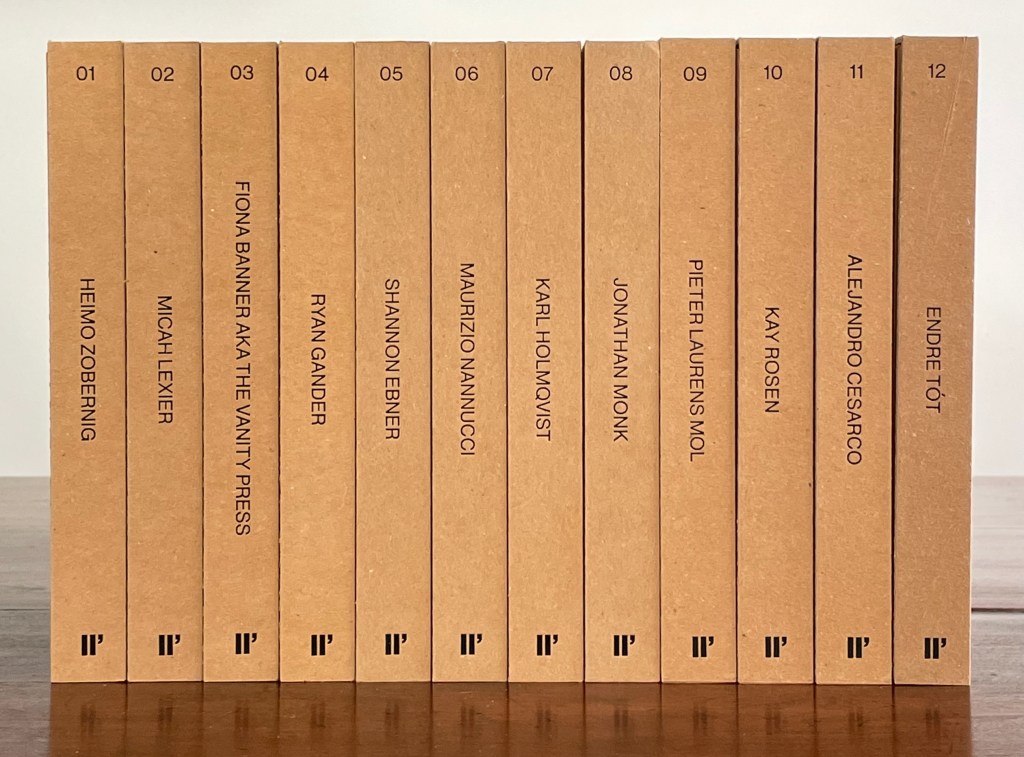
Enthusiasts and collectors of artists’ books should congratulate LL’Editions (Göteborg, Sweden) on its leporello series not only for the artists enlisted so far but for the constraint to inspire them. Critics of book art have opined that book artists turned to the accordion structure in the 20th century for more freedom with visual images and another tool with which to question the notion of the book as book. LL’Editions has challenged its invited artists with a constraint: a fixed-format leporello of ten panels, nine folds and always H140 x W100 mm (closed). The works are printed on Mohawk Superfine Eggshell paper. Housed in a custom box with the title hot foiled both on its front and spine, each volume in the series is limited to 250 numbered copies.

The real pleasure in each work and across the series is how each artist handles the shape to make it dance to a personal style or stamp. With each new addition — brick by brick — LL’Editions is building a monument to book art’s most common structure.

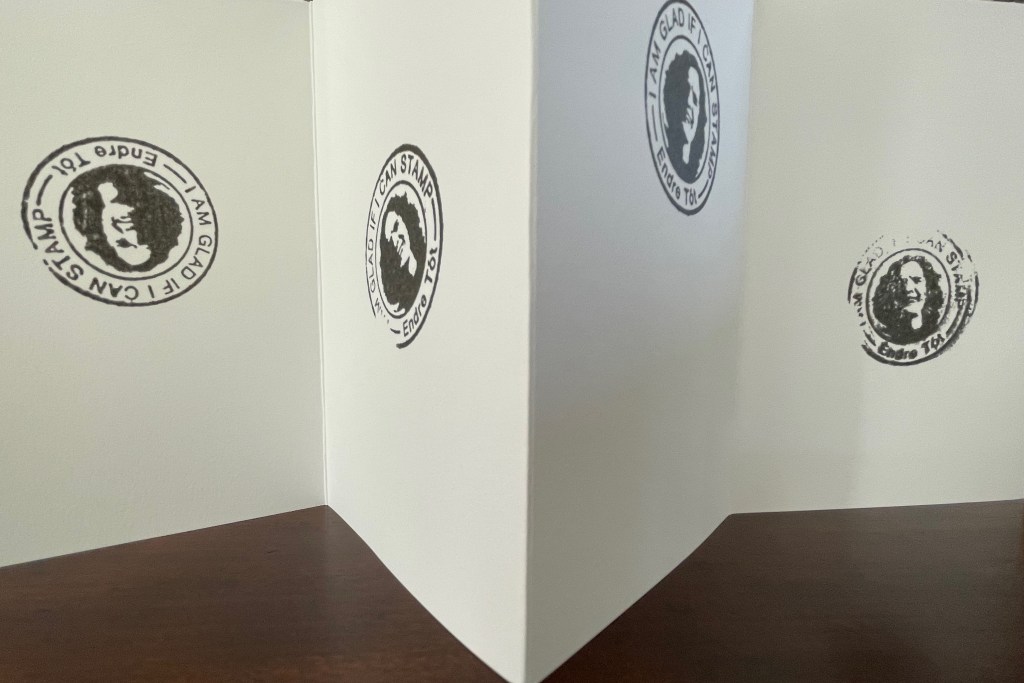
Leporello #12 (2025)

Leporello #12 (2025)
Endre Tót
Box: 148×191×23 mm. Leporello: H142 x W99 mm (closed); W990 mm (open). 10 panels. Edition of 250, of which this #70. Acquired from LL’Editions, 28 August 2025.
Photos: Books On Books Collection. Displayed with permission of LL’Editions.

Bespoke Eska Board 1260 G/M2, Insert: F-Flute Black 500 G/M2, Hot-foiled title on front and spine. Mohawk Superfine Eggshell Ultrawhite 175 gsm.

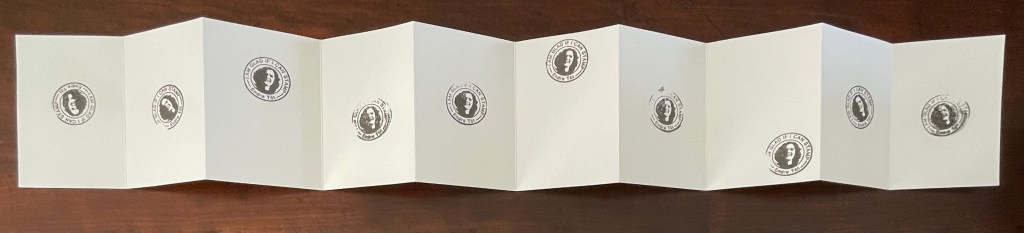
Endre Tót has worked with a wide range of media: telegrams, postcards, posters, actions, and artist’s books. This one self-reflexively celebrates his signature gladness statements “We are glad if we are happy”, “I am glad that I have stood here”, “I’m glad that I can write one sentence after another”, “We are glad if we can demonstrate” and so on.

I am glad to have Endre Tót’s work in the Books On Books Collection.

Leporello #11 (2024)

Leporello #11 (2024)
Alejandro Cesarco
Box: H191 x W148 x D 23 mm. Leporello: H142 x W99 mm (closed). W990 mm (open). 10 panels. Edition of 250, of which this #229. Acquired from LL’Editions, 14 November 2024.
Photos: Books On Books Collection. Displayed with permission of LL’Editions.

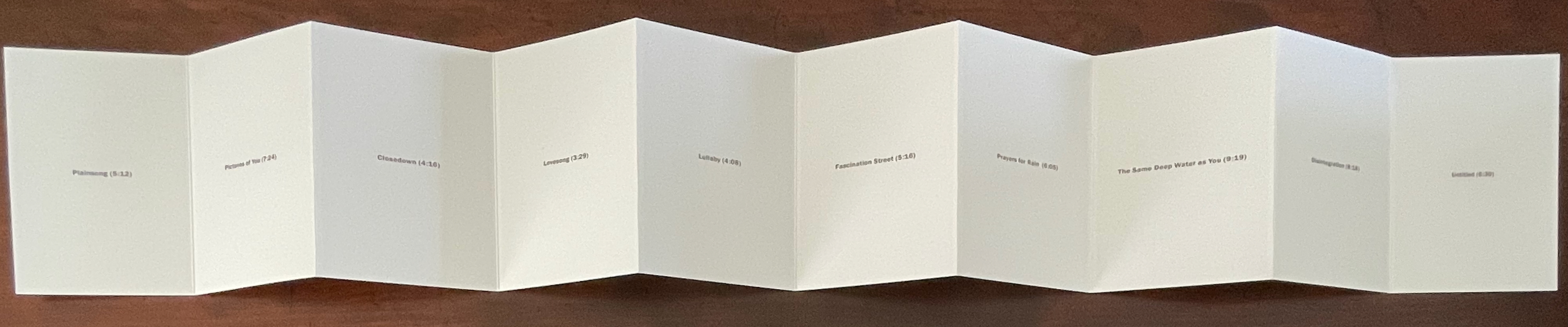
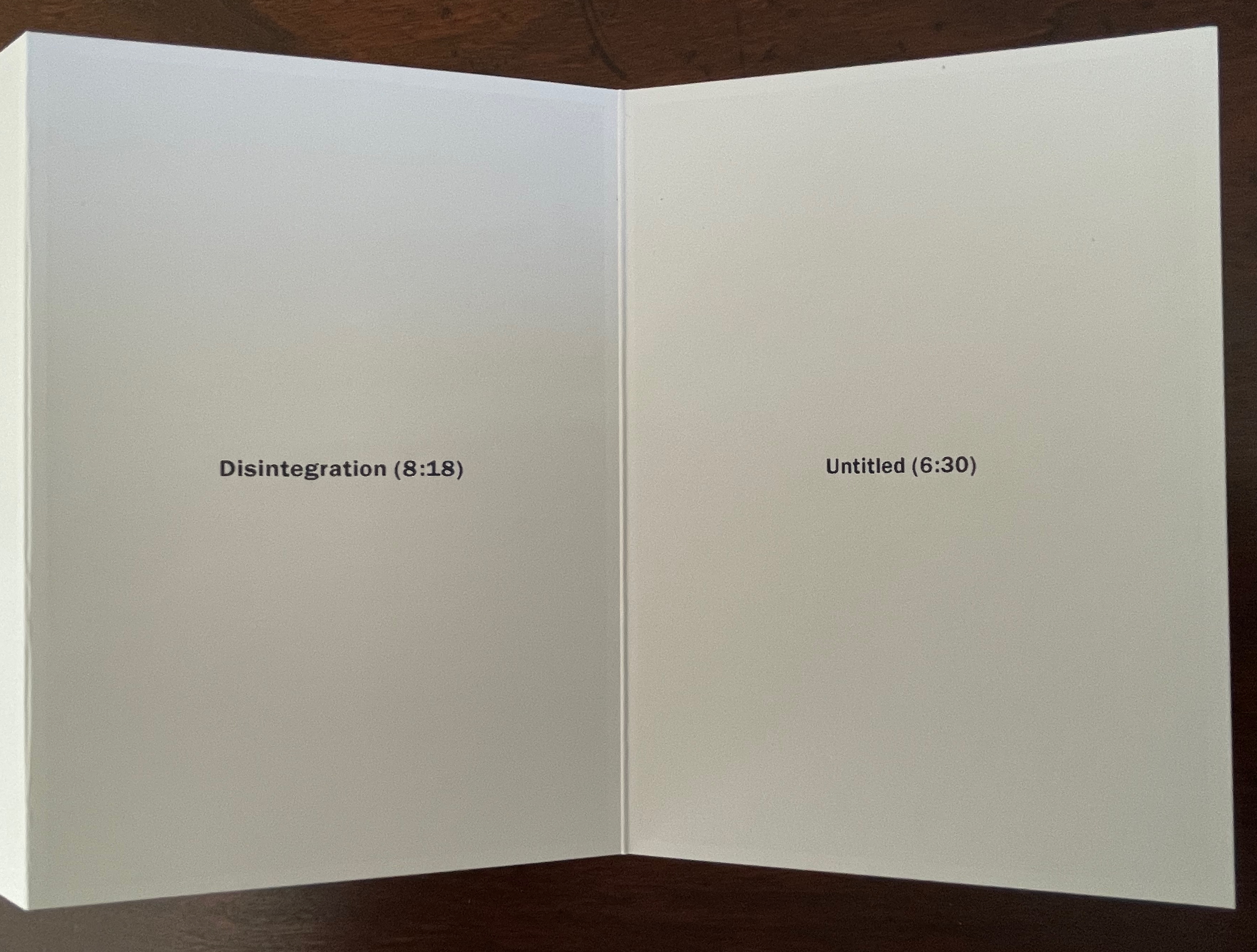
These are the titles and durations of the songs making up The Cure’s 1989 album. With each song on its own panel, Cesarco (b. 1975) seems to have created a photo album to remind himself of his youth. Given his artworks referencing/co-opting/implicating/appropriating John Baldessari, Marcel Broodthaers, Félix Gonzáles-Torres, Allen Ruppersberg, Ed Ruscha, and other book artists, the less-than-fans of The Cure may wonder if Cesarco is deliberately wrong-footing their expectations for his tackling the book artist’s platform. If you are one of them, consider that your horizons have been widened and that The Ramones (An Autobiography) (2008) — his list in chronological order of every Ramones song that begins with the pronoun “I” — does not neatly divide by 10.

Leporello #10 (2024)

Leporello #10 (2024)
Kay Rosen
Box: H191 x W148 x D 23 mm. Leporello: H142 x W99 mm (closed). W990 mm (open). 10 panels. Edition of 250, of which this #116. Acquired from LL’Editions, 14 November 2024.
Photos: Books On Books Collection. Displayed with permission of LL’Editions.

There’s a lengthy and excellent essay entitle “The Gravity of Language” about Rosen’s work in Osmos Magazine (Winter 2019) by Stephanie Cristello. In it, she writes:

You will notice, by now, that the works discussed here are united by their allusions to the motions of up and down. Does this seem arbitrary to you? Or strike you as the imposi­tion of a rule-based physics upon an artistic practice whose oeuvre certainly contains vari­ances, divergences, and oddities–cut out for the purpose of being explored through a par­ticular force? Perhaps. (Cristello, 2019)

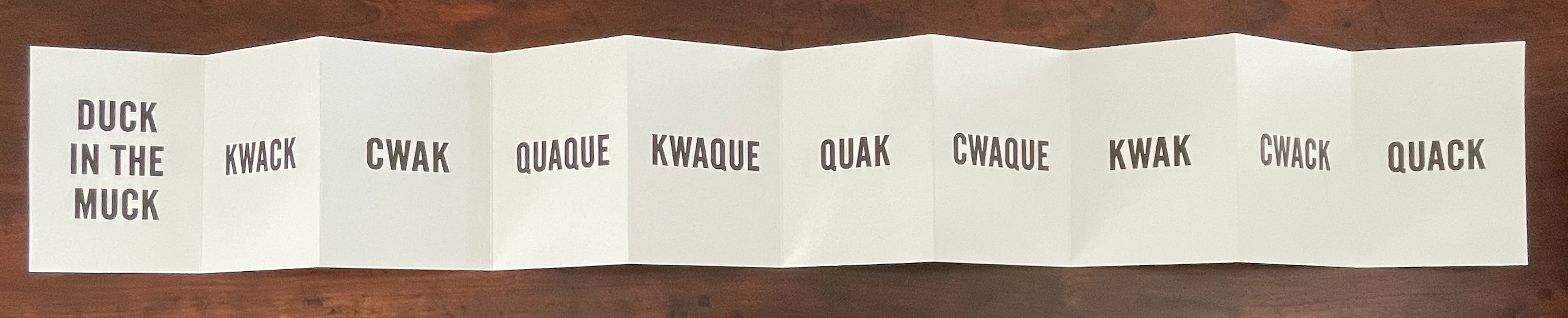
Somehow this more recent artist’s book seems to confirm and repudiate the critic’s approach. As if to say, “Yes, I’m stuck in the muck despite my variances, divergences and oddities”, or “No, ducky, there’s no gravitas or gravity here”. Or perhaps it’s Rosen’s visual way of using permutations on language (starting with a common expression) to poke fun at LL’Editions’ constraint: “So you want to confine me like a duck in the muck? Well, quack, the joke’s on you”.

Leporello #9 (2024)

Leporello #9 (2024)
Pieter Laurens Mol
Box: H191 x W148 x D 23 mm. Leporello: H142 x W99 mm (closed). W990 mm (open). 10 panels. Edition of 250, of which this #111. Acquired from LL’Editions, 14 November 2024. Photos: Books On Books Collection. Displayed with permission of LL’Editions.

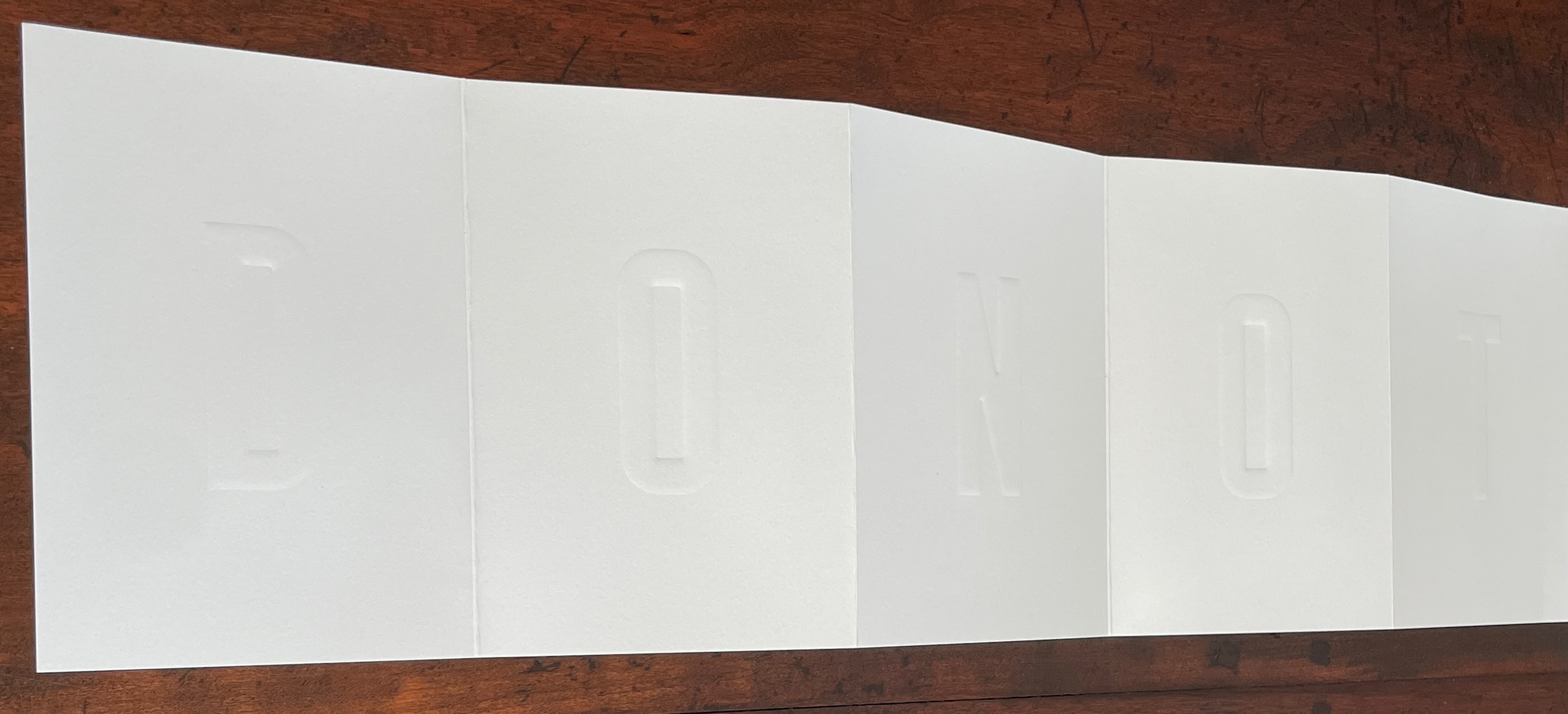
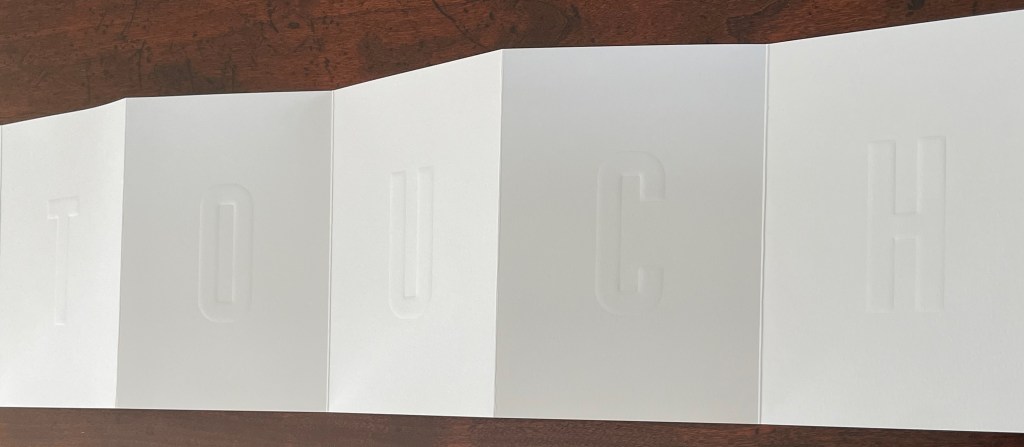
How many artists before and after Marcel Duchamp’s Prière de Toucher (1947) have played this joke in an artist’s book? Where Duchamp’s displayed work played against the usual museum injunction, Pol’s embraces and wrong-foots it with blind embossing.

Leporello #8 (2022)

Leporello #8 (2022)
Jonathan Monk
Box: H191 x W148 x D 23 mm. Leporello: H142 x W99 mm (closed). W990 mm (open). 10 panels. Edition of 250, of which this #175. Acquired from LL’Editions, 14 November 2024.
Photos: Books On Books Collection. Displayed with permission of LL’Editions.

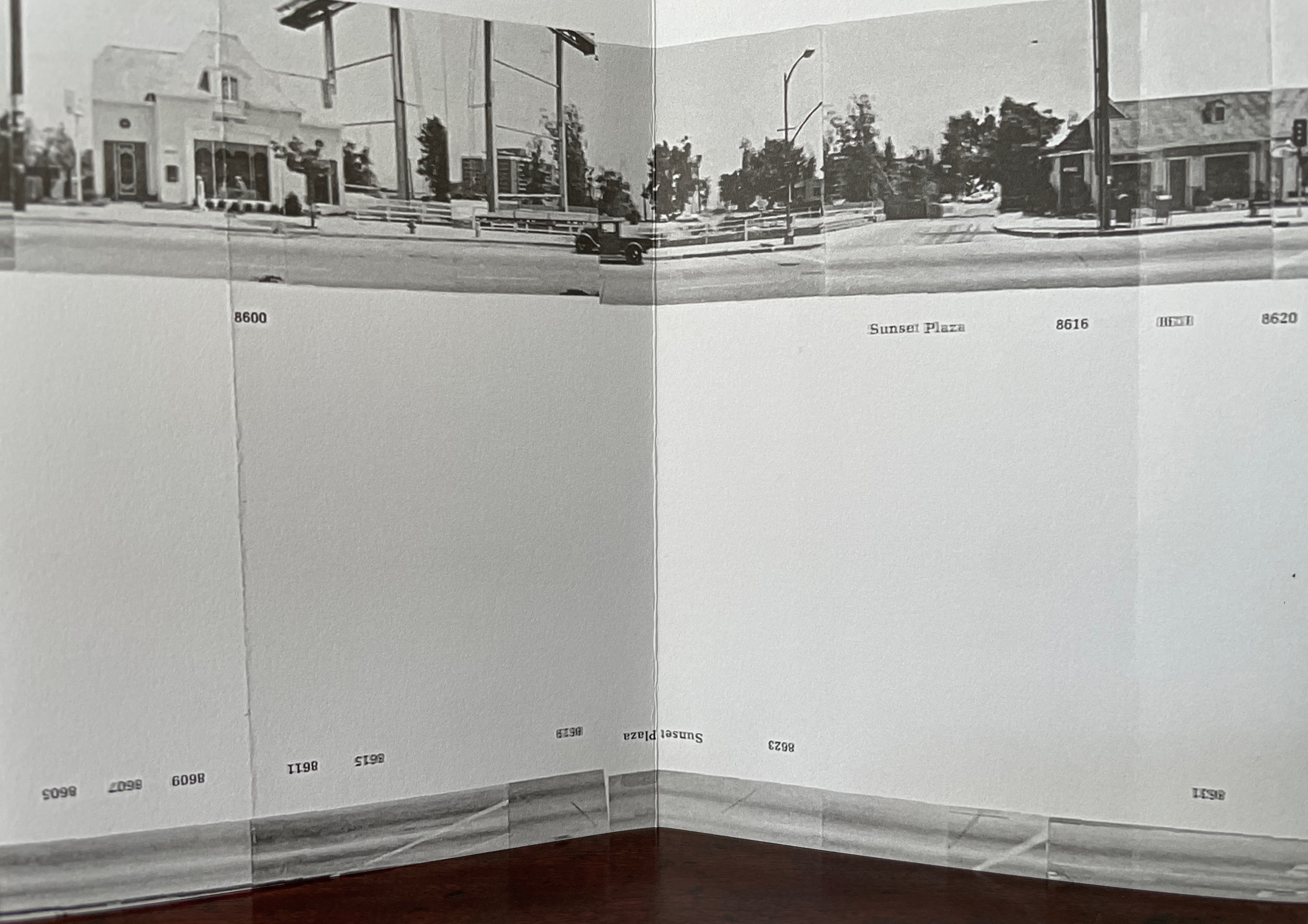
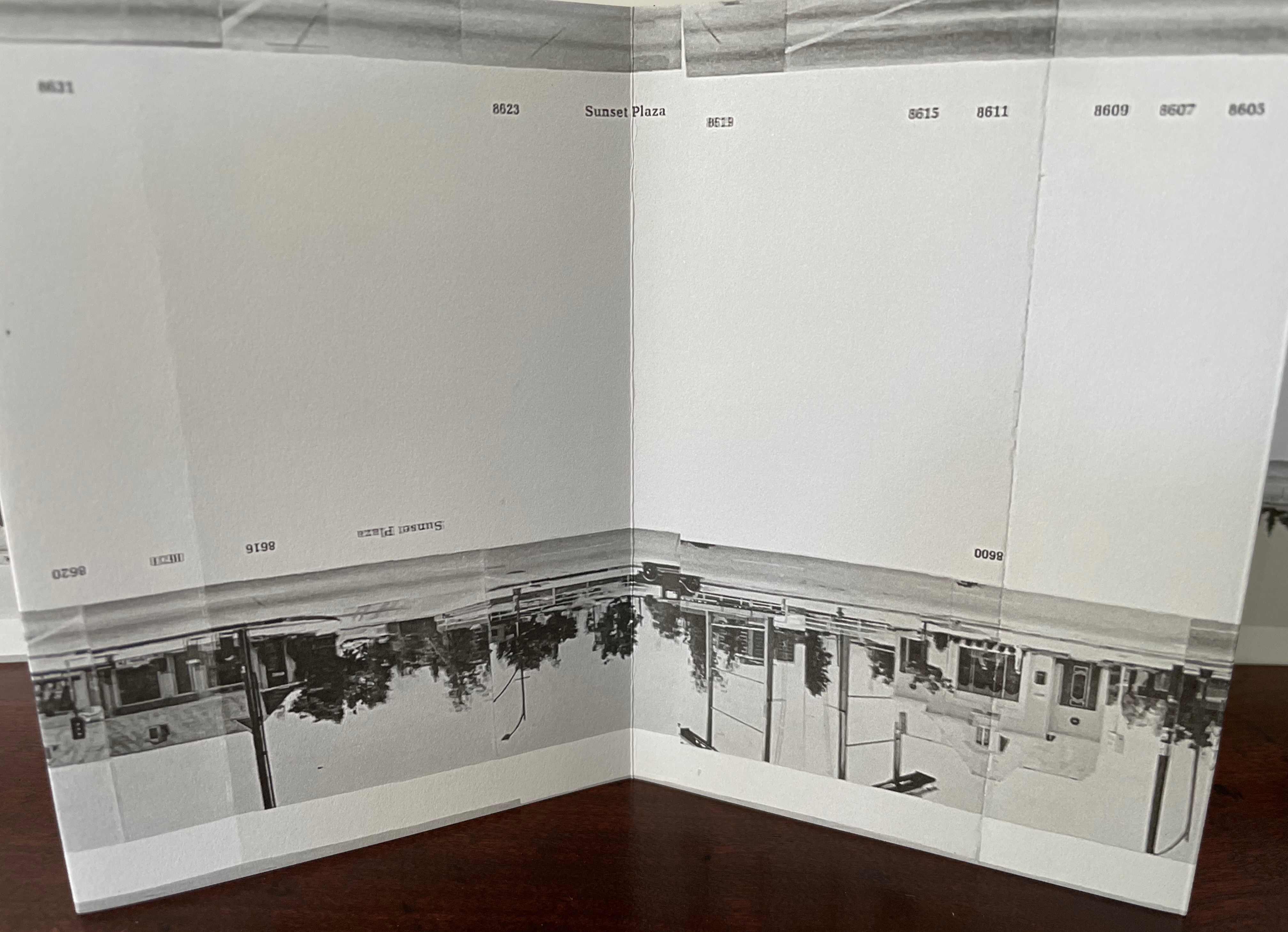
It helps to know or remember that in 2002, Jonathan Monk published None of the buildings on Sunset Strip with Revolver. Here, he has used his iPhone in panoramic mode to appropriate again Ed Ruscha’s Every Building on the Sunset Strip (1966). But when Monk’s leporello is turned over, notice that this side of the Strip has been truncated. Monk’s thoughts on appropriation and self-reflexivity can also be enjoyed in the three-handed interview Books on Books (2011) with Jérôme Saint-Loubert Bié and Yann Sérandour.

Leporello #7 (2022)

Leporello #7 (2022)
Karl Holmqvist
Box: H191 x W148 x D 23 mm. Leporello: H142 x W99 mm (closed). W990 mm (open). 10 panels. Edition of 250, of which this #110. Acquired from Unoriginal Sins, 14 November 2024.
Photos: Books On Books Collection. Displayed with permission of LL’Editions.

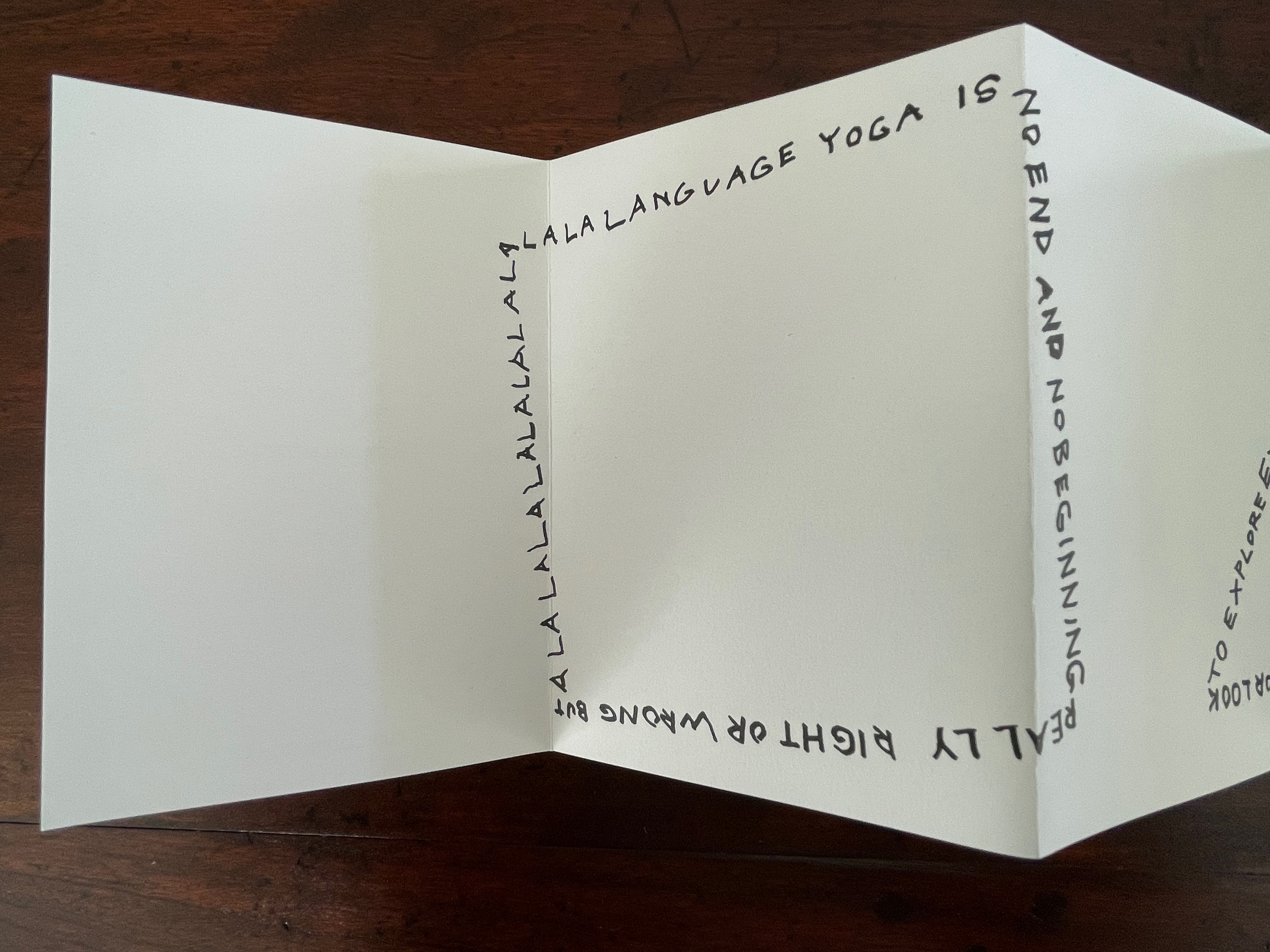
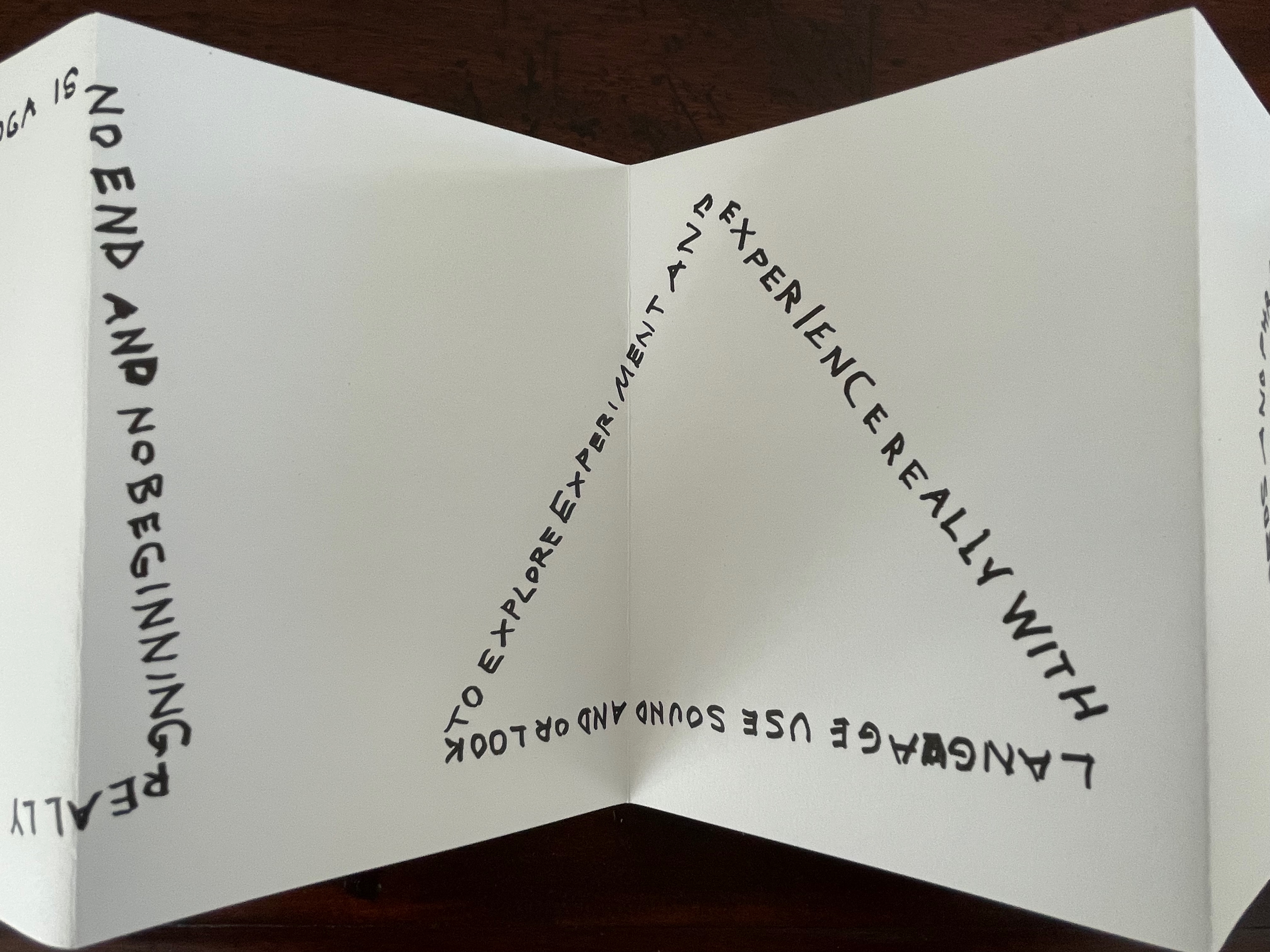
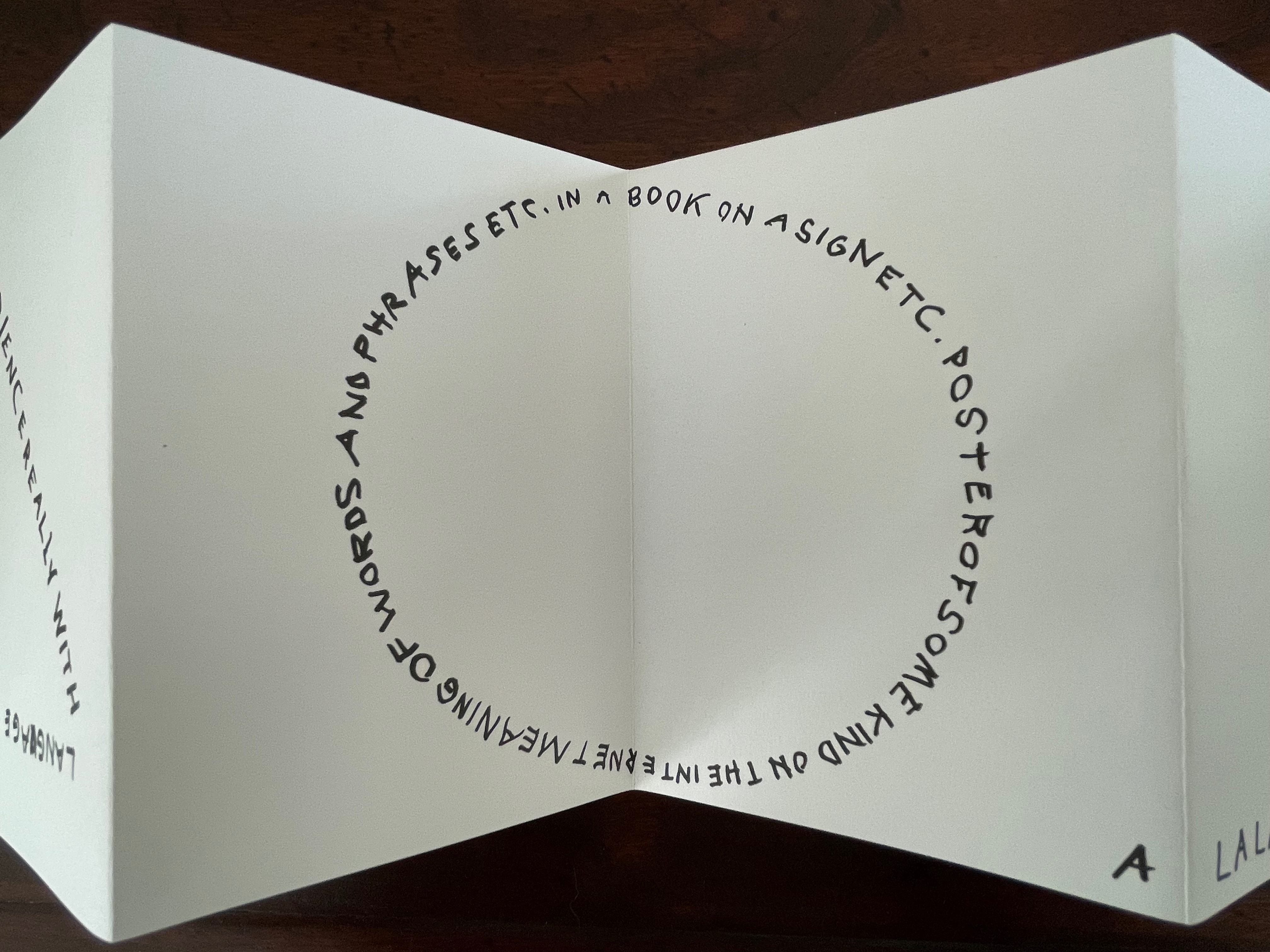
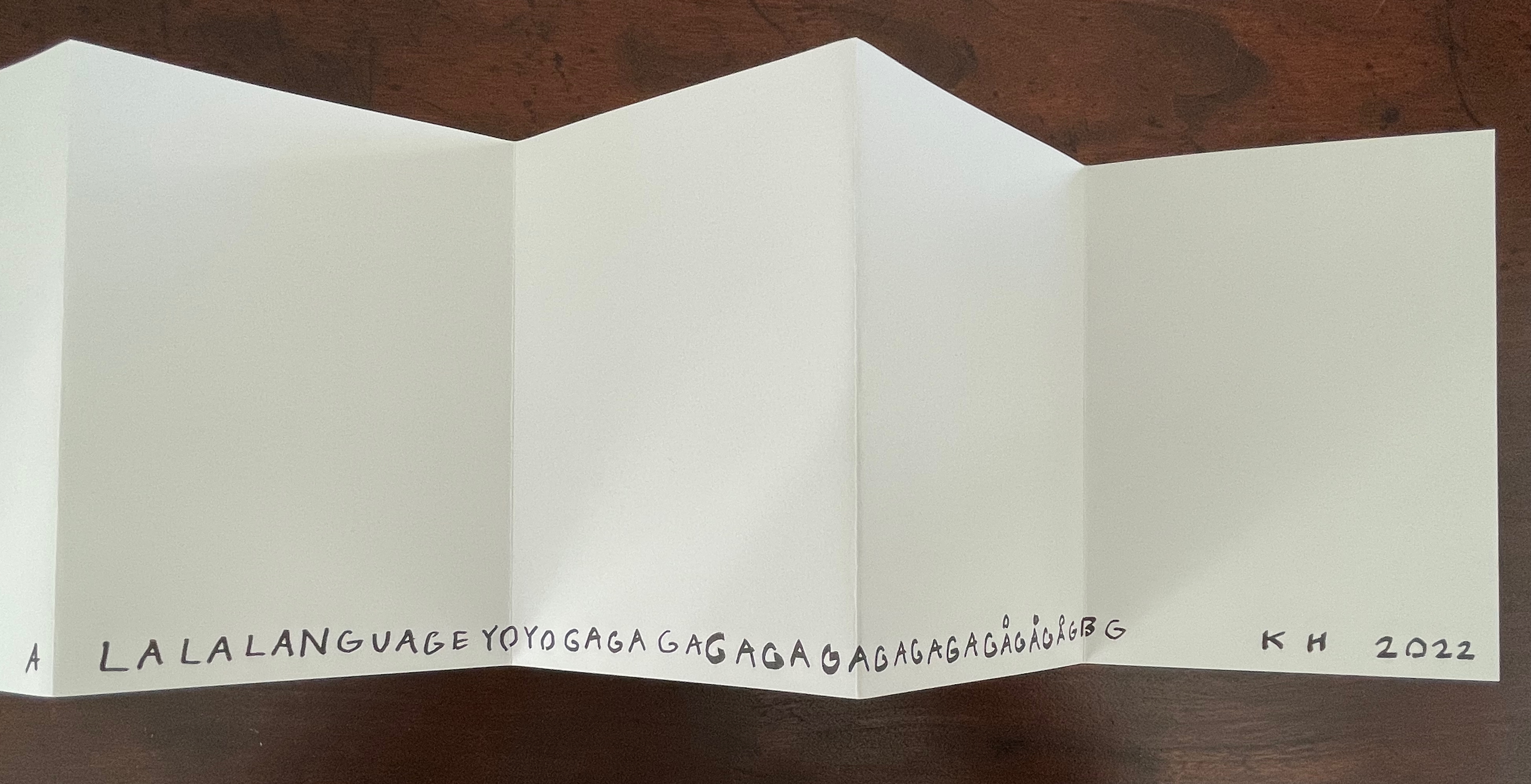
Here’s one to add to Bruno Munari‘s collection of squares, circles, and triangles. While the yoga may also remind you of Ric Haynes‘s Aquatic Yoga with Dangerous Foods (1984), this leporello is a welcome opportunity to experience this Swedish artist’s ability to weld language and shapes together in perceptive and humorous (and sometimes acerbic) ways. Galerie Neu in Berlin has been astute enough to hold three solo exhibitions for Holmqvist since 2013; their display of his works here provides views of his several sculptures that chime with Leporello #7.

Leporello #6 (2022)


Leporello #6 (2022)
Maurizio Nannucci
Box: H185 x W148 x D 23 mm. Leporello: H143 x W90 mm (closed). W900 mm (open). 10 panels. Edition of 250, of which this #106. Acquired from Unoriginal Sins, 14 November 2024.
Photos: Books On Books Collection. Displayed with permission of LL’Editions.

It’s hard to believe that Leporello #6 may be one of only three accordion books produced by this prolific and inventive artist associated with Fluxus. The other two are Sessanta Verdi Naturali (Sixty Natural Greens) (1977) and Up Above the Wor(l)d/A Guide for Aliens (1981). In Leporello #6, he has made the accordion structure, panel layout, and language reinforce one another simultaneously to create an ouroboros artwork.

Leporello #5 (2022)

Leporello #5 (2022)
Shannon Ebner
Box: H185 x W148 x D 23 mm. Leporello: H143 x W90 mm (closed). W900 mm (open). 10 panels. Edition of 250, of which this #132. Acquired from Unoriginal Sins, 14 November 2024.
Photos: Books On Books Collection. Displayed with permission of LL’Editions.

Since her participation in MoMA’s Ecstatic Alphabets/Heaps of Language in 2012, Shannon Ebner has been a book artist to watch for bringing the alphabet and the artist’s book together.

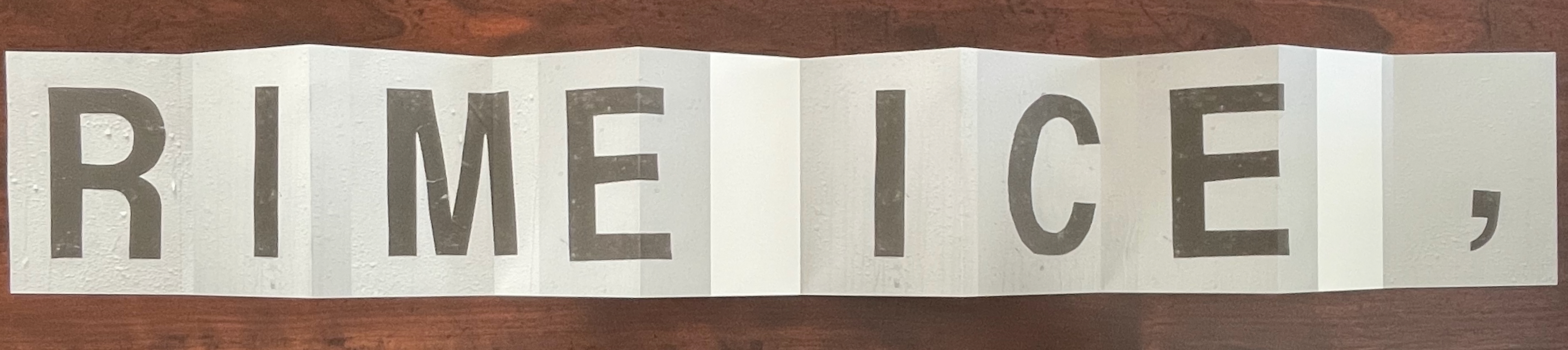
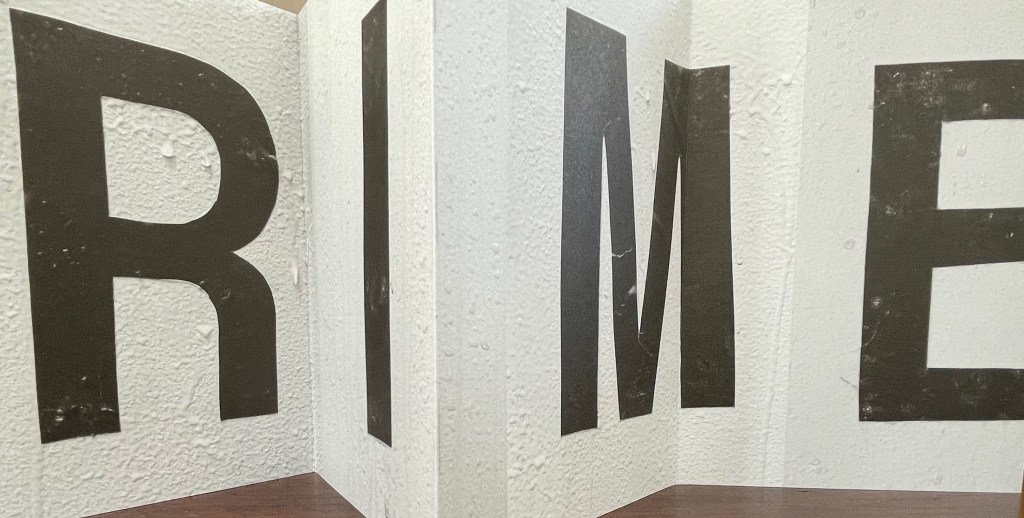
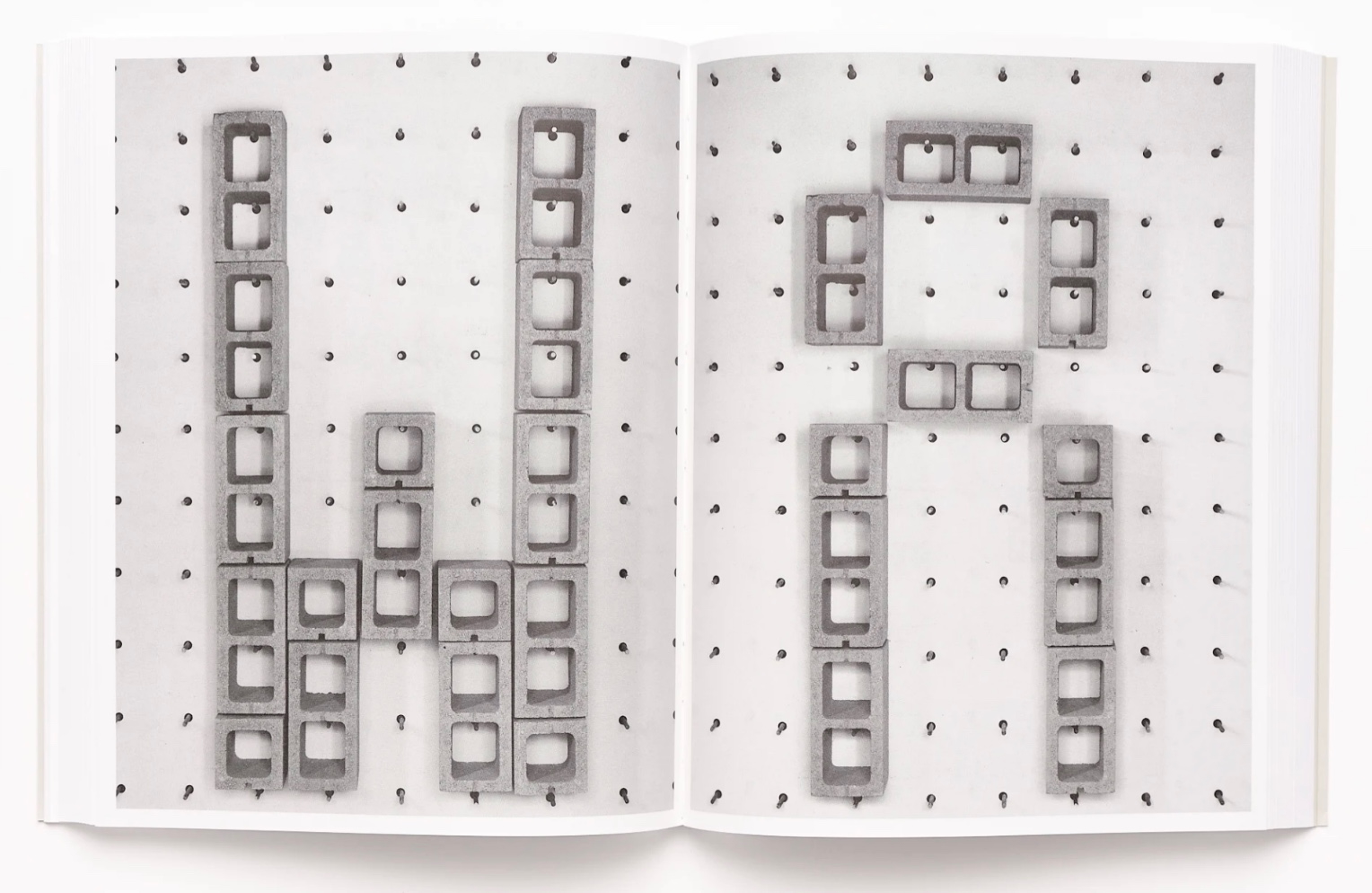
Her Strike (2014) concretely rewarded the alert. The textures of melting ice in Leporello #05 and concrete blocks in Strike seem to leap off the letters and paper. From the LL’Editions’ description of Leporello #05:

Ebner has selected specific materials based on their self-reflexive relationship to the subject of the writing itself. Each photographic typeface is in essence a material response to the various cultural conditions and societal pressures at hand. For Ebner’s leporello, the meteorological term RIME ICE is its single subject, though the phenomenon itself falls into two categories, soft or hard rime. In either case it is rime ice that forms when liquid droplets comprised of supercooled water freeze onto surfaces. RIME ICE is an outtake from Ebner’s recent exhibition FRET SCAPES (2022). FRET is acronym for the Forecast Reference Evapotranspiration Report, a report that is generated by climate scientists to measure the rate at which water that falls to the ground will evaporate to the sky.

Leporello #04 (2021)

Leporello #04 (2021)
Ryan Gander
Box: H191 × W148 x D23 mm. Leporello: H142 x W99 mm (closed), W990 mm (open). 10 panels. Edition of 250, of which this #32. Acquired from Unoriginal Sins, 14 November 2024.
Photos: Books On Books Collection. Displayed with permission of LL’Editions.

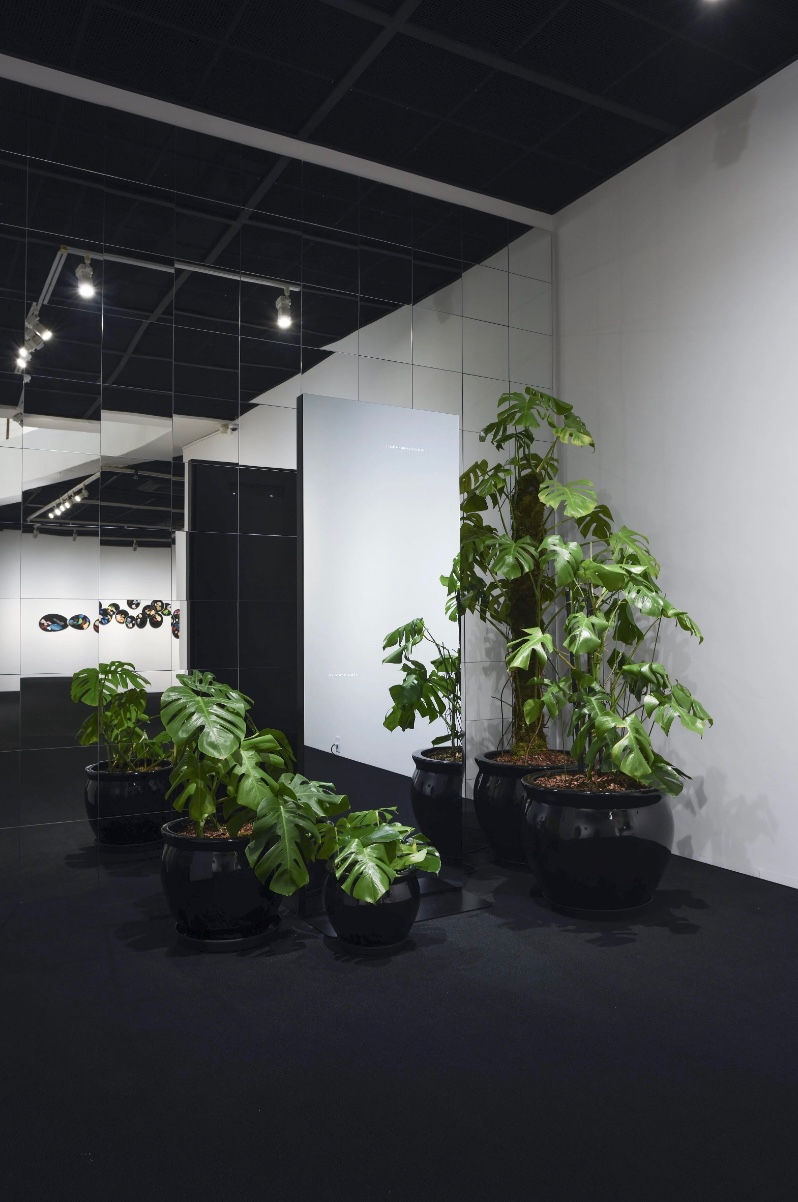
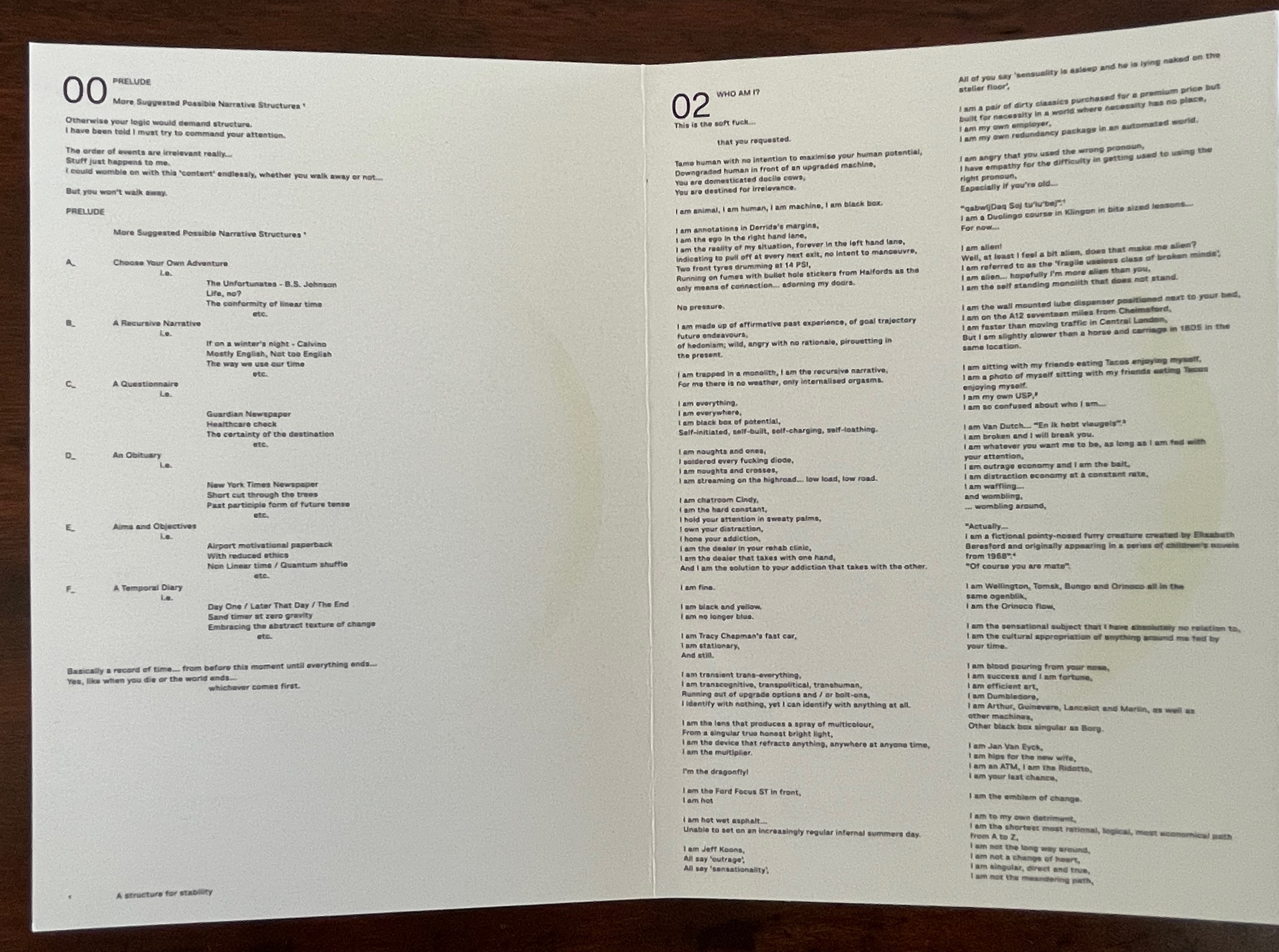
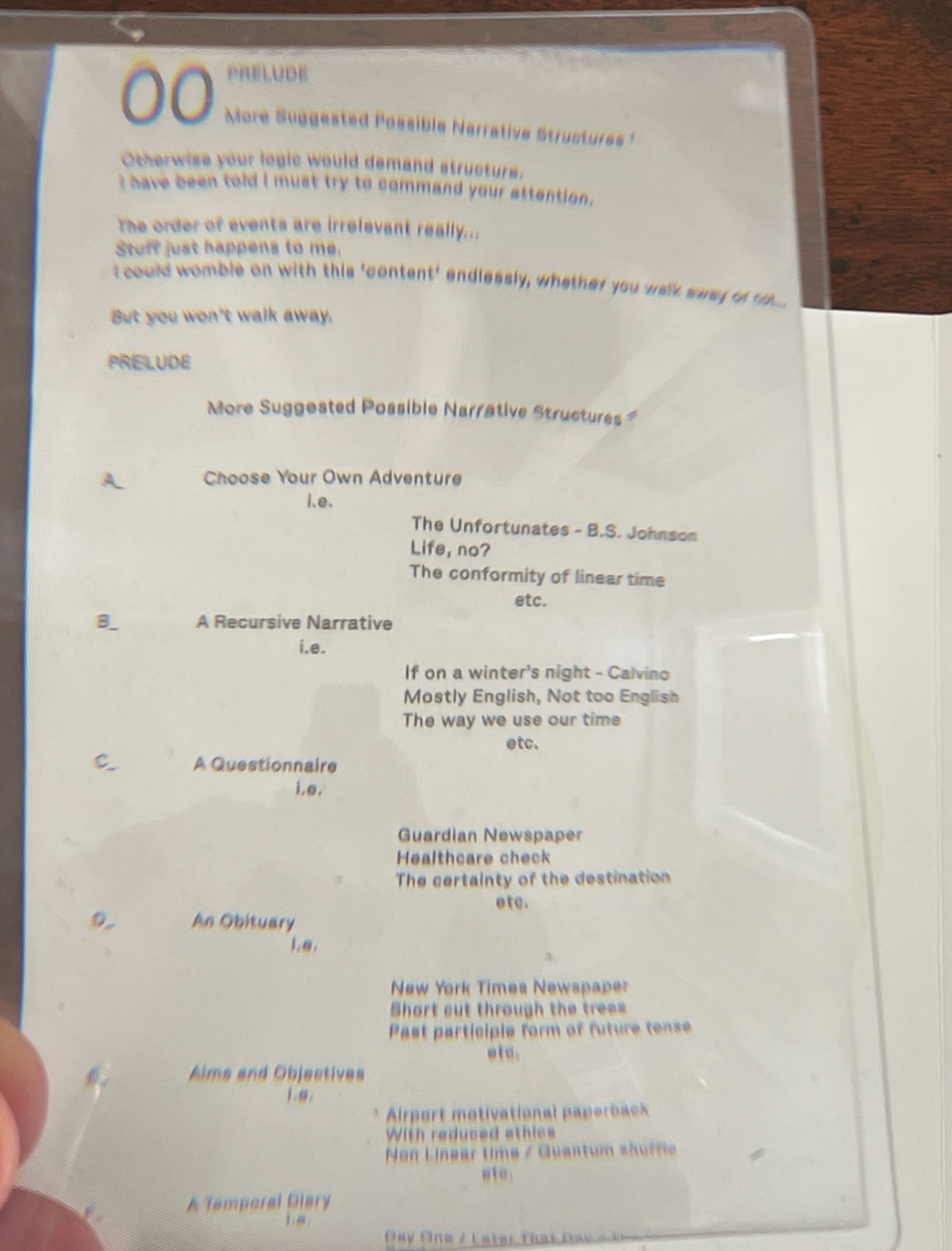
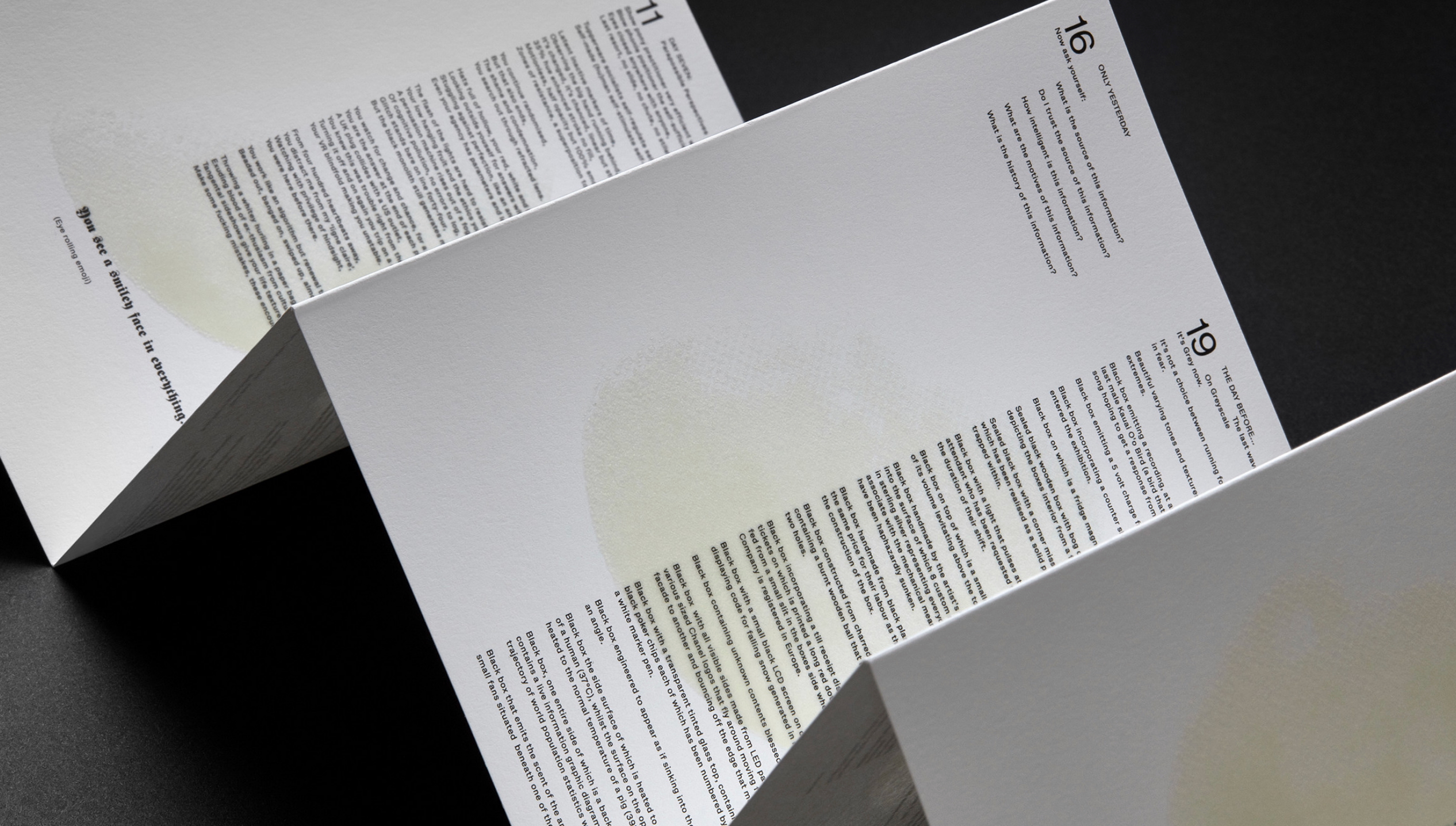
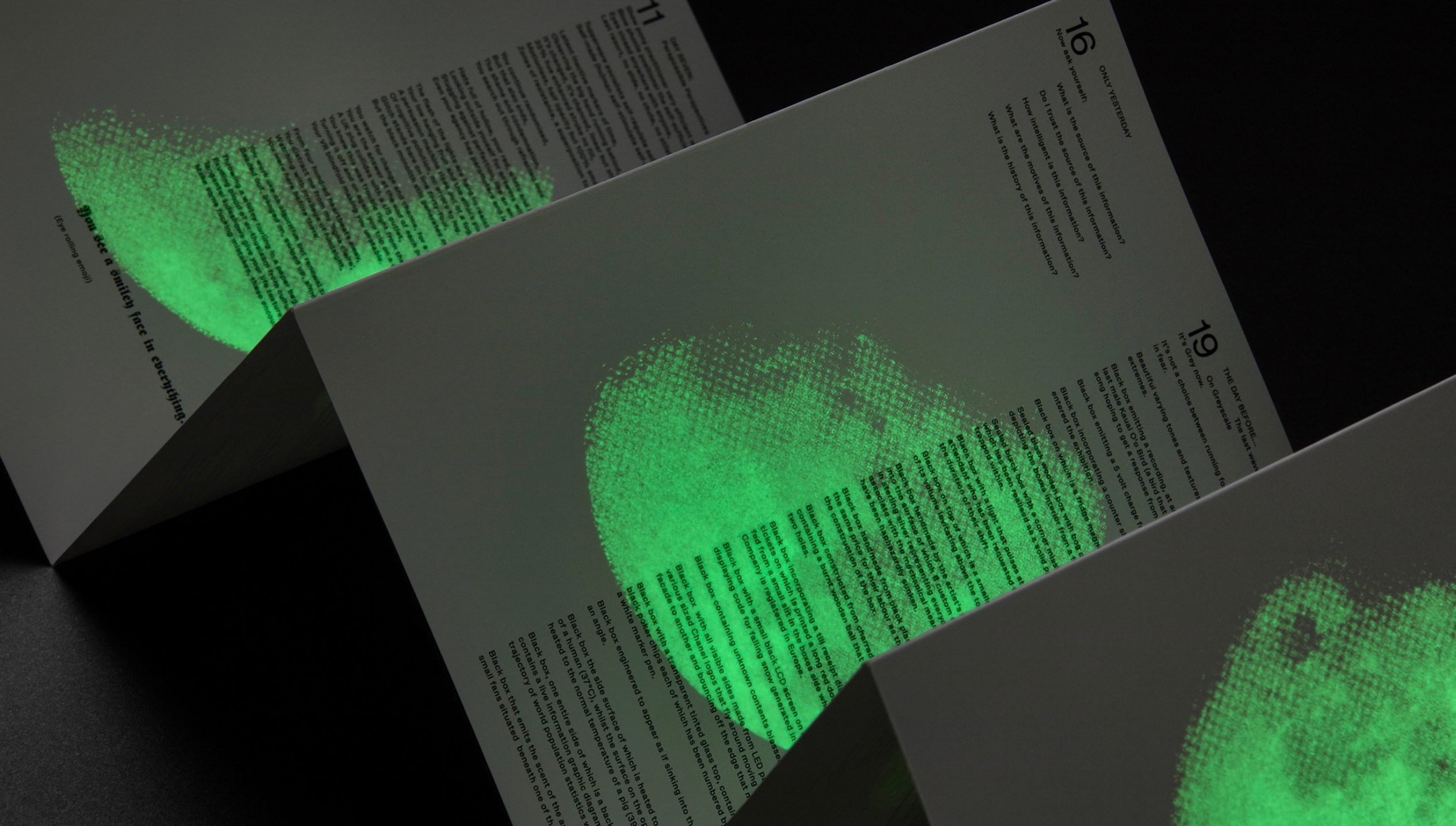
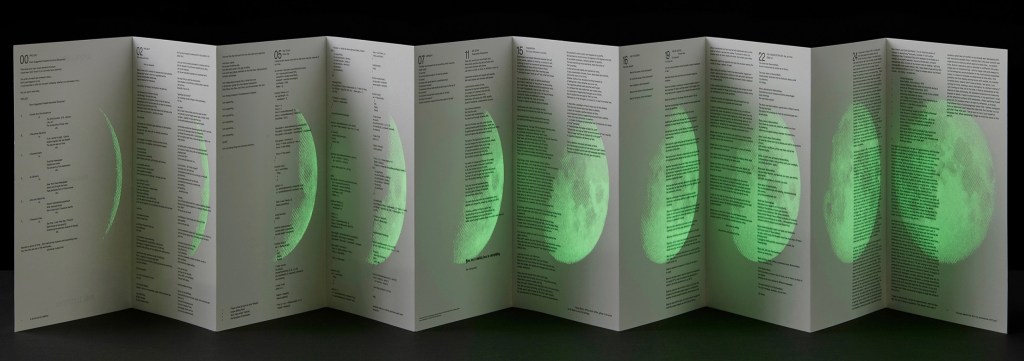
Ryan Gander has repurposed his installation Staccato Reflections (2017-20) to create Leporello #04. The tiny text originates from the artist’s notebook. In Staccato Reflections, it appears in a normal-sized font in business-directory format on a freestanding reflective screen. Gander describes the installation this way in an interview in Art in America:

Staccato Reflections is based on the idea of the self in culture, the obsession with the me and the selfie and the narcissist wand. The surface is mirrored, so as you read the words, you see yourself. The work has devices in it that are self-referential. It asks you to touch the screen, and then says “don’t touch the screen.” So it seems like it is responding to you, but it’s not.” (Fullerton, 107)

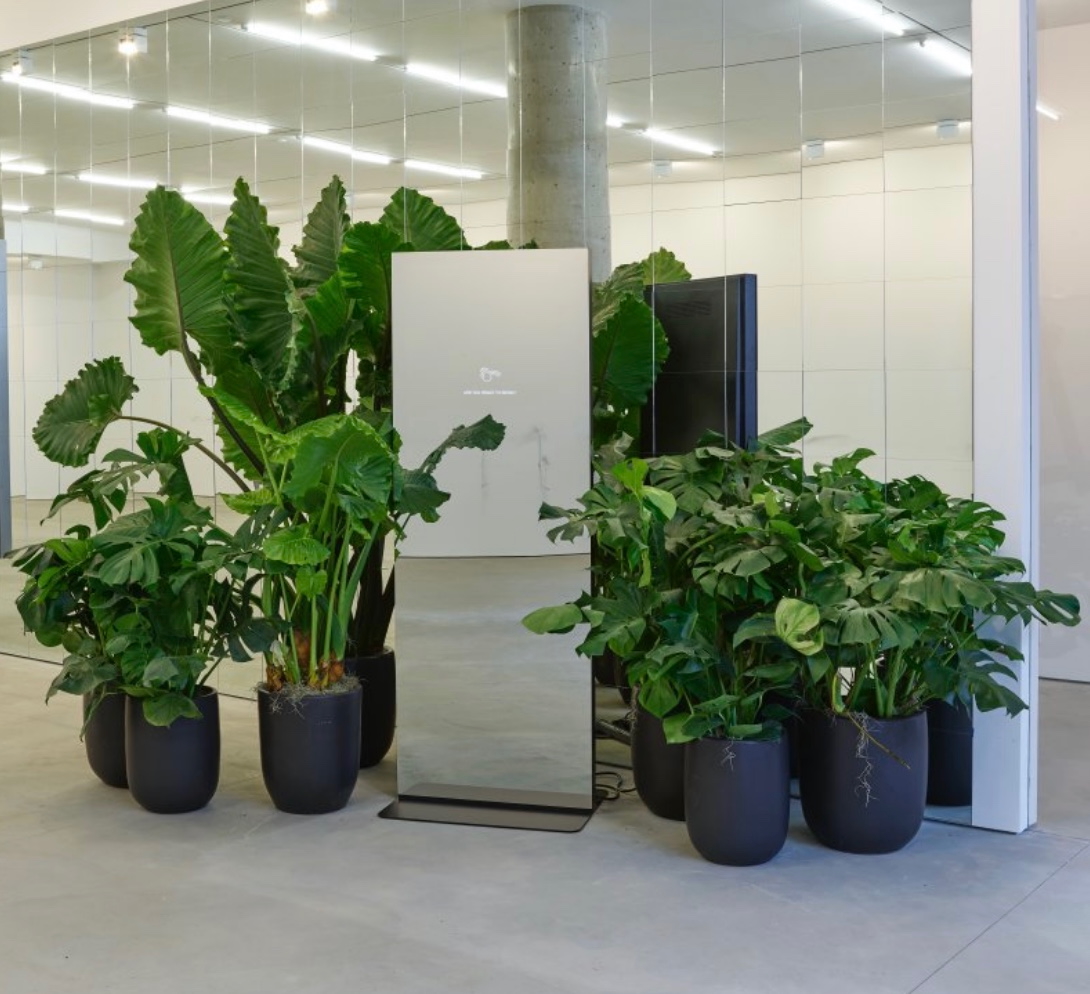
Staccato Reflections (2017)
Ryan Gander
A large free standing backlit mirrored business infototem, as one would expect to see in the lobby of a corporate building. The display presents a word composition / beat poetry written by the artist, on the themes of narcissism, self reflection and the presentation of the self in everyday life, leaving the viewer with an associative but ambiguous stream of consciousness. The digital lobby sign is surrounded by a collection of domestic looking Monstera deliciosa plants (Swiss Cheese Plants).
© Ryan Gander. Photos: Youngjun Choi.

With its miniscule print requiring the enclosed rectangular plastic magnifying glass, and with its overprint in glow-in-the-dark ink of a waxing full moon, Leporello #04 marks quite a departure from the installation.

Leporello #03 (2021)

Leporello #03 (2021)
Fiona Banner
Box housing leporello. Box: H185 xW140 xD25 mm. Leporello: H140 x W100 mm. 10 panels. Numbered edition of 250, of which this #42. Acquired from Unoriginal Sins, 14 November 2024.
Photos: Books On Books Collection. Displayed with permission of LL’Editions.

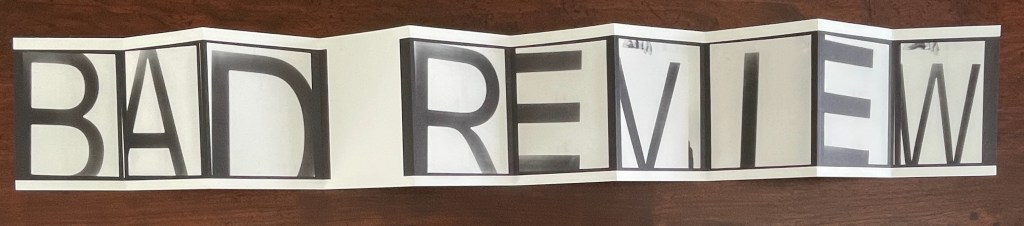
With Leporello #03, Fiona Banner repurposes the previously repurposed conceptual artwork Bad Review. It has appeared as a C-type print with the words overlaid on a rearview mirror and as a sculpture. To reproduce the two words, Banner uses found letters photographed held up by hand and badly positioned. Is it serendipity or cheeky genius that, like readymades, the nine letters and space of Banner’s conceptual artwork fit the ten panels imposed by LL’Editions to give us another re-view?

Leporello #02 (2021)

Leporello #02 (2021)
Micah Lexier
Box housing leporello. Box: H185 xW140 xD25 mm. Leporello: H140 x W100 mm. 10 panels. Edition of 250, of which this #171. Acquired from Unoriginal Sins, 14 November 2024.
Photos: Books On Books Collection. Displayed with permission of LL’Editions.

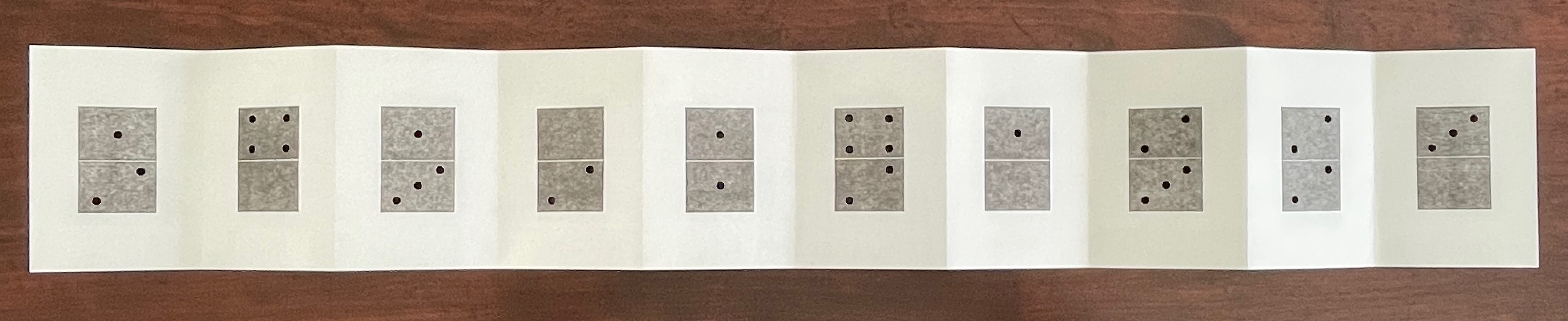
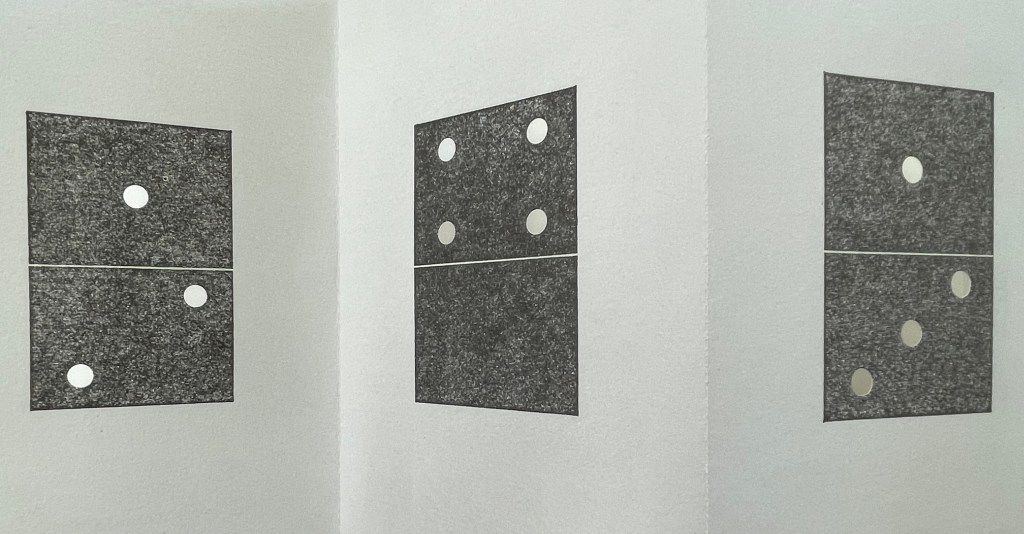
Publisher’s description: A number of years ago Micah Lexier purchased a small paperback publication about the game of dominoes. The very end of the book consisted of a series of pages that reproduced a complete set of twenty-eight domino tiles. The images were printed on right-hand pages, four to a page, while the left-hand pages were blank. The idea was that you were supposed to cut these images out of the book and glue them to empty matchboxes to create your own do-it-yourself set. That sequence of pages, combined with the quality of their reproductions, was the inspiration for Lexier’s leporello. To that, he added two favourite print techniques – perforations and die-cut holes – to create a set of ten domino tiles. Lexier chose the denomination of each tile and its order in the leporello so that none of the thirty-four die-cut holes line up with each other, allowing each hole to be misread as a printed white domino dot.

If you stand Leporello #02 on its edge on a table and then lean forward to view the panels at eye level, the domino images seem to have grown into oversized hangings on gallery walls. You can see some of the die-cut holes if you look closely at the lower right corner below.

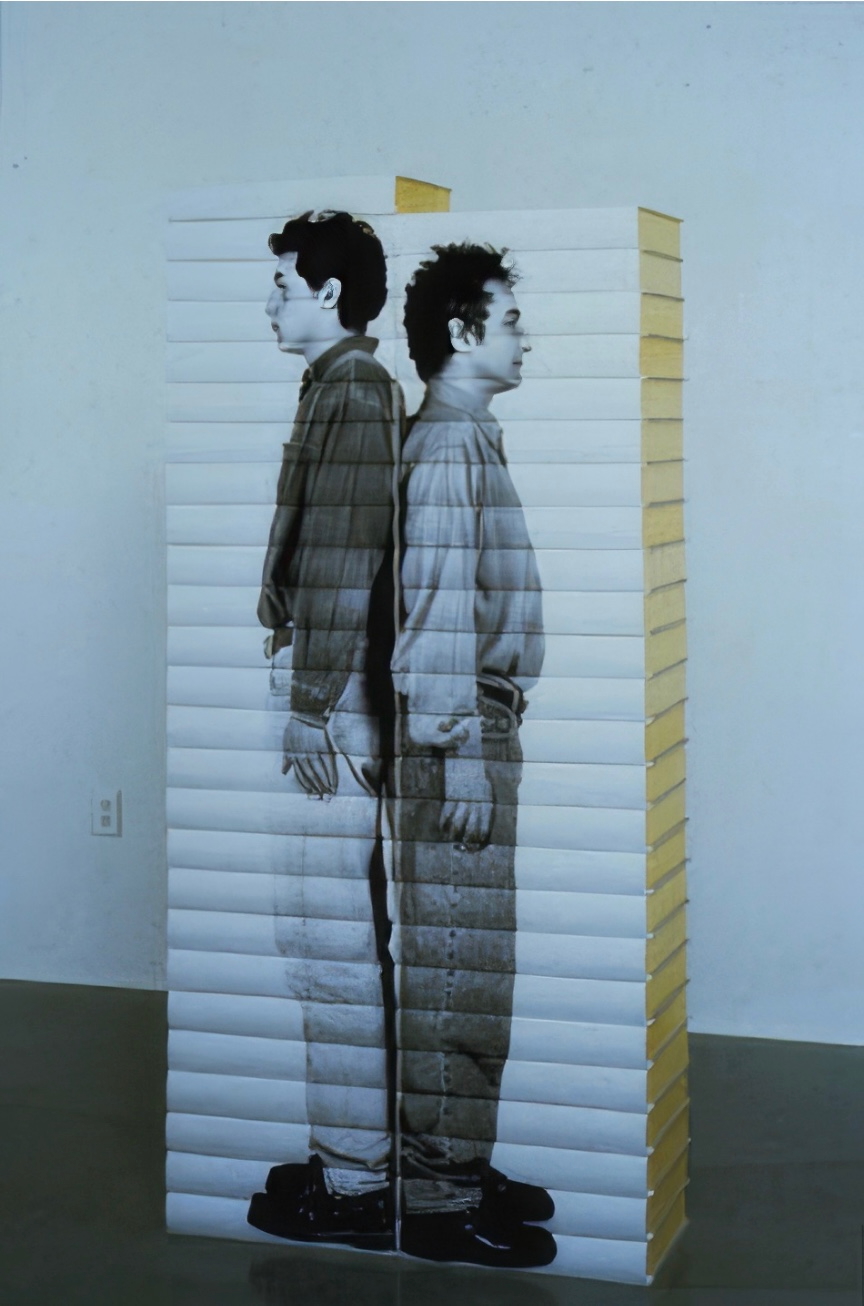
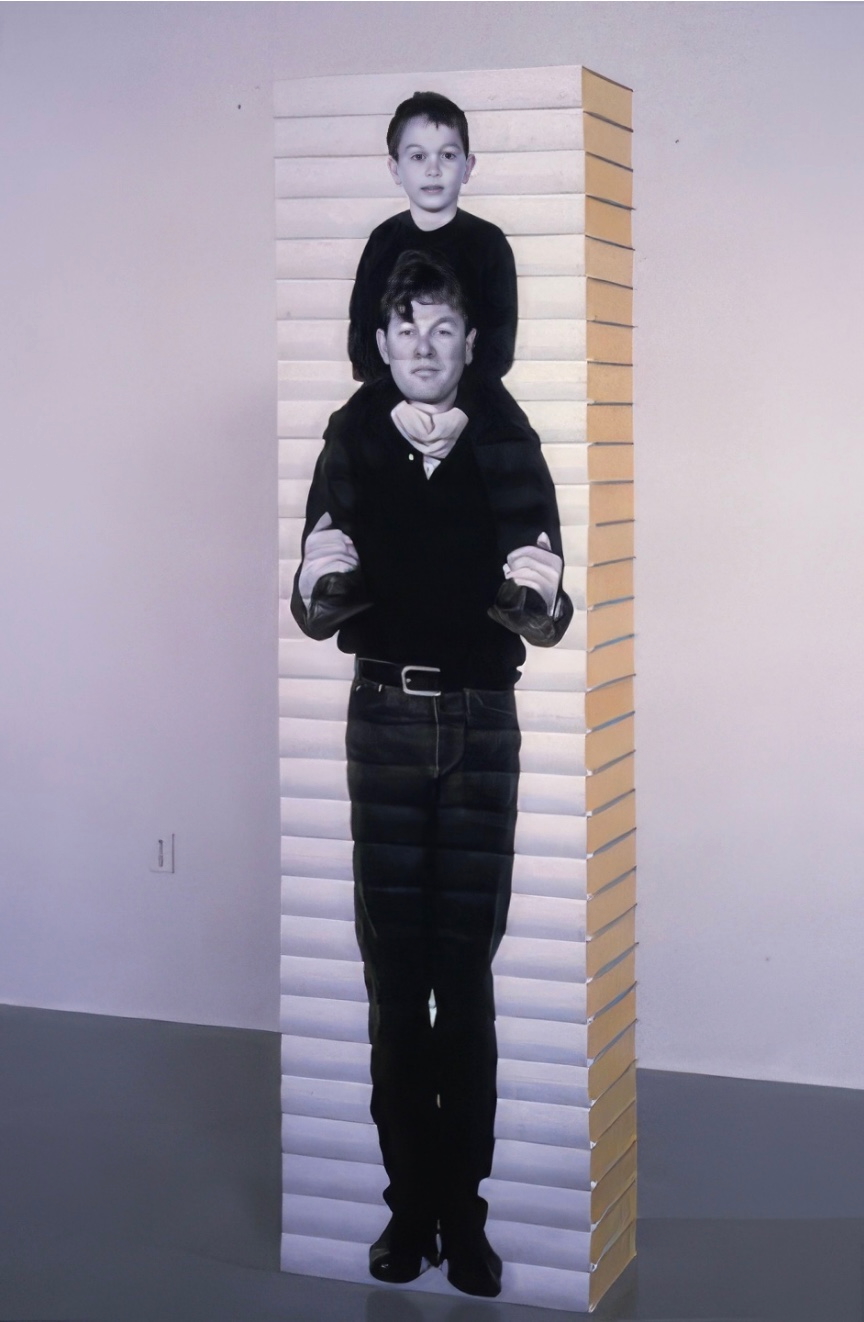
It’s a peculiar sensation, but it echoes Lexier’s website, which highlights mostly installations and large-scale works. Even more so it echoes Robert Birch Gallery in Toronto, which emphasizes his large wall displays. On both sites, Lexier’s play with patterns, shapes, tiles, and contrasts of black and white stands out. Although it’s not clear from those current sites, he has many book-related works. In the ’90s, he produced book sculptures in which each spine in a stack of books would have part of a life-size photo of a human subject printed on it. Properly stacked, the books display the human figure.

Taller Child (Adolescent Male) (1993) and Father and Son (1993)
Photos: CCCA Canadian Art Database Project, Centre for Contemporary Canadian Art. © Micah Lexier.

As can be seen in Leporello #02 and other works on display in the CCCA Canadian Art Database Project, Lexier likes to work with found objects. As can be seen in the book sculptures above and in the Database Project, Lexier’s art also reflects on relationships and community. Leporello #02 neatly and abstractly brings these two themes together with the found dominoes game book and the game’s communal roots.

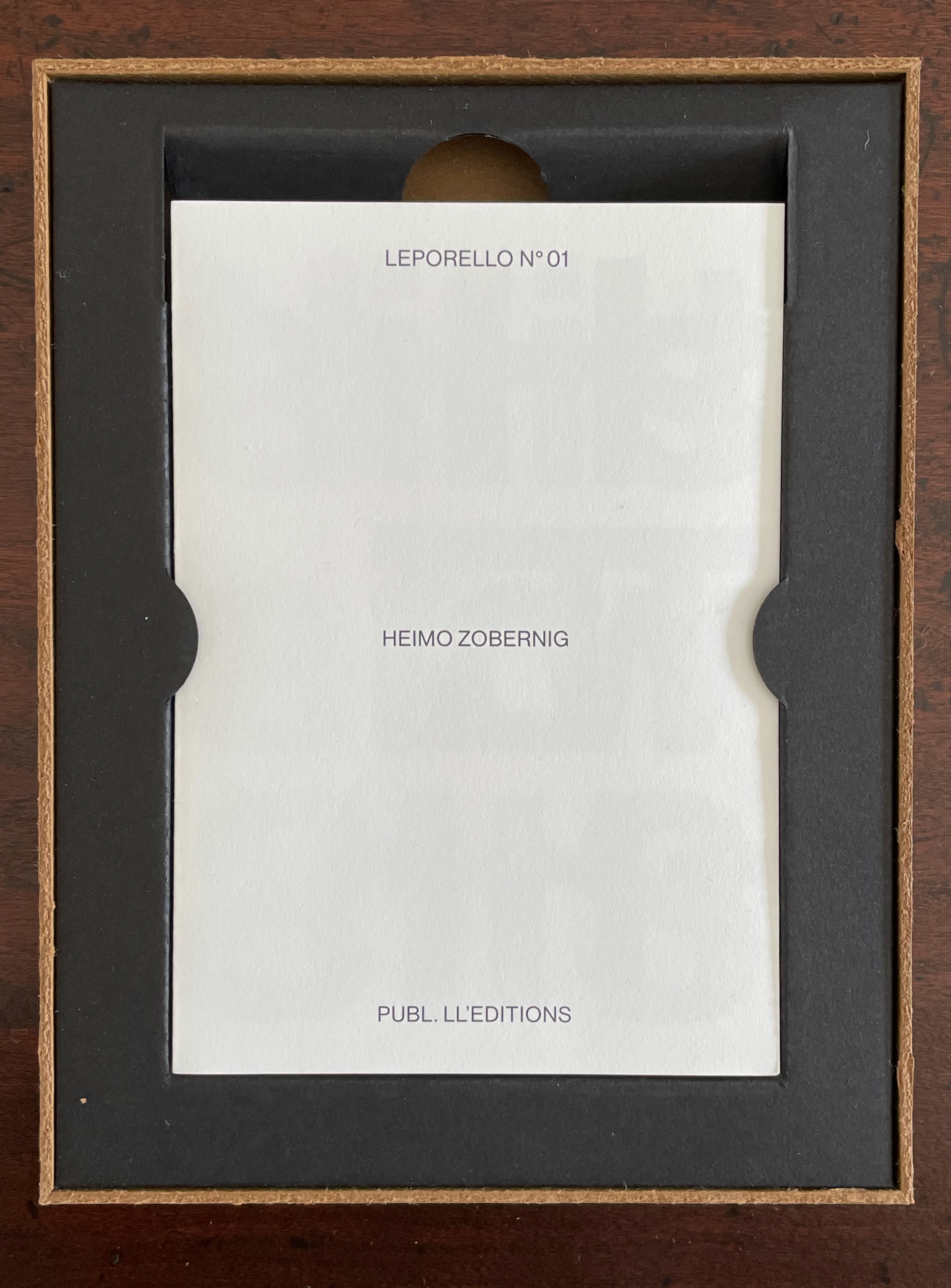
Leporello #01 (2021)

Leporello #01 (2021)
Heimo Zobernig
Box housing leporello. Box: H185 xW140 xD25 mm. Leporello: H140 x W100 mm. 10 panels. Edition of 250, unnumbered. Acquired from Unoriginal Sins, 14 November 2024.
Photos: Books On Books Collection. Displayed with permission of LL’Editions.

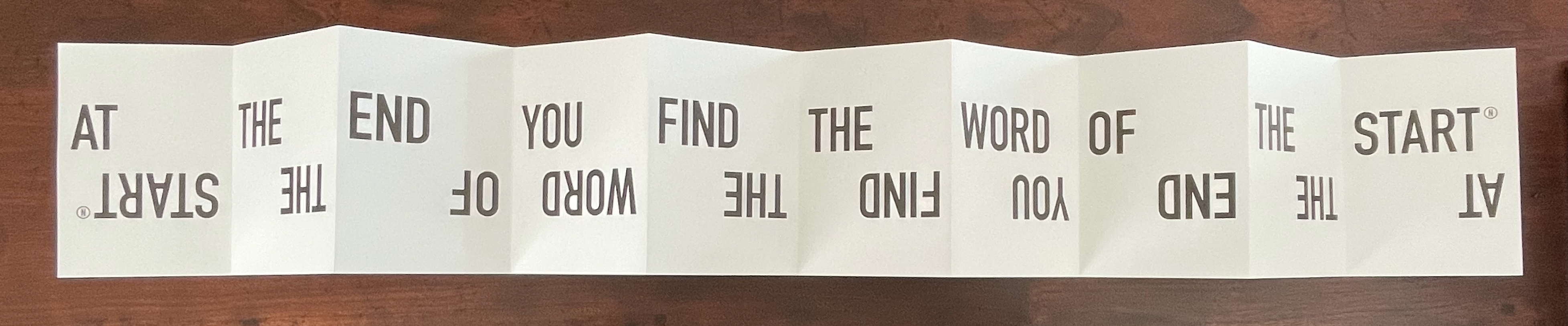
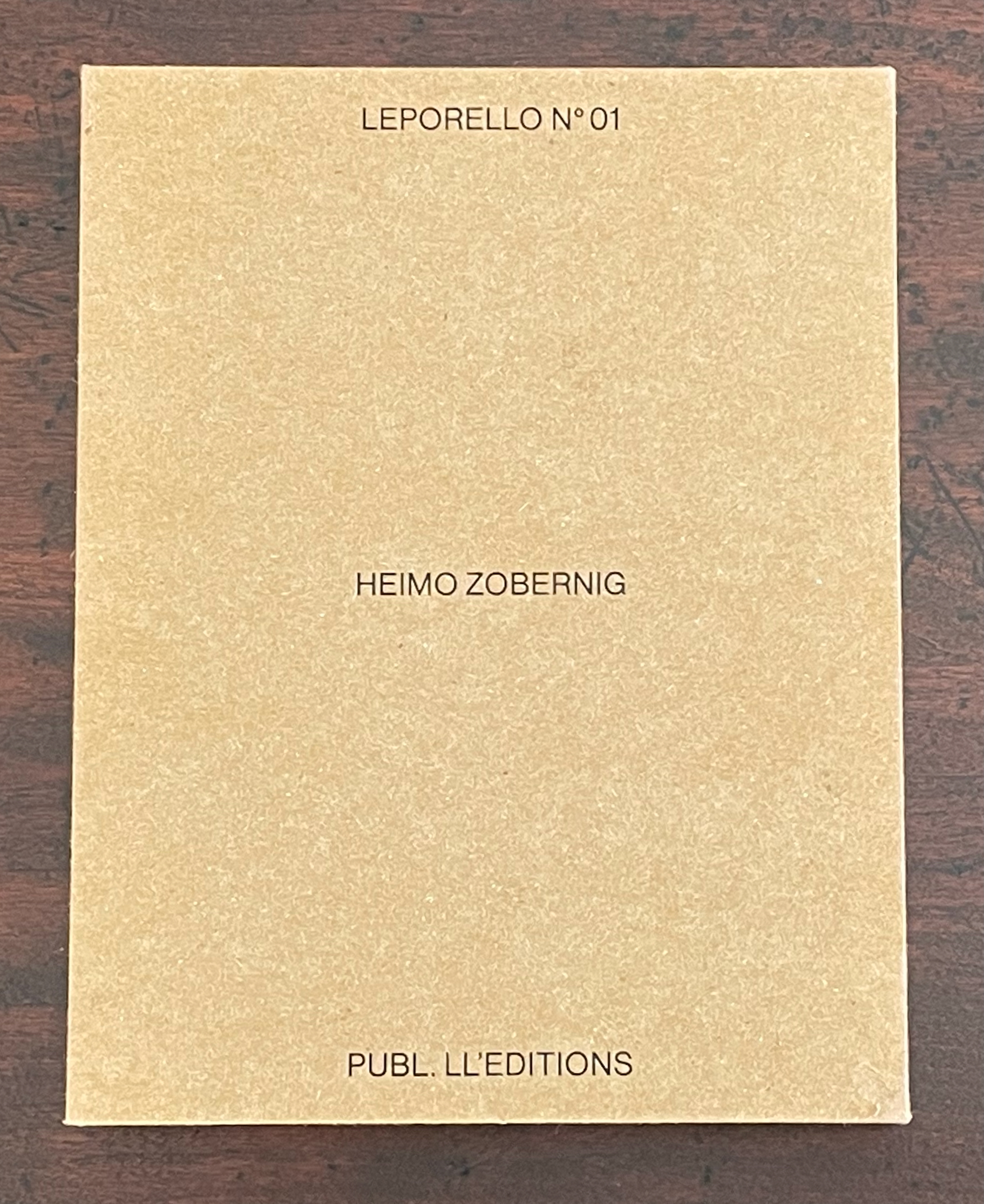
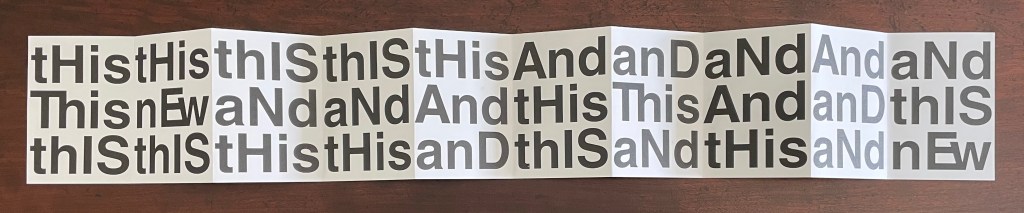
If you extend Leporello #01 fully, you are likely at first glance to project onto it the common expression “this and that”, but thwarted, you then start looking for another phrase comprised of “His”, “IS”, “And”, but you run into “Ew” or “nEw”, which throws you into renewed pattern-seeking behavior. Should you count the “this’s” and “and’s” in each row? Maybe there’s something in the pattern of lowercasing and uppercasing? Is there anything to the fact that the word “new” never begins with an uppercase N, or that it occurs only twice? Maybe you should read the rows aloud? With that, you may remember that, in earliest writings, words were not spaced and mixed majuscule and miniscule didn’t come along until later. Now you see how the folds are the primary means of separating the words in this book. This becomes clearer if you read the book panel by panel, or page by page codex-style. But now there are other possible patterns: does the book begin with “thIs, This, thIS” and proceed to “tHis, nEw, thIS”, and so on?

Somehow the acronym “WYSIWYG” — what you see is what you get — pops to mind, but Leporello #01 seems also a case of “WYGIWYS” — what you get is what you see. Fully extended or panel by panel, Leporello #01 offers more to see than a glance will get you.

Leporello #01 continues Zobernig’s love affair with Helvetica, which is also on display in Farben Alphabet (2018) and CMYK (2013), also in the Books On Books Collection.

Further Reading

Books on Books edited by Jérôme Saint-Loubert Bié“. Books On Books Collection.

Heimo Zobernig“. 30 December 2022. Books On Books Collection.

Cristello, Stephanie. Winter 2019. “The Gravity of Language“. Osmos Magazine. No. 17.

Ebner, Shannon. 2014. Shannon Ebner : Strike. Milan: Mousse Publishing.

Fullerton, Elizabeth. 28 April 2017. “In the Studio: Ryan Gander“. Art in America. Accessed 7 November 2025.

Hubert, Renée Riese, and Judd David Hubert. 1999. The Cutting Edge of Reading : Artists’ Books. New York City: Granary Books. See chapter 6, “Variations on the Accordion”, pp. 97-122.

Lewis, Jim. 18 December 2023. “Ed Ruscha’s ‘Every Building on the Sunset Strip’: Why the artists’ book is a reminder of freedom“. The Yale Review.

Lexier, Micah, Nancy Tousley, and Marnie Fleming. 1993. Micah Lexier : Book Sculptures. Oakville, Ont.: Oakville Galleries.

Munari, Bruno. 1960/2015. The Square: Discovery of the Square. Milan: Corraini Editions.

____________. 1964/2015. The Circle: Discovery of the Circle. Milan: Corraini Editions.

____________. 1976/2015. The Triangle: Discovery of the Triangle. Milan: Corraini Editions.

Perkins, Stephen. 5 April 2023. LL’Editions: The Leporello Series. Accordionbooks.com.

Salamony, Sandra, and Peter and Donna Thomas. 2012. 1,000 Artists’ Books : Exploring the Book as Art. Minneapolis: Quarto Publishing Group USA. See items 0355-0637, pp. 108-87.

Bookmarking Book Art – An Online Annotation of Germano Celant’s “Book as Artwork 1960/1972”

Where to go to compare and contrast the book art in Germano Celant’s pioneering “catalogue” of the Nigel Greenwood Gallery exhibition in London (1972) with that of the last half century?

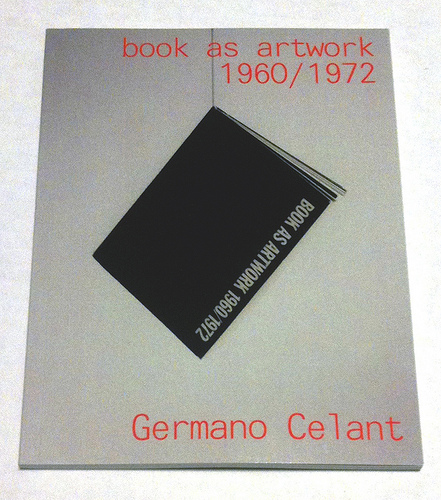
Being a sort of small and portable catalogue and curator’s explanation for the gallery’s exhibition of ca. 300 works, Celant’s Book as Artwork is arranged chronologically and then alphabetically by artist. Presumably it was organized to match the exhibition’s organization (note the year 1967 in upper left of the photograph below and the distinctive Hidalgo cover, fifth from the left). With no photographs of the works, Book as Artwork gives no easily accessible visual sense of the 300 works in that exhibition. If we had that starting visual touchpoint, it would be easier to “place” the period or individual works in relation to book art from the 80’s onward.

Book as Artwork 1960 – 1972 – Exhibition Nigel Greenwood Gallery B, 1972.

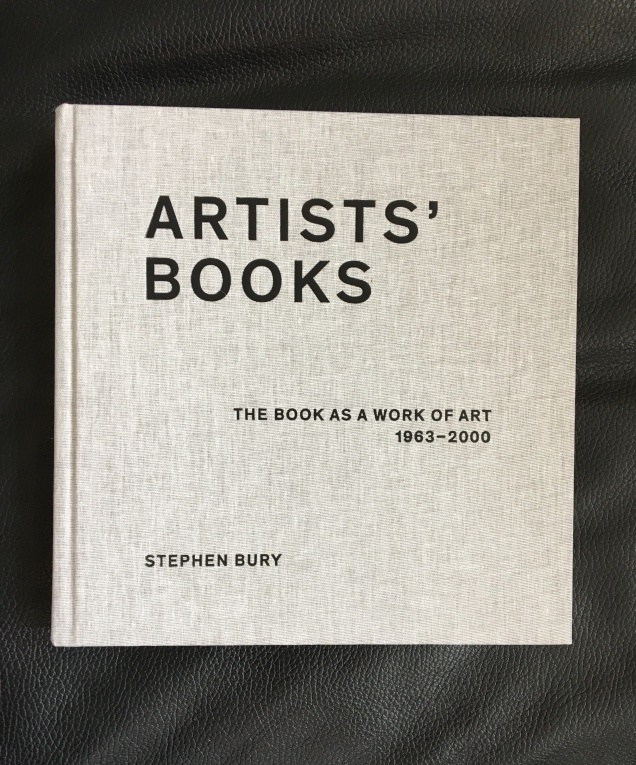
Stephen Bury’s Artists’ Books: The Book as a Work of Art, 1963 – 2000 (2015) includes, by design, only a handful of the artists and works selected for the Celano/Greenwood exhibition.

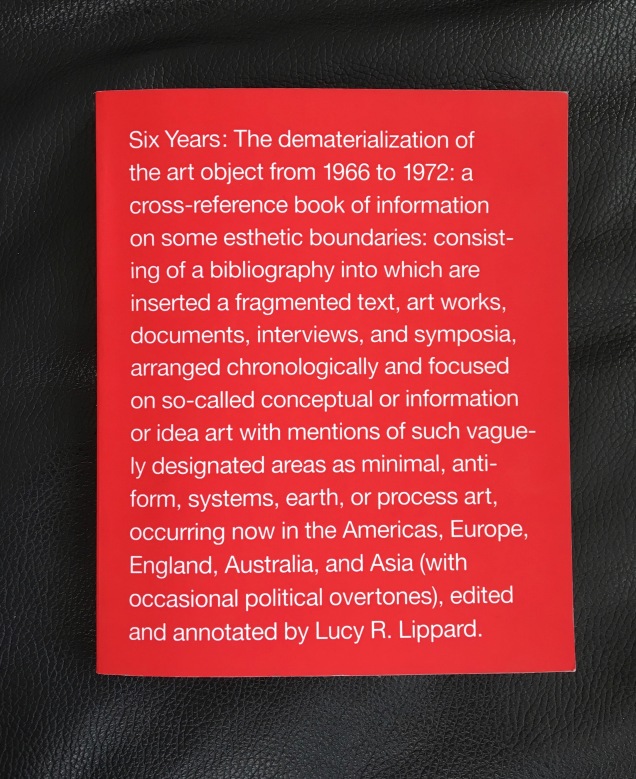
Lucy Lippard’s Six Years: The dematerialization of the art object from 1966 to 1972 (1973, 1997) — a “bibliography into which are inserted a fragmented text, art works, documents, interviews, and symposia, arranged chronologically” — comes as close as one might hope in black-and-white print for a starting visual touchpoint. Lippard’s scope, however, ranges beyond book art, so the number illustrated limits systematic visual comparison and contrast with the book art of the ensuing decades.

Phaidon’s Artists Who Make Books (2017) provides good coverage and bridges the 1960s to the 21st century. The essays and descriptions bring the book art off the page and into the mind’s hands.

Best of all is Lynda Morris’s mini-memoir of her role in organizing the Celant/Greenwood exhibition.

Germano had sent Nigel [Greenwood] a wonderful, arty handwritten letter in pink capitals … on December 22, 1970:

DEAR PUBLISHER I AM PREPARING FOR A NEW INTERNATIONAL MAGAZINE A COMPLETE ANTHOLOGY OF BOOKS MADE DIRECTLY BY ARTISTS. 

…Nigel had met Germano and had his telephone number in Genoa. I was sitting beside him when he phoned and proposed Book as Artwork exhibition for September 1972. Germano immediately agreed.

For sources of book art since the close of the Celant/Greenwood exhibition, we are spoilt for choice. Print and digital, image-rich aggregations of book art abound. We can return to the Phaidon and Bury books. We can turn to the well-illustrated print and online publications from the Centre for Fine Print Research at the University of Western England, online library collections such as the MassArt Library or Chicago’s School of the Art Institute, the websites of dealers such as Zucker Art Books displaying their wares, the dozens of websites for recurring book art fairs such as International Artist’s Books Triennial Vilnius (1997 – present) and CODEX International Book Fair (2007 – present) and community sites such as Artist Books 3.0. In the future, the Getty Research Institute‘s processing of the Steven Leiber Basement archive should also yield a rich source of images of works by the artists selected for the Celant/Greenwood exhibition. 

Present-day online access challenges Mallarmé’s dictum: ”Everything in the world exists to end up in a book.” Now it seems:

Everything in the world exists to end up on the web.

As far as that premise holds, this annotation and rearrangement of Celant’s bibliography — a “webliography” — offers an online starting point for connecting the book as artwork 1960/1972 with the book as artwork since. In providing some images of the works and links to images, the webliography offers anyone interested in book art the means to gain a more colored impression of the period’s book art.  That the primary impression is still black and white underscores the impact of xerographic technology on artists then as well as that of conceptualism driven by text or photograph. A webliographic approach also offers the opportunity to link the book art of the Celant exhibition with book-oriented Web-art or Net-art such as that of Amaranth Borsuk, Taeyoon Choi, Gunnar Green, Johannes Heldén, Bernhard Hopfengärtner and many others referenced below.

The reorganization here of Celant’s and Morris’s list — by artist alphabetically then chronologically — makes it easier to see the curators’ tendencies in selection as well as the influence of practical factors. The curators’ selection is obviously more Western, less Eastern European and even less Middle Eastern and Asian. Individuals’ prodigality surely played a role in whom and what was included. As Morris’s essay in the Phaidon book reveals, the geographical proximity of works available to be chosen played a role; so, too, the influence of the then-contemporary art network played a role (Atkinson, Beuys, Celant, Dwan, Greenwood, Hansjorg Mayer, Walther König, Maenz, Siegelaub, Sperone and the many other personalities of the Art-Language, Arte Povera, Conceptualist and Fluxus movements); and even the size of suitcases and availability of transport for bringing the artwork into the UK played a role. 

Generally the online links for the artists’/authors’ names lead to biographies, either in their official websites, Wikipedia or other news sources. Where an artist/author is listed multiple times, the links vary from instance to instance to provide a wider range of information about the individual and, in some cases (such as Dieter Rot’s), more images. The links behind the publishers’ names go to publishers’ websites or Wikipedia entries about them. The links that follow each entry resolve to images of the work, videos, audio, interviews or essays relevant to the work. For selected entries in Celant’s list, a compare/contrast takes the user to websites or works whose juxtaposition might shed light on the similarities or differences between the item in Celant’s list and book art of the subsequent decades.

The webliography also supports the haptically as well as digitally inclined. The links behind the titles of the works provide information on the nearest library location of the work (although not all titles could be located).  Be sure to enter your own location and refresh the results. 

βΟβσβΟβσβΟβσβΟβσβΟβσβΟβσβΟβσβΟβσβΟβσβΟβσβΟβσβΟβσβΟβσβΟβσβΟβσβΟβσ

A “webliography” for

Germano Celant’s Books as Artworks 1960/1972

2nd edition, published by 6 Decades Books, 2010, and 1st edition published by Nigel Greenwood, Inc., 1972.

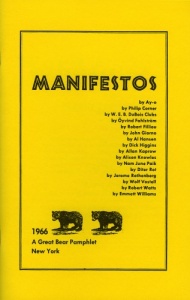
______. Manifestos. New York: Great Bear Pamphlets, 1966. [Contributors: Ay-OPhilip CornerRobert FilliouJohn GiornoAl HansenDick HigginsAllan KaprowAlison KnowlesNam June PaikDiter RotJerome RothenbergWolf VostellRobert Watts, and Emmett Williams] [Images] [Compare/contrast with Jessica Lack’s Why Are We ‘Artists’?: 100 World Art Manifestos, with Michael Pichler’s Publishing Manifestos and this review of Luca Lo Pinto’s exhibition “Publishing as an Artistic Toolbox, Vienna, 28 January 2018“]

Acconci, Vito. Transference: Roget’s Thesaurus. New York: 0 to 9 Books, 1969. [Image] [Video] [Essay] [Compare/contrast with Sam Winston’s Darwin, 2015]

Agnetti, Vincenzo. 14 Proposizioni sul Linguaggio Portatile. Turin: Sperone Editore, 1972. [originally published in Flash Art]

Andre, Barry, Huebler, Kosuth, LeWitt, Morris and Weiner.  The Xerox Book. New York: Seth Siegelaub, Jack Wendler, 1968. [Image] [Video, Jack Wendler] [Compare/contrast with Michael Mandiberg’s Print Wikipedia, 2015, and Paul Soulellis’ Library of the Printed Web, 2013 to present]

Andre, Carl. Seven Books of Notes and Poetry. New York: Dwan Gallery/Seth Siegelaub, 1969. [Images] [Essay on artist] [Video, Carl Andre] [Video, retrospective] [Compare/contrast with Sam Winston’s Dictionary Story Book, 2014]

Anselmo, Giovanni. Leggere. Turin: Sperone Editore, 1972. [Images] [Compare/contrast with Leilei Guo’s The Way, 2008]

Art & Language. Olivet Discourse. Paris: Templon Editeur, 1971. [Image]

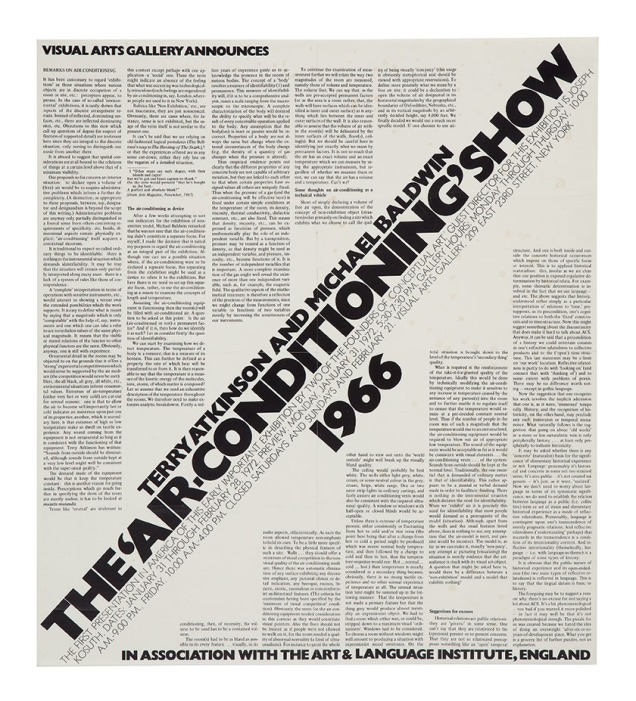
Atkinson, Terry; Baldwin, Michael. Frameworks-Air Conditioning. Coventry: Art & Language Press, 1967. [Image] [Essay] [Video of Baldwin and Ramsden, Chicago symposium] [Compare/contrast with Taeyoon Choi’s “Zero & One”, 2017]

Art & Language – Poster for Air-Conditioning Show, 1971-1972
Colección MACBA. Consorcio MACBA. Depósito Philippe Méaille.

Atkinson, Terry; Baldwin, Michael. Hot-Warm-Cool-Cold. Coventry: Art & Language Press, 1967. [Image]

Atkinson, Terry; Baldwin, Michael. 22 Sentences: The French Army. Coventry: Precinct Publications, 1968. [Image]

Atkinson, Terry; Baldwin, Michael. Sunnybank. Coventry: Art & Language Press, 1969. [Image] [Compare/contrast with M.L. Van Nice’s Feast is in the Belly of the Beholder, 2010]

Atkinson, Terry; Baldwin, Michael. Theories of Ethics. New York: Art & Language Press, 1971. [Image]

Atkinson, Terry; Bainbridge, David; Baldwin, Michael; Harrison, Charles; Hurrell, Harold; Kosuth, Joseph. Art-Language. Cologne: Dumont Schauberg, 1972. [Essay] [Essay]

Image result for art & language: texte zum phänomen kunst und sprache [book]

Baldessari, John. Ingres and Other Parables. London: Studio International, 1972. [Image] [Also see Clare Lehmann’s entry on Baldessari in Artist’s Who Make Books, 2017, p.29]

Baldessari, John. Choosing: Green Beans. Milan: Edizioni Toselli, 1972. [Images][Compare/contrast with George Gessert’s Natural Selection, 1994]

Baldwin, Michael; Hurrell, Harold. Handbook to Ingot. New York, Coventry: Art & Language Press, 1971. [Image] [Video of Baldwin and Ramsden]

Barry, Robert. ”   “. Turin: Sperone Editore, 1970. [Images] [Essay] [Compare/contrast with Elisabeth Tonnard’s The Invisible Book, 2012]

Barry, Robert. Robert Barry 1969-71. Cologne: Gerd de Vries, 1971. [Compare/contrast with Elisabeth Tonnard’s A Dialogue in Useful Phrases, 2010]

Barry, Robert. Something Which Is…(30 Pieces as of 14th June 1971). Cologne: Paul Maenz, 1971. [Image]

Barry, Robert. Two Pieces. Turin: Sperone Editore, 1971.[Images]

Baruchello, Gianfranco. Mi viene in mente. Milan: Edizioni Galleria Schwarz, 1966. [Image] [Compare/contrast with Xu Bing’s Book from the Ground, 2014]

Becher, Bernd & Hilla. Anonyme Skulpturen. Dusseldorf: Städtische Kunsthalle Verlag, 1970.  [Image] [Video] [Compare/contrast with Anselm Kiefer’s The Rhine, 1992-2013, and Helen Malone’s Ten Books on Architecture, 2012]

Blake, John. John Blake : recent work, 1969-71 : a travelling exhibition arranged by the Circulation Department of the Victoria and Albert Museum. London: Victoria and Albert Museum, 1972. [Image] [Compare/contrast with Anouk Kruithof’s The Daily Exhaustion, 2010]

Bochner, Mel;  Cherix, ChristopheWorking Drawings and Other Visible Things on Paper Not Necessarily Meant to Be Viewed As Art: Visual Arts Gallery, School of Visual Arts,December 2 – December 23, 1966 [New York]. Köln: Verlag der Buchhandlung Walther König, 1997. [Images] [Compare/contrast with Johanna Drucker’s All: the Books I Never Wrote or Wrote and Never Published, 1962 to 2017]

Bochner, Mel. The Singer Notes. New York: Self-published, 1968. [Images] [Compare/contrast Bochner’s notes and drawings resulting from conversations with scientists and engineers at Singer Labs in New Jersey with the Smithsonian Libraries’ online exhibition Science and the Artist’s Book, 1995]

Bochner, Mel. Misunderstandings (A Theory of Photography). New York: Multiples, Inc., 1970. [Images]

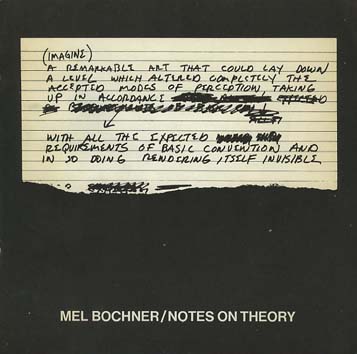
Bochner, Mel. Notes on Theory. Kingston, RI: University of Rhode Island, 1971. [Image]

Bochner, Mel. 11 Excerpts (1967 – 1970). Paris: Edition Sonnabend, 1972. [Images]

Boshier, Derek. 16 Situations. London: Idea Books, 1971. [Images] [Compare/contrast with Sascha Pohflepp’s and Chris Woebken’s Situated Sampling Set, 2017]

Derek Boshier, Situation 1 (from the ‘16 Situations’ series), photograph, 1971
See The Courtauld Institute blog.

Boyle, Mark. Journey to the Surface of the Earth. Stuttgart: Hansjorg Mayer, 1970. [Images and book by J.L. Locher] [Compare/contrast with New England Guild of Book Workers’ Geographies: New England Book Work, 2014]

Brecht, George. Fluxus No. 1 March 1964. New York: Valise eTRangLE, 1964. [Images]

Brecht, George. Chance-Imagery. New York: Something Else Press, 1966. [Images, including facsimiles] [Compare/contrast with Barb Tetenbaum’s and Julie Chen’s Artist’s Book Ideation Cards, 2013, and Paul Soulellis’s Chancebook #1 (Why Does It Hurt So Bad), 2013]

Brecht, George; Filliou, Robert. Games at the Cedilla, or the Cedilla Takes Off. New York: Something Else Press, 1967. [Images]

Brøgger, Stig. 21. marts 1969 = March 21 1969. Copenhagen: Jysk Kunstgalerie, 1969. [Second edition]

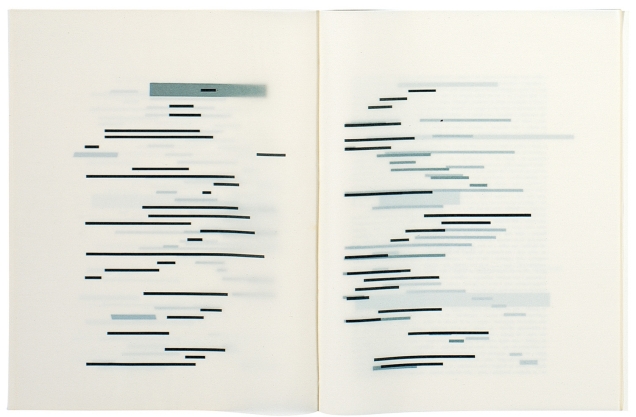
Broodthaers, Marcel. Image: un coup de dés jamais n’abolira le hasard. Antwerp: Wide White Space, 1969. [Images] [Video] [Compare/contrast with Doug Beube’s Veil: Secret Wars of the C.I.A., 1996, J. Meejin Yoon’s Absence, 2004, Jonathan Safran Foer’s Tree of Codes, 2010, Pauline Rafal’s Windows, 2014, and James Bridle’s Every Redaction, 2015]

Double-page spread Marcel Broodthaers Image: Un coup de dés jamais n’abolira le hasard, 1969

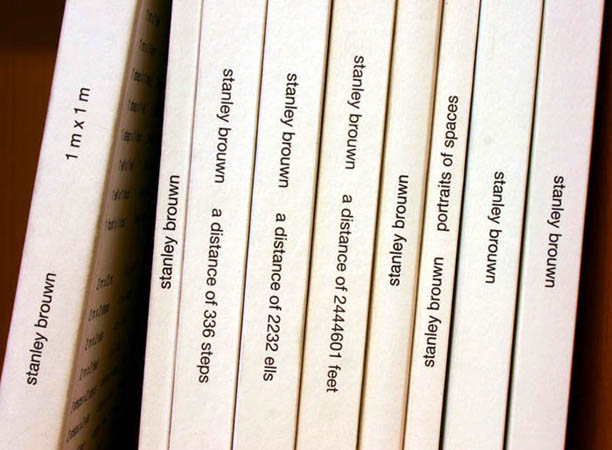
Brouwn, Stanley. 100 This Way Brouwn Problems for Computer IBM Model 95. Cologne: Walther König, 1970. [Essay] [Compare/contrast with Julie Johnstone’s 2-20% | 20-2cm, 2014]

Brouwn, Stanley. La Paz. Schiedam: Stedelijk Museum, 1970.[Image] [Images]

Brouwn, Stanley. Tatwan. Munich: Aktionsraum, 1970. [Images] [More images] [Compare/contrast with Craig Mod’s and Dan Rubin’s Koya Bound: Eight Days on the Kumano Kodo, 2016]

Brouwn, Stanley. Durch Komische Strahlen Gehen. Monchengladbach: Stadtisches Museum, 1970. [Image] [Image]

Brouwn, Stanley. Steps. Amsterdam: Stedelijk Museum, 1971. [Image] [See also Clare Lehmann’s entry in Artists Who Make Books, 2017, pp. 57-58][Compare/contrast with James Bridle’s All Roads Lead to X, 2015; compare/contrast with Yu-Wen Yu’s Boston to Taipei ,2013]

Brouwn, Stanley. Afghanistan-Zambia. Aachen: Gegenverkehr e.V., Zentrum für aktuelle Kunst, 1971. [Image & essay] [Compare/contrast with James Bridle’s Where the F**k Was I?, 2011}

Brouwn, Stanley. One Step (IX-100X). Brussels: Galerie MTL, 1971. [Essay]

Brouwn, Stanley. 1 Step – 100,000 Steps. Amsterdam: Art & Project, 1972. [Image]

Buren, Daniel. Limites Critique. Paris: Yvon Lambert, 1970. [Images] [Site]

Burgin, Victor. Work and Commentary. London: Latimer Press, 1972.  [Image] [Video] [Essay] [Exhibition 2012]

Burgy, Donald. Art Ideas for the Year 4000. Andover, MA: Addison Gallery of American Art, 1970. [Video] [Compare/contrast with Gunnar Green’s and Bernhard Hopfengärtner’s 75000 Futures, 2014]

Burgy, Donald. Contexts Completion Ideas. Krefeld: Schuring, 1971. [Compare/contrast with Praxis, Museum of Nonvisible Art, 2011]

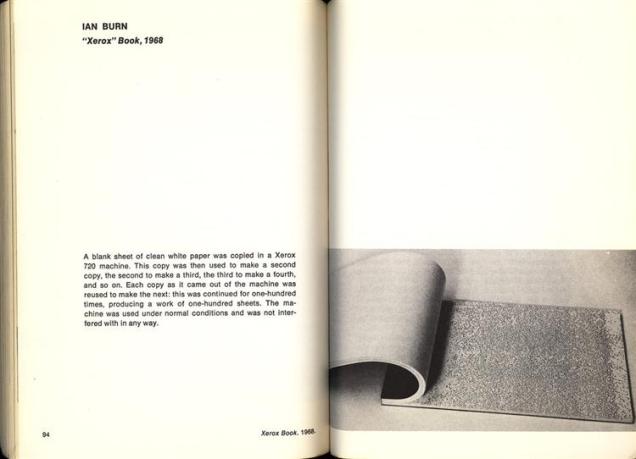
Burn, Ian. Xerox Book. n.p.: Self-published, 1968. [Compare/contrast with Paul Soulellis’s Apparition of a distance, however near it may be, 2013]

Xerox Book (1968)
Ian Burn

Burn, Ian; Ramsden, Mel. Six Negatives. New York: Society for Theoretical Art, 1969. [Images] [Video of Baldwin and Ramsden]

Burn, Ian; Ramsden, Mel. Notes on Genealogies. Vol. 1, No. 2. New York: Art-Language, 1970. [Essay by Thomas Dreher]

From the National Gallery of Victoria
Melbourne, Australia

Burn, Ian; Cutforth, Roger; Ramsden, Mel. Proceedings. Vol. 1, No. 3. New York: Art-Language, 1970. [Essay by Jo Melvin]

Burn, Ian; Ramsden, Mel. Notes on Analyses (1). Coventry: Art-Language Press, 1970. [Image]

Burn, Ian; Ramsden, Mel. Stating and Nominating. New York: Art-Language, 1970.

Burn, Ian; Ramsden, Mel. The Grammarian. New York: Art-Language, 1970.[Image]

Byars, James Lee. 100,000 Minutes, or the Big Sample of Byars, or 1/2 an Autobiography, or the First Paper of Philosophy. Antwerp: Galerie Anny de Decker, 1969. [Images] [See also Clare Lehmann’s entry in Artists Who Make Books, 2017, pp. 75-77] [Compare/contrast with Johanna Drucker’s All: the Books I Never Wrote or Wrote and Never Published, 1962 to 2017]

Cage, John. Silence. Middletown, CT: Wesleyan Press, 1961. [Video] [Compare/contrast with Paul Soulellis’s 273 Relics for John Cage (A Likeness Is an Aid to Memory), 2011]

Cage, John. A Year from Monday. Middletown, CT: Wesleyan Press, 1967.

Cage, John. Notations. New York: Something Else Press, 1969.

Cage, John. Diary: How to Improve the World (You Will Only Make Things Worse) Continued, Part Three. New York: Great Bear Pamphlets, 1967. [Video] [Compare/contrast with Robin Price’s As You Continue, 2011]

Carlini, Alessandro; Lang, Karl. Prozess Art, Situation Art. Berlin: Self-published, 1971.

Castillejo, Jose Luis. The Book of I’s. Constance: Castillejo, 1969. [Images] [Video] [Audio]

Castillejo, Jose Luis. The Book of Eighteen Letters. Madrid: Artes Graficas Luis Peres, 1972. [Images] [Audio]

Chiari, Giuseppe. Senza Titolo, 1971. Milan: Edizioni Toselli, 1972. [Images] [More images]

Collins, James. Revision and Prescription. New York: 98 Greene Street, 1971. [Image]

Corner, Philip. Popular Entertainments. New York: Great Bear Pamphlets, 1967. [Images] [Compare/contrast with Andrew Savage’s Savage Presents Jean Michel Jarre, 2011]

Costa, Claudio. Estratti da Evoluzione-Involuzione. Genova: Edizioni Masnata, 1972. [Image]

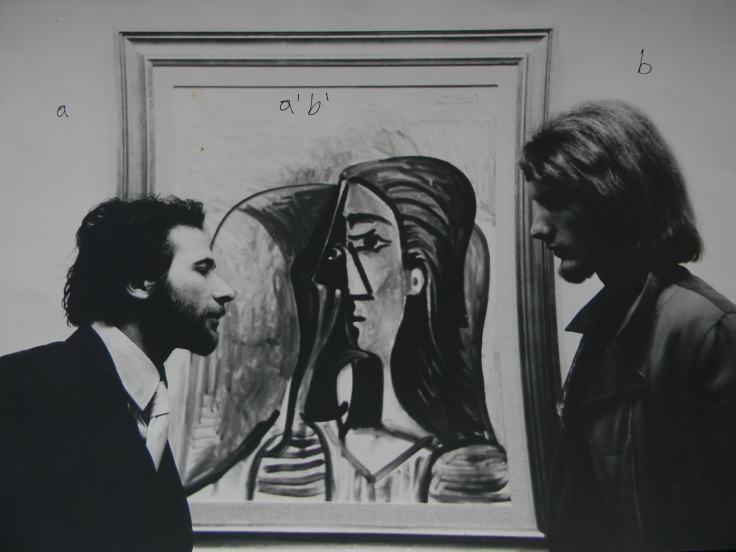
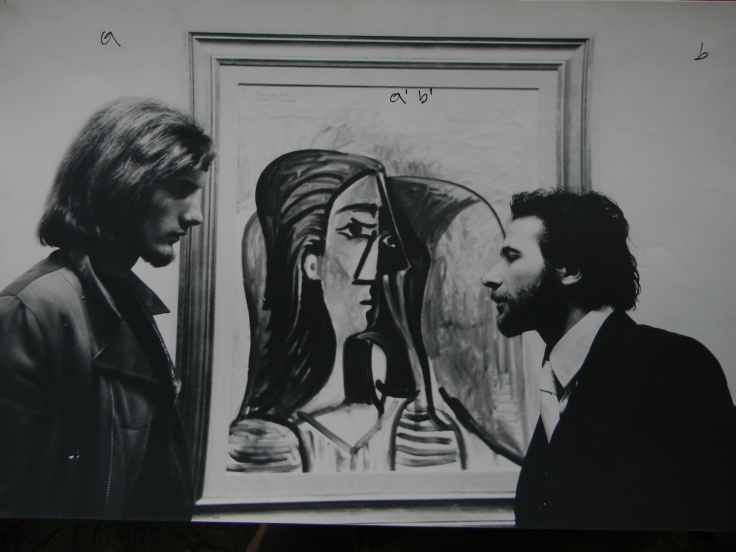
Croce, Giancarlo. a  a’b’  b. Rome: Edizioni Gap, 1971.[Compare/contrast with Abra: The Living Book by Kate Durbin, Amaranth Borsuk and Ian Hatcher (2014)]

a  a’b’  b (1971)
Giancarlo Croce
19.3 x 18.5 cm, 48 pages + cover
a  a’b’  b (1971)
Giancarlo Croce
19.3 x 18.5 cm, 48 pages + cover

Cunningham, Merce. Changes: Notes on Choreography. New York: Something Else Press, 1968.

Cutforth, Roger. The Empire State Building. New York: Art Press, 1969. [Image] [Compare/contrast with Helen Malone’s Ten Books on Architecture, 2012, and Mandy Brannan’s 30 St Marys Axe, 2015]

Cutforth, Roger. The Visual Book. London: Lisson Gallery, 1970. [Image]

Cutforth, Roger. CN/ET/ESB: The Non-Art Project. New York: Self-published, 1971. [Image] [Compare/contrast with Helen Malone’s Ten Books on Architecture, 2012]

Darboven, Hanne. Xerox Book. Hamburg: Self-published, 1969.

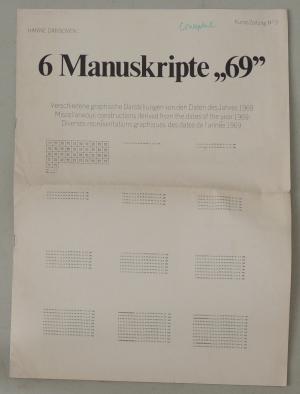
Darboven, Hanne. 6 Manuskriptie 69. Dusseldorf: Michelpresse, 1969. [Image]

Darboven, Hanne. Das Jahr. n.p.: n.p., 1971. [Unable to locate]

Dibbets, Jan. Robin Redbreast’s Territory: Sculpture 1969, April — June. New York, Cologne: Siegelaub/Walther König, 1969. [Images] [More images] [Compare/contrast with Stephen Collis’ and Jordan Scott’s Decomp, 2013; with Marinus van Dijke’s Eye, 2013]

Dibbets, Jan. Perspective Correction. New York: Multiples, Inc., 1970. [Image] [Essay] [Compare/contrast with Wendy Wahl’s Laid Open, 2017]

Dibbets, Jan. 3.12.1971 t/m 16.1.1972. Eindhoven: Van Abbemuseum, 1971.

Fabbris, Giorgio; Spiller, Giorgio. Assenza. Venice: Self-published.

Ferguson, Gerald. The Standard Corpus of Present Day English Language Usage Arranged by Word Length and Alphabetized within Word Length. Halifax: Nova Scotia College of Art and Design, 1970. [Images] [Compare/contrast with Masumi Shibata’s UED (Uncertain English Dictionary), 2008]

Filliou, Robert. Ample Food for Stupid Thought. New York: Something Else Press, 1965. [Images] [Compare/contrast with Black Page catalogue from the Laurence Sterne Trust, 2009]

Filliou, Robert. Hand Show. Villingen: Saba-Studio, 1967. [Image] [Additional images]

Filliou, Robert. A Filliou Sampler. New York: Great Bear Pamphlets, 1967. [Image]

Filliou, Robert. 14 Chansons et 1 Charade. Stuttgart: Hansjorg Mayer, 1968. [Images] [Additional images]

Filliou, Robert (with Beuys, Brecht, Cage, Iannone, Kaprow, Marcelle, Patterson and Rot). Teaching and Learning as Performing Arts. Cologne: Walther König, 1970. [Images] [Video]

Fisher, Joel. Double Camouflage. Mansfield, OH: Mansfield Fine Arts Center, 1970. [Image] [Additional images]

Flynt, Henry. Down with Art. New York: Fluxpress, 1968. [Image] [Additional images] [Compare/contrast with Doug Beube’s Breaking the Codex, 2011]

Fulton, Hamish. The Sweet Grass Hills of Montana as seen from the Milk River of Alberta. Turin: Sperone Editore, 1971. [Image] [Additional images] [Compare/contrast with Helen Douglas’s The Pond at Deuchar, 2013]

Fulton, Hamish. Hollow Lane. London: Situation Publications, 1972. [Images] [Additional images]  [Video] [Compare/contrast with Craig Mod’s and Dan Rubin’s Koya Bound: Eight Days on the Kumano Kodo, 2016]

Gilbert & George. A Message from the Sculptors Gilbert & George. London: Art for All, 1970. [Image] [Additional images] [Video]

Gilbert & George. To Be with Art is All We Ask. London: Art for All, 1970. [Image] [Additional images] [Video]

Gilbert & George. The Pencil on Paper Descriptive Works. London: Art for All, 1970. [Additional images]

Gilbert & George. A Day in the Life of Gilbert & George. London: Art for All, 1971. [Image] [Additional images]

Gilbert & George. Oh, The Grand Old Duke of York. Lucerne: Kunstmuseum Luzern, 1972. [Image] [Additional images]

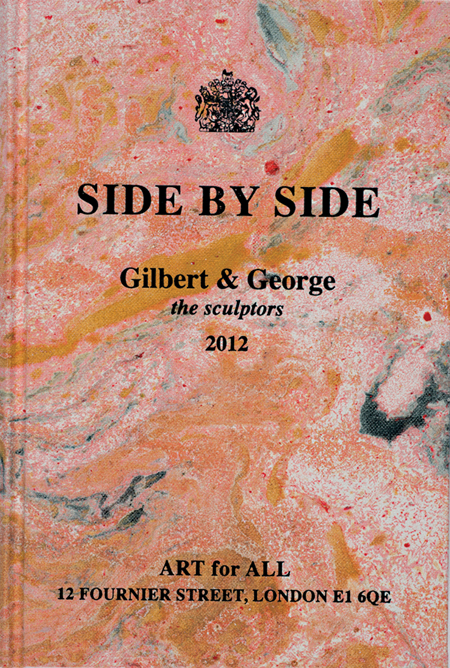
Gilbert & George. Side by Side. Cologne: Walther König, 1972. [Images] [Compare/contrast with Abra: The Living Book by Kate Durbin, Amaranth Borsuk and Ian Hatcher (2014)]

Graham, Dan. End Moments. New York: Self-published, 1969. [Image]

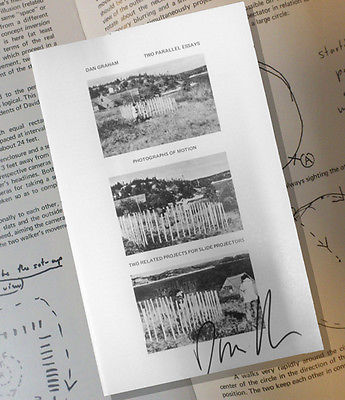
Graham, Dan. Two Parallel Essays. New York: Multiple, Inc., 1970. [Image] [Compare/contrast with Tom Abba’s These Pages Fall Like Ash, 2013.

Graham, Dan. Dan Graham. London/Cologne: Lisson Gallery/Walther König, 1972.

Graham, Rodney. Works 1963-1969. Cologne/New York: Walther König, 1970.

Greco, Sandro. Saper Sorridere. n.p.: Self-published, 1971. [Article]

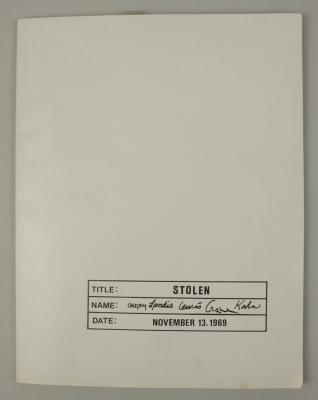
Gregory, Kathe; Landis, Marilyn; Lewis, Russell; Crane, David; Kahn, Scott. Stolen. New York: Colorcraft Lithographers/Dwan Gallery, 1970. [Images] [Compare/contrast with Andrew Savage’s Stolen White Goods, 2006, and then Cristina Garrido’s intervention White Goods, 2011]

Hamilton, Richard. Polaroid Portraits, Volume One. Stuttgart: Hansjorg Mayer, 1972. [Images] [Compare/contrast with Anouk Kruithof’s The Daily Exhaustion, 2010]

Harvey, Michael. White Papers. New York: Self-published, 1971. [Images] [Additional images]

Hemsworth, Gerard. South West Coast of England. Amsterdam, London: X-One/Nigel Greenwood, 1970.

Hidalgo, Juan. Viaje a Argel. Madrid: Zaj, 1967. [Images] [More images]

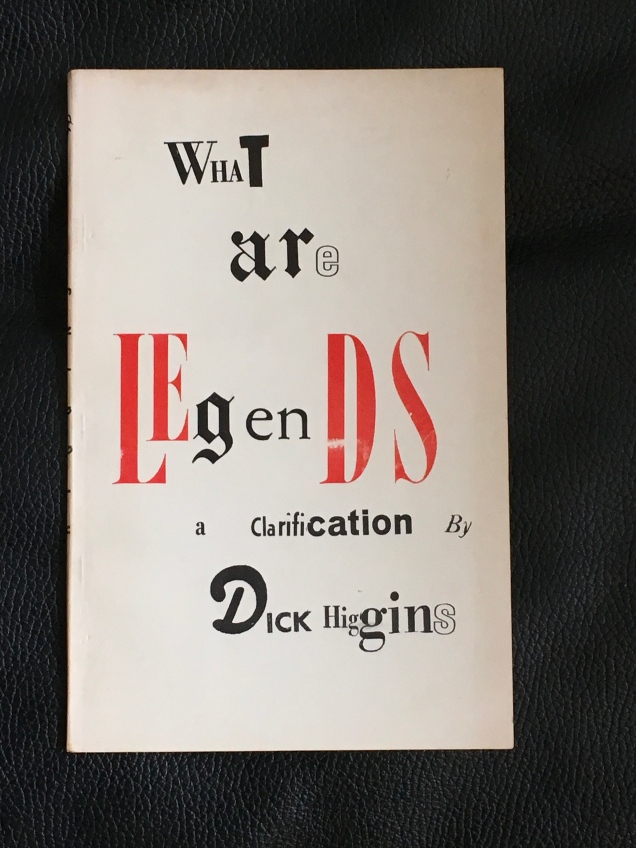
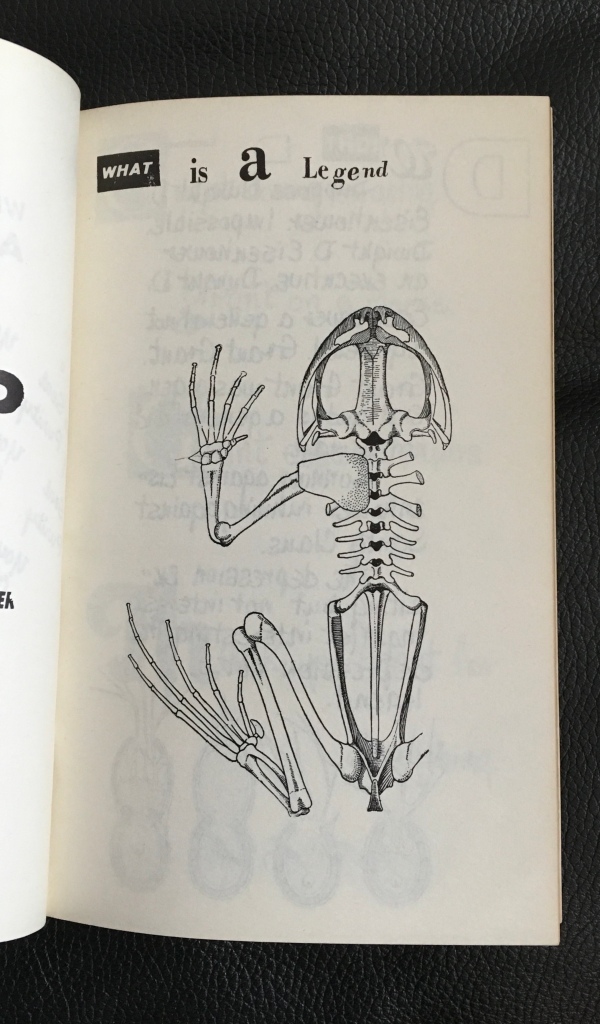
Higgins, Dick. What are Legends: A Clarification. Calais, ME: Bern Porter, 1960. [Images]

Higgins, Dick. Jefferson’s Birthday / Postface. New York: Something Else Press, 1964. [Images]

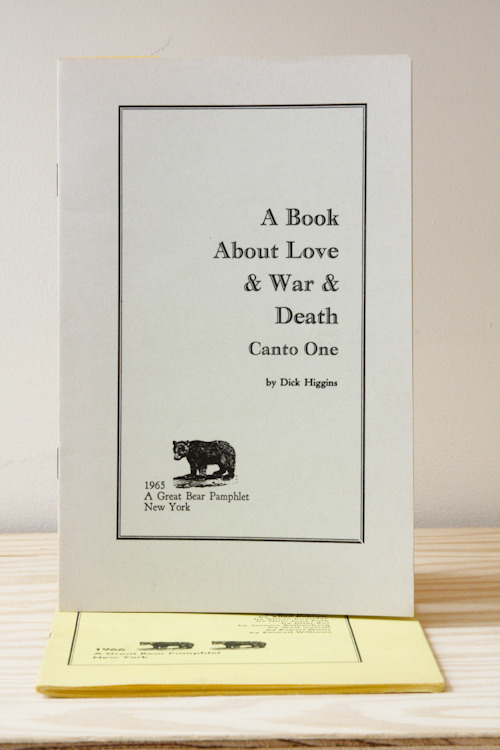
Higgins, Dick. A Book about Love & War & Death, Canto One. New York: Great Bear Pamphlets, 1965. [Images] [Video]

Higgins, Dick. Foew and ombwhnw : a grammar of the mind and a phenomenology of love and a science of the arts as seen by a stalker of the wild mushroom. New York: Something Else Press, 1969. [Images] [Video]

Huebler, Douglas. Durata Duration. Turin: Sperone Editore, 1970. [Images] [Video] [Compare/contrast with Andrew Eason’s Clock Watching, 2006]

Huebler, Douglas. Location Piece #2. New York: Multiple, Inc., 1970. [Images] [More images] [Video] [Compare/contrast with Barbara Tetenbaum’s Mining My Ántonia; Excerpts, Drawings, and a Map, 2012]

Hurrell, Harold. Fluidic DeviceCoventry: Art-Language, 1968. [Image]

Johnson, Ray. The Paper Snake. New York: Something Else Press, 1965. [Video of reprint edition]

Kaltenbach, Stephen. [Artforum Advertisements]. New York: Artforum, Issues dated November 1968 through December 1969. [Image] [Artslant interview]

Kaprow, Allan. Assemblage, Environments & Happenings. New York: Harry N. Abrams, Inc., 1965. [Images] [Video]

Kaprow, Allan. Pose: Carrying Chairs through the City, Sitting Down Here and There, Photographed, Pix Left on Spot, Going On, March 22 1969-1970. New York: Multiples, Inc., 1970. [Images]

Knowles, Alison. By Alison Knowles. New York: Great Bear Pamphlets, 1965. [Images]

Kosuth, Joseph. Four Titled Abstracts [within S.M.S. Portfolio no. 3]. New York: Letter Edged in Black, Inc., 1968]. [Images] [More images]

Kosuth, Joseph. Function. Turin: Sperone Editore, 1970. [Images] [Additional images]

Kosuth, Joseph. Notebook on Water. New York: Multiples, Inc., 1970. [Images] [Additional images]

Kosuth, Joseph. The Sixth Investigation 1969, Proposition 14. Cologne: Gerd de Vries, 1971. [Image] [Video]

Kosuth, Joseph. The Sixth Investigation 1969, Proposition 2. Buenos Aires/Cologne: CAYC/Paul Maenz, 1971. [Video]

Lamelas, David. Publication. London: Nigel Greenwood, 1970. [Images] [Video]

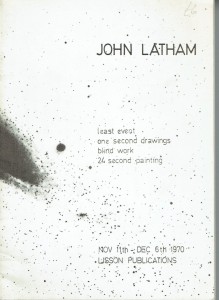
Latham, John. Least Event/One-Second Drawings/Blind Work/24-Second Painting. London: Lisson Gallery, 1971. [Image] [Video] [Cover of the work indicates a publication date of 1970]

Law, Bob. 16 Drawings. London: Lisson Gallery, 1971. [Images] [Audio]

LeWitt, Sol. 49 Three Part Variations Using Three Different Kinds of Cubes, 1967-1968. Zurich: Editions Bischofberger, 1969. [Images] [Video]

LeWitt, Sol. Four Basic Kinds of Straight Lines. London: Studio International, 1969. [Images][Video] [Film][See also Clare Lehmann’s entry in Artists Who Make Books, 2017, pp. 171-172]

LeWitt, Sol. Schematic Drawings for Muybridge II, 1964. New York: Multiples, Inc., 1970. [Images] [Video, Veronica Roberts] [Video, Charles Haxthausen]

LeWitt, Sol. Four Basic Colours and their Combinations. London: Lisson Gallery, 1971. [Images]

Lole, Kevin; Smith, Paul. Handbook on Models. Coventry: Self-published, 1972. [Unable to locate a work of this title in WorldCat, but one with the title The Relativism of Emotion Handbook to the Model and same date of publication is described in Paul Robertson‘s “A Collection of Rare Art+ Language Books and Internal Documents – Many Unknown in Literature”, Gorebridge, Midlothian: Unoriginal Sins/Heart Fine Art, n.d.]

30 x 21cm, 50pp (printed recto only) plus printed card covers. Xerox inner pages as issued. The first and only edition of this theoretical work based on a physical model (electro-shock, photo beams and electronic buzzers) acting as metaphor for analogue, theoretical and representative models. Cover is very minority marked on the front and back cover has a faint diagonal crease else VG++. From the archive of David Rushton who believes only 10 or fewer of this book was published.

Long, Richard. Rain Dance. New York: Multiples, Inc., 1970. [Images]

Long, Richard. From Along a Riverbank. Amsterdam: Art & Project, 1971. [Images] [Compare/contrast with Helen Douglas’s Venetian Brocade, 2010]

Long, Richard. Two Sheepdogs Cross In and Out of the Passing Shadows the Clouds Drift Over the Hill with a Storm. London: Lisson Gallery, 1971. [Images][See also Clare Lehmann’s entry in Artists Who Make Books, 2017, pp. 175-176]

Maloney, Martin. Integuments. Brattleboro, VT: Press Work, 1969. [Image] [Video] [Additional outtakes]

Maloney, Martin. Fractionals. Brattleboro, VT: Press Work, 1970.

Maloney, Martin. Intervention (Five Days and Five Nights at the Galerie MTL). Brussels: Galerie MTL, 1970. [Images] [Compare/contrast with Sam Winston’s Darkness Visible, 2017]

Double-page spread from
Intervention (Five Days and Five Nights at the Galerie MTL), Martin Maloney
Brussels: Galerie MTL, 1970

Manzoni, Piero. The Life and Works. Glucksburg-Hamburg-Paris: Peterson Press, 1963. [Image] [Artspace essay] [Compare/contrast with Marc Straus’s White Heat exhibition, 2017]

Marchetti, Walter. Arpocrate Seduto sul Loto. Madrid: Zaj, 1968. [Images] [More images]

McLean, Bruce. King for a Day. London: Situation Publications, 1972. [Images]

Merz, Mario. Fibonacci 1202 Merz 1970. Turin: Sperone Editore, 1970. [Images] [Additional images] [Compare/contrast with Rutherford Witthus’ Anything is a Mirror, 2007, and Susan Happersett’s Box of Chaos, 2014]

Merz, Mario. Una somma reale e una somma di gente. Turin: Sperone Editore, 1972.

Morris, Robert. Continuous Project Altered Daily. New York: Multiples, Inc., 1970. [Images] [Additional images][Further additional images][Still more images]

Nauman, Bruce. Burning Small Fires.  San Francisco.: Self-published, 1968. [Images]

Display of Ed Ruscha’s Various Small Fires and Milk, 1964, at Pliure: La Part du Feu, 2 February – 12 April 2015, Paris. Photo by Robert Bolick. Reflected in the lower left hand corner is the display of Bruce Nauman’s Burning Small Fires; in the upper right corner, the film clip of Truffaut’s 1966 Fahrenheit 451; and in the upper left, Maria Helena Vieira da Silva’s La bibliotheque en feu, 1974.
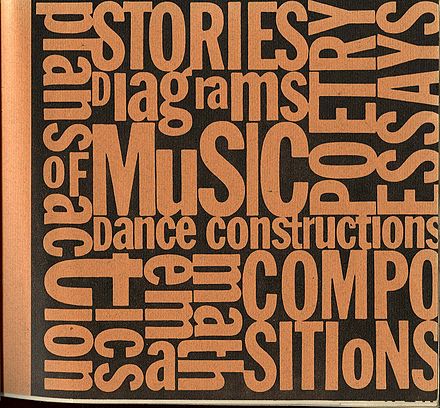
Nauman, Bruce. Clea Rsky. n.p.: Self-published, 1969. [Images] [Additional images] [Compare/contrast with Anouk Kruithof’s Automagic, 2016]

Nauman, Bruce. Laair. New York: Multiples, Inc., 1970. [Images][Additional image]

N.E. Thing Company. A Portfolio of Piles. Vancouver: Self-published, 1968. [Images] [Compare/contrast with Alicia Martín’s Biografias, 2002 ongoing]

N.E. Thing Company. Trans VSI Connection NSCAD-NETCO. Halifax: Nova Scotia College of Art & Design, 1969. [Images] [Compare/contrast with Dennis Ashbaugh’s and William Gibson’s AGRIPPA: A Book of the Dead, 1992]

Oldenburg, Claes. Injun & Other Histories. New York: Great Bear Pamphlets, 1966. [Image]

Oldenburg, Claes. Store Days. New York: Something Else Press, 1968. [Images]

Oldenburg, Claes. Notes in Hand. London: Petersburg Press, 1971. [Images]

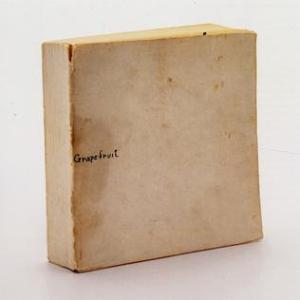
Ono, Yōko. Grapefruit. Tokyo, New York: Wunternaum, 1964. [Images]

©Yoko Ono

Oppenheim, Dennis. Flower Arrangement for Bruce Nauman. New York: Multiples, Inc., 1970.  [Images] [More images]

Paolini, Giulio. Cio che non ha limiti e che per sua stessa natura non ammette limiti di sorta. Turin: Self-published, 1968. [Image] [Another image] [More images]

Paolozzi, Eduardo. Metafisikal Translations. London: Kelpra Studios, 1962. [Images] [More images] [Compare/contrast with Francisco Prieto’s London 1827, 2001-13]

Paolozzi, Eduardo. ABBA ZABA. London: Hansjorg Mayer, 1970. [Image] [Images] [More images]

Penone, Giuseppe. Svolgere la Propria Pelle. Turin: Sperone Editore, 1971. [Image] [More images]

Phillips, Tom. A Humument. London: Tetrad Press, 1970. [Image] [More images] [Video] [Compare/contrast with Jonathan Safran Foer’s Tree of Codes, 2010]

Phillips, Tom. Trailer. Dusseldorf: Hanjorg Mayer, 1971. [Image]

Pilkington, Philip; Rushton, David; Lole, Kevin; Smith, Paul. Concerning the Paradigm of Art. Zurich: Editions Bischofberger, 1971. [Last author’s name corrected from “Paul” to “Peter”] [From Paul Robertson, “A Collection of Rare Art+ Language Books and Internal Documents – Many Unknown in Literature”, Gorebridge, Midlothian: Unoriginal Sins/Heart Fine Art, n.d.

“30 x 21cm, 16pp (recto only). White card covers – with offset title. A text published by Bischofberger from a theoretical document written by Kevin Lole, Philip Pilkington, David Rushton and Peter Smith (formerly Analytical Art and by this time fully regarded as members of Art & Language) which applied Thomas Kuhn’s theory of paradigm shift to art (the original theory by Kuhn being a view that revolutions in scientific thought only occurred when sufficient contrary evidence to the prevailing orthodoxy had mounted up and the original hypothesis could no longer explain the physical evidence emerging from empirical studies). It is worth noting that at this time Bischofberger bought a great deal of Art + Language material from the group and published other documents by them including some of the group’s rarest publications – storing many of the more three-dimensional works for later resale. Bischofberger did not print the books himself – rather Art and Language arranged design and publication in Coventry (for free using the University’s resources) and David Rushton drove the books over in a camper van to Switzerland (breaking down just on the edge of the city due to running out of petrol and having little money left, Rushton coasted the last mile down hill on an empty tank).

The limitations of these series of books are usually placed at c. 200 but Rushton remembers taking far fewer than that with him and this Analytical Art book was in fact only produced in 50 copies taken to Zurich plus a few retained by the artists in the UK.

That said this is one of ONLY 5 copies which were numbered in roman numerals (this one being III/V) and signed by ALL of the four writers in pencil on the first title page.”]

Pilkington, Philip; Rushton, David. Sample from a Topological Notebook. Coventry: Self-published, 1972. [Video] [From Paul Robertson, “A Collection of Rare Art+ Language Books and Internal Documents – Many Unknown in Literature”, Gorebridge, Midlothian: Unoriginal Sins/Heart Fine Art, n.d.

“30 x 21cm, 28pp carbon copy pages and printed cover. This was one of ONLY four copies made and published by the group – two copies being signed by David Rushton and Peter [sic] Pilkington and created from original typed sheets and two copies remaining unsigned and created (as here) using the carbon copies from the originals. These latter two examples were regarded by the group as artist’s proofs of the book. This is the only copy of this book available for sale anywhere as from the original four prices: one is in Paul Maenz’s archive and another two copies are in the hands of private collectors (who purchased them from ourselves). This copy is signed by David Rushton and Philip Pilkington and has been stamped on the inside front cover with the official Art & Language Stamp and also designated in blue ink “Second Copy”. Fine estate and clearly rare.”]

Pistoletto, Michelangelo. Le Ultime Parole Famose. Turin: Tipolito Piano, 1967. [Images] [Additional images]

Pistoletto, Michelangelo. L’uomo nero: Il lato insopportabile. Salerno: Rumma Editore, 1969. [Included in this anthology; searchable here] [Image] [Cover image] [Video] [Compare/contrast with Abigail Thomas’s Micro-Pages, 2010]

Prini, Emilio. Magnete. [included within Celant’s Arte Povera published by Praeger , 1969.] [Unable to verify this; an image of the work appears in Emanuela Nobile Mino’s article “Emilio Prini: Non creo, se è possibile”, Flash Art 50, 298 Dicembre 2011 – Gennaio 2012.]

Magnet / Photo Series / Group 2000 / September 1968 / (4 Phase) / Continuous Photographic Photographs Continuously Photographs Up to 20,000 Shots / Run Time work / 10 years / annual series of 20,000 elements / technique / black and white photography / leafs / 3 M / K 203 3 / each 30 x 40 / constant time setting diaphragm / fixed tilt stand / 1969 / camera used maintains the original value and adds to the artistic market.

Ramsden, Mel. The Black Book. [Unable to find a work under this title in WorldCat]

Ramsden, Mel. Abstract Relations. New York: Art-Language, 1968. Edition of 5. [Unable to find a work under this title in WorldCat; the 5 images on the left in this photograph from the Philippe Méaille private collection at MACBA come closest.]

‘ART & LANGUAGE Incomplet’ exhibition views, 2014. Photo: EOS-AF, Estudi Orpinell & Sánchez — Artesania Fotogràfica
100% Abstract (1968) Art & Language

Roehr, Peter. Ziffern: 10 Typomontagen 1965. Cologne: Gerd de Vries, 1970.

Ty-100 (1965)
Peter Roehr
Source: Artnet 29 October 2017

Rot, Dieter. BOK 2a. Reykjavik: forlag ed, 1960. [Images and essay] [Video, survey of Rot’s artist’s books]

Rot, Dieter. BOK 2b. Reykjavik: forlag ed, 1961. [Links in author’s name lead to image]

Rot, Dieter. BOK 3a. Reykjavik: forlag ed, 1961.

Rot, Dieter. BOK 3b. Reykjavik: forlag ed, 1961.

Rot, Dieter. BOK 3c. Reykjavik: forlag ed, 1961. [For images, see Clare Lehmann’s entry in Artists Who Make Books, 2017, p. 243]

Rot, Dieter. BOK 3d. Reykjavik: forlag ed, 1961. [Video link]

Rot, Dieter. BOK 4a. Reykjavik: forlag ed, 1961.

Rot, Dieter. BOK 5. Reykjavik: forlag ed, 1961.

Rot, Dieter. Dagblegt Bull No. 8. La Louvriere: A. Balthazar & P. Bury, 1961.

Rot, Dieter. Daily Mirror Book. Reykjavik: forlag ed, 1961. [For image, see Clare Lehmann’s entry in Artists Who Make Books, 2017, pp. 242-243][Compare/contrast with Vienna Romanée’s Data Sewing Project,  2011 to present]

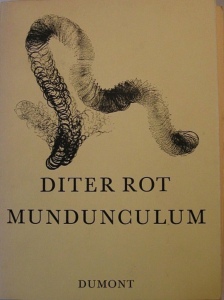
Rot, Dieter. Mundunculum. Cologne: Dumont Schauberg, 1961.

Rot, Dieter. Book AC 1958-1964. New Haven: Ives-Sillman, 1964.

Rot, Dieter. Quadrat-blatt. Hilversum: Steendrukkerij de Jong, 1965.

Rot, Dieter. The Copley Book. Chicago: Bill and Norma Copley Foundation, 1965. [For image, see Clare Lehmann’s entry in Artists Who Make Books, 2017, pp. 243-245]

Rot, Dieter. Kölner Divisionen. Cologne: Galerie der Spiegel, 1965.

Rot, Dieter. Quick. Reykjavik: Self-published, 1965.

Rot, Dieter. Poetrie No. 1. Stuttgart: Hansjorg Mayer, 1966.

Rot, Dieter. Scheisse: Neue Gedichte von Dieter Rot. Stuttgart: Hansjorg Mayer, 1966.

Rot, Dieter. Die Blaue Flut. Stuttgart: Hansjorg Mayer, 1967.

Rot, Dieter. A Look into the Blue Tide, Part Two. New York: Great Bear Pamphlets, 1967.

Rot, Dieter. Siebdruckbilder (Screenprint Pictures 1-4). Stuttgart: Hansjorg Mayer, 1967.

Rot, Dieter. Mundunculum (enlarged and corrected). Cologne: Dumont Schauberg, 1967.

Rot, Dieter. Poetrie 2 (301 kleine Wolken in Memoriam big J und big G : ein fingierter Bericht aus der inneren Fremde)Stuttgart: Hansjorg Mayer, 1967.

Rot, Dieter. 80 Wolken, 1965-67. Stuttgart: E. Walther, 1967.

Rot, Dieter. Poeting 3/4 (Poeterei: Doppelnummer …). Stuttgart: Hansjorg Mayer, 1968.

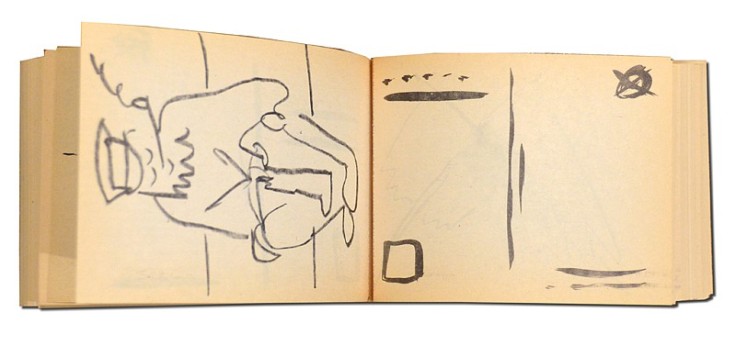
Rot, Dieter. Poemetrie. Cologne: Divers Press, 1968. [Image] [Compare/contrast with Robert Kalka’s Medium, 1995]

Poemetrie (no. 4 of the review Poeterei) (1968)
19 transparent plastic bags; letterpress, printed on both sides, filled with vanilla pudding and urine; plastic cover, back cover with signed drawing a.p. (ed. of 30 + 3 a.p.)
© Dieter Roth

Rot, Dieter; Williams, Emmett. Still More Shit — A Supplement. New York: Something Else Press, 1968. [Still more images]

Rot, Dieter. Die Kakausener Gemeine. Stuttgart: Hansjorg Mayer, 1968. [Images]

Rot, Dieter. Die Gesamte Scheisse/The Complete Shit. Berlin: Rainer Verlag, 1968. [Images]

Rot, Dieter. 246 Little Clouds. New York: Something Else Press, 1968. [Images]

Rot, Dieter. Little Tentative Recipe. Stuttgart: Hansjorg Mayer, 1969. [Images]

Little Tentative Recipe (1969)
Approx 800 rotaprints in colour.
8.8 x 8.8 x 8.8 cm. Adhesive binding wooden box. 100 unique pieces numbered.
© Dieter Roth

Rot, Dieter. Poetrie 5 to 1st. London: Hansjorg Mayer, 1969. [Images]

Rot, Dieter. Icelandic Leather. Reykjavik: Self-published, 1970. [Unable to locate by this title; may be referring to Volume 5, Bok 3 of the Collected Works]

Rot, Dieter. Snow. Stuttgart, Reykjavik, London: Wasserpresse Mayer, 1970. [Images]

Rot, Dieter. Postkartenblock (Postcard Pad). Cologne, London, Hellnar: Hansjorg Mayer, 1971. [Images] [Compare/contrast with Frances Kiernan’s All the Prints I Have Made, 2010]

Rot, Dieter. 2 Problems of Our Time: An Essay. Reykjavik: Verlag Reykjavik, 1971.

Rot, Dieter. Franz Eggenschwiler: The Young Man, the Man, His Time, His Work (until today 2.5.71), An Essay. Stuttgart: Hansjorg Mayer, 1971. [Images]

Rot, Dieter. Ideogramme. Stuttgart: Hansjorg Mayer, 1971.

Rot, Dieter. Smaller Works Part 1. Stuttgart: Hansjorg Mayer, 1971. [Volume 18 of Gesammelte Werke]

Rot, Dieter. Smaller Works Part 2. Stuttgart: Hansjorg Mayer, 1971. [Volume 19 of Gesammelte Werke]

Rot, Dieter. Who Was Mozart. Reykjavik: Verlag Reykjavik, 1971.

Rot, Dieter. Who’s the One Who Doesn’t Know Who Mozart Was? Reykjavik: Verlag Reykjavik, 1971.

Rot, Dieter. A Question? Reykjavik: Verlag Reykjavik, 1971.

Ruppersberg, Allen. 23 Pieces. Los Angeles: Sunday Quality, 1969. [Images]

Ruppersberg, Allen. 24 Pieces. Los Angeles: Sunday Quality, 1970. [Images]

Ruscha, Ed. Twentysix Gasoline Stations. Los Angeles: Self-published, 1963. [Images] [Interview about the book][See also Clare Lehmann’s entry in Artists Who Make Books, 2017, pp. 251-252][Compare/contrast with Sowon Kwon’s Whiteowned Gasoline Stations, 2007, and Ginger Burrell’s Twentysix Charging Stations, 2014]

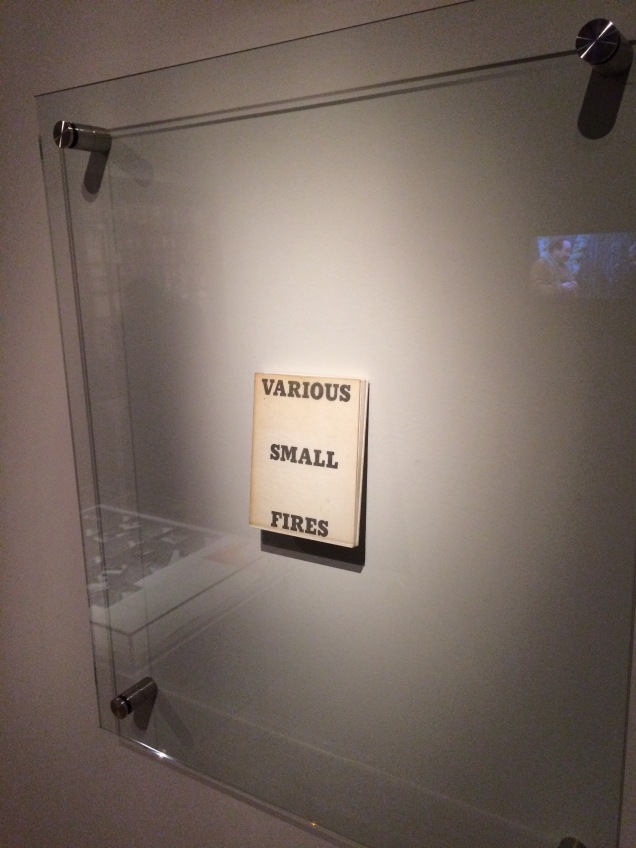
Ruscha, Ed. Various Small Fires. Los Angeles: Self-published, 1964. [Images]

Display of Ed Ruscha’s Various Small Fires and Milk, 1964, at Pliure: La Part du Feu, 2 February – 12 April 2015, Paris. Photo by Robert Bolick. Reflected in the lower left hand corner is the display of Bruce Nauman’s Burning Small Fires; in the upper right corner, the film clip of Truffaut’s 1966 Fahrenheit 451; and in the upper left, Maria Helena Vieira da Silva’s La bibliotheque en feu, 1974.
Ruscha, Ed. Every Building on the Sunset Strip. Los Angeles: Self-published, 1966. [Images] [Animation] [Compare/contrast with Every Item in the Artists’ Book Collection of the Banff Centre Paul D. Fleck Library & Archives, 2013 to the present, and James Bridle’s installation Every CCTV (CC), 2017, an extension of The Nor, 2014]

Ruscha, Ed. Thirtyfour Parking Lots. Los Angeles: Self-published, 1967. [Images] [Compare/contrast with James Bridle’s Drone Shadow Handbook, 2013]

Ruscha, Ed. Nine Swimming Pools (and a Broken Glass). Los Angeles: Self-Published, 1968.

Ruscha, Ed. Business Cards. Los Angeles: Heavy Industry Publications, 1968. [Images]

Ruscha, EdStains. Los Angeles: Heavy Industry Publications, 1969. [Images] [Compare/contrast with Ellie Ga’s Classification of a Spit Stain, 2009]

Ruscha, Ed. Crackers. Los Angeles: Heavy Industry Publications, 1969. [Images]

Ruscha, Ed. Real Estate Opportunities. Los Angeles: Self-published, 1970. [Images]

Ruscha, Ed. Babycakes with Weights. New York: Multiples, Inc., 1970. [Images][See also Clare Lehmann’s entry in Artists Who Make Books, 2017, pp. 252-253]

Ruscha, Ed. A Few Palm Trees. Los Angeles: Heavy Industry Publications, 1971. [Images]

Ruscha, Ed. Records. Los Angeles: Heavy Industry Publications, 1971. [Images]

Ruscha, Ed. Dutch Details. Deventer: Octopus Foundation, 1971. [Images] [Video, more images and essay][See also Clare Lehmann’s entry in Artists Who Make Books, 2017, pp. 254-255]

Sonnier, Keith. Object Situation Object. Cologne, New York: Walther König, 1970. [Images] [Official website] [Video]

Spoerri, DanielTopographie Anecdotée du Hasard. Paris: Galerie Lawrence, 1962. [Images]

Spoerri, Daniel. An Anecdoted Topography of Chance. New York: Something Else Press, 1966. [Images] [Compare/contrast with Rutherford Witthus’ Anything is a Mirror, 2007]

Spoerri, Daniel. The Mythological Travels.... New York: Something Else Press, 1970. [Images]

Staeck, Klaus. Pornographie. Giessen: Anabas Verlag, 1971. [Images] [Official website]

Stezaker, John. Works, 1969 – 1971. London: Nigel Greenwood, 1972. [Compare/contrast with Doug Beube’s Speechless Series, 2015, Noriko Ambe’s Artist Books Project, 2009-13, and Scott Hazard’s Photo Constructs, 2011]

Stezaker, John. “0(A-F)” and Five Inherent Predicables. London: Nigel Greenwood, 1972.

Stezaker, John. “A” and Six Predicable Concepts. London: Nigel Greenwood, 1972.

Tacha, Athena. Heredity Study I, 1970-71. Oberlin, OH: Self-published, 1971. [Images] [Compare/contrast with Jan Fairbairn-Edwards’ Family Geology, 2015]

Tacha, Athena. Heredity Study II, 1970-71. Oberlin, OH: Self-published, 1971. [Images]

Tacha, AthenaSpatial Disorientation Staircases and Ramps 1971-72. Oberlin, OH: Self-published, 1972. [Image]

Titus-Carmel, Gerard. Joaquin’s Love Affair. Paris: Ericard Editeur, 1971. [Images]

Tuttle, Richard. 2 Books 1969. New York: Betty Parsons Gallery, 1969. [Images]

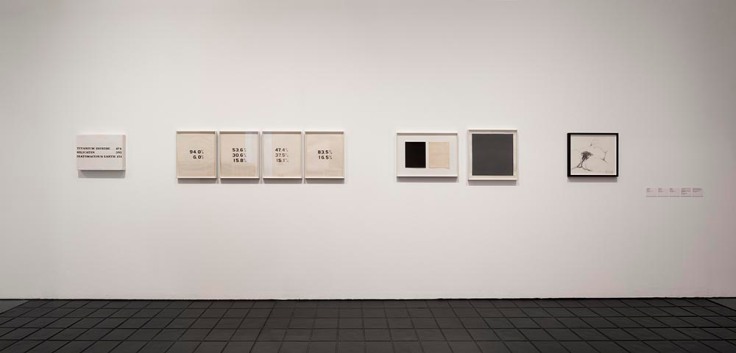
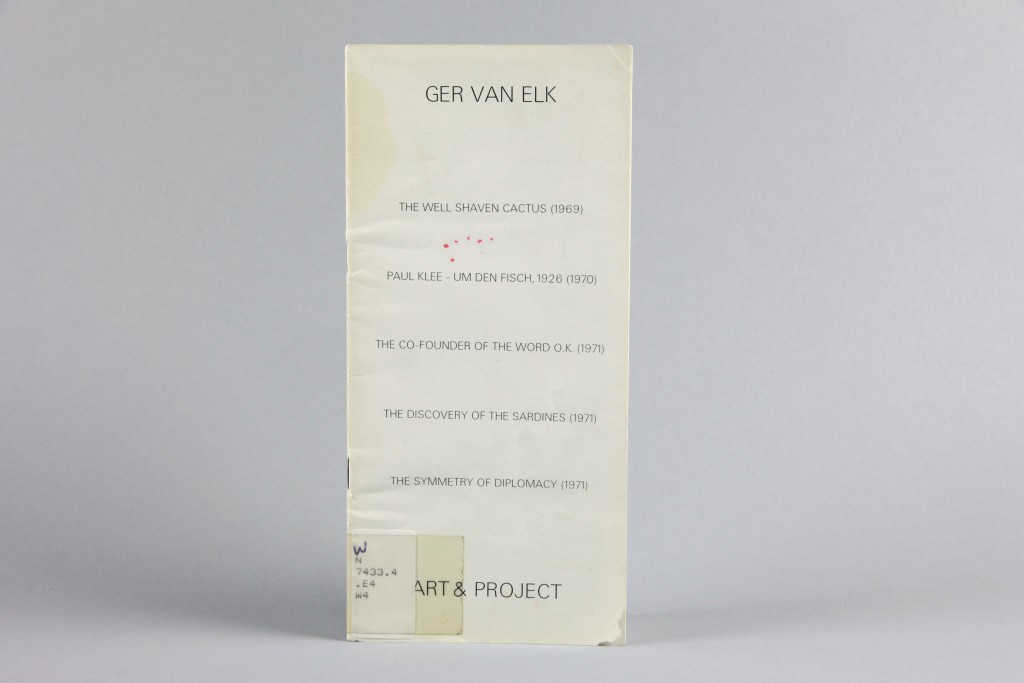
Van Elk, Ger. The Well-Shaven Cactus/Paul Klee um den Fisch, 1926/The Co-Founder of the Word OK/The Discovery of Sardines/The Symmetry of Diplomacy. Amsterdam: Art & Project, 1972. [Images] [More images ][Video]

Vautier, Ben. Le Livre Total: 13 propositions pour une nouvelle perception et conscience de l’objet livre. Nice: Self-published, 1963. [Image]

Vautier, Ben. Écrit pour la gloire à force de tourner en rond et d’être jaloux. Nice: Self-published, 1970. [Images]

Venet, Bernar. Astrophysics [within S.M.S. Portfolio no. 6]. New York: Letter Edged in Black Press, 1968. [Images]

Venet, Bernar. Exploited Subjects: Stimulated Raman Effect. New York: Multiples, Inc., 1970. [Images]

Walther, Franz Erhard. Objekte, Benutzen. Cologne: Walther König, 1968. [Images]

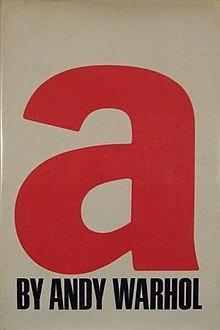
Warhol, Andy. A. New York: Grove Press, 1968. [Images] [Compare/contrast with Warren Lehrer’s A Life in Books, 2013]

Warhol, Andy. Andy Warhol. Stockholm: Moderna Museet, 1968. [Images]

Weiner, Lawrence. Statements. New York: Siegelaub, 1968. [Images][See also Clare Lehmann’s entry in Artists Who Make Books, 2017, p. 291]

Weiner, Lawrence. Traces. Turin: Sperone Editore, 1970. [Actual title is Tracce Traces.] [Images] [Compare/contrast Michael Winkler’s Word Art/Art Words, 1985]]

Weiner, Lawrence. 10 Works. Paris: Yvon Lambert, 1971. [Images][See also Clare Lehmann’s entry in Artists Who Make Books, 2017, pp. 293-294]

Weiner, Lawrence. 10 Obras. Buenos Aires: CAYC, 1971. [Images]

Weiner, Lawrence. Causality Affected and/or Effected. New York: Leo Castelli, 1971. [Images][See also Clare Lehmann’s entry in Artists Who Make Books, 2017, pp. 292-293]

Weiner, Lawrence. Flowed. Halifax: Nova Scotia College of Art and Design, 1971. [Images] [More images] [Compare/contrast with Demosthenes Agrafiotis’ The Chinese Notebook, 2015.

Weiner, Lawrence. Misschien door Verwijddering [Perhaps when removed]. Amsterdam: Art & Project, 1971. [Images]

Weiner, Lawrence. Quizas Cuando Removido [Perhaps when removed]. Buenos Aires: CAYC, 1971. [Edition of the work pirated and edited with the permission of Art & Project] [Image]

Weiner, Lawrence. Having Been Done At. Turin: Sperone Editore, 1972. [Images]

Weiner, Lawrence. Green as well as Blue as well as Red. London: Jack Wendler, 1972. [Full title is And/Or: Green as well as blue as well as red.] [Images]

Young, La Monte. An Anthology of Chance Operations. New York: La Monte Young and Jackson MacLow, 1963. [Contributors: Brecht, George; Cage, John; De Maria, Walter; Flynt, Henry; Higgins, Dick; Johnson, Ray; MacLow, Jackson; Morris, Robert; Ono, Yoko; Paik, Nam June; Rot, Dieter; Williams, Emmett; Young, La Monte; et al.] [Images] [Young soundtracks and video]

Young, La Monte; Zazeela, Marian. Selected Writing. Munich: Friedrich Publishers, 1969. [Images]

βΟβσβΟβσβΟβσβΟβσβΟβσβΟβσβΟβσβΟβσβΟβσβΟβσβΟβσβΟβσβΟβσβΟβσβΟβσβΟβς