Books On Books Collection – Chiavelli

Arthur R.: Promenade pour 5 chameaux (1987)

Arthur R./Promenade pour 5 Chameaux (1987)
Chiavelli
Bande Dessinée. H298 xW226 mm, 48 pages. Acquired from Librarie de l’Université, 28 October 2021.
Photo: Books On Books Collection.

It is curious — given that Stéphane Mallarmé had only ever seen Arthur Rimbaud once and wrote about him only on commission — that Chiavelli assigns Un Coup de Dés as the subtitle of his second volume in a series of three graphic novels following the adventures of “Arthur R.”, a Tin Tin-like version of Arthur Rimbaud. Chiavelli weaves his imagined adventures of Rimbaud on the Horn of Africa (1880-91) into a three-volume graphic novel whose plot lines, scenes and dialogue balloons are stuffed with arch allusions to Rimbaud’s abandoned literary life and postmodern literary criticism.
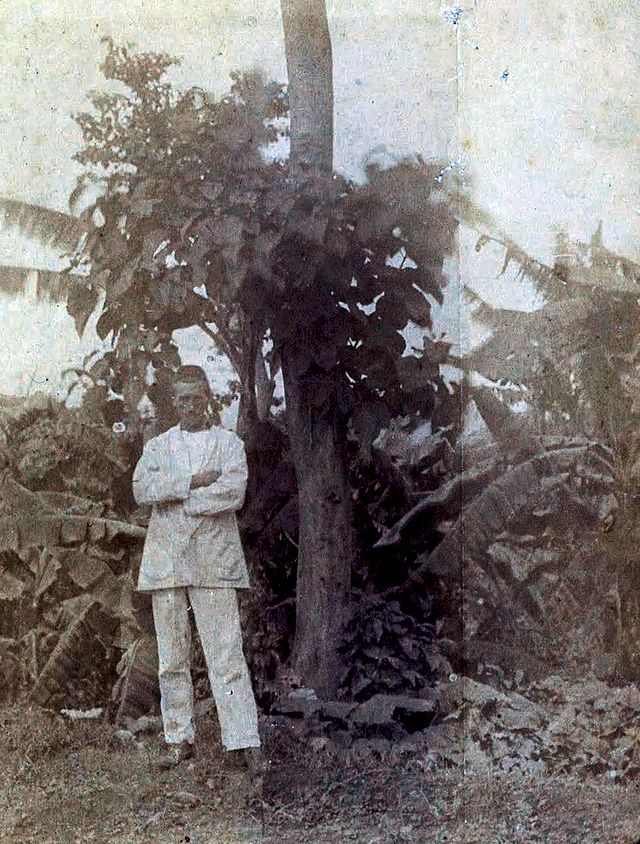
Rimbaud in Harar.

In this first volume, Chiavelli gives his hero a favorite curse — the mild Bon sang! (“damn!”), probably uncharacteristic for the Rimbaud who killed a worker in Cyprus with a rock, but characteristic for Chiavelli making a tongue-in-cheek reference to Mauvais sang (“Bad Blood”, the second and longest poem in Une saison en enfer, 1873). The five camels of the title are named A,E, I, U and O, after the letters of his sonnet Les Voyelles (1871), which has been rendered in multiple livres d’artiste, one of which is in the Books On Books Collection. As the sonnet associates each vowel with a color, Chiavelli can be suspected of being tongue-in-cheek in delivering his comic completely in black and white. Certainly the invitation to a philosophical discussion of time that segues into a French pun “sons of the desert” into “sons of bitches” (fils de buttes for fils de putes) sets the tone to come.
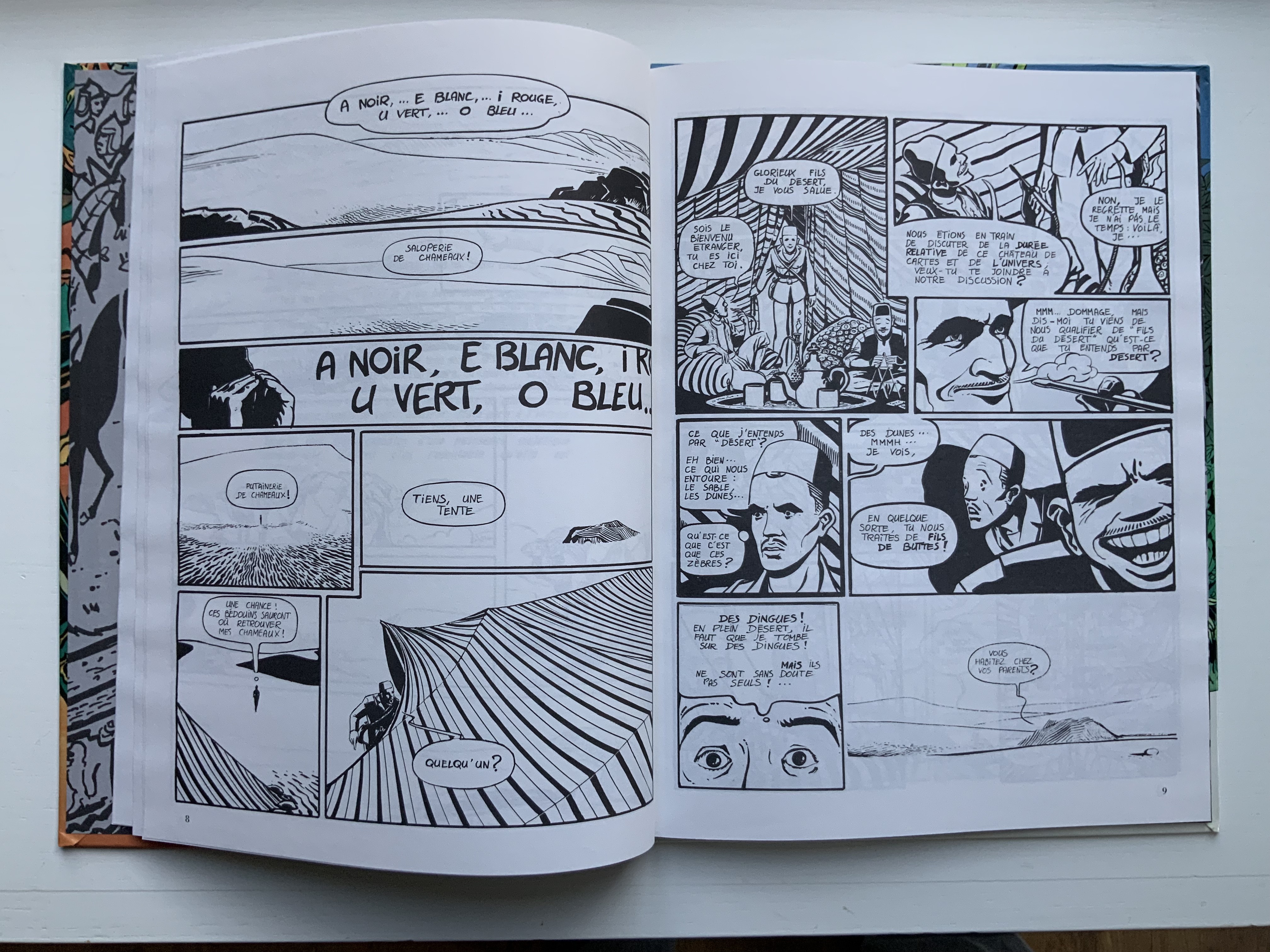
Arthur R./Un Coup de DÉS Jamais N’Abolira le HASARD (1988)
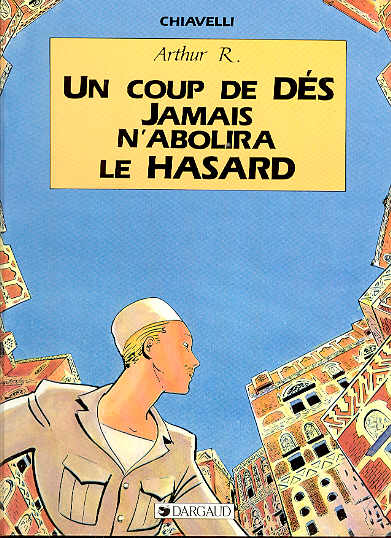
Arthur R./Un Coup de DÉS Jamais N’Abolira le HASARD
Chiavelli
Bande Dessinée H290 x W225 mm, 48 pages. Acquired from Librairie de l’Université, 28 October 2021.
Photo: Books On Books Collection.

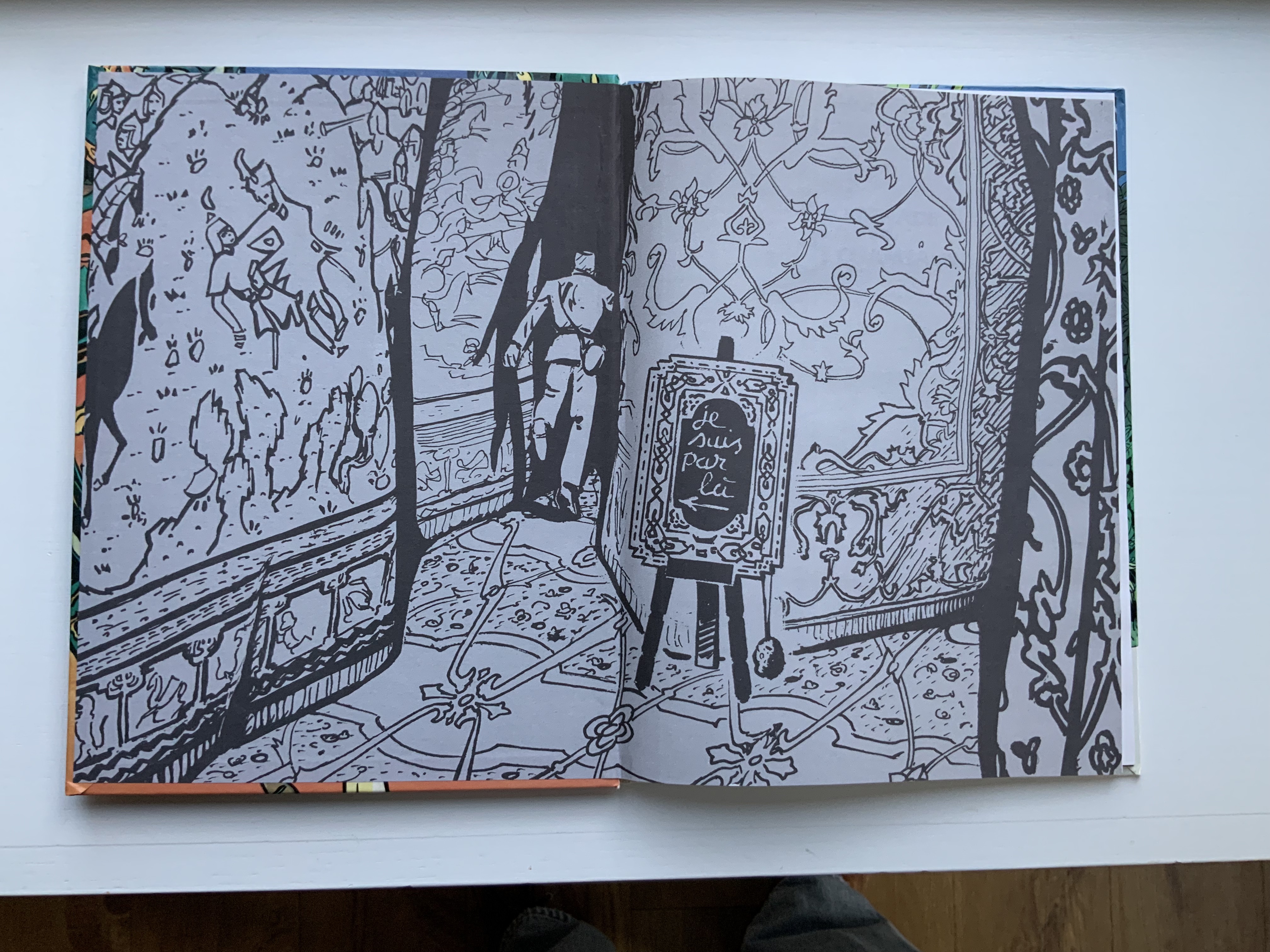
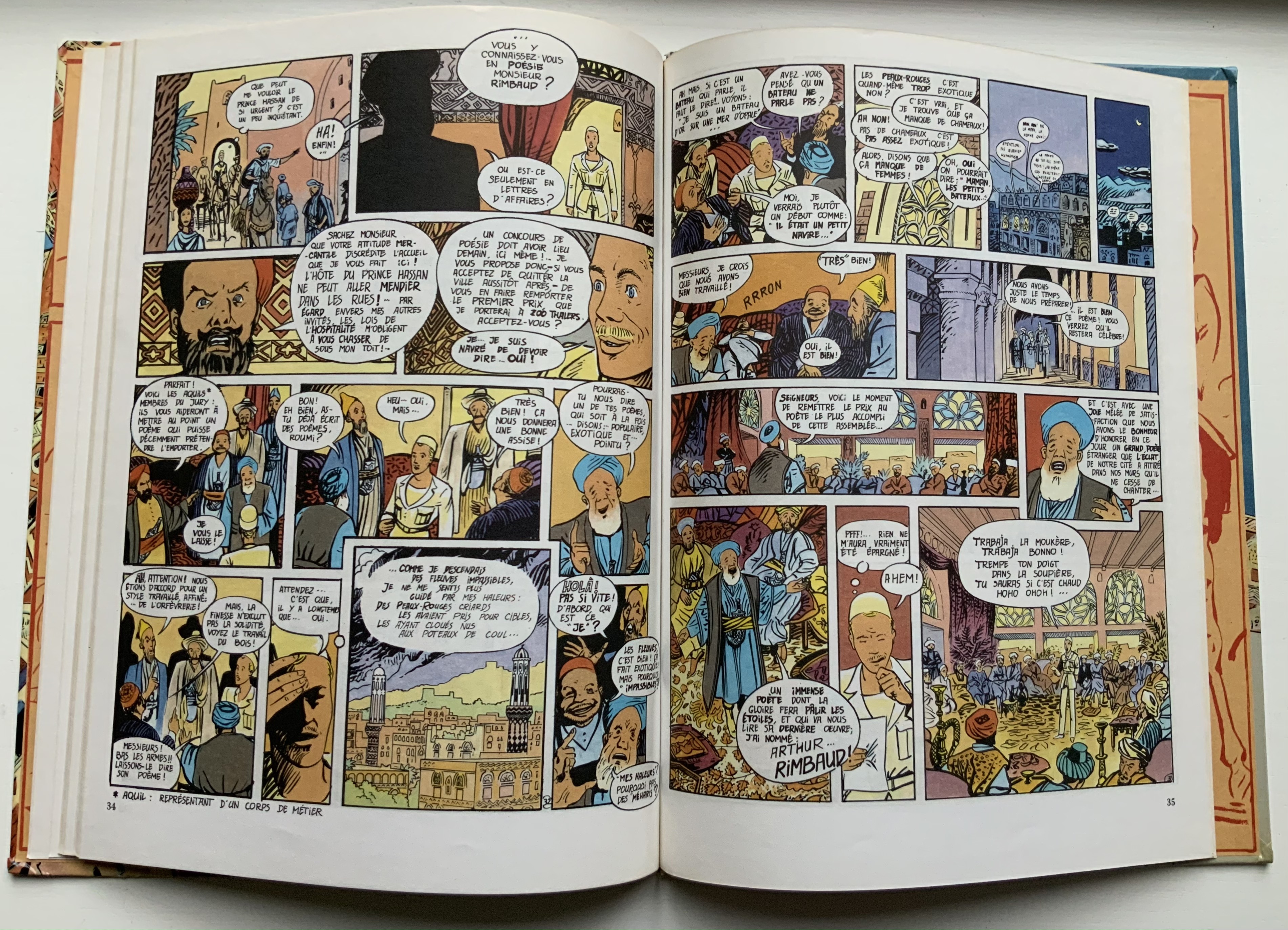
With its title, this four-color volume marks a shift in its joking allusiveness from Rimbaud alone to a conflation with Stéphane Mallarmé’s poem of the same title: an opening game of dice and a search for the city of “Azar” (homonym for hasard, meaning chance and also a game of dice). Still though, Rimbaud/Tin Tin is never far away; see the second double-page spread in which he recalls to himself the opening lines to Le Bateau Ivre/”The Drunken Boat” but then delivers to his Arab audience a racist, misogynistic ditty concocted by French legionnaires in Algeria.

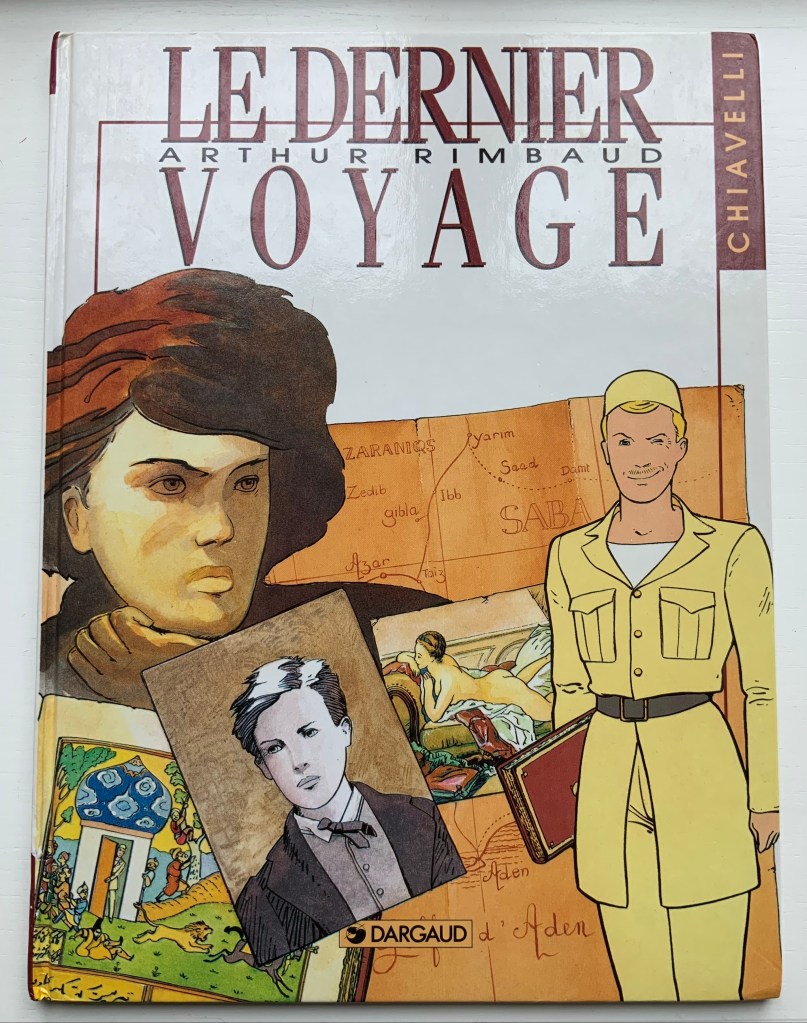
Arthur Rimbaud/ Le Dernier Voyage (1992)
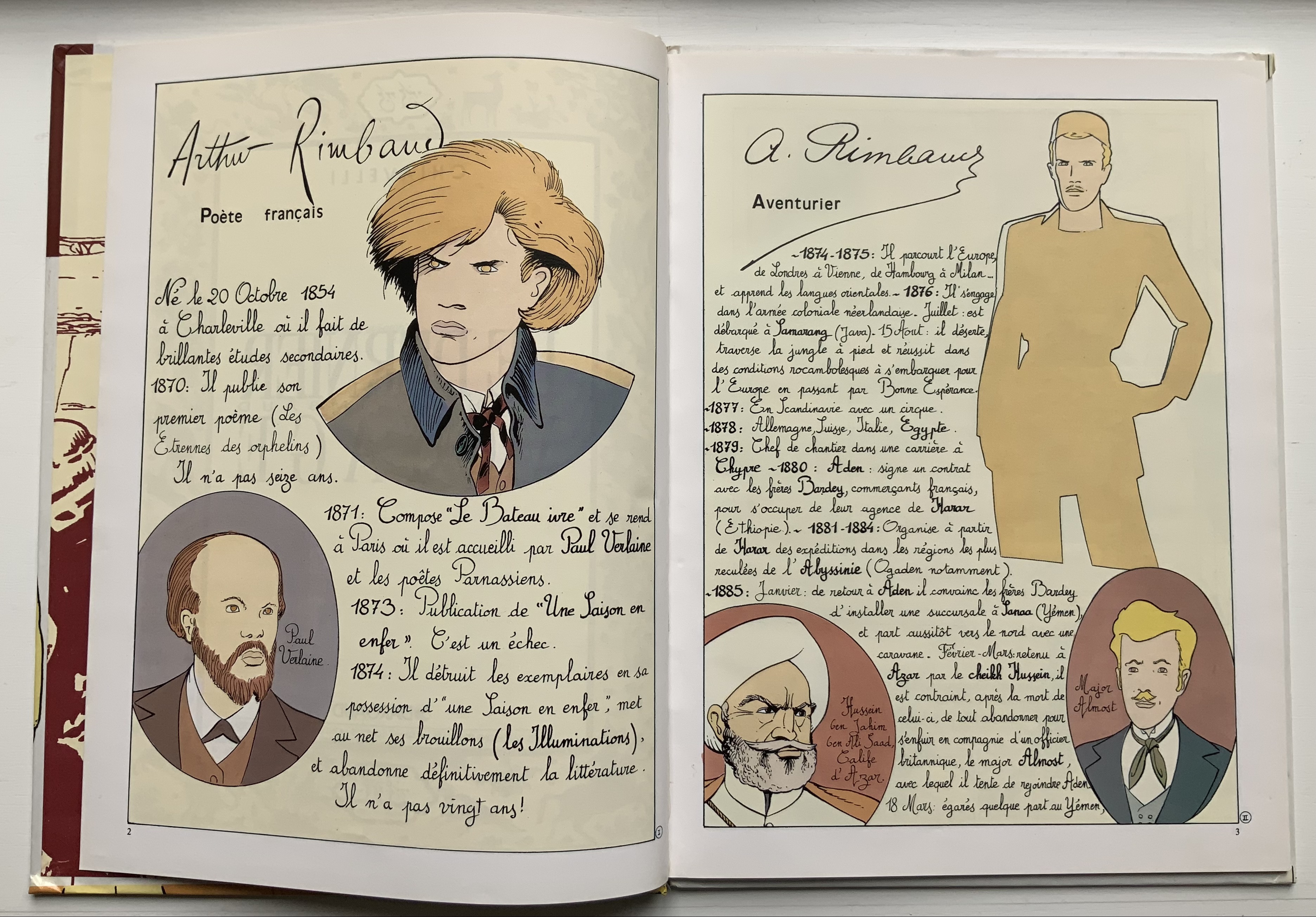
Arthur Rimbaud/ Le Dernier Voyage (1992)
Chiavelli
Bande Dessinée H320 x W240 mm, 52 pages. Acquired from EV Asset, 29 October 2021.
Photo: Books On Books Collection.

Spelling out Arthur R. on the cover of the last of the trilogy somewhat spoils the already scant Tin Tin camouflage. The inclusion of Rimbaud’s capsule biography at the start and epitaph at the end also gives this volume the feel of the earnest American comic book series “Classics Illustrated”. But its “One Thousand and One Nights” leap into the hero’s pursuit of le livre in this last voyage (a double allusion to Mallarmé?) and his amorous involvement with a femme fatale (and others) raise the trilogy to such a comic level of narrative, philosophical and literary self-reference (and such groan-inducing puns as Chipizade for Scheherezade) that the cover title and earnestness might be forgiven — depending on the reader’s age, sex and race.
Further Reading

Borer, Alain. 1984. Rimbaud en Abyssinie. Paris: Seuil.

Fontaine,  Hugues. 29 September 2020. “Arthur Rimbaud and King Menelik of ShoaThe Rimbaud and Verlaine Foundation. Accessed 4 December 2021.

Starkie, Enid. 1938. Rimbaud en Abyssinie. Avec une carte. Collection de documents et de témoignages pour servir à l’histoire de notre temps. Paris: Payot.

Books On Books Collection – Jacques Vernière

UN COUP DE DÉS JAMAIS N’ABOLIRA LE HASARD/
UN COLPO DI DADI MAI ABOLIRÀ IL CASO
(1897/1987)

UN COUP DE DÉS JAMAIS N’ABOLIRA LE HASARD/UN COLPO DI DADI MAI ABOLIRÀ IL CASO (1897/1987)
Stéphane Mallarmé/ Translation, Maurizio Cucchi/ Wood engravings, Jacques Vernière
Slipcased, paper bound, sewn. H325 x W260 mm, 70 pages. Acquired from Carla Bellini, 14 November 2021.
Photos of the work: Books On Books Collection. Displayed with permission of Edizioni Ampersand.

In the Books On Books Collection, there are livres d’artiste of Un Coup de Dés in French, English and German — even Arabic. Edizioni Ampersand brings an Italian edition into the fold. Alessandro Zanella founded Edizioni Ampersand in the early 1980s in Verona, and its second publication was UN COLPO DI DADI. Zanella had been intrigued by the revolutionary typographic layout of the poem and borrowed a first edition copy from Leo Lionni, the children’s book author and illustrator. Presumably for the future flexibility of his printing house, Zanella purchased a set of Caslon type rather than Bodoni in which to set the poem.

The 1914 edition of the poem has no title page laid out as a double-page spread. Why the title is split into four lines for the French and five for the Italian is not clear. The French layout gives a more expected left to right reading across the spread, whereas the Italian jumps back and forth (perhaps more in keeping with Mallarmé’s syntax later in the poem). Otherwise, as seen in the pairing of the “Comme si … comme si/ come se … come se” spreads, Zanella follows the 1914 edition’s layout.
The French printer/artist Jacques Vernière may have destined himself to contribute the artwork to UN COLPO DI DADI. He had introduced Zanella to American expatriate printer Richard-Gabriel Rummonds, proprietor of The Plain Wrapper Press, then also in Verona. Some years after working with Rummonds, Zanella struck out on his own and established Edizioni Ampersand. Whether by research or intuition, Zanella
Although not following Mallarmé’s choice of typeface, Zanella did follow Ambroise Vollard’s instinct that a livre d’artiste edition would sell better than a text-only edition. He also followed Mallarmé’s concern that Vollard should not let the prints and paper used for them detract from the visual impact of the text. Zanella separates Vernière’s wood engravings from the text, placing two after the French version and two after the Italian version of Mallarmé’s preface. Their evocation of the storm, shipwreck, waves and the abyss is unmistakable, as is the folio cover’s image of foam on the surface of waves.

Spread of French preface and image; spread of Italian preface and image.

Close-up of images after the prefaces.

Spread with second image in the French section; spread with second image in the Italian section.

Close-up of second images in the French and Italian sections, respectively.

The watermark in the handmade paper seems extraneous: Veronica’s Veil, the relic capturing Christ’s image, might have interested the otherwise non-religious author of Herodiade, but its bearing on this poem is unclear. A mermaid or siren would have been more suitable. But such a subtle discrepancy or missed opportunity does not sway the balance of text, image, ink and paper that Zanella has achieved here.

Logo of Edizioni Ampersand

Further Reading

Nicolini, Chiara. Summer 2012. “Lines in the Ampersand“, Illustration. Accessed 5 February 2022.

Shaw, Paul. “Alessandro Zanella: In Memoriam“, Special Collections, Marriott Library, University of Utah. Accessed 5 February 2022.

Books On Books Collection – Jean Holabird

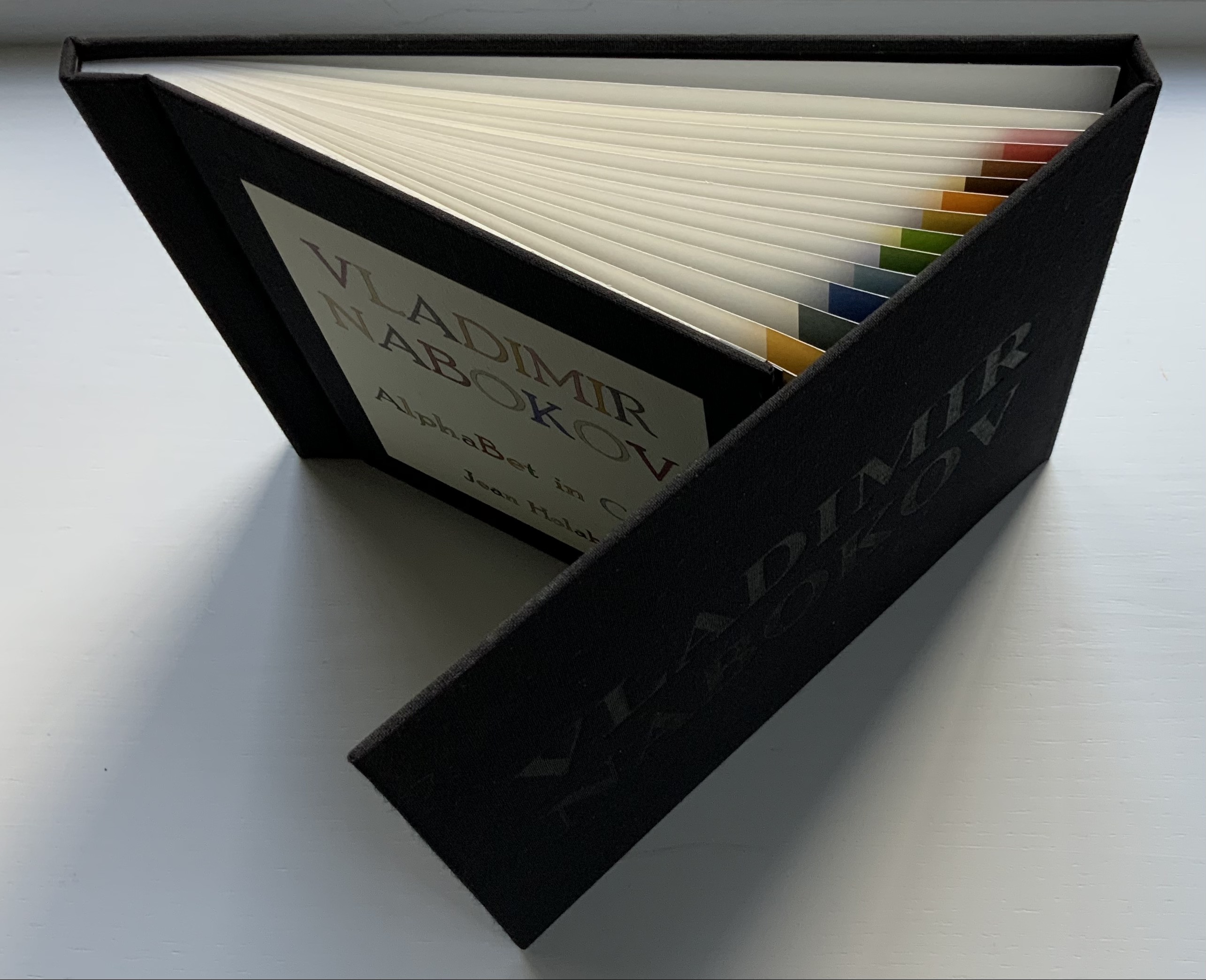
Vladimir Nabokov: AlphaBet in Color (2005)

Vladimir Nabokov: AlphaBet in Color (2005)
Jean Holabird
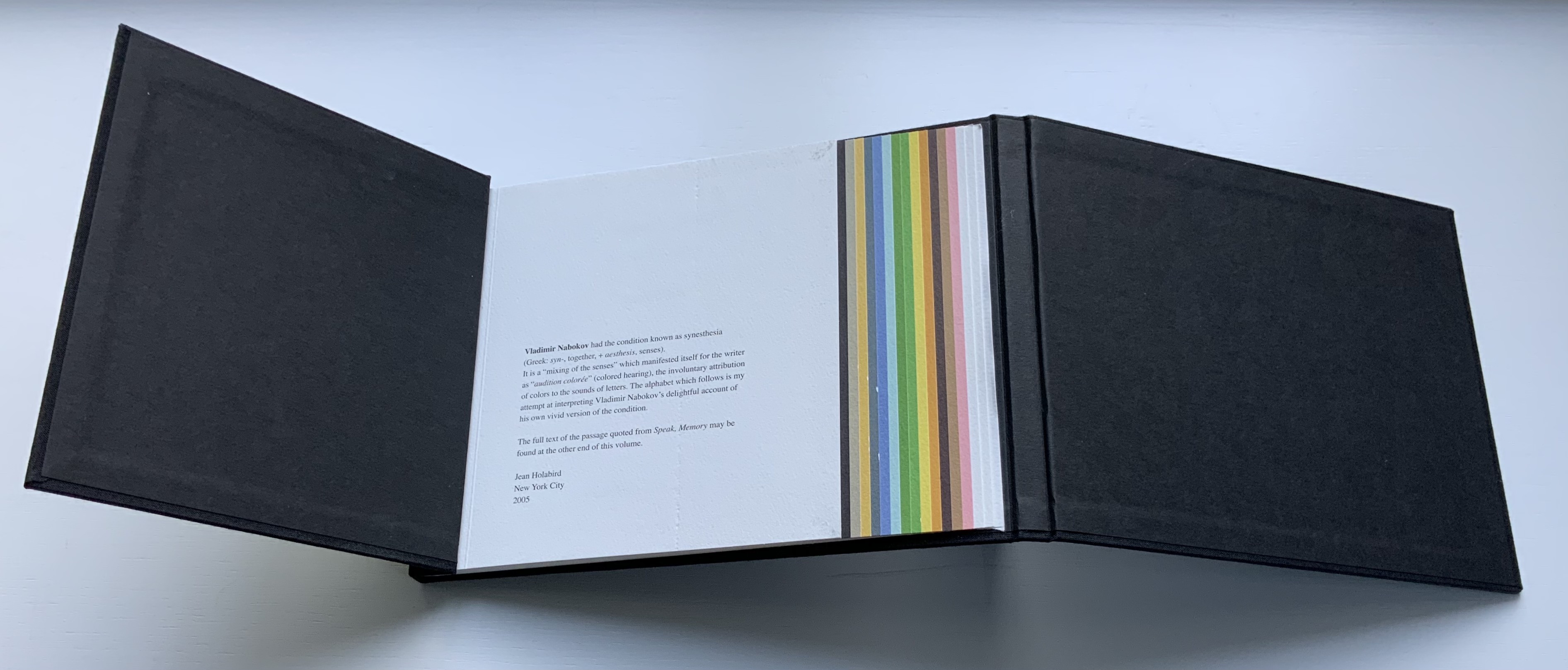
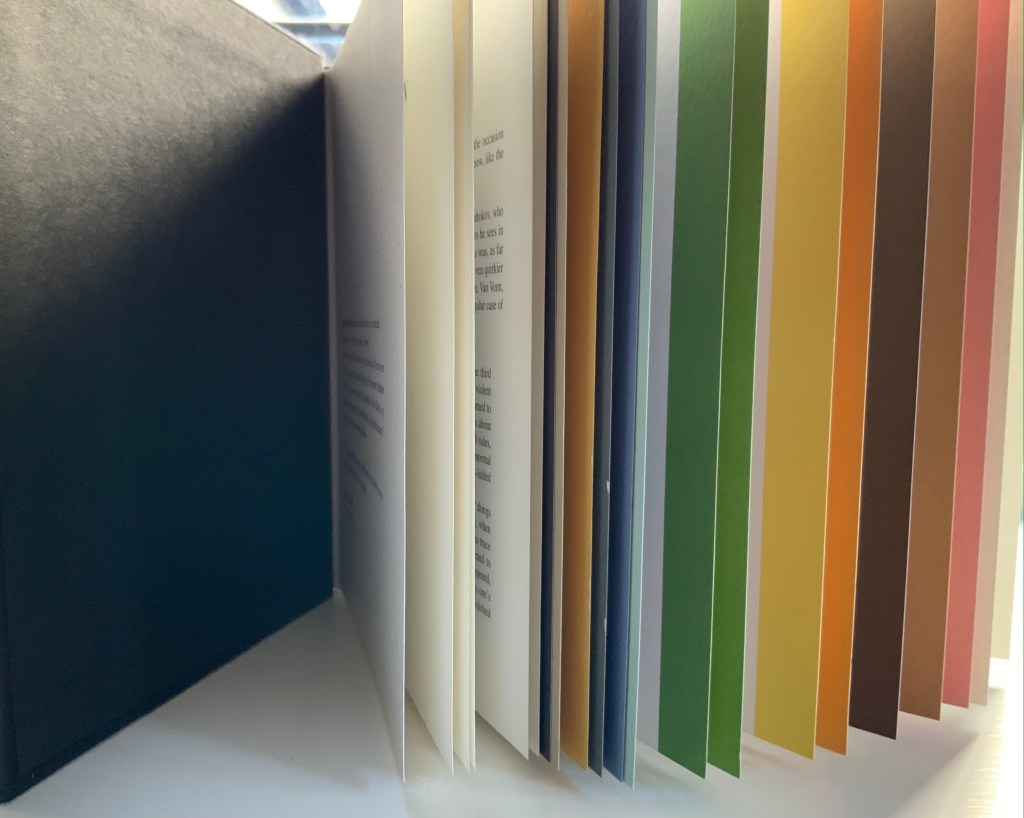
Black cloth boards, silver lettering to spine, blind stamped lettering to front board, illustrated title label to inner board; internally bound in the Japanese style with opening overlapping boards and staggered colored pages. H175 W235 mm, 40 pages. Acquired from Klondyke (Almere NL), 11 November 2021.
Photos of the book: Books On Books.

Publisher’s statement:

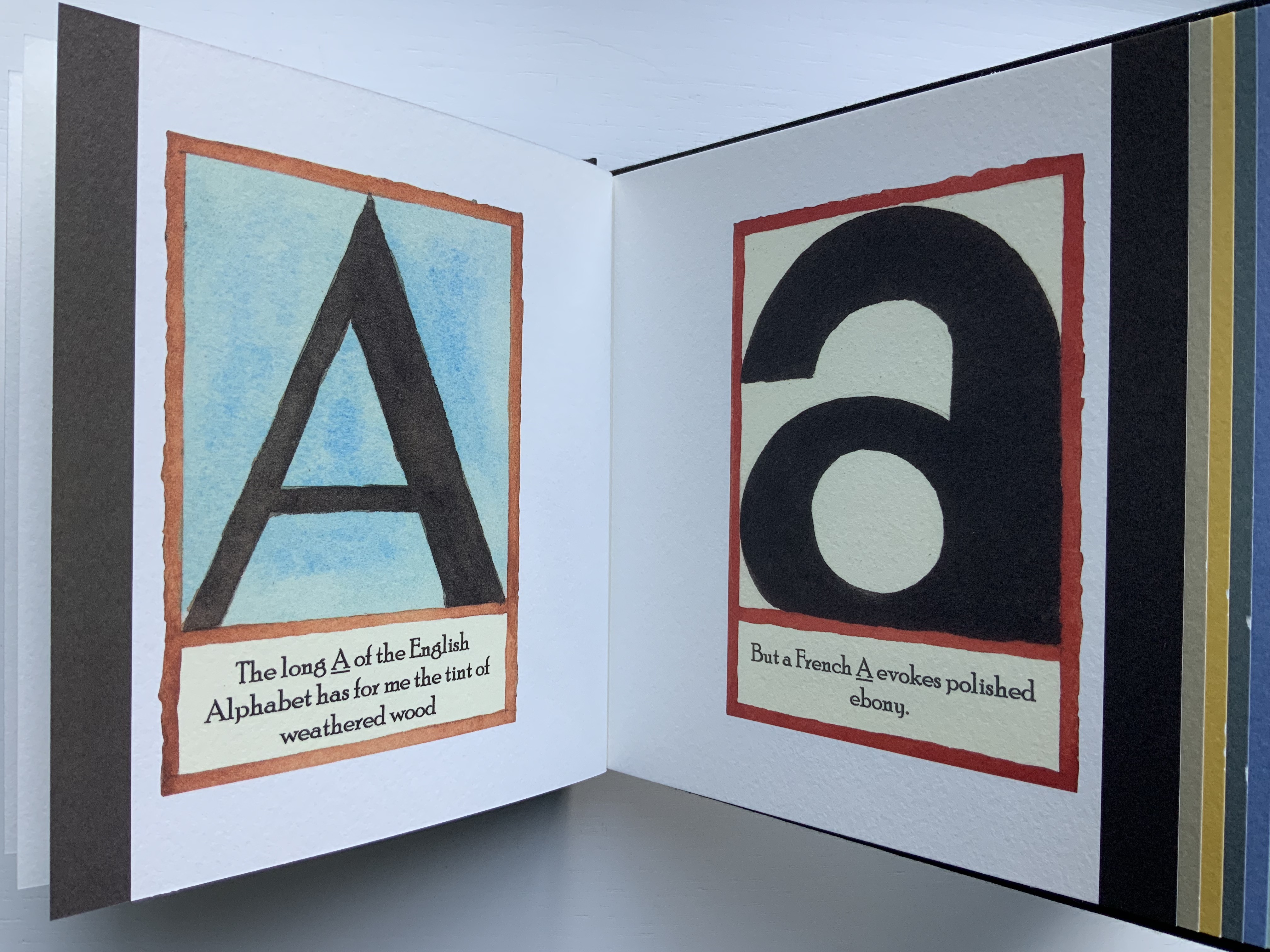
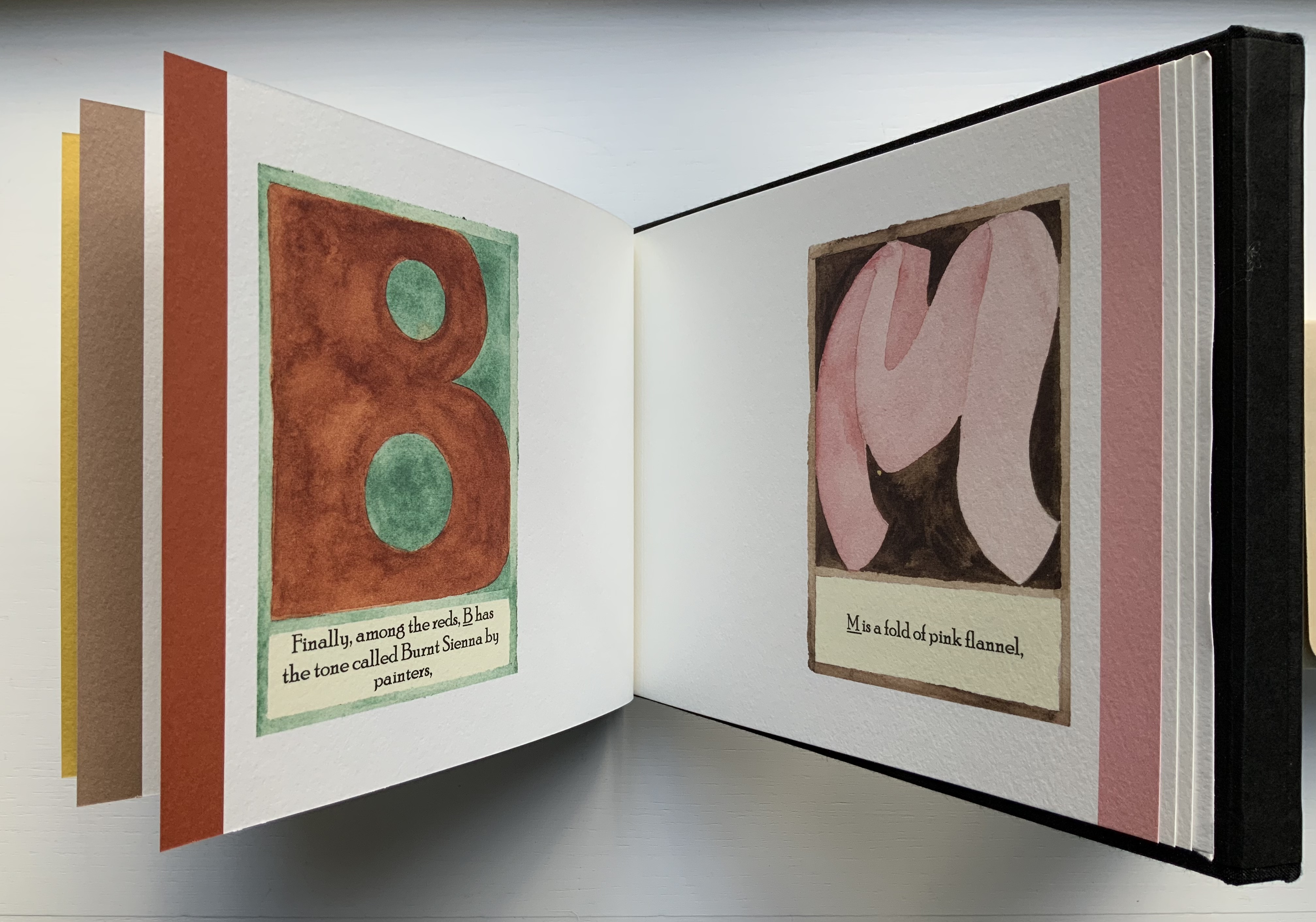
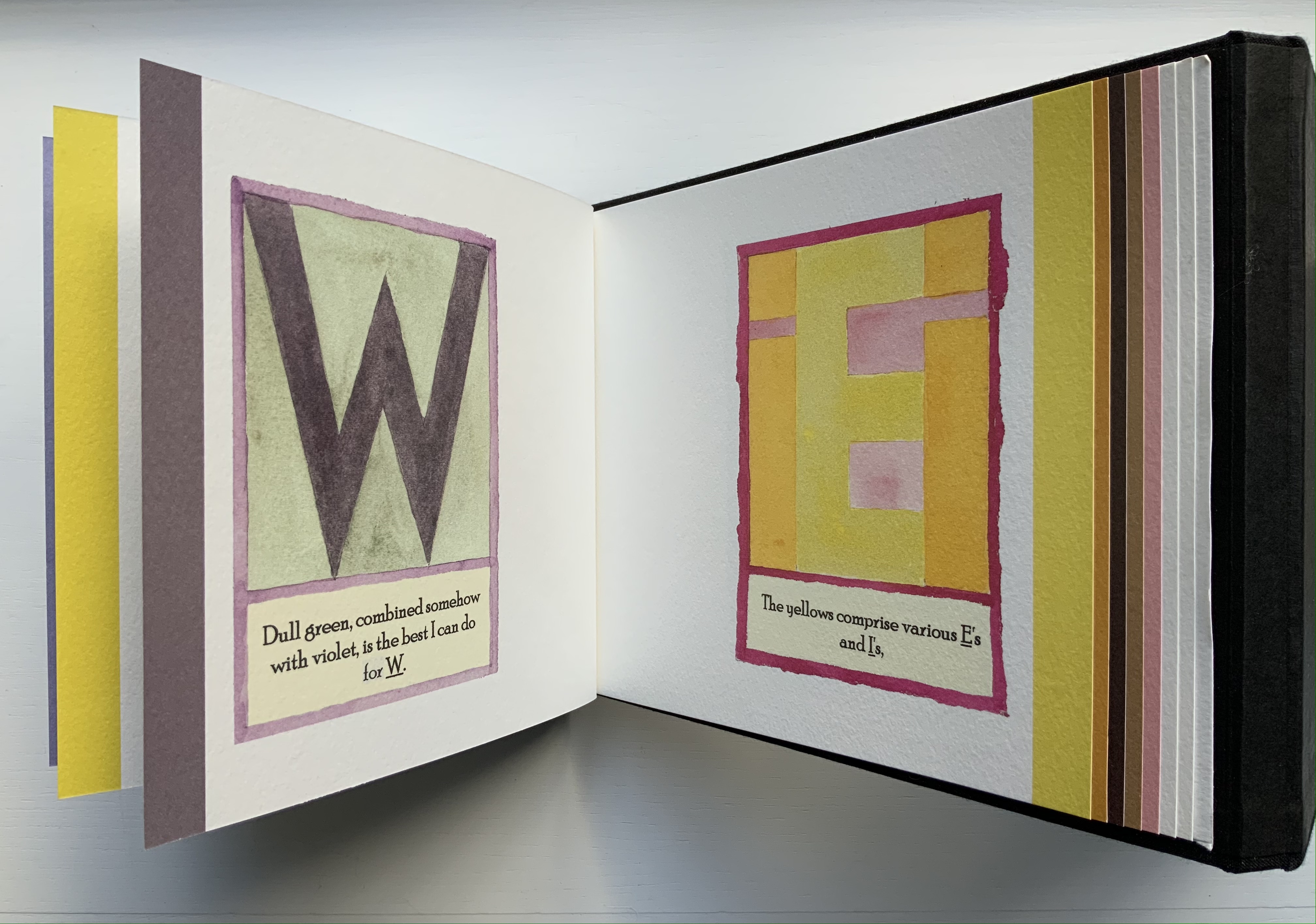
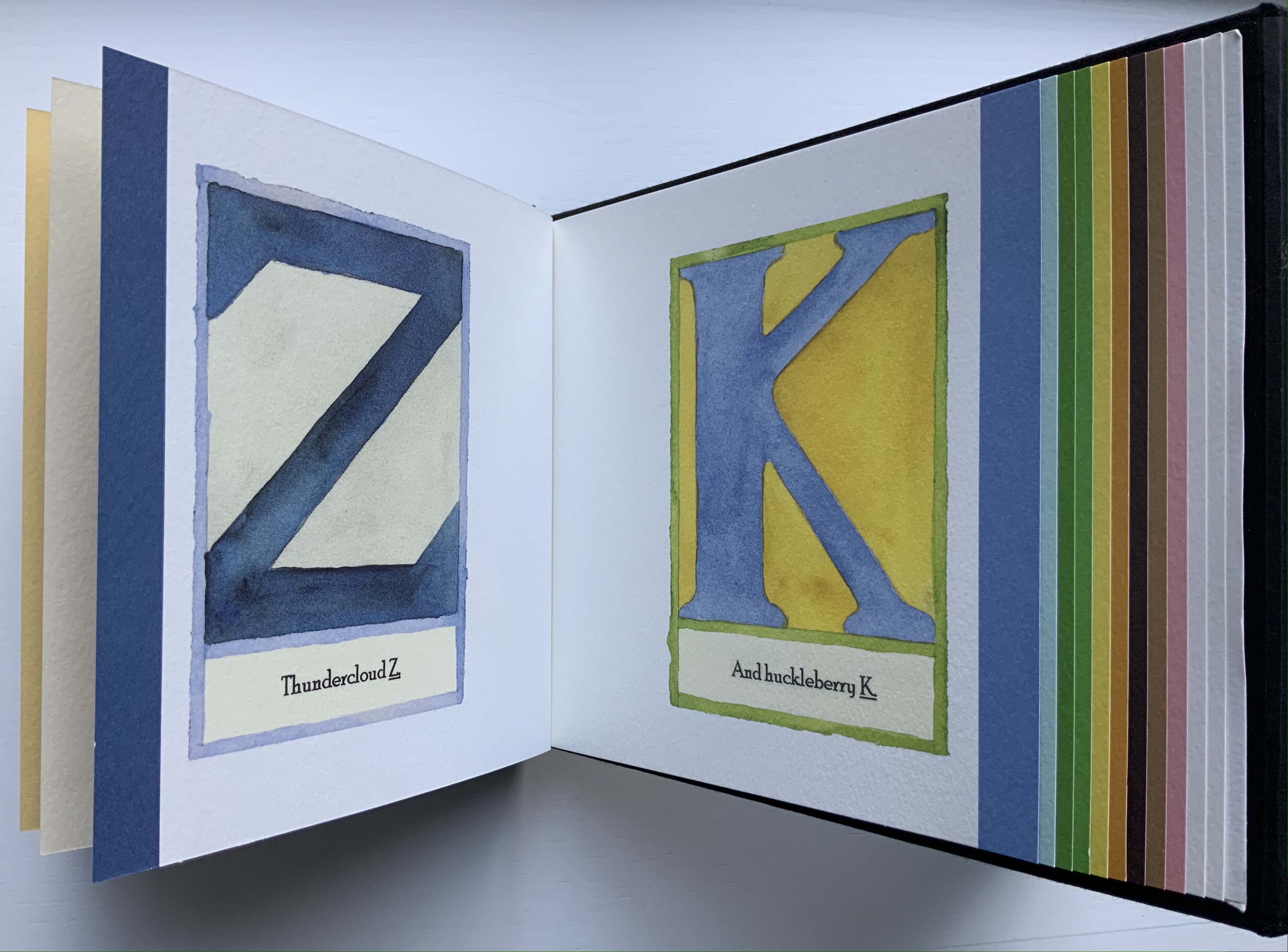
Vladimir Nabokov saw rich colors in letters and sounds and noted the deficiency of color in literature, praising Gogol as the first Russian writer to truly appreciate yellow and violet. He saw q as browner than k, and s as not the light blue of c, but a curious mixture of azure and mother-of-pearl. For anyone who has ever wondered how the colors Nabokov heard might manifest themselves visually, Alphabet in Color is a remarkable journey of discovery. Jean Holabird’s interpretation of the colored alphabets of one of the twentieth century’s literary greats is a revelation. The book masterfully brings to life the charming and vibrant synesthetic colored letters that until now existed only in Nabokov’s mind. In Alphabet in Color Jean Holabird’s grasp of form and space blends perfectly with Nabokov’s idea that a subtle interaction exists between sound and shape.

As puzzling as the phenomenon of synesthesia is, Holabird’s depictions and the book’s architecture are more engaging in their own right. The lapping pages and binding make this work awkward to handle, which might be thought of as a complement to the book’s non-alphabetical and non-spectral order of letters and colors. It is a warm complement to Le Cadratin’s cool rendition of Rimbaud’s sonnet “Les Voyelles“.

Further Reading

Abecedaries I (in progress)“. Books On Books Collection.

William Joyce“. 18 June 2021. Books On Books Collection. Another example of graphemic-color synesthesia.

Le Cadratin“. 8 February 2022. Books On Books Collection.

Cohut, Maria. 17 August 2018. “Synesthesia: Hearing colors and tasting sounds“. Medical News Today. Accessed 2 February 2022.

Campen, Crétien van. 26 July 2012. “Bibliography: Synesthesia in Art and Science“. Leonardo. Accessed 2 February 2022.

Cytowic, Richard E. 2018. Synesthesia. Cambridge, MA: MIT Press.

Books On Books Collection – Le Cadratin

Voyelles (2012)

Voyelles (1871/1883/2012)
Arthur Rimbaud
Design and direction: Jean-Renaud Dagon H325 x W235 mm, 32 unnumbered pages. Edition of 200, of which this is #67. Acquired from Le Cadratin, 6 November 2021.
Photos: Books On Books Collection.

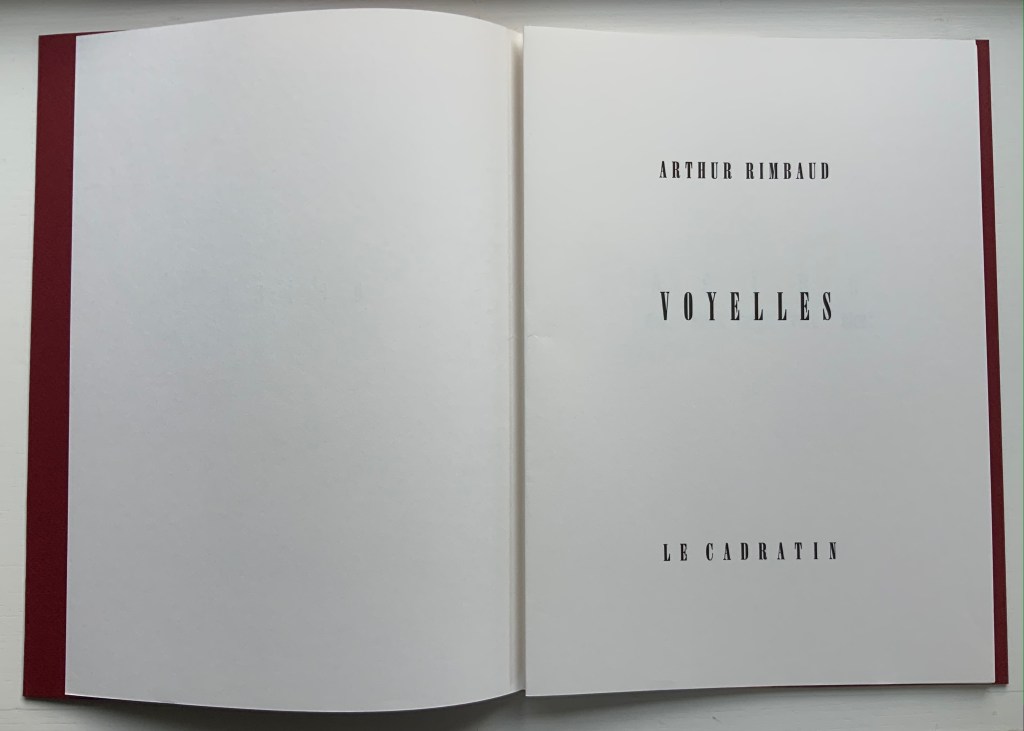
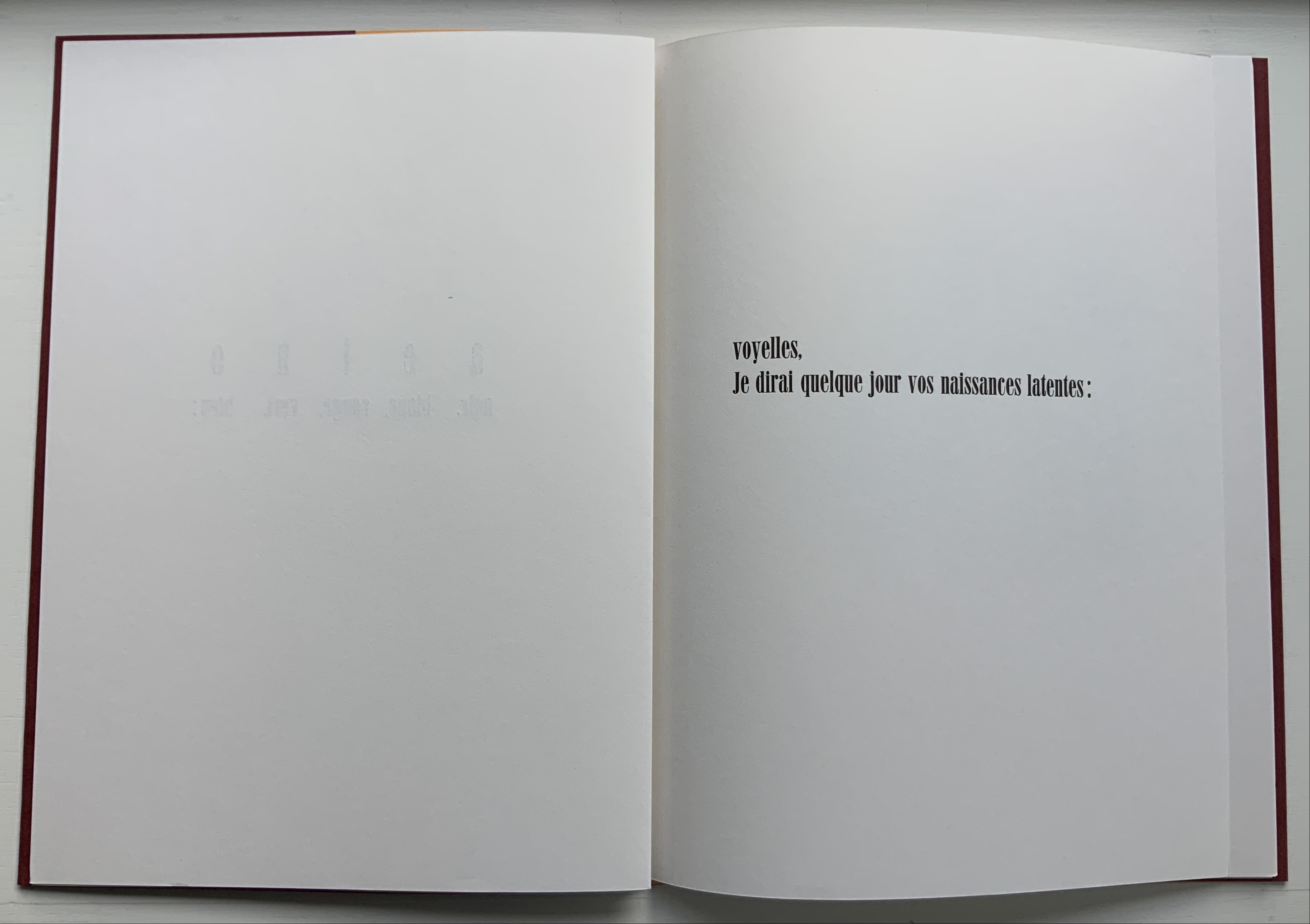
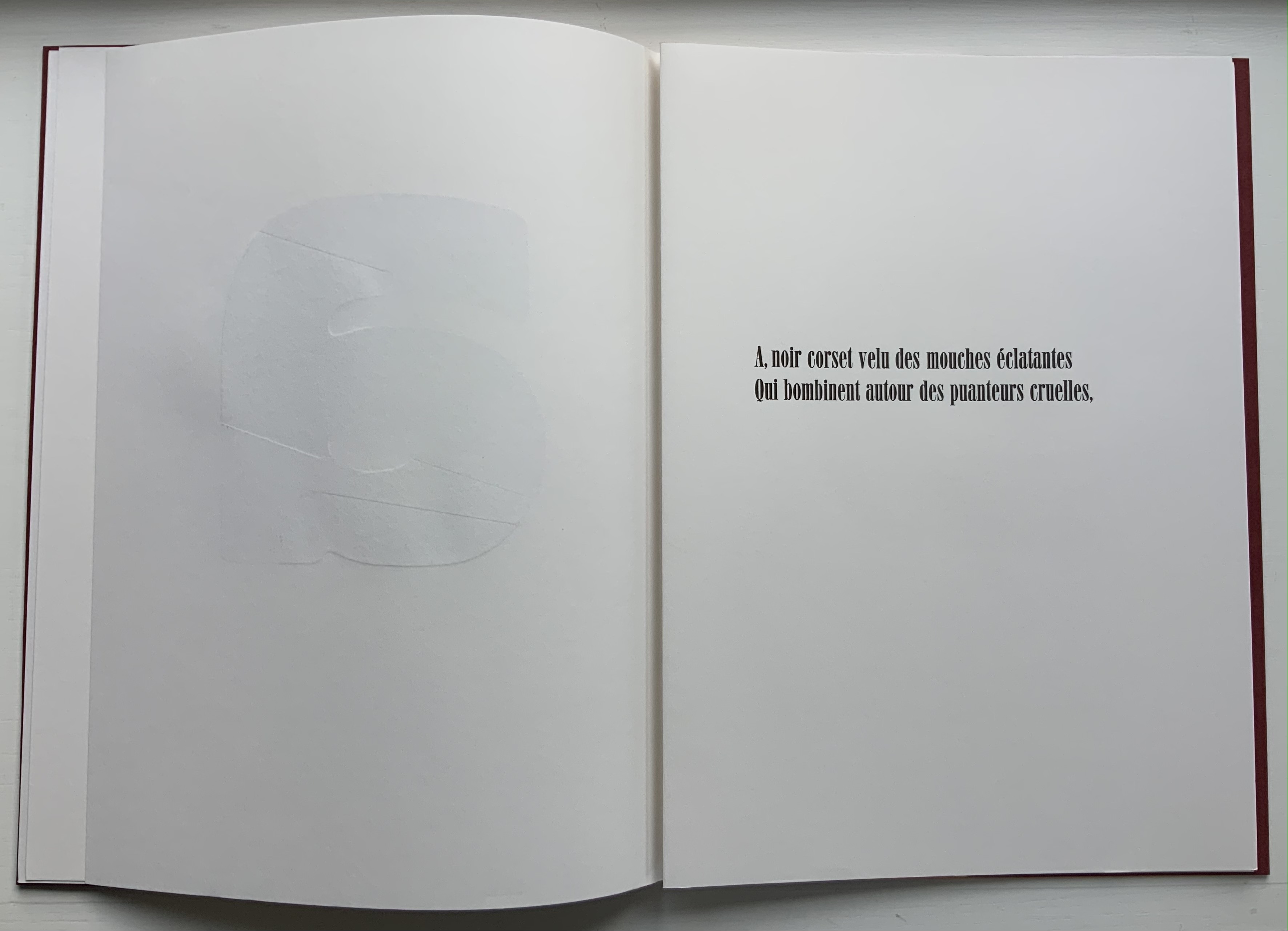
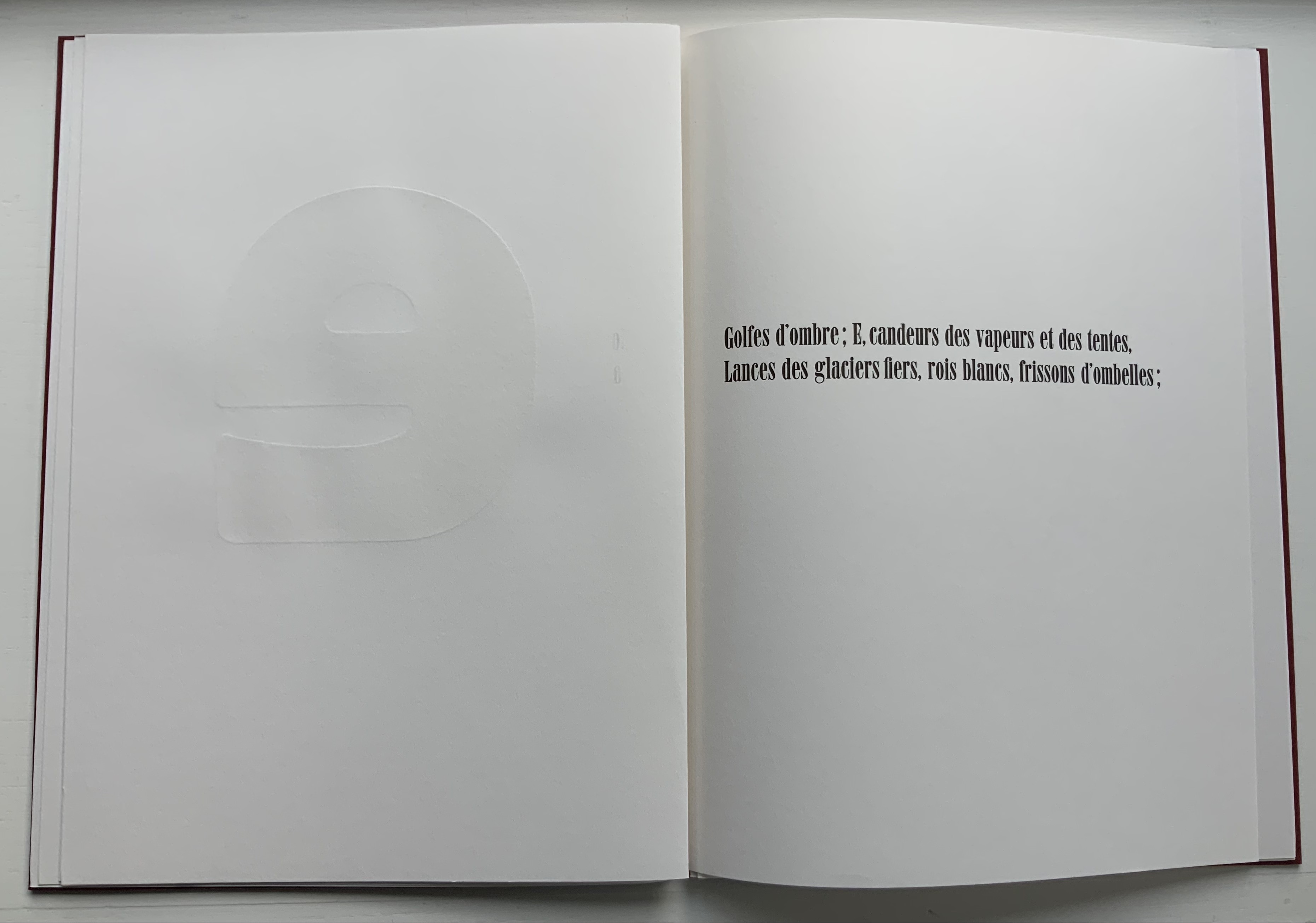
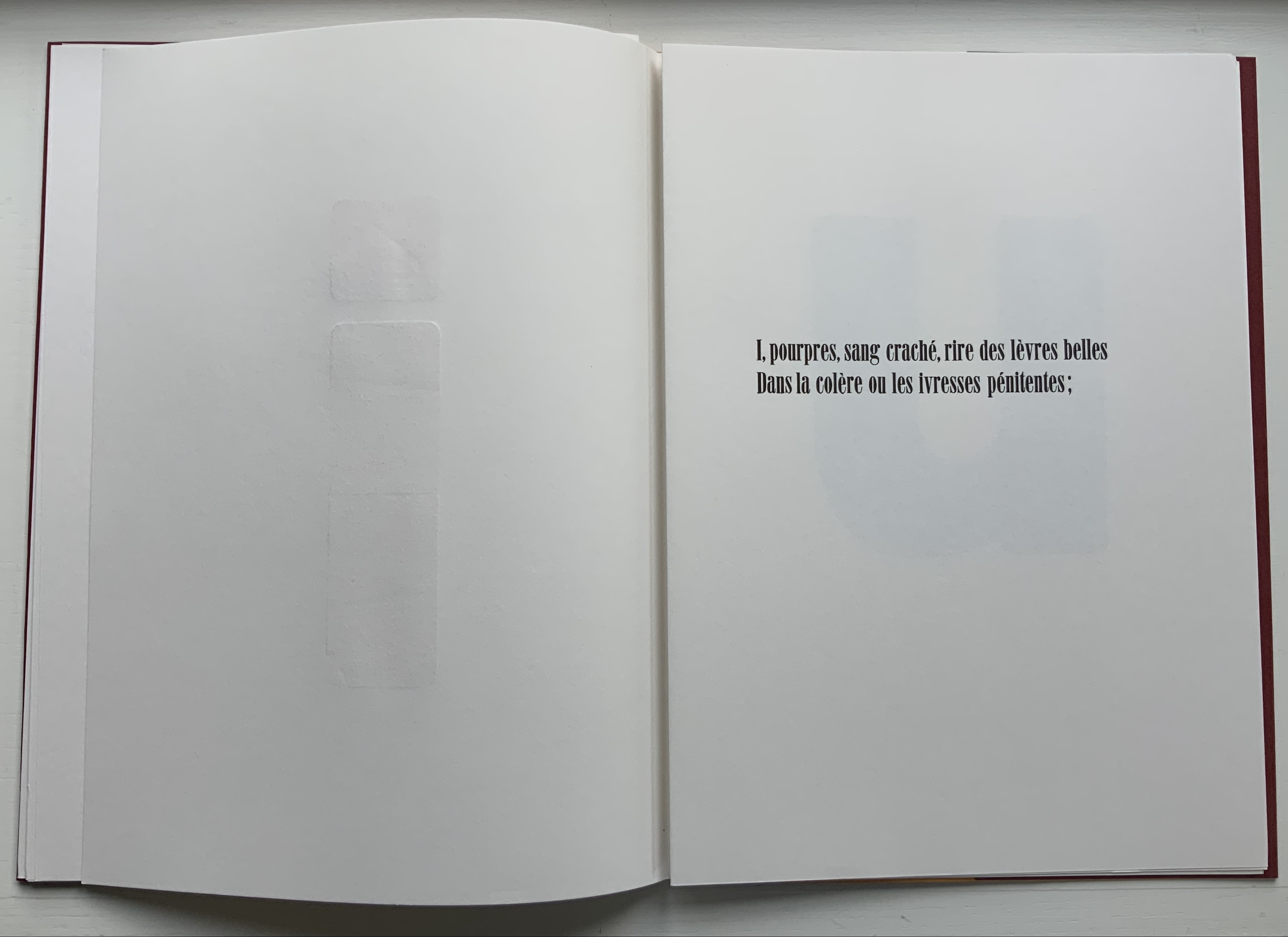
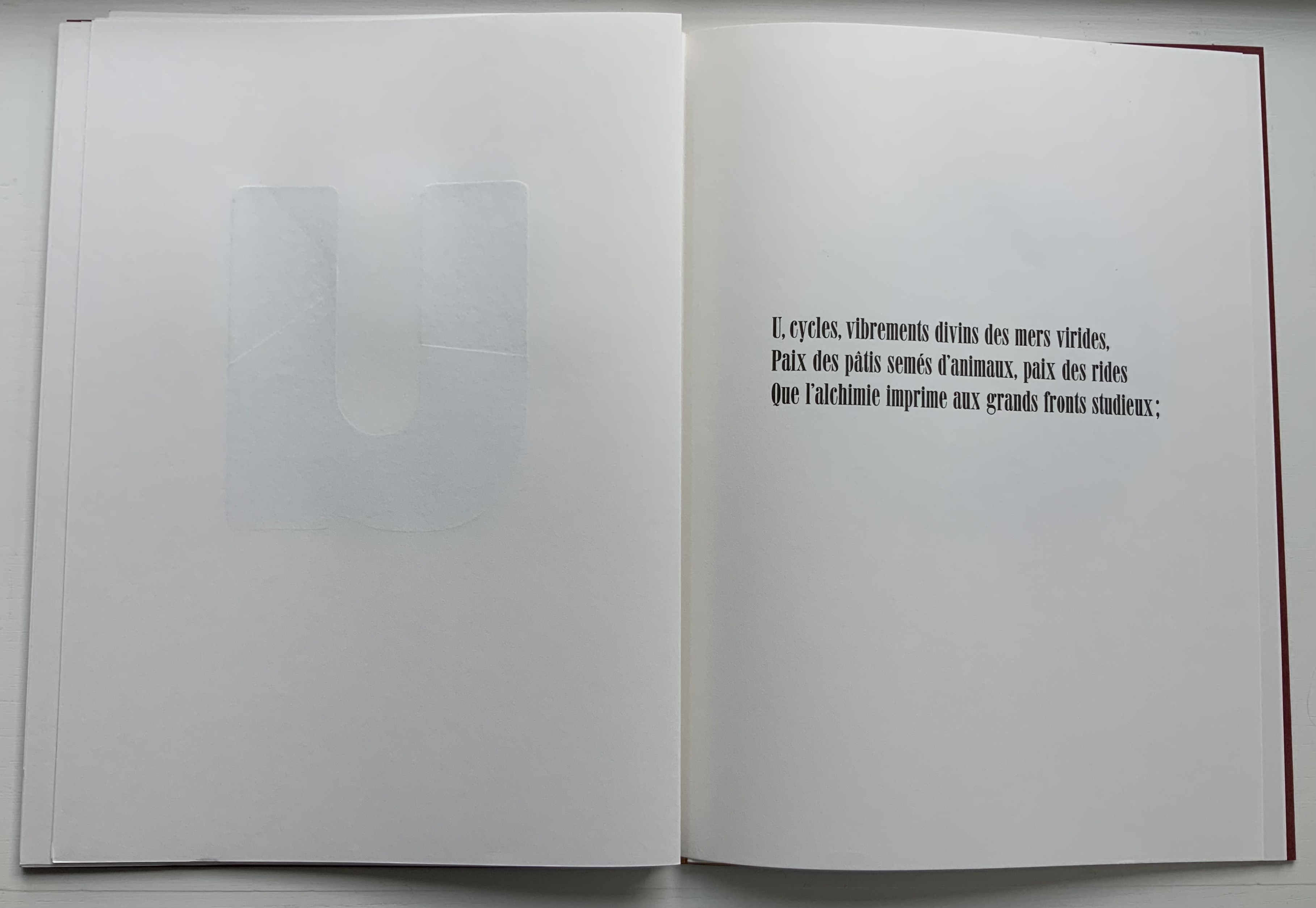
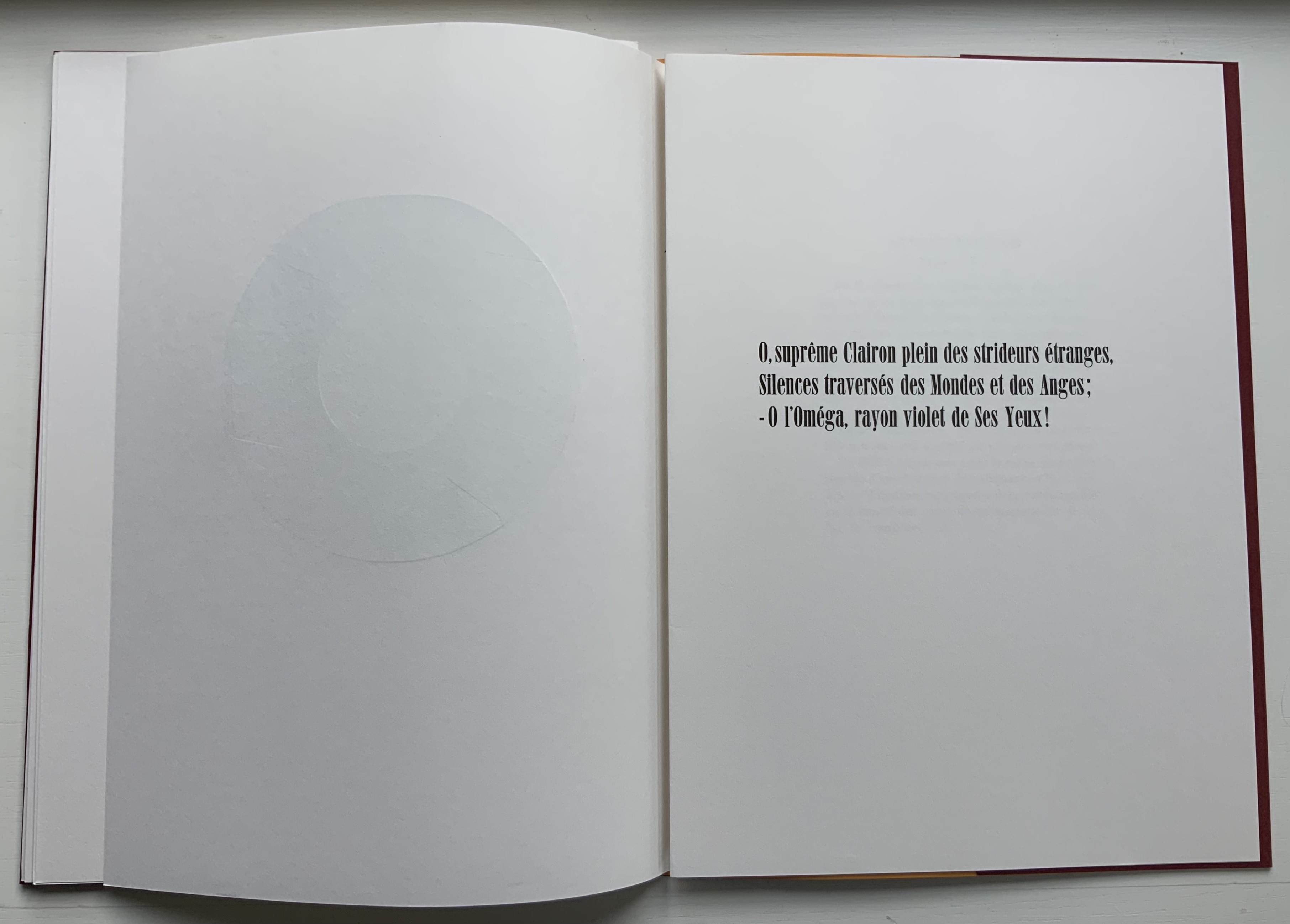
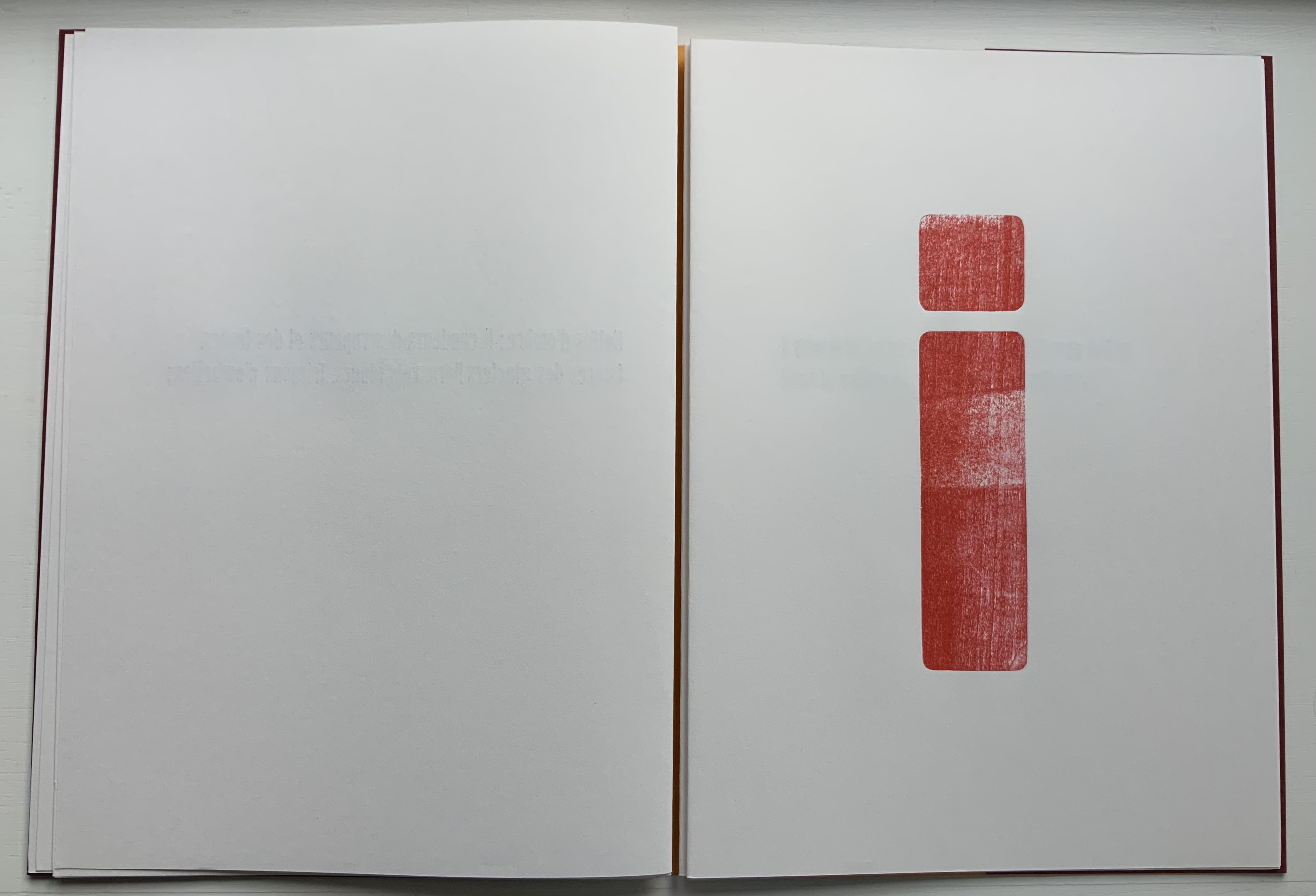
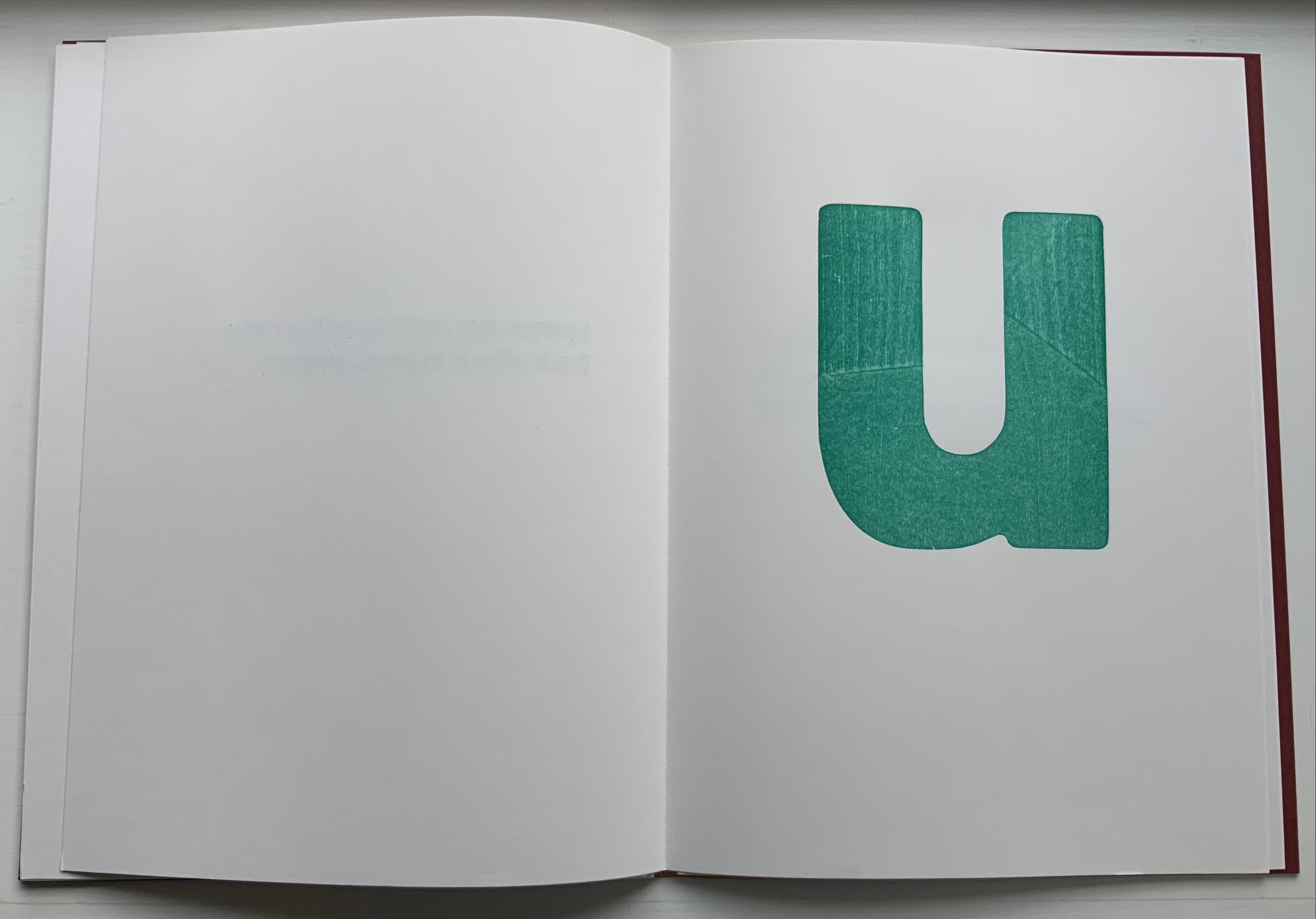
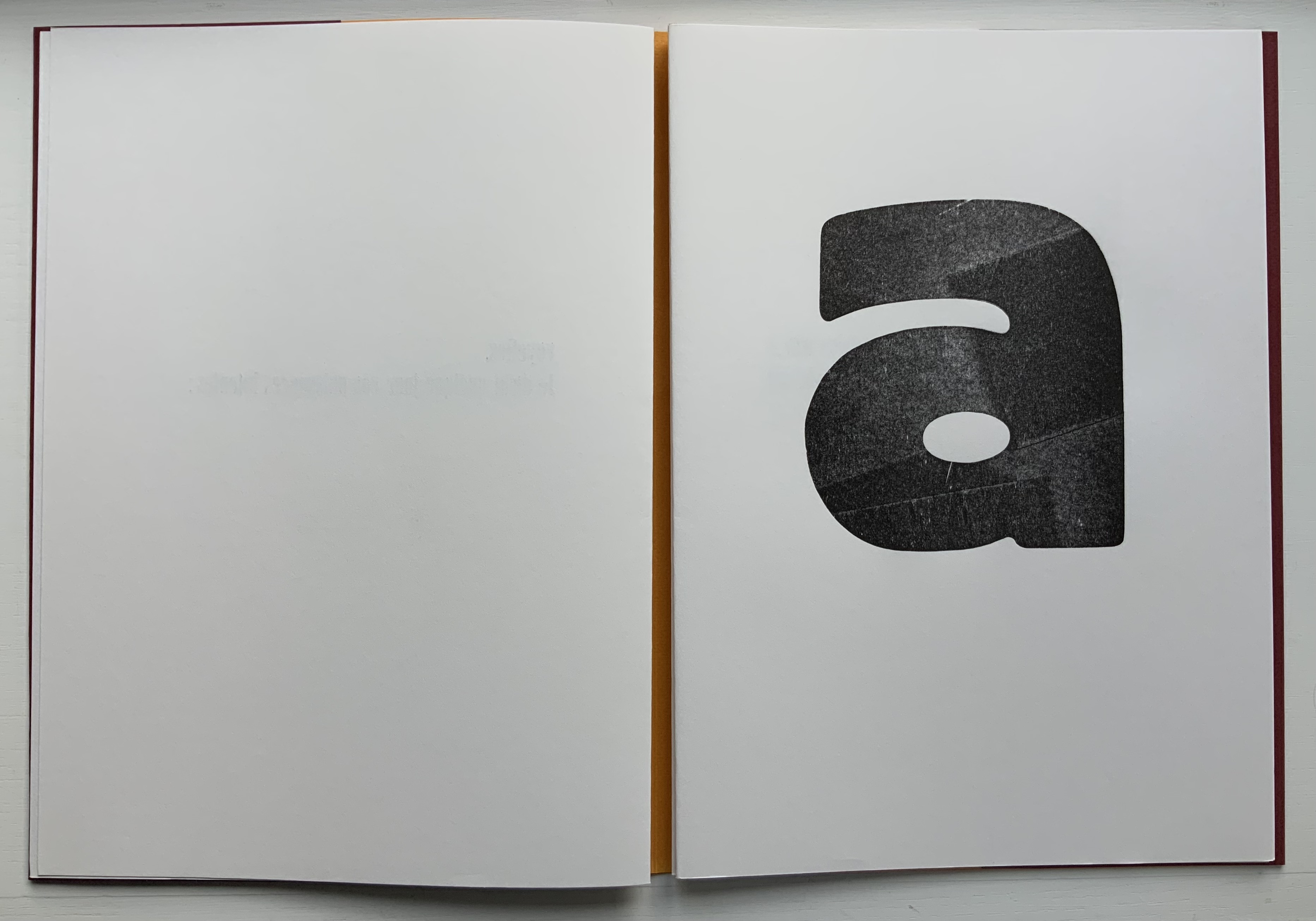
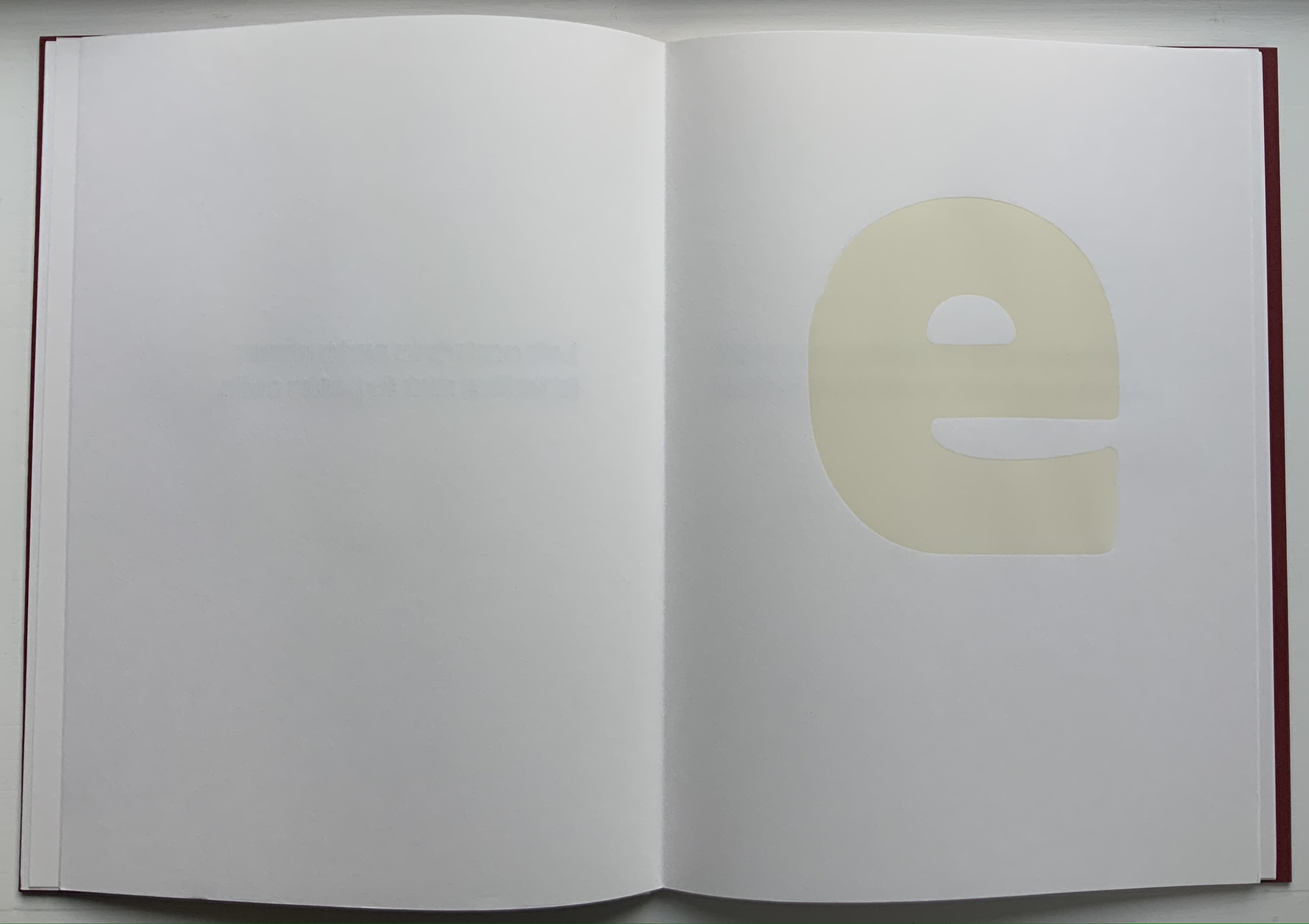
Le Cadratin is more than a typesetting and printing house or fine press. An atelier-typographique, founded by Jean-Renaud Dagon, its artists perform tightrope acts in typography, ink, paper and form. Under Dagon’s direction, Joanne Bantick, Hugues Eynard, Nicolas Regamey and Roger Jaunin have composed and printed a rendition of Arthur Rimbaud’s sonnet “Les Voyelles” that deserves applause.

Written in 1871 by Rimbaud and first published in 1883 by Paul Verlaine, the sonnet is one of the better known historic literary examples of graphemic-color synesthesia — strongly associating a color with a letter — and in Rimbaud’s case with strong tones of eroticism. Le Cadratin’s artists leave Rimbaud’s eroticism bound to his text, handset in 28pt Roman Idéal, but deliver their own exuberance with subtle tactility and visual texture in large format wooden type using Heidelberg and Vandercook presses.

Voyelles contributes to other themes in the Books On Books Collection besides the alphabet motif. The handling of wooden type echoes David Clifford’s Letterpress Printing ABC and Andrew Morrison’s Ampersand& (2005) and Two Wood Press A-Z (2013). The synesthesia of letters is shared with Jean Holabird’s Vladimir Nabokov: AlphaBet in Color (2005)

Further Reading

David Clifford“. 15 September 2021. Books On Books Collection.

Jean Holabird“. 8 February 2022. Books On Books Collection. For a look at Vladimir Nabokov’s synesthetic alphabet.

William Joyce“. 18 June 2021. Books On Books Collection. For the more innocent end of literary synesthesia where the cold gray-black of numbers gives way to an alphabet of jelly bean colors.”William Joyce”. 202 Books On Books Collection.

Andrew Morrison“.15 September 2021. Books On Books Collection.

Etiemble, René. 1968. Le sonnet des voyelles: de l’audition colorée à la vision érotique. Paris: Gallimard.

Books On Books Collection – Ian Tyson and Neil Crawford

Poème: Un Coup de Dés Jamais N’Abolira le Hasard (1897)
Poem: A cast of Dice never can annul Chance (1985)

Un Coup de Dés Jamais N’Abolira le Hasard (1897)/A cast of Dice never can annul Chance (1985)
Ian Tyson and Neil Crawford
Embossed cloth-covered clamshell box enclosing two set of folios, each in a blue folio folder. Edition of 40, consisting of 30 numbered copies, of which this is #7, and 10 copies marked I-IX. Acquired from Roseberys, 2 November 2021.
© Ian Tyson and Neil Crawford. Photos: Books On Books Collection. Permission to display from Neil Crawford.

As Mitsou Ronat and Tibor Papp were preparing their mise-en-page edition of Mallarmé’s Un Coup de Dés Jamais N’Abolira le Hasard(1897/1980) following Mallarmé’s corrected proofs, Neil Crawford came across a copy of Robert Cohn’s Mallarmé’s Masterwork and was struck by its reproduction of the set of proofs sold by Pierre Berès to an American collector – the so-called Lahure proofs. Crawford, too, was determined to prepare a “typographic translation” of the proofs — but in English. In an essay providing a rich background to the poem, his meeting with Tyson and the publishing of their homage, Crawford explains how he went about his typographic translation.

First, using Cohn’s reference to the original’s size, he enlarged the reproductions photographically and then began puzzling over how to squeeze an English version taking up 10% more space than the French into Mallarmé’s careful layout. Compromising on the use of Bodoni in place of Didot as the typeface (the latter was not available to English typesetters when the poem was first pubIished anyway), it would take Crawford seven years of evenings in tracing letters, translation, transcription, adjustment, retranslation and retranscription to generate hand-crafted layouts that could be stored away until the day that photocomposition would be sufficiently advanced to accommodate the word and character spacing necessary to follow them. The original of Crawford’s typographic layout resides at the University of San Diego. Below are iterations toward the double-page spread that completes the appearance of the poem’s title within the poem.

Courtesy of Neil Crawford.

When Crawford and Tyson met in the early Eighties, Tyson had already established Tetrad Press and was planning his own livre d’artiste version of the poem. His aquatints in a separate folio cover would occupy the position Mallarmé expected for Odilon Redon’s prints in the abortive limited edition in train at the time of his death in 1898. In an ironic reversal of Mallarmé’s concern that the Redon prints might undermine the typography, Tyson and Crawford were concerned that anything less than letterpress printing would not ensure the density of black on the page that would complement Tyson’s aquatints. This led to phototypesetting output as patch setting, then hand pasting according to Crawford’s layouts, and then creation of process line blocks for the relief printing in letterpress.

At a glance, Tyson’s aquatints present a puzzling juxtaposition with the poem, but we can thank Crawford’s essay for a clue to the puzzle.

© Ian Tyson. Permission to display from Neil Crawford.

The poem’s reference to LE NOMBRE (“THE NUMBER”) has sent plenty of scholars on the hunt for its identity. Mitsou Ronat had argued that the magical number has to be 12. After all the classic Alexandrine line of French poetry numbers 12 syllables, and the larger type sizes that Mallarmé chose for the poem are 36, 48 and 60. Unconvinced “typographically”, Crawford points out that “at the time of composition – faces above 24 point were cut in multiples of twelve as standard”. Nevertheless, he also writes, “It would appear that the number 12 (the number of feet in the classic Alexandrine verse form) had great symbolism for Mallarmé” and notes that Tyson’s images

reflect the undertones of the Poème’s symbolism with a composition based on a duodecic permutation corresponding to the measures within the Alexandrine metre, referring in an oblique way to Mallarmé’s recurring imagery ….

Duodecic refers to the Base 12 system, which has the arithmetic advantage over Base 10 of making fractions easier as can be seen from the following image. To apply that image’s Base 12 grid to Tyson’s permutations, however, requires modifying it from 3×4 to 4×6. In other words, there are 24 small squares underlying Tyson’s images, not 12. Mallarmé intended the double-page spread, not the single page, to be the unit for page layout. So perhaps Tyson’s oblique reference to the Alexandrine is also “doubly oblique” (2×12), referring to Mallarmé’s preferred canvas.

“The Curious Case for Base 12 …” Steemit.

Tyson’s geometric approach would be echoed in later works of homage such as Michael Lechner‘s Les Ondes de sable; Un coup de dés / d’ordinateur (1986), Geraldo de BarrosJogos de Dados (1986), Ellsworth Kelly‘s livre d’artiste (1992) and Michael Graeve‘s Hexagram 12: Heaven and Earth Shall not Meet (1998). Neil Crawford has kindly shared the following image of Tyson’s preliminary study for the print suite. Ian Tyson passed away in France on 2 October 2021.

© Ian Tyson. Photo: Neil Crawford.

Further Reading

Cohn, Robert Greer. 1966. Mallarmé’s Masterwork: New Findings. The Hague: Mouton.

Crawford, Neil. December 1997. “A typographic translation of Stéphane Mallarmé’s Un coup de Dés”. Unpublished.

Dave __. 2017. “The Curious Case For Base 12 (Why Dozens Are Easier For Everyday Maths Than Tens)“. Steemit. Accessed 28 December 2021. (Base 10 has 1, 2, 5 and 10 as factors; Base 12 as 1, 2, 3, 4, 6 and 12).

Meillassoux, Quentin, and Robin Mackay. 2012. The Number and the Siren: A Decipherment of Mallarmé’s Coup de Dés. Falmouth: Urbanomic.