Bookmarking Book Art – Basia Irland

Basia Irland’s art project ICE BOOKS: receding/reseeding gives a formidably tangible and new meaning to “publishing as dissemination.”  As Irland describes the project on her site:

River water is frozen, carved into the form of a book, embedded with an ‘ecological language’ or ‘riparian’  consisting of local native seeds, and placed back into the stream. The seeds are released as the ice melts in the current…

Tome I

I carved a 250-pound book from clear ice and embedded it with a seed text of Mountain Maple (Acer spicatum), Columbine flowers (Aquilegia coerulea), and Colorado Blue Spruce (Picea pungens). Four people carried the heavy book out into the current of Boulder Creek.  As it rested between two large rocks, viewers cold see the water flowing under the ice.  Ice Books.   Accessed 17 February 2013 and 11 September 2014.

This is book art as performance art and conceptual art but with a twist: the performance yields results beyond the on-site viewers’ memories or any photography and video of the event replayed in galleries or museum installations.  Whether the seeds that float downstream in local rivers do take root is uncertain. As there is at least a chance that it will happen, it is more than the concept that counts.

“Performed” across 18 locations around the world, Irland’s project has been going since 2007. Fittingly the first performance began with Lucy R. Lippard’s Weather Report exhibition in 2007, but the concept has a rich heritage. With some further reading and the help of Peter Verheyen’s listserv BKARTS, I have tracked down some of that other “ramifying” or “ecologically political” book art.
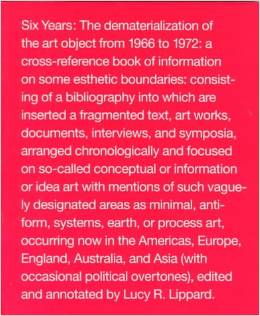
Lucy Lippard, Six Years
Lucy Lippard, Six Years (1997)

Starting with Lippard herself, there is Six Years, the 1973 seminal, long-subtitled work that drew attention to  Hans Haacke’s Wind in Water  (1967) and other conceptual and environmental art.  And then came Doug Beube’s pieces from the 80s and later such as Organic and The Chair of Censorship.  In the late 90s, we had Ann Marie Kennedy’s Plant Dreams. In 2010, Maggie Puckett’s “Thaw“.

And now, this conceptual book art has revolved back into books:

Pequeño Editoran Argentinian children’s book publisher, has published Tree Book Tree with ecologically friendly ink and acid-free paper embedded with jacaranda seeds. As the video explains, “Books come from trees. Today, a tree comes from a book.”

Tree Book Tree Published on 3 May 2015 The first book that can be planted after it is read. FCB Buenos Aires
Tree Book Tree, 2015
Video published on 3 May 2015
FCB Buenos Aires

The act of reading then planting the book echoes the twist in Irland’s performance and conceptual pieces. The book as read (the performance) resides in the memories of the readers, the concept (books are made of trees) resides in the mind, and downstream in time, a jacaranda blossoms overhead.

il_570xN.537080074_jfho


Compare also with the work of Jaz Graf.
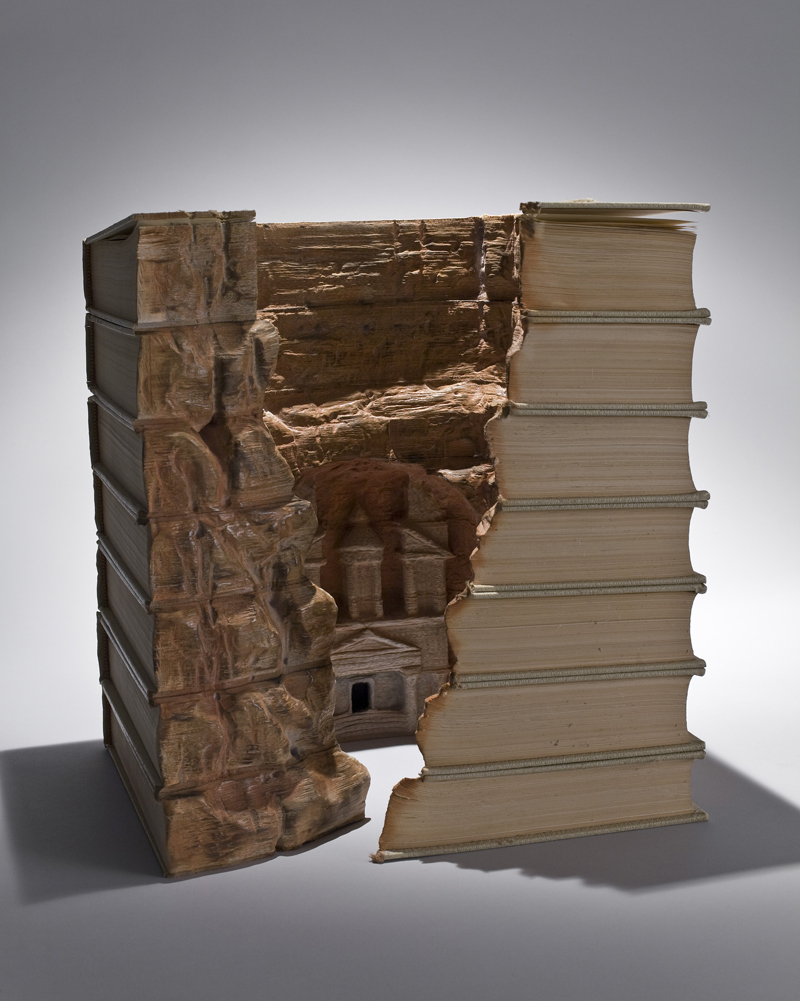
Bookmarking Book Art – Guy Laramée

The form of the book, the book as technological artifact, each of the book arts (design and layout, typography, illustration, papermaking, imposition, printing, binding, preservation and restoration) and even the book as an objet d’art attract memes —  ideas, gestures, behaviors, methods, devices and practices that have spread from clay to scroll, from scroll to book, from book to ebook and perhaps from ebook to “cloud book.”

As we try to preserve – with clay counters in clay containers, with 0’s and 1’s stored on floating disks in tablets – we have assumed we are progressing.

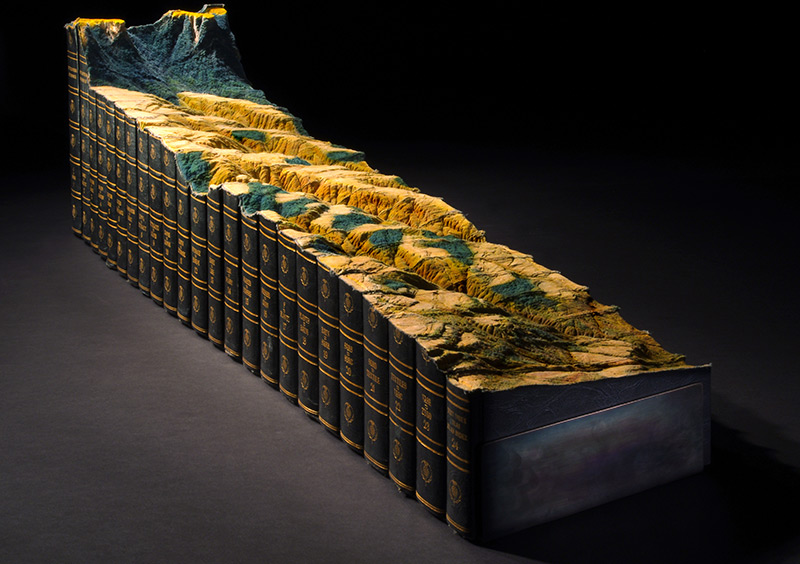
Guy Laramée is a book artist,  a subversive book artist.   His “artist statement” articulates the meme of erosion, entropy and the dissolution of culture and knowledge — what he calls the “cloud of unknowing.”

Copyright © Guy Laramee.

Artist Statement

The erosion of cultures – and of “culture” as a whole – is the theme that runs through the last 25 years of my artistic practice. Cultures emerge, become obsolete, and are replaced by new ones. With the vanishing of cultures, some people are displaced and destroyed. We are currently told that the paper book is bound to die. The library, as a place, is finished. One might ask so what? Do we really believe that “new technologies” will change anything concerning our existential dilemma, our human condition? And even if we could change the content of all the books on earth, would this change anything in relation to the domination of analytical knowledge over intuitive knowledge? What is it in ourselves that insists on grabbing, on casting the flow of experience into concepts?

When I was younger, I was very upset with the ideologies of progress. I wanted to destroy them by showing that we are still primitives. I had the profound intuition that as a species, we had not evolved that much. Now I see that our belief in progress stems from our fascination with the content of consciousness. Despite appearances, our current obsession for changing the forms in which we access culture is but a manifestation of this fascination.

My work, in 3D as well as in painting, originates from the very idea that ultimate knowledge could very well be an erosion instead of an accumulation. The title of one of my pieces is “ All Ideas Look Alike”. Contemporary art seems to have forgotten that there is an exterior to the intellect. I want to examine thinking, not only “what” we think, but “that” we think. 

So I carve landscapes out of books and I paint romantic landscapes. Mountains of disused knowledge return to what they really are: mountains. They erode a bit more and they become hills. Then they flatten and become fields where apparently nothing is happening. Piles of obsolete encyclopedias return to that which does not need to say anything, that which simply IS. Fogs and clouds erase everything we know, everything we think we are.

After 30 years of practice, the only thing I still wish my art to do is this: to project us into this thick “cloud of unknowing.”

ADIEU Guy Laramée Copyright 2013
ADIEU (2013)
Guy Laramée

Is that the book’s evolutionary destination – in the “cloud”?

Further reading

http://sculpting.wonderhowto.com/news/artist-carves-old-books-into-beautifully-painted-landscapes-0175708/?_scpsug=crawled_46008_f4679e90-cedb-11e6-bd01-f01fafd7b417#_scpsug=crawled_46008_f4679e90-cedb-11e6-bd01-f01fafd7b417

Magnificent New Carved Book Landscapes and Architecture by Guy Laramée

“Guy Laramée’s (previously) new series Onde Elles Moran (Where They Live) captures the mystique of the native birds of the Brazilian region Serra do Corvo Branco (Range of the White Raven) through both portrait and carved landscape.”

Bookmarking Book Art – Exhibit at the Grosvenor Rare Book Room

Bookmarking Book Art — Long-Bin Chen

Bookmarking Book Art — “Out of Print: Altered Books”, A Virtual Exhibition

Bookmarking Book Art – Update to “Rebound: Dissections and Excavations in Book Art”

Mihai, Cristian.  “Showcase: Guy Laramée“, Irevuo, 31 March 2018.

Bookmark for “A Brief History of Reading” (and a Revisit of “The Future of Reading?”)

Aristotle, a 4th-century-BCE philosopher, port...
Aristotle, a 4th-century-BCE philosopher, portrayed in 1493 Nuremberg Chronicle as a 15th-century-CE scholar (Photo credit: Wikipedia)

LiveInk® cleverly demonstrates how the display of writing has developed by presenting the following quotation from Aristotle’s On Interpretation in the forms in which it would have appeared in the different stages of the A Brief History of Reading.

“Spoken words are the symbols of mental experience, and written words are the symbols of spoken words.” — Aristotle, On Interpretation

For example,

In 2000 BC, the Phoenicians developed the first methods to represent spoken language – an alphabet consisting entirely of consonants:

SPKNWRDSRTHSYMBL
SFMNTLXPRNCNDWRT
TNWRDSRTHSYMBLSF
SPKNWRDS.

LiveInk® must hope for a place on the timeline for its re-formatting process (Visual-Syntactic Text Formatting (VSTF), which breaks up blocks of traditionally laid out text (flush left, ragged right or justified) and presents them in a more readable form, reminiscent of 20th century free verse.  The claim of increased readability is based on eye movement studies by Randall Walker, Charles Vogel, Stan Walker, Phil Schloss, Charles R. Fletcher, Youngmin Park and Mark Warschauer.

Last September, BOB picked up an article by Michael Kozlowski on the Kindle feature of synching an ebook with its counterpart audiobook and explored the question, “What can the physiology, neuropsychology and sociology of reading tell us about ourselves?”  The research behind LiveInk® is worth bookmarking for the reading list (see below) concluding BOB’s  September 2012 entry if only to experience the “melon twisting” that comes from trying to accommodate these disparate yet related perspectives on the act of reading.

Reading List

Vinall-Cox, JoanMoving From Paper to E-Book Reading.  eLearn Magazine. March 2012.  Retrieved September 8, 2012.

Rollins, H.A. Jr., Hendricks, R.  Processing of words presented simultaneously to eye and ear.  J. Exp. Psychol. Hum. Percept. Perform. 1980 Feb; 6(1): 99-109. Retrieved September 8, 2012.

British Association for the Advancement of Science (2007, September 11). Reading Process Is Surprisingly Different Than Previously Thought, Technology Shows. ScienceDaily. Retrieved September 8, 2012.

Association for Psychological Science (2010, August 30).  Eye movements reveal readers’ wandering minds.  ScienceDaily. Retrieved September 8, 2012.

Florida State University (2012, February 14). How Do Children Learn to Read Silently?. ScienceDaily. Retrieved September 8, 2012.

LiveInk® (four papers:  jaltcalljournal, National Educational Computing Conference, Reading Online and IEEE International Professional Computing Conference)

Bookmarking the Index

In 2003, at McGraw-Hill, we discovered something about making ebooks while working with Dr. Bill Detmer and Unbound Medicine to create Harrison’s On Hand.  Don’t start or present through the Table of Contents; start with the Index.

Ten years later and the lesson’s being rediscovered.  Read Hugh McGuire’s A Publisher’s Job Is to Provide a Good API for Books – Tools of Change for Publishing.


A Bookmark for February 2013 – from the British Library

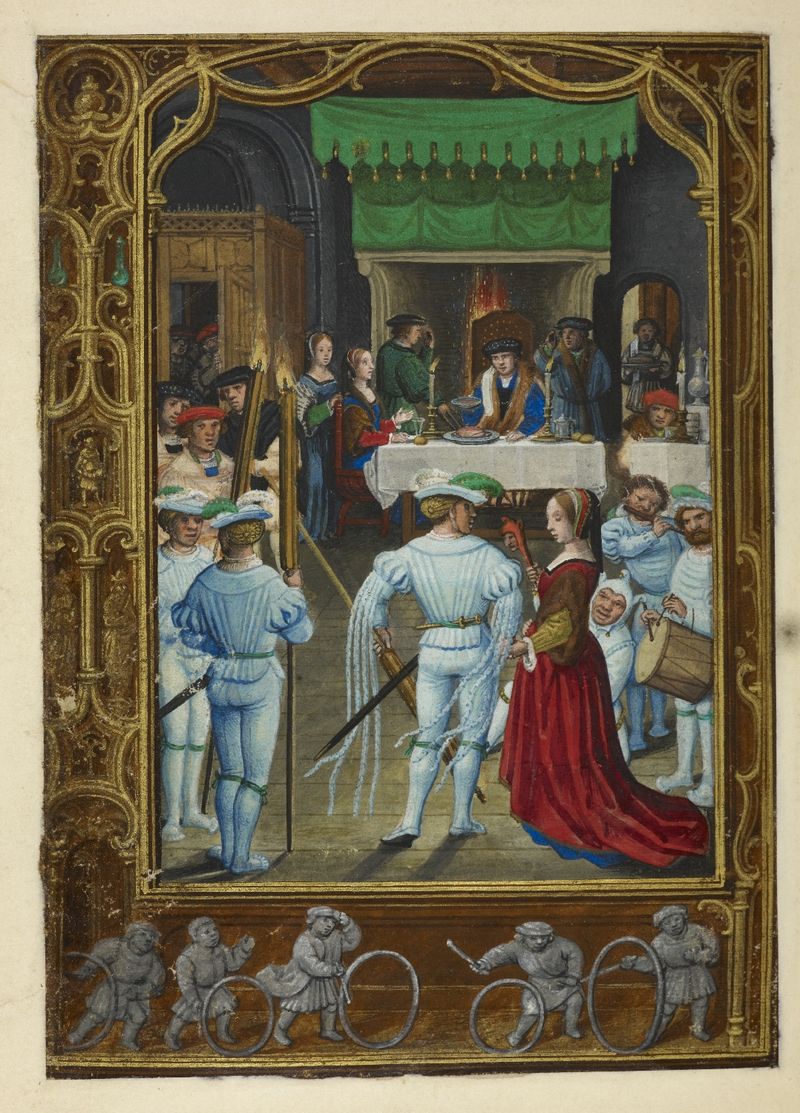
Calendar page for February with a feasting scene, from the Golf Book (Book of Hours, Use of Rome), workshop of Simon Bening, Netherlands (Bruges), c. 1540, Additional MS 24098, f. 19v


Are we over-thinking EPUB? – Tools of Change for Publishing

Are we over-thinking EPUB? – Tools of Change for Publishing.

The punning subtitle to this article indicates its subtext:  “The future of the book is inherently linked to the browser.”

Can Print and E-Books Coexist? Ceci n’est pas un signet!

grWJH

“So a video journalist goes into a bookstore …”  and finds little to report.  Beset by the BBC’s wallowing in non-events and the trivial, I am probably flailing out unfairly at the PBS’s “dog bites man” story or perhaps indigesting a bit of humbug this Christmas season.   MediaShift . VIDEO: Can Print and E-Books Coexist? | PBS.*

At least one commentator (gfrost; Gary Frost?), however, points out what video journalist Joshua Davis and his interviewees failed to explore:  “[M]issed is an inherent interdependence between print and screen books. An eerie complementary fit of the different affordances means that neither will flourish without the other.” Now there is a premise worth exploring, which Gary Frost does (see previous posting).

And what would Joshua Davis and his interviewees make of David Streitfield’s story in the NY Times that sales of e-reading devices seem to have reached a plateau?  “Even as prices fall, though, the dedicated e-reader is losing steam. The market peaked last year, with 23.2 million devices sold, IHS iSuppli said in a report this month. This year, sales will be 15 million. By 2016, the forecast is for seven million devices — as opposed to 340 million tablets, which allow for e-reading and so much more.”

Streitfield’s story actually begins with “the dog that didn’t bark”:  the prices for ebooks themselves have not fallen, despite the predicted result of the US Justice Department’s case against and settlements with six of the big publishers (five, now that two are merging).    For Frost’s premise that neither form — ebook or print — will flourish without the other, does that raise the question of whether either will decline without the other’s declining?   The rules of logic alone suggest otherwise, but consider Streitfield’s “more counterintuitive possibility … that the 2011 demise of Borders, the second-biggest chain, dealt a surprising blow to the e-book industry. Readers could no longer see what they wanted to go home and order.”

Perhaps the ebook and print are more intertwined than even Frost’s premise implies. Simba’s Jonathan Norris is quoted in Streitfield’s article:  “The print industry has been aiding and assisting the e-book industry since the beginning.”    Of course, someone needs to point this out with a cattle prod to the publishers withholding their ebooks from public and academic libraries.  The site TeachingDegree offers a succinct collection of data (PBS take notes) on the topic in a sort of dialectical digital poster.

Perhaps the whole story is just “human reads book” and is not worth a bookmark, but then where would have been the fun of finding out in punning

Magritte-pipe

with Magritte’s painting that the French for bookmark is either un signet (digital) or un marque-page (print), and in English we can make no distinction?

*In fairness to PBS, readers should take a look at the series “Beyond the Book 2012.”

Still, Frost’s Future of the Book goes far deeper.

(A general indifference?) Towards the Digital Divide

How might we explain the ascent, pervasiveness and popular appeal of digital art?

A few months ago, Greg Smith, a  Toronto-based artist, reviewed Claire Bishop’s “Digital Divide” (Art Forum, September 2012).  The review and Bishop’s article touch on a recurrent theme in Books On Books:  the materiality and immateriality of books.

http://www.scoop.it/t/books-on-books/p/2204574815/expanded-artists-books-envisioning-the-future-of-the-book

http://www.scoop.it/t/books-on-books/p/2540958720/a-bookmark-for-letters-outside-themselves

http://www.scoop.it/t/books-on-books/p/2276808444/ebooks-do-we-really-want-our-literature-to-last-for-ever

http://www.scoop.it/t/books-on-books/p/2204732117/bookmarking-a-forthcoming-title

http://www.scoop.it/t/books-on-books/p/2213422701/the-bookless-library-and-what-will-become-of-the-paper-book

http://www.scoop.it/t/books-on-books/p/2173038714/and-there-you-have-it-the-kindle-of-the-late-eighteenth-century-mike-kelly-amherst-college

http://www.scoop.it/t/books-on-books/p/2182994587/this-is-for-you-in-support-of-libraries-books-words-ideas

http://www.scoop.it/t/books-on-books/p/2123229496/to-see-a-world-in-a-grain-of-sand-or-tobacco-leaf

http://www.scoop.it/t/books-on-books/p/2082258113/post-artifact-books-and-publishing

http://www.scoop.it/t/books-on-books/p/2079452417/the-making-unmaking-and-remaking-of-books-guy-laramee-s-book-art

But the review and Bishop’s article resonate with some more recent and popular seismic tremors in the world of ebooks.  With all but Macmillan caving into the US Justice Department, we are still left wondering where and when the consumer benefits in cheaper ebooks will be handed out.  The prices on e-reading devices have plummeted, but in the world of ebooks, a slight unease about the inevitability of e-readers is creeping in as tablets and mini-tablets seize the imaginations of some with the loudest digital megaphones.  “Are e-reading devices doomed?”  And by extension – given that tablets are far more than ebook devices — “Is the trajectory for ebooks leveling off?”   While the post-Xmas sales analysis will be more assiduously examined for the “evidence” than the equally predictive gizzards of our Xmas fowls,  as Greg Smith paraphrases Julian Oliver, “the New Aesthetician”:   material or immaterial, “we should all just keep focused on making stuff.”

Bookmarking Book Art – What is “Manuscripts Online”?

MSS Online

Elsewhere I have commented on this JISC-funded project rising like a medieval cathedral from busy hands at the universities of Sheffield, Leicester, Birmingham, Glasgow, York and Queen’s (Belfast) will warm the enlightened taxpayer’s cockles.  It is now coming to a summary conference to be held at the University of Leicester on 11 January 2013.

Everything about this ambitious project to enable full-text searching of literary manuscripts, historical documents and early printed books owned by libraries, archives, universities and publishers and now online is transparent and open to public scrutiny as it happens.

The researchers’ plan is to enable users to generate visualised search results using maps of medieval Britain, add their own annotations to the data for public consumption and contribute to a knowledge base that will surround and suffuse an outstanding body of primary sources:  Manuscripts Online: the resources.

You can follow the Project Plan and meeting minutes, preview site designs and the scholars’ tweets about the work and witness what appears to be a project run “by the book.”