An Alphabet Coloring Book by Theodore Menten (1997)
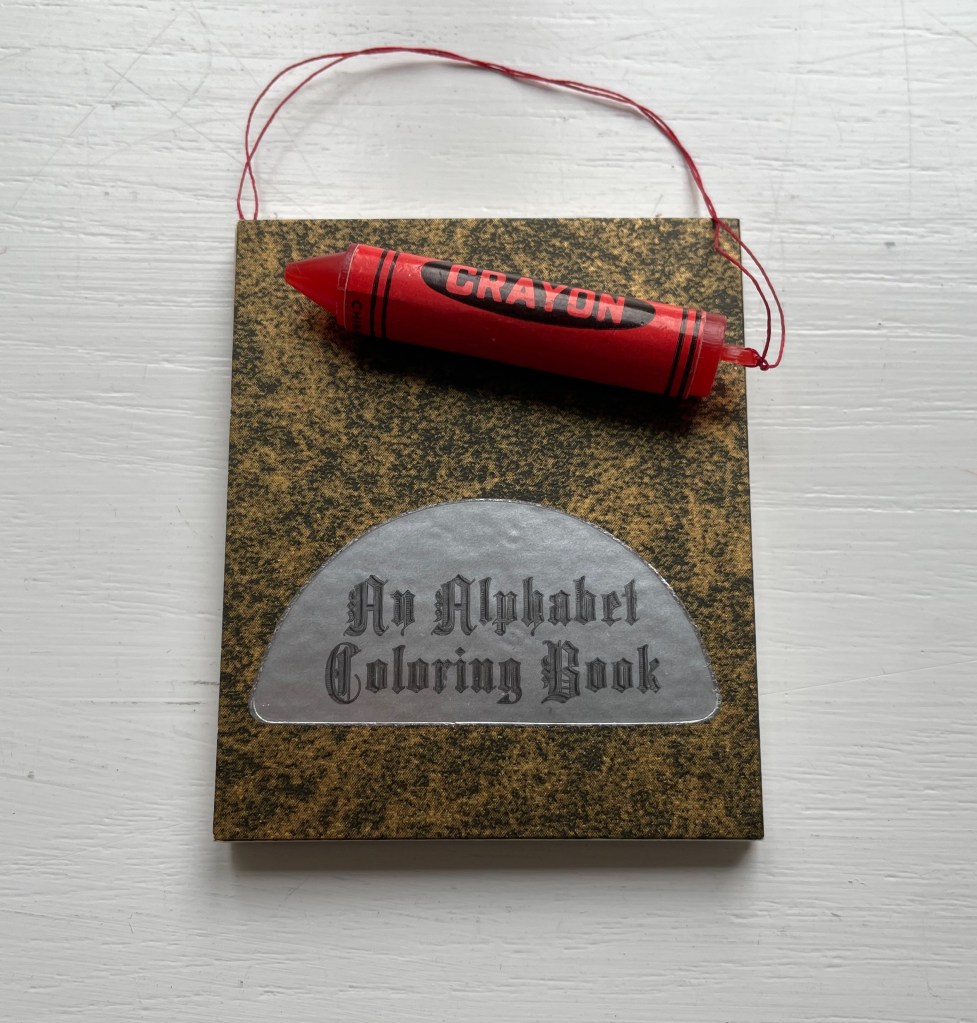
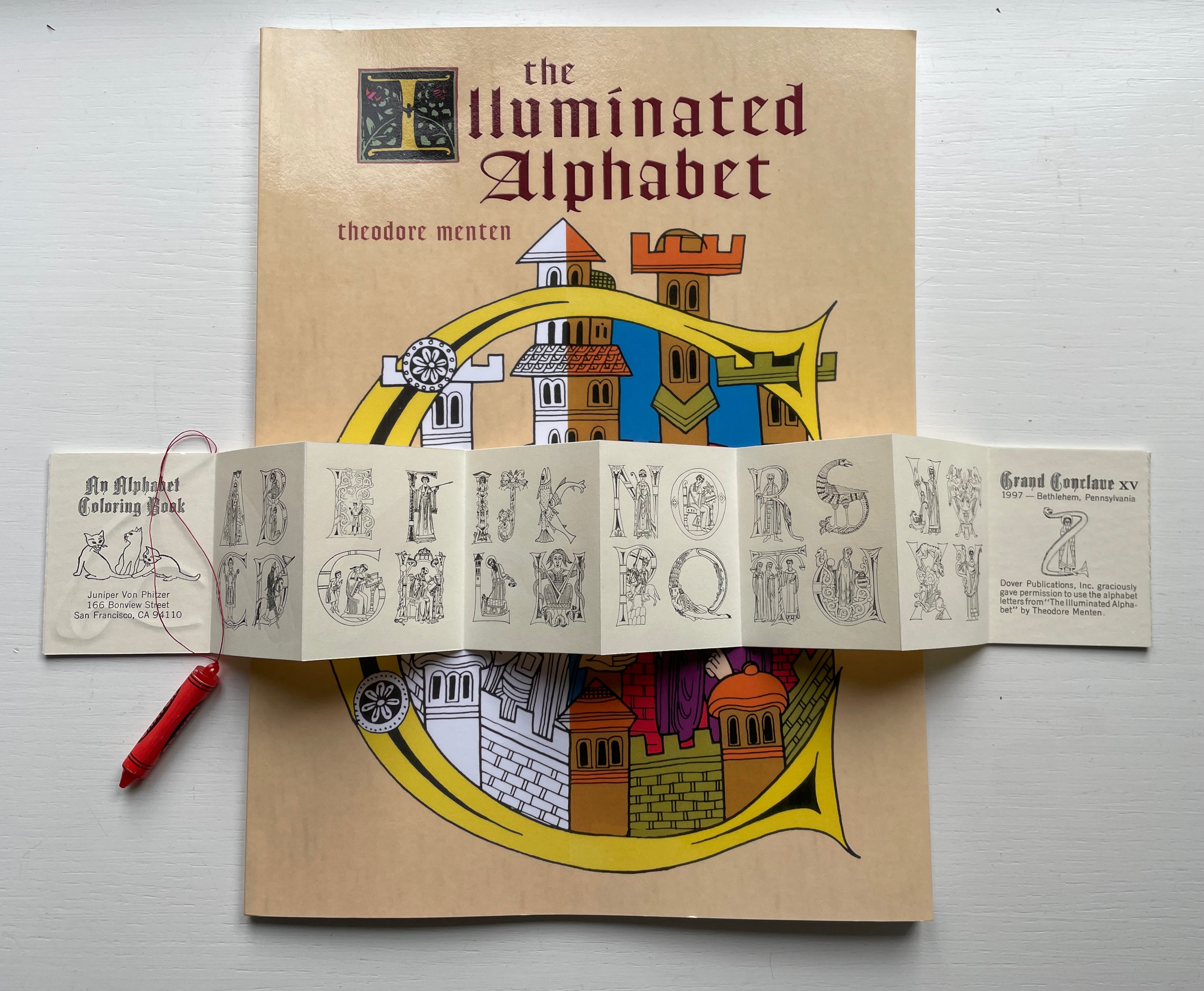
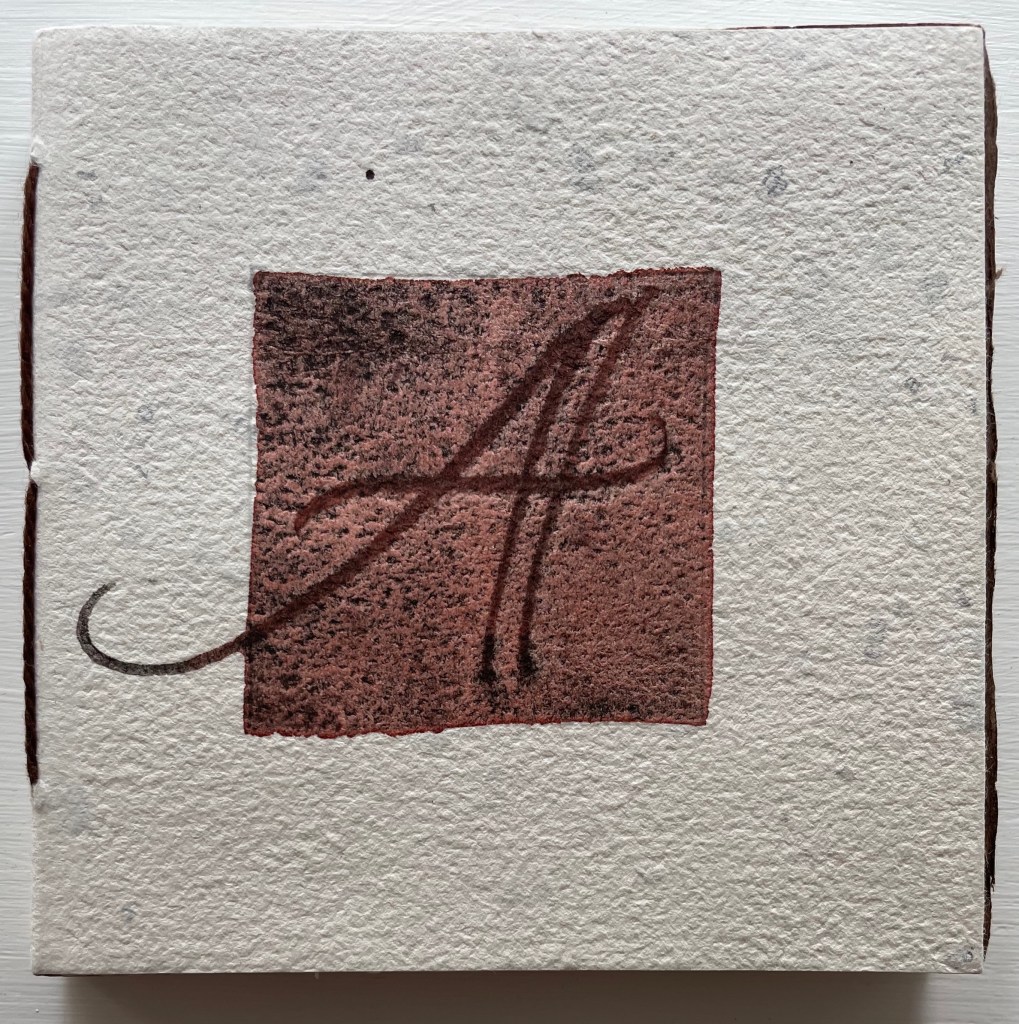
An Alphabet Coloring Book by Theodore Menten (1997) Juniper Von Phitzer Miniature leporello. Closed: H64 x W52 mm. 8 pages. Limited edition. Acquired from Book Lair, 30 October 2022. Photos: Books On Books Collection.
Lloyd L. Neilson, founder of Juniper Von Phitzer Press, compiled its name from those of his three cats, a sure sign of his sense of humor. This one signals that, like the cats, its humor was patient on the hunt. Theodore Menten had produced a coloring book called The Illuminated Alphabet in 1971 for Dover Publications. After a quarter century, Juniper Von Phitzer could not fail to pounce, capture and deposit the ultimate trophy: a miniature alphabet coloring book with a faux crayon. It was a limited edition, but individual copies could be distinguished by the color of the plastic crayon. The Books On Books Collection is proud to have this particular copy with its red crayon honoring the tradition of rubrication in medieval manuscripts.
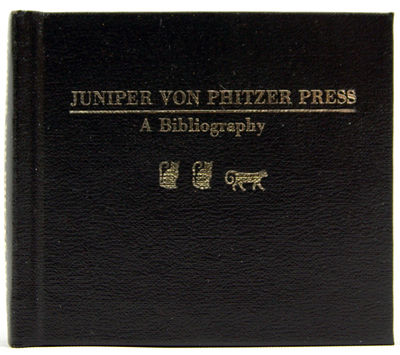
The archives of Juniper Von Phitzer Press reside at Indiana University, several universities and institutions hold copies of its numerous alphabet miniatures, and Neilson’s dedication to the craft (and his cats) was honored with a miniature gilt-stamped bibliography from the equally humorously named Opuscula Press [opuscula = small or minor literary or musical works].
“Human society, the world, man as a whole, is in the alphabet.… The alphabet is a source.” — Victor Hugo.
“… the Book, the total expansion of the letter” — Stéphane Mallarmé
“I see new horizons approaching me and the hope of another alphabet.” Marcel Broodthaers
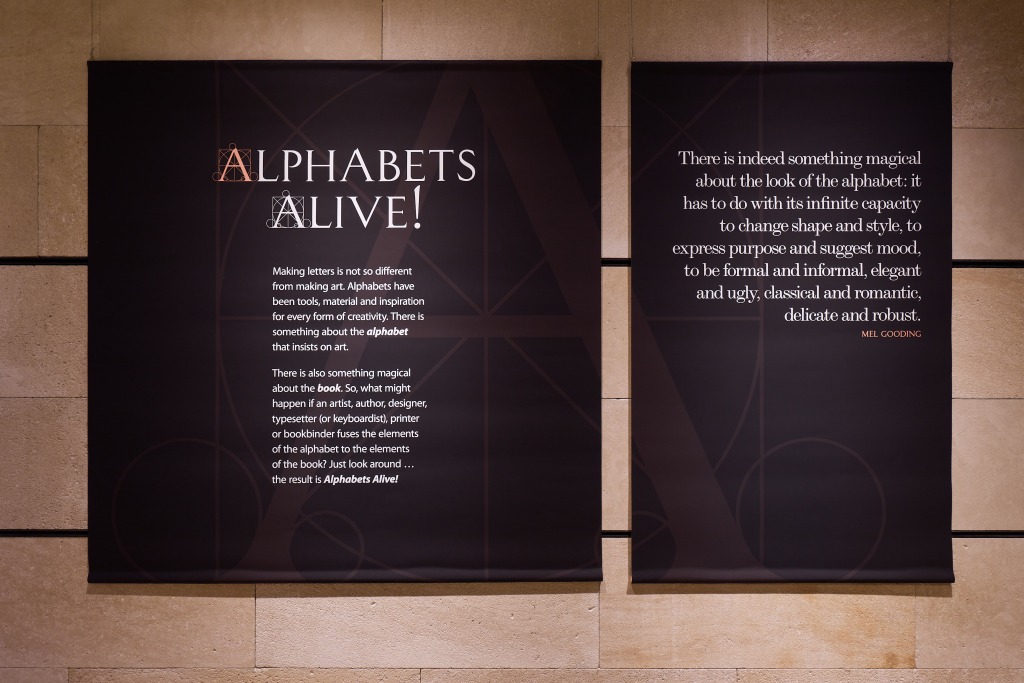
“There is indeed something magical about the look of the alphabet: it has to do with its infinite capacity to change shape and style, to express purpose and suggest mood, to be formal and informal, elegant and ugly, classical and romantic, delicate and robust.” — Mel Gooding
“… the letter is repeatedly a lens through which Western culture makes sense of itself and its world.” — Laurence de Looze
What do alphabets and artists’ books have to do with one another?
Early on, alphabets and books cast their magical spells over us. Learning the alphabet is a childhood rite of passage for us. We play with letters on blocks and nesting boxes. Someone points and reads the letters to us. We mouth, chew and play with the books whose pages we learn are turned or devices whose screens we learn are swiped. We sing the alphabet song and memorize the letters. We learn to draw them and make sense of our world with those “shapes for sounds”. The alphabet taps the imagination in material and immaterial ways that are deep-rooted.
The magic of the alphabet flows into the magic of the book. Historians of the book know this. It is no accident that so many chroniclers of the history of the book begin with the ABCs. Why pay so much attention to the birth of the alphabet to get to the birth of the codex? Is it the professional historian’s habit –to begin at the beginning, to ask what were the causes of this or that event, invention or change? Or is it the habit of myth-making, of storytelling — the magic of “once upon a time” that leads to “once upon a time, there was an alphabet, and then along came books”? Mel Gooding’s explanation of what’s magical about the alphabet could equally apply to the book: it, too, has the “capacity to change shape and style, to express purpose and suggest mood, to be formal and informal, elegant and ugly, classical and romantic, delicate and robust.”
In general, children’s books and artists’ books have much in common. They both play with form and structure. They play with words and images, sometimes images without words and sometimes just shapes. Almost always an attention to all the senses. Perhaps the alphabet rite of passage inspires a later one. For many designers, typographers, printers and book artists, creating an alphabet book is a common rite of passage.
In particular, children’s alphabet books have even more in common with artists’ books. Both play with animals, bodies, colors, design (of letters, page and book), calligraphy, the Babel of languages and alphabet origin stories and more. Artists’ books inspired by the alphabet, or even just one letter of it, focus our senses and attention on more than the letter. They may focus our senses on the possible shapes the book as container can take. Or the elements and parts of the book (ink, paper, cover, binding, pages, margins and other blank spaces, preliminaries, chapters, running heads, etc.). Or the very idea of the book. The choice of cloth for a book’s cover may have its unconscious origin in touching a linen ABC primer. The use of thick laser-cut pages or highly tactile paper surfaces may be rooted in early childhood board books or “Pat the Bunny” books. The choice to use the accordion structure or scroll for an artist’s abecedary may lie in the linearity of the alphabet. Or the artist may be challenging that linearity with structures that echo the boxes of Joseph Cornell or the boîte-valise of Marcel Duchamp — or a bag of alphabet blocks.
With two such potent sources of magic on offer, how can the child in the book artist resist recreating the “once upon a time” when image and letter seemed to be one and the same thing? Only under certain circumstances does the play with letters and the book become art rather than the commonplace. Only when the artist, author, designer, typesetter (or keyboardist), printer and binder digs through the material aspects and conceptual aspects of the book right down to the letters of the alphabet, fusing the elements of the alphabet (or writing system) with the elements of the book, does the work sing (or at least hum) to us.
So here begins the journey from source to artists’ books where letters and characters turn into the world, the world turns into letters and characters, and alphabets come to life.
List of “Display Cases”
For the exhibition Alphabets Alive! — at Oxford University’s Weston Library from 18 July 2023 through 24 January 2024 — the Bodleian Libraries have brought together over 150 works — from medieval manuscripts to the AI-generated — all inspired by the alphabet and the book. Across the street from the Weston is the Old Bodleian Library, whose entrance the Proscholium houses an additional display case where works from Ron King, Kevin M. Steele and artists of the Movable Book Society point to the main exhibition.
Below, the “online display cases” of the exhibition are arranged alphabetically, concluding with a bibliography of the items consulted for the exhibition’s curation.
Where do letters go when they’re not making words? Book artists know that they hide everywhere – often in plain sight – in landscapes, roadworks and signs, tree branches, rocks, flags, and even in a cup of coffee. [Links in the captions will take you to more images and details.]
Despite today’s multilingual packaging labels, the ingeniously, confusingly folded directions for our new appliances, or the occasionally mistaken choice of subtitling for the latest episode of an imported detective TV show, we tend to forget that ours is not the only alphabet. Abecedarians and book artists alike have enjoyed playing with the many alphabets and writing systems there are, even making up new ones, posing codes, teasing us with the underlying randomness of these marks we think have inherent meaning or inviting us to the borders between image and letters, letters and image. [Links in the captions will take you to more images and details.]
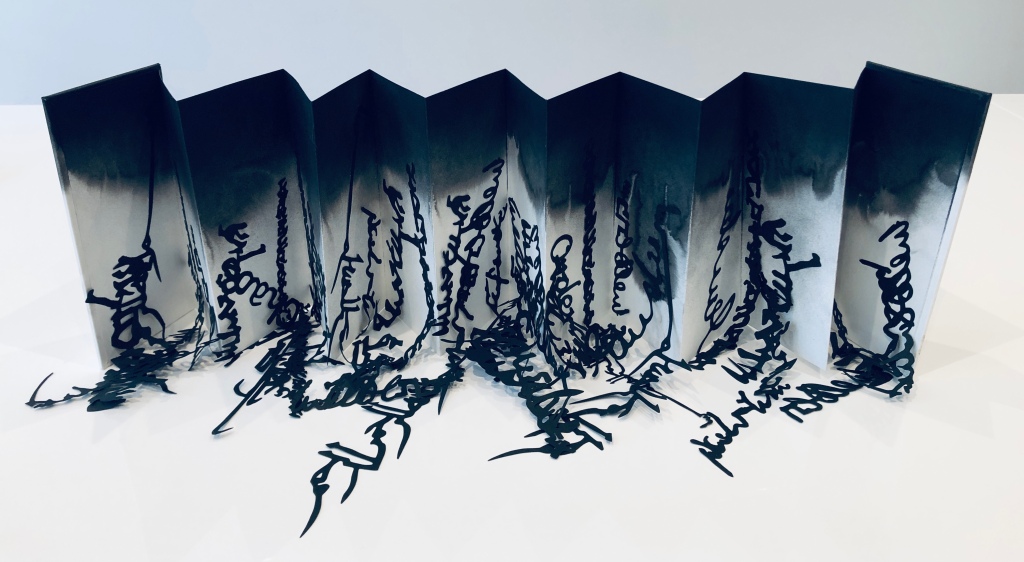
Inspired by a 2019 exhibition at the Scuola Internazionale di Grafica in Venice, Lizzie Brewer created Babel (2019),* a sculptural exploration of that border between image and letters. The black letters and words from Farsi, Japanese, Greek, English and more rain or drip down from the cloud of ink at the upper edge of the accordion structure implying our lack of knowledge of whatever Ur language preceded the Babylonians’ tower and also the punitive nature of the Old Testament deity.
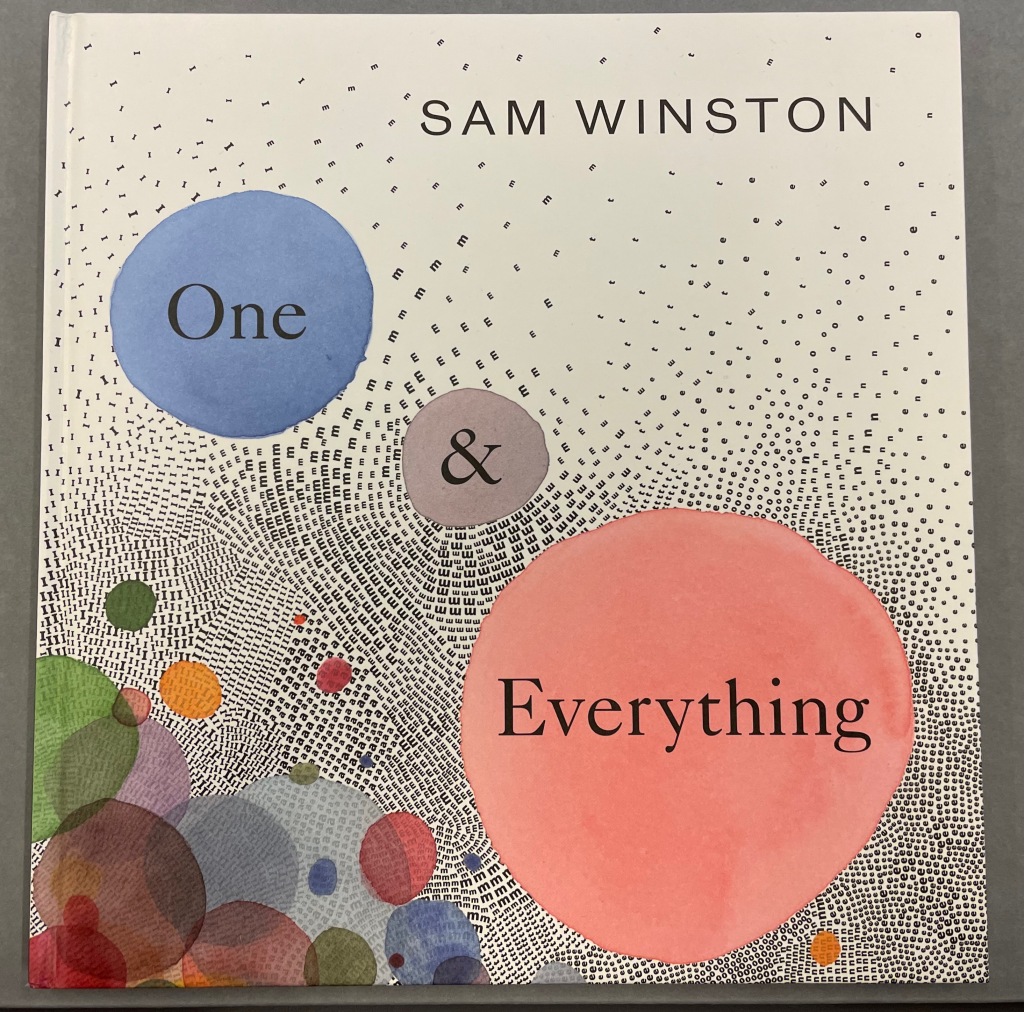
Sam Winston is another book artist who regularly works at the border of image and text. “Once there were many stories for the world.” So begins One & Everything (2022).* Inspired by Tim Brookes’ Endangered Alphabets Project, Winston uses the striking shapes of letters and scripts from Ogham, Cherokee, Armenian, Hebrew, Tibetan and dozens more alphabets and syllabaries to create the characters in his fable about the story that decides one day that it is the “One & Everything” story. And of course, its alphabet is the “one and only” A to Z. The way One & Everything ends, perhaps Babel was more of a blessing than a curse.
This rest of this display space offers several examples of other alphabets and the book art they have inspired. You decide: curse or blessing?
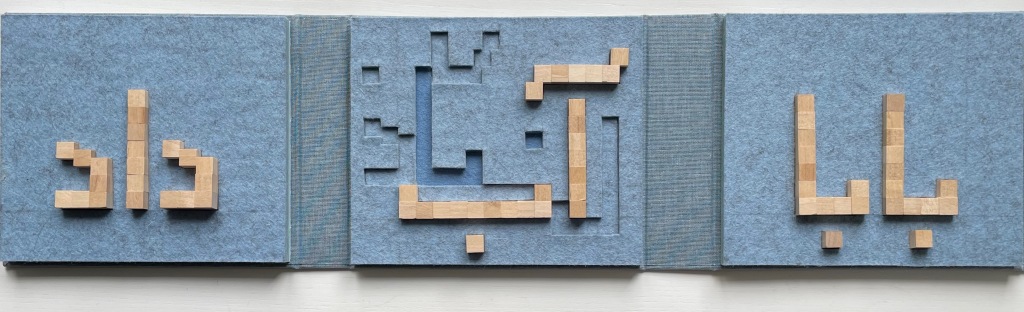
Golnar Adili’s Father Gave Water/Baabaa Aab Daad (2020)* performs a linguistic and cultural bridging. The miniaturized shape of traditional Western alphabet blocks meets a pixellated and sculpted Persian in her modular wooden cubes and recessed felt base. By leaping into the third dimension, her invented typography mostly skirts the calligraphic concerns of letter shapes that change depending on position and combination with other letters. Language becomes tactile and three-dimensional not only in this work but in almost all of the work emanating from her studio.
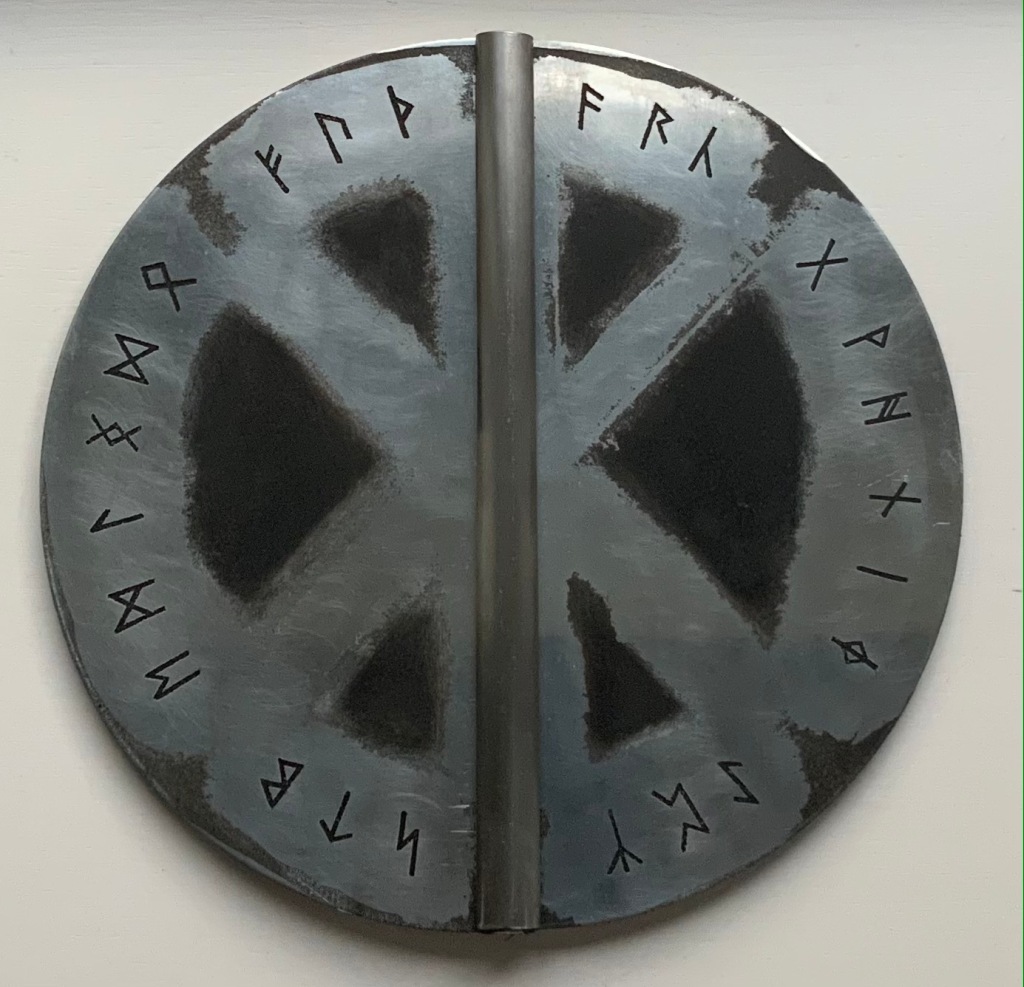
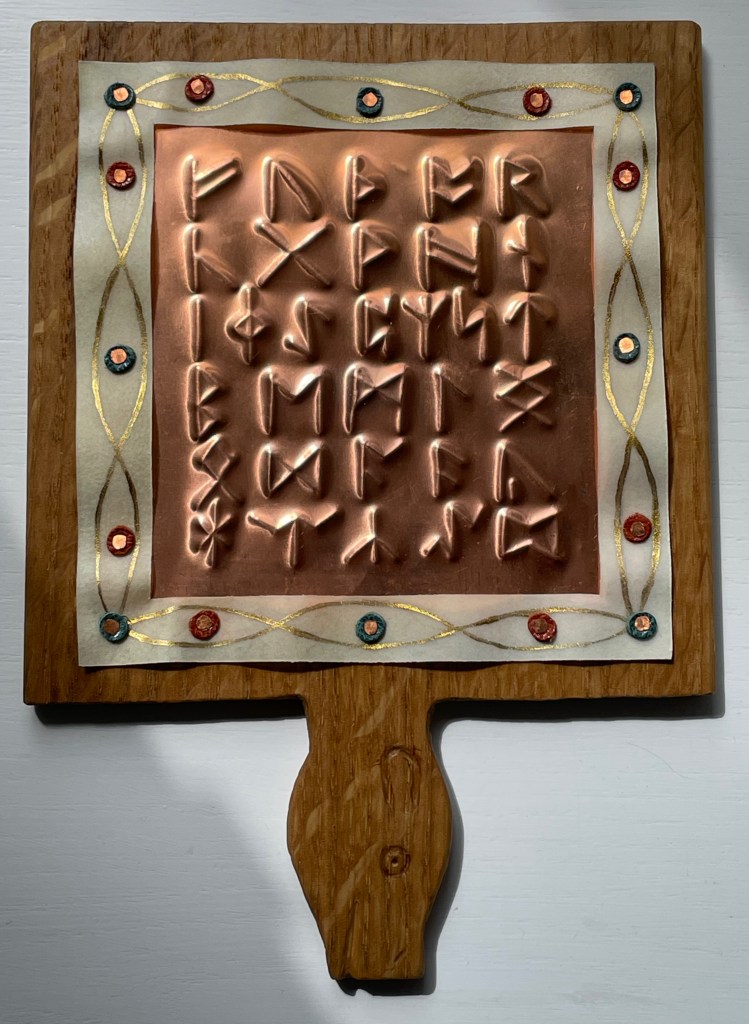
Fully open and laid face down, the shield-like covers of Brynja Baldursdottír’s Fuþorc (1992) display all twenty-four runes of the Runic alphabet — fuþorc — named for the first six runes, much as alphabet derives from the first two Greek letters alpha and beta. In the Middle Ages, books cut and bound in the shape of a heart were given as tokens of love or loyalty. Drawing on the Rune Poem, this shield-metal-covered, tree-trunk-round codex is a token to the Nordic and Anglo-Saxon tribes, whose shields, jewelry, tools and stone markers bore these angular letters of their alphabet, also used for divining fortunes (“casting the runes”).
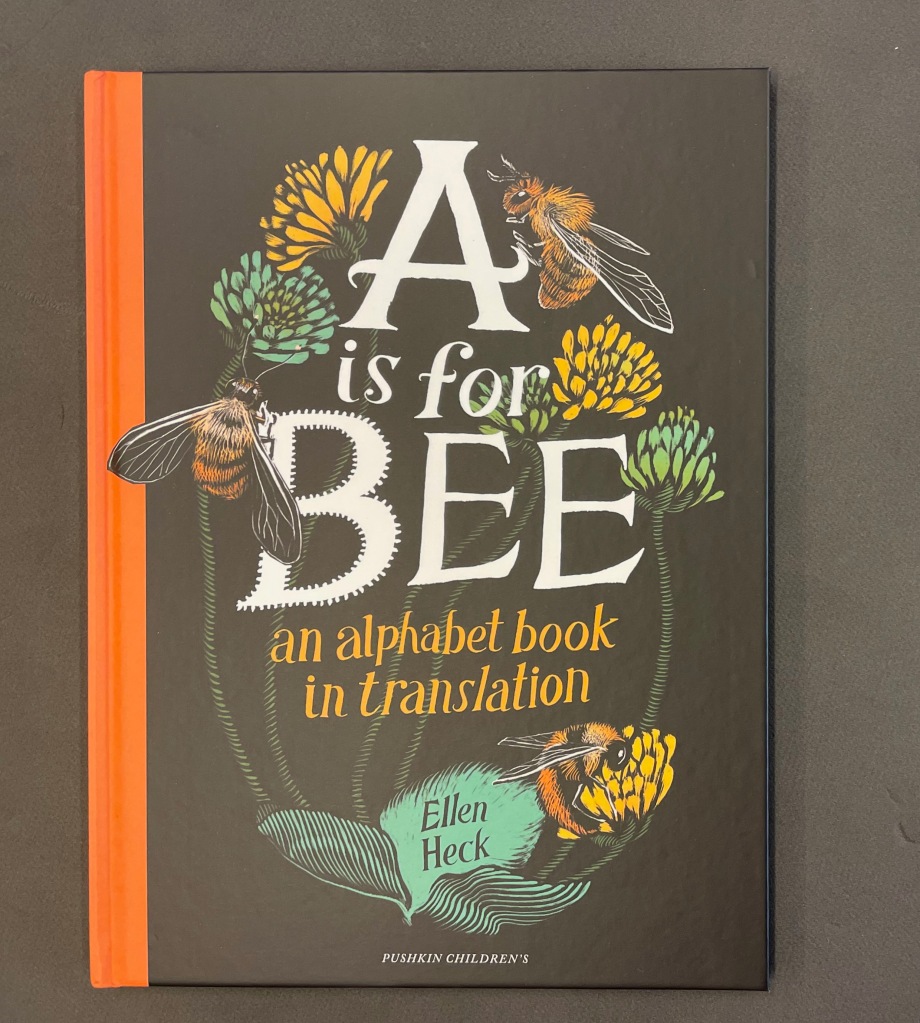
In another celebration of many alphabets and cultures, Ellen Heck’s A is for Bee (2022)
Ellen Heck, A is for Bee (2022).* Another clarion call to awareness of other languages and the consensual essence of the alphabet.
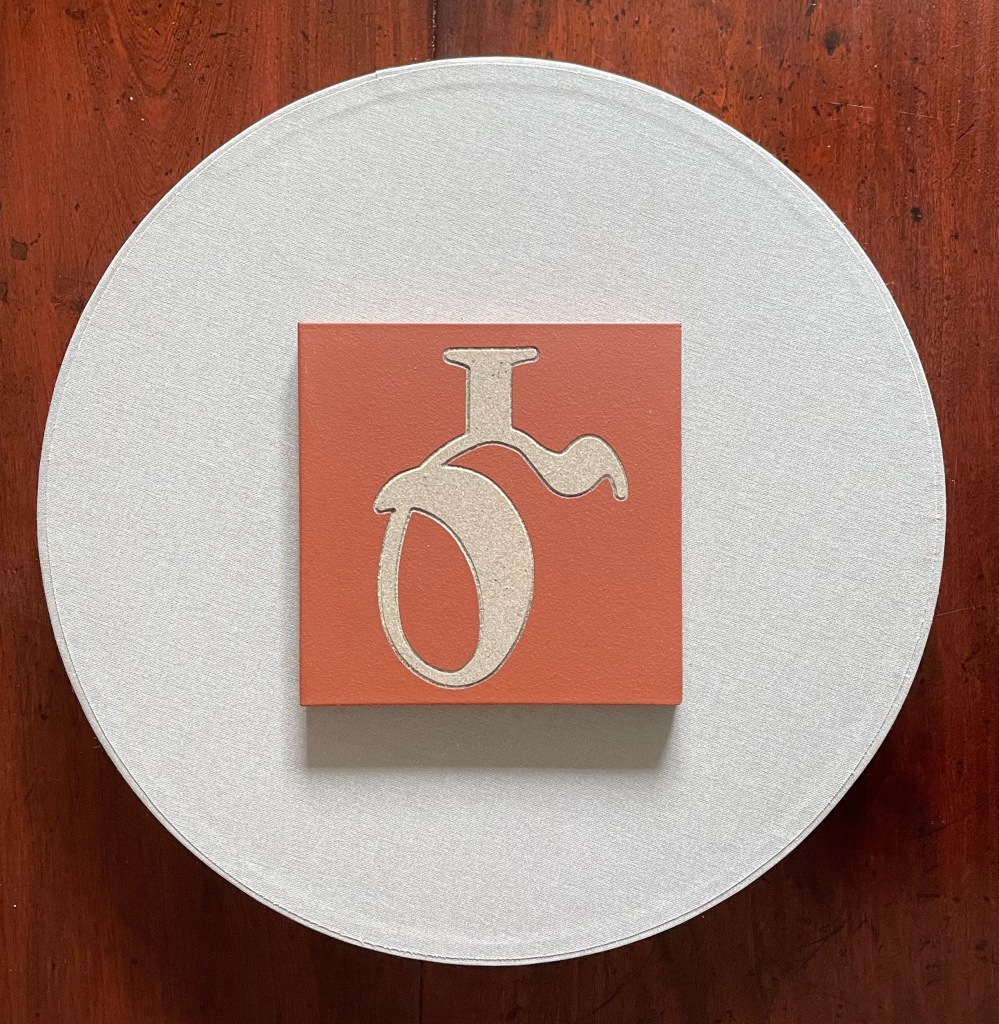
Satin’s Alphabook (Cherokee) (1998/9)* surprises the reader with four fan-shaped books in this circular portfolio. The character on the tile derives from Sequoyah’s syllabary, but the four books display the histories of multiple writing systems.
Online Exhibition Bonus!
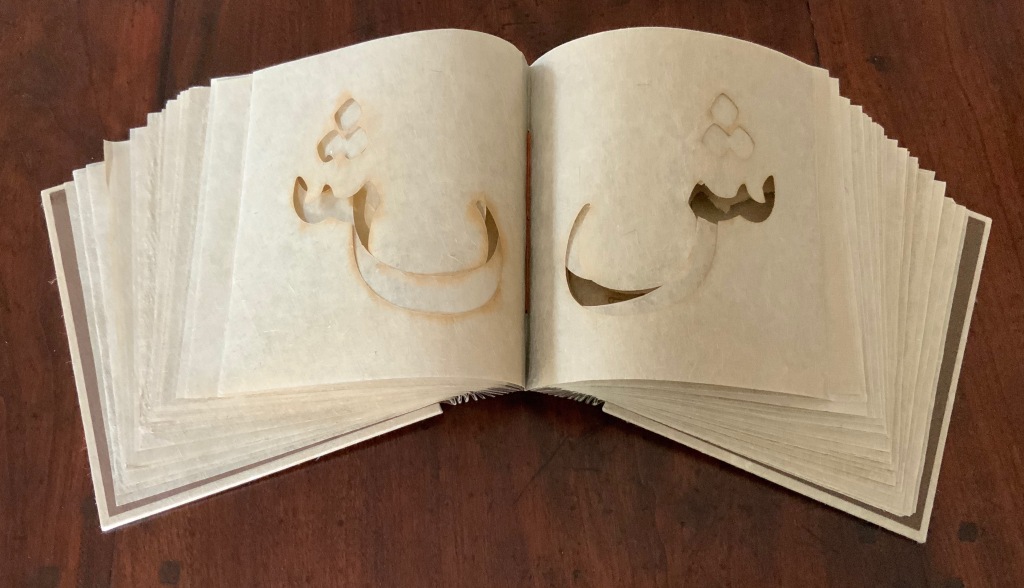
In Islam Aly’s 28 Letters (2013), the artist’s choice of paper and its color, laser-cutting and binding creates a work that conveys a feeling of Arabic’s cursiveness.
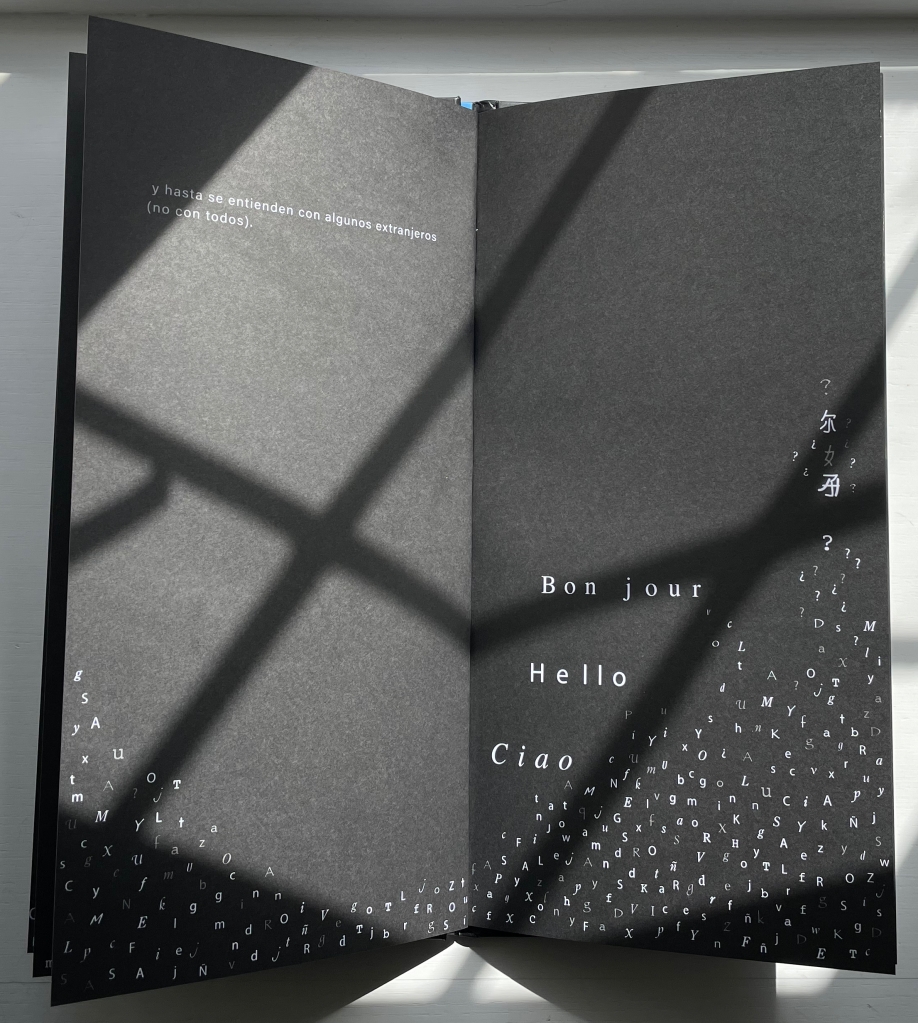
According to Menena Cottin’s Las Letras(2008/2018), even letters themselves celebrate our differences. “People are like letters, each one is different from the other, with its own form, its own shape, its own voice and its own personality. They can be fat, skinny, simple or complicated. Some are very popular and are seen everywhere, while the shyer ones don’t like to go out much. Everyone has their own voice, some are deep, others high-pitched, and some are even mute. Alone, none of them makes sense, but just two together is enough for them to become important. And the more they get together, the more interesting the get-together.” (Translated from the Spanish)
Leonard Everett Fisher’s Alphabet Art (1978) is a rare early commercial effort to interest children in non-Latin alphabets. Above is Fisher’s hand drawing of Thai consonants and vowels.
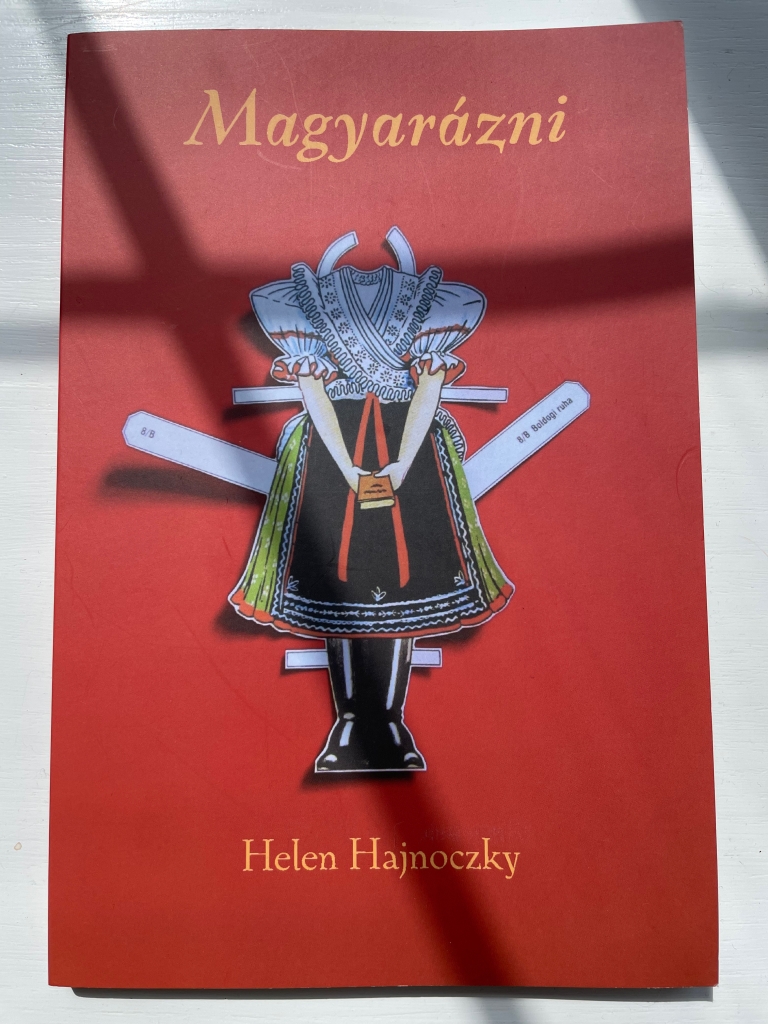
With all its diacritics and dipthongs, if there is an alphabet song in Hungarian, it must be operatic in length. It is fortunate, though, that it is as long as it is; otherwise we would have fewer poems in Helen Hajnoczky’s Magyarázni (2016). This is an abecedary that introduces monolingual English speakers to the “feel” of Hungarian and the feeling of growing up in a bilingual household.
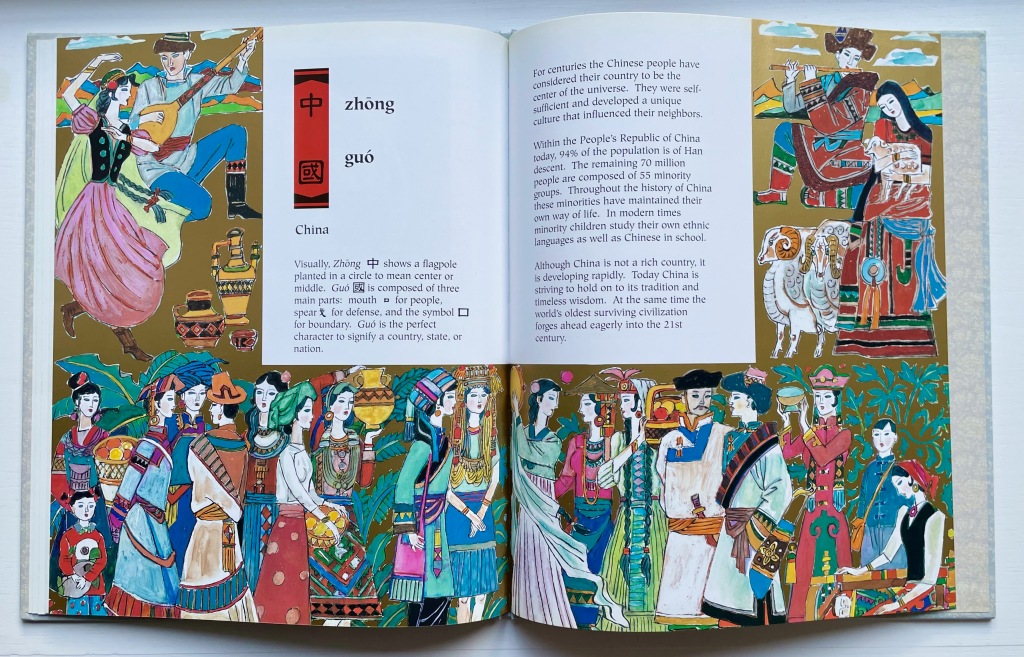
D is for Doufu: An Alphabet Book of Chinese Culture (1997) by Maywan Shen Krach and Hongbin Zhang is a “stand in” for an abecedary that cannot really exist since the Chinese writing system is not based on an alphabet but rather characters that are a mix of pictographs, ideographs, tonal markers and context indicators. For a different bridge between Western alphabets and Chinese characters, see the works of Xu Bing below.
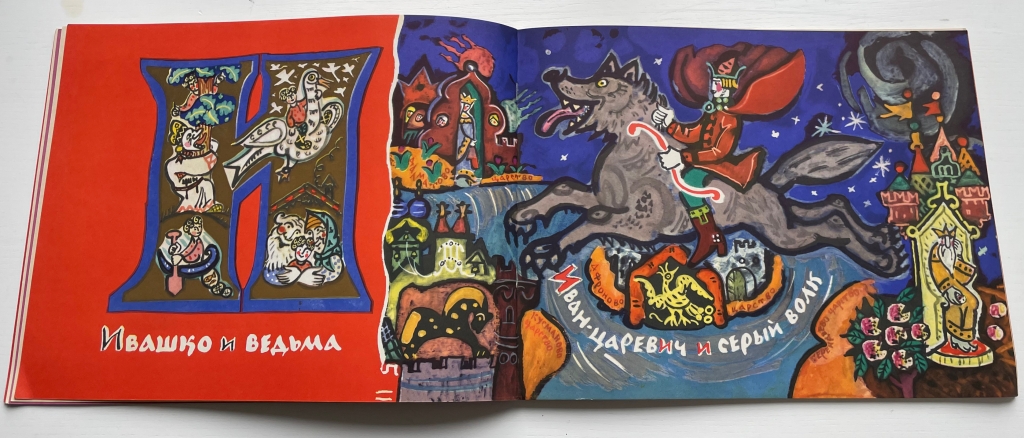
Tatyana Mavrina’s A Fairy Tale Alphabet(1969) provides this display case with its colorful example of one version of the Cyrillic alphabet.
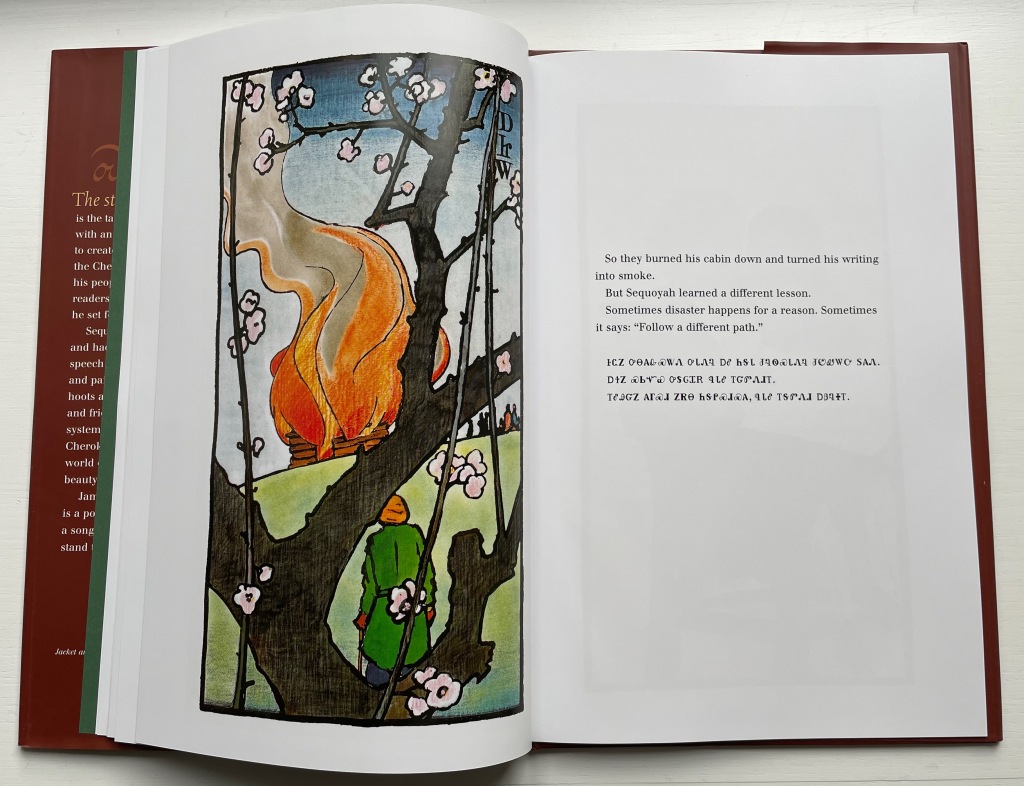
James Rumford’s Sequoyah (2004) recounts the story of the Cherokee Indian who, like Bouabré after him, invented a syllabary for his people. It was used by them on the walls of Manitou Cave in Alabama (US) in rituals and ancestral ceremonies.
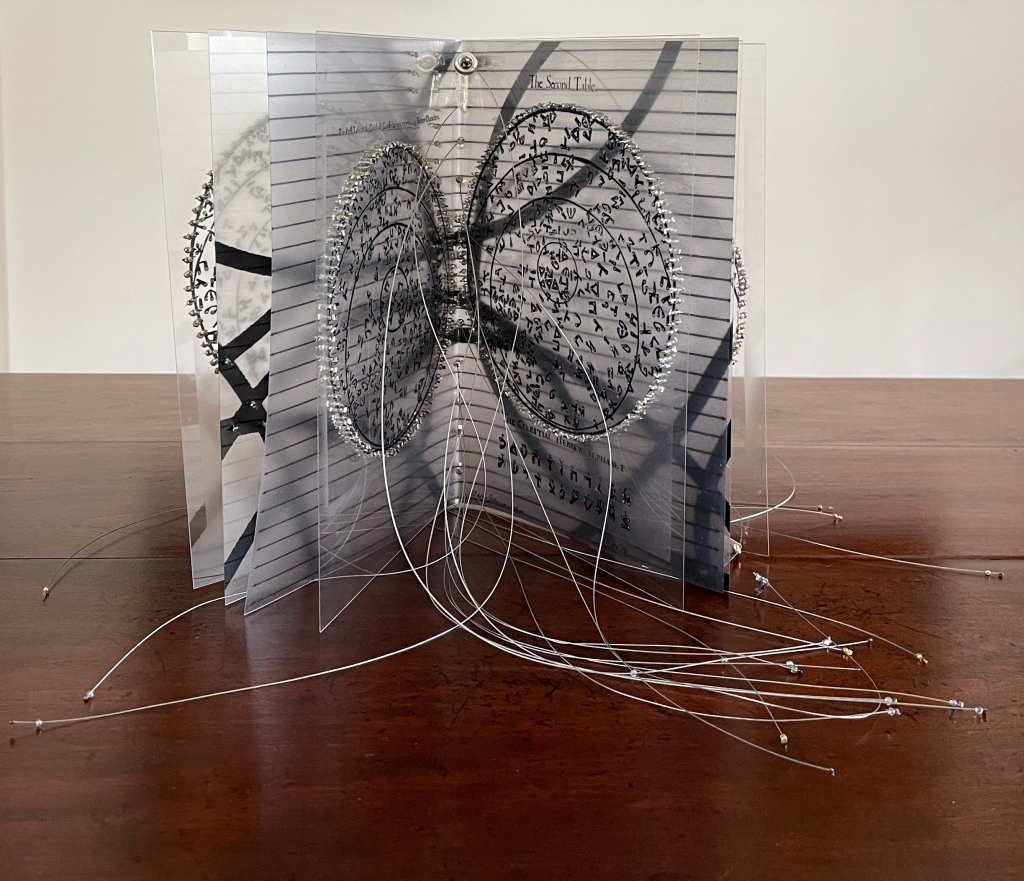
One of the alphabets in Dr. Edmund Fry’s encyclopedic Pantographia (1799) is Chaldean I, which he notes is also called Celestial, “said to have been composed by ancient astrologers”. Claire Jeanine Satin’s The Hebrew Alphabet Expressing the Celestial Constellations (2017) goes back to the same source in which Fry found his Chaldean alphabet. The tangled fish line and the gold-accented exterior and silver-accented interior echo the mystic interpretation of the divine language of the heavens.
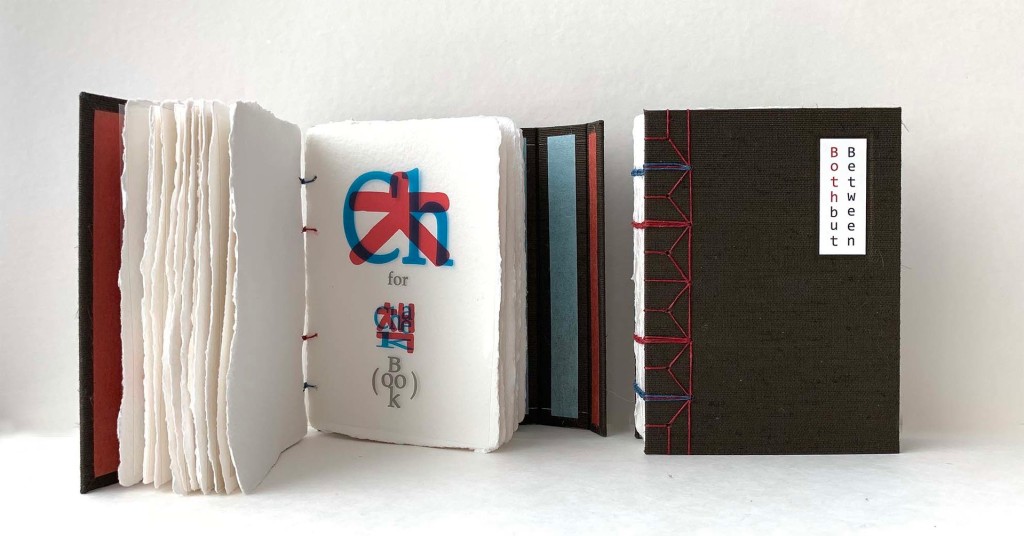
Both but between is a bilingual abecedary. If punning in a foreign language indicates successful mastery of a non-native tongue, punning in that language and doing so materially with an artist’s book must indicate an altogether higher level and higher kind of mastery. Jana Sim demonstrates such mastery with an extraordinary use of letterpress printing and laser printing to underscore the “both but between” metaphor of her bicultural experience in this bilingual abecedary.
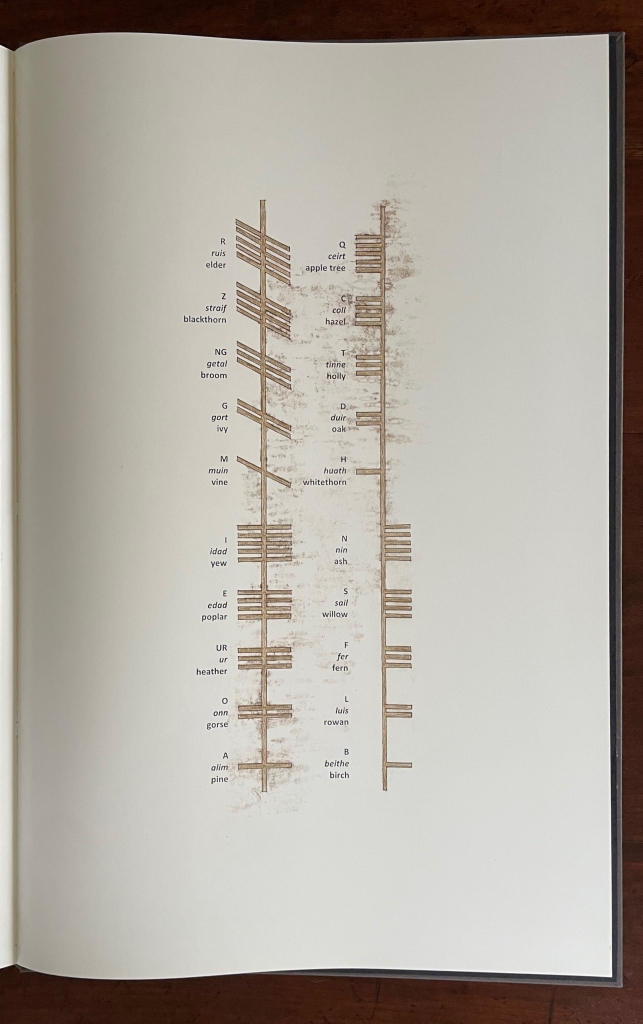
The Ogham letters, appearing here at the end of Serena Smith’s Ekphrasis (2020), are collectively known as the Beith-luis-nin (a contraction of the five letters in the lower right above, like our alphabet from alpha and beta). They are associated with 4th to 6th century Irish inscriptions on stone and, according to early sagas and legends, wood. Although only some of the 20 core letter names are the names of trees, the Beith-luis-nin came to be known as the “Tree Alphabet”. Smith’s large lithographic book is not an abecedary for the Tree Alphabet. Rather it is a meditation on place (a Leicestershire country park — “part arboretum and part community”) and the art of lithography (drawing on and printing from stone) in which she wonders “if the hands of Celtic scribes also tired, whilst scoring the lines of Ogham script“.
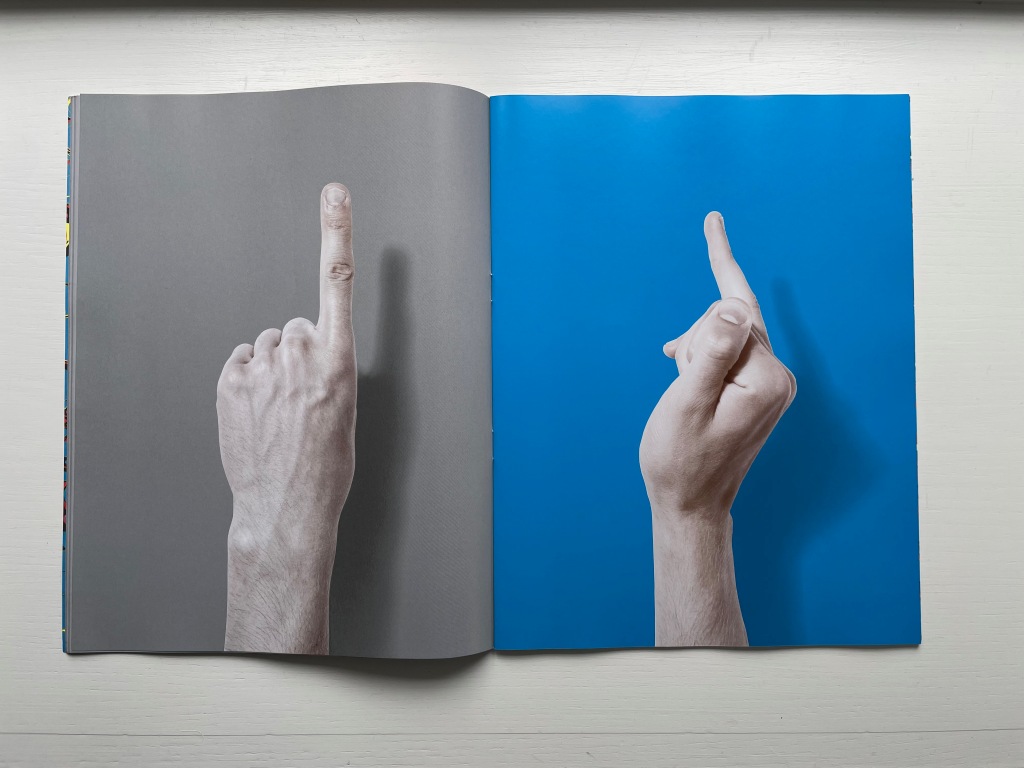
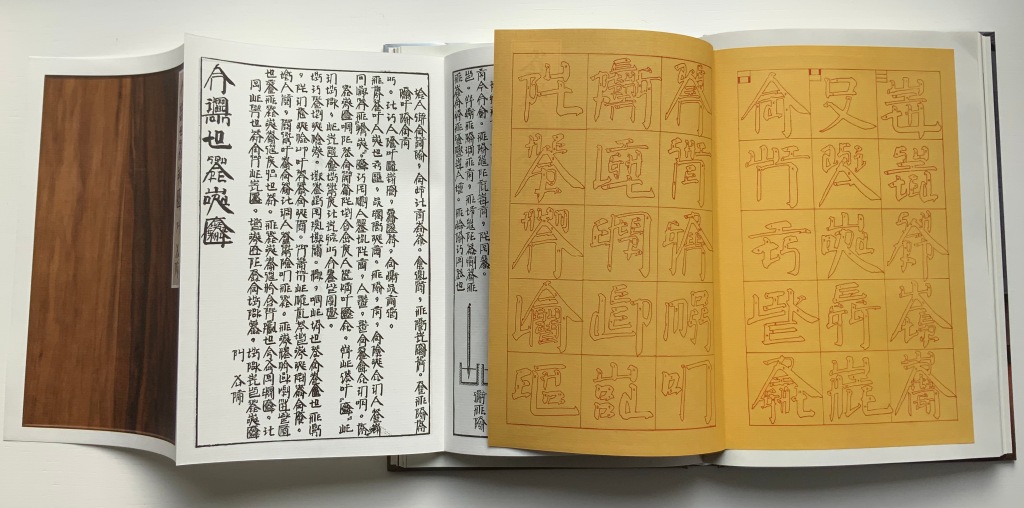
Speculation has it that the Irish familiar with Ogham also used it for a secret sign language. No speculation is needed for the sign language shown in Stuart Whipps’ Feeling with Fingers that See (2017).* It comes from Sir Christopher Wren and can be found interleaved in the Royal Institute of British Architects’ “heirloom copy” of Parentalia, a family memoir published in 1750 by Wren’s grandson, also named Christopher. Whipps uses it in his A System For Communicating With The Ghost Of Sir Christopher Wren.
This online exhibition bonus concludes with three works by one of the most inventive and prolific artists of the 20th and 21st centuries: Xu Bing.
This work —Book from the Sky to Book from the Ground (2020) — is perhaps the artist’s best introduction to Book from the Sky (1986-2012), Book from the Ground (2003~) and “square word calligraphy”, his writing system that bridges Chinese and English with humor and artistry.
Book from the Ground (2014) was published by MIT Press. A throwback to the pictographic origins of most alphabets and writing systems, the book recounts a day in the life of Mr. Black, an office worker, in the symbols, icons and logos of modern life.
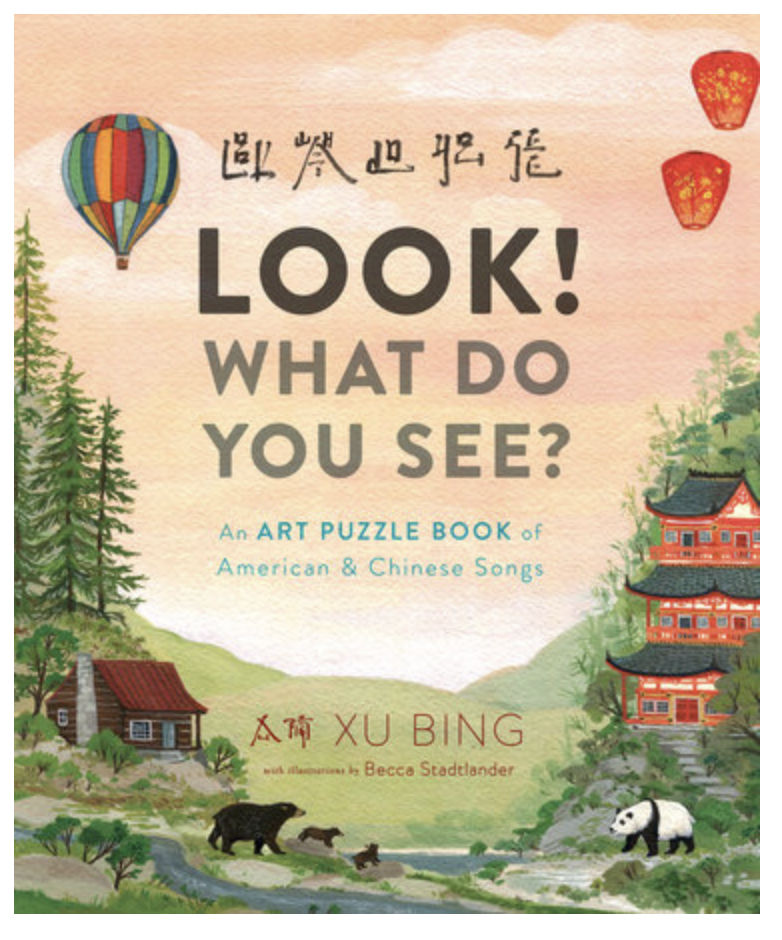
The artist’s cross-cultural humor shines in his children’s book Look! What do you see? (2017). Published by the trade publisher Viking, the lyrics to familiar US songs are printed with the sinographic letters from square word calligraphy.
Artists use knives, thread, wood, handmade paper, wire and other tools to execute their beautiful writing. Some create their designs with straight edge and compass – or with punch, matrix, mould and molten metal – or with the computer and even artificial intelligence.
Cathryn Miller’s L is for Lettering (2011) is a brilliant example of the book artist’s rite of passage: make an alphabet book, but make it new.
Tauba Auerbach has made the alphabet her life’s work. How to Spell the Alphabet (2007) uses the title of one of her best-known works. A work of ink and pencil on paper (2005), it begins “EY BEE CEE DEE” and was featured in MoMA’s “Ecstatic Alphabet” exhibition (2012). Her artistic playfulness makes the letters of the alphabet self-referential and ecstatic (“to stand outside themselves”). Another route to this is what she calls “letter worship” as demonstrated in this homage to another artist of the letter: Paulus Franck.
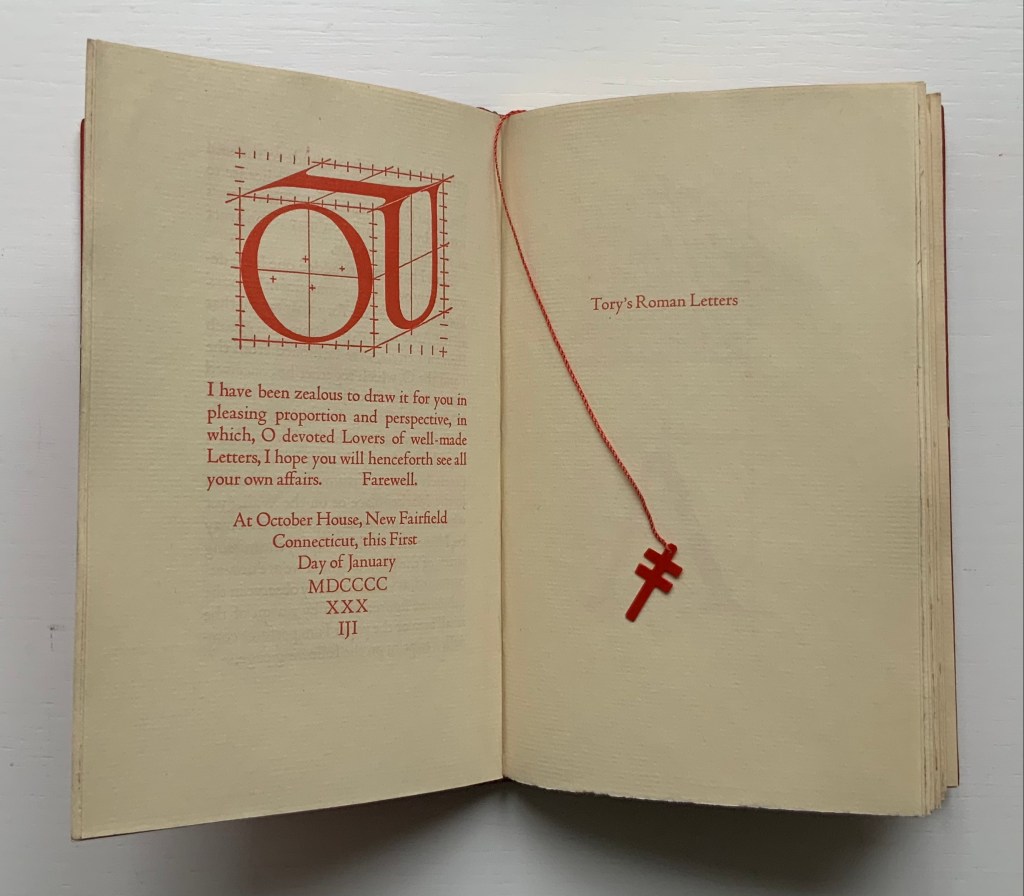
Thanks to the editors Joseph Kiermeier-Debre and Fritz Franz Vogel, we have this facsimile edition of Paulus Franck’s Schatzkammer, Allerhand Versalien Lateinisch vnnd Teutsch (1601/1995), a “treasury of all manner of German and Latin ornamental letters. The editors neatly use the margins of their book to add to the historical context. On the verso page, they have the geometrically controlled design of Albrecht Durer (1525), and on the recto, the exuberance of John Seddon (1695).
Another lifelong devotee of the alphabet is Annie Cicale. Her Patterned Alphabet (2013) is an extended dance of contrasts and complements with printing, paper and patterns.
Not quite an alphabet book but clearly a children’s book and artist’s book at play with the alphabet is Kurt Schwitters’ Die Scheuche (1925/1965), which might send you flying over to the display with Roberto de Vicq de Cumptich, Bembo’s Zoo: An Animal ABC Book under Alphabets Alive! — Animals.
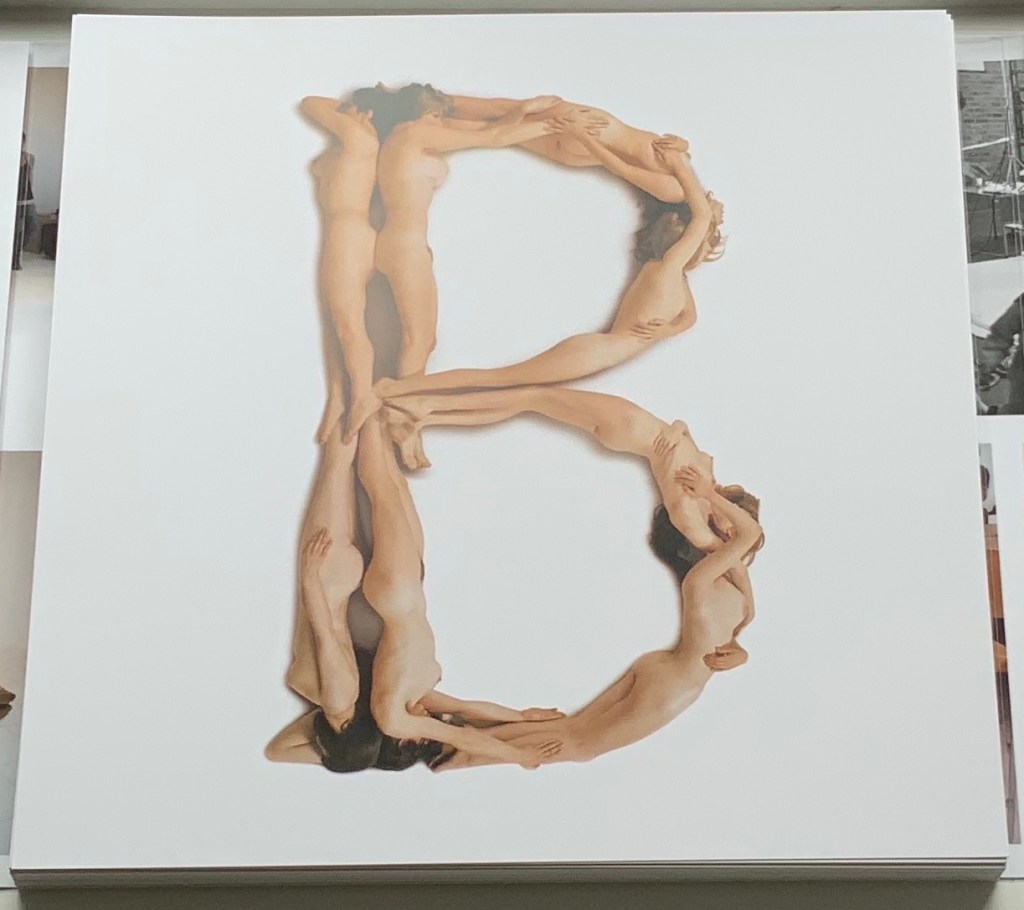
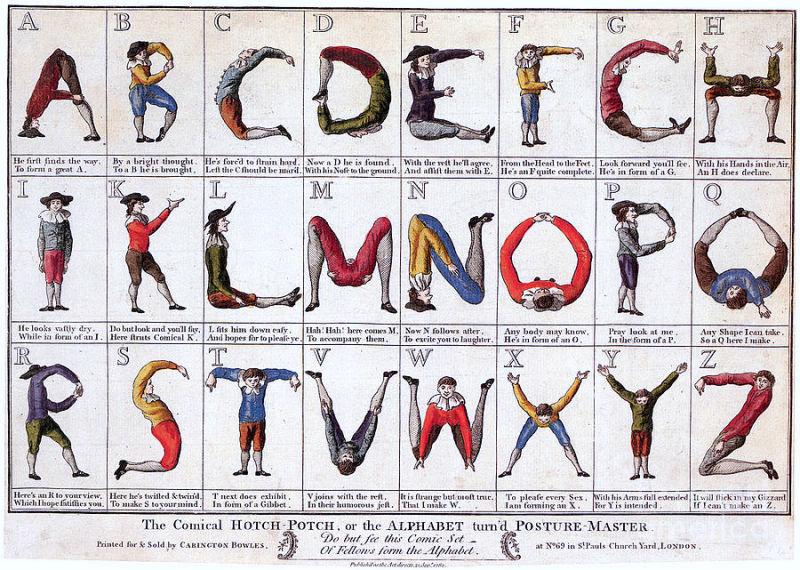
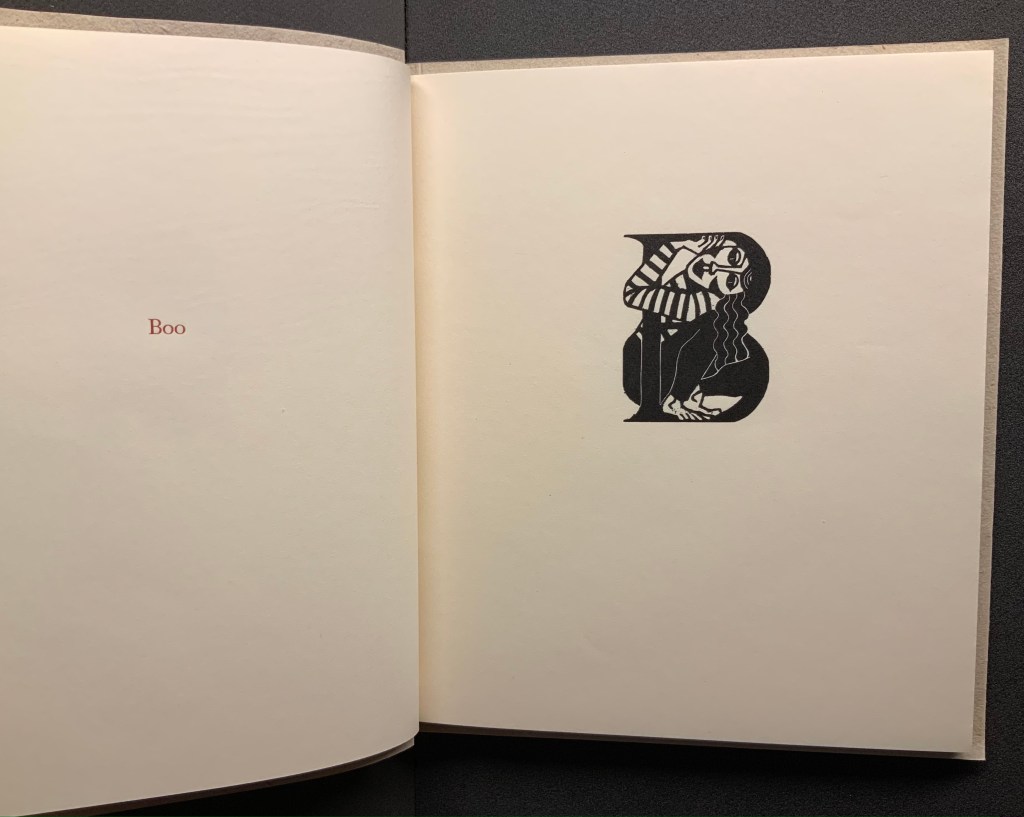
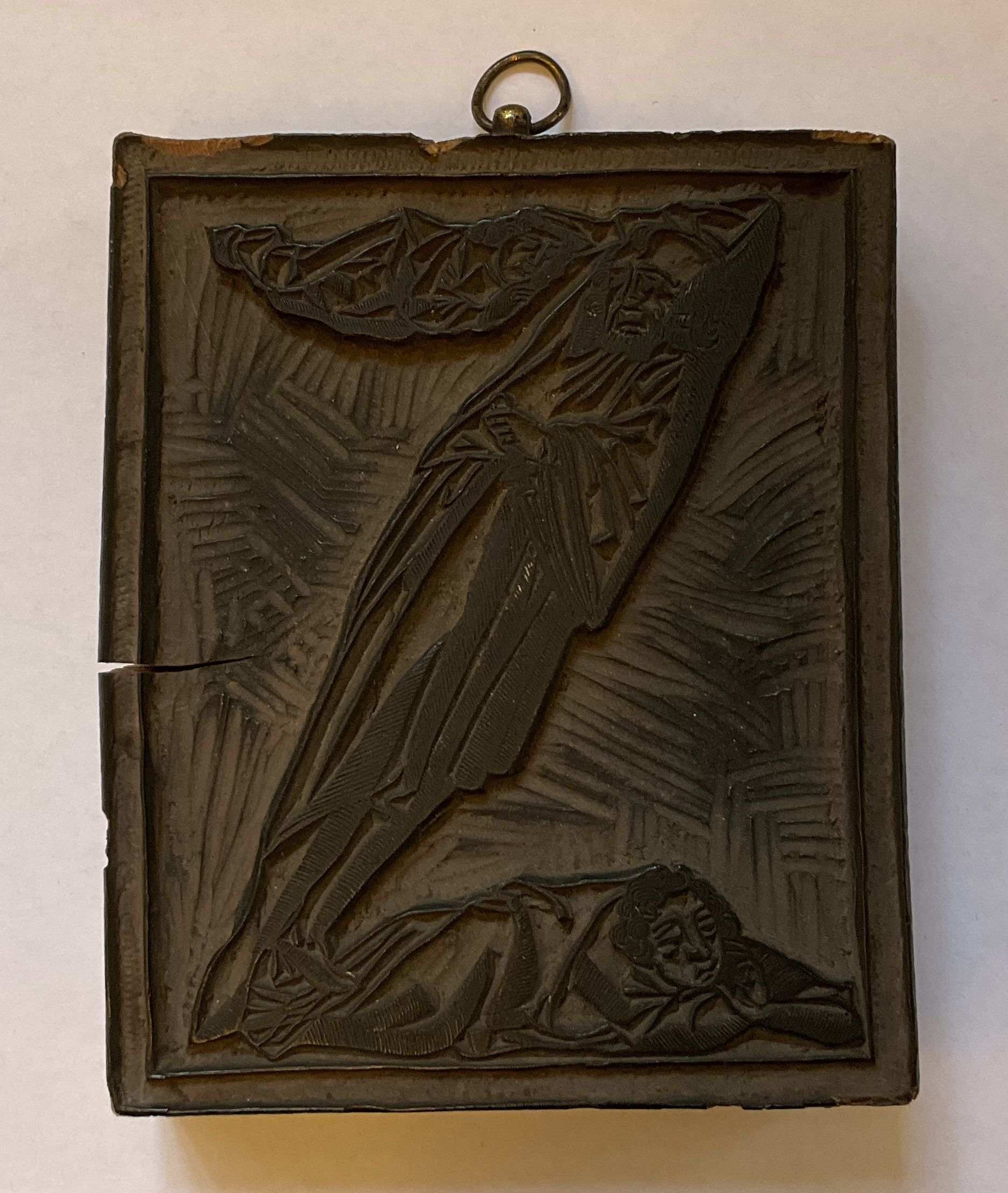
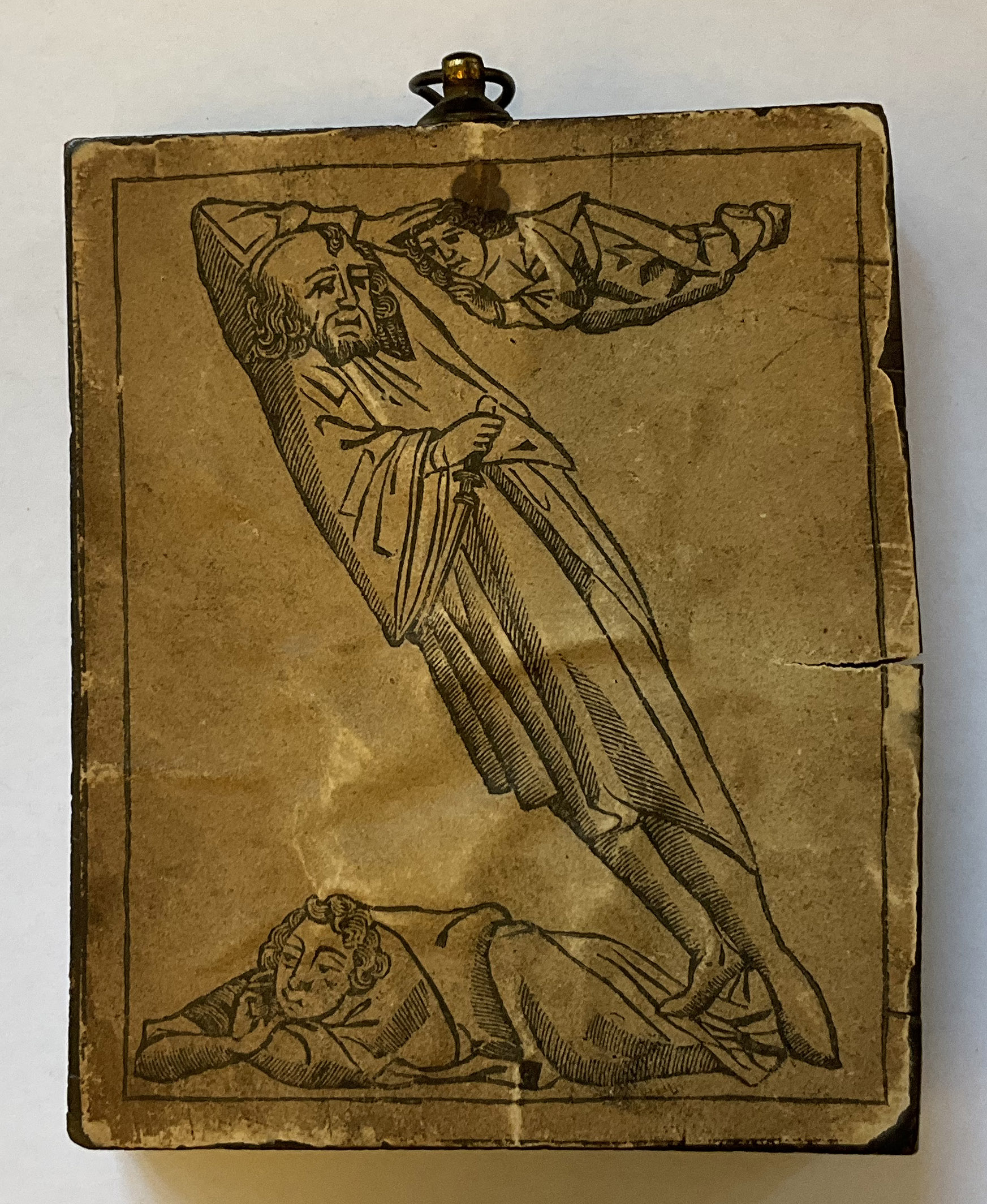
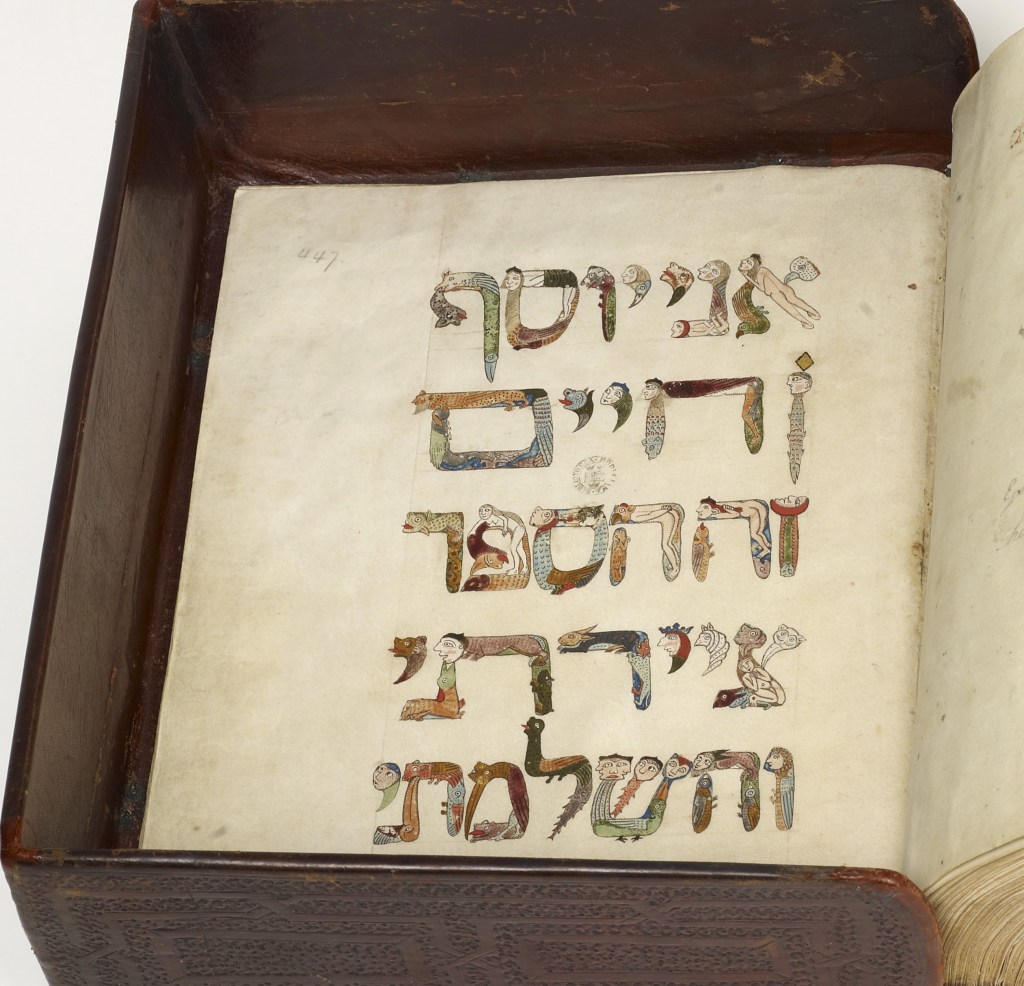
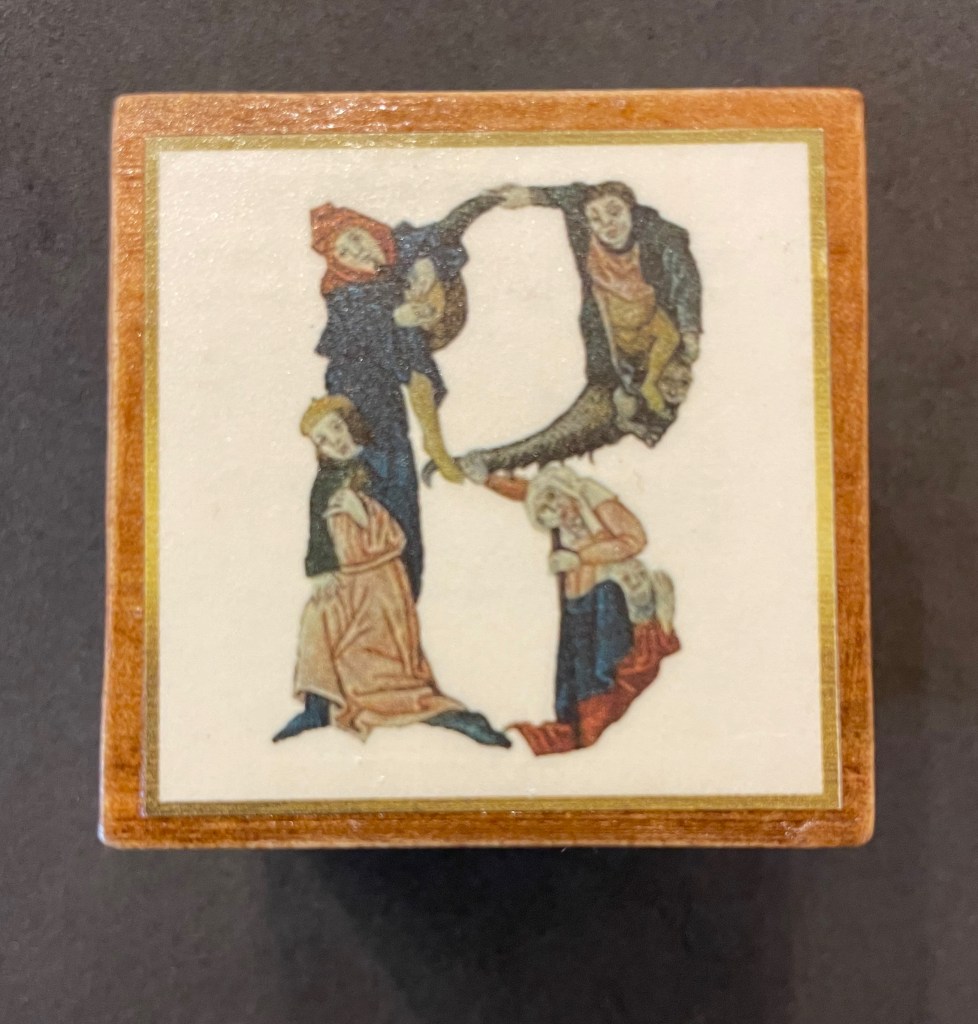
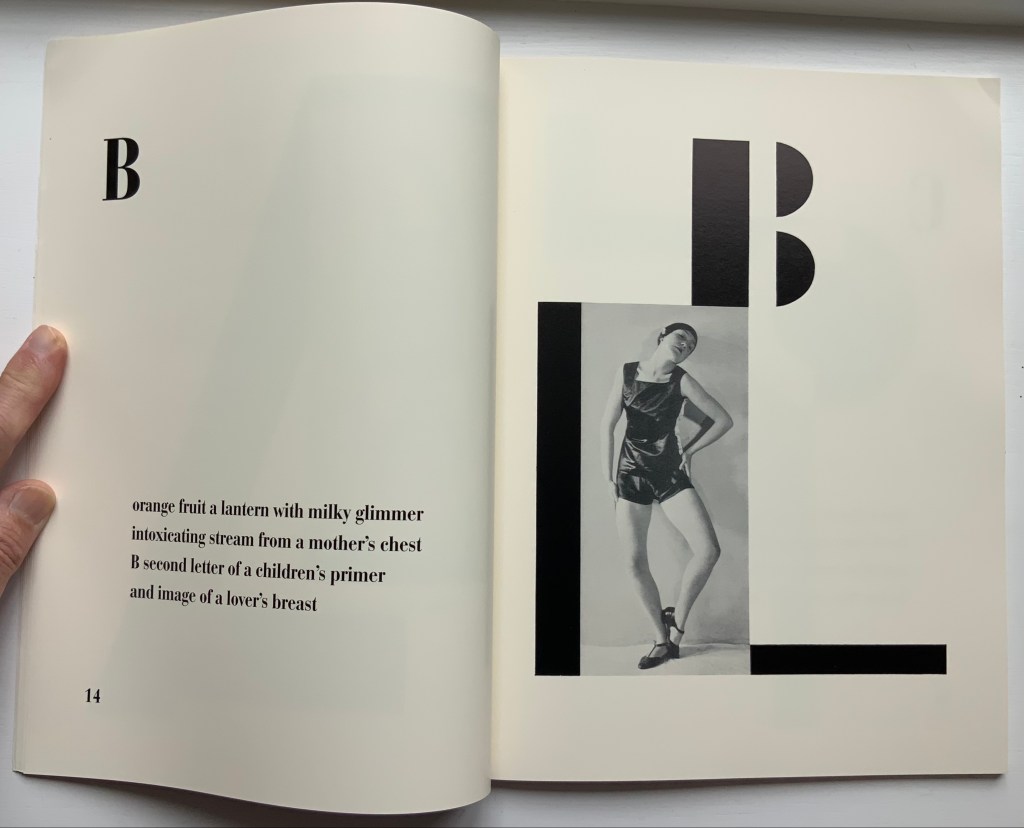
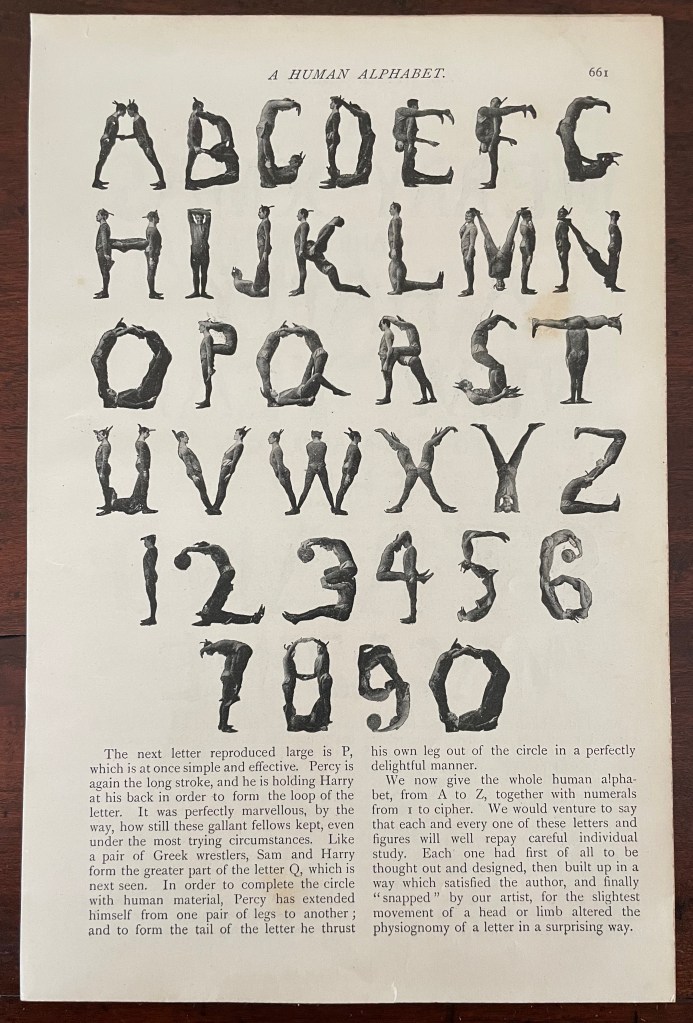
Can you bend your body into the letter B? Too easy? What about the letter M? Ancient Greek playwrights had their characters mime and dance the letters of the alphabet, and the Czech writer Vítězslav Nezval has carried on this tradition. Lisa Merkin’s alphabet blocks also follow the tradition of manipulating bodies to make letter shapes. Which alphabet is the most acrobatic? Take a look at the characters making up the Hebrew letters in the Kennicott Bible. What word would you spell out with your body?
Only remembered after the Alphabets Alive! exhibition opened at the Bodleian in July 2023, The Three Delevines and W.G. Shepherd (their impresario on the occasion in 1897) have nevertheless demanded an appearance online among the other embodied alphabets (or lettered bodies) included in the “B for Bodies” display.
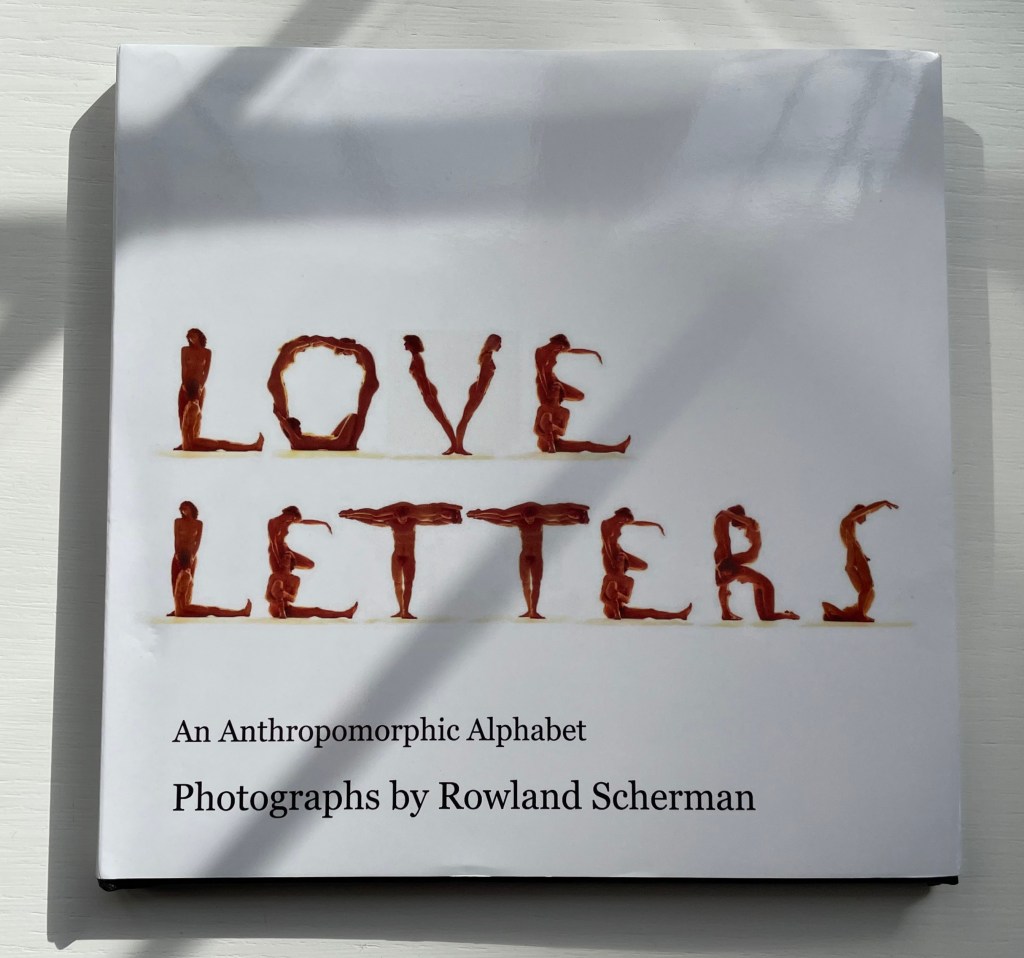
First photographer for the Peace Corps in 1961, Rowland Scherman has been camera in hand for the Beatles in ’64, Bob Dylan’s Greatest Hits album in ’68. and Crosby, Stills and Nash for their first recording in 1969. A bus ride in London in the 1970s revealed to him Giovanni Battista Bracelli’s “Alfabeto Figurato”, which led to another first: the first photo of a freestanding nude human alphabet: Love Letters (2008).
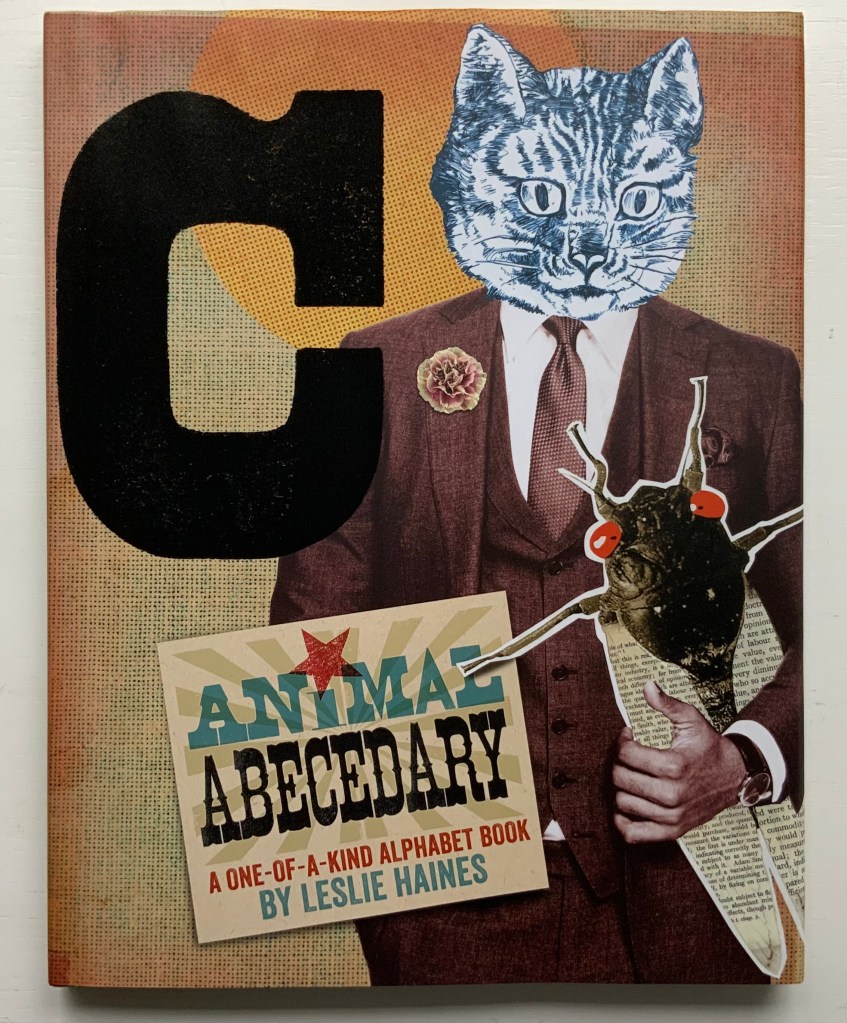
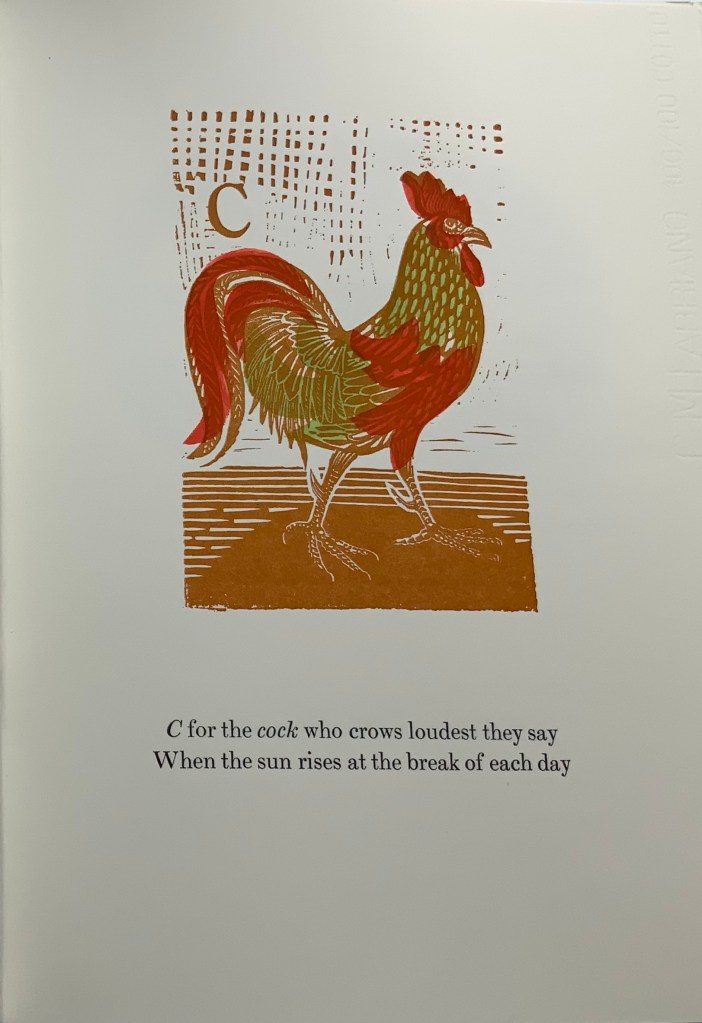
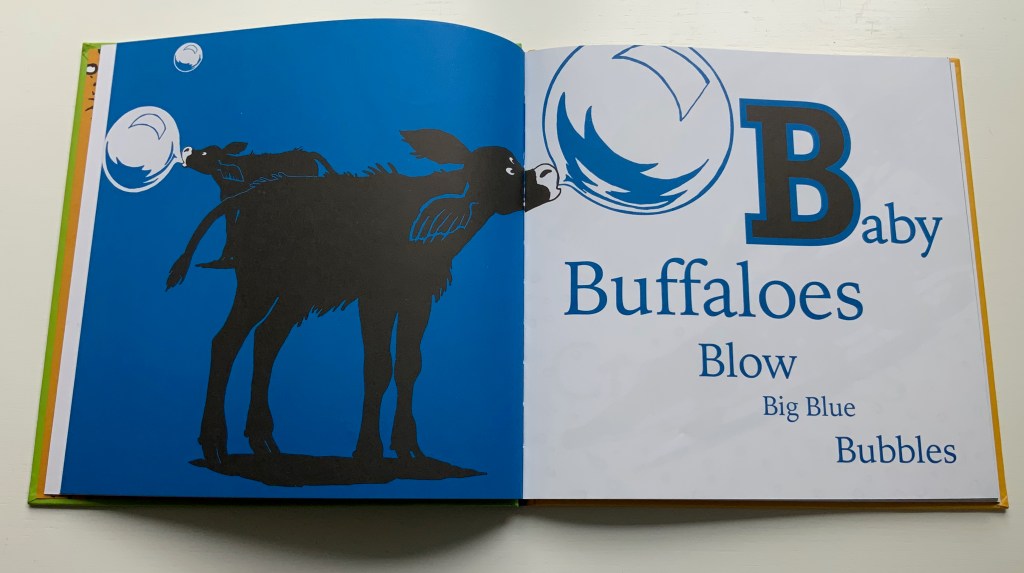
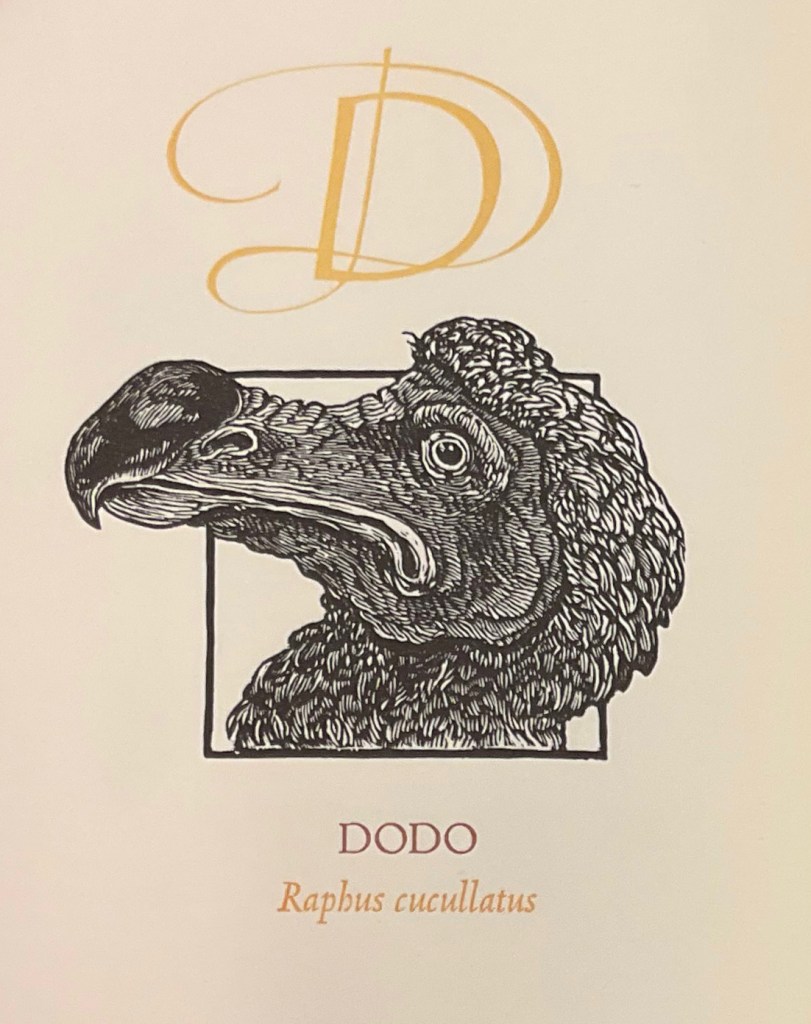
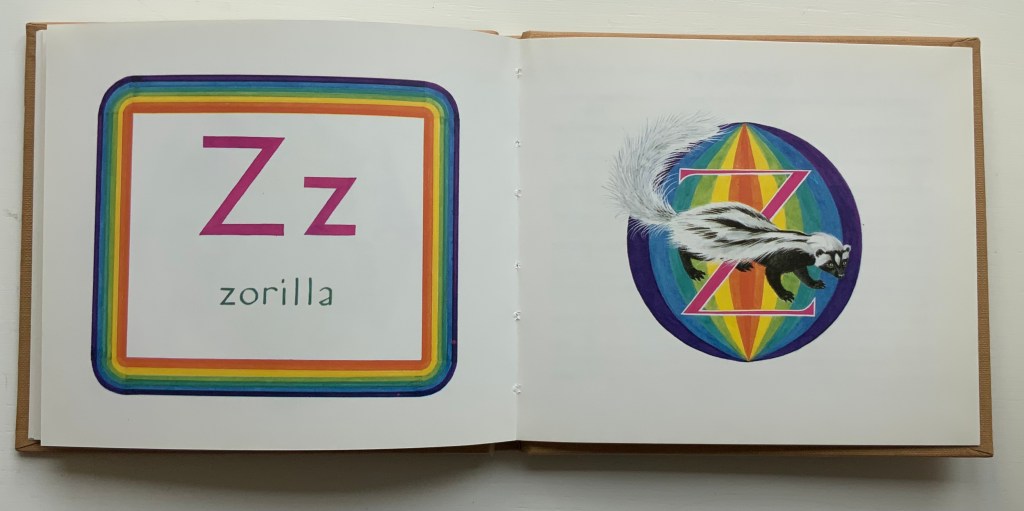
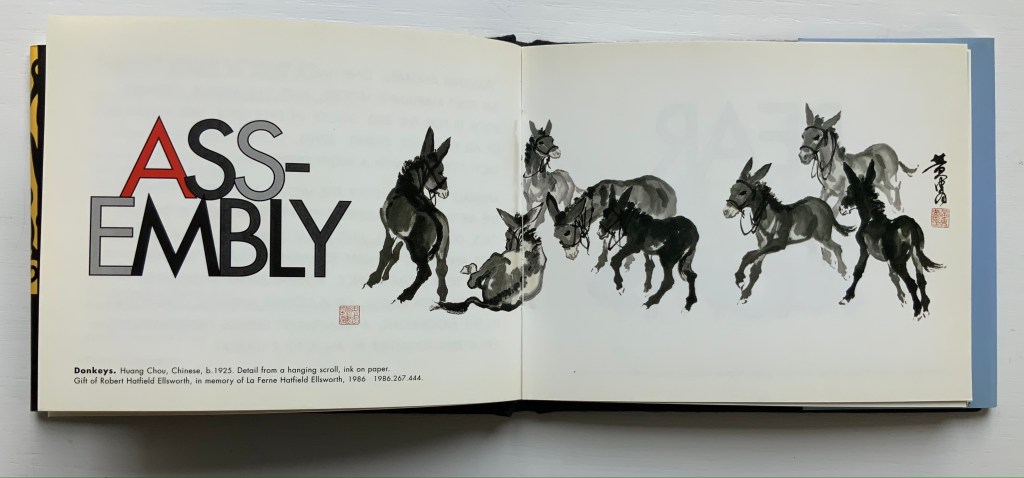
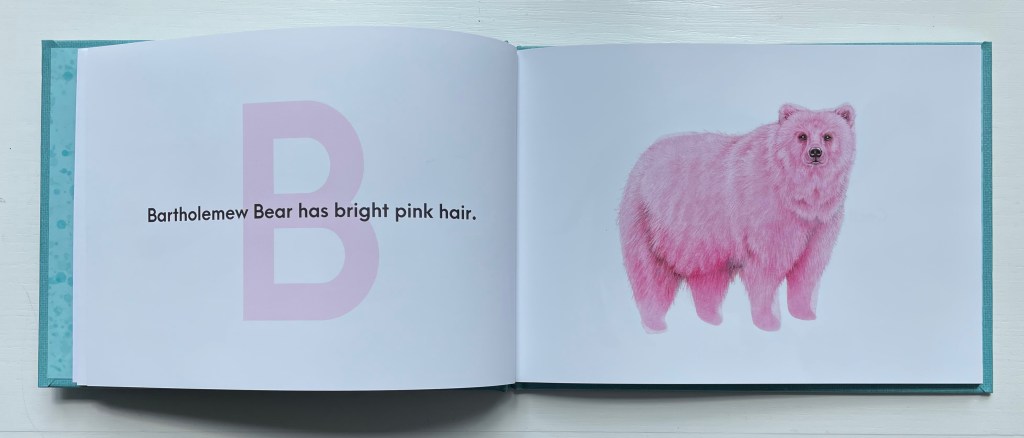
Animal alphabet books hum with imagination and wit. Animals, birds, fish, insects, even dinosaurs, decorate and transform letters, or might be created from the letters themselves. Sometimes, the animals come in disguise, or hide, only to pop out and surprise you. Perhaps the alphabet’s pictographic origin explains this animal obsession. The letter ‘A’ comes from the word ‘aleph’ meaning cow or ox, and its early letterform resembled an ox’s head and horns. [Links in the captions will take you to more images and details.]
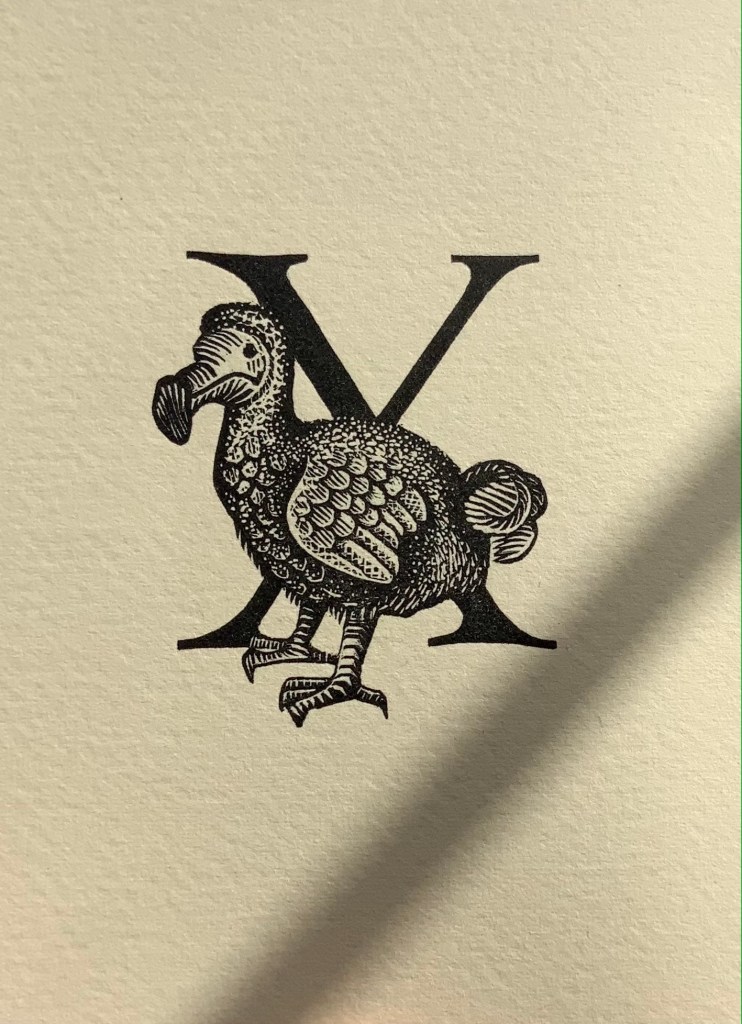
E.N. Ellis, An Alphabet (1985).* The letters Q and X always present challenges in finding suitably named animals. Ellis’s solution with X is as elegant as her engraving.
C.B. Falls, ABC Book (1923). Almost a quarter century after William Nicholson’s successful A Square Book of Animals, Falls applied his successful poster designing to this larger format.
Enid Marx,Marco’s Animal Alphabet (2000). Bringing together the talents of the engraver (Enid “Marco” Marx), “pochoir-ist” (Peter Allen) and letterpress printer (Graham Moss), this large-scale portfolio treads the boundary of fine press and artist’s book.
[Alphabet Leporello of dressed animals] (Paris, c. 1851) Opie T 407. The Books On Books Collection’s concentration on alphabet books falls primarily over the 20th and 21st centuries and extends the pre-1950s focus of the Opie Collection of children’s books. Together, the two collections offer a broad and deep source for exploring the links between artists’ books and children’s alphabet books as well as studying topics such as children’s literature and literacy.
Christiane Pieper & Anushka Ravishankar, Alphabets Are Amazing Animals (2003).* Alliteration is almost as frequent a feature of alphabet books as animal association.
Alan James Robinson and Suzanne Moore, A Fowl Alphabet (1986).* A superb collaboration between an engraver (Robinson) and calligrapher (Moore).
John Norris Wood, An Alphabet of Toads & Frogs (2002).* Sometimes past art abroad catches up with present American fauna of political celebrity.
Leonard Baskin, Hosie’s Alphabet (1972). Son Hosie and father Leonard unite their rites of passage: learning the alphabet and creating an artist’s alphabet book.
Michele Durkson Clise, Animal Alphabet: Folding Screen (1992) wrongfoots the reader with animal images that do not align with the expected alphabet letter or the letters of the first words in the leporello’s rhyming couplets. If the image does at least align with a word in the couplet (e.g., “whale”), that word’s first letter does not align with the alphabet letter expected for that panel.
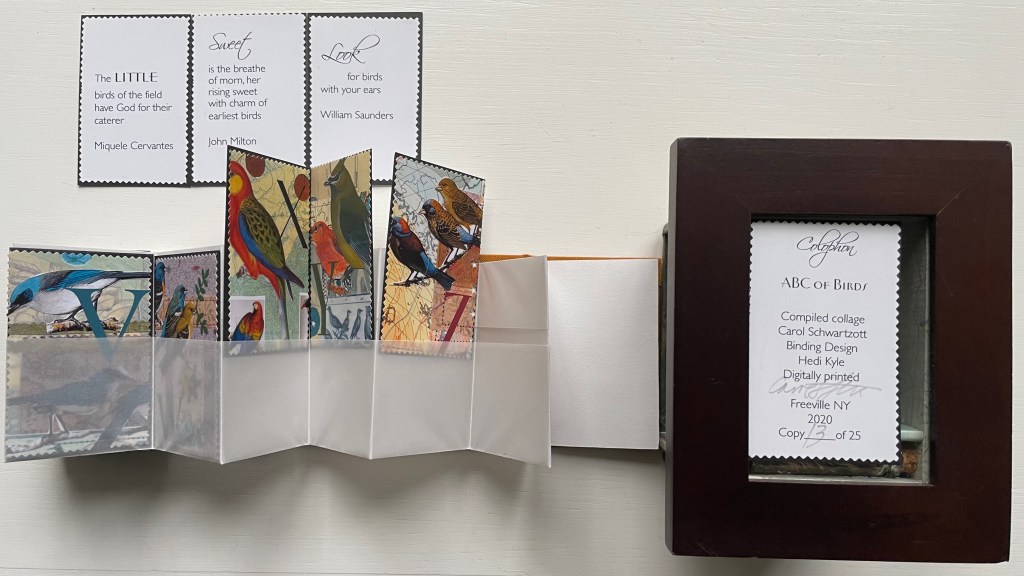
Brian D. Cohen & Holiday Eames, The Bird Book (2013). Cohen’s engravings are finer in detail than most.
In Abstract Alphabet: A Book of Animals(2001), Paul Cox turns the alphabet on its evolutionary head. The letter A started out with the pictogram of an ox’s head and then developed into the abstract shape we associate with the sound /a/. Here, we have to work back from 26 different abstract shapes (each assigned to a letter on a fold-out flap) to figure out the name of the animal being spelled. The reversal conjures up the challenge that letters, objects and phonics present to children, and in their resemblance to a Hans Arp painting, the shapes challenge the reader to a renewed connection with art.
Roberto de Vicq de Cumptich, Bembo’s Zoo: An Animal ABC Book (2000). Where Sharon Forss and Sarah Werner use several type faces to shape their animals, De Vicq de Cumptich restricts his to Bembo.
David L. Kulhavy & Charles D. Jones,A Forest Insect Alphabet(2013). Extraordinary woodcuts by Jones, worth comparing with Cohen, Grieshaber, Marx and Robinson.
Metropolitan Museum of Art, Animalphabet (1996). Curators’ puns and wordplay with favorites from the Met.
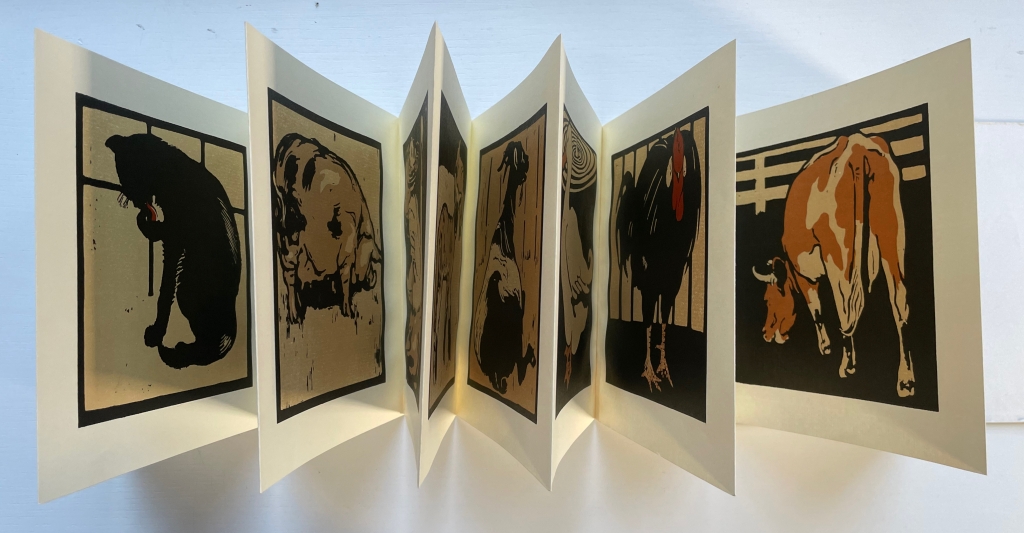
William Nicholson, A Square Book of Animals (1900). Nicholson followed his successful An Alphabet with this book, but it was Scolar Press in 1979 that redesigned and re-originated it in this well-chosen leporello format.
Carton Moore Park, An Alphabet of Animals (1899). Unusual for its grisaille technique and restriction of color to the cloth cover.
When letters are not hiding in plain sight or busy forming words and sentences, they get up to all sorts of adventures. Some abecedarians and book artists like to imagine them in fairy tales, voyages or light-hearted battles. [Links in the captions will take you to more images and details.]
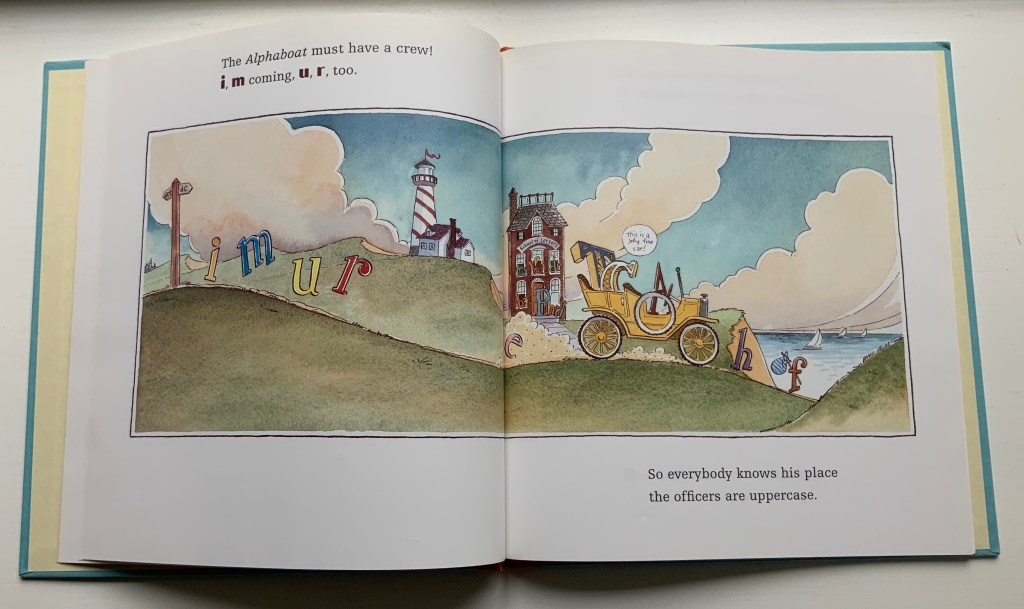
Prepare to groan as Michael Chesworth gathers the crew of the Alphaboat (2002) and has them set out for buried treasure.
Both an origin story and adventure story, Souza Desnoyer and Marcelle Marquet’s Il était une fois un alphabet(1951/2009) [“Once upon a time there was an alphabet”] tells of the mutual discovery of the medieval/Renaissance country of Vowels and the isle of Consonants and their union over a banquet, evening gala and ball to form the alphabet.
In Alpha Oops! The day Z went first (2006), Alethea Kontis and Bob Kolar let X, Y and Z take the lead — with letter puns and fisticuffs to follow.
These two panels from Warja Lavater’s Spectacle: Pictoson Mural(1990) are the textual guide to the preceding wordless panels that tell another strange tale of vowels meeting consonants.
Online exhibition bonus!
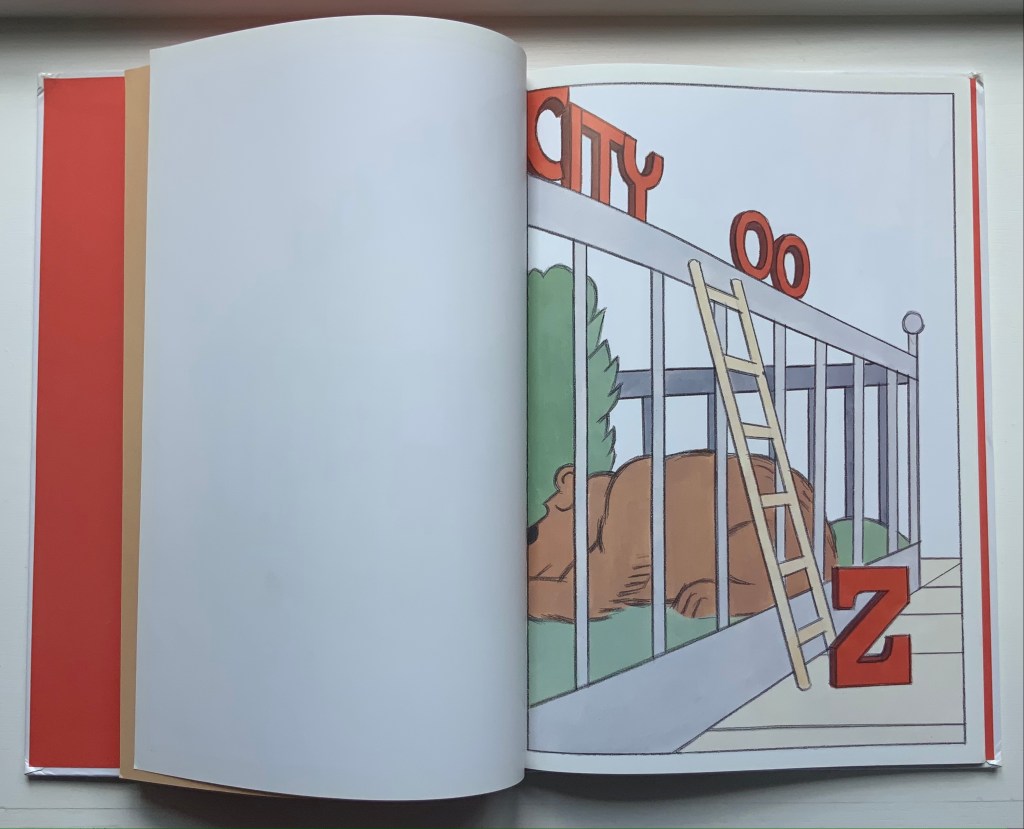
Jon Agee, Z Goes Home (2006) is another imaginative book bringing Z to life. This time the letter begins to take on real character, quietly descending a ladder from its day job at the city zoo.
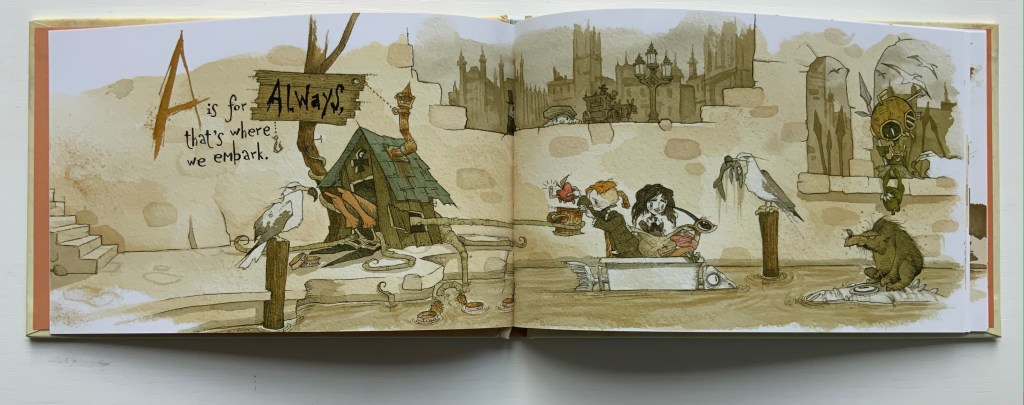
The letters themselves do not perform as characters in The Dangerous Alphabet(2008) by Neil Gaiman & Gris Grimly. They take their more traditional places in words that progress the plot.
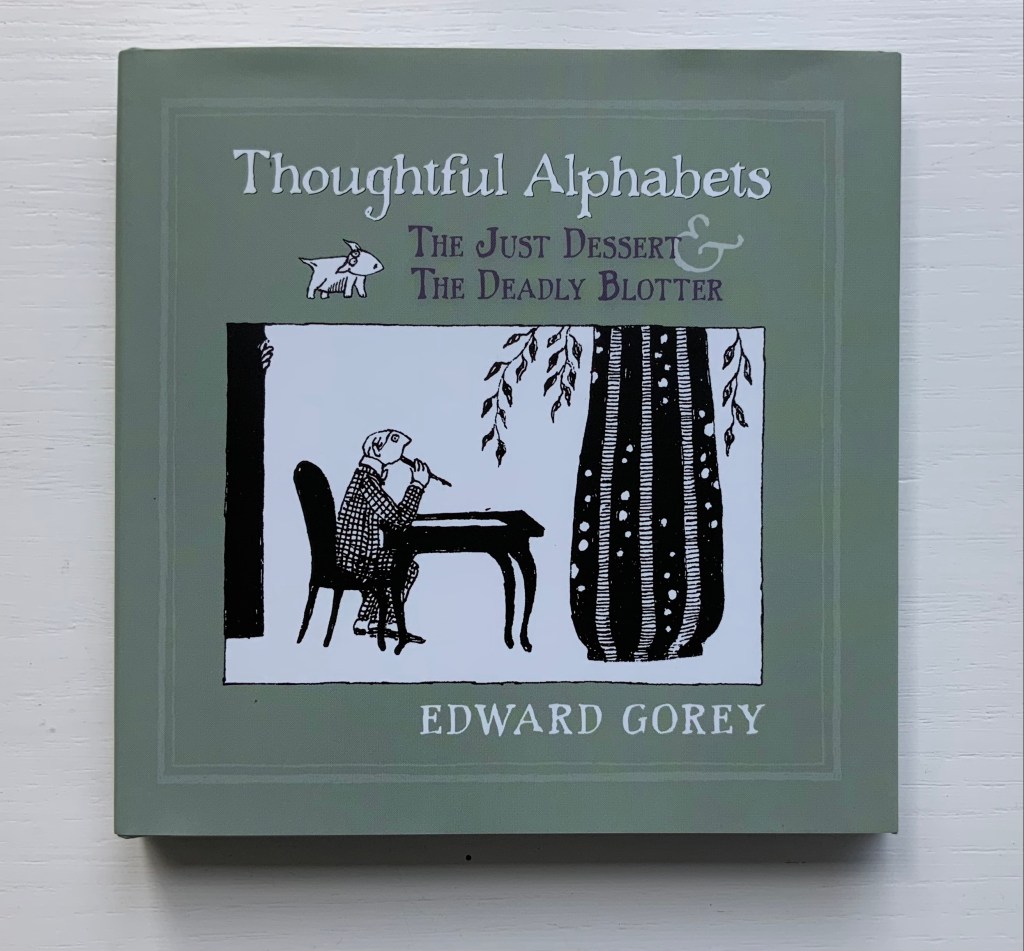
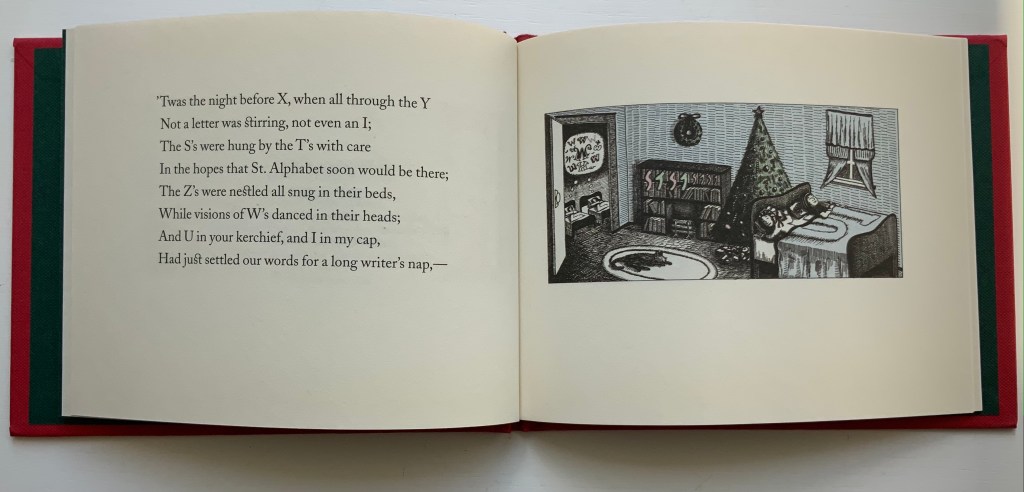
Edward Gorey’s Thoughtful Alphabets (2012) represents the most narrative of his alphabet books in the Books On Books Collection. Patrice Miller‘s flagbook and Jacob’s Ladder adaptations reveal their structural opportunities.
Here is the alphabet in a courtroom drama. Thomas Edwards’ The Trial of the Letter ϒ alias Y(1753) has been rebound by Mark Cockram, a master of design binding.
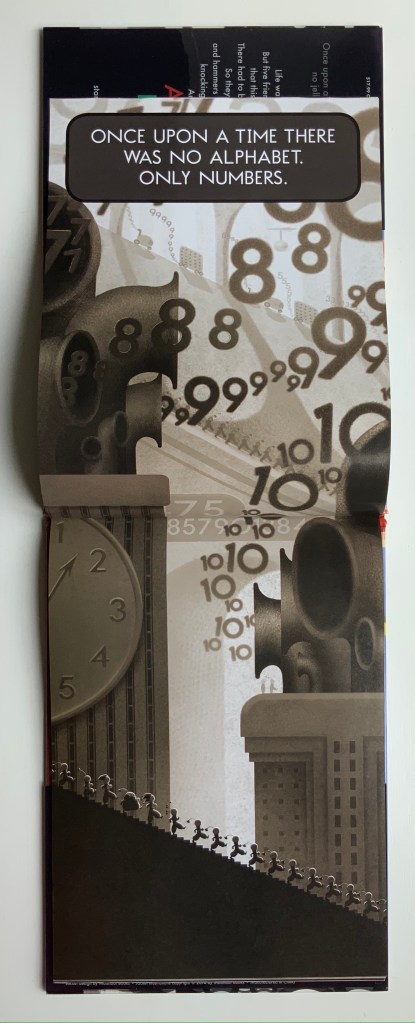
“Once upon time, there was no alphabet. Only numbers” So begins The Numberlys (2014) by William Joyce and continues with characters 1 through 5, who in the digital book version have distinctively different vowelly voices and, in both versions, invent the alphabet.
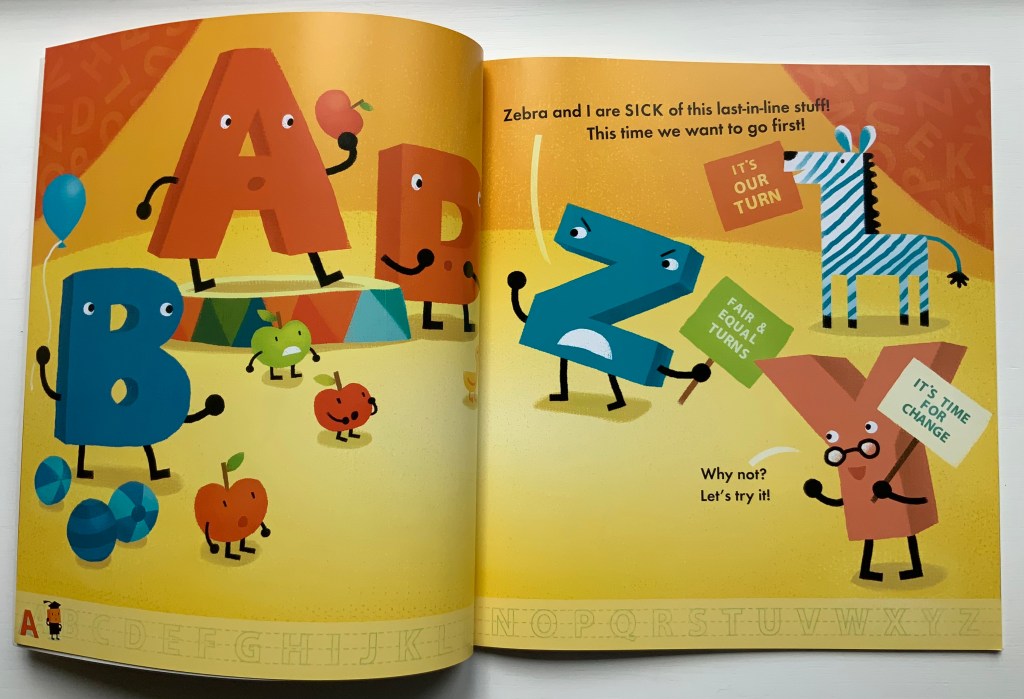
In Z Goes First (2018), Sean Lamb and Mike Perry introduce a generally milder Z, accompanied by a helpful Y always ready to ask why and why not when the other letters are less than cooperative with Z’s going first.
Yes, Virginia, there is a St. Alphabet. To find out, just read Dave Morice’s A Visit from St. Alphabet (2005), after the poem that Clement Moore originally wrote for you.
Molly Peacock & Kara Kosaka’s Alphabetique: 26 Characteristic Fictions(2014) Molly presents standalone stories for each letter of the alphabet, but when the character T appears (a maple tree), characters from the other vignettes show up, including the offspring of the words “A” and “THE”.
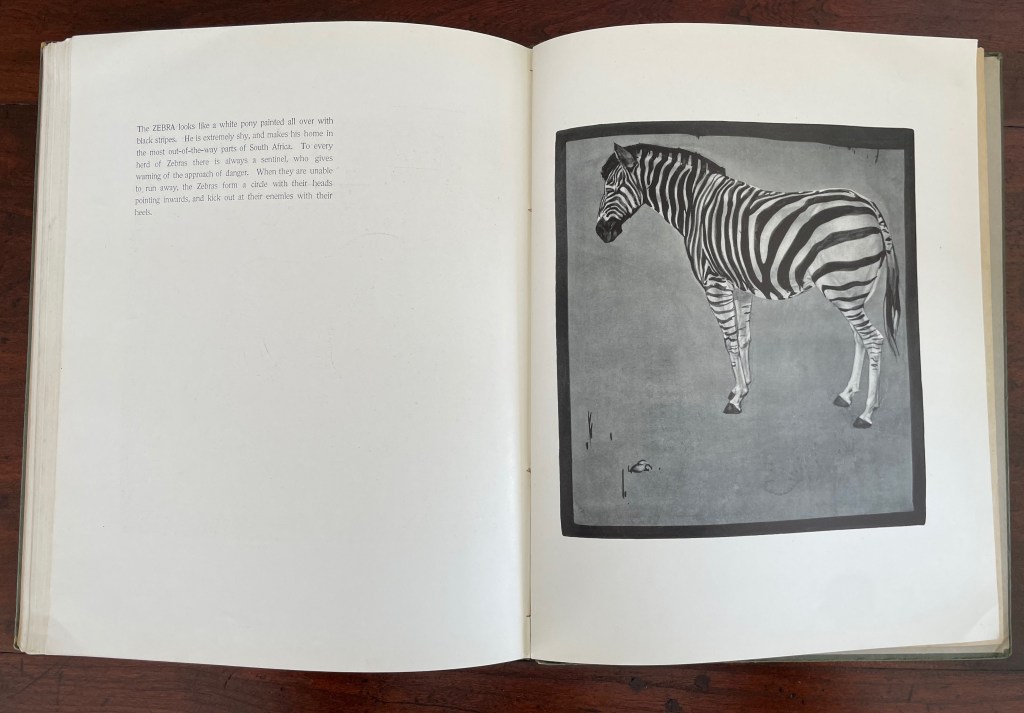
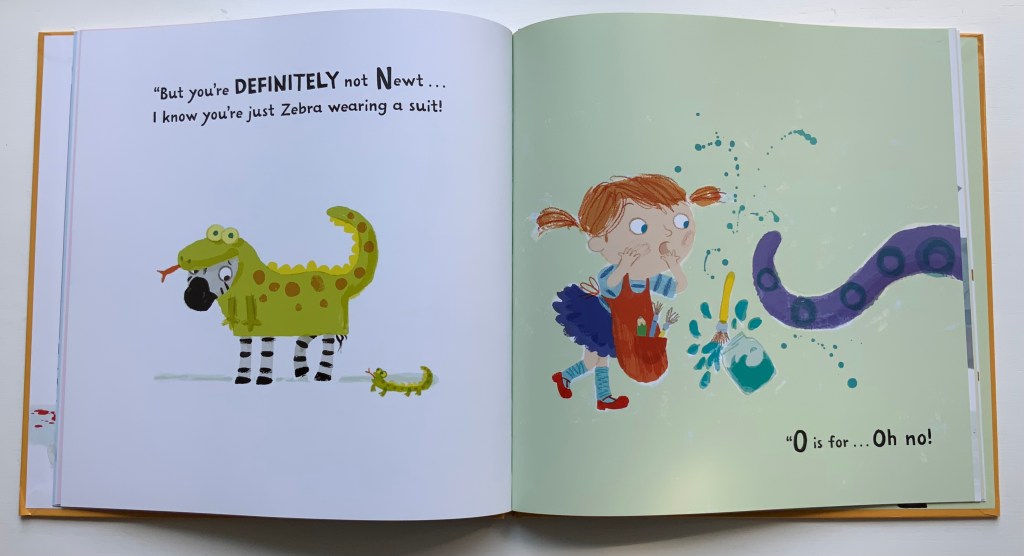
In Not Yet Zebra! (2018), Lou Kuenzler & Julia Woolf let Z’s “inner Zebra” loose on poor Annie who just wants to paint her alphabet in the right order.
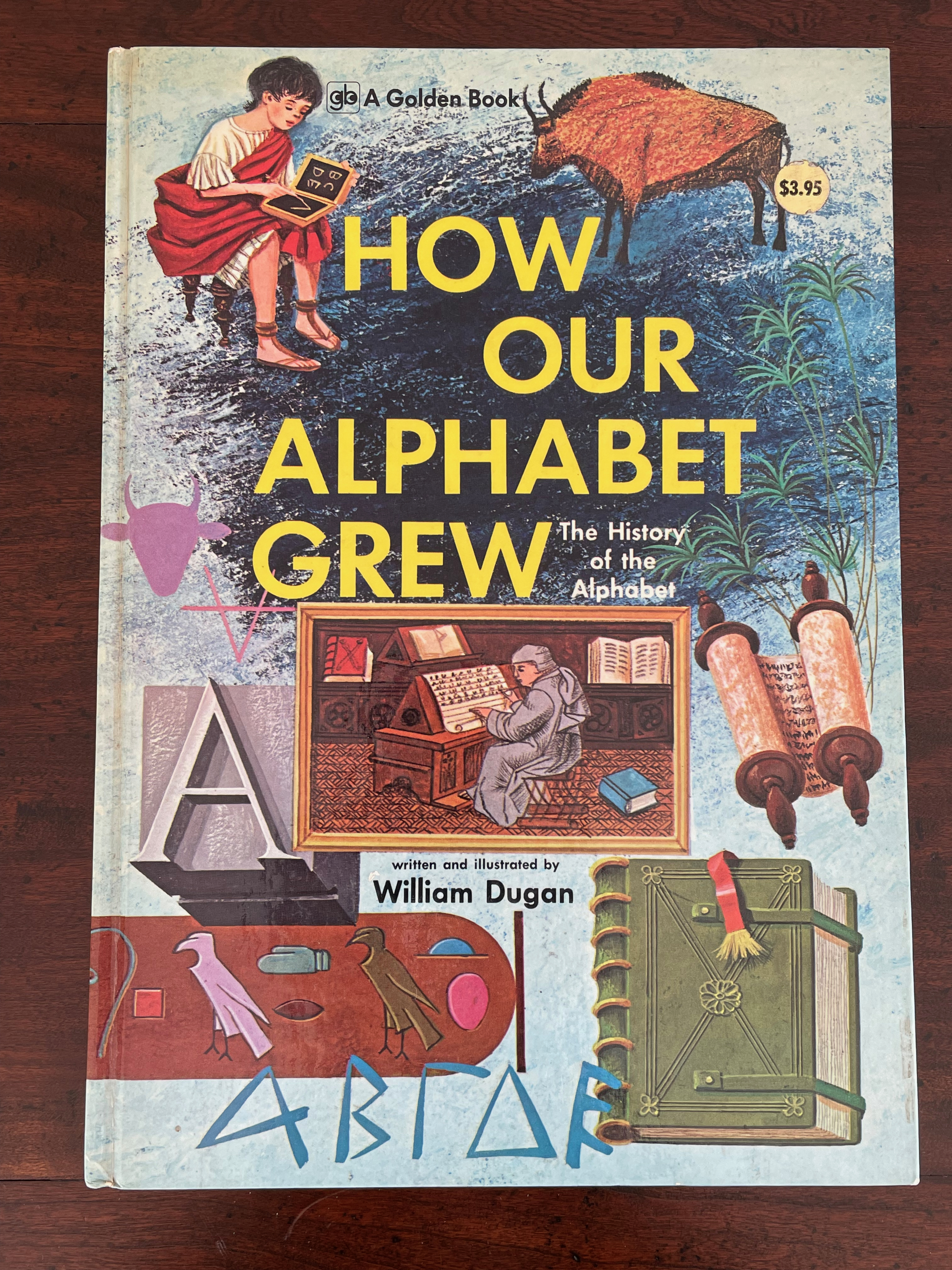
Where did the alphabet come from? The ancient Egyptians claimed that Thoth brought writing to us; the Babylonians, Nebo; the Sumerians, Nabû; the Greeks, Hermes or Zeus; the Norse, Odin; the Hindus, Ganesh; the Mayans, Itzamna; in the Bible, God through Moses; and in the Qur’an, Allah. (Flanders in Bibliography)
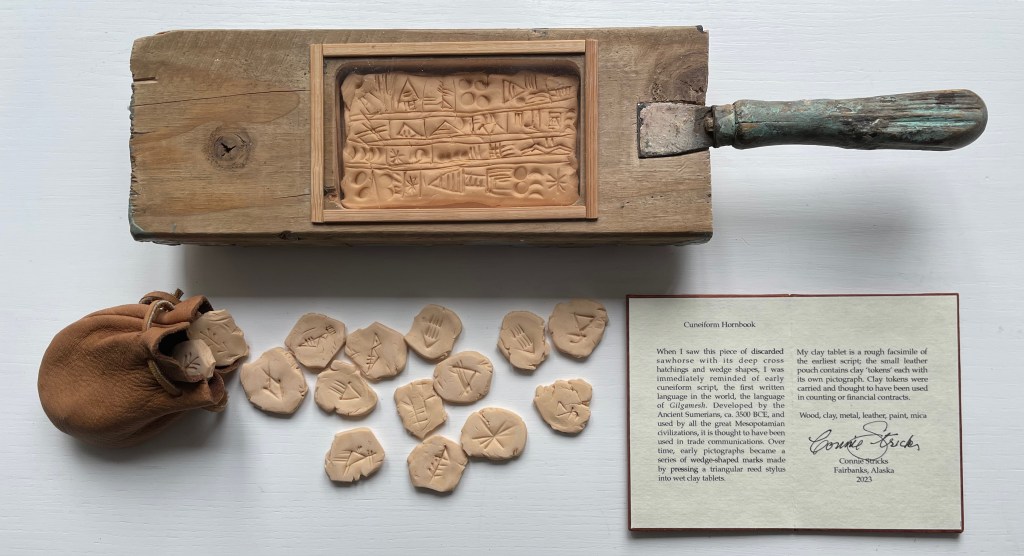
For millennia, it was a mystery. Over the last three centuries, anthropologists, archaeologists, historians, linguists and paleographers have agreed general lines of explanation. One line starts from cuneiform (wedge-shaped marks on clay) used in the 4th millennium BCE in Sumer for accounting and administrative purposes. In the 3rd millennium BCE, some cuneiform glyphs came to represent Akkadian and Hittite language sounds. The other line starts from a Semitic consonantal script used in the 2nd millennium BCE in the Levant. In this pre-alphabet, shapes for sounds started more directly with the shapes of things, and over time, the shapes turned into symbols for the initial sounds of the thing depicted.
So, a stylized drawing of an ox’s head that was used for the word for ox turned into the Phoenician glyph 𐤀representing the initial sound of ‘aleph, the Phoenician word for ox. After the Phoenician alphabet reached Greece and beyond, the glyph tilted to become A, representing any instance of the sound /a/. The Greeks changed the glyph’s name from ‘aleph to alpha as well as the name of the glyph 𐤁 from bēt to beta, from which comes our word “alphabet”.
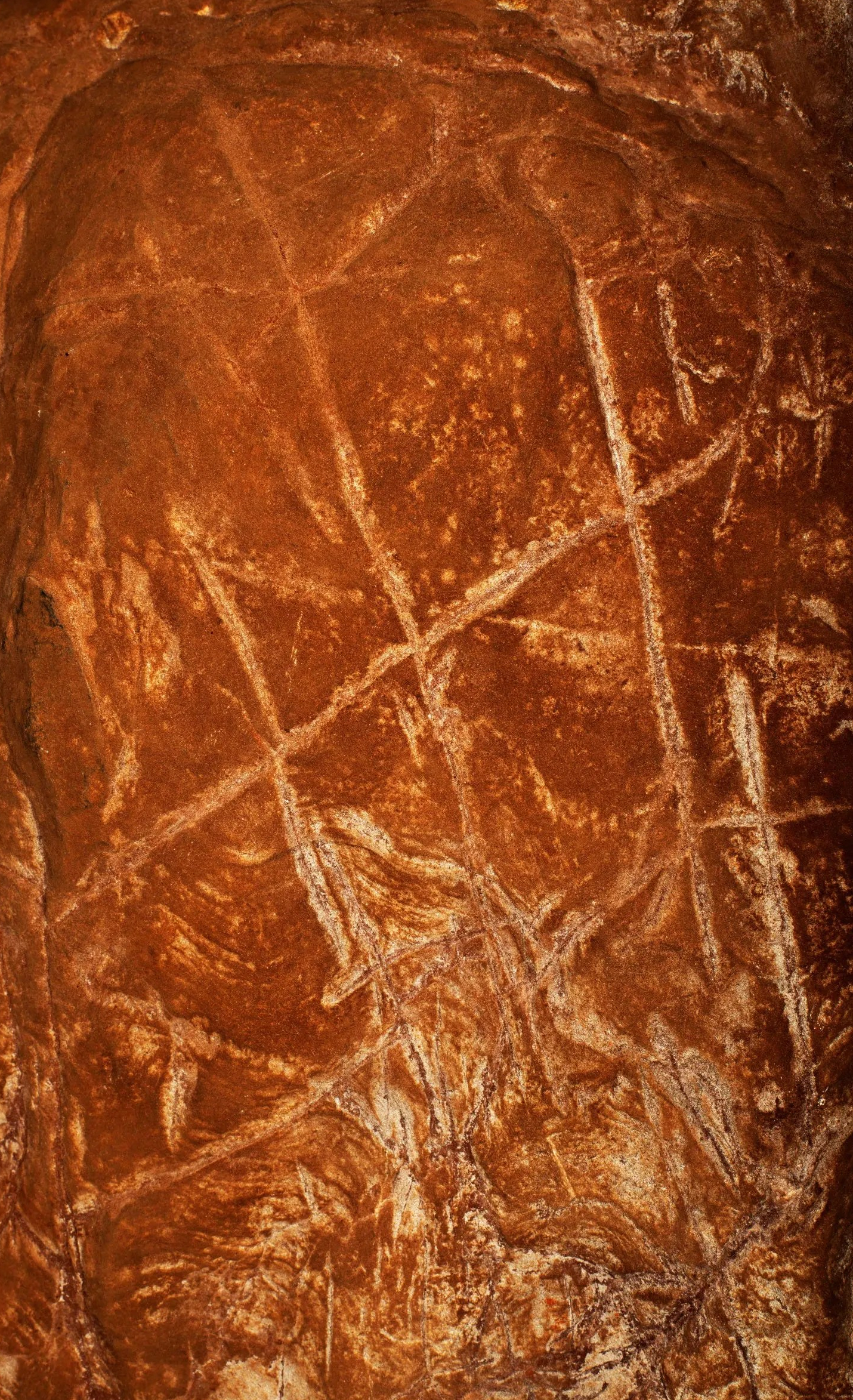
In the last decade, however, the earliest point of the alphabet’s symbol-making origin may have slipped back into mystery with the discovery of carvings in South African caves, possibly the work of Homo naledi, a much smaller-brained hominin species whose fossils have been dated to between 236,000 and 335,000 years ago. (Wong in Bibliography)
Left: Bolter, D.R. et al. 2020. “Immature remains and the first partial skeleton of a juvenile Homo naledi”. PLoS One 15 (4). CC BY-SA 4.0. Right: Berger, Lee R. et al. June 2023. “241,000 to 335,000 Years Old Rock Engravings Made by Homo naledi in the Rising Star Cave system, South Africa”. bioRxiv. CC BY-SA 4.0.
Such mysteries and explanations alike have been a source of inspiration for children’s books and artist’s books. [Links in the captions will take you to more images and details.]
Chloë Cheese, a talented artist and illustrator, further enlivens Rudyard Kipling’s tale “How the Alphabet was Made” (1983)* with a colorful interpretation of the black-and-white drawings that Kipling originally included in the manuscript for his daughter Josephine. Another version can be found below in the Online Exhibition Bonus!
Inside and out, Cari Ferraro’s The First Writing (2004)* echoes early cave paintings and challenges the administration theory of writing’s origins.
In the Bodleian exhibition but not shown here due to rights issues: Abe Kuipers’ Letters (1983).
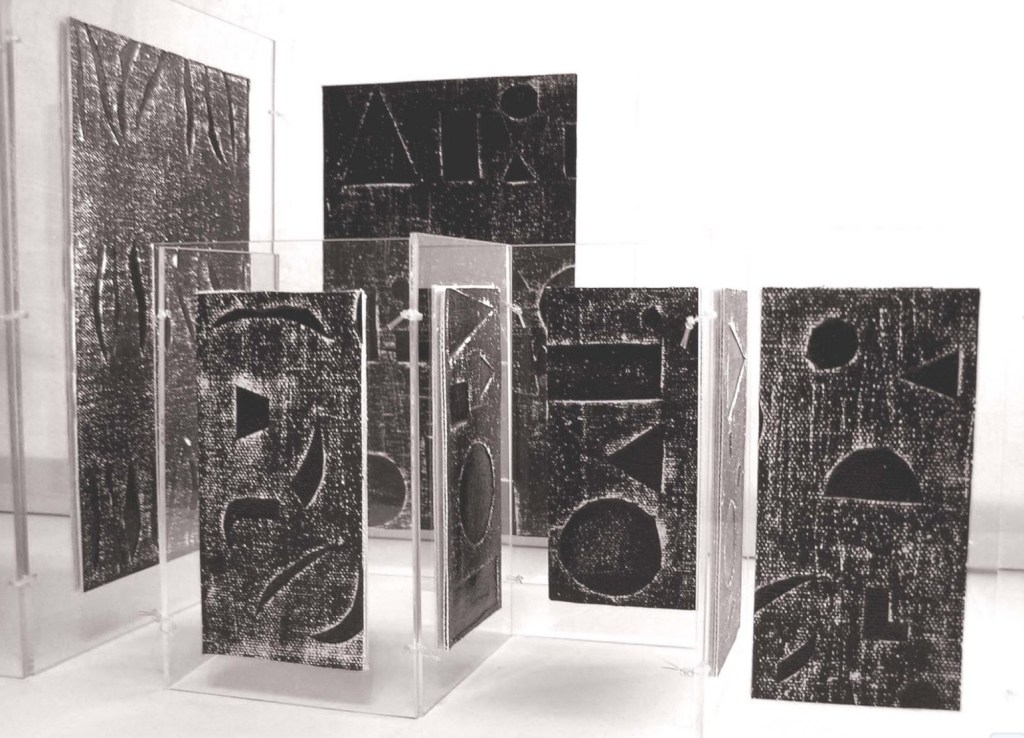
Helen Malone’s Alphabetic Codes (2005)* consists of separate plexiglas accordion books that open into a sculptural view of the abstract markings that have emerged in the search for the alphabet’s origins.
James Rumford’s There’s a Monster in the Alphabet (2002)* retells Herodotus’ account of how the Phoenicians brought the alphabet to Greece. Rumford has also written and illustrated children’s books on the invention and process of papermaking, Gutenberg, Sequoyah (inventor of the Cherokee syllabary), Champollion (decipherer of the Rosetta Stone), Chadian arabic, Chinese explorers and much else to celebrate languages and cultures.
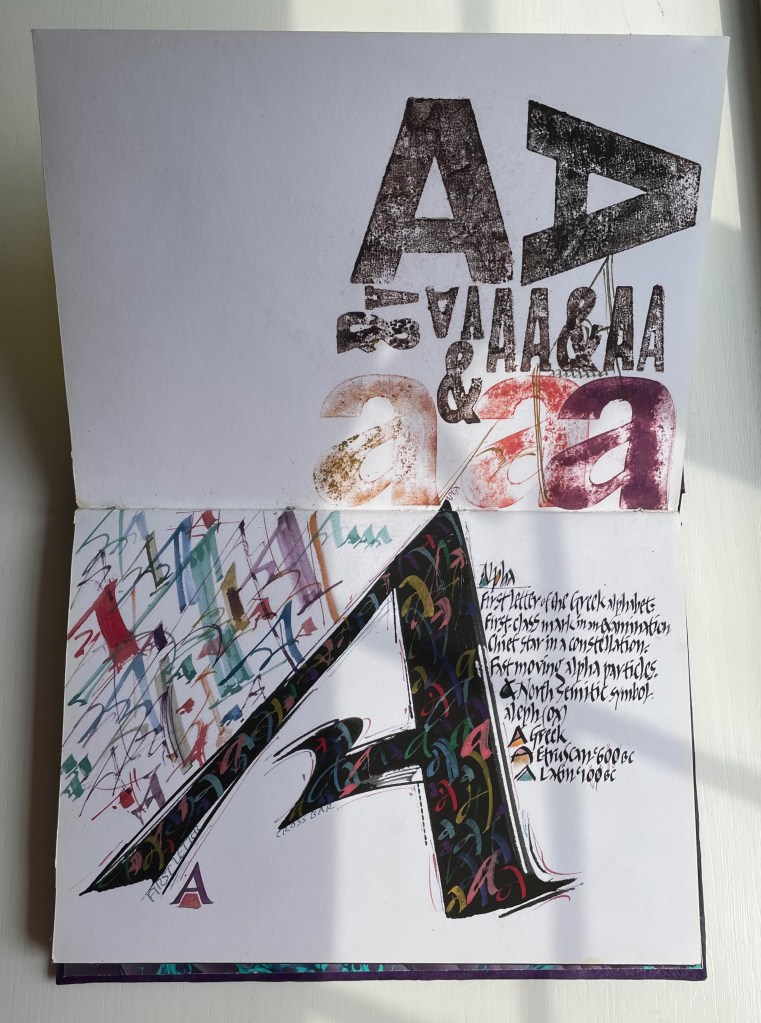
Letter by letter, Dave Wood’s Alphabetica (2002)* celebrates the alphabet with a multitude of calligraphic and letter-form styles. Wood integrates inscribed captions that show and comment on the development of each letter.
Online Exhibition Bonus!
The letter B derives from the Phoenician word bēt (meaning “house”). Lanore Cady’s Houses and Letters (1977) calligraphically displays every letter’s development. Inscribed verses aim to link the letters and houses depicted in Cady’s watercolors.
Slipcased, beautifully clothbound and well-designed, Lyn Davies’ A is for Ox (2006) belongs to the fine press tradition. Despite its brevity, A is for Ox conveys just as much as many lengthier books on the origins of the alphabet. See the Bibliography for additional reference works on the alphabet’s history.
William Joyce’s The Numberlys (2014) takes an inventive approach to the theory that numbers preceded letters and led to the alphabet’s invention. The five characters who are the story’s heroes (representing the five vowels?) first made their appearance online in an interactive app. Ironically, the app is no longer available. It is perilously stored on an early iPad in the Books On Books Collection and has been “backed up” by this print version.
Gerald Lange’s The Neolithic Adventures of Taffi-mai Metallu-mai (1997) reproduces Kipling’s own drawings for “How the Alphabet was Made” and includes “How the First Letter Was Written”. With the variety of Japanese papers, watercoloring of the text leaves, handsetting of type, letterpress printing and tortoise shell edge-sewn binding, this represents a special strain of artist’s book.
David Rault’s ABC of Typography (2019) traces 3,500 years of letters and type from pictographs and cuneiform through Roman lettering and Gutenberg to the Bauhaus and beyond. What distinguishes it from the works above and other illustrated reference works in the Books On Books Collection is its origin in the Franco-Belgian tradition of lesbandes dessinées (BDs), which the French and Belgians call laNeuvième Art (“the Ninth Art”).
Painter Ben Shahn’s The Alphabet of Creation (1954) presents a Hebrew abecedary by recounting the story of how the twenty-two letters responded to God’s invitation to make their cases for being the first letter of the alphabet.
Renowned as an expert in Hebrew palaeography, Ada Yardeni was also known for her art, calligraphic hand and storytelling. Combining all these talents, A-dventure-Z’ (2003) crosses the boundaries of scholarly reference, children’s book and artist’s book.
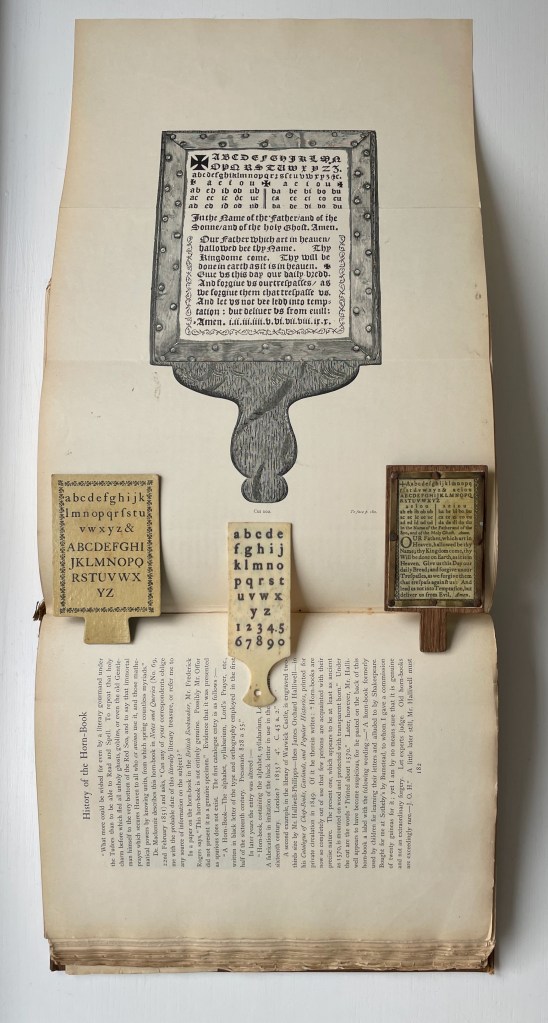
According to Peter Hunt, the first example of teaching the English alphabet with illustrations appears to be John Hart’s A Methode, or Comfortable Beginning for All Unlearned(1570); it is even the first instance of “A is for Apple”. John Amos Comenius’Orbis Sensualium Pictus (1658), a later example of a pictorial Latin alphabet, was translated into English is 1659. But these are not the earliest alphabet tutorials. In History of the Horn-Book (1897), still the most authoritative book on the subject, Andrew White Tuer traces the earliest record “of a real horn-book with horn and not a mere alphabetical table” back to an equally important date in the history of printing and publishing: 1450. See the Online Exhibition Bonus below, however, for Erik Kwakkel’s challenge on this date.
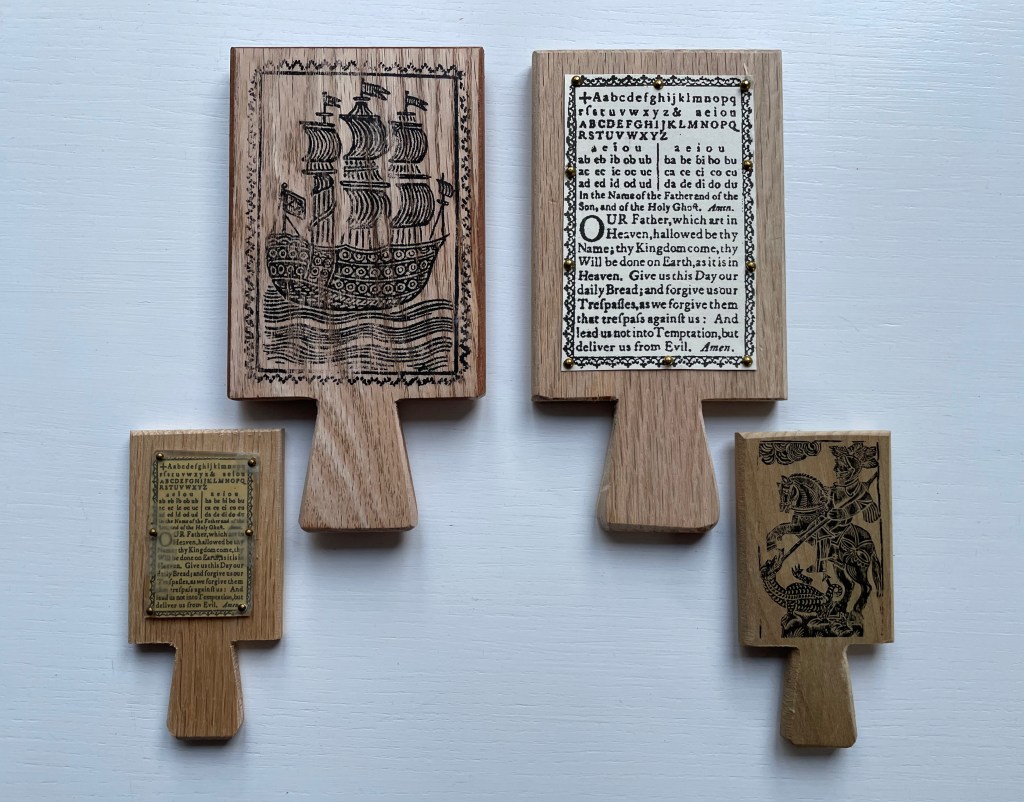
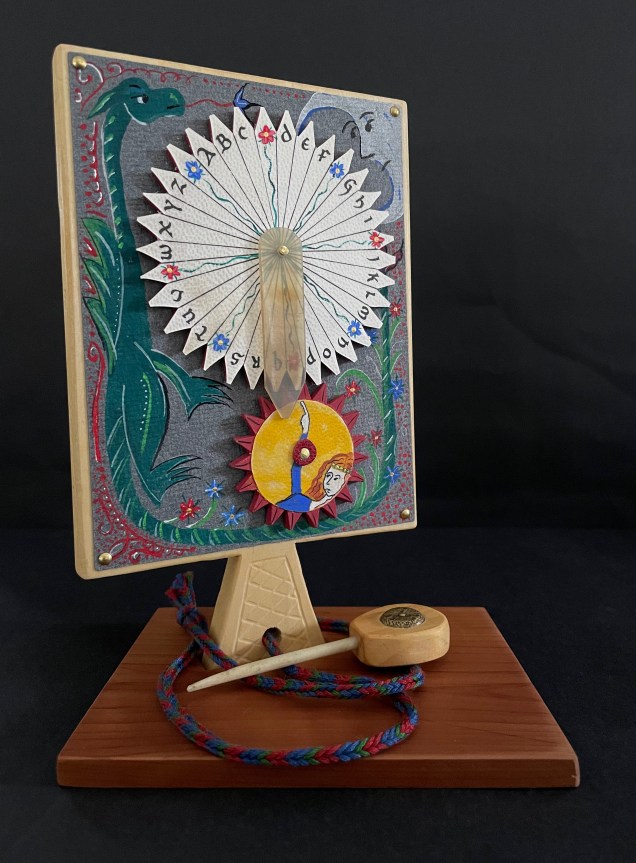
The display case in Oxford for “Alphabets Alive!” included some of the Bodleian’s earliest examples of the horn-book. Here are some of the other works also shown there as well as some novelties and Tuer’s book. [Links in the captions will take you to more images and details.]
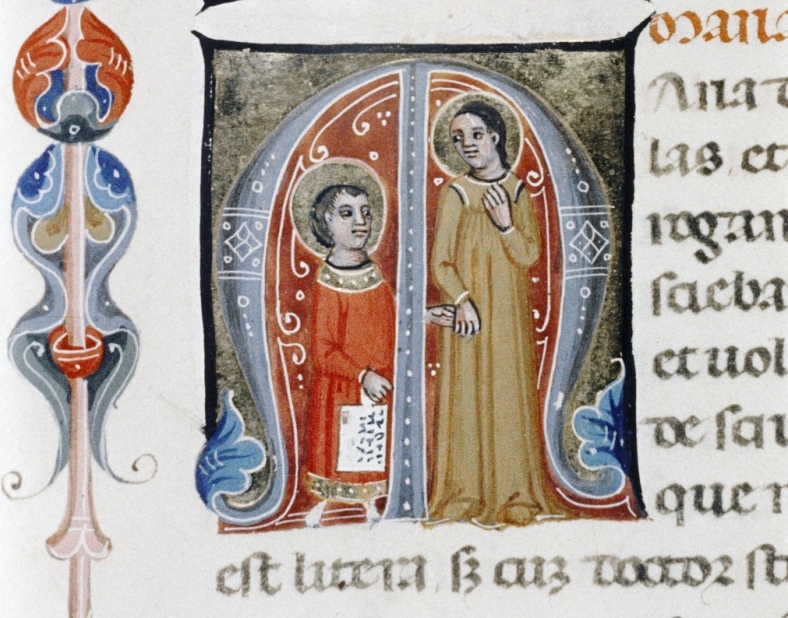
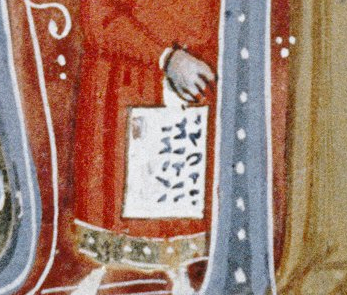
On his website Medievalbooks, Professor Erik Kwakkel has challenged Andrew White Tuer’s estimated date for the horn-book’s first appearance. Here is his discovery from the treasures in the Bodleian, right under the nose of the Alphabets Alive! exhibition:
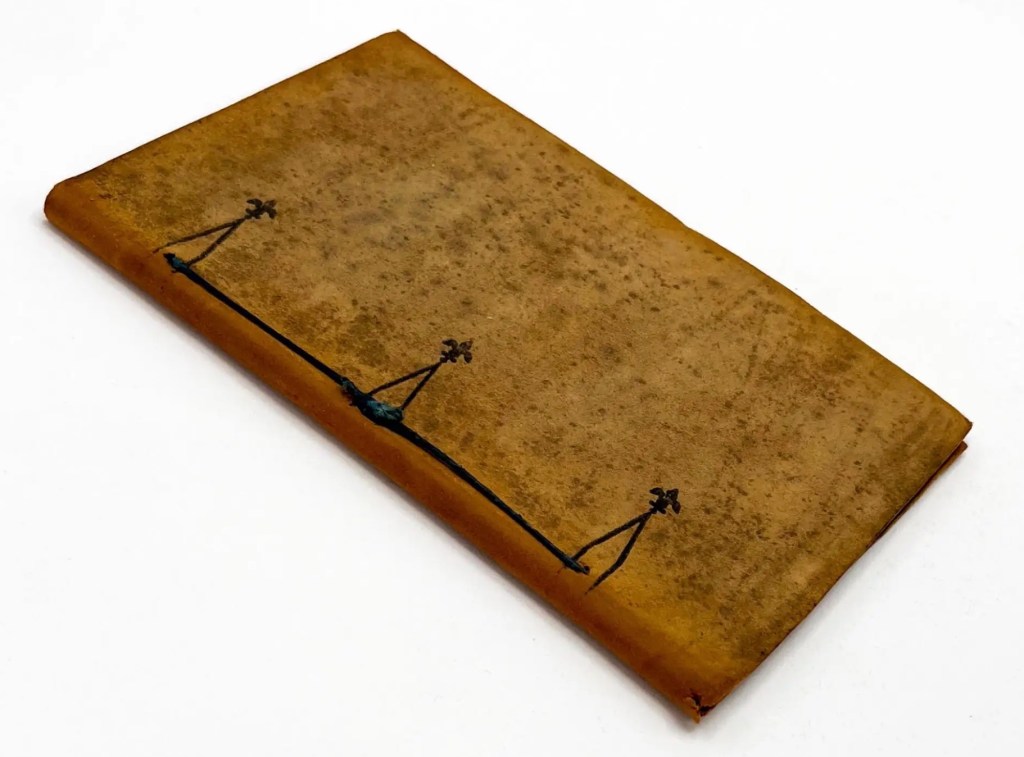
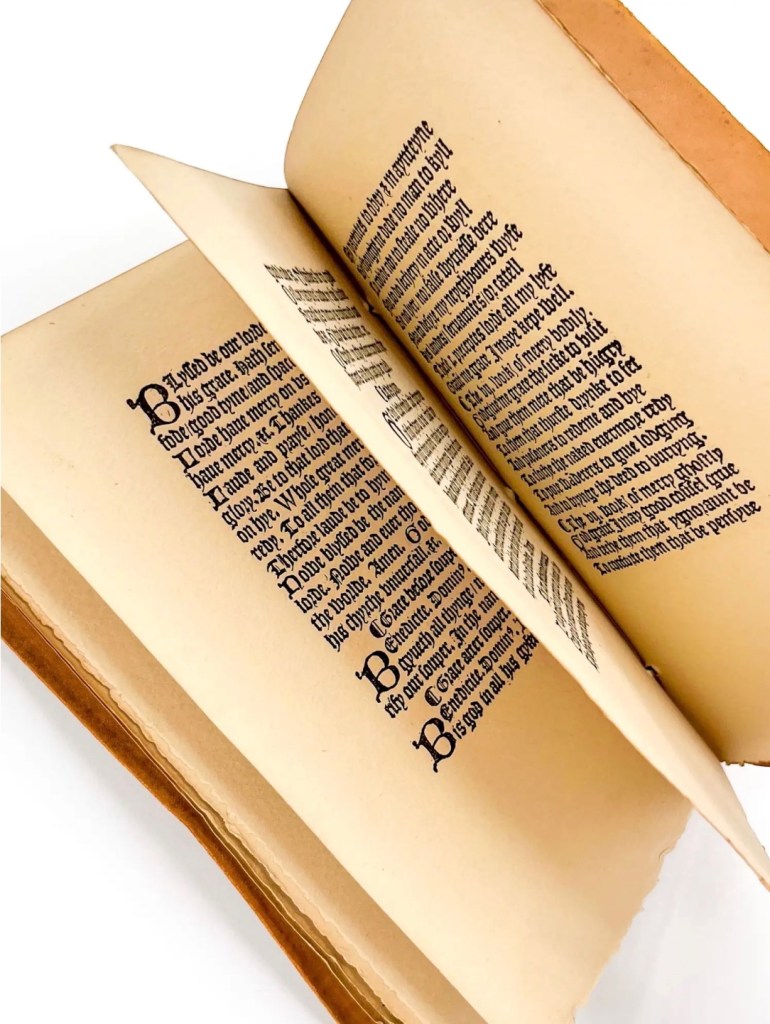
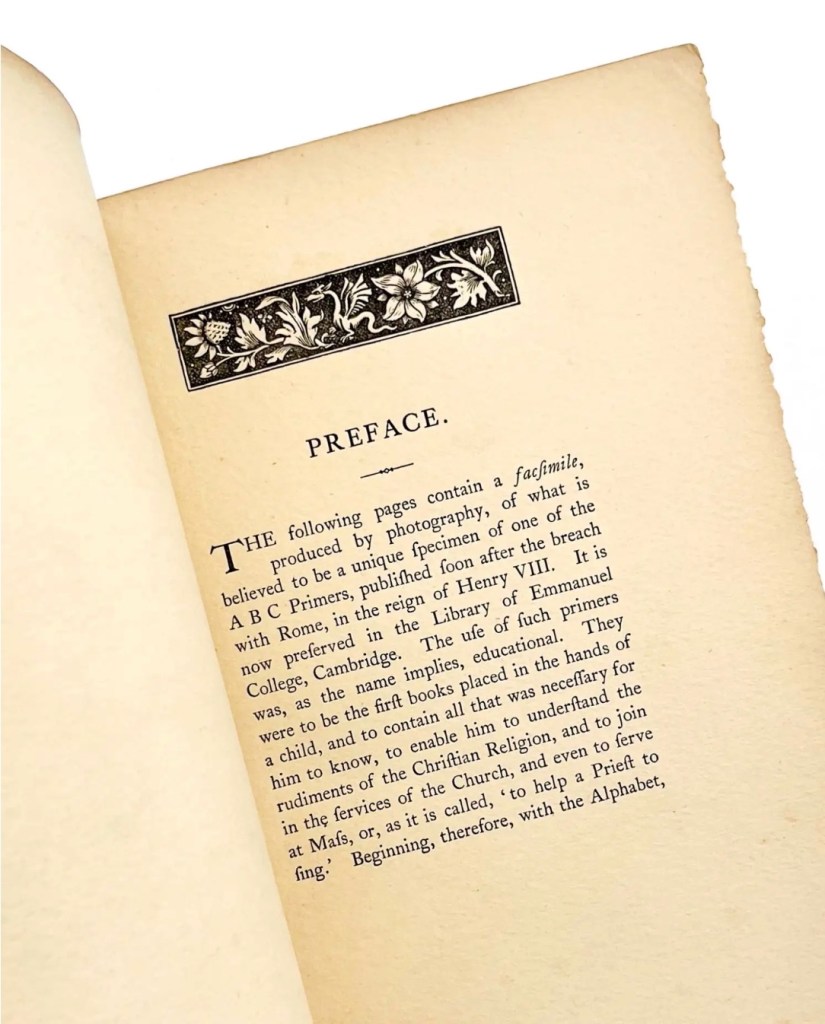
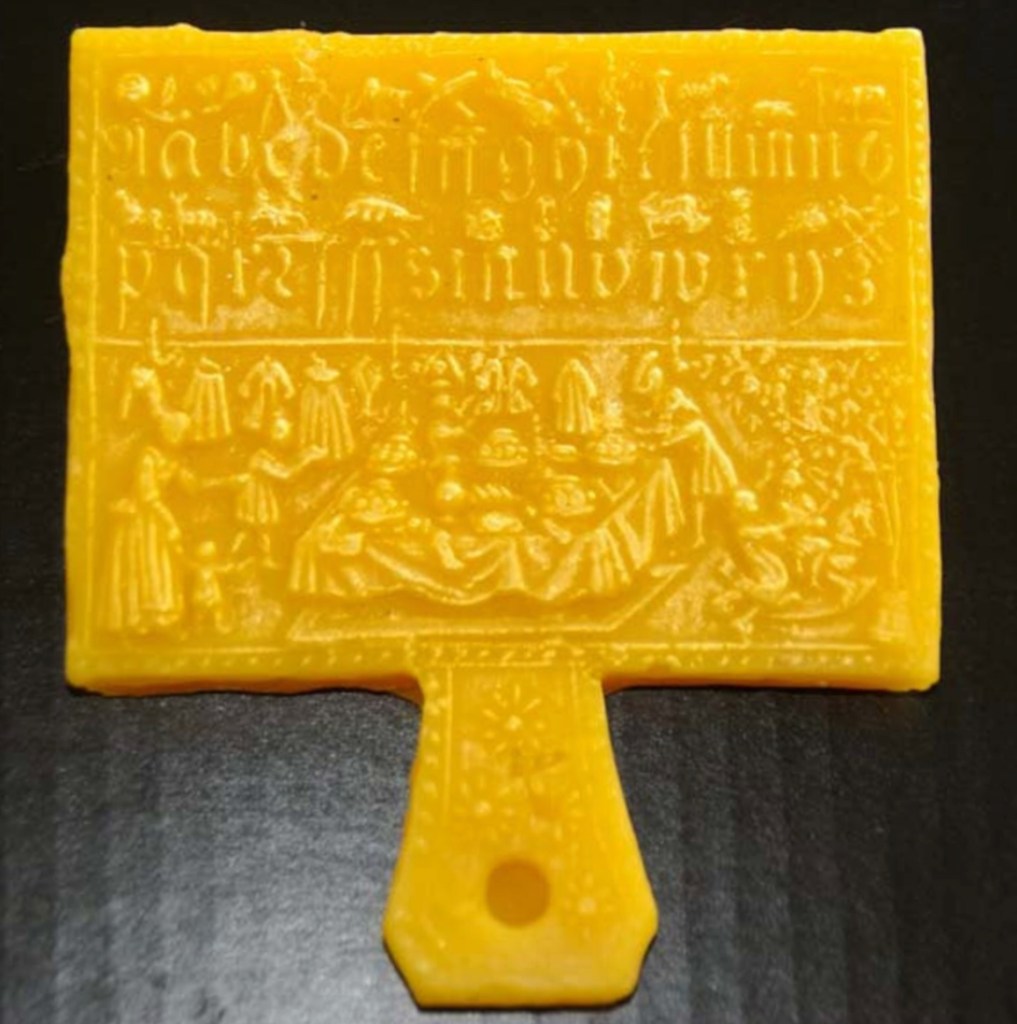
Although Tuer (below) devotes several pages to gingerbread horn-books made from cookie moulds, he does not mention any predecessors to this other home craft spin-off.
In the upper left corner of the image on the double-page spread can be seen the image of the cross from which the horn-book picked up its nickname “criss-cross row”. The three horn-books displayed atop the double-page spread were included in the limited edition of the book. The deluxe edition included five!
Facsimile horn-books. Real cow horn is used for the cover of the horn-book at the lower left.






































 Books On Books