If the pen can be mightier than the sword, can a bookmark be mightier than Amazon? Bow Software Ltd in the UK thinks so. Using NFC technology, Charlotte Quickenden’s firm has committed “digital metonymy”: a bookmark that delivers the book.
A PhysiDigi Bookmark is a physical form which acts as a digital trigger to download an ebook. A PhysiDigi Bookmark has value, the value of the ebook that it opens for you to read. Therefore if you want to buy it, you purchase the ebook just as you would any other book by exchanging money with the vendor be that bookshop, venue or exhibition. The ebook is then yours. You own it, this is not an ebook lease controlled by DRM. If it’s a good ebook you can lend it, or, if it was a present you can wrap it and gift it. This physical digital thing is tactile, it has visual appeal, and through the act of acquiring it you will naturally have a closer connection to it than a box that you tapped ‘install’. Charlotte Quickenden, MD, Bow Software Ltd., via Bookshops of the Future: Where Physical and Digital Co-exist.
NFC (Near Field Communication) is the wireless transmission of data from a hardware device to another physical object within 10 centimeters of the device. Both must have embedded NFC chips and antennas. Quickenden hopes that her bookmarks with embedded NFC chips and antennas will level the playing field for bookstores, which for some publishers have fallen to less than 10% as a source of sales. Listen to Quickenden describe the PhysiDigi bookmark and watch it in action.
rankfurt is upon us, so here is a celebration of type and the book. The initial “F” comes from Boekwetenschap en Handschriftenkunde Amsterdam, wherePaul Dijstelberge and others have posted over 30,000 photos of initials, ornaments and type in cooperation with the Special Collections, Amsterdam; the Royal Library, The Hague; and the Archive at Alkmaar.
Much has been made in recent years about the emergence of the ebook and the ‘death’ of the printed book. Such discussions are fashionable and fruitless. As long as people read, the shape or form of the book is irrelevant. In fact, the ebook may well be a blessing in disguise for those who passionately defend the printed book. Photography did not kill off portrait painting as it was once feared; neither will the ebook refer the printed text to the dustbin of history.
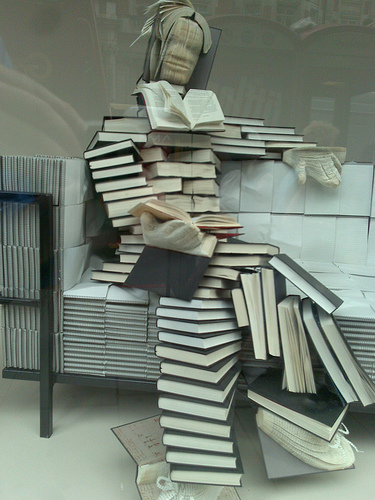
Photography may not have killed off portaiture, but digital photography did kill off Eastman Kodak. Which entities ebooks will see off will be debated until the event. The shape or form of extended narrative and discourse, however, is surely not irrelevant. The Fantastic Flying Books of Mr. Morris Lessmore and the walk-in book exhibition Memory Palace at the Victoria & Albert Museum are recent evidence. While more evidence may be adduced, do we need it to know that shape and form matter, or that we gather each year in Frankfurt to celebrate reading and its shape and form?
Image by markhillary Window display at Harvey Nichols in London via Book man | Books Images.
Giuseppe Arcimboldo’s portraits commissioned by the court of Rudolph II are his main claim to fame. Take some time with Jonathan Jones’ superb article on Arcimboldo and the 2008 exhibition devoted to his work at Vienna’s Kunsthistoriches Museum.
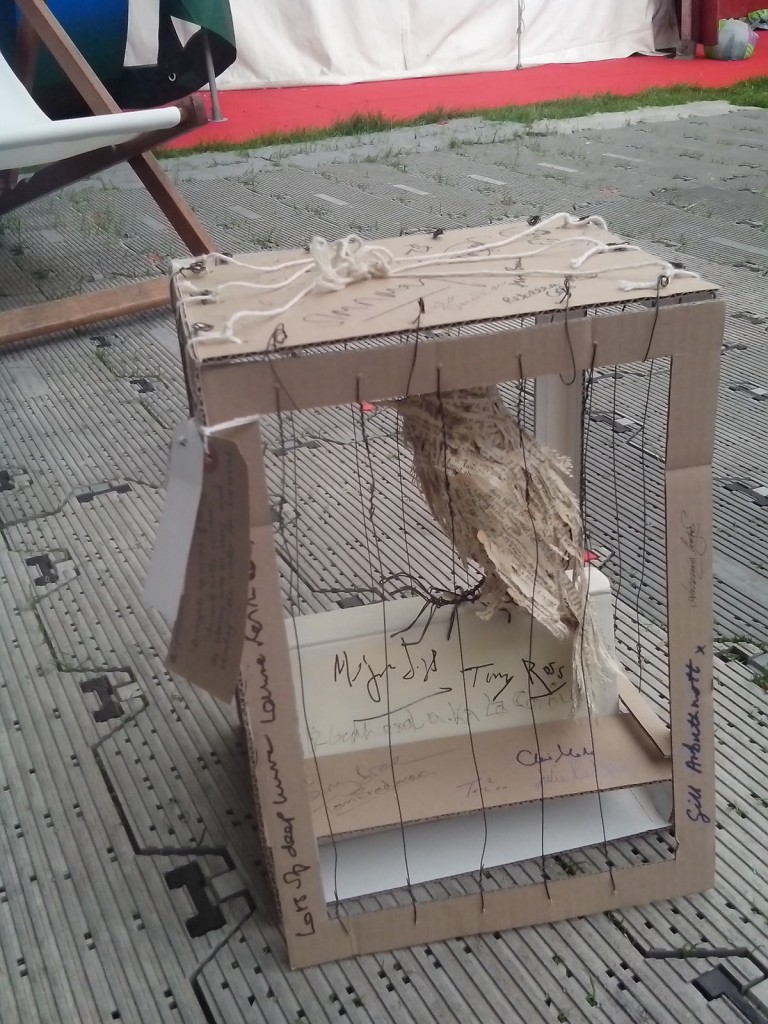
Paul St John Mackintosh posted some intriguing sleuth work at Teleread this month, occasioned by the Edinburgh International Book Festival. The work—and identity—of the MBAE (Mystery Book Artist of Edinburgh) has been a recurrent theme throughout the Festival. She has delivered works specifically for the Festival, which are part of her “Free to Fly” campaign (see @_freetofly_). One of them has attracted the autographs of some of the celebrated authors in attendance.
On his way back to his digs in Edinburgh, Mackintosh says,
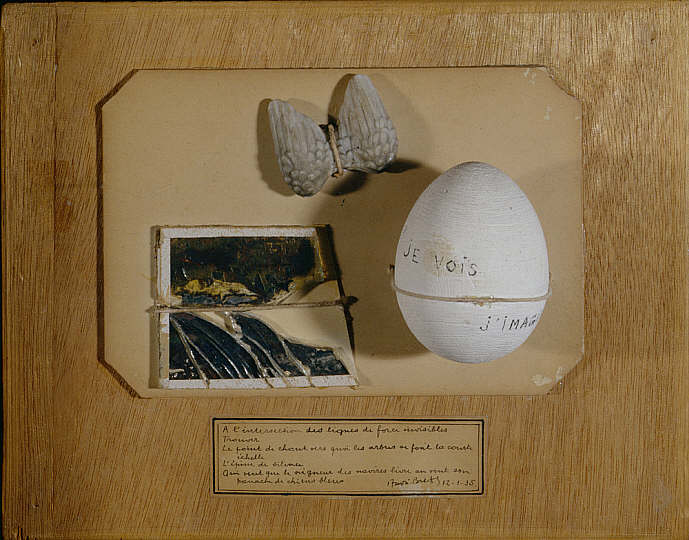
I stopped off at the Scottish National Gallery of Modern Art to see their fascinating “Witches and Wicked Bodies” exhibition. In their permanent collection is this work by André Breton, entitled Poème Objet (Poem-Object):
Poème Objet, André Breton
Mackintosh notes several other distinctive works in the Scottish National Gallery of Modern Art that find echoes in the works left by the MBAE in various places around Edinburgh such as the Leith Library and the Scottish Poetry Library. Edinburgh’s mystery book sculptures even have their own Wikipedia page.
MBAE’s “Free to Fly” campaign, run appropriately from her Twitter account, came to a close on the 21st of August, but as she writes in her farewell,
Berggren says he never believed that single-purpose devices like the original Kindle would become widespread, a prediction that seems to be playing out. But he did believe that multi-purpose tablets like the iPad would become most people’s primary e-reading devices, not phones. According to Readmill’s data, however, phones are not only the most popular e-reading device, they’re the best at keeping readers engaged, too.
“It is not only that they are spending more time reading the books because the screen is smaller. Even taking into account screen size, smartphone users read more often, they finish more books in general, they start more books, they share more quotes, and they write more comments,” says Berggren. “This paints a very clear picture that the people that are most engaged with their books are the people who read on their phones.”
To find a union of metal and the printed page as rich and tactile as that created by Andrew Hayes, we have to hark back to the days of hot metal typesetting or farther still to the chained library.
Books chained in Zutphen
As a Core Fellow at Penland School of Crafts, Andrew Hayes explored a variety of materials and technique, drawing on his experience in Portland, Oregon as a welder and his work with fabricated steel as a student at Northern Arizona University. At Penland, the book insinuated itself in this exploration, and his work today joins the rigidity of metal with the delicacy of the book page.
Placer Steel, book pages, and brass 10” x 7” x 9” Andrew Hayes, 2013
This codex is almost Dali-esque in its appearance. Its title seems to allude to the thumb index, and the fluid shape that distorts the indexed pages is a paradoxical cast on that title. As a work of art in the age of digital reproduction, it offers a slippery tale.
… in medias res … in the midst of things … Nel mezzo del caminn di nostra vita …
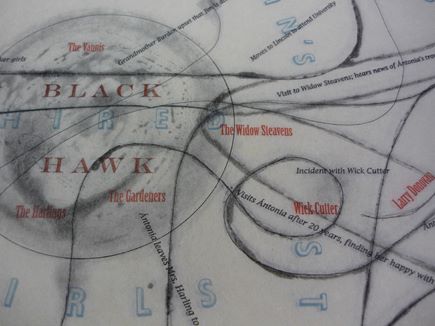
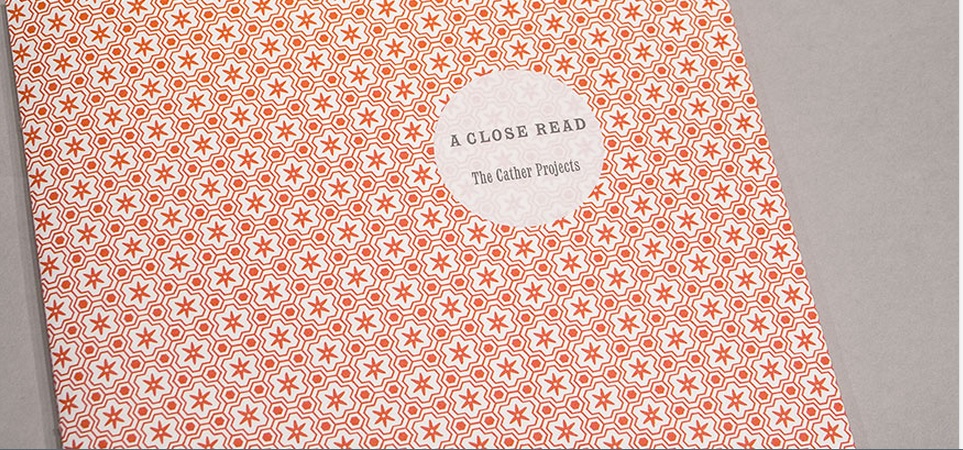
Mining My Ántonia; Excerpts, Drawings, and a Map Barbara Tetenbaum, 2012. A portfolio containing five automatic drawings/etchings, a book of excerpted text from the novel, a pull-out map, and a fragment from the 2010 installation at Reed College. The book is bound as a soft-cover pamphlet using reproduction fabrics from the late 1800s. The portfolio is cloth-covered binder’s board and features a wood frame to house and display the prints.
I asked Barbara Tetenbaum if we could base this interview on her selection of a book she owns and may or may not have read. Perhaps sounding like a card magician, I instructed:
Go to any row or stack of books (or file folder of books; yes, ebooks would count) in your home or workplace. Select the title that is in the middle. Please note the author, title, year of publication, publisher and ISBN, if available. Now, turn to the middle of the title selected and choose any element (paragraph, image, footnote and sentence footnoted, bit of dialogue, etc.). Please note the page number or other means of identifying the element’s location.
And here is the result of this “deliberated” selection of the book, of this bit of ordered randomness or random order in finding our point of departure for our interview.
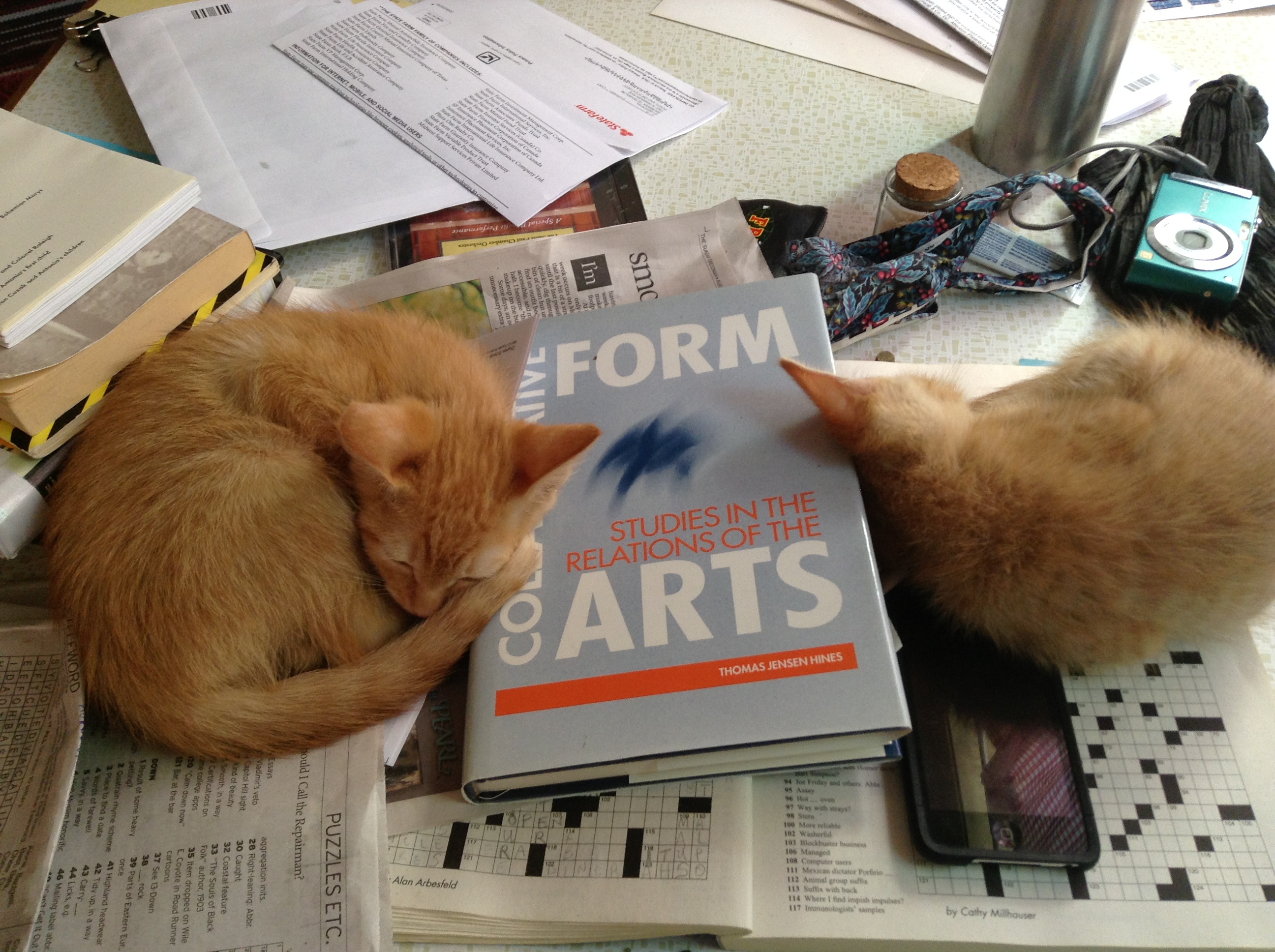
Hines, Collaborative Form, in Barbara Tetenbaum’s studio
BoB: Where was Hines’ book when you selected it? What are the objects immediately on either side of the book when it’s on the shelf? As you take the book from its place, what are your physical sensations? As you open it to its midpoint, what do you hear, smell or see about it or around it?
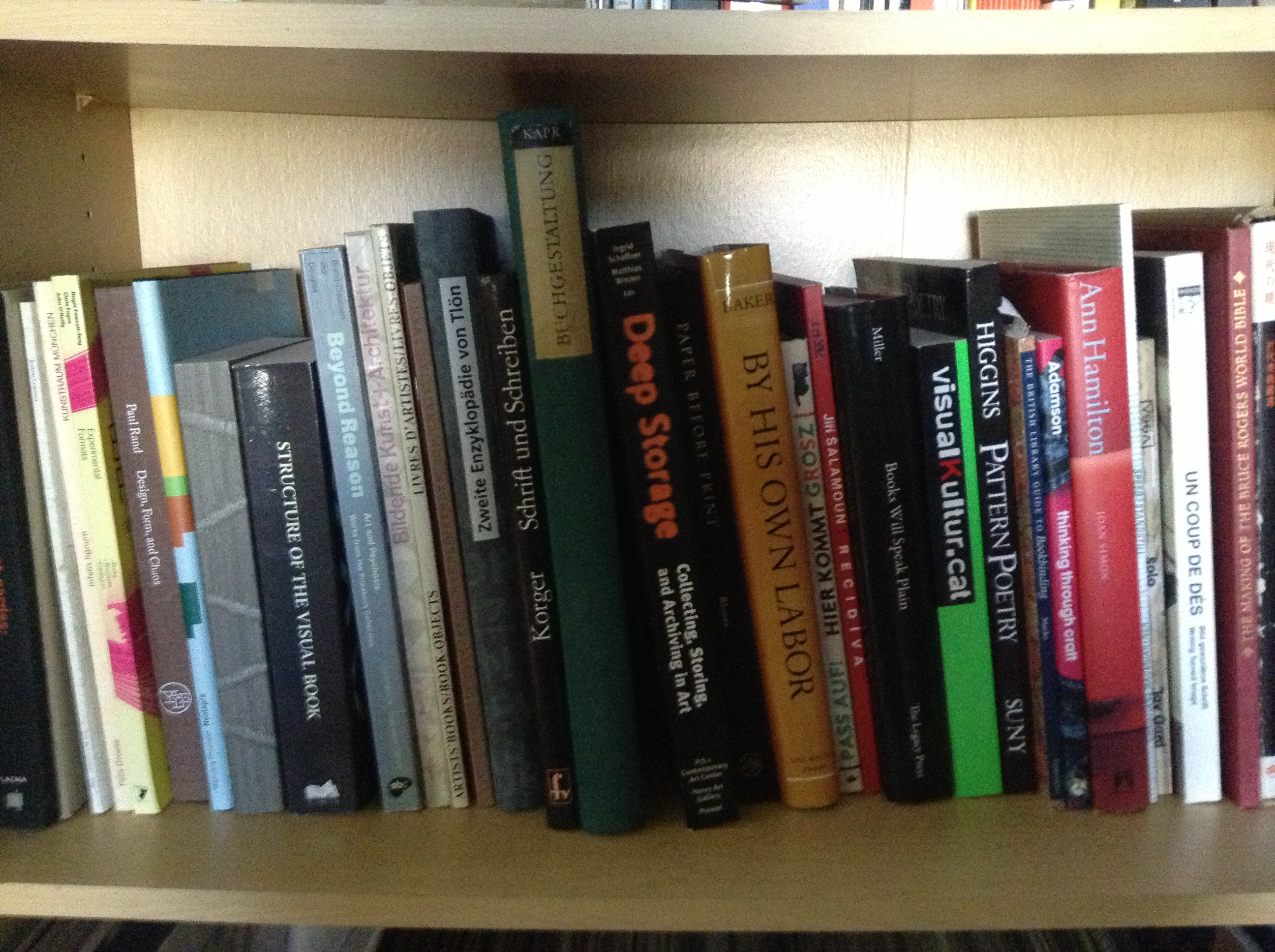
BT: I took the book from my living room, the main bookshelf that houses my main books-about-art library. I chose the middle shelf and the middle book.
Here are the first four books to the left of the book in contiguous order:
When I took the book out, I had these feelings: trepidation – on what was inside; pride – that I had found it years ago and knew to acquire it; charm – that it so reflects what I’m working on at the moment; slight disgust – at its ugly dust jacket; and curiosity – to read and discover what I had been missing all these years since purchasing it.
The book smelled academic. Like a book that is published for a very narrow audience and is rarely opened, but produced with a certain level of quality that is better than a mass-market paperback for instance.
And to say something about the adjacent books on the shelf: I was surprised how many of them had German content! These books represent people I have met, places I’ve been. For instance, the Hildegard Korger book was a gift from her after I spent a semester in Leipzig. She had been so very suspicious of me as an American, so shortly after the Wall had come down, very odd to speak with, but in the end she saw that I was trying to do something positive for the school and the students. She gave me this book and told me we could say “Du”. It was an important moment for me. And Peter and Ines’s encyclopedia is one of my favorite projects of the last decade or so. I admire them so much and can’t begin to imagine what it takes to make the work they make. I know them well, but they are super heroes for me. That book on paper is smart and continues to prove that the development of book culture is primarily a political process.
BoB: You say you had forgotten you bought this book. Having taken it from its place, have you recalled the circumstances of the book’s purchase? What were you doing when you decided to buy it? What prompted the purchase?
BT: I bought it possibly 10 years ago. I found it in Powell’s “Literary Criticism” section, which is a place I go to when I am not being productive in the studio and feel like reading some smart book will inspire me to be a better/smarter artist. I often buy books in this way that I don’t get around to reading. Or maybe I read a bit and find that it actually triggers an idea that was sitting dormant. In this case, I think it did. I was working a lot between music and visual books then. I was interested in the languages that these arts have developed individually and how these languages can be learned and used by other disciplines. This book for me is a bit dry as I like books that get to the point without exploring example after example. I’m often bored by the examples used by these theoreticians and would prefer them to get to the point! (that’s me in general).
BoB: As an artist whose work has an intimate relationship to “the book,” could you describe the effect this has on you when you are reading books in general?
BT: Reading/handling books can lead to many possible reactions! First off, I’m very aware of their physical body: the weight in my hands, the feel of the cover, of the paper, how well the book opens and the pages ‘drape’, the smell to a certain extent. I notice if the layout is of good quality, that the text is easy to read for my eyes, that this is an object that will help me spend time with its contents and not annoy me. I think we are all this way, though maybe not so conscious. Because I am both a book artist and a teacher, I’m always noticing/looking for books that add to the discussion about the dynamic nature of the book. So I may become interested in a book because it shows something that I want my students to think about, or that will inspire me to utilize a particular ‘move’ in a future project. So books themselves contain the evidence/proof of the vitality of the book structure and book organization.
I’m also very interested in the presumed ‘authority’ that books convey. I think this was my opening into the book arts back in 1979: to challenge this presumption. I still am!
BoB: Turning the question on its head, when the act of creating a work rather than the act of reading is in flight, how do books feed your working process?
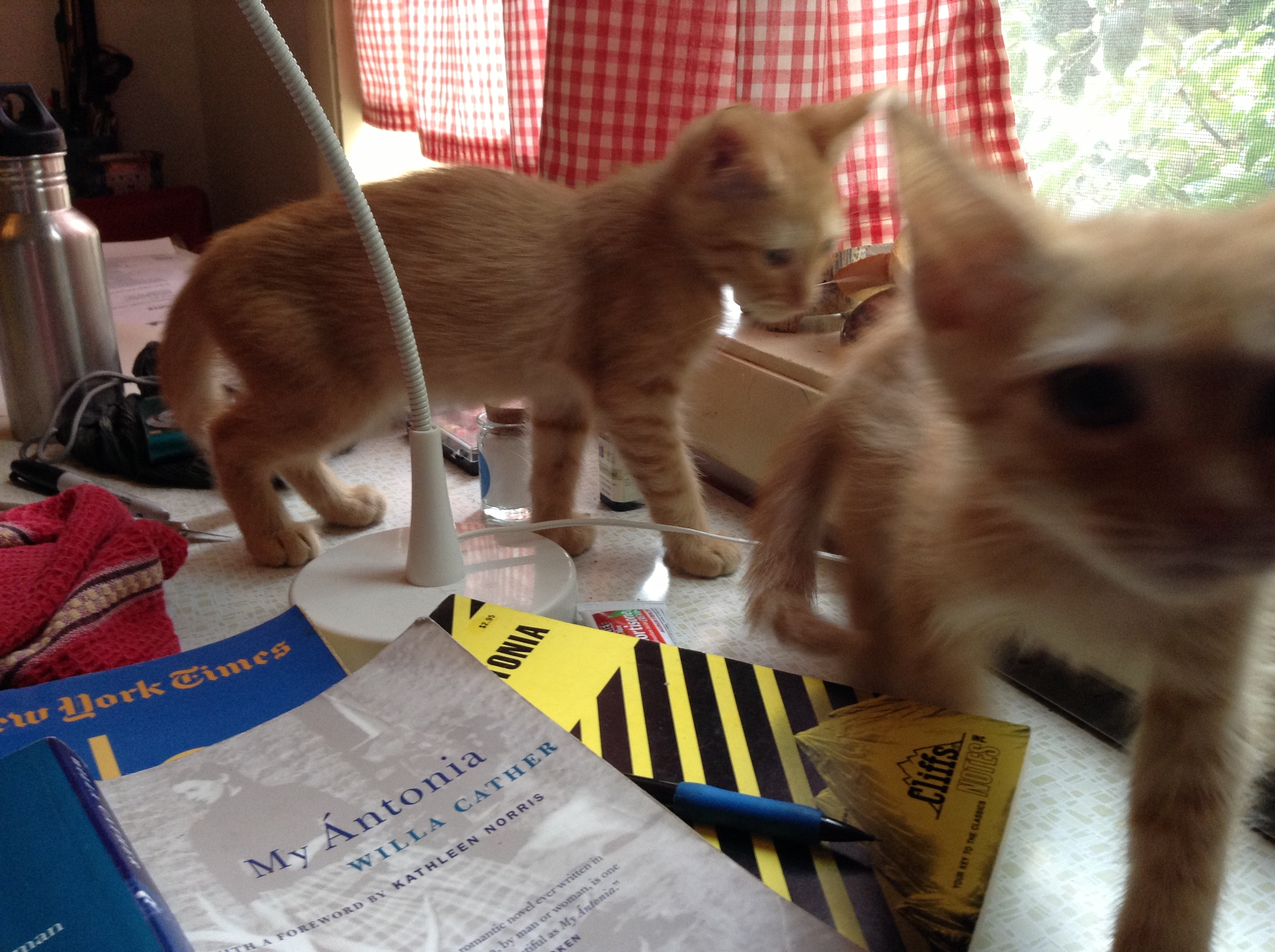
BT: When I’m working on a project, books are everywhere, on all surfaces. [In the] photo of my new kittens hanging out on my kitchen table [you can] see all the books that I was referencing as I worked this week on a new quick Cather project (creating a visual score for My Ántonia). Books are either direct source material, or they are reminders of a standard of design, or palette of colors, or format, or mix of materials, etc., that I want to influence this particular project. Buzz Spector gave an interesting talk a year or so ago on the artist’s library relationship to their studio practice. I like this image of the fluid interaction between the studio and the library.
BoB: As might be expected with a university press book, the Hines text is dry, but it came to life a bit for me when I noticed how it touches on two key themes in your life and work. In particular, the collaborative form in which two or more artists work together on a joint creation and the collaborative form in which an artist works the elements of two or more arts into a solo creation. Now you have taken this several steps beyond what Hines writes of. Not only do you work in mixed media but you collaborate with contemporaries (like Julie Chen) and with past authors and artists (like Willa Cather).
Most often we think of the literary or pictorial artist as creating in solitude. If asked for outstanding examples of artistic collaboration, don’t we most often turn to music? Picking one or more of your contemporary collaborations, can you tell me how that kind of collaboration works with what so many think of as the solitary creative process?
BT: Hmmm….’solitary creative process’ is definitely an aspect of being an artist and for me personally it is the most bizarre part of my time making work. I am a fairly social being and my imagination is mostly ignited by the world/ideas/people around me. But yes, there are those times when it’s just your own struggle to get through the place you’ve brought yourself to. I love rereading Georges Perec’s essay “The Parachute Jump” just to be reminded of the absolute fear that one can experience in the studio, not knowing where to go, but knowing that you brought yourself to this point and the only thing you can do is throw yourself into the void.
Maybe collaboration for me is to partly feel the impetus from outside myself. So this is an energy thing. I am really great at answering to the needs of others. If I collaborate, then there’s another person to help drive the projects. Otherwise I can spin in on my projects for a long time.
I have a highly reactive mind. So even having a very brief interaction with another artist can trigger a direction to take. So to sum up this part of the question: collaboration is a way to get outside of myself and bring impetus into moments of fear and stagnation.
But the other side of collaboration, the bringing together of otherwise distinct, separate disciplines, is something I must thrive off of. I have always loved collage. Max Ernst said that there’s a spark that comes from bringing together seemingly unrelated things. So collaboration contains a lot of potential ‘sparking’! I like to create things that show something new to the world. Collaboration offers a means to discover new territory. A Reed College professor brought her literature class to see my Cather installation last year, and we also looked at the book project I’d just finished. She said that having an artist show a way of seeing a novel opened up otherwise uncharted ways of looking at a piece of literature. Literary scholars have long discussed “My Ántonia”, but here was new information. So this aspect of working outside, but slightly parallel to one’s discipline, can be exciting.
A third reason I like to collaborate with certain people is because I admire them so much, that this is the closest way I can get to walking in their shoes. I’m not normally a collaborator who is all about showing MY imagery in the work, but rather one who is always thinking “What would Julie do?” These questions help me work in ways that I don’t usually. And maybe collaborating with a dead author is the ultimate homage and selfish way to make a connection…??!!! I only say that, but don’t think this was my impetus for making work with Cather’s text, whom I had never read before then.
BoB: You have described how you listened for days to Willa Cather’s work being read aloud when preparing for Mining My Ántonia. And Ute Schneider in her essay “Turning the Page” writes of the “sound world” of your work Black Ice and Rain. And you mentioned that when you bought Collaborative Form you were “working a lot between music and visual books.” How important is sound to your work? What do you hear as the work progresses? Or when it is finished, what do you hear and hope your audience hears when experiencing the work?
BT: … I never thought about this, but there is definitely a rhythm to my books (well, anyone’s books, really). I know intuitively when this rhythm is ‘right’. We know what it means to sit through a symphony, or a sonata, or a rock song. We know that there will be certain refrains, changes in texture, returning themes. I think we all make books with this kind of sense. I can’t say that there’s any real sound going through my head, but its more knowing that something is right. Not just based on aesthetics, but more on rhythm.
I did teach a class in NYC a few years ago in which we examined musical notation as inspiration for mark-making, and looked at musical form as inspiration for the organization of the parts of the book, so I definitely am in tune (sorry) with this other discipline. And I am a musician, too.
BoB: As you described taking Hines’ Collaborative Form from the shelf, you spoke of the “drape” of the page, the weight in your “hands,” and the “feel” of the cover and paper. That strange but apt word “haptic” (from the Greek ἅπτω = ‘I fasten onto, I touch’) comes to mind. It often comes up in critiques of the digital revolution we have been, and are, living. The digital revolution challenges almost everything physical around us – especially the book. You are something of a “biblioclast,” too, in your challenging “the presumed ‘authority’ that books convey,” no? Many of the digerati, the “born digital first” or the “born-again” digital first are proclaiming that the social network effect and the inevitable demise of print on paper mark a fundamental challenge to the authority of the book and its form. Is that digital challenge to the book’s authority different from what you have in mind?
BT: I think my journey with the book, being at first iconoclastic, could be explained as a way of making friends/healing a wound from childhood. I grew up with intelligent scientific parents who luckily loved music and art. I was kind of the black sheep, the one who didn’t get the good grades, who smoked pot, ran with the wild crowd, got in trouble. My siblings were achievers. My brother got perfect scores on 2 of his SATs and went to M.I.T. So the book and text and school-learning became an easy target for my early youthful endeavors. What I didn’t expect was that I would do a 180 degree turn and become so enamored of books and the printed word, and have become fairly missionary about the future-of-the-book. I have been inspired and influenced by Gary Frost who points to the fact that learning IS a haptic phenomenon. When we remove the physicality of knowledge, we are in danger of losing levels of understanding. Also, I am worried about the survival of so much digital information. Paper, even acidic paper, can still survive wars, floods, fires, neglect, political change. So I’ve become pretty militant about the survival of the paper-based book. It is still the most accessible object for the widest amount of readers.
BoB: The kittens in your photo suggest a world “a-borning” in your life. On what will you fasten or touch next in your art?
Kittens in the middle of things
BT: Ahhh, the kittens. It’s just nice to come home to these living creatures who are so interactive and of course very very cute. They won’t be the subject of my art, but rather a distraction from the studio.
Like the conversation that Willa Cather relates to begin My Ántonia, this one concludes too soon for me. By some ordered randomness — as in pulling the book that happens to rest in the middle of the shelf and finding our way from it to the things around us — I will find myself in Portland or in a gallery somewhere and suddenly hear that generosity of spirit, and our conversation will resume.
Further reading and listening relating to Barbara Tetenbaum and her art:
Donaghy, Michael. “Black Ice and Rain.” [Read by the late poet, the poem incorporated in Tetenbaum’s limited edition artwork Black Ice and Rain.]
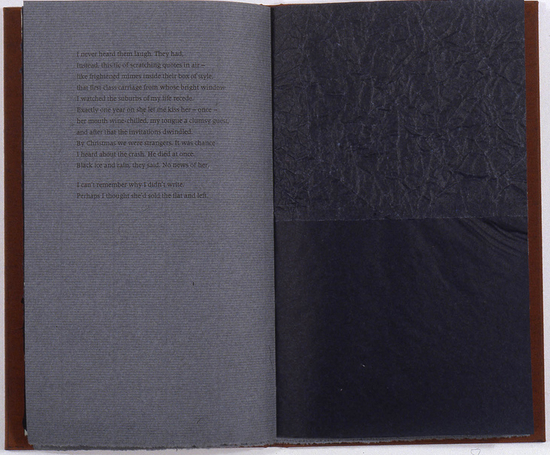
Black Ice and Rain, 2002. Designed, letterpress printed & bound in a limited edition of 50 by Barbara Tetenbaum with assistance from Maki Yamashita and Clare Carpenter. The type is handset Meridien; the paper, Hahnemühle Ingres; the interleaved collages were made using an abaca paper handmade by Katie MacGregor of Whiting, Maine.
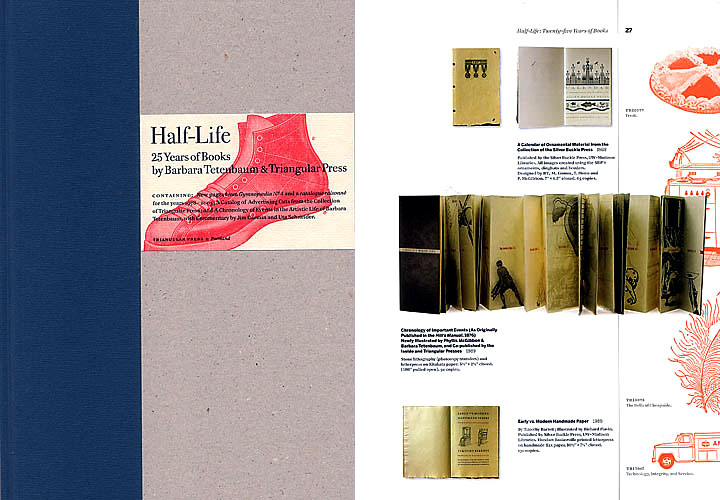
Schneider, Ute. “Turning the Page,” Half-Life: 25 Years of Books. Tetenbaum, Barbara, and Triangular Press. 2005. Triangular Press. Portland, OR.
Half-Life: 25 Years of Books Barbara Tetenbaum and Triangular Press, 2005.
Tetenbaum, Barbara. Interview with Claudia Hamilton about early book arts influences, and what inspires her work. Podcast series, Book Arts Program, University of Alabama, accessed 6 February 2014: http://www.bookarts.ua.edu/podcast/podcasts.html
“There is art to be found in science books and science to be found in artist’s books.”
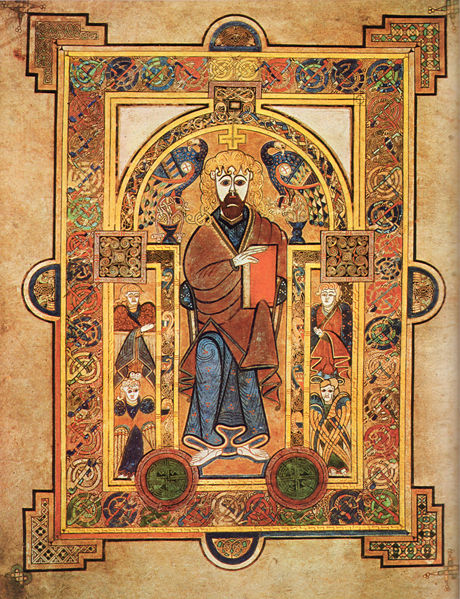
The Buffalo & Erie County Public Library has been kind enough to share the exhibit labels for its display held in March this year in the Grosvenor Rare Book Room. The section devoted to “Artist’s Book History” begins with the Book of Kells and runs to Ed Ruscha’s Twentysix Gasoline Stations.
Although many will claim that artist’s books began with William Blake in the 1700’s or so that would dismiss entirely all of the artistry that went into many lovely and ornate illuminated manuscripts that proceeded and somewhat overlapped the printed text in codex form. Whether painted in monastic scriptoria, as was the Book of Kells (c. 800), or by secular guild artists as were many others, the figures and/or flora are artworks to behold.
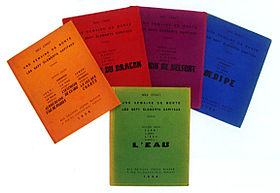
World Wars I & II brought many artist books associated with the Avant-Garde, Futurist and Surrealism Movements. Max Ernst’s Une Semaine de Bonté (1934).
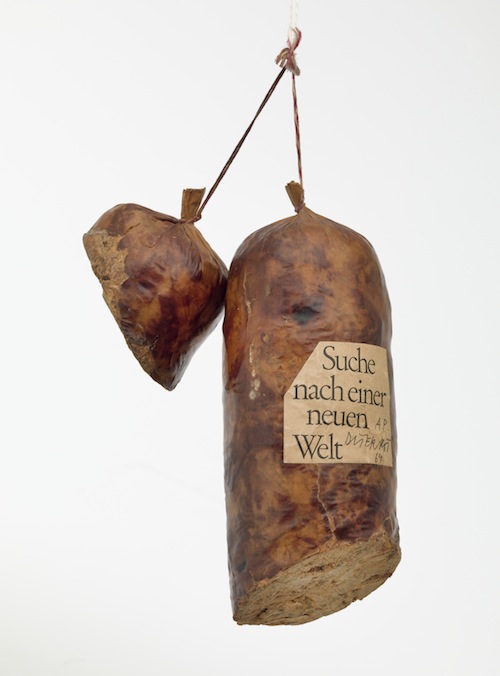
Dieter Roth, “Literature Sausage (Literaturwurst),” 1969, published 1961-70. Artist’s book of ground copy of Suche nach einer Neuen Welt by Robert F. Kennedy. Gelatin, lard, and spices in natural casing. Overall (approx.) 12 x 6 11/16 x 3 9/16 in. The Museum of Modern Art, New York. The Print Associates Fund in honor of Deborah Wye.
The second half of the nineteenth [sic] century brought Dieter Roth and Ed Ruscha’s works. Roth was a Swiss artist for whom the book was just one of his media. Paint, sculpture, installation work and more also provided means of artistic expression.
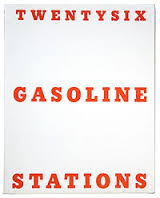
Ed Ruscha is an American pop artist whose focus is in paint, drawing, printmaking and photography. His Twentysix Gasoline Stations (1963) photographically captures gas stations in book form as Andy Warhol did Campbell soup cans on canvas. This artist’s book is considered an important milestone for the genre.
Ruscha’s book also figures in the exhibit section called “Artist’s Books and Bookworks Today” along with works by Julie Chen and Susan Allix as examples of the growing availability of collectible book art today.
Personal Paradigms, Julie Chen, 2004
Julie Chen founded Flying Fish Press in California through which she creates handmade “artists’ books with an emphasis on three-dimensional and movable book structures and fine letterpress printing” according to her web site. These books are frequently moveable and/or interactive in their design.
Egyptian Green, Susan Allix, 2003 “The texts in Egyptian Green are mainly drawn from travellers visiting or writing about Egypt. The earliest is a spell written inside an ancient coffin; later writers include Plutarch and Catullus, also Leonhart Rauwolff, who noted in 1672 that the water of the Nile was “perfectly green”, and Amelia Edwards on the precise colour of palm trees. There are two calligraphic pieces of Kufic script printed from the original blocks found in Cairo.”
British book artist Susan Allix also has her own (self-titled) press and she creates handmade books with a variety of fine papers and textures with letterpress printing, embossing and all manner of printmaking. Though some of her books convey a certain whimsy, the choice of materials, method of printing and crafts[wo]manship is the result of serious thought, planning and selection.
Other sections are devoted to historical examples of illustrated works of scientists such as Vesalius and Lamarck, which are well punctuated by the inclusion of Guy Laramée’s Grand Larousse, Brian Dettmer’s The Household Physicians and Doug Beube’s Fault Lines.
Grand Larousse, Guy Laramée, 2010The Household Physicians, Brian Dettmer, 2008Fault Lines, Doug Beube, 2003
Books altered and/or sculpted by artists to represent something other than the original readable text are known as bookworks and they are works of art. This type of art is not technically an artist’s book whereby a book is created. Altered/sculptural books take from a book that had already been created and turn it into art by cutting, folding and/or sculpting it into an art form. Although there are many examples of this type of work, perhaps the most inspiring artists’ works (some available in art galleries today) are those by contemporary and still-creating Canadian Guy Laramée, American Brian Dettmer and Toronto-born, schooled-(in part)-in-Rochester/Buffalo and now-living-in-New-York-City Doug Beube. The examples of their works shown are all pieces inspired by some aspect of science or subject of scientific study including geology, medicine and geography.
The theme of the exhibit deserves a catalogue. As the exhibit’s online announcement notes, “Today’s mutually exclusive idea of ‘left-brained’ and ‘right-brained’ activity discounts longer understood ideas that science is a creative pursuit—that there really is art to be found in science—and that creative artworks often have some scientific basis and/or inspiration.” One would do well to start with Harry Robin’s The Scientific Image: From Cave to Computer (1992) and Brian Ford’s Images of Science: A History of Scientific Illustration (1993) and take further inspiration from the Grosvenor Rare Book Room.
Based in Chicago, Meador writes, photographs, prints, designs and teaches. His interest in the “narratives of culture, history, and place … the basis for identity” finds its expression best in the artist’s book, the ideal vehicle for “countless ways to create complex, engaging narratives.” Meador’s artist’s statement — “Human identity is not monolithic, nor is it a simple linear narrative, and I use the book as a strategy to present this complexity. Who we are depends on who is asking ….” — shows a profound grasp of the nature of the book. A grasp epitomized by his collaborative work with Julie Chen, How Books Work, 2010.
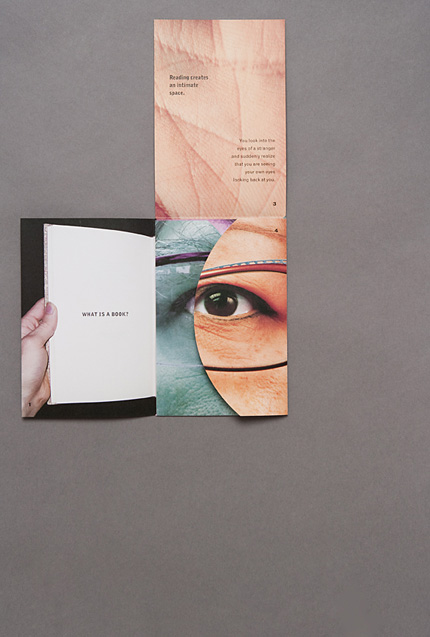
How Books Work, 2010 Clifton Meador and Julie Chen







 Books On Books