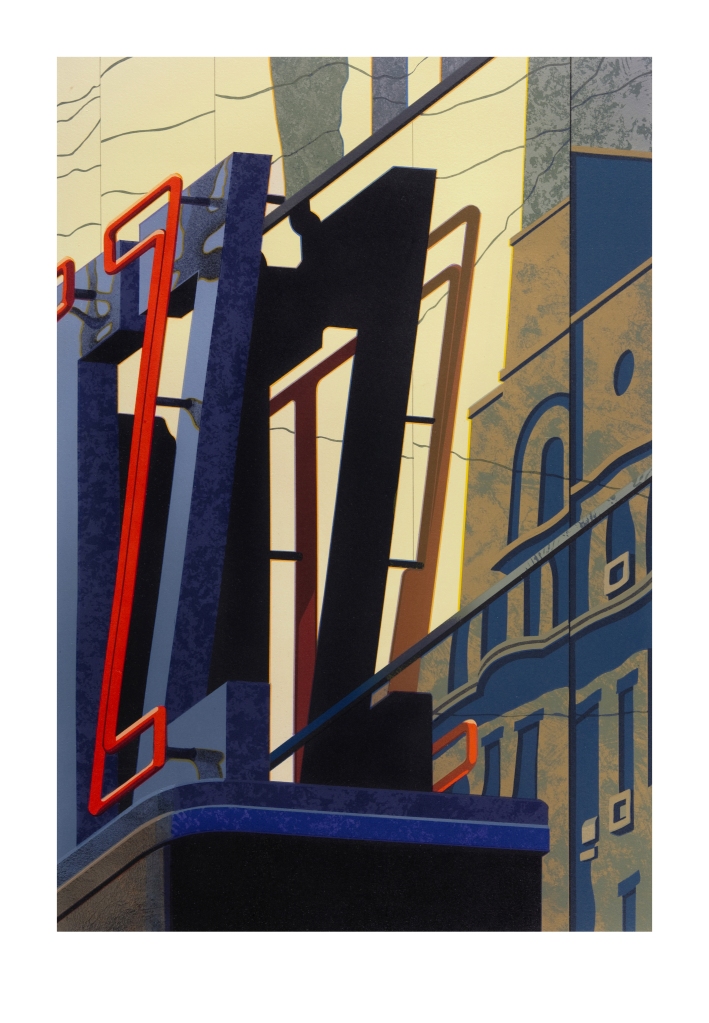
Books On Books Collection – Sunkyung Cho

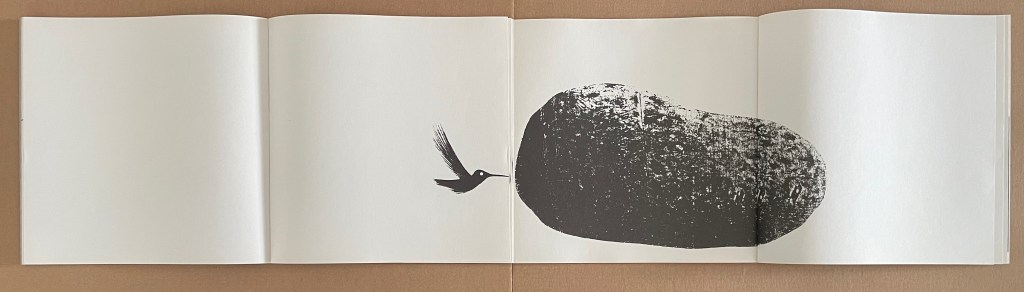
This is not a stone (2017)

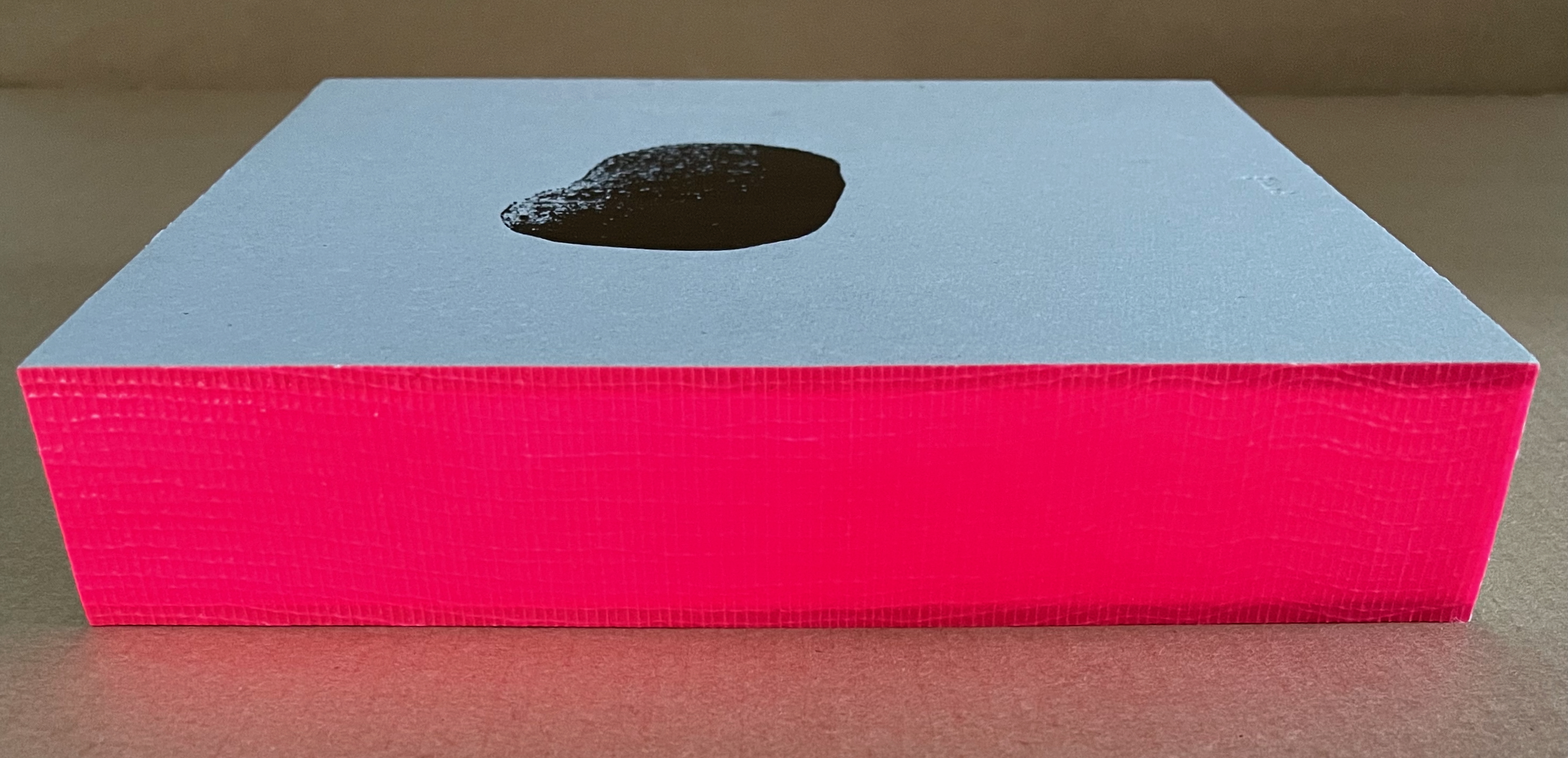
This is not a stone (2017)
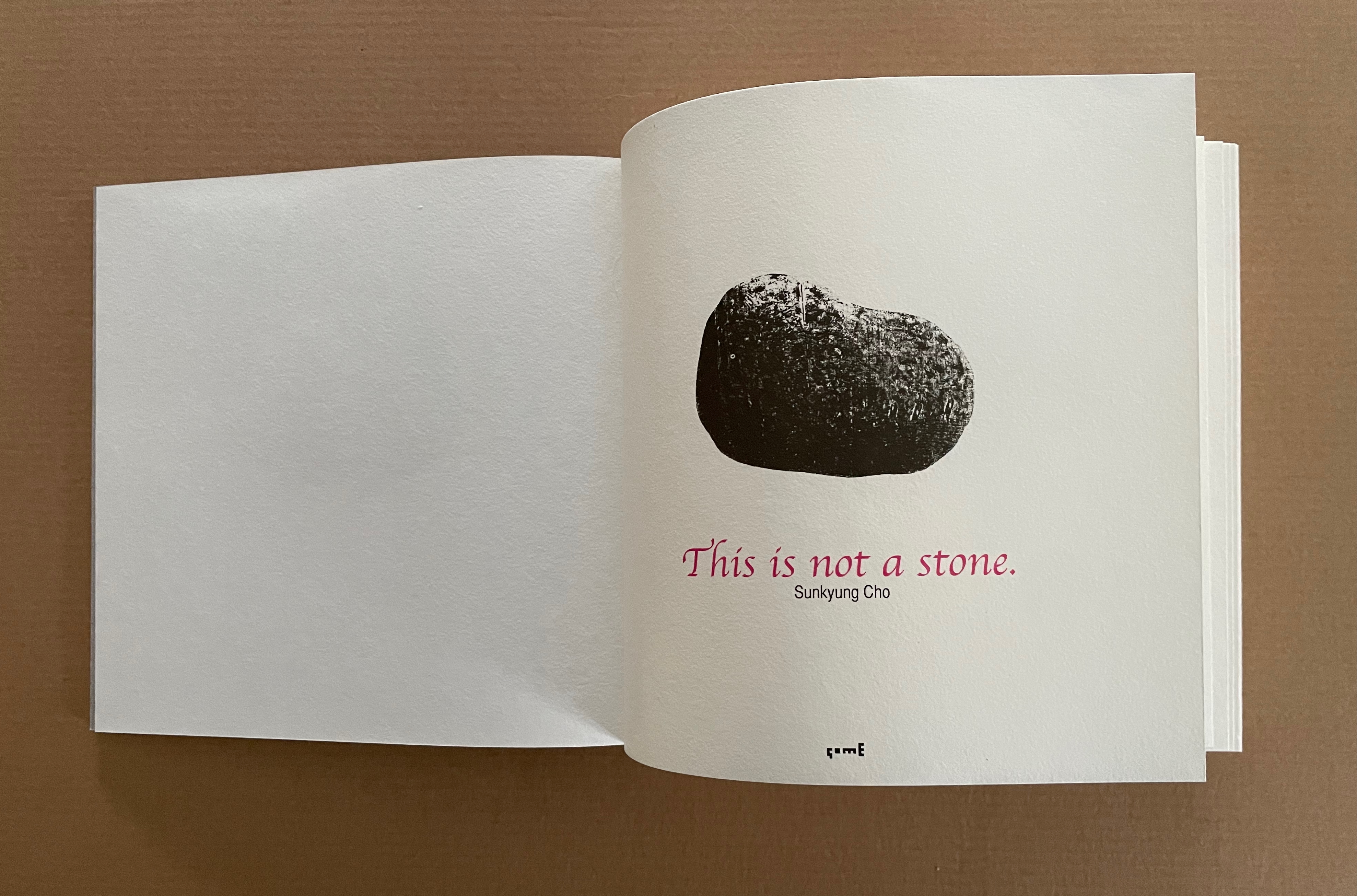
Sunkyung Cho
Exposed spine binding with cross weave filament tape, board-covered. 170 x 170 mm. Acquired from SpazioB**K, 6 April 2025.
Photos: Books On Books Collection.

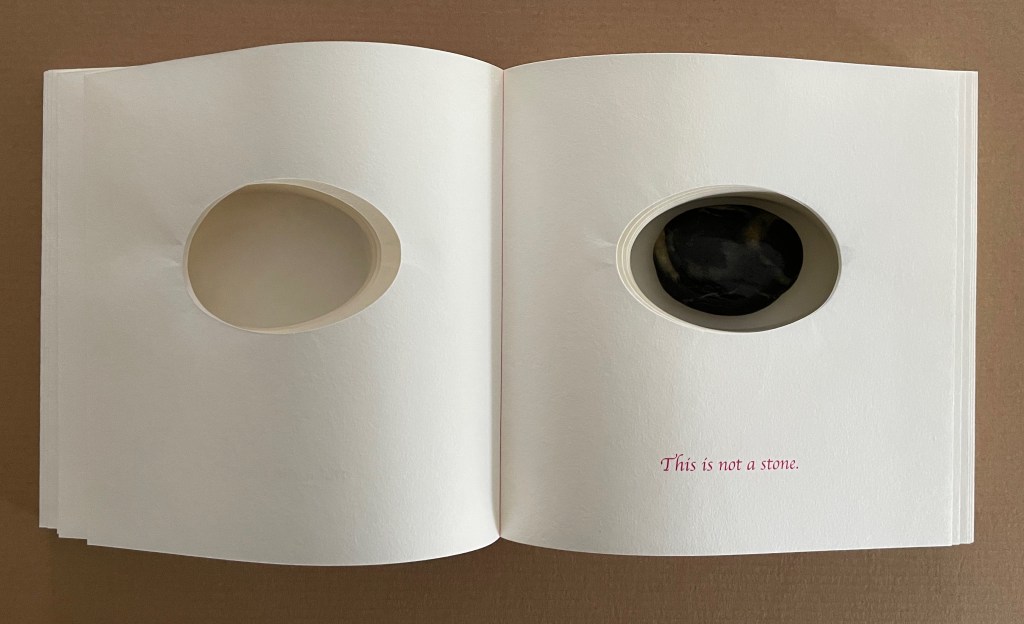
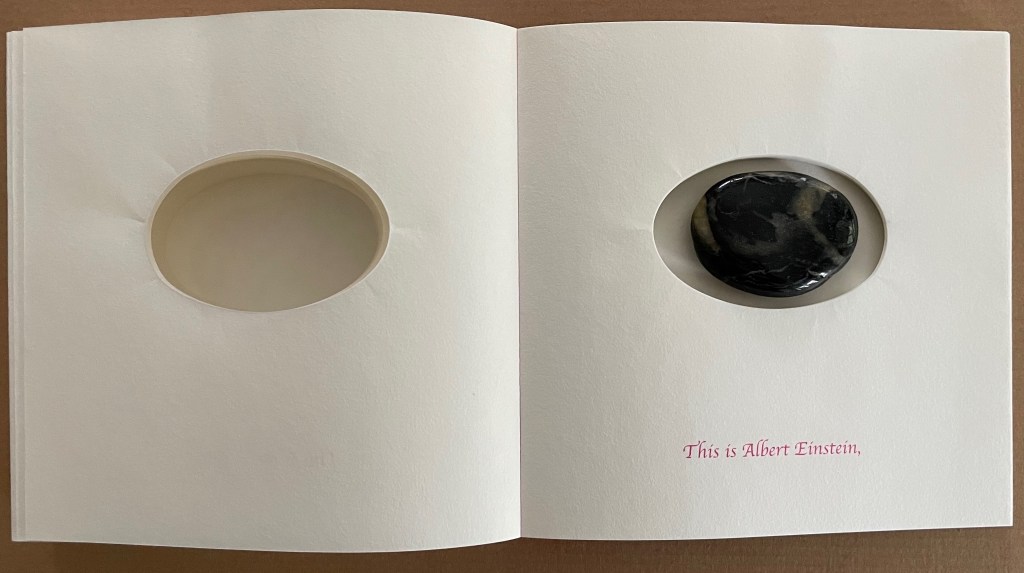
Just as you think this will be another two-dimensional riff on René Magritte’s The Treachery of Images (aka Ceci n’est pas une pipe), the Chinese fold title page turns to reveal a cutout well with a stone at the bottom.
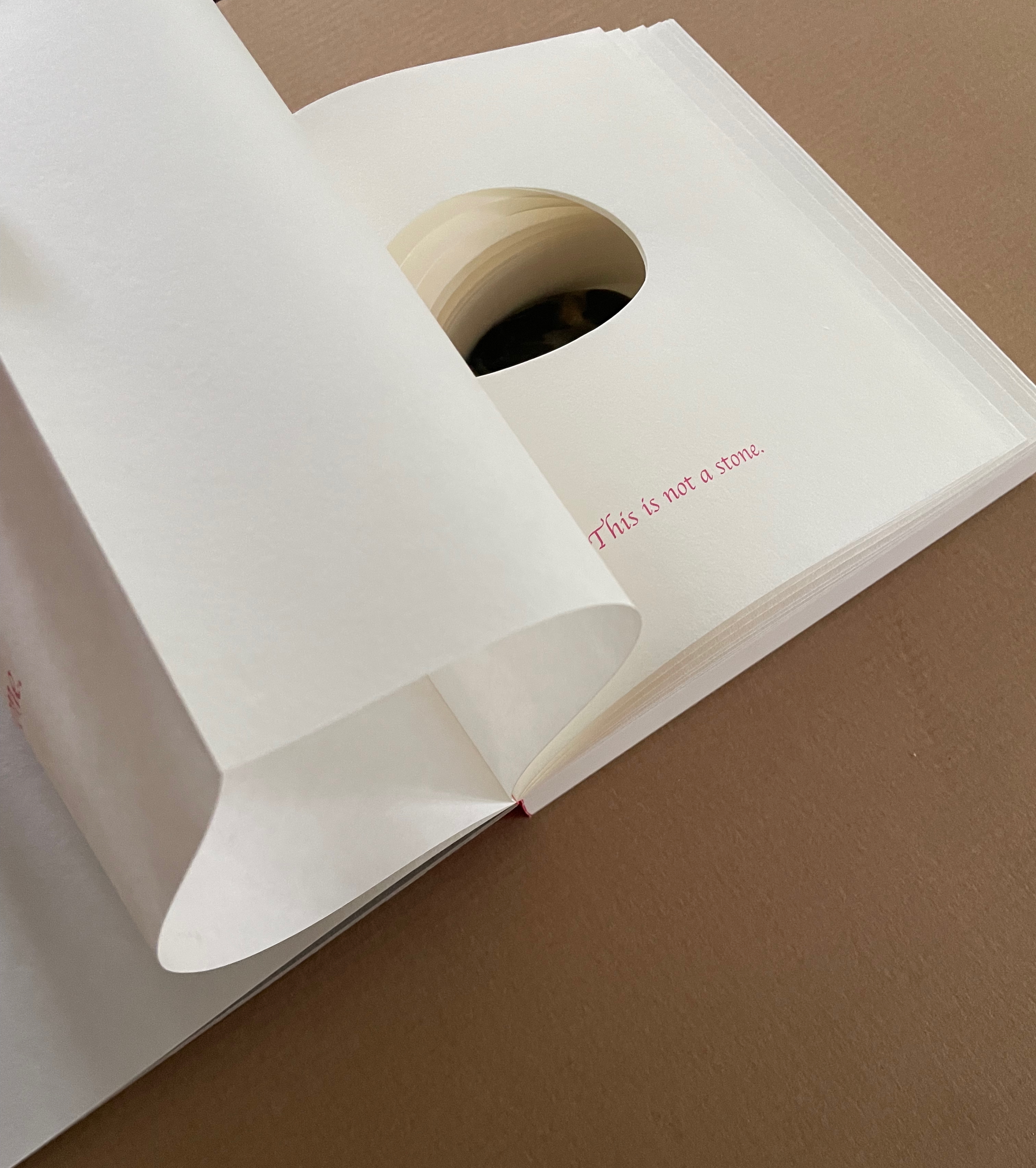
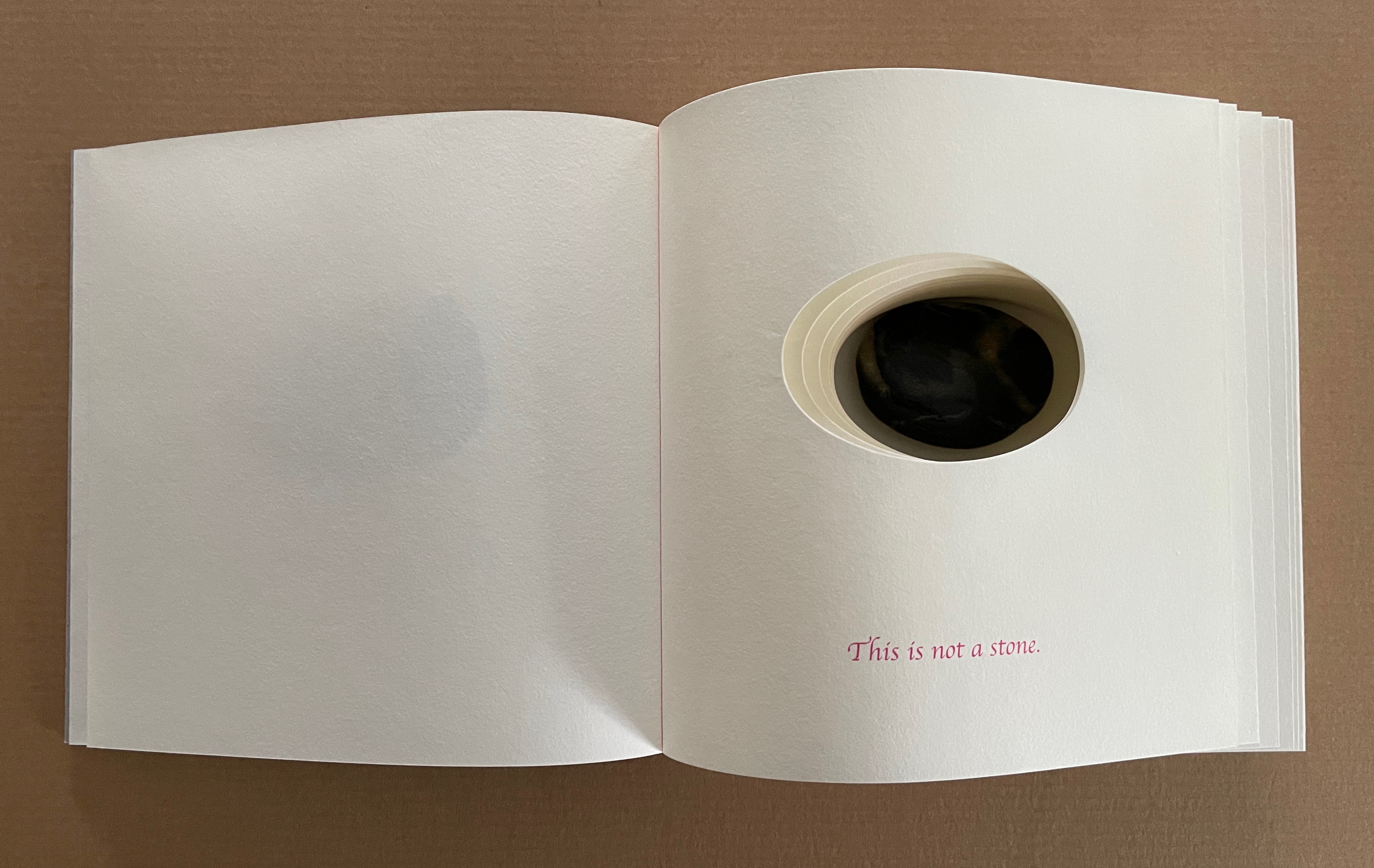
With the turn of the next two pages, it appears we are in for a series of metaphors and riddles, and something more than a three-dimensional riff on the anti-metaphor and the gap between words (symbols) and objects. First, this not-a-stone is “an apple,” but then turn the next page, and the not-a-stone is also “a sun flower”. Is there some law of commutation that applies: If not-a-stone = apple, and not-a-stone = sun flower, therefore, apple = sun flower? Because it is round, because it is vegetal?
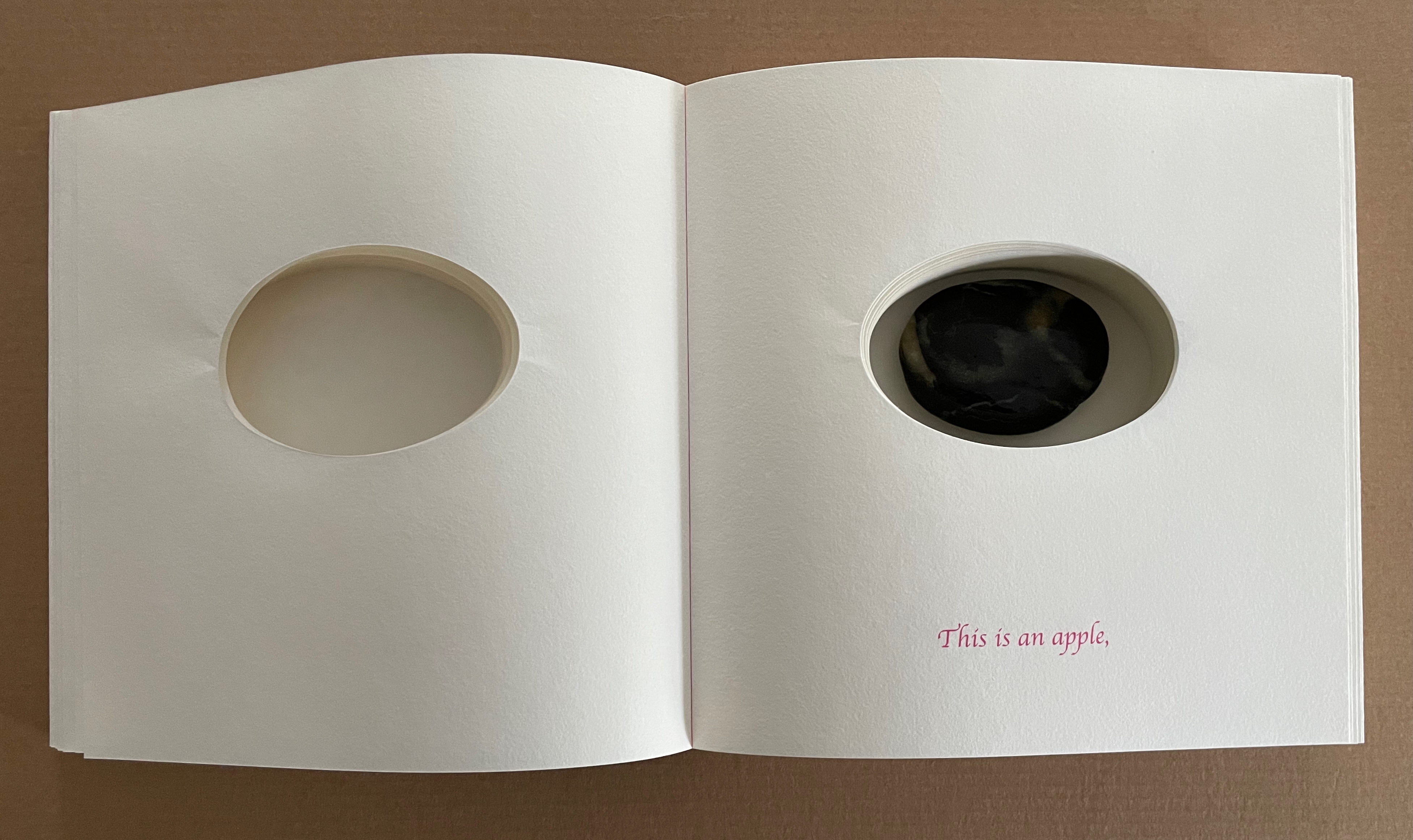
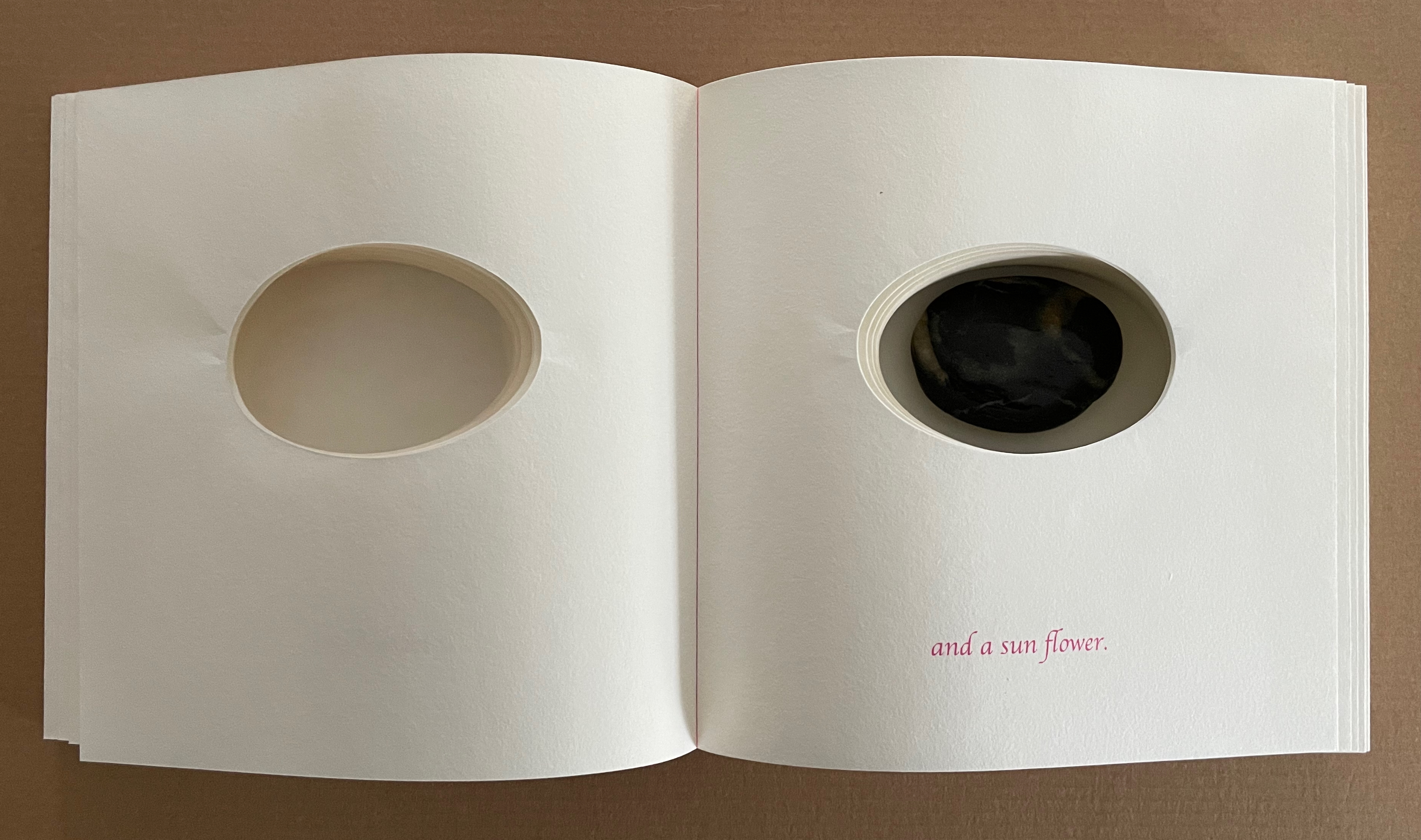
Over the next turns, we have “the Sun” and “the earth”, then “a crystal” and “a flake of snow in the Himalyas”, then “a beetle” and “a scorpion”, and on the pairs go, each separated with the spread “This is not a stone”. All along, while being urged to deny the evidence of reality, we are asked to accept the evidence of metaphor and imagination. Naturally our inbred pattern-seeking and ludic behaviors kick in, as if this were a game of “Twenty Questions”. But the pairs run the gamut of Animal, Vegetable, Mineral and beyond.
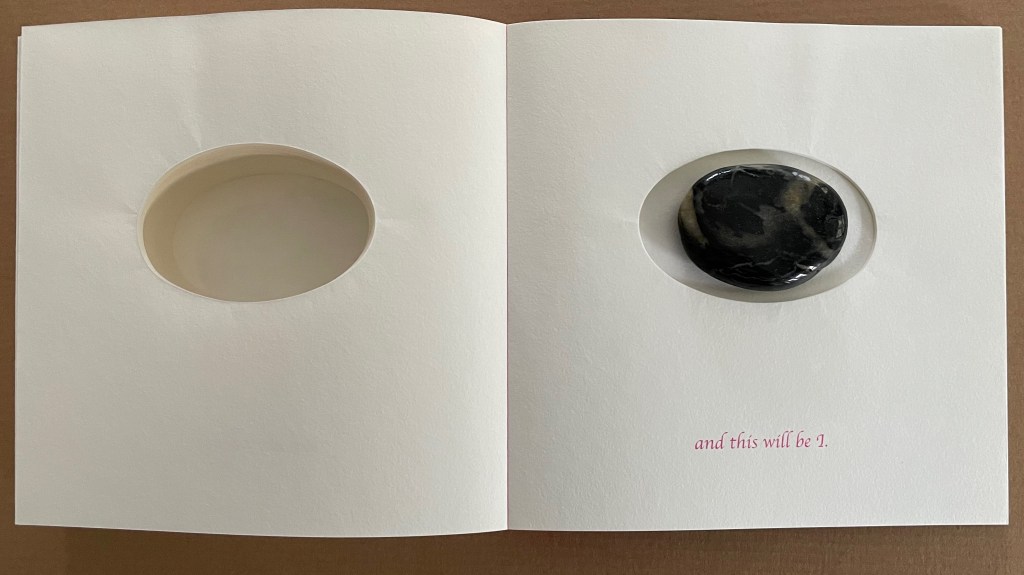
By the last page, it is as if we are playing “Twenty Questions” with the stone itself. That is, if the “I” is the stone saying, “and this will be I”. Is the stone uttering a deliberate a-grammatical union of subject (I) and object (me)? Is it a verbal visual pun (I-eye) evoking Emersonian Transcendentalism? Perhaps this stone that says “This is not a stone” is a Cretan philosopher’s stone, and round and round we will go.

On the artist’s website (www.somebooks.kr), the product page displays this Korean expression and its translation: 하나의 돌은 돌이자 다른 모든 것이다 [“One stone is a stone and everything else”]. It does not appear anywhere in the book, so perhaps it is unfair to invoke it as confirmation of any reading of This is not a stone. On the other hand, if you are going to play “Twenty Questions” with a Cretan philosopher’s stone, cheating may be your best option.

The other works by Sunkyung Cho in the collection are wordless, except for their titles, and lean more toward children’s books than This is not a stone. Like so many artists’ books, they occupy that crossover zone discussed by Sandra Beckett, Johanna Drucker, and Carol Scott (see Further Reading).

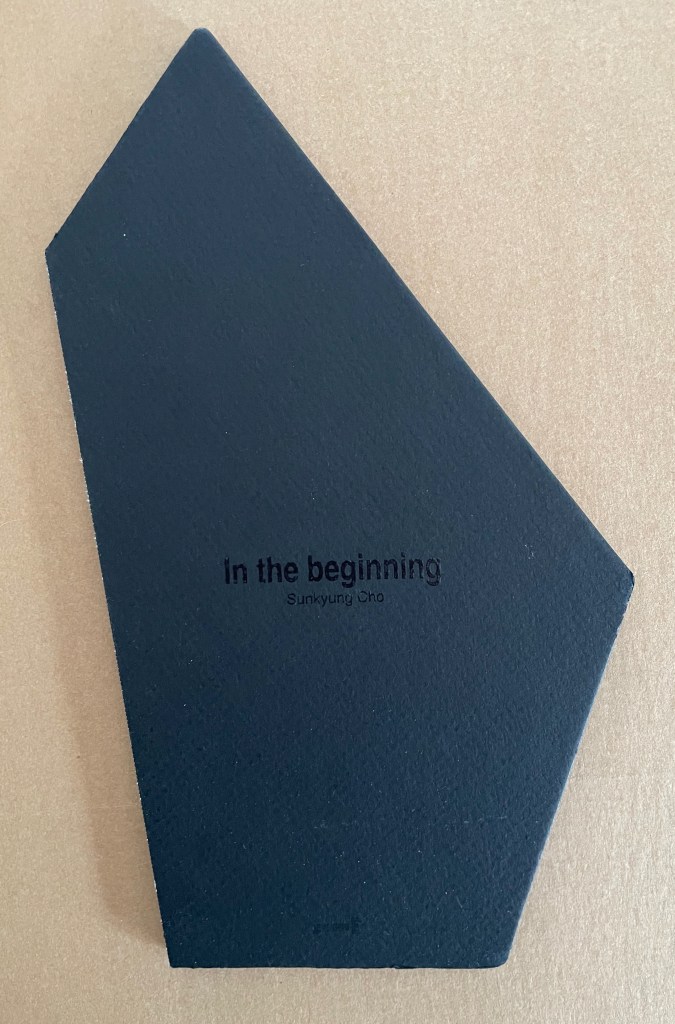
In the beginning (2012)
In the beginning (2012)
Sunkyung Cho
Softcover, sewn, exposed spine binding with cross weave filament tape. H260 x W150 mm. [36] pages. Unknown edition, of which this is #146. Acquired from SpazioB**K, 6 April 2025. Photos: Books On Books Collection.

From the artist’s website: 빛 이전의 태초, 사회화되기 이전의 인간에 대해 생각하는 책. [“In the beginning before light, a book that thinks about people before they became socialistic.”]

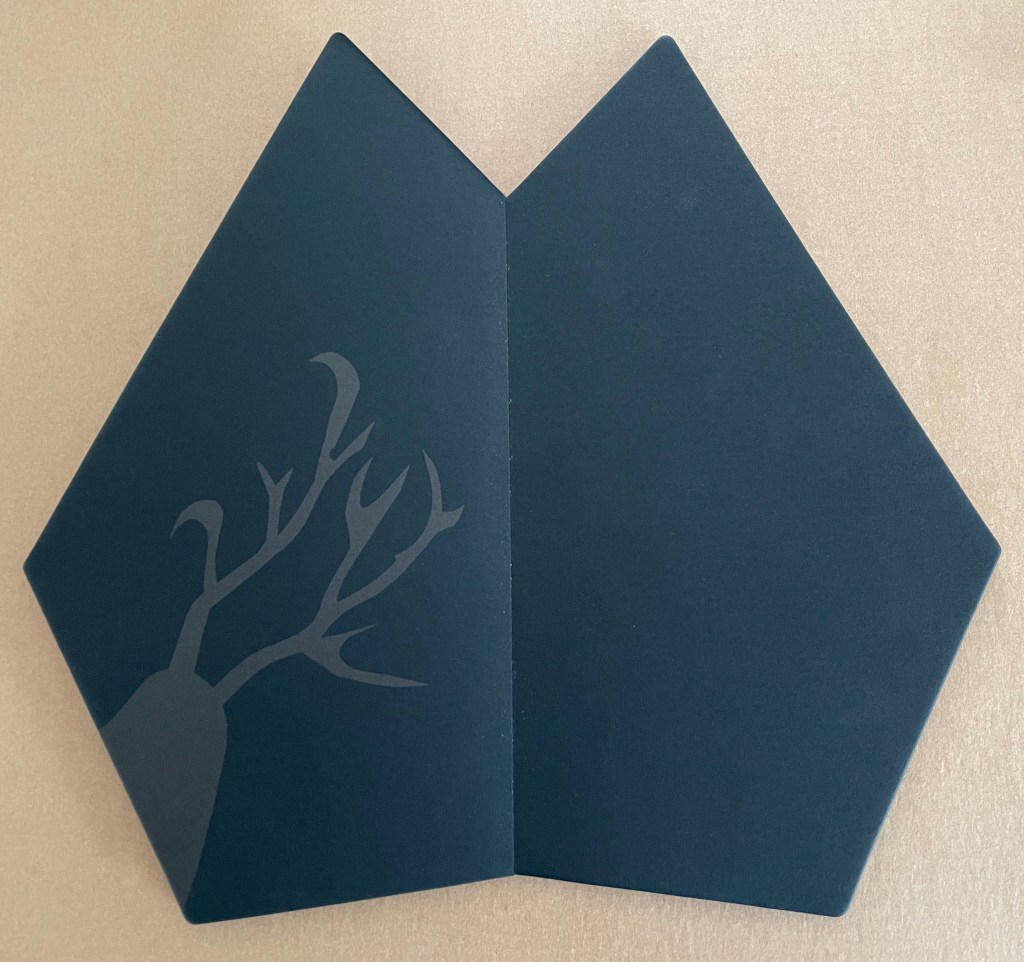
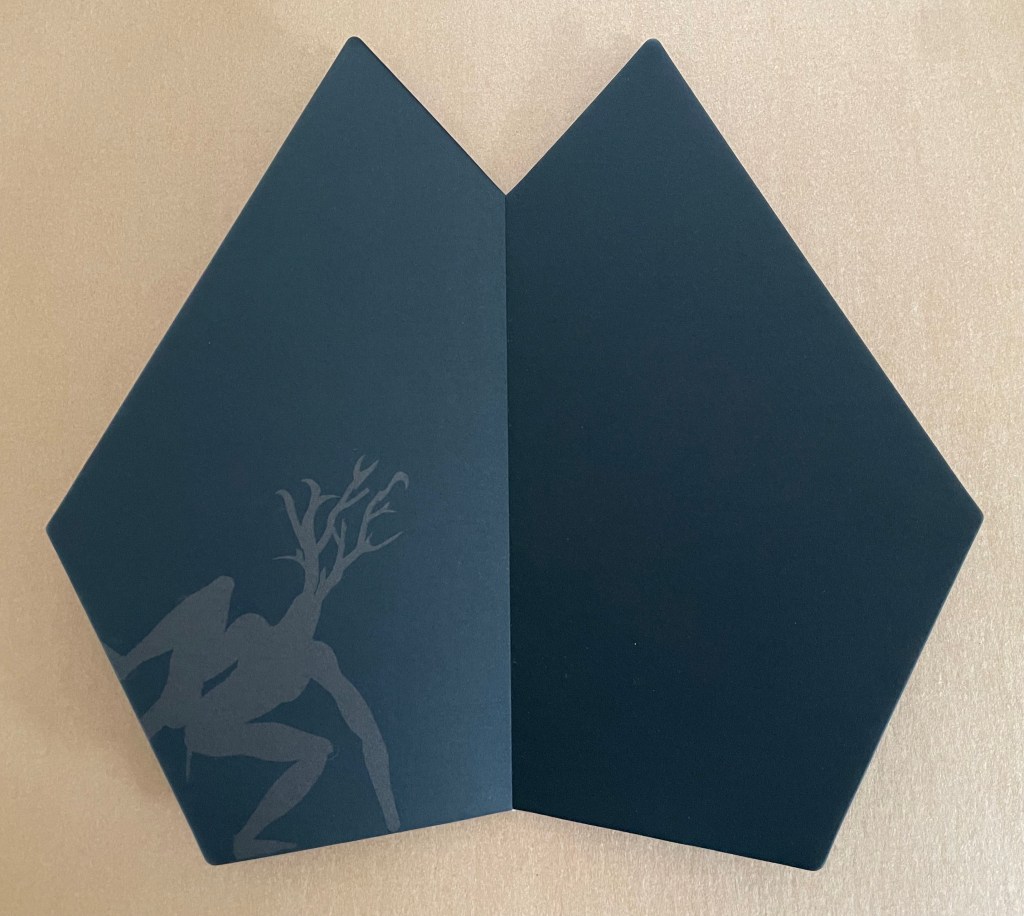
A translation that resonates more with the paper, structure, and images might be “A book contemplating the primordial state of the human before light and socialization.” Such a book would, of course, not have the normalized appearance we enlightened and socialized humans expect. Hence the black oddly shaped covers and leaves across which the gray, almost headless creature crawls on all fours and begins to sprout antlers or branches.
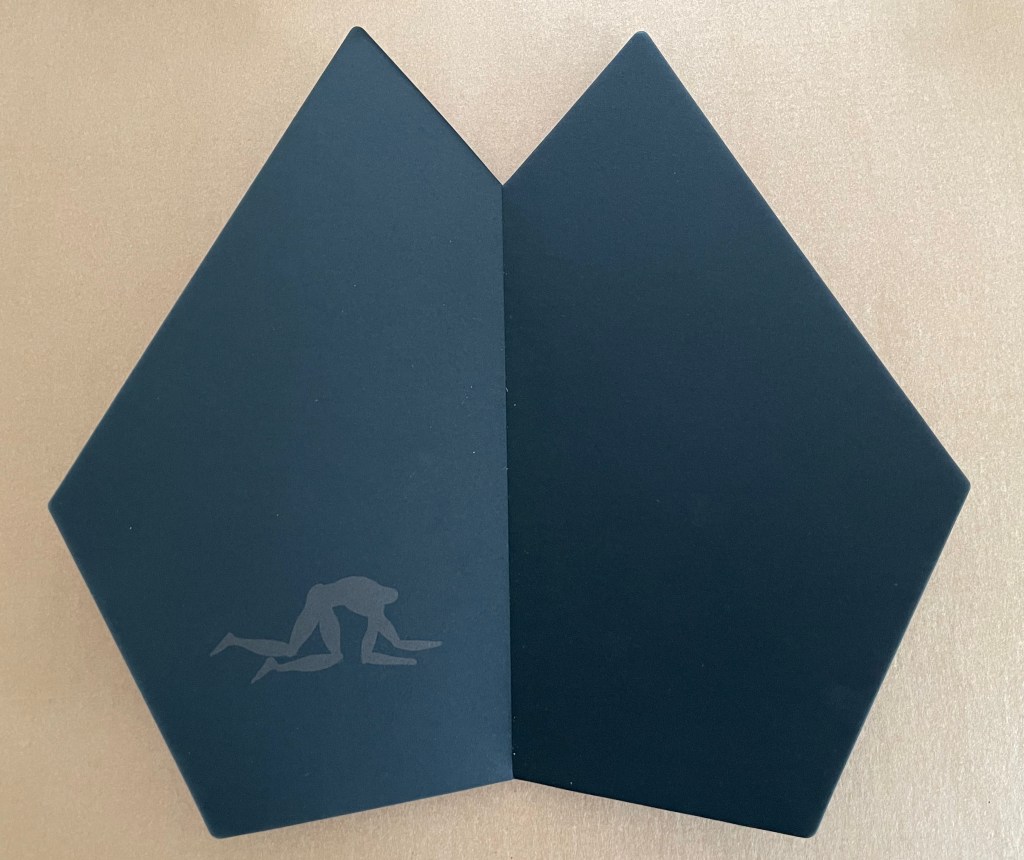
When other creatures enter the primordial state, they are oriented to it differently, which our branch-headed forebearer notices and tries to assume but fails.
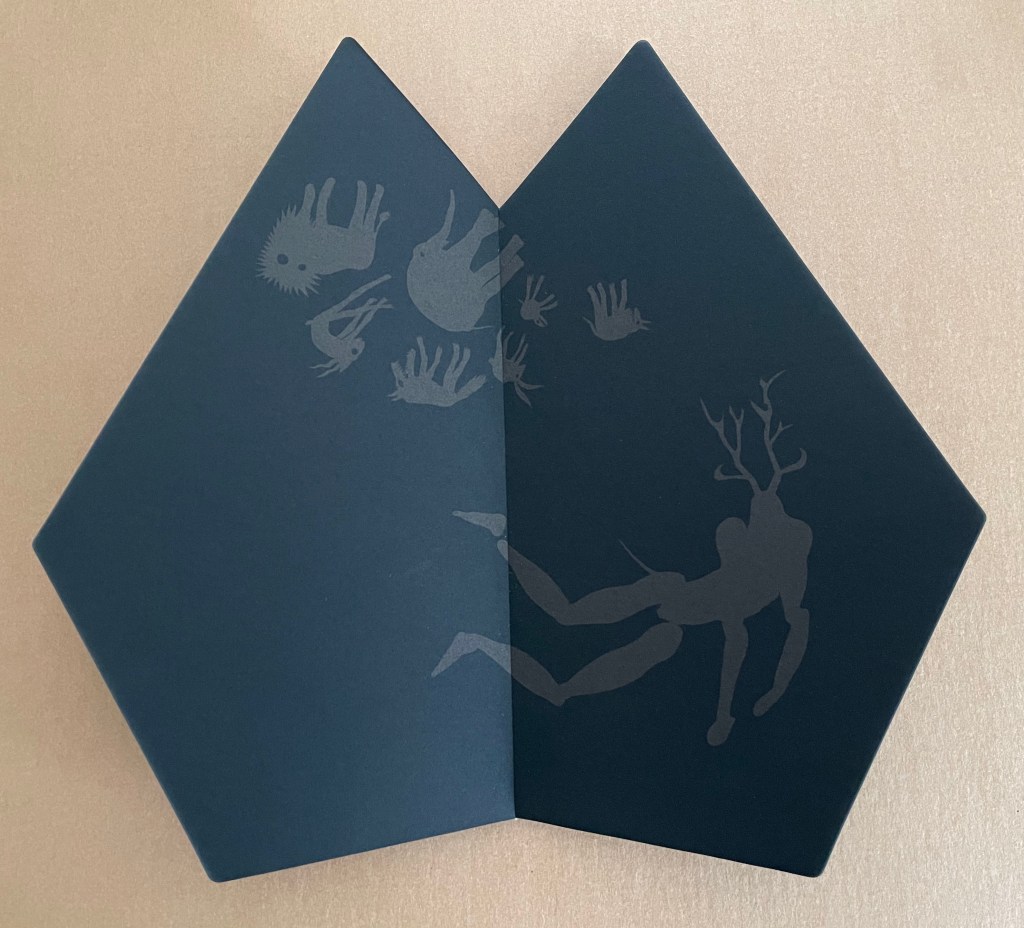
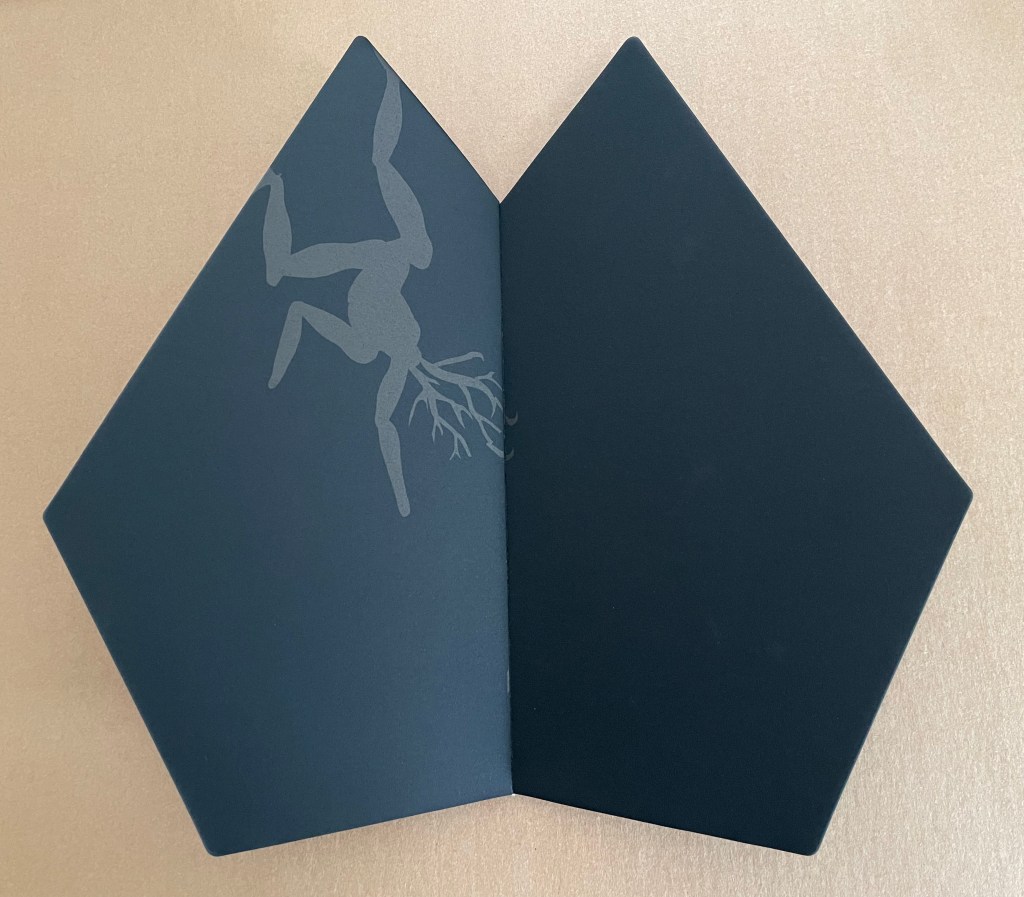
Having failed, our precursor tries to merge with one of the other creatures, but this elephant-like being will have none of him and flings the proto-human off.
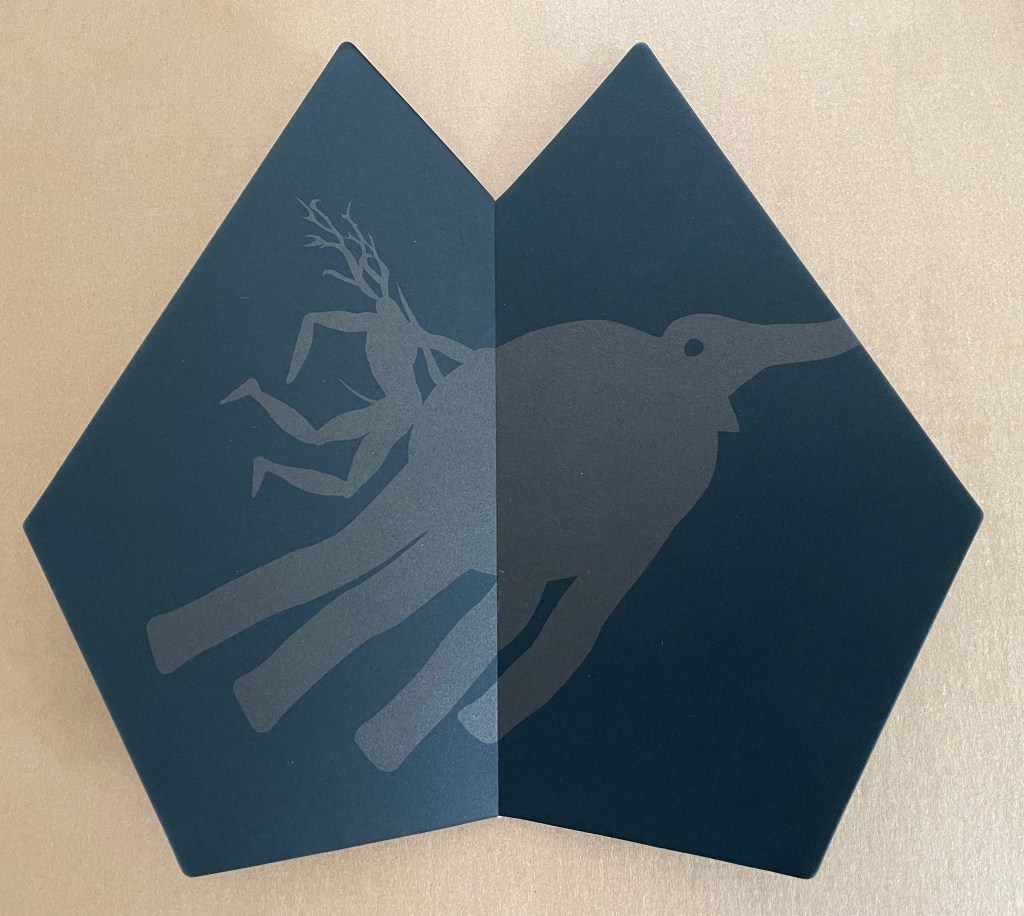
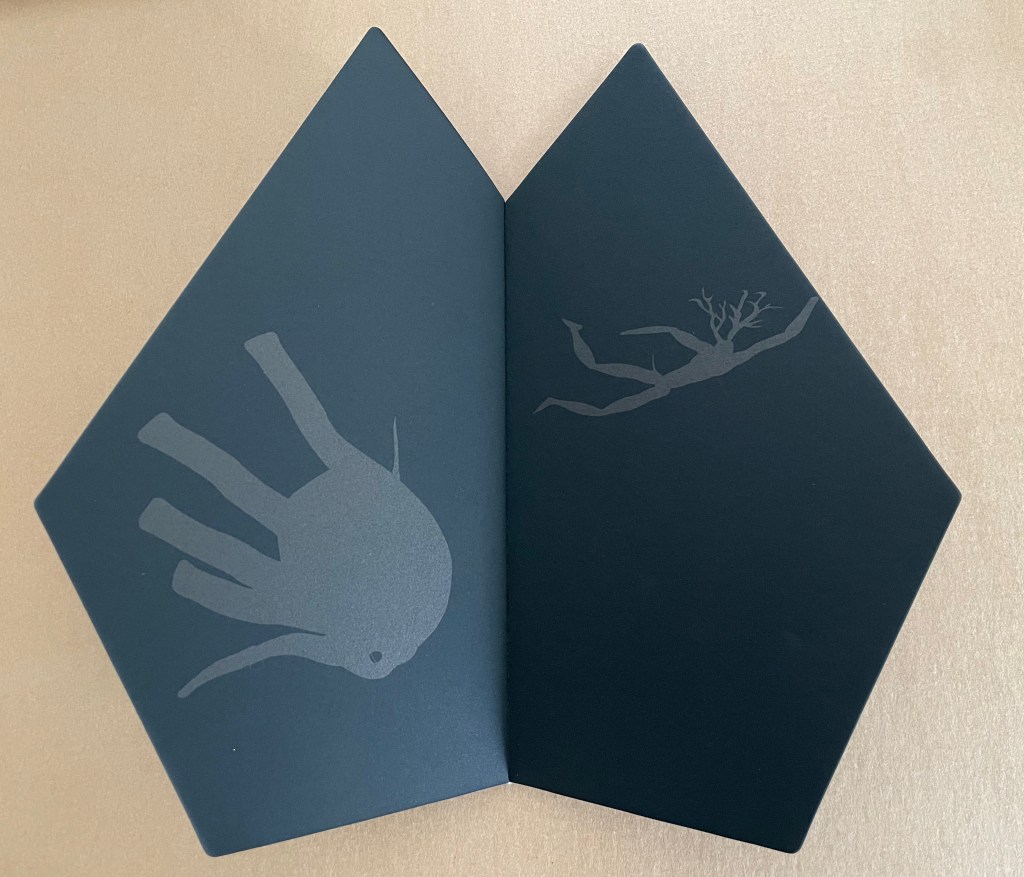
Whereupon, branch-head seeks affiliation with the vegetable kingdom and climbs toward the top.
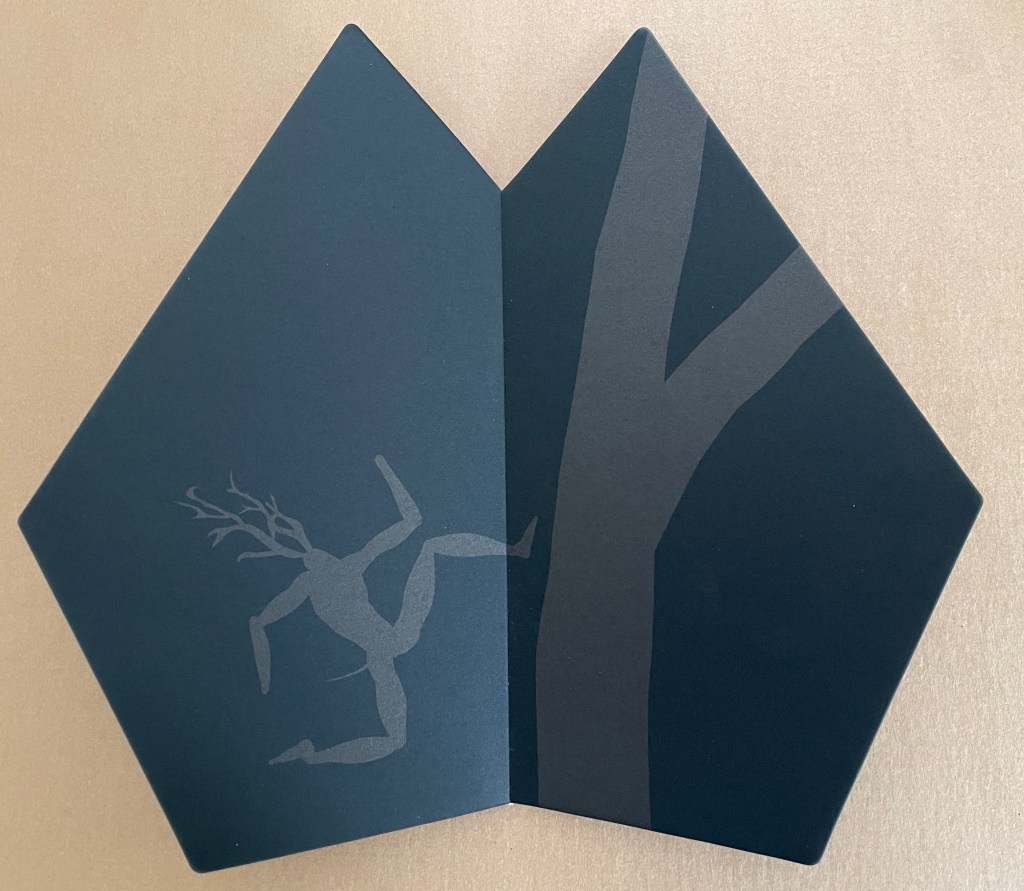
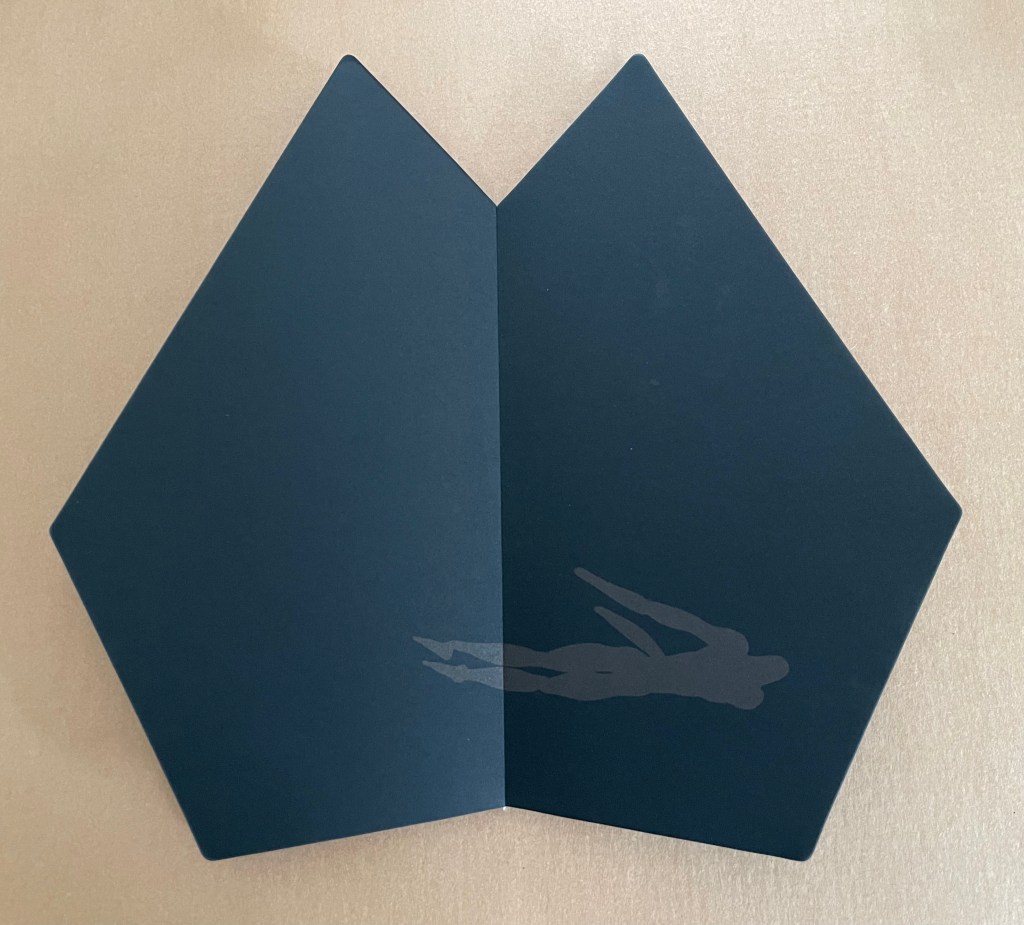
Having reached the top, our forebearer confronts and succumbs to the source of light and, having fallen and lost the semblance of antlers or branches (or both), yearns with arms outstretched for what once was.

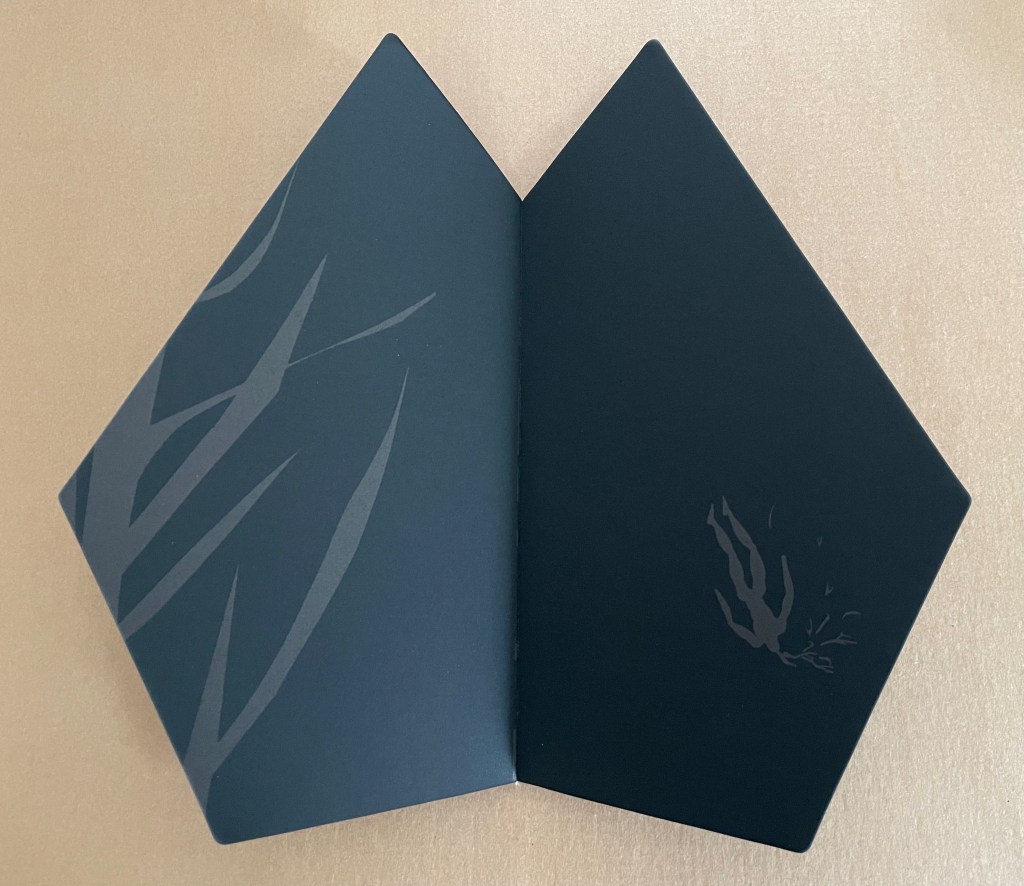
The book’s unusual shape recalls Helmut Löhr’s Visual Poetry (1987), Kevin Osborn’s Tropos (1988), and Philip Zimmermann’s High Tension (1993), where likewise the shape contributes to meaning.

The Blue Bird (2011)

The Blue Bird (2011)
Sunkyung Cho
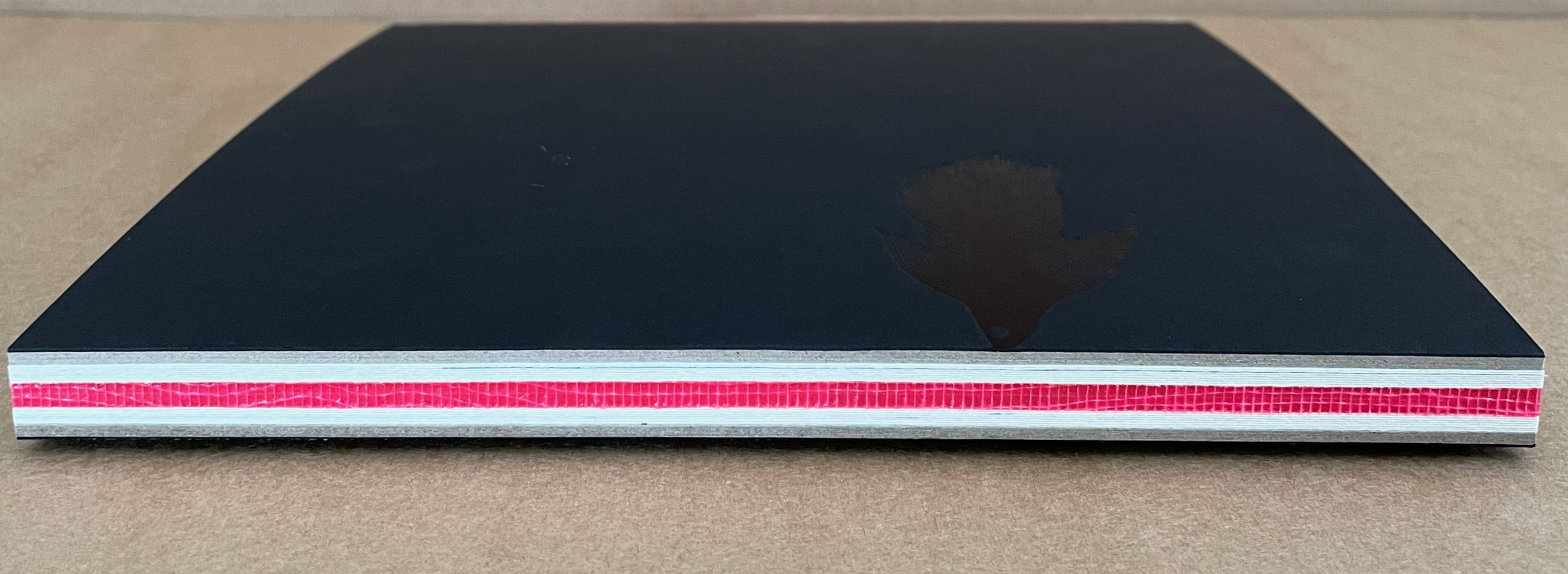
Exposed spine binding with cross weave filament tape, board-covered. 200 x 200 mm. [40] not including 2 illustrated fly leaves. Acquired from SpazioB**K, 6 April 2025.
Photos: Books On Books Collection.

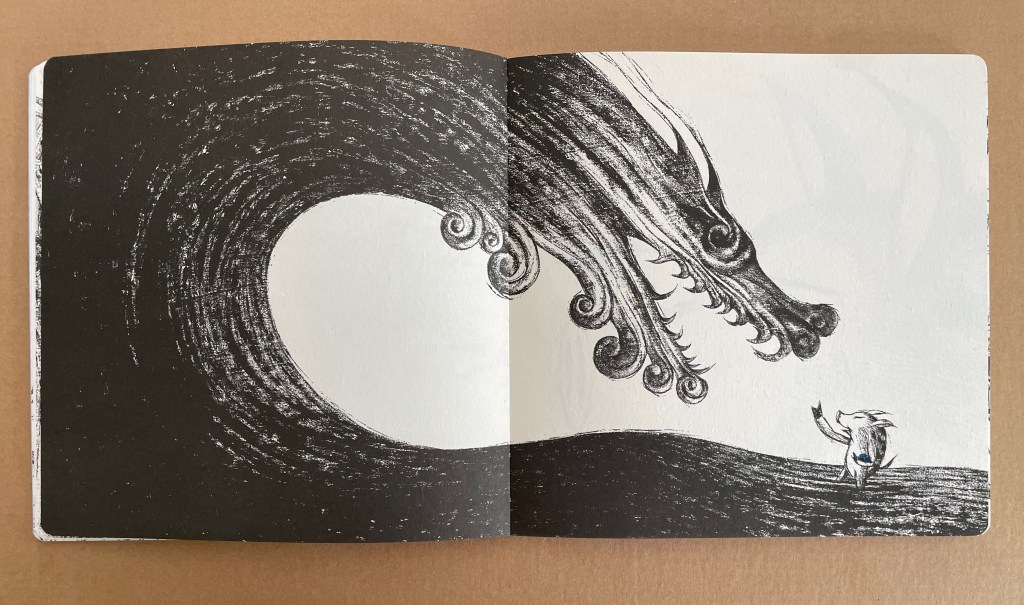
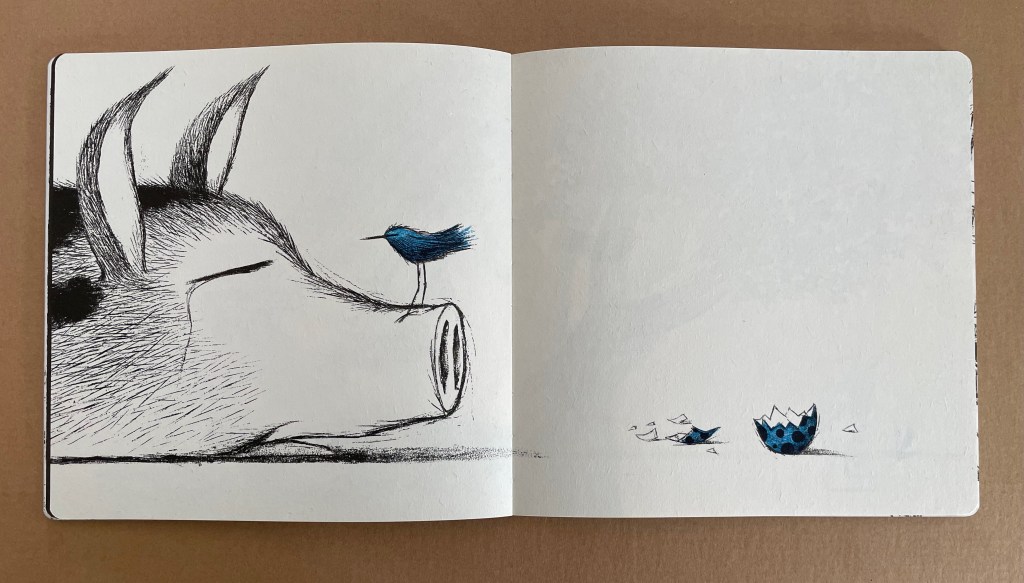
The Blue Bird leans much more toward the children’s book end of the crossover spectrum than in the beginning. The website’s description of it — “Blue Bird and Boar’s story of how to be a child and parent” — underscores all of the physical evidence except for the delicate nature of the paper. It is hard to imagine a copy surviving childhood use. But that might well be in keeping with the tender mix of joy and sadness in the tale.
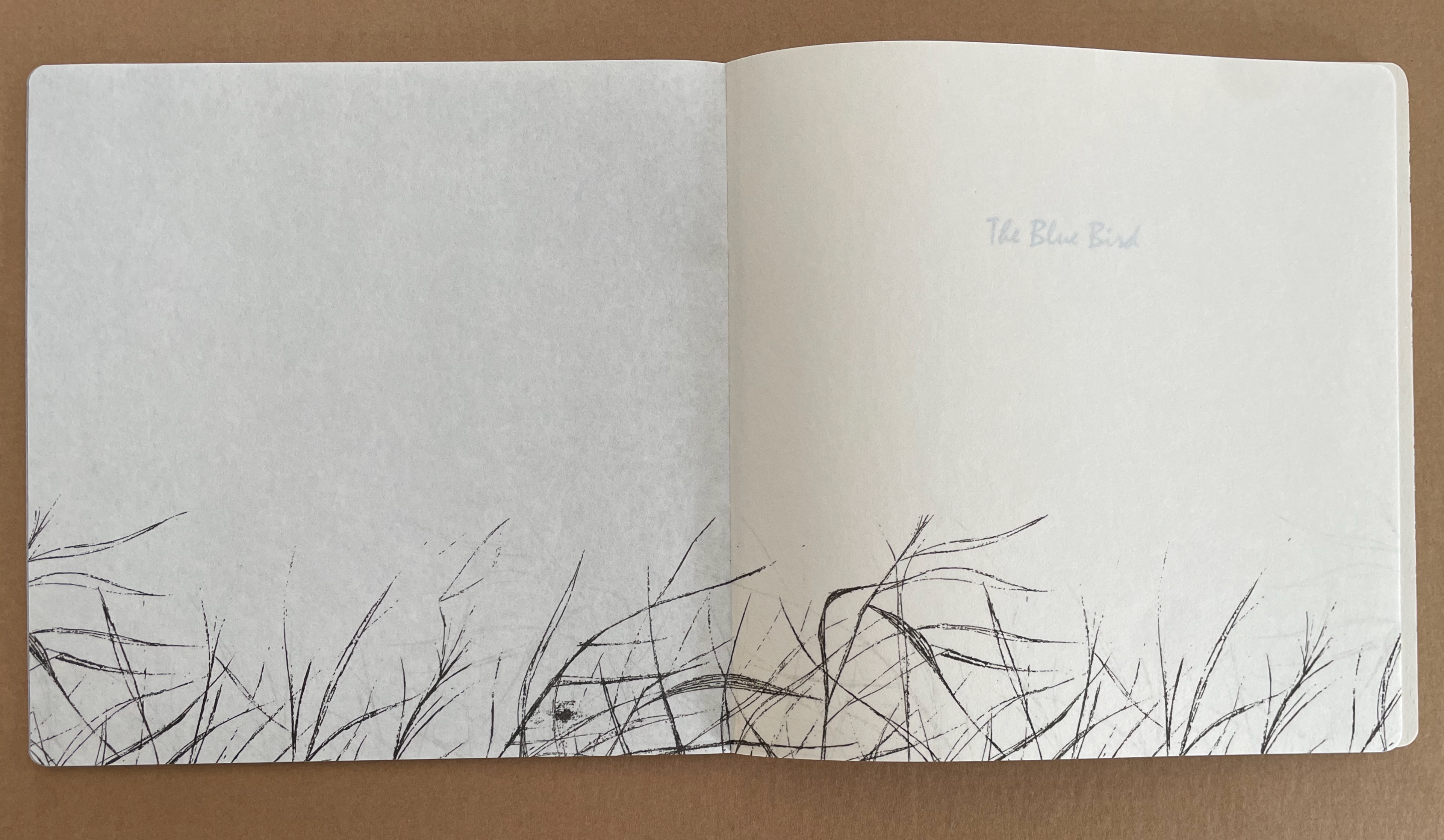
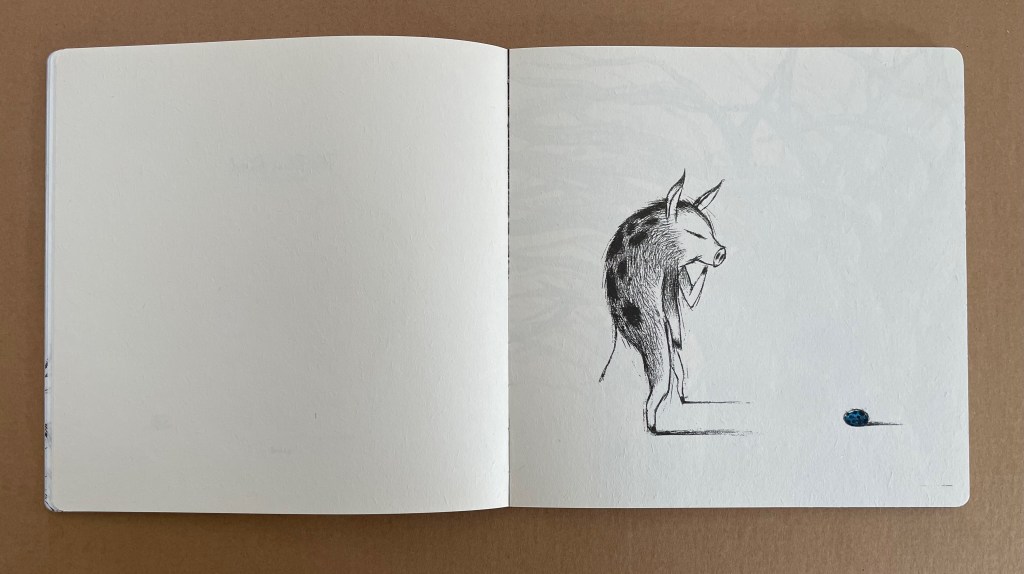
The simplicity and evocative sophistication of composition and line eliminate the need for any words to carry the narrative. In the sequence below, Boar’s protective parental handling of the egg against wind and wave ends in predictable exhaustion and birth.
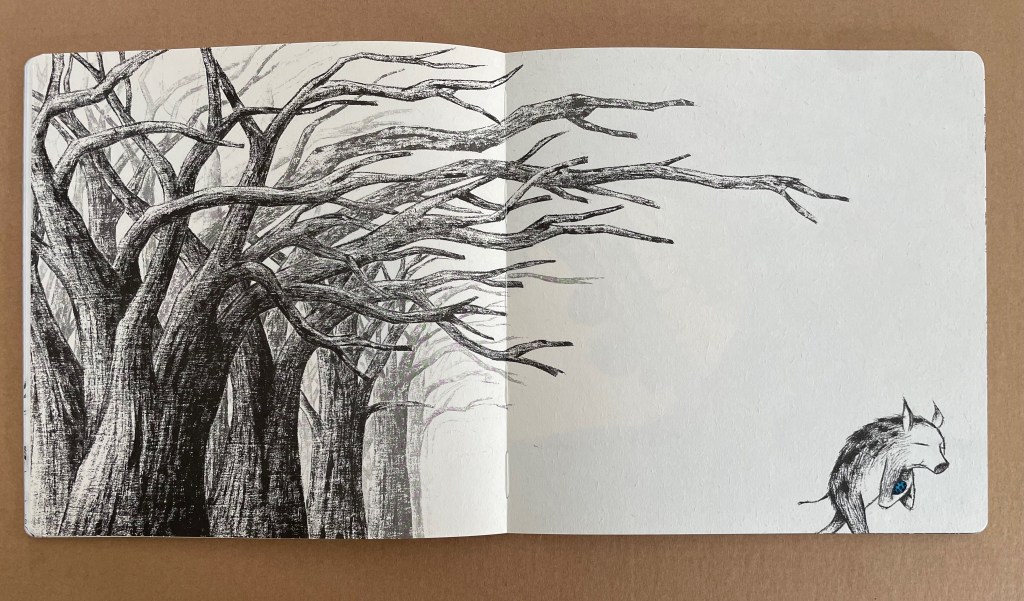
The remainder of the book in which Boar introduces Blue Bird to the world of foraging, running, jumping, sky- and star-gazing is landbound. Boar climbs trees to let Blue Bird sleep there, but when returns to the ground to sleep, Blue Bird follows, preferring to nestle against Boar under the stars.
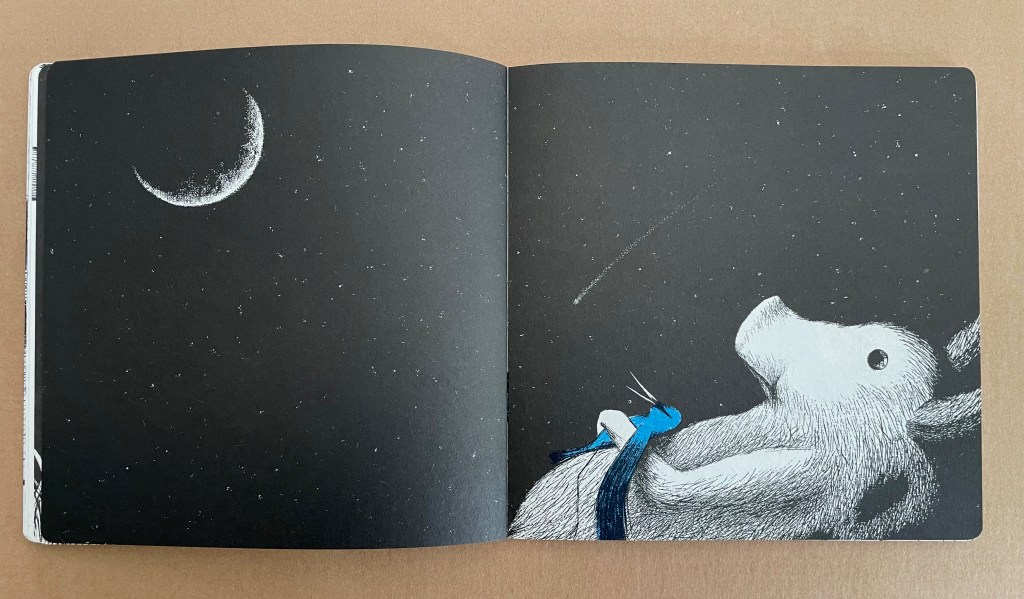
Boar’s continued efforts to teach Blue Bird about flight lead to a separation that some parents may not be ready to explain to a child.

Kiss (2015)
Kiss (2015)
Sunkyung Cho
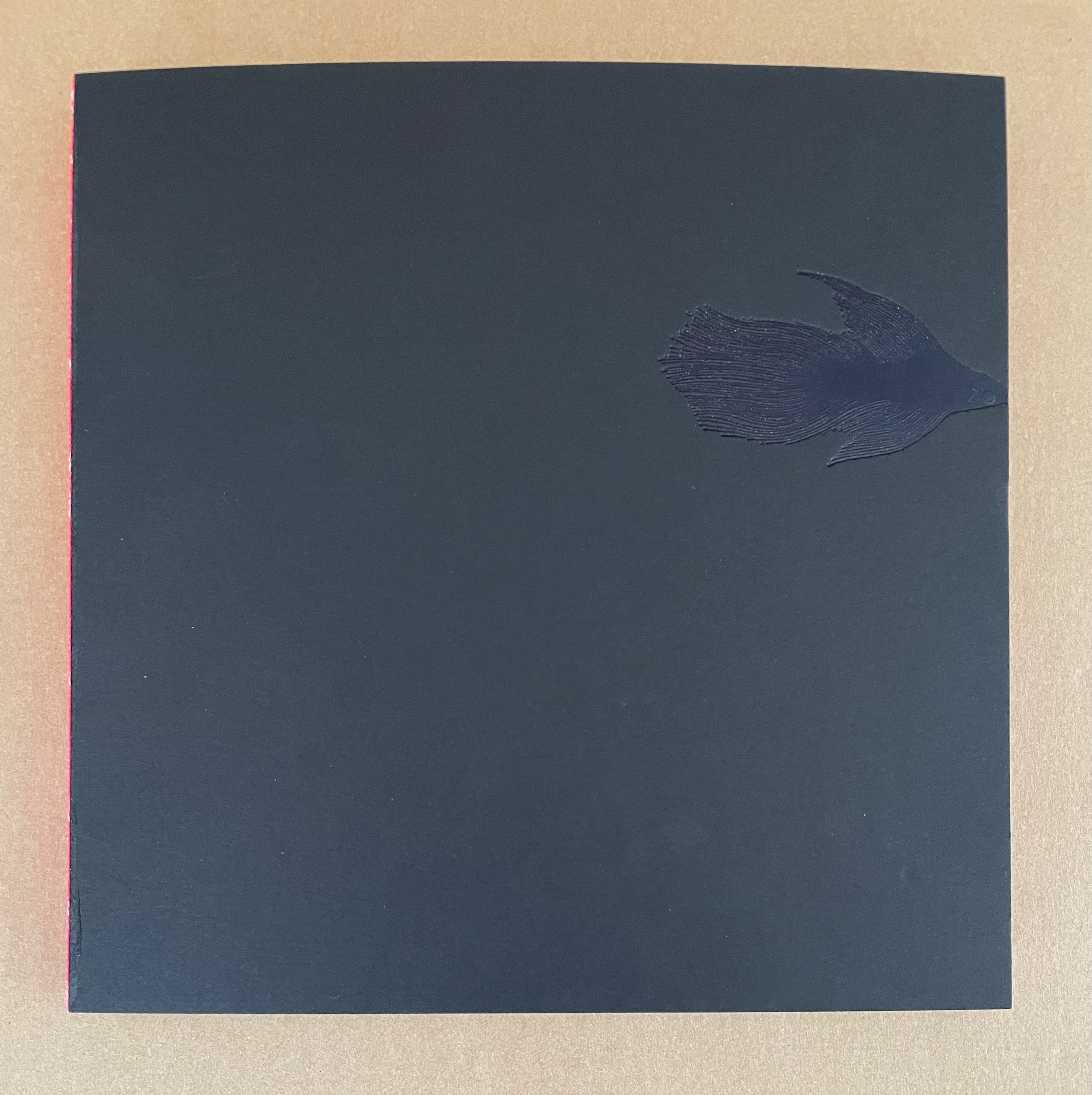
Board-covered books, bound face-to-face, exposed spine binding with cross weave filament tape. H200 x W400 mm (open); W800 (open). [16] Chinese fold folios. Acquired from Somebooks, 6 April 2025.
Photos: Books On Books Collection.

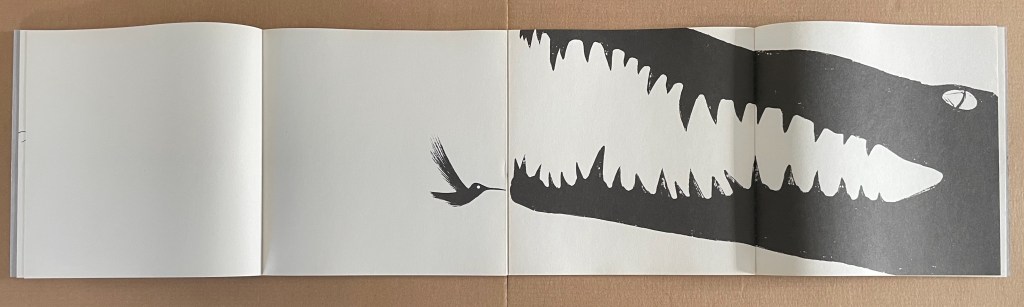
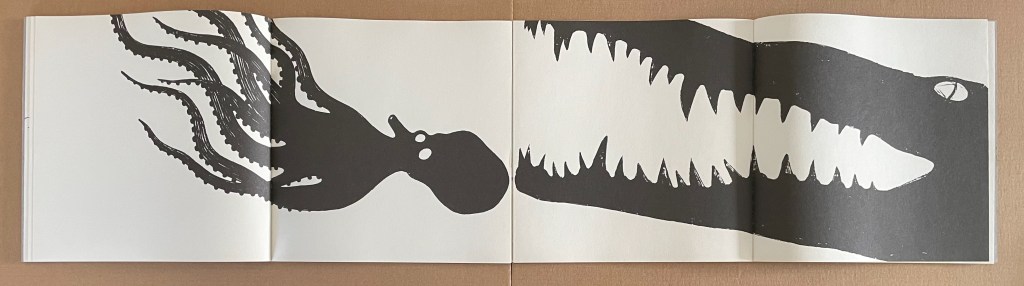
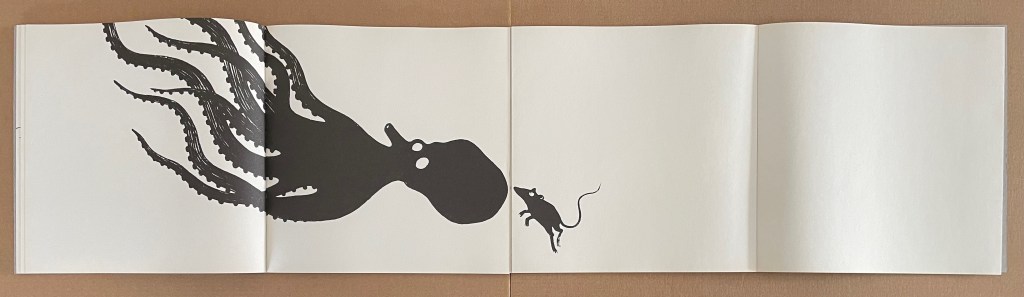
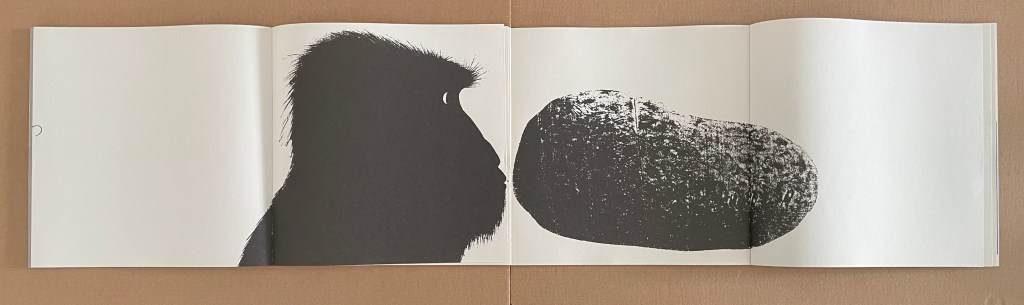
Kiss is far more whimsical. It works somewhat like a harlequinade, allowing multiple juxtapositions of images. The structure by which it does this is complex enough and the juxtapositions, subtle enough, that adult assistance is likely required. The book is actually two books joined at edges of their back covers, one opening to the left and the other, to the right.
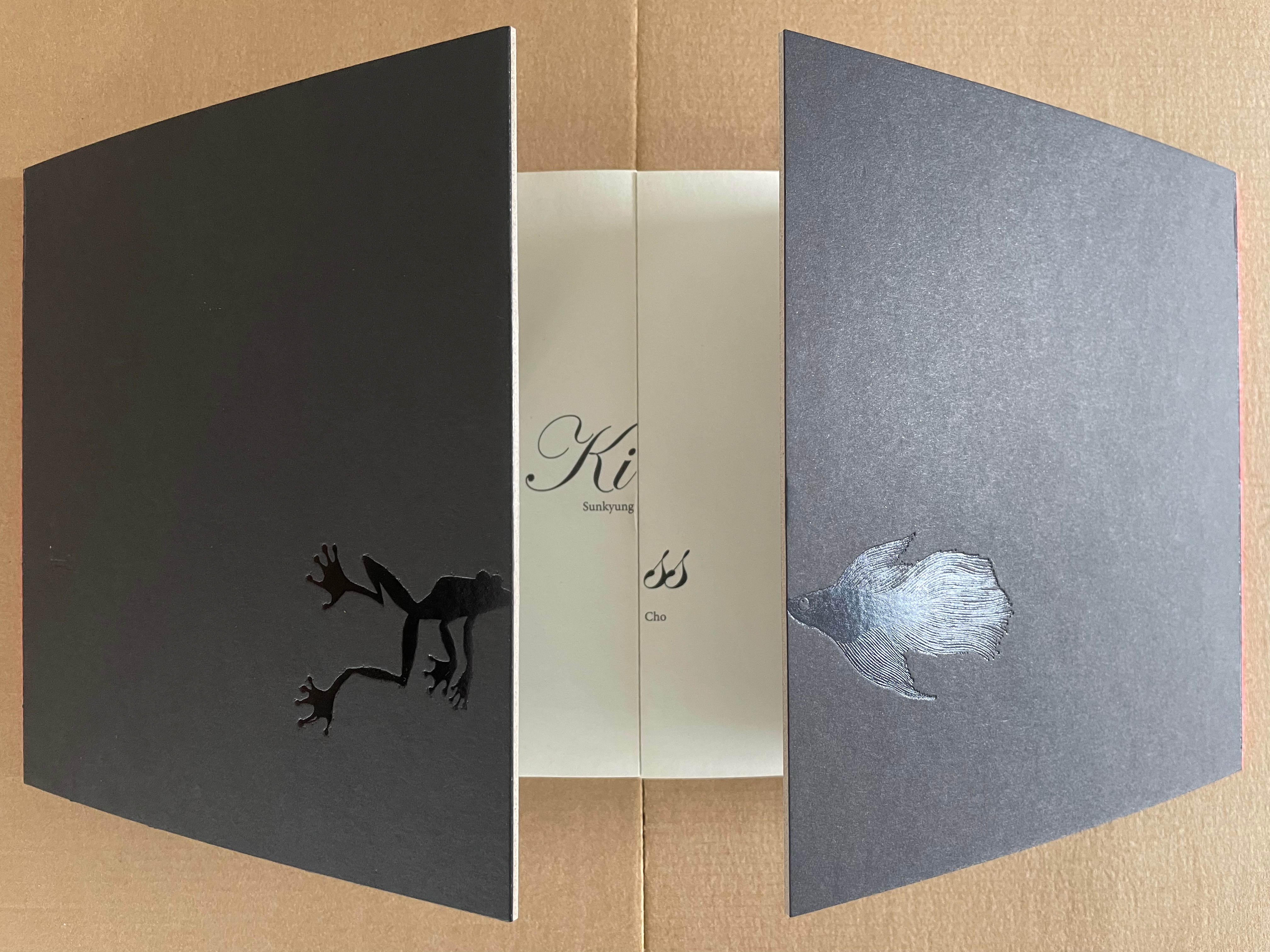
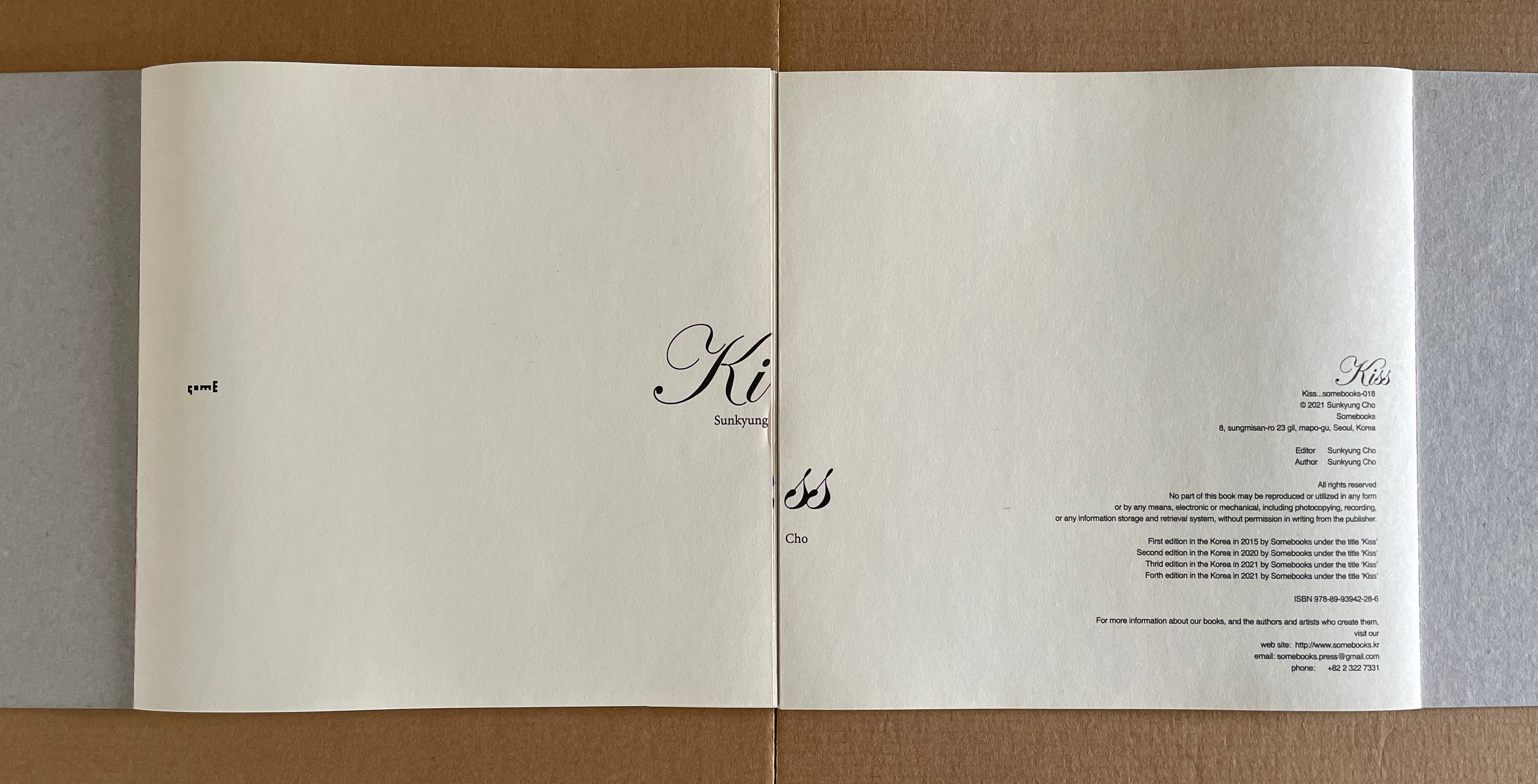
The precision of the registration between the facing books will generate delight as a gorilla kisses a mouse. The mouse kisses a bird. The bird, a crocodile. The crocodile, a gorilla or octopus. The octopus, a mouse or frog. And so on with sharks, snakes, and others.

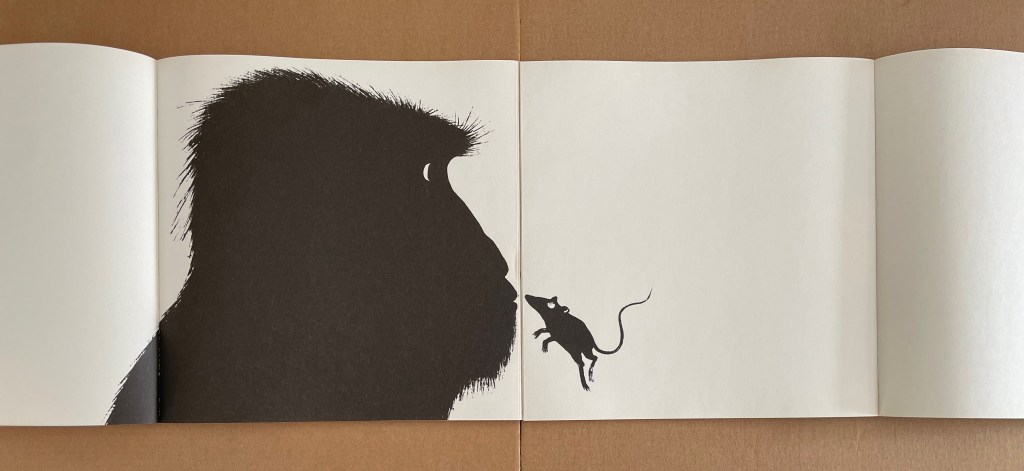
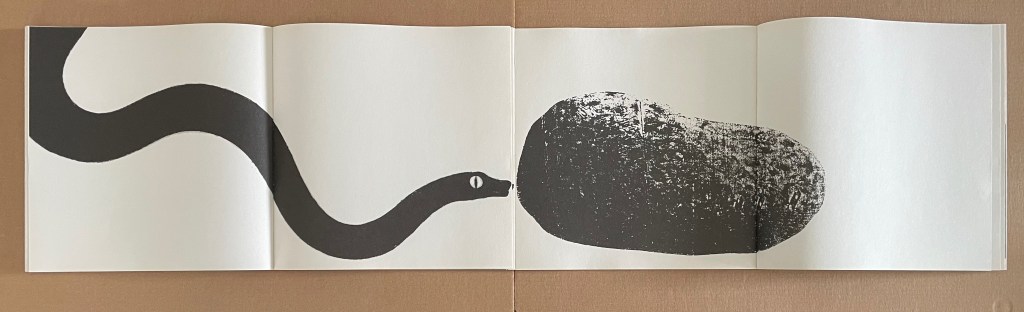
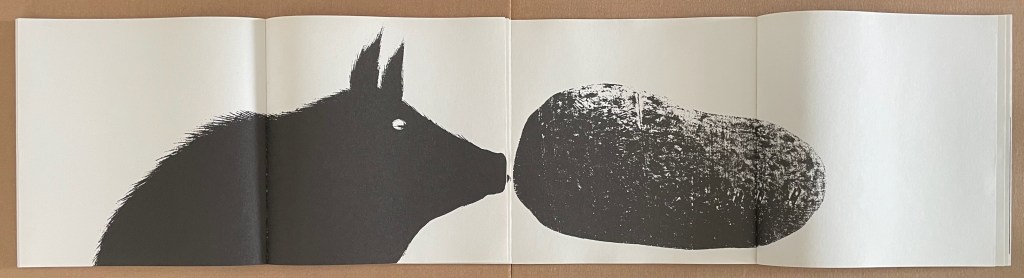
Among the effective subtleties that more experienced observers will note are Cho’s handling of bleeds and the facing sets of double-page spreads. The large expanses of white behind each of any two smaller figures facing each other from single pages contribute to a non-threatening delicate kiss. The larger, more threatening creatures extend across their double-page spreads and even bleed off their pages. When they meet, or when one of them meets a smaller figure, there is an edge. It may be an edge of curiosity on one side or the other or both, but it is likely also one of threat and unease.

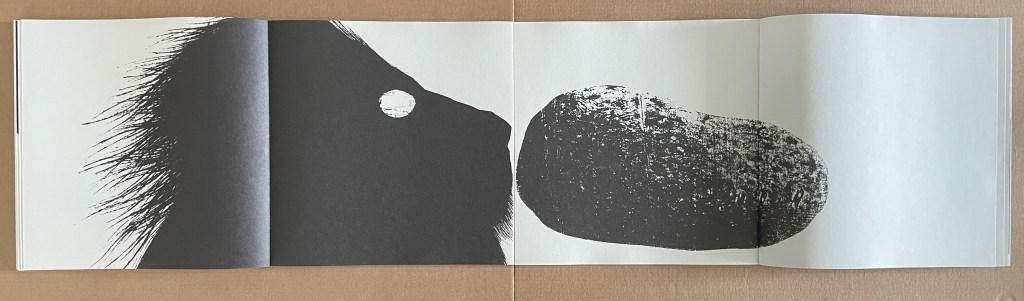
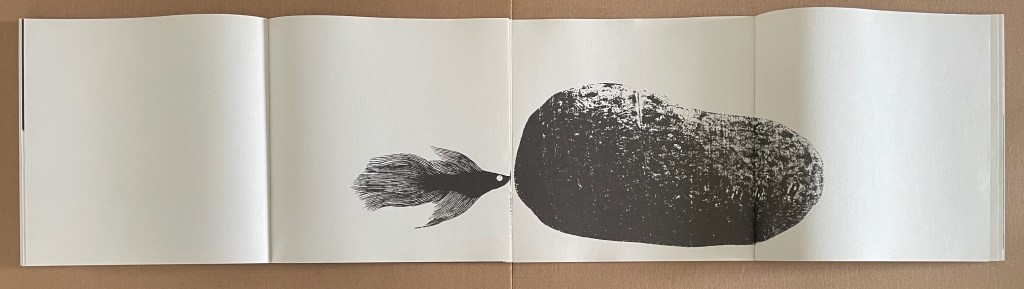
Another subtlety is the handling of the human figure. It occurs in the recto book. Like the smaller figures, it occupies a single page with a page of white behind it. It is expressionless, regardless of what it faces whether fish or lion. Oddly, the fish seems to be curious, and the lion, reserved.

Here is another subtlety that Cho raises. The last figure in the recto book is a stone, large enough to extend over its double-page spread. No doubt it is an anthropomorphizing tendency to read something (puzzlement, curiosity, annoyance, etc.) into the silhouette of each creature confronting the stone. But it is only the stone and human that exude indifference.
For an interesting structural, line and color comparison with another osculatory work, see Antonio Ferrara’s Ventiquattromila baci (Twenty four thousand kisses) (2021).

Further Reading

Philip Zimmermann“. Books On Books Collection.

Beckett Sandra L. 2013. Crossover Picturebooks : A Genre for All Ages. London: Routledge.

Golden Pinwheel. 23 July 2020. “Cho Sunkyunk, the many faces of illustration“. Golden Pinwheel.

Haughton, Chris. 13 September 2011. “5 1/2 months on Sunkyung’s sofa“. chrishaughton.com.

Mutty. 12 May 2020. “Sunkyung Cho – Living Objects“. Art Tribune.

Nikolajeva, Maria, and Carole Scott. 2007. How picturebooks work. New York: Routledge Taylor & Francis Group.

Outlaw, Christopher. 17 April 2017. “FILBo 2017“. The Bogotá Post. Accessed 30 October 2011.

Perkins, Stephen. 7 March 2023. “Antonio Ferrara, Ventiquattromila baci (Twenty four thousand kisses), Settenove edizioni, Cagli, Italy, 2021.” Accordion Publications.

Scott, Carole. 2014. “Artists’ books, Altered books, and Picturebooks”. In: B. Kümmerling‐Meibauer, ed., Picturebooks: Representation and Narration. London, New York: Routledge.
Books On Books Collection – Sam Sampson

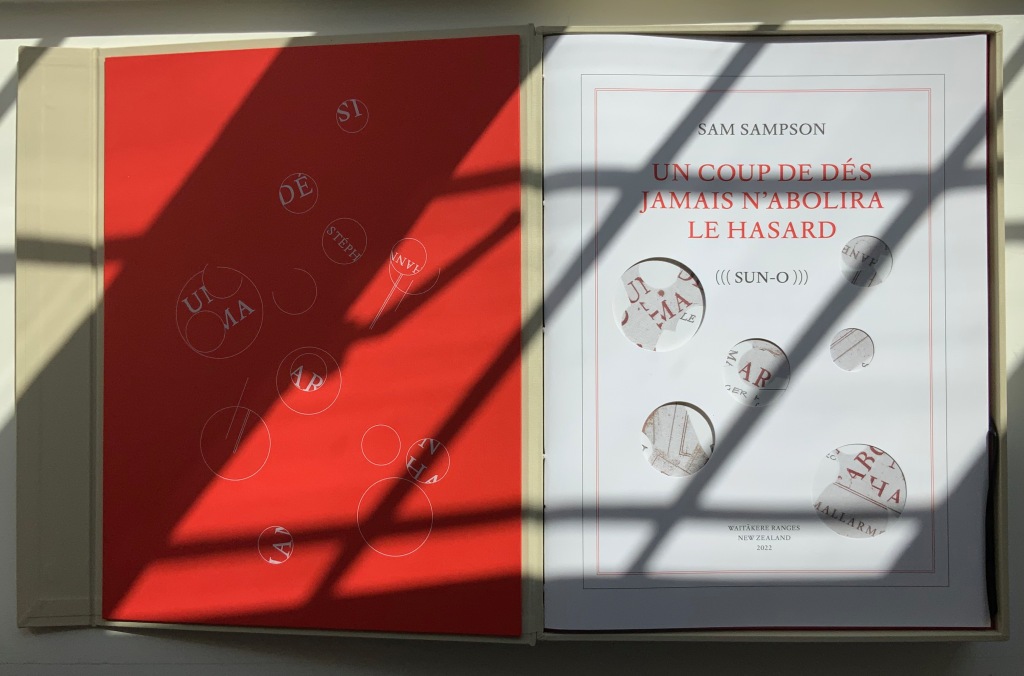
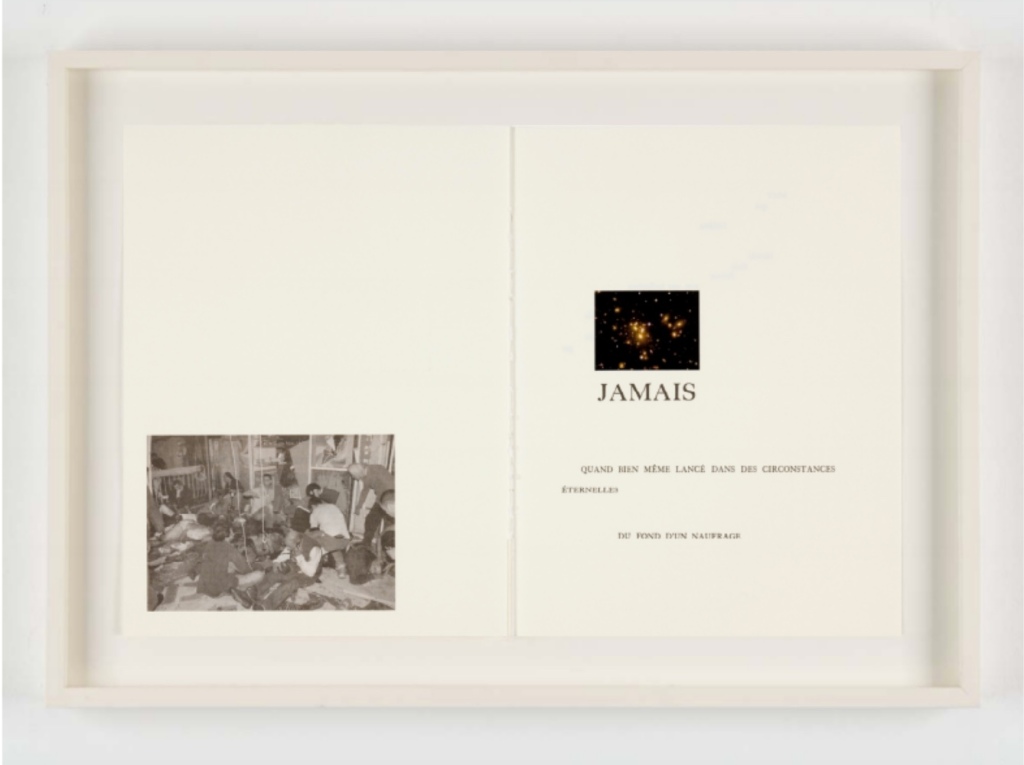
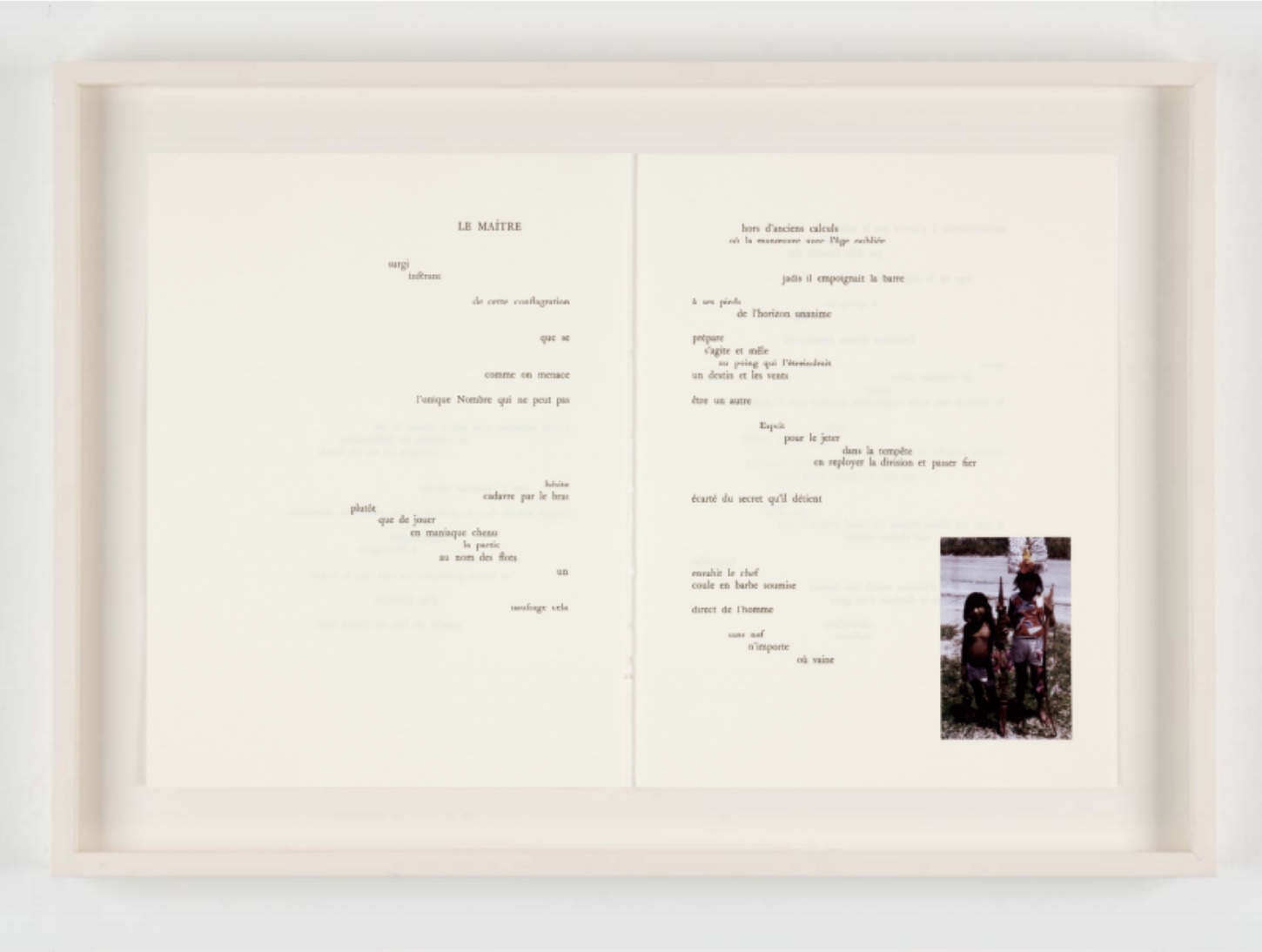
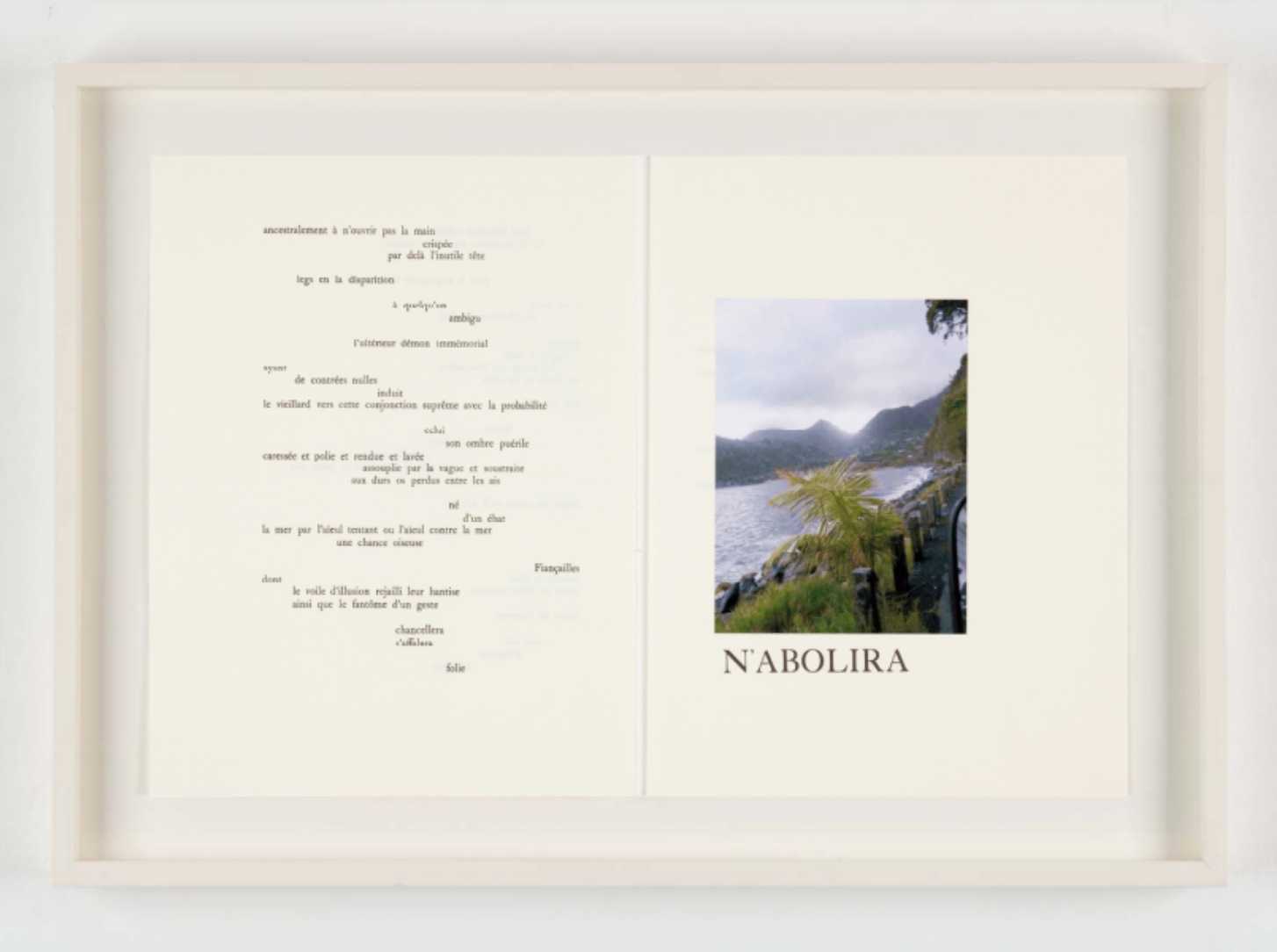
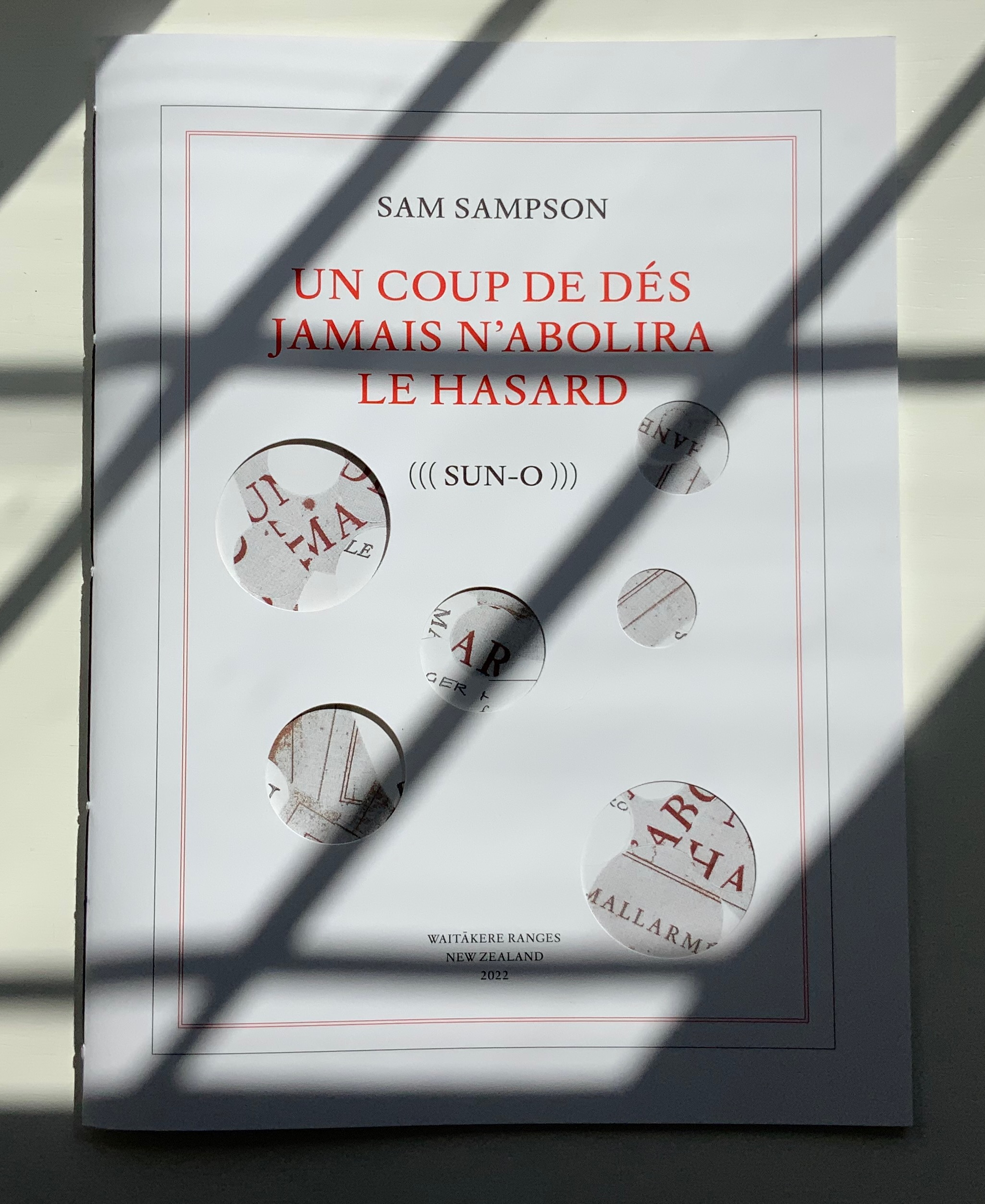
Derek Beaulieu (No Press) first published Sam Sampson’s homage to Un Coup de Dés as a handsewn pamphlet in 2020. To celebrate the 125th anniversary of Mallarmé’s initial publication of “the poem that made us modern”, Sampson enlisted Jacinda Torrance of Verso Visual Communications for design, the firm Centurion for printing, and Louise James of The Binding Studio for hand binding to produce this deluxe edition.

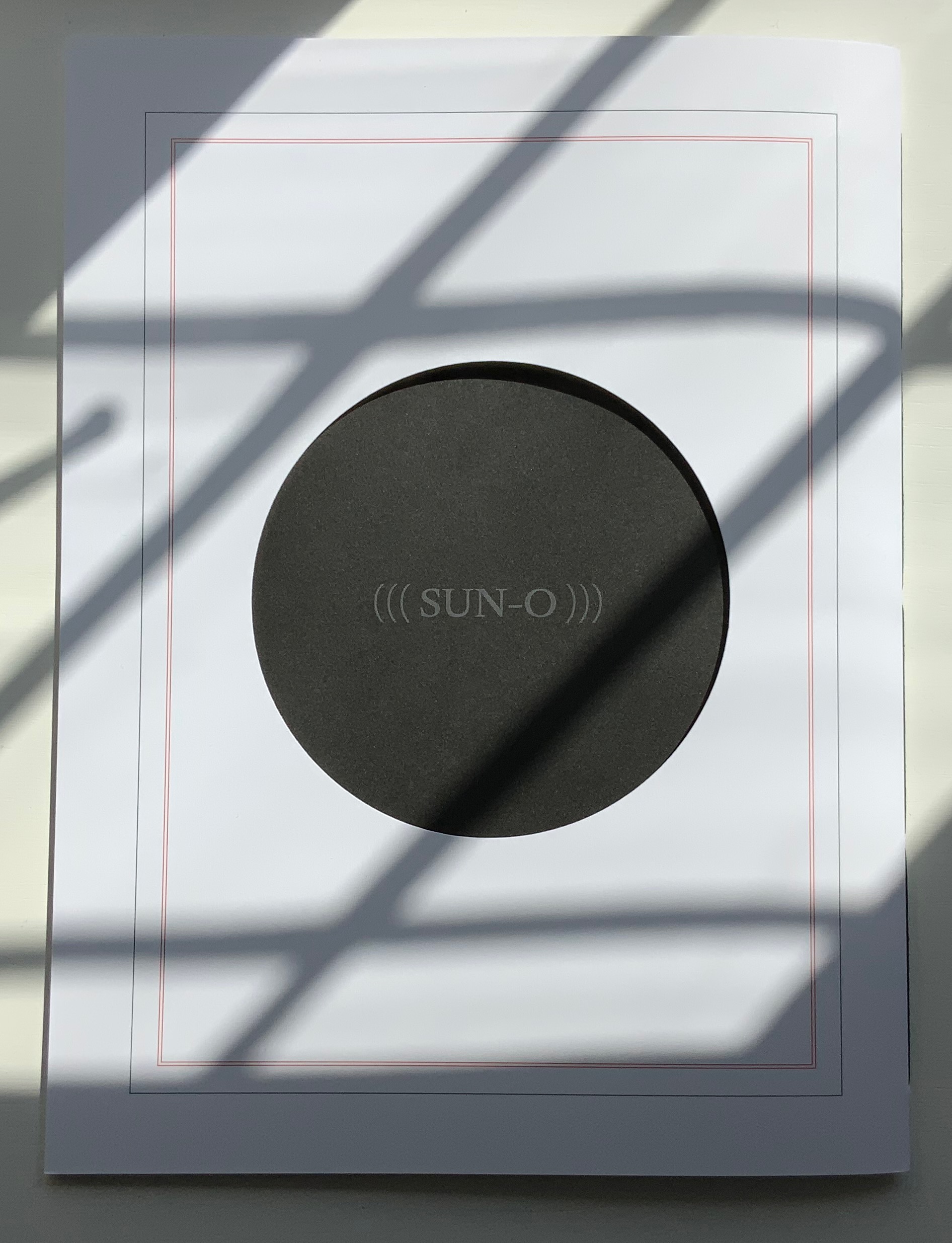
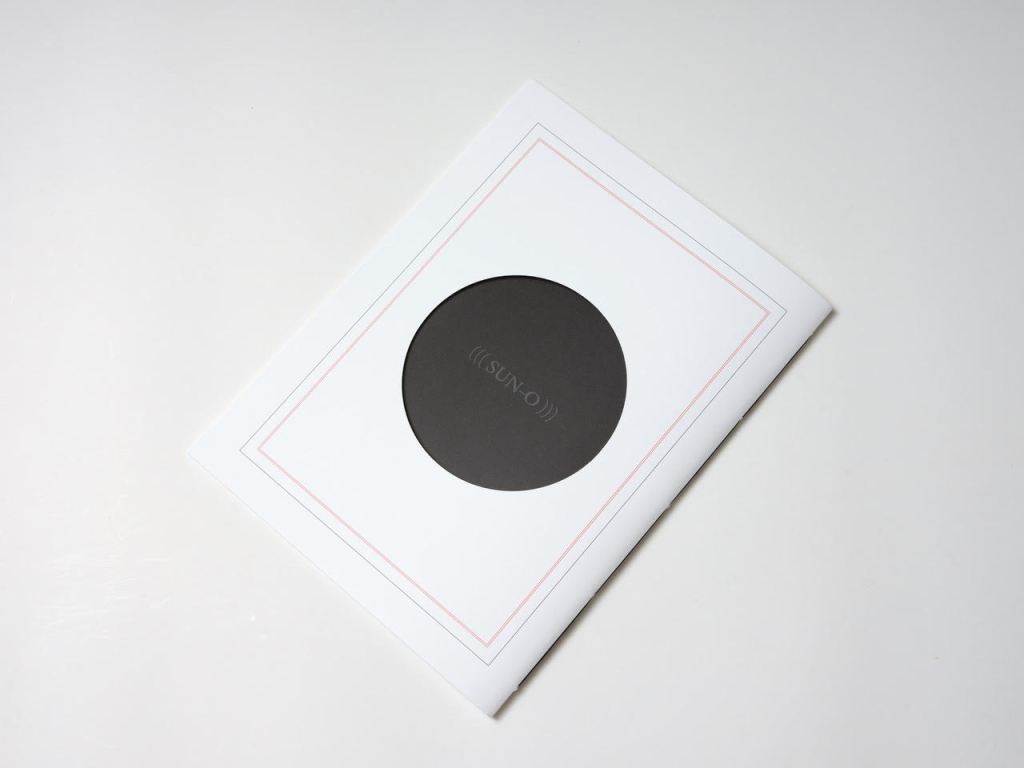
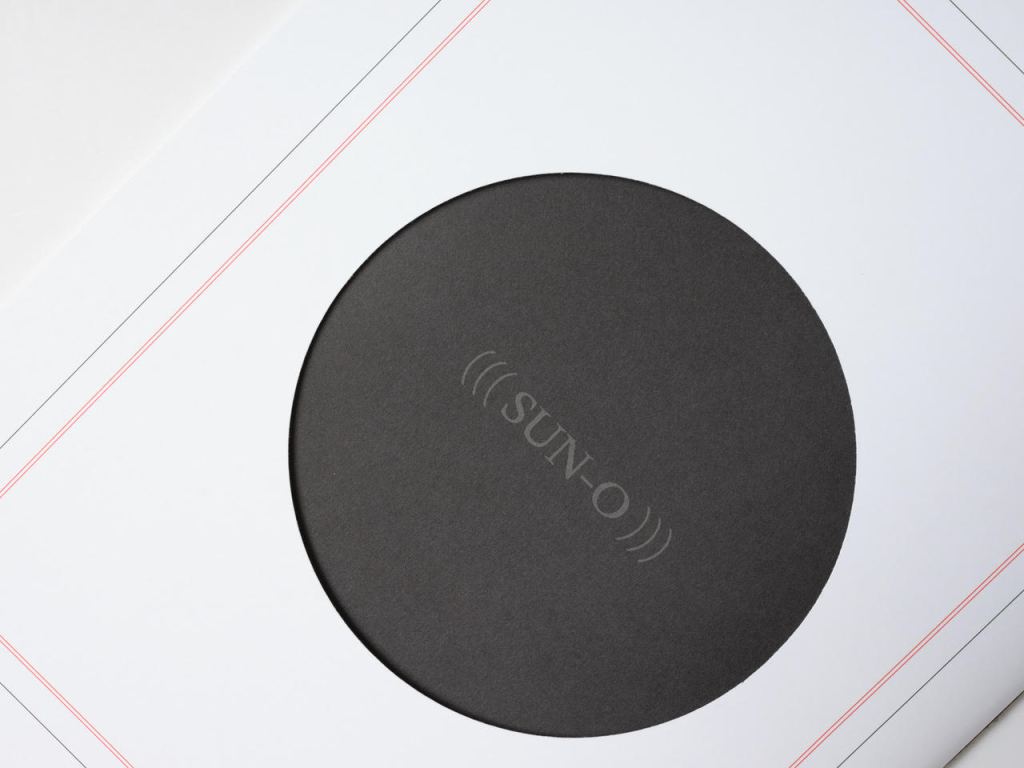
UN COUP DE DÉS JAMAIS N’ABOLIRA LE HASARD (((SUN-O))) (2022)

Un Coup de Dés Jamais N’Abolira le Hasard ((( Sun-O ))) (2022)
Sam Sampson
Handsewn book, H300 x W225 mm, 28 unnumbered pages. Edition of 20 (10, each enclosed in a hinged-lid box with magnetic flap; 10 unboxed), of which this is boxed # 2. Acquired from the artist, 7 April 2022.
Photos: Books On Books Collection. Displayed with permission of the artist.

As with most creative works, (((Sun-O))) had multiple points of inception. One of them was an essay Sam Sampson read by Susan Howe and Cole Swensen. They quote Mallarmé’s preface to the poem (“nothing new except a certain distribution of space made within the reading” and speak of his aim to fuse sequential and simultaneous perception, to fully engage the eye and ear, as a result pushing poetry in two directions – toward visual art and toward musical performance. This resonated with a series of poems Sampson was writing and manifests itself in (((Sun-O))):

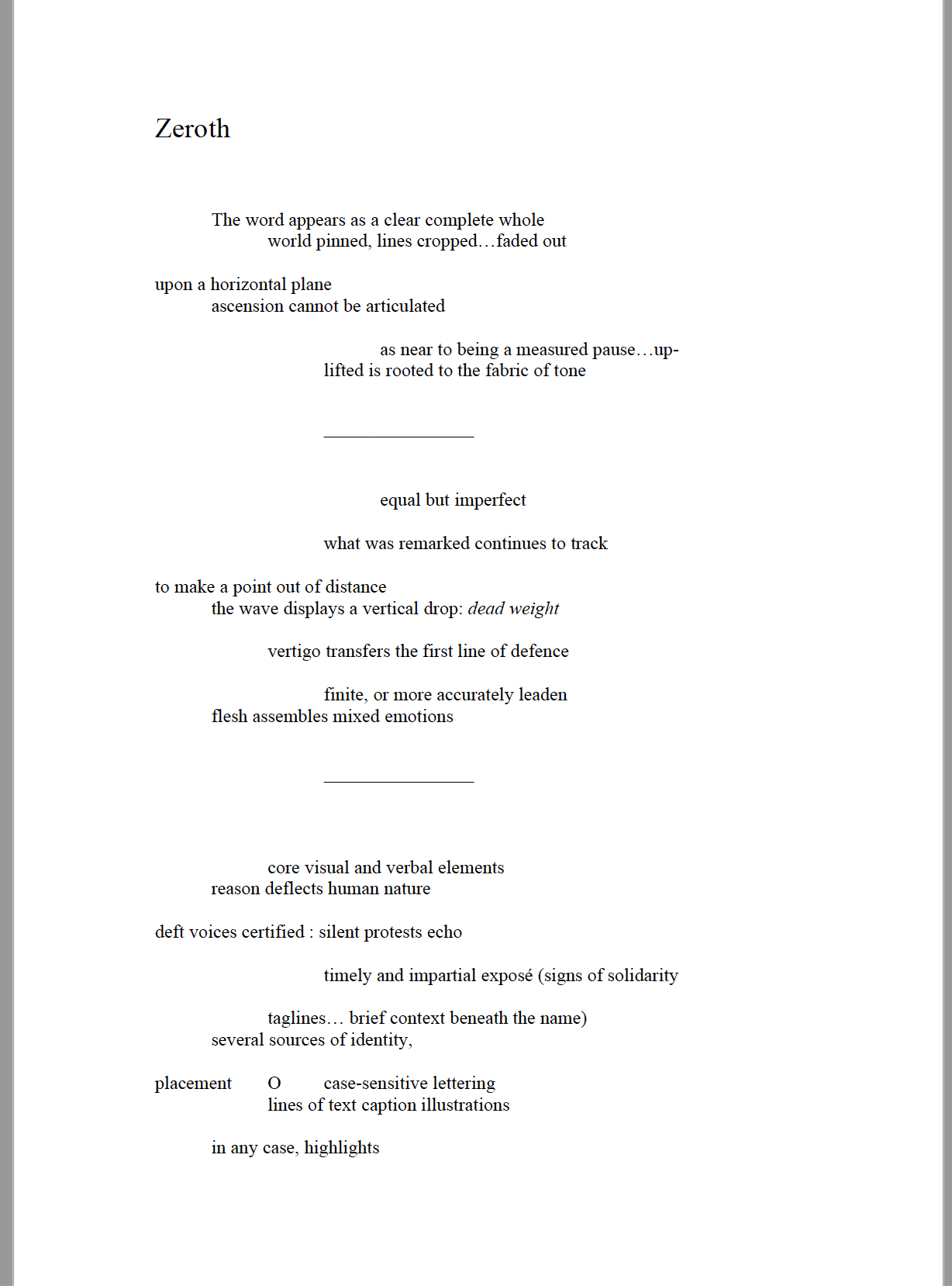
The physical design and analogy in my rendition is aligned with what I would call the ‘O Poems’. ‘O’ Zero, being the sound that runs through these poems, but I’ve also been interested in the numerical concept of zero: the beginning point, but also the point of departure, the ‘O’ as an ideogram, giving the text a pictorial as well as vocalised movement. [Correspondence with Books On Books Collection, 29 March 2022]

Another of the “O Poems” is Zeroth. Sampson reads it here:

© Sam Sampson. Reprinted with permission of the author.

Zeroth leads to another point of inception: a conversation with Roger Horrocks, a New Zealand poet, writer, film-maker, educator and cultural activist, to whom (((Sun-O))) is dedicated. After reading Zeroth, Horrocks told Sampson that it reminded him of his favorite Seattle experimental metal band at the time – Sunn O))). Sampson describes their sound as slow, heavy, blending diverse genres including “drone, black metal, dark ambient and noise rock”. Sampson’s mulling over the very sound of the band’s name led to free associations with the secondary meanings of drone (surveillance, panopticon). Mulling over the name’s compression of word and the letter O led to his hybridized subtitle (((Sun-O))) “with its parentheses radiating out but never closing”. A potent visual and textual image for a poem touching on, if not touching, the sun, the abyss and the human.

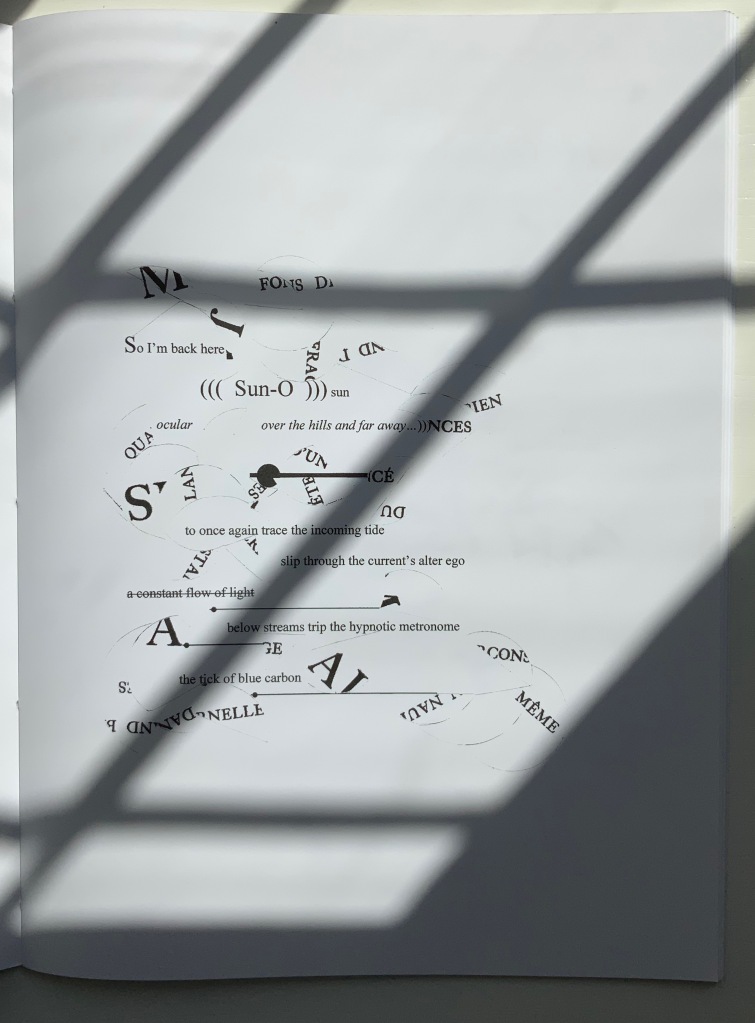
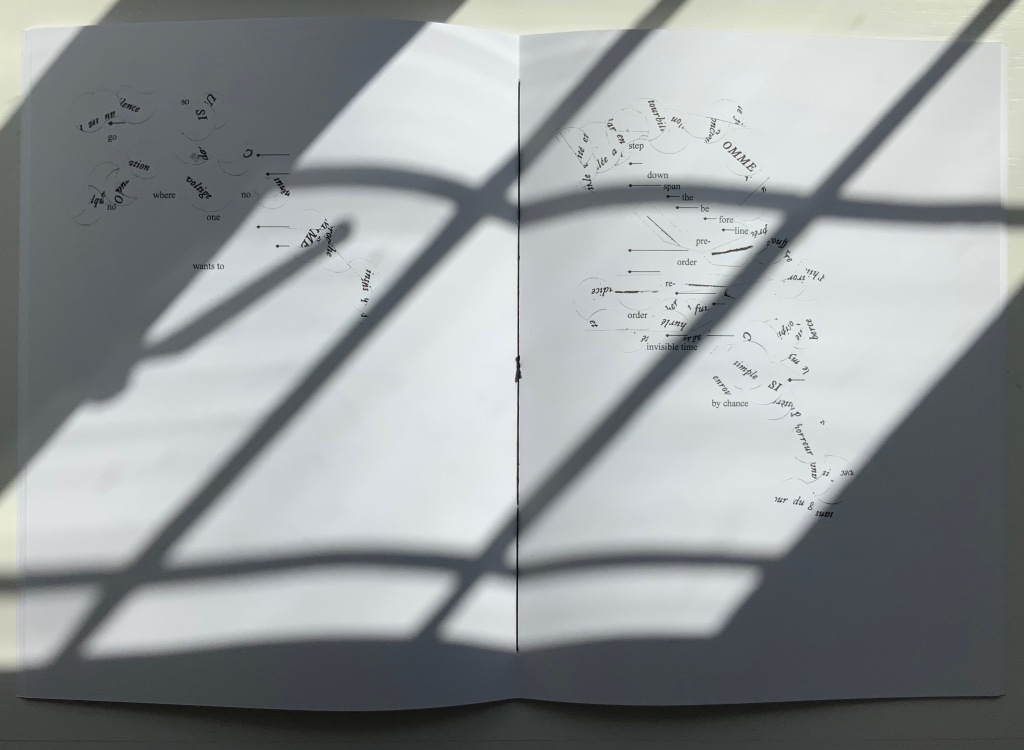
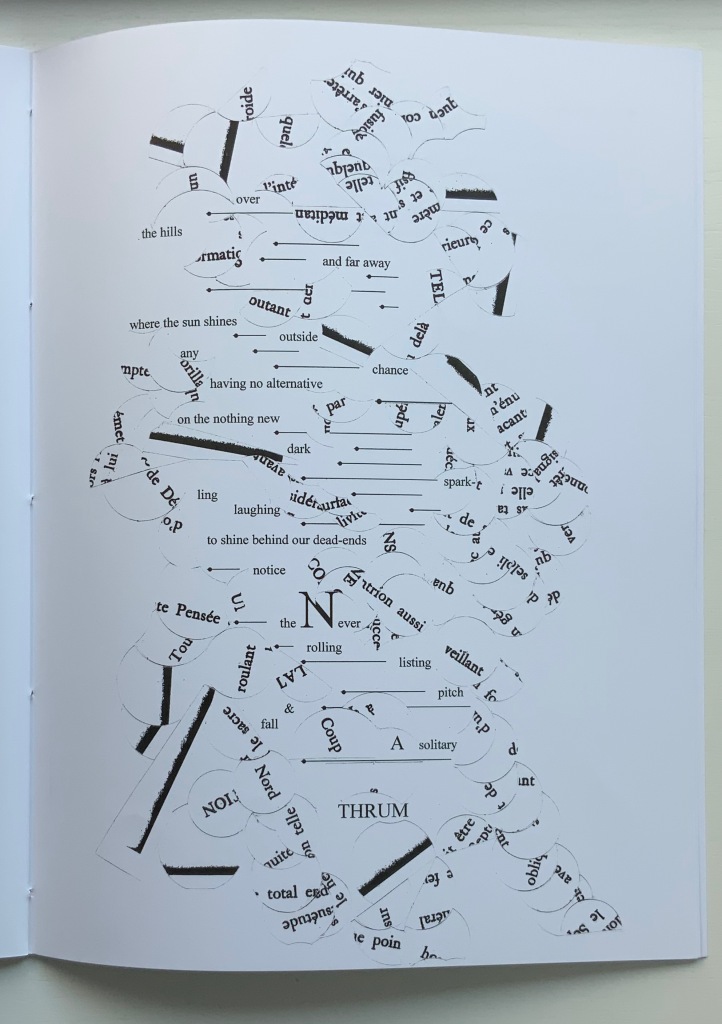
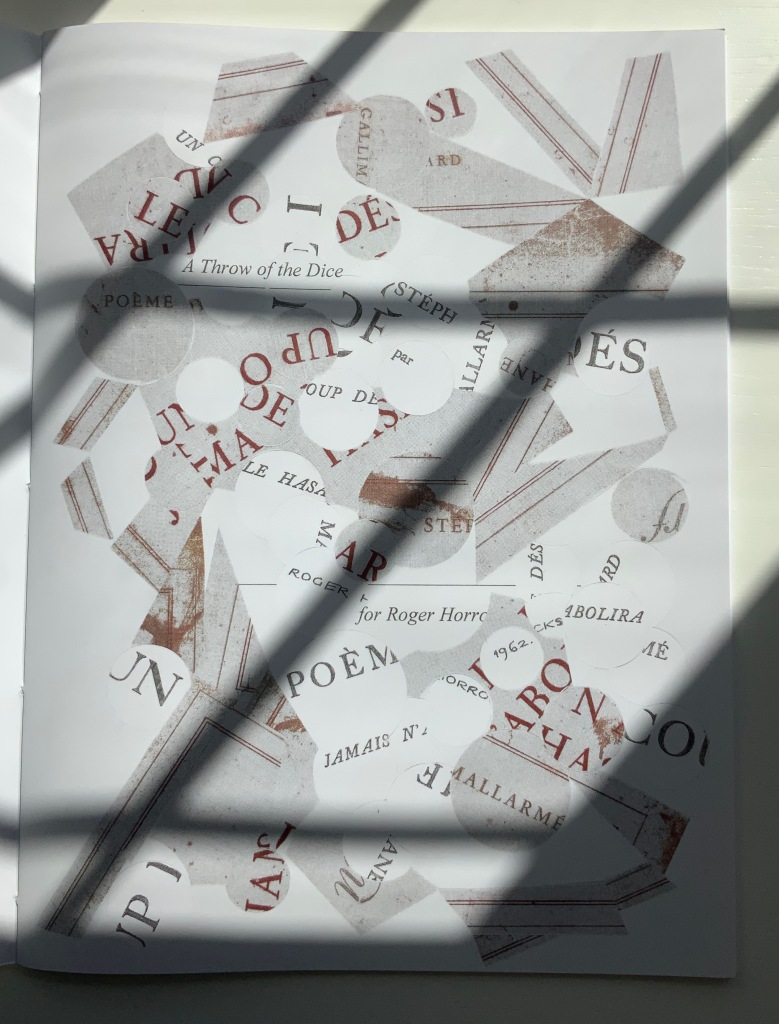
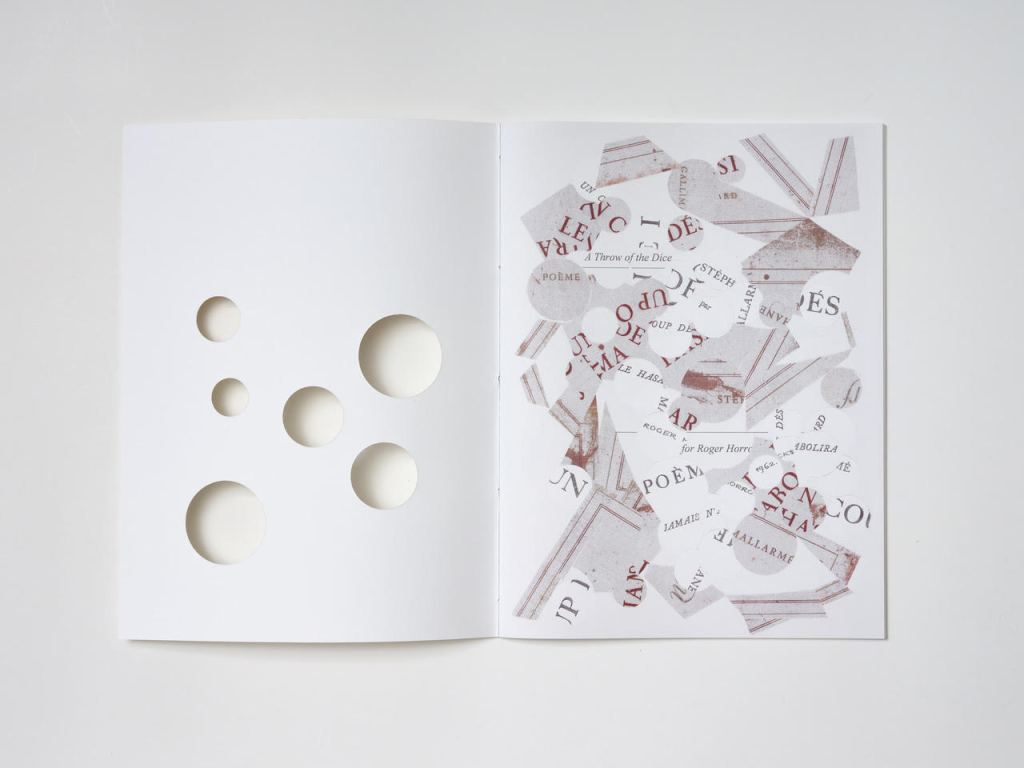
But, of course, the zero point of inception is Un Coup de Dés. On a visually material level, (((Sun-O))) has a scaffolding of bullet-pointed rules, whose lengths are based on measuring each of Mallarmé’s lines, whose weights approximate the variable font sizes, and whose placement matches that in Un Coup de Dés. This lattice serves as the physical structure for the collage of words and O’s that Sampson layers like paint or screenprint onto the page. Some words and lines are upside down like the detritus of a shipwreck. Some words curve and drape between the lines like torn sails. Appropriately, some come from the precisely corresponding pages in Mallarmé’s poem. Faint lines of the circumferences of O’s leap across and down between the lines almost like musical notations.

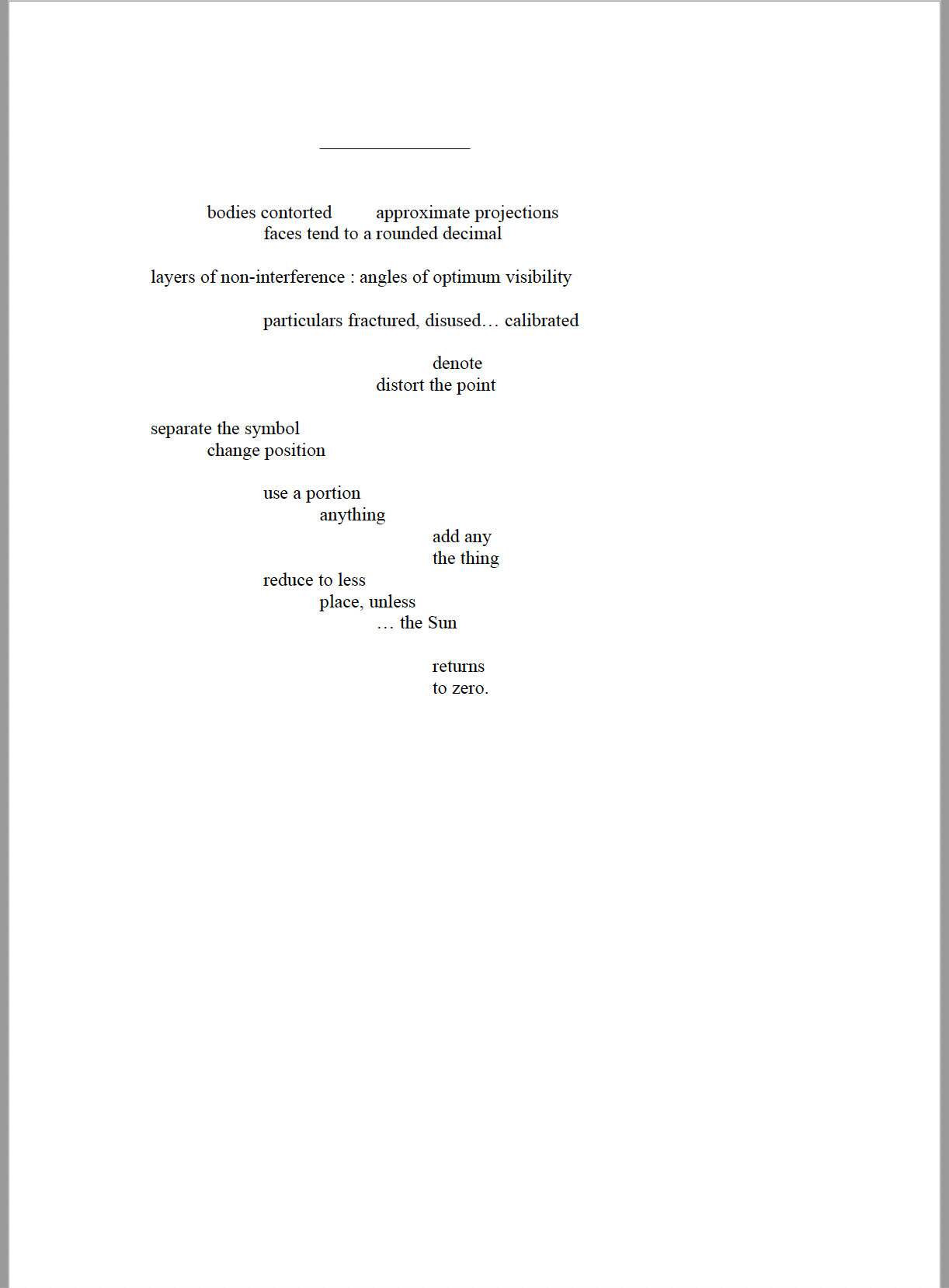
Within this tangle, Sampson’s own elusive and allusive text plays. Some of its phrases come from traditional song; some fix the geographical location (“blue carbon” places the speaker in a coastal community); some “un-fix” the location (“over the hills and far away”); some are struck through, alerting the reader to be ready to discard and start again; some set the technological time frame (the reference to operating systems like Suse, Symbian and, of course, Solaris). As in Un Coup de Dés, the text’s syntax and placement on the page encourage reading in fits and starts, back and forth. As Sampson puts it:

I wanted [my] poem to somehow capture, as Mallarmé had described it, “the invitation of the great white space”, and the successive, incessant, back-and-forth motions of our eyes travelling from one line to the next, and beginning all over again. [Correspondence with Books On Books Collection, 29 March 2022]

Indeed, before writing Un Coup de Dés, Mallarmé foreshadowed more expansively this phenomenon toward which Sampson strives:

Pourquoi — un jet de grandeur, de pensée ou d’émoi, considérable, phrase poursuivie, en gros caractère, une ligne par page à emplacement gradué, ne maintiendrait-il le lecteur en haleine, la durée du livre, avec appel à sa puissance d’enthousiasme: autour, menus, des groupes, secondairement d’après leur importance, explicatifs ou dérivés — un semis de fioritures. [Oeuvres Complètes, 2, 227]

“Why — couldn’t a considerable burst of greatness of thought or emotion, carried in a sentence in large typeface, gradually placed with one line per page, hold the reader’s bated breath throughout the entire book by appealing to his or her power of enthusiasm: around this [burst], smaller groups of secondary importance, explicating or deriving from the primary phrase — a scattering of flourishes.” [Arnar, 234]

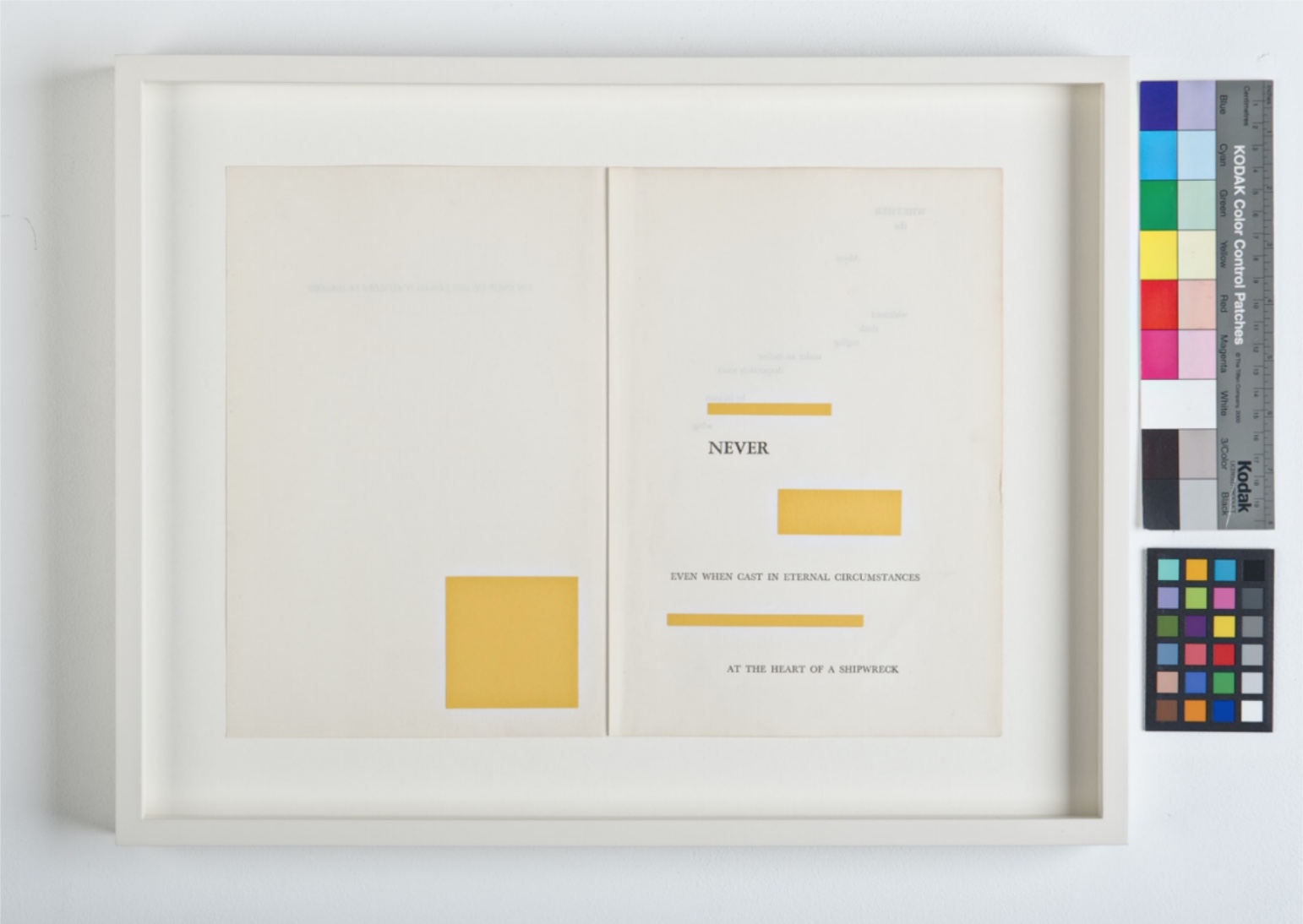
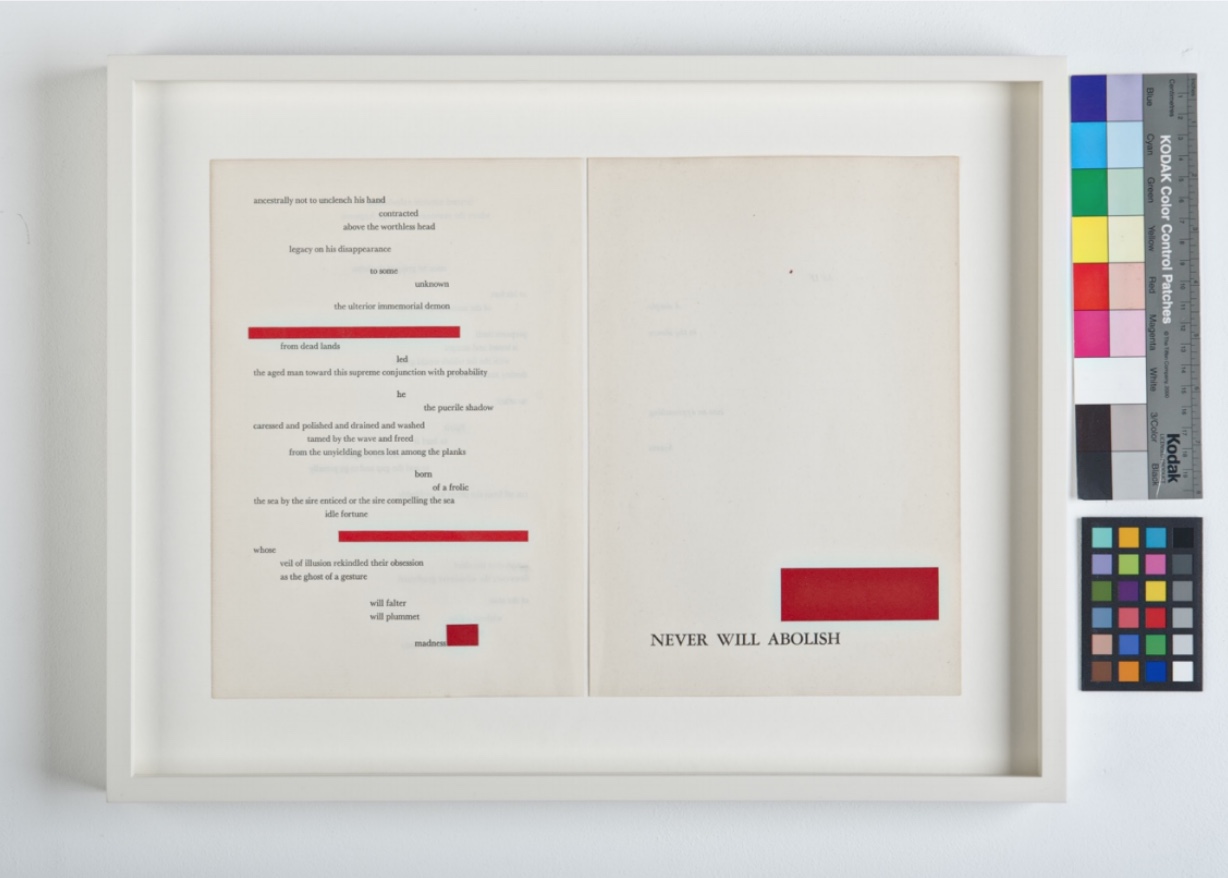
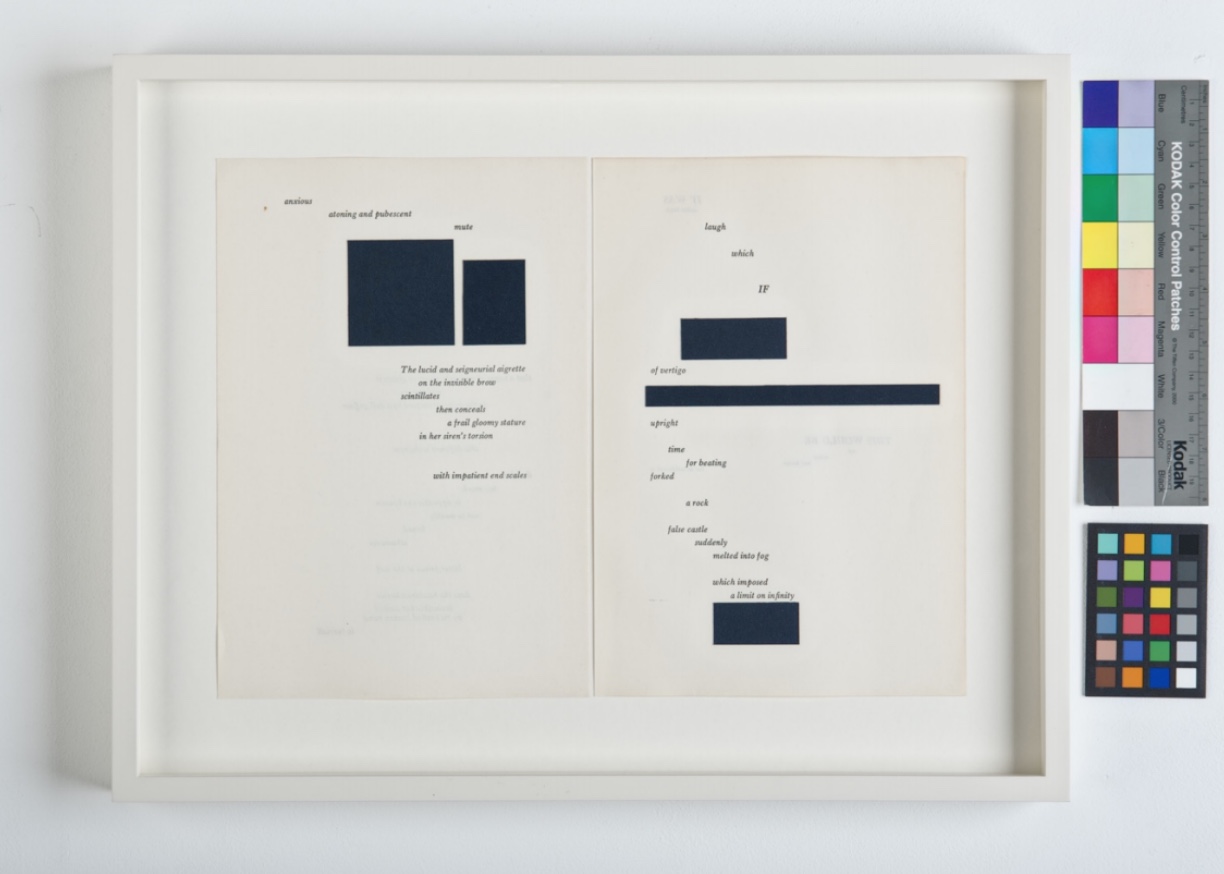
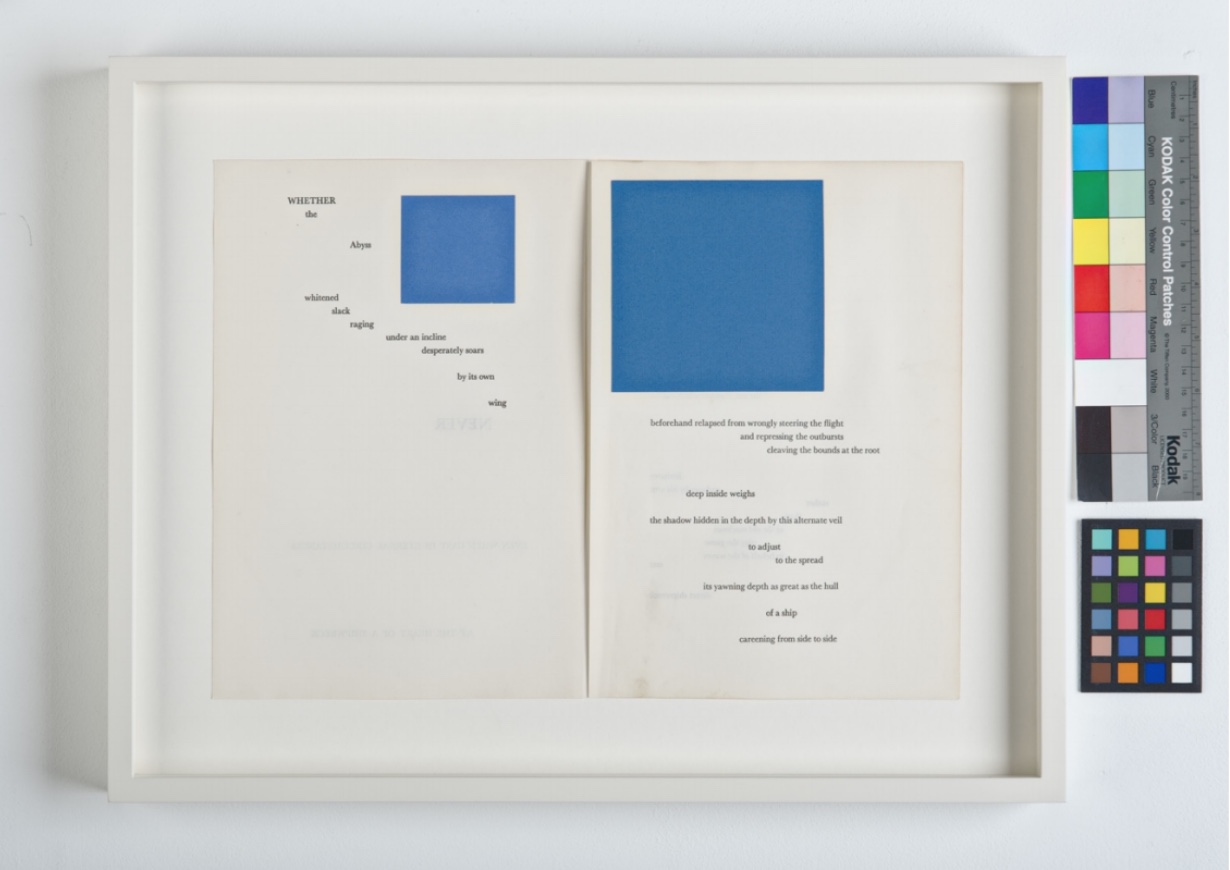
Whereas in Mallarmé’s poem there is a primary sentence in large typeface (“UN COUP DE DÉS JAMAIS N’ABOLIRA LE HASARD”) off which the secondary groups of phrases and sentences play, (((Sun-O)))‘s primary foil is the combination of two things: the collage made from shards of Mallarmé’s poem and that strange, enjambed subtitle (((Sun-O))). After all, the full title of Sampson’s work is UN COUP DE DÉS JAMAIS N’ABOLIRA LE HASARD (((SUN-O))).

The “Comme si … Comme si” center double-page spread.

Sampson calls Mallarmé’s poem a form of metaphysical gambling, reproducing the sensation of being both in and outside time. Being both in and outside of time — that could be the defining state of human consciousness. Unlike the abstract representation of humanity in Un Coup de Dés, however, (((Sun-O)))‘s representation is concretely personal. The traditional song “Over the Hills and Far Away“, which Sampson cites at the start of (((Sun-O))), can be read as a reference to Horrocks’ departure from New Zealand for the United States in the 1960s. At one point, the speaker addresses Horrocks directly: “Roger / what of these / parallels of blue / sea shanties / masquerading mind-sets / …”. Sampson takes the image of Roger Horrocks’ signature from Horrocks’ copy of an edition of Un Coup de Dés, fragments it and reproduces it on the pages of (((Sun-O))). Did Sampson have in mind the story of René Magritte’s loaning his copy of Un Coup de Dés to Marcel Broodthaers, which led to Broodthaers’ Image version of Mallarmé’s poem? (See Marine Hugonnier’s retelling of the tale here.) The scaffolding of bulleted-pointed lines certainly pays homage to Broodthaers and other “hommageurs by redaction” such as Michalis Pichler, Sammy Engramer and others. (((Sun-O))) is a work of many conversations on many levels across time and time zones.

One of the main topics in (((Sun-O))), however, naturally seems to defy the bridging of the personal and abstract: climate crisis. It is hard to miss the allusions to the global shipwreck that is the climate crisis, engendering rising ocean levels and spastic efforts towards zero carbon emissions based on a computational chaos of competing environmental models and competing economic and political systems. It is clearly of personal concern to the speaker, but that does not take the issue from the abstract to the concretely personal in the way that Horrocks’s signature in a copy of Un Coup de Dés does. Making the climate crisis personal could, of course, run the risk of descending into small talk about the weather.

The references to music and the poem’s demonstration of musicality throughout are also hard to miss, and given its zero point of inception, the poem would be seriously remiss without them. The aim for union of text, sound and graphic image is as central to Sampson’s poem as the manipulation of syntax and les blancs is to Mallarmé’s. The aim’s importance in Sampson’s poem even has the last note and oversized word in the poem:

... the Never / rolling / listing / pitch / & / fall / A solitary / THRUM

The frequency of achieved union may be what puts Sampson’s homage in the front rank.

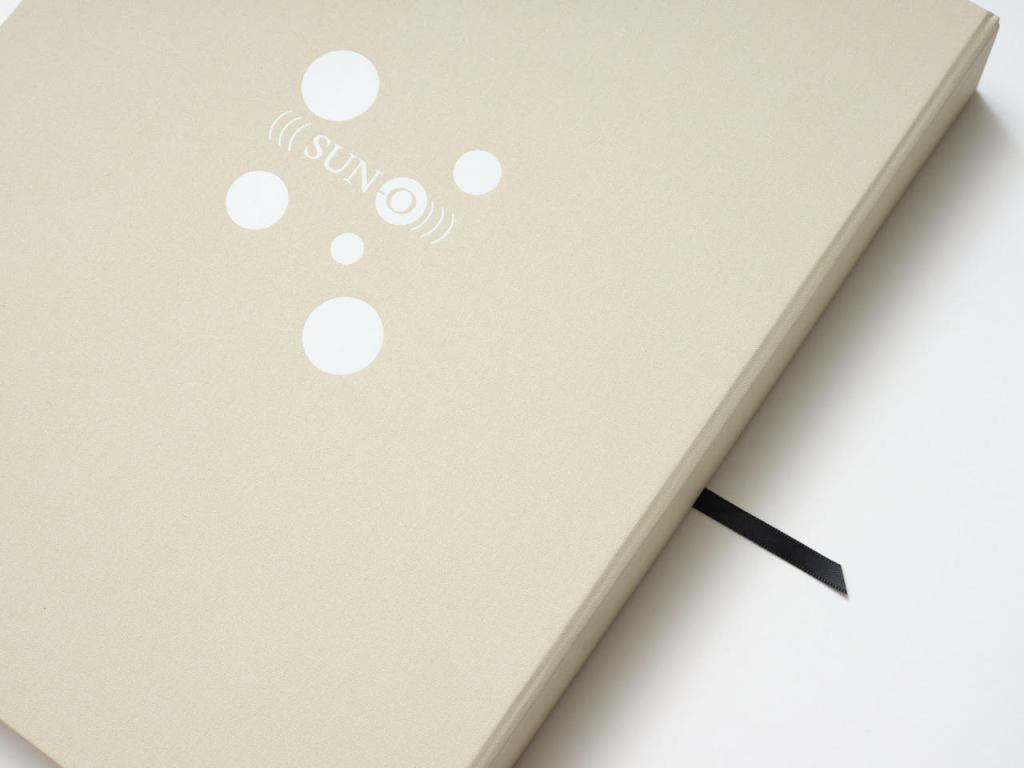
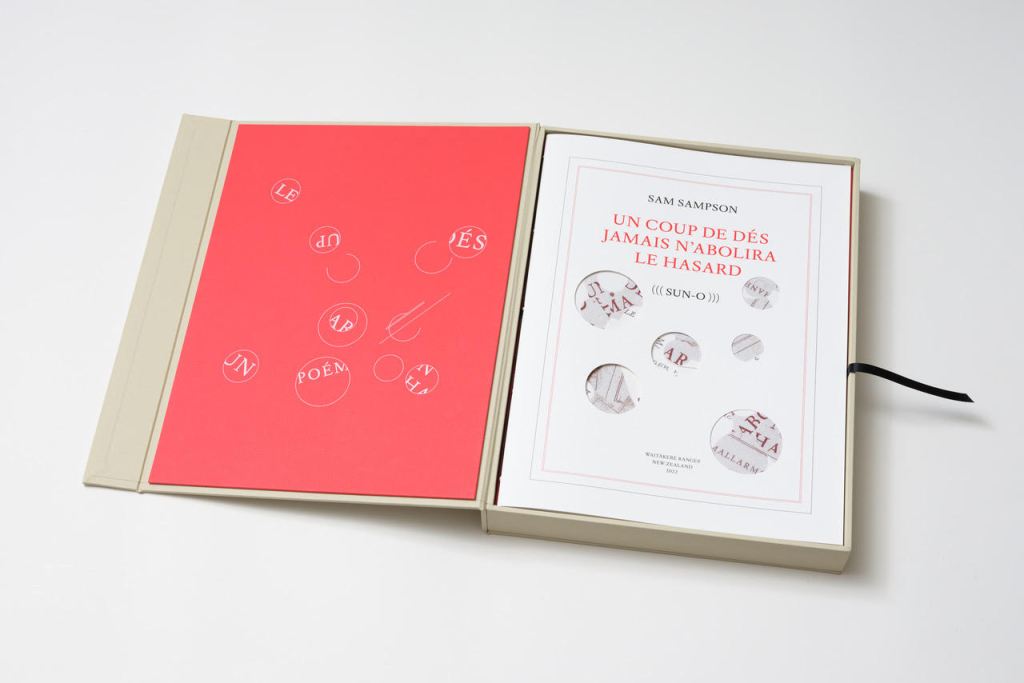
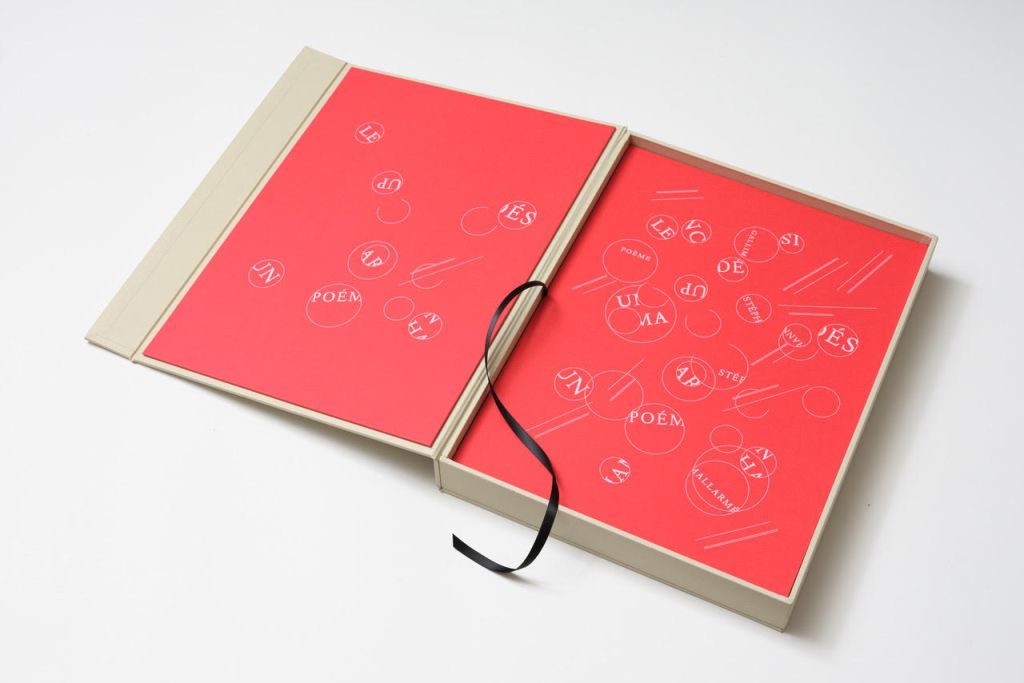
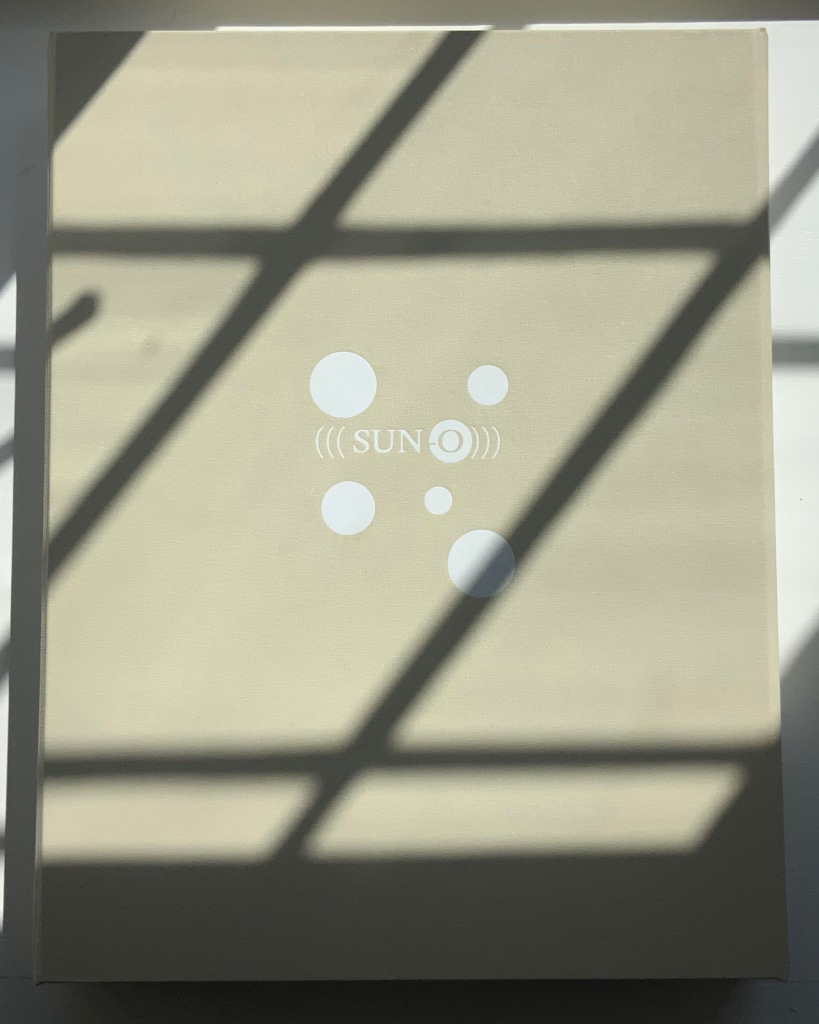
The special edition of (((Sun-O))) enhances that union in material ways. The design and materials play off Sampson’s cutting into and out of, sticking on and sticking through Un Coup de Dés. Six circles foiled in white on the front cover of the box turn the subtitle into an emblem — a mark maker. On the box’s inside lining, a design of circles and broken circles echoing the collage of O’s in the poem (even hinting at musical notation) is used to designate the number of the copy in the edition of 10. For this copy (#2), straight lines cut through 2 of the circles.

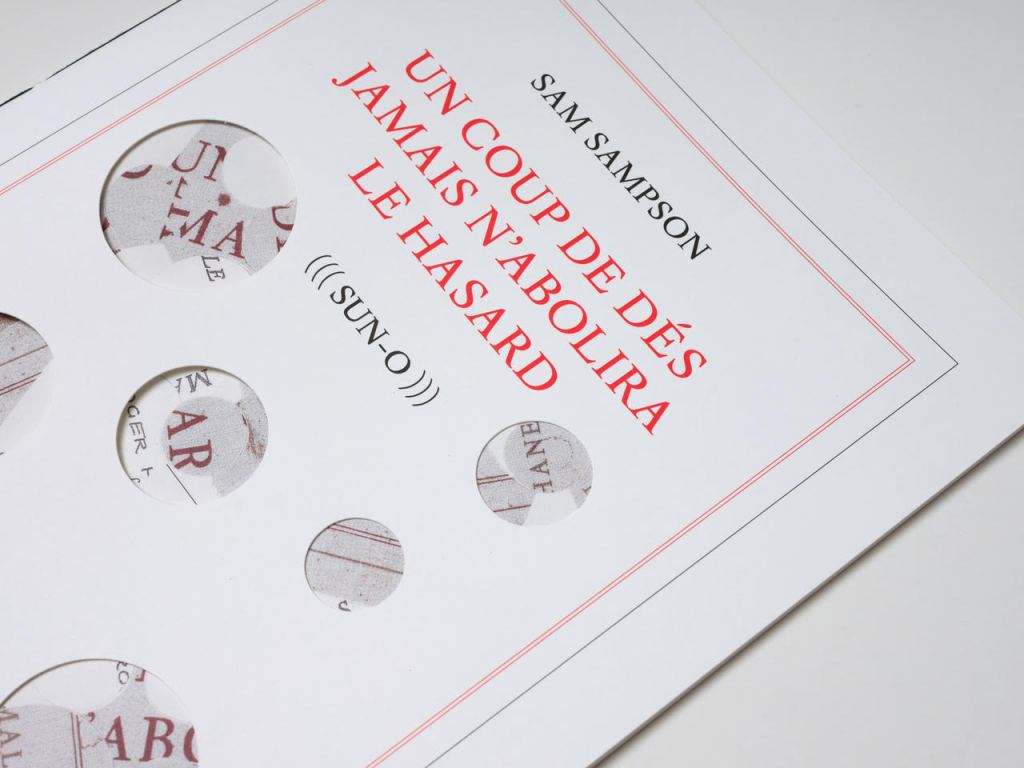
Like the white circles, six die-cut circles on the book’s front cover correspond to the six parentheses of the subtitle and likewise one face of a die. They also recall the hemistich of French poetry’s twelve-syllable Alexandrine, which Un Coup de Dés shattered. An image peeks through the die cuts and, as the cover turns, reveals itself as a collage of the cut-up cover of Horrocks’ copy of the poem and pages of (((Sun-O))). On the back cover, a single large die-cut circle centers on a black-hole sun with a faint, almost invisible ((( Sun-O ))) disappearing into blank/blackness.

By chance or by sly humor, the typeface used is DTL Elzevir. (((Sun-O))) is obviously not in the hunt for absolute fidelity to the edition planned by Mallarmé and Ambroise Vollard in 1896-97, which collapsed with the poet’s death. When Mallarmé’s son-in-law Dr. Edmond Bonniot issued an edition with Gallimard/NRF in 1914, the typeface was Elzevir, allegedly a face that Mallarmé detested. With this special edition of (((Sun-O))), Sampson is in the hunt on his own terms for his own more personal Mallarméan prism, constellation or radiant (((Sun-O))) that syntactically, auditorily, visually and physically scatters and focuses his response to the human condition.

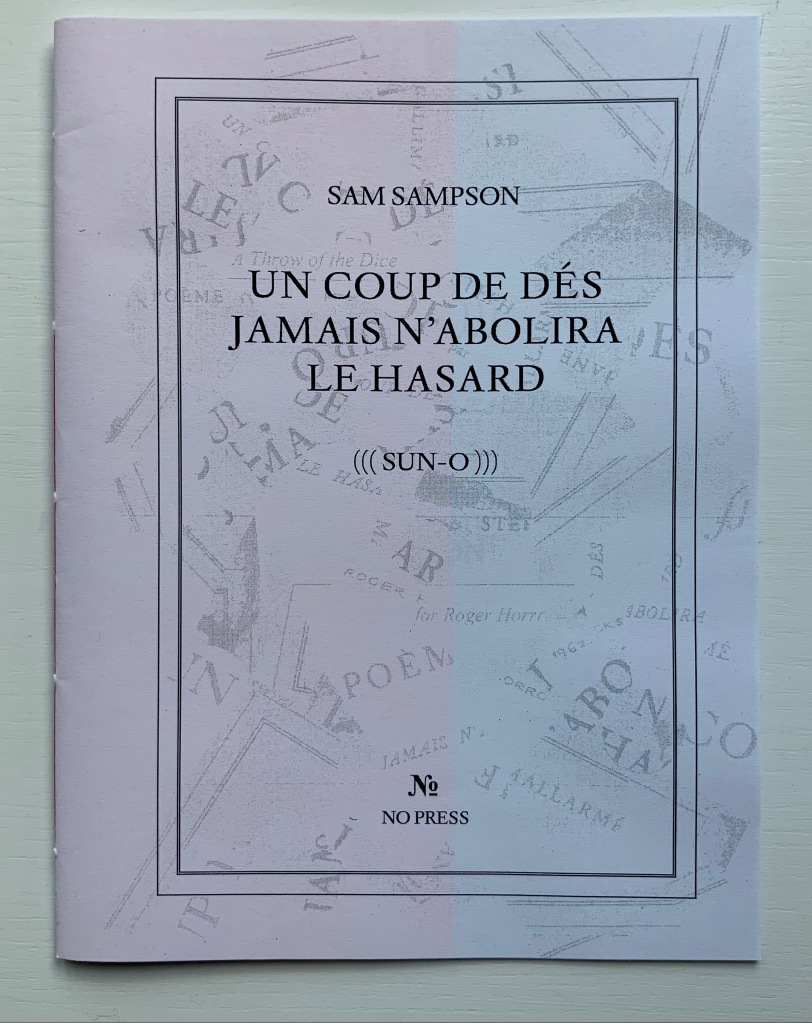
UN COUP DE DÉS JAMAIS N’ABOLIRA LE HASARD (((SUN-O))) (2020)

Un Coup de Dés Jamais N’abolira le Hasard: (((Sun-O))) (2020)
Sam Sampson
Handsewn pamphlet. H255 x W190 mm, 24 pages. Edition of 60. Acquired from No Press, 4 January 2021.
Photo of the work: Books On Books Collection. Displayed with permission of the artist.

[Mallarmé’s] work is a constellation and trying to unpack and explicate what went into my response hopefully doesn’t remove the joy of just jumping in. I like what John Ashbery said about his own work: “my work is accessible, if you take the time to access it.” [Sampson in correspondence with Books On Books Collection, 29 March 2022]

Further Reading & Listening

Derek Beaulieu“. 19 June 2020. Books On Books Collection.

Arnar, Anna Sgrídur. 2011. The Book as Instrument: Stéphane Mallarmé, the Artist’s Book and the Transformation of Print Culture. Chicago: University of Chicago Press.

Bloch, R. Howard. 2017. One toss of the dice: the incredible story of how a poem made us modern. New York: Liveright Publishing Corporation, a division of W.W. Norton & Company.

Davenport, Philip. 27 March 2020. “‘France’, or… we are circles of cancelled stars’“, Synapse International: An international visual poetry gathering. Started by Karl Kempton and Davenport in February 2018, Synapse International quickly attracted online works of homage to Un Coup de Dés, including an early appearance in March 2018 of Eric Zboya‘s Translations and later a visually adapted essay by David W. Seaman and as well as an “ADVERTISEMENT” from Derek Beaulieu that links to his 3D rendering of Un Coup de Dés.

Howe, S., & Swensen, C. 2000. “A Dialogue“. Conjunctions, 35, 374–387.

Marchal, Bertrand. March 2015. “Petite Histoire du Coup de Dés“. Transversalités: Revue de l’Institut Catholique de Paris, 134, 109-113.

Sampson, Sam. 1 July 2015. “Six Pack Sound: Sam Sampson“. New Zealand Electronic Poetry Center. Accessed 8 April 2022.

Stark, Trevor. 2020. Total Expansion of the Letter: Avant-Garde Art and Language after Mallarmé. Cambridge, MA: MIT Press.

Additional photos of the 2022 edition
Credit: Sam Hartnett.
Courtesy and permission to display: Sam Sampson

Bookmarking Book Art – Marine Hugonnier

The Bedside Book Project (2006-07)

The Bedside Book Project is a quintuple homage — Stéphane Mallarmé (1842-1898), Marcel Broodthaers (1924-1976), Odilon Redon (1840-1916), Kurt Schwitters (1887-1948) and Richard Hamilton (1922-2011) — and approaches its subjects in cinematic fashion. It begins with this anecdote:

In 1945 René Magritte gave Marcel Broodthaers a copy of Mallarmé’s poem as ‘a way of explaining his art to a young admirer without explaining it literally’. In 1969, Broodthaers modified an edition of the poem by covering all its words with black stripes that correspond directly to the typographic layout used by Mallarmé to articulate the text. In this way, Mallarmé’s poem, which Broodthaers considered had unconsciously invented modern space, is reduced to its structure. 

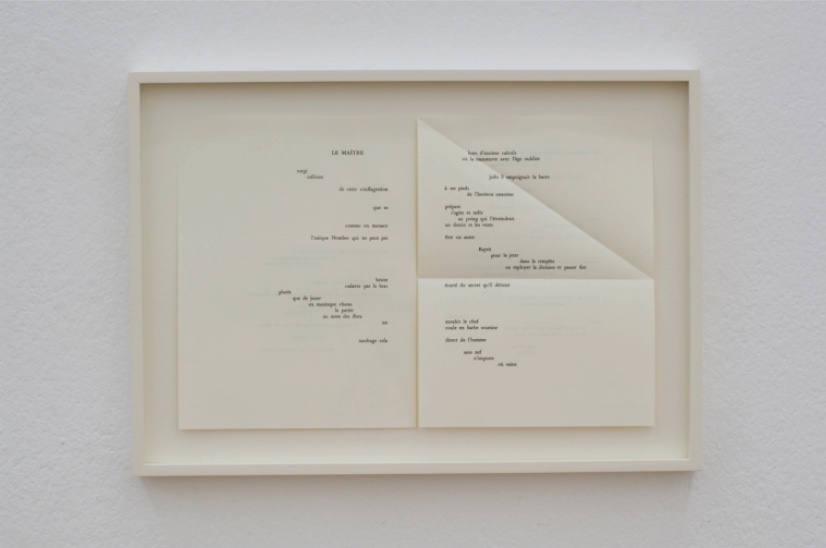
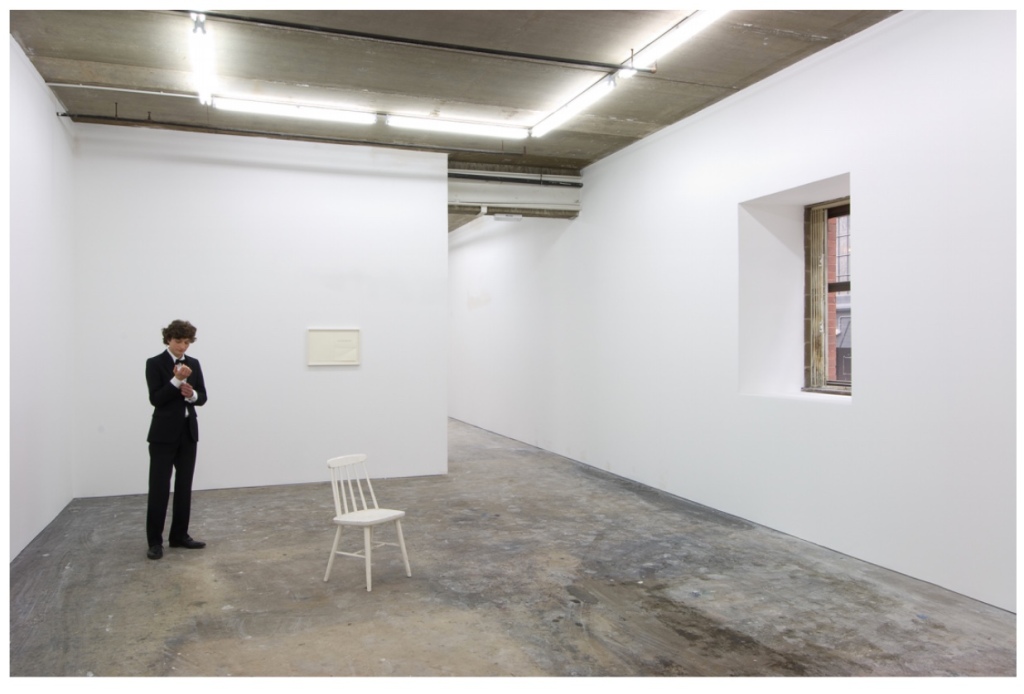
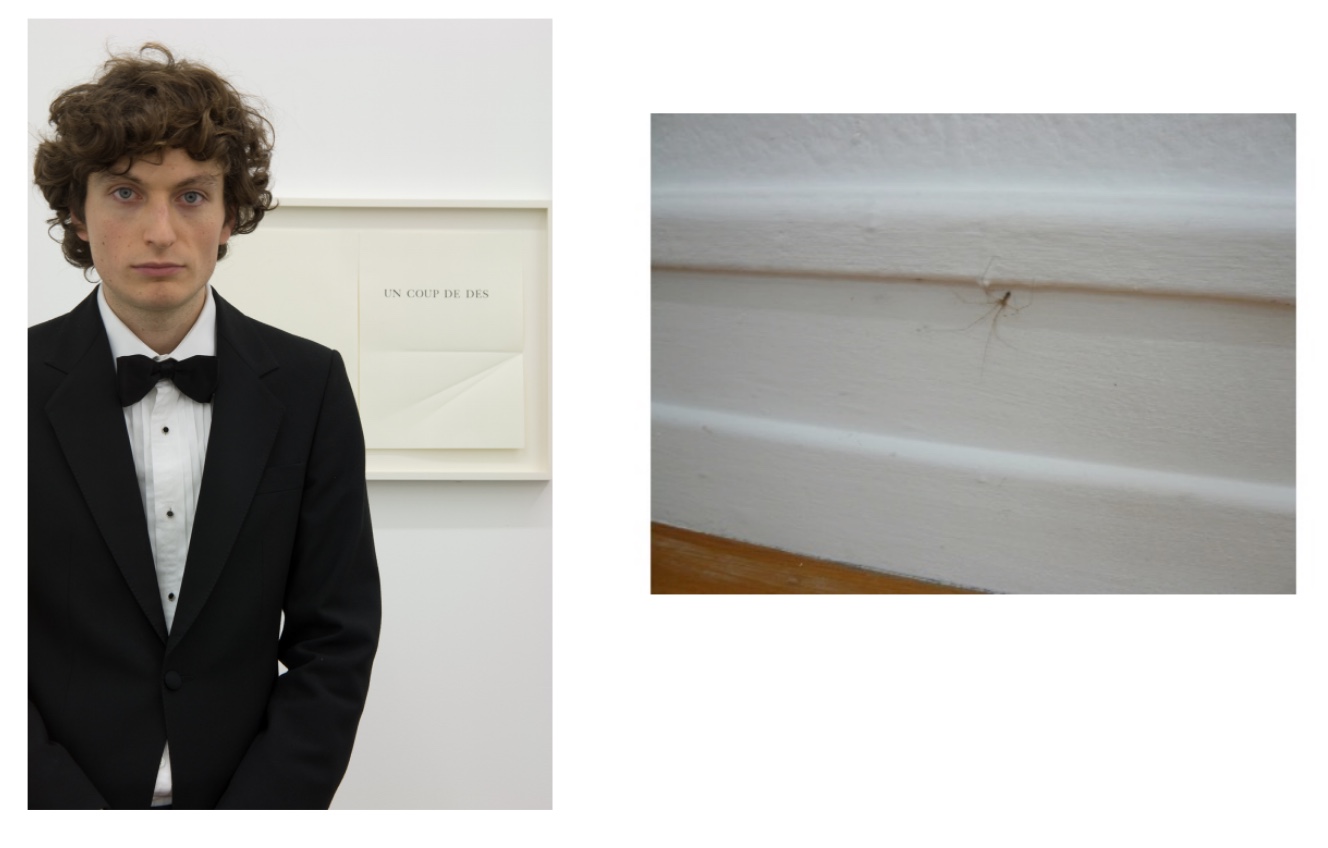
From here, Marine Hugonnier‘s imagination takes hold. As if in a film scene, she moves into the bedrooms of Redon, Schwitters and Hamilton, steals their copies of Un Coup de Dés from their bedside tables, alters each one by inserting images and then replaces them. The result is a series of installations in which the pages of their altered books are displayed on the gallery walls. Each has its “book title”: La forme du mystère (Odilon Redon), Altération (Kurt Schwitters) and L’espace social (Richard Hamilton). Here is Hugonnier’s description of Redon’s book and the installation performance in which it is presented:

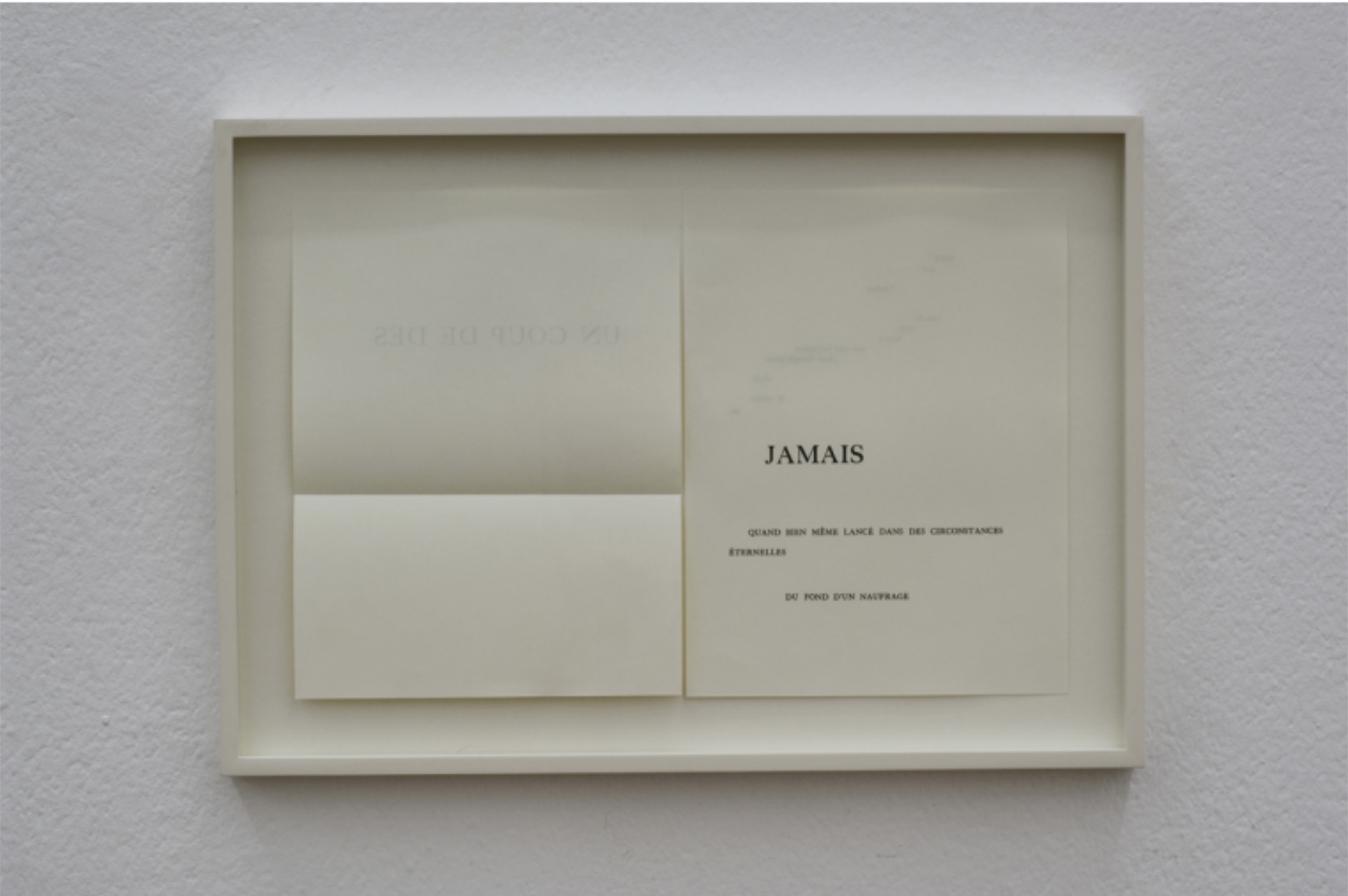
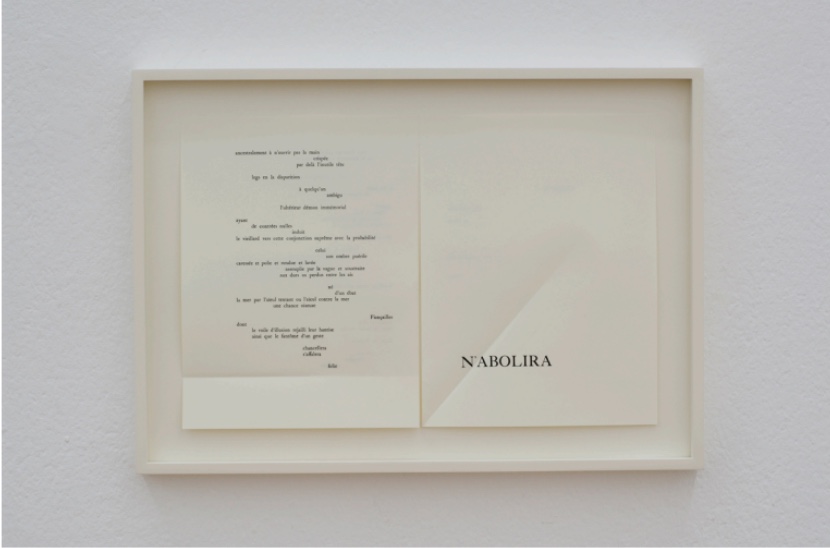
Redon’s bedside book has been stolen and its pages have been folded to extend the space and time of the poem’s interlude bringing his dreams to a deeper sleep. ... The mise-en-scène is composed of a white space with an open window, a spider and a man dressed in a tuxedo who will change a solitary frame, containing a folded page of the poem, on the wall every hour. On the 12th hour, the room will be left empty.

The Bedside Book Project: La forme du mystère (Odilon Redon). Source: Museu d’Art Contemporani de Barcelona, displayed with permission of the artist.

Staging a performance in which the pages of Redon’s bedside book are parceled out over 12 hours is ambitious. As she introduces Schwitters and Hamilton into The Bedside Book Project, Hugonnier creates an even more ambitious immersion for the reader/viewer in different times, spaces and influence. Further temporal instability is involved as well: the pages on Redon’s 19th century bedside table come from a 2006 Gallimard edition of the poem.

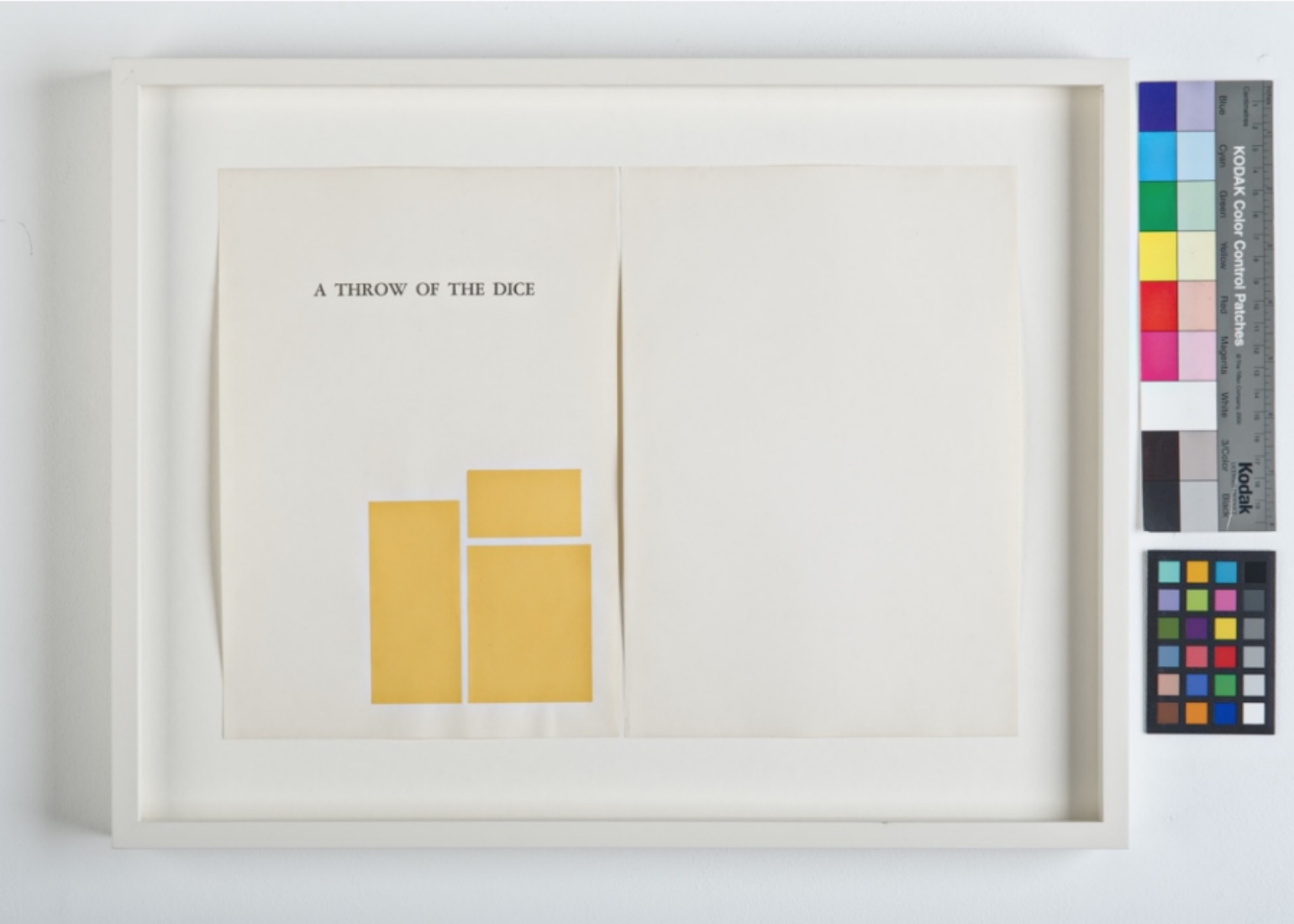
Time travelling from Redon’s bedside table to that of Kurt Schwitters, Hugonnier also introduces a bit of temporal and linguistic instability: Schwitters’ bedside copy comes from the Tiber Press edition of Daisy Aldan’s translation into English, published in 1956 eight years after Schwitters’ death. Colored paper cut-outs conceal words, disrupt the gaps of the poem and alter its reading.

The Bedside Book Project: Altération (Kurt Schwitters). Source: Museu d’Art Contemporani de Barcelona, displayed with permission of the artist.

With Richard Hamilton, Hugonnier gives him the same edition as Redon — the Gallimard 2006 — and fills its interstices with images as a way to change its reading.

The Bedside Book Project: L’espace social No.2 (Richard Hamilton). Source: Museu d’Art Contemporani de Barcelona, displayed with permission of the artist.

As ghostly film director and actress in the film, Hugonnier wonders how these altered bedside books might have affected the way those three artists perceived art and practiced it in their times. As Hugonnier’s audience, we must surely wonder how she has altered the way we perceive Un Coup de Dés and its influence and very possibly how we perceive time, space and art.

Further Reading

Un Coup de Dés Jamais N’abolira le Hasard – L’Espace Social N2, 2007“. MACBA Collection. MACBA Foundation. Fundación Repsol Collection. Acquired 2009.

Books On Books Collection – Robert Cottingham

A-Z: Robert Cottingham: An American Alphabet (1997-2012)

A-Z: Robert Cottingham: An American Alphabet (1997-2012)
Robert Cottingham
Hardcover. H x W mm, pages. Edition of 100. Acquired from Tandem Press, 10 September 2021.
Photos of the book: Books On Books Collection. Displayed with permission of the artist and Tandem Press.

I had completed a number of canvases for AN AMERICAN ALPHABET and began to experience storage problems. The paintings were leaning against all available walls and were in danger of being damaged. For protection, I hung them as a group on one wall, stacking them four high by four across, … sixteen canvases that reached to the ceiling and formed a monumental mosaic of letterforms. This arrangement of tightly packed images created an energy I hadn’t anticipated. As I looked up at it for the first time from my studio floor, I was immediately transported back to those moments when my father and I ascended from the 42nd Street subway station. The sight lines in my studio matched the ones I’d experienced as a child looking up at the signs and lights of Times Square. (Cottingham, A-Z)

Cottingham’s time travel creates a longing in the viewer for travel in time and space. What that wall must have looked like. Those who might have enjoyed the 1996 show at the Forum Gallery in New York or the installation at the New York Print Fair in November 2011 or the Tandem Press exhibition at Madison, WI, in 2018 would have a limited idea (the images were not stacked four high). A-Z: An American Alphabet is as close as the rest of us will come to visualizing it. The artist book does have the advantage of letter by letter commentary from Cottingham.

Another plus in the book is Cottingham’s exploration of his process, tools and material:

The photograph is the starting point. Once I’ve chosen a specific image, I’ll do at least one preliminary sketch in black and white. This drawing familiarizes me with the image and allows me to make the first formal adjustments. The drawing acts as a value study — a sketch that helps determine the tonal range of the image, how dark or light the various elements should be. …/ Next comes the preliminary color study. This may be a watercolor or a gouache, sometimes handled loosely, sometimes treated as a more finished work. …/ I can now move on to the canvas. My preferred medium is oil. … The painting quickly takes on a life of its own, demanding further adjustments to color, tonal value, and form. But the preliminary work, like a map, guides me towards the new and always unexpected version of my original concept./ … / I consider printmaking an important adjunct to my painting. Many times, when I’ve completed a painting, I feel the need to do more work with the image — to dig deeper, exploring other aspects of its structure. Printmaking offers this opportunity. … / … An old world sensibility and craftsmanship is brought to the selection of paper (often hand-made), the mixing of inks, the preparation of plates or lithographic stones, and other steps in the process.

Cottingham also draws out the collaborative nature of printmaking, which in this case involved four Master Printers (Andy Rubin, Bruce Crownover, Joe Freye and, for the digital, Jason Ruhl) and, for the book design and layout, Linda Endlich. Another form of collaboration is influence, and Cottingham is generously open about his debts: Charles Demuth, Edward Hopper, René Magritte, Piet Mondrian and, of course, the design of the signs from which the letters come. Along with his contemporaries such as Chuck Close, Don Eddy, Richard Estes, Audrey Flack and John Salt, Cottingham represents the movement of Photo-Realism.

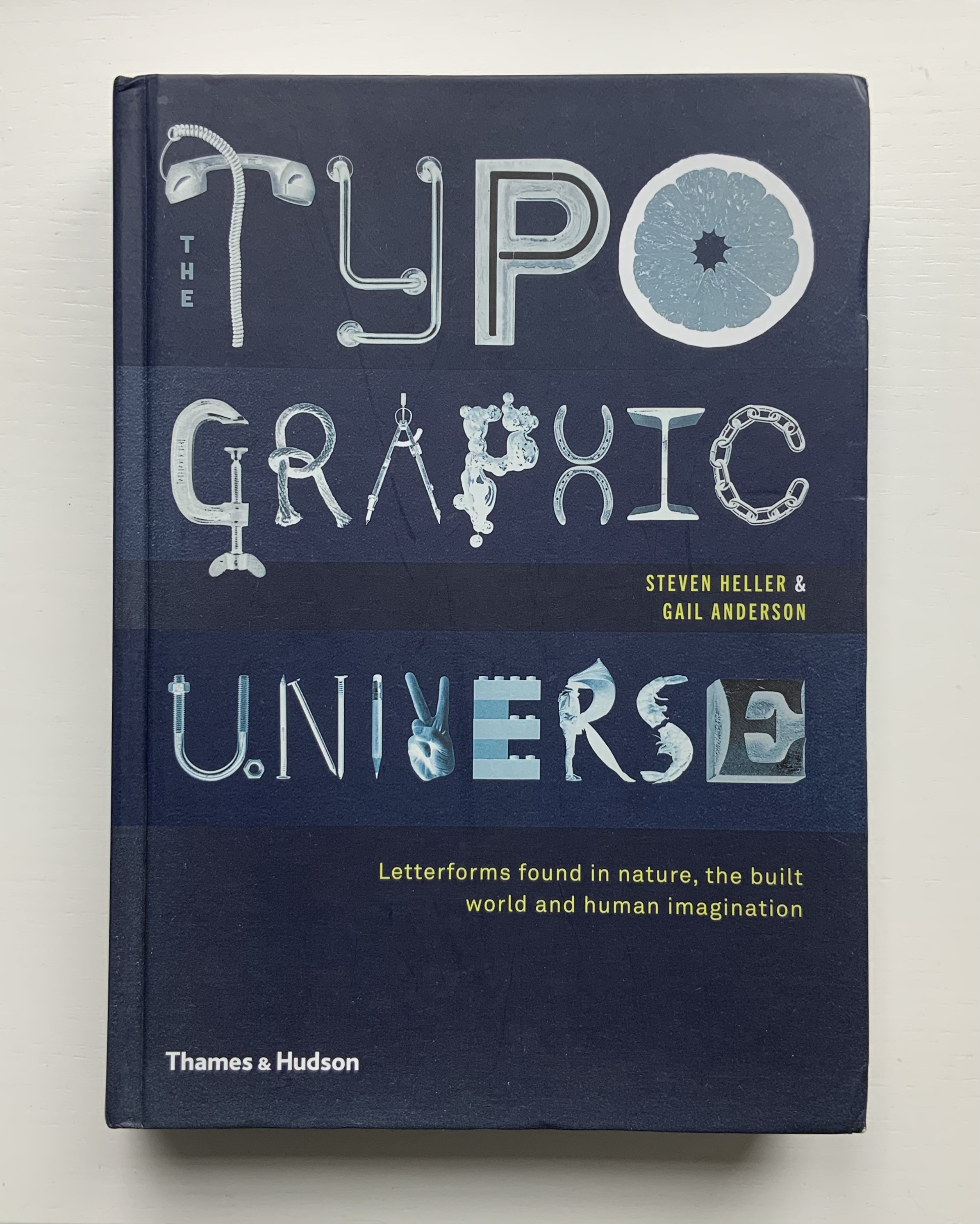
An American Alphabet also finds cousins in the Books On Books Collection. For found letters as objects, there is The Typographic Universe (2014), compiled by Steven Heller and Gail Anderson. For found letters recreated with pastels and watercolor, there is Stephen T. Johnson’s Alphabet City (1995). For color and form (albeit in totally different media), there are Karen Hanmer’s The Spectrum A-Z (2003) and Tara McLeod’s ABC (2015).

Left: The Typographic Universe (2014) by Steven Heller and Gail Anderson. Right: Alphabet City (1995) by Stephen T. Johnson.
Photos of the works: Books On Books Collection.

Left: The Spectrum A-Z (2003) by Karen Hanmer. Right: ABC (2015) by Tara McLeod.
Photos of the works: Books On Books Collection.

The artist and Tandem Press have been kind enough to provide images of the letters A and Z to compare with those in the book, a comparison that underscores the quality of the book and Cottingham’s art.

An American Alphabet: A (2001)
Robert Cottingham
Lithography, Edition of 40, 32 x 23 inches
Image courtesy of Robert Cottingham and Tandem Press

An American Alphabet: Z (2008)
Robert Cottingham
Lithography, Edition of 40, 30 1/2 x 23 inches
Image courtesy of Robert Cottingham and Tandem Press

Further Reading

Abecedaries I (in progress)“. Books On Books Collection. 31 March 2020.

Stephen T. Johnson“. Books On Books Collection. 30 November 2021.

Meisel, Louis K. 1993. Photorealism since 1980. New York: H.N. Abrams.

Meisel, Louis K., and Helene Zucker Seeman. 1989. Photo-Realism. New York: Abradale Press.