Diane Stemper
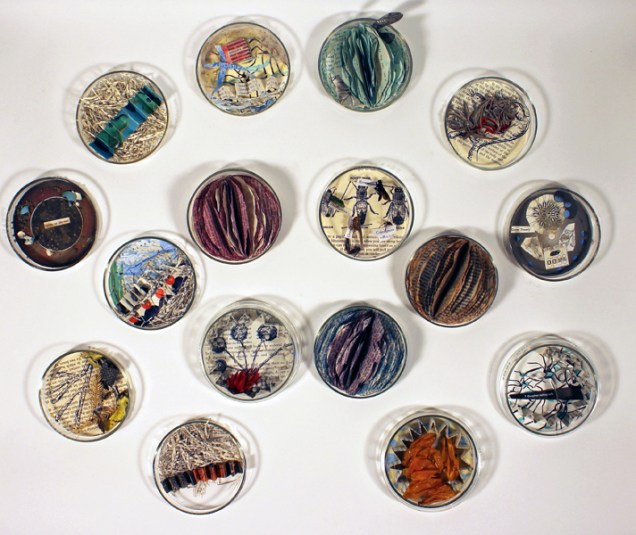
The work began with a gallery installation of Cell: Descent and 25 petri dishes filled by gallery visitors with science facts, liquid and solid matter. The installation in 2016 included 75 dishes filled with small altered found text books, drawings, and specimen objects housed in petri dishes.
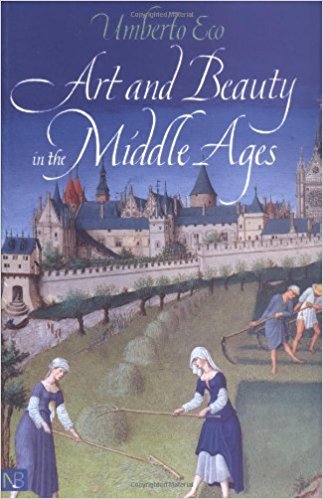
In the middle of a shelf in Diane Stemper’s Ohio home, Umberto Eco’s Art and Beauty in the Middle Ages sits bookended, on the left, by two books about Francis Bacon and, on the right, by a small monograph on Pierre Bonnard and another book Art and Culture of Japan. The books are not organized alphabetically or chronologically. When she pulls the book out, it feels perfect, not too thin or thick, its dimensions and weight ideal for carrying in a shoulder bag. It has a feeling of secrets and importance.
Since discovering Stemper’s work at the Center for Book Arts (New York, 2014), I have wanted to talk to her about the themes and material that drive that work. Art and science, paper and glass, the universal and the particular, ink and watercolor, the physical and the spiritual. We finally arranged it in medias res, and she agreed to this oblique approach to her mind and art.
BoB: As you open Art and Beauty to its mid-point, what do you hear, smell or see about it or around it?
DS: Well, not sure if you mean inside of the room I am in or the memory it conjures, so I will go with memory. The words “cathedral”, “Chartres”, “vestibule”, “allegory” take me from the immediate space of my front room to the interior of a European cathedral or even perhaps as a child to the pews of St. Paul Cathedral in Minnesota during midnight mass. There is the fragrance of incense, the dark light of an imposing building, chanting and mystery. There are also the many hands of craftsmen chipping away at stone, painting glass and the laborers who put it all together and probably were not treated all that well.
Then there is that word “parabolic” and Eco’s explanation of Aquinas’ description of the arts as being literal, that the poetic image and its meaning were in the mind of the “reader” and that this association was a “matter of habit” – this reminds me that I and my viewers have different habits of mind, from the museum visitors I once toured who loved Impressionism and were hostile to Rothko, to the viewers responding to my specimen series – “why are they dead, did you kill them, that’s icky”. Surface literalism can be a matter of what one is familiar with and fearful of what one does not understand, but it can also be a “way into a piece” if the viewer is willing.
BoB: At the end of his book, Eco sums up his explanation of how the medievals looked at art with this startling statement, “They saw the world with the eyes of God”. What of today’s viewers of art and, in particular, those who look at your art?
DS: When originally picking the book from the middle of the middle shelf and then opening it to the middle, that sentence you mentioned — “The association of an image with a certain meaning is a matter of habit” — leapt out. Eco was referring to the ability of people of the Medieval period to read an image as if it were a literary text, for example, knowing instantly which animals or colors represent which biblical figure or story. However, I am reading Eco’s words from my 21st century vantage point, where there isn’t necessarily a concrete set of universal meanings assigned to objects or colors that every person understands and knows.
He also writes that the medieval mind loved a puzzle, that it was part of public discourse to figure out symbols and the inherent meaning within images. That there was adventure in the act of discovery. And another phrase that struck me: “Grasping reality through sense knowledge.”
Diane Stemper
Edition of 4, Intaglio and letterpress on Arches
Today’s “matter of habit” is problematic when viewing art. For some of my pieces, in particular Universal Sample and my drawings and prints of specimens, the viewing can be rather cursory, a knowing, habitual glance that says, “oh I see what that is”. The glance sums up the object in very simplistic terms. In this case, for the viewer, the specimen represents death or some distasteful high school experience of dissecting a small creature, and nothing more. It is possible to look at visual art not just with visual sense but in partnership with other physical sensations conjured by the image. Looking at the work as if there is more than meets the eye, that there is an underlaying sensibility to the image that references another experience or feeling or bit of knowledge, a smell, a sound…or that of the animal or that of the instance in which the animal finds itself, or the moment that a curious person finds such an animal. Imagining that moment — “What was it like?”
So, I hope that people will approach my artwork with imagination and not as a matter of habit — to look at my work as if it is a bit of a puzzle, not a straightforward statement or concept but more of a string of thoughts, feelings and visual and sensate information to be arranged and rearranged to come to some sort of conclusion or idea about the meaning, however uncertain that may be.
BoB: Do you recall the circumstances of the book’s purchase? What were you doing when you decided to buy it?
 DS: I absolutely remember. I was living in London with my spouse and family as part of a study abroad program my spouse was leading. Each day, after all were at school or otherwise occupied, I would head out in pursuit of art, medical museums, natural history oddities or any number of things and on one day I went to the British Library to see an exhibition, Royal Manuscripts: The Genius of Illumination. This was an exhibition of the several collections representing centuries of books commissioned by kings and queens and to my delight there were books on medicine, science and nature. After spending a very long time in the exhibition, I went to the gift shop where I found the Eco book. The extraordinary detail of the manuscripts I had just seen and the enormity of the exhibition itself put me in the mood to purchase the book.
BoB: As an artist whose work has an intimate relationship to “the book,” could you describe the effect this has on you when you are reading books in general or when revisiting the Eco book in particular?
DS: In general, when I am reading a book versus the screen of a device, I enjoy the structure of the book and understanding the manner in which it is assembled. The type of binding, the quality of paper, the action of the pages, do they lay flat or do they fight. I find the term “perfect binding” ironic as I am reading a book where the pages are falling out. I typically notice the condition of a book, faded covers, mildew or wear on the edges. Books with these qualities I feel a bit sorry for as I wonder where their next home will be, probably not my local library or the used book store, since here in Ohio, we haven’t many of those. Maybe they will live a short while at the Goodwill Thrift Store and from there, the recycle bin. Books are a bit like an endangered species and I am at times concerned that the youth (I have one at home) are only relating to books as they are required to do so at school and not as a place of refuge, ideas and travel. It is hard for books to compete with the ever-present screen and digital speed of information and interaction.
The Eco book in particular is a pathway back to London, to other centuries, to a time when art was the screen of the day and to the Royal manuscript exhibition. The books in the exhibition survived over centuries; the hours and hours of skill, artistry and dedication it took to not only create the books but to also preserve them gives me pause. The Eco book itself is not a great work of craftsmanship as an object, it is, after all, bound as a “perfect binding”. Still, it has not fallen apart yet, so the binders must have used a better-quality glue. Instead, the Eco book is a vessel of ideas and murmurs of what it meant to have art and beauty in one’s life hundreds of years ago. What are my intentions when opening a book? To be lifted away from the present, to enter another time period or another person’s circumstance or to be visually transported.
BoB: Turning the question on its head, when the act of creating a work rather than the act of reading is in flight, how do books feed your working process?
DS: For my series on Darwin, all seemed to fall into a flawless moment. I happened upon dozens of petri dishes and had already been thinking about Darwin’s 200th birthday. It is an instance of form and content playing together without much conflict or negotiation. From that came many books that really seemed to define themselves both in structure and content.

Diane Stemper
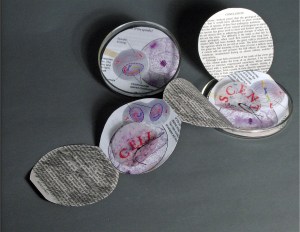
My books built into petri dishes are a different viewing experience for people because the dish itself is so familiar and suddenly the viewer finds the dish in an unusual circumstance, that of being a book. People pause, take notice and naturally ask questions, they seem unleashed from any customary reaction or habit and are open to an idea. The dish is an entry to figuring out a puzzle and not a barrier, such as an image of a dead bird or a dissected lizard might be.
The first books (Cell: Compendium) were in direct response to various nearby communities that were pushing for “creationism” to be taught in the public schools. The petri dish is a universal item repositioned and viewers find it humorous, unique or “creative” and while some stop there, most people are prompted to go further. The recognition of the petri dish spurs and opens the door to more meaningful connections and interpretations.
Diane Stemper
Mostly however, when making my art work, initially the book structure is secondary, a simple vehicle for the content. Imagery, content, text and the oblique narrative story are primary and the development of the images and content are the key portions of my studio work. I use other books in my work, discarded textbooks and spines, for instance, that I take apart and rework. I also use books as reference, looking for a word or phrase, a bit of information to jumpstart a narrative about a topic I am interested in. I borrow science imagery to create and integrate with my own images. I am an observational artist and that includes observing via books as well as nature.

Diane Stemper
A unique artist book. One of four unique books exploring the life of insects as observed on, in, around an Ohio porch. Book 2 (Migration), Book 3 (Pause) & Book 4 (Flight) in the special collections of the Cincinnati Public Library, Hamilton County, Ohio.

Diane Stemper
Once the content and images are in motion, the book structure comes into play and that is when the many possibilities of the structure interact with the content and it is really the most significant challenge of creating an artist book. I do not like to use book forms for the simple novelty of the structure or for the entertainment factor (for instance a pop-up or tunnel book) unless of course it really fits the topic. I want viewers to focus on the images and feeling or message of the work, so the book structure becomes, is, or should be a thoughtful object that houses an idea or an experience, it is in service to the artist, to the viewer, it invites the viewer in and then steps aside.
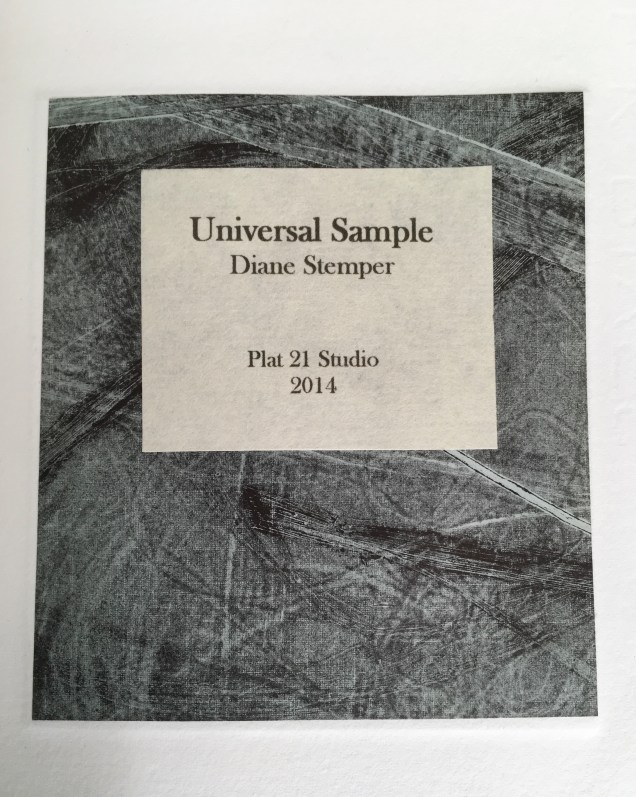
BoB: Let’s turn to Universal Sample in some more detail. I’d like to ask you to comment on the intersection between the words in Universal Sample (“universal” and “sample”, “chance” and “order”, “moment” and “decay”) as well as the intersection of the words with the prints, their color, the paper you used, and the star structure.
Diane Stemper
Edition of 4, Intaglio and letterpress on Arches
DS: First, let me say the entire book, the six images and the text, is meant to present obliquely a life cycle of early life forms. The images are inspired by my own source material comprised of many drawings of specimens that I did at the Hunterian Museum at the Royal College of Surgeons in London.
The title, Universal Sample, is singular and expansive. A sample is one bit of something larger that is collected and taken from a whole and isolated, universal represents a larger inclusive whole. In this case “Sample” is not numbered or identified. It is in relationship to all else, is composed of and is evidence for all else.
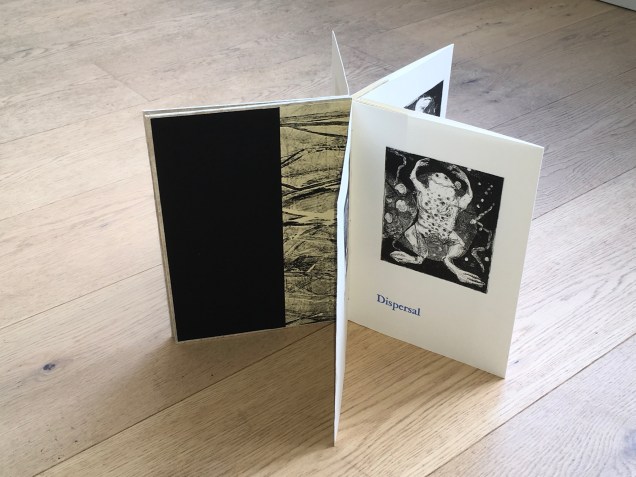
Dispersal – Begins the book and alludes to creation.

Diane Stemper
Edition of 4, Intaglio and letterpress on Arches
Vestigial – Ends it and alludes to remains.

Diane Stemper
Edition of 4, Intaglio and letterpress on Arches
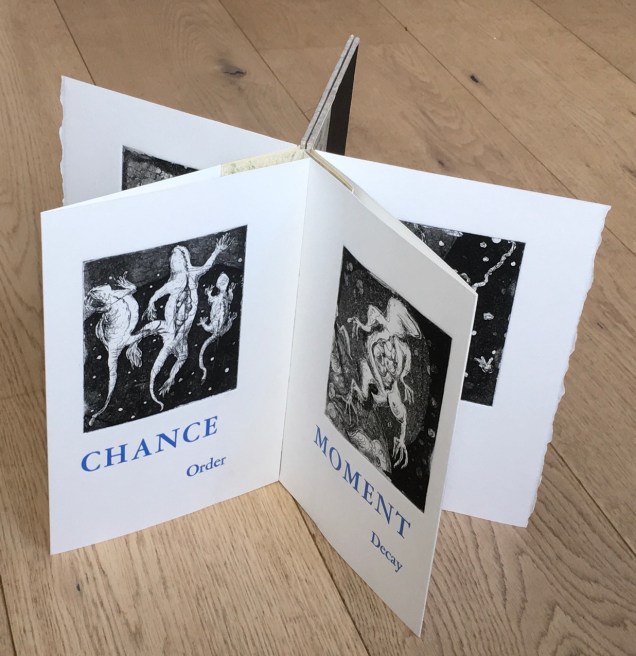
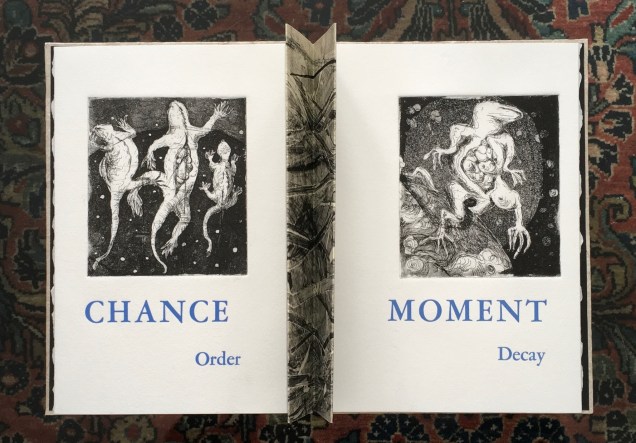
Chance – In part I feel the world is a chaotic place where the intentional can be overcome by chance and luck, circumstance and happenstance.
Order – This is about human systems (religious, scientific) within a chaotic world and about the molecular combining and recombining relative to evolution over millions of years which bring about reasonable order within an ever-changing environment.
Diane Stemper
Edition of 4, Intaglio and letterpress on Arches
When I place the words “chance” and “order” together, I am referencing religion as a human system attempting to bring order to chaos, to explain the inexplicable. The images progress from an unidentified plasma or bubbly life form to a life form that appears to be lizard like, one of the early animal forms on earth. One print shows three lizards, a trinity of sorts, impaled perhaps, especially as specimens might be. Floating, they represent the substance, atom, molecules, electrons, neutrons that I know exist versus the Trinity as espoused by Christianity that I am not so certain about. In this way, I am harking back to the root of an entire body of work that I have made that draws upon Darwin’s On the Origin of Species.
Moment and Decay are read together with the image of a frog, a frog that is decomposing, reordering and redistributing its cells. I want the text to key viewers into the idea of a space, gap, a line or moment when decay begins. The last print is of an imaginary cellular structure of a life form as it is releasing and redistributing entirely into another space whether that is air, dirt or water or the space beyond our stratosphere.
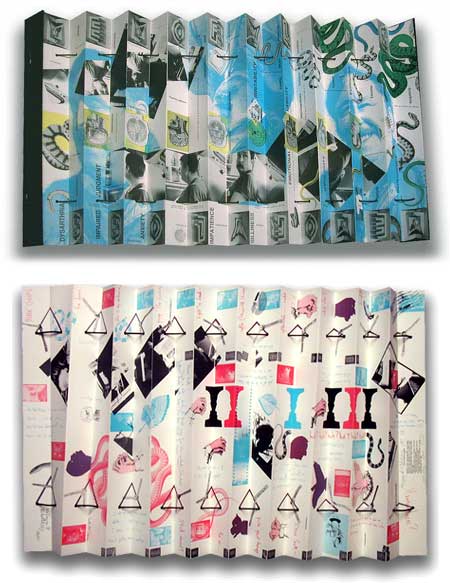
The book structure, font and print size and paper choices are all subject to various constraints, such as paper and press bed size, size of copper, or availability of type face at the printmakers cooperative where I do my printing. For this book, I worked the structure of the book, image and text placement and layout simultaneously with content development and made at least a few small mock-ups to help me see the possibilities, resolve problems and keep me on track. I like book structures that are straightforward and that are an entry to the images and content. Sometimes, as with the Cell books, the structure is integral to the content of the work. For Universal Sample, what was going to be a simple accordion changed as I saw that the images and text could offer different ways in which to view and read the book. The star structure which consists of a series of three-page short accordions sewn into a concertina spine is elegant, seems like a standard book, a good frame for the images and when opened it can go beyond being a standard book and be manipulated and reconsidered.
Diane Stemper
Edition of 4, Intaglio and letterpress on Arches
BoB: Where next with your art?
DS: I like anything that can be described as a collection, the more personal and odd, the better, and I find opportunities to visit natural history or medical museums when I can. Currently, I am finishing a book object that incorporates several of my drawings of backyard specimen finds. This work includes test tubes and refers to the challenge of birds to avoid hazards and remain undetected. I am also thinking about a series of artist books that somehow reveal the dozens, hundreds, thousands of birds that are housed in the drawers of collecting institutions.
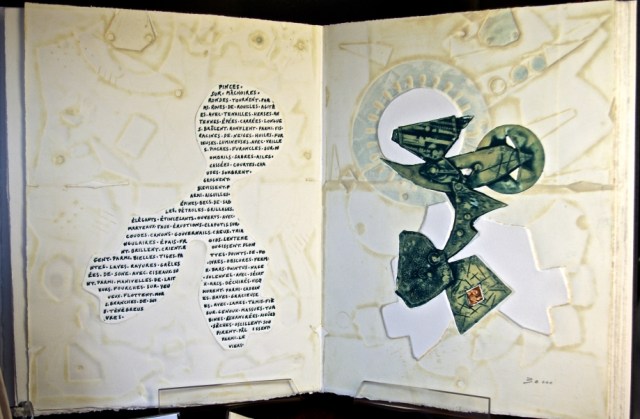
BoB: With thanks to Diane Stemper for her time and reflection. To enjoy more of her work, see her site and also:
Miami University Libraries (Oxford, Ohio)
Diane Stemper received her B.F.A. in printmaking from the San Francisco Art Institute and a M.A. in Interdisciplinary Arts from San Francisco State University. Her work is included in the Artists’ Book Collections of: DAAP Library, University of Cincinnati, Ohio; Main Public Library of Cincinnati and Hamilton County, Cincinnati, Ohio; Special Collections, Miami University, Oxford, Ohio; and the Lucille Little Fine Arts Library, University of Kentucky.





 Books On Books