Locus: Identified by the History (2016)
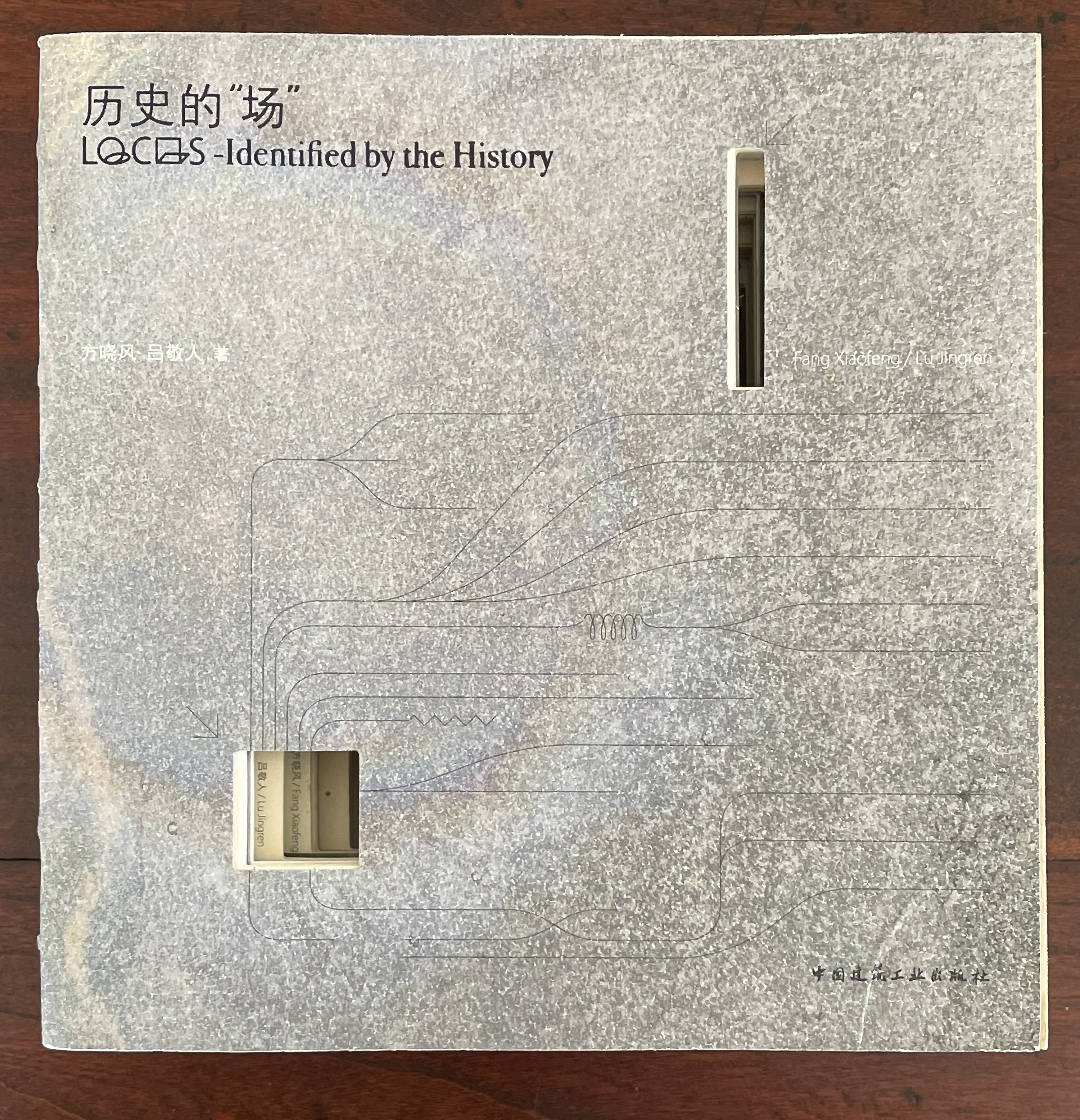
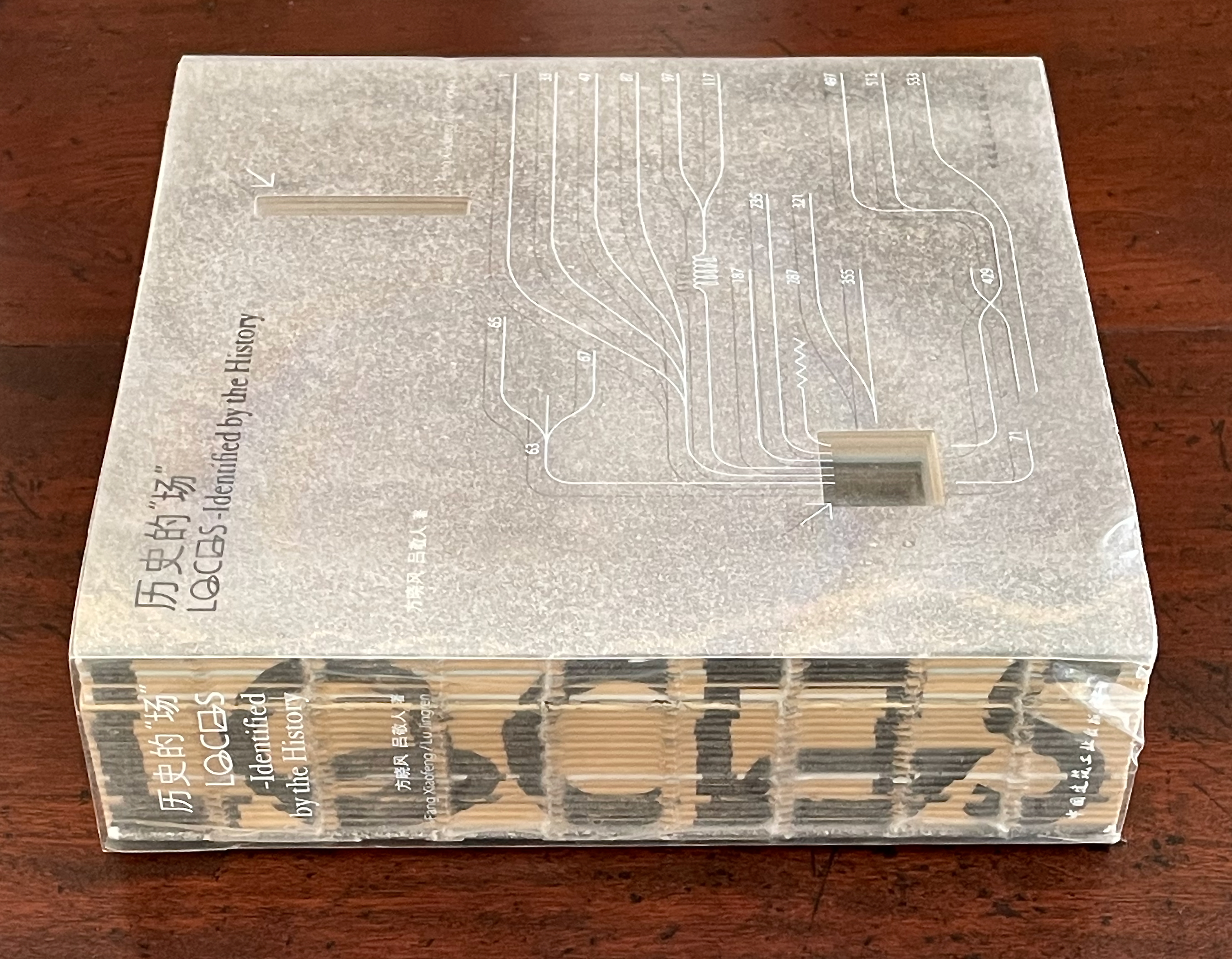
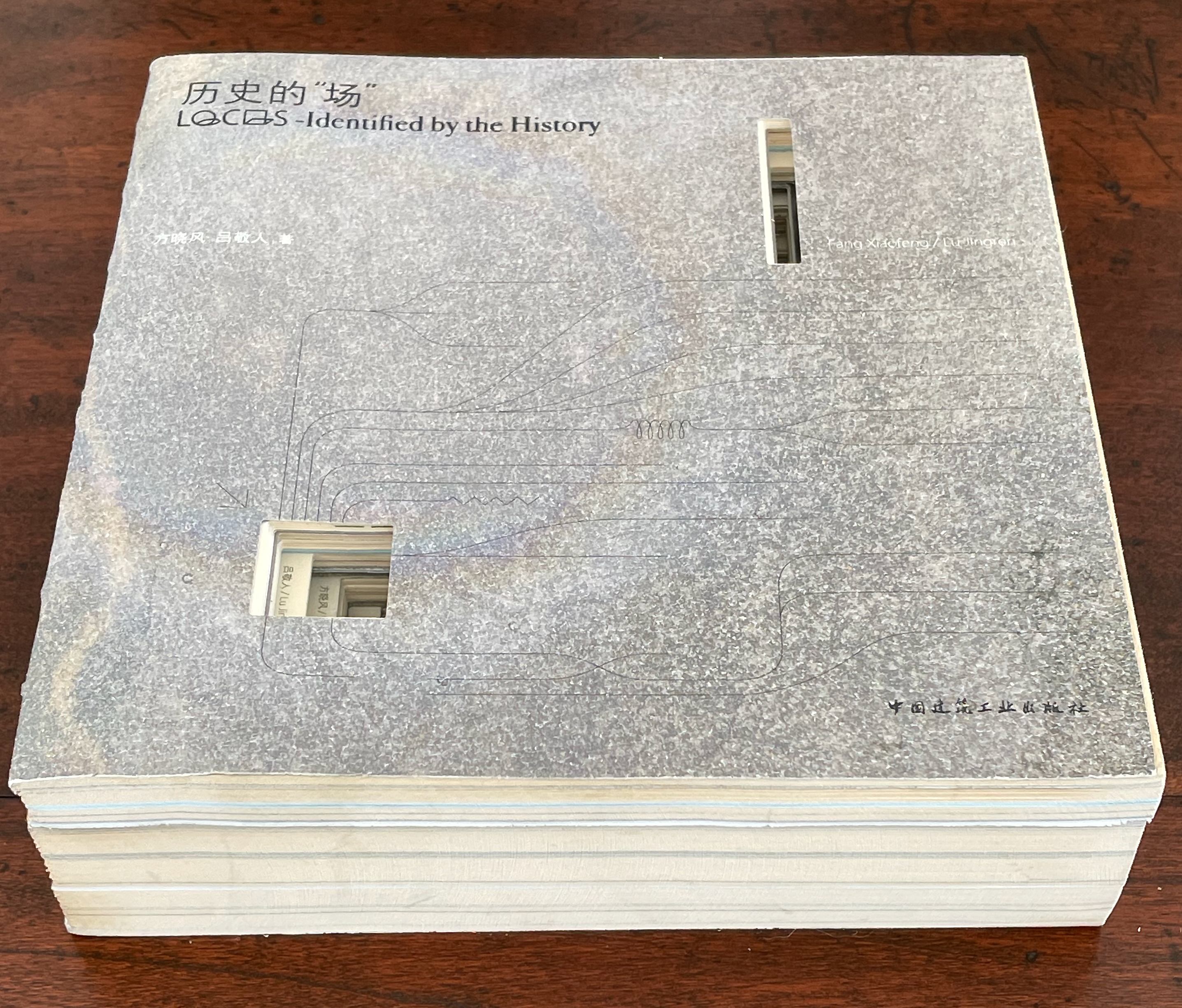
Locus: Identified by the History (2016)
Lu Jingren and Fang Xiaofeng
Softcover, sewn, open spine. H170 x W170 x D45 mm. 566 pages. Acquired from Liu Xing Bookseller, 9 May 2026.
Photos: Books On Books Collection.
历史的”场 (Locus: Identified by the History) (2016)
方晓风 (Fang Xiaofeng) and 呂敬人 (Lu Jingren)
Beijing Shi: Zhongguo jian zhu gong ye chu ban she.
Co-authored by architecture scholar Fang Xiaofeng and book designer Lu Jingren, Locus: Identified by the History (2016) springs from the Book – Architecture Project (书 – 筑 / Shu – Zhu Project), conceived by Lu Jingren, Fumihiko Maki (Japan), and Yi Ki-Ung (South Korea). The project initiated a multi-year series of exhibitions/forums called “Book – Architecture: Dialogues Between Architects and Book Designers” (2011-19) across all three countries. Locus was published on the occasion of the second exhibition/forum in 2016.
Locus pursues two overlapping lines of thought. The first and primary one rests on Lu’s design philosophy that a book is a built environment, a habitat for text and images to be engaged by readers and all five of their senses. Its layout, pacing, structure, and their interconnectedness with each other and the book’s materials mirror the architect’s design of rooms, hallways, stairs, windows, doors, thresholds, and their interconnectedness with each other and their materials. Likewise as habitats, they each have exteriors, are designed to occupy a locus in time and space, and relate to a world outside. In Lu’s philosophy, the design mechanics involve four pillars: binding + layout + editorial + information visualization. Successful execution results in an immersive spatial object (habitat) that triggers the reader’s visual, tactile, auditory, olfactory, and gustatory systems simultaneously.
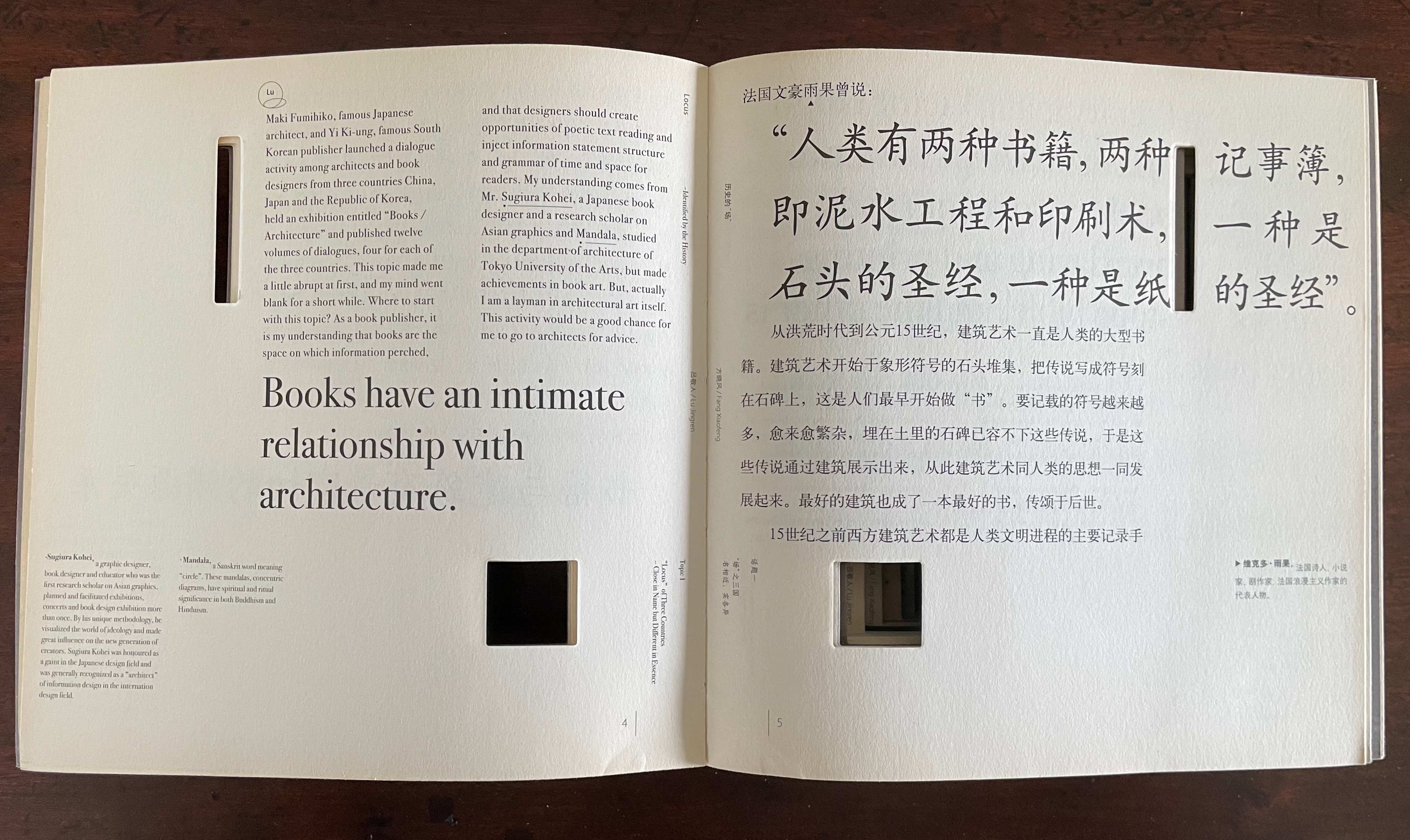
The second line of thought concerns the similarities and differences between Eastern and Western traditions of the book and architecture. Both Fang and Lu have been influenced by Western traditions in their respective fields, and both in the later stages of their careers are anxious to see a rebalancing toward the more Eastern concepts of “locus” (场 – chang) — the spiritual, historical, and emotional atmosphere embedded in physical environments (and books) — and “right balance of simplicity/absolute emptiness and complexity/absolute density” (繁简得当 – fán jiǎn dé dàng).
The anxiety over Western influence, however, does not prevent Lu from introducing the book’s main theme by quoting Victor Hugo. Indeed, looking back over the book’s effort to connect book design and architectural design through underlying common philosophical, almost spiritual, precepts, one admires the appropriateness of his starting point.
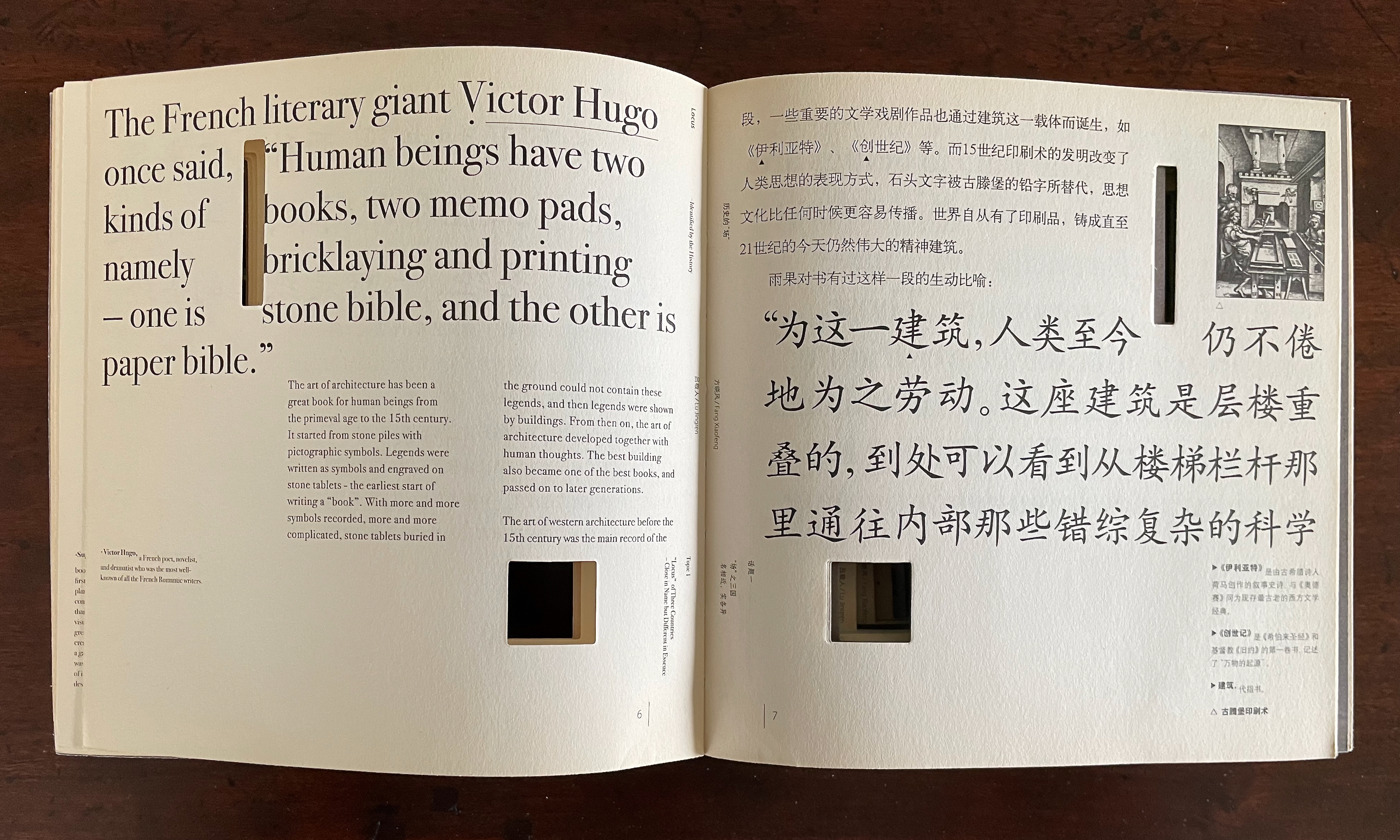
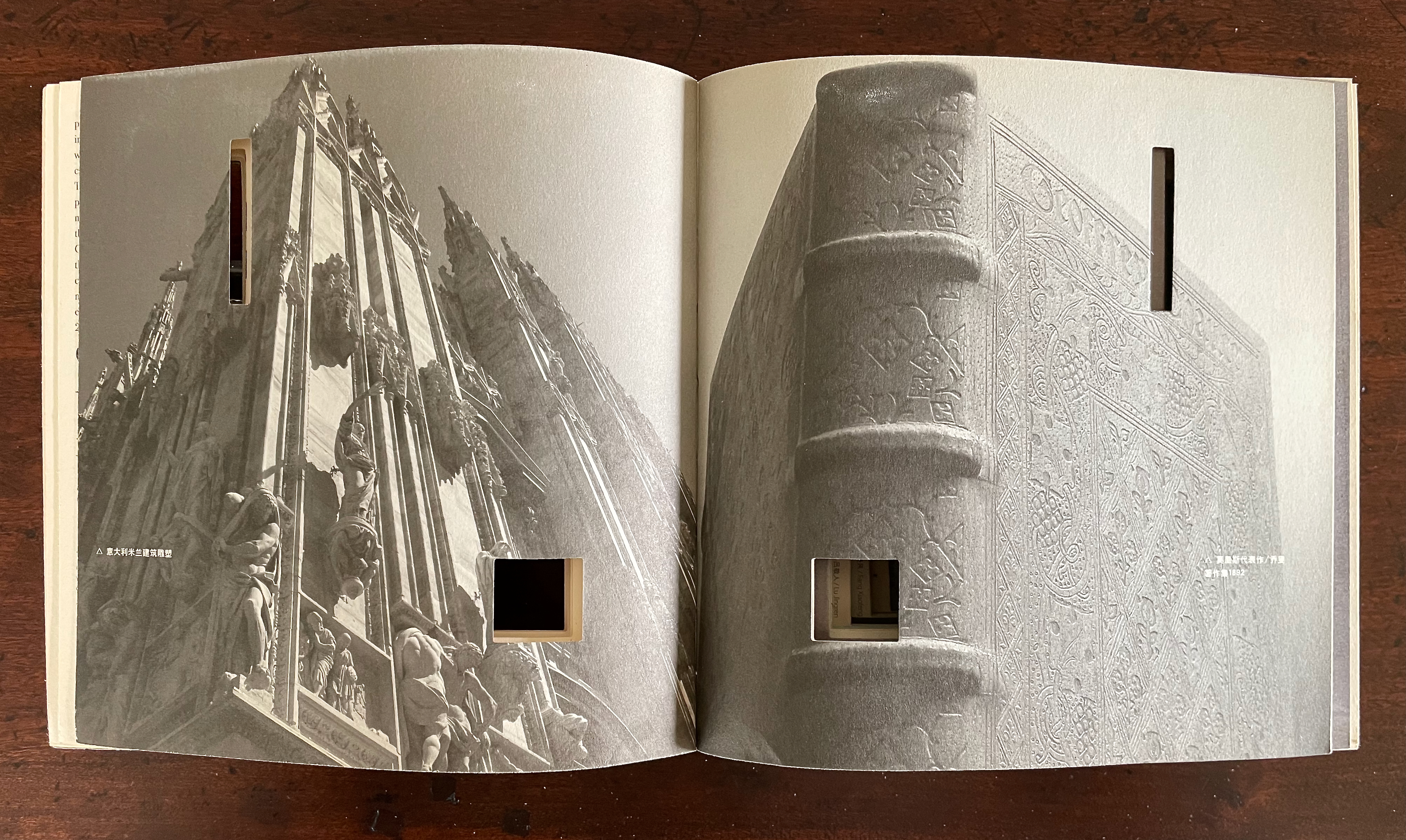
It may be this collector’s perspective and language limitations, but it seems that Lu is more adept at finding elements of architecture in the book than Fang is at finding elements of the book in architecture. On the other hand, Fang sheds more light on the differences between Eastern and Western architecture than Lu sheds on those between the two cultures’ books. The affinity of the book and book design for architecture and architectural design seems greater than vice versa. Nevertheless Lu and Fang explore shared precepts of design in their respective fields in ways that offer avenues to better appreciation of books, buildings, gardens, and landscapes.
The 566-page square book has sixteen chapters that split roughly evenly between Lu and Fang, which is cleverly signalled in the exposed spine-edge title and throughout the book by the devices fashioned from the letter O for Lu and the letter U for Fang. The devices mark whoever is speaking. The binding design also cleverly signals the book’s East-West theme. Lu generally favors the traditional Chinese wrapped-back binding, which places the folds at the fore edge. Lu has a penchant for exposed spines. Locus, however, binds its folds at the spine (Western style) and displays the exposed spine (Eastern style) to highlight the varieties of paper used as well as introduce the Lu and Fang devices. This bit of orchestration (编排 – jiang) exemplifies one aspect of Lu’s aim for interconnectedness in his books.
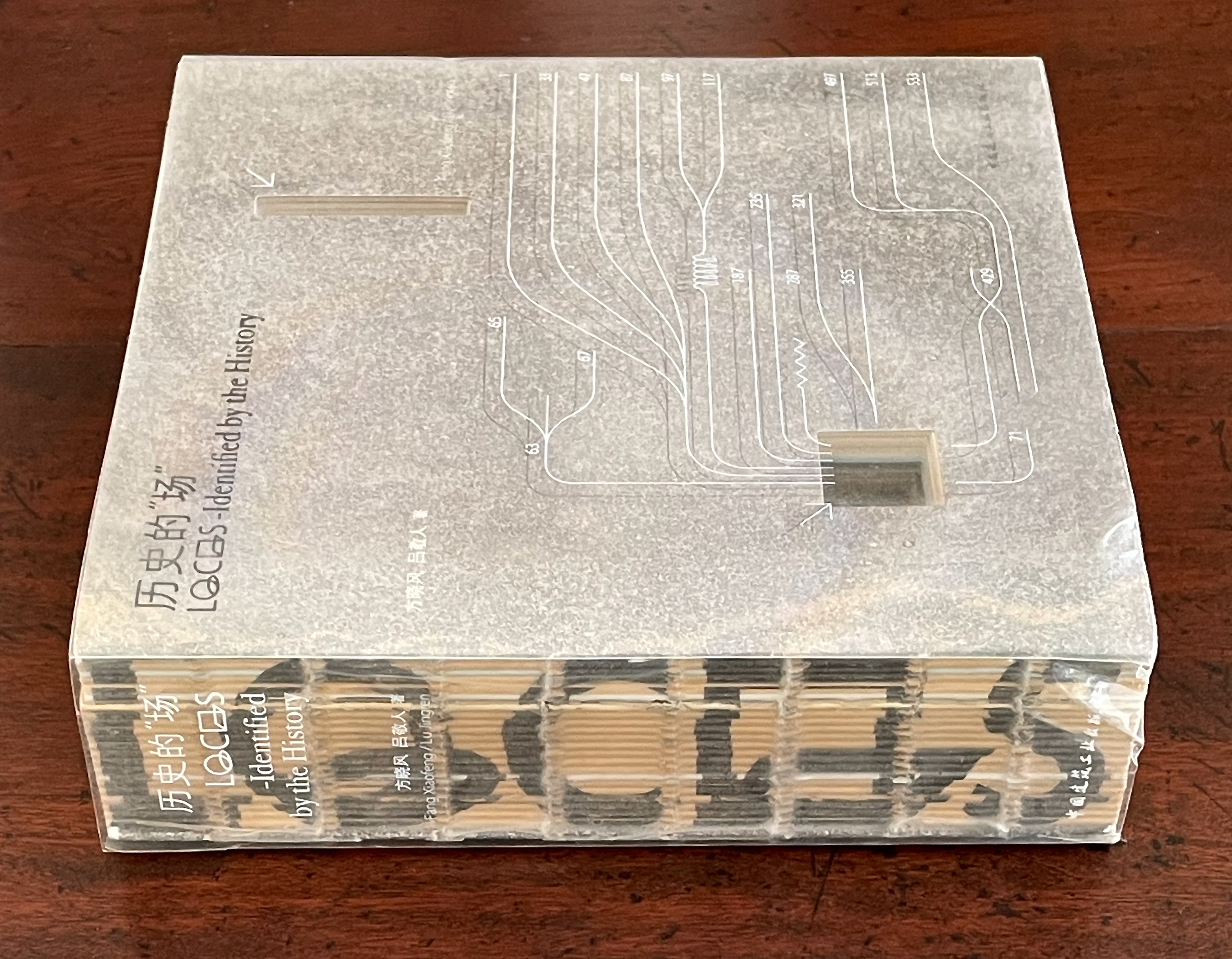
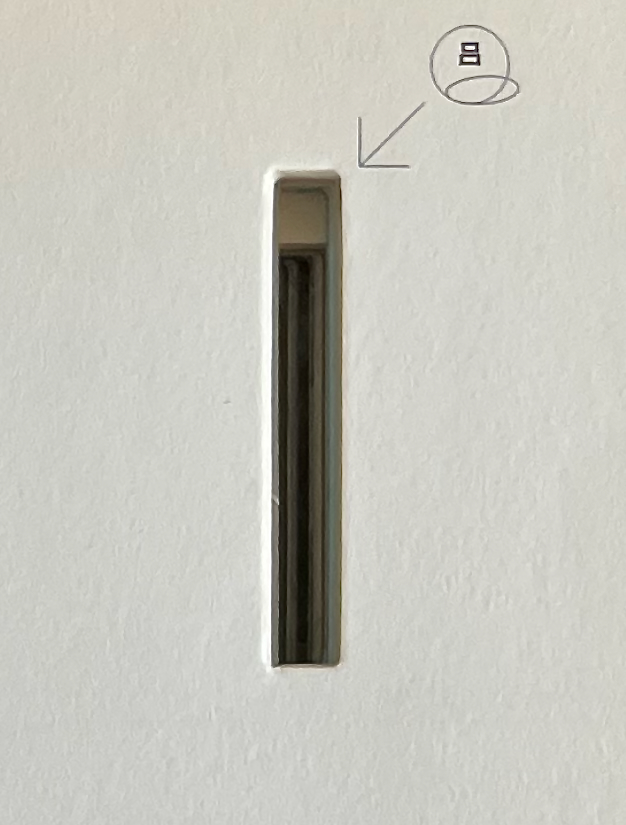
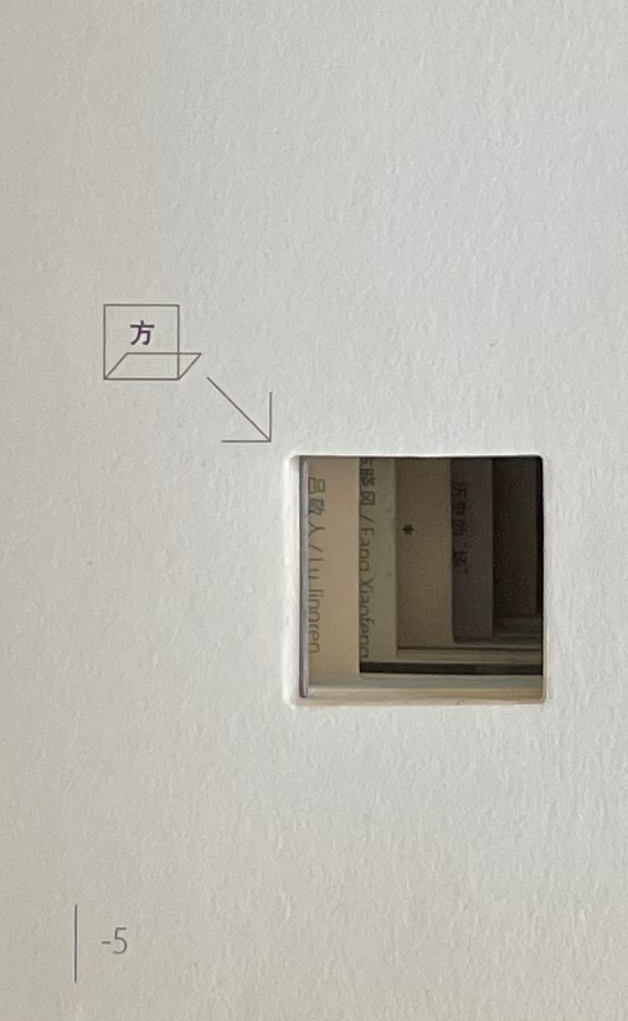
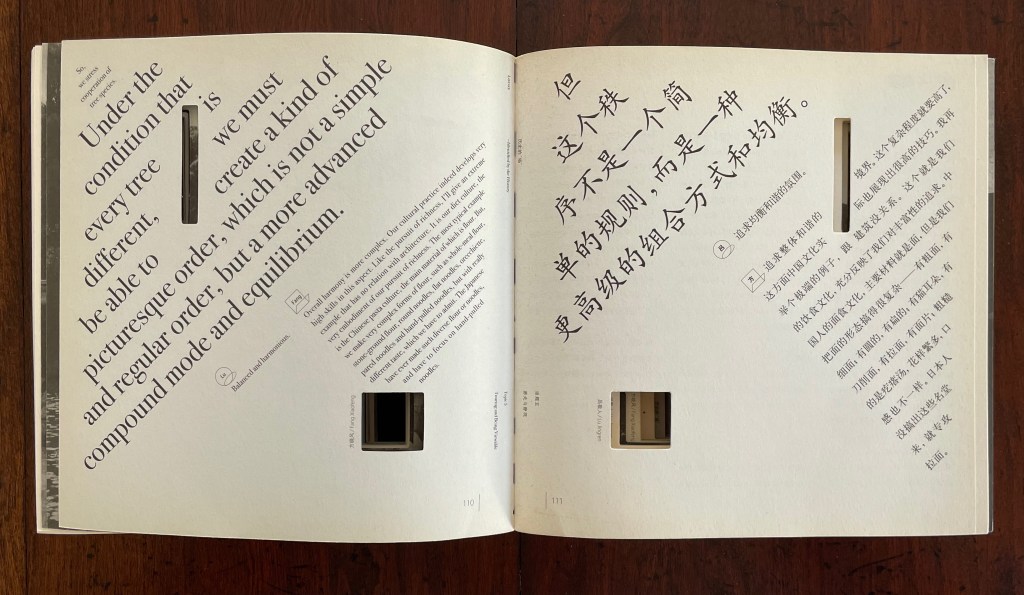
Being exposed, the spine also aligns with the exposed Dougong (bracket sets) of traditional Chinese timber frames. In another deft link between the book and architecture, the front and back covers carry the interior and exterior images of facades, but their most striking feature is the stepped die cuts penetrating the entire book. Lu puts them to multiple uses in linking book and architecture. The cutouts link book designer and architect, the narrow one being associated with Lu and the square one with Fang, while their revealed views suggest an architectural perspective of columns receding into the book and a sense of steps leading into spatial depths. Inside the book, the two die cuts become four across the double-page spreads and interact with the text and images visually and structurally.
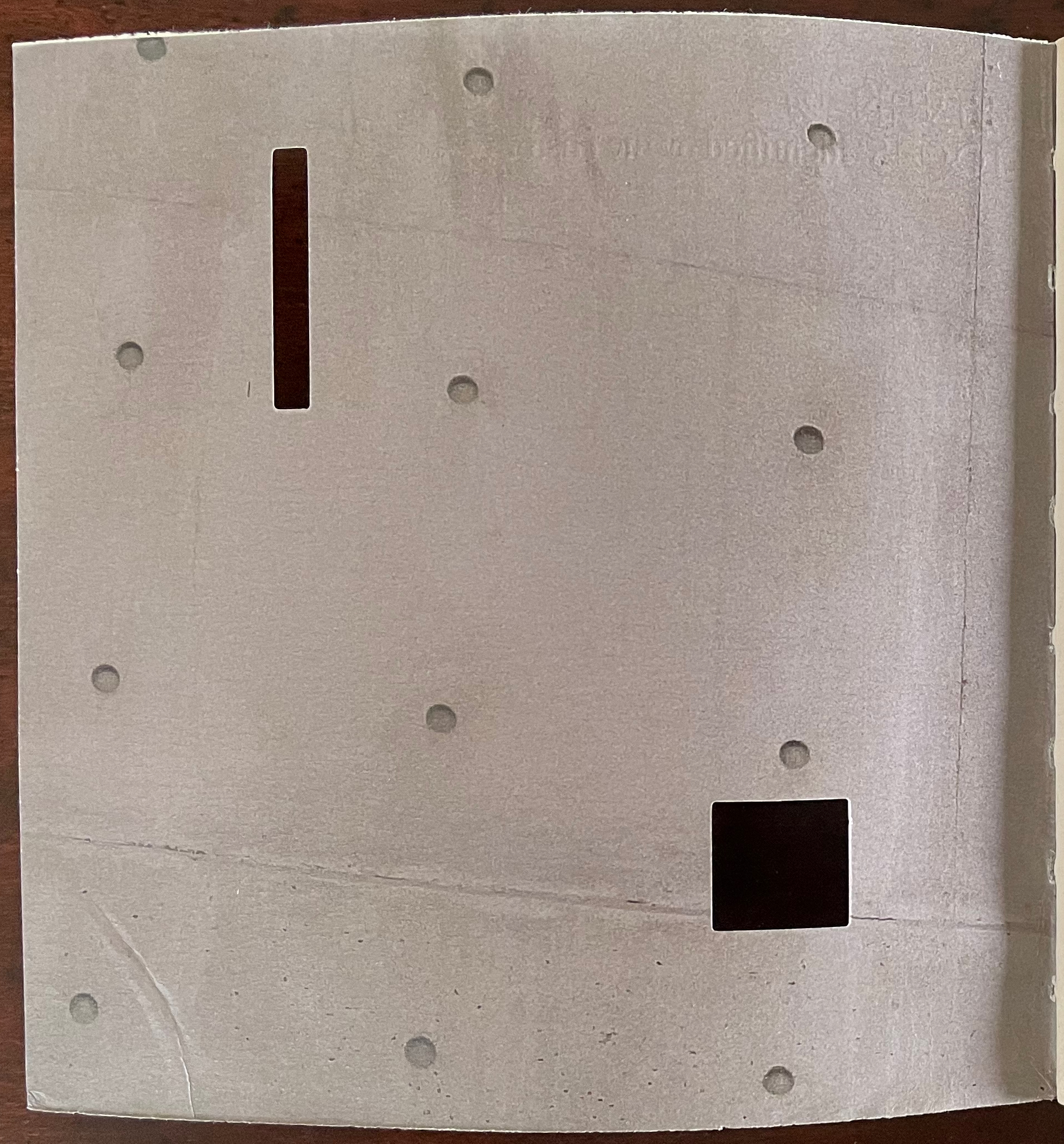
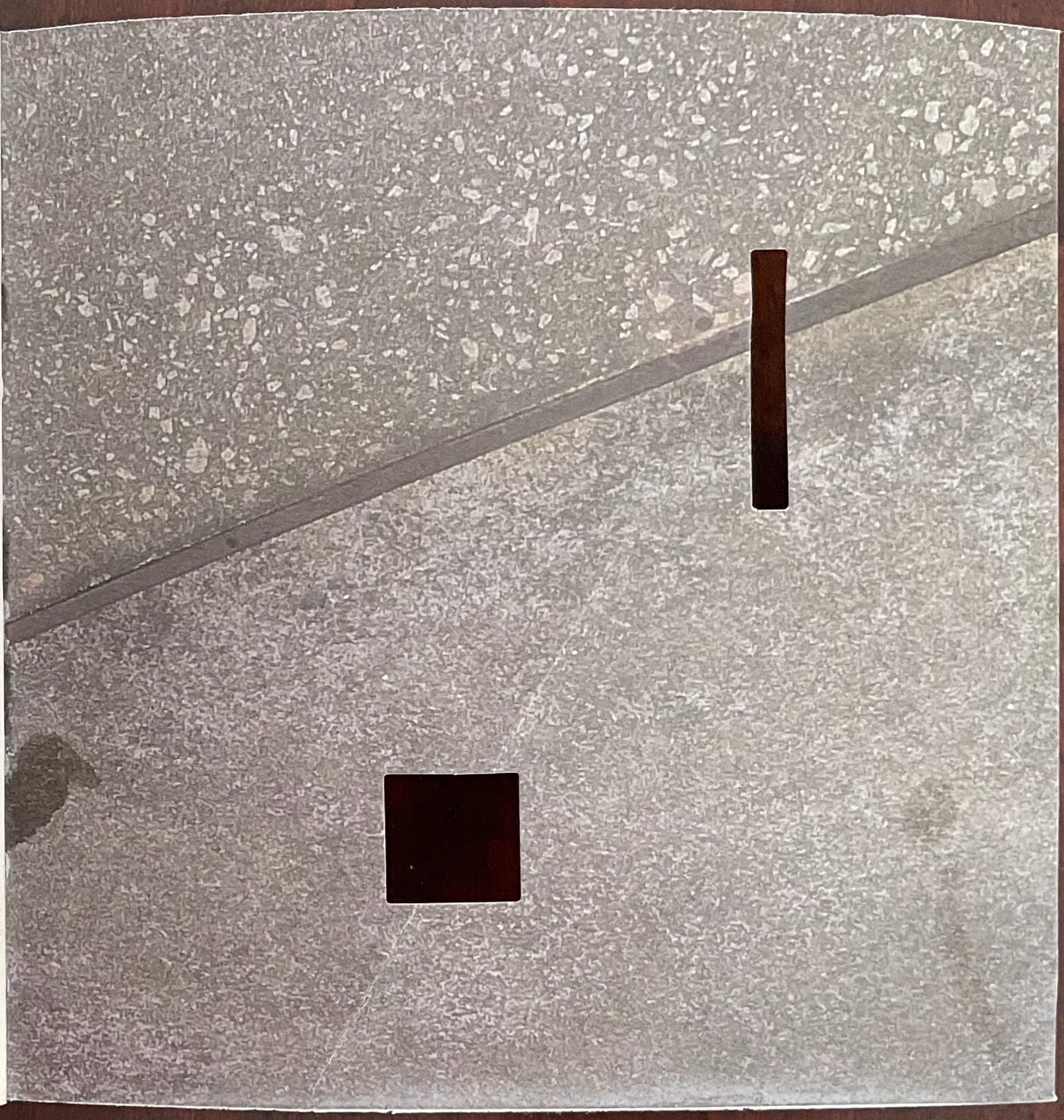
Inside front cover; inside back cover.
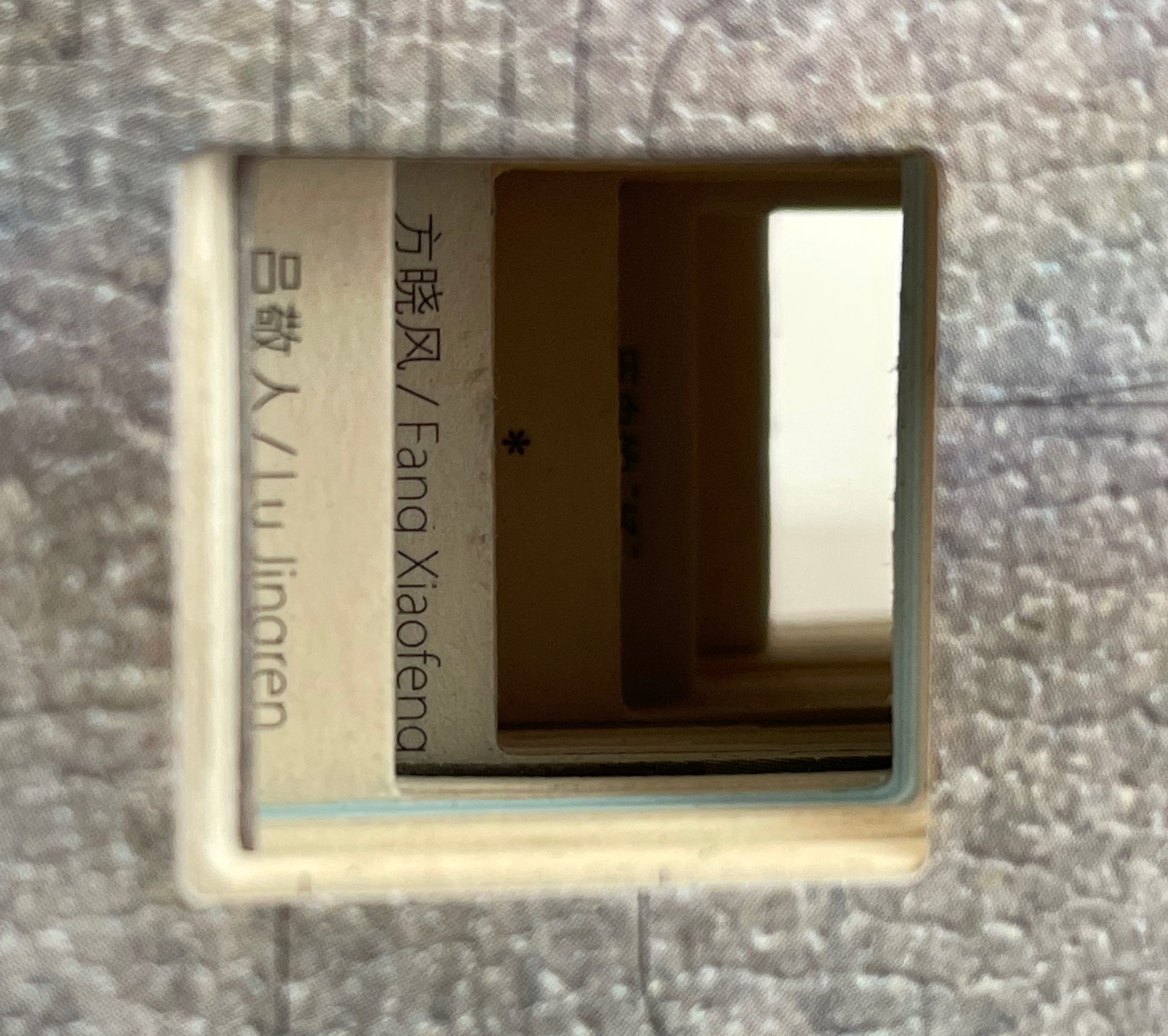
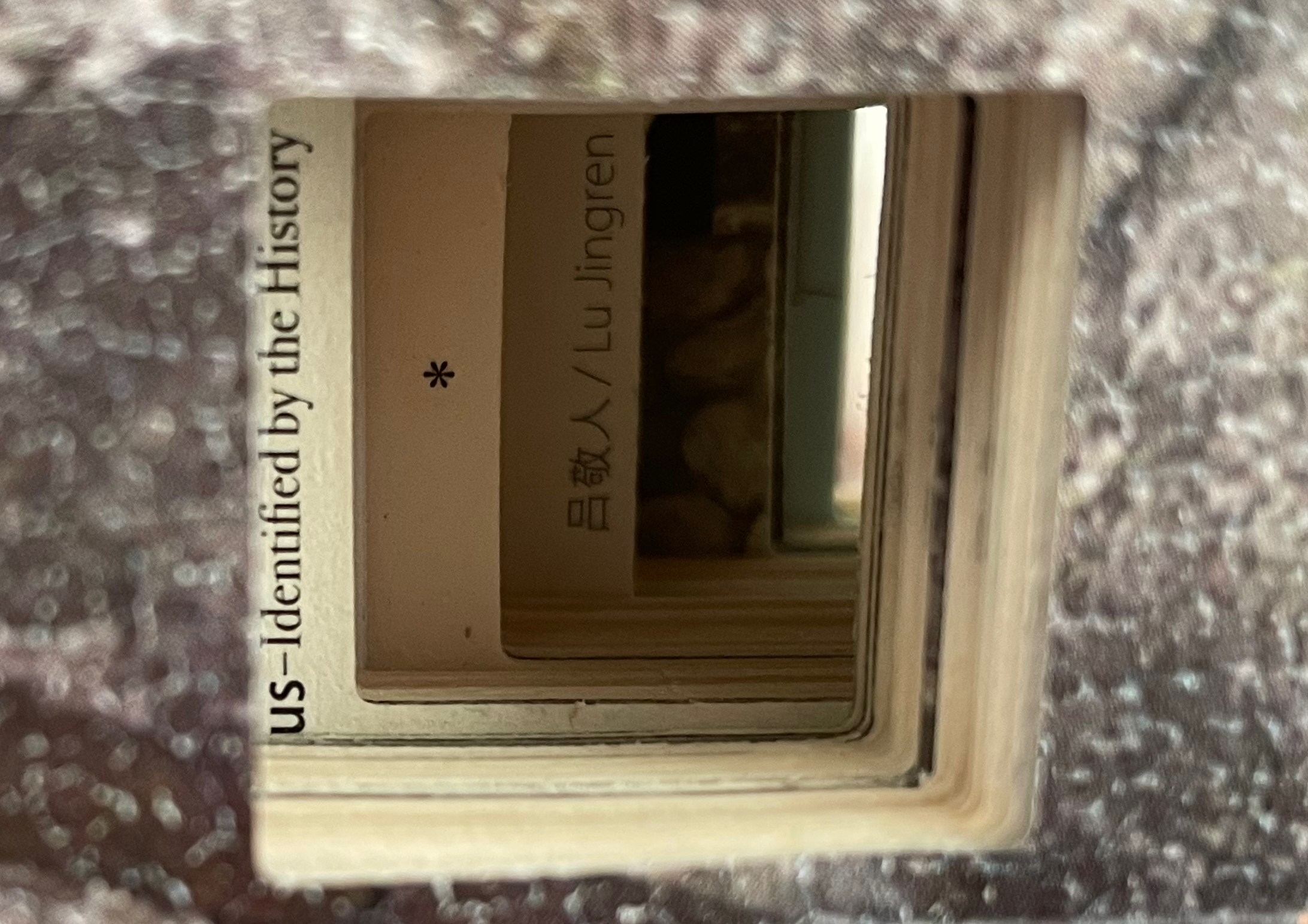
Close-ups of front cover square die cut.
Later on, in Chapter 5 when Fang expounds on the differences between Japanese gardens (meant to be viewable or picturesque) and Chinese gardens (meant to be approached and toured), Lu angles the typography and images at 45° to suggest approaches and paths, and the die cut spaces seem to become objects seen from on high or doors/windows/passages integral to the images.
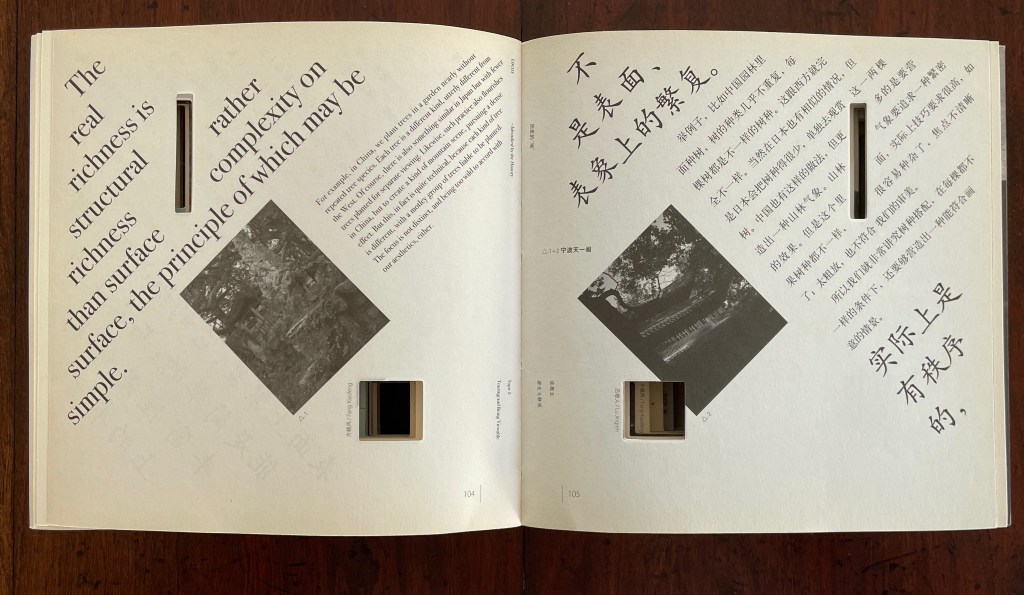
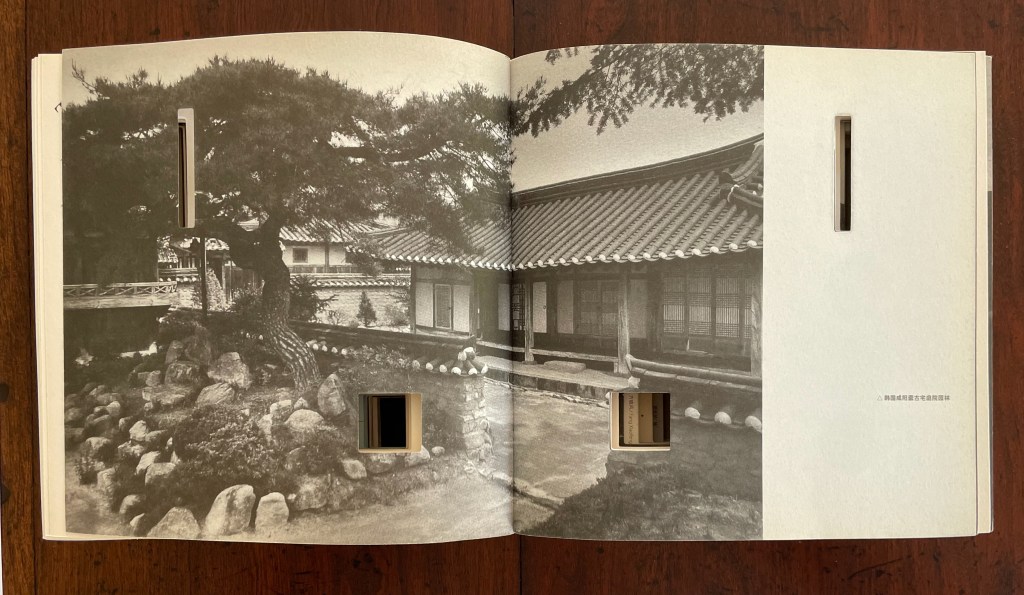
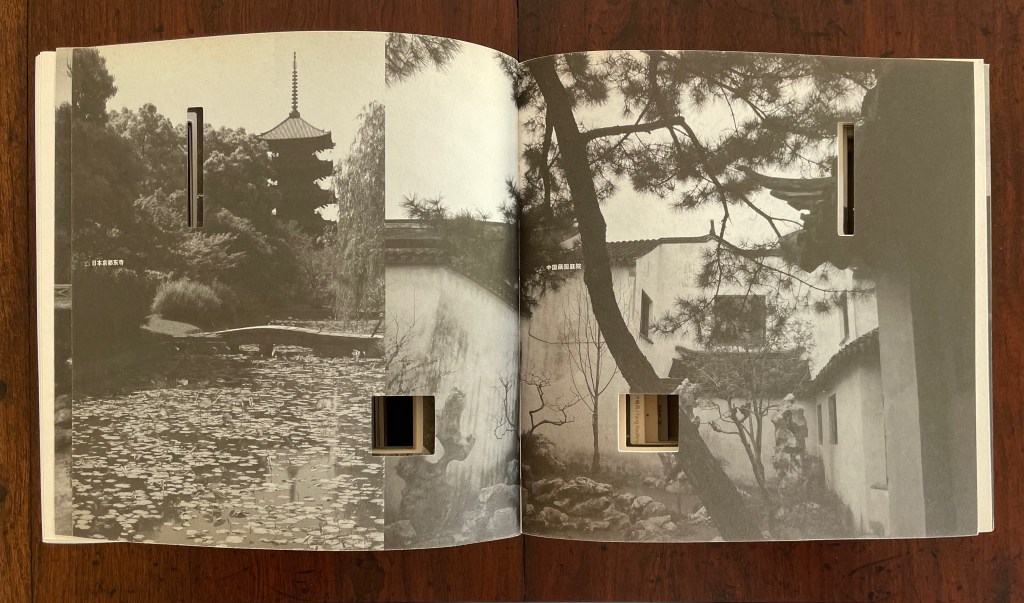
In Chapter 11, before Fang utters a word about the differences between the Western and Eastern handling of space in architecture, Lu uses the chapter title page to signal what is coming. The Chinese characters present themselves in their normal vertical orientation. The English text, however, is turned on its side, and when we turn the book to make the English more readable, we are reading it vertically in Chinese fashion. In the pages following it, the perspective of the photos creates angles along a vertical axis. Then, text and images tilt 45º, and the placement of the images across the space between paragraphs creates a city-like grid seen from a bird’s eye view.
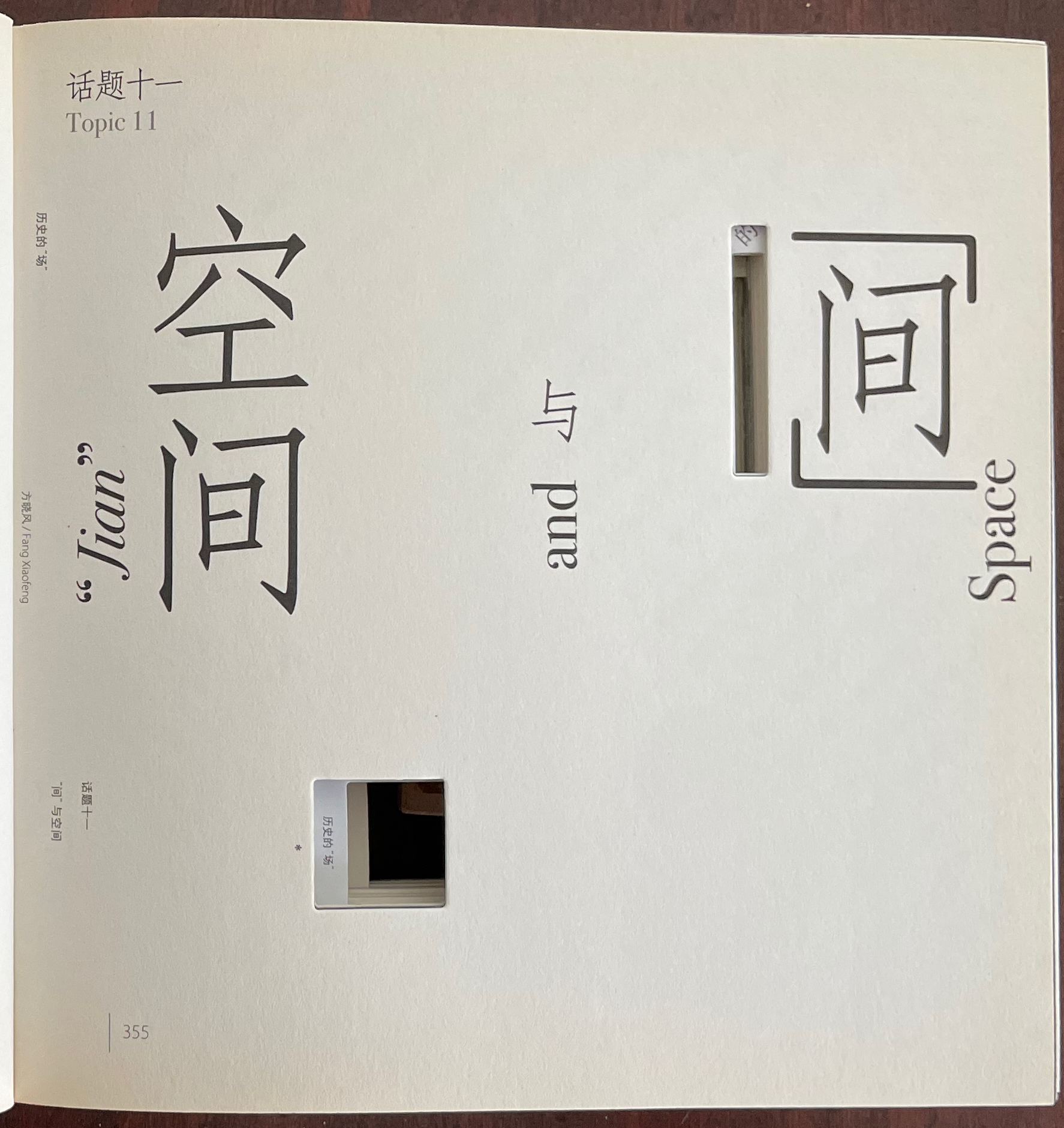
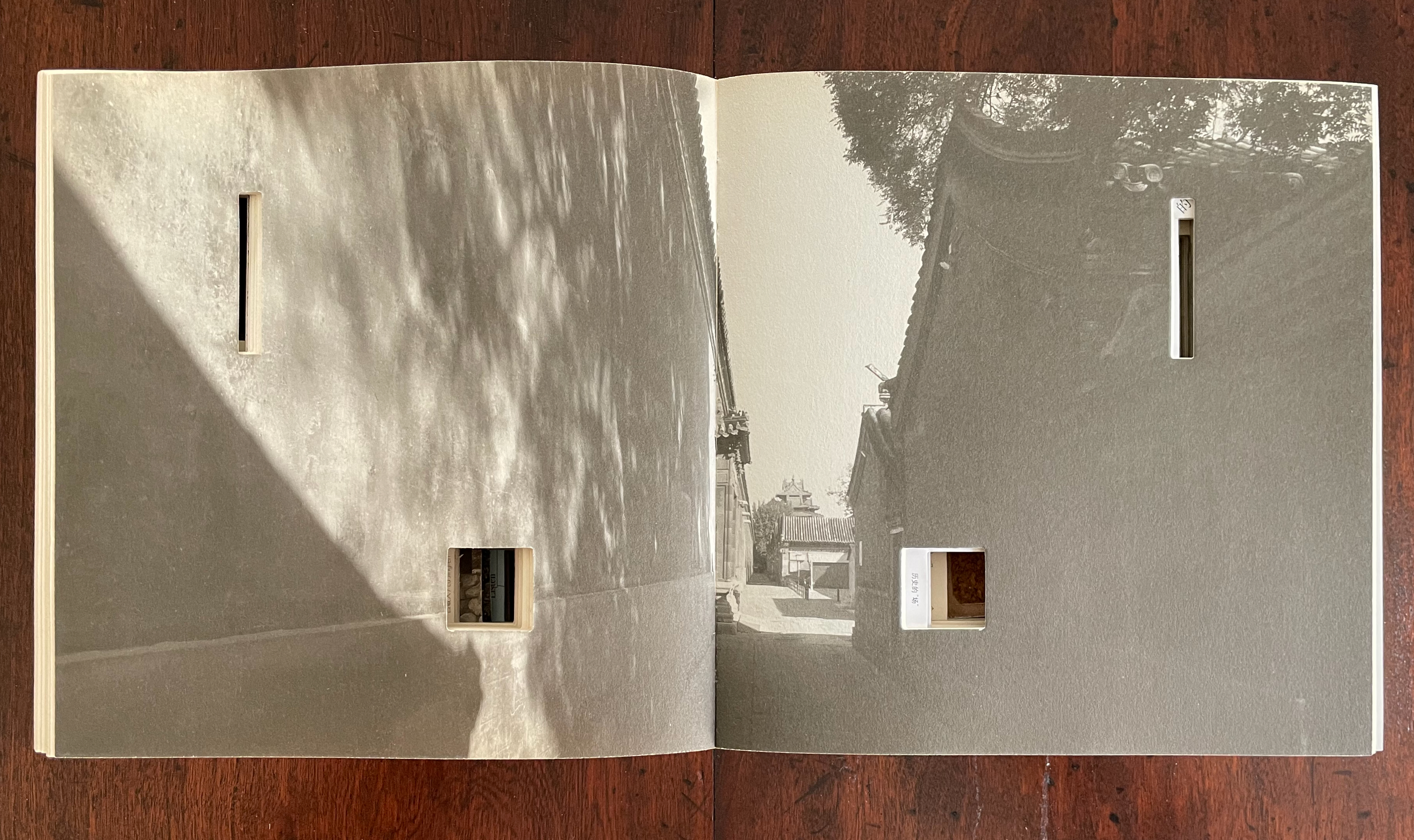
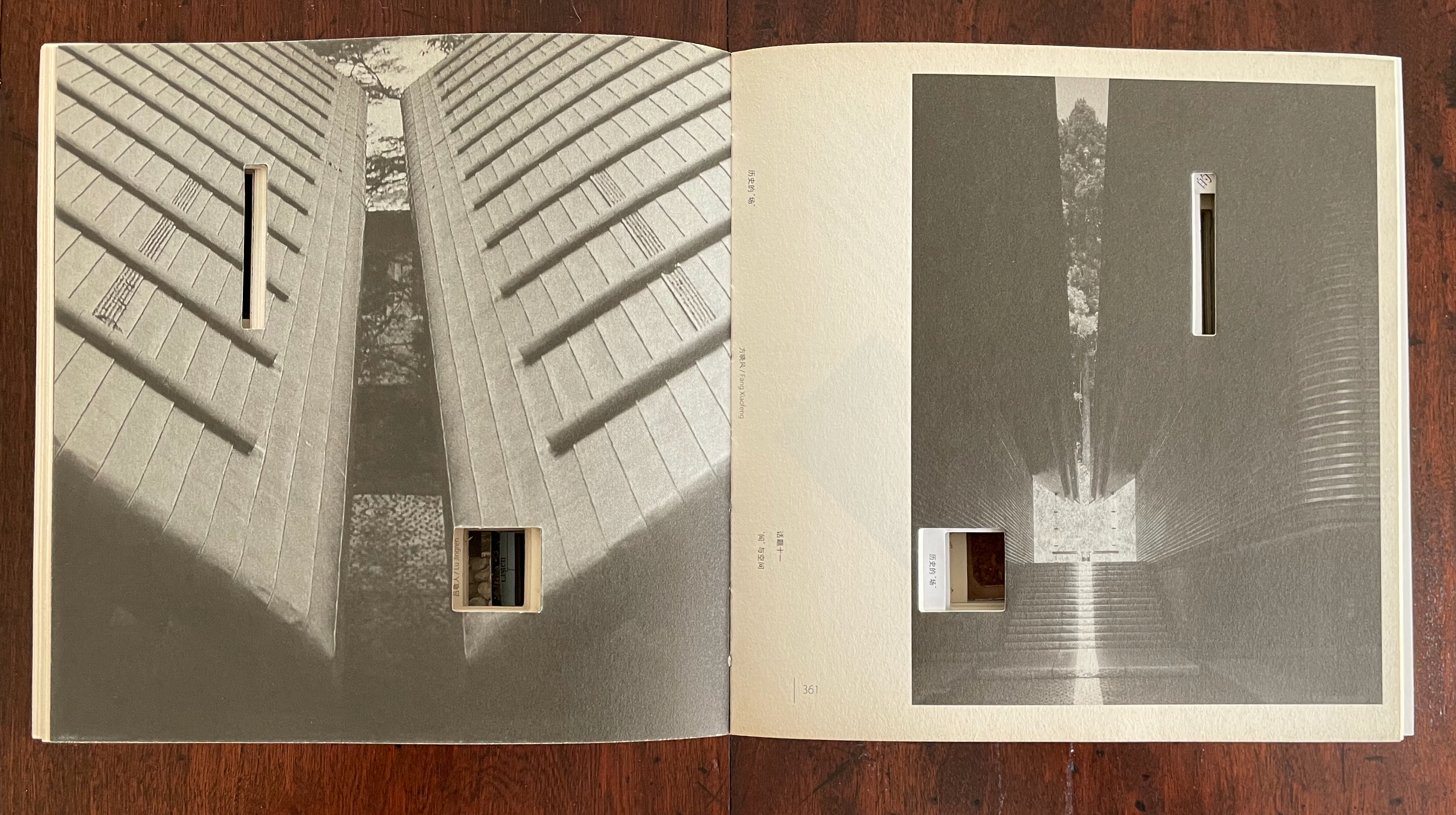
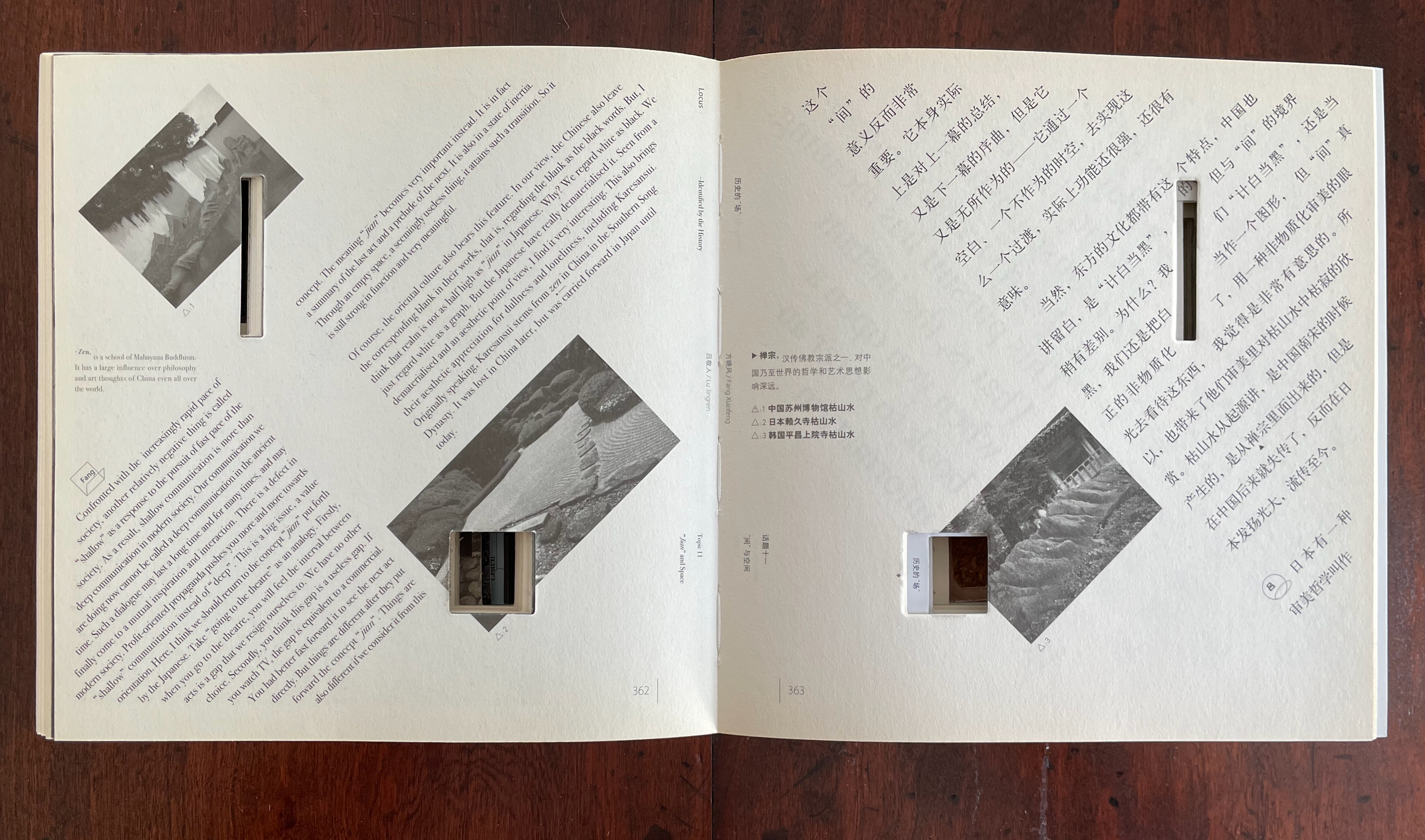
The word jian in the chapter title presents a complex concept core to this book.
The Chinese concept of betweenness is called jian (间) and the ancient character of jian (閒) shows that moonlight passes through the gap between door frames. This implies that ‘instead of the door being opaque and blocking out, some in-between remains, which indefinitely lets through — the wind, life and the light’.17
The concept of betweenness is also reflected in traditional Chinese architecture. Traditional Chinese buildings ‘focused not on single, independent buildings but on vast complexes with interconnected and well-coordinated parts spread out over a large area’.18 This interconnection and coordination refers to the harmonious interplay between the solid of the building and the void of the central courtyard. In ancient China, architecture with a central courtyard was conceived for a wide range of functions and it was hugely popular throughout the country. Furthermore, ‘the horizontal expansion of Chinese buildings into an organic complex virtually transforms spatial consciousness into a concept of time.’19 It is this flowing space based on a temporal process that gives rise to the aesthetic of traditional Chinese courtyard buildings (Liu , 2025)
Lu’s conversation in an earlier chapter, as well as this one, articulates how the book maps onto this complex notion. Although not mentioned, it doesn’t hurt his case that, etymologically, jian links to jiance or jian du, the bamboo slat book form preceding the invention of paper by Cai Lun. In a more direct mapping, Lu’s text compares opening a book with entering a dwelling, and the open spaces of the layout mimic the open courtyard threshold preceding dense “rooms” of dense text.
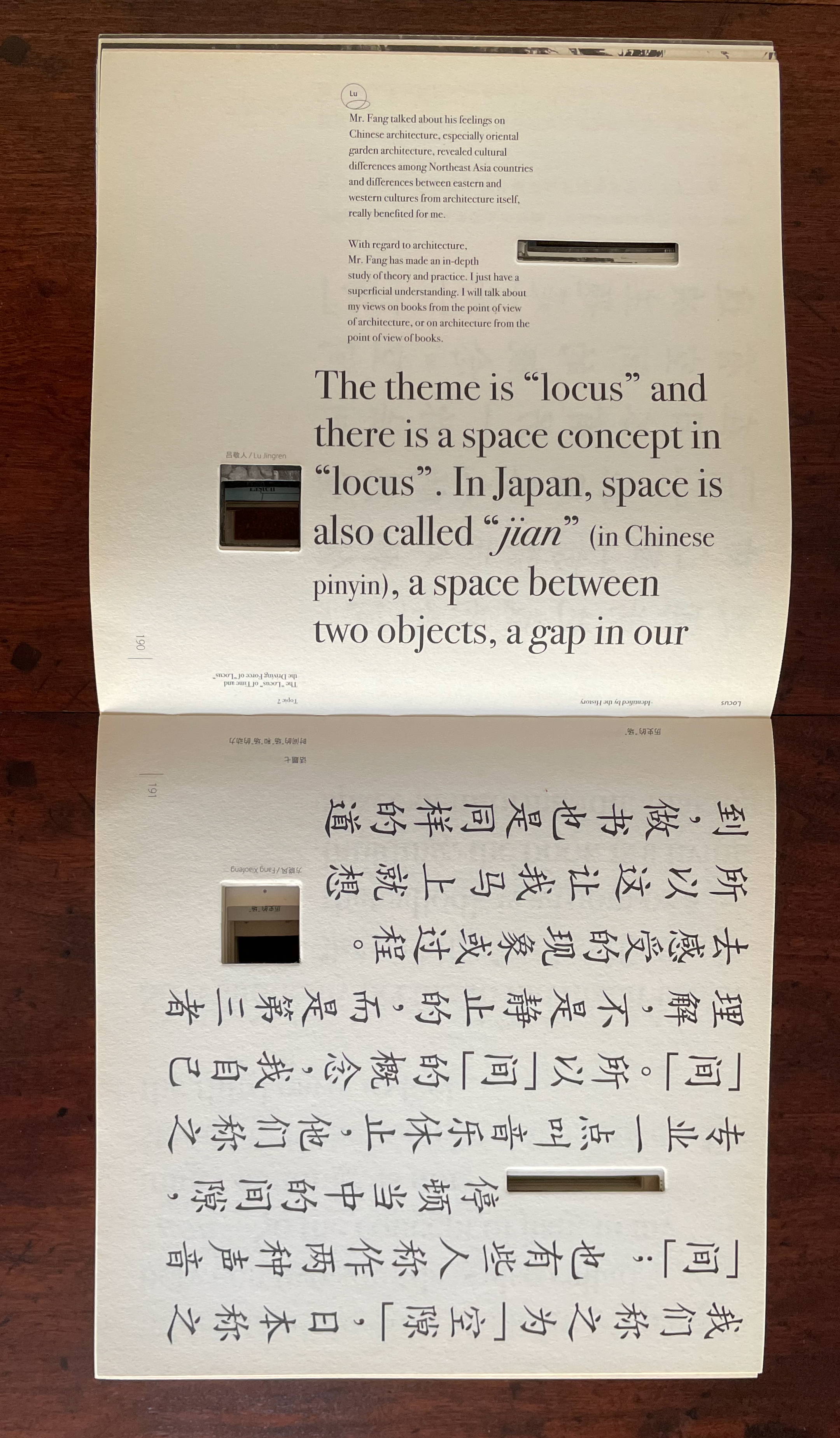
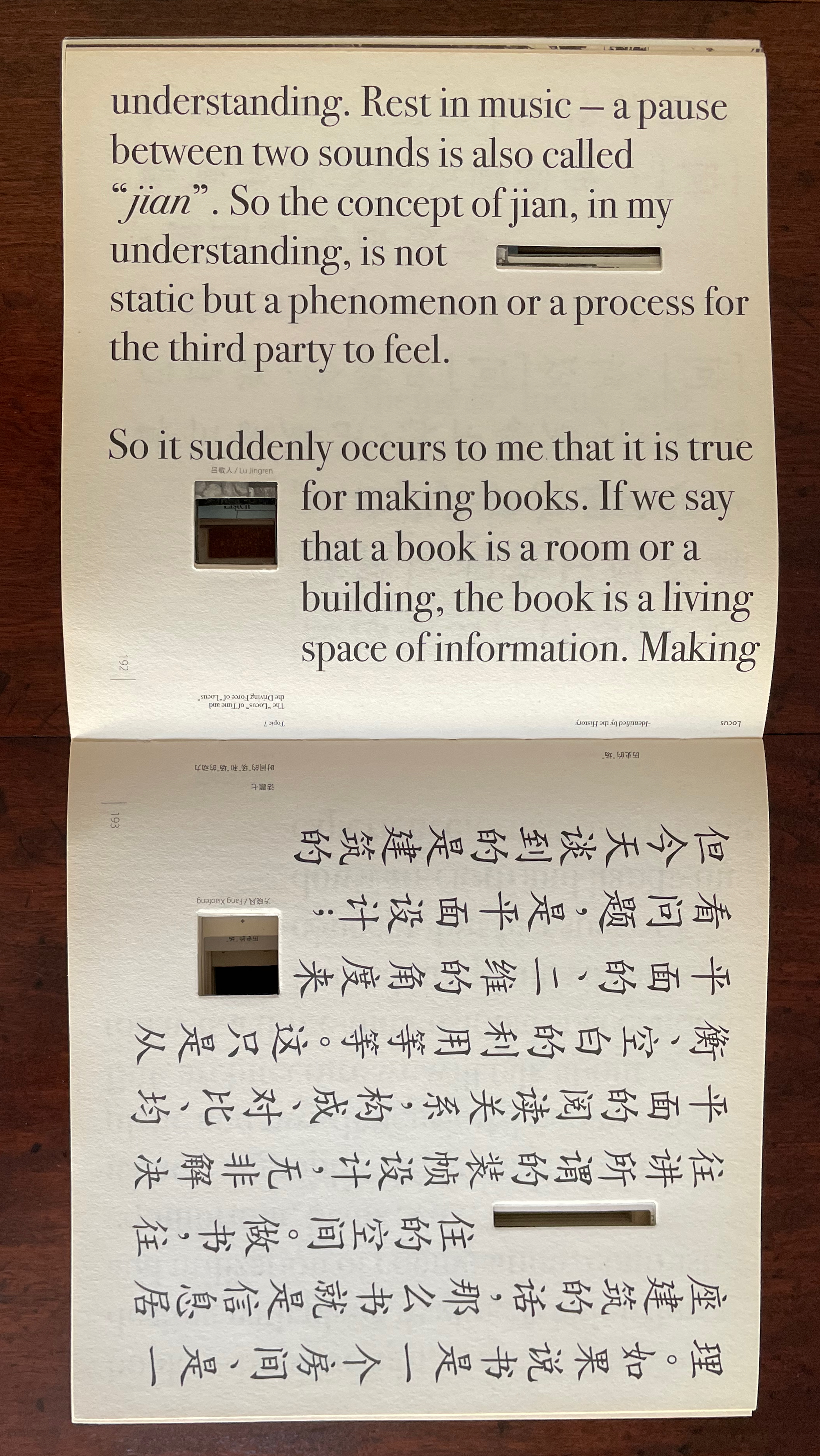
From Chapter 7 (“The ‘Locus’ of Time and the Driving Force of ‘Locus'”), mapping the book onto the concept of jian.
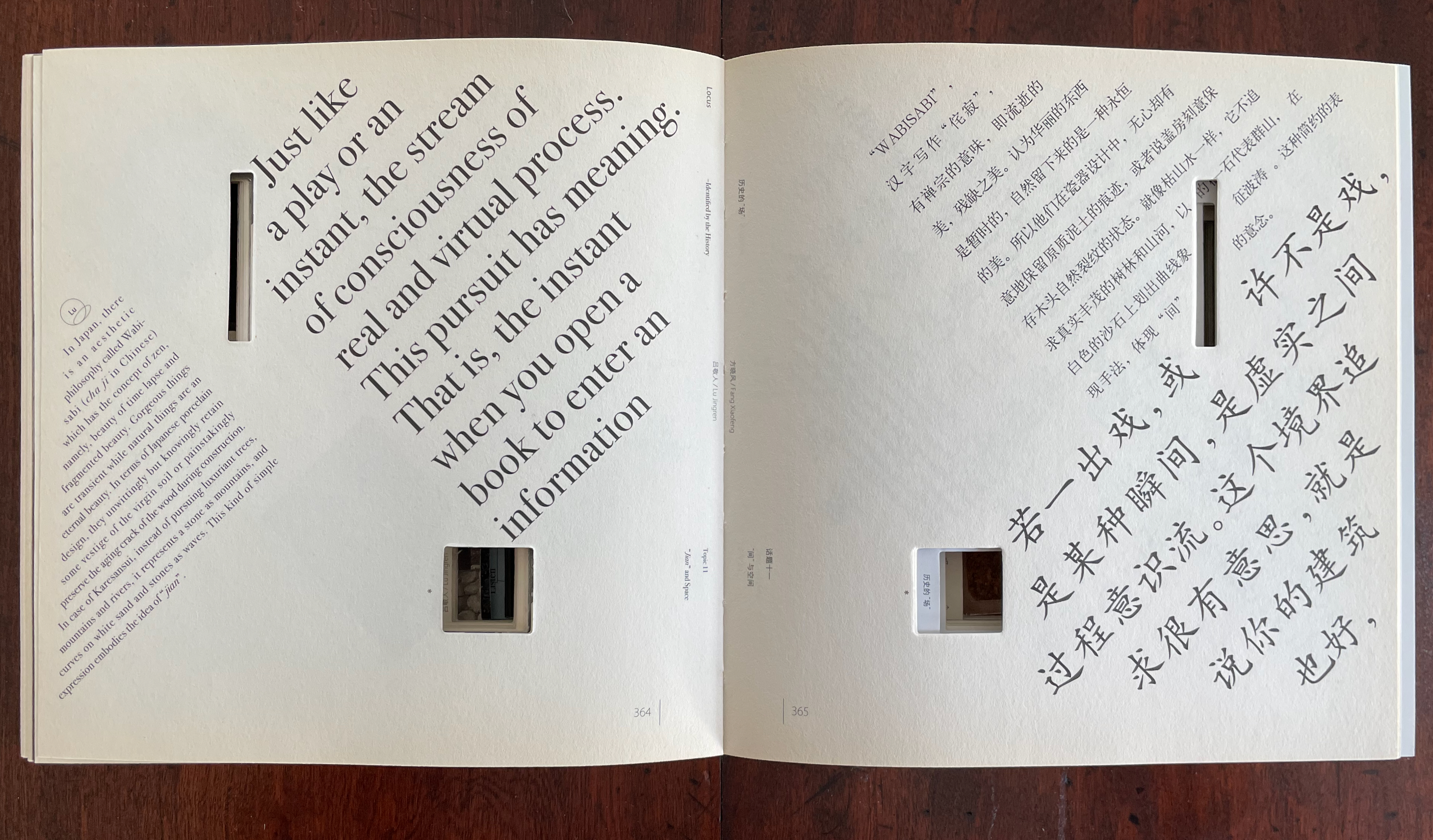
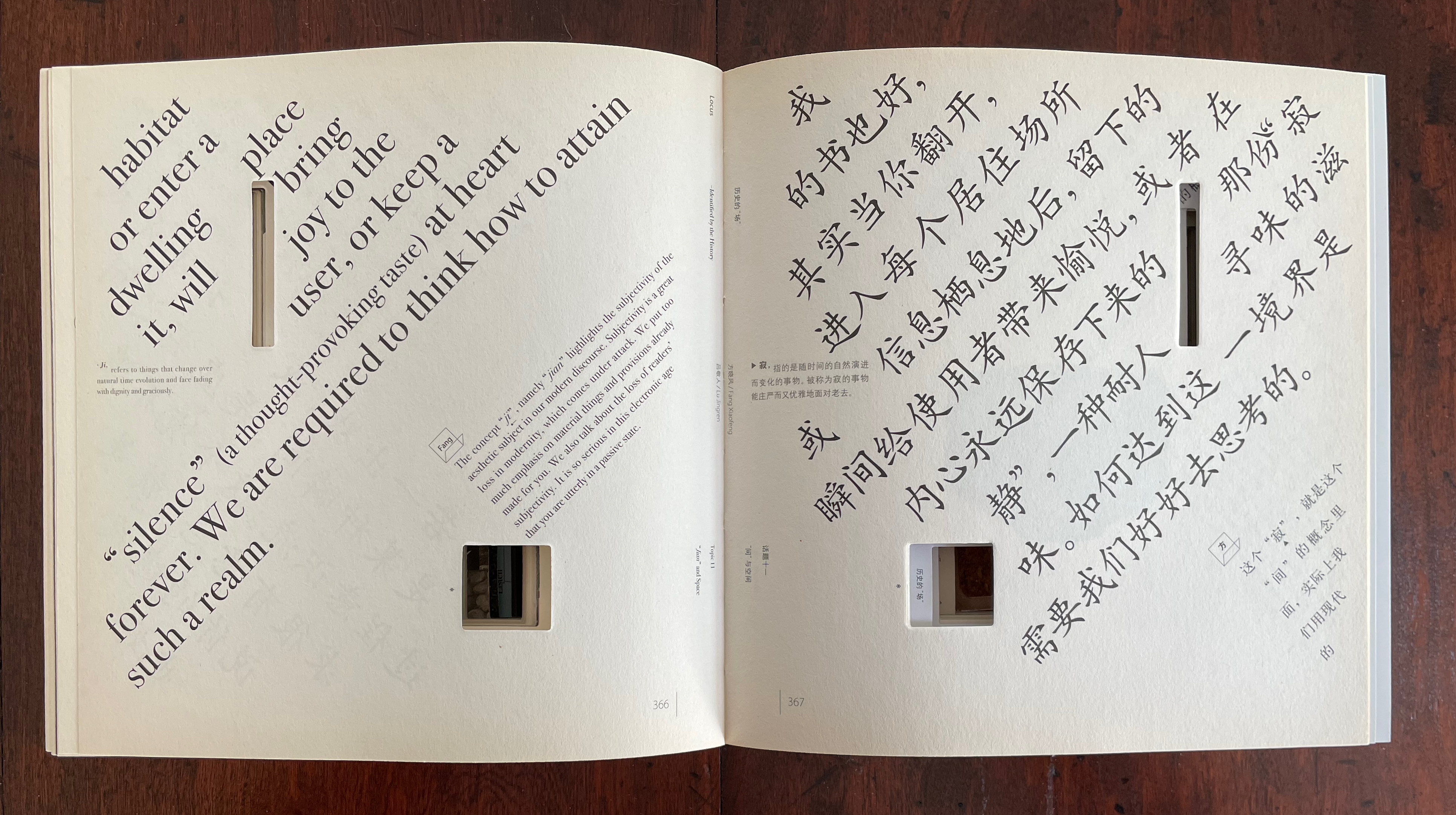
From Chapter 11, mapping the book onto the concept of jian.
Temporality, rhythm, and pacing are aspects of jian that Lu also maps to book design. Turning pages in this book blends with shifts in layout as well as the layering effect of the die cuts, and the overall effect is an experience of changes in the rhythm of reading and an experience of space and time. Another way in which this aspect of jian manifests itself is in shifting perspectives in Chinese gardens. Turning pages becomes like walking through a garden, each turn and changing spread becoming a step and encounter with a new viewpoint. This also relates to another concept that Lu borrows from architecture — jing (景 -“scenery/view/context”) — to build a bridge to book design. Turning on the word “scenery” in the second double-page spread below, Lu shifts metaphors and likens the book designer to a theater stage manager. Elaborating elsewhere on this metaphor, he writes: “The main characters and supporting characters each play their roles and intertwine with each other, like a play with not only dialogue but also scenery, sound effects, atmosphere, melody, and voice-over all injected into the book’s message” (Lu, 2022).
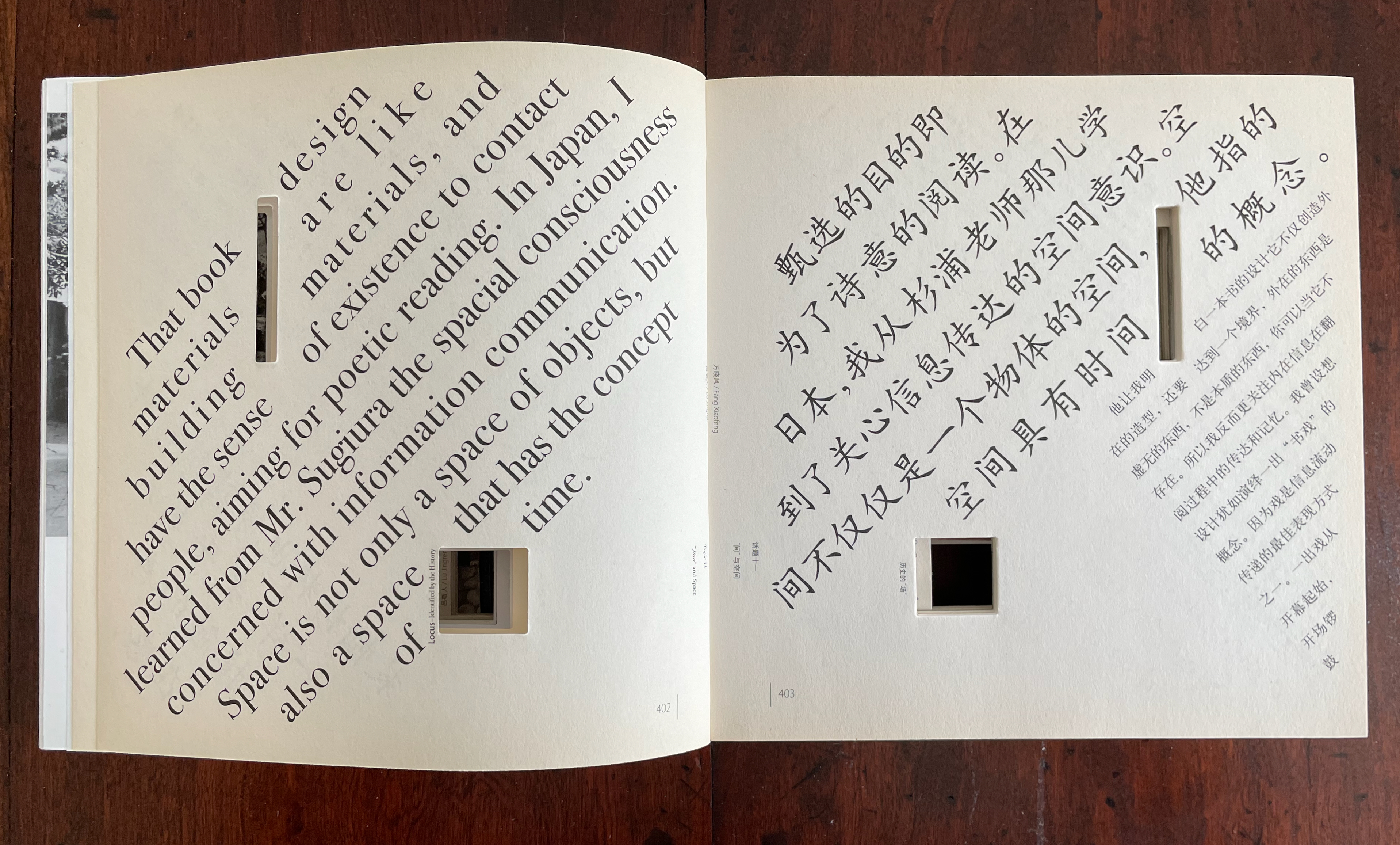
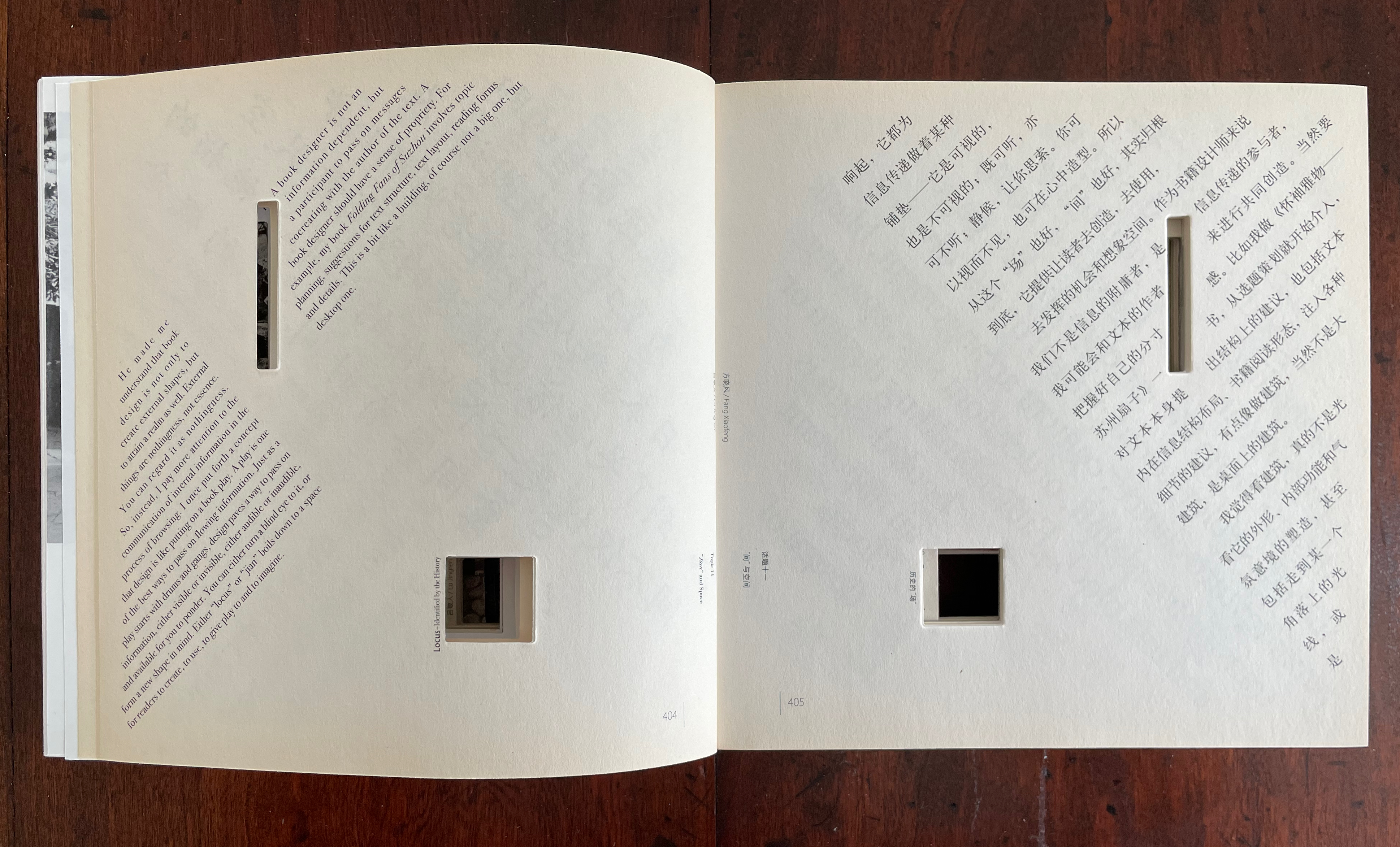
From Chapter 11, mapping the book onto the concept of jian.
Turning the pages of this book brings out another architecturally related aspect of Lu’s design philosophy: his “five senses” approach. Lu introduces the approach in Chapter 3 “‘Locus’ of Values” in one of the sections distinguished by a difference in paper. Each diagram on blue paper cleverly illustrates or suggests one of the five senses. Alongside the diagrams, Lu places the Chinese characters for touching, seeing, smelling, tasting, and hearing and excerpts from Shuowen Jiezi (1oo CE), the first dictionary to analyze characters by their structure and by their components’ relation to their meanings. By doing this, Lu gives his “five senses design” a linguistic and calligraphic foundation.
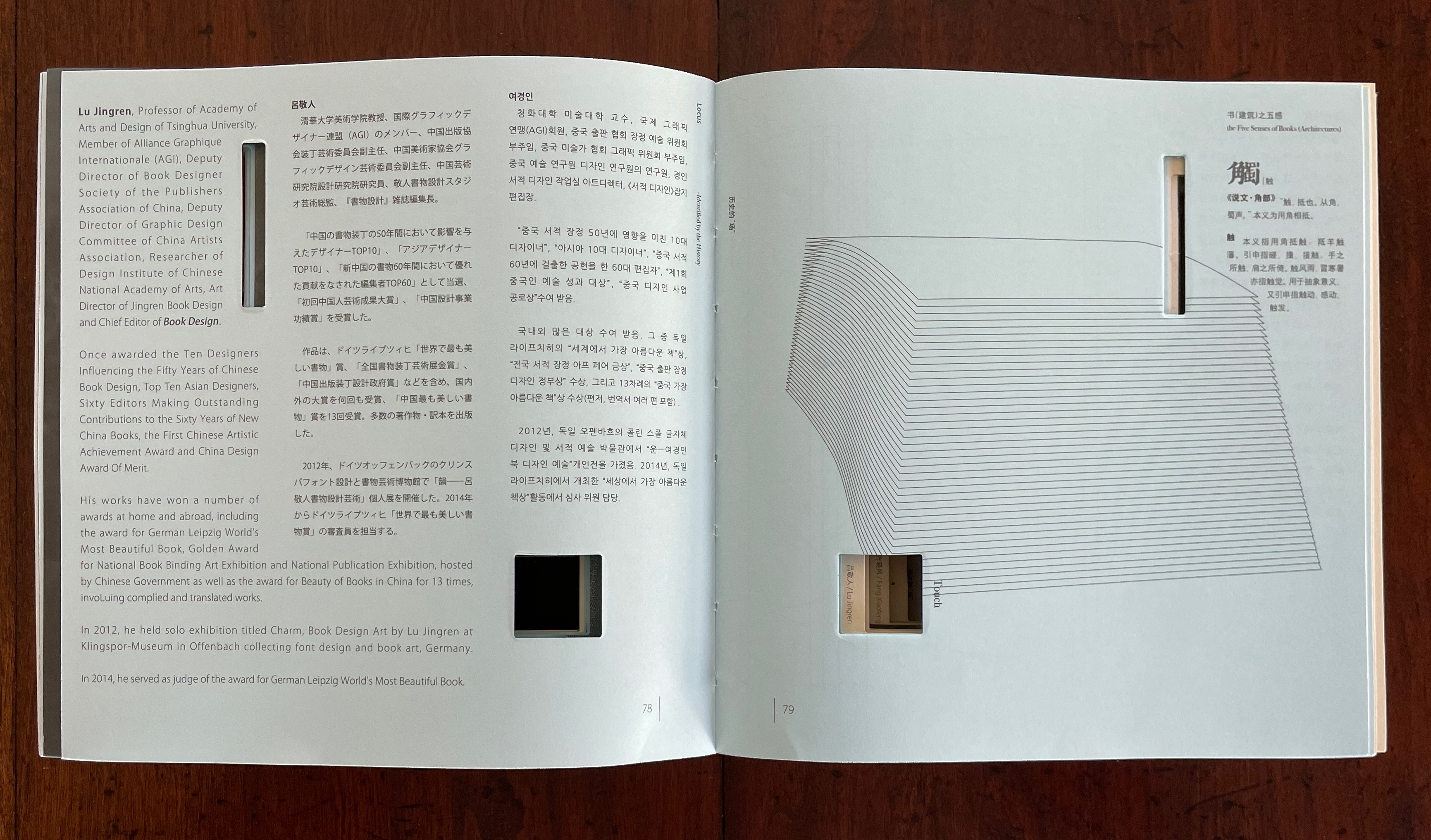
The diagram for touch.
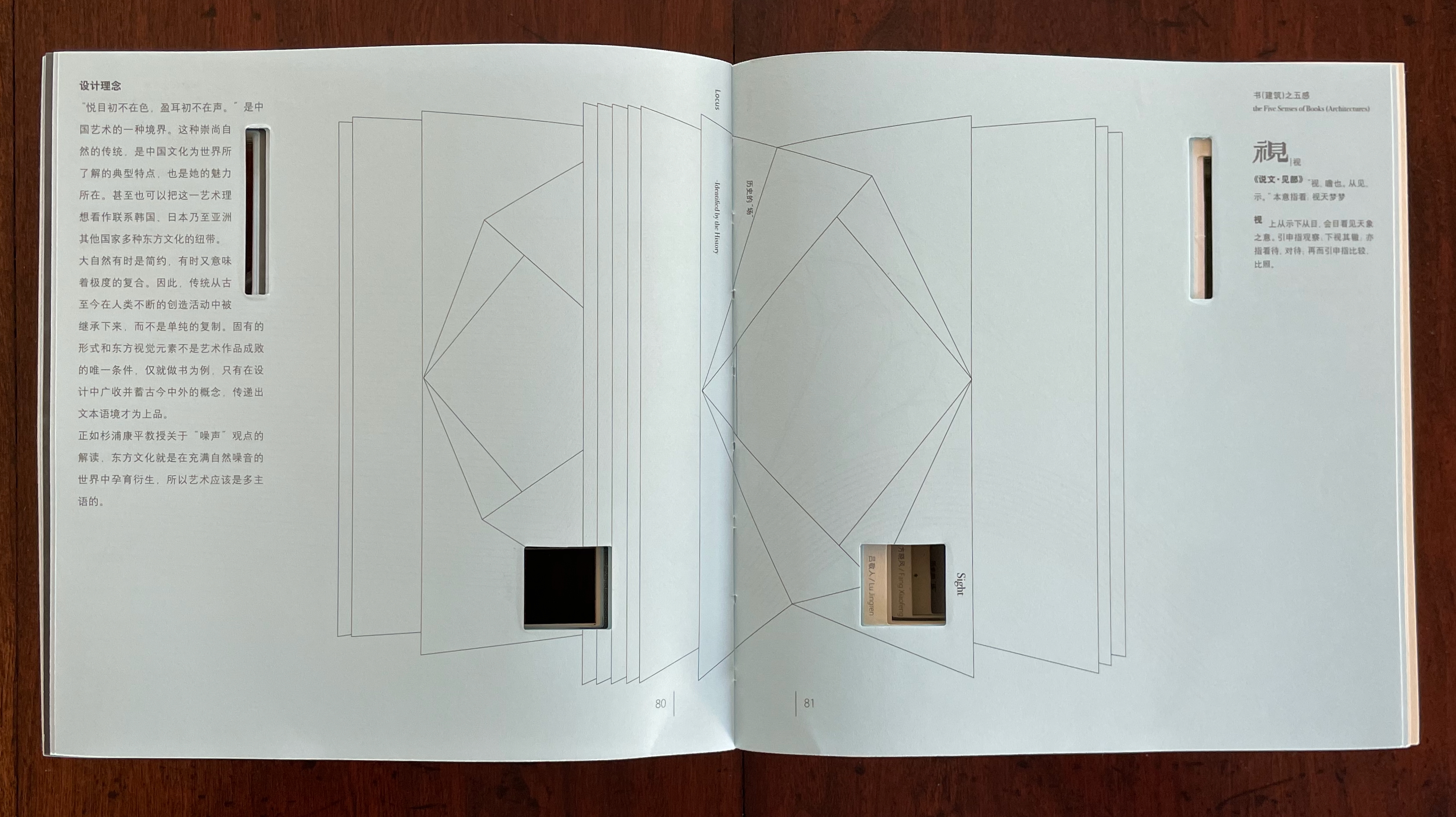
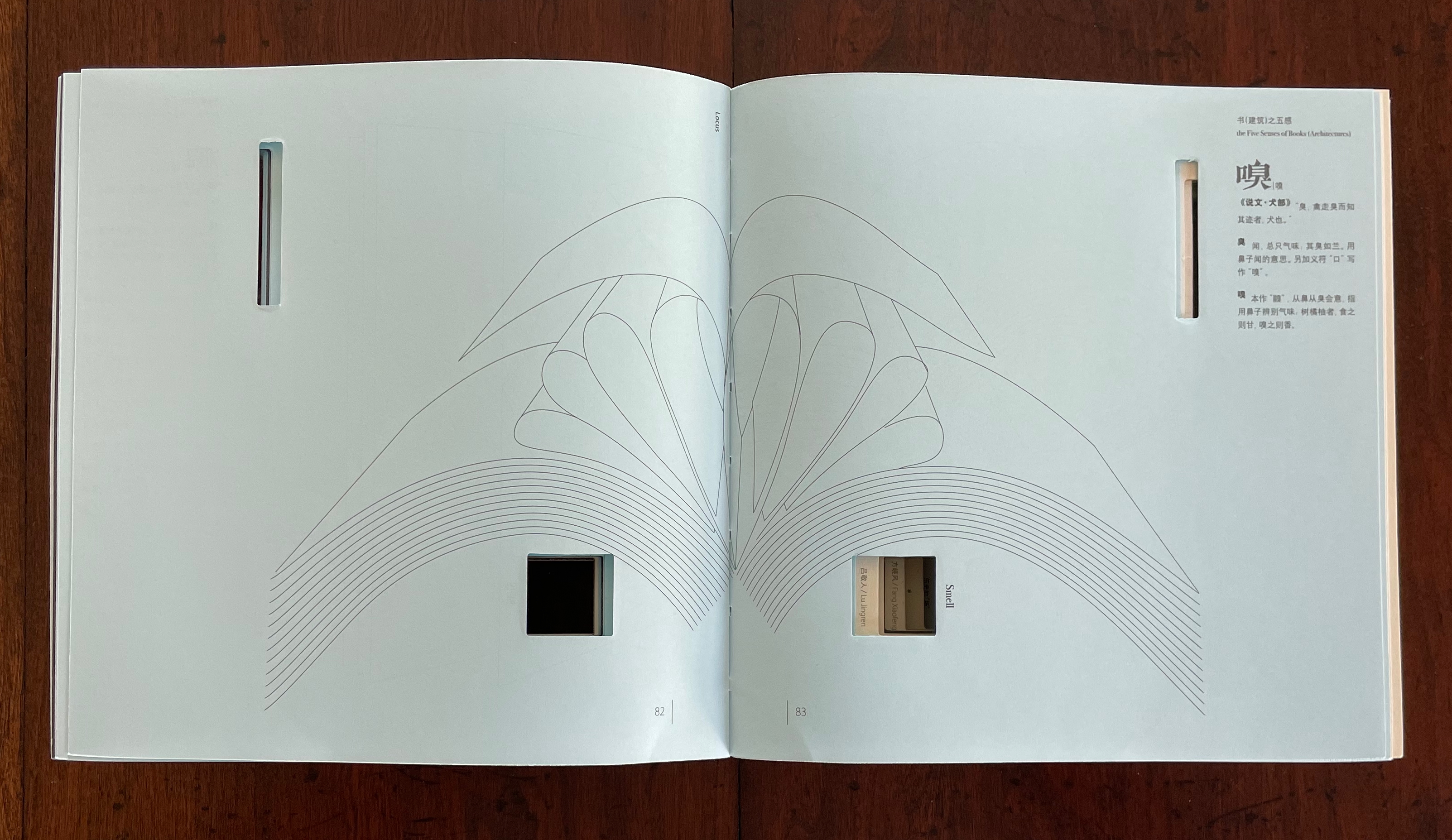
A double-page spread for sight with a drawing of pop-ups for a pair of eyes; a double-spread for smell with a drawing of page sculpture suggesting nostrils.
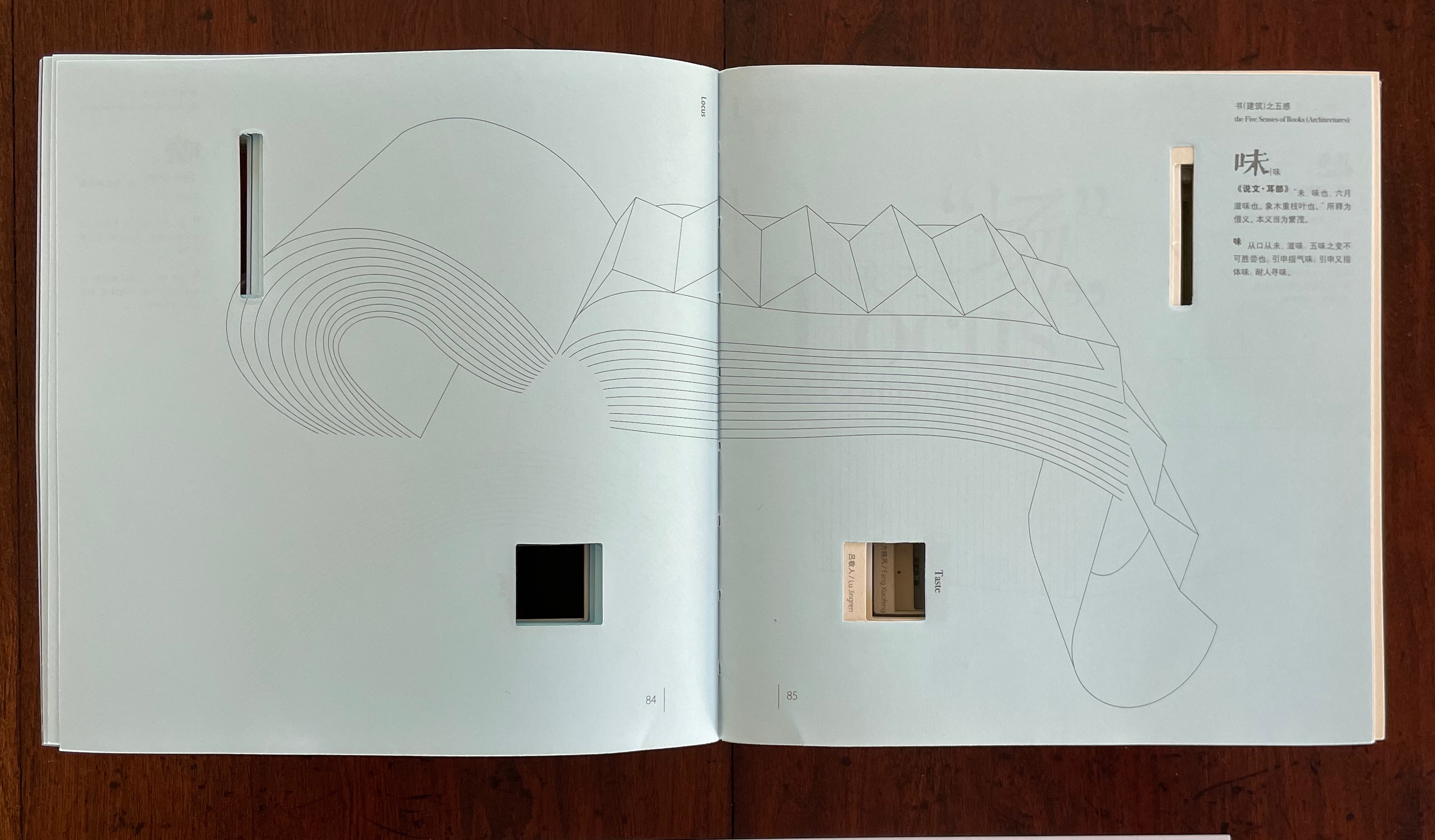
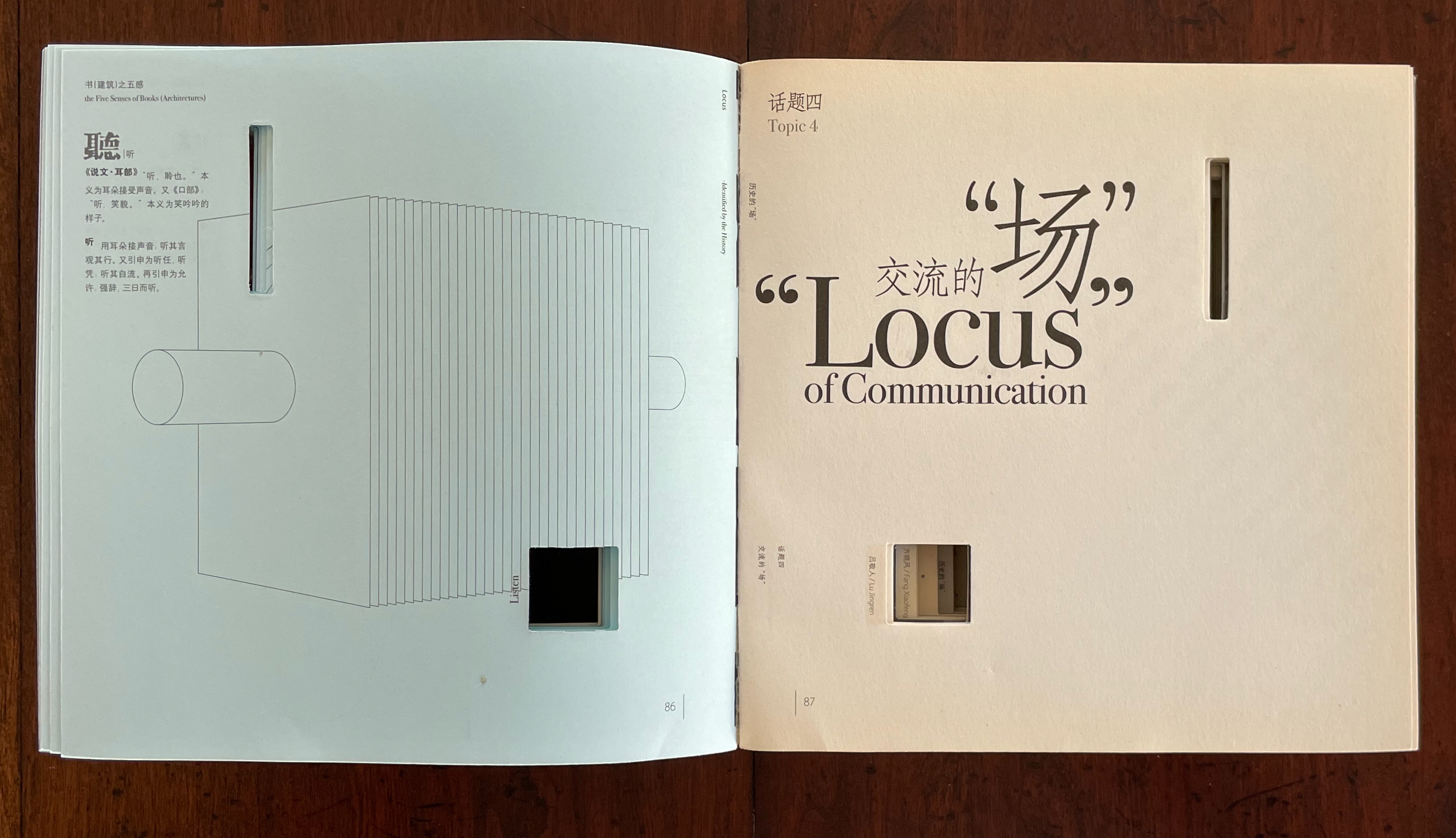
A double-page spread for taste with a drawing of book sculpture suggesting a protruding tongue; a single page for hearing with a drawing of a book with dowels for ears.
Touch (Haptic): It’s no accident that Lu puts touch first. Physically, it occurs through the skin, our largest and earliest sensory organ to develop. Its primary position emphasizes the attention that design should give to the book’s three dimensionality, its materials’ weight, texture, temperature, and flexibility or rigidity, and the touch-driven actions it elicits — holding the work, opening it, breaking the spine or untying the fastenings, turning pages or unrolling them, unfolding or popping them up, lifting flaps, or whatever navigational steps the designer aligns with the book’s purpose. These actions feed into the book’s pacing, which is also perceived . Touch can evoke the other senses, which underscores the interconnectedness that Lu seeks in good book design.
Sight (Visual): This is the sense that book designers have traditionally put first. Lu wants the design to move beyond standard typography or layout. Presumably he would applaud the titles and arguments of architect Juhani Pallasmaa’s The Eyes of the Skin (2005) and The Embodied Image (2010). In Lu’s world, the designer’s eye takes account of the reader’s eye and its ability to perceive harmony across margins, grid systems, negative space, density of text and image, the flow of light and shadow, changes in perspective, the colors of ink and substrate, and so on.
Smell (Olfactory): Elegists and fetishists of the book often extol the aromas of new and old books as they decry the digital age. Lu does not fall into that camp. As his diagram suggests, he wants designers to take account readers’ nostrils, what they can detect from specific materials such as ink, paper, glue, plastic, wood, metal, or modern scented varnishes, and what those scents might evoke as they engage with the book.
Taste (Gustatory): Lu’s incorporation of this sense in his design approach is as metaphorical as Francis Bacon’s “Of Studies” and its assertion “Some books are to be tasted, others to be swallowed, and some few to be chewed and digested”. He wants book designers (book artists?) to recognize that together the materials, layout, and essence of the text have a flavor for the perceptive reader and that it can linger after the book is finished.
Hearing (Auditory): In learning to read, we are urged to stop moving our lips, but that doesn’t stop the sounds of words or the book in our minds. Lu wants his “five senses design” to take account of the acoustics of reading: the voice of the narrative or descriptive text in the ear and mind, the creaking of the spine, the scratching of pages turning, the flap of pages slipping under fingers, or the rustle or crackling of paper. in such as the crisp snap of heavy cardstock, the soft rustle of thin rice paper, or the rhythmic flipping of pages. Considers the acoustic properties of a book. The distinct crisp sound of paper rustling, flipping, or folding introduces a unique temporal dimension and rhythm to the act of reading.
Dealing with gardens and architecture for human habitation, Fang Xiaofeng naturally addresses the senses interaction with them, and his urging a rebalancing toward the more Eastern concepts of “locus” and jian find echos in Pallasmaa’s warning to Western architects that the “current overemphasis on the intellectual and conceptual dimensions of architecture contributes to the disappearance of its physical, sensual and embodied essence” (The Eyes of the Skin, p. 35). Indeed, Pallasmaa’s later assertion —
Sensuous materiality and the sense of tradition evoke benevolent experiences of natural duration and temporal continuum. As I argued earlier, we do not only dwell in space, we also dwell in the continuum of culture, time and memory (Pallasmaa, 2016).
— would not be out of place in this book.
Locus confirms an earlier intuition that thoughtful analyses of architecture can enrich the enjoyment of book art. The “five senses” approach adds to Fang’s and others’ analyses Lu’s insistence on designing with interconnectedness in mind. When Locus demonstrates evidence of the design approach that it articulates, it not only enhances its primary theme that “Books have an intimate relationship with architecture” but it also demonstrates the self-reflexiveness and self-interrogation of the book form that brings Locus close to being an artist’s book rather than simply an outstandingly well-designed book.
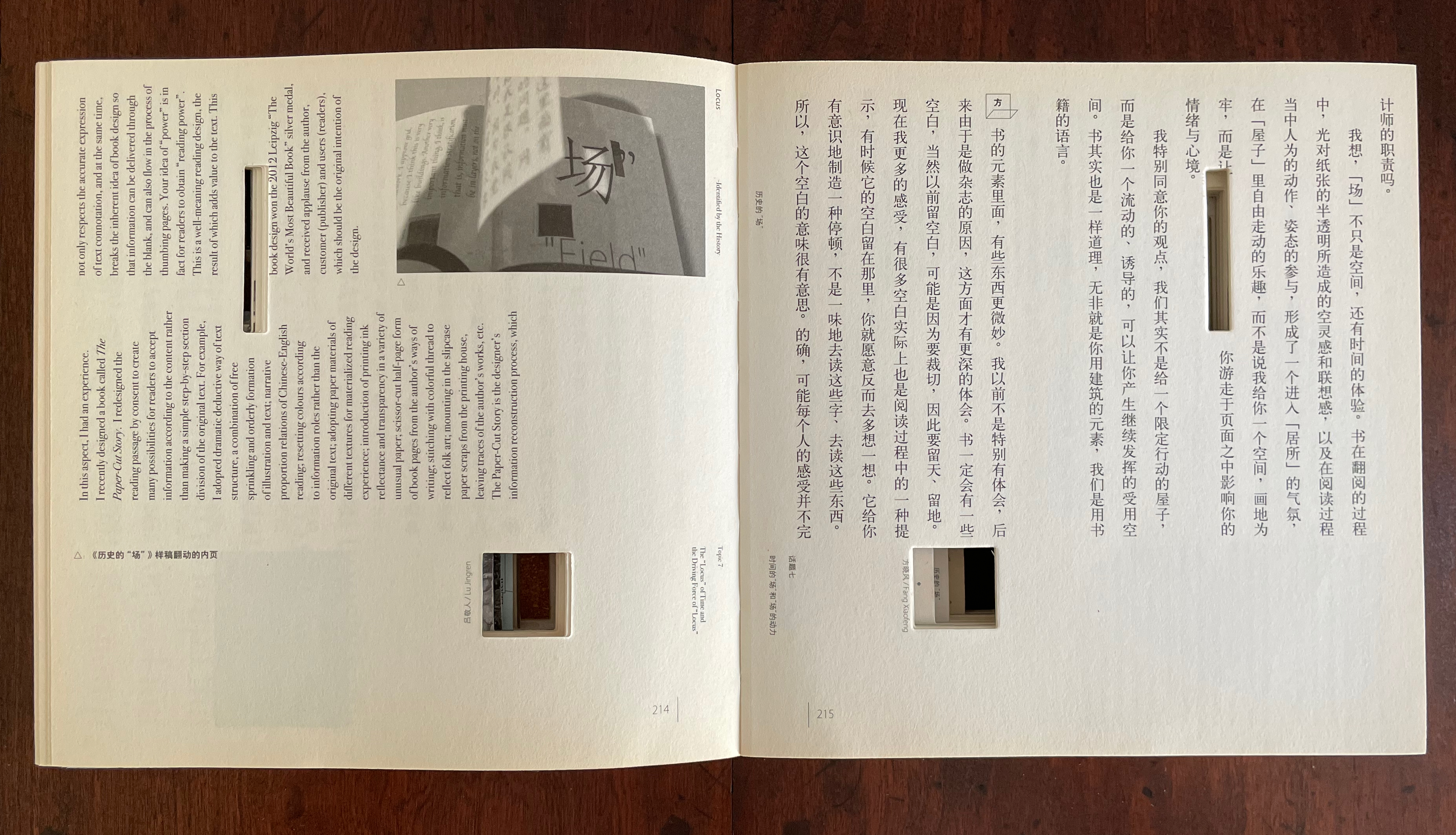
A witty example of self-reflexiveness: the illustration on page 214 is a photo of a spread from an earlier design of the book in hand.
Further Reading
“Architecture“. 12 November 2018. Books On Books Collection.
“Celebrating the 250th Anniversary of Steingruber’s Architectural Alphabet”. 1 January 2023. Books On Books Collection.
“Lu Jingren, Amanda Degener, and Peng Wu“. 12 May 2026. Books On Books Collection. In Handmade Path (2021), co-edited with Amanda Degener and Peng Wu, Lu included in the questionnaire sent out to contributors the key question “In what way do you understand the 5 senses of paper/book: vision, touch, hearing, smelling, tasting?”
Chen Ling. 10 August 2018. “Lu Jingren: From Bookbinding to the Methodology of ‘Five Senses’ Design“. Sohu.com. Accessed 8 June 2026. Translation Google.
Editorial team. 18 August 2017. “Practical and beautiful books add tangible poetry to life | Designer Lü Jingren“. Artron Art Network. Accessed 8 June 2026. Translation: Google.
Jullien,François. (2020). From Being to Living: A Euro-Chinese lexicon of thought. London: SAGE Publications Ltd.
Lin Gengli. 2018. Art in Book Form. Hong Kong: Sendpoint. Covers the book design philosophy of Lu Jingren, Stefan Sagmeister, and Hubert & Fischer.
Liu, X. (2025) “The return of tradition: a preliminary study on the integration of traditional concepts of space with contemporary Chinese urban space”, Architecture_MPS. 30(1).
Lu Jingren. 22 November 2022. “Lu Jingren: Book Design is the Work of a Director“. Design. Issue 8. Accessed 8 June 2026. Translation: Google.
Padberg, Susan (curator). 7 May – 26 June 2026. “Book. Space. House. Space of Movement“. Exhibition at Galerie Druck & Buch, Vienna, Austria. Accessed 22 May 2026. “The artist’s book as a three-dimensional space: forming a house, outlining, remembering, mimicking—thinking the human being within space. Between object and narrative, books unfold as architectural structures, as inhabitable thought-spaces, as reflections of individual and collective experience. The exhibition brings together artistic positions that expand the book as a spatial body.”
Pallasmaa, Juhani. 1996. The Eyes of the Skin. London: Academy Editions.
Pallasmaa, Juhani. 2009. The Thinking Hand. Chichester, UK: Wiley.
Pallasmaa, Juhani. 2011. The Embodied Image. Chichester, UK: Wiley.
Pallasmaa, Juhani. 2016. “Matter, Hapticity and Time Material Imagination and the Voice of Matter.” Building Material, no. 20: 171-89. Accessed February 8, 2021.
Ye Yangbin. 18 October 2017. “Practical and beautiful books add tangible poetry to life | Designer Lü Jingren“. Accessed 8 June 2026. Translation: Google.
Zhang Huichao. 24 June 2021. “Research on the Application of Systems Science in Book Design Practice“. Journal of Systems Science. Accessed 8 June 2026. Translation: Google.

