Books On Books Collection – Helmut Andreas Paul (HAP) Grieshaber

Affen und Alphabete (1962)

Affen und Alphabete [“Apes and Alphabets“] (1962)
Helmut Andreas Paul (HAP) Grieshaber
Slipcased, self-covered leporello with eighteen original woodcuts of stylized apes and sixteen typographical experiments. H450 x W335 mm. 36 unnumbered sheets. Edition of 300, of which this is #68. Acquired from Winterberg-Kunst, 22 October 2022.
Photos: Books On Books Collection.

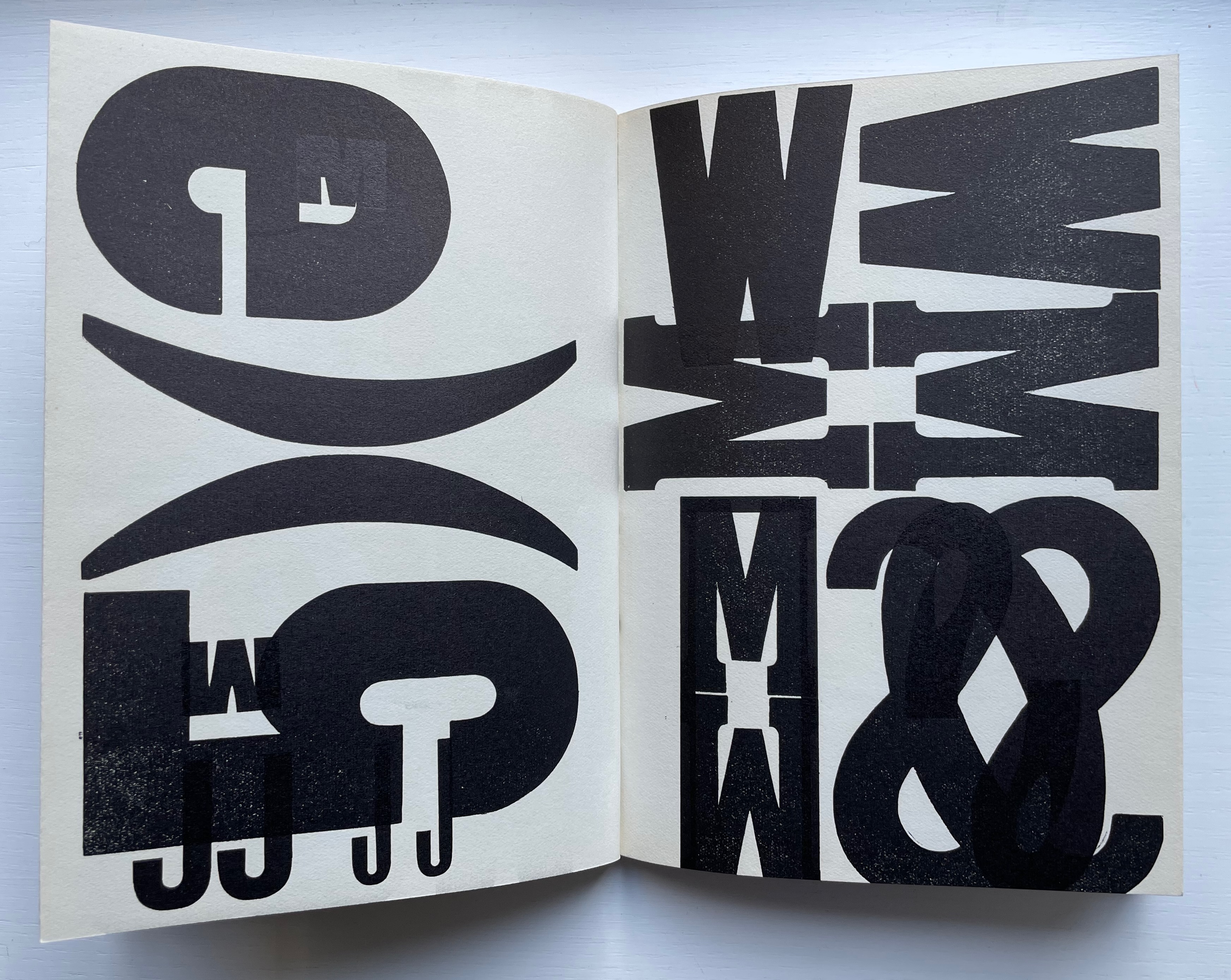
HAP Grieshaber was one of the foremost German woodcut artists of the post-WWII era. His devotion to the woodcut technique was almost matched by that to the medium of the book, which he used in several formats and sizes for series works. Apes and Alphabets is one of the larger of those series and representative of his undeviating Expressionist style and blurring of borders between letter and image, the civilized and uncivilized, the artificial and the natural. This slipcased accordion book comprises 18 original woodcuts, two of which appear on the cover (one again on the wooden slipcase).

A full page of ranks of blackletter characters echoes a full page of columns and rows of apes with musical instruments. In visual cacophony, the letters make wordless strings just as the apes make soundless music.

Only one of the book’s panels has a touch of color, but the garish orange of the slipcase and book cover shows Grieshaber’s characteristic handling of this element — printing over an undercoat that serves as background. Even when working with a single color in these prints, Grieshaber earns his description as Der Holzschneider als Maler (“the woodcutter as a painter”), to which could be added “collagist”. Although influenced by  Paul Klee and Lyonel Feininger, the physical intensity of the prints, this book and the others below sets Grieshaber apart.

His use of heavy wove paper in this work and other monumental ones like Die Rauhe Alb (1968) is equally of a part with a drive toward the tactile and a reaction to the alleviation of wartime paper shortages, which comes up later in Herzauge (1969) below.

Poesia Typographica (1962)

Poesia Typographica (1962)
Helmut Andreas Paul (HAP) Grieshaber
Paperback, perfect bound Chinese-fold folios, black endpapers. H215 x W155 mm. 28 unnumbered pages. Edition of 1000. Acquired from Print Arkive, 22 October 2022.
Photos: Books On Books Collection. Displayed with permission of the publisher Galerie der Spiegel.

The alphabet theme of Affen und Alphabete carries over in the hornbook images on the front and back covers of Poesia Typographica. More than most typographic or concrete poetry, Poesia Typographica addresses the materiality of letters, images, ink, paper and printing — even going so far as to exalt it over the alphabet.

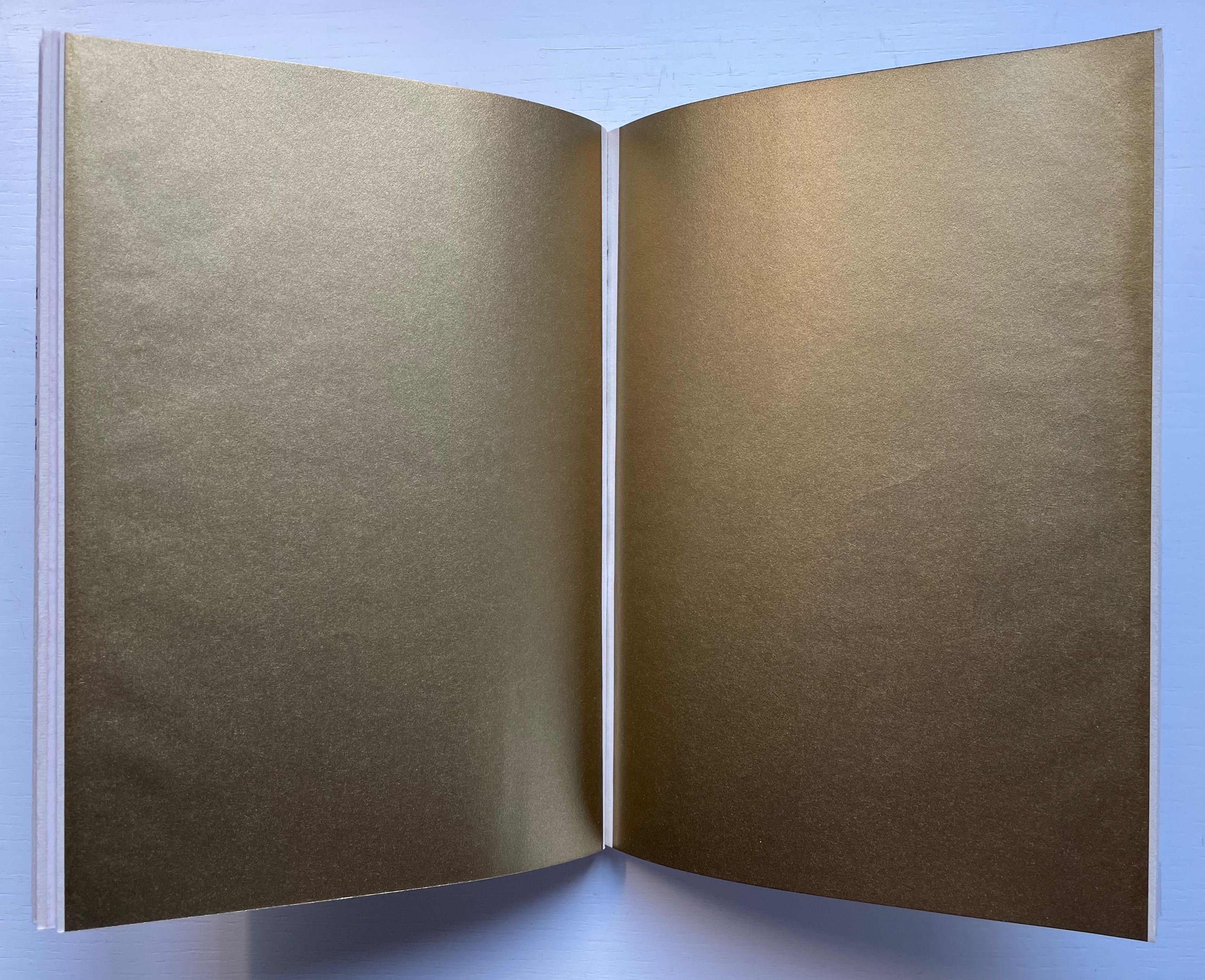
This is particularly clear in Grieshaber’s use of white ink on a transparent sheet to record the tale of missionary Baedeker and his Analphabeten Bibel (“Illiterates’ Bible”). To the Russian peasantry to whom Baedeker distributed thousands of the booklet, he claimed that its eight pages contained “the whole Bible, the pure teaching of our Jesus Christ”. The typeset transparent sheet sits between what would otherwise be a double-page spread of solid black. That spread is followed by one of red, one of white and then one of gold.

The transparent page explains :

the peasants saw in the black of the first page the darkness of their sinful hearts, their great guilt.

in the red of the next page, they united with the divine blood of christ. they walked out the suffering steps of our lord. washed clean in the blood of his love, they won innocence:

the pasture linen of the third page, that is the purity that must be in the heart.

ready to enter into the mystery, to look into the sunshine of God’s face. to fall down in prayer, the sound of the golden trumpets of heavenly bliss in their ears.

A literate reader may smile at the missionary’s metaphorical hoodwinking of the serfs, but the longer the reader moves the transparent page back and forth, registers its interloping nature, and recognizes that “analphabet” doesn’t just mean “an illiterate” but also one who does not know letters at all, the more the materiality of the stiff black, red, white and gold pages makes itself felt and the more the viewer realizes that Grieshaber is laying down a challenge to look beyond the alphabet to the ink, paper and the printing.

Just as in Affen und Alphabete, the reader/viewer must look at letters beyond “shapes for sounds”. Letters may have their roots in the pictorial, but Grieshaber isn’t taking their “shapeness” back to pre-Gutenberg or pre-alphabet pictoriality. He takes it into an expressive post-Gutenberg, post-alphabet visual and material art.

Herzauge (1969)

Herzauge (1969)
Helmut Andreas Paul (HAP) Grieshaber
Board book casebound in bookcloth, with illustrated dustjacket. H294 x W240 mm. 16 unnumbered pages with 9 color plates. Edition of 800? Acquired from K.G. Kuhn Antiquariat, 14 July 2023.
Photos: Books On Books Collection. Displayed with permission of artist’s family.

Hat das Herz noch ein Auge? (“Can the heart still see?”), Grieshaber asks on the last page of this artist’s book for children published by Parabel Verlag in Munich. It’s a disturbing afterword. It changes what you think these Expressionist woodcuts and the words beside them express. Grieshaber explains that, by 1937, paper for printing was scarce. From a generous doctor, he obtained filtration paper on which to print his landscape woodcuts Die Rauhe Alb, his visual ode to the Swabian Alps. Children brought him the sheets of glossy paper on which the original 20 copies of Herzauge were printed and over-drawn with a dry brush. No one wanted Die Rauhe Alb at the time, and all but one copy of Herzauge were lost. His summary phrase — Märchen in dunkler Zeit (“Fairy tales in dark times”) — offers a way into the board book and perhaps an answer to the question “Can the heart still see?”

Second double-page spread. “Ach Alm, a knight once moaned. Achalm, I live in your lap.”

Achalm is a mountain in Reutlingen, Germany. On its top are the ruins of Achalm Castle, ancestral seat of the counts of Achalm, a 13th-century Swabian noble family. The legend is that the name comes from Count Egino’s dying words to his brother. He meant to say “Ach Allmächtiger!” ( “O Almighty!”) but only uttered “Ach Allm…“, and to honor Egino, the brother named the mountain and castle Achalm. It’s a clever poem and clever woodcut. The last word Schoß — meaning bosom, arms, heart or lap — is close to the word Schloß — meaning castle. Turning the castle into a fairy tale crown, the woodcut also gives the mountain a feminine visage, a sweep of white that looks like an embracing arm and a village nestled in its lap.

This spread comes after the first in which a black woebegone bird in a brush-streaked patch of snow occupies the foreground alongside the lines “Winter is a hard man. The tree freezes.” And it precedes the third in which the viewer’s perspective must be that of standing on a dock and looking out on a harbor alongside text that reads, “Do you hear the horn hooting in the harbor? We are leaving.” Achalm is the fairy tale bookended by dark cold before and forlorness after.

The fourth spread’s text — Wer streicht am Abend allein über de Berge? Die Katze weiß es.(“Who is painting alone in the mountains in the evening? The cat knows.”) — is a fairy-tale blend of gloomy forest and mysterious animal humor matched by the dark purple undercoat and background of the woodcut.

A fifth spread with colors of dark blue, burnt umber and green against a turquoise undercoat and background shows a distressed Hansel-and-Gretel-like pair on the turquoise path between blue and umber trees and beneath a large blue, umber and turquoise owl that cries “Home, home!” as Der Nacht krab kommt (“The night call comes”)

The sixth and seventh spreads introduce a different air of childhood innocence, one of lessening threat. In the sixth, a child figure with upraised arms (throwing an orange ball up in the air?) wanders down a meadow valley bordered by a knoll of trees leaning over the otherwise sunny scene with black and purple foliage that suggest the faces and hair buns of stern school mistresses. The last line of text — Ich muß zur Schule (“I must go to school”) — evokes a nursery-rhyme dawdling ten o’clock scholar to English ears. In the seventh, Wir haben Ferien (“We have holidays”) sounds like the concluding sentence in a final school assignment and is matched by the child-like drawing of swans, roses, a green lake and a motherly figure. But mother is faceless, preparing us for the afterword’s hopeful but worried question “Can the heart still see?”

It’s good to see a renewed interest in Grieshaber — not only for his own artistry but also his medium. Another of his major works — The Easter Ride, a series of 27 colored woodcuts based on a journey through the Swabian Alb — was exhibited at the Elztalmuseum Waldkirch in early 2023.

Helmut Andreas Paul Grieshaber, better known as HAP Grieshaber, is one of the most important artists of the 20th century in the field of woodcuts. He created numerous large-format, abstract works on socio-political and religious themes. He was considered down-to-earth and idiosyncratic. His art was intended to be visible and accessible to all.
The exhibition invites visitors to engage with Grieshaber’s idiosyncratic, unmistakable visual language and to become acquainted with the technique of the woodcut.

Further Reading

Fichtner, Gerhard, and Wolfgang Bartelke. 1999. Bibliographie Hap Grieshaber. Ostfildern-Ruit: Cantz.

Grieshaber, Helmut A. P., and Fuerst, Margot. 1964. HAP Grieshaber: Der Holzschneider. Stuttgart: Hatje.

Grieshaber, Helmut A. P, and Margot Fuerst. 1964. H.a.p. Grieshaber; Woodcuts. New York: Arts.

Grieshaber Helmut A. P, and Margot Fuerst. 1965. Grieshaber: Der Drucker Und Holzschneider. Plakate Flugblätter Editionen Und Akzidentia. Stuttgart: Hatje.

Grieshaber, HAP, and Margot Fuerst 1969. Grieshaber 60 (Sechzig). Württembergischer Kunstverein and Städtische Kunstgalerie Bochum.

Grieshaber, Helmut A. P.; Göbel, Johannes; and Glöckner, Wolfgang. 1989. Grieshaber Der Holzschneider Als Maler: Gouachen, Malbriefe, Aquarelle, Holzschnitte, Zeichnungen. Bonn: Bouvier.

Käufer, Hugo Ernst. 1981. Der Holzschneider HAP Grieshaber. Passau: Edition Toni Pongratz.

The Easter Ride” – HAP Grieshaber
In this special exhibition, the Elztalmuseum is showing one of the artist’s major works: “The Easter Ride”. 10 March 202307 May 2023, Elztalmuseum Waldkirch

Brinkhus Gerd Gerhard Fichtner and Universität Tübingen Universitätsbibliothek. 1979. Grieshaber Und Das Buch : Eine Ausstellung Der Universitätsbibliothek Zum 70. Geburtstag Hap Grieshabers 25. Mai Bis 14. Juli 1979. Tübingen: Universitätsbibliothek.

Books On Books Collection – Leonard Brett

A Surrealist Alphabet (2014)

A Surrealist Alphabet (2014)
Leonard Brett
Perfect bound paperback. 216 x 280 mm. 120 pages. Acquired from Amazon.fr, 10 February 2023.
Photos: Books On Books Collection. Displayed with permission of the artist.

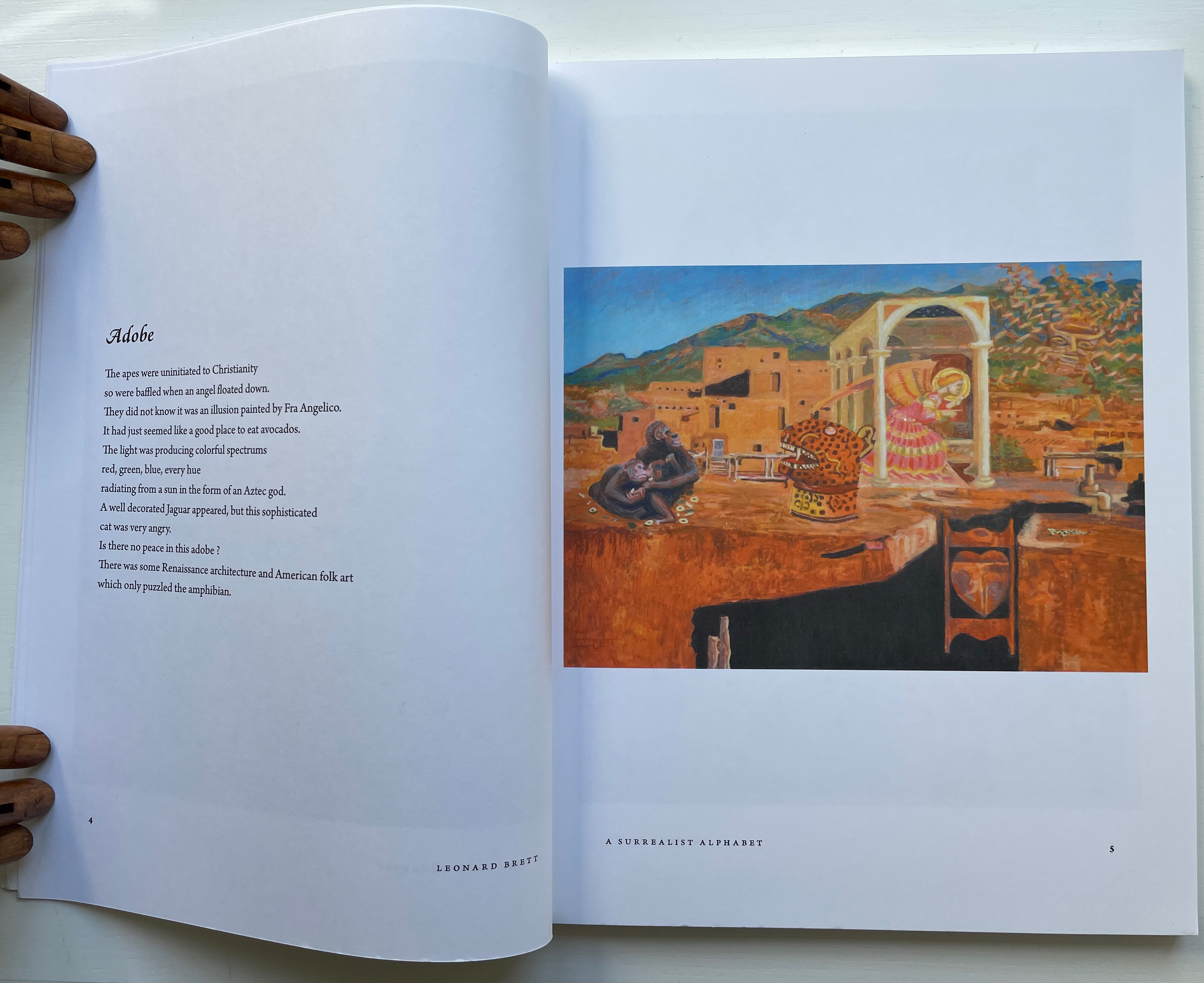
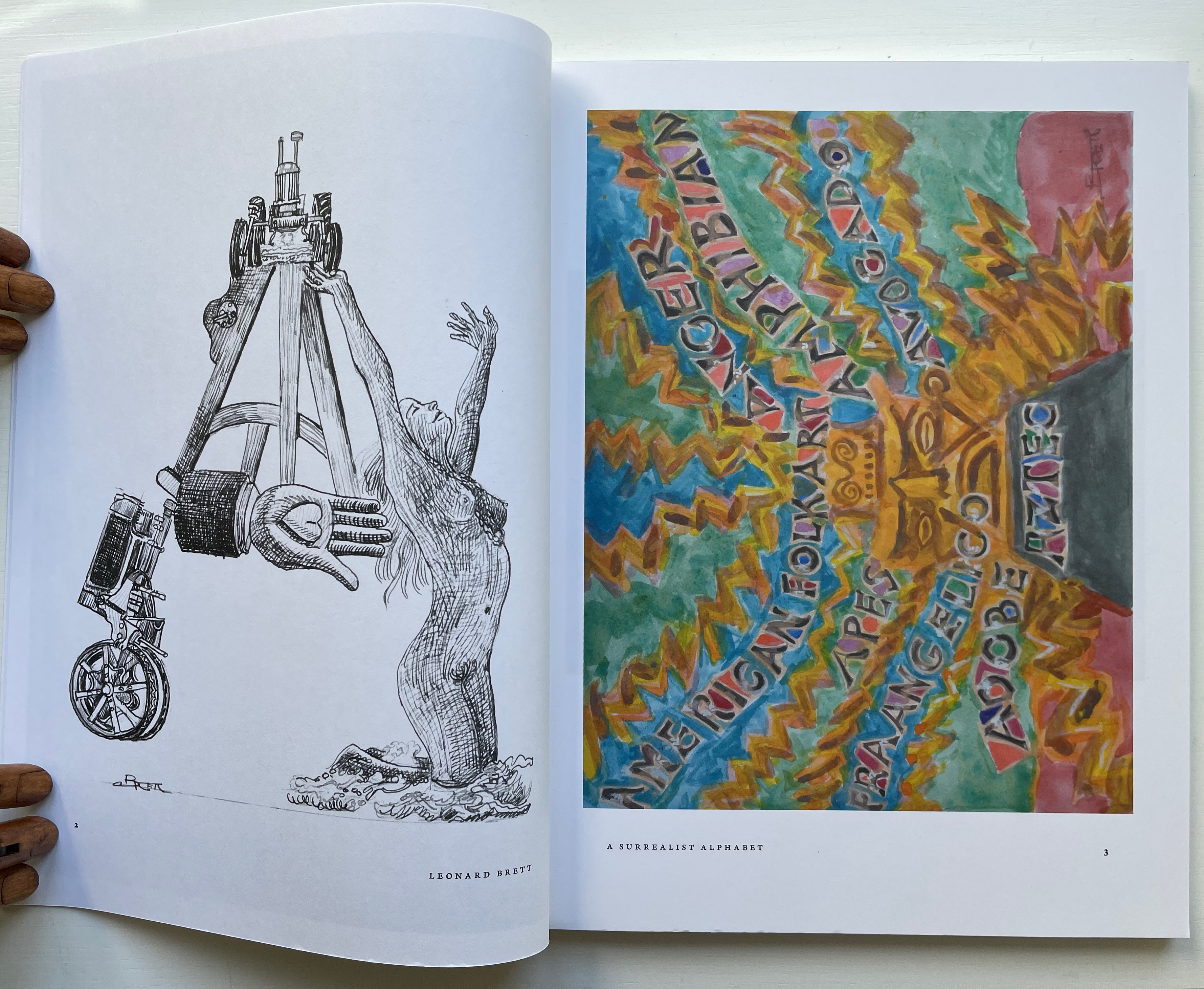
To stand out and secure a place among the several other surrealist abecedaries and alphabet books out there — such as those by Jim Avignon & Anja Lutz, Roman Cieślewicz, Jason D’Aquino, Lisa Haines, Lynn Hatzius, Peter Hutchinson, Peter Malutzki, Clément Meriguet, Paul Noble, Judy Pelikan, Rose Sanderson, Zazie Sazonoff, Paul Thurlby and Ludwig Zeller — takes considerable talent and effort. Leonard Brett’s A Surrealist Alphabet displays just that.

Per the artist’s statement, an interest in the aesthetics of script as visual symbol led him to the Louvre and British Museum for studies of ancient scripts — Sumerian, Egyptian, and Chinese — and to Bali, Egypt and Istanbul for inspection of contemporary scripts and sources of inspiration. Juxtaposition of that with images and text alluding to baseball teams (the Blue Jays and Orioles ), celebrities (Elvis and Marilyn Monroe), Renaissance painters (Raphael and Pisanello among others), movies and TV shows (Casablanca and X-Men) and much more leads to one of the densest and most frenetic of alphabet artists’ books in the Books On Books Collection.

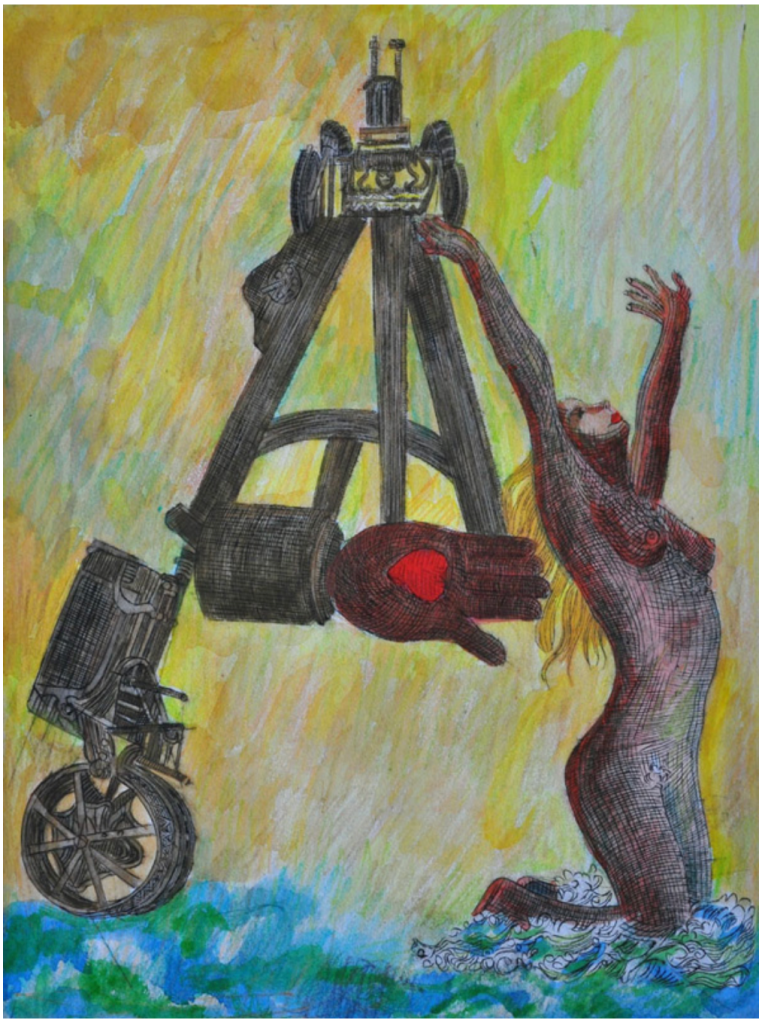
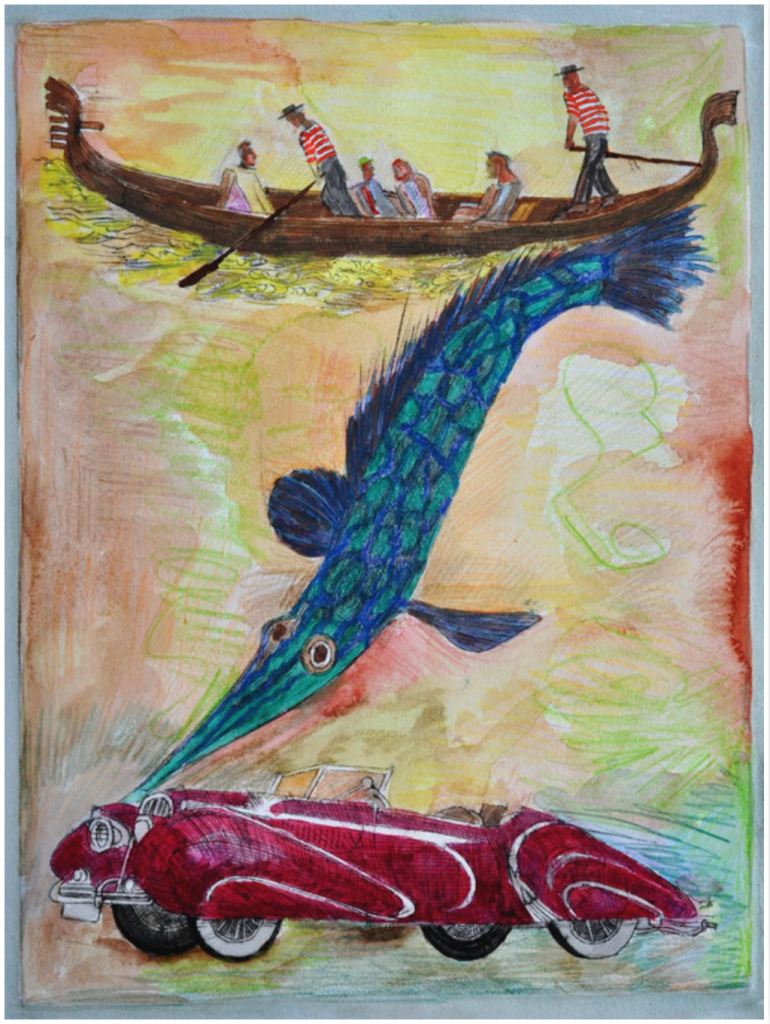
Each letter receives two double-page spreads. The first is a diptych, consisting of a black-and-white etching forming a composite letter across from a color image that may come from a watercolor or a host of other media; the second, a poem and another color image (again varying as to media) playing off the poem. The etchings and original color artwork were in an exhibition sponsored by the Sunshine Coast Arts Council in Sechelt BC, Canada,1-26 March 2017. According to the exhibition’s description, “The drawings in the book were used as a reference to produce the engravings shown in this exhibition. The engravings are done in the traditional manner using a burin to cut the plate, there is no acid used. They are inked and printed the same way as an etching on damp rag paper.”

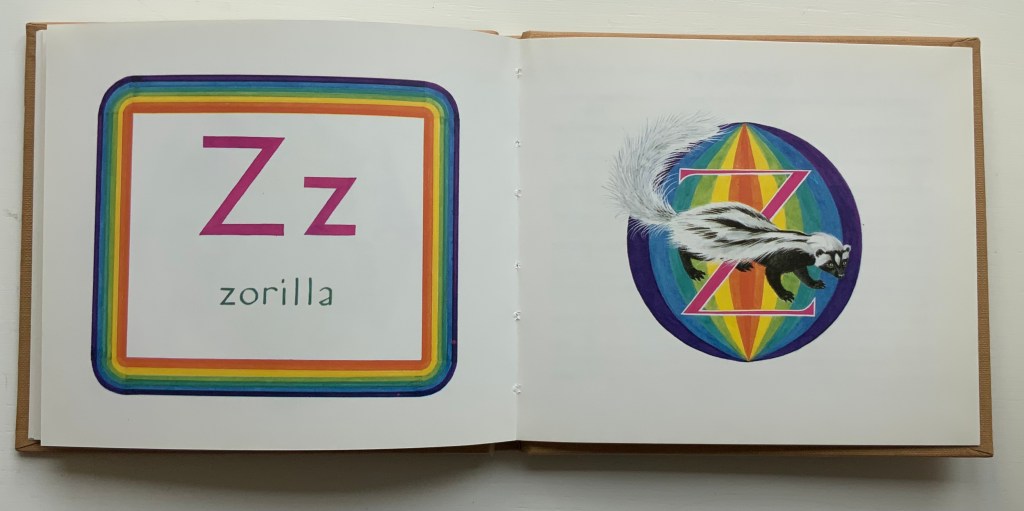
The color treatments of A and Z suffice to show how the artworks in exhibition complemented and differed from the book. Just these letters’ two double-page spreads, however, come nowhere near the effect of unrelenting variety and creativity delivered by the volume as a whole.

Displayed in exhibition

Displayed in exhibition

Further Reading

Abecedaries I (in progress)“. Books On Books Collection.

ABCs: Bookmarking Book Art”. 29 November 2015. Books On Books.

Ernst, Max, Robert Rainwater, Anne Hyde Greet, Evan M. Maurer and Vartan Gregorian. . 1986. Max Ernst : Beyond Surrealism : A Retrospective of the Artist’s Books and Prints. New York: New York Public Library : Oxford University Press.

Sunshine Coast Arts Council, 1-26 March 2017. “‘A Surrealist Alphabet’ – Leonard Brett“. Accessed 25 May 2023.

Books On Books Collection – Erwin Huebner

Erwin Huebner is a professor at the University of Manitoba engaged in research and teaching cell and developmental biology. He is also a book artist and miniaturist. Following his work, the Books On Books Collection has started small and hopes to grow into his larger works. At both ends of the spectrum, Huebner’s themes resonate with the integration of art and science, a recurrent focus of the collection (see Further Reading below).

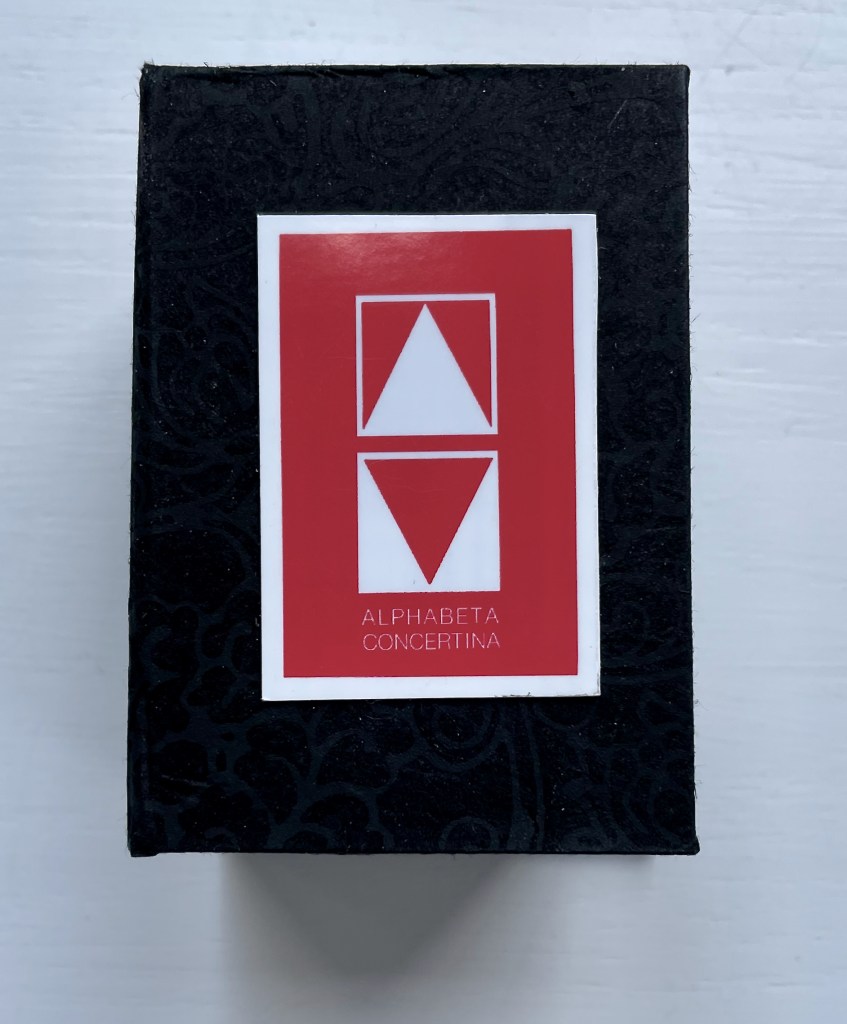
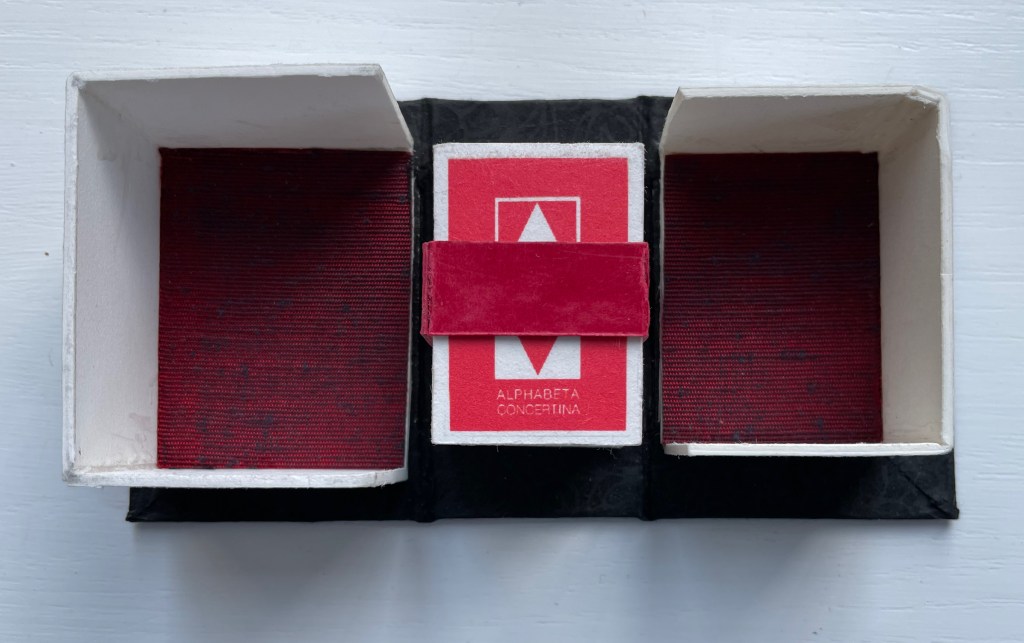
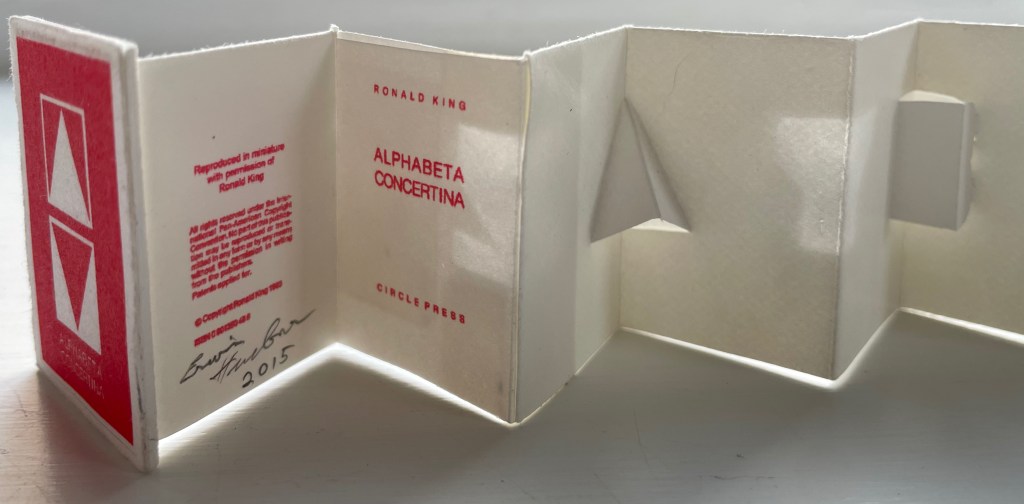
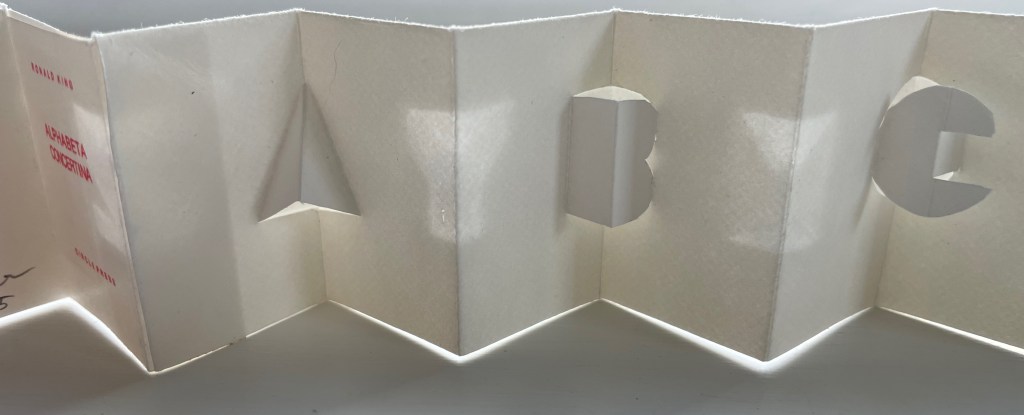
Alphabeta Concertina Majuscule (2015)

Alphabeta Concertina (2015)
Erwin Huebner (with permission of Ron King)
Miniature double-sided leporello. H 1.5 x W 1.0 x D 0.75 in. Edition of 4. Acquired from Erwin Huebner, 20 January 2023.
Photos: Books On Books Collection.

The geometry and invention of Ron King’s work must have appealed to a kindred spirit in Erwin Huebner. The classificatory nature of the alphabet must also have spoken to Huebner’s inner Linnaeus. As 2023 is the 270th anniversary of Linnaeus’ Species Plantarum, which introduced his classification system, it is an auspicious moment for Huebner’s miniature versions of King’s alphabet concertinas to join the Books On Books Collection and be included works in the Bodleian exhibition “Alphabets Alive!” (19 July 2023 to 24 January 2024, Weston Library, Oxford).

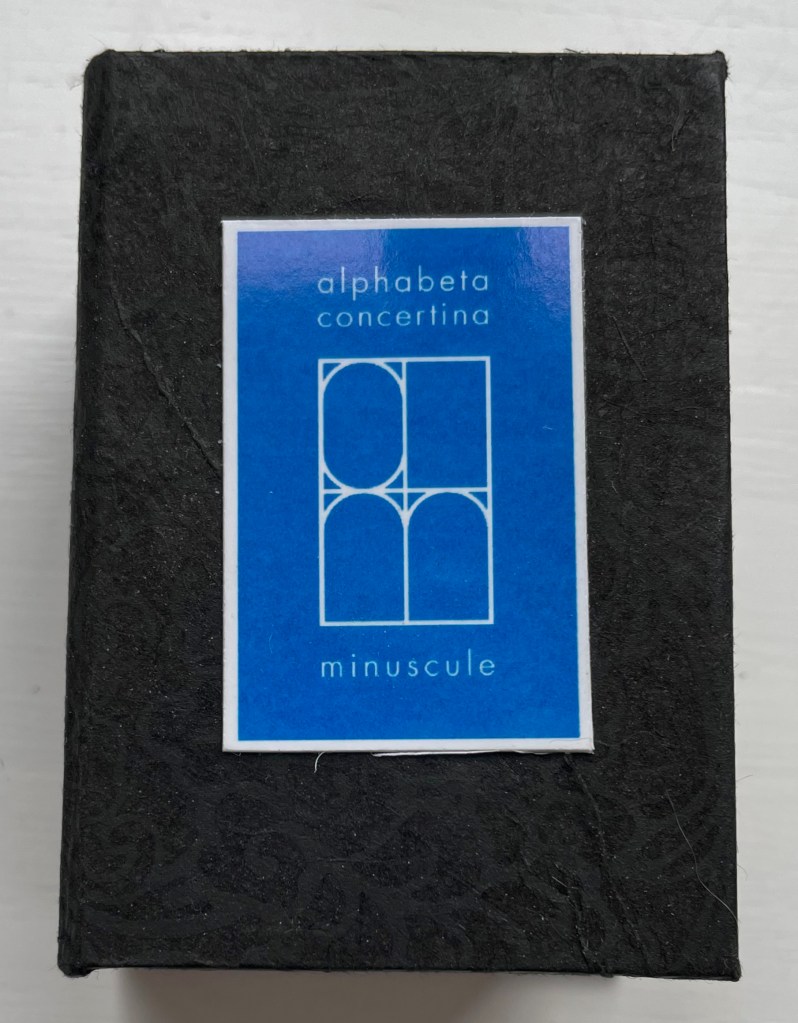
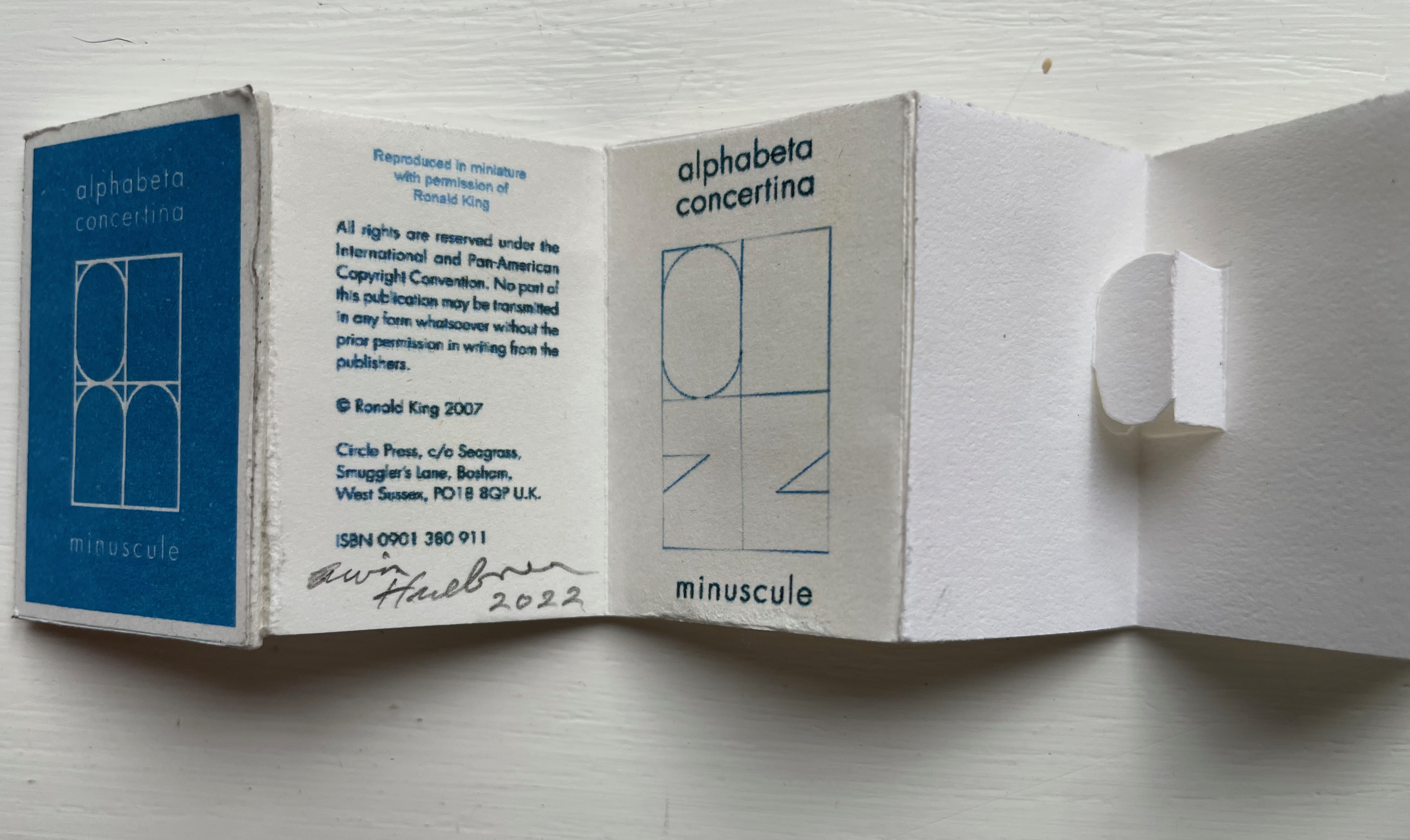
alphabet concertina miniscule (2022)


alphabet concertina miniscule
(2022)
Erwin Huebner (with permission of Ron King)
Miniature double-sided leporello. H 1.5 x W 1.0 x D 0.75 in. Acquired from Erwin Huebner, 20 January 2023.
Photos: Books On Books Collection.

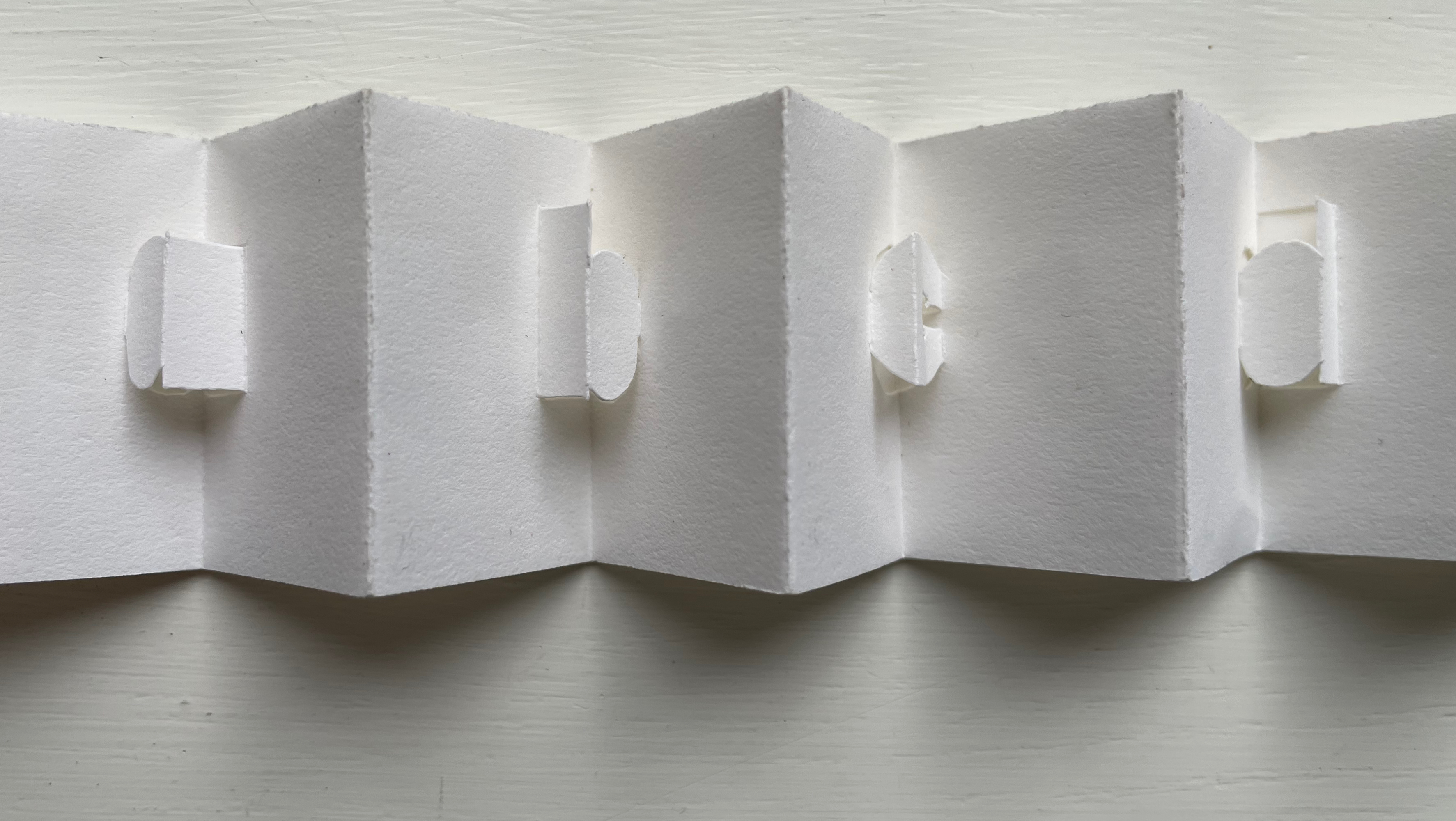
Both the majuscule and miniscule concertinas are double-sided with half the alphabet on one side and half on the other just as King designed from the first with The White Alphabet and the majuscule concertina in 1984 and subsequently 2007 with the miniscule.

Micrographia Revisited (2017)

Micrographia Revisited: A Triptych (2017)
Erwin Huebner
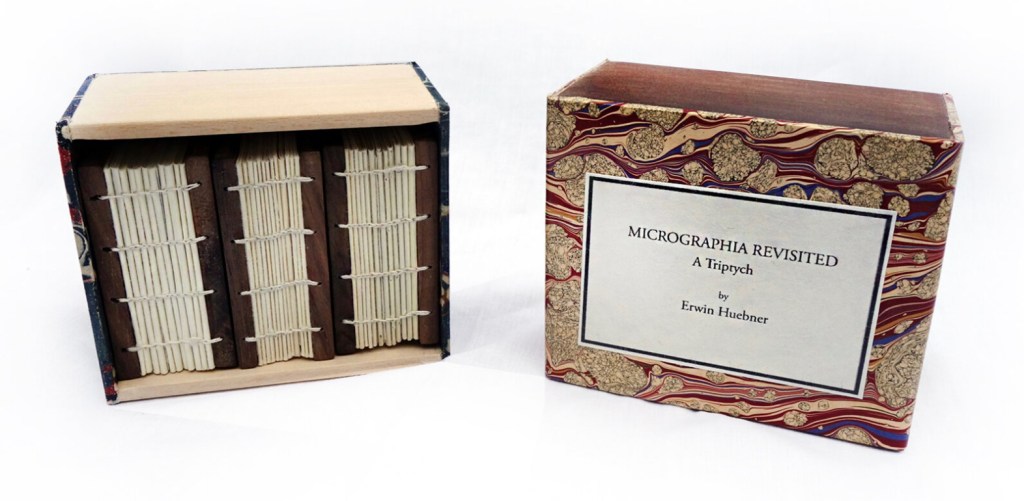
Box with 3 Coptic-bound volumes, each H 2.625 x W 1.875 x variable depth. Edition of 3. Acquired from Erwin Huebner, 20 January 2023.
Photos: Courtesy of the artist.

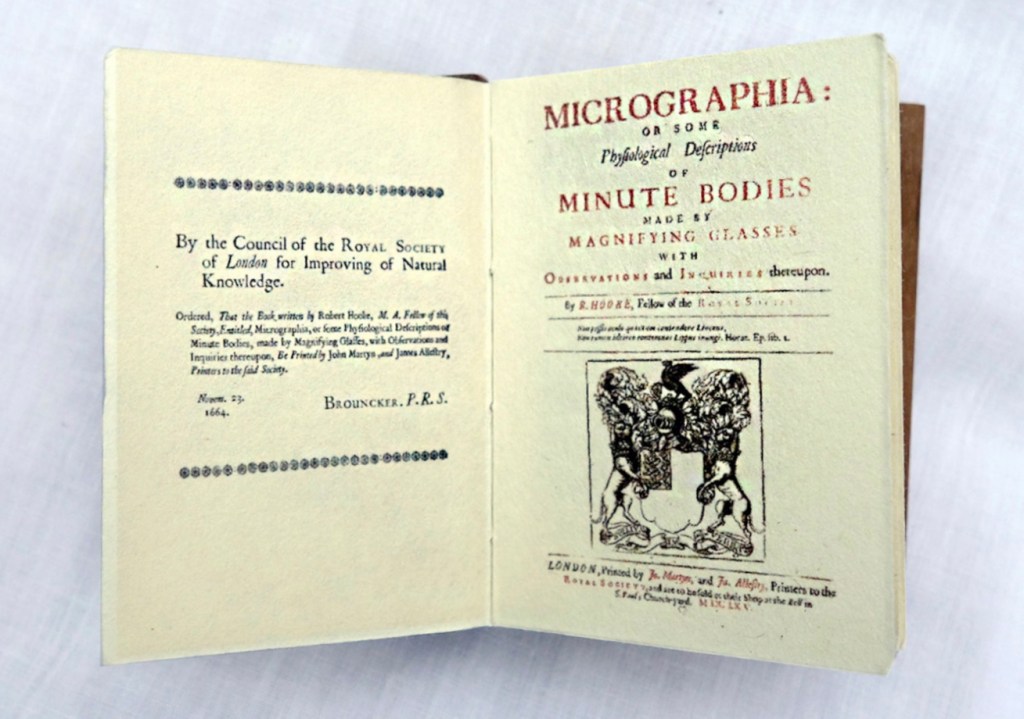
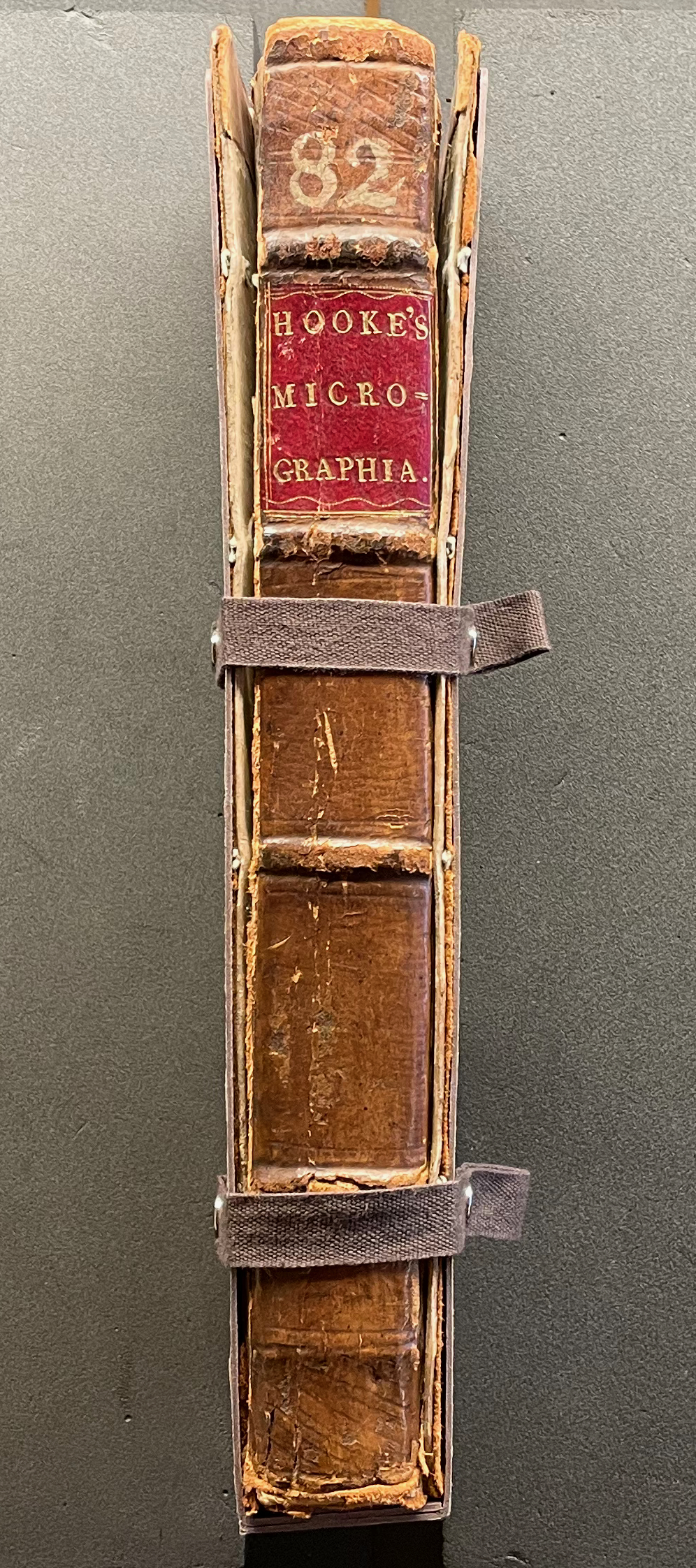
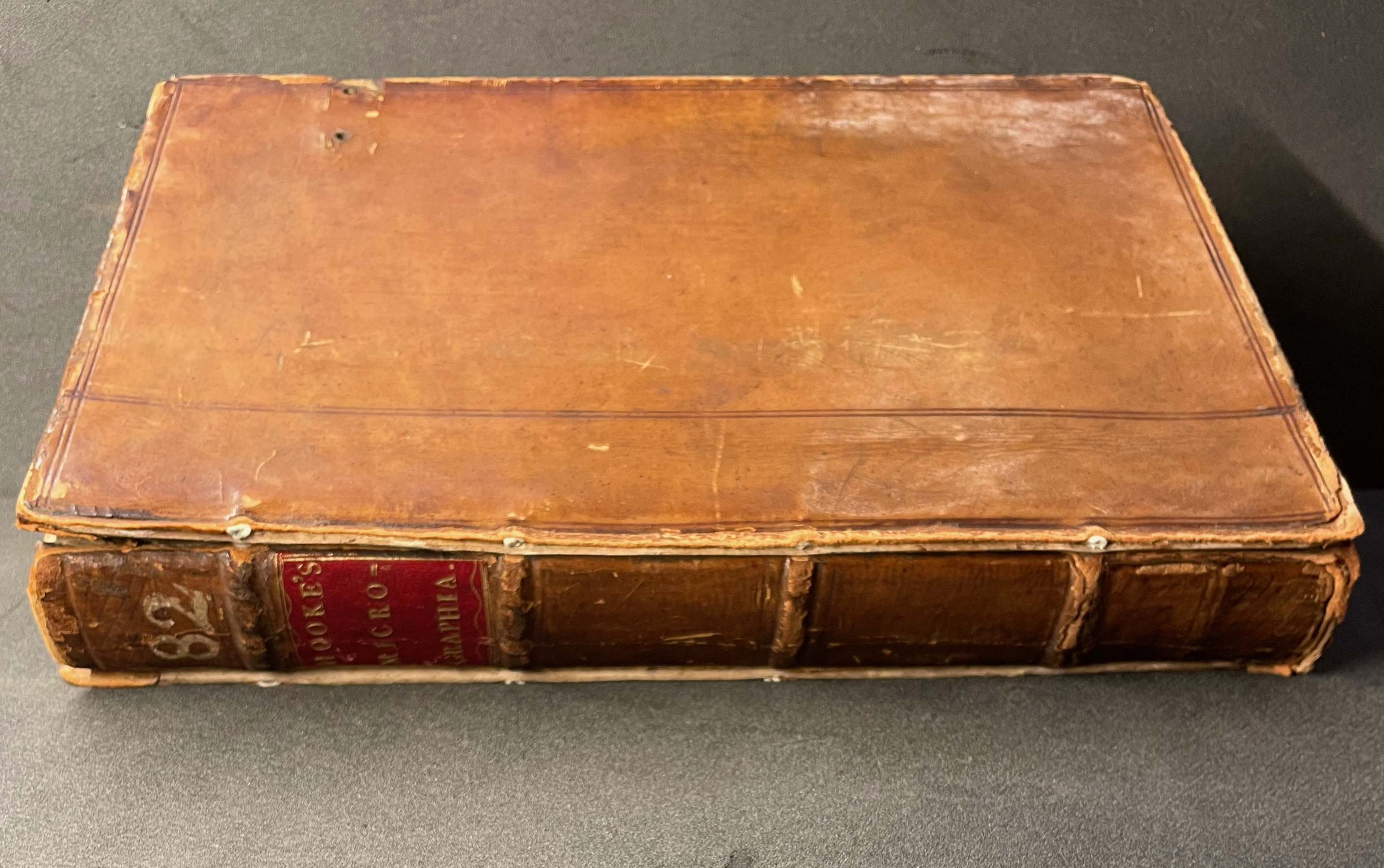
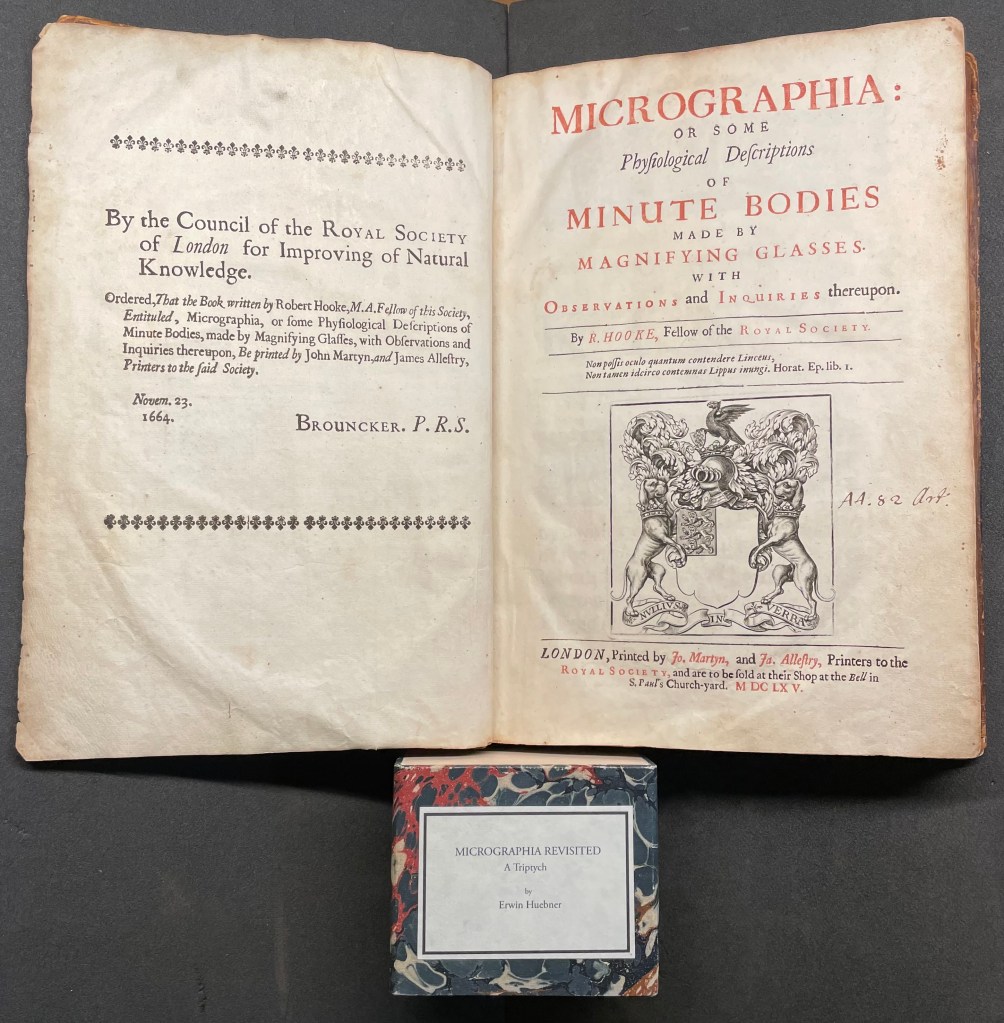
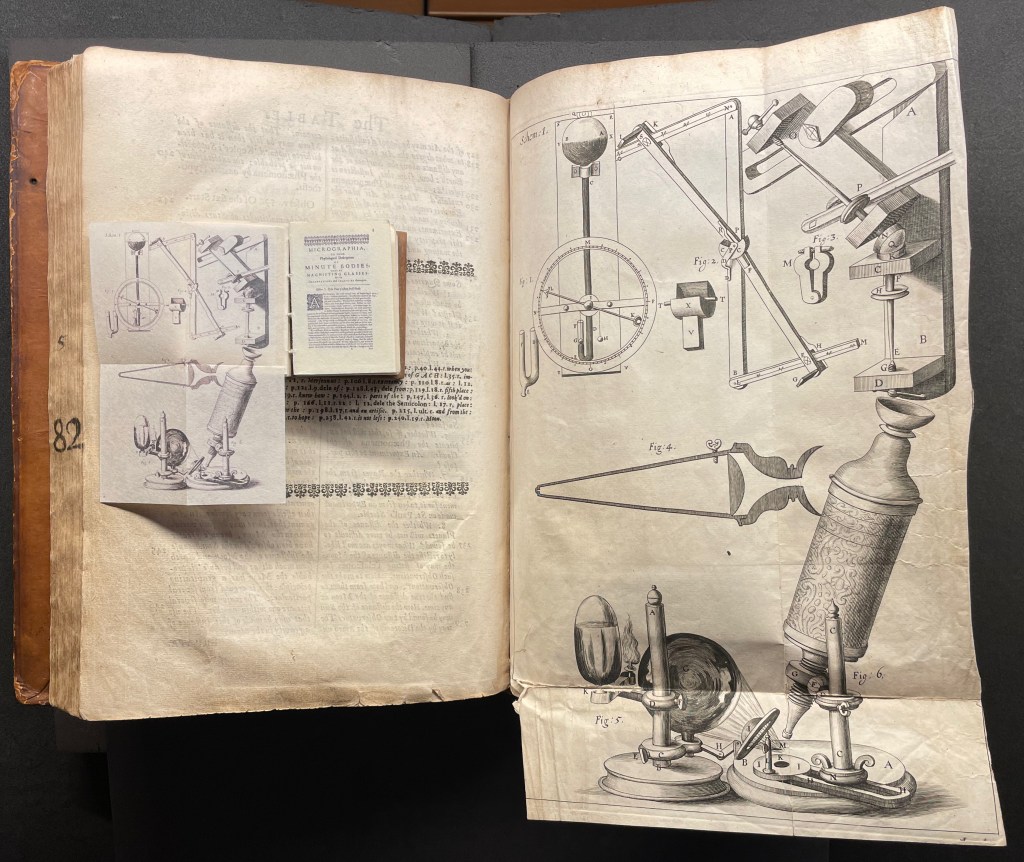
Despite Francesco Stelluti’s Melissographia (1625), Robert Hooke’s Micrographia: Or Some Physiological Descriptions of Minute Bodies Made by Magnifying Glasses with Observations and Inquiries Thereupon (1665) was long thought to be the first publication with illustrations drawn from observation with a microscope. Given Huebner’s scientific and artistic careers, it would seem impossible for him to resist paying homage to this work. Indeed, in his larger artist’s books, he has incorporated entire microscopes, but here, he exploits the technological advances of photography and electron microscopy and joins them with the craft of bookbinding to produce just as wondrous a work. Using Scanning Electron Microscopy (SEM), Huebner has created images of the same or similar objects to those Robert Hooke observed in the 1600’s. One of the volumes in the triptych presents these photographic results, and the other two present a reprint of Micrographia.

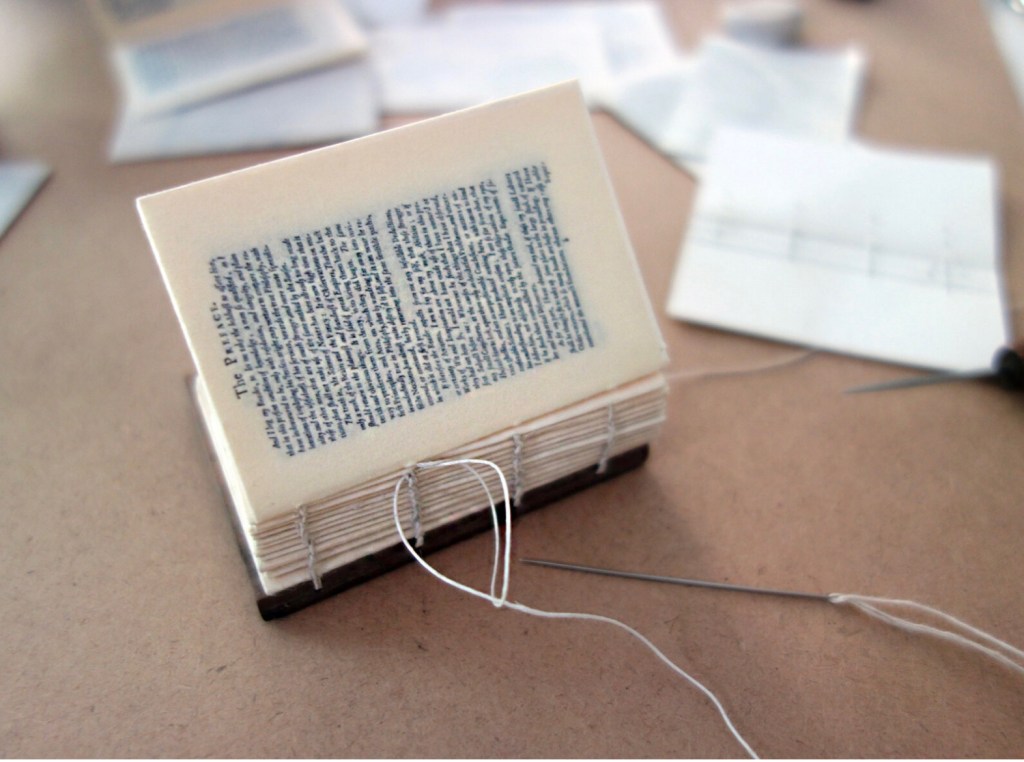
The coptic binding to black walnut covers, the wooden case covered in marbled paper and the subtitle create a suitable medieval/Renaissance air for this homage.

Living in a village near Oxford and having access to the Bodleian Libraries, I took Micrographia Revisited on a pilgrimage to compare it with a copy of the original not far from Hooke’s alma mater Wadham College.


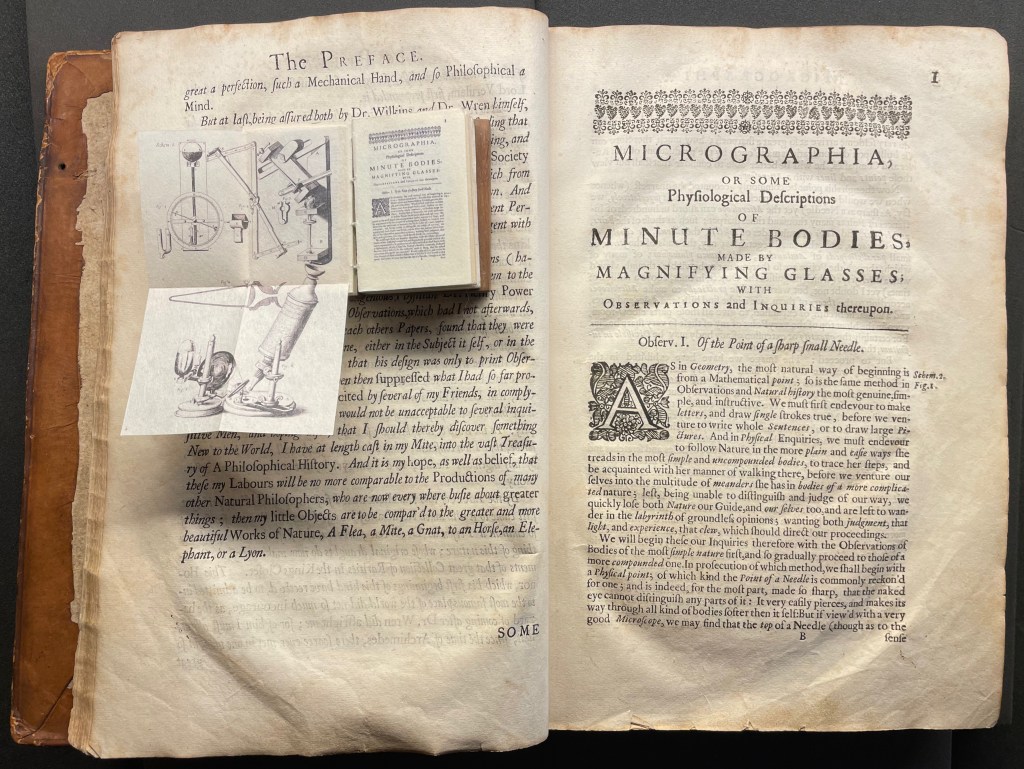
Among the many outstanding features of Huebner’s homage is his use and placement of fold-outs to capture the larger plates in Hooke’s original, all of which were placed in an appendix and some of which were also printed as fold-outs. In the juxtapositions below, note how Huebner has placed Hooke’s illustration of his equipment at the end of the Preface.

Sitting atop the double-page spread showing the end of the Preface and page 1 of Hooke’s original is Micrographia Revisited, open to Huebner’s fold-out of Hooke’s illustration of his equipment. Hooke’s same fold-out illustration from the appendix is juxtaposed below with Huebner’s.

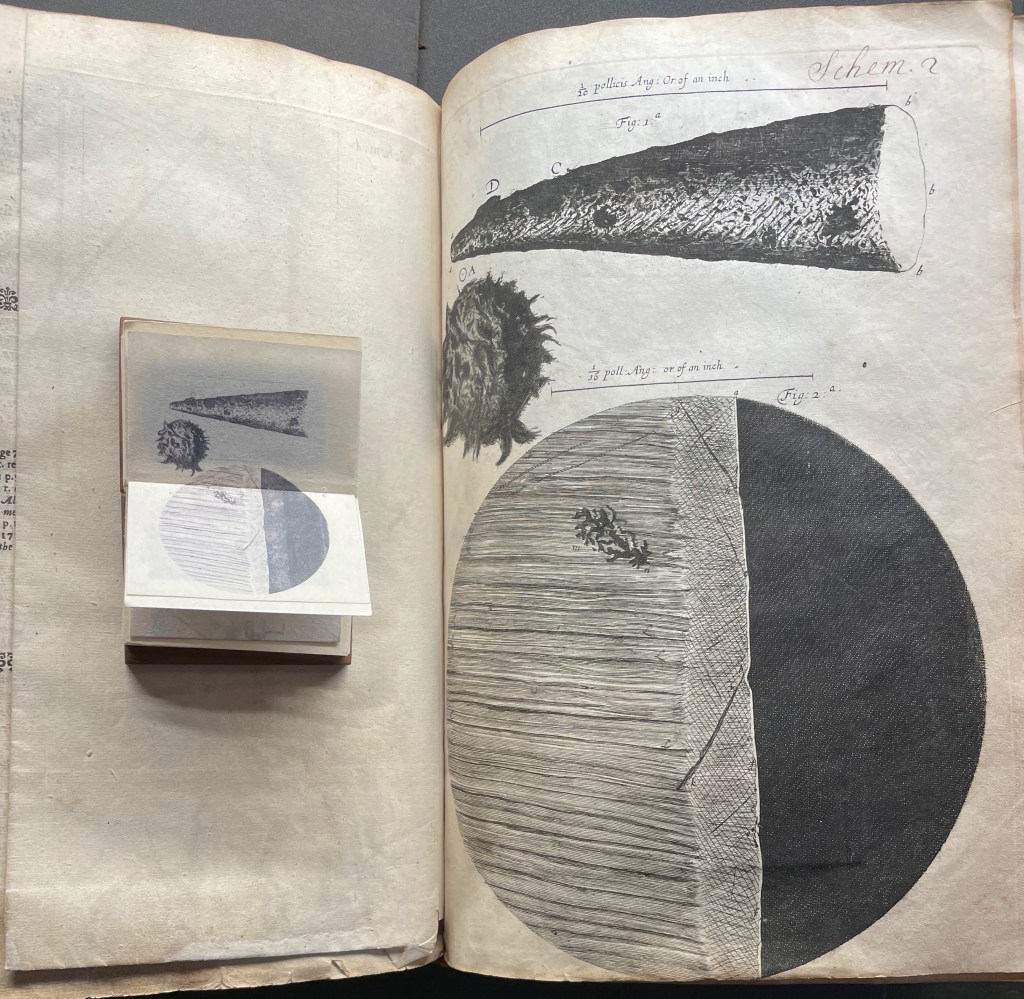
Hooke’s first two objects under the microscope Hooke are the point of a needle (described on pages 1-3) and the edge of a razor (described on pages 4-5). Huebner transforms Hooke’s single-page plate illustrating what he describes into a double-page spread between pages 2 and 3 of Micrographia Revisited.

Juxtaposing Huebner’s double-page presentation of Hooke’s drawings of a needle point and edge a razor with Hooke’s single-page presentation.

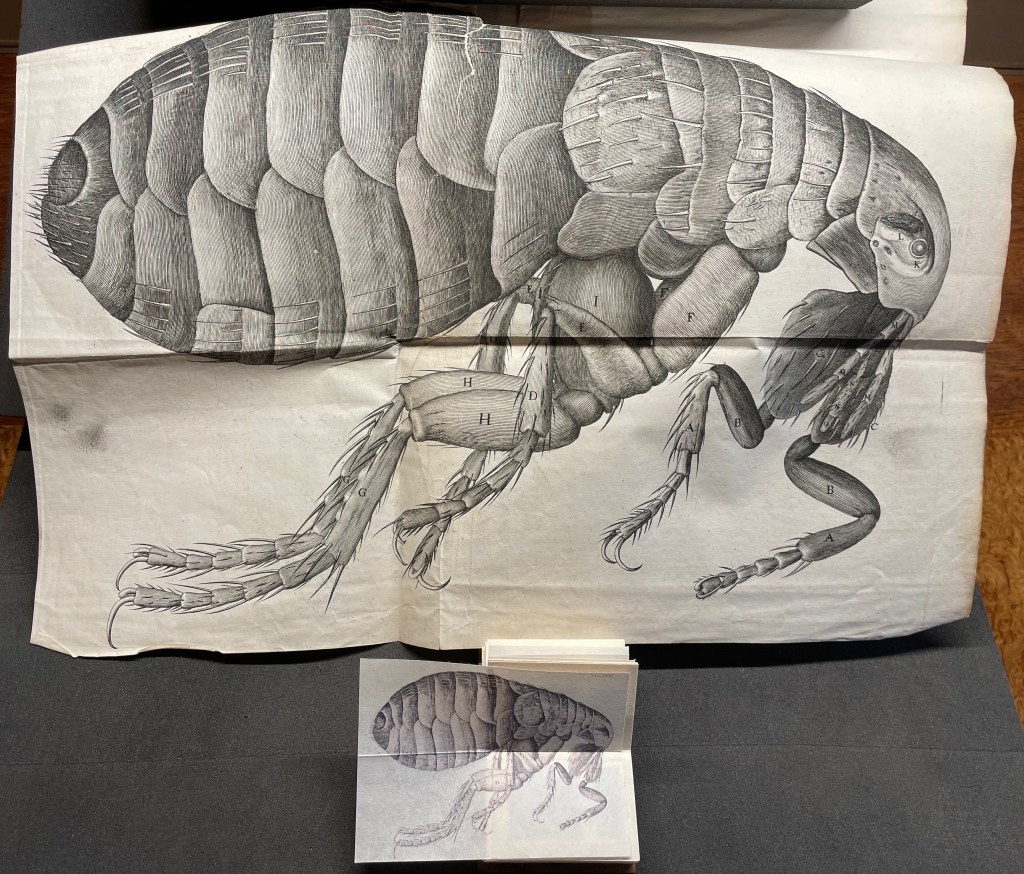
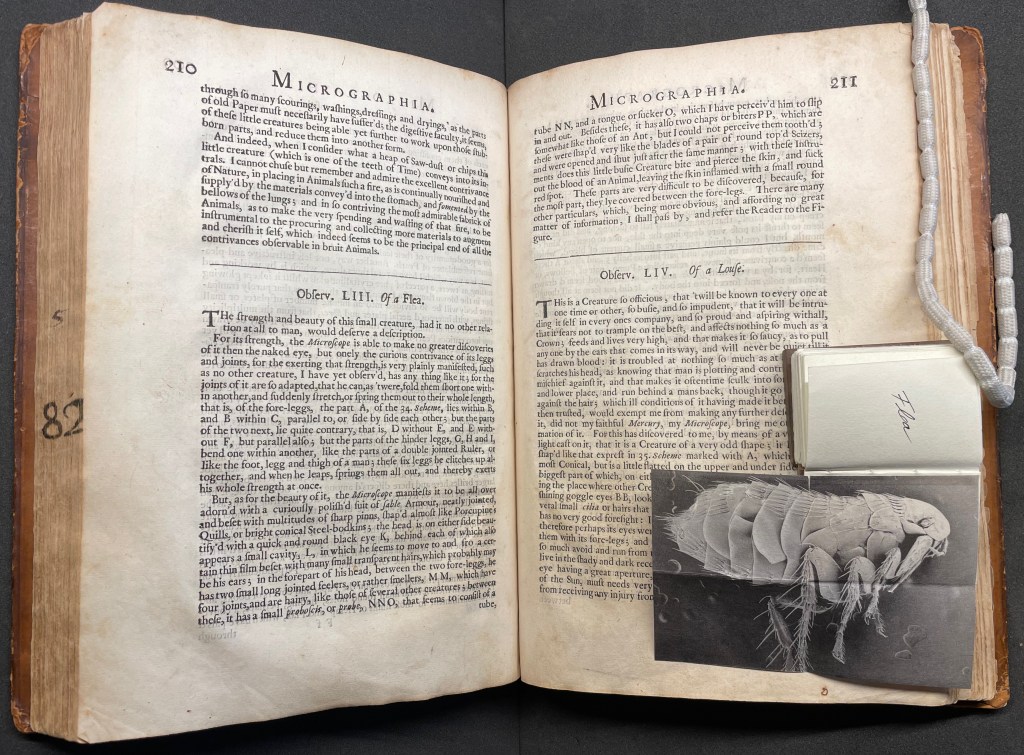
Hooke’s large fold-out of his flea may display the most impressive drawing in the book. The description appears on page 210, and the fold-out is in the appendix. Huebner’s double-fold fold-out of the illustration falls between pages 210 and 211.

The flea from Micrographia juxtaposed with that from Micrographia Revisited.

But most impressive of all is Huebner’s SEM image of a flea and its testament to Hooke’s powers of observation and skills as a draughtsman.

In the spirit of “standing on the shouders of giants”.

Further Reading

Abecedaries I (in progress)“. Books On Books Collection.

Alphabets Alive! – ABCs in Miniature“. 19 July 2023. Books On Books Collection.

Ron King“. 1 March 2021. Books On Books Collection.

Willow Legge“. 16 February 2021. Books On Books Collection.

Bignami, G. 2000. “The microscope’s coat of arms“. Nature. 405:999.

Freedberg, David. 1998. “Iconography between the History of Art and the History of Science: Art, Science and the Case of the Urban Bee“. In Jones, Caroline A., Peter Galison and Amy E Slaton. 1998. Picturing Science Producing Art. New York: Routledge.

Books On Books Collection – Lloyd L. Neilson

An Alphabet Coloring Book by Theodore Menten (1997)

An Alphabet Coloring Book by Theodore Menten (1997)
Juniper Von Phitzer
Miniature leporello. Closed: H64 x W52 mm. 8 pages. Limited edition. Acquired from Book Lair, 30 October 2022.
Photos: Books On Books Collection.

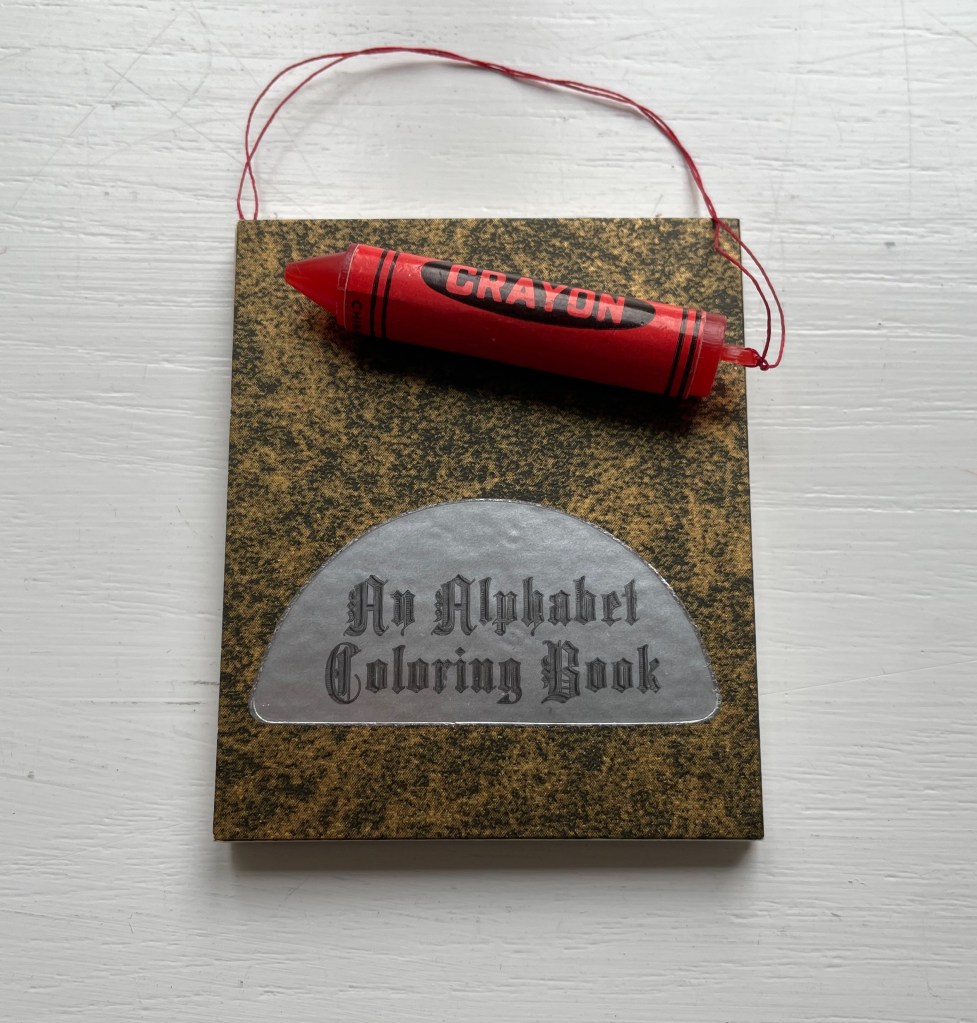
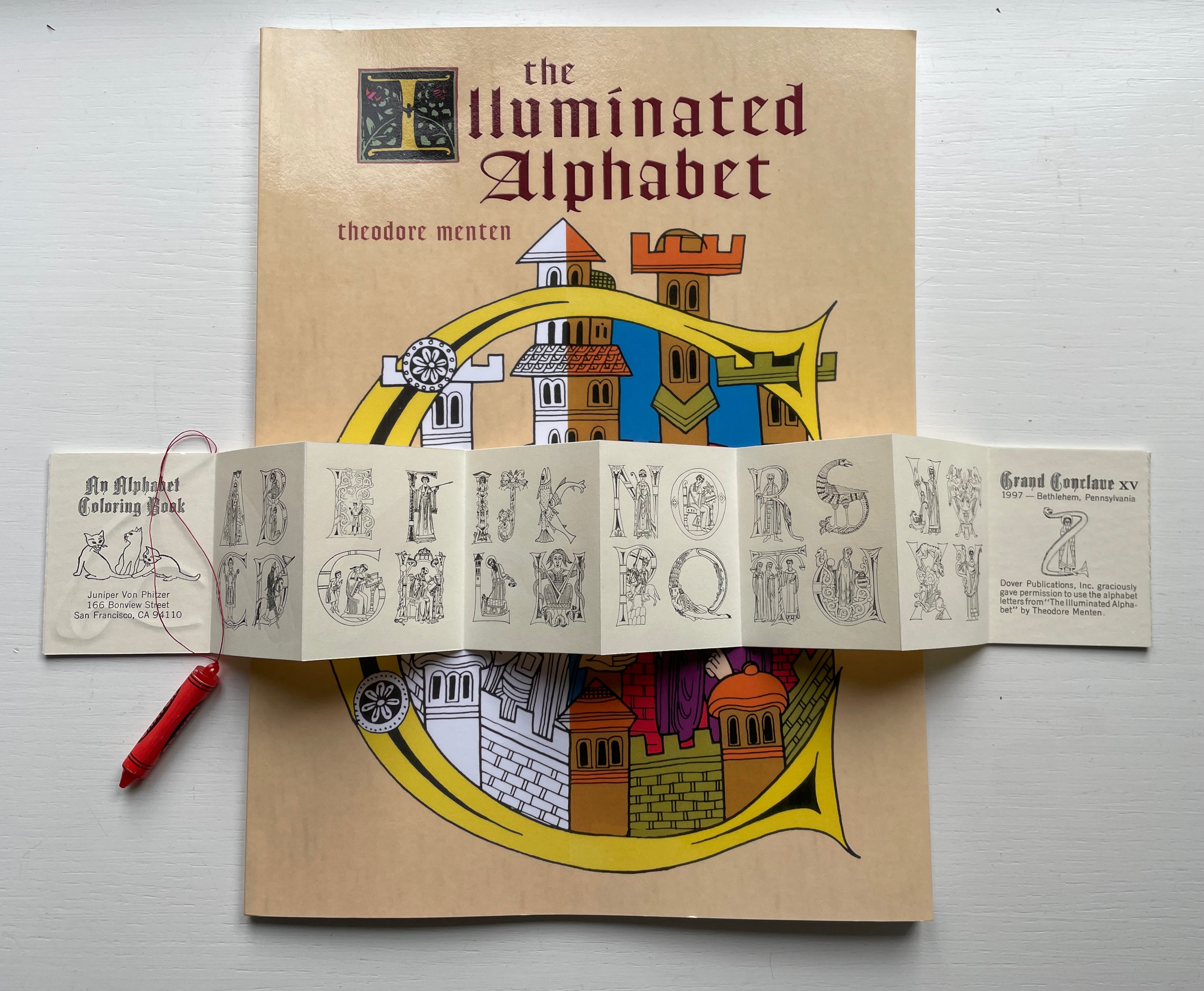
Lloyd L. Neilson, founder of Juniper Von Phitzer Press, compiled its name from those of his three cats, a sure sign of his sense of humor. This one signals that, like the cats, its humor was patient on the hunt. Theodore Menten had produced a coloring book called The Illuminated Alphabet in 1971 for Dover Publications. After a quarter century, Juniper Von Phitzer could not fail to pounce, capture and deposit the ultimate trophy: a miniature alphabet coloring book with a faux crayon. It was a limited edition, but individual copies could be distinguished by the color of the plastic crayon. The Books On Books Collection is proud to have this particular copy with its red crayon honoring the tradition of rubrication in medieval manuscripts.

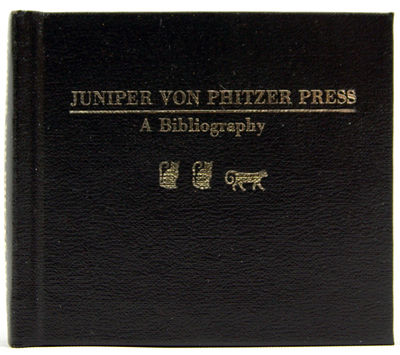
The archives of Juniper Von Phitzer Press reside at Indiana University, several universities and institutions hold copies of its numerous alphabet miniatures, and Neilson’s dedication to the craft (and his cats) was honored with a miniature gilt-stamped bibliography from the equally humorously named Opuscula Press [opuscula = small or minor literary or musical works].

Albuquerque: Opuscala Press, 1999. 149pp. One of 75 copies. A playful and reflective bibliography, s...

Juniper Von Phitzer Press: A Bibliography (1999)
Robert F. Orr Hanson

Further Reading

Abecedaries I (in progress)“. Books On Books Collection.

Alphabets Alive! – ABCs in Miniature“. Books On Books Collection.

Books On Books Collection – Ornan Rotem

A Typographic Abecedarium (2015)

A Typographic Abecedarium (2015)
Ornan Rotem
Perfect bound in a softcover case. H174 x W176 mm. 136 pages 1 poster (64 x 48 cm, folded to 16 x 16 cm). Acquired from Devils in the Detail Ltd, 14 March 2023.
Photos of the book: Books On Books Collection. Displayed with permission of the artist.

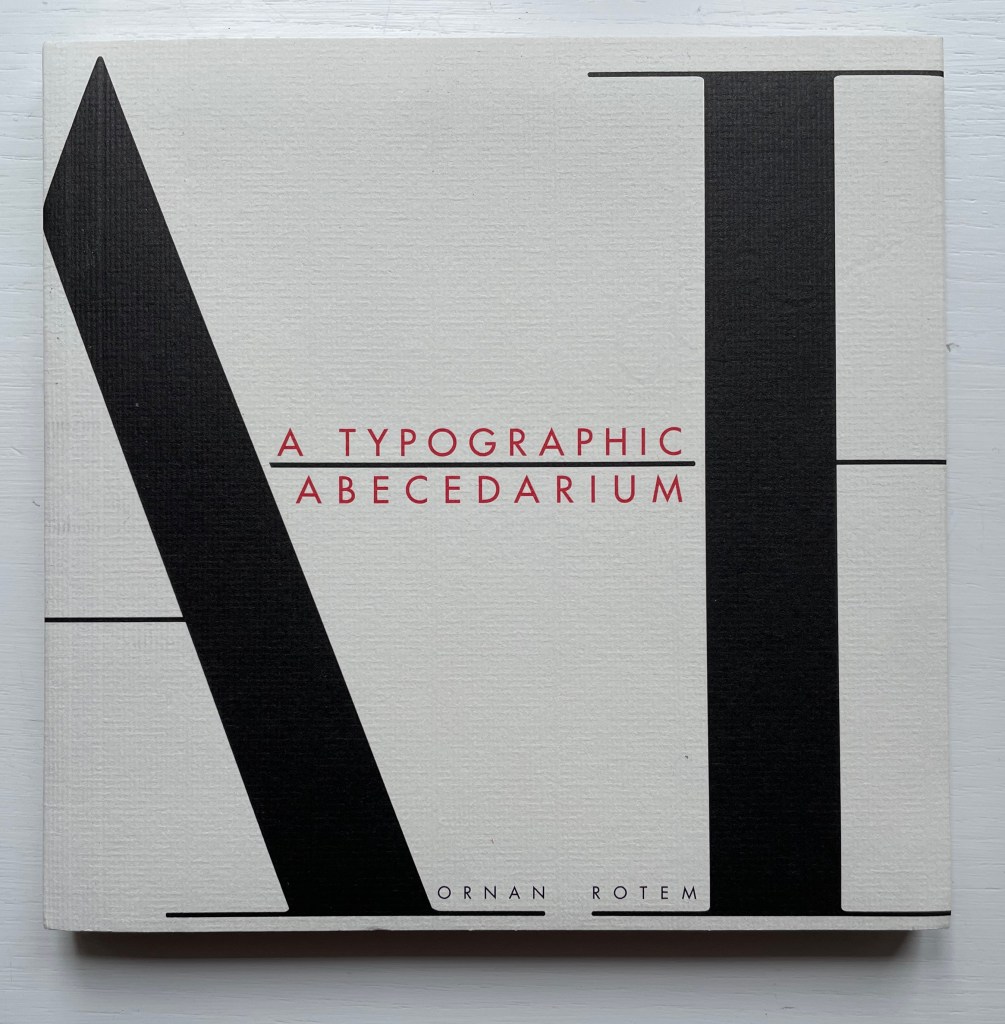
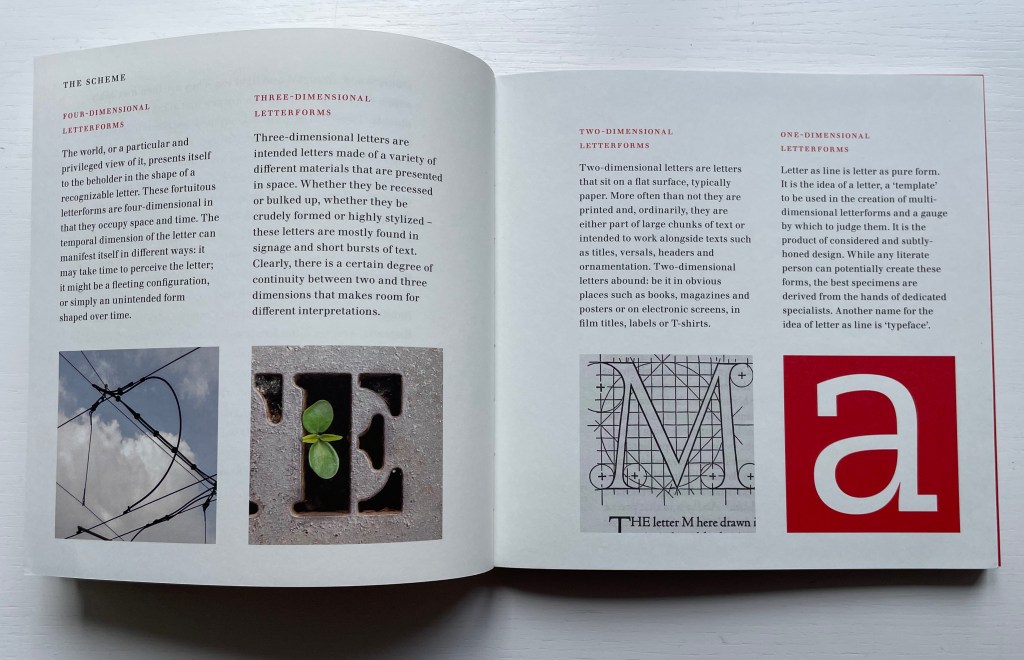
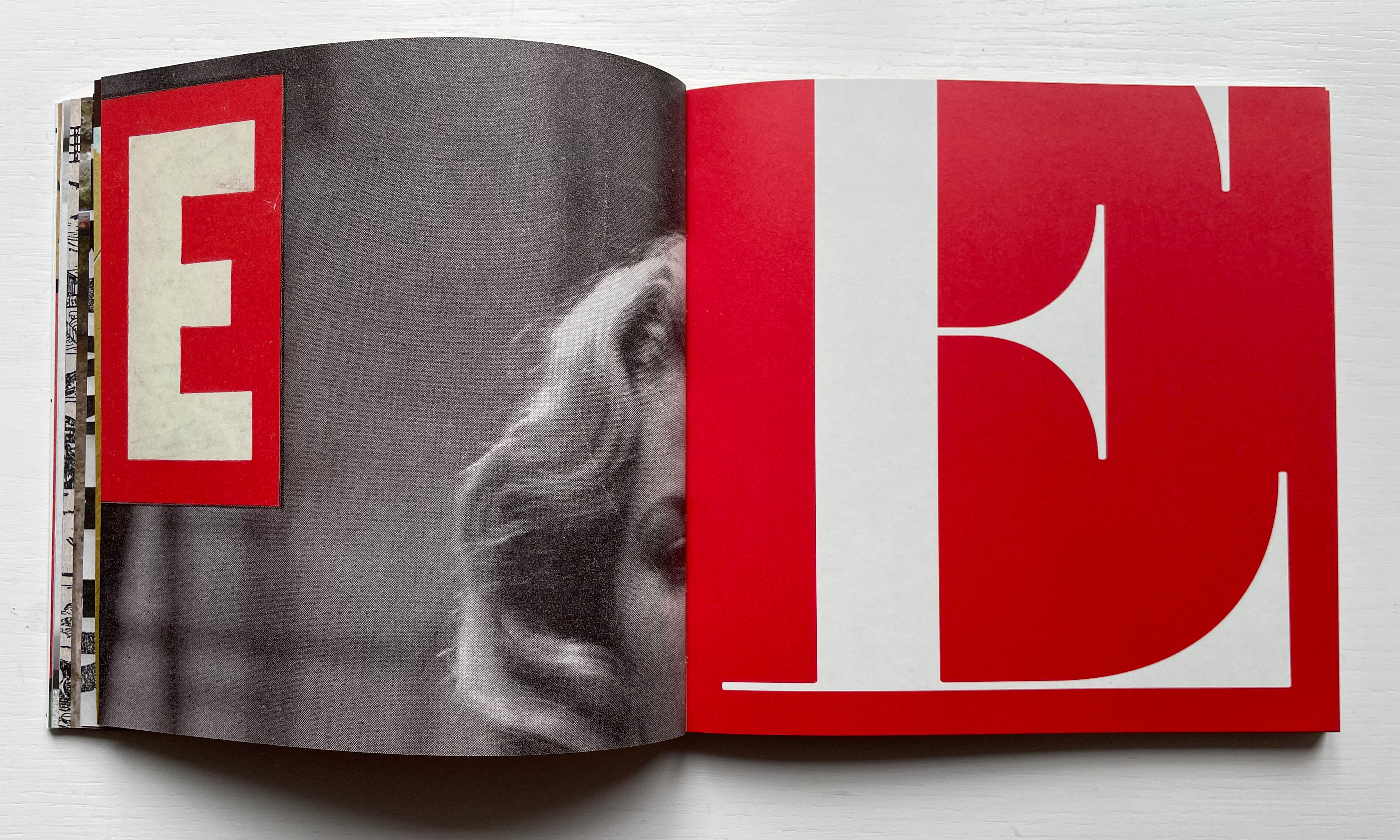
Ornan Rotem calls his book a “photo-typographic essay … a meditation … [e]xploring the relationship between typography and the visual world around us ….” As shown in the double-page spread below, his meditation is shaped across a four dimensional views of the letterform: the four-dimensional, three-dimensional, two-dimensional and the one-dimensional. At the end of the essay, there are 26 miniature essays that will send the reader back to enjoy each letter’s four dimensional entries again.

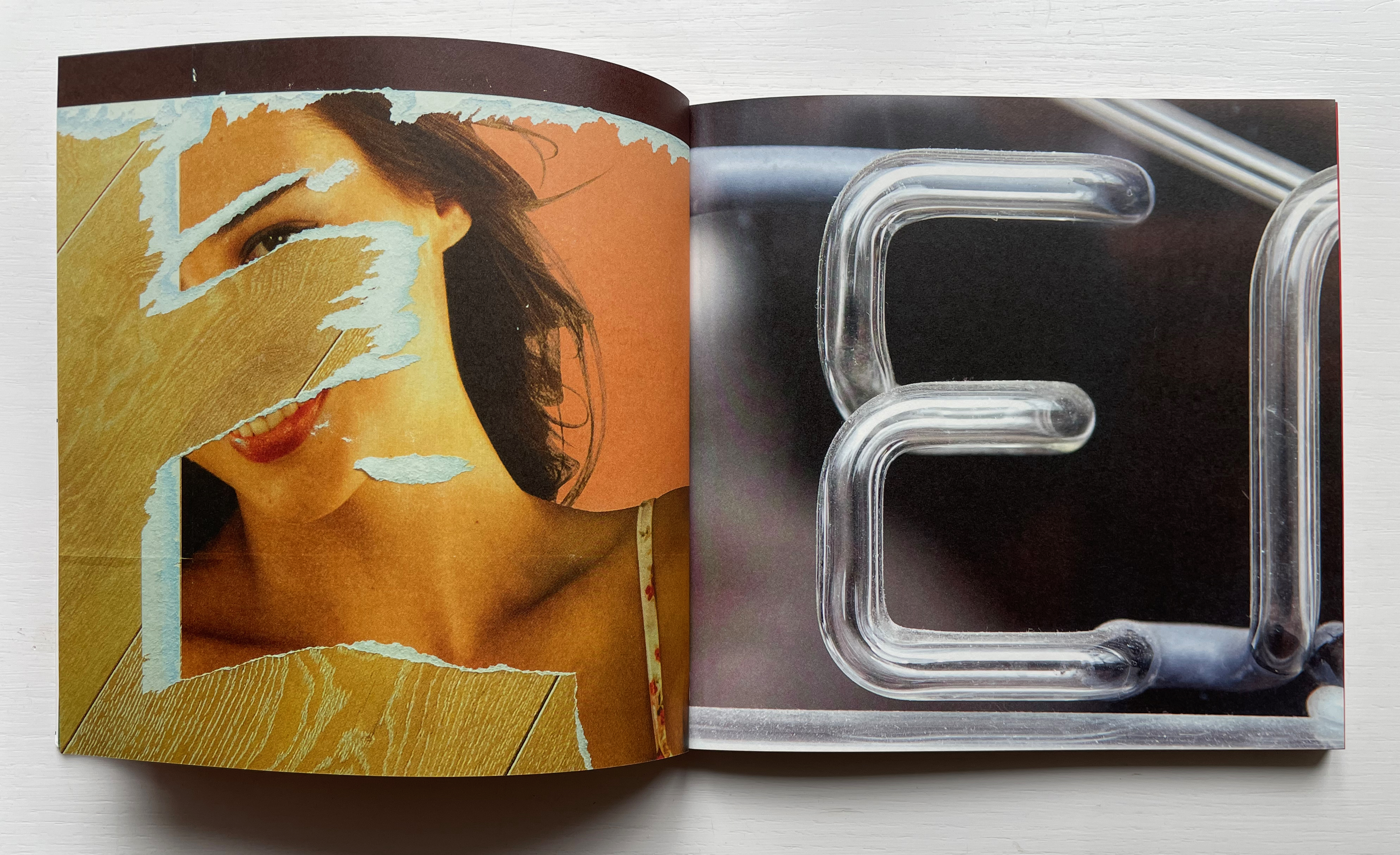
Everywhere you look you can see an E smiling at you (just saying it induces a smile). In 1969, Georges Perec, whose own name has four Es, tried exorcising the E by writing an esoteric 300-page novel, La disparition, without ever using one. I wonder how he would have felt had he come across this E — which was shot in Paris — when he was writing the novel. ¶ If you want to endow letters with character, then I suppose E would be the lively sort, hence the printed form comes from a 1948 cover of LIFE magazine.

Much is packed into these miniature essays. Naturally for an artist’s book celebrating type, there are the necessary self-referential typographic puns in the one above: character and sort. In all, there is the evidence of the long, multi-place, multi-source contemplative gestation of the work. In the example above, the allusion to Perec’s novel leads to the 1969 photo in Paris (or was it vice versa?). The typographic puns lead to a search for an E from a LIFE cover (again, or was it vice versa?). This circular connectedness over time, text and image highlights the self-referentiality of the genre of the artist’s book.

While the dense allusiveness might suggest that this is a work limited to an adult audience, A Typographic Abecedarium does find favor with a younger audience — no doubt because it speaks to the phenomenon of seeing letters everywhere and in multiple dimensions.

Physical Poetry Alphabet (2018)

Physical Poetry Alphabet (2018)
Douglas & Françoise Kirkland and designed by Ornan Rotem
Casebound, illustrated paper over boards. Acquired from Sylph Editions, 18 March 2023. Photos: Screenshots displayed with permission of the publisher.

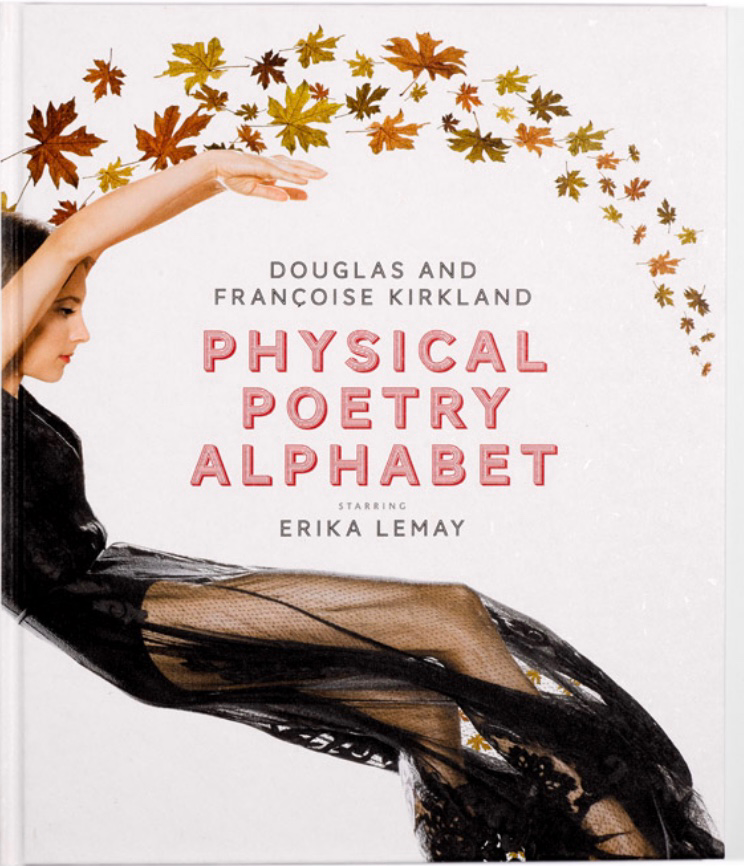
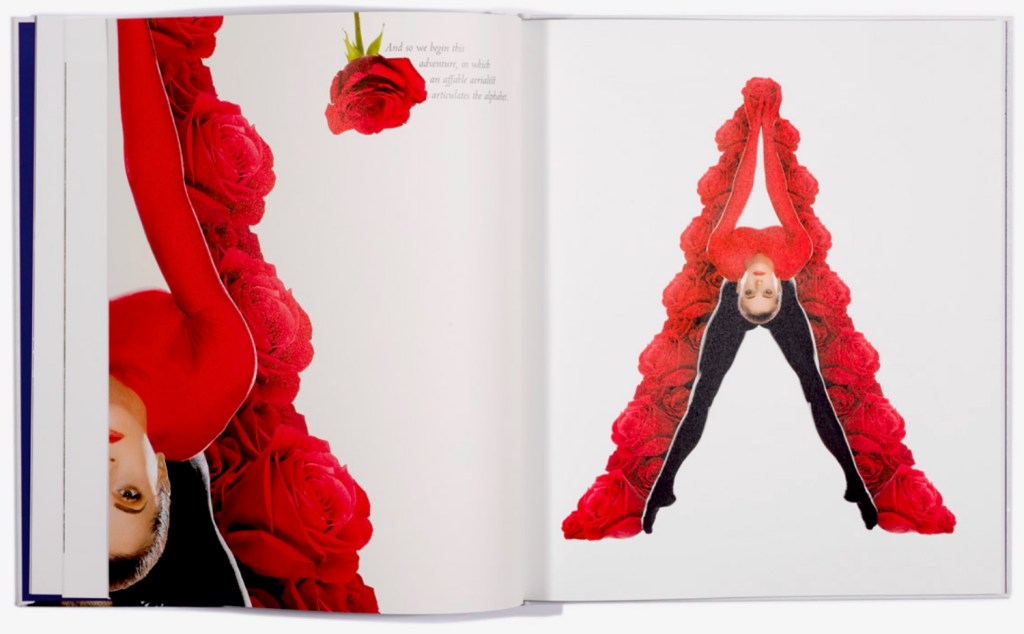
Physical Poetry Alphabet (2018) is a curious work. The Thames & Hudson-style production values combined with the knowledgeable essay in it by Ornan Rotem makes one think of Andrew Robinson’s  The Story of Writing, an actual Thames & Hudson book. While the acrobatics of Erika Lemay echo the longstanding tradition of modeling the letters with the human body, followed by Erté, Vítězslav Nezval, Anthon Beeke and Rowland Scherman and so ingeniously summarized by Lisa Merkin, Lemay’s elaborate costumes and the scene design echo the traditions of Hollywood, Las Vegas and the fashion industry, which is not surprising given the involvement of Douglas Kirkland, portrait photographer to the stars. A Typographic Abecedarium strikes its singular target of “photo-typographic essay”. Having too many targets, Physical Poetry Alphabet perhaps misses its several bull’s eyes, but to follow along with its mixed metaphors, it undeniably delivers a shop full of eye candy.

Further Reading

Abecedaries I (in progress)“. Books On Books Collection.

Alphabets Alive! – Body“. 19 July 2023. Books On Books Collection.

Meier, Allison. 14 January 2016. “A Visual Essays Recalls the Alphabet’s Pictorial Past“. Hyperallergic. Accessed 18 March 2023.

Books On Books Collection – Květa Pacovská

À l’infini (2007)

À l’infini (2007)
Květa Pacovská
Softcover with protective Mylar attached, exposed spine, sewn with multicolored threads. 270 x 270 x 29 mm. 128 pages. Acquired from Rakuten, 25 November 2022.
Photos: Books On Books Collection.

The Buzz Lightyear character of Toy Story and his catchphrase “To infinity and beyond” arrived in 1995. While it seems unlikely that the catchphrase influenced Květa Pacovská, the audience for Á l’infini (2007) and that for Toy Story definitely overlap. In her invitation below, Pacovská explicitly addresses the youngest of her audience: Tu peux regarder chaque lettre, toucher chaque lettre, considérer chaque lettre de façon formelle ou lire chaque lettre à haute voix. Chaque lettre a son propre son, sa propre forme et sa propre couleur. Note leurs différences quand tu les prononces, quand tu écoutes le son de ta voix. [You can look at each letter, touch each letter, consider each letter formally, or read each letter aloud. Each letter has its own sound, shape and color. Note their differences when you pronounce them, when you listen to the sound of your voice.] Above all — literally at the top of the page — she urges the reader: Dis la lettre <<A>> à haute voix jusqu’à ce qu’elle heurte les murs qui l’entourent. [Say the letter “A” out loud until it knocks down the walls surrounding it.], which is what the cut-out A plays outs.

For Pacovská, letters are “the architecture of pleasure”, and À l’infini invites us to play with them in “her city of paper”. Her invitation notes alternative approaches to the book, but the suggestion to walk through it as a paper sculpture is the best and appeal to the child in everyone.

With its collage of cut-outs, pop-ups, spot varnishes, reflective silver ink, letters and, later in the book, numbers, À l’infini is a joyful visual city. Pacovská received the Hans Christian Andersen Award in 1992 for her illustration.

Further Reading

Abecedaries I (in progress)“. Books On Books Collection.

Alphabets Alive! – ABCs in Miniature“. Books On Books Collection.

Pacovská, Květa . 1993. The Art of Kveta Pacovska. Zürich Frankfurt: Michael Neugebauer Book/North South Books.

Linhart, Eva, and Květa Pacovská. 2008. Kveta Pacovskà: Maximum Contrast. Bargteheide/Paris: Michael Neugebauer Edition GmbH/Minedition.

Books On Books Collection – Nancy Anderson Trottier

The Alphabet Effect (2013)

The Alphabet Effect (2013)
Nancy Anderson Trottier
Double-sided meander fold. 630 x 630 mm. 24 panels. Edition of 15. Acquired from Bromer Booksellers, 2 August 2022.
Photos: Books On Books Collection.

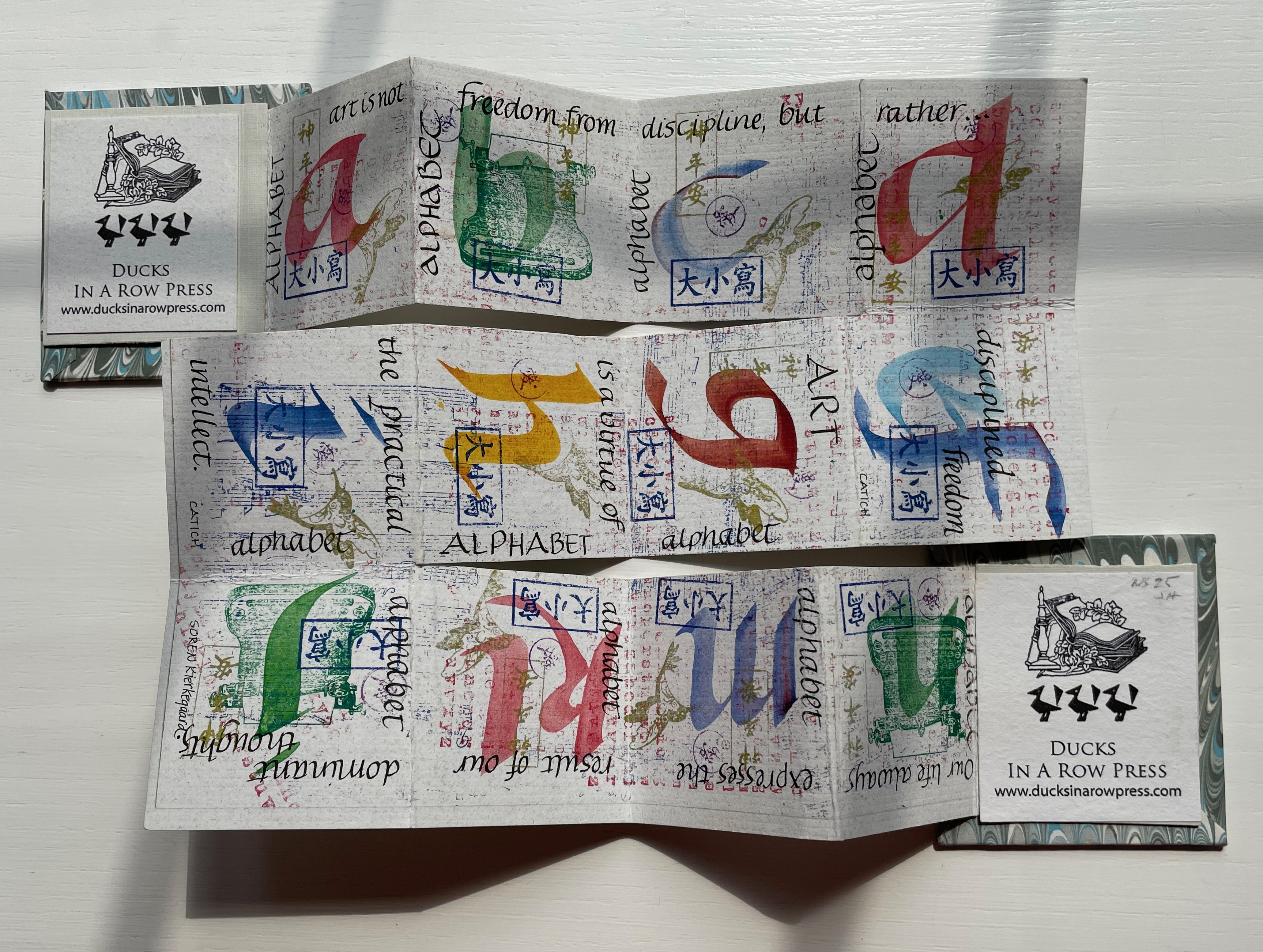
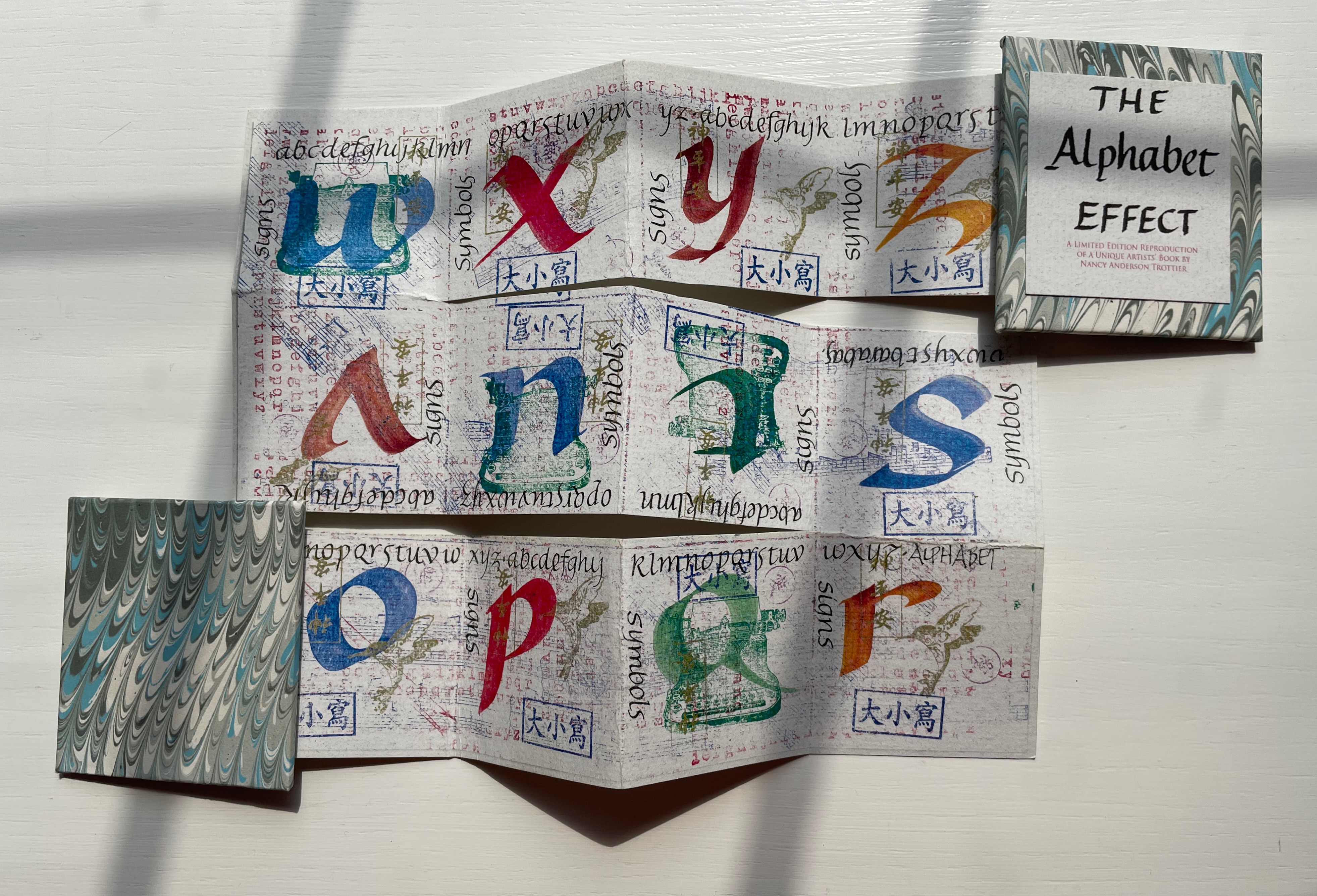
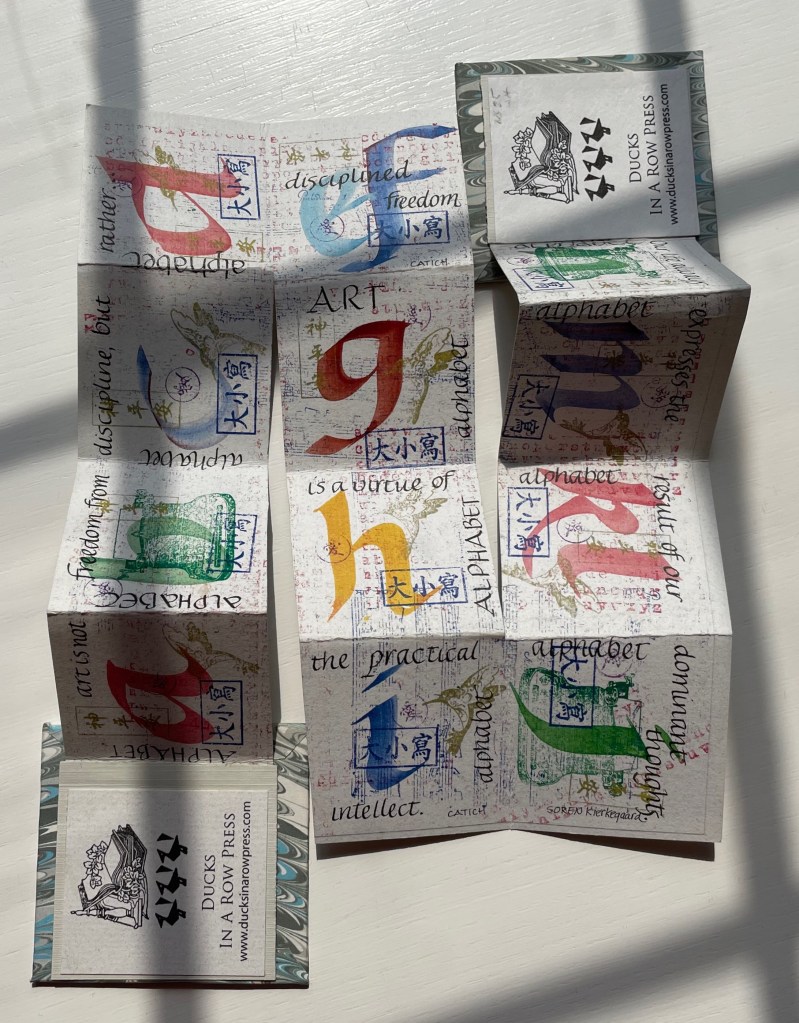
This miniature reproduces a larger unique artist’s book created by Nancy Anderson Trottier. Bound in marbled boards with ribbon ties, the small book’s text concerning art and philosophy meanders among stamped signs and symbols and calligraphed letters of the alphabet printed on both sides of a single sheet cut and following the meander fold structure. When the “pages” are unfolded and rearranged into the single sheet fully extended, the alphabet effect appears. To squeeze 26 letters into 24 panels, the letters e and f are paired on one panel, as are k and l on another.

Further Reading

Abecedaries I (in progress)“. Books On Books Collection.

Alphabets Alive! – ABCs in Miniature“. Books On Books Collection.

Books On Books Collection – Carol Cunningham

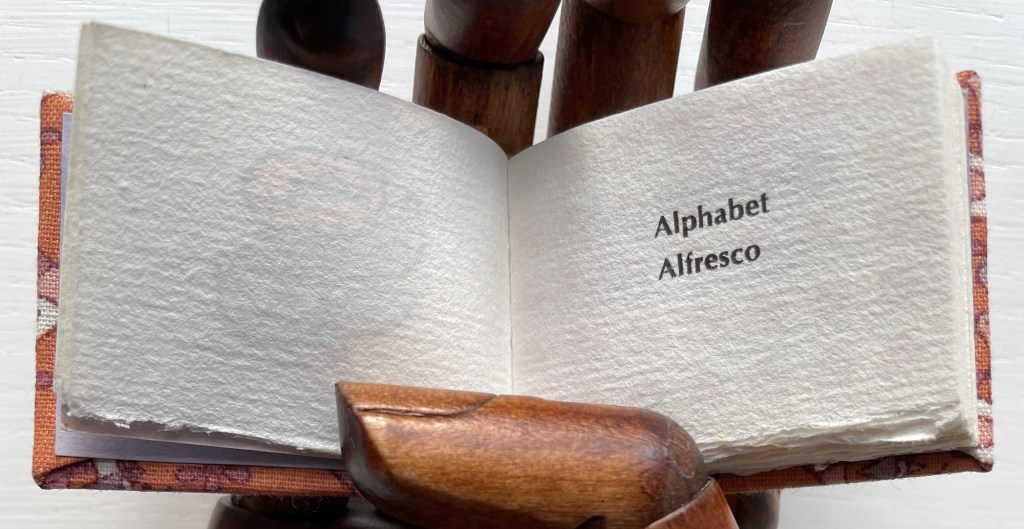
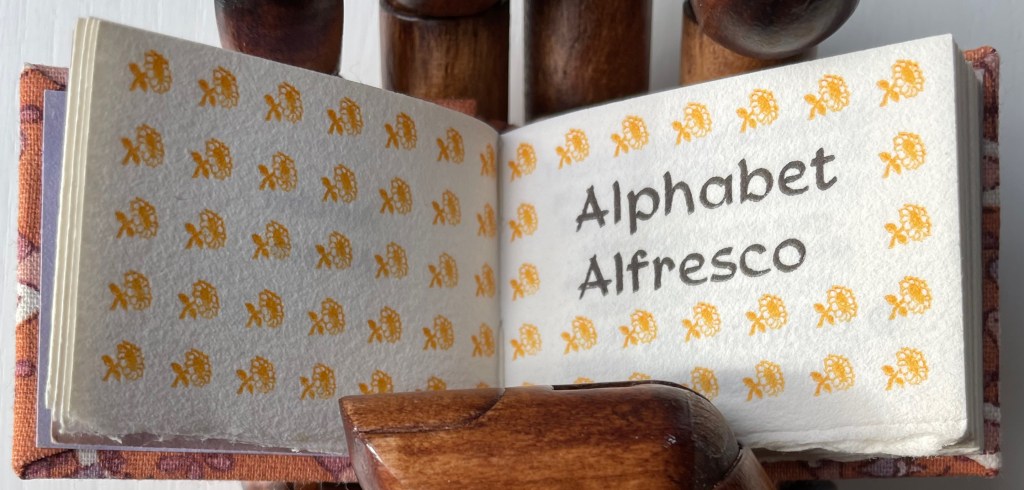
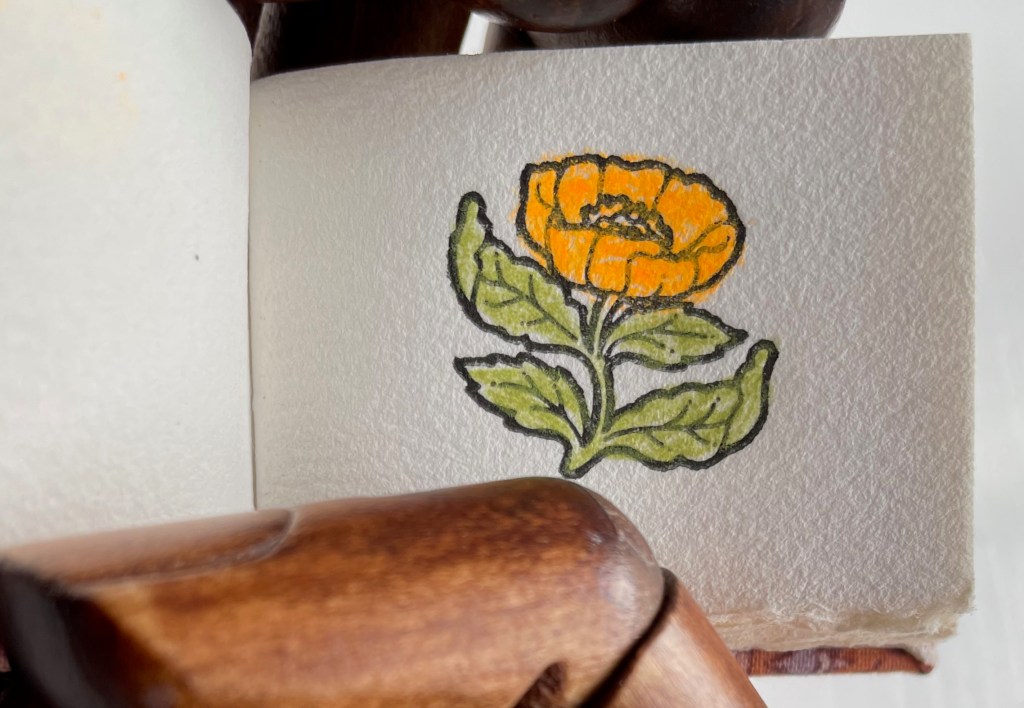
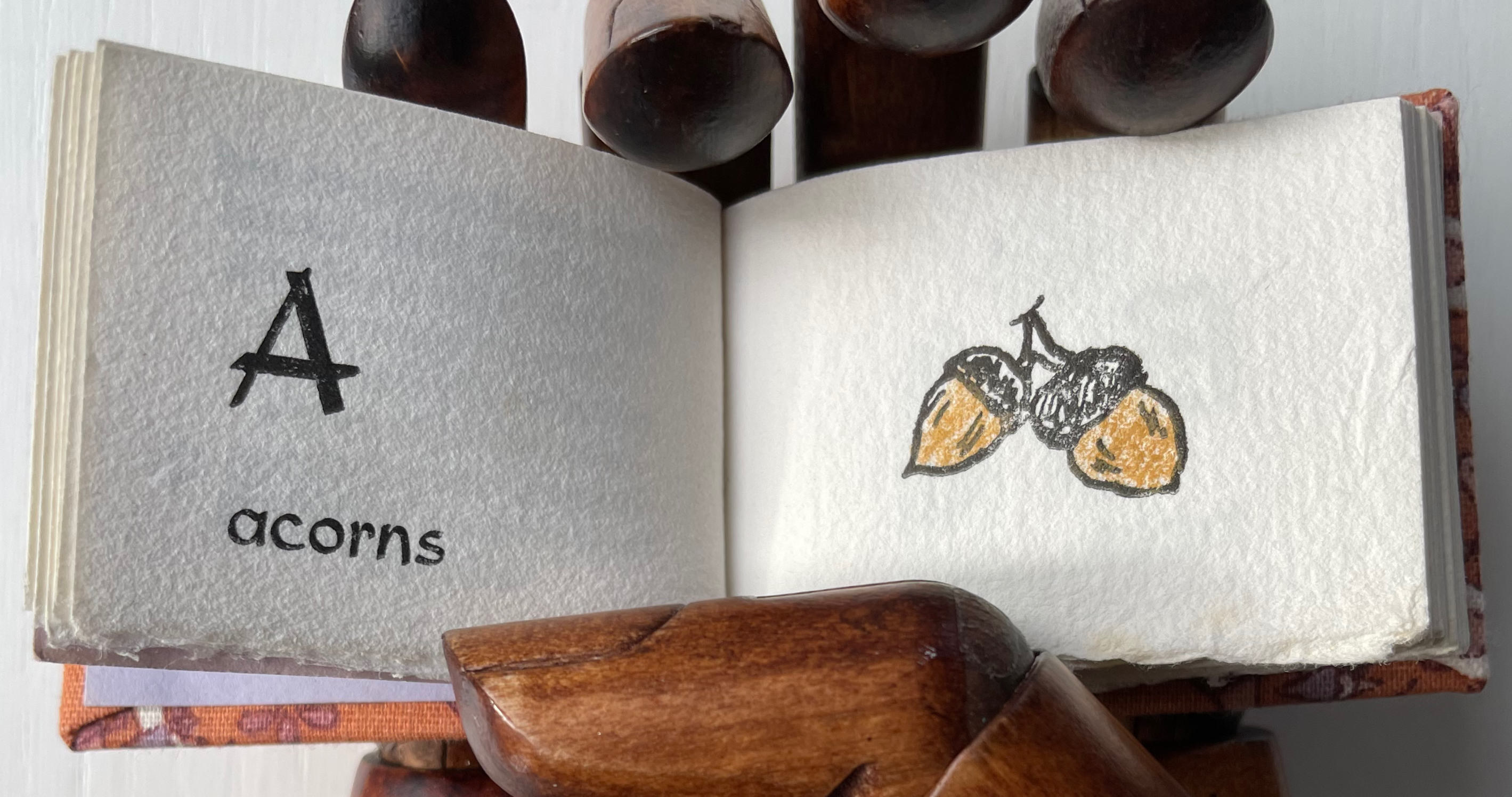
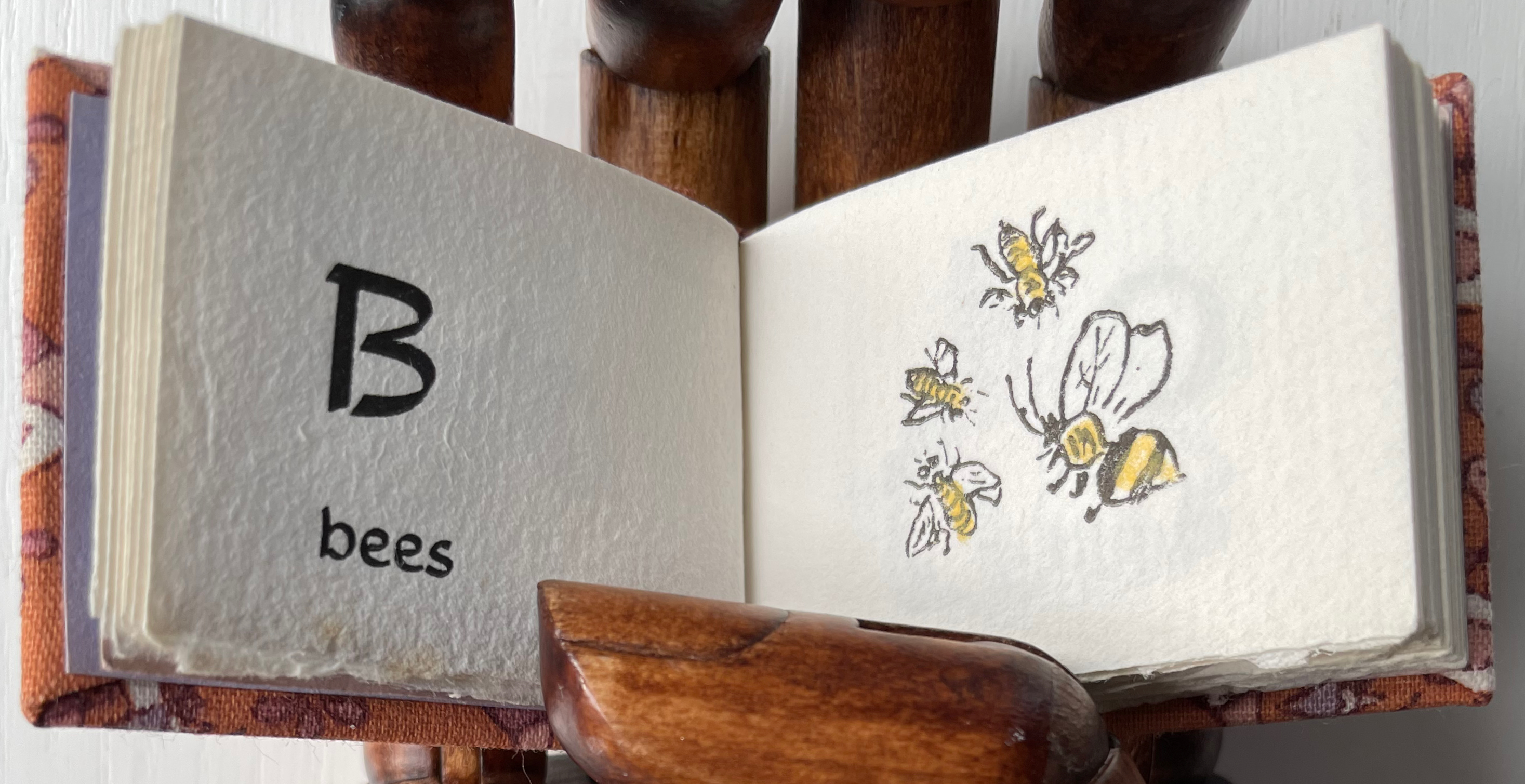
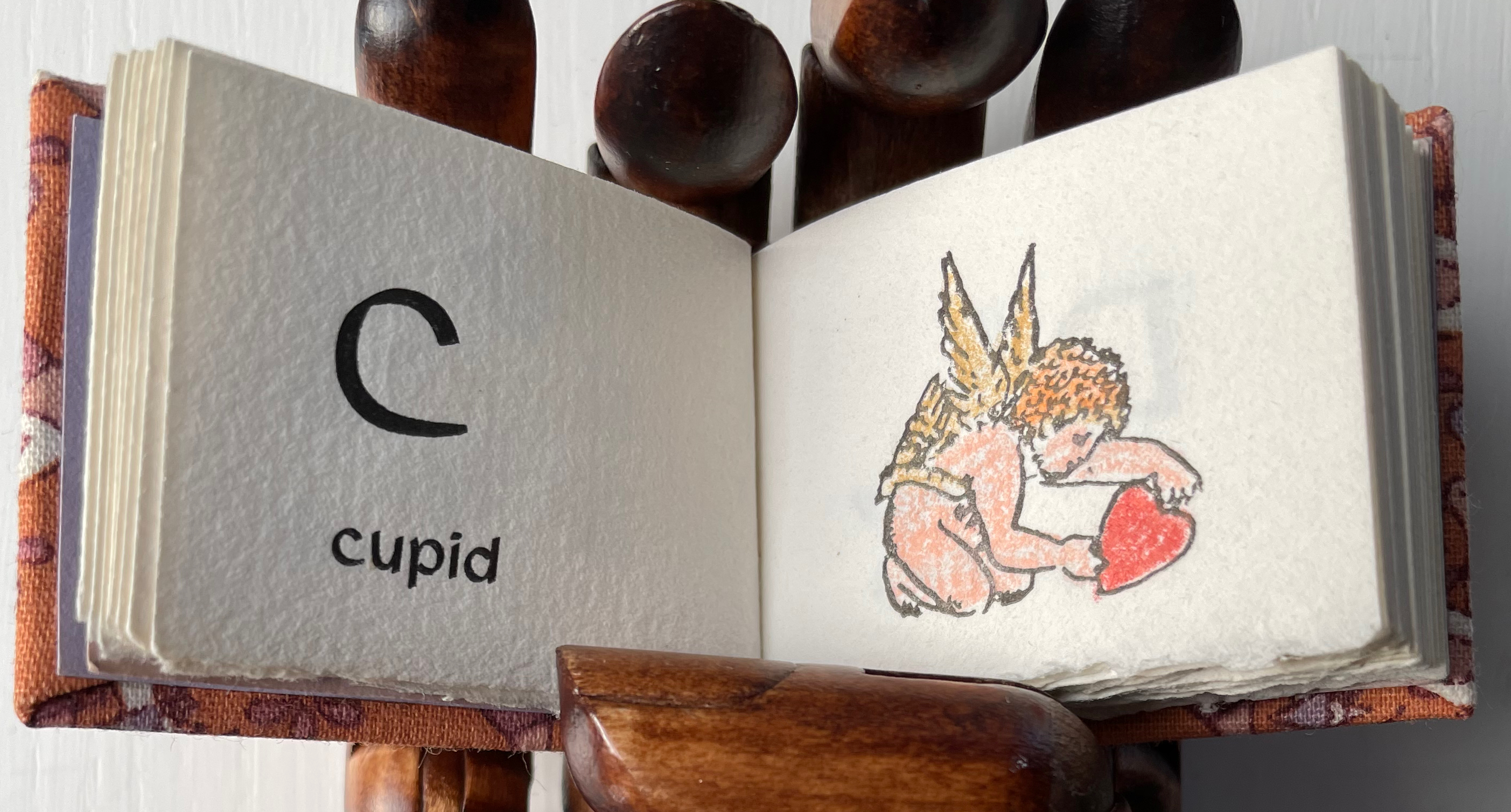
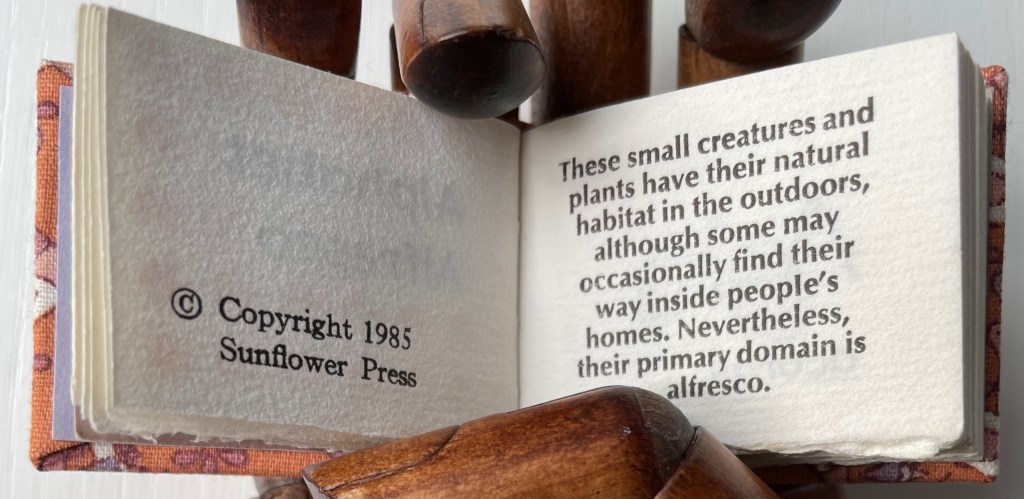
Alphabet Alfresco (1985)

Alphabet Alfresco (1985)
Carol Cunningham
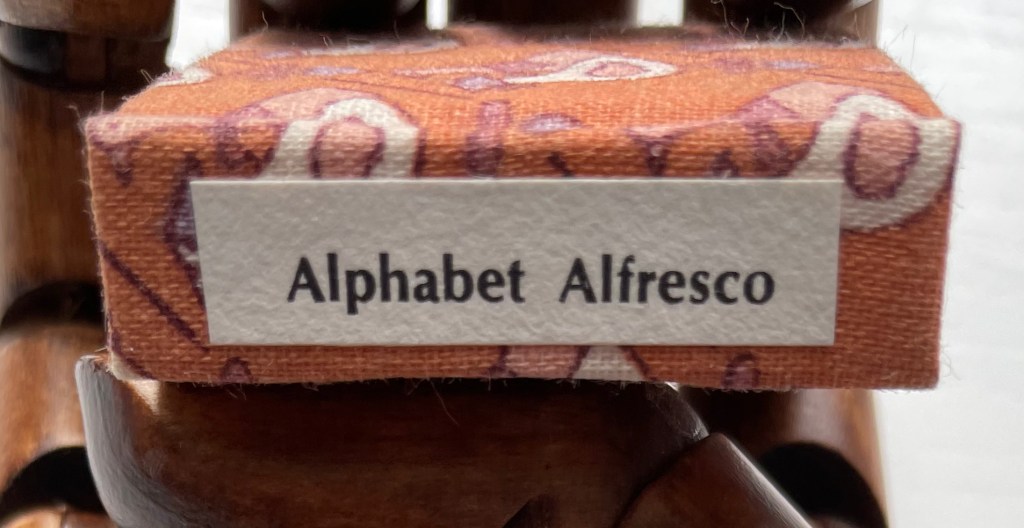
Casebound miniature, decorated cloth, colored doublures. H40 x W52 mm. 68 pages. Acquired from Lorson’s Books & Prints, 5 December 2022.
Photos: Books On Books Collection.

Carol Cunningham’s Sunflower Press produced many gems like this. Founder of the Miniature Book Society in 1983, Cunningham also produced numerous oil paintings and prints, some of which can be found here.

Further Reading

Abecedaries I (in progress)“. Books On Books Collection.

Alphabets Alive! – ABCs in Miniature“. 19 July 2023. Books On Books Collection.

Alphabets Alive! – ABCs in Miniature

If ever the dictum “Less is more” applied, it applies here — with miniaturized tongue in cheek, of course. [Links in the captions will take you to more images and details.]

Nancy Trottier, The Alphabet Effect (2013). Compare this example of the meander fold with Claire Van Vliet’s below and Lisa McGarry’s in The ABCs of Form & Structure.

Peter & Donna Thomas, Alphabet People (1989). Even in miniature, B is for Body.

Picture ABC (place and date of creation unknown). And C is for Color.

Rebecca Bingham, Defining the Rainbow (2018). And still more Color.

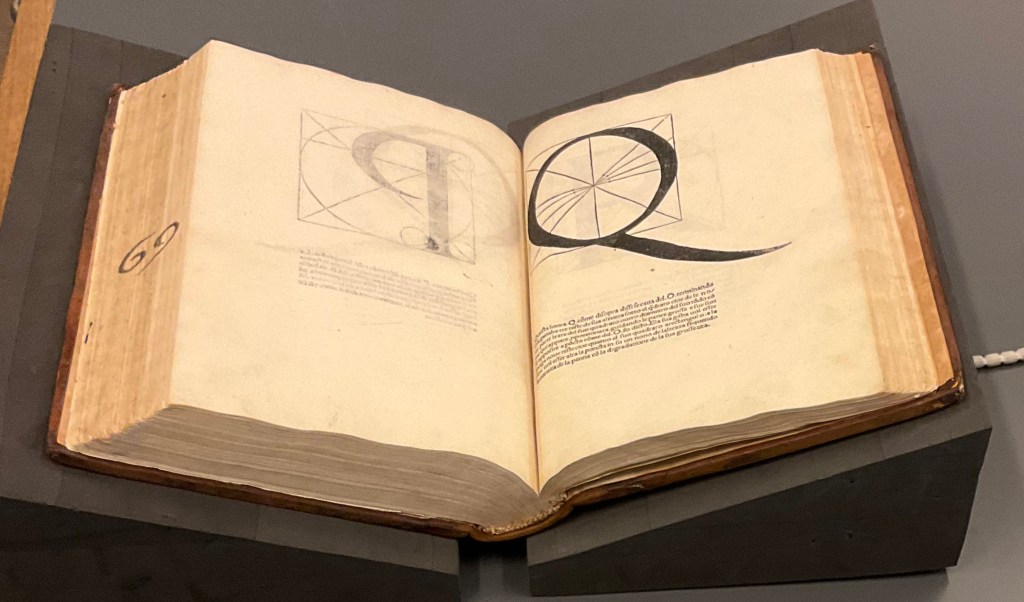
These two miniatures — Albrecht Dürer’s Directions for the Construction of the Text or Quadrate Letters (1993) and Fra Luca de Pacioli’s The Divine Alphabet (1993) — were produced by Tabula Rasa Press for a three-volume set, including Ben Shahn’s The Alphabet of Creation (1954). Although the miniature edition of Shahn remains elusive, the original edition can be seen here.

Mark Van Stone, The Evolution of the Medieval Decorated Letter (1985) In the spirit of medieval illuminators, Van Stone has imitated the hand of twenty-three of what he calls the “semi-precious jewels” of “‘minor’ illumination that usually receives little attention in the Art-History books”.

Carol DuBosch, Embossed Alphabet Gallery (2019).* This gallery structure combines elements of the flag-book and leporello to create a freestanding sculptural book to be read “in the round” — although in the Bodleian exhibition it was fixed in a wall case that allowed 180º view.

Claire Van Vliet, Tumbling Blocks for Pris and Bruce (1996).* A meander-fold book hinged to keep the cube unfolding, refolding and unfolding as it falls from hand to hand.

Carol Cunningham, Alphabet Alfresco (1985). One of several gems created by the founder of the Miniature Book Society (1983).

William Cheney, ABC for Tiny Schools ( 1975). Along with “A was an archer”, the “A was an apple pie” was among the earliest themes for secular alphabet books.

Alphabet Salmagundi (1988) and Golden Alphabet (1986) demonstrate the breadth of Rebecca Bingham’s interest in various periods and techniques of calligraphy.

Another Tabula Rasa Press production, Arthur Maquarie, The Uffizi ABC: a facsimile reproduction in miniature (1992)

Pat Sweet’s wit led her to fill the ancient Egyptians’ previously unperceived need for an alphabet book with Hieroglyphs (2009).

David Clifford and Heavenly Monkey teamed up to produce this intricately bound miniature, Letterpress Printing ABC (2004).

June Sidwell, Lady Letters (1986). Another production by Rebecca Bingham, which also led to a miniature nod to another alphabetist — Erté.

Nicolas McDowall, A Bodoni Charade (1995). Don’t let delight in the verbal/visual punnery distract you from wondering at the skill with type and letterpress needed to pull this off.

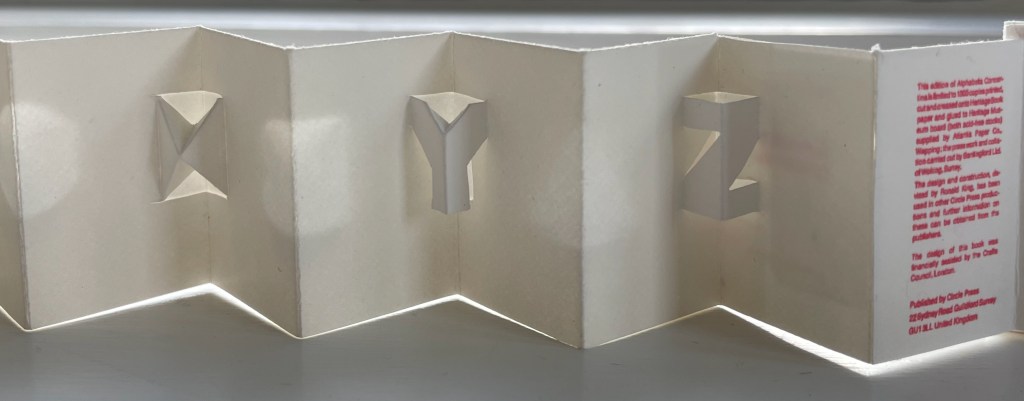
Erwin Huebner and Ron King, Alphabeta Concertina Majuscule (2015) and alphabeta concertina miniscule (2022). Miniaturist and microbiologist, Huebner obtained Ron King’s permission to reproduce King’s two signature pop-up alphabets with extraordinary results.

Juniper Von Phitzer, An Alphabet Coloring Book by Theodore Menten (1997). Lloyd L. Neilson compiled the name of his Juniper Von Phitzer Press from the names of his three cats. Theodore Menten had produced a coloring book called The Illuminated Alphabet in 1971 for Dover Publications. Obviously Juniper Von Phitzer could not fail to pounce.

Online Exhibition Bonus!

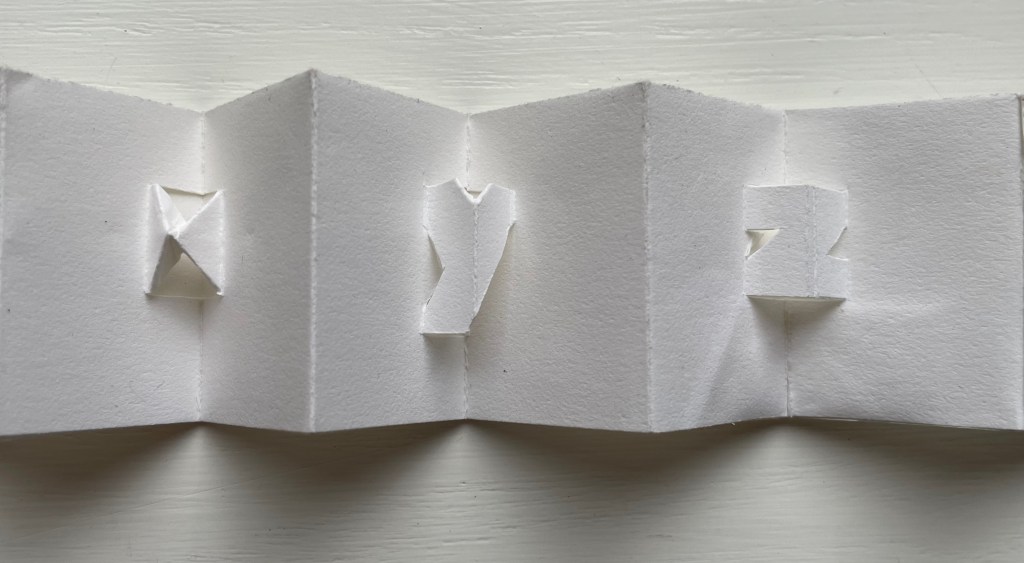
Many of the ABC books in the collection use the accordion, concertina or leporello structure, but none but Maria G. Pisano’s XYZ (2002) combine fine beaten abaca in two colors and the watermark technique to achieve their effect.

Return to List of Displays in Alphabets Alive!

Alphabets Alive! – Alphabets All Around

Where do letters go when they’re not making words? Book artists know that they hide everywhere – often in plain sight – in landscapes, roadworks and signs, tree branches, rocks, flags, and even in a cup of coffee. [Links in the captions will take you to more images and details.]

Stephen T. Johnson Alphabet City (1995)

Lisa McGuirk, If Rocks Could Sing (2011)

Elliott Kaufman, Alphabet Everywhere (2012)

Ornan Rotem, A Typographic Abecedarium (2015)

Marion Bataille, Vues/Lues (2008)

Online Exhibition Bonus!

Ellen Sollod, Outdoor Types : An Urban Alphabet Source (2019)

Jan Middendorp and Clotilde Olyff , Lettered Typefaces and Alphabets by Clotilde Olyff (2000)

Return to List of Displays in Alphabets Alive!