Oratorical Type A by Nerhol (Ryuta Iida and Yoshihisa Tanaka)
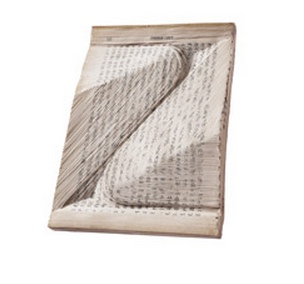
Oratorical Type Z by Nerhol (Ryuta Iida and Yoshihisa Tanaka)
The Japanese artists and partners Ryuta Iida and Yoshihisa Tanaka are known as NERHOL. Interviewed by Rebecca Fulleylove in the online magazine It’s Nice That, they explain the name:
We met at one of Iida’s exhibition and realised we had so much in common in regards to experience, design and taste. Gradually, we began working together. Our very first piece, Oratorical Type, used books as the theme, after sculpting them by carefully carving out certain sections of each page, it resulted in interesting dimensions. At that time, we still hadn’t decided on our name but soon came up with “NERHOL”, a mash-up of two words, “neru” to plan ideas and “holu” to sculpt and carve.
“To plan ideas” and “to sculpt and carve” those ideas in air, time, stone, wood or paper is that not a poem, a book, a building, a city — the work of art? That these two artists chose the letters of the alphabet as their first work together, that the alphabet and each of its letters came into being by collective human art and craft, marking our passage from orality to literacy, and that the alphabet, type and book are tools by which we have strived to evolve — how could they not be named Nerhol and their first work of art not be called Oratorical Type?
The British Library‘s “Medieval and Earlier Manuscripts” blog is a reliable source of visual delight and provocation to think about the interplay of the print and digital worlds. It also prompts the application of Ezra Pound’s critical technique of juxtaposing works, demonstrated so well in his The ABC of Reading.
I have read A Degree of Mastery from cover to cover twice. Once in New York between 2002 and 2005 when I was teaching “Professional Book and Information Publishing” at NYU and wanted readings to help provide students with a sense of the history, art and craft of the book. The second time here and now in Windsor looking for the “right something” to include in “Books On Books.”
On both occasions ebooks and digital publishing pervaded my thoughts, but only on the second time around did these questions and observations I want to raise now shape themselves as they have.
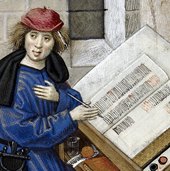
Annie Tremmel Wilcox weaves a memoir of her apprenticeship under the renowned bookbinder and conservator William Anthony. She weaves it with her diary entries, excerpts from an exhibit brochure “Saving Our Books and Words: The Conservation and Preservation of Books,” newspaper articles, correspondence, passages from “Japanese Woodworking Tools: Their Tradition, Spirit and Use” by Toshio Odate, step by step descriptions of mending torn pages and crumbling leather spines and plainspoken observation of fellow workers, conference attendees, librarians, government officials posing with restored documents, children making “books” from striped computer paper with wallpaper sewn on for covers and, of course, Bill Anthony, the “Johnny Appleseed of bookbinding.”
“Weaves” is the precise word for the structure of her book’s narrative, and it would be the right word for her ebook, if there were one. As I re-read it, this game of word substitution yielded questions that make this memoir a useful means to bookmark the evolution of the book.
Writing about some of the tools she learns to use — lifting knives, translucent bone folders, the spokeshave and others — she says of Anthony’s, “His tools were smarter than mine. They knew the correct way to cut paper or pare leather. By using them I could feel in my hands how the tools were supposed to work.” (48) For Wilcox and her reader, Bill Anthony is the master “shokunin,” craftsman or artisan. And when she quotes from Odate “For the ‘shokunin,’ utility and appearance must be enhanced by the tool’s ‘presence,’ that is its refinement and dignity….,” this reader asks,
What are the tools of the ebook maker? From whence comes their refinement and dignity — their “presence” — with which the “shokunin” imbues his creation as a result of his commitment to his craft? In what tools of the ebookmaker does “the spirit of the tool that records the ‘shokunin’s’ ability through the years to face the uncertainties of life, to overcome them, and to master the art of living” reside?
Too Zen? Perhaps.
An English grad student, Wilcox relished handling the University of Iowa‘s Sir Walter Scott Collection, its Leigh Hunt Collection and The Works of Rudyard Kipling. Confronted with earlier slapdash and botched work on certain volumes of the Kipling, she writes, “Certainly these volumes of Kipling are found on the shelves of numerous libraries across the country, but the integrity of ‘these’ volumes as a complete set has been lost.” (179) What constitutes the “integrity” of an ebook or its constituents? Are ebooks so “immaterial” that such a question is nonsensical?
The author’s apprenticeship included collaboration on the exhibit “Saving Our Books and Words.” In addition to coauthoring the exhibit’s brochure, Wilcox contributed to completing Anthony’s special project of developing for the exhibit a unique collection of models demonstrating “the evolution of the codex – the form of the book as we know it.”(181) In the brochure she touches on the immateriality and materiality of the Center’s work: “Simply defined, preservation is the attempt to save the intellectual content of books while conservation is the attempt to save both the intellectual content and its vehicle — the covers, paper, endbands, etc. The former is concerned with saving what the human record contains without regard to the forms it winds up in. The latter focuses on the artifact itself, attempts to save this book, this sheet.” (192)
What is the “form” of the ebook as we know it? Is the ebook as much “vehicle” as “content”? What are its equivalencies to the page or to what “binds” the “text block”? What does it mean to “conserve” an ebook? Of a digital copy, what are the materials; what is the artifact to be conserved?
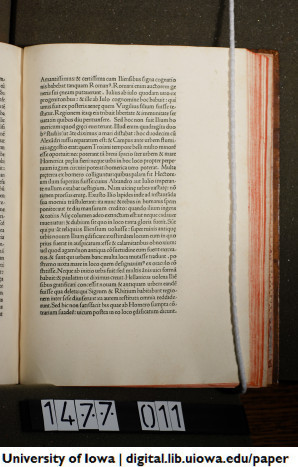
Wilcox ends her memoir with the completion of her “masterpiece,” the restoration of the incunabulum that Bill Anthony assigned her before his death and which she completed after it with the help of “The Restoration of Leather Bindings” by Bernard Middleton, author of the standard text “A History of English Craft Bookbinding Technique.” The work assigned was Pope Pius II’s “Historia Rerum Ubique Gestarum,” printed by Johannes De Colonia and Johannes Manthen in Venice in 1477, which when restored was “not a deluxe edition, but … had great integrity.” In the year 2547, of what will the preservation and conservation of today’s e-incunabula consist? Will some apprentice conservator understand the “form” of these ebooks “in the cradle” and, master of smart tools, restore them to their integrity?
With Ann Tomalak’s essay, perhaps we can see that future through her present lense on the past. Give it a read.
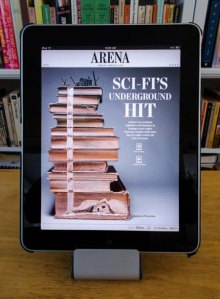
This image of Thomas Allen’s book art appears along with the story about fellow-North Carolinian Hugh Howey‘s self-published novel WOOL in the 7 March 2013 edition of The Wall Street Journal but only in the iPad App version. Go to SECTIONS, then ARENA.
Click on the image to the left to go to Allen’s website to see more of his work and find out how to purchase it. If you can find the Fall 2006 issue of Zoetrope: All Story, you can see more of Allen’s work, but click here to read Chip Kidd’s comments on Allen’s artistry.
In a report possibly falling under the category “What the Font?” or simply “Sans Clue,” PoliceSpecials.com carried this story from the BBC today:
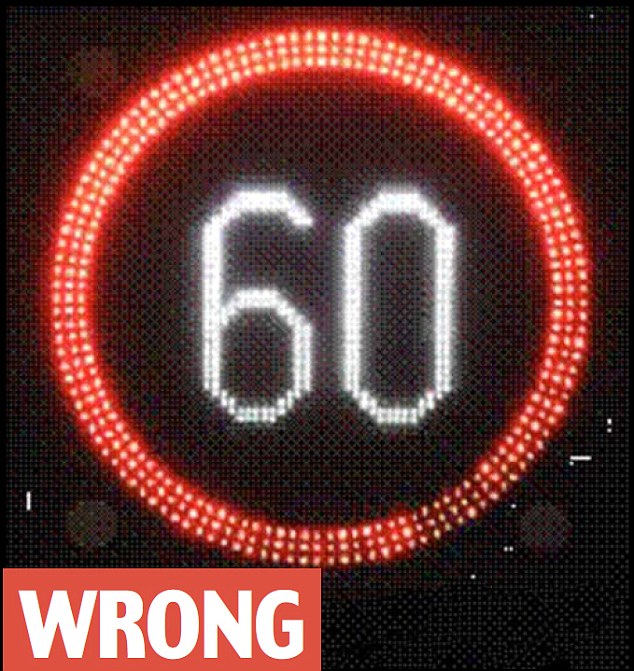
“Thousands of motorway speeding convictions could be overturned because the font used to display the numbers on some variable speed limit signs may not have complied with traffic regulations. The Crown Prosecution Service said the signs showed mph numbers taller and narrower than they should have been.”
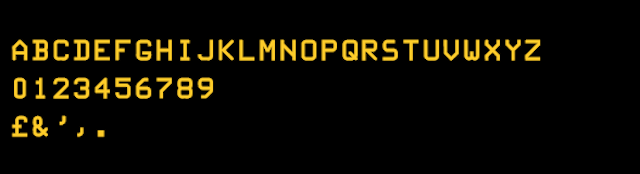
The typefaces mandated by the Department of Transport for traffic speed limit signs are Transport Medium, Transport Heavy and Motorway Permanent. The designers were Jock Kinneir and Margaret Calvert. Simon Garfield provides an amusing chapter in Just My Type on how their design came to be adopted. But the typeface in question on which the BBC has belatedly reported (see the Daily Mail for the original scoop last December) is this:
According to roadsuk.com (well, that is the URL, although a bit of blue in the letters “u” and “k” help to disambiguate the message), the font seems to be named (imaginative this) “Variable Message Sign.” But in the Daily Mail article, neither the “wrong” nor “right” signs illustrated seems to be in the Variable Message Sign typeface. So, what the font?
Basia Irland’s art project ICE BOOKS: receding/reseeding gives a formidably tangible and new meaning to “publishing as dissemination.” As Irland describes the project on her site:
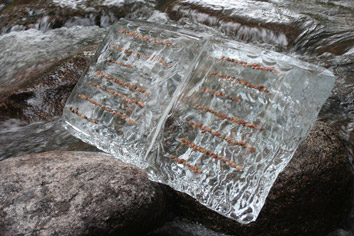
River water is frozen, carved into the form of a book, embedded with an ‘ecological language’ or ‘riparian’ consisting of local native seeds, and placed back into the stream. The seeds are released as the ice melts in the current…
I carved a 250-pound book from clear ice and embedded it with a seed text of Mountain Maple (Acer spicatum), Columbine flowers (Aquilegia coerulea), and Colorado Blue Spruce (Picea pungens). Four people carried the heavy book out into the current of Boulder Creek. As it rested between two large rocks, viewers cold see the water flowing under the ice. Ice Books. Accessed 17 February 2013 and 11 September 2014.
This is book art as performance art and conceptual art but with a twist: the performance yields results beyond the on-site viewers’ memories or any photography and video of the event replayed in galleries or museum installations. Whether the seeds that float downstream in local rivers do take root is uncertain. As there is at least a chance that it will happen, it is more than the concept that counts.
“Performed” across 18 locations around the world, Irland’s project has been going since 2007. Fittingly the first performance began with Lucy R. Lippard’s Weather Reportexhibition in 2007, but the concept has a rich heritage. With some further reading and the help of Peter Verheyen’s listserv BKARTS, I have tracked down some of that other “ramifying” or “ecologically political” book art.
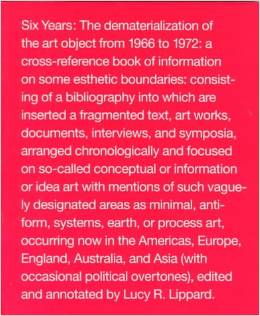
Lucy Lippard, Six Years (1997)
Starting with Lippard herself, there is Six Years, the 1973 seminal, long-subtitled work that drew attention to Hans Haacke’s Wind in Water (1967) and other conceptual and environmental art. And then came Doug Beube’s pieces from the 80s and later such as Organic and The Chair of Censorship. In the late 90s, we had Ann Marie Kennedy’s Plant Dreams. In 2010, Maggie Puckett’s “Thaw“.
And now, this conceptual book art has revolved back into books:
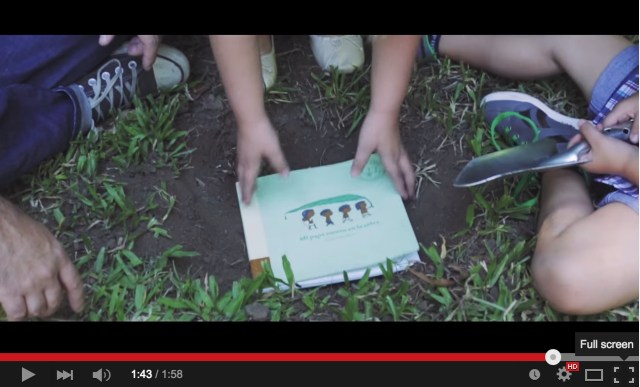
Pequeño Editor, an Argentinian children’s book publisher, has published Tree Book Treewith ecologically friendly ink and acid-free paper embedded with jacaranda seeds. As the video explains, “Books come from trees. Today, a tree comes from a book.”
Tree Book Tree, 2015 Video published on 3 May 2015 FCB Buenos Aires
The act of reading then planting the book echoes the twist in Irland’s performance and conceptual pieces. The book as read (the performance) resides in the memories of the readers, the concept (books are made of trees) resides in the mind, and downstream in time, a jacaranda blossoms overhead.
Aristotle, a 4th-century-BCE philosopher, portrayed in 1493 Nuremberg Chronicle as a 15th-century-CE scholar (Photo credit: Wikipedia)
LiveInk® cleverly demonstrates how the display of writing has developed by presenting the following quotation from Aristotle’s On Interpretation in the forms in which it would have appeared in the different stages of theA Brief History of Reading.
“Spoken words are the symbols of mental experience, and written words are the symbols of spoken words.” — Aristotle, On Interpretation
For example,
In 2000 BC, the Phoenicians developed the first methods to represent spoken language – an alphabet consisting entirely of consonants:
LiveInk® must hope for a place on the timeline for its re-formatting process (Visual-Syntactic Text Formatting (VSTF), which breaks up blocks of traditionally laid out text (flush left, ragged right or justified) and presents them in a more readable form, reminiscent of 20th century free verse. The claim of increased readability is based on eye movement studies by Randall Walker, Charles Vogel, Stan Walker, Phil Schloss, Charles R. Fletcher, Youngmin Park and Mark Warschauer.
Last September, BOB picked up an article by Michael Kozlowski on the Kindle feature of synching an ebook with its counterpart audiobook and explored the question, “What can the physiology, neuropsychology and sociology of reading tell us about ourselves?” The research behind LiveInk® is worth bookmarking for the reading list (see below) concluding BOB’s September 2012 entry if only to experience the “melon twisting” that comes from trying to accommodate these disparate yet related perspectives on the act of reading.
What makes his comments on comments on a comment bookmark-worthy are the comments they provoked from Gary Frost, Emeritus Conservator at the University of Iowa Libraries and the author of Future of the Book: A Way Forward(Coralville, IA: Iowa Book Works, 2012):
“The current rush of changes in print and ebook uses is dramatic evidence of our close relationship with books. A flood of digital reading devices and hybrid software and hardware designs are emerging as the print book is augmented by screen delivery and associated cloud libraries, ebook collection building, automated index and searching, and screen learning. While all screen book simulations deviate from print conventions the hybrids that emerge reference each other and often resonate with each other. This rapidly developing book production and consumption landscape is dynamic and unique in media history, or is it?
It’s pretty amazing that little attention is paid to the emerging composite of print and screen delivery of books. I mean looking directly between them and at an emergent functionality of all books. There you can now perceive the interdependence of print and screen and the likelihood that neither will flourish without the other. . . . Also involved are other forums, other than the forum of current technologies, their products and marketing. These other disciplines include academic book studies, cognitive science aspects of reading, book sustainability within libraries and many vectors of book arts.”
One might single out the infiltration of the book by “the social web” from the vector of current technologies that Frost insightfully identifies as necessary to explore this moment in the book’s/ebook’s evolution in which those who buy ebooks buy yet more print books. The ability to annotate and share print books is gradually being replicated, prodded as it were by the phenomenon of the social web.
So here you have it: a comment on comments on comments on comments on a comment.
Norma Levarie (1920-1999) was a graphic designer and author of children’s books, one a winner of a New York Herald Tribune award — Little People in a Big Country. But, in addition to her design work for the National Audubon Society, The Jewish Museum, The University of Chicago Press, Oxford University Press, Random House and Harry N. Abrams, this Virginian’s most important gift to those interested in the evolution of the book and book arts is her volume The Art & History of the Book (New York: James H. Heineman, 1968).
The quality of her research and writing measures up to the best. If only Heineman had been able to afford color reproductions, her ability to handle illustrations and her keen eye for selection of examples would have placed this book in good company with works such as Michael Olmert’s The Smithsonian Book of Books (Washington, D.C.: Smithsonian, 1992). Still, Levarie’s book merits a bookmark for its overarching message, which is cleverly embodied in the book’s organization.
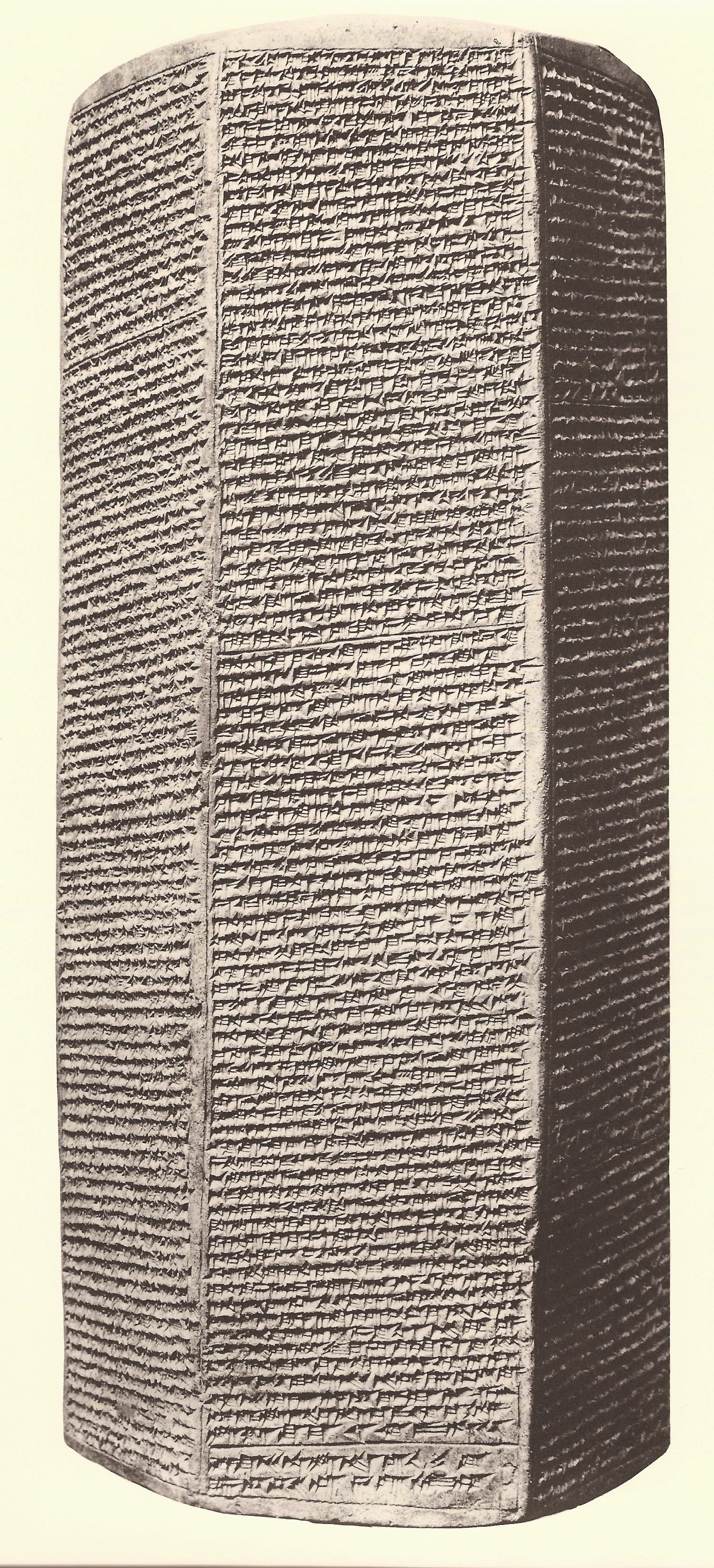
Facing the stark image of the Prism of Sennacherib on the opposite page, these words of Ashburnipal launch the book on the recto page:
Prism of Sennacherib. Assyrian, VII century B.C. Oriental Institute, University of Chicago. Height 15 in. Reproduced from Levarie, The Art & History of the Book (New York, 1968).
“. . . I read the beautiful clay tablets from Sumer and the obscure Akkadian writing which is hard to master.
I had my joy in the reading of inscriptions in stone from the time before the flood. . . .”
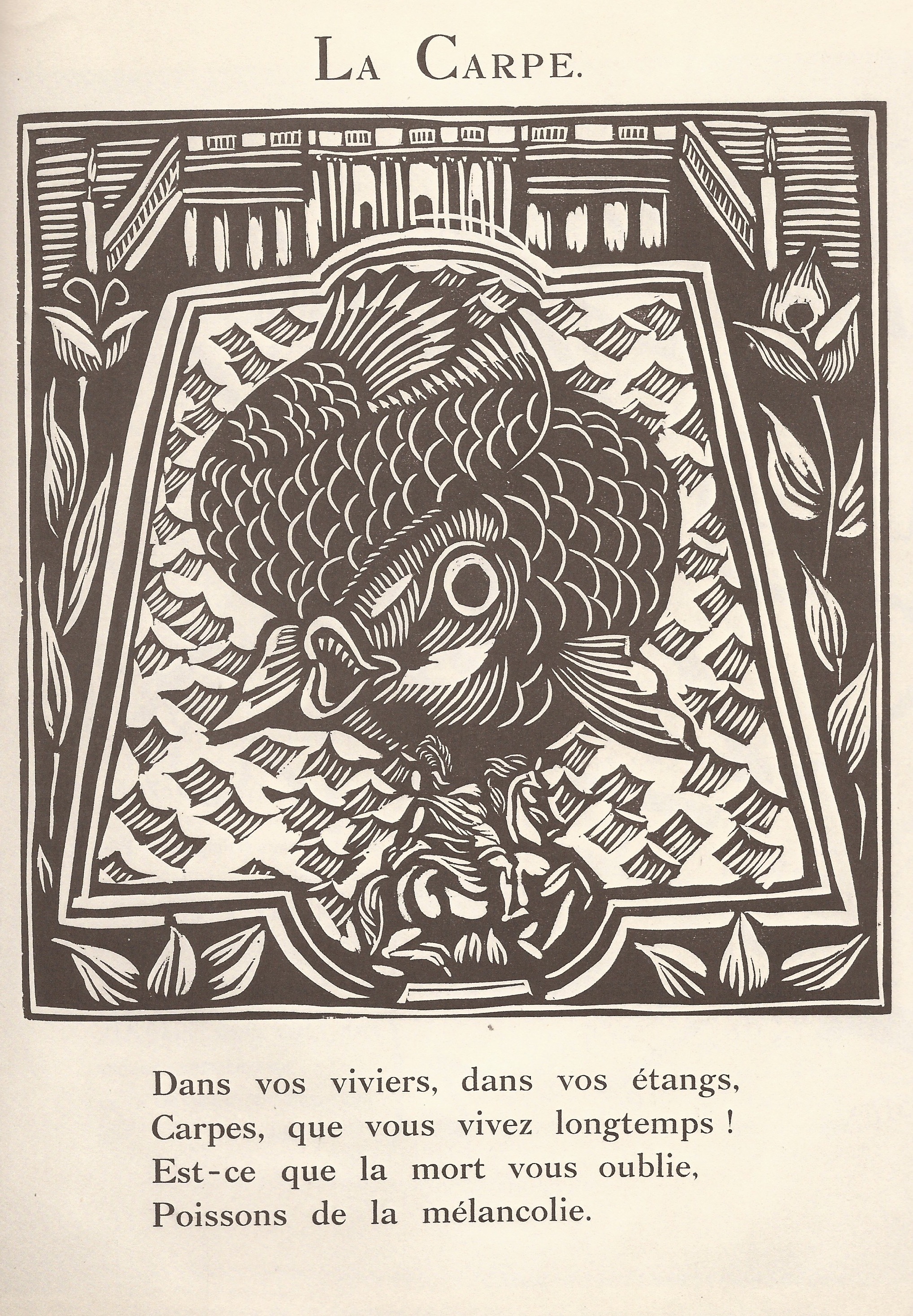
Continuing chronologically up to the fifteenth century and “block book,” Levarie switches to a geographical approach, starting of course with Germany, ending with England and returning to a timeline overview from the seventeenth century to the twentieth, the last illustrated with pages from Spiral Press’s Ecclesiastes (New York, 1965), drawings by Ben Shahn, engraving by Stefan Martin and calligraphy by David Shoshensky, and Apollonaire’s Le Bestiare (Paris, 1911).
Guillaume Apollinaire, Le Bestiaire. Paris, 1911. Woodcuts by Dufy. Yale University Library, Graphic Arts Collection. 14 x 10 1/4 in.
This structure neatly builds to these concluding words:
“The homogenizing forces of our time have broken many barriers of national style, and sometimes it is difficult to tell at a glance the origin of a book. But local differences in production or taste still exist, and where they are manifest they bring the pleasure of variety. . . .
For the lover of fine books, nothing can replace the bite of type or plate into good paper, the play of well-cut, well-set text against illustration or decoration of deep artistic value. But an inexpensive edition can carry its own aesthetic validity through imaginative or appropriate design. These are not matters of concern only for aesthetes; if, in an era of uncertain values, we want to keep alive respect for ideas and knowledge, it is important to give books a form that encourages respect. The style and production of books, for all the centuries they have been made, still have much to offer the designer and publisher in challenge, the reader in pleasure.” (303-06)
Leaping ahead more than fifty years to the shift from print to digital, we find that many of the observations and message legitimately reassert themselves. Websites and ebooks do vary in design from region to region, but standardization and, more so, the global character of the Web and the products of the technology industries counter-assert a homogeneity in design. Sven Birkerts‘ elegies for Gutenberg are echoed across blogs devoted to the continuing pleasures of the printed book. But likewise Levarie’s stand that these are not merely matters for the elite is echoed across the debate of print vs digital in the popular press and the democratizing blogosphere.
What still must be translated from her message is how to make the leap that, if we respect ideas and knowledge, we must give online books as well as print books a form that encourages respect.
Under the blog name “Wynken de Worde,” Sarah Werner writes about books, early modern culture, and those of us who may be postmodern readers — when she is not preparing the syllabus for her course at the Folger Shakespeare Library. Wynken (not related to Blynken or Nod) was the primary assistant to William Caxton the first printer of English-language books — Malory’s Morte d’Arthur, Chaucer’s Canterbury Tales, and The Golden Legend.
If Sarah Werner channels Wynken de Worde in her classroom as well as she does through her website, her students are to be envied. She makes what she writes tangible, palpable, haptic. Three brief examples, the last of which prompts this bookmark:
Imposition is “the arranging of pages in a chase [a steel or iron frame for holding them tightly for the letterpress] in a particular sequence . . . so that when folded the printed pages will be in consecutive order.” Glaister, Encyclopedia of the Book (2001). But the earliest books did not have page numbers, so how were old Bill and Wynk to know which to place where? Here’s Werner:
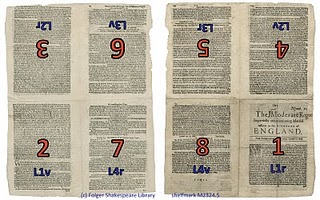
Lerner’s newsbook ready for folding.
Above is a numbered example of the same newsbook that I used as an image in my last post. The red numbers are page numbers: folded in the right way, you’d get an 8-page booklet in the order indicated. But if you look closely, you’ll see that the actual news sheet doesn’t have page numbers. Instead, there are signatures: at the bottom of the first page is a tiny, blotted “L”; at the bottom of the 5th page is a tiny “L3″ (the “L2″ has been cut off at some point when the page was trimmed). These are signature marks that count off by leaves. What’s a leaf, you ask? It’s a physical unit of paper: when you turn the page in a book, you are actually turning a leaf of paper. Early modern printers would have thought in terms of sheets and leaves, not pages, when they were figuring out how to print a work. Depending on the imposition (how the text is laid out on the sheet), you could end up with different numbers of leaves: 1, 2, 4, 8, 12, 16, 24. A quarto imposition results in a sheet of paper being turned into 4 leaves; there are 2 pages to each leaf (a recto side and a verso side), so there are 8 pages in all. The blue letters and numbers show the signatures. One thing that throws off beginners is understanding how recto and verso relate to each other. They do not mean right and left but front and back.
Providing a downloadable PDF with which to follow along, Werner walks the reader through the exercise and proves her point: “it’s a handy way to understand and demonstrate to others the general principle of early modern format: multiple pages are printed onto a single sheet in the correct order so that when folded, they appear sequentially.”
The second example of the pedagogically palpable or the palpably pedagogic comes in the same posting:
“When you’re done, you can try folding it into a tiny little pressman’s cap, following the instructions that appear in this lovely piece, “The Newspaper Man is Defunct,” from The Cape Cod today.”
That bit of fun was two years ago. The brilliance is undiminished today; if anything it’s brighter. For this year’s course, Werner is handing out her syllabus in unpaginated quarto format. To figure out the syllabus, the students have to fold the imposition correctly! Try it yourself and grasp the meaning of the “book arts.”
Ah, the books arts. Imposition. The dying arts? You need look no further than the end of your Proboscis to see that that is not true. Proboscis is a London-based non-profit studio that commissions and facilitates new works and publications, some of which can be found in the DIFFUSION library.
DIFFUSION ebooks are hybrid digital/material publications. They bring together the “tactile pleasures of tangible objects with the ease of sharing via digital media.” Shareable paper books, free to download as PDFs, print and make up, DIFFUSION eBooks “can be shared electronically or as material objects – scanned, photocopied, emailed or posted. The eBooks bridge analogue and digital media by taking the reader away from the computer screen and engaging them with the handmade.”
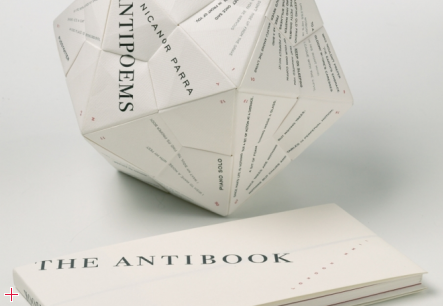
And just a bit further along the continuum is Francisca Prieto, also in London. Inspired by the serio-comical poet Nicanor Parra’s “antipoems,” Prieto offers up The ANTIBOOK.
The reader must fold the pages of the book (20.5 x 10.5cm) to form the icosahedron (15 x 17 x 19cm) in order to read Parra’s antipoems in order.
Whether Prieto’s ANTIBOOK or the DIFFUSION ebooks are book, art, both or neither, they and Wynken de Worde make us think with our hands as well as our minds about what can be done with the form and concept of the book. And that makes the concept of imposition worth a bookmark.
PS: “Books On Books” acknowledges David Pearson‘s Books as History (New Castle, DE: Oak Knoll, 2008 and 2011), p. 75, for the inspiration of the wording of the conclusion here.
PPS: Another opportunity to learn by doing can be found at the end of a short and witty book called A Dodo at Oxford: An Unreliable Account of a Student and His Pet Dodo. Under the guise of explaining, presenting and annotating a diary found in a charity shop, Philip Atkins and Michael Johnson deliver a history of the book. Appendix 7 provides the offer to engage in imposition.
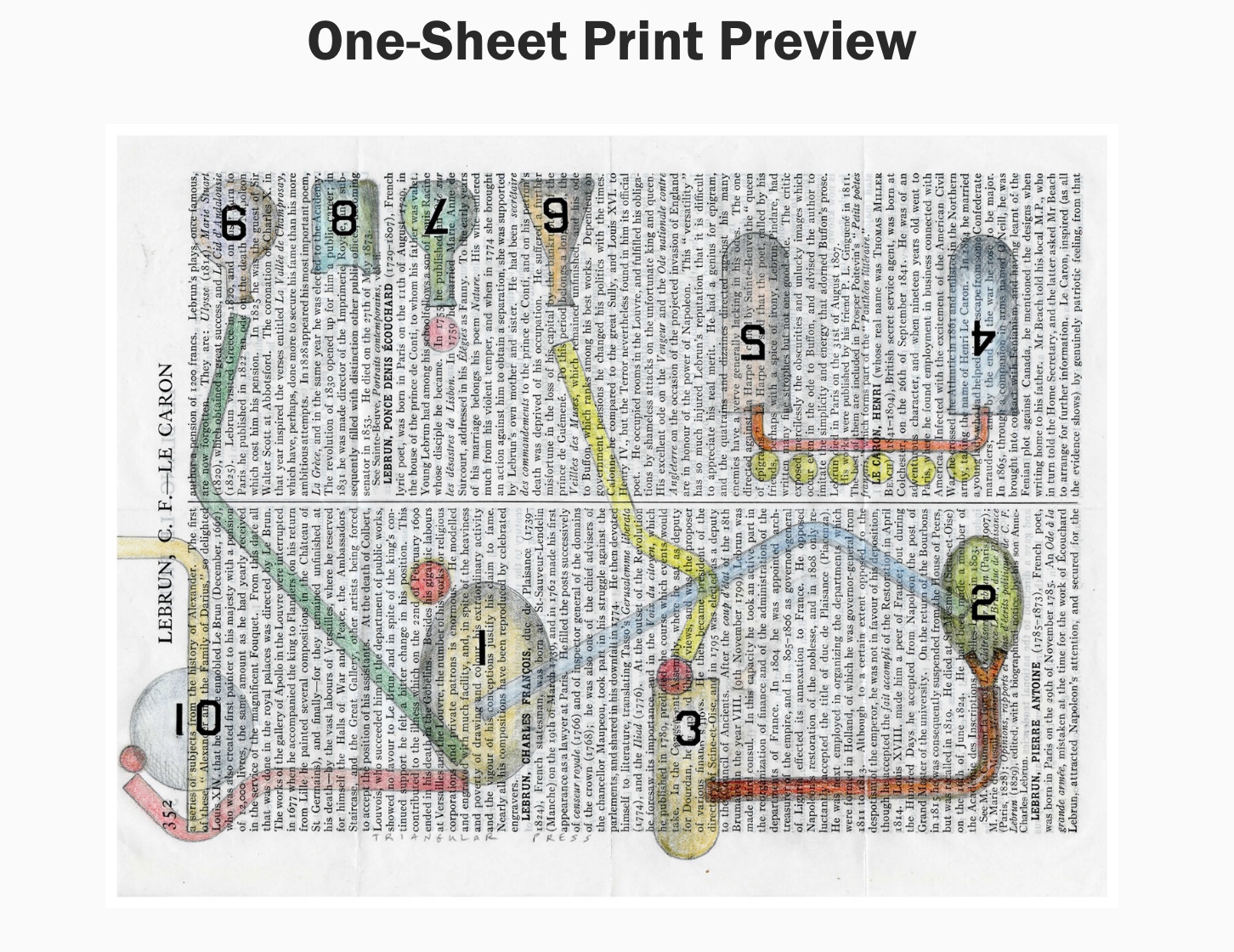
PPPS (6 January 2021): Weeks into a third Corona virus lockdown, another contribution for learning imposition by doing has appeared. Appropriately this time in the Quarantine Public Library started by Katie Garth and Tracy Honn in May 2020. It comes from Barb Tetenbaum; check out the download and instruction video here.
Untitled Barbara Tetenbaum Chemistry stencils (Prague, 1993); colored pencils (Madison, WI, 1975); and press-on letters from the model train industry are combined with a 100-year old Encyclopedia Brittanica page.




 Books On Books