Bookmarking Book Art — Doug Beube

Doug Beube’s works exude the influence of his studies with Keith A. Smith and Gary Frost, craftsmen and scholars whose work has been referenced here.  Eleven years ago, in an interview with Judith Hoffberg in UmbrellaVol 25, No 3-4 (2002), Beube speaks of experiencing

the whole book as an entity in itself, which can’t be done by reading line by line. The book’s not made to do that. Readers experience the totality of the book by building up linear movement, word-byword, sentence by sentence, etc. and I’m interested in the book as a simultaneous experience.

The experience of the wholeness of the book plays off the major theme of Smith’s The New Structure of the Visual Book and The New Text in the Book Format: “Composing the book, as well as the pictures it contains, creates pacing in turning pages. Just as poetry and cinema are conceived in time, so is a book.”  Both Smith and Beube are interested in the structure of the book, “the mechanical aspects of the book as  a technology, and how it functions as a container of  information,” as Beube puts it.  

But where Beube is “trying to solve the problem of experiencing the content of the book as a visual phenomenon, layering it and transforming it into a visual object,” Smith pushes the traditional form of the book to enhance the book experience that “Events depicted in writing unfold through time in space, alongside the physical act of turning pages.”

Although Gary Frost’s influence on Beube’s deep-seated inspiration from the history of the book can be seen in the first two examples below, Beube’s more acerbic view of our digital world in Facebook, the third example, is where they part company.  Frost is still seeking the possibility of an ongoing link between the print and the digital:  “The circumstance of mixed delivery options for books reveals a surprisingly complementary and interdependent relation of affordances and a third stance going forward. We advocate for the interdependence of paper and screen books; neither will flourish without the other.”   Beube’s twisted phonebook dangled before his face in Facebook “both acknowledges and satirizes the intended community of computer users.”

Beube divides his bookworks into methodological categories — Fold, Gouge and Cut:

City by Doug Beube

Inspired by a phrase from the Hindu scriptures, the Vedas, in 1989 I began folding the pages of books in on themselves. The phrase goes, “Curving back upon myself, I create again and again.”

via Doug Beube – Fold.

"Reading

Using various power tools I selectively removed parts of the cover, pages, and content, for example, by grinding them away. The underlying pages revealed themselves, as hidden depictions interacting with top layers, interrupting what might have been an undisturbed reading of text and image now viewed as an altered book.

via Doug Beube – Gouge.
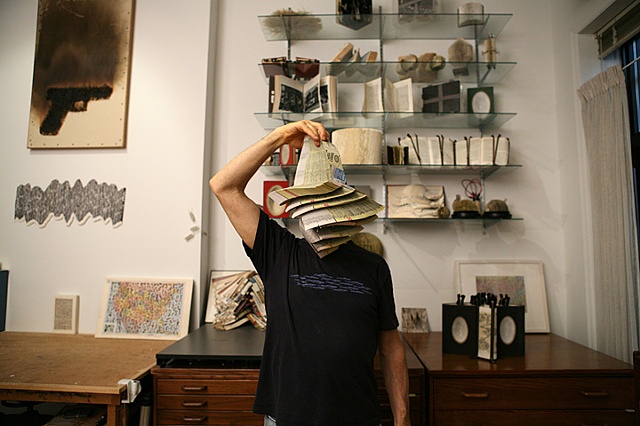
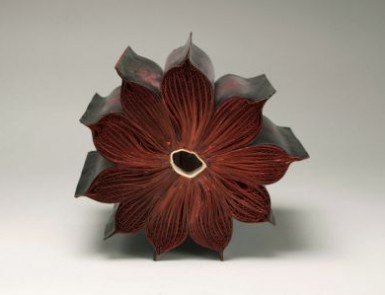
"Facebook2009altered

Theoretically and physically I ‘excavate’ the book, as a phenomenological endeavor, creating hypertexts, as if the text block itself is an archaeological site. When I appropriate books, their words are sometimes readable, their shapes are sometimes recognizable, but in every case they are transformed into objects that are visual and speak volumes.

via Doug Beube – Cut.

See also

Bookmarking Book Art – Doug Beube | @scoopit http://sco.lt/9Jn1tp

Bookmarking Book Art — Doug Beube | @scoopit http://sco.lt/8Dp5UH

Bookmarking Book Art — Rebound – An exhibition at the Halsey Institute of Contemporary Art | @scoopit http://sco.lt/5rNMkz

Bookmarking Book Art — Paul Forte | @scoopit http://sco.lt/58SMoz

Bookmarking Book Art — Alexander Korzer-Robinson

Alexander Korzer-Robinson

Korzer-Robinson, from Berlin and now working in Bristol, UK, aims to illustrate the process by which we create our past from “fragments of reality in a process that combines the willful aspects of remembering and forgetting with the coincidental and unconscious,” in his own words.

By using pre-existing media as a starting point, certain boundaries are set by the material, which I aim to transform through my process. Thus, an encyclopedia can become a window into an alternate world, much like lived reality becomes its alternate in remembered experience. These books, having been stripped of their utilitarian value by the passage of time, regain new purpose. They are no longer tools to learn about the world, but rather a means to gain insight about oneself.

I make book sculptures/cut books by working through a book, page by page, cutting around some of the illustrations while removing others. In this way, I build my composition using only the images found in the book.

These “bookworks” begin as a volume from the Nouveau Larousse Illustré, the Brockhaus Konversationslexikon or The Boy’s Own Annual — reference works, those sources of vivid and fading fact, practical guidance, definition and explanation of our world, now being gradually superseded by the digital, where all will be recorded and nothing forgotten willfully, coincidentally or unconsciously.

More and more quickly, nostalgia is becoming no longer what it once was.  See  more of Alexander Korzer-Robinson’s sculpted books here.

t_394949_

Bookmarking Book Art — “Out of Print: Altered Books”, A Virtual Exhibition

In November 2012, the Bakersfield Museum of Art exhibited “Out of Print: Altered Books“, the book as a sculptural object. Ten contemporary artists, some of whose works have been bookmarked here, participated:   Doug Beube, Alex Queral, Jacqueline Rush Lee, Mike Stilkey, Jim Rosenau, Guy Laramee, Cara Barer, Robert The, Brian Dettmer and Mary Ellen Bartley.

Anthologia-2-385x295-1
Featured Image: Jacqueline Rush Lee, Anthologia, 2008, altered book

Behind each name is a link to each book artist’s site or gallery bio.  Consider it a virtual exhibition, but check out the dates of the real-world exhibitions announced on many of the sites.

Bookmarking Book Art — A to Z in Bas Relief

Oratorical Type by Nerhol (Ryuta Iida and Yoshihisa Tanaka)
Oratorical Type A by Nerhol (Ryuta Iida and Yoshihisa Tanaka)
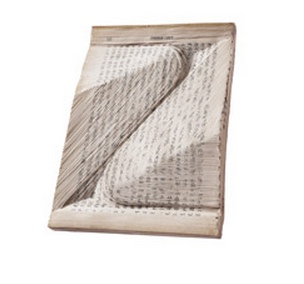
Oratorical Type Z by Nerhol (Ryuta Iida and Yoshihisa Tanaka)

The Japanese artists and partners Ryuta Iida and Yoshihisa Tanaka are known as NERHOL.  Interviewed by Rebecca Fulleylove in the online magazine It’s Nice That, they explain the name:

We met at one of Iida’s exhibition and realised we had so much in common in regards to experience, design and taste. Gradually, we began working together. Our very first piece, Oratorical Type, used books as the theme, after sculpting them by carefully carving out certain sections of each page, it resulted in interesting dimensions. At that time, we still hadn’t decided on our name but soon came up with “NERHOL”, a mash-up of two words, “neru” to plan ideas and “holu” to sculpt and carve.

“To plan ideas” and “to sculpt and carve” those ideas in air, time, stone, wood or paper is that not a poem, a book, a building, a city — the work of art?  That these two artists chose the letters of the alphabet as their first work together, that the alphabet and each of its letters came into being by collective human art and craft, marking our passage from orality to literacy, and that the alphabet, type and book are tools by which we have strived to evolve — how could they not be named Nerhol and their first work of art not be called Oratorical Type?

Bookmarking Book Art — Kylie Stillman

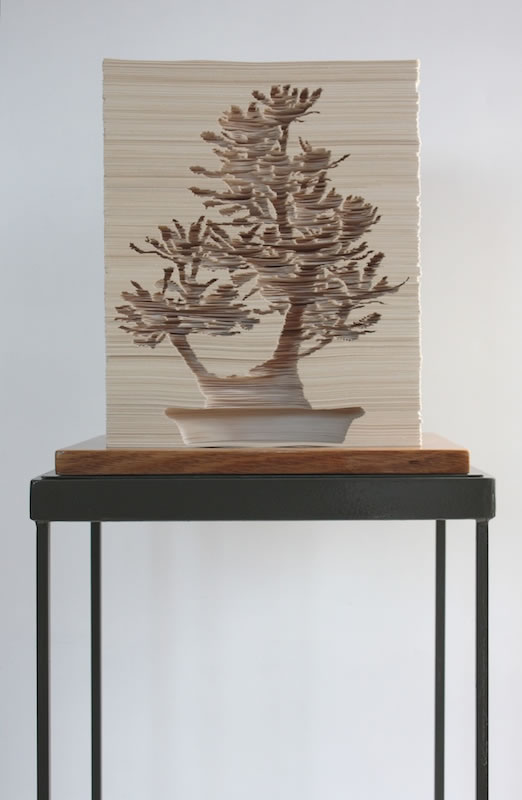
Banksia Serrata (2012)
Copyright © Kylie Stillman 2012 

When working with books, each sheet of paper is painstakingly carved by hand with a scalpel to create forms that emerge in absence.

Artist statement. Accessed 14 March 2013.

Utopia Art Sydney represents Stillman and holds a large number of her works. Her site reproduces a 2014 interview conducted by Owen Craven for “Artist Profile Magazine” in which Stillman responds to Craven’s question about the influence of conceptual art:  

While I do appreciate that conceptual attribution, it is important for me to do something and not let the object be the work on its own. There is an inherent poetry in many objects but in my case it’s important I do something more. It is important that I create something accessible and that the viewer isn’t left scratching their heads and asking ‘am I missing something’.  

And yet most of her work depends on what is missing.

Bookmark — The ABC of Bookmarking

romandelarose
Detail from Harley MS 4425, Roman de la Rose

767479
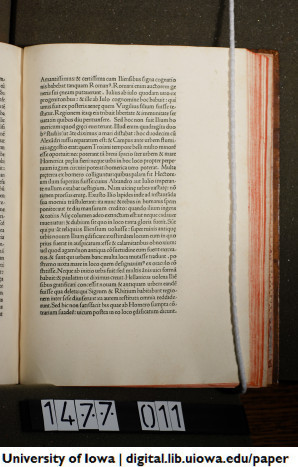
Historia Rerum Ubique Gestarum

The British Library‘s “Medieval and Earlier Manuscripts” blog is a reliable source of visual delight and provocation to think about the interplay of the print and digital worlds.  It also prompts the application of Ezra Pound’s critical technique of juxtaposing works, demonstrated so well in his The ABC of Reading.

Earlier this year, Ann Tomalak, Conservator, Greek Manuscripts Digitisation Project, posted “Digitising Manuscripts:  The Condition Assessment,” a wonderful essay that warrants reading alongside A Degree of Mastery by Annie Tremmel Wilcox.

I have read A Degree of Mastery from cover to cover twice.  Once in New York between 2002 and 2005 when I was teaching “Professional Book and Information Publishing” at NYU and wanted readings to help provide students with a sense of the history, art and craft of the book. The second time here and now in Windsor looking for the “right something” to include in “Books On Books.”

On both occasions ebooks and digital publishing pervaded my thoughts, but only on the second time around did these questions and observations I want to raise now shape themselves as they have.

Annie Tremmel Wilcox weaves a memoir of her apprenticeship under the renowned bookbinder and conservator William Anthony.  She weaves it with her diary entries, excerpts from an exhibit brochure “Saving Our Books and Words: The Conservation and Preservation of Books,” newspaper articles, correspondence, passages from “Japanese Woodworking Tools: Their Tradition, Spirit and Use” by Toshio Odate, step by step descriptions of mending torn pages and crumbling leather spines and plainspoken observation of fellow workers, conference attendees, librarians, government officials posing with restored documents, children making “books” from striped computer paper with wallpaper sewn on for covers and, of course, Bill Anthony, the “Johnny Appleseed of bookbinding.”

“Weaves” is the precise word for the structure of her book’s narrative, and it would be the right word for her ebook, if there were one.  As I re-read it, this game of word substitution yielded questions that make this memoir a useful means to bookmark the evolution of the book.

Writing about some of the tools she learns to use — lifting knives, translucent bone folders, the spokeshave and others — she says of Anthony’s, “His tools were smarter than mine. They knew the correct way to cut paper or pare leather. By using them I could feel in my hands how the tools were supposed to work.” (48)  For Wilcox and her reader, Bill Anthony is the master “shokunin,” craftsman or artisan.  And when she quotes from Odate “For the ‘shokunin,’ utility and appearance must be enhanced by the tool’s ‘presence,’ that is its refinement and dignity….,” this reader asks,

What are the tools of the ebook maker? From whence comes their refinement and dignity — their “presence” — with which the “shokunin” imbues his creation as a result of his commitment to his craft?  In what tools of the ebookmaker does “the spirit of the tool that records the ‘shokunin’s’ ability through the years to face the uncertainties of life, to overcome them, and to master the art of living” reside?

Too Zen? Perhaps.

An English grad student, Wilcox relished handling the University of Iowa‘s Sir Walter Scott Collection, its Leigh Hunt Collection and The Works of Rudyard Kipling.  Confronted with earlier slapdash and botched work on certain volumes of the Kipling, she writes, “Certainly these volumes of Kipling are found on the shelves of numerous libraries across the country, but the integrity of ‘these’ volumes as a complete set has been lost.” (179)  What constitutes the “integrity” of an ebook or its constituents? Are ebooks so “immaterial” that such a question is nonsensical?

The author’s apprenticeship included collaboration on the exhibit “Saving Our Books and Words.”  In addition to coauthoring the exhibit’s brochure, Wilcox contributed to completing Anthony’s special project of developing for the exhibit a unique collection of models demonstrating “the evolution of the codex – the form of the book as we know it.”(181)  In the brochure she touches on the immateriality and materiality of the Center’s work: “Simply defined, preservation is the attempt to save the intellectual content of books while conservation is the attempt to save both the intellectual content and its vehicle — the covers, paper, endbands, etc. The former is concerned with saving what the human record contains without regard to the forms it winds up in. The latter focuses on the artifact itself, attempts to save this book, this sheet.” (192)

What is the “form” of the ebook as we know it? Is the ebook as much “vehicle” as “content”?  What are its equivalencies to the page or to what “binds” the “text block”?  What does it mean to “conserve” an ebook?  Of a digital copy, what are the materials; what is the artifact to be conserved?

Wilcox ends her memoir with the completion of her “masterpiece,” the restoration of the incunabulum that Bill Anthony assigned her before his death and which she completed after it with the help of “The Restoration of Leather Bindings” by Bernard Middleton, author of the standard text “A History of English Craft Bookbinding Technique.”  The work assigned was Pope Pius II’s “Historia Rerum Ubique Gestarum,” printed by Johannes De Colonia and Johannes Manthen in Venice in 1477, which when restored was “not a deluxe edition, but … had great integrity.”  In the year 2547, of what will the preservation and conservation of today’s e-incunabula consist?  Will some apprentice conservator understand the “form” of these ebooks “in the cradle” and, master of smart tools, restore them to their integrity?

With Ann Tomalak’s essay, perhaps we can see that future through her present lense on the past.  Give it a read.

Bookmarking Book Art — Georgia Russell

Georgia Russell’s
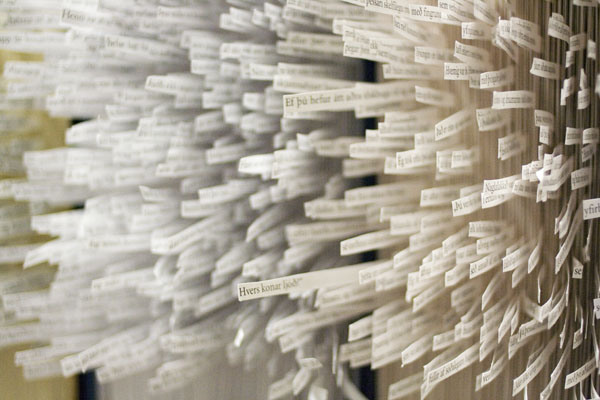
De Baudelaire au Surréalisme 2007

From England & Co’s online gallery:

“Russell’s work with books began during an artists’ residency in Paris while she was a student at the Royal College of Art. Old books have always seemed to her like sculptural objects ‘representing the many hands which have held them and the minds they have passed through’. She says that she has always chosen something which ‘holds within it a sense of its own personal history, an object which has a secret life’, and wants to resurrect her fragile materials and give them ‘a new life and new meaning’. There is a simultaneous sense of loss and preservation in each construction, as she wants to retain and reclaim the past as much as her techniques attack it.”

Like the phenomena in our transition between analog and digital, Russell’s shredded books and the other instances of book art or “bookworks” bookmarked here constitute another form of “creative destruction” to stretch Schumpeter’s economic concept.

The opening up of new markets, foreign or domestic, and the organizational development from the craft shop to such concerns as U.S. Steel illustrate the same process of industrial mutation—if I may use that biological term—that incessantly revolutionizes the economic structure from within, incessantly destroying the old one, incessantly creating a new one. This process of Creative Destruction is the essential fact about capitalism.

                      Capitalism, Socialism and Democracy (1942), p.83

Of course, without the old print book industry’s output, our Scottish artist and her kith and “ken” will eventually face a scarcity of raw material for their new art industry.  A sure sign of a misapplied economic theory, however apropos and paradoxical the misappropriation of the paradox may feel.

See also The First Seven Books of the Papier Biënnale Rijswijk

Bookmarking Book Art — Thomas Allen

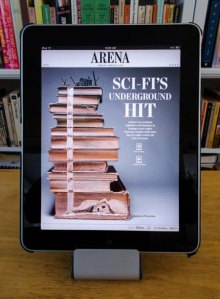
wsj_ipad
Stories
Posted on March 9, 2013 by Thomas Allen

This image of Thomas Allen’s book art appears along with the story about fellow-North Carolinian Hugh Howey‘s self-published novel WOOL in the 7 March 2013 edition of The Wall Street Journal but only in the iPad App version. Go to SECTIONS, then ARENA.

Click on the image to the left to go to Allen’s website to see more of his work and find out how to purchase it.   If you can find the Fall 2006 issue of Zoetrope:  All Story, you can see more of Allen’s work, but click here to read Chip Kidd’s comments on Allen’s artistry.

Bookmarking — A Variable Redletter Day?

In a report possibly falling under the category “What the Font?” or  simply “Sans Clue,” PoliceSpecials.com carried this story from the BBC today:

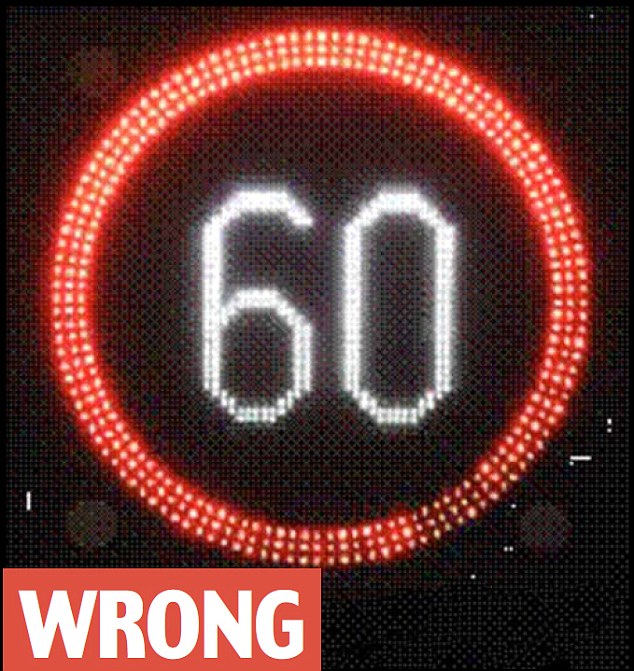
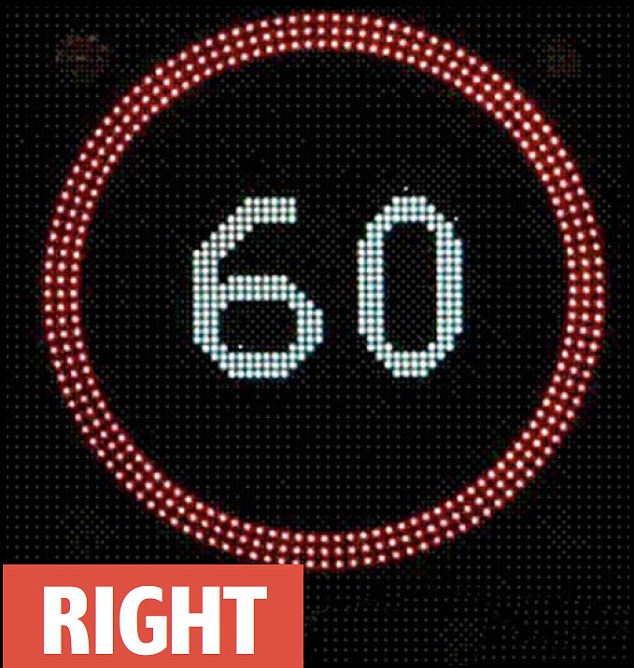
“Thousands of motorway speeding convictions could be overturned because the font used to display the numbers on some variable speed limit signs may not have complied with traffic regulations.  The Crown Prosecution Service said the signs showed mph numbers taller and narrower than they should have been.”

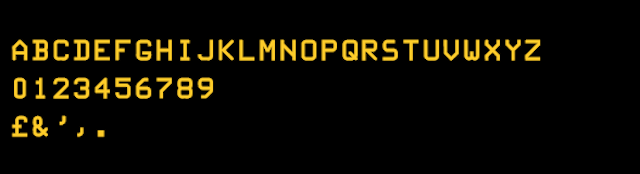
The typefaces mandated by the Department of Transport for traffic speed limit signs are Transport Medium, Transport Heavy and Motorway Permanent.  The designers were Jock Kinneir and Margaret Calvert.   Simon Garfield provides an amusing chapter in Just My Type on how their design came to be adopted.  But the typeface in question on which the BBC has belatedly reported (see the Daily Mail for the original scoop last December) is this:

variable

According to roadsuk.com (well, that is the URL, although a bit of blue in the letters “u” and “k” help to disambiguate the message),  the font seems to be named (imaginative this) “Variable Message Sign.”   But in the Daily Mail article, neither the “wrong” nor “right” signs illustrated seems to be in the Variable Message Sign typeface.  So, what the font?

article-2251985-169E2590000005DC-278_634x671 article-2251985-169E2560000005DC-717_634x668