Books On Books Collection – Sean Kernan

one_secretsm
Copyright 1999, Sean Kernan, Inc.

The Secret Books is a dialogue between the photography of Sean Kernan and the writings of Jorge Luis Borges.  It contains tritone photographs, short stories, poems and quotations as well as an essay by the artist.   Kernan explains how the dialogue began:

“There was an old book out on a table. I went to put it away, but instead I just opened it and gazed. I looked at the way the sharp metal type cut into the paper, at the blooms of foxing in the margins. I smelled its slight odor of papery rot, caught Latin words here and there and made out that they said something about the spirit and devotion. I stood there for the longest time. The book had stilled me.

On an impulse, I went to the closet where I keep a compost heap of props and got four black stones from a Japanese river. I set them out carefully in a line across the pages of the book. And suddenly it looked to me like…a poem. Or a kind of poem, at least. Maybe a Haiku or something by one of the Imagists, something that didn’t narrate or argue but just placed a few simple things before you and invited you to complete the work. This book with its stones was a pure image, the kind that can move from one mind to another and root there in some mysterious panspermic process. Joining things that didn’t logically go together–Latin meditations and Japanese rivers, black stones and creamy paper–broke apart some notion of what these things should say and set my imagination free to work. I had always wanted my photography to do this, and now I saw this wonderful composition open on the table before me.

I took a picture of this poem. And that was the beginning of these books.

After a while there were enough of them to suggest that they might themselves make a book, and indeed had to be a book. So I began to think about what might be necessary to make this happen. Perhaps it needed the armature of a text, but what that text might be and how it might work to unite the whole wasn’t clear. Then a designer friend, Lana Rigsby, saw the pictures and said they reminded her of Borges.

Of course! …

The Secret Books doesn’t attempt to illustrate Borges, and it doesn’t aspire to be a collaboration–as an artist I couldn’t hold his coat. I have simply found some instances in which he speaks directly about books and have put them with my images of books to make a kind of sequence, or perhaps a dialogue. And navigating thus under the star of Borges, I look at this book–words and images, side by side on the table before me–and find myself looking down dark, unfamiliar paths across the plane of the world with a rising sense, both exciting and ominous, that everything is about to change.”

The Secret Books was published in 1999 by Leete Island Books to coincide with the centennial of Borges’ birth and, by happenstance, with the start of the long journey to the EPUB standard.  The month before The Secret Books appeared the Open eBook Forum (now the IDPF) released the Open eBook Publication Structure (OEBPS) version 1.0.  A coincidence Borges would have relished.

English: The poem El apice of the Argentinian ...
English: The poem El apice of the Argentinian poet Jorge Luis Borges on a wall of the building at the Groenhovenstraat 18, Leiden, The Netherlands. Nederlands: Het gedicht El apice (De top) van de Argentijnse dichter Jorge Luis Borges op een muur van het gebouw aan de Groenhovenstraat 18 in Leiden, Nederland. (Photo credit: Wikipedia)

Further Reading

Lizzie Brewer“. 4 July 2023. Books On Books Collection. For another homage to Borges.

Ines von Ketelhodt“. 1 February 2021. Books On Books Collection. For another homage to Borges.

Peter Malutzki“. Books On Books Collection. For another homage to Borges.

Aurélie Noury“. 9 November 2020. Books On Books Collection. For another homage to Borges.

Hanna Piotrowska (Dyrcz)“. 13 December 2019. Books On Books Collection. For another homage to Borges.

Benjamin Shaykin“. 3 December 2022. Books On Books Collection. For another homage to Borges.

Rachel Smith“. In progress. Books On Books Collection. For another homage to Borges.

Sam Winston“. 18 May 2023. Books On Books Collection. For another related alphabet work.

Frate, Kathryn Shank. 2019. “Tower of Babel Exhibit“. Scuola Internazionale di Grafica, Venice. Accessed 28 June 2023.

Basile, Jonathan. 2015~. The Library of Babel. Website. Accessed 3 July 2023.

Moving the bookmark on apps vs epub vs pdf

altmetricexplore comment


Last year, BOB bookmarked the following blog entries:

JMax (http://www.ccsp.sfu.ca/2012/11/books-in-browsers-2012-a-watershed/)  “Books in Browsers is a “future-of-publishing” conference. It is arguably the future-of-publishing conference right now. As the name suggests, it is loosely arranged around the idea that the future of the book is wrapped up in the future of the (Web) browser.”

Jason Pontin (http://www.technologyreview.com/news/427785/why-publishers-dont-like-apps/) “Last fall, in version 3.0 of our apps, we moved the editorial content, including the magazine, into simple RSS feeds in “rivers of news.” We dumped the digital replica altogether. Now we’re redesigning TechnologyReview.com, which we have made free to use, and we’ll follow the Financial Times in using HTML5, so that our Web pages will look great on a laptop or desktop, tablet, or smart phone. Then we’ll kill our apps, too. Now we just need to discover how to make the Web pay.”

Anna Lewis (http://www.futurebook.net/content/cruising-browsing-experience) “should publishers be putting the browser at the centre of their digital strategy, or focusing on files and apps?”

Nellie McKesson (http://toc.oreilly.com/2013/01/pdf-is-still-better.html) “… our popular eBook formats (EPUB and .mobi) and the eReaders built to read them also currently attempt to mirror the print structure, and limit how publishers are “allowed” to format their content. The EPUB 3 standard promises HTML5 support, but the various eReaders have been slow to adopt the new standard, and even when they do, they’ll likely still offer very limited support for just a subset of the spec. This means we’ll need to find platforms both to create and to distribute these new digitally-redefined eBook products. We’ll also need to train production teams to work with these new technologies, and find authors and editors who can think in the context of the screen.”

But while JMax, Jason Pontin, Anna Lewis and Nellie McKesson argued the case for HTML5 and designing for the screen, the browser developers were embracing PDF.

Utopiadocs (http://utopiadocs.com/index.php), “combining the convenience and reliability of the PDF with the flexibility and power of the web.”

Michael Kozlowski (http://goodereader.com/blog/electronic-readers/firefox-update-makes-e-reading-easy-with-new-pdf-viewer/)  “Mozilla issued a statement that said ‘Today, the PDF.js project clearly shows that HTML5 and JavaScript are now powerful enough to create applications that could previously have only been created as native applications. Not only do most PDF’s load and render quickly, they run securely and have an interface that feels at home in the browser. As an added benefit of using standard HTML5 API’s, the PDF viewer is capable of running on many platforms (PC’s, tablet, mobile) and even different browsers. Last, performance will only get better as JavaScript engines and rendering performance continue to improve in browsers.'”

Bookmarking Book Art – Basia Irland

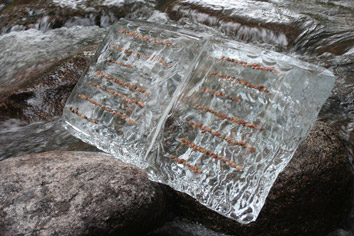
Basia Irland’s art project ICE BOOKS: receding/reseeding gives a formidably tangible and new meaning to “publishing as dissemination.”  As Irland describes the project on her site:

River water is frozen, carved into the form of a book, embedded with an ‘ecological language’ or ‘riparian’  consisting of local native seeds, and placed back into the stream. The seeds are released as the ice melts in the current…

Tome I

I carved a 250-pound book from clear ice and embedded it with a seed text of Mountain Maple (Acer spicatum), Columbine flowers (Aquilegia coerulea), and Colorado Blue Spruce (Picea pungens). Four people carried the heavy book out into the current of Boulder Creek.  As it rested between two large rocks, viewers cold see the water flowing under the ice.  Ice Books.   Accessed 17 February 2013 and 11 September 2014.

This is book art as performance art and conceptual art but with a twist: the performance yields results beyond the on-site viewers’ memories or any photography and video of the event replayed in galleries or museum installations.  Whether the seeds that float downstream in local rivers do take root is uncertain. As there is at least a chance that it will happen, it is more than the concept that counts.

“Performed” across 18 locations around the world, Irland’s project has been going since 2007. Fittingly the first performance began with Lucy R. Lippard’s Weather Report exhibition in 2007, but the concept has a rich heritage. With some further reading and the help of Peter Verheyen’s listserv BKARTS, I have tracked down some of that other “ramifying” or “ecologically political” book art.

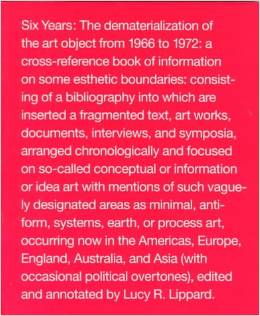
Lucy Lippard, Six Years
Lucy Lippard, Six Years (1997)

Starting with Lippard herself, there is Six Years, the 1973 seminal, long-subtitled work that drew attention to  Hans Haacke’s Wind in Water  (1967) and other conceptual and environmental art.  And then came Doug Beube’s pieces from the 80s and later such as Organic and The Chair of Censorship.  In the late 90s, we had Ann Marie Kennedy’s Plant Dreams. In 2010, Maggie Puckett’s “Thaw“.

And now, this conceptual book art has revolved back into books:

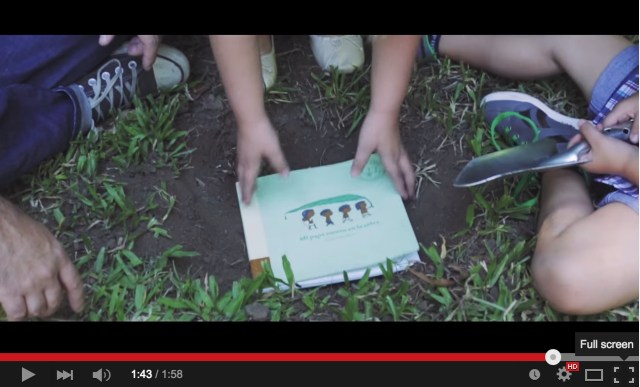
Pequeño Editoran Argentinian children’s book publisher, has published Tree Book Tree with ecologically friendly ink and acid-free paper embedded with jacaranda seeds. As the video explains, “Books come from trees. Today, a tree comes from a book.”

Tree Book Tree Published on 3 May 2015 The first book that can be planted after it is read. FCB Buenos Aires
Tree Book Tree, 2015
Video published on 3 May 2015
FCB Buenos Aires

The act of reading then planting the book echoes the twist in Irland’s performance and conceptual pieces. The book as read (the performance) resides in the memories of the readers, the concept (books are made of trees) resides in the mind, and downstream in time, a jacaranda blossoms overhead.
il_570xN.537080074_jfho


Compare also with the work of Jaz Graf.

Bookmarking Book Art – Guy Laramée

The form of the book, the book as technological artifact, each of the book arts (design and layout, typography, illustration, papermaking, imposition, printing, binding, preservation and restoration) and even the book as an objet d’art attract memes —  ideas, gestures, behaviors, methods, devices and practices that have spread from clay to scroll, from scroll to book, from book to ebook and perhaps from ebook to “cloud book.”

As we try to preserve – with clay counters in clay containers, with 0’s and 1’s stored on floating disks in tablets – we have assumed we are progressing.

Guy Laramée is a book artist,  a subversive book artist.   His “artist statement” articulates the meme of erosion, entropy and the dissolution of culture and knowledge — what he calls the “cloud of unknowing.”

Copyright © Guy Laramee.

Artist Statement

The erosion of cultures – and of “culture” as a whole – is the theme that runs through the last 25 years of my artistic practice. Cultures emerge, become obsolete, and are replaced by new ones. With the vanishing of cultures, some people are displaced and destroyed. We are currently told that the paper book is bound to die. The library, as a place, is finished. One might ask so what? Do we really believe that “new technologies” will change anything concerning our existential dilemma, our human condition? And even if we could change the content of all the books on earth, would this change anything in relation to the domination of analytical knowledge over intuitive knowledge? What is it in ourselves that insists on grabbing, on casting the flow of experience into concepts?

When I was younger, I was very upset with the ideologies of progress. I wanted to destroy them by showing that we are still primitives. I had the profound intuition that as a species, we had not evolved that much. Now I see that our belief in progress stems from our fascination with the content of consciousness. Despite appearances, our current obsession for changing the forms in which we access culture is but a manifestation of this fascination.

My work, in 3D as well as in painting, originates from the very idea that ultimate knowledge could very well be an erosion instead of an accumulation. The title of one of my pieces is “ All Ideas Look Alike”. Contemporary art seems to have forgotten that there is an exterior to the intellect. I want to examine thinking, not only “what” we think, but “that” we think. 

So I carve landscapes out of books and I paint romantic landscapes. Mountains of disused knowledge return to what they really are: mountains. They erode a bit more and they become hills. Then they flatten and become fields where apparently nothing is happening. Piles of obsolete encyclopedias return to that which does not need to say anything, that which simply IS. Fogs and clouds erase everything we know, everything we think we are.

After 30 years of practice, the only thing I still wish my art to do is this: to project us into this thick “cloud of unknowing.”

ADIEU Guy Laramée Copyright 2013
ADIEU (2013)
Guy Laramée

Is that the book’s evolutionary destination – in the “cloud”?

Further reading

http://sculpting.wonderhowto.com/news/artist-carves-old-books-into-beautifully-painted-landscapes-0175708/?_scpsug=crawled_46008_f4679e90-cedb-11e6-bd01-f01fafd7b417#_scpsug=crawled_46008_f4679e90-cedb-11e6-bd01-f01fafd7b417

Magnificent New Carved Book Landscapes and Architecture by Guy Laramée

“Guy Laramée’s (previously) new series Onde Elles Moran (Where They Live) captures the mystique of the native birds of the Brazilian region Serra do Corvo Branco (Range of the White Raven) through both portrait and carved landscape.”

Bookmarking Book Art – Exhibit at the Grosvenor Rare Book Room

Bookmarking Book Art — Long-Bin Chen

Bookmarking Book Art — “Out of Print: Altered Books”, A Virtual Exhibition

Bookmarking Book Art – Update to “Rebound: Dissections and Excavations in Book Art”

Mihai, Cristian.  “Showcase: Guy Laramée“, Irevuo, 31 March 2018.

Bookmark for the “Used e-book, slightly foxed”

In “Used e-book, slightly foxed,” Nicholas Carr ponders Amazon’s widely reported patent on a method allowing the resale or giving of ebooks and other digital objects.

"Tiny Library Filled with Wee Books and a Deep, Dark, Secret,"  Artist, TheMistressT.  Accessed 10 February 2013.
“Tiny Library Filled with Wee Books and a Deep, Dark, Secret,” Artist, TheMistressT. Accessed 10 February 2013.

Matthew Kirschenbaum might dispute Carr’s view that there is no difference between the new and used ebook however.  In his book Mechanisms: New Media and the Forensic Imagination, he explores the nano-differences between masters and their digital copies, much as textual bibliographers have delved into the meaningful and revealing differences among print editions and even copies of the same print edition.

And with the recent publication of a W3C specification for Open Annotation of digital text, what might be inside that used ebook?   As Baratunde Thurston, author of How to Be Black and founder of Cultivated Wit, writes:

What if you could download books that had been pre-annotated? I would pay extra to read Freakonomics with commentary by Paul Krugman,The New Jim Crow with notes from editors at The Nation, or the Bible annotated by the creators of South Park. A book could always inspire new layers of meaning, but now it can host that inspiration and a slew of associated conversations.

Thurston’s proposition though is more akin to the digital equivalent of the Norton critical editions or Robert Strassler’s oversized, beautifully enriched Landmark editions of Thucydides, Herodotus and Xenophon.  Still, a pre-loved ebook is a different virtual matter and might be desirable to some hapless, non-haptic readers.  No doubt, resellers of used ebooks will want to assure their customers that their digital goods are free of lesser annotators’ bytes of marginalia and the latest viruses and Trojan horses favored by vandals and hacksters.   How will eBay cope, assuming it can come to terms with Amazon’s patent claim?

But to bring Thurston’s proposition and Open Annotation together suggests another market: the collectible ebook.  Can there be such a thing as a rare ebook?  Which libraries will be bidding for Clay Shirky’s ebook collection after he has shuffled off his digital coil?

The implications for DRM and copyright are delicious.  Recall the hoax that Bruce Willis was considering legal action against Apple over his desire to leave his digital music collection to his daughters?  If his collection’s metadata contained extensive annotations providing insight into the music or, more likely, the celebrity himself, why should iTunes’ Terms and Conditions override the family’s claim to the Die Hard star’s intellectual property that they could share (or not) with future celebrity biographers?

This year looks set to be one of important bookmarks for the evolution of the book: secondary markets for ebooks, Open Annotation, social reading and still more devices and applications for reading.

Bookmarking Book Art – Butterfly escaping Bertran de Born?

If only this were blood red (read), one might call it “Butterfly Escaping Bertran de Born.” Click to hear a reading of “Sestina Altaforte,” Ezra Pound’s attempt to dig up Bertran.

il_fullxfull.387056371_5xjc
From Joy at Etsy. Accessed 10 February 2013.

Bookmarking Book Art – Sarah Cohen

Blizzard Brings Contemporary Art

By massofglass9  |  Posted 4 hours ago, 09 February 2013  |  Cambridge and Boston, Massachusetts
CNN iReport
Accessed 09 February 2013
40488510151491788862813190521291-2379967_p9

Not cold enough for you?  Skate over to the artist’s web site for her stack of Ice Books. Sarah Cohen writes, “My books are usually made from ice and melt, referring to the melting icecaps, global warming, and the loss of books through newer technologies like the ereader. It’s all related. And just like ice, the snow books will also disappear over time- representing that permanence is always fleeting and that books may also disappear from contemporary culture.”

Bookmark for “A Brief History of Reading” (and a Revisit of “The Future of Reading?”)

Aristotle, a 4th-century-BCE philosopher, port...
Aristotle, a 4th-century-BCE philosopher, portrayed in 1493 Nuremberg Chronicle as a 15th-century-CE scholar (Photo credit: Wikipedia)

LiveInk® cleverly demonstrates how the display of writing has developed by presenting the following quotation from Aristotle’s On Interpretation in the forms in which it would have appeared in the different stages of the A Brief History of Reading.

“Spoken words are the symbols of mental experience, and written words are the symbols of spoken words.” — Aristotle, On Interpretation

For example,

In 2000 BC, the Phoenicians developed the first methods to represent spoken language – an alphabet consisting entirely of consonants:

SPKNWRDSRTHSYMBL
SFMNTLXPRNCNDWRT
TNWRDSRTHSYMBLSF
SPKNWRDS.

LiveInk® must hope for a place on the timeline for its re-formatting process (Visual-Syntactic Text Formatting (VSTF), which breaks up blocks of traditionally laid out text (flush left, ragged right or justified) and presents them in a more readable form, reminiscent of 20th century free verse.  The claim of increased readability is based on eye movement studies by Randall Walker, Charles Vogel, Stan Walker, Phil Schloss, Charles R. Fletcher, Youngmin Park and Mark Warschauer.

Last September, BOB picked up an article by Michael Kozlowski on the Kindle feature of synching an ebook with its counterpart audiobook and explored the question, “What can the physiology, neuropsychology and sociology of reading tell us about ourselves?”  The research behind LiveInk® is worth bookmarking for the reading list (see below) concluding BOB’s  September 2012 entry if only to experience the “melon twisting” that comes from trying to accommodate these disparate yet related perspectives on the act of reading.

Reading List

Vinall-Cox, JoanMoving From Paper to E-Book Reading.  eLearn Magazine. March 2012.  Retrieved September 8, 2012.

Rollins, H.A. Jr., Hendricks, R.  Processing of words presented simultaneously to eye and ear.  J. Exp. Psychol. Hum. Percept. Perform. 1980 Feb; 6(1): 99-109. Retrieved September 8, 2012.

British Association for the Advancement of Science (2007, September 11). Reading Process Is Surprisingly Different Than Previously Thought, Technology Shows. ScienceDaily. Retrieved September 8, 2012.

Association for Psychological Science (2010, August 30).  Eye movements reveal readers’ wandering minds.  ScienceDaily. Retrieved September 8, 2012.

Florida State University (2012, February 14). How Do Children Learn to Read Silently?. ScienceDaily. Retrieved September 8, 2012.

LiveInk® (four papers:  jaltcalljournal, National Educational Computing Conference, Reading Online and IEEE International Professional Computing Conference)

Bookmarking the Index

In 2003, at McGraw-Hill, we discovered something about making ebooks while working with Dr. Bill Detmer and Unbound Medicine to create Harrison’s On Hand.  Don’t start or present through the Table of Contents; start with the Index.

Ten years later and the lesson’s being rediscovered.  Read Hugh McGuire’s A Publisher’s Job Is to Provide a Good API for Books – Tools of Change for Publishing.