A few months ago, Greg Smith, a Toronto-based artist, reviewed Claire Bishop’s “Digital Divide” (Art Forum, September 2012). The review and Bishop’s article touch on a recurrent theme in Books On Books: the materiality and immateriality of books.
But the review and Bishop’s article resonate with some more recent and popular seismic tremors in the world of ebooks. With all but Macmillan caving into the US Justice Department, we are still left wondering where and when the consumer benefits in cheaper ebooks will be handed out. The prices on e-reading devices have plummeted, but in the world of ebooks, a slight unease about the inevitability of e-readers is creeping in as tablets and mini-tablets seize the imaginations of some with the loudest digital megaphones. “Are e-reading devices doomed?” And by extension – given that tablets are far more than ebook devices — “Is the trajectory for ebooks leveling off?” While the post-Xmas sales analysis will be more assiduously examined for the “evidence” than the equally predictive gizzards of our Xmas fowls, as Greg Smith paraphrases Julian Oliver, “the New Aesthetician”: material or immaterial, “we should all just keep focused on making stuff.”
Elsewhere I have commented on this JISC-funded project rising like a medieval cathedral from busy hands at the universities of Sheffield, Leicester, Birmingham, Glasgow, York and Queen’s (Belfast) will warm the enlightened taxpayer’s cockles. It is now coming to a summary conference to be held at the University of Leicester on 11 January 2013.
Everything about this ambitious project to enable full-text searching of literary manuscripts, historical documents and early printed books owned by libraries, archives, universities and publishers and now online is transparent and open to public scrutiny as it happens.
The researchers’ plan is to enable users to generate visualised search results using maps of medieval Britain, add their own annotations to the data for public consumption and contribute to a knowledge base that will surround and suffuse an outstanding body of primary sources: Manuscripts Online: the resources.
You can follow the Project Plan and meeting minutes, preview site designs and the scholars’ tweets about the work and witness what appears to be a project run “by the book.”
What makes his comments on comments on a comment bookmark-worthy are the comments they provoked from Gary Frost, Emeritus Conservator at the University of Iowa Libraries and the author of Future of the Book: A Way Forward(Coralville, IA: Iowa Book Works, 2012):
“The current rush of changes in print and ebook uses is dramatic evidence of our close relationship with books. A flood of digital reading devices and hybrid software and hardware designs are emerging as the print book is augmented by screen delivery and associated cloud libraries, ebook collection building, automated index and searching, and screen learning. While all screen book simulations deviate from print conventions the hybrids that emerge reference each other and often resonate with each other. This rapidly developing book production and consumption landscape is dynamic and unique in media history, or is it?
It’s pretty amazing that little attention is paid to the emerging composite of print and screen delivery of books. I mean looking directly between them and at an emergent functionality of all books. There you can now perceive the interdependence of print and screen and the likelihood that neither will flourish without the other. . . . Also involved are other forums, other than the forum of current technologies, their products and marketing. These other disciplines include academic book studies, cognitive science aspects of reading, book sustainability within libraries and many vectors of book arts.”
One might single out the infiltration of the book by “the social web” from the vector of current technologies that Frost insightfully identifies as necessary to explore this moment in the book’s/ebook’s evolution in which those who buy ebooks buy yet more print books. The ability to annotate and share print books is gradually being replicated, prodded as it were by the phenomenon of the social web.
So here you have it: a comment on comments on comments on comments on a comment.
“By accident of history, we have applied the same word to pop-up illustrations for children, lavish art and architecture hardcovers, compendiums of home cooking recipes, telephone directories, multi-volume encyclopaedias, historically significant works of literature and poetry, and fun and exciting works of entertainment and pop culture. What we call a ‘book’ has always been loosely inclusive. The only common element to these kinds of content is the object through which they’re distributed: paper, ink, thread, glue.”
Willow Pattern by Angela Slatter and others, written as part of if:book’s experimental publishing project, the 24-Hour Book, gives Groth the opportunity to introduce yet another collision in this long accident of history. The online publishing platform Angela Slatter used to write Willow Pattern is called Pressbooks. It retains and timestamps the complete text of every saved version of the story. As Groth puts it, this book “is not just the completed volume, it’s also the entire publishing process, the nuts and bolts and the broad range of information that went into creating it.” The common element of paper, ink, thread, glue is optional. What we have is a database offering other options: the online text with comments, data to explore “to find new threads between stories within the book,” and more. For Slatter’s thoughts on the experience, click here.
The if:book enterprise has a record of throwing down challenging bookmarks for the evolution of the book. This looks like another.
Norma Levarie (1920-1999) was a graphic designer and author of children’s books, one a winner of a New York Herald Tribune award — Little People in a Big Country. But, in addition to her design work for the National Audubon Society, The Jewish Museum, The University of Chicago Press, Oxford University Press, Random House and Harry N. Abrams, this Virginian’s most important gift to those interested in the evolution of the book and book arts is her volume The Art & History of the Book (New York: James H. Heineman, 1968).
The quality of her research and writing measures up to the best. If only Heineman had been able to afford color reproductions, her ability to handle illustrations and her keen eye for selection of examples would have placed this book in good company with works such as Michael Olmert’s The Smithsonian Book of Books (Washington, D.C.: Smithsonian, 1992). Still, Levarie’s book merits a bookmark for its overarching message, which is cleverly embodied in the book’s organization.
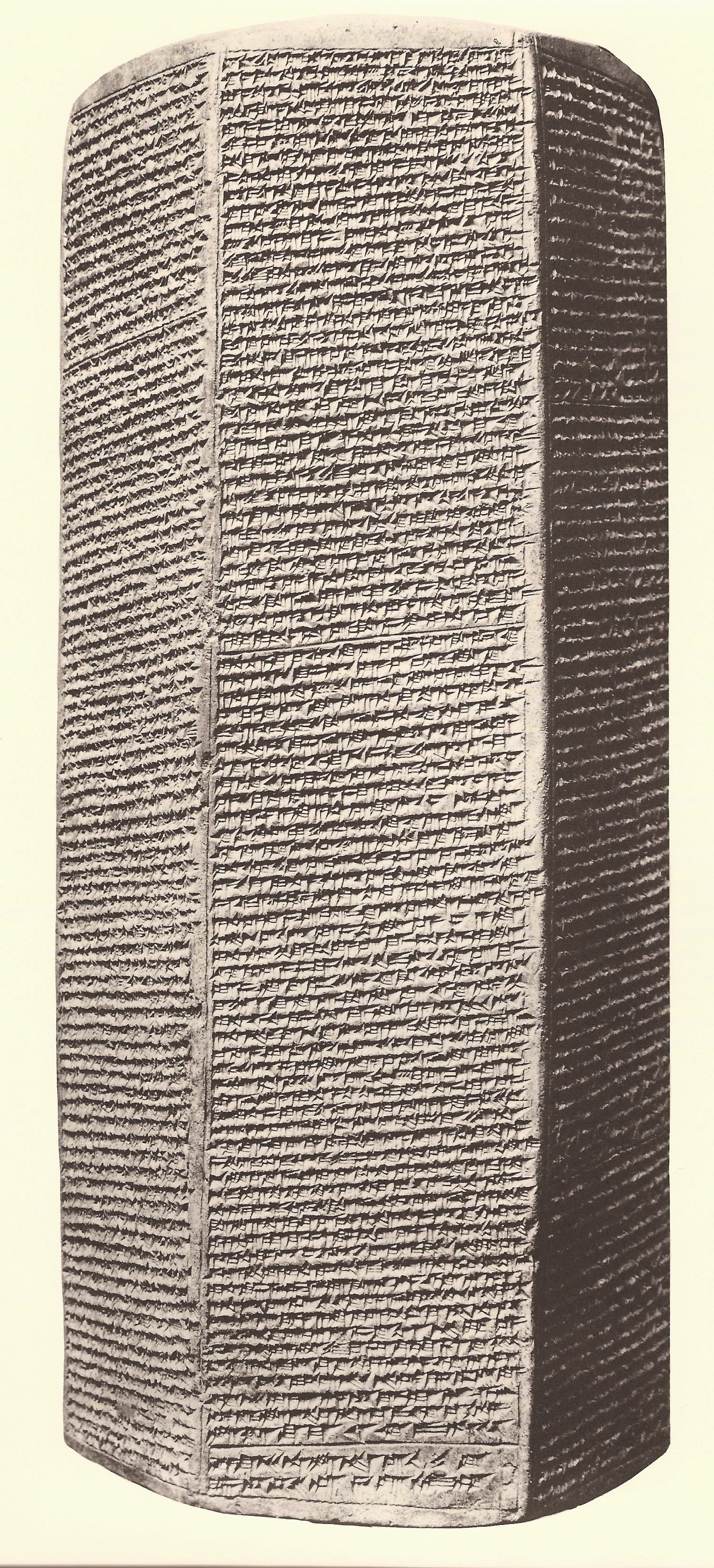
Facing the stark image of the Prism of Sennacherib on the opposite page, these words of Ashburnipal launch the book on the recto page:
Prism of Sennacherib. Assyrian, VII century B.C. Oriental Institute, University of Chicago. Height 15 in. Reproduced from Levarie, The Art & History of the Book (New York, 1968).
“. . . I read the beautiful clay tablets from Sumer and the obscure Akkadian writing which is hard to master.
I had my joy in the reading of inscriptions in stone from the time before the flood. . . .”
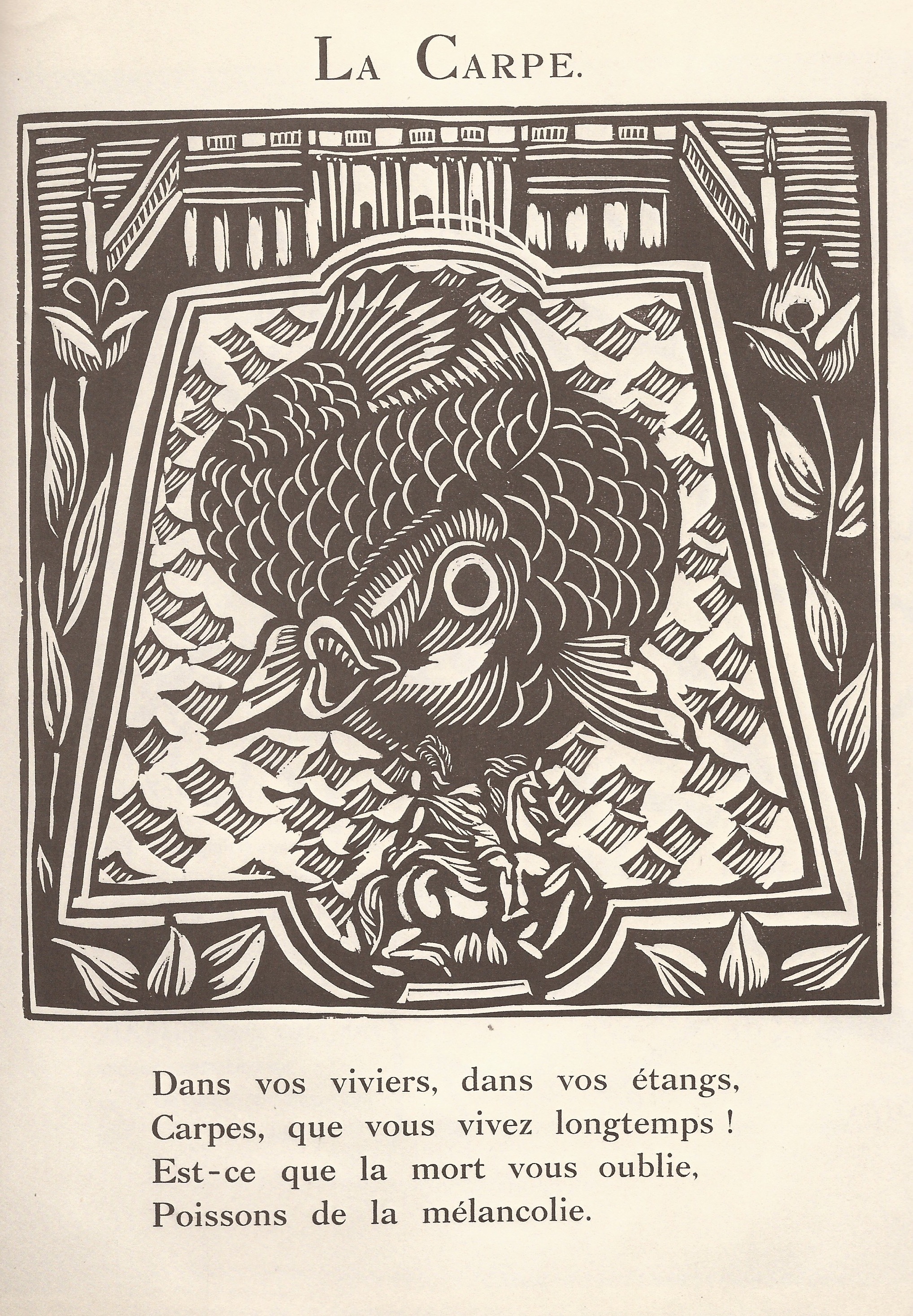
Continuing chronologically up to the fifteenth century and “block book,” Levarie switches to a geographical approach, starting of course with Germany, ending with England and returning to a timeline overview from the seventeenth century to the twentieth, the last illustrated with pages from Spiral Press’s Ecclesiastes (New York, 1965), drawings by Ben Shahn, engraving by Stefan Martin and calligraphy by David Shoshensky, and Apollonaire’s Le Bestiare (Paris, 1911).
Guillaume Apollinaire, Le Bestiaire. Paris, 1911. Woodcuts by Dufy. Yale University Library, Graphic Arts Collection. 14 x 10 1/4 in.
This structure neatly builds to these concluding words:
“The homogenizing forces of our time have broken many barriers of national style, and sometimes it is difficult to tell at a glance the origin of a book. But local differences in production or taste still exist, and where they are manifest they bring the pleasure of variety. . . .
For the lover of fine books, nothing can replace the bite of type or plate into good paper, the play of well-cut, well-set text against illustration or decoration of deep artistic value. But an inexpensive edition can carry its own aesthetic validity through imaginative or appropriate design. These are not matters of concern only for aesthetes; if, in an era of uncertain values, we want to keep alive respect for ideas and knowledge, it is important to give books a form that encourages respect. The style and production of books, for all the centuries they have been made, still have much to offer the designer and publisher in challenge, the reader in pleasure.” (303-06)
Leaping ahead more than fifty years to the shift from print to digital, we find that many of the observations and message legitimately reassert themselves. Websites and ebooks do vary in design from region to region, but standardization and, more so, the global character of the Web and the products of the technology industries counter-assert a homogeneity in design. Sven Birkerts‘ elegies for Gutenberg are echoed across blogs devoted to the continuing pleasures of the printed book. But likewise Levarie’s stand that these are not merely matters for the elite is echoed across the debate of print vs digital in the popular press and the democratizing blogosphere.
What still must be translated from her message is how to make the leap that, if we respect ideas and knowledge, we must give online books as well as print books a form that encourages respect.
William H. Gass’s books Finding a Form and Reading Rilke demonstrate over and over that one of this author’s great qualities is his ability, as Daniel Mendelsohn put it, to leave you “feeling more human.”
In 1973 in an article in The Library Quarterly and in her 1979 dissertation, Mingshen Pan (or Ming-Sun Poon) concludes from her examination of books during the Sung period that the colophon gradually changed in form, content, design, and placement, demonstrating an increasing use of the colophon as an advertisement of the printer and his wares. This shift embodied a critical transition in the printing trade of that time. As support from governmental and private sources waned, support from diversified sources were sought in which the commercial element played a significant role.
Familiar? As the European printing press began to make books available to a wider economic circle, manuscript books ceased to be supported by commission and patronage. One of the earliest and famous printers of Venice, Aldus Manutius, reportedly printed only one commissioned book (Hypnerotomachia Poliphili, 1499); the rest had to make their way in the market.
In Sir Isaac Newton’s day, “Printers secured their livelihoods by advertising medicines, . . . Physicians told each other that if they want to market a new drug then they ought to go to the booksellers to do it.” Adrian Johns, Piracy (Chicago: University of Chicago Press, 2009), pp. 84-85.
Publishing has always been marked (or marred) by the struggle to establish a stable business model.
Under the blog name “Wynken de Worde,” Sarah Werner writes about books, early modern culture, and those of us who may be postmodern readers — when she is not preparing the syllabus for her course at the Folger Shakespeare Library. Wynken (not related to Blynken or Nod) was the primary assistant to William Caxton the first printer of English-language books — Malory’s Morte d’Arthur, Chaucer’s Canterbury Tales, and The Golden Legend.
If Sarah Werner channels Wynken de Worde in her classroom as well as she does through her website, her students are to be envied. She makes what she writes tangible, palpable, haptic. Three brief examples, the last of which prompts this bookmark:
Imposition is “the arranging of pages in a chase [a steel or iron frame for holding them tightly for the letterpress] in a particular sequence . . . so that when folded the printed pages will be in consecutive order.” Glaister, Encyclopedia of the Book (2001). But the earliest books did not have page numbers, so how were old Bill and Wynk to know which to place where? Here’s Werner:
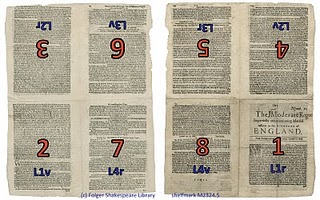
Lerner’s newsbook ready for folding.
Above is a numbered example of the same newsbook that I used as an image in my last post. The red numbers are page numbers: folded in the right way, you’d get an 8-page booklet in the order indicated. But if you look closely, you’ll see that the actual news sheet doesn’t have page numbers. Instead, there are signatures: at the bottom of the first page is a tiny, blotted “L”; at the bottom of the 5th page is a tiny “L3″ (the “L2″ has been cut off at some point when the page was trimmed). These are signature marks that count off by leaves. What’s a leaf, you ask? It’s a physical unit of paper: when you turn the page in a book, you are actually turning a leaf of paper. Early modern printers would have thought in terms of sheets and leaves, not pages, when they were figuring out how to print a work. Depending on the imposition (how the text is laid out on the sheet), you could end up with different numbers of leaves: 1, 2, 4, 8, 12, 16, 24. A quarto imposition results in a sheet of paper being turned into 4 leaves; there are 2 pages to each leaf (a recto side and a verso side), so there are 8 pages in all. The blue letters and numbers show the signatures. One thing that throws off beginners is understanding how recto and verso relate to each other. They do not mean right and left but front and back.
Providing a downloadable PDF with which to follow along, Werner walks the reader through the exercise and proves her point: “it’s a handy way to understand and demonstrate to others the general principle of early modern format: multiple pages are printed onto a single sheet in the correct order so that when folded, they appear sequentially.”
The second example of the pedagogically palpable or the palpably pedagogic comes in the same posting:
“When you’re done, you can try folding it into a tiny little pressman’s cap, following the instructions that appear in this lovely piece, “The Newspaper Man is Defunct,” from The Cape Cod today.”
That bit of fun was two years ago. The brilliance is undiminished today; if anything it’s brighter. For this year’s course, Werner is handing out her syllabus in unpaginated quarto format. To figure out the syllabus, the students have to fold the imposition correctly! Try it yourself and grasp the meaning of the “book arts.”
Ah, the books arts. Imposition. The dying arts? You need look no further than the end of your Proboscis to see that that is not true. Proboscis is a London-based non-profit studio that commissions and facilitates new works and publications, some of which can be found in the DIFFUSION library.
DIFFUSION ebooks are hybrid digital/material publications. They bring together the “tactile pleasures of tangible objects with the ease of sharing via digital media.” Shareable paper books, free to download as PDFs, print and make up, DIFFUSION eBooks “can be shared electronically or as material objects – scanned, photocopied, emailed or posted. The eBooks bridge analogue and digital media by taking the reader away from the computer screen and engaging them with the handmade.”
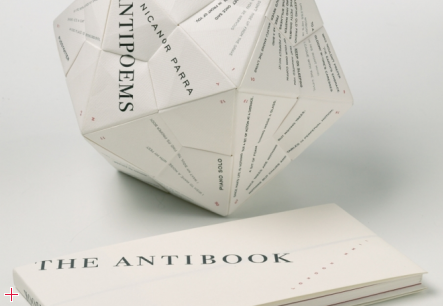
And just a bit further along the continuum is Francisca Prieto, also in London. Inspired by the serio-comical poet Nicanor Parra’s “antipoems,” Prieto offers up The ANTIBOOK.
The reader must fold the pages of the book (20.5 x 10.5cm) to form the icosahedron (15 x 17 x 19cm) in order to read Parra’s antipoems in order.
Whether Prieto’s ANTIBOOK or the DIFFUSION ebooks are book, art, both or neither, they and Wynken de Worde make us think with our hands as well as our minds about what can be done with the form and concept of the book. And that makes the concept of imposition worth a bookmark.
PS: “Books On Books” acknowledges David Pearson‘s Books as History (New Castle, DE: Oak Knoll, 2008 and 2011), p. 75, for the inspiration of the wording of the conclusion here.
PPS: Another opportunity to learn by doing can be found at the end of a short and witty book called A Dodo at Oxford: An Unreliable Account of a Student and His Pet Dodo. Under the guise of explaining, presenting and annotating a diary found in a charity shop, Philip Atkins and Michael Johnson deliver a history of the book. Appendix 7 provides the offer to engage in imposition.
PPPS (6 January 2021): Weeks into a third Corona virus lockdown, another contribution for learning imposition by doing has appeared. Appropriately this time in the Quarantine Public Library started by Katie Garth and Tracy Honn in May 2020. It comes from Barb Tetenbaum; check out the download and instruction video here.
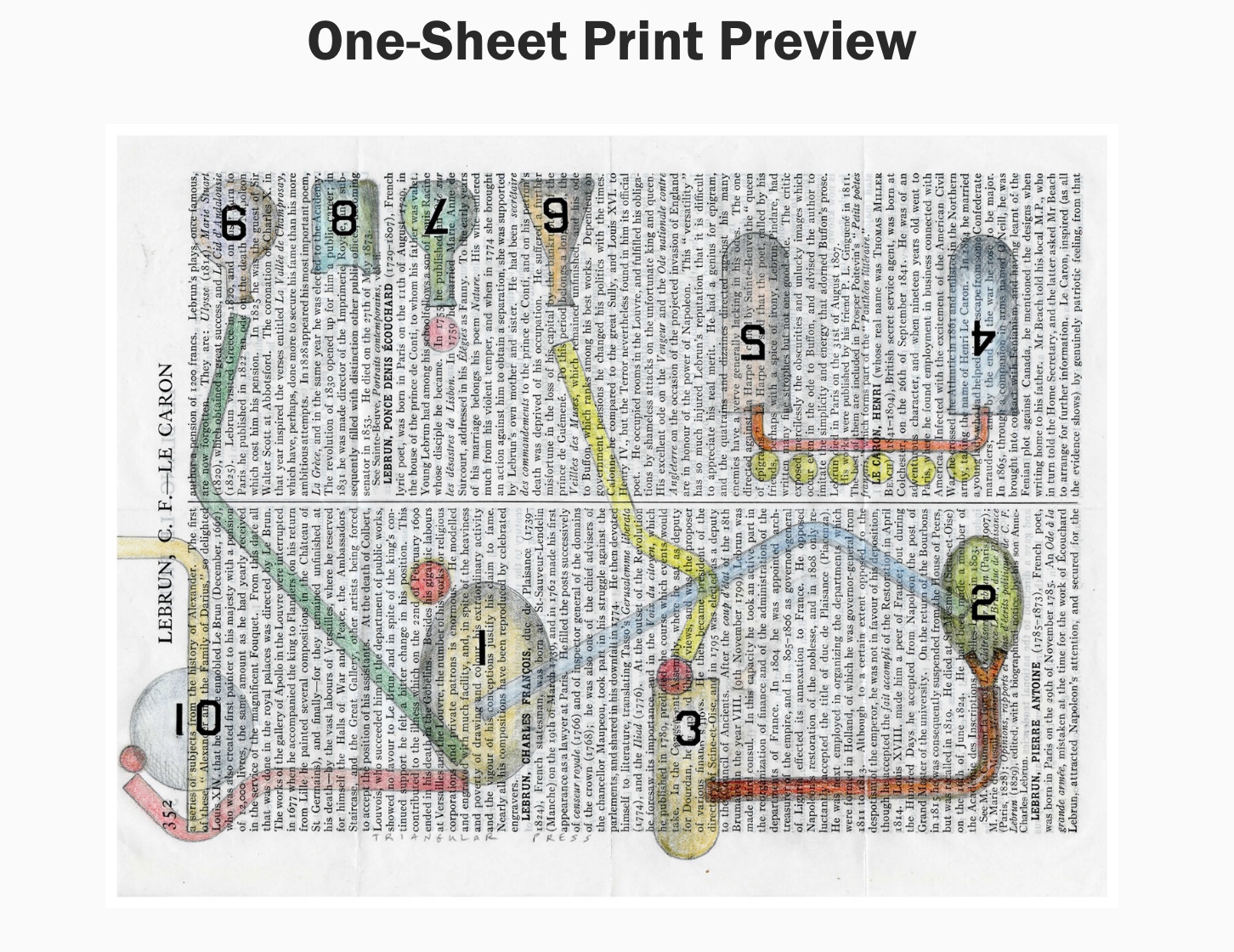
Untitled Barbara Tetenbaum Chemistry stencils (Prague, 1993); colored pencils (Madison, WI, 1975); and press-on letters from the model train industry are combined with a 100-year old Encyclopedia Brittanica page.
We’re witnessing another sea change in Web publishing. From Pinterest at the beginning of this year to the launch this week of a new product from two Twitter founders, Medium, 2012 has been a year where the norms of publishing are being challenged.
So writes Richard Macmanus at ReadWriteWeb about a new platform for Web publishing. But there have been books written in Twitter. What if the same were to happen in Medium? If the stream replaces the page, if topic maps replace authors, . . .
The original posting (20120815) begins beneath the image. The updates are flagged below.
Somewhat similar to the discussion kicked off by Jason Pontin in Technology Review, this collection of viewpoints pulled together by Anna Lewis of ValoBox for The Bookseller‘s digital blog FutureBook puts the case for HTML5 over the app/device.
“. . . HTML5 has laid down a new marker in browser standards. Not only does it enable offline capability through caching of content, it also lets you create websites that feel like native apps. The browser is certainly becoming a very different beast. So, does this mean publishers should rethink their approach to the browser, and see it as a way to deliver content, not just discover it?”
How the answers to this question play out affects the evolution of the book. Bookmark the concept if not this web page.
Also a three-part series of postings by Bill McCoy, Director of the International Digital Publishing Forum (IDPF), has begun at Tools of Change today (20120816). The first in the series articulates a key point about the book as content,
“. . . over time there will continue to be an increasing ability to conveniently publish directly to the cloud, as well as increasing acceptance by end users of cloud-based consumption. Perhaps someday the idea of a “file” will even become obsolete. But, at a minimum for many years to come – and possibly forever – it seems obvious that there will continue to be a significant role for reified content objects [italics added], particularly portable documents.”
Books On Books will add links to the second and third of McCoy’s postings by as they occur. The concept of the book as a reified content object (techy as the phrase may be) has its bibliographic and critical forerunners (in the work of McKerrow, Benjamin, Barthes, Ong and others) and its contemporaries (in the work of Illich, Hayles, Michael Joyce and others).
On its surface, the debate in which HTML5, EPUB 3, iOS apps, the ebook, the cloud are swimming seems to be a competition of technical approaches and tools. Beneath its surface, however, stirs something vital to the future of the book.
Updated bookmark begins here (20120817). . .
Before Bill McCoy’s next posting (see above for the first), Jeremy Greenfield at Digital Book World (DBW) usefully flagged a timely collection of postings supporting “the cloud trumps the future” perspective on ebooks: Hachette’s return on its investment in the cloud, the State Department backing off its Kindle deal in order to research other options (cloud-based being the implication), the major textbook publishers’ adaptation to Virtual Learning Systems and MOOCs (massive open online courses), etc.
The “cloud” view, however, recalls an apt caution Michael Joyce made in his Adam Helms lecture in Stockholm in 2001:
Digital culture reels and swaggers like a drunken plowman who dreams of taking flight, relieved of mortal weight and presence. . . . an old dream, perhaps the oldest of human culture . . . . Much is made of how the digital escapes fixedness, . . . from electrons hurtling along copper corridors, upward to switched registers of transient values, and ultimately to brilliant phosphor letterforms which disappear like fireflies in a billion recurring twilights of a nanosecond’s duration.
However we situate ourselves in place and time alike. Cyberspace is not exempt from the mortal and moral geometry wherein we place our hope and find our future.
This from one of the pioneers of the ebook. What is ironic here and now is that Joyce made these comments while comparing ebooks to print books, yet today they are equally applicable when comparing ebooks in ereaders to ebooks in the cloud. As the ebook in the ereader stands with the printed book as a “reified content object,” the cloud gathers.
 From
From 

 Books On Books