Books On Books Collection – Barbara Beisinghoff

Tau blau / Dew Blue (2013)
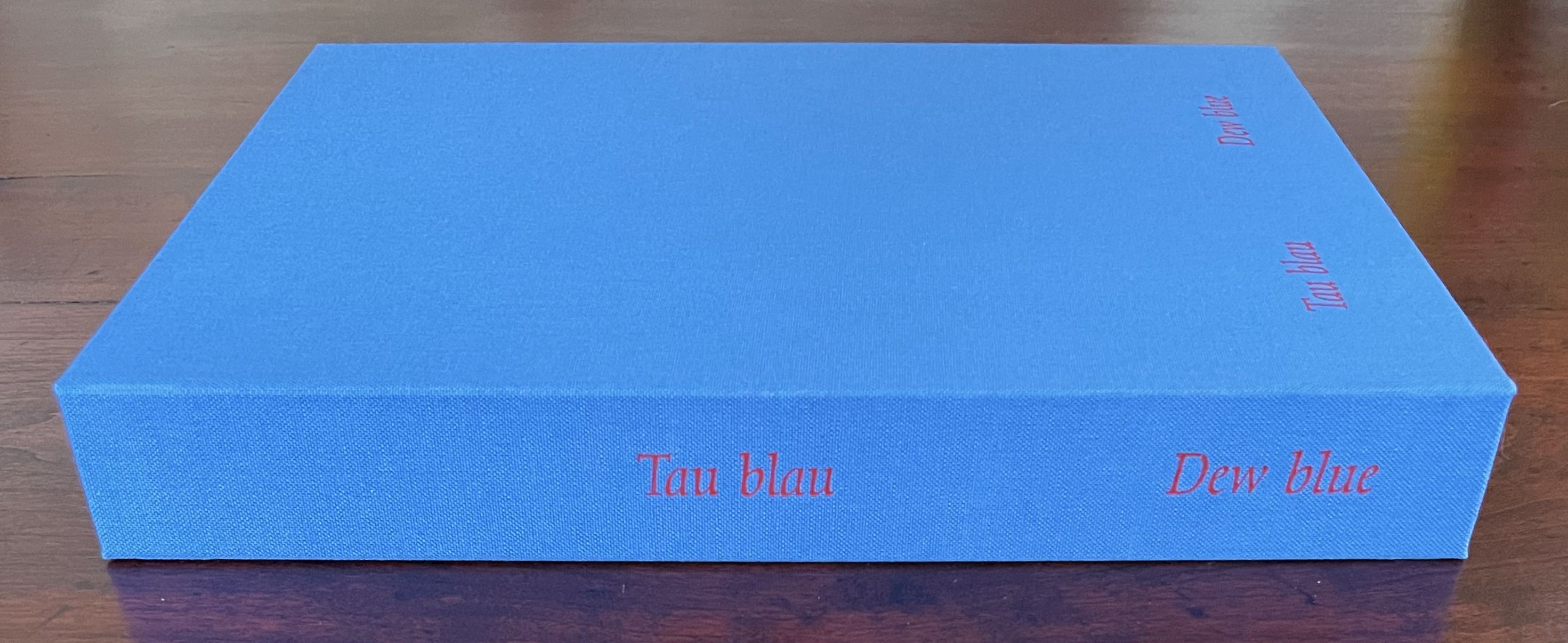
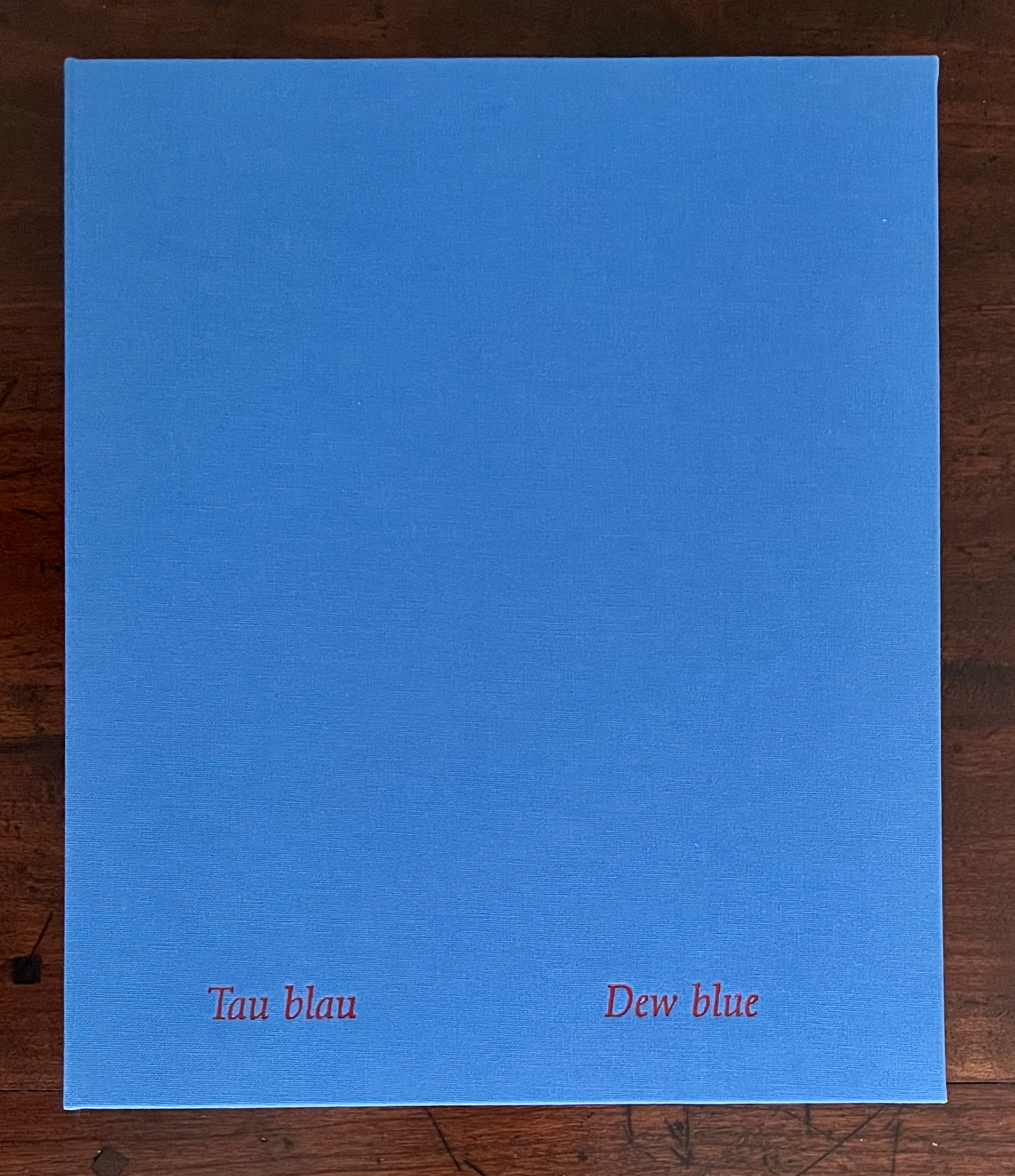
Tau blau / Dew Blue (2013)
Barbara Beisinghoff ; Solander box in linen, handbound Vera Schollemann; Flax paper, handmade by John Gerard.
Solander box: H240 x W200 x D32 mm. Flagbook: H220 x W180 mm. Edition of 38, of which this is #22. Acquired from the artist, 30 December 2024.
Photos: Books On Books Collection.

Familiarity with Hans Christian Andersen’s fairy tale Hørren /The Flax enhances appreciation of Barbara Beisinghoff’s Tau blau / Dew Blue. Andersen gives a voice to the plant that expresses its joy, pain, hope and observations at each stage of its blooming, being harvested, turned into linen and clothing then paper, and finally consigned to flames. The H.C. Andersen Centre offers Jean Hersholt’s translation of it here.

Only the opening paragraph of the story appears in Tau blau / Dew Blue, but Beisinghoff documents and illustrates the stages from her own cultivation of flax, observation of its growth and preparation of its processing. And with the etching, drawing, watermarking, handmade papers, linen cloth and thread, and binding structure, Beisinghoff suffuses the spirit of the tale’s metamorphosizing plant throughout the whole of Tau blau / Dew Blue.
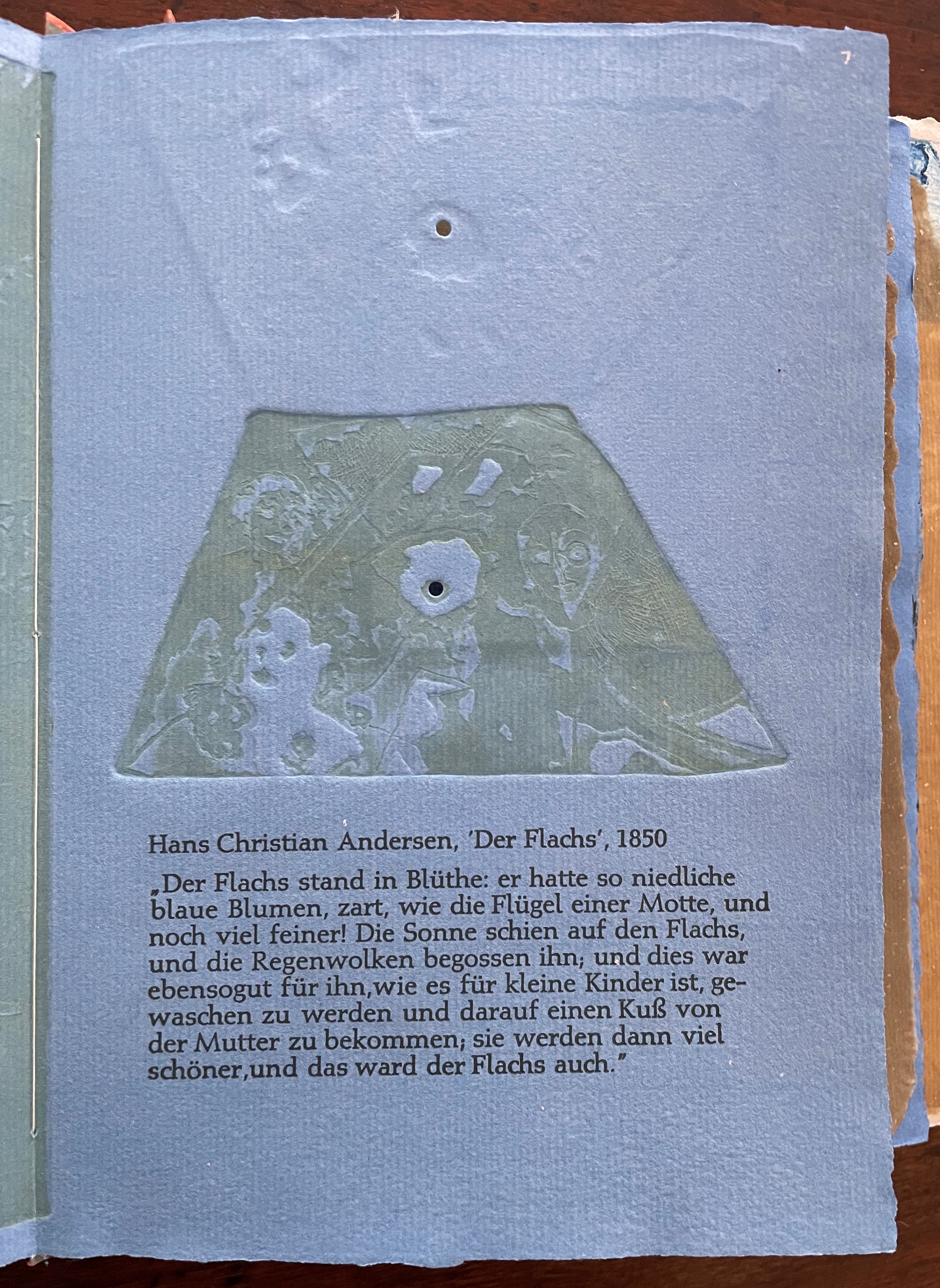
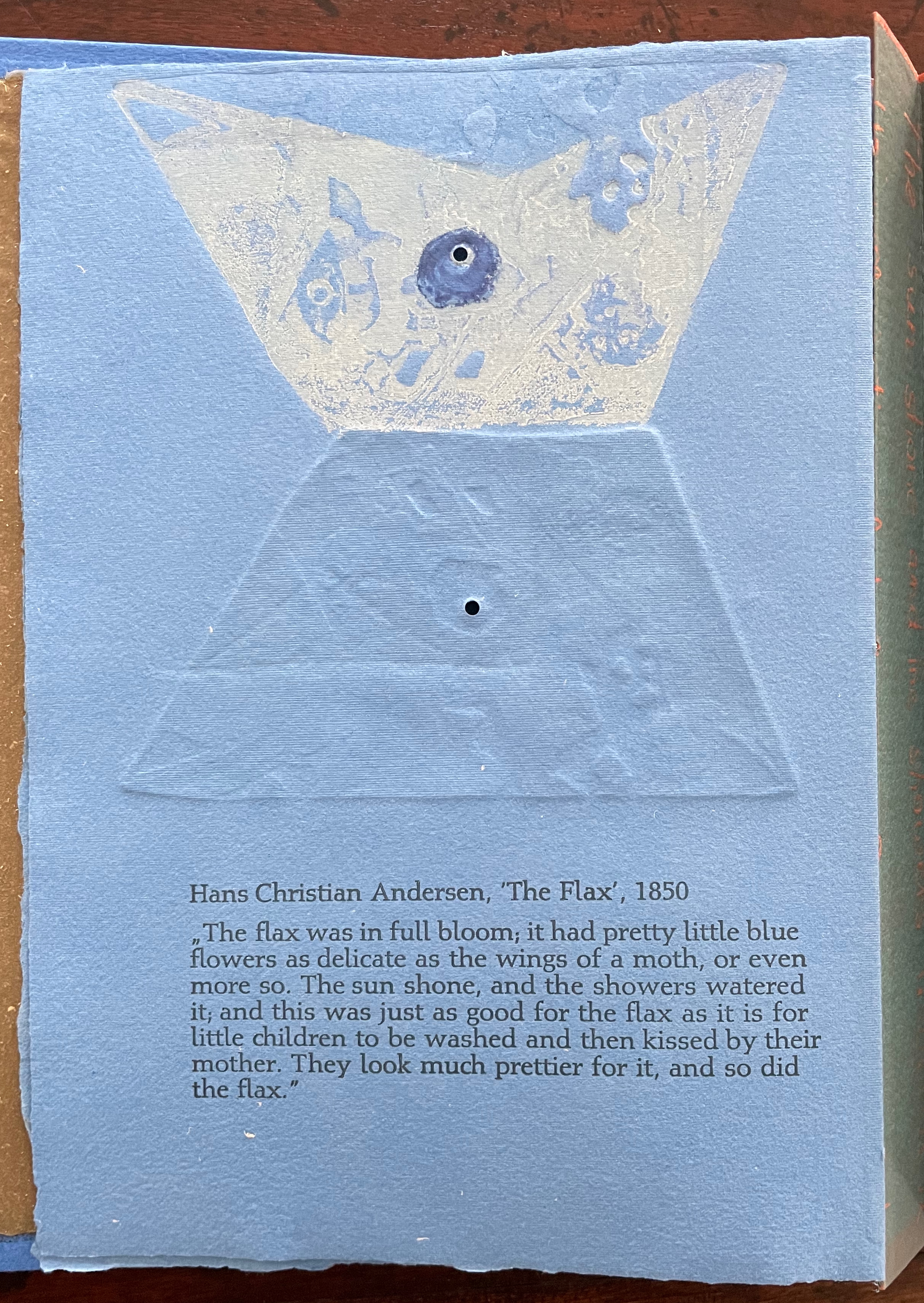
From the blue of the plant’s blossoms to the white of its change into linen and paper to the red, burnt orange and black of its sparks and ash when it is consumed by fire in the end, all of the story’s colors are replayed across Tau blau / Dew Blue from its Solander box to its covers and spine like motives in a Baroque musical piece.
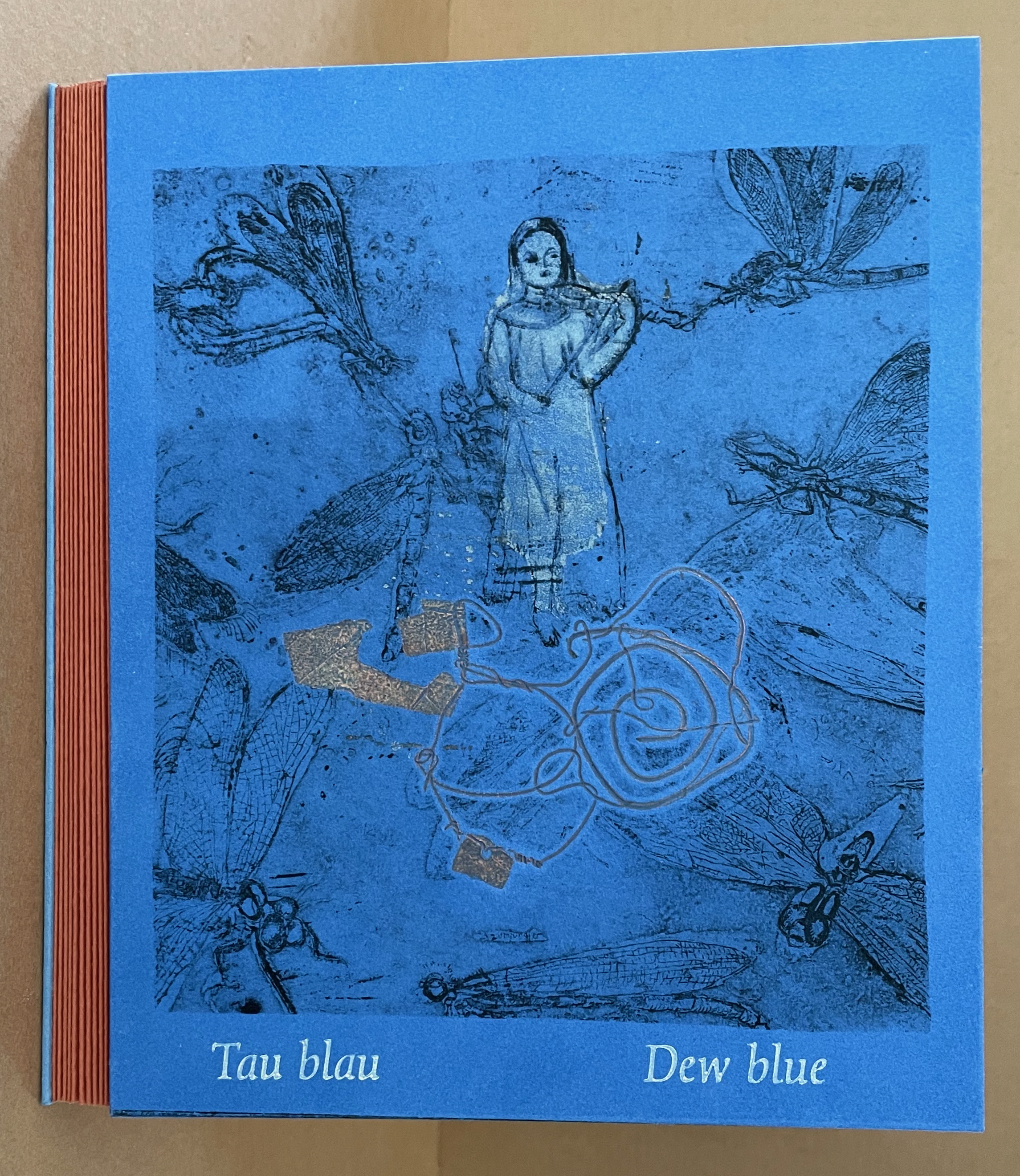
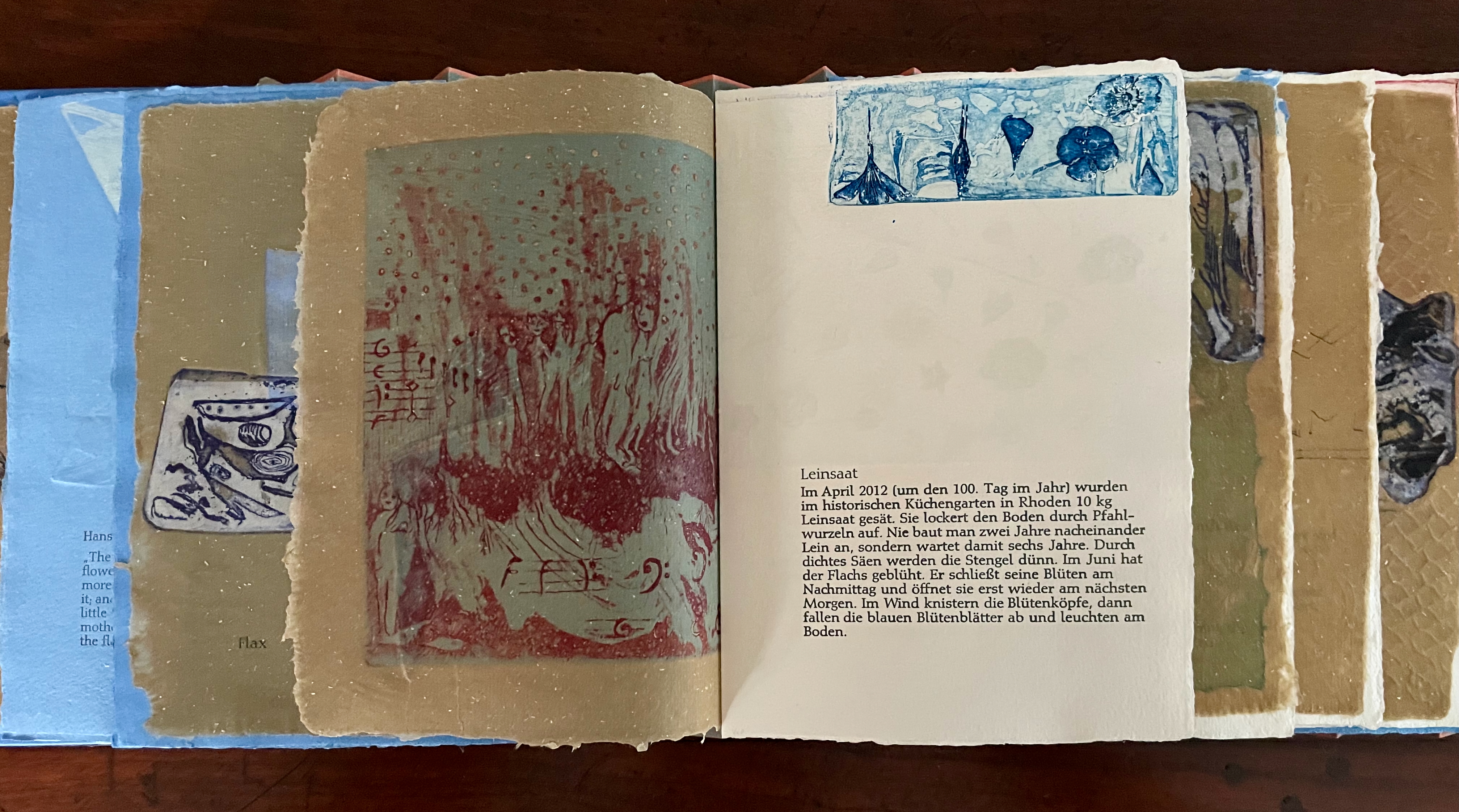
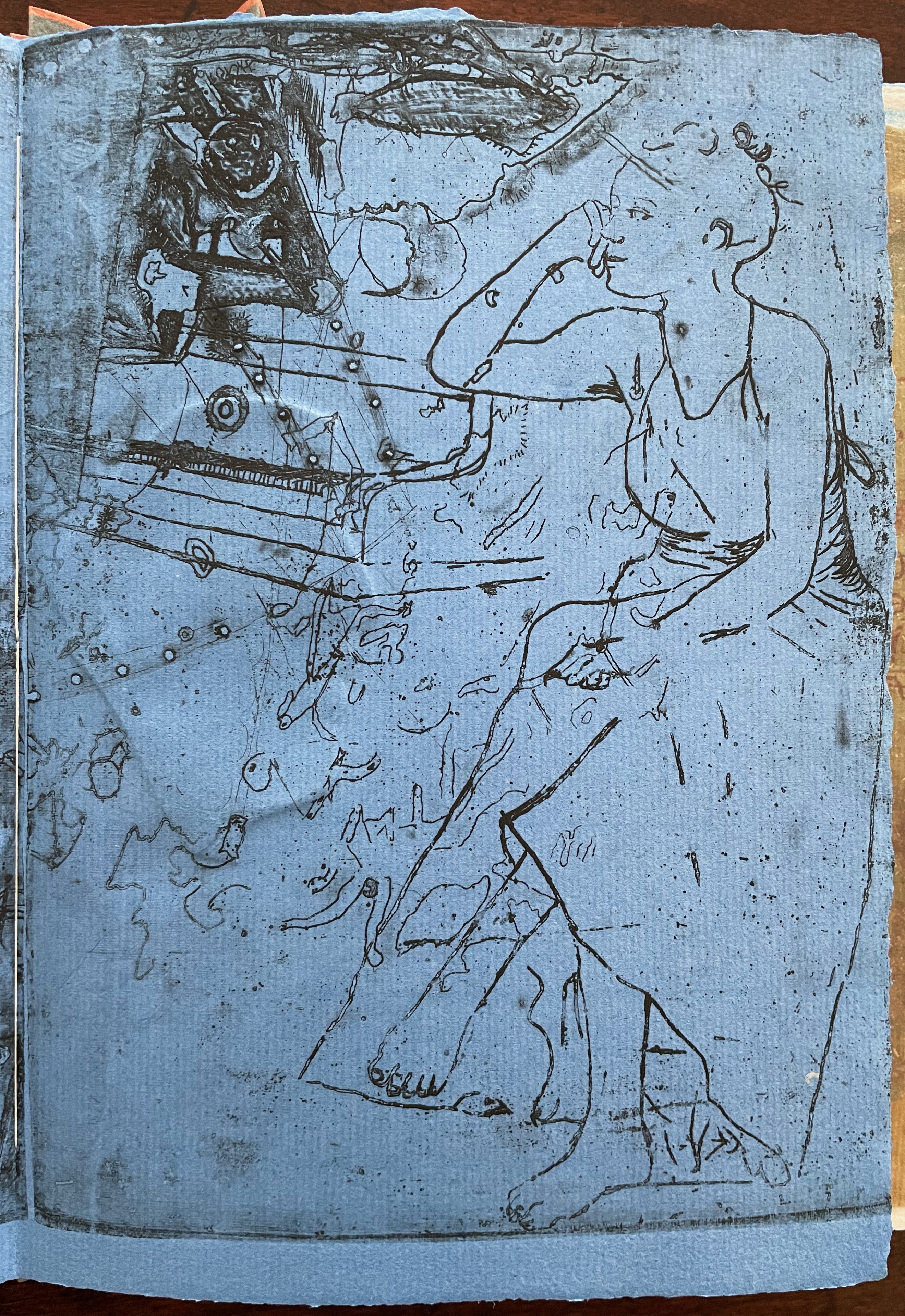
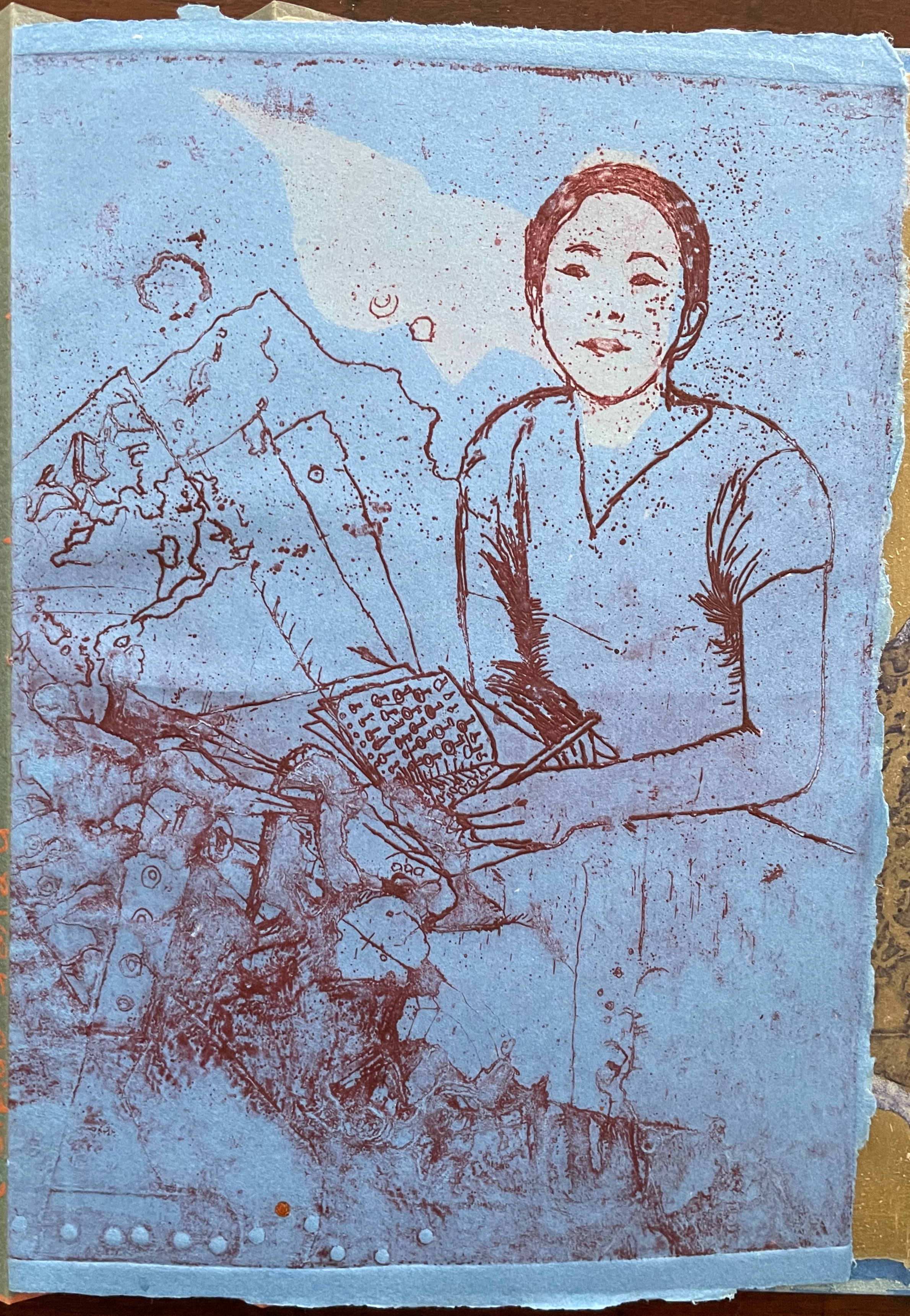
In a concerto, motives play off one another and develop. In Tau blau / Dew Blue, the motif of nature (the plant) plays off the motif of artifice and the manmade (the fairy tale, music, linen, paper, etc.). On the front cover (above), a young girl, surrounded by large damselflies, plays a fiddle or violin and seems to hover above a silver foil image of flax thread and tools for making it. In the spread above alongside the front cover, the specks rising over the staves and musical notes (a recurring motif in itself) recall the tale’s final passage in which the bundle of papers (made from linen rags) is cast into a fire:

I’m going straight up to the sun!” said a voice in the flame. It was as if a thousand voices cried this together, as the flames burst through the chimney and out at the top. And brighter than the flames, but still invisible to mortal eyes, little tiny beings hovered, just as many as there had been blossoms on the flax long ago. They were lighter even than the flame which gave them birth, and when that flame had died away and nothing was left of the paper but black ashes, they danced over the embers again. Wherever their feet touched, their footprints, the tiny red sparks, could be seen.

Images of tools — whether for preparing flax or for making the products from it — also recur on the inside of the front and back covers and throughout the book. The human figures alongside the tools, however, appear engaged in more than manufacturing. Elsewhere in the book, they dance, they sit and meditate or write, they row on ponds beside the growing flax. The fairy tale, too, has these Romantic juxtapositions of nature, art and craft. So, again, the spirit of Andersen’s tale finds another way into Tau blau / Dew Blue.
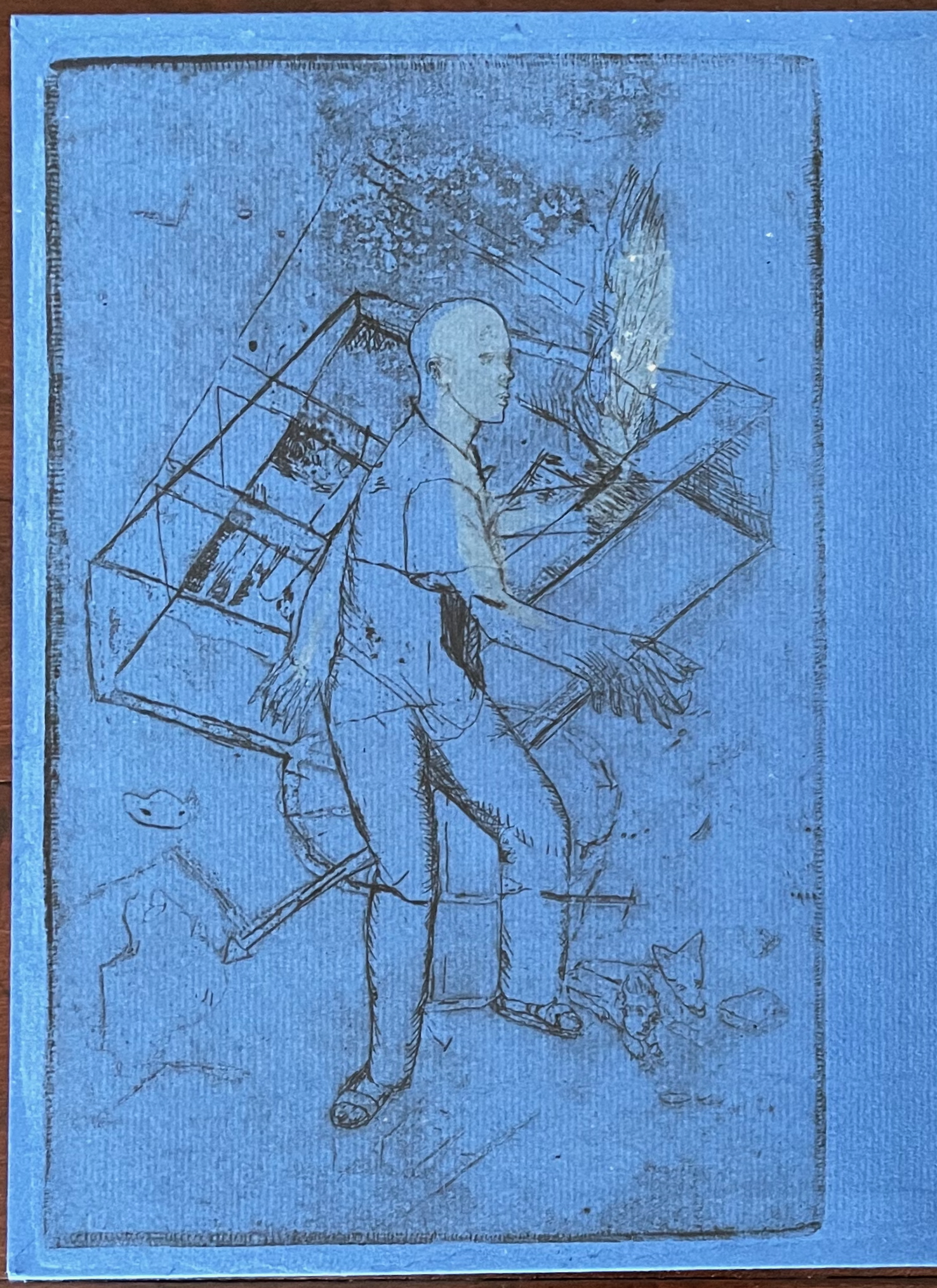
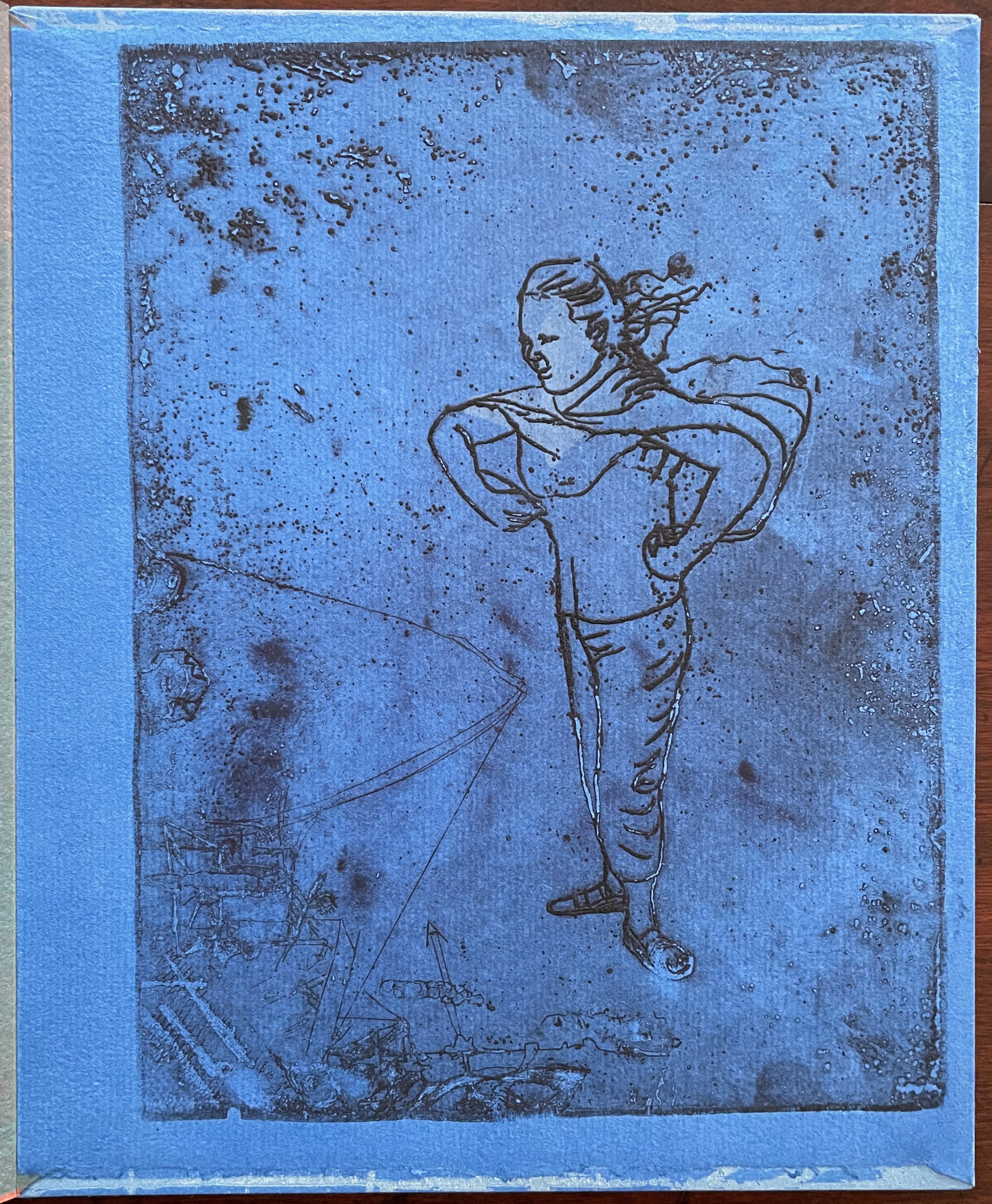
Inside front and inside back covers.
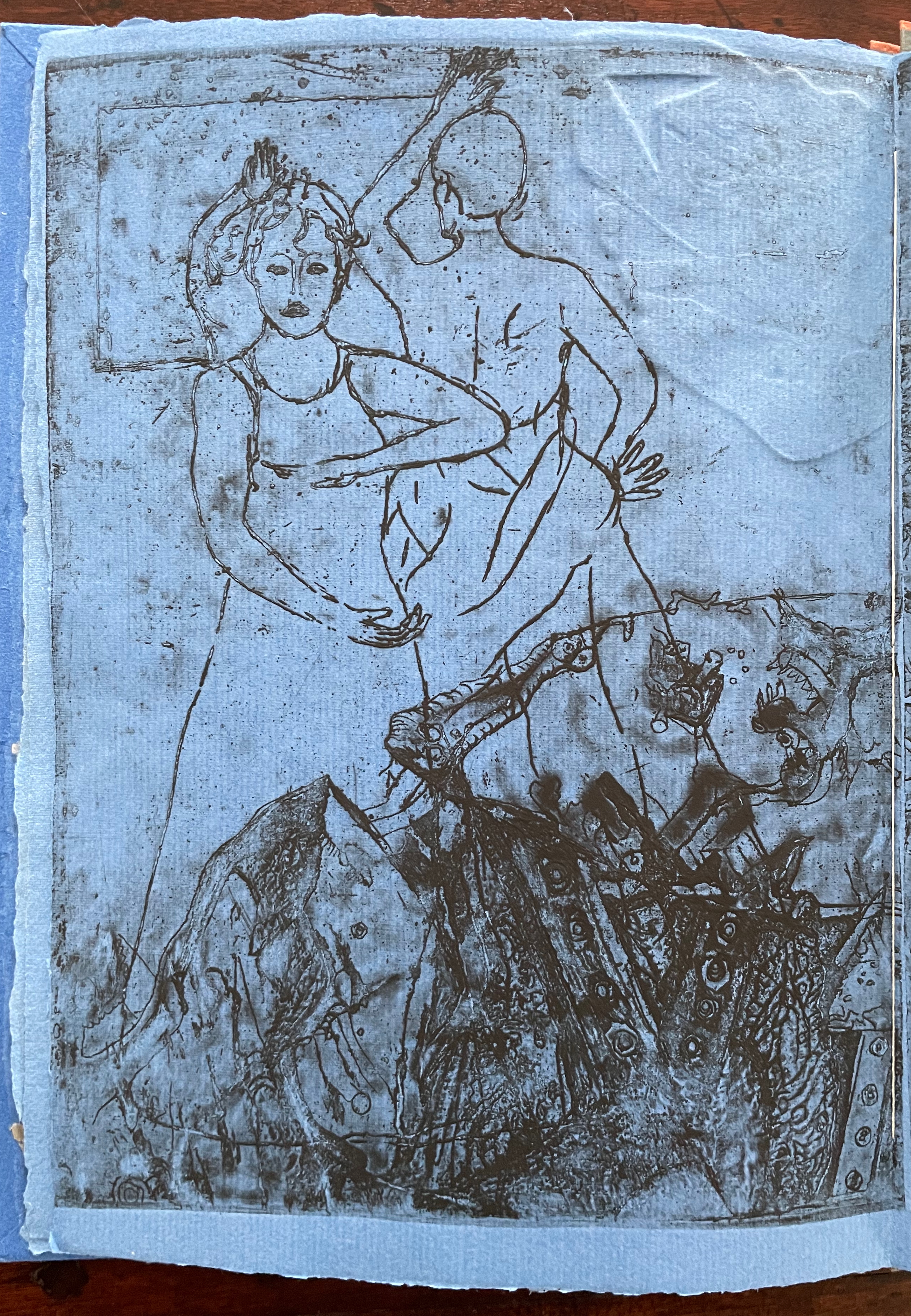
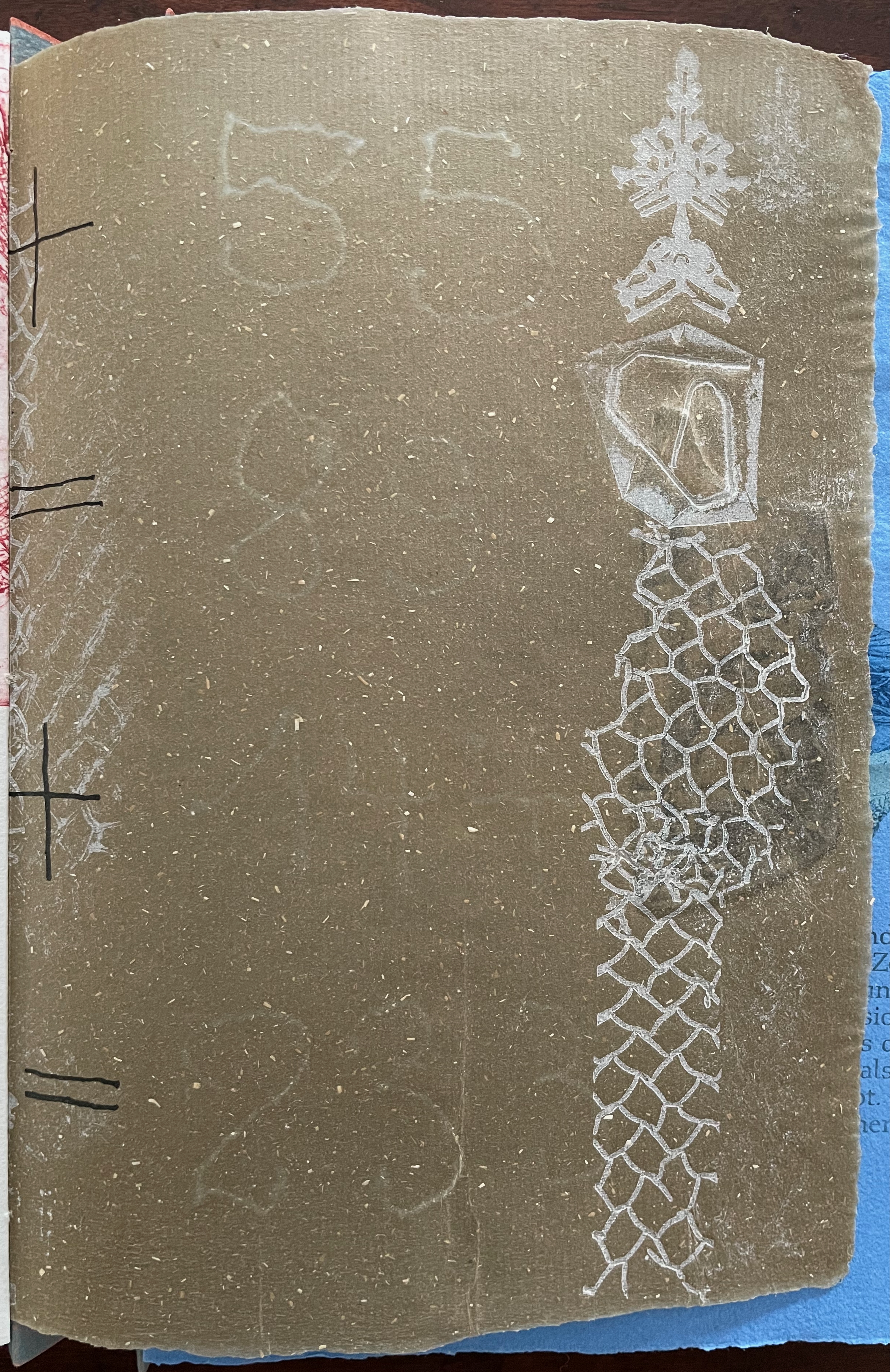
The front cover also announces another motif in those coils of thread below the young girl’s feet. Within the coils is the image of a Fibonacci spiral, which appears on the back cover and throughout the book in different ways. It can be found drawn and printed. It can be found in watermarks in the handmade paper. It can be found in the arrangement of florets in flax. Being a composite flower, flax blossoms display the spiral based on the Fibonacci sequence 1, 2, 3, 5 … 233, and so on. These numbers are waterjet-drawn on the pure flax paper below and explained in an entry printed on the adjacent plain handmade paper folio. By appearing on the book’s front and back covers, the spiral echoes the beginning and ending cycles of birth and rebirth the flax goes through in the folktale.
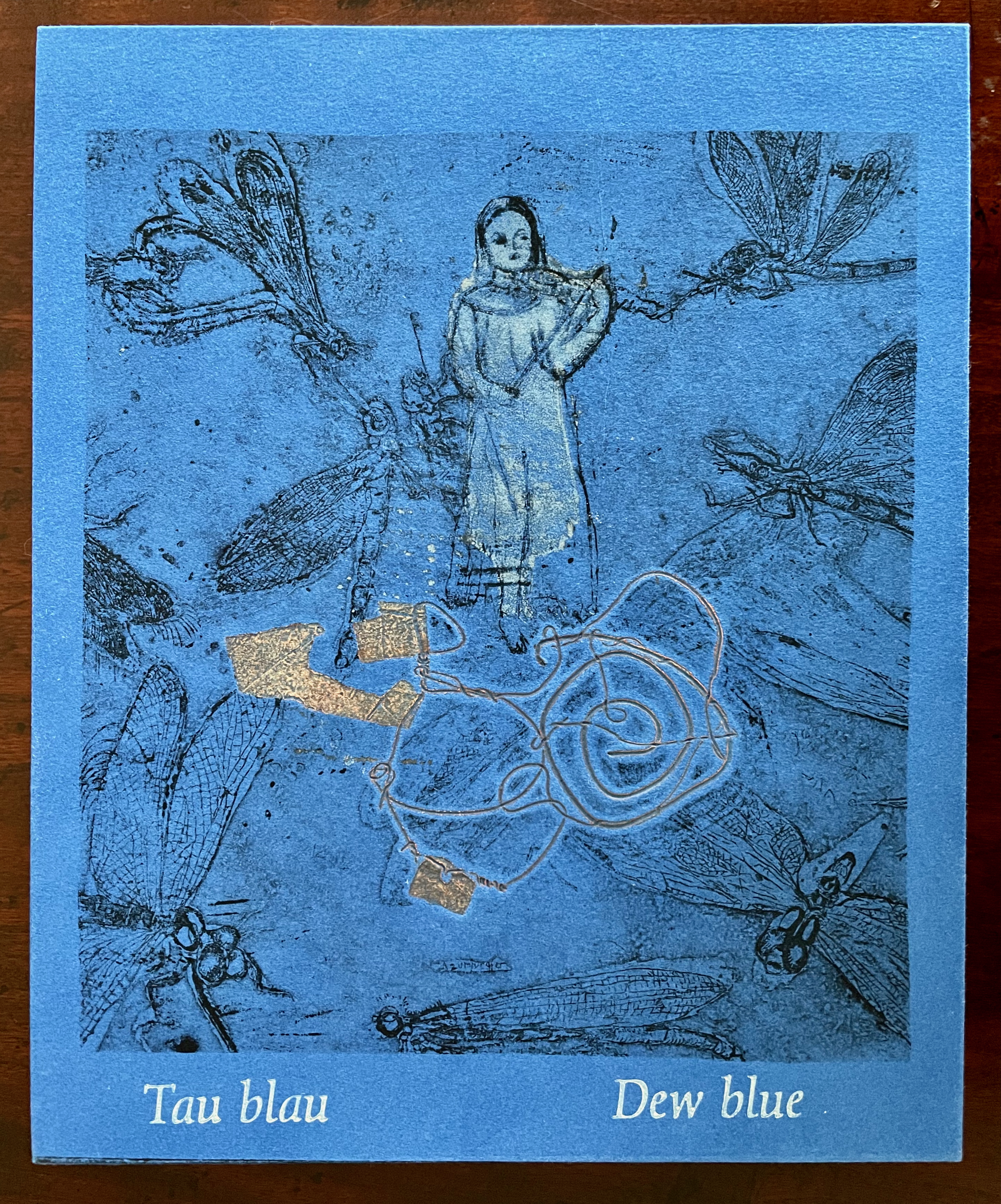
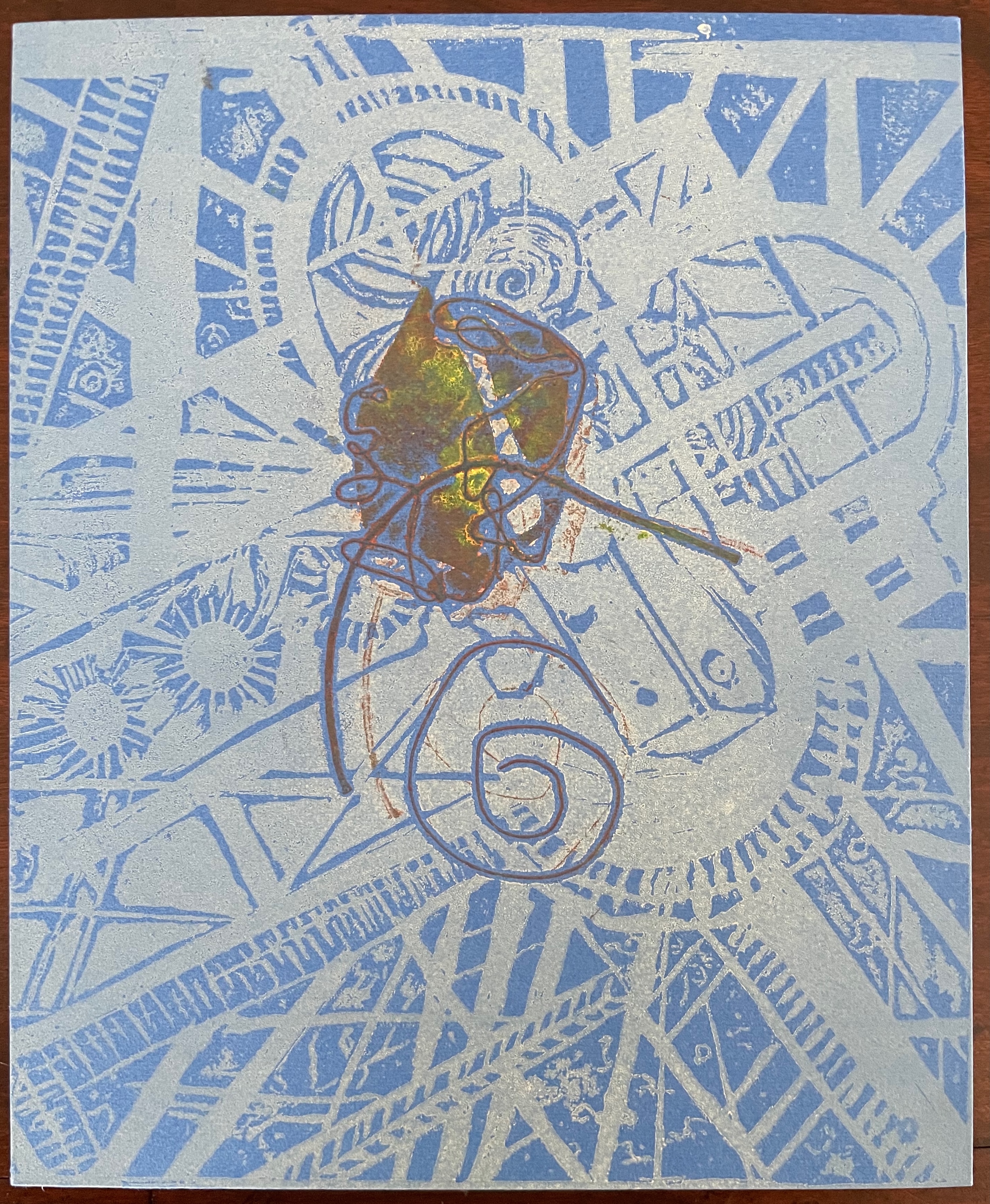
The Fibonacci spiral on the front and back covers.
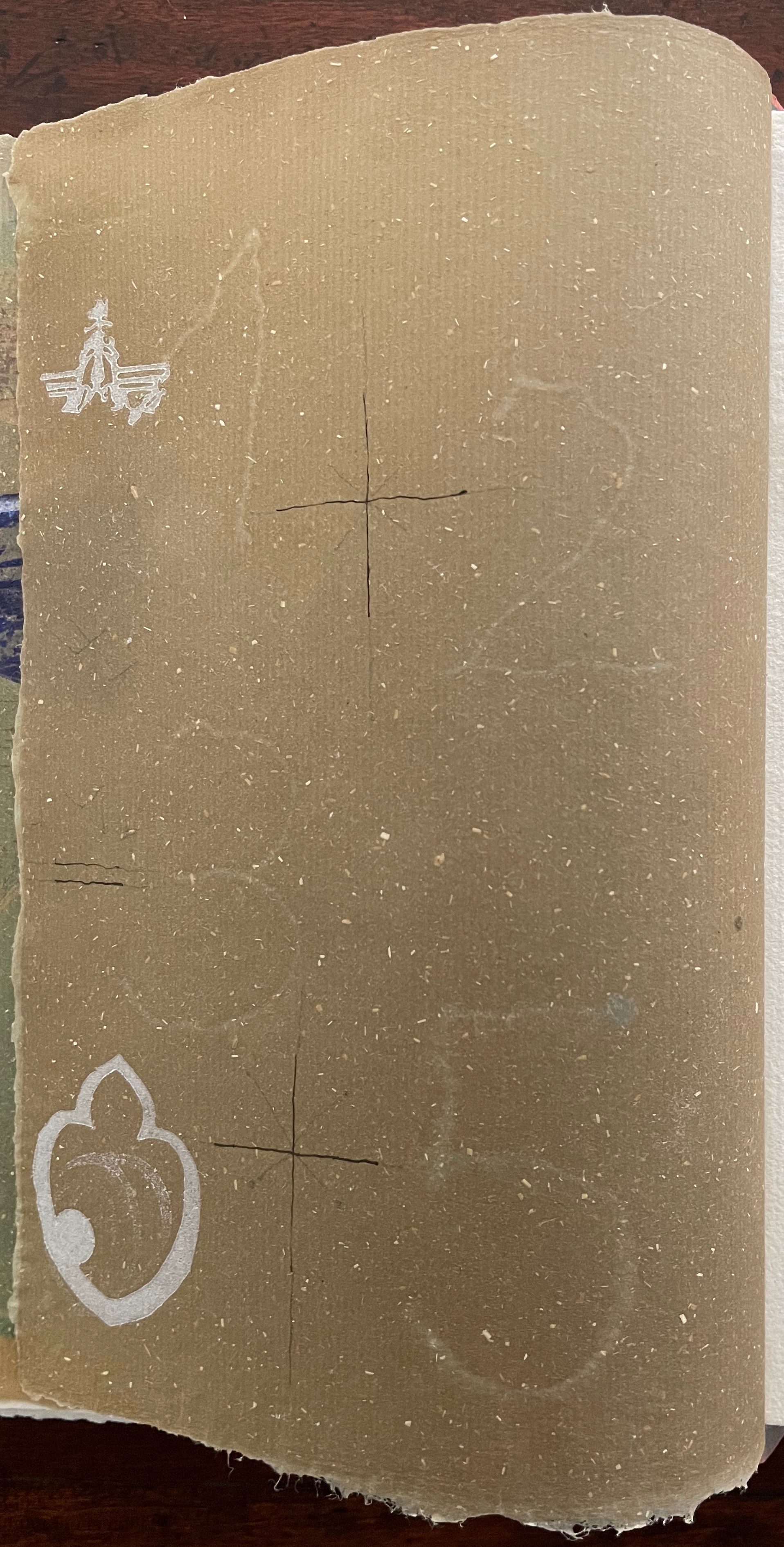
The sequence of Fibonacci numbers 1, 2, 3, 5 … 55, 89, 144, 233 … watermarked on handmade flax paper with a water jet.
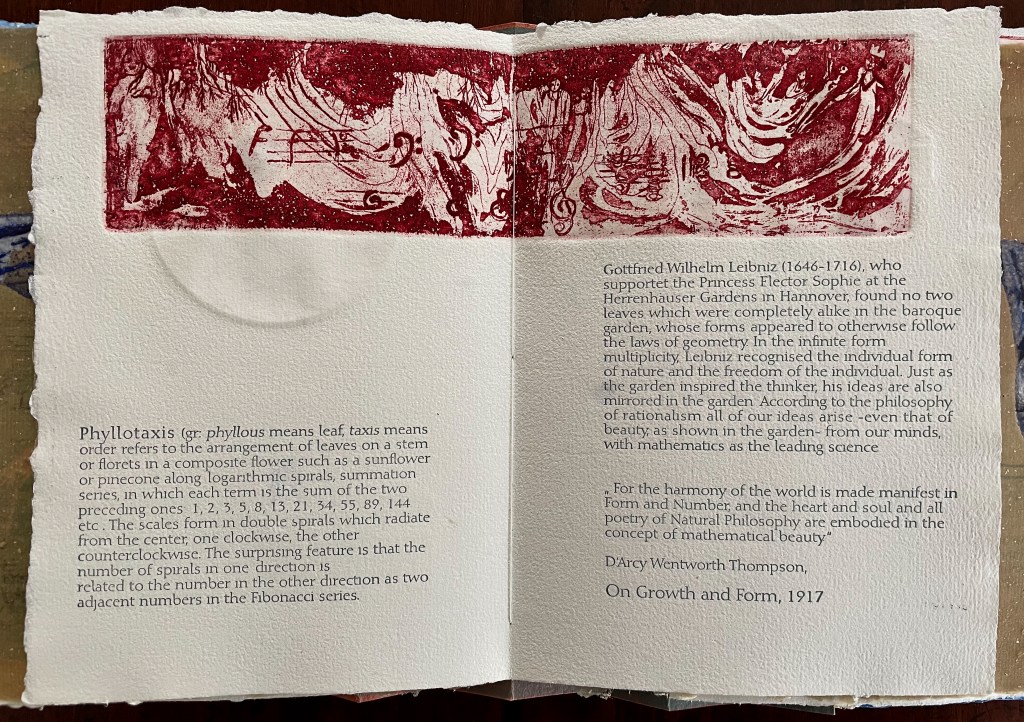
Description of the Fibonacci spiral side by side with quotation from Thompson’s On Growth and Form (1917), drawing on Leibniz’s Rationalist philosophy.

To organize and weave her motives together, Beisinghoff uses an accordion spine to whose peaks eleven sets of folios are sewn with linen thread. Three of the eleven are 4-page folios consisting of blue handmade paper. Another three 4-page folios consist of pure flax paper (handmade by John Gerard). The remaining five gatherings have 8-page folios, each consisting of a pure flax paper folio around a blue or plain one.
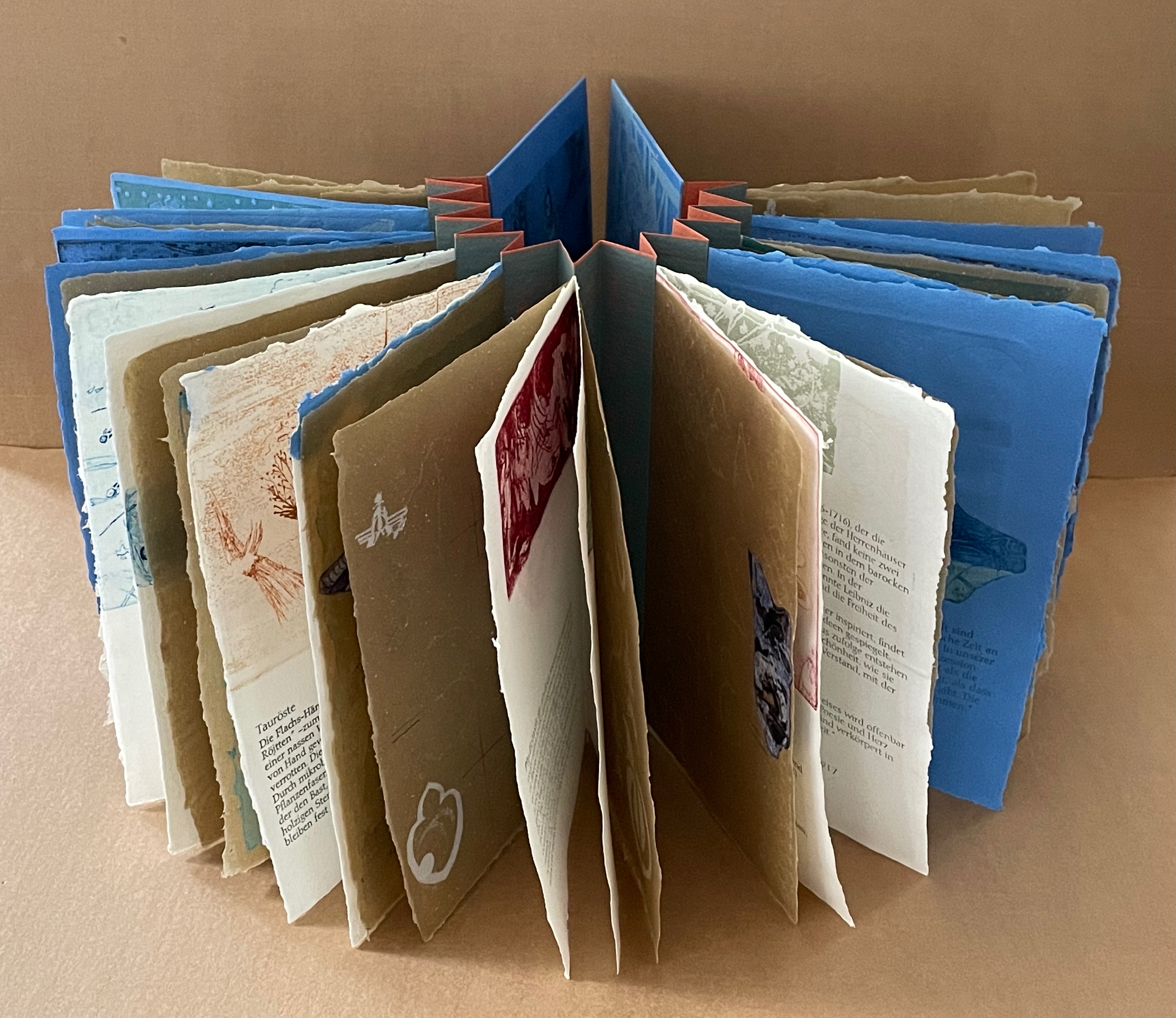
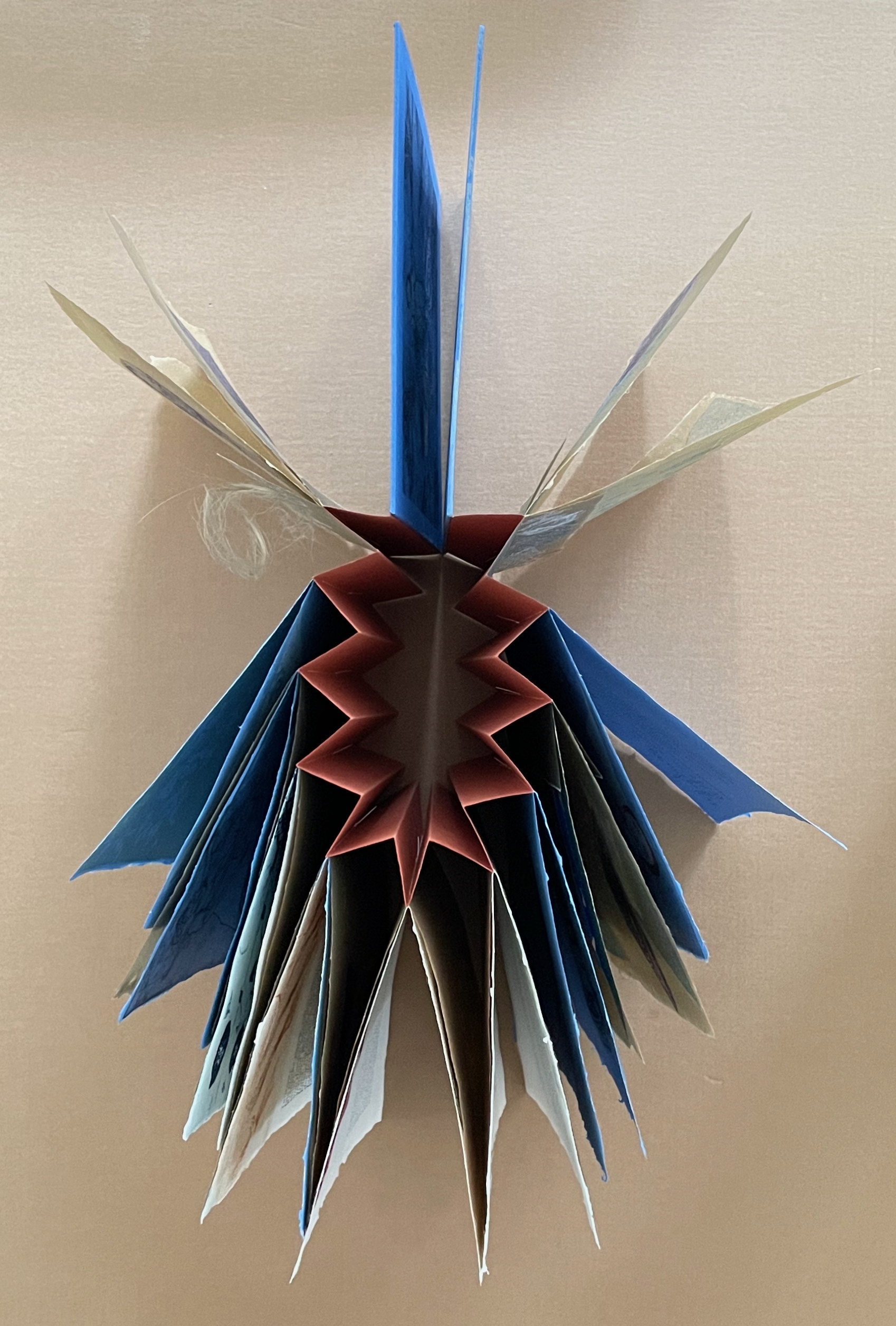
Side and top views of the accordion spine.

The first pure flax folio begins the book, displaying two title pages (German and English) and two etchings on its first and last pages. In the center spread, two more etchings appear. A watermark symbolizing phyllotaxis shows through in the upper left, balanced by a watermark with a cross section of a flax stalk in the upper right of the center spread. The texture and weight of the flax paper allows the impress and shadow of the etchings to stand out on both sides against the inking and watermarks.
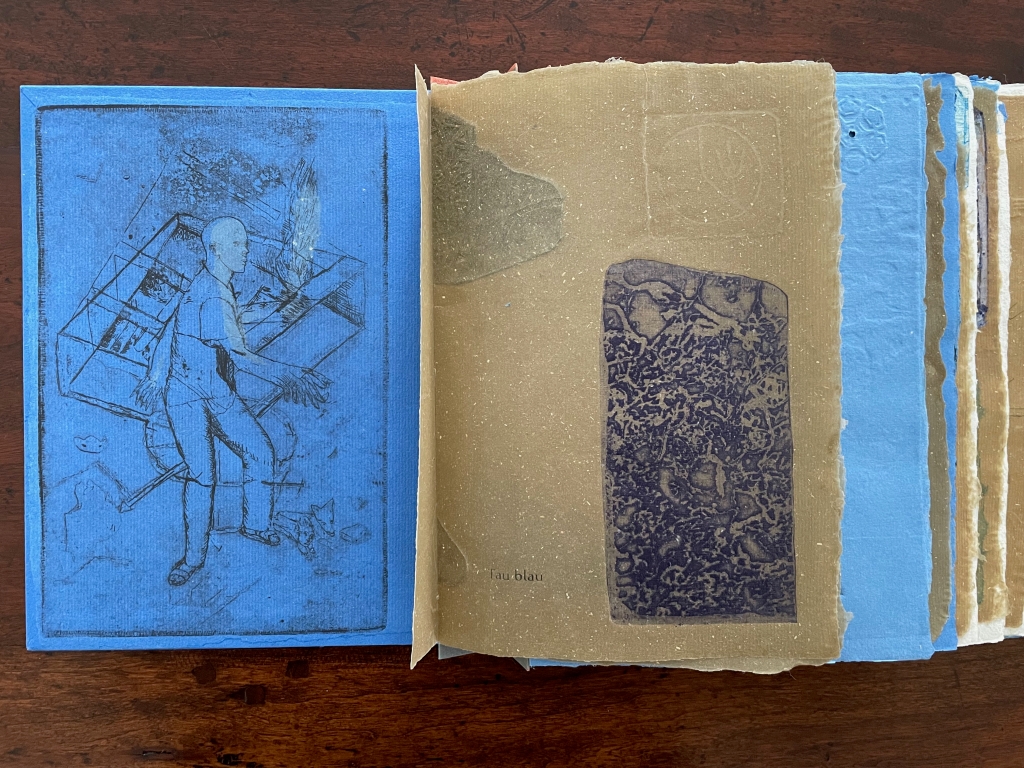
Inside front cover and Tau blau title page and etching.
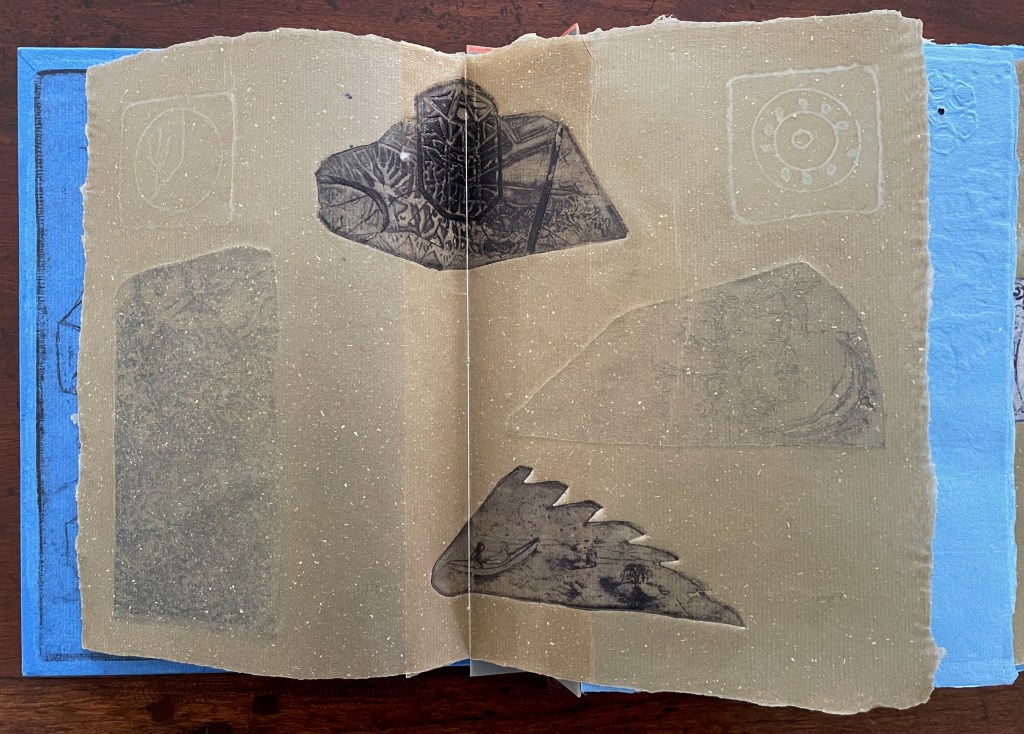
Center spread of first flax paper folio. Note the watermarks in the upper left and right corners.
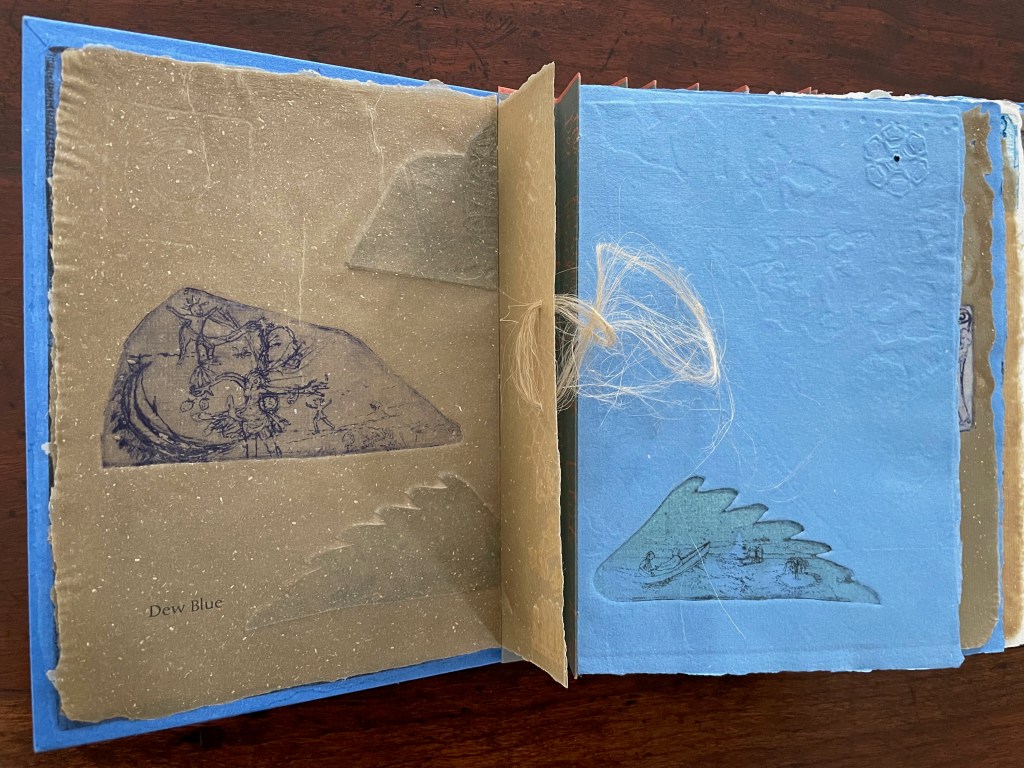
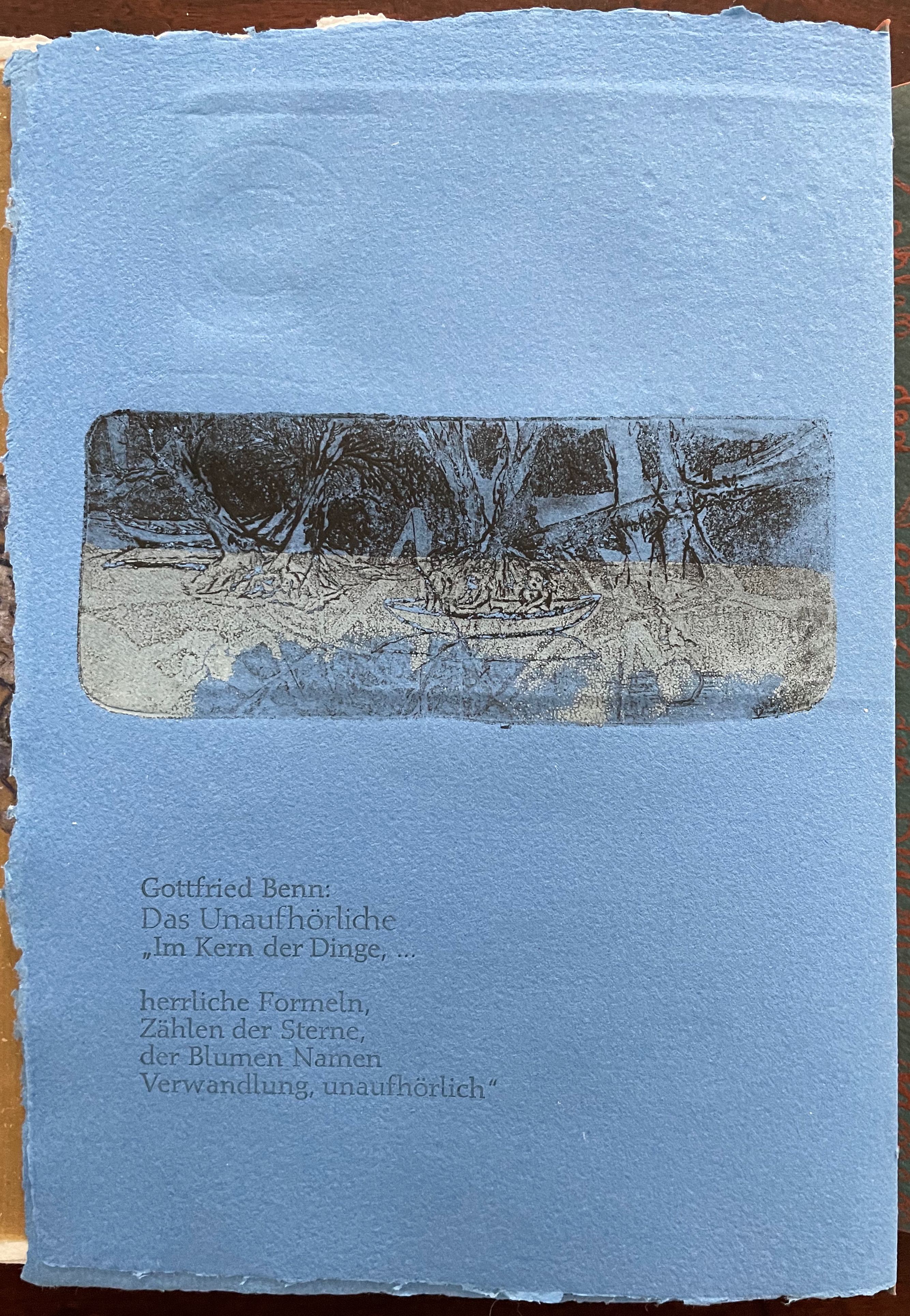
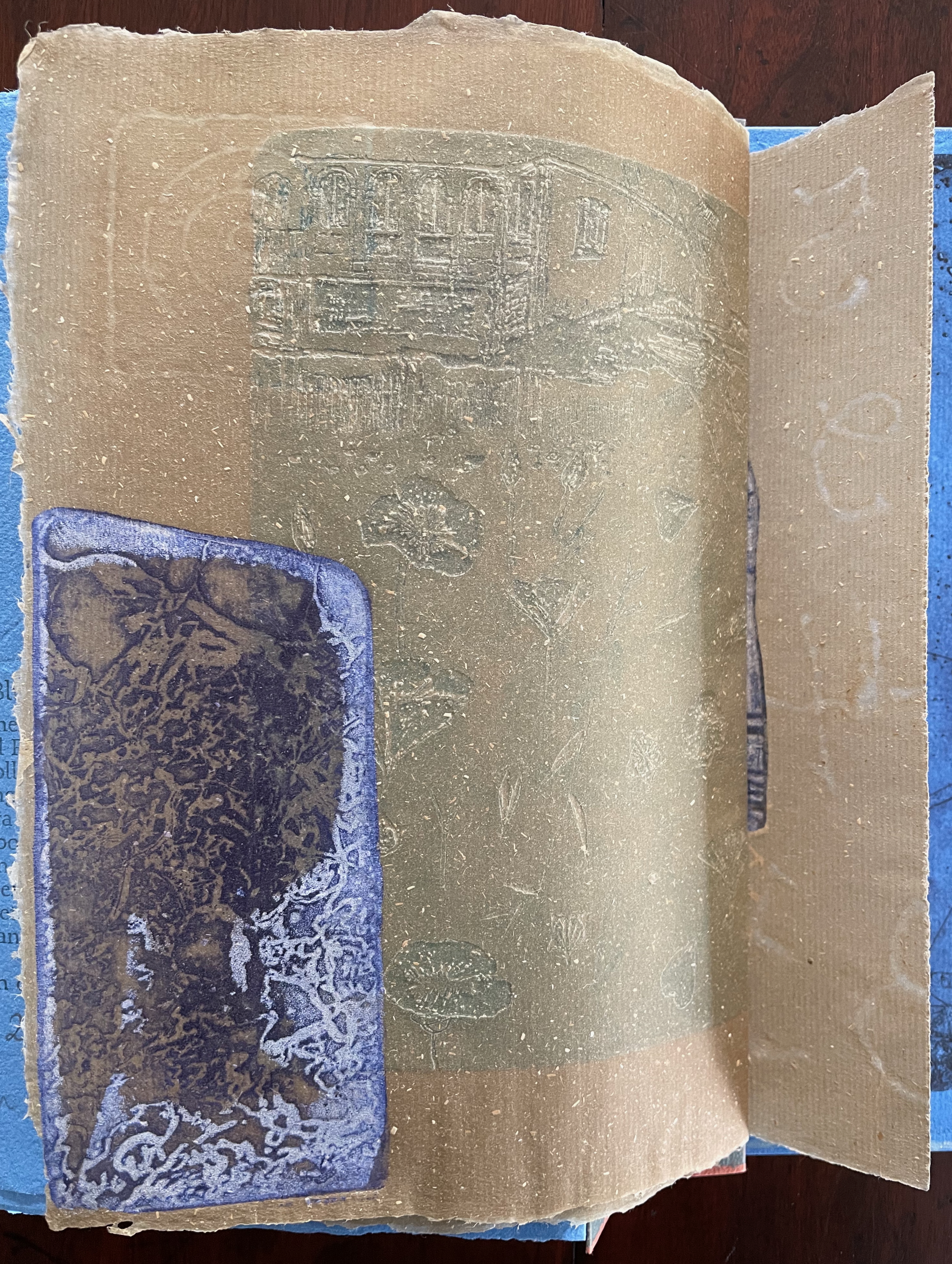
Dew Blue title page and etching, loop of flax fibers, first page of blue handmade paper folio; note its boating image repeated from the prior center spread.

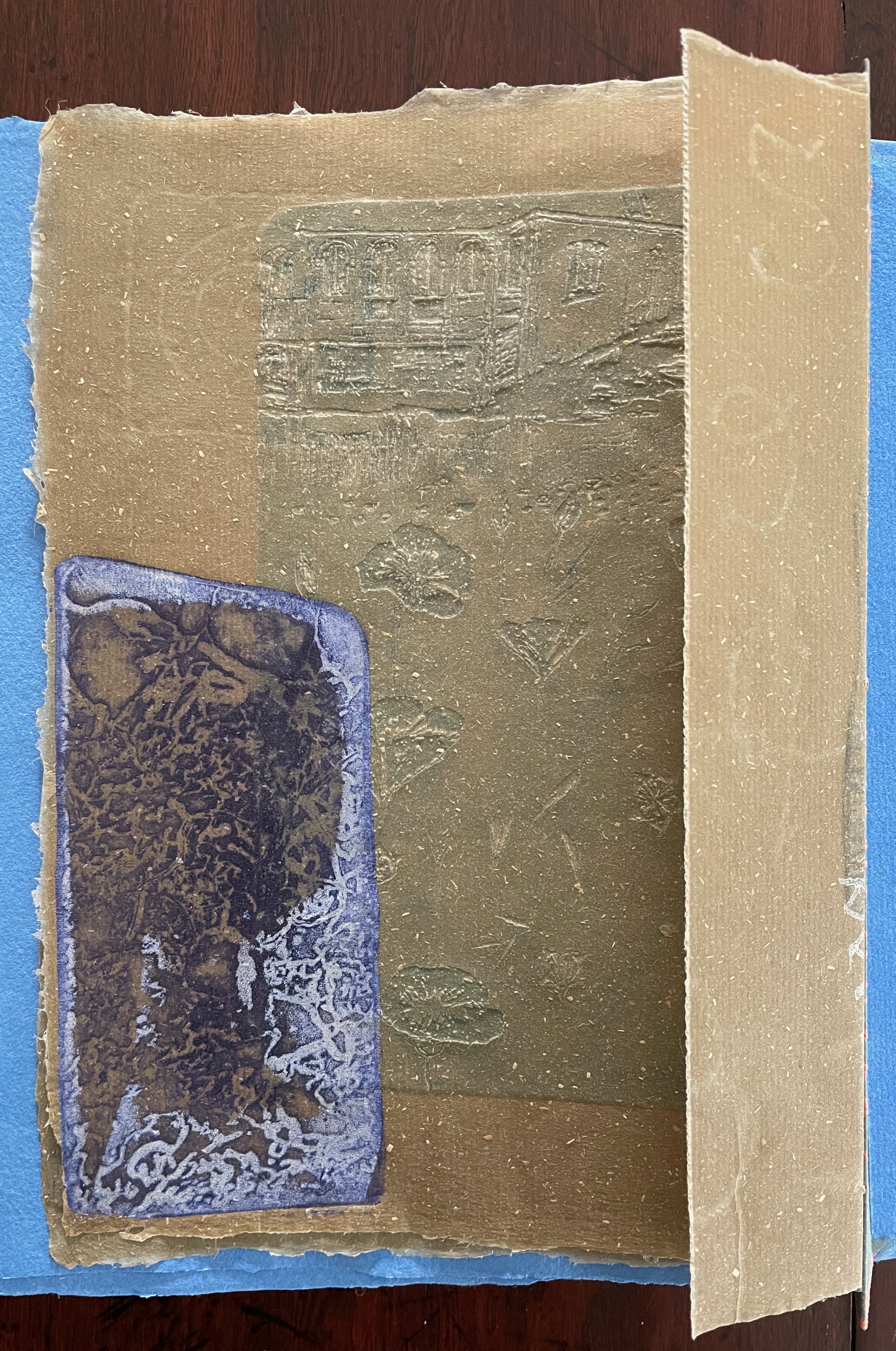
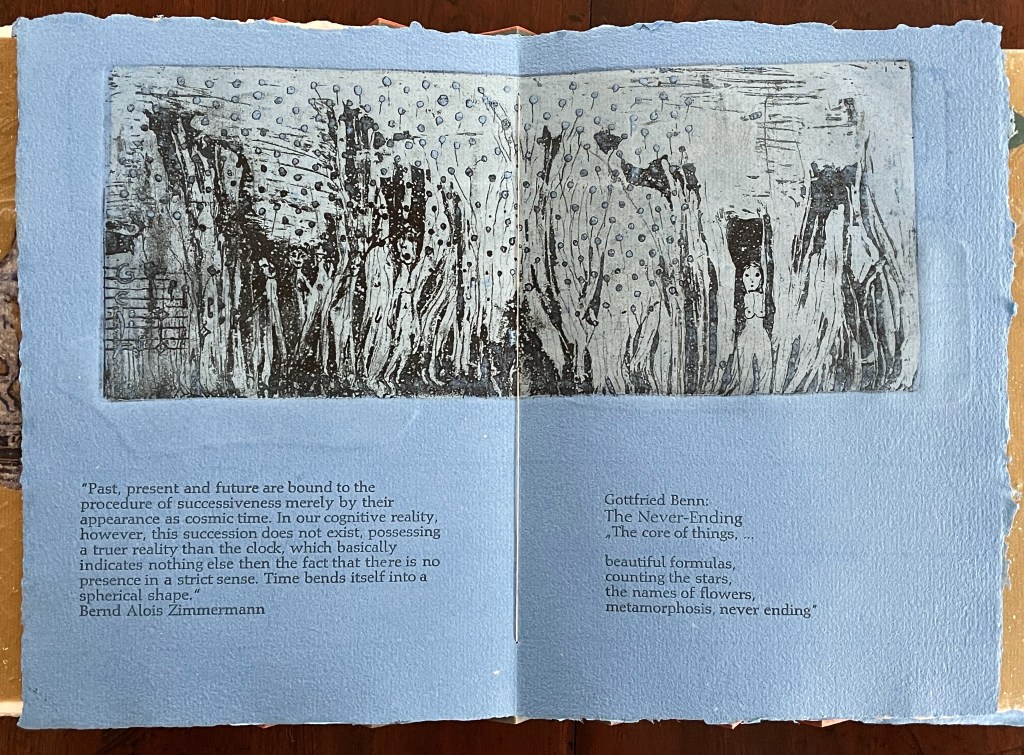
Following the pure flax folio, the first all blue folio gives us that introductory excerpt from Andersen’s fairy tale. Next comes a description of flax comes from Leonhart Fuchs’ Book of Herbs (1543), then the series of planting and harvesting observations from Beisinghoff, then the refrain from Clemens Brentano’s poem “Ich darf wohl von den Sternen singen” (1835), then philosophical observations drawing on G.W. Leibniz from D’Arcy Wentworth Thompson’s On Growth and Form (1917), a much-quoted theorem of musical composition from Bernd Alois Zimmermann’s Intervall und Zeit (1974), and finally (below) a passage of text by Gottfried Benn from the Hindemith oratorio Das Unaufhörliche / The Neverending (1936). In the valleys of the accordion spine, some of the lines from Andersen, Fuchs, Beisinghoff and Been appears handwritten in orange paint.
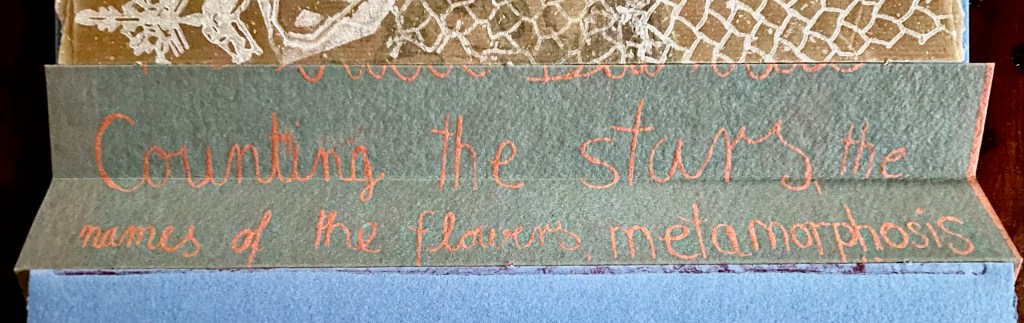
Translated fragment of Benn’s lyrics for Paul Hindemith’s oratorio Das Unaufhörliche / The Neverending (1936).

Even with these additional texts, Andersen’s fairy tale remains the most central text in Tau blau / Dew Blue, despite the brevity of its excerpt. Brentano’s Romantic/religious expostulations (“O Star and Bloom, Garb and Soul, Love, Hurt and Time for evermore”) sound like those of the plant in the story’s final passage. The occurrence of Fibonacci’s spiral in the plant may be a physical fact, but Beisinghoff turns it into something more mystical by placing the description of phyllotaxis next to Leibniz’ and Thompson’s transcendental view of mathematical science and natural philosophy. Likewise she links the texts from Bernd Alois Zimmermann and Gottfried Benn to the fairy tale by placing them beneath the etching that captures the flax plant’s singing and dancing into its transformation by fire.
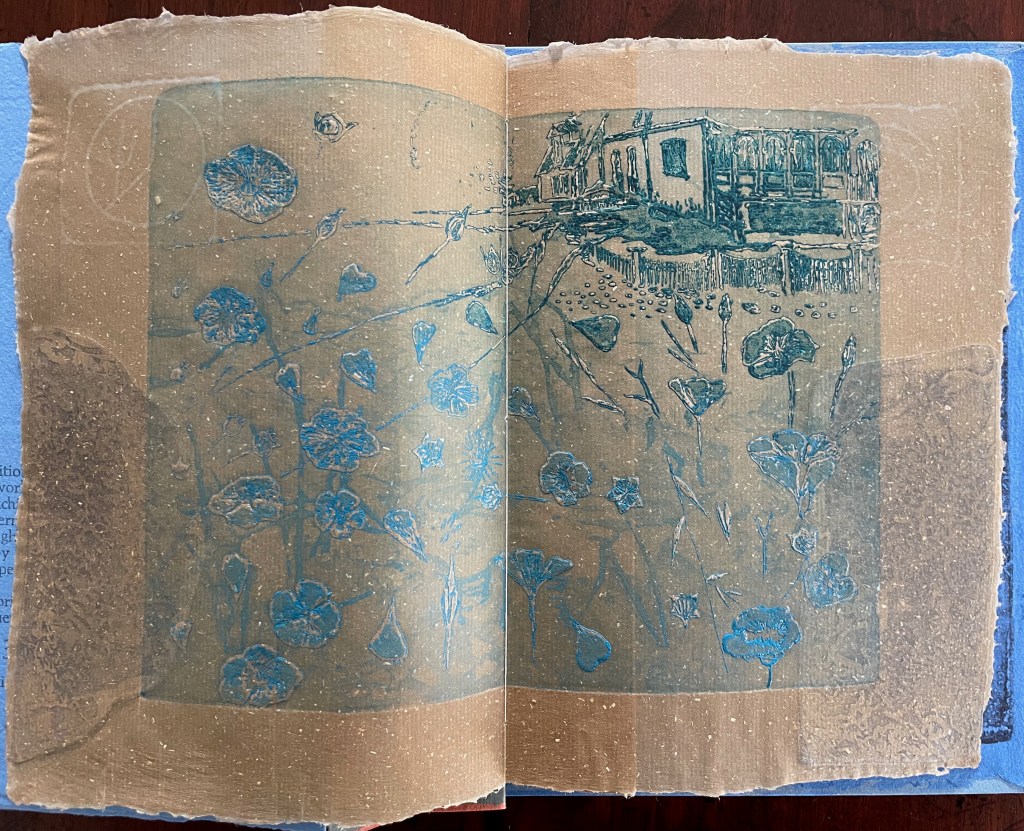
Below is the final folio of the work. Like the first, it is made completely of flax paper, but its center spread offers a fuller image: flax blossoms and stalks float in the foreground, and in the background is a sketch of Beisinghoff’s residence where she grows her flax. Like the Fibonacci spiral on the front and back covers, the first and last flax folios round out the work. But go back and listen for the hidden sound installations accompanying Dew Blue. Noticing Beisinghoff’s abstract musical notation, indulge yourself with recordings of a Swedish folk song (“Today is supposed to be the big flax harvest” here or here) to which the notation and phrases allude, and as the flax papers turn and wave on their accordion peaks, listen carefully for their musical rustle.
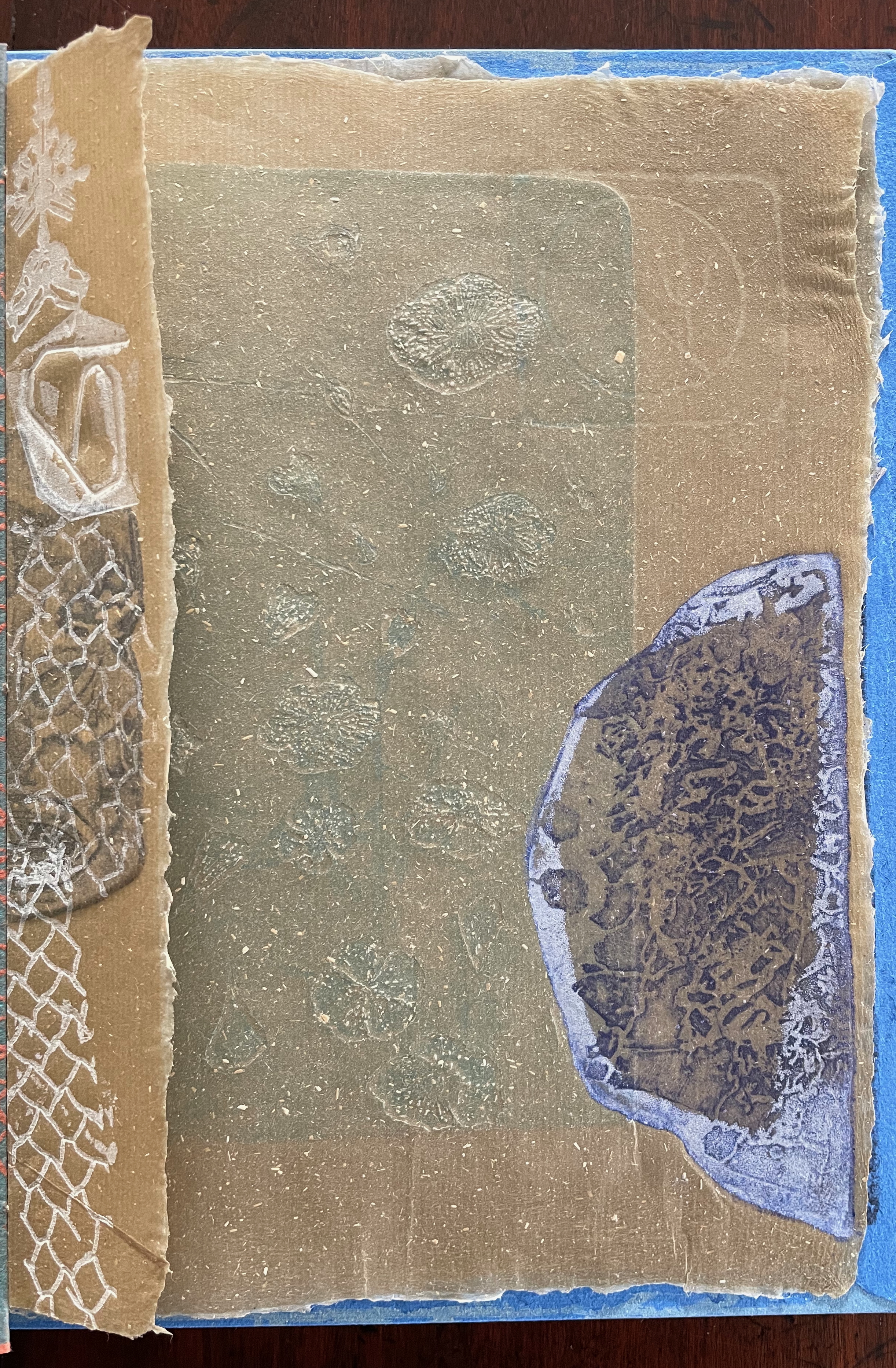
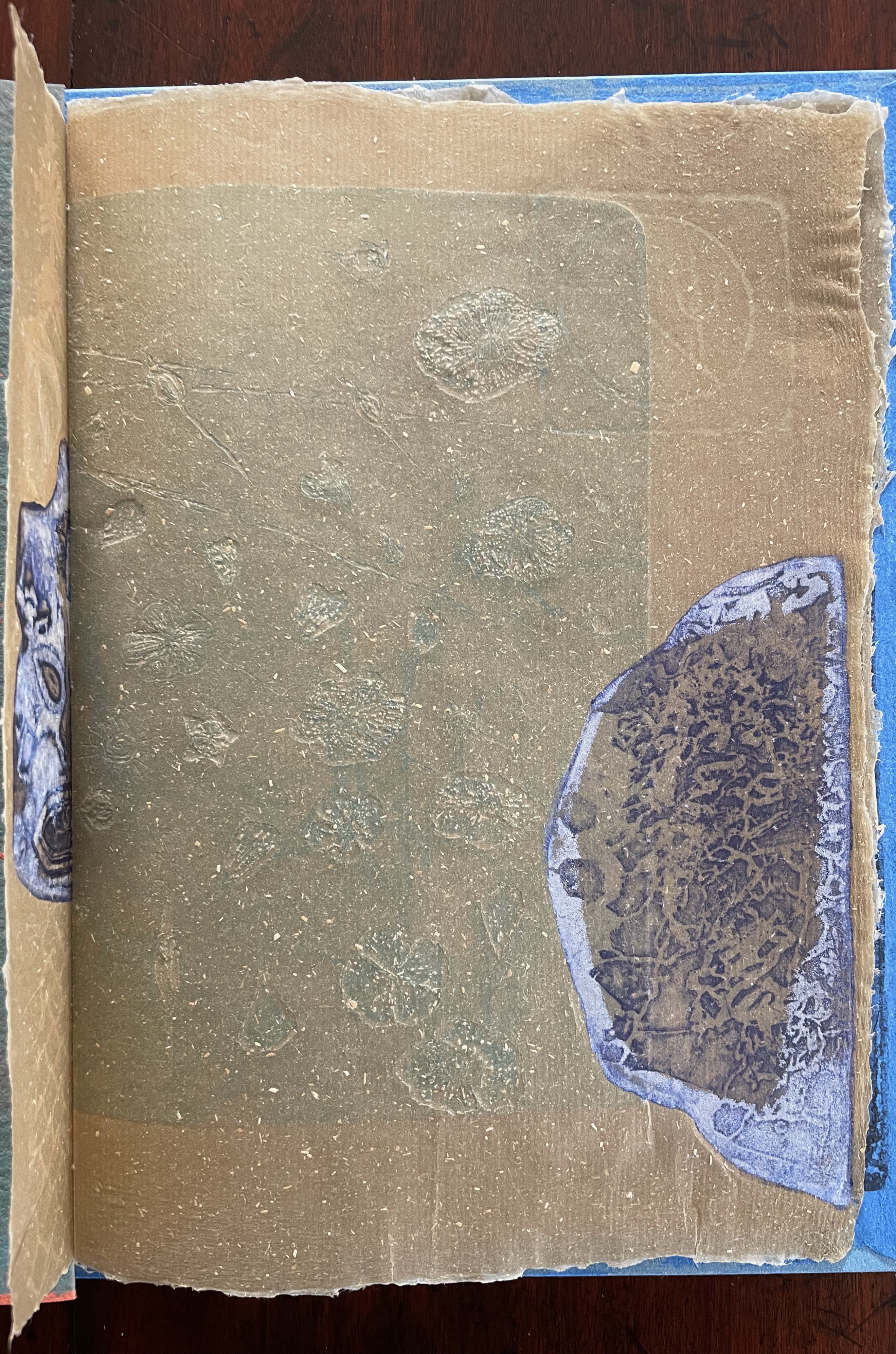
The final pure flax paper folio.
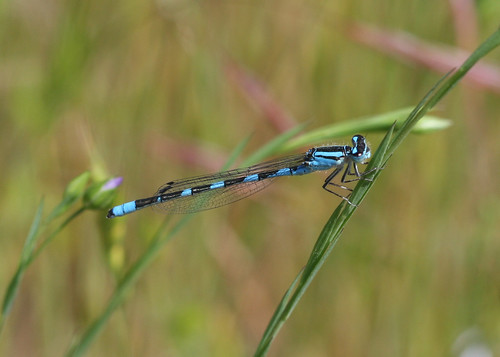
Tule Bluet damselfly perched on flax leaf. Photo: John Riutta, The Well-Read Naturalist (2009). Displayed with permission.

Die wilden Schwäne (2001)
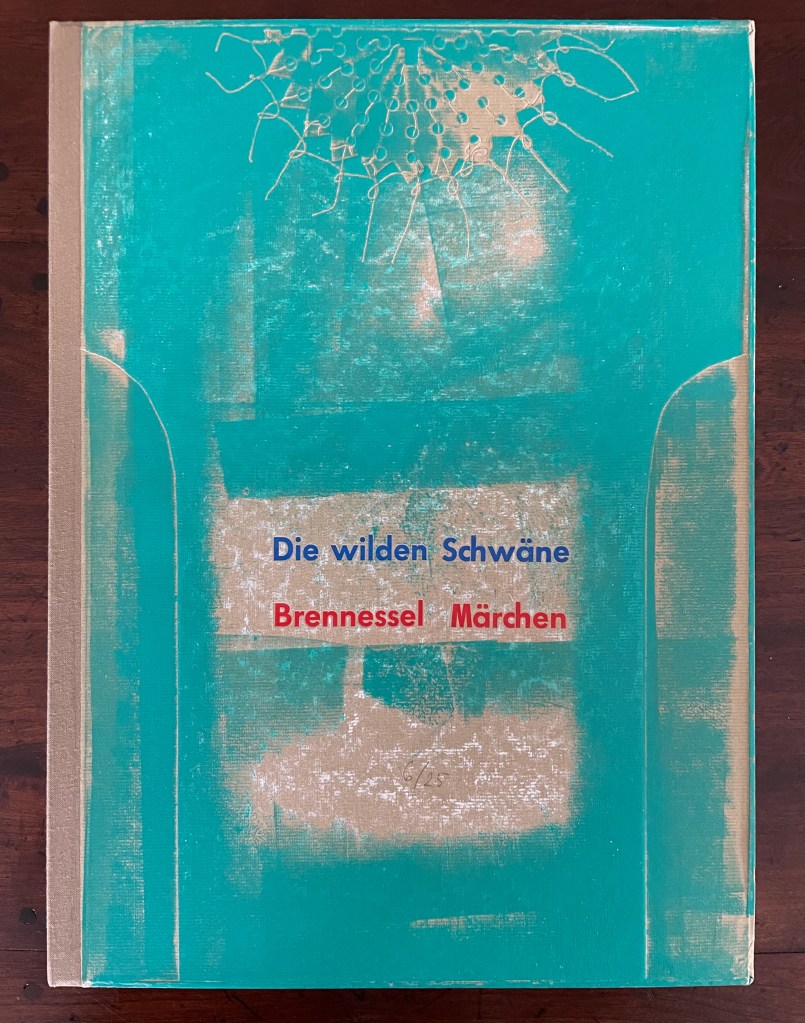
Die wilden Schwäne (2001)
Barbara Beisinghoff
Box with embossed cover holding folios wrapped in chemise. H35o x W250 mm. 18 folios. Edition of 25, of which this is #6. Acquired from the artist, 20 December 2024.
Photos: Books On Books Collection.

Barbara Beisinghoff’s Die wilden Schwäne is an exemplar of collaboration and craft. In it, she even requires collaboration between Hans Christian Andersen and the Brothers Grimm. Andersen’s Die wilden Schwäne and the Grimms’ Die sechs Schwäne are based on the same tale of brothers turned into swans who are saved by their sister Elisa’s diligent and mute harvesting, pulping, spinning and sewing of stinging nettles into shirts that break the spell when donned. H.C. Andersen, however, is verbose and elaborate in his telling (even including vampires!), and Beisinghoff has done a bit of nipping and tucking with the more succinct Brothers Grimm to create a version more suited to the artist’s book she creates.

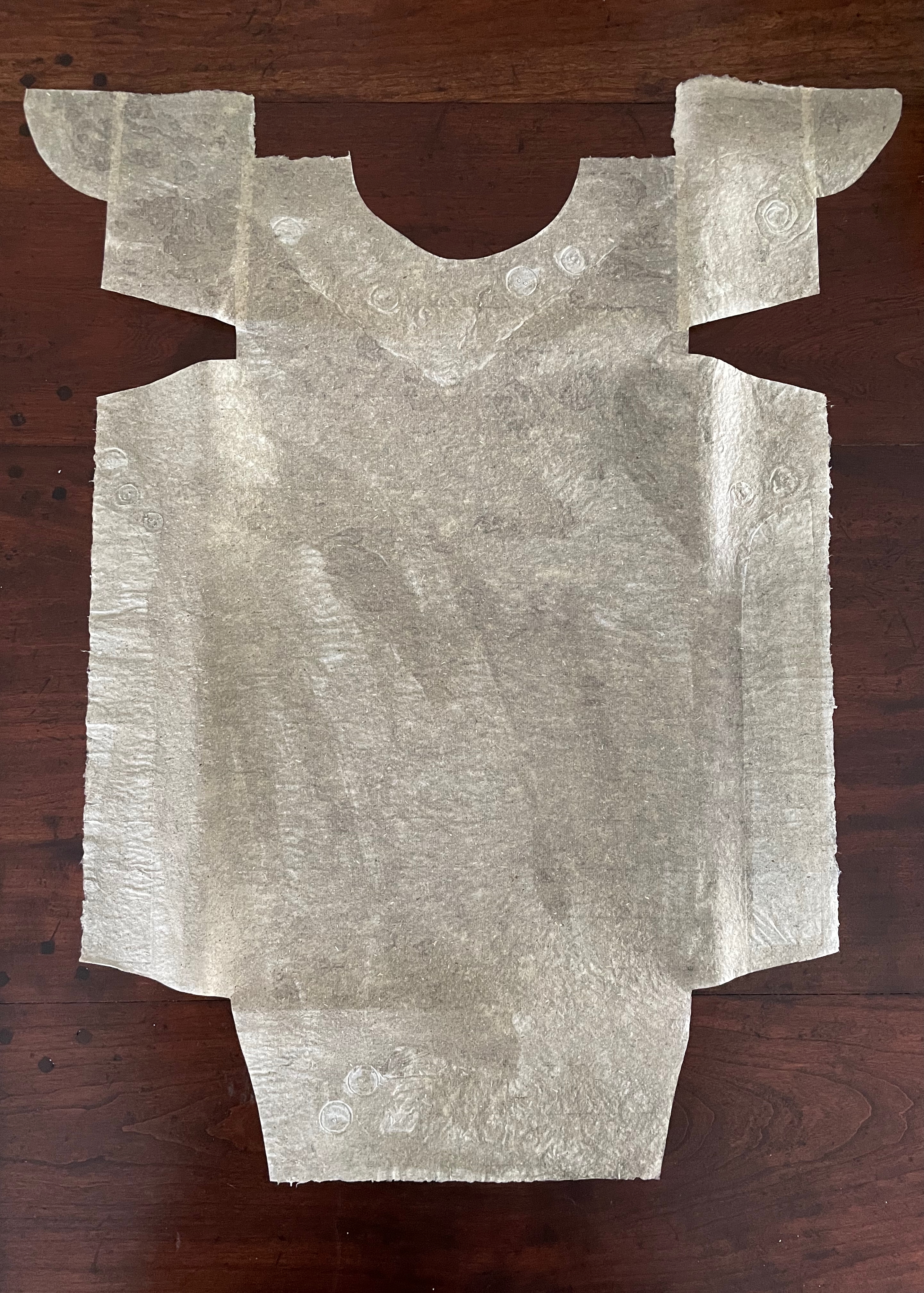
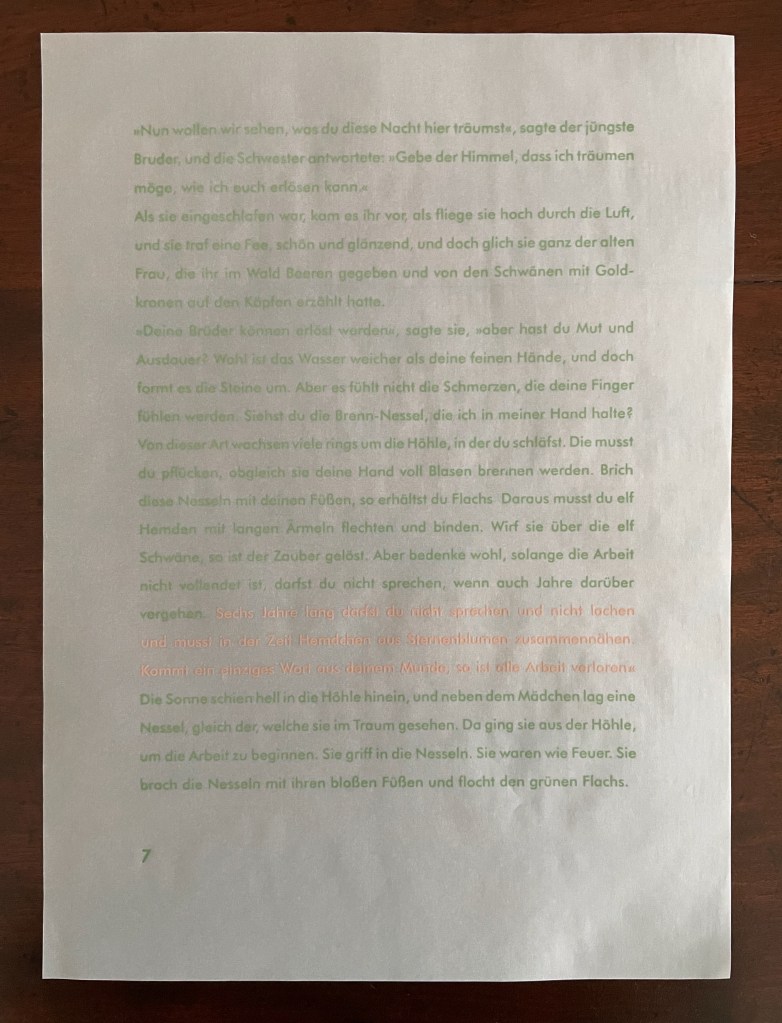
To match Elisa’s effort with stinging nettles, Beisinghoff enlisted the collaboration of Johannes Follmer, the owner of a paper mill. Together they obtained cultivated stinging nettles from the Institute for Applied Botany in Hamburg, cut the fibers, left them to rot, boiled them into a pulp, mixed that with water in a vat, scooped up layers in a sieve embroidered with illustrations, couched the sheets, then pressed and dried them into paper. Beisinghoff applied further drawings with a water jet, watercolor and pencil to the watermark-embossed sheets to illustrate aspects of the tale. To present the Andersen/Grimm “collage”, Beisinghoff had the type set and printed at the Gutenberg Museum. Andersen is printed in light green and Grimm in light red on seven numbered translucent sheets and interleaved with the nine folios of paper art (two more translucent sheets carry the cover page and colophon). To wrap the folios together, Beisinghoff made an embossed chemise or “feather dress” of pure nettle fiber, which could represent Andersen’s description of the brothers’ blowing off each other’s feathers every evening when the sun has set or one of the shirts that their sister makes to break their spell.
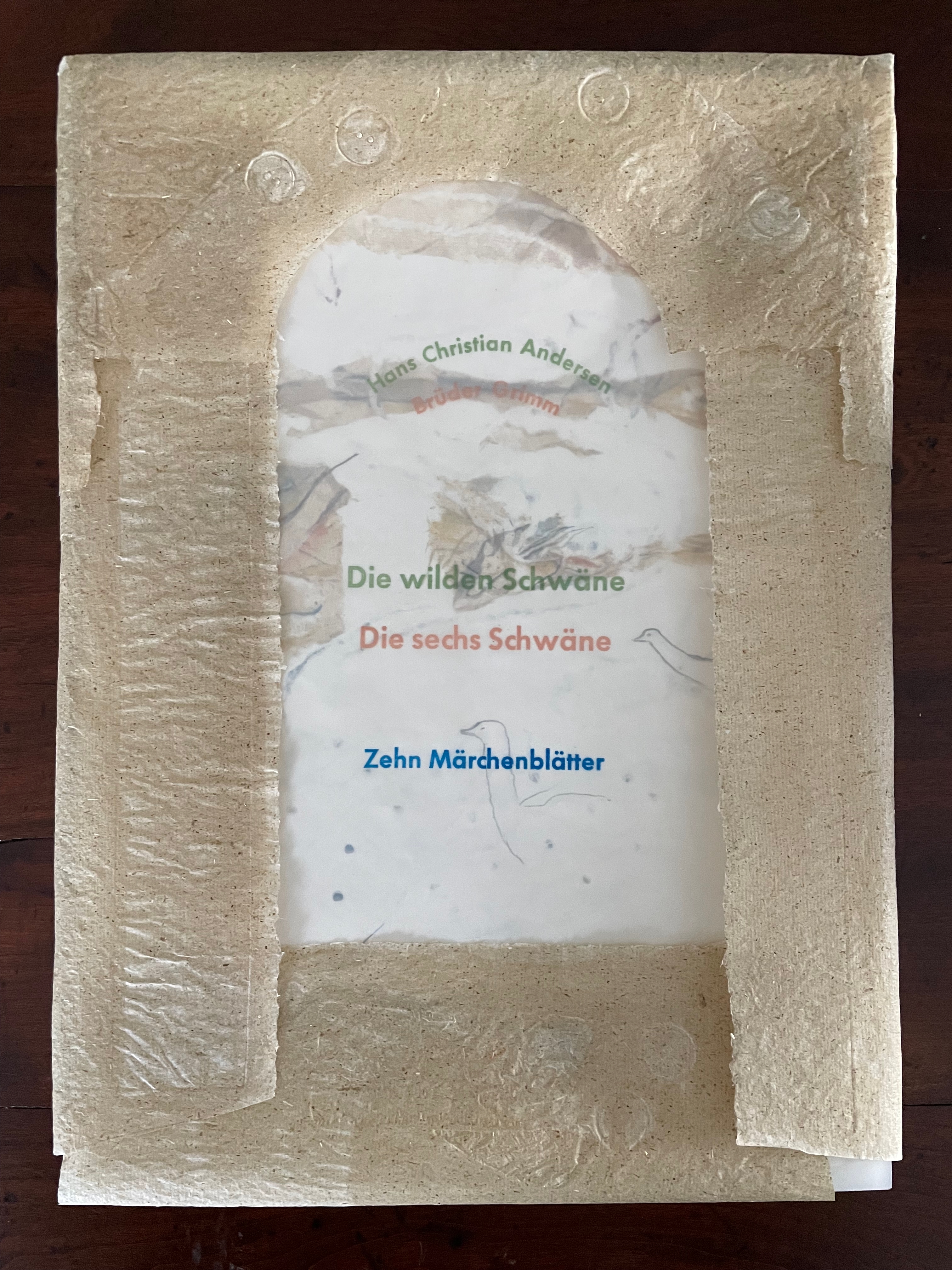
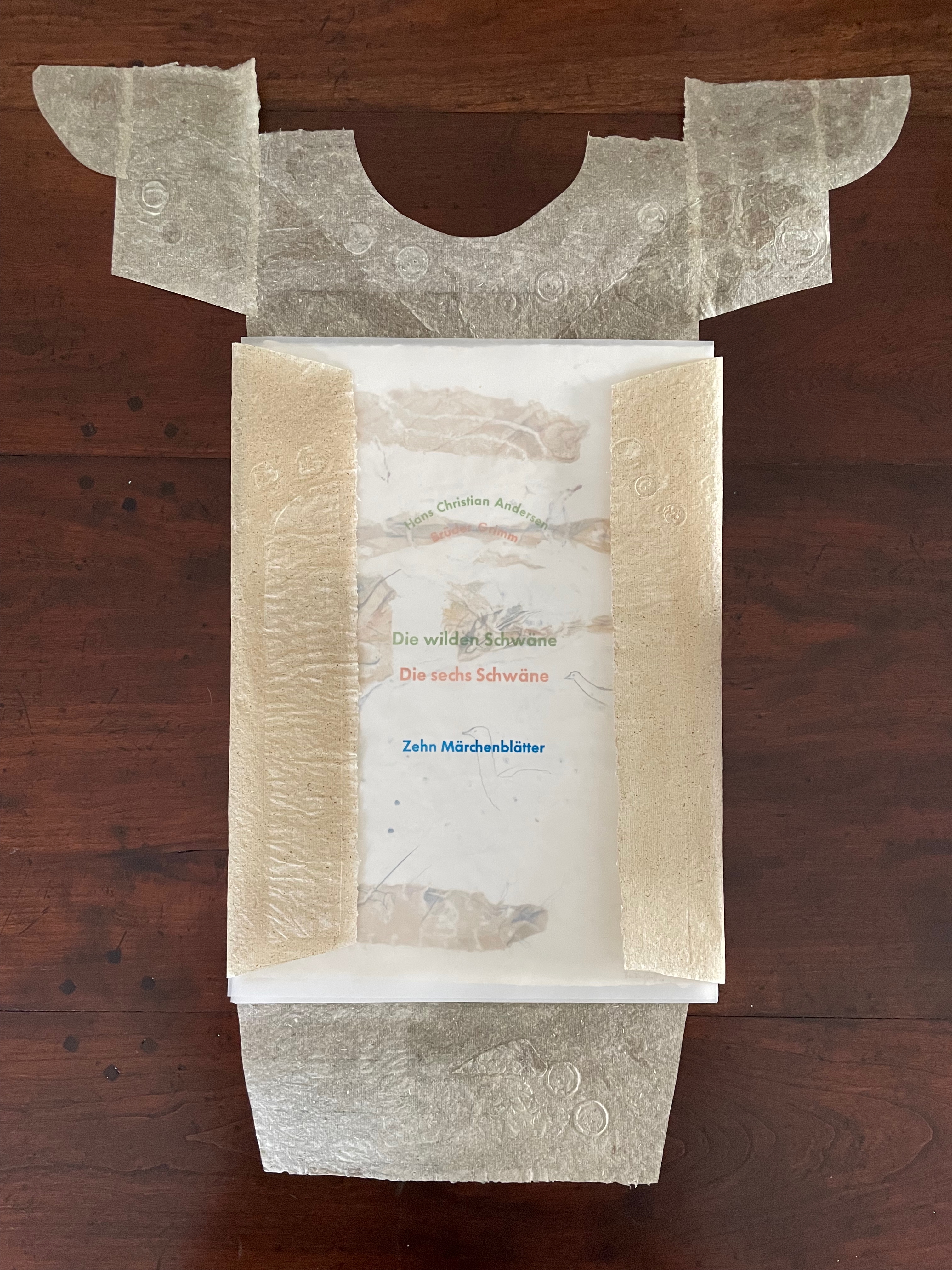
The “feather dress” of stinging nettle fiber.
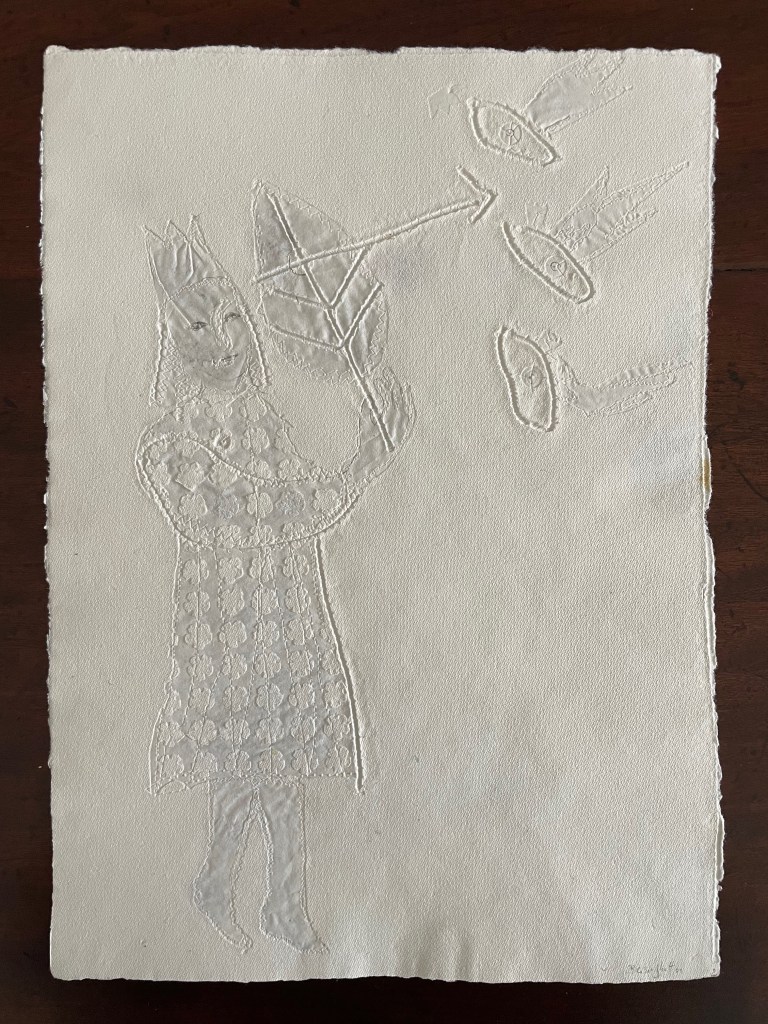
“The King’s little daughter was standing in the cottage room, playing with a green leaf, for she had no other toys. She pricked a hole right through the leaf, looked up at the sun, and there it was, she saw the clear eyes of her brothers, but every time the warm rays of the sun shone on her cheeks, she thought of all their kisses.” Translation with DeepL.
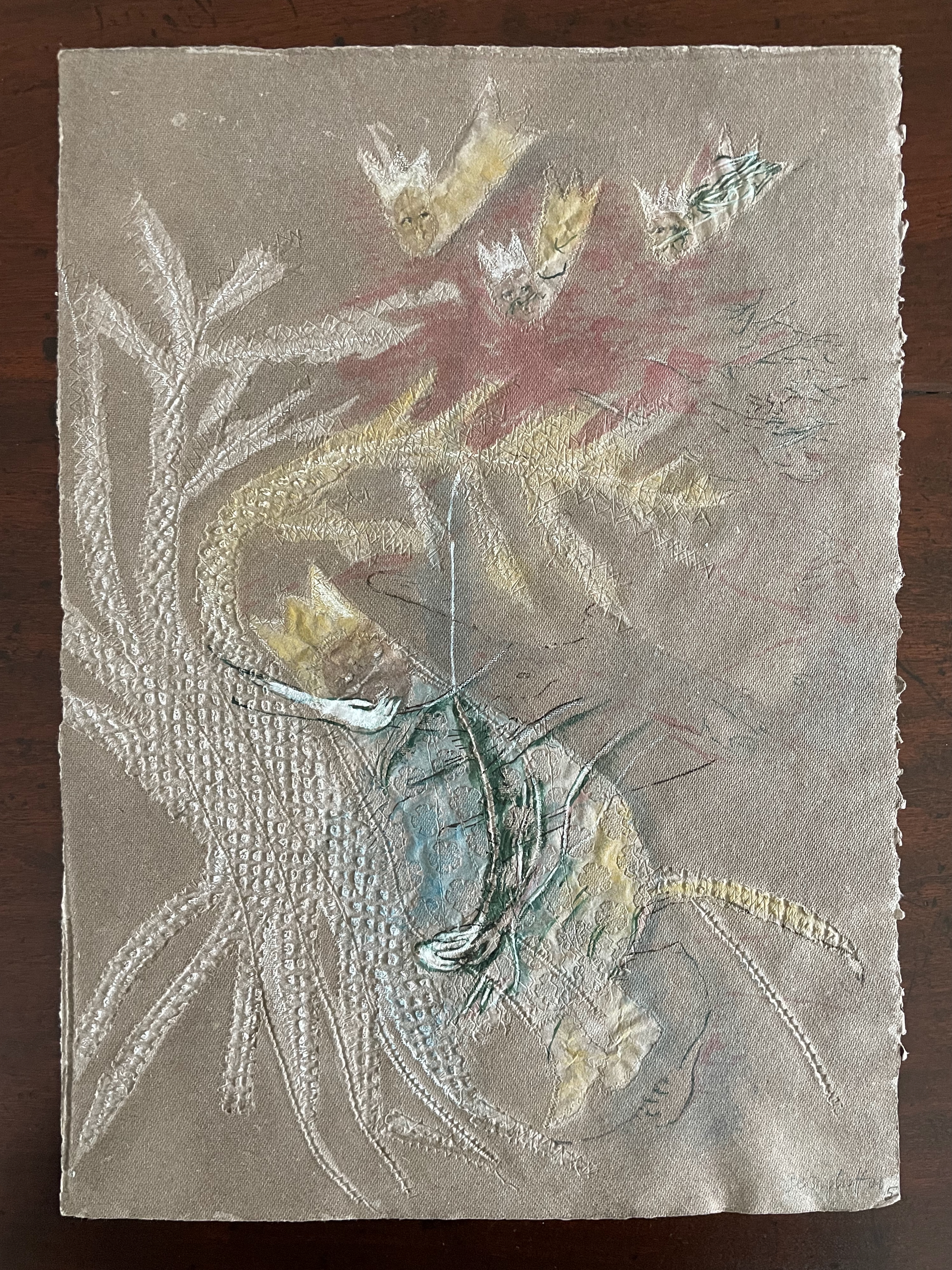
“When she had fallen asleep, it seemed to her as if she were flying high through the air, and she met a fairy, beautiful and radiant, yet she looked very much like the old woman who had given her berries in the forest and told her about the swans with gold crowns on their heads.” Translation with DeepL.
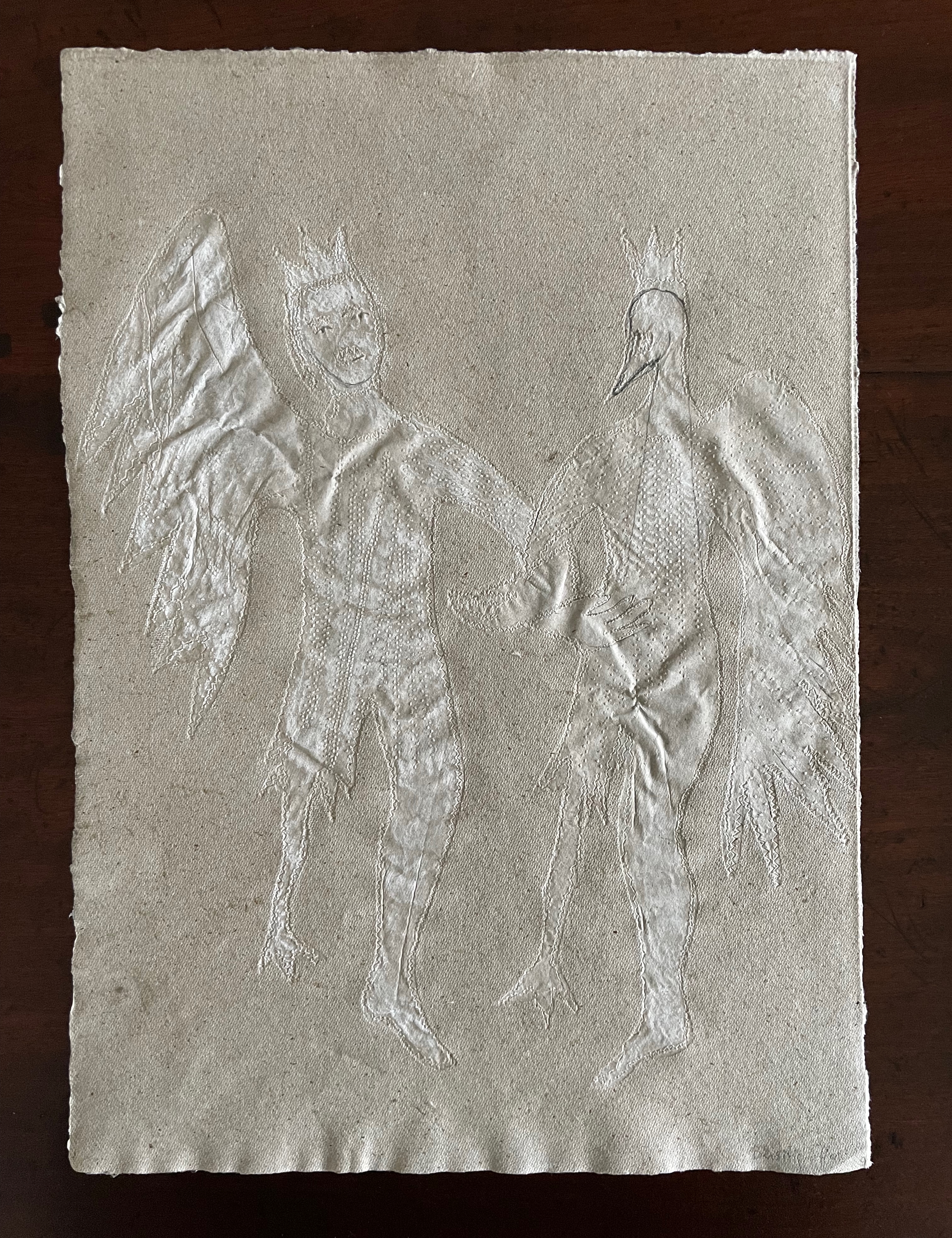
“The swans swooped down to her and lowered themselves so that she could throw the shirts over them: and as she touched them, the swan skins fell off, and her brothers stood before her in the flesh, fresh and beautiful.” Translation with DeepL.
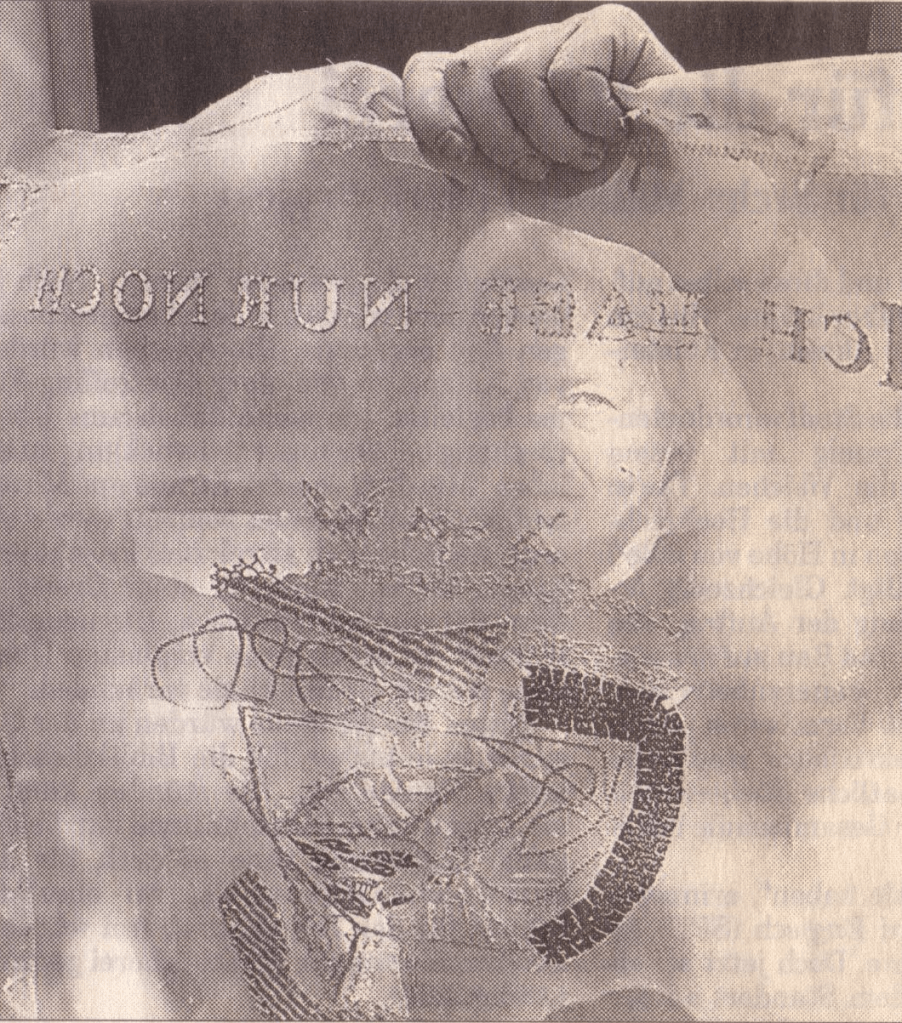
“Barbara Beisinghoff (head in the background) covers the frame with this transparent, embroidered and sewn gauze, which is used to scoop and emboss her nettle papers. This is how her large-format watermark illustrations end up on the sheets.” Translation with DeepL.
Peter Holle. 30 August 2001. Frankfurter Rundschau. Photo: Oliver Weiner.

This art by watermarking recalls that of other artists in the collection: Fred Siegenthaler and Gangolf Ulbricht, in particular. The technique of pulp painting also finds other practitioners in the collection: Pat Gentenaar-Torley, John Gerard, Helen Hiebert, Tim Mosely, Maria G. Pisano, Taller Leñateros, Claire Van Vliet and Maria Welch. Beisinghoff’s blend of embroidered watermarks, waterjet marking and pulp painting, however, creates a bas relief effect that is echoed only in the collection’s works by Mosely, Taller Leñateros and Van Vliet, albeit achieved differently. These workings of the substrate — as material, color, surface, and even narrative — with the workings of book structure is one of the more magical locations of book art. It is perfect for Beisinghoff’s metamorphical interpretation of the Andersen/Grimm fairy tale.

Further Reading

The First Seven Books of the Rijswijk Paper Biennial“. 10 October 2019. Books On Books Collection.

Pat Gentenaar-Torley“. 8 October 2020. Books On Books Collection.

John Gerard“. 13 August 2020. Books On Books Collection.

Helen Hiebert“. 18 June 2021. Books On Books Collection.

Werner Pfeiffer and Anselm Kiefer“. 17 January 2015. Bookmarking Book Art.

Warja Lavater“. 23 December 2022. Books On Books Collection.

Tatyana Mavrina“. 24 February 2023. Books On Books Collection.

Tim Mosely“. 23 August 2024. Books On Books Collection.

Maria G. Pisano“. 15 August 2021. Books On Books Collection.

Fred Siegenthaler“. 10 January 2021. Books On Books Collection.

Taller Leñateros“. 19 November 2020. Books On Books Collection.

Gangolf Ulbricht“. Books On Books Collection. In process.

Brentano, Clemens. 1970. Clemens Brentano’s Gesammelte Schriften. Edited by Christian Brentano. Bern: Herbert Lang. See also “Nach großem Leid“. Wikisource.

Fehn, Ann Clark. 1977. Change and Permanence : Gottfried Benn’s Text for Paul Hindemith’s Oratorio Das Unaufhörliche. Bern ; Peter Lang.

Feneyrou, Laurent. 2009.”Survey of works by Bernd Alois Zimmermann“. ircam. Paris: Centre Pompidou.

Fuchs, Leonhart, Klaus Dobat, and Werner Dressendörfer. 2016. The New Herbal of 1543 = New KreüTerbuch. Complete coloured edition. Köln: Taschen.

Holle, Peter. 30 August 2001. “Sie schöpft aus Brennnesseln Papier und druckt daraus ein Buch”. Frankfurter Rundschau. Photo: Oliver Weiner.

Rienäcker, Gerd. 2012. “Musizieren über Traditionen. Die Soldaten von Bernd Alois Zimmermann, Einstein von Paul Dessau” in Musik und kulturelle Identität, Vol. 2, edited by Detlef Altenburg and Rainer Bayreuther. Kassel: Bärenreiter-Verlag.

Thompson, D’Arcy Wentworth. 1917. On Growth and Form . Cambridge: University Press.

Books On Books Collection – Fred Siegenthaler

Strange Papers: A Collection of the World’s Rarest Handmade Papers (1987)

Strange Papers (1987)
Fred Siegenthaler
Wooden, felt-lined briefcase, containing a large box enclosing a book and 101 rare handmade paper samples in individual portfolios. Covering paper for the box and book is two-layer handmade paper from Nepal made with the bast fiber of the Daphne papyracea. Briefcase: H x W x D mm. Box: H x W x D Book: H x W mm, 127 pages. Portfolios: Edition of 200 copies, of which this is #28, signed by Fred Siegenthaler.  Acquired from Berkelouw Rare Books, 13 Aug 2020.
Romana-Butten cover paper from Papierfabrik August Koehler in Oberkirch, W. Germany. 
Printed by G. Krebs in Basel, Switzerland. 

As Siegenthaler explains in his preface, this is the work that started an international organization: the International Association of Hand Papermakers and Paper Artists (IAPMA). By 1986, Siegenthaler was well positioned to start this international association focused on paper art and the craft and science of papermaking. Since the late 1960s, he had been experimenting with strange material for paper — glass beads, hay, leather waste, stinging nettles, tobacco, wasps’ nests and much more. By the 1970s, he was supplying handmade custom papers to Helen Frankenthaler, Jasper Johns, Marisol, Claes Oldenburg among others. Travelling the world for business reasons (Sandoz), he began collecting paper samples from like-minded artists and papermakers in Mexico, Thailand, Viet Nam and more than 87 other countries. And he was “convinced that [he] had a duty to include these exclusive, beautiful and rare creations in [his] collection and preserve them for posterity”.

So, in November 1985, he began writing (by hand) to his network and, later, new association colleagues telling them of his plan for assembling Strange Papers. With the 200 samples of each paper, each selected contributor also provided a structured description of the raw materials and process used. The resulting book not only delivers a wealth of knowledge on the portfolios of samples but also contains items worth placing alongside the portfolios in an exhibition: a sample of a Taoist sacrificial money note on handmade rice paper with embossed gold leaf, plant drawings by Marilyn Wold and small samples of shifu and kinu-shifu (woven papers).

To hold a piece of papyrus and feel its natural curl toward scrolling, its roughness on one side and its smoothness yet segmentedness on the other, brings the history of paper alive. The differences among all the samples — in touch, appearance and, for some, even smell — is extraordinary. It is hard to choose what is most enjoyable about Strange Papers: reading the entries, holding each sample up to the light to examine it, comparing one sample with another, or deciding which is the strangest raw material.

The text — Browsing and reading the entries yields fascinating tidbits. Hawaii’s Akia plant has poisonous bark, roots and leaves, which are discarded in papermaking, but, according to Pam Barton, Hawaiians pound them, put them in a porous container and sink it in salt water pools to narcotize fish to be caught. Donna Koretsky advises observing the Fancy Manila Hemp paper under varying angles of light to see how the coloring changes. From the region where the Hollander beater was invented, De Zaanse Molen’t Weefhuis cites a letter from the paper scholar Henk Voorn that in large shipbuilding works, Moss Paper “was nailed to wood with so-called paper nails under the copper skin of the hull.” In making Jute Paper, Natan Kaaren in Israel “used old sacks … cut up into shreds and placed to rot in a barrel of water … about a year.” The confluence of patience, planning, sense of tradition, attention to detail, awareness of function with creative exuberance is the chief effect of the entries.

Inspection and comparison — Each of the 101 samples calls for inspection. Holding each one to the light and turning it side to side to see the change in effect is seductive. Photographing each paper backlit through its portfolio’s oval cutout shares some of this pleasure of inspection. To the oval cutout’s left, the number-stamped side is shown; to the right, the reverse side. Each sheet rests on its portfolio folder and is angled for viewing the surface. The six similarly named papers of the twelve composed of some form of grass leap out for comparison.

Sample 1.1 Composed of Poaceae — poa annua, poa trivialis. Netherlands. Not of the same family as the following sample, which goes to show how the same common name does not always identify the same substance. Both Lawn Grass samples were cut by lawn mower, but 1.1 was harvested over a longer period and fermented. Both were cooked for two hours, but 1.1 underwent another half hour of boiling. This sample’s darker color and slightly greater heft may be due to its difference in family or the washing process. Both feel brittle and make a crinkling sound when flexed.

Sample 19.5 Composed of Stenotaphrum secundatum. Israel. With this sample, the pulp was washed for a further two hours after boiling and then strained through a screen under high pressure, which may account for its greater translucence. Sample 19.5’s wrinkles are more shallow than 1.1’s and resembles wax paper. Both samples have a pungent dry grass smell.

Sample 14.2 Composed of Cortaderia selloana. Australia. The color and texture differ greatly from those of the next sample. This one is almost linen-like, not fully apparent from the photo, and is lighter, more flexible and less brittle than the next sample. It has almost no smell. The sample’s description is not extensive, which limits comparison of processing.

Sample 22.1 Also composed of Cortaderia selloana. USA. The darker color may be due to inclusion of stalks and fibrous plumes and possibly the season of harvesting. This sample is far less dense and far more brittle than 14.2. Where 14.2 has that linen-like texture on its number-stamped side, 22.1 is actually more polished between the bits of stalk or leaf. Its smell is slightly metallic.

Sample 15.5 Composed of Phragmites australis. Australia. Cut with a garden shredder before soaking then boiling in a solution of 17% caustic soda (500 gms in 30 liters). Beating occurred by chopping with a Chinese-style vegetable cleaver, then running through a sink garbage disposal unit, then running through a kitchen blender. Its color, lighter than the next sample’s, matches with its weight and stiffness, both less than the next sample’s.

Sample 18.1 Composed of Phragmites communis. USA. Cut into 2-3 inch length. Soaked then boiled in 20% caustic soda. Processed with a Hollander beater. The densest and least translucent of all the grass samples above. It has a huskier smell than the Common Reed sample above.

The strangest raw material — This is truly a contest. Carrots are a strong contender, but so are hemp from old fire brigade hoses, moss, peat and stinging nettles. The following are chosen due to their inorganic, silicate and worrisome nature. Except for the sample made of 100% polyethylene fibers, all others consist of organic material.

Sample 32.1 Composed of 100% asbestos fiber. Light and flimsy, it feels like cloth; seems odorless; but this is not one to handle or sniff too closely. Its white, greyish color and dimpled texture will be familiar to anyone who attended school in the latter half of the twentieth century and looked up the ceilings.

Sample 28.1 Composed of 70% strands of glass, containing about 200 tiny fibers, 20% Kozo and 10% polyvinyl alcohol fibers for binding. The glass strands feel tough and breakable; they shine like satin under glancing light; their pinkness comes from dye. Odorless.

Among the contributors with other works represented in the Books On Books Collection are Winifred Lutz, Maureen Richardson, Raymond Tomasso and Therese Weber. Each also appeared in one of the first seven books published for the Rijswijk Paper Biennial, which along with Siegenthaler’s works here, Helen Hiebert’s The Secret Life of Paper, paper samplers from Velma Bolyard and Maureen Richardson, works from Taller Leñateros, watermark art from Gangolf Ulbricht, and pulp painting works from Pat Gentenaar-Torley, John Gerard, Claire Van Vliet and Maria Welch form the core of the collection’s subset focused on paper. Other references are listed under Further Reading.

Das Werk / The Works (2009)

Das Werk: Schöpfen bis zum Erschöpfen: mein Leben mit Kunst u. Papier / The Works: From Creation to Exhaustion: My life with Art and Paper (2009)
Fred Siegenthaler with Renate Meyer.
Hardback, goldleaf stamped. H300 x W240 mm, 301 pages. Edition of 50, of which this is #23. Acquired from ZVAB, 21 October 2020. Photos: Books On Books Collection, displayed with permission of the artist.

The Works and its update (below) are useful and valuable to have alongside Strange Papers. Both illustrate Siegenthaler’s breadth of artistry beyond papermaking, and the former includes a comprehensive essay on that artistry by Nana Badenberg. Along with John Gerard and Gangolf Ulbricht, Siegenthaler is one of the twentieth and twenty-first centuries’ masters at using watermarking to make art. His self-portrait, included in The Works, provides an outstanding example of watermark art, described at length by Badenberg. She records Siegenthaler’s watermark contributions to works by Horst Antes and Meret Oppenheim as well as his papermaking for the artists mentioned in this entry’s introduction. Her commentary on the technical, material and conceptual aspects of Siegenthaler’s work in each of its areas of development — “incorporation” (similar but more subtle than appropriation), “revealments”, book objects, paper castings of the human form, “repulpings” (recycling of precious papers), pulp painting and sculpturing, signage, erotica and religious works — enriches any encounter with his art.

Nachtrag zu: Fred Siegenthaler Das Werk: neue Arbeiten aus den Jahren 2010 bis 2015 / Addendum to: Fred Siegenthaler The Works: New Works from 2010 to 2015 (2016)

Nachtrag zu: Fred Siegenthaler Das Werk neue Arbeiten aus den Jahren 2010 bis 2015 / Addendum to: Fred Siegenthaler The Works: New Works from 2010 to 2015 (2016) Fred Siegenthaler with Renate Meyer
Casebound in paper-on-board covers. H303 x W211 mm, 48 pages. Edition of 300. Acquired from the artist, 2 November 2020.
The cover shows Endlich wieder vereint (2015) (“Finally united again”).

This double-page spread provides a snapshot of continuity and development. The cards made from repulping and recalling Siegenthaler’s earlier work with this technique speak to continuity — as does the juxtaposition of the overpaintings from 2000 and 2011 on the next page. The nature of Siegenthaler’s 2010-2015 absorption with color on the verso page contrasts with his earlier handling of color in the Kopfüssler and the facsimile leaf of the Gutenberg Bible on the recto. Like Strange Papers, the Addendum reflects the careful planning and exuberant creativity characteristic of Siegenthaler’s entire career.

Further Reading

The First Seven Books of the Rijswijk Paper Biennial“. 10 October 2019. Books On Books Collection/

Taller Leñateros“. 19 November 2020. Books on Books Collection.

@incunabula. 7 July 2019. “The German paper artist Fred Siegenthaler’s monumental 1987 ‘Strange Paper’“. Twitter thread. Accessed 4 September 2019. An extended thread of commentary provides close-ups of the samples made with carrot, US dollar bills, eggplant, steel and glass fiber. Some, like the steel sample, are in the special edition of Strange Papers, for which only 20 copies were produced.

Bloom, Jonathan. 2001. Paper before print: the history and impact of paper in the Islamic world. New Haven: Yale University Press.

Blum, André, and Harry Miller Lydenberg. 1934. On the origin of paper. New York: R.R. Bowker Company.

Hamady, Walter; Samuel Haatoum; and Hermann Zapf. 1982. Papermaking by Hand : A Book of Suspicions. Perry Township, Dane County, Wisconsin, USA: Perishable Press Limited.

Hiebert, Helen. 12 August 2014. “Strange Papers“, Helen Hiebert Studio. Accessed 3 November 2020.

Hiebert, Helen. 2000. The papermaker’s companion: the ultimate guide to making and using handmade paper. North Adams, MA: Storey Pub.

Hiebert, Helen, and Melissa Potter. 2016. The secret life of paper: 25 years of works in paper. Kalamazoo, MI: Kalamazoo Book Arts Center.

Hunter, Dard. 1987. Papermaking: the history and technique of an ancient craft. New York: Dover.

Kurlansky, Mark. 2016. Paper: paging through history. New York, NY: W.W. Norton.

McIlroy, Thad. 3 January 2018. “The Future of Paper”, The Future of Publishing. Accessed 14 September 2019.

Müller, Lothar. 2015. White magic: the age of paper. Cambridge, UK: Polity Press.

Sansom, Ian. 2012. Paper: an elegy. New York, NY: Wm. Morrow.

Vincent, Jessica. 08 August 2019. Indigenous Women Are Publishing the First Maya Works in Over 400 Years, Atlas Obscura. Accessed 27 October 2020.

Weber, Therese. 2008. The language of paper: a history of 2000 years. Bangkok, Thailand: Orchid Press.

Books On Books Collection – Jane Paterson

Blue Whale (2015)

Blue Whale (2015)
Jane Paterson
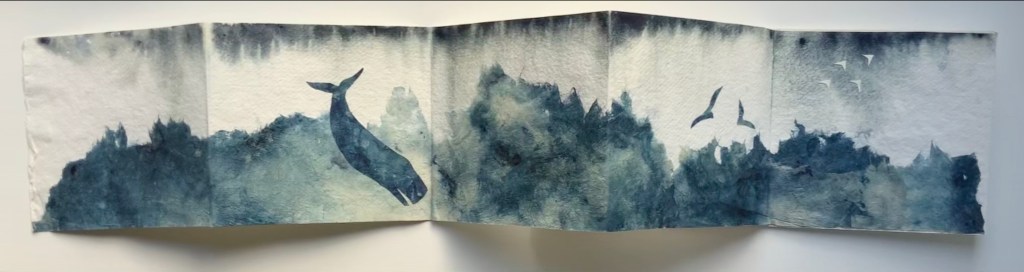
Self-covering accordion book. H140 x W155 x D10 mm (closed); W750 mm (open). Unique. Acquired from the artist, 15 April 2015. Photos: Books On Books Collection.

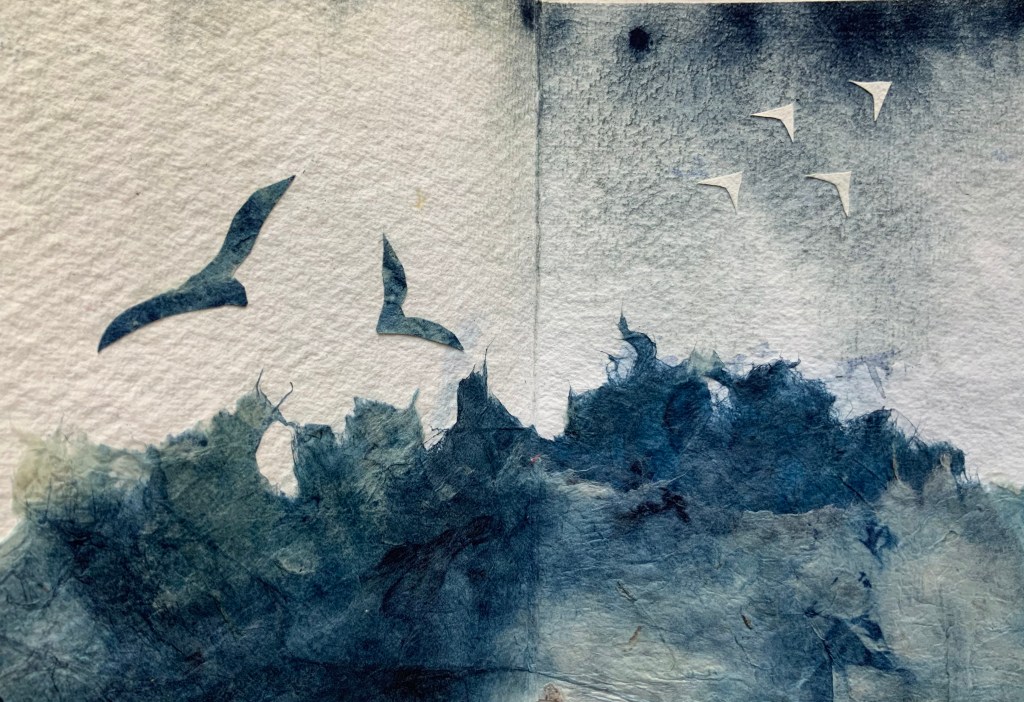
An acquisition early in the early days of this collection, Blue Whale forged the way for later acquisitions that painted with paper. At the time, the artist was asked how Blue Whale was created:

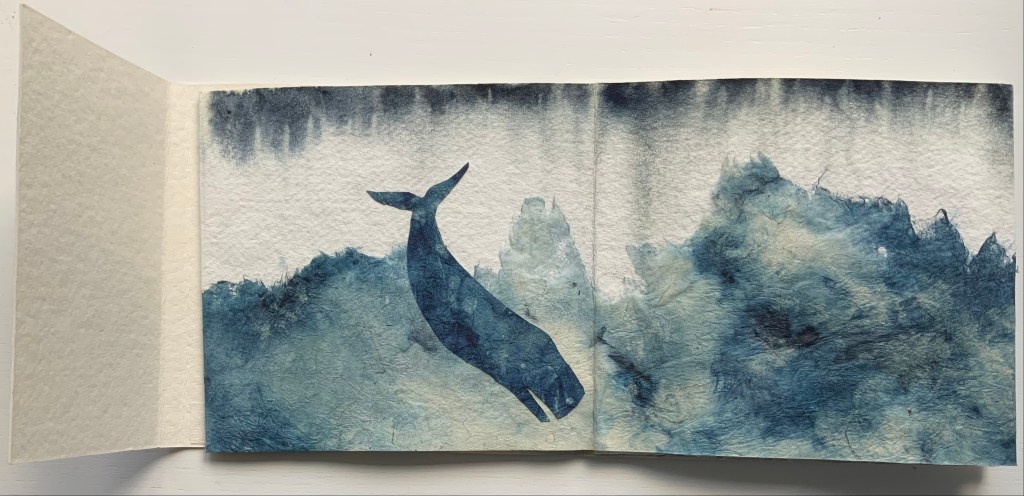
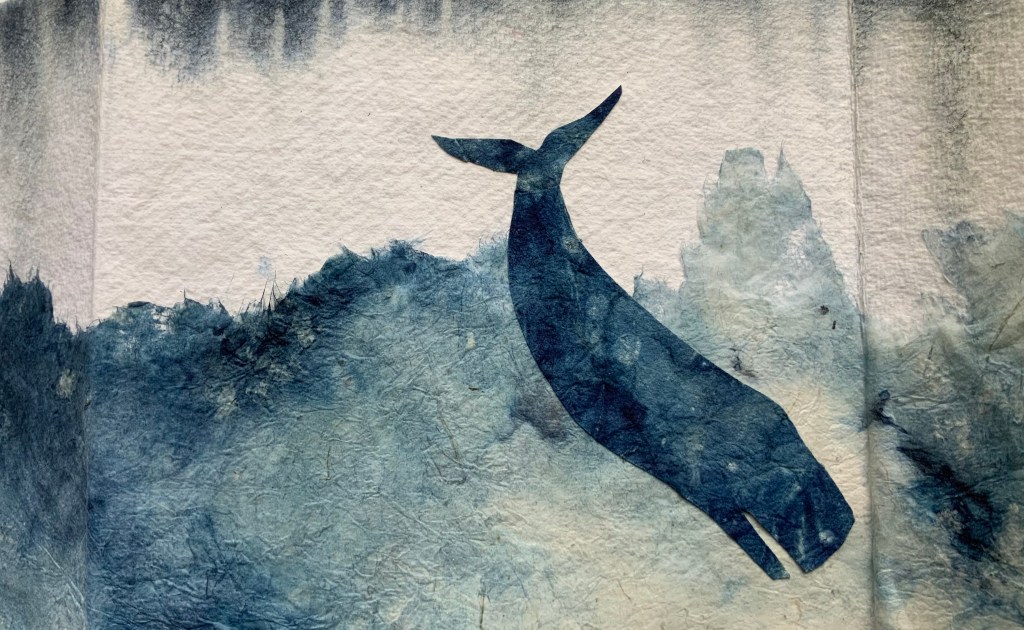
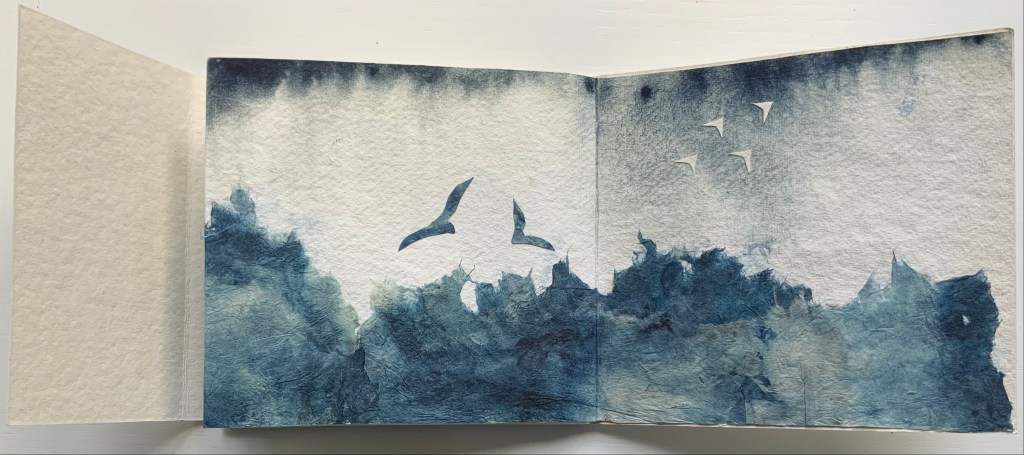
In answer to your questions about the processes I use, I should explain that I have a background in textile design and a great love for indigo dye.  Since starting making books I have experimented with dyeing paper in an indigo vat.  I use khadi and various mulberry papers that have excellent wet strength and allow me to use many of the decorative processes that I use with textiles.  I also dye card board from boxes and have exciting results tearing the wet layers apart. I made the sea in the Blue Whale book from fine paper that had partly disintegrated in the vat.  The cover was made by clamping khadi paper between 2 square blocks so that the dye seeped underneath in interesting ways.  The whales are made from dyed khadi. Artist’s correspondence, 9 April 2015.
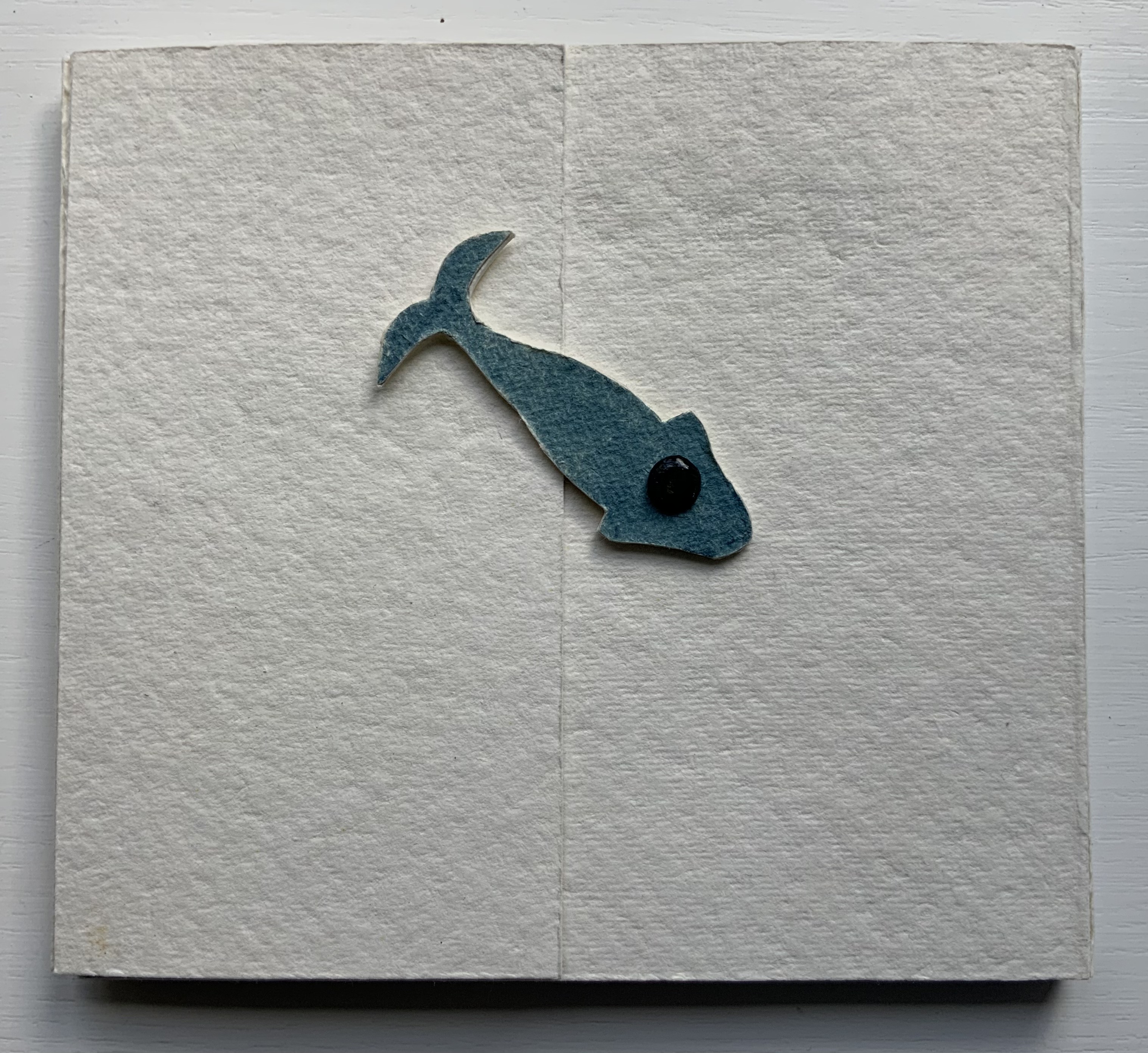
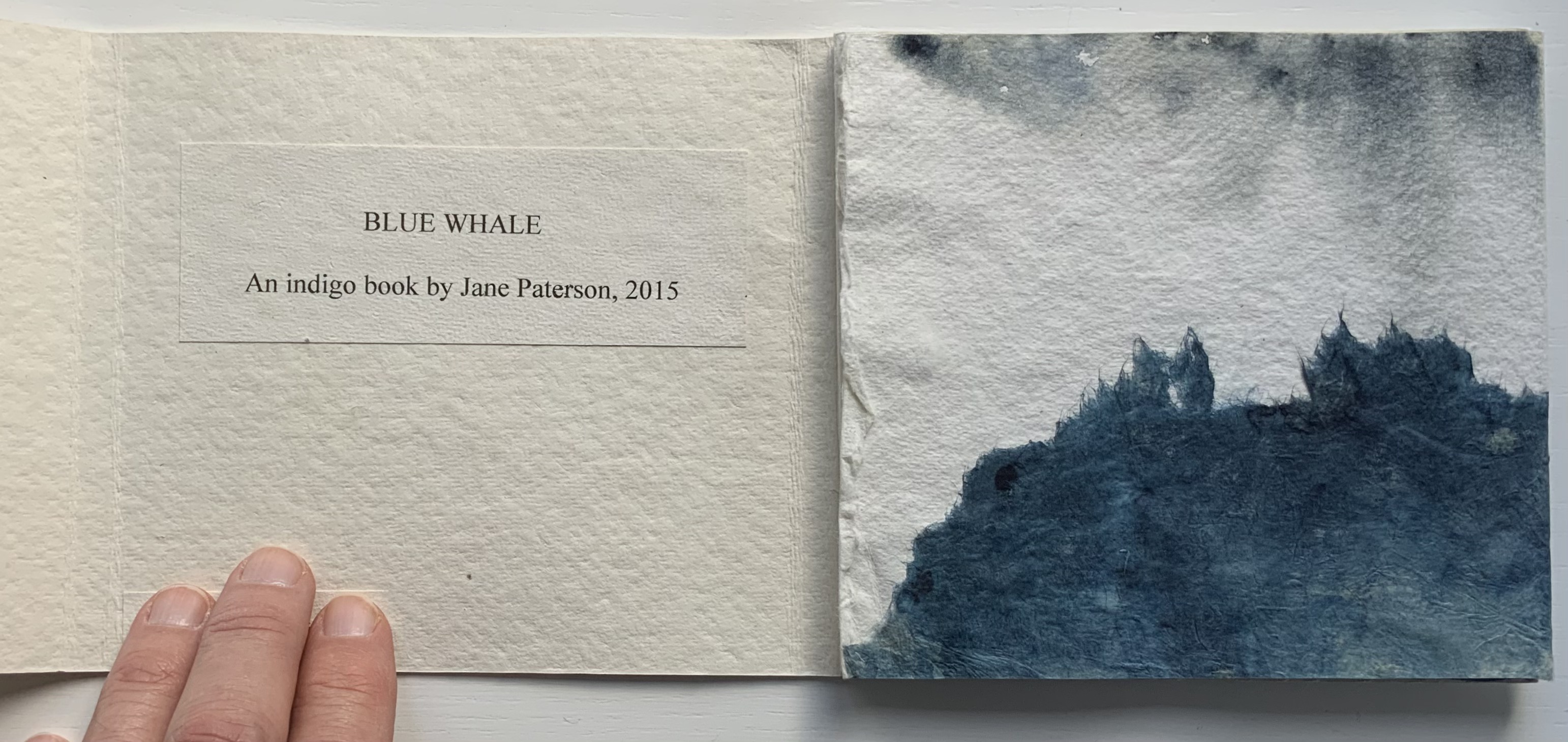
Paterson’s technique in Blue Whale occupies a middle ground between collage and pulp painting. The way the artist has manipulated the nearly disintegrated, indigo-dyed fine paper to evoke the depth, surface and spray of the sea is remarkable. Additional examples of her work with indigo dye as well as other book art techniques can be found in the Artists Book Club Dove (ABCD) site.

Khadi is also the name of a papermaking company founded in the 1980s in India. Based outside the village of Tarihal near Hubli, in Karnataka, South India, Khadi runs a mill that manufactures the 100% cotton-rag paper. The company also works with suppliers in Nepal (GET Paper) and Bhutan (Jungshi). The process is described here and demonstrated here.

Further Reading

The First Seven Books of the Rijswijk Paper Biennial“, Books On Books Collection, 10 October 2019. A wide variety of art with paper and the form of the book.

Pat Gentenaar-Torley“, Books On Books Collection, 8 October 2020. Examples of pulp painting.

John Gerard“, Books On Books Collection, 13 August 2020. Book art and pulp painting.

Claire Van Vliet“, Books On Books Collection, 8 August 2019. Book art and pulp painting.

Maria Welch“, Books On Books Collection, 18 September 2020. Book art and pulp painting.

Books On Books Collection – John Gerard

Alpha Beta (2005)

Alpha Beta (2005)

John Gerard 

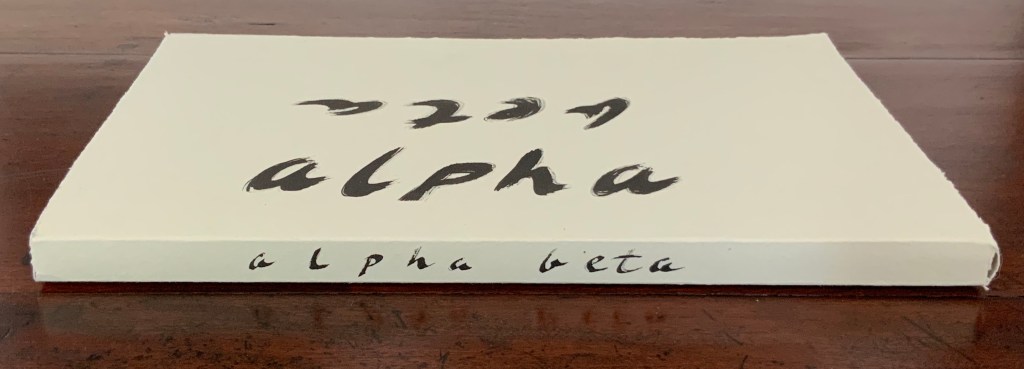
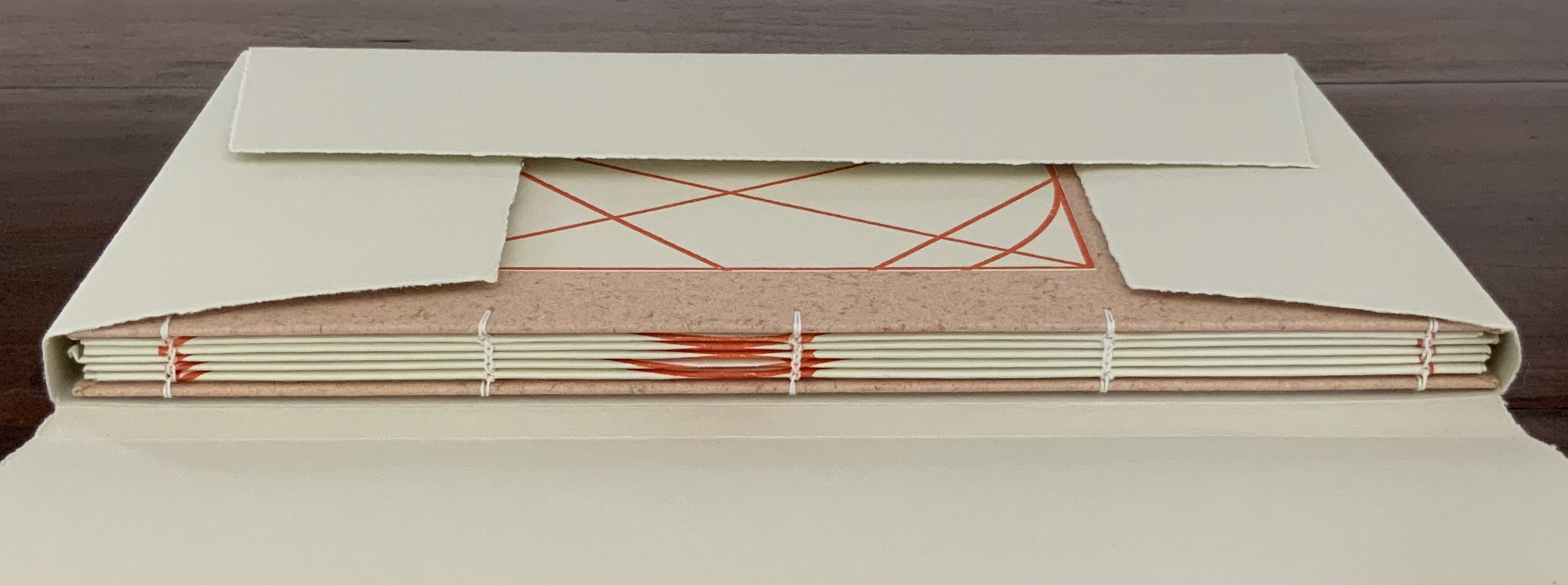
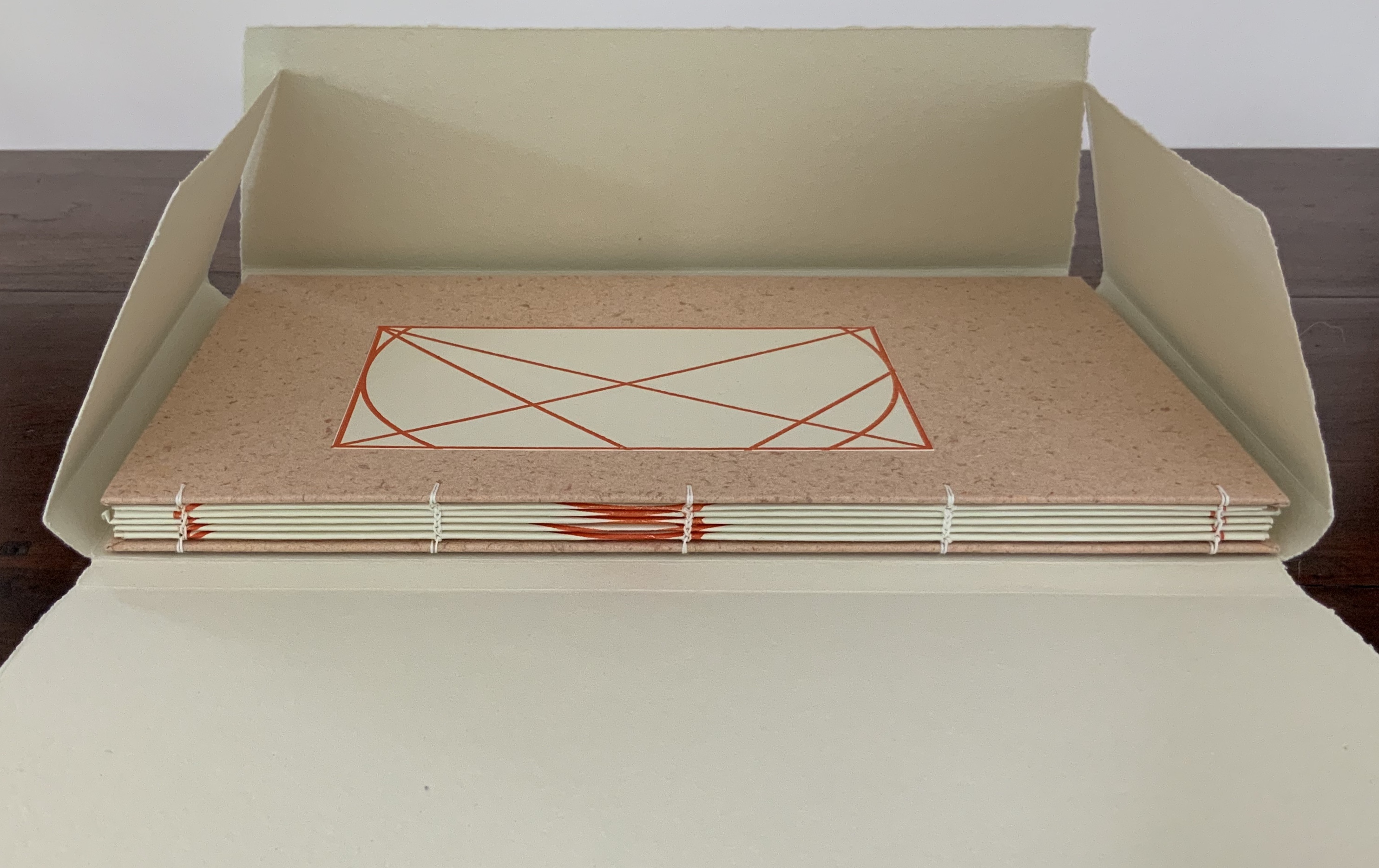
Small quarto book chain-stitched in boards, with a paper label to the upper cover, 40 pages, H275 x W272 x D15 mm, housed in a paper four-flap enclosure H175 x W278 x D16 mm. Signed edition of 20, of which this is #18. Acquired from the artist, 29 July 2020. Photos: Books On Books Collection.

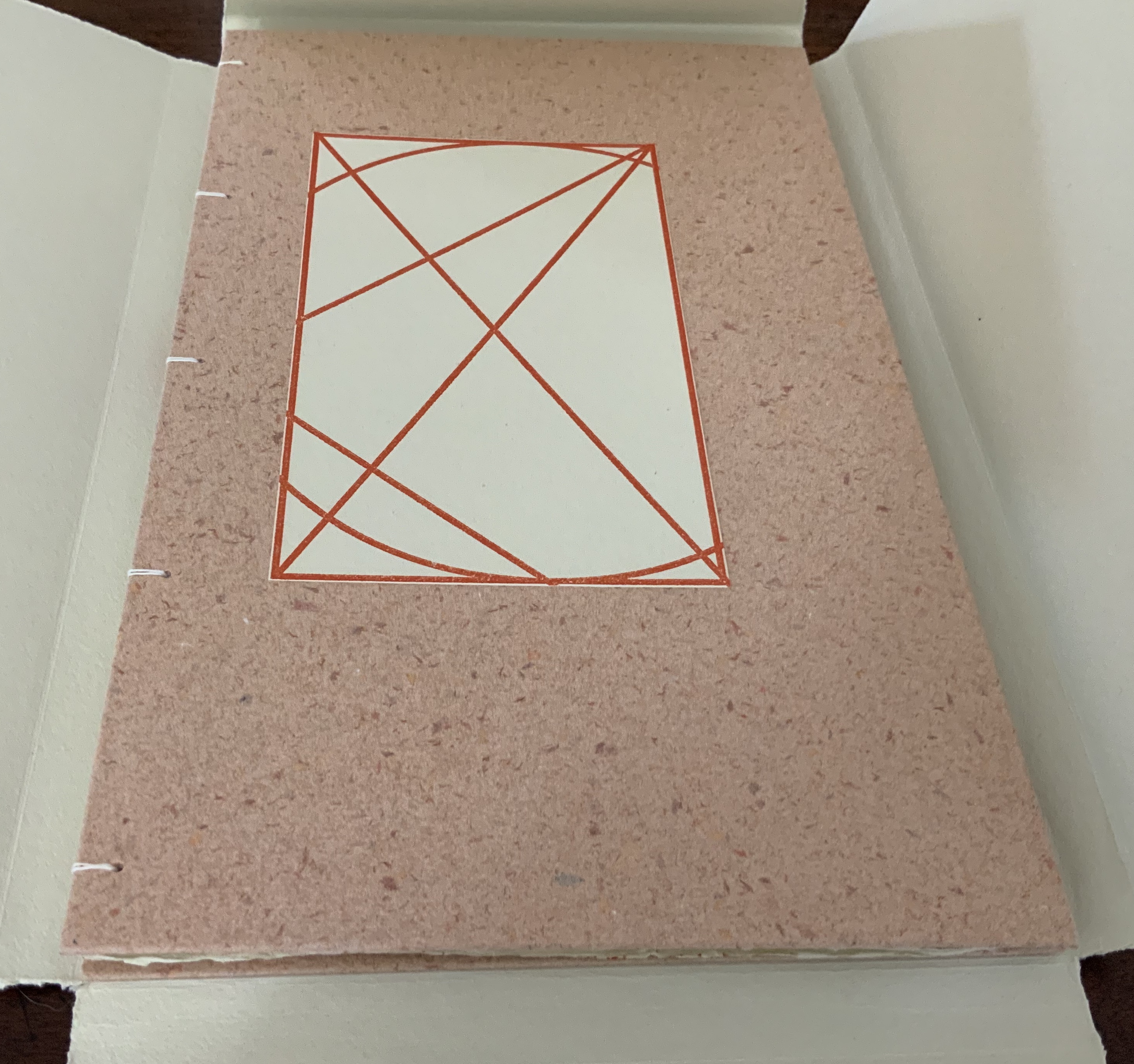
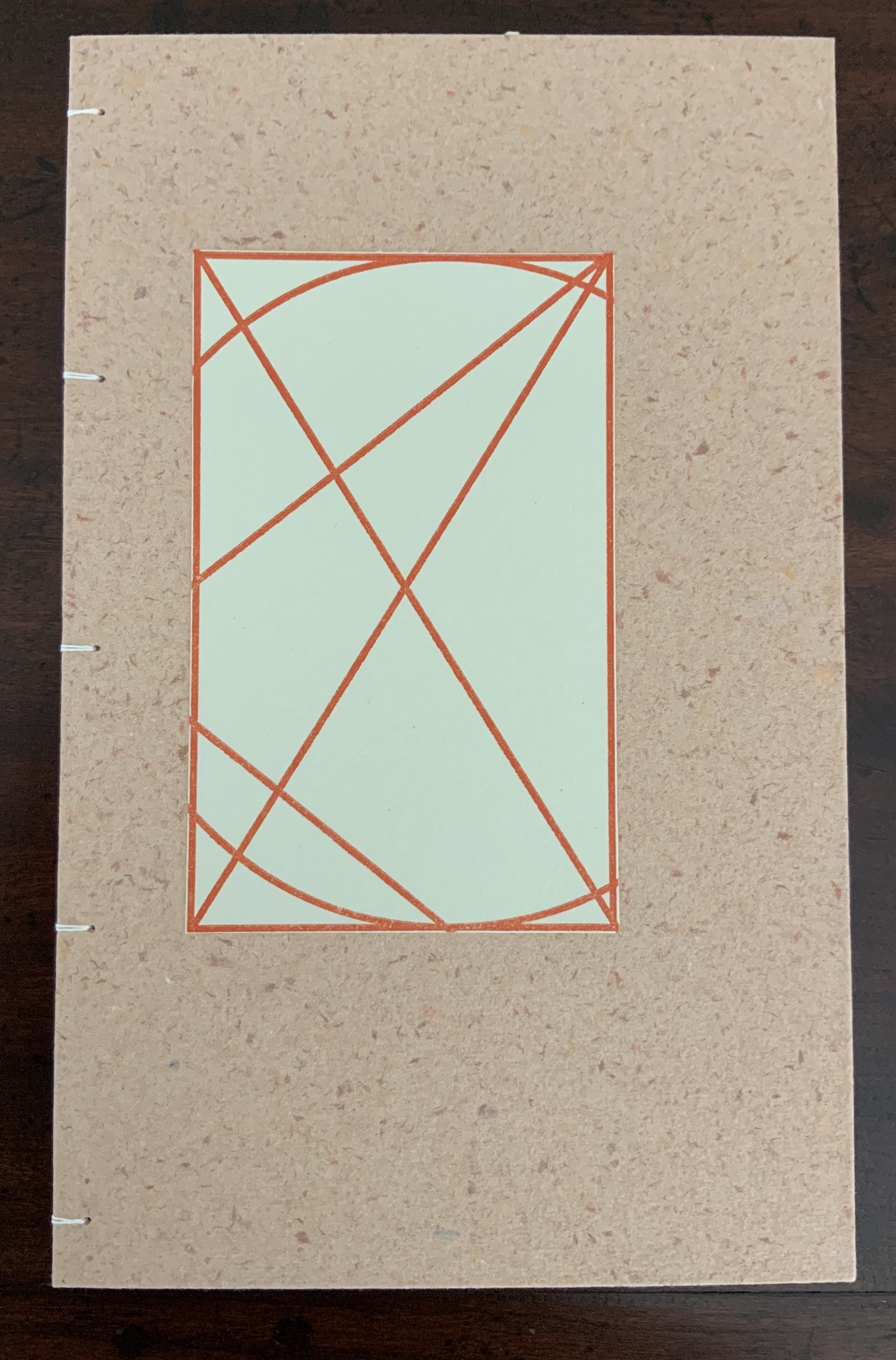
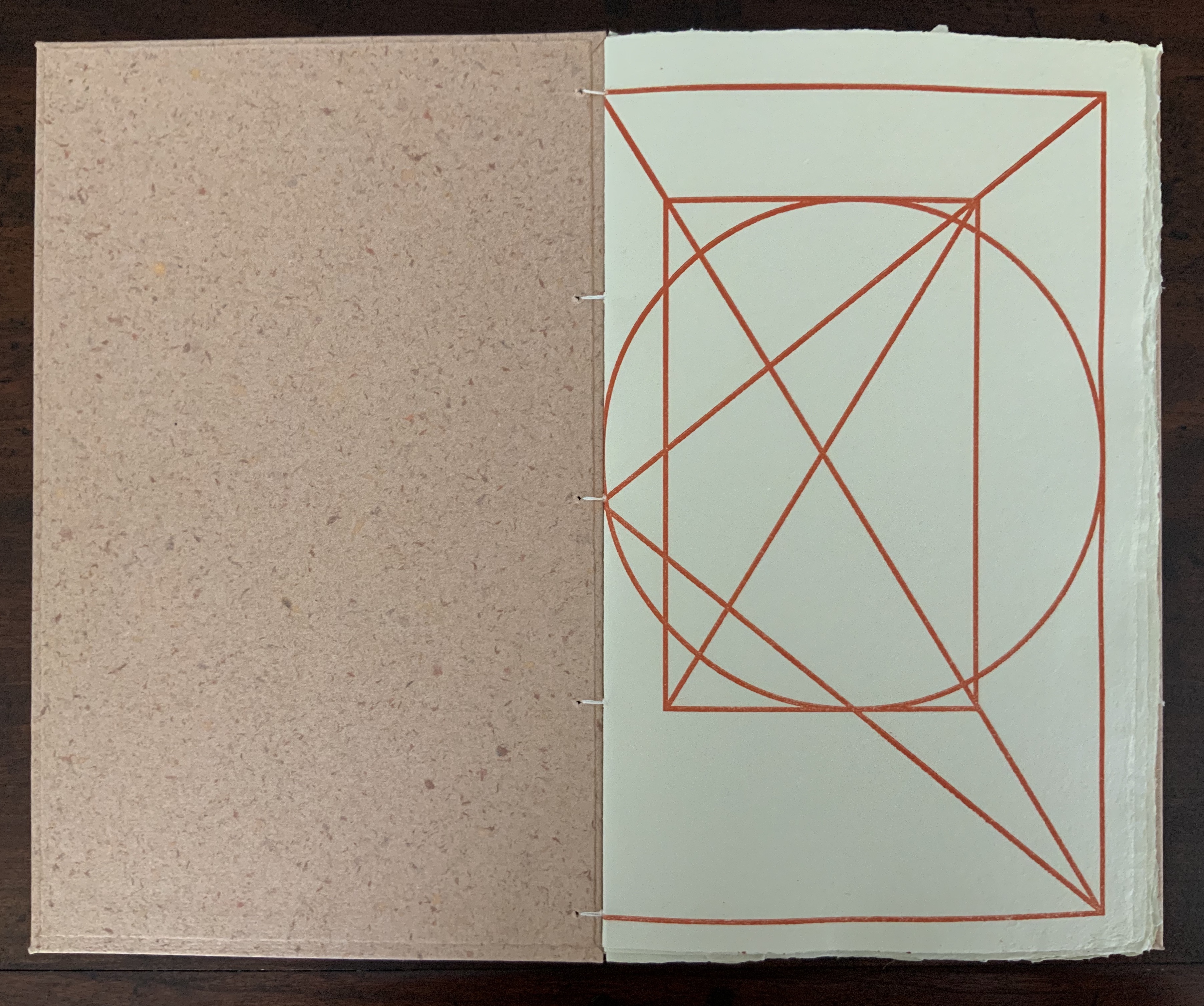
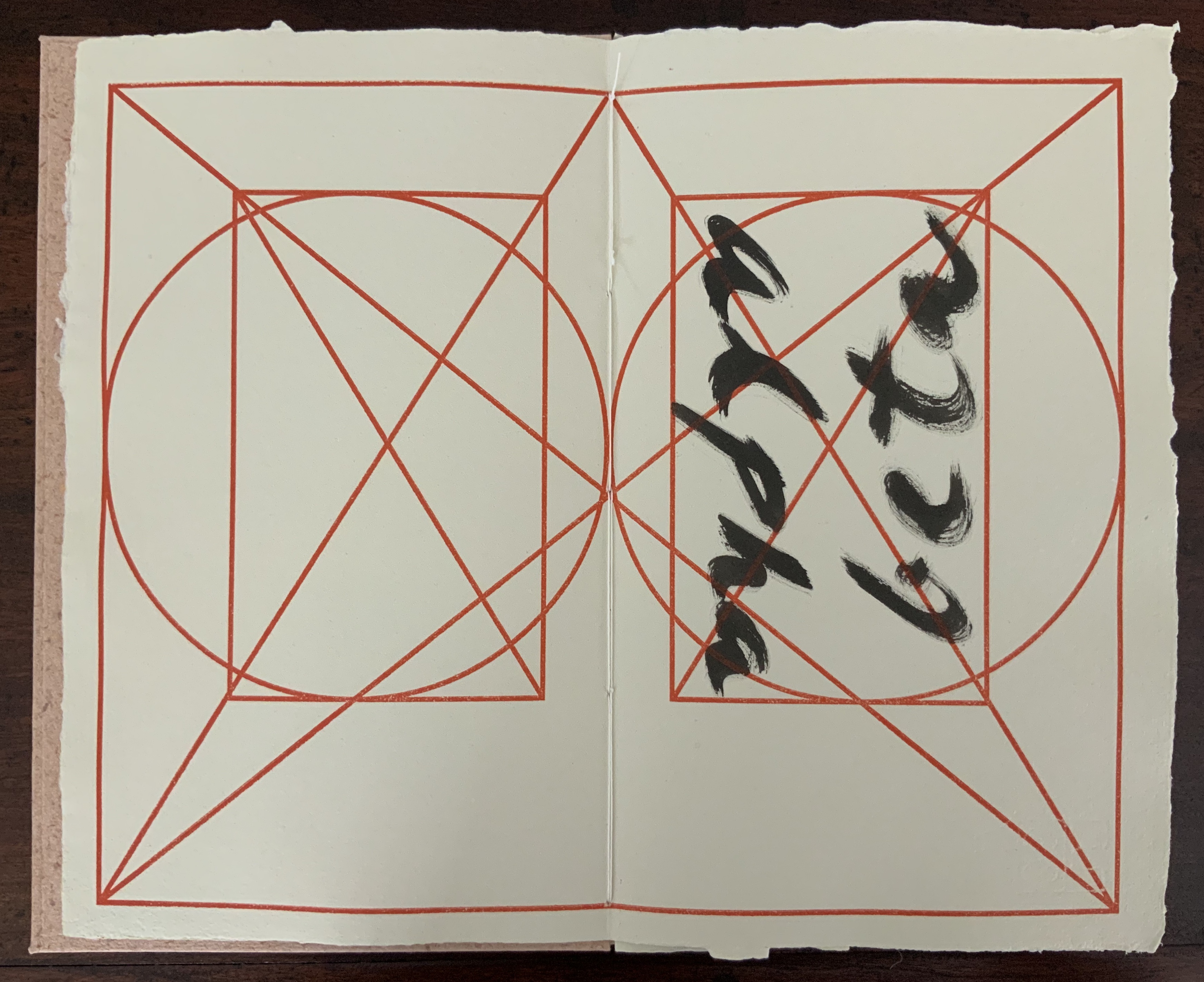
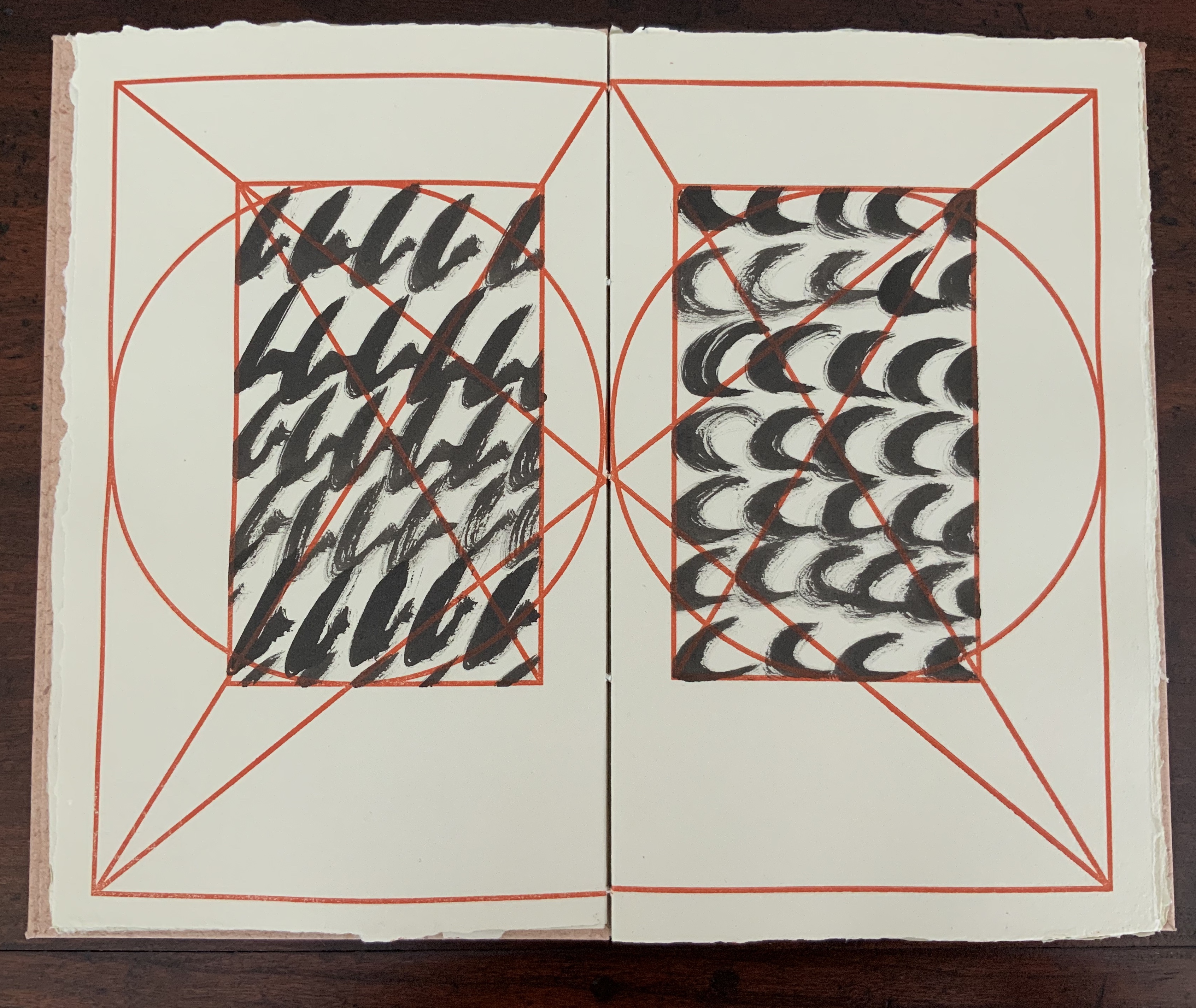
In the playground of the alphabet, papermaking, calligraphy, page design and layout, image and text, printing and binding, John Gerard has created an outstanding and contemplative work of book art and the book arts. Eastern and Western traditions meet on the page and in the material and structure: Coptic-style binding, handmade paper and spirited brushing of the letters right up against the geometric constraints of Jan Tschichold’s diagram for deriving the text block’s ideal space and positioning from the Golden Ratio.

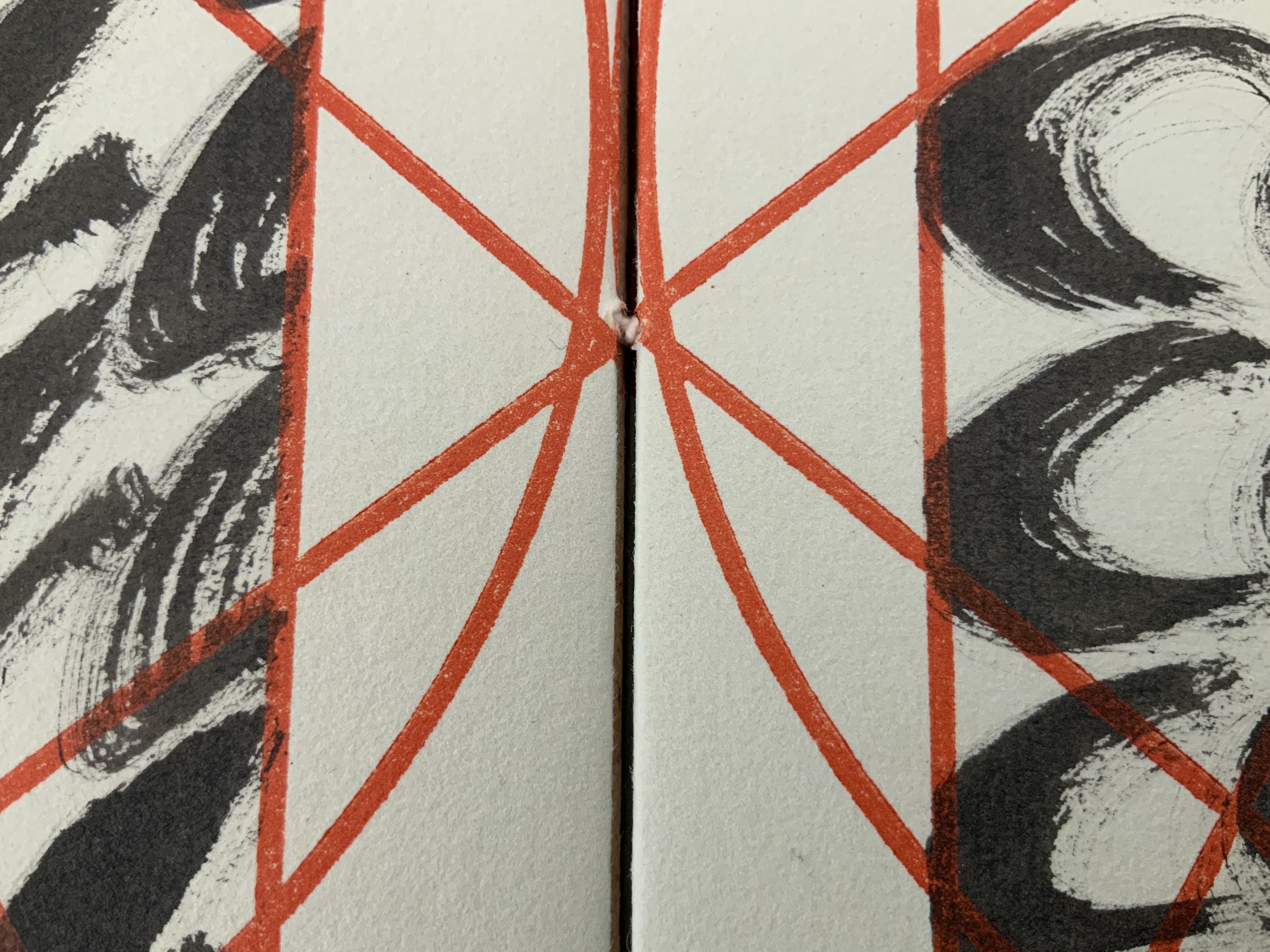
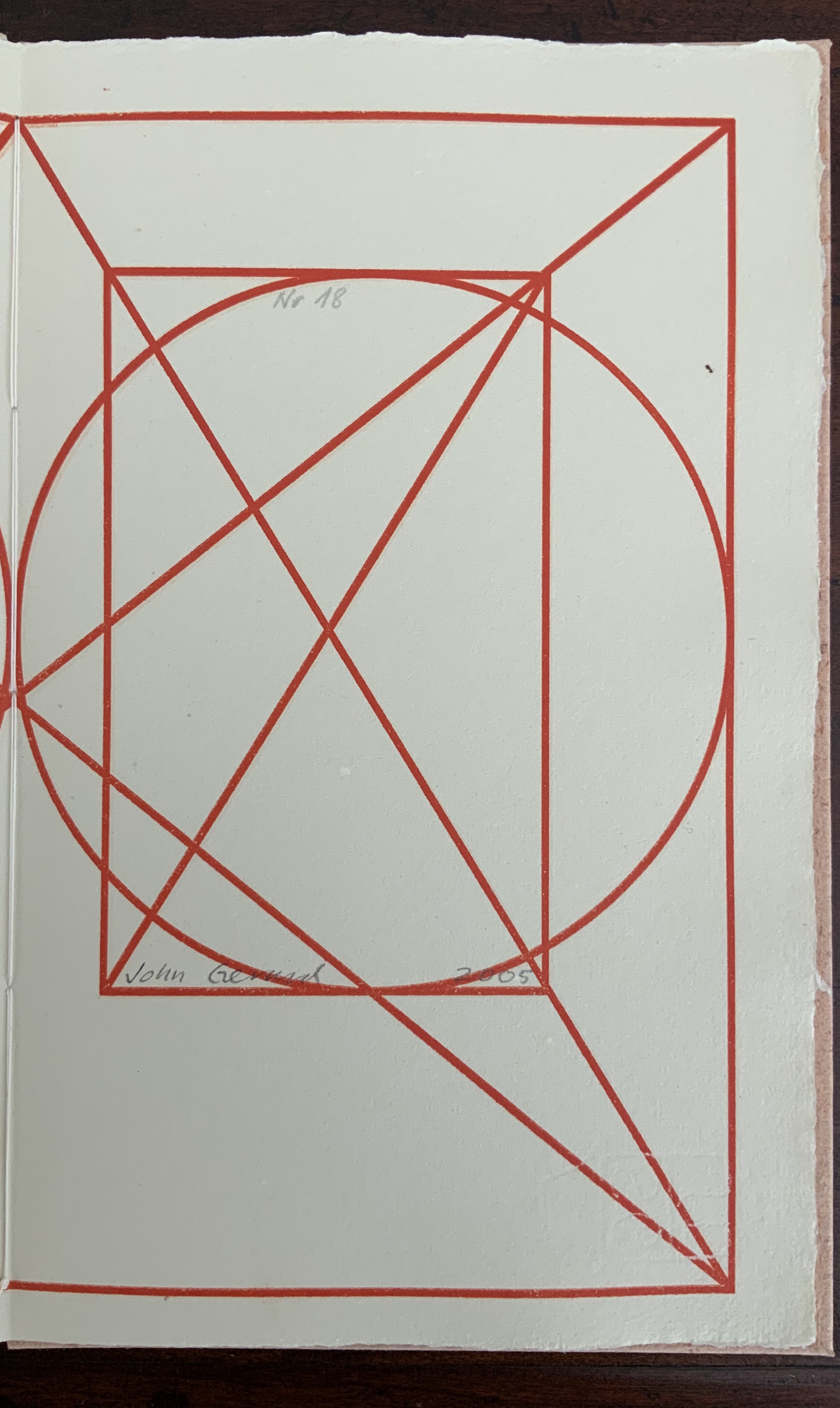
The cover’s paper label shows the image of Jan Tschichold’s canon for page layout, which is reproduced on every page of the work. Each letter of the alphabet is messily brushed in black over and over to fill the mathematically precise text area defined by Tschichold’s canon.

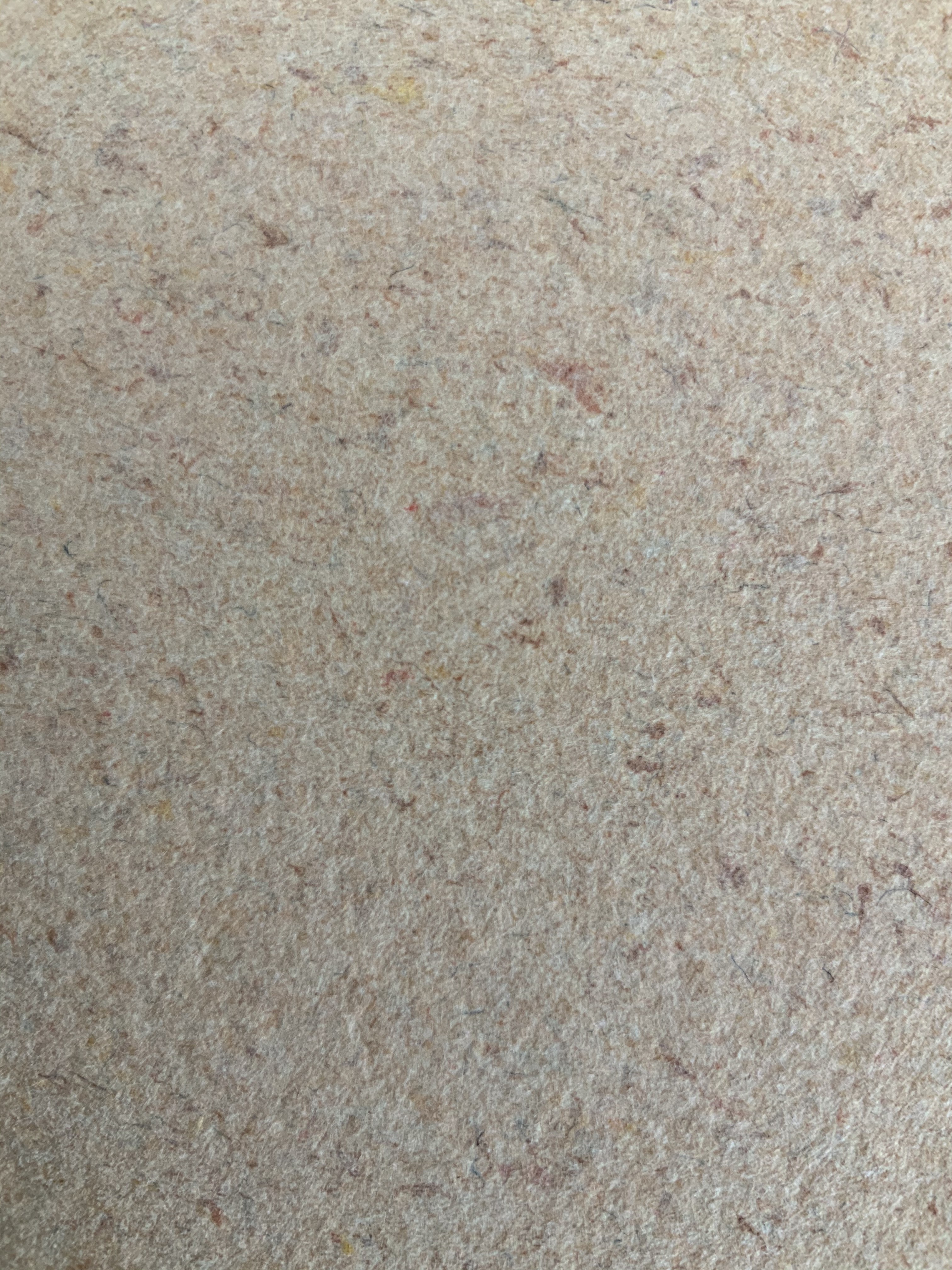
The text and label papers for Alpha Beta are handmade from cotton and hemp using a velin mould with Gerard’s early watermark depicting the Eifeltor Mühle (Eifeltor Mill) and the letters S and G (Studio John Gerard). The weight of the paper is about 150-180gsm. The lettering is done with Indian ink, and the printing of Tschichold’s diagram, with a proofing press using a photo-sensitive nylon plate. The cover papers are also made with cotton and hemp using a coagulant with slightly different pigmented pulps, which creates the decorative speckled look.  The sewing thread is linen.

Tschichold’s “canon” is but one among four. The others belong to Villard de Honnecourt, J.A. Van de Graaf and Raúl Rosarivo. Online, Alexander Ross Charchar’s dynamic diagram “The Dance of the Four Canons” delightfully illustrates the development of the Western craft and science of page layout.

Seifenblasen (2013)

Seifenblasen (2013)

John Gerard

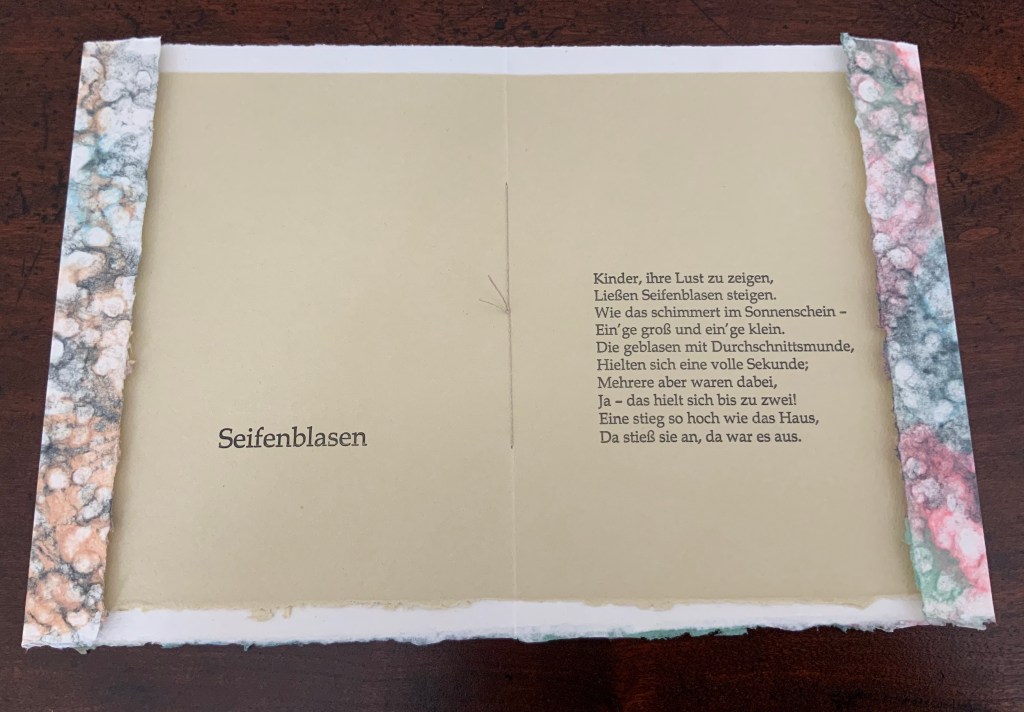
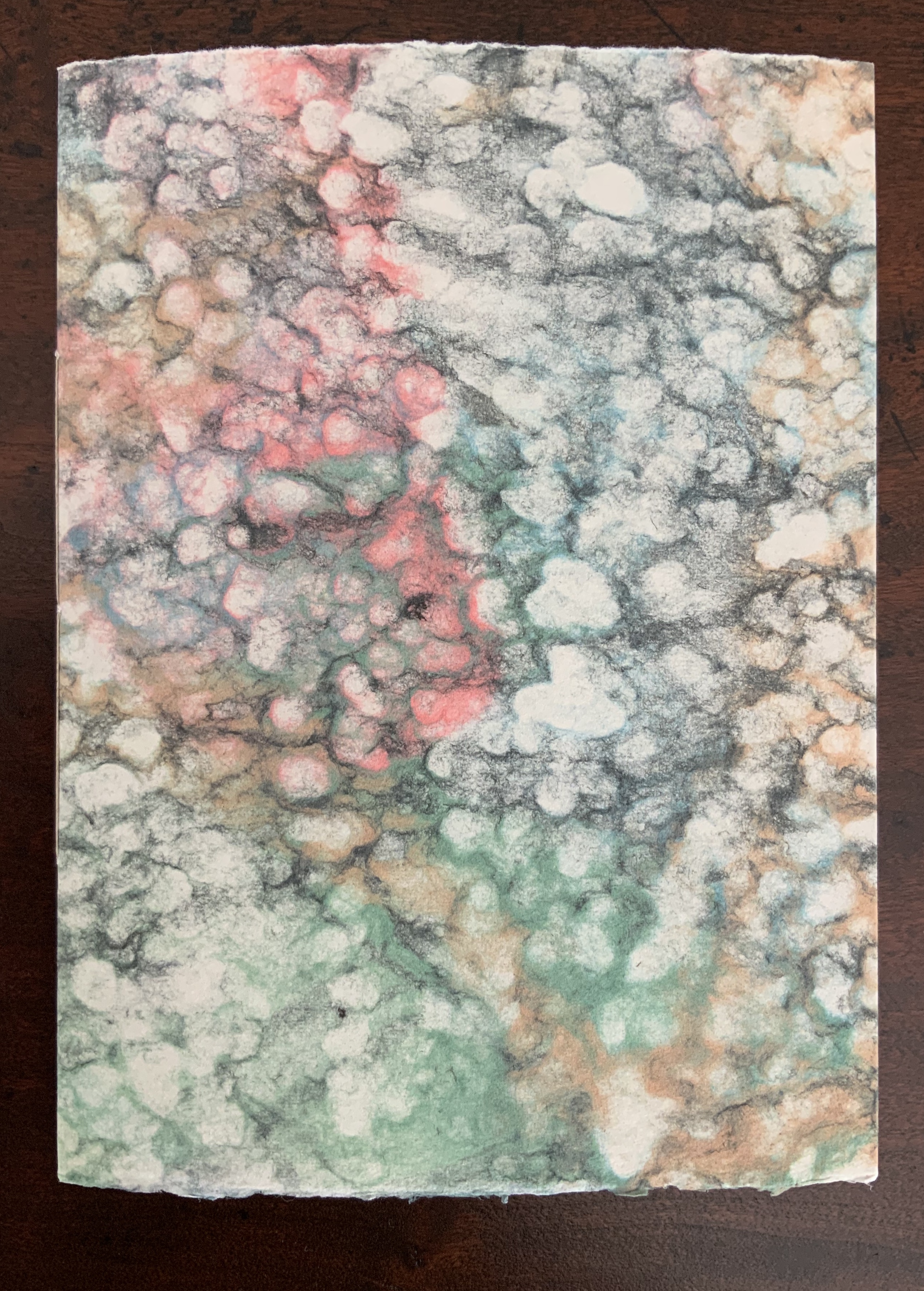
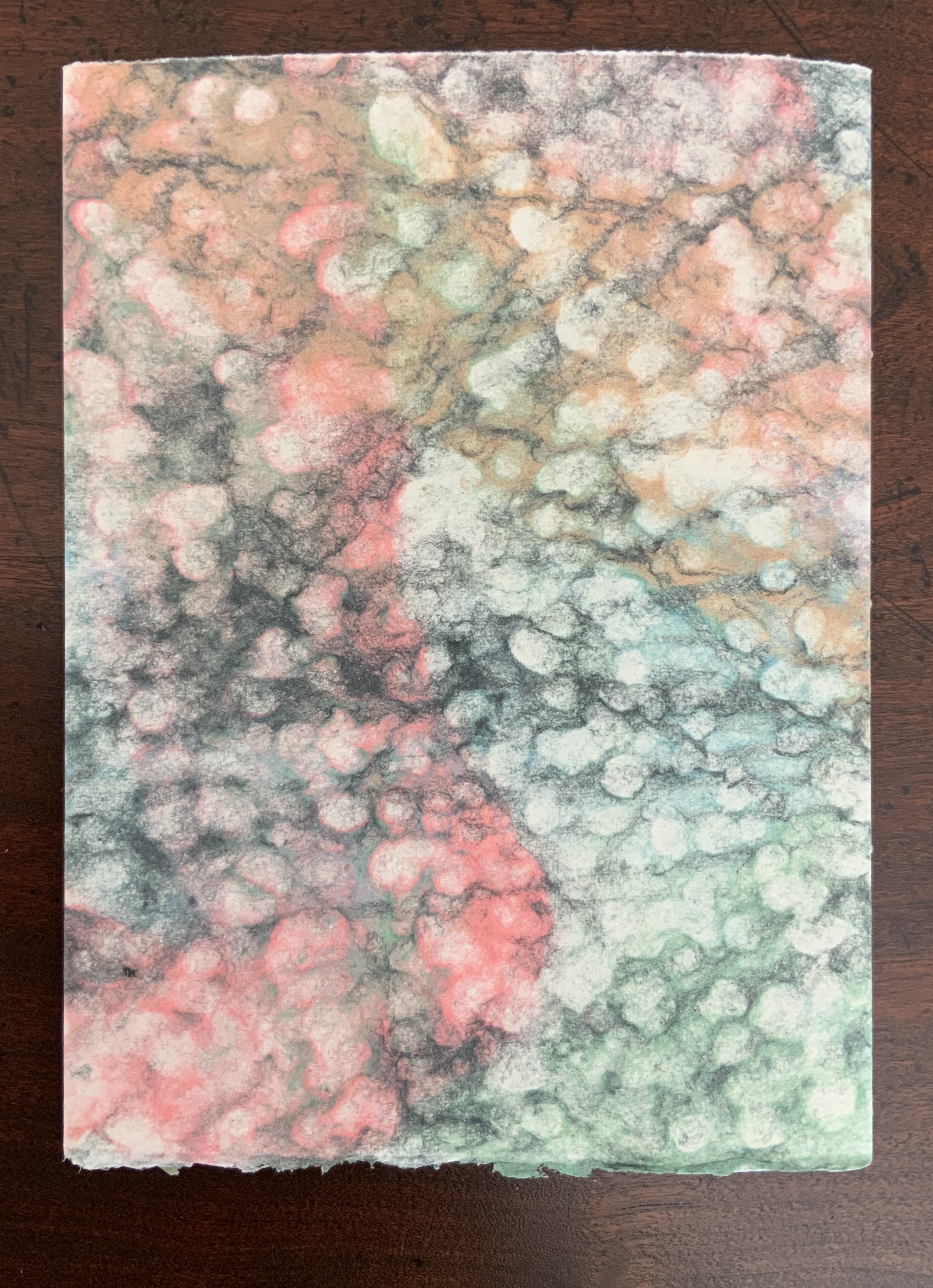
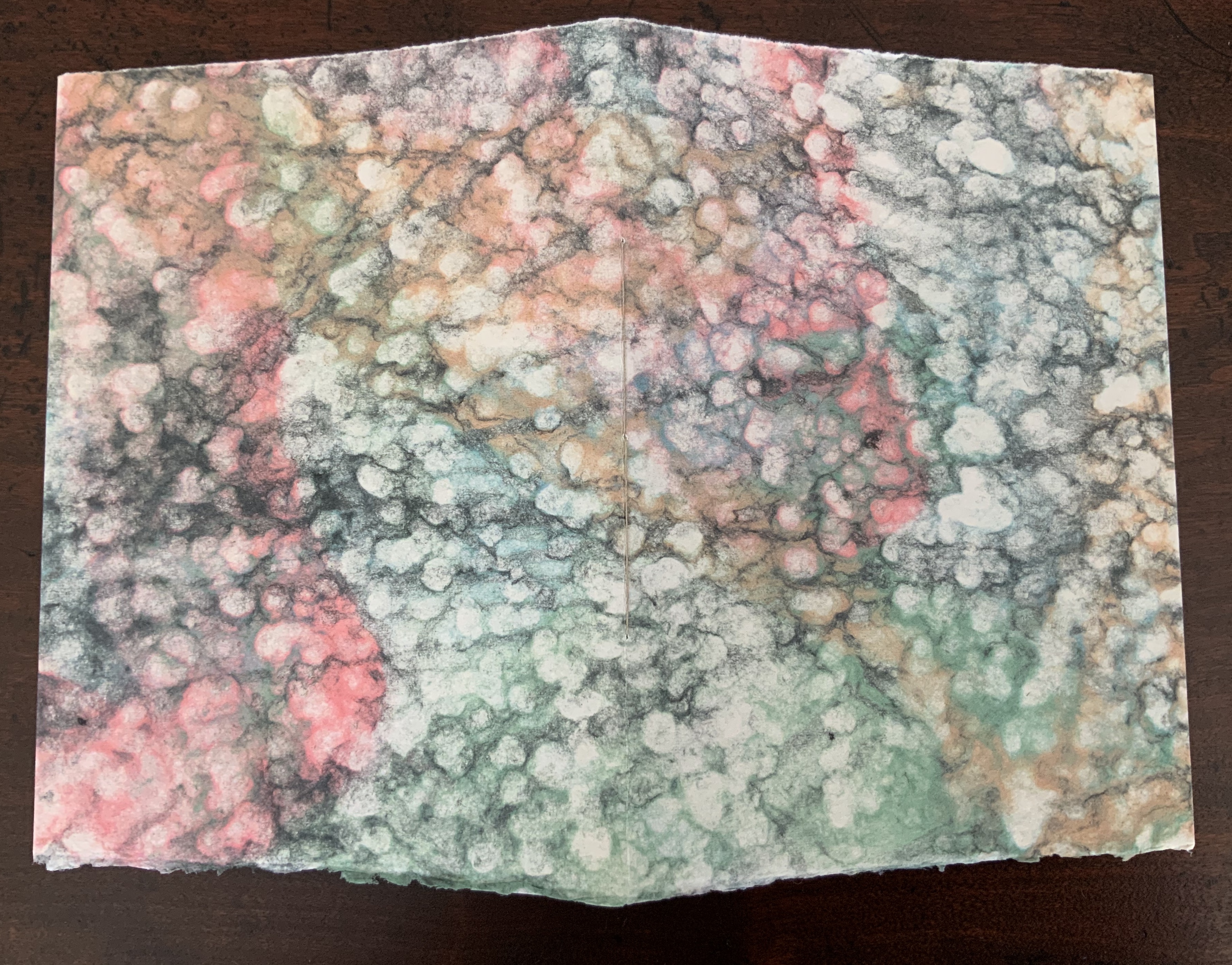
Artist booklet, stitched with linen thread, two sheets hand-made of cotton and abaca fibers, the cover sheet being double couched using a layer of colored pulps, the inner sheet printed in 14p Book Antiqua in relief printing. H200 x W150 mm. Edition of 100 unnumbered copies. Acquired from the artist, 29 July 2020. Photos: Books On Books Collection.

Inspired by the 19th century poem “Seifenblasen” (“Soap Bubbles”) by Theodor Fontane, John Gerard uses pulp painting to create the shifting prismatic colors displayed on the surface of a soap bubble. By layering different colored pulps on a sheet of plain wet pulp, he evokes the same pleasure, color and lightness evoked by the words.Here is a loose translation:

Soap Bubbles

Children to show their delight 
Send soap bubbles up to the light. 
How they shimmer in the sun — 
Some big, some small. 
Blown with a mouth just so, some
Hold out a whole second —
But several there — 
Yes! — hold on for two. 
One rises as high as the house — 
Bumps there — then it’s over.

Gerard seems drawn to respond to things displaying a tension between spirit and form, be it the tension of soap bubbles or the tension between repeatedly scrawled letters constrained by a canonical grid.

Der Panther (2013)

Der Panther (2013)

John Gerard

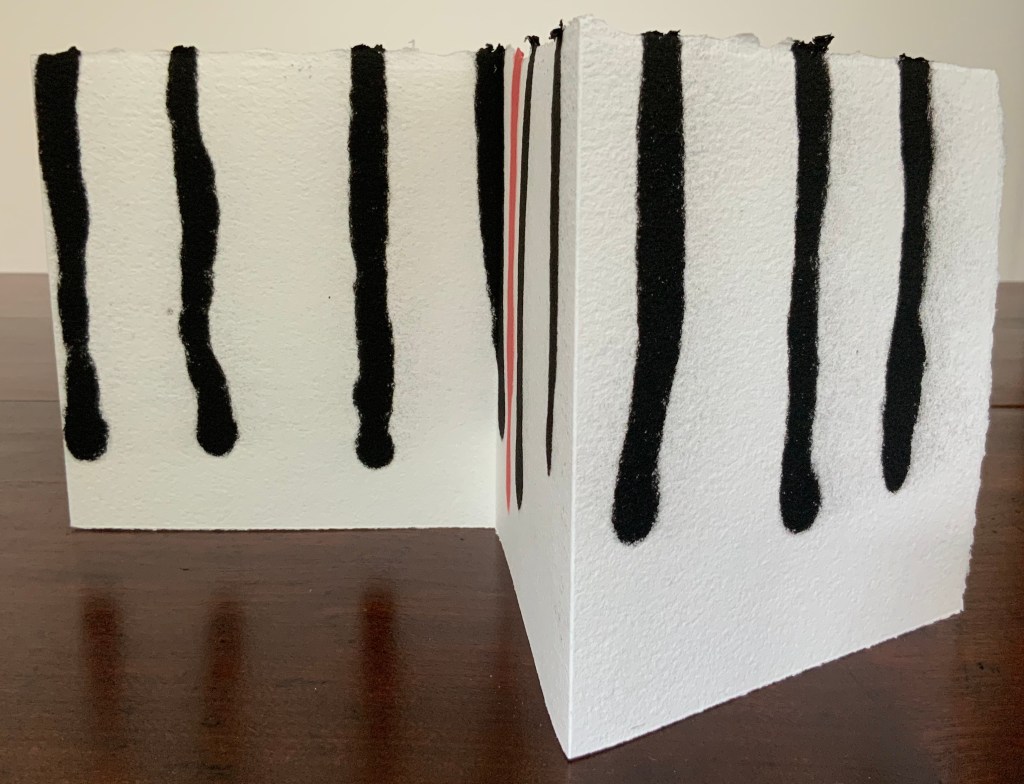
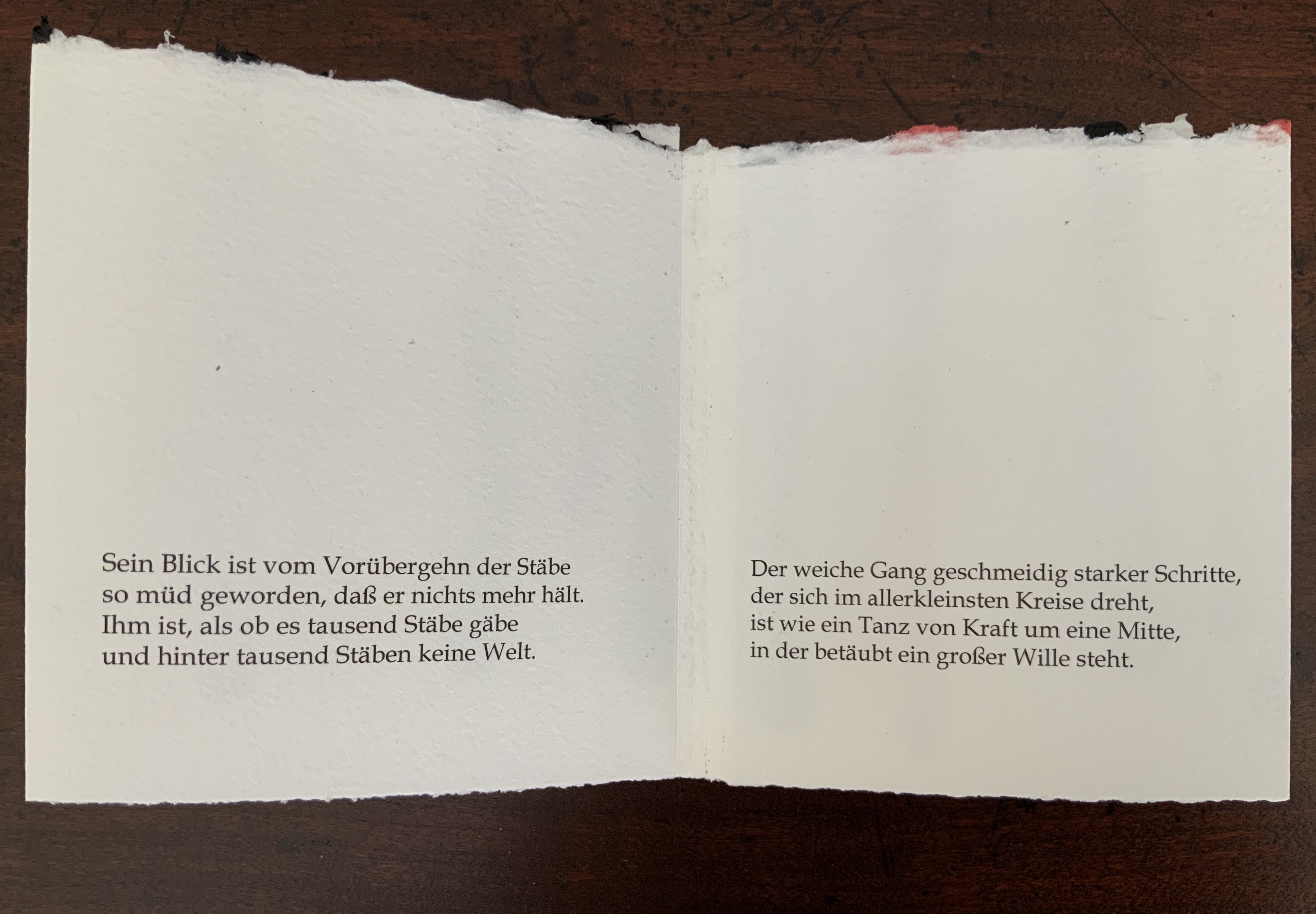
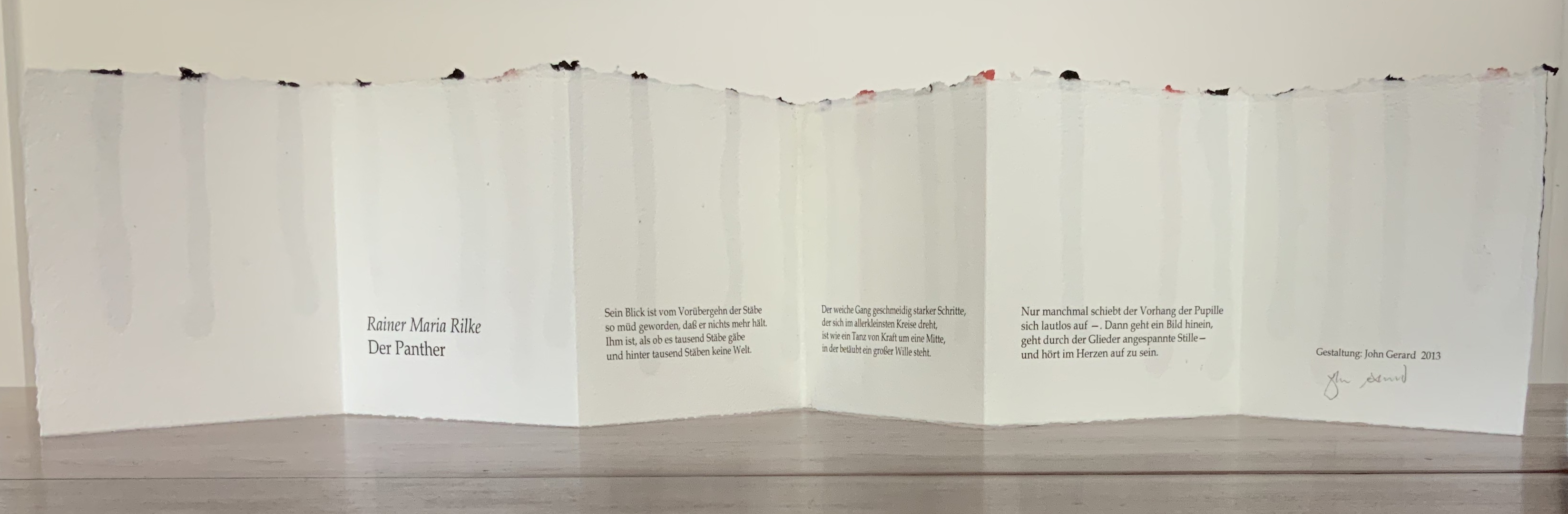
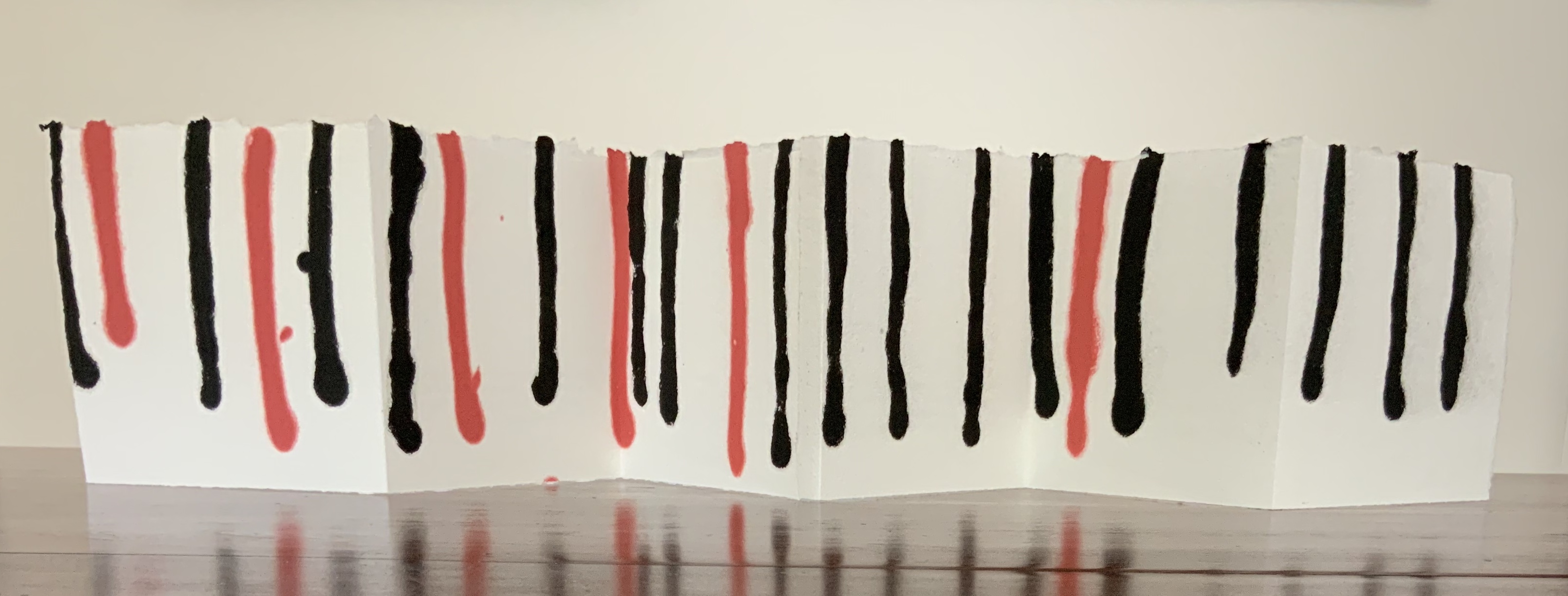
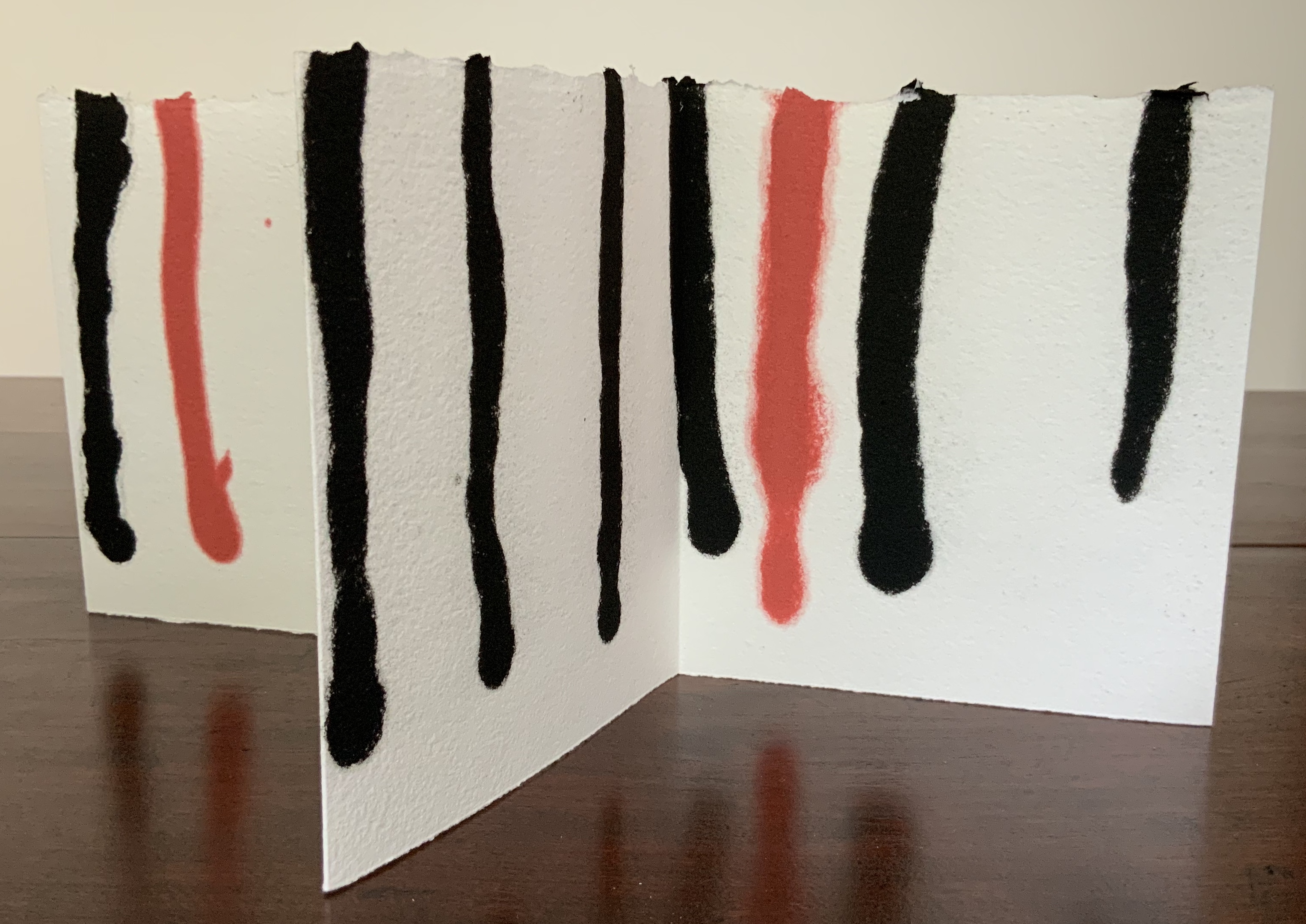
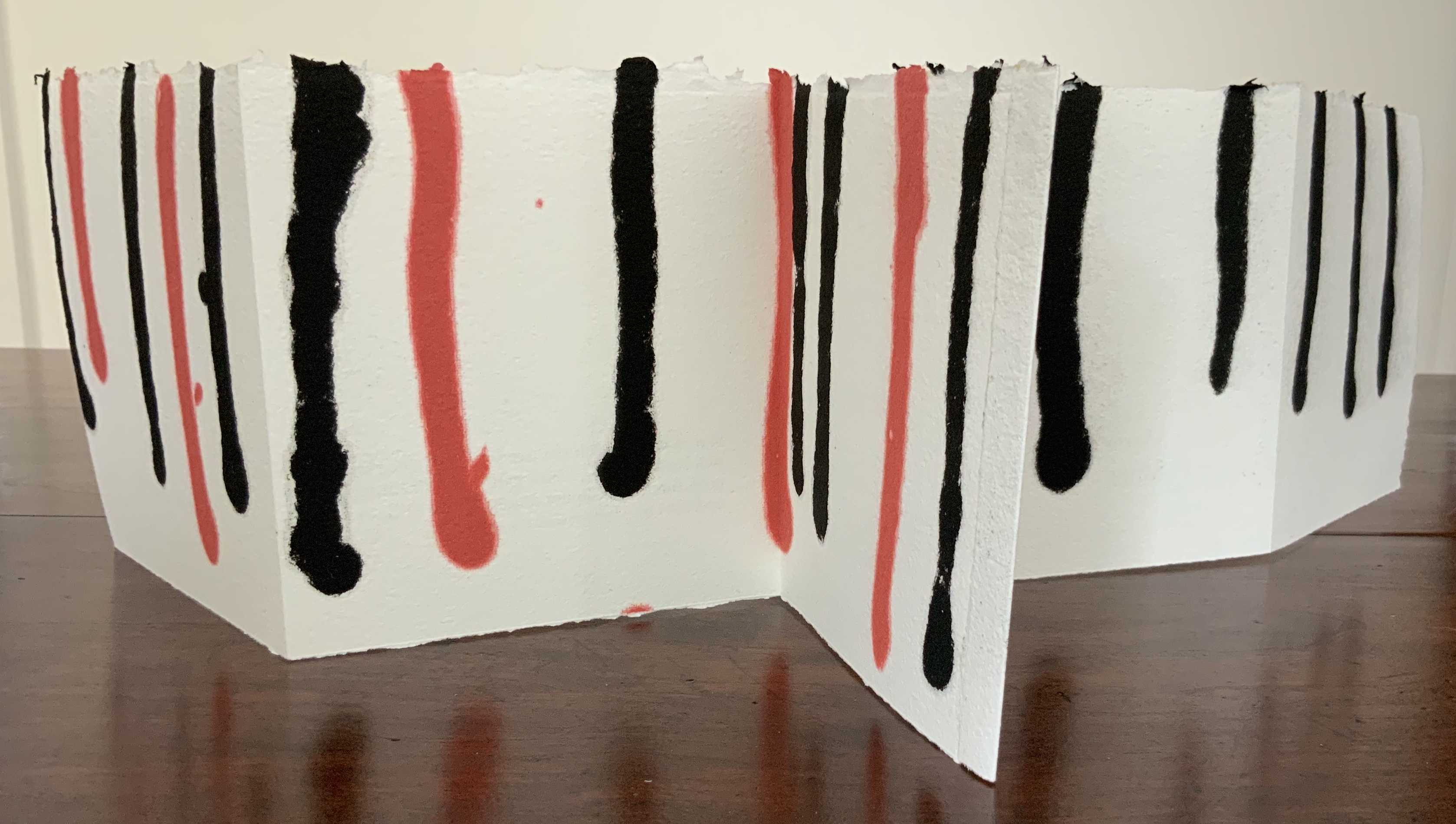
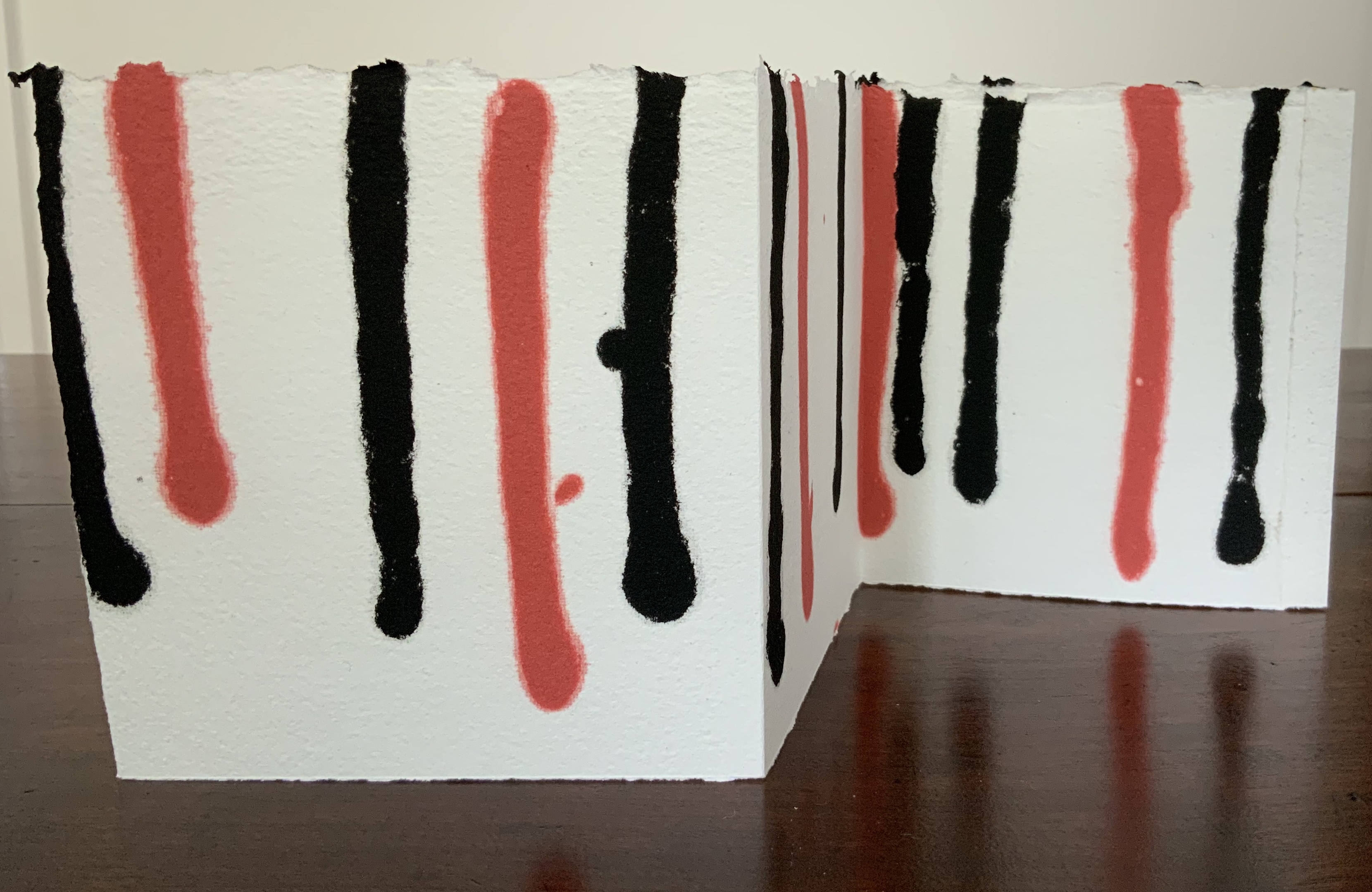
Leporello of two connected sheets of hand-made cotton and hemp paper, pulp-painted with red and black lines. H140 x W130 mm (unfolded approx. 770 mm). Unnumbered, signed edition of 25 copies. Acquired from the artist, 29 July 2020. Photos: Books On Books Collection.

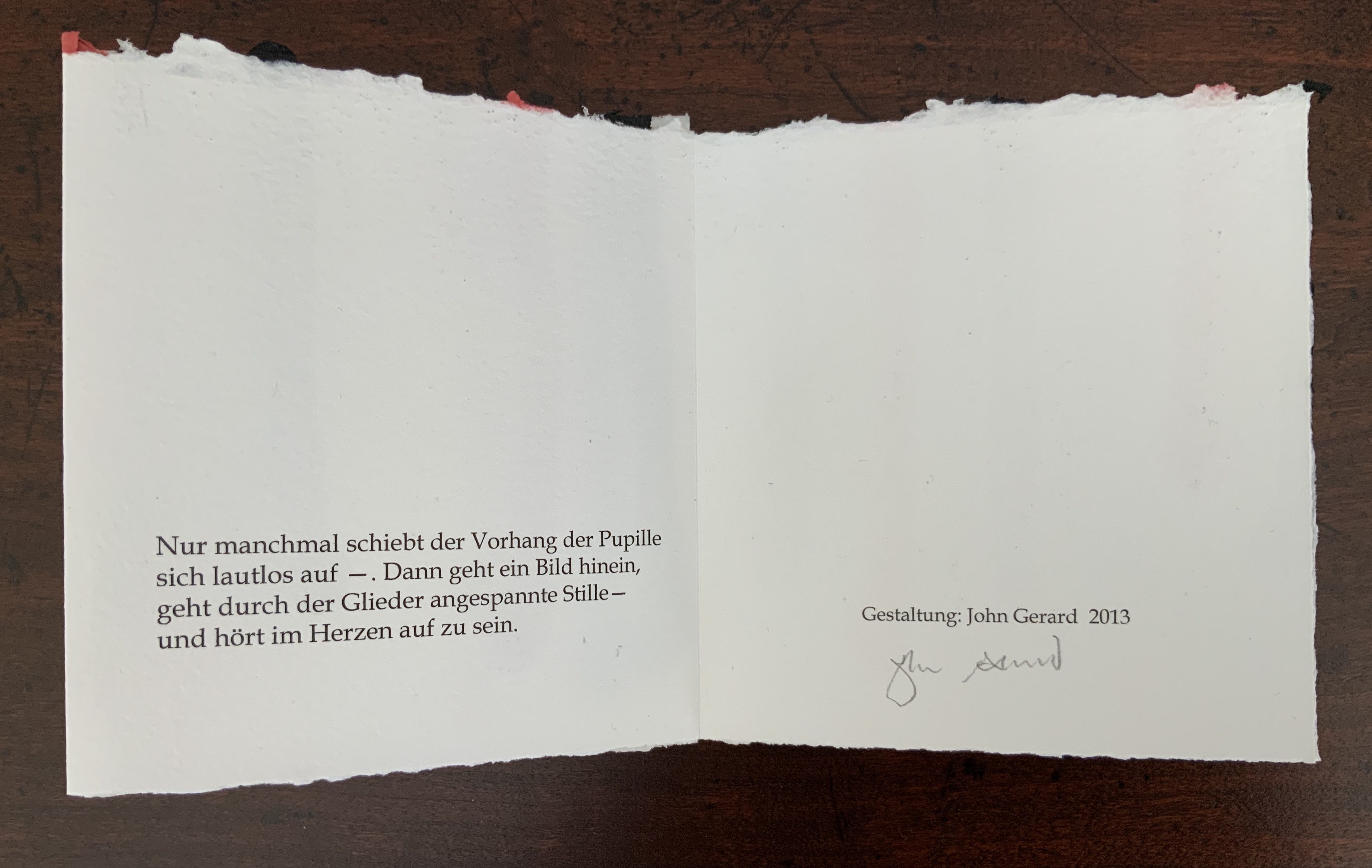
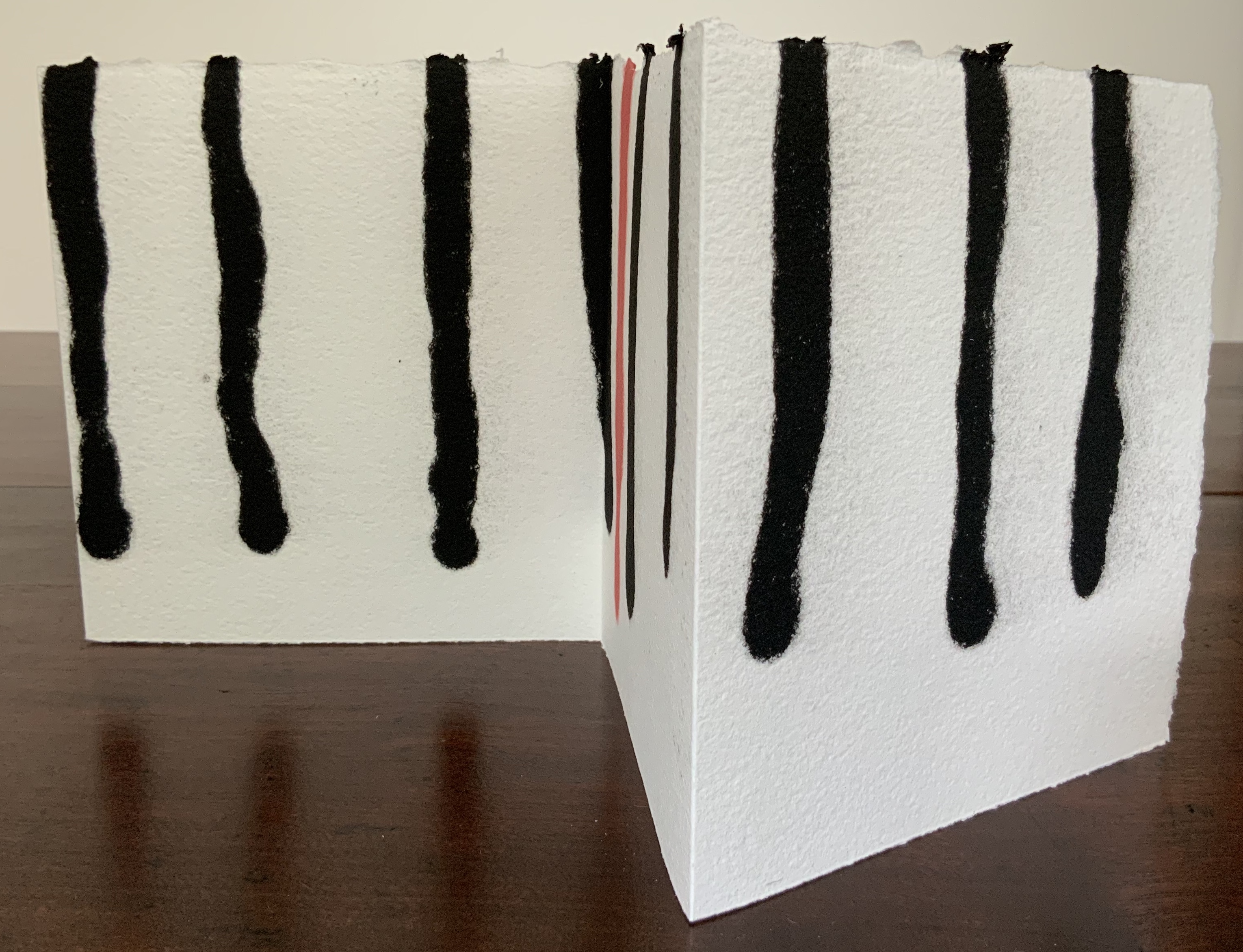
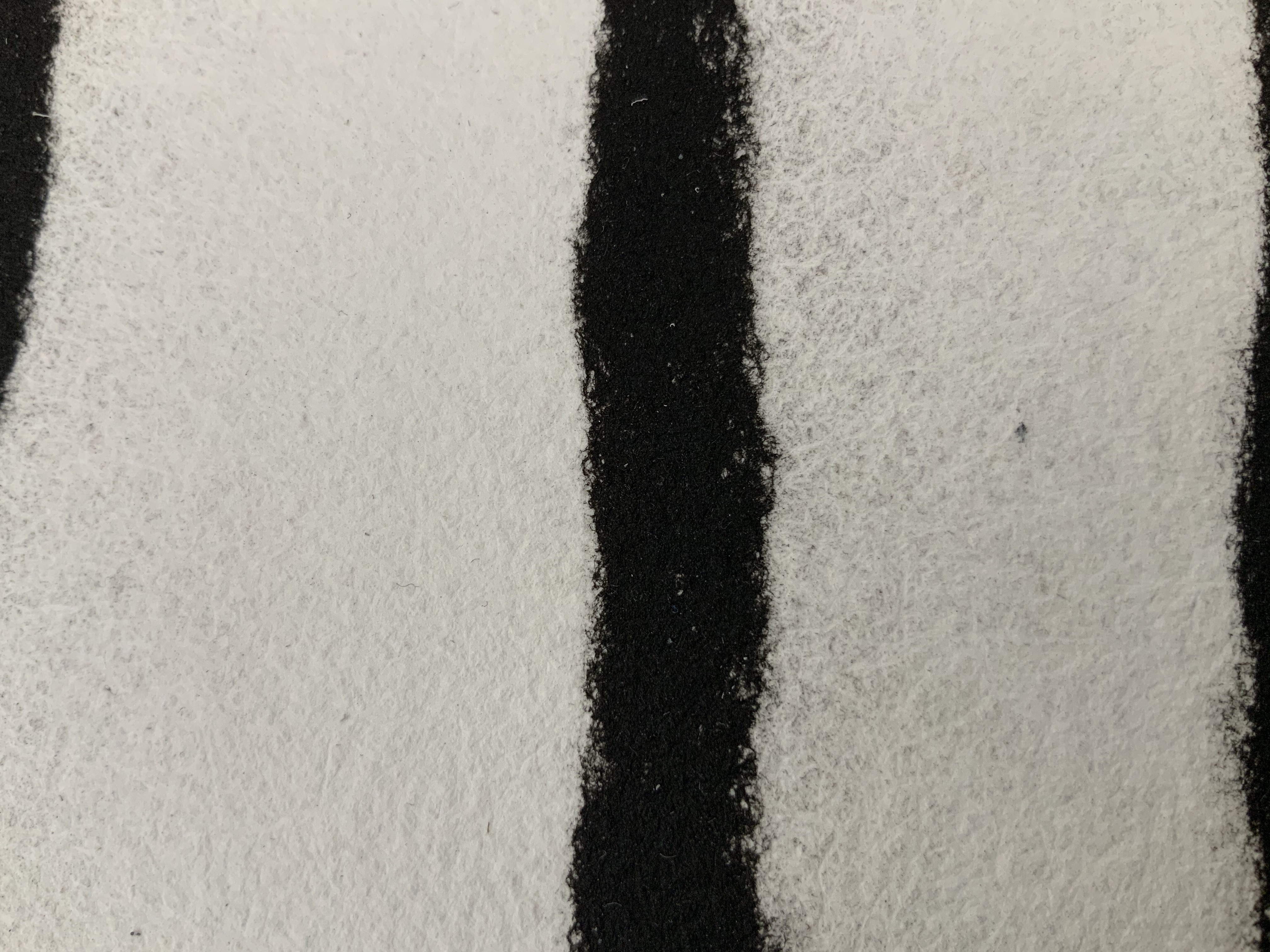
Rainer Maria Rilke’s poem “The Panther” embodies the tension that Gerard seems to love. Three stanzas in black 12 pt Book-Antiqua pace across the leporello like the panther behind what seem to him “a thousand bars”, which Gerard evokes in black and red pulp painting on the reverse of the leporello. Fully open, the torn top edge slopes and rises like the back and shoulders of the panther as it strides and turns in the smallest circle it can make. The bars behind, or in front of it, end above the lower edge in rounded shapes like the panther’s paws, whose texture the soft and rough handmade paper mimics.

The alternation of black and red pulp echoes the tension between the cage and panther’s heart in the poem, and the leporello opens and closes on the panther just as its own pupil’s nictitating membrane slides open, then closes on its world. Reportedly, at Augusta Rodin’s behest, Rilke stood before the animal’s cage in the Jardins des Plantes in Paris for nine hours. At the end of the poem, he has placed the reader/viewer inside the animal, absorbed the reader/viewer through the animal’s movement and gaze. Gerard’s artist booklet — by giving the reader/viewer a chance to see through the panther’s eyes — makes Rilke’s poem just as tangible as Rilke’s poem makes the panther and its world.

Gerard’s three works belong with the Books On Books Collection’s first seven books of the Rijswijk Biennial. His Alpha Beta even features in that series’ Papier op de vlucht = Paper takes flight (2006) and contributes to two of the collection’s sub themes: abecedaries as well as the technique of pulp painting. Seifenblasen and De Panther exemplify the sub theme of “reverse ekphrasis” represented by works such as Barbara Tetenbaum’s version of Michael Donaghy’s poem “Machine” or herman de vries’ argumentstellen 1968 / 2003 (de wittgenstein — tractatus — ) (2003). Gerard’s two works are, in fact, the epitome of transforming a literary text into an artwork.

Further Reading

Abecedaries I (in progress)”, Books On Books Collection, 31 March 2020.

The First Seven Books of the Rijswijk Paper Biennial”, Books On Books Collection, 10 October 2019.

Looking Back and Forward from the Paper Biennial 2018”, Bookmarking Book Art, 24 June 2016

Margins and making objects that live forever”, Bookmarking Book Art, 20 August 2014.

Claire Van Vliet”, Books On Books Collection, 8 August 2019.

Corbett, Rachel. “From You Must Change Your Life: The Story of Rainer Maria Rilke and Auguste Rodin”, Poetry Magazine, 31 August 2016. Accessed 11 August 2020.