Books On Books Collection – William Dugan

How Our Alphabet Grew (1972)

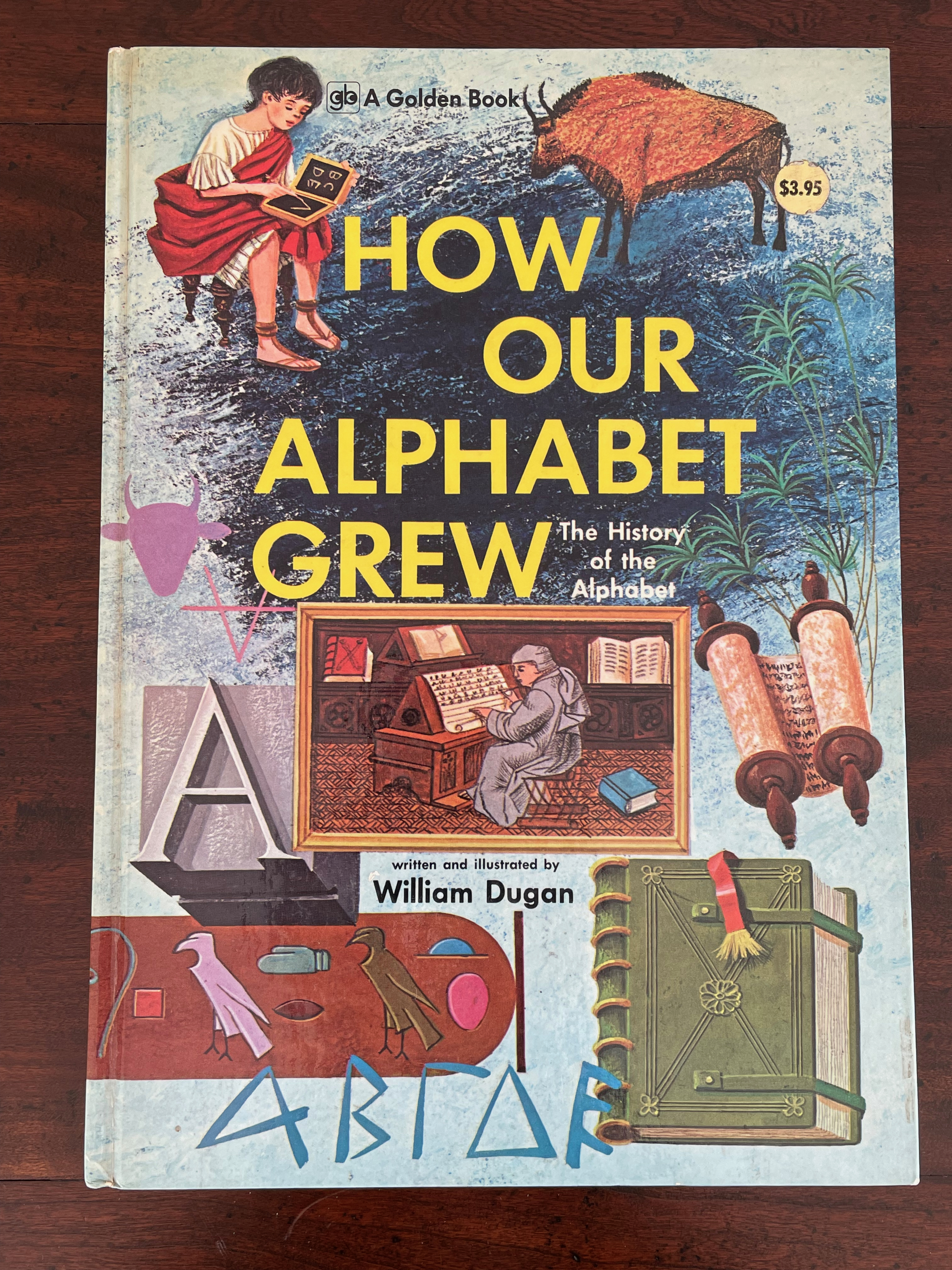
How Our Alphabet Grew: The History of the Alphabet (1972)
William Dugan
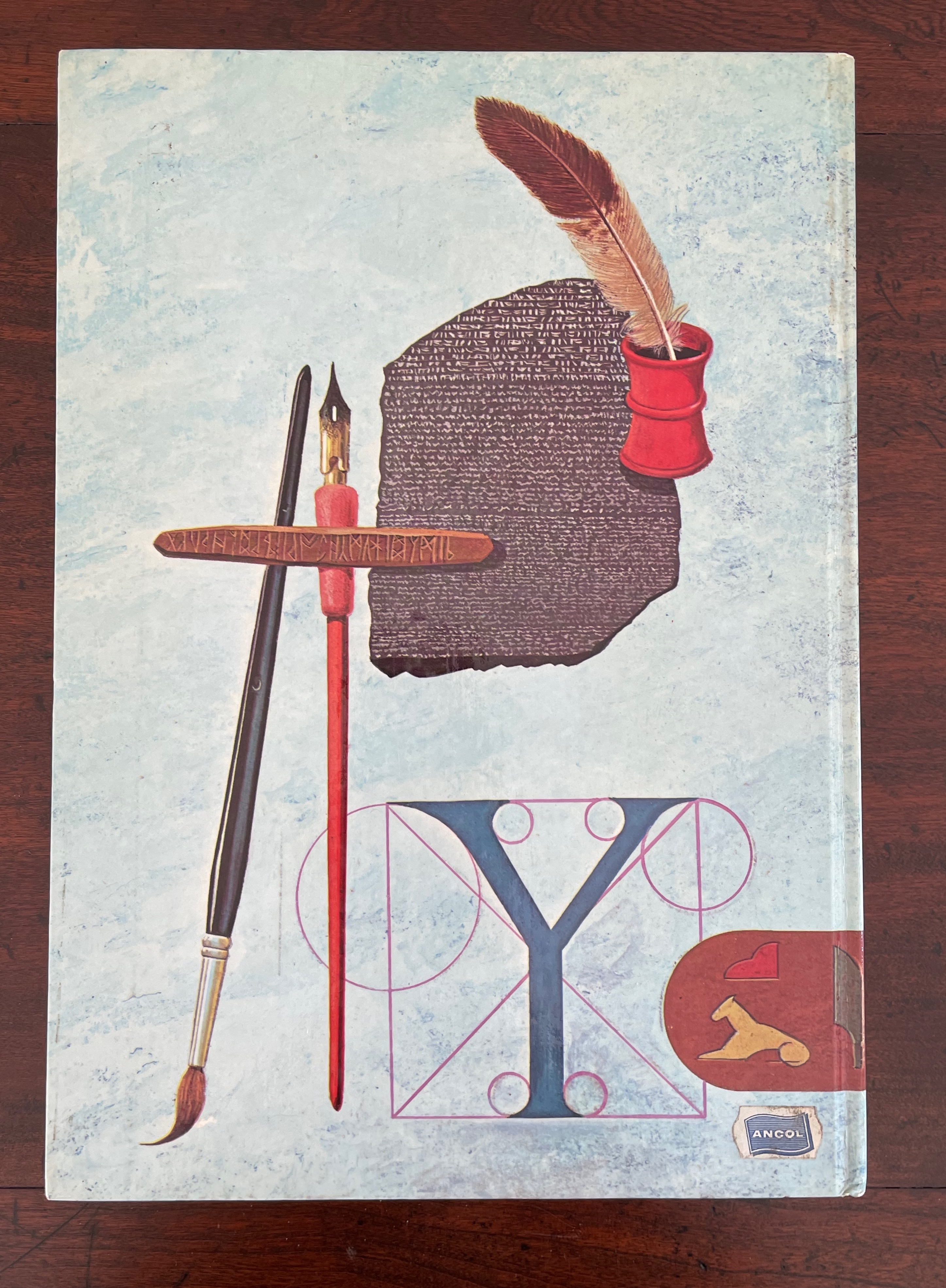
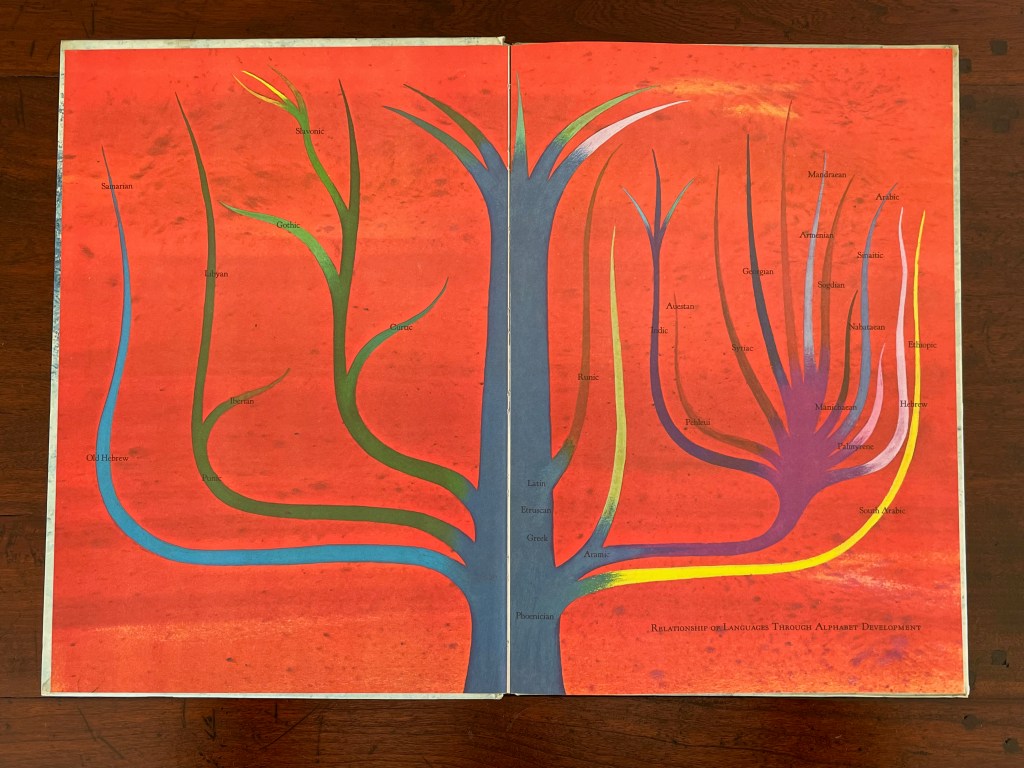
Casebound, illustrated paper on board, illustrated endpapers and pastedowns. H320 x W227 mm. 72 pages. Acquired 14 March 2023.
Photos: Books On Books Collection.

Curiously, little information about William Dugan appears online. He was a prolific illustrator of children’s books — especially those published by Golden Press in the 1960s and 1970s. He also authored as well as illustrated several early childhood books — on insects, signs, machines and vehicles. Two of his books, however, are meant for older children — this one and All about Houses (1975), which is a forerunner to Dorling Kindersley‘s children’s reference books.

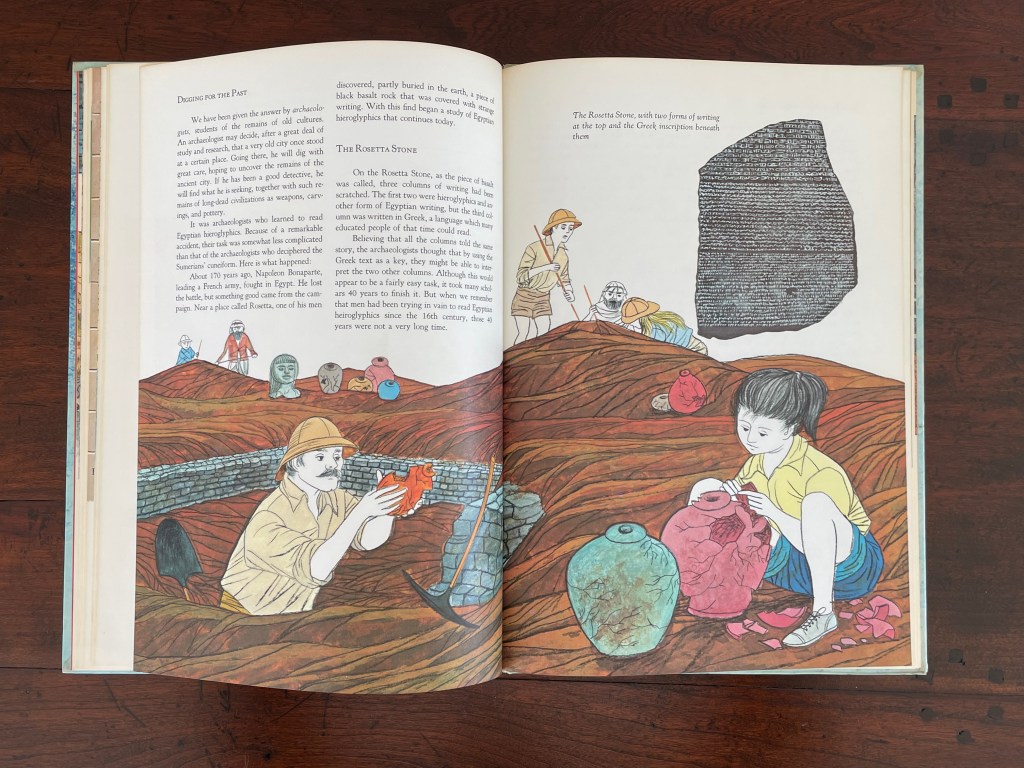
Dugan’s ability to alter his style as writer and illustrator to the ages of his audience is notable. Even more notable is the diversity and inclusiveness of his reference works for older children. Despite the date of publication, a young girl occupies the foreground of the illustration of archaeologists, a feature that would have brought a smile to Ada Yardeni and still might to Tiphaine Samoyault.

Further Reading

Abecedaries I (in progress)“. Books On Books Collection.

Lanore Cady“. 16 December 2022. Books On Books Collection.

Lyn Davies“. 7 August 2022. Books On Books Collection.

Timothy Donaldson“. 1 February 2023. Books On Books Collection.

Cari Ferraro“. 1 February 2023. Books On Books Collection.

David J. Goldman“. Books On Books Collection. [In progress]

Rudyard Kipling and Chloë Cheese“. 15 February 2023. Books On Books Collection.

Abe Kuipers“. 15 February 2023. Books On Books Collection.

Don Robb and Anne Smith“. 26 March 2023. Books On Books Collection.

Renzo Rossi“. 10 July 2023. Books On Books Collection.

James Rumford. 21 November 2022. Books On Books Collection.

Tiphaine Samoyault“. 10 July 2023. Books On Books Collection.

Ben Shahn“. 20 July 2022. Books On Books Collection.

Tommy Thompson“. 21 August 2022. Books On Books Collection.

Ada Yardeni“. 10 July 2023. Books On Books Collection.

Bernal, Martin. 1990. Cadmean Letters : The Transmission of the Alphabet to the Aegean and Further West Before 1400 B.C. Winona Lake IN: Eisenbrauns.

Diringer, David, and Reinhold Regensburger. 1968. The alphabet: a key to the history of mankind. London: Hutchinson. A standard, beginning to be challenged by late 20th and early 21st century archaeological findings and palaeographical studies.

Drucker, Johanna. 1999. The alphabetic labyrinth: the letters in history and imagination. New York, N.Y.: Thames and Hudson.

Ege, Otto. 1921/1998. The Story of the Alphabet, Its Evolution and Development… Embellished Typographically with Printer’s Flowers Arranged by Richard J. Hoffman. Van Nuys, CA: Richard J. Hoffman. A miniature. The type ornaments chosen by Hoffman are arranged chronologically by designer (Garamond, Granjon, Rogers) and printed in color.

Firmage, Richard A. 2001. The alphabet. London: Bloomsbury.

Fischer, Steven Roger. 2008. A history of writing. London: Reaktion Books.

Jackson, Donald. 1997. The story of writing. Monmouth, England: Calligraphy Centre.

Moziani, Eliyahu. 1984. Torah of the Alphabet or How the Art of Writing Was Taught Under the Judges of Israel (1441-1025) : -The Original Short Course in Alphabetic Writing Conceived by Israel in Sinai. Herborn: Baalschem.

Pflughaupt, Laurent. 2008. Letter by letter: an alphabetical miscellany. New York: Princeton Architectural Press.

Robb, Don, and Anne Smith. 2010. Ox, house, stick: the history of our alphabet. Watertown, MA: Charlesbridge. Children’s book.

Robinson, Andrew. 1995. The story of writing. London: Thames and Hudson.

Rosen, Michael. 2014. Alphabetical: how every letter tells a story. London: John Murray.

Sacks, David. 2003. Language visible unraveling the mystery of the alphabet from A to Z. New York: Broadway Books.

Shaw, Gary. 15 April 2021. “Ancient ABCs: The alphabet’s ‘missing link’ discovered in Israel“. The Art Newspaper.

Books On Books Collection – Ada Yardeni

A- dventure- Z’ (2003)

A- dventure- Z’: The Story of the Alphabet (2003)
Ada Yardeni
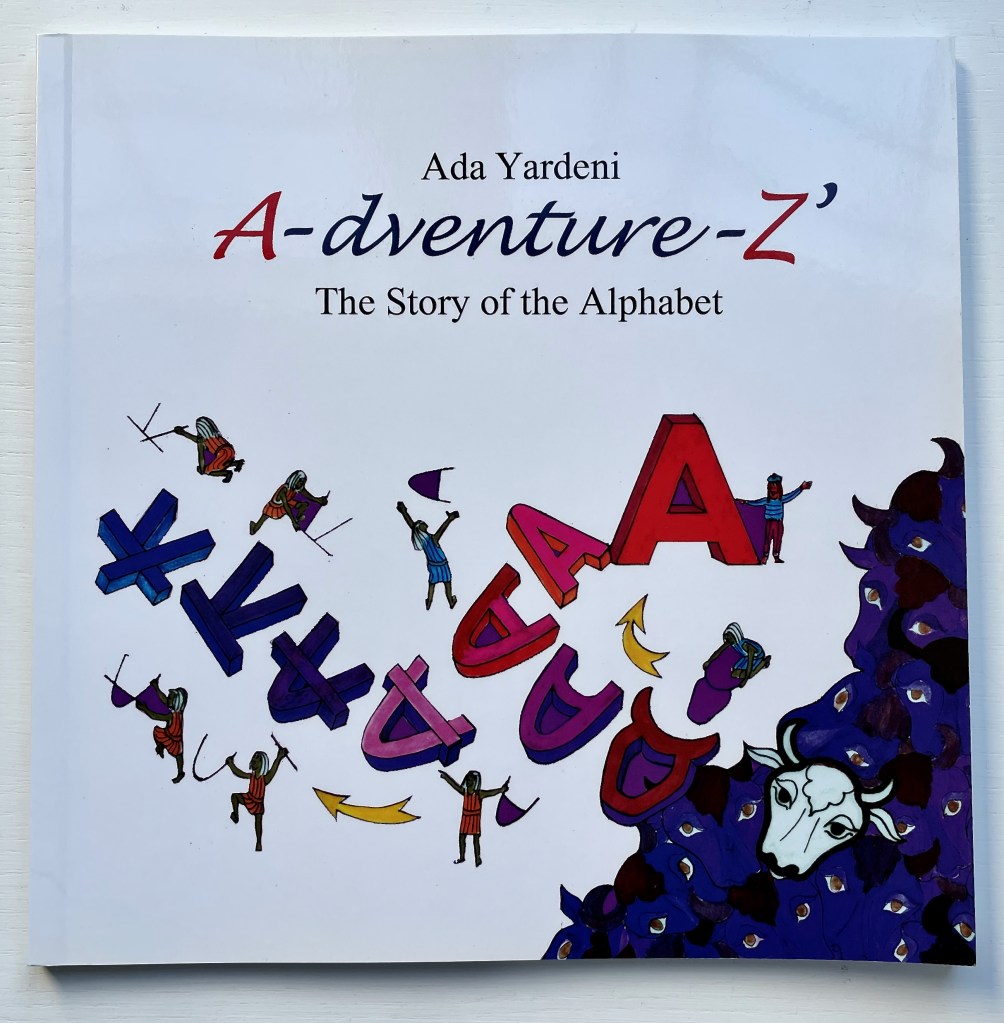
Paperback. 220 x 220 mm. 86 pages. Acquired from Carta Jerusalem, 28 March 2023.
Photos: Books On Books Collection.

There is gray between what is unknown and known about the invention of shapes and signs for sounds. In the Books On Books collection, one side is reflected by works such as Cari Ferraro’s The First Writing (2004) and William Joyce’s The Numberlys (2014); the other, by Lyn Davies’ A is for Ox (2006) and Tiphaine Samoyault’s Alphabetical Order (1998). One engages myth, artistic extrapolation or fictional representation; the other, the rational, the evidentiary mundane or non-fictional presentation.

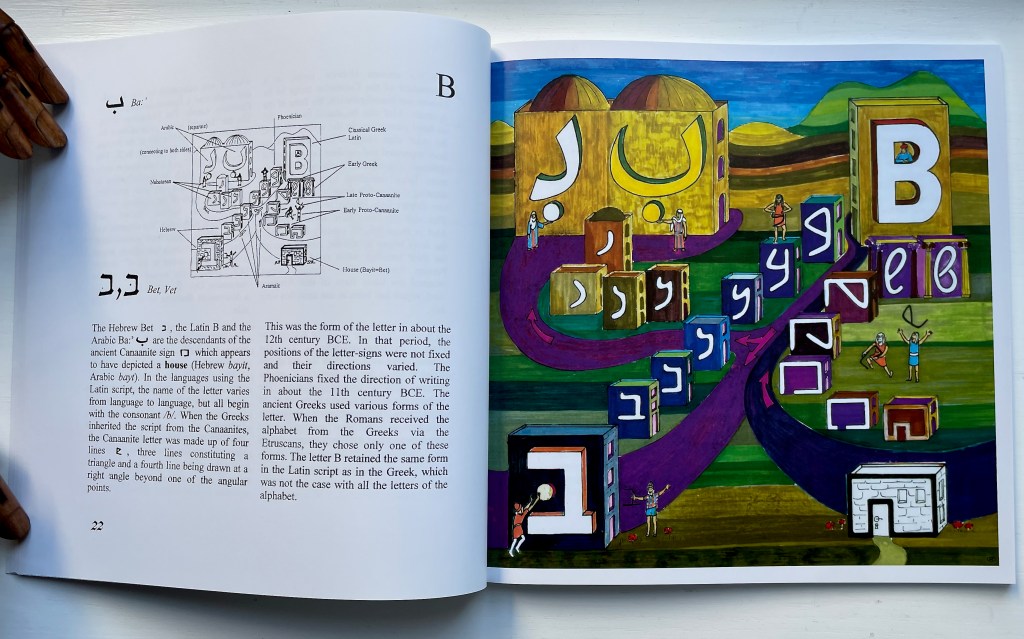
Ada Yardeni’s A- dventure- Z’: The Story of the Alphabet (2003) arches between them. She studied at the Bezalel Academy of Arts and Design in Jerusalem. As a designer at Koren Publishing, she created the font “Ada”, after which she went on to receive her doctorate under Joseph Naveh at Hebrew University in Jerusalem in 1991 and become an acknowledged expert in Hebrew palaeography.

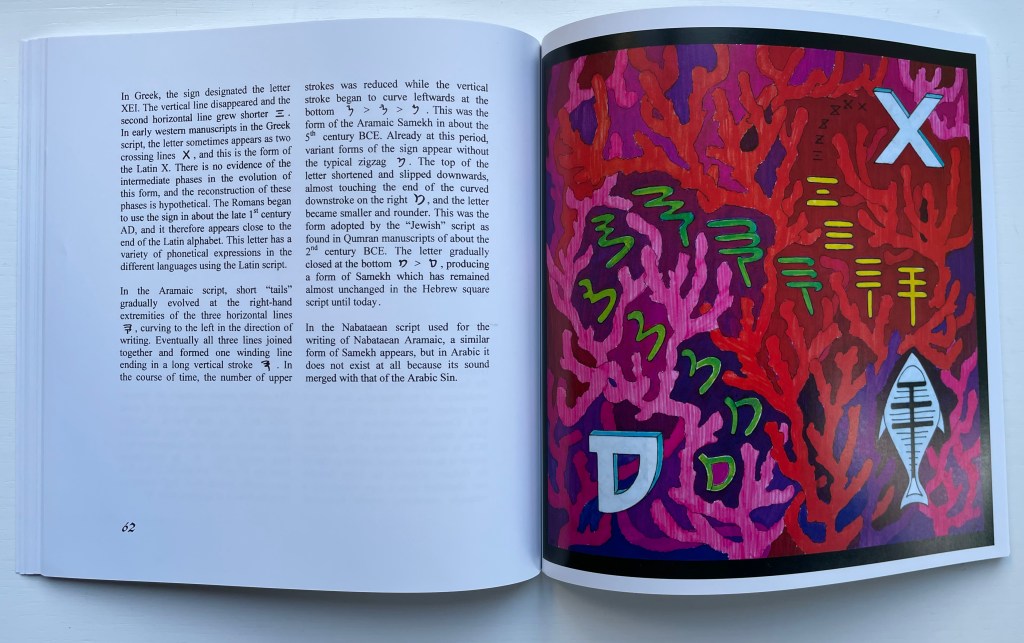
Paired with intricate and annotated black and white diagrams, Yardeni’s illustrations use brilliant colors, an accomplished calligraphic hand and her palaeographic, historical and linguistic understanding of the alphabet to display the evolution of each letter based on its forms as they appear in ancient inscriptions. While most of the illustrations contain the cartoon figures seen below in the display of the Hebrew Bet and Arabic Ba:’, the illustration for the letter Samekh (on which the letter X is based) takes on the aspect of abstract pop art.

Alongside the diagrams, the clear, uncluttered text delivers a scholarly assuredness about the appearance, disappearance and changes of strokes in the early signs found in the Sinai, but the artistry somehow evokes the mystery that continues to envelop the invention of shapes and signs for sounds and the differences in the many writing and alphabetical systems around the world. Yardeni’s still more scholarly works are to be found elsewhere, but A- dventure- Z’: The Story of the Alphabet holds its own as a companion to any of the reference works noted below. With its graphics and its charming tale of a Canaanite king seeking a way to preserve his songs, it also holds its own with any of the children’s books noted below.

Further Reading

Abecedaries I (in progress)“. Books On Books Collection.

Children’s books

Cumptich, Roberto de Vicq de. Bembo’s Zoo: An Animal ABC Book (2000).

Dugan, William. How Our Alphabet Grew (1972).

Ferraro, Cari. The First Writing (2004).

Heck, Ellen. A is for Bee (2022).

Joyce, William. The Numberlys (2014).

Kipling, Rudyard, and Chloë Cheese.  How the Alphabet Was Made (1983).

Kipling, Rudyard, and Gerald Lange, The Neolithic Adventures of Taffi-Mai Metallu-Mai (1997).

Mavrina, Tatyana. Сказочная Азбука / Skazochnaia Azbuka / A Fairy Tale Alphabet (1969).

Rossi, Renzo. The Revolution of the Alphabet (2009).

Rumford, James. There’s a Monster in the Alphabet (2002).

Samoyault, Tiphaine. Alphabetical Order (1998).

Shahn, Ben. The Alphabet of Creation (1954).

Winston, Sam. One and Everything (2022).

Werner, Sharon, and Sharon Forss. Alphabeasties (2009).

Reference works

Clodd, Edward. The Story of the Alphabet (1913). Superseded by several later works, but is freely available online with line illustrations and some black and white photos.

Davies, Lyn. A is for Ox (2006).

Diringer, David, and Reinhold Regensburger. The alphabet: a key to the history of mankind (1968). A standard, beginning to be challenged by late 20th and early 21st century archaeological findings and palaeographical studies.

Donaldson, Timothy. Shapes for Sounds (cowhouse) (2008).

Drucker, Johanna. The alphabetic labyrinth: the letters in history and imagination (1999).

Ege, Otto. 1921/1998. The Story of the Alphabet, Its Evolution and Development… Embellished Typographically with Printer’s Flowers Arranged by Richard J. Hoffman (1921/1998). A miniature. The type ornaments chosen by Hoffman are arranged chronologically by designer (Garamond, Granjon, Rogers) and printed in color.

Firmage, Richard A. The alphabet (2001).

Fischer, Steven Roger, A history of writing (2008).

Goldman, David. A is for ox: the story of the alphabet (1994).

Jackson, Donald. The story of writing (1997).

Pflughaupt, Laurent. Letter by letter: an alphabetical miscellany (2008).

Robinson, Andrew. The story of writing (1995).

Rosen, Michael. Alphabetical: how every letter tells a story (2014).

Sacks, David. Language visible unraveling the mystery of the alphabet from A to Z (2003).

Thompson, Tommy. The ABC of our alphabet (1952).Not a fine press publication or artist’s book, but its layout, illustrations and use of two colors bear comparison with the Davies book. It too is out of print and unfortunately more rare.

Books On Books Collection – Tiphaine Samoyault

Alphabetical Order (1998)

Alphabetical Order: How the Alphabet Began (1998)
Tiphaine Samoyault
Casebound, illustrated glossy paper over boards, decorated doublures. H270 x W195 mm. 32 unnumbered pages. Acquired from World of Books, 15 August 2022.
Photos: Books On Books Collection.

Tiphaine Samoyault had the extraordinary experience of growing up in residence at the  Château de Fontainebleau, where her father  Jean-Pierre Samoyault was the conservator and where, almost a century and a half before, Jacques-Joseph Champollion-Figeac was the librarian.

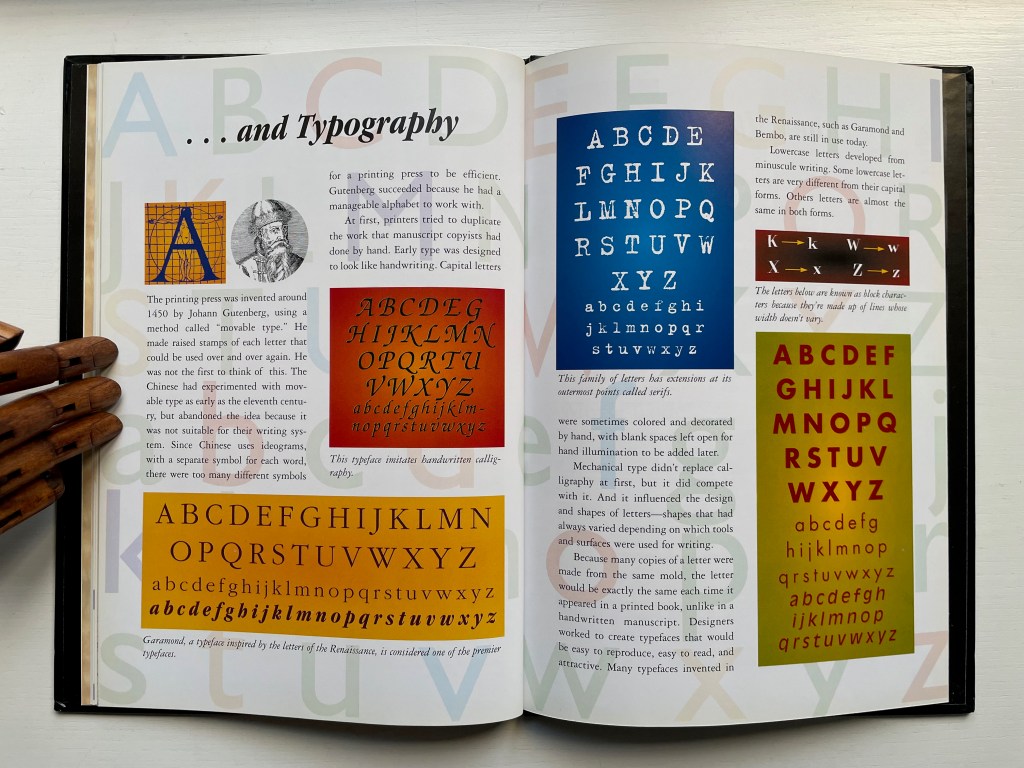
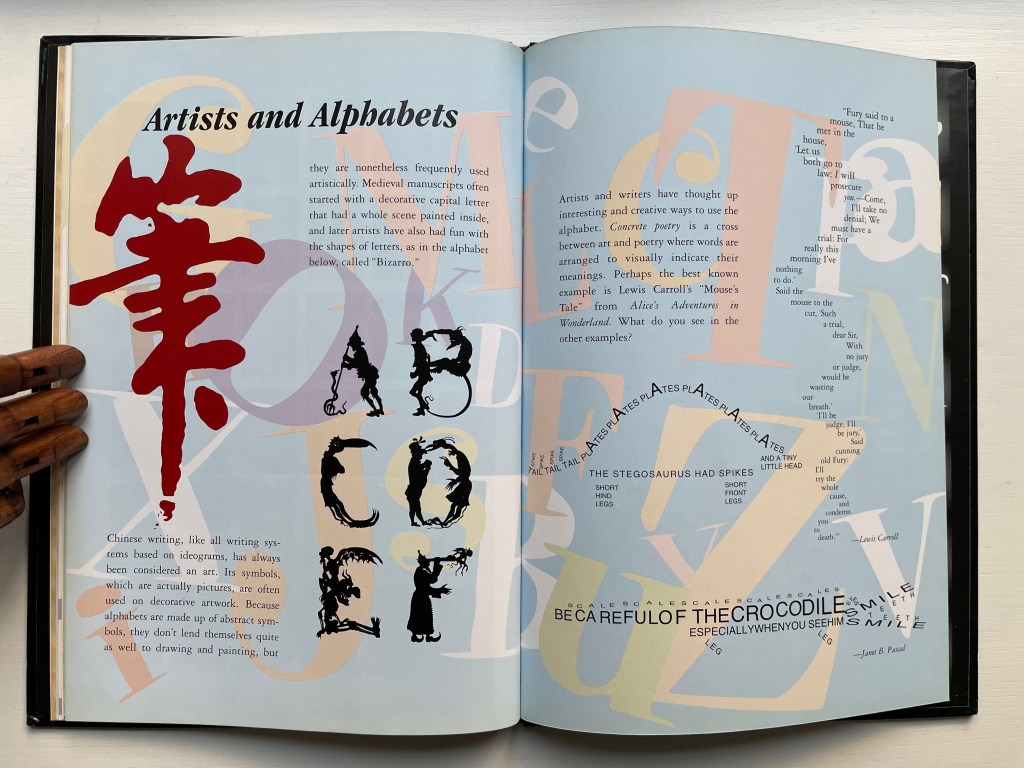
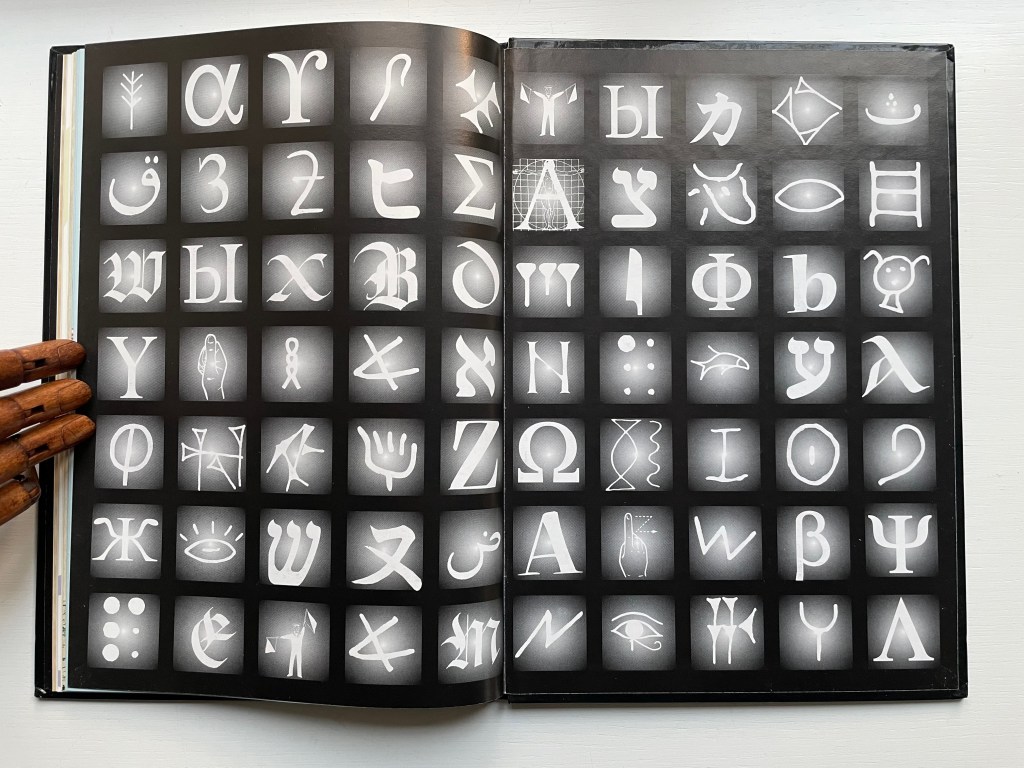
Alphabetical Order is a translation. Its original title — Le Monde des pictogrammes (Paris: Circonflexe, 1996) — better reflects the well-illustrated character of the book. The images, the hand lettering, the ghost-printed background and handling of color are constant reminders of the pictographic roots of most alphabets and writing systems. The final section — Artists and Alphabets — punctuates those reminders. In fact, the book’s endpapers act as quotation marks around the point.

Further Reading

Abecedaries I (in progress)“. Books On Books Collection.

Lyn Davies“. 7 August 2022. Books On Books Collection.

Timothy Donaldson“. 1 February 2023. Books On Books Collection.

Cari Ferraro“. 1 February 2023. Books On Books Collection.

David J. Goldman“. Books On Books Collection. [In progress]

Rudyard Kipling and Chloë Cheese“. 15 February 2023. Books On Books Collection.

Abe Kuipers“. 15 February 2023. Books On Books Collection.

Don Robb and Anne Smith“. 26 March 2023. Books On Books Collection.

Renzo Rossi“. 10 July 2023. Books On Books Collection.

James Rumford. 21 November 2022. Books On Books Collection.

Ben Shahn“. 20 July 2022. Books On Books Collection.

Tommy Thompson“. 21 August 2022. Books On Books Collection.

Ada Yardeni“. 10 July 2023. Books On Books Collection.

Bernal, Martin. 1990. Cadmean Letters : The Transmission of the Alphabet to the Aegean and Further West Before 1400 B.C. Winona Lake IN: Eisenbrauns.

Diringer, David, and Reinhold Regensburger. 1968. The alphabet: a key to the history of mankind. London: Hutchinson. A standard, beginning to be challenged by late 20th and early 21st century archaeological findings and palaeographical studies.

Drucker, Johanna. 1999. The alphabetic labyrinth: the letters in history and imagination. New York, N.Y.: Thames and Hudson.

Ege, Otto. 1921/1998. The Story of the Alphabet, Its Evolution and Development… Embellished Typographically with Printer’s Flowers Arranged by Richard J. Hoffman. Van Nuys, CA: Richard J. Hoffman. A miniature. The type ornaments chosen by Hoffman are arranged chronologically by designer (Garamond, Granjon, Rogers) and printed in color.

Firmage, Richard A. 2001. The alphabet. London: Bloomsbury.

Fischer, Steven Roger. 2008. A history of writing. London: Reaktion Books.

Jackson, Donald. 1997. The story of writing. Monmouth, England: Calligraphy Centre.

Moziani, Eliyahu. 1984. Torah of the Alphabet or How the Art of Writing Was Taught Under the Judges of Israel (1441-1025) : -The Original Short Course in Alphabetic Writing Conceived by Israel in Sinai. Herborn: Baalschem.

Pflughaupt, Laurent. 2008. Letter by letter: an alphabetical miscellany. New York: Princeton Architectural Press.

Robb, Don, and Anne Smith. 2010. Ox, house, stick: the history of our alphabet. Watertown, MA: Charlesbridge. Children’s book.

Robinson, Andrew. 1995. The story of writing. London: Thames and Hudson.

Rosen, Michael. 2014. Alphabetical: how every letter tells a story. London: John Murray.

Sacks, David. 2003. Language visible unraveling the mystery of the alphabet from A to Z. New York: Broadway Books.

Shaw, Gary. 15 April 2021. “Ancient ABCs: The alphabet’s ‘missing link’ discovered in Israel“. The Art Newspaper.

Books On Books Collection – Don Robb and Anne Smith

Ox, House, Stick (2007)

Ox, House, Stick: The History of Our Alphabet (2007)
Don Robb (text) and Anne Smith (ills)
Casebound, illustrated paper over boards. H280 x W217 mm. 48 pages.Acquired from The Saint Bookstore, 14 August 2022. Photos: Books On Books Collection.
Text copyright © 2007 by Donald Robb. Illustrations copyright © 2007 by Anne Smith/Lilla Rogers Studio.
Used with permission by Charlesbridge Publishing, Inc. 9 Galen Street, Suite 220, Watertown, MA 02472. (617)-926 0329  

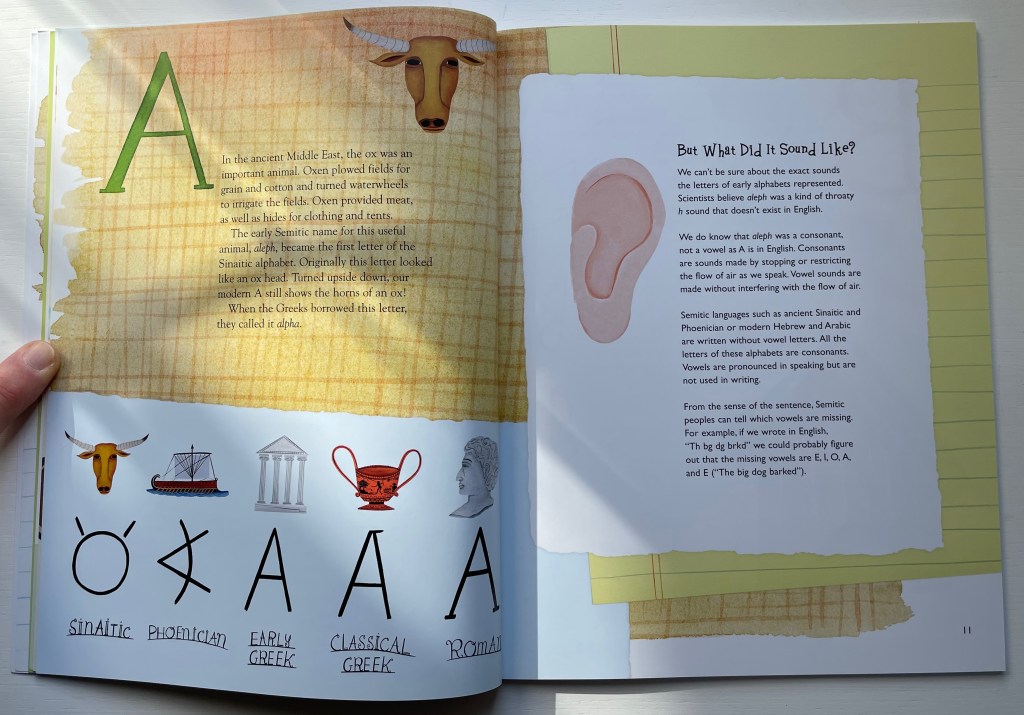
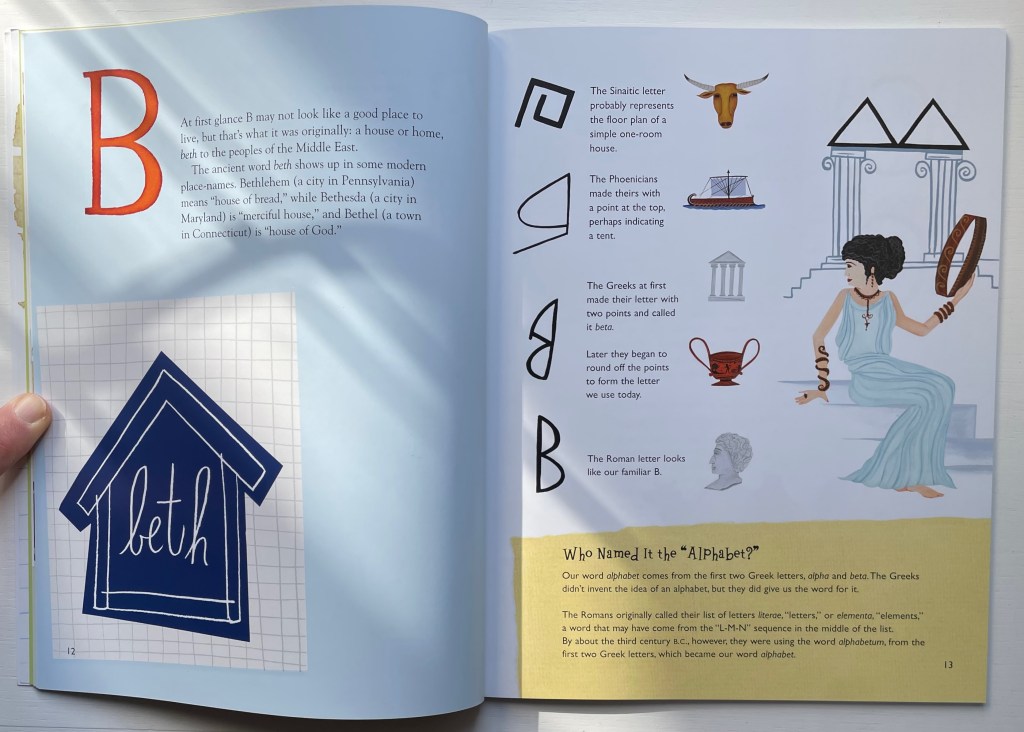
A fair number of fiction and non-fiction children’s books on the history of the alphabet have made their way into the Books On Books Collection.

Of the fiction variety, there is Rudyard Kipling’s “Just So Story” of the alphabet’s invention: How the Alphabet Was Made (1983), illustrated by Chloe Cheese. Another fiction entry is James Rumford’s retelling of Cadmus’ visit to Crete in There’s a Monster in the Alphabet (2002) and William Joyce’s inventive The Numberlys (2014).

In the non-fiction category are William Dugan’s How Our Alphabet Grew (1972), Tiphaine Samoyault’s Alphabetical Order (1998), Renzo Rossi’s The Revolution of the Alphabet (2009) and the entry here: Don Robb’s and Anne Smith’s Ox, House, Stick.

Ox, House, Stick is scheduled to appear as part of an exhibition at the Bodleian Libraries in Oxford (opening 15 July 2023). “A is for Ox” designates the display case devoted to the question: Where did the alphabet come from? It’s not just a question for archaeologists, historians, linguists and paleographers — or children’s book authors and illustrators. It’s one generating repeated inspiration for book artists as shown by Abe Kuipers’ Letters (1971), Lanore Cady’s Houses & Letters (1977), another rendition of the Kipling tale by Gerald Lange in The Neolithic Adventures of Taffi-Mai Metallu-Mai (1997), designed by Gerald Lange and produced with Robin Price, Dave Wood’s Alphabetica (2002), Cari Ferraro’s The First Writing (2004), and Helen Malone’s Alphabetic Codes (2005).

Artists’ books share much with children’s books in general. They both play with form and structure. They play with words and images, sometimes images without words and sometimes just shapes. Almost always an attention to all the senses. Children’s alphabet books in particular display features that appeal to book artists: play with animals, the Babel of languages, bodies, calligraphy, colors, design (of letters, page and book) and, as above, alphabet origin stories. Viewing and exploring alphabet books and artist’s books side by side heightens the enjoyment and appreciation of both.

Further Reading

Abecedaries I (in progress)“. Books On Books Collection.

Lanore Cady“. 16 December 2022. Books On Books Collection. Artist’s book.

William Dugan“. 10 July 2023. Books On Books Collection.

Cari Ferraro“. 1 February 2023. Books On Books Collection. Artist’s book.

William Joyce“. 18 June 2021. Books On Books Collection.Illustrated children’s book.

Rudyard Kipling and Chloë Cheese“. 15 February 2023. Books On Books Collection. Illustrated children’s book.

Rudyard Kipling and Gerald Lange“. 16 April 2023. Books On Books Collection. Artist’s book.

Abe Kuipers“. 15 February 2023. Books On Books Collection. Artist’s book.

Helen Malone“. 23 July 2020. Books On Books Collection. Artist’s book.

Renzo Rossi“. 10 July 2023. Books On Books Collection.  Illustrated children’s book. [In progress]

James Rumford. 21 November 2022. Books On Books Collection. Illustrated children’s book.

Tiphaine Samoyault“. 10 July 2023. Books On Books Collection. Illustrated children’s book. [In progress]

Animal alphabets & artists’ books

Marie Angel, An Animated Alphabet (1996)

Leonard Baskin, Hosie’s Alphabet (1972)

Paul Cox, Abstract Alphabet: A Book of Animals (2001)

E.N. Ellis, An Alphabet (1985)

C.B. Falls, ABC Book (1957)

David L. Kulhavy & Charles D. Jones, A Forest Insect Alphabet (2013)

Enid Marx, Marco’s Animal Alphabet (2000)

Carol Schwartzott, ABC of Birds (2020)

Borje Svensson & James Diaz, Animals (1982)

John Norris Wood, An Alphabet in Praise of Toads & Frogs (2002)

Babel, alphabets & artists’ books

Golnar Adili, Father Gave Water/Baabaa Aab Daad (2022)

Islam Aly, 28 Letters (2013)

Brynja Baldursdottír, Fuþorc (1992)

Ellen Heck, A is for Bee (2022)

Tatyana Mavrina, Сказочная Азбука / Skazochnaia Azbuka / A Fairy Tale Alphabet (1969)

Claire Jeanine Satin, Alphabook (1998/99)

Ben Shahn, The Alphabet of Creation (1954)

Jana Sim, Both but between (2021)

Sam Winston, One and Everything (2022)

Bodies & artists’ books

Anthon Beeke, Alphabet (1970)

Anthon Beeke & René Knip, Body Type (2011)

Edward Gorey, Figbash Acrobate (1994) In progress

Toshifumi Kawahara, Dancing Alphabet (1991)

Françoise and Douglas Kirkland, Physical Poetry Alphabet (2018)

Marie Lancelin, Gestes Alphabétiques (2014)

Lisa Merkin, Bodies of Language (2021)

Annette Messager, Mes Enluminaires (1988) [In progress]

Vítězslav Nezval, Abeceda/Alphabet (1926/2001)

Rowland Scherman, Love Letters (1975) [In progress]

Calligraphy, alphabets and artists’ books

Mari Angel, Marie Angel’s Exotic Alphabet (1992)

Tauba Auerbach, How to Spell the Alphabet (2007)

Rebecca Bingham, Lady Letters (1986)

Rebecca Bingham, Alphabet Salmagundi (1988)

Carol DuBosch, Alphabet of Calligraphic Tricks (2014)

Carol DuBosch, Embossed Alphabet Gallery (2019)

Francesca Lohmann, An Alphabetical Accumulation (2017)

Suzanne Moore, A Blind Alphabet (1986)

Edward Andrew Zega & Bernd H. Dams, An Architectural Alphabet : ABC (2008)

Colors, alphabets and artists’ books

Rebecca Bingham, Golden Alphabet (1986)

Rebecca Bingham, Defining the Rainbow (2018)

Sonia Delaunay, Alphabet (1972)

Carol DuBosch, Rainbow Alphabet Snowflake (2013)

Ursula Hochuli-Gamma, 26 farbige Buchstaben (1986)

Karen Hanmer, The Spectrum (2003)

Amy Lapidow, Spiralbet (1998)

Lisa McGarry, Be Amazed (and other words to live by) (2013)

Kveta Pacovská, A l’infini (2007)

Design (of letters), alphabets & artists’ books

Anne Bertier, Anne Dessine-moi une lettre(2004)

Roberto de Vicq de Cumptich, Bembo’s Zoo: An Animal ABC Book (2000)

Felice Feliciano & Jason Dewinetz, Alphabetum Romanum: The Letterforms of Felice Feliciano (c. 1460, 2010)

Jeff Morin and Steven Ferlauto, The Sacred Abecedarium (1999)

Andrew Morrison, Two Wood Press A-Z (2020

David Pelletier, The Graphic Alphabet (1996)

Bruce Rogers, Champ rosé (1933)

Kevin Steele, The Movable Book of Letterforms(2009)

Sharon Werner & Sharon Forss, Alphabeasties (2009)

Structures, alphabets & artist’s books

Kathleen Amt, Kaleidoscopic ABC’s (1991)

Matsumasa Anno, Anno’s Magical Alphabet (1981)

Marion Bataille, ABC3D (2008)

John Crombie, ABC in a maze (1987)

Carol DuBosch, Rainbow Alphabet Snowflake (2013)

Carol DuBosch, Embossed Alphabet Gallery (2019)

Helen Hajnoczky, alpha seltzer (2023)

Karen Hanmer, A2Z (2013)

Karen Hanmer, The Spectrum (2003)

Helen Hiebert, Alpha Beta (2010)

Ron King, Alphabeta Concertina majuscule (2007)

Ron King, alphabeta concertina miniscule (2007)

Ron King, The White Alphabet (1984) In progress

Ron King, ABC Paperweights (nd)

Amy Lapidow, Spiralbet (1998)

Scott McCarney, Alphabook 3 (1986)

Scott McCarney, Alphabook 10 (2015)

Scott McCarney, Alphabook 13 (1991)

Lisa McGarry, Twenty-six/Fragments (2012)

Patrice Miller (Edward Gorey), The Eclectic Abecedarium (2022)

Patrice Miller (Edward Gorey), Figbash Acrobate (2023)

Jeff Morin and Steven Ferlauto, The Sacred Abecedarium (1999)

Jeff Morin and Steven Ferlauto, Sacred Space (2003)

Moveable Book Society, A to Z Marvels in Paper Engineering (2018)

Bruno Munari, ABC con fantasia (2008)

Bruno Riboulot, ABCD’Air (2005)

Merrill Shatzman, Calligrafitti #3 (2011)

Borje Svensson & James Diaz, Letters (1982)

Emmett Williams, abcdefghijklmnopqrstuvwxyz (1963) In progress

Books On Books Collection – Tommy Thompson

The ABC of Our Alphabet (1952)

The ABC of Our Alphabet: A primer of the lineal history of our present-day letters (1952)
Tommy Thompson
Casebound with doublures showing map of locations of alphabet development.
Acquired from St Luke’s Hospice, Sheffield, 6 August 2022. Photos: Books On Books Collection.

First appearing in 1942, Samuel Winfield (Tommy) Thompson’s somewhat forgotten children’s introduction to the history of the alphabet occupies an interesting position in that line of work that includes Oscar Ogg’s The 26 Letters (1964), Tiphaine Samoyault’s Alphabetical Order (1998), Renzo Rossi’s The Revolution of the Alphabet (2009) and Don Robb’s Ox, House, Stick (2010). For a collector of children’s alphabet books and alphabet-related artists’ books, the decision whether to acquire it balances on its interior design and content.

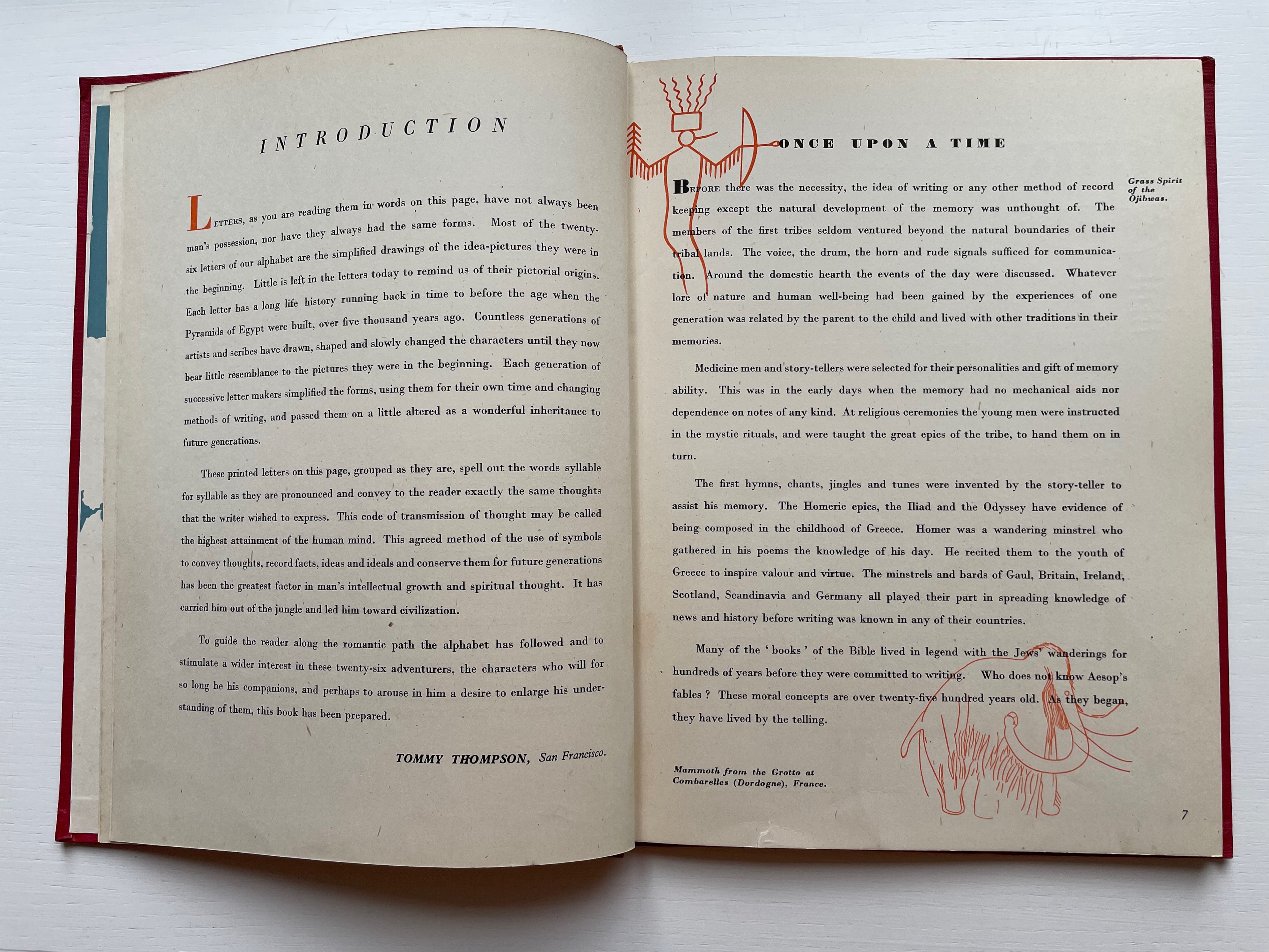
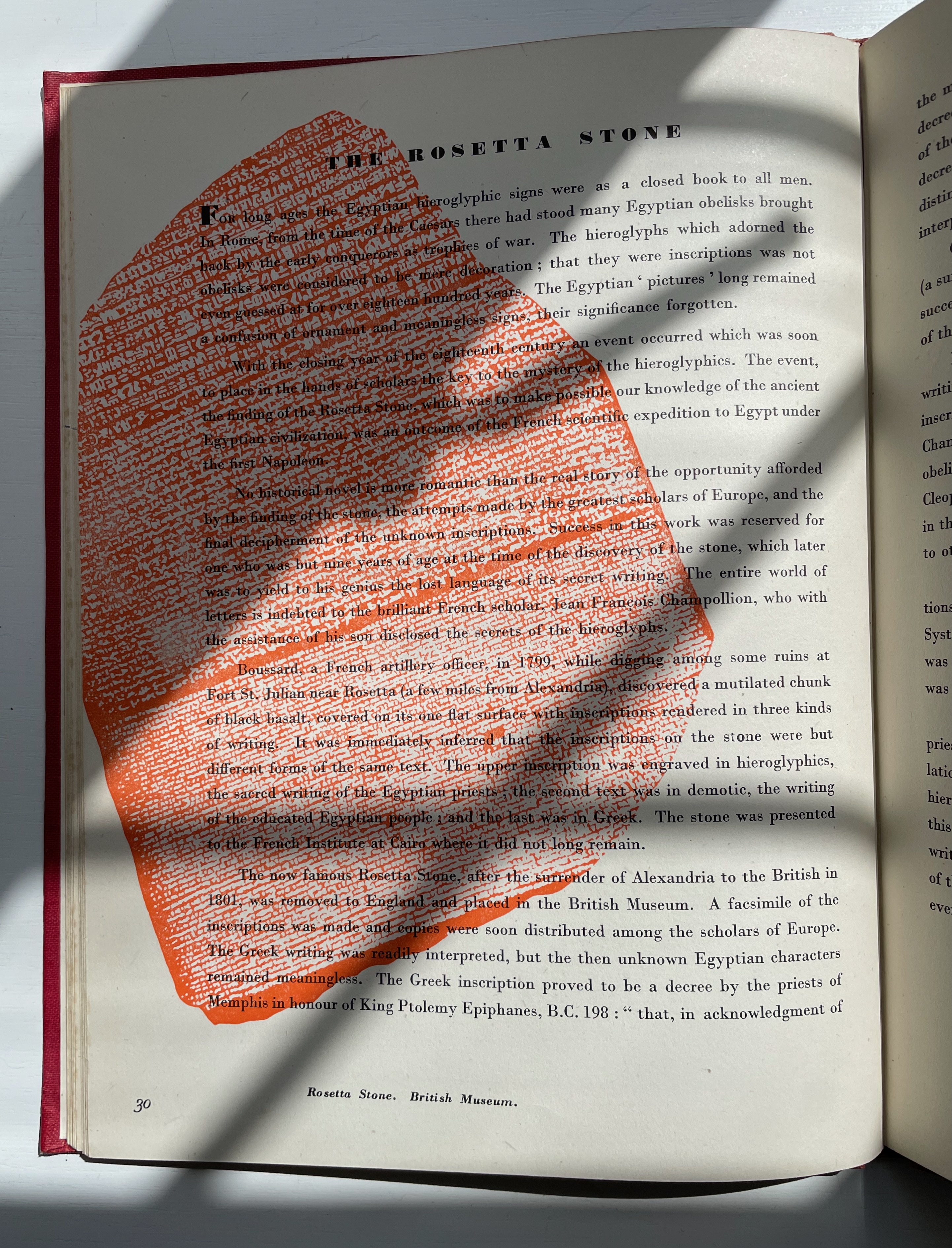
With its overlay of second-color illustrations on the text, Thompson’s book makes for an interesting forerunner to Lyn Davies’ fine press A is for Ox. Thompson falls prey to instances of illegibility from the technique, but both enjoy instances of brilliant juxtaposition of word and redrawn images.

Two-color illustration overlaying text. Right: Davies. Left: Thompson.

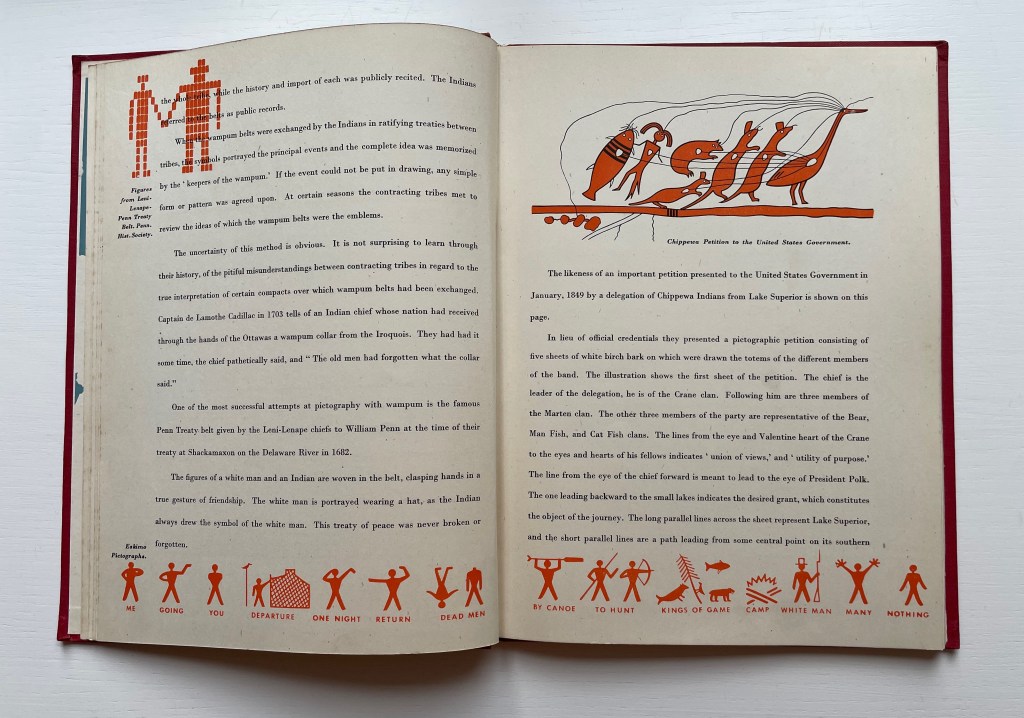
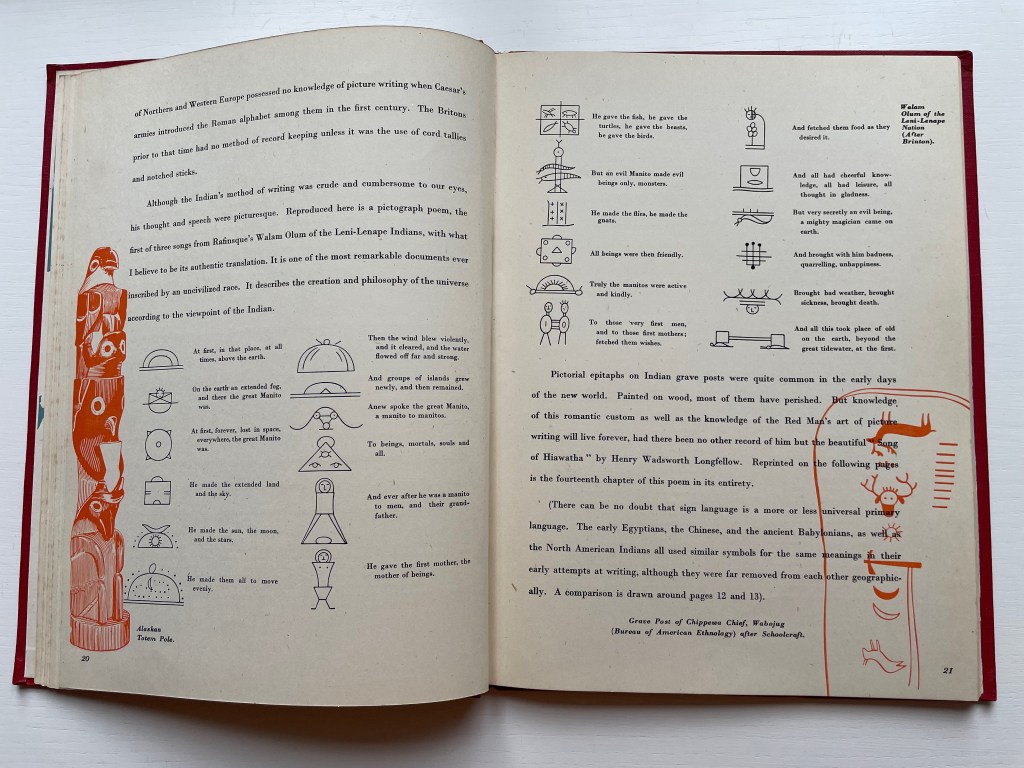
Among the primers of alphabet history, Thompson’s also stands out for the attention it gives to North American Indian pictorial writing. Rather than the usual Eurocentric sources, the Leni-Lenape, Dakota and Sioux Nations provide the bulk of examples of the method. The enlightened perspective, however, is undercut by a strain of cultural and historical supremacy apparent in several passages and, in particular, the perpetuation of the Walum Olum hoax and inclusion of a chapter from Longfellow’s Song of Hiawatha to stand in for the absence of any similar memorialization of painted grave posts. Although Thompson is point blank on how “the invasion of the white man” prevented the growth and development of this method of writing, consider this passage describing the Leni-Lenape Penn Treaty of 1682 that was woven with perforated shell beads (wampum):

The figures of a white man and an Indian are woven in the belt, clasping hands in a true gesture of friendship. The white man is portrayed wearing a hat, as the Indian always drew the symbol of the white man. This treaty of peace was never broken or forgotten.

Except that, in the 1860s, most of the Leni-Lenape Nation was forcibly displaced to Oklahoma.

It was not until the 1990s that the so-called Leni-Lenape cosmographical poems of Walum Olum were proven to be fake, but suspicions were strong in the 1930s. All this is compounded as the book laments the ephemerality of the “Walum Olum poems” and the custom of pictorial grave posts:

Pictorial epitaphs on Indian grave posts were quite common in the early days of the new world. But knowledge of this romantic custom as well as the knowledge of the Red Man’s art of picture writing will live forever, had there been no other record of him but the beautiful “Song of Hiawatha” by Henry Wadsworth Longfellow.

Thompson’s design skills and his side note of claim to fame as reportedly the first recipient of royalties for typeface design (Thompson Quill Script) nudged the balance toward acquisition. Maybe perversely the annoying cultural dissonance also nudged the balance in that direction. The book’s presence provides the opportunity to compare it line for line with the other primers and look harder for the signs of the cultural blinkers we are wearing now. Also, with authentic pictorial cosmography available from the Navajo (Diné) Nation and with new archaeological finds from the Middle East (see below for both), perhaps it is time for a new primer against which to compare Thompson and the rest.

Further Reading

Abecedaries I (in progress)“. Books On Books Collection.

Lyn Davies“. 7 August 2022. Books On Books Collection.

Grant, Richard. September 2021. “In the Land of the Ancient Ones“. Smithsonian Magazine. Accessed 20 August 2022.

A review of the film Canyon del Muerto about one of the first female archaeologists, Ann Axtell Morris. What has this to do with Thompson’s book? An ironic coincidence. Morris worked for the archaeologist Sylvanus G. Morley on his Yucatán expedition. Thompson cites Morley in his bibliography. With her husband, fellow archaeologist Earl Morris, and their Navajo team, Ann Morris went on to open the Canyon del Muerto to the discoveries that led to insights into the Ancestral Puebloans, the source of Navajo cosmography. Other than papers coauthored with Earl, Ann’s accounts could only find outlet as juvenile publications. While Sylvanus and Earl may have been the combined inspiration for Indiana Jones, Ann offers the status of artist, first female archaeologist and subject of a current movie as a role model to celebrate with a sidebar in a new history of writing.

Morris, Ann Axtell. 1931. Digging in Yucatan: Archaeological Explorations in 1924. Garden City, NY: Doubleday, Doran & Co.

_______________. 1934. Digging in the Southwest. Garden City, NY: Doubleday, Doran & Co.

Naveh, Joseph. 1975. Origins of the alphabet. London: Cassell.

Oestreicher, David M. 1994. Unmasking the Walum Olum: A 19th-century Hoax. South Orange, N.J.: Archaeological Society of New Jersey.

Ogg, Oscar. 1964. The 26 Letters. New York: T.Y. Crowell.

Robb, Don, and Anne Smith. 2010. Ox, House, Stick: The History of our Alphabet. Watertown, MA: Charlesbridge.

Rossi, Renzo. 2009. The revolution of the alphabet. New York: Marshall Cavendish Benchmark.

Sacks, David. 2003. Language visible unraveling the mystery of the alphabet from A to Z. New York: Broadway Books.

Samoyault, Tiphaine. 1998. Alphabetical Order: How the Alphabet Began. New York: Viking.

Shaw, Gary. 15 April 2021. “Ancient ABCs: The alphabet’s ‘missing link’ discovered in Israel“. The Art Newspaper.