With 260 illustrated books to his name and 90 of them authored by him, Leonard Everett Fisher would have been remiss not to have contributed works to the category of alphabets and artists’ books.
Leonard Everett Fisher offers thirteen non-English languages — Arabic, Cherokee, Chinese, Cyrillic, Eskimo, Gaelic, German, Greek, Hebrew, Japanese, Sanskrit, Thai and Tibetan — each with an illustrative image alongside a page of background text followed by a double-page spread of hand-drawn characters of the writing system. Unlike Tommy Thompson’s The ABC of Our Alphabet (1952) and William Dugan’s How Our Alphabet Grew (1972), Fisher’s book does not focus on the development of the Latin alphabet, but unusually aims instead to interest the children’s market in the variety of non-Latin alphabets. In this, it is a precursor to Sam Winston’s One & Everything (2022).
The book has no bibliography or indication of sources, and the background text’s few slightly off-center assertions (e.g., that the Chinese writing system is a syllabary) create a slight unease about the accuracy of the character sets. Nevertheless, for calligraphic inspiration, the double-page presentation of consistent hand-drawn character sets delivers strong impressions of the differences in the look and feel among the languages’ writing systems.
The ABC Exhibit (1991)
The ABC Exhibit(1991) Leonard Everett Fisher Dustjacket. Casebound, one-eighth cloth and paper over board. Doublures. Sewn binding. H287 x W225 mm. 32 pages. Acquired from Books End, 28 August 2022. Photos: Books On Books Collection.
The ABC Exhibit emphasizes image more than letter or text. Forgoing other usual features of a children’s alphabet book (such as presenting upper and lowercase letters), the book steers more toward an artist’s book or catalogue of the artist’s style of illustration and art. The colophon even specifies that the original artwork was prepared as acrylics on board. While the image of the elephant and several others can be easily imagined in a children’s book, the rendering of the Brooklyn Bridge in fog stands out as do a sailboat in motion and a still life of oranges.
The book features around the 24′ mark in this interview with the Hennepin County Library in 1991.
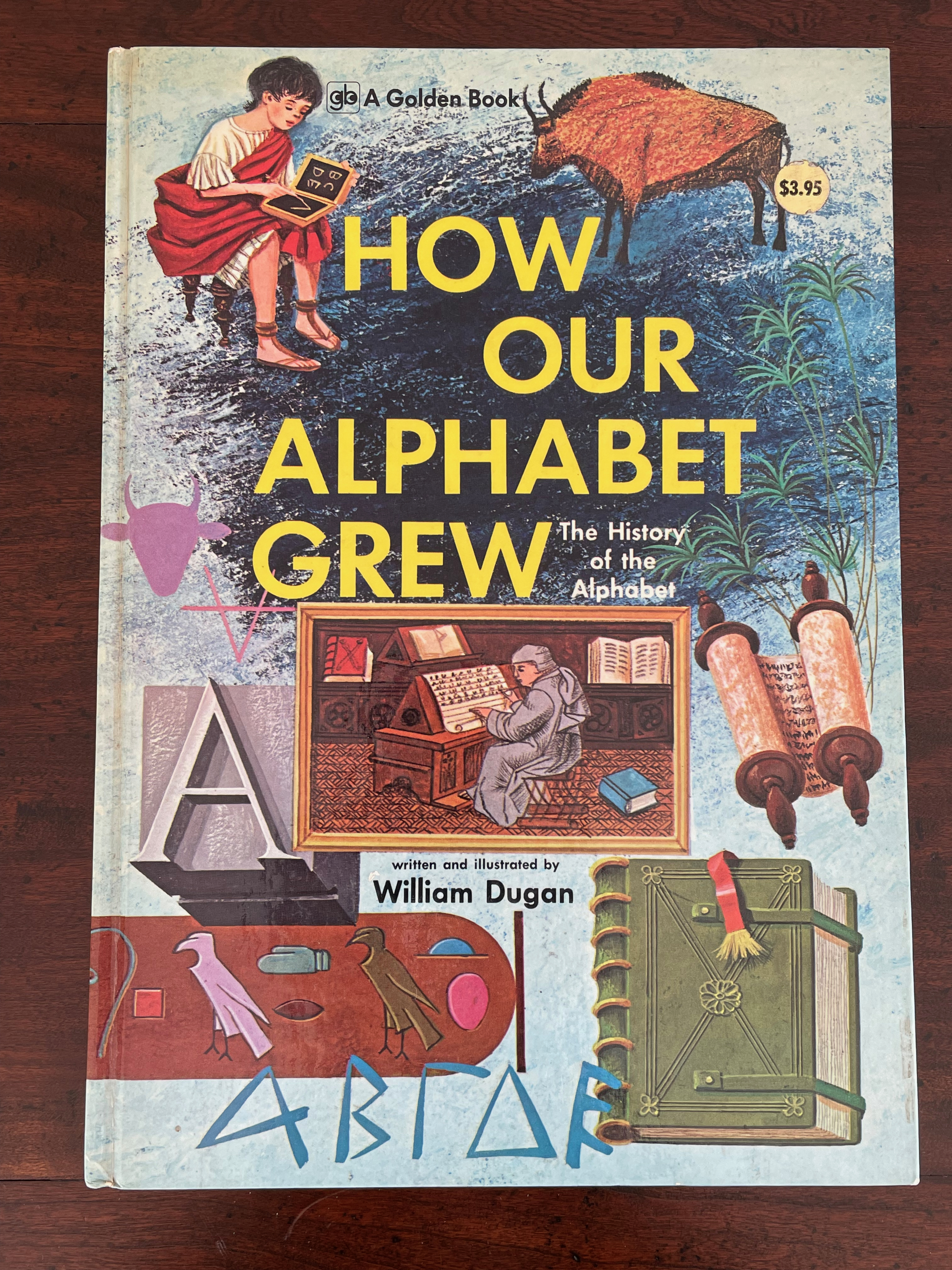
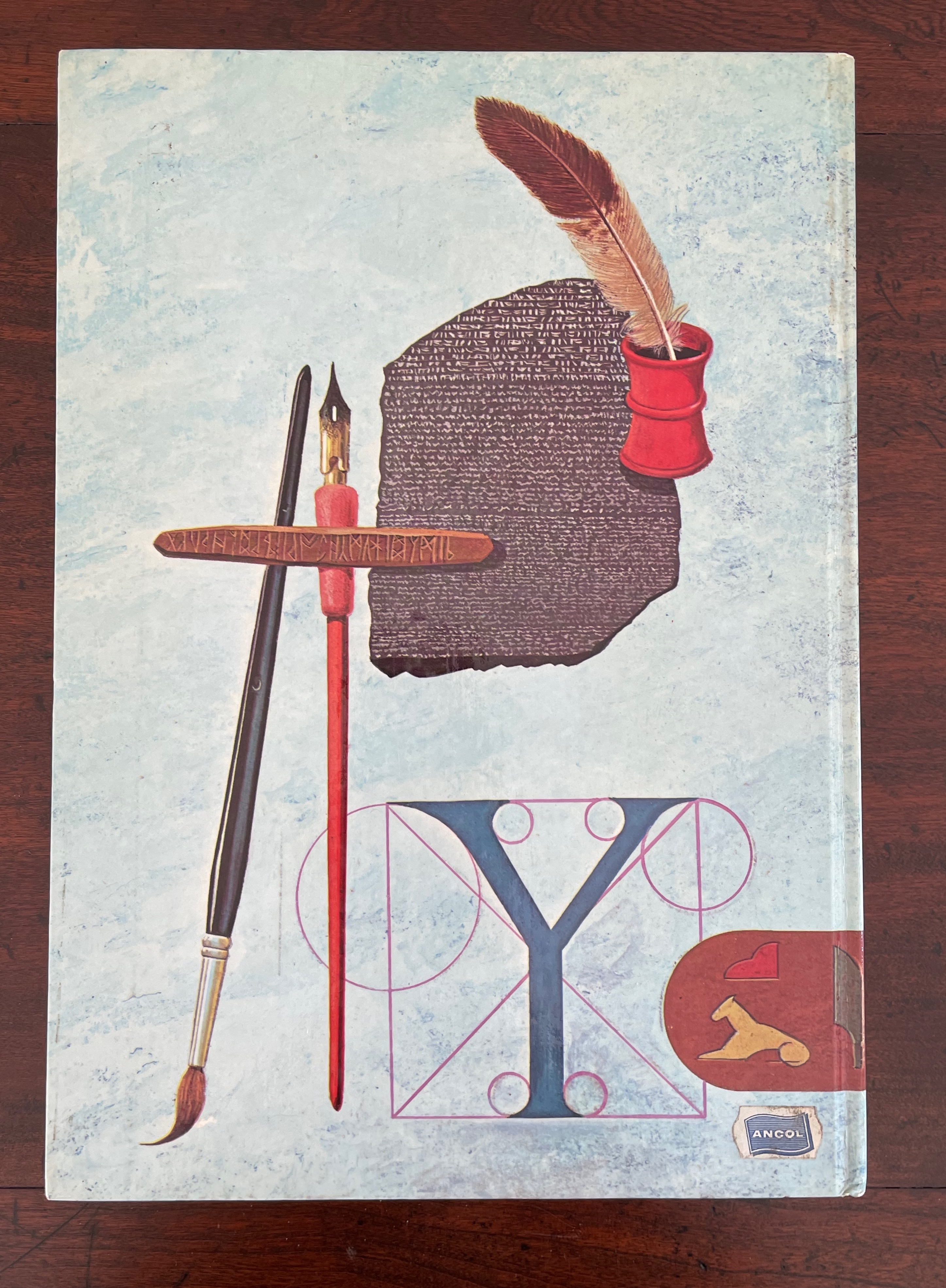
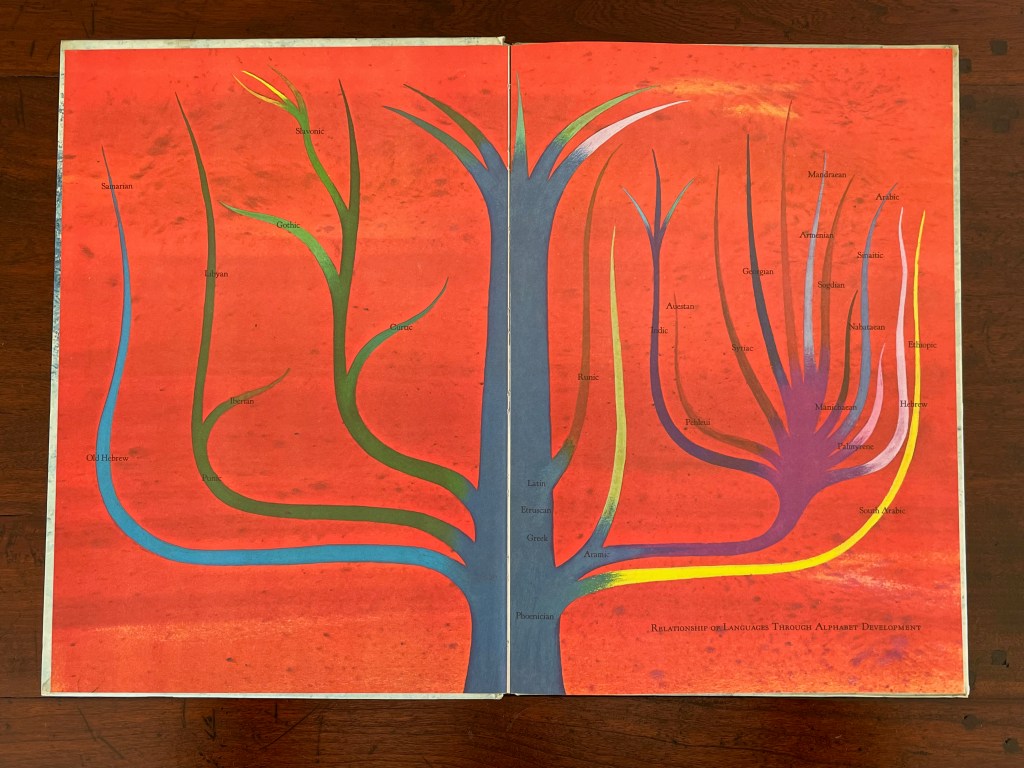
How Our Alphabet Grew: The History of the Alphabet(1972) William Dugan Casebound, illustrated paper on board, illustrated endpapers and pastedowns. H320 x W227 mm. 72 pages. Acquired 14 March 2023. Photos: Books On Books Collection.
Curiously, little information about William Dugan appears online. He was a prolific illustrator of children’s books — especially those published by Golden Press in the 1960s and 1970s. He also authored as well as illustrated several early childhood books — on insects, signs, machines and vehicles. Two of his books, however, are meant for older children — this one and All about Houses (1975), which is a forerunner to Dorling Kindersley‘s children’s reference books.
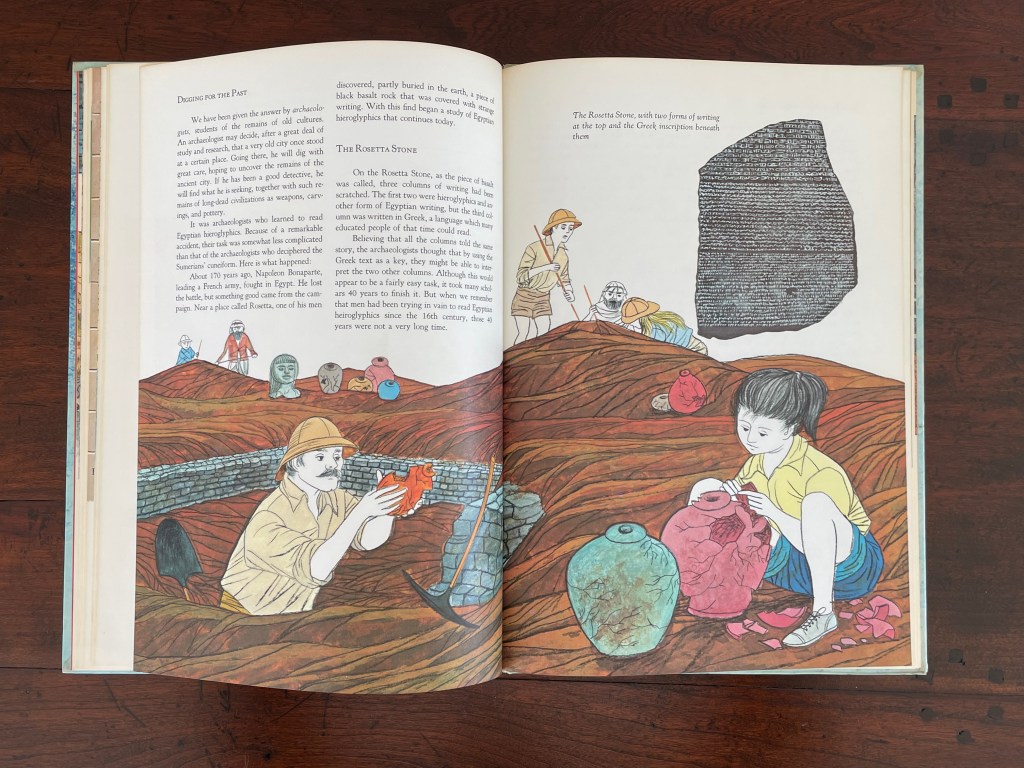
Dugan’s ability to alter his style as writer and illustrator to the ages of his audience is notable. Even more notable is the diversity and inclusiveness of his reference works for older children. Despite the date of publication, a young girl occupies the foreground of the illustration of archaeologists, a feature that would have brought a smile to Ada Yardeni and still might to Tiphaine Samoyault.
Diringer, David, and Reinhold Regensburger. 1968. The alphabet: a key to the history of mankind. London: Hutchinson. A standard, beginning to be challenged by late 20th and early 21st century archaeological findings and palaeographical studies.
A fair number of fiction and non-fiction children’s books on the history of the alphabet have made their way into the Books On Books Collection.
Of the fiction variety, there is Rudyard Kipling’s “Just So Story” of the alphabet’s invention: How the Alphabet Was Made (1983), illustrated by Chloe Cheese. Another fiction entry is James Rumford’s retelling of Cadmus’ visit to Crete in There’s a Monster in the Alphabet (2002) and William Joyce’s inventive The Numberlys (2014).
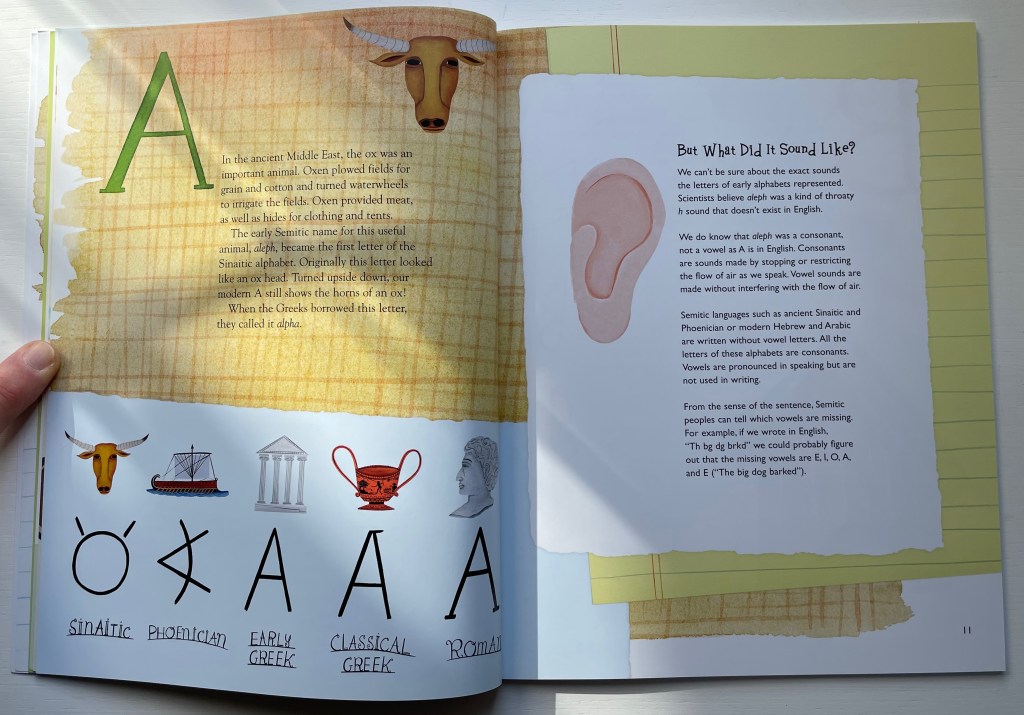
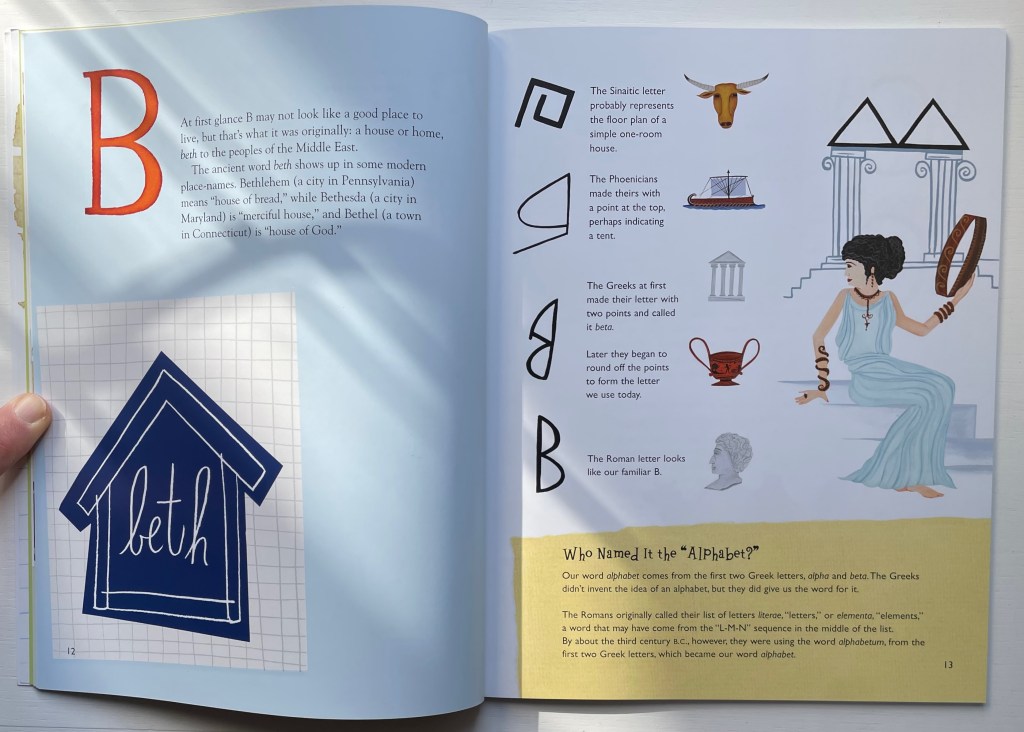
In the non-fiction category are William Dugan’s How Our Alphabet Grew (1972), Tiphaine Samoyault’s Alphabetical Order (1998), Renzo Rossi’s The Revolution of the Alphabet (2009) and the entry here: Don Robb’s and Anne Smith’s Ox, House, Stick.
Ox, House, Stick is scheduled to appear as part of an exhibition at the Bodleian Libraries in Oxford (opening 15 July 2023). “A is for Ox” designates the display case devoted to the question: Where did the alphabet come from? It’s not just a question for archaeologists, historians, linguists and paleographers — or children’s book authors and illustrators. It’s one generating repeated inspiration for book artists as shown by Abe Kuipers’ Letters (1971), Lanore Cady’s Houses & Letters (1977), another rendition of the Kipling tale by Gerald Lange in The Neolithic Adventures of Taffi-Mai Metallu-Mai (1997), designed by Gerald Lange and produced with Robin Price, Dave Wood’s Alphabetica (2002), Cari Ferraro’s The First Writing (2004), and Helen Malone’s Alphabetic Codes (2005).
Artists’ books share much with children’s books in general. They both play with form and structure. They play with words and images, sometimes images without words and sometimes just shapes. Almost always an attention to all the senses. Children’s alphabet books in particular display features that appeal to book artists: play with animals, the Babel of languages, bodies, calligraphy, colors, design (of letters, page and book) and, as above, alphabet origin stories. Viewing and exploring alphabet books and artist’s books side by side heightens the enjoyment and appreciation of both.




 Books On Books