Bookmark – Phoenix in an Elegy for Paper?

fahrenheit-451In another elegy for paper, Mark Fox in Designers & Books leaps from the famous conversation between Ray Bradbury’s characters Professor Faber and Fireman Montag in Fahrenheit 451 that begins, “Do you know why books such as this are so important? Because they have quality. And what does the word quality mean?” to Jaron Lanier’s assertion that the remix culture is responsible for “the digital flattening of expression into a global mush.” Fox sets this against Professor Faber’s elaboration of what he means by “quality”: 

To me it means texture. This book has pores. It has features. This book can go under the microscope. You’d find life under the glass, streaming past in infinite profusion. The more pores, the more truthfully recorded details of life per square inch you can get on a sheet of paper, the more ‘literary’ you are. That’s my definition, anyway. Telling detailFresh detail. The good writers touch life often. The mediocre ones run a quick hand over her. The bad ones rape her and leave her for the flies.

Consider, however, this conversation between the artists Stefan Saalfeld and Gerhard Mantz published in the February 2013 issue of the Lumas Gallery Magazine, “The Liberation of Art“:

Saalfeld – … I’m interested in the changes that take place over time. In nature, the old sits alongside the new. There are always tensions, and injuries.

Mantz – That is exactly what characterises your images. This breaking apart and breaking through as if the colours were peeling off to reveal fragments of completely different pictures behind.

Saalfeld – Gaps appear through these breaks and dislocations. This allows something different to emerge from the image. There is always an unexplained story behind the story, another version. I no longer believe in a single, individual image.

Here is a healthy “anxiety of influence” that overcomes qualms about tradition, builds upon it and, yes, perhaps devours it as if it were seed corn. Its analogs in book publishing can be found in the work of Tom Abba, Duncan Speakman and others associated with WeAreCircumstance or in the works of Jonathan Safran Foer and others published by Visual Editions, all of which represent an intersection of narrative and the plastic visual arts.

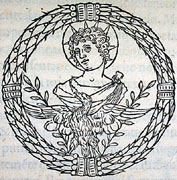
Paper is not dead, digital is not still-born, creativity is a phoenix.

These Pages Fall Like AshThese Pages Fall Like Ash, Tom Abba

Short Films for YouShort Films for You, Tom Abba, Els Viaene, Reinout Hiel and Yoko Ishiguro

Foer2Tree of Codes, Jonathan Safran Foer

Composition-1Composition No. 1, Marc Saporta

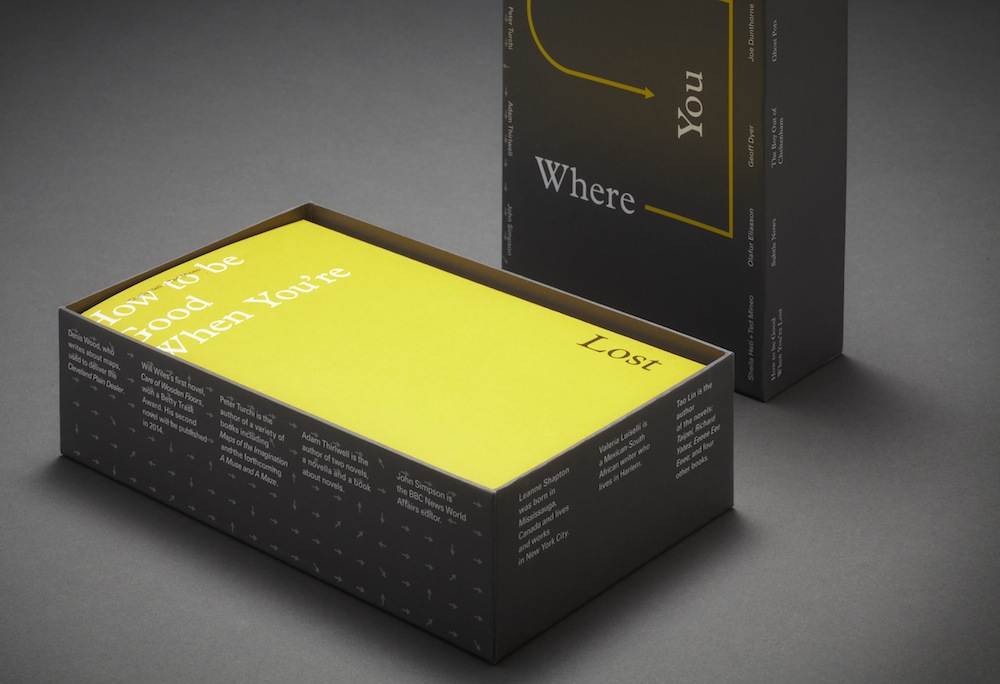
WhereYouAreWhere You Are, Visual Editions

Bookmarking Book Art – A Good Book

What is “A Good Book“?

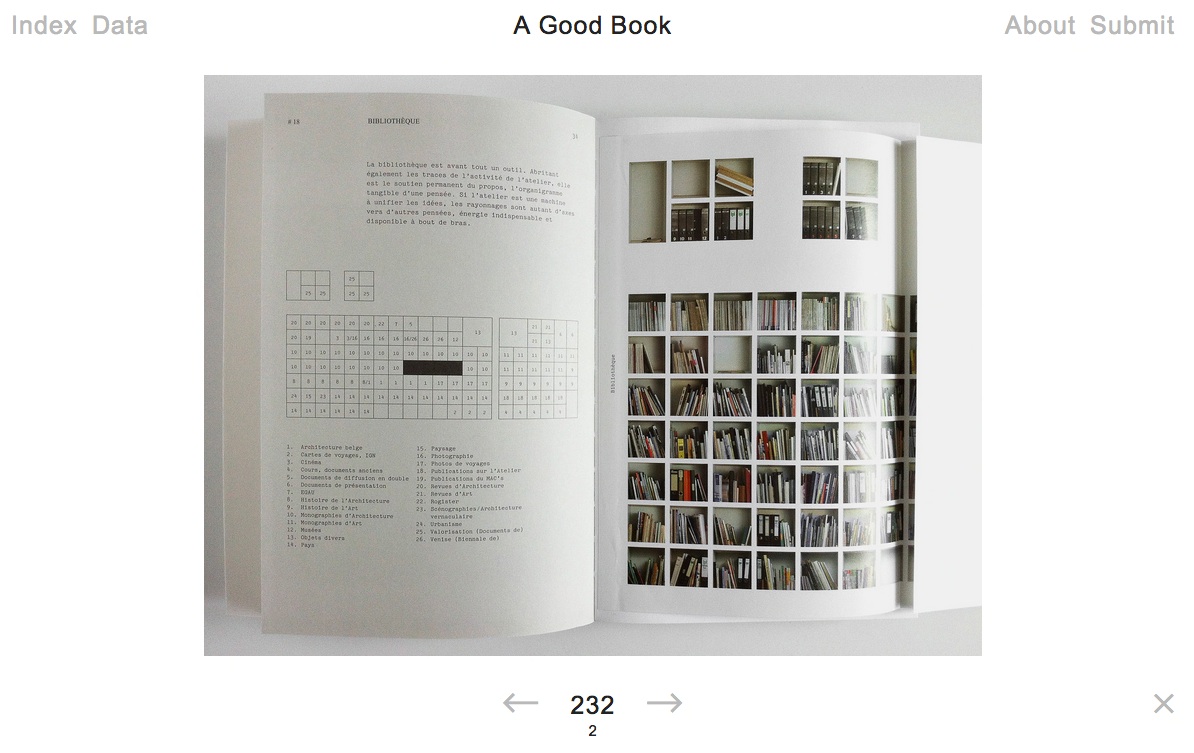
A hard question? A trick question? Yes and no. Since 2011, Bernd Kuchenbeiser, the Munich-based book designer, has been attempting an answer. He began by posting entries to a database on Twitter. With the demise of Twitter’s gallery function, Kuchenbeiser migrated the diary-like collection of photos and comments to A Good Book site with help from Simon Zirkunow. Below is a screenshot of part of the 232nd entry.

A Good Book
Screenshot of Méthodes, cover designed by Manuela Dechamps Otamendi, Entry #232 in A Good Book.

Until recently, the entries were Kuchenbeiser’s alone. The entries started on a daily basis, but as with many diary projects, the execution flagged. With 349 entries of his own (plus 3 from friends), he is now inviting entries from far and wide. Notice “Submit” in the upper righthand corner of the screenshot. Behind it lie the instructions and requirements for submission. Kuchenbeiser’s own entries are often brief, but his choices and comments are interesting because Kuchenbeiser and his oeuvre are interesting. See Michael Cina’s interview with him in The New Graphic (15 August 2011). For this venture to reward constant revisiting beyond that interest, however, Kuchenbeiser wisely holds potential contributors to the following standard:

Here’s what you need in order to submit a book:

– A short description of your book or the aspect that makes it ‘good’. From 140 characters to a maximum of 560, including spaces.

– The bibliographic details: author, title, year of publication, publisher, designer (if known). A questionnaire is already set up within the email that opens when you click ‘Submit now’.

– One to five photos of your book (at least 1400 pixels wide for landscape format and 1200 pixels high for portrait format).

Think of Pinterest or Flickr with serious feeling and intellectual rigor behind them. Kuchenbeiser’s design work and his own words exude that feeling:

Books have personalities. They can be our companions and friends. A good book doesn’t deserve to languish on a bookshelf; it wants to be opened, read, savoured, displayed, recommended. That’s why this website exists.

This site is like a message in a bottle hoping to be discovered. It will work only if it manages to generate communication.

The London Centre for Book Arts must have picked up the bottle from one of the Thames overswellings last week and placed a notice on its home page about the website. Although Kuchenbeiser does not promote it as such, if A Good Book thrives, it could generate a rich database worth semantic analysis for the book art and book arts community. All materials on A Good Book are being made available for noncommercial and educational use only.

Bernd Kuchenbeiser Projects, Schwanthalerstraße 7780336 München (Germany)

Bookmarking Book Art – Helen Yentus

 
On Such a Full Sea Chang-rae Lee credit: Riverhead Books
On Such a Full Sea
Chang-rae Lee
credit: Riverhead Books

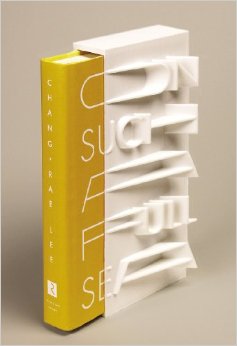
“This limited, numbered edition of Chang-rae Lee’s On Such a Full Sea will be available on January 7th, 2014. Riverhead art director Helen Yentus and members of the MakerBot team designed the slipcase, and 200 of them will be made with the MakerBot® Replicator® 2 Desktop 3D Printer with MakerBot PLA filament, a bioplastic made of corn, fabricated by MakerBot in Brooklyn, New York. Each copy is signed and numbered by the author.” From www.riverheadbooks.com  Is this the first 3D-printed slipcase?  Yea or nay, this effort is clever.  As the book slips from its case, the words of the title on the slipcase are completed. The design will surely make purchasers give “pride of space” to this book on their bookshelves and renewed sense to the word “outstanding”.

Additional cover design and art direction by Helen Yentus can be viewed here.

Related articles:

Lindsay Ballant, “Helen Yentus”, Print, 1 June 2007, accessed 5 January 2014: http://www.printmag.com/article/nva_2007_helen_yentus/

Todd Halterman, “Print Is Not Dead – Pulitzer Prize Hopeful Wraps His Novel In A 3D Printed Slipcase”, 3D Printer World, 12 December 2013, accessed 5 January 2014: http://www.3dprinterworld.com/article/print-not-dead-pulitzer-prize-hopeful-wraps-his-novel-3d-printed-slipcase

“Cover Designer: Helen Yentus”, DecorWrite, 1o February 2011, accessed 5 January 2014: http://www.decorwrite.com/?p=458

“Helen Yentus”, The Book Cover Archive, nd, accessed 5 January 2014: http://bookcoverarchive.com/Helen_Yentus

“MakerBot Creates First-of-Its-Kind 3D Printed Hardcover Book Slipcase for Award—Winning and New York Times—Bestselling Author Chang-rae Lee”, press release, 10 December 2013, accessed 5 January 2014: http://investors.stratasys.com/releasedetail.cfm?releaseid=812980

“Riverhead Goes 3D for Chang-rae Lee”, Publishers Weekly, 11 December 2013, accessed 5 January 2014: http://www.publishersweekly.com/pw/by-topic/industry-news/publisher-news/article/60331-riverhead-goes-3d-for-chang-rae-lee.html

Bookmark – Bodoni’s Bicentennial

English: Comparative Bauer Bodoni versus Bodon...
English: Comparative Bauer Bodoni versus Bodoni Català: Comparativa Bauer Bodoni vs Bodoni (Photo credit: Wikipedia)

This year marks the 200th anniversary of the passing of a great contributor to the linked histories of the book and typography:  Giambattista Bodoni (1740-1813).  Bodoni among others such as Fournier and Didot established the “Modern” fonts, typefaces characterized by the extreme contrast of their thick and thin strokes, delicate and sharp serifs and a chilly sparkling engraving-like quality heightened by generous leading and made possible by improvements in 18th and 19th century typecasting and manufacture of ink and paper.  Bodoni planned and formed the royal printing house for the Duke of Parma in the Palazzo della Pilotta, where the Museo Bodoniano resides today.  Associated with Pope Sixtus V, Carlos III of Spain and the Duke of Parma, Bodoni became one of the most celebrated printers in Europe.

View of Palazzo della Pilotta. The rebuilt par...
View of Palazzo della Pilotta. (Photo credit: Wikipedia)

Although Bodoni’s fame in his lifetime was of a piece with that of the Romantic figures Chopin, Liszt, Byron, Goethe and Shelley, his output was Neoclassical with editions of Homer, Catullus, Virgil, Horace and the English poets Thomas Gray and James Thomson.  His two-volume Manuale Tipografico (1788, 1818) is a meticulous monument of typographic art with more than 14 sets of roman and italic typefaces, a wide selection of decorative designs and symbols and alphabets from the Greek, Hebrew, Russian, Arabic, Phoenician, Armenian, Coptic, and Tibetan languages.  The 1818 two-volume edition can be viewed online at the Bibiloteca Bodoni.

Portrait of Bodoni (c. 1805-1806), by Giuseppe...
Portrait of Bodoni (c. 1805-1806), by Giuseppe Lucatelli. Museo Glauco Lombardi. (Photo credit: Wikipedia)

This flowering of typography and design – reflective of the age and technical developments of book printing – prompts a thought toward the impact of today’s technology – screen display, ereaders, XML and HTML, cascading style sheets, etc. – not only on type and design but their purpose as well.

“The type and pages beg to be admired – that is looked at – which is well and good, except that looking and reading are quite different, actually contradictory, acts…. To look at things, we either disengage and let them flow by on their own or we stop them in their tracks.  To look we hold our breath or (in the worst of cases) pant.  To read we breathe.”  So say Warren Chappell and Robert Bringhurst in their critical comments on Bodoni and the Moderns. (A Short History of the Printed Word, pp. 173-74; 1970,1999.)

Perhaps we are still in the age of e-incunabula and have not reached the point where type and design on the screen beg to be admired.   The improvements delivered by Readmill and Readability have been welcome for their contribution to ease of reading.  It may be perverse to wish for developments that may interfere as Chappell and Bringhurst assert the Modern faces interfere with reading.  But that assumes that they are right in their hieratic statement “To read we breathe.”   Might it be as legitimate to assert “To read we click.  To read we link.  To read we dim or brighten.  To read we tilt from portrait to landscape causing the page to reflow.”?  

Will High Definition play the role that improved paper surfaces played to allow those thinner strokes and delicate serifs in the 18th and 19th centuries?  And if it does, what on-screen design, comparable to Bodoni’s increased leading, will perform the same heightening effect for new faces and design that beg to be admired?  

Bodoni Ornaments
Bodoni Ornaments (Photo credit: Bene*)

For more on the subject of Bodoni, see “Biblioteca Bodoni Launched on Bicentennial Anniversary of Giambattista Bodoni’s Death” by Yves Peters, The Font Feed, 11 December 2013.

Bookmark for your browser or ereader? | Anniversary Update

Book with florentine paper bookmark.
Book with florentine paper bookmark. (Photo credit: Wikipedia)

Publishing and editorial folk who wish to educate themselves in the changing craft of the book should track this ongoing discussion on the merits of browsers versus apps/devices –even if at times it becomes finely technical.

Books On Books logged several articles on this last year when Jason Pontin declared MIT Technology Review’s colors (decidedly HTML5).  Here is another worth a quick read:   5 Myths About Mobile Web Performance | Blog | Sencha.  A quick read?  Yes, publishers and editors need not be HTML jockeys or Java connoisseurs, but they need to have a business-like grasp of what they are choosing to ride or drink.

Understanding why to publish an ebook through an app or in a browser-friendly format — or both — and what the implications are for crafting finds its rough print analogs in selecting the primary channel and form of  publication (trade or academic, hardback or paperback) as well as  the structure of the work (design, layout and organization) and working out the financial case for deciding whether to publish and how.

Bookmark – Education for the Future of Publishing

The Elements, Theodore Gray

When it comes to acquiring skills and professional training in book publishing, from the early days of the printing press onwards, learning by doing has been book publishing’s order of the day.  Consider the following interview exchange between Mac Slocum (Tools of Change) and Theodore Gray (The Elements):

.

MS: What skills — or people with those skills — must be incorporated into the editorial process to produce something like the iPad/iPhone editions?

TG: Specifically in the case of “The Elements,” the skills required were writing, commercial-style stills photography, Objective-C programming, and a whole, whole lot of Mathematica programming to create the design and layout tool and image processing software we used to create all the media assets that went into the ebook.

Other ebooks might well require different skills. My next one, for example, is going to include a lot more video, so we’re gearing up to produce high-grade stereo 3D video. That’s one of the challenges in producing interesting ebooks: You need a wider range of skills than to produce a conventional print book.

Starting out in book publishing late in the last century, a novice would have consulted Marshall Lee’s Bookmaking and the Chicago Manual of Style to learn the basics of design, editorial and production.  If it were Trade publishing that beckoned, a familiarity with A. Scott Berg’s biography of Maxwell Perkins (“Editor of Genius”) would have been likely.

Maxwell Perkins, half-length portrait, seated ...
Maxwell Perkins, half-length portrait, seated at desk, facing slightly right / World Telegram & Sun photo by Al Ravenna. (Photo credit: Wikipedia)

If scholarly book publishing, then Harman’s The Thesis and the Book, Turabian’s A Manual for Writers and maybe Bailey’s The Art & Science of Book Publishing.

But as with the acquisition of print publishing skills through learning by commissioning, designing, editing, printing, marketing and selling, the acquisition of the skills required for ebook publishing could use a hand up from appropriate resources.   People like Joshua Tallent, Joel Friedlander, Liz Castro, Craig Mod, Matthew Diener are those resources — either by example or authoring — and novices today would do well to start bookmarking their output.

For notes on the availability of formal training and career conditions in publishing, see Thad McIlroy’s The Future of Publishing.

Related sources:

“Joshua Tallent of Ebook Architects on the State of Digital Publishing,” Bill Crawford, Publishing Perspectives

“Understanding Fonts & Typography,” Joel Friedlander, The Book Designer

html, xhtml, and css: 6th edition, Elizabeth Castro

“Our Future Book,” Craig Mod

“Resources,” Matthew Diener, David Blatner and Anne-Marie Concepcion, ePUBSecrets

The Chicago Manual of Style Online

English: Image of the cover of the 1906, 1st E...
English: Image of the cover of the 1906, 1st Edition of the Chicago Manual of Style (Photo credit: Wikipedia)

Bookmarking Book Art – Book Arts Newsletter

Published by Impact Press at the Centre for Fine Print Research, UWE Bristol, this newsletter is an important tool, kept honed by Sarah Bodman.  The link will take you to the June 2013 issue.

Bookmark — Anniversary of The Imprint and Its Font

Gerard Meynell's The Imprint
Gerard Meynell’s The Imprint

The Imprint

This year is the centenary of Gerard Meynell’s trade periodical The Imprint, which was the scene of Stanley Morison’s first appearance in print. How appropriate then that Morison’s book A Tally of Types tells the story of the journal’s founding and, equally important, how the historic font called Imprint Old Face came into being. The font’s importance is that “the design had been originated for mechanical composition. … the first design, not copied or stolen from the typefounders, to establish itself as a standard book-face.”(p.21) Ironically, Meynell and his colleagues intended for the font to be freely available to the trade, but eventually it came into the ownership of Monotype Imaging, where it can be obtained today under the OpenType family.

As the world of print morphs into its digital incarnation, we see the same impetus behind the new generation of typographers, the ones born digital, but we see varying degrees of adherence to the “type wants to be free” movement.

Bookmarking Book Art – Franziska, a typeface

The Fine Press Book Association’s inaugural Student Type Design Competition sprang from the hope that by building bridges between printers and young type designers we might end up creating new material resources for the fine press community.

A PDF document called the Making of Franziska – a hybrid text-face between slab and serif is available for downloading.  This document is quite well put together and provides a kind of tutorial on type design.

franziska-font_runge_03_text_04_freundliche-versalien

Books On Books Collection – Heather Hunter

Folded book pages rarely generate a work that rises above mere craft. Heather Hunter’s Observer Series: Architecture (2009) achieves the necessary height. It combines the altered book with an accordion book that incorporates a found poem composed of the words excised and folded outwards from the folded pages of The Observer’s Book of Architecture.

Observer Series: Architecture (2009)
Heather Hunter
Photo: Books On Books Collection

Photo: Books On Books Collection

The very fact of a found poem made of excised words that happen to fall at the folds shaping a column from a book on architecture chimes with the title of Bachelard’s The Poetics of Space.

Another work in the collection is Foldable Sculpture No. 1.

“Environmental memories,” not just of places but of cherished objects held in the hand, are Hunter’s chief inspiration, and the design of her bookworks is intended through touch, reading and exploration to evoke in the reader “unique feelings that become the reader’s own environmental memory.”  Her artistic and literary influences and inspirations are an interesting blend of the 20th century Neo-Concrete and the 19th century Romantic movements.  Links to illustrations of those sources of influence are embedded in the caption to Snowdrop.

SnowdropInspired by Lygia Clark’s movable sculptures and Mary Robinson’s poem, the snowdrop pushes upwards through the dark cold soil into the light. Then being changed by the wind into different spear shapes before the flower drops its head and opens in the sun. 2008 Triangular book 12cm high. 16cm diagonally.
Snowdrop ()

Hunter has regularly exhibited and demonstrated her work at Turn End Studios in Haddenham, Buckinghamshire.