Bookmarking Book Art – Guy Laramée

The form of the book, the book as technological artifact, each of the book arts (design and layout, typography, illustration, papermaking, imposition, printing, binding, preservation and restoration) and even the book as an objet d’art attract memes —  ideas, gestures, behaviors, methods, devices and practices that have spread from clay to scroll, from scroll to book, from book to ebook and perhaps from ebook to “cloud book.”

As we try to preserve – with clay counters in clay containers, with 0’s and 1’s stored on floating disks in tablets – we have assumed we are progressing.

Guy Laramée is a book artist,  a subversive book artist.   His “artist statement” articulates the meme of erosion, entropy and the dissolution of culture and knowledge — what he calls the “cloud of unknowing.”
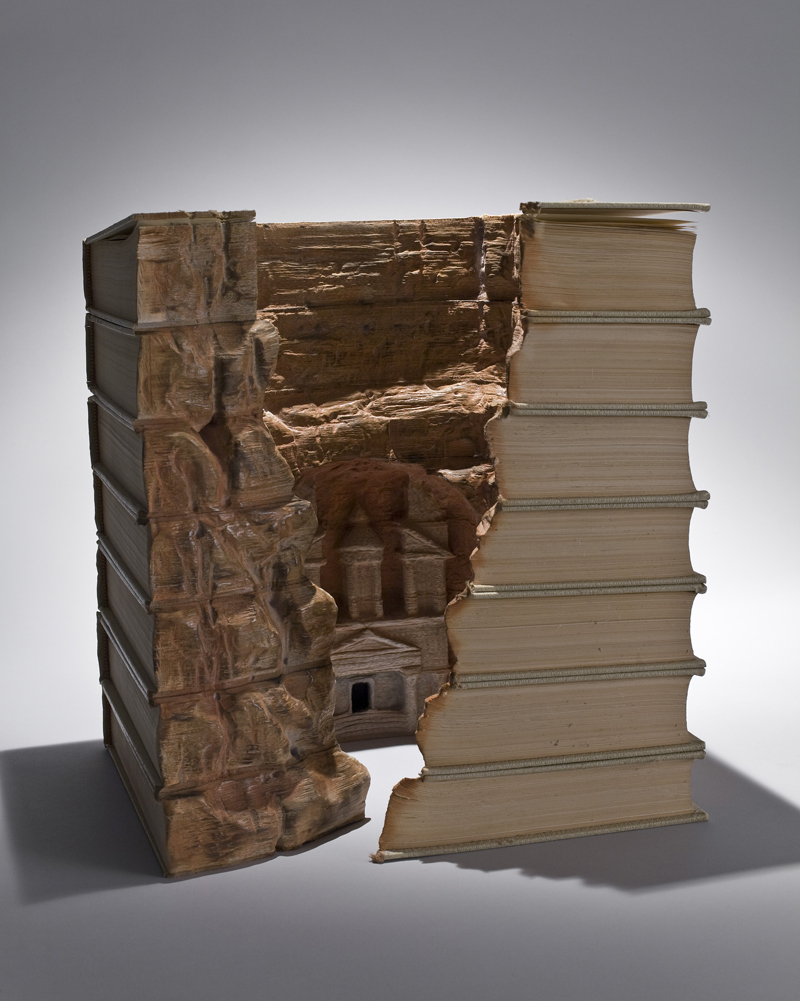
Copyright © Guy Laramee.

Artist Statement

The erosion of cultures – and of “culture” as a whole – is the theme that runs through the last 25 years of my artistic practice. Cultures emerge, become obsolete, and are replaced by new ones. With the vanishing of cultures, some people are displaced and destroyed. We are currently told that the paper book is bound to die. The library, as a place, is finished. One might ask so what? Do we really believe that “new technologies” will change anything concerning our existential dilemma, our human condition? And even if we could change the content of all the books on earth, would this change anything in relation to the domination of analytical knowledge over intuitive knowledge? What is it in ourselves that insists on grabbing, on casting the flow of experience into concepts?

When I was younger, I was very upset with the ideologies of progress. I wanted to destroy them by showing that we are still primitives. I had the profound intuition that as a species, we had not evolved that much. Now I see that our belief in progress stems from our fascination with the content of consciousness. Despite appearances, our current obsession for changing the forms in which we access culture is but a manifestation of this fascination.

My work, in 3D as well as in painting, originates from the very idea that ultimate knowledge could very well be an erosion instead of an accumulation. The title of one of my pieces is “ All Ideas Look Alike”. Contemporary art seems to have forgotten that there is an exterior to the intellect. I want to examine thinking, not only “what” we think, but “that” we think. 

So I carve landscapes out of books and I paint romantic landscapes. Mountains of disused knowledge return to what they really are: mountains. They erode a bit more and they become hills. Then they flatten and become fields where apparently nothing is happening. Piles of obsolete encyclopedias return to that which does not need to say anything, that which simply IS. Fogs and clouds erase everything we know, everything we think we are.

After 30 years of practice, the only thing I still wish my art to do is this: to project us into this thick “cloud of unknowing.”
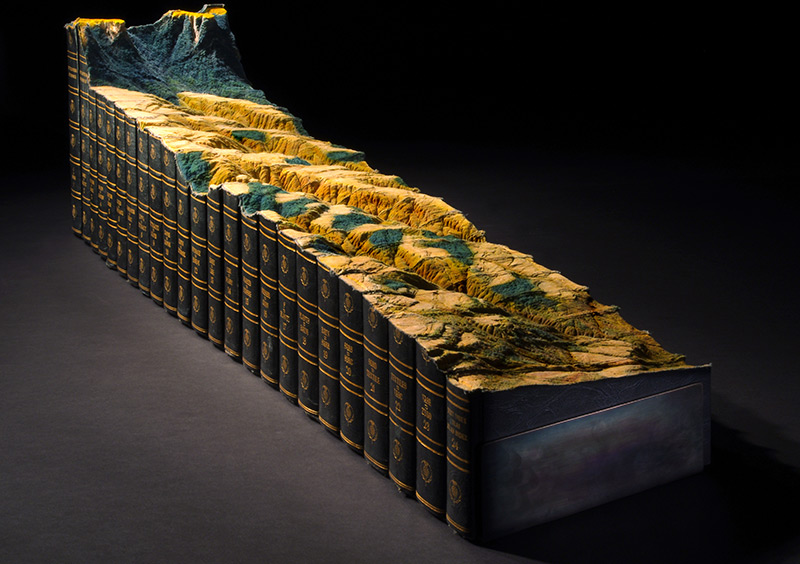
ADIEU Guy Laramée Copyright 2013
ADIEU (2013)
Guy Laramée

Is that the book’s evolutionary destination – in the “cloud”?

Further reading

http://sculpting.wonderhowto.com/news/artist-carves-old-books-into-beautifully-painted-landscapes-0175708/?_scpsug=crawled_46008_f4679e90-cedb-11e6-bd01-f01fafd7b417#_scpsug=crawled_46008_f4679e90-cedb-11e6-bd01-f01fafd7b417

Magnificent New Carved Book Landscapes and Architecture by Guy Laramée

“Guy Laramée’s (previously) new series Onde Elles Moran (Where They Live) captures the mystique of the native birds of the Brazilian region Serra do Corvo Branco (Range of the White Raven) through both portrait and carved landscape.”

Bookmarking Book Art – Exhibit at the Grosvenor Rare Book Room

Bookmarking Book Art — Long-Bin Chen

Bookmarking Book Art — “Out of Print: Altered Books”, A Virtual Exhibition

Bookmarking Book Art – Update to “Rebound: Dissections and Excavations in Book Art”

Mihai, Cristian.  “Showcase: Guy Laramée“, Irevuo, 31 March 2018.
Bookmark for the “Used e-book, slightly foxed”

In “Used e-book, slightly foxed,” Nicholas Carr ponders Amazon’s widely reported patent on a method allowing the resale or giving of ebooks and other digital objects.

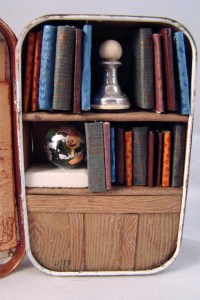
"Tiny Library Filled with Wee Books and a Deep, Dark, Secret,"  Artist, TheMistressT.  Accessed 10 February 2013.
“Tiny Library Filled with Wee Books and a Deep, Dark, Secret,” Artist, TheMistressT. Accessed 10 February 2013.

Matthew Kirschenbaum might dispute Carr’s view that there is no difference between the new and used ebook however.  In his book Mechanisms: New Media and the Forensic Imagination, he explores the nano-differences between masters and their digital copies, much as textual bibliographers have delved into the meaningful and revealing differences among print editions and even copies of the same print edition.

And with the recent publication of a W3C specification for Open Annotation of digital text, what might be inside that used ebook?   As Baratunde Thurston, author of How to Be Black and founder of Cultivated Wit, writes:

What if you could download books that had been pre-annotated? I would pay extra to read Freakonomics with commentary by Paul Krugman,The New Jim Crow with notes from editors at The Nation, or the Bible annotated by the creators of South Park. A book could always inspire new layers of meaning, but now it can host that inspiration and a slew of associated conversations.

Thurston’s proposition though is more akin to the digital equivalent of the Norton critical editions or Robert Strassler’s oversized, beautifully enriched Landmark editions of Thucydides, Herodotus and Xenophon.  Still, a pre-loved ebook is a different virtual matter and might be desirable to some hapless, non-haptic readers.  No doubt, resellers of used ebooks will want to assure their customers that their digital goods are free of lesser annotators’ bytes of marginalia and the latest viruses and Trojan horses favored by vandals and hacksters.   How will eBay cope, assuming it can come to terms with Amazon’s patent claim?

But to bring Thurston’s proposition and Open Annotation together suggests another market: the collectible ebook.  Can there be such a thing as a rare ebook?  Which libraries will be bidding for Clay Shirky’s ebook collection after he has shuffled off his digital coil?

The implications for DRM and copyright are delicious.  Recall the hoax that Bruce Willis was considering legal action against Apple over his desire to leave his digital music collection to his daughters?  If his collection’s metadata contained extensive annotations providing insight into the music or, more likely, the celebrity himself, why should iTunes’ Terms and Conditions override the family’s claim to the Die Hard star’s intellectual property that they could share (or not) with future celebrity biographers?

This year looks set to be one of important bookmarks for the evolution of the book: secondary markets for ebooks, Open Annotation, social reading and still more devices and applications for reading.

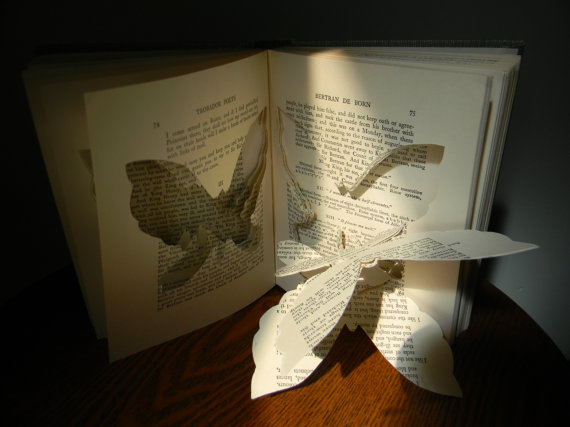
Bookmarking Book Art – Butterfly escaping Bertran de Born?

If only this were blood red (read), one might call it “Butterfly Escaping Bertran de Born.” Click to hear a reading of “Sestina Altaforte,” Ezra Pound’s attempt to dig up Bertran.

il_fullxfull.387056371_5xjc
From Joy at Etsy. Accessed 10 February 2013.

Bookmarking Book Art – Sarah Cohen

Blizzard Brings Contemporary Art

By massofglass9  |  Posted 4 hours ago, 09 February 2013  |  Cambridge and Boston, Massachusetts
CNN iReport
Accessed 09 February 2013
40488510151491788862813190521291-2379967_p9

Not cold enough for you?  Skate over to the artist’s web site for her stack of Ice Books. Sarah Cohen writes, “My books are usually made from ice and melt, referring to the melting icecaps, global warming, and the loss of books through newer technologies like the ereader. It’s all related. And just like ice, the snow books will also disappear over time- representing that permanence is always fleeting and that books may also disappear from contemporary culture.”

Bookmark for “A Brief History of Reading” (and a Revisit of “The Future of Reading?”)

Aristotle, a 4th-century-BCE philosopher, port...
Aristotle, a 4th-century-BCE philosopher, portrayed in 1493 Nuremberg Chronicle as a 15th-century-CE scholar (Photo credit: Wikipedia)

LiveInk® cleverly demonstrates how the display of writing has developed by presenting the following quotation from Aristotle’s On Interpretation in the forms in which it would have appeared in the different stages of the A Brief History of Reading.

“Spoken words are the symbols of mental experience, and written words are the symbols of spoken words.” — Aristotle, On Interpretation

For example,

In 2000 BC, the Phoenicians developed the first methods to represent spoken language – an alphabet consisting entirely of consonants:

SPKNWRDSRTHSYMBL
SFMNTLXPRNCNDWRT
TNWRDSRTHSYMBLSF
SPKNWRDS.

LiveInk® must hope for a place on the timeline for its re-formatting process (Visual-Syntactic Text Formatting (VSTF), which breaks up blocks of traditionally laid out text (flush left, ragged right or justified) and presents them in a more readable form, reminiscent of 20th century free verse.  The claim of increased readability is based on eye movement studies by Randall Walker, Charles Vogel, Stan Walker, Phil Schloss, Charles R. Fletcher, Youngmin Park and Mark Warschauer.

Last September, BOB picked up an article by Michael Kozlowski on the Kindle feature of synching an ebook with its counterpart audiobook and explored the question, “What can the physiology, neuropsychology and sociology of reading tell us about ourselves?”  The research behind LiveInk® is worth bookmarking for the reading list (see below) concluding BOB’s  September 2012 entry if only to experience the “melon twisting” that comes from trying to accommodate these disparate yet related perspectives on the act of reading.

Reading List

Vinall-Cox, Joan. Moving From Paper to E-Book Reading.  eLearn Magazine. March 2012.  Retrieved September 8, 2012.

Rollins, H.A. Jr., Hendricks, R.  Processing of words presented simultaneously to eye and ear.  J. Exp. Psychol. Hum. Percept. Perform. 1980 Feb; 6(1): 99-109. Retrieved September 8, 2012.

British Association for the Advancement of Science (2007, September 11). Reading Process Is Surprisingly Different Than Previously Thought, Technology Shows. ScienceDaily. Retrieved September 8, 2012.

Association for Psychological Science (2010, August 30).  Eye movements reveal readers’ wandering minds.  ScienceDaily. Retrieved September 8, 2012.

Florida State University (2012, February 14). How Do Children Learn to Read Silently?. ScienceDaily. Retrieved September 8, 2012.

LiveInk® (four papers:  jaltcalljournal, National Educational Computing Conference, Reading Online and IEEE International Professional Computing Conference)

(A general indifference?) Towards the Digital Divide

How might we explain the ascent, pervasiveness and popular appeal of digital art?

A few months ago, Greg Smith, a  Toronto-based artist, reviewed Claire Bishop’s “Digital Divide” (Art Forum, September 2012).  The review and Bishop’s article touch on a recurrent theme in Books On Books:  the materiality and immateriality of books.

http://www.scoop.it/t/books-on-books/p/2204574815/expanded-artists-books-envisioning-the-future-of-the-book

http://www.scoop.it/t/books-on-books/p/2540958720/a-bookmark-for-letters-outside-themselves

http://www.scoop.it/t/books-on-books/p/2276808444/ebooks-do-we-really-want-our-literature-to-last-for-ever

http://www.scoop.it/t/books-on-books/p/2204732117/bookmarking-a-forthcoming-title

http://www.scoop.it/t/books-on-books/p/2213422701/the-bookless-library-and-what-will-become-of-the-paper-book

http://www.scoop.it/t/books-on-books/p/2173038714/and-there-you-have-it-the-kindle-of-the-late-eighteenth-century-mike-kelly-amherst-college

http://www.scoop.it/t/books-on-books/p/2182994587/this-is-for-you-in-support-of-libraries-books-words-ideas

http://www.scoop.it/t/books-on-books/p/2123229496/to-see-a-world-in-a-grain-of-sand-or-tobacco-leaf

http://www.scoop.it/t/books-on-books/p/2082258113/post-artifact-books-and-publishing

http://www.scoop.it/t/books-on-books/p/2079452417/the-making-unmaking-and-remaking-of-books-guy-laramee-s-book-art

But the review and Bishop’s article resonate with some more recent and popular seismic tremors in the world of ebooks.  With all but Macmillan caving into the US Justice Department, we are still left wondering where and when the consumer benefits in cheaper ebooks will be handed out.  The prices on e-reading devices have plummeted, but in the world of ebooks, a slight unease about the inevitability of e-readers is creeping in as tablets and mini-tablets seize the imaginations of some with the loudest digital megaphones.  “Are e-reading devices doomed?”  And by extension – given that tablets are far more than ebook devices — “Is the trajectory for ebooks leveling off?”   While the post-Xmas sales analysis will be more assiduously examined for the “evidence” than the equally predictive gizzards of our Xmas fowls,  as Greg Smith paraphrases Julian Oliver, “the New Aesthetician”:   material or immaterial, “we should all just keep focused on making stuff.”

“How important are paper books?” | TeleRead

In his Teleread article (11 October 2012), Dan Eldridge picks up on Associate Professor Justin Hollander’s New York Times op-ed piece protesting Education Secretary Arne Duncan’s  comment before the National Press Club that “over the next few years, [paper] textbooks should be obsolete.”

What makes his comments on comments on a comment bookmark-worthy are the comments they provoked from Gary Frost, Emeritus Conservator at the University of Iowa Libraries and the author of Future of the Book: A Way Forward (Coralville, IA: Iowa Book Works, 2012):

“The current rush of changes in print and ebook uses is dramatic evidence of our close relationship with books. A flood of digital reading devices and hybrid software and hardware designs are emerging as the print book is augmented by screen delivery and associated cloud libraries, ebook collection building, automated index and searching, and screen learning. While all screen book simulations deviate from print conventions the hybrids that emerge reference each other and often resonate with each other.  This rapidly developing book production and consumption landscape is dynamic and unique in media history, or is it?

It’s pretty amazing that little attention is paid to the emerging composite of print and screen delivery of books.  I mean looking directly between them and at an emergent functionality of all books. There you can now perceive the interdependence of print and screen and the likelihood that neither will flourish without the other. . . .  Also involved are other forums, other than the forum of current technologies, their products and marketing. These other disciplines include academic book studies, cognitive science aspects of reading, book sustainability within libraries and many vectors of book arts.”

One might single out the infiltration of the book by “the social web” from the vector of current technologies that Frost insightfully identifies as necessary to explore this moment in the book’s/ebook’s evolution in which those who buy ebooks buy yet more print books.  The ability to annotate and share print books is gradually being replicated, prodded as it were by the phenomenon of the social web.

So here you have it: a comment on comments on comments on comments on a comment.

“Of the making of comments, there is no end.”

Bookmarking Book Art – A comment on Norma Levarie’s “The Art & History of Books” (New York, 1968)

Norma Levarie (1920-1999) was a graphic designer and author of  children’s books, one a winner of a New York Herald Tribune award — Little People in a Big Country.   But, in addition to her design work for the National Audubon Society, The Jewish Museum, The University of Chicago Press, Oxford University Press, Random House and Harry N. Abrams, this Virginian’s most important gift to those interested in the evolution of the book and book arts is her volume The Art & History of the Book (New York: James H. Heineman, 1968).

The quality of her research and writing measures up to the best.  If only Heineman had been able to afford color reproductions, her ability to handle illustrations and her keen eye for selection of examples would have placed this book in good company with works such as Michael Olmert’s The Smithsonian Book of Books (Washington, D.C.: Smithsonian, 1992).  Still, Levarie’s book merits a bookmark for its overarching message, which is cleverly embodied in the book’s organization.

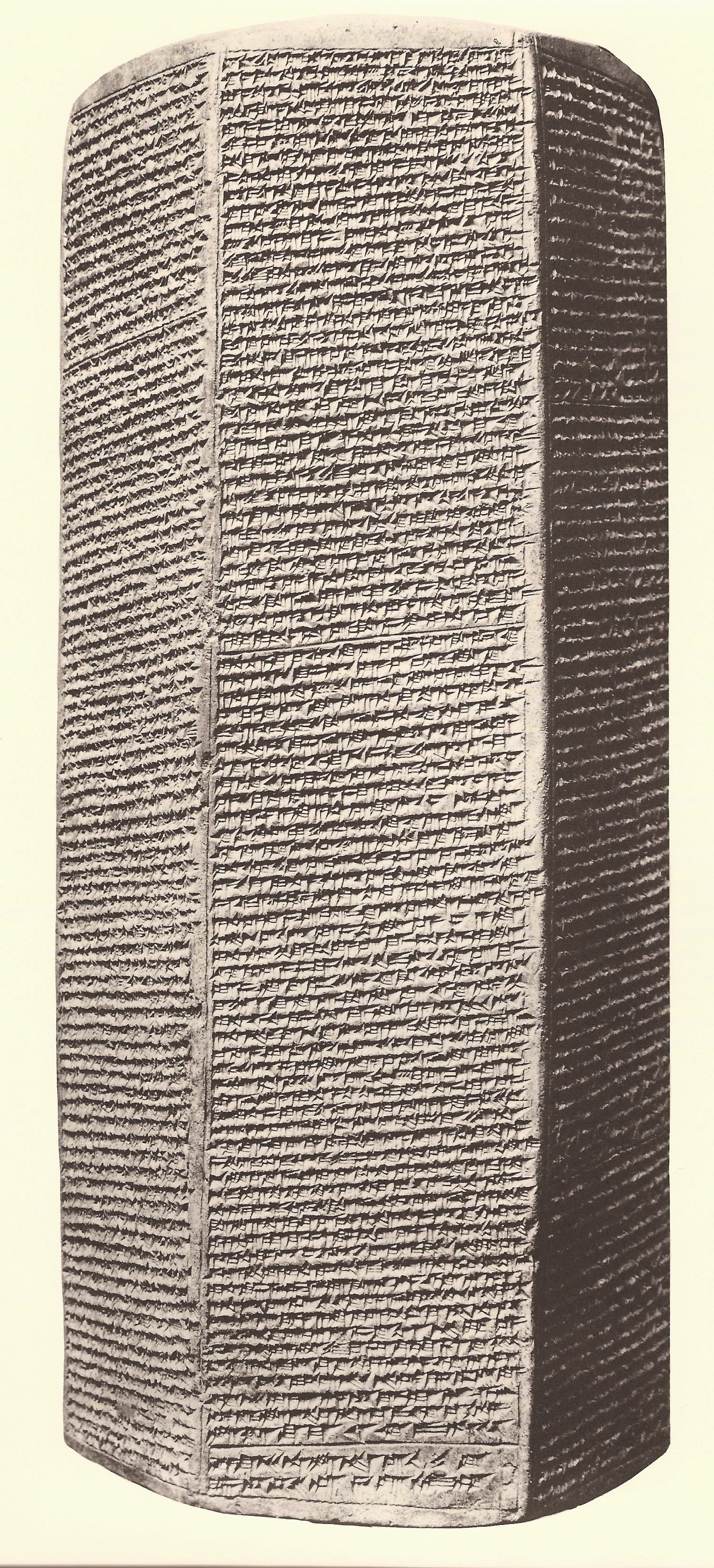
Facing the stark image of the Prism of Sennacherib on the opposite page, these words of Ashburnipal launch the book on the recto page:

Prism of Sennacherib. Assyrian, VII century B.C. Oriental Institute, University of Chicago. Height 15 in. Reproduced from Levarie, The Art & History of the Book (New York, 1968).

“. . .  I read the beautiful clay tablets from Sumer and the obscure Akkadian writing which is hard to master.

I had my joy in the reading of inscriptions in stone from the time before the flood. . . .”

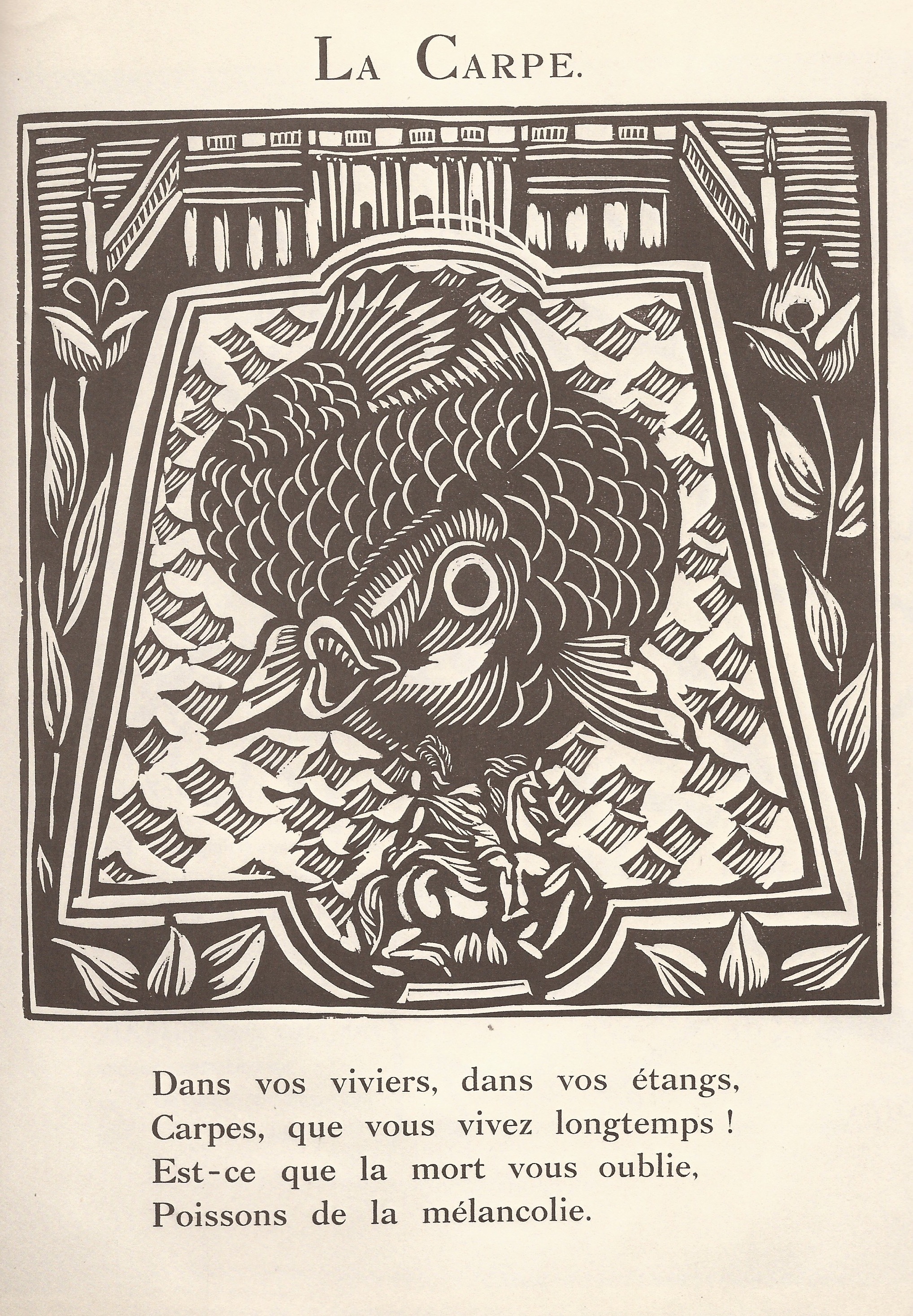
Continuing chronologically up to the fifteenth century and “block book,” Levarie switches to a geographical approach, starting of course with Germany, ending with England and returning to a timeline overview from the seventeenth century to the twentieth, the last illustrated with pages from Spiral Press’s Ecclesiastes (New York, 1965), drawings by Ben Shahn, engraving by Stefan Martin and calligraphy by David Shoshensky, and  Apollonaire’s Le Bestiare (Paris, 1911).

Guillaume Apollinaire, Le Bestiaire. Paris, 1911. Woodcuts by Dufy. Yale University Library, Graphic Arts Collection. 14 x 10 1/4 in.

This structure neatly builds to these concluding words:

“The homogenizing forces of our time have broken many barriers of national style, and sometimes it is difficult to tell at a glance the origin of a book.   But local differences in production or taste still exist, and where they are manifest they bring the pleasure of variety.  . . .

For the lover of fine books, nothing can replace the bite of type or plate into good paper, the play of well-cut, well-set text against illustration or decoration of deep artistic value.  But an inexpensive edition can carry its own aesthetic validity through imaginative or appropriate design.  These are not matters of concern only for aesthetes; if, in an era of uncertain values, we want to keep alive respect for ideas and knowledge, it is important to give books a form that encourages respect.  The style and production of books, for all the centuries they have been made, still have much to offer the designer and publisher in challenge, the reader in pleasure.” (303-06)

Leaping ahead more than fifty years to the shift from print to digital, we find that many of the observations and message legitimately reassert themselves.   Websites and ebooks do vary in design from region to region, but standardization and, more so, the global character of the Web and the products of the technology industries counter-assert a homogeneity in design.  Sven Birkerts‘ elegies for Gutenberg are echoed across blogs devoted to the continuing pleasures of the printed book.  But likewise Levarie’s stand that these are not merely matters for the elite is echoed across the debate of print vs digital in the popular press and the democratizing blogosphere.

What still must be translated from her message is how to make the leap that, if we respect ideas and knowledge, we must give online books as well as print books a form that encourages respect.

Bookmarking Book Art – A PPPS to “imposition” – the craft of learning by doing

Wynken de Worde’s printer’s device.

Under the blog name “Wynken de Worde,” Sarah Werner  writes about books, early modern culture, and those of us who may be postmodern readers — when she is not preparing the syllabus for her course at the Folger Shakespeare Library.   Wynken (not related to Blynken or Nod) was the primary assistant to William Caxton the first printer of English-language books — Malory’s Morte d’Arthur,  Chaucer’s Canterbury Tales, and The Golden Legend.

If Sarah Werner channels Wynken de Worde in her classroom as well as she does through her website, her students are to be envied.  She makes what she writes tangible, palpable, haptic. Three brief examples, the last of which prompts this bookmark:

Imposition is “the arranging of pages in a chase [a steel or iron frame for holding them tightly for the letterpress] in a particular sequence . . .  so that when folded the printed pages will be in consecutive order.”  Glaister, Encyclopedia of the Book (2001).  But the earliest books did not have page numbers, so how were old Bill and Wynk to know which to place where?   Here’s Werner:

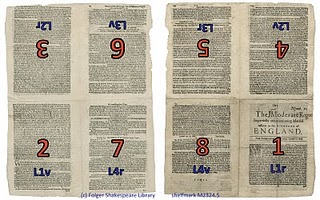
Lerner’s newsbook ready for folding.

Above is a numbered example of the same newsbook that I used as an image in my last post. The red numbers are page numbers: folded in the right way, you’d get an 8-page booklet in the order indicated. But if you look closely, you’ll see that the actual news sheet doesn’t have page numbers. Instead, there are signatures: at the bottom of the first page is a tiny, blotted “L”; at the bottom of the 5th page is a tiny “L3″ (the “L2″ has been cut off at some point when the page was trimmed). These are signature marks that count off by leaves. What’s a leaf, you ask? It’s a physical unit of paper: when you turn the page in a book, you are actually turning a leaf of paper. Early modern printers would have thought in terms of sheets and leaves, not pages, when they were figuring out how to print a work. Depending on the imposition (how the text is laid out on the sheet), you could end up with different numbers of leaves: 1, 2, 4, 8, 12, 16, 24.  A quarto imposition results in a sheet of paper being turned into 4 leaves; there are 2 pages to each leaf (a recto side and a verso side), so there are 8 pages in all. The blue letters and numbers show the signatures. One thing that throws off beginners is understanding how recto and verso relate to each other.  They do not mean right and left but front and back.

Providing a downloadable PDF with which to follow along, Werner walks the reader through the exercise and proves her point:  “it’s a handy way to understand and demonstrate to others the general principle of early modern format: multiple pages are printed onto a single sheet in the correct order so that when folded, they appear sequentially.”

The second example of the pedagogically palpable or the palpably pedagogic comes in the same posting:

“When you’re done, you can try folding it into a tiny little pressman’s cap, following the instructions that appear in this lovely piece, “The Newspaper Man is Defunct,” from The Cape Cod today.”

That bit of fun was two years ago.  The brilliance is undiminished today; if anything it’s brighter.   For this year’s course, Werner is handing out her syllabus in unpaginated quarto format.  To figure out the syllabus, the students have to fold the imposition correctly!  Try it yourself and grasp the meaning of the “book arts.”

Ah, the books arts.  Imposition.  The dying arts?  You need look no further than the end of your Proboscis to see that that is not true.   Proboscis is a London-based non-profit studio that commissions and facilitates new works and publications, some of which can be found in the DIFFUSION library.

DIFFUSION ebooks are hybrid digital/material publications. They bring together the “tactile pleasures of tangible objects with the ease of sharing via digital media.” Shareable paper books, free to download as PDFs, print and make up,  DIFFUSION eBooks “can be shared electronically or as material objects – scanned, photocopied, emailed or posted. The eBooks bridge analogue and digital media by taking the reader away from the computer screen and engaging them with the handmade.”

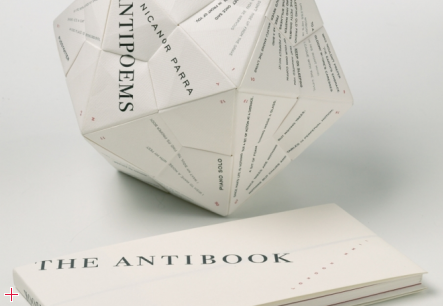
And just a bit further along the continuum is Francisca Prieto, also in London. Inspired by the serio-comical poet Nicanor Parra’s “antipoems,”  Prieto offers up The ANTIBOOK.

ALL RIGHTS RESERVED. COPYRIGHT © FRANCISCA PRIETO 2001-2012

The reader must fold the pages of the book (20.5 x 10.5cm) to form the icosahedron (15 x 17 x 19cm) in order to read Parra’s antipoems in order.

Whether Prieto’s ANTIBOOK or the DIFFUSION ebooks are book, art, both or neither, they and Wynken de Worde make us think with our hands as well as our minds about what can be done with the form and concept of the book.  And that makes the concept of imposition worth a bookmark.

PS: “Books On Books” acknowledges David Pearson‘s Books as History (New Castle, DE: Oak Knoll, 2008 and 2011), p. 75, for the inspiration of the wording of the conclusion here.

PPS: Another opportunity to learn by doing can be found at the end of a short and witty book called A Dodo at Oxford: An Unreliable Account of a Student and His Pet Dodo. Under the guise of explaining, presenting and annotating a diary found in a charity shop, Philip Atkins and Michael Johnson deliver a history of the book. Appendix 7 provides the offer to engage in imposition.

PPPS (6 January 2021): Weeks into a third Corona virus lockdown, another contribution for learning imposition by doing has appeared. Appropriately this time in the Quarantine Public Library started by Katie Garth and Tracy Honn in May 2020. It comes from Barb Tetenbaum; check out the download and instruction video here.

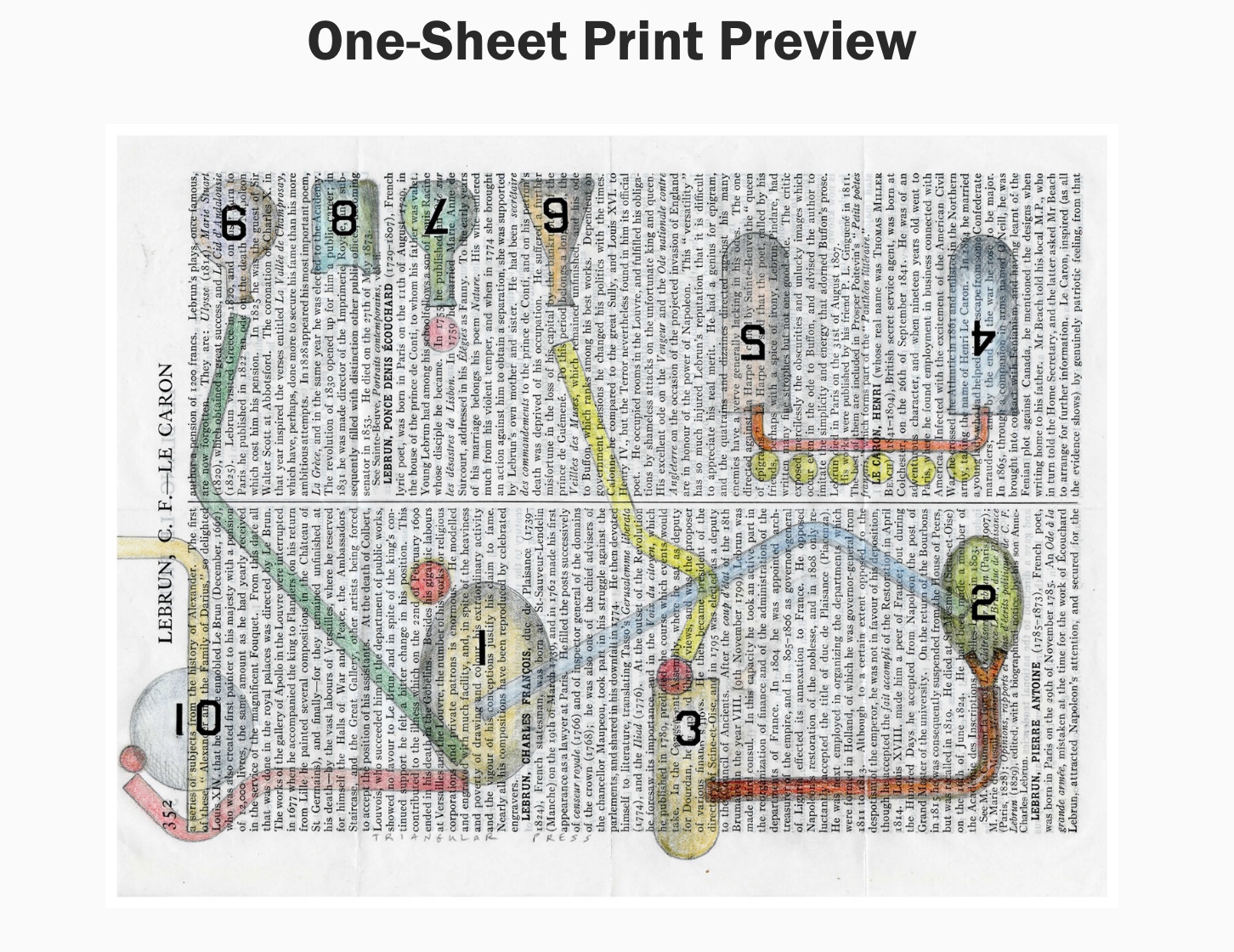
Untitled Tetenbaum imposition

Untitled
Barbara Tetenbaum
Chemistry stencils (Prague, 1993); colored pencils (Madison, WI, 1975); and press-on letters from the model train industry are combined with a 100-year old Encyclopedia Brittanica page.