Books On Books Collection – Dave Wood

Alphabetica (2002)

Alphabetica (2002)
Dave Wood
Bound in vellum; open-spine binding sewn on vellum strips. H210 x W290 x D30 mm. 54 pages. Loosely inserted colophon. Edition of 26. Acquired from the artist, 27 July 2022.
Photos: Books On Books Collection. Displayed with permission of the artist.

From Alphabetica‘s description as an exploration of the alphabet’s “diverse development from historic shapes to the infinite variations we see today in typefaces and calligraphic forms of the Western alphabet”, the reader might expect an academic work. The deeply embossed and debossed royal purple cover presenting the title in landscape format suggests otherwise as do the marbled endpapers and embossed gold foil title page. The cover is built up with a very strong paper made in Nepal, painted with acrylic then sprayed with semi-matte varnish. Inside, the reader finds a portfolio of twenty-five distinct “canvases” in which Wood demonstrates both historical sensitivity and artistic inspiration.

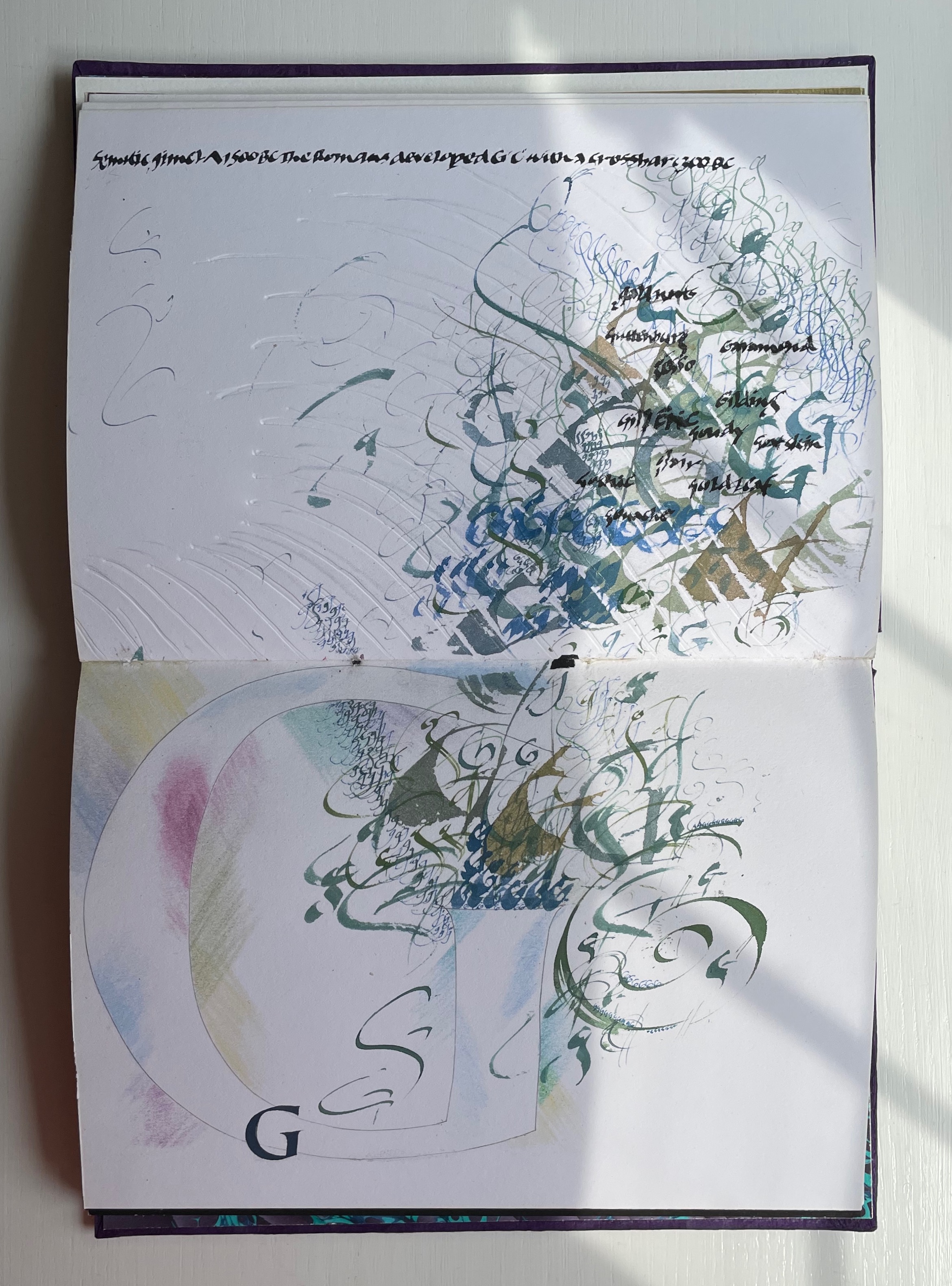
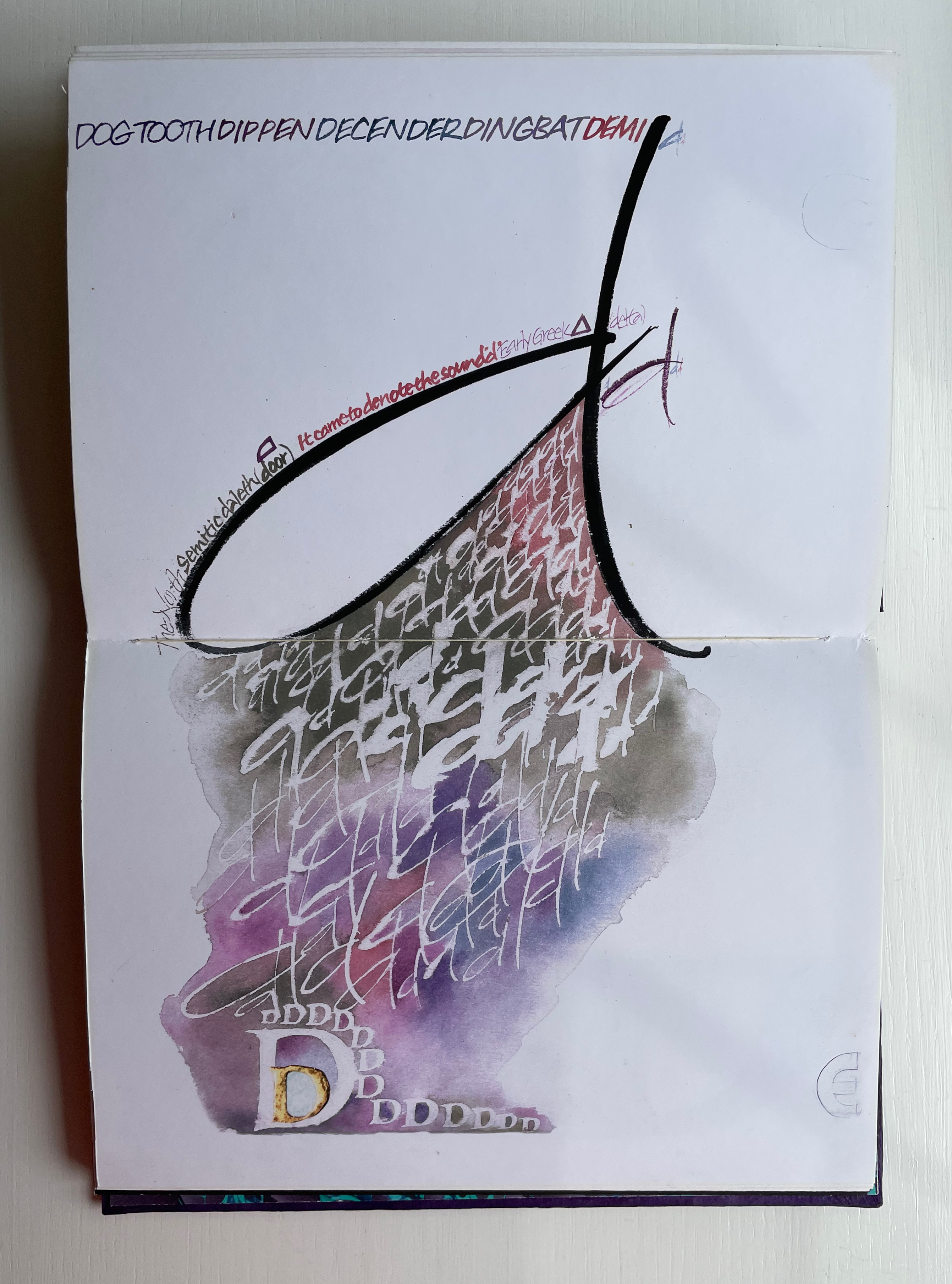
Across the twenty-six spreads, Dave Wood has captured each letter’s distinct story with multiple styles of calligraphy in Sumi ink and gouache paints as well as varying textures and techniques (Canson and Arches paper, glassine, foil, embossing, stamping, feathering and cutting), colors and layouts.

The letters’ developing shapes and periods are labeled. Starting with the letter B, Wood adds names of typefaces, structural terms for type, palaeographical terms and terms from the crafts of calligraphy, typesetting and printing — all beginning with /b/. Similar labeling occurs for the letter C but with a different layout. Across the twenty-five canvases, Wood excels at this balancing of difference and similarity. Notice, for example, how letters B and C incorporate the Renaissance style of illumination called bianchi girari (white vine stem decoration).

The ways in which uppercase-to-lowercase movements interact with the layout’s variations make for a dynamic experience. Sometime it’s subtle, sometimes vigorous. Note, for example, how the letter D de-emphasizes the gutter whereas the letter E emphasizes it.
With letters H through Q, a shift from Arches white to Canson black paper and back adds to the overall dynamic movement. Yet Wood is attentive to elements of unity; for example, his playful handling of the gutter in the transition from letter H to letters I/J echoes that from letters D to E.
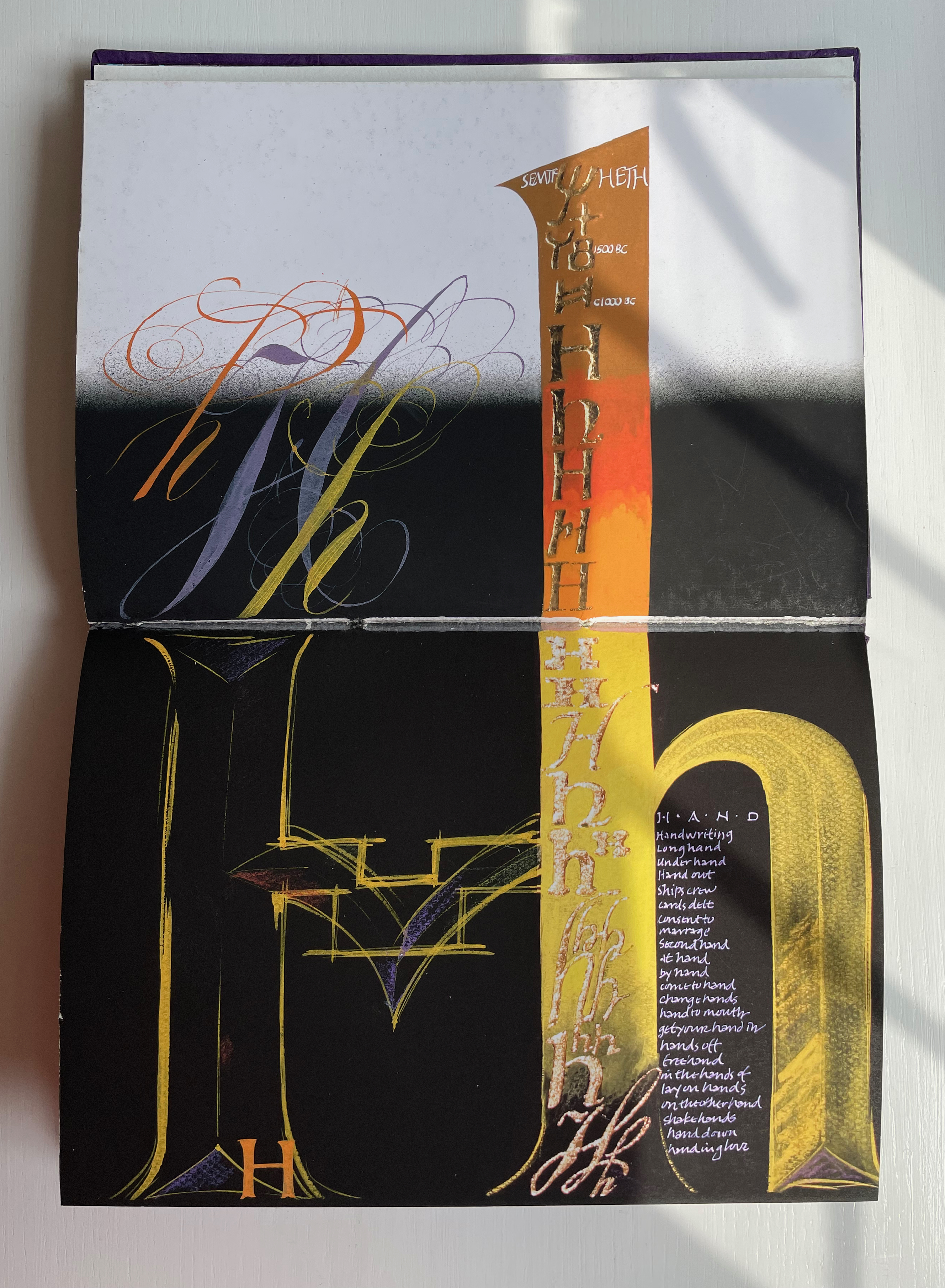
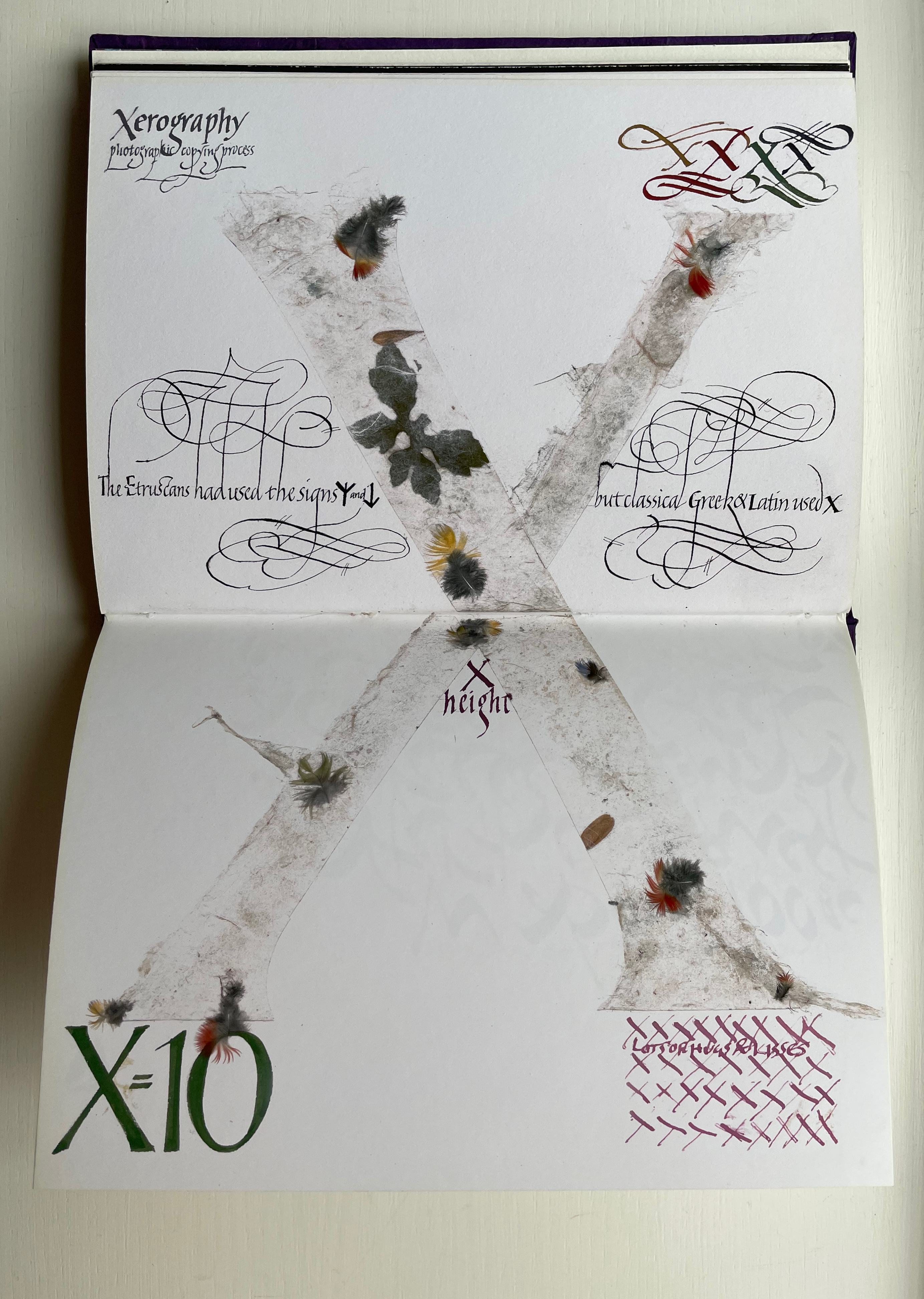
Only six letters perform the trick of extending across the gutter — lowercase H and uppercase K, M, O, U and X. While O, U and X take the similar approach of almost evenly straddling the gutter, each of the other three succeed differently. M is perhaps the most striking and interesting of them all. M derives from the Semitic word for “water” mem. As Wood points out in the loose insert colophon, the watery blue that fills the letter is intentional — as must be the precise alignment of the inner peaks of the letter with the gutter. Such attention to detail in the midst of so much activity on the page demands a similar attentiveness from the reader.
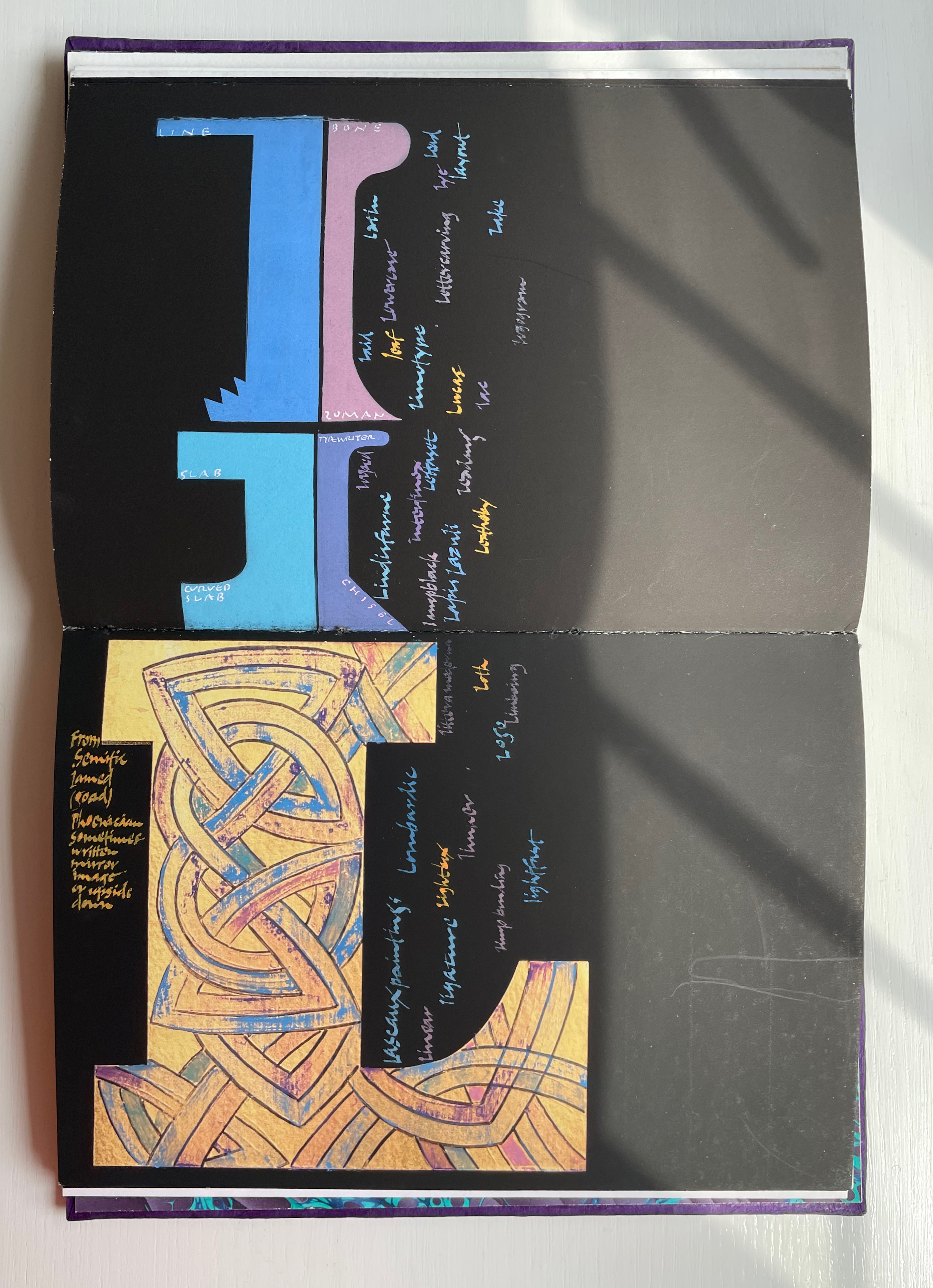
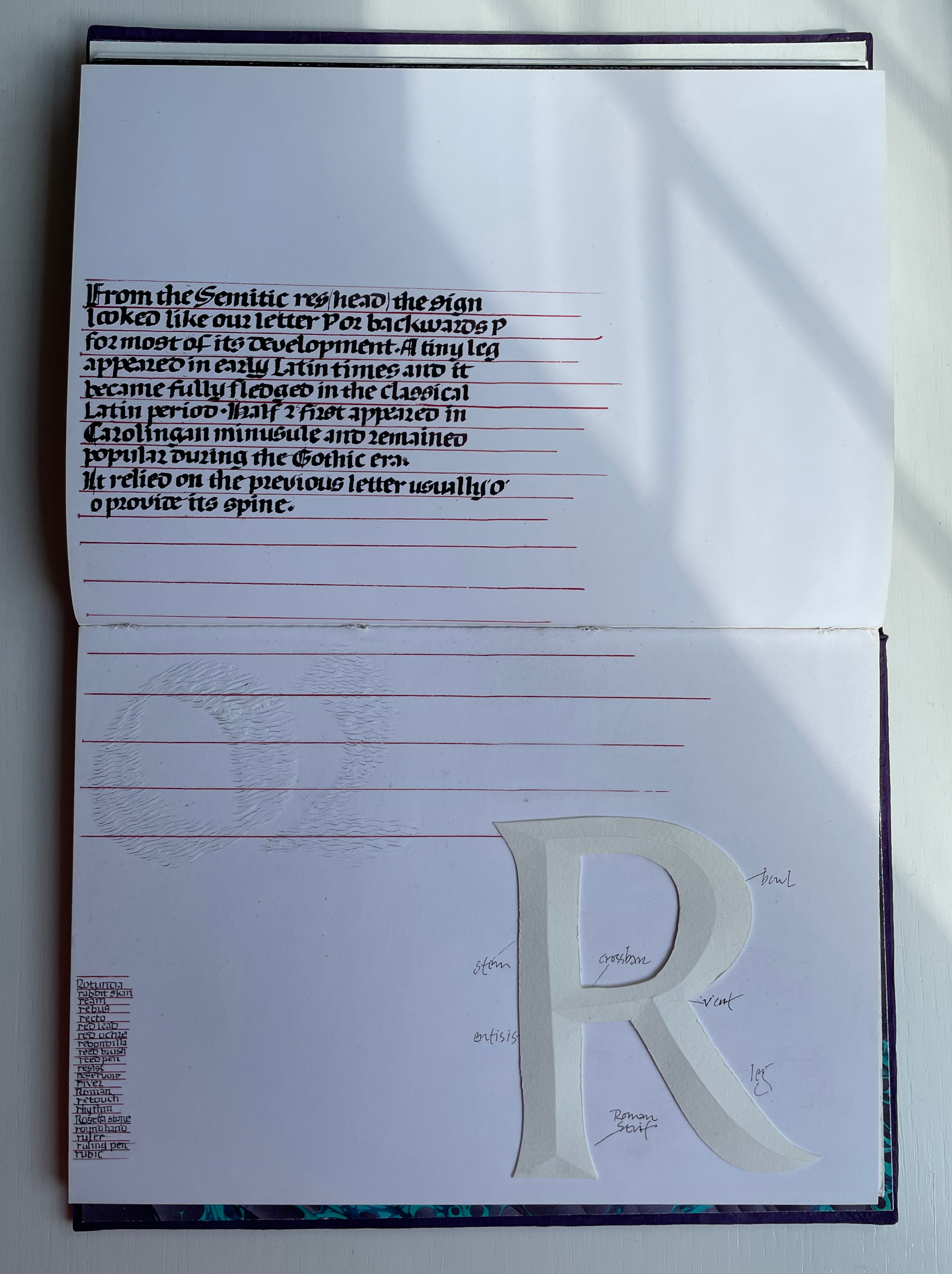
For example, the long tail of the Q does not show up until the bottom of the spread. And the reader may need to pick out the the word “or” in the text to spot the lowercase r in the textured, oversized written word “or” directly below the text.

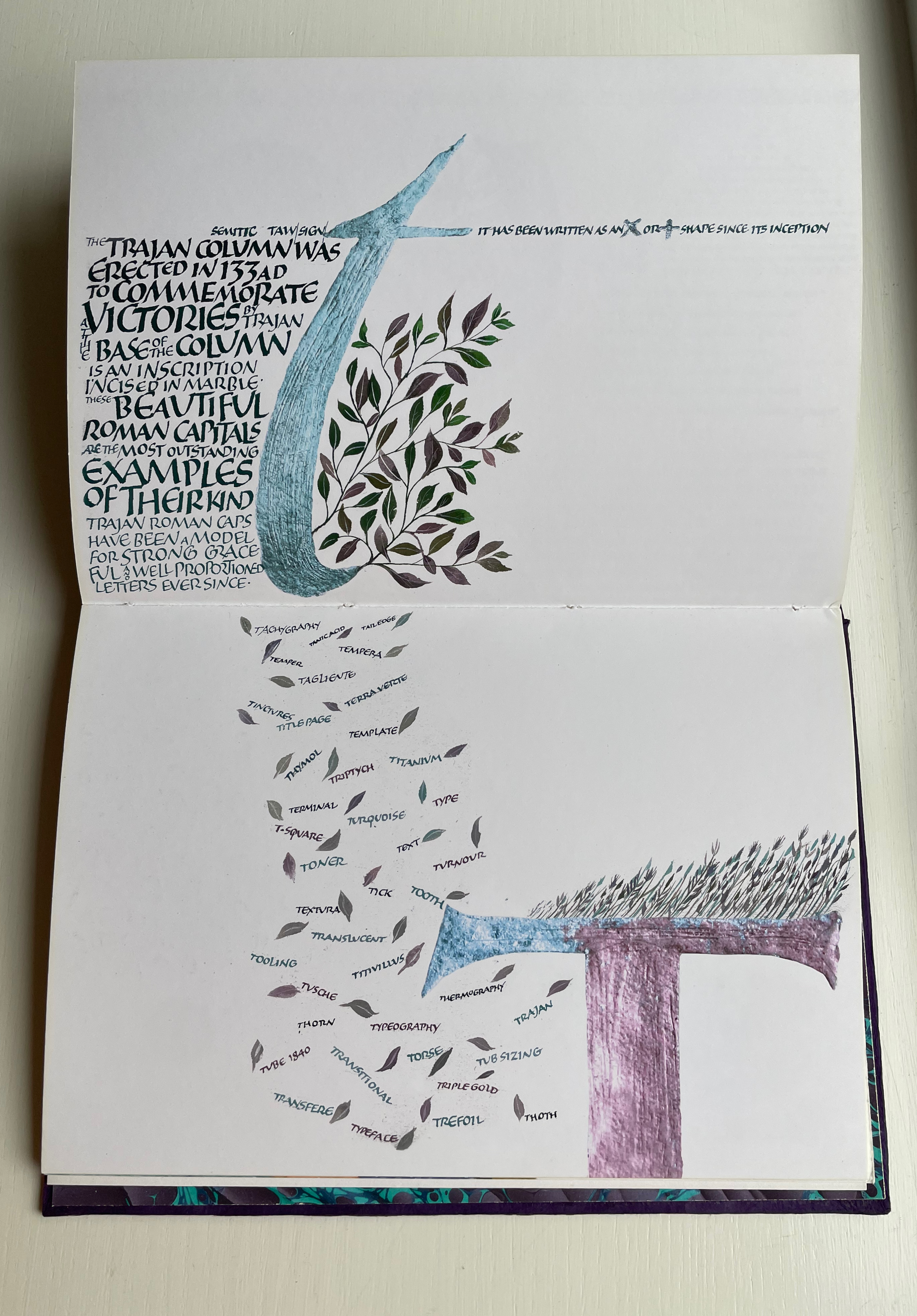
Visual puns abound. Celtic knots in a capital L (for the Lindisfarne gospels). An S formed of stones. Leaves falling from a lowercase t (for tree or tea, of course). A U growing underground.
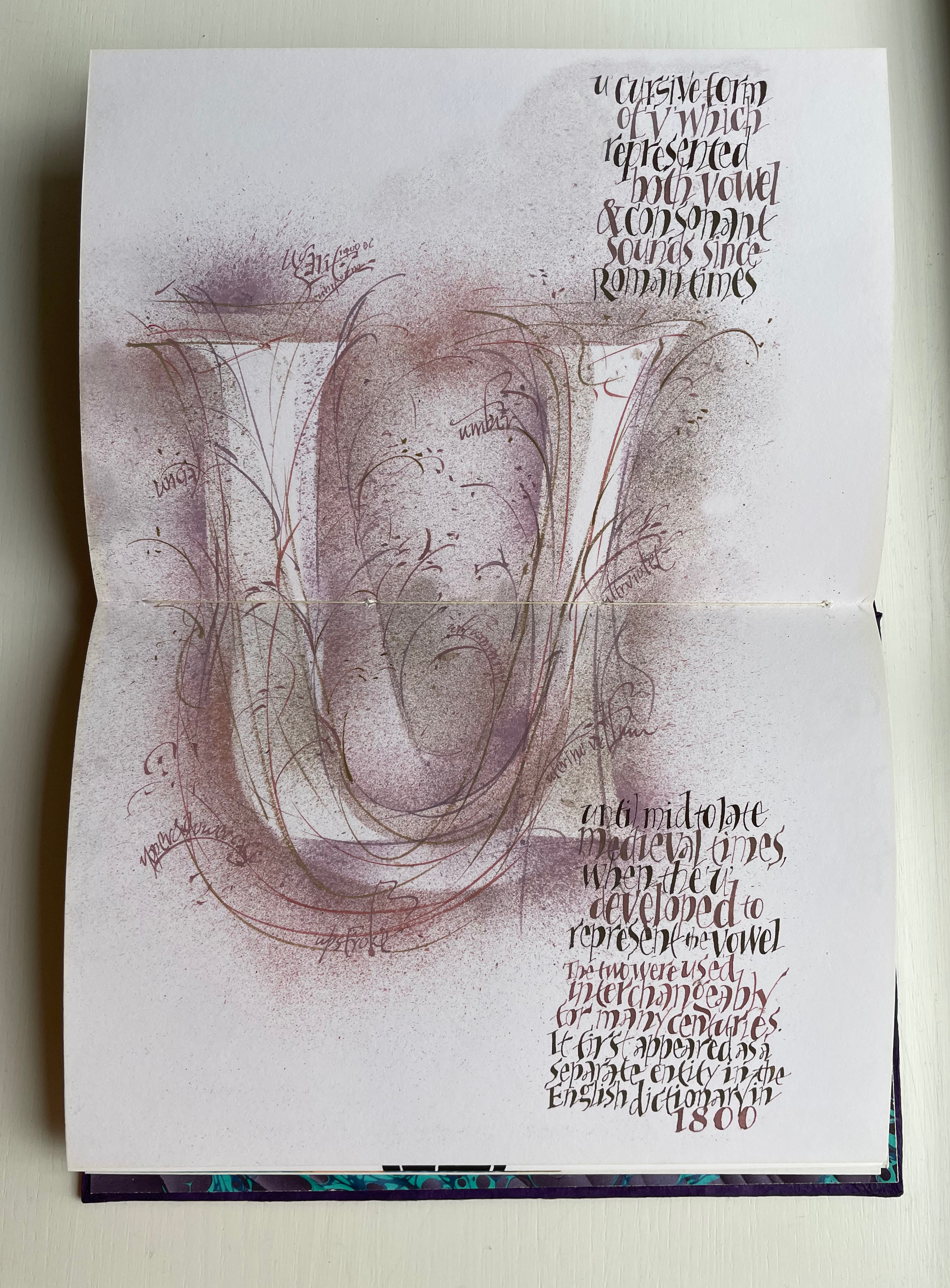
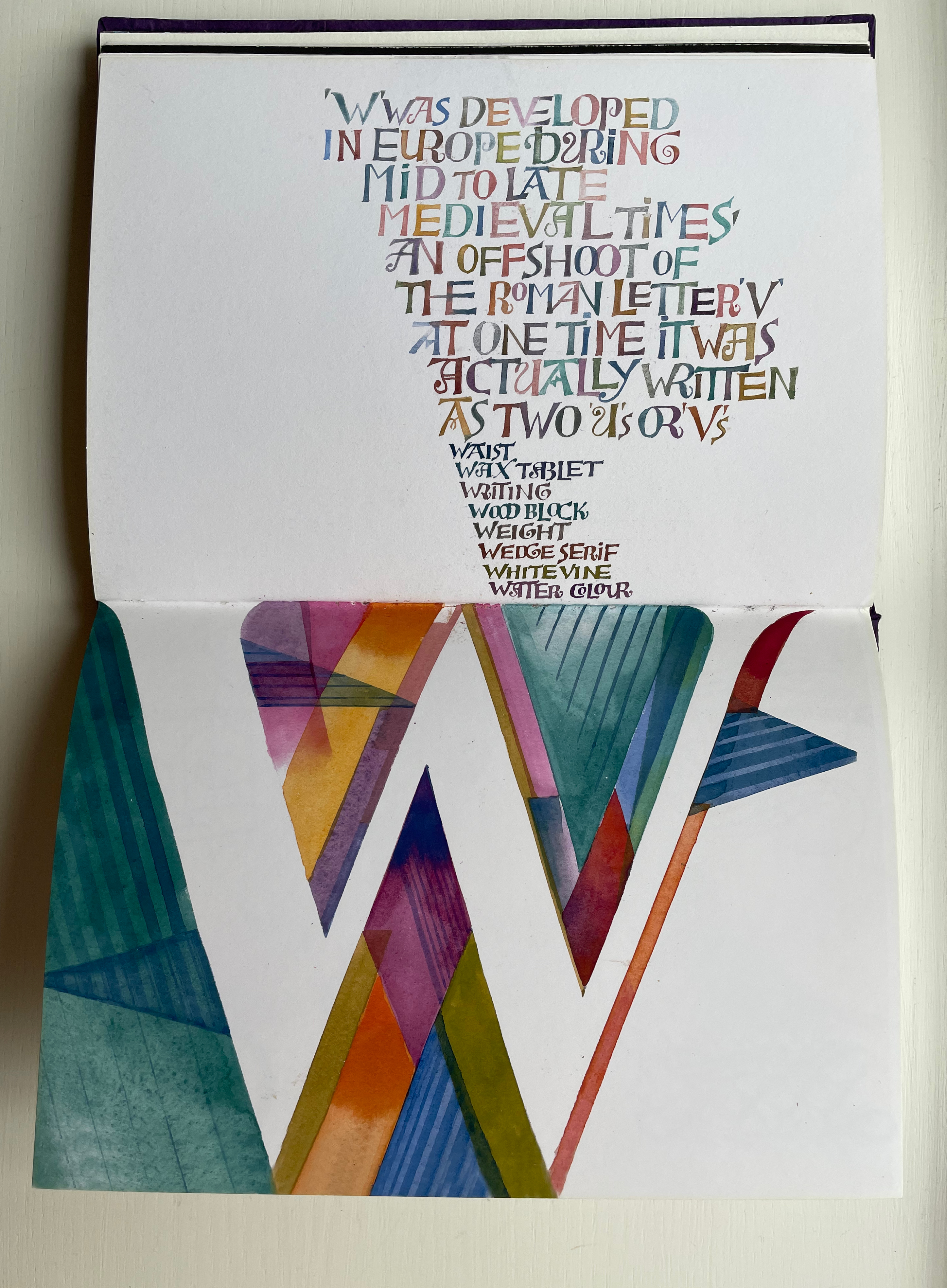
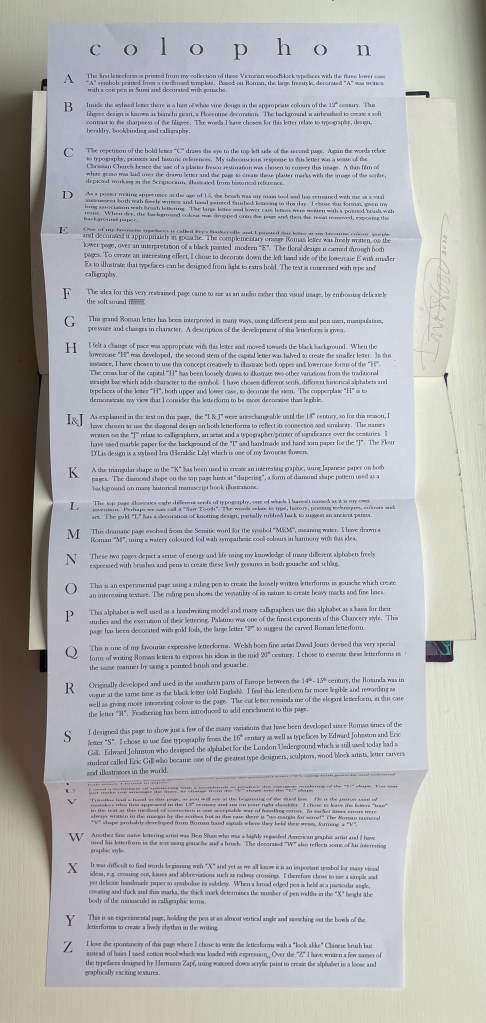
Fortunately, the accordion-fold colophon loosely inserted in the book offers pointers to some (not all) allusions. For example, the beginning of the third line for the letter V pays homage to Titivillus, the 13th-century patron demon of scribes’ mistakes. The illustrated W is an homage to Ben Shahn’s letter design. The highly contrasting thicks and thins in the letter X allude, in calligraphic terms, to the thick mark’s determining the number of pen widths making up the x height (the body of the miniscule).
And while the colophon may be necessary to know that the typefaces written in color below were created by Hermann Zapf, any viewer can enjoy Wood’s incorporating the entire alphabet in the Sumi ink design culminating in the letter Z as a fitting self-referential conclusion to Alphabetica.

Further Reading and Viewing

Abecedaries I (in progress)“. Books On Books Collection.

Lyn Davies“. 7 August 2022. Books On Books Collection.

Timothy Donaldson“. Books On Books Collection.

Cari Ferraro“. Books On Books Collection.

David J. Goldman“. Books On Books Collection.

Rudyard Kipling and Chloë Cheese“. Books On Books Collection.

Abe Kuipers“. Books On Books Collection.

Don Robb and Anne Smith“. Books On Books Collection.

James Rumford. 21 November 2022. Books On Books Collection.

Tiphaine Samoyault“. Books On Books Collection.

Ben Shahn“. 20 July 2022. Books On Books Collection.

Tommy Thompson“. 21 August 2022. Books On Books Collection.

Mark Van Stone“. 1 June 2023. Books On Books Collection.

Demeude, Hugues. 1996. The Animated Alphabet. London: Thames and Hudson.

Shaw, Henry. 1845. Alphabets, Numerals and Devices of the Middle Ages. London: W. Pickering.
Books On Books Collection – Don Robb and Anne Smith

Ox, House, Stick (2007)

Ox, House, Stick: The History of Our Alphabet (2007)
Don Robb (text) and Anne Smith (ills)
Casebound, illustrated paper over boards. H280 x W217 mm. 48 pages.Acquired from The Saint Bookstore, 14 August 2022. Photos: Books On Books Collection.
Text copyright © 2007 by Donald Robb. Illustrations copyright © 2007 by Anne Smith/Lilla Rogers Studio.
Used with permission by Charlesbridge Publishing, Inc. 9 Galen Street, Suite 220, Watertown, MA 02472. (617)-926 0329  

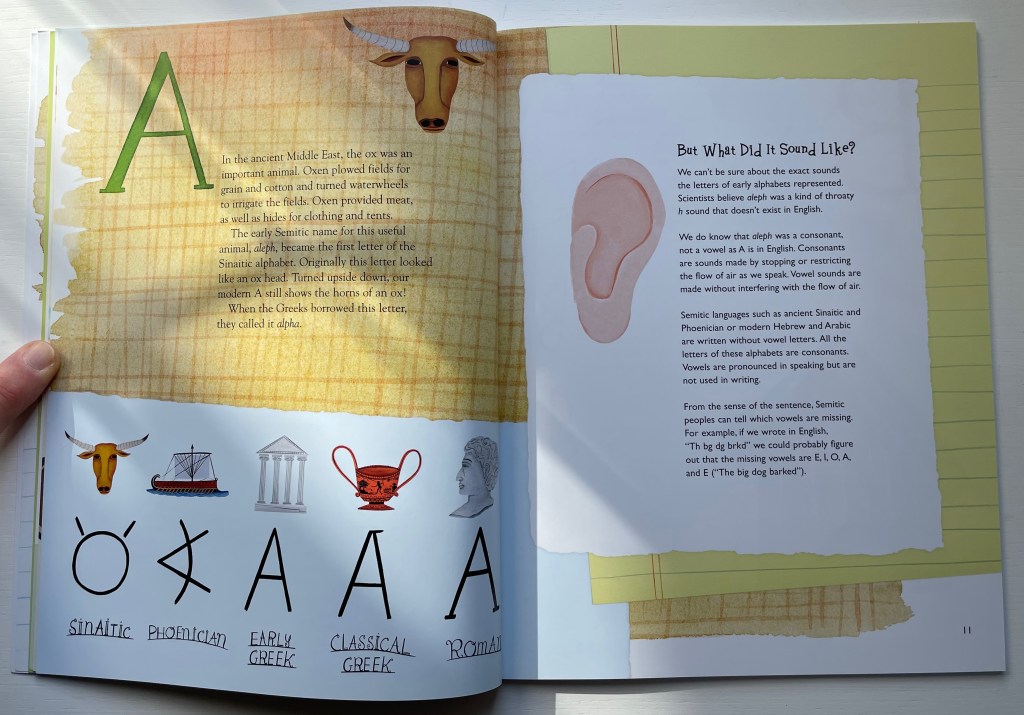
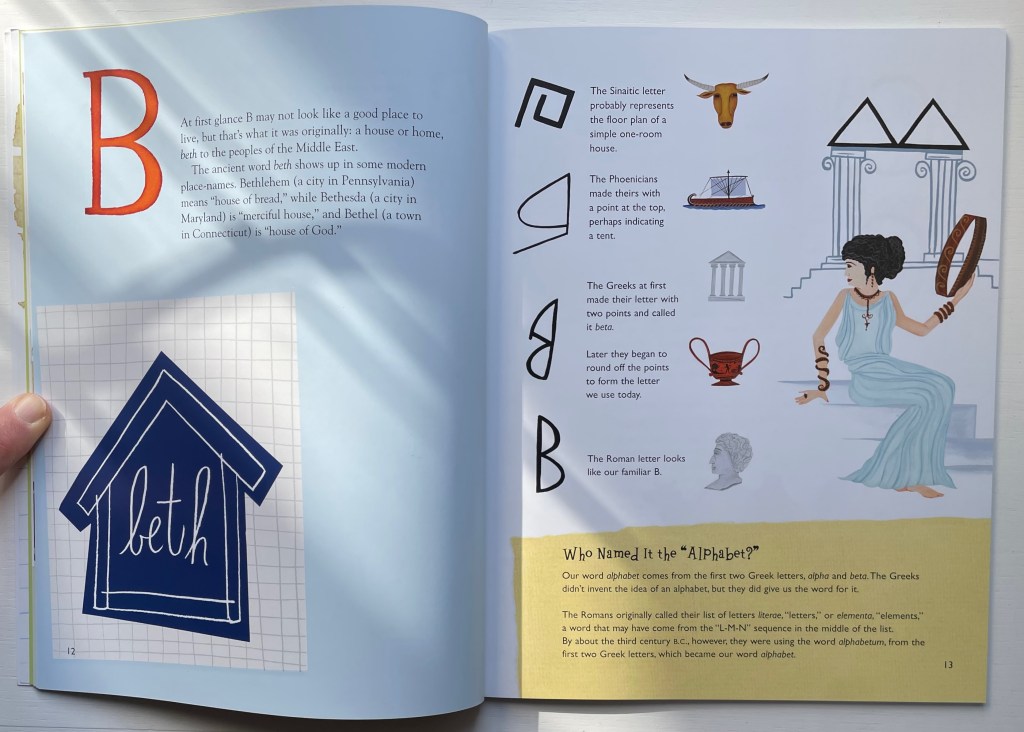
A fair number of fiction and non-fiction children’s books on the history of the alphabet have made their way into the Books On Books Collection.

Of the fiction variety, there is Rudyard Kipling’s “Just So Story” of the alphabet’s invention: How the Alphabet Was Made (1983), illustrated by Chloe Cheese. Another fiction entry is James Rumford’s retelling of Cadmus’ visit to Crete in There’s a Monster in the Alphabet (2002) and William Joyce’s inventive The Numberlys (2014).

In the non-fiction category are William Dugan’s How Our Alphabet Grew (1972), Tiphaine Samoyault’s Alphabetical Order (1998), Renzo Rossi’s The Revolution of the Alphabet (2009) and the entry here: Don Robb’s and Anne Smith’s Ox, House, Stick.

Ox, House, Stick is scheduled to appear as part of an exhibition at the Bodleian Libraries in Oxford (opening 15 July 2023). “A is for Ox” designates the display case devoted to the question: Where did the alphabet come from? It’s not just a question for archaeologists, historians, linguists and paleographers — or children’s book authors and illustrators. It’s one generating repeated inspiration for book artists as shown by Abe Kuipers’ Letters (1971), Lanore Cady’s Houses & Letters (1977), another rendition of the Kipling tale by Gerald Lange in The Neolithic Adventures of Taffi-Mai Metallu-Mai (1997), designed by Gerald Lange and produced with Robin Price, Dave Wood’s Alphabetica (2002), Cari Ferraro’s The First Writing (2004), and Helen Malone’s Alphabetic Codes (2005).

Artists’ books share much with children’s books in general. They both play with form and structure. They play with words and images, sometimes images without words and sometimes just shapes. Almost always an attention to all the senses. Children’s alphabet books in particular display features that appeal to book artists: play with animals, the Babel of languages, bodies, calligraphy, colors, design (of letters, page and book) and, as above, alphabet origin stories. Viewing and exploring alphabet books and artist’s books side by side heightens the enjoyment and appreciation of both.

Further Reading

Abecedaries I (in progress)“. Books On Books Collection.

Lanore Cady“. 16 December 2022. Books On Books Collection. Artist’s book.

William Dugan“. 10 July 2023. Books On Books Collection.

Cari Ferraro“. 1 February 2023. Books On Books Collection. Artist’s book.

William Joyce“. 18 June 2021. Books On Books Collection.Illustrated children’s book.

Rudyard Kipling and Chloë Cheese“. 15 February 2023. Books On Books Collection. Illustrated children’s book.

Rudyard Kipling and Gerald Lange“. 16 April 2023. Books On Books Collection. Artist’s book.

Abe Kuipers“. 15 February 2023. Books On Books Collection. Artist’s book.

Helen Malone“. 23 July 2020. Books On Books Collection. Artist’s book.

Renzo Rossi“. 10 July 2023. Books On Books Collection.  Illustrated children’s book. [In progress]

James Rumford. 21 November 2022. Books On Books Collection. Illustrated children’s book.

Tiphaine Samoyault“. 10 July 2023. Books On Books Collection. Illustrated children’s book. [In progress]

Animal alphabets & artists’ books

Marie Angel, An Animated Alphabet (1996)

Leonard Baskin, Hosie’s Alphabet (1972)

Paul Cox, Abstract Alphabet: A Book of Animals (2001)

E.N. Ellis, An Alphabet (1985)

C.B. Falls, ABC Book (1957)

David L. Kulhavy & Charles D. Jones, A Forest Insect Alphabet (2013)

Enid Marx, Marco’s Animal Alphabet (2000)

Carol Schwartzott, ABC of Birds (2020)

Borje Svensson & James Diaz, Animals (1982)

John Norris Wood, An Alphabet in Praise of Toads & Frogs (2002)

Babel, alphabets & artists’ books

Golnar Adili, Father Gave Water/Baabaa Aab Daad (2022)

Islam Aly, 28 Letters (2013)

Brynja Baldursdottír, Fuþorc (1992)

Ellen Heck, A is for Bee (2022)

Tatyana Mavrina, Сказочная Азбука / Skazochnaia Azbuka / A Fairy Tale Alphabet (1969)

Claire Jeanine Satin, Alphabook (1998/99)

Ben Shahn, The Alphabet of Creation (1954)

Jana Sim, Both but between (2021)

Sam Winston, One and Everything (2022)

Bodies & artists’ books

Anthon Beeke, Alphabet (1970)

Anthon Beeke & René Knip, Body Type (2011)

Edward Gorey, Figbash Acrobate (1994) In progress

Toshifumi Kawahara, Dancing Alphabet (1991)

Françoise and Douglas Kirkland, Physical Poetry Alphabet (2018)

Marie Lancelin, Gestes Alphabétiques (2014)

Lisa Merkin, Bodies of Language (2021)

Annette Messager, Mes Enluminaires (1988) [In progress]

Vítězslav Nezval, Abeceda/Alphabet (1926/2001)

Rowland Scherman, Love Letters (1975) [In progress]

Calligraphy, alphabets and artists’ books

Mari Angel, Marie Angel’s Exotic Alphabet (1992)

Tauba Auerbach, How to Spell the Alphabet (2007)

Rebecca Bingham, Lady Letters (1986)

Rebecca Bingham, Alphabet Salmagundi (1988)

Carol DuBosch, Alphabet of Calligraphic Tricks (2014)

Carol DuBosch, Embossed Alphabet Gallery (2019)

Francesca Lohmann, An Alphabetical Accumulation (2017)

Suzanne Moore, A Blind Alphabet (1986)

Edward Andrew Zega & Bernd H. Dams, An Architectural Alphabet : ABC (2008)

Colors, alphabets and artists’ books

Rebecca Bingham, Golden Alphabet (1986)

Rebecca Bingham, Defining the Rainbow (2018)

Sonia Delaunay, Alphabet (1972)

Carol DuBosch, Rainbow Alphabet Snowflake (2013)

Ursula Hochuli-Gamma, 26 farbige Buchstaben (1986)

Karen Hanmer, The Spectrum (2003)

Amy Lapidow, Spiralbet (1998)

Lisa McGarry, Be Amazed (and other words to live by) (2013)

Kveta Pacovská, A l’infini (2007)

Design (of letters), alphabets & artists’ books

Anne Bertier, Anne Dessine-moi une lettre(2004)

Roberto de Vicq de Cumptich, Bembo’s Zoo: An Animal ABC Book (2000)

Felice Feliciano & Jason Dewinetz, Alphabetum Romanum: The Letterforms of Felice Feliciano (c. 1460, 2010)

Jeff Morin and Steven Ferlauto, The Sacred Abecedarium (1999)

Andrew Morrison, Two Wood Press A-Z (2020

David Pelletier, The Graphic Alphabet (1996)

Bruce Rogers, Champ rosé (1933)

Kevin Steele, The Movable Book of Letterforms(2009)

Sharon Werner & Sharon Forss, Alphabeasties (2009)

Structures, alphabets & artist’s books

Kathleen Amt, Kaleidoscopic ABC’s (1991)

Matsumasa Anno, Anno’s Magical Alphabet (1981)

Marion Bataille, ABC3D (2008)

John Crombie, ABC in a maze (1987)

Carol DuBosch, Rainbow Alphabet Snowflake (2013)

Carol DuBosch, Embossed Alphabet Gallery (2019)

Helen Hajnoczky, alpha seltzer (2023)

Karen Hanmer, A2Z (2013)

Karen Hanmer, The Spectrum (2003)

Helen Hiebert, Alpha Beta (2010)

Ron King, Alphabeta Concertina majuscule (2007)

Ron King, alphabeta concertina miniscule (2007)

Ron King, The White Alphabet (1984) In progress

Ron King, ABC Paperweights (nd)

Amy Lapidow, Spiralbet (1998)

Scott McCarney, Alphabook 3 (1986)

Scott McCarney, Alphabook 10 (2015)

Scott McCarney, Alphabook 13 (1991)

Lisa McGarry, Twenty-six/Fragments (2012)

Patrice Miller (Edward Gorey), The Eclectic Abecedarium (2022)

Patrice Miller (Edward Gorey), Figbash Acrobate (2023)

Jeff Morin and Steven Ferlauto, The Sacred Abecedarium (1999)

Jeff Morin and Steven Ferlauto, Sacred Space (2003)

Moveable Book Society, A to Z Marvels in Paper Engineering (2018)

Bruno Munari, ABC con fantasia (2008)

Bruno Riboulot, ABCD’Air (2005)

Merrill Shatzman, Calligrafitti #3 (2011)

Borje Svensson & James Diaz, Letters (1982)

Emmett Williams, abcdefghijklmnopqrstuvwxyz (1963) In progress