Books On Books Collection – Kurt Schwitters

Die Scheuche Märchen (1925/1965)

Die Scheuche Märchen (1925, 1965) [The Scare-Crow Fairy Tale]
Kurt Schwitters, Kate Steinitz and Theo van Doesberg. English translation by Robert Haas (enclosed, loose).
Miniature reprint of the 1925 edition. H123 x W154 mm. 12 pages. Acquired from Plain Tales Books, 12 July 2023.
Photos: Books On Books Collection.

The Schwitters-Steinitz Collection held at the National Gallery of Art Library identifies this work as a miniature reprint published in 1965 by Stockholm’s Gallery Samlaaren, owned by Agnes Widlund. The original, measuring H250 x W210 and also in red and blue on light brown paper, was published by Kurt Schwitters, Kate Steinitz and Theo van Doesberg under the imprint APOSS, which is a nonsense word, derived from “A for Active; P for Paradox; OS for Oppose Sentiment; and S for Sensitive” (Paley, p. 267). There have been several other editions, but this one is particularly satisfying for its inclusion of the loose typewritten translation by Robert Haas, who also translated Steinitz’s memoir/biography of Schwitters.

Continue reading

Books On Books Collection – Christopher Hicks

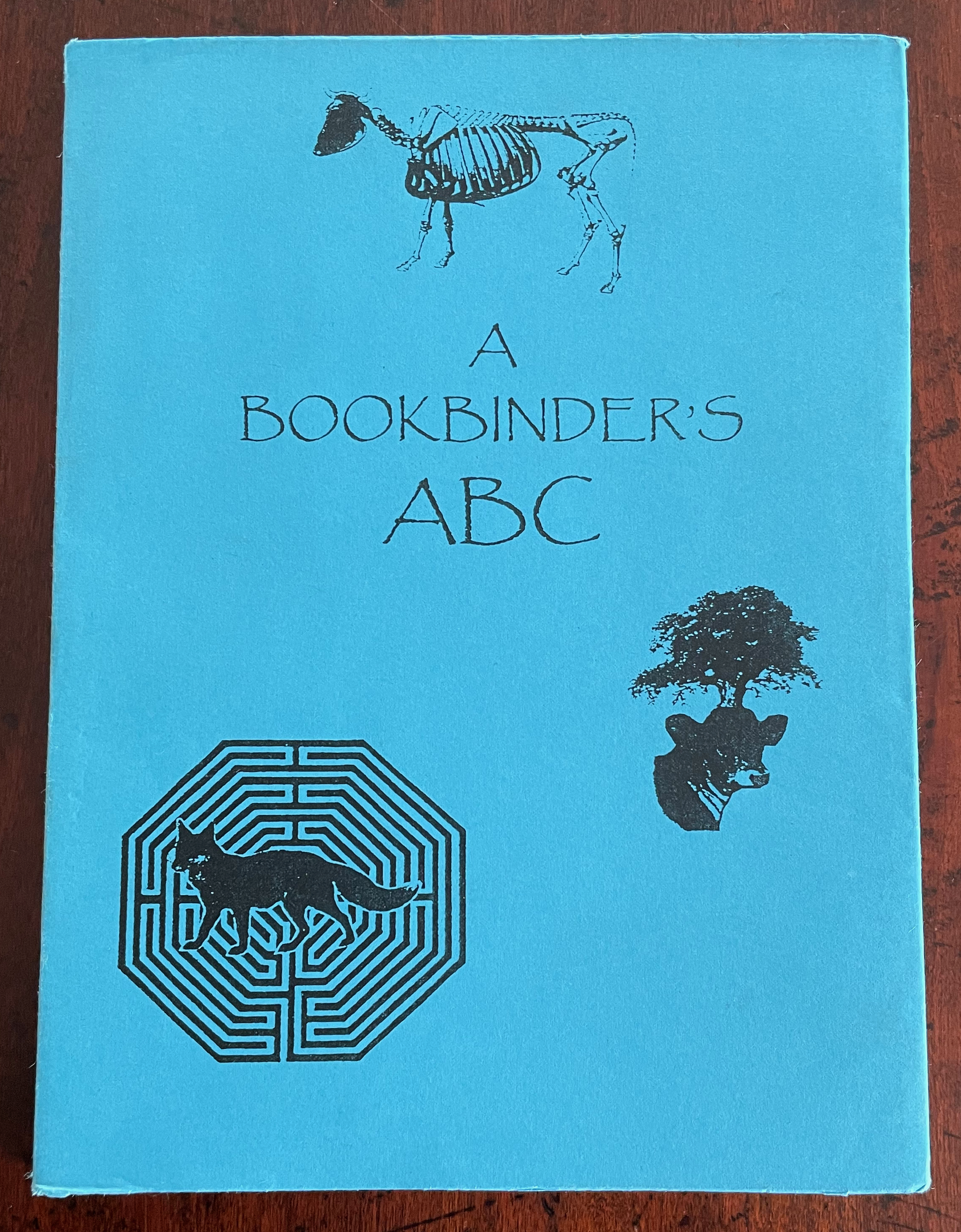
A Bookbinder’s ABC (2003)

A Bookbinder’s ABC (2003)
Christopher Hicks, Leaning Chimney Press Editions
Soft cover (buff card, illustrated paper jacket glued to spine, sewn block). H200 x W150 mm. 34 pages. Edition of 75. Acquired from Barter Books, 18 October 2023.
Photos: Books On Books Collection.

Although Glaister’s Encyclopedia of the Book is the canonical dictionary for book terminology, A Bookbinder’s ABC provides 26 humorous visual reminders.

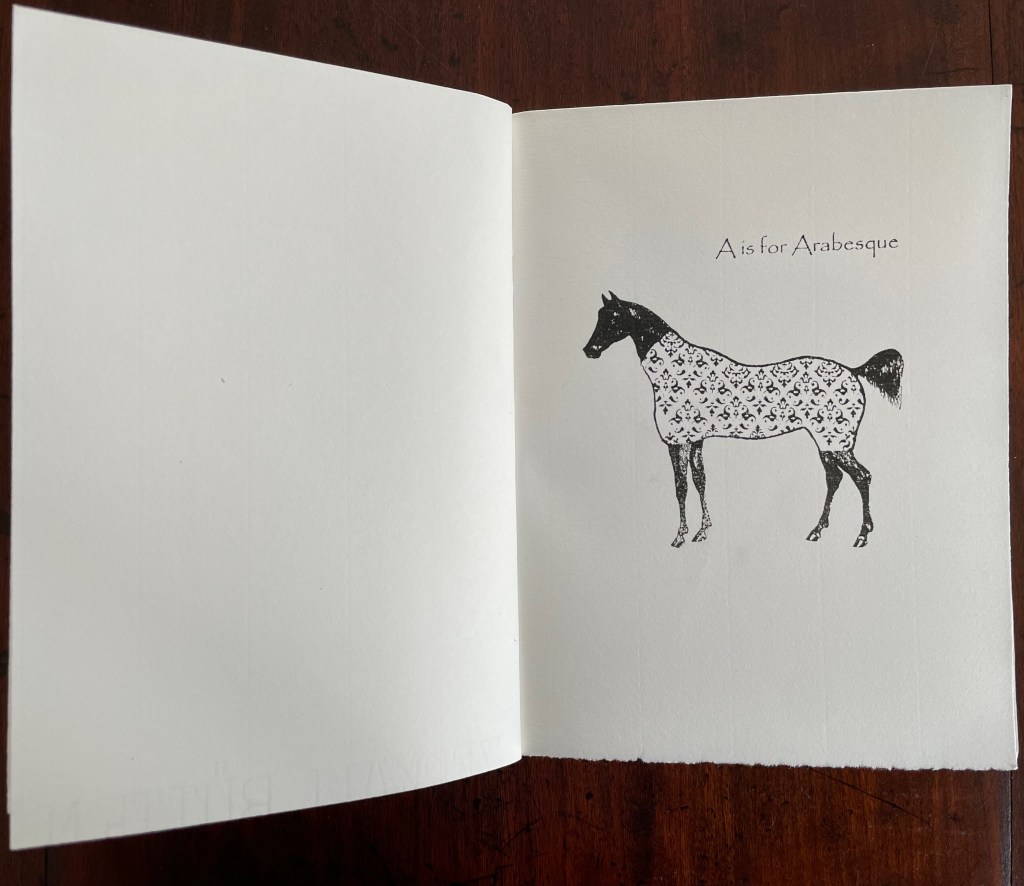
An Arabian stallion in a decorative onsie for recalling the description of fleurons and other devices derived from Islamic patterns.

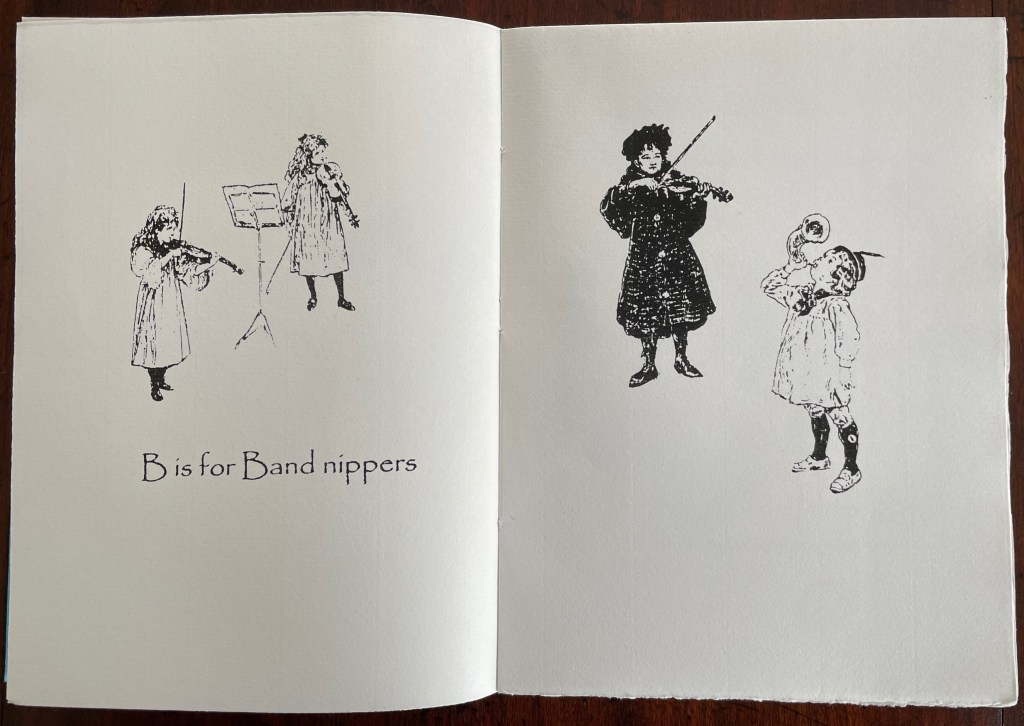
What else would a binder call a children’s orchestra?

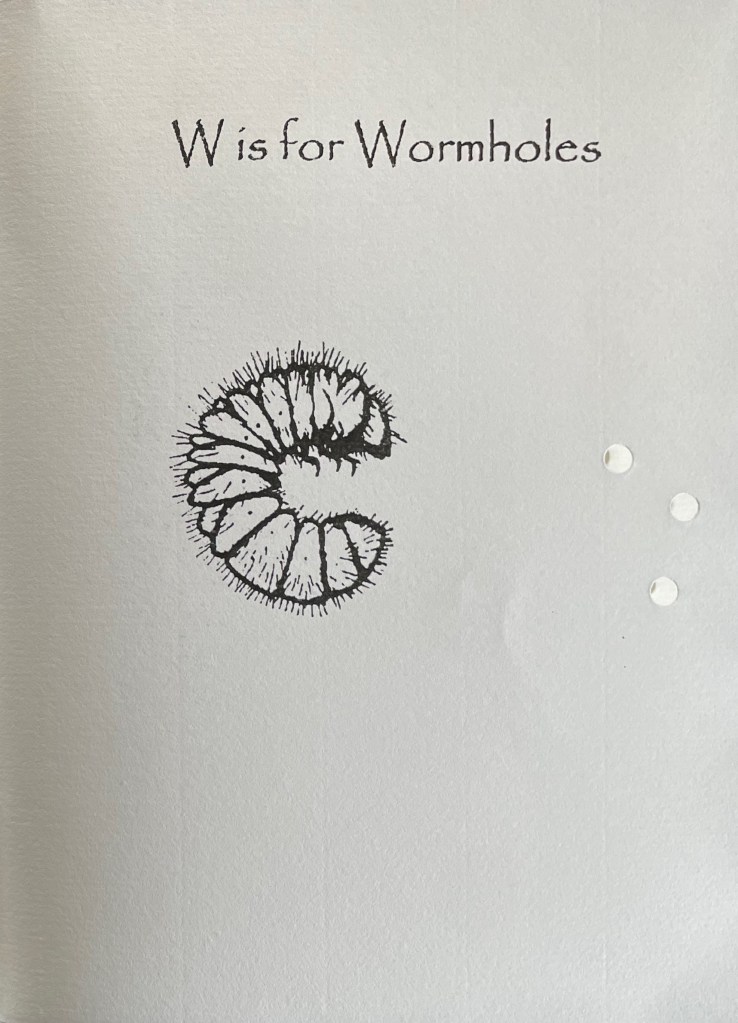
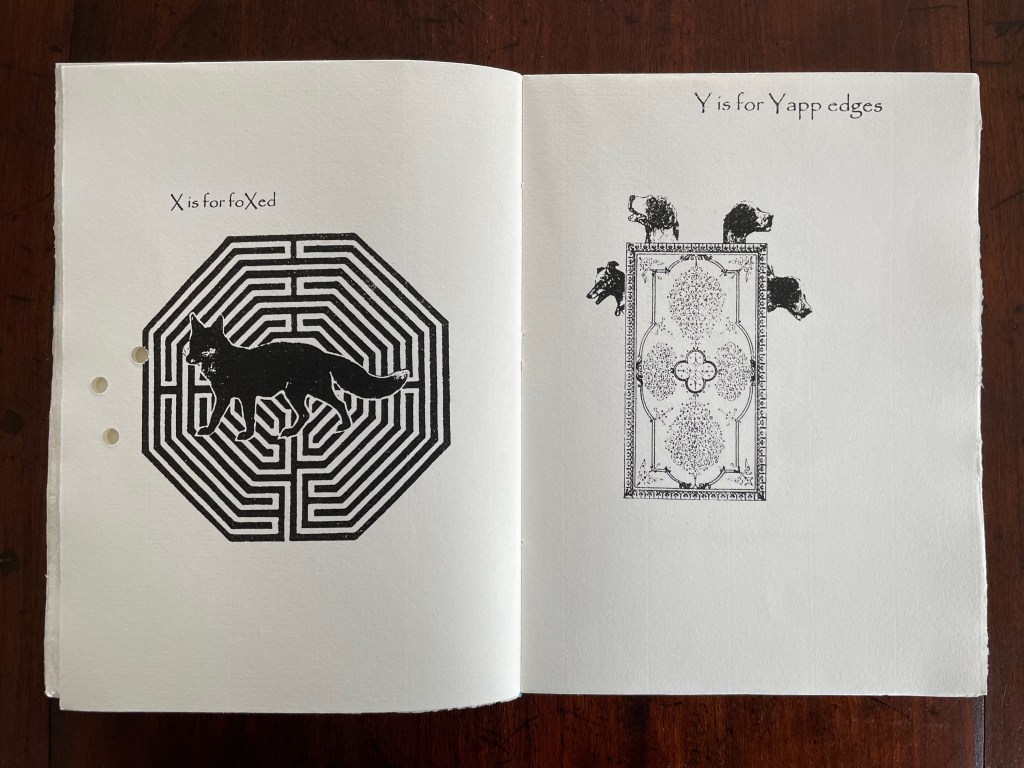
A fox flummoxed by a maze is certainly “foxed”. This one is also likely puzzled by the holes carried over from “Wormholes” on the previous page. Barking dogs springing from a book cover might be a helpful mnemonic for the name of the wide soft edges or flaps for Bible covers devised by the 19th century London bookseller Yapp.

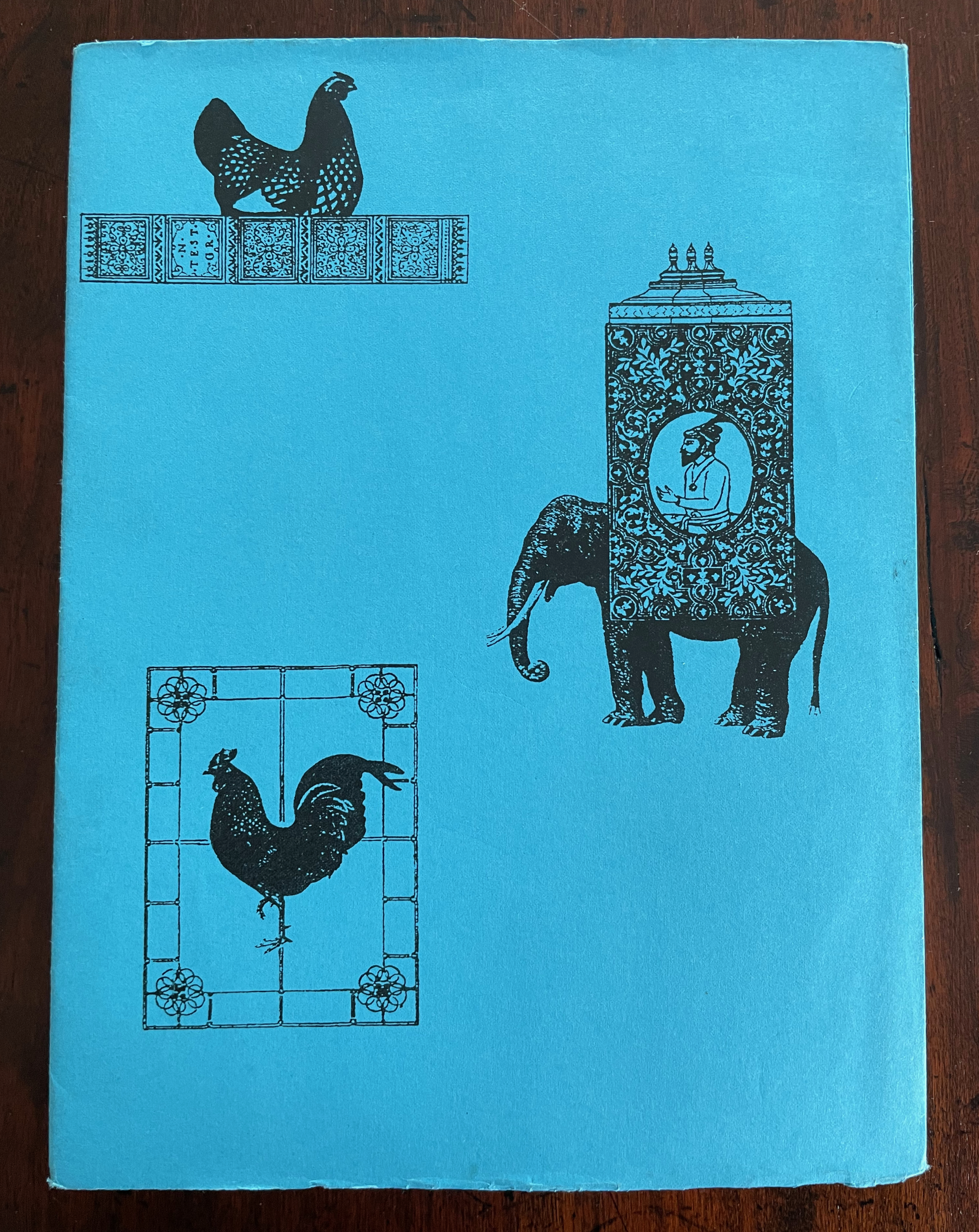
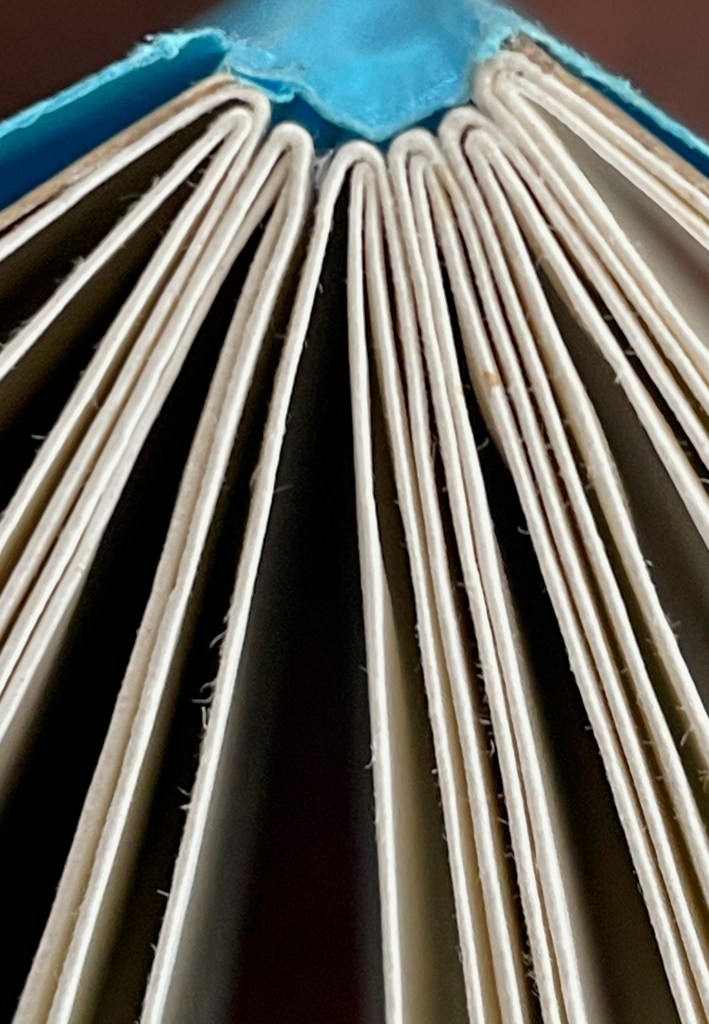
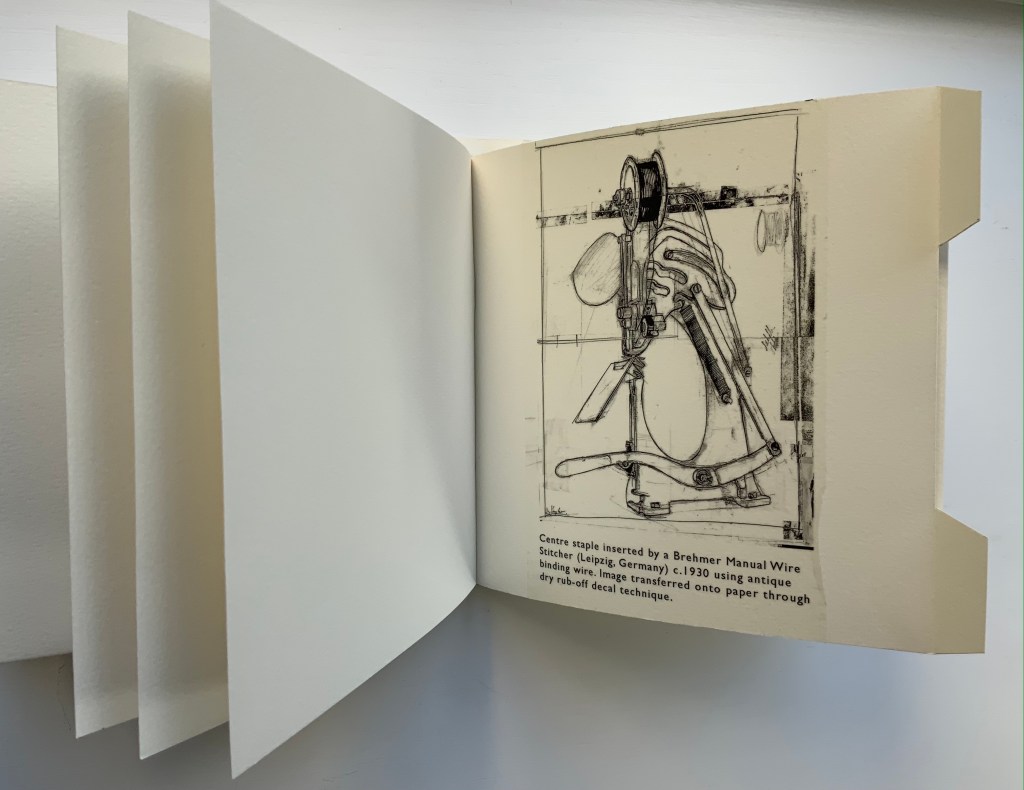
The work’s own binding has simple but interesting features. The front and back covers in buff card are glued to the first and last sewn gatherings, respectively, and the sewn gatherings are glued in between and sewn together. The blue paper jacket’s spine is glued to the spines of the gatherings and its fore edges fold over the fore edges of the buff card. Curious but not as self referential as the features of two nearby birds of a feather from Andrew Morrison’s Two Wood Press.

Detail of uncut top edges and gluing of gatherings and spine.

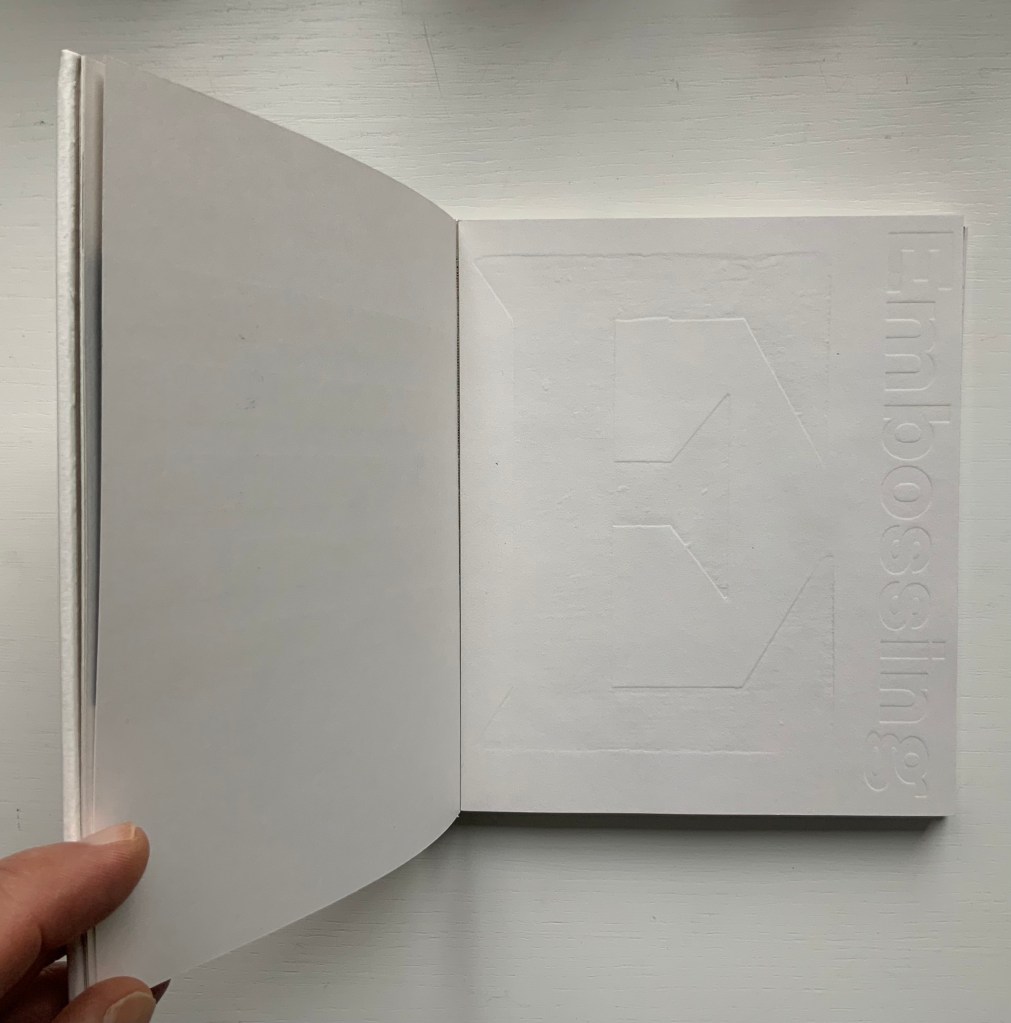
From Morrison’s Provenance (2018), showing an actual wire-stitched gathering and then an illustration of the mechanism; from Morrison’s Two Wood Press A-Z (2003), showing showing an embossed page illustrating E for Embossing. Photos: Books On Books Collection.

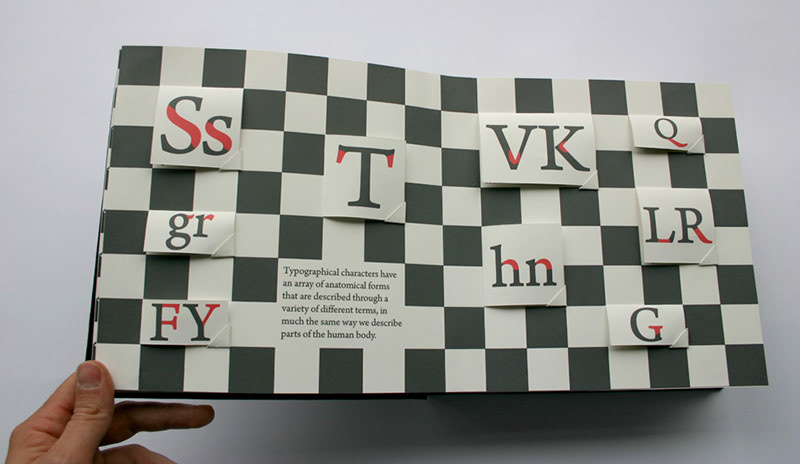
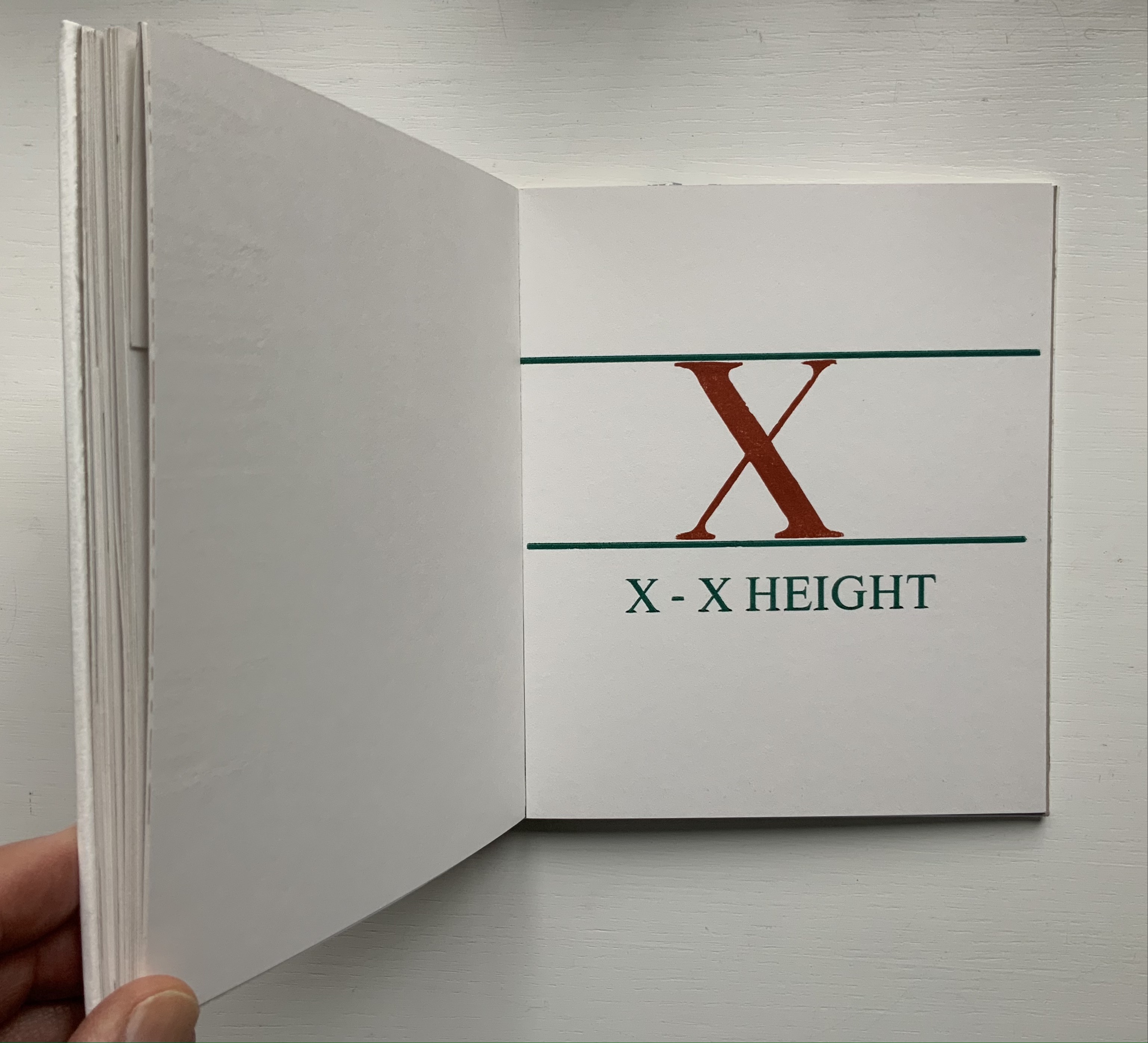
But what would a self-referential binding for A Bookbinder’s ABC look like — especially one that might carry on the punnery of the contents? Presumably because they are closer to the words, entries in letterpress abecedaries such as Morrison’s Two Wood Press A-Z (2003) and Kevin M. Steele’s The Movable Book of Letterforms (2009) have an easier time of the visually self-referential.

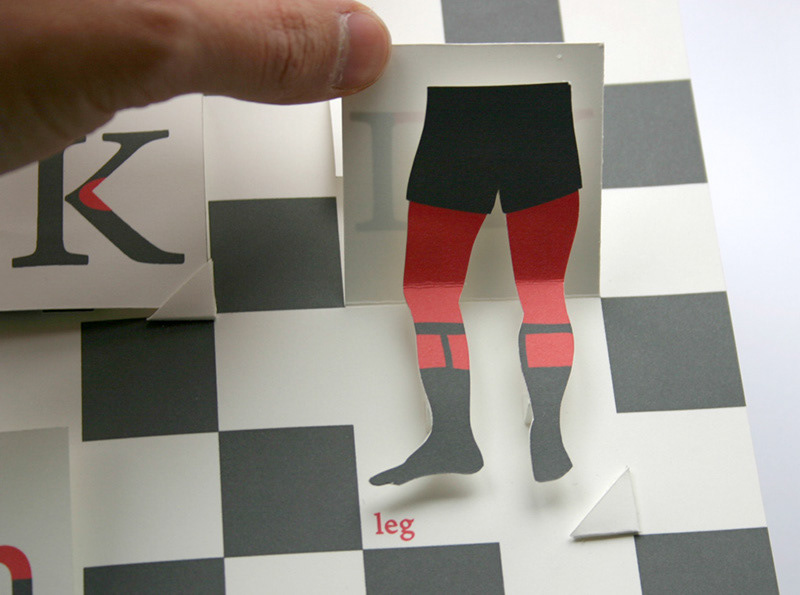
From Steele’s A Movable Book of Letterforms, showing the anatomical term for the red areas of the L & R (a leg lift?); from Morrison’s Two Wood Press A-Z, showing x’s definition of its height.

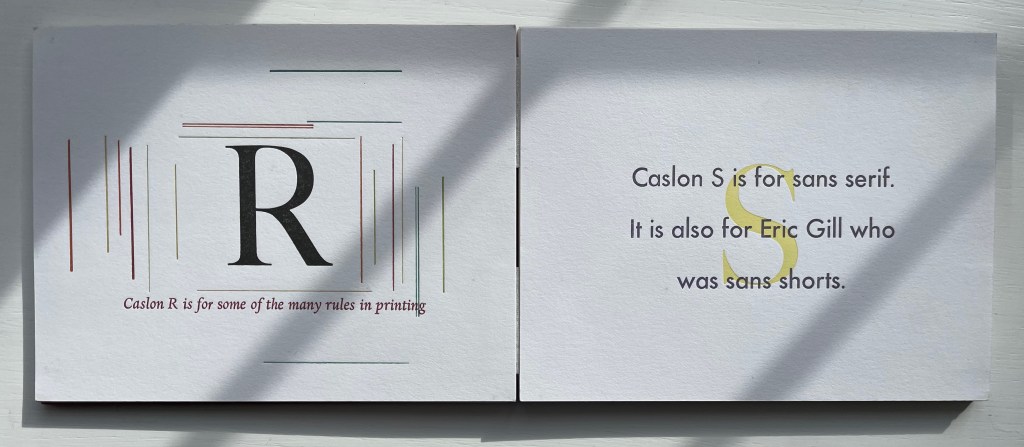
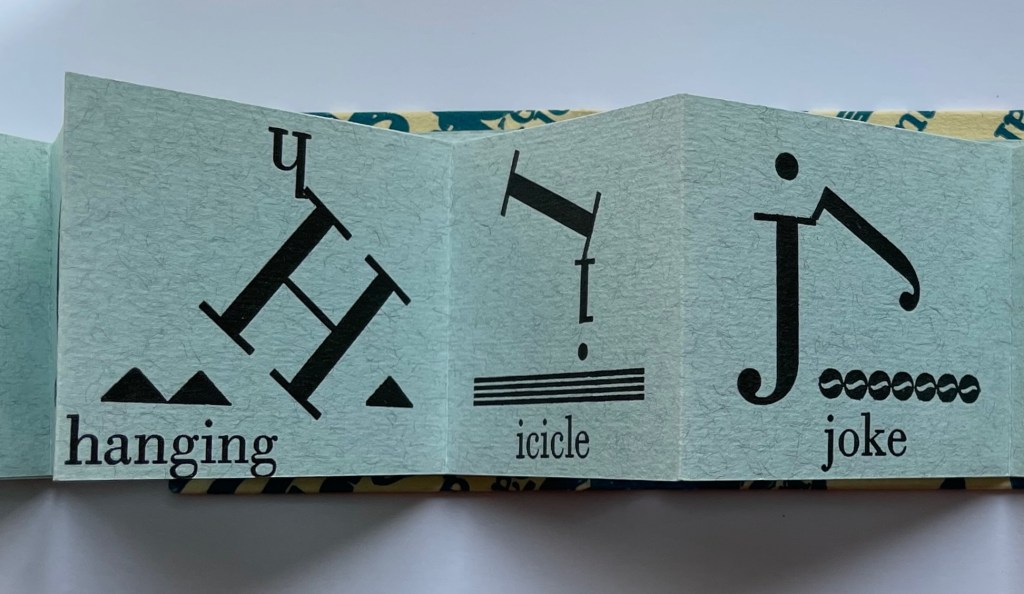
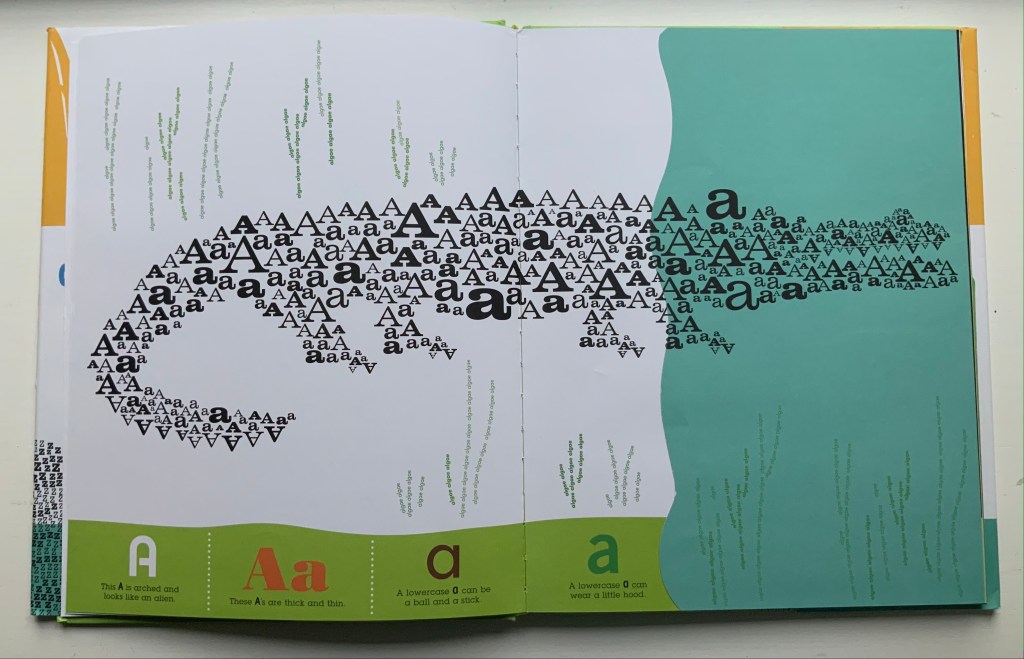
Closer still to the words are the typographical punsters such as Marie Dern and William Caslon’s Typographic ABC (1991), Nicolas McDowall and A Bodoni Charade (1995) or Sharon Werner & Sharon Forss and Alphabeasties and Other Amazing Types (2009).

From Dern’s William Caslon’s Typographic ABC, McDowall’s A Bodoni Charade and Werner & Forss’ Alphabeasties and Other Amazing Types.

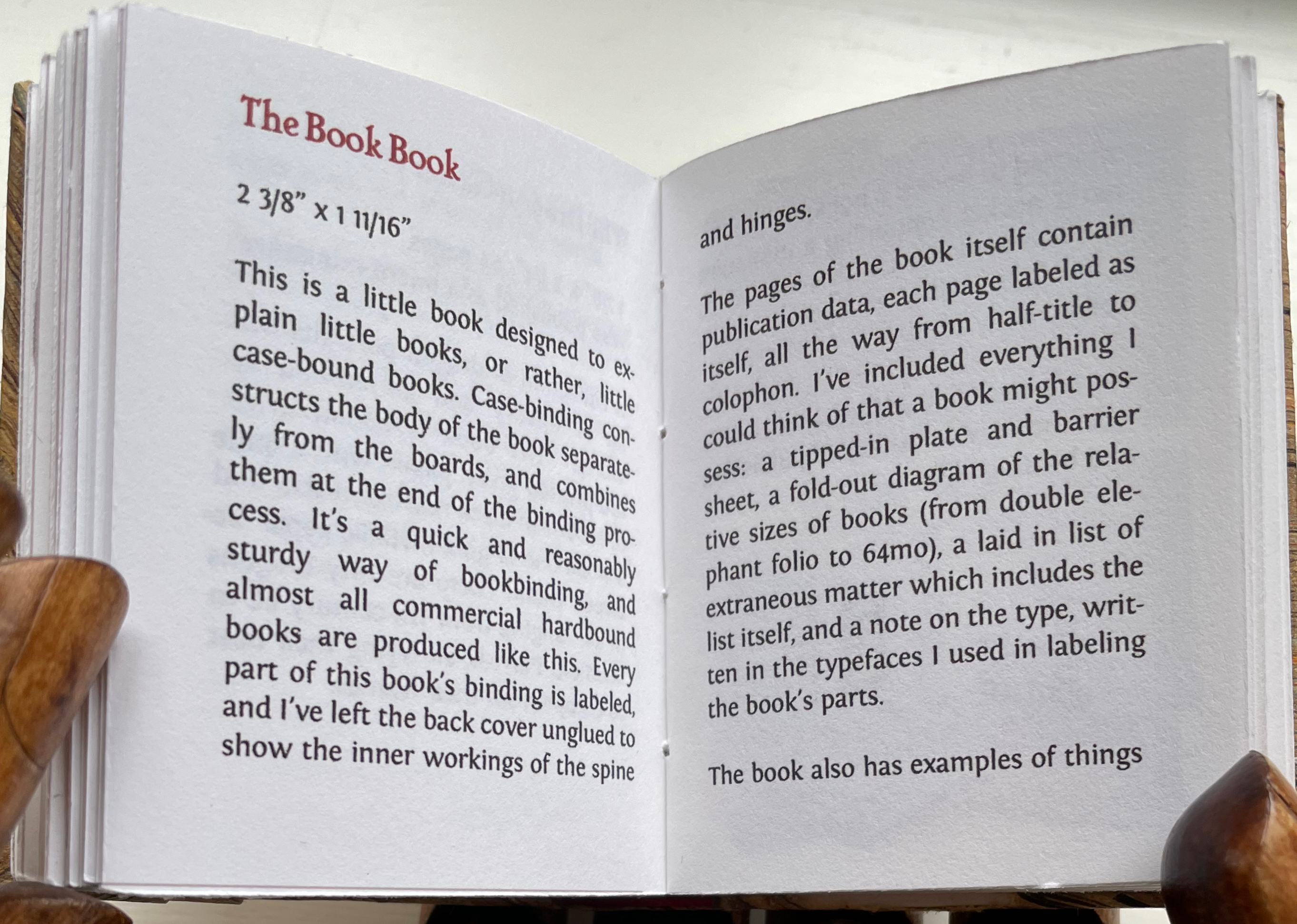
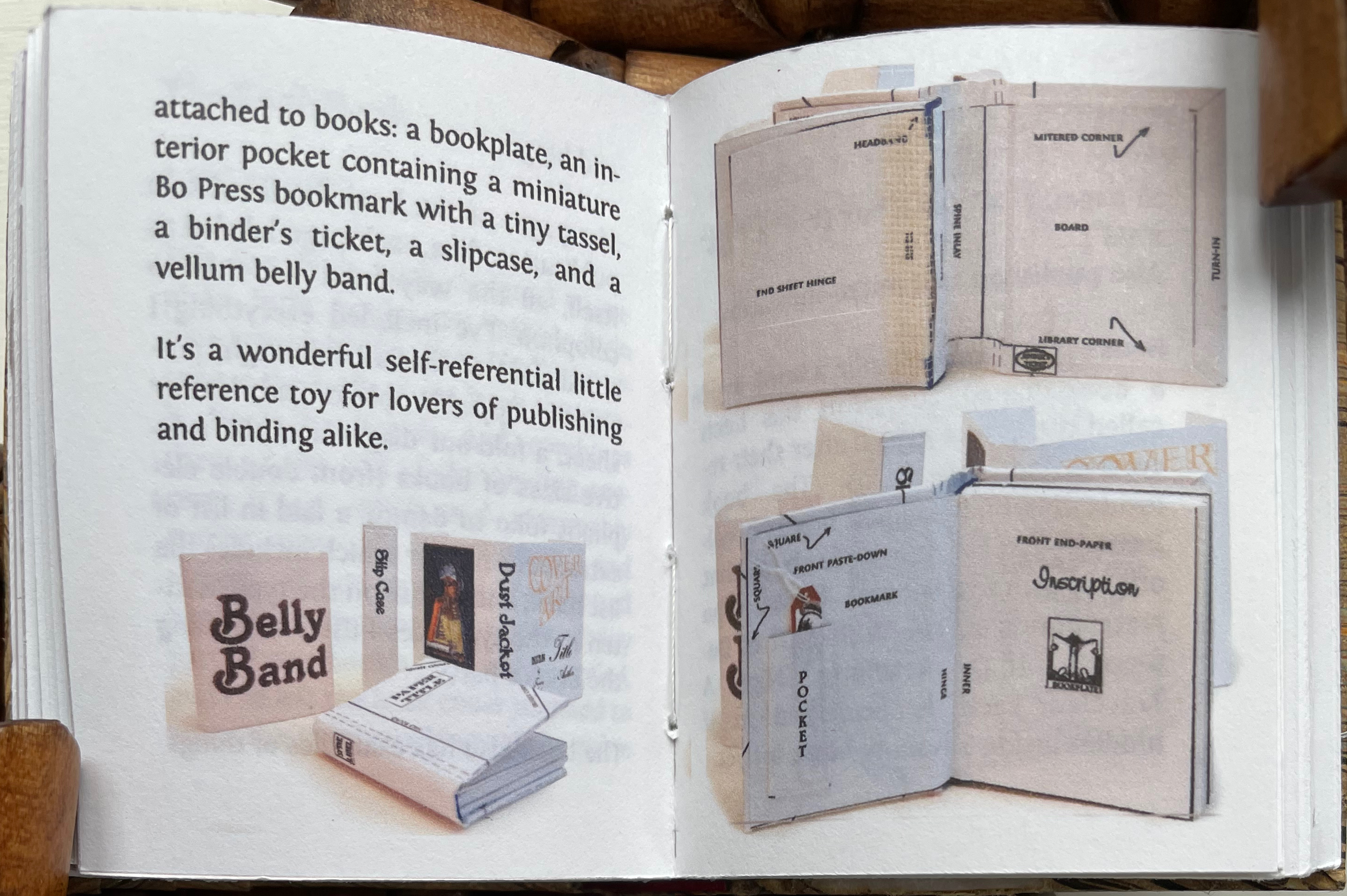
Perhaps Pat Sweet’s miniature The Book Book (2010) comes closest on self-referentiality in a work about binding. For the puns, we will have to wait for another bookbinder to take a stab at it.

From Sweet’s The History of Bo Press (2021).

Further Reading

Abecedaries I (in progress)“. Books On Books Collection.

Alphabets Alive!“. 19 July 2023. Books On Books.

David Clifford“. 15 September 2021. Books On Books Collection.

Marie Dern“. 8 March 2023. Books On Books Collection.

Nicolas McDowall“. 10 December 2022. Books On Books Collection.

Andrew Morrison“. 15 September 2021. Books On Books Collection.

Kevin M. Steele“. 18 July 2023. Books On Books Collection.

Pat Sweet“. 18 January 2023. Books On Books Collection.

Sharon Werner & Sharon Forss“. 20 December 2022. Books On Books Collection.

Frost, Gary. 1996. Teaching set of historical bookbindings. Utopia, Tex: Gary Frost, Dry Frio Bindery.

Hanmer, Karen. 2013. Biblio Tech. Glenview, IL: Karen Hanmer Book Arts.

Books On Books Collection – Department of Special Publications, The Museum of Metropolitan Art

Animalphabet (1996)

Animalphabet (1996)
Department of Special Publications, The Museum of Metropolitan Art
Hardcover, casebound sewn. H120 x W150 mm, 60 unnumbered pages. Acquired from Aardvark Books, 1 August 2021.
Photos: Books On Books Collection.

Animalphabet is a reminder of the close connection between animals and alphabet books. Think of the several same-titled works, e.g., Julia Donaldson’s Animalphabet (2018) or Sharon Werner and Sharon Forss’ AlphaBeasties (2009) or Alan James Robinson and Suzanne Moore’s A Fowl Alphabet (1986). It also highlights an aspect of book art.

Although the museum’s little book does not rise to the level of art, its self-reflective textual/visual puns are a hallmark of much book art. In it, the museum staff selects an ink scroll depiction of donkeys by Huang Chou for “Ass-embly”, François Pompon’s Polar Bear for “Bear Minimum”, and a 10th-11th-century bookcover carving of the emblem of Luke the Evangelist for “Holy Cow”. The Met’s choice of Pompon’s Minimalist bear to pun on the art movement comes closest to the rampant punning of homages to Ed Ruscha’s “various” iconic works of book art, distilled in Various Small Books (MIT Press, 2013).

Because it is hard to think of a textual/visual/genre pun among artists’ books that is more multilevel than the Met’s final letter, the little book should have the last word.

© Metropolitan Museum of Art, 1977.

Further Reading

Abecedaries I (in progress)“. Books On Books Collection.

Buzz Spector“. 24 September 2021. Books On Books Collection.

Ximena Pérez Grobet“. 7 July 2021. Books On Books Collection.

Ron King“. 1 March 2021. Books On Books Collection.

Alan James Robinson“. 9 June 2023. Books On Books Collection.

Sharon Werner & Sharon Forss“.

Brouws, Jeffrey T., Wendy Burton, Hermann Zschiegner, Phil Taylor, Mark Rawlinson and Edward Ruscha. 2013. Various Small Books : Referencing Various Small Books by Ed Ruscha. Cambridge Massachusetts: MIT Press.

Donaldson Julia. 2018. Animalphabet. London: Pan Macmillan.

Books On Books Collection – Marie Dern

William Caslon’s Typographic ABC (1991)

William Caslon’s Typographic ABC (1991)
Marie Dern
Double-sided leporello. H11 x W14 mm. 28 panels. Edition of 55, of which this is #1. Acquired from Bromer’s, 5 February 2023.
Photos: Books On Books Collection.

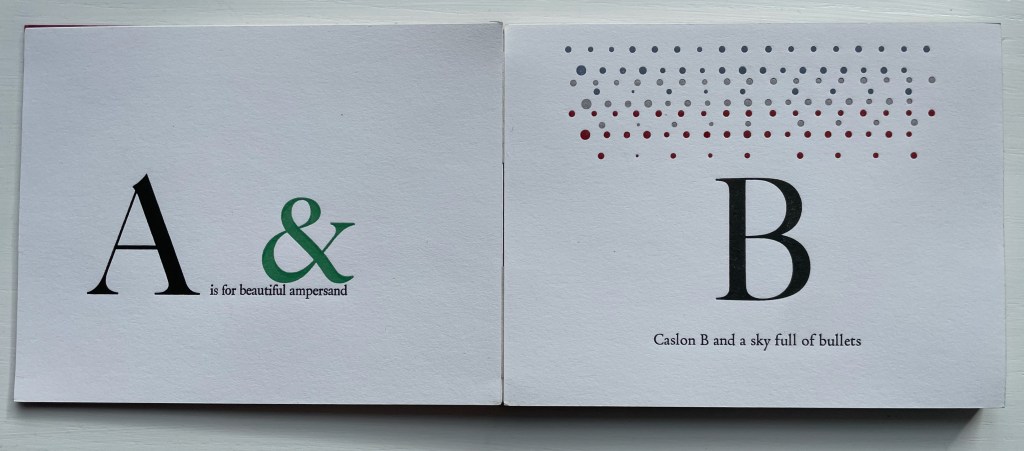
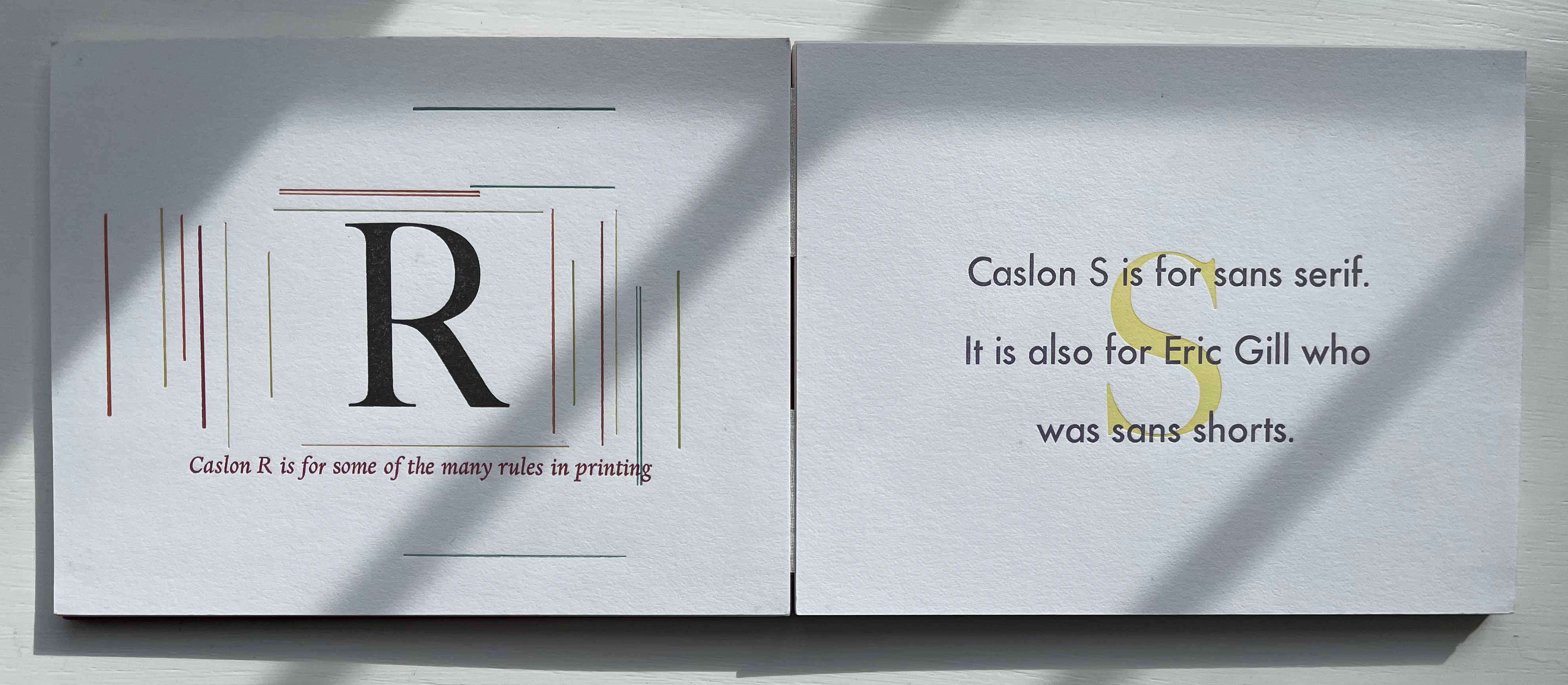
One of the most common precursors to the codex, the leporello, accordion or concertina structure suits this celebration of what is considered the first original English typeface, designed by William Caslon (1692–1766), used to set both the Declaration of Independence and the U.S. Constitution, and so dominant a font since the 18th century that it prompted its own dicta: “When in doubt, use Caslon”. In Marie Dern’s hands, though, the accordion structure is anything but common. Rather than zigzag folding a long strip of paper, she has attached her panels to two parallel strips of linen tape and left just enough space between the pairs of panels to have the hinged leporello fold down into a precise oblong shape.

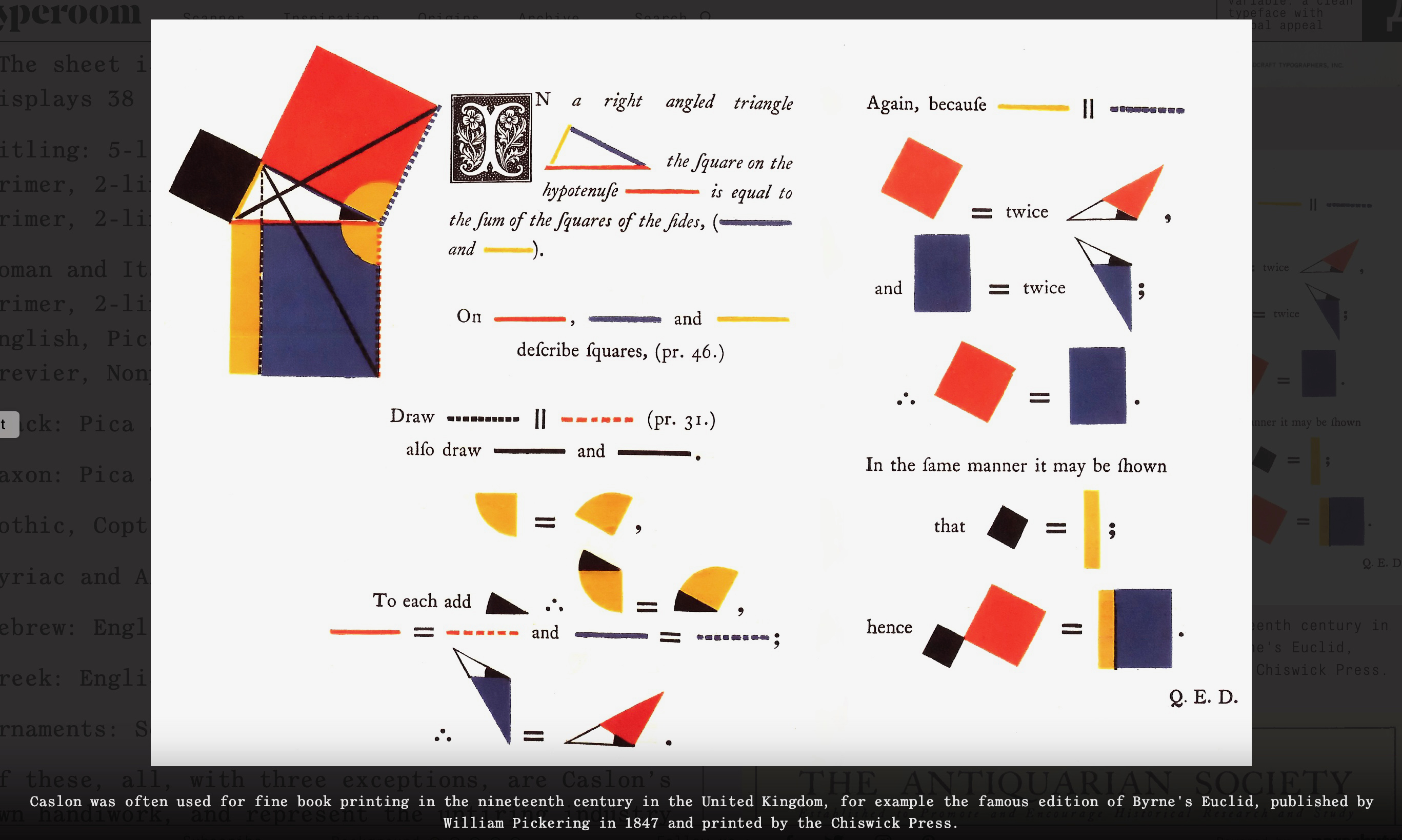
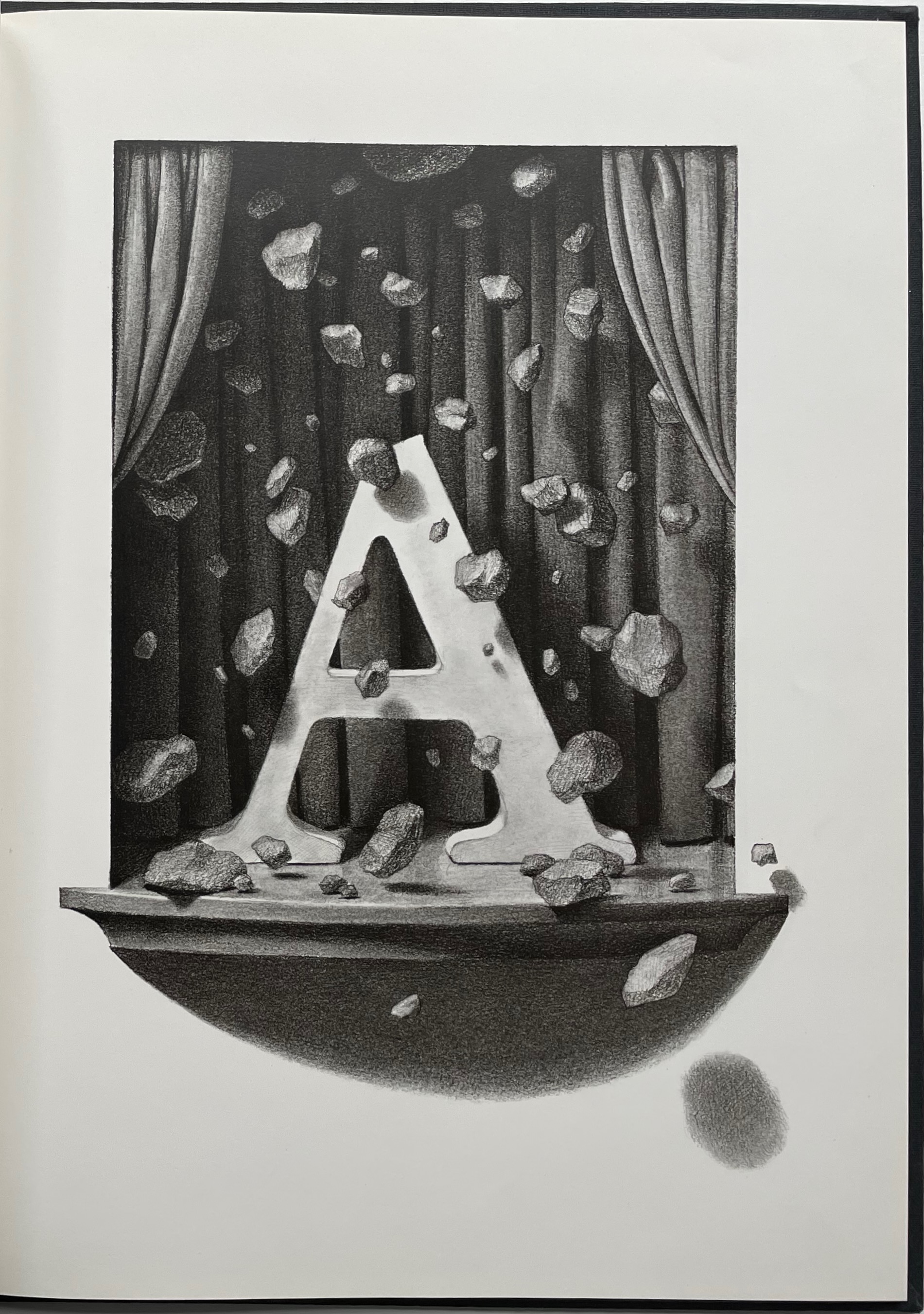
Caslon has featured in such outstanding books as Oliver Byrne’s The First Six Books of the Elements of Euclid: In Which Coloured Diagrams and Symbols Are Used Instead of Letters (1847), nearly an artist’s book in its own right. Dern might have been more immediately inspired, however, by Chris Van Allsburg’s whimsical children’s book The Z was Zapped: A Play in Twenty-six Acts, Performed by the Caslon Players (1987). From the start, bending the alphabet full circle to the ampersand, Dern’s own whimsy extends beyond the letters themselves.

L: from Byrne’s The First Six Books. Typeroom, 23 January 2020. Accessed 8 March 2023.
R: from Van Allsburg’s The Z was Zapped. Photo: Books On Books Collection.

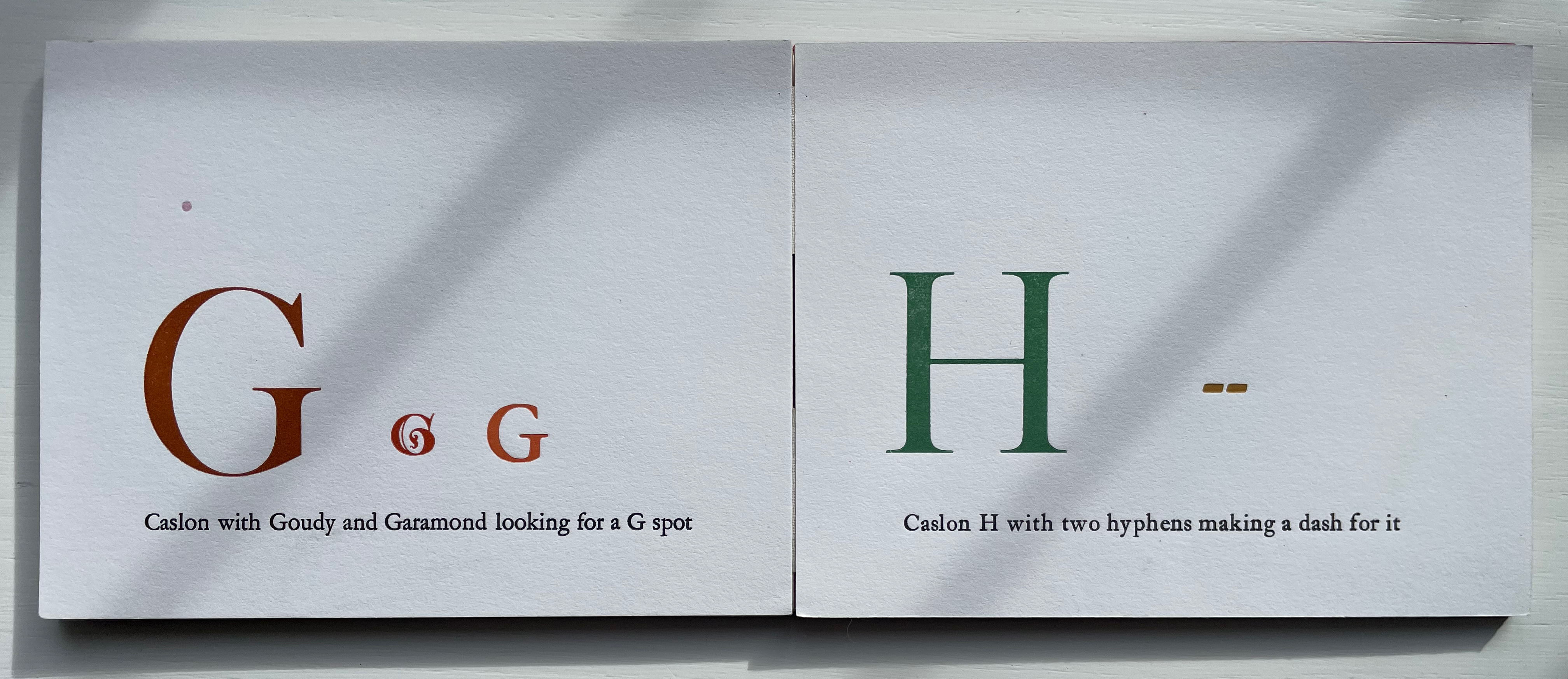
Given its age and dignity, Caslon attracted a fair amount of rock throwing from designers (especially in the 20th century). While Dern may have her own whimsical fun with Caslon, she doesn’t let the rock-throwers off scot free. Her Caslon’s G puts Frederic Goudy on notice that size does matter, and the Caslon S reminds Eric Gill of the emperor’s new clothes.

Other alphabetical typeface celebrations in the Books On Books Collection include Nicolas McDowall’s A Bodoni Charade (1995), Roberto de Vicq de Cumptich’s Bembo’s Zoo (2000) and Sharon Werner & Sharon Forss’ Alphabeasties and Other Amazing Types (2009).

Further Reading

Abecedaries I (in progress)“. Books On Books Collection.

Roberto de Vicq de Cumptich“. 12 February 2021. Books On Books Collection.

Sharon Werner & Sharon Forss“. 20 December 2022. Books On Books Collection.

Nicolas McDowall”. 10 December 2022. Books On Books Collection.

Nicholas Rougeux“. 19 November 2022. Books On Books Collection.

Chris Van Allsburg“. 12 December 2022. Books On Books Collection.

Byrne, Oliver, and William Pickering. 1847. The First Six Books of the Elements of Euclid: In Which Coloured Diagrams and Symbols Are Used Instead of Letters. London: W. Pickering.

Morison Stanley. 1997. Letter Forms : Typographic and Scriptorial : Two Essays on Their Classification History and Bibliography. Point Roberts WA: Hartley & Marks. See pp. 27-28 for the first stones cast in 1937.

Morison, Stanley. 1999. A Tally of Types New ed. [3rd ed.] ed. Boston: D.R. Godine. Caslon is not even included in Morison’s “tally” of seventeen typefaces. It appears on pages 24-27 in his introduction “revised & amplified” by Phyllis M. Handover. Even there they enlist Bruce Rogers, Emery Walker and William Morris to chuck additional rocks in Caslon’s direction on pages 37-38.

Books On Books Collection – Sharon Werner & Sharon Forss

Alphabeasties and Other Amazing Types (2009)

Alphabeasties and Other Amazing Types (2009)
Sharon Werner & Sharon Forss
Hardcover. H300 xW mm, 56 pages. Acquired from Golden Waves of Books, 7 August 2021.
Photos: Books On Books Collection.

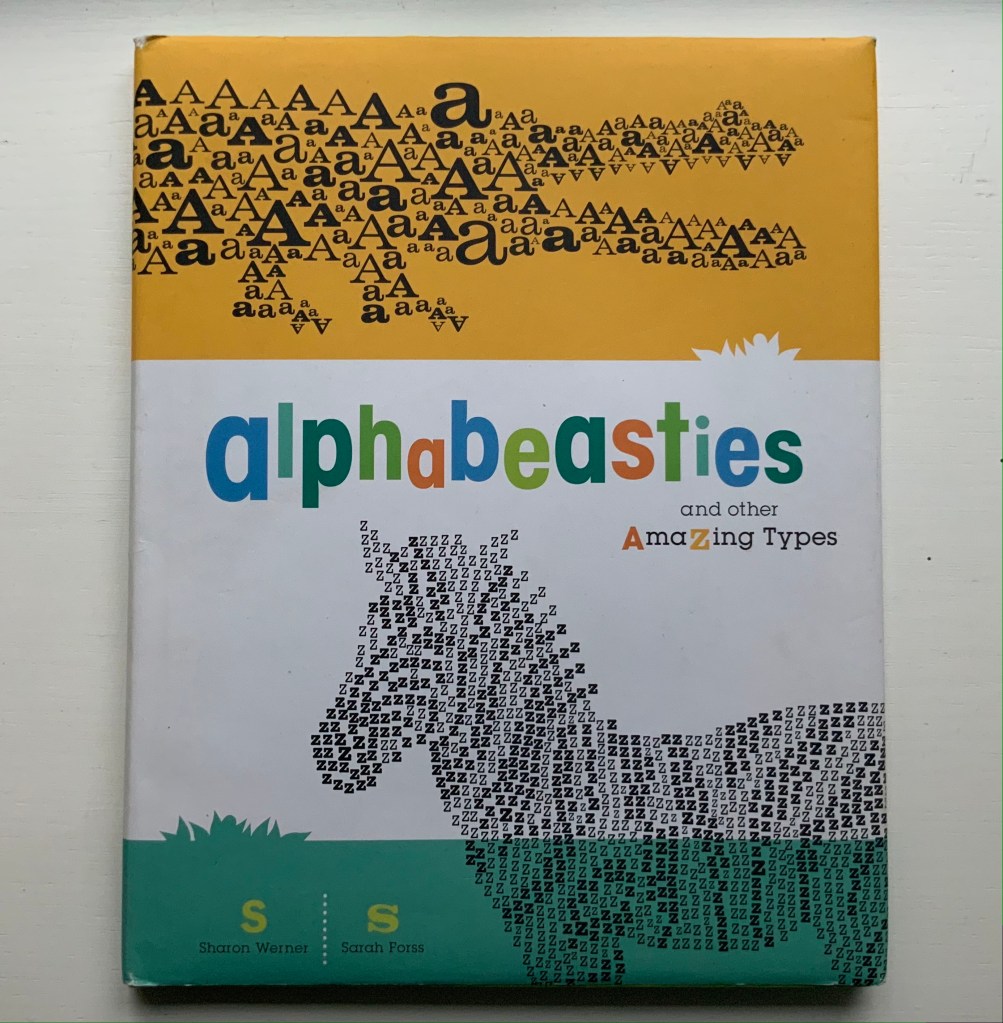
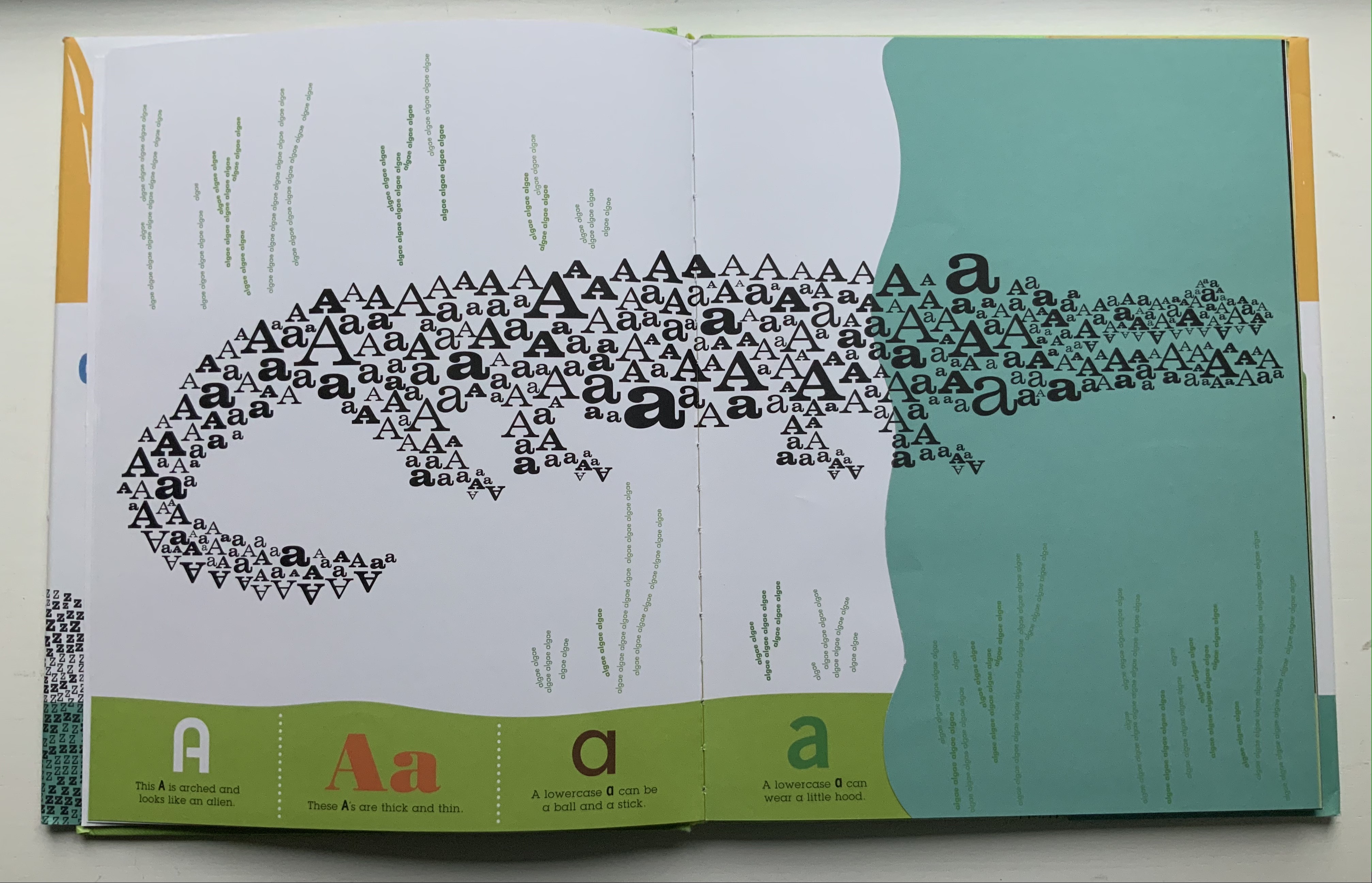
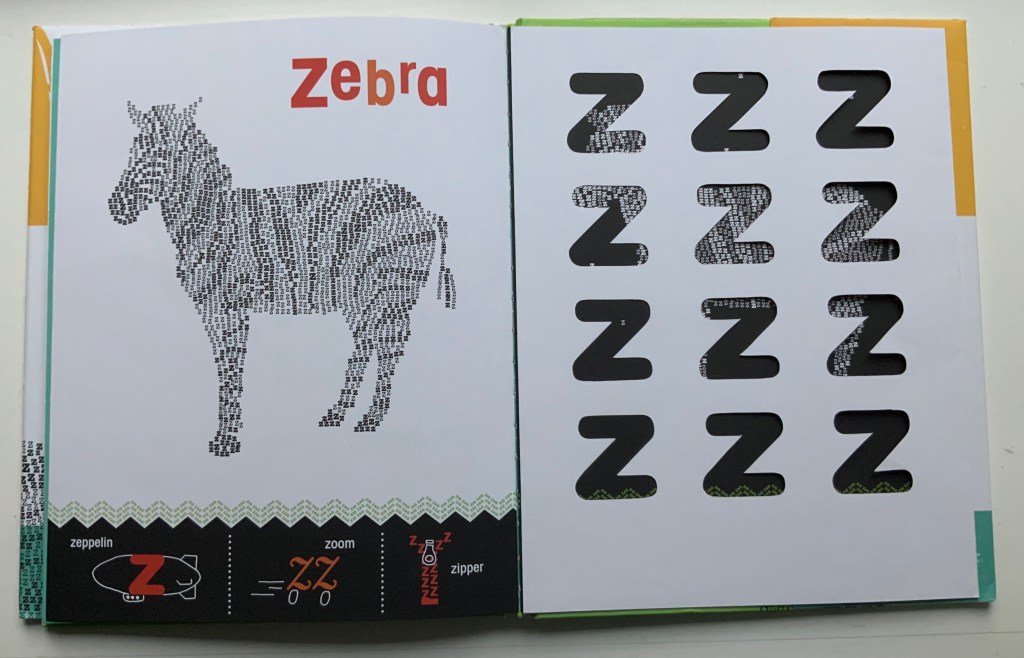
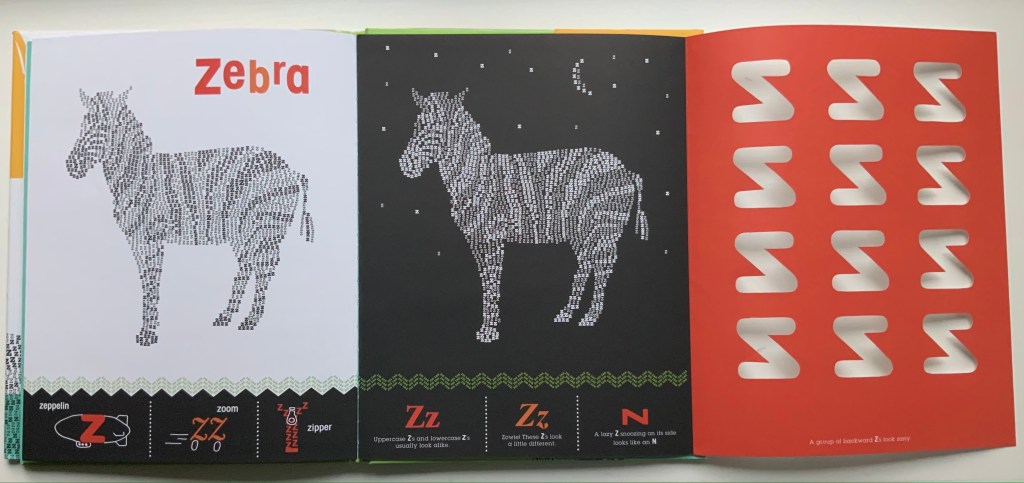
Unlike Roberto de Vicq de Cumptich’s Bembo’s Zoo (2000), this book relies on numerous type faces with which to create its alphabeasties, posed above the book’s illustratively shaped chiron that also provides the running information about “other amazing types”. Information is also conveyed from under flaps, through cutouts, across foldouts and by background images constructed of words.

Further Reading

Abecedaries I (in progress)“. Books On Books Collection.

Roberto de Vicq de Cumptich‘”. 12 February 2021. Books On Books Collection.

Books On Books Collection – Martín Gubbins

Alfabeto (2017)

Alfabeto (2017)
Martín Gubbins
Hardback. 180 x 180 mm. 60 pages. Acquired from Naranja Publicaciones, 28 July 2022.
Photos: Books On Books Collection.

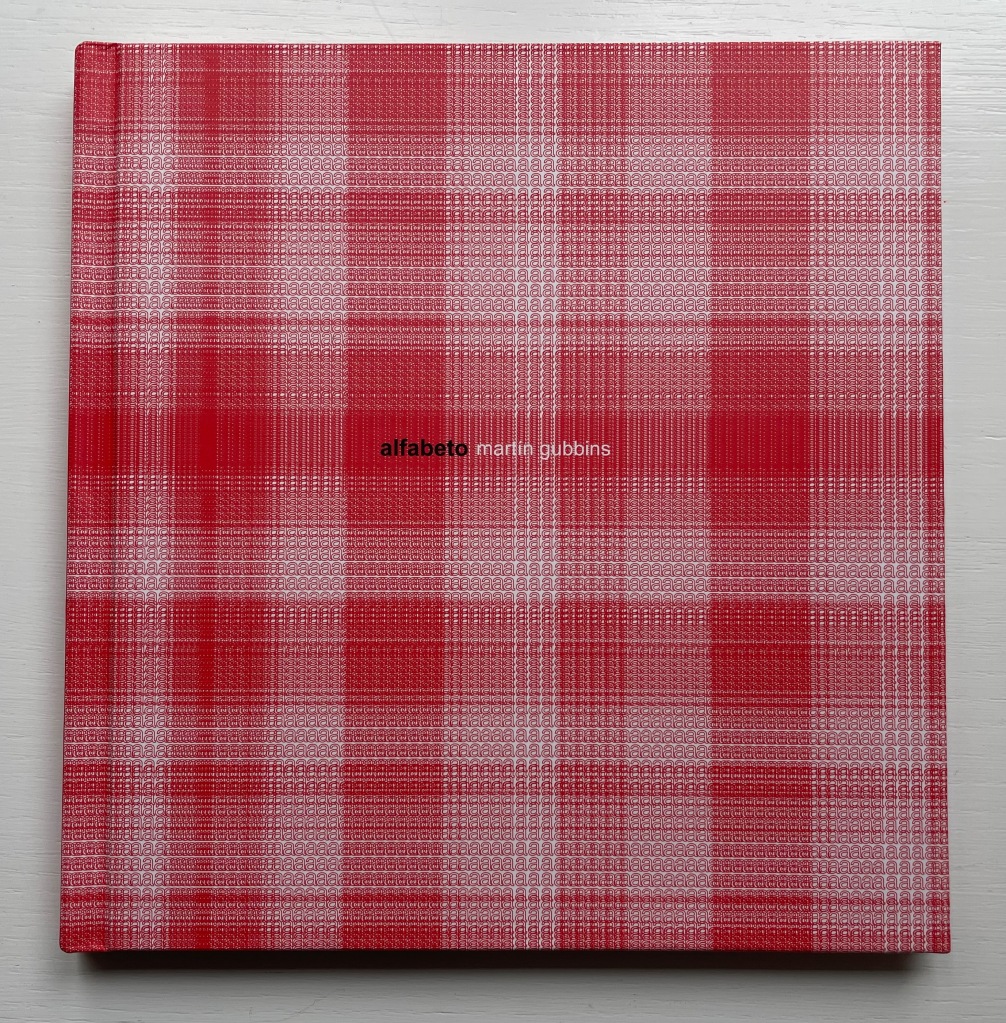
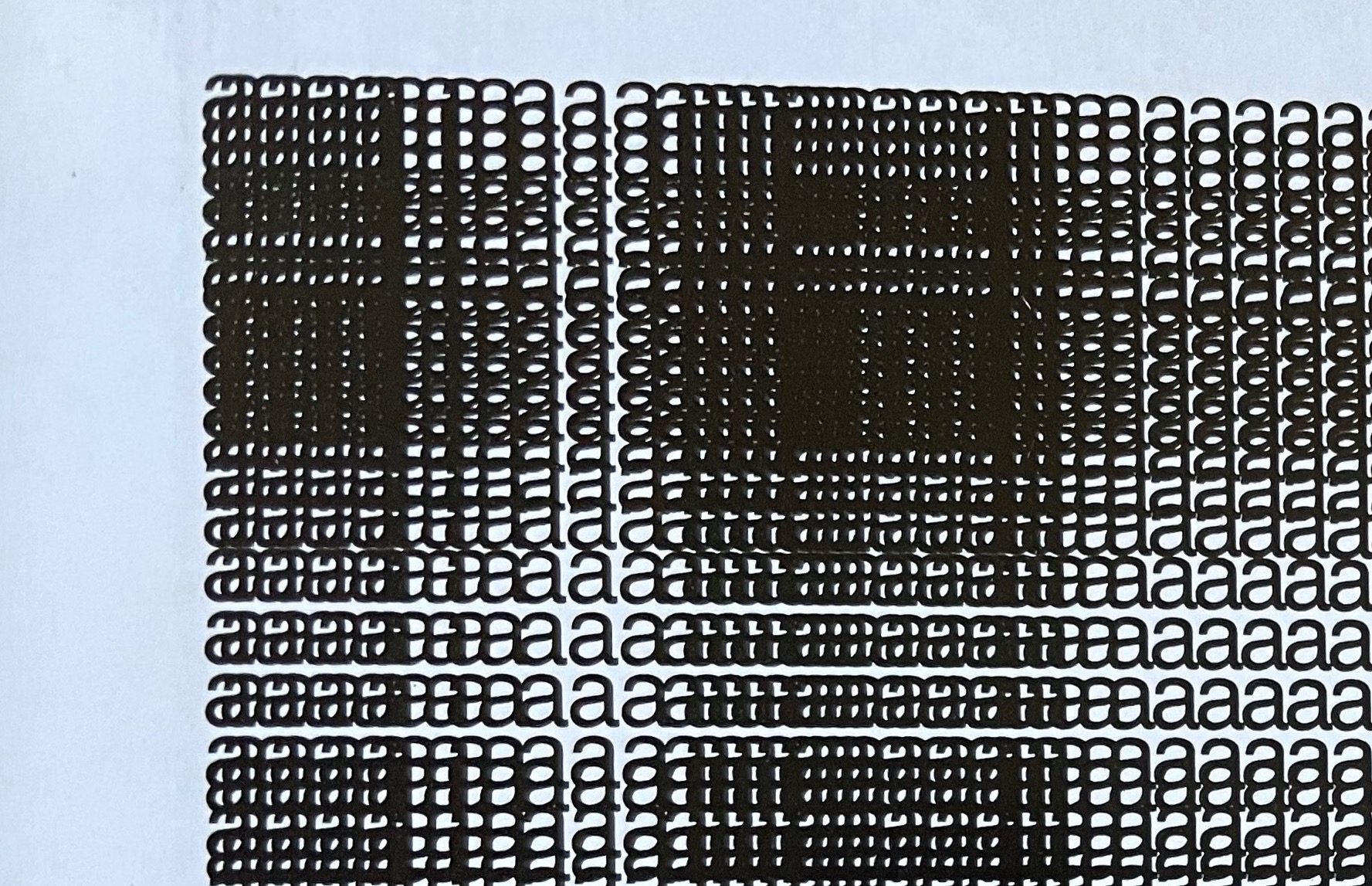
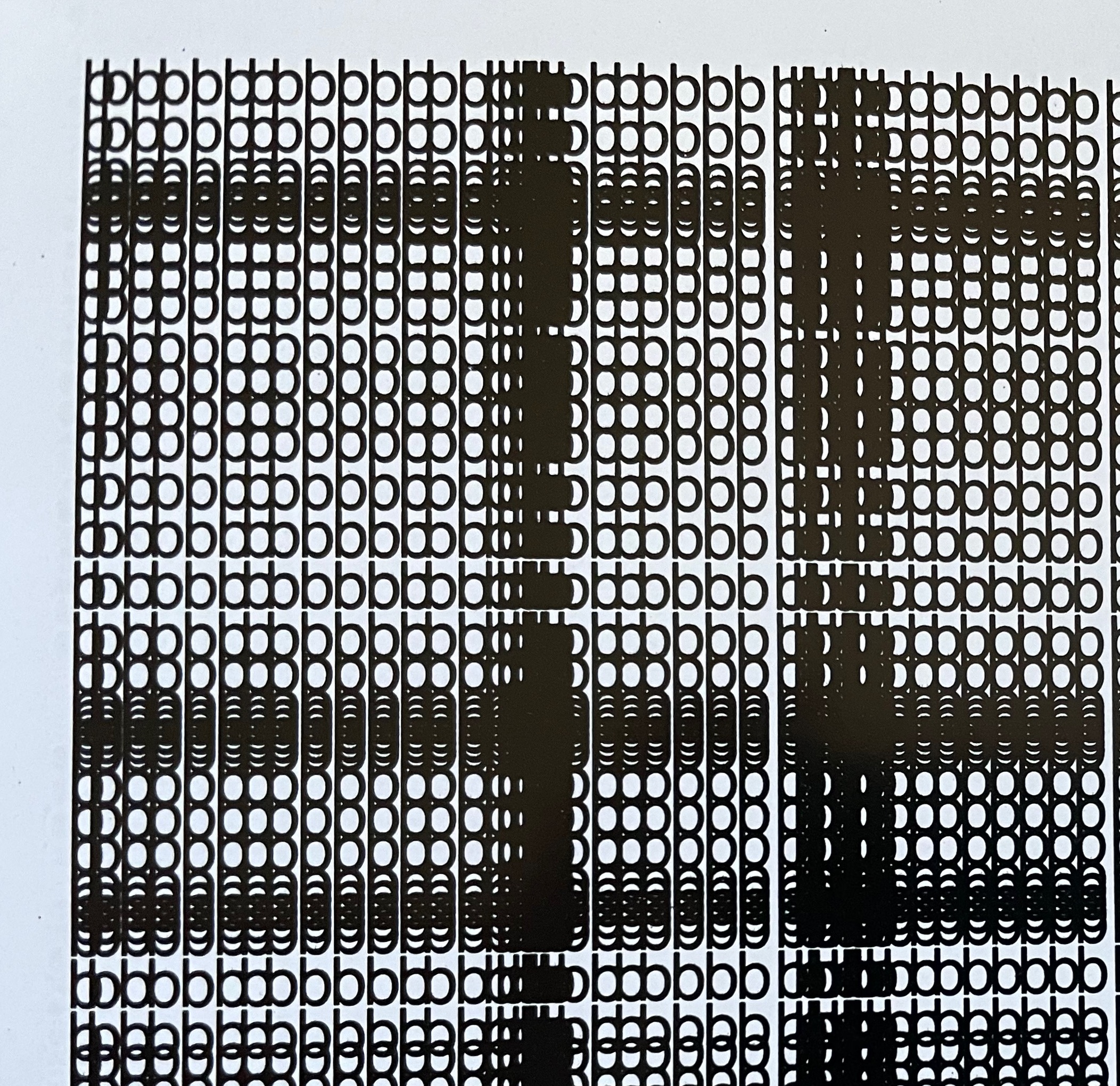
Each letter of the Spanish alphabet is printed in sans serif across a full page to create a grid-like or plaid-like pattern. All letters are printed once in black on white paper and twice in white on black paper; with sheets facing one another. For the English-speaking reader, that’s a bonus of two pages for the ñ.

Held at normal reading length, the double-page spreads do have a plaid effect, but inspected closely, the effect becomes that of wire mesh from which the letters leap out from the less tightly woven spots.

Unsurprisingly the plaids are as distinct from, and similar to, one another as letter shapes are. Sometimes, as with the letter b, an illusion of three dimensionality takes hold.

The most surprising — though they should not be — are the letters i and l. With no crossbar, bowl or curve, they cannot create a plaid pattern. Rather, their black on white, white on black patterns look like barcodes.
Gubbins One of the founding members of the Foro de Escritores (www.fde.cl) Chilean version of Bob Cobbing’s Writers Forum in London, and noted figure in the avant-garde poetry scene in Latin America. Gubbins has collaborated with the American poet and artist John M. Bennett, in whose honor

Some visual artists call this kind of work a “tapuscript“. Some throw it together under the heading of language art or concrete or visual poetry. Karl Kempton prefers the term “visual text art” over any other. Conceding the term to cover the broad genre, works like Alfabeto that cover the entire alphabet in sequence — or even play with its sequence — might deserve the sub generic term “visual alphabet art”. Kempton himself, Roberto de Vicq de Cumptich, Raffaella della Olga, Sharon Werner & Sharon Forss — as well as many of the artists in Victoria Bean and Chris McCabe’s anthology and those in Philip Davenport’s — surely provide a sufficient number of examples.

Further Reading

Bean, Victoria, and Chris McCabe. 2016. The new concrete: visual poetry in the 21st century. London: Hayward Publishing.

Davenport, Philip. 2013. The dark would: anthology of language art. Manchester-Berlin: Apple Pie Editions.

Kempton, Karl. 2018. A History of Visual Text Art. Manchester-Berlin: Apple Pie Editions. Accessed 15 December 2020.

Olga, Raffaella della“. Books On Books Collection. For “tapuscript”.