Books On Books Collection – Gennady Spirin

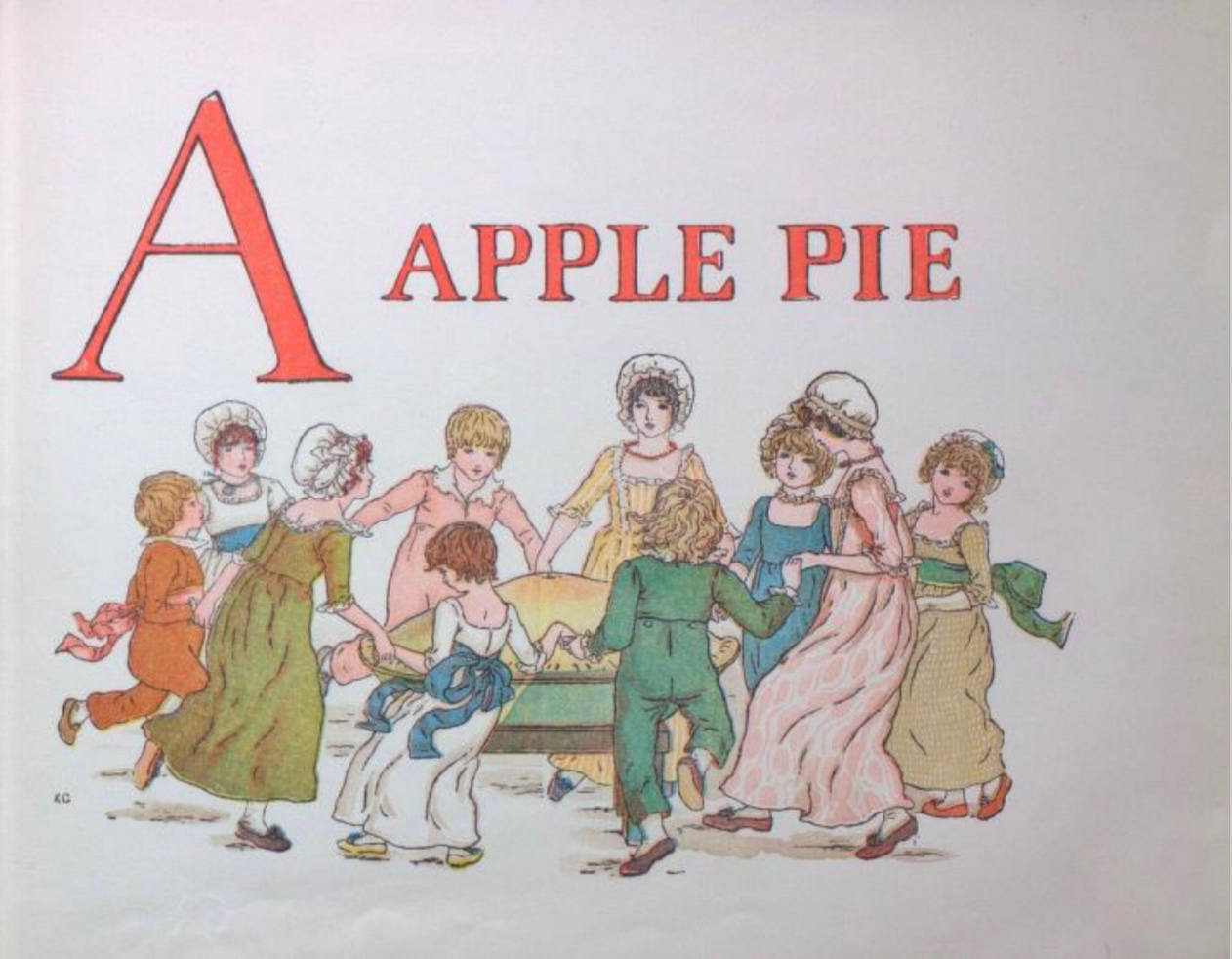
A Apple Pie (2005)

A Apple Pie (2005)
Gennady Spirin
Casebound, laminated paper over boards, pastedown with matching endpapers, sewn. 275 x 275 mm. 32 pages. Acquired from Bud Plant & Hutchison Books, 13 March 2023.
Photos: Books On Books Collection. Displayed with permission of the artist.

“Never judge a book by its cover” does not mean “ignore the clues and promises there”. A laminated cover and lay-flat binding are not uncommon among children’s books. Nor is the spreading of an illustration across the back and front covers. What is unusual about Gennady Spirin’s A Apple Pie is how it uses them to offer clues and promises of the lesson this book offers beyond the lesson of the alphabet. It promises a lesson about perspective and the canvas of the book.

Look at how the back and front covers play with landscape perspective and the notion of the book as frame and canvas. The head of the spine interrupts the landscape to join the narrow orange frame that demarcates the edges of the landscape. All the same, the landscape’s hill of apples in the foreground overlaps the spine to descend into the landscape’s midground on the back cover, which deepens into a background of at least five levels like a medieval or Renaissance painting.

Another technique of perspective from those traditions is to place in the background things we know are large and in the foreground what we know is smaller. A temple or mansion behind, a mother and child or pie up front. These objects and figures often perform temporal double duty as in The Flight into Egypt, where the tiny workers misdirect the mass of Herod’s soldiers in the background while the Holy family looms large resting in the foreground. In Spirin’s illustration, the past apple-picking appears in the distance, and the resulting pie is near.
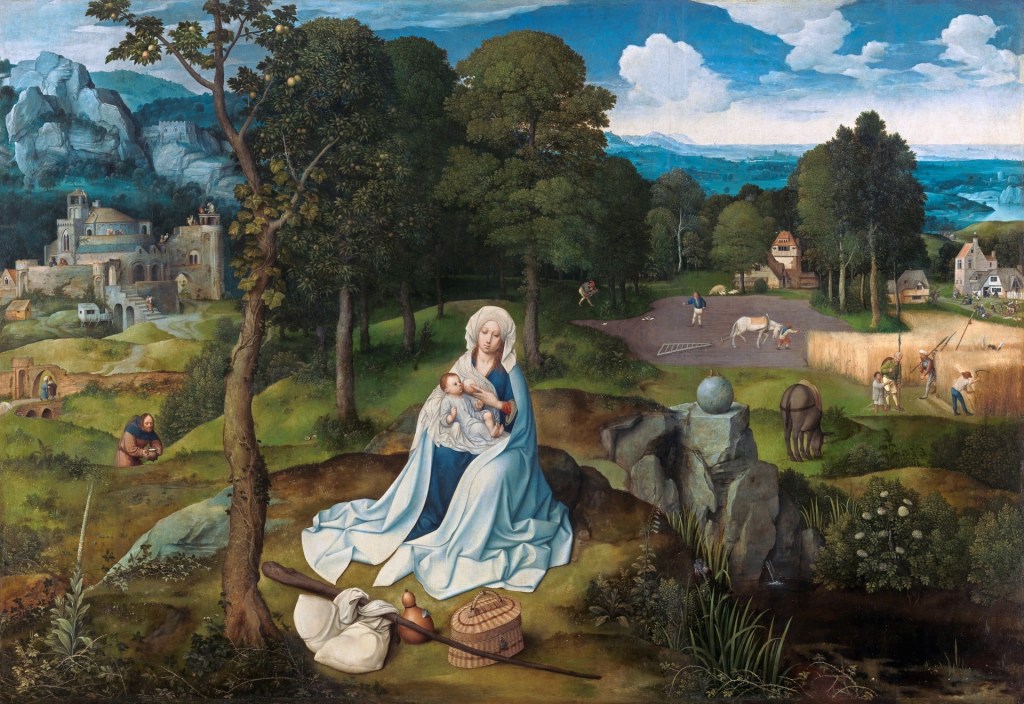
Rest on the Flight into Egypt (1518-20)
Joachim Patinir
Copyright ©Museo Nacional del Prado

Spirin slyly multiplies this trick with his apple pie in the foreground with its tiny characters dancing around it. Yes, this book is going to replay the traditional celebration of the apple pie alphabet, but pay attention to relative sizes. The pie is monumental, larger even than the three-dimensional letter A that sits atop and casts its shadow over the banner of calligraphy, so watch for how the trick of shadows draws attention to perspective, to the roman vs calligraphic letters and to the surfaces on which the letters and tricks of perspective play out.

The very first double-page spread delivers on the cover’s clues and promises.

The oversized carved A serves as an arch to provide an example of a word beginning with A and casts its shadow over the oversized pie and cutting board that a team of elf-sized bakers has borne under it to the applause of mother and children who are mid-sized between the pie and bakers. The A is so oversized that its apex disappears from the image area. Bringing further attention to the image area and deepening its dimensionality, Spirin “cuts” the surface on which it is drawn and curls the cut section against the arm of the A.

In the world of letters, size matters — in the form of the upper and lower cases.

Further drawing attention to the art of illustrating the alphabet, not only does Spirin hand-draw examples of their forms in print and calligraphy, he leaves the guidelines for the base and x-height in place, eliminating them after (or before?) using them as the measure for the base and crust of a miniature pie in the margin. In a sense, the process of lettering has also become the canvas for A Apple Pie.

This process is displayed for every letter. Most also have a small apple vignette in the lower left or lower right corner.
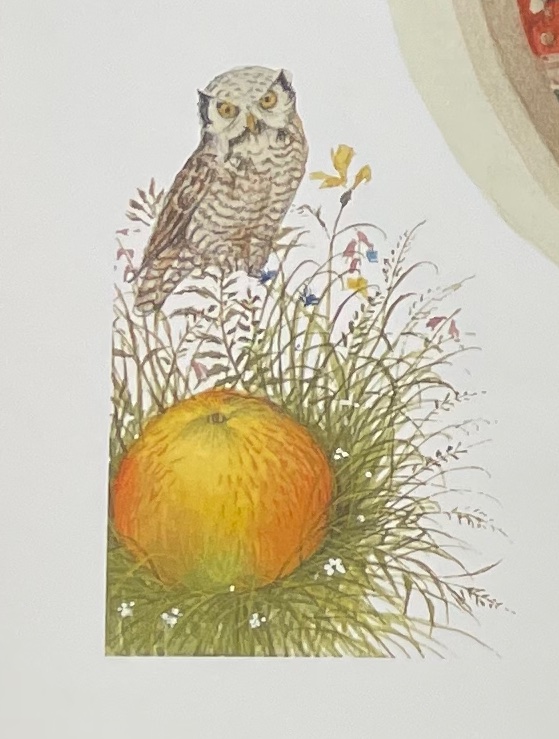
As with the ants surrounding the apple, most of these vignettes serve up images that begin with the letters of their pages (for example, O for owl and P for pig) and are trimmed to re-emphasize the pages’ image space with which Spirin plays.

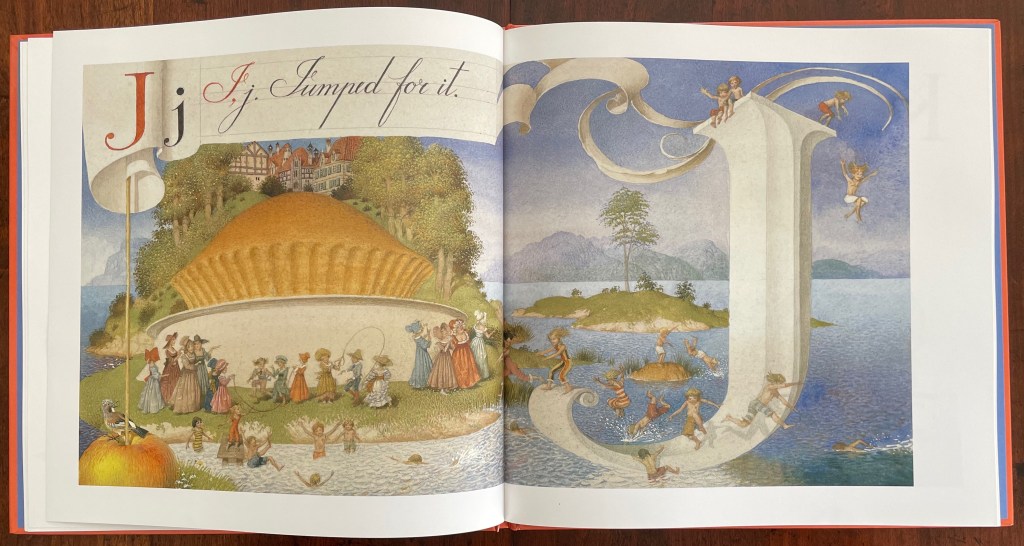
Letters other than A have images that cross the divide of pages. When they do, Spirin’s historical influences ranging from the medieval to the Renaissance to the Victorians stand out even more. His play with figures, color, perspective and shadow in the letter J pages recall Brueghel, Bosch, Patinir and, of course, Kate Greenaway.
Detail from Children’s Games (1560), Jan Brueghel, Kunsthistoriches Museum Wien
Detail from Garden of Earthly Delights (1490-1500), Hieronymus Bosch, Museo del Prado
A Apple Pie (c. 1886), Kate Greenaway, Internet Archive

The tradition of the “apple pie” mnemonic reaches almost as far back as the artistic ones. As noted on Spirin’s copyright page and confirmed in Peter Hunt’s International Companion, alphabet primers based on the mnemonic must have been well known prior to 1671 when the English cleric John Eachard  referred to it. Compiled from the Bodleian Libraries’ record of “apple pie” items in the Opie Collection and from preparation for the exhibition Alphabets Alive!, here is a starting list for the industrious apple-picking artist interested in confecting an extension to the tradition. (Suggested additions to the menu are welcome in the Comments.) Scholarly baker’s apprentices should also start with the dissertation of the appropriately named A. Robin Hoffman (now at the Art Institute of Chicago); see Further Reading below.

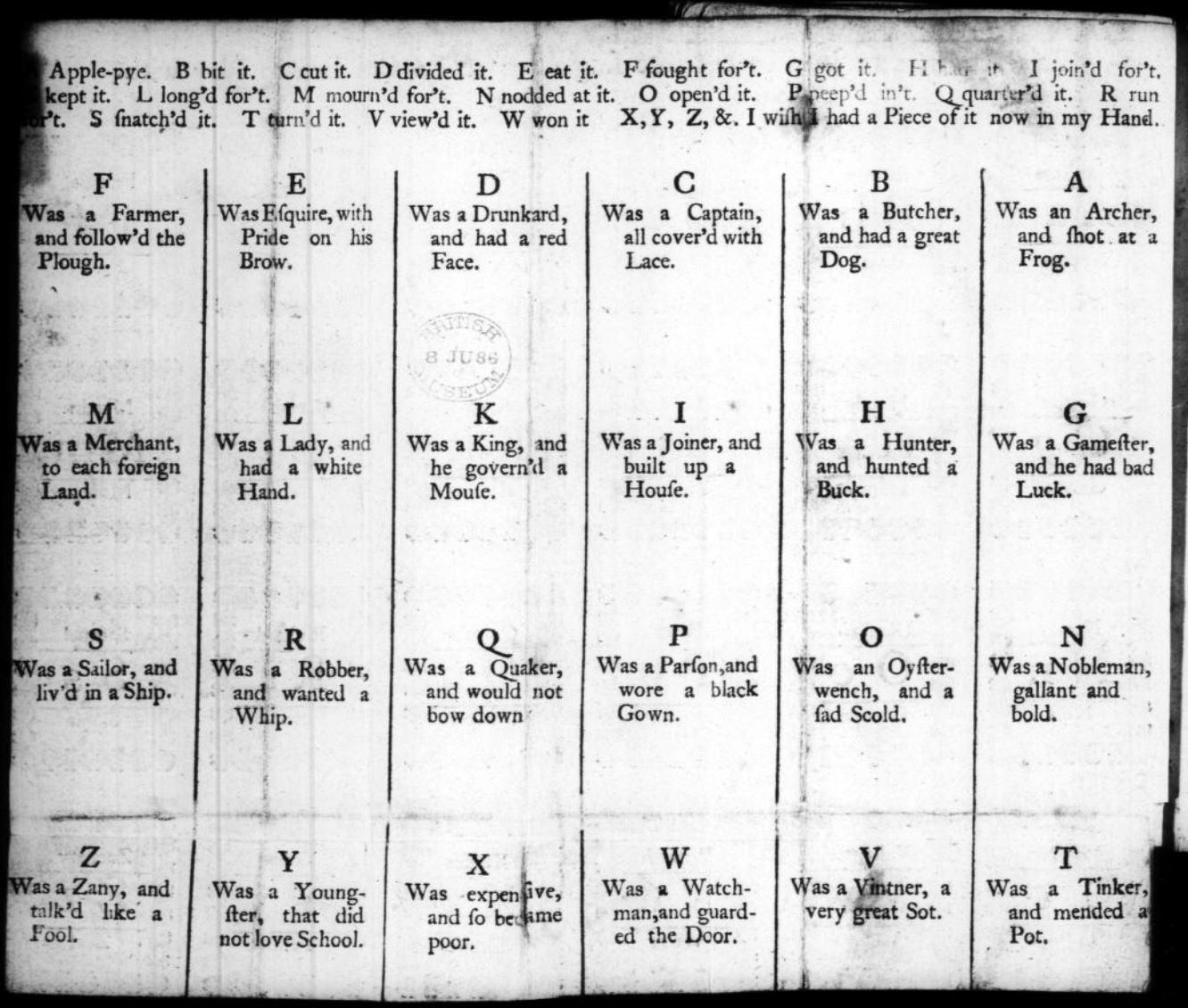
1743. The child’s new play-thing : being a spelling-book intended to make the learning to read, a diversion instead of a task. consisting of scripture-histories, fables, stories, moral and religious precepts, proverbs, songs, riddles, dialogues, &c. the whole adapted to the capacities of children, … or for children before they go to school. London: Mary Cooper.

British Library (formerly British Museum)

1764. Tom thumb’s play-book : to teach children their letters as soon as they can speak. London. Contains “A Apple Pie” as well as “A was an Archer“.

1791. The tragical death of a apple-pye : who was cut in pieces and eat by twenty five gentlemen : with whom all little people ought to be very well acquainted. London: J. Evans. Internet Archive.

1800-12. The Tragical Death of a Apple-Pye, Who Was Cut in Pieces and Eat by Twenty Five Gentlemen with
Whom All Little People Ought to Be Well Acquainted
.
London: Printed for John Evans, 42, Long-lane, West-Smithfield. Folded sheet, as issued. 9.5 x 5.9 cm. Opie N 589.

1808. The History of the Apple Pie. Written by Z. London: John Harris and Son. Opie C 1152. Also viewable here.

1815. The History of Master Watkins : To Which Is Added, The Tragical Death of an Apple-Pie. Chelmsford: Marsden, printer. Opie N 887.

1820. Hone, W. & Cruikshank, G. The Political “A Apple Pie” … by the Author of “The House that Jack Built”. Sixth ed. London: Printed for the Author; sold by J. Johnston. Johnson e.1111.

1820, ca. The History of an Apple-Pie. Written by Z. London: Harris and Son. 17.3 x 10.5 cm. Opie N 582.

1827. The History of A Apple Pie. Written by Z. London: Orlando Hodgson.

1835-57. Marks’ History of an Apple Pie. King Pippin’s Alphabet for Good Children. London: J. Marks.
17 x 10.2 cm. Opie N 588. Also view here.

1836. Bouncing B. The History of an Apple Pie. William Darton and Son.

1837-45. The History of an Apple Pie. London: Darton & Clark. 16 x 10.5 cm. Opie N 583.

1841. The tragical death of an apple pie : who was cut to pieces and eaten by twenty-five gentlemen with whom all little people ought to be acquainted. Printed by J. Paul & Co. London: 2 & 3 Monmouth-court. View here.

1843-49. The History of an Apple Pie; with Ditties for the Nursery, by Dame Dearlove’s Ditties. London: Grant and Griffith. 17.9 x 10.8 cm. Colophon of S & J. Bentley, Wilson, and Fley, Bangor House, Shoe Lane. Opie N 584.

1851-74. The Apple-Pie Alphabet. London: John and Charles Mozley, 6 Paternoster Row. 13.1 x 8.2 cm. Colophon of Henry Mozley and Sons, Derby. This title number 26 in the publisher’s series of penny chapbooks. Opie N 580. See also Opie N 581.

1856-65. The History of an Apple Pie. Written by Z. London: Griffith and Farran. 17.6 x 11.5 cm. Reissue as a rag book of the 1820 edition published by J. Harris. Wrappers have the colophon of H.W. Hutchings, 63, Snow Hill, London. Opie N 585. See also Opie N 586 for larger version (18 x 19.8 cm). From the library of Roland Knaster.

1860, ca. The History of an Apple Pie. London: J. Bysh, 157 & 158 Albany Road, Old Kent Road. 13.6 x 10.7 cm. Opie N 587.

1860, not after. The Apple Pie. London: Darton & Co., 58 Holborn Hill. 25 x 17 cm. Darton’s Indestructible Elementary Children’s Books. Inscription dated 8 February 1860. Opie N 2. Also view here.

1861, not before. The History of A, Apple Pie. London: Dean & Son, Printers, Lithographers, and Book and Print
Publishers, 11, Ludgate Hill. 25 x 16.5 cm. (Dean’s Untearable Cloth Children’s Coloured Toy Books). Opie N 4.

1865, ca. A. Apple Pie. London: Frederick Warne & Co. 26.8 x 22.6 cm. Aunt Louisa’s London Toy Books. Colophon of Kronheim & Co. Opie N 1.

1865-89. The History of A Apple Pie. London: George Routledge & Sons. 31 x 25.2 cm. Rear wrapper has colophon of the lithographer L. van Leer & Co, Holland and 62 Ludgate Hill Opie N 5. Also see Pussy’s Picture Book. Opie N 1017.

1874. Routledge’s nursery album for children. London: George Routledge and Sons. A.

1886, ca. Kate Greenaway. A Apple Pie. London: George Routledge and Sons. Opie N 18. Also view here and here.

1890, ca. E.A. Cooke. The Story of A Apple Pie. London: R. E. King & Co.

1899. A.B.C. of the Apple Pie. Printed on linen. New York: McLouglin Bros. Viewable here.

19__, ca. A Apple Pie. An Alphabet from Modelled Designs by Mrs. Wm. Harbutt. Pen and Ink Drawings by Noel C. Harbutt A.R.C.A. London: Dean & Son, Ltd; Bathampton: W. Harbutt. Plasticine Works & Studio. 25.4 x 18.8 cm. Opie N 3.

1966. The Tragical Death of A. Apple Pie Who Was Cut in Pieces, and Eaten by Twenty-Six Little Villains.
[Whitstable, Kent: Ben Sands at his Shoestring Press]. Leporello. 11.5 x 13.4 cm. #185/225 copies. Gift of Roland Knaster. Opie N 590.

From the Bodleian Librairies’ copy of The Tragical Death … (1966)
Ben Sands
Photo: Books On Books.

1974. William Stobbs. A is an Apple Pie. London: The Bodley Head.

1986. Tracey Campbell Pearson. A Was an Apple Pie. London: Bodley Head.

1987. Gavin Bishop. A Apple Pie. Oxford University Press.

2011. Alison Murray. Apple Pie ABC. London: Orchard Books.

Further Reading

Alphabets Alive!“. 19 July 2023. Books On Books.

Hoffman, A. Robin. 2012. “‘Doubtful Characters’: Alphabet Books and Battles over Literacy in Nineteenth-Century British Print Culture“. Diss. University of Pittsburgh.

Hunt, Peter. 2004. International Companion Encyclopedia of Children’s Literature. 2nd ed. London: Routledge, p. 179.

Webb, Poul. 2017~ . “Alphabet Books — Parts 1-8” on Art & Artists. Google has designated this site “A Blog of Note”, well deserved for its historical breadth in examples, clarity of images and insight.
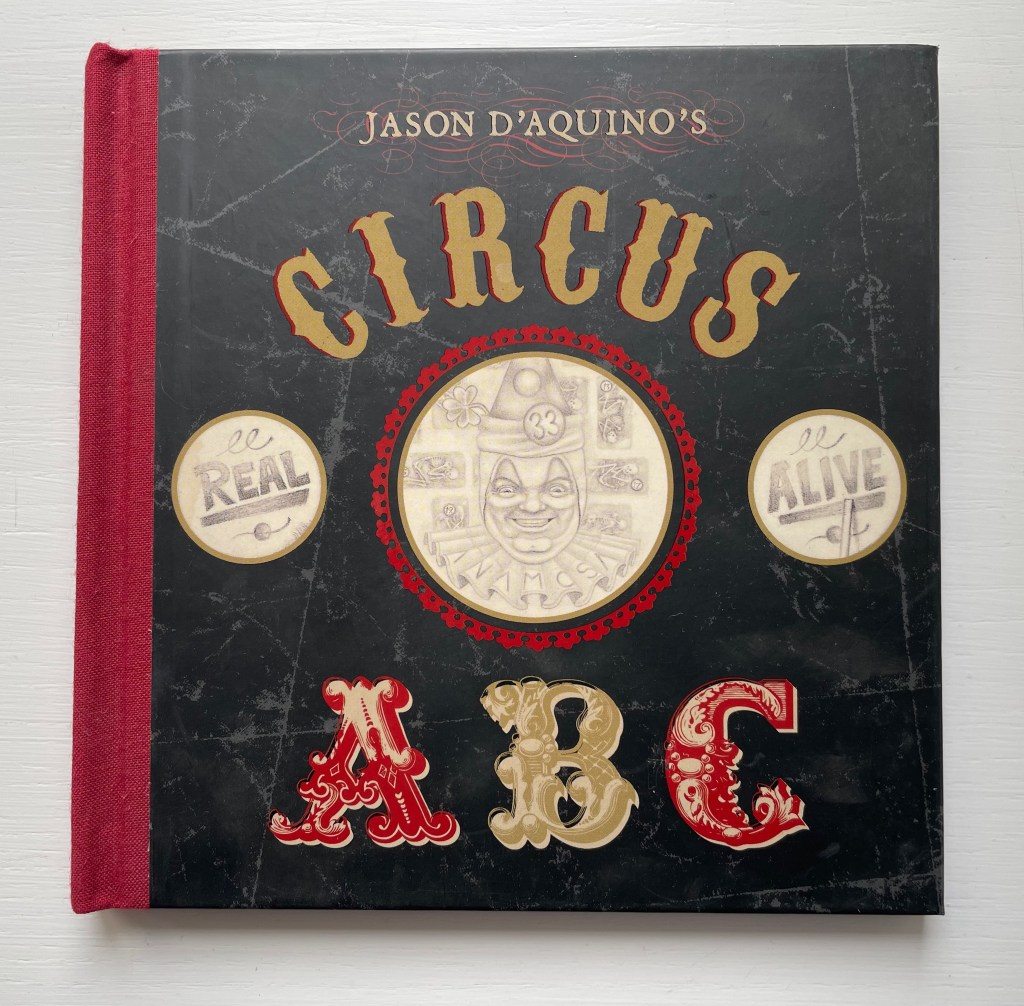
Books On Books Collection – Jason D’Aquino

Jason D’Aquino’s Circus ABC (2010)

Jason D’Aquino’s Circus ABC (2010)
Jason D’Aquino
Hardcover, cloth spine, printed paper over boards. H158 x W 158 mm. 56 pages. Acquired from Amazon, 24 September 2022.
Photos: Books On Books Collection

At the intersection of alphabet books and artists’ books, surrealists and neo-surrealists come sailing, unicycling, swimming, stilt-walking and crossbreeding. Jason D’Aquino distinguishes his contribution with a circus theme and miniaturist’s hand, although his publisher Simply Read Books expands it to 158 mm square (6 x 6 inches).

The illustrations are more R. Crumb than Max Ernst, and the letters themselves hark back to Jean Midolle’s Écritures Ánciennes D’après Des Manuscrits & Les Meillers Ouvrages (1834). But in concept and execution, Jason D’Aquino’s Circus ABC is original. The fineness of D’Aquino’s drawings fascinates the eye.

Jean Midolle, Alphabet Composée 1832. From Luc Devroye’s Type Design, Typography, Typefaces and Fonts, last updated 18 May 2023. Accessed 26 May 2023.

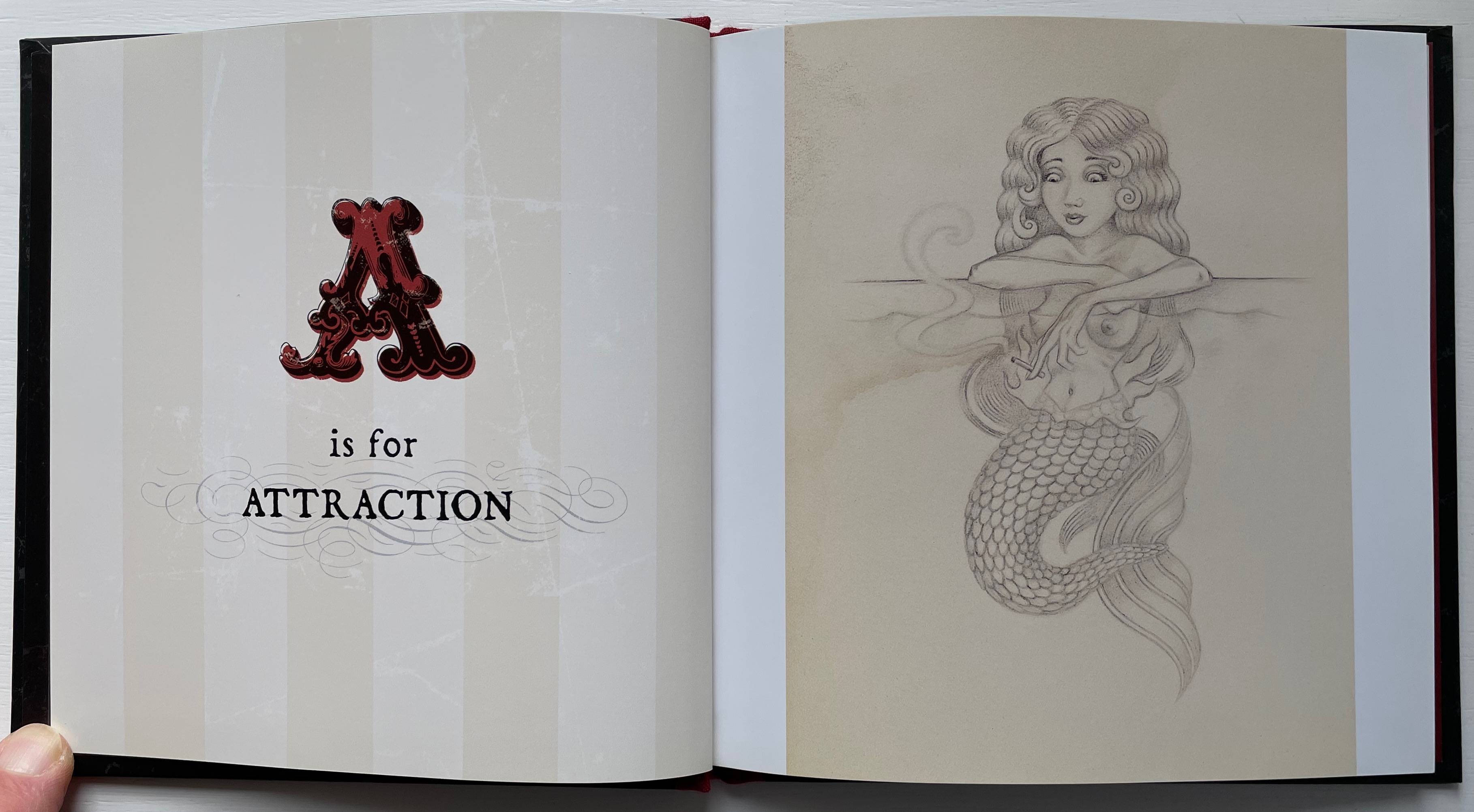
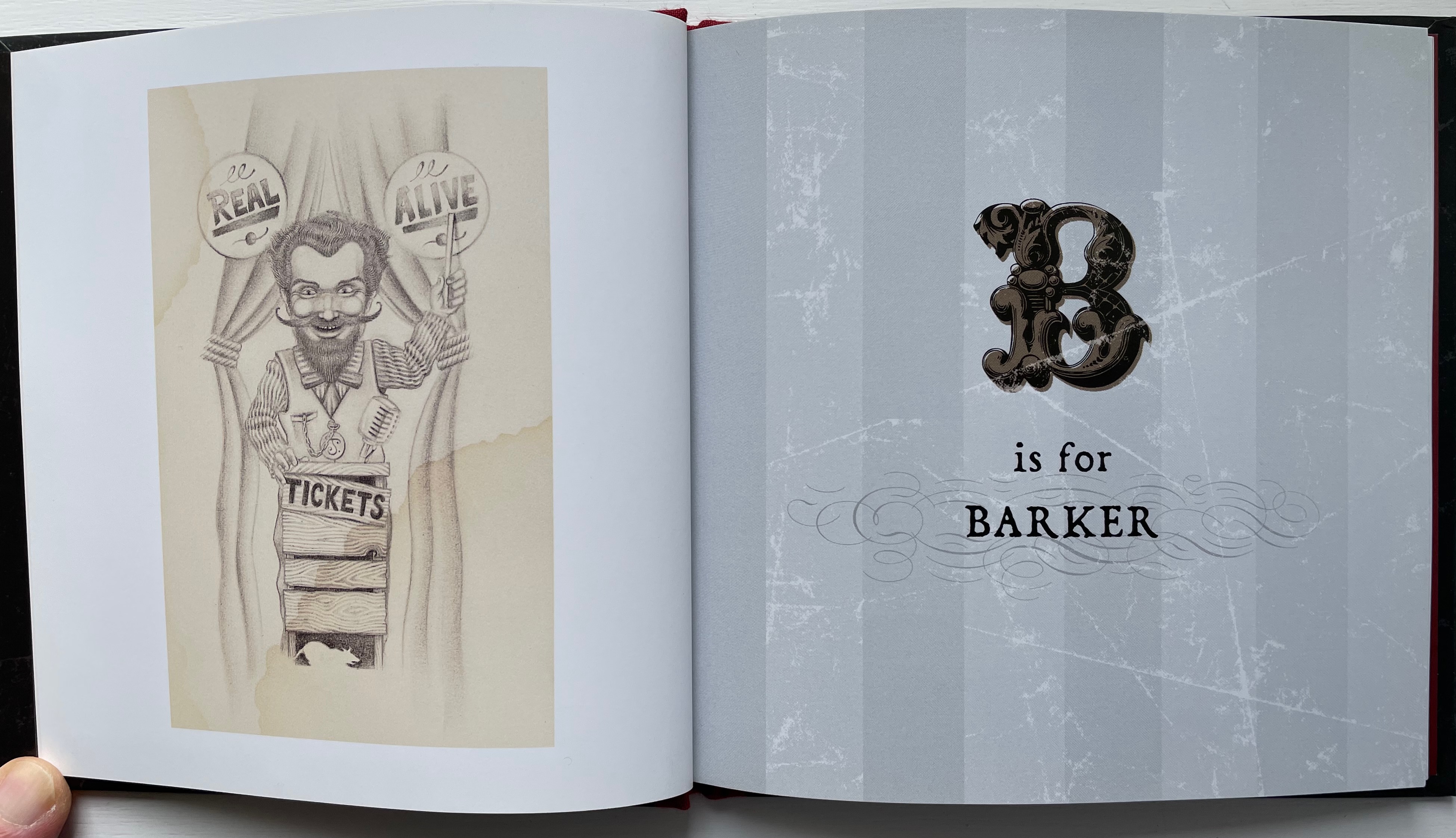
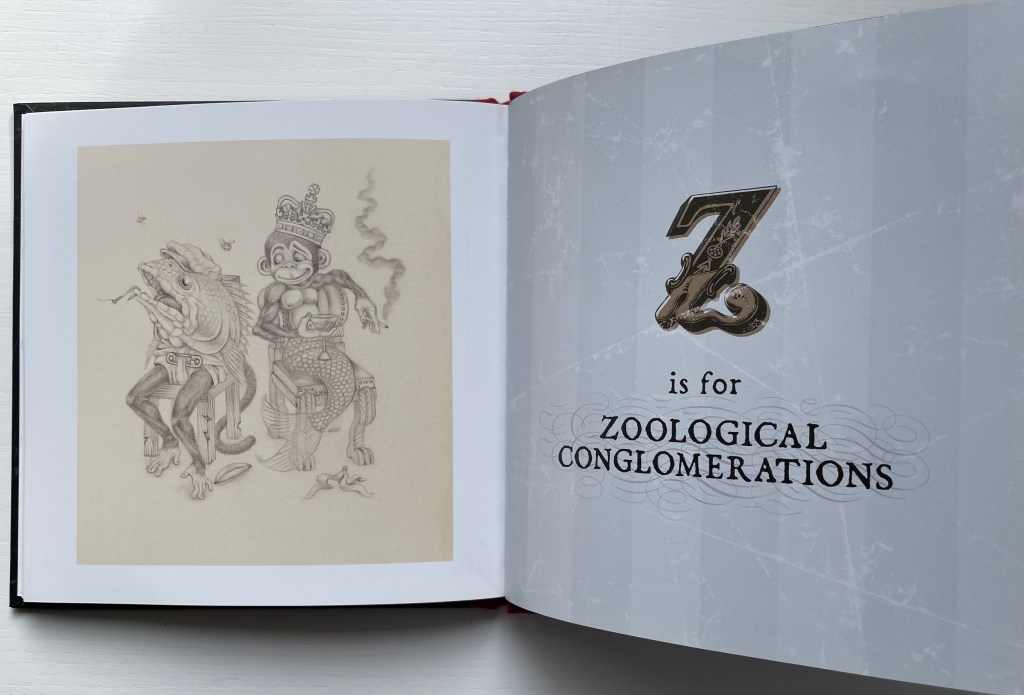
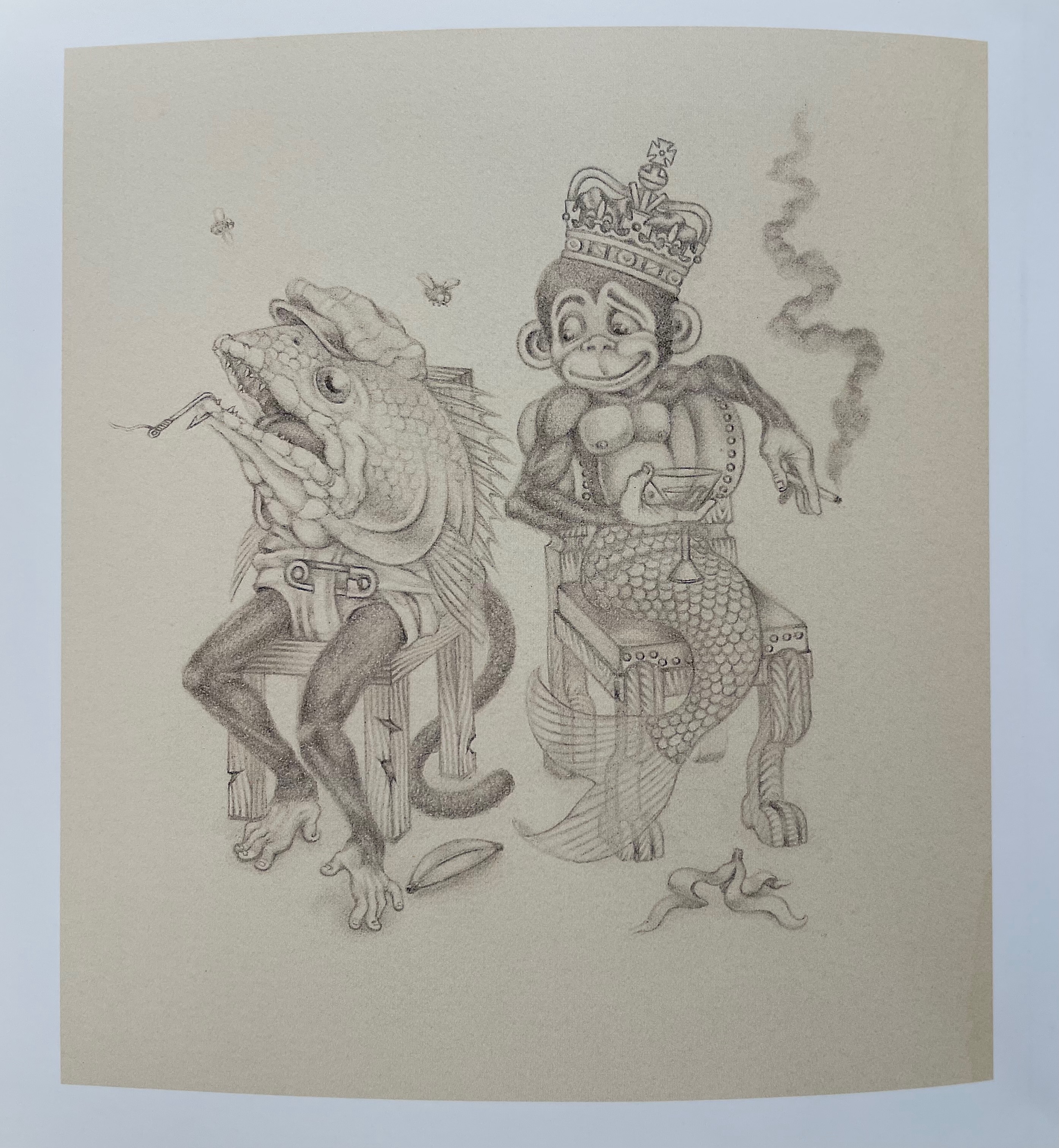
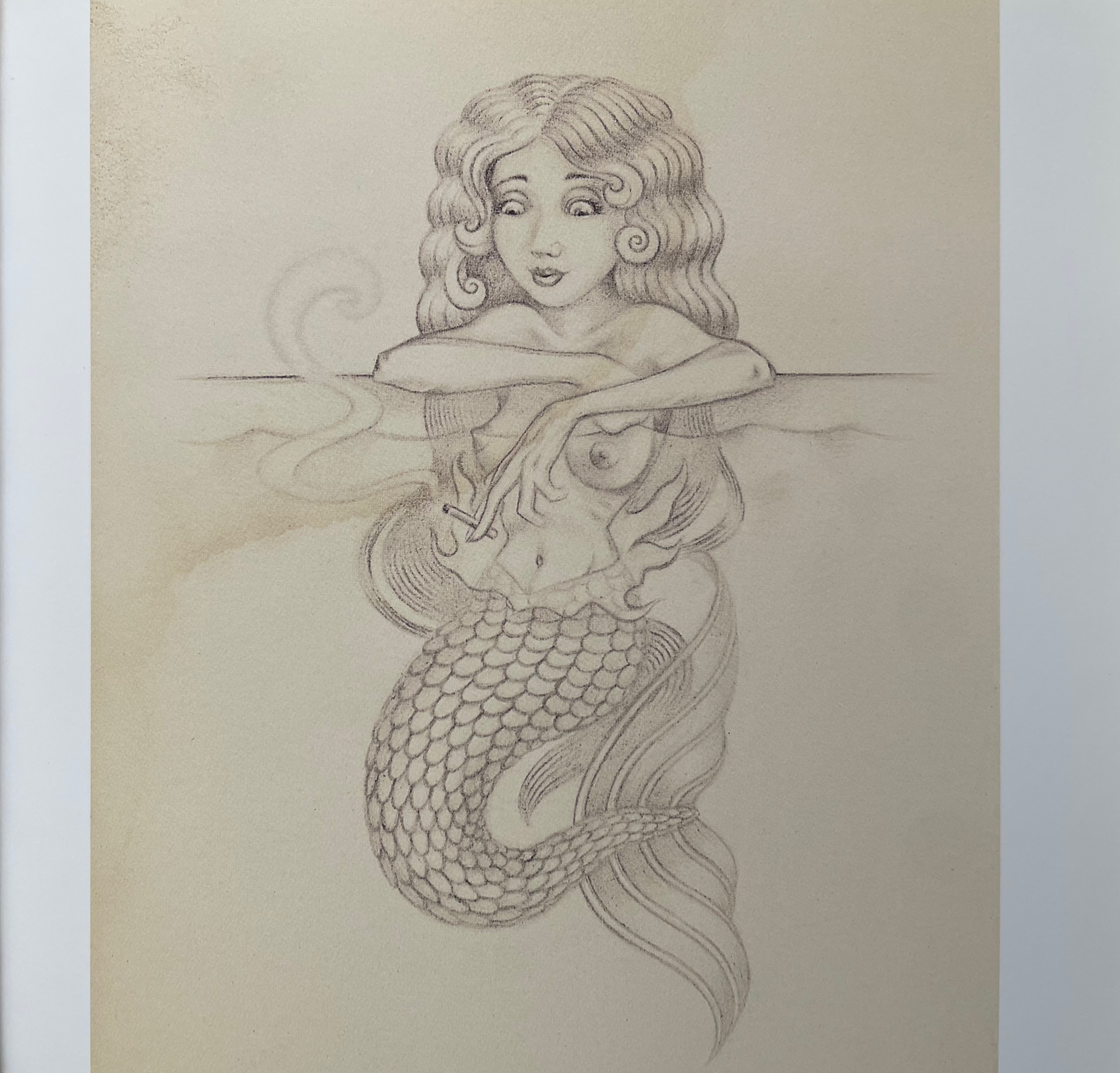
D’Aquino’s book is also eclectic in its abecedary approach. Above, where the illustration for the letter C offers several things beginning with that letter, those for A and B do not play the “find the object” game, although they do have their jokes. The mermaid’s is an optical illusion.The barker’s joke is that he is D’Aquino’s self-portrait. And with the letter Z below, for which nothing shown begins with the letter Z, the visual puzzle lies in figuring out what the crown, martini and cigarette have to do with the anatomical swap-out between the goldfish and chimp — and why the image so strongly echoes that for letter A.

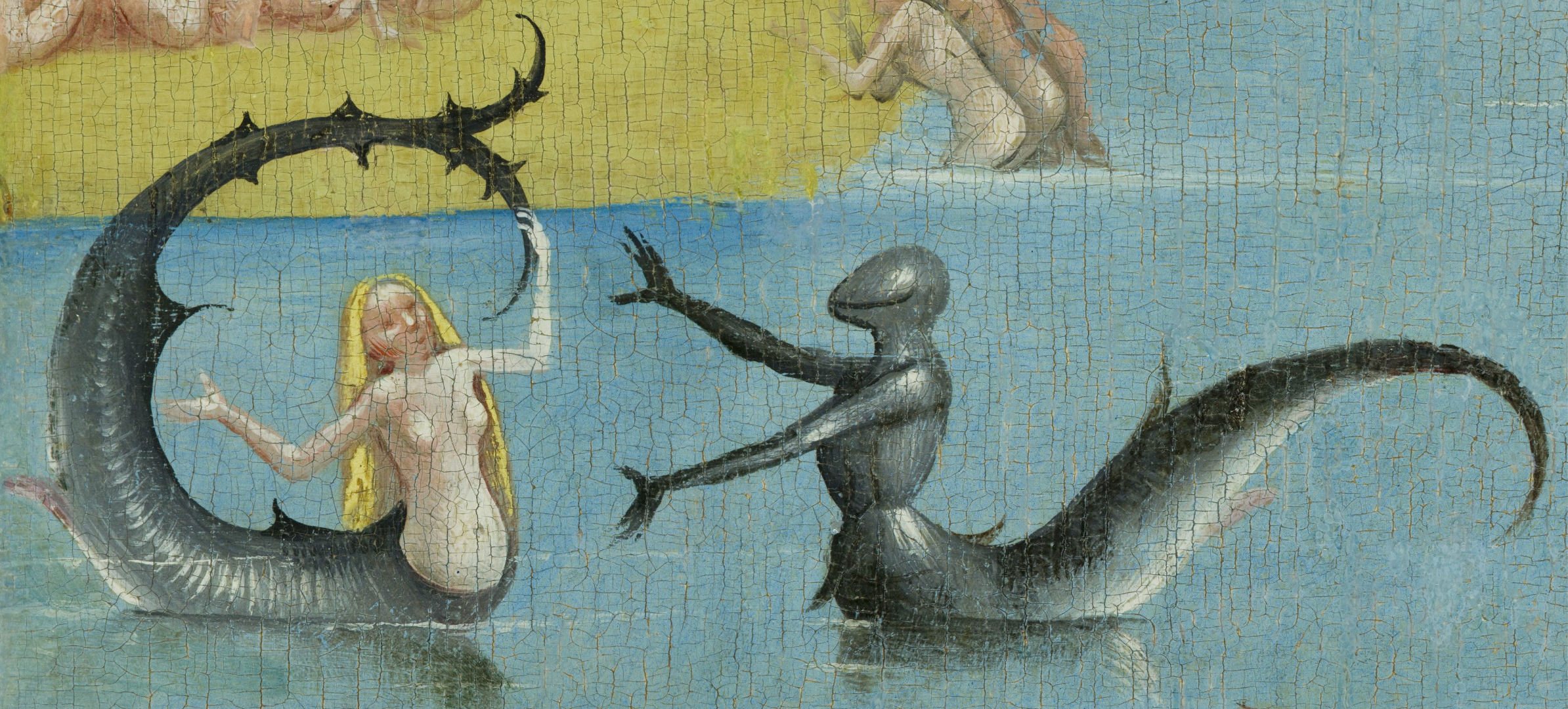
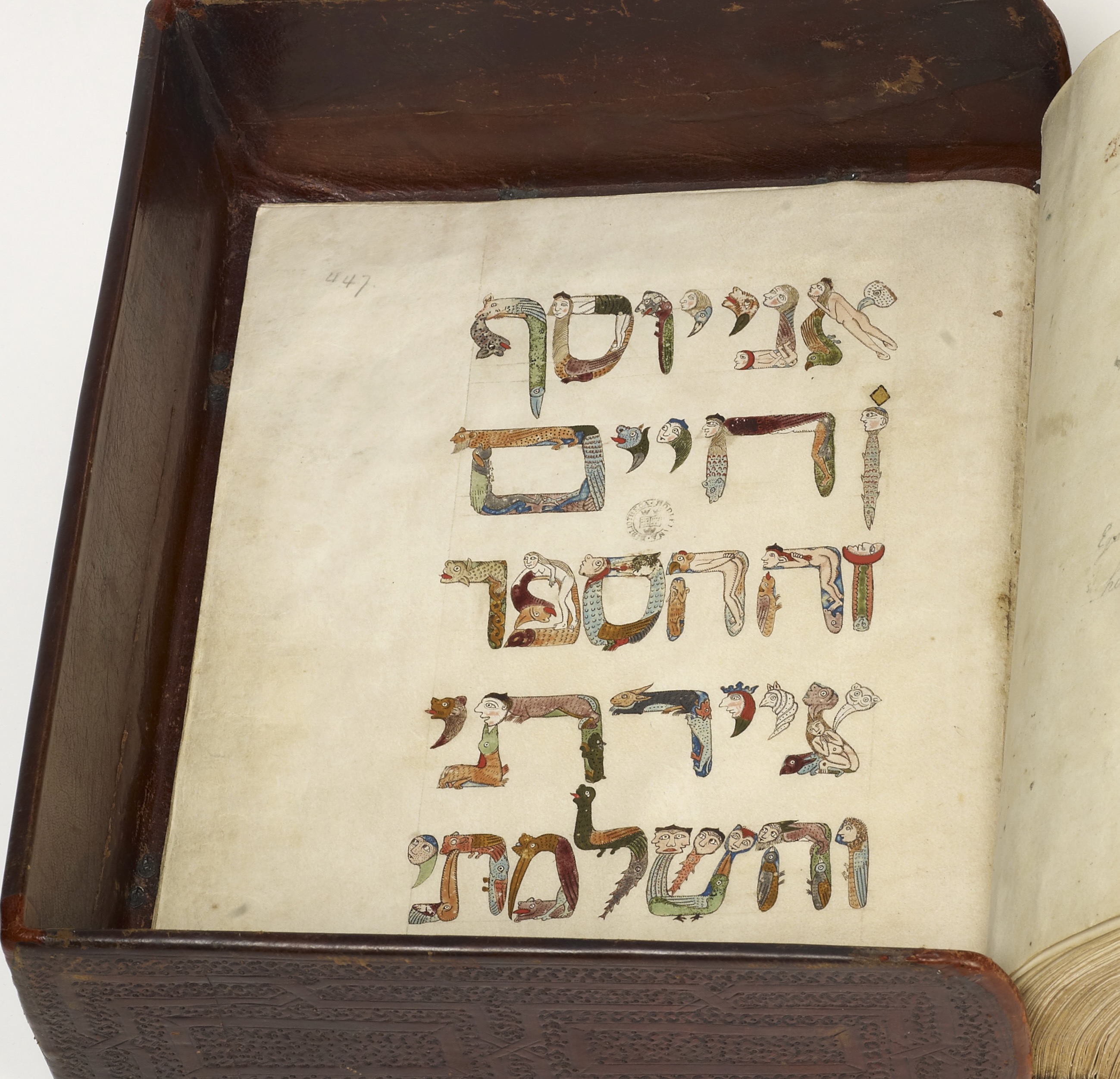
Surrealism has roots in the art of Hieronymus Bosch as well as in the fantastical alphabets of Jean Midolle and his medieval predecessors. Not surprising then that elements of D’Aquino’s world can be found in the Garden of Earthly Delights and the Kennicott Bible. Other surrealist alphabets from the Books On Books Collection are listed below.

Above: Detail from Hieronymus Bosch, The Garden of Early Delights (1490-1510). Below: Hebrew Bible (Former Prophets with Targum and various commentaries), Bodleian Library MS. Kennicott 5, 446v.

Further Reading

Abecedaries I (in progress)“. Books On Books Collection.

Jim Avignon & Anja Lutz“. 29 October 2022. Books On Books Collection.

Leonard Brett“. 8 August 2023. Books On Books Collection.

Roman Cieślewicz“. Books On Books Collection. In progress.

Leslie Haines“. 4 November 2022. Books On Books Collection.

Lynn Hatzius“. 2 December 2022. Books On Books Collection.

Peter Hutchinson“. Books On Books Collection. In progress.

Peter Malutzki“. Books On Books Collection. In progress.

Clément Meriguet“. 13 November 2021. Books On Books Collection.

Paul Noble“. 20 April 2021. Books On Books Collection.

Judy Pelikan“. 2 June 2023. Books On Books Collection.

Rose Sanderson“. 30 May 2023. Books On Books Collection.

Pat Sweet“. 18 January 2023. Books On Books Collection.

Ludwig Zeller“. 24 March 2020. Books On Books Collection.

Druker, Elina, and Kümmerling-Meibauer, Bettina. 2015. Children’s Literature and the Avant-Garde. Amsterdam: John Benjamins Publishing Company. Especially Philip Nel’s “Surrealism for Children”, pp. 267-83.

Van Huijstee, Pieter, and NTR. 2016. Interactive Documentary, Jheronimus Bosch, The Garden of Earthly Delights. Amsterdam: Pieter van Huystee Film, NTR. Accessed 26 May 2023.

Books On Books Collection – Jacobus Oudyn (II)

Out of Breath (2019)

Out of Breath (2019)
Jacobus Oudyn
Hardboard slipcase covered in textured paper, housing stab-bound book with waxed paper cover, attached page lifter. Slipcase: Box: H345 x W232 x D50 mm. Book: H300 x W202 mm. 34 pages. Unique. Also acquired, Artist’s Proof: H205 x W165 mm. Both from the artist, 1 June 2023.
Photos: Books On Books Collection. Displayed with permission of the artist.

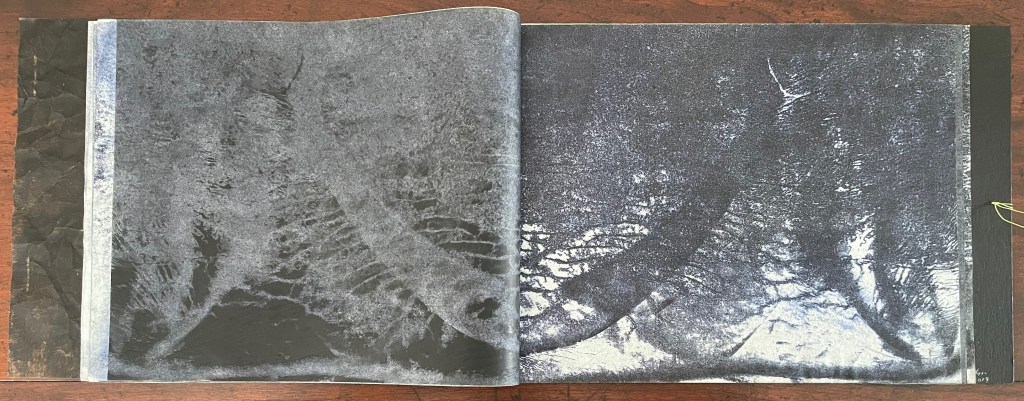
In turning the thirty-four pages of this artist’s book, your fingers, eyes and ears pick up a rhythm: a labored inward and crackling outward breath, a catching and losing grasp of air, an alternating wet, dry, wet wheezing. The effects come from the material (sounds and touch that the slippery, thin and delicate rice paper gives against the wrinkled carbon paper that continues to shed its carbon), from the technique of alternating positive and negative prints, and from the ticklish action of picking up the pages with the card lifter. It takes a long time to turn these pages.

The artist’s note accompanying the work describes it as being “for all our friends and relations who have been victims of Mesothelioma and other ‘industrial’ lung disorders like Black Lung”. Indeed, the double-page spreads’ bilateral symmetry and their blackness, grayness and whiteness recall chest X-rays. The process by which Oudyn achieves this is worth remarking.

In correspondence with Books On Books, the artist notes that the process emerged from much chance and circumstance. It began with rubbings made against charred trees after a bush fire near Tewantin in 2018. Those results prompted childhood memories of the kind of carbon paper he knew as a child. Wanting to explore its use, he found that it was no longer stocked by stationers in the region, no doubt because computers, printers and photocopiers had made it superfluous. An online search yielded some boxes of very fine thin A4 sheets of bluish black and purer black carbon paper from China. Around the same time, he had been experimenting with momigami using various papers, mainly rice paper and mulberry but also cartridge and craft paper. While making books with the carbon paper and momigami results, he had reason to iron some sheets flatter, which yielded a variety of carbon prints on the rice paper. Different temperatures, durations and pressures as well as other papers yielded a range of prints on paper but also beautiful positives on the fine carbon paper itself. Experimenting with different orders in the steps, rewrinkling before or after ironing, and further grading and sorting the papers, Oudyn gained some control over the finished result. Then came the ideas that led to Out of Breath and the following works.

Opening Dark Windows (2020)

Opening Dark Windows (2020)
Jacobus Oudyn
Slipcase. Japanese stab binding, endpapers and a small card page lifter attached by thread. H220 x W300 mm. 20 folios. Unique. Acquired from the artist, 1 June 2023.
Photos: Books On Books Collection. Displayed with permission of the artist.

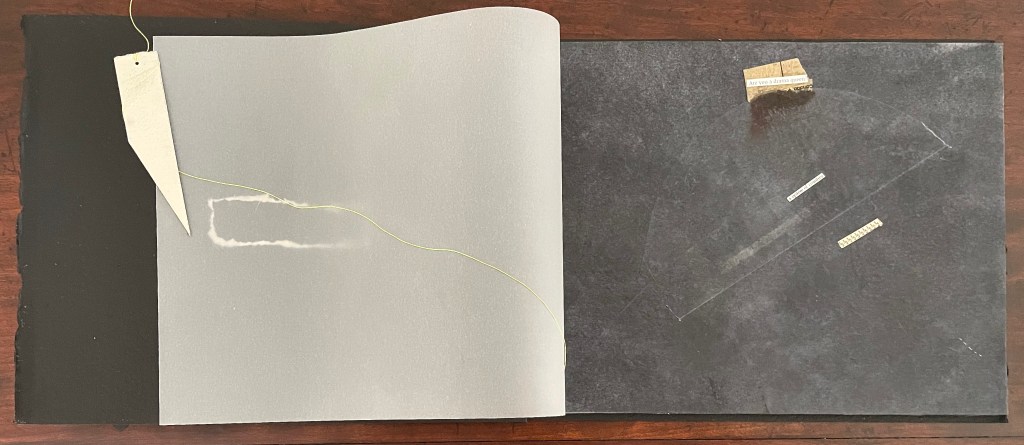
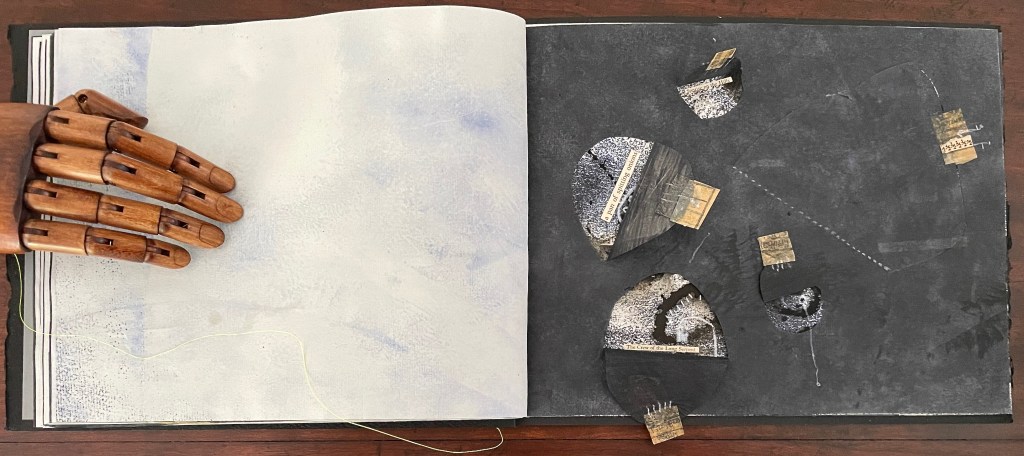
Opening Dark Windows has a variety of tactile sensations similar to those in Out of Breath. Both have covers generating an unusual sensation — a waxen flexible texture in Out of Breath, a dry rough stiff texture in Opening Dark Windows. Both alternate different weights of papers. Of the 20 folios in Opening Dark Windows, 10 are carbon tissue paper, 10 are cotton Ingres (108 gsm), and all show the experimentation described above. This work, however, also displays Oudyn’s characteristic use of multiple media and collage — black acrylic paint, white wax crayon, pva glue, graphite, inks and found text. Oudyn also adds further tactility with torn and cut flaps with their pull tabs. All of this is in service to an idea: an exploration of fading memory and the retrieval of material long thought forgotten, both of which are made interactive by the flaps (the physical “dark windows”) in the carbon tissue that reveal the collaged text, signs, fractions and drawings sometimes glued to or made on the underside of the tissue, sometimes on the underlying sheet of Ingres.

Texture and weight alternating from one layer to the next, textures juxtaposed as flaps peel away, truncated text expanding and changing as the page turns — this is mindscape as surreal scrapbook.

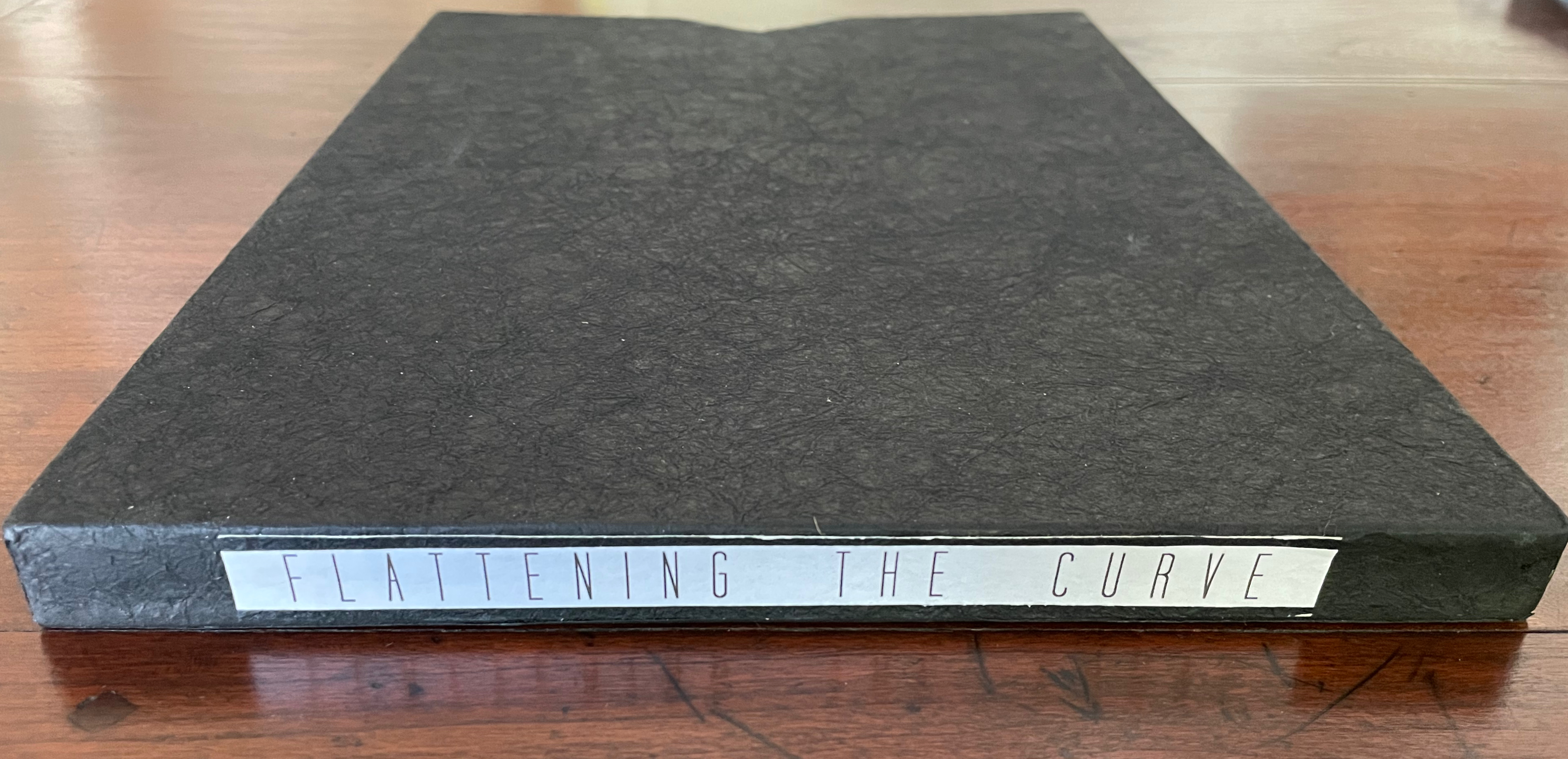
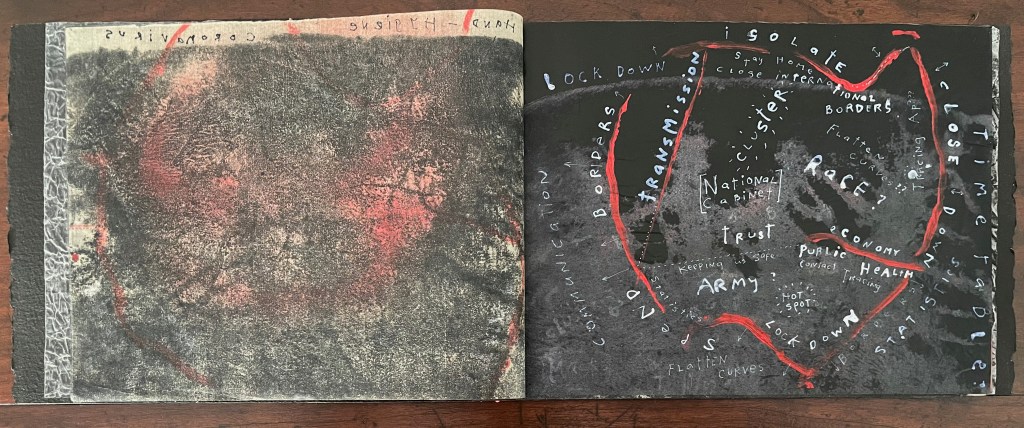
Flattening the Curve (2021)

Flattening the Curve (2021)
Jacobus Oudyn
Slipcase. Japanese stab binding.H210 x W300 mm. 24 folios. Unique. Acquired from the artist, 1 June 2023.
Photos: Books On Books Collection. Displayed with permission of the artist.

Like Out of Breath and Opening Dark Windows, Flattening the Curve (2021) uses the “swag” of black papers Oudyn had created. Although it is also a work of multiple media — the papers themselves, graphite and inks — the focus of Flattening the Curve rests more on a sort of narrative or documentary line showing how language changed as the Covid 19 pandemic progressed. A specific Covid language evolved as daily progress reports from political leaders and medical experts and interviews in the media became the focus of everyday life for two years. As the words on the page change reflecting their use for the purpose of authority and confidence, the seemingly fixed geographical boundaries in red break and shift. Even the height and width of the leaves shift.

M.L.A. (2021)

M.L.A. (2021)
Jacobus Oudyn
Softcover pamphlet-stitched, textured flyleaves. 18 sheets Chinese carbon paper, 18 sheets Chinese rice paper. Found text. H125 x W110 mm. 36 pages. Unique. Acquired from the artist, 1 June 2023.
Photos: Books On Books Collection. Displayed with permission of the artist.

Obviously from the works above, Oudyn deploys his set of tools, techniques and material imaginatively, but for this satiric portrait of a flip-flopping Member of the Legislative Assembly in Australia, the subject himself seems to have selected unwittingly the overprinting from carbon paper onto rice paper. Every turn presents a reversal.

Even beneath the reversals, his previous faces to the world accumulate and peek out slightly askew from “today’s” view until at the end you can hardly tell what view would be next. To which the M.L.A would reply, does reply, “Yes, why not?”

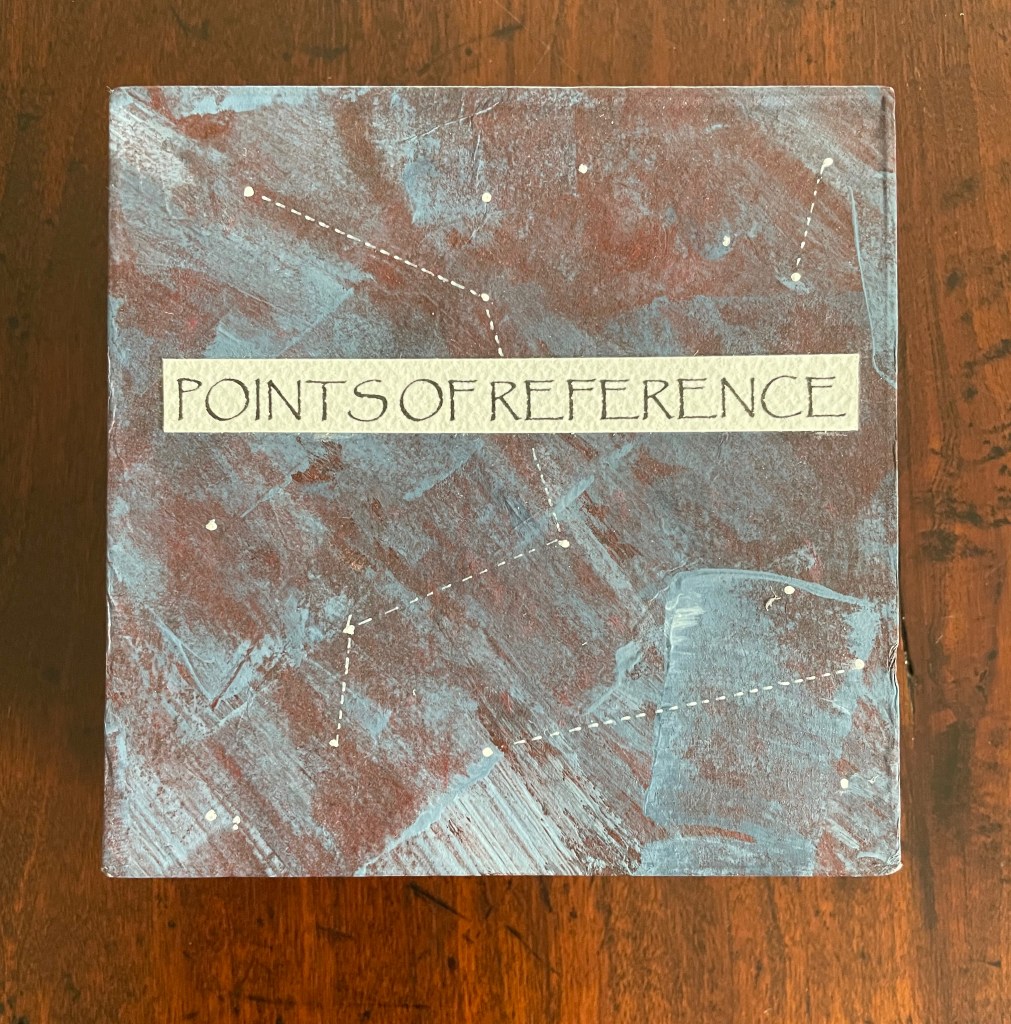
Points of Reference (2022)

Points of Reference (2022)
Jacobus Oudyn
Box covered in illustrated paper. Three small books, each with five double-sided panels. Box: 115 x115 mm. Each book, closed: 103 x 103 mm; open: H260 x W 210 mm. 10 panels each book. Unique. Acquired from the artist, 1 June 2023.
Photos: Books On Books Collection. Displayed with artist’s permission.

Points of Reference recalls Oudyn’s earlier 16 Century Map (2012) where the artist juxtaposed an old European map (showing Mesopotamia and the Euphrates, the Northern hemisphere’s cradle of civilization) with an Australian map of the Kakadu National Park, which covers ancient locations that evoke the concept of Tjukurpa, by which Australia’s Anangu refer to the creation period. The later work raises the earlier one’s implicit critique of European colonialism — “if we map it, we own it” — to a more all-embracing level.

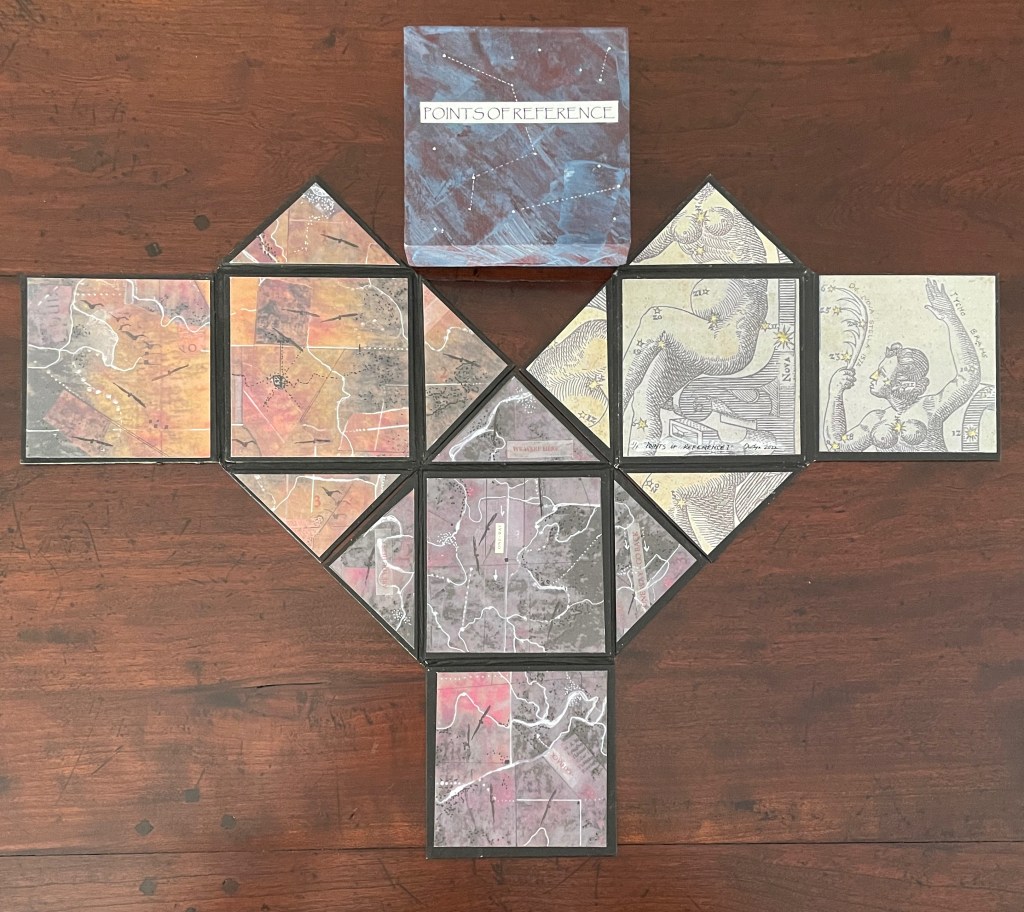
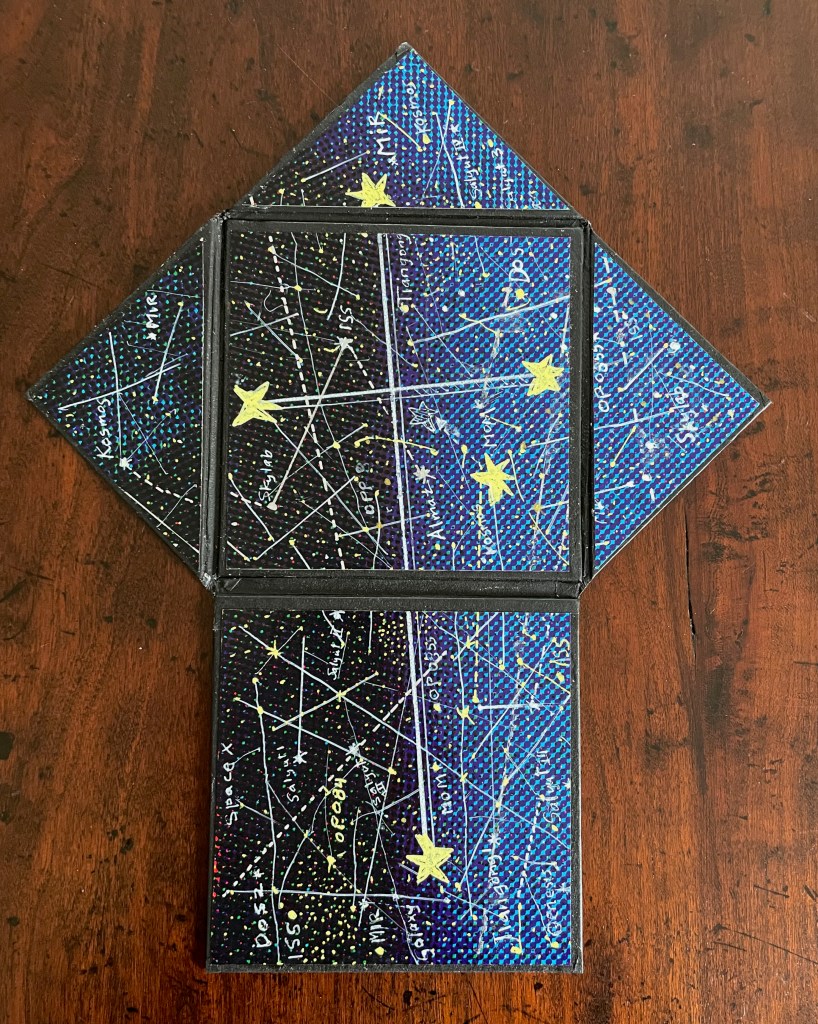
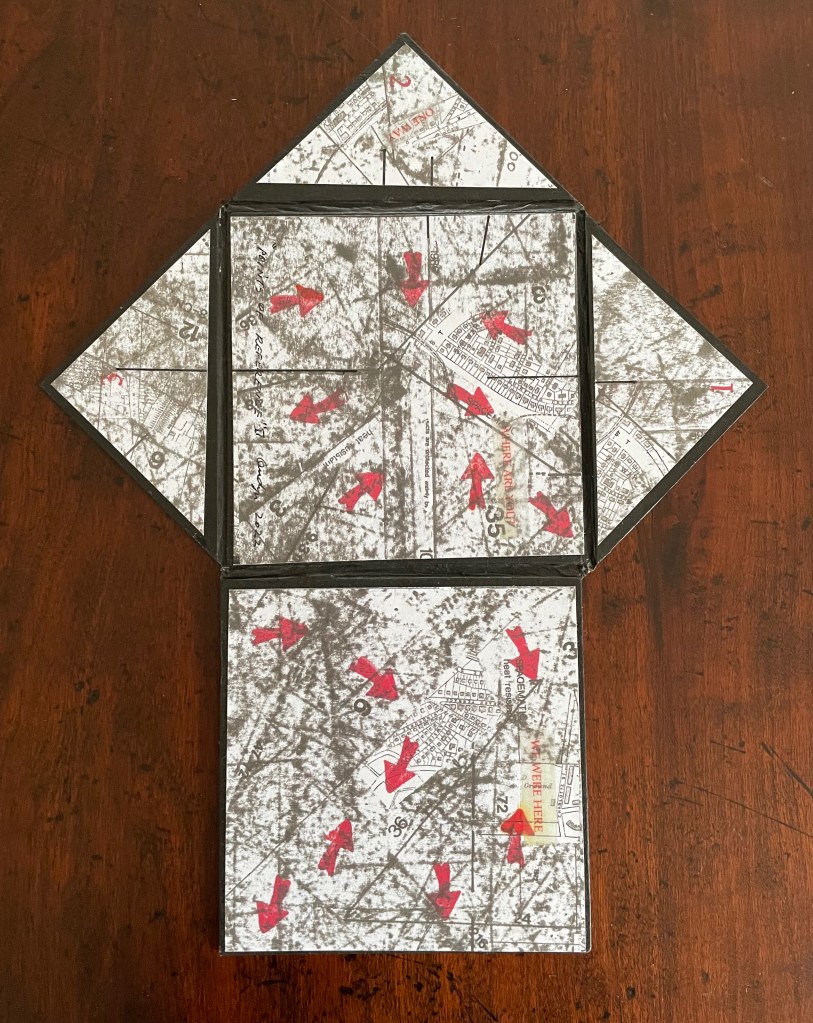
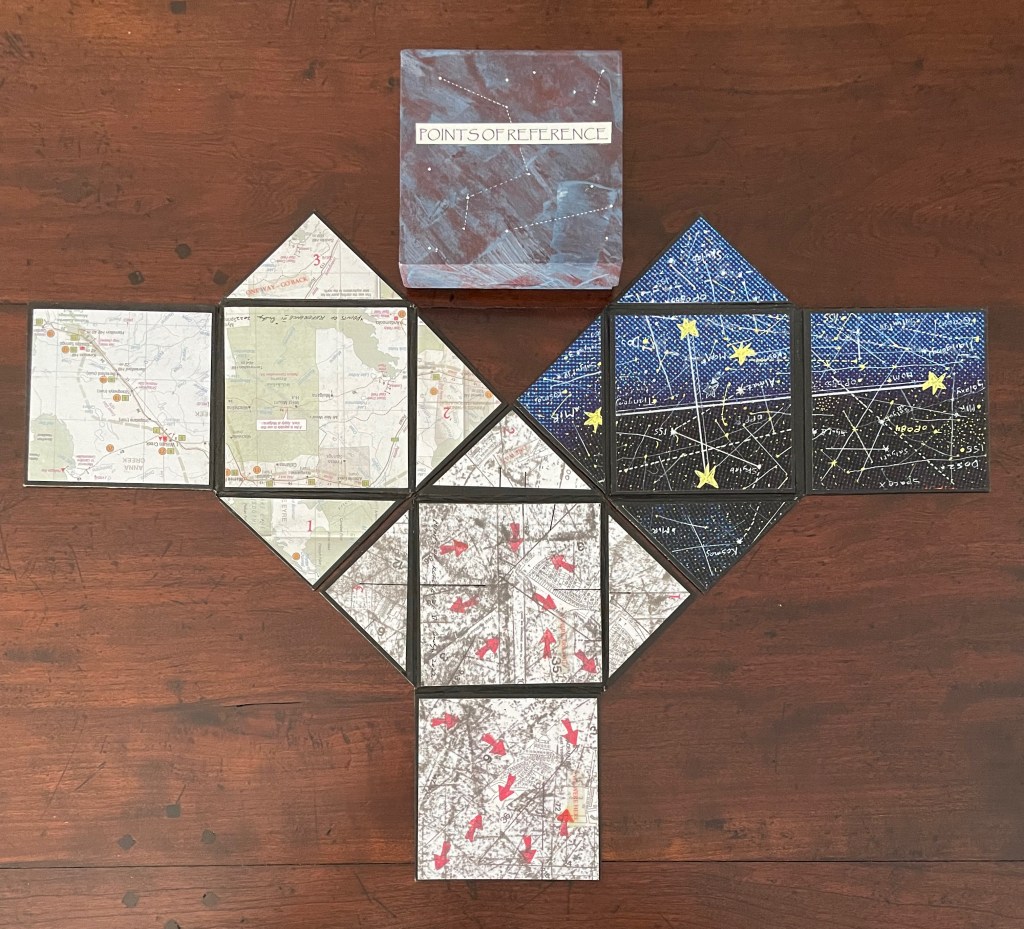
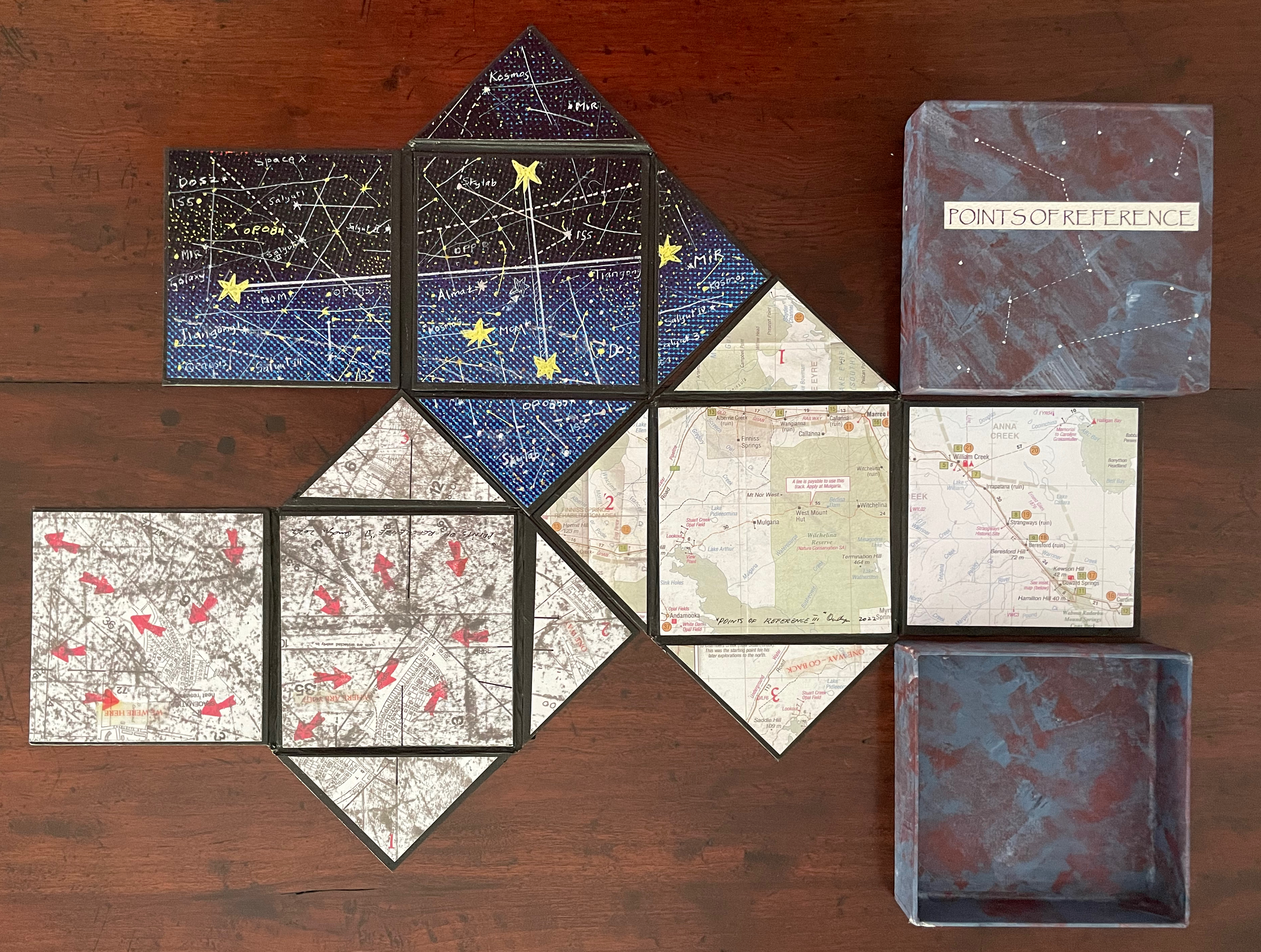
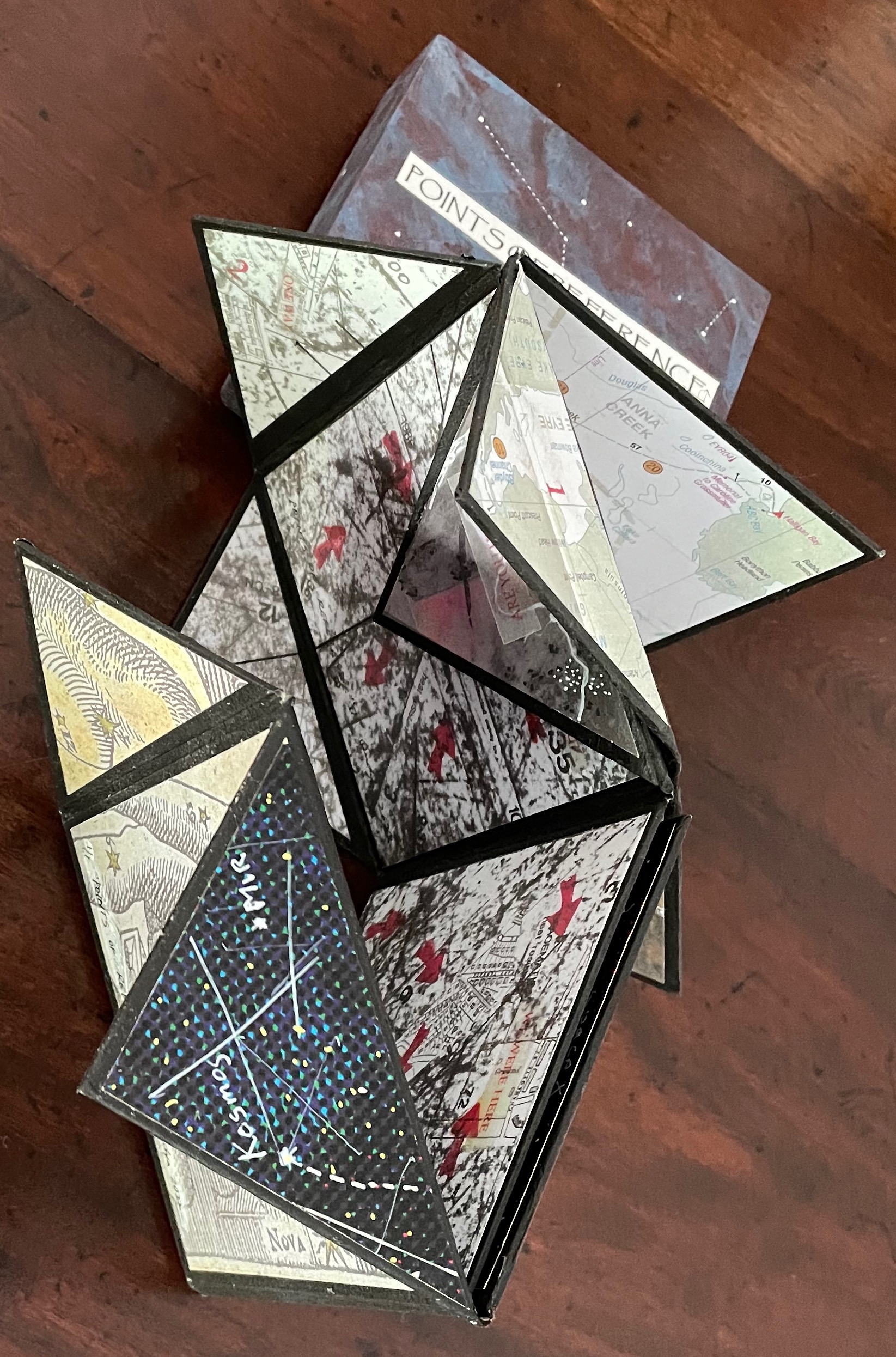
A paper-covered box holds three small identically shaped, double-sided folding panel books. Each has two square panels and three triangular panels. When fully opened, each book takes the shape of a directional arrow.

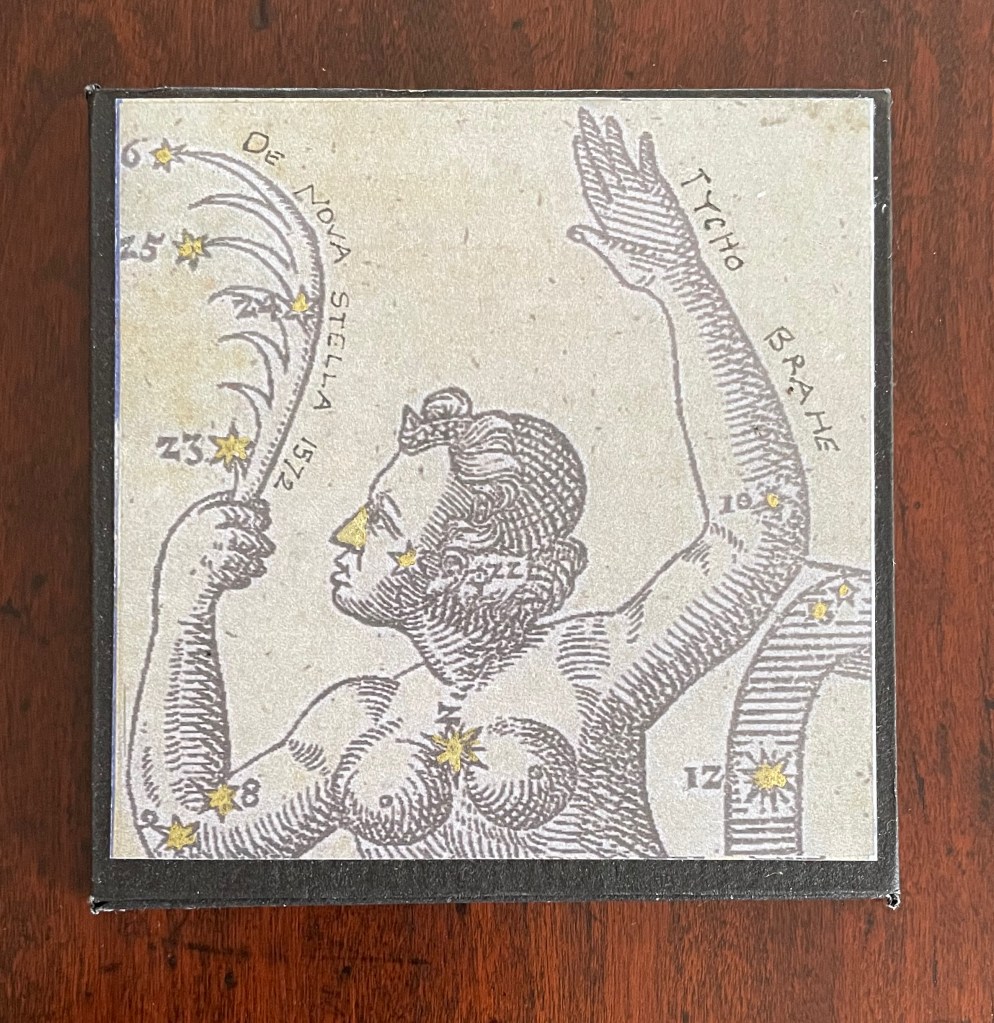
One book has an image from Tycho Brahe’s Stella Nova 1572 on one side and, on the other side, an imaginary space map of commercial and abandoned space junk around the Southern Cross.

The second book has a planimetric map on one side and, on the other, a map of the same area entirely painted over predominantly in a muted orange and yellow, with some brown and gray, and black-ink silhouettes of birds in flight and native Australian markings in white and black.

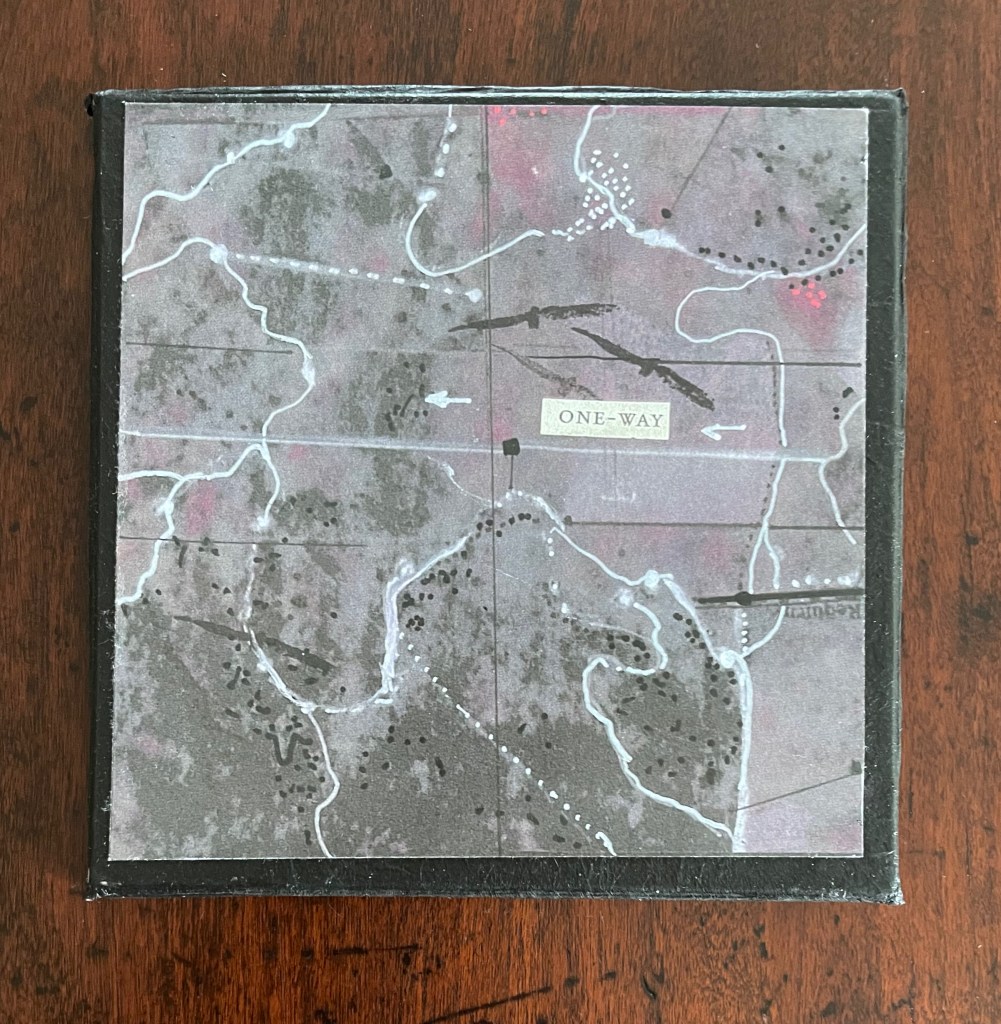
Similar to the second, the third book has a partially obscured cadastral map with plots of property on one side and, on the other side, a map of the same area entirely painted over in gray, with some rose accents and, again, black-ink silhouettes of birds in flight and native Australian markings in white and black.

The triangular panels in the second and third books are numbered 1 to 3 on both sides, signifying that the same areas are mapped on both sides. Also, both of these books have faint collagraphed snippets of found text on the overpainted sides. Uniquely, the third book has gameboard-like text on both sides. On one side, the text reads,”ONE WAY”, “WHERE ARE YOU?” and “WE WERE HERE”; on the other, it reads “ONE-WAY”, “ARE YOU HERE?”, “WE WERE HERE”, “ONE WAY – GO BACK” and “- GO BACK”.

Along with their punning on the work’s title, the pointer-shaped open books’ re-arrangeability and their gameboard text suggest a playful invitation to consider how we imagine, mythologize, redefine and map what seems to us to be empty space challenging our place in it.

Facing Again (2023)

Facing Again (2023)
Jacobus Oudyn
Card cover, found-text title pasted on front cover. Pamphlet stitched, 10 portraits made of found text, collage and mixed media. H102 x W147 mm. Unique. Acquired from the artist, 1 June 2023.
Photos: Books On Books Collection. Displayed with permission of the artist.

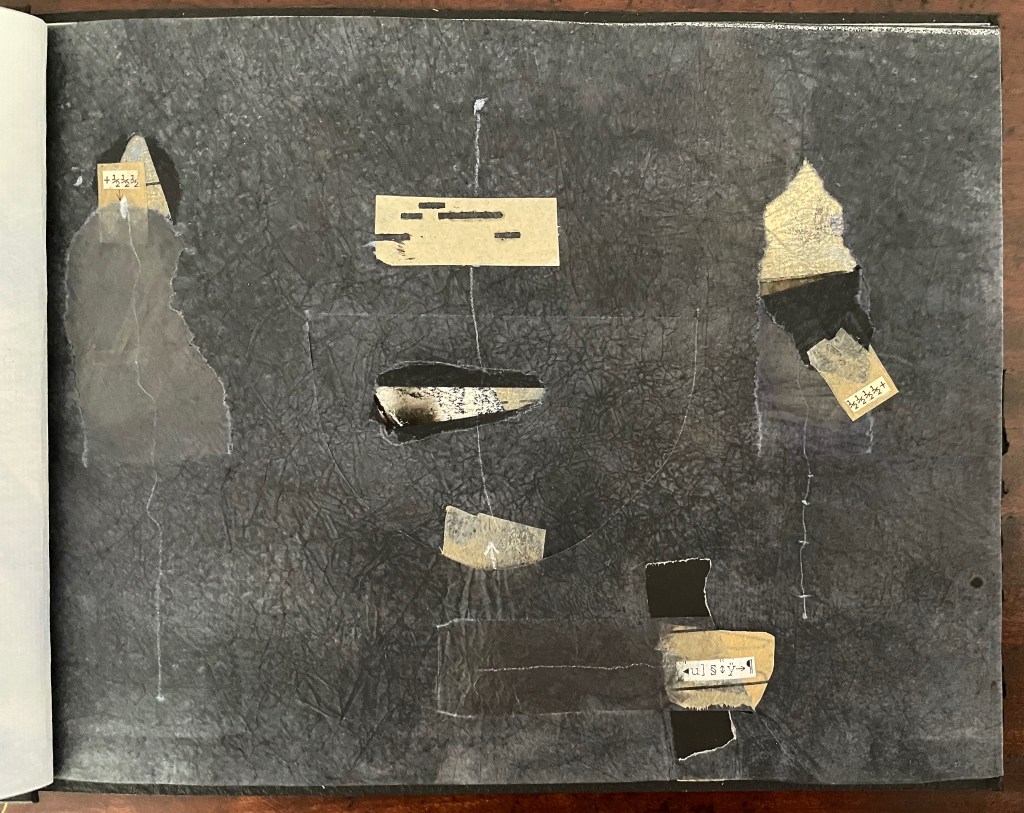
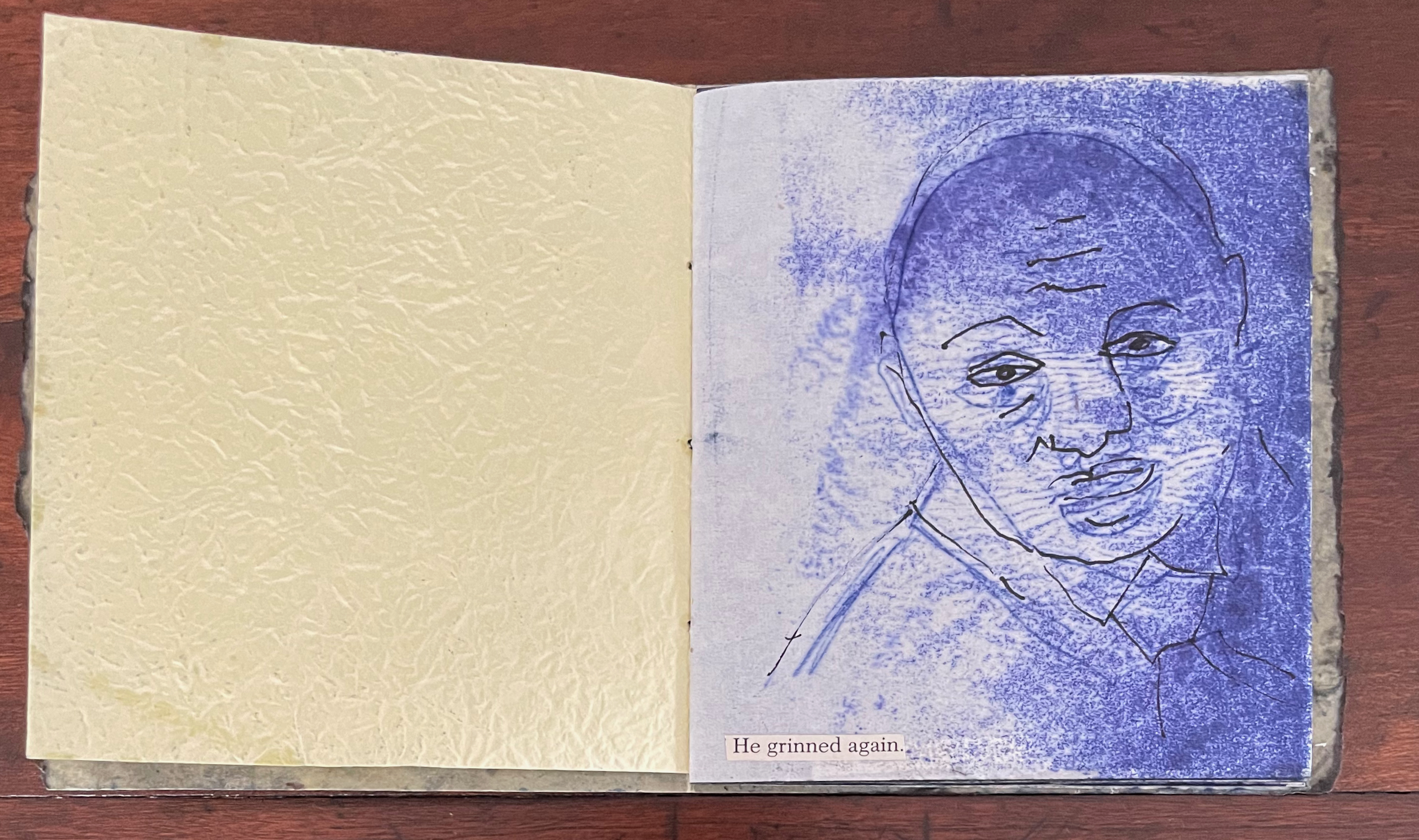
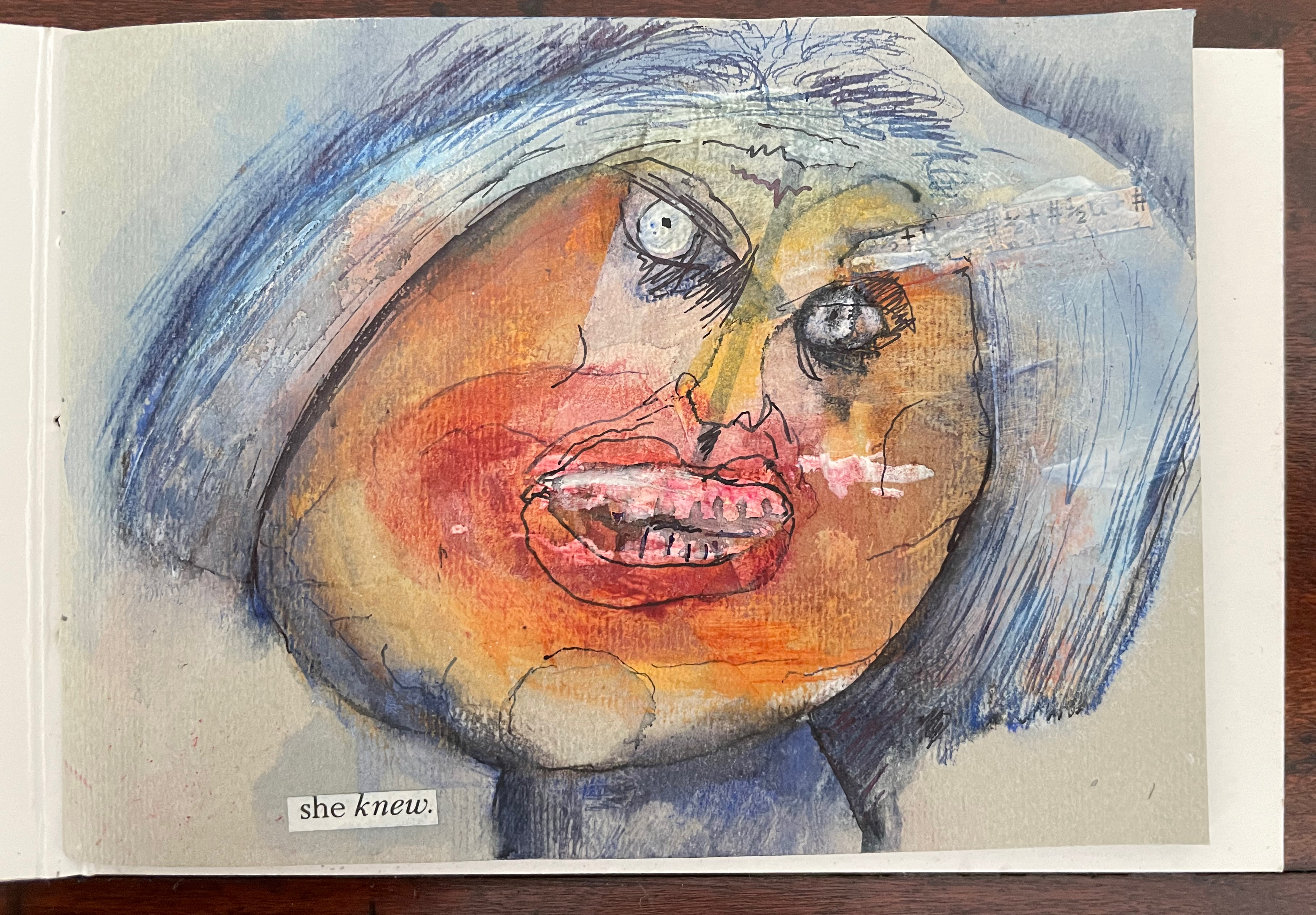
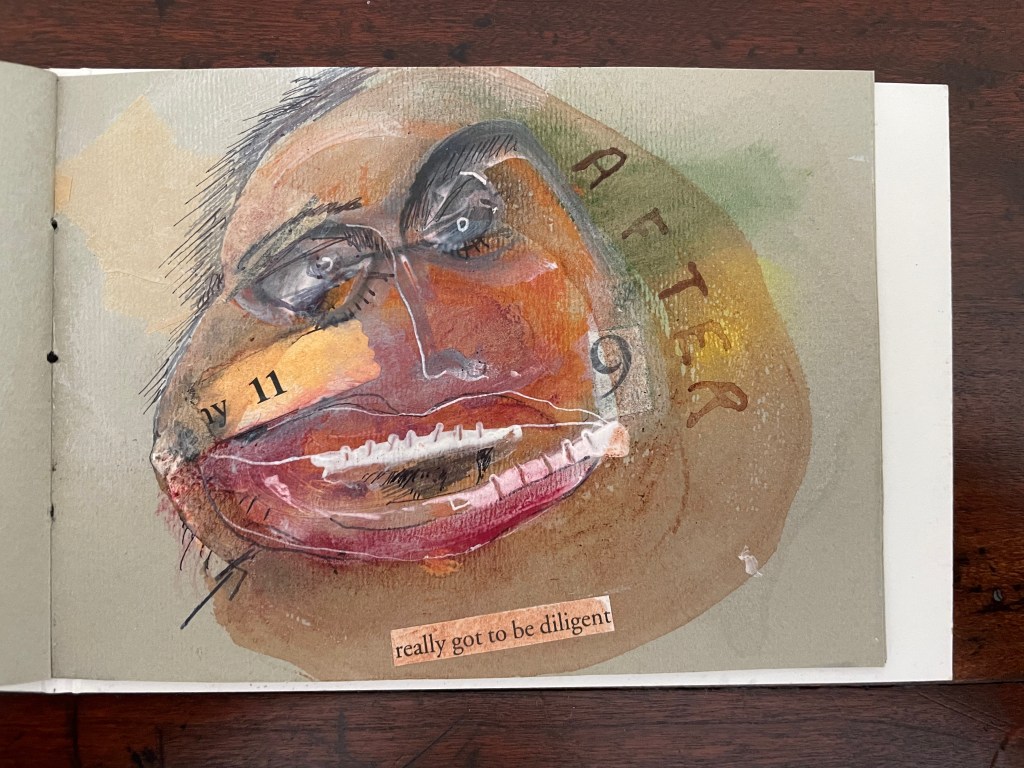
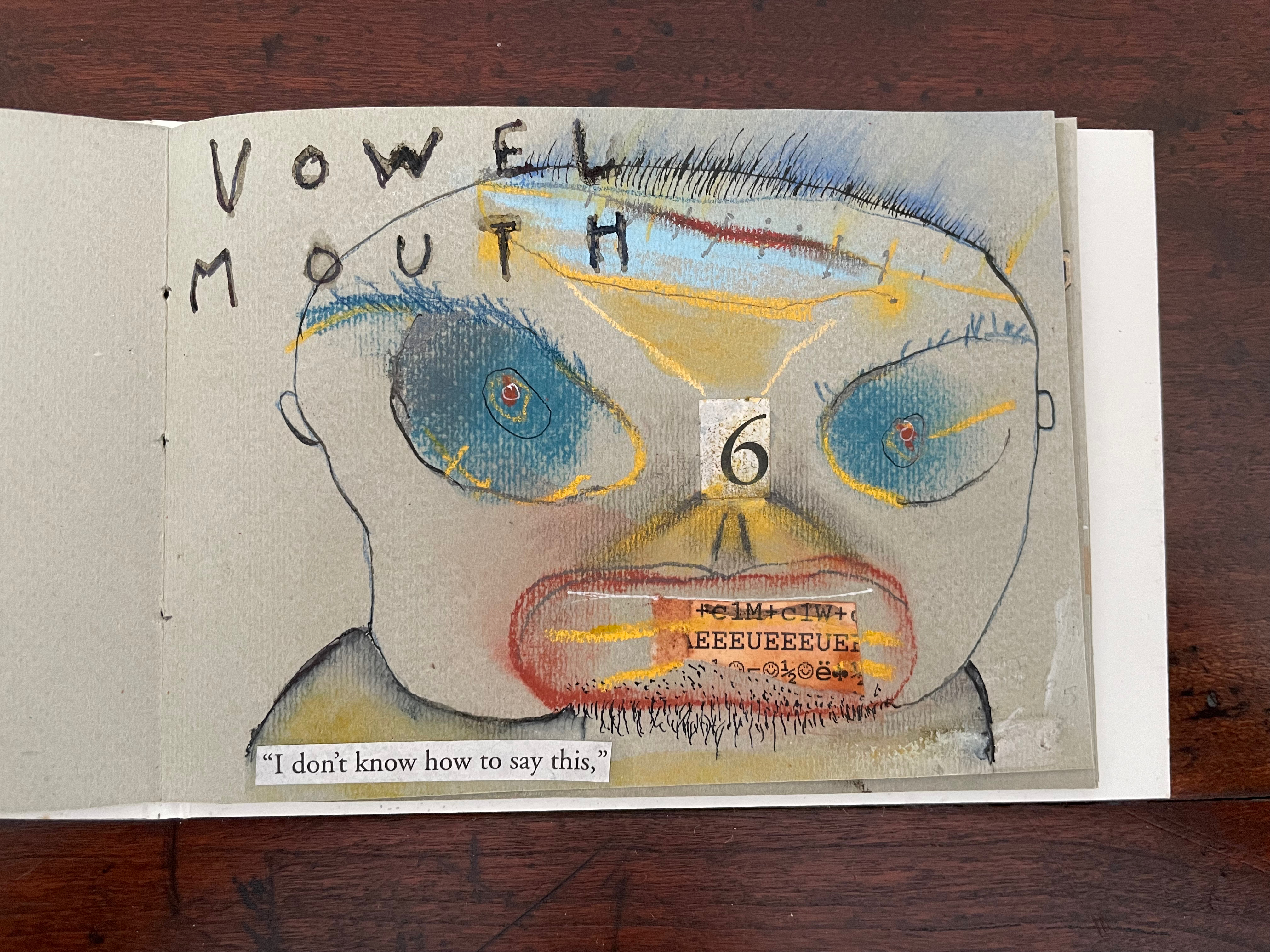
Something of a cross between the satire of R. Crumb and Spitting Image and the rawness of Lucien Freud and Francis Bacon, each of these ten portraits fills its half of an 80 gsm gray pastel paper folio. So, naturally, they loom larger than life in the near-miniature trim size. While the portrait in M.L.A. has a real-life subject of its satire, these faces in Facing Again are fictional, more general and reflective of “mental” issues afflicting 21st century first world societies. Common to most of the portraits, fractions appear as content in the mouths or in the minds of the portrayed — or almost as if they are brushstrokes conveying a characteristic. They imply a sense of psychological, social and political fractionation and division that have featured increasingly in the first three decades of the 21st century.

In the first portrait, above, a set of fractions seems to issue from the character’s forehead like a thought bubble, but this bubble is shard-shaped and could just as well be impaling the character’s forehead with fractions. In either case, they have to do with what “she knew” — the “what she knows” that inflames her face and contorts her nose and mouth into a snarl.

Although not a fraction, the eighth portrait’s reference below to the 9/11 event of 2001 and the text — “really got to be diligent” — evoke an identifiable instance of fractionation and division. This character is more physically distorted than the first. Its jaw dislocated, its teeth inverted, its eyes askew, the face looks submerged in a brown pool of 9/11 aftermath. Divisions on a global scale begat violence, which reinforced fear and division, which begat more violence and fear. If it were only that simple.

These portraits are images of confusion and uncertainty until the last, who seems able to weep only with one eye for “something else”.

Further Reading

Jacobus Oudyn (I)“. 17 January 2021. Books On Books Collection.

Books On Books Collection – Christopher Hicks

A Bookbinder’s ABC (2003)

A Bookbinder’s ABC (2003)
Christopher Hicks, Leaning Chimney Press Editions
Soft cover (buff card, illustrated paper jacket glued to spine, sewn block). H200 x W150 mm. 34 pages. Edition of 75. Acquired from Barter Books, 18 October 2023.
Photos: Books On Books Collection.

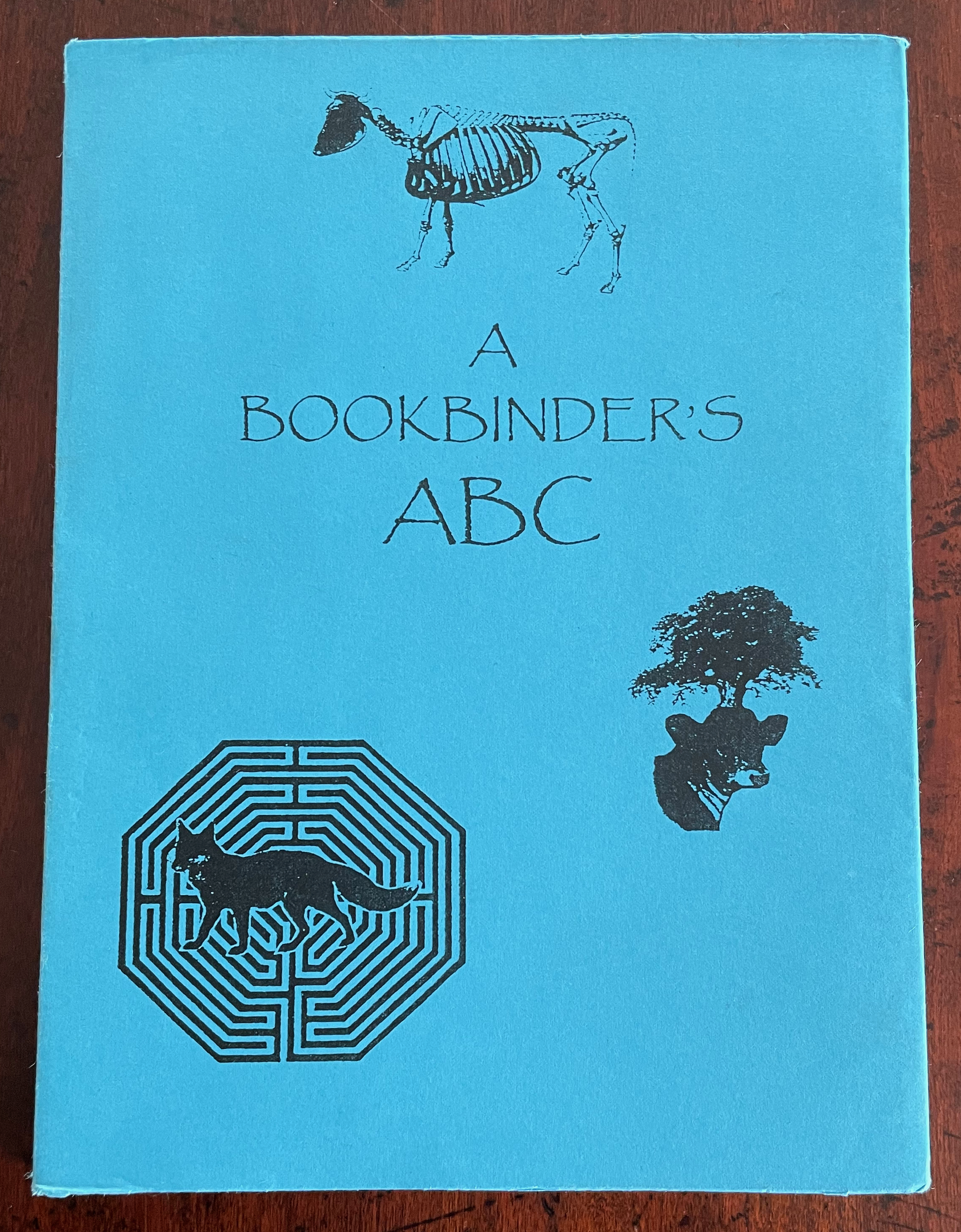
Although Glaister’s Encyclopedia of the Book is the canonical dictionary for book terminology, A Bookbinder’s ABC provides 26 humorous visual reminders.

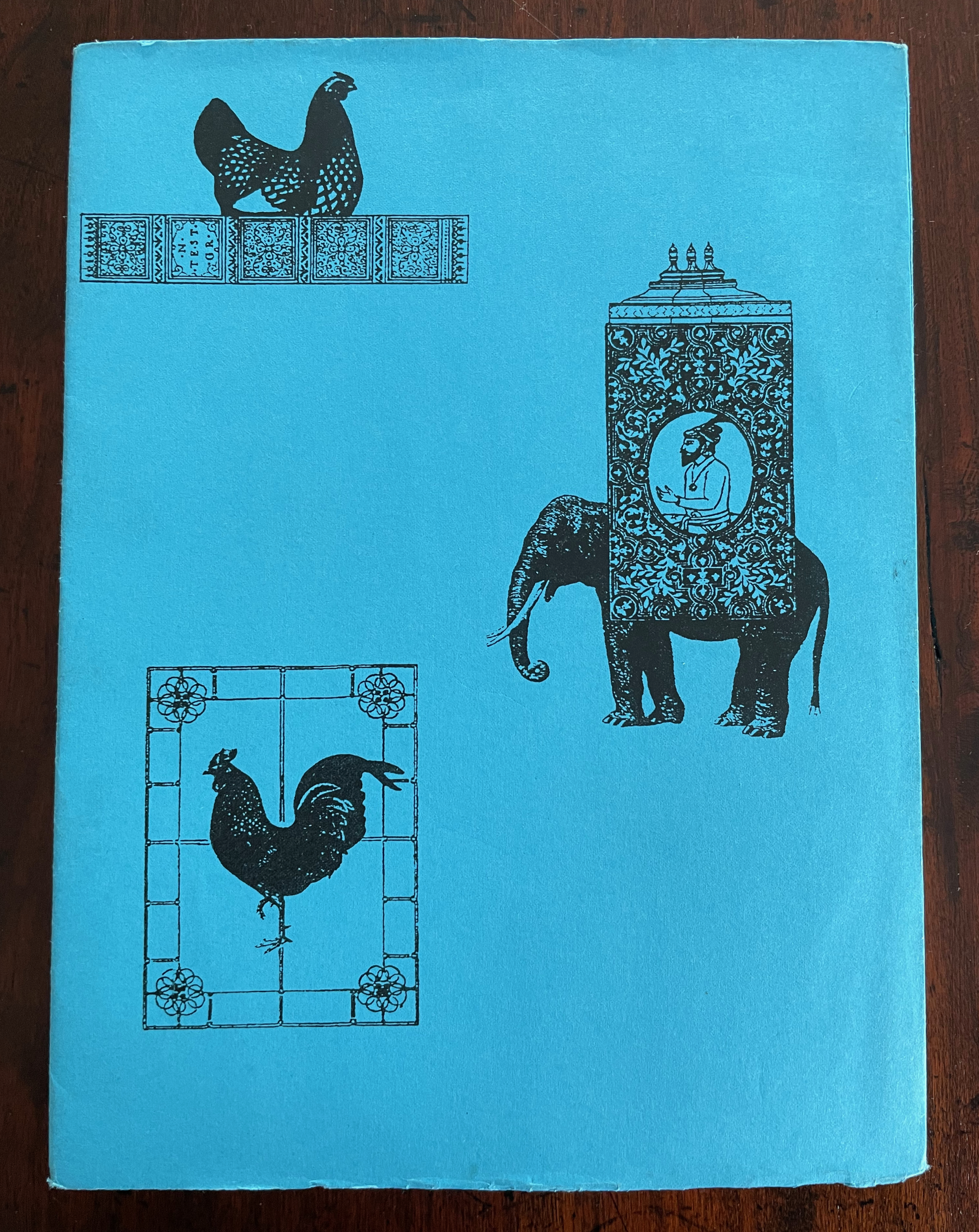
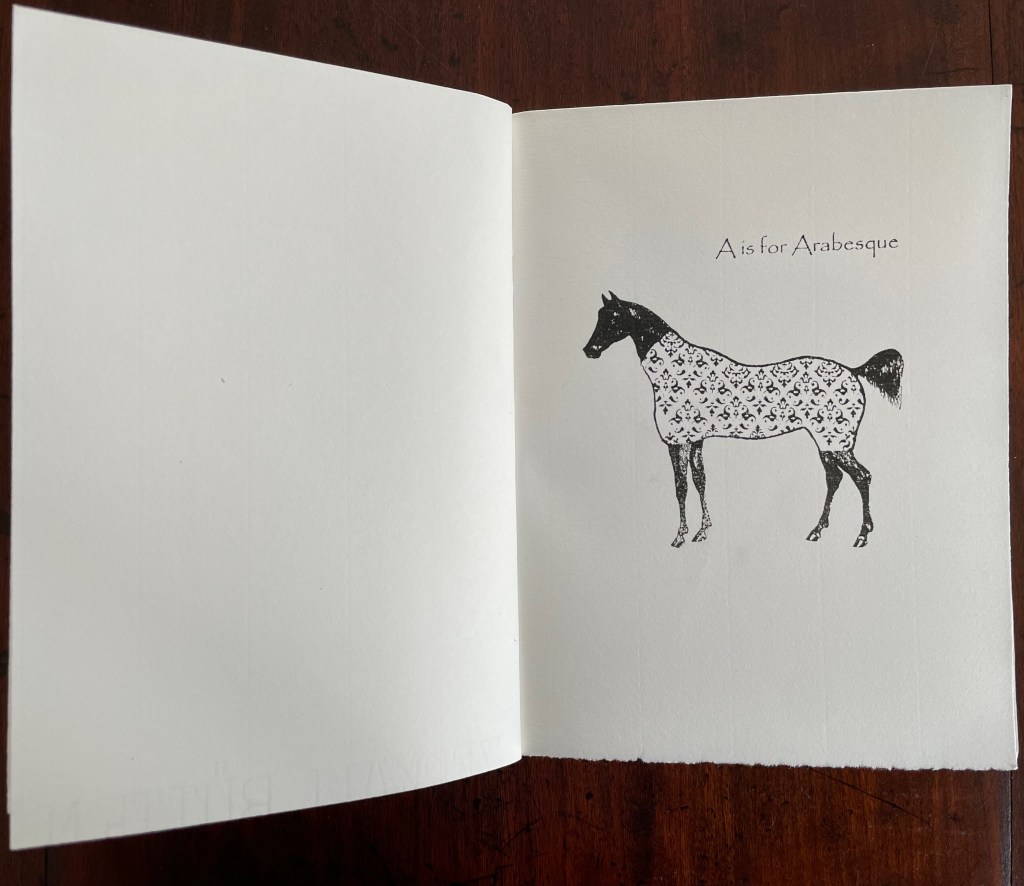
An Arabian stallion in a decorative onsie for recalling the description of fleurons and other devices derived from Islamic patterns.

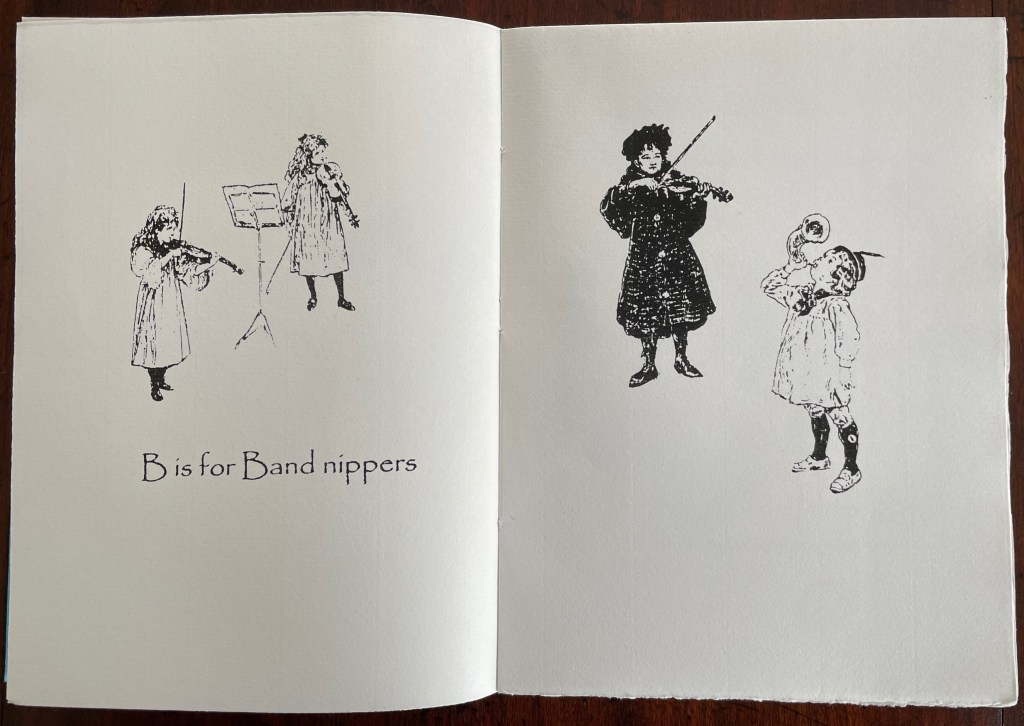
What else would a binder call a children’s orchestra?

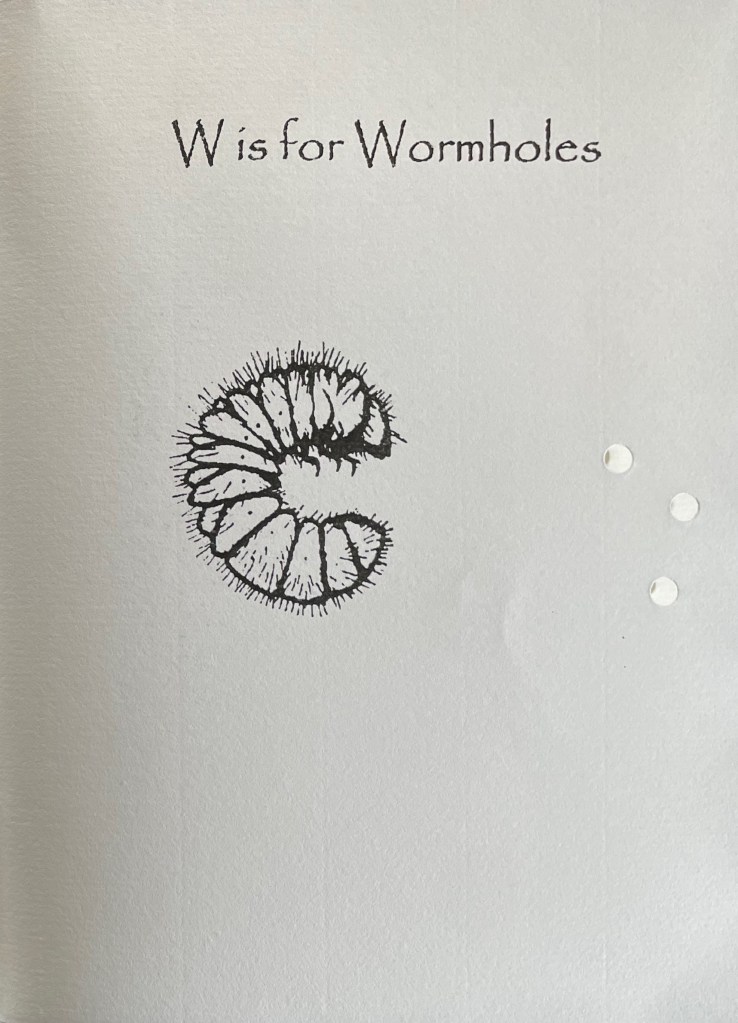
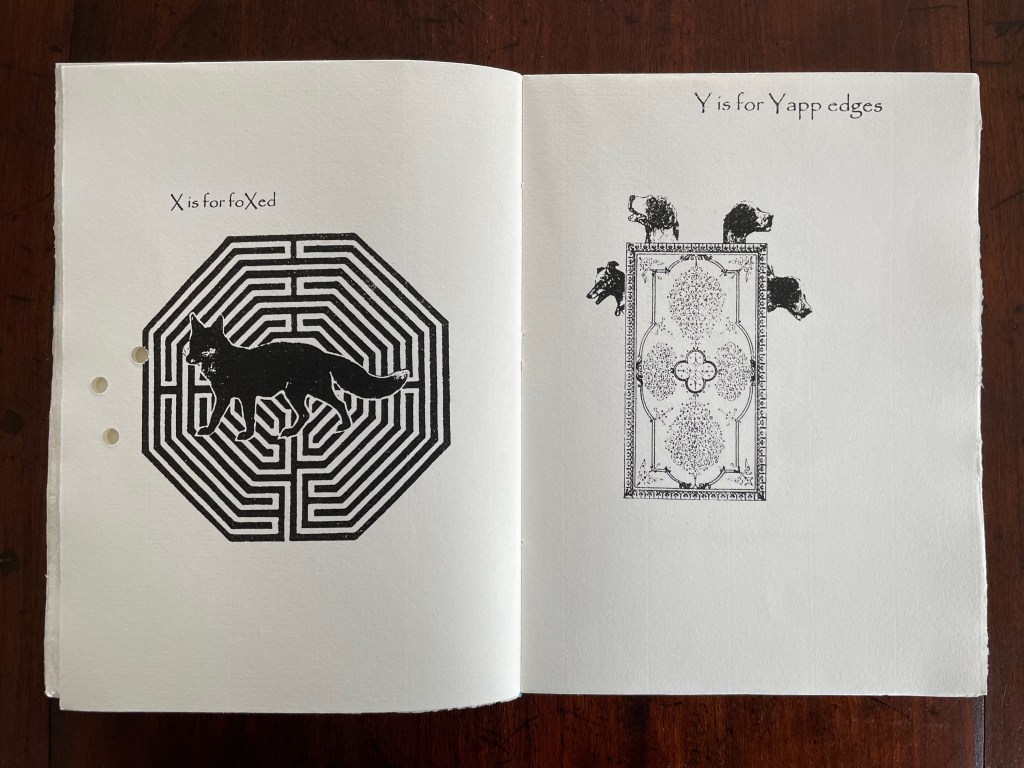
A fox flummoxed by a maze is certainly “foxed”. This one is also likely puzzled by the holes carried over from “Wormholes” on the previous page. Barking dogs springing from a book cover might be a helpful mnemonic for the name of the wide soft edges or flaps for Bible covers devised by the 19th century London bookseller Yapp.

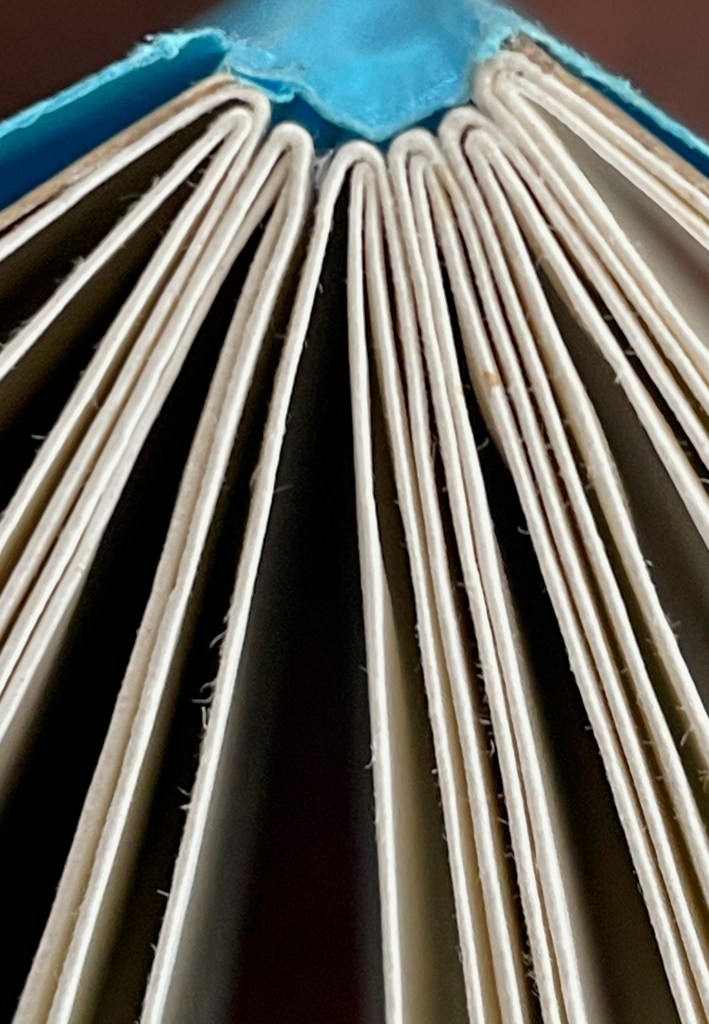
The work’s own binding has simple but interesting features. The front and back covers in buff card are glued to the first and last sewn gatherings, respectively, and the sewn gatherings are glued in between and sewn together. The blue paper jacket’s spine is glued to the spines of the gatherings and its fore edges fold over the fore edges of the buff card. Curious but not as self referential as the features of two nearby birds of a feather from Andrew Morrison’s Two Wood Press.

Detail of uncut top edges and gluing of gatherings and spine.

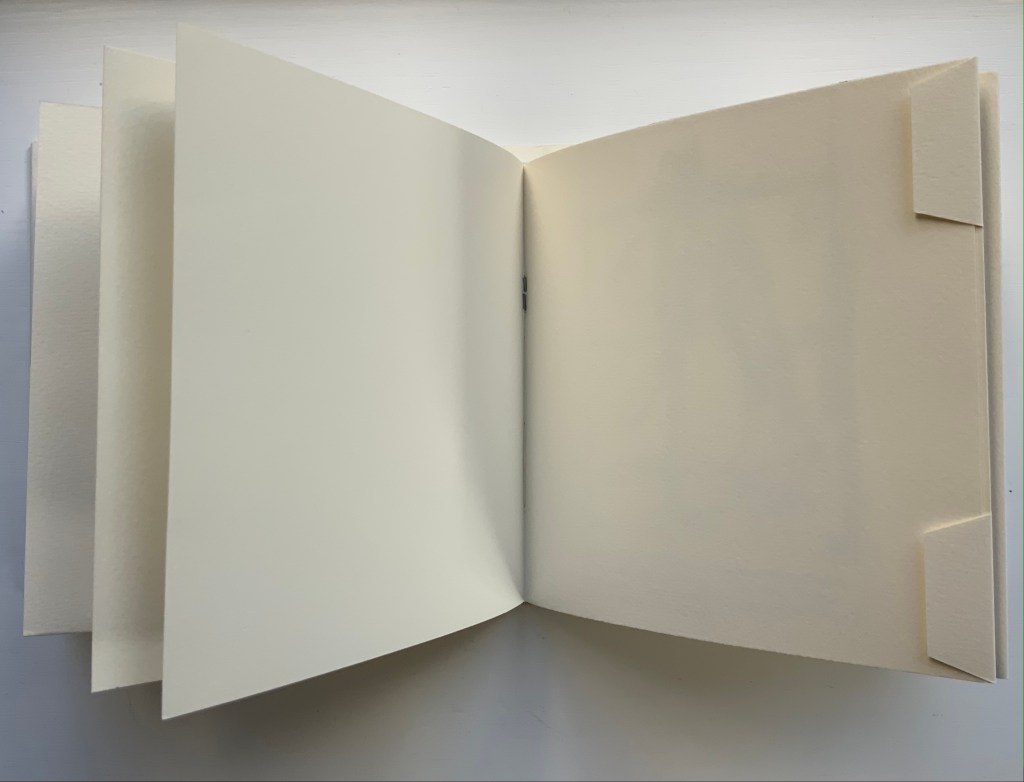
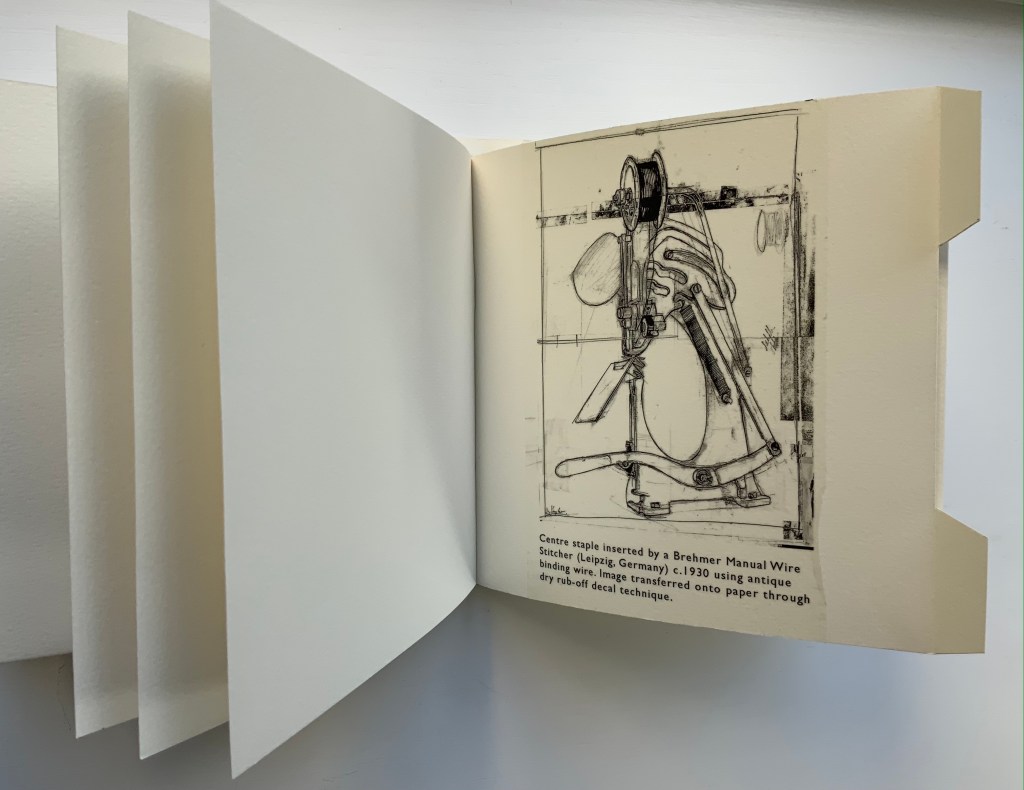
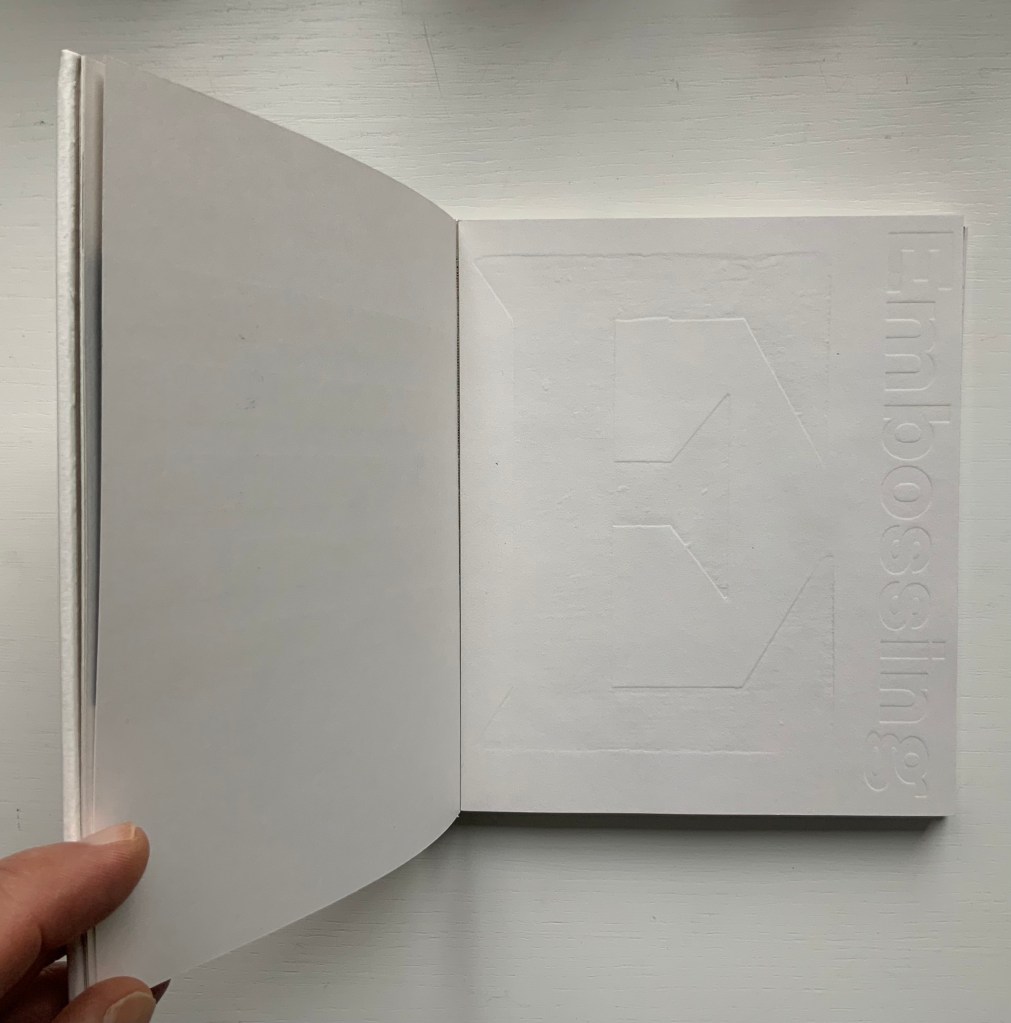
From Morrison’s Provenance (2018), showing an actual wire-stitched gathering and then an illustration of the mechanism; from Morrison’s Two Wood Press A-Z (2003), showing showing an embossed page illustrating E for Embossing. Photos: Books On Books Collection.

But what would a self-referential binding for A Bookbinder’s ABC look like — especially one that might carry on the punnery of the contents? Presumably because they are closer to the words, entries in letterpress abecedaries such as Morrison’s Two Wood Press A-Z (2003) and Kevin M. Steele’s The Movable Book of Letterforms (2009) have an easier time of the visually self-referential.

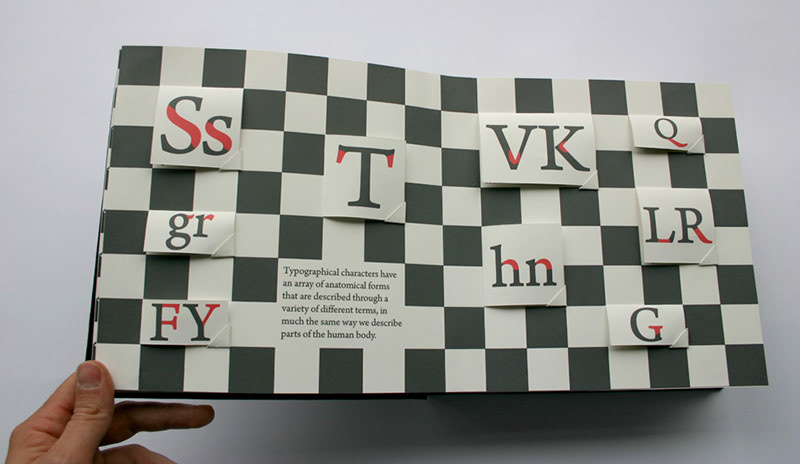
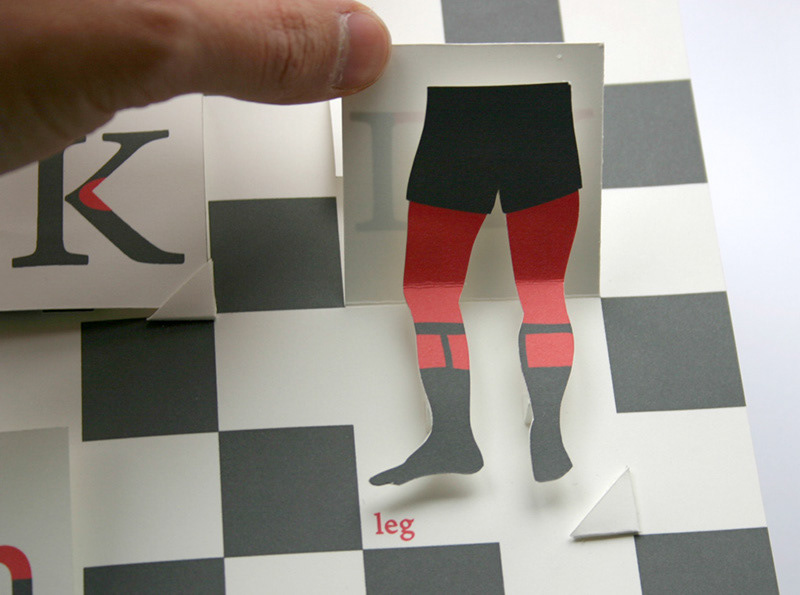
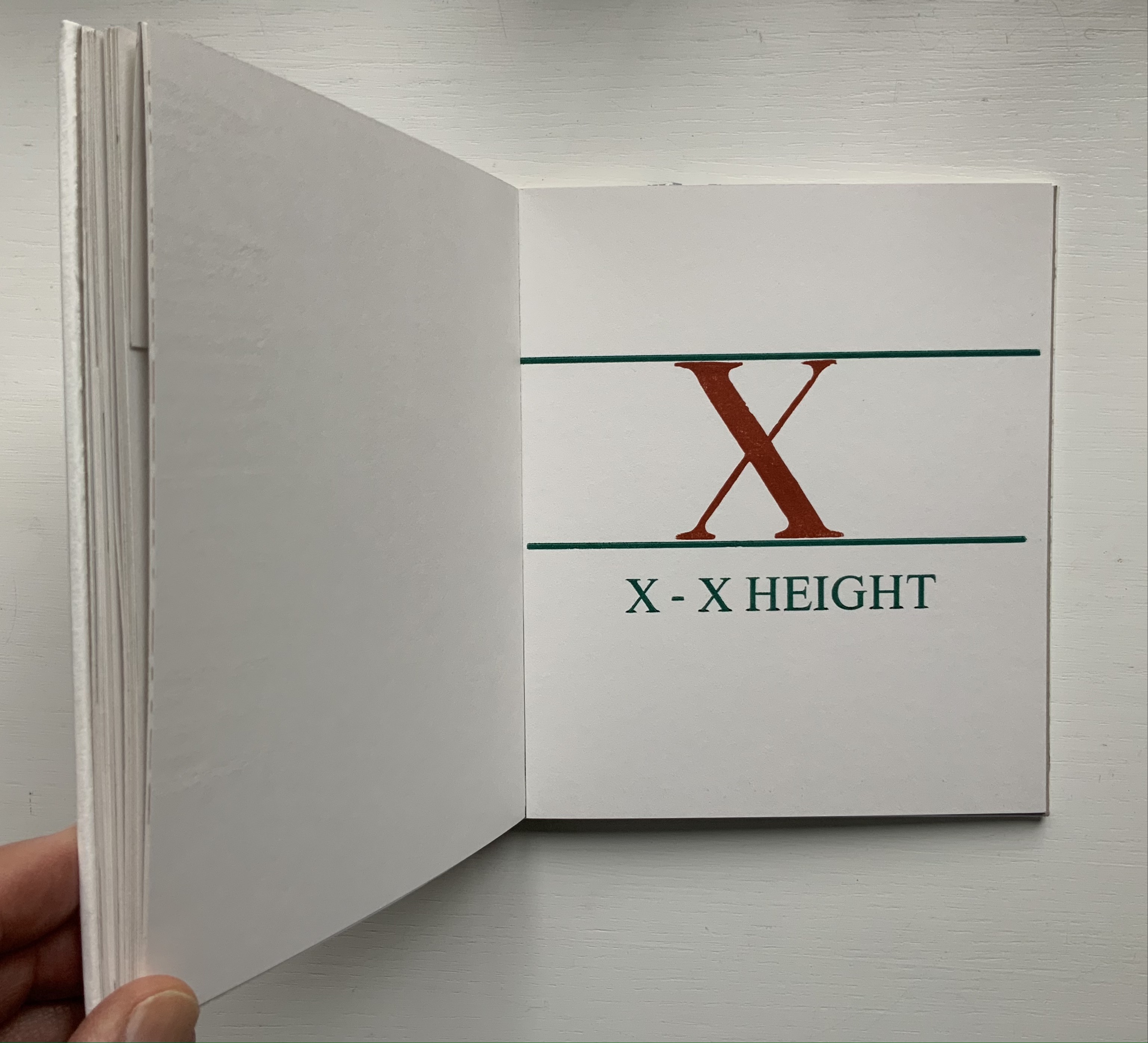
From Steele’s A Movable Book of Letterforms, showing the anatomical term for the red areas of the L & R (a leg lift?); from Morrison’s Two Wood Press A-Z, showing x’s definition of its height.
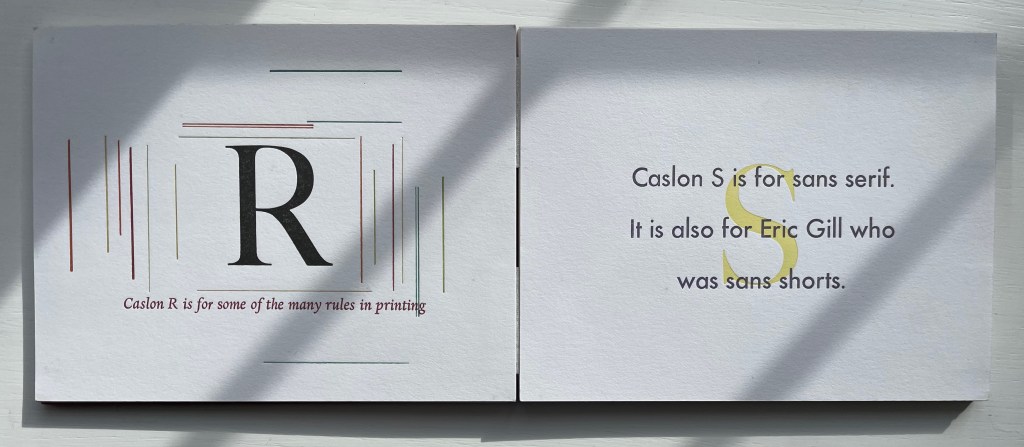
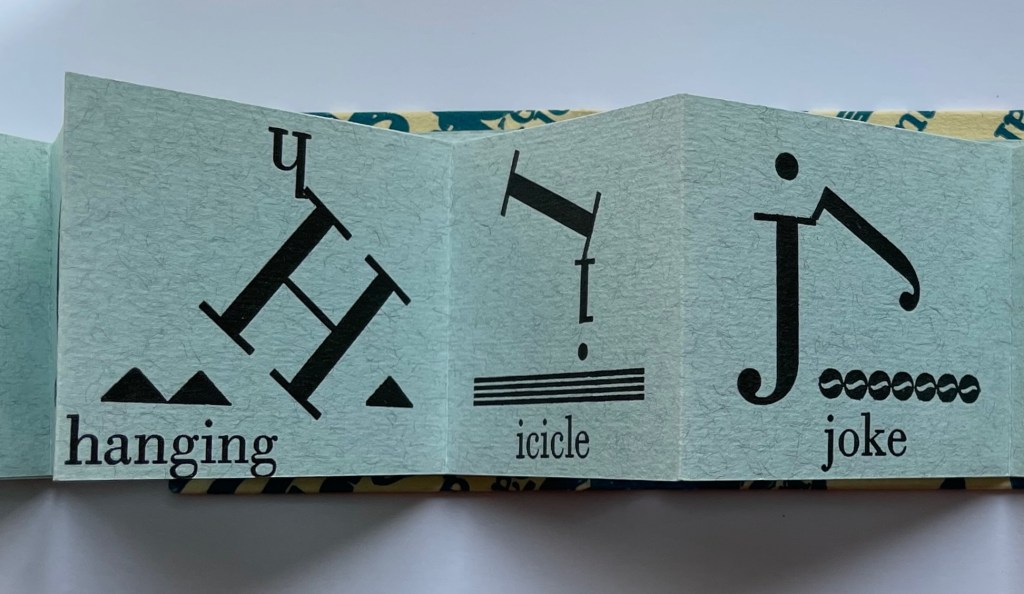
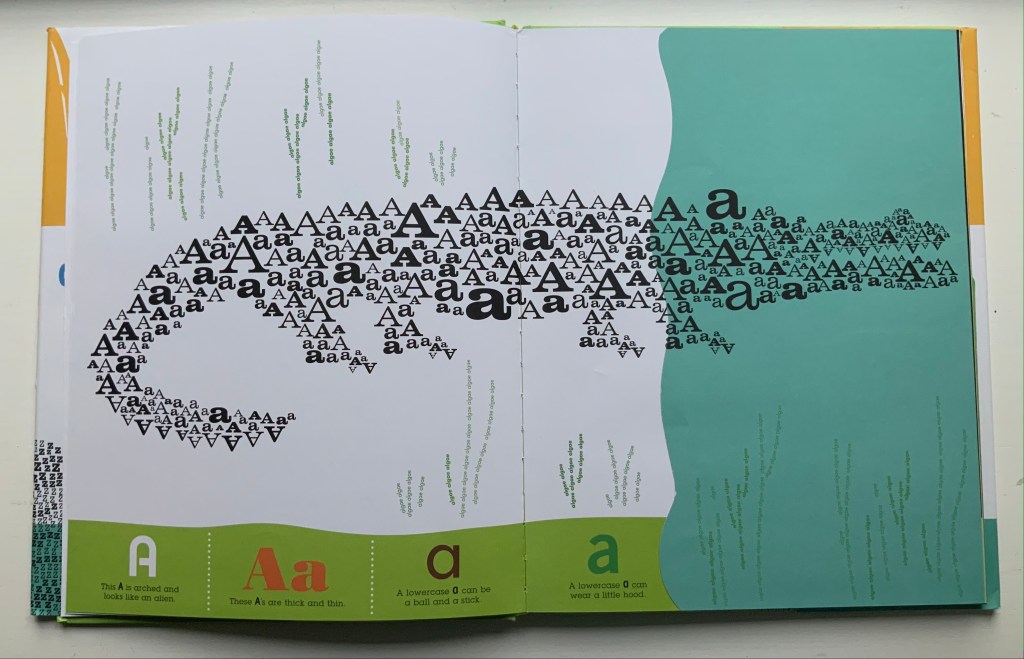
Closer still to the words are the typographical punsters such as Marie Dern and William Caslon’s Typographic ABC (1991), Nicolas McDowall and A Bodoni Charade (1995) or Sharon Werner & Sharon Forss and Alphabeasties and Other Amazing Types (2009).

From Dern’s William Caslon’s Typographic ABC, McDowall’s A Bodoni Charade and Werner & Forss’ Alphabeasties and Other Amazing Types.

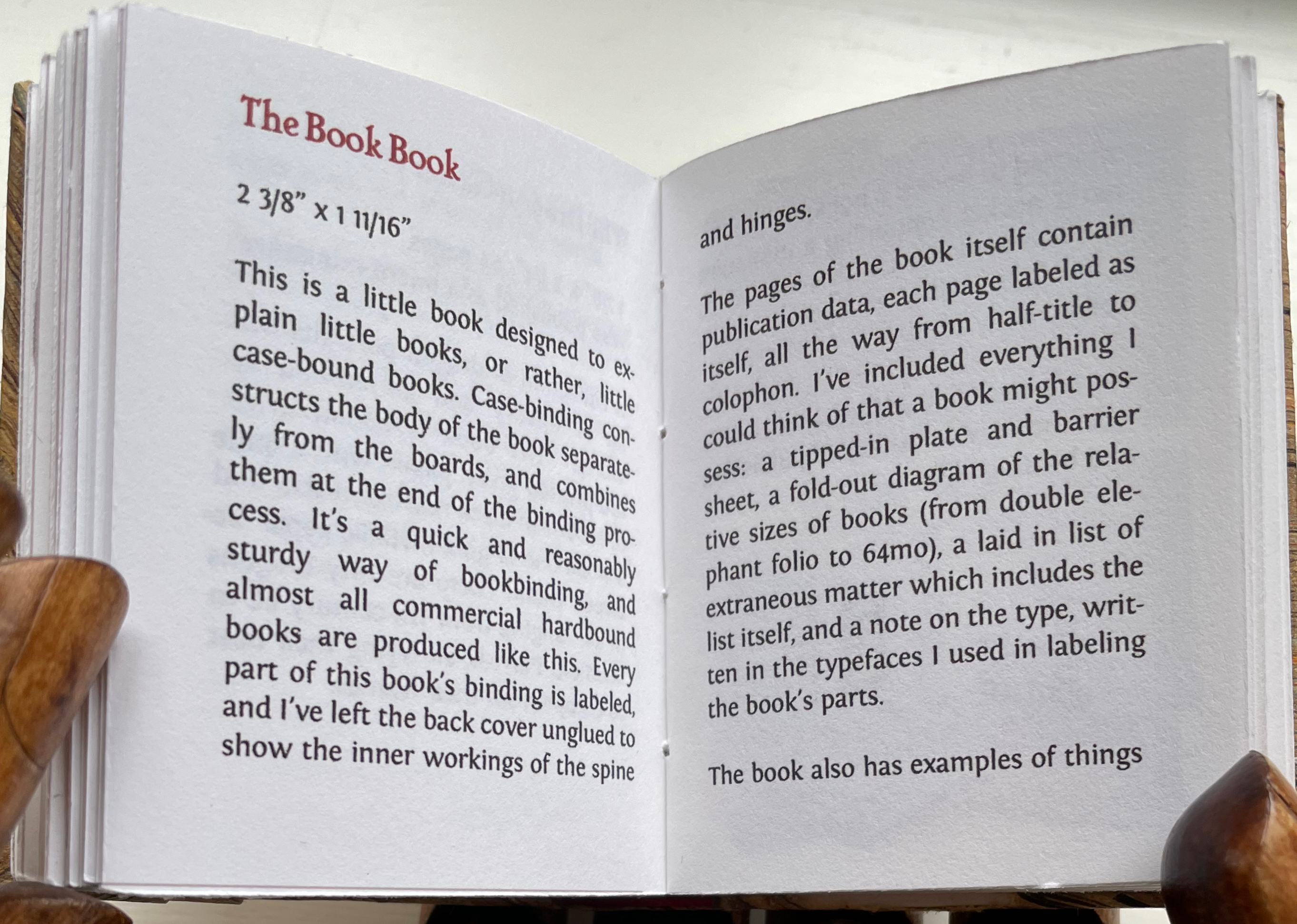
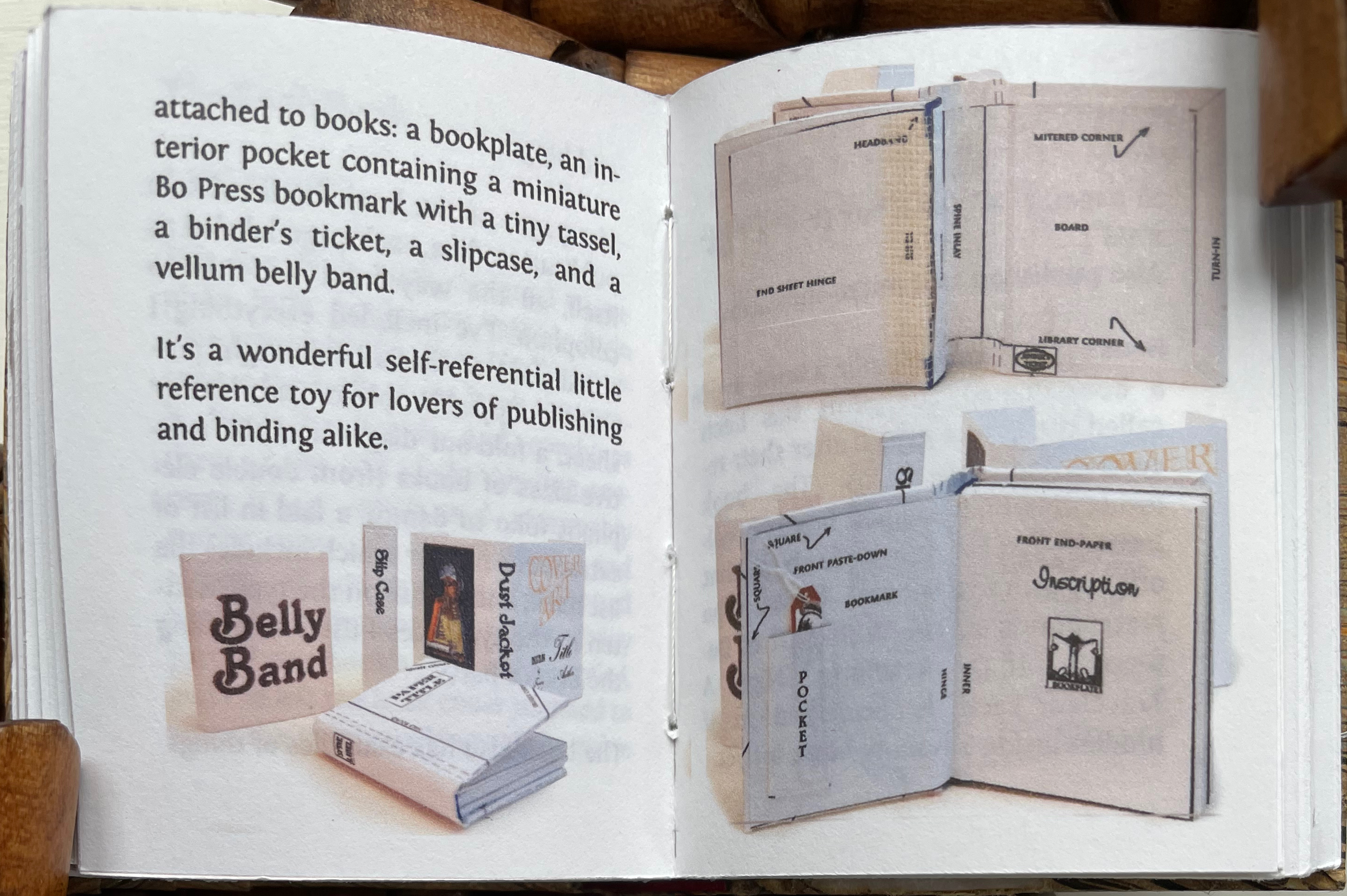
Perhaps Pat Sweet’s miniature The Book Book (2010) comes closest on self-referentiality in a work about binding. For the puns, we will have to wait for another bookbinder to take a stab at it.

From Sweet’s The History of Bo Press (2021).

Further Reading

Abecedaries I (in progress)“. Books On Books Collection.

Alphabets Alive!“. 19 July 2023. Books On Books.

David Clifford“. 15 September 2021. Books On Books Collection.

Marie Dern“. 8 March 2023. Books On Books Collection.

Nicolas McDowall“. 10 December 2022. Books On Books Collection.

Andrew Morrison“. 15 September 2021. Books On Books Collection.

Kevin M. Steele“. 18 July 2023. Books On Books Collection.

Pat Sweet“. 18 January 2023. Books On Books Collection.

Sharon Werner & Sharon Forss“. 20 December 2022. Books On Books Collection.

Frost, Gary. 1996. Teaching set of historical bookbindings. Utopia, Tex: Gary Frost, Dry Frio Bindery.

Hanmer, Karen. 2013. Biblio Tech. Glenview, IL: Karen Hanmer Book Arts.

Books On Books Collection – Annie Cicale

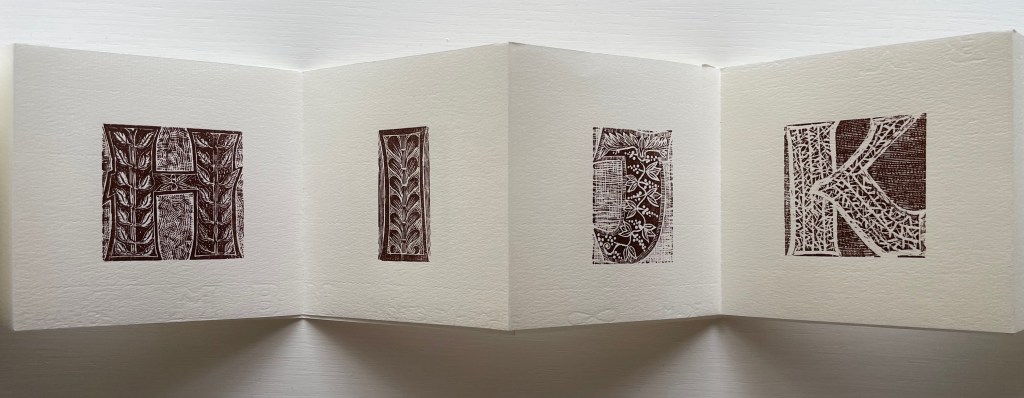
Patterned Alphabet (2013)

Patterned Alphabet  (2013)
Annie Cicale
Sewn, casebound leporello. H104 x W104 mm. 34 panels. Edition of 41, of which this 26. Artist 4 July 2023.
Photos: Books On Books Collection.

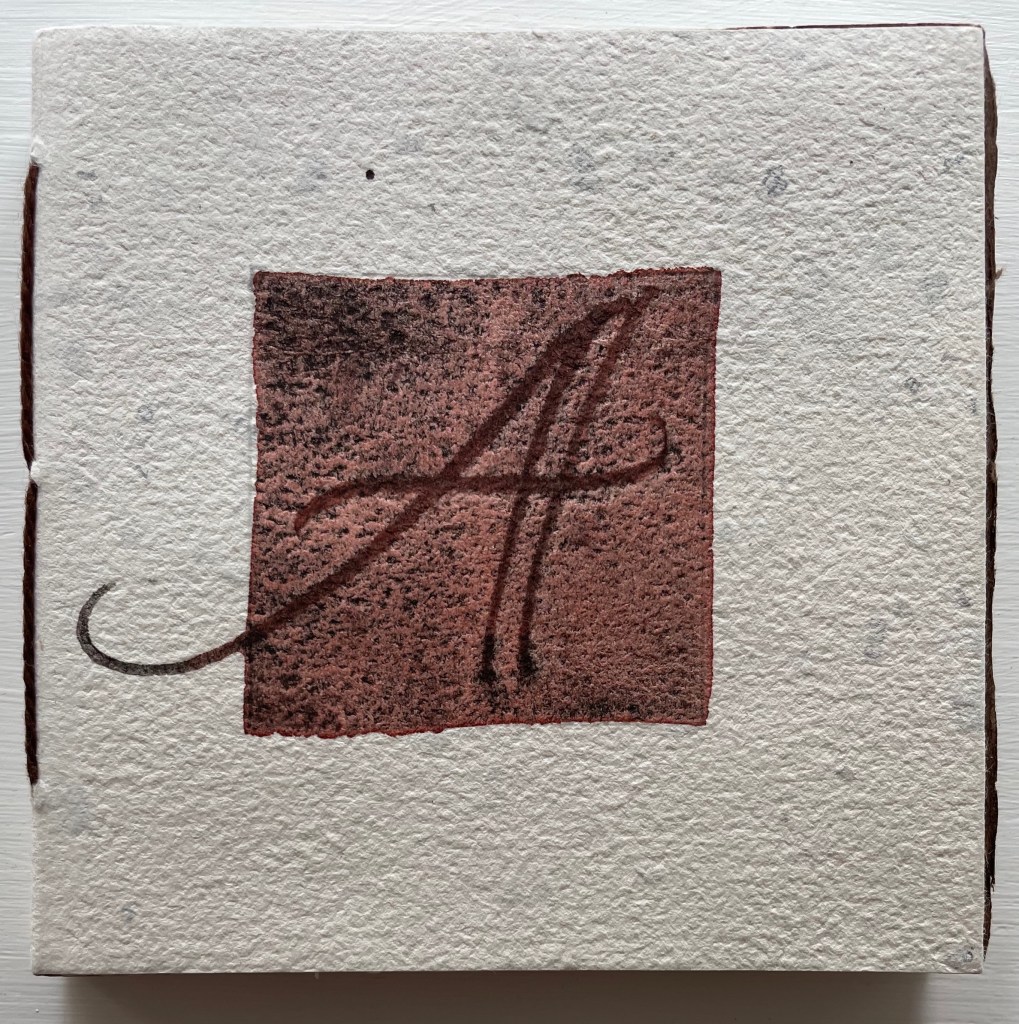
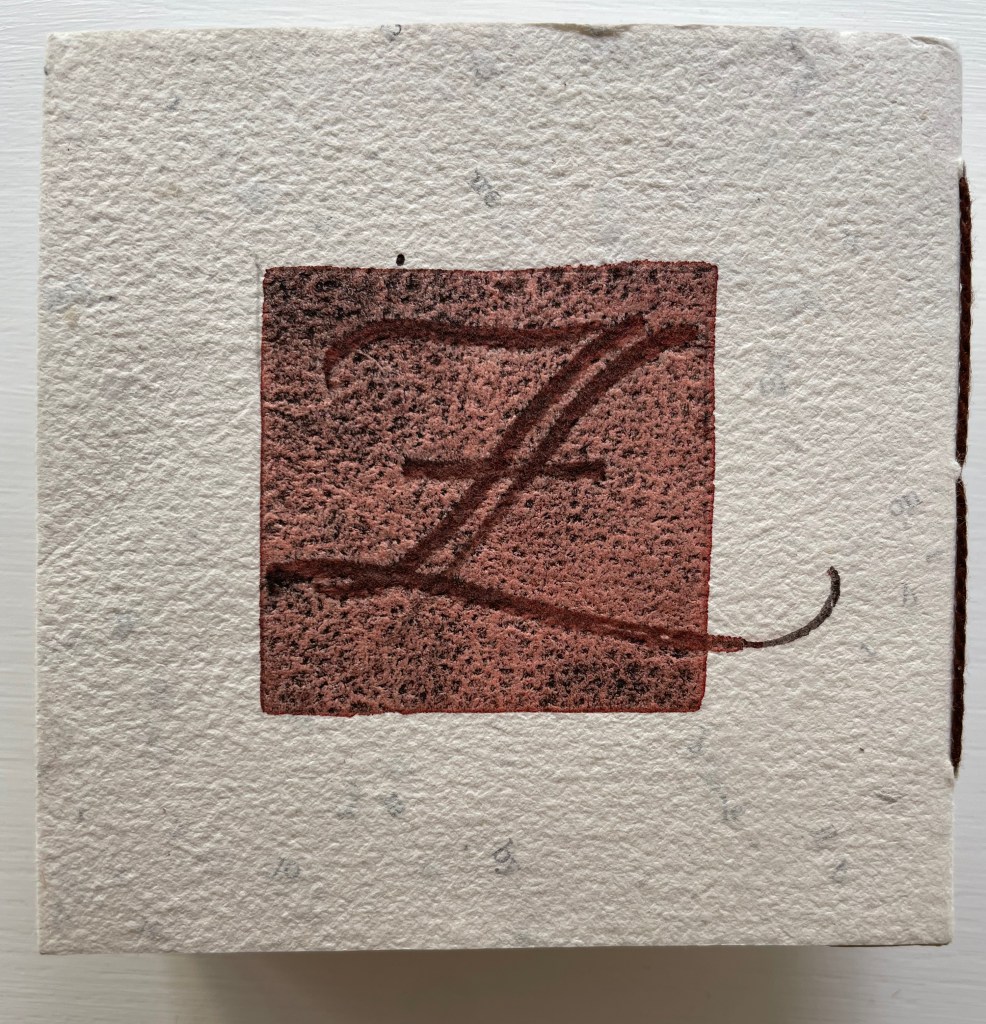
Patterned Alphabet could well have been entitled Textured Alphabet. The number of different textures almost equals that of the patterns. It is the textures’ interaction with each other as well as with the patterns that particularly appeals. The cover, appropriately made of Cave Paper’s Alphabet Heavyweight, initiates the interplay. While the calligraphic style and patterned background of the copperplate engravings of A and Z do not vary, the textures around and beneath them multiply, mirror and contrast. The surface of the Cave Alphabet paper echoes that of the copperplate’s stippled background. The softness of the thick cotton string, binding the cover, contrasts with the roughness of the paper.
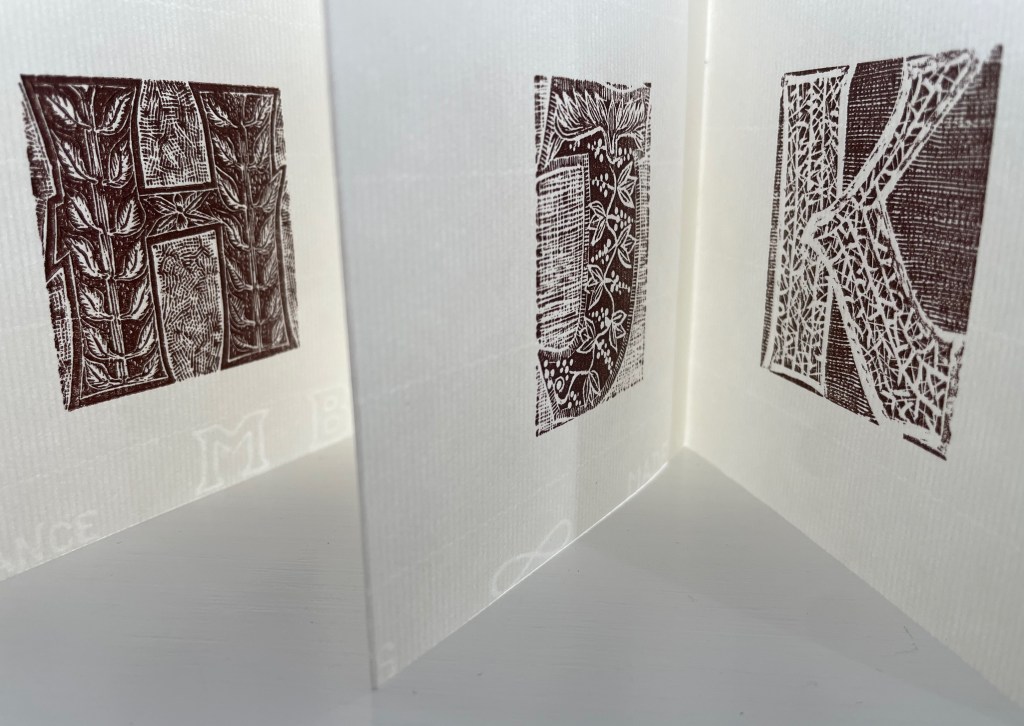
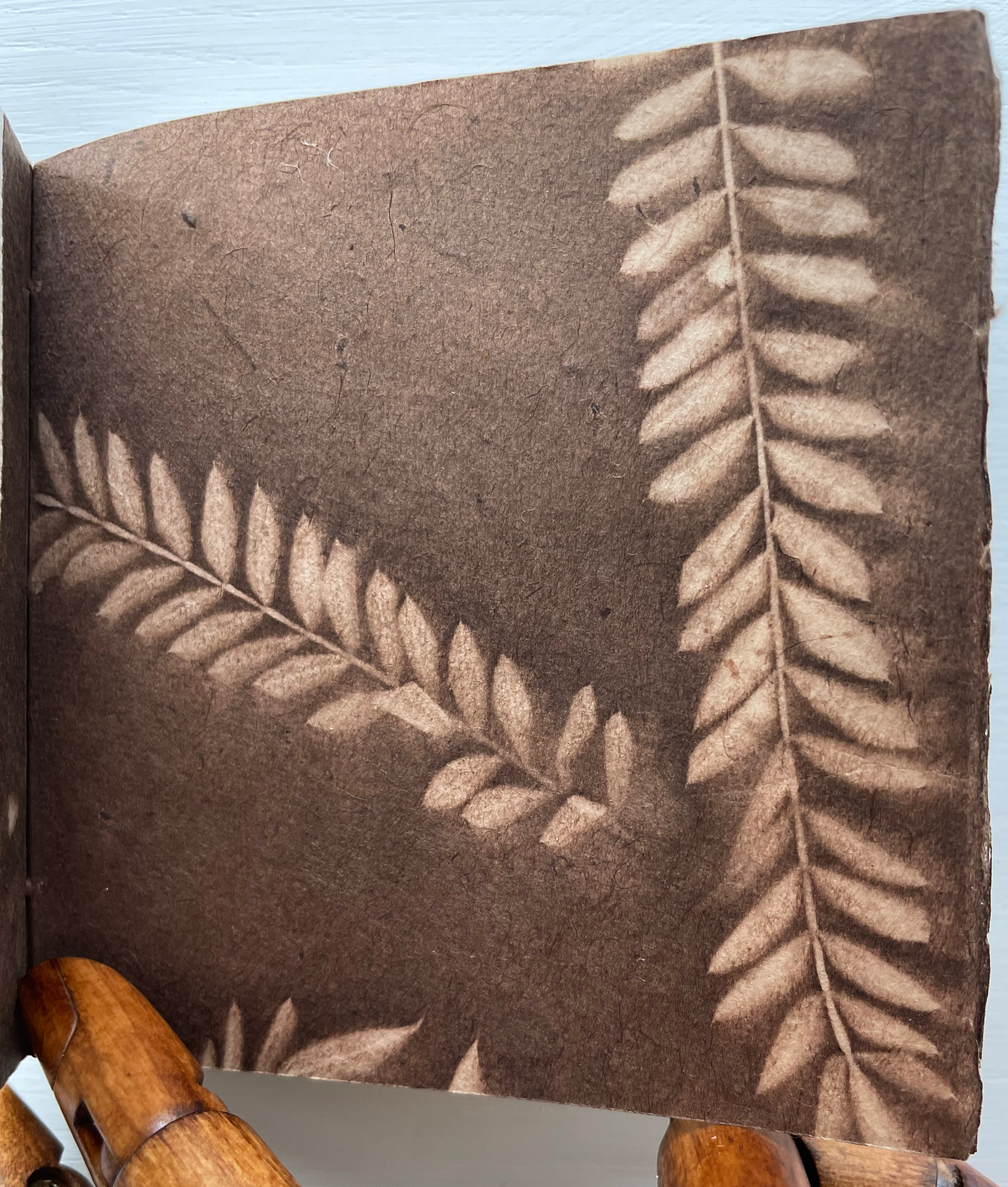
Before coming to the leporello, hand and eye are slowed by another texture. Like the self-referential Cave Alphabet paper cover, the flyleaf refers to itself with a leaf print. It contrasts with the cover, however, in its lightness, surface and color. While that dance of contrasting textures goes on, the flyleaf’s embedded image strikes up its own contrast with the relief technique and letters on the covers.

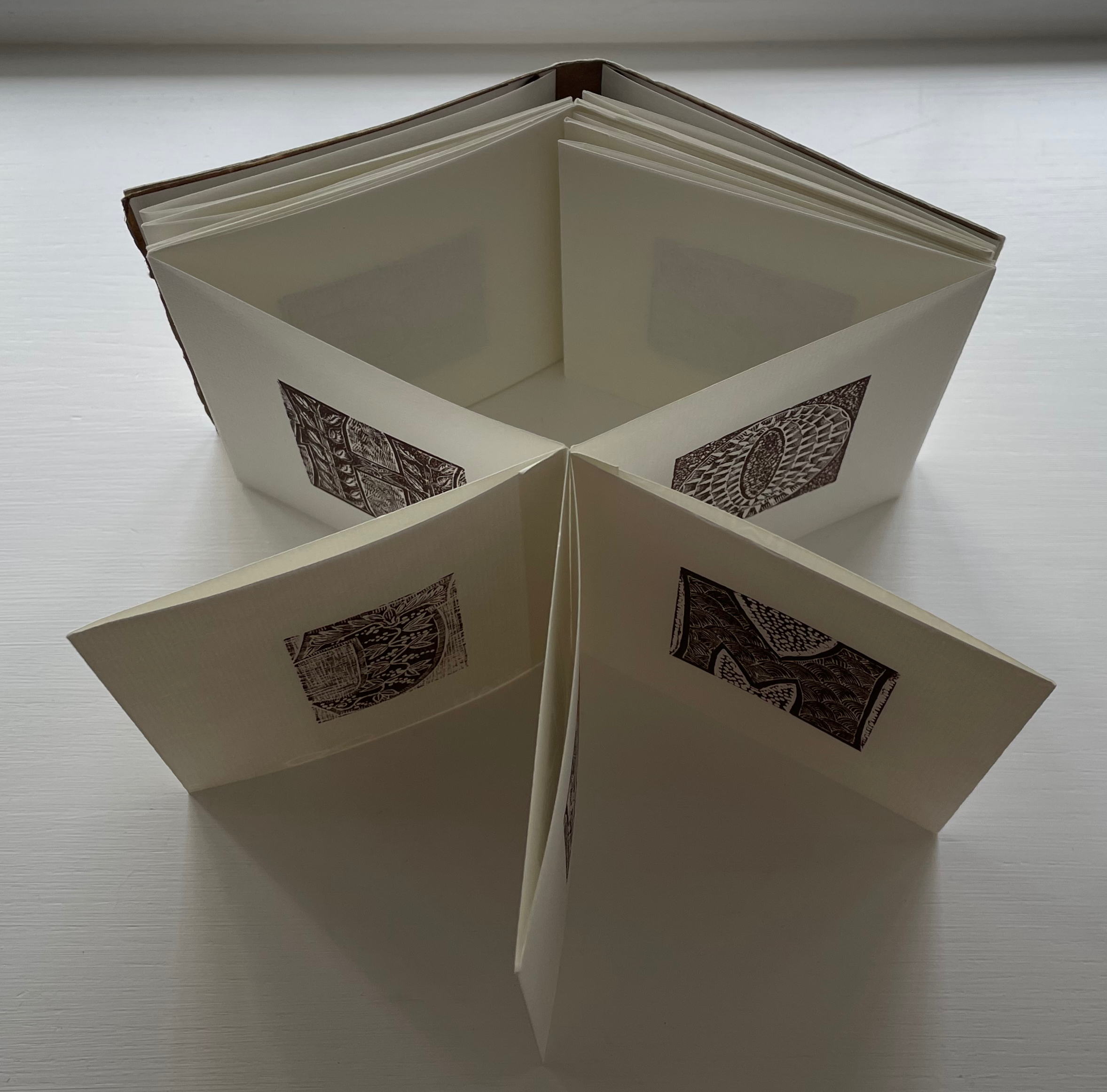
When the leporello comes on stage, the print pattern and paper texture exchange the roles they played at the beginning. Before, the print pattern held the stillpoint around which the cover, binding string, flyleaf and copperplate danced. Now, the smoother laid texture of the Ingres d’Arches paper becomes the stillpoint. Its weight, surface and color — very different from those of the cover and flyleaf — serve that constancy well. For each letterform (including the ampersand), different patterns make up the anatomy and background, which adds quite a number of dancers around the stillpoint.

The printing technique for all those dancers — Resingrave engraving — contributes to their variety of pattern. Invented by Richard Woodman, Resingrave is a synthetic substitute for boxwood. It consists of a thin layer of resin atop a block of MDF wood and, since the ’90s, was famously used by Barry Moser (e.g., the Pennyroyal Caxton Bible). More than lino or blocks for woodcuts, it allows for the thin lines necessary for close and fine patterns. Standing the leporello against the light offers a chance to enjoy the interaction of the “texture” of those patterns with the texture of the paper.

Like Moser, Cicale has engaged with watercolors as well as prints and embraced the abstract as well as the figurative, as can be seen in the next work.

Detritus No. 30 (2020)

Detritus No. 30: Floppy Alphabet, Brush Alphabet (2020)
Annie Cicale
Modified leporello, pasted to paper cover, bellyband closure. Closed: H95 x W80; Open: W750. 12 panels. Acquired from the artist, 4 July 2023.
Photos: Books On Books Collection.

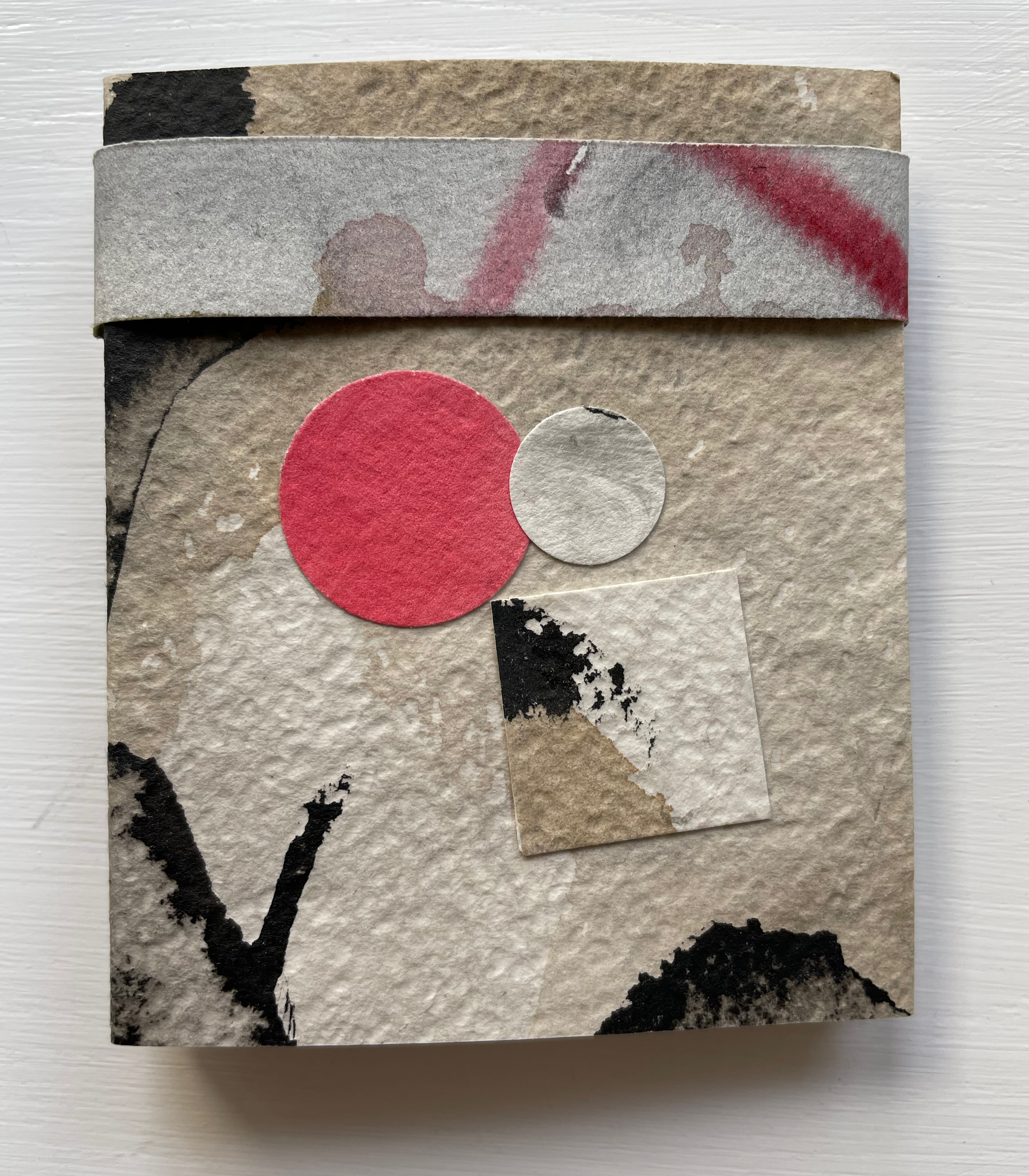
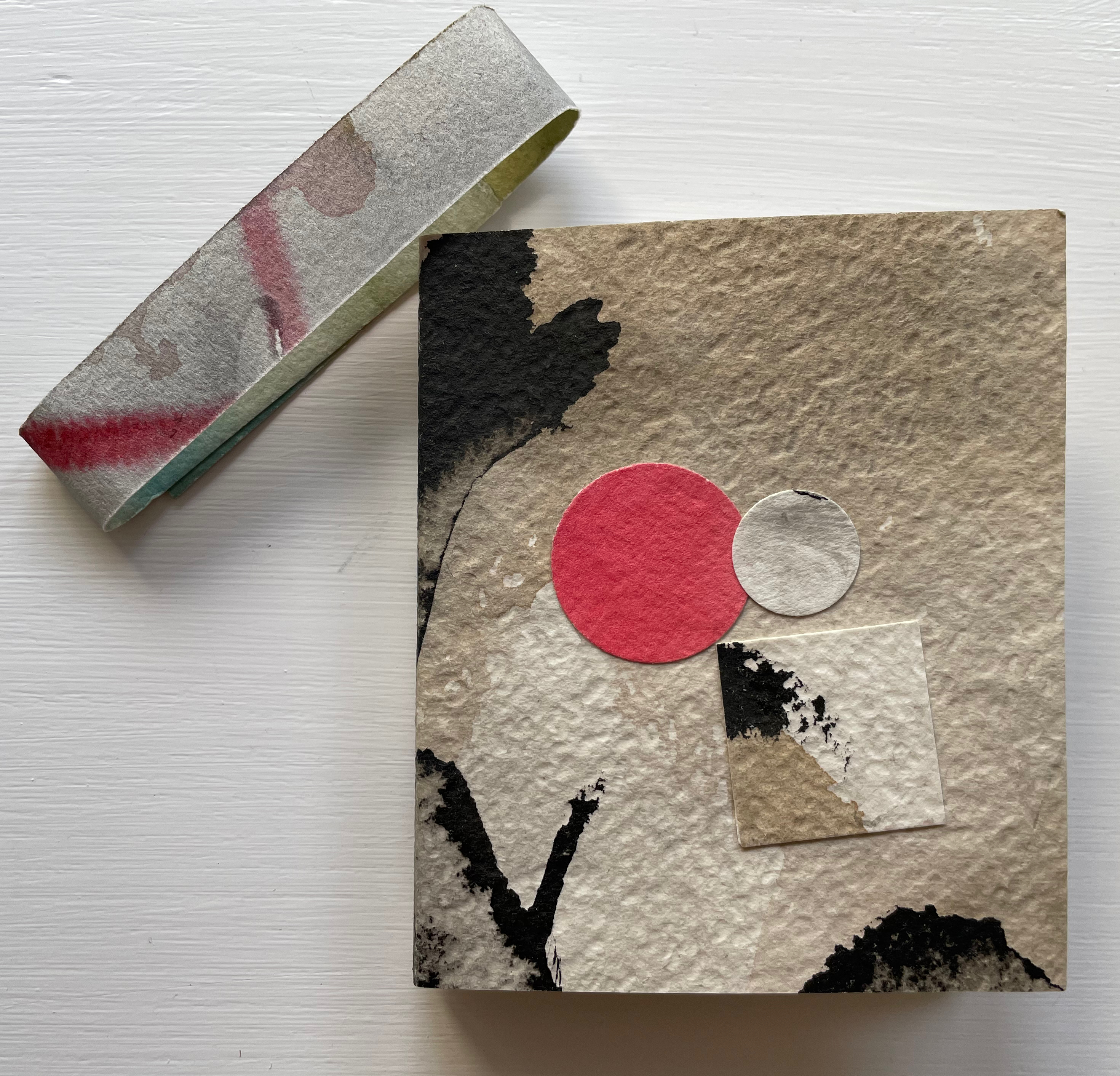
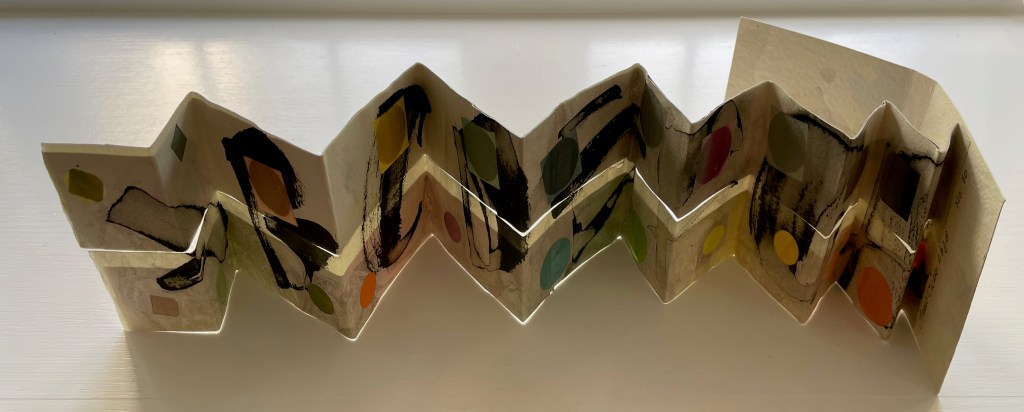
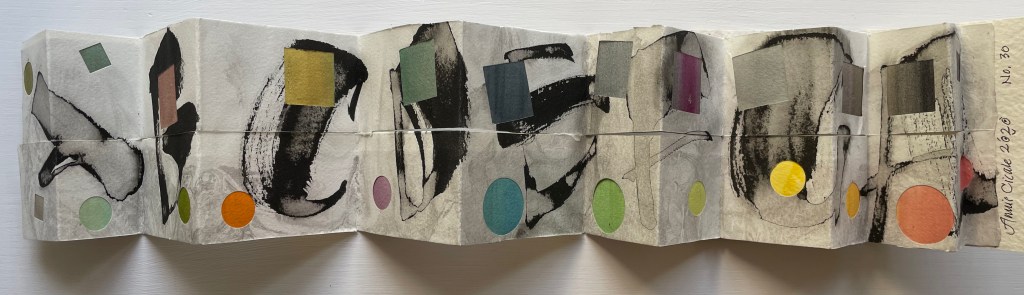
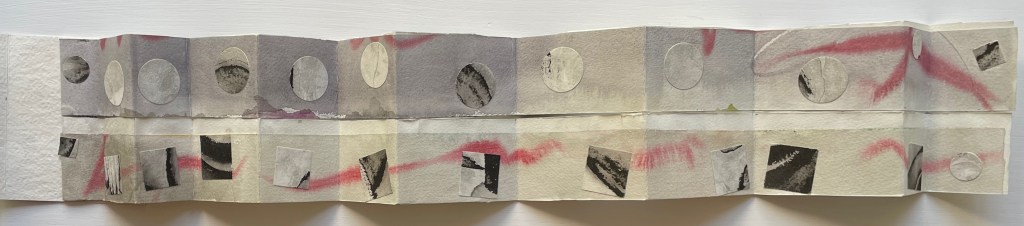
Here, Cicale has compiled and collaged cast off letters, ornaments and marks from completed works to create a modified double-sided leporello bound in painted and inked watercolor paper, held together with a belly band. The leporello’s two modifications are its variation in panel size and the cut across the mountain folds. Except for a reversal on the first panel, the upper row’s panels bear square cutouts, and the lower row’s bear circular ones. Although constant in shape and distribution, the recurrent squares and circles vary in their color and size, highlighting the variation in size of panels. With their constant black and gray, the ink-brushed letters A-H contrast with the variance of color and size of the circles and squares.

On the reverse side of the leporello, the circles and squares exchange position. They are, in fact, circular and square patches, black and white on this side of the leporello and colored on the other, supplying the color to the other side’s square and circular cutouts. The circular patches are generally consistent in size, as are the square patches, which contrasts with the varied sizes of the cutouts on the other side. The reverse side of the leporello is more muted, and with its black and white patches, it seems more abstract, but is it? Letters themselves are abstract, which may the tongue-in-cheek point of the underlying patches.

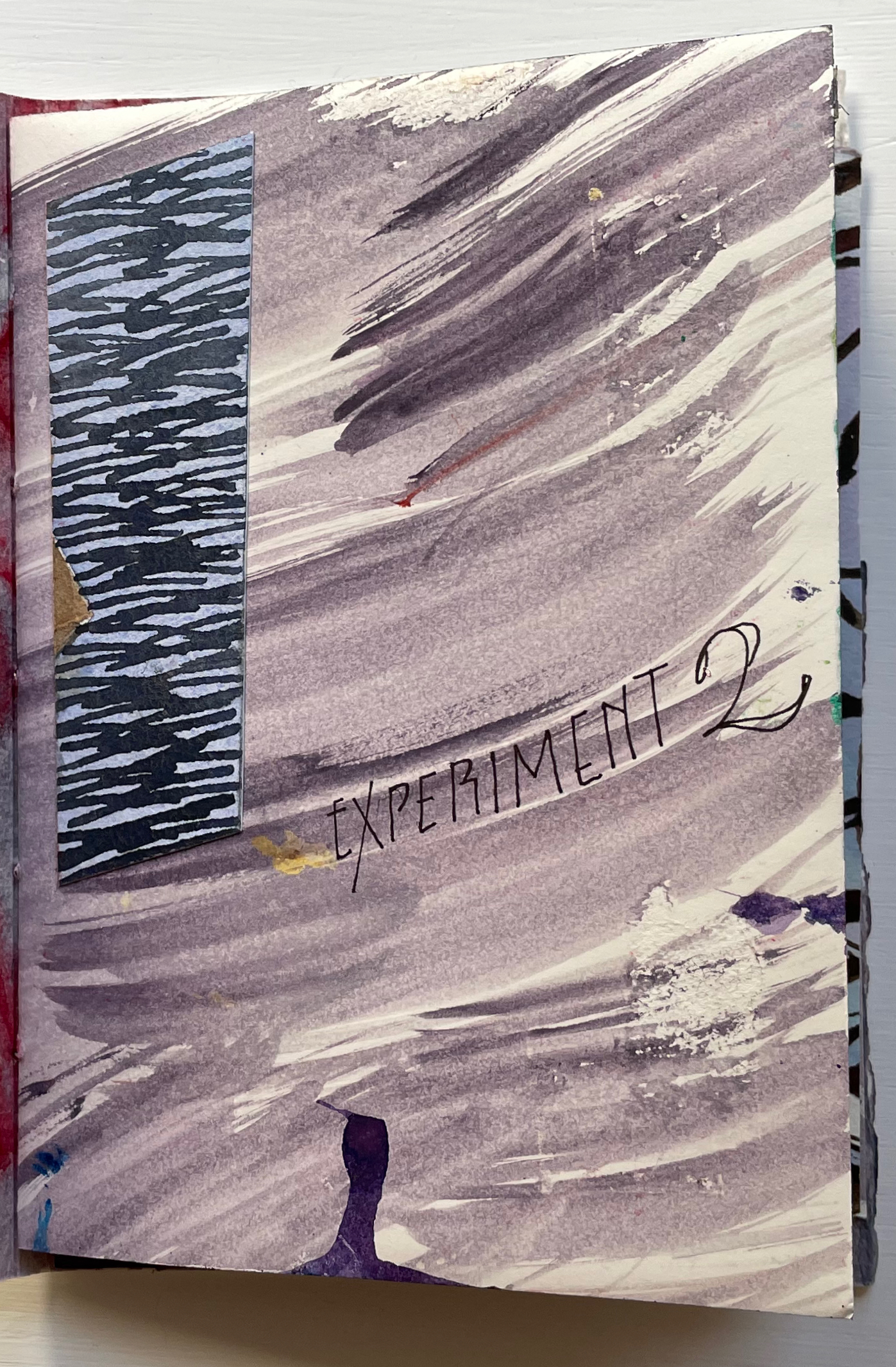
Experiment No. 2 (2023)

This image has an empty alt attribute; its file name is img_7572.jpeg

Experiment No. 2: Step by Step (2023)
Annie Cicale
Pamphlet stitch book. H185 x W 130 mm. Seven folios of varying trim size and papers, one set of four folios gathered and sewn to upper fold of spine, one set of three folios gathered and sewn to lower fold of spine. Acquired from the artist, 4 July 2023.
Photos: Books On Books Collection. Displayed with permission.

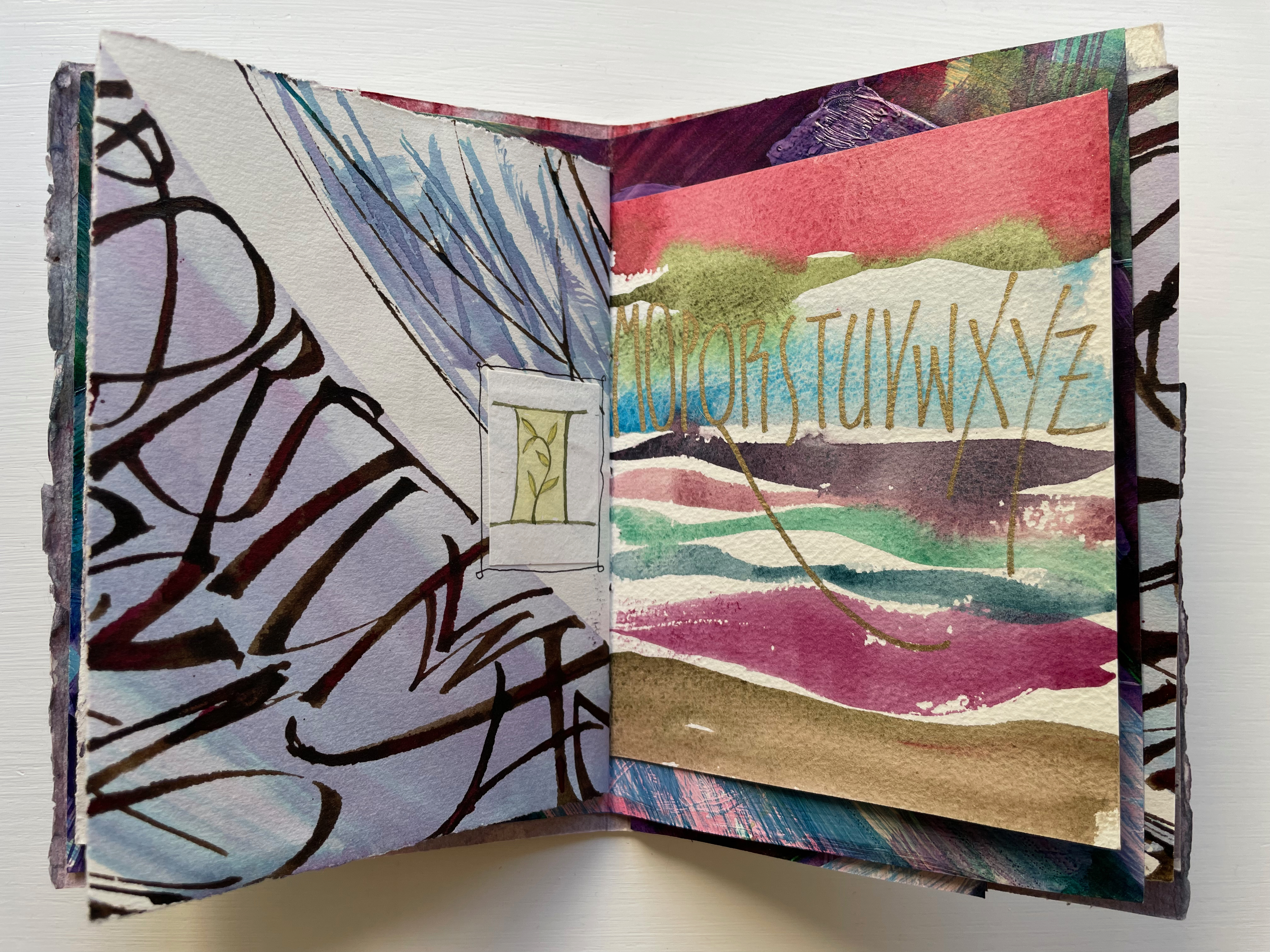
Cicale continues her dance of contrasts and similarities with Experiment No. 2 (2023). Here are some of her comments on process and material:

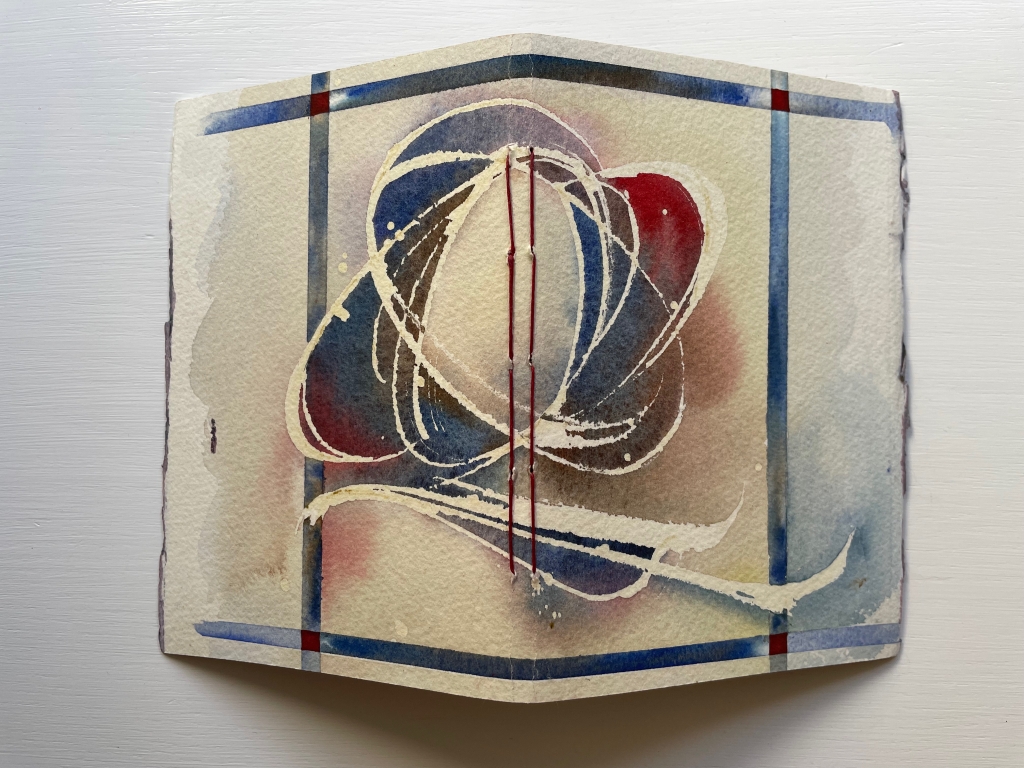
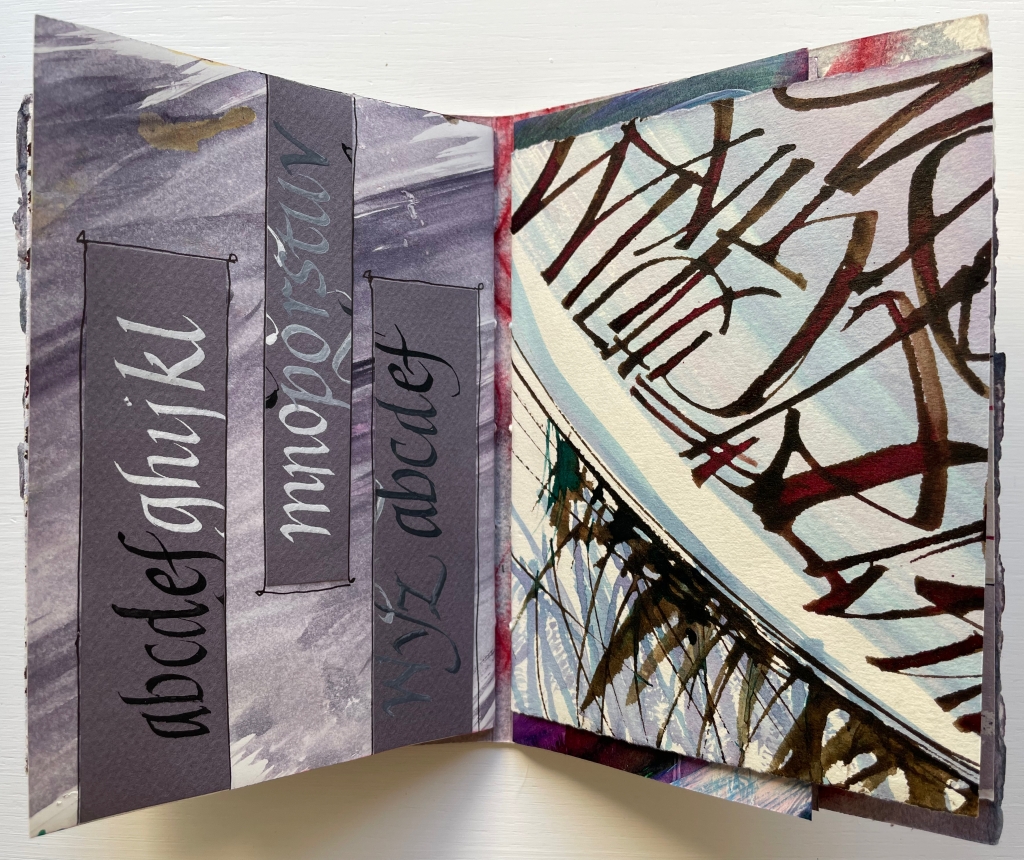
Teaching watercolor for many years has allowed me to try many exuberant techniques, using good rag paper and a wide gamut of colors, shapes and techniques.An alphabet written on another sheet of paper has been collaged on these pages. I’ve used walnut ink, watercolor and iridescent pigments, which create an interesting series of contrasts as you move through the book.

Another experimental aspect of this pamphlet stitch book is the gathering of the folios into two separate gathers and the variation in size of the folios. The exterior image of the spine above and its interior below show the attachment of the gatherings to the right and left folds of the spine. Two pamphlets in one.

This image has an empty alt attribute; its file name is img_7588-1.jpeg

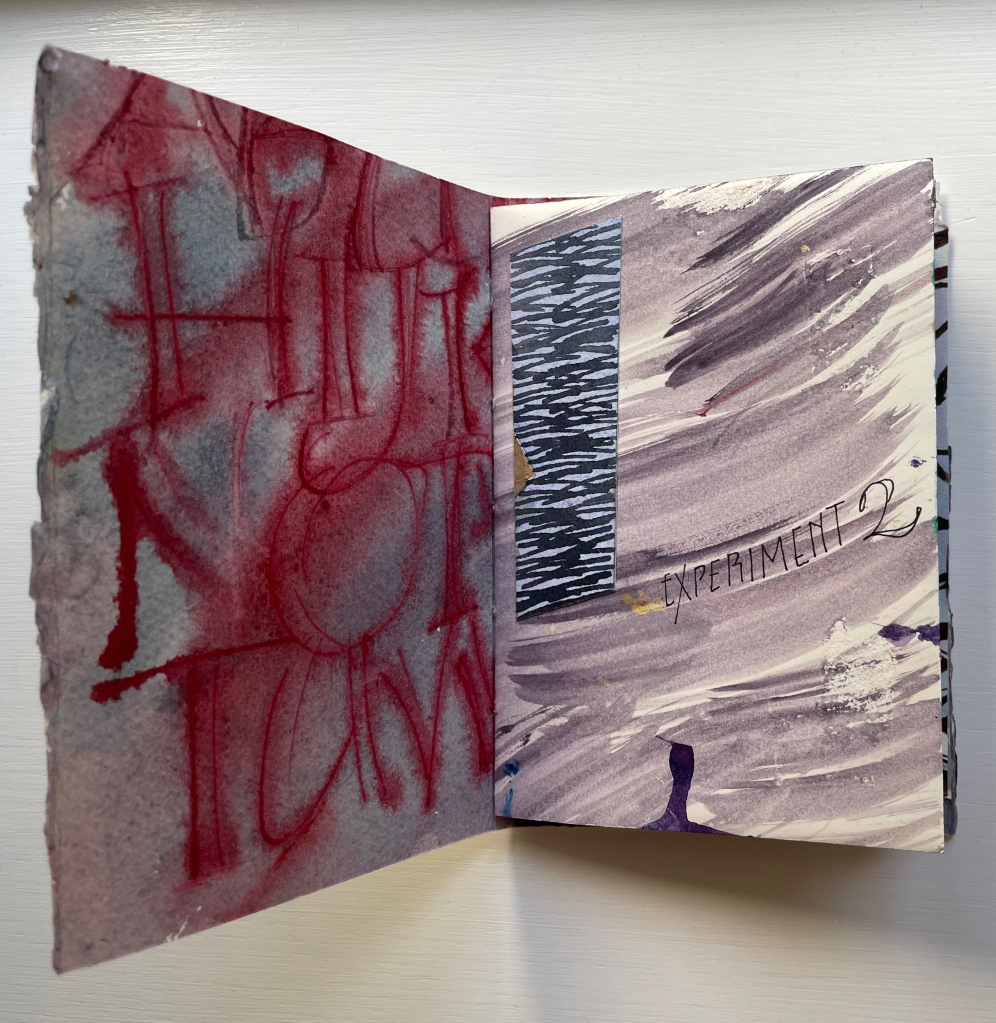
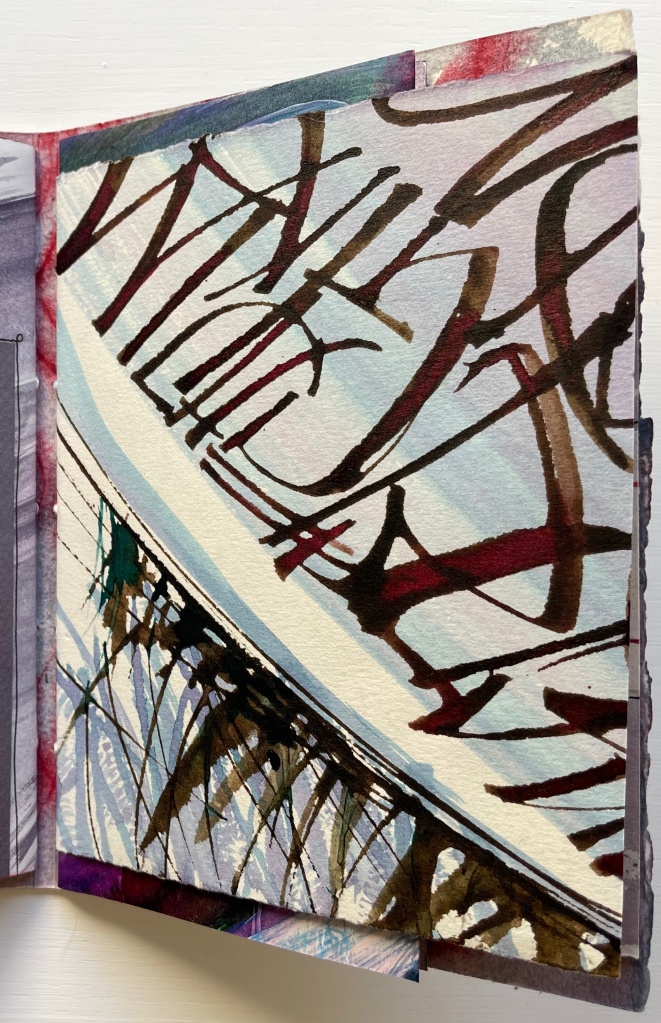
The first gathering’s title-bearing folio measures H176 x W246 mm when spread out fully. On its title-bearing page, there is one of the collage elements that Cicale mentions; three others appear on the other half, which is the final page of the first gathering.

This image has an empty alt attribute; its file name is img_7573.jpeg

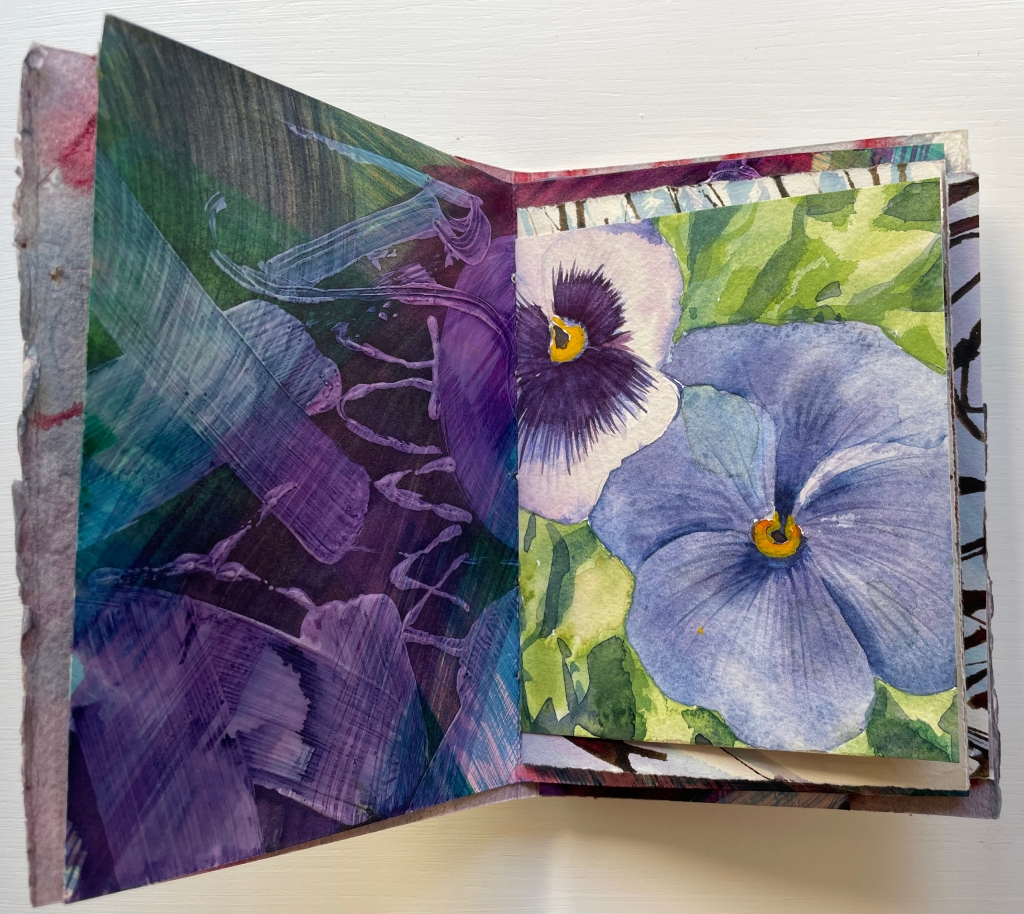
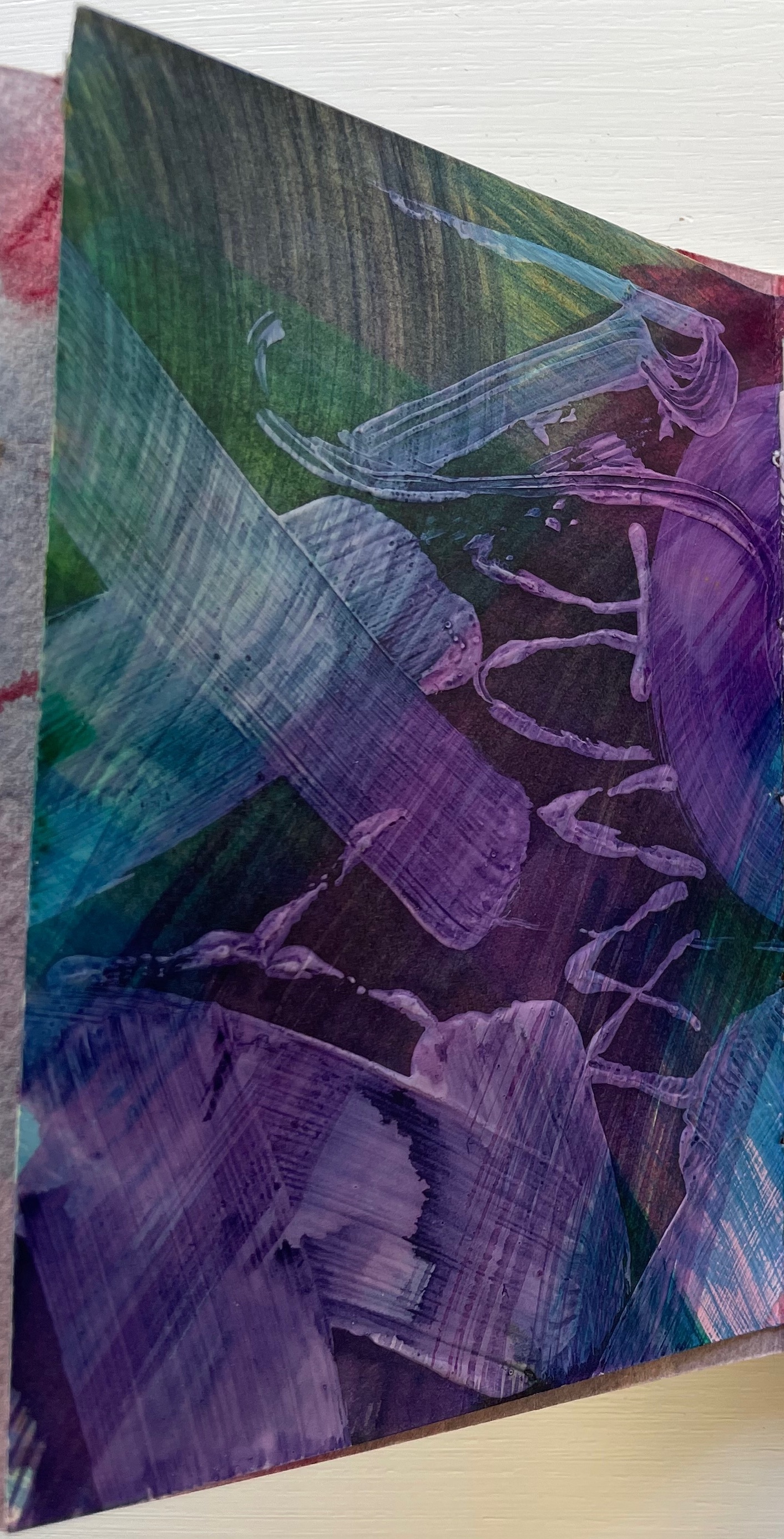
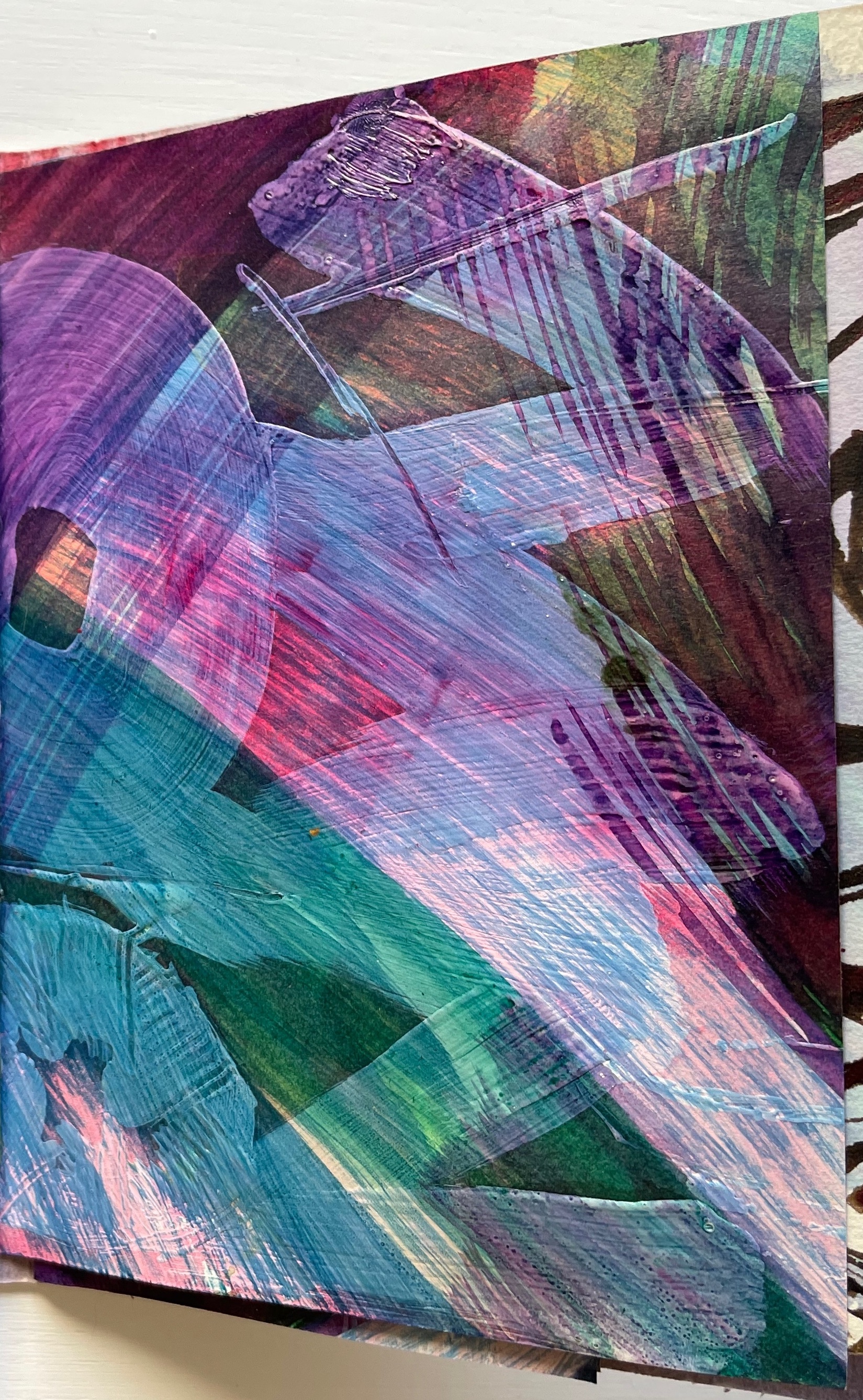
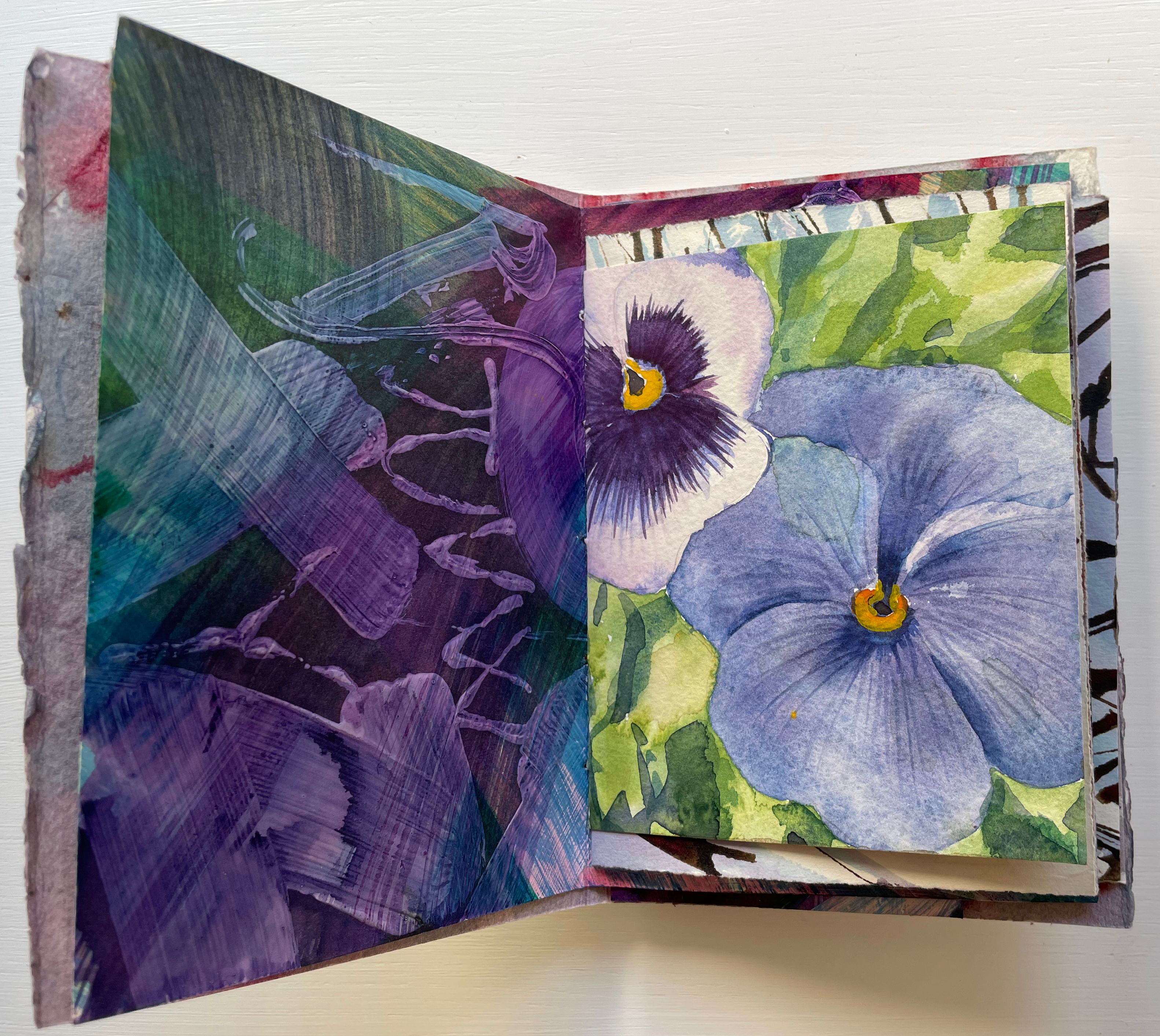
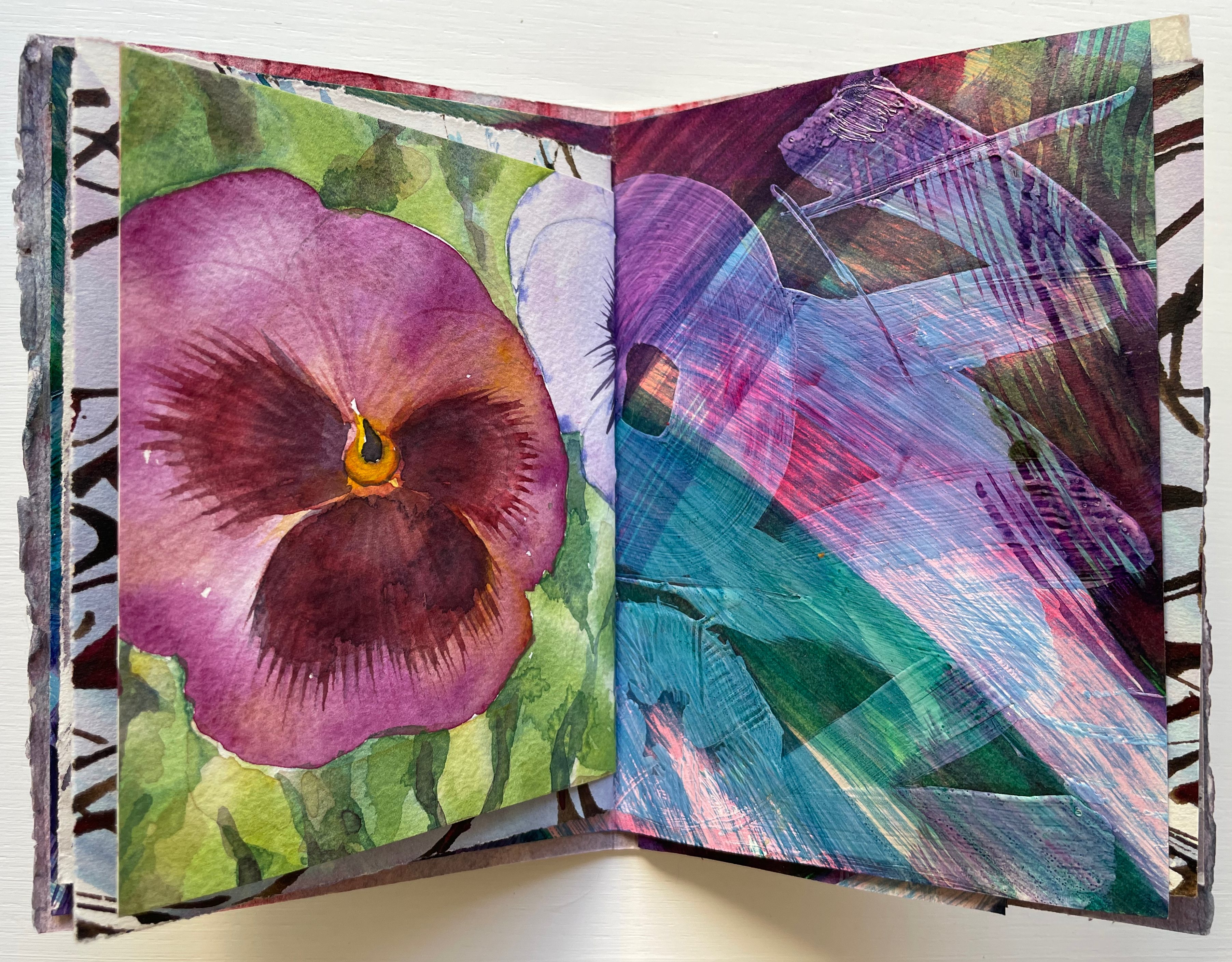
Of course, the full images on either side of the title-bearing folio cannot be seen all at once because of the intervening, contrasting and differently sized folded folios. It’s those different sizes and contrasts that somehow urge the reader/viewer to jump forward then back not only to see those full images for every folio but also to enjoy the magic of the contrasts and similarities. Two of the more effective spreads prompting this jumping forward and backward are these below. On the reverse side of the title-bearing folio is a colorful impasto painting of letters, some in sequence, some overlapping.

This image has an empty alt attribute; its file name is img_7575.jpeg

Perhaps it’s the impasto of the verso page that prompts the jump forward to find its recto mate, but once there, the mirrored colors of the pansy and letters surely prompt a jump back to enjoy again the different colors mirrored before.

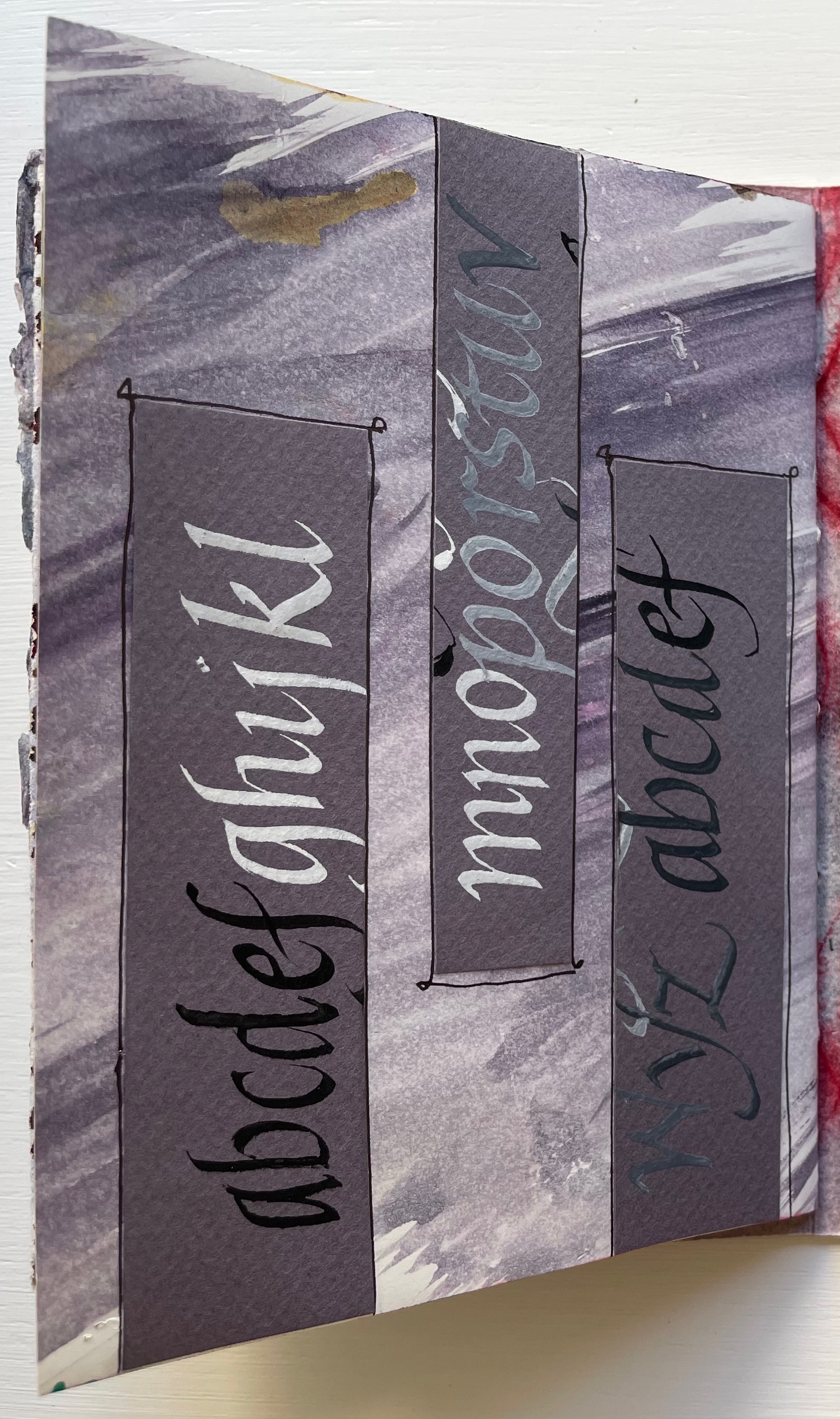
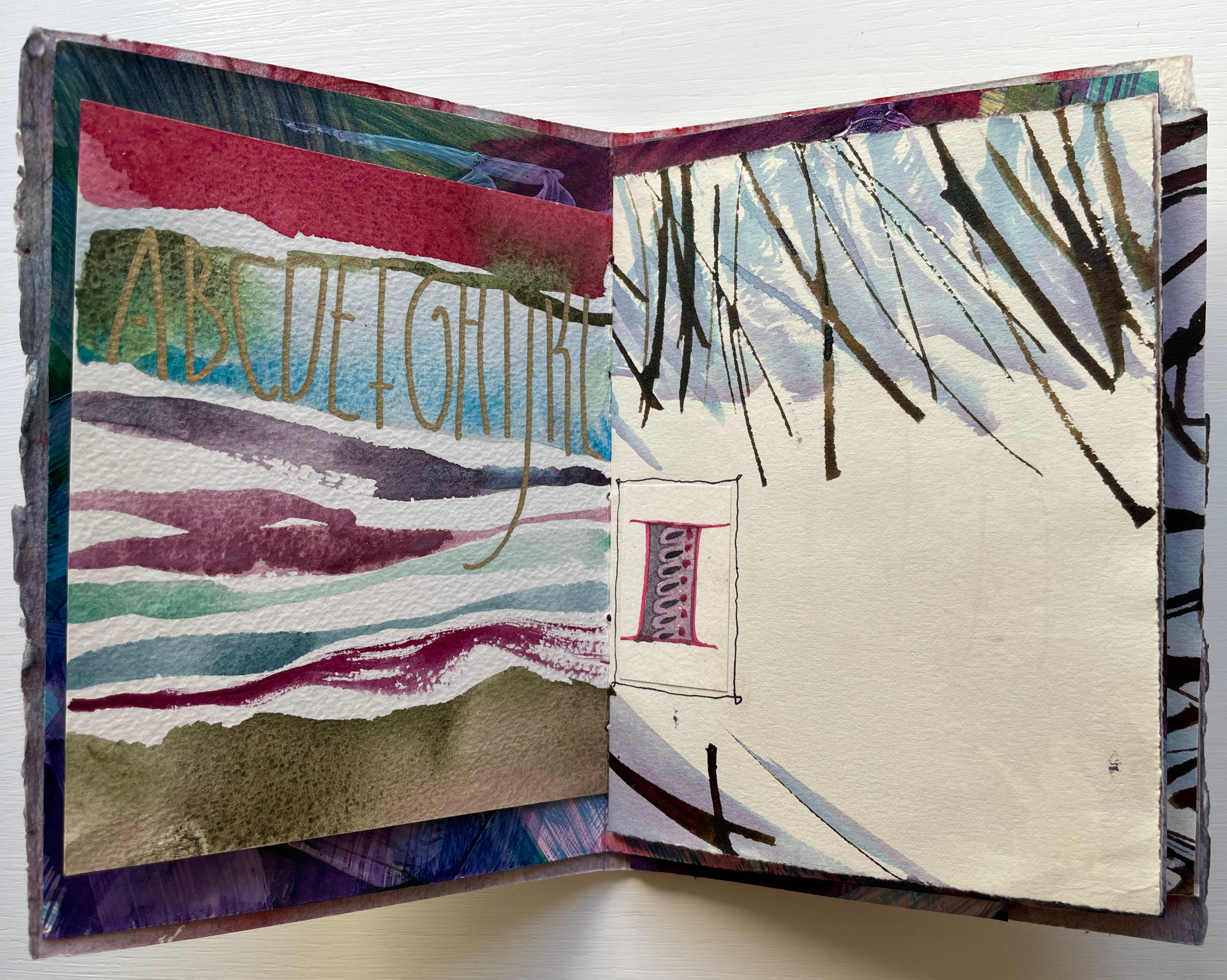
Below, the truncated alphabet prompts the leap forward to find its other half, and the contrasting wintry calligraphy facing M through Z sends us back to its other half to puzzle over those collaged thumbnail letter I’s.

Mind that all of this has occurred in just the first gathering.

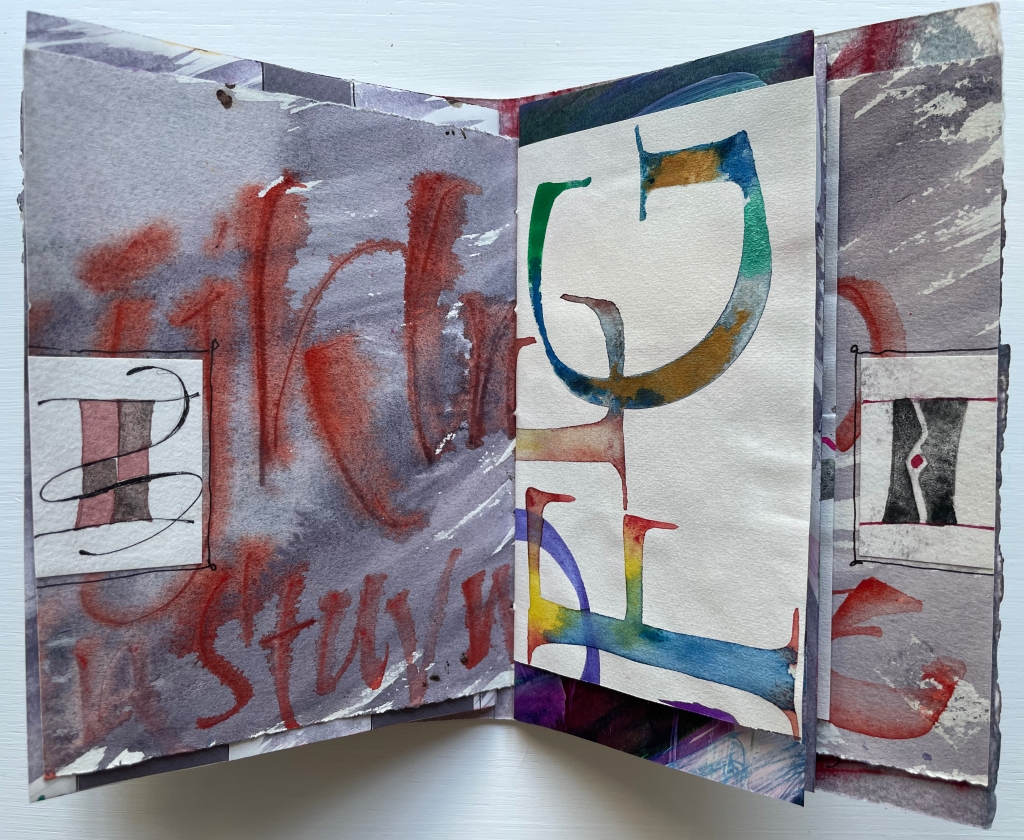
The second gathering has fewer folios and perhaps fewer prompts to jump forward and back, but there is at least one prompt to jump back to the first gathering. The first page of the second gathering recalls from the first gathering the folio of wintry calligraphy — the one above with the two puzzling thumbnail letter I’s.

This image has an empty alt attribute; its file name is img_7588-copy-2-1.jpeg

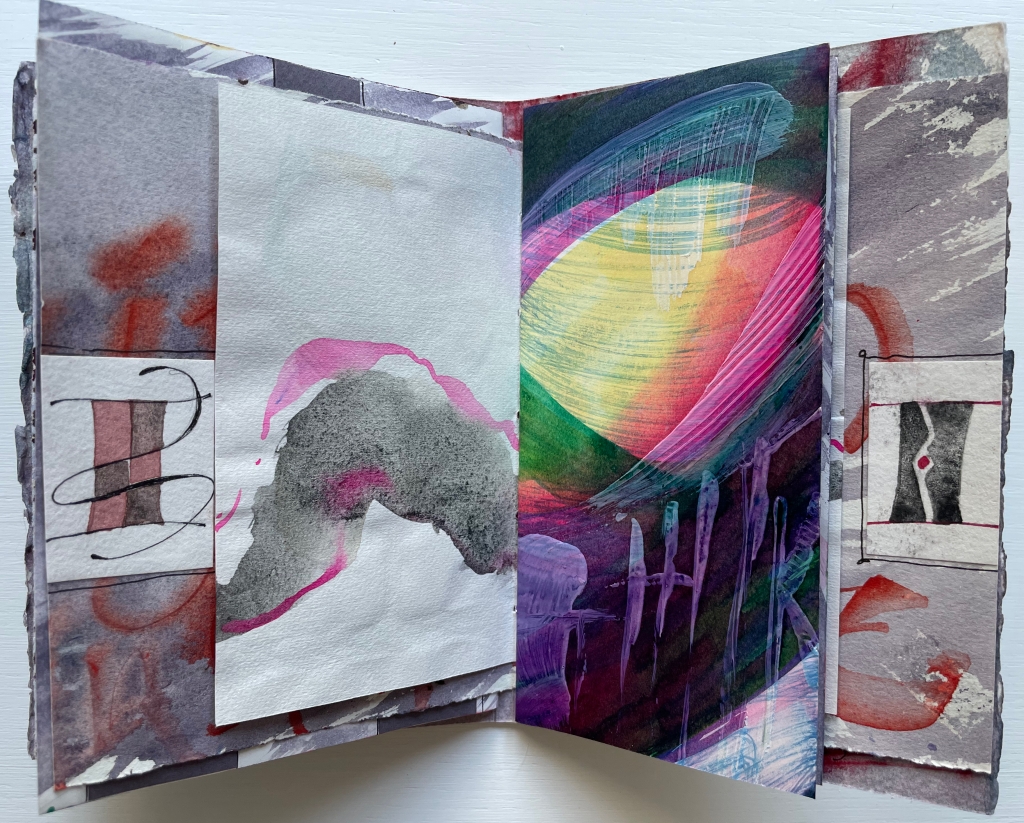
Curiously, the second gathering has several more of those thumbnail letter I’s than the first gathering has. In fact, due to the narrowness of the inner folios, the collaged thumbnails are also more constantly present to the eye. In general, the thumbnails and narrow inner folios make the second gathering more about the collage effect and strong contrasts across the differently sized pages and less about jumping forward and back.

When we reach the final page of the second gathering, there sits the thumbnail, almost as if it were the illuminated initial of “Incipit” — except, of course, this is the end.

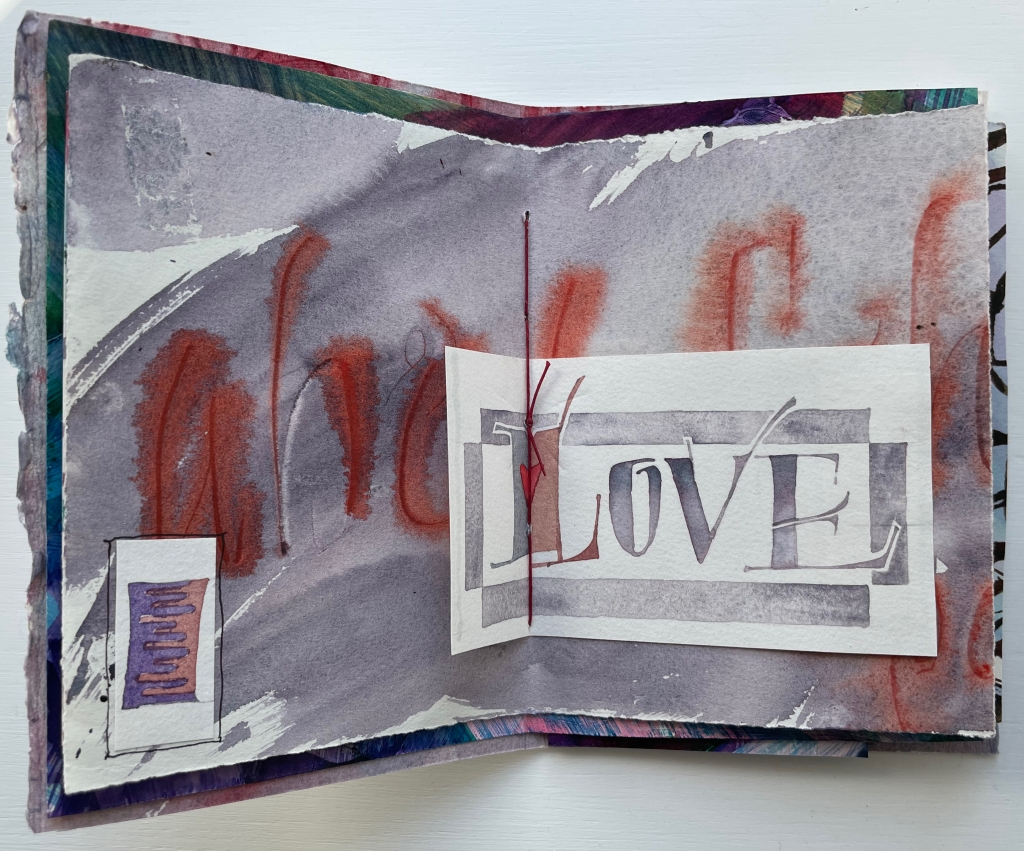
This image has an empty alt attribute; its file name is img_7597-copy-1.jpeg

Tantalizing and enchanting as those thumbnail letter I’s are, they also draw attention to the experiment’s one jarring folio. It appears in the center of the first gathering and is quirkily the only off-center folio in the whole book. It is also the folio that, with an explicit message, forecloses the surrounding incipience. With that twee red heart beneath the red thread, out the window goes the structural and material subtlety so enjoyable in the rest of the book.

This image has an empty alt attribute; its file name is img_8107.jpeg

Further Reading

Abecedaries I (in progress)“. Books On Books Collection.

Alphabets Alive! – Calligraphy & Design“. 19 July 2023. Books On Books.

Chen, Julie. 2013. 500 Handmade Books. Volume 2. New York: Lark. Pp. 54 (Grow), 279 (Free Play).

Books On Books Collection – Rowland Scherman

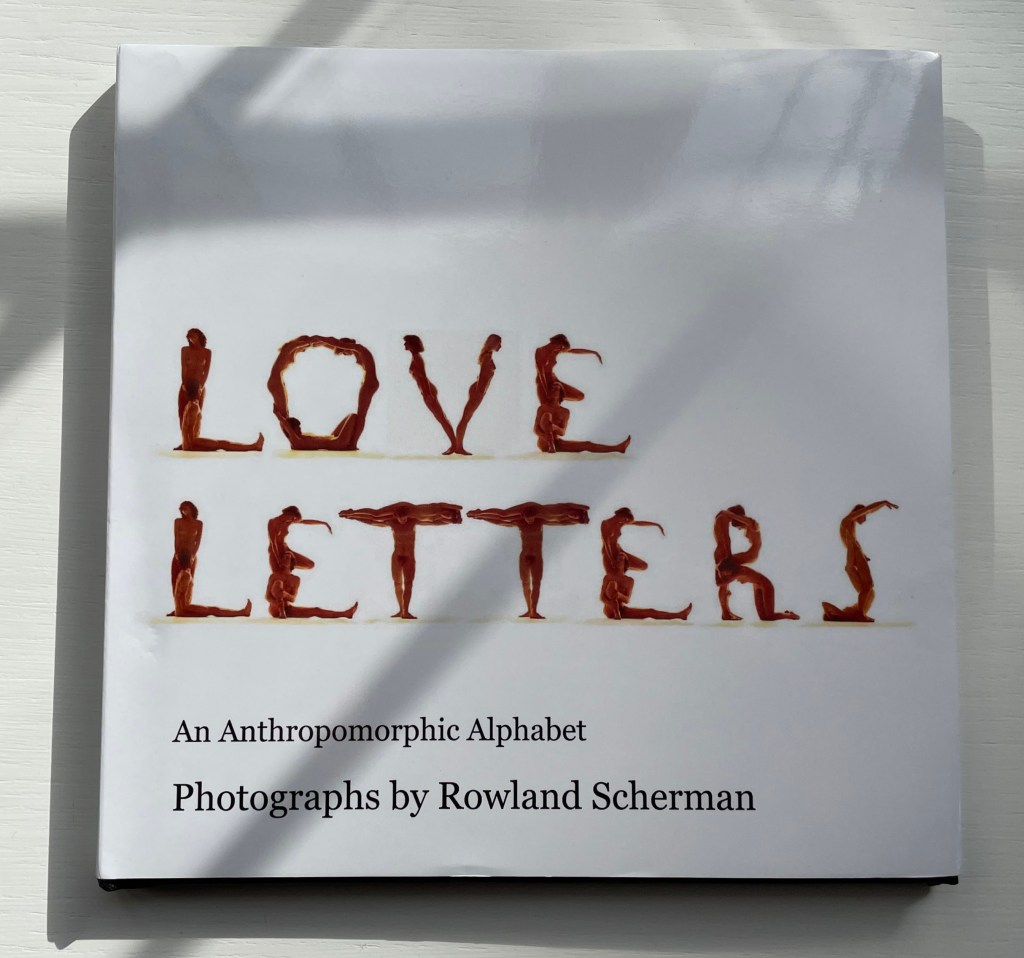
Love Letters (2008)

Love Letters: An Anthropomorphic Alphabet (2008)
Rowland Scherman
Casebound, doublures, perfect bound. H178 x W180 mm. 34 pages. Acquired from Rowland Scherman, 3 March 2023.
Photos of the book: Books On Books Collection. Displayed with permission of Rowland Scherman.

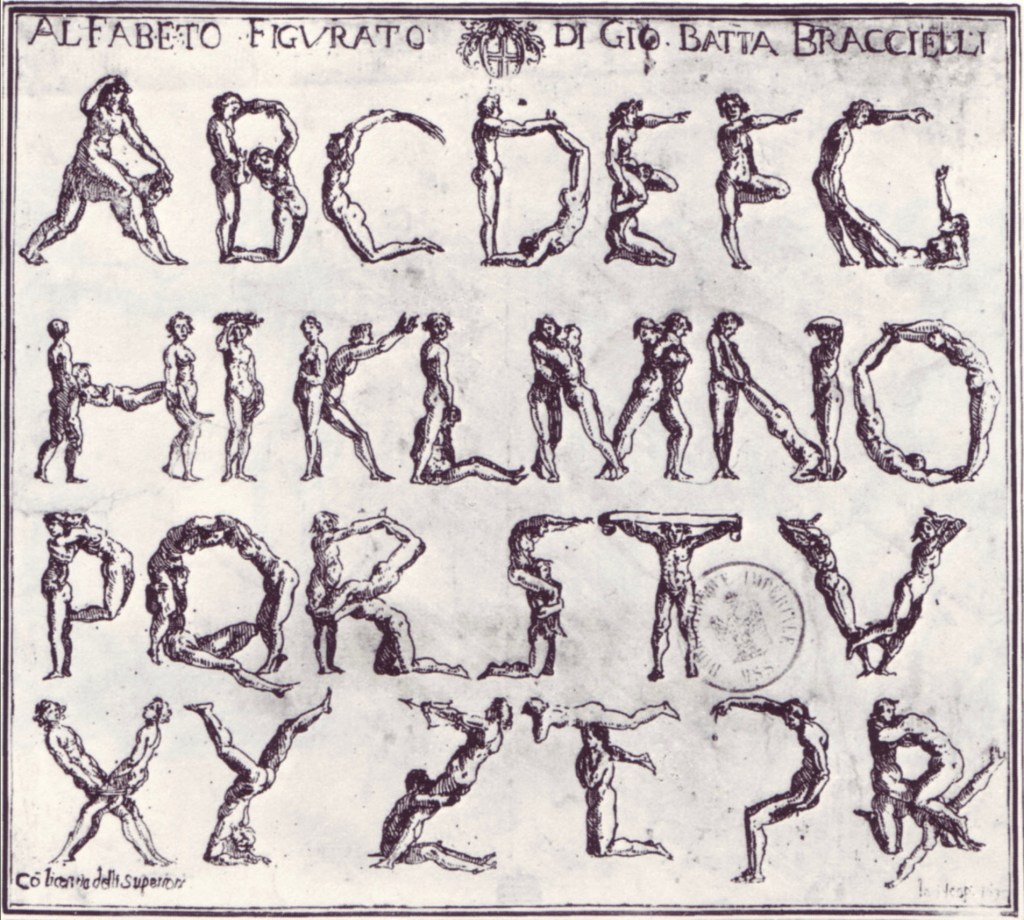
Braccelli. “Alfabeto figurato“. Etching. Naples, 1632.

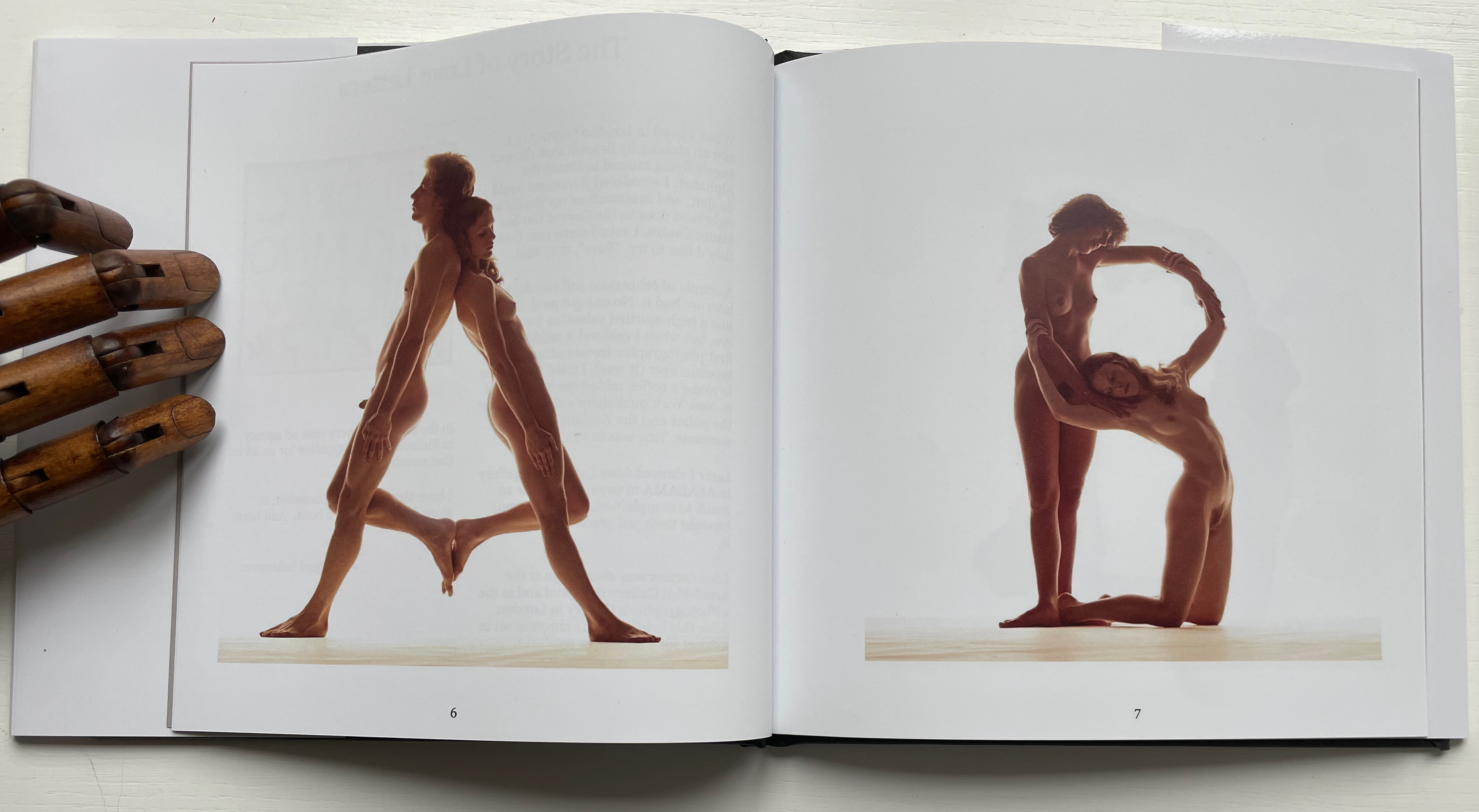
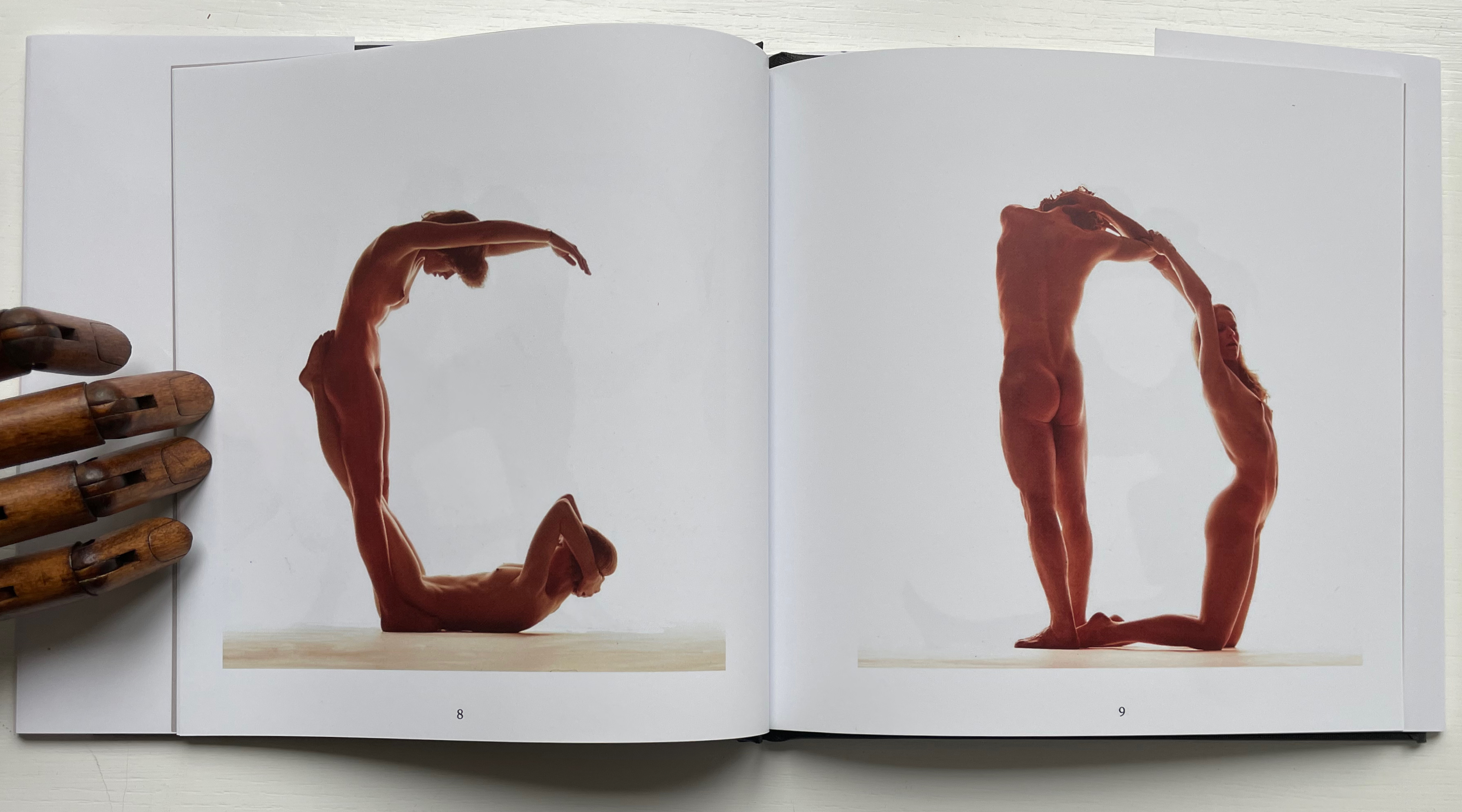
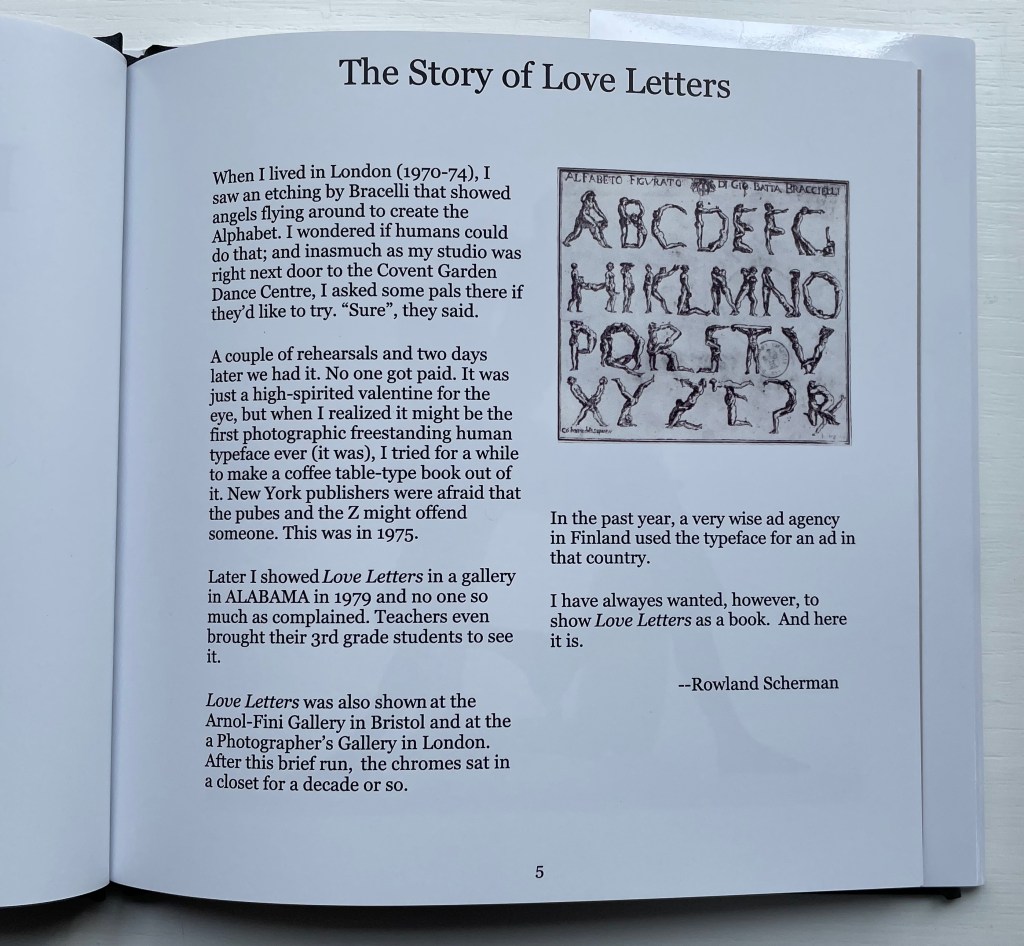
Giovanni Battista Bracelli’s “Alfabeto Figurato”, a single-sheet etching, occurred well after Carravagio’s presence there earlier in the century but well within the sphere of his ongoing influence. The print’s contortions of human bodies to display that most human of inventions — the alphabet — would probably have pulled a sneer of admiration from him. Maybe Bracelli had heard of the 5th-century comic playwright Kallias, who had his chorus dance (no doubt “cheek to cheek”) the shapes of the Ionian contenders for letterforms. In 1969, Anthon Beeke and Ed van der Elsken had their naked models arrange themselves into the alphabet on the studio floor and took photos from above. When Rowland Scherman saw Bracelli’s print on a London bus 340 years later, he wondered if human bodies could actually hold those poses or ones like them.

In the third decade of the 21st century, when book bannings and body shaming have reached new heights (or depths), Scherman’s “Story of Love Letters” might leave the reader wondering if we are now running headlong past Kallias and the 5th century into the pre-alphabetic world.

Further Reading

Abecedaries I (in progress)“. Books On Books Collection.

Alphabets Alive! – Body“. 19 July 2023. Books On Books.

Anthon Beeke“. 21 June 2021. Books On Books Collection.

Bruinsma, Max. “The erotics of type“. Maxb. Accessed 15 February 2023.

Dukes, Hunter. 27 April 2023. “Punctuation Personified (1824)“. The Public Domain Review. Not only could letters be formed with the human body, so could quotation marks and square brackets.

Reed, Sue Walsh. 2000. “Bizzarie di Varie Figure: Commentary“. Octavo. Accessed from Monoskop, 28 February 2023.

Wise, Jennifer. 1998. Dionysus Writes : The Invention of Theatre in Ancient Greece. Ithaca ; London: Cornell UP.

Steiner Deborah. 2021. Choral Constructions in Greek Culture : The Idea of the Chorus in the Poetry Art and Social Practices of the Archaic and Early Classical Period. Cambridge: Cambridge University Press. See chapter 8 for the story on Kallias and dancing the alphabet.

Typographica. 18 March 2007. “Rowland Scherman’s ‘Love Letters‘”. Typographica. Accessed 13 February 2023.

Typographica. 1 April 2010 (last modified). “Bracelli.jpg“. Typographica. Accessed 13 February 2023.

Books On Books Collection – Guy Bigland

Square Photographs of White Circle Paintings (2022)

Square Photographs of White Circle Paintings (2022)
Guy Bigland
Saddle stitched soft cover. H150 x W220 mm. [40] pages. Edition of 100. Acquired from the artist, 12 October 2023.
Photos of the work: Books On Books Collection.

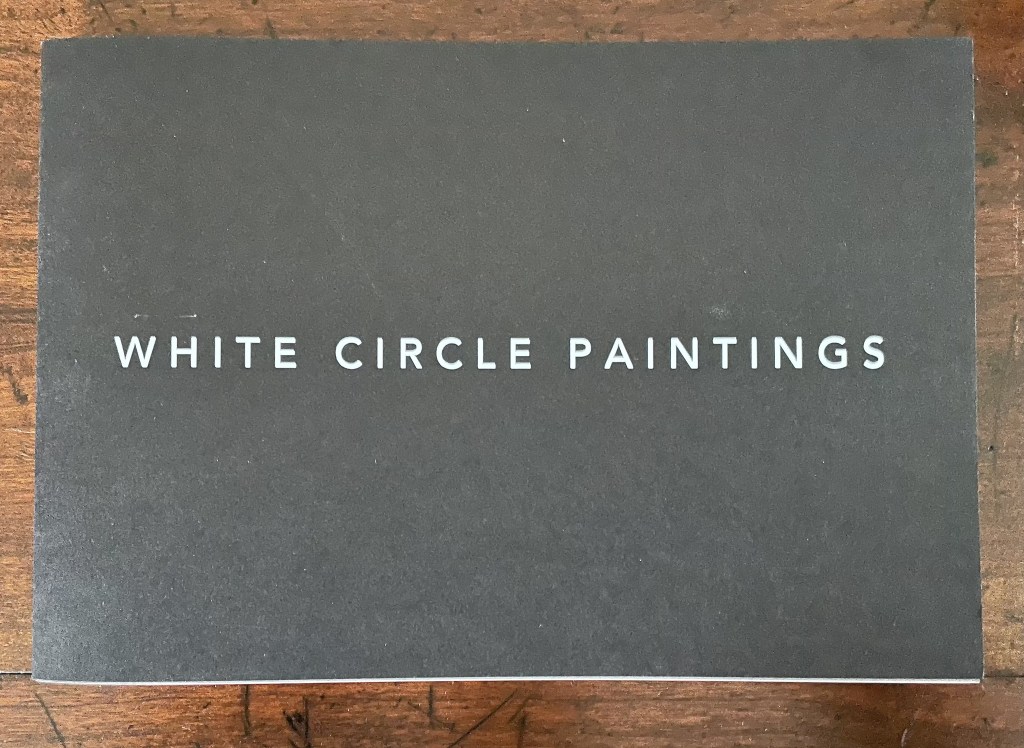
The cover and title of this artist’s book create an odd road sign to appreciating the work. White on heavy black stock (320 gsm), only the second half of the title appears on the front cover. Opening the book to its bright white sturdy 148 gsm interior, we find photographs of the promised “white circle paintings” framed in dark gray to black squares. So far, so expected. But on closer inspection, the dark squares emerge as road surface. At the end of the book, almost all is revealed by a short text on the rules and history of the mini-roundabout.

Continue reading

Books On Books Collection – David Rault

ABC of Typography (2019)

ABC of Typography (2019)
David Rault  
Casebound, sewn, illustrated paper-over-boards cover, endbands, sewn, red doublures. H265 x W195 mm. 128 pages. London: Self Made Hero [Translated from French (Gallimard, 2018)]. Acquired from The Saint Bookstore, 29 June 2023.
Photos: Books On Books Collection.

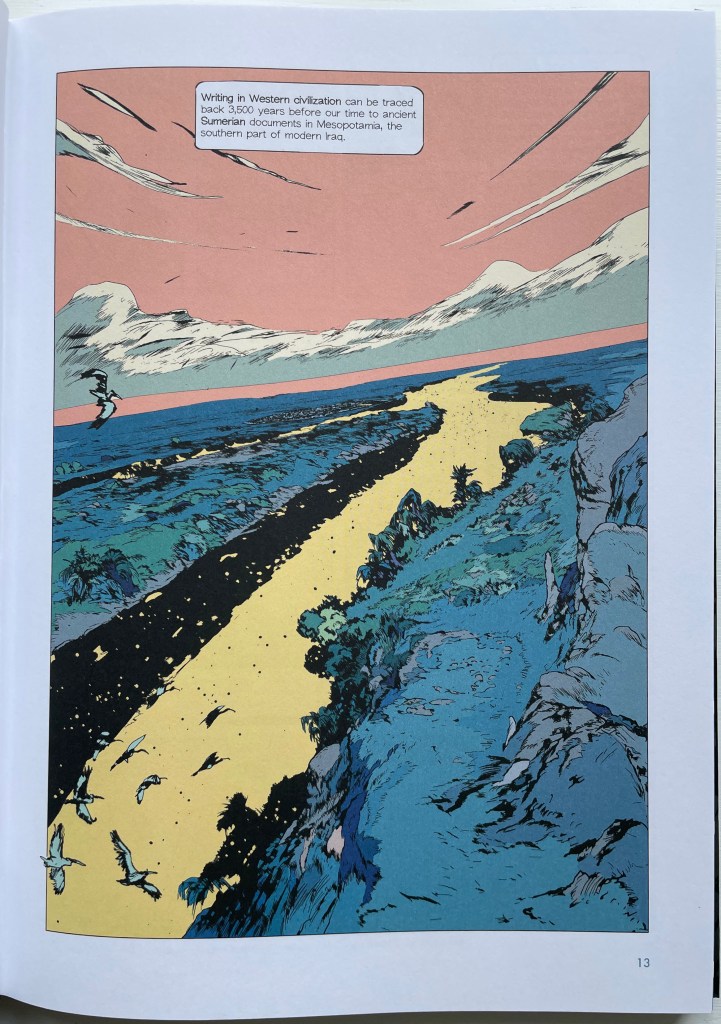
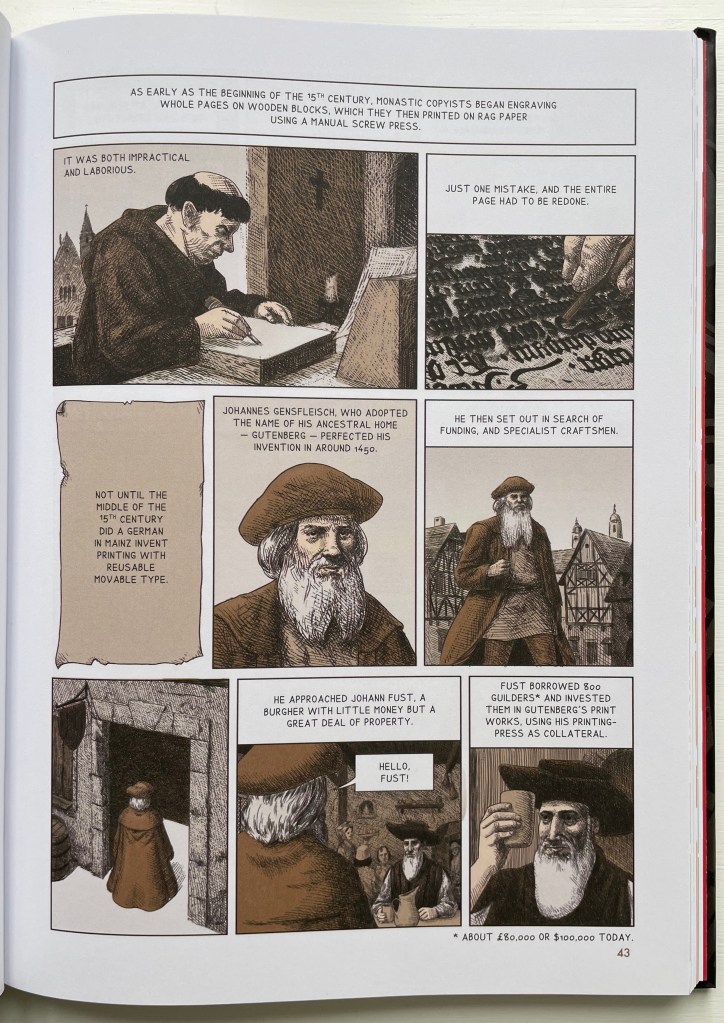
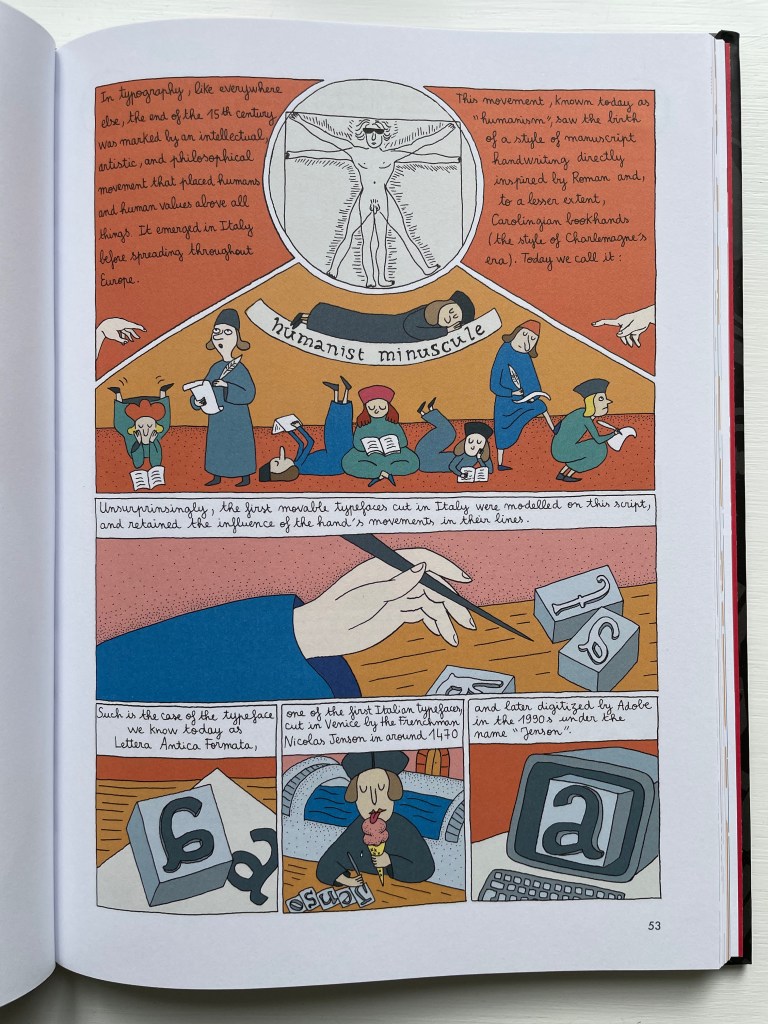
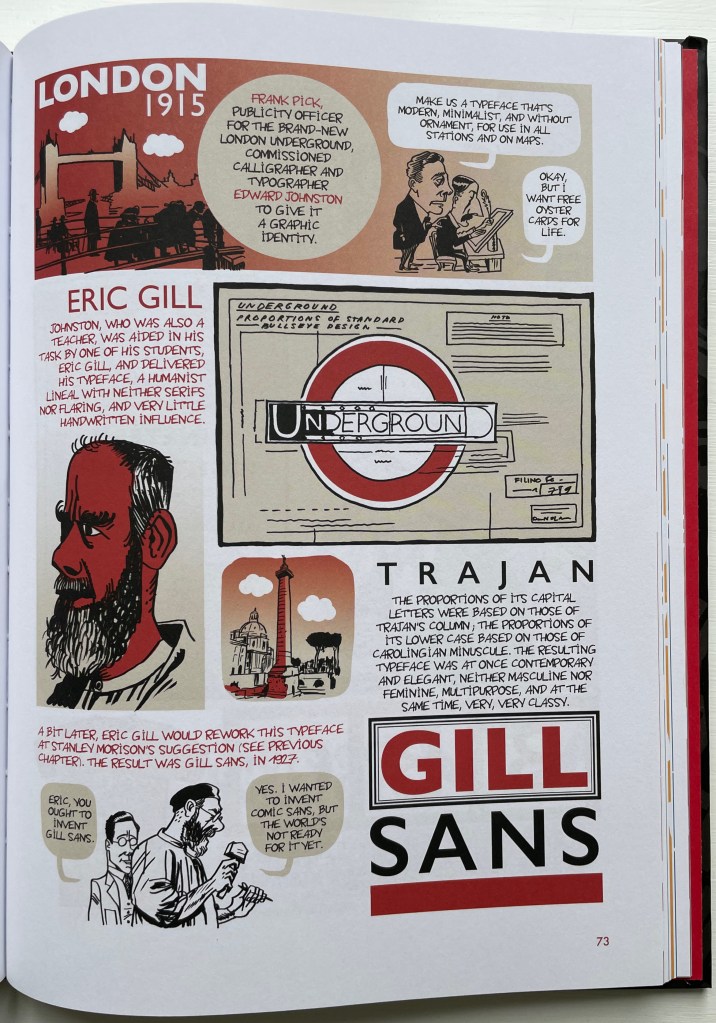
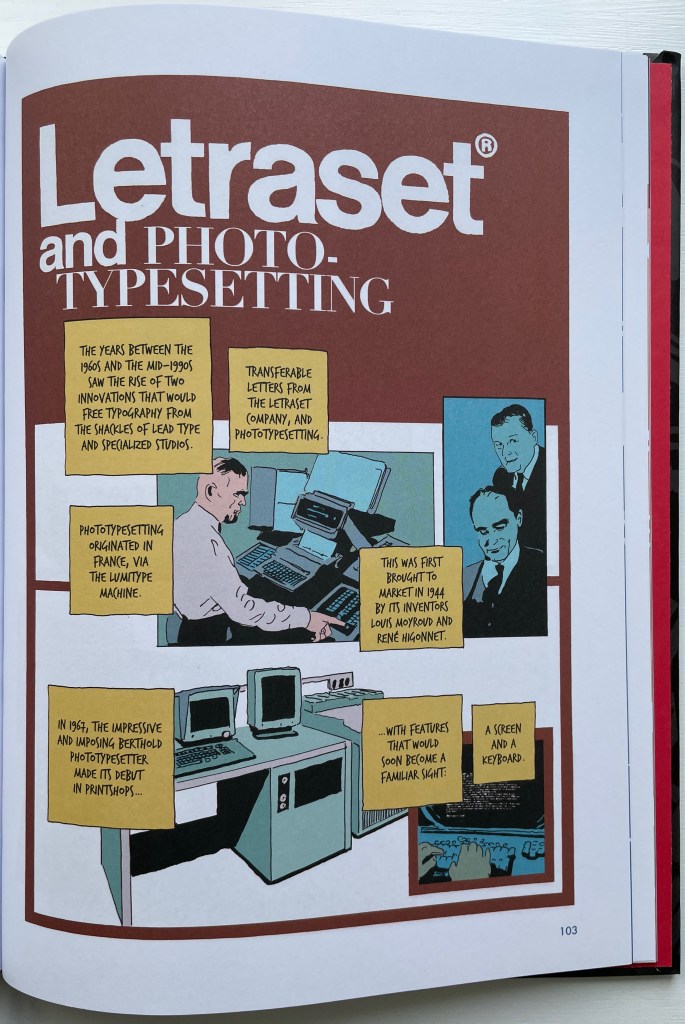
David Rault’s ABC of Typography traces 3,500 years of letters and type from pictographs and cuneiform through Roman lettering and Gutenberg to the Bauhaus and beyond. For the Books On Books Collection, it enriches the focus on the alphabet, typography and artists’ books — in particular, that subset of illustrated histories of the alphabet and type. These include Tommy Thompson’s The ABC of Our Alphabet (1952), William Dugan’s How Our Alphabet Grew (1972), Tiphaine Samoyault’s Alphabetical Order (1998), James Rumford’s There’s a Monster in the Alphabet (2002), Ada Yardeni’s A-dventure-Z’ (2003), Don Robb and Ann Smith’s Ox, House, Stick (2007) and Renzo Rossi’s The Revolution of the Alphabet (2009).

While enhancing that subset of illustrated reference works, ABC of Typography also highlights a gap in the collection. Rault and his team of invited artists hail from the Franco-Belgian tradition of les bandes dessinées (BDs), which the French and Belgians call la Neuvième Art (“the Ninth Art”). English-language readers will likely be familiar with BDs from seeing Hergé’s Tintin or René Goscinny’s Asterix. Other than Chiavelli’s Arthur R./Un Coup de DÉS Jamais N’Abolira le HASARD (1988) and its two companion volumes, the collection has no BDs. The Rault volume does, however, deliver a mini-survey of styles among contemporary bandes dessinateurs with its assignment of chapters to eleven different artists.

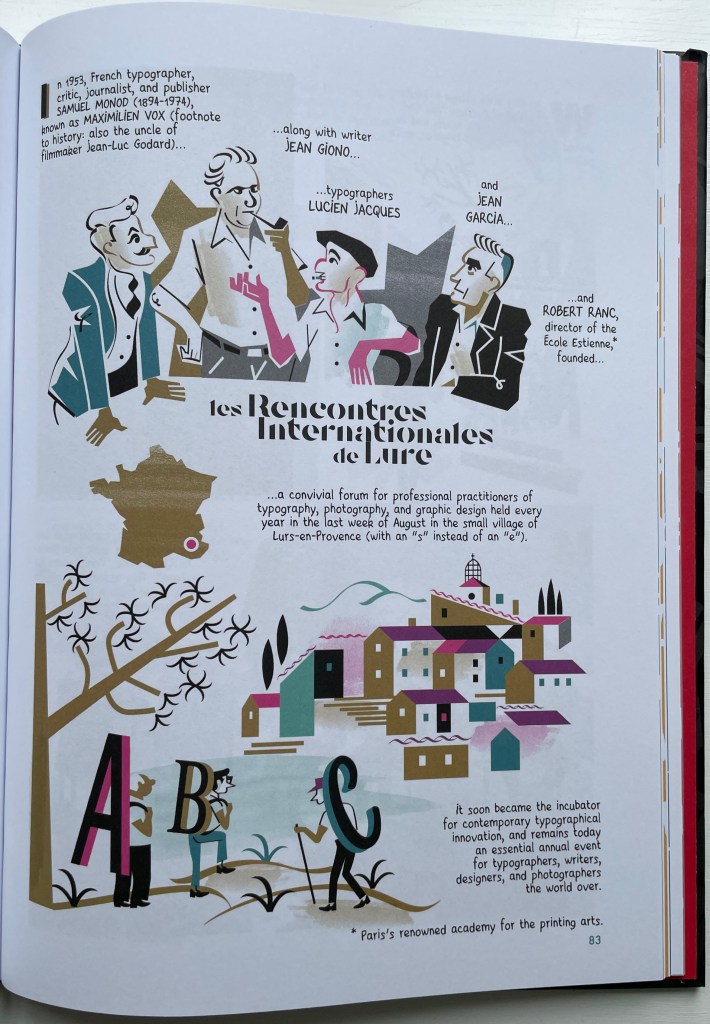
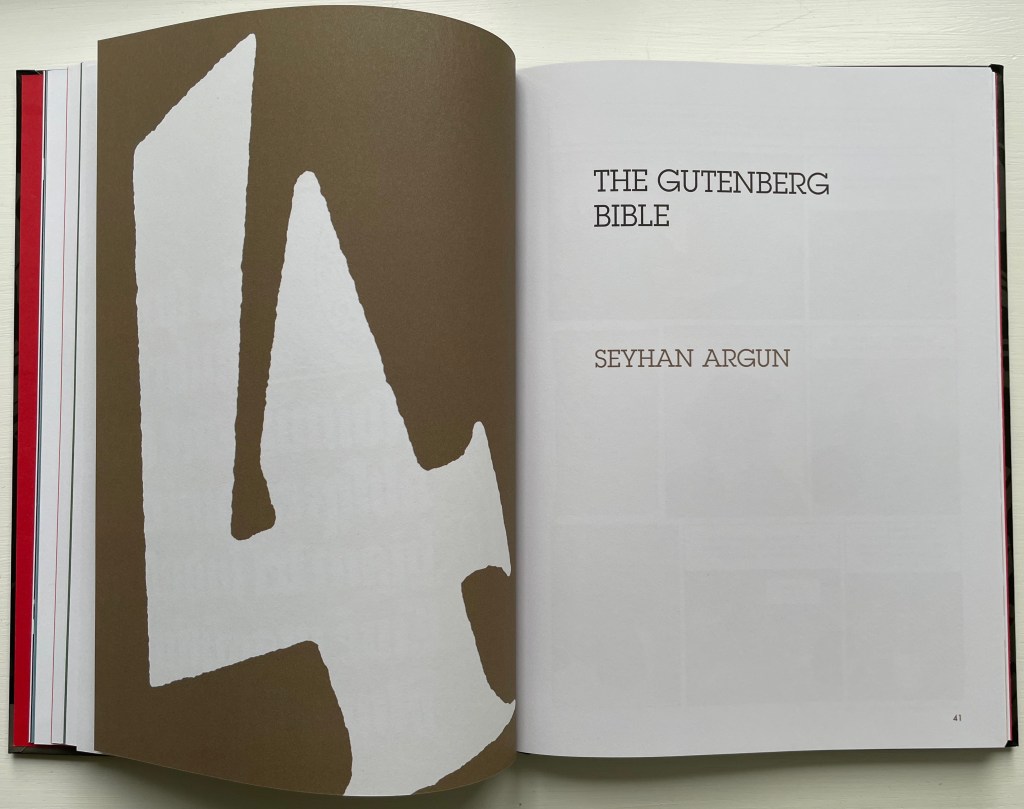
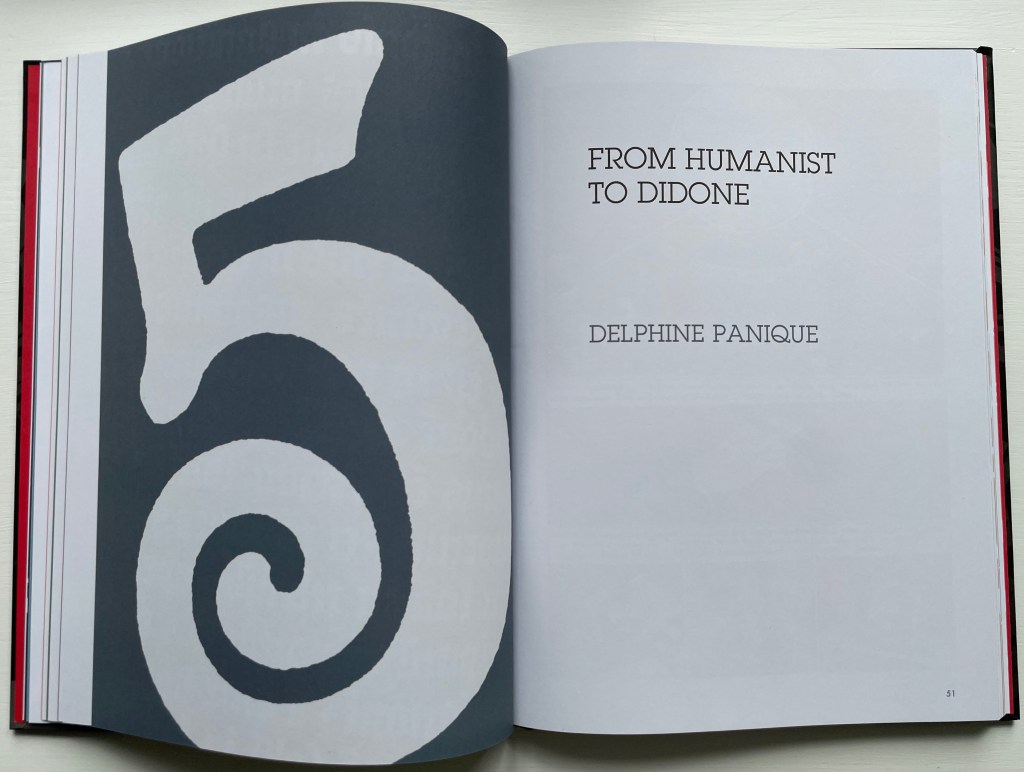
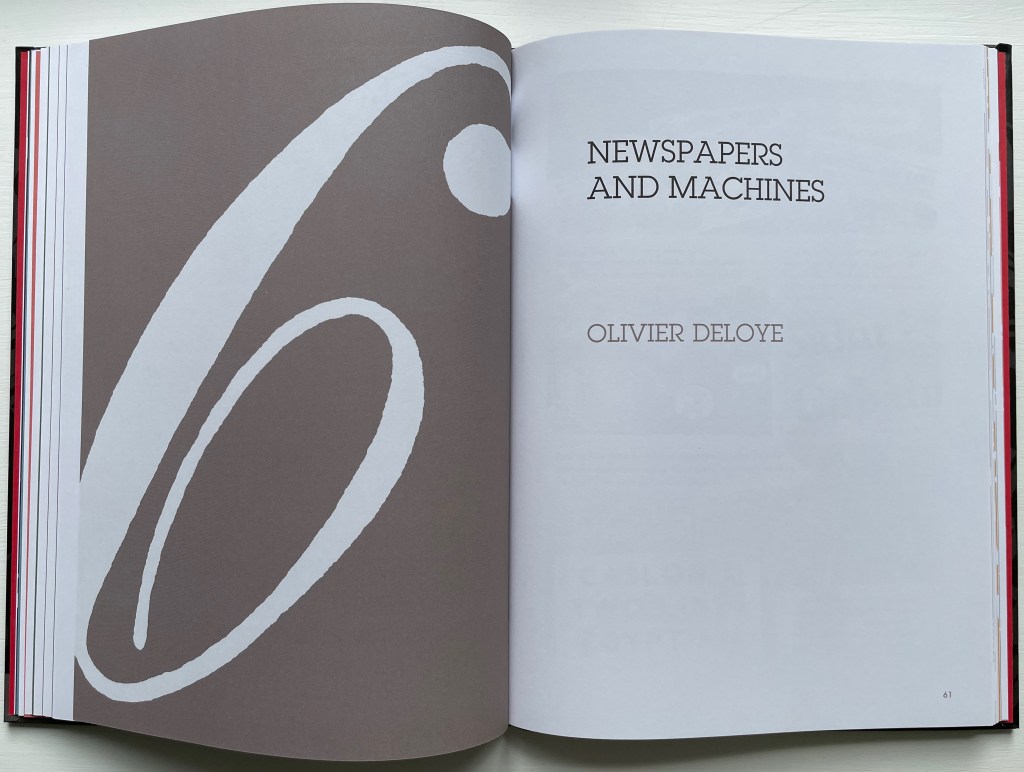
Artists from left to right from the top: Aseyn (“The Birth of Writing”), Singeon (“The Romans and their Writing”), Libon (“Form the Middle Ages to Frakturs”), Seyhan Argun (“The Gutenberg Bible”), Delphine Panique (“From Humanist to Didone”), Olivier Deloye “Newspapers and Machines”), Hervé Bourhis “From Gills Sans to Bauhaus”), Alexandre Clérisse (“The ‘Rencontre de Lure”), Anne Simon (“Maximilien Vox’s System”), Jake Raynal (“Letraset and Phototypesetting”) and François Ayroles (“Typography Today and Tomorrow”)

The book’s overall design by Jean-Christophe Menu simultaneously embraces and sets off the individual styles of drawing and lettering. Menu’s consistent use of a slab serif font (Lubalin Graph Std?) for chapter titles alongside oversized chapter numbers that bleed off the facing page signals his intent and success.

The variety of “strip” layouts pushes the boundaries of unity. Some, like Libon’s and Clérisse’s, float on the page. Others, like Singeon’s and Simon’s, are ruled off. Within the strip layouts, panels vary in shape, and the images within them tilt at different angles, all creating as much of a sense of movement as any action comic. Even where a strip is ruled off, sketches sometimes encroach across panels as well as the book’s margins or gutter to give depth and perspective as well as movement. as happens with the gulls in flight below from Aseyn’s chapter.

Note how the gulls in flight in Aseyn’s chapter appear within panels but also cross them and the gutter.

Evident from Clérisse’s recounting of “Les Rencontres internationale de Lure” (an influential annual forum in Provence), Simon’s homage to the typologist Maximilien Vox (one of the forum’s founders) and Ayroles’ positioning of the typeface DIN, the volume’s European roots are never far from the surface, which also makes ABC of Typography a useful and necessary addition to this collection or any shelf of Anglo-centric works about the alphabet, type or design. It’s interesting that, while the French have categorized BDs as the ninth among the ten officially designated arts, typography and design do not yet rate a category. Neither does the livre d’artiste for that matter, which raises a question:

Between the traditional BD and livres d’artistes by graphic artists, is there fertile ground for artists’ books that blend subject, material, form and metaphor into innovative works of book art? The above-mentioned BD by Chiavelli, paying homage to Mallarmé’s Un Coup de Dés, represents one end of that spectrum. Hervé di Rosa, part of the Figuration libre movement, associated with Keith Haring and graffiti artists, can provide the other end of the spectrum with his Un Coup de Dés jamais n’abolira le Hasard (2021), published by Virgile Legrand. For the work of book art between them, Nanette Wylde’s Babar Redacted: ABC Free (2020) might be a case in point. Likewise, Catherine Labio’s curated exhibition in 2013 — “From Bande Dessinée to Artist’s Book” — finds earlier exemplars in the works of Lars Arrhenius, Felicia Rice, Omar Olivera and Mamiko Ikeda.

Babar Redacted: ABC Free (2020)
Nanette Wylde
Based on an altered copy of the board book B is for Babar: An alphabet book by Laurent de Brunhoff. French link exposed spine on tapes. 9″ x 9″ x .5″ closed. Edition of 3.
Photos: Courtesy of the artist.

Further Reading

Abecedaries I (in progress)“. Books On Books Collection.

Alphabets Alive!“. 19 July 2023. Books On Books.

Richard Niessen“. 23 April 2021. Books On Books Collection.

Library of Congress. “Bande Dessinée: Comics & Graphic Novels“, in “Reading in French: A Student’s Guide to Francophone Literature & Language Learning”. Library of Congress Research Guides. Accessed 11 August 2023.

Labio Catherine and Center for Book Arts (New York N.Y.). 2013. From Bande Dessinée to Artist’s Book : Testing the Limits of Franco-Belgian Comics. New York: Center for Book Arts.

Books On Books Collection – Helmut Andreas Paul (HAP) Grieshaber

Affen und Alphabete (1962)

Affen und Alphabete [“Apes and Alphabets“] (1962)
Helmut Andreas Paul (HAP) Grieshaber
Slipcased, self-covered leporello with eighteen original woodcuts of stylized apes and sixteen typographical experiments. H450 x W335 mm. 36 unnumbered sheets. Edition of 300, of which this is #68. Acquired from Winterberg-Kunst, 22 October 2022.
Photos: Books On Books Collection.

HAP Grieshaber was one of the foremost German woodcut artists of the post-WWII era. His devotion to the woodcut technique was almost matched by that to the medium of the book, which he used in several formats and sizes for series works. Apes and Alphabets is one of the larger of those series and representative of his undeviating Expressionist style and blurring of borders between letter and image, the civilized and uncivilized, the artificial and the natural. This slipcased accordion book comprises 18 original woodcuts, two of which appear on the cover (one again on the wooden slipcase).

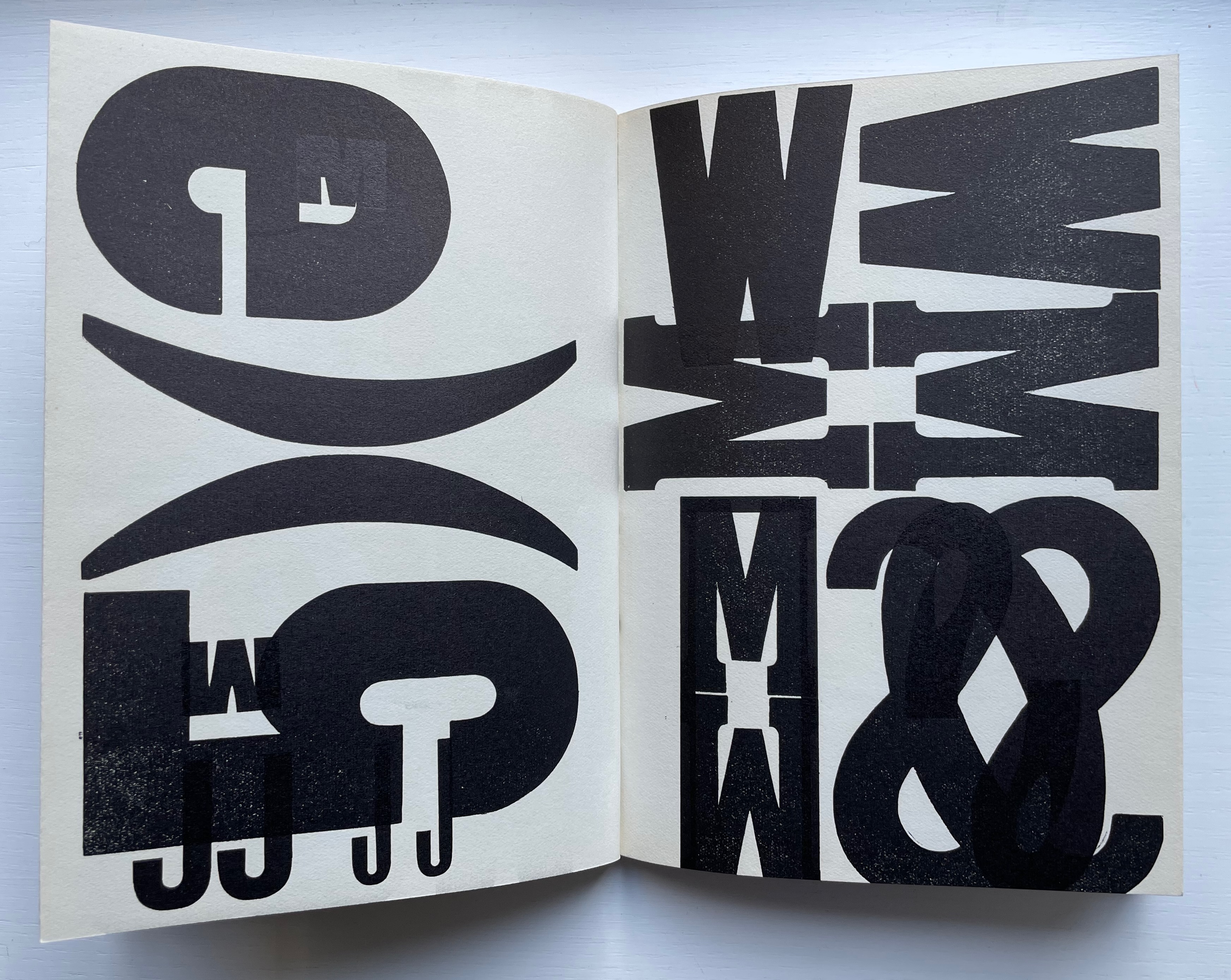
A full page of ranks of blackletter characters echoes a full page of columns and rows of apes with musical instruments. In visual cacophony, the letters make wordless strings just as the apes make soundless music.

Only one of the book’s panels has a touch of color, but the garish orange of the slipcase and book cover shows Grieshaber’s characteristic handling of this element — printing over an undercoat that serves as background. Even when working with a single color in these prints, Grieshaber earns his description as Der Holzschneider als Maler (“the woodcutter as a painter”), to which could be added “collagist”. Although influenced by  Paul Klee and Lyonel Feininger, the physical intensity of the prints, this book and the others below sets Grieshaber apart.

His use of heavy wove paper in this work and other monumental ones like Die Rauhe Alb (1968) is equally of a part with a drive toward the tactile and a reaction to the alleviation of wartime paper shortages, which comes up later in Herzauge (1969) below.

Poesia Typographica (1962)

Poesia Typographica (1962)
Helmut Andreas Paul (HAP) Grieshaber
Paperback, perfect bound Chinese-fold folios, black endpapers. H215 x W155 mm. 28 unnumbered pages. Edition of 1000. Acquired from Print Arkive, 22 October 2022.
Photos: Books On Books Collection. Displayed with permission of the publisher Galerie der Spiegel.

The alphabet theme of Affen und Alphabete carries over in the hornbook images on the front and back covers of Poesia Typographica. More than most typographic or concrete poetry, Poesia Typographica addresses the materiality of letters, images, ink, paper and printing — even going so far as to exalt it over the alphabet.

This is particularly clear in Grieshaber’s use of white ink on a transparent sheet to record the tale of missionary Baedeker and his Analphabeten Bibel (“Illiterates’ Bible”). To the Russian peasantry to whom Baedeker distributed thousands of the booklet, he claimed that its eight pages contained “the whole Bible, the pure teaching of our Jesus Christ”. The typeset transparent sheet sits between what would otherwise be a double-page spread of solid black. That spread is followed by one of red, one of white and then one of gold.

The transparent page explains :

the peasants saw in the black of the first page the darkness of their sinful hearts, their great guilt.

in the red of the next page, they united with the divine blood of christ. they walked out the suffering steps of our lord. washed clean in the blood of his love, they won innocence:

the pasture linen of the third page, that is the purity that must be in the heart.

ready to enter into the mystery, to look into the sunshine of God’s face. to fall down in prayer, the sound of the golden trumpets of heavenly bliss in their ears.

A literate reader may smile at the missionary’s metaphorical hoodwinking of the serfs, but the longer the reader moves the transparent page back and forth, registers its interloping nature, and recognizes that “analphabet” doesn’t just mean “an illiterate” but also one who does not know letters at all, the more the materiality of the stiff black, red, white and gold pages makes itself felt and the more the viewer realizes that Grieshaber is laying down a challenge to look beyond the alphabet to the ink, paper and the printing.

Just as in Affen und Alphabete, the reader/viewer must look at letters beyond “shapes for sounds”. Letters may have their roots in the pictorial, but Grieshaber isn’t taking their “shapeness” back to pre-Gutenberg or pre-alphabet pictoriality. He takes it into an expressive post-Gutenberg, post-alphabet visual and material art.

Herzauge (1969)

Herzauge (1969)
Helmut Andreas Paul (HAP) Grieshaber
Board book casebound in bookcloth, with illustrated dustjacket. H294 x W240 mm. 16 unnumbered pages with 9 color plates. Edition of 800? Acquired from K.G. Kuhn Antiquariat, 14 July 2023.
Photos: Books On Books Collection. Displayed with permission of artist’s family.

Hat das Herz noch ein Auge? (“Can the heart still see?”), Grieshaber asks on the last page of this artist’s book for children published by Parabel Verlag in Munich. It’s a disturbing afterword. It changes what you think these Expressionist woodcuts and the words beside them express. Grieshaber explains that, by 1937, paper for printing was scarce. From a generous doctor, he obtained filtration paper on which to print his landscape woodcuts Die Rauhe Alb, his visual ode to the Swabian Alps. Children brought him the sheets of glossy paper on which the original 20 copies of Herzauge were printed and over-drawn with a dry brush. No one wanted Die Rauhe Alb at the time, and all but one copy of Herzauge were lost. His summary phrase — Märchen in dunkler Zeit (“Fairy tales in dark times”) — offers a way into the board book and perhaps an answer to the question “Can the heart still see?”

Second double-page spread. “Ach Alm, a knight once moaned. Achalm, I live in your lap.”

Achalm is a mountain in Reutlingen, Germany. On its top are the ruins of Achalm Castle, ancestral seat of the counts of Achalm, a 13th-century Swabian noble family. The legend is that the name comes from Count Egino’s dying words to his brother. He meant to say “Ach Allmächtiger!” ( “O Almighty!”) but only uttered “Ach Allm…“, and to honor Egino, the brother named the mountain and castle Achalm. It’s a clever poem and clever woodcut. The last word Schoß — meaning bosom, arms, heart or lap — is close to the word Schloß — meaning castle. Turning the castle into a fairy tale crown, the woodcut also gives the mountain a feminine visage, a sweep of white that looks like an embracing arm and a village nestled in its lap.

This spread comes after the first in which a black woebegone bird in a brush-streaked patch of snow occupies the foreground alongside the lines “Winter is a hard man. The tree freezes.” And it precedes the third in which the viewer’s perspective must be that of standing on a dock and looking out on a harbor alongside text that reads, “Do you hear the horn hooting in the harbor? We are leaving.” Achalm is the fairy tale bookended by dark cold before and forlorness after.

The fourth spread’s text — Wer streicht am Abend allein über de Berge? Die Katze weiß es.(“Who is painting alone in the mountains in the evening? The cat knows.”) — is a fairy-tale blend of gloomy forest and mysterious animal humor matched by the dark purple undercoat and background of the woodcut.

A fifth spread with colors of dark blue, burnt umber and green against a turquoise undercoat and background shows a distressed Hansel-and-Gretel-like pair on the turquoise path between blue and umber trees and beneath a large blue, umber and turquoise owl that cries “Home, home!” as Der Nacht krab kommt (“The night call comes”)

The sixth and seventh spreads introduce a different air of childhood innocence, one of lessening threat. In the sixth, a child figure with upraised arms (throwing an orange ball up in the air?) wanders down a meadow valley bordered by a knoll of trees leaning over the otherwise sunny scene with black and purple foliage that suggest the faces and hair buns of stern school mistresses. The last line of text — Ich muß zur Schule (“I must go to school”) — evokes a nursery-rhyme dawdling ten o’clock scholar to English ears. In the seventh, Wir haben Ferien (“We have holidays”) sounds like the concluding sentence in a final school assignment and is matched by the child-like drawing of swans, roses, a green lake and a motherly figure. But mother is faceless, preparing us for the afterword’s hopeful but worried question “Can the heart still see?”

It’s good to see a renewed interest in Grieshaber — not only for his own artistry but also his medium. Another of his major works — The Easter Ride, a series of 27 colored woodcuts based on a journey through the Swabian Alb — was exhibited at the Elztalmuseum Waldkirch in early 2023.

Helmut Andreas Paul Grieshaber, better known as HAP Grieshaber, is one of the most important artists of the 20th century in the field of woodcuts. He created numerous large-format, abstract works on socio-political and religious themes. He was considered down-to-earth and idiosyncratic. His art was intended to be visible and accessible to all.
The exhibition invites visitors to engage with Grieshaber’s idiosyncratic, unmistakable visual language and to become acquainted with the technique of the woodcut.

Further Reading

Fichtner, Gerhard, and Wolfgang Bartelke. 1999. Bibliographie Hap Grieshaber. Ostfildern-Ruit: Cantz.

Grieshaber, Helmut A. P., and Fuerst, Margot. 1964. HAP Grieshaber: Der Holzschneider. Stuttgart: Hatje.

Grieshaber, Helmut A. P, and Margot Fuerst. 1964. H.a.p. Grieshaber; Woodcuts. New York: Arts.

Grieshaber Helmut A. P, and Margot Fuerst. 1965. Grieshaber: Der Drucker Und Holzschneider. Plakate Flugblätter Editionen Und Akzidentia. Stuttgart: Hatje.

Grieshaber, HAP, and Margot Fuerst 1969. Grieshaber 60 (Sechzig). Württembergischer Kunstverein and Städtische Kunstgalerie Bochum.

Grieshaber, Helmut A. P.; Göbel, Johannes; and Glöckner, Wolfgang. 1989. Grieshaber Der Holzschneider Als Maler: Gouachen, Malbriefe, Aquarelle, Holzschnitte, Zeichnungen. Bonn: Bouvier.

Käufer, Hugo Ernst. 1981. Der Holzschneider HAP Grieshaber. Passau: Edition Toni Pongratz.

The Easter Ride” – HAP Grieshaber
In this special exhibition, the Elztalmuseum is showing one of the artist’s major works: “The Easter Ride”. 10 March 202307 May 2023, Elztalmuseum Waldkirch

Brinkhus Gerd Gerhard Fichtner and Universität Tübingen Universitätsbibliothek. 1979. Grieshaber Und Das Buch : Eine Ausstellung Der Universitätsbibliothek Zum 70. Geburtstag Hap Grieshabers 25. Mai Bis 14. Juli 1979. Tübingen: Universitätsbibliothek.

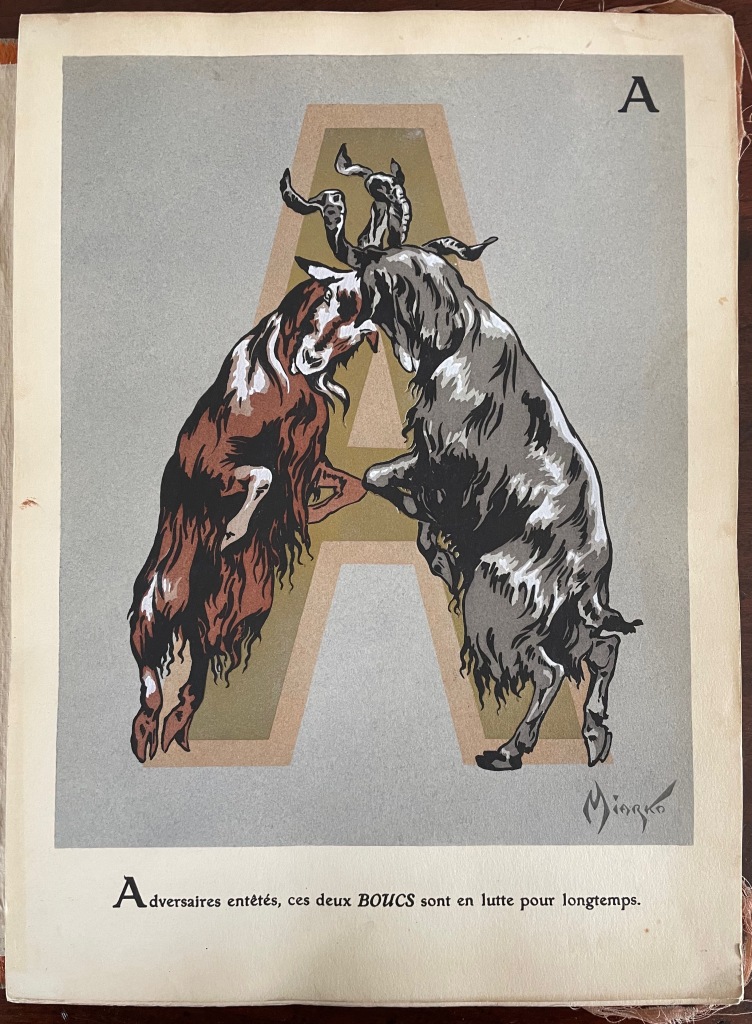
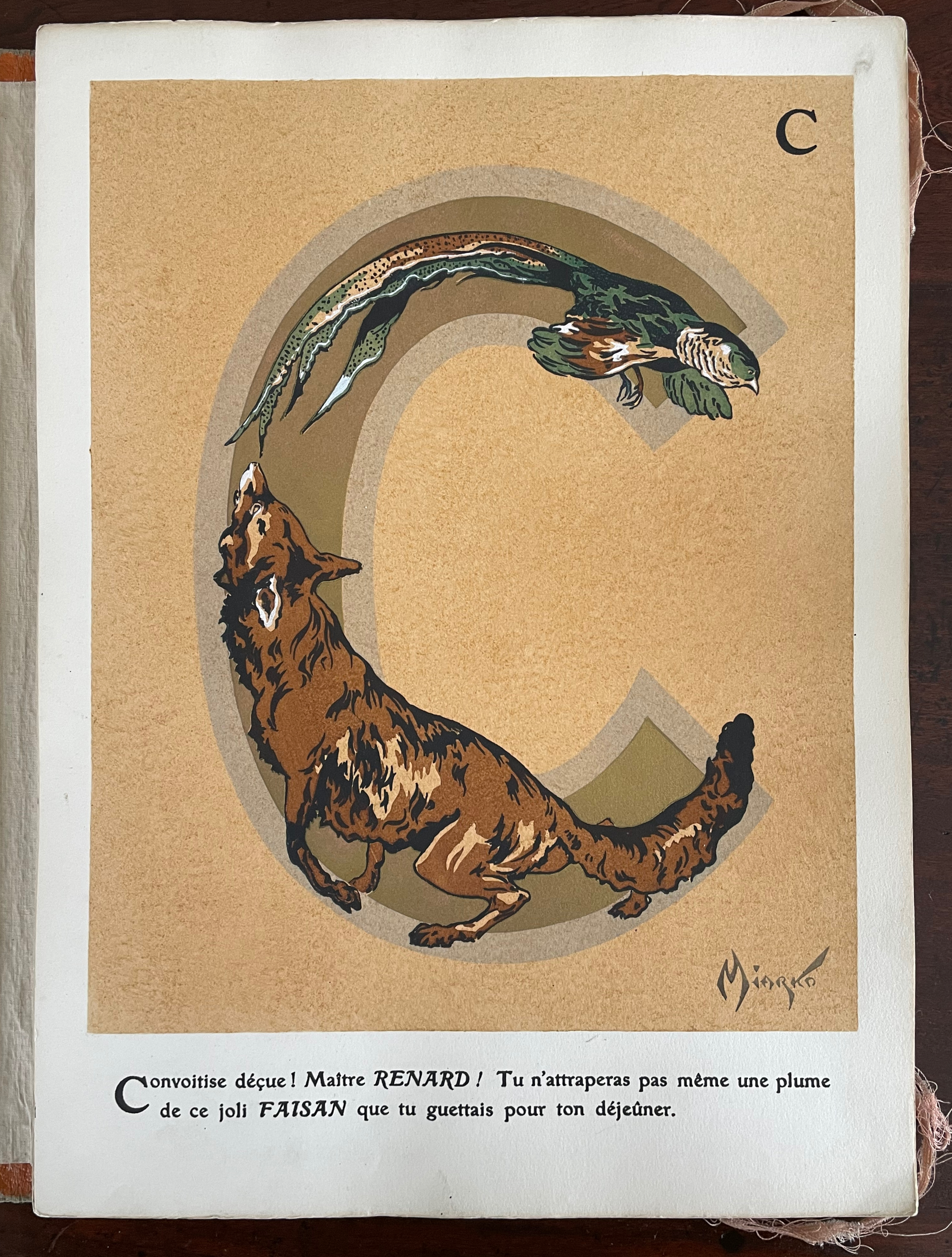
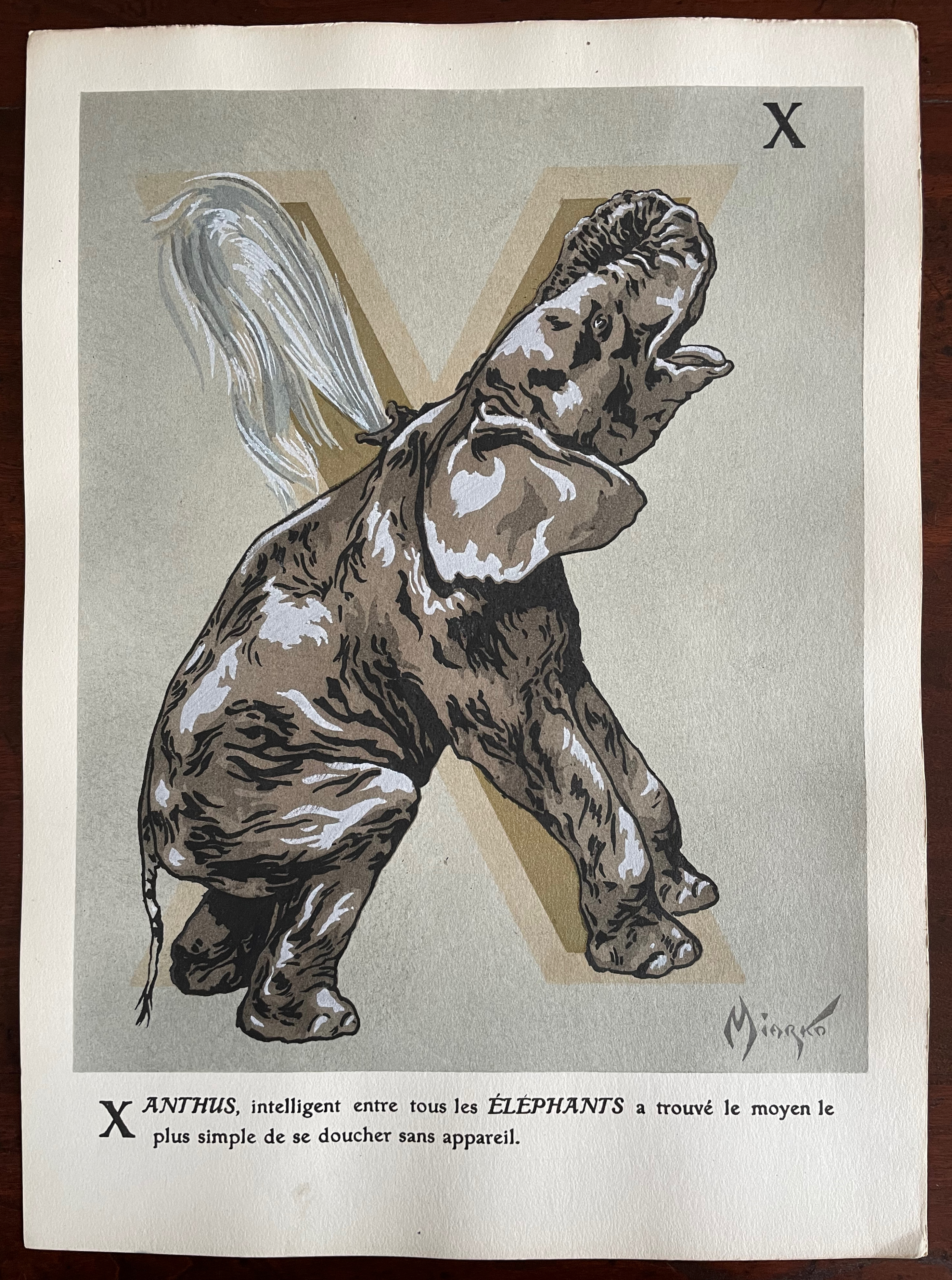
Books On Books Collection – Miarko (Edmond Bouchard)

ABC d’Art (c. 1920)

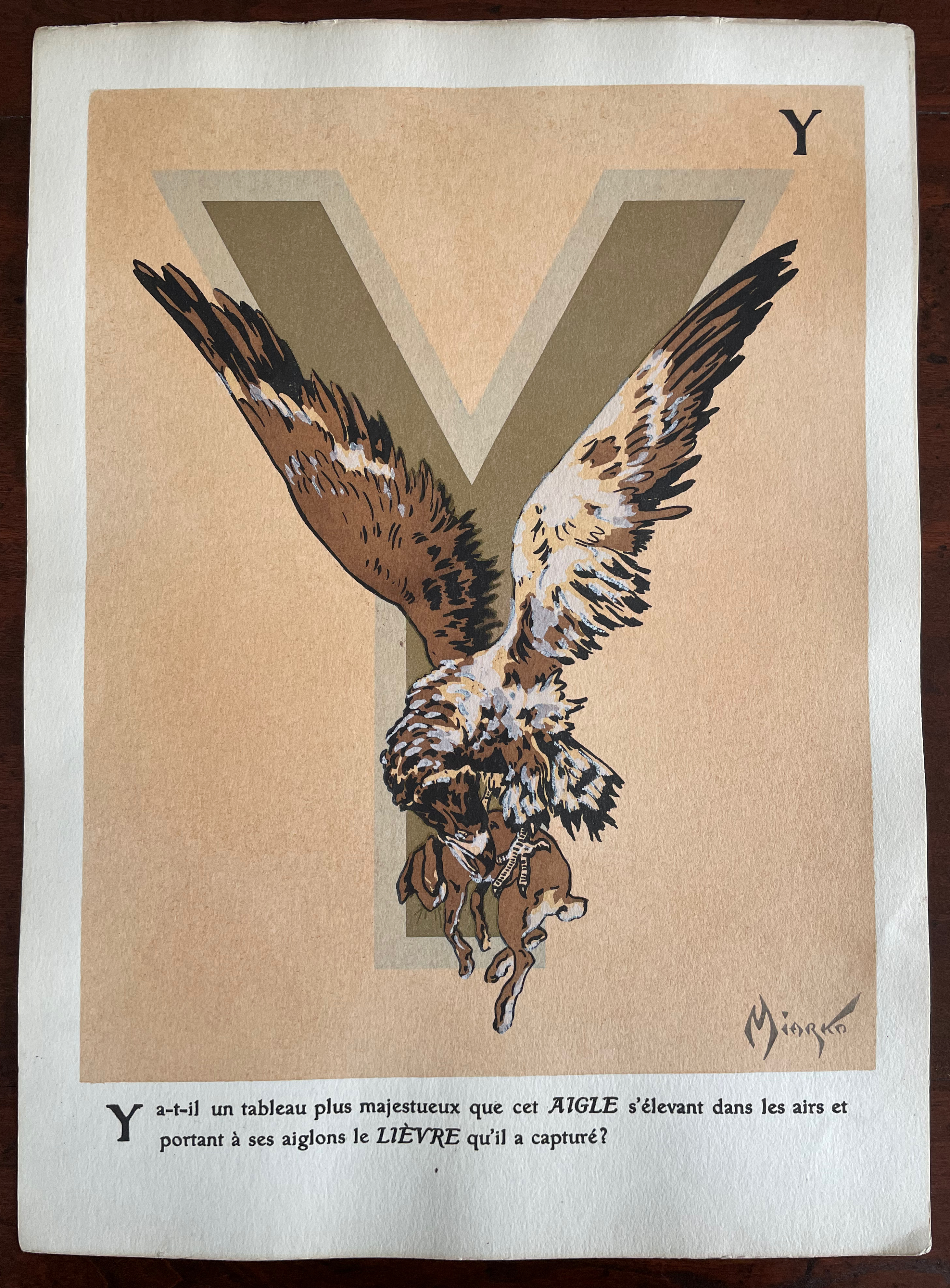
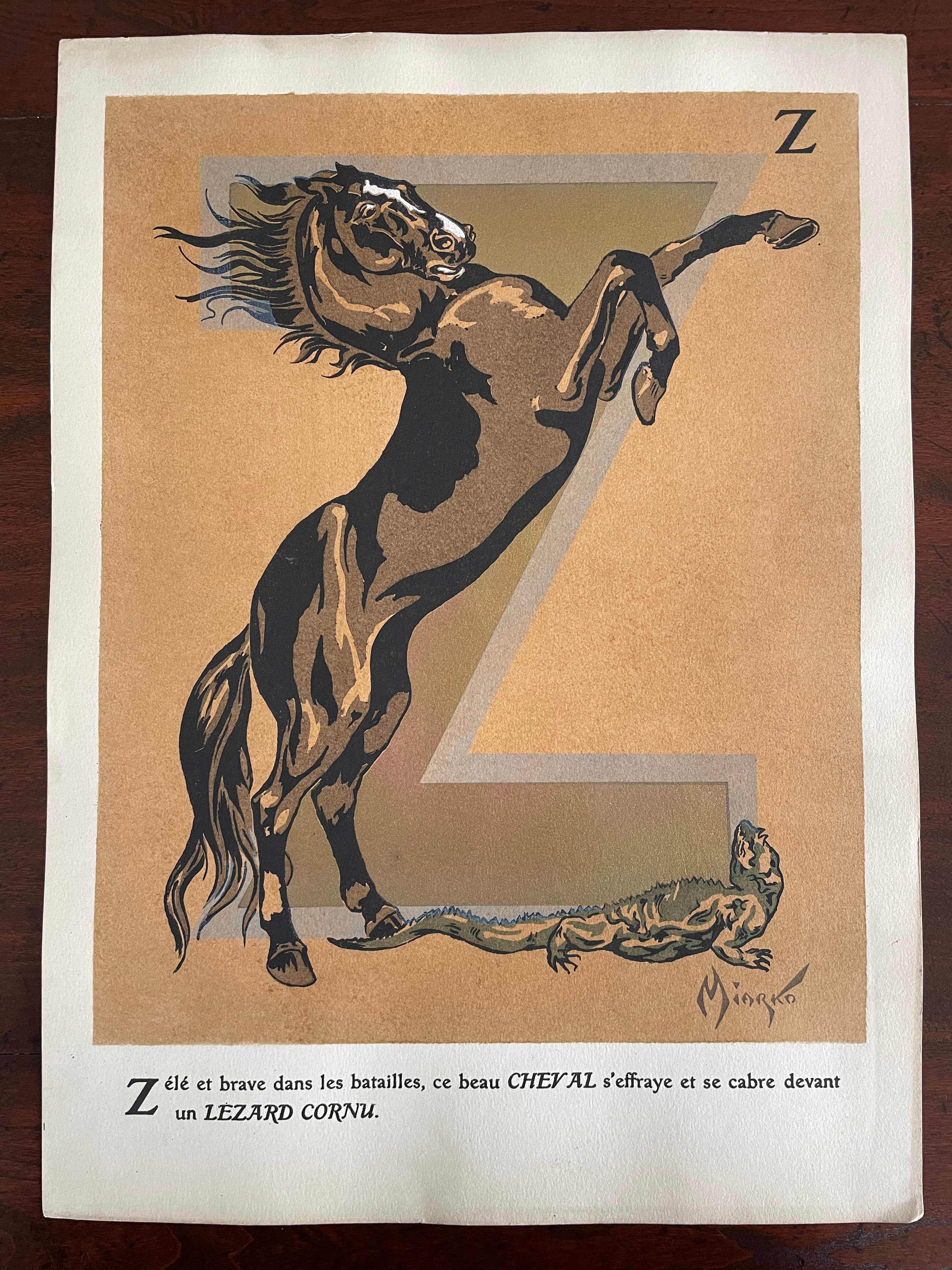
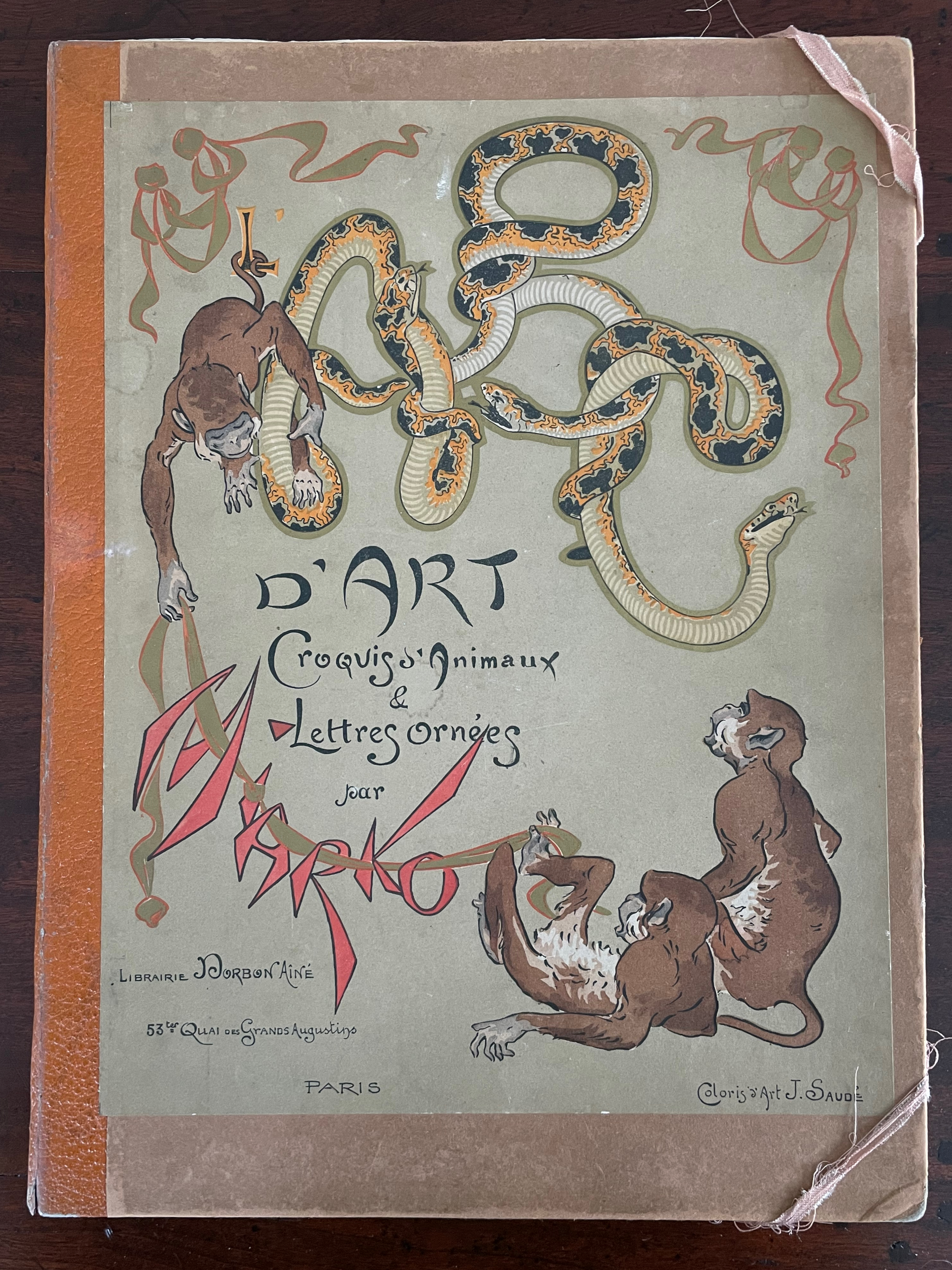
ABC d’Art: Croquis d’animaux & Lettres ornées [ABC of Art: Animal Sketches & Decorated Letters] (c. 1920)
Miarko (Edmond Bouchard), Colored by Jean Saudé
Portfolio, corner closures with ribbon, Portfolio: H385 x W285 mm. Prints: H380 x W280 mm. 27 folios. Acquired from ADER Nordmann & Dominique, 16 March 2023.
Photos: Books On Books Collection.

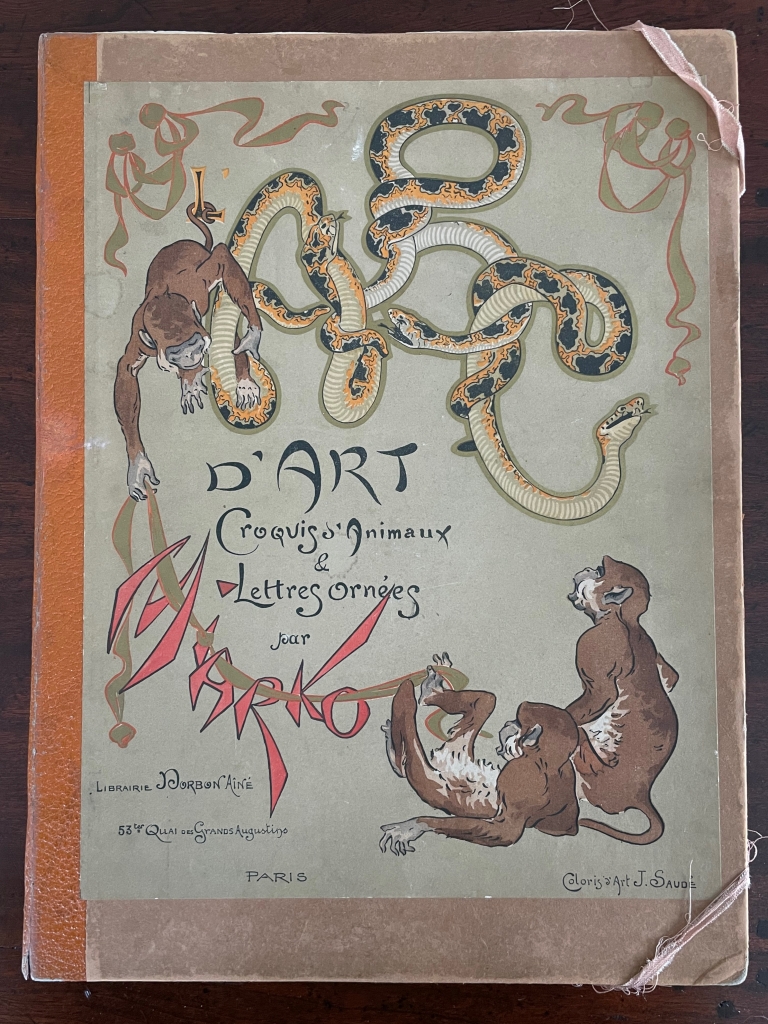
Miarko (born Edmond Bouchard, 1889, Kyiv) was an illustrator, caricaturist, painter and expatriate in Paris when he died in 1924. His work followed in the Art Nouveau tradition and appeared in magazines like The Magpie.

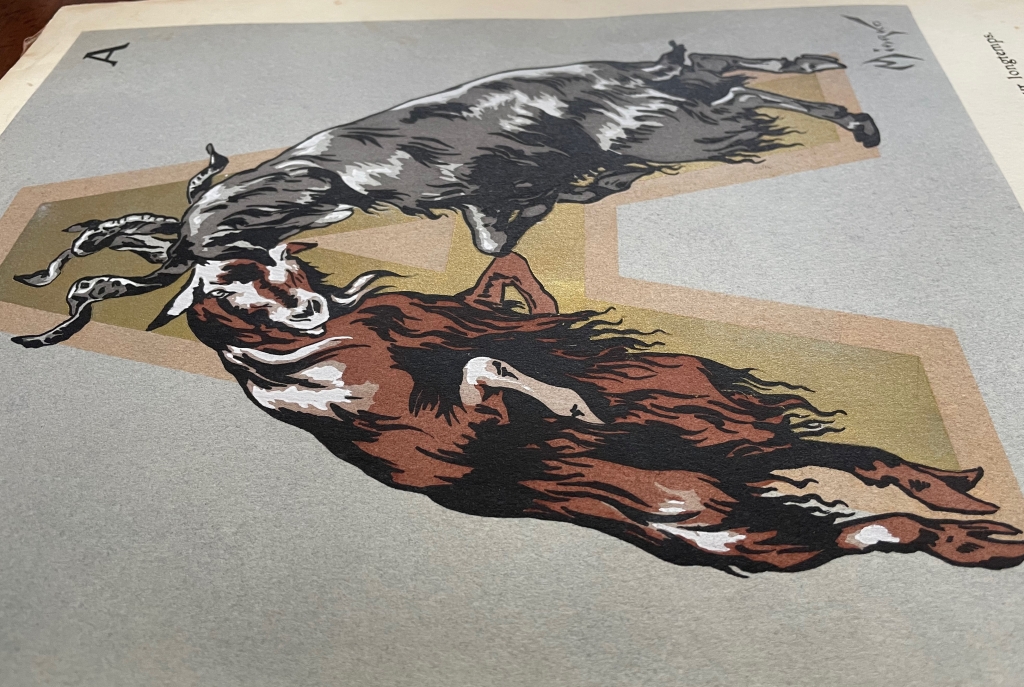
Of his limited output, ABC d’Art is probably the best known. Produced by Jean Saudé, it provides a representative link in a chain of alphabet works with which to explore distinctions and affinities among different periods of art. Although Saudé was known for his pochoir work, the varying background colors of ochre, golden yellow, blue gray, mauve, etc., and use of gold paint in Miarko’s plates speak an entirely different language from that of fellow-expatriate Sonia Delaunay’s intense pochoir colors in Alphabet (1972) or even her work in the 1920s. Although some affinity with the woodcut of the horse in C. B. Falls’ ABC Book Boo(1923) can be seen, the handling of color, again, leads in different directions. Add Jasper Johns’ painting Alphabet (1959) to this chain, and marvel at the stylistic differences that arise from the artists’ blending of stencil work and brush work.

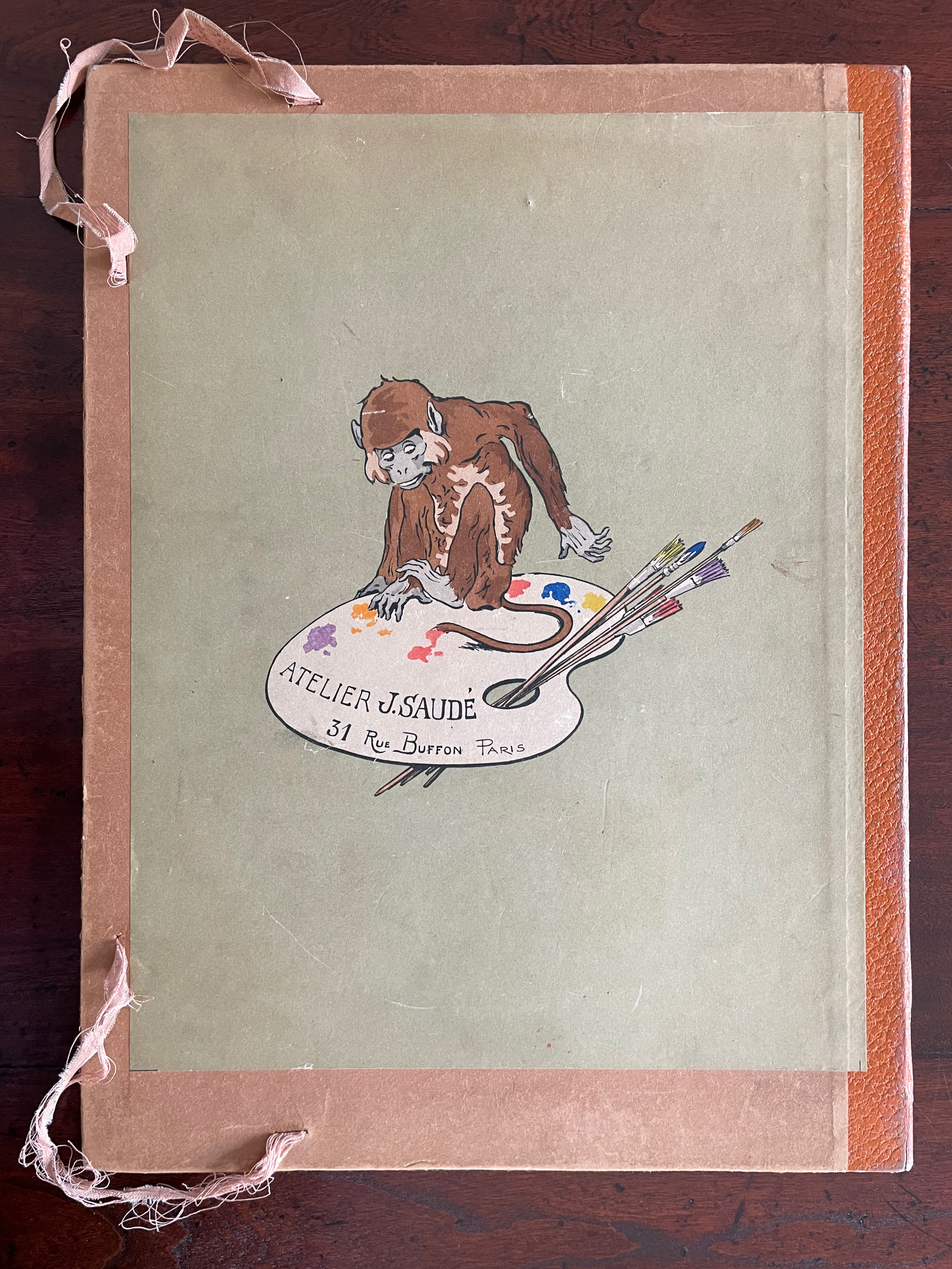
Miarko’s portfolio is a cardboard folder with an orange morocco paper spine. Its covers have lithographed illustrations in colors applied. The letters ABC formed by boas on the front cover are almost easily missed for the gamboling chimpanzees. There are twenty-seven lithographed plates in colors and gold. Each letter of the alphabet is rendered as a large initial in gold paint and outlined in another color. The twenty-seventh plate is devoted to the numerals 0-9.

Unlike most animal alphabet books, the animals do not always correspond to the initial they decorate. Rather, each initial corresponds to the first letter of the text beneath. More to the point of its difference from most animal alphabets, this one’s images and text seem to revel in nature’s tooth and claw.

Side view with gold paint highlighted.

Side view with gold paint highlighted.

Front and back covers

Further Reading

Abecedaries I (in progress)“. Books On Books Collection.

Alphabets Alive! – Animals“. 19 July 2023. Books On Books. An online version of the exhibition at the Bodleian Libraries, 19 July 2023 – 24 January 2024.

Sonia Delaunay“. 17 July 2023. Books On Books Collection.

C. B. Falls“.14 December 2022. Books On Books Collection.

William Nicholson“. 26 May 2023. Books On Books Collection

ADER Nordmann et Dominique. 16 March 2023. Abécédaires, Etc.: Collection Bernard Farkas. Accessed 16 March 2023. Cf. Le Bestiaire by Albert Gérard and Robert Hanesse (c. 1960), p. 78.

Art Institute Chicago. Alphabet (1959). Jasper Johns. Ref. 2015.121.