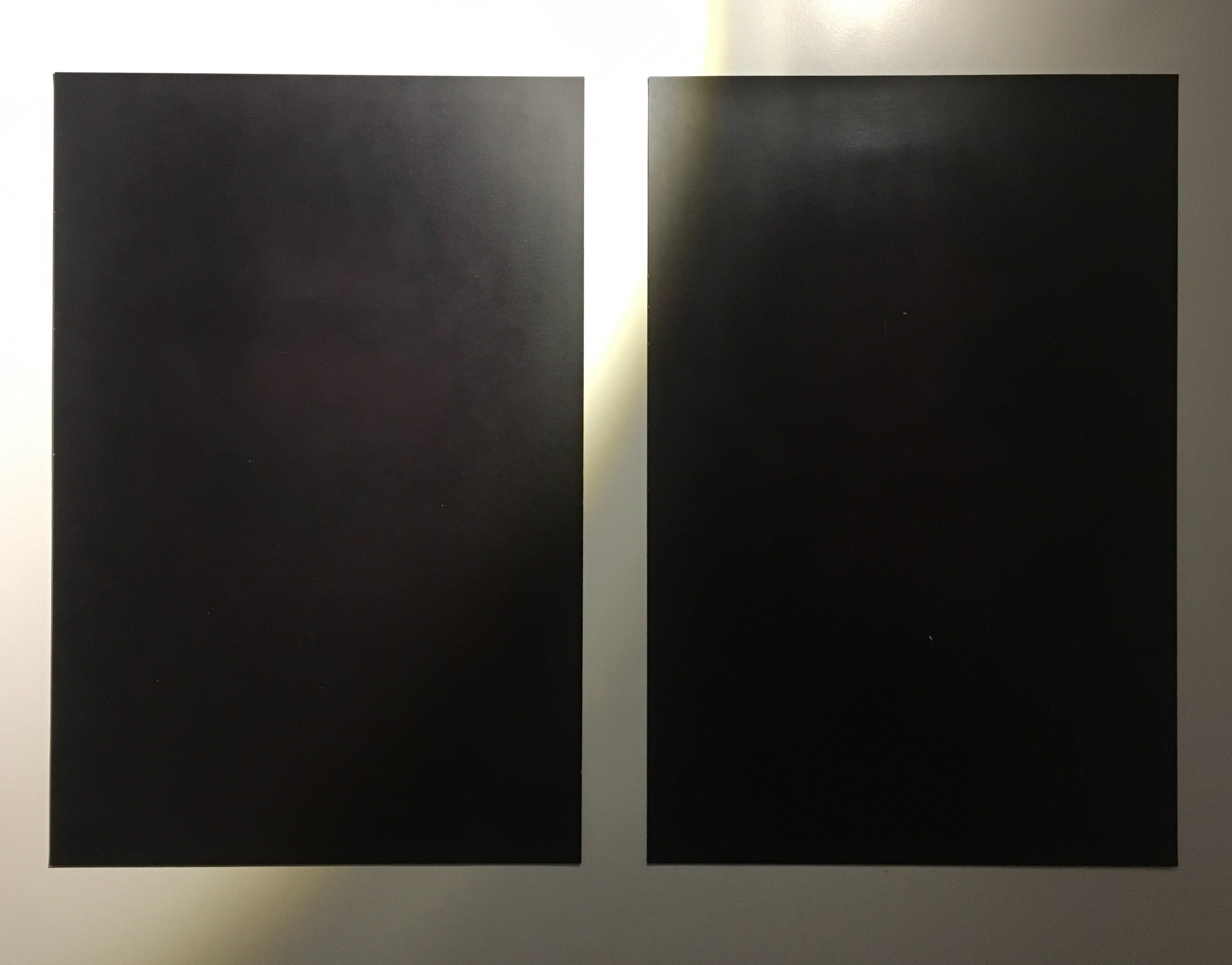
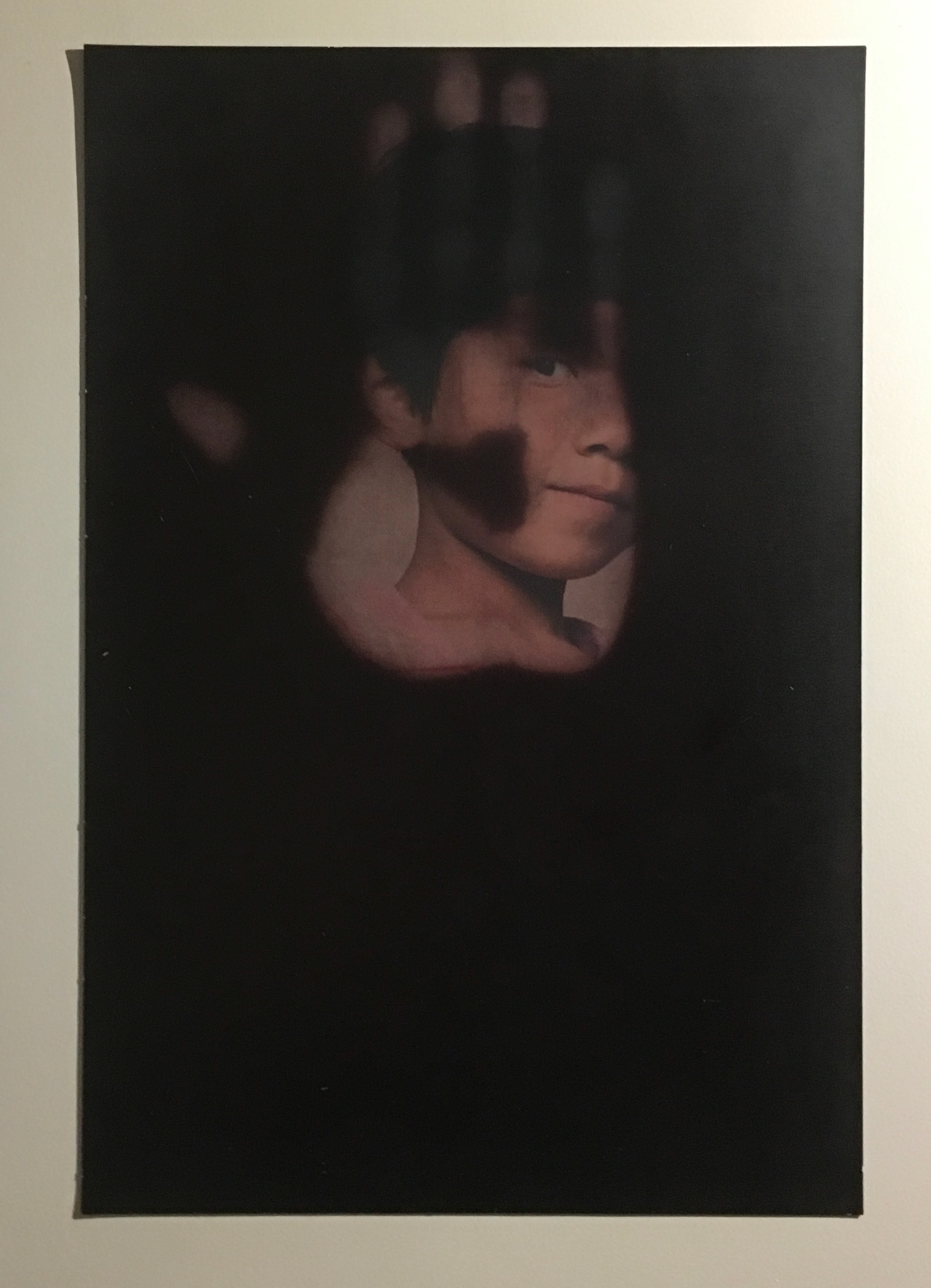
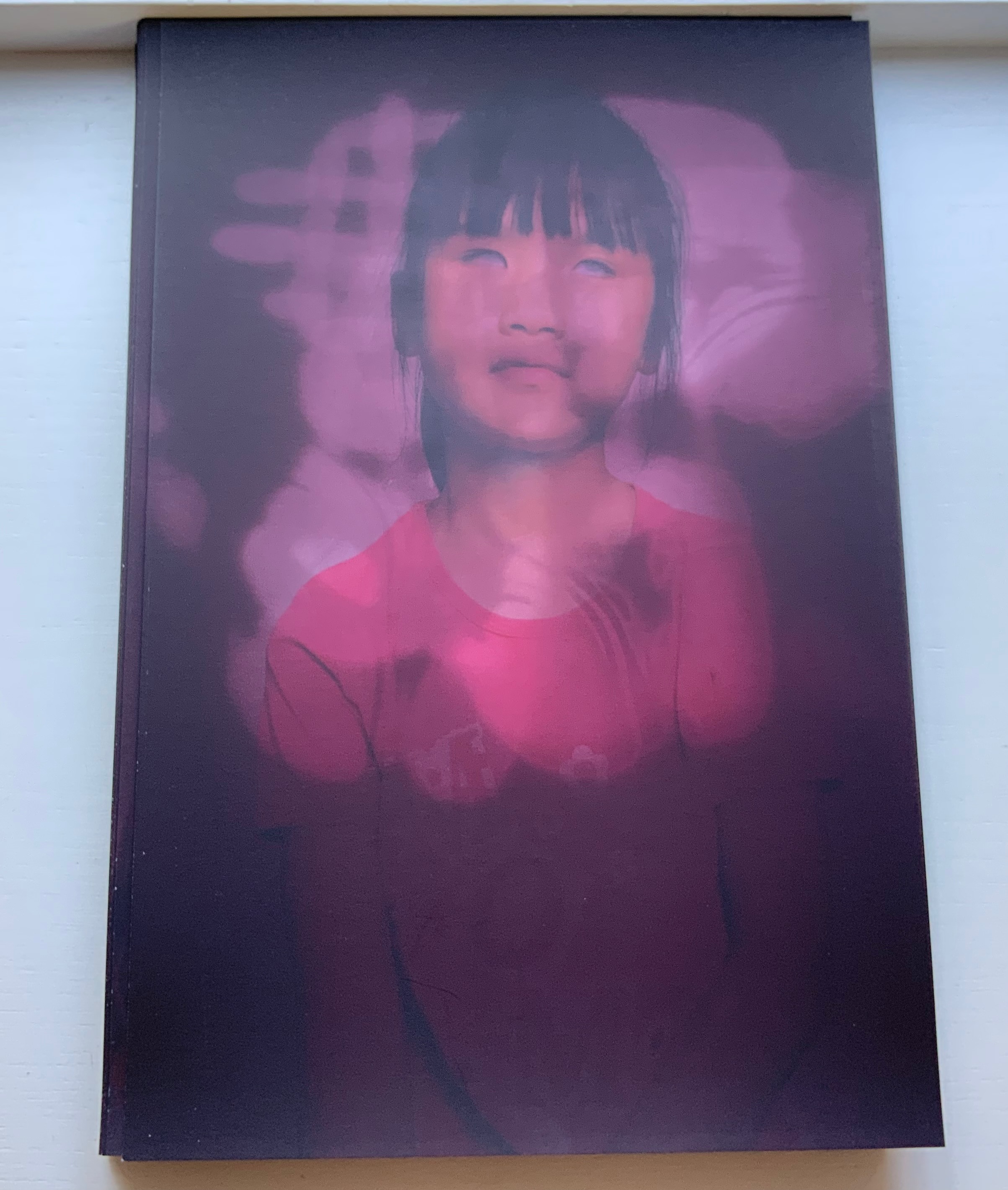
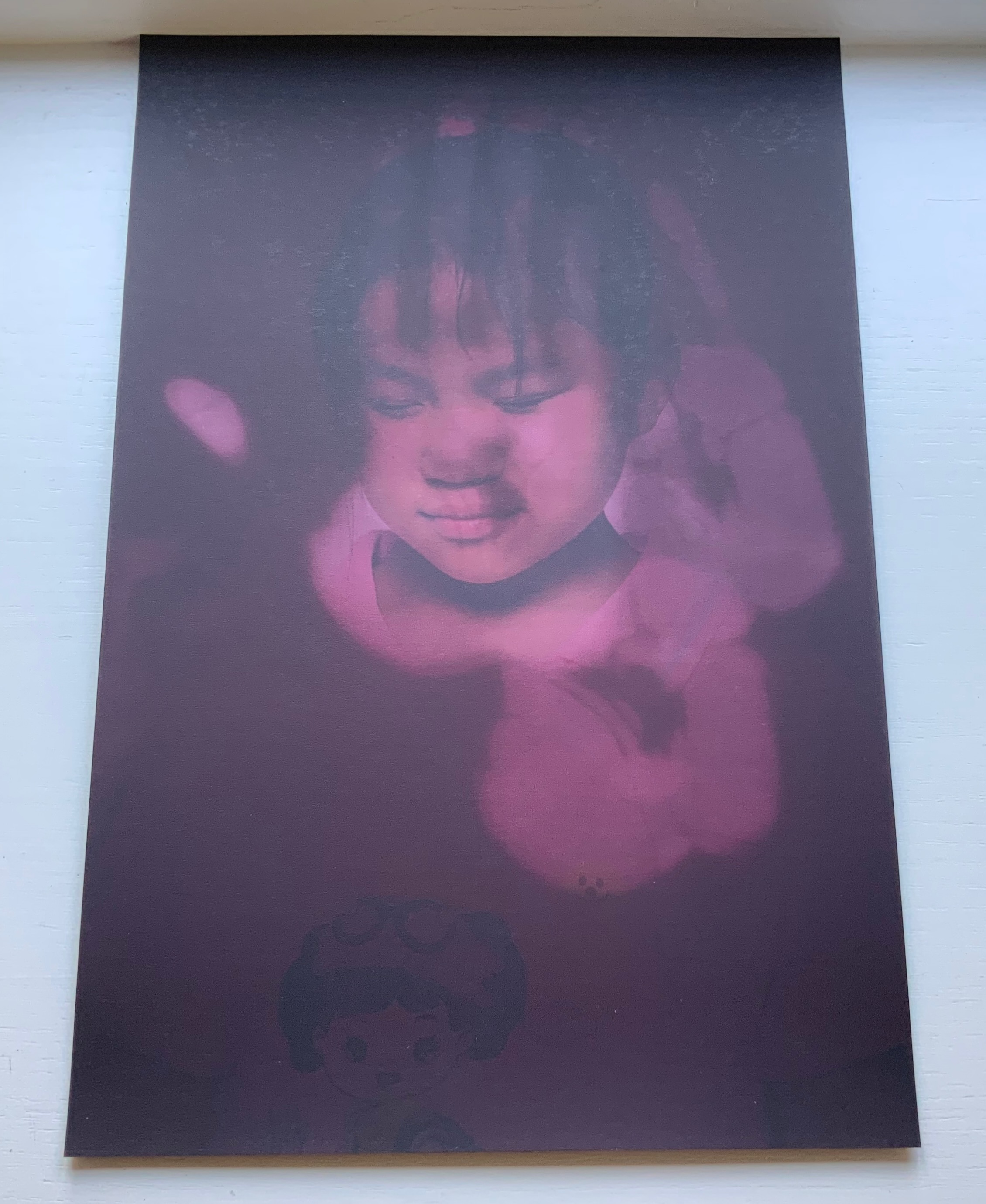
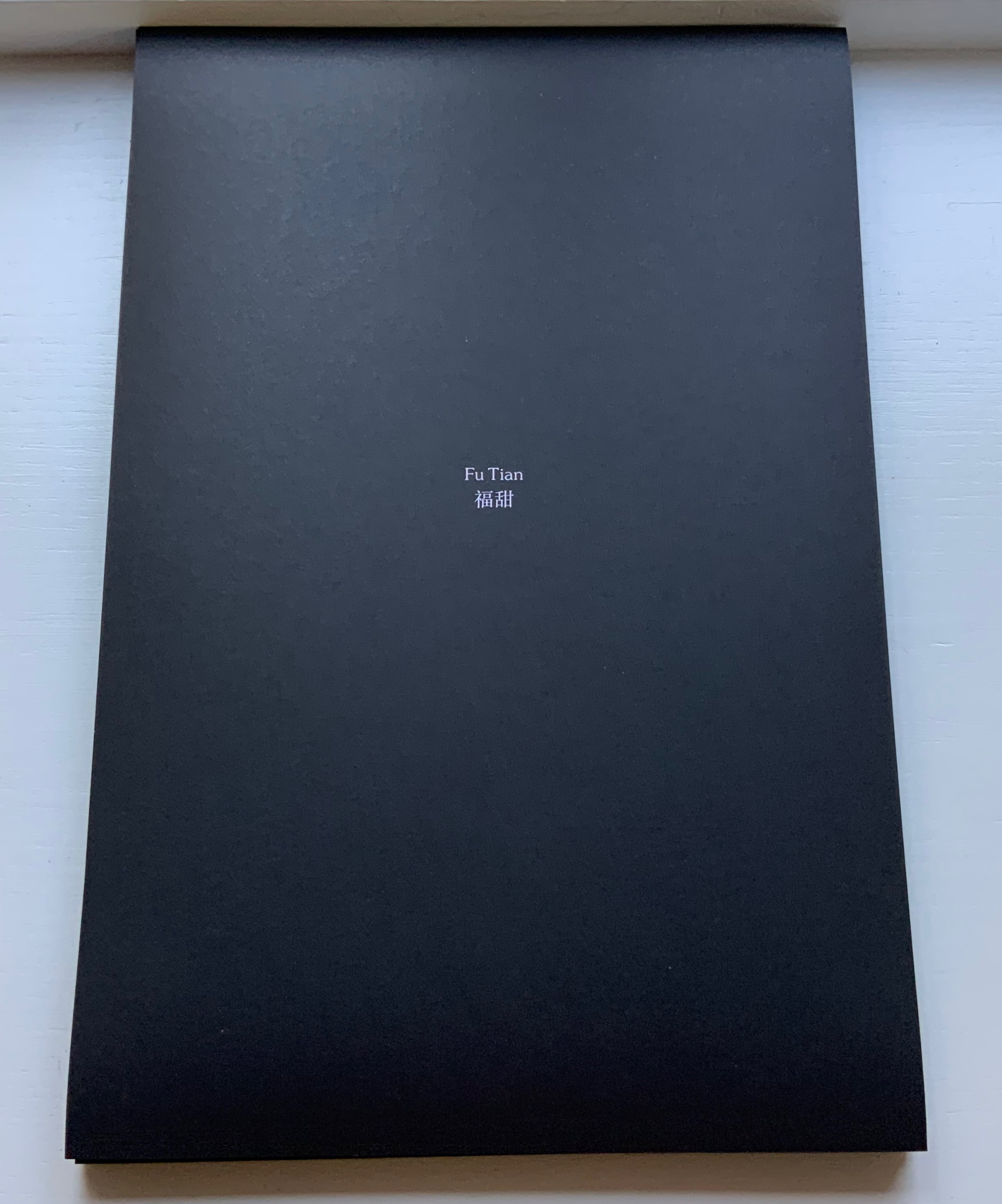
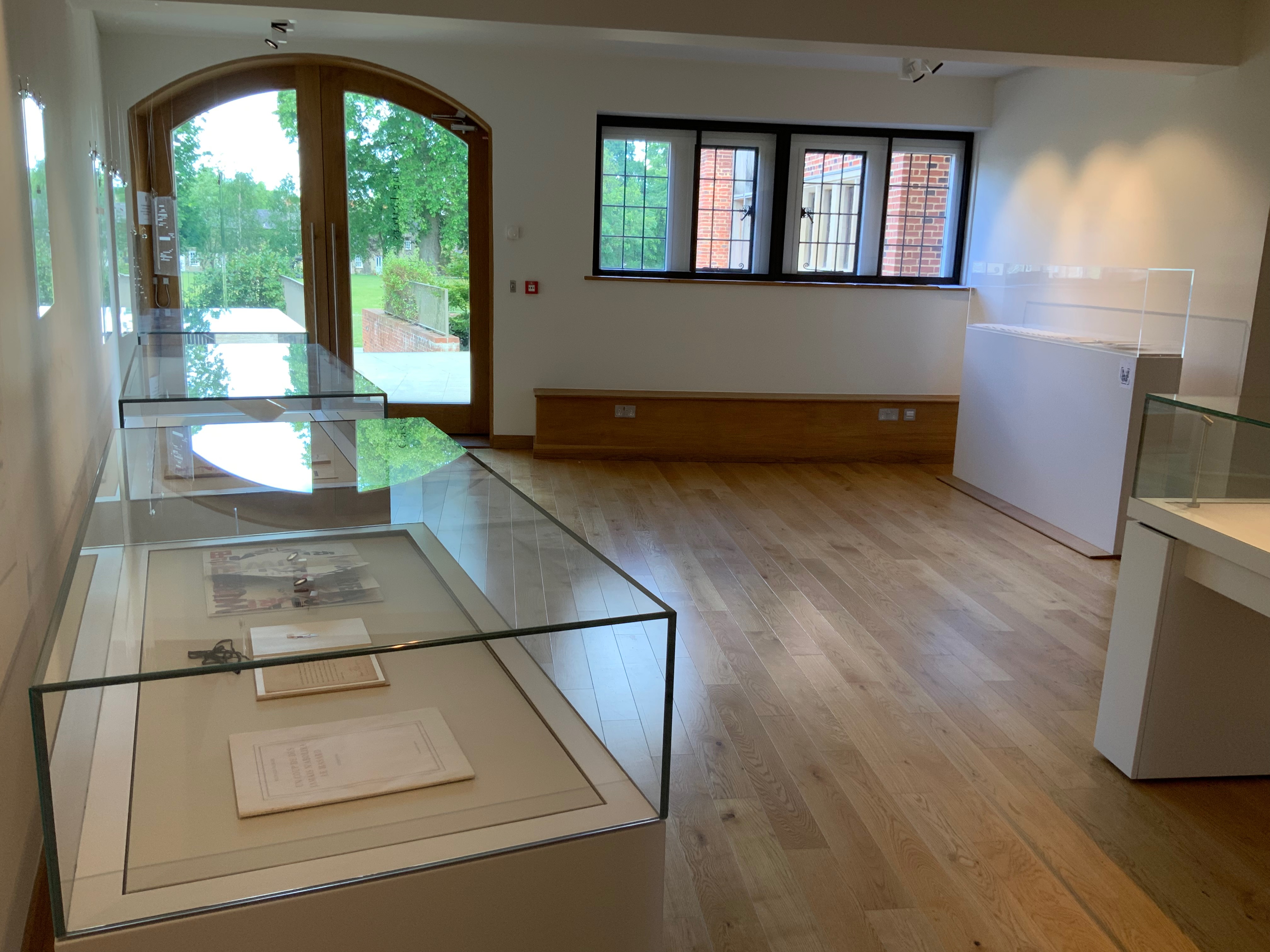
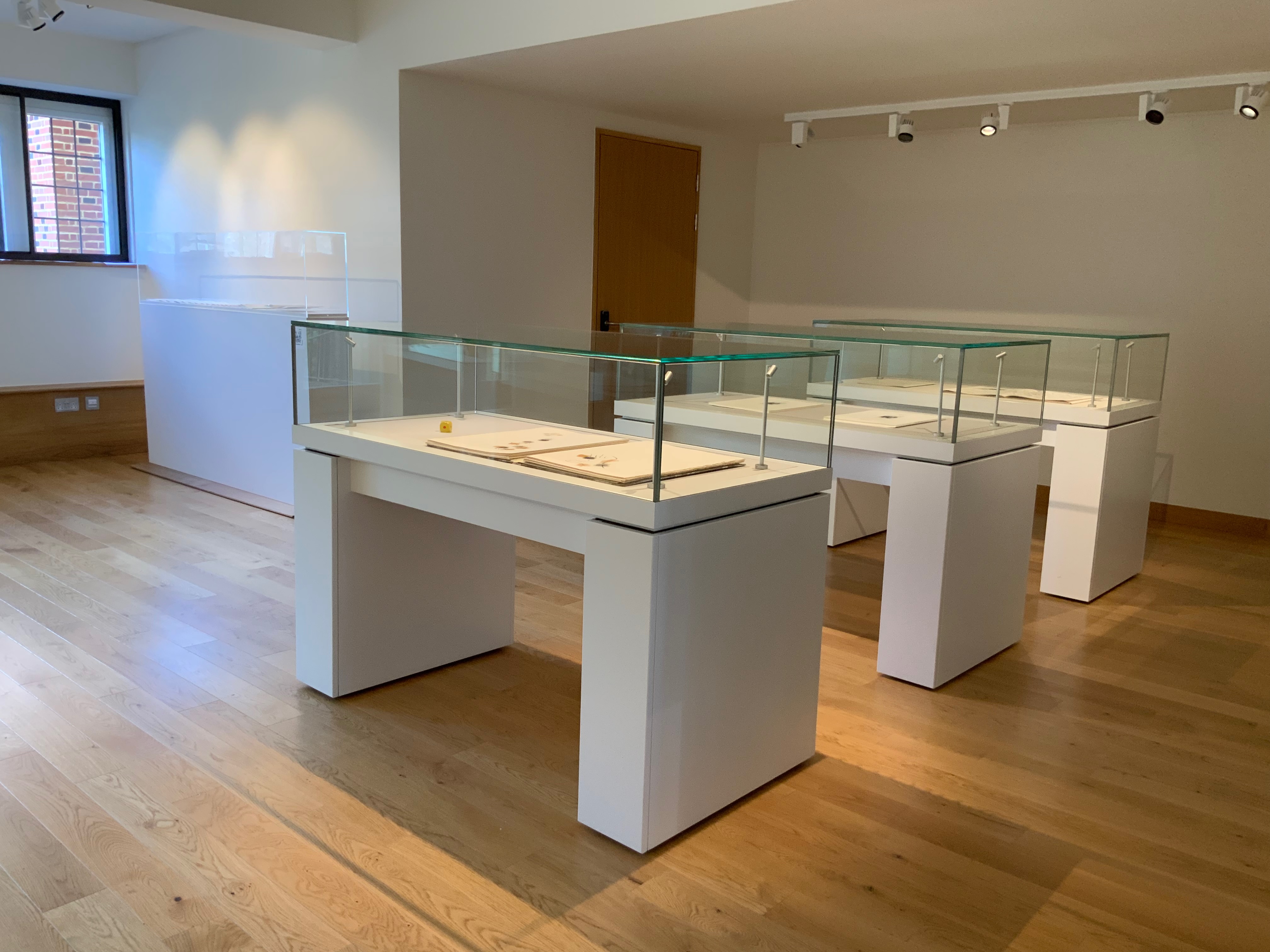
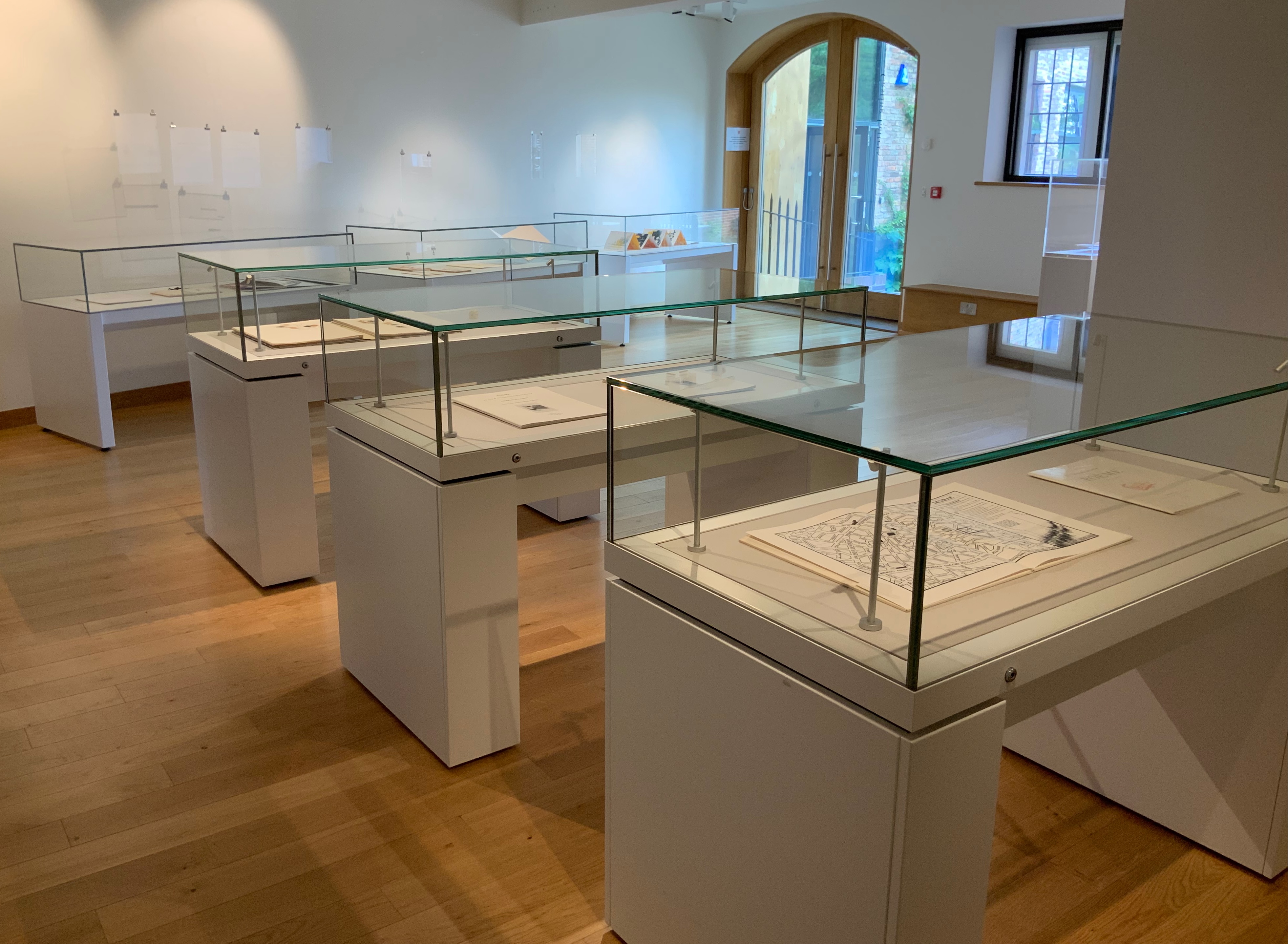
Like a Pearl in My Hand(2016) Carina Hesper Boxed folios. Box: H388 x W278 x D35. Folios: H330 x W220, 32 loose folios. Edition of 250, of which this is #221. Acquired from the artist, 19 December 2021. Photos of the work: Books On Books Collection.
Carina Hesper’s Like a Pearl in my Hand came to the collection after its appearance in the exhibition “The Art of Reading”, 18 November 2017 to 4 March 2018, at the Meermanno Museum in The Hague, Netherlands. It was an exhibition whose curator insisted that none of the works could be under glass. They had to be touchable. Like a Pearl in my Hand is a boxed set of 32 photographic portraits, each coated in black thermochromatic ink. Only by touching the prints can you see the underlying portraits.
Photos: Books On Books Collection. Taken at the Meermanno Museum in 2017.
Each portait is of a child, congenitally blind, whom Carina Hesper met through the Bethnal China orphanage between 2012 and 2016. A folded sheet (8 unnumbered pages) includes two essays and the colophon for the work. In one essay, Bettine Vriesekoop provides background on Hesper’s visit to the orphanage Bethel China as well as social and historical observations about the position of the congenitally blind in China. In the other essay, Hannes Wallrafen, once a photographer, now blind, delivers a perceptive review of what he calls the “book with black pages on my lap”. Explaining his situation, he addresses his task by explaining “how the blind see” by touch, memory and imagination. For his review, he also has the advantage of an app, TapTapSee, which enables him to take photographs before and after touching each folio and listen to an automated description of each. A quick trial will reveal the app’s limitation vis-à-vis Like a Pearl in My Hand and underscore the poignancy of Wallrafen’s concluding comment:
For anyone who does not dare pick up the book or only gently touches the pages, this book remains what it seems at first sight: a collection of black pages.
The best artists’ books engage the reader/viewer in a multisensory experience. Even so, usually sight comes first and touch, second among the senses in the experience. Like a Pearl in My Hand challenges this by making the subject of the unsighted accessible to the sighted only through the warmth of touch.
Other works in the Books On Books Collection to compare with Like a Pearl in My Hand include
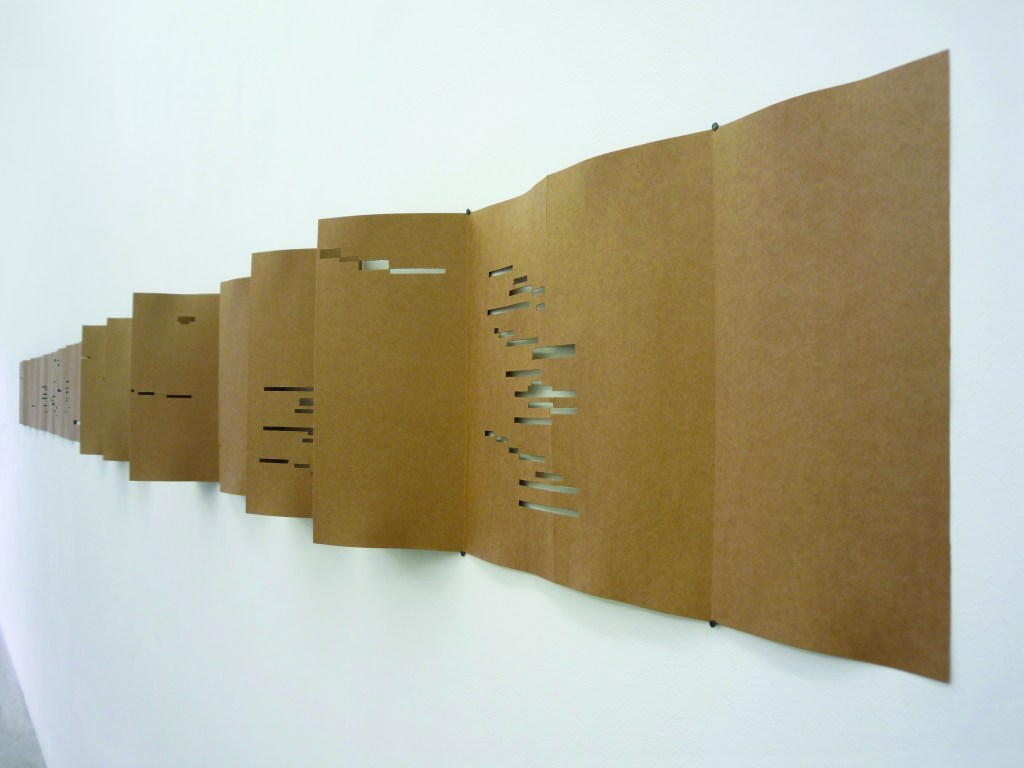
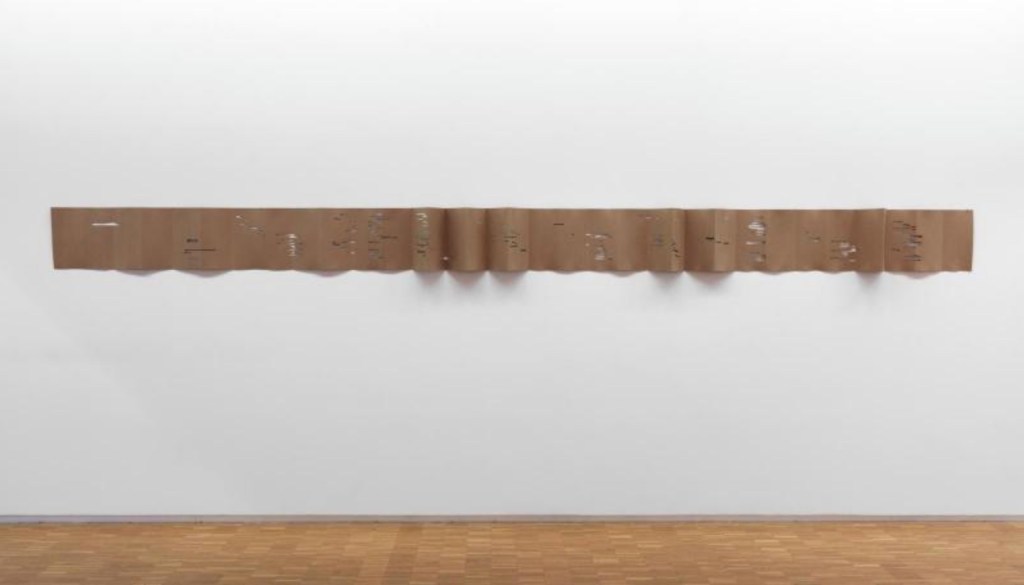
In 2009, Rainier Lericolais created one of the more unusual works of homage to Stéphane Mallarmé’s Un Coup de Dés Jamais N’Abolira le Hasard (1914). In Carton Perforé, the words and lines of Mallarmé’s poem take up their positions as perforations on a continuous paper roll used for a barrel organ or hurdy-gurdy.
For a multidisciplinary artist and musician, Lericolais’ choice of medium here is highly appropriate, as is the choice of Mallarmé’s poem for an artist in pursuit of “grasping the elusive“. The work is now in the permanent collection at the Musée national d’art moderne, Centre Pompidou.
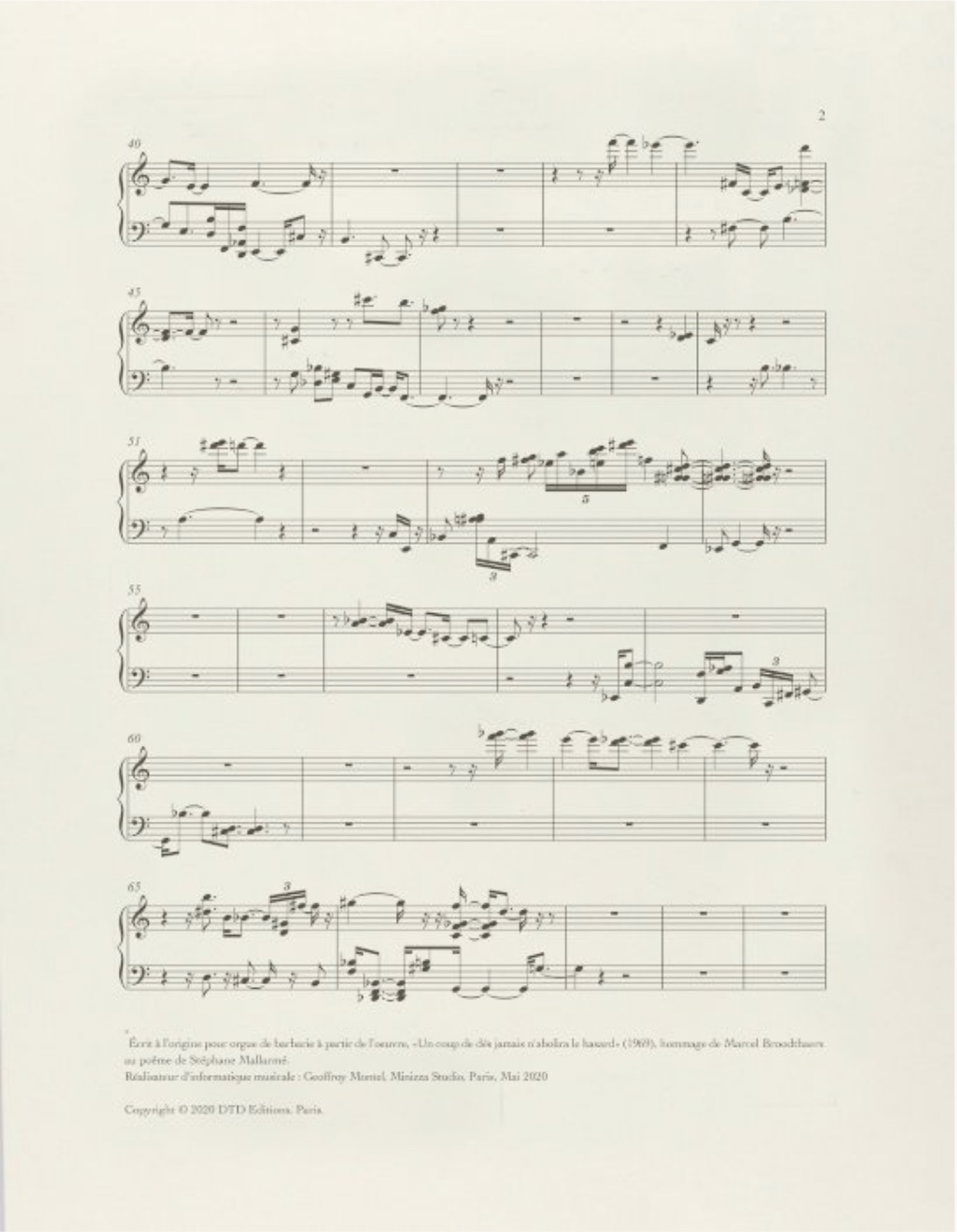
In 2020, Lericolais revisited his visual barrel-organ homage to create a version that could be heard as well as seen. Under the Direct to Disk Éditions label, Lericolais published Carton Perforé as sheet music for piano along with a recording of it. Just as Broodthaers and other hommageurs signaled their homage by changing Mallarmé’s subtitle from Poème to Image, Sculpture, Musique, etc., Lericolais adds the subtitle Piano, paying homage to their tributes, Mallarmé’s poem and, humorously, his own earlier work. A performance of the piano version can be heard here.
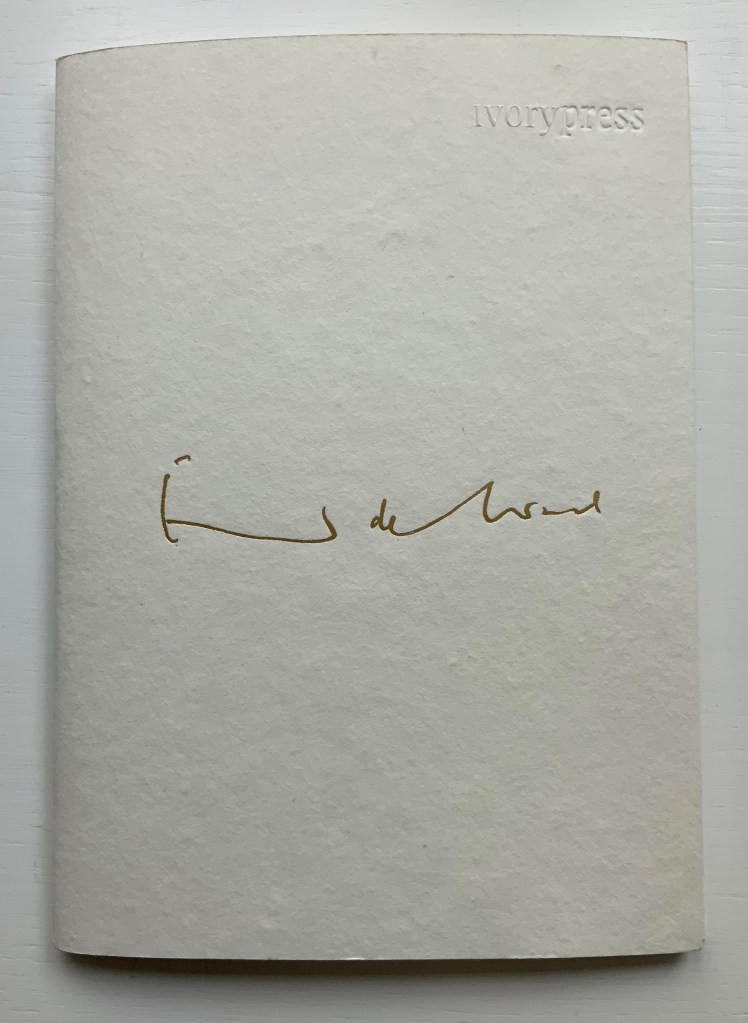
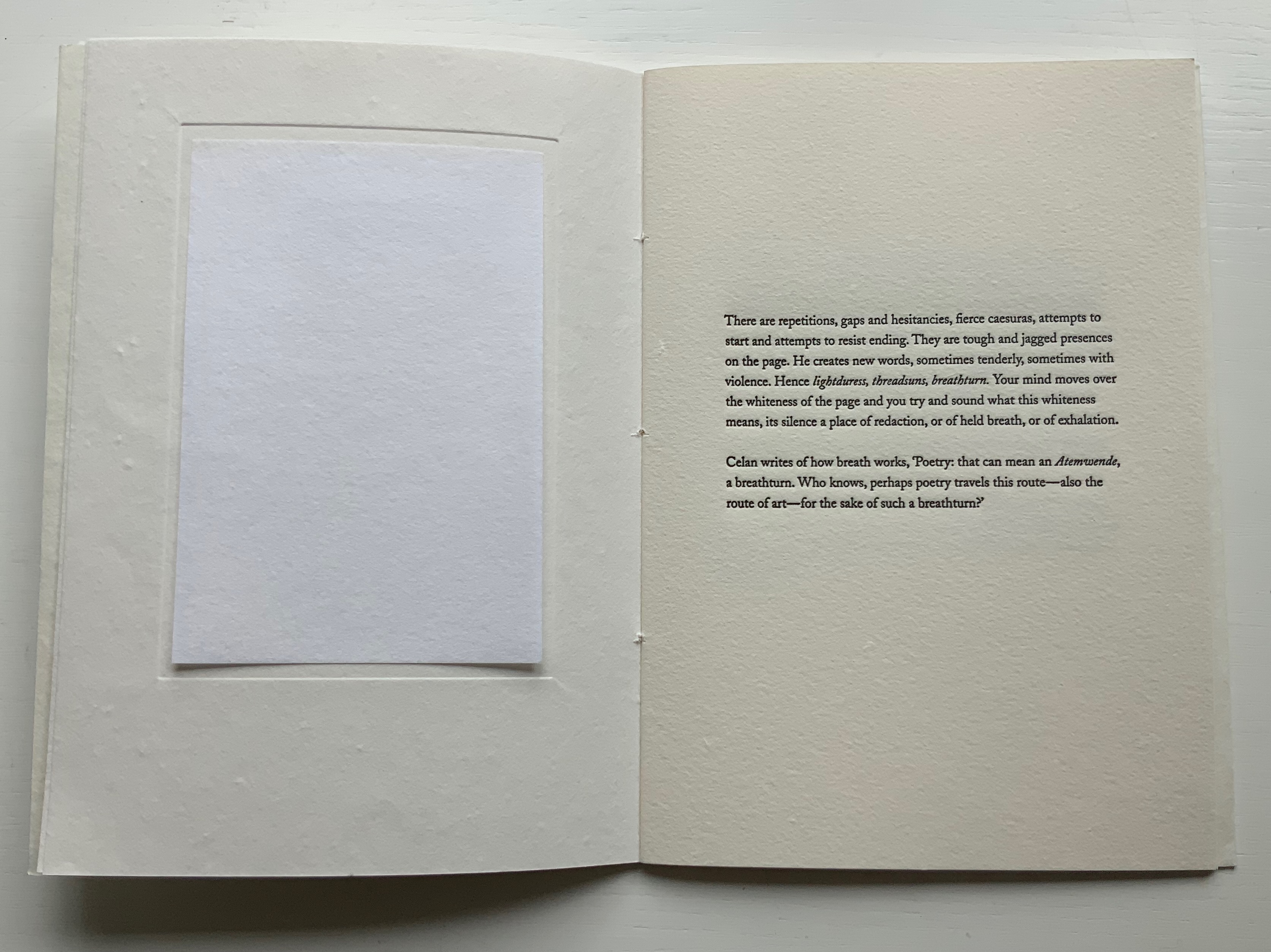
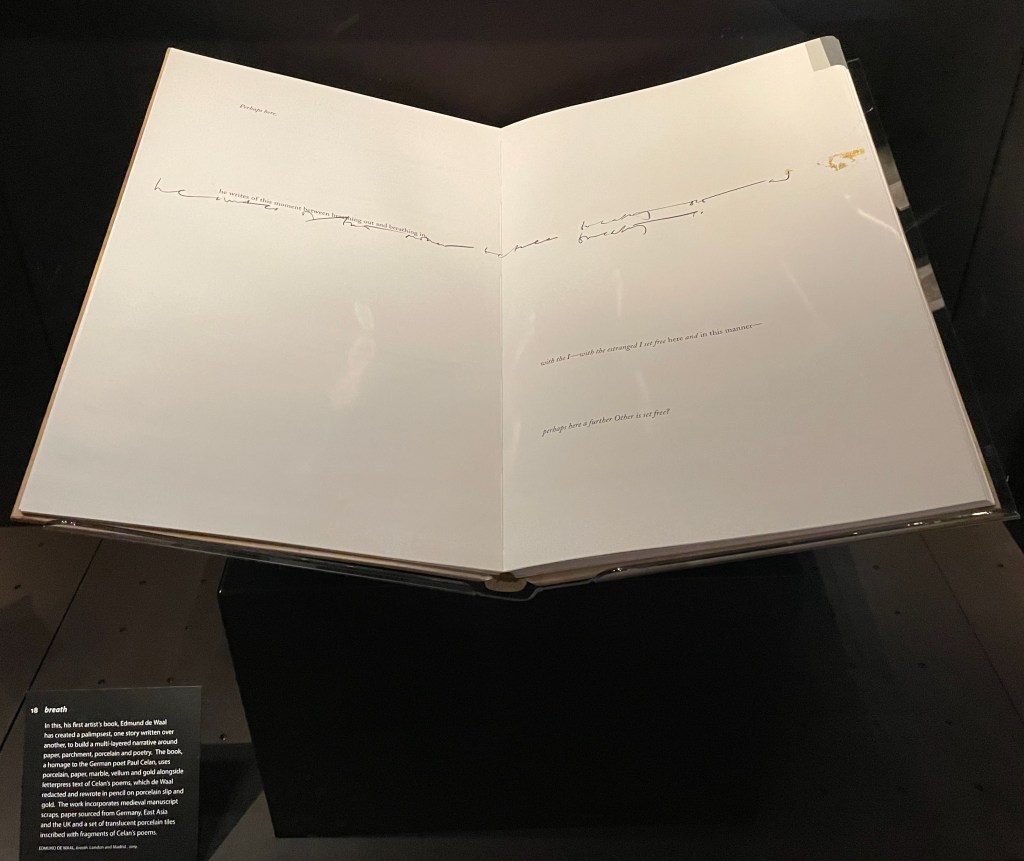
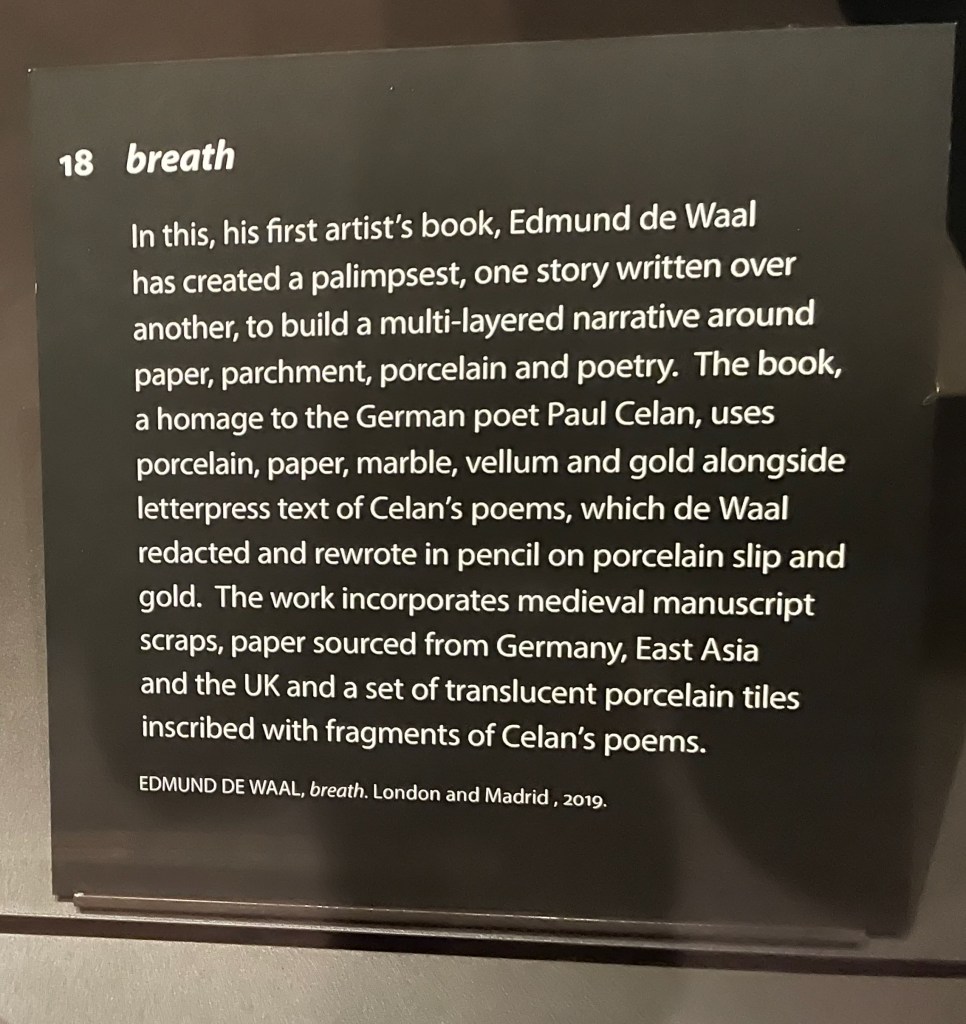
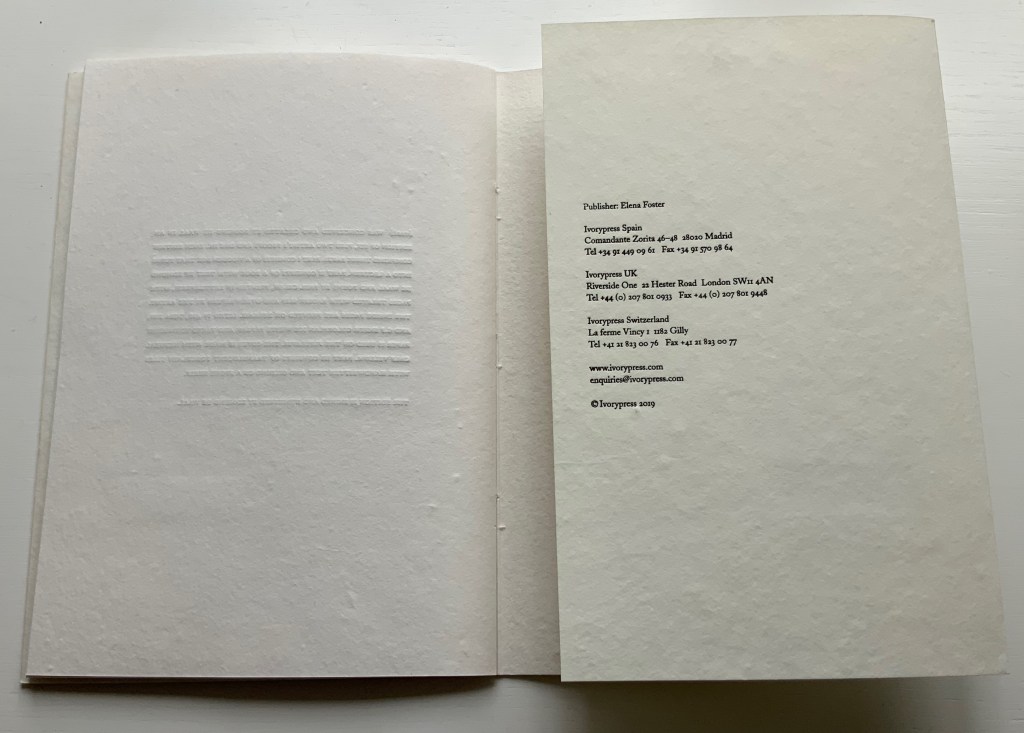
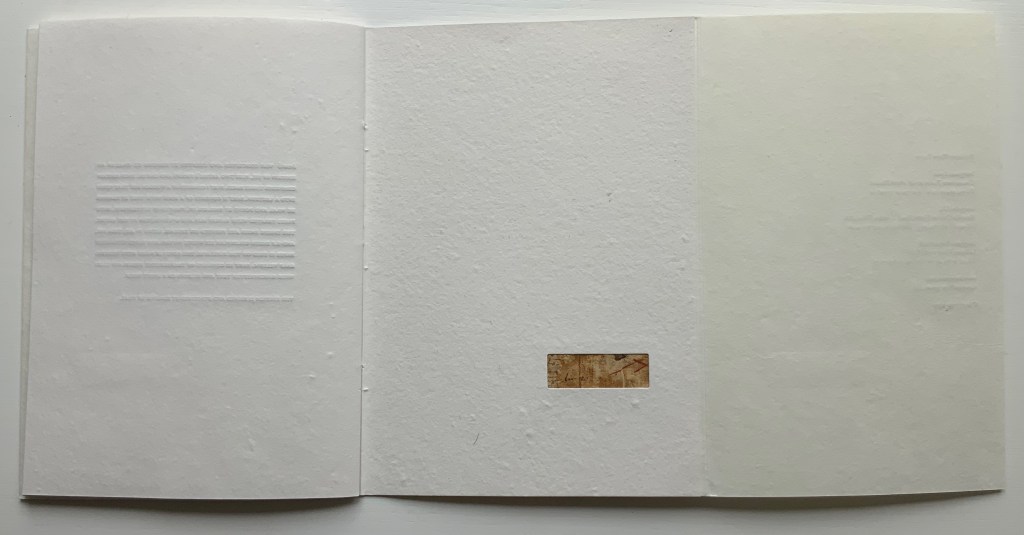
breath [prospectus](2019) Edmund de Waal Papercased sewn booklet. H214 x W152 mm, 16 pages. Acquired from Lady Elena Ochoa Foster, 28 June 2022, “Sensational Books” exhibition at the Bodleian Libraries. Photos of the work: Books On Books Collection.
In correspondence with Ivorypress in 2019, I first learned of Edmund de Waal’s artist’s book inspired by the later works of Paul Celan. With the help of Ivorypress, de Waal created breath as an artwork consisting of the artist’s book (in a limited edition of six), a series of vitrines, shelves and diptychs conceived as open books, and a reading room. His aim was to pay homage to the Romanian poet Paul Celan, in whose last books “there is more white page than word”, as de Waal puts it. The only way to have seen the book then would have been to fly to Madrid.
In a major surprise, a copy of the edition appeared at the formal opening of the exhibition “Sensational Books” at the Weston Library, part of the Bodleian Libraries (Oxford, 28 June 2022). Heightening the surprise was Edmund de Waal’s delivering a talk about the work to open the exhibition. And capping the surprise was Lady Elena Ochoa Foster’s kind gift of this eponymous booklet describing breath. Perhaps the surprise of a long anticipation’s being met, or de Waal’s impassioned talk, or the kindness of the gift created a susceptibility to the raw emotion on, in and beneath the whiteness of this work. But no, it is objectively there. De Waal’s booklet, photos from the exhibition and the Ivorypress videos further below help to understand from where the power of breath comes.
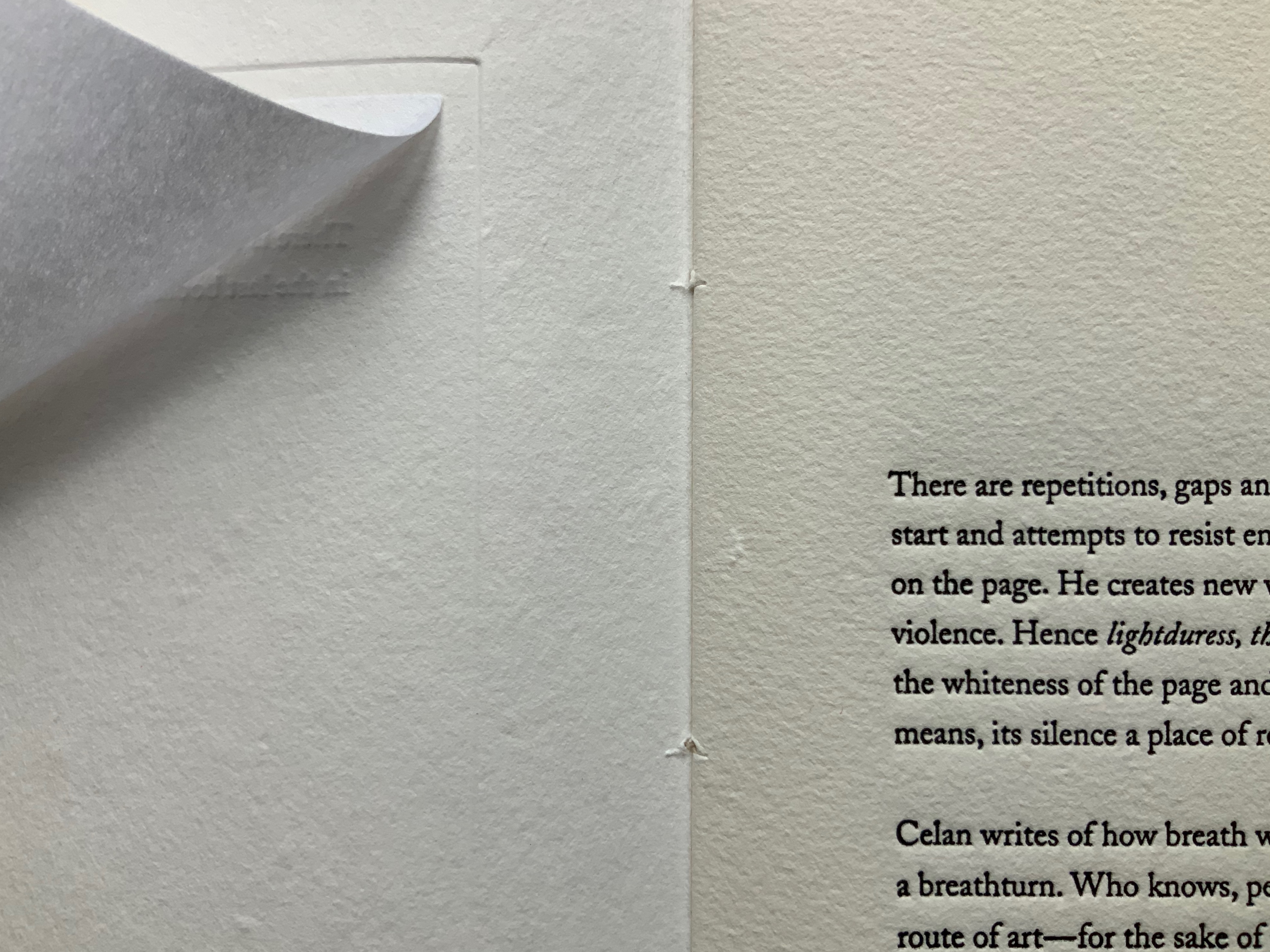
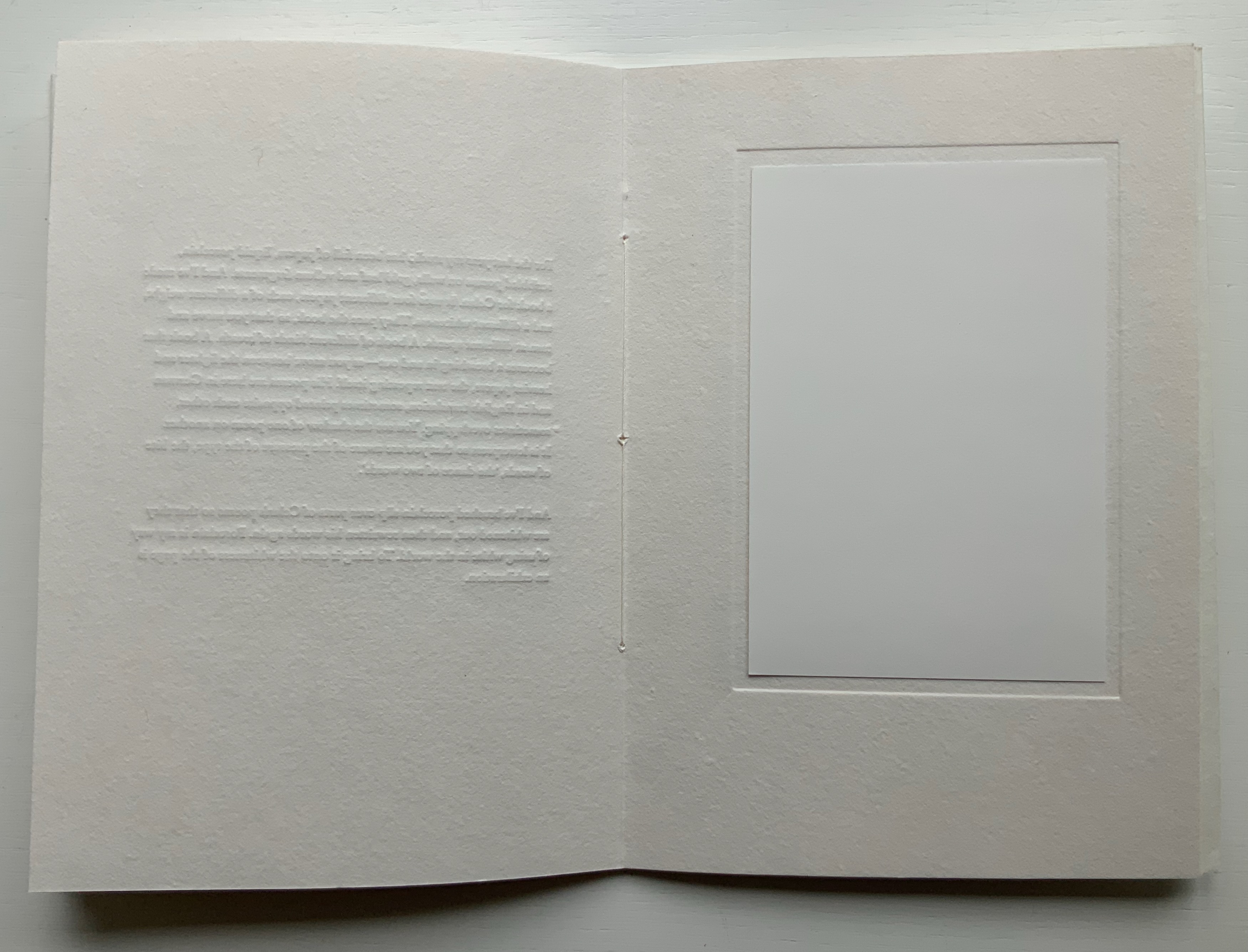
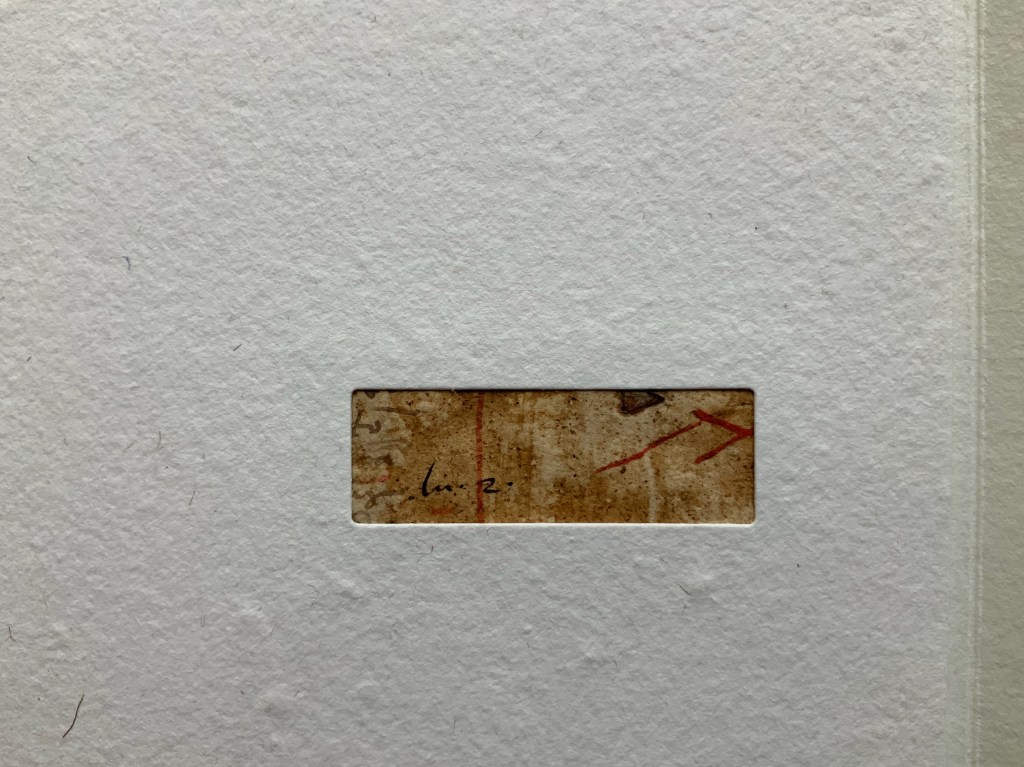
One of the booklet’s inserts is a square of white paper (perhaps the G.F. Smith Colorplan Ice White, one of the four different papers used in the artist’s book). Opposite the insert, de Waal writes, “Your mind moves over the whiteness of the page and you try and sound what this whiteness means, its silence a place of redaction, or of held breath, or of exhalation.” The close-up of the insert turned shows the paper’s degree of translucence that de Waal uses to great effect in his artist’s book as can be seen in the videos. The close-up also gives a view of the bite of the letterpress in the raised impression from the page before and the ink-filled depth on the facing page. This kind of material contrast recurs — bite and breath, white and black, lighter and heavier papers, rougher and smoother — in the larger work in so many ways.
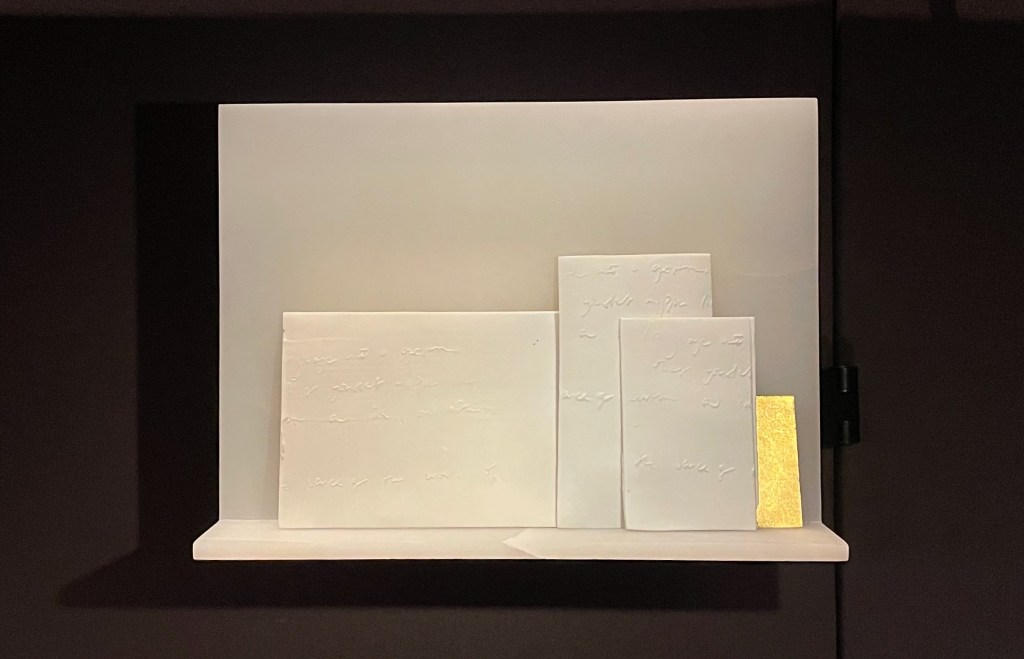
These visual, tactile and conceptual workings realize in small what the artist’s book accomplishes on a larger almost monumental scale. The artist’s book measures 453 x 673 x 43 mm and runs to 104 pages and is housed in a wooden box that converts to a lectern and provides storage for the translucent ceramic works on which Celan’s words are inscribed.
Another source of the larger work’s power is the porcelain slip that de Waal has brushed over parts of Celan’s poems to create a white surface on which he rewrites Celan’s words. Porcelain is de Waal’s tool. When asked what he does, he often puns in reply, “I throw pots”. The presence of porcelain slip in a work of such size, materiality and grounding in Celan’s poetry of coming to grips with the Shoah conjures a more somber pun on creativity and destruction. It establishes a paradoxical, metaphorical union of fragility, breakage and exhalation with strength, restoration and inhalation.
Showcased at “Sensational Books” exhibition, Weston Library, Oxford University. Photo: Books On Books, 8 July 2022.
Showcased at “Sensational Books” exhibition, Weston Library, Oxford University. Photo: Books On Books, 8 July 2022.
Just as the book, ceramics and lectern constitute another layer to the installation work, there are layers in the artist’s book itself, some of them hidden. The use of porcelain slip to cover Celan’s words has already been mentioned. Another layer lies in the binding, executed by Shepherds, Sangorski & Sutcliff. As was done in the early days of bookbinding, scraps of previously published material line the spine. For this purpose, De Waal collected scraps of medieval manuscripts previously used for binding. Binding within binding, centuries within centuries. By tucking away underneath the paper binding’s flap the only colored image in the booklet, an image that even looks like a scrap of illuminated manuscript, de Waal alludes to this practice.
While the scraps embedded in breath‘s binding are not materially perceptible, knowledge of it enriches the reader/viewer’s perception. Enriched perception enriches the work. As de Waal writes in the booklet and as we hear in the videos, “All books are palimpsests. As we read and reread, we re-create texts”. As readers/viewer responding to breath, each of us brings a layer to the palimpsest.
My response brings to the palimpsest another layering artist who celebrates Celan in works of book art: Anselm Kiefer. The juxtaposition provokes an intake of breath as it brings to mind Shulamith (1990) in homage to Celan’s “Todesfugue” (“Death Fugue”) or The Secret Life of Plants (2008) shown with a sound installation of Celan’s poetry and also sponsored by Ivorypress. So different from the whiteness of breath and its materiality of porcelain, wood, gold and paper, Shulamith is 64 pages made of lead, hair and ashes (1010 x 630 x 110 mm), and The Secret Life of Plants is 18 pages made of oil on lead over cardboard (1900 x 1400 x 200 mm). Both are dark and foreboding works. The artists themselves, too, differ in their roots. As told in The Hare with Amber Eyes (2010), de Waal’s family, the Viennese Ephrussis, were persecuted by the Nazis. Kiefer’s father was a soldier in the Wehrmacht, which we know from Kiefer’s infamous early works incorporating photos of him in his father’s uniform and giving the Nazi salute. Where de Waal evokes breath and whiteness, Kiefer evokes death and leadenness. Yet both fuse materiality and visual representation with text (whether explicit, implicit or hidden) to stand with Celan’s agony and creative spirit and achieve an originality, an independence that is nevertheless dependent on history.
De Waal, Edmund. 2021 “Breath“, In Paul Celan Today: A Companion, edited by Michael Eskin, Karen Leeder and Marko Pajević. Berlin, Boston: De Gruyter. 319-324.
Granero, Natalia, and Gunnar B. Kvaran. 2019. Anselm Kiefer: livres et xylographies: [catalogue de l’exposition, Montricher Fondation Jan Michalski pour l’écriture et la littérature du 8 février au 12 mai 2019 ; Oslo Astrup Fearnley Museet du 30 mai au 15 septembre 2019].
Personal Libraries Library (Winter 2009-10 to Spring/Summer 2021)
Imagine belonging to a library composed of selected personal libraries and housed on another continent. Imagine that the Librarian who selects those personal libraries and hunts down copies of the works (preferably the same editions) needed to recreate those libraries completely is also constantly harvesting them for cross-references and delivers the discoveries to you in the form of ephemera. It exists. I have a library card for it.
Since 2009, Abra Ancliffe has been replicating and making art from the personal libraries of
Maria Mitchell (1818-1889), Massachusetts astronomer, educator, suffragist and librarian Robert Smithson (1938-1973), New Jersey-born land artist, sculptor and art theorist Jorge Luis Borges (1899-1986), Argentinian writer of fiction, poetry and essays Italo Calvino (1923-1985), Cuban-Italian writer of fiction, poetry and essays Anne B. Spencer (1882-1975), Virginia-based member of the Harlem Renaissance circle, poet, civil rights activist, teacher and librarian [added in early 2014]
Each personal library has a catalogue derived from our Librarian’s research and consultation with foundations associated with each of the owners. Each library has its wish list of works needed to complete the holdings; and a Reference Library Catalogue for background on each of the owners has been added. But why these particular personal libraries? Was there a rule?
The library itself has rules (courtesy of our Librarian’s fellow artist Larissa Hammond):
1 The Library is a coordinate geometry that is initiated within and between the booksets. 2 The books within each set may not be disassociated and circulate as a singularity. 3 Each individual book is zero dimensional unless activated by its faction. 4 Reference materials are considered an empty set and may not be removed from the Library.
Given such rules, it is no surprise that our Librarian has included Borges. The fabulist of “The Library of Babel” once held the job of first assistant in a Buenos Aires municipal library and reportedly remarked “if I were asked to name the chief event in my life, I should say my father’s library” and “I always imagined Paradise to be some kind of a library”. Also, given such rules and the inclusion of Borges, could the Cuban-Italian Italo Calvino, a member of the Oulipo movement, be far behind?
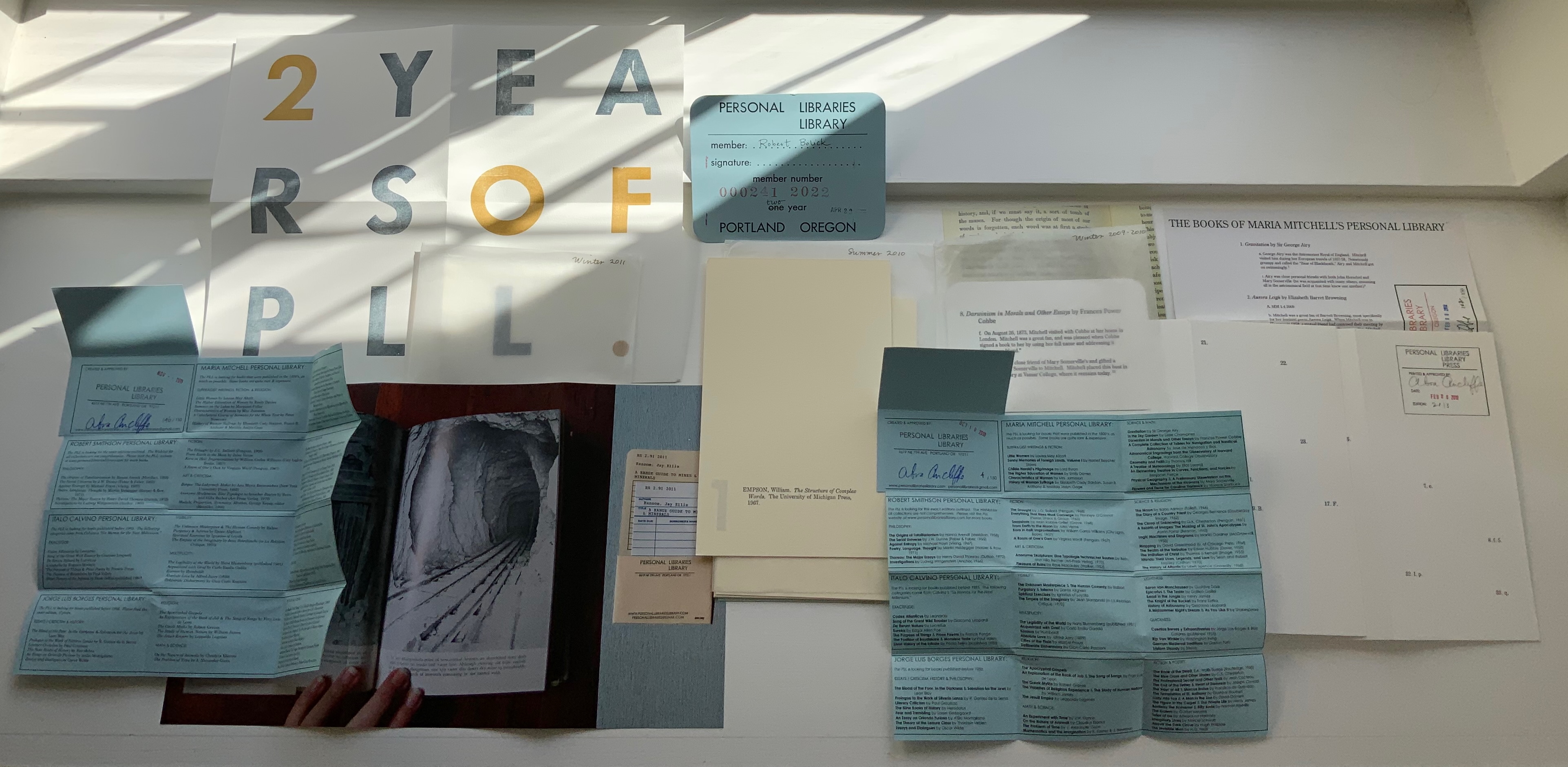
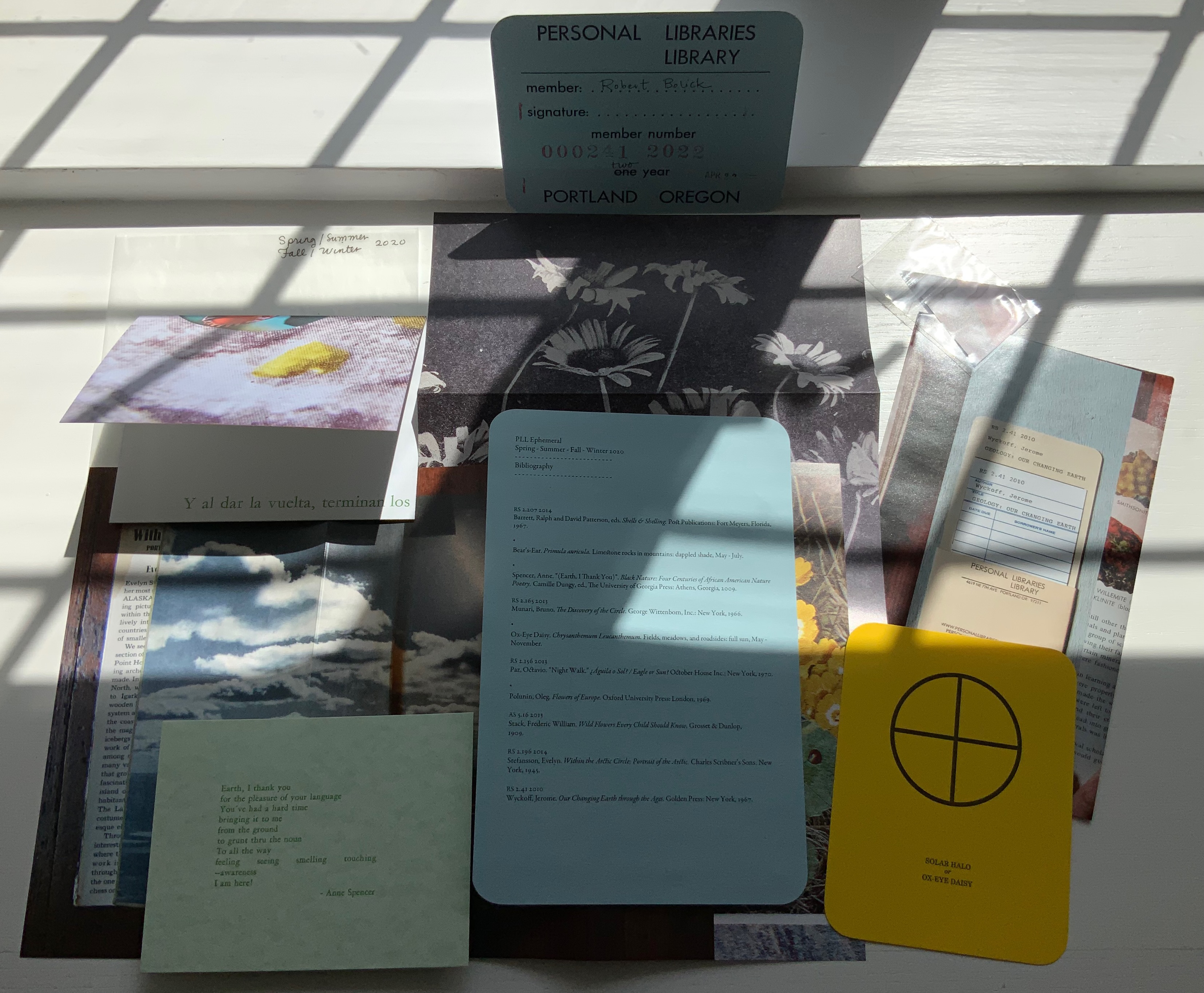
Maria Mitchell’s personal library was the seed or germinating star of the PLL in the winter of 2009-2010 (see the item in the upper right corner of the photo above). Flowers and constellations are two elements in the coordinate geometry that our Librarian finds “within and between the booksets”.
Another link between the libraries are the books common to more than one library. For instance, Ralph Waldo Emerson’s Essays appears in Maria Mitchell’s and Robert Smithson’s libraries. Perhaps there is a sort of transcendentalism driving the library! How appropriate that the first book from Mitchell’s library acquired and the first in the PLL was Ralph Waldo Emerson’s Essays.
By virtue of these collage-like connections that our Librarian draws in the periodic issues of ephemera, a book published at a later date may seem to belong equally to an earlier owner. Perhaps, as in the collages into which the ephemera can fall, “one book may hide another” to paraphrase Kenneth Koch. The issues of ephemera arrive like challenges to Robert Smithson’s notion of site and non-site works of art. They are works that depend and do not depend on their site. They arrive so similar and so different, regular enough but sporadic enough, that they are like “Miss Mitchell’s comet” — non-periodic (until it appears again).
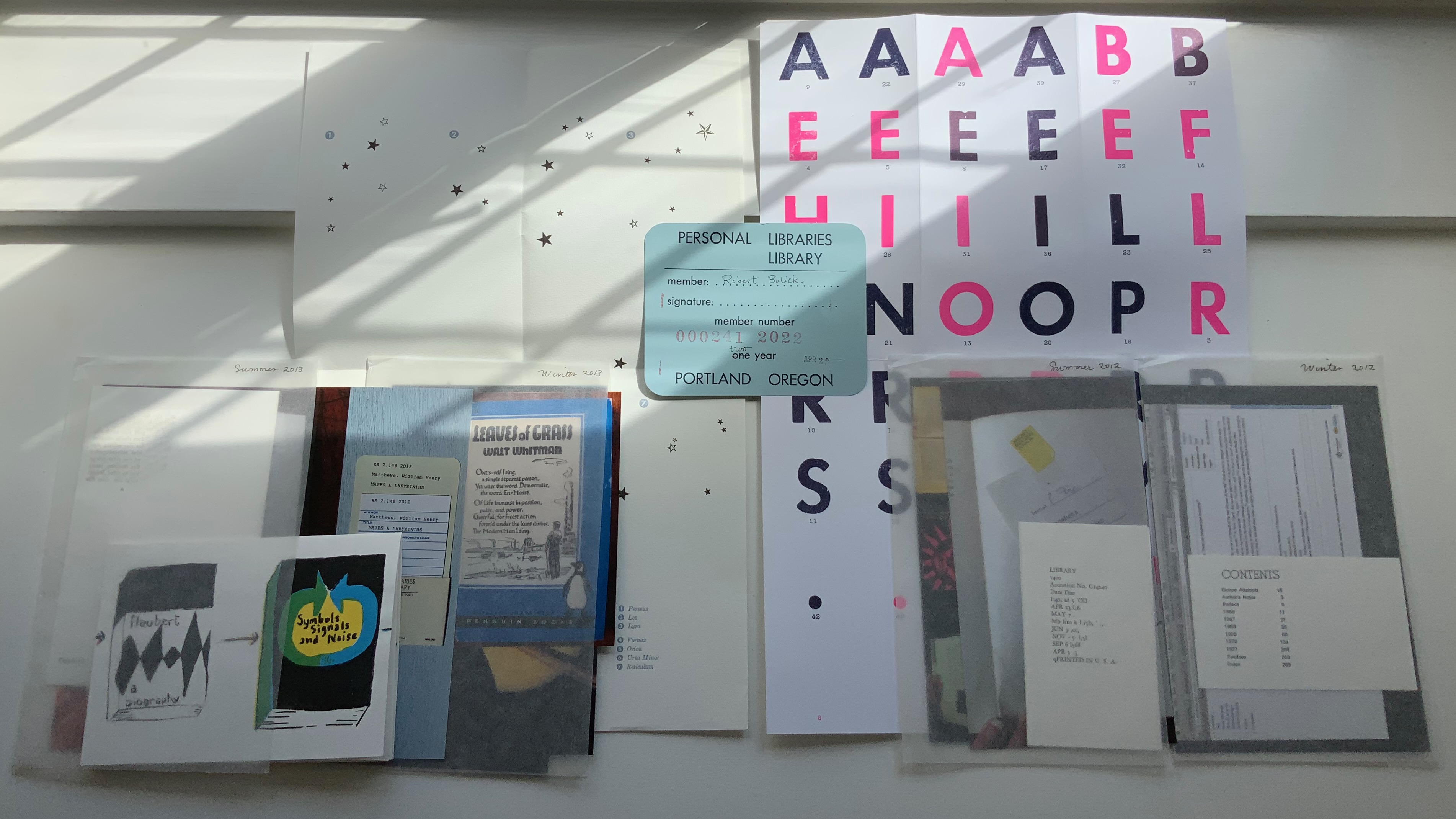
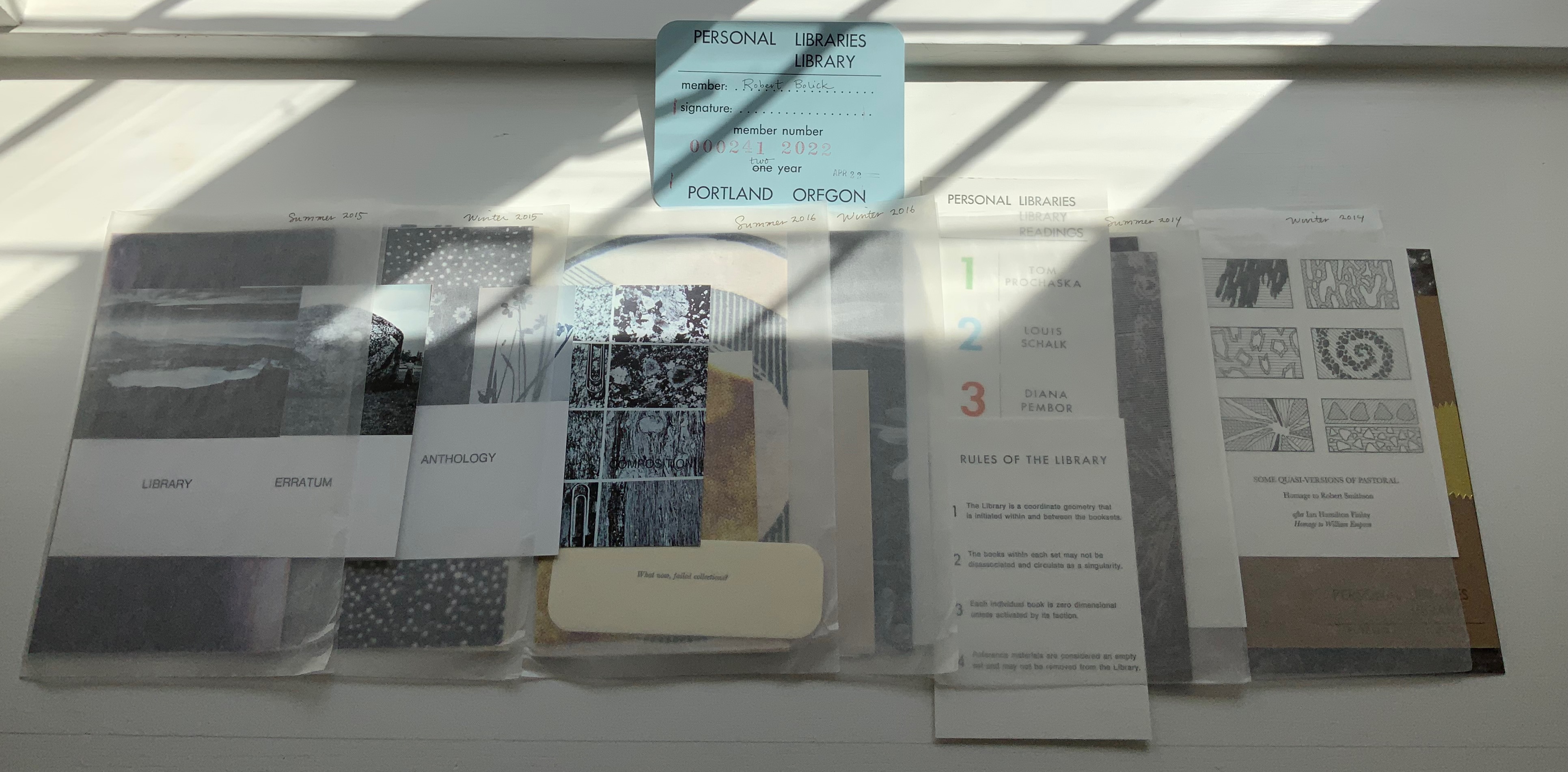
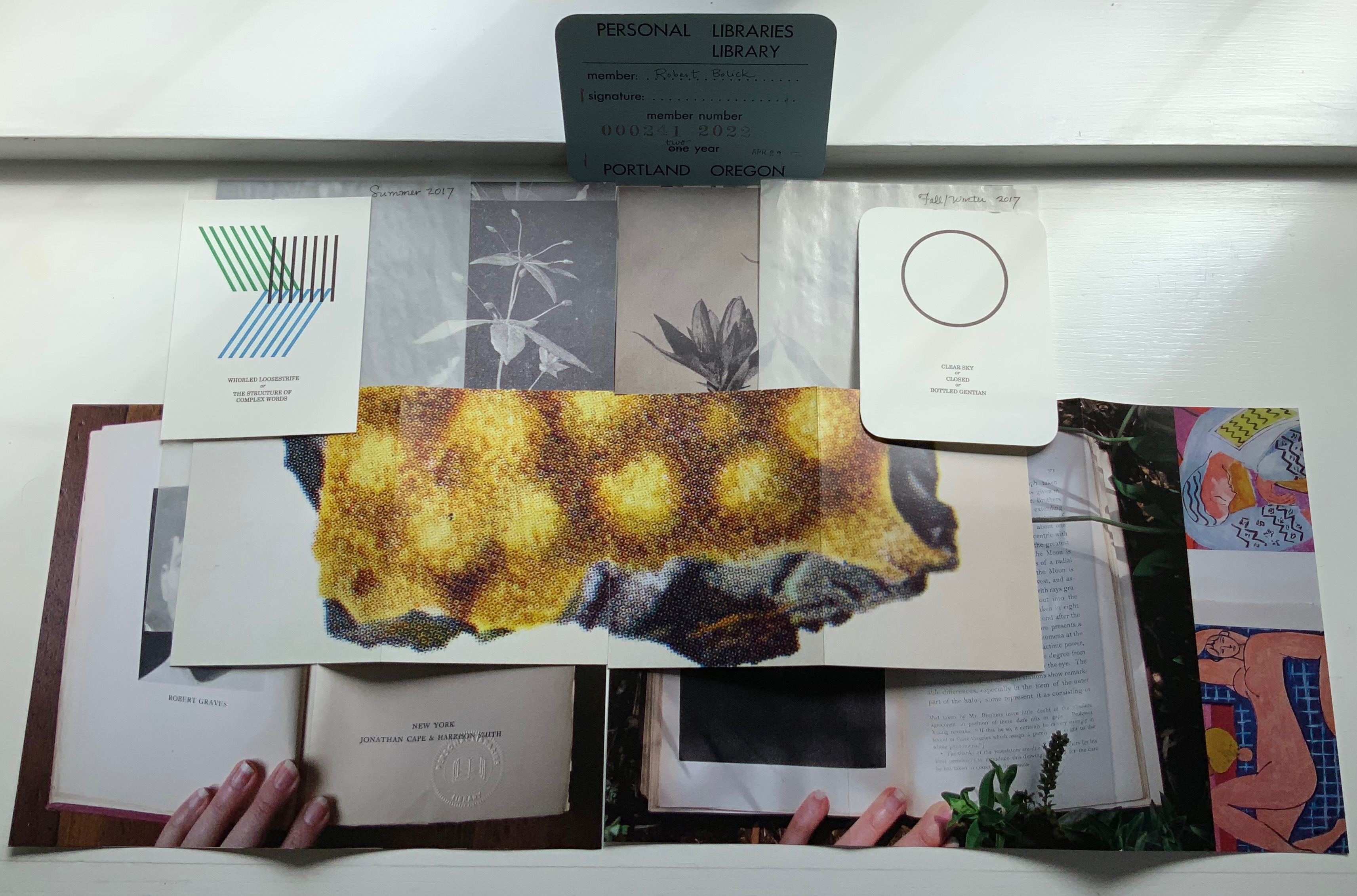
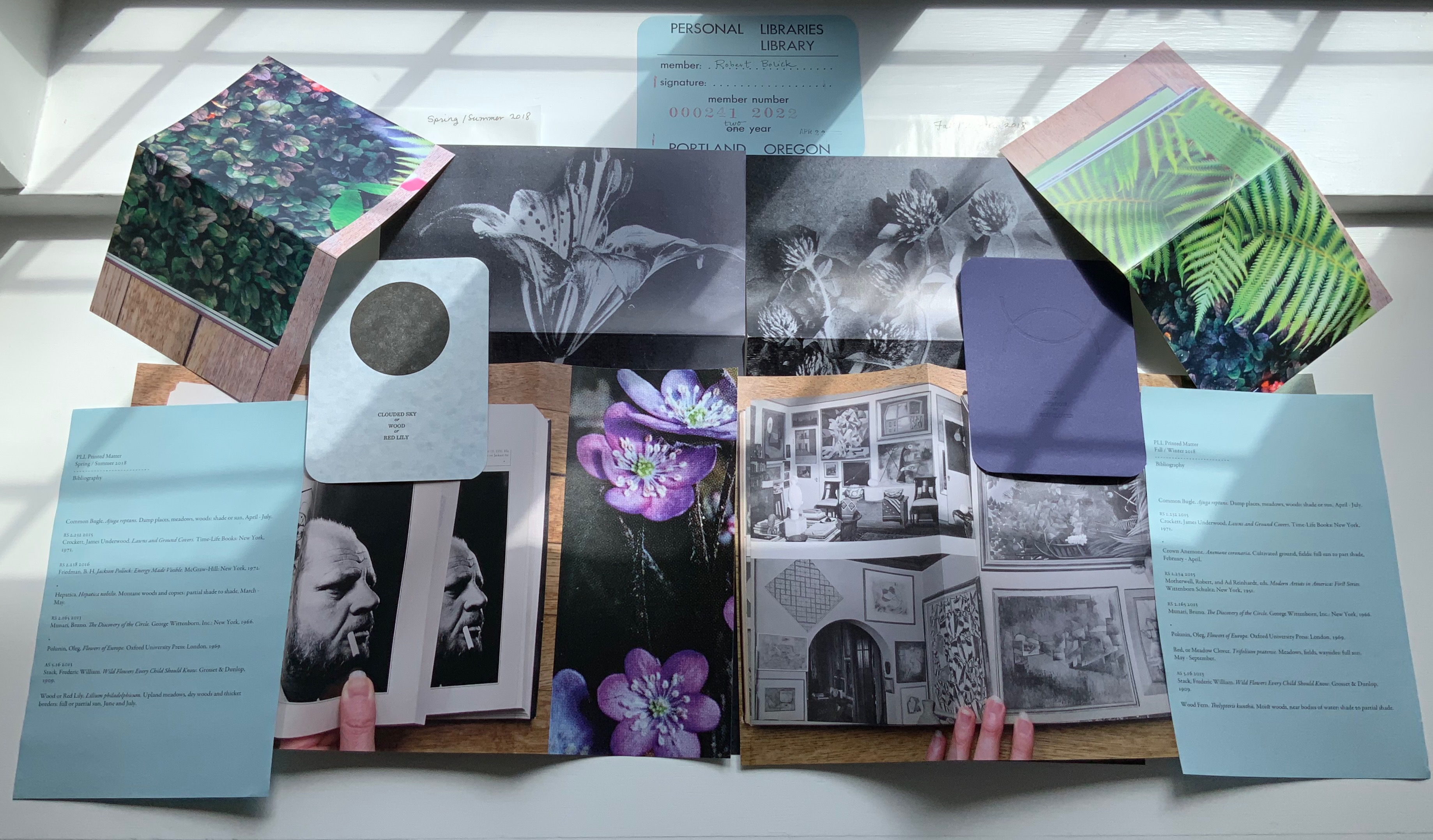
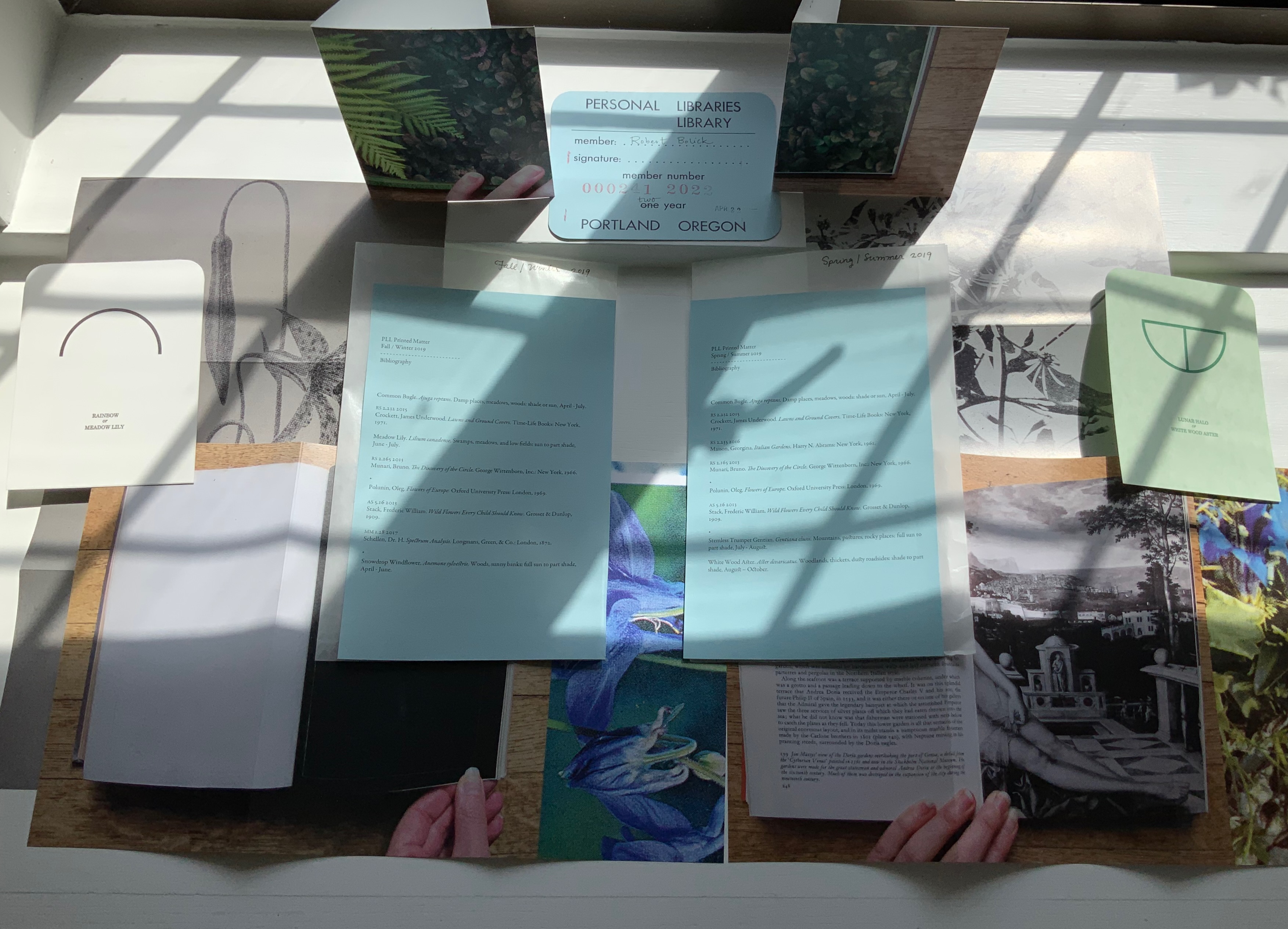
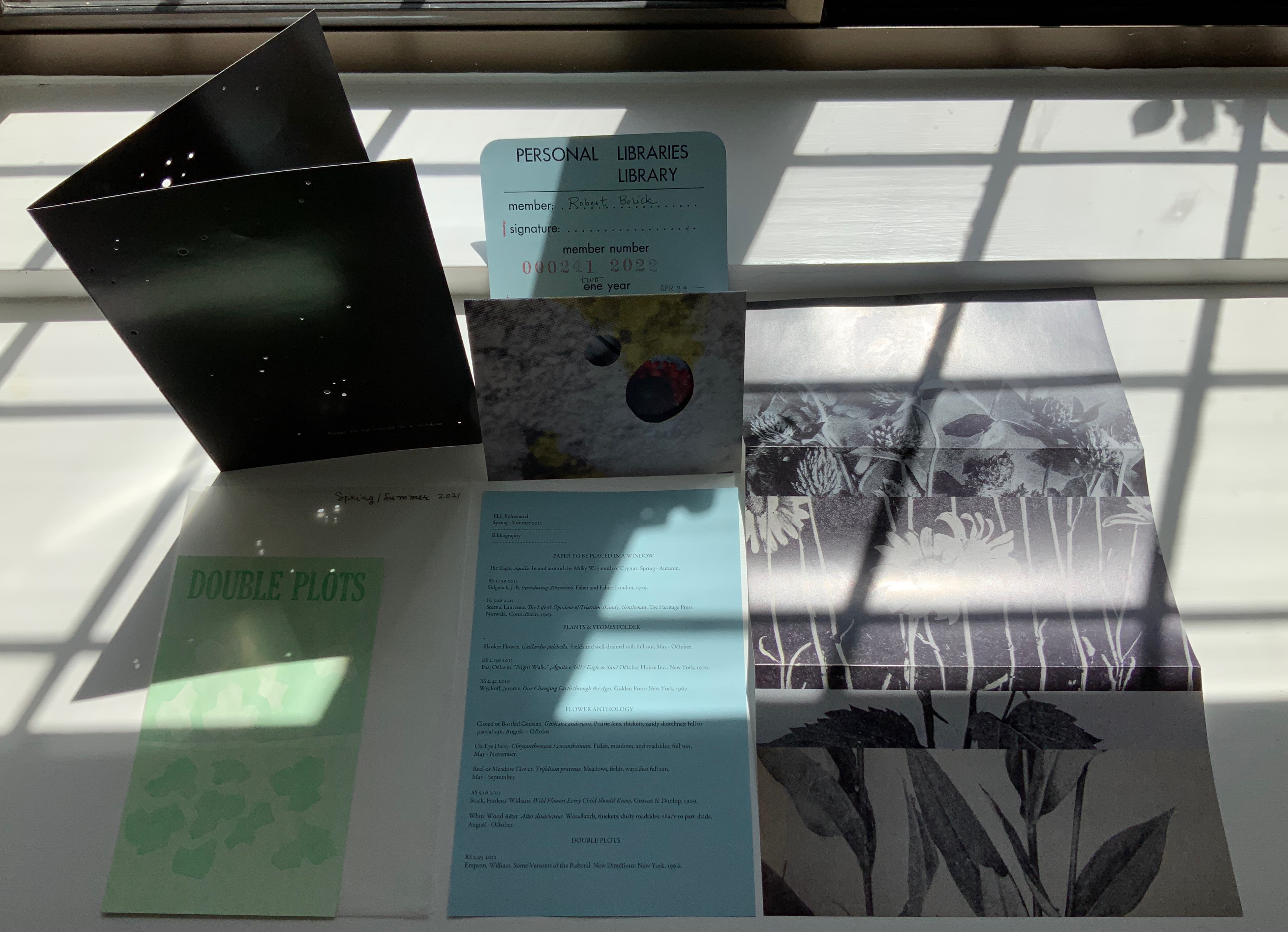
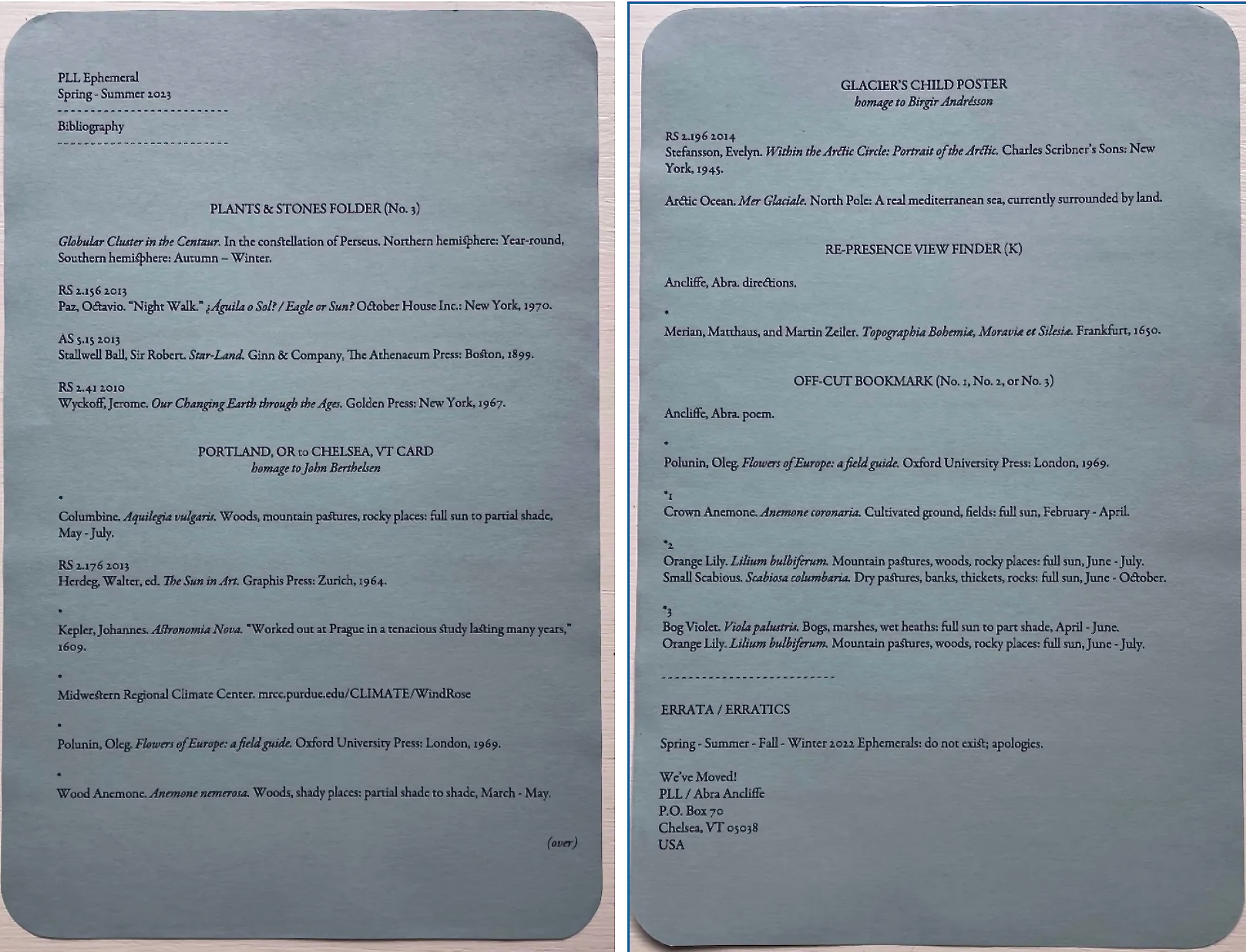
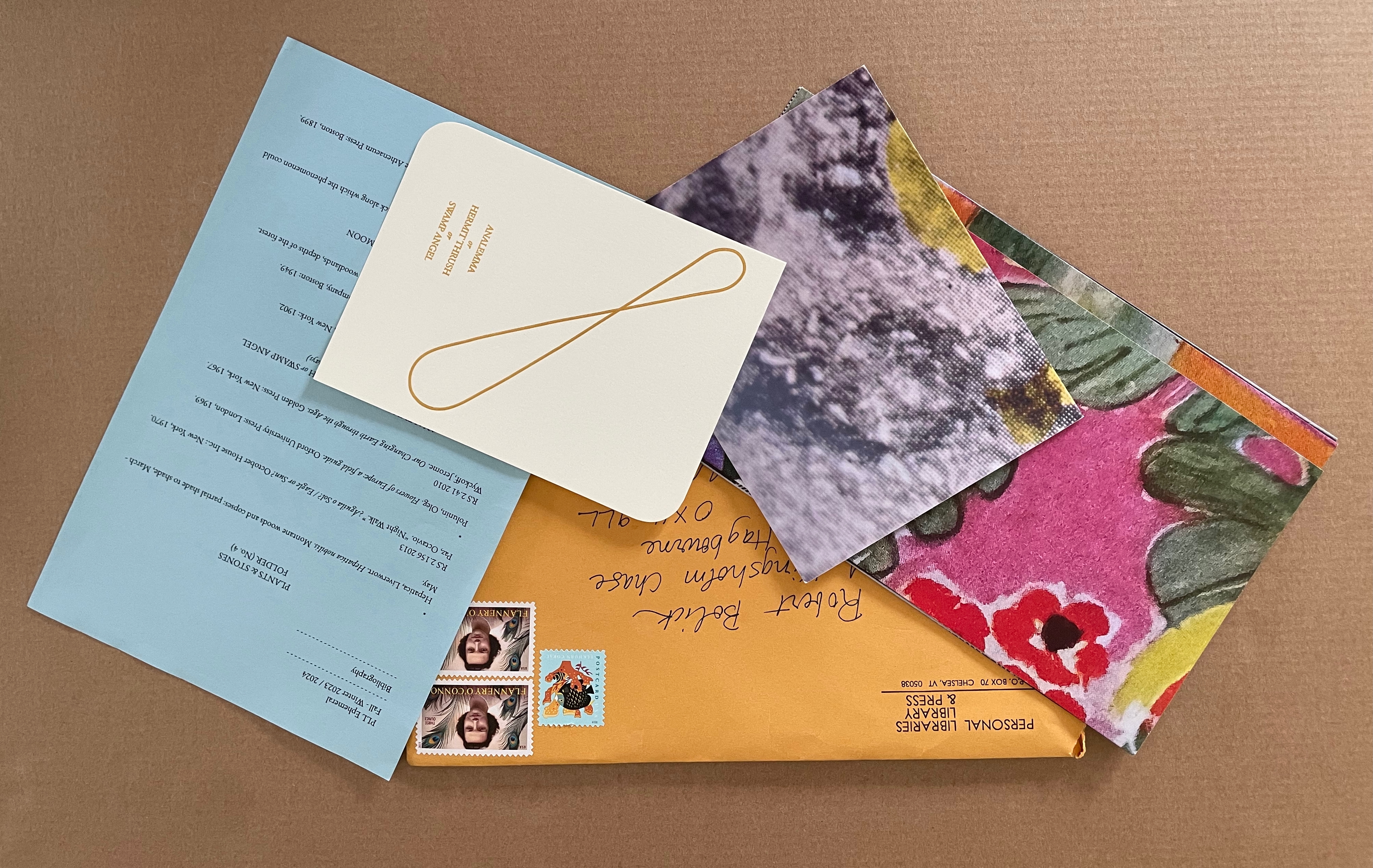
PLL Ephemeral Issues. Top down and left to right: 1) PLL 2011 Winter, PLL 2010 Summer, PLL 2009-10 Winter. 2) PLL 2013 Summer/Winter, PLL 2012 Summer/Winter. 3) PLL 2016 to 2014. 4) PLL 2017 Summer/Winter. 5) PLL 2018 Spring/Summer, Fall/Winter. 6) PLL 2019 Spring/Summer, Fall/Winter. 7) PLL 2020 Spring/Summer, Fall/Winter. 8) PLL 2021 Spring – Summer. 9) PLL 2023 Spring-Summer 10) PLL 2023-2024 Fall Winter.
The ephemera themselves represent “collaborations” among the personal libraries — courtesy of our Librarian’s reading of the Library’s “coordinate geometry”, of course. For the Spring/Summer 2021 issue, the first piece of ephemera listed on the blue manifest (its Bibliography) is “Paper to be Placed in a Window” (see the upper left-hand corner of the photo immediately above). Glossy black on both sides, the single folded sheet displays an astronomical photo with holes of different size punched to let light light up the constellation.
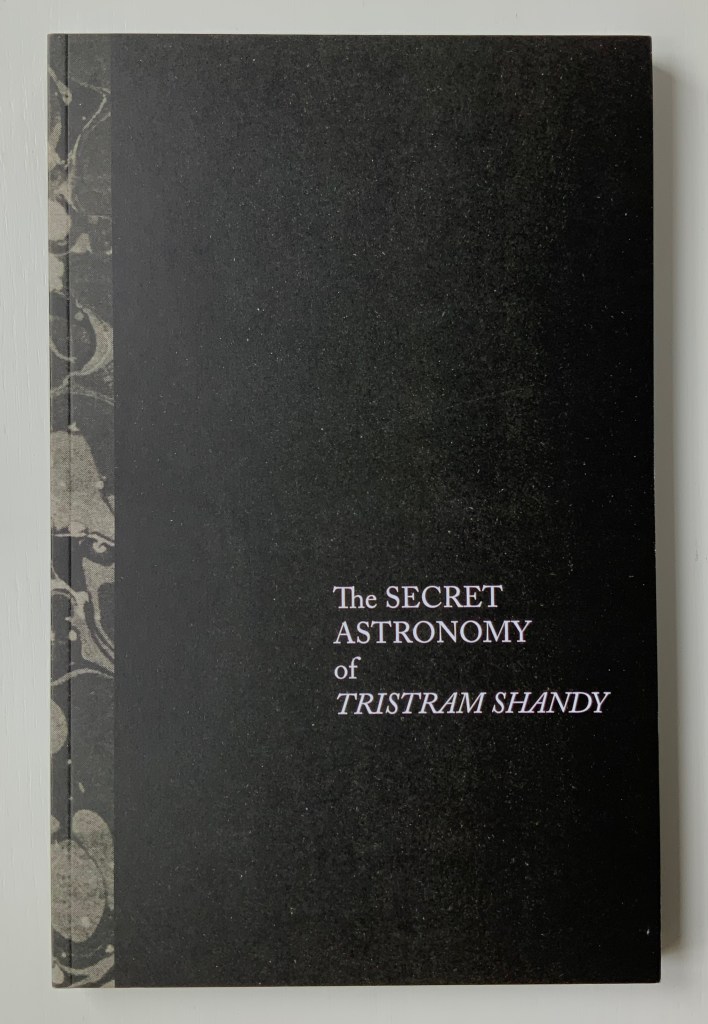
According to the manifest or Bibliography, the work connects the constellation Aguila (Eagle) “in and around the Milky Way south of Cygnus” with J.B. Sedgwick’s Introducing Astronomy from Smithson’s library and with Laurence Sterne’s The Life & Opinions of Tristram Shandy, Gentleman from Calvino’s. The connection with Sedgwick is obvious. The connection with Sterne’s novel may be obvious to readers familiar with its “black page”, or will be to readers here who proceed to the entry for the next of Abra Ancliffe’s works in the Books On Books Collection.
It is no surprise that Ancliffe’s work of book-art-cum-academic-treatise is part of the Laurence Sterne Trust Foundation’s permanent collection. Like Shandy Hall’s own The Black Page Catalogue (2010), The Secret Astronomy extrapolates and celebrates page 73 with the same whimsy and seriousness that the 73 writers and artists invited to make their own Black Page exercised. In its own self-publishing status, it also underscores like Simon Morris’s manifesto Do or DIY (2012) the same status of Sterne’s work as a forerunner to the self-published, self-referential works of book art of the mid- to late 20th century. It is Ancliffe’s elevation of the self-reflexive academic treatise to art status that secures The Secret Astronomy its position in the Books On Books Collection.
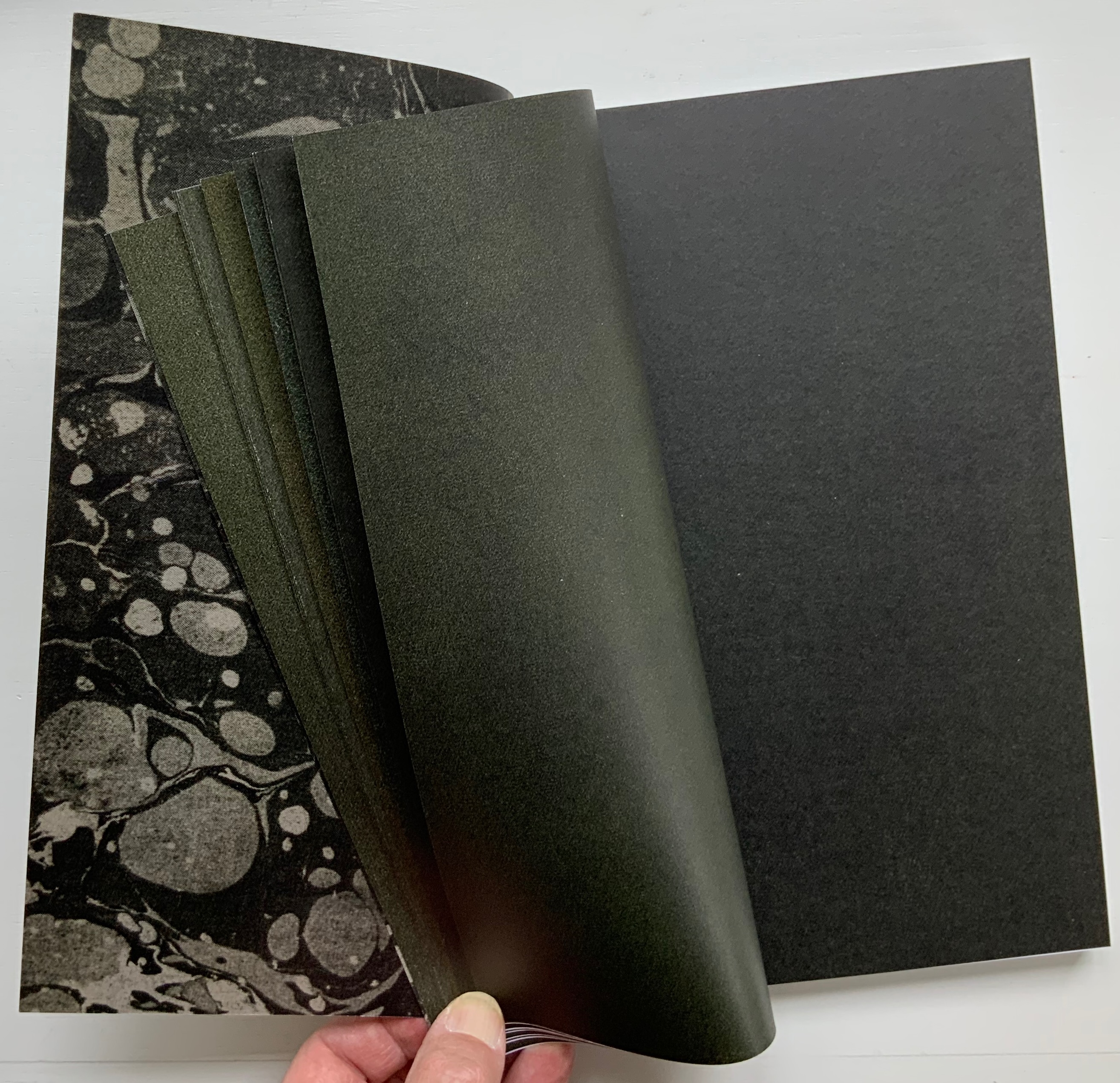
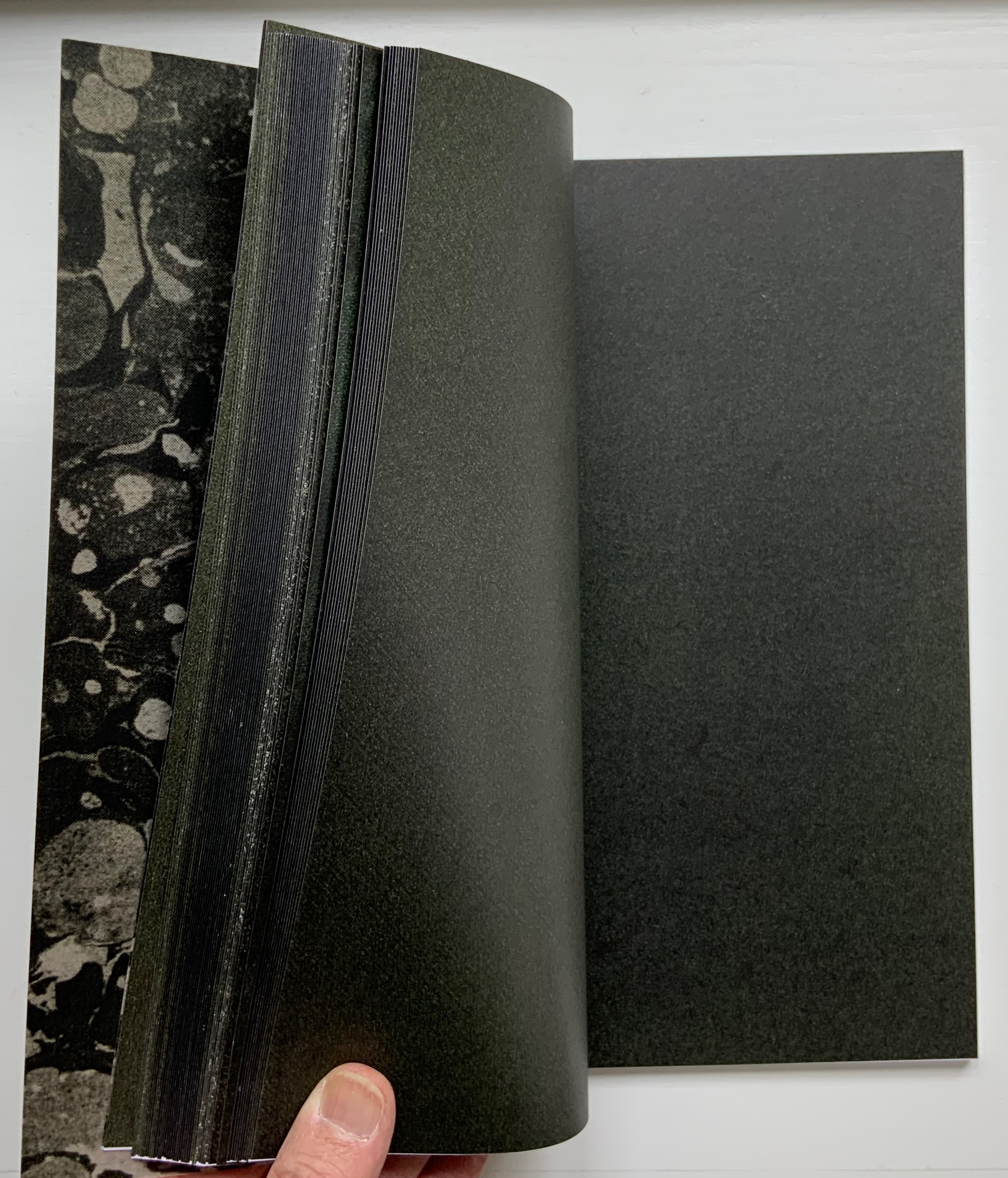
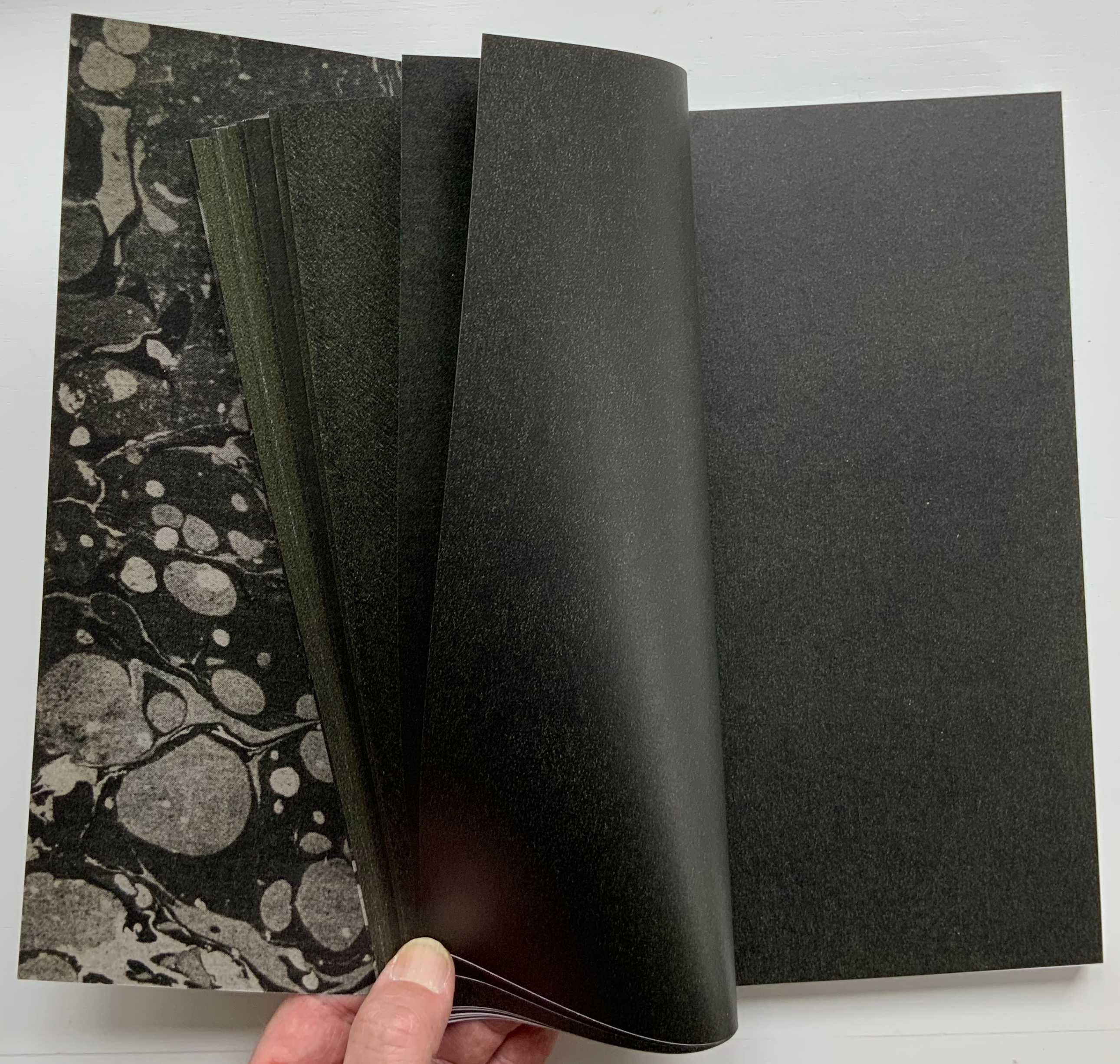
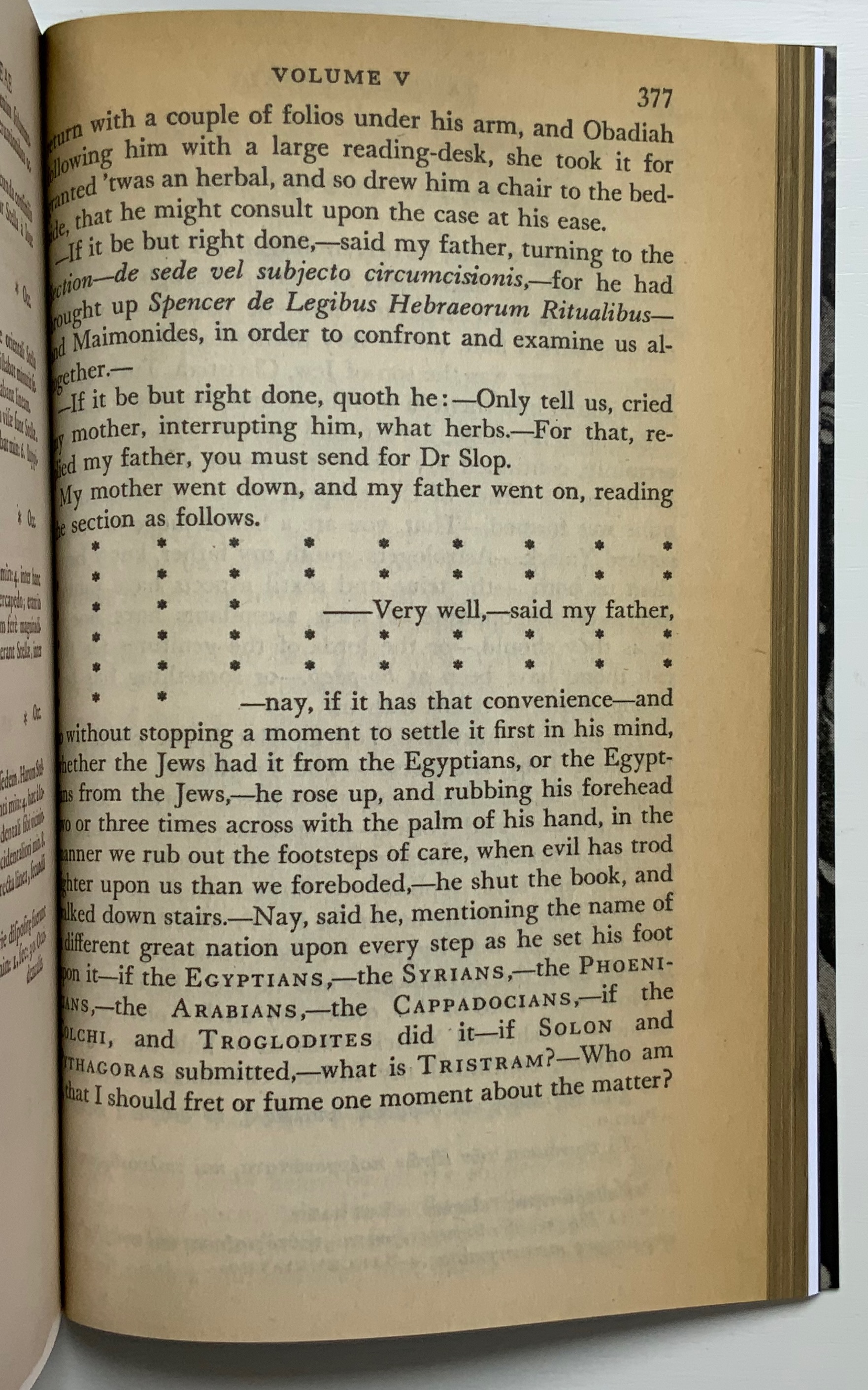
The rectangle of black appearing on page 173 in the first edition of Sterne’s novel faces the brief announcement of Parson Yorick’s death on page 172: “Alas, poor Yorick”. Taking off on the concept of academe’s variorum edition, Ancliffe has reproducedthe black pages from more than one hundrededitions of Sterne’s novel. What is a singularity in the novel becomes a contemplation of a regularity that reveals a material irregularity since the 1759 edition. Densities of ink have varied, oxidation occurred, spots from lint and fingerprints accumulated — even show-throughs from the next chapter’s text — so that the eye begins to read the accumulated pages for astronomical images — Tristram’s and Sterne’s secret astronomy. (The temptation to Grangerize this work by slipping into it Ancliffe’s ephemera “Paper to be Placed in a Window” is strong.) Ancliffe urges forward her case for the discovery of a secret astronomy with a series of appendices, one of which draws attention to Sterne’s use of the asterisk in the novel and proposes one of its hidden kabbalistic meanings in an equation: if star = *, and Sterne = star, then Sterne = *. There is even the dutiful source appendix listing all of the editions from which black pages have been gathered.
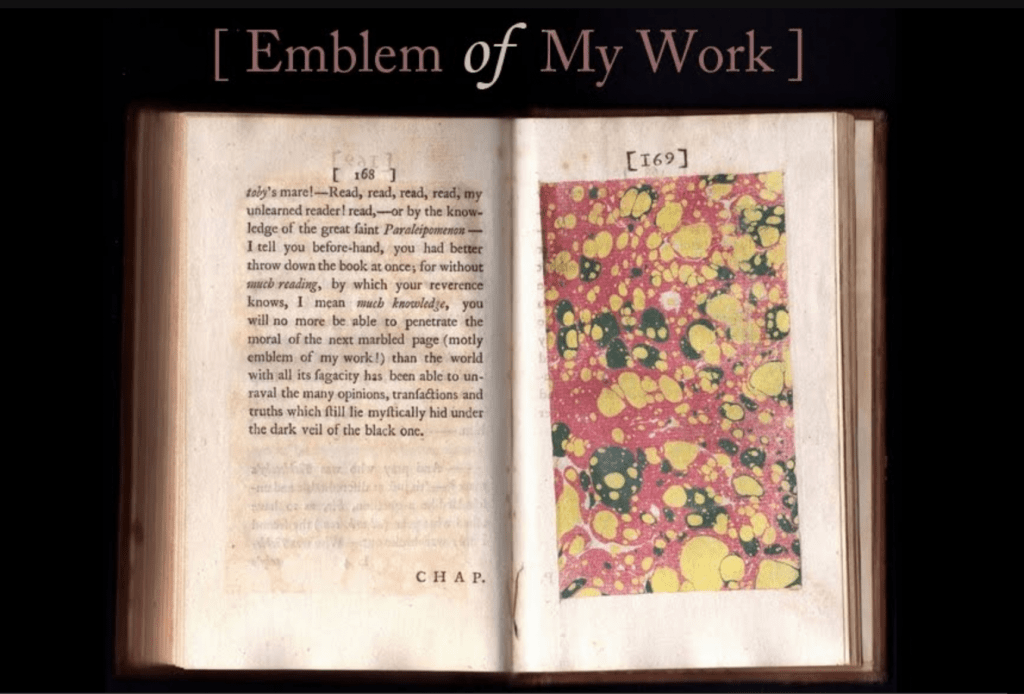
Pages 169-70 of the first edition of Tristram Shandy account for another famous singular, regular irregularity — the marbled page, which Tristram calls “the motly emblem of my work”. Ancliffe’s black, brown and gray marbled spine and inside covers make for an apt, ironic and artistic stroke — a reminder of the element of chance that is so characteristic of Sterne’s narrative project, of The Secret Astronomy, and of the ephemera arising from the Personal Libraries Library.
From Shandy Hall’s Emblem of My Workblog, accessed 18 September 2019.
This entry continues with three other works by Ancliffe. To continue reading, click here.
“Shandy Hall“. 1 January 2021. Books On Books Collection.
“Jorge Luis Borges“, last edited on 8 May 2022. Wikipedia. Accessed 15 May 2022.
“Italo Calvino“, last edited 20 April 2022. Wikipedia. Accessed 15 May 2022.
“Maria Mitchell“, last edited 8 March 2022. Wikipedia. Accessed 15 May 2022.
“Robert Smithson“, last edited 14 May 2022. Wikipedia. Accessed 15 May 2022.
“Anne B. Spencer“, last edited 25 April 2022. Wikipedia. Accessed 15 May 2022.
Baldwin, Kate, Denise Bookwalter, Sarah Bryant, Macy Chadwick and Tricia Treacy. 2021.REF. Another work that finds its art in libraries.
Davis, Brian. 1 May 2024. “Part One: The Rise of Multimodal Book-Archives“. Book Art Theory. Starkville, MS: College Book Arts Association. Explores “archival poetics”, finding art by harvesting archives and libraries.
With the permission of the author and The Book & Paper Gathering, this essay by Paula Steere is being reposted at Books On Books because Steere’s observations about bookbinding lead to a closer look at works in the Books On Books Collection. Keep Steere’s essay open in this window, then open another window for one of the entries in this baker’s dozen to start:
Compare images in the open windows. Just as Gary Frost’s conservation work shed light on book art, Steere’s descriptions and explanations can lead to a greater appreciation of these artists’ works and others.
Posted on Thursday 9th June, 2022 by thebookandpapergathering. Accessed 13 June 2022.
What stresses occur when we open a book? How do spine materials affect them? What are we really doing when we stick things on a book spine, sand them back, and then stick more things on? On what are we basing these decisions? As a book conservation student, keen to learn, I looked for spine structure information in popular conservation and bookbinding literature, but I found no satisfactory answers to my questions. So I did what I always do when I want to find out how things work: I talked to a mechanical engineer. This article is based on my MA Conservation dissertation research at Camberwell College of Arts, London. I realised early in the research process that I needed the knowledge of an engineer, and conveniently, there happened to be one in my family. Lee McIlvaine lives and works in the United States, has 30 years of mechanical engineering experience and specialises in mechanism and structural design. Five years later, we are still talking about book mechanics.
Spine lining materials are fundamental to the action of a book spine. Yet, a review of over 250 technical statements about book structure, lining materials or lining techniques from historical and contemporary conservation and bookbinding literature1 revealed that many statements are unqualified or unquantified. For example, Middleton (1998) advises that ‘when enough layers [of paper linings] have been applied, the end of the paper is trimmed off’, but he does not specify how many ‘enough’ would be. Technical information can also be contradictory between authors. For example, Szirmai (2001, p. 275) partially attributes the functional longevity of existing gothic bindings to the ‘restrained’ use of adhesive on the spine. However, Douglas Cockerell (1901, p. 152) advocates giving the spine ‘a thick coat of glue’ when lining heavy books. Diehl (1980 Vol. 1, p. 190) states that the hollow back is ‘one of the most commonest [sic] faults of construction’, but does not explain why. On the other hand, Middleton (1963) simply reports the historical use of recessed thongs with a hollow back to enable more throwup; he does not indicate whether this was a good or bad practice. Advice in the literature requires some level of experience to interpret it, and some statements in the literature reviewed are even technically incorrect2, all of which makes the advice unhelpful for learners. I felt an immediate kinship with an anonymous author who wrote in The British Bookmaker that
Vague generalities may always be used by theorists in describing a process of work, and they may suffice for those who know how to do it, and are consequently able to fill in the omissions of the unpractised and merely theoretical exponent of the craft, but for those who desire to learn, or for those who, being practised workmen, desire to extend their knowledge, vague generalities will not suffice. (1892-3, no page)
Clear and reliable information about linings is greatly needed. As Miller (2010, p. 100) rightly points out, ‘linings can sometimes be extremely damaging’. With that in mind, the starting point for my research was the well-known article by Conroy, ‘The Movement of the Book Spine’ (1987), in which he describes a fundamental engineering principle important for bindings – the tension and compression principle.
Mechanics of the book spine
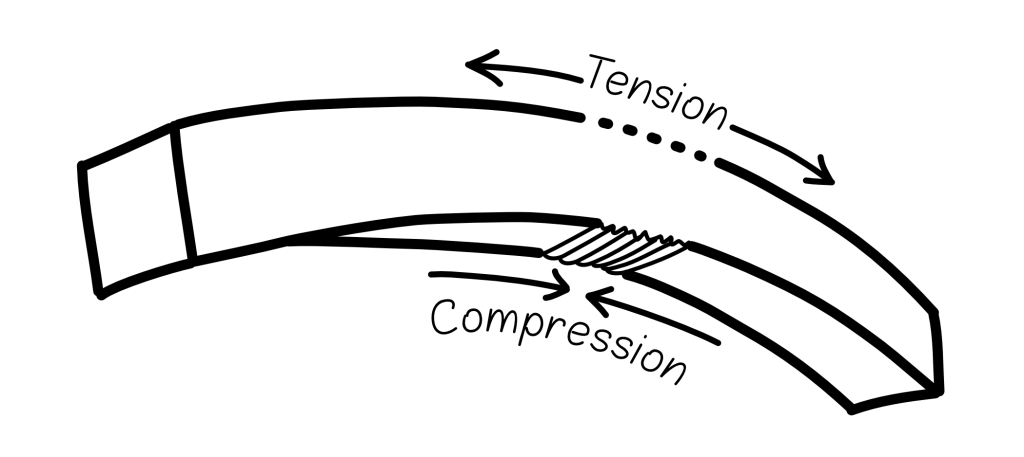
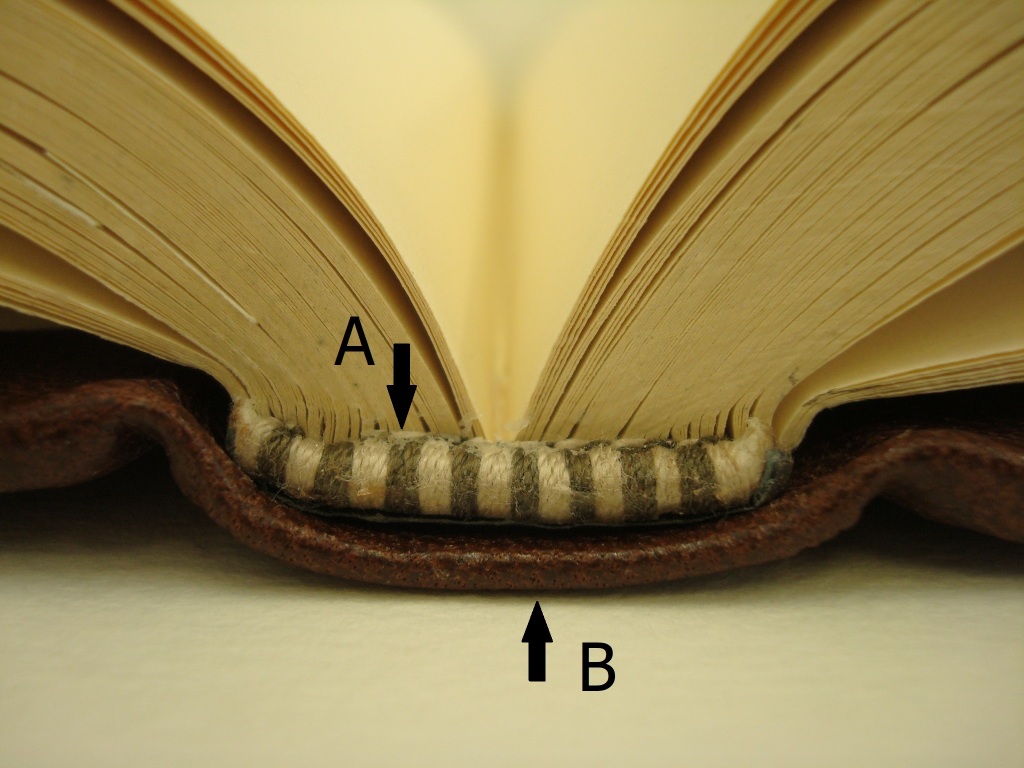
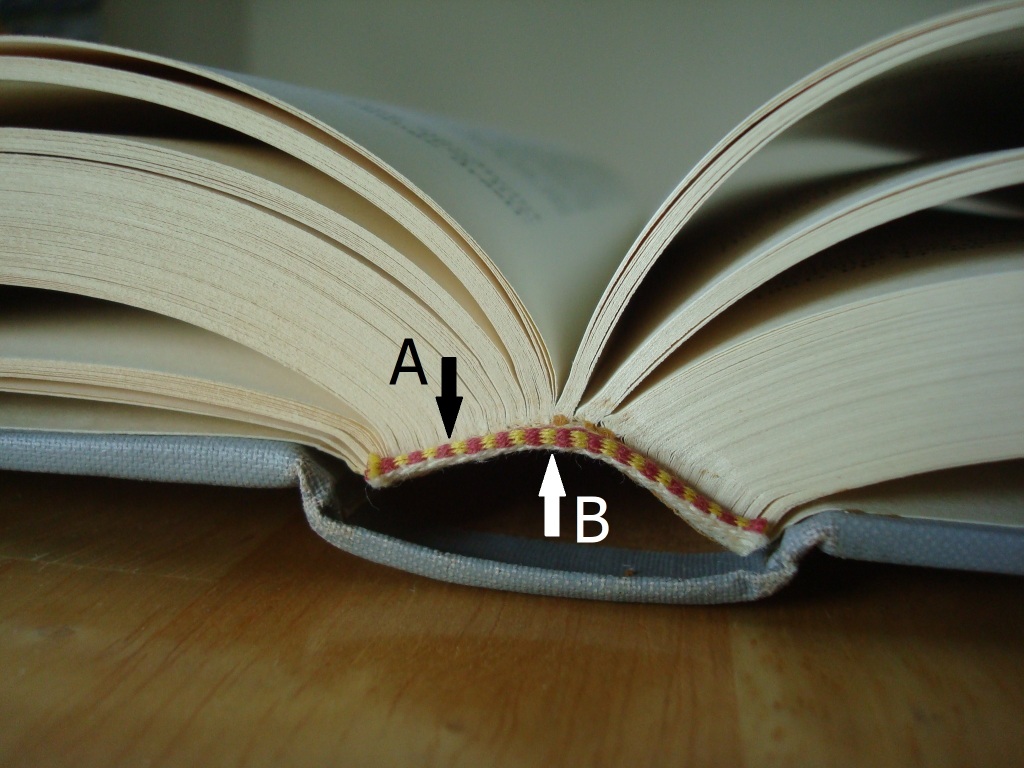
When any material bends, it has a tension side and a compression side (Fig. 1). Material in the tension layer will spread apart, while material in the compression layer will, as the name suggests, compress. This principle applies when a book is opened (Figs. 2, 3). A book spine has a tension and a compression layer. The tension layer consists of the spine folds of the text block (the folded edges of the text sections) and the material adhered directly to them. All materials placed on top of this layer are in compression.
Fig. 1 – The action of a bending object, demonstrating the tension and compression principle. Original drawing by Paula Steere; graphic rendering by The Book & Paper Gathering
Figs. 2, 3 – Tension (A) and compression (B) layers: the tension and compression principle applies to any open book, regardless of the binding type. Photography by Paula Steere
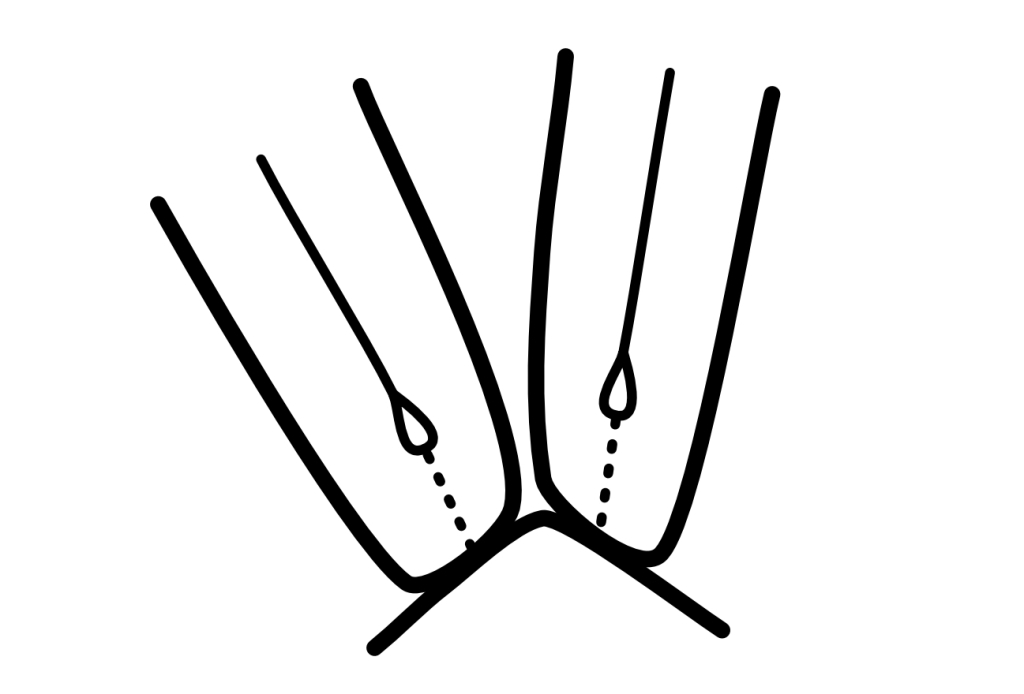
When a book is opened, the movement at the spine folds is largely imperceptible, but its importance should not be underestimated. Too much movement could contribute to poor opening and structural failure. Each of the spine folds moves with some degree of independence. This localised movement can be thought of as a series of flexible mini-bends (McIlvaine 2017a), as illustrated in Figure 4. These mini-bends have different radii and are affected by adhesives and sewing. (Sewing structure will be discussed in Part II.) They create localised strain (deformation) (Fig. 5), and it is this localised strain that causes the spine to fail.
Fig. 4 – Imperceptible movement of the spine folds in an opened book. Original drawing by Paula Steere; graphic rendering by The Book & Paper Gathering
Fig. 5 – Localised bending at each spine fold increases strain. Sewing and adhesives also create non-uniform stiffness; for example, adhesive shrinkage pulls paper down and flattens. Original drawing by Paula Steere; graphic rendering by The Book & Paper Gathering
Linings also move, and these shearing forces contribute to the deformation of the spine folds. The choice of lining materials affects the extent of the deformation. Miller (2010, p. 100) defines linings as a support that allows the spine to flex ‘without the sewn sections parting’. While in reality we cannot eliminate deformation entirely, informed choices can minimise it.
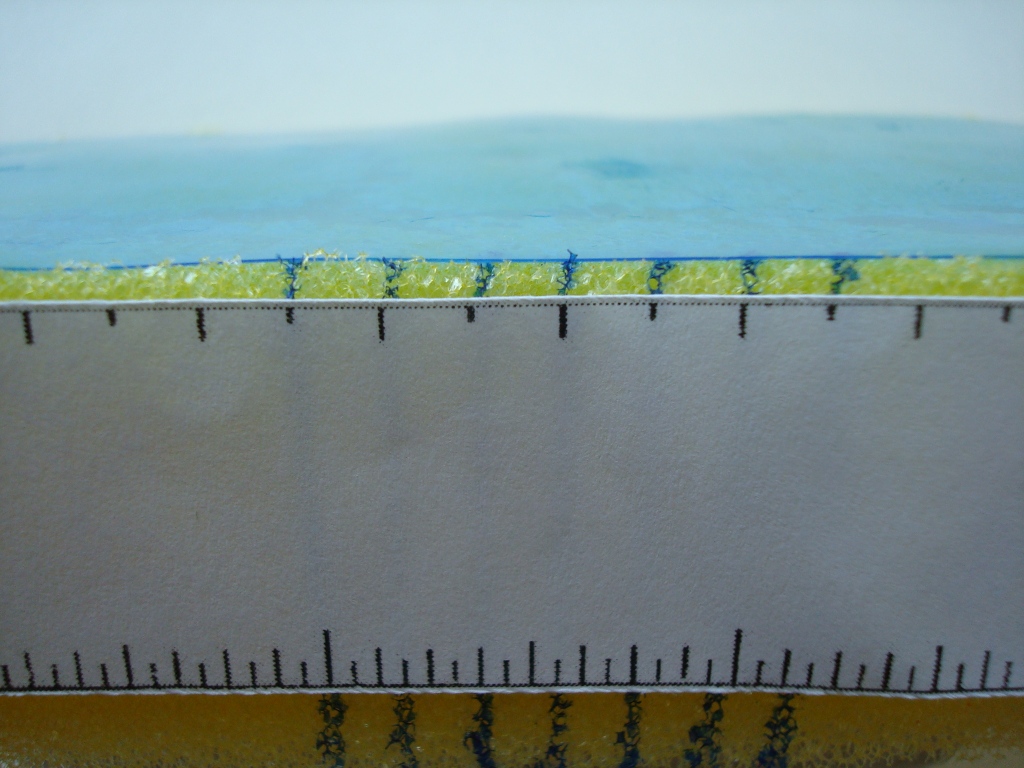
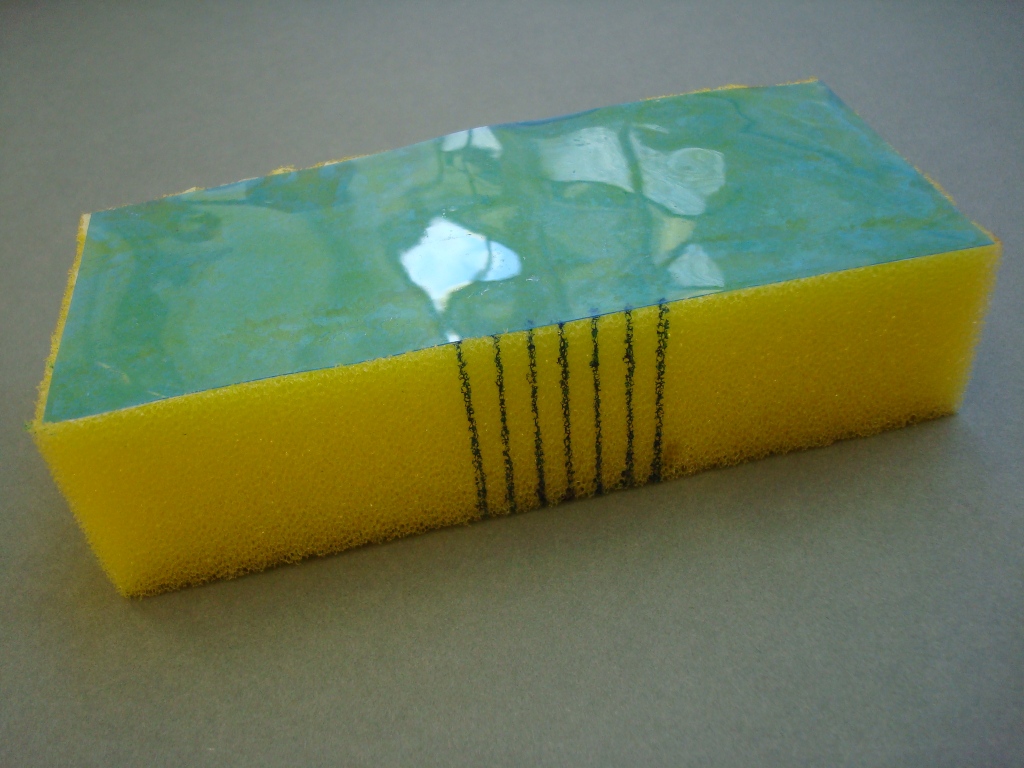
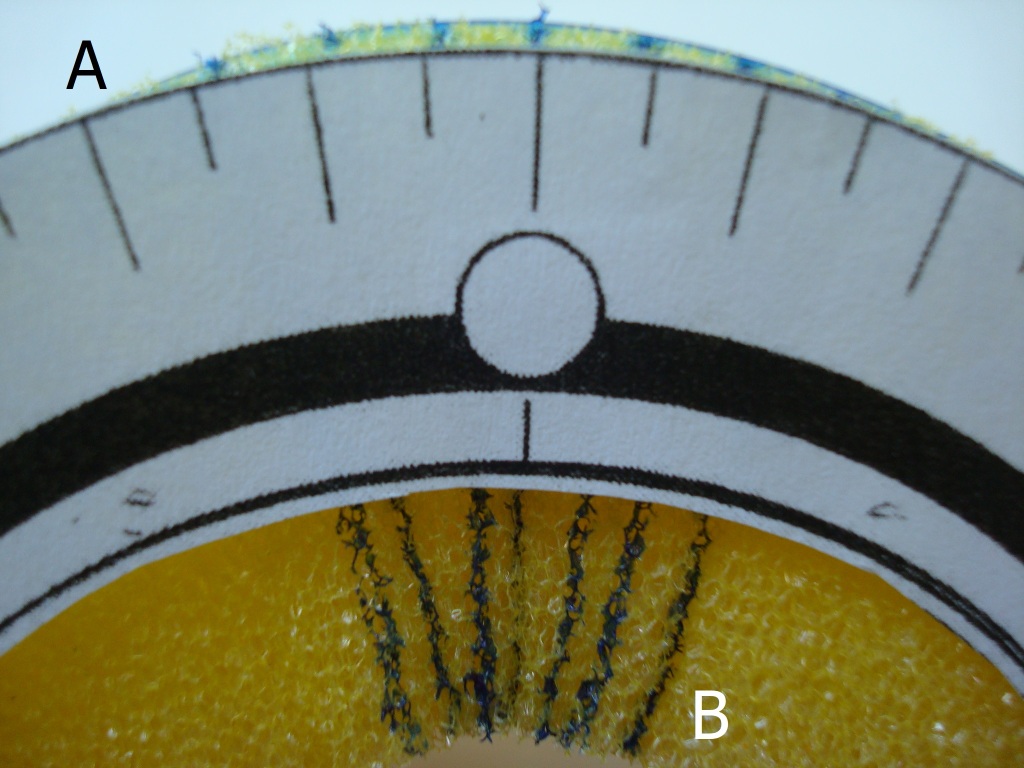
A fundamental aim of spine linings, therefore, is to minimise deformation at the interface between the text block and the first layer (the spine folds and first lining). We can achieve this by minimising the spreading apart (deformation) of the spine folds in the tension layer. Based on principles of mechanical engineering, the first step is to place a stiff and thin first lining against the text block to minimise movement. All subsequent materials, including further linings, adhesive layers and covering material, should ideally be less stiff than this first lining. This is not always an easy task. The model in Figures 6, 7 and 8 shows how adhering a stiff material to a flexible material affects the strain distribution in a composite material. Acetate, a thin and relatively stiff material, is adhered to a sponge (Fig. 6, 7). When the sponge is bent, the stiffness of the acetate minimises movement at the acetate/sponge interface (Fig. 8A). This interface is in the tension layer, and the higher stiffness of this layer drives deformation into the less stiff outer sponge (compression layer), as shown in Figure 8B. This is a simplified model of a book spine, which is also essentially a composite of several materials.
Figs. 6, 7 – A stiff material (acetate) adhered to a less stiff material (a sponge). Photography by Paula Steere
Fig. 8 – The stiffness of the acetate reduces (but does not eliminate) the spreading apart (tension) of the sponge at A. This can be a model of the spine fold – first lining interface. When the tension layer is stiffer, the deformation is driven into the compression layer at B, which represents the exterior book spine and covering material. Photography by Paula Steere
Of course, driving deformation to the outer spine layers could potentially damage the spine leather and tooling of a tight back (Franck 1941, p. 7). We also do not want to prevent movement entirely, as the spine needs to flex to some degree for the book to open well. The required degree of spine stiffness is also affected by other variables, such as the thickness of the sewing supports and type of sewing structure. Nevertheless, the tension and compression principle applies equally to all books and offers tangible criteria on which to base spine lining decisions. However, this is only the first part of the story. We must also understand the performance mechanics of the conservation spine lining materials themselves – paper, linen, cotton and adhesives.
The mechanical properties of spine lining materials determine their use
Research indicates that paper lining materials are not robust enough for book spine linings. In 1708, Zeidler wrote in his book on the philosophy of bookbinding that ‘The French do not care to glue anything on the spine. Some glue only paper strips on, putting everything slovenly over and believing they have come just as far [as putting parchment or linen cloth on neatly and exactly]’3(p. 78). Szirmai (2001, p. 196) interprets these sentiments by saying that Zeidler ‘castigates’ French bookbinders for using paper linings in gothic books.
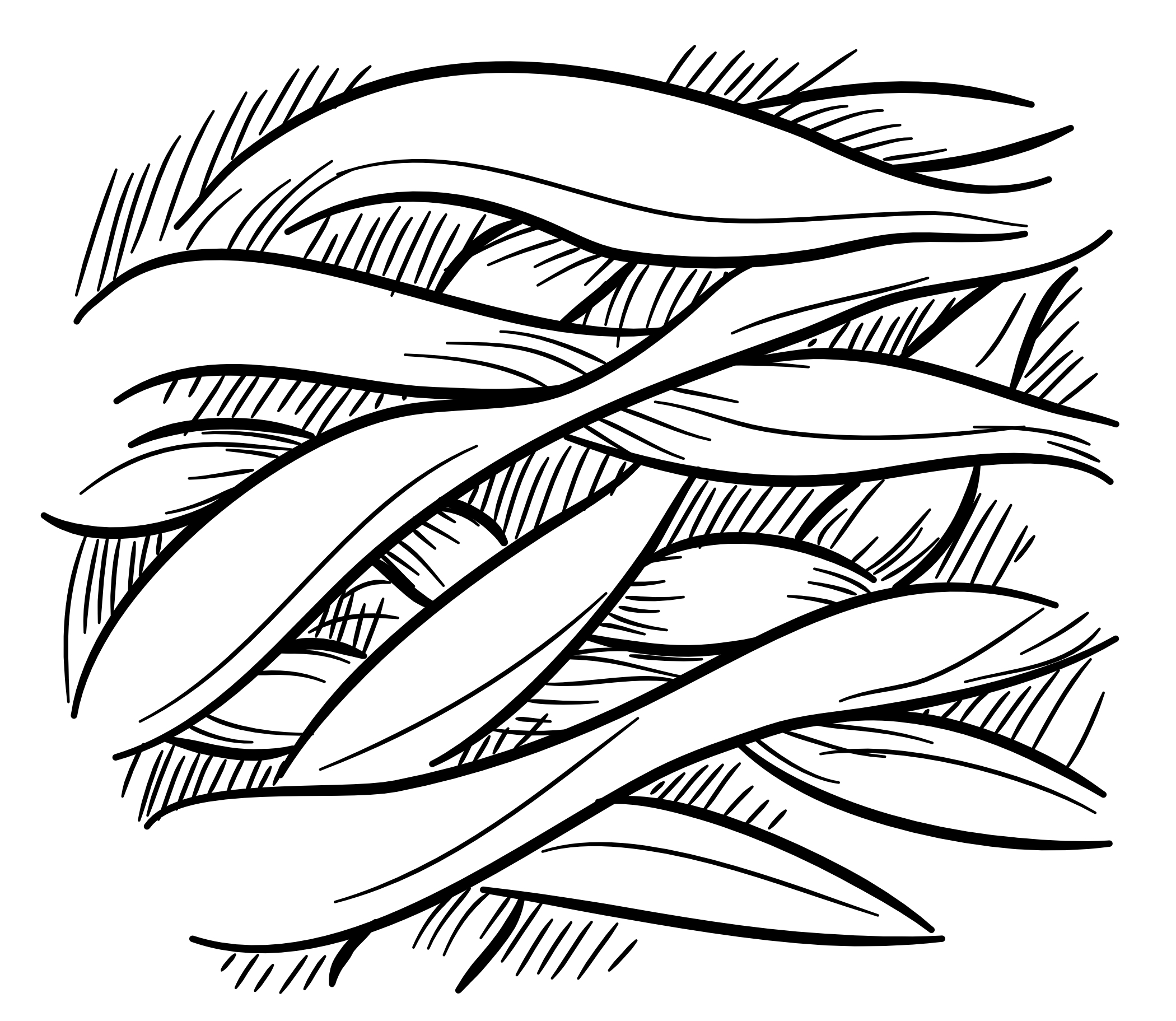
Conroy (1987, p. 4) supports the case against placing paper on the spine. He warns that paper is prone to breaking when stretched (due to tension) and buckles easily when compressed. McIlvaine (2017a) concurs, saying that while paper is a stiff material, it is not strong enough and is susceptible to tearing. Any imperfection would propagate easily. Paper has an irregular and random structure, which determines its physical properties (Corte and Kallmes 1961, p. 14–15; see Fig. 9). Its relative weakness could be attributed in part to this formation.
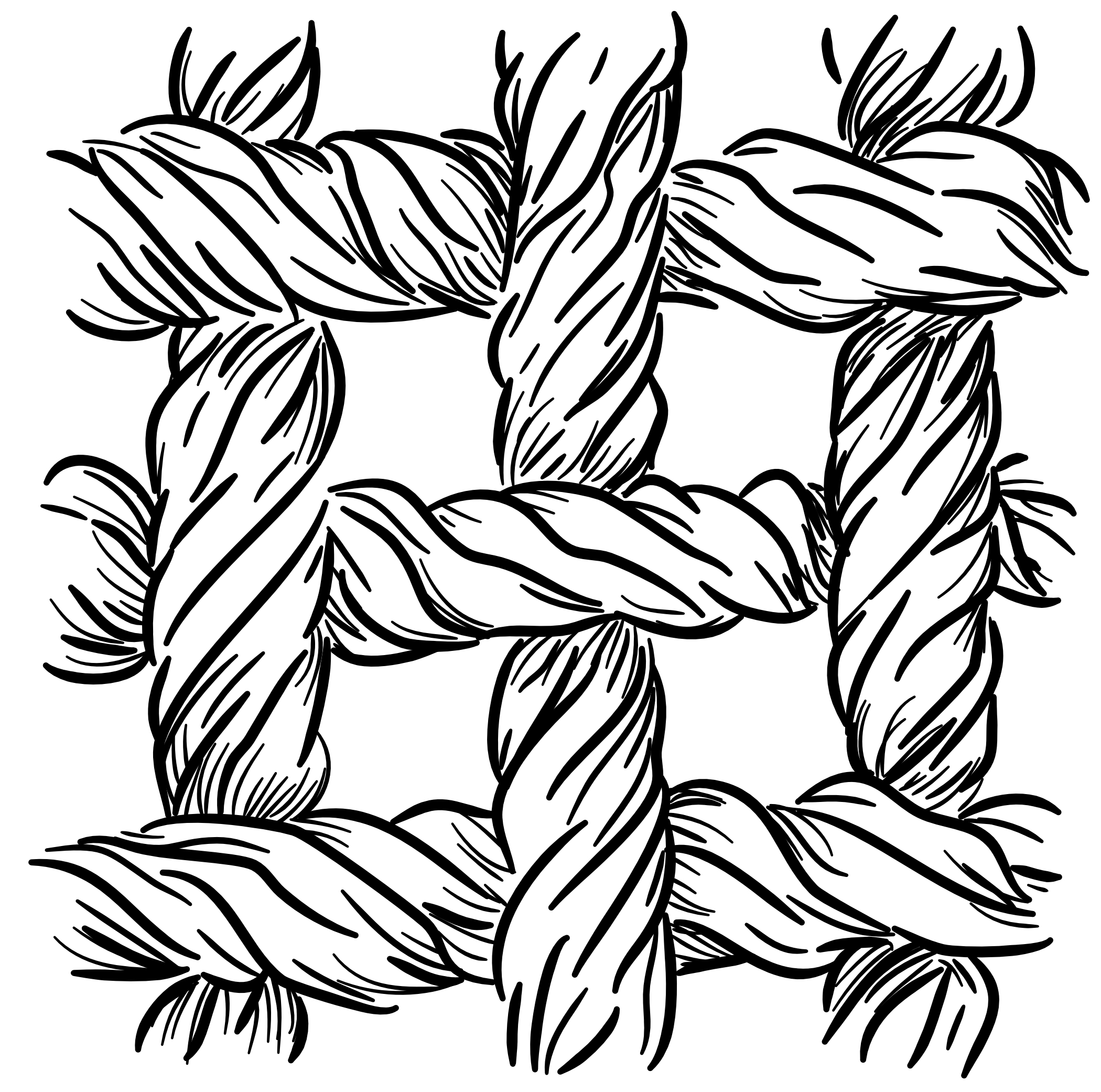
Fig. 9 (left) – Paper consists of randomly arranged separate fibres. Fig. 10 (right) – Fabric consists of twisted, woven and secure threads. Drawings by The Book & Paper Gathering
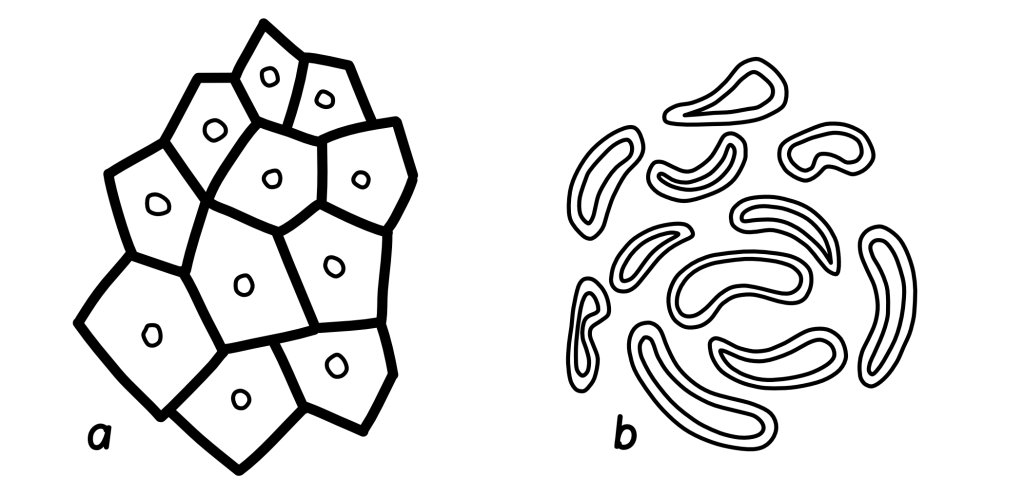
Fabrics tend to have a stronger base material and structure than paper (Fig. 10). For spine linings, the important properties of fabrics are tenacity (stress at break), extensibility (degree of stretch before breaking) and modulus (resistance to stretch). Tenacity is the term used to describe fibre strength; extensibility contributes to fold endurance; and modulus contributes to stiffness. These properties are determined by the fibre structure of the raw material. Linen is made from the bast stem fibres of Linum usitatissimum. The thick-walled, tube-like cells with small lumens or canals (hollow spaces) (Landi 1998, p. 22) are arranged in bundles, as shown in Figure 11a. Cotton, meanwhile, is made from the seed hair of Gossypium herbaceum and Gossypium hirsutum. Cotton fibres are very different from linen, forming single hollow and flat cells with a large lumen (Landi 1998, p. 21; Fig. 11b).
Fig. 11 – a: A cross-section of thick-walled linen cells arranged in bundles. b: Cross-sections of thinner, flatter cotton cells. Original drawing by Paula Steere; graphic rendering by The Book & Paper Gathering
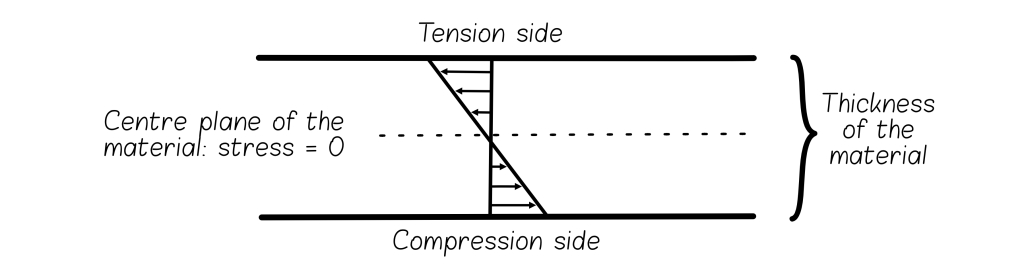
The thick walls and bundle arrangement of linen cells make linen a stiff and strong material. However, the thick cell walls lower its fold endurance and make it prone to breaking when repeatedly folded in the same place (UAL, no date), because thicker walls undergo more strain when bent. This is analogous to bending a piece of cardboard versus a piece of paper – there will be more damage (deformation) to the cardboard because of its thickness. The thicker a material, the stiffer it becomes when bent due to the neutral axis principle (McIlvaine 2017c), illustrated in Figure 12. This principle states that when a material is bent, there is no tension or compression at the centre line, but deformation increases with distance from this central plane.
Fig. 12 – Neutral axis principle: when a material is bent, the centre plane has zero tension or compression; tension and compression increase with distance from this zero axis. Original drawing by Paula Steere; graphic rendering by The Book & Paper Gathering
Linen also has less extensibility than cotton and will break more easily when stretched. Cotton has higher fold endurance than linen due to its structure: thin walls and a large lumen enable it to collapse on itself, reducing thickness locally and decreasing strain when folded (as per the neutral axis principle). These properties have been confirmed with data from fold endurance and mechanical strength tests published in the well-known books Conservation of Leather and Related Materials and The Textile Conservator’s Manual (Tables 1 and 2).
The data in Table 2 shows that linen is, on average, stronger than cotton because of its higher tenacity. Linen also has a much higher initial modulus (resistance to extension) than cotton, making it the stiffer fabric and a good candidate for a thin, stiff first lining. The less stiff cotton is a good second lining because of its higher fold endurance, and can be used to reattach boards if needed (more on that shortly).
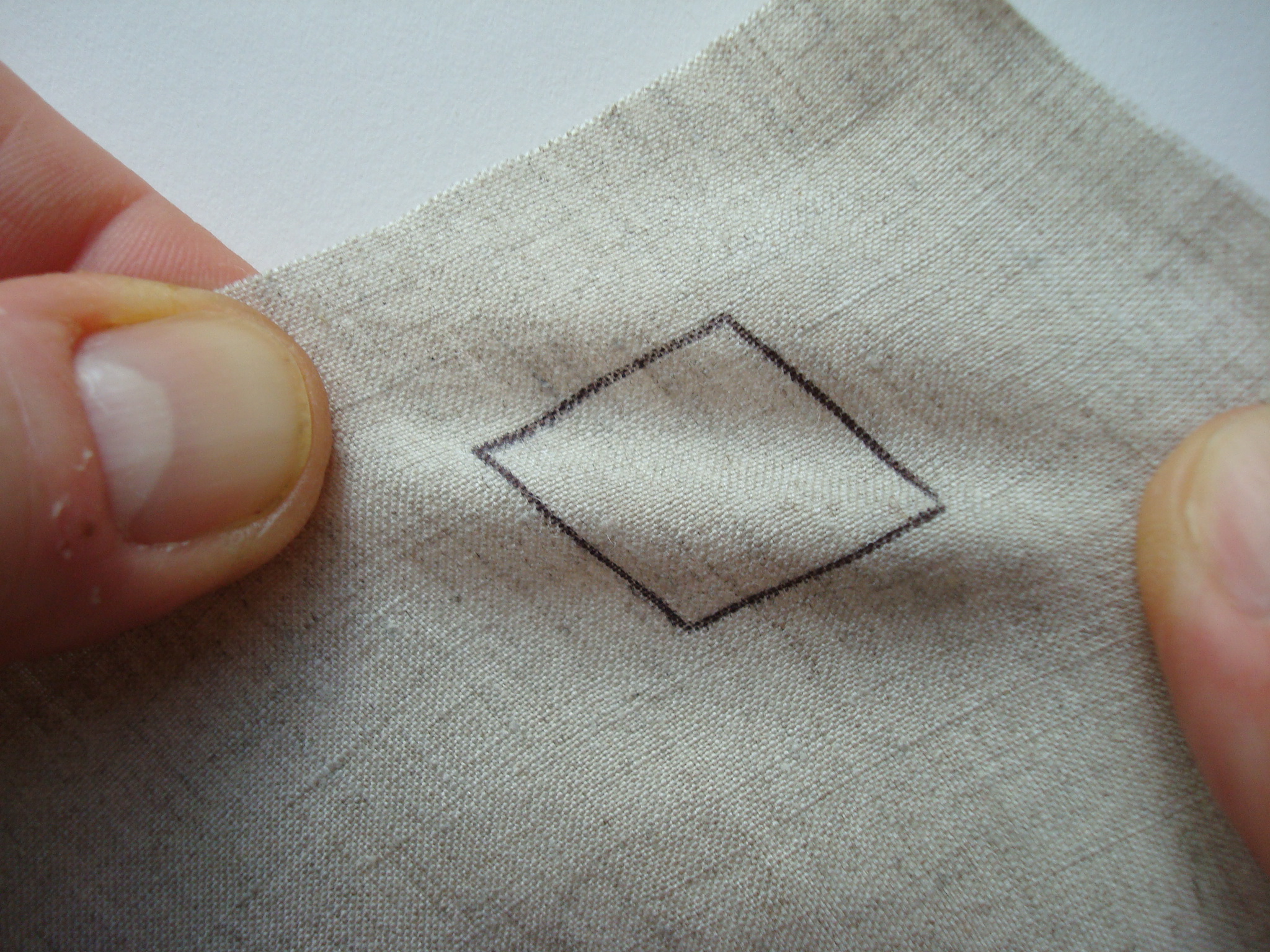
In addition to fibre composition, the orientation of the yarns also affects the mechanical properties of fabric that are relevant to this spine lining design. Warp yarns (lengthwise grain, parallel to the selvage edge) stretch less (are stiffer) because they have a higher modulus than weft yarns (crosswise grain, perpendicular to the selvage edge). Warp yarns are more tightly twisted, and hence stronger (Hackler 2006), than weft yarns. They are tightly stretched during the weaving process (The Taunton Press, no date) to allow the more loosely wound weft yarns to be woven between them. I confirmed the higher stiffness of warp yarns by pulling the fabrics the same distance in both directions. Under tension, weft yarns stretched visibly more than warp yarns. Therefore, additional stiffness in the first lining can be gained by positioning the linen with the warp yarns across the spine width, which minimises the spreading apart of the spine folds. It is worth noting that the bias grain direction has been considered the strongest because the most fibres are available; however, in this orientation, the fabric also deforms easily, and therefore, could be susceptible to damage (Fig. 13).
The properties of adhesives should also be considered. Conroy (1987, p. 4) says that an adhesive does not need to be flexible; flexibility is required only if too much adhesive is used. McIlvaine (2017b) further reminds us of the neutral axis principle (Fig. 12) – thin layers of adhesive are desirable because thin materials strain less when bent.
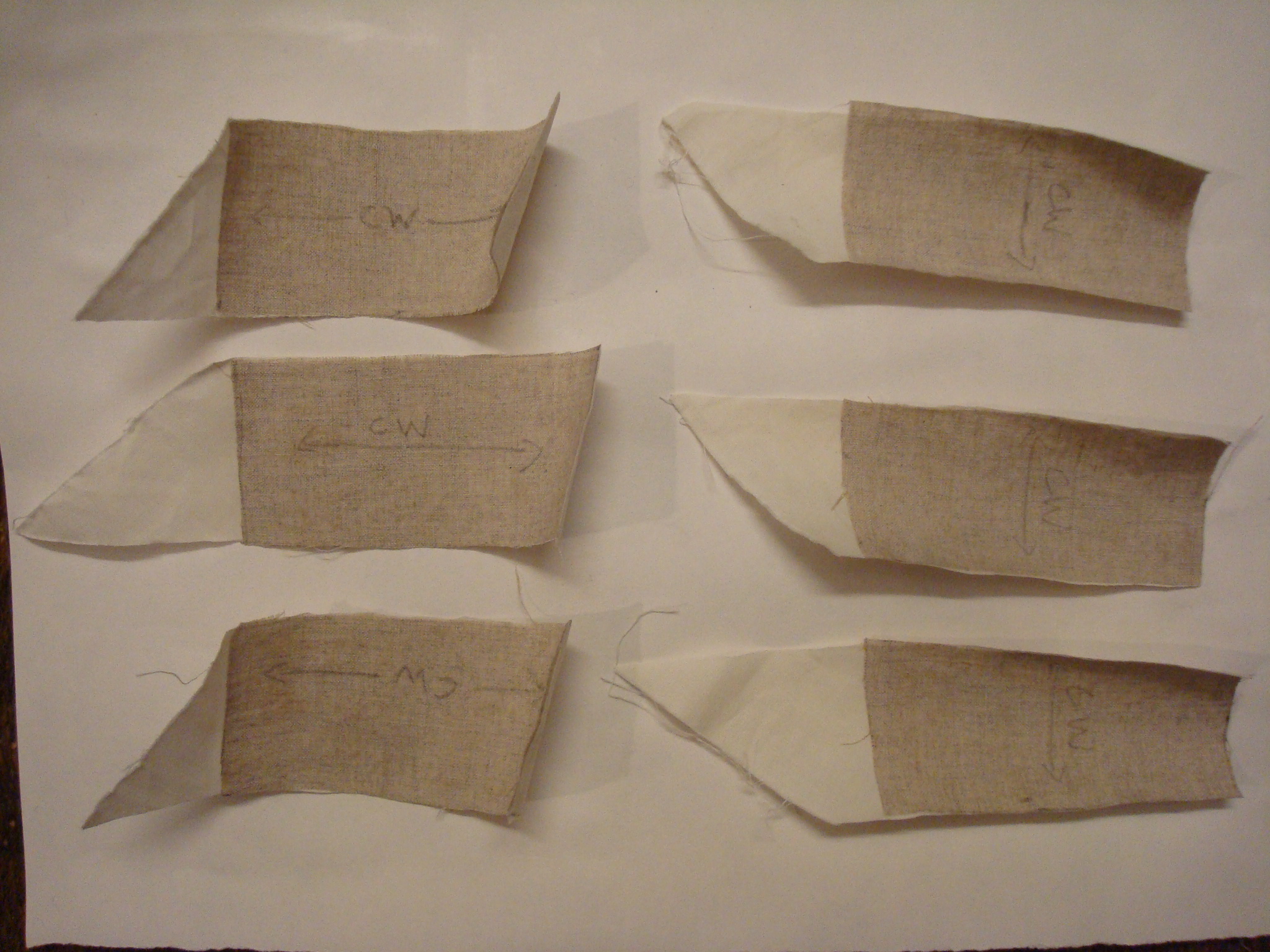
However, the adhesive must still be thick enough to be effective. I carried out adhesion tests on aero linen and aero cotton swatches to find the smallest amount of adhesive that still yielded strong adhesion between the two fabrics. A 1:1 mix of Evacon R and wheat starch paste (1:3 wheat starch to water v/v) was used for additional strength. A thin, medium and thick layer of adhesive was applied with a brush to clear acetate to serve as a quantity guide. The adhesive was then applied by brush to both cotton and linen swatches to be adhered together. The linen was positioned on the cotton swatches so that both the warp and weft orientations were tested in the direction of the shearing force. The cotton was not used in the bias direction. The fabrics were pressed with a bone folder and air-dried for a minimum of two hours (Fig. 14). There was no adhesive failure or obvious strength difference between the thin, medium and thick coats of adhesive mix when pulling them apart with my hands under maximum manual shearing force (Fig. 15). Therefore, the thinnest coat of adhesive could safely be used to minimise deformation and cumulative stiffness without compromising adhesion strength.
Fig. 13 (left) – Bias grain under tension deforms easily. Fig. 14 (right) – Lining design adhesion test swatches: linen and cotton adhered together with thin, medium and thick layers of adhesive. Pencil arrows show the weft (crosswise) direction. Photography by Paula Steere
Fig. 15 – Manual adhesive strength test: pulling fabrics to mimic shearing forces experienced by spine linings when a book is opened. Photography by Paula Steere
Putting the principles into practice: spine lining design
To review, for optimum functionality and durability, spine linings should minimise deformation at the interface between the spine folds and first lining material. We can achieve this by placing a stiff and thin first lining against the text block to minimise movement and keep the spine folds from spreading apart. All subsequent materials, including further linings, adhesives and covering material, should ideally be less stiff than this first lining.
For the spine lining design based on this research, aero linen should be used as the first lining, with the stronger, stiffer warp yarns placed across the spine width from shoulder to shoulder (Figs. 16, 17). Thinner, less stiff aero cotton, with its greater fold endurance, should be used as a second lining to reattach the boards. (If the boards are still attached, a second lining may not be necessary at all.) To minimise cumulative stiffness in the outer (compression) layer, positioning cotton in the bias direction could be a good choice, since this is the least stiff of the yarn orientations. Additionally, all subsequent linings, such as the paper used to smooth an uneven tight back spine, should be kept to an absolute minimum, with thin adhesive layers throughout. For heavy text blocks, I use WSP and ethyl vinyl acetate (EVA) mix (1:1) to adhere the linen to the spine folds, and I use wheat starch paste alone, without EVA, for materials in the compression layer (to reduce cumulative stiffness). For standard-sized books that are not very heavy, I use wheat starch paste on its own throughout the process; however, I have not tested swatches of wheat starch paste without EVA.
When adding more linings after the linen (and cotton, if reattaching boards), check opening characteristics after each lining has dried thoroughly. Paper linings can be omitted altogether in some instances; for example, if the tight back spine is even, in a case binding, or in a situation where throwup does not require additional control. Keep in mind the engineering principles discussed in this article when deciding on the number of additional linings and the choice of lining material: the compression layer (everything after the first linen lining) should ideally be less stiff than the tension layer. Thinly pared leather, discussed below, can be used instead of paper for additional linings to reduce stiffness.
Fig. 16 – Spine lining design based on the tension and compression engineering principle and the mechanical properties of spine lining materials. Original drawing by Paula Steere; graphic rendering by The Book & Paper Gathering
Fig. 17 – The spine of a leather reback just before reattaching the boards. On the spine is the first lining – aero linen with warp yarns running shoulder to shoulder. It has been adhered directly against the text block spine folds. The fabric above and below the spine is aero cotton and was adhered directly to the linen to reattach the boards. Photography by Paula Steere, courtesy of the College of Arms Library, London
The quarter leather tight back in Figure 18 has a heavy parchment text block, and I wanted to experiment with traditional leather linings because the mechanical properties of leather are excellent for the compression layer of my spine lining design: it is strong, but not stiff, because of the structure of its main component, the protein collagen. The linings in this image are made of thinly pared leather. I have used a graduated lining technique, which I was delighted to discover during my research, to further minimise stiffness in the compression layer. The graduated lining structure is attributed to Francis Bedford, a nineteenth-century bookbinder acclaimed for the ‘even strain’ (Anonymous author 1893, p. 58) of his bindings. The rationale for the graduated lining structure is that the stiffness needed for a book to open well at any given place varies. The centre of the spine takes the greatest strain and should be the stiffest, while less stiffness is required near the beginning and end sections of the text block (McIlvaine 2017b). Subsequent linings after the first one are ‘a little further in’ (Anonymous author 1893, p. 58), stopping a little short of the shoulders, as illustrated in Figure 18.
I also adapted the graduated lining technique to the leather covering material to reduce overall stiffness. The leather over the centre spine folds is thicker than that over the beginning and end spine folds. This was achieved through tapered paring, as shown in Figures 19 and 20. A comparison of opening characteristics before and after treatment can be seen in Figures 21 and 22.
Fig. 18 – The graduated lining structure attributed to Francis Bedford’s workshop. According to the author in The British Bookmaker, every lining after the first is ‘a little further in’, stopping short of the shoulder. The text block of this book was made from heavy parchment, and in addition to using the spine lining design described in this article, I wanted to experiment with traditional leather linings because of their strength. Photography by Paula Steere, courtesy of the College of Arms Library, London
Fig. 19 – Adapting the graduated lining technique to leather paring. Original drawing by Paula Steere; graphic rendering by The Book & Paper Gathering
Fig. 20 – Paring in progress: the thickness of the leather under the central black line will remain as is, and the leather will be pared to taper towards F and B, which indicate the width of the text block. Photography by Paula Steere
Fig. 21 – Opening characteristics of the book from Fig. 18 before treatment. Photography by Paula Steere, courtesy of the College of Arms Library, London
Fig. 22 – The same book after treatment, with improved opening characteristics. Note that some of the improvement is also due to repairs in the text block. Photography by Paula Steere, courtesy of the College of Arms Library, London
In conclusion, exploring the forces present in a book spine and the mechanical properties of familiar book conservation materials has helped me to overcome the ‘vague generalities’ found in the literature. Understanding mechanics and materials enables the conservator to take advantage of engineering concepts that offer tangible criteria on which to base spine lining decisions. I discovered several hidden gems along the way, such as Zeidler’s ire, Bedford’s famed workshop, and, of course, that anonymous kindred spirit from The British Bookmaker for whom vague generalities would not suffice.
Special thanks to my colleagues at the College of Arms, Becky Tabram and Christopher Harvey, head of conservation, who encouraged and allowed me to explore these ideas while I was a conservator there. Their experience and knowledge of books and our ongoing conversations and practical experiments in the workshop were invaluable.
Footnotes
1. I reviewed approximately 36 books and articles, spanning the years 1658 (in a 1977 translation) to 2017.
2. Technical statements in the literature were cross-referenced with a mechanical engineer, Lee McILvaine, for scientific accuracy. This research document is available upon request.
3. Translation by Isana Skeete (2017). No published English translation of this book could be found.
Bibliography
Anonymous author (1892–3) ‘Editorial’, The British Bookmaker, 6, no page number.
Anonymous author (1893) ‘On forwarding’, The British Bookmaker, 7(75), p. 58.
Cockerell, D. (1901) Bookbinding: The classic Arts and Crafts manual. New York: Dover Publications.
Conroy, T. (1987) ‘The movement of the book spine’, The Book and Paper Group Annual, 6, pp. 1–22.
Corte, H. and Kallmes, O.J. (1961) Statistical geometry of a fibrous network. New York: Regis Paper Company.
Diehl, E. (1980) Bookbinding: Its background and technique (2 vols). Rev. edn. New York: Dover Publications.
Franck, P. (1941) A lost link in the technique of bookbinding and how I found it. Gaylordsville, Connecticut: The author.
Hackler, N. (2006) Understanding fabric grain. Rev. edn. Gainesville: University of Florida.
Landi, S. (1998) The textile conservator’s manual. Butterworth-Heinemann: Oxford.
McIlvaine, L. (2017a) Email to Paula Steere, 8 April.
McIlvaine, L. (2017b) Conversation with Paula Steere, 13 April.
McIlvaine, L. (2017c) Email to Paula Steere, 26 April.
Middleton, B.C. (1963) A history of English craft bookbinding technique. Hafner Publishing: London.
Middleton, B.C. (1998) The restoration of leather bindings. Rev. Ed. Delaware, London: Oak Knoll Press, The British Library.
Miller, J. (2010) Books will speak plain – A handbook for identifying and describing historical bindings. Michigan: Legacy Press.
Silverman, R., Cains, A., Ruzika, G., Zyats, P., Reidell, S., Primanis, O., Puglia, A., Anderson, P., Etherington, D., Minter, B., Brock, D., Zimmern, F. (2006) ‘Conservation of leather bookbindings: a mosaic of contemporary techniques’, in Kite, M. and Thomson, R. Conservation of leather and related materials. Oxford: Butterworth-Heinemann, pp. 225–243.
Skeete, I. (2017) Translation of passage in Zeidler, J. (1708), 17 May.
Szirmai, J.A. (2001) The archaeology of medieval bookbinding. Burlington, Vermont: Ashgate.
Zeidler, J.G. (1708) Buchbinder-Philosophie oder Einleitung in die Buchbinder-Kunst. Hall im Magdeburgschen: in Rengerischer Buchhandlung.
Paula Steere has an education background and was head of Art and Design in a secondary school in London before retraining in book and archival conservation at Camberwell College of Arts from 2015 to 2017. She has worked at the College of Arms, the Wellcome Collection, the Senate House Library, the London College of Fashion Archive, the Victoria and Albert Museum and UCL Special Collections. Currently she is a preventive conservator, volunteer coordinator and grant writer at the Hershey History Centre, a nonprofit museum in Pennsylvania, US. She is also a book conservator in private practice.
On inverse ekphrasis and its role in artists’ books and book art.
When a work of art inspires poetry or prose, we call the literary result ekphrastic: “the verbal representation of visual representation”. Keats, Auden and Jarrell use words to “recreate”, re-present, evoke or respond to works of art — an antique urn, a painting by Brueghel, or Donatello’s sculpture of David. But book artists often work in the other direction. They use the letters, words, the physical elements of the book or even the shape of books, the functions of the book or even the processes of bookmaking to create works of art. A kind of inverse ekphrasis.
In the Books On Books website, the phrase inverse ekphrasis first appears in comments on artwork by Kate Buckley and Ros Rixon. It originated and sharpened from reading Murray Krieger (1992), W.J.T. Mitchell (1994), Jay David Bolter (1996) and Marian Macken (2018). Explaining ekphrasis and the tensions between text and image in Picture Theory, Mitchell writes:
A verbal representation cannot represent — that is, make present — its object in the same way a visual representation can.
Mitchell calls this a commonsense perception. It insists on an impossibility for verbal representation and a possibility for visual representation. But let’s play a game. Invert and modify it:
A visual representation does not represent — that is, make present — its object in the same way a verbal representation does.
Likewise the altered assertion seems a commonsense perception, but it does not insist; it is a simpler, more limited observation. It has to be. A visual work can reproduce a readable version of The Great Gatsby’s entire text. This poster does just that. The image illustrates the book, but the poster is not an illustrated book, the illustration is the text of the book. The visual representation makes the story present, but in a temporally and spatially different way. Instead of leaning over a codex to read the words and look through them to Nick and Gatsby’s world, we stand and look at their arrangement into an emblem of that world, we begin to read the words. Tiring or being called away, we turn from it. Passing by, we stop, and our eyes jump to another part of the image and, seeing a familiar or intriguing word or sentence, begin to read again. It may be “great book” art, but is it great “book art”? Whatever one’s judgment, it is a form of inverse ekphrasis, which is one means that some works of book art adopt to make present their inspiring object, which in part achieves their own objecthood.
Exploring the relationship of the book and, in particular, the artist’s book to architecture, Marian Macken (2018) also makes observations that, restated, shed light on inverse ekphrasis but, just as important, shed light on book art in general. She writes:
… matter is not just material presence, it is the site of techniques, which may be understood as the complex relation between architecture’s material presence and the immaterial. Thus the exhibition of architecture becomes the display of technique. With this description of the display of architecture and the notion of translation in mind, artists’ books provide an immediate vehicle for the exhibition of architecture: central to the concept of technique is the re-making of the representation. p. 126.
Now let’s play the restatement game:
Matter is not just the material presence of the book in artists’ books, it is the site of techniques, which may be understood as the complex relation between the book’s material presence and the immaterial. The alphabet, type, typography, the substrate (clay, stone, skin, paper, screen, etc.), page (in the manifestation chosen by the structuring technique) and the binding or apparent absence of binding (again, in the manifestation chosen by the structuring technique): each and together are the site of techniques that the artist/author can choose in pursuit of an idea, concept, thought, emotion or sensation intended.
With that statement, we move beyond inverse ekphrasis (“the re-making of a representation” or the making of re-presentation). A work of book art hardly requires an external literary work to occasion it, but in the collection’s many instances occasioned by verbal works of art, they riff more often than not on those elements mentioned above. The riffing is a performance that takes place on the site of techniques; it is the exploration of the complex relation between the book’s material presence and the immaterial.
The page is one of the most frequent elements subject to riffing. The choice of codex, palm leaf, leporello, scrolling paper, scrolling screen (and what others?) as a book’s structuring technique offers the opportunity to choose or redefine the “page”. Even within the space of a codex page, the diptych of a double-page spread, foldouts, pop-ups, or even within a continuously (horizontal or vertical) scrolling screen, the artist chooses techniques of demarcating, delineating, delimiting to deliver the idea, concept, emotion or sensation intended. This includes the metaphorical use to which the most experimental of book artists and authors have put the space between letters, words, lines of text, images and pages. Think of Stéphane Mallarmé’s Un Coup de Dés Jamais N’Abolira le Hasard and the artists’ books in homage to it.
Thebinding or apparent absence of binding is another frequent element subject to invention. The choice of structure (codex, etc.) offers an opportunity to choose or invent techniques of holding or bringing together or dispersing what is demarcated, delineated, delimited in the attempt to deliver the idea, concept, emotion or sensation intended. Think of the innovations and rediscoveries of Cor Aerssens, Gary Frost, Daniel Kelm, Hedi Kyle, Claire Van Vliet and other book artists. And what of the“apparent absence of binding”? Its inclusion allows for some of the more conceptual and most experimental works of book art — those that pose simple challenges to the idea of binding, those that pose more complex concepts of unboundedness. Think of Marc Saporta’s Composition No. 1 (2011), Doug Beube’s Red Infinity #4 (2017) or Amaranth Borsuk’s Between Page and Screen (2012).
Ulises Carrión’s 1975 manifesto assertion — The book is a space-time sequence — is apropos here. The book artist India Johnson (2019) explains its appropriateness by playing the same game of restatement and, in doing so, also captures Macken’s notion of “the site of techniques”:
… the more I read of Carrión, the more I’m persuaded that he is right: that his definition of the book, as both space and sequence, may be the most adequate one that we have.
That’s why I don’t describe the sculptures I’ve made in response to The New Art of Making Books as ‘expanding’ the idea of the book. They may, however, expand the idea of bookbinding.
In mulling over bookbinding in the expanded field, I have ultimately found myself back where I began: but not as a translator–this time, as an author. I am currently re-writing The New Art of Making Books, in collaboration with the translator and poet Andrea Bel.Arruti. As Ulises Carrión himself proclaimed, “plagiarism is the point of departure for creative activity in the new art.” By inverting all of Carrión’s claims, we’re generating a new manifesto, The Old Art of Making Books:
“Books, contrary to popular opinion, are not for reading. They are for making.
Making books is a sequence of processes, unfolding into space, whose making happens in time.
The making is a space-time sequence.”
And so inverse ekphrasis via this inverse manifesto becomes a way into book art.
Some examples of inverse ekphrasis from the Books On Books Collection:
Tetenbaum, both writer and book artist, spent a month in a gallery listening to a recording of Willa Cather’s 1918 novel, My Ántonia, and the result was an “artist’s book” or “bookwork” called Mining My Ántonia; Excerpts, Drawings, and a Map. Put aside — difficult as it may be — the pleasure of craft and art so plainly suffusing the print, paper and binding of this work, what is the work’s relation to the material of which it is made? Is it like a “movie of the book”? Or some sort of literary/artistic criticism? Are we enjoying Tetenbaum’s “making the novel her own” (as in the pun on min(e)ing), or is the work inspiring us to go back to Cather’s novel with renewed interest? Or both? To what degree can we appreciate Tetenbaum’s book art without having read My Ántonia? To make Tetenbaum’s work our own — to mine it — must we go to the site from which the artist quarried her material? How do we think about the “material” of which Mining My Ántonia is made? How does that contribute to our appreciation of the work itself? And to our thinking about book art?
Todd Alden, Todd. 1991. The Library of Babel. Buffalo, N.Y.: Hallwalls Contemporary Arts Center. Alden’s introduction speaks directly to the phenomenon of inverse ekphrasis but does not use the term.
Bartsch, S., & Elsner, J. 1 January 2007. “Special issue on ekphrasis. Classical Philology, 102, 1. Chicago, Ill: The University of Chicago Press.
Benjamin, Andrew. 2005. “On display: The exhibition of architecture”. In Abe, Hitoshi. Hitoshi Abe Flicker. Tokyo: Toto Shoppan.
Benjamin, Walter. 1955. Illuminations. Harcourt, Brace & World. “The Work of Art in the Age of Mechanical Reproduction” and “The Task of the Translator”.
Bolter, Jay David. “Ekphrasis, Virtual Reality, and the Future of Writing” in Nunberg, Geoffrey, and Umberto Eco. 1996. The future of the book. Turnhout: Brepols.
Abstract: In this essay, Robert P. Fletcher demonstrates how, while putting together digital and print media affordances, augmented print may evoke in readers a sense of the uncanny. Fletcher also explains how works such as Amaranth Borsuk’s Abra (2014), Aaron A. Reed and Jacob Garbe’s Ice-Bound (2016) or Stuart Campbell’s Modern Polaxis (2014) seem to demonstrate the existence of a never-ending return of the “familiar” in electronic literature.
Kashtan, Aaron. 2011. “Because It’s Not There: Ekphrasis and the Threat of Graphics in Interactive Fiction”. DHQ: Digital Humanities Quarterly, 5:1. Accessed 19 May 2020.
Abstract: Existing scholarship on interactive fiction (IF, also known as the text adventure) tends to treat it as a video game genre and/or as a category of electronic literature. In this essay I argue that IF can be understood as participating in traditions of visual prose and ekphrastic textuality, insofar as IF consists of room and object descriptions which direct the player to visualize the things they describe. Unlike traditional ekphrastic literature, however, IF also asks the player to take practical actions in response to the images he or she visualizes. During the commercial era of IF, ekphrasis was the most effective means available of providing players with immersive visual experiences. However, graphical video games have now surpassed IF in this area. Therefore, in order to justify the continued existence of IF, contemporary IF authors have been forced to conceive of the visuality of IF otherwise than in terms of the logic of transparency. One strategy for doing this, exemplified by Nick Montfort’s game, Ad Verbum, is to abandon visuality almost entirely and emphasize IF’s linguistic and textual qualities. An alternative strategy, exemplified by Emily Short’s game City of Secrets, is to assert that IF is visual in a nontransparent way, because IF offers visual experiences which are user-generated rather than prerendered.
Abstract: In this article, the significance of the rhetorical and modern definitions of ekphrasis will be discussed through the lens of digital literature and art. It attempts to reinscribe the body in ekphrastic practice by adding touch to the abstracted visualism of the eye, and emphasize defining features of the ancient usage: orality, immediacy and tactility. What I call the digital ekphrasis with its emphasis on enargeia, its strong connections with the ancient definition, and on the bodily interaction with the work of art, conveys an aesthetic of tactility; digitalis=finger. By tracing and elucidating a historical trajectory that takes the concept of ekphrasis in the ancient culture as a starting point, the intention is not to reject the theories of the late 1900s, but through a reinterpretation of ekphrasis put forward an example of how digital perspectives on classic concepts could challenge or revise more or less taken-for-granted assumptions in the humanities. In this context ‘the digital’ is not only a phenomenon that could be tied to certain digital objects or used as a digital tool, but as an approach to history, with strong critical potential. The aim is to show that one of the most important features of our digital culture is that it offers new perspectives – not only on current technology – but also on literary, cultural and aesthetic historical practices.
Merleau-Ponty, Maurice. “The Indirect Language”. In Merleau-Ponty, M., & Lefort, C. 199). The prose of the world. Evanston: Northwestern University Press. Touches on gesture, on science and mathematics, compares language and painting.
… these artist book makers have taken traditionally non-literary works, including the phone book and the Bible, and re-imagined them through the form of the artist book. In so doing, these artist books have effectively expanded literature to include non-literary forms.
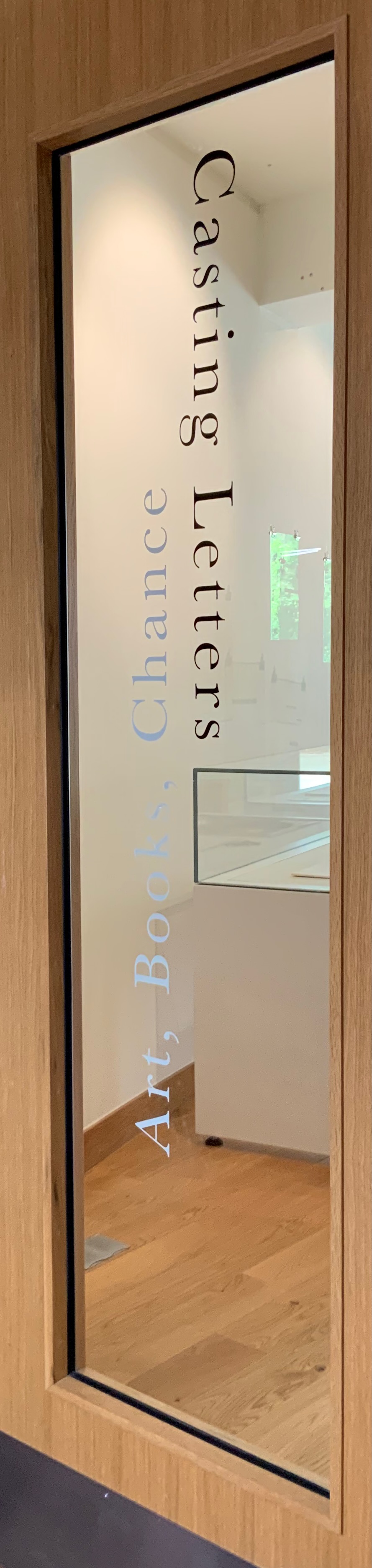
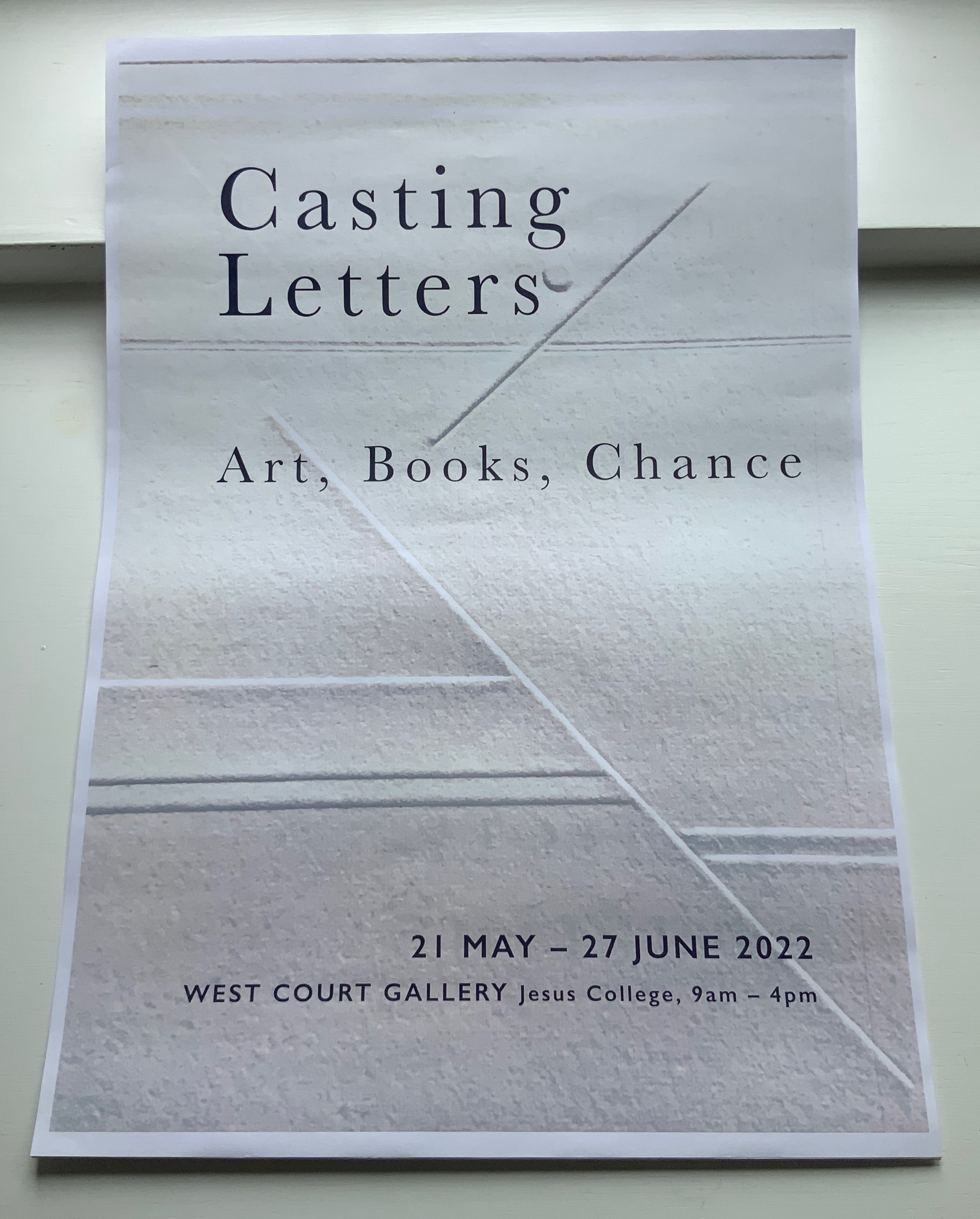
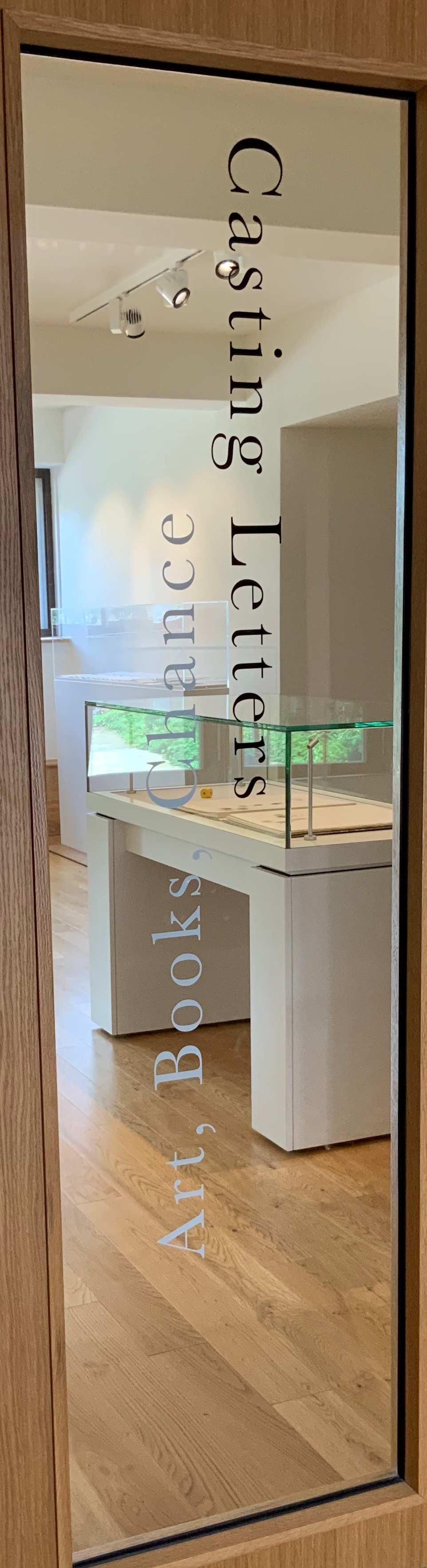
Jessica Berenbeim, a University Lecturer at the Faculty of English and a Fellow of Jesus College, has selected works from the Books On Books Collection for this exhibition. With the assistance of Justine Provino, a doctoral student at Cambridge, Berenbeim has arranged the works to effect a certain conversation. As she writes,
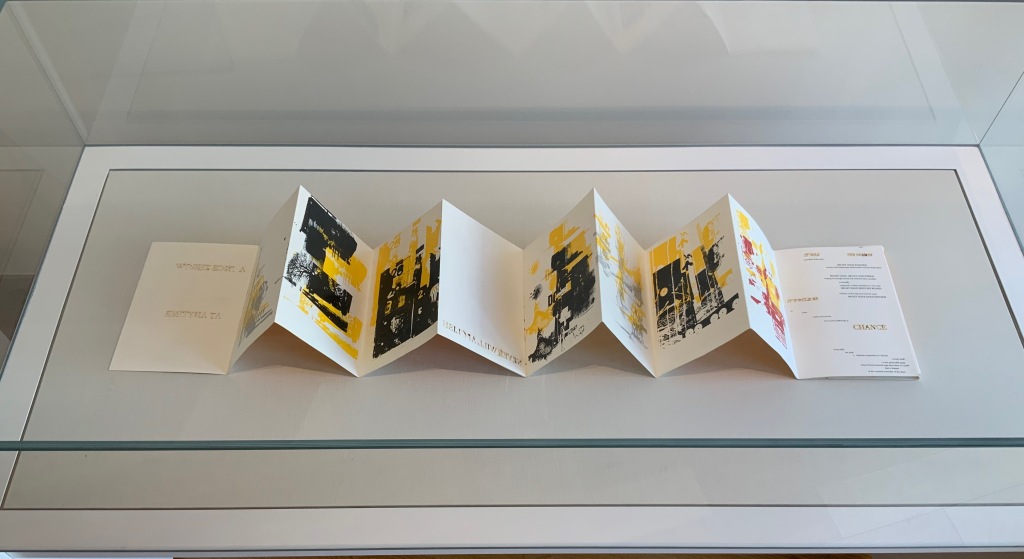
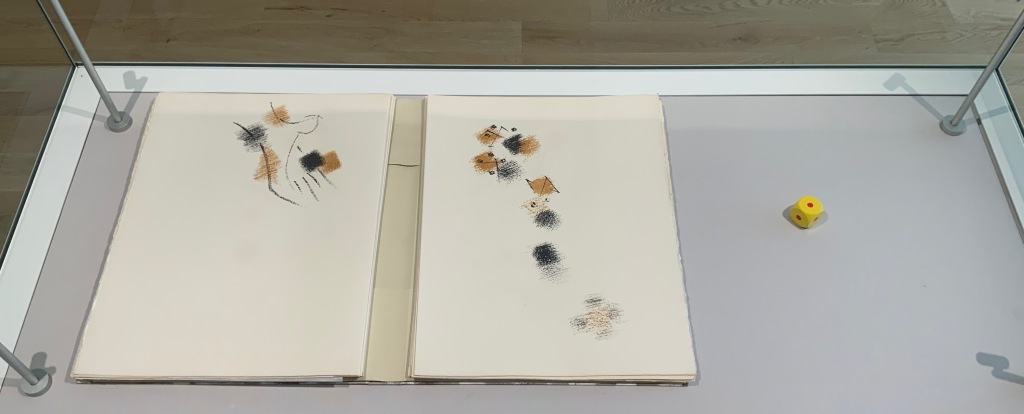
Artists’ experiments with books and letters have taken many forms, some of which look more like books than others. This exhibition of book art, and book-inspired art, opens a view of one of its most intriguing stories: the tradition of reflections, riffs, and responses to one seminal work, Stéphane Mallarmé’s A Roll of the Dice Never Will Abolish Chance (Un Coup de dés jamais n’abolira le hasard). Mallarmé’s experimental work celebrates its 125th anniversary in May 2022, when this exhibition opens. The particular objects on display here, and on view at the screening events, play on two central ideas inspired by this work: chance and visible language. The works in the exhibition are in effect a conversation about the intersection of those themes. What part does chance have to play in the way language is depicted on (or off) the page, and how might accidents of language determine how it looks? How does meaning settle throughout the forms of letters, words, lines, pages, and books, as well as in what the words say?
The exhibition and screenings include works by Jérémie Bennequin, Isabella Checcaglini & Mohammed Bennis, Robert Filliou, Ernest Fraenkel, Rodney Graham, ‘Estelle J.’, Michel Lorand, André Masson, Reinhold Nasshan, Michalis Pichler, Man Ray, Mitsou Ronat & Tibor Papp, and Honorine Tepfer.
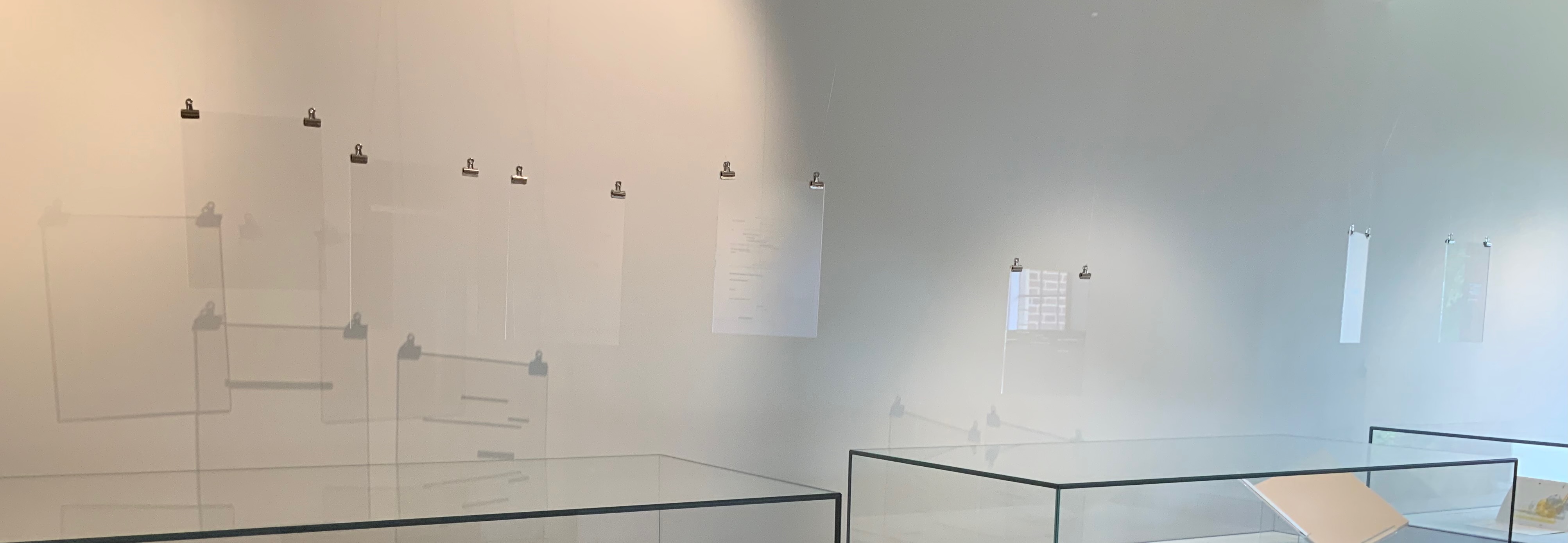
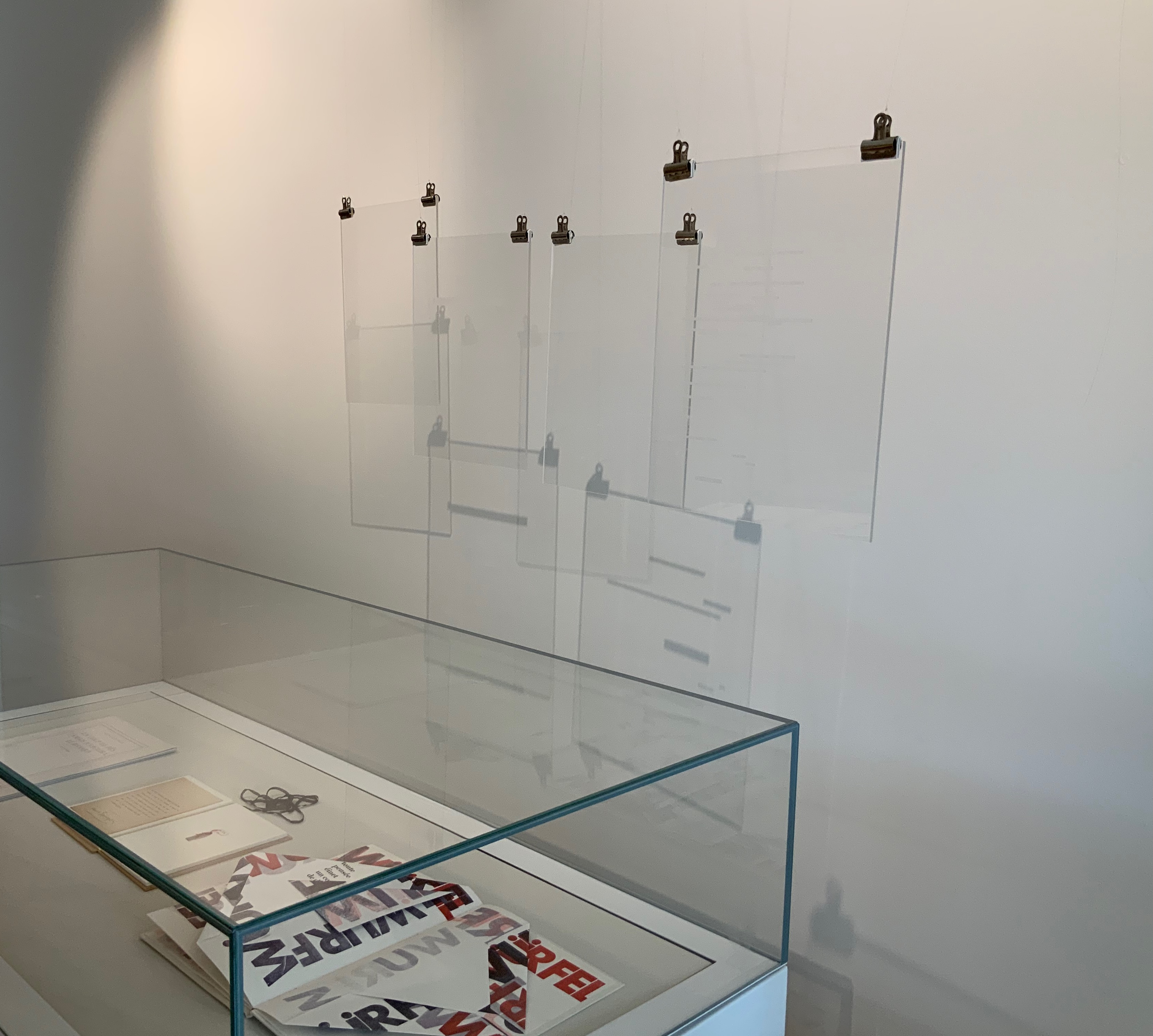
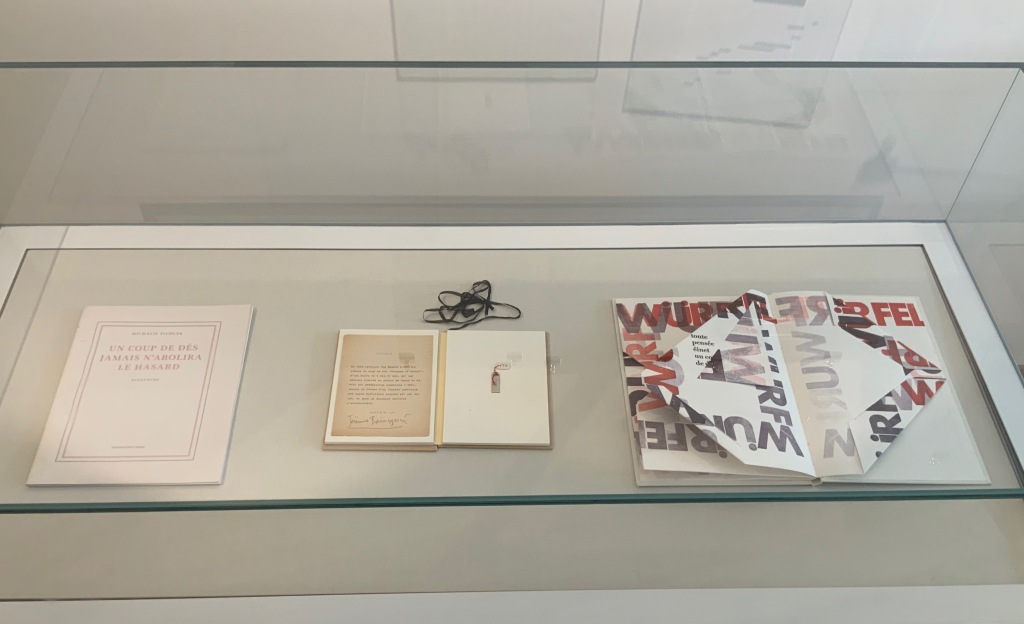
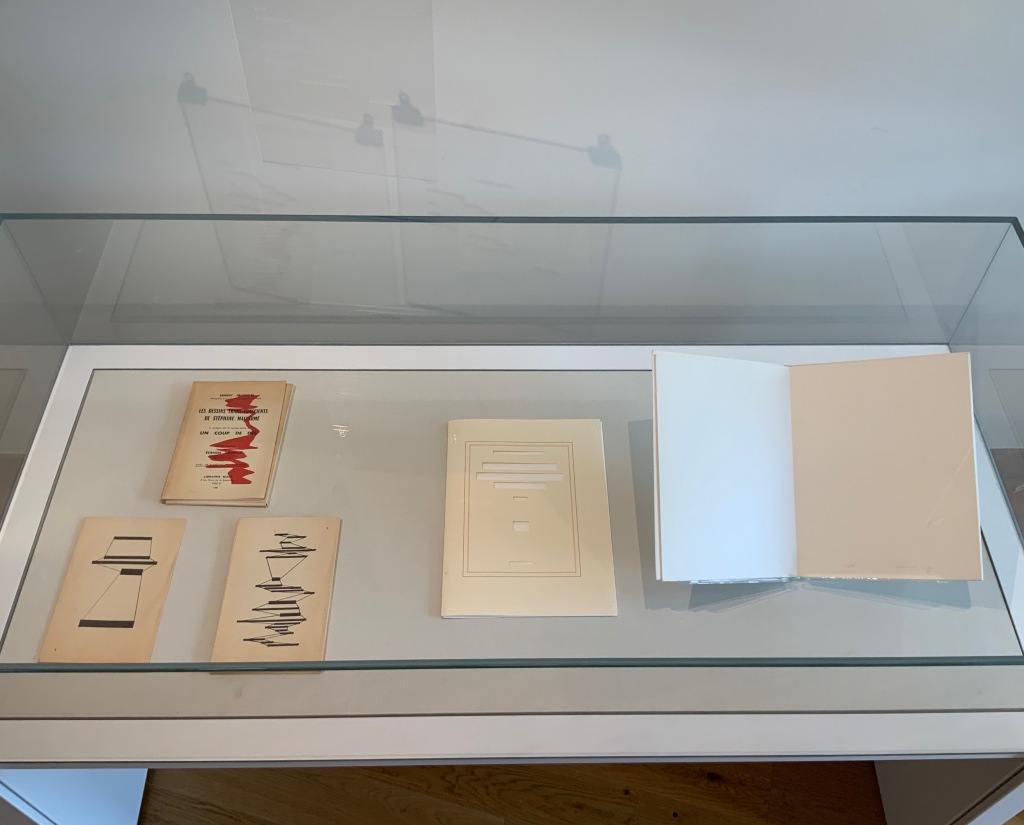
Berenbeim and Provino have suspended seven plates from Pichler‘s homage to hang over the cases containing works by Bennequin, Nasshan, Lorand, Tepfer and Estelle J.. and quietly cast shadows to pun with those works and the exhibition’s title.
L-R: Michalis Pichler, Un Coup de Dés Jamais N’Abolira le Hasard: Sculpture (2008); Jérémie Bennequin, Le Hasard N’Abolira Jamais Un Coup de Dés (Changes of Music) (2020); Reinhold Nasshan, Würfelwurf: fragmentarische Annäherung an Stéphan Mallarmé (1992).
L-R: Ernest Fraenkel, Les Dessins Trans-conscients de Stéphane Mallarmé, à propos de la Typographie de Un Coup de Dés (1960); Michel Lorand, Après Un Coup de Dés (2015); Honorine Tepfer, Un Coup de Dés Jamais N’Abolira le Hasard: Poème (1989)
Estelle J., STÉPHANE MALLARMÉ: Un coup de dés n’abolira le hasard (ND)
Three other cases across from those above present a conversation of dice between Masson and Filliou, then a French and Arabic conversation between Checcaglini and Bennis, and then Tibor Papp and Rodney Graham joking with one another.
L-R: André Masson, Poéme: Un Coup de Dés Jamais N’Abolira le Hasard by Stéphane Mallarmé (1961); Robert Filliou, Eins. Un. One. (1984)
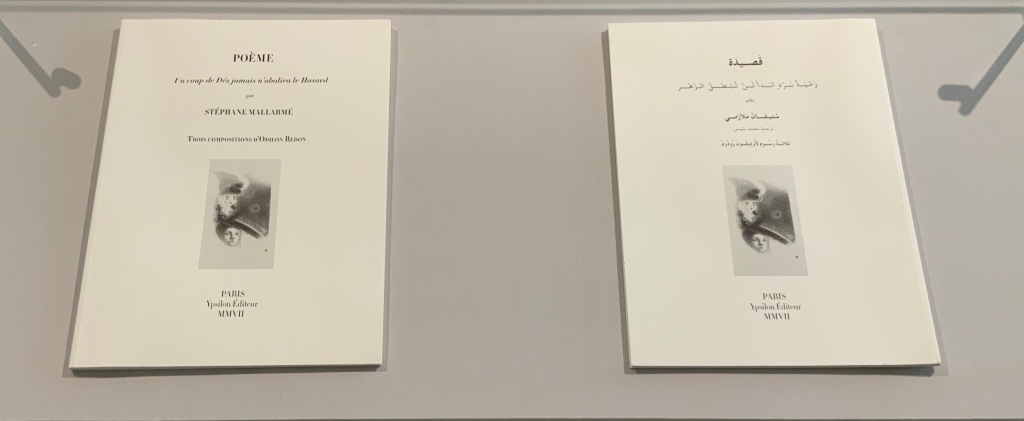
L-R: Isabella Checcaglini, POÉME: Un coup de Dés jamais n’abolira le Hasard (2007); Mohammed Bennis, صلة وصل مع قصيدة ” رمية نرد أبدا لن تبطل الزهر” /Ṣilat waṣl maʻa qaṣīdat Ramyat nard abadan lan tubṭila al-zahr (2007)
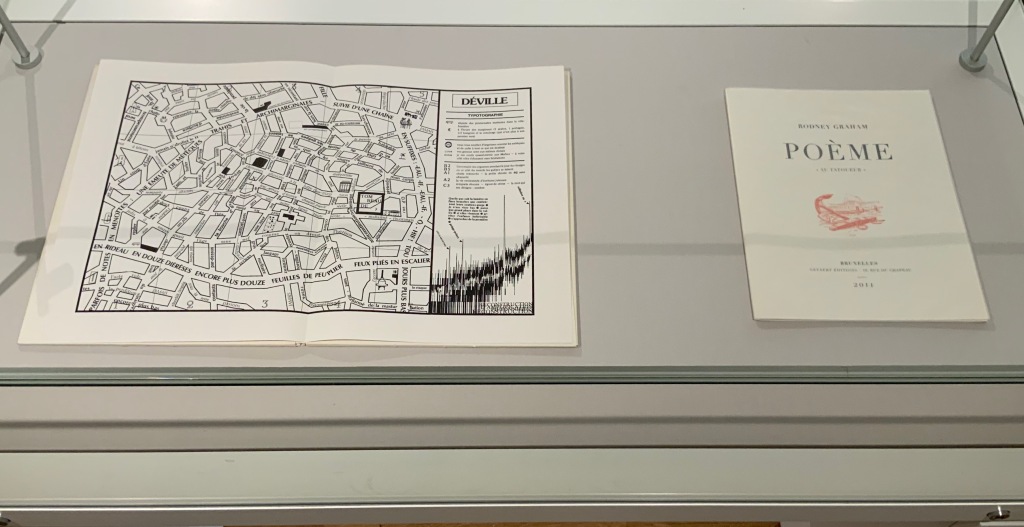
L-R: Tibor Papp, Déville in Mitsou Ronat & Tibor Papp, eds., Poème: Un coup de Dés jamais n’abolira le Hasard par Stéphane Mallarmé (1980; )Rodney Graham, Poème : “Au Tatoueur” (2011)
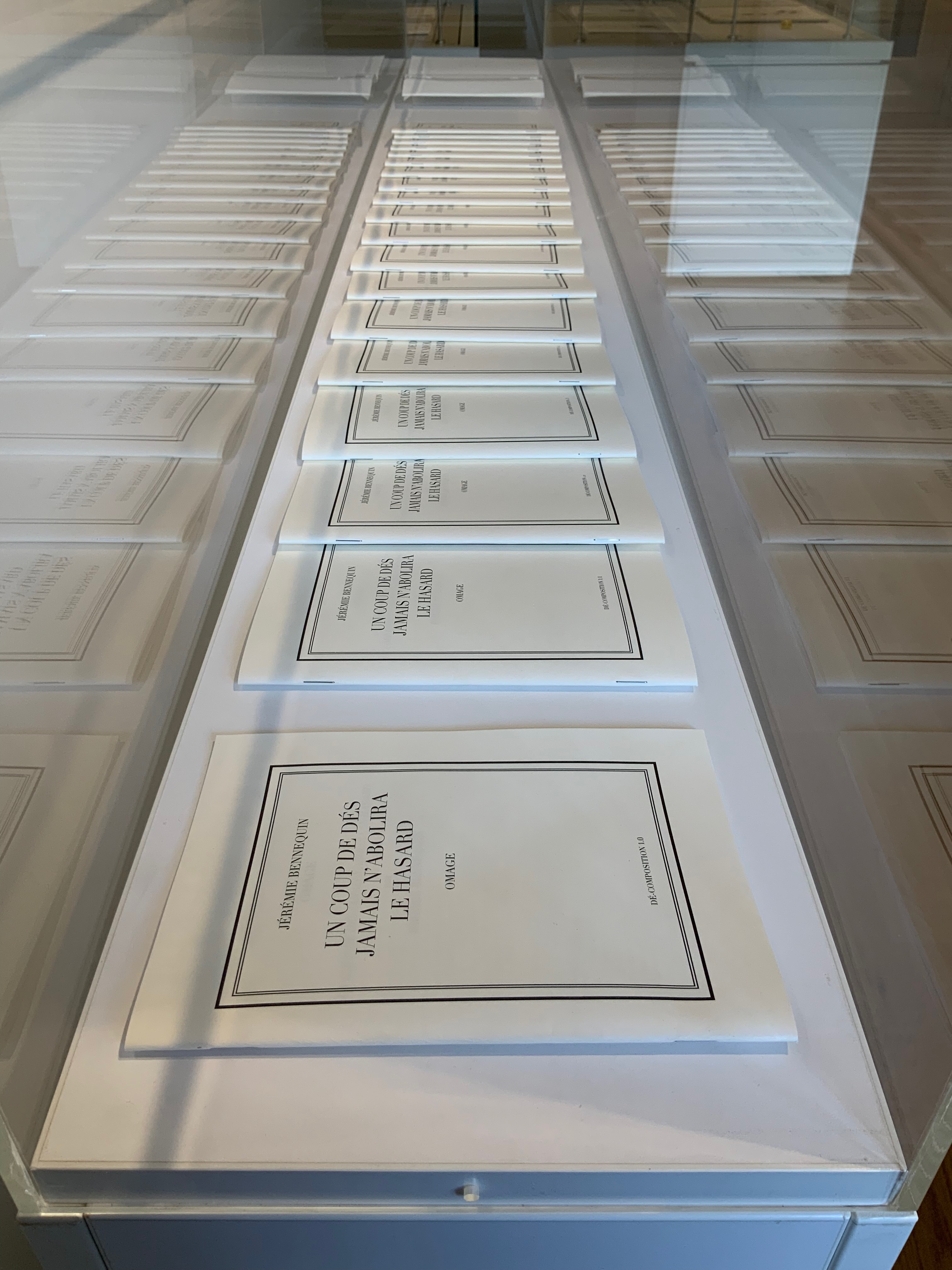
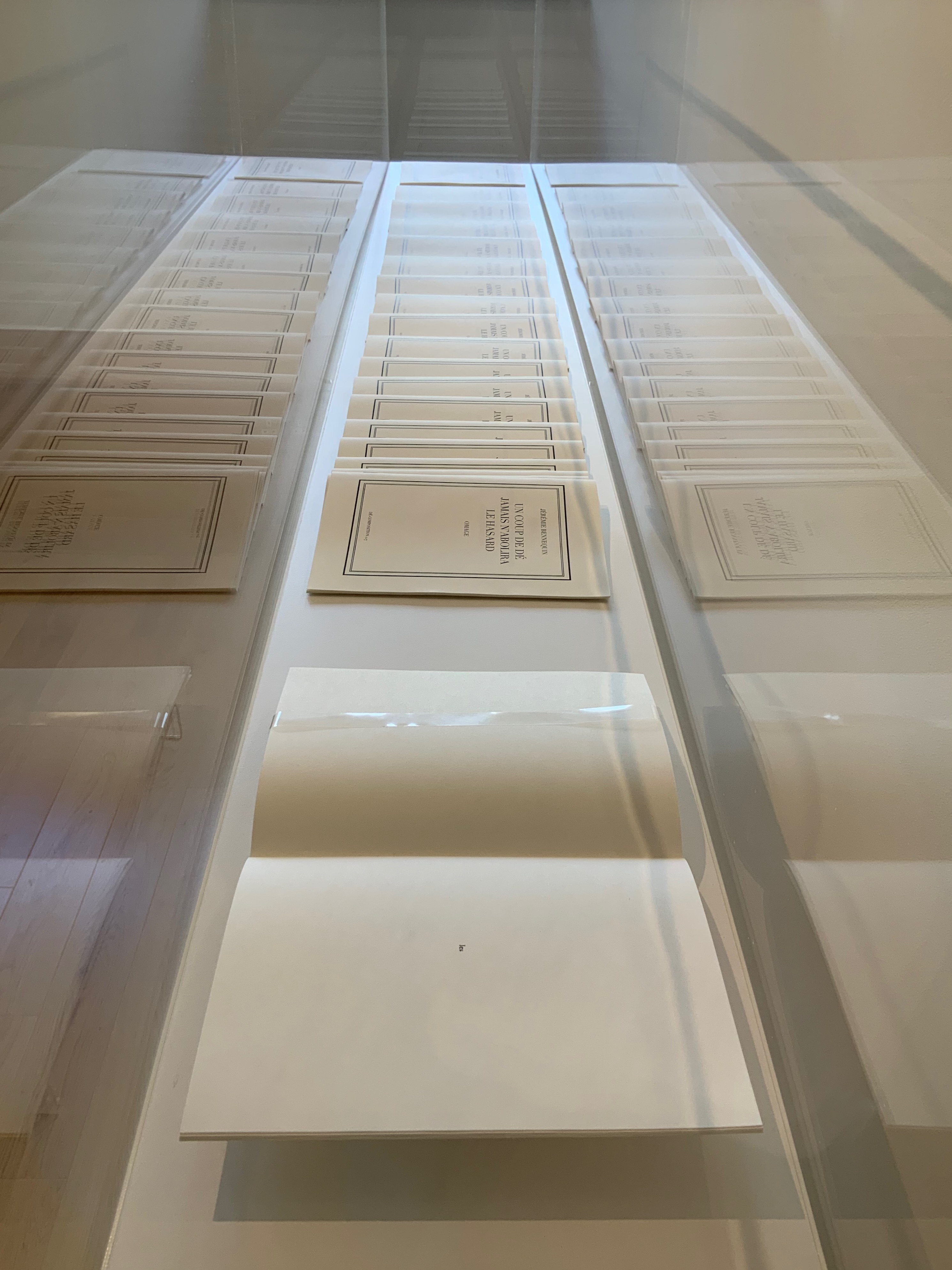
In a display case seemingly made for his particular work, the result of Bennequin’s long-distance performances of erasure with his colleague and publisher Antoine Lefebvre calls across the room to all the other works of chance and visible language.
Jérémie Bennequin, Un Coup de Dés jamais n’abolira le Hasard, Dé-composition (2009-2013)
With the sun streaming into West Court Gallery, the only things missing from the buzz of these conversations were perhaps canapés, champagne and name tags to celebrate the 125th anniversary of this strange poem’s publication.
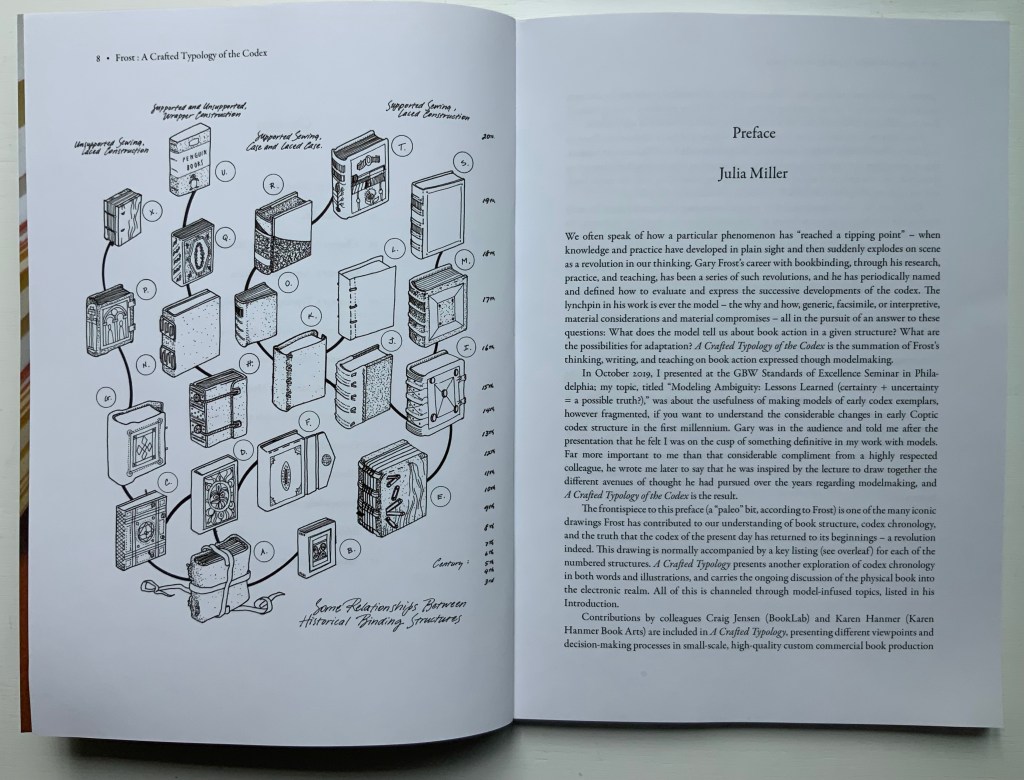
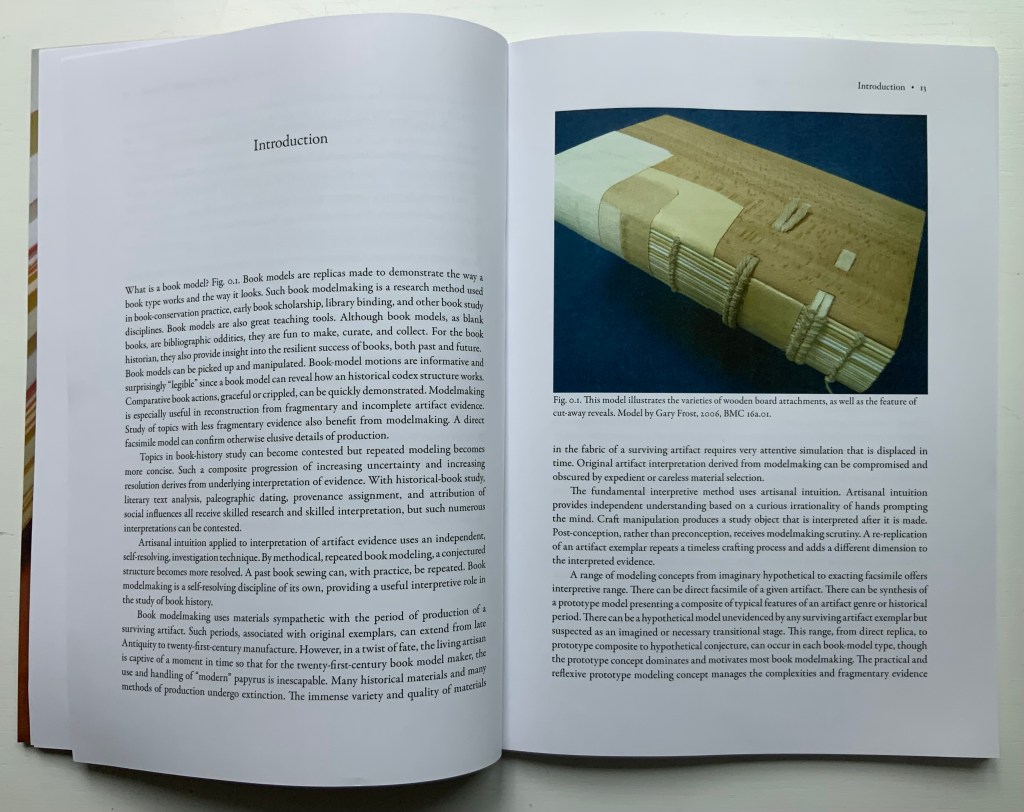
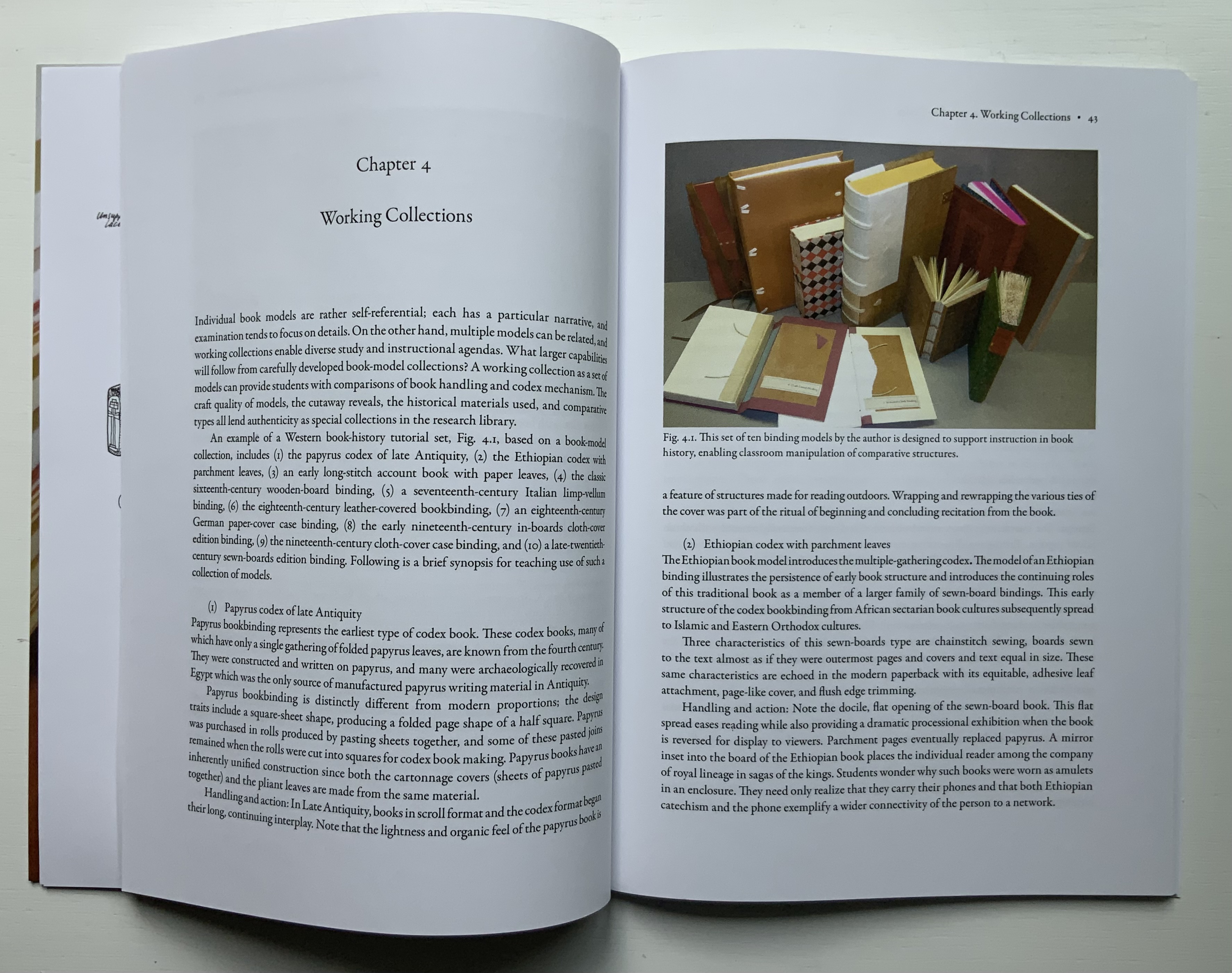
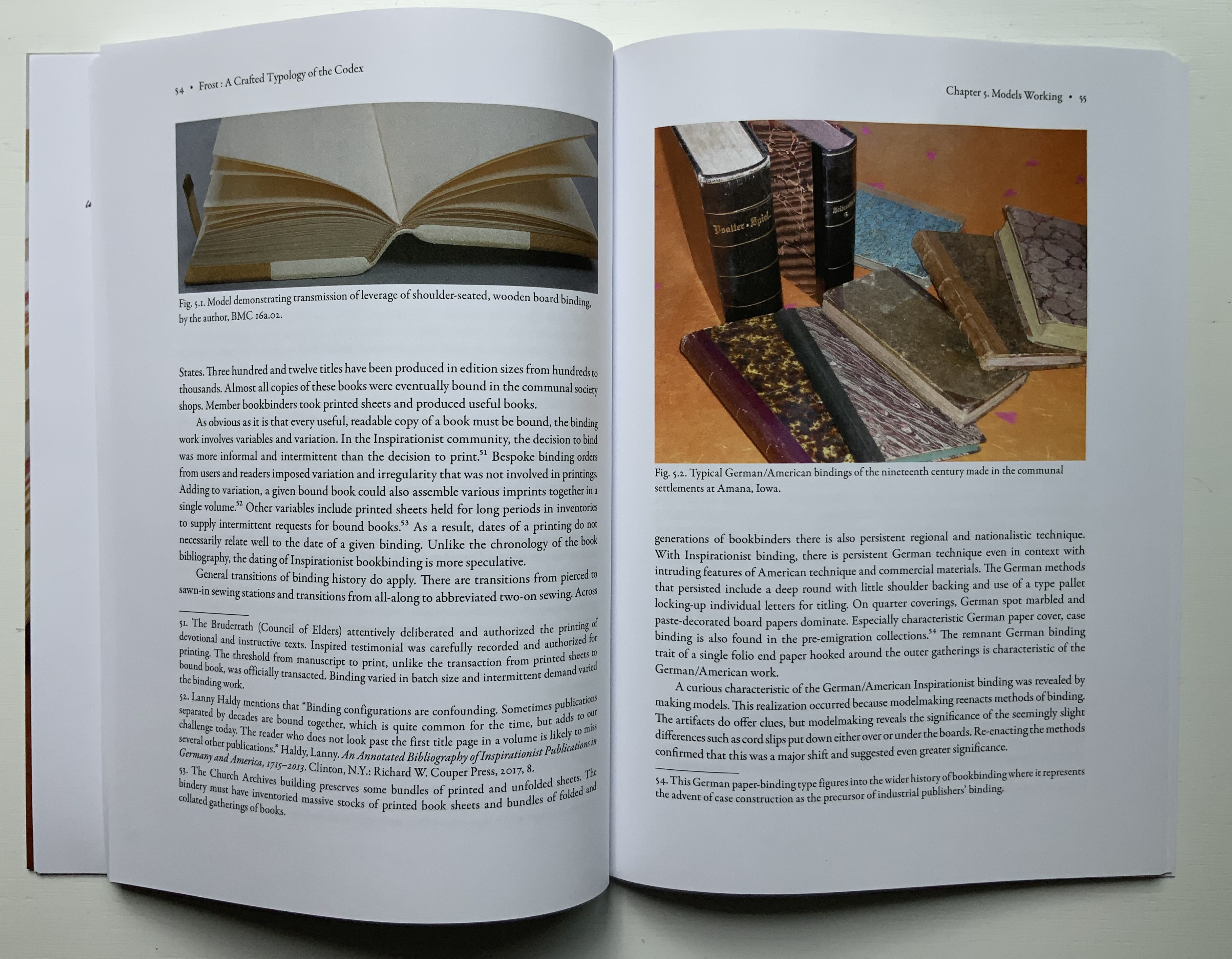
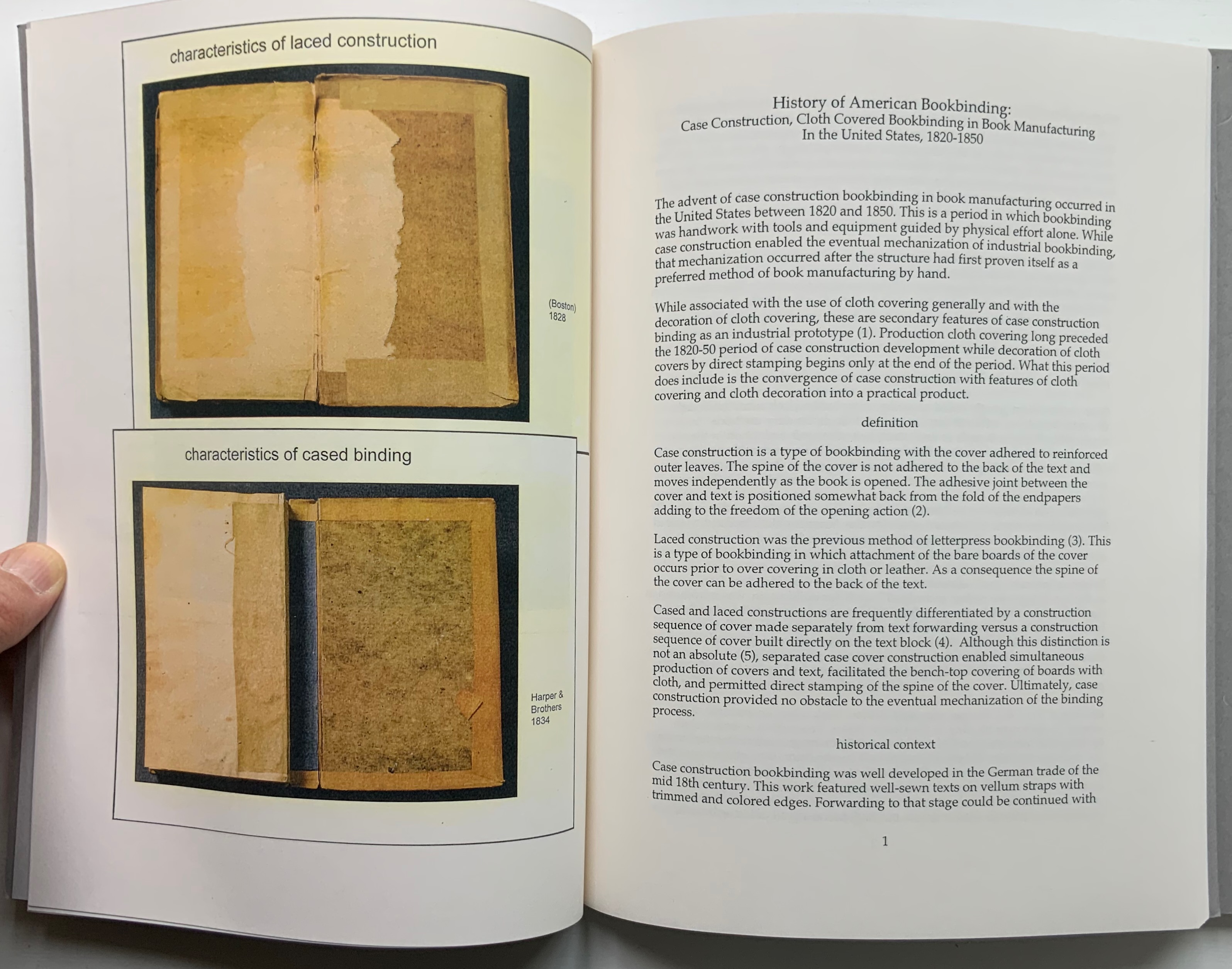
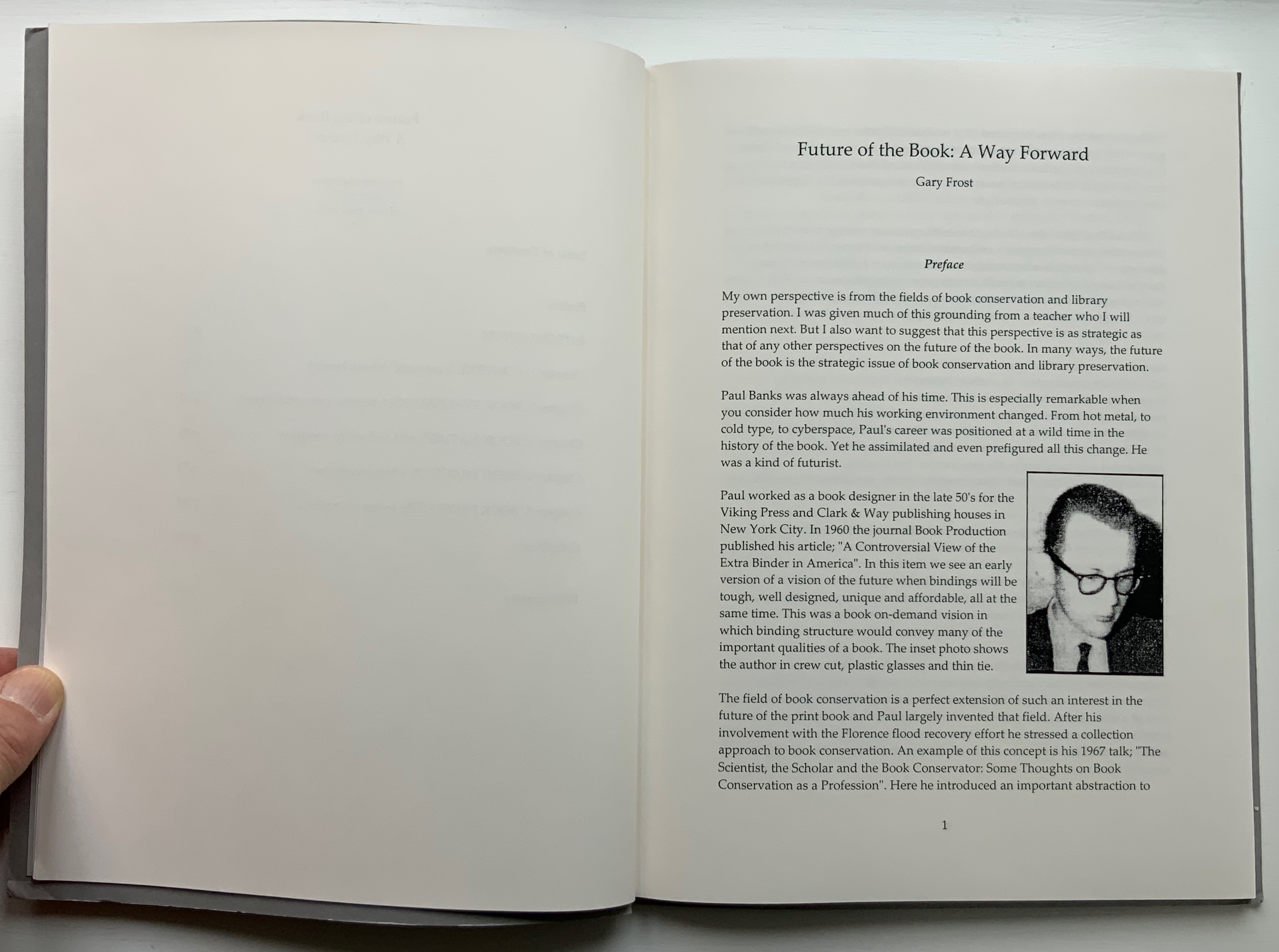
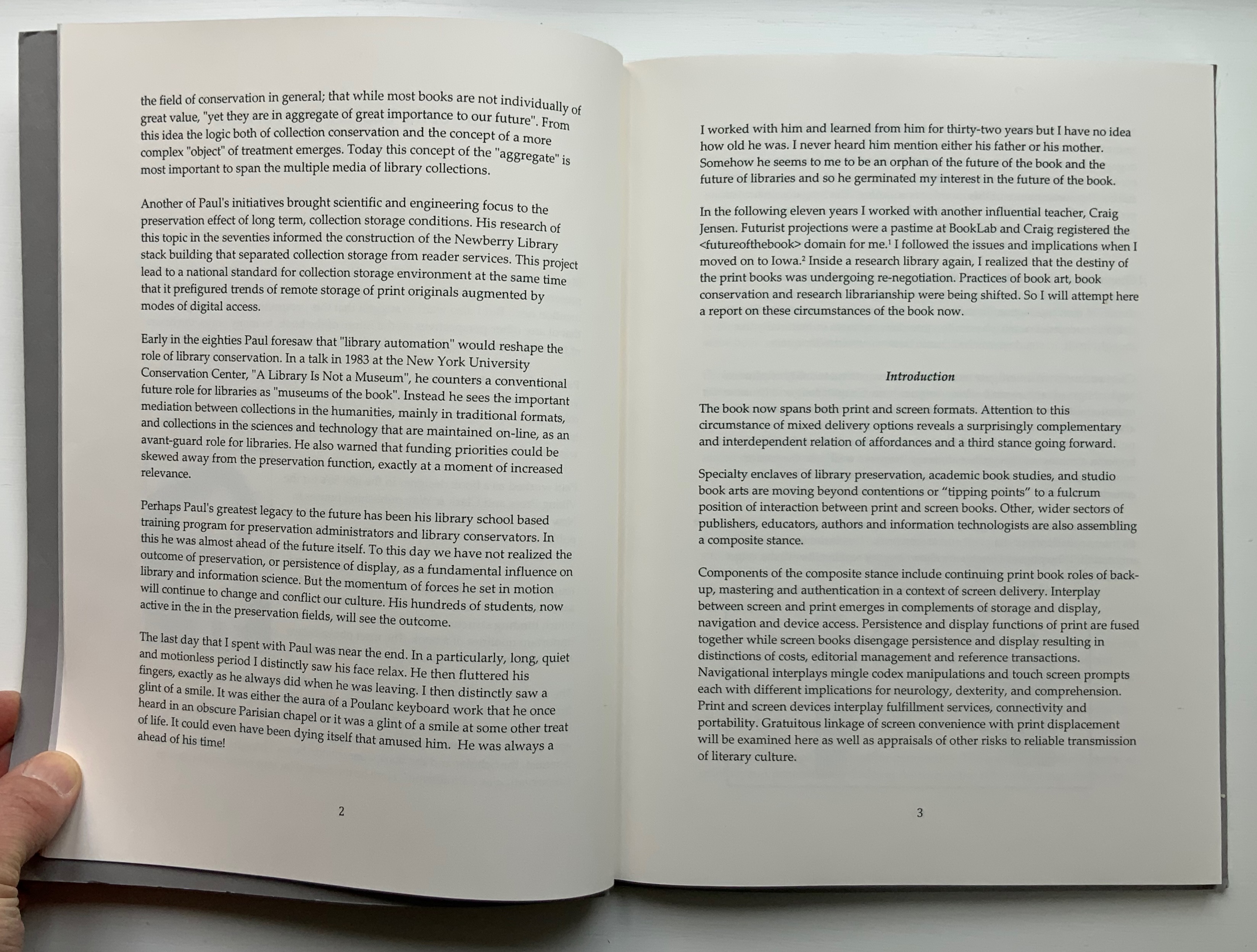
This recent volume from Gary Frost contains some previously published content from the two other works in the collection (see below), but the new material makes it worth re-reading that content and being reminded to revisit the two works for what is not re-published here. The diagram below, providing an historical overview of types of codices and their relationship, is also worth keeping close to hand when reading other reference works (see Further Reading).
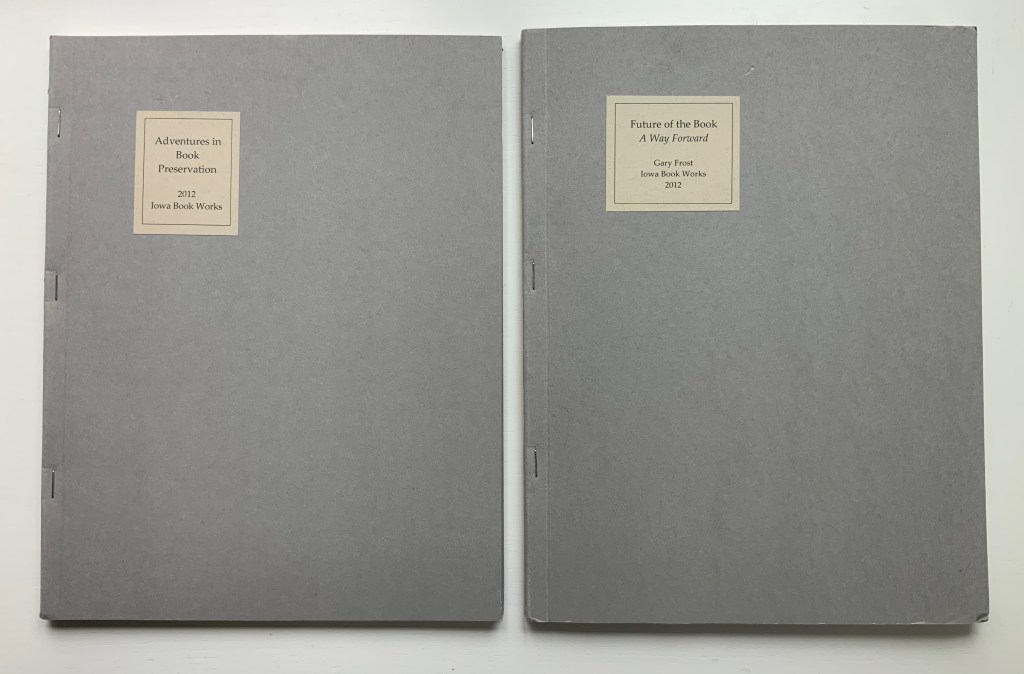
Adventures in Book Preservation (2012) Future of the Book: A Way Forward (2012)
Adventures in Book Preservation (2012) Gary Frost Paperback saddle-stitched. H278 x W215 mm, 68 pages. Future of the Book: A Way Forward (2012) Paperback saddle-stitched. H280 x W215 mm, 98 pages. Both acquired from the author, 22 July 2012. Photos: Books On Books Collection.
Sample pages from Adventures in Book Preservation (2012)
Sample pages from Future of the Book: A Way Forward (2012)
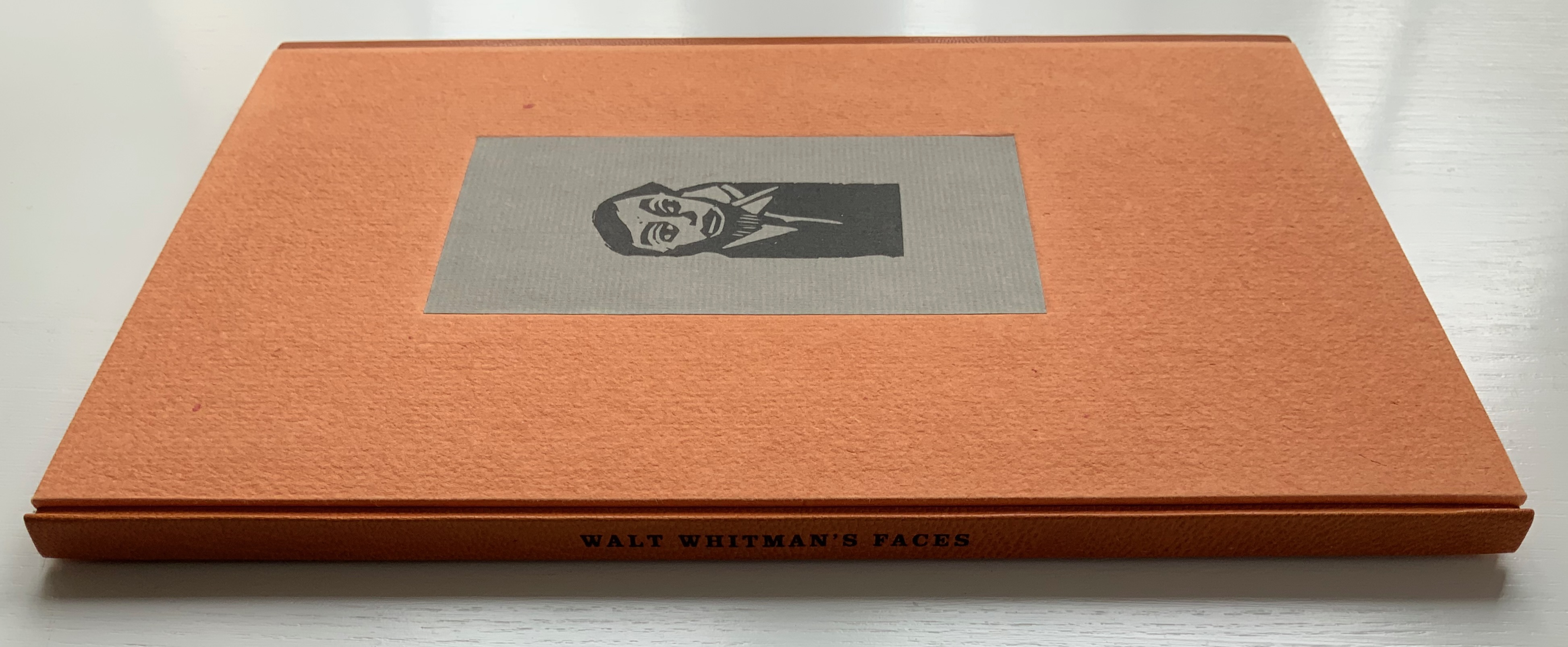
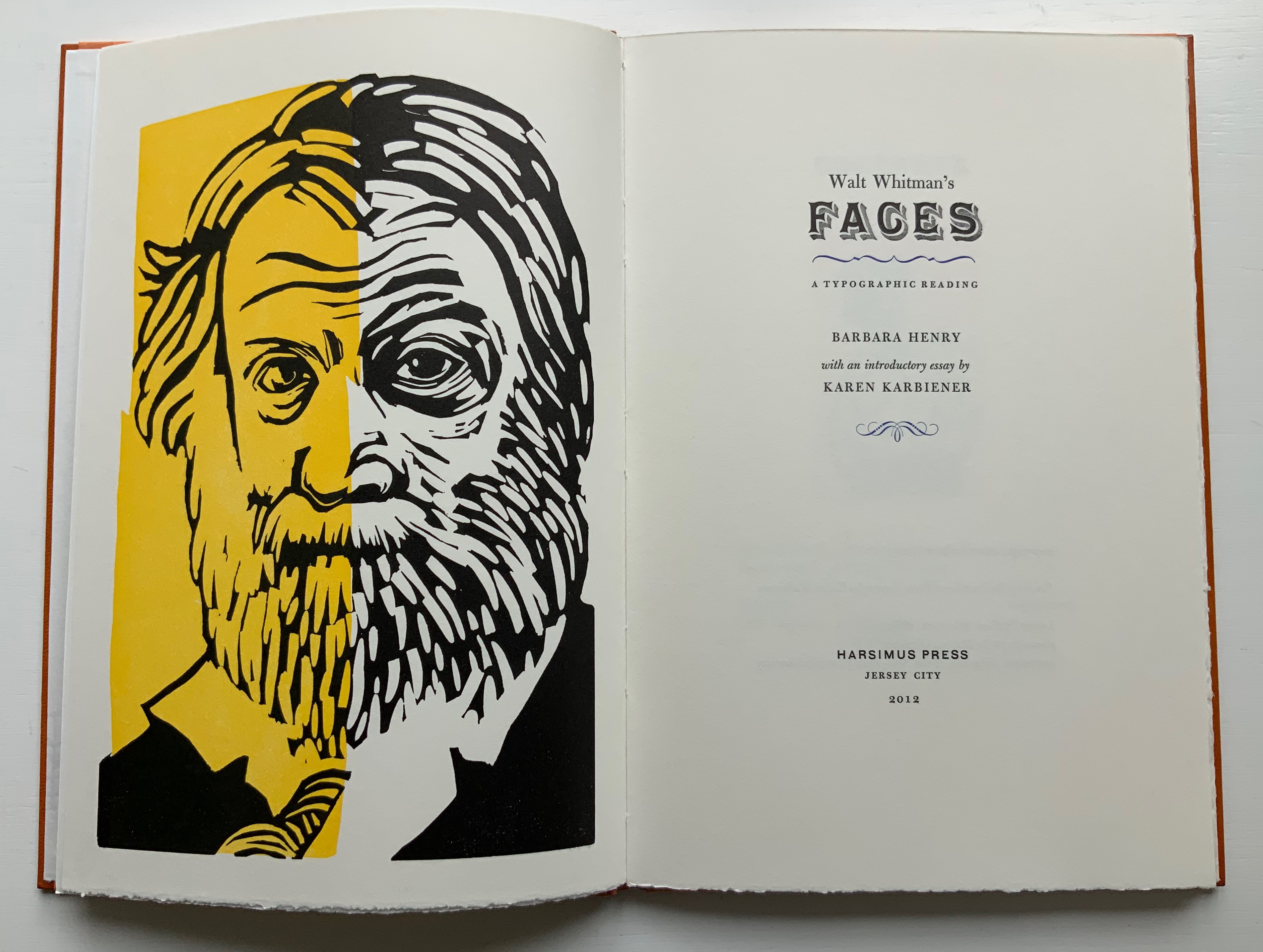
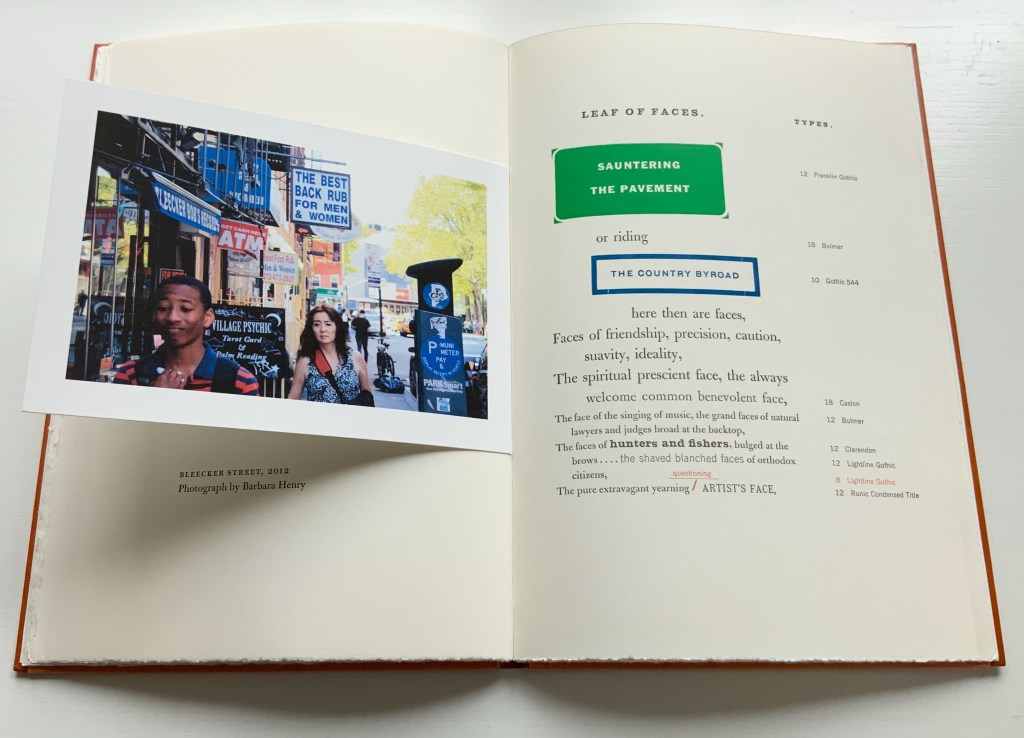
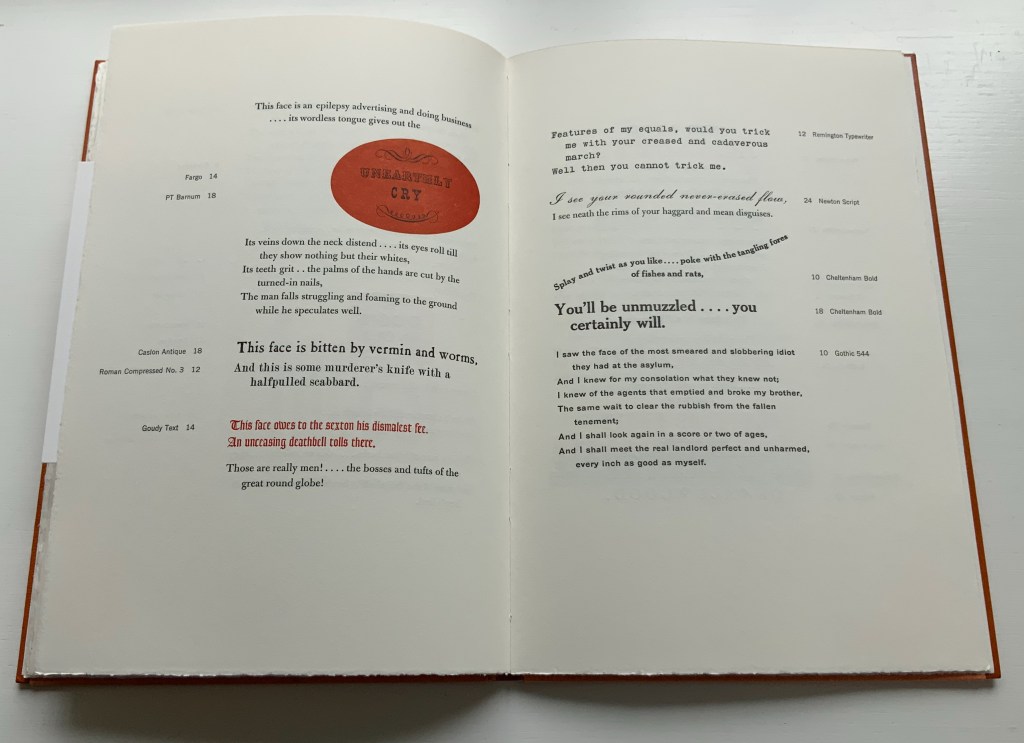
Walt Whitman’s “Faces”: A Typographic Reading (2012) Barbara Henry Case bound in boards in quarter-leather. H270 x W182 mm, 34 pages. Linocuts by Barbara Henry. Edition of 80, of which this is #69. Acquired from the artist, 11 April 2022. Photos of the work: Books On Books Collection. Displayed with permission.
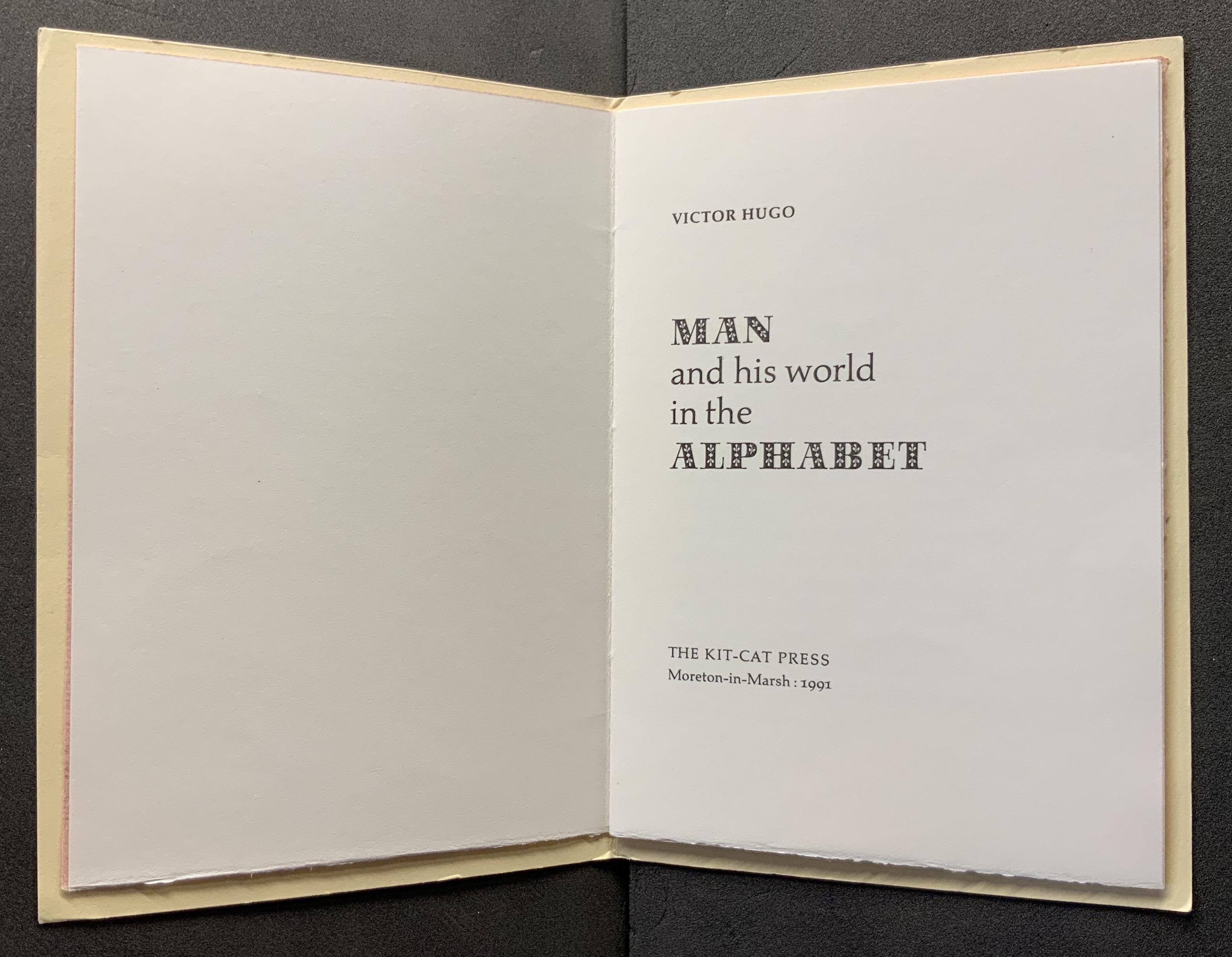
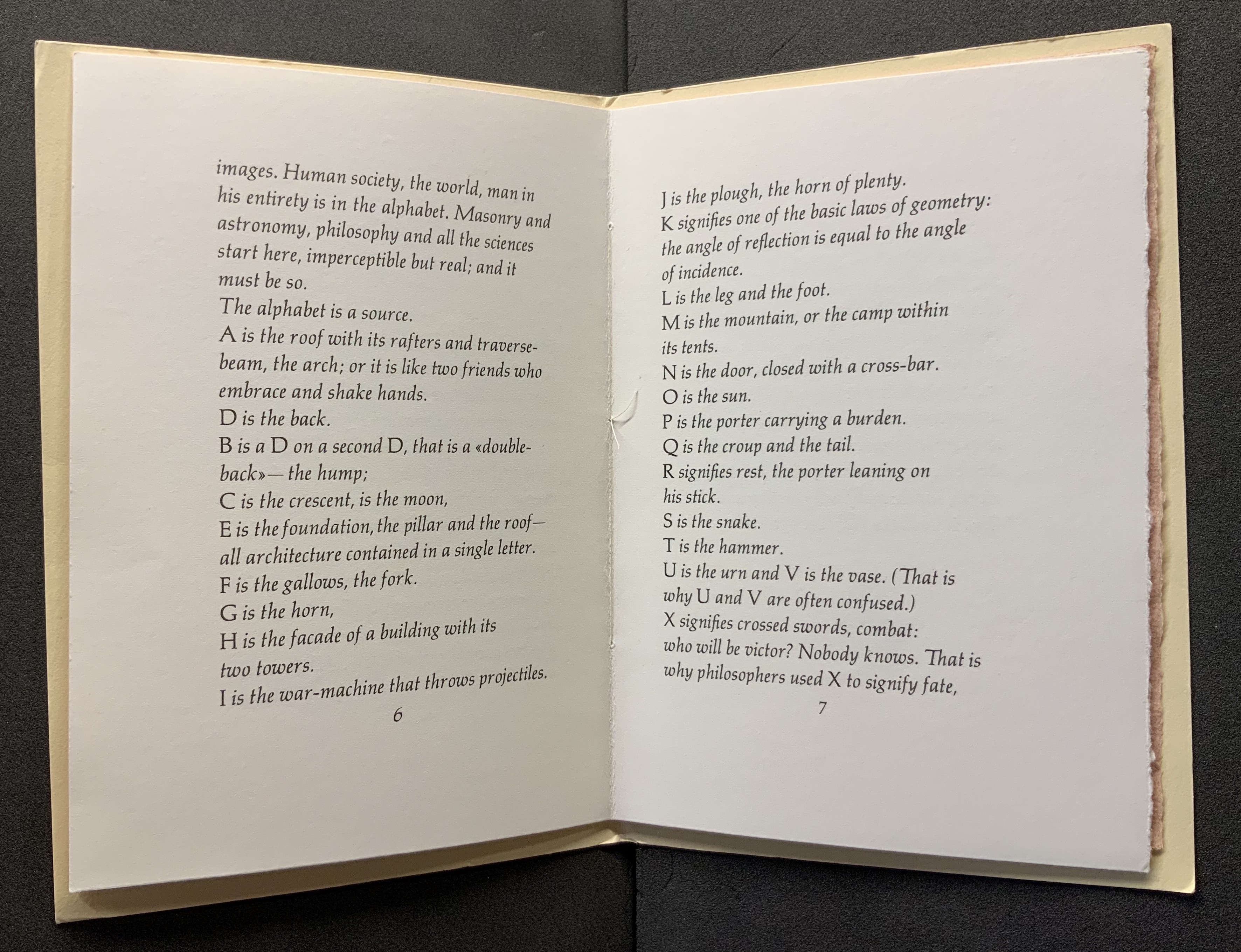
Although Whitman knew some of Victor Hugo’s work (in translation), it is unlikely that he knew of Hugo’s declaration “man in his entirety is in the alphabet … The alphabet is a source”. If he had, and if he had the French text as well, he would have appreciated that that last word in the original is font.
Man and his World in the Alphabet (1991) Victor Hugo Design and production by Kenneth Hardacre. Translation by Paul Standard for Hermann Zapf’s Manuale Typographicum (1954). Photos of the work: Books On Books.
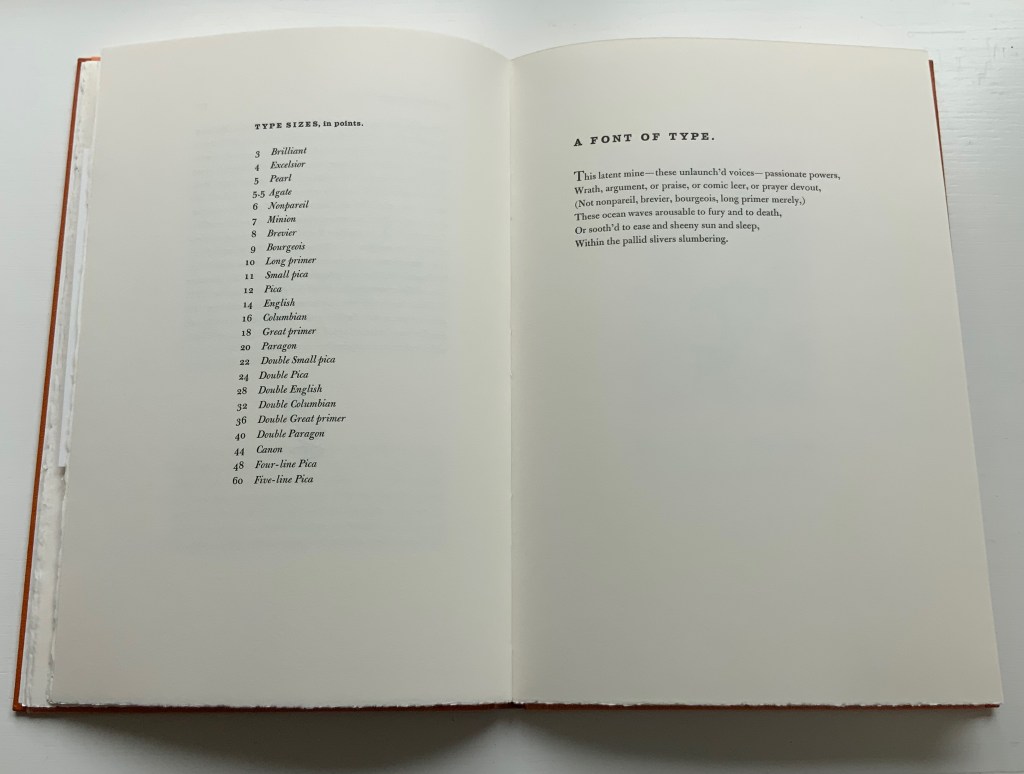
Working in a printing shop, Whitman could hardly overlook the metaphors on offer: the font or fount as source or mine, the typeface for the human face and vice versa. Barbara Henry has harvested from the Leaves of Grass the two short poems — “A Font of Type” and “Leaf of Faces” — that explore those metaphors. Bringing them together alongside an essay by Karen Karbiener (New York University) and one of her own, Henry embeds them in a well-crafted fine press book and embodies “Leaf of Faces” in its own set of typographic fireworks.
First though come the two essays. Karbiener’s sets the familiar biographical stage for Whitman and provides a sympathetic reading of Henry’s “typographic reading” to come. Henry’s is an earnest and plausible justification for her explication of the typographic references in each section of “Leaf of Faces”. Her essay closes with a paragraph explaining that many of the typefaces Whitman would have known are no longer available, that today’s measure of type size (the point) did not exist in Whitman’s day and that in homage she has mostly used 12 point Bulmer, a typeface from “the American Type Founders Company, a conglomerate of most of the type foundries formed in 1892, the year of Whitman’s death”. Also, she has set the type for “Leaf of Faces” by hand in a composing stick as Whitman would have done.
Then on the following pages comes a list of the names by which Whitman and his fellow print workers knew the various sizes of type. Without the list, the reader would miss the parenthetical allusions in “A Font of Type” — “nonpareil, brevier, bourgeois, long primer” — to what today are known as 6pt, 8pt, 9pt and 10pt type sizes. Whitman’s clever choice of names that have connotations beyond his extended metaphor possibly makes the lines comprehensible even without the finer points of the allusion. Or perhaps the reader still needs to be familiar with loose hot metal type and how the slivers of individual letters rest all sorted into their sections of a wooden typecase before they are mined or pulled from their latent slumbers to form words and expressions to be voiced.
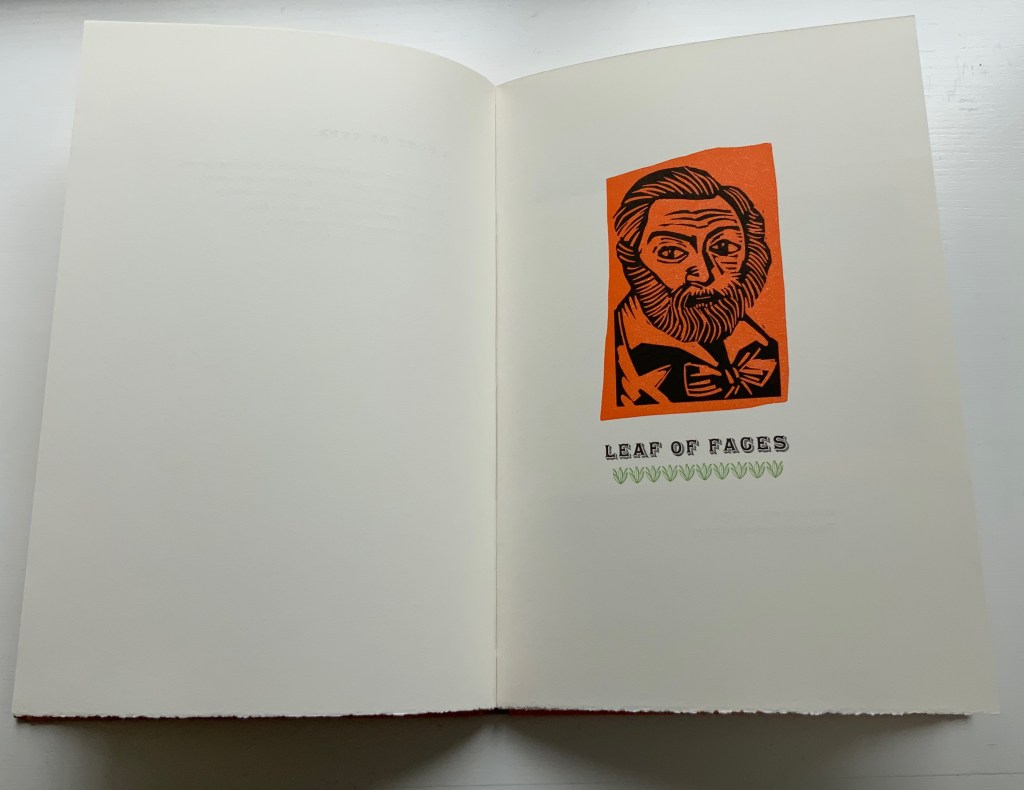
Then, after this prefacing short poem, the fireworks begin with Henry’s orange and black linocut of Whitman’s face over the title of the second poem, underlined with green fleurons (like leaves of grass).
In the poem’s first double-page spread, Henry’s postcard-size digital photo of pedestrians and signs on Bleecker Street in 2012 not only illustrates lines of the facing poem, it echoes the postcard-size vintage photo by Marcus Ormsbee of Lower Hudson Street in 1865 used at the start of her essay. Her photo’s startling colors contrast with Ormsbee’s black and white and complement the bold colors and foundry typefaces that follow in her treatment of the poem. A true book artist, Henry is making these features in her book refer to what she is doing in the book — bringing her 21st century eye to eye with Whitman’s 19th century.
These are but three of the six spreads across which Henry transforms Whitman’s “Leaf of Faces” into her typographic spectacle. It and the whole of the book bring to life what Anne M. Royston calls “artistic arguments (my emphasis), a term that indicates theory that pushes back against the expectations of the theory or criticism genre, specifically by employing signification that exceeds the semantics of printed text”.
One last observation: Just as there is no evidence that Whitman knew Victor Hugo’s mystic reference to the alphabet as source, there is also no evidence that he knew the Sufi poets. But Ralph Waldo Emerson did know them. His Complete Works, Volume VIII, has a section entitled “Persian Poetry” and translates a key passage of Farid ud-Din Attar’s The Conference of the Birds (1177). As Karbinier notes in her essay, Whitman called Ralph Waldo Emerson the “Master”, so perhaps it is not so uncanny that “Leaf of Faces” includes a similar recognition of divinity at which the birds arrive when they finally meet the Simorgh, lord of all birds, whom they have been seeking, only to be told by the Simorgh:
It is yourselves you see and what you are. (Who sees the Lord? It is himself each sees; …)
Or as Whitman more egotistically puts it:
And I shall look again in a score or two of ages, And I shall meet the real landlord perfect and unharmed, every inch as good as myself.
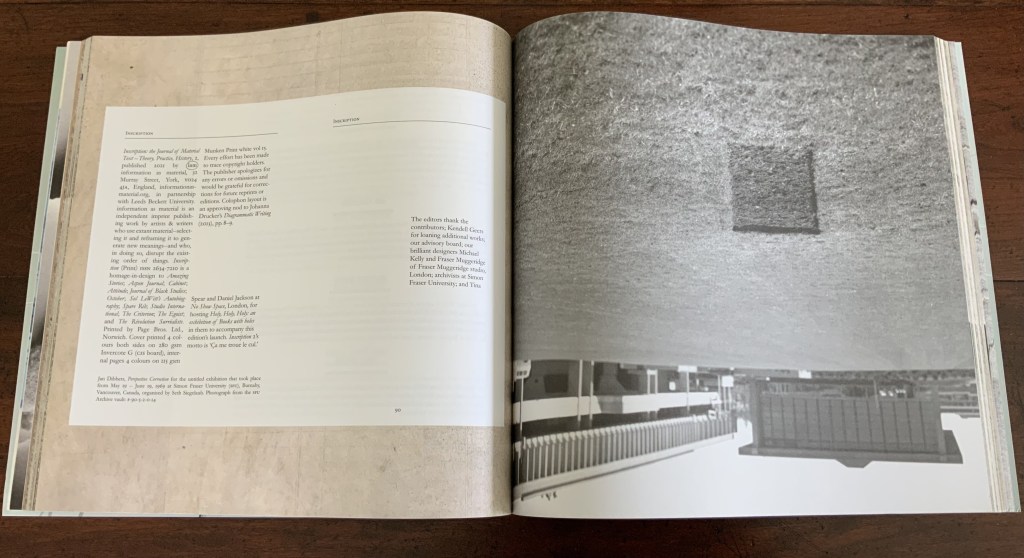
Inscription: The Journal of Material Text – Theory, Practice, History, Issue 2 on Holes (2021) Simon Morris, Gill Partington and Adam Smyth (eds.) Perfect bound softcover, H314 x W314 mm, 180 pages. Editions included: Fiona Banner (aka Vanity Press), Full Stop, front & back covers; Kendell Geers, Stripped Bare, end papers; Carolyn Thompson, The Beast in Me, H1180 x W1180 mm; Erica Baum, Piano Rolls, H120 x W120 closed, W960 mm open; Harold Offeh, Crystal Mouths, H210 x W105 closed, W480 mm open; David Bellingham, Cigar Burn Apertures, H210 x W105 mm; Miranda July, Bookmark, H302 x W54 mm; Christian Bök, Supermassive, LP. Acquired from Information as Material, 10 October 2021. Photos of the issue: Books On Books Collection.
How materially perverse is it that the second issue of Inscription is devoted to “the hole”, yet it is the first issue that actually has a hole in it? The first issue of Inscription did set a seriously playful — or playfully serious — tone, and the second issue does not fail to maintain it. The second issue continues the dos-à-dos binding but with only the front and back covers as the external giveaway. In the middle of this single-spine paperback, pages 1-90 meet an inverted pages 90-1 in the middle, which prompts the reader to turn the open book 180° and flip back to page 1. From either direction, the reader meets the traditional backmatter of a journal in the middle.
Inverted cover and center of Inscription (2021).
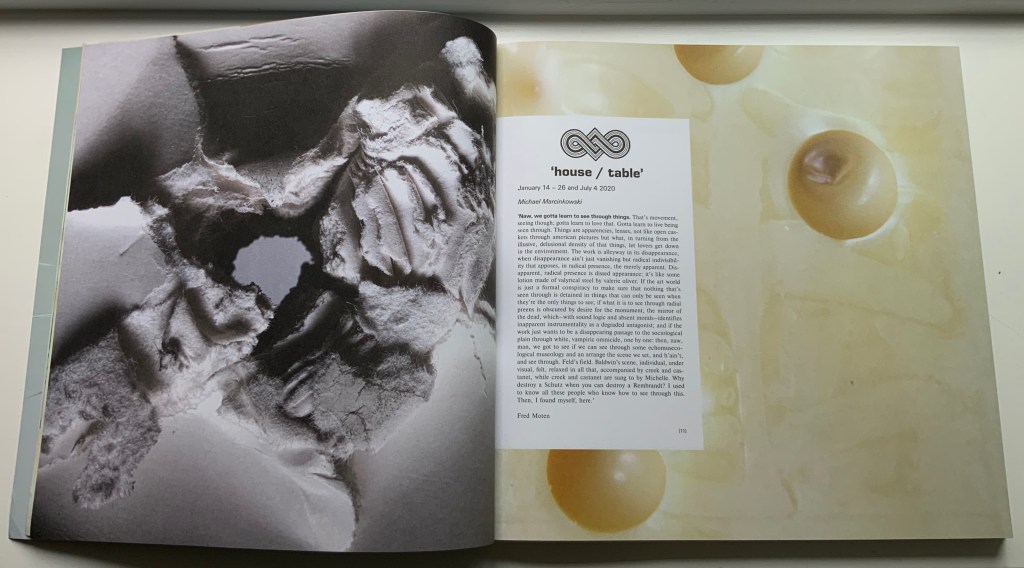
Such reversals of expectation call for a countervalent design element to avoid too much confusion. In this issue, that element consists of constant earth-tone backgrounds framing constant black-on-white text boxes (square holes?) for each article. Even within these constants, reversals of expectation play out. The backgrounds are drawn from 14 different sources, ranging from laid paper samples, parchment, pulp and brown boards to a slice of Emmental cheese (sorry, Gromit, no Wensleydale), and the layouts for each square hole differ, being taken from 16 other journals such as The Criterion, The Egoist and National Geographic.
List of backgrounds used throughout the issue.
List of publications whose layouts are used throughout the issue.
The Emmental cheese background around the opening of Marcinkowski’s essay; Hybrid wove/laid paper made for James Watt & Co around the opening of Lüthi’s essay.
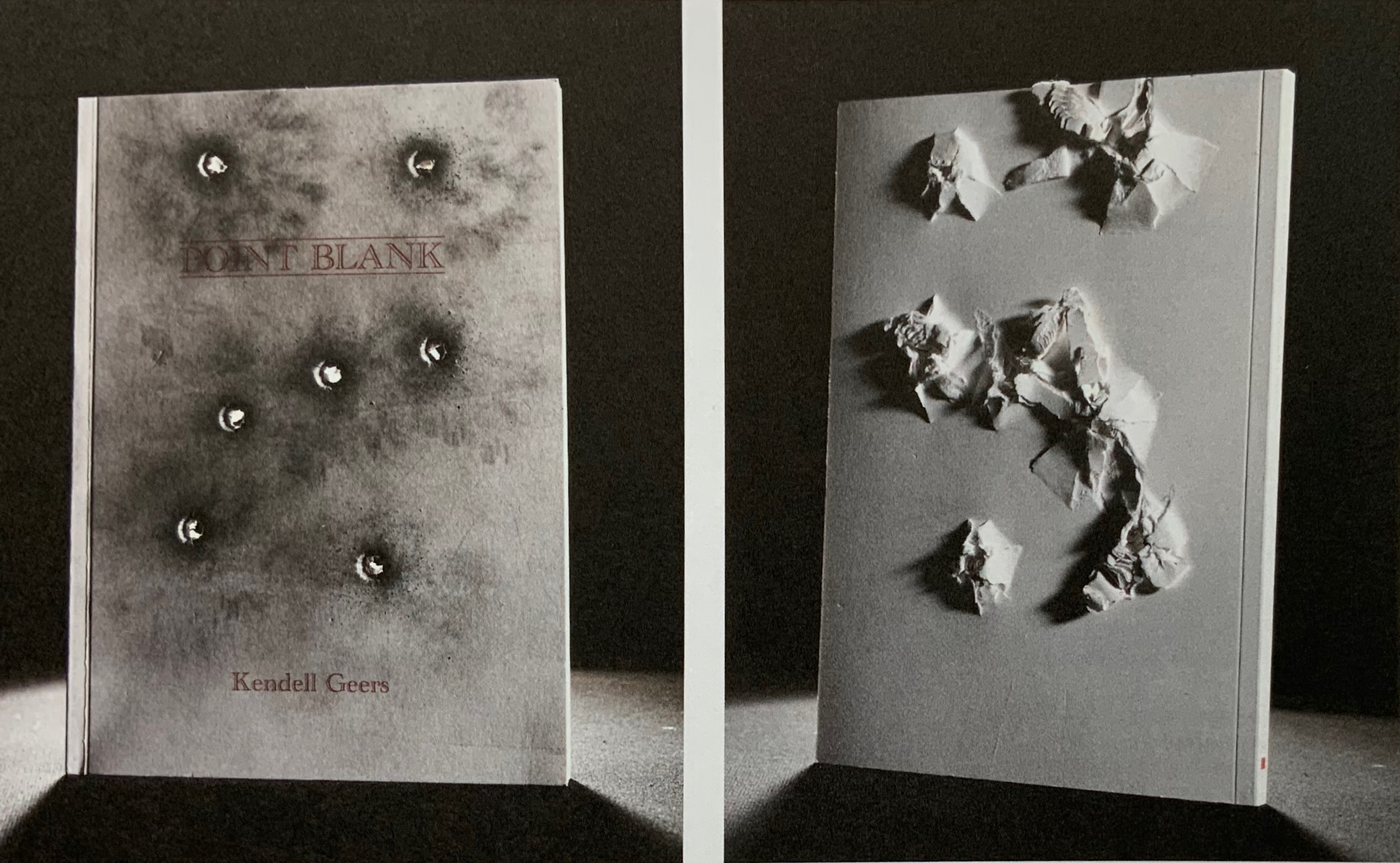
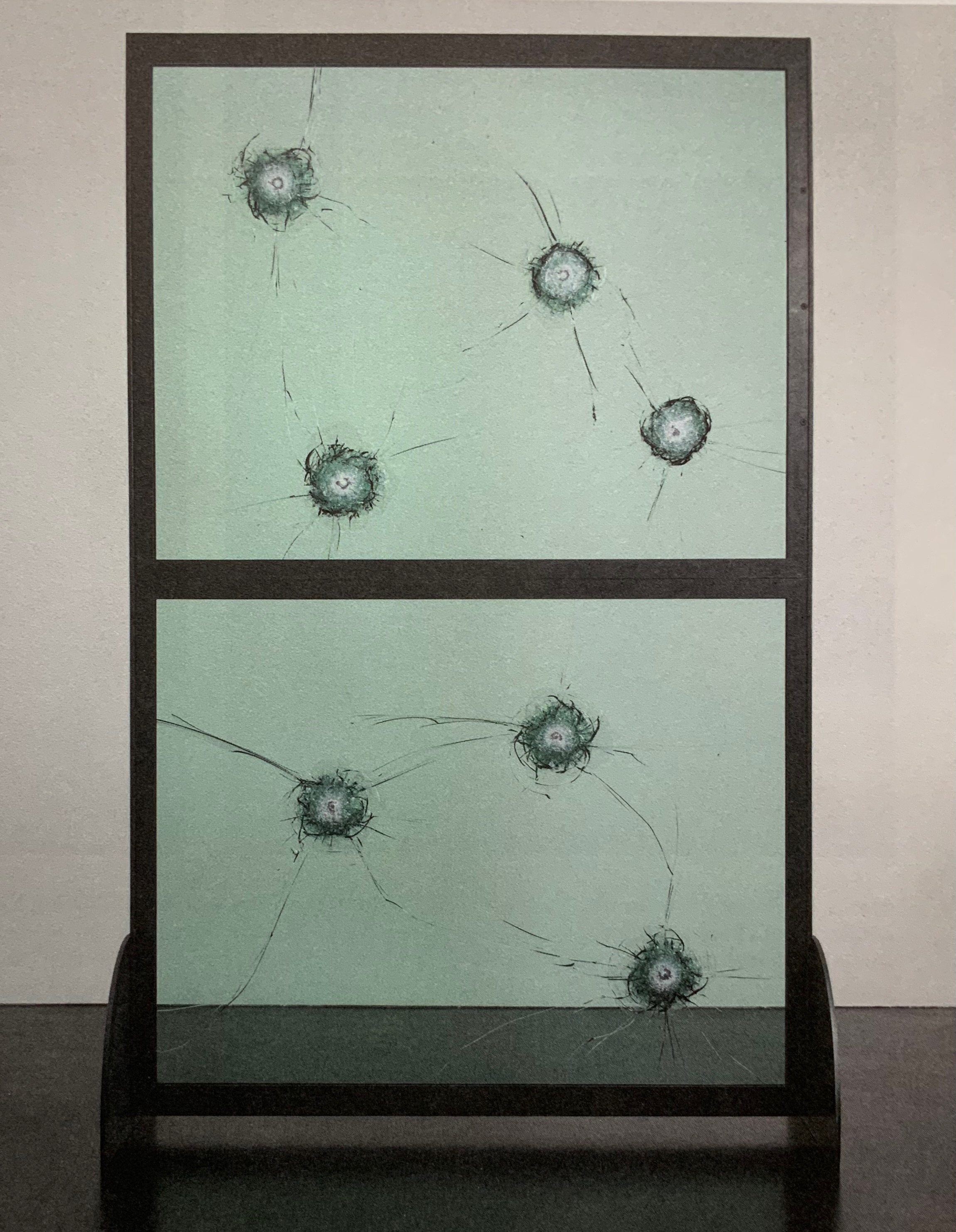
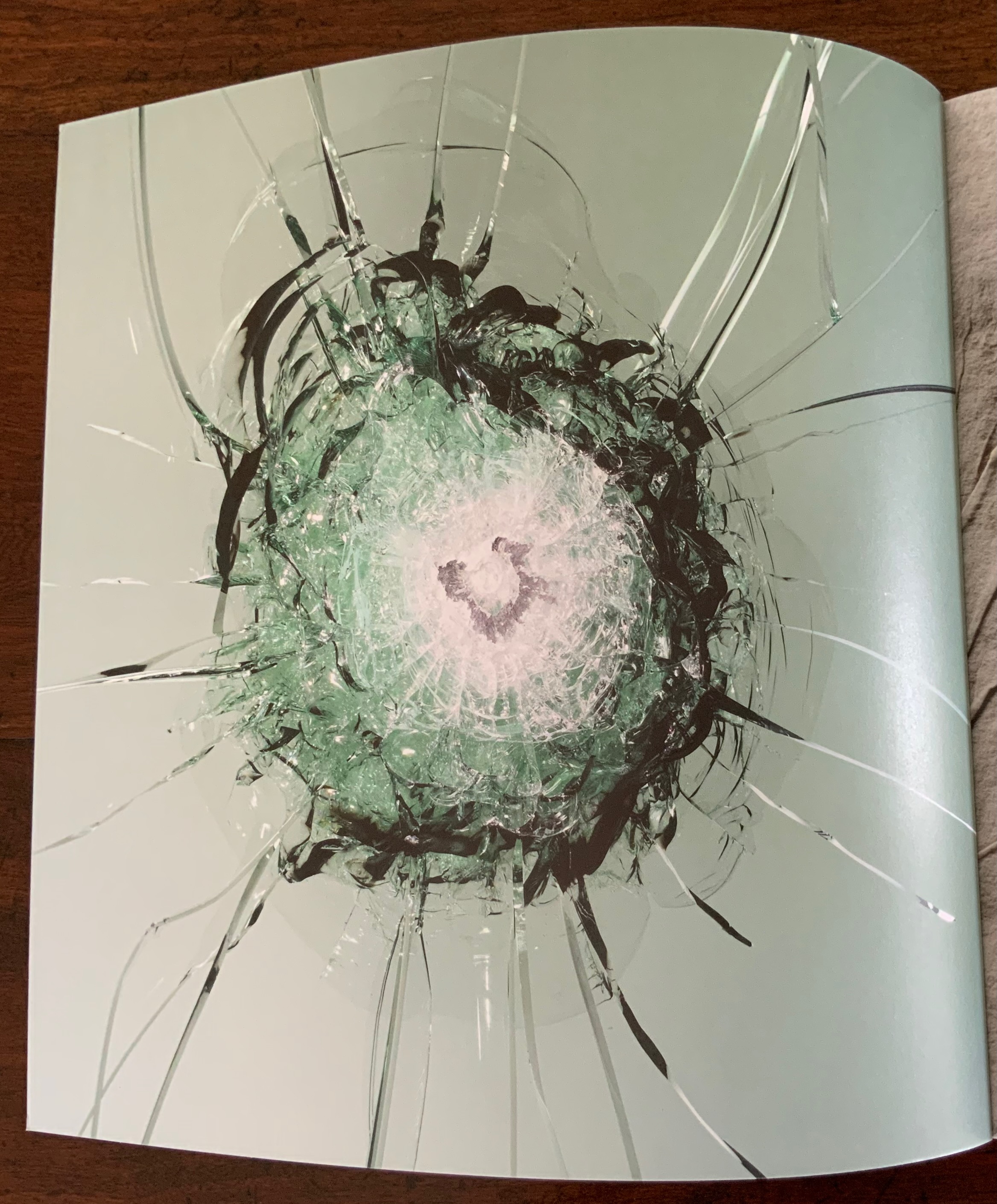
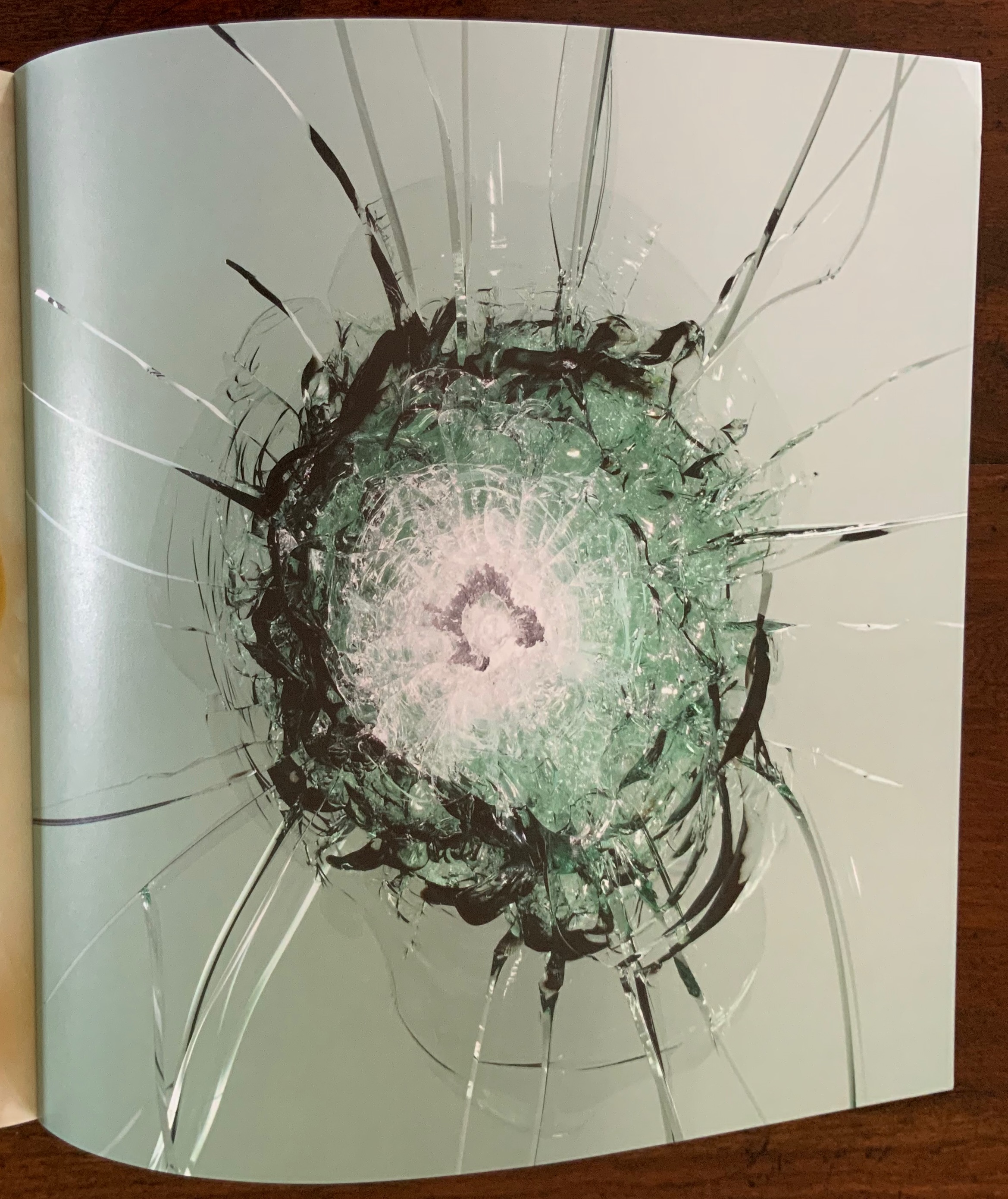
There is an even more recurrent “bass” line in this issue. It comes from the South African artist Kendell Geers, interviewed by the Editors. Even this bass line plays with variable perspective. Marking the start of most articles is a sheet bearing on recto and verso pages the image of a bullet hole (entry then exit) taken from Geers’ work Point Blank (2004). Bullet holes in glass — from Geers’ Stripped Bare (2009) — punctuate inversely the inside covers, bringing two symmetric/asymmetric openings to this topsy turvy production.
Kendell Geers, Point Blank (2004), front and back covers; Stripped Bare (2009; inside covers of Inscription (2021).
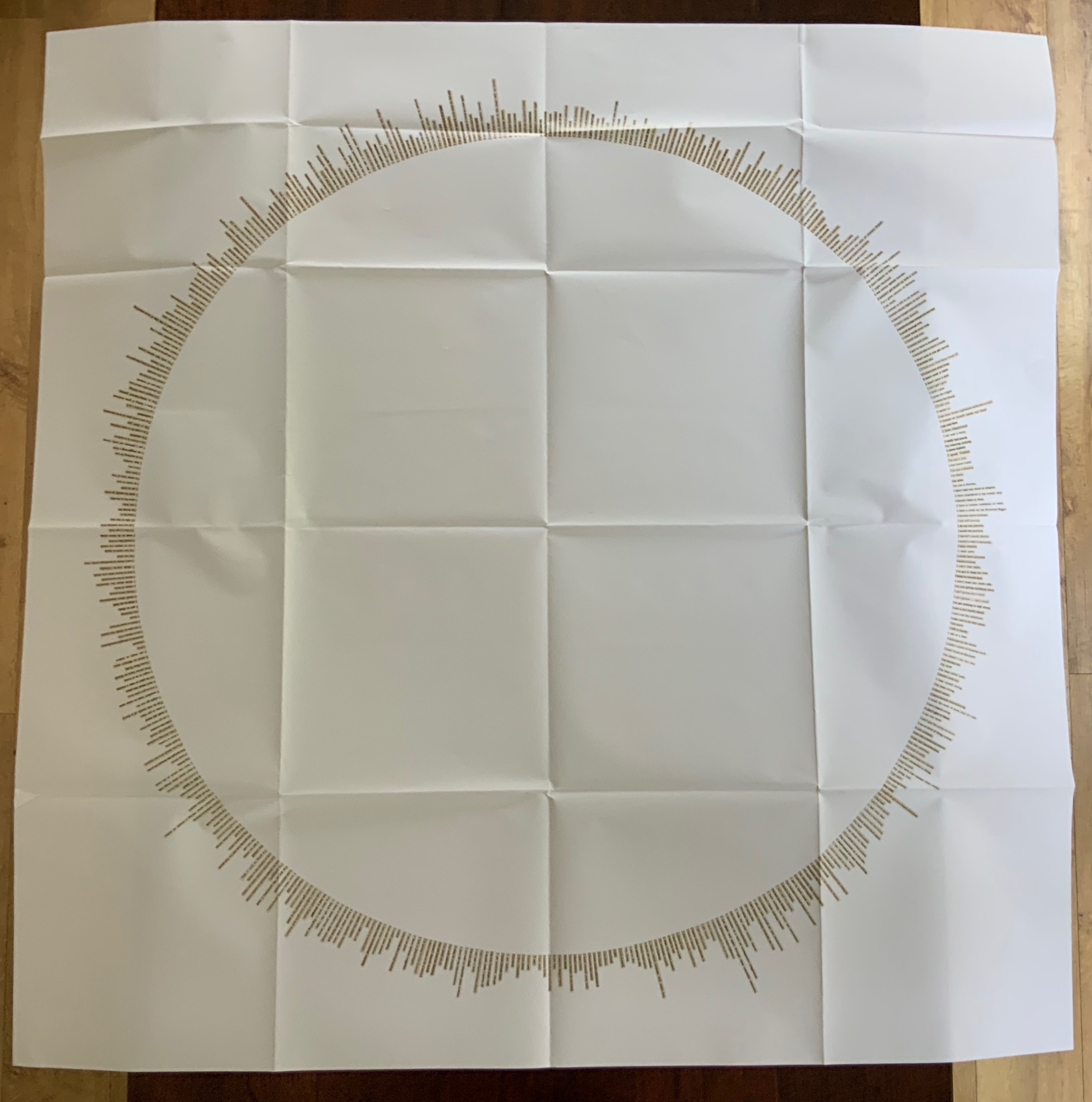
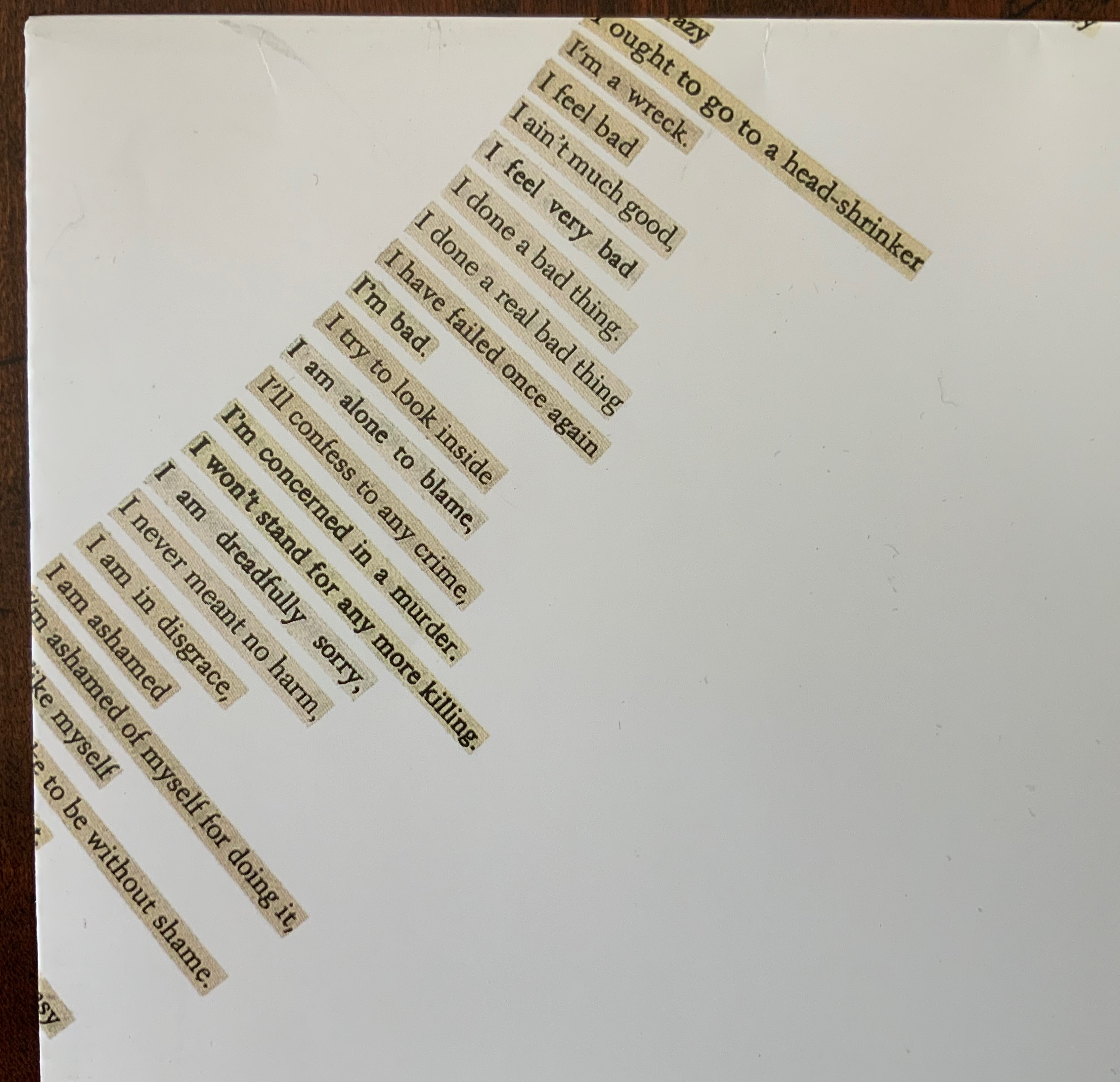
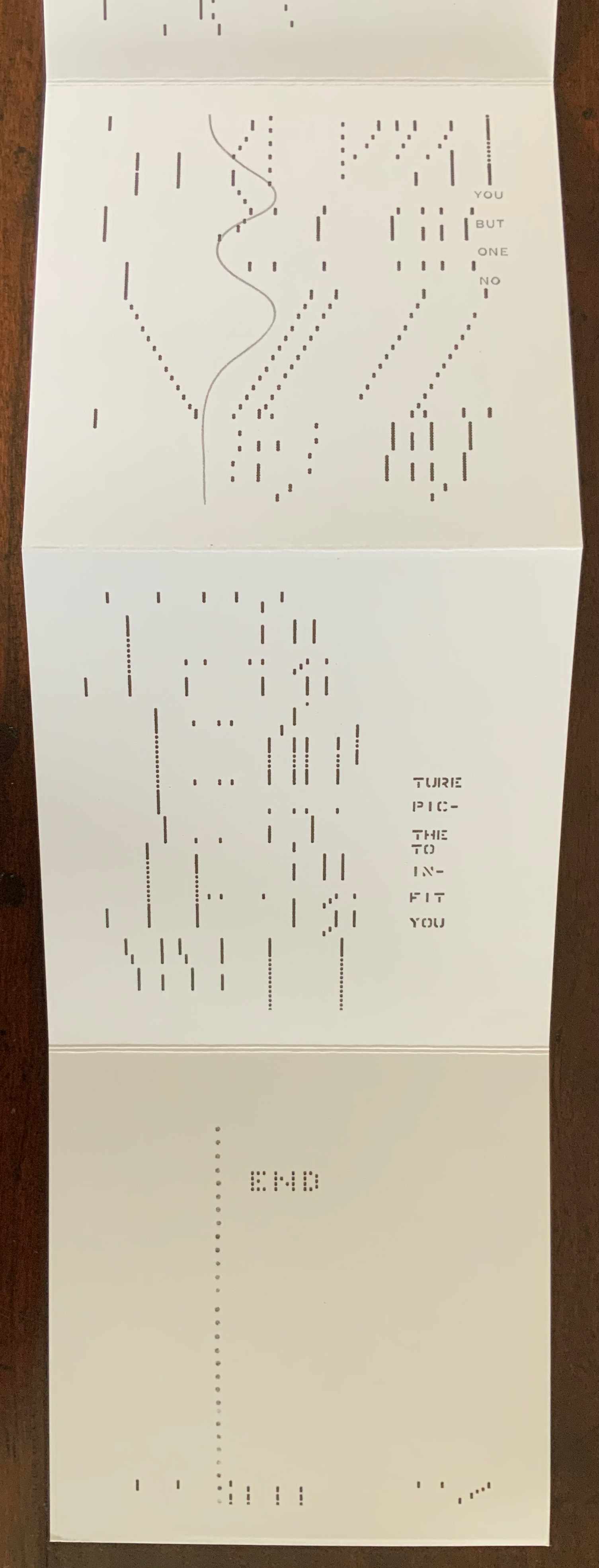
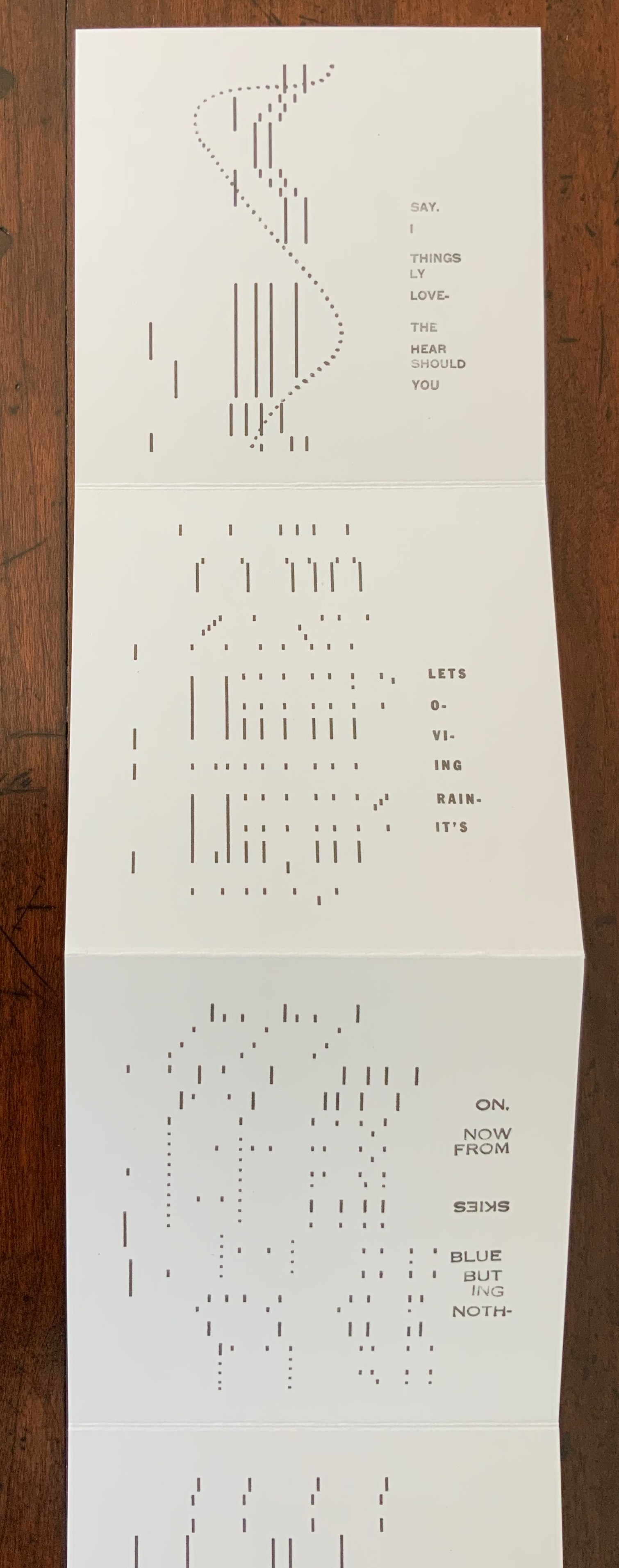
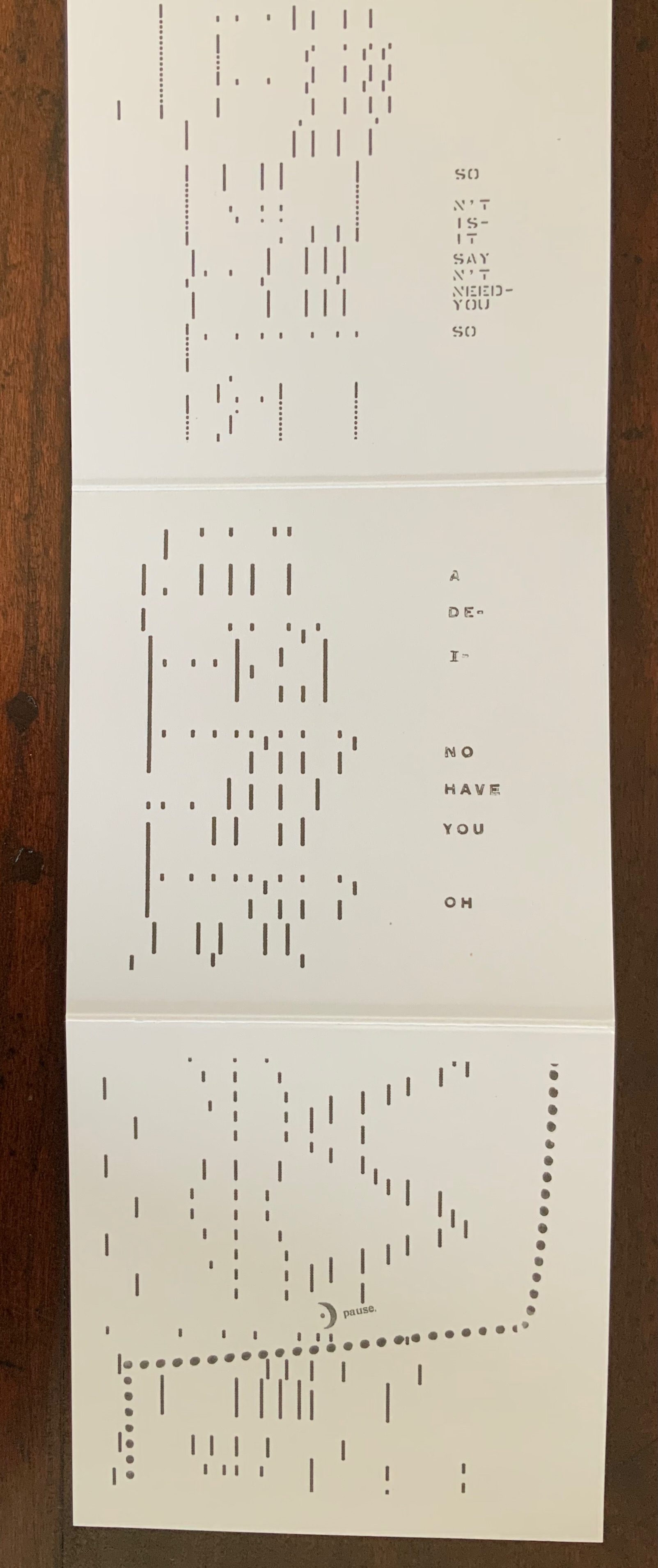
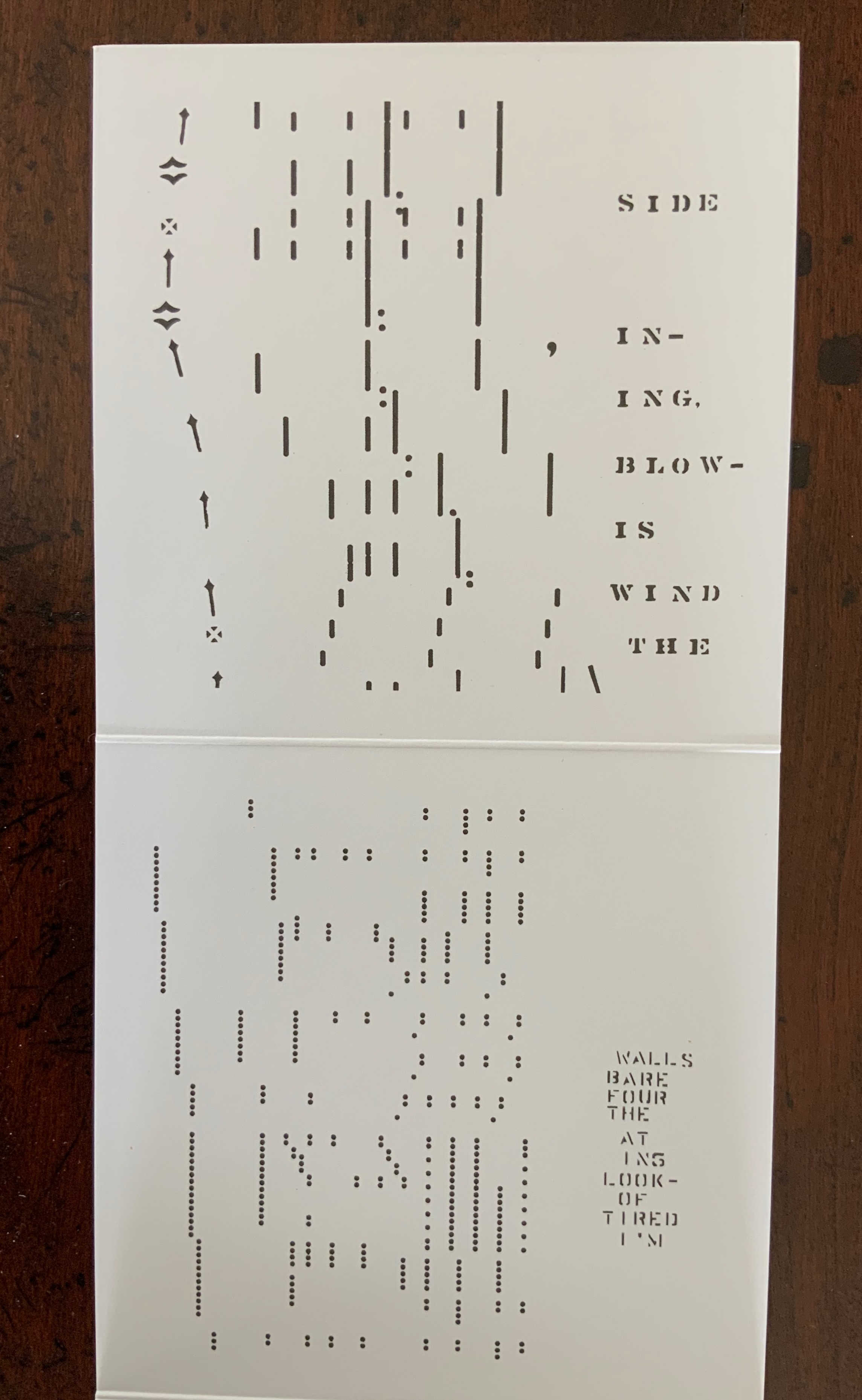
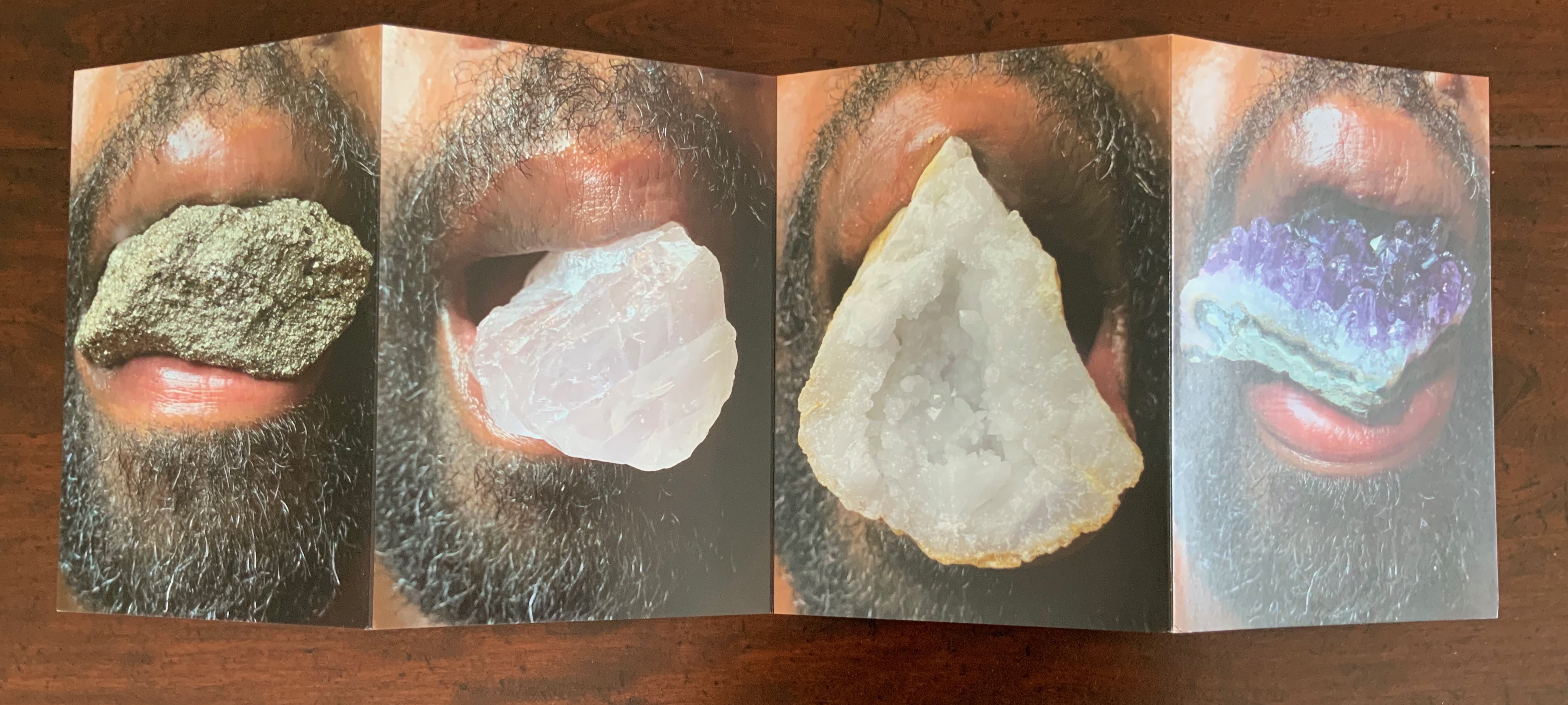
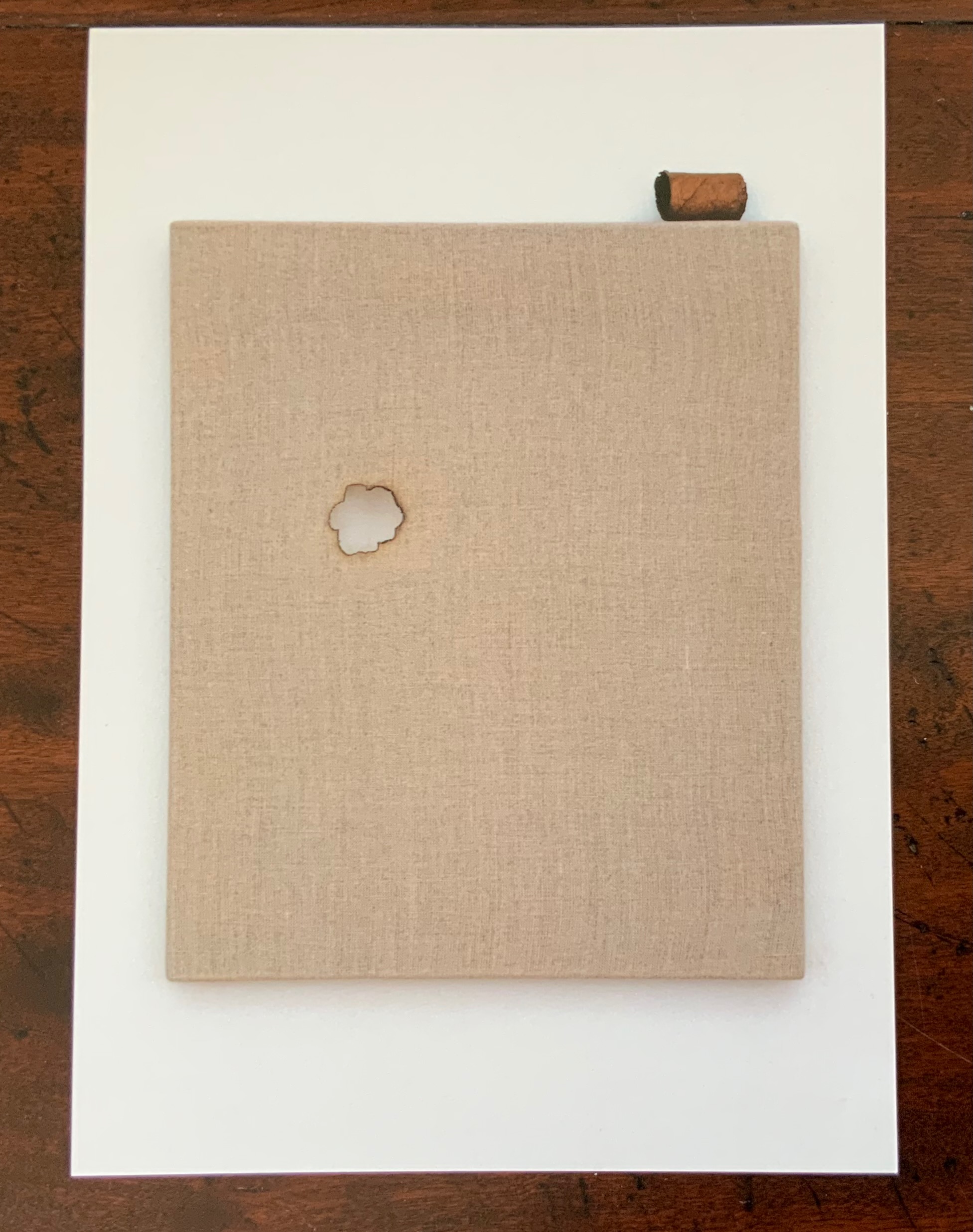
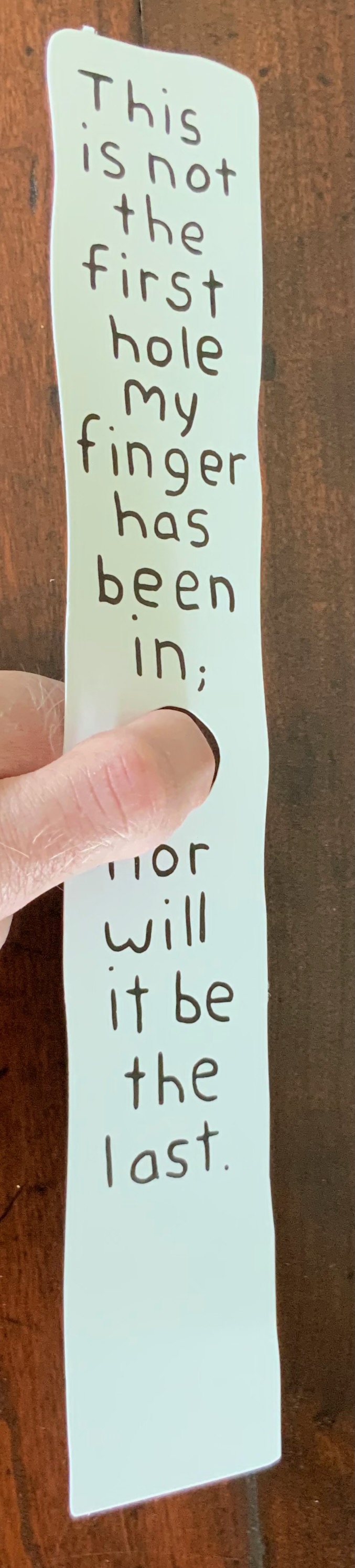
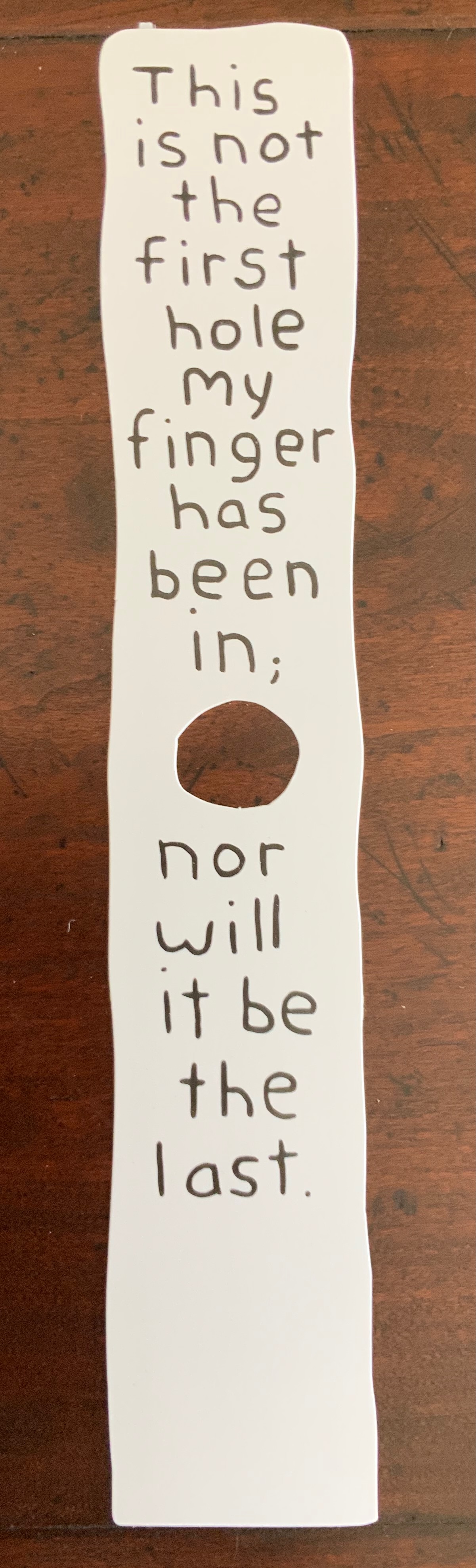
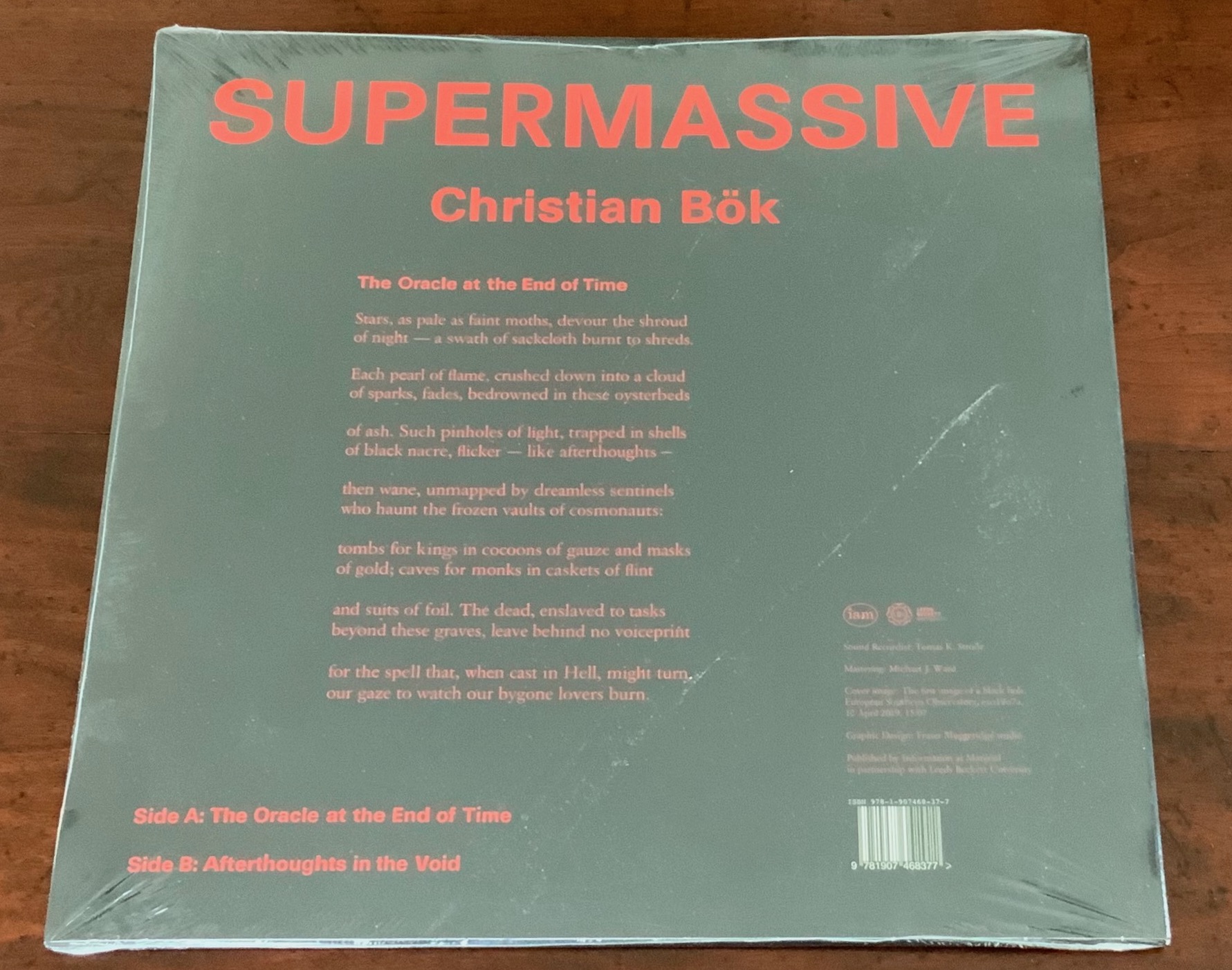
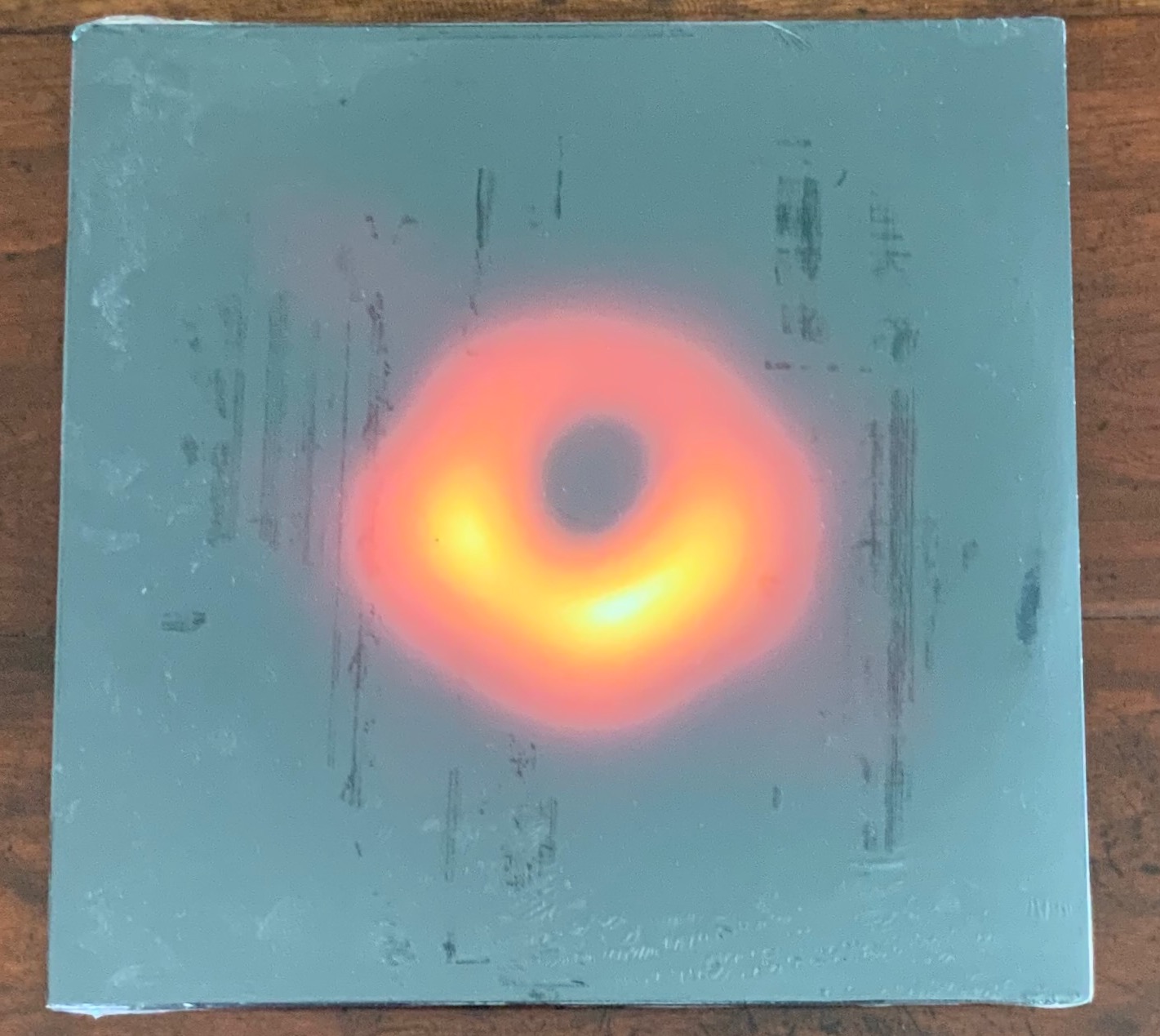
Long-time admirers of the 1960s-70s multimedia magazine Aspen, the editors have continued their practice of including unbound elements. In this issue, they have included Carolyn Thompson’s enormous poster The Beast in Me, whose sentences and part-sentences beginning with “I” have been cut from eight different novels and pasted down to form the hole seen below. Also included are Erica Baum’s Piano Rolls, Harold Offeh’s Crystal Mouths, David Bellingham’s Cigar Burn Apertures, Miranda July’s, Bookmark and Christian Bök’s Supermassive LP.
Carolyn Thompson, The Beast in Me, H1180 x W1180 mm. Photo: Ricky Adam. Photos of the work: Books On Books Collection.
Erica Baum, Piano Rolls, H120 x W120 closed, W960 mm open. Photos of the work: Books On Books Collection.
Harold Offeh, Crystal Mouths, H210 x W105 closed, W480 mm open; David Bellingham, Cigar Burn Apertures, H210 x W105 mm; Miranda July, Bookmark, H302 x W54 mm; Christian Bök, Supermassive, LP. Photos of the works: Books On Books Collection.
Like the famous combined Aspen issue Nos.5/6 — an homage to Stéphane Mallarmé — Inscription manages to pull off an eclectic unity with the essays included, which unlike Aspen was accomplished after a double-blind review process. Inscription‘s editors have turned on its head Robert Frost’s dismissive characterization of free verse as playing tennis without a net; they are playing doubles with a net and blindfolded and have created a work of art. This issue’s entries range from Paul Reynold’s erudite and whimsical definitions of all sorts of holes; the scholarly detective work on the holes that bind (pin holes and punch holes by Craig Robertson and Deirdre Lynch and filing holes by Heather Wolfe); James Mission’s tracking the crafts of scribe, typesetter and coder in representing lacunae, gaps or holes in the text; Louis Lüthi’s puncturing juxtaposition of W. Somerset Maugham’s 1948 abridgment of Moby-Dick, Orion Books’ 2007 Moby-Dick in Half the Time and Damion Searls’ 2009 riposte ; or The Whale; to Fiona Banner’s photo-essay on her hole-creating Full Stop‘s, granite sculptures of full stops (periods) created from the Peanuts , Klang and Orator typefaces, two of which were dropped into the marine protected area of Dogger Bank to put a sure stop to industrial fishing there. Here is the table of contents:
Michael Marcinkowski — “house / table” Galina Oustinova-Stjepanovíc — “Reading the Hole on the Last Address Memorial Plaques in Moscow” Fiona Banner — “Full Stop intervention with Greenpeace” Simon Morris — “Perspective Correction” Dianna Frid, Carla Nappi and Ian Truelove — “Wormholes, The Cascabel Butterfly and an AR collaboration” Aleksandra Kaminska and Julian De Maeyer — “The Perfect Cut: Talking with Myriam Dion” Paul Reynolds — “A Glossary of Holes” Louis Lüthi — “A Snow Hill in the Air” James Mission — “Signifying Nothing: Follow a Hole Through Three Text Technologies” Editors — “An Interview with Kendell Geers” Heather Wolfe — “On Curating Filing Holes” Craig Robertson and Deirdre Lynch — “Pinning and Punching: A Provisional History of Holes, Paper, and Books”
Inscription continues to provide one of the liveliest examples of what Anne M. Royston calls “artistic arguments (my emphasis), a term that indicates theory that pushes back against the expectations of the theory or criticism genre, specifically by employing signification that exceeds the semantics of printed text”.