Bookmarking Book Art — Kylie Stillman

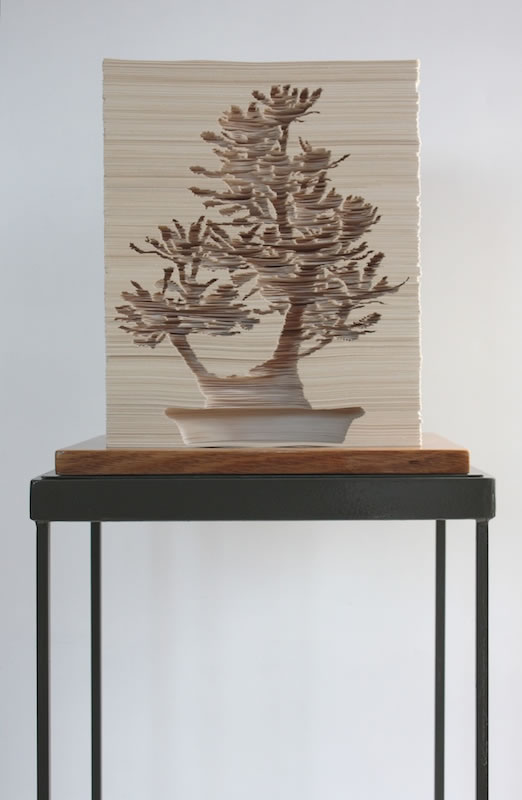
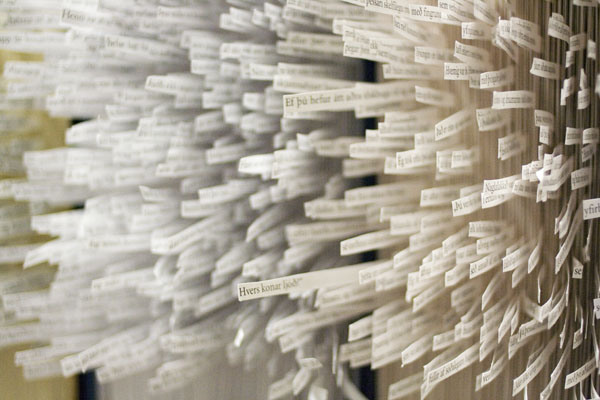
Banksia Serrata (2012)
Copyright © Kylie Stillman 2012 

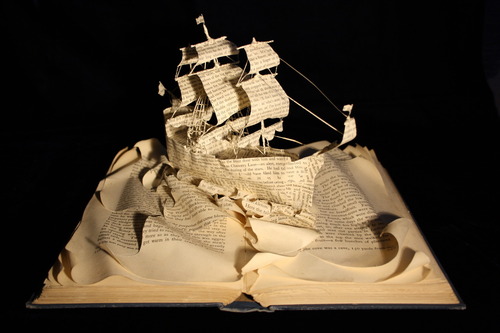
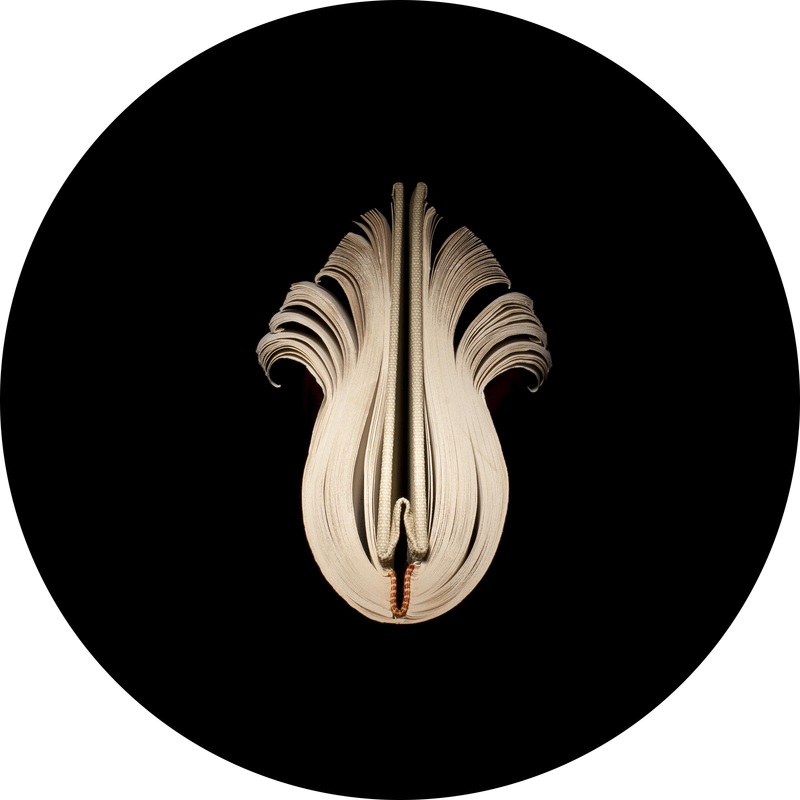
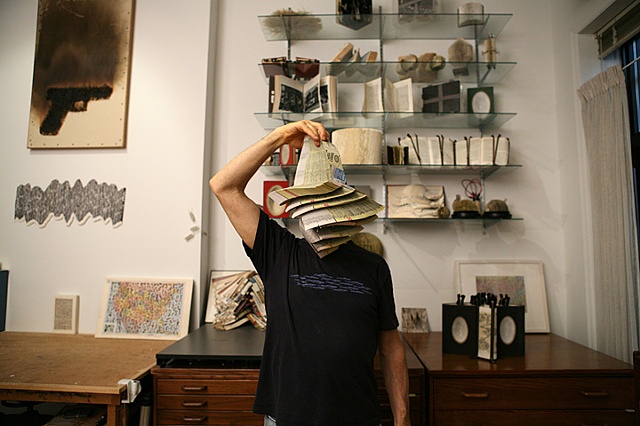
When working with books, each sheet of paper is painstakingly carved by hand with a scalpel to create forms that emerge in absence.

Artist statement. Accessed 14 March 2013.

Utopia Art Sydney represents Stillman and holds a large number of her works. Her site reproduces a 2014 interview conducted by Owen Craven for “Artist Profile Magazine” in which Stillman responds to Craven’s question about the influence of conceptual art:  

While I do appreciate that conceptual attribution, it is important for me to do something and not let the object be the work on its own. There is an inherent poetry in many objects but in my case it’s important I do something more. It is important that I create something accessible and that the viewer isn’t left scratching their heads and asking ‘am I missing something’.  

And yet most of her work depends on what is missing.

Bookmark — The ABC of Bookmarking

romandelarose
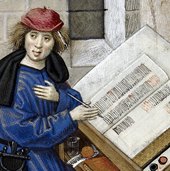
Detail from Harley MS 4425, Roman de la Rose

767479
Historia Rerum Ubique Gestarum

The British Library‘s “Medieval and Earlier Manuscripts” blog is a reliable source of visual delight and provocation to think about the interplay of the print and digital worlds.  It also prompts the application of Ezra Pound’s critical technique of juxtaposing works, demonstrated so well in his The ABC of Reading.

Earlier this year, Ann Tomalak, Conservator, Greek Manuscripts Digitisation Project, posted “Digitising Manuscripts:  The Condition Assessment,” a wonderful essay that warrants reading alongside A Degree of Mastery by Annie Tremmel Wilcox.

I have read A Degree of Mastery from cover to cover twice.  Once in New York between 2002 and 2005 when I was teaching “Professional Book and Information Publishing” at NYU and wanted readings to help provide students with a sense of the history, art and craft of the book. The second time here and now in Windsor looking for the “right something” to include in “Books On Books.”

On both occasions ebooks and digital publishing pervaded my thoughts, but only on the second time around did these questions and observations I want to raise now shape themselves as they have.

Annie Tremmel Wilcox weaves a memoir of her apprenticeship under the renowned bookbinder and conservator William Anthony.  She weaves it with her diary entries, excerpts from an exhibit brochure “Saving Our Books and Words: The Conservation and Preservation of Books,” newspaper articles, correspondence, passages from “Japanese Woodworking Tools: Their Tradition, Spirit and Use” by Toshio Odate, step by step descriptions of mending torn pages and crumbling leather spines and plainspoken observation of fellow workers, conference attendees, librarians, government officials posing with restored documents, children making “books” from striped computer paper with wallpaper sewn on for covers and, of course, Bill Anthony, the “Johnny Appleseed of bookbinding.”

“Weaves” is the precise word for the structure of her book’s narrative, and it would be the right word for her ebook, if there were one.  As I re-read it, this game of word substitution yielded questions that make this memoir a useful means to bookmark the evolution of the book.

Writing about some of the tools she learns to use — lifting knives, translucent bone folders, the spokeshave and others — she says of Anthony’s, “His tools were smarter than mine. They knew the correct way to cut paper or pare leather. By using them I could feel in my hands how the tools were supposed to work.” (48)  For Wilcox and her reader, Bill Anthony is the master “shokunin,” craftsman or artisan.  And when she quotes from Odate “For the ‘shokunin,’ utility and appearance must be enhanced by the tool’s ‘presence,’ that is its refinement and dignity….,” this reader asks,

What are the tools of the ebook maker? From whence comes their refinement and dignity — their “presence” — with which the “shokunin” imbues his creation as a result of his commitment to his craft?  In what tools of the ebookmaker does “the spirit of the tool that records the ‘shokunin’s’ ability through the years to face the uncertainties of life, to overcome them, and to master the art of living” reside?

Too Zen? Perhaps.

An English grad student, Wilcox relished handling the University of Iowa‘s Sir Walter Scott Collection, its Leigh Hunt Collection and The Works of Rudyard Kipling.  Confronted with earlier slapdash and botched work on certain volumes of the Kipling, she writes, “Certainly these volumes of Kipling are found on the shelves of numerous libraries across the country, but the integrity of ‘these’ volumes as a complete set has been lost.” (179)  What constitutes the “integrity” of an ebook or its constituents? Are ebooks so “immaterial” that such a question is nonsensical?

The author’s apprenticeship included collaboration on the exhibit “Saving Our Books and Words.”  In addition to coauthoring the exhibit’s brochure, Wilcox contributed to completing Anthony’s special project of developing for the exhibit a unique collection of models demonstrating “the evolution of the codex – the form of the book as we know it.”(181)  In the brochure she touches on the immateriality and materiality of the Center’s work: “Simply defined, preservation is the attempt to save the intellectual content of books while conservation is the attempt to save both the intellectual content and its vehicle — the covers, paper, endbands, etc. The former is concerned with saving what the human record contains without regard to the forms it winds up in. The latter focuses on the artifact itself, attempts to save this book, this sheet.” (192)

What is the “form” of the ebook as we know it? Is the ebook as much “vehicle” as “content”?  What are its equivalencies to the page or to what “binds” the “text block”?  What does it mean to “conserve” an ebook?  Of a digital copy, what are the materials; what is the artifact to be conserved?

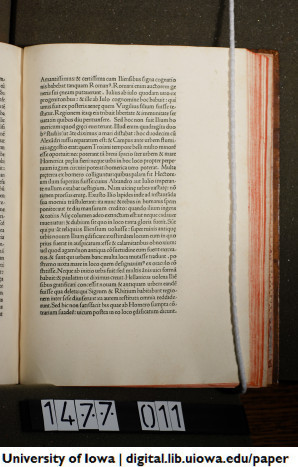
Wilcox ends her memoir with the completion of her “masterpiece,” the restoration of the incunabulum that Bill Anthony assigned her before his death and which she completed after it with the help of “The Restoration of Leather Bindings” by Bernard Middleton, author of the standard text “A History of English Craft Bookbinding Technique.”  The work assigned was Pope Pius II’s “Historia Rerum Ubique Gestarum,” printed by Johannes De Colonia and Johannes Manthen in Venice in 1477, which when restored was “not a deluxe edition, but … had great integrity.”  In the year 2547, of what will the preservation and conservation of today’s e-incunabula consist?  Will some apprentice conservator understand the “form” of these ebooks “in the cradle” and, master of smart tools, restore them to their integrity?

With Ann Tomalak’s essay, perhaps we can see that future through her present lense on the past.  Give it a read.

Bookmarking Book Art — Georgia Russell

Georgia Russell’s
De Baudelaire au Surréalisme 2007

From England & Co’s online gallery:

“Russell’s work with books began during an artists’ residency in Paris while she was a student at the Royal College of Art. Old books have always seemed to her like sculptural objects ‘representing the many hands which have held them and the minds they have passed through’. She says that she has always chosen something which ‘holds within it a sense of its own personal history, an object which has a secret life’, and wants to resurrect her fragile materials and give them ‘a new life and new meaning’. There is a simultaneous sense of loss and preservation in each construction, as she wants to retain and reclaim the past as much as her techniques attack it.”

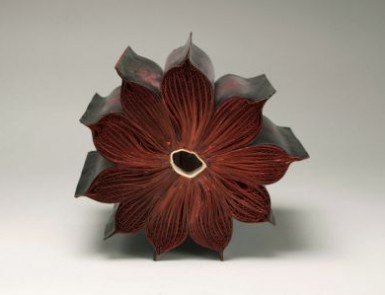
Like the phenomena in our transition between analog and digital, Russell’s shredded books and the other instances of book art or “bookworks” bookmarked here constitute another form of “creative destruction” to stretch Schumpeter’s economic concept.

The opening up of new markets, foreign or domestic, and the organizational development from the craft shop to such concerns as U.S. Steel illustrate the same process of industrial mutation—if I may use that biological term—that incessantly revolutionizes the economic structure from within, incessantly destroying the old one, incessantly creating a new one. This process of Creative Destruction is the essential fact about capitalism.

                      Capitalism, Socialism and Democracy (1942), p.83

Of course, without the old print book industry’s output, our Scottish artist and her kith and “ken” will eventually face a scarcity of raw material for their new art industry.  A sure sign of a misapplied economic theory, however apropos and paradoxical the misappropriation of the paradox may feel.

See also The First Seven Books of the Papier Biënnale Rijswijk

Bookmarking Book Art — Thomas Allen

wsj_ipad
Stories
Posted on March 9, 2013 by Thomas Allen

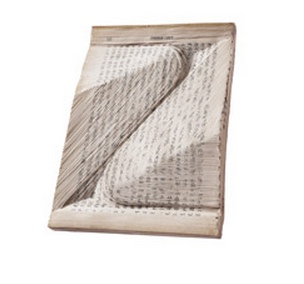
This image of Thomas Allen’s book art appears along with the story about fellow-North Carolinian Hugh Howey‘s self-published novel WOOL in the 7 March 2013 edition of The Wall Street Journal but only in the iPad App version. Go to SECTIONS, then ARENA.

Click on the image to the left to go to Allen’s website to see more of his work and find out how to purchase it.   If you can find the Fall 2006 issue of Zoetrope:  All Story, you can see more of Allen’s work, but click here to read Chip Kidd’s comments on Allen’s artistry.

Bookmarking a Book Burning – I

Julian Baggini (Aeon) has posted a thoughtful piecejulian-baggini-burning-books on the need for an important cultural artifact to evolve — not just in its codex form but in its very essence — the encyclopedia.  One reader/viewer (there’s a video as well) commented:

Which is worse? Burning books because they are now available in an electronic format? Or not having any physical books to burn, unless you steal them from a museum or collector?

Hold that thought (an “argument by false dichotomy”) and go to Baggini’s concluding paragraph:

I can’t help but mourn the passing of my set of Britannicas, but I do not mourn the passing of the institution. Encyclopædias have passed their use-by-date as fitting symbols for the esteem in which we hold culture and learning. The world is changing, and books, magazines and education have to change with it. Nostalgia for obsolete publications serves us only if we use it to remind us of the things we really value, and want to take forward into our own new world.

What if, though, the things we value and want to take forward into our new world are caught up in the “affordances” of such tangible institutions as the encyclopedia.  Maryanne Wolf hits this chord hard in Proust and the Squid when she worries about the effect of the Google universe on the nature of her children’s ability to read:

Reading is a neuronally and intellectually circuitous act, enriched as much by the unpredictable indirections of a reader’s inferences and thoughts as by the direct message from the eye to the text. … Will the constructive component at the heart of reading begin to change and potentially atrophy as we shift to computer-presented text, in which massive amounts of information appear instantaneously? … is there either sufficient time or sufficient motivation to process the information more inferentially, analytically and critically? … Or does the potential added information from hyperlinked text contribute to the development of the child’s thinking? …

I stray with these questions. But indeed we stray often when we read.  Far from being negative, this associative dimension is part of the generative quality at the heart of reading. … Charles Darwin saw in creation a similar principle, … ‘From so simple a beginning, endless forms most beautiful and most wonderful have been, and are being evolved.’  So it is with written language.  Biologically and intellectually, reading allows the species to go ‘beyond the information given’ to create endless thoughts most beautiful and wonderful.   We must not lose this essential quality in our present moment of historical transition to new ways of acquiring, processing and comprehending information. (pp. 16-17)

To go back to Baggini’s troubled reader/viewer, we will not burn books because we have them electronically.  As our different types of books evolve, some we will have electronically only and some we will have both in print and electronically.  We already have many digitised rare books and manuscripts in libraries, museums and collectors’ holdings.  Most people’s exposure to those works can only be electronic, and the more this is the case, the less the need to steal them.   But also the greater the need to understand and innovate to address the loss of tactility and the proprioceptive experience of “curling up with a good book.”  In alluding to Jerome Bruner’s collection of essays Beyond the Information Given, Wolf is reminding us (linking us?) to Bruner’s apt observation that Lev Vygotsky, the famous Soviet developmental psychologist, “was fond of an epigram from Bacon, “Nec manus, nisi intellectus, sibi permissus, multum valent” (Neither hand nor intellect left each to itself is worth much)” (247).   Perhaps neither print nor digital left each to itself is sufficient.

Bookmarking — A Variable Redletter Day?

In a report possibly falling under the category “What the Font?” or  simply “Sans Clue,” PoliceSpecials.com carried this story from the BBC today:

“Thousands of motorway speeding convictions could be overturned because the font used to display the numbers on some variable speed limit signs may not have complied with traffic regulations.  The Crown Prosecution Service said the signs showed mph numbers taller and narrower than they should have been.”

The typefaces mandated by the Department of Transport for traffic speed limit signs are Transport Medium, Transport Heavy and Motorway Permanent.  The designers were Jock Kinneir and Margaret Calvert.   Simon Garfield provides an amusing chapter in Just My Type on how their design came to be adopted.  But the typeface in question on which the BBC has belatedly reported (see the Daily Mail for the original scoop last December) is this:

variable

According to roadsuk.com (well, that is the URL, although a bit of blue in the letters “u” and “k” help to disambiguate the message),  the font seems to be named (imaginative this) “Variable Message Sign.”   But in the Daily Mail article, neither the “wrong” nor “right” signs illustrated seems to be in the Variable Message Sign typeface.  So, what the font?

article-2251985-169E2590000005DC-278_634x671 article-2251985-169E2560000005DC-717_634x668

Bookmarking The Gutenberg Bible – The Digital in Support of the Print

The beginning of the Gutenberg Bible: Volume 1...

The Harry Ransom Center at the University of Texas at Austin has updated its site displaying one of the only five copies of the Gutenberg Bible in the US.   There is much to admire here, and much to be curious about.  The illustration of the watermarks that distinguish the Pforzheimer Bible, the map of locations of other copies (complete and incomplete), the page-turning interactivity and the inclusion of a kids section are welcome.

The interactive map showing the spread of printing, however, does not compare well with those at Jeremy Norman’s From Cave Paintings to the Internet Database Maps, and an explanation of how the Center’s Bible was digitized, something on the order of Ann Tomalak’s informative essay at the British Library’s site describing what conservators must do to prepare fragile manuscripts for digitization, would enrich the Ransom Center’s offering.   

Equally the history of Gutenberg the man and his work with Johann Fust could have been more detailed as could the history of printing and its spread.  Jeremy Norman’s site is still hard to rival.  Other related sites worth a bookmark:

Sarah McCarthy’s review of Hendrik Willem van Loon’s Observations on the Mystery of Print and the Work of Johann Gutenberg at the New York City’s Center for Book Arts

Jeremy Norman’s speculation on Gutenberg’s possible contribution to stereotype printing

The British Library’s site where you can compare paper and vellum copies of the Gutenberg Bible

The Göttingen Gutenberg Bible site where you can also find reproduced the notarial instrument on the financial dispute between Gutenberg and Fust

The Keio University site that allows you to compare the Keio Gutenberg Bible with that of the University of Cambridge (require Javascript plugin)

And of course the Mainz Gutenberg Bible.

Bookmark for Marginalia and Note-taking

Annotation function in Utopiadocs.
Annotation function in Utopiadocs. Copyright © 2012 Lost Island Labs.

imgres
Nathaniel Hawthorne
Herman Melville
New York, NY; Salem, MA, 1846-1850. ©2012 The President and Fellows of Harvard College

Earlier this month, we saw the release of the Open Annotation Community Group’s specification of the Open Annotation Core Data Model, an interoperable framework for creating annotations that can be easily shared between platforms.  The work, directed by Robert Sanderson and Paolo Ciccarese, began in earnest about six months ago, although it was proceeded by longstanding efforts within and between the editors of the Annotation Ontology and the Open Annotation Collaboration.  Under the auspices of the W3C, the efforts merged into the Open Annotation Community Group (OACG).

The OACG model defines an annotation as “a set of connected resources, typically including a body and target, where the body is somehow about the target,” and the full model  “supports additional functionality, enabling semantic annotations, embedding content, selecting segments of resources, choosing the appropriate representation of a resource and providing styling hints for consuming clients.”    Public rollout events are scheduled for 9 April (Stanford University), 6 May (University of Maryland) and 24 June (University of Manchester).

Back in November last year, while the Open Annotation Community Group (OACG) was thrashing through how to handle collections of annotations and other ontological issues, the Radcliffe Institute for Advanced Studies at Harvard University held a two-day symposium called “Take Note,”  marking the conclusion of a two-year project on the history and future of note-taking.  The project also resulted in a virtual exhibition of objects and works from the Harvard University Collections with notes ranging from a price list inscribed on a potsherd to a clothes list on papyrus found in an Egyptian garbage dump to Herman Melville’s annotations of his review copy of Hawthorne’s Mosses from an Old Manse (see image above).    The exhibition was curated by Greg AfinogenovAnn Blair and Leah Price, and interestingly, the OACG’s Paolo Ciccarese contributed to building the exhibition’s website.

So besides Paolo Ciccarese’s involvement, what’s the connection between these two events?   Perhaps the link is captured in three comments from the participants:

Bill Sherman, historian at the University of York and author of Used Books: Marking Readers in Renaissance England, commented to a reporter,  “We’re now in a moment where we’re leaving behind fewer traces of our reading than ever before…. We may have moved to the turning point where…we’ll have to find new ways to leave more behind.” And as Matthew Kirschenbaum has spelt out in Mechanisms, historians will have to learn new ways to decipher what is left behind.

David Weinberger, author of The Cluetrain Manifesto and long-time blogger, tweeted (according to the Harvard Gazette reporter), “”Collaborative notetaking via etherpad or GoogleDocs etc. is often a great way to go. Fascinating to participate in, too,’ during an afternoon presentation that explored digital annotation tools.”  Like Bob Stein, the co-founder of the FutureoftheBook.com, Weinberger is a champion of social reading and collaborative creativity.

Another participant told the Gazette’s reporter, “’I was struck by the request that we send our notes into Radcliffe because my reaction was, “You know, my notes are really none of your business. My notes are my private thoughts, my private collaborations.” Until I am dead, I don’t really need other people looking at them.'”  That last comment is particularly fetching:  one wonders whether William James and Herman Melville had such an eye on posterity as they scribbled their notes now on display across the Web.

As the book evolves and we annotate works in our ereaders (offline or online), how do we ensure that they persist, and whether offline or online, how do we handle how private or public those notes will be?

Earlier this month, Books on Books raised proprietorial questions about annotated ebooks in response to Nicholas Carr’s article “Used e-book, slightly foxed” sparked by the Amazon patent for selling pre-loved ebooks.  On his site, Carr responded with his own questions:

“[W]hat’s the relationship (legal and otherwise) between an e-book and the annotations added to it by its reader? Are the annotations attached to the particular copy of the e-book, and allowed to remain attached to it when it passes to a new reader, or do the annotations exist in a separate sphere — say, in a personal online database that is the property of the individual reader? … what right does the copyright holder (in particular, the author) hold over the way an e-book is presented? If annotations, or other metadata, in effect become part of the text, permanently or even temporarily, then does that represent a modification of the work that requires the consent of the author? You can’t publish an annotated print edition of a book under copyright without the copyright holder’s permission. Do different rules apply to an e-book?” (Carr’s questions elicited an interesting comment at Futureofthebook.com:  “perhaps the interdependence of print and screen books is inevitable….”)

In some respects, by digitizing and reproducing others’ property (appropriately acquired through bequests, gifts and so on), the Harvard University Collections’ virtual exhibition illustrates Carr’s questions and those of the symposia participants — even the comment from Future of the Book — in a beautifully “tangible” way.  Think upon it.


Bookmarking Book Art – Books on Book Art | 4 August 2013

See also Resources (in progress) page.

81sxtcfbKiL._SL1500_

Abt, Jeffrey. The Book Made Art: A Selection of Contemporary artists’ Books Exhibited in Joseph Regenstein Library – University of Chicago, February Through April 1986 Exhibition catalog.

Antaya, Christine and Sloman, PaulBook Art: Iconic Sculptures and Installations Made from Books Gestalten (May 26, 2011). Documents current art, installation, and design created with and from books. “The fascinating range of examples in Book Art is eloquent proof that–despite or because of digital media’s inroads as sources of text information–the book’s legacy as an object and a carrier of ideas and communication is being expanded today in the creative realm.” Book jacket. See interview with Antaya and some of the artists here.

The Book as Instrument: Stephane Mallarmé, the Artist’s Book, and the Transformation of Print Culture – Anna Sigridur Arnar. An academic study of the literary and cultural seedbed of book art. “This is a highly ambitious, original account of Stéphane Mallarmé’s lifelong engagement with the book and the vast network of forces (cultural, aesthetic, political) that both informed this engagement and were transformed by it. Anna Sigrídur Arnar seamlessly brings together divergent areas of inquiry in order to support the idea that the book was and remains a site of numerous debates about democracy, public and private space, the uses of art and print, and the role of authors and readers. The Book as Instrument is elegantly written, in engaging and highly readable prose. Arnar succeeds in presenting and analyzing with remarkable lucidity ideas that many of us have learned to approach as difficult and thus nearly off-limits. This will be an important work of scholarship for a variety of disciplines.” (Willa Z. Silverman, Pennsylvania State University).

Art Is Books: Kunstenaarsboeken/Livres D’Artistes/Artist’s Books/Künstlerbücher – Guy Bleus. Catalog of a travelling exhibition in 1991. See also Artists’ Books on Tour edited by Kristina Pokorny-Nagel.

No Longer Innocent: Book Art In America 1960-1980 – Betty Bright. A history of an important period in book art. Like Drucker (below), Bright categorizes book art, places it within the movements of the period and profiles its individual and institutional supporters. Artbook review.

Artists’ Books: The Book As a Work of Art, 1963-1995Stephen Bury. Explores the impact artists had on the format of the book.

A Century of Artists Books — Riva Castleman. New York: Museum of Modern Art, 1994. NAL pressmark: AB.94.0020. A catalog of an exhibition held at the Museum of Modern Art in New York. The selection tends toward the livre d’artiste but does address the impact of the digital shift on artists’ books.

Chapon, François. Le Peintre et le Livre: l’Age d’Or du Livre Illustré en France 1870–1970. Paris: Flammarion, 1987. NAL pressmark: 507.C.172

Courtney, Cathy. Speaking of Book Art: Interviews with British and American Book Artists. Los Altos Hills: Anderson-Lovelace, 1999. NAL pressmark: AB.99.0001

New Directions in Altered Books – Gabe Cyr. A book of projects and techniques by a book artist.

The Century of Artists Books – Johanna Drucker. “A folded fan, a set of blocks, words embedded in lucite: artists’ books are a singular form of imaginative expression. With the insight of the artist and the discernment of the art historian, Drucker details over 200 of these works, relating them to the variety of art movements of the last century and tracing their development in form and concept. This work, one of the first full-length studies available of artists’ books, provides both a critical analysis of the structures themselves and a basis for further reflection on the philosophical and conceptual roles they play. From codex to document, from performance to self-image, the world of artists’ books is made available to student and teacher, collector and connoisseur. A useful work for all art collections, both public and academic.”Paula Frosch, Metropolitan Museum of Art Library, Library Journal.

#5168 Altered Book – Special Effects (Design Originals) – Laurie Goodson. One of a series of booklets on book-alteration techniques. Other authors include Beth Cote and Cindy Pestka.

Altered Books, Collaborative Journals, and Other Adventures in Bookmaking – Holly Harrison. A showcase of book art with an emphasis on multi-artist collaborations.

The Cutting Edge Of Reading: Artists’ Books – Judd Hubert and Renee Hubert. Published in 1999, a close examination of 40 examples of book art. Illustrated.

Books Unbound – Michael Jacobs. A book of projects by a book artist.

Johnson, Robert Flynn. Artists Books in the Modern Era 1870–2000: the Reva and David Logan Collection of Illustrated Books. London: Thames & Hudson, 2002. NAL pressmark: AB.2001.0002

Artists’ Books: A Critical Survey Of The Literature – Stefan Klima. A 1998 monograph summarizing the debates over the artists’ book. 

Book + Art: Handcrafting Artists’ Books – Dorothy Simpson Krause. A book of projects by a book artist; covers mixed-media techniques as well as bookbinding.

The Penland Book of Handmade Books – Jane LaFerla (Editor); Alice Gunter (Editor); Lark Books Staff. Tutorials, inspiration and reflective essays by book artists.

500 Handmade Books – Steve Miller. A highly illustrated, wide-ranging coffee table book.

Artists’ Books on Tour – Kathrin Pokorny-Nagel. Catalog of a travelling exhibition organized and sponsored by MAK (Austrian Museum of Applied Arts, Vienna), MGLC (Llubljana’s International Centre of Graphic Arts) and UPM (Museum of Decorative Arts) in 2011.

1,000 Artists’ Books: Exploring the Book as Art – Peter and Donna Thomas, Sandra Salamony. External and internal views of works, descriptions at the end of the book.

Joseph Cornell’s Manual of Marvels: How Joseph Cornell reinvented a French agricultural manual to create an American masterpiece – Dickran Tashjian and Analisa Leppanen-Guerra (editors). A part-facsimile, part-DVD, part-boxed-presentation that gives some idea of the artwork by Joseph Cornell held in the Philadelphia Museum of Art. The artwork is Cornell’s alteration of the Journal d’Agriculture Practique (Volume 21, 1911), a handbook of advice for farmers.

Playing with Books: The Art of Upcycling, Deconstructing, and Reimagining the Book – Jason Thompson. Techniques-driven; covers bookbinding, woodworking, paper crafting, origami, and textile and decorative arts techniques.

Masters: Book Arts: Major Works by Leading Artists – Eileen Wallace. Illustrated selection of work from 43 master book artists with brief comments from the artists about their work, careers, and philosophies.

The Book As Art – Krystyna Wasserman; Audrey Niffenegger (Text by); Johanna Drucker (Text by). An illustrated volume covering over 100 artists books held in the permanent collection of the Museum of Women in the Arts, Washington, D.C.

Book Art: Creative Ideas to Transform Your Books, Decorations, Stationary, Display Scenes and More – Claire Youngs. A crafts book of 35 projects.