Bookmarking Book Art – Giorgio & Giulio Maffei

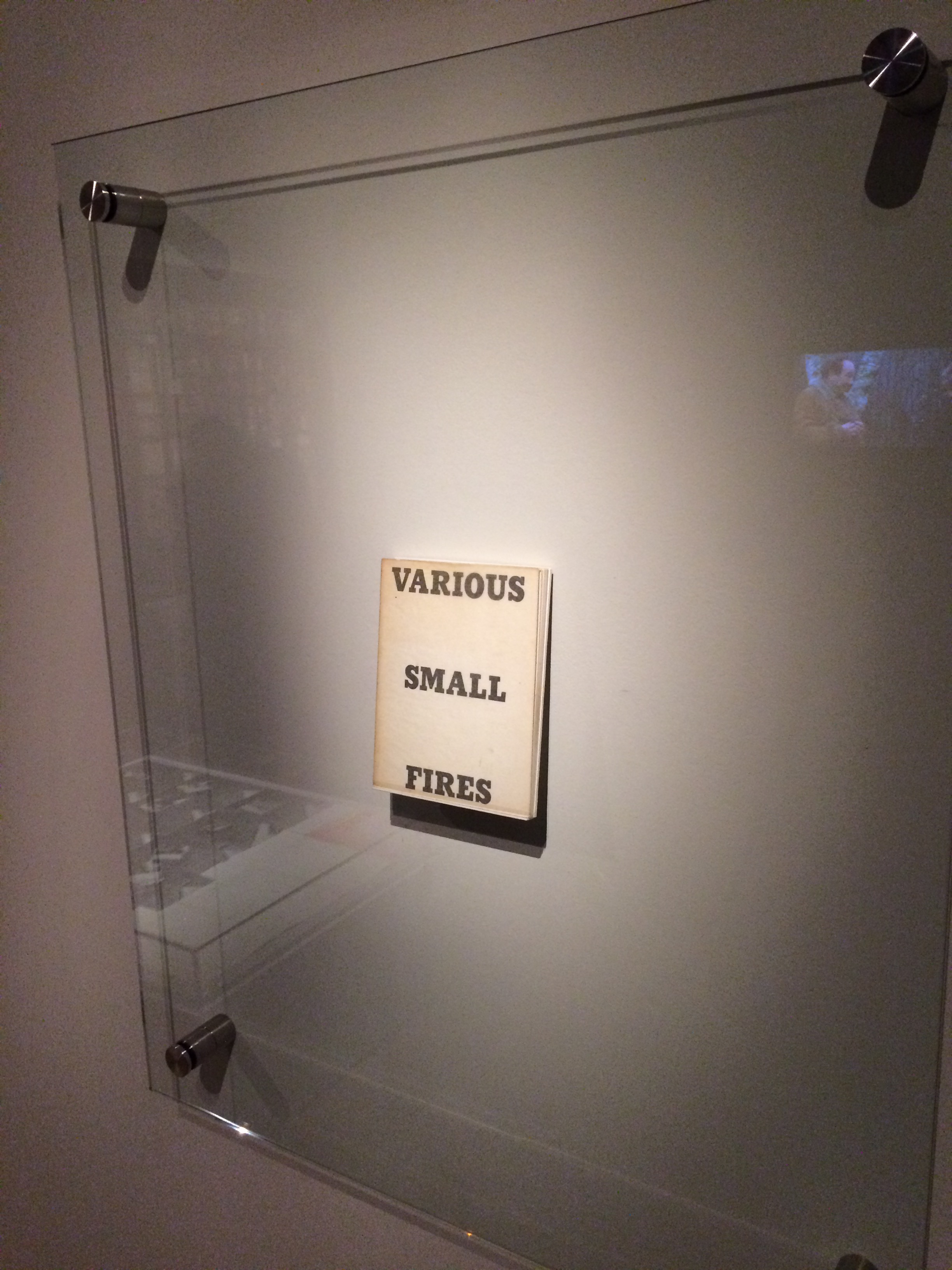
Display of Ed Ruscha's Various Small Fires and Milk, 1964, at Pliure: La Part du Feu, 2 February - 12 April 2015, Paris. Photo by Robert Bolick. Reflected in the lower left hand corner is the display of Bruce Nauman's Burning Small Fires; in the upper right corner, the film clip of Truffaut's 1966 Fahrenheit 451; and in the upper left, Maria Helena Vieira da Silva's La bibliotheque en feu, 1974.
Display of Ed Ruscha’s Various Small Fires and Milk, 1964
Pliure: La Part du Feu, 2 February – 12 April 2015, Paris, Fondation Calouste-Gulbenkian.
Photo by Robert Bolick, 11 April 2015.
Reflected in the lower left hand corner is the display of Bruce Nauman’s Burning Small Fires, 1968; in the upper right corner, the film clip of Truffaut’s 1966 Fahrenheit 451; and in the upper left, Maria Helena Vieira da Silva’s La bibliotheque en feu, 1974.

The Studio Bibliografico Giorgio Maffei specializes in original texts and book art by twentieth century visual and literary avant-garde artists such Baldessari, Lewitt, Munari, Man Ray, Ruscha and Warhol among others. Recently the owner’s son – Giulio Maffei – “started making film as a side activity” and introduced a series of short animations “to put on the social networks and reach new potential customers”.  An anonymous pair of hands displays a variety of the books and book art in stock.

But Giulio’s videos are not always the straightforward marketing effort intended. They provide an experience of book art or artists’ books that most of us will never hold or touch. And that may be Maffei’s point in his series “Le Vite dei Libri” (The Lives of Books) in which these usually glassed-off works are playfully handled, gently made fun of and still honored.

Some of the videos are derivative artworks in their own right in the same vein as Bruce Nauman’s Burning Small Fires, 1968.  Nauman poked fun at Ed Ruscha’s Various Small Fires and Milk, 1964, by composing a book of photos recording the burning of a copy of Various Small Fires. Maffei’s Nauman-esque handling of Various Small Fires and Milk involves flash paper or its Photoshop equivalent.  His celebration of Ruscha’s The Sunset Strip is still more endearing with its soundtrack and toy convertible. His cheeky animations of the pop-ups in Warhol’s Index (Book) and the ironically daring destruction of Papa Maffei’s copy of Some/Thing No.3 are even better.  In the latter, the plastering of a Banksy-like mural with Warhol’s “Bomb Hanoi” stickers torn from the perforated cover is a sharp-edged example of the arch, reflective commentaries throughout Maffei’s videos.

Most of the films’ credits pay typographical homage to the work at hand, which is a nice self-deprecating and affectionate touch.  At my last viewing, there were twenty-two works in the Lives series.  They are listed below, but once you reach one on YouTube, the others follow. Giulio Maffei has also created a longer video catalogue for his father’s enterprise: Tra Libro e Oggetto (Between Book and Object). The Maffeis are a knowing team. The catalog title can be read as the beginning of a statement displayed on the cover.

BETWEEN BOOK AND OBJECT

The artists’ book, the multiple and the object

become an artwork

A statement that refers not only to the works in the catalog but to the video catalog itself and to the elder Maffei’s lifework of collecting, selling and writing about book art.

1 – An Unreadable Quadrat Print, Bruno Munari

2 – The Sunset Strip, Ed Ruscha

3 – Nine Swimming Pools, Ed Ruscha

4 – Various Small Fires, Ed Ruscha

5 – Andy Warhol’s Children’s Book, Andy Warhol

6 – Choosing Green Beans, John Baldessari

7 – Kleve 2009, Ettore Spalletti

8 – Made in Machine, Jean-François Bory

9 – Cieli ad Alta Quota, Alighiero Boetti

10 – Il Merlo Ha Perso il Becco, Bruno Munari

11 – Mémoires, Guy Debord, Asger Jorn

12 – Zang Tumb Tuuum, Filippo Tommaso Marinetti

13 – Acervus, Luigi Ontani

14 – Toiletpaper JAN 2011, Maurizio Cattelan & Pierpaolo Ferrari

15 – Toiletpaper JUL 2012, Maurizio Cattelan & Pierpaolo Ferrari

16 – Les Illuminations, Fernand Léger & Arthur Rimbaud

17 – Man Ray, Man Ray

18 – The Biggest Art-Book in the World, Enrico Baj

19 – Fable, John Baldessari

20 – Air Condition, Allan Kaprow

21 – Andy Warhol’s Index (Book), Andy Warhol

22 – Some/Thing No.3, ed. David Antin, cover by Andy Warhol
Bookmarking Book Art – The Banff Centre, Paul D. Fleck Library & Archives

From Alberta, Canada

Now added to BooksOnBooks’ blogs followed.

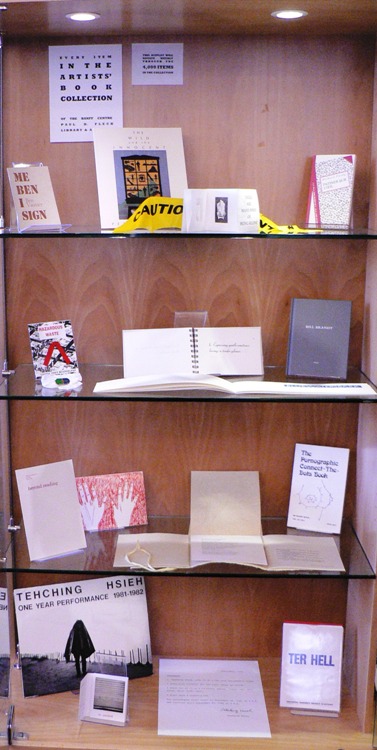
The Paul D. Fleck Library & Archives at The Banff Centre has over 4,000 artists’ books and multiples. Inspired by Ed Ruscha’s seminalbook “Every Building on the Sunset Strip”, we will display every item in the collection in a case in the library, rotating through 15 items weekly. Here you will find a photo log documenting the items, chosen randomly for display. Click through on any photo for title and creator caption.

For more information and full catalogue records for the items pictured, visit banffcentre.ca/library/.

Kudos to book artist Jaye Fishel for setting up Every Item in the Artists’ Books Collection and to Silvio Lorusso for the interview with Fishel.

Bookmarking Book Art – Exhibit at the Grosvenor Rare Book Room

title“There is art to be found in science books and science to be found in artist’s books.”

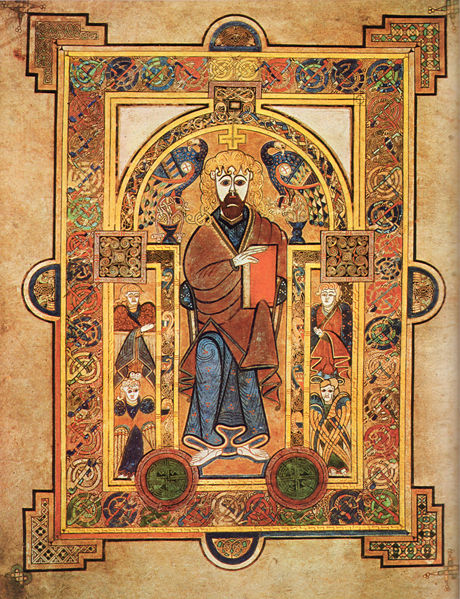
The Buffalo & Erie County Public Library has been kind enough to share the exhibit labels for its display held in March this year in the Grosvenor Rare Book Room. The section devoted to “Artist’s Book History” begins with the Book of Kells and runs to Ed Ruscha’s Twentysix Gasoline Stations.

460px-KellsFol032vChristEnthroned

Although many will claim that artist’s books began with William Blake in the 1700’s or so that would dismiss entirely all of the artistry that went into many lovely and ornate illuminated manuscripts that proceeded and somewhat overlapped the printed text in codex form. Whether painted in monastic scriptoria, as was the Book of Kells (c. 800), or by secular guild artists as were many others, the figures and/or flora are artworks to behold.

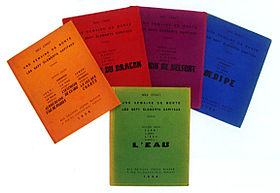
280px-UneSemaineDeBonteWorld Wars I & II brought many artist books associated with the Avant-Garde, Futurist and Surrealism Movements. Max Ernst’s Une Semaine de Bonté (1934).

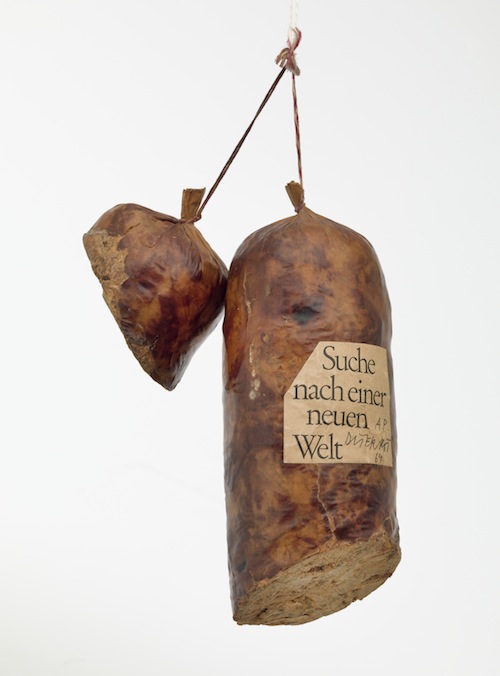
Dieter Roth, “Literature Sausage (Literaturwurst),” 1969, published 1961-70. Artist’s book of ground copy of Suche nach einer Neuen Welt by Robert F. Kennedy. Gelatin, lard, and spices in natural casing. Overall (approx.) 12 x 6 11/16 x 3 9/16 in. The Museum of Modern Art, New York. The Print Associates Fund in honor of Deborah Wye.

The second half of the nineteenth [sic] century brought Dieter Roth and Ed Ruscha’s works. Roth was a Swiss artist for whom the book was just one of his media. Paint, sculpture, installation work and more also provided means of artistic expression.

images

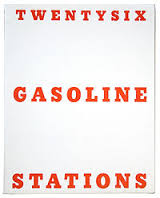
Ed Ruscha is an American pop artist whose focus is in paint, drawing, printmaking and photography. His Twentysix Gasoline Stations (1963) photographically captures gas stations in book form as Andy Warhol did Campbell soup cans on canvas. This artist’s book is considered an important milestone for the genre.

Ruscha’s book also figures in the exhibit section called “Artist’s Books and Bookworks Today” along with works by Julie Chen and Susan Allix as examples of the growing availability of collectible book art today.

Personal Paradigms, Julie Chen, 2004

Julie Chen founded Flying Fish Press in California through which she creates handmade “artists’ books with an emphasis on three-dimensional and movable book structures and fine letterpress printing” according to her web site. These books are frequently moveable and/or interactive in their design.

Egyptian Green, Susan Allix, 2003
“The texts in Egyptian Green are mainly drawn from travellers visiting or writing about Egypt. The earliest is a spell written inside an ancient coffin; later writers include Plutarch and Catullus, also Leonhart Rauwolff, who noted in 1672 that the water of the Nile was “perfectly green”, and Amelia Edwards on the precise colour of palm trees. There are two calligraphic pieces of Kufic script printed from the original blocks found in Cairo.”

British book artist Susan Allix also has her own (self-titled) press and she creates handmade books with a variety of fine papers and textures with letterpress printing, embossing and all manner of printmaking. Though some of her books convey a certain whimsy, the choice of materials, method of printing and crafts[wo]manship is the result of serious thought, planning and selection.

Other sections are devoted to historical examples of illustrated works of scientists such as Vesalius and Lamarck, which are well punctuated by the inclusion of Guy Laramée’s Grand Larousse, Brian Dettmer’s The Household Physicians and Doug Beube’s Fault Lines.

Grand Larousse, Guy Laramee, 2010
Grand Larousse, Guy Laramée, 2010

The Household Physicians, 2008
The Household Physicians, Brian Dettmer, 2008

Fault Lines, Doug Beube, 2003

Books altered and/or sculpted by artists to represent something other than the original readable text are known as bookworks and they are works of art. This type of art is not technically an artist’s book whereby a book is created. Altered/sculptural books take from a book that had already been created and turn it into art by cutting, folding and/or sculpting it into an art form. Although there are many examples of this type of work, perhaps the most inspiring artists’ works (some available in art galleries today) are those by contemporary and still-creating Canadian Guy Laramée, American Brian Dettmer and Toronto-born, schooled-(in part)-in-Rochester/Buffalo and now-living-in-New-York-City Doug Beube. The examples of their works shown are all pieces inspired by some aspect of science or subject of scientific study including geology, medicine and geography.

The theme of the exhibit deserves a catalogue. As the exhibit’s online announcement notes, “Today’s mutually exclusive idea of ‘left-brained’ and ‘right-brained’ activity discounts longer understood ideas that science is a creative pursuit—that there really is art to be found in science—and that creative artworks often have some scientific basis and/or inspiration.” One would do well to start with Harry Robin’s The Scientific Image: From Cave to Computer (1992) and Brian Ford’s Images of Science: A History of Scientific Illustration (1993) and take further inspiration from the Grosvenor Rare Book Room.

via New Exhibit on First Day of Spring! | Grosvenor Rare Book Room and [Book] Art Inspired by Science [Books]

Permissions courtesy of Amy J. Pickard, Rare Book Curator, Buffalo & Erie County Public Library, 1 Lafayette Square, Buffalo, New York 14203.