Bookmarking Book Art – The Art of Reading in a “Post-Text Future”

Did you read on New York Times Interactive how text is succumbing to the sound and blurry of podcasts, YouTube, talking assistants, Netflix, face-reading phones, Instagram and augmented reality? We are passing through an internet portal turning our evolution from orality to literacy in on itself — where “text recedes to the background, and sounds and images become the universal language”.

Welcome to the post-text future.

The seemingly unintentional irony of delivering the welcome by text rather than by podcast or tweeted looping video meme undermines the hyperventilation a bit. But we should not roll our eyes and move on. The NYTI journalists are reminding us to pay attention.

Our literacy has always been multimodal (read and hear the orality in the opening text of Genesis in the The Douay Version). With each new medium it rapidly becomes more multimodal.  In Ringing the Changes on “The End of Books”, there’s the tongue-in-cheek evidence from 1894.
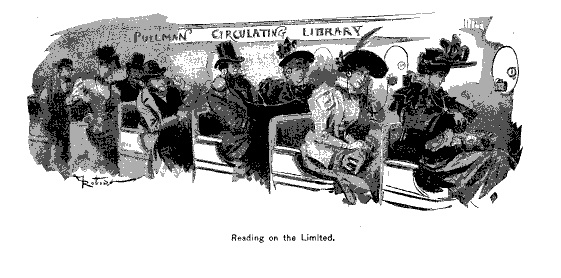
“The End of Books”, Scribner’s Magazine (August 1894)
Louis Octave Uzanne

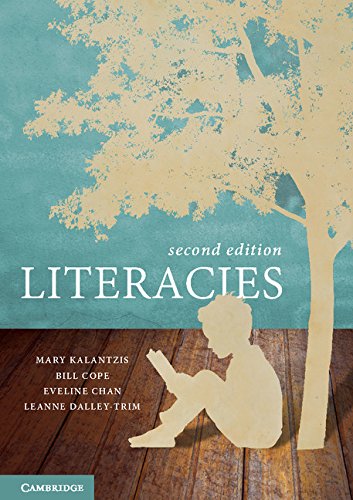
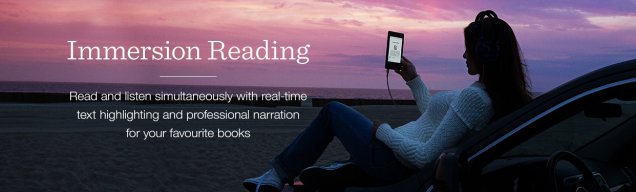
In Literacies, Mary Kalantzis and Bill Cope at the University of Illinois, Urbana-Champaign, trace its occurrence back to the mid-twentieth century age of radio and television.  And not that long ago (2012), Amazon released Immersion Reading, enabling audio in sync with ebook reading.Leaving aside the apocalyptic speculation on the fate of letters, we should take the point: our literacies are entangled and evolve together. Putting the more scholarly view of differences between orality and text alongside the post-text Futurists’ observations about tweets, memes and other social media, we can see why we would benefit from closer attention to that entanglement and evolution.

Here is Walter J. Ong:

Oral folk prefer, especially in formal discourse, not the soldier, but the brave soldier; not the princess, but the beautiful princess; not the oak, but the sturdy oak. Oral expression thus carries a load of epithets and other formulary baggage which high literacy rejects as cumbersome and tiresomely redundant because of its aggregative weight … (Orality and Literacy: The Technologizing of the Word. London: Methuen, 1982, pp.31, 37-49).

Here is the post-text future:

An information system dominated by pictures and sounds prizes emotion over rationality. It’s a world where slogans and memes have more sticking power than arguments. — Farhad Manjoo

Here is Ong:

Writing fosters abstractions that disengage knowledge from the arena where human beings struggle with one another. It separates the knower from the known. By keeping knowledge embedded in the human lifeworld, orality situates knowledge within a context of struggle.

Here is the post-text future:

Doyle Canning, who wrote a book on using memes for political movements and co-founded the Center for Story-Based Strategy, said people have now realized memes are replacing nuanced political debate.

“People in 2016 declined to take seriously the impact of the memes and clung to this narrative that rational policy discourse would triumph, … And it didn’t.”

“Now politics,” she said, is just “a battle of the memes.” Nellie Bowles

These comparisons/contrasts underscore Kalantzis’ and Cope’s educational earnestness about the importance of teaching to these entangled and evolving literacies as perhaps the only systematic means we have of offering children social equity and a chance at social equality. Imbuing their literacies with critical thinking skills is paramount. The art of living depends on the art of reading.

At the Museum Meermanno in The Hague, you can step into this increasingly busy intersection of literacies at an exhibition called The Art of Reading.  The exhibition is divided into six rooms labeled “Reading is Turning the Page”, “Reading is Seeing”, Reading is Touching”, “Reading is Remembering”, “Reading is Concentrating” and “Reading is Reacting”. Unusually the art is not simply on display. Touching is allowed. Paul van Capelleveen, one of the curators organizing the show, insisted that each work be touchable. As a curator at the Dutch national library and advisor to the Museum Meermanno (The House of the Book), he felt strongly that the challenges of multimodal literacy cannot be understood “under glass”.

2nd Hand Reading (2014)
William Kentridge

Physicality or the haptic is an affordance that print literacy lords over digital literacy. We know where we are in a print book because we can feel as well as see where we are. Welcome then to the first room “Reading is Turning the Page”, where William Kentridge turns the tables on that claim. As you watch the “film of the book” across the room, you can try your hand at flipping the pages of the physical copy like a flipbook to mimic the video. Look closely though. The page numbers are not sequential.
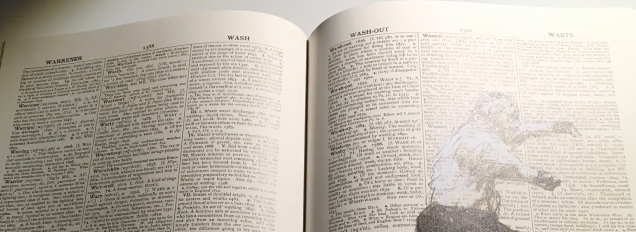
2nd Hand Reading (2014)
Page 2388 then 2390?

And the entries are not in alphabetical order.

2nd Hand Reading (2014)
“Inquest” before “Heterogenesis”?

When the order of text, numerals, narrative and images collide, we are left with the literacy of art — be it digital or physical. Which brings you to the next room: “Reading is Touching”.
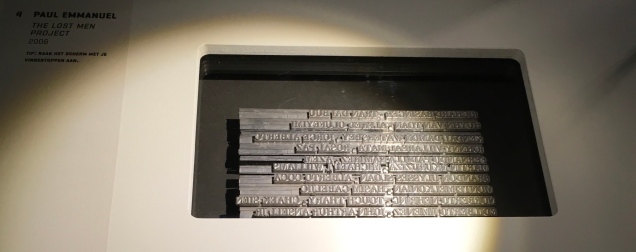
The Lost Men Project (2006)
Paul Emmanuel
The Lost Men Project (2006)
Paul Emmanuel

The names of South African soldiers, both black and white, killed in the First World War, are set in hot metal type then impressed without ink on flesh. Photographed and filmed, the names fade away. In the exhibition, a voice from the touchscreen device repeats, “Touch me, touch me”. Each touch upon the screen — on the skin before you —  advances the work running as a video on the touchscreen. Touching is the only way to read all of the names of the dead as they fade away. This work is but one of several that make up The Lost Men Project

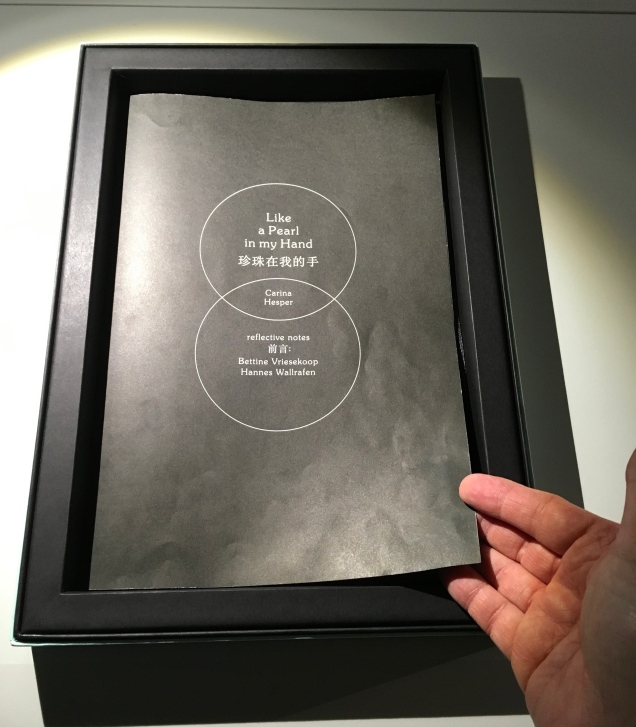
Like a Pearl in My Hand (2017)
Carina Hesper

In this room of touch, you move from sorrow to sorrow. Glass and ink do not separate you from them very much.
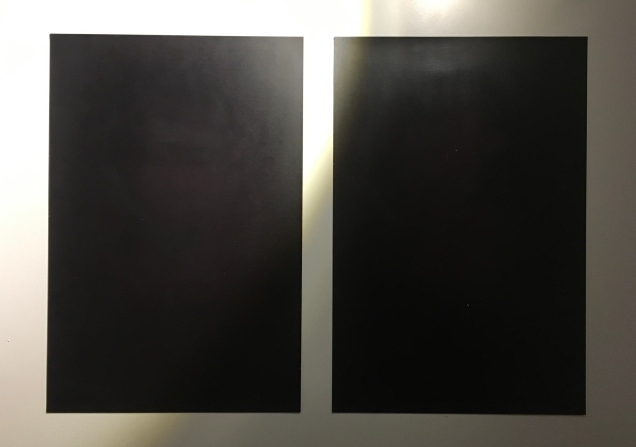
Two pages from Like a Pearl in My Hand

To read the pages of Like a Pearl in My Hand, you must rest your hands on them then lift your hands away.
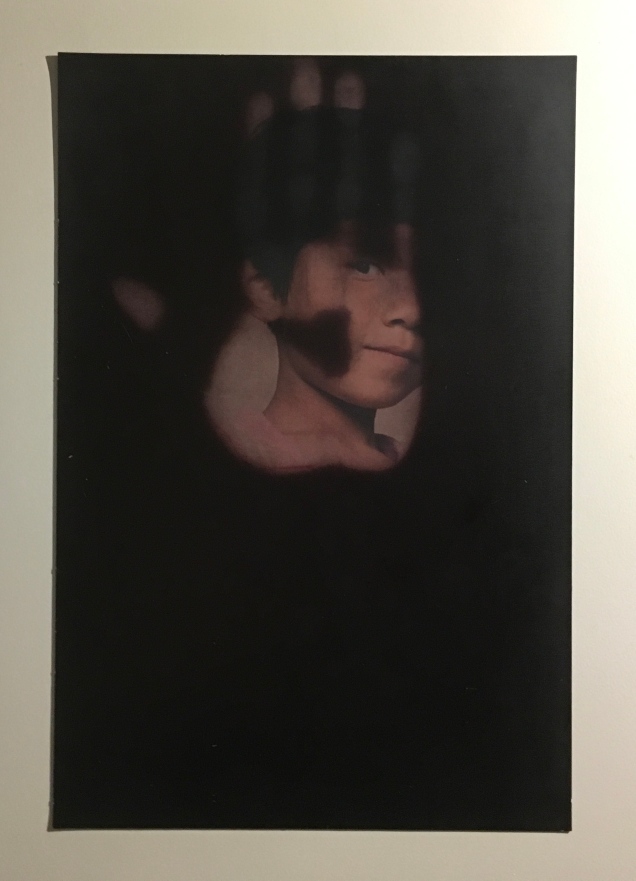
The face revealed on each page is the face of a blind or visually impaired child in a Chinese orphanage. As you read the page, the face fades into blackness.
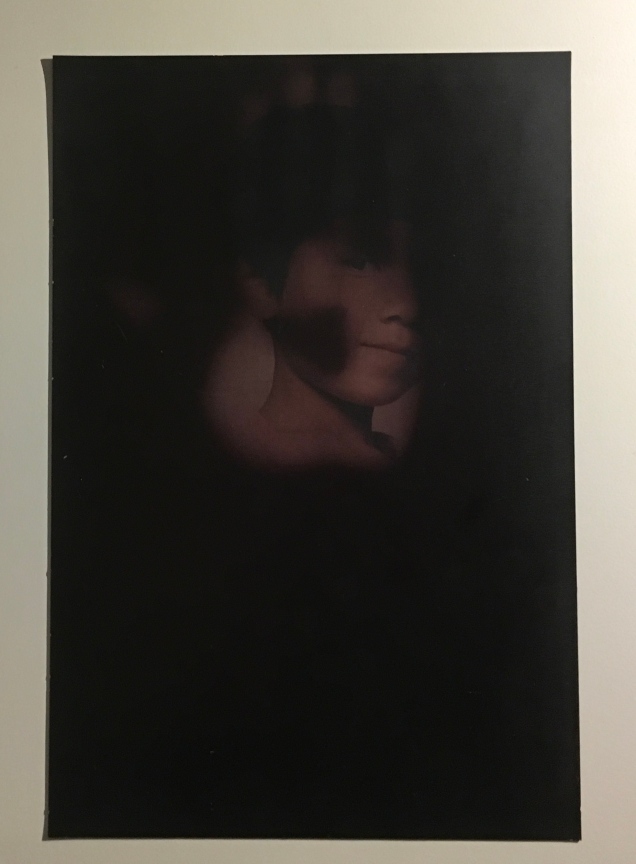
The artist’s book is associated with Bethel China, a charity for the visually impaired. Click on the image above to visit the charity’s site.

The next room is “Reading is Seeing”.

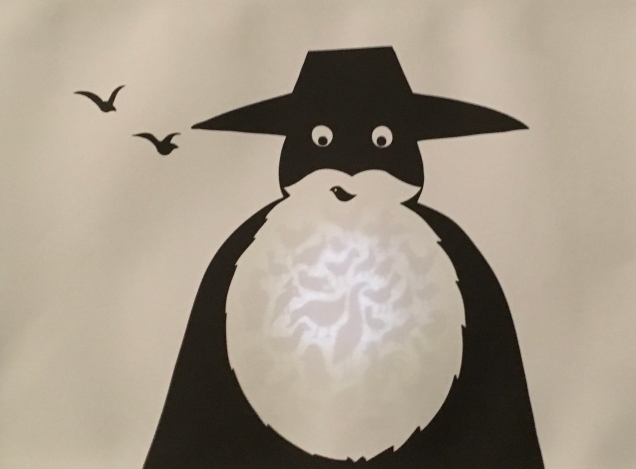
Were the curators being tone deaf with this juxtaposition?  No, it is the bluntness and earnestness of recognition that literacies and our sensibilities are jumbled up.  The literacy of art does that. It can move us from somberness to whimsy and back. The first work in this room of sight is a children’s flashlight (or torch) book; the next, a device for the visually impaired; the next, an augmented reality app on iPads.
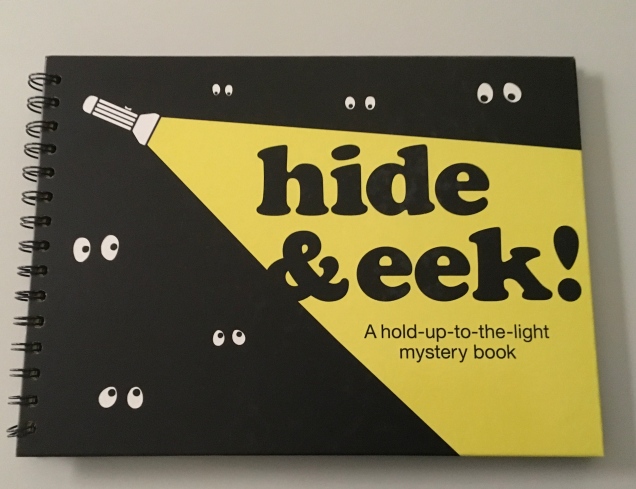
Hide & Eek! (2013)
Rebecca Sutherland
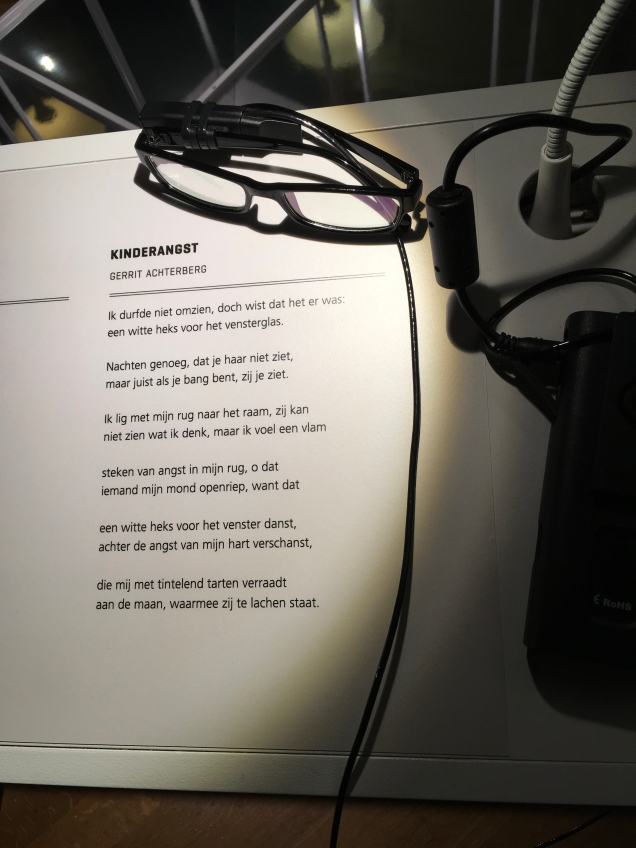
OrCam MyEye 2.0 (2017)
Amnon Shashua and Ziv Aviram
An artificial vision device with a lightweight smart camera that instantly reads text aloud –in this case, a poem by Gerrit Achterberg (Kinderangst or Childhood Fear).

The curators deftly paced the impact of these rooms. Something from the one before lingers with you in the next, or something in the next reminds you of the one before.

“Reading is Remembering” is the next room. Here the artists play with re-membering text vs dis-membering text, recalling vs forgetting, excavating vs filling in, deconstructing to reconstruct, destroying to create.
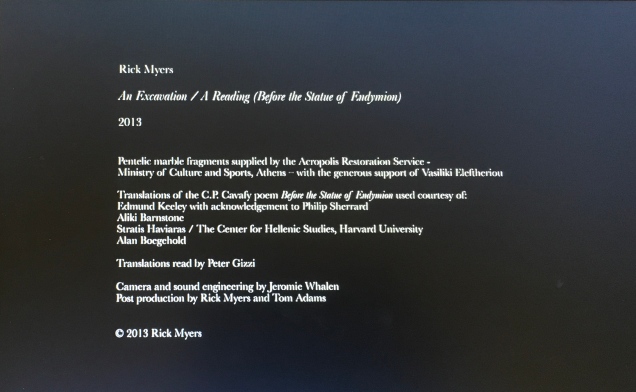
A Excavation, A Reading (2013)
Rick Myers

Rick Myers was commissioned by the Onassis Cultural Center to commemorate the Greek poet Constantine Cavafy. The work he proposed required permission to obtain Pentelic marble fragments (quarrying is restricted for the purpose of restoring the Acropolis) and grinding them into dust. He then sourced four different translations of Cavafy’s poem “Before the Statue of Endymion”, arranged a reading and recording of each, and, for each, cut a stencil. The chronologically first translation’s stencil was positioned on stretched plastic film suspended over speakers.  The marble dust was sifted onto the black plastic through the stencil, leaving the legible white text on the black background with which the video starts after the credits above. As the recording of the chronologically second translation plays, the sound’s vibration obliterates the  marble dust words of the first translation. Then comes the turn of the second stenciled translation to be obliterated by the third’s recorded reading. And so on.

An instant from “An Excavation, A Reading” (2013)
Rick Myers

Here, then, is a work of art that simultaneously endorses and refutes the premise that text recedes in favor of some new universal language of sound and image. It is a textual palimpsest in motion where sound dissipates the text of the past, making way for the next version of the text to be dissipated by the sound of the third and the text of the third to be dissipated by the sound of the fourth. A moment of the work is captured in Victoria Bean and Chris McCabe’s The New Concrete (see below). The work runs a little over three minutes, excerpts can be found here, but the experience under the exhibition room’s banner provides an unsurpassable frame for the work.

An Excavation, A Reading (2013)
Rick Myers
From The New Concrete: Visual Poetry in the 21st Century, Edited by Victoria Bean and Chris McCabe. London: Hayward Publishing, 2015

Inspired by The Royal Road Test by Ed Ruscha, Mason Williams and Patrick Blackwell (the crew that filmed a Royal typewriter being thrown out of a Buick travelling at 90mph), Simon Morris had seventy-eight students cut out all of the words from Freud’s The Interpretation of Dreams.  On Sunday, June 1st, 2003, he “threw the words out of the window of a Renault Clio Sport on Redbridge Road, Crossways, Dorset, traveling at a speed of 90mph, approximately 122 miles southwest of Freud’s psychoanalytical couch in London. The action freed the words from the structural unity of Freud’s text as it subjected them to an ‘aleatory moment’ – a seemingly random act of utter madness.” The work on display consists of a Ruscha-like book (right down to the plastic spiral binding) and a film of the epic literary littering.

If you are expecting the next room — “Reading is Concentrating” — to help you gather any scattered thoughts or words, think again.

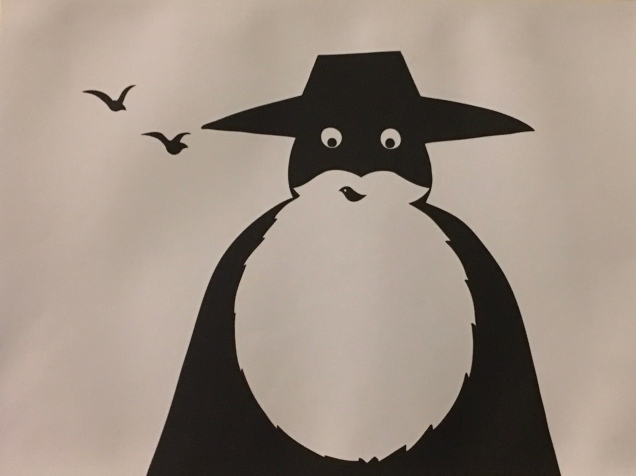
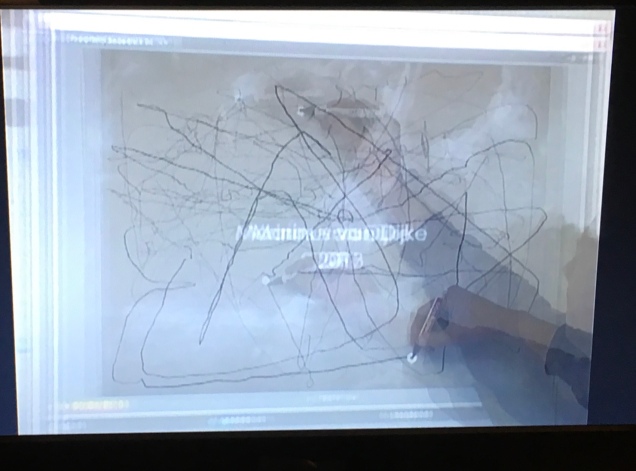
Marinus van Dijke’s work draws your eye and ear first. Chickens clucking and strutting onscreen, superimposed small white circles the size of a chicken’s eye jerking and gliding across the screen, a sheet of paper being laid over the screen (ah, it’s a screen within a screen), and then a hand with pen enters the frame, picks a circle and, trying to track it, leaves a scrawl on the paper.
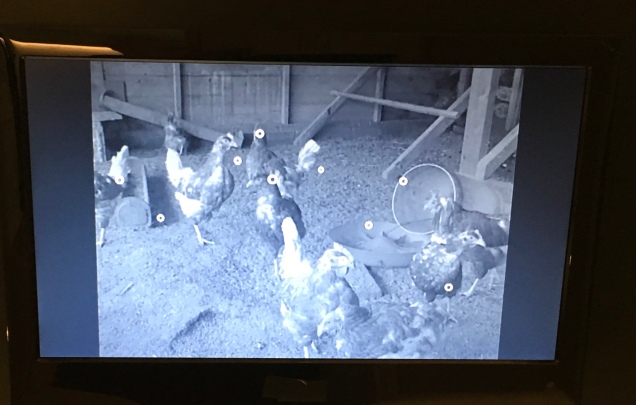
Eye (2013)
Marinus van Dijke

Van Dijke’s work echoes Jan Dibbets’ Robin Redbreast’s Territory: Sculpture 1969, April — June, which Germano Celant included in his Book as Artwork show in 1973. Like the deliberate echo of Morris/Ruscha, this chance echo of Van Dijke/Dibbets recalls the grounding of  contemporary textual and book art in the conceptualism of the 1960s/70s.

Robin Redbreast’s Territory: Sculpture 1969, April — June (1970)
Jan Dibbets

Dibbets documented the flight patterns of this highly territorial bird and presented that in a book as a conceptualization of an “as if” sculpture drawn in space.

Robin Redbreast’s Territory: Sculpture 1969, April — June (1970)
Jan Dibbets

There was admittedly some “artistic license” in Dibbets’ documentation — somewhat the same as when Van Dijke’s tracing pen cannot keep up with the peripatetic circles, which are projections of the chickens’ eye movements as they hunt for food.

“Reading is Reacting” is the last room. Here it seems that printed text comes out on top. Over in one corner is a Dutch encyclopedia, stacked vertically four feet high.
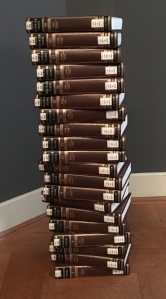
In the opposite corner, on shelves from floor to ceiling, is the Dutch version of Michael Mandiberg’s Print Wikipedia. The paperbacks scattered on the display table began their textual lives online. 

Print Wikipedia (Dutch edition, 2016)
Michael Mandiberg
Jack
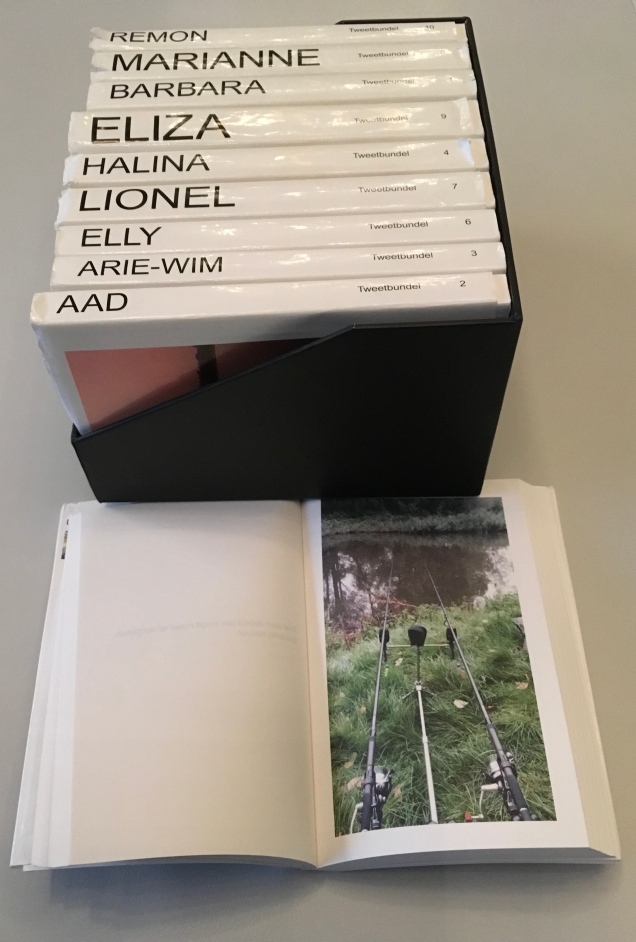
Tweetbundel (2015)
Jan Dirk van der Burg
Unsolicited autobiography created from the subject’s Twitter feed.

Although printed text seems to be having the last word, attend to the curators’ last words on your way out:

Reading and writing have become increasingly open arenas: there are more readers than ever before, there are more books and publication outlets, which can reach vast readerships thanks to the internet. Readers feel more empowered and are able to combine or alter texts found online. Readers become writers. Online texts have therefore come to resemble oral literature, in that they are constantly changing and being passed on from one person to another, retold — sometimes differently. They are unstable and at the same time highly accessible.

Text in books appear to be fixed, but annotations and deletions change the printed text, just as editorial changes alter a page on the internet…. Even so, printed texts are in principle less changeable than those posted online. This makes them appear inviolable and irrefutable. Some people fear that young people believe everything they read on the internet. That is nothing new. Philosophers from Socrates to Locke thought that written or printed texts would be accepted as the absolute truth.

Where do we stand today? … How reading will develop in the future is unclear, but one thing is sure: connection and interaction will be key to that development.

Leaving The Art of Reading and thinking again about a post-text future, you can be sure of one other thing: the art of living will still depend on the art of reading.
Bookmarking Book Art – Pien Rotterdam

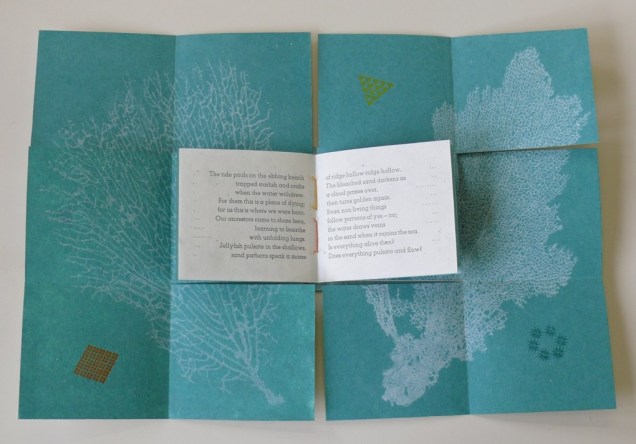
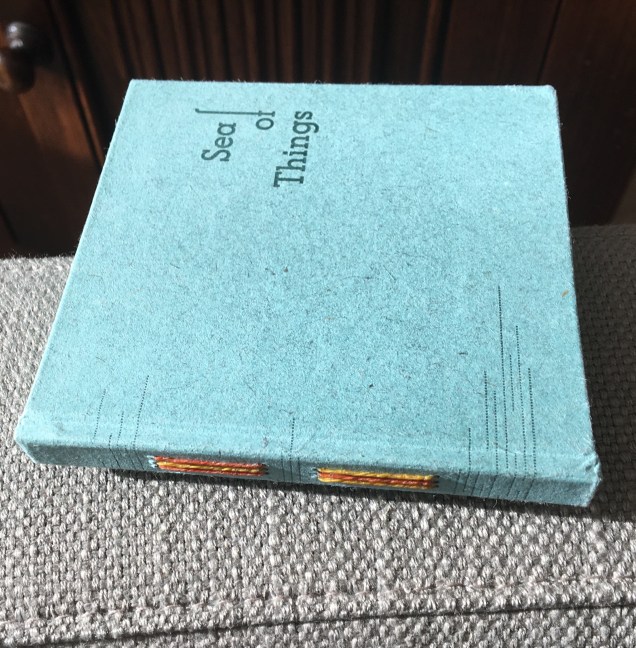
Again and again, Pien Rotterdam’s works — Sea of Things (2014) and Absences (2015) — reward reading and contemplation.

Sea of Things (2014)
Pien Rotterdam
Border book structure; 11 x 10.5 x 1.3 cm closed; 20 by 30 cm folded out
Image printed into kozo/cotton paper with very fine paper pulp; text and cell-like patterns printed letterpress on kozo/cotton/abaca paper. Set in Atlas and Atlas Light.
Sea of Things (2014)
Pien Rotterdam
Sea of Things (2014)
Pien Rotterdam

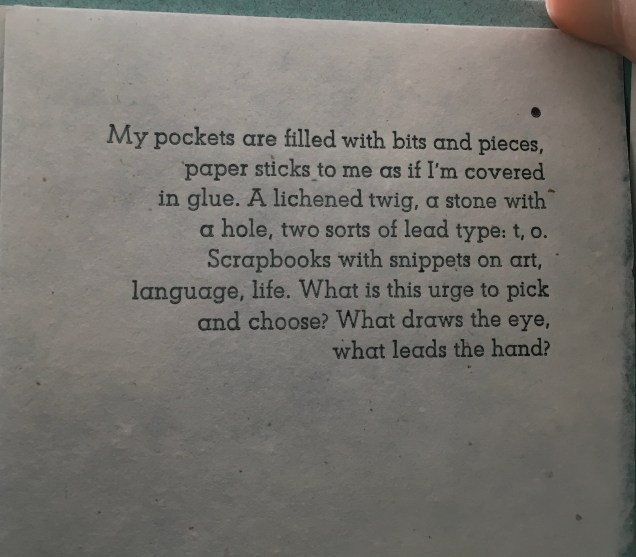
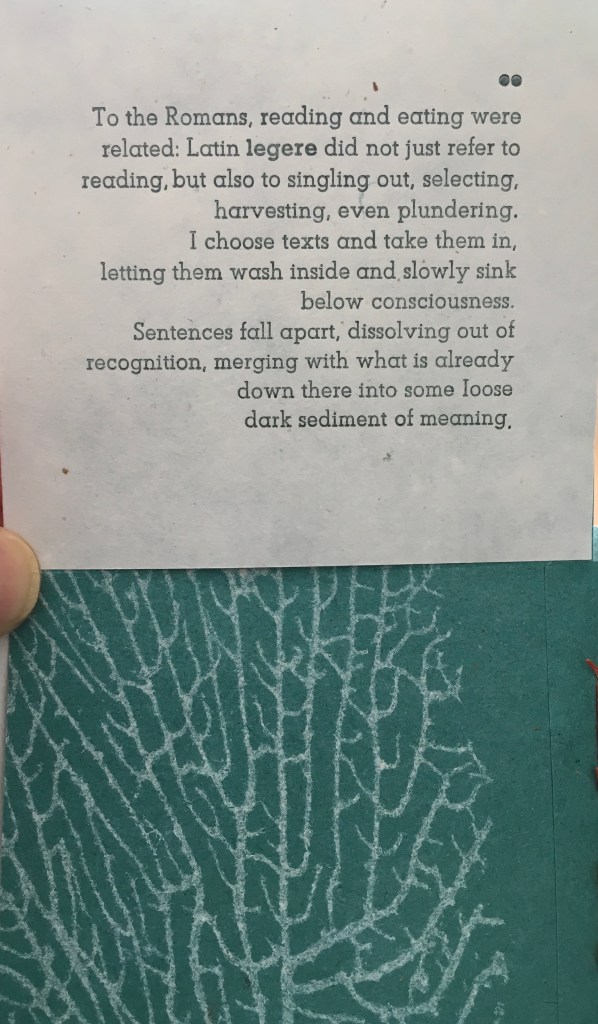
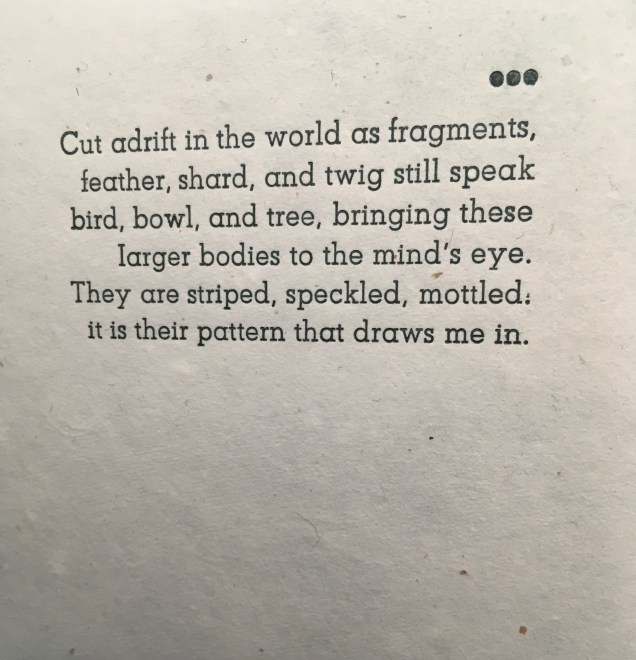
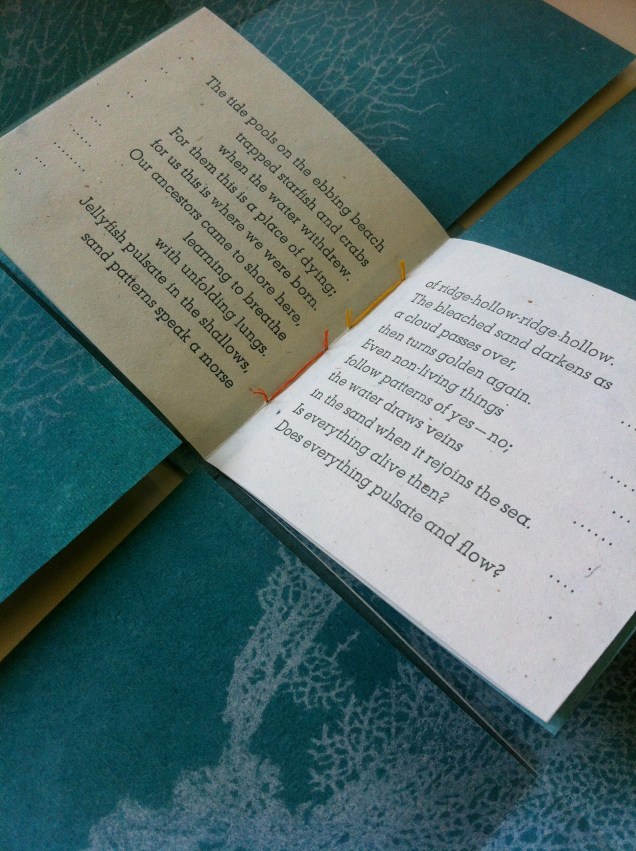
The images of the coral, square, circle and triangle are “pulp printed”, a hybrid silkscreen/papermaking technique, which Rotterdam learned from Tim Mosely. The images themselves are made of fine pulp paper, transferred to, pressed and dried together with the receiving kozo/cotton paper.  Message (or image) and medium are one, a sea around the letterpress text, whose words and acts described harmonize with technique, material, color and shape. Here are “pages” 1 to 5 as a sample.

Sea of Things (2014)
Set in Atlas and Atlas Light on kozo/cotton/abaca paper.
Sea of Things (2014)
Pien Rotterdam
Sea of Things (2014)
Pien Rotterdam
Sea of Things (2014)
Pien Rotterdam
Sea of Things (2014)
Pien Rotterdam

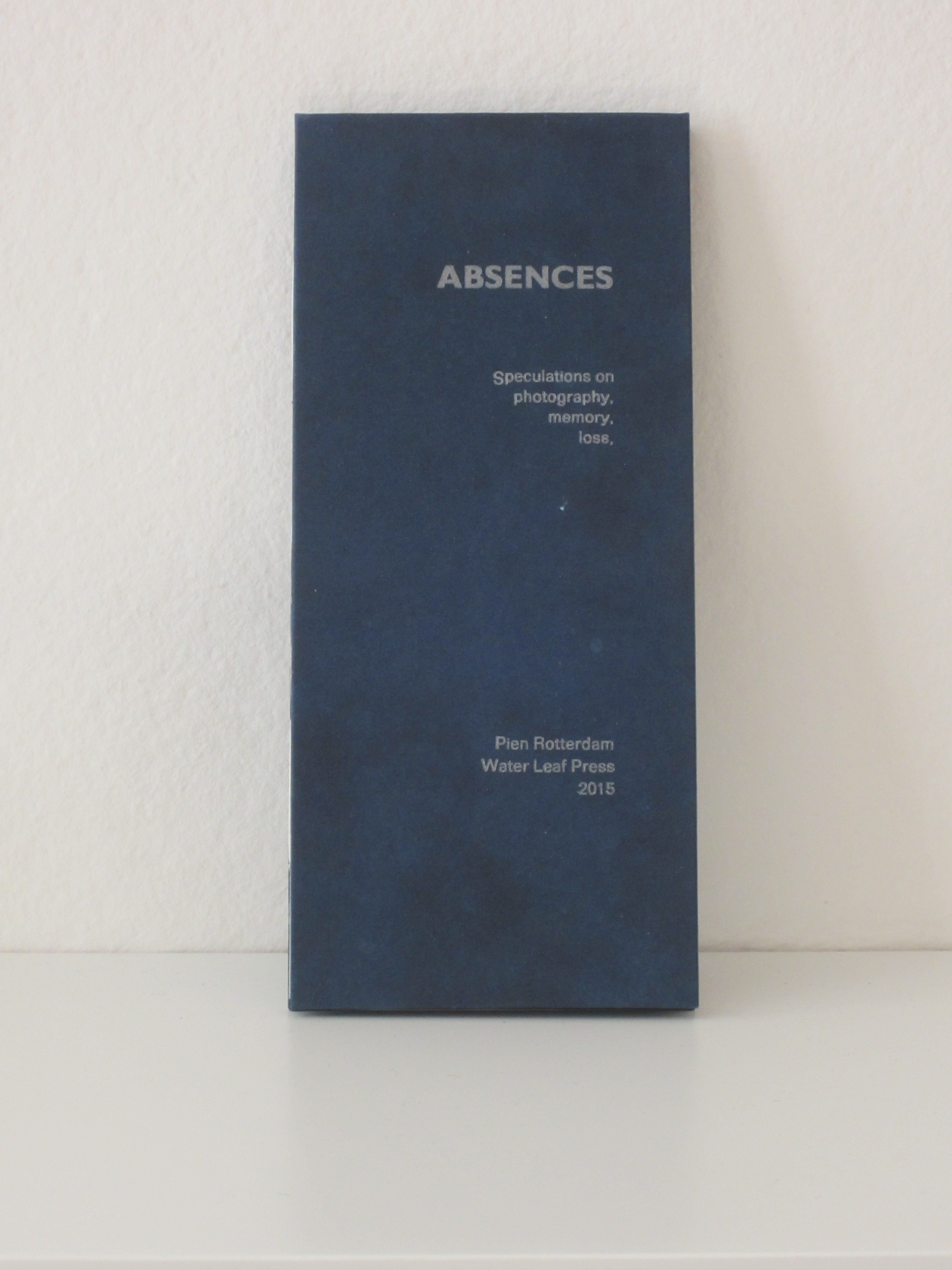
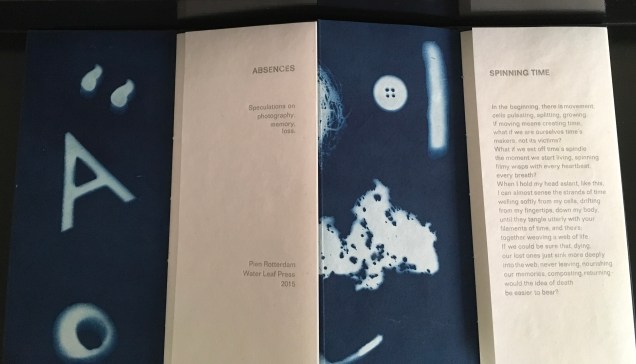
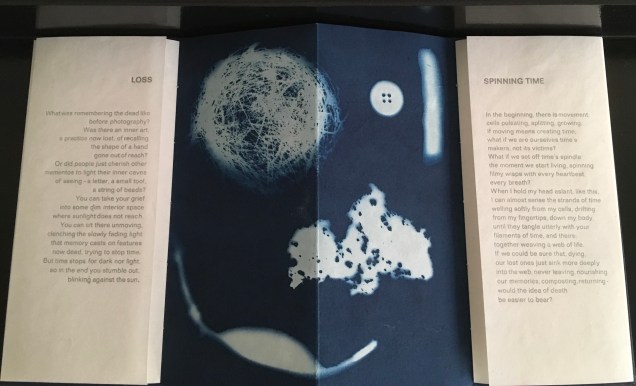
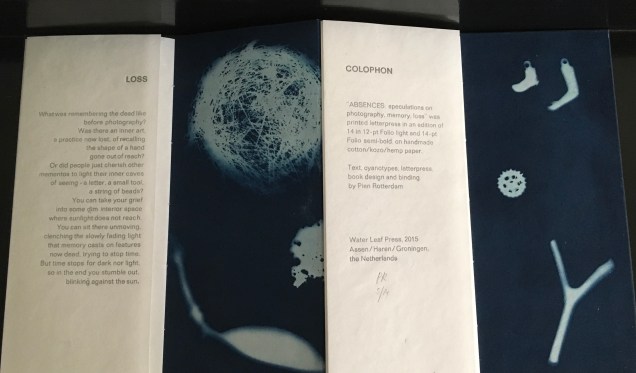
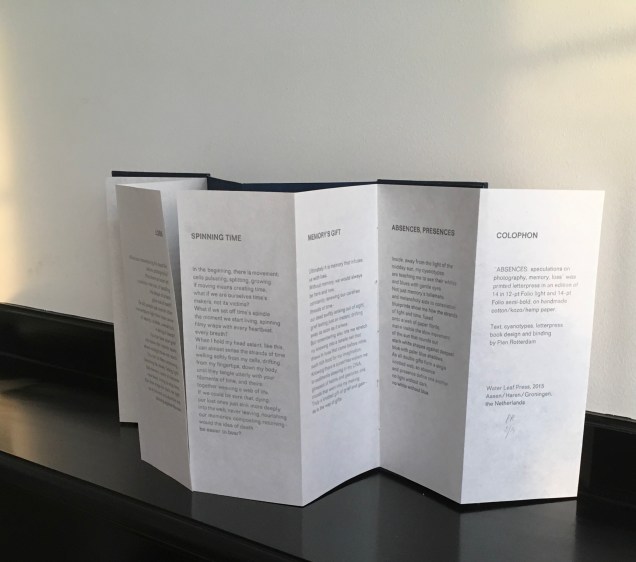
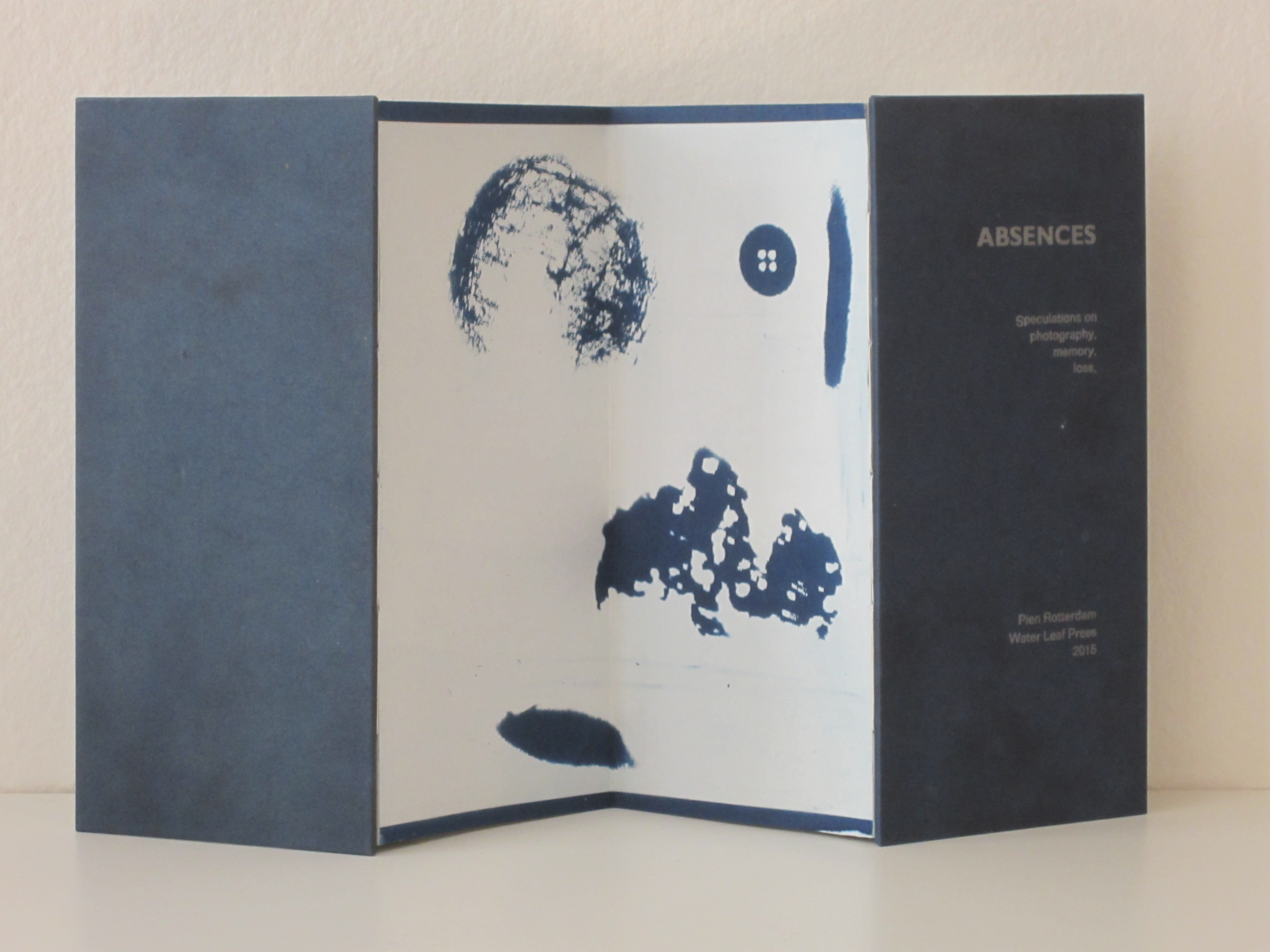
As with Sea of Things, Rotterdam achieves another singular union of technique and meaning in Absences. Where Sea of Things addresses selecting and collecting, Absences addresses loss, memory and the experience of time.

Absences (2015)
Pien Rotterdam
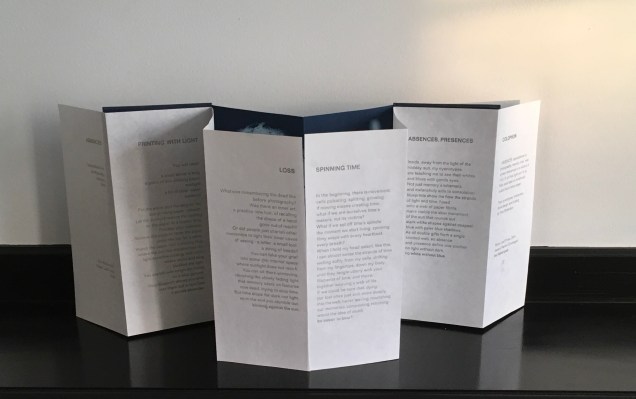
Concertina structure. Cyanotype on photogram and text paper handmade from kozo/cotton/hemp in different weights, apart from the cyanotype on the back, which is made from Japanese paper. Letterpress in Folio light (lead type) with silver-grey ink. 10.5 x 23 cm when closed, 42 x 23 cm open.
Absences (2015)
Pien Rotterdam
Absences (2015)
Pien Rotterdam
Absences (2015)
Pien Rotterdam
Absences (2015)
Pien Rotterdam
Absences (2015)
Pien Rotterdam

Rotterdam’s explanation of the connection between technique, material and meaning can hardly be bettered:

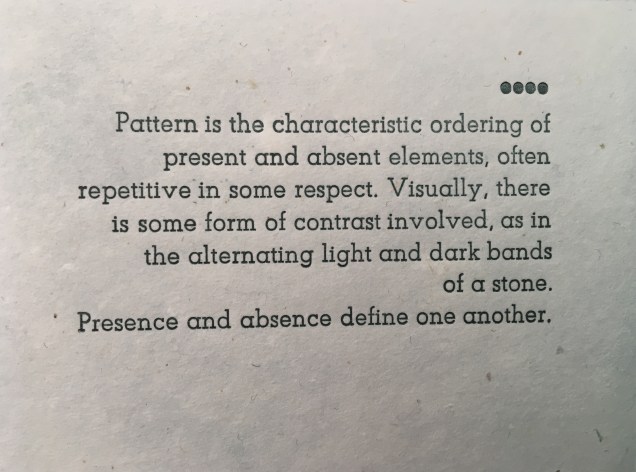
When I made my first cyanotype photogram ten years ago, I was immediately struck by the way in which light shapes against a deep-blue ground show, simultaneously and paradoxically, what was there when the paper was exposed but what is now no longer there: the photogram makes absences visible. This realisation has led to an exploration of the metaphorical properties of the cyanotype process and to speculation on the relationship between photography, mementos, and memory, between memory and loss, and on the nature of time, in six brief reflective texts.

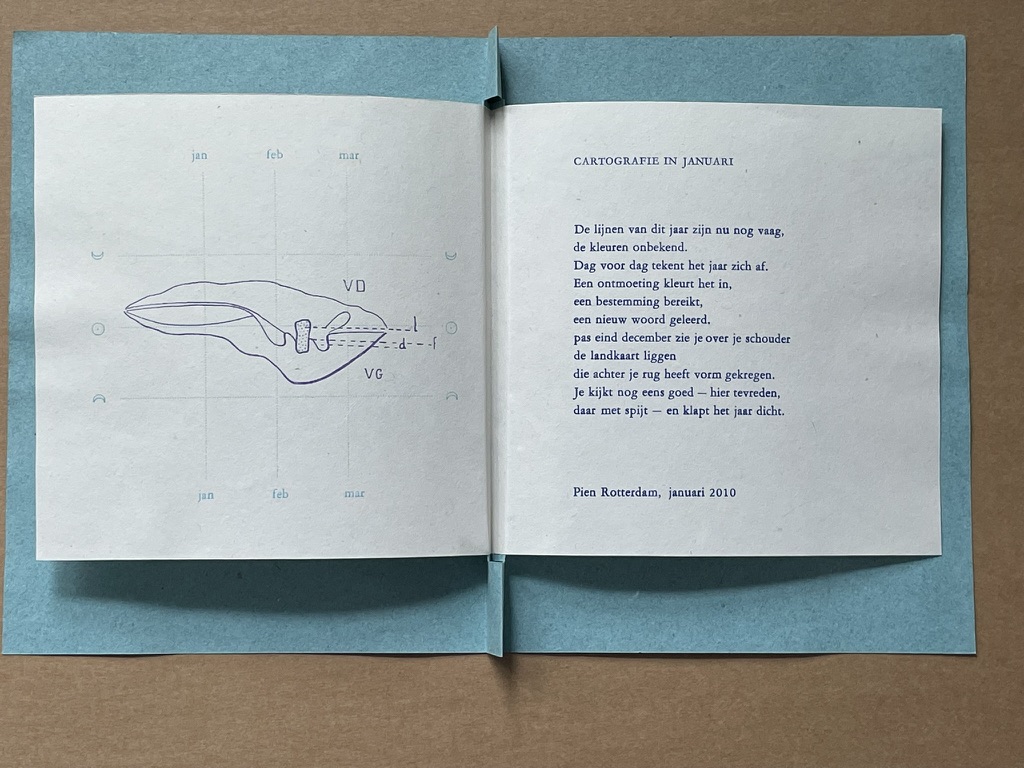
Cartographie in Januari (2010)

Cartographie in Januari (2010)
Pien Rotterdam
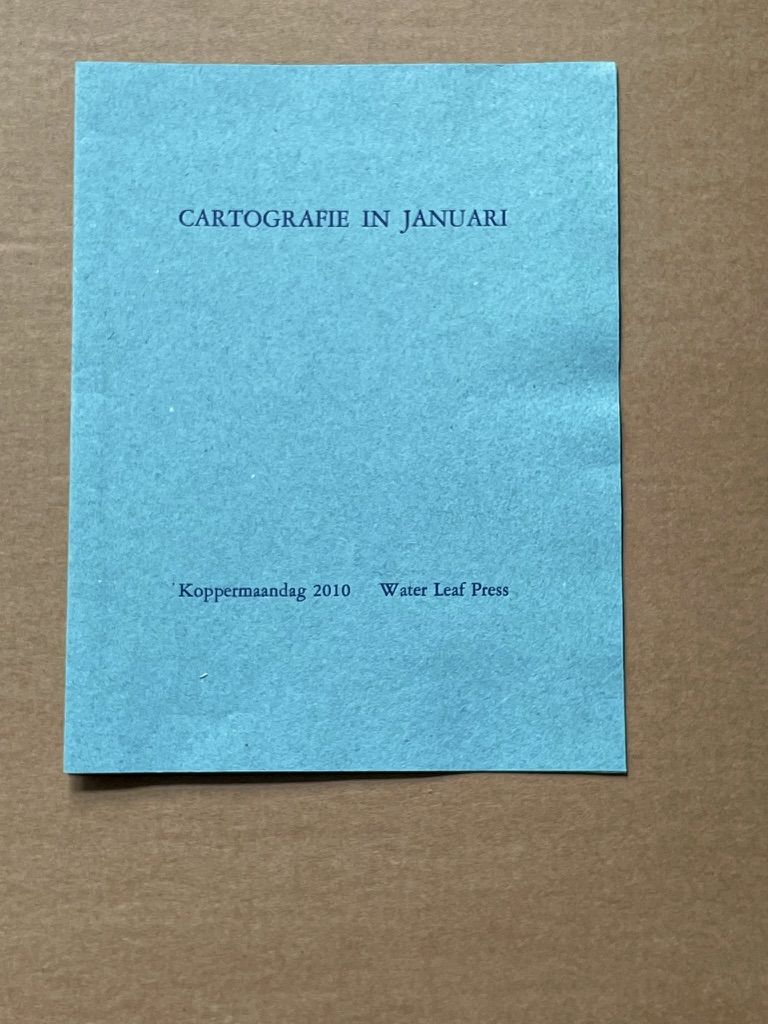
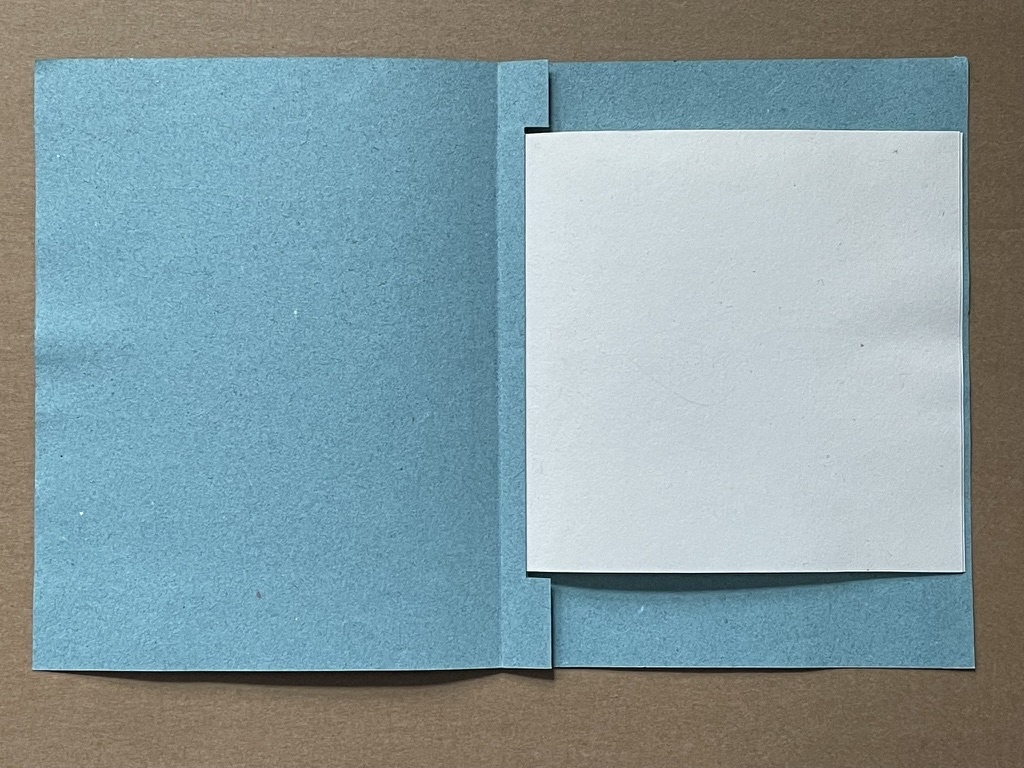
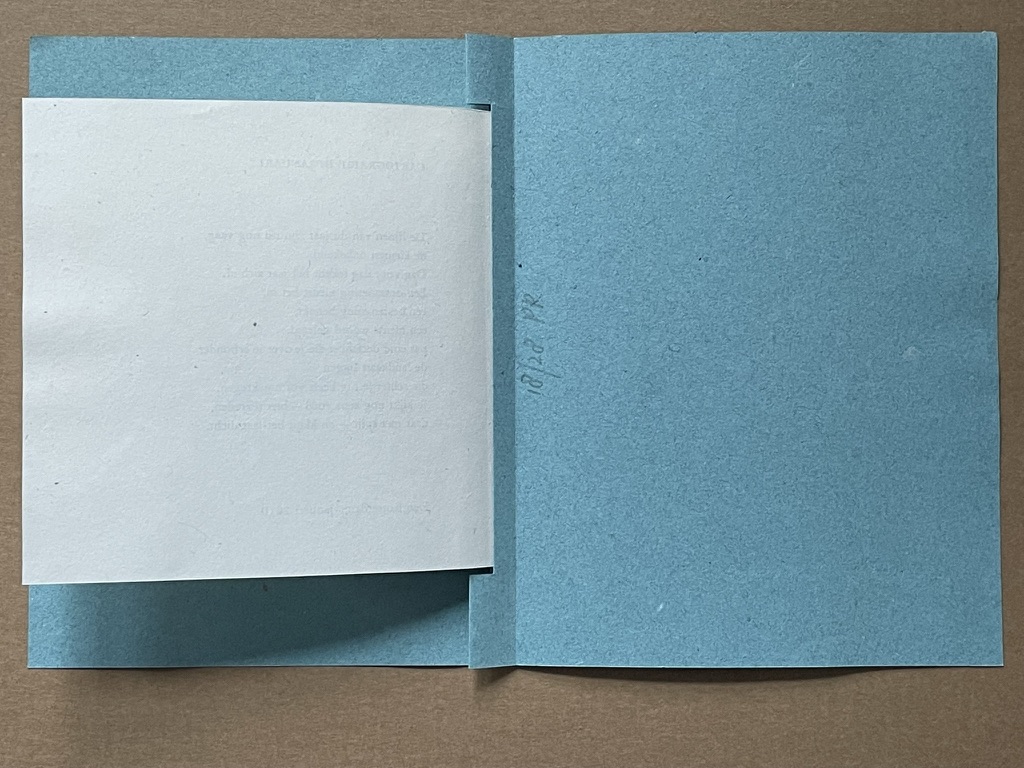
Pamphlet, modified stub binding, sewn. H160 x W130 mm. 1 folio, 2 panels. Edition of 28, of which this is #18. Acquired from the artist.
Photos: Books On Books Collection.

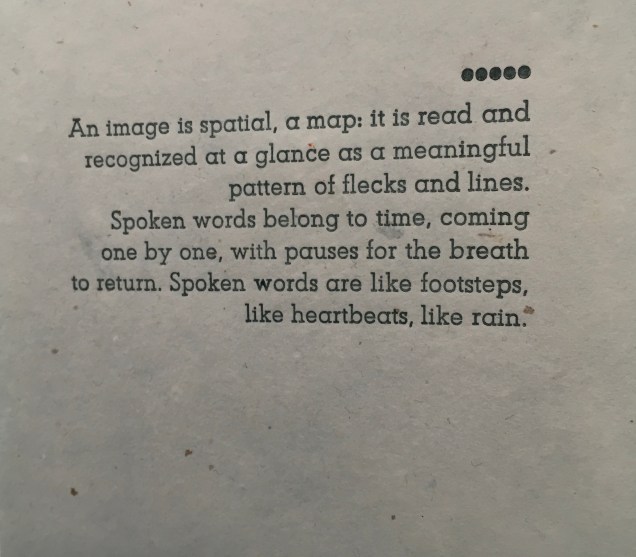
This year’s lines are still vague, the colors unknown.
Day by day, the year takes shape.
An encounter colors it in, a destination reached, a new word learned.
Only at the end of December do you see the map lying over your shoulder,
which has taken shape behind your back.
You take another good look—here with satisfaction, there with regret—and close the year.

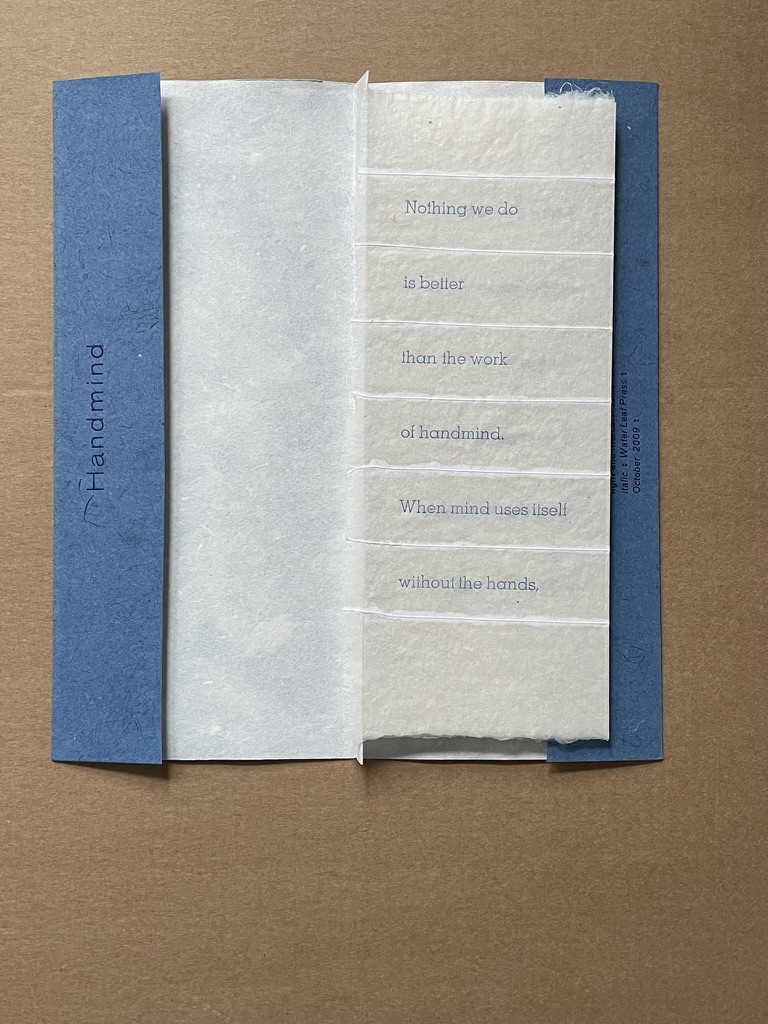
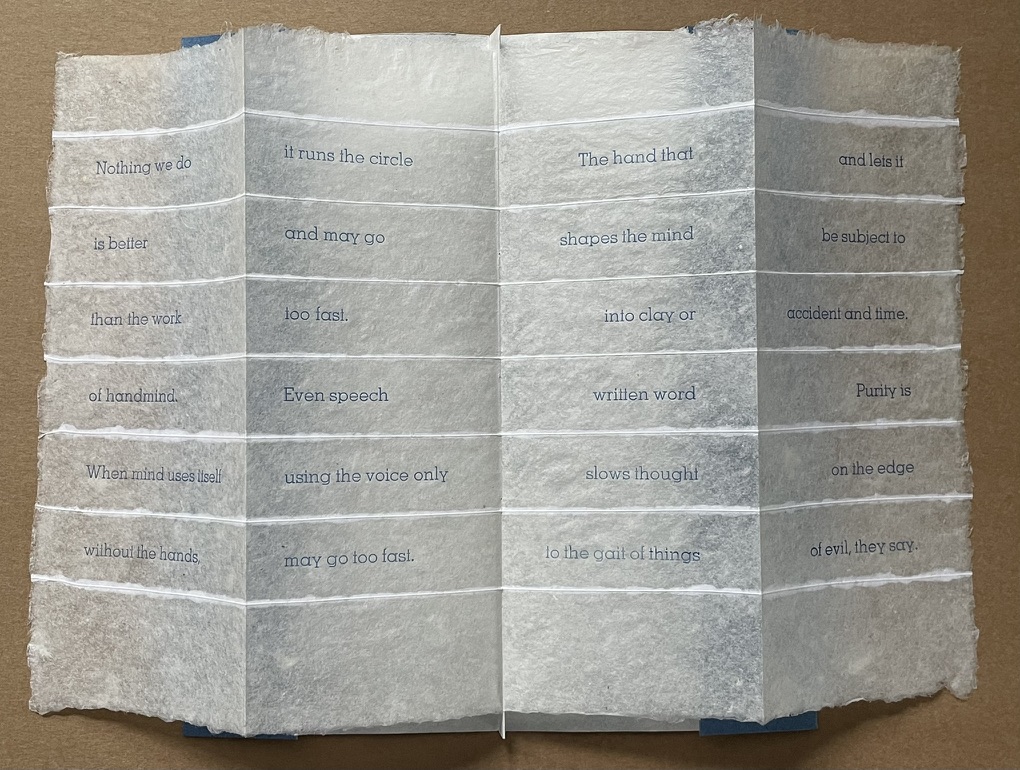
Handmind (2009)

Handmind (2009)
Pien Rotterdam
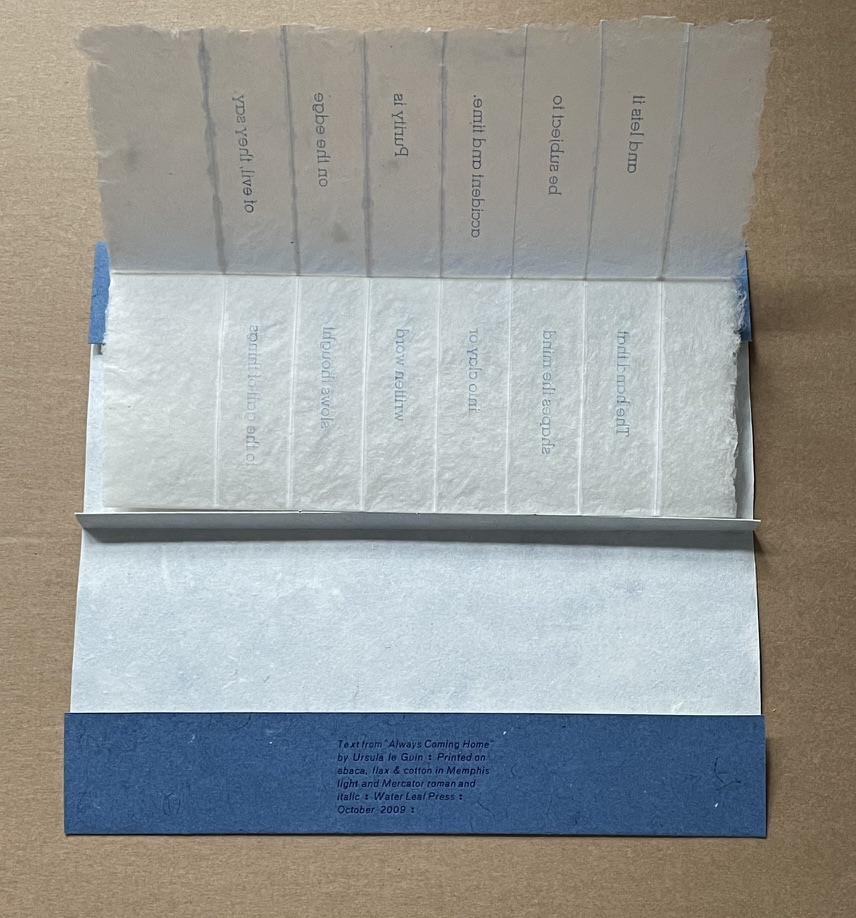
Pamphlet, stub binding, sewn, printed on abaca, flax & cotton. H202 x W90 mm 2 folios, 4 panels. Text from Ursula K. LeGuin “Always Coming Home”. Limited edition (unknown qty). Acquired from the artist. Photos: Books On Books Collection.

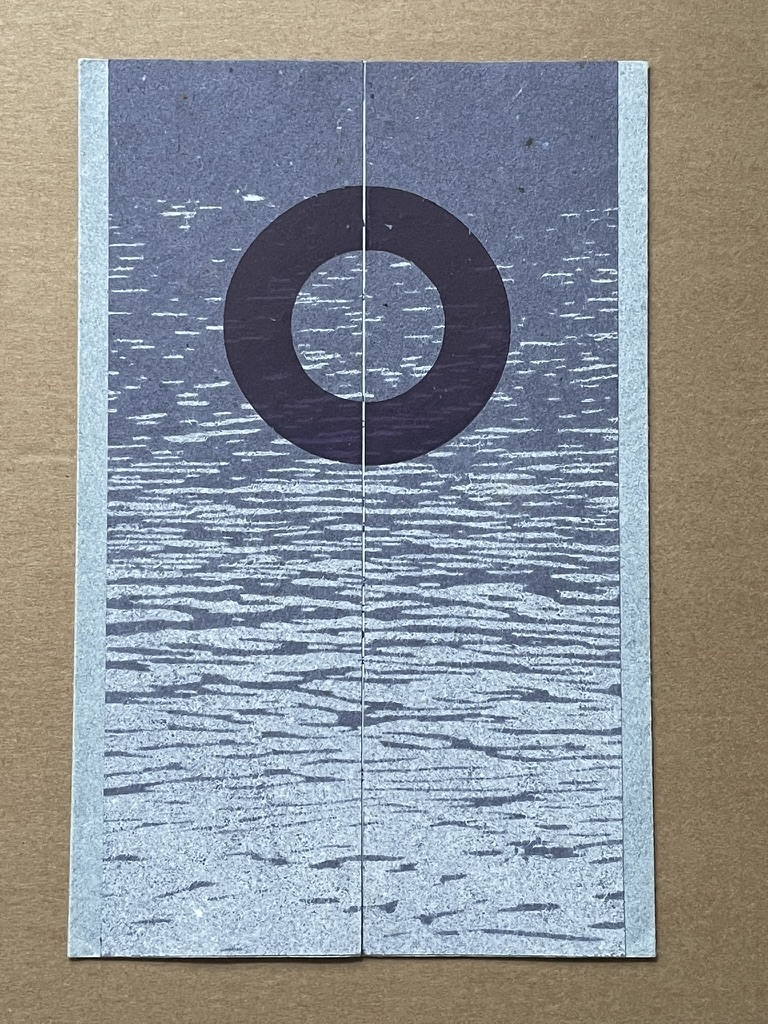
Et in Arcadia (2013)

Et in Arcadia (2013)
Pien Rotterdam
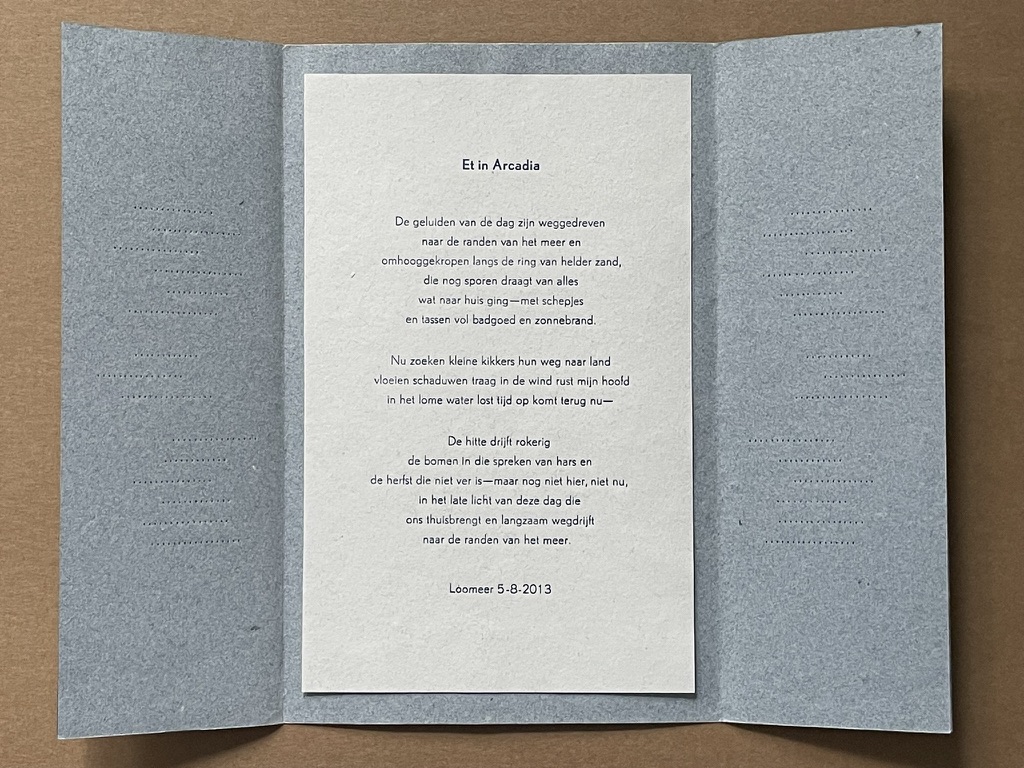
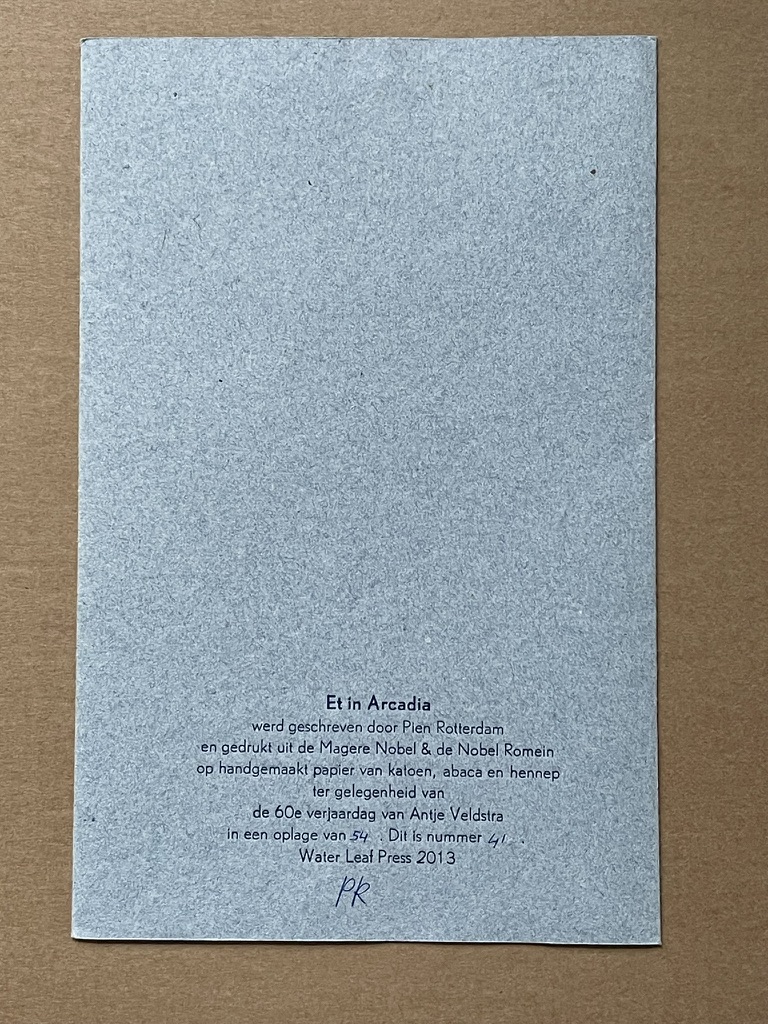
Pamphlet, French fold. H210 x W135 mm. 1 page. Edition of 54, of which this is #41. Acquired from the artist.
Photos: Books On Books Collection.

The chatter of the day has drifted to the edges of the lake and crept up along the ring of bright sand, which still bears traces of everything that went home—with shovels and bags full of bathing gear and sunscreen.
Now little frogs find their way to land, shadows flow slowly in the wind, my head rests in the languid water, time dissolves, returns now—
The heat drifts smoky
into the trees that speak of resin and
autumn that is not far off—but not yet here, not now, in the late light of this day that brings us home and slowly drifts away to the edges of the lake.

Rotterdam’s site rewards repeated visits.  It traces her development as a book artist since 2003 and demonstrates mastery and strength at each stage. Her work can be acquired through the site. Rotterdam lives and works in Groningen, The Netherlands, home to the Book Arts NetworkGrid Grafisch Museum and De Ploeg, an artists collective started in the early 20th century.

Further Reading

Hirschey, Paige. 7 December 2023. “Rhapsodies in Blue: Anna Atkins’ Cyanotypes“. The Public Domain Review. Using the cyanotype process, Anna Atkins produced the world’s first photograph album.

Bookmarking Book Art – Ioana Stoian

It took a long look at the development of Ioana Stoian’s work to show me the relationship of trompe l’oeil to book art — and to appreciate how an artist can invent herself.

Stoian’s apprenticeship as an artist began with the decorative arts in 2004 in Lower Normandy, France, and has taken her to New York (MoMA), Cologne, Vienna, Salzburg, Minneapolis, Ostende (Belgium), Kadoide (Japan), Amsterdam (the Stedlijk) and, as of 2015, back to Minneapolis, where she is a Jerome Foundation fellow at the Minnesota Center for the Book Arts.

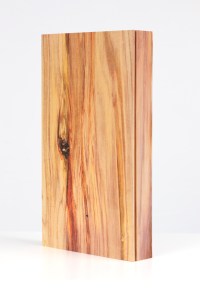
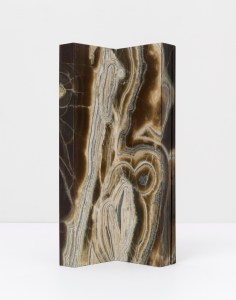
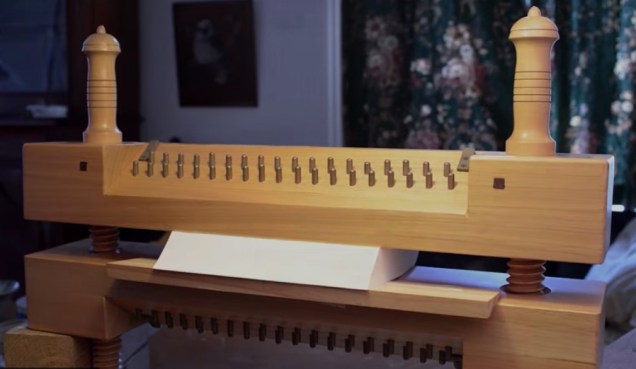
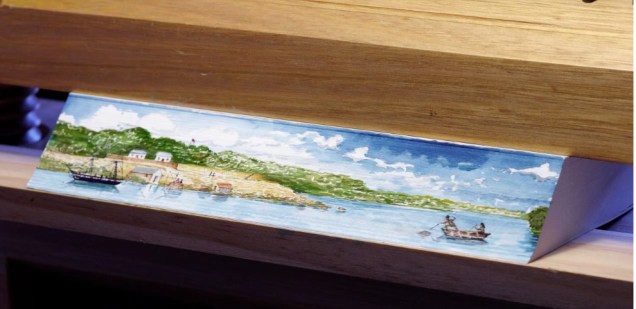
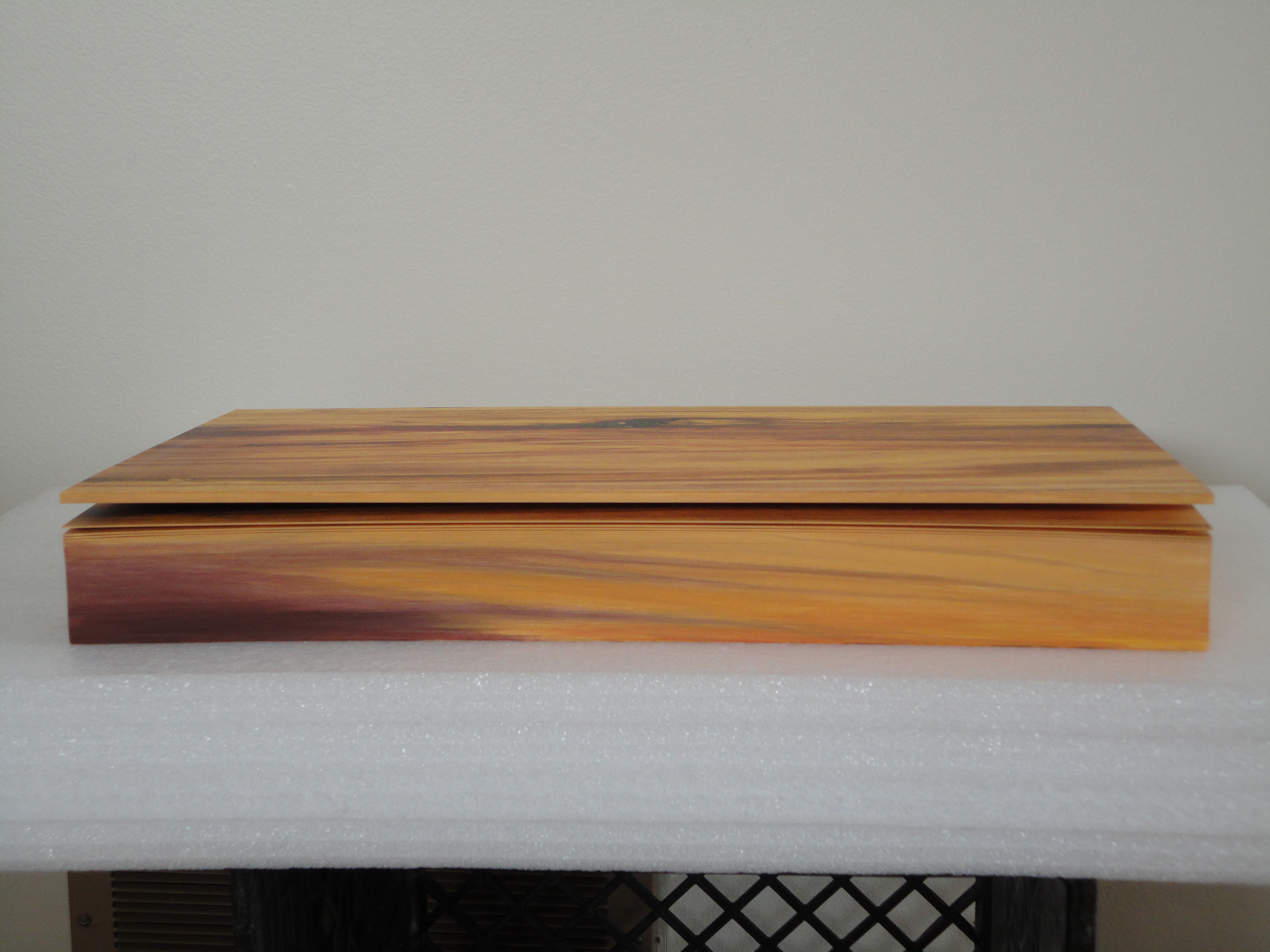
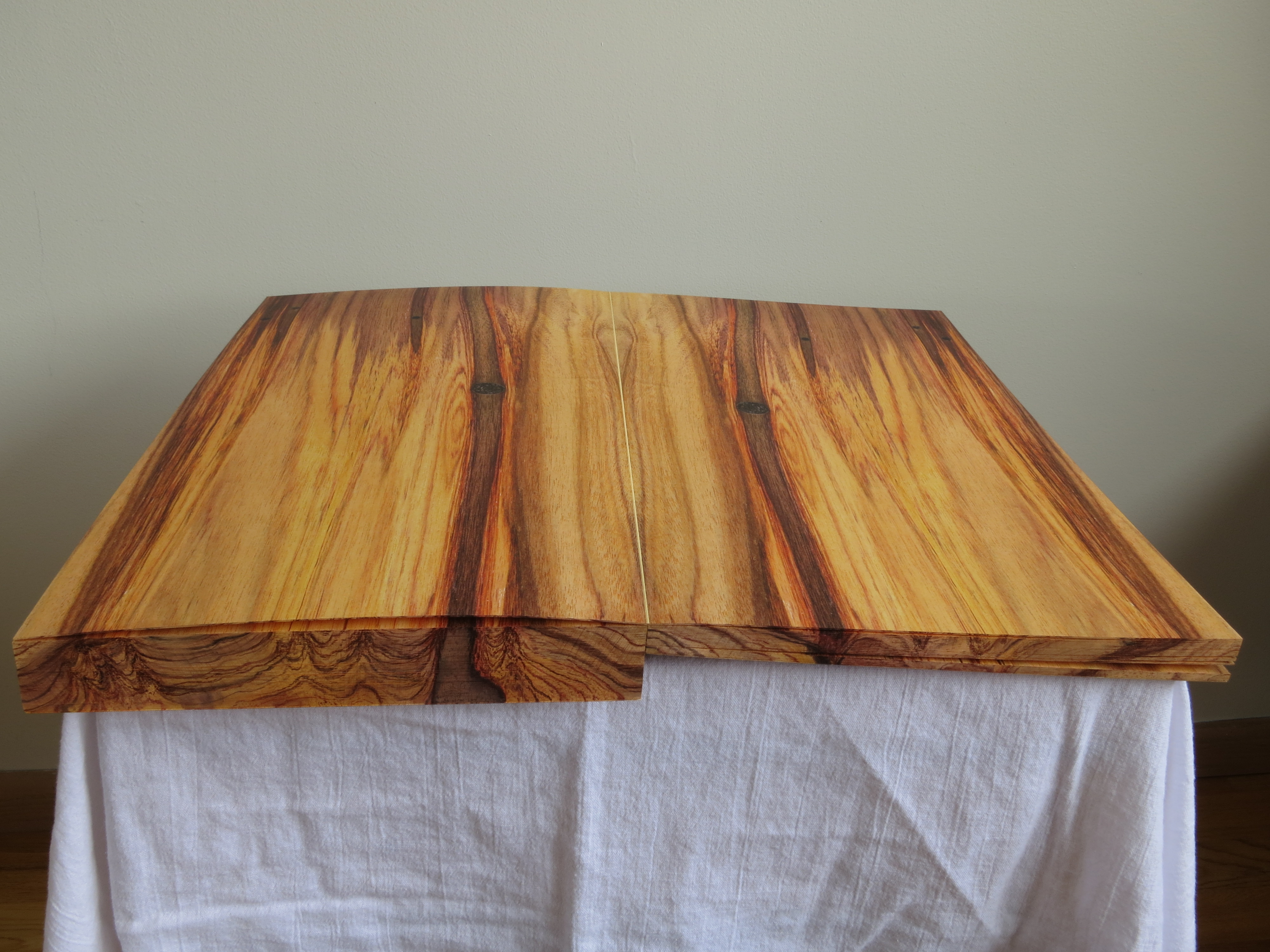
Stoian’s time as an assistant artist with the Scottish painter Lucy McKenzie, starting in 2008, honed her skills in deceiving the eye with faux woodgrain and faux marbling. For example, see McKenzie’s 2008 installation at MoMA, 2009 installation at the Ludwig (Cologne), 2011 installation at the Galerie Buchholz and 2013 installation at the Stedelijk. One may wonder whether Daniel Buchholz’s roots in antiquarian books or the Stedelijk’s in artists’ books prepared the ground for Stoian’s artistic direction toward book art and paper art, but book art and trompe l’oeil joined spectacularly in 2014 when Stoian had the chance to work with Tauba Auerbach in 2014 on the completion of Auerbach’s Wood and Bent Onyx. Stoian handpainted the fore, top and bottom edges of the book blocks in watercolor pencil and paints to match the color and grain of the prints of wood and marble digitally offset on pages of Mohawk superfine paper. As a technique, fore edge painting dates to the 16th century, and the “vanishing” variety, where the painting appears only when the pages are pressed and fanned out, dates to the 17th century. Over time, a standard type of press developed to hold the “canvas” of page edges evenly fanned to accept the painting.

Wood (2011)
Tauba Auerbach
Digital offset printing, Mohawk superfine paper, 55 pages,
hand painted edges 
closed: 43.2 x 24.1 x 5.1 cm
© Tauba Auerbach. Courtesy Paula Cooper Gallery, New York.
Photo: Steve Probert
Bent Onyx (2012)
Tauba Auerbach
Digital offset printing, Mohawk superfine paper, Japanese tissue,
hand painted edges
closed: 43.2 x 16.5 x 16.5 cm
© Tauba Auerbach. Courtesy Paula Cooper Gallery, New York.
Photo: Steven Probert.
Still from “Fantastically Fast Fore-edge Painting by Stephen Bowers
Friends of the State Library of Australia
18 February 2013
Stephen Bowers’ fore-edge painting on a copy of A Narrative of a Survey of the Inter-tropical and Western Coasts of Australia by Phillip Parker King, son of the third governor of New South Wales
Still from “Fantastically Fast Fore-edge Painting by Stephen Bowers
Friends of the State Library of Australia, 18 February 2013

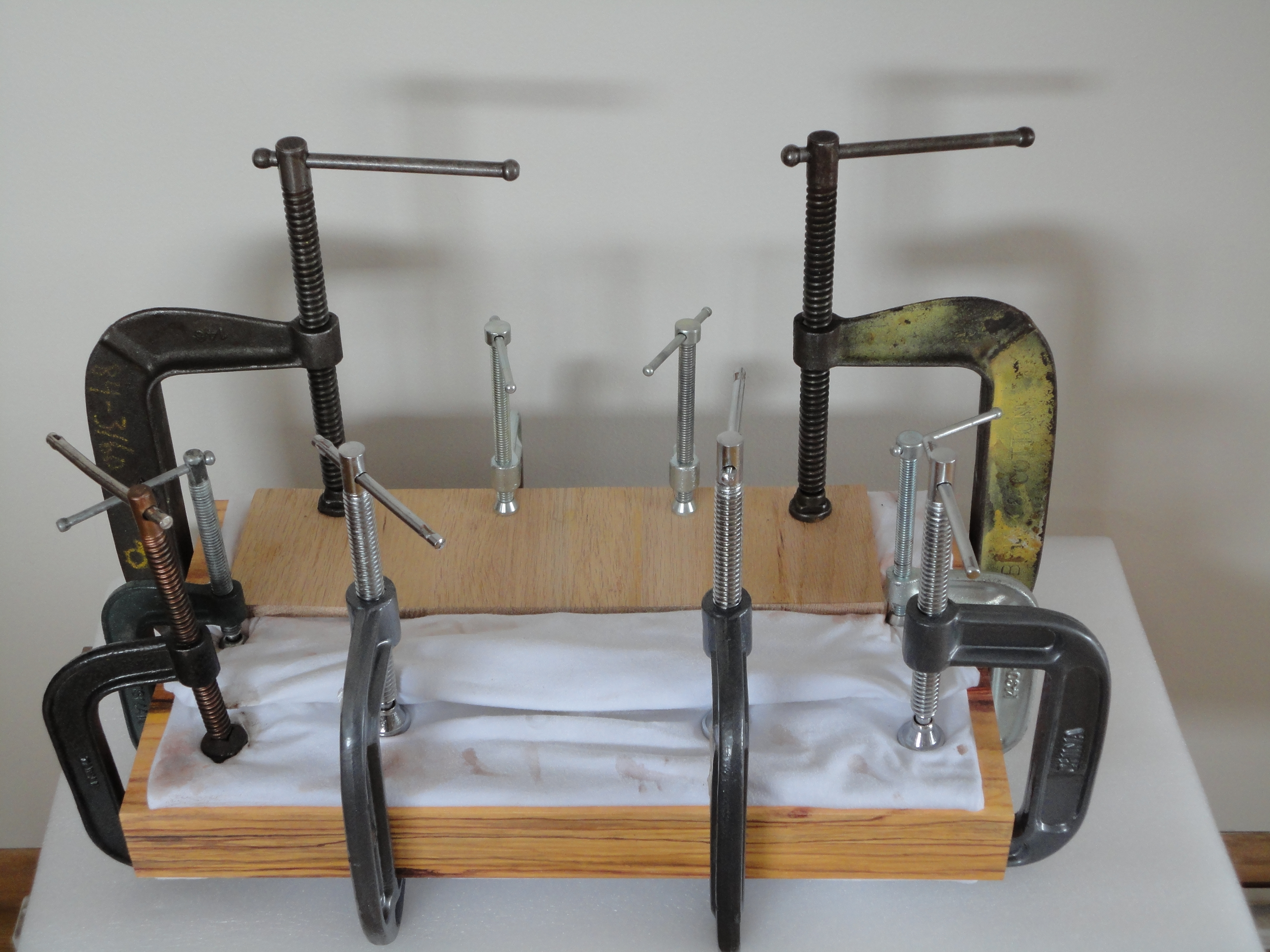
Despite this established history of fore-edge painting, Stoian had to fall back on a mastery and technique that come from her apprenticeship work, inventiveness and meticulousness. These books were very heavy and the pages were very thick …. There was absolutely no way to fan the pages.  I went through the book, page by page, and made marks of where the wood/ marble veins were located.

Before Stoian started work on Wood

Then I clamped the book so that water wouldn’t seep in and using my ‘map’, I recreated the wood/ marble. As you can imagine, it was challenging to match the inside spreads. I had to constantly unclamp, verify that I was matching the spreads, re-clamp, paint, wait…

I used both watercolour pencils and paints. Needless to say, it’s very hard to erase watercolour without using lots of water and saturating the page. I had to be careful with every single brush stroke I made.  

Finished

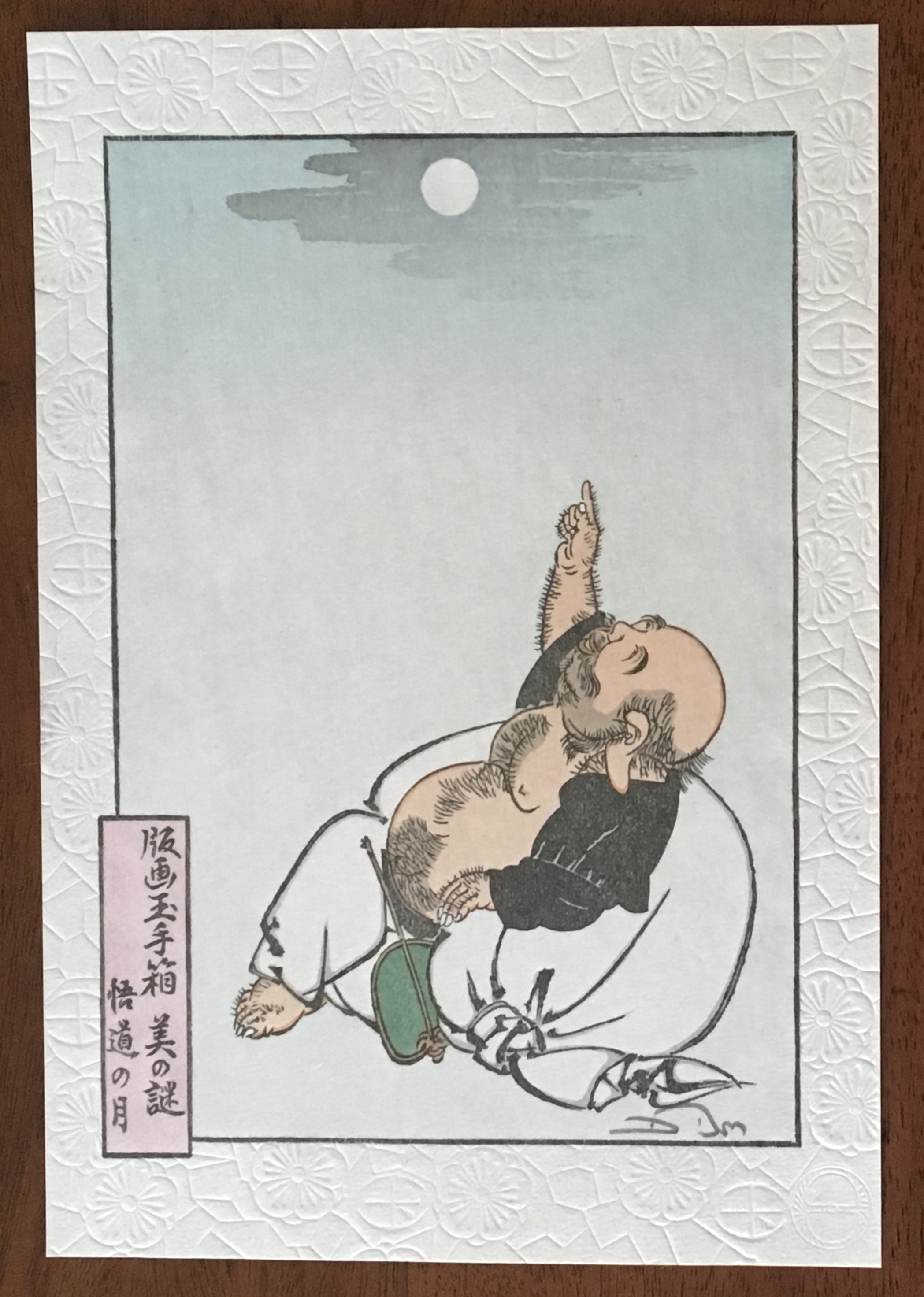
There is something Zen-like about trompe l’oeil in the attentiveness to detail, to material, to execution.  But there is more. To mangle a Zen saying:  Trompe l’oeil is more than a pointing at the moon; those who gaze only at the pointing will never see beyond — never see the beauty of the moon, never see the beauty of the pointing. With the best of trompe l’oeil, that moment in which the eye is fooled recurs again and again for the attentive viewer. In its recurrence, the work of art alternates between the self-referential (the mind drawn to the pointing) and the mimetic (the mind drawn to the pointed at).

Moon of Enlightenment (2010)
David Bull
From a design by Tsukioka Yoshitoshi (1839-92) in his series “One Hundred Aspects of the Moon”.
The Zen saying is “All instruction is but a finger pointing to the moon; and those whose gaze is fixed upon the pointer will never see beyond. Even let him catch sight of the moon, and still he cannot see its beauty.”

So it is not surprising that Stoian has “always been interested in Japanese art and culture”. As early as 2008, origami appears in her commercial decorative work. She is the author of two books: Origami for All with her partner Eric Gjerde (2013) and The Origami Garden (2016). In reviewing both books for The Fold , Jane Rosemarin commented:

… as I paged through her first book, “Origami for All,” I eventually began to understand that Stoian is an artist who has chosen origami as her medium. Her work is not hard to fold, but it has a consistency of style and a real beauty.

Recognized not only for their origami, Stoian and Gjerde were invited in 2013 to exhibit their paper art at the prestigious Salon des Artisans et Métiers d’Art, held at La Propriété Caillebotte in the village of Yerres outside Paris. While Gjerde’s folds explicitly explore the mathematical (for example, Voronoi tessellations and hyperbolic paraboloids), Stoian’s explore shapes more suggestive of the oriental: cranes and flowers as in Strelizia (2010).

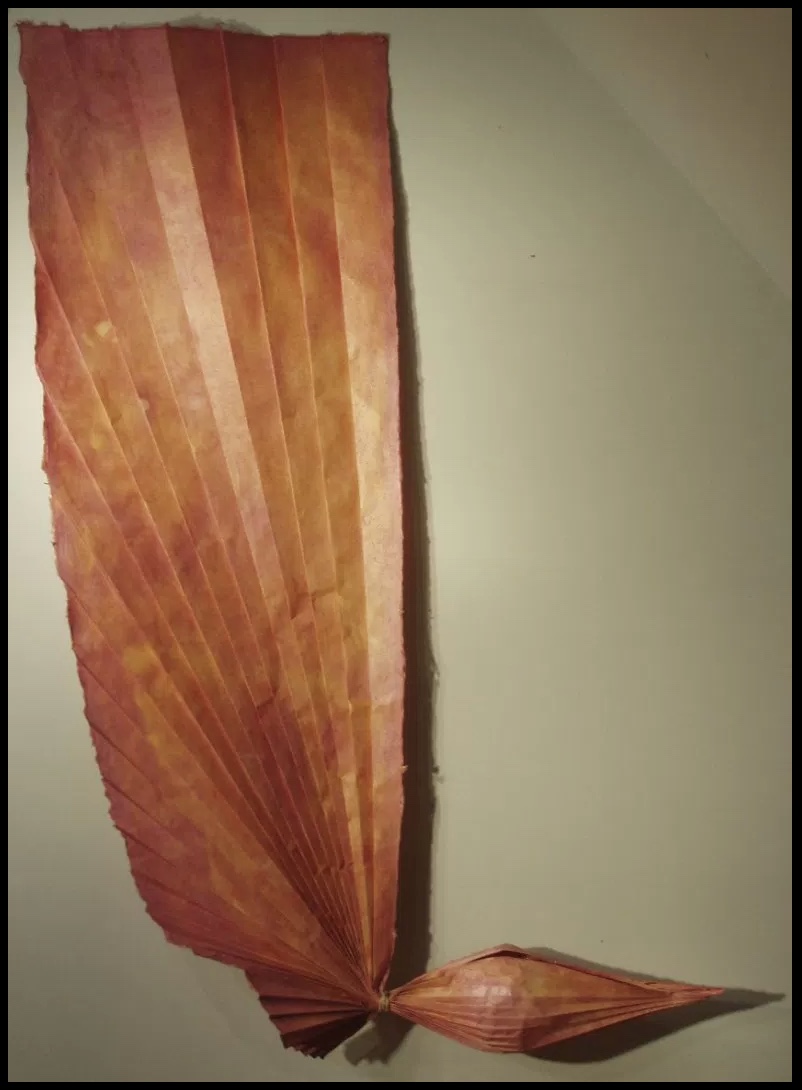
Strelizia (2010)
Ioana Stoian
Pigment on handmade flax and abaca paper
165cm x 59cm
Strelizia (Strelitzia reginae) is a South African plant, known as the “bird of paradise” or “crane” flower.

Where Gjerde’s interest in his material has led him to bio-art (paper grown from bacterial cellulose), Stoian’s has hewed to traditional papermaking, which figures consistently in her work: for example, Hidden Within (2010). In 2012, that interest in traditional

Hidden Within (2010)
Ioana Stoian
Hand-made flax and abaca paper
1.3m x 1.3m

western papermaking had turned eastward:

After discovering western papermaking, I became fascinated with thin, strong sheets, which obviously led me to washi – the Japanese paper made from mulberry. I naturally had the desire to go to Japan and see how this paper was made.

It so happens that a friend of mine, Tomoko Fuse (a very talented and well-known female origami artist and perhaps the most published origami author in the world), was at a paper folding event in France. I casually mentioned that I wanted to go to Japan to learn papermaking. Next thing I know, she had very kindly organised for me to spend a month with Yasuo Kobayashi, master paper maker and owner of Kadoide Washi – an offer I could not refuse.

I spent a magical month in the mountains, during the Kozo harvest (December) and had an amazing time learning from a great master.

Yasuo Kobayashi is a fifth-generation papermaker but also a writer and philosopher, whose unique views on papermaking warranted his inclusion in the American Folklore Society’s sponsored report on apprenticeship and papermaking. Yasuo Kobayashi told the report’s author, Aimee Lee: “I wanted the kozo to tell me what kind of paper it wants to become, not to force it to be what I want. This is not typical for papermakers. I want kozo to be my teacher.” When asked to elaborate,

… Kobayashi compared bunka (culture) and bunmei (civilization). “Bunka is what you think from your heart.” In contrast, bunmei’s goal is to develop constantly, exemplified by the western desire for progress: people do not want today and tomorrow to be the same—they want things to be less difficult and more convenient. This mindset cannot translate to making real paper. His grandfather’s and father’s lives were not very different. His father’s and his lives were a little different. But his son’s and his lives are so different that it is hard to relate across that rift. He sees two roots for the future of paper: growers and makers. Real kozo goes with the heart but is inconvenient and does not follow progress. Kigami [paper] comes from the root “to be born,” and this word also relates to breathing. When born, paper is like a child: weak, but growing stronger over time until it dies. He knows that his point of view is rare, but also said people must balance bunka and bunmei, rather than to go absolutely one way or another. Today, the balance is too heavy on the professional side, so he tries to balance this by leaning towards the growing side.

Stoian’s jump at the chance to learn from him is consonant with her “journeyman’s” approach to her artistic development. Note that the visit to Kadoide Washi precedes the work on Wood and Bent Onyx for Tauba Auerbach in 2014. The methodical diligence required in making washi and the resulting appreciation of the properties of paper re-present themselves in Stoian’s mapping of the grain and perceiving what the works and the paper “wanted”. The impressive fore-edge work with Wood and Bent Onyx now seems inevitable, rising from a combination of technique and deep appreciation of color, material, form and structure in the service of illusion. In her own work, Stoian strives toward bunka, which is evident in works like Strelizia and Hidden Within, where the form and color her handmade paper takes combine to convey feeling — or “heart” as Kobayashi might put it. Her aim has become even clearer during the Jerome Foundation stage of her “journeyman’s” journey.

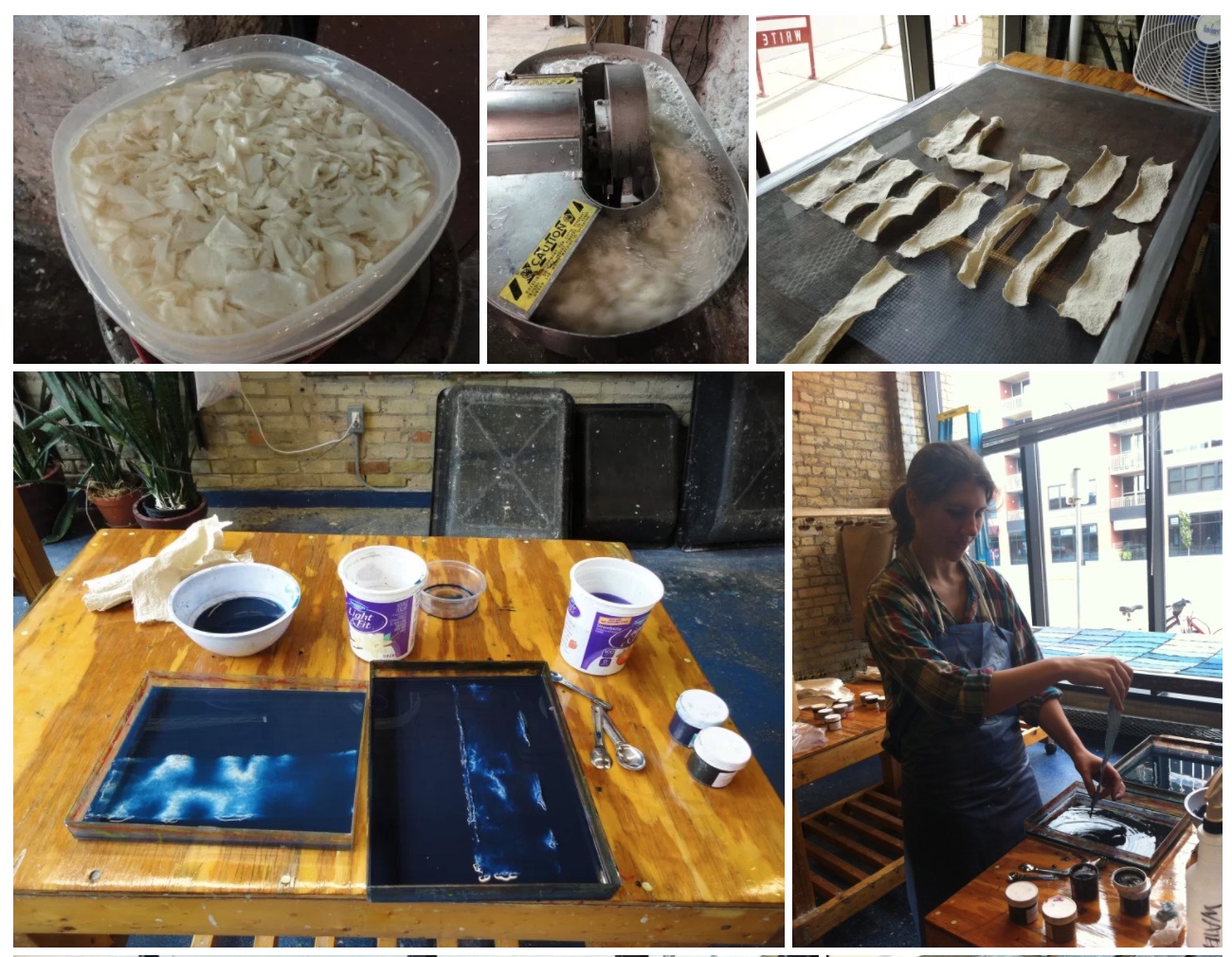
Stoian received the Jerome Foundation Mentorship grant for 2014/15 at the Minnesota Center for Book Arts to create an artist book — an extraordinary artist book. The mentorship program  offers emerging artists the resources to create a book, fusing together newly acquired skills with aspects of their own artistic practice. The grant provided one year of 24-hour access to the Center’s facilities, a mentor, and a series of introductory workshops on paper making, letterpress printing, and book binding.
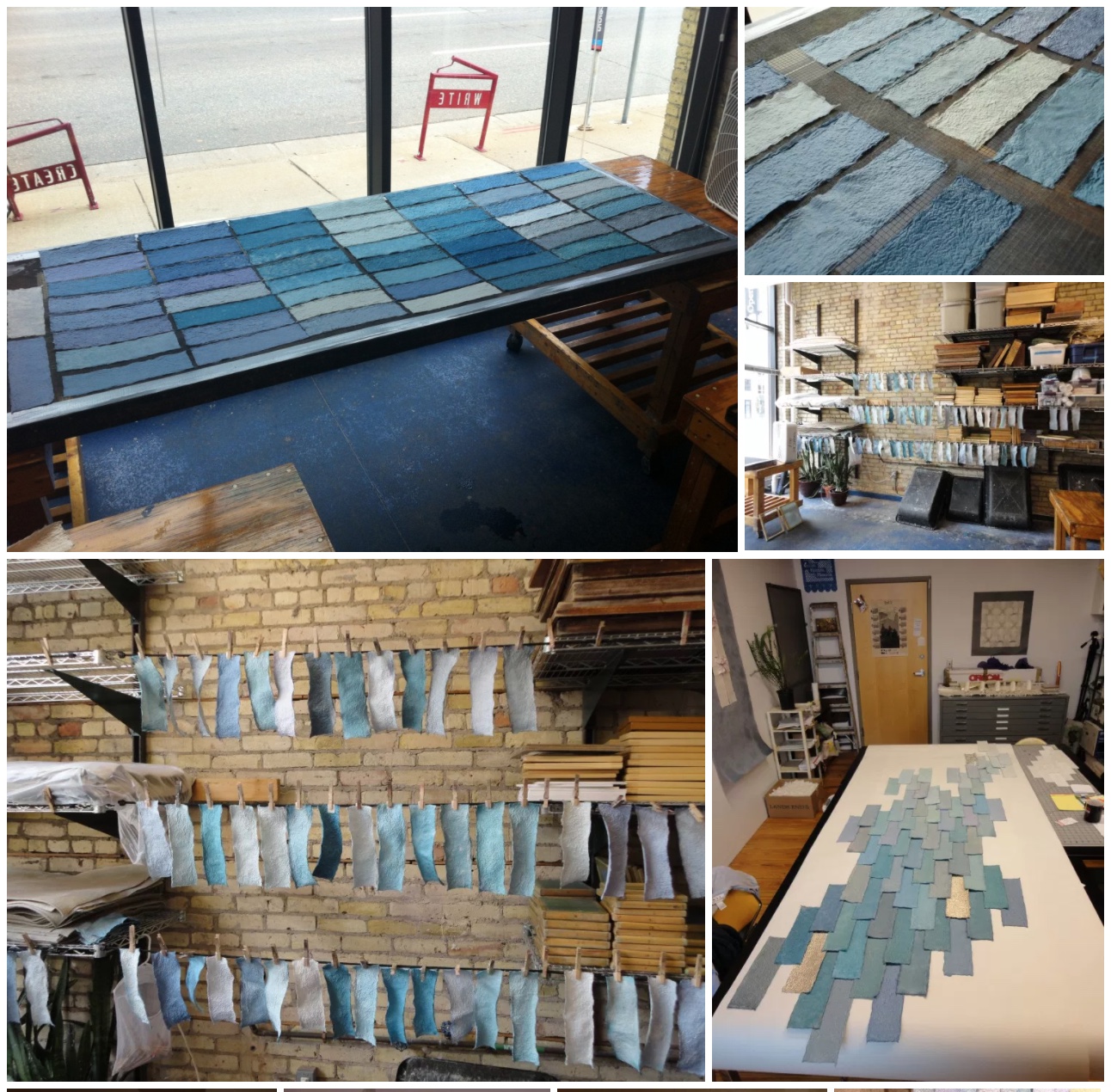
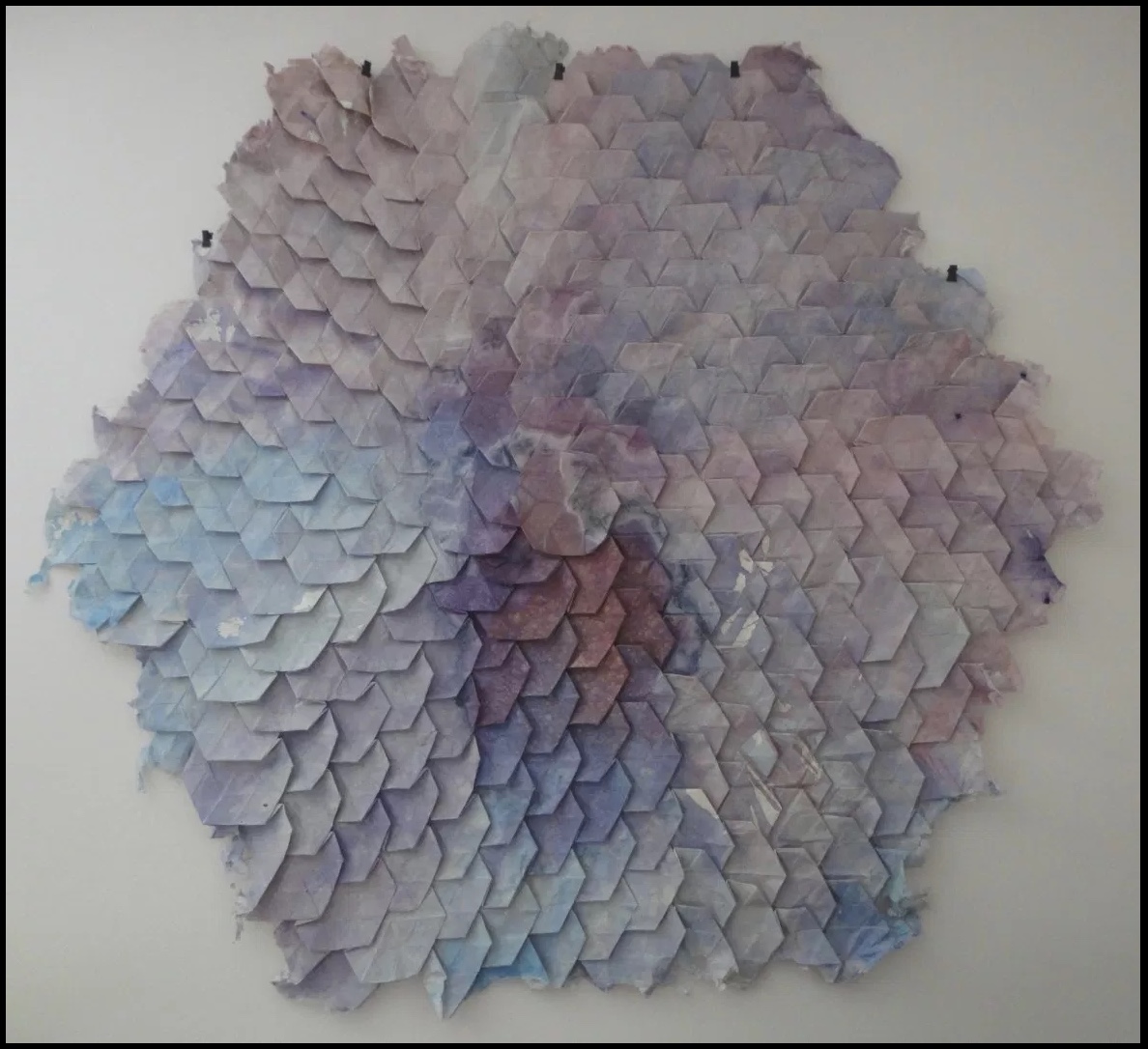
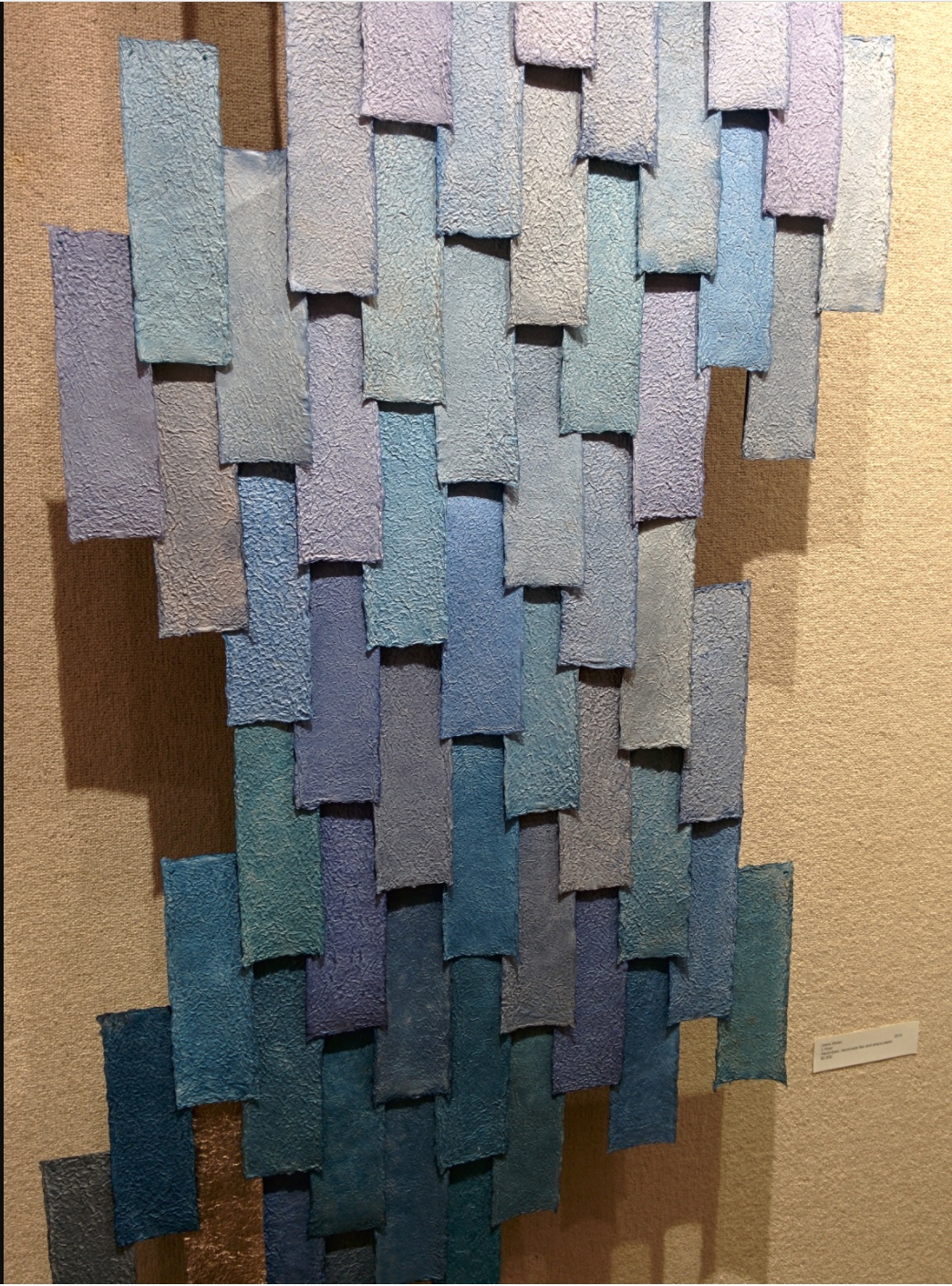
Responding to her new wintry environment, Stoian embarked on l’hiver (2014), a new work consisting of 80+ individually hand-made and dyed pieces of paper. L’hiver is reminiscent of Hidden Within (2010) in its pursuit of a harmony of color, structure, and form. The former is perhaps more open than the latter and lets each part’s snowflake-like uniqueness assert itself.

l’hiver (2104)
Ioana Stoian
Hand dyed, handmade flax and abaca paper
3m x 1m

The congruence and continuity of those two works do nothing to prepare the viewer for Nous Sommes (2015), the artist’s book that follows them. While Nous Sommes continues Stoian’s aim of harmony among color, structure and form, while its intensity of colors harks back to the stencil work for Lucy McKenzie’s Stedelijk exhibition in 2013, the structure and form Stoian chose marks a bold departure.

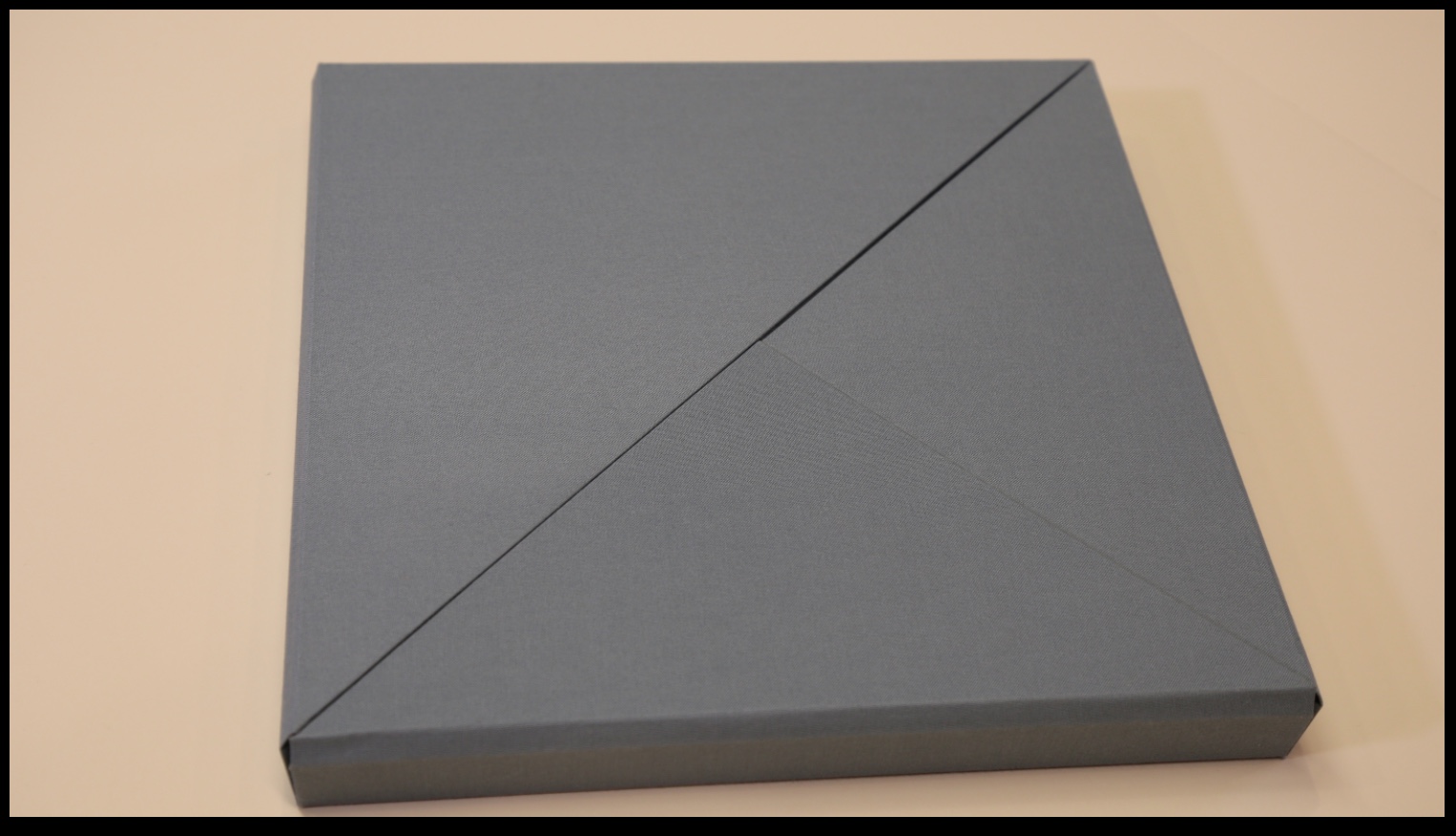
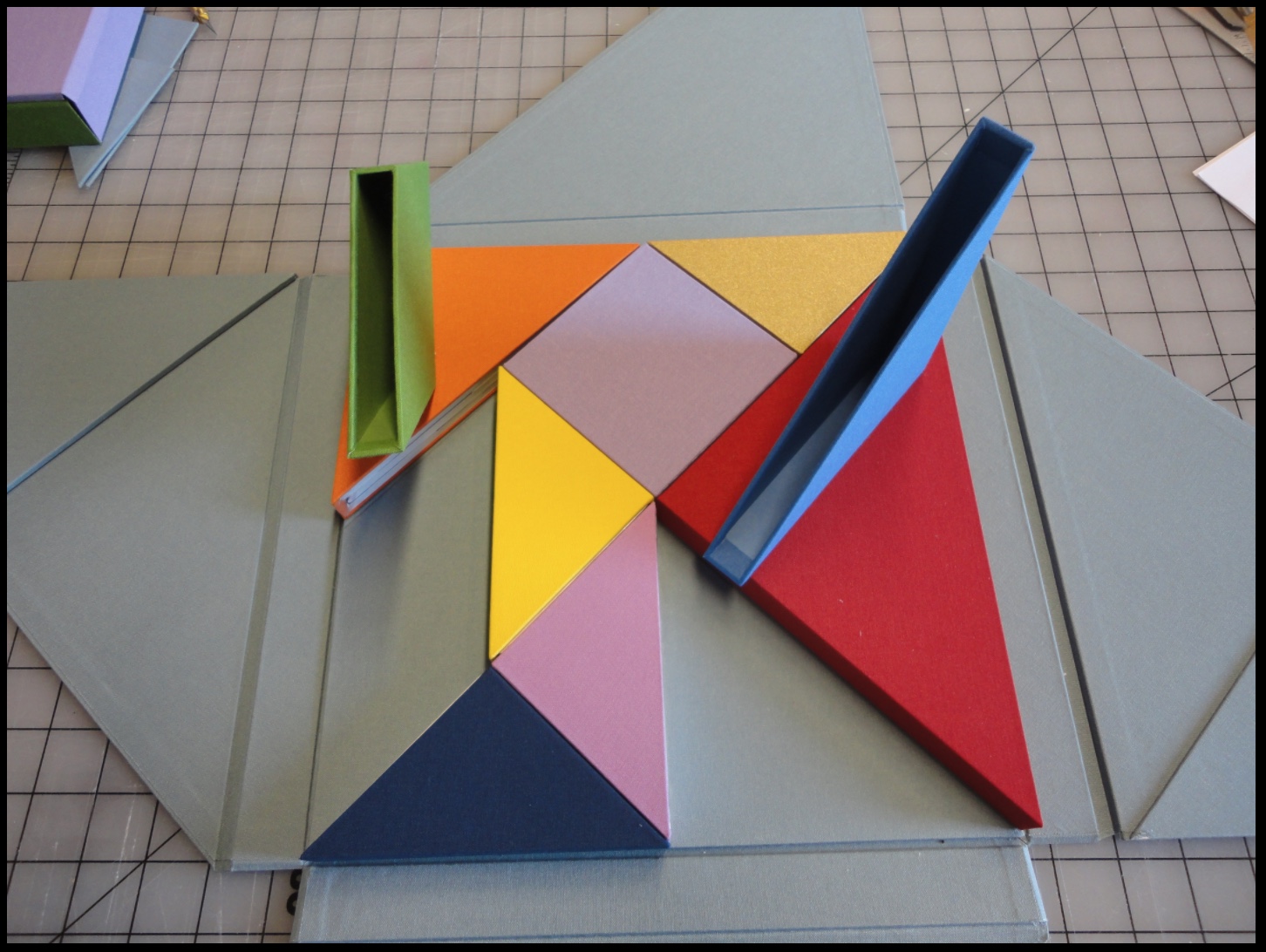
The cover and binding of Nous Sommes has the feel of a Solander box.  The book opens in a particular order of lifting the triangular flaps, one of which displays the “Table of Contents” and another the colophon. 

Nous Sommes (2015)
Ioana Stoian

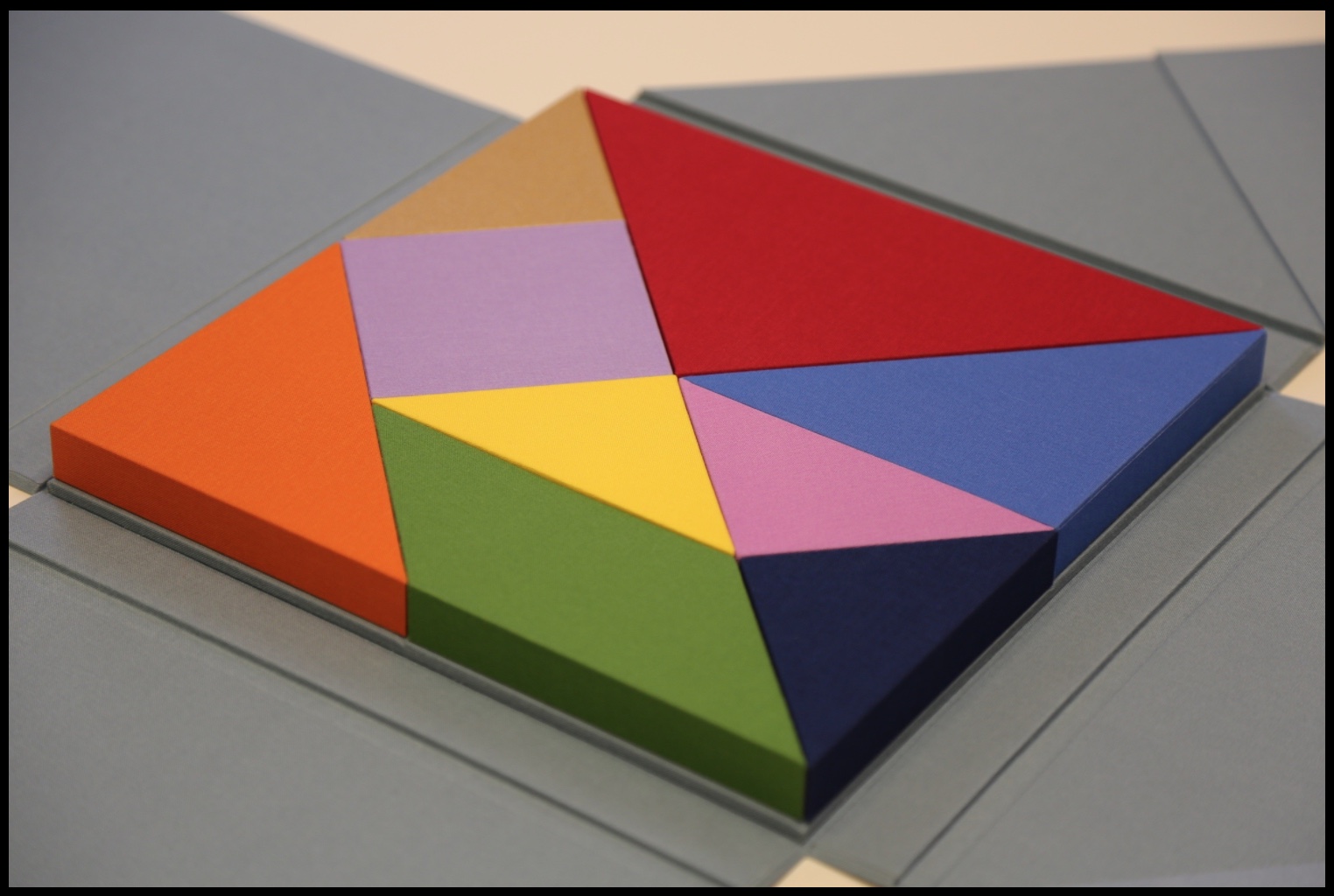
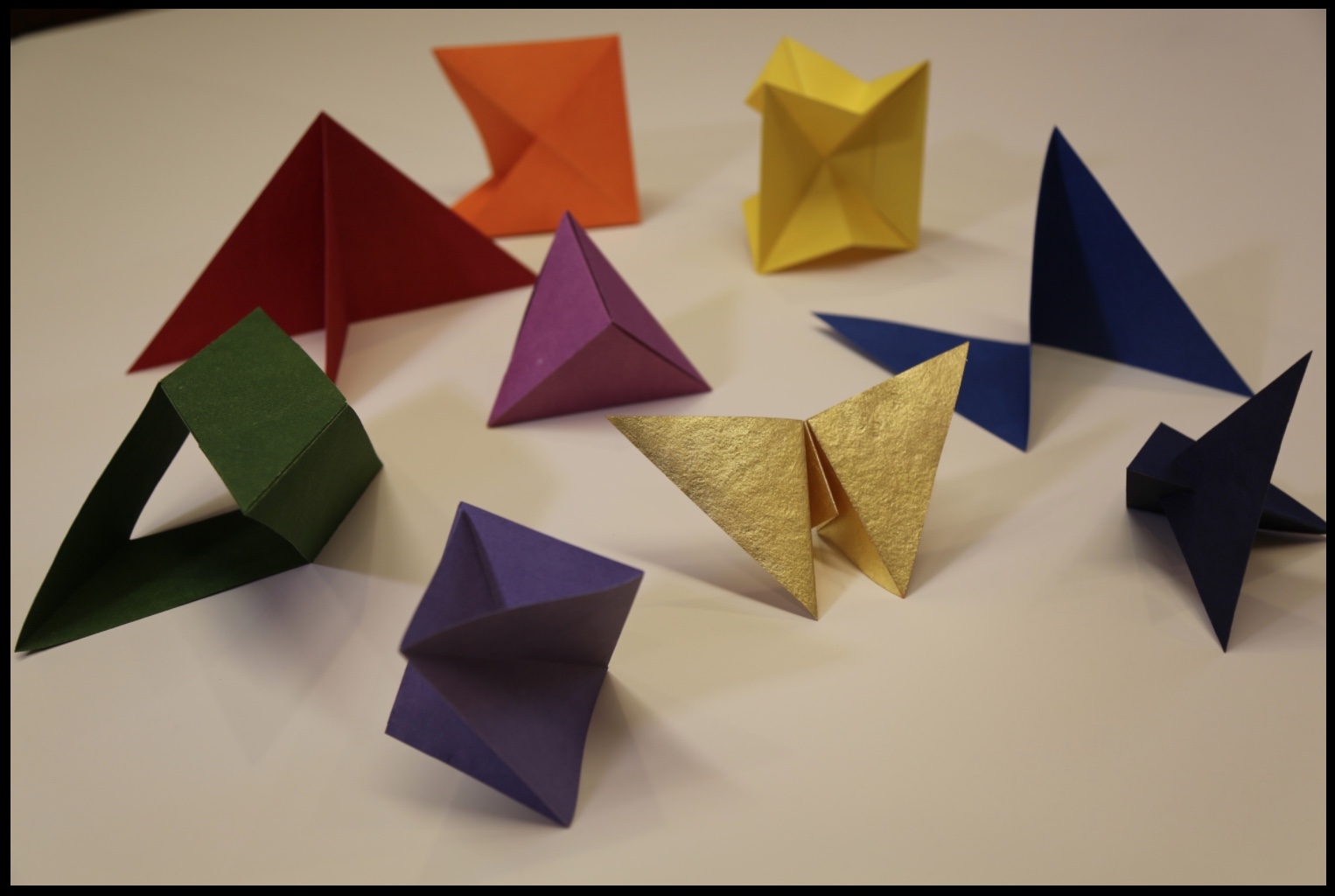
Nous Sommes has nine “chapters” or differently sized, shaped and colored slipcases whose material matches that of the cover and binding. The chapters fit precisely together (tangram-like), but the order of their reading lies with the reader’s choice of color, shape or size. The video provided by Stoian and Gjerde offers one of many readings of the work.
Nous Sommes (2015)
Ioana Stoian
Empty “chapters”
Nous Sommes (2015)
Ioana Stoian

Within each chapter is a precisely fitted paper structure to be “read” by unfolding, positioning, displaying, contemplating and, in conclusion, returning it to its chapter/slipcase.

“Contents” of nine chapters/slipcases
Nous Sommes (2015)
Ioana Stoian 

Commenting on Strelizia, shown earlier, Stoian writes,

I am interested in intuitive color experiments; this work represents the flow from mood to colour, with the final form of the paper manifesting itself from these captured emotions.

In Kandinsky’s footsteps, perhaps, this artist finds and aims to offer the spiritual in art. The title Nous Sommes suggests so. Whether the expression “we are” applies to the art object (self-referentially) or to its audience (individually or collectively), form, structure and colors assert community, inclusion and a fitting together. 

We can look forward to Stoian’s next chapter as she has received a follow-on appointment from the Minnesota Center for the Book Arts: the 2017/18 Jerome Foundation Fellowship.