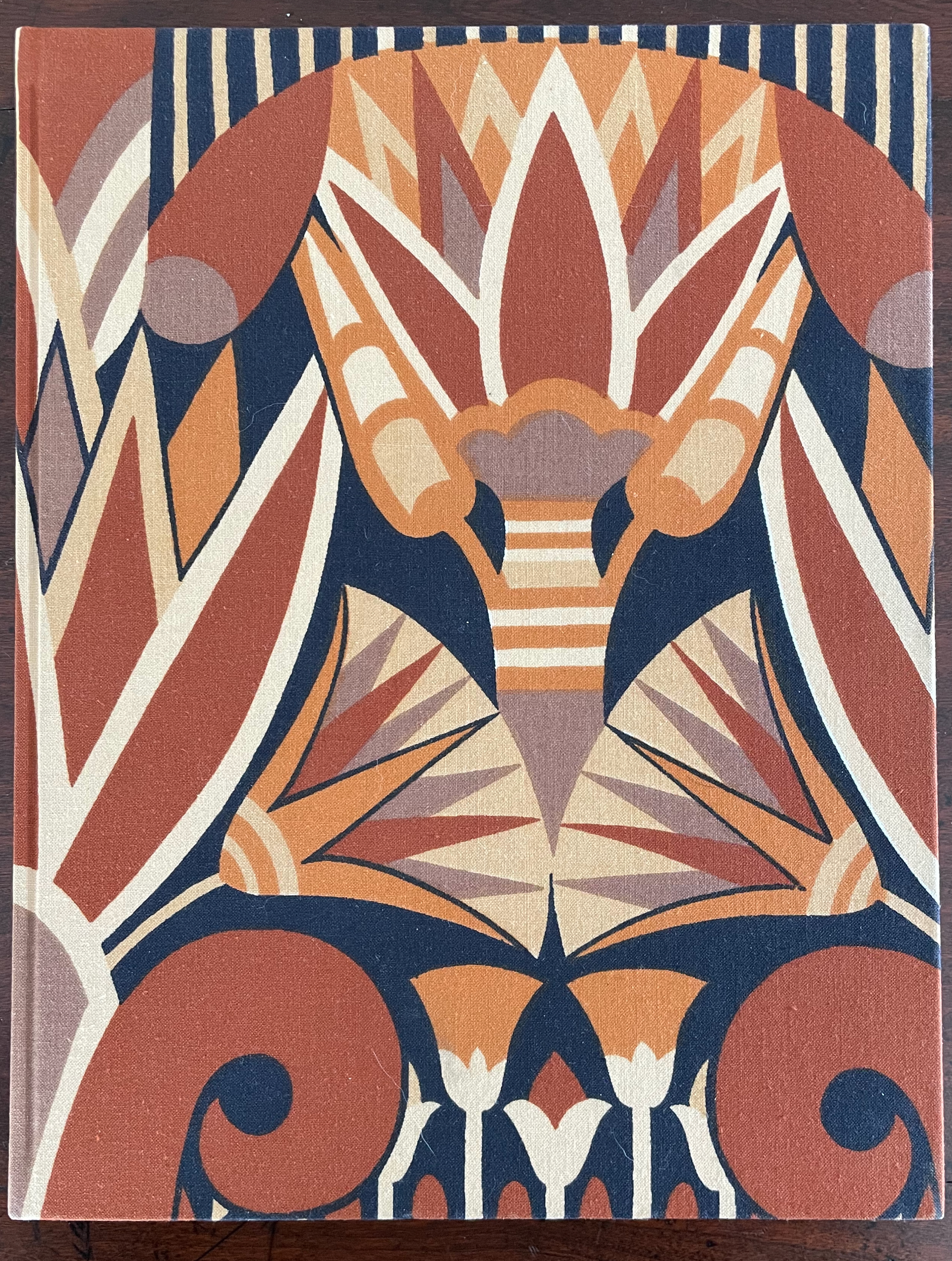
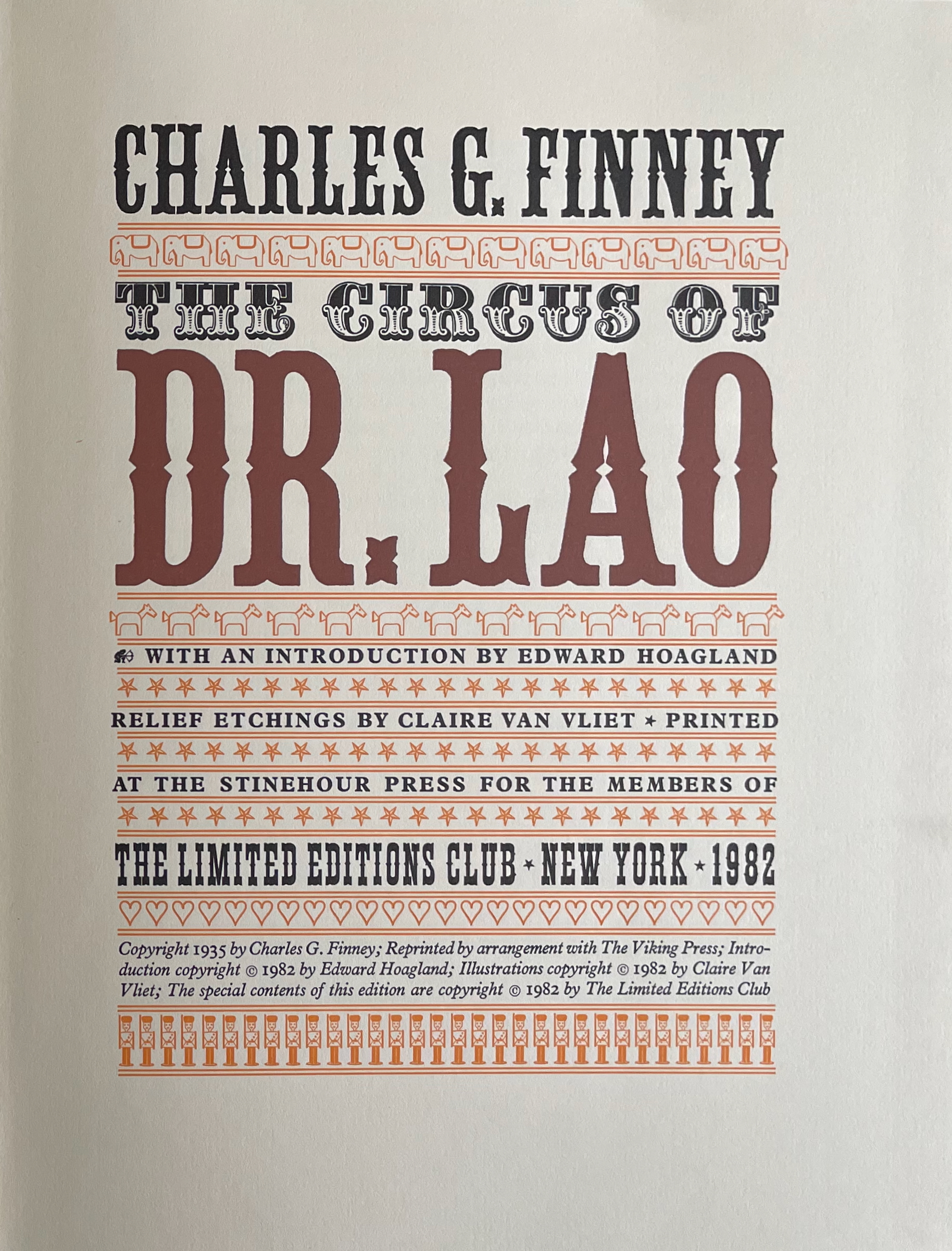
The Circus of Dr. Lao (1982) Charles G. Finney (text) Claire Van Vliet (design and illustration) Hardback, cased in cotton cloth over boards, head and tail bands, sewn. H x W mm. 9 1/4 x 12 inches 140 pages. Edition of 2000, of which this is #996. Acquired from BlueMamaBooks, 9 February 2025. Photos: Books On Books Collection.
If you have read Nathaniel West’s The Day of the Locust (1939) or Flannery O’Connor’s A Good Man Is Hard to Find (1955), Charles Finney’s novella illustrated by Claire Van Vliet will seem only marginally disturbing. If you have seen Tod Browning’s Freaks (1932), it will seem more than tame. Somewhere in between is the appropriate trigger warning for The Circus of Dr. Lao (1982).
Finney drops Dr. Lao’s circus of P.T. Barnum-esque carnival sideshows, a bestiary of distorted mythological creatures and exaggerated stereotypes, into the Arizona backwater of Abalone. The denizen of Abalone and their reactions — from gullibility, lubricious fascination, racist hazing, and violence to shrugs and a smug return to unexceptional normality — are the targets of Finney’s fevered satire. Van Vliet mirrors the range with her illustrations printed from original relief etchings and her selection of contrasting Plantin and Victoria display types.
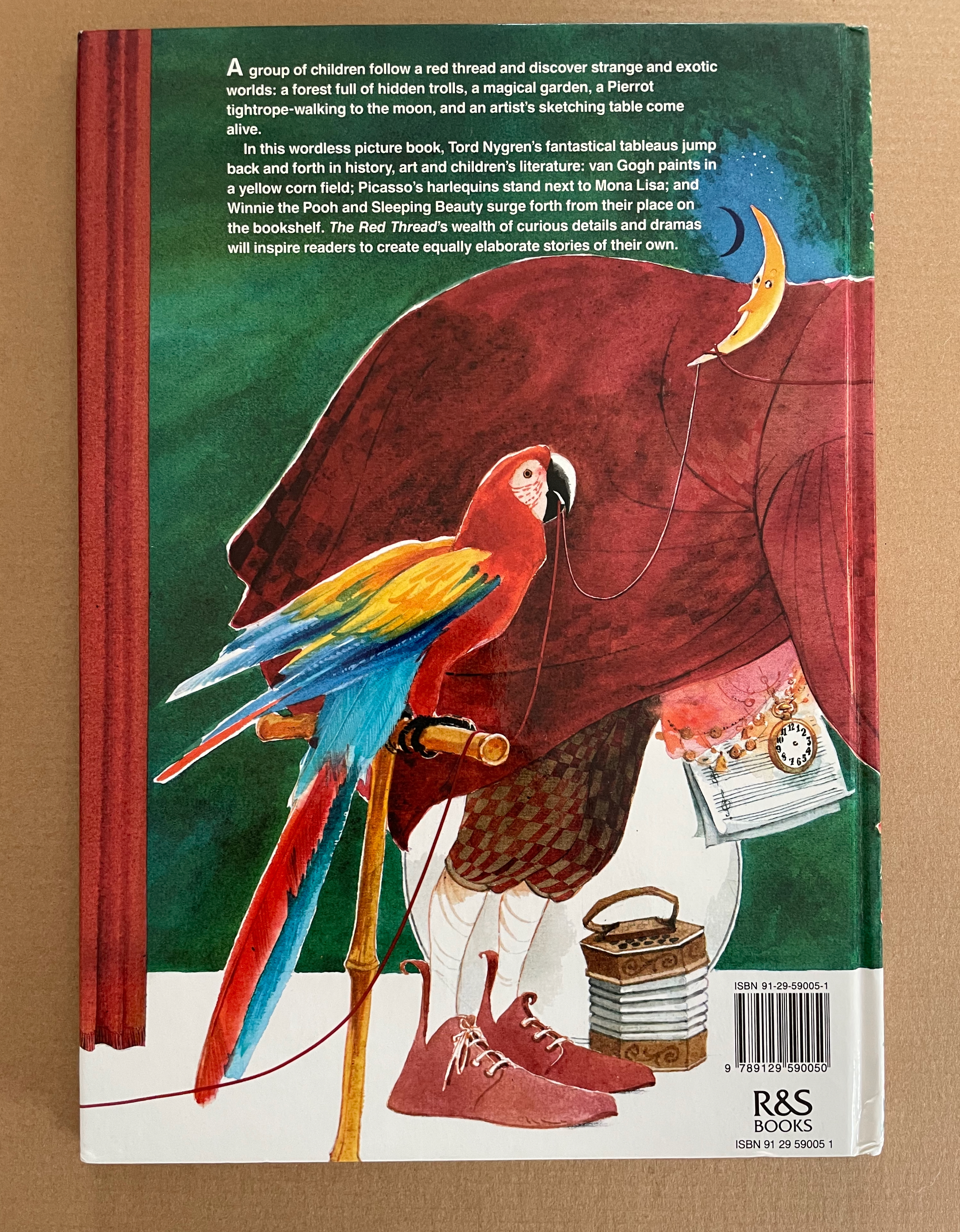
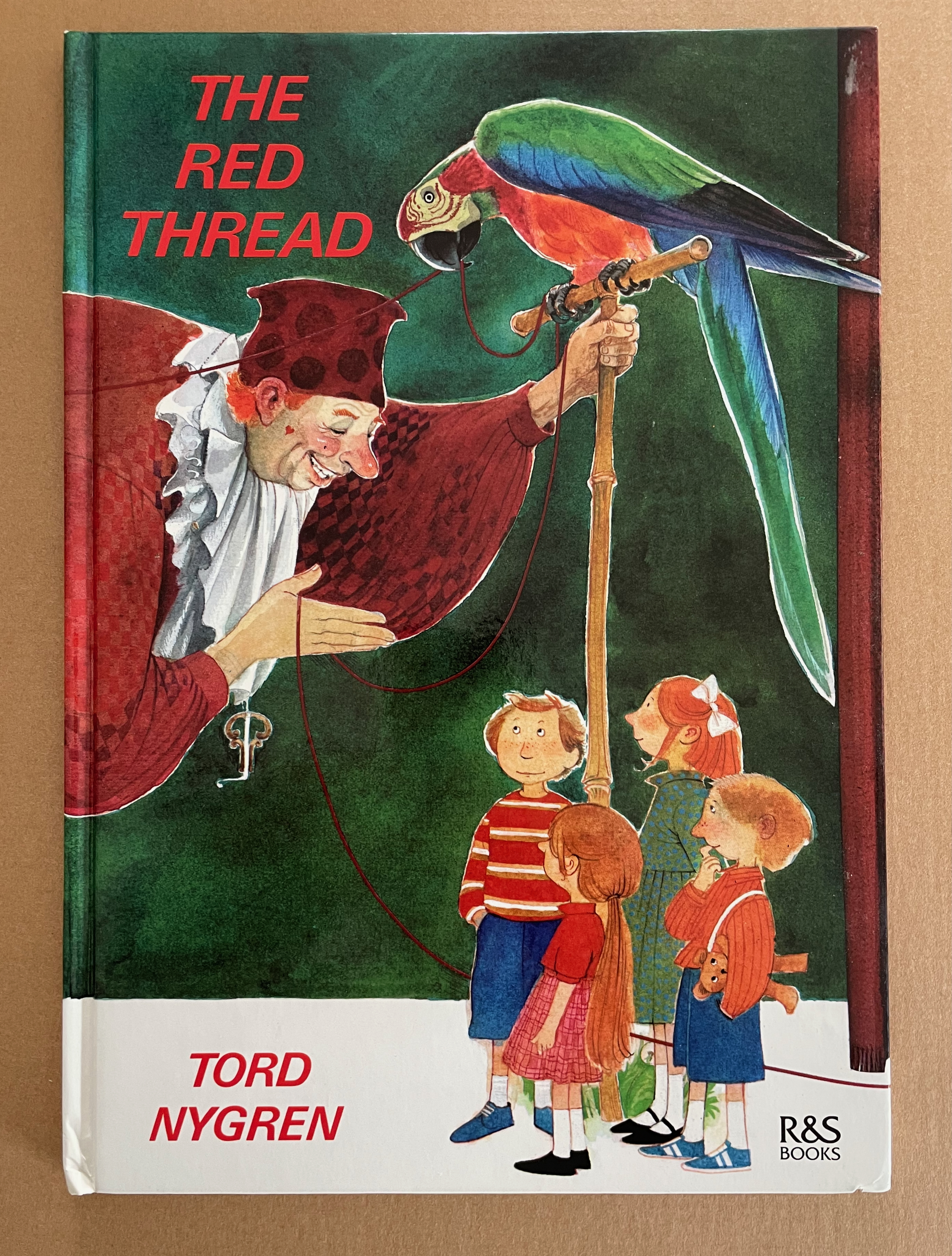
The Red Thread (1988) Tord Nygren Hardback, casebound, sewn. H305 x W 215 mm. [30] including pastedowns. Acquired from Better World Books, April 2025. Photos: Books On Books Collection.
The Swedish expression “den röda tråden” translates best as “the common thread”, the thing that links together otherwise disparate things and experiences. The literal translation, however, works best for Tord Nygren’s Den Röda Tråden (1987), leaving us to follow the red thread that the clown offers to the children on the front cover. The thread wraps around to the pastedown and across the fly leaf chased by the runaway carousel horse …
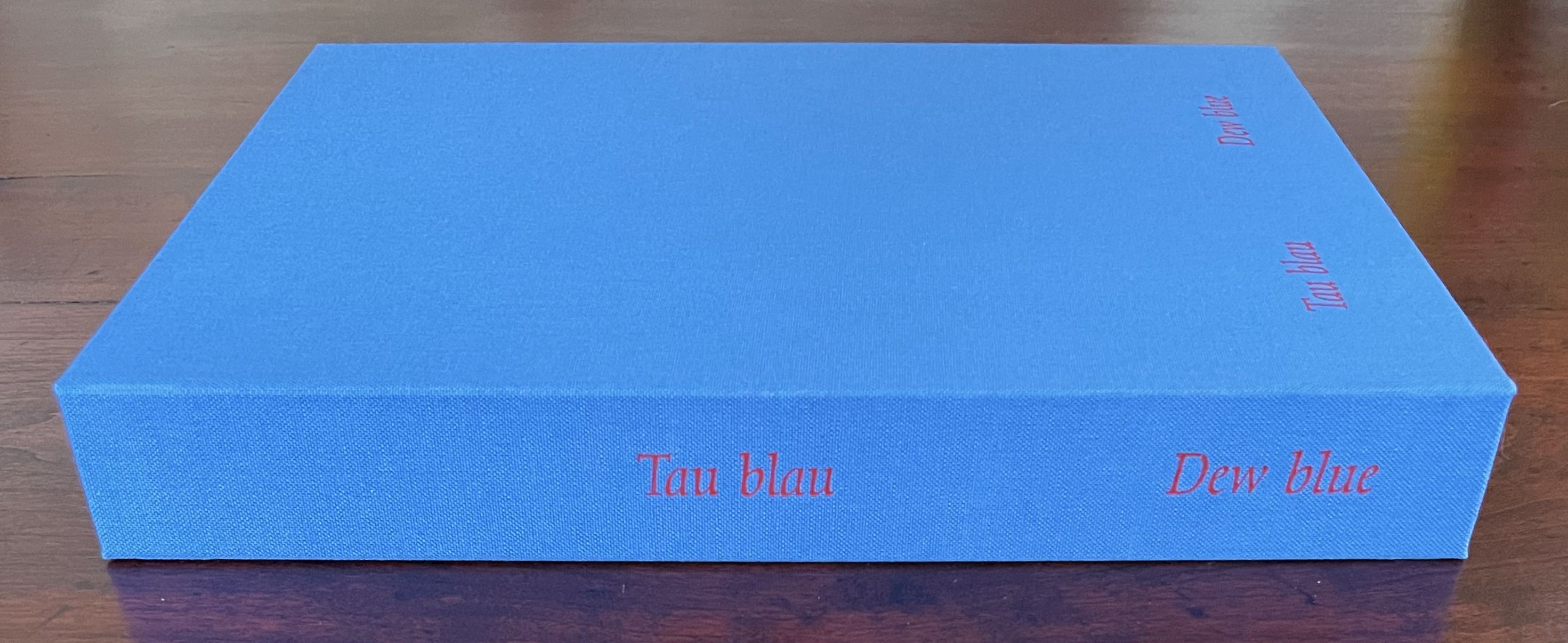
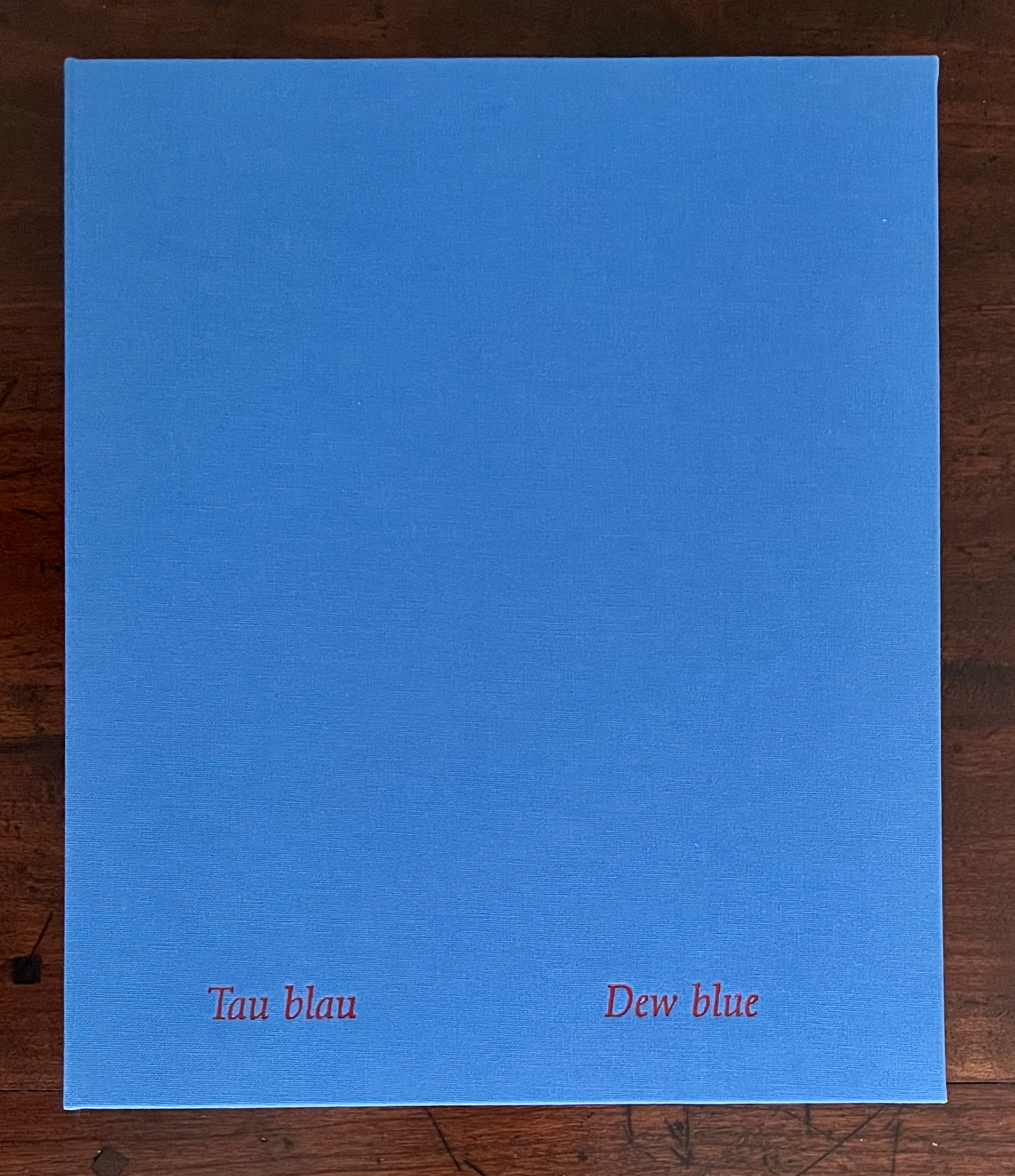
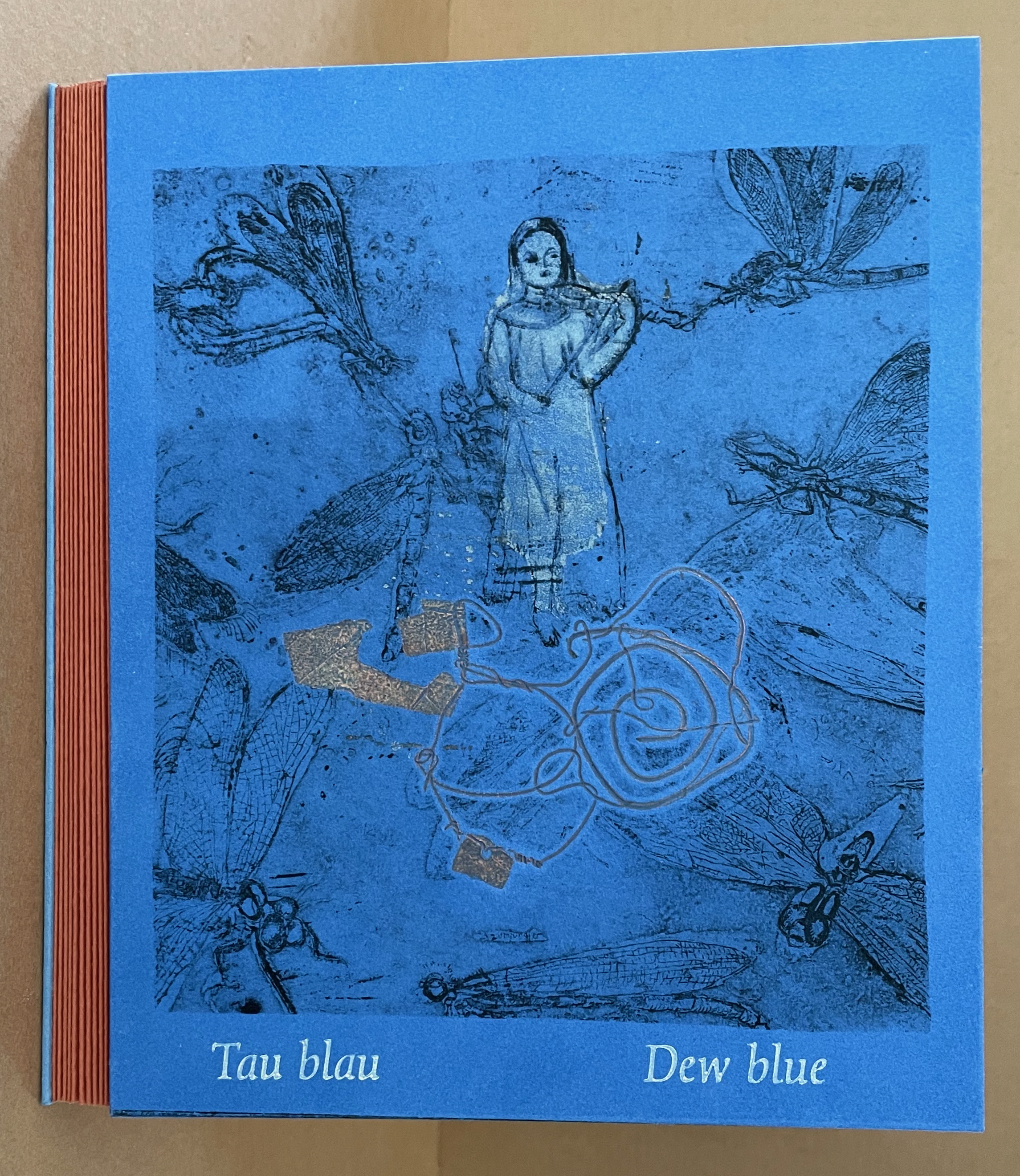
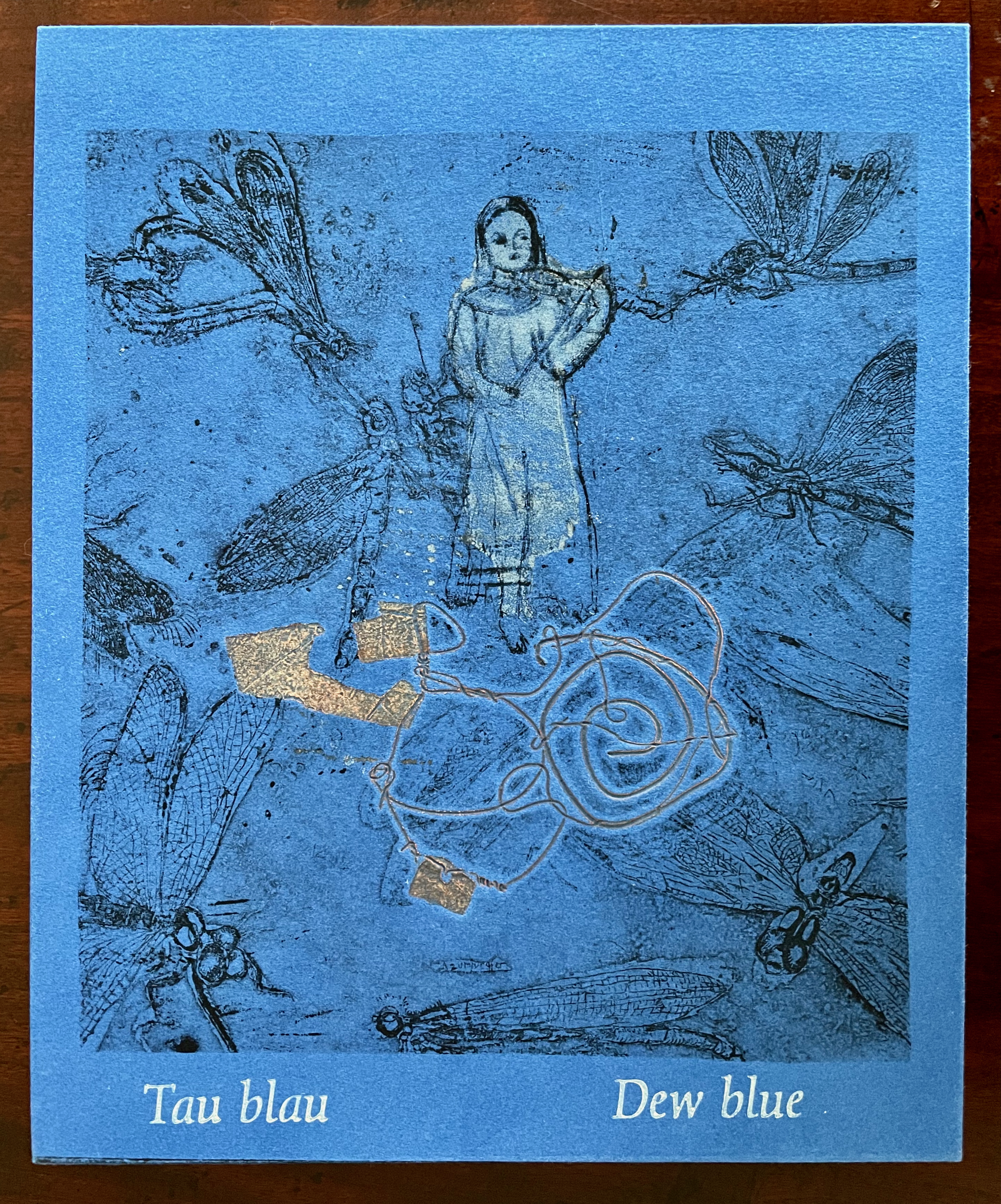
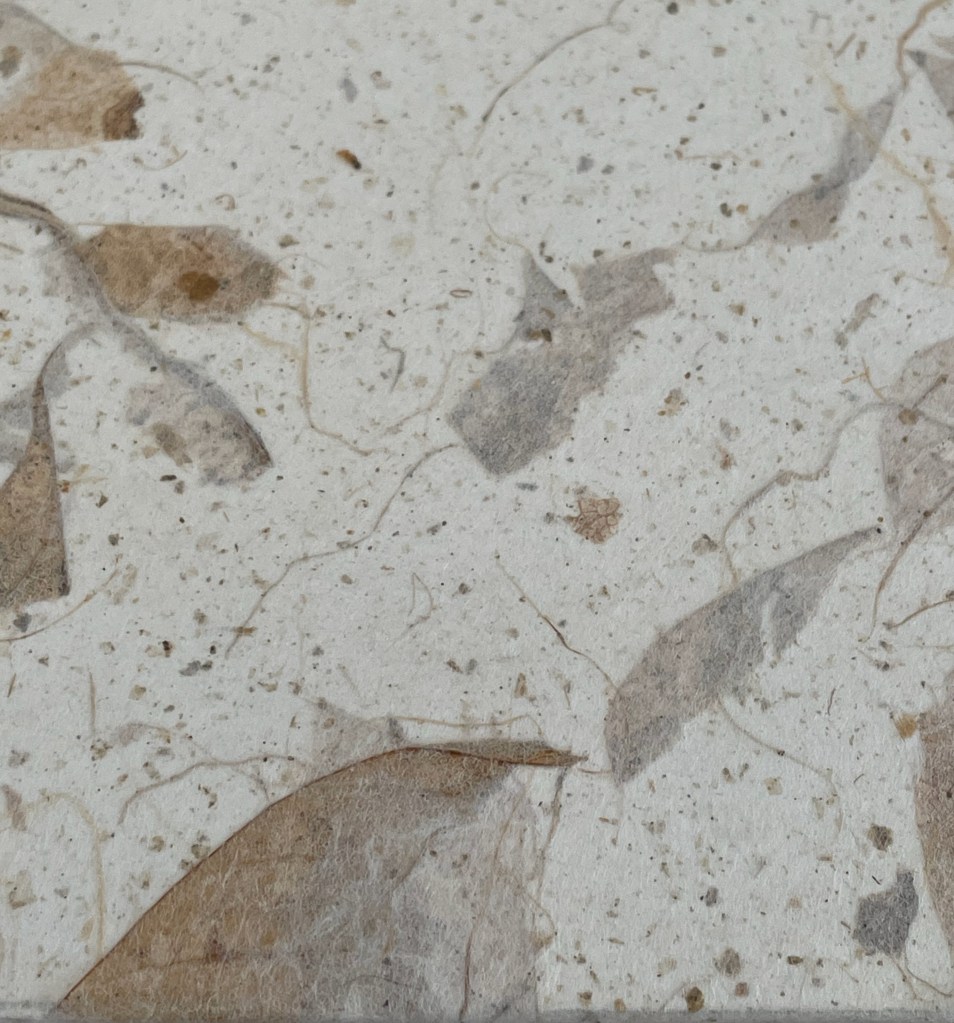
Tau blau / Dew Blue (2013) Barbara Beisinghoff ; Solander box in linen, handbound Vera Schollemann; Flax paper, handmade by John Gerard. Solander box: H240 x W200 x D32 mm. Flagbook: H220 x W180 mm. Edition of 38, of which this is #22. Acquired from the artist, 30 December 2024. Photos: Books On Books Collection.
Familiarity with Hans Christian Andersen’s fairy tale Hørren /The Flax enhances appreciation of Barbara Beisinghoff’s Tau blau / Dew Blue. Andersen gives a voice to the plant that expresses its joy, pain, hope and observations at each stage of its blooming, being harvested, turned into linen and clothing then paper, and finally consigned to flames. The H.C. Andersen Centre offers Jean Hersholt’s translation of it here.
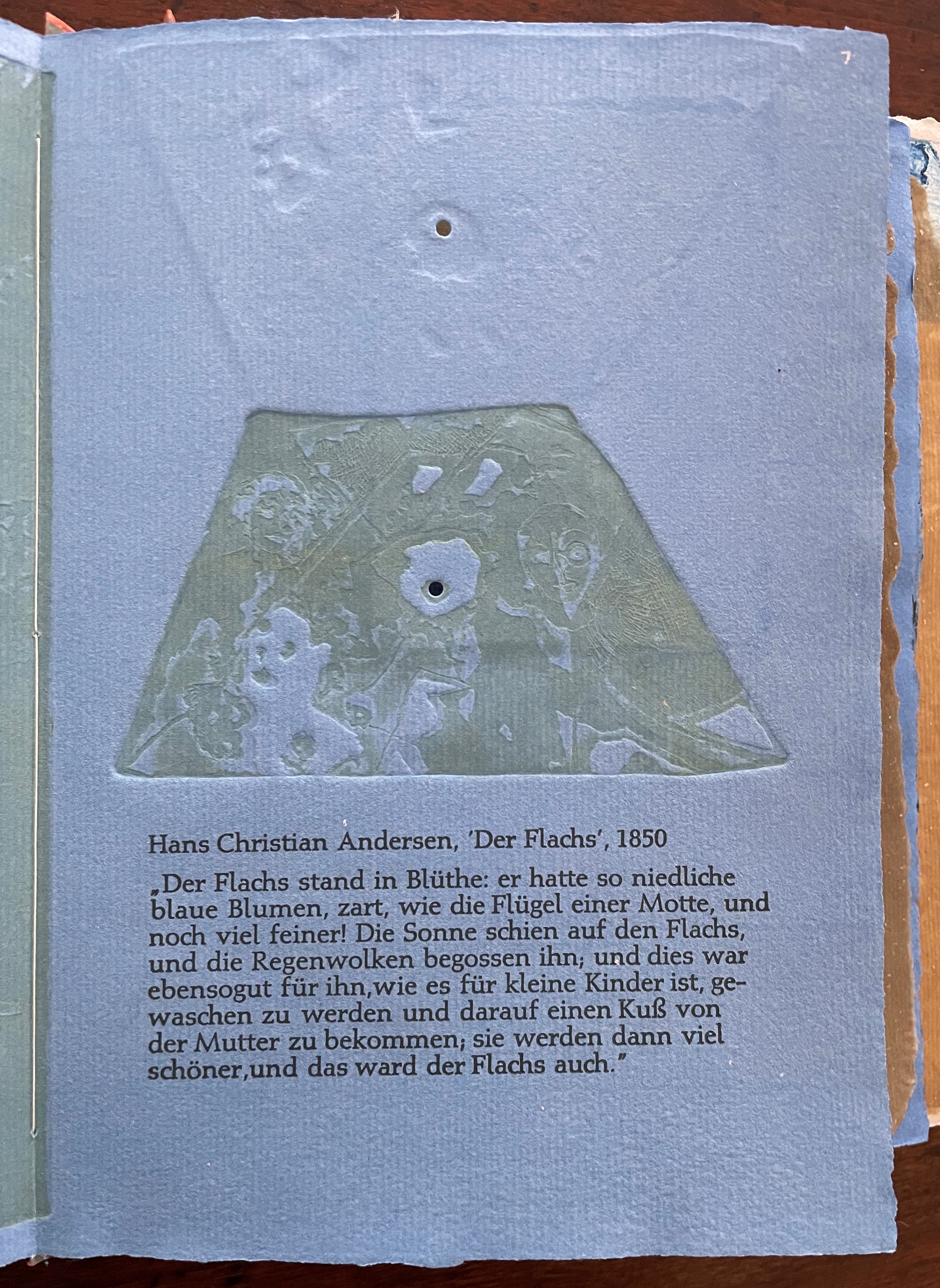
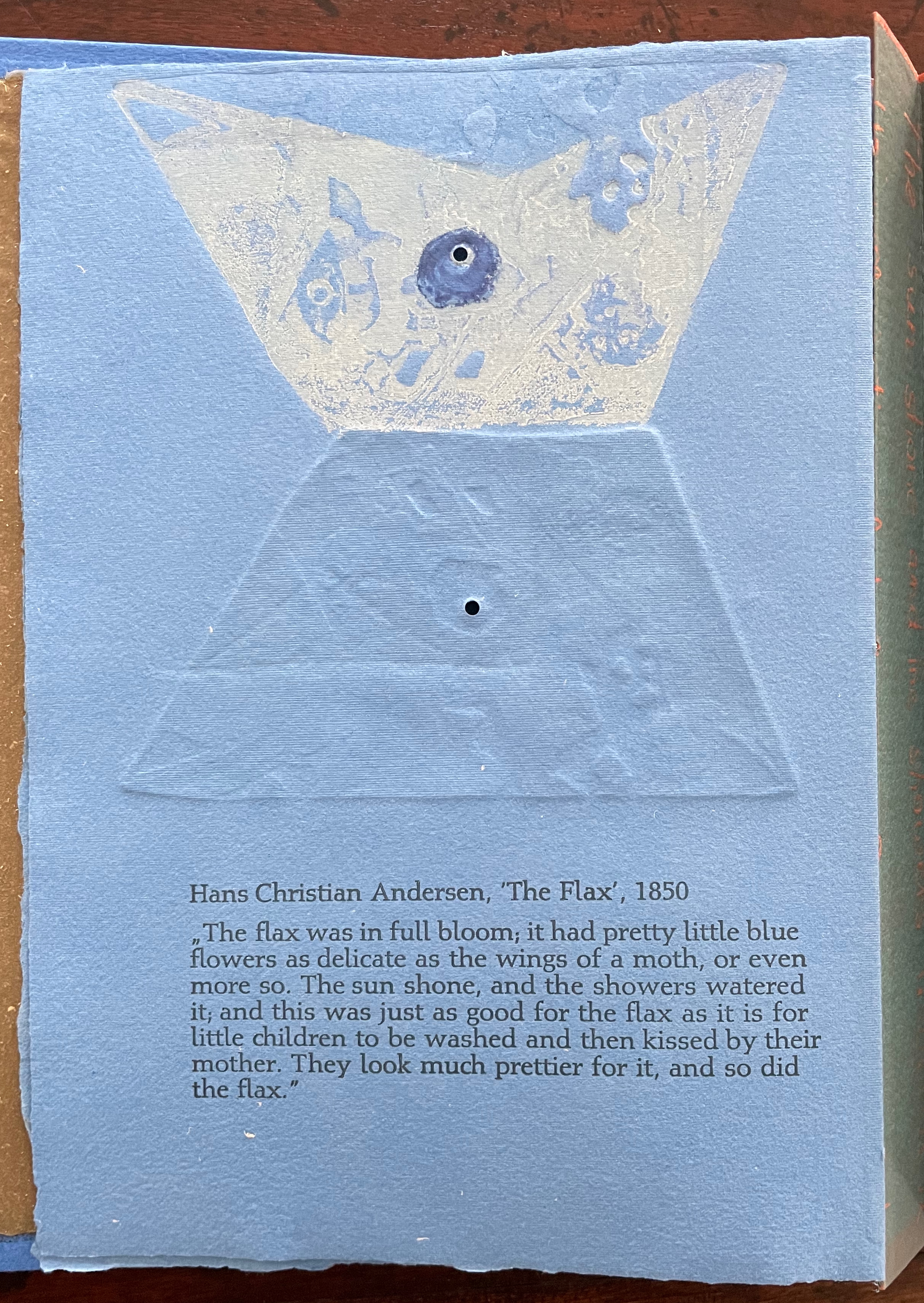
Only the opening paragraph of the story appears in Tau blau / Dew Blue, but Beisinghoff documents and illustrates the stages from her own cultivation of flax, observation of its growth and preparation of its processing. And with the etching, drawing, watermarking, handmade papers, linen cloth and thread, and binding structure, Beisinghoff suffuses the spirit of the tale’s metamorphosizing plant throughout the whole of Tau blau / Dew Blue.
From the blue of the plant’s blossoms to the white of its change into linen and paper to the red, burnt orange and black of its sparks and ash when it is consumed by fire in the end, all of the story’s colors are replayed across Tau blau / Dew Blue from its Solander box to its covers and spine like motives in a Baroque musical piece.
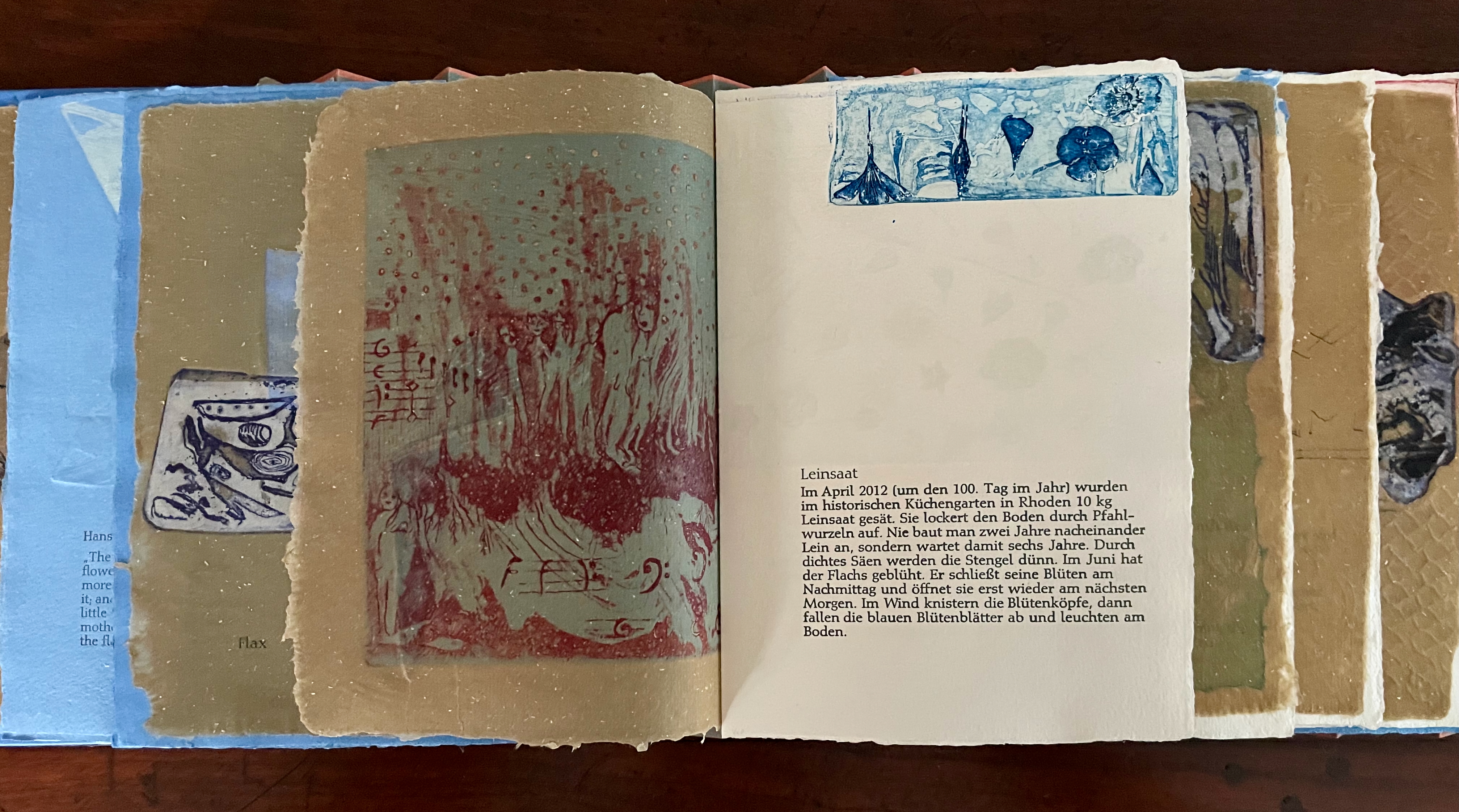
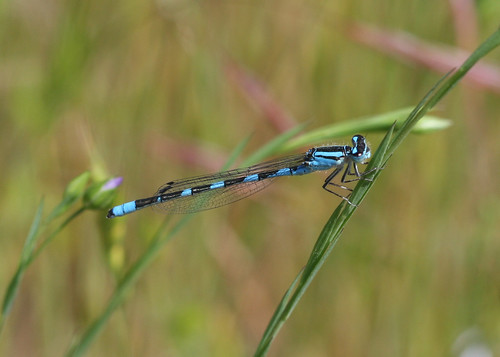
In a concerto, motives play off one another and develop. In Tau blau / Dew Blue, the motif of nature (the plant) plays off the motif of artifice and the manmade (the fairy tale, music, linen, paper, etc.). On the front cover (above), a young girl, surrounded by large damselflies, plays a fiddle or violin and seems to hover above a silver foil image of flax thread and tools for making it. In the spread above alongside the front cover, the specks rising over the staves and musical notes (a recurring motif in itself) recall the tale’s final passage in which the bundle of papers (made from linen rags) is cast into a fire:
“I’m going straight up to the sun!” said a voice in the flame. It was as if a thousand voices cried this together, as the flames burst through the chimney and out at the top. And brighter than the flames, but still invisible to mortal eyes, little tiny beings hovered, just as many as there had been blossoms on the flax long ago. They were lighter even than the flame which gave them birth, and when that flame had died away and nothing was left of the paper but black ashes, they danced over the embers again. Wherever their feet touched, their footprints, the tiny red sparks, could be seen.
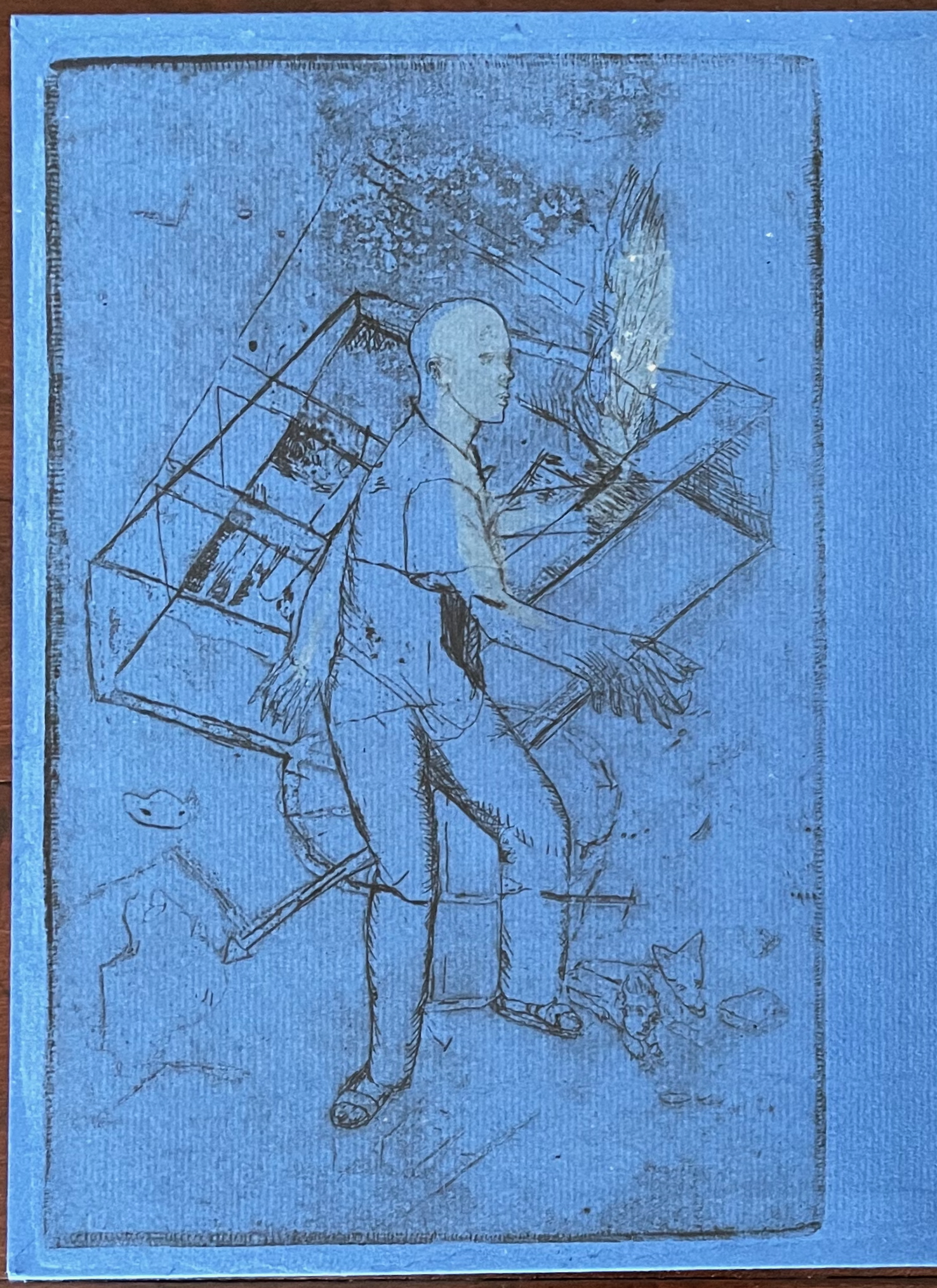
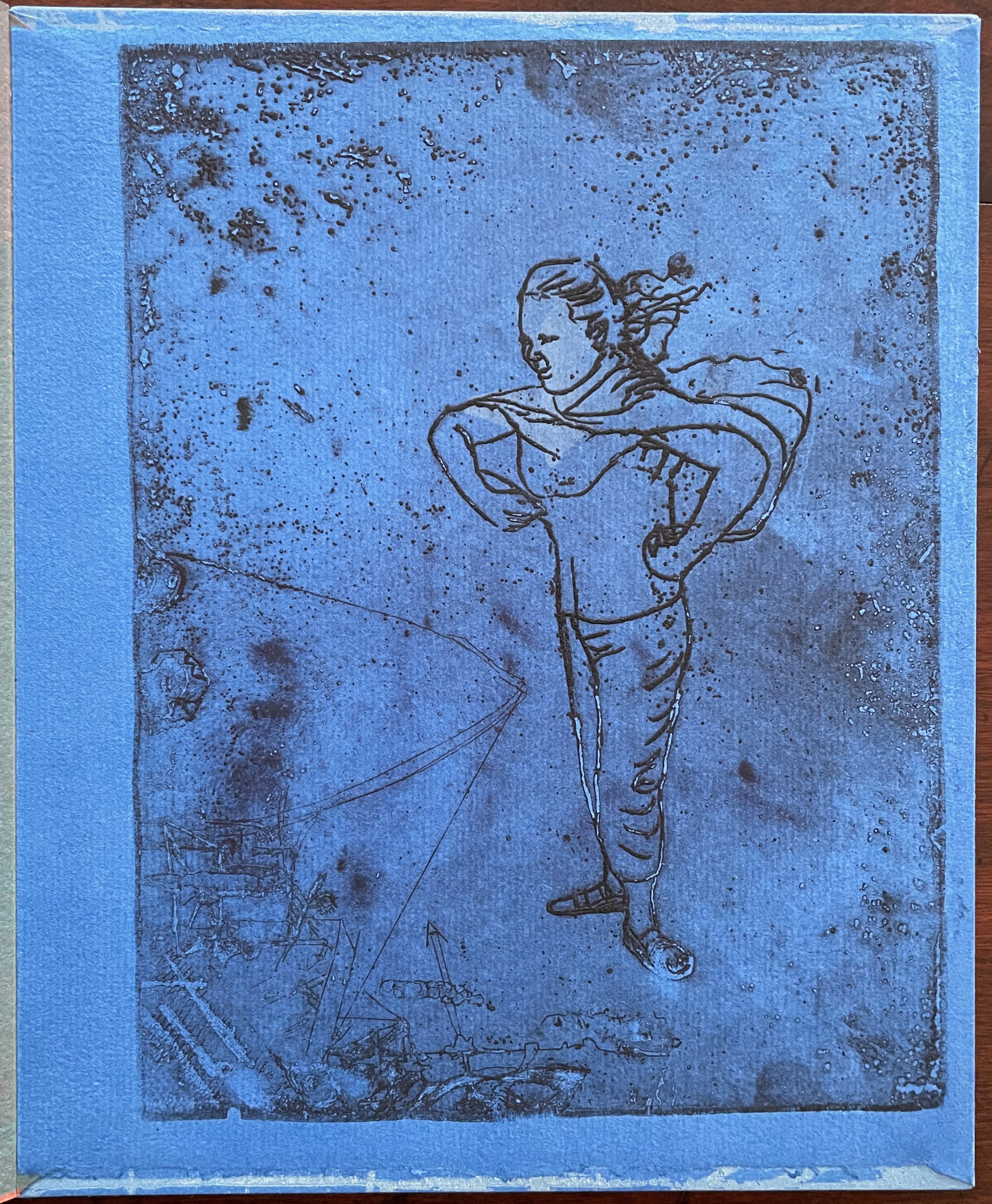
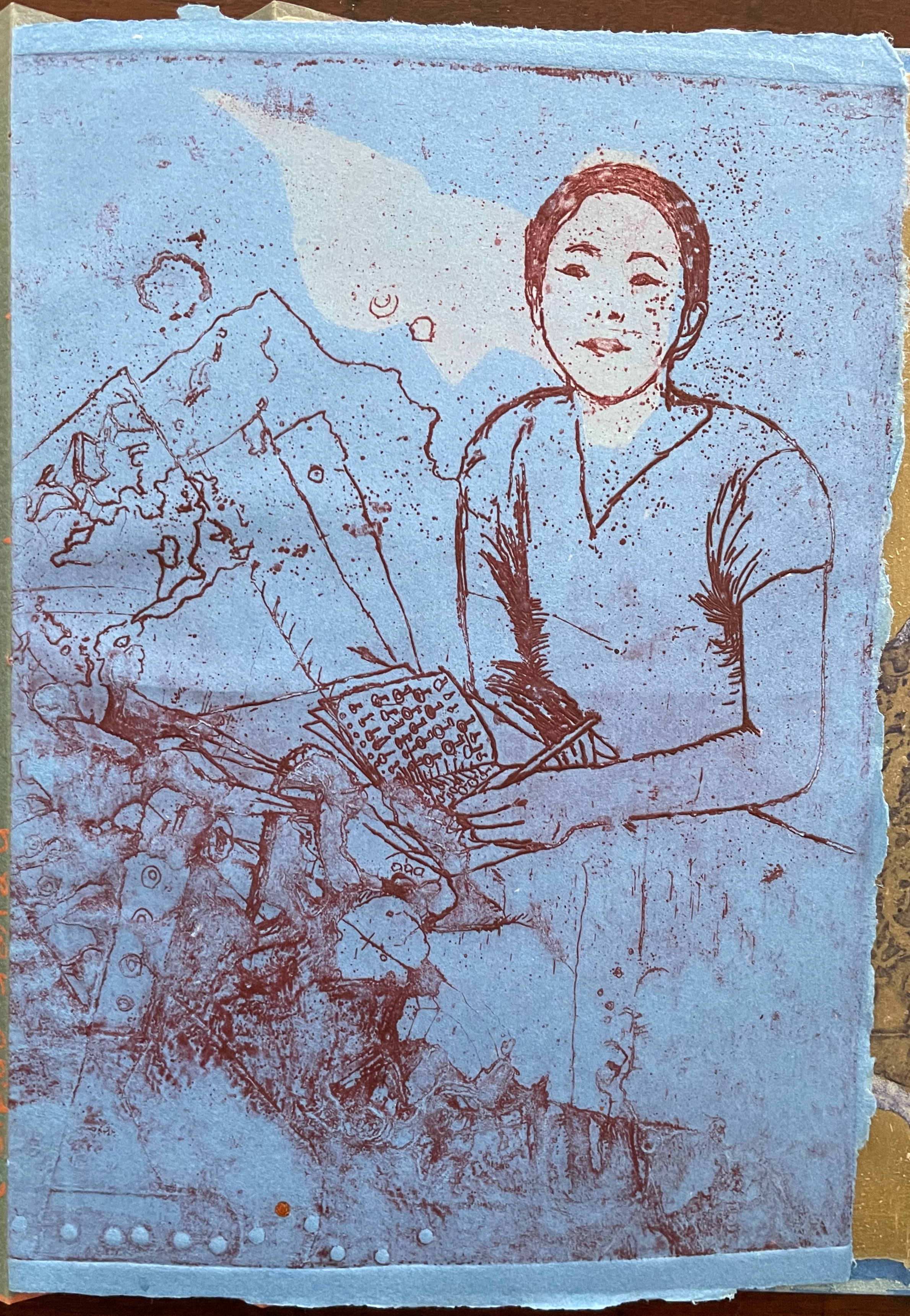
Images of tools — whether for preparing flax or for making the products from it — also recur on the inside of the front and back covers and throughout the book. The human figures alongside the tools, however, appear engaged in more than manufacturing. Elsewhere in the book, they dance, they sit and meditate or write, they row on ponds beside the growing flax. The fairy tale, too, has these Romantic juxtapositions of nature, art and craft. So, again, the spirit of Andersen’s tale finds another way into Tau blau / Dew Blue.
Inside front and inside back covers.
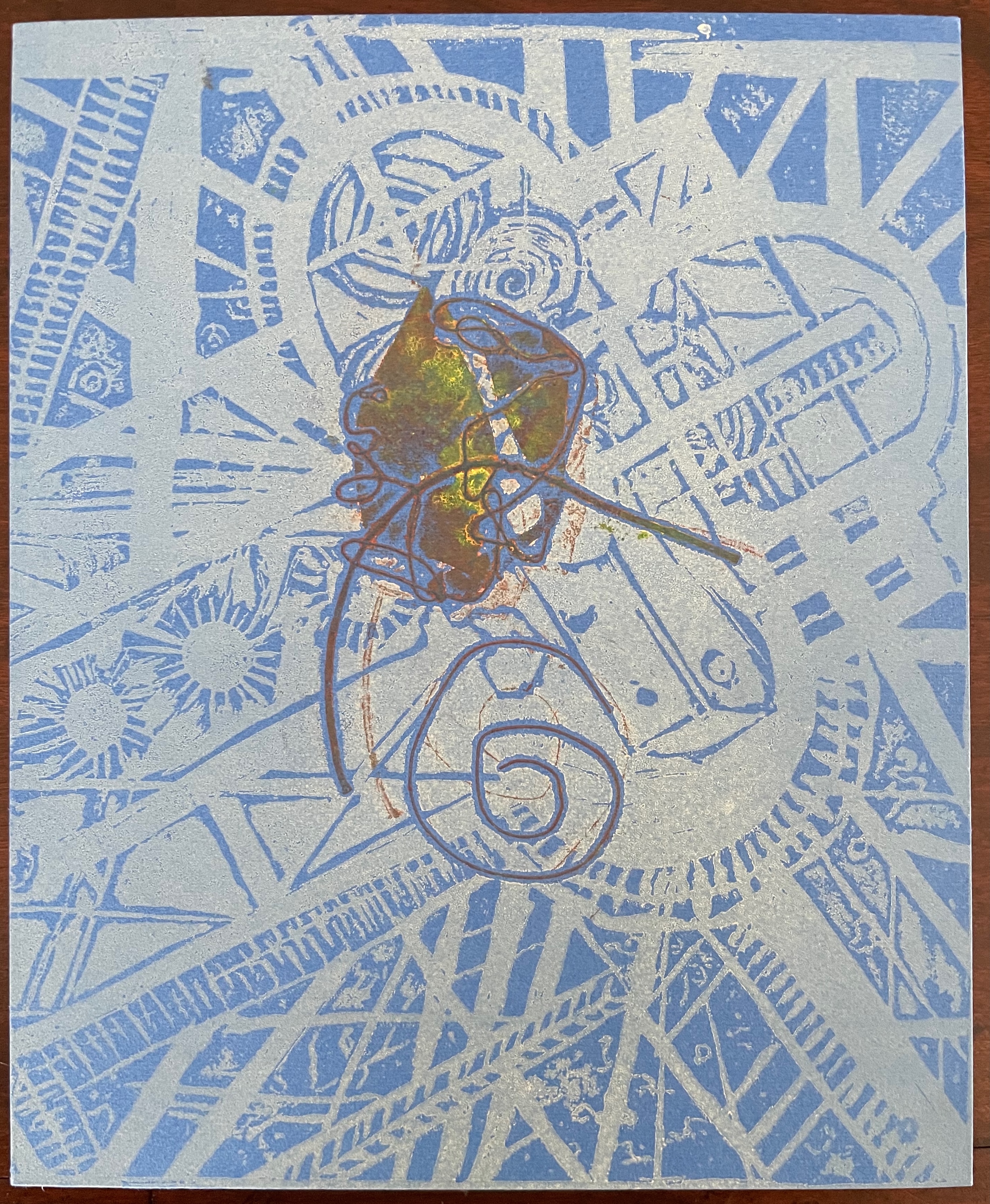
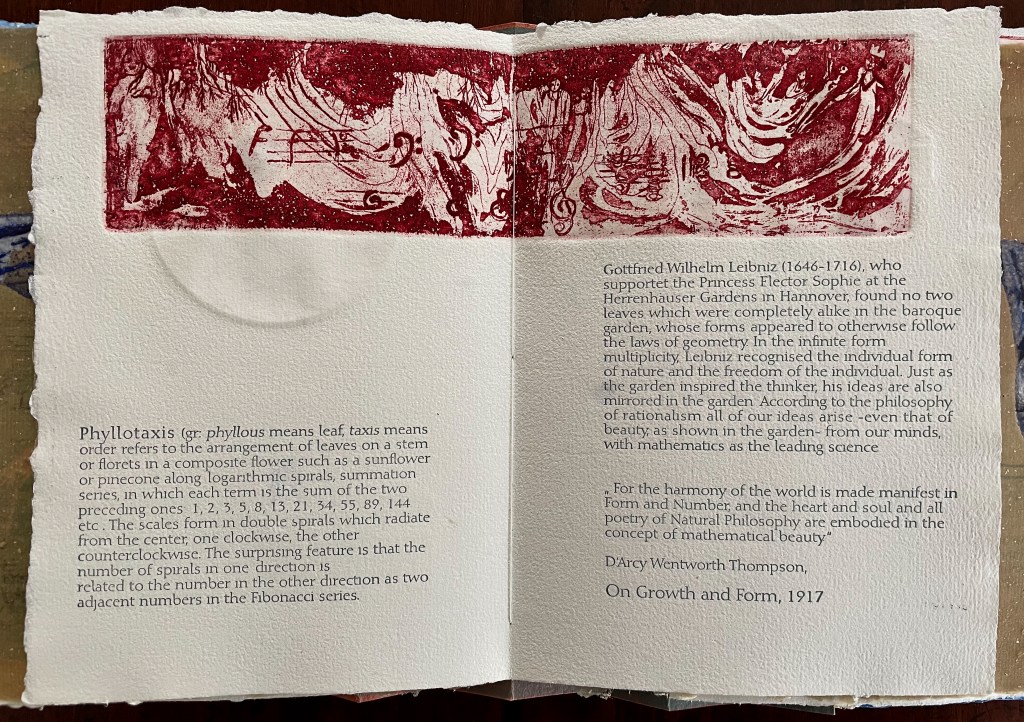
The front cover also announces another motif in those coils of thread below the young girl’s feet. Within the coils is the image of a Fibonacci spiral, which appears on the back cover and throughout the book in different ways. It can be found drawn and printed. It can be found in watermarks in the handmade paper. It can be found in the arrangement of florets in flax. Being a composite flower, flax blossoms display the spiral based on the Fibonacci sequence 1, 2, 3, 5 … 233, and so on. These numbers are waterjet-drawn on the pure flax paper below and explained in an entry printed on the adjacent plain handmade paper folio. By appearing on the book’s front and back covers, the spiral echoes the beginning and ending cycles of birth and rebirth the flax goes through in the folktale.
The Fibonacci spiral on the front and back covers.
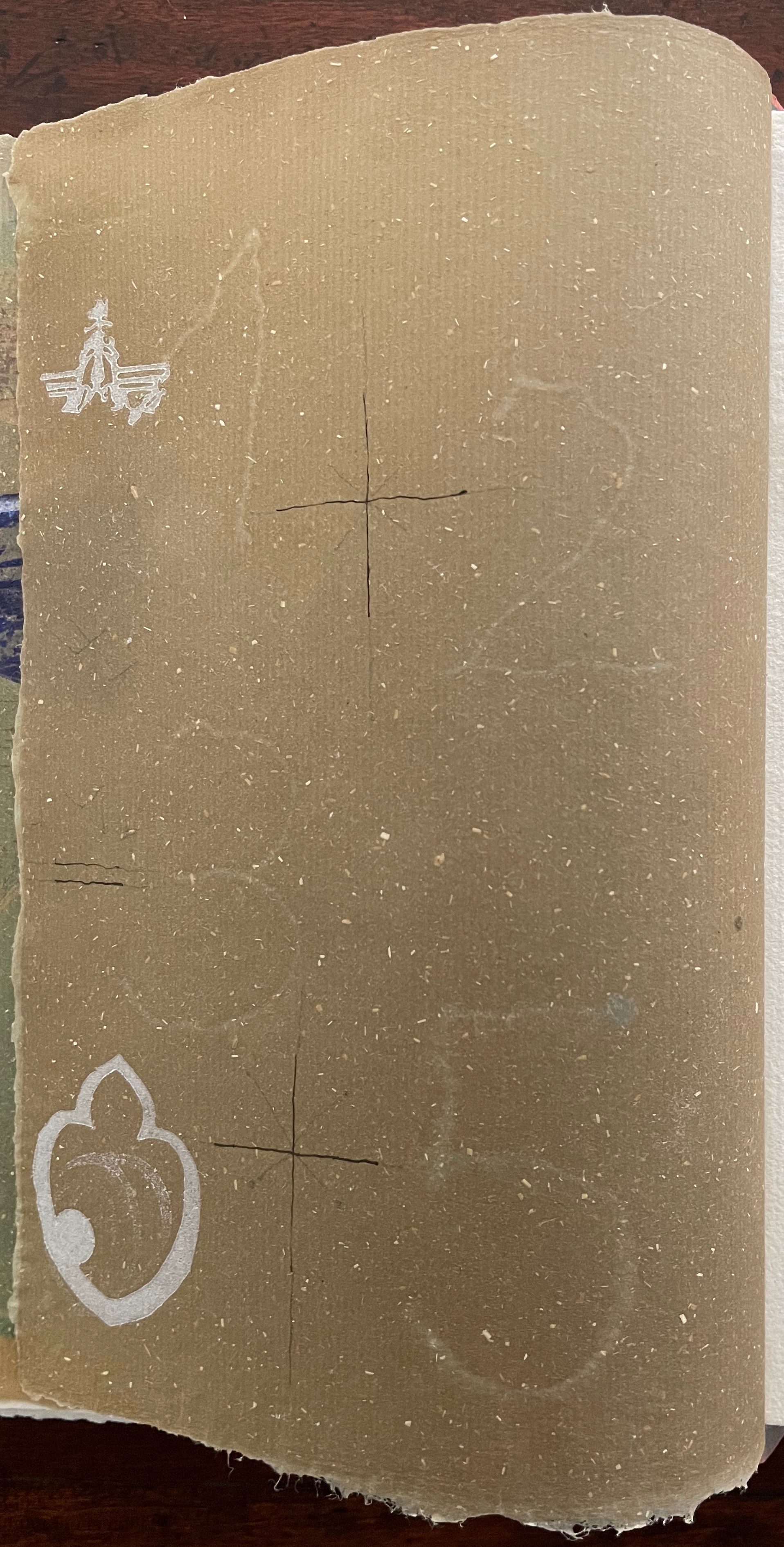
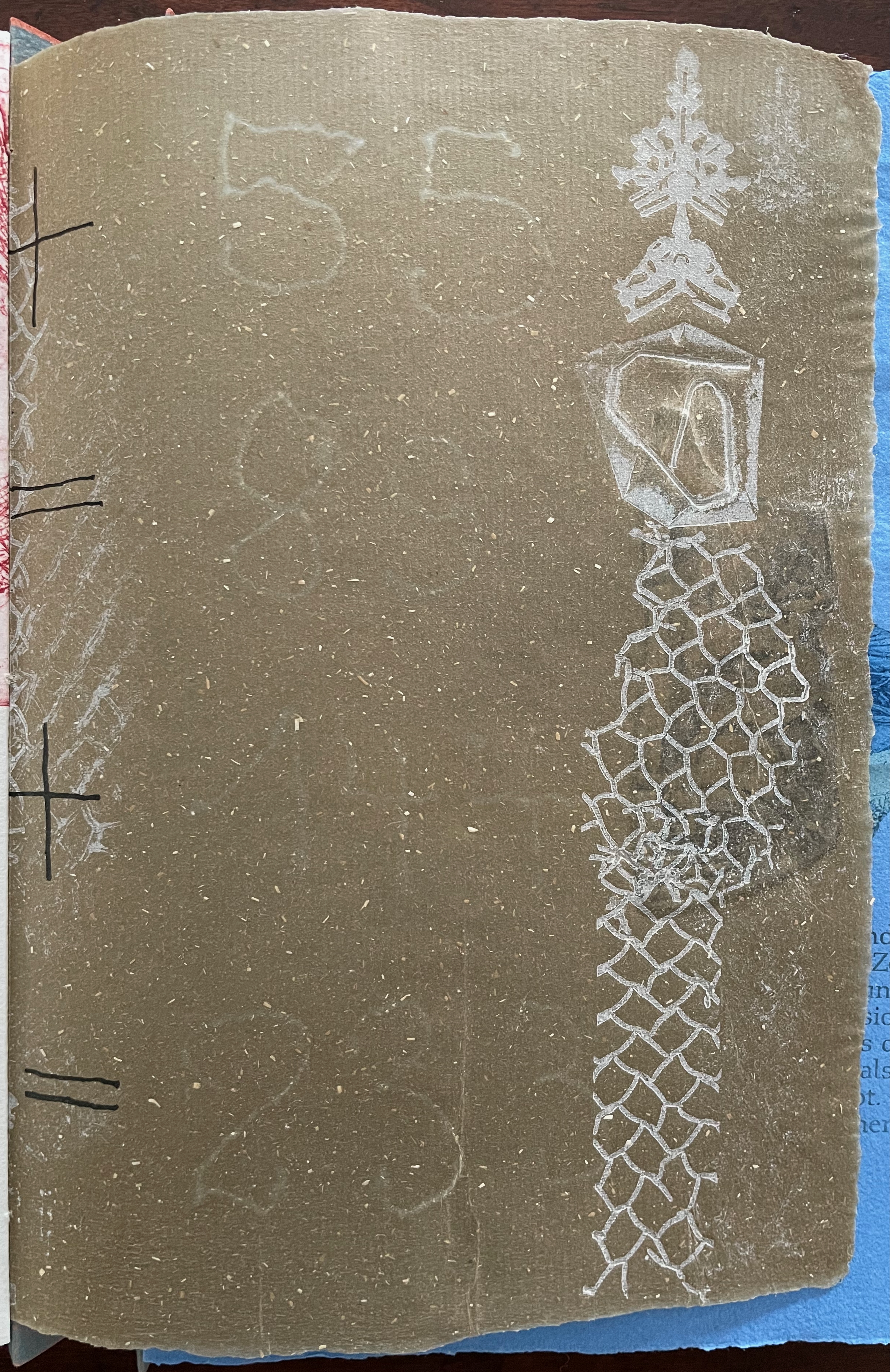
The sequence of Fibonacci numbers 1, 2, 3, 5 … 55, 89, 144, 233 … watermarked on handmade flax paper with a water jet.
Description of the Fibonacci spiral side by side with quotation from Thompson’s On Growth and Form (1917), drawing on Leibniz’s Rationalist philosophy.
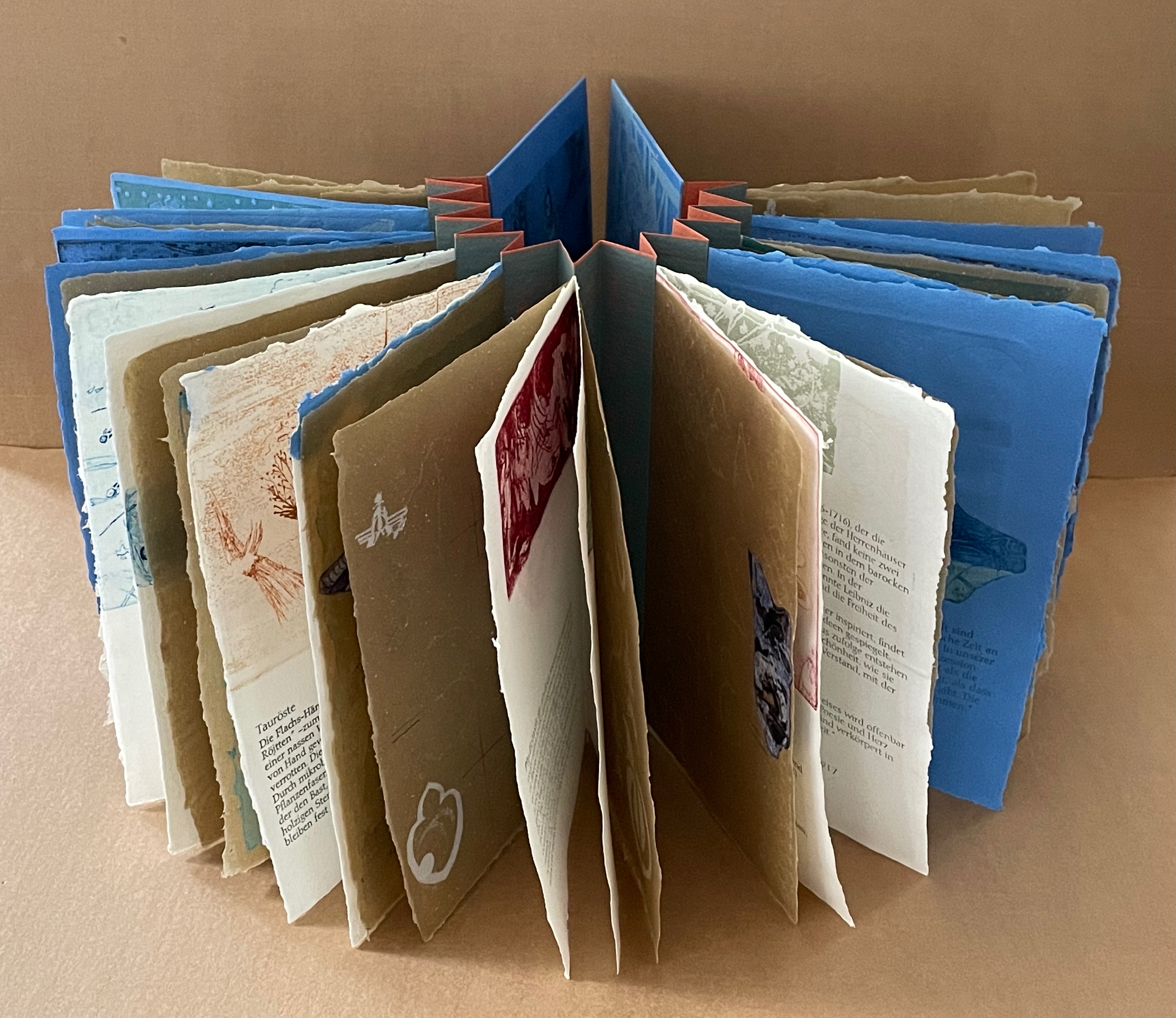
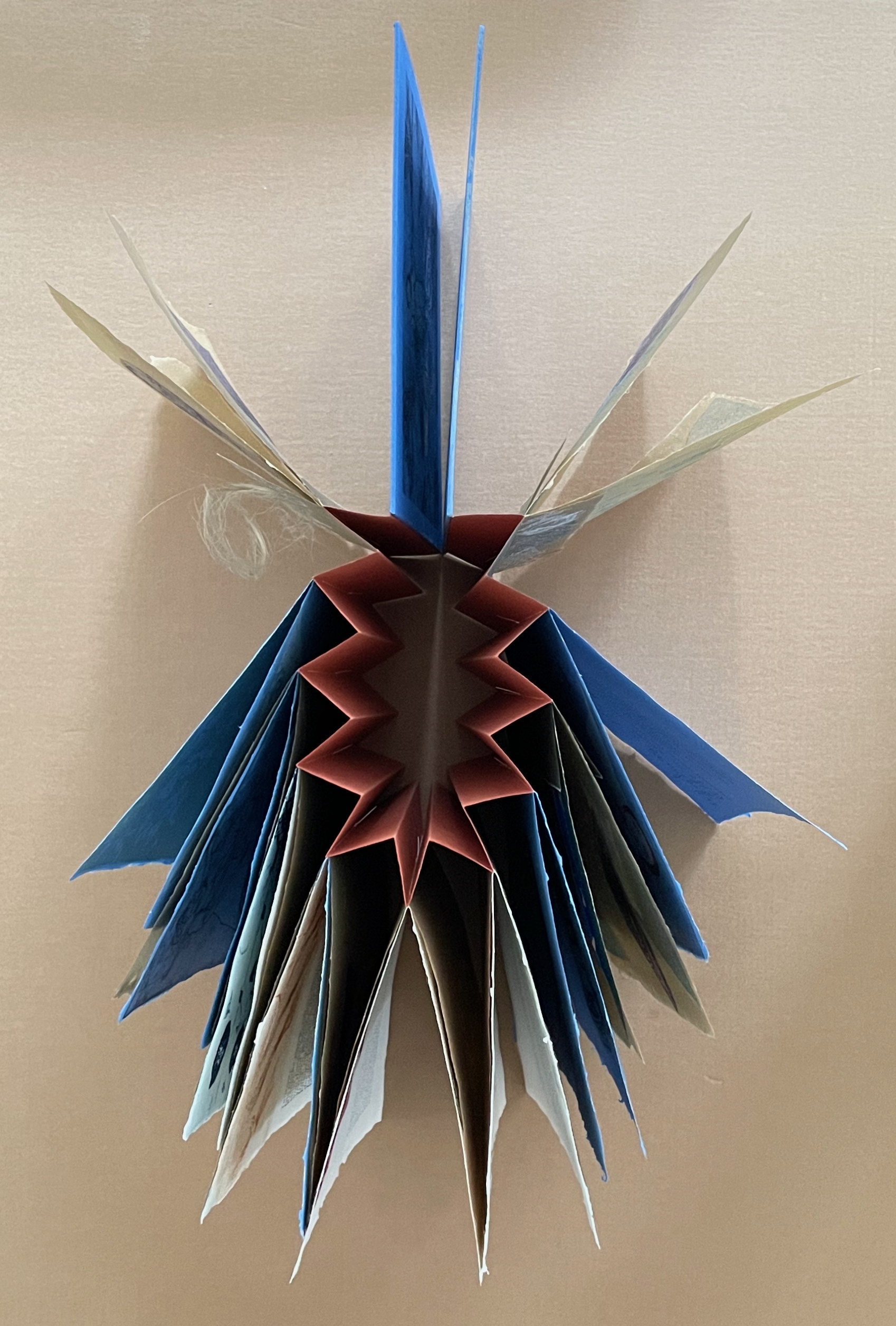
To organize and weave her motives together, Beisinghoff uses an accordion spine to whose peaks eleven sets of folios are sewn with linen thread. Three of the eleven are 4-page folios consisting of blue handmade paper. Another three 4-page folios consist of pure flax paper (handmade by John Gerard). The remaining five gatherings have 8-page folios, each consisting of a pure flax paper folio around a blue or plain one.
Side and top views of the accordion spine.
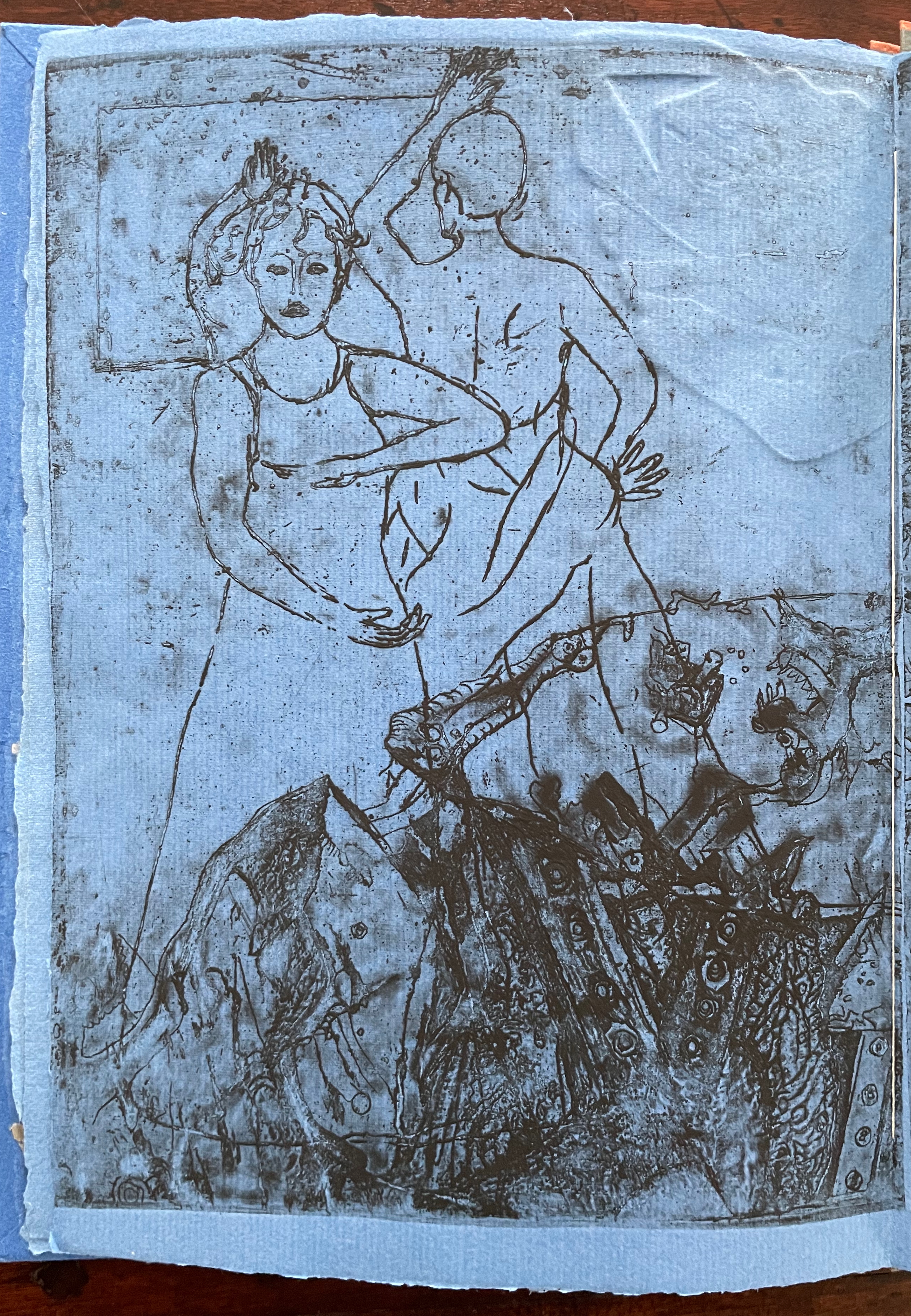
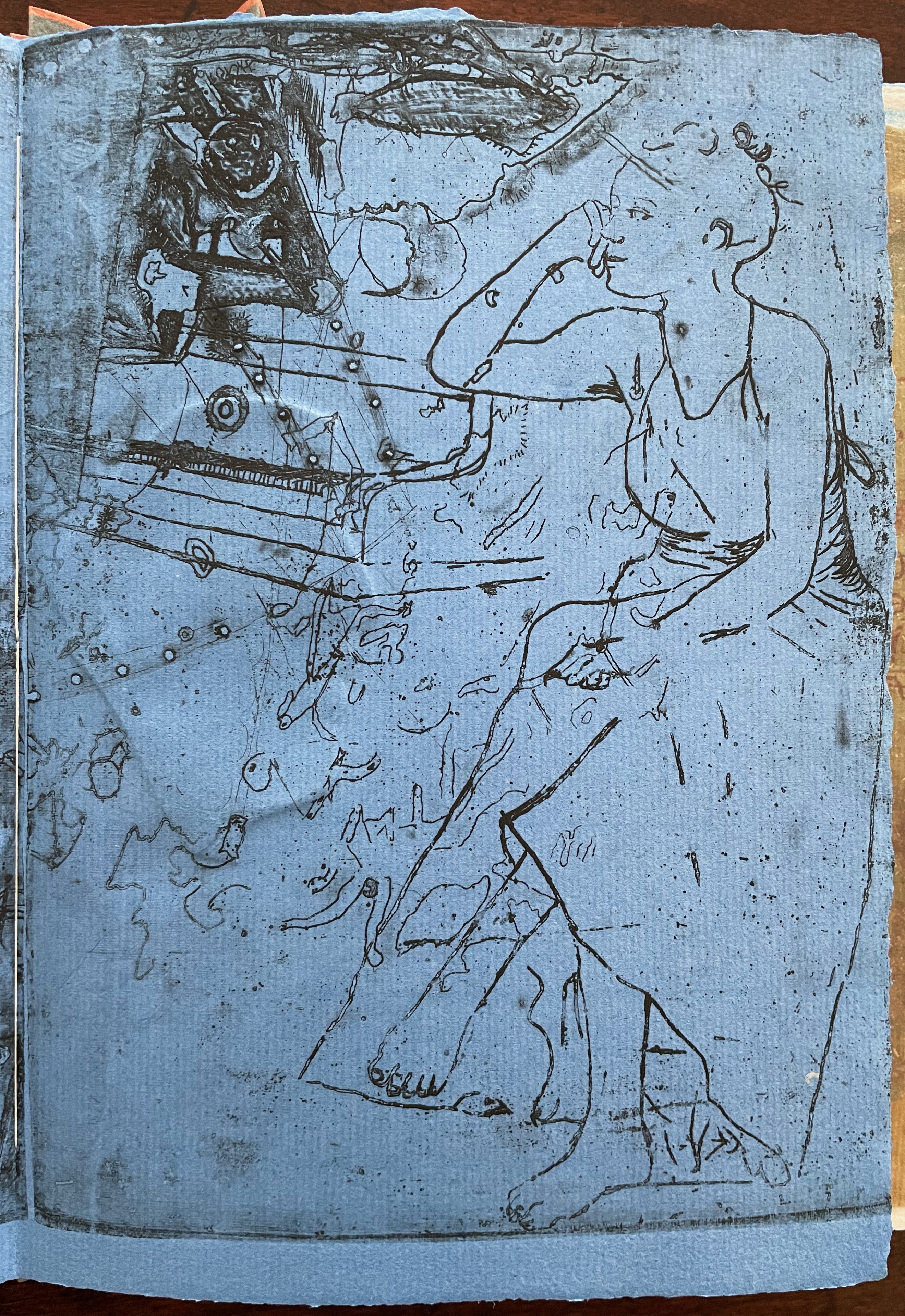
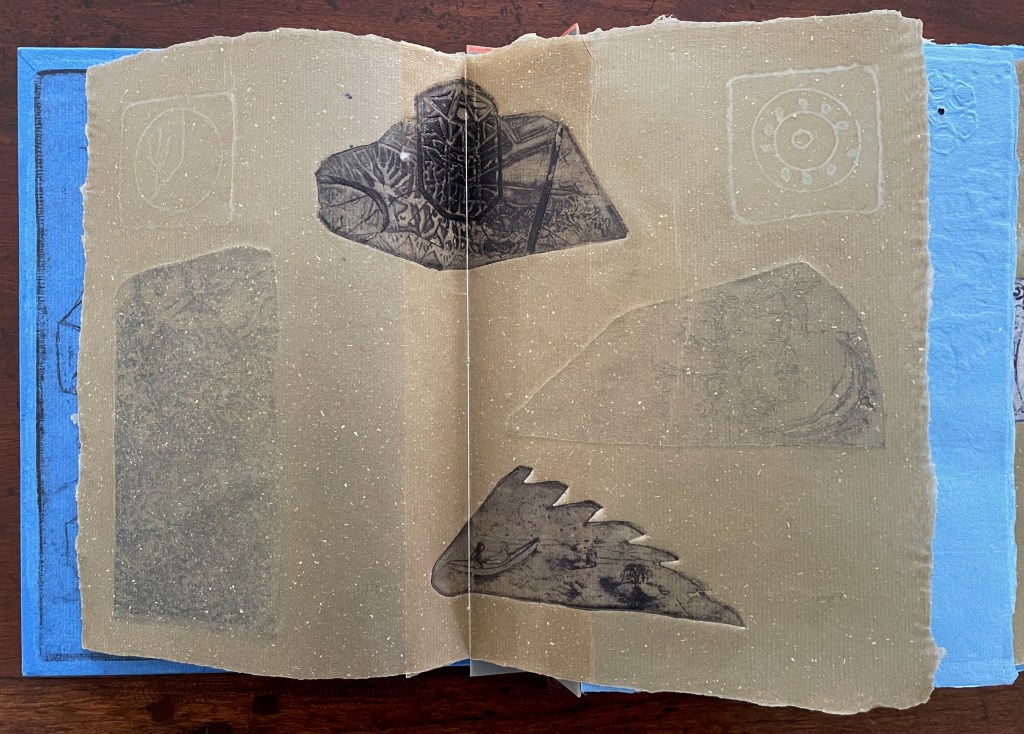
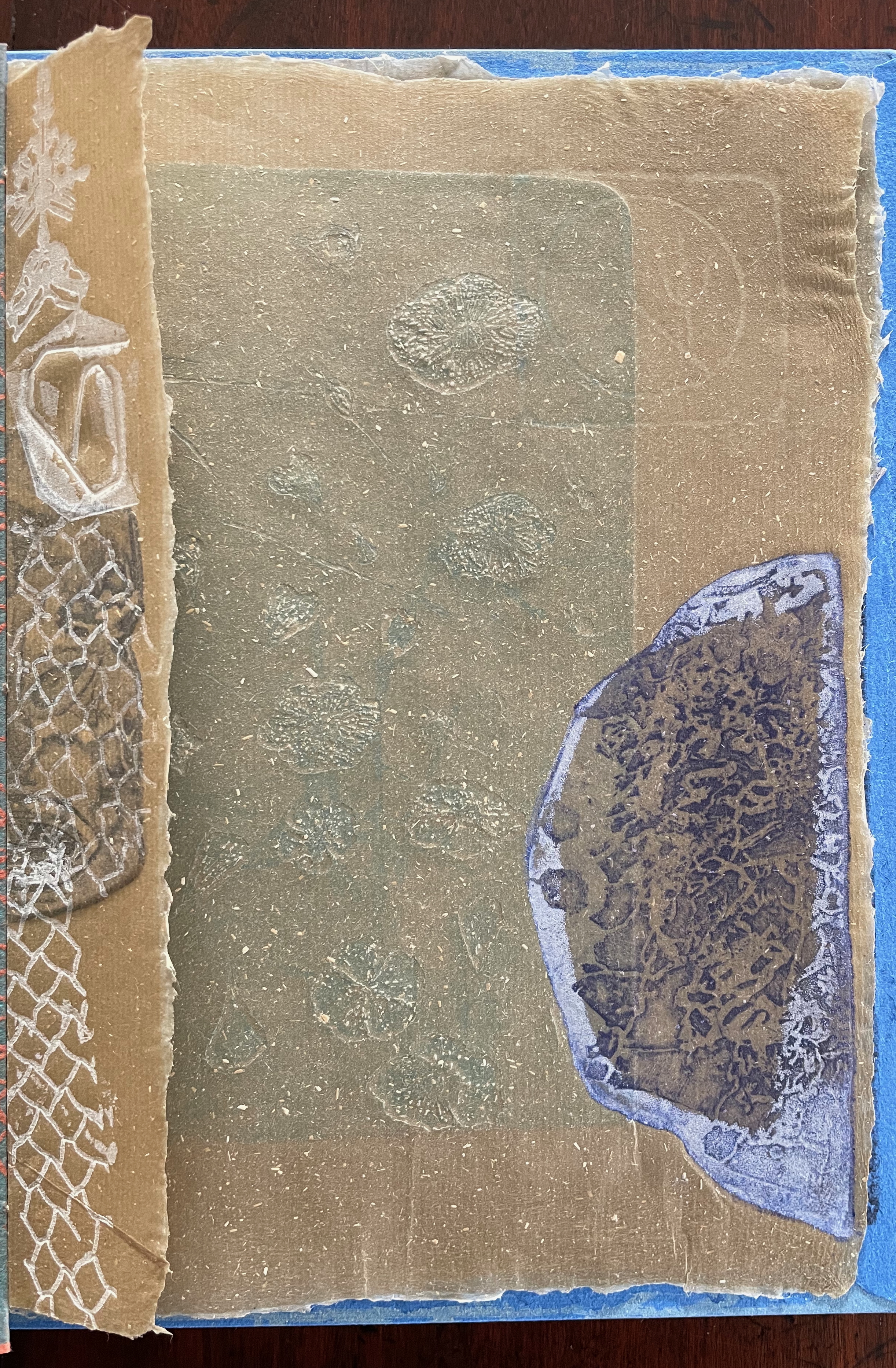
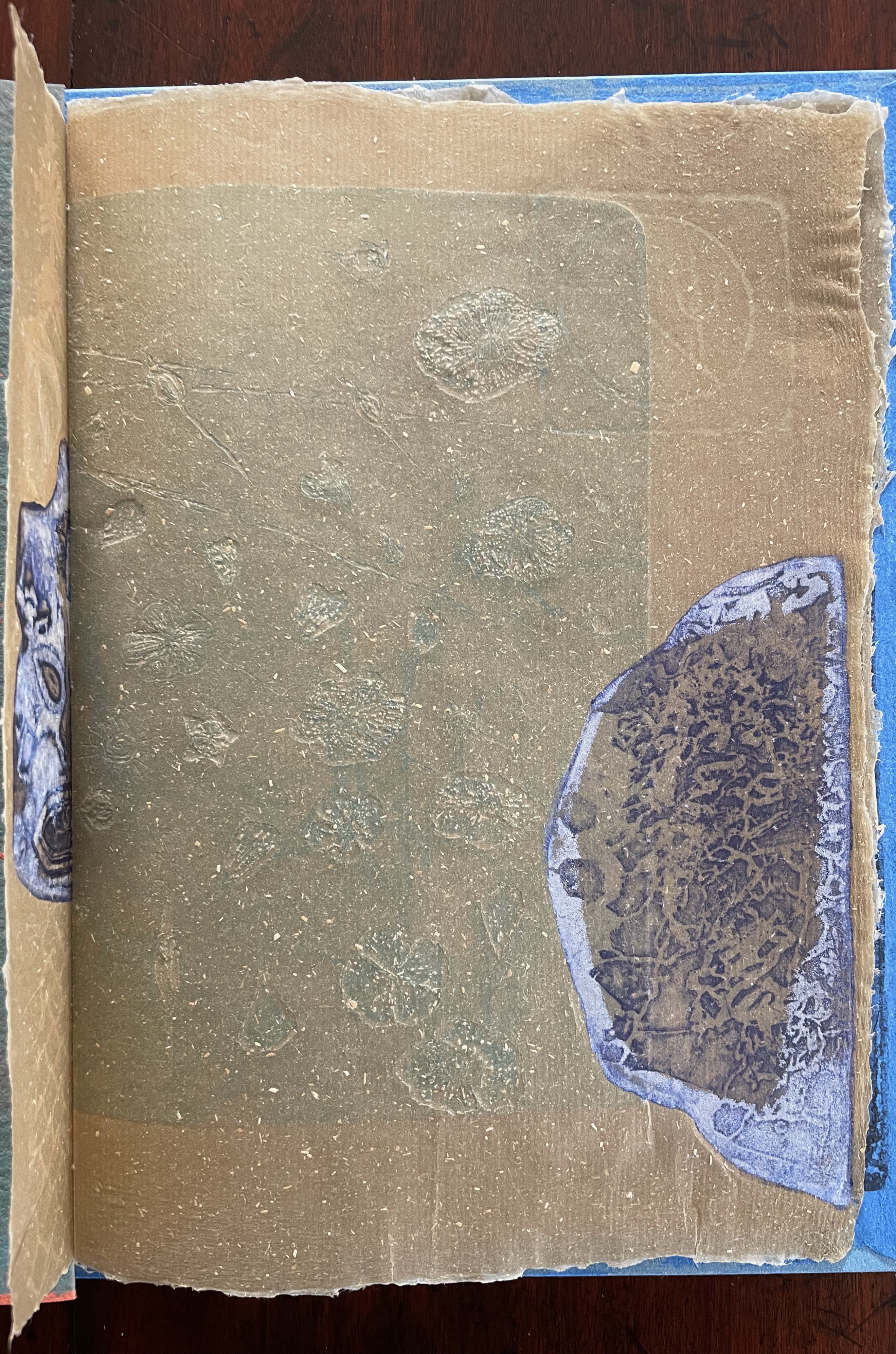
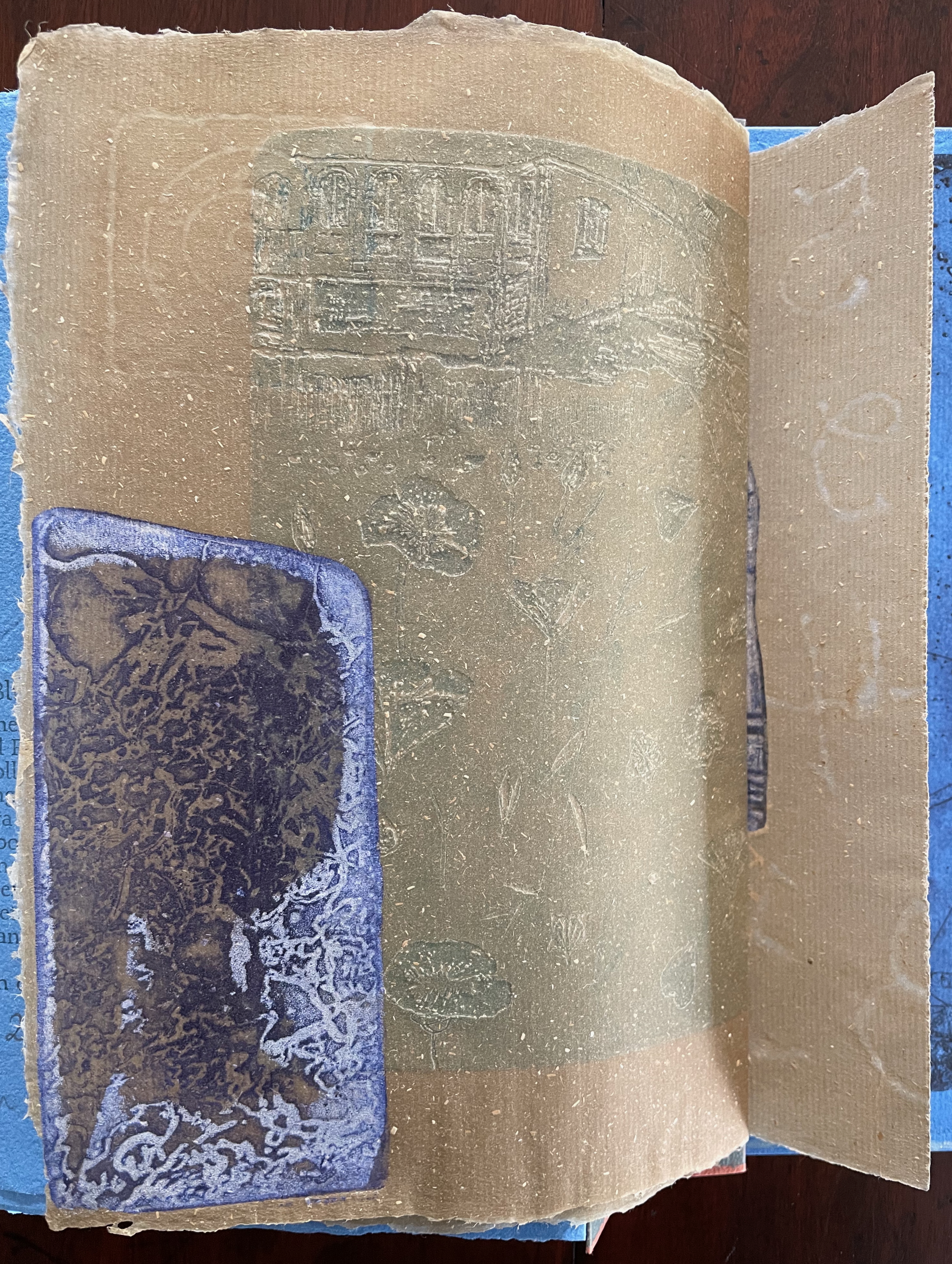
The first pure flax folio begins the book, displaying two title pages (German and English) and two etchings on its first and last pages. In the center spread, two more etchings appear. A watermark symbolizing phyllotaxis shows through in the upper left, balanced by a watermark with a cross section of a flax stalk in the upper right of the center spread. The texture and weight of the flax paper allows the impress and shadow of the etchings to stand out on both sides against the inking and watermarks.
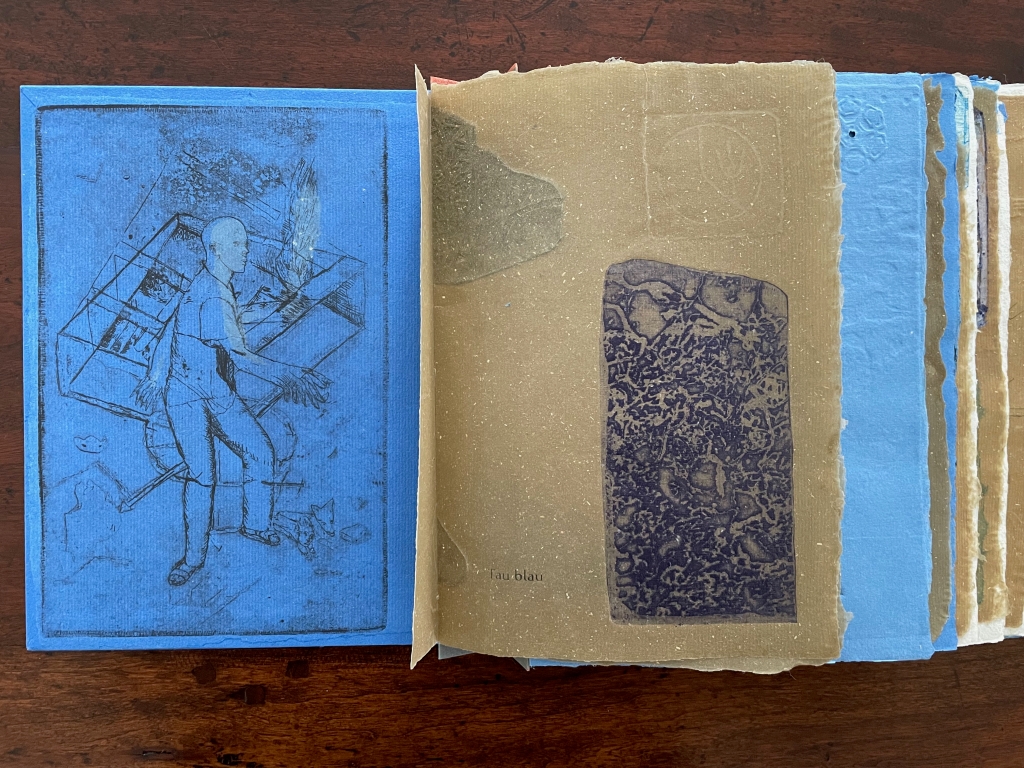
Inside front cover and Tau blau title page and etching.
Center spread of first flax paper folio. Note the watermarks in the upper left and right corners.
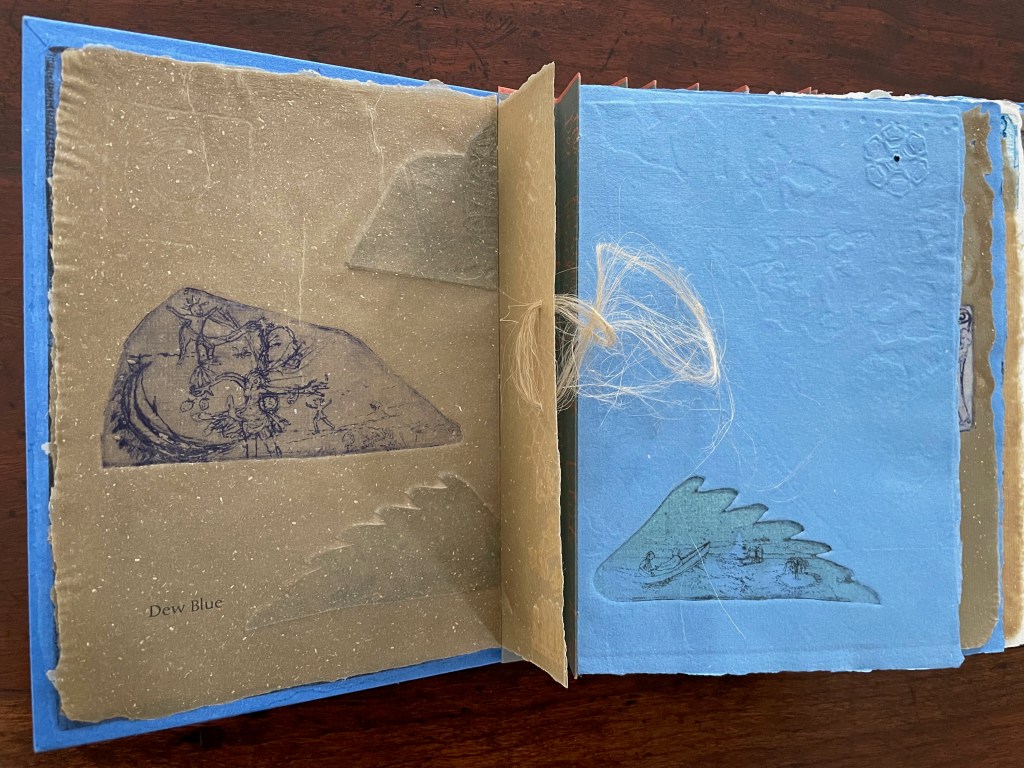
Dew Blue title page and etching, loop of flax fibers, first page of blue handmade paper folio; note its boating image repeated from the prior center spread.
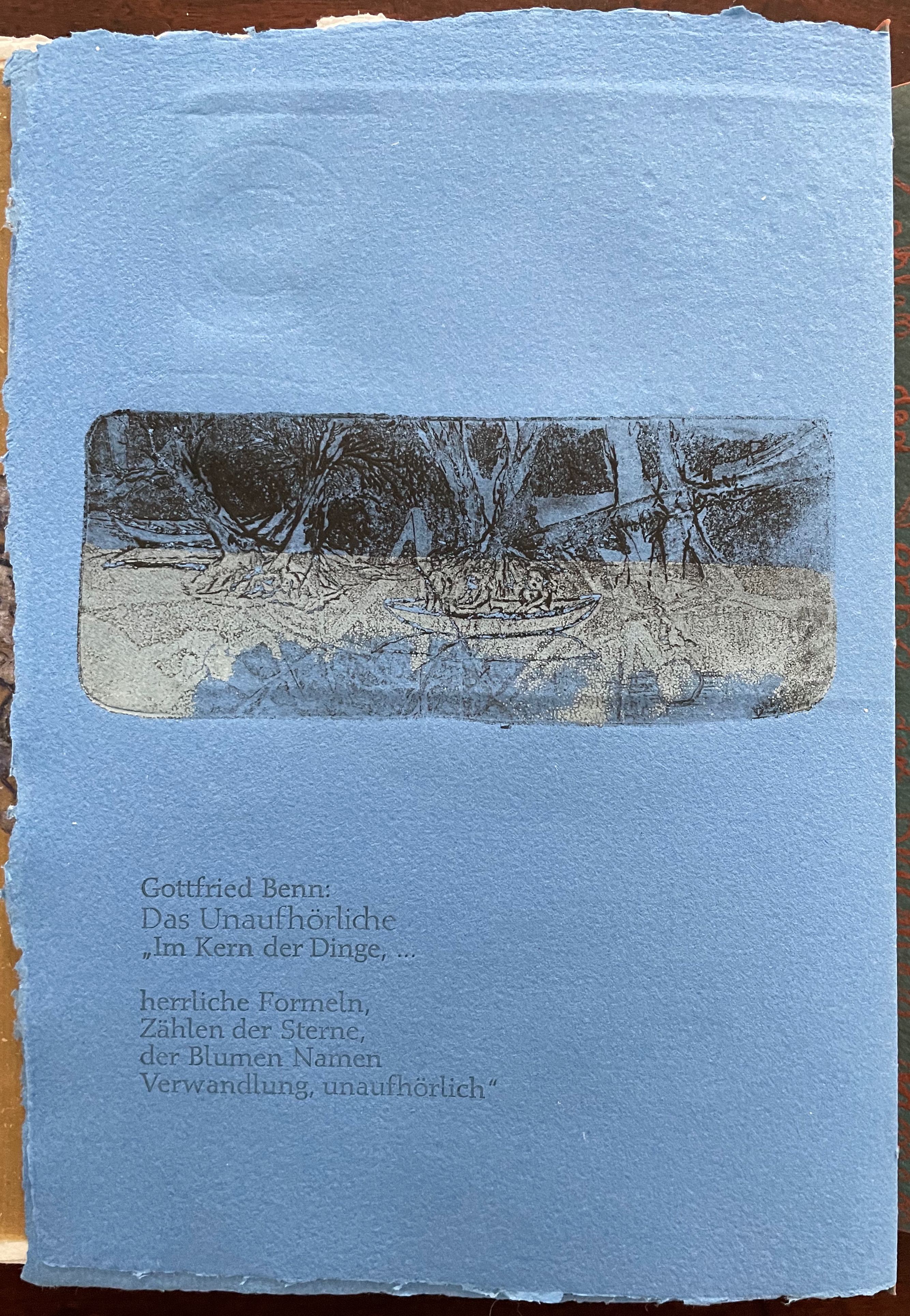
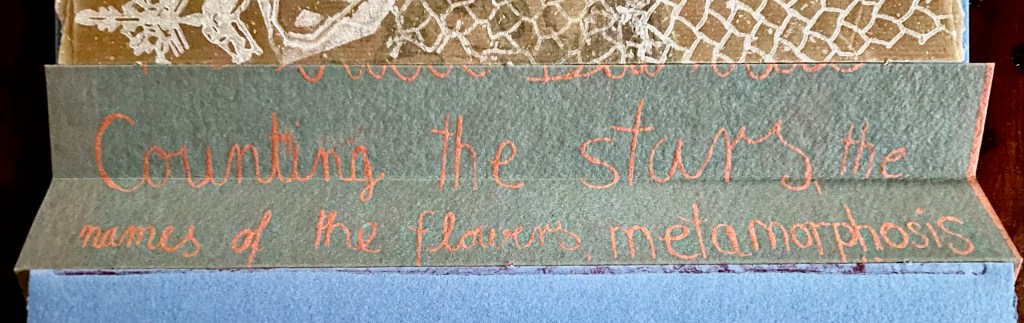
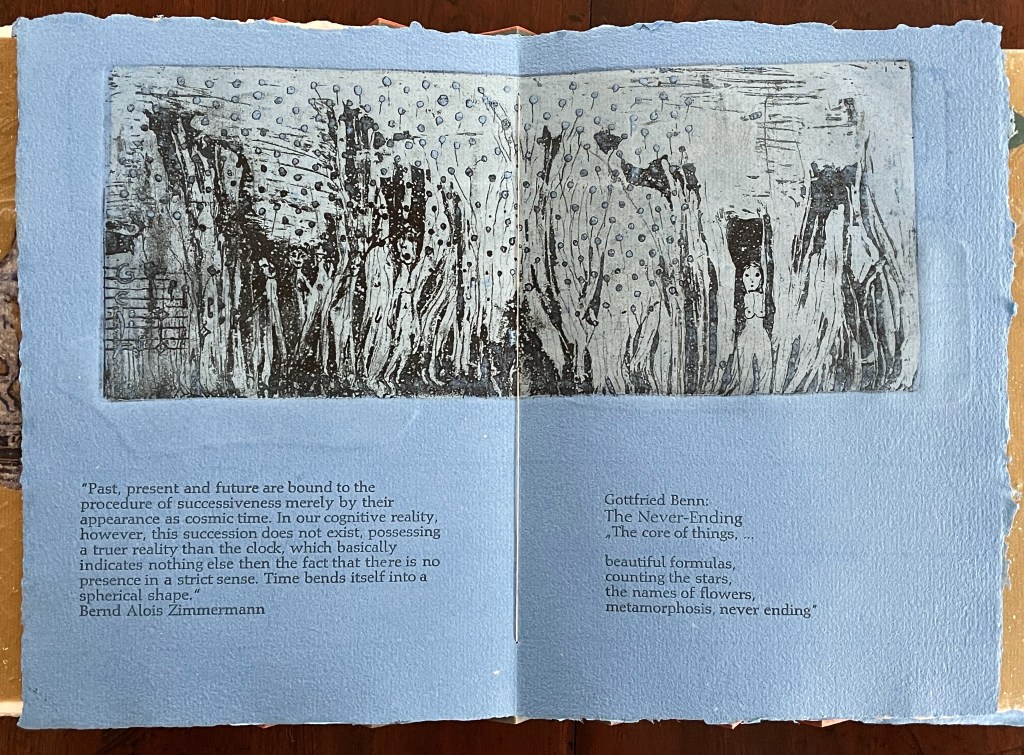
Following the pure flax folio, the first all blue folio gives us that introductory excerpt from Andersen’s fairy tale. Next comes a description of flax comes from Leonhart Fuchs’ Book of Herbs (1543), then the series of planting and harvesting observations from Beisinghoff, then the refrain from Clemens Brentano’s poem “Ich darf wohl von den Sternen singen” (1835), then philosophical observations drawing on G.W. Leibniz from D’Arcy Wentworth Thompson’s On Growth and Form (1917), a much-quoted theorem of musical composition from Bernd Alois Zimmermann’s Intervall und Zeit (1974), and finally (below) a passage of text by Gottfried Benn from the Hindemith oratorio Das Unaufhörliche / The Neverending (1936). In the valleys of the accordion spine, some of the lines from Andersen, Fuchs, Beisinghoff and Been appears handwritten in orange paint.
Translated fragment of Benn’s lyrics for Paul Hindemith’s oratorio Das Unaufhörliche / The Neverending (1936).
Even with these additional texts, Andersen’s fairy tale remains the most central text in Tau blau / Dew Blue, despite the brevity of its excerpt. Brentano’s Romantic/religious expostulations (“O Star and Bloom, Garb and Soul, Love, Hurt and Time for evermore”) sound like those of the plant in the story’s final passage. The occurrence of Fibonacci’s spiral in the plant may be a physical fact, but Beisinghoff turns it into something more mystical by placing the description of phyllotaxis next to Leibniz’ and Thompson’s transcendental view of mathematical science and natural philosophy. Likewise she links the texts from Bernd Alois Zimmermann and Gottfried Benn to the fairy tale by placing them beneath the etching that captures the flax plant’s singing and dancing into its transformation by fire.
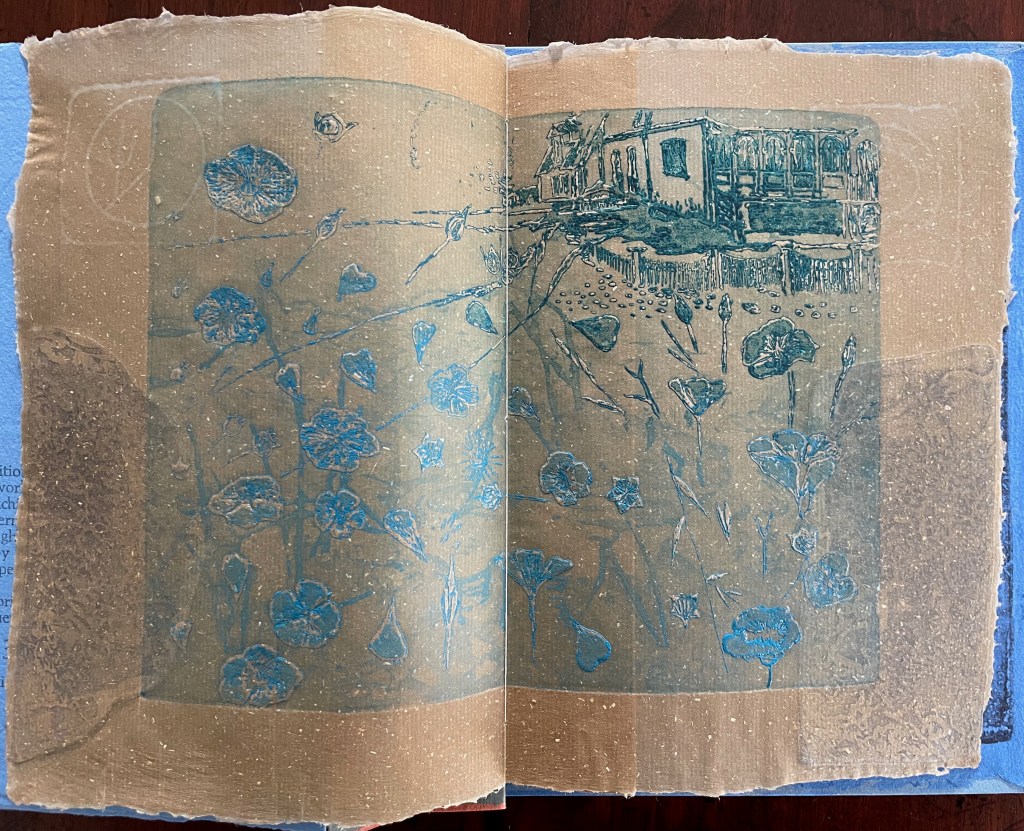
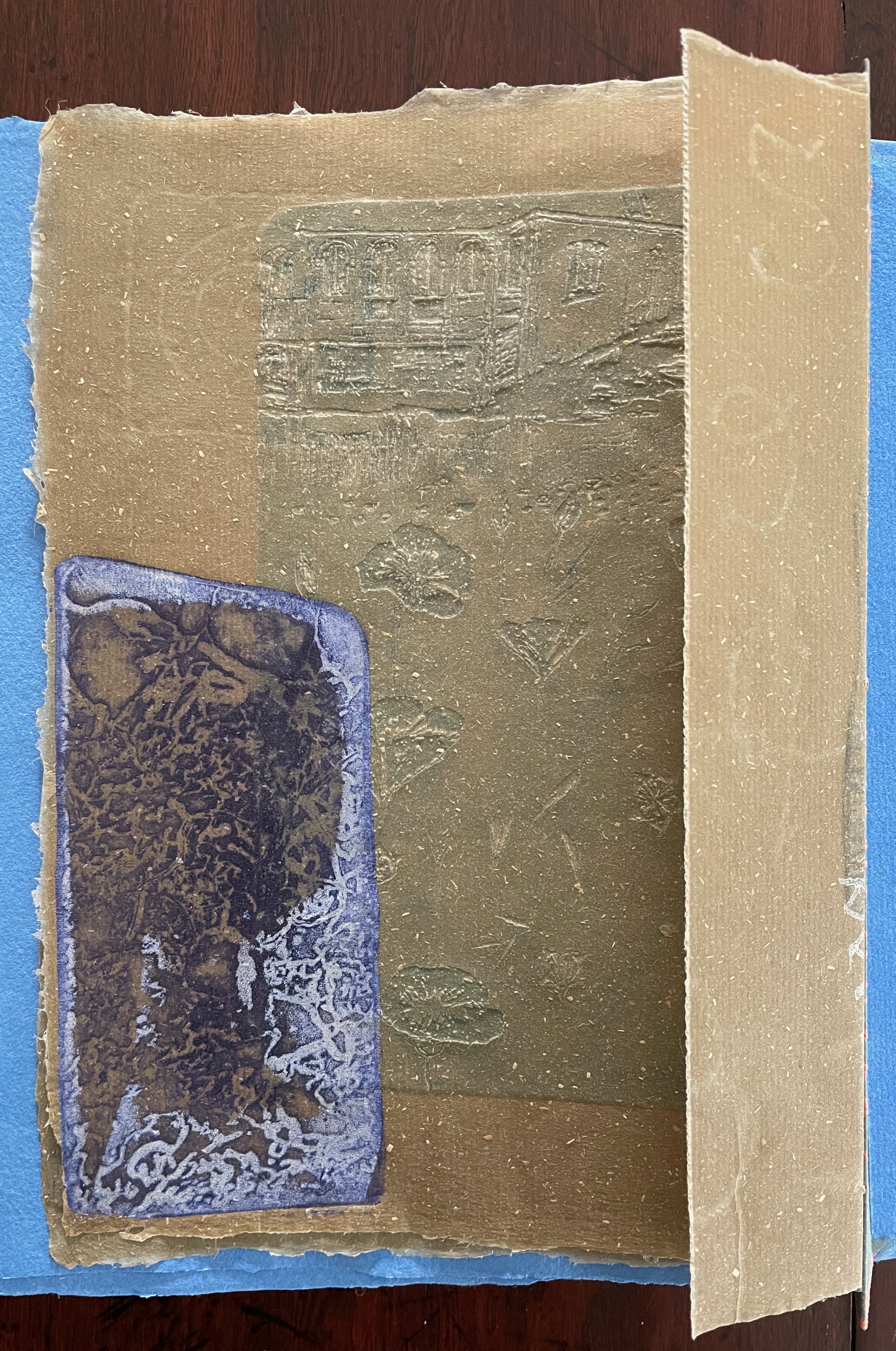
Below is the final folio of the work. Like the first, it is made completely of flax paper, but its center spread offers a fuller image: flax blossoms and stalks float in the foreground, and in the background is a sketch of Beisinghoff’s residence where she grows her flax. Like the Fibonacci spiral on the front and back covers, the first and last flax folios round out the work. But go back and listen for the hidden sound installations accompanying Dew Blue. Noticing Beisinghoff’s abstract musical notation, indulge yourself with recordings of a Swedish folk song (“Today is supposed to be the big flax harvest” here or here) to which the notation and phrases allude, and as the flax papers turn and wave on their accordion peaks, listen carefully for their musical rustle.
The final pure flax paper folio.
Tule Bluet damselfly perched on flax leaf. Photo: John Riutta, The Well-Read Naturalist (2009). Displayed with permission.
Die wilden Schwäne (2001)
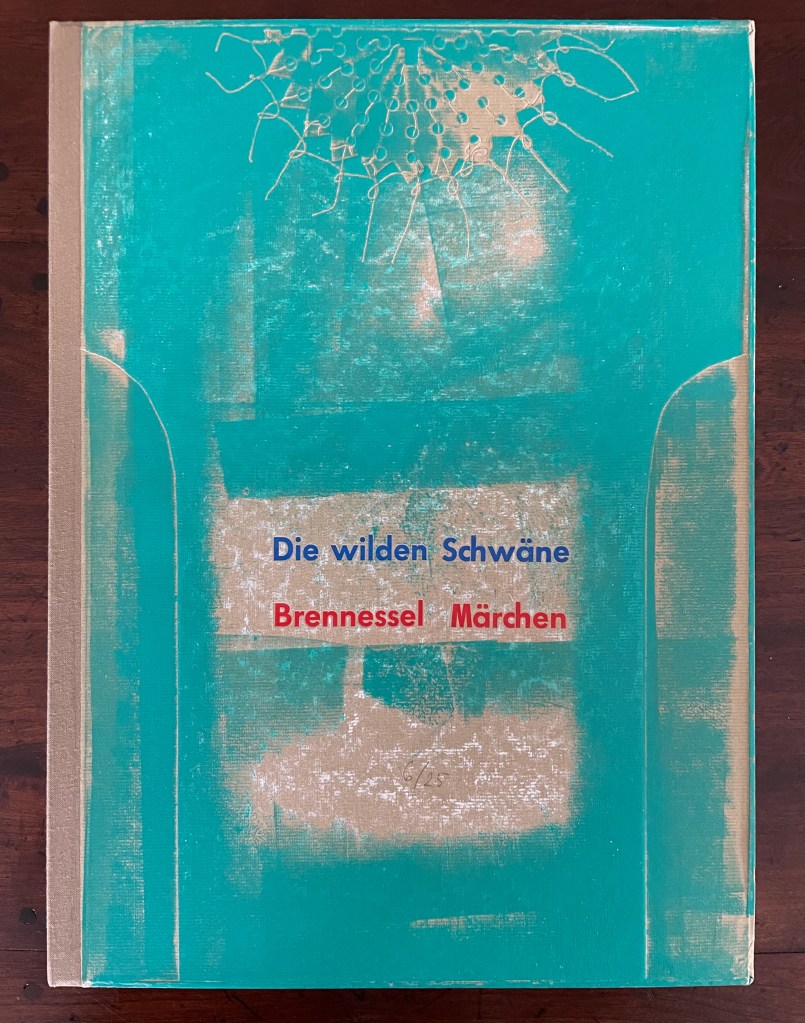
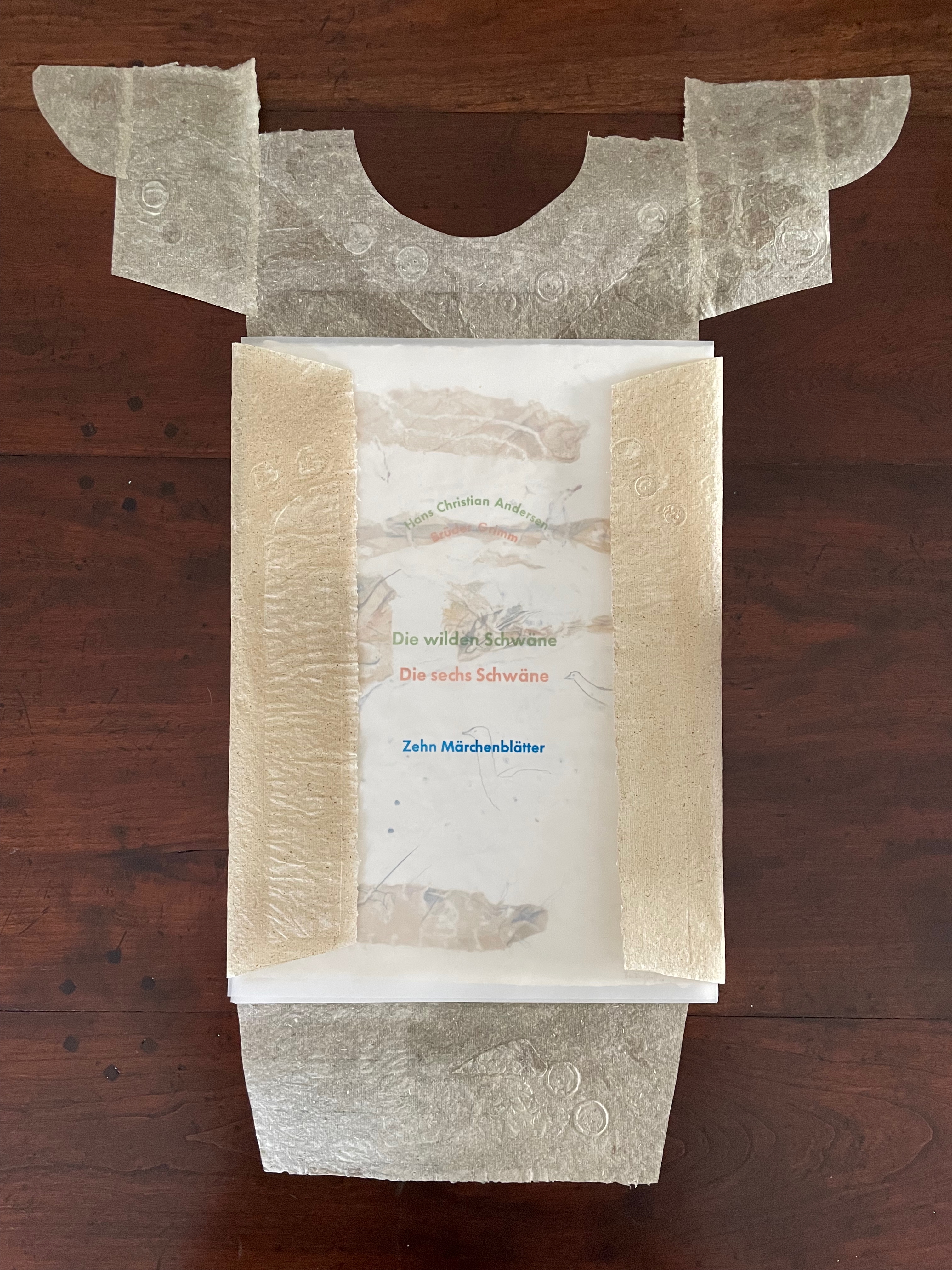
Die wilden Schwäne (2001) Barbara Beisinghoff Box with embossed cover holding folios wrapped in chemise. H35o x W250 mm. 18 folios. Edition of 25, of which this is #6. Acquired from the artist, 20 December 2024. Photos: Books On Books Collection.
Barbara Beisinghoff’s Die wilden Schwäne is an exemplar of collaboration and craft. In it, she even requires collaboration between Hans Christian Andersen and the Brothers Grimm. Andersen’s Die wilden Schwäne and the Grimms’ Die sechs Schwäne are based on the same tale of brothers turned into swans who are saved by their sister Elisa’s diligent and mute harvesting, pulping, spinning and sewing of stinging nettles into shirts that break the spell when donned. H.C. Andersen, however, is verbose and elaborate in his telling (even including vampires!), and Beisinghoff has done a bit of nipping and tucking with the more succinct Brothers Grimm to create a version more suited to the artist’s book she creates.
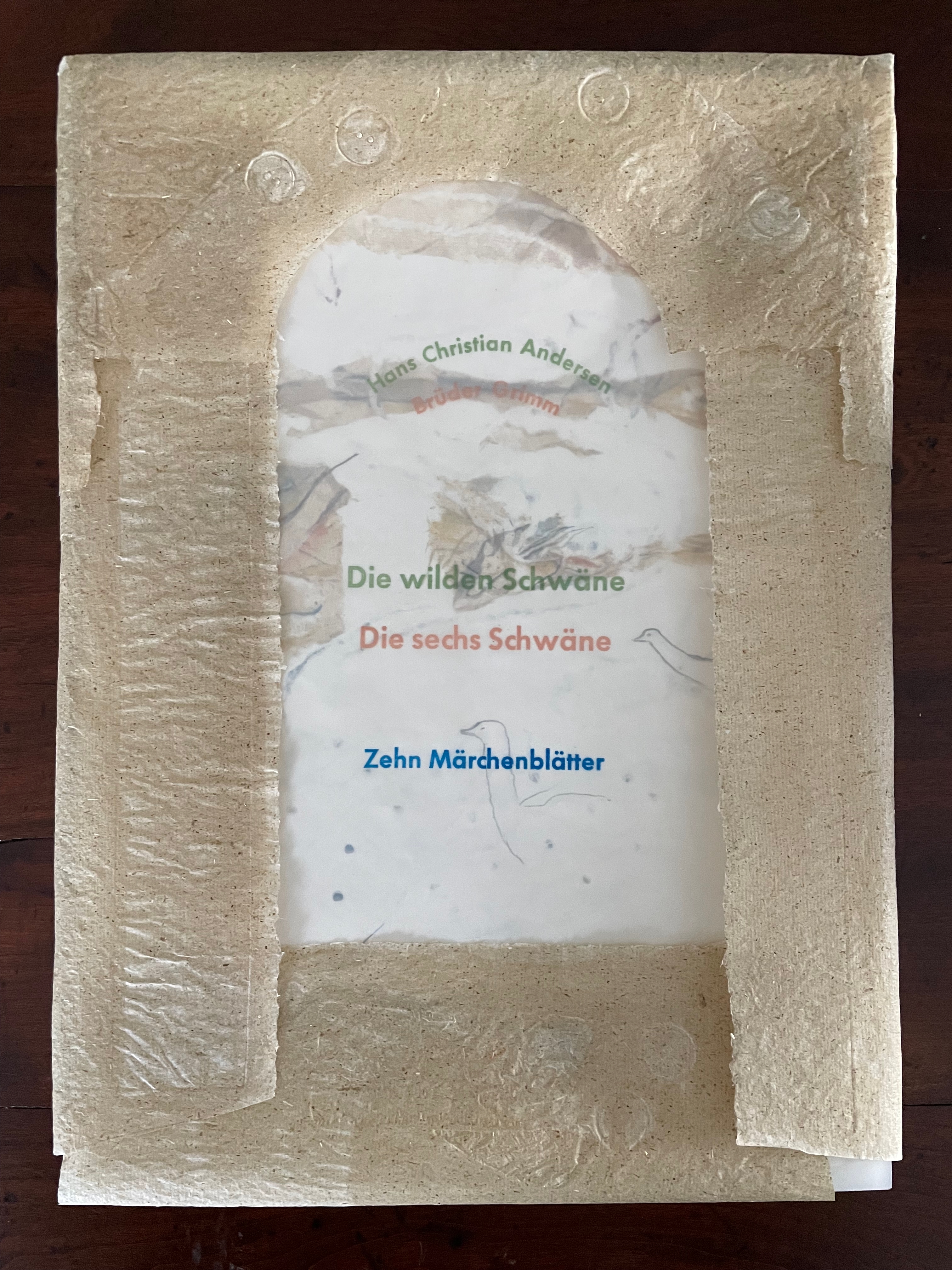
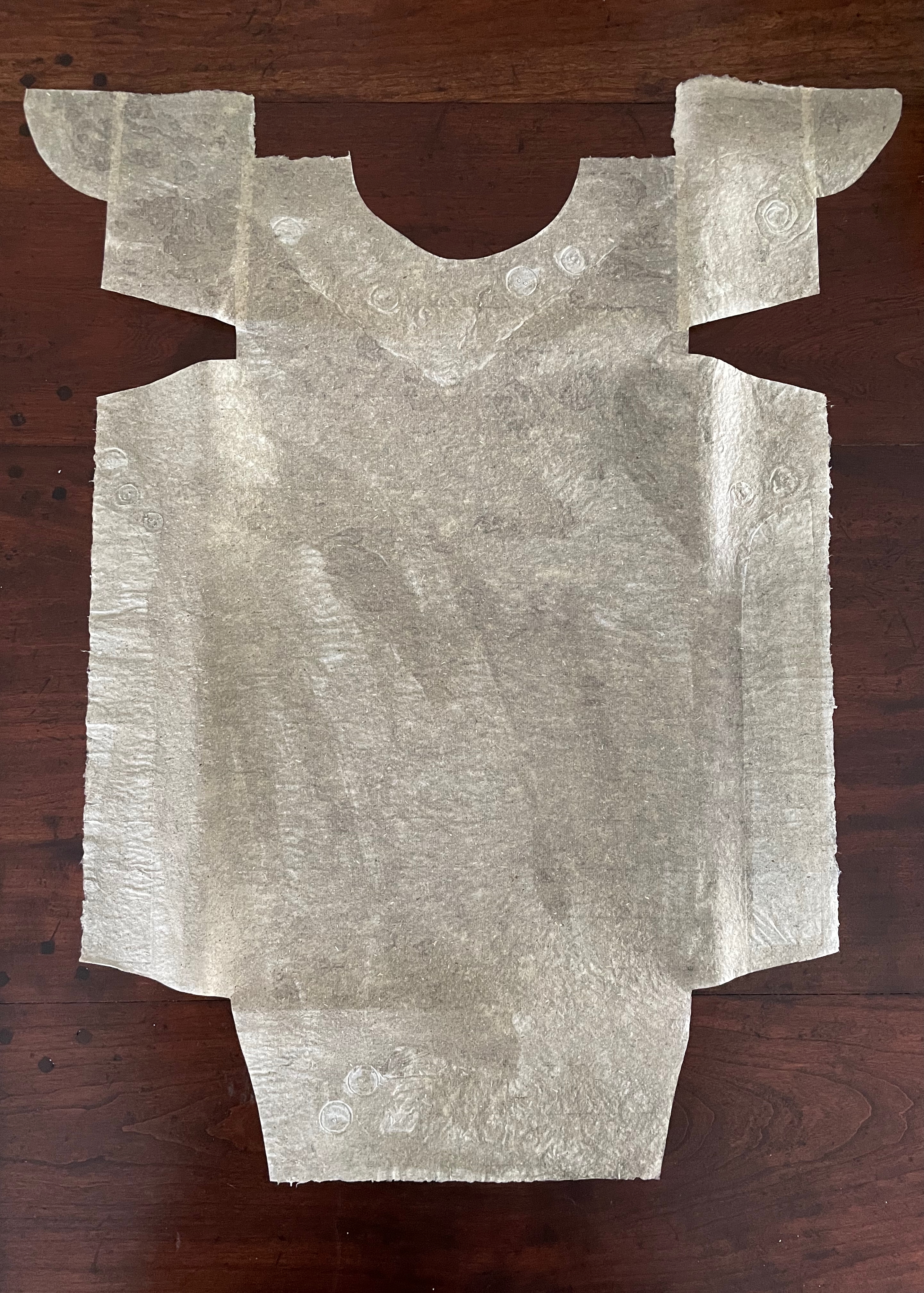
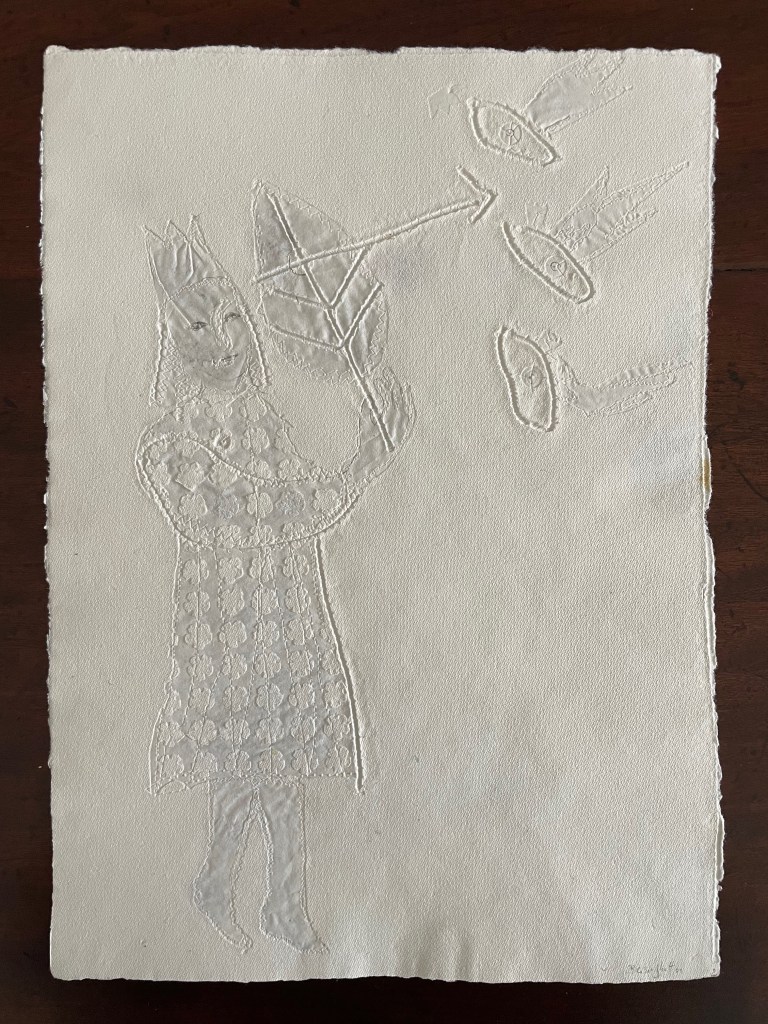
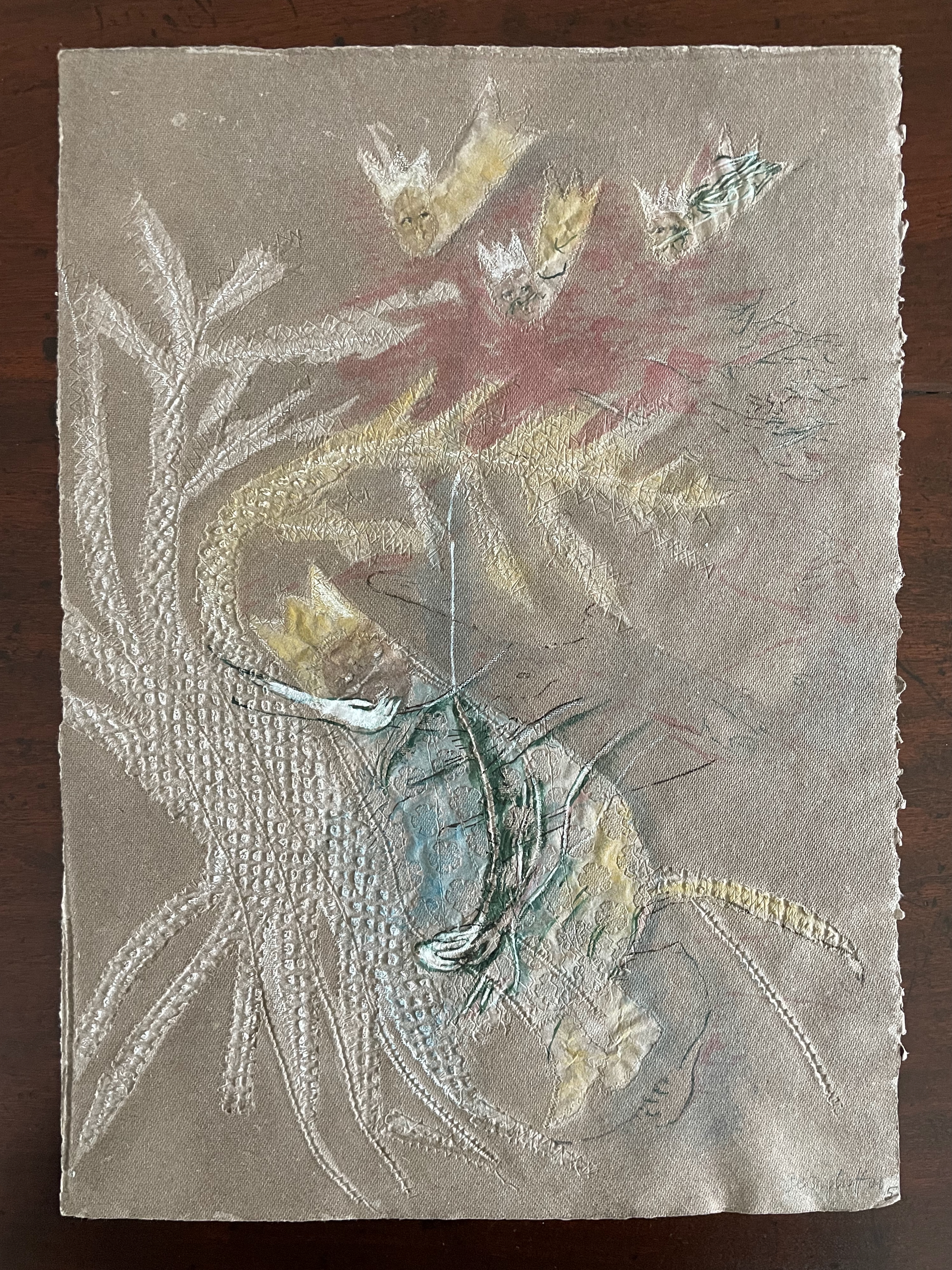
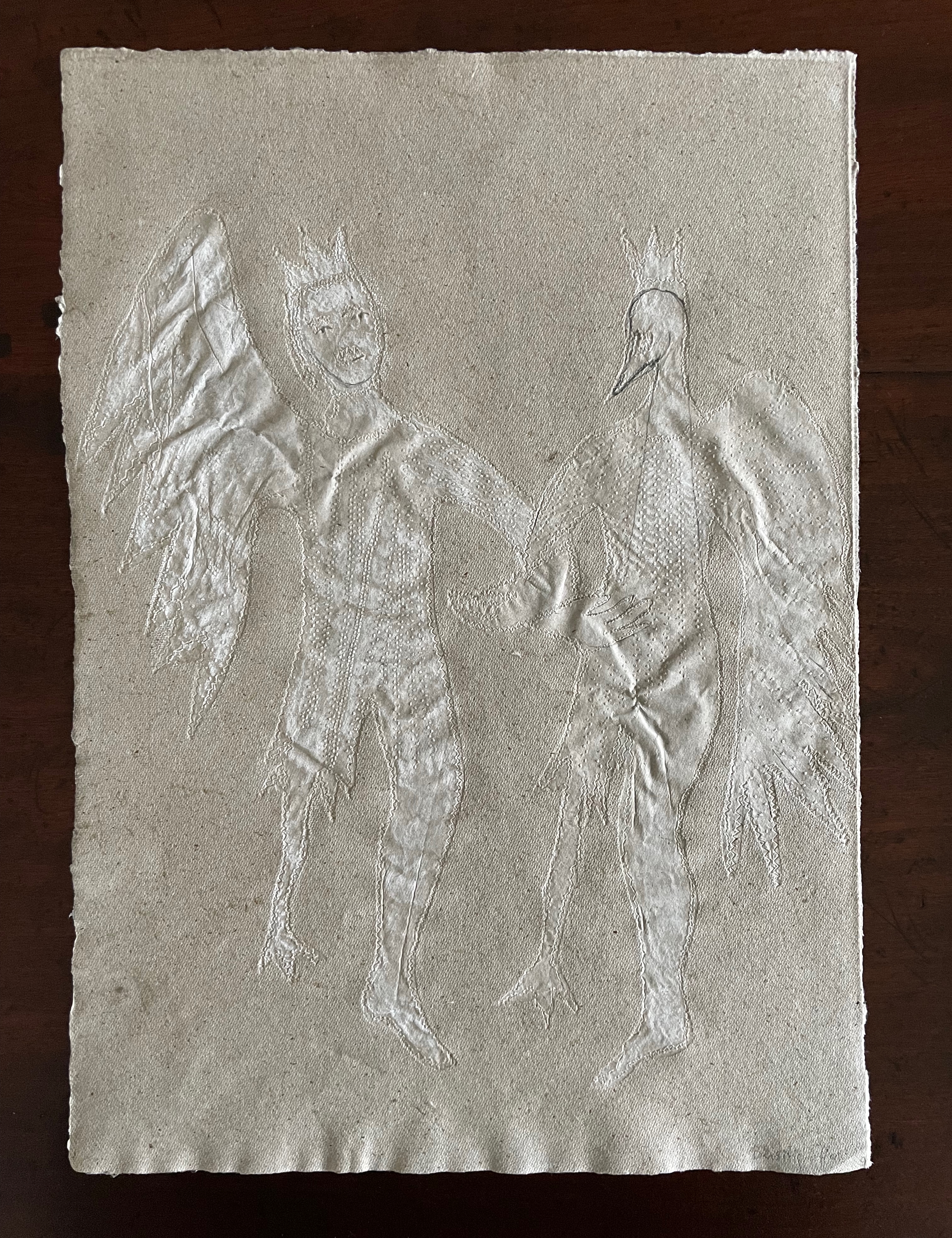
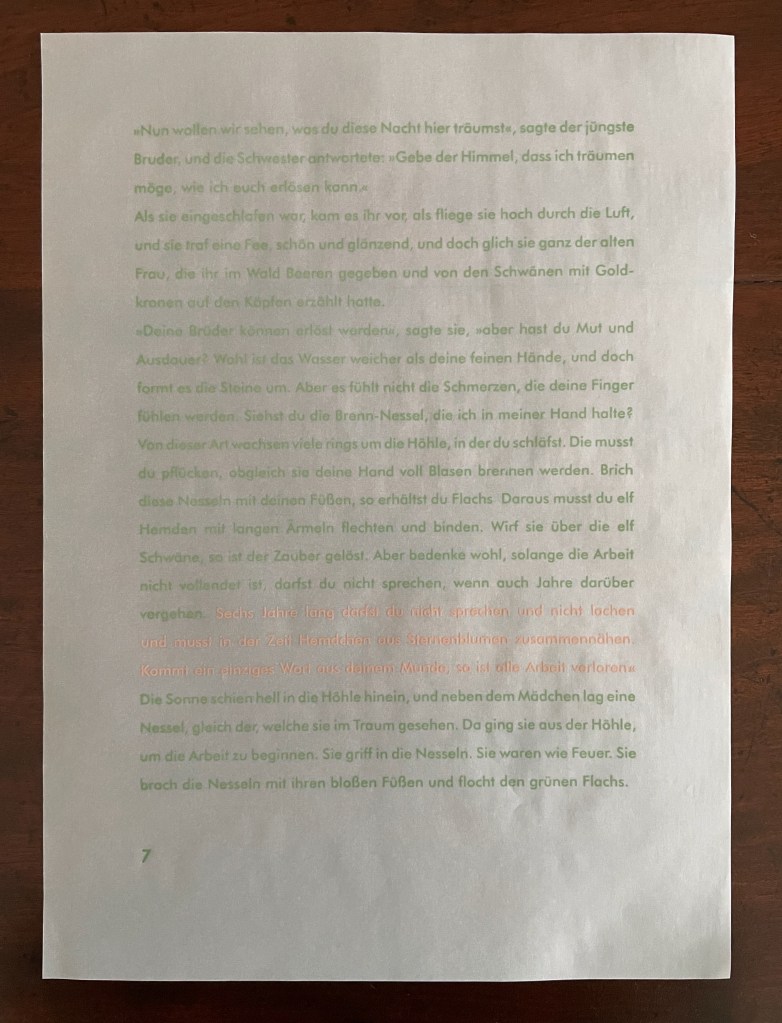
To match Elisa’s effort with stinging nettles, Beisinghoff enlisted the collaboration of Johannes Follmer, the owner of a paper mill. Together they obtained cultivated stinging nettles from the Institute for Applied Botany in Hamburg, cut the fibers, left them to rot, boiled them into a pulp, mixed that with water in a vat, scooped up layers in a sieve embroidered with illustrations, couched the sheets, then pressed and dried them into paper. Beisinghoff applied further drawings with a water jet, watercolor and pencil to the watermark-embossed sheets to illustrate aspects of the tale. To present the Andersen/Grimm “collage”, Beisinghoff had the type set and printed at the Gutenberg Museum. Andersen is printed in light green and Grimm in light red on seven numbered translucent sheets and interleaved with the nine folios of paper art (two more translucent sheets carry the cover page and colophon). To wrap the folios together, Beisinghoff made an embossed chemise or “feather dress” of pure nettle fiber, which could represent Andersen’s description of the brothers’ blowing off each other’s feathers every evening when the sun has set or one of the shirts that their sister makes to break their spell.
The “feather dress” of stinging nettle fiber.
“The King’s little daughter was standing in the cottage room, playing with a green leaf, for she had no other toys. She pricked a hole right through the leaf, looked up at the sun, and there it was, she saw the clear eyes of her brothers, but every time the warm rays of the sun shone on her cheeks, she thought of all their kisses.” Translation with DeepL.
“When she had fallen asleep, it seemed to her as if she were flying high through the air, and she met a fairy, beautiful and radiant, yet she looked very much like the old woman who had given her berries in the forest and told her about the swans with gold crowns on their heads.” Translation with DeepL.
“The swans swooped down to her and lowered themselves so that she could throw the shirts over them: and as she touched them, the swan skins fell off, and her brothers stood before her in the flesh, fresh and beautiful.” Translation with DeepL.
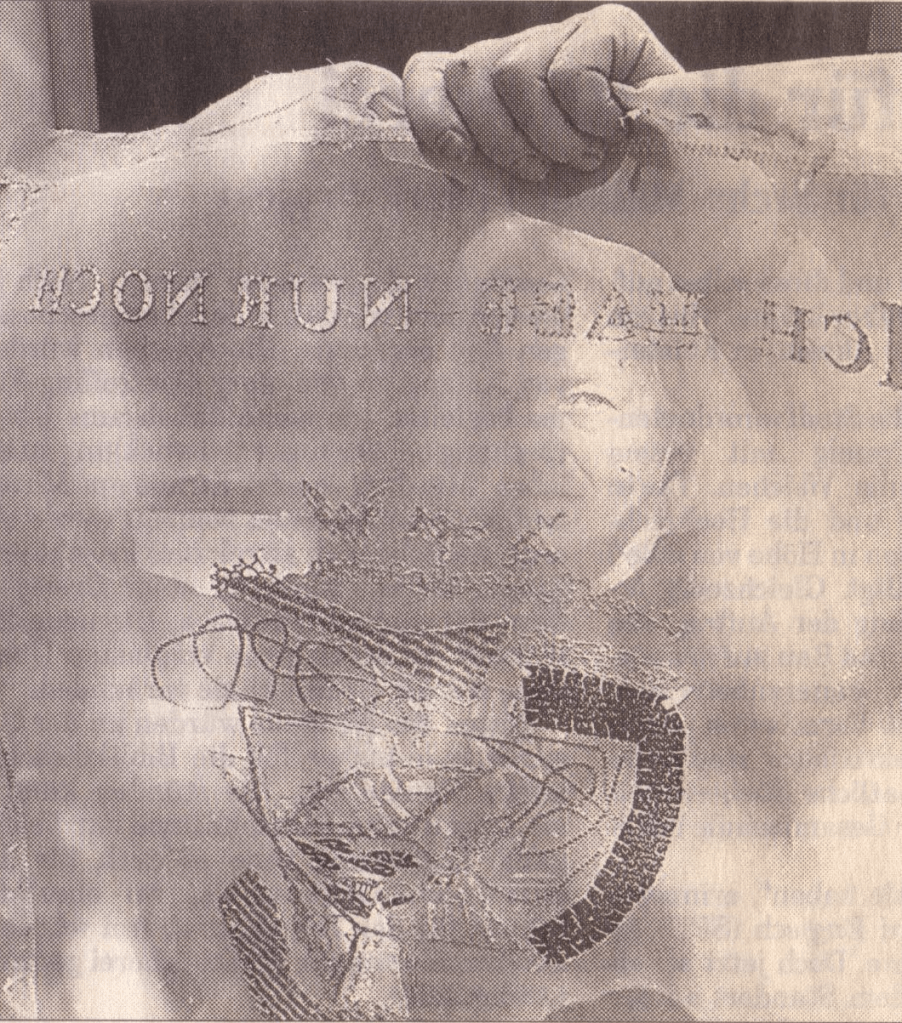
“Barbara Beisinghoff (head in the background) covers the frame with this transparent, embroidered and sewn gauze, which is used to scoop and emboss her nettle papers. This is how her large-format watermark illustrations end up on the sheets.” Translation with DeepL. Peter Holle. 30 August 2001. Frankfurter Rundschau. Photo: Oliver Weiner.
This art by watermarking recalls that of other artists in the collection: Fred Siegenthaler and Gangolf Ulbricht, in particular. The technique of pulp painting also finds other practitioners in the collection: Pat Gentenaar-Torley, John Gerard, Helen Hiebert, Tim Mosely, Maria G. Pisano, Taller Leñateros, Claire Van Vliet and Maria Welch. Beisinghoff’s blend of embroidered watermarks, waterjet marking and pulp painting, however, creates a bas relief effect that is echoed only in the collection’s works by Mosely, Taller Leñateros and Van Vliet, albeit achieved differently. These workings of the substrate — as material, color, surface, and even narrative — with the workings of book structure is one of the more magical locations of book art. It is perfect for Beisinghoff’s metamorphical interpretation of the Andersen/Grimm fairy tale.
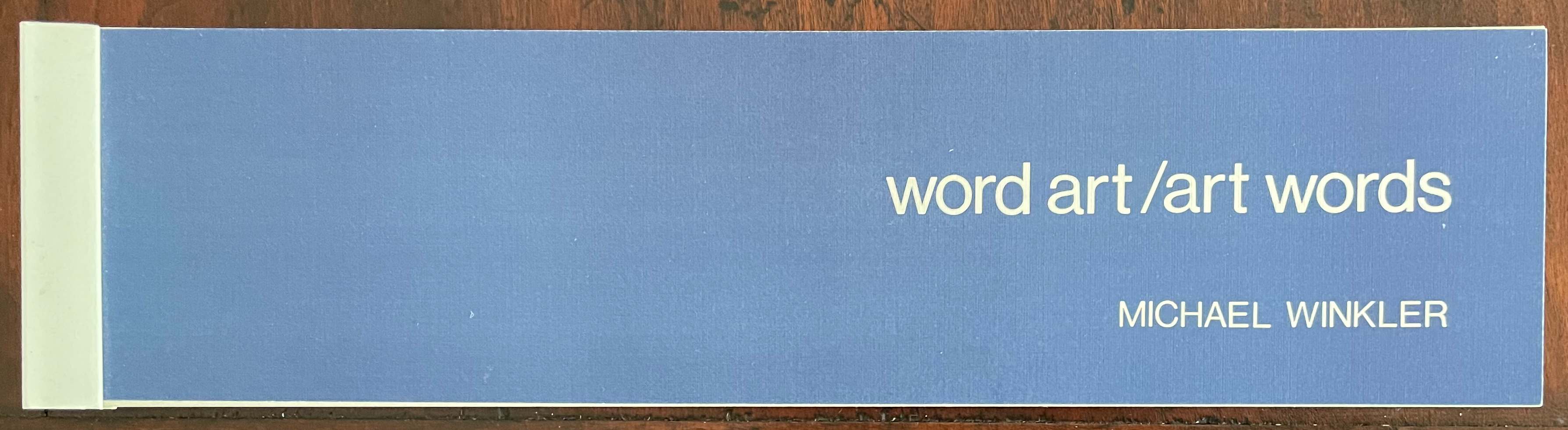
Word Art/Art Words(1985) Michael Winkler Booklet of 29 folios, including front and back covers, held in a white plastic clip. H73 x W288 mm. 27 folios, printed on recto only. Edition of 500. Acquired from Printed Matter, Inc., 23 September 2022. Photos: Books On Books Collection. Displayed with artist’s permission.
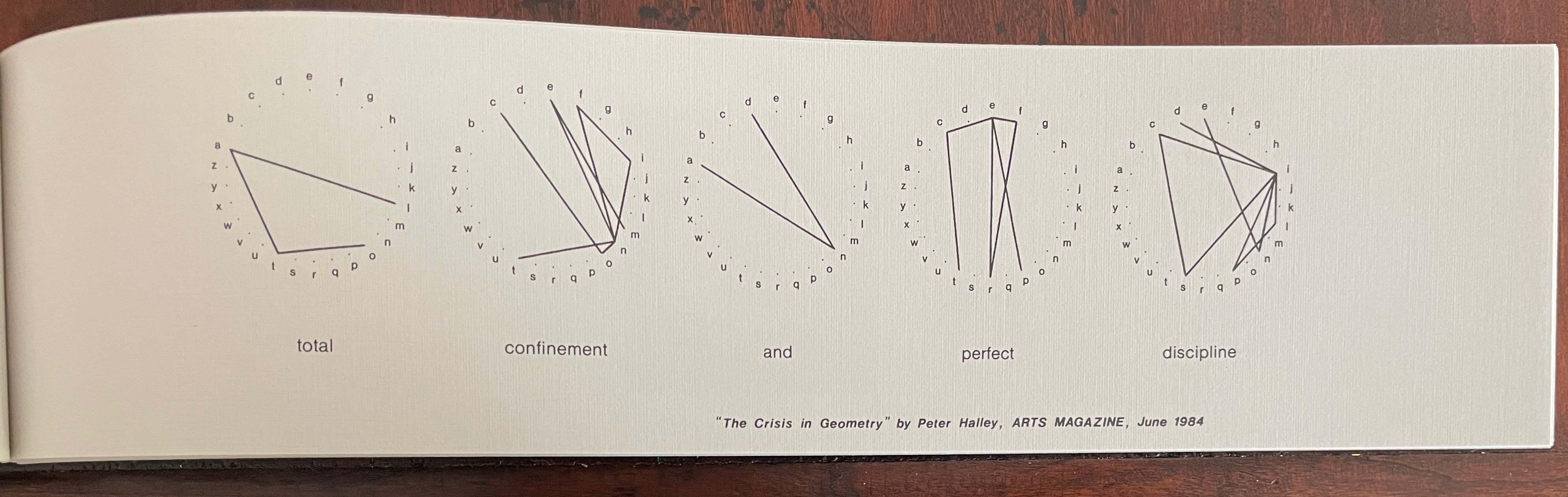
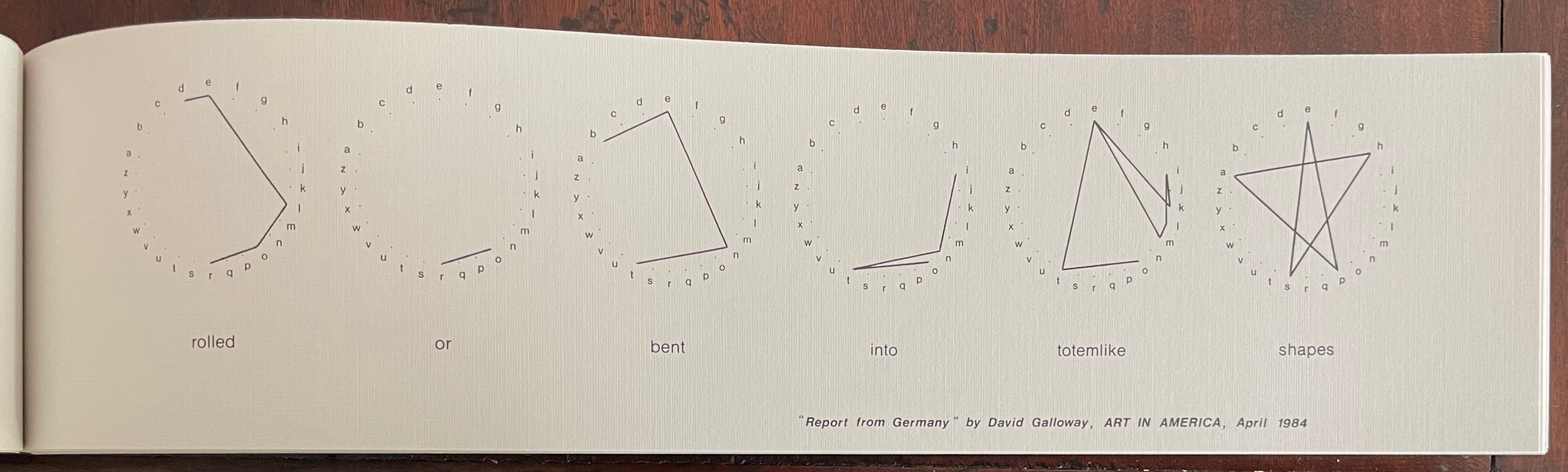
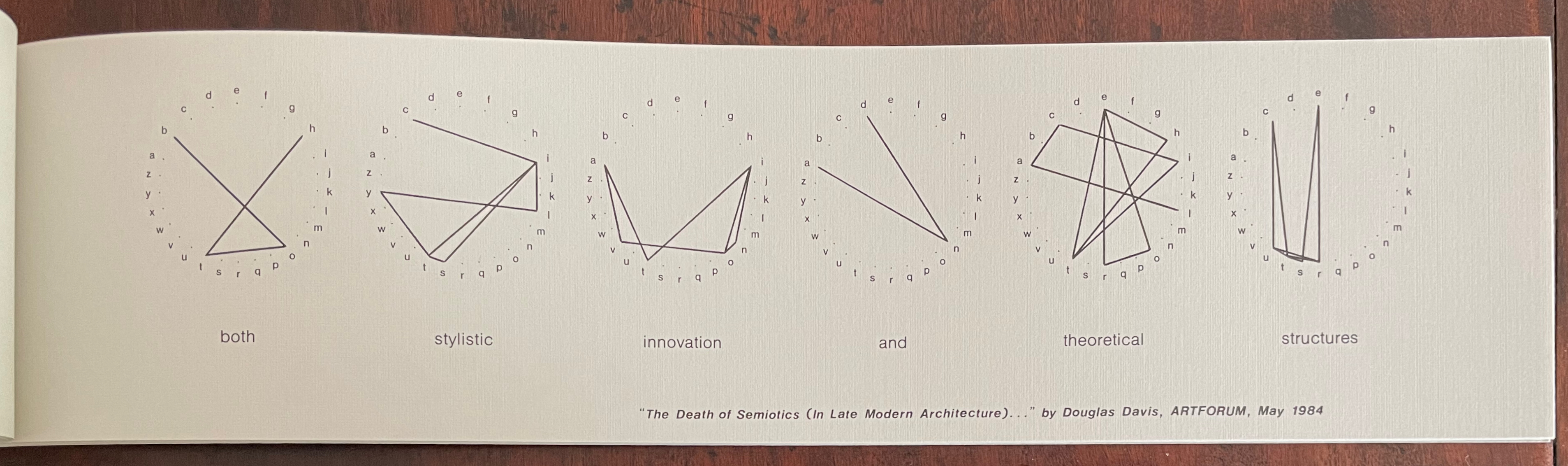
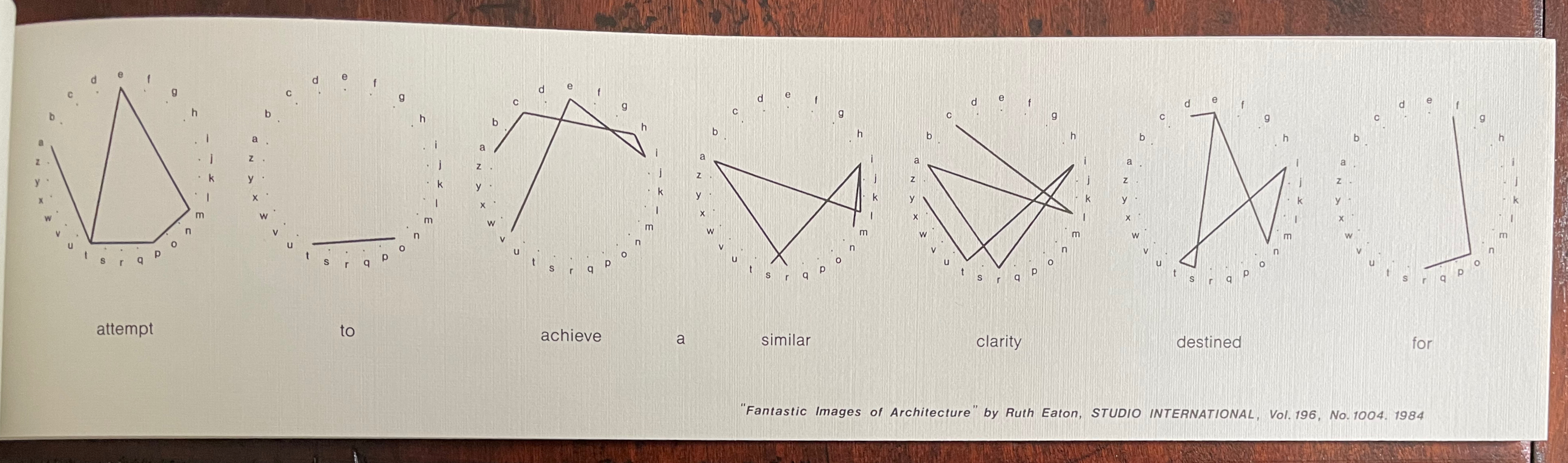
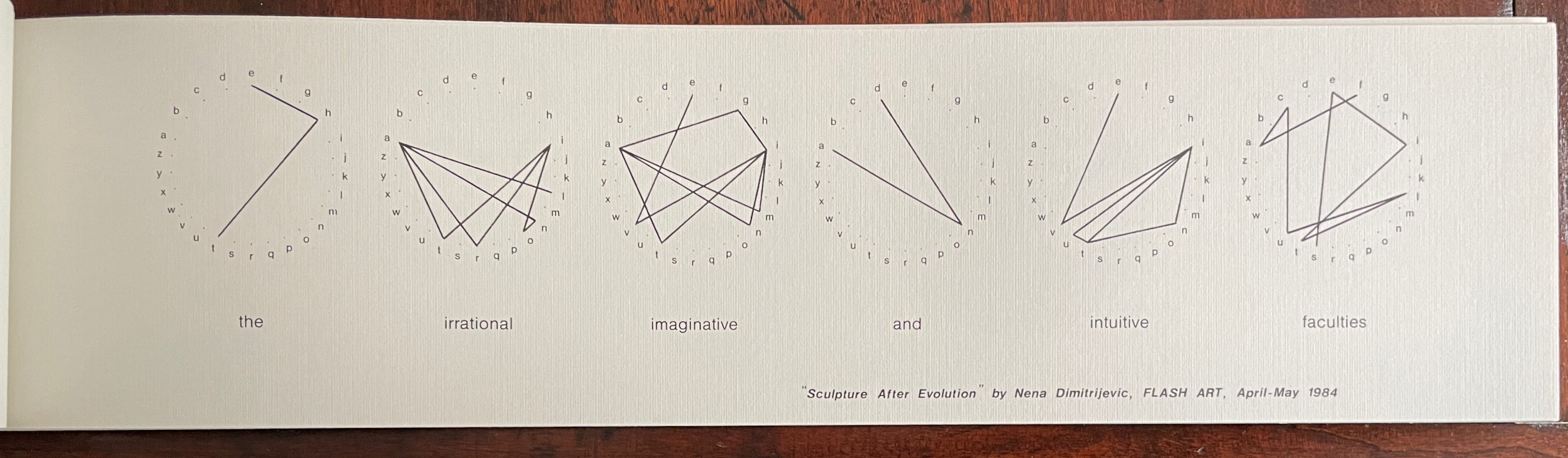
Among all the works of book art related to the notion of alphabets and signs in the Books On Books Collection, Michael Winkler’s word art/art words is one of the more unusual. Winkler’s view of the alphabet varies from traditional linguistic and semiotic theories that families of language arose from ur-languages and that letters evolved from pictographs into increasingly abstract abstractions arbitrarily associated with sounds by social convention. Winkler celebrates a different mystery.
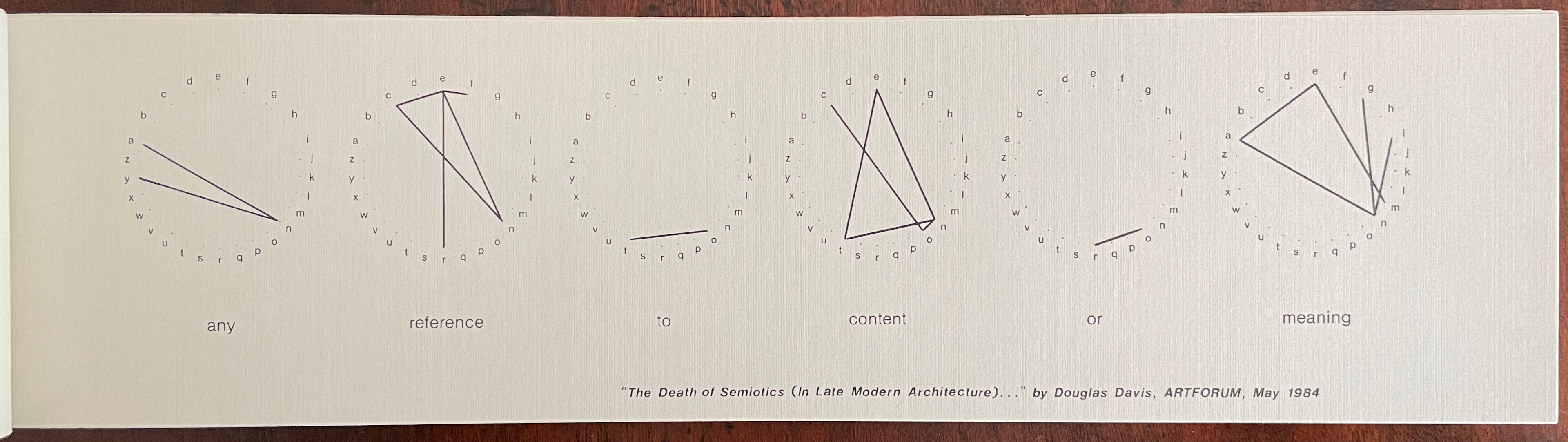
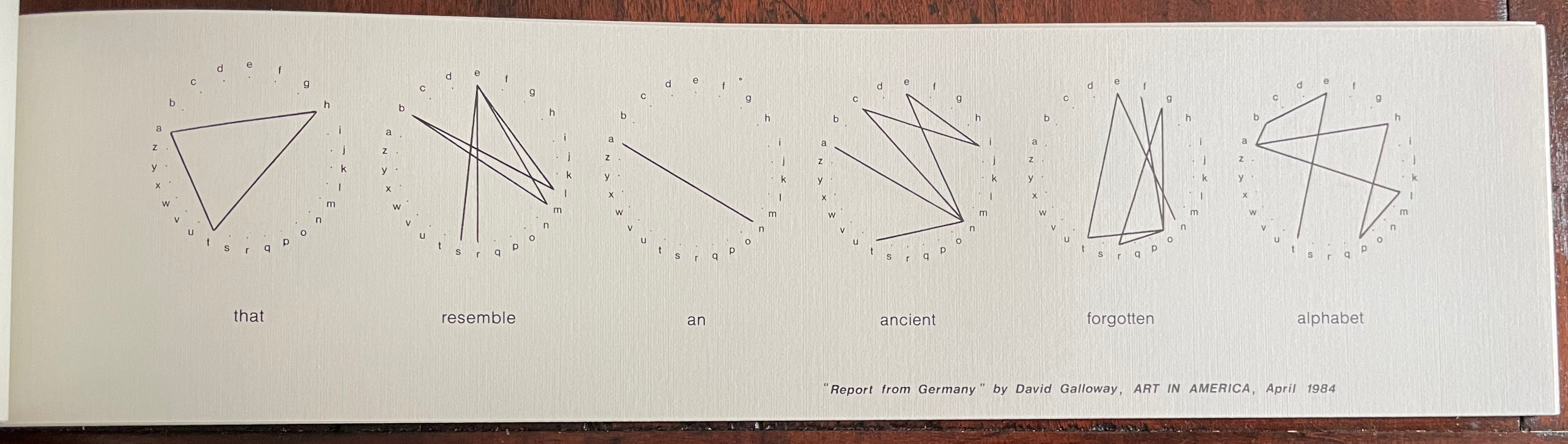
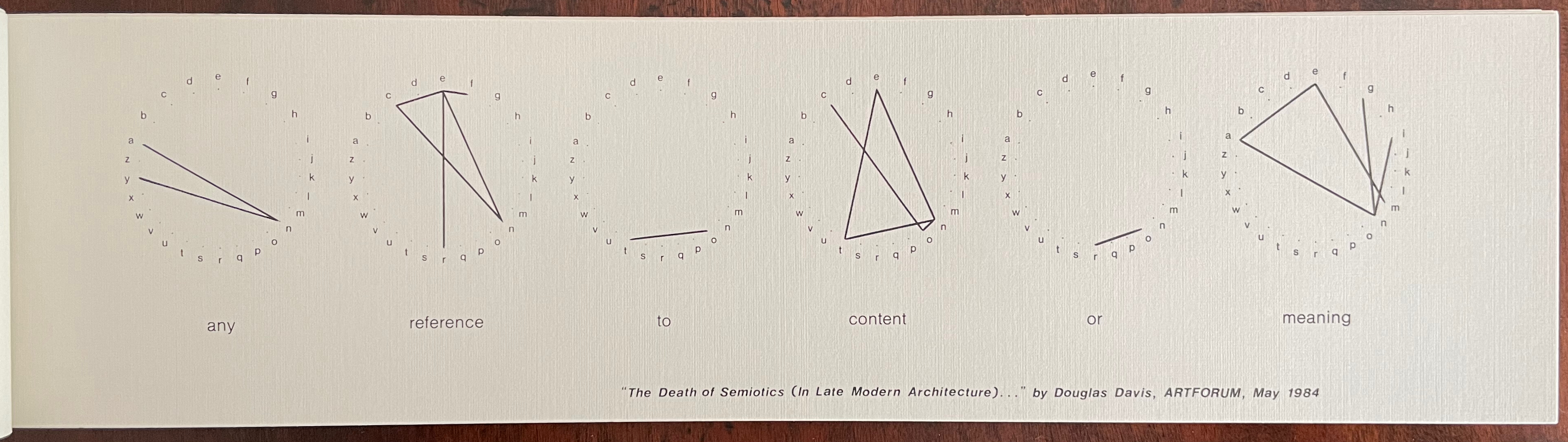
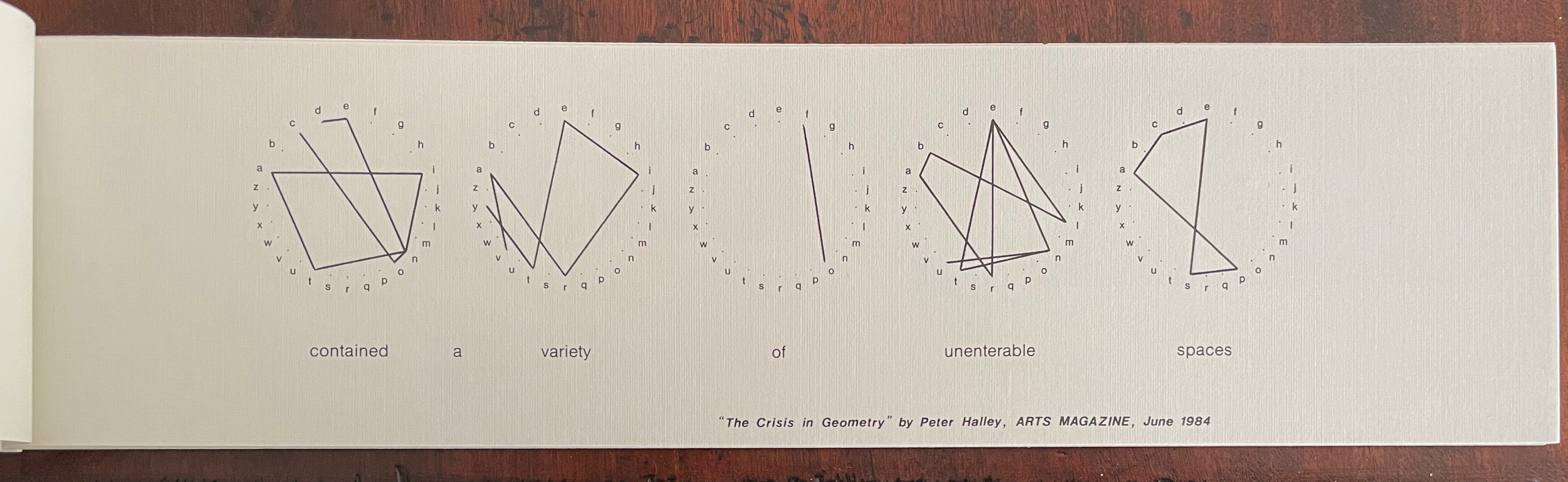
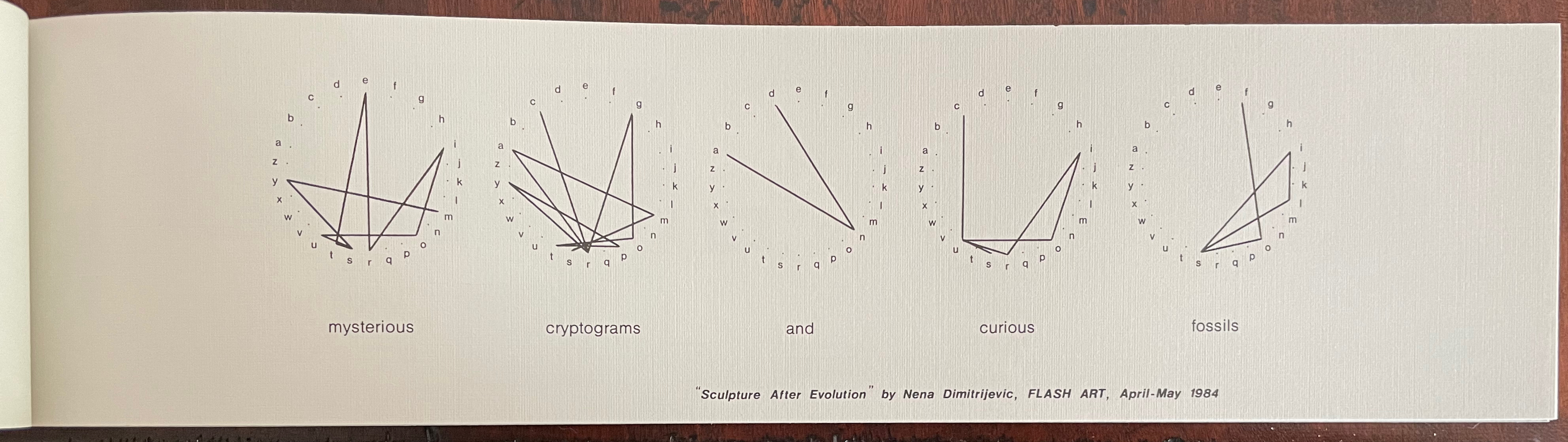
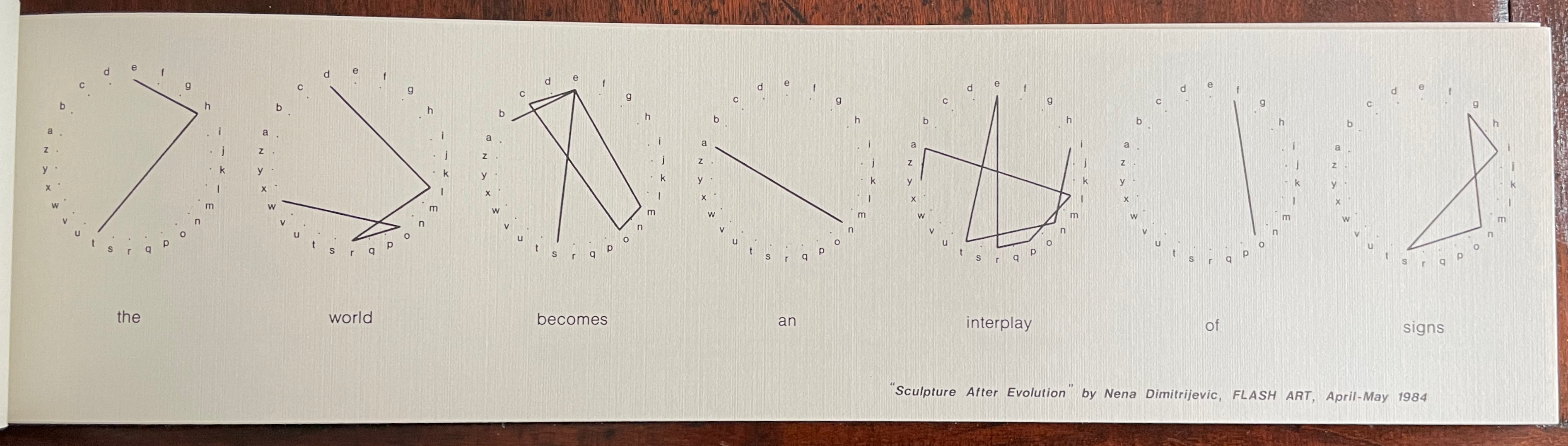
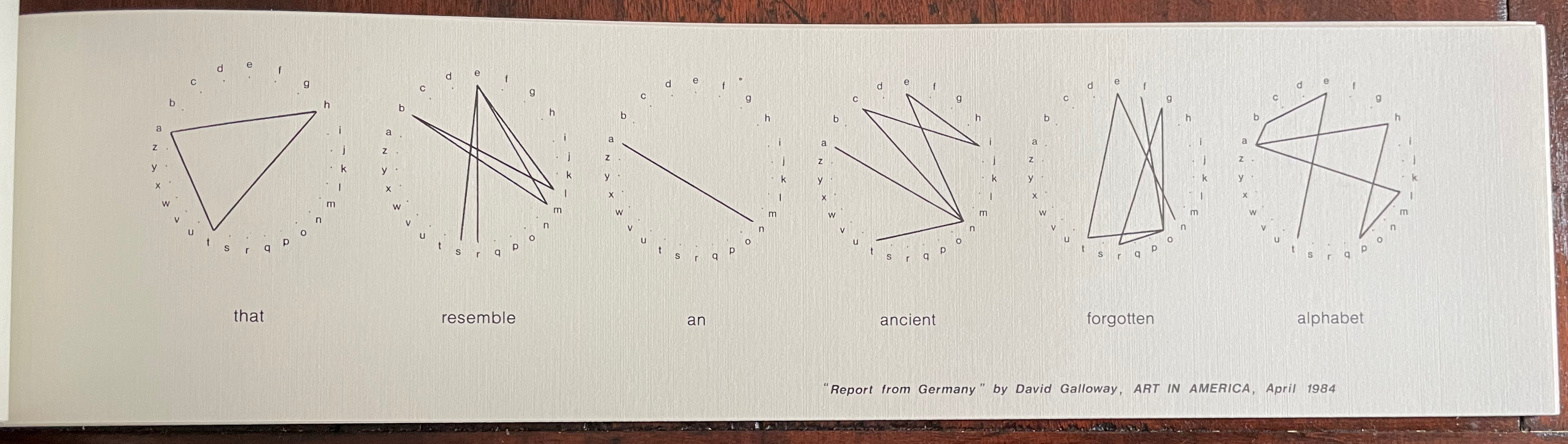
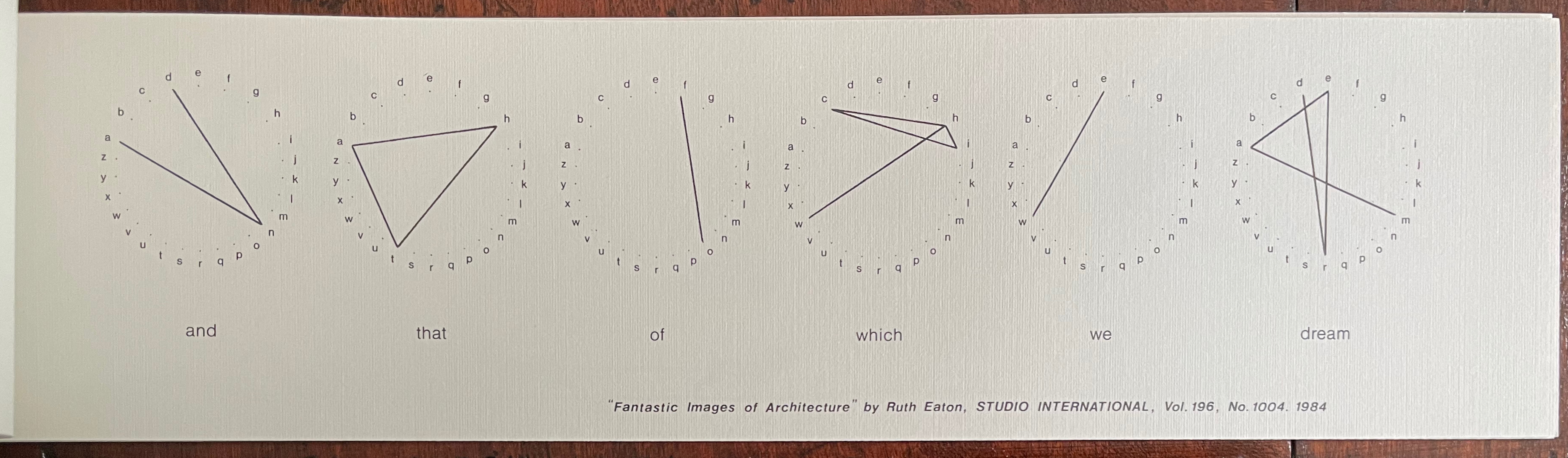
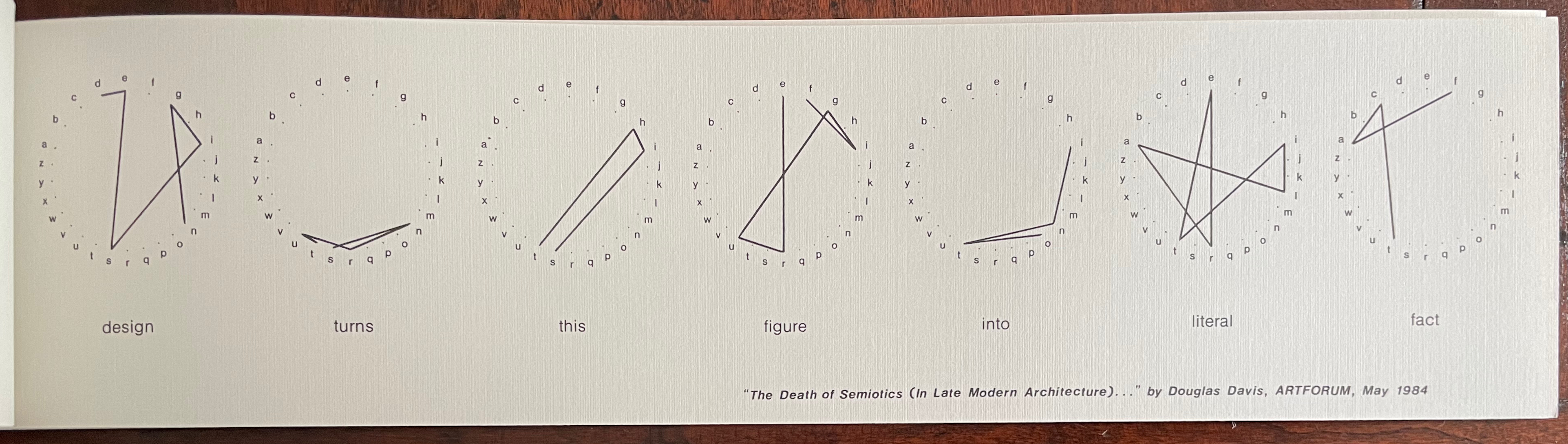
Each of twelve folios has a phrase taken out of context from an art review or essay about art and printed on one side. Above each word, Winkler presents the word’s transformation into an image by drawing lines from letterpoint to letterpoint in a circularly displayed alphabet. Here is the first folio that performs that transformation:
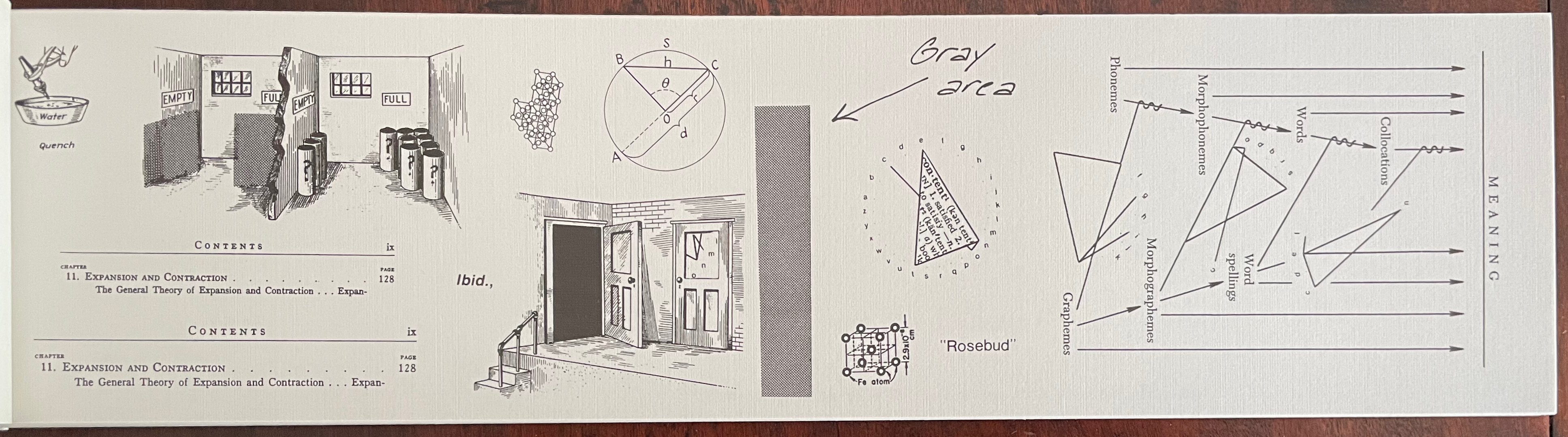
After each of these word-image folios, Winkler adds another folio with various images “based on the visual aspects of, or the implications of the meanings inherent in,” the preceding folio’s sequence of word/images. Below is the folio that follows the word/images above:
Notice that, just under the label “gray area”, the word/image for “content” is reproduced from the preceding folio but with the dictionary-definition of “content” (as meaning “satisfied”) collaged into the triangular space of the image. Text generates image, image captures text. To the left of the gray block, the lower arc of the image for “meaning” appears within the rectangular window of the doorframe. If we miss the point that geometric representation of text and meaning is linked to geometric definition and measurement of shape, there is the traditional image of circle, circumference, diameter, radius, segment and chord displayed just above the doorframe to remind us. If we miss the point that the “content” referenced by a circle can be empty or full of meaning, there are the closed and open portals as well as a cross section of rooms labeled “empty” and “full” to remind us. The ambiguity of the word “content” shows up in the section of a Table of Contents, whose reference to the paired opposites of expansion and contraction is reinforced by the metaphorical equation set up by ibid. (the “same source”) between the twice-repeated Contents section on the one hand and the open and closed portals on the other. The manifoldness of “meaning” as well is represented by the semantic diagram on the right.
And so it goes, folio after folio, which are otherwise loose but bound only by virtue of the plastic clip and meaningfulness of sequence. The plastic clip, the loose folios and the oblong shape contrary to expectations for a codex — they obliquely reprise Winkler’s suggestion of what meaning/making (or making meaning) is about. Circularly represented, the loose letters of the alphabet nevertheless combine in words and linear images in which meaning inheres.
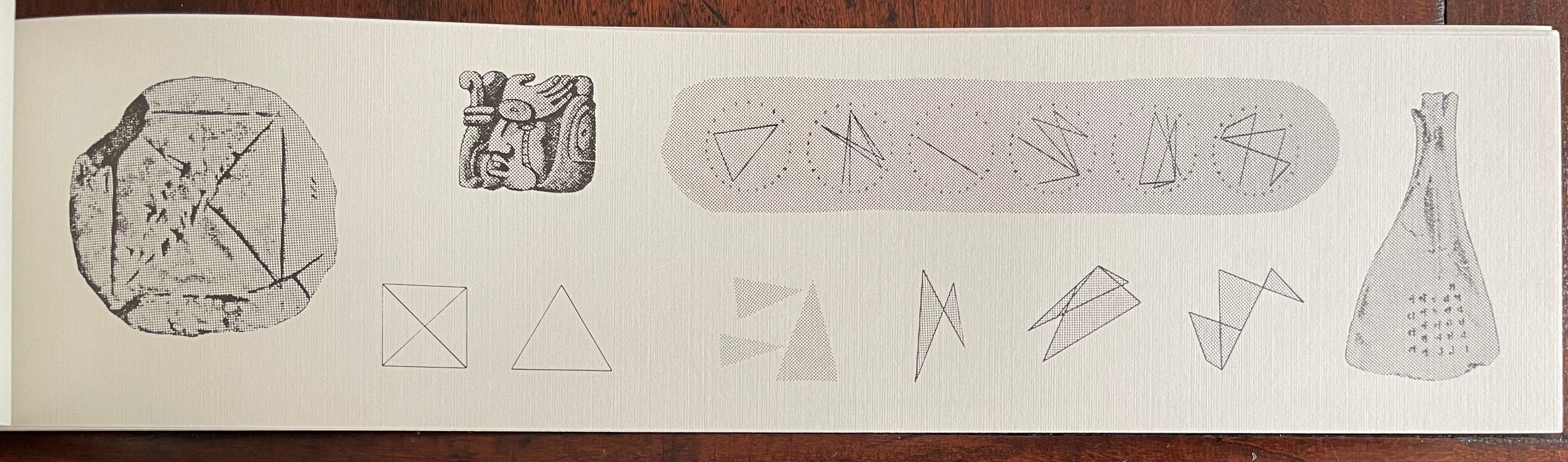
But isn’t meaning associated with words arbitrary (as hinted at by the allusion to the mysterious Wellesian “Rosebud” from Citizen Kane)? Winkler’s circular word-decoder (or rather image-encoder) implies that it only seems so. The mystery doesn’t lie in arbitrariness, rather it lies in Nature. In Winkler’s view, language is a product of a Nature that is meaningfully patterned. If consciousness and language are products of Nature, the associations that he finds between the abstract linear images and external figurative images argue for an inherent meaningfulness perhaps resident in some “ancient forgotten alphabet”.
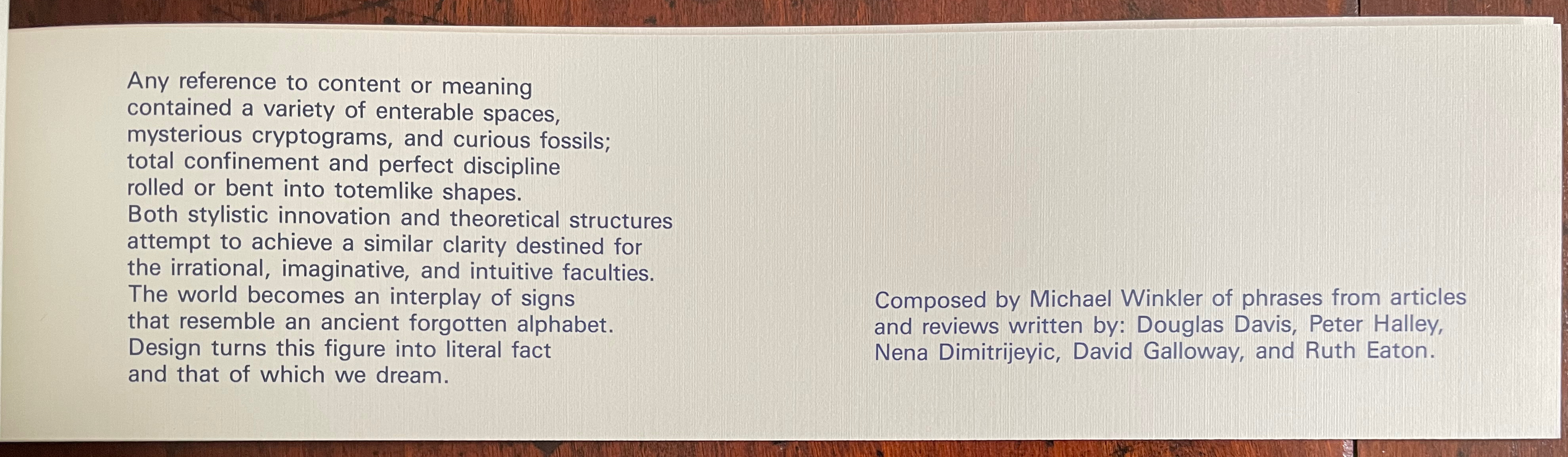
Although the preface to word art/art words signals the clinching argument that Winkler presents, it has to be experienced from front to back and back to front to appreciate it. The final page compiles all of the previous twelve phrases into a single paragraph of four sentences: a sort of textual collage that presents a syntactically and semantically coherent manifesto.
The seamlessness of the collaged paragraph implies a vision just waiting for discovery through application of the artist’s word/image technique. Albeit out of context and somewhat disparately sourced, though, the phrases were selected and combined to produce that articulate statement of artistic vision. The artistry in doing so is what celebrates the mystery of language and representation that Winkler finds in Nature.
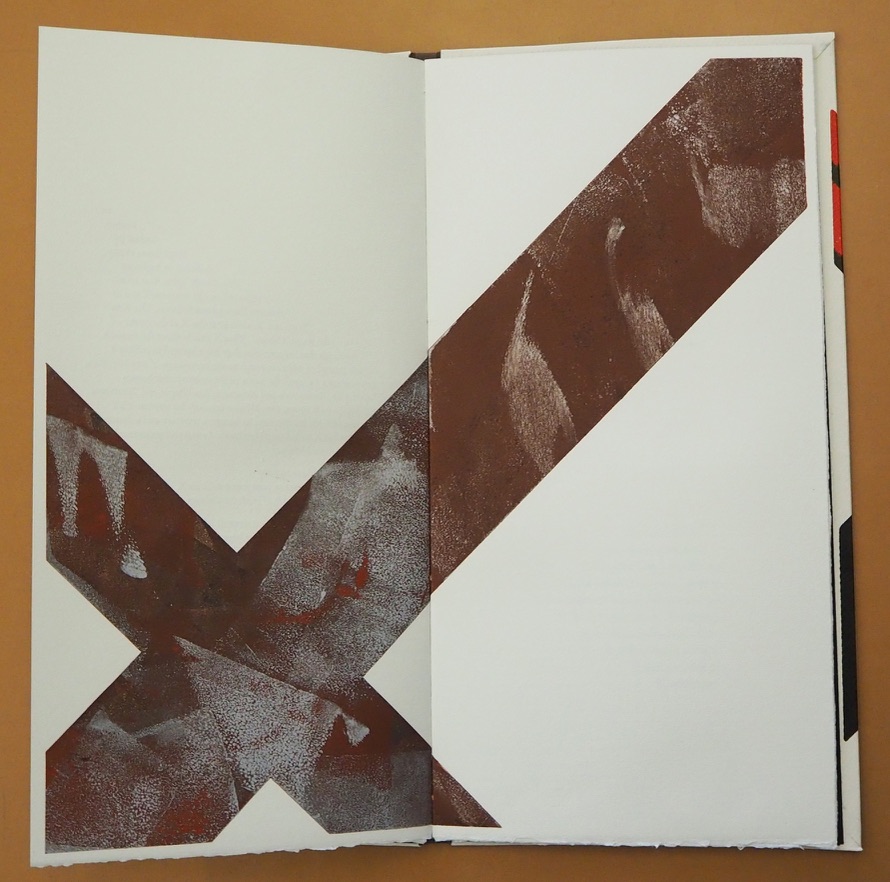
In this ode to the letter X, Mexico and language itself, Alberto Blanco and Nacho Gallardo Larrea brilliantly show how the artist’s book can translate word and image from one to the other and back and, at the same time, soar over the challenge of translating poetry.
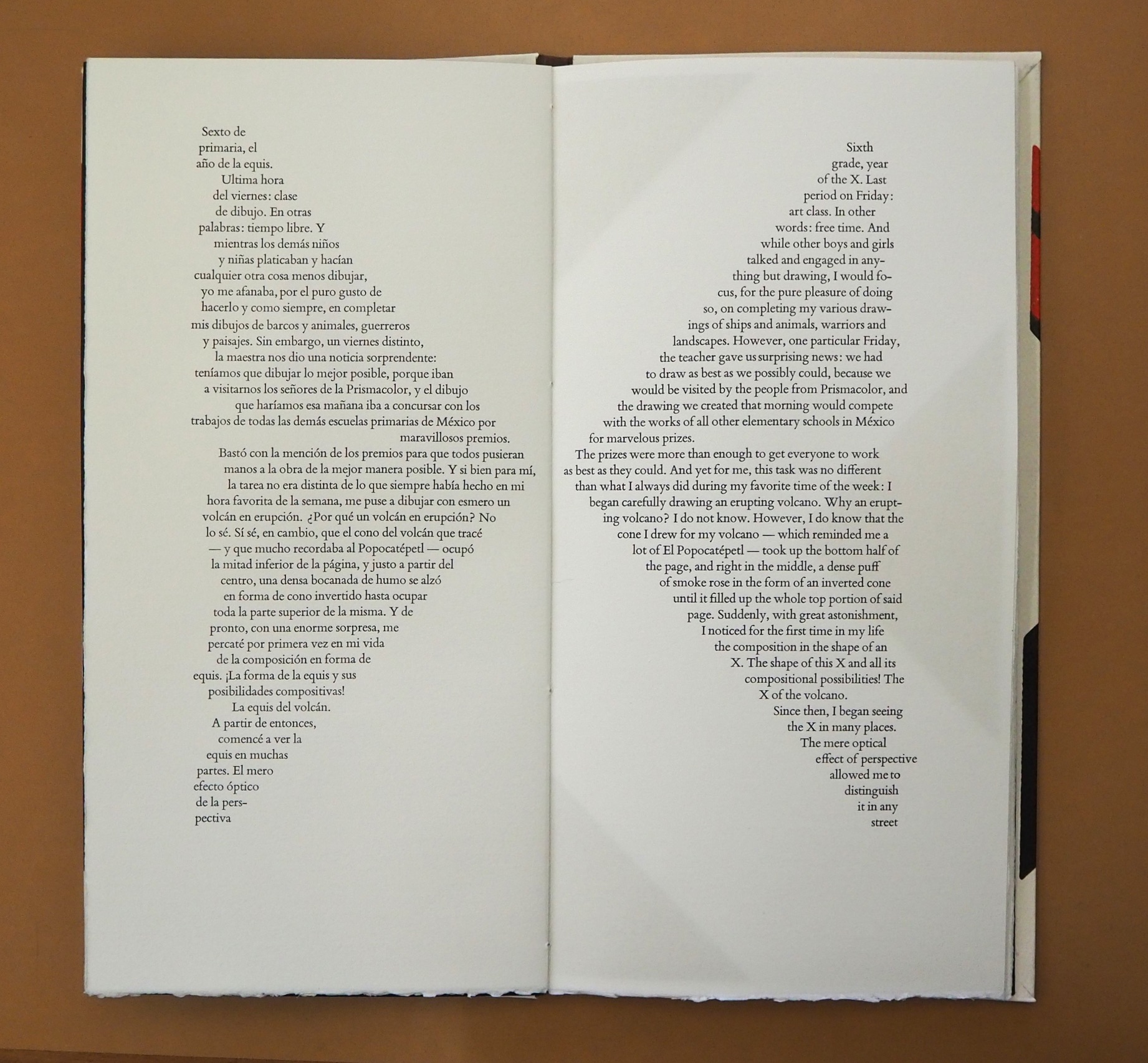
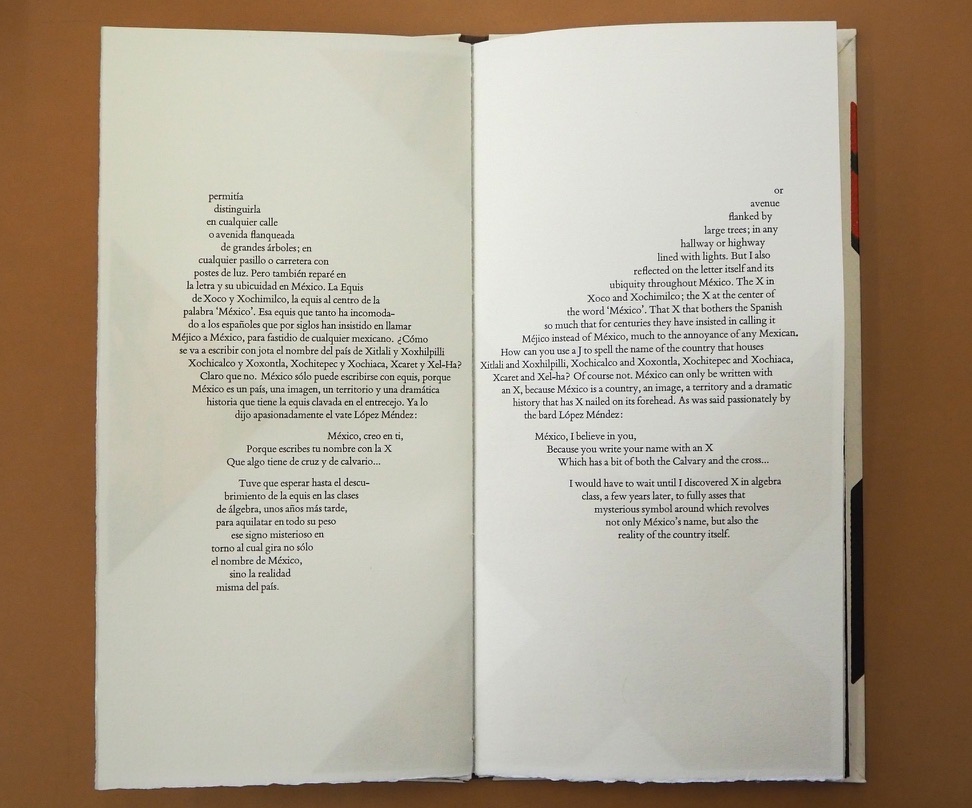
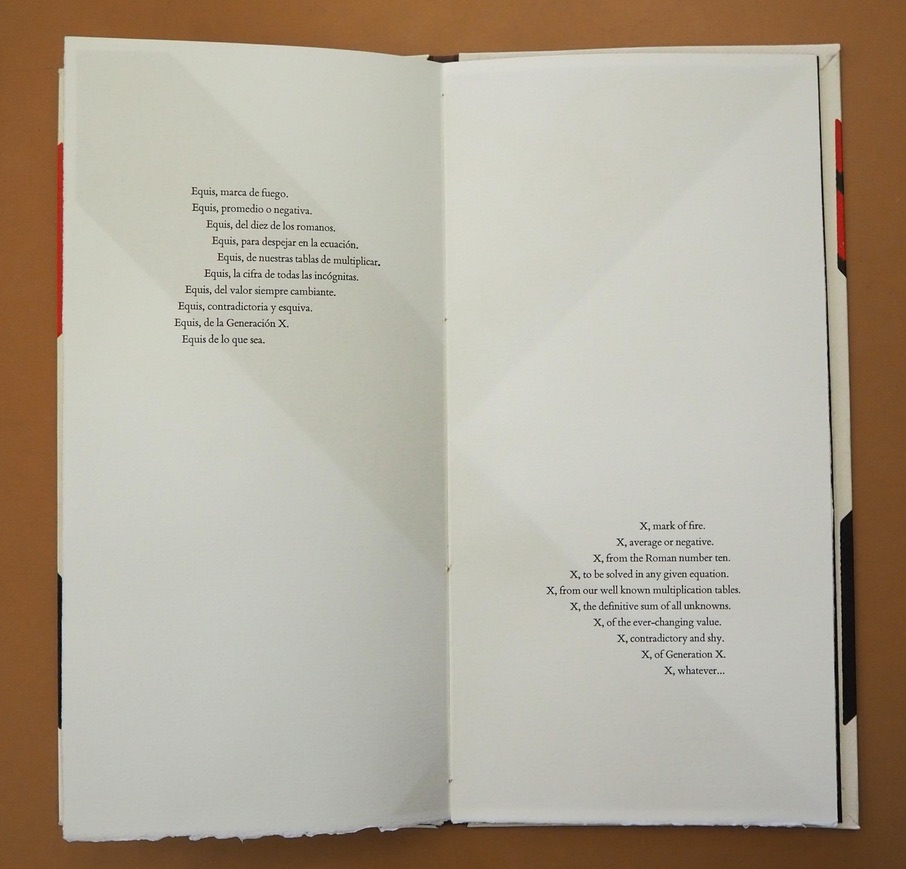
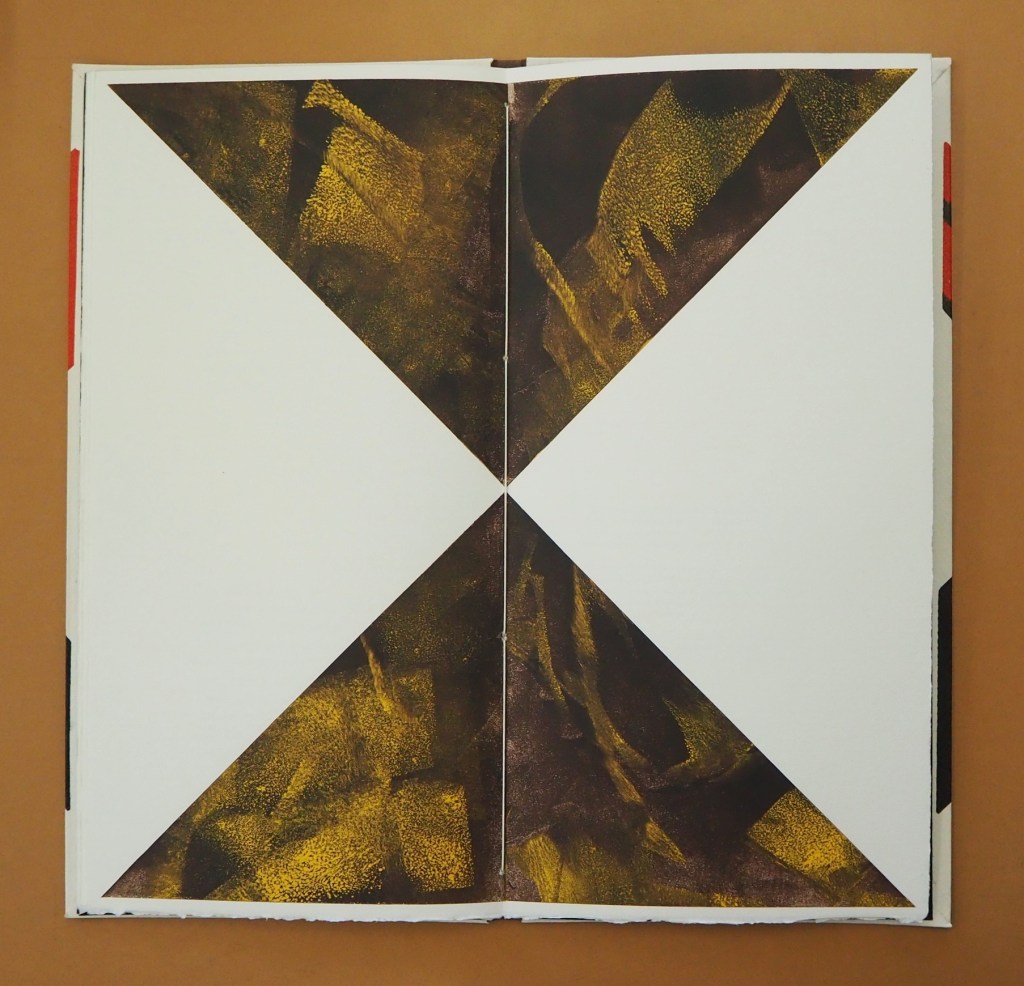
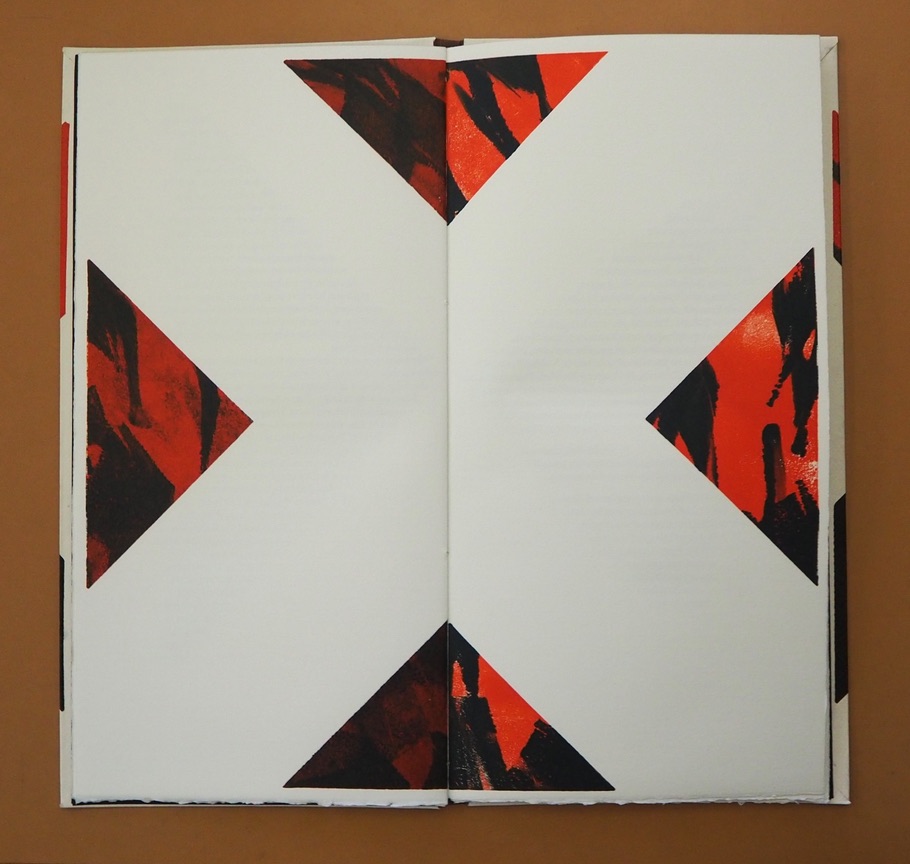
The Spanish and English versions of Blanco’s text shape, and are shaped by, the bilateral symmetry of the letter X and the codex form of the book. Spanish on the left, English on the right: the imposition of type and the ghostly images of the X play with one another. The two texts delight in the crossover between similarity and difference, knowingly in the white space at the exact center of the X in the double-page spread below. How better to use the notion that, for all letterforms, space counts as much as line?
Sometimes the language on one side completes a thought or expression before the language on the other side can do so, a natural phenomenon in translation in which one language needs fewer or more words than the other. See above, for example, the passages beginning “La equis del volcán” and “X of the volcano” that do not quite align in the legs of the X. The Spanish sentence trails off in a fragment to be completed on the following verso page, but the English sentence is already half way there on the recto page above.
As the shaped poem continues in the pages below, and the number of words in one language exceeds those on the other creating lines asymmetrical to one another, the poet and artist use the X shape in whole and parts and the diametrical placement of text in the last double-page spread to reflect the crossing dance of similarity and difference, asymmetry and symmetry, that they find in X across languages, generations and country.
Interpersed between the pages of text, the late El Nacho’s monotypes make color, shape and space play with one another to mirror — not merely illustrate — the thrust of the language. If ever there were a collaborative work that distinguishes the artist’s book from a livre d’artiste, this is it. Alberto Blanco has also created solo artist’s books, which enjoyed an exhibition at the Athenaeum Music & Arts Library, La Jolla, California, February 19-March 26, 2011. Stylistically they are distinct from The Book of Equis, which underscores its collaborative originality.
Colophon: “The Book of Equis was designed and printed in Intagrafía, located in San Jose del Cabo under the direction of Peter Rutledge Koch, with monotypes created by El Nacho. Printed under the supervision of Lenin Andujo Fajardo by Ivonne Rivas.”
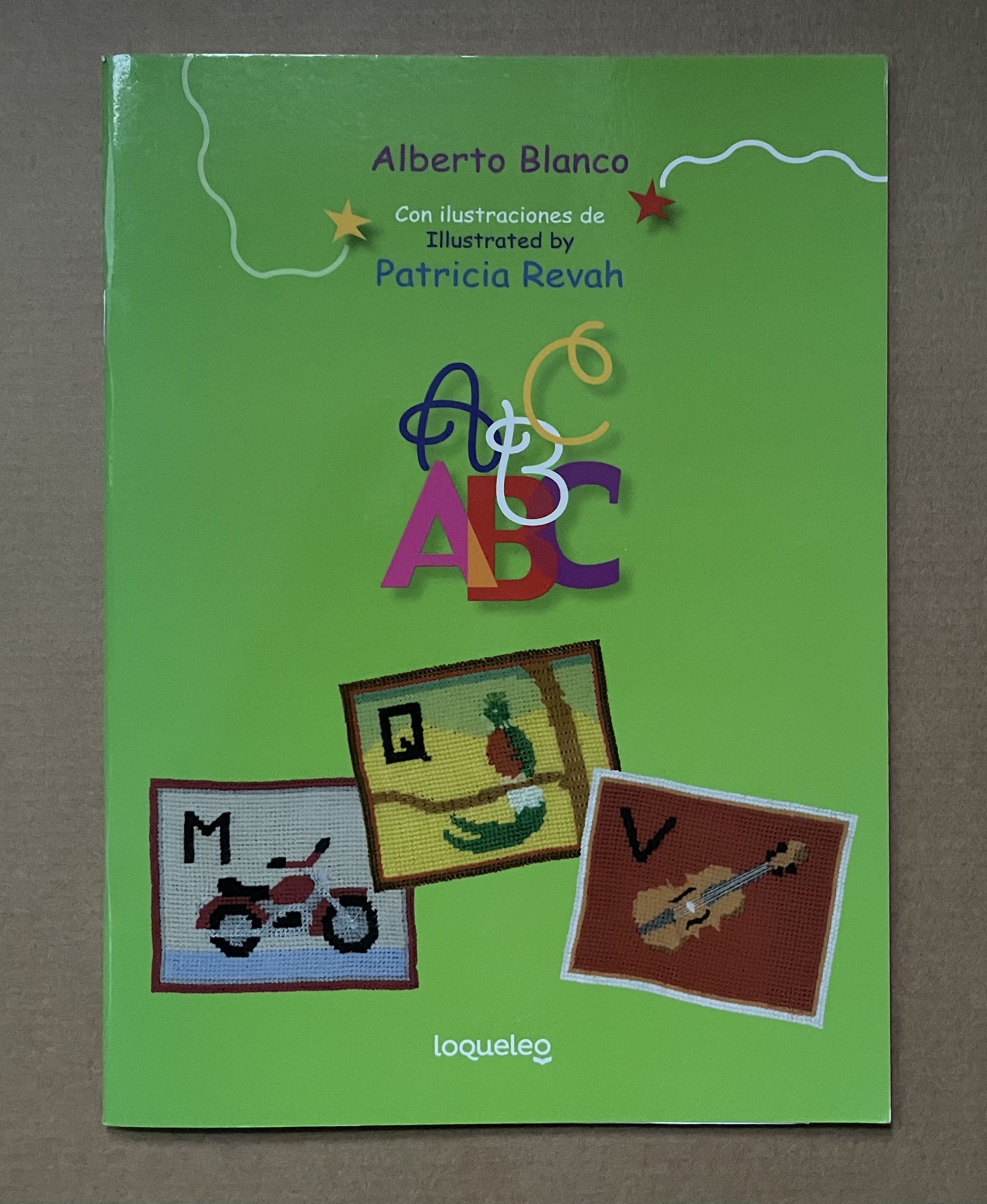
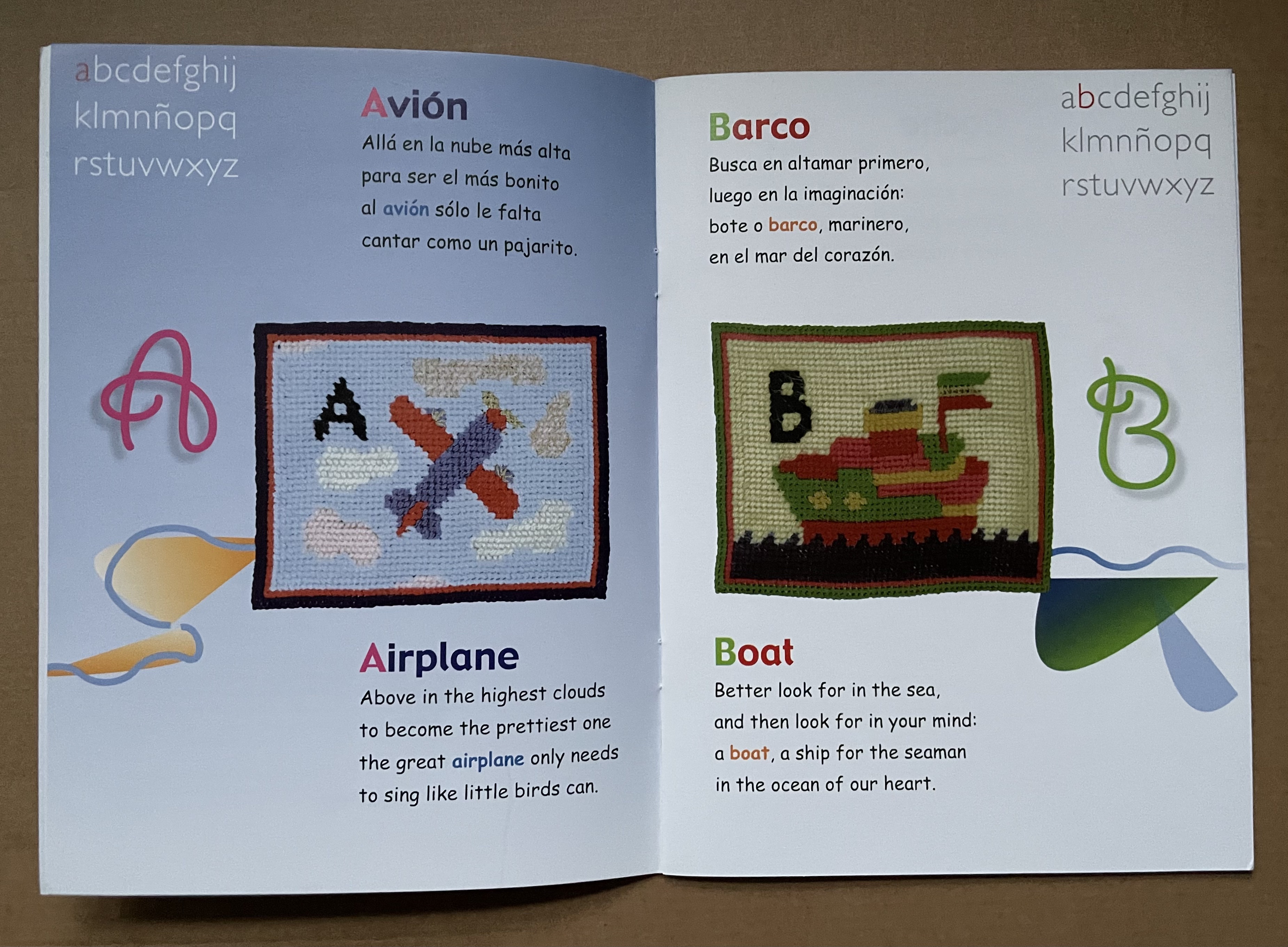
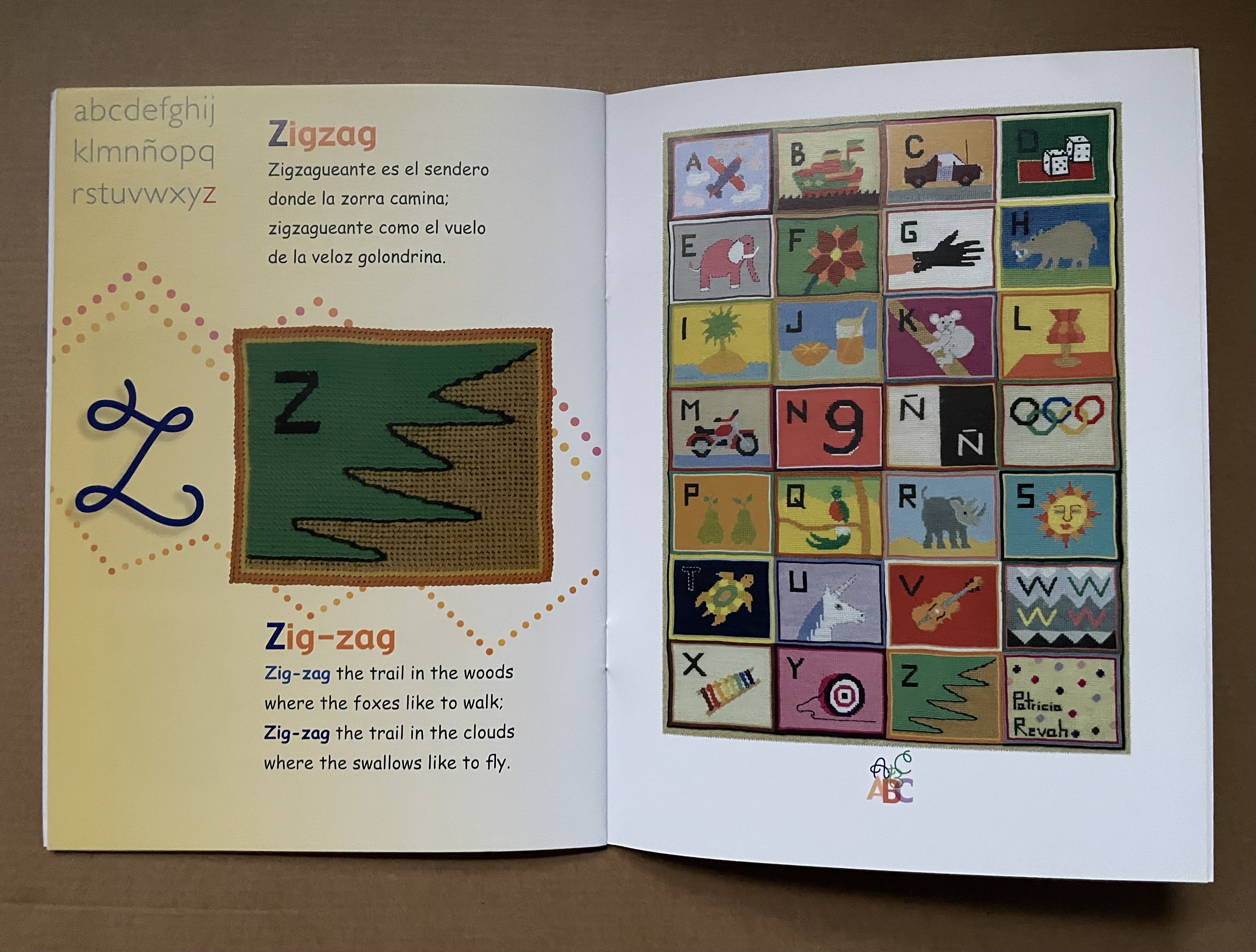
Rhyming poetry often raises the already high bar to translation. The literal English translations that follow Alberto Blanco’s charming abab Spanish poems do not attempt to substitute suitable rhymes. The textile art in this abecedary, however, wraps a comforting quilt around the challenge of translating poetry in a way that appeals to children.
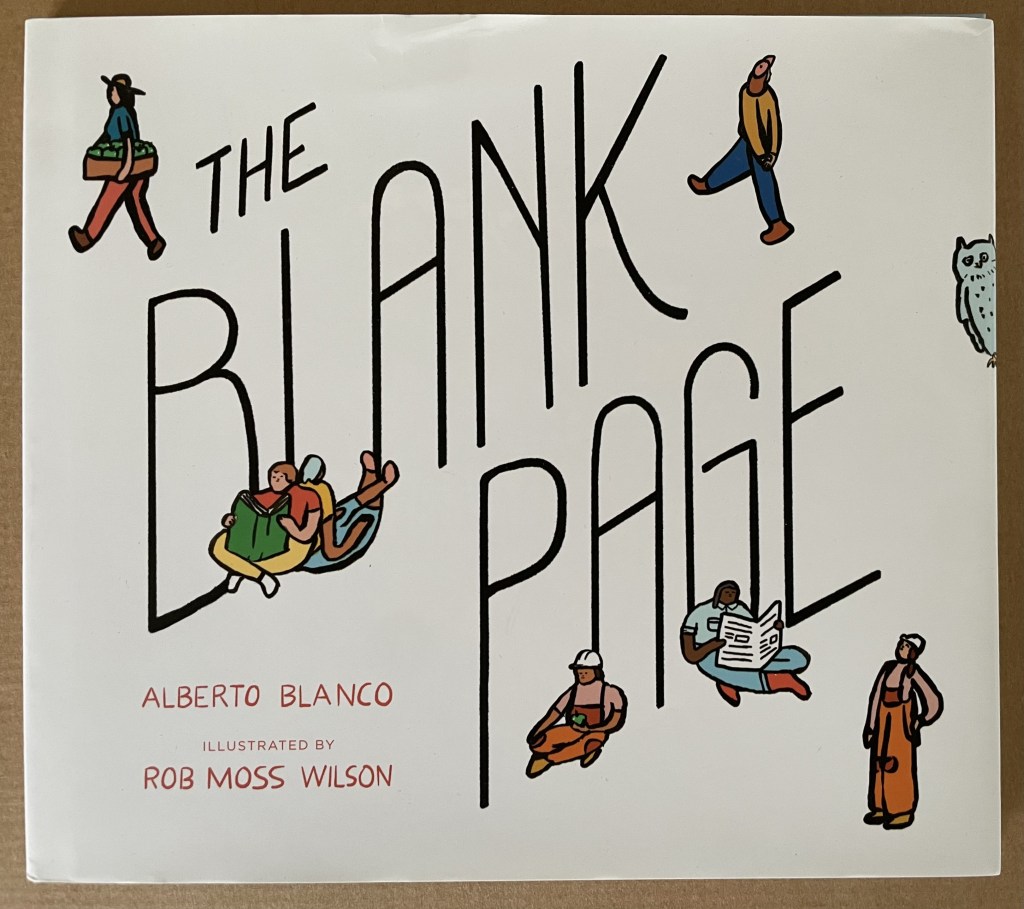
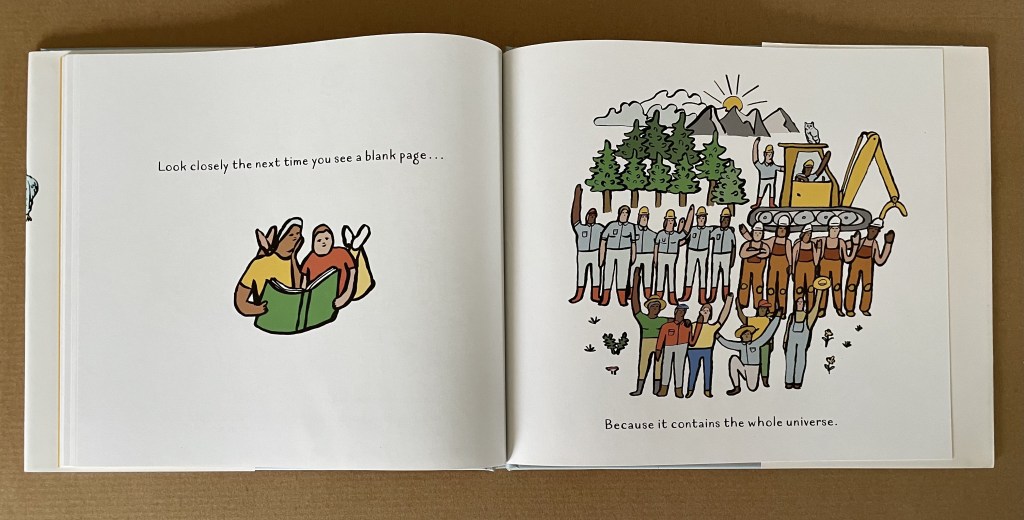
Who would think it possible to introduce children to the ideas of Stéphane Mallarmé? Alberto Blanco for one, albeit without mentioning the French poet.
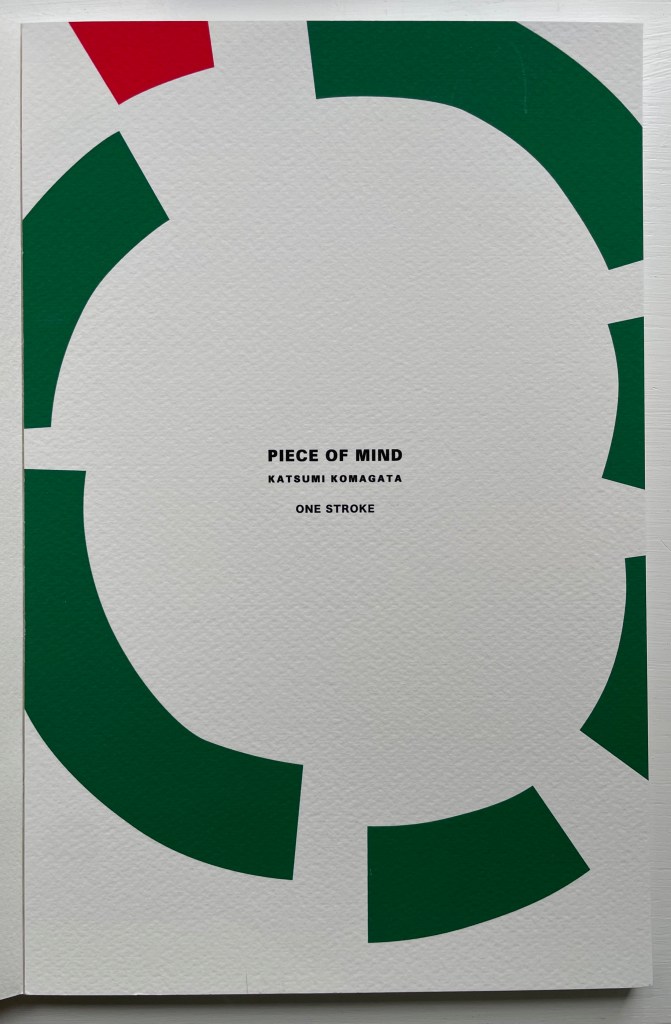
The Paris-based publishers Les Trois Ourses announced that Katsumi Komagata died on 29 March 2024. Although the Bologna Children’s Book Fair responded quickly with a memorial on 8 April, it is strange that no significant obituary has yet appeared for such a major figure in the book arts, children’s books and artists’ books. Fortunately there is extensive biographical information on the site of his publishing firm One Stroke.
Piece of Mind (2022), one of his last limited edition works, becomes all the more treasured.
Piece of Mind (2022) Katsumi Komagata Casebound, card around perfect bound block of lighter card stock. H300 x W196 mm. [30] pages. Edition of 100, of which this #67. Acquired from One Stroke, 7 August 2023. Photos: Books On Books Collection.
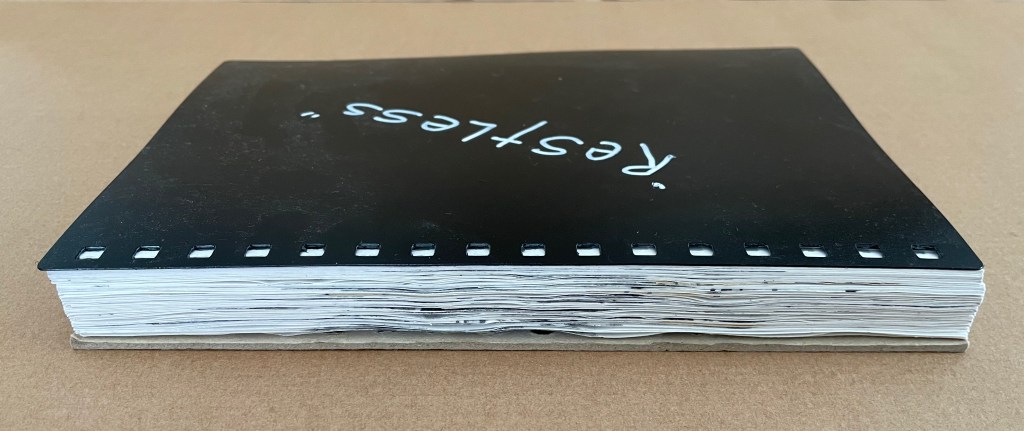
Restless (2020) Jacobus Oudyn Loose sheets from plastic comb bound notebook in a clamshell box covered in Japanese paper. Box: H240 x W170 x D40 mm. 60 pages. Unique. Acquired from the artist, 2 January 2024. Photos: Books On Books Collection. Displayed with permission of Jacobus Oudyn.
Restless consists of a continuous drawing with graphite and collage across sixty loose sheets of 120gsm cartridge paper removed from a plastic comb bound notebook. Like Oudyn’s earlier work Out of Breath (2019), meant to represent the medical conditions of mesothelioma and black lung, Restless aims to evoke chronic restless leg syndrome.
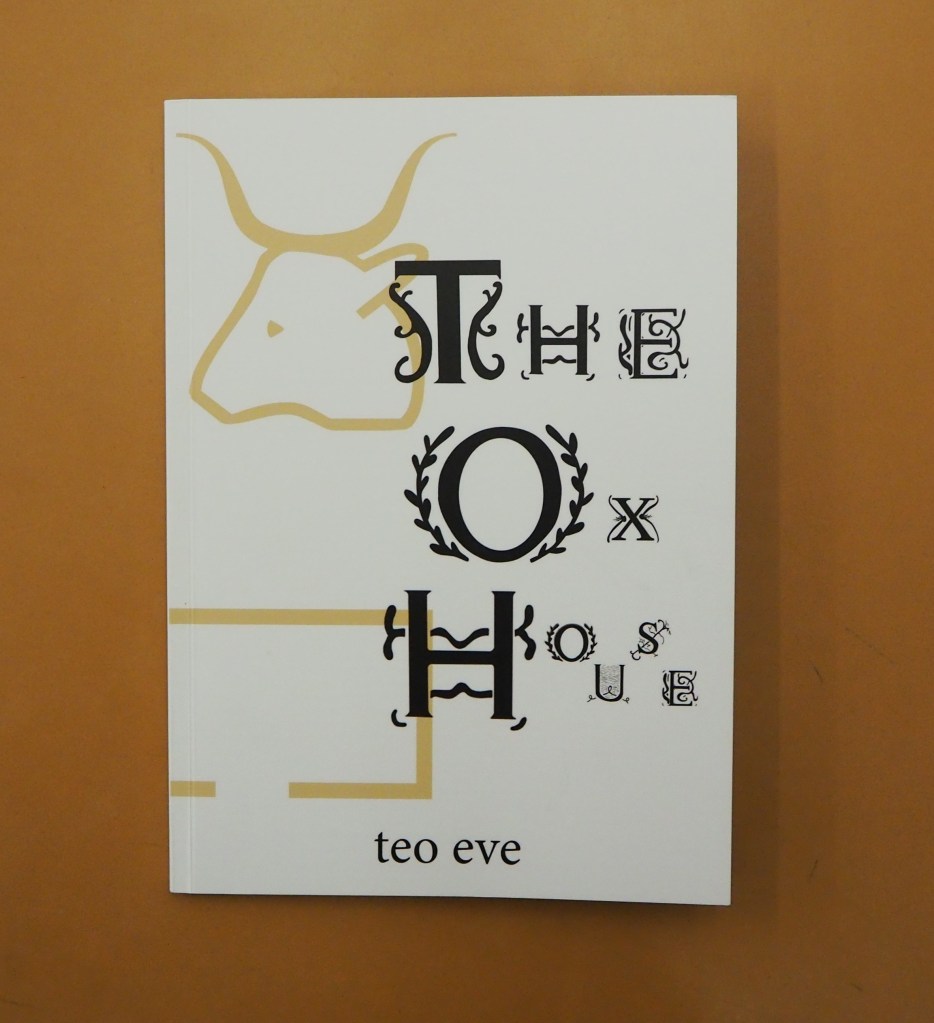
The Ox House(2022) Teo Eve Perfect-bound paperback. H210 x W148 mm. 68 pages. Acquired from Penteract Press, 6 August 2022. Photos: Emilia Osztafi.* Displayed with permission of the publisher.
A love letter to the letters of the alphabet, Teo Eve’s debut collection The Ox House contains an eclectic array of constraint-based poems, innovative forms, and concrete & visual works. At once homage to the intricate hieroglyphs used in Ancient Egypt & the beautifully illuminated capital forms of Medieval manuscripts, and an exploration into the possibilities of new ways of playing with letters’ shapes & sounds, The Ox House harks back to a time when words were magic, and language was new. — Publisher’s description.
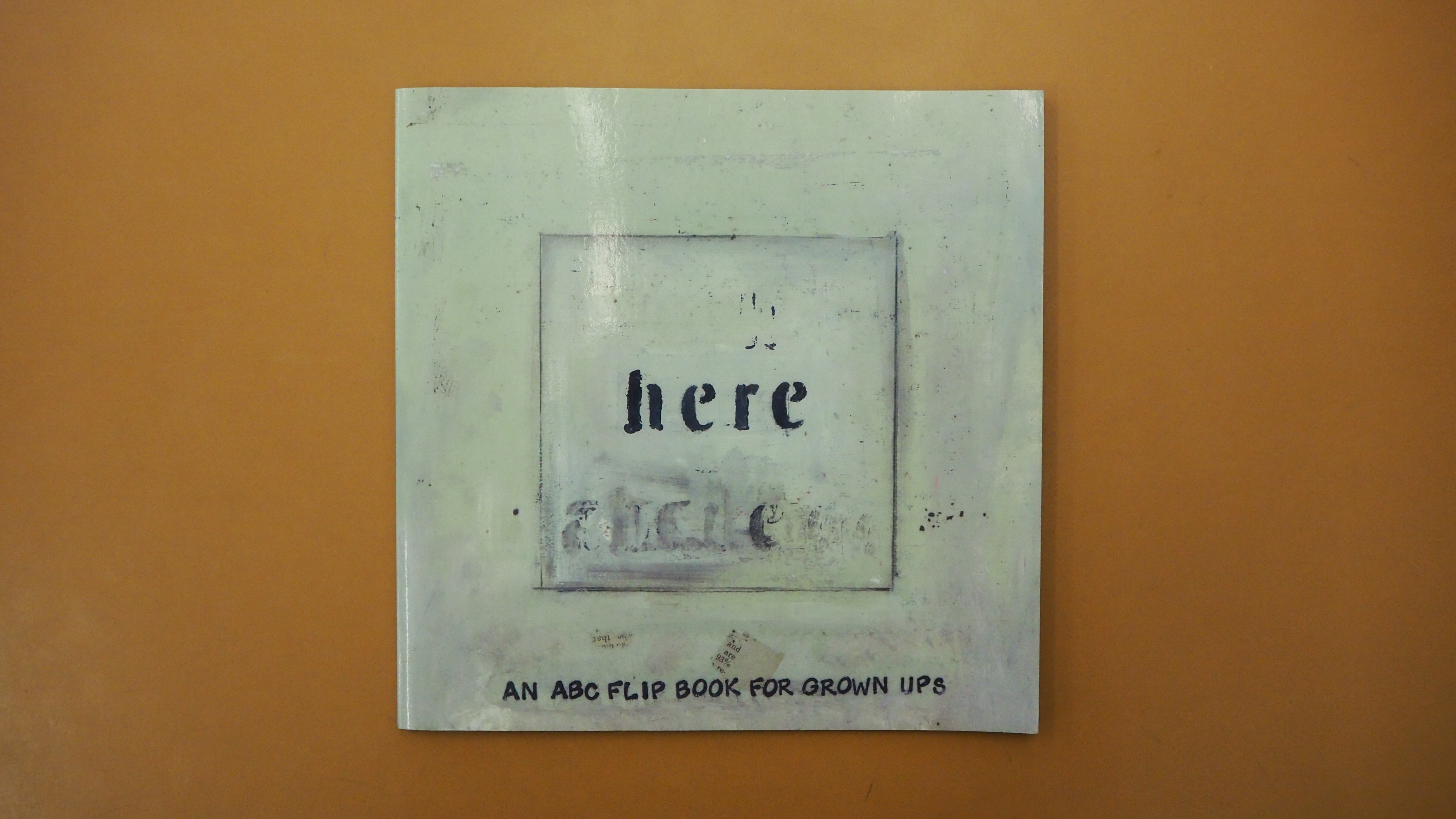
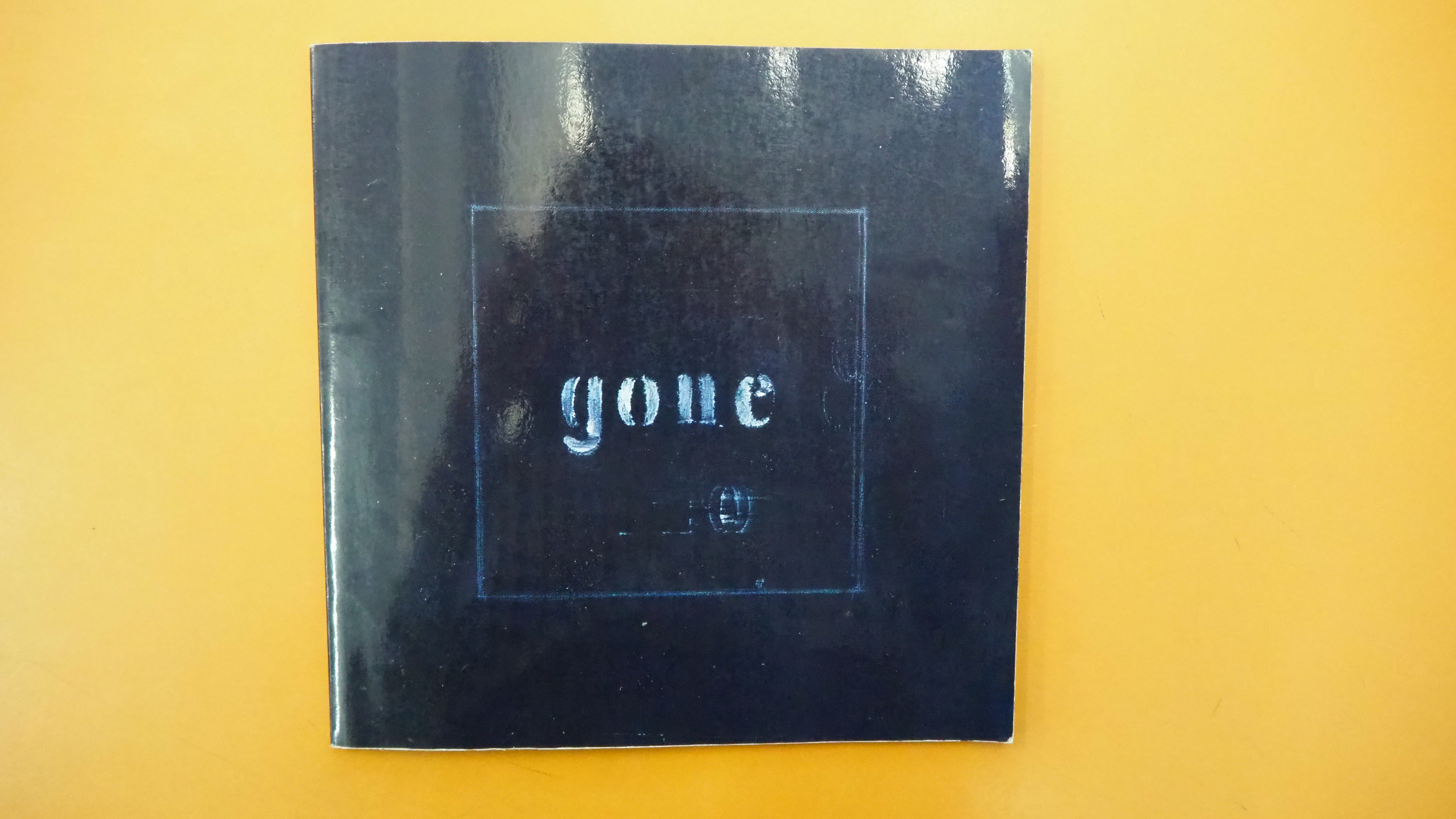
Here/Gone: An ABC Flip Book for Grown Ups (2008) Karen Green Perfect bound, invertible flipbook. 215 x 215 mm. [56] pages. Acquired from AbeBooks, 14 March 2019. Photos: Emilia Osztafi*. Displayed with the author/artist’s permission.
here/gone is a story of two parts, the arrival of love and its departure. “Zipping and unzipping the alphabet in a narrative of love and unlove” as the Spineless Books website describes it, here/gone tells its story with mixed media paintings and minimal text across the right hand pages of its invertible flip book structure, each page’s text beginning with a letter of the alphabet. The flipping pages of here enact love’s zipping together two characters, the flipping pages of gone enact “unlove’s” unzipping them apart.




 Books On Books