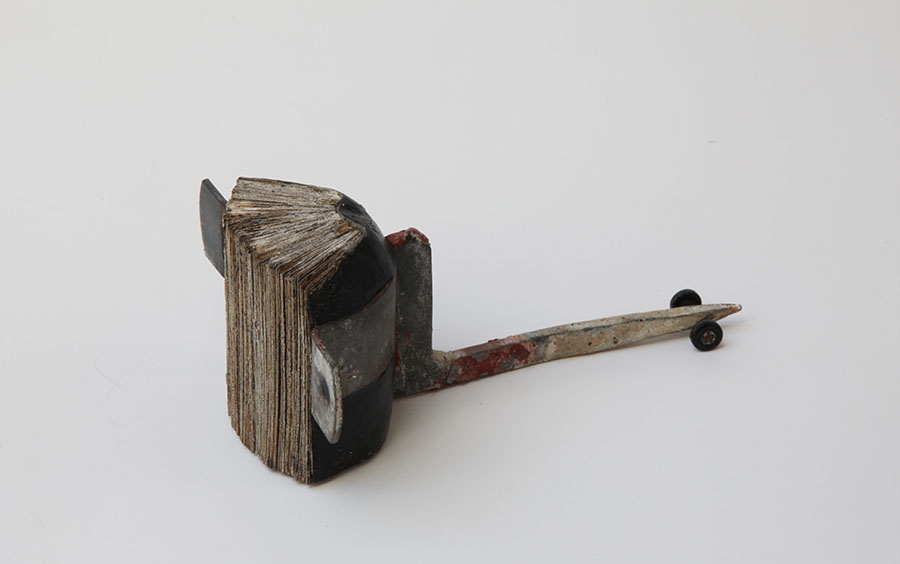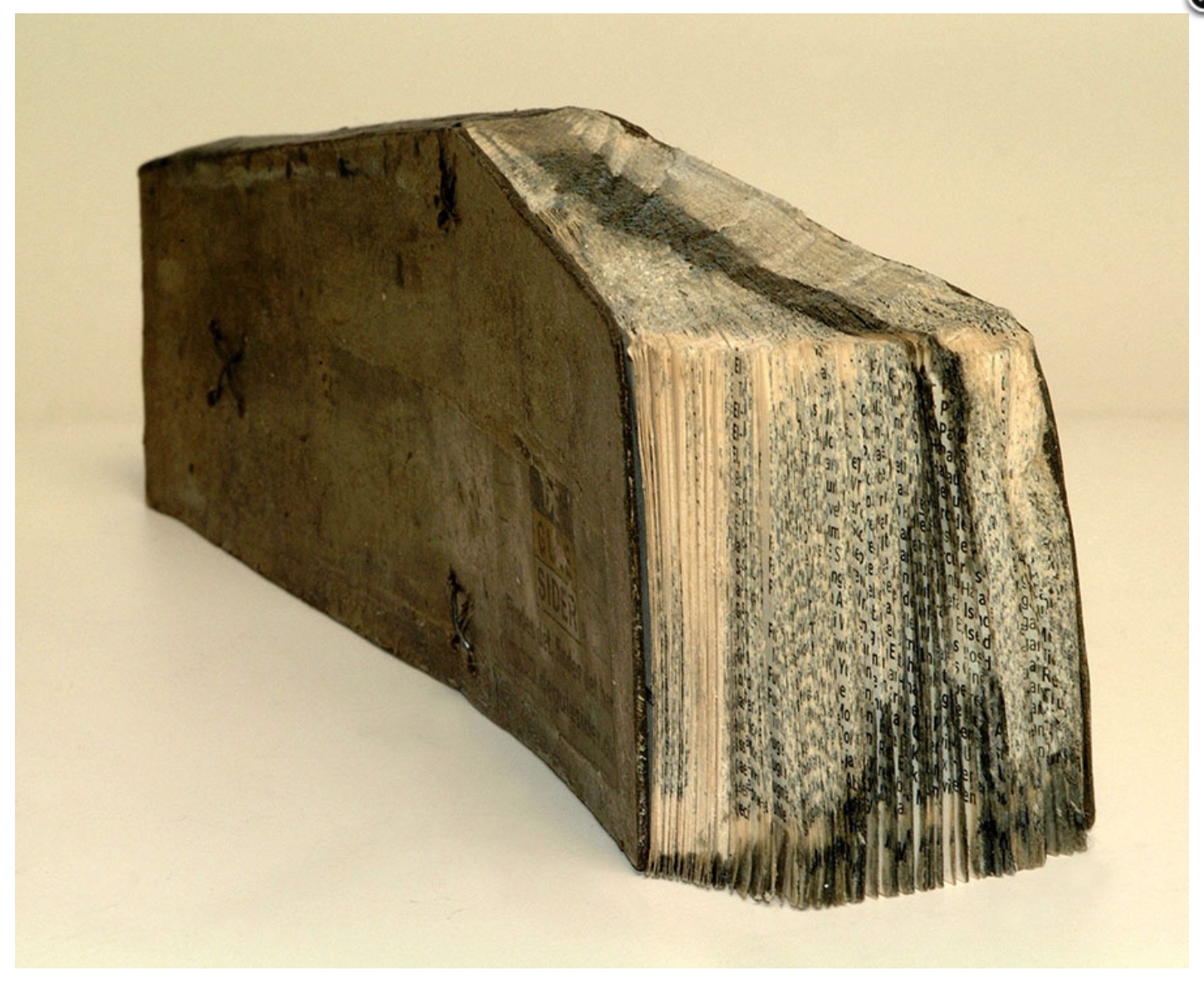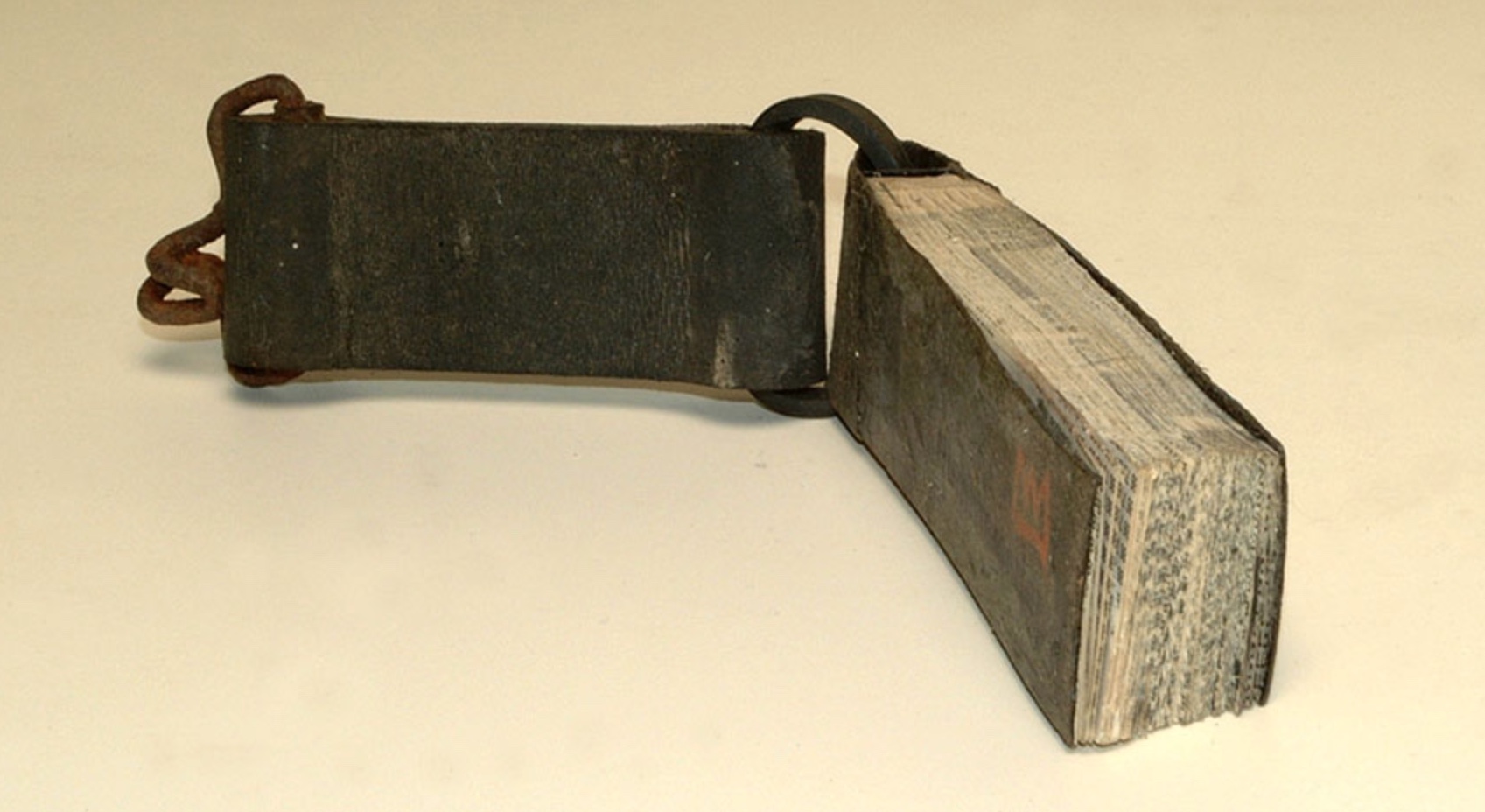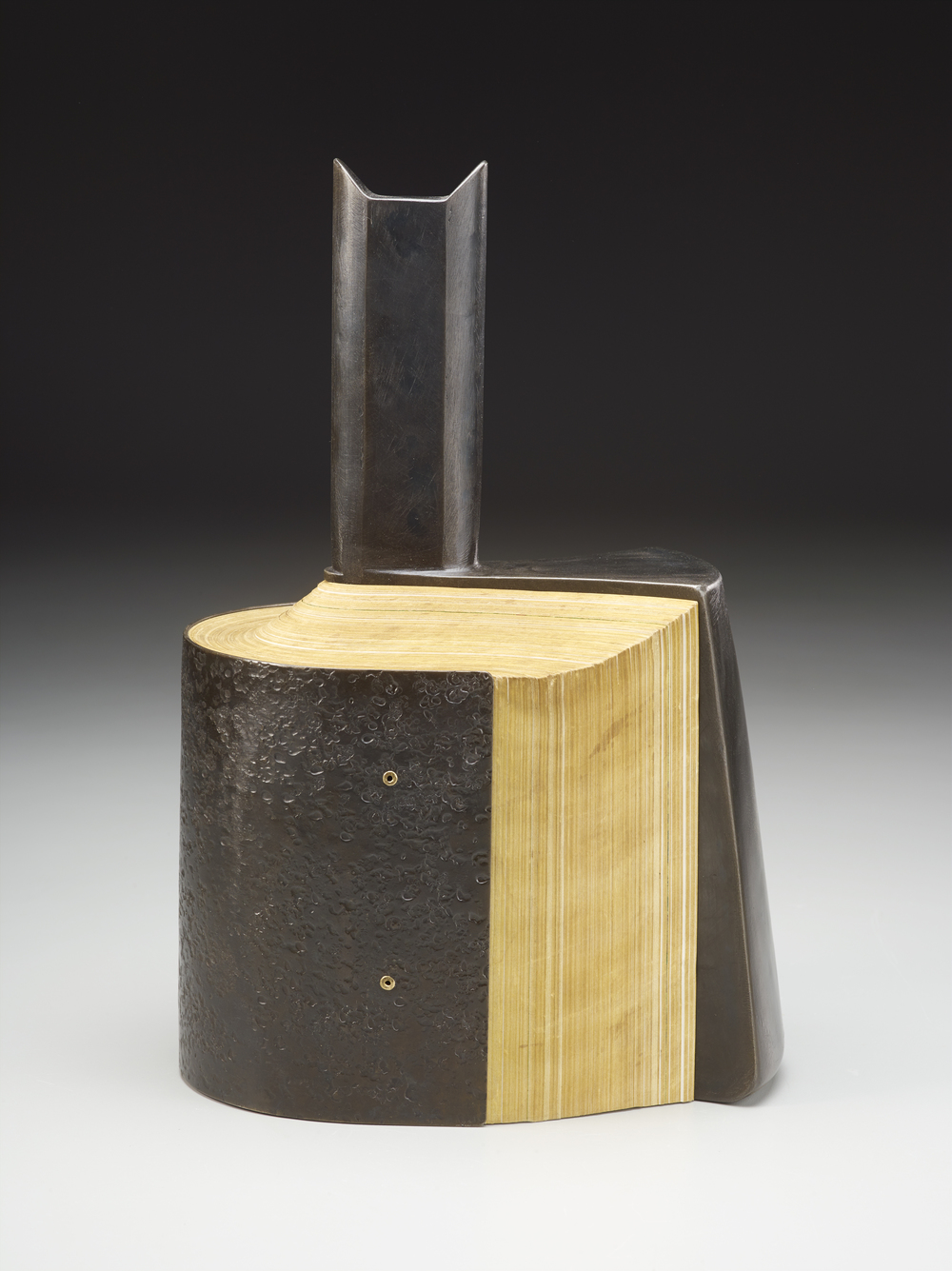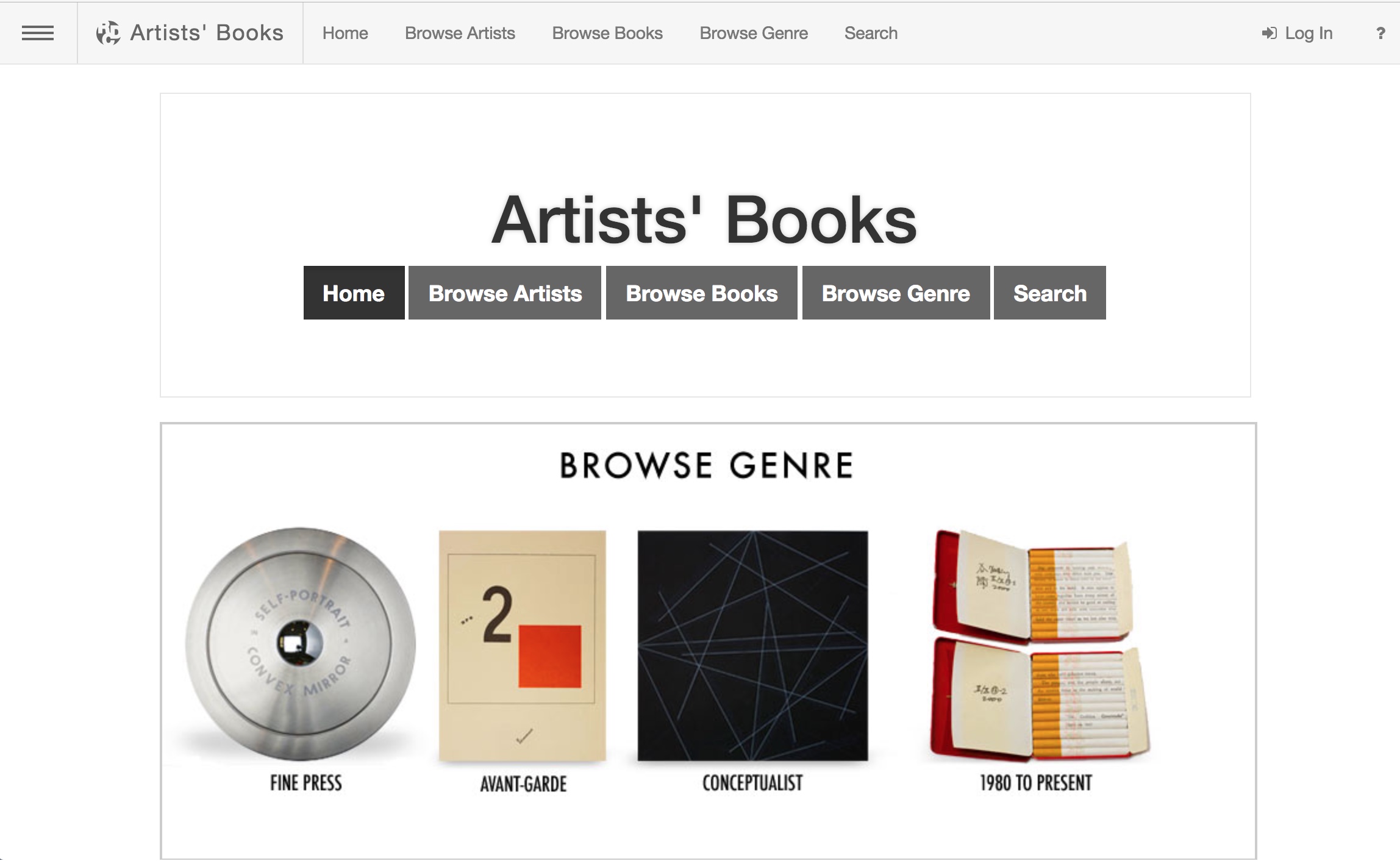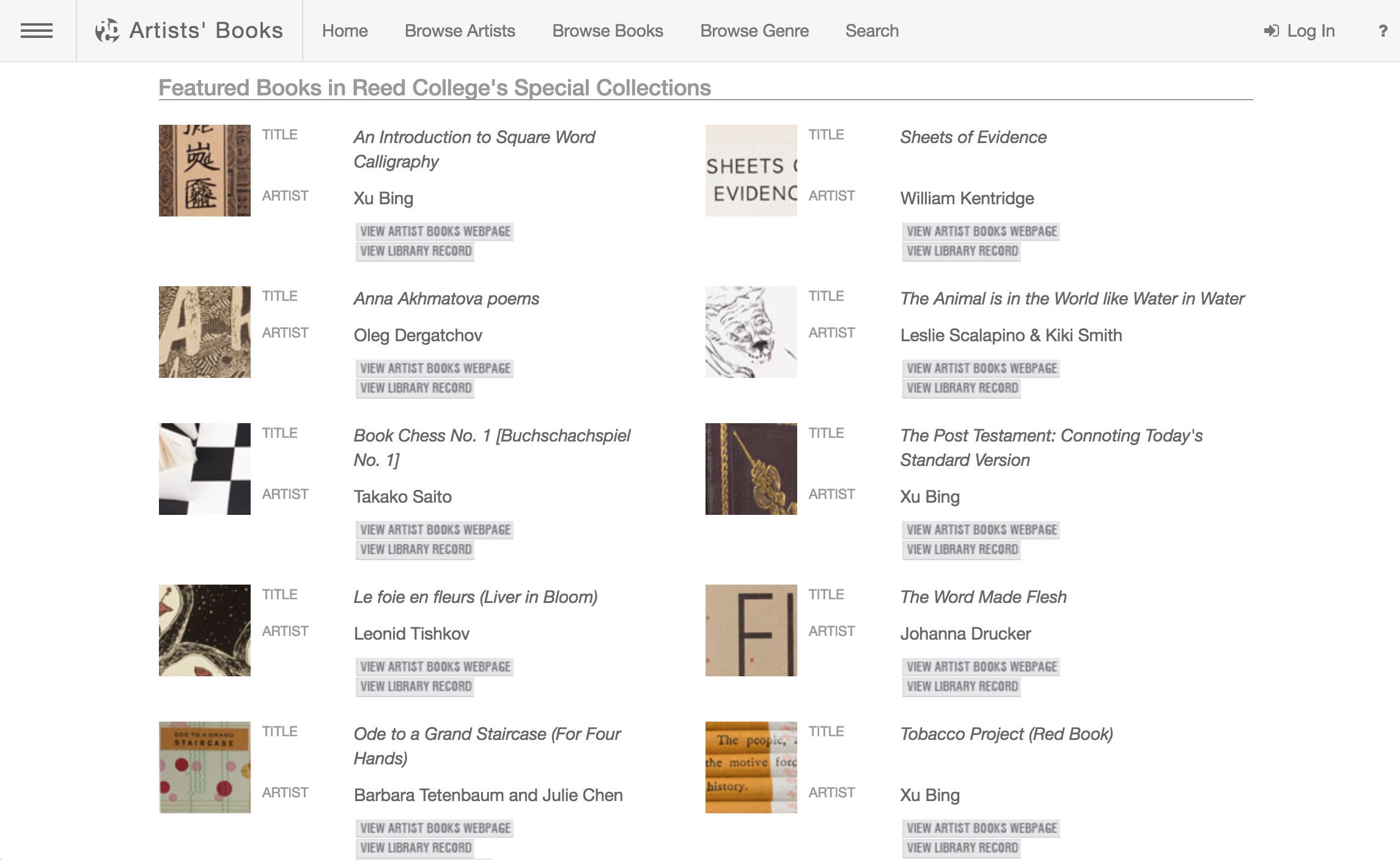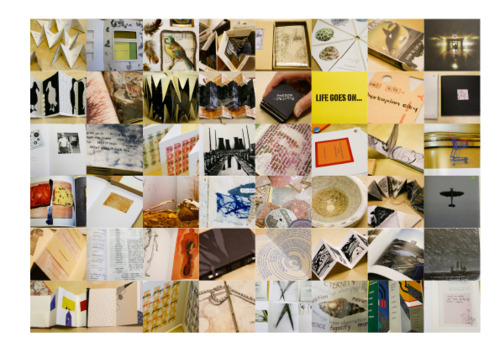
An easily searchable source. The carousel of images in the home page‘s lower right-hand corner highlights some of the favorite artists at Books on Books:
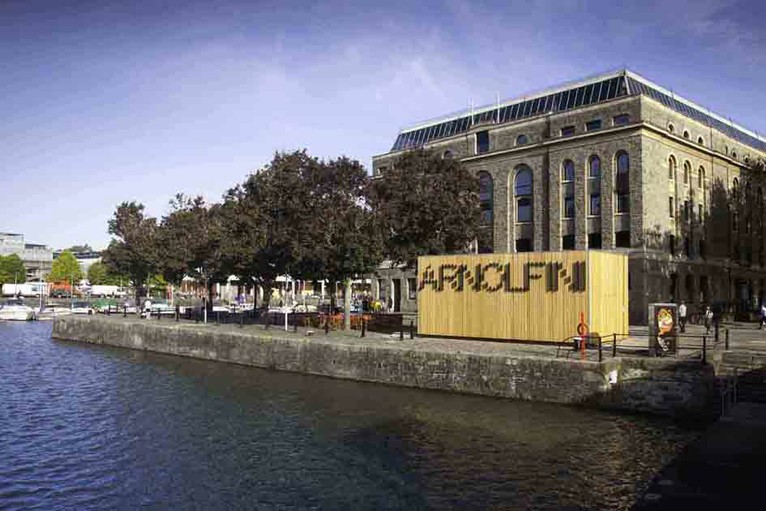
Containing over 700 items, the Arnolfini artists’ book collection is one of the largest UK collections of contemporary book art. It leans toward the 1970s and 1980s. The US-based Franklin Furnace Archive Artists Book Bibliography is representative, as are European works such as those of Vito Acconci, Marcel Broodthaers, Stanley Brouwn, Hanne Darboven, Jan Dibbetts, Helen Douglas, Dieter Roth and Telfer Stokes.
Franklin Furnace Archive Artists Book Bibliography (1977) Unbound notecards of artists’ books catalogues 3 v. ; 430 cards ; 11 x 16cm
The collection is not without later representative works such as those by SooMin Leong, Jonathan Monk and Grayson Perry, but there seem to be no works after 2012. The Arnolfini, Bristol’s center for contemporary art, also hosts the biennial Bristol Artists Book Event.
A search of Lafayette College’s Artists’ Books Collection on the genre yields 1284 entries, including works by Alicia Bailey, Julie Chen, Maureen Cummins, Steven Daiber, Karen Hanmer, Margaret Kaufman, Clifton Meador, Lois Morrison, Werner Pfeiffer, Gerhard Richter, Maryann Riker, Edward Ruscha, Buzz Spector, Barbara Tetenbaum, Erica Van Horn and Sam Winston.
Check out the archives for the Werner Pfeiffer exhibition.
Worth a visit to the Skillman Library if you’re in Easton, PA.
If you are anywhere near Minneapolis in July or August, bookmark these items in your calendar and make your way to the Traffic Zone and the Minnesota Center for Book Arts:
15 June through 21 October 2018 — “Formation: A Juried Exhibition of the Guild of Book Workers”, Minnesota Center for Book Arts, 1011 Washington Avenue South, Suite 100
20 July through 30 September 2018 — “Freud on the Couch: Psyche in the Book”, Minnesota Center for Book Arts, 1011 Washington Avenue South, Suite 100
Harriet Bart and Jon Neuse are curating the intriguing exhibition “Wallpaper”. They invited twelve artists, known for their engagement with the art of the book, to participate in an experiment. The artists were each given a copy of the book Wallpaper: A Collection of Modern Printsby Charlotte Abrahams and tasked with using it, its form and/or content, to deliver an original work.
A screen grab from an iPad alteration (2018) Yu-Wen Wu Photo: Courtesy of the curators
The result of the Neuse/Barton effort is a mixed media exhibition well worth pondering. Below is a sampling of photos from the exhibition (links lead to the artists’ sites).
The Yellow Wallpaper (2018) Harriet Bart Photo: Courtesy of the curators
The Yellow Wallpaper (2018) Harriet Bart Photo: Courtesy of the curators The individual pages of the Abrahams book, removed and painted cadmium yellow with text from Gilman’s story added, will be given away.
Wawlpeyper – A Study in Unobtrusive Backgrounds (2018) Scott Helmes Photo: Courtesy of the curators
Vesna’s Altered Wallpaper Book (2018) Vesna Kittelson Photo: Courtesy of the curators
Wall Covering: A meditation on appropriation, class and the other, and on the power of images (2018) Joyce Lyon Photo: Courtesy of the curators
Scrolls (2018) Jon Neuse Photo: Courtesy of the curators
As always with book art, there is the self-reflexive, self-referring humor: Jon Neuse’s pun on the book scroll housed in a house-shaped codex in which miniature scrolls of wallpaper are housed and Scott Helmes’ pronunciation-entitled work subtitled with a joke to which the work’s sculpture is the punchline. The exhibition also covers a good variety of the forms book art has taken and may pursue even further in the future: Vesna Kittelson’s carving, Joyce Lyon’s accordion book, Doug Beube’s excavated book (shown below), and Harriet Bart’s painted-book homage to Charlotte Perkins Gilmore’s short story “The Yellow Wall-Paper” and Yu-wen Wu’s digital take on the challenge.
It is not far from Traffic Zone to the MCBA: a 5-minute drive, a 24-minute walk or bus ride. A rare occurrence to have three book art exhibitions within such close proximity.
Subsequent to this notice, one of the participants – Doug Beube – posted the following demonstration of his contribution Wallpaper Selfie.
Rotch Library offers a small but growing collection of contemporary artists’ books. The collection focuses on artists’ books published from the 20th century to the present and explores a range of techniques and technologies employed by the books’ creators.
Yellow Submarine? Monty Python? Heath Robinson? Rube Goldberg? Hieronymus Bosch? Albrecht Durer? Quentin Massys? Whatever the influence, David M. Moyer has created choice work under The Red Howler Press. MIT has chosen well.
Errantry (2008) Werner Pfeiffer
Errantry, a 27-foot scroll housed in a howitzer shell casing, is inspired by Der Triumphzug Kaiser Maximilians or The Triumphal Procession of the Emperor Maximilian (1515), a series of 130 woodcuts by Hans Burgkmair the Elder (1473-1531) and others, about which Pfeiffer comments: “One of the dominant features in this document is the militant nature of many of the characters depicted, as well as their posture in parading their arms on horse, by carriage or on foot.” The text in Errantry draws from a poem of the same name in J.R.R. Tolkien’s Middle Earth mythology. The source poem, composed by Bilbo Baggins, describes one of his quest adventures in the usual self-aggrandizing yet self-pitying tone. As a model for Pfeiffer’s text, it makes the digitally printed images of war all the more horrible.
The picture above comes from Linda Toigo‘s interactive edition of Robert Louis Stevenson’s The Strange Case of Dr. Jekyll and Mr. Hyde. The interactive elements consist of opening envelopes, ripping pages, constructing illustrations from jigsaw pieces, turning and returning pages facing reflective surfaces, but just as engaging — perhaps more so — is the unified way in which layout, texture, page size, illustration and half-tones achieve a gothic atmosphere. Experience it here online.
Going to and fro between her blog, website portfolio and Vimeo site is like viewing a solo exhibition in the artist’s company. When you have finished viewing this two-minute video, treat yourself to Toigo’s book art animation. I especially enjoyed the “hide and seek” effect of the three-level accordion and tunnel book work Annar and the Moose. But what is worth repeated viewing is Medieval and Modern History (Suggestions for Further Study for Jack Hroswith) (2013), in which the artist uses lit matches, a glass surface and her fingers to burn, excavate and sculpt the pages of a used history textbook. Jack Hroswith is the owner’s name inscribed on the opening endpaper, which is a haunting piece of random history reflected in the artist’s creative process:
… I gave chance a prominent role: with the same morbid fascination that inspired the fire officer in Fahrenheit 451, I let fire burn its way on the pages, and I observed the devastation of words, maps and illustrations. At the same time, however, I kept a certain level of control on the destructive process developing a quick reaction to avoid the complete dissolution of the book: for every page I waited for the fire to reach a chosen sentence or a specific image before pushing the paper down onto a glass surface with my fingertips.
In her blog, Toigo notes the influence of Gustav Metzger’s Autodestructive Art manifesto from the 60s, John Latham’s burning Skoob Tower and sequences from Truffaut’s Fahrenheit 451. Toigo seems to have no “anxiety of influence”. While her works echo those of contemporaries and twentieth century book artists, they do so in her own voice.
Further Reading
“Islam Aly“. 13 January 2020. Books On Books Collection.
“Doug Beube“. 21 April 2020. Books On Books Collection.
“Jessica Drenk“. 29 August 2024. Books On Books Collection.
At the end of a year when we have been reminded that creative works of merit can often issue from the dungheap, The Guardian reports that Rome’s city council has decided to revoke the 8 AD exile of Publius Ovidius Naso. Ovid whiled away his time in the backwater of the Black Sea composing the Tristia and The Black Sea Letters, respectivelybewailing in couplets his condition and pleading with the recipients of his letters to intervene with the emperor.
We don’t know what “carmen et error” (poem and mistake) caused Augustus to banish Ovid. But should the city council have focused on the works rather than the man? Does great art justify “rehabilitation”? Who knows.
At least the news prompts a new look at Jacqueline Rush Lee‘s transformation of the Tristia and Black Sea Letters.
Silenda (Black Sea Book). 2015 (Sister of Nous) Transformed Peter Green Translation of Ovid’s “Tristia and the Black Sea Letters.” H9.5″ x W12″ x D6.5.” Manipulated Text, Ink, Graphite Photo: Paul Kodama In Private Collection, NL
Above: “The Alfred Jewel”, enamel and gold; late 800s; found at Petherton, Somerset, in 1693. The Ashmolean Museum, Oxford, presented by the Estate of Colonel Nathaniel Palmer. Below: MS. Hatton 20, fols 2v-3r. St Gregory the Great, Cura pastoralis, translated by King Alfred and copied 890-897. This copy of St Gregory’s manual for clergymen “speaks” (bottom left) of how Alfred “sent me to his scribes north and south”.
The exhibition “Designing English” at the Bodleian’s Weston Library (1 December 2017 — 22 April 2018) showcases almost 100 of Oxford’s medieval manuscripts, objects and books illustrating graphic design and the book arts.
Alongside that exhibition are the results of a workshop and competition among book artists: “Redesigning the medieval book“. A surprise and pleasure to find the medievally inspired work of Turn the Page‘s own Jules Allen:
Pilgrim Shoe (2017) Jules Allen, with Ernst Allen and Eileen Gomme
Jules Allen was kind enough to provide additional photographs and some background on the making of Pilgrim Shoe.
Pilgrim Shoe (2017) Jules Allen
Guided by the anthology of possible texts, I made Pilgrim Shoe in response to Geoffrey Chaucer’s The Canterbury Tales. The following points in the brief inspired me:
Where and on what should you write if you seek ‘to do things with words’?
Does form always fit function? Does a function only have one form?
Is looking more sensuous than reading?
I approached the project from the perspective of a Medieval Cordwainer seeking to attract wealthy customers and found that although it was common practice to decorate shoes by engraving or cutting patterns into the leather, other forms of decoration were rare during Medieval times. An inventive Cordwainer might have thought of personalising shoes for specific purposes or events using text, images, or even a charm for luck.
With this in mind I made a Poulaine style shoe with wooden patten specifically for Chaucers’ ‘The Lady of Bath’, who may have been attracted by the decorated shoe both as a unique, sensuous status symbol and a map with which to find her way from London to Canterbury. Such a shoe might have been admired or found useful by fellow pilgrims en-route, and with a recipe for love (from the Anthology of texts) concealed within the rein-forced heal, perhaps she might attract a new husband during her pilgrimage.
Pilgrim Shoe (2017) Jules Allen
I hand painted images and added calligraphic text on the shoe. The place references from London to Canterbury were researched using various historical sources including the Gough Map http://www.goughmap.org/about/
Pilgrim Shoe (2017) Jules Allen
Materials: Leather, artificial sinew, watercolour and acrylic paint, calligraphers ink, wood. paper, metal studs, starch paste and wax
Dimensions: L30cm W10cm H16cm
Paper charm: Selected from a section on Medical Remedies and Charms from the 1400’s for the concealed charm written by hand on paper, housed in the heal of the shoe.
Middle English Version: Charm for love Take thi swetyng yn a fayr bason and clene and afterwarde put hyt yn a wytrial of glas, and put therto the shavyng of the nedder party of thy fete and a lytyl of thy oune dong ydryet at the sune, and put therto a more of valurion. And take to drynke, whane that ever ye will, and he schall love the apon the lyght of thyn yene. And thys ys best experiment to gete love of what creature that thou wolt. And Y, Gelberte, have yproved that ofte tymys, for trewthe. Modern Translation: Charm for love (translation) Catch your sweat in a nice clean basin and afterwards mix it with sulphuric salt, and add to it some shavings from the back of your feet and little of your own dung dried in the sun, and add a root of the herb valerian. And take a swig whenever you want, and he’ll love you as soon as he catches your eye. And this is the best proven method to win love from whoever you want. And I, Gilbert, have proved this many times, truly.
Credits also to Ernst Allen for the wooden patten and Eileen Gomme for the passage of calligraphy on the paper charm.
Huang Yong Ping: The History of Chinese Painting and a Concise History of Modern Painting Washed in a Washing Machine for Two Minutes, 1987/1993, ink on wooden crate, paper pulp, and glass, 30 by 19 by 27½ inches. Walker Art Center, Minneapolis.
“Art and China after 1989: Theater of the World,” now appearing at the Guggenheim Museum in New York through January 7, 2018, includes work from Xu Bing and Huang Yong Ping. The exhibition attracted animal rights protestors and removal of works, one of which was Xu Bing’s video of his 1994 installation A Case Study of Transference. In a pen littered with books, Xu Bing presented two pigs, one tattooed with words in his now famous nonsense Chinese calligraphy and one with nonsense English words. The piece became infamous when the pigs, bored with the intercourse offered by the books, engaged in more mutually interesting discourse.
A Case Study of Transference (1994) ⓒ Xu Bing
The exhibition also occasioned this article in “Art in America” by managing editor Richard Vine. He has held up art’s hard mirror to us all in this essay.