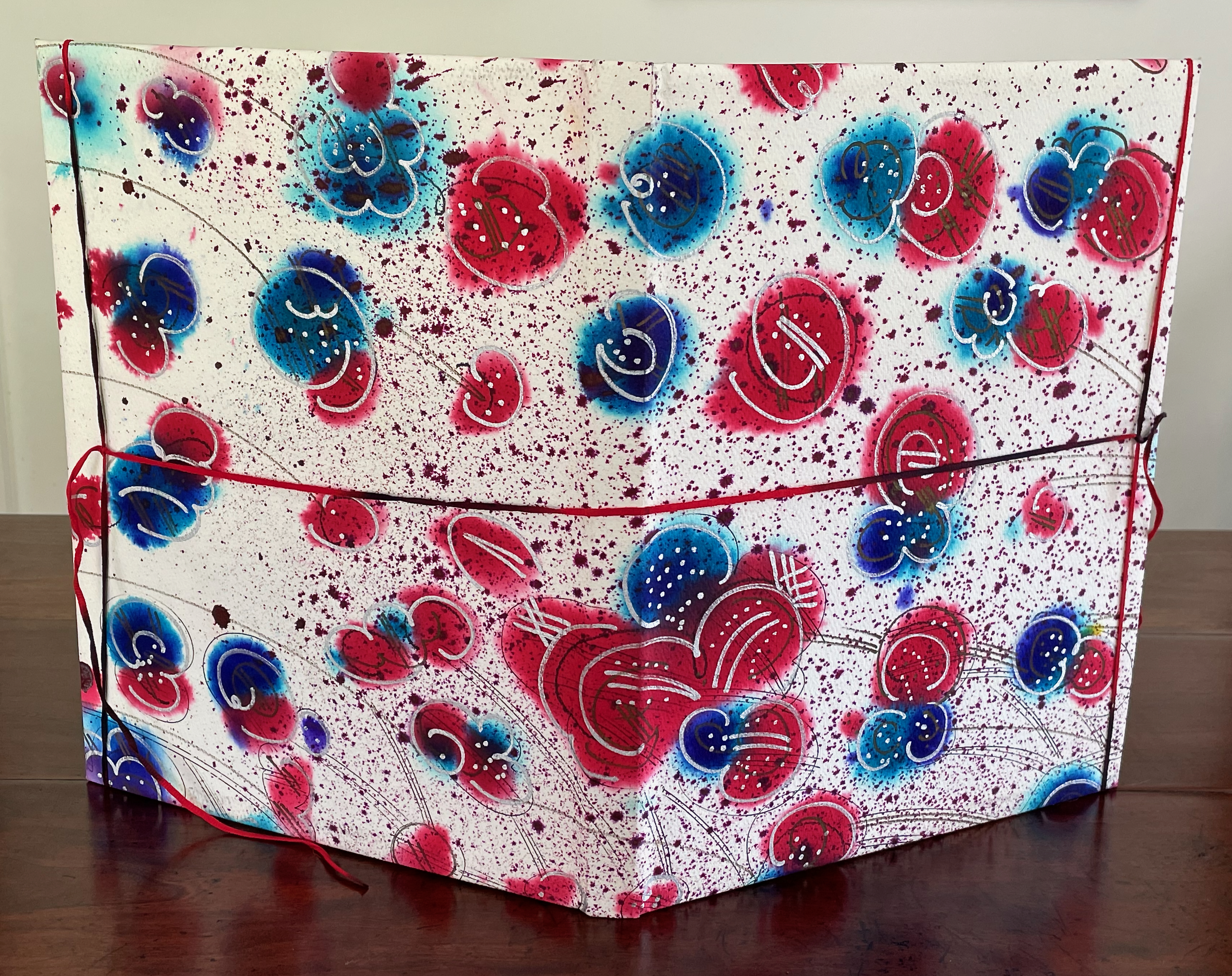
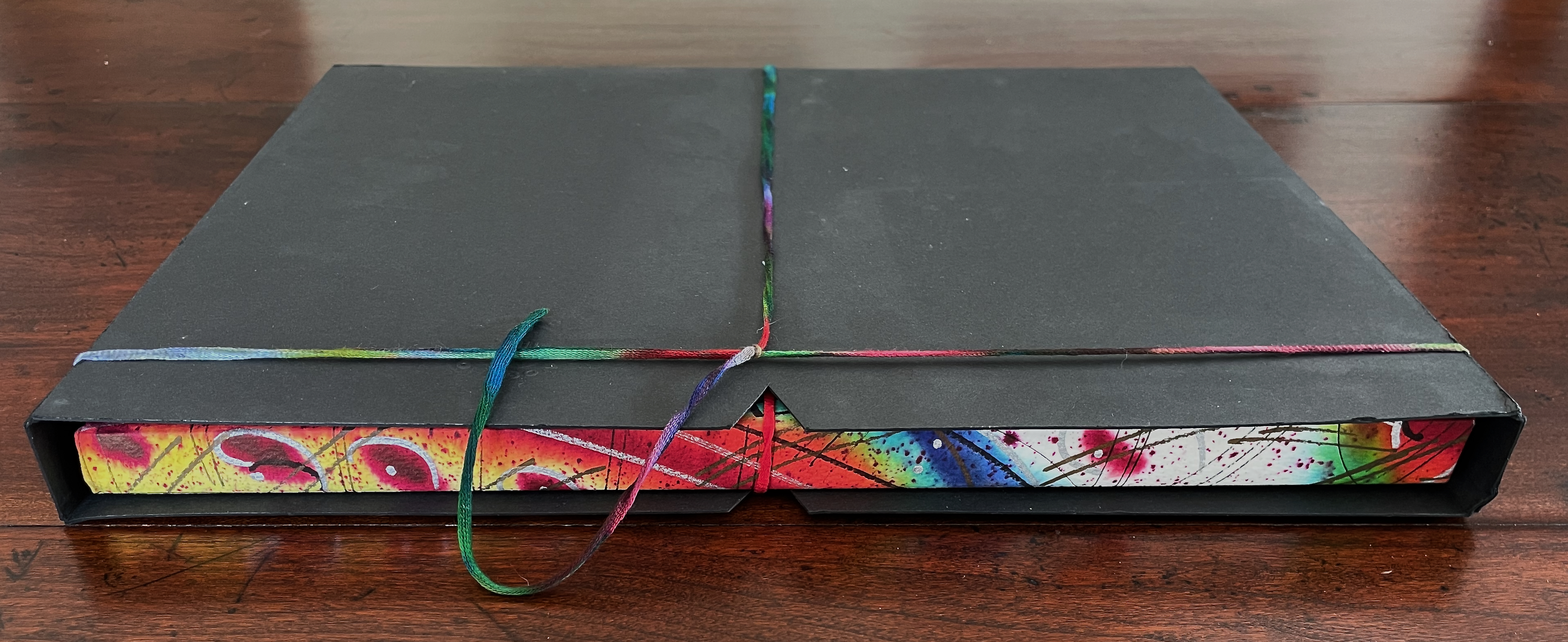
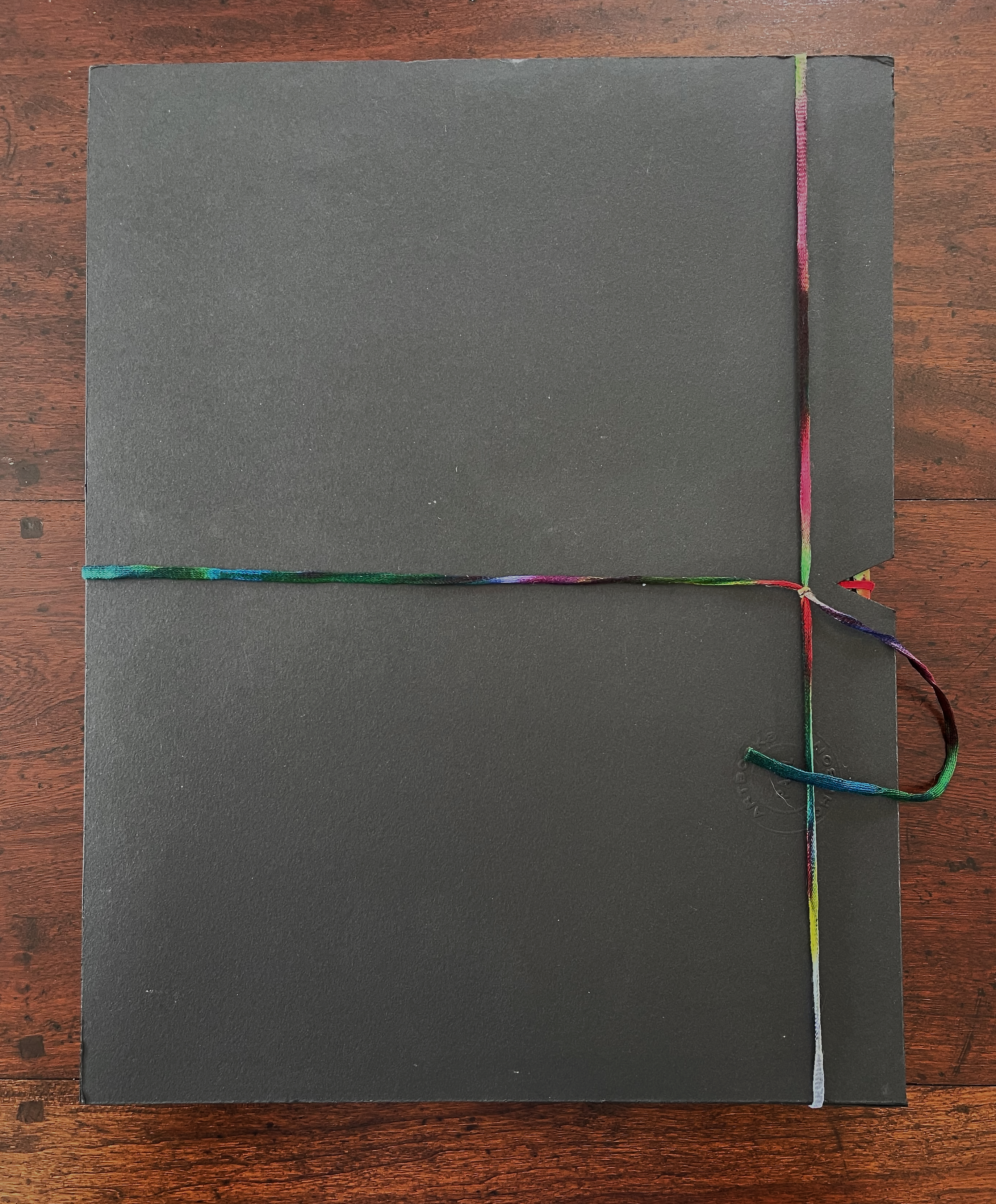
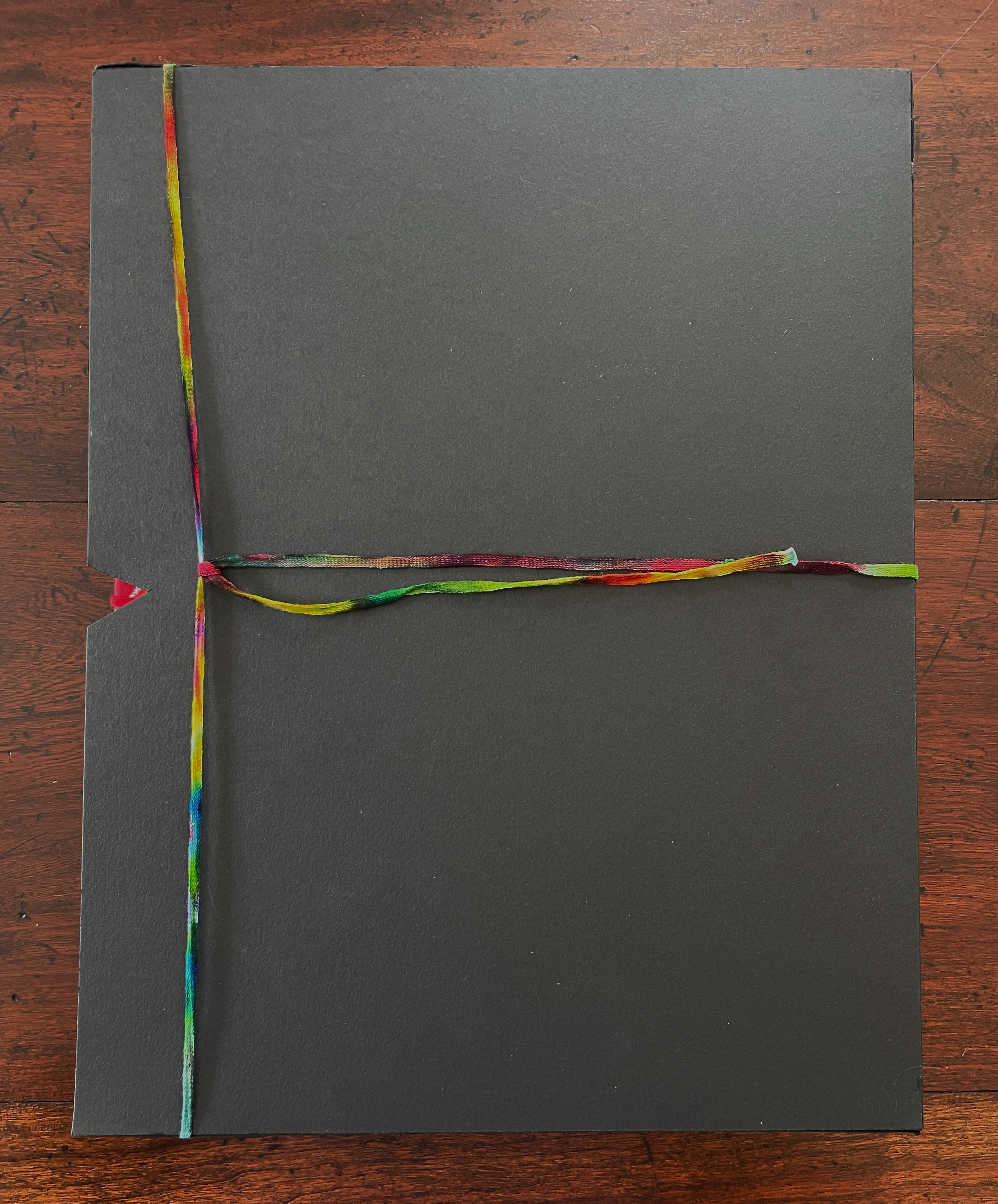
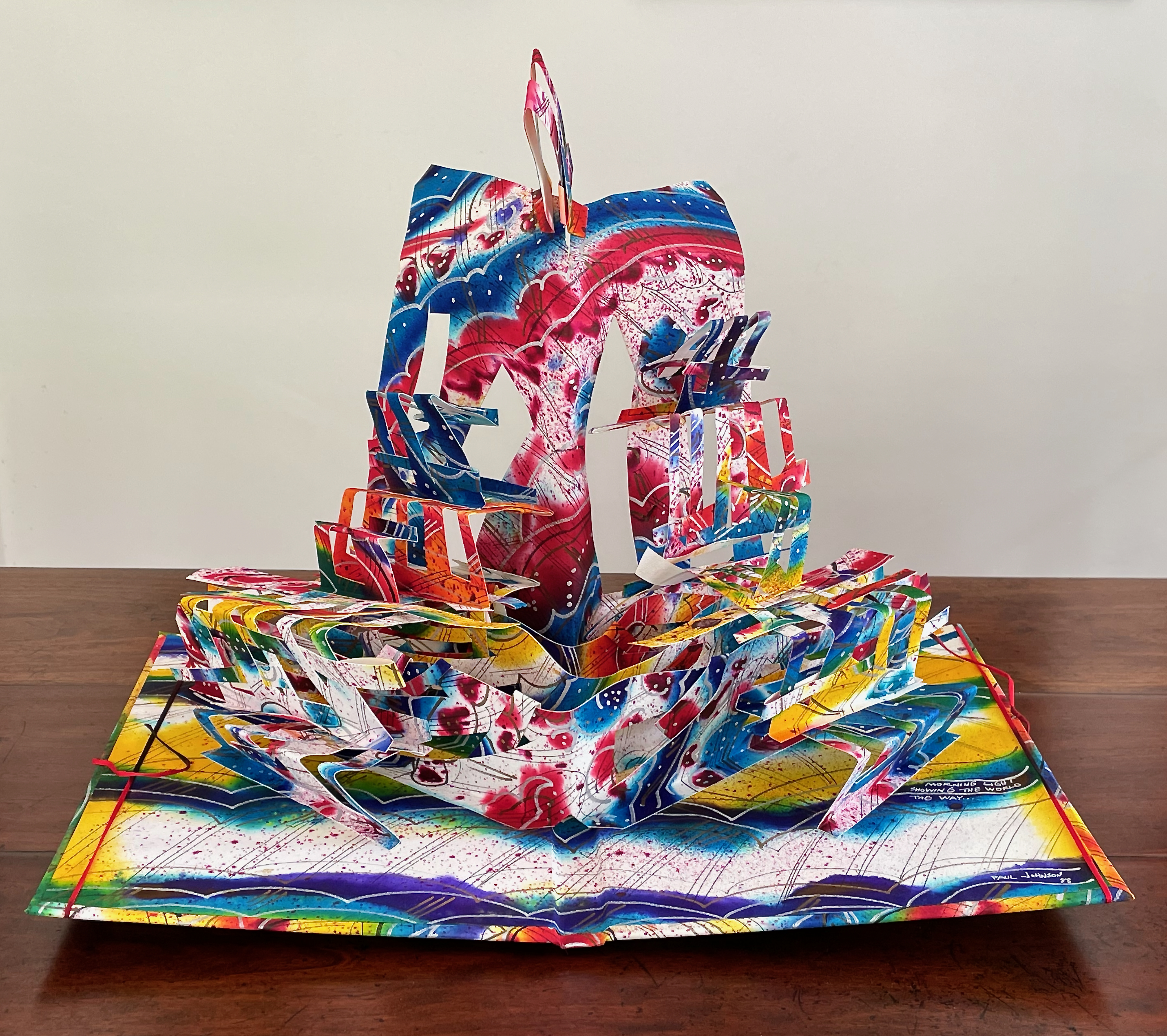
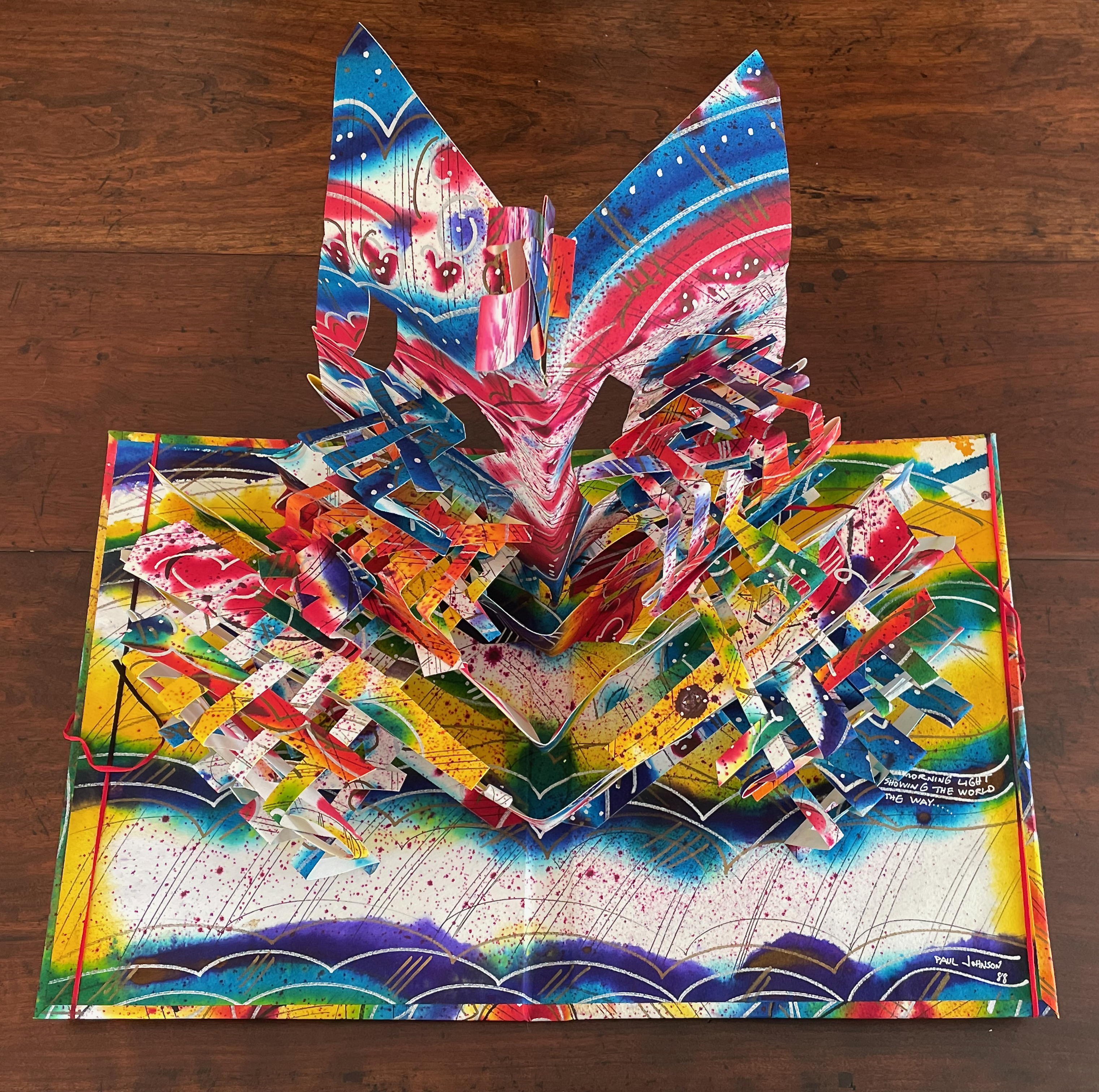
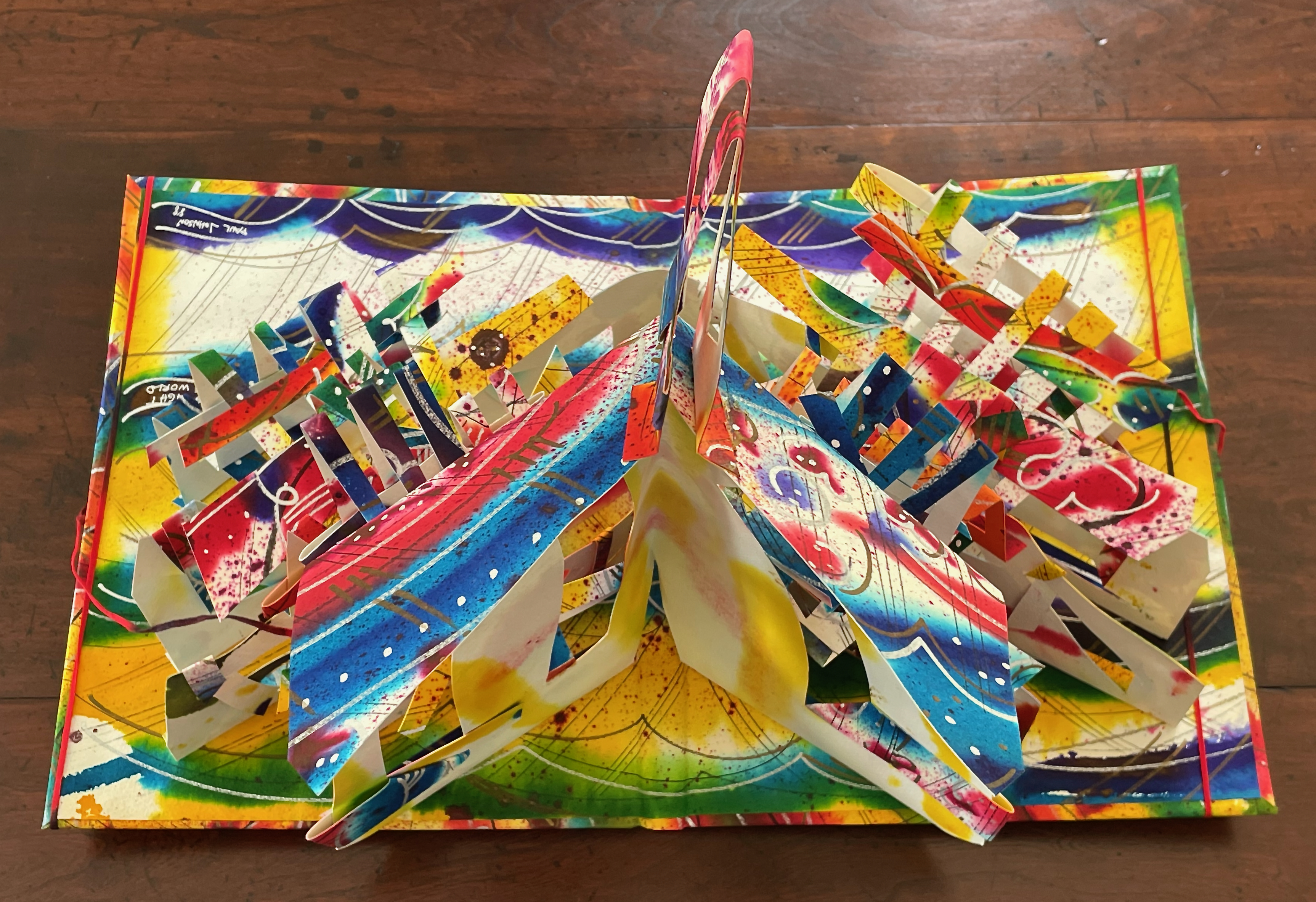
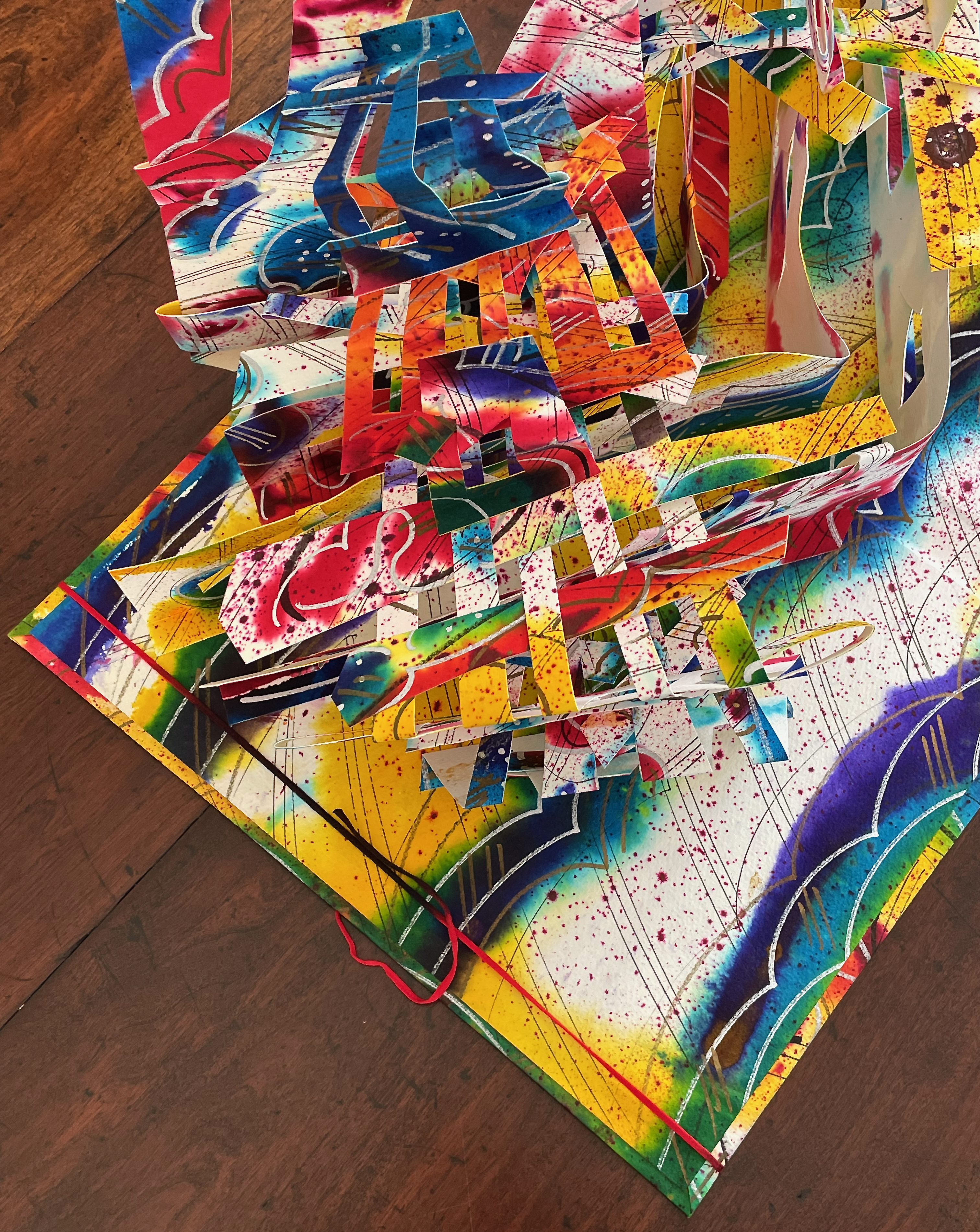
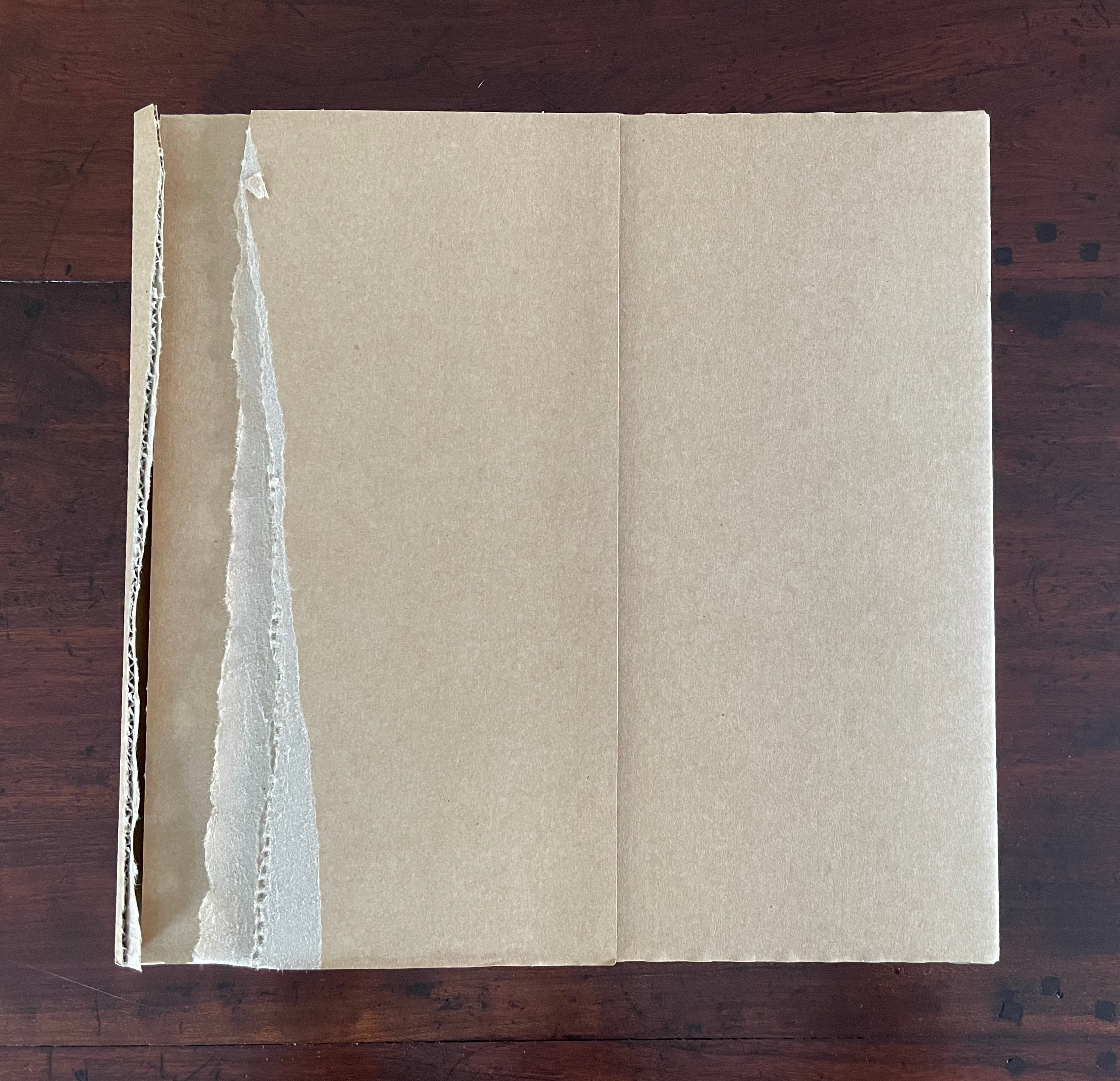
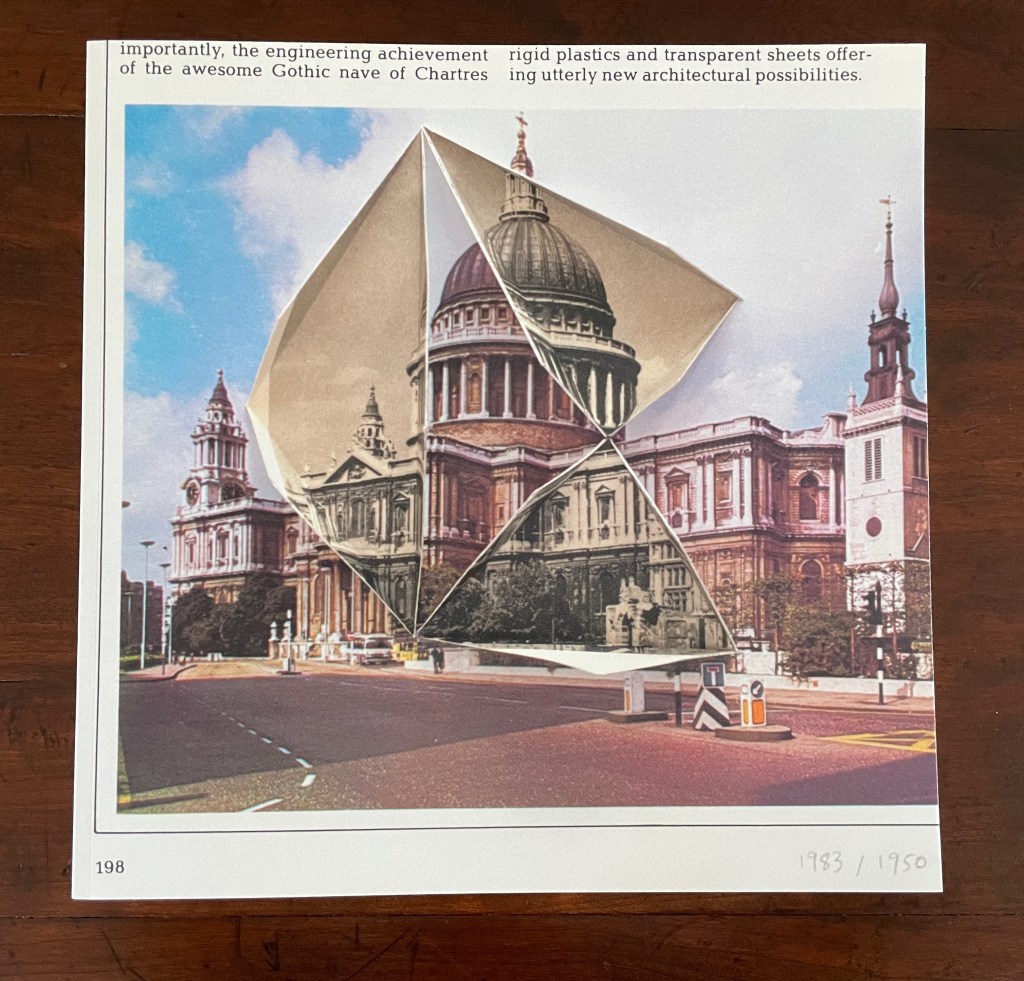
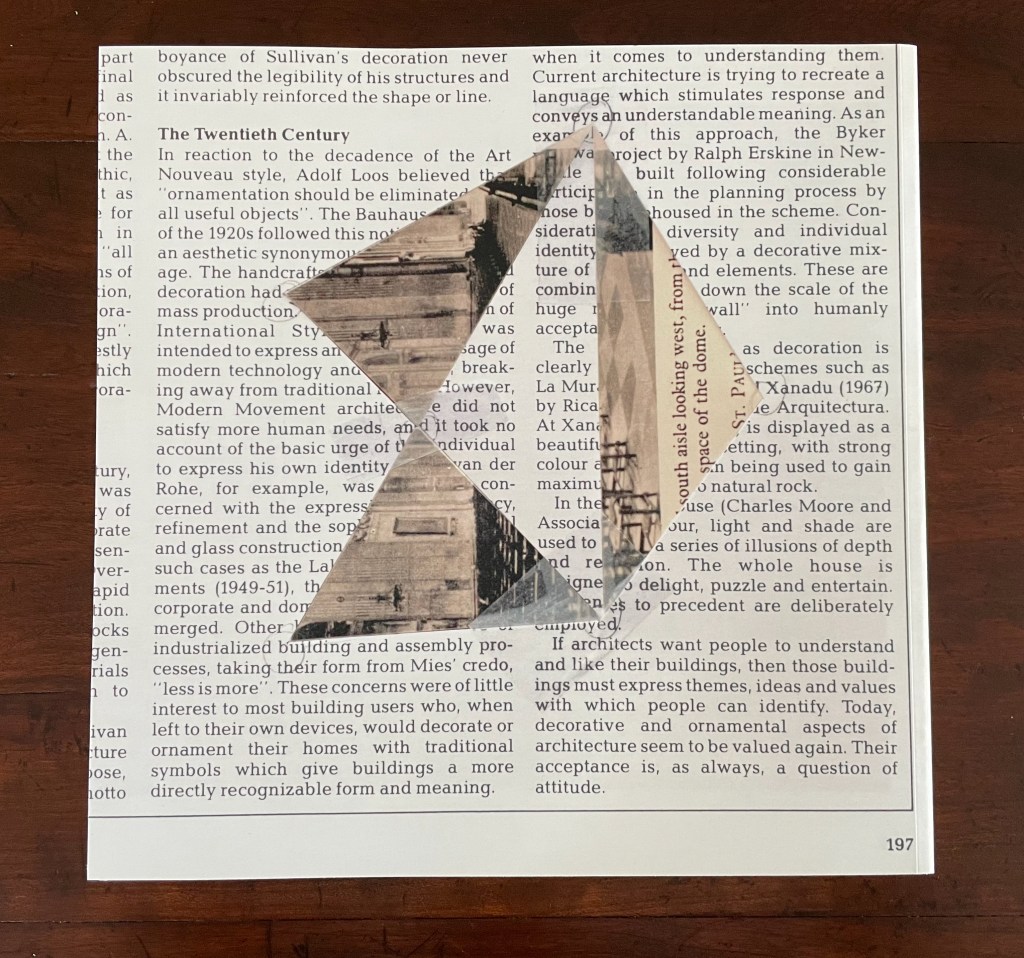
There is more to Timothy Mosely’s art than meets the eye or touch. It rises equally on an intellectual plane and a physical plane. It is the art of visual touch or haptic seeing.
ep’s (2018)
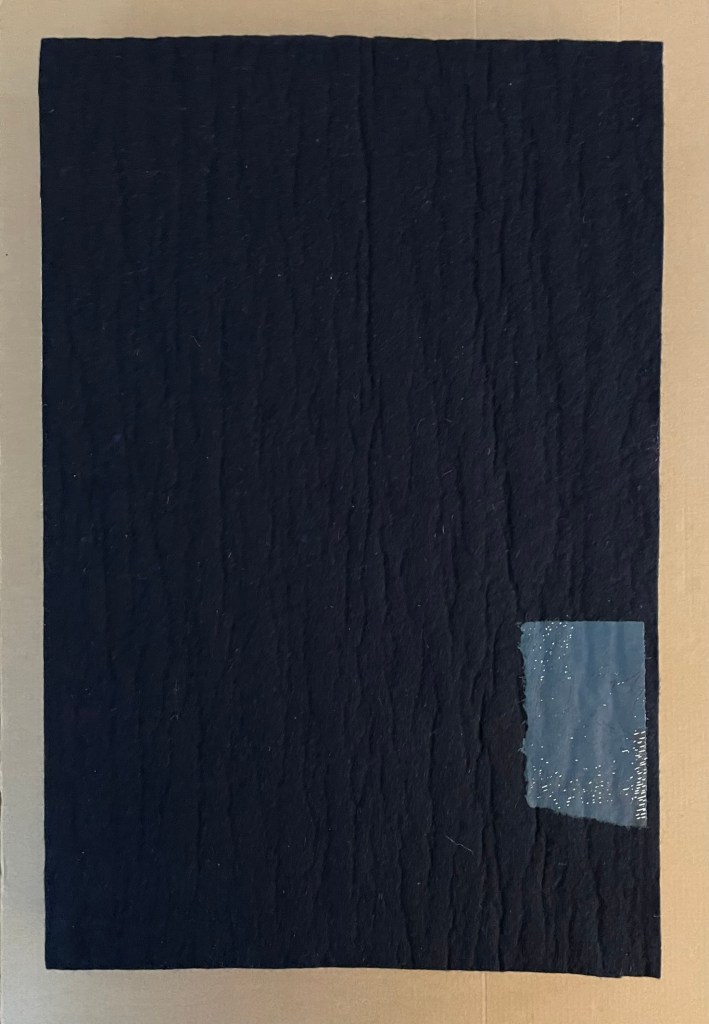
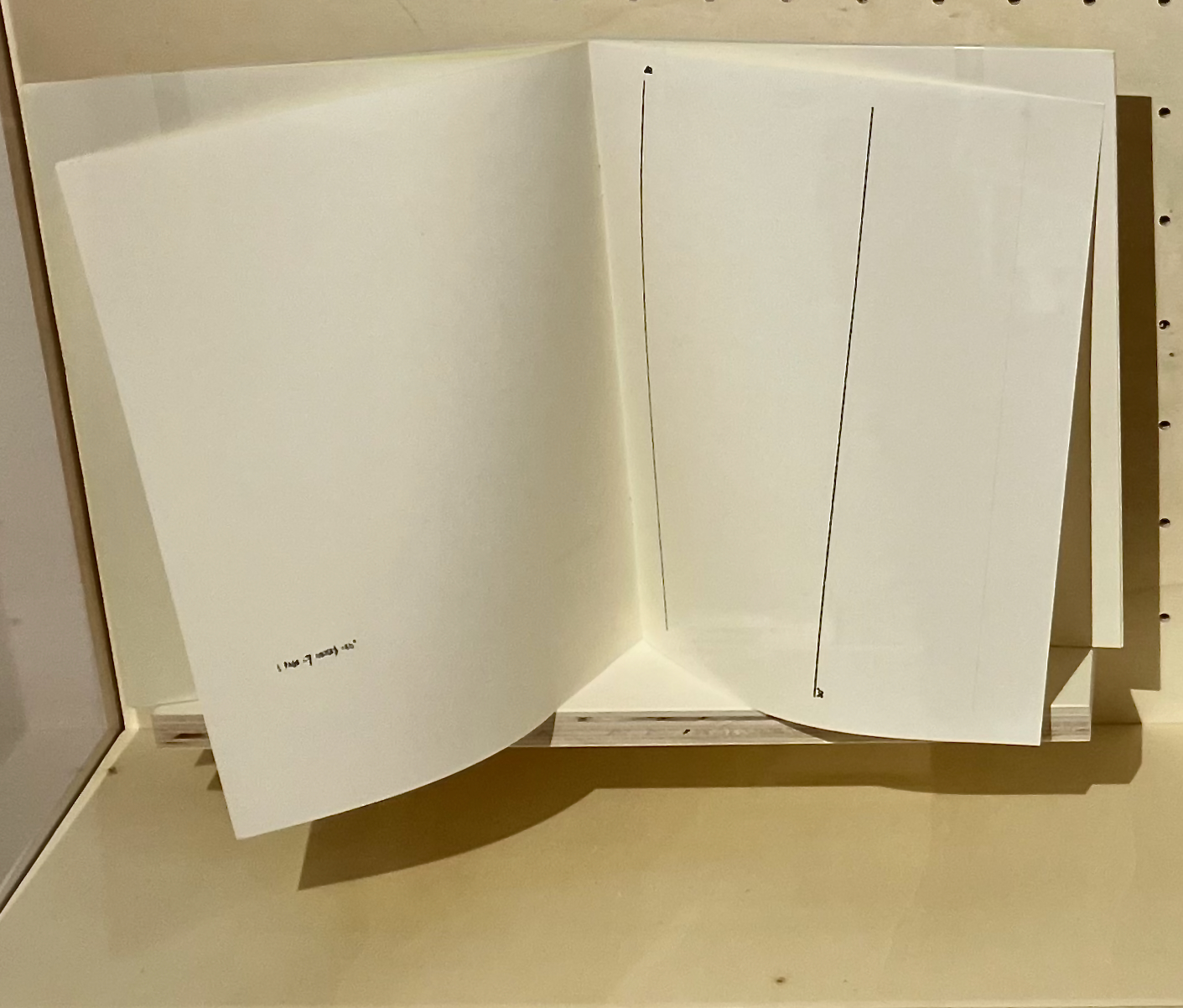
ep’s (2018) the first book from the series of artists books ”representation by touch” Timothy Mosely Casebound in felt with plywood backing, pulp printing and silkscreen on recycled cotton paper. H52o x W345 x D58 mm (closed), W693 (open). 7 interleaved folios: 4 folios of H438 x W608 mm, 2 folios of H220 x W310 mm, and 1 folio of H307 x W210 mm. Unique. Acquired from the artist, 31 October 2024. Photos: Books On Books Collection.
ep’s (2018) is the first of four works in the series “representation by touch” that offers the results of Tim Mosely’s ongoing studio research into the relationship between touch and sight / the haptic and the optic. His drive to draw us into involving touch in our reception and evaluation of art has its roots in a long tradition of concern that Western society has become too ocularcentric for a whole-bodied appreciation of art. If the artist’s aim is to express how the world touches us (as Cézanne put it), a full appreciation of art requires all the senses.
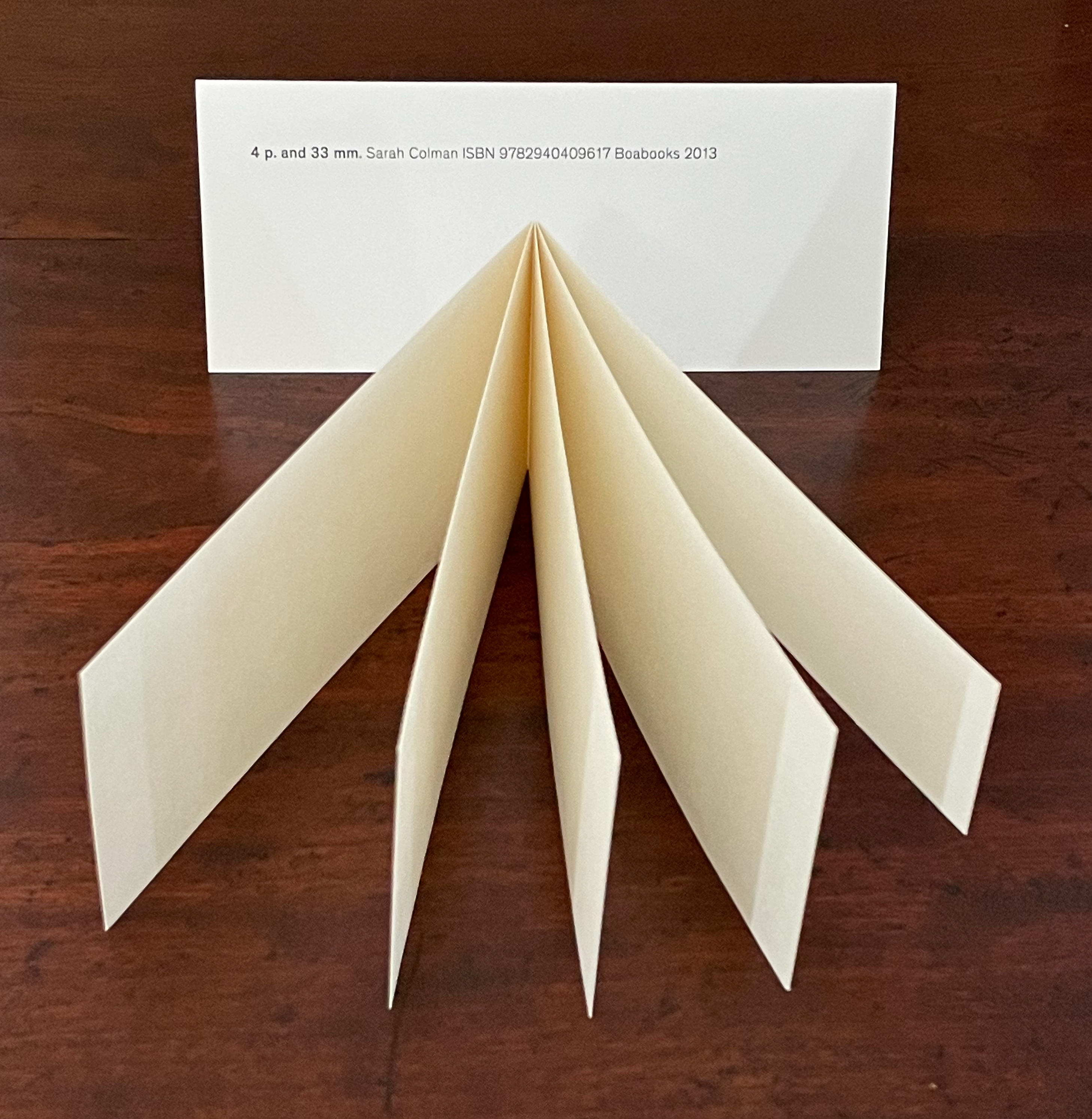
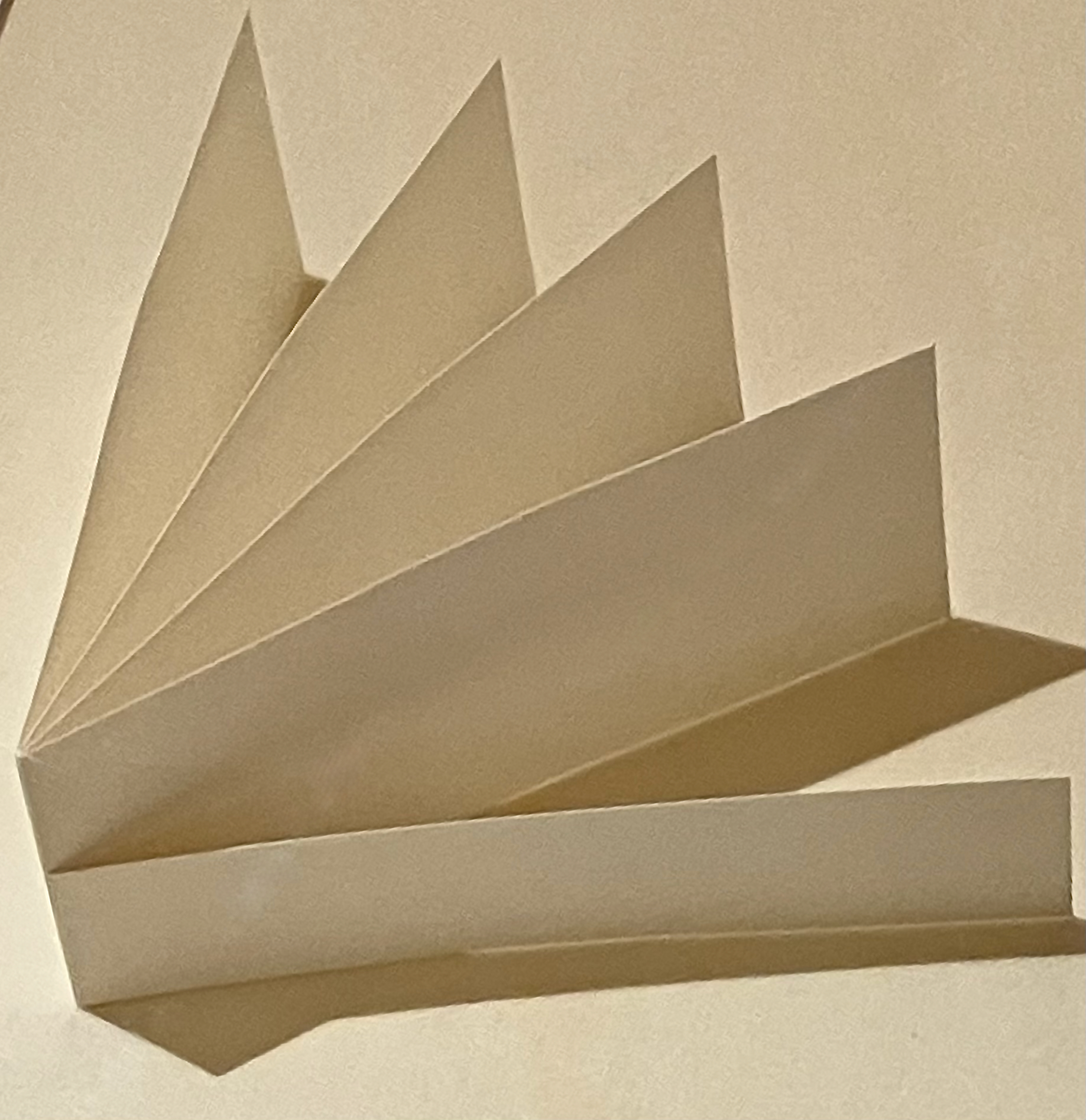
4 p. and 33mm (2013) Sarah Colman Card folder with title, author, publisher. Perfect binding of 4.33 folios. H66 x W148 mm [10] pages. Acquired from the artist, 1 August 2026. Photos: Books On Books Collection.
Colman’s 4 p. and 33 mm. was on display in the exhibition a minima at the Wittockiana in Brussels. If the work ‘s title directs us to consider first the four full folios and then the folio trimmed to half their size, then the item is displayed upside down in the image below. Observant visitors may have noticed it. Western books read from left to right.
Left: 4 p. and 33 mm. (2013). Sarah Colman. Geneva: Boabooks. Right: 4’33” (1993).John Cage. New York: Peters No. 6777a.
Being able to manipulate this work drives home the right orientation. First come the 4 pages that measure 66 mm and then the page that measures 33 mm. Of course, it ends hanging in air — just as Cage’s composition leaves the audience hanging as it ends after 4 minutes and 33 seconds.
In other words, Colman has turned Cage’s temporal art into spatial art. Given the performance origin of the next work, though, it’s not hard to imagine an invitation from Colman to watch her open 4 p. and 33 mm., place it atop a piano, and then close it at the conclusion of 4 minutes and 33 seconds.
Semiotics of the Studio (2015)
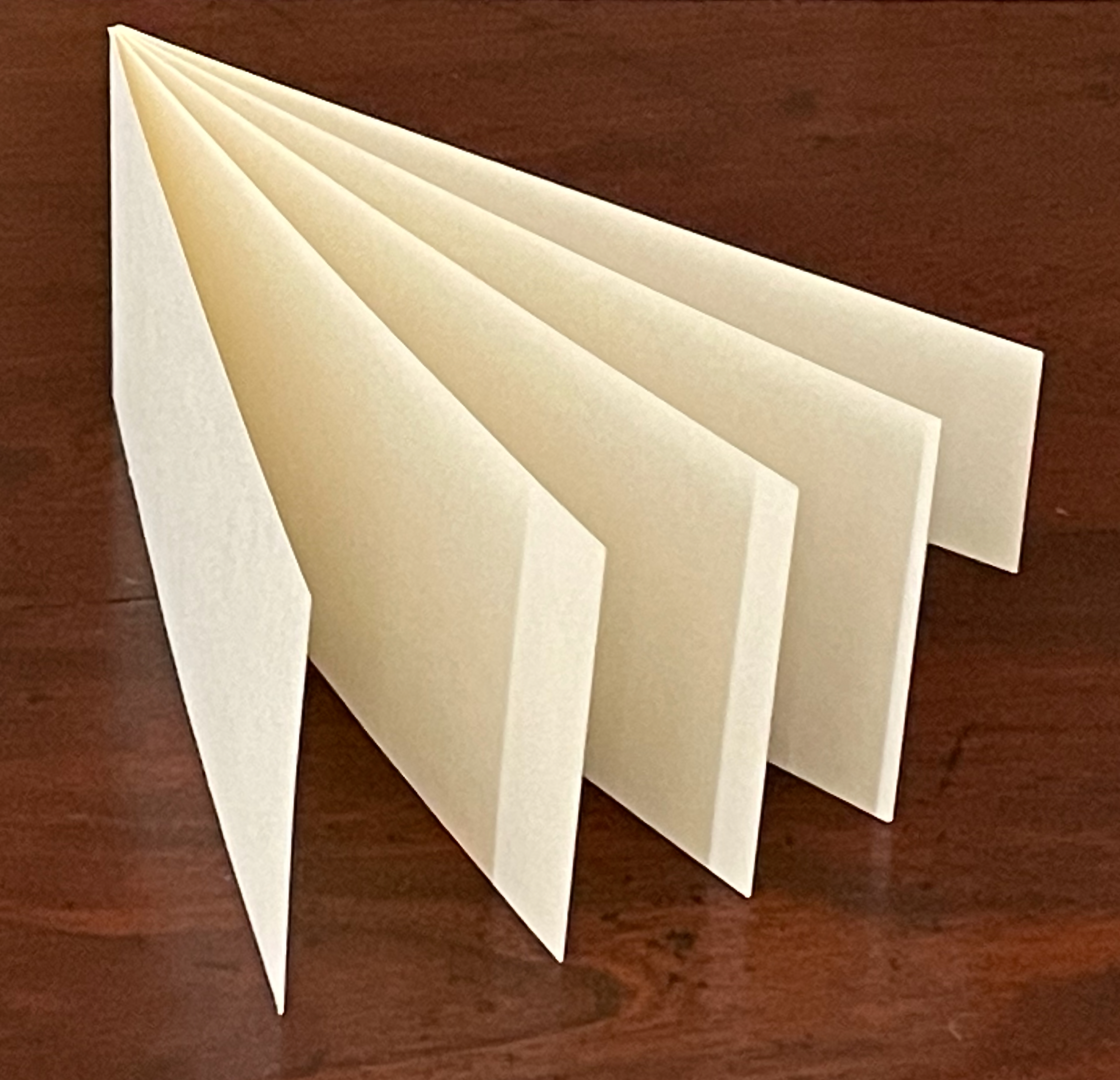
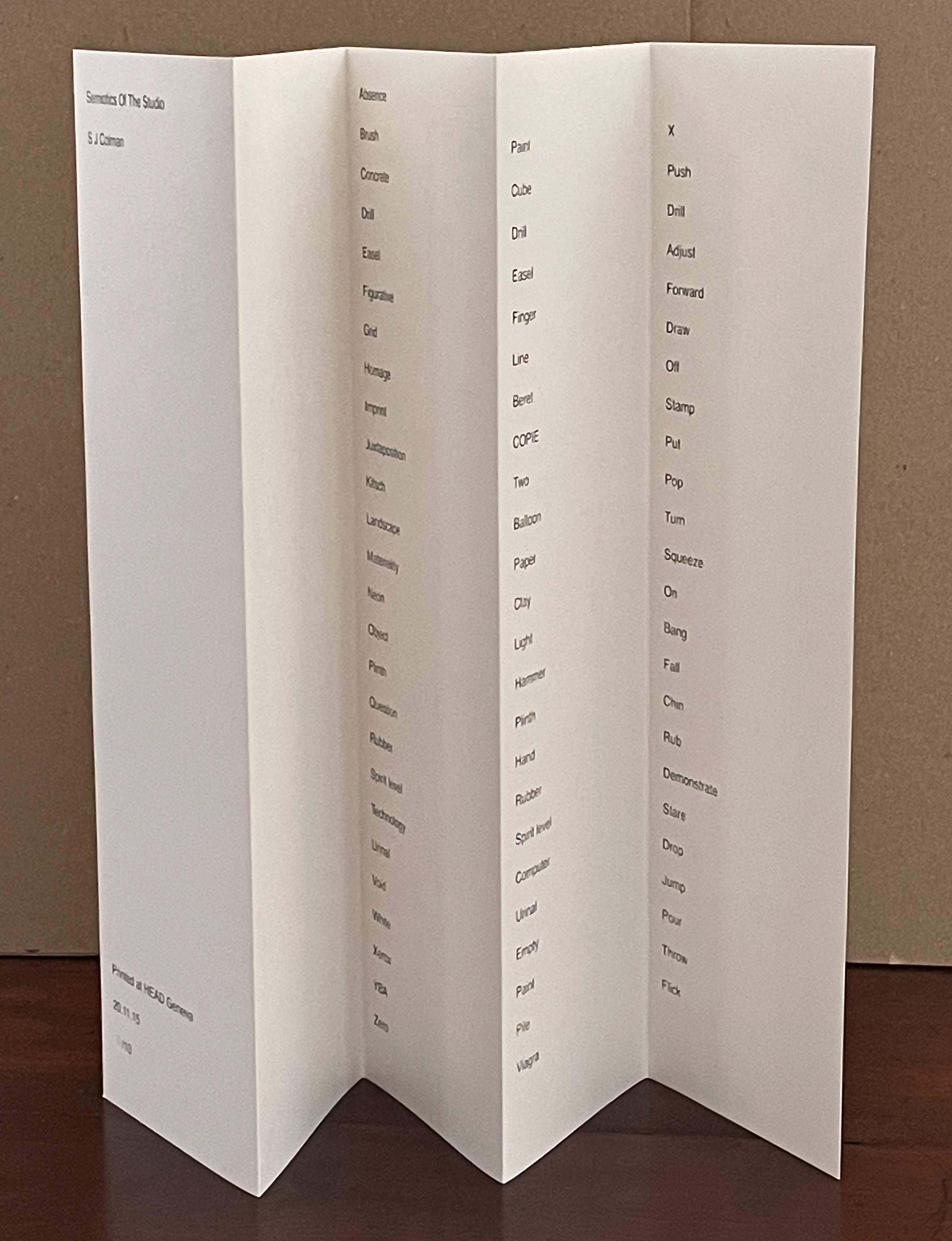
Semiotics of the Studio (2015) Sarah Colman Leporello H300 x W85 mm (closed), up to W425 mm (open). Five panels. Edition of 10, of which this is #10. Acquired from the artist, 1 August 2026. Photos: Books On Books Collection.
Like 4p. and 33mm, the Semiotics of the Studio translates a different medium into that of an artist’s book and very much insists on being experienced on its own terms.
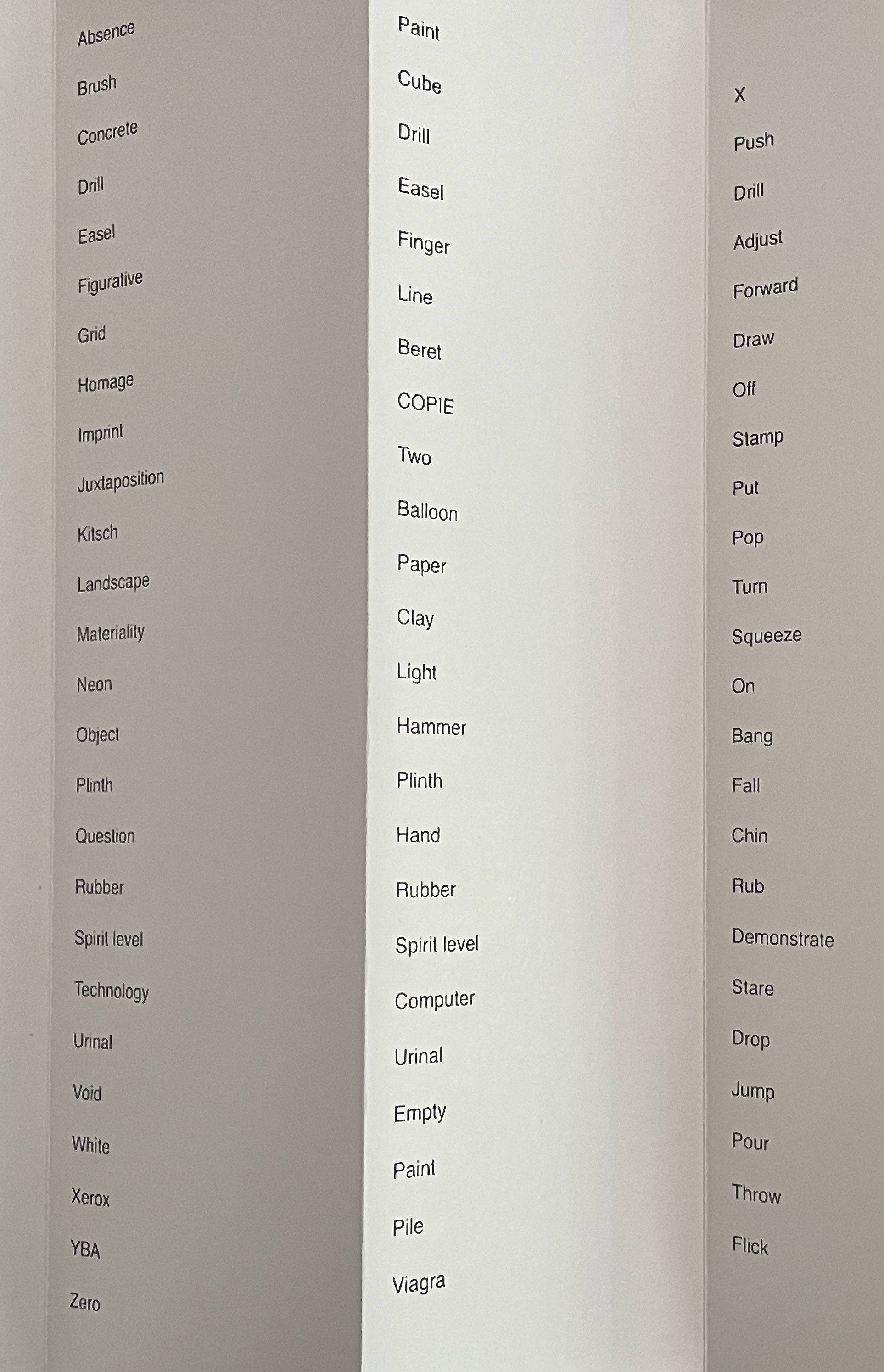
Laid flat or standing, Semiotics of the Studio presents itself as an accordion book, but the order of reading its text is not as straightforward (or downward) as the first panel’s alphabetical order suggests. The alphabetical order in panel 1 becomes a red herring in panel 2. With “Cube”, “Drill”, “Easel”, and “Finger”, Panel 2 resumes an alphabetical order only to abandon it, and in panel 3, there are no alphabetical pairs or triples at all.
Perhaps we should read from left to right across the three panels instead of down. Is the blank space at the top of the third panel showing us the product of “Absence” in the first panel and “Paint” in the second panel? But wait, maybe we should read backwards from “Paint” in the second panel to “Brush” in the first; after all, further down, we have “”Juxtaposition” in panel 1, then “Two” in panel 2, and “Put” in panel 3, suggesting that we put two in juxtaposition.
Just below that, if we put “Kitsch” and “Balloon” together with “Pop”, do we have a dig at Jeff Koons? And much further down, is the juxtaposition of “Urinal”, “Urinal”, and “Drop” taking the piss with Duchamp?
What about “Object”, “Hammer”, and “Bang”? If we are trying to figure out sentences from this, Subject, Verb, and Object seem to jump about. We need to put “Chin” (panel 3) on “Hand” (panel 2), and “Question” (panel 1) what is going on.
Another puzzle is that some words are repeated across from each other in panels 1 and 2. “Drill”, “Easel”, “Plinth”, “Rubber”, “Spirit Level”, and “Urinal”, as we have seen. Sometimes, panel 2 gives an example for the word in panel 1 (e.g., “Computer” for “Technology”). Sometimes, the words are descriptive or synonyms of one another (e.g., “Neon” and “Light” and “Void” and “Empty”, respectively).
Closer inspection reveals that the three columns of words do not precisely align horizontally. They cascade. “Absence” is slightly higher than “Paint”, “Paint” is slightly higher than “X”, and so on. Moreover, panel 1 has 26 words, panel 2 has 22, and panel 3 has 23. So perhaps we should be looking for sense in multiple directions, which is pretty much where semiotics as a discipline has landed.
Context, too, matters. Colman reaps the benefit of Martha Rosler’s kitchen setting for her subversive purposes. While Colman is in the studio, which suggests that her exploration of semiotics is one of creative process, she also slips in terms that challenge the clichés and politics of art, terms like “Beret”, “Kitsch”, and “Viagra”. It’s the artist’s book equivalent of donning the aprons and maintaining a deadpan delivery in the video.
By putting art words to work in a work of art — especially in the form of an artist’s book — Semiotics of the Studio “interrogates” itself and its subject.
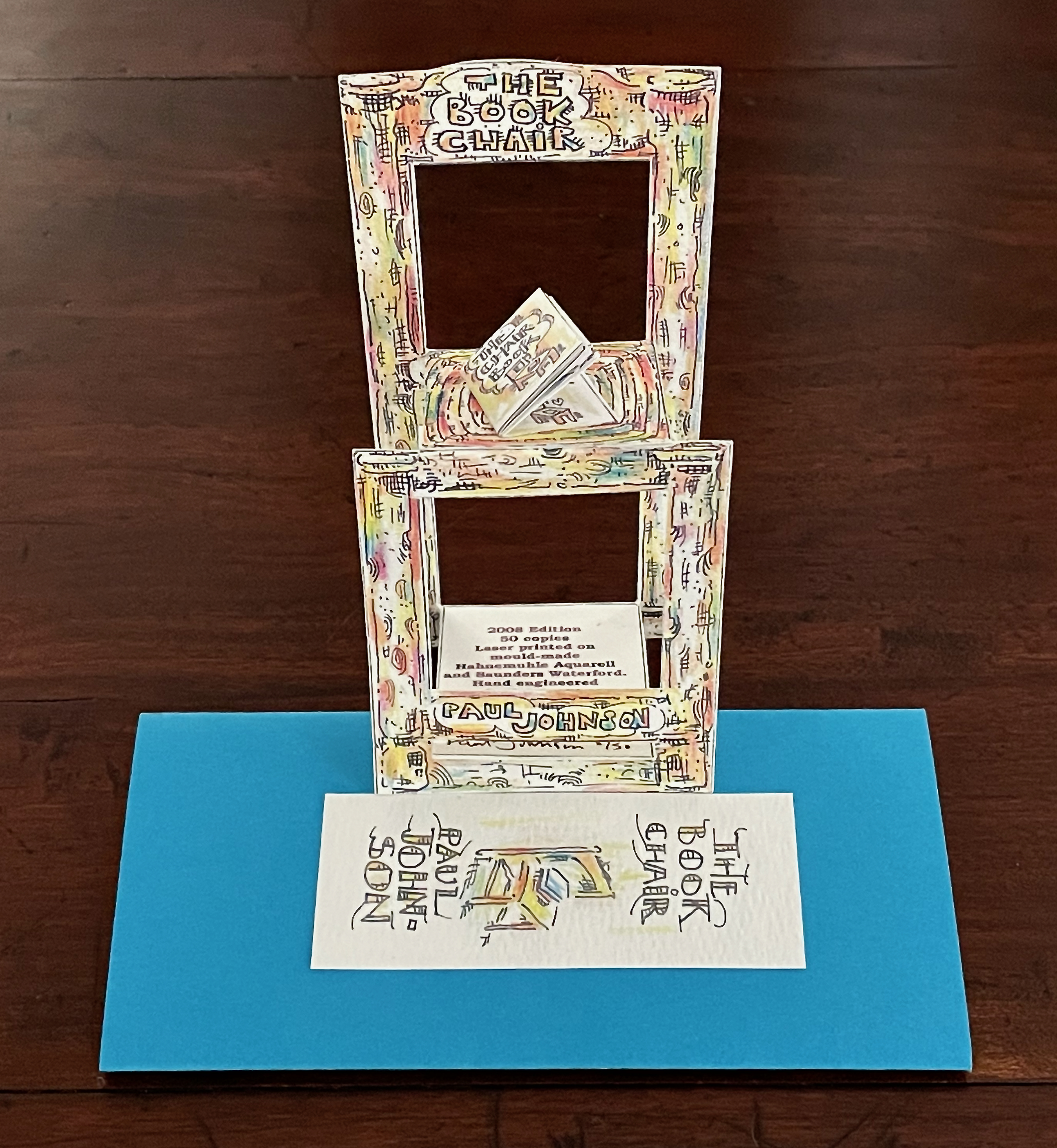
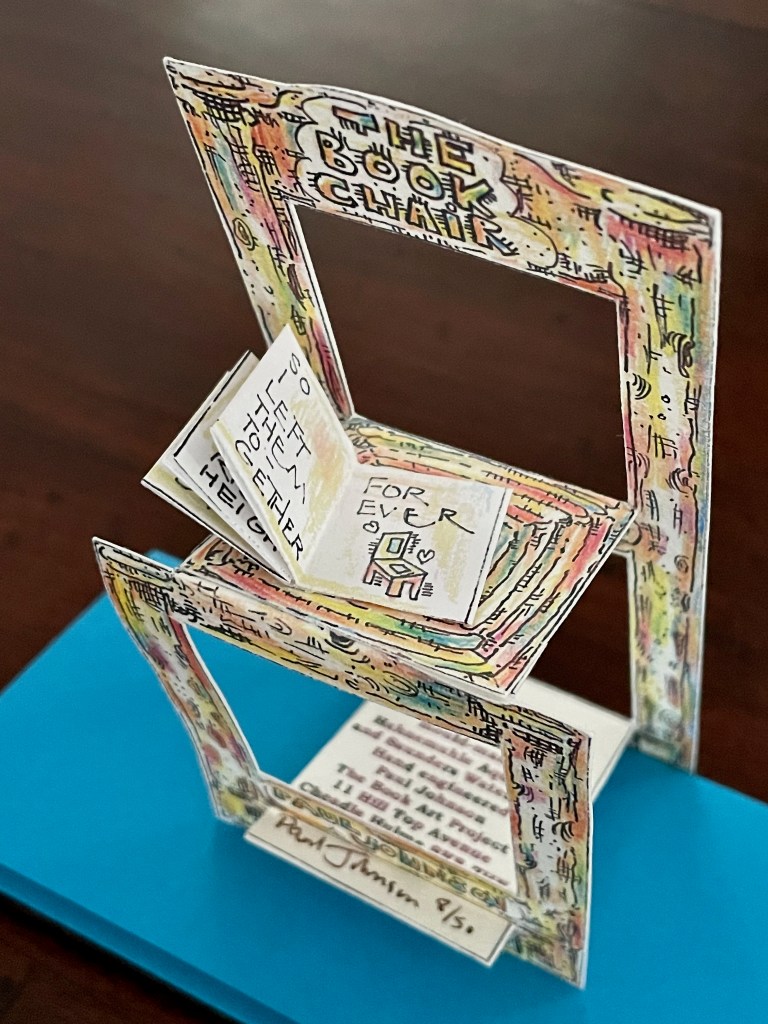
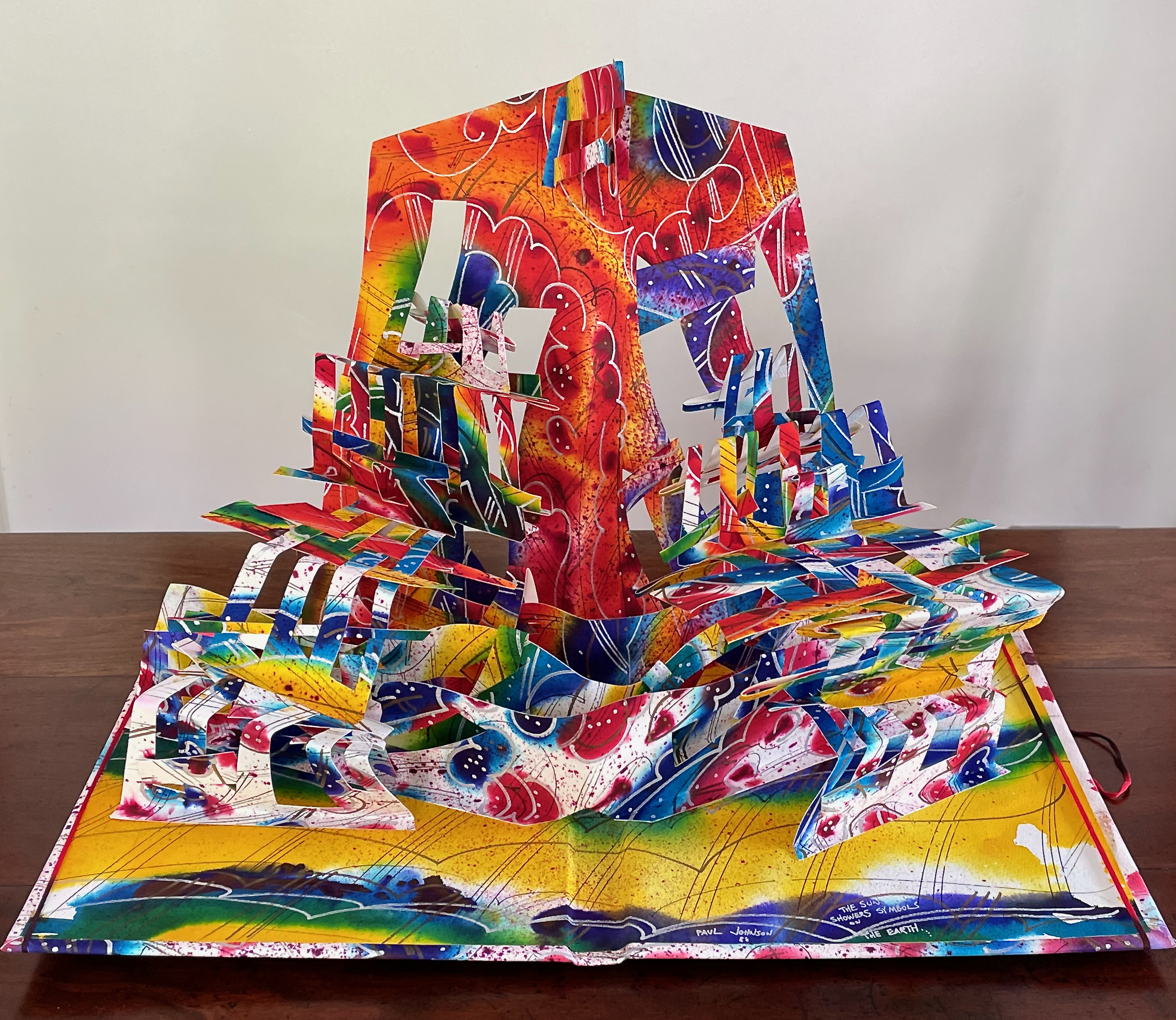
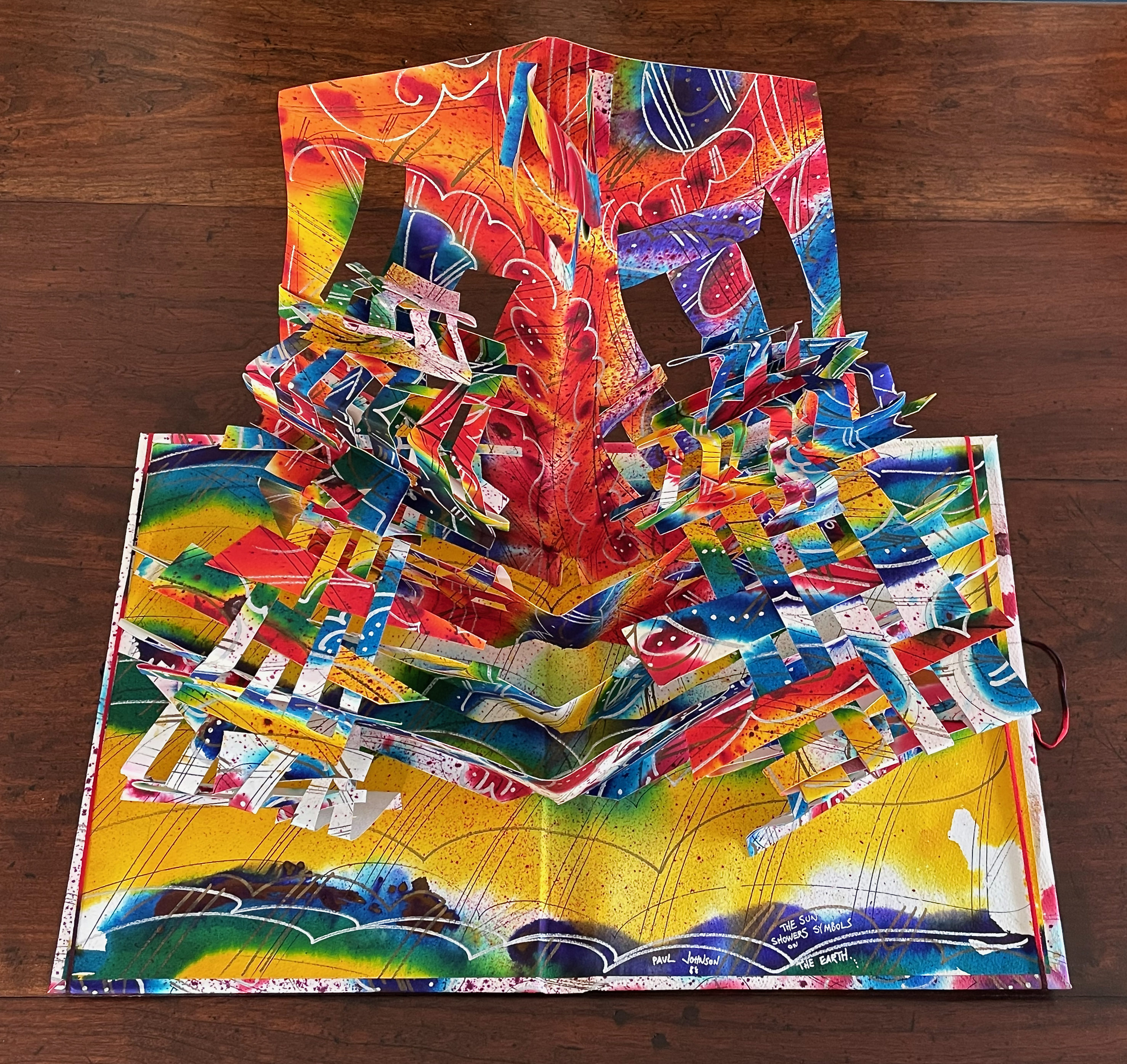
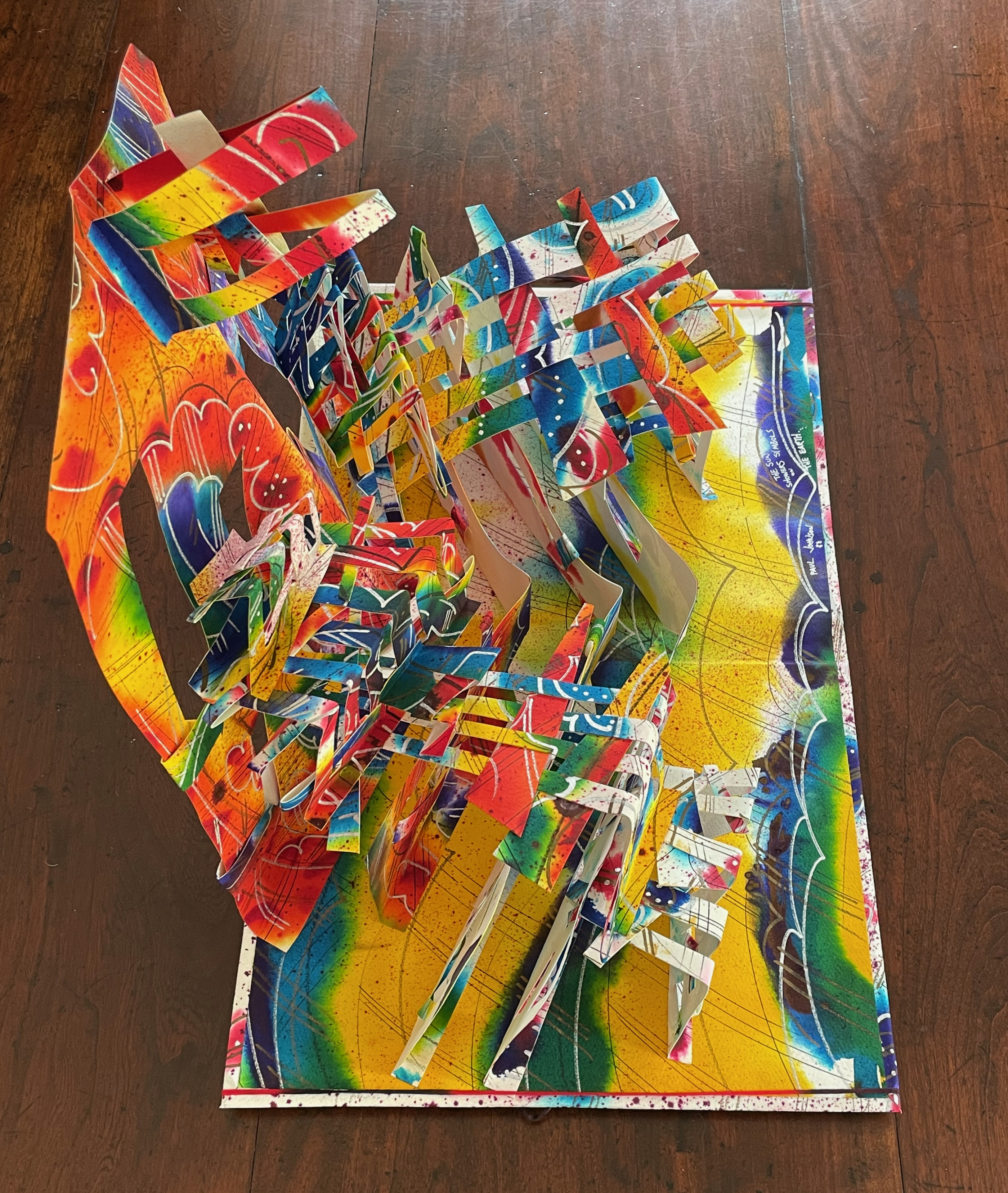
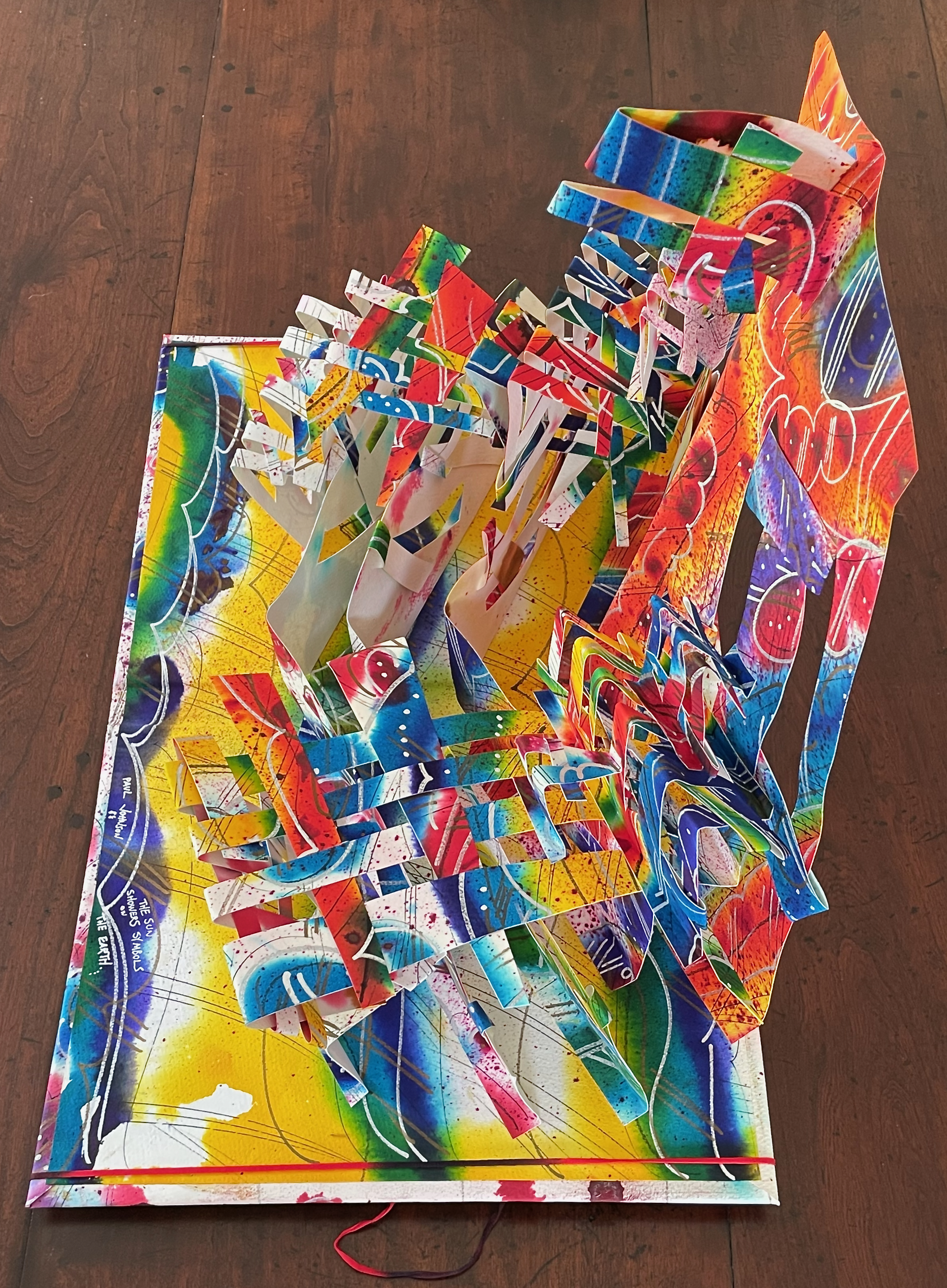
Paul Johnson’s book art has a childlike openness to delight, wonder, and joy. Those characteristics are signaled in his works’ titles — titles such as Suddenly from the centre of the universe came a symphony of light and The rivers of time carry the music of life down to the sea…. Below, the titles of two of his works in this collection also capture that exuberant spirit — The Sun Showers Symbols on the Earth and Morning Light Showing the World the Way. Some titles such as The Book Chair, Goldilocks & The Three Little Pigs, and The Pop-Up Unabridged History of the World, all also below, signal a quirkiness to be found in the works. And another vein of titles such as Ed Hutchins Studio, New York and Arthur Jaffe’s house, Florida reflects his works’ celebration of friendships, as demonstrated in the first work of Johnson’s to join this collection:
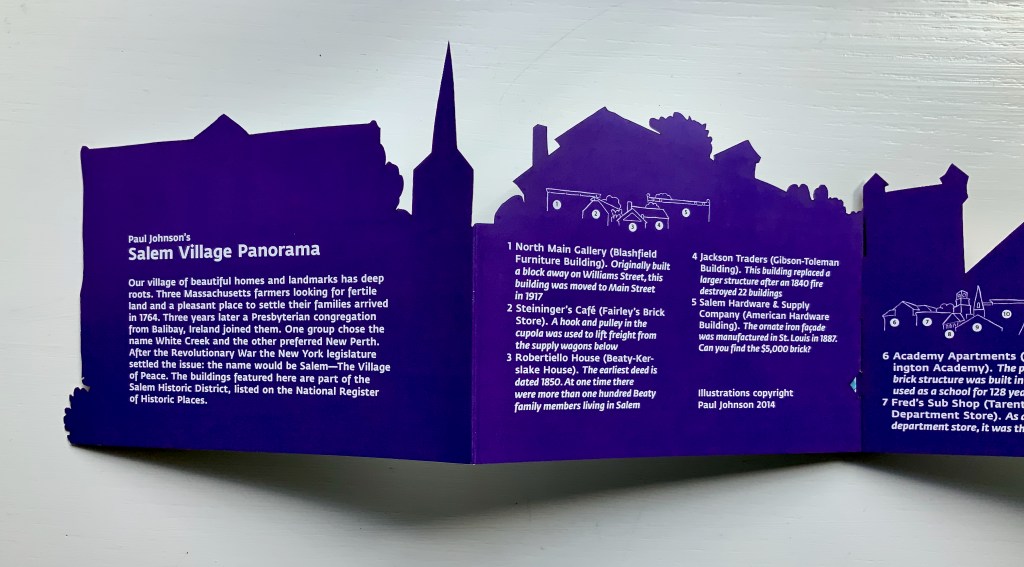
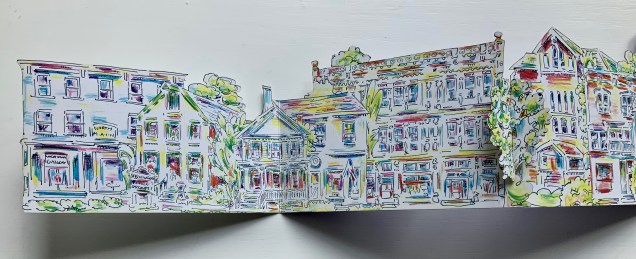
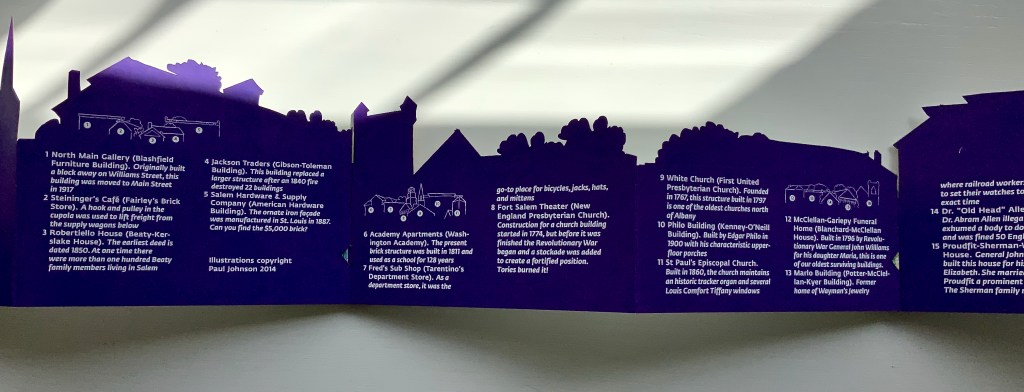
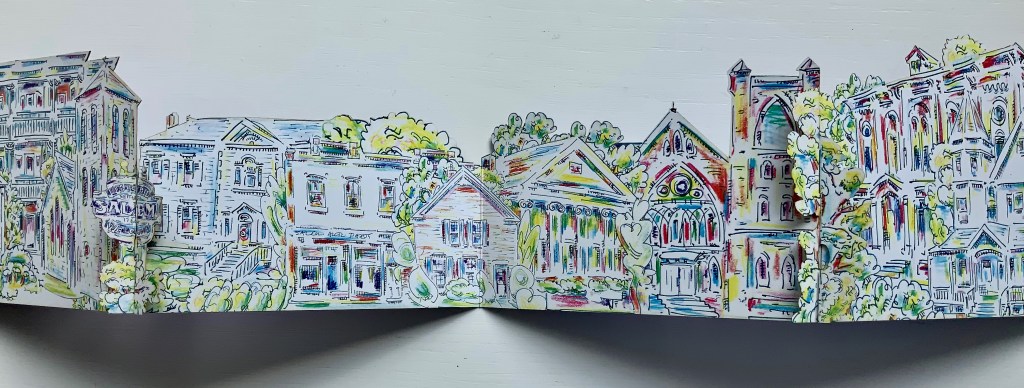
Paul Johnson’s Salem Village Panorama (2014)
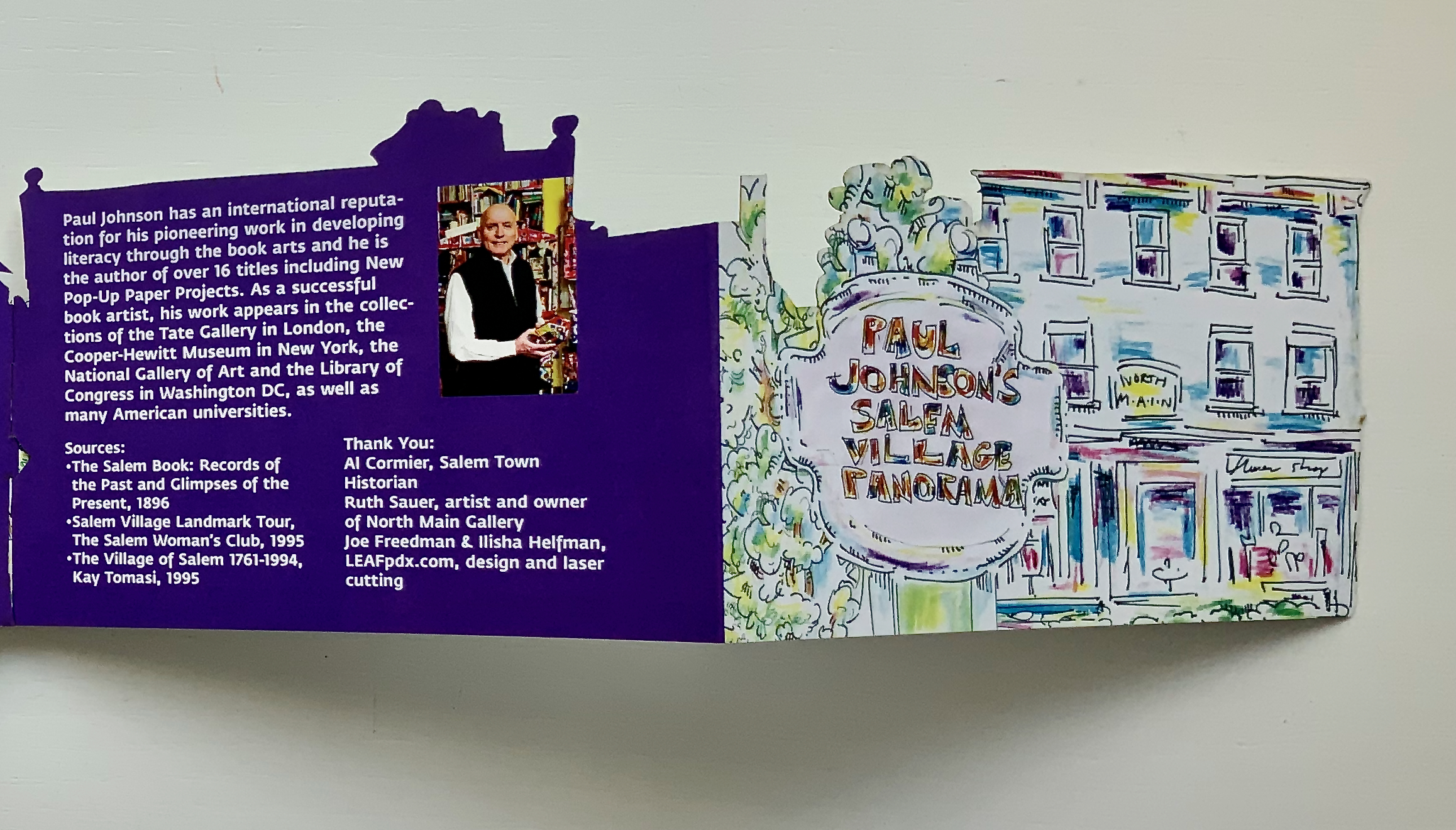
Paul Johnson’s Salem Village Panorama(small version) (2014) Paul Johnson Pop-up double-sided leporello. H140 x W140 mm (closed), W974 mm (open). 8 panels. Limited edition (unknown quantity). Acquired from Ed Hutchins, 26 January 2022. Photos: Books On Books Collection.
Johnson’s good friend Ed Hutchins organized the show at North Main Gallery in Salem, NY. The town historian chipped in with historical sources, and local artist Paula Beardell Krieg announced it here with excited anticipation.
The next three works in the collection display Johnson’s penchant for unexpected and quirky explorations and that tell-tale characteristic of artists’ books: self-reflexivity.
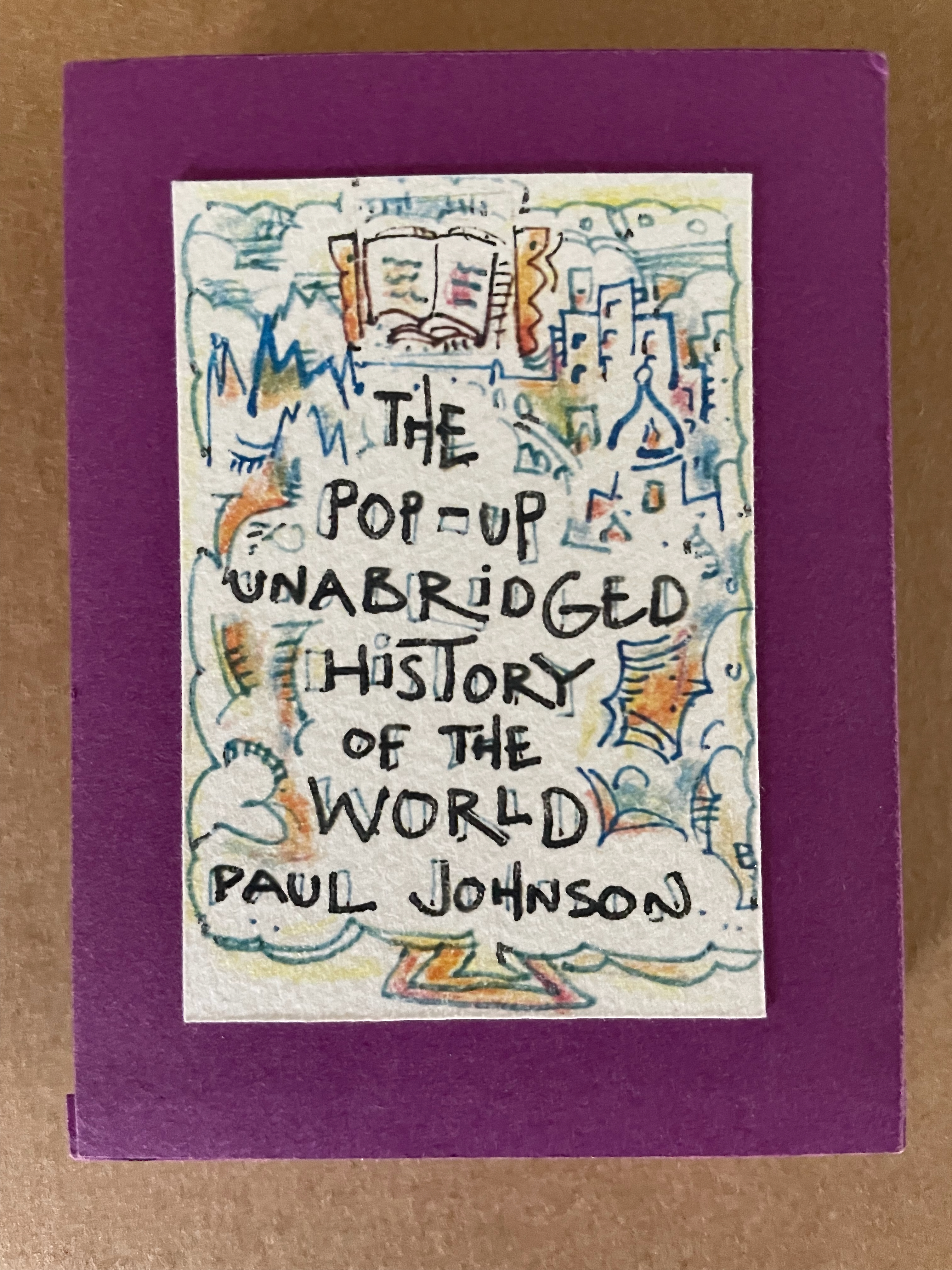
The Pop-Up Unabridged History of the World (2008)
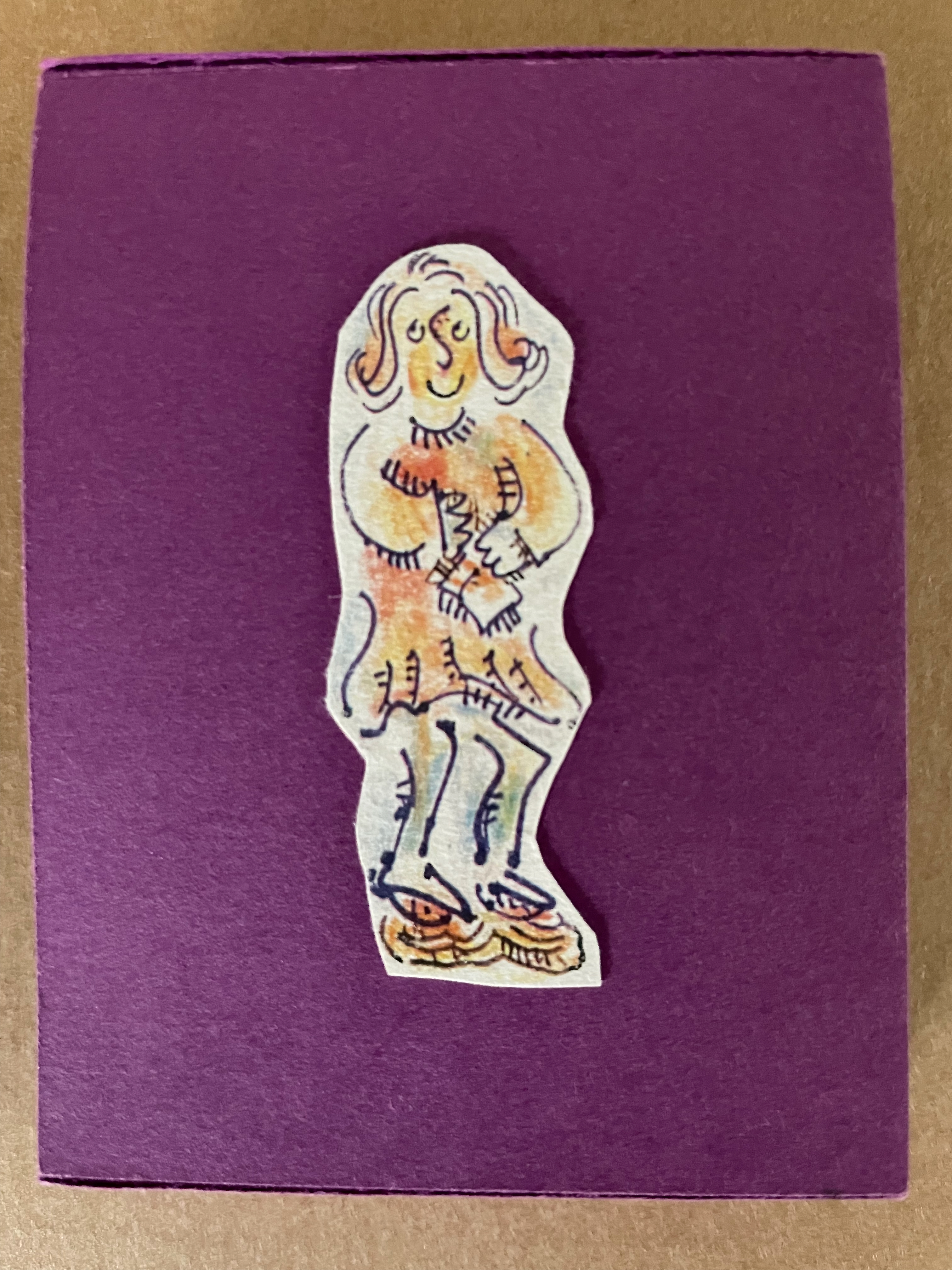
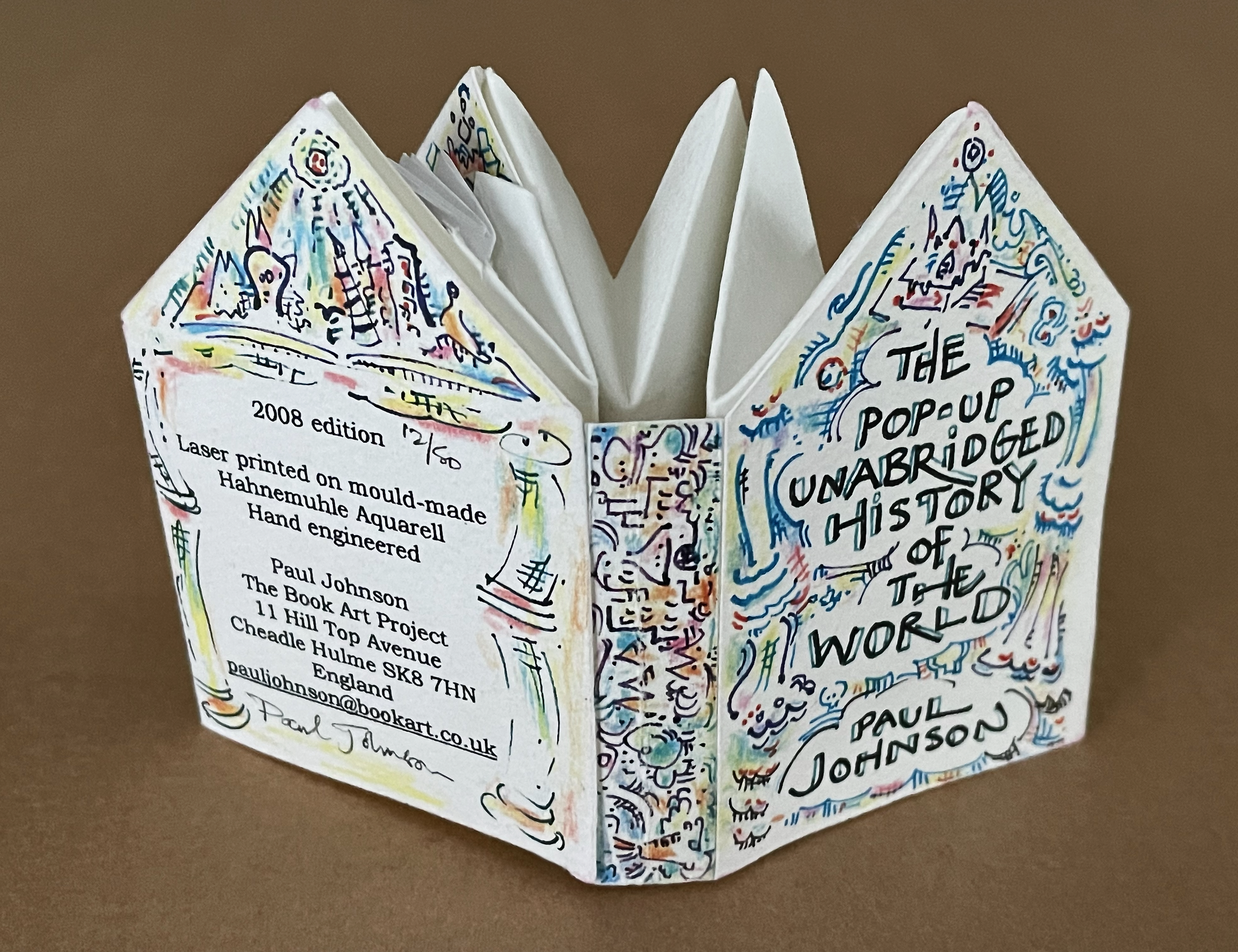
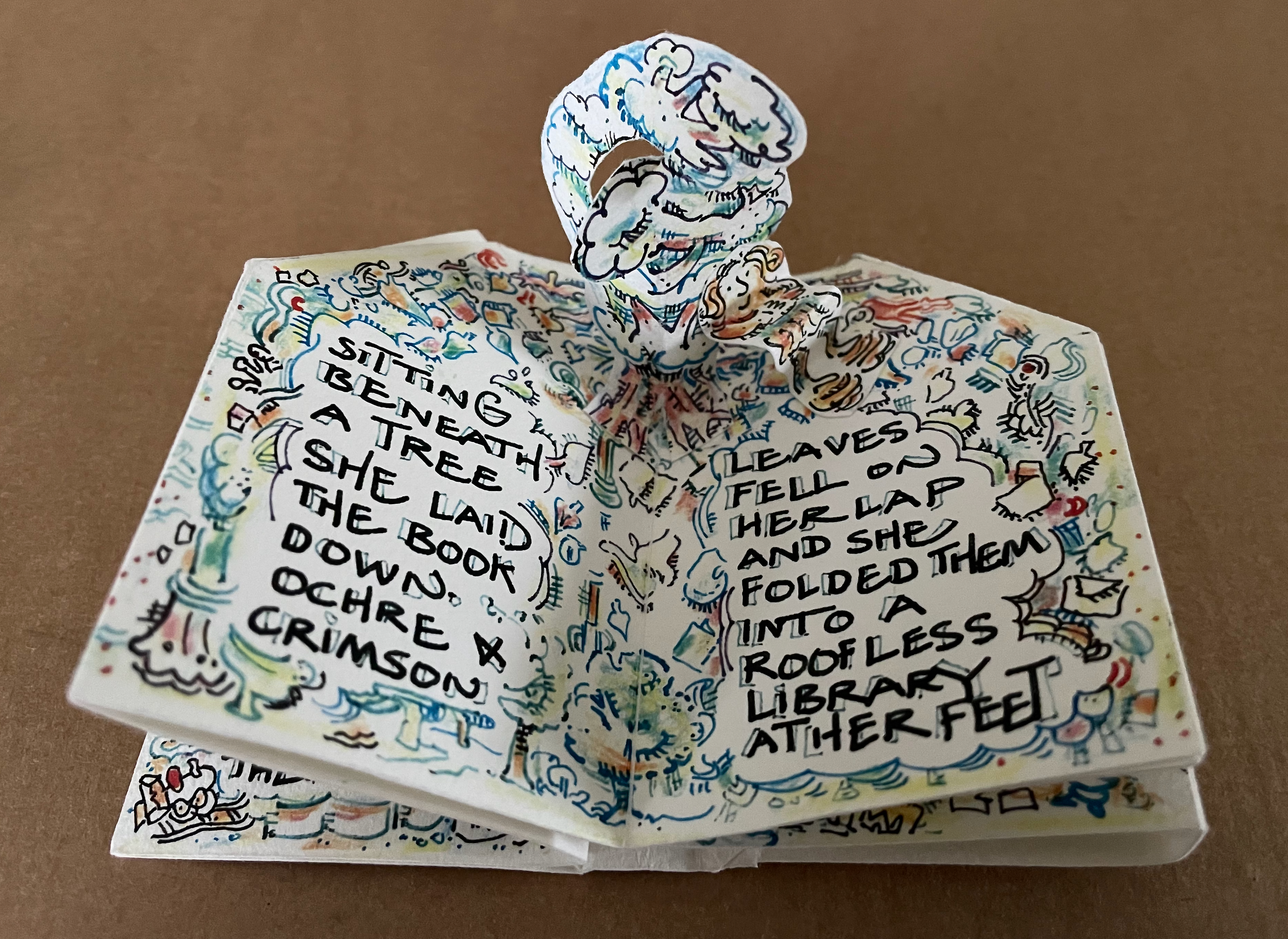
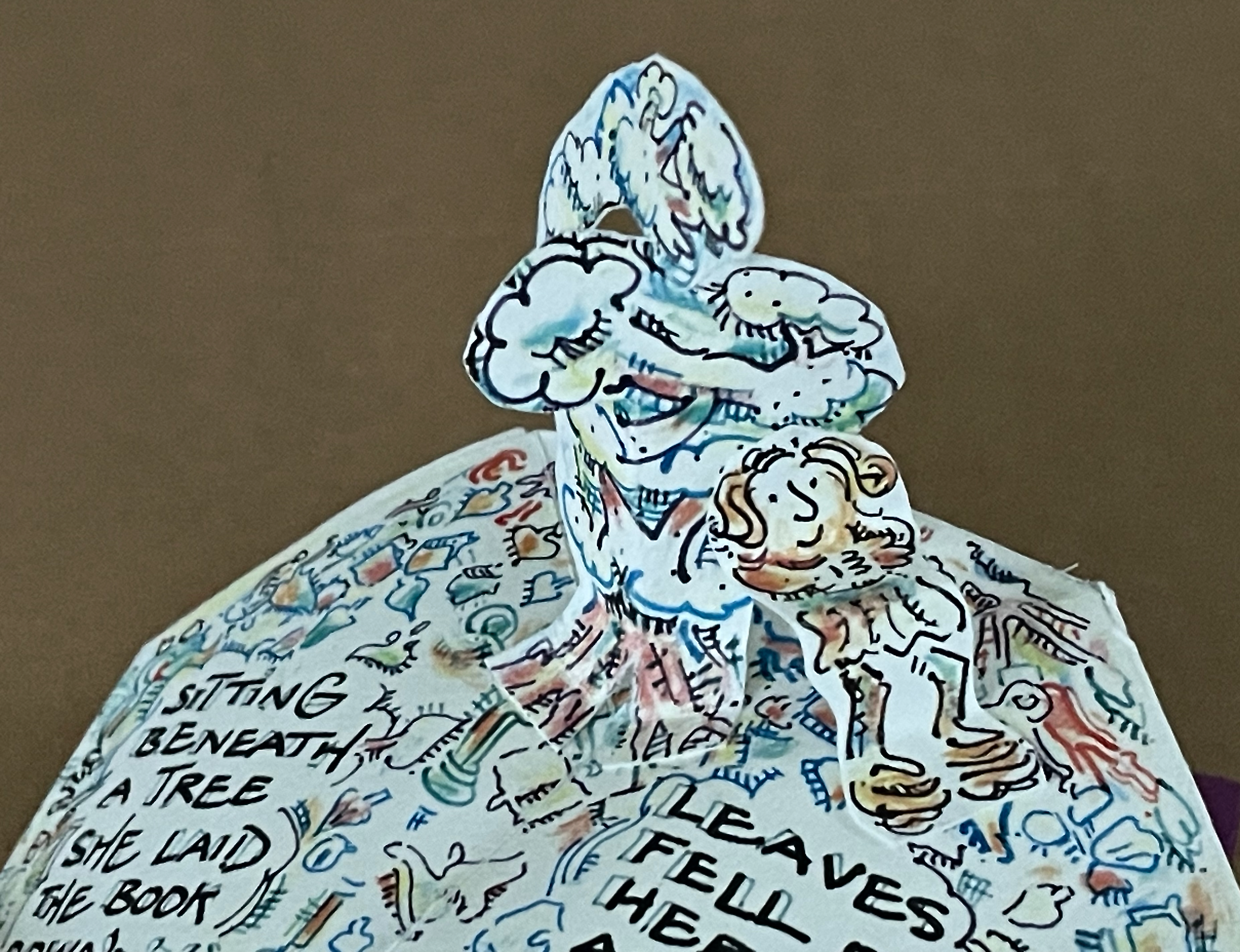
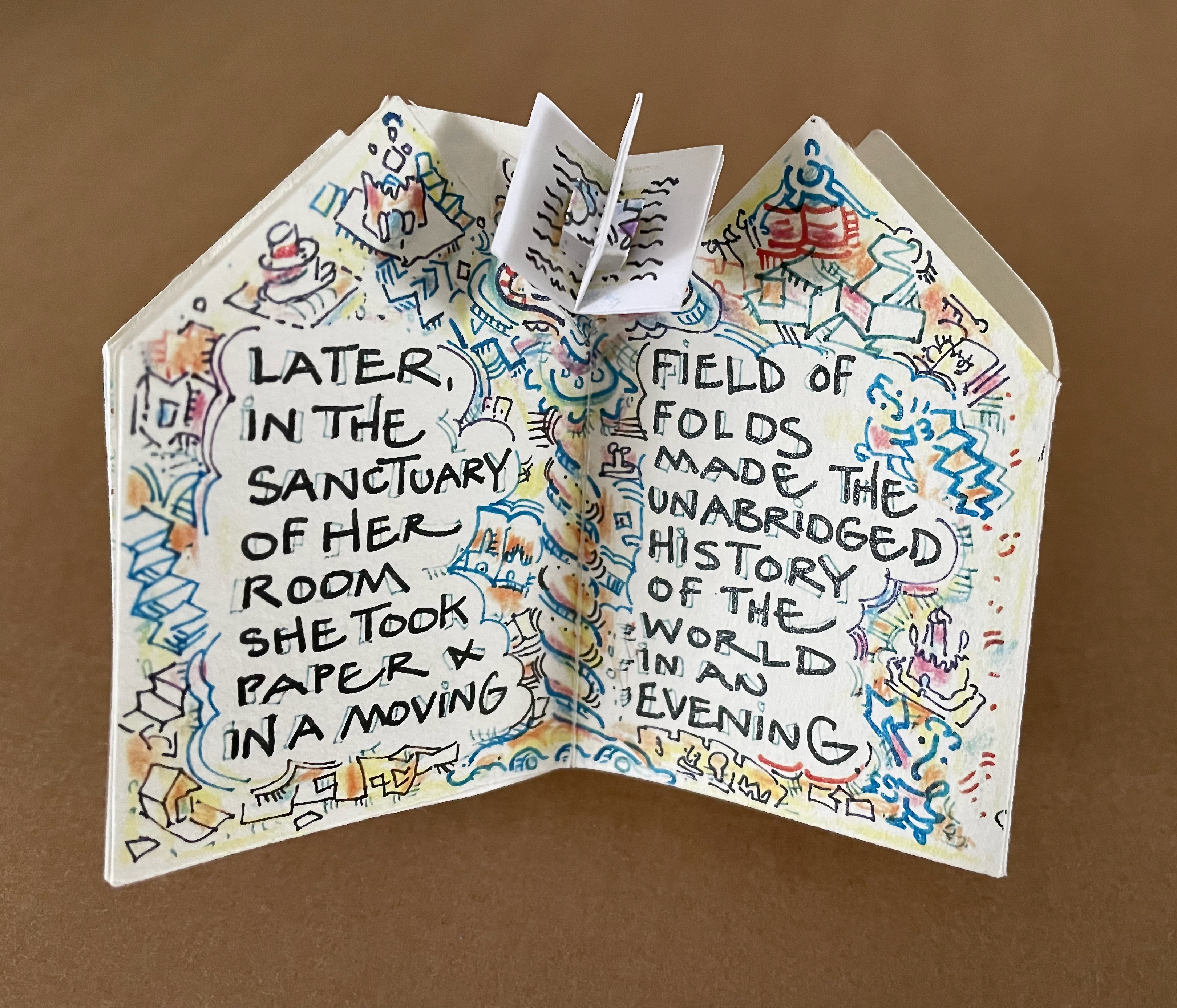
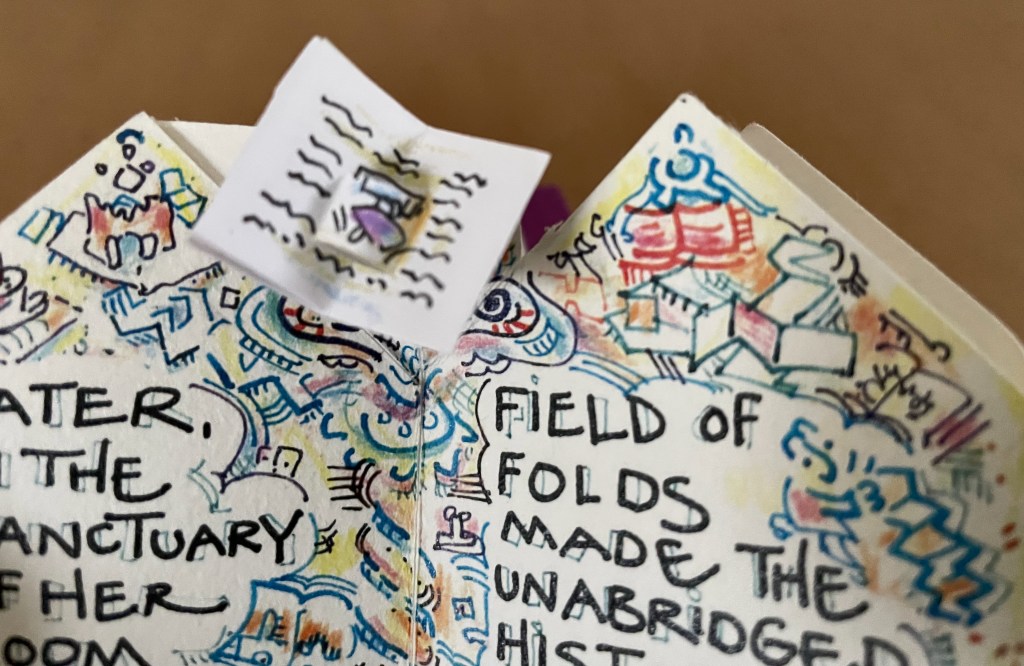
The Pop-Up Unabridged History of the World (2008) Paul Johnson Purple slipcase. Pop-up book. Slipcase: H86 x W65 mm. Book: H85 x W55 mm. [6] pages. Edition of 50, of which this is #12. Acquired from Collinge & Clark, 7 November 2024. Photos: Books On Books Collection.
Again, title matters in Paul Johnson’s work. How can something so small, crafted from Hahnemuhle Aquarell, Johnson’s preferred paper, contain the unabridged history of the world?
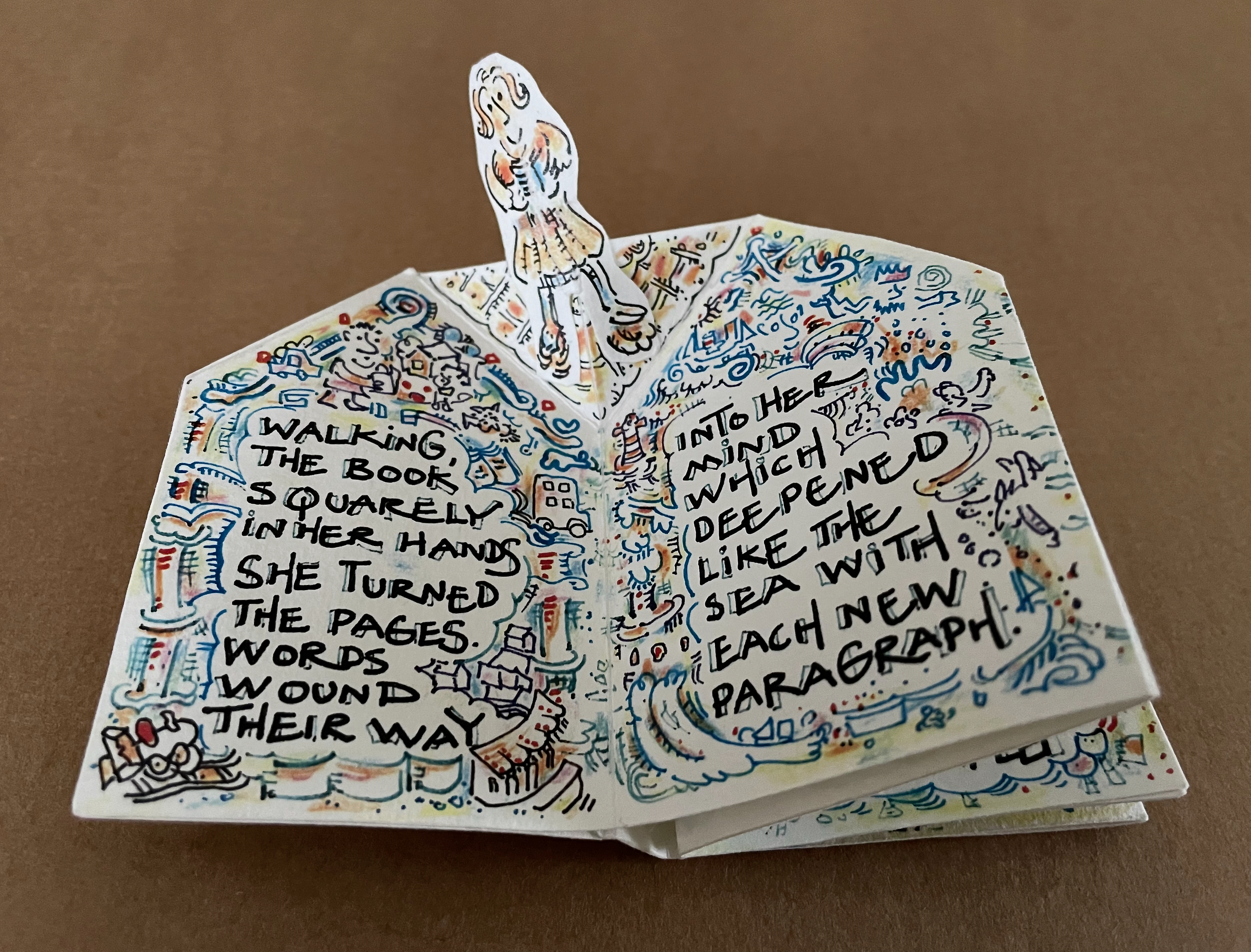
On the very first page, we find we are in a world of fiction, not non-fiction, but is the book the main character is reading fiction or non-fiction? Either could be deepening her mind.
With the turn to the next page, the world’s leaves and the act of folding become as inclusive as the book’s leaves and the act of reading.
And with the turn to the last pages, we have the book she has made: a book within a book within a book.
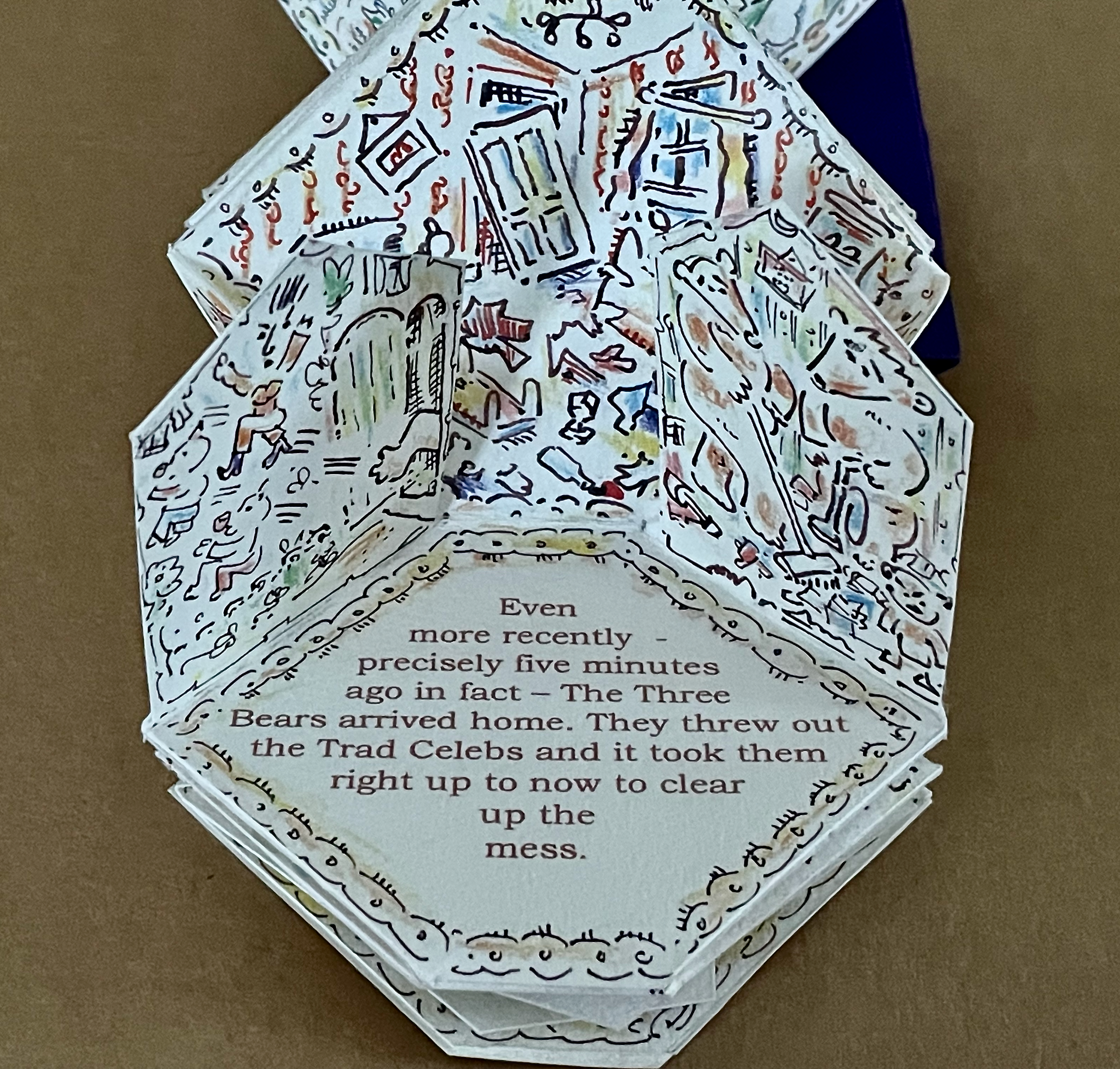
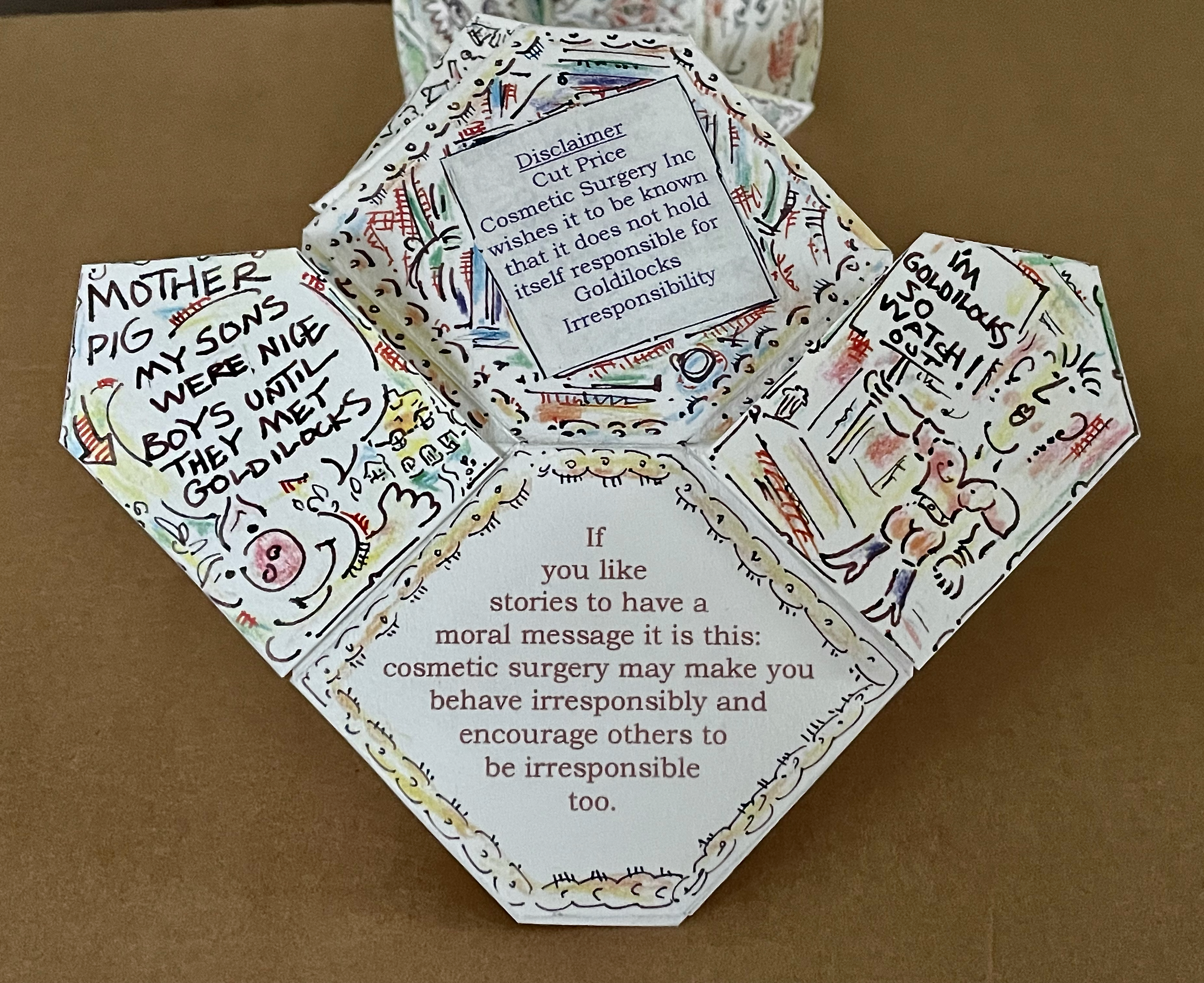
Goldilocks & the Three Little Pigs (2008)
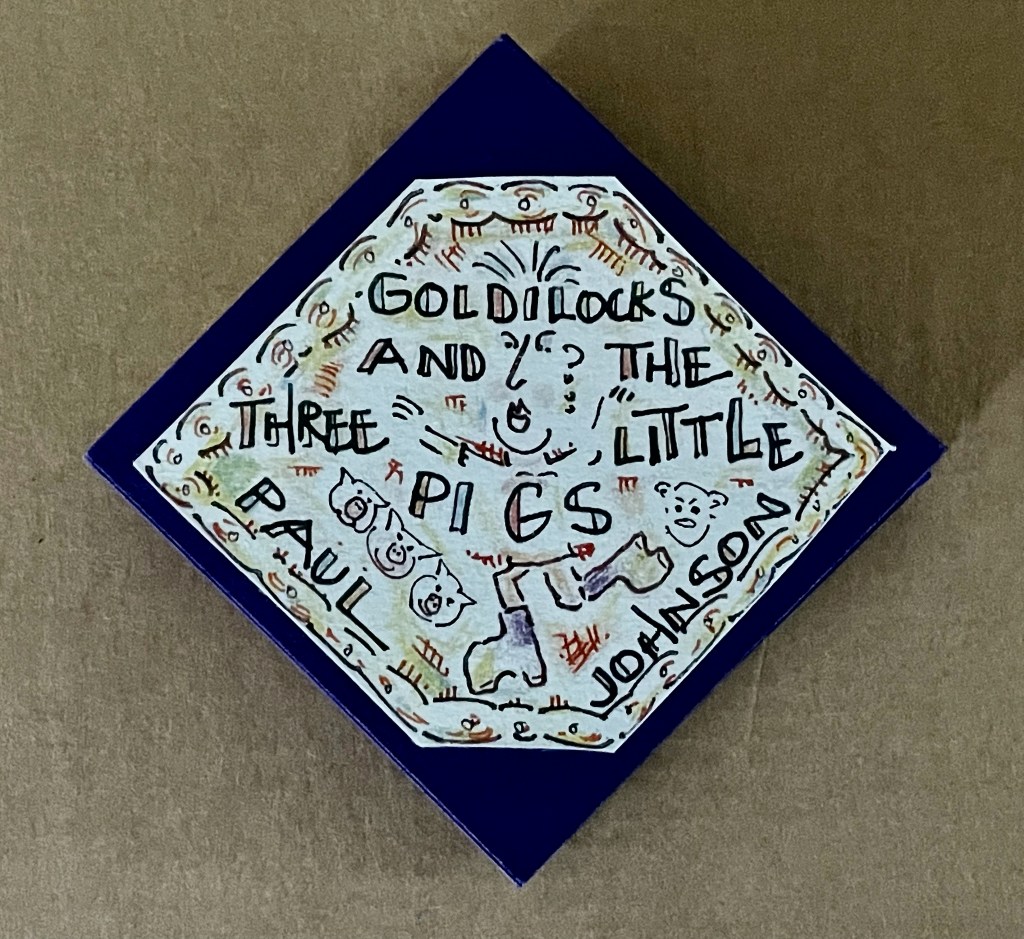
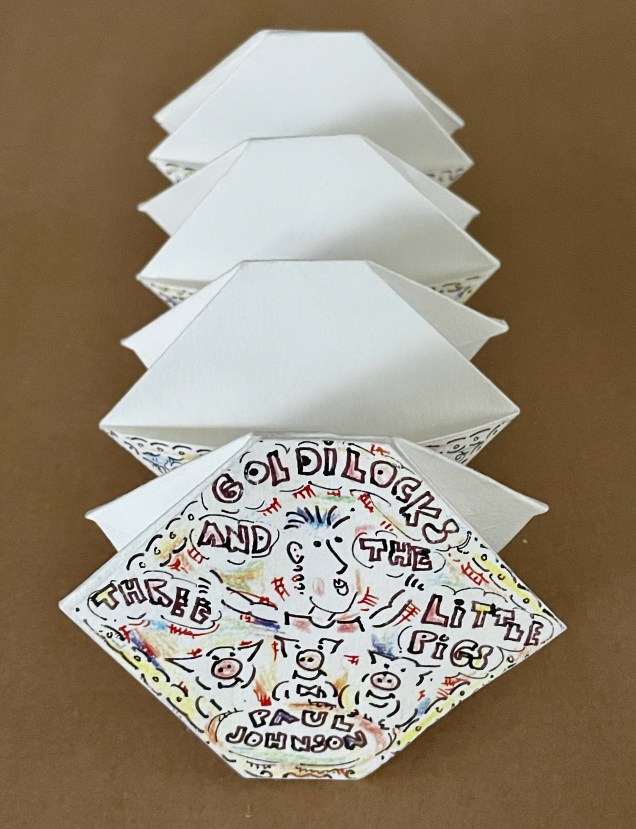
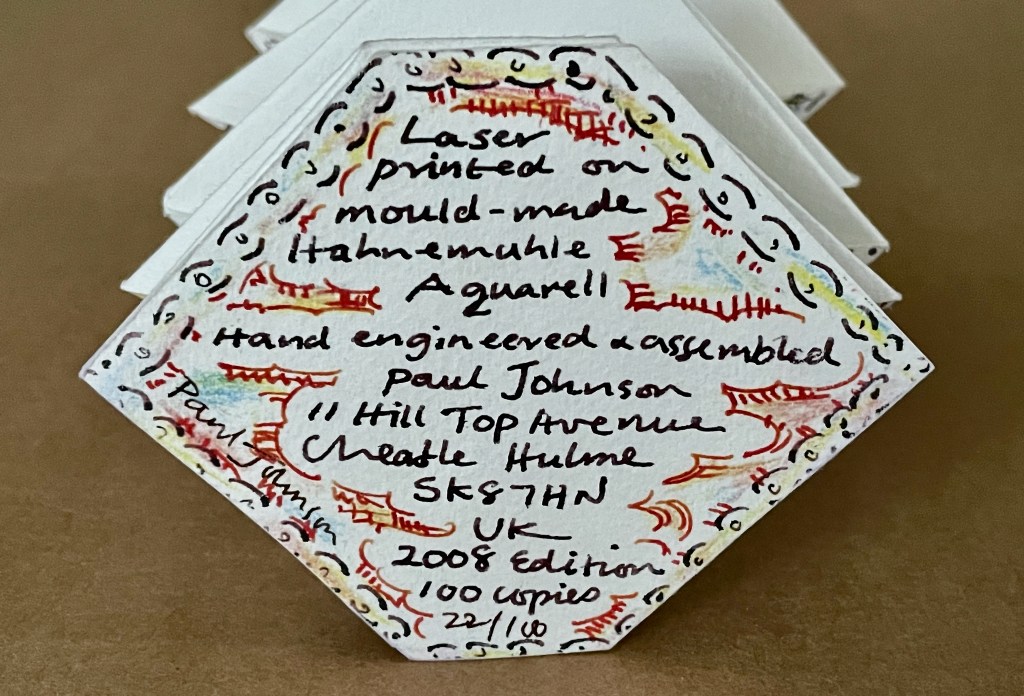
Goldilocks & the Three Little Pigs (2008) Paul Johnson Purple slipcase. Vertical, laddered pop-up. 75 x 75 mm [4] pages. Edition of 100, of which this is #22. Acquired from Collinge & Clark, 7 November 2024. Photos: Books On Books Collection.
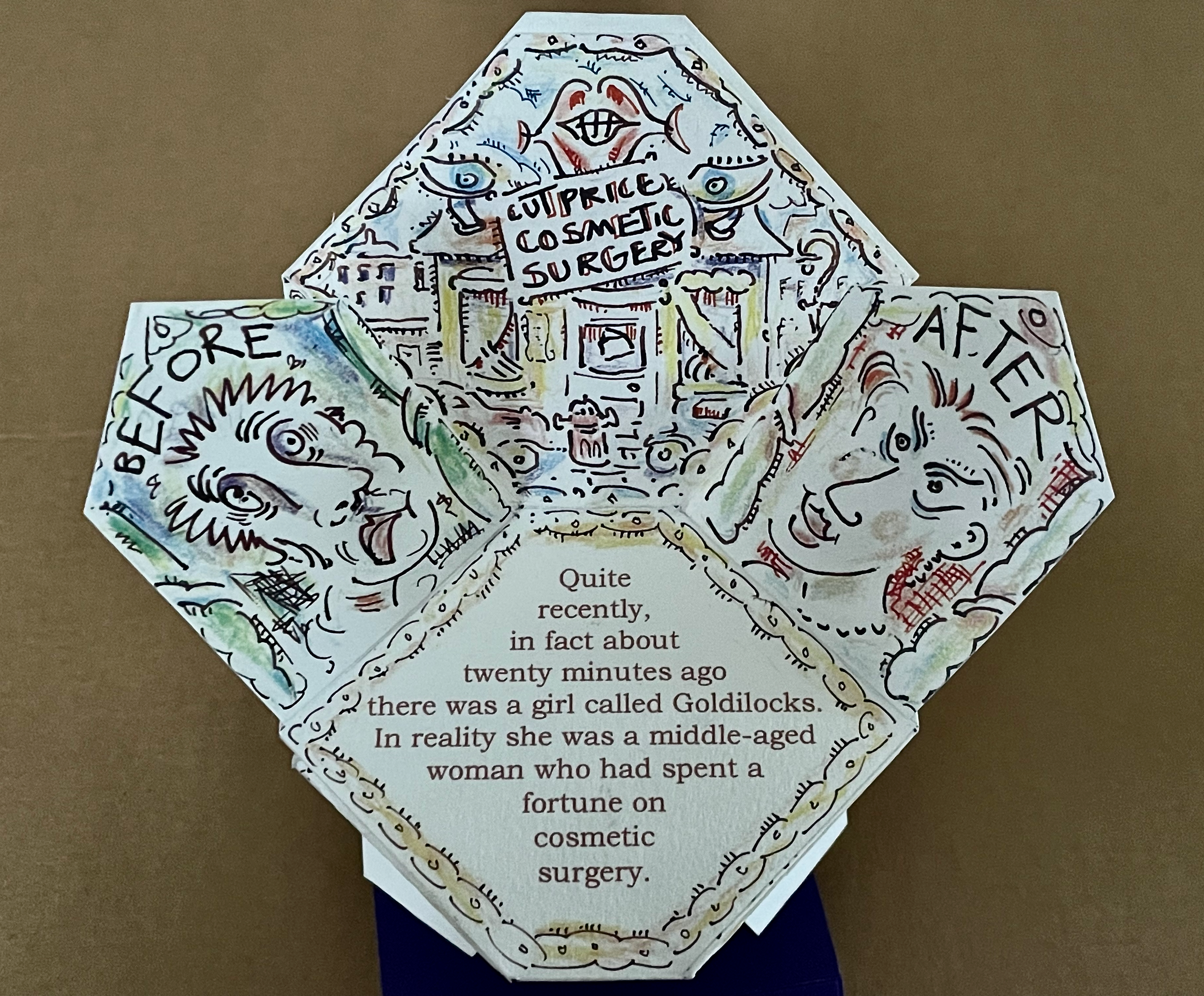
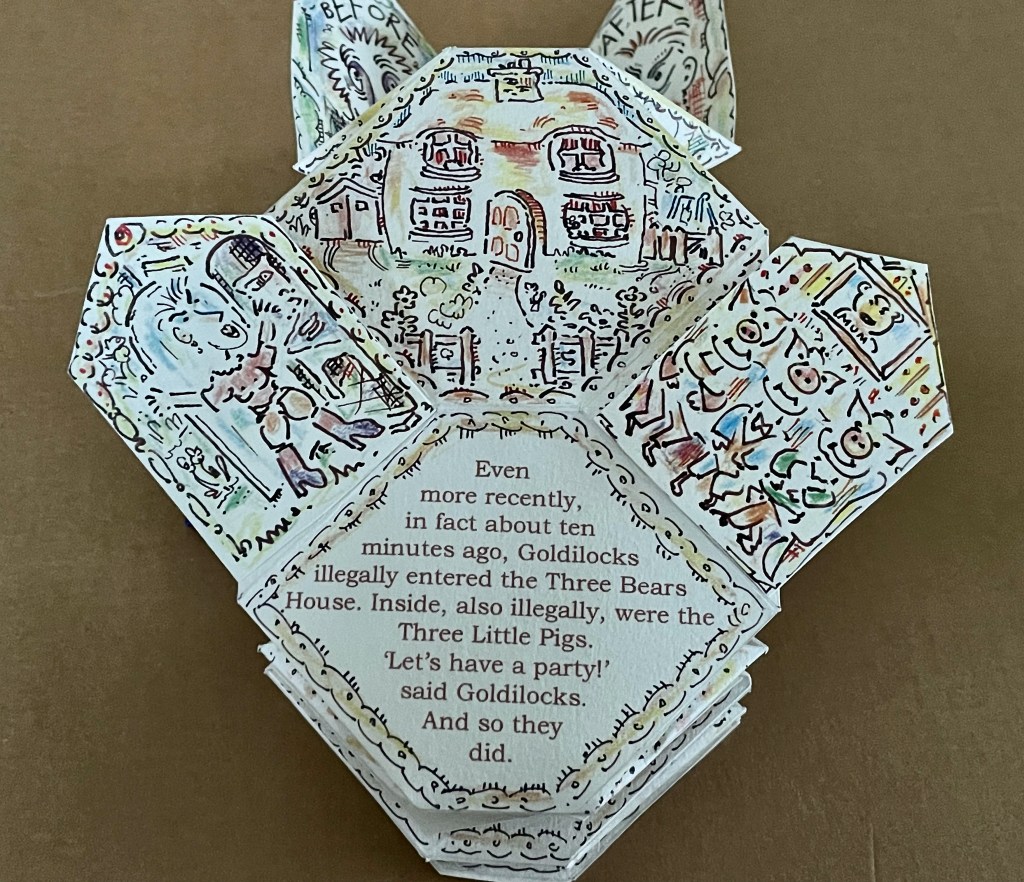
Hijacking Goldilocks from her traditional story and the Three Little Pigs from theirs leads Johnson’s imagination in a more acerbic direction than in his other limited editions. His softer whimsy still comes through in his changing the usual time frame of “Once upon a time” to “Quite recently, in fact twenty minutes ago”, appropriate enough for the pace of modern life as is his giving the pop-up the shape of a make-up compact.
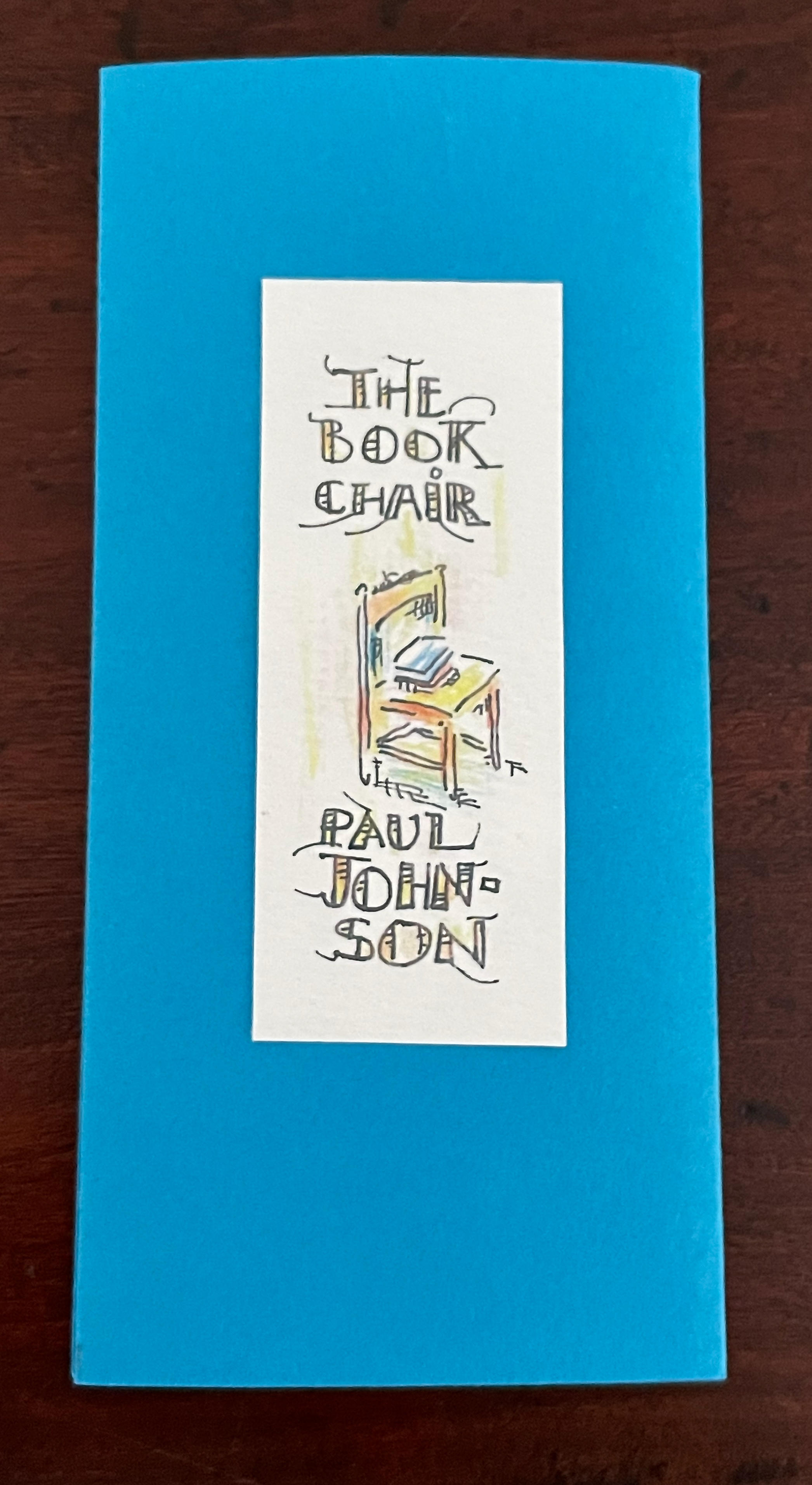
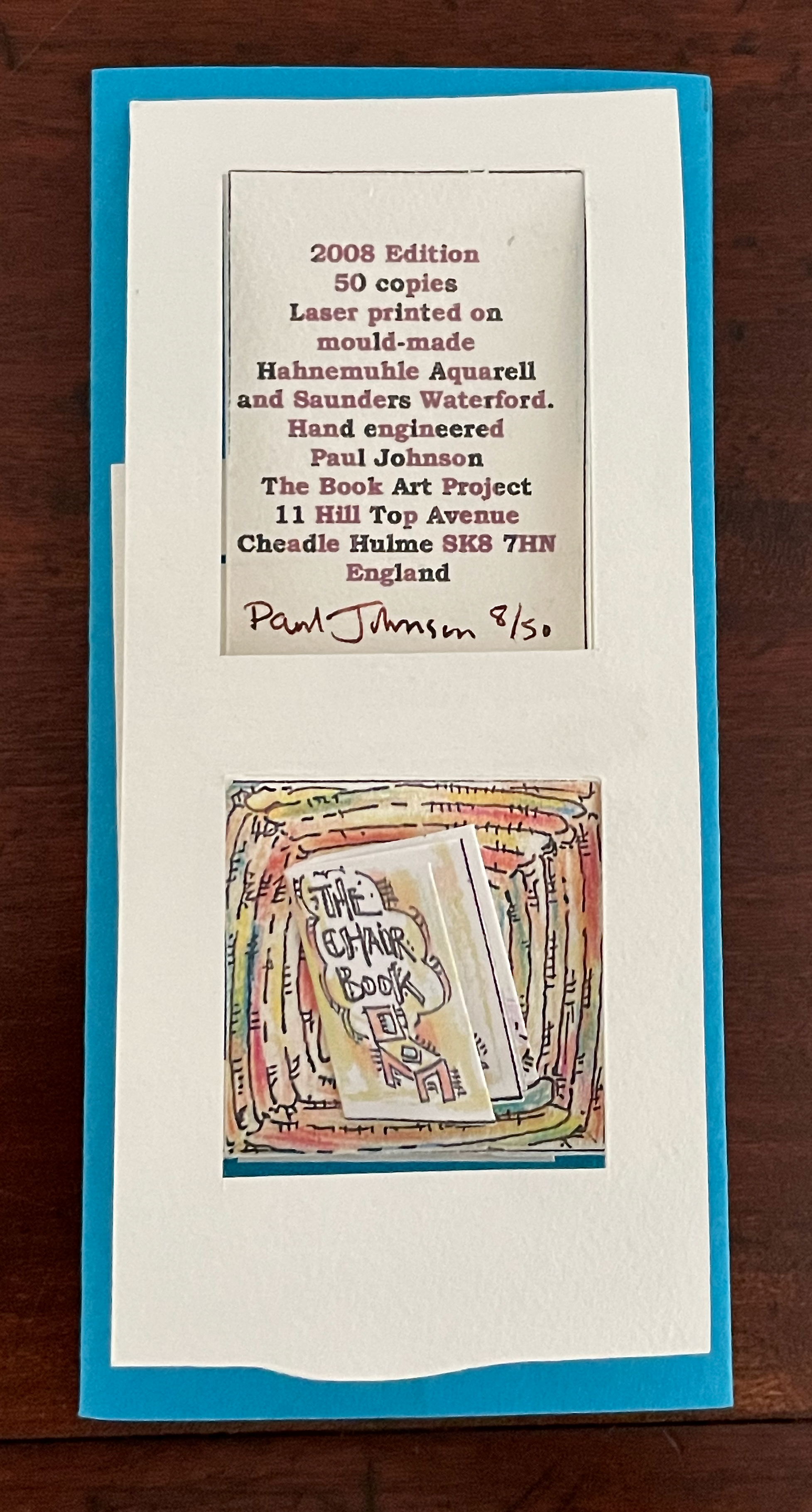
The Book Chair (2008)
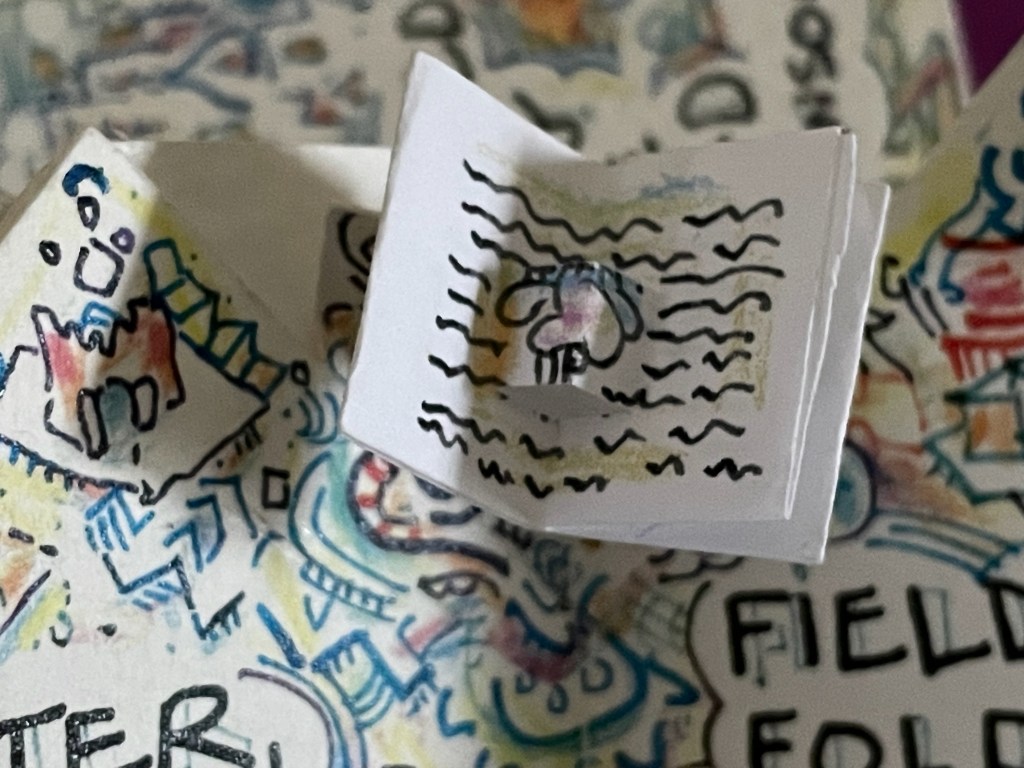
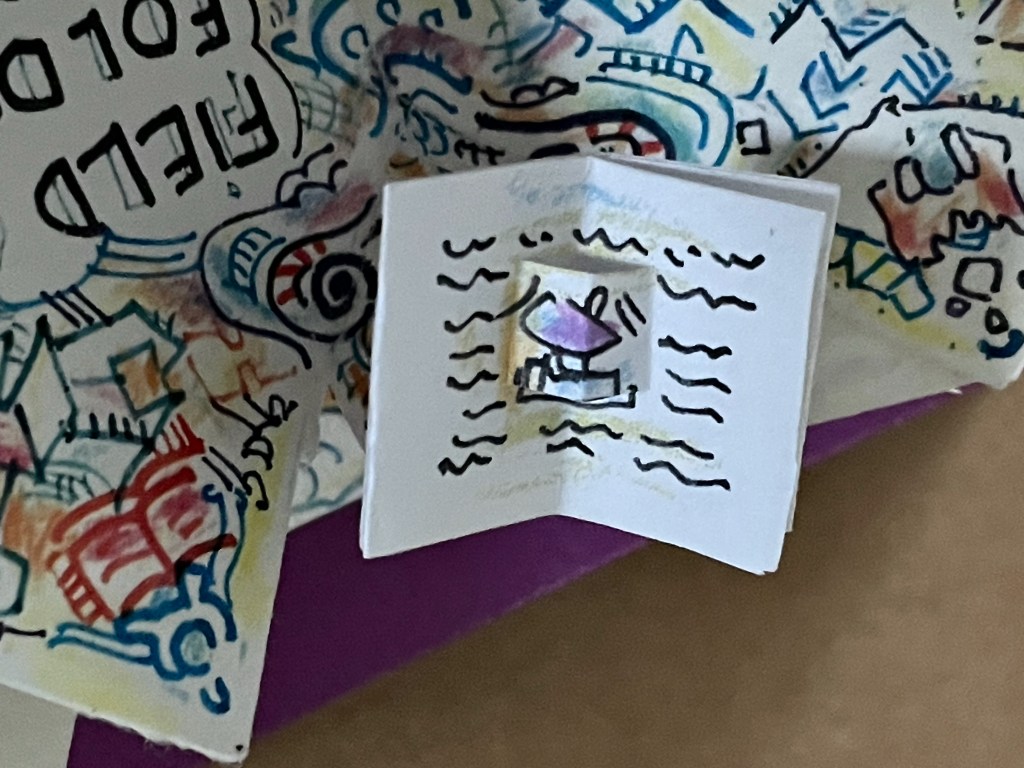
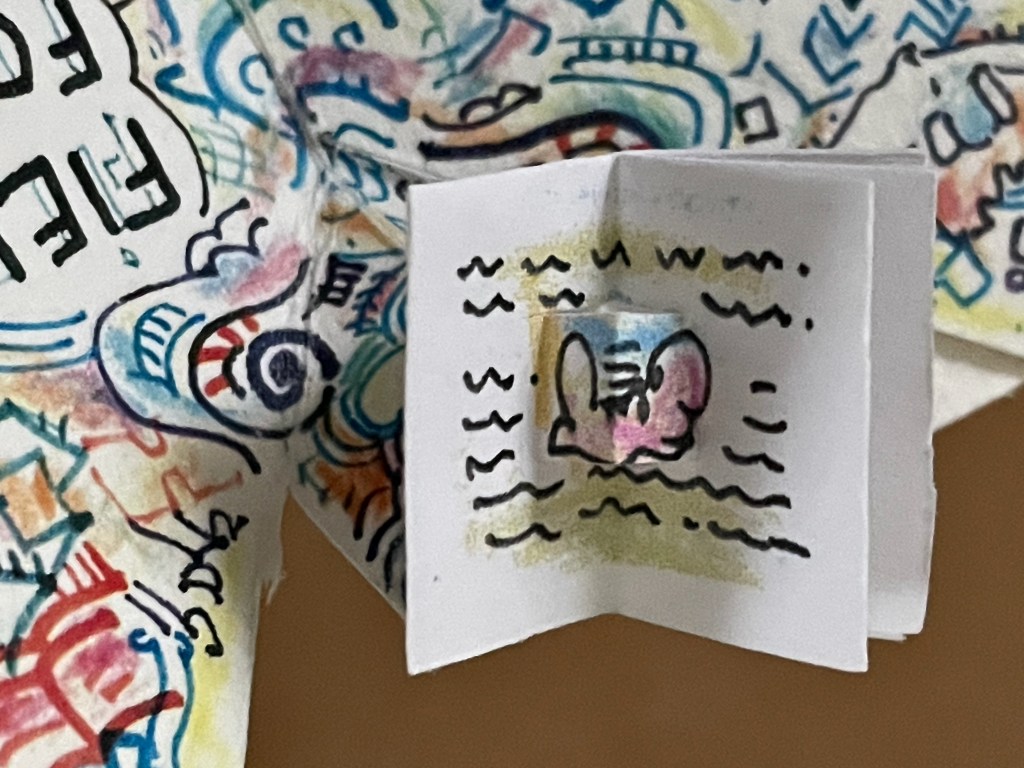
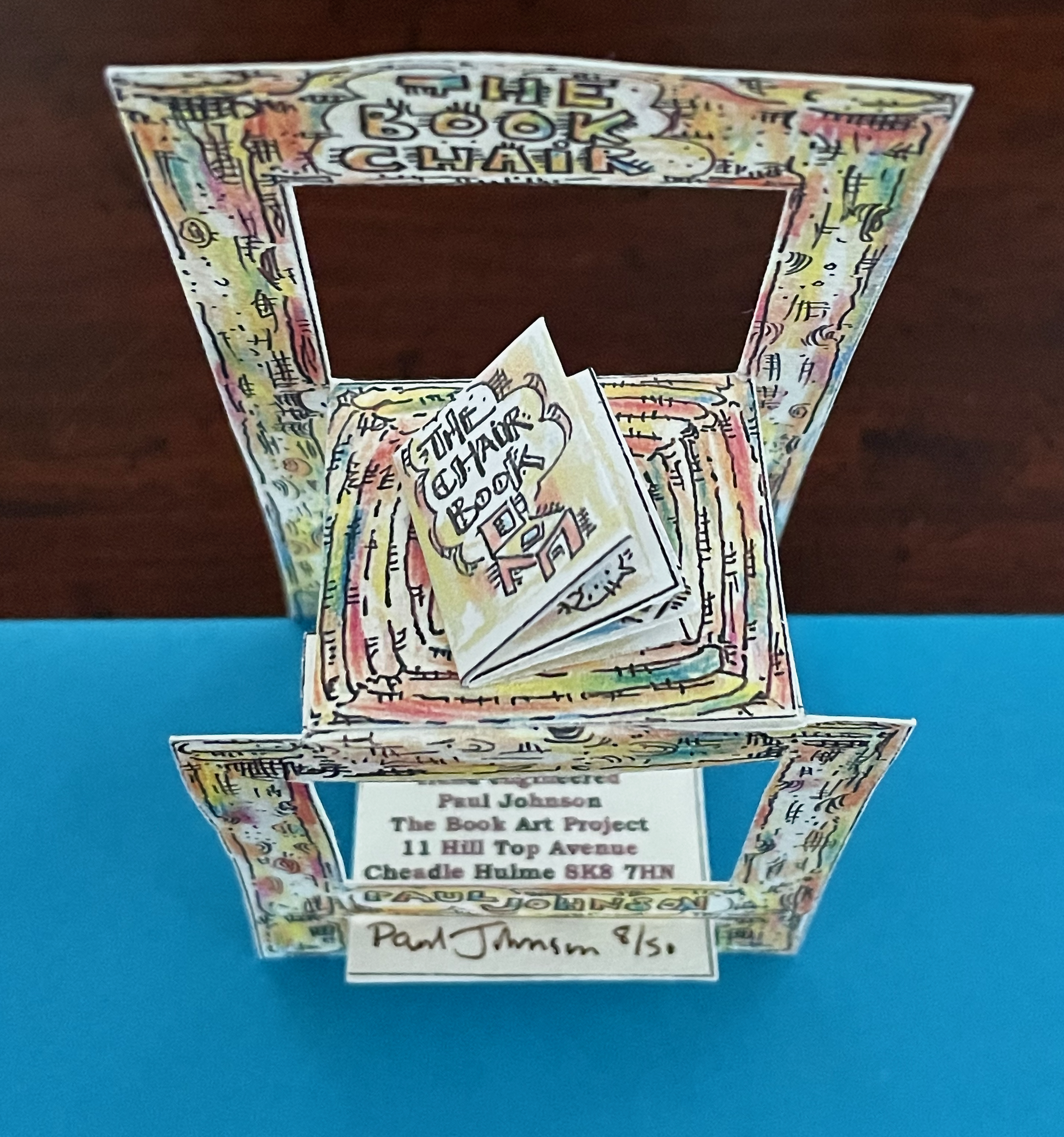
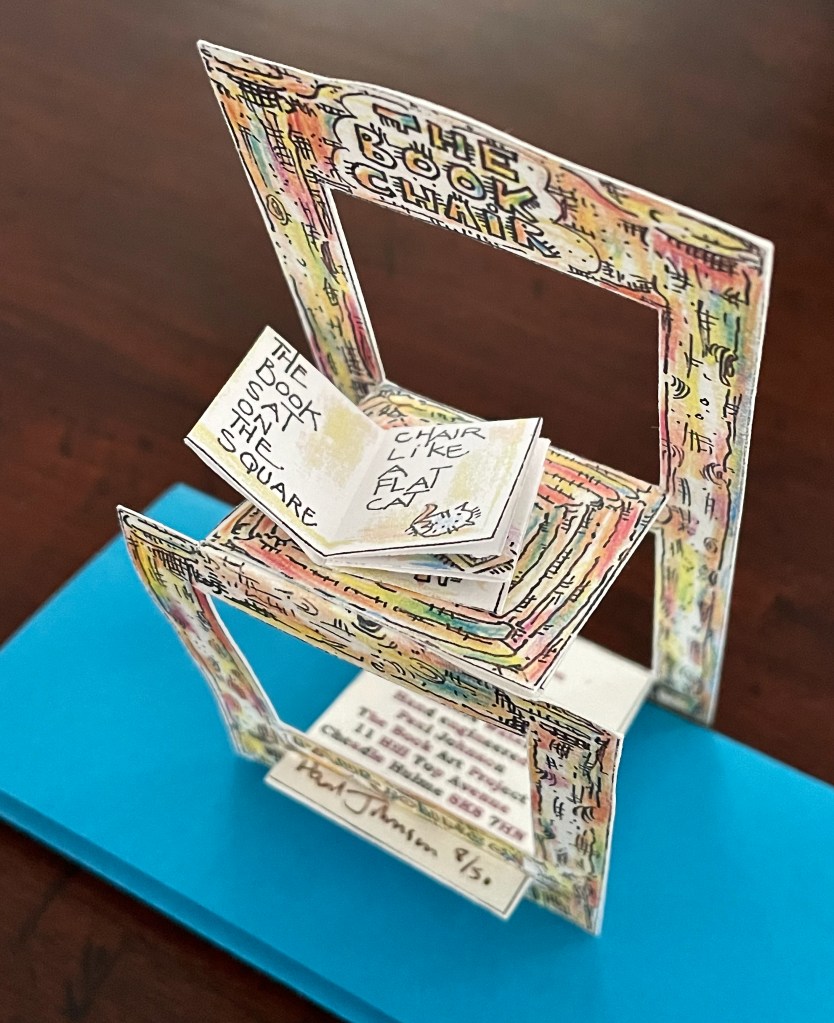
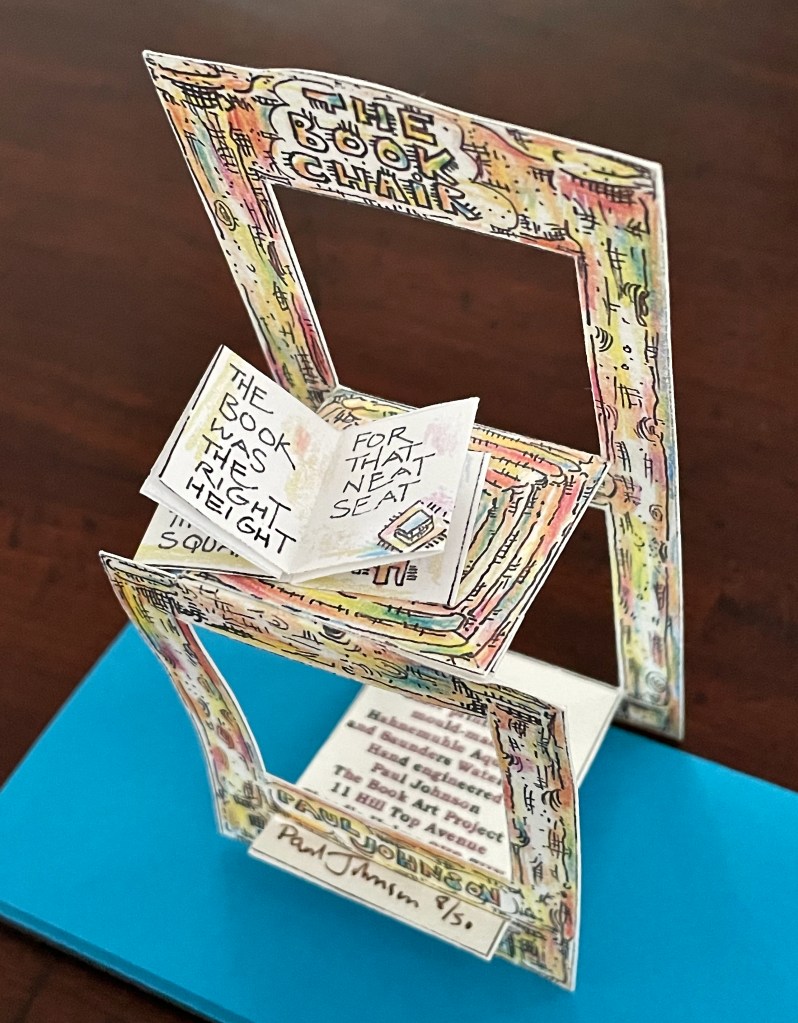
The Book Chair (2008) Paul Johnson Blue fold-around slip with illustrated label. A pop-up chair with an origami book on the seat. H136 x W62 x D47 mm. Edition of 50 copies , of which this is #8. Acquired from Collinge & Clark, 17 July 2025. Photos: Books On Books Collection.
The Book Chair repeats the book-within-a-book gambit from The Pop-up Unabridged History of the World. This time the miniature within the miniature, however, treats us to full text that delivers reflection on reflection on reflection. Is the chair the book’s chair, or is the book the chair’s book?
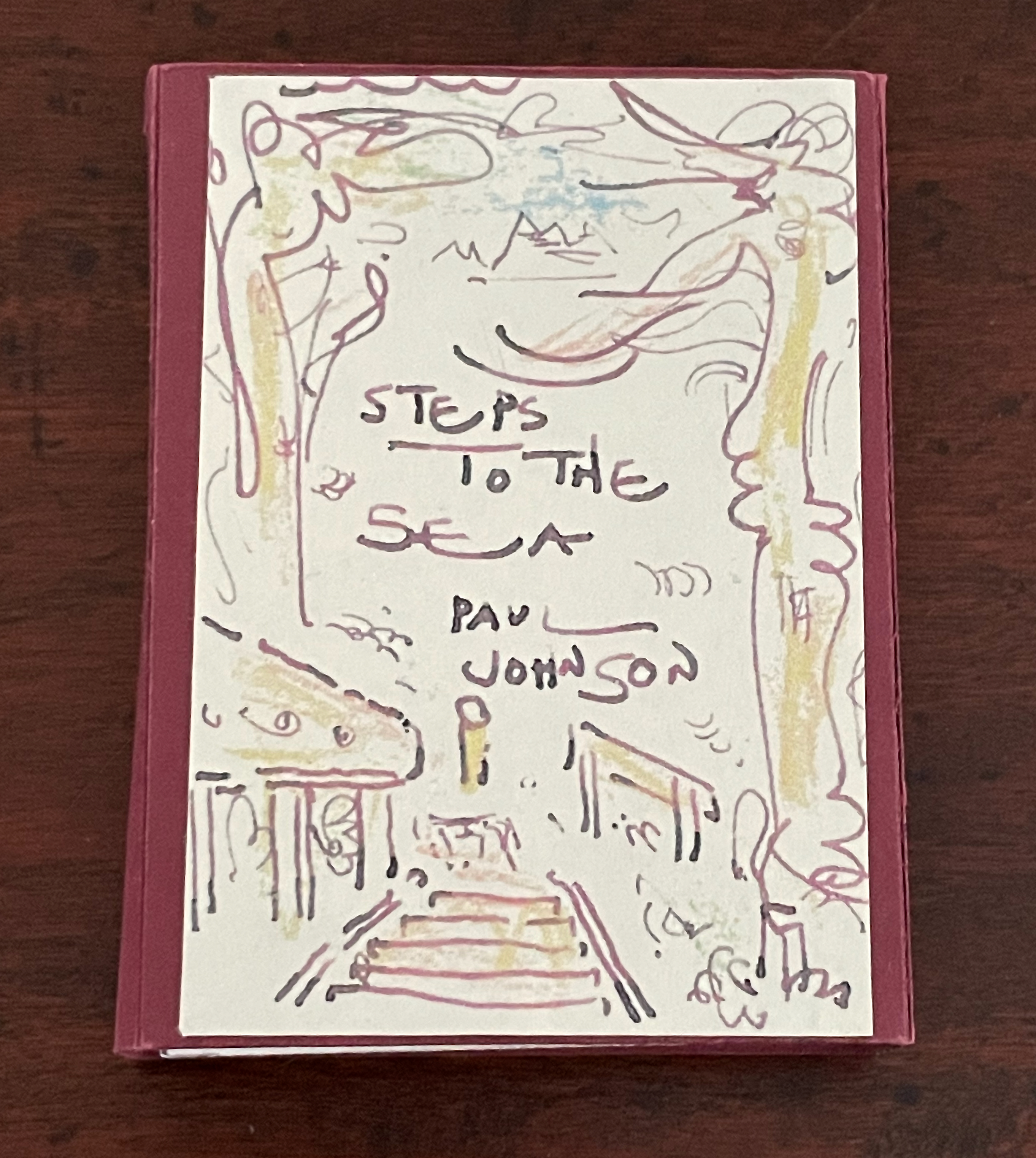
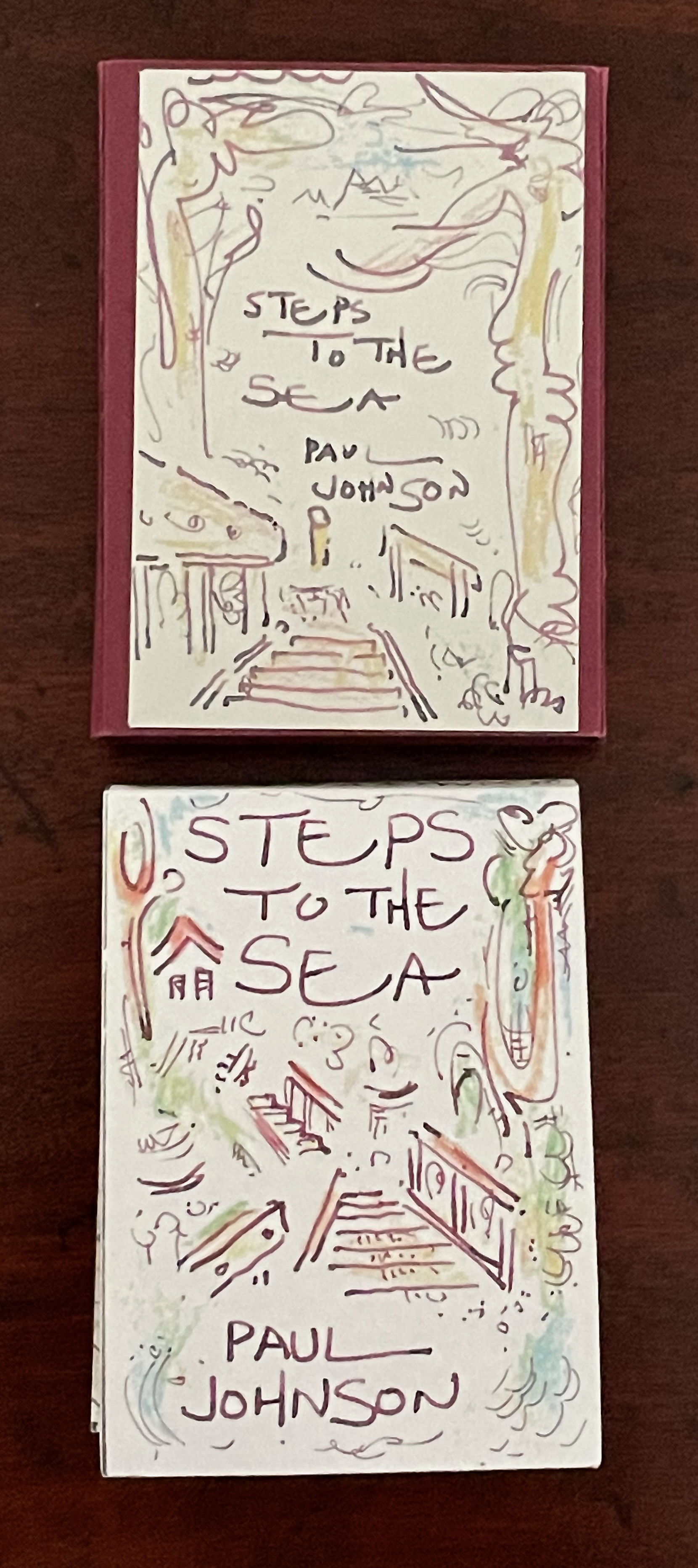
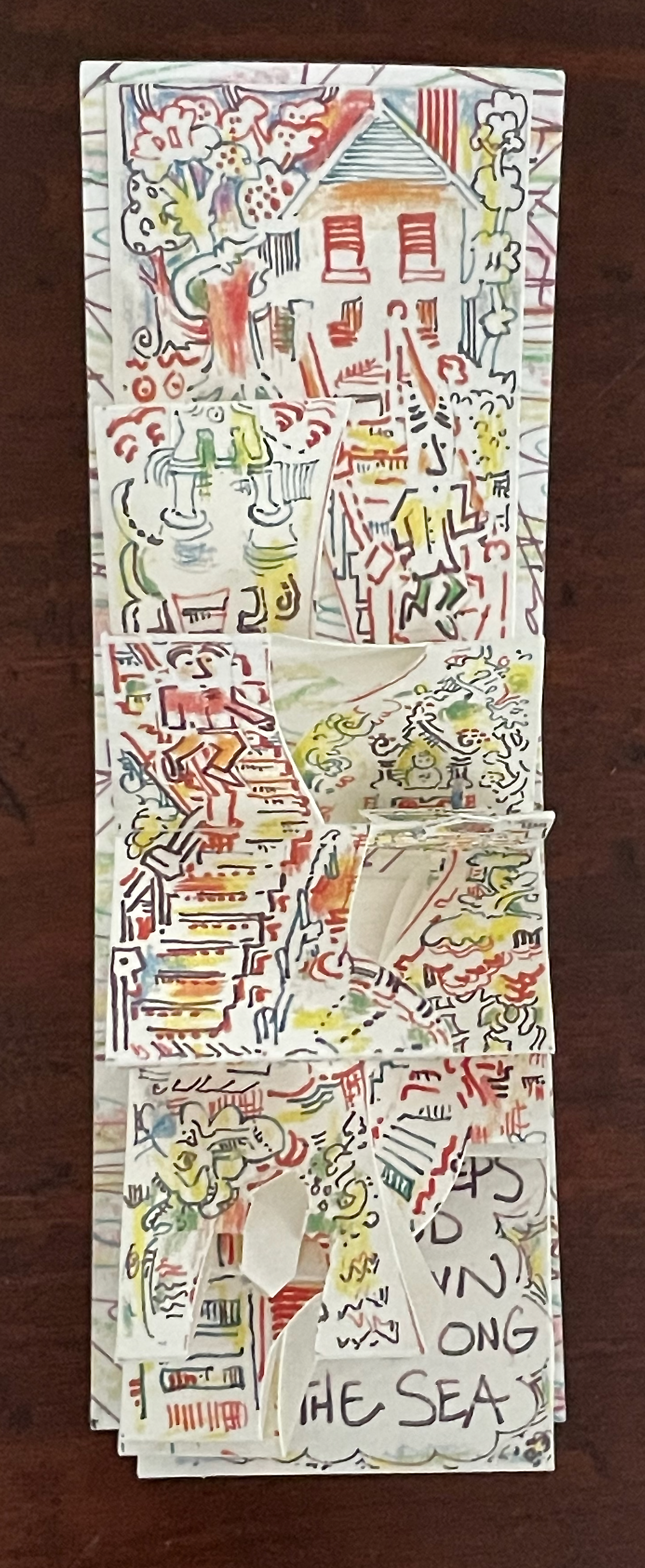
Steps to the Sea (2008)
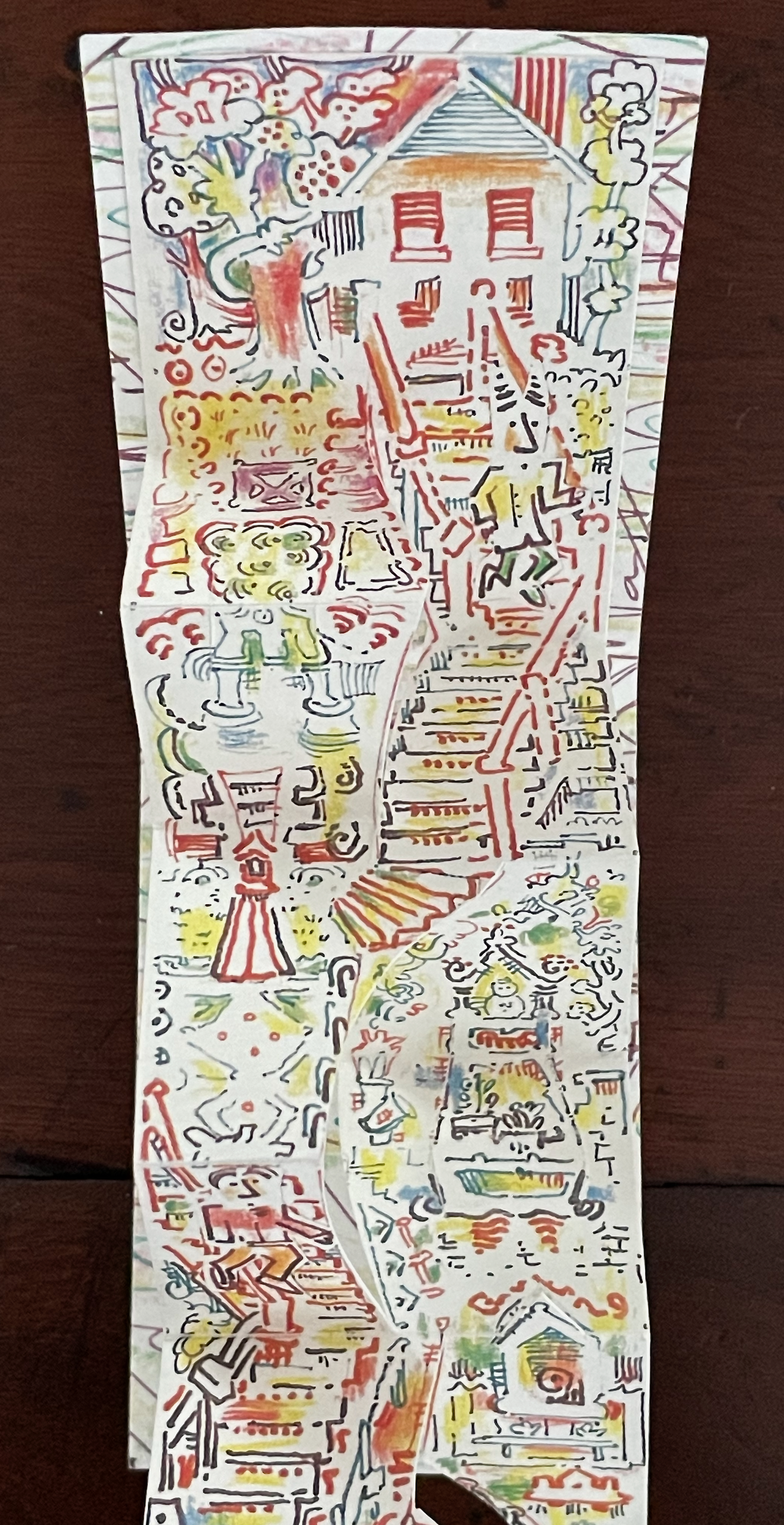
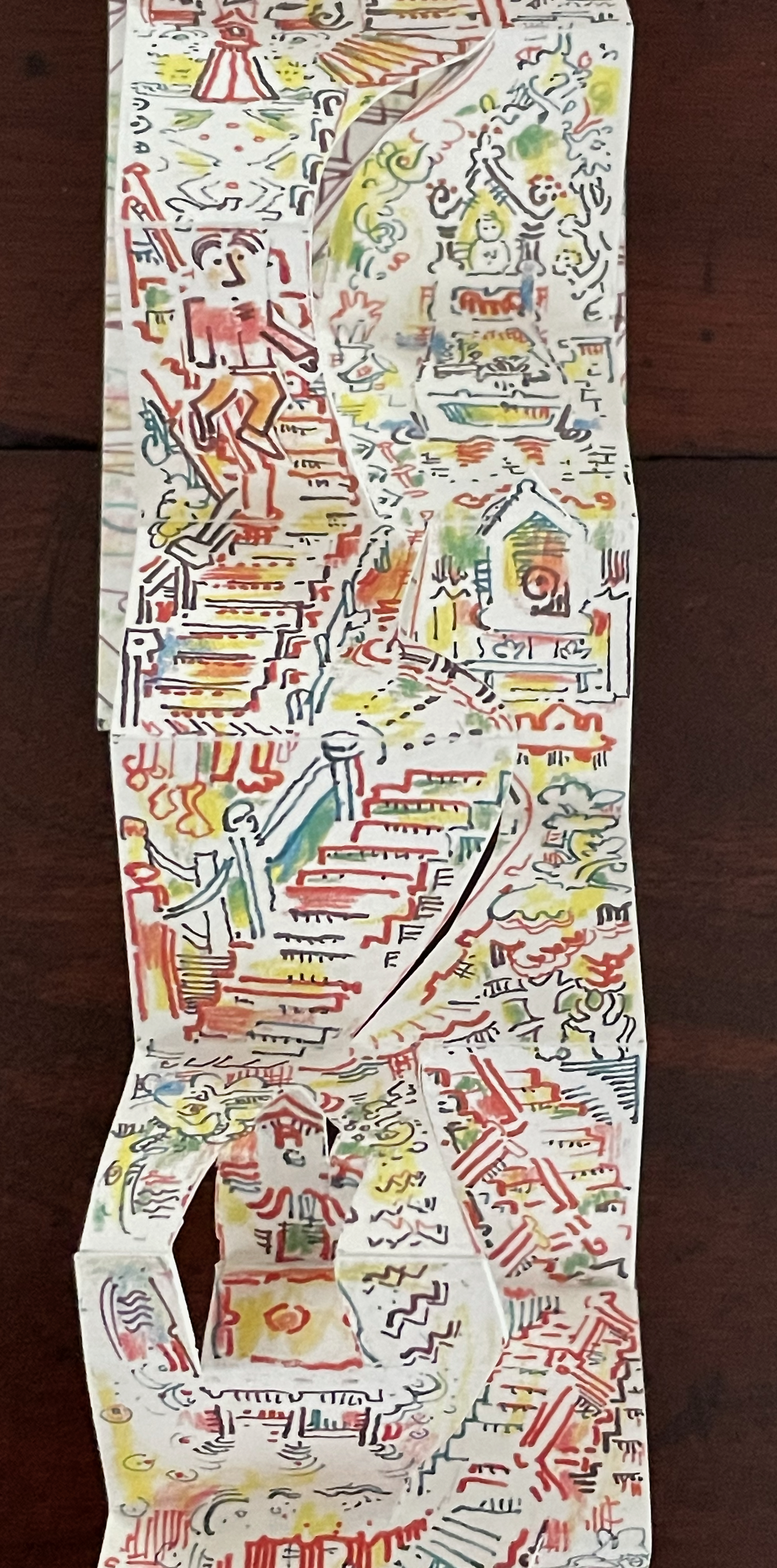
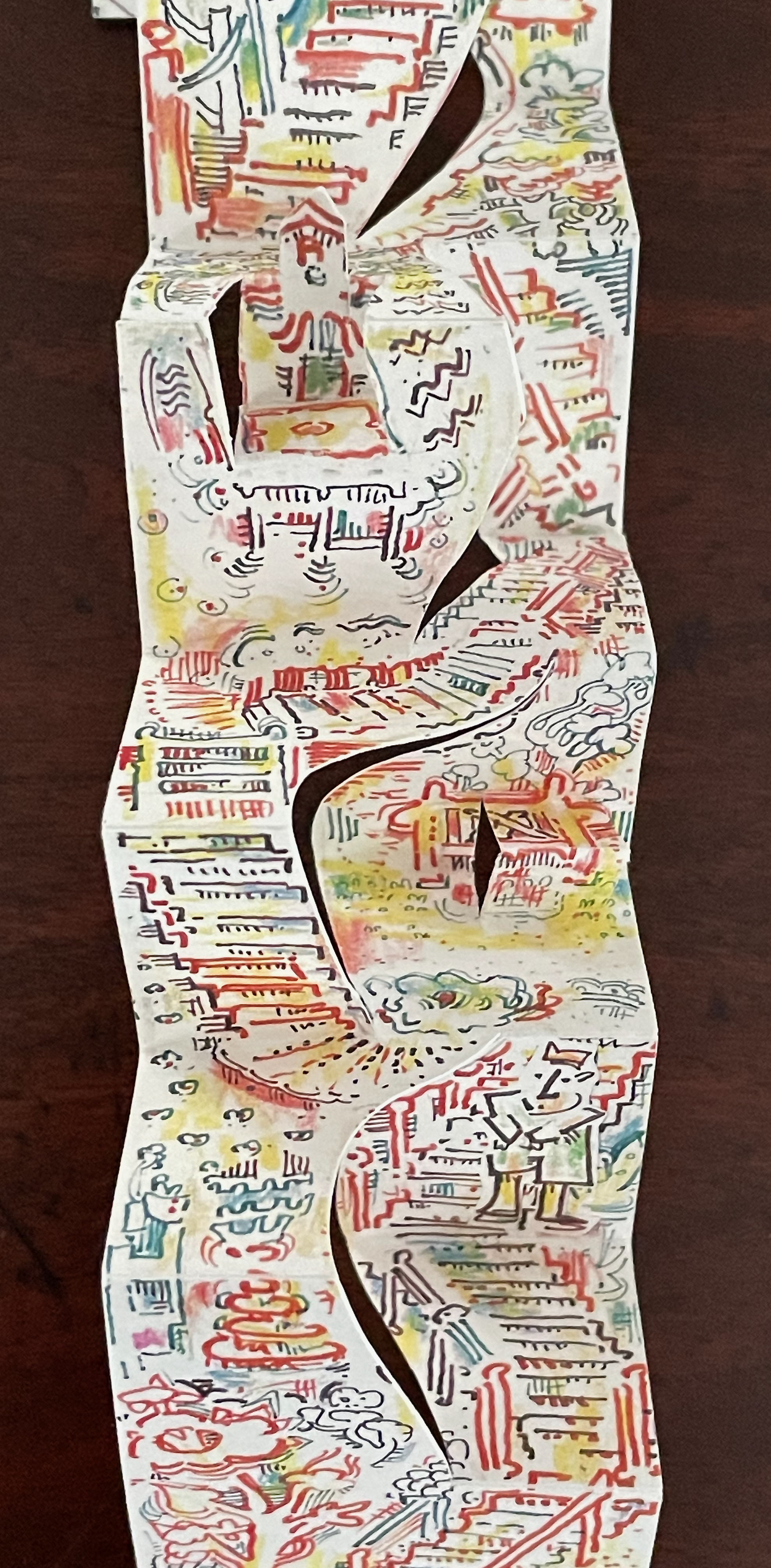
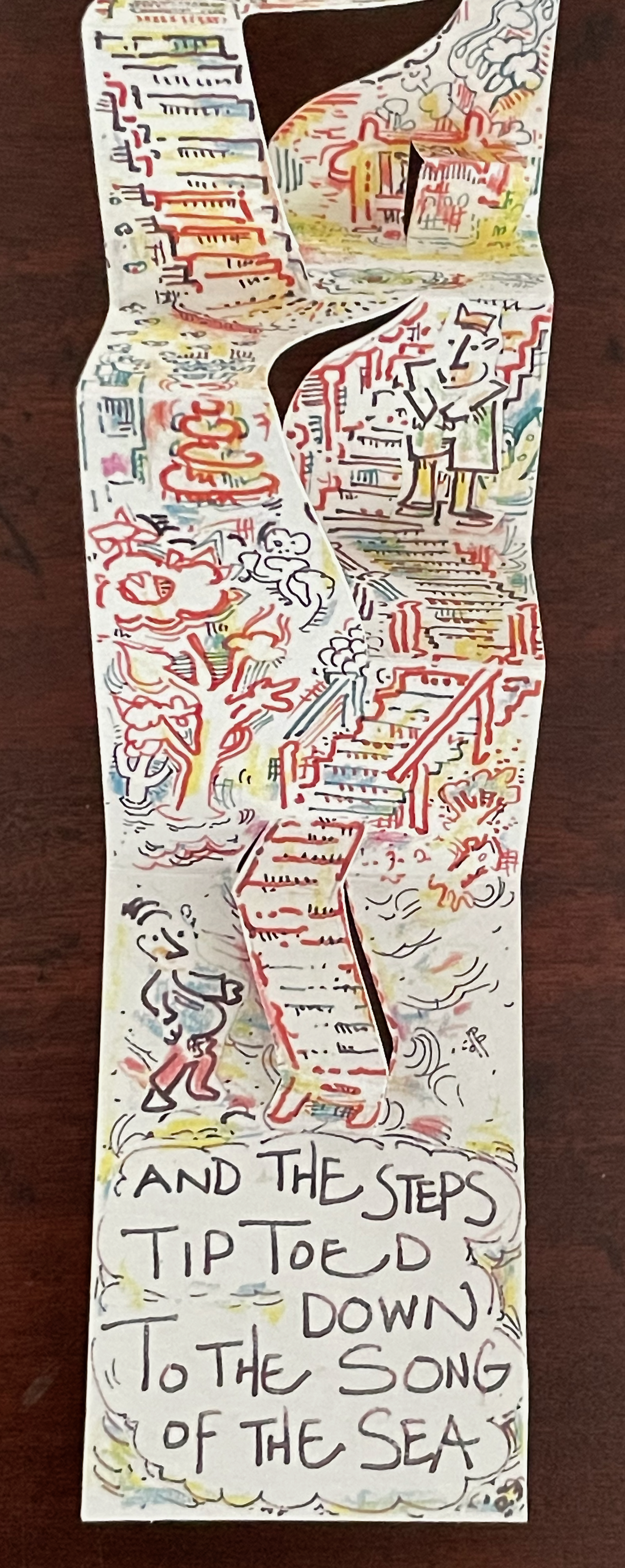
Steps to the Sea (2008) Paul Johnson Purple slipcase. A pop-out staircase attached to covering card. Slipcase: H76 x W57 x D18 mm. Card and pop-out: H75 x W59 x D12 mm (closed), H variable to 550 mm. Open edition. Acquired from Collinge & Clark 17 July 2025. Photos: Books On Books Collection.
Steps to the Sea may be based on a garden in Seattle, but if you have ever visited San Francisco and descended Lombard Street or the Filbert Steps, Johnson’s vertical pop-up will recall your vertigo for you.
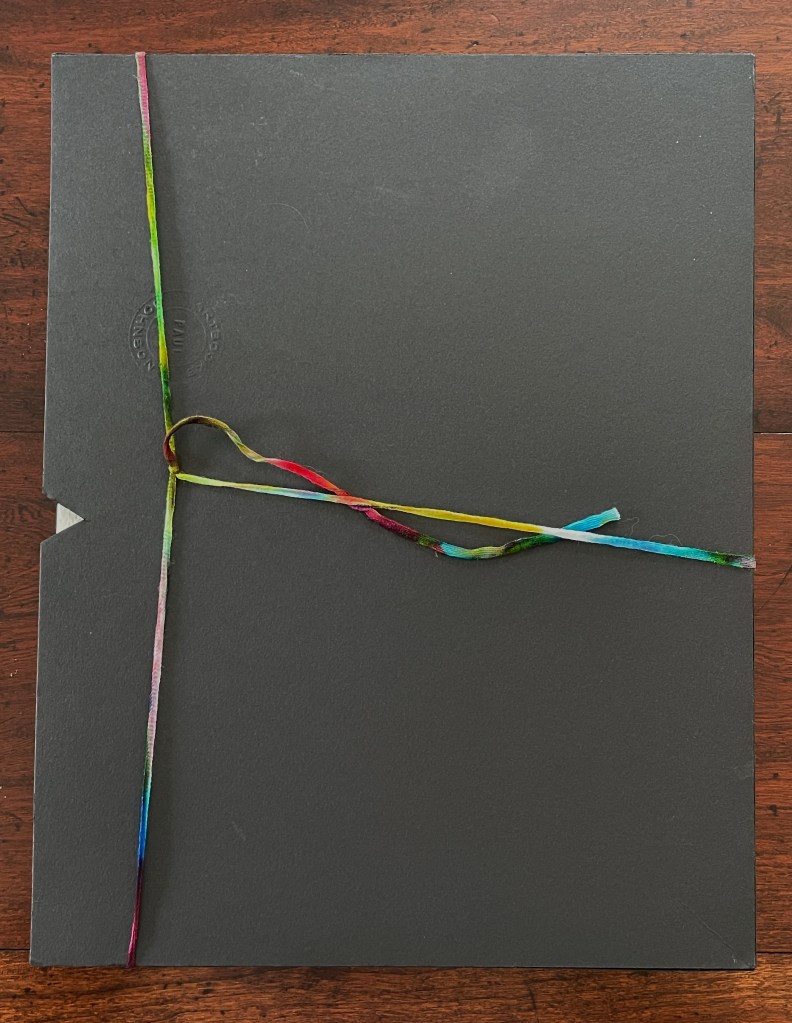
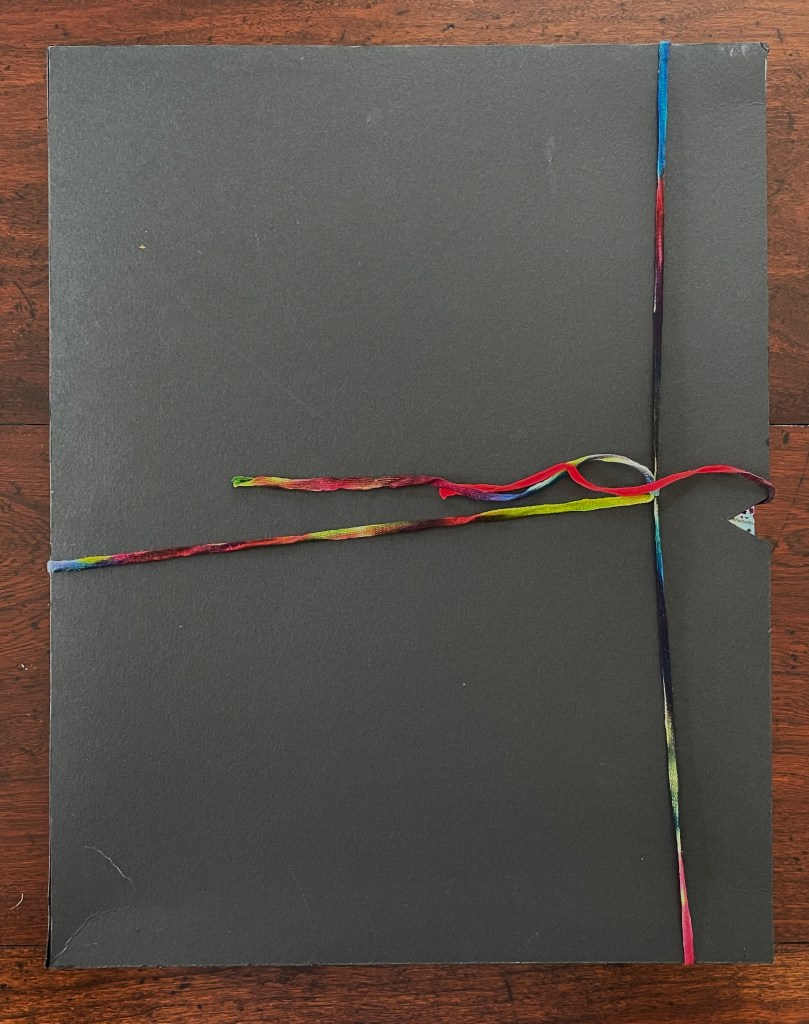
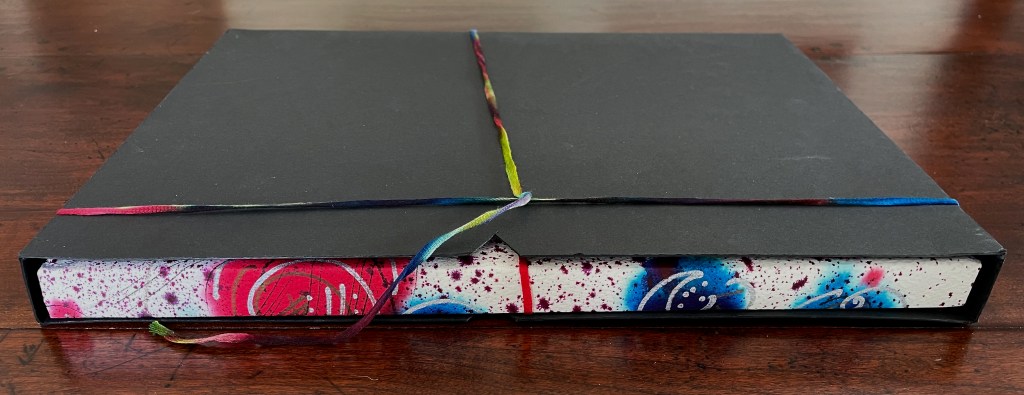
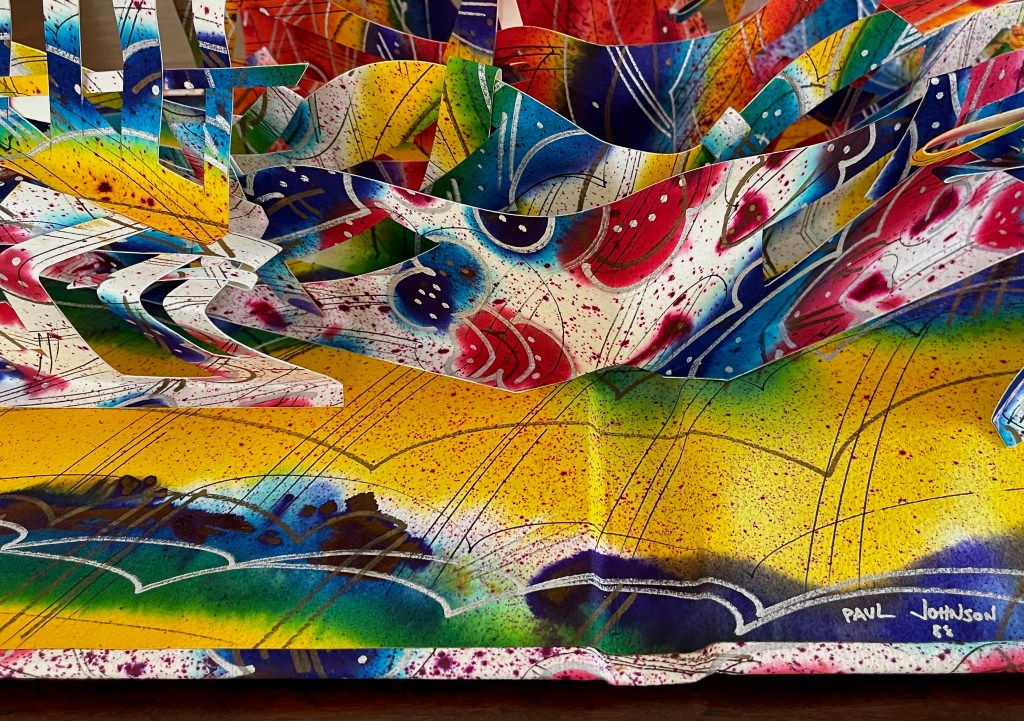
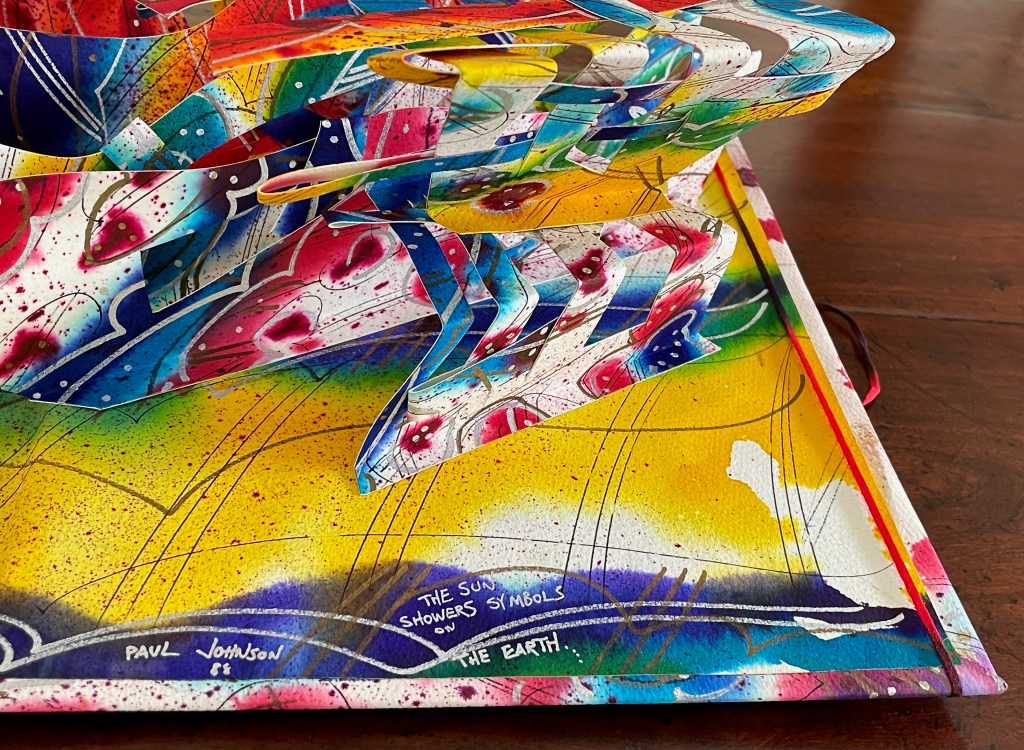
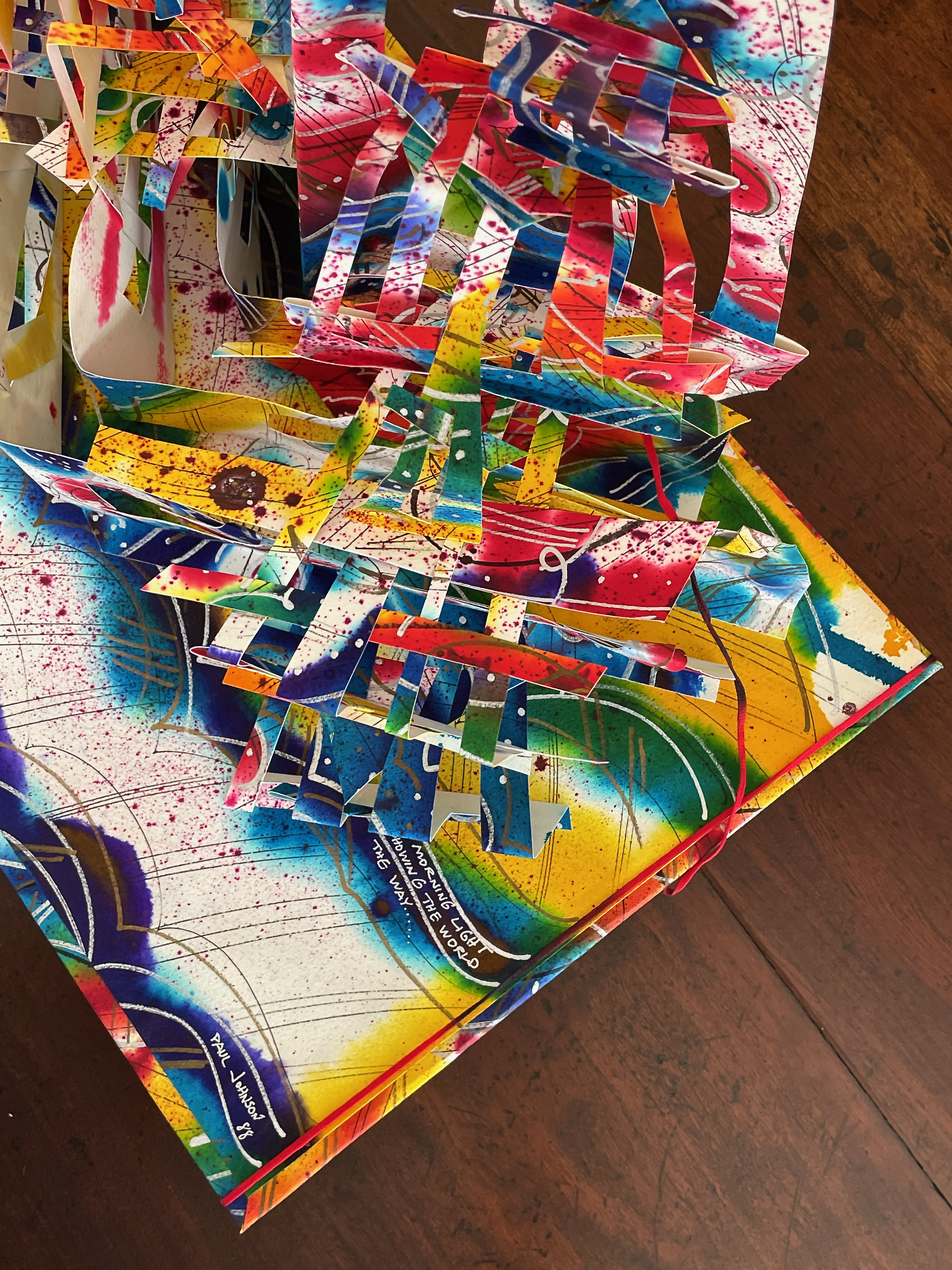
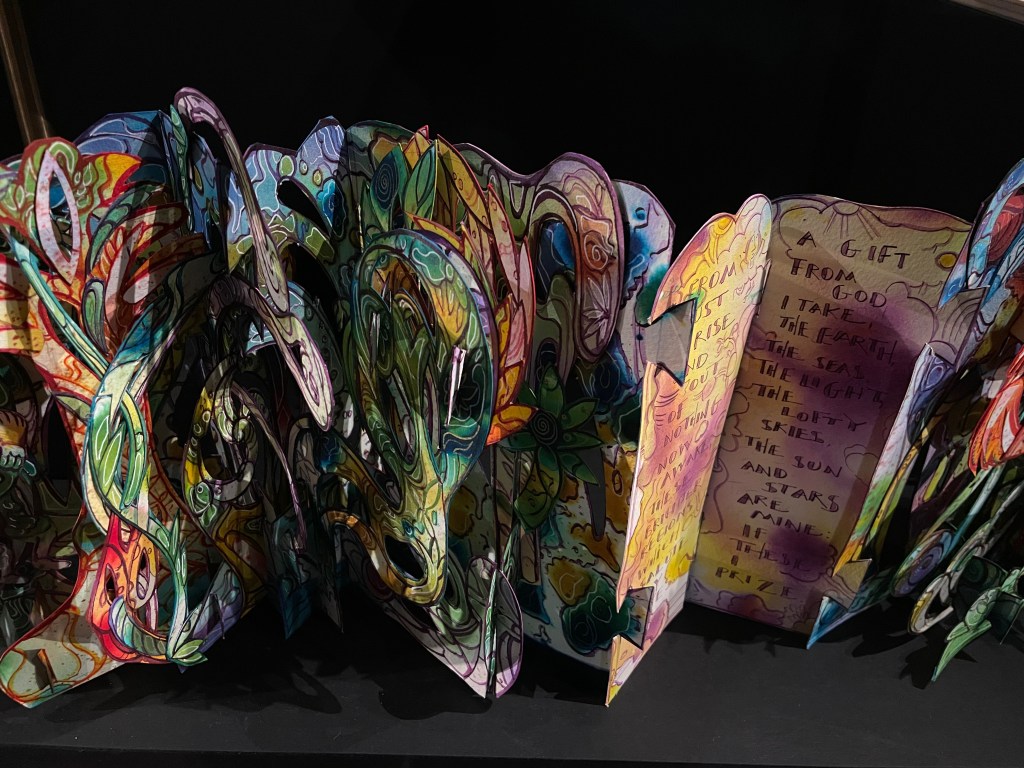
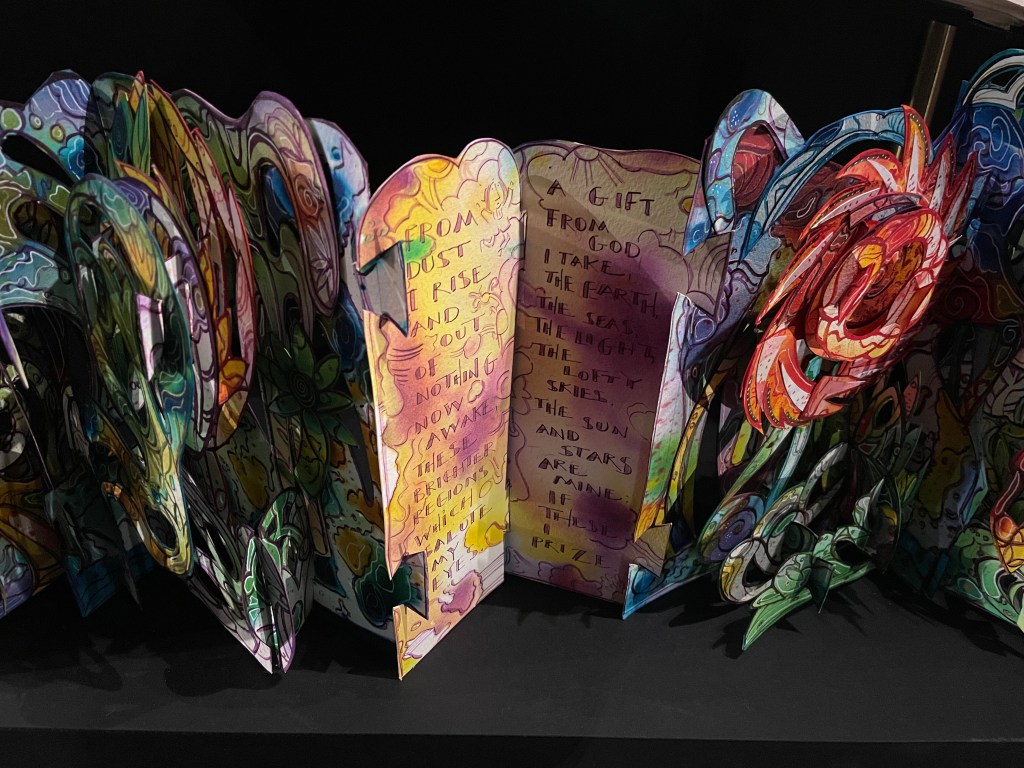
Wrapped in multicolored ribbon, the next two works in the collection — The Sun ShowersSymbols on the Earth and Morning LightShowing the World the Way — arrive like gifts.
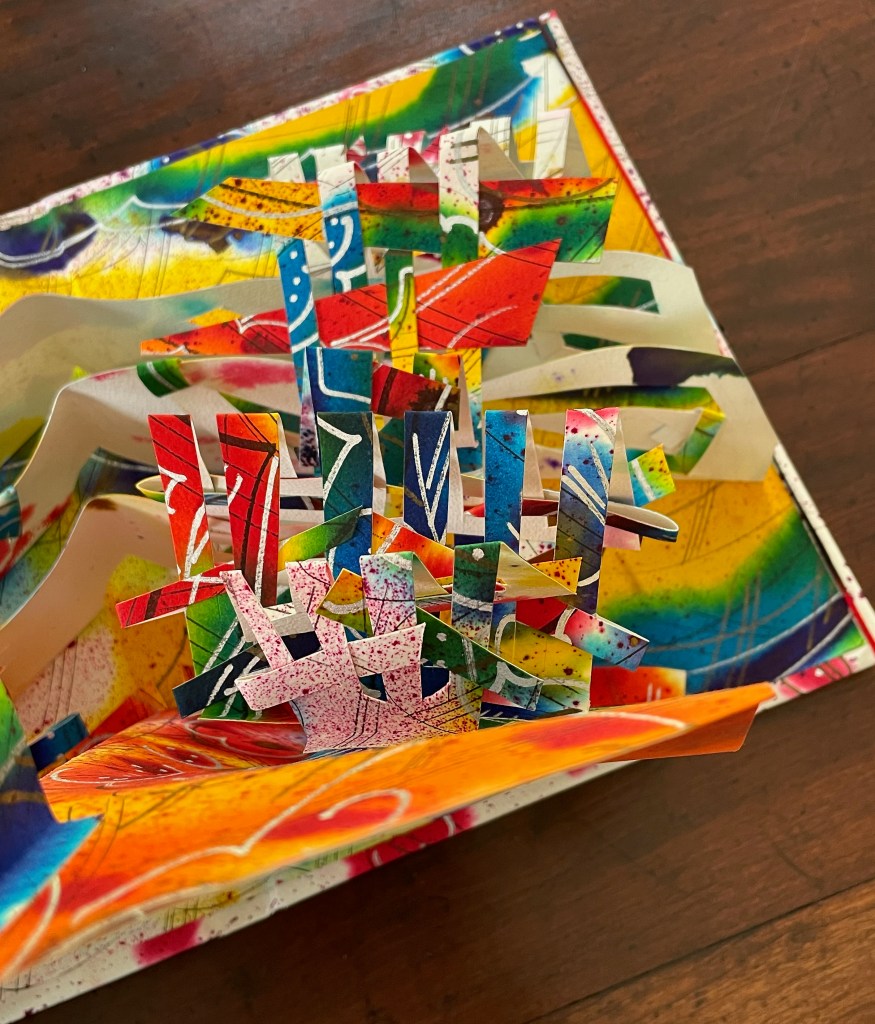
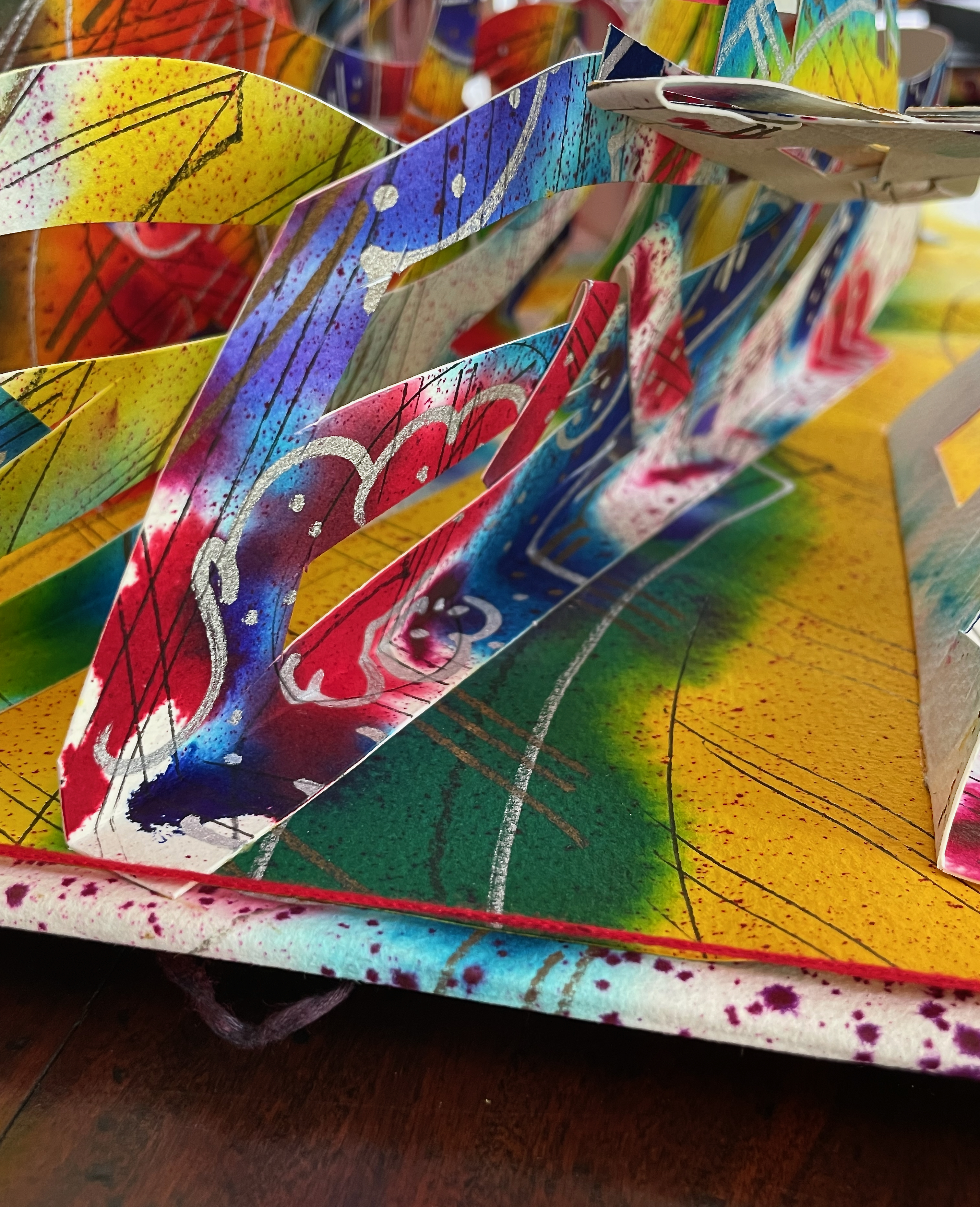
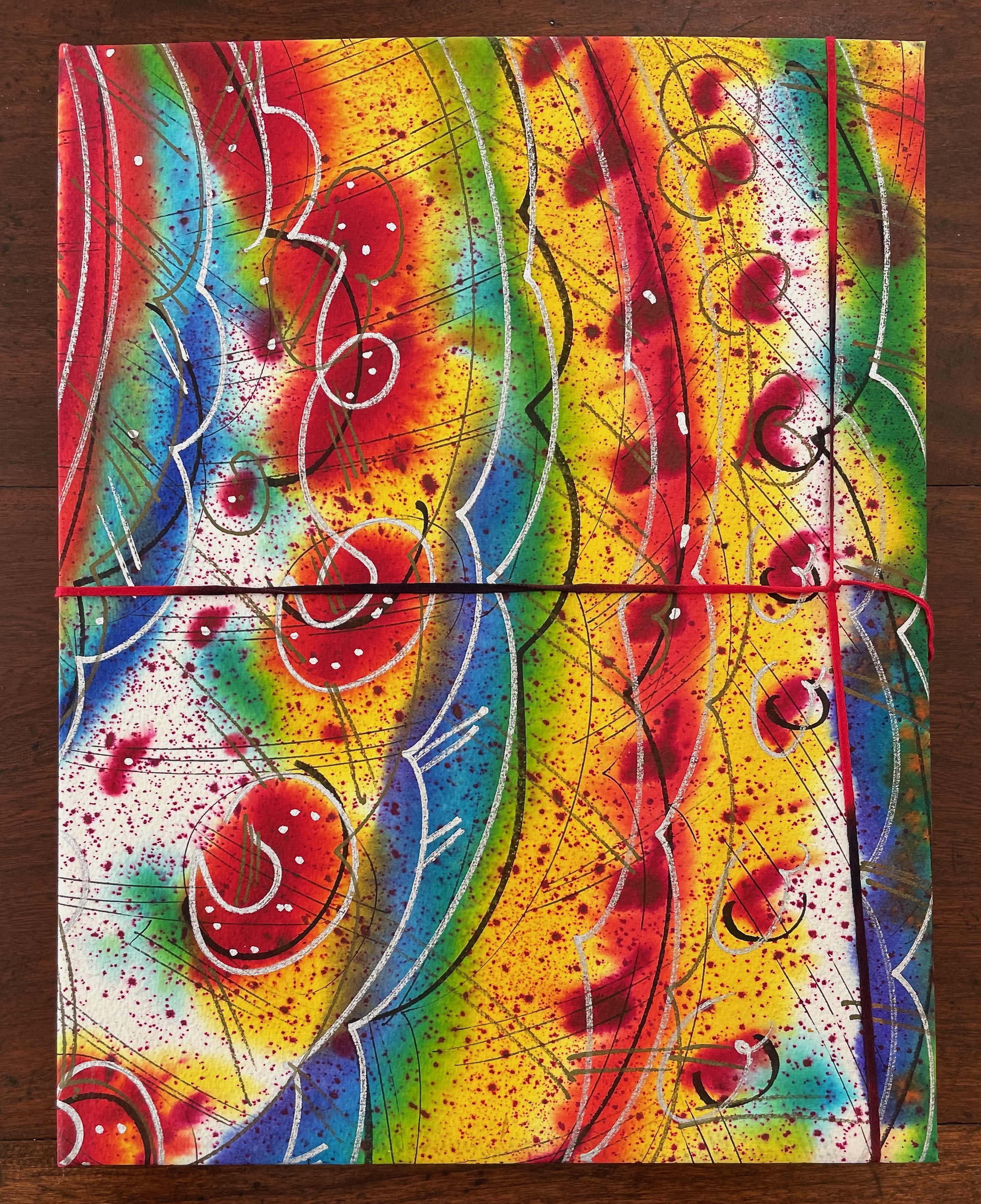
The Sun Showers Symbols on the Earth (1988)
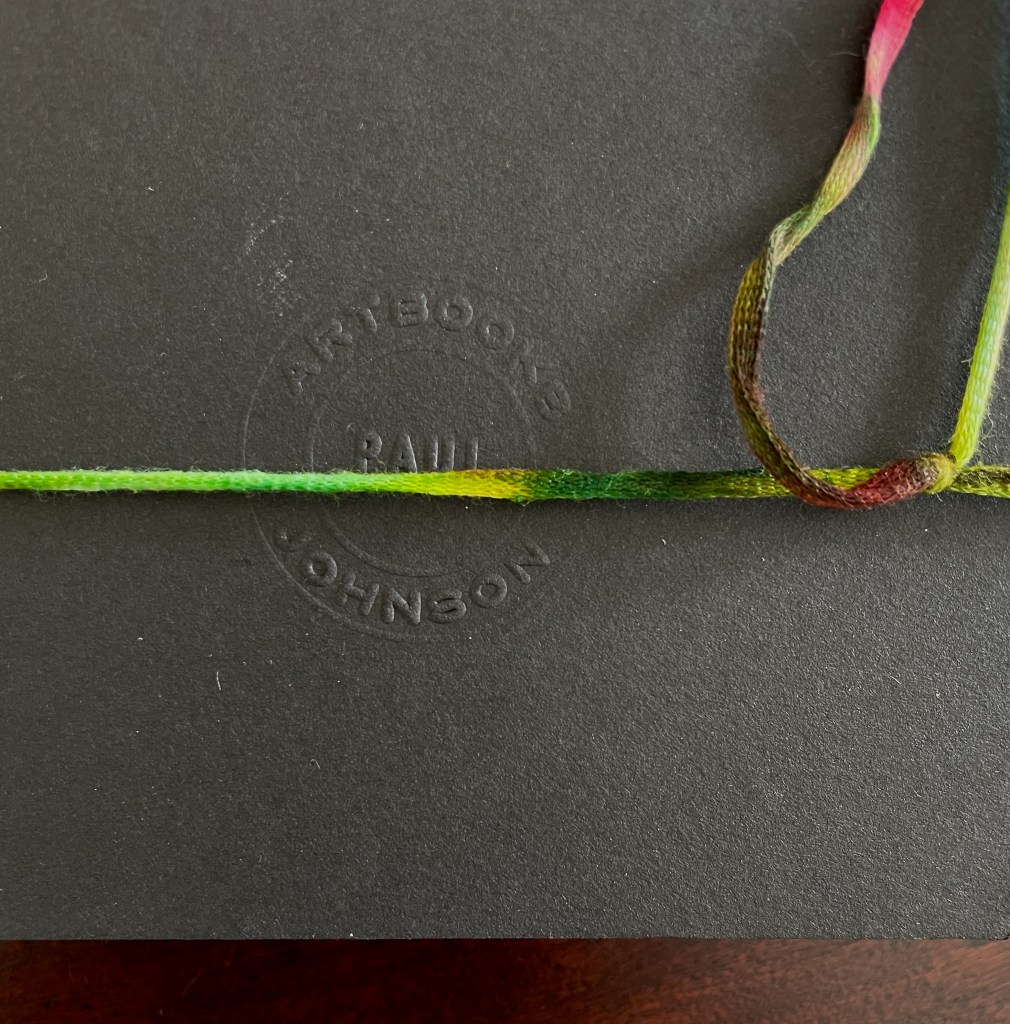
The Sun Showers Symbols on the Earth(1988) Paul Johnson Notched slipcase with multicolor inked ribbons. Single sculpture pop-up book. Slipcase: H330 x W256 x D28 mm. Book: H319 x W249 x D25 mm (closed); W515 x D340 mm (open). Unique. Acquired from Potter & Potter Auctions, 9 Jul 2026. Photos: Books On Books Collection.
Compared with the later works above, The Sun Showers Symbols on the Earth is brighter and more abstract. Still later works, though, such as Serenade to Chaucer (2018), an abridgement of “The Miller’s Tale”, and Dies Natalis (2023), inspired by a cantata for voice and strings composed by Gerald Finzi (1901-56), inspired in turn by several poems by Thomas Traherne (1636-74), deploy colors just as bright. Both of those later works are considerably larger than the two shown here. The use of industrial fabric dyes seems to correlate with the size of the unique works, whereas watercolor correlates with the smaller limited edition works.
View from left side. View from right side.
View of lower edge.
View of left and right sides from above and behind.
Detail at left edge.
Front and back covers.
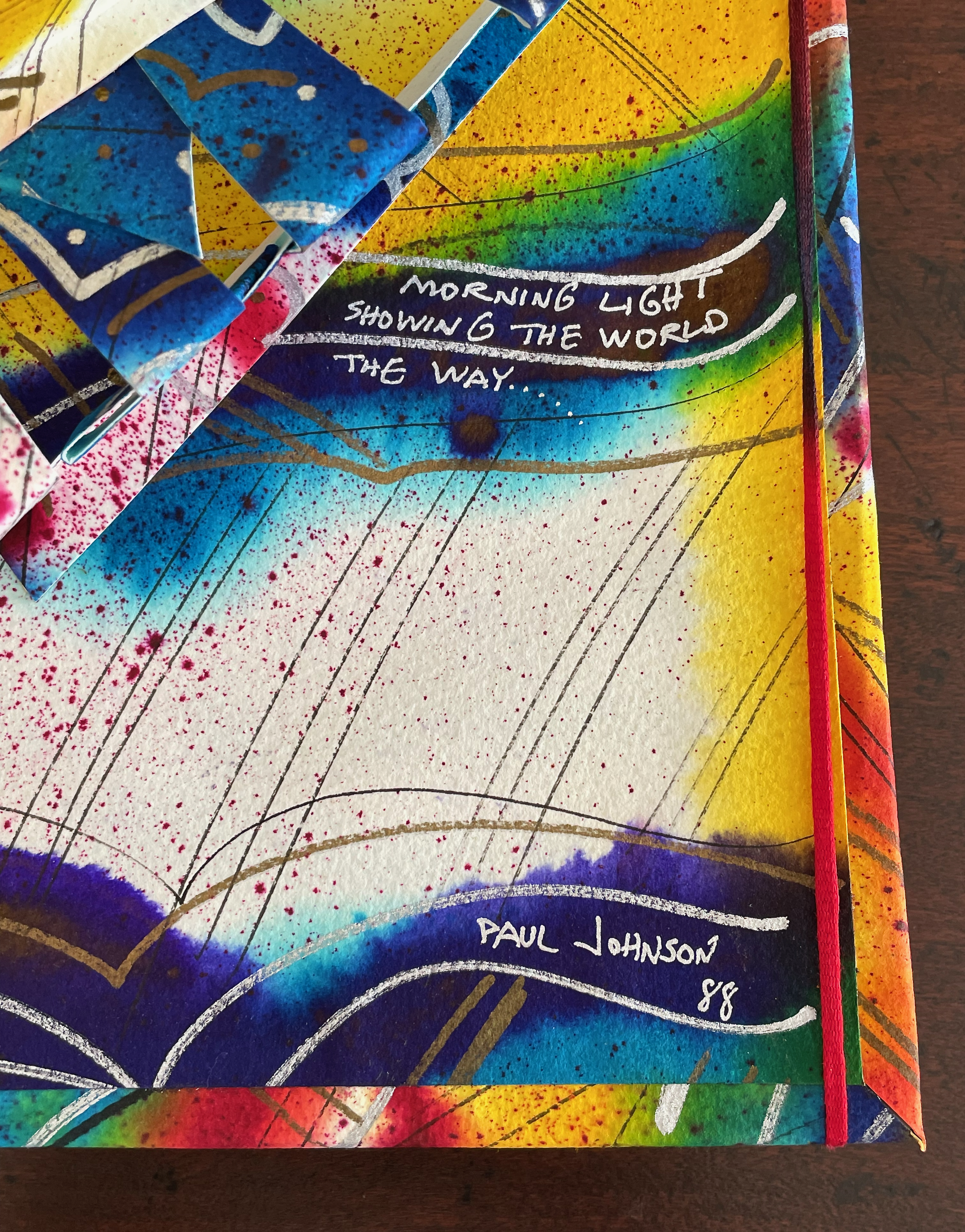
Morning Light Showing the World the Way (1988)
Morning Light Showing the World the Way(1988) Paul Johnson Notched slipcase with multicolor inked ribbons. Single sculpture pop-up book. Slipcase: H330 x W256 x D28 mm. Book: H319 x W250 x D25 mm (closed); W515 x D340 mm (open). Unique. Acquired from Potter & Potter Auctions, 9 Jul 2026. Photos: Books On Books Collection.
Johnson’s website refers to the stained glass windows of Norwich, where he grew up, as an influence on his work. In their titles, colors, and construction, The Sun Showers Symbols on the Earth and Morning Light Showing the World the Way fully bear this out. Their cascading tiers also bear out another influence: Hokusai (think of The Great Wave of Kanagawa).
View from above and behind.
Left side. Right side.
Detail of lower right.
Front cover.
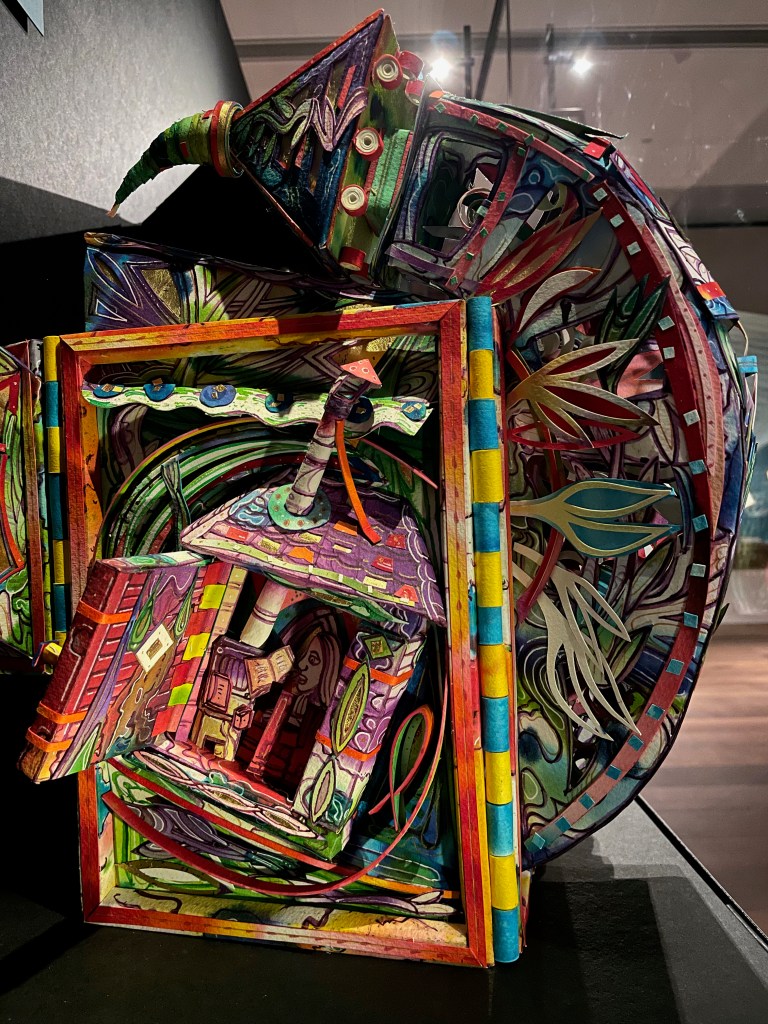
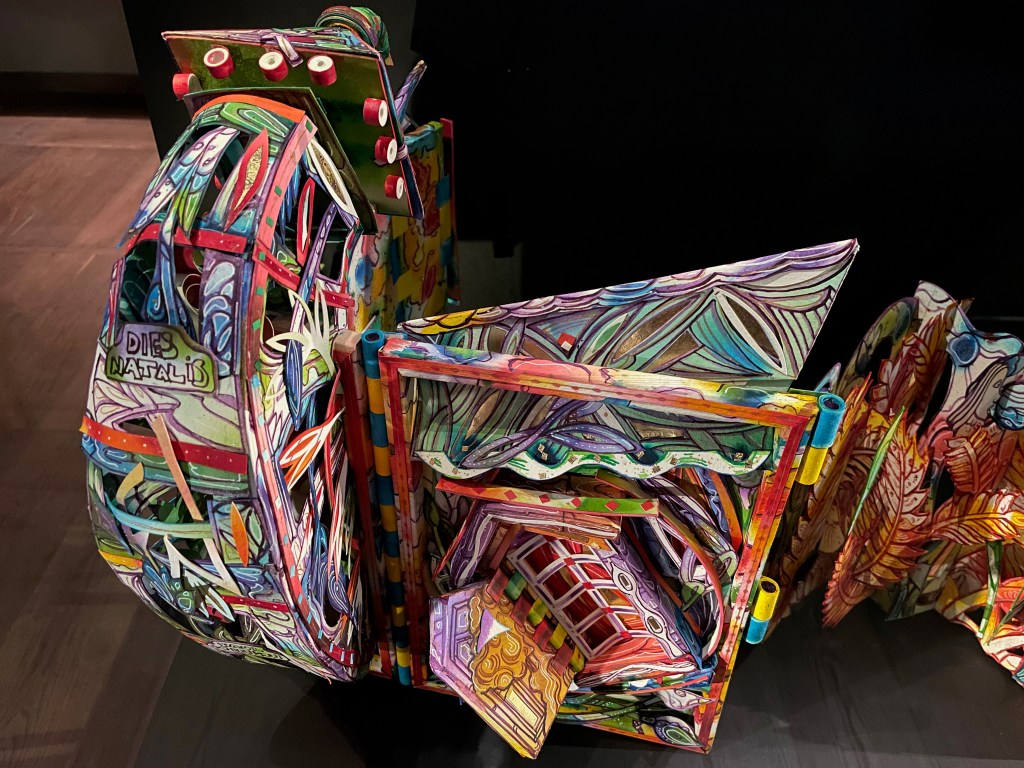
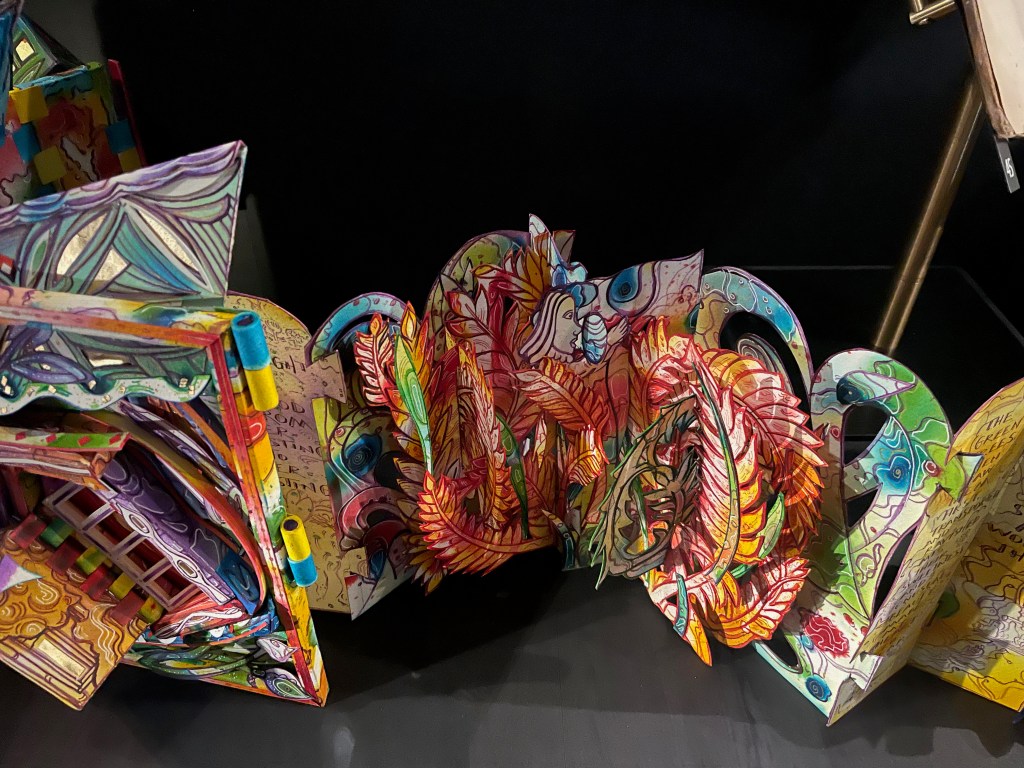
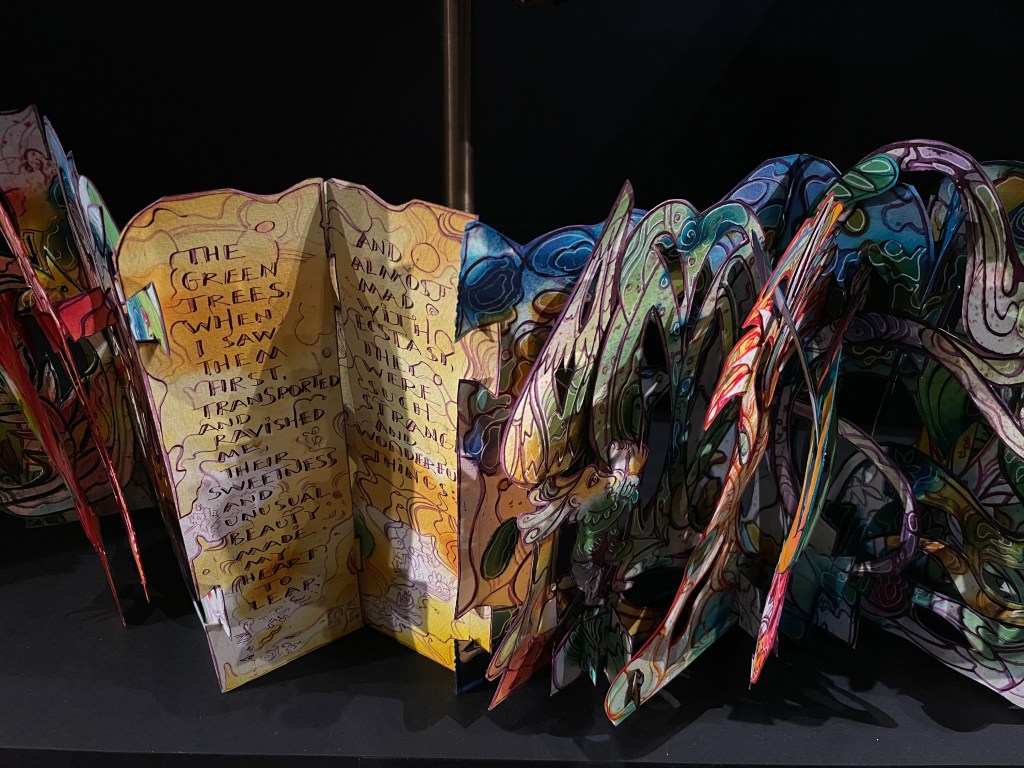
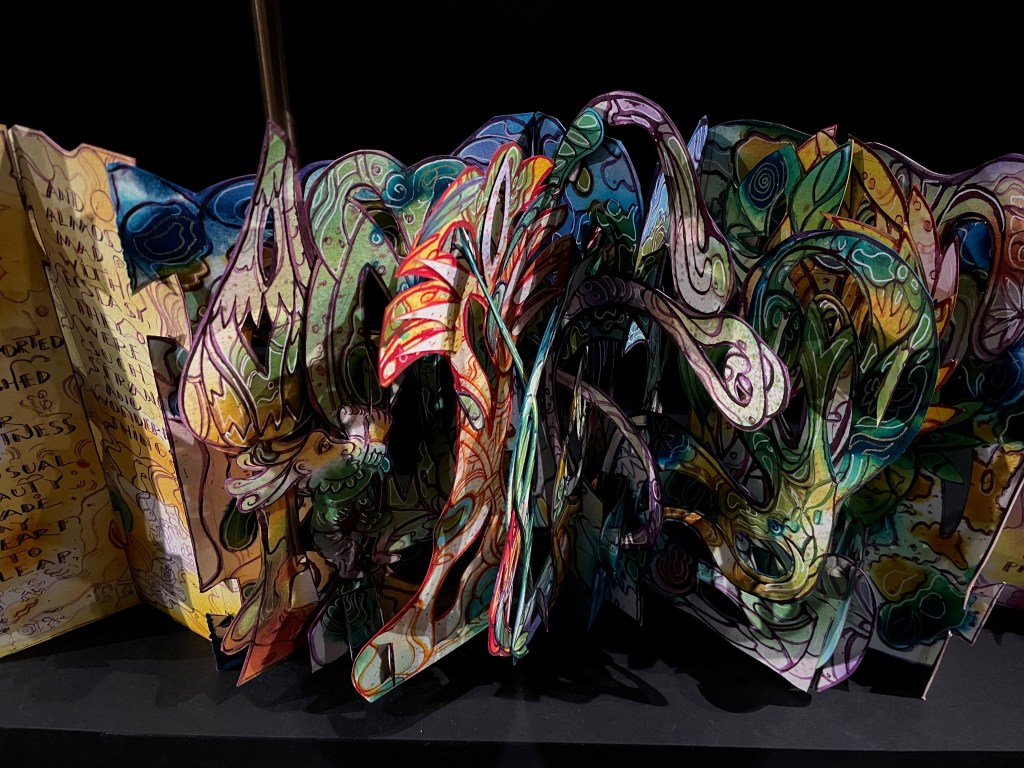
The slipcasing of The Sun Showers Symbols on the Earth and Morning Light Showing the World the Way capture another characteristic of Paul Johnson’s work and the man himself — a giving nature — which foreshadows the monumental Dies Natalis, his gift to the Bodleian Libraries in 2023.
Dies Natalis (2023)
Dies Natalis(2023) Paul Johnson A gift from the artist, Dies Natalis resides at the Bodleian Libraries. Photos: Books On Books at the Bodleian exhibition Gifts and Books, curated by Dr. Nicholas Perkins, 19 June 2023 – 29 October 2023.
A birthday gift from the deity becomes a gift from the artist.
Further Reading
“Movables Now and Then“. 31 August 2024. Bookmarking Book Art. For background reading on movables.
“Květa Pacovská“. 19 July 2023. Books On Books Collection. For comparably colorful pop-ups.
Chen, Julie. 2013. 500 Handmade Books. Volume 2. New York: Lark. P. 26, for Johnson’s We Waited with Eyes Lifted (2012).
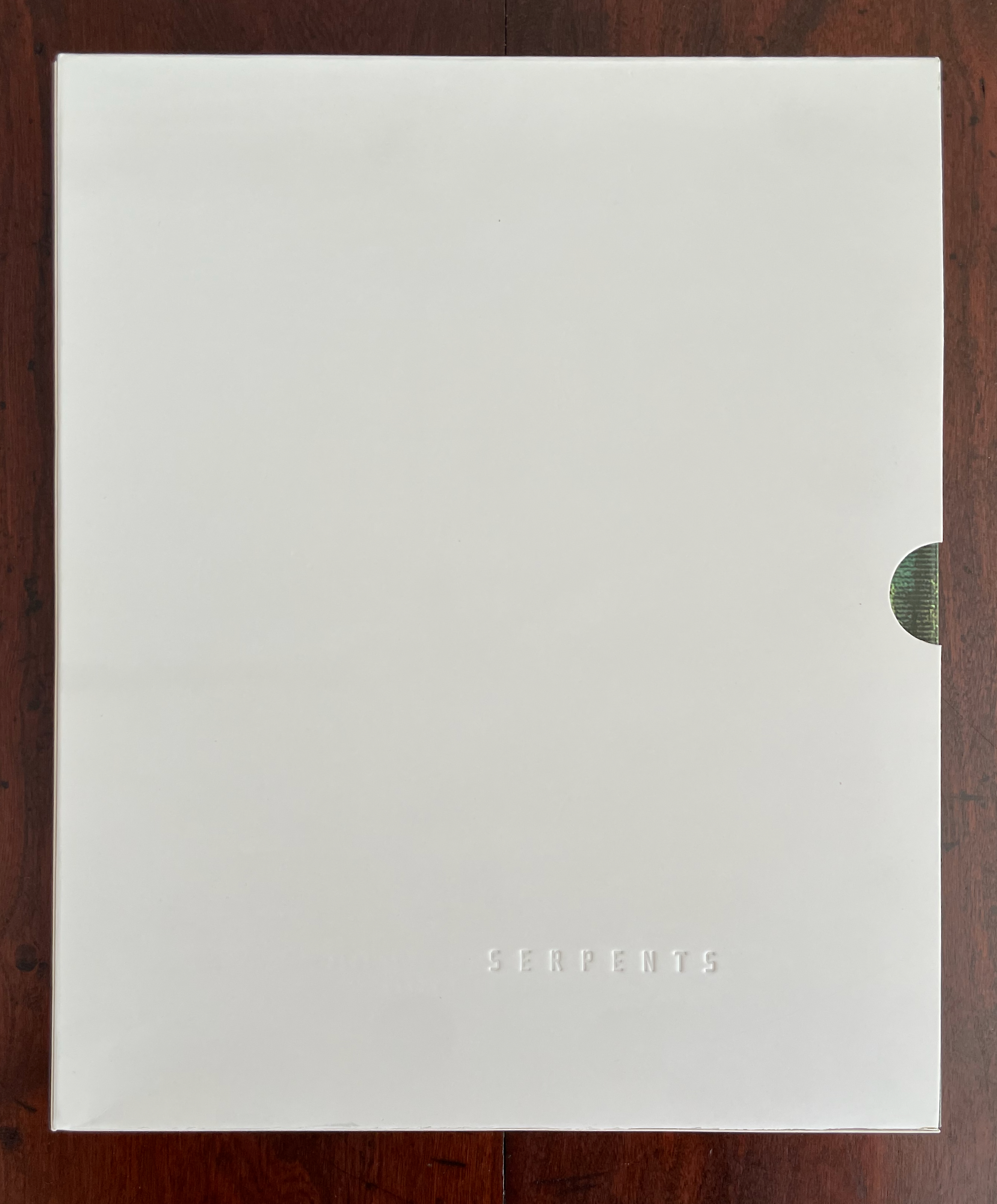
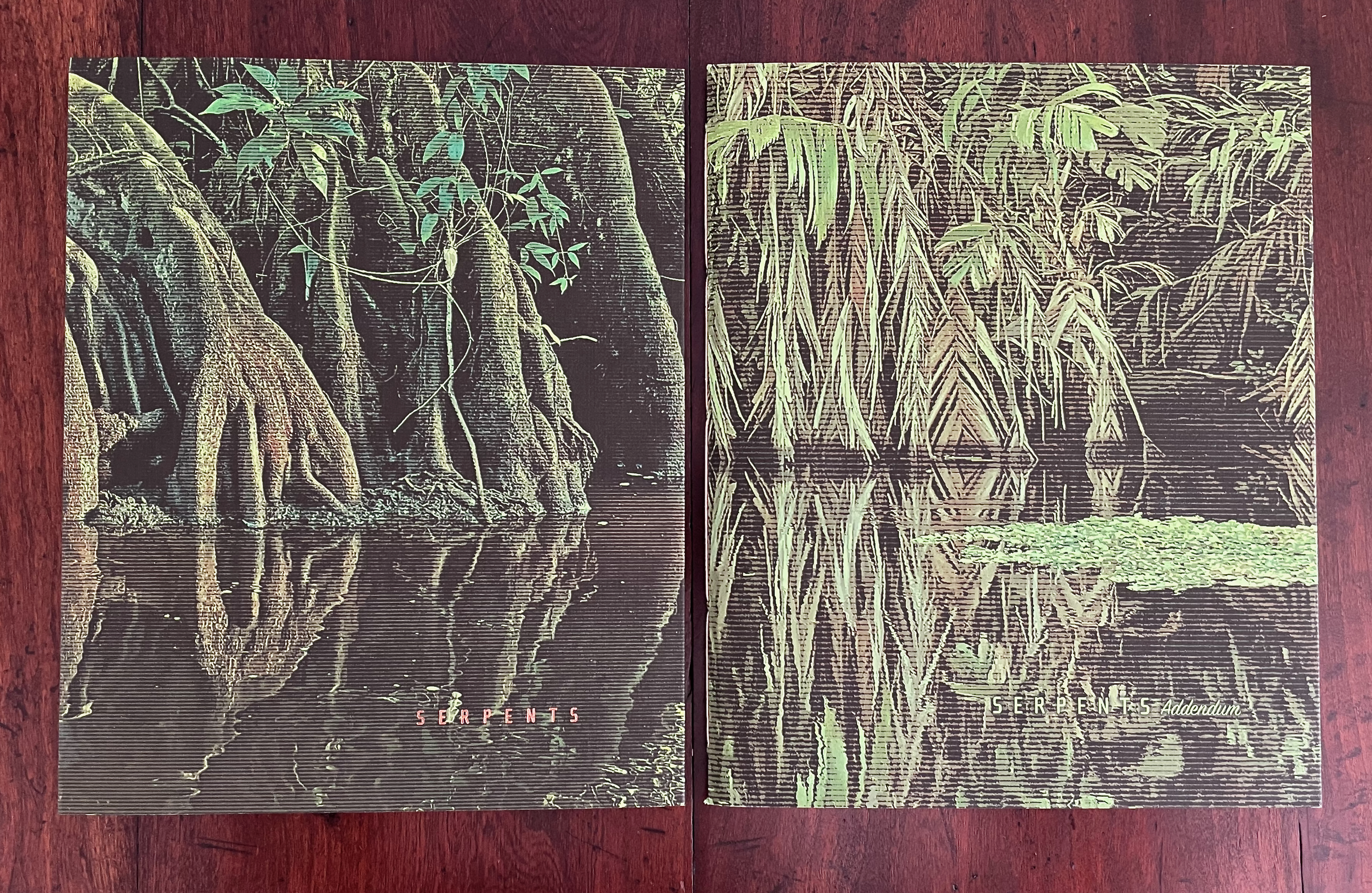
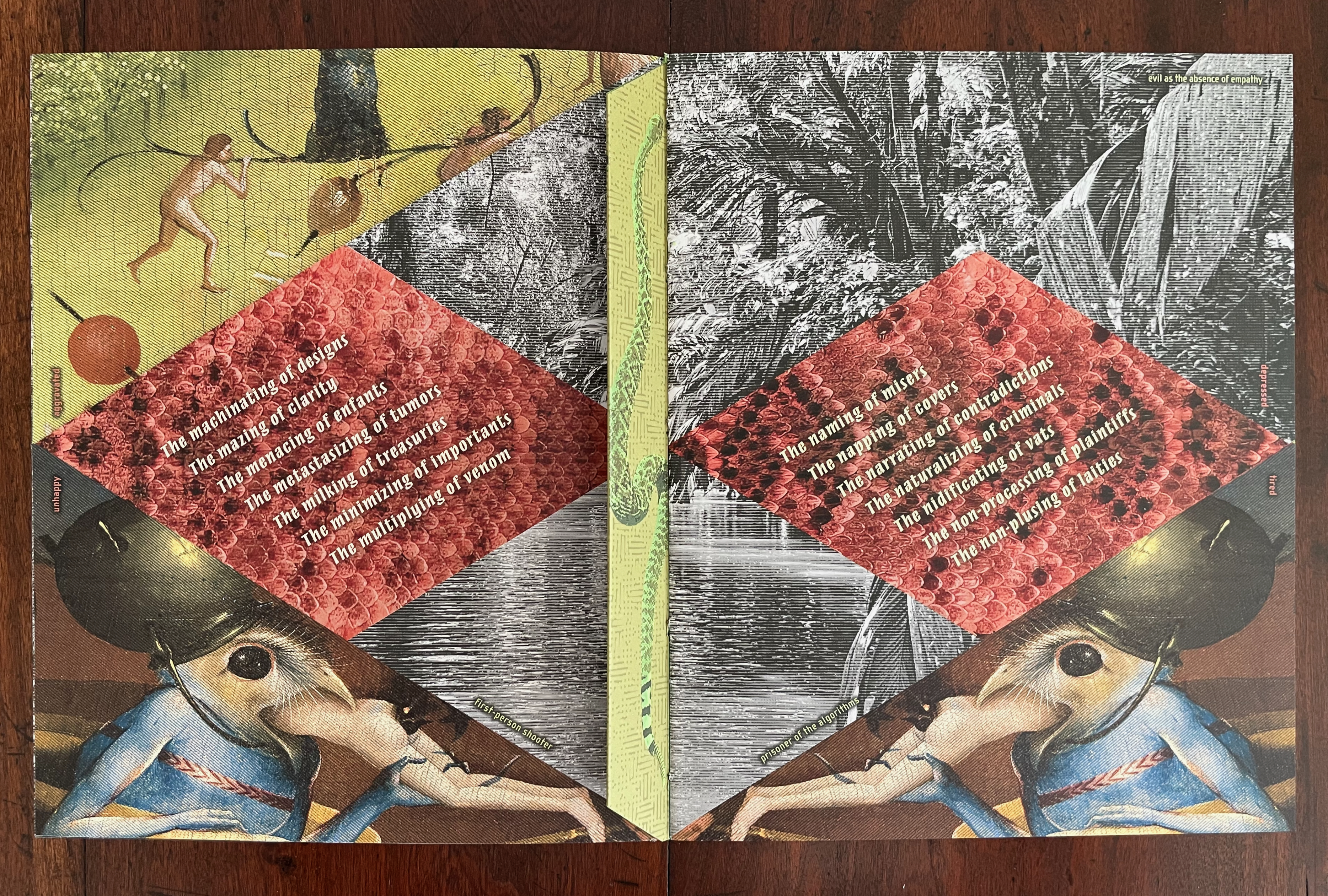
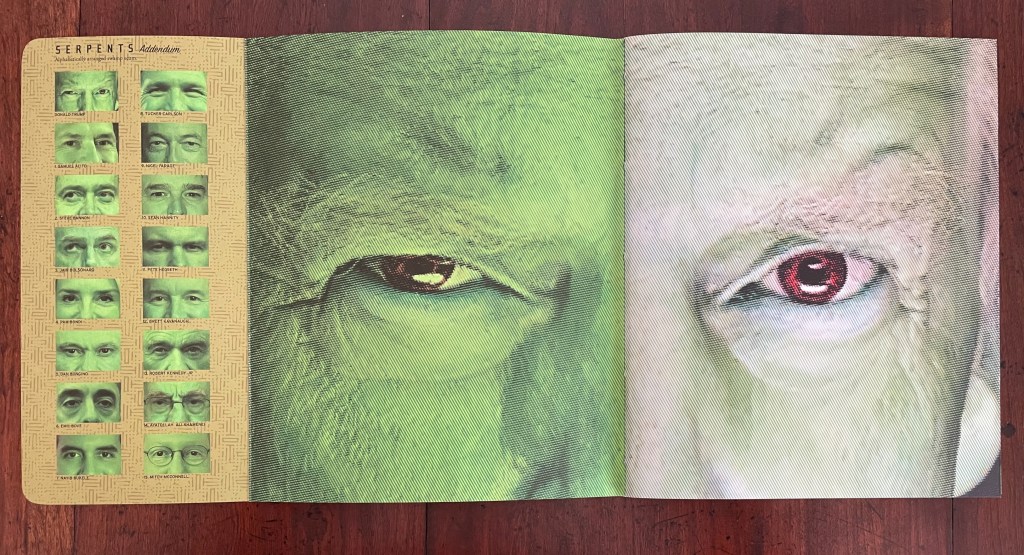
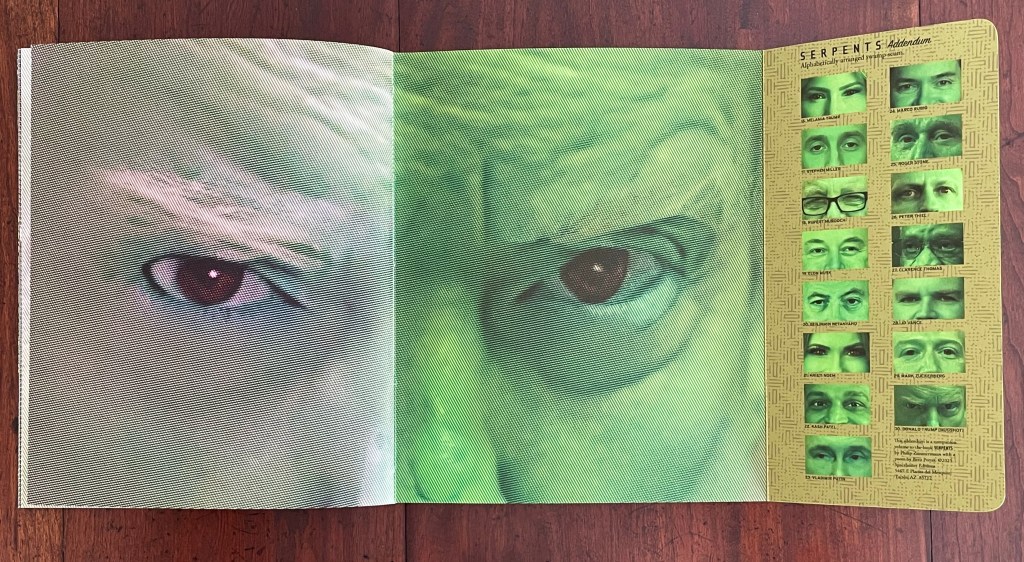
Serpents (2025) Phil Zimmermann Blind embossed white slipcase holding two volumes. Slipcase: H265 x W217 X D17 mm. Deep-flap cover: H263 x W216 mm. Vol. I: H262 x W210 mm. Vol. II: H262 x W215 mm. Vol. I: [40] pages. Vol. II: [60] pages. Edition of 65, of which this is #22. Acquired from the artist, 9 February 2026. Photos: Books On Books Collection.
Serpents is a welcome chance to add an alphabetical offering by Philip Zimmermann to his works already in the collection. Two volumes, one of which is an addendum, make up Serpents.
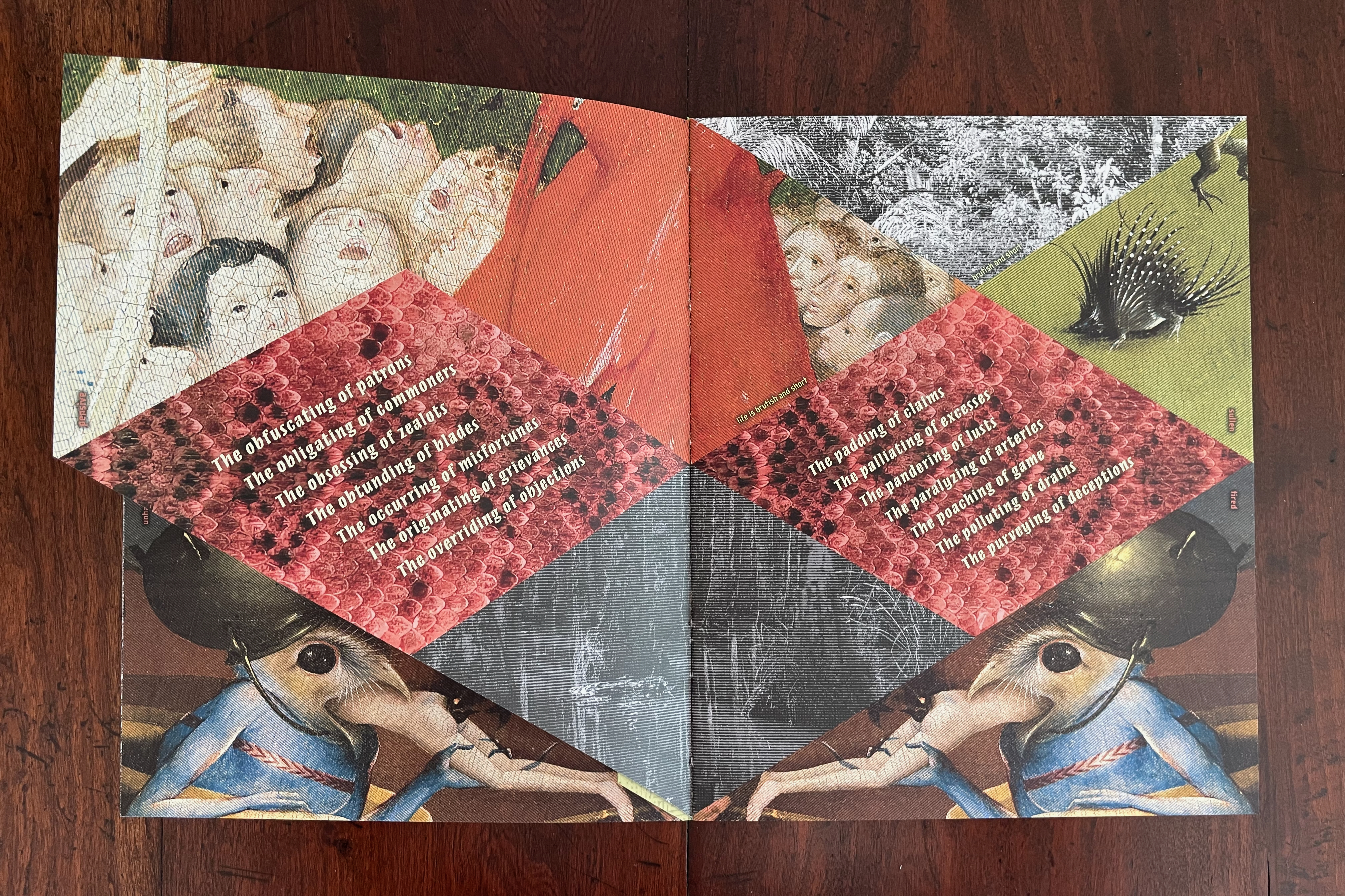
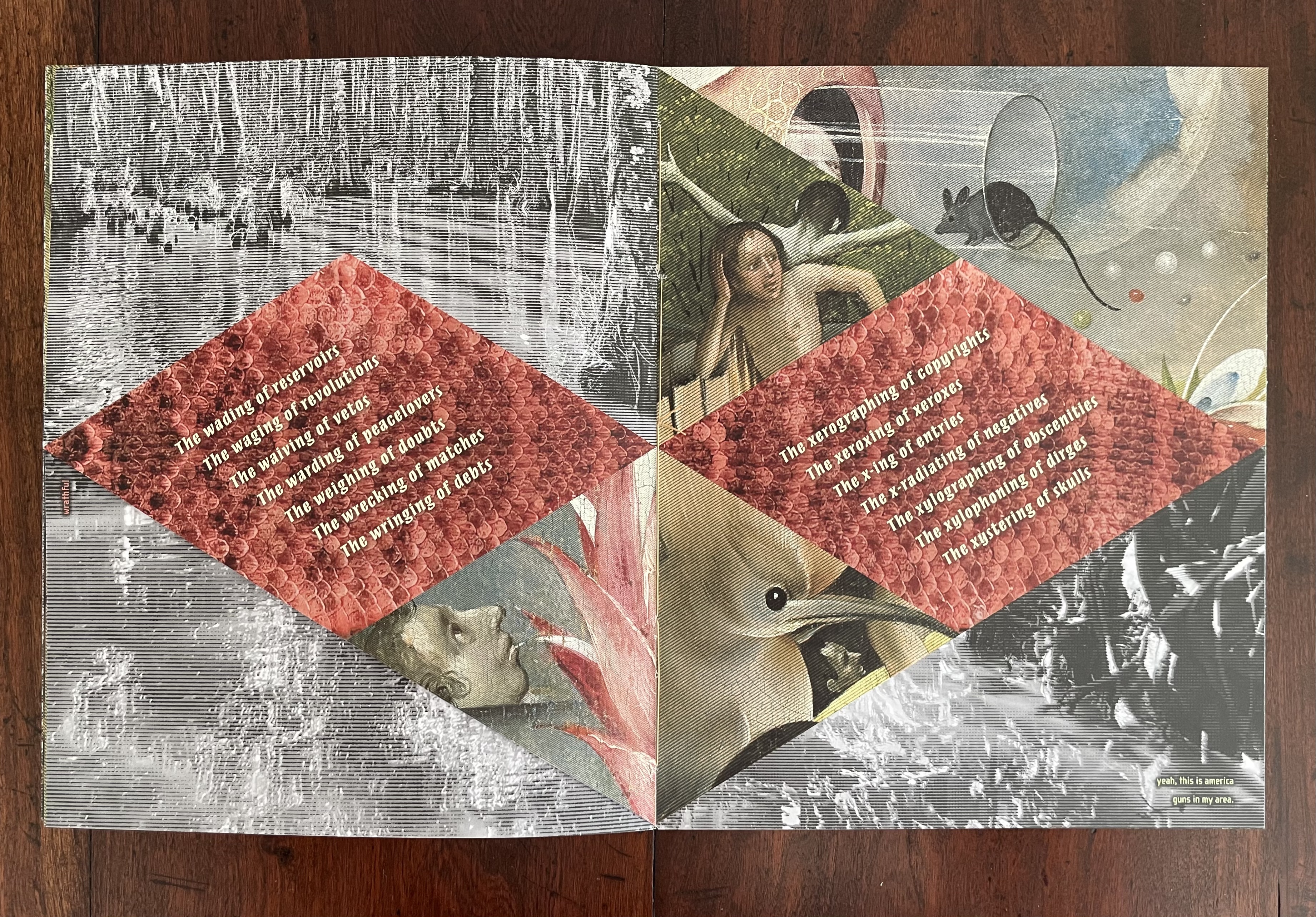
The main volume combines Zimmermann’s own photographs of swampland in Costa Rica and Louisiana with details from The Garden of Earthly Delights (1490-1510) by Hieronymus Bosch and embedded an alphabetical poem The Last Acts of Saint Fuck You (1975) by Bern Porter against a background of rattlesnake skin. Its politically conscious content echoes Sanctus Sonorensis (2009), but with sharper vi(per)tuperation against what the artist describes as “the increasingly corrupt and fascistic direction of our national and global civilizations”.
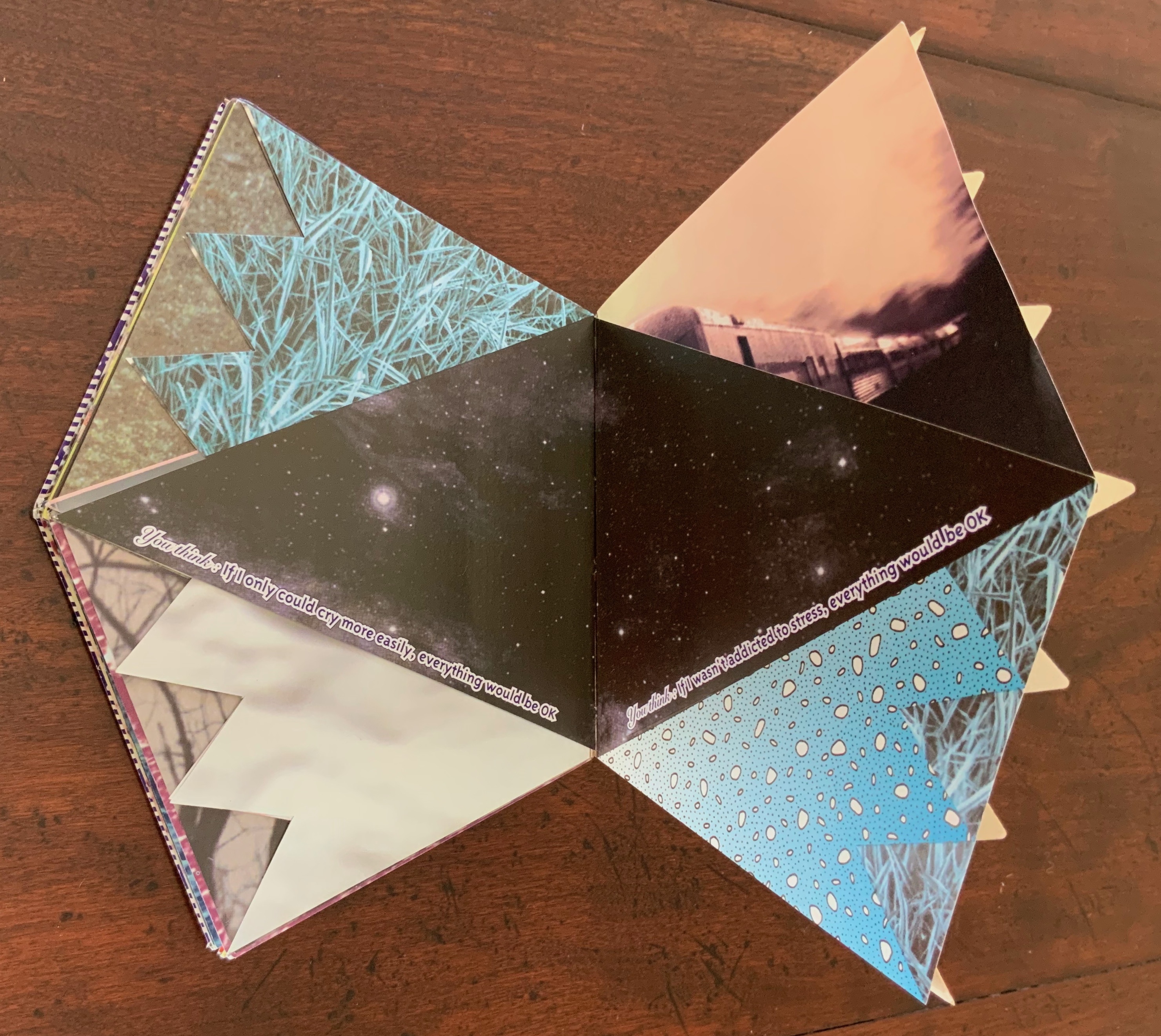
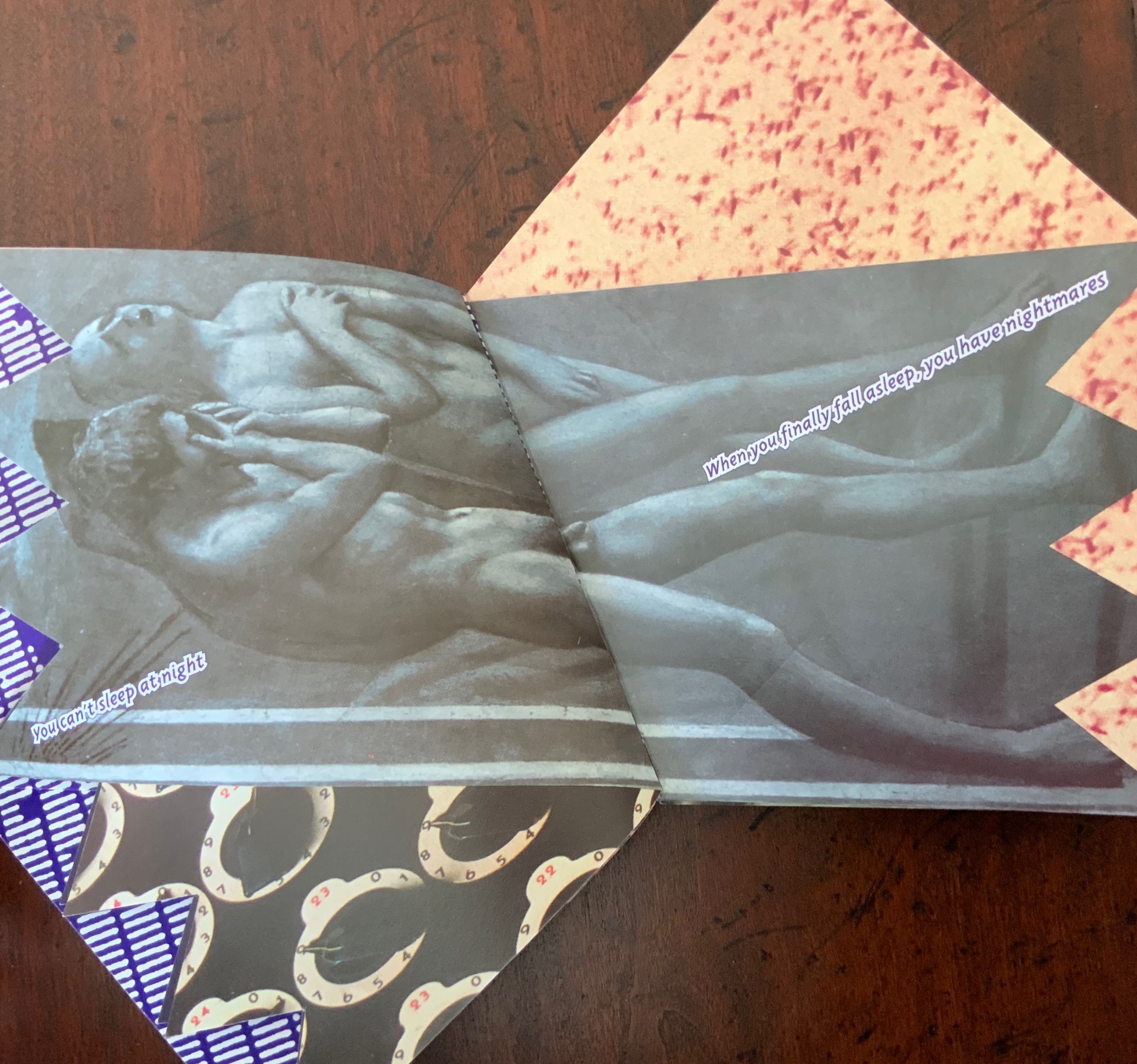
Zimmermann wields the book as a catalytic medium in just the right way to bring theme and technique together in striking and satisfying artworks. Two points of comparison with his earlier work High Tension illustrate this. Serpent‘s diagonally cut pages recall those of High Tension (1993), but notice how the diagonality works differently to suit each book’s typography and theme. Like its theme of personal anxiety, High Tension’s diagonality is spiky. Like its theme of reptilian tyrants, Serpents‘ diagonality emphasizes the diamond-back rattlesnake pattern that runs through the collage, and in turn, the diagonally set text emphasizes the rattlesnake pattern.
While High Tension includes Masaccio’s 1425 fresco depicting the expulsion from the Garden of Eden and Serpents includes Bosch, Adam and Eve’s grief and shame play their brief role among multiple personal anxieties, whereas Bosch’s creatures continuously slip and slide into the swamp and rattlesnake background of the world state.
In Serpents, snippets of text from other sources (1984 by George Orwell, “Sympathy for the Devil” by the Rolling Stones/Mick Jagger, “This is America” by Childish Gambino/Donald Glover, “The Star-Spangled Banner” by Francis Scott Key, Hannah Arendt, John McCain, Thomas Hobbes, Marcus Junius Brutus, and Elisabeth Kübler-Ross) appear in small fonts in the corners, diagonally, and at the fore edges (Kübler-Ross). Their size and positioning require close attention and draw the eye into the details of the imagery.
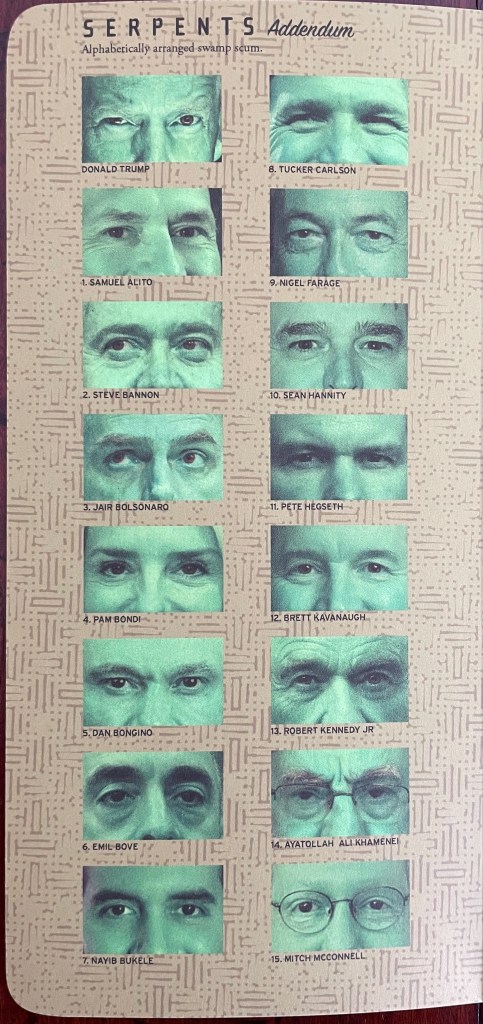
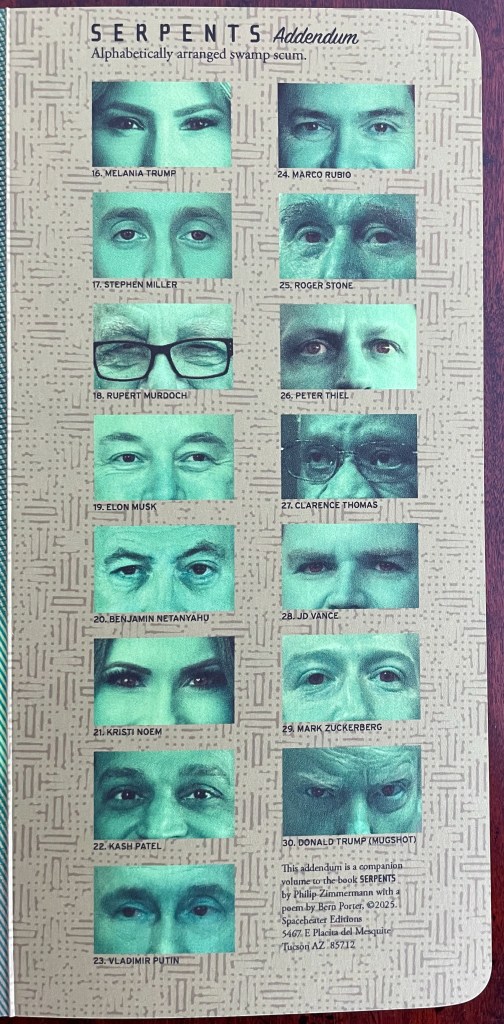
In parallel with the poem’s alphabetical arrangement, the addendum presents cropped individual portraits of Donald Trump, his enablers, and fellow tyrants from around the world in alphabetical order with amber-tinted irises and green-hued faces. It implicitly flips the script on Donald Trump’s use of Oscar Brown’s song “The Snake” (1963) to justify his concentration camps targeting the immigrant population (“You knew damn well I was a snake before you brought me in”).
The next two volumes carry forward a series of works with a different socially conscious burden — the anthropo(bs)cene period of terrestrial evolution. They began with Landscapes of the Late Anthropocene (2017) and Melt (2023) but also echo images in the earlier works Sanctus Sonorensis (2009) and Incident in Deseret (2014).
Accelerated Entropy (2024)
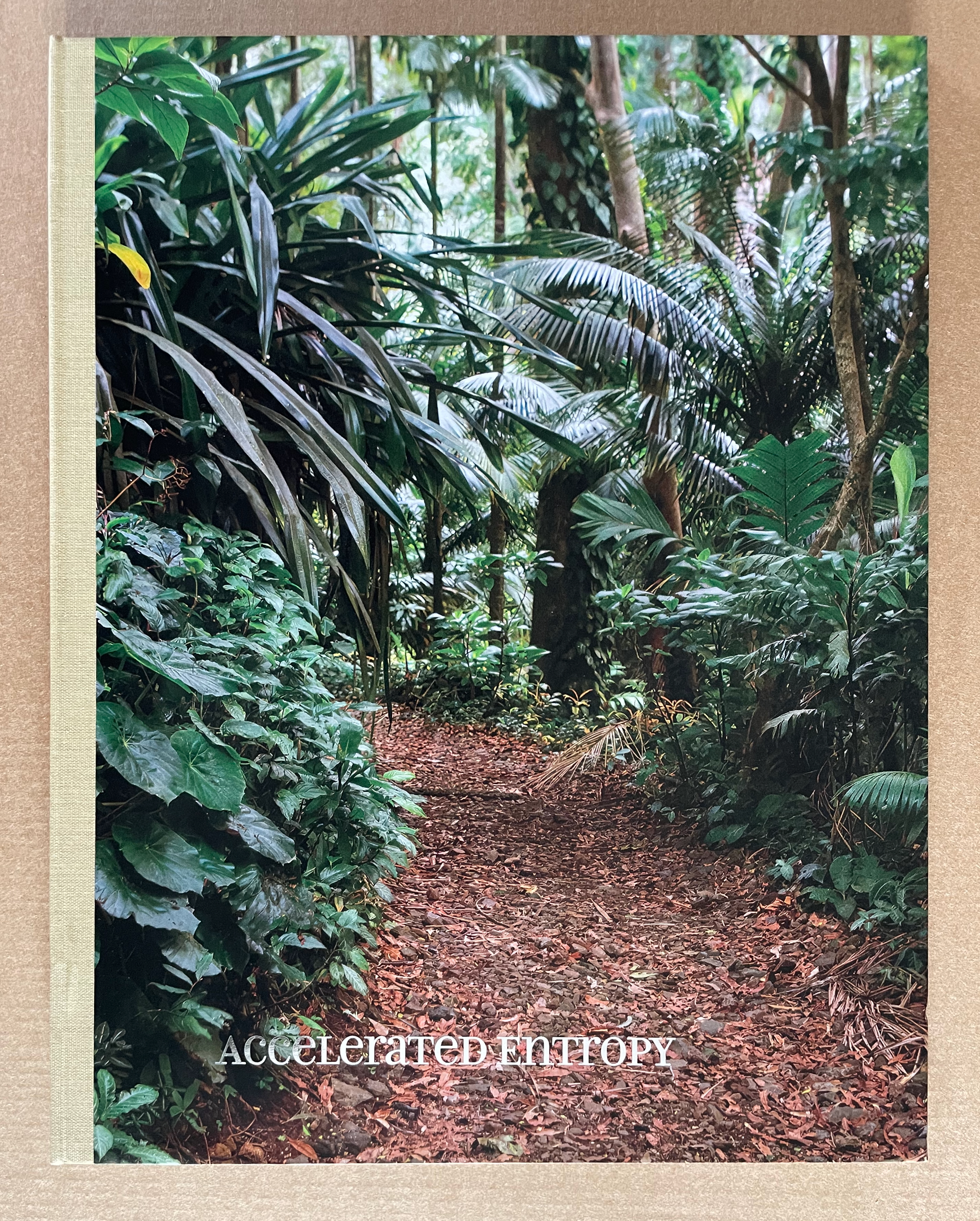
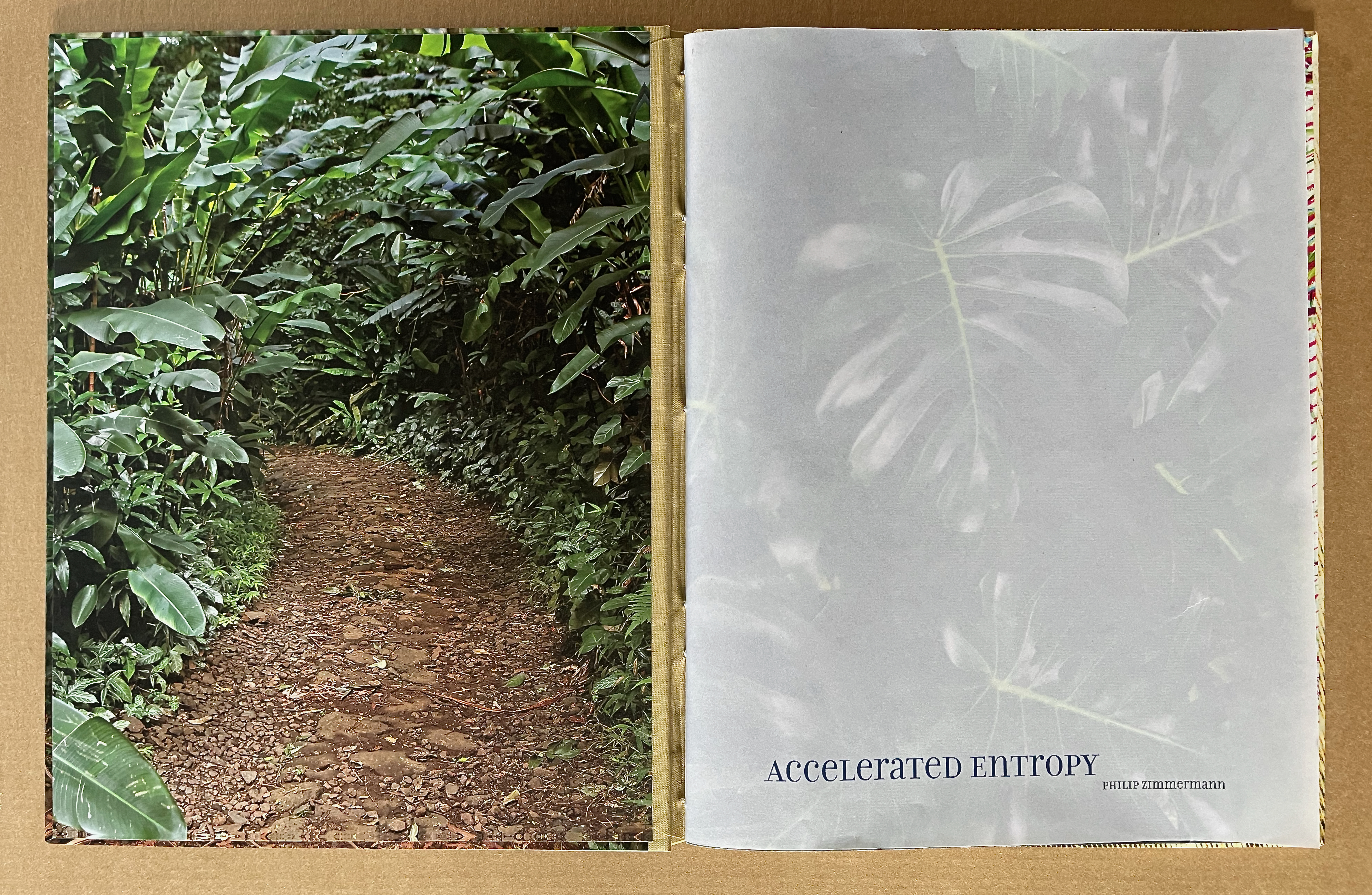
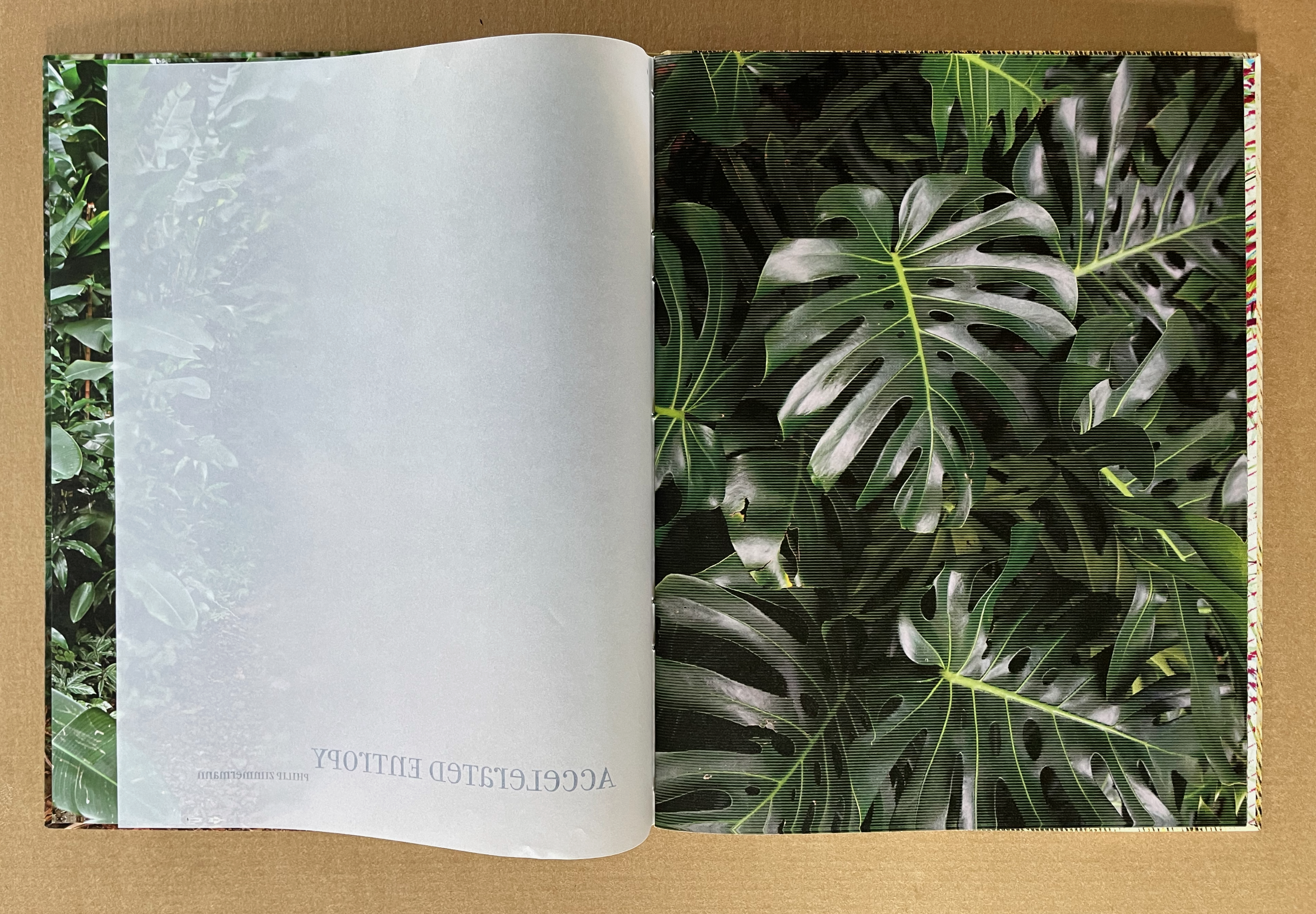
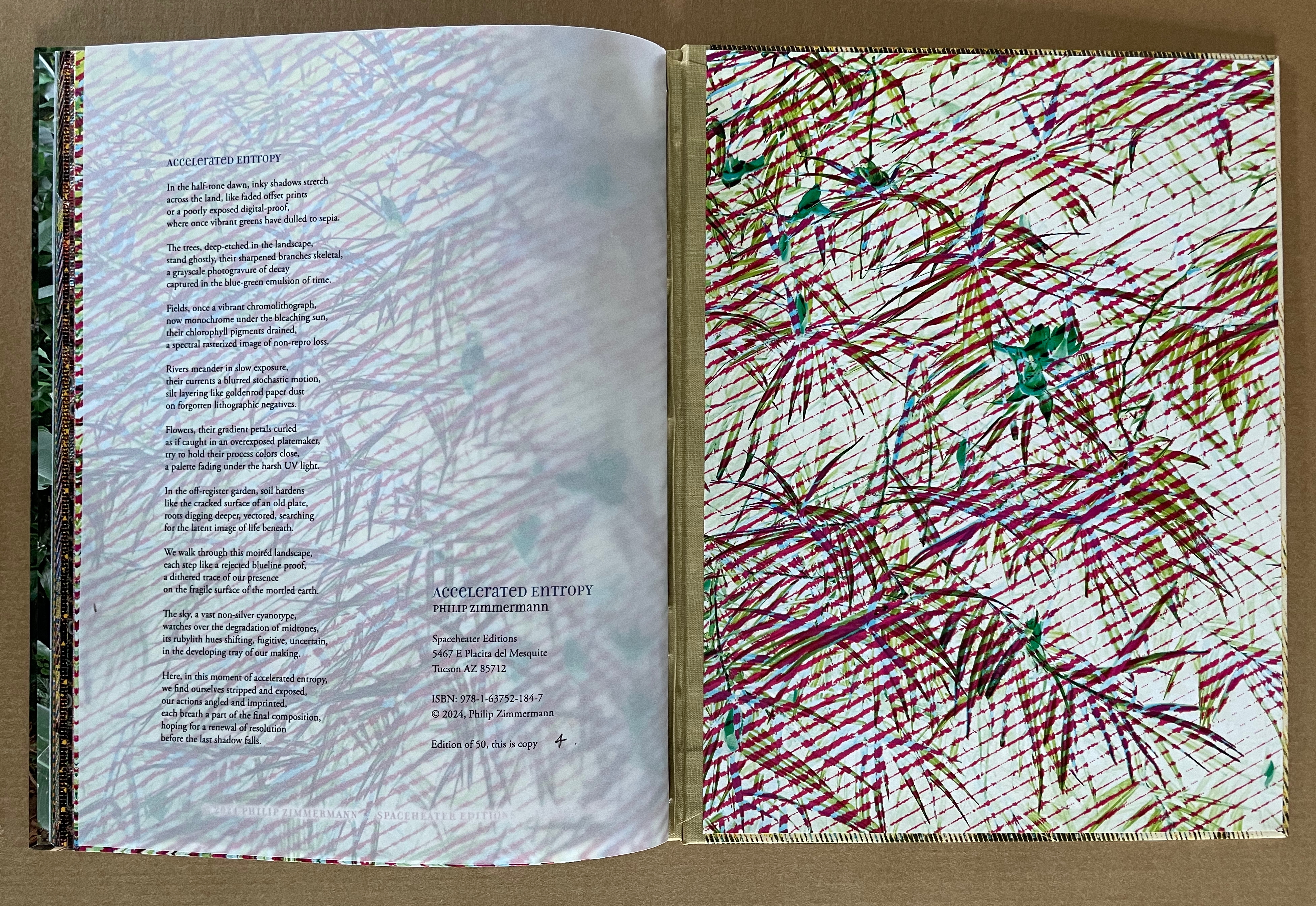
Accelerated Entropy (2024) Phil Zimmermann Casebound, cloth spine, photoprinted paper over boards and paste-down end sheets, pamphlet stitch book with translucent paper cover. H285 x W225 mm. [40] pages. Edition of 50, of which this is #4. Acquired from the artist, 31 August 2024. Photos: Books On Books Collection.
As Marlene MacCallum (2024) points out, “Phil Zimmerman has consistently woven imagery and text in response to issues related to perilous conditions of our world and social structures.” What is particularly interesting in Serpents, Accelerated Entropy, and In the Desert is how that weaving differs effectively from book to book. In Serpents, the Porter text and rattlesnake skin are tightly woven together, acting as the main tapestry weave while the snippets of text and the images of the swamp and Bosch’s Garden of Earthly Delights act as a discontinuous weft creating a changing collage around the main weave.
In Accelerated Entropy, the text (a poem by Zimmermann) is held to the very end. In fact, it appears on the translucent pamphlet-stitched back cover inside the casing. So how does the poem weave with the imagery? The images are not without narrative. Progressive computer-derived halftone patterns and various types of rasters of photographs of lush vegetation constitute the visual tool with which the artist writes that narrative. Like Melt and Landscapes of the Late Anthropocene, the narrative concerns climate change. The final image has reduced the foliage to abstract tracery over a whitened background, which is repeated in end pastedown. By placing the text on the verso side of the translucent paper at the end of the book, the artist makes the poem hover over and between the final image.
Zimmermann’s poem uses prepress process and photomechanical terms to create an extended metaphor for describing the decay of climate change. The terms relate not only to the visual tools used to effect the book’s images of decay but also to the disappearing tools and techniques of printing technology. Perhaps we will recognize our effect on the world around us when it is expressed in printing metaphors, and perhaps we will recognize the world’s accelerating entropy in the pace of our own disappearing technology.
Accelerated Entropy (2024)

In the half-tone dawn, inky shadows stretch
across the land, like faded offset prints
or a poorly exposed digital-proof,
where once vibrant greens have dulled to sepia.

The trees, deep-etched in the landscape,
stand ghostly, their sharpened branches skeletal,
a grayscale photogravure of decay
captured in the blue-green emulsion of time.

Fields, once a vibrant chromolithograph,
now monochrome under the bleaching sun,
their chlorophyll pigments drained,
a spectral rasterized image of non-repro loss.

Rivers meander in slow exposure,
their currents a blurred stochastic motion,
silt layering like goldenrod paper dust
on forgotten lithographic negatives.

Flowers, their gradient petals curled
as if caught in an overexposed platemaker,
try to hold their process colors close,
a palette fading under the harsh UV light.

In the off-register garden, soil hardens
like the cracked surface of an old plate,
roots digging deeper, vectored, searching
for the latent image of life beneath.

We walk through this moiréd landscape,
each step like a rejected blueline proof,
a dithered trace of our presence
on the fragile surface of the mottled earth.

The sky, a vast non-silver cyanotype,
watches over the degradation of midtones,
its rubylith hues shifting, fugitive, uncertain,
in the developing tray of our making.

Here, in this moment of accelerated entropy,
we find ourselves stripped and exposed,
our actions angled and imprinted,
each breath a part of the final composition,
hoping for a renewal of resolution
before the last shadow falls.
Clifton Meador’s observation in correspondence with Zimmermann nails how this text is woven into the images:
“The poem at the end of Accelerated Entropy is a great addition to the piece, and how could I not love an extended metaphor about climate change that uses print technology as the vehicle? It significantly changes the reading of the piece after the first encounter—I had to go back through the book again, with a vastly changed framework for reading. In the place of a reading of visual richness and formal invention, I looked for evidence of a history of print production. That’s a pretty cool trick—a textual moment that causes me to re-read with an entirely different framework in mind.” — Meador to Zimmermann, 31 August 2024.
In the Desert (2024)
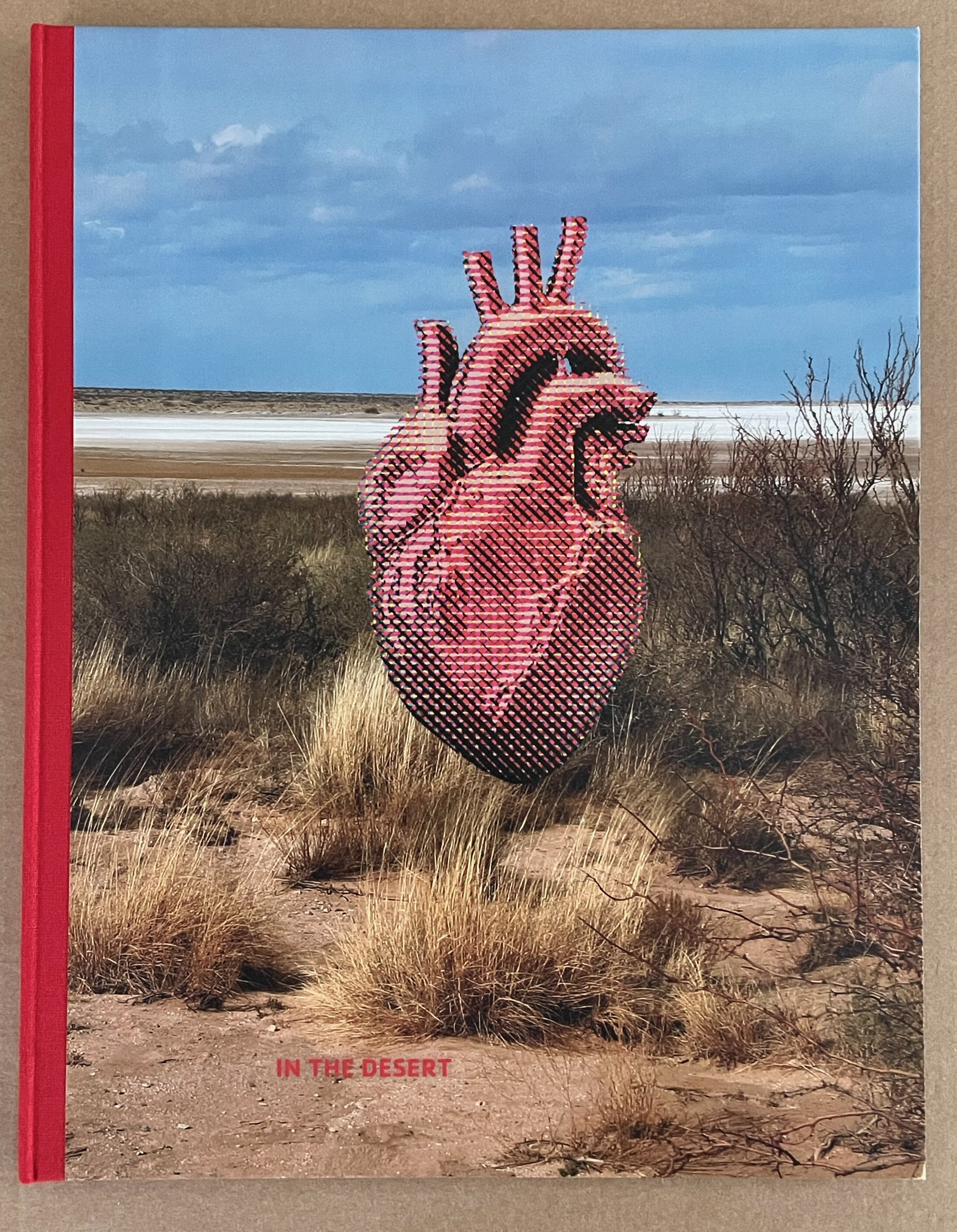
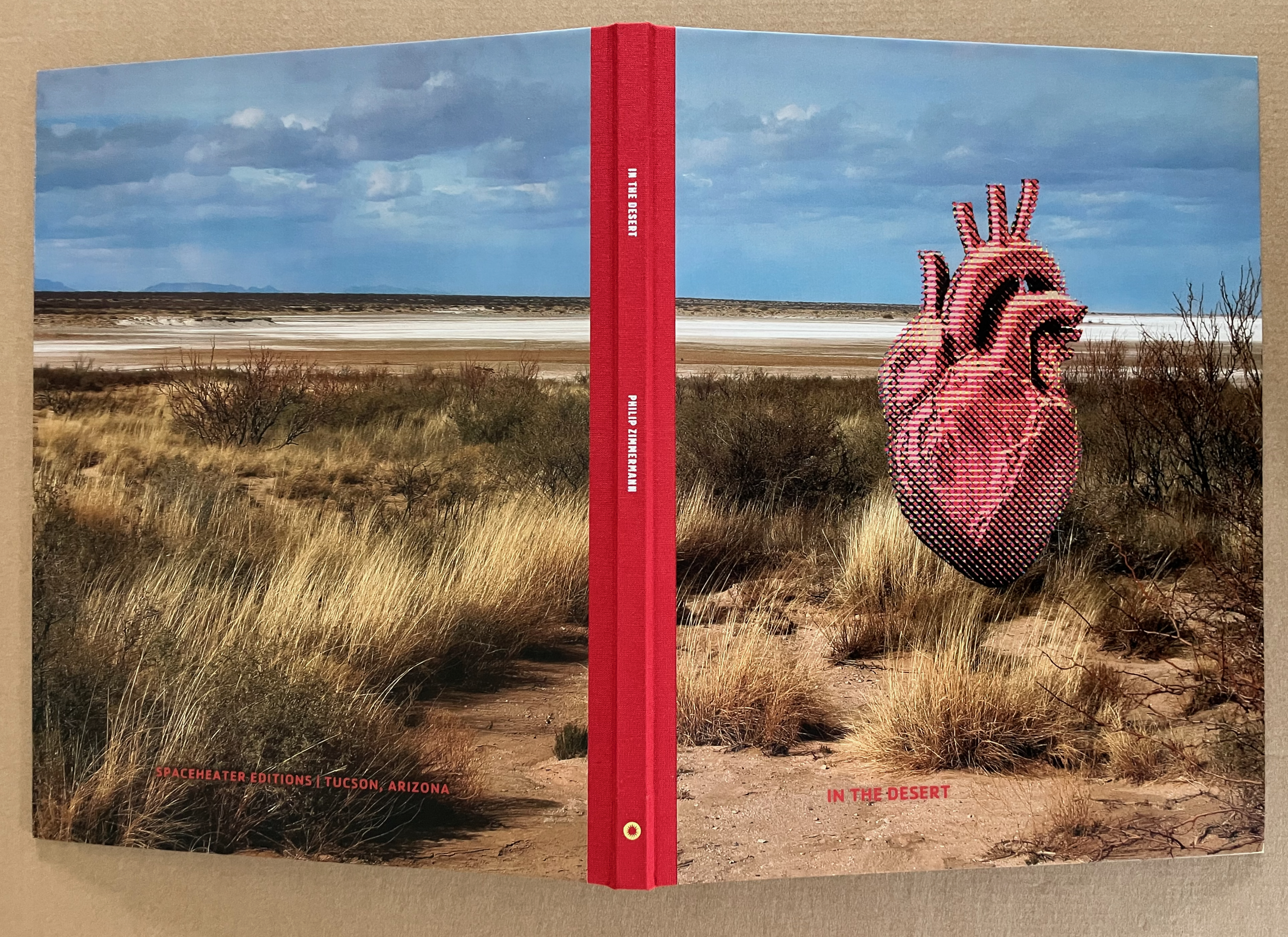
In the Desert (2024) Phil Zimmermann Casebound, cloth spine, photoprinted paper over boards and paste-down end sheets, pamphlet stitch book. H285 x W225 mm. [40] pages. Edition of 50, of which this is #4. Acquired from the artist, 31 August 2024. Photos: Books On Books Collection.
Stephen Crane’s poem In the Desert sits at the heart of Zimmermann’s artist’s book by the same name. In red ink, it sits there like the creature in Crane’s otherwise featureless poem.
In the Desert (1895)

In the desert
I saw a creature, naked, bestial,
Who, squatting upon the ground,
Held his heart in his hands,
And ate of it.
I said, “Is it good, friend?”
“It is bitter—bitter,” he answered;

“But I like it
“Because it is bitter,
“And because it is my heart.”
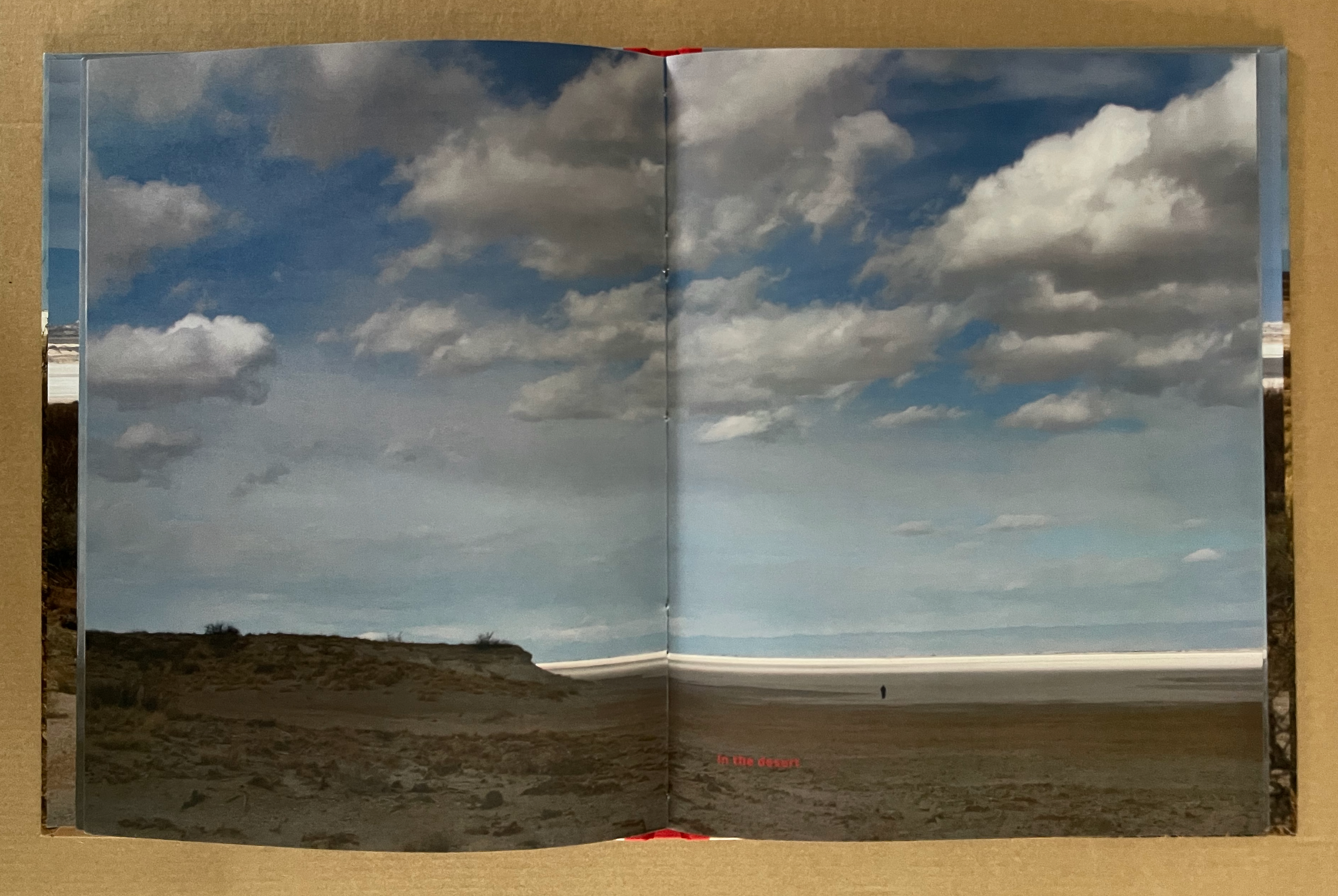
The artist’s book is far from featureless. The images in the book come from Zimmermann’s photographs taken at Lake Lucero, a dry gypsum lake located in the White Sands Missile Range near Las Cruces, New Mexico. His artist’s statement describes it as
… a restricted part of the missile range and open to the public only a few times a year when National Park Service rangers take visitors holding US Passports on closed busses in to visit the dry lake. The dry gypsum crystals from the lake blow to the northeast and are the source of the famous white dunes in White Sands National Park. The park is located, as is the entire Missile Range, in the great Tularosa Basin.
Seven double-page spreads of barren desert scenery lead up to the poem’s first line, which squats in red in the dark foreground of a recto page. In the far foreground, a blurry human figure appears.
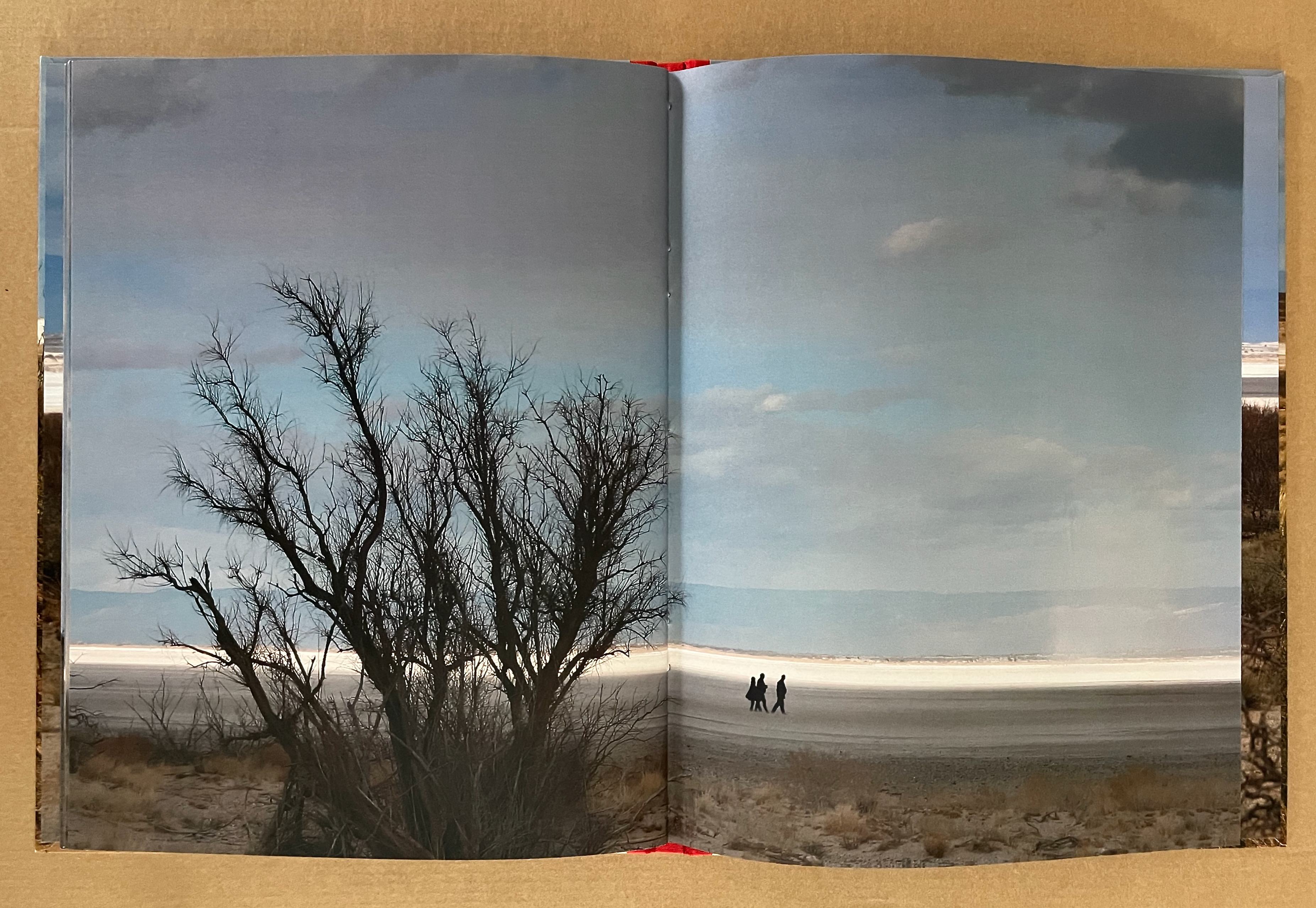
Over the next ten spreads, the poem’s two human figures (narrator and creature) gradually inhabit the pages alongside that solitary human figure, who is joined by an increasing then dwindling number of other silhouetted human figures in the far foreground. The last double-page spread is textless. A foregrounded leafless bush looms on the verso page standing in contrast to three human figures walking away in the far foreground on the recto page.
From spread to spread prior to the poem, the only action was the movement of dust from the salt flats in the air. With the poem’s appearance, we have two other sets of action. Like small signposts, the individual lines from Crane’s poem drive the reader’s page-turning as do the gathering and dispersing human figures.
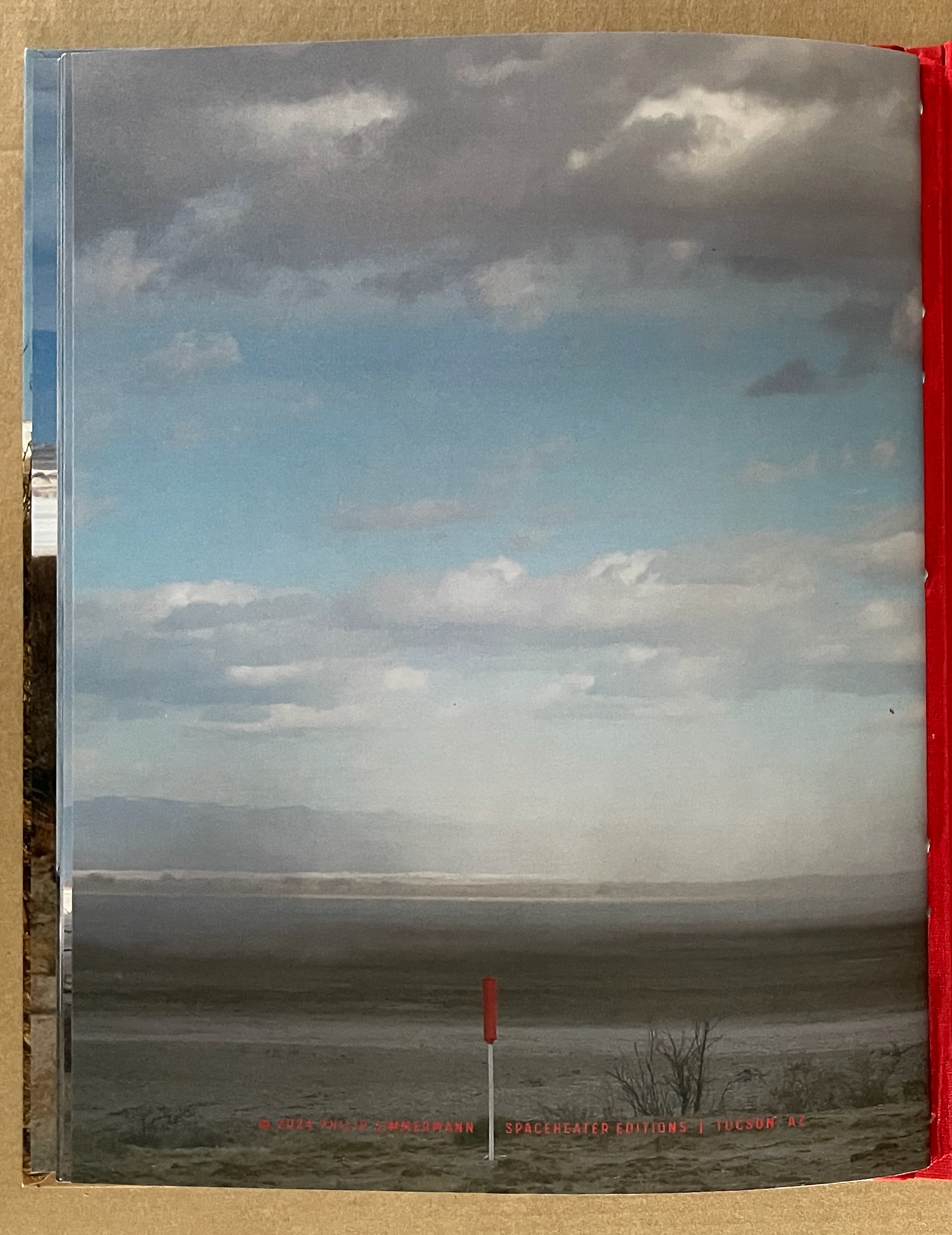
On the book’s last page, the only text is the copyright line. There is no other text. There are no human figures. The foreground is punctuated by a red boundary marker. In the middle ground, dust from the salt flats hovers against the low hills and cloud. Sky and cloud occupy the upper reaches of the background. In its size, that red boundary marker is shriveled in comparison with the heart on the front cover.
“But I like it “Because it is bitter, “And because it is my heart.”
The most beautiful and perfect book in the world is a book with only blank pages, in the same way that the most complete language is that which lies beyond all that the words of a man can say. Every book of the new art is searching after that book of absolute whiteness, in the same way that every poem searches for silence. — Ulises Carrión: “The New Art of Making Books” Kontexts no. 6-7, 1975.
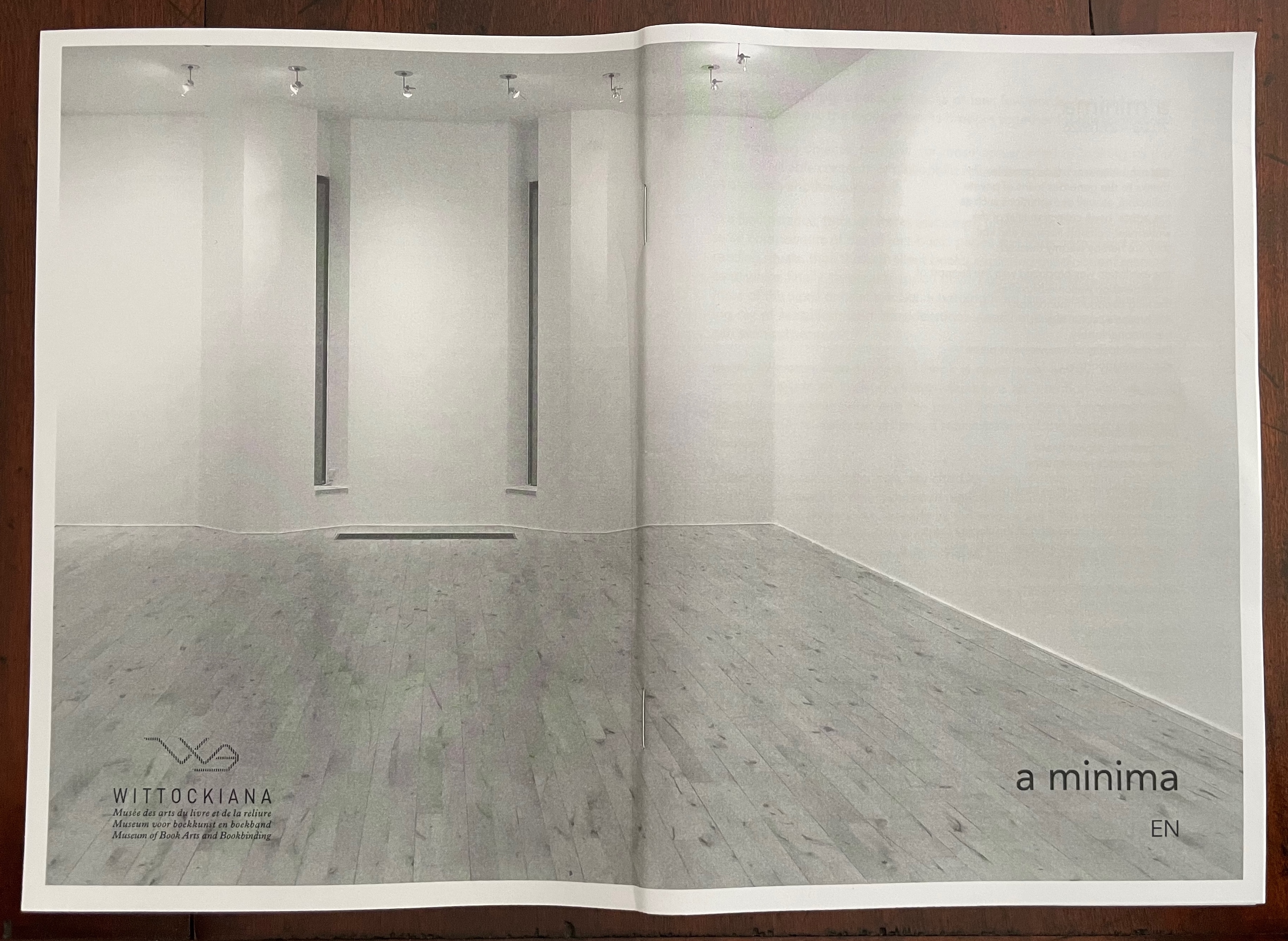
At the entrance to The Wittockiana. Back and front cover of the a minima catalogue.
If, as I did, you missed Moritz Küng‘s exhibition Blank. Raw. Illegible… Artists’ Books as Statements, 1960-2022 at the Leopold-Hoesch-Museum in Düren, Germany, in 2023, Didier Decoux‘s a minima presents an equally well-thought-out gathering of artists’ books that stretches out over 150 years (1876 – 2026). With 4 spacious rooms, 25 vitrines, 2 videos, and over 180 works, a minima requires several hours at a minimum to peruse and enjoy. Information on getting there is available here.
The comments and links below are in no way a substitute for visiting this exhibition, and keep in mind that Wittockiana also has permanent displays of presses, rare fonts, and books that should not be missed.
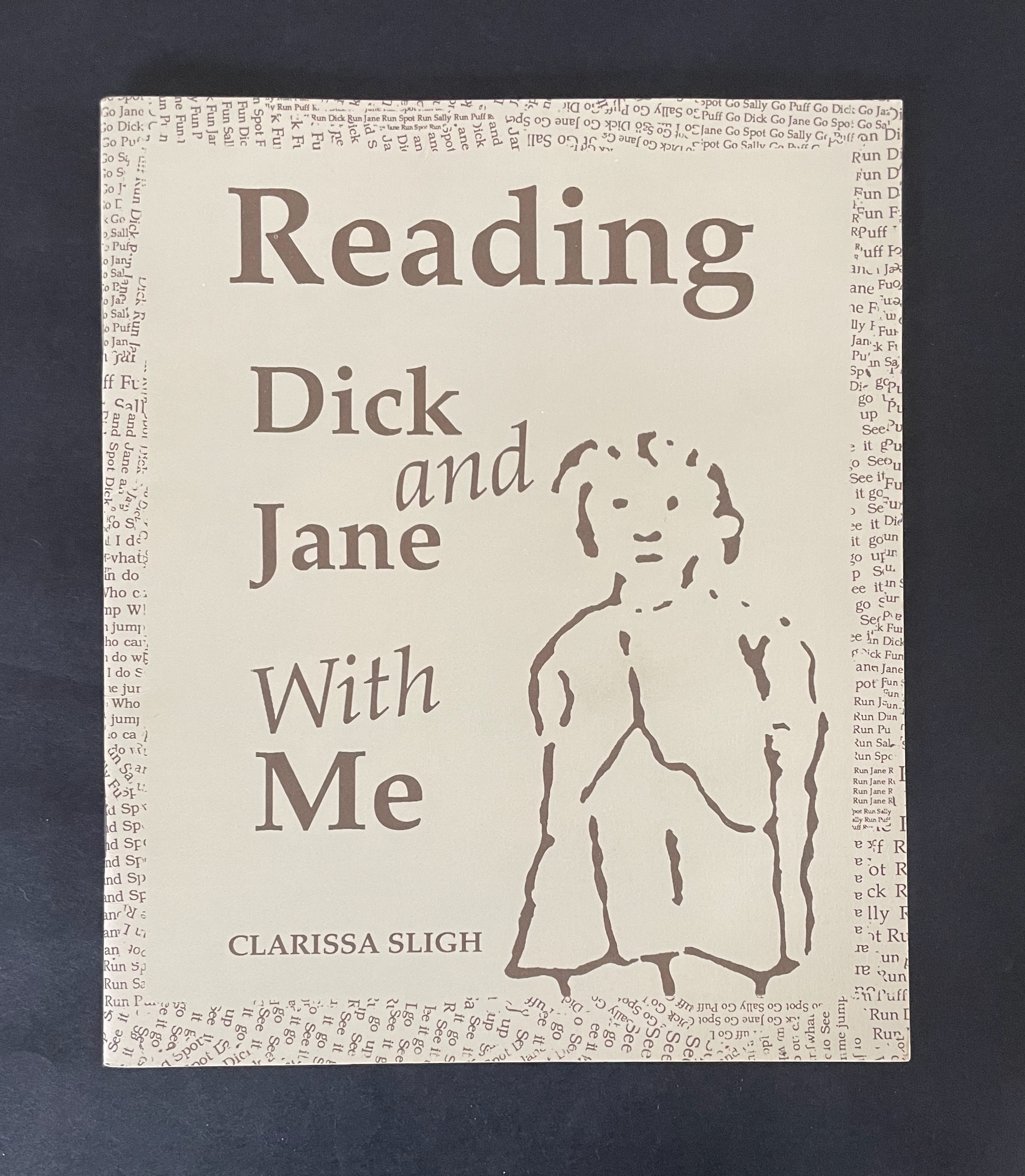
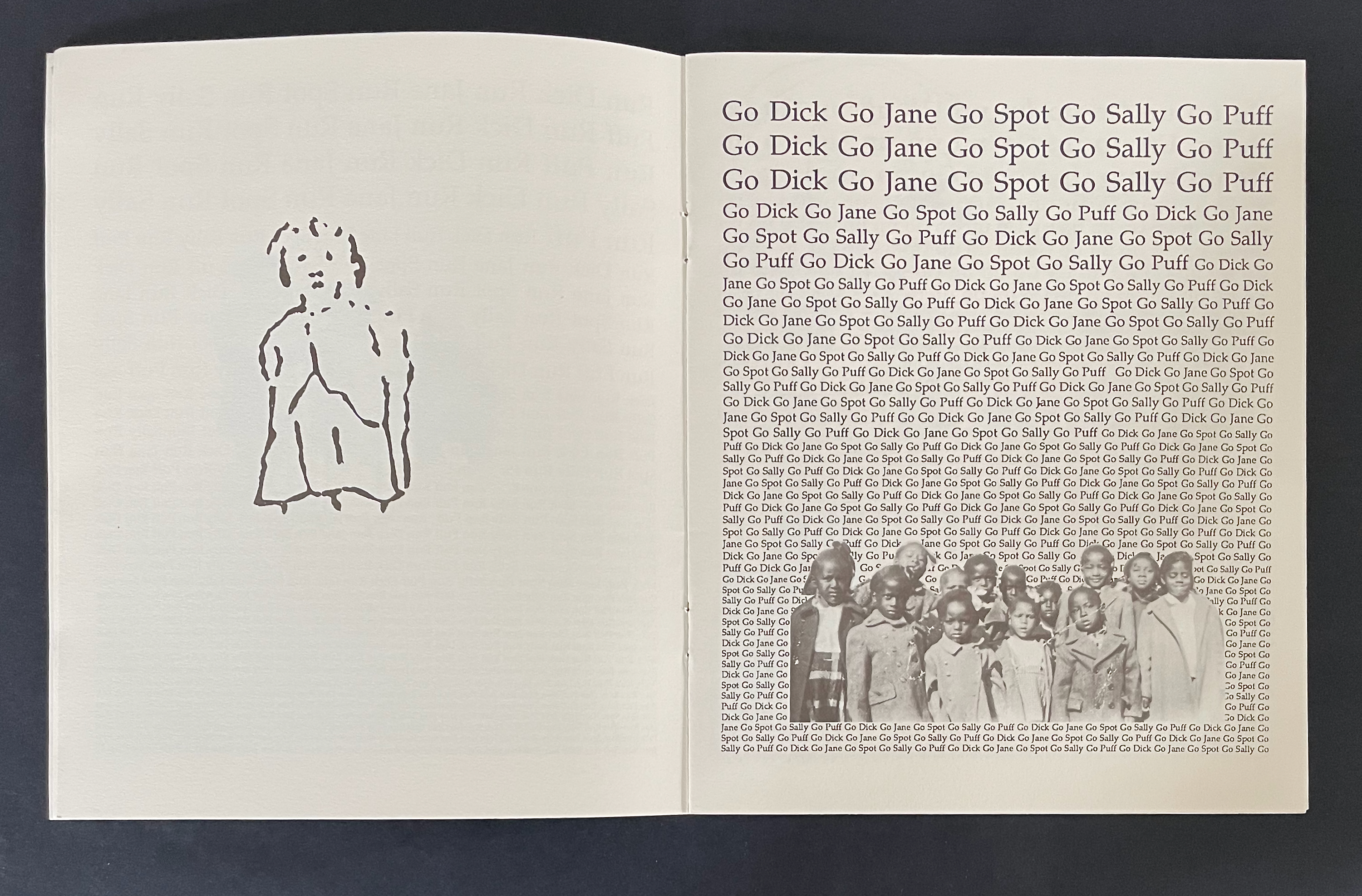
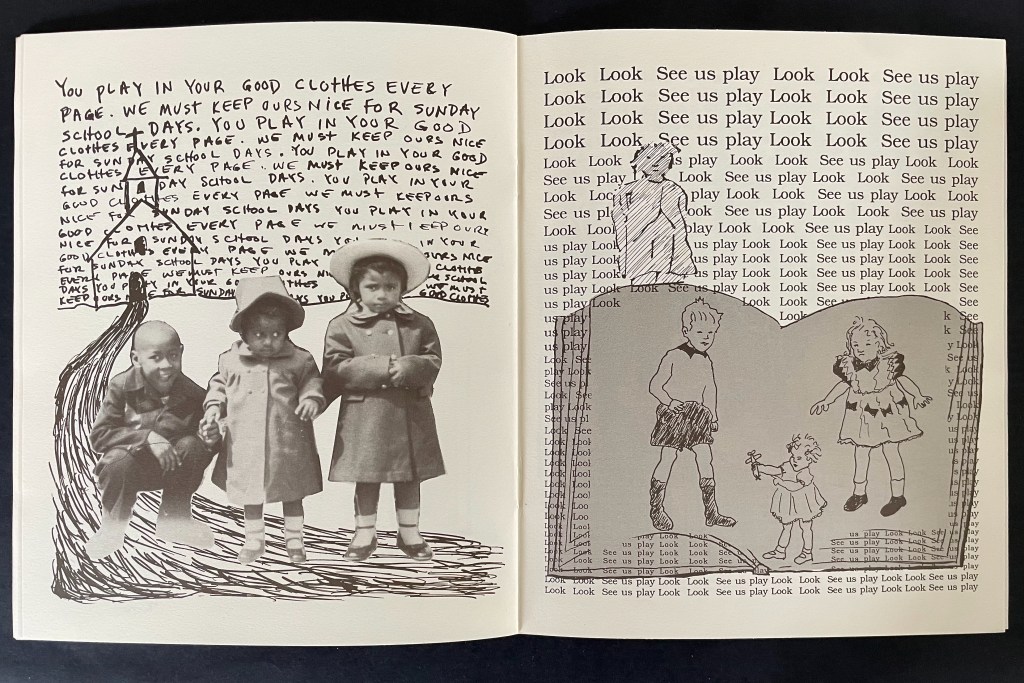
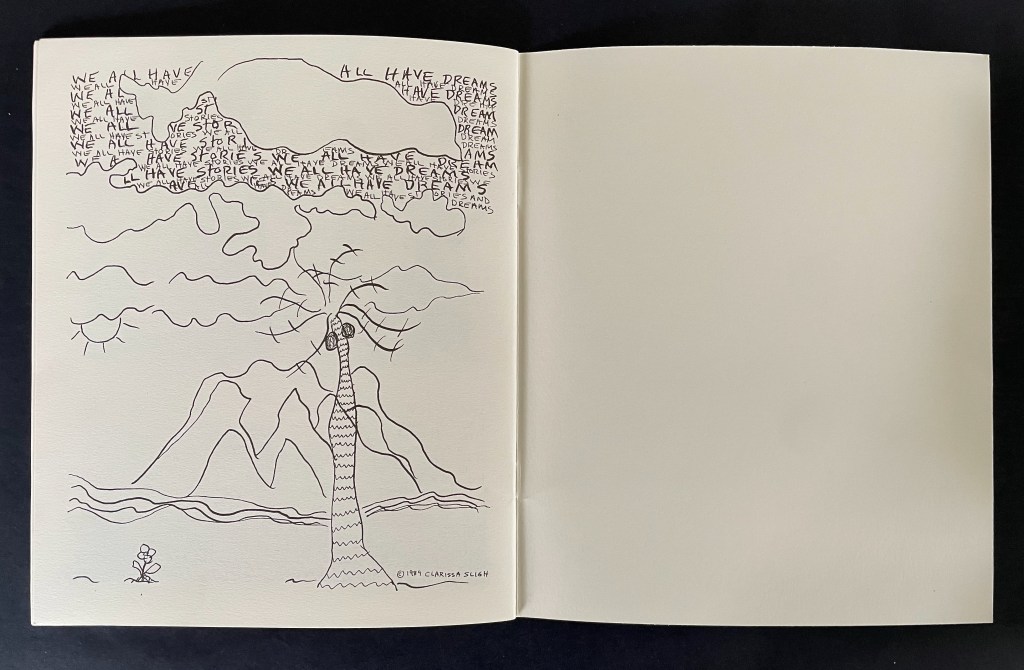
Reading Dick and Jane with Me (1989) Clarissa Sligh Saddle-stitched booklet, staples. H212 x W177 mm. [24] pages. Acquired from Marta Zlotnick, 6 October 2025. Photos: Books On Books Collection.
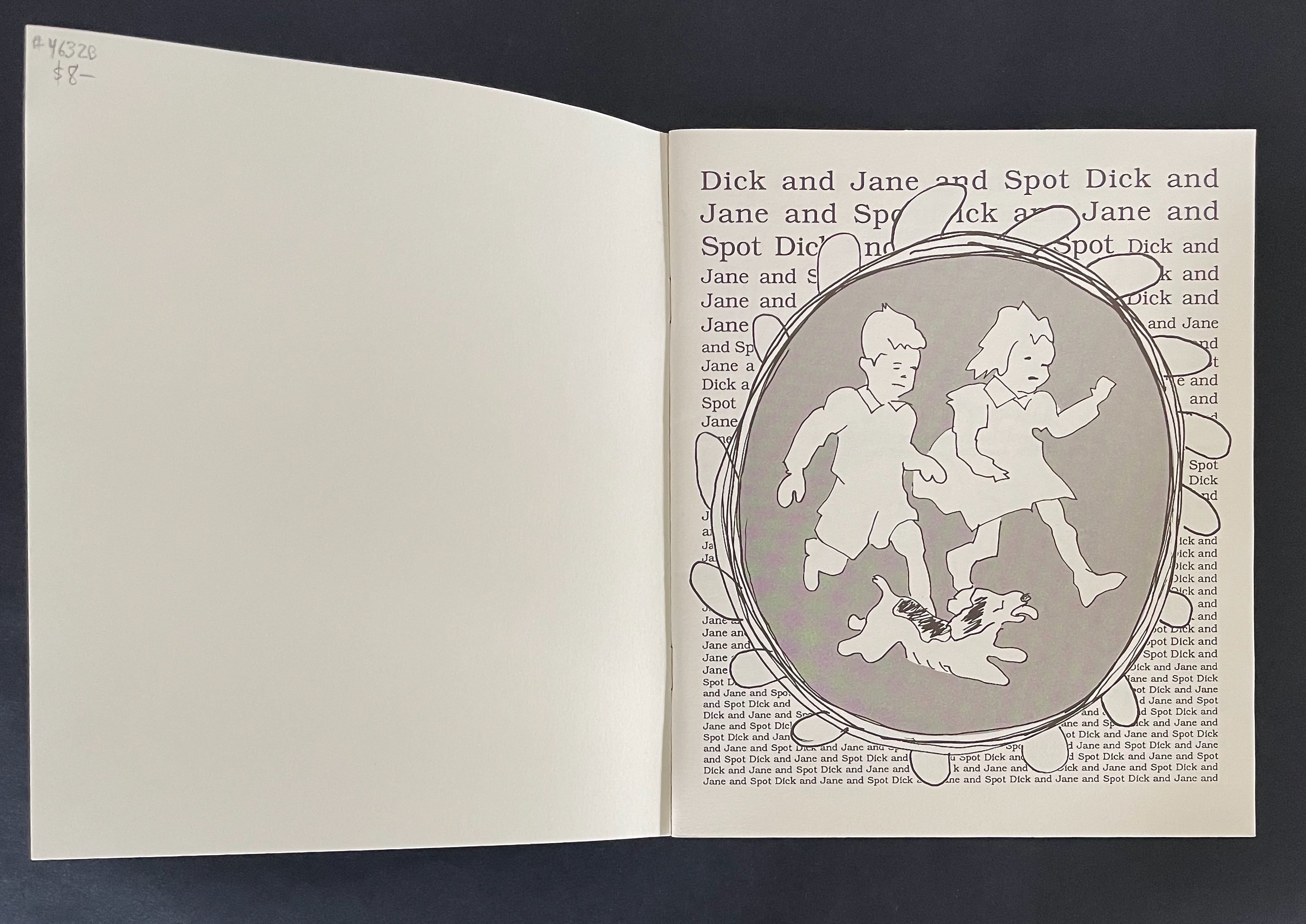
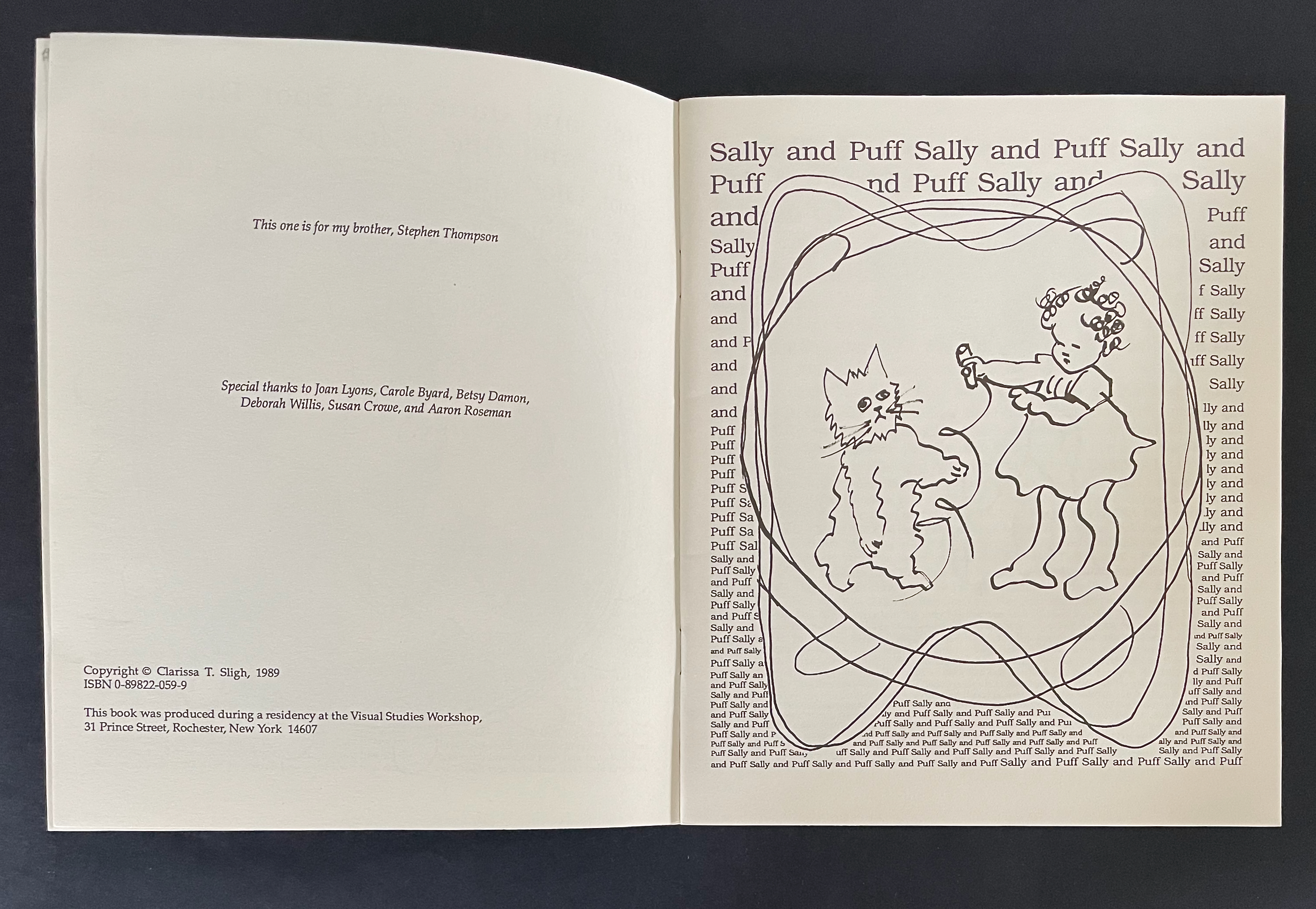
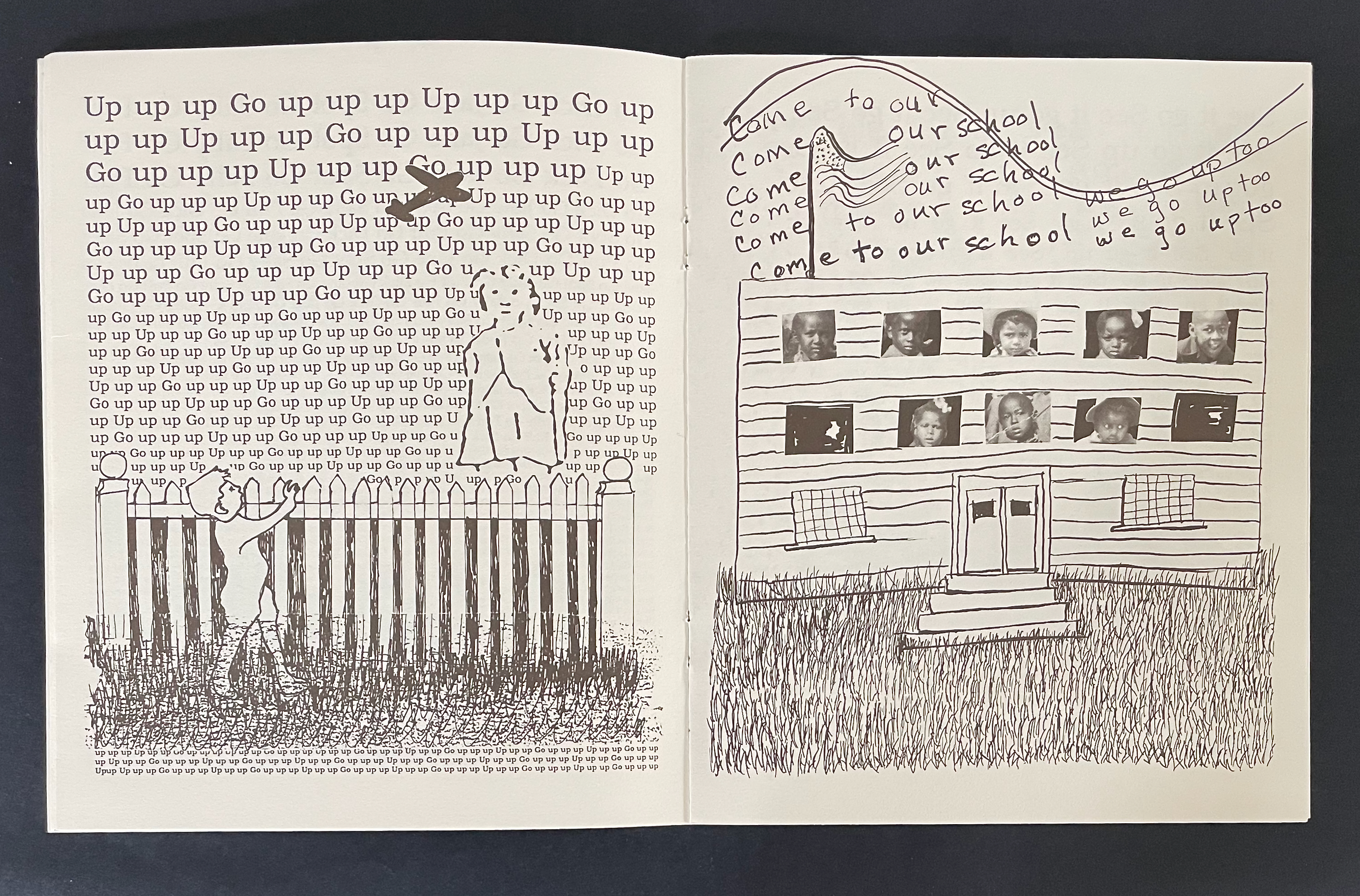
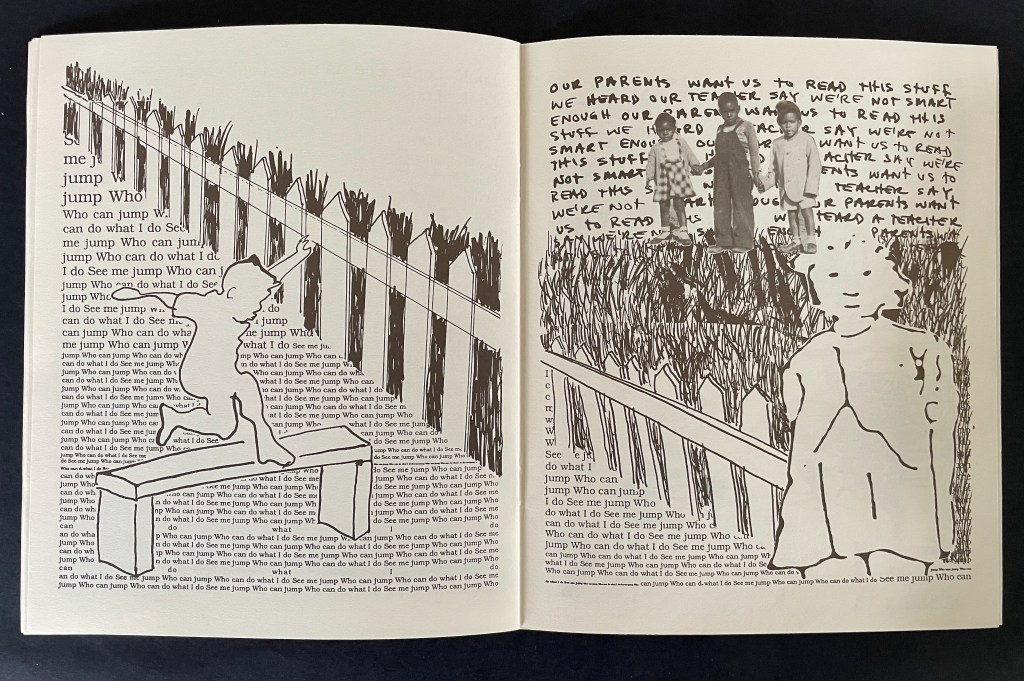
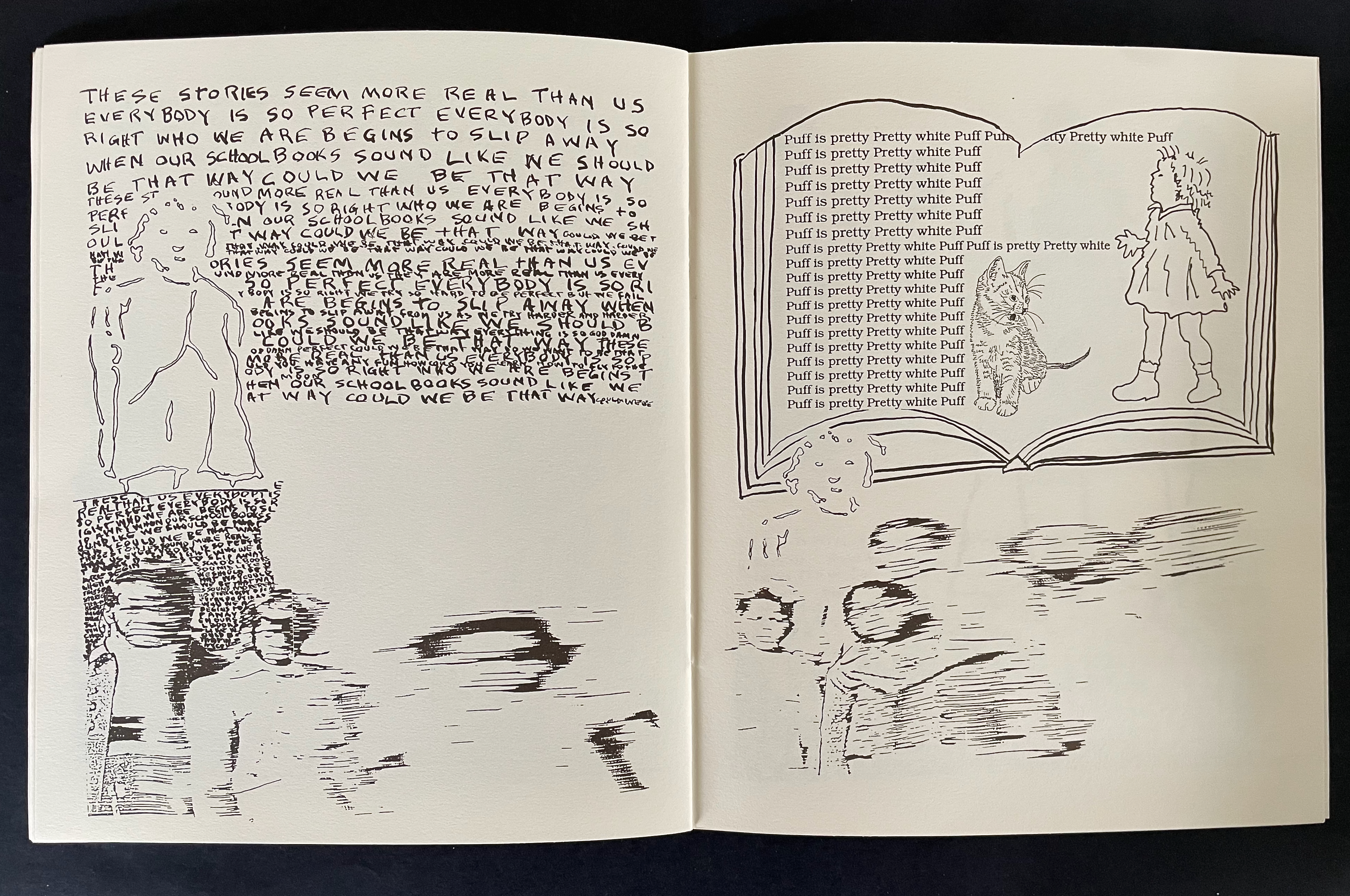
This is a painful artist’s book. In the repetitive style of the 1950s “Dick and Jane” beginning readers’ book, the child in the artist carries on a one-way conversation with children from those books. Dick, Jane, and Sally are white and upper middle class. They live in a suburban setting with their dog Spot and cat Puff, and the text of their lives is interpersed with “Fun”, “Fun”, “Fun”. They run and play, and tell the reader to “Look Look See us play”. Dick demands, “See me jump” and asks, “Who can jump Who can do what I do”. Sally insists on how pretty and white Puff is.
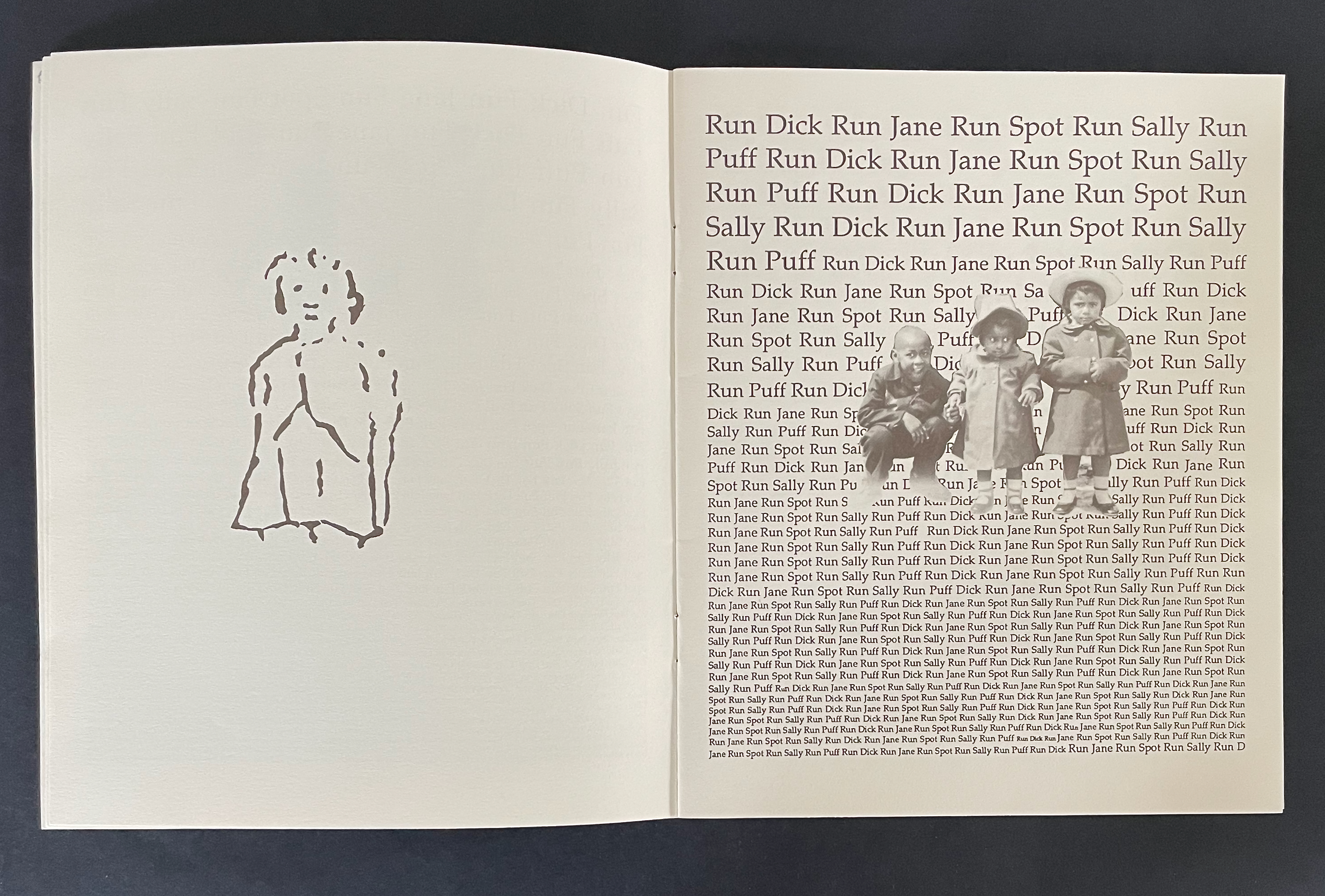
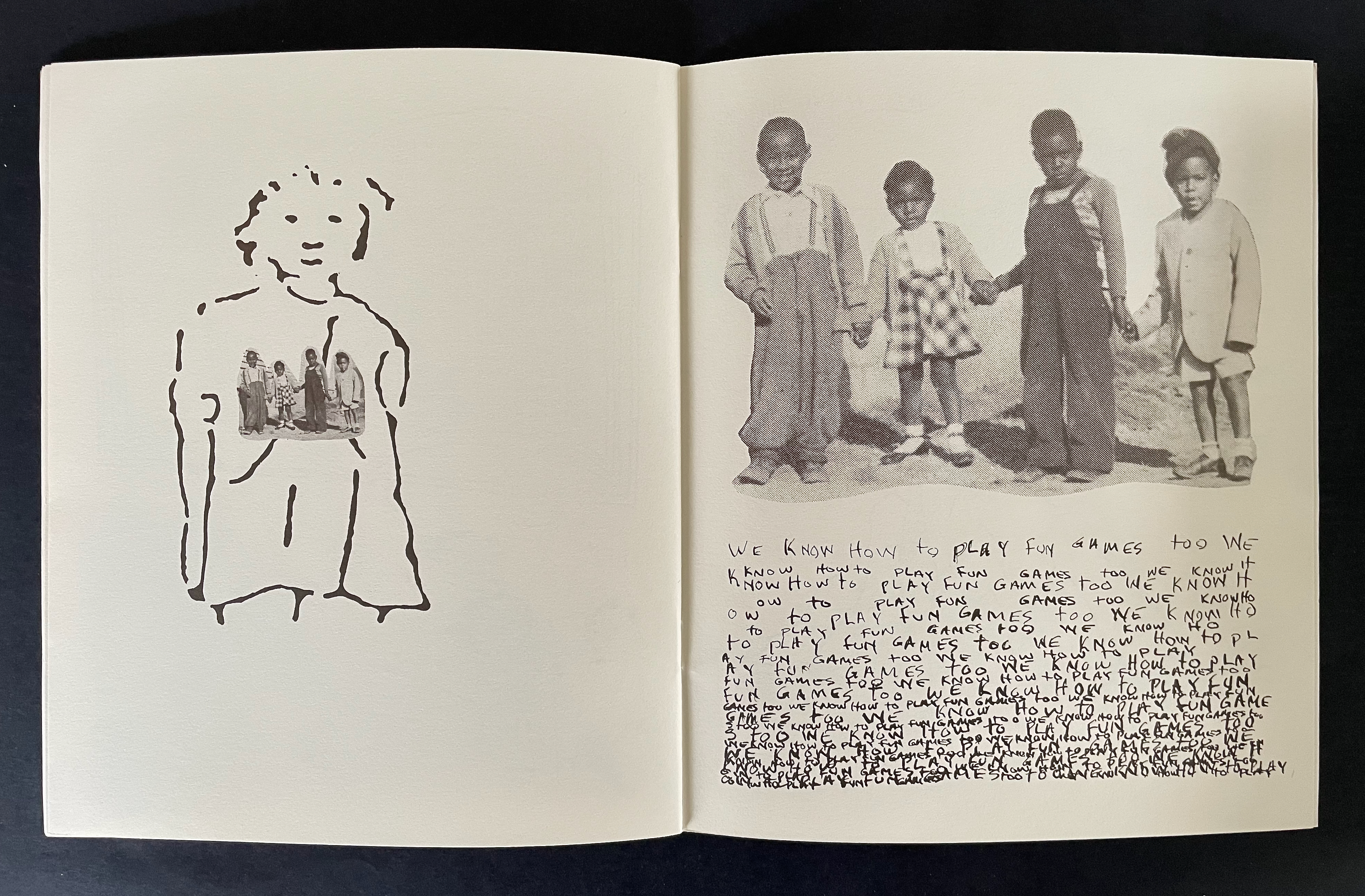
Alongside her redrawn versions of Dick, Jane, Sally, and their pets, the artist sketches in a cartoon self portrait and pastes in old photos of herself, siblings, and friends. For the first few pages, these images respond mutely to the “Dick and Jane” repetitions.
Facing the page below where a white picket fence separates the artist from Dick, she and her friends respond in a scrawled script (in contrast to Dick’s typeset exhortations to “Go up up up”). They invite Dick and the reader to “come to our school” where they “go up too”.
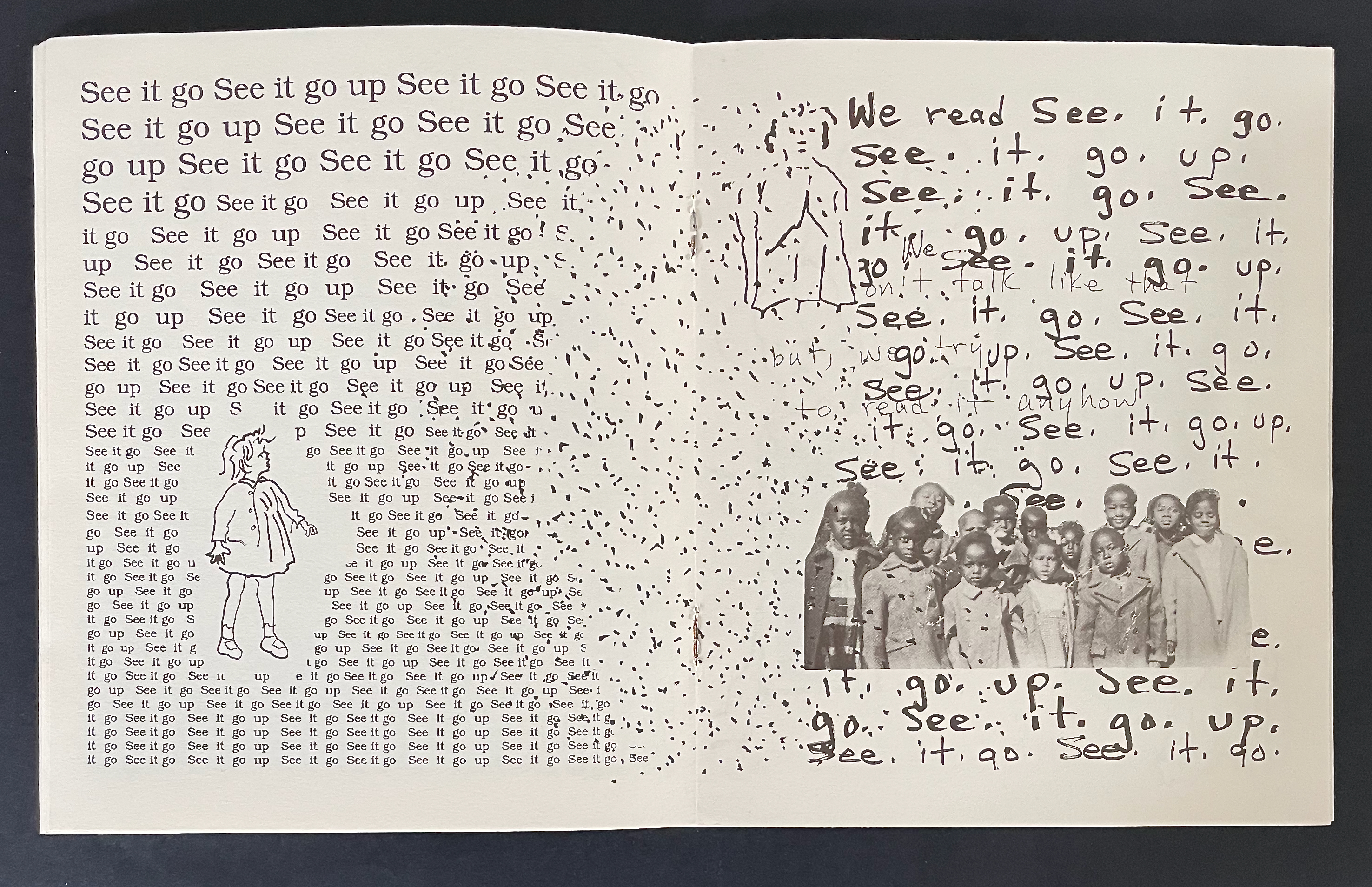
In the next spread, surrounded by imperatives to “See it go” and “See it go up”, Sally frowns and appears troubled by the encroachment of scrawls over the gutter and into her typeset page. On the facing recto page, the artist and friends stutter as they read the typeset lines: “We read See. it. go. see. it. go. up.” Maybe Sally is troubled by the words between the lines:
Between the lines: “We don’t talk like that but we try to read it anyhow”.
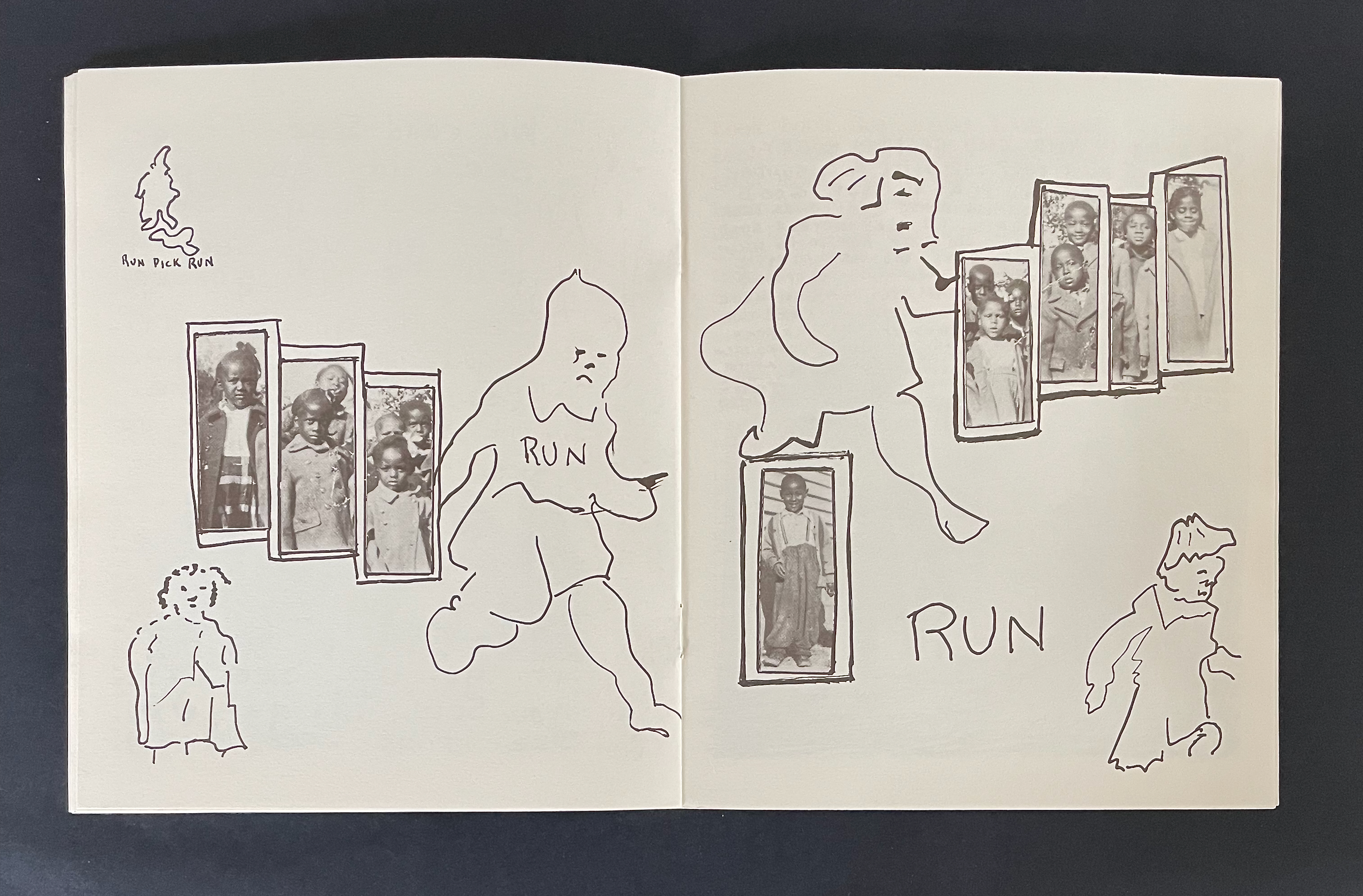
At this point, when the artist and her friends read “Run Dick Run”, the book takes a darker turn for us the readers — if we are reading with the child artist. Dick and Sally run across the double-page spread. Even though they are more roughly sketched than before and even though Dick wears a Ku Klux Klan hood, we know it is them. As the scrawled imperative RUN RUN RUN grows across the spread to its largest size, Dick’s mask slips aside. If you the reader are white, and if you understand that the scrawled (not typeset) command is in the artist’s voice, and if you are reading with the child who stands self-portrayed in the lower left hand corner and with the children in the photographs, maybe now you see what they see between the lines in Dick and Jane’s world.
From here on, the child artist addresses Dick and Jane (white society) more directly. She signals her “encroachment” by taking over the verso page with all of her scrawl and places Dick, Jane, and Sally within the drawn pages of their book in the foreground of the recto page. For the first time, her self-portrait is shaded as she stands in the background of the shaded Dick and Jane book.
As she explains how she and her friends differ from Dick and Jane (not likely to be listening, embedded as they are in their book), the child artist’s voice is soft but insistent in its “Dick and Jane” style repetition. For the first time, her self-portrait appears larger than the white child, and she is on the same side of the picket fence.
In the next spread, the impact of these “Dick and Jane” stories on her and her friends is spelled out and drawn to heartbreaking effect. Sally and “Pretty white Puff” stand in sharply drawn and typeset contrast to the erasure, the slipping away, of the self-portrait and the photograph. Even the book you hold in your hands and its hand scrawled text are smearing away in the lower left corner.
The artist’s voice is soft but, like the “Dick and Jane” style, insistent. In text and image, the message is heartfelt.
Reading Dick and Jane with Me also had an exhibition life, which Sligh describes on her website:
These cyanotype prints, 40 x 30 inches, 1990-2013, originated from artwork made for my artist’s book Reading Dick and Jane With Me while in residency at Visual Studies Workshop in 1989. The size of the original collage and the book page was about 8 ½ x 7 inches. During that residency at VSW, before the days of Photoshop, I learned to shoot the artwork onto film, strip and spot the films and make metal plates for the offset press printing of the book.
With the encouragement of Joan Lyons, the VSW Press director, I also used the large process camera to shoot and develop large negatives from the artwork. After returning home, I built a large light table, contact printed the negatives and processed them in my bathtub. The prints are sent to various exhibition sites. Viewers draw and mark on the prints in response to my image and text narratives. This process is done repeatedly until the prints are fully covered with marks and sketches left by the public.
The process continues. — Sligh website, accessed 17 July 2026.
As of this writing — in the time of Jim Crow 2.0, brutalization of children of color, and vicious beliefs in replacement theory and empathy as sin — Reading Dick and Jane With Me continues to insist — Read Dick. Read Jane. Read Sally. Read.
Further Reading
“Tia Blassingame”. 17 August 2020. Books On Books Collection.
Gabor, Nora. 18 February 2021. “Black History and Experiences through Book Arts“. The Full Text: News about library resources and services. Chicago, IL: DePaul University. Accessed 22 January 2024.
Gleek, Charlie. 2019. “Centuries of Black Artists’ Books“. Presented at “Black Bibliographia: Print/Culture/Art” conference at the Center for Material Culture Studies, University of Delaware, 27 April 2019, pp. 7-8. Accessed 20 July 2020.
Sligh, Clarissa. 1 July 2006. Interview with Steve Miller, Book Arts Podcasts, School of Library Information and Sciences, University of Alabama. Accessed 20 July 2020.
Deconstruction and Reconstruction of the Book (1990)
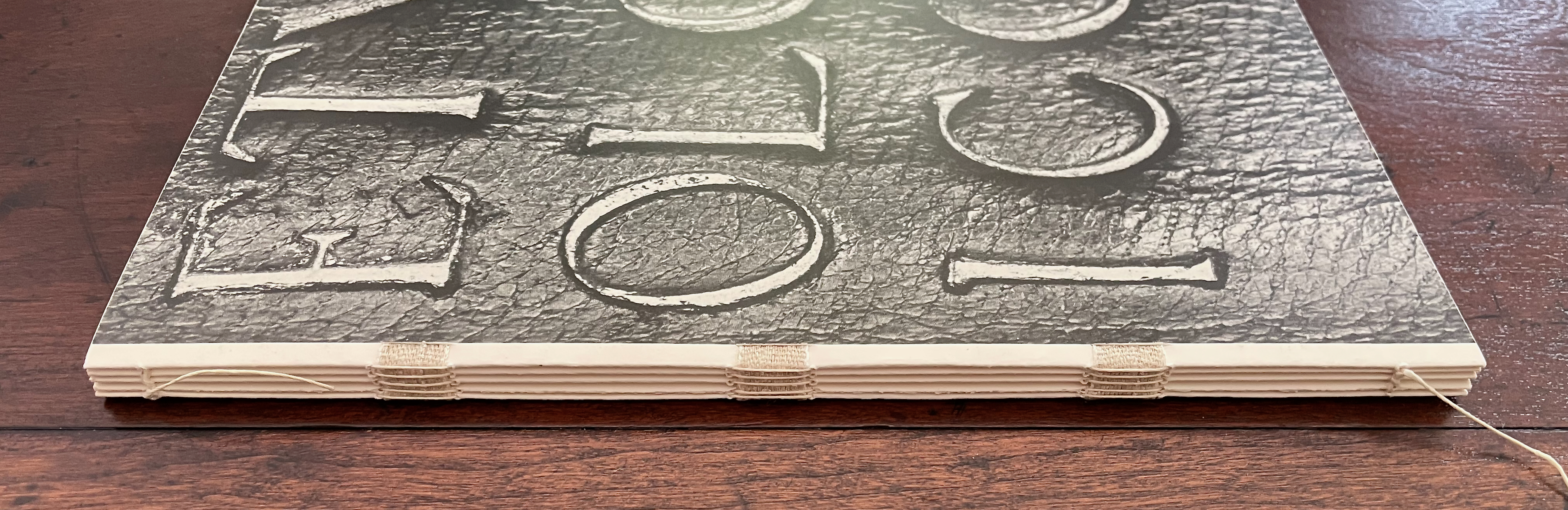
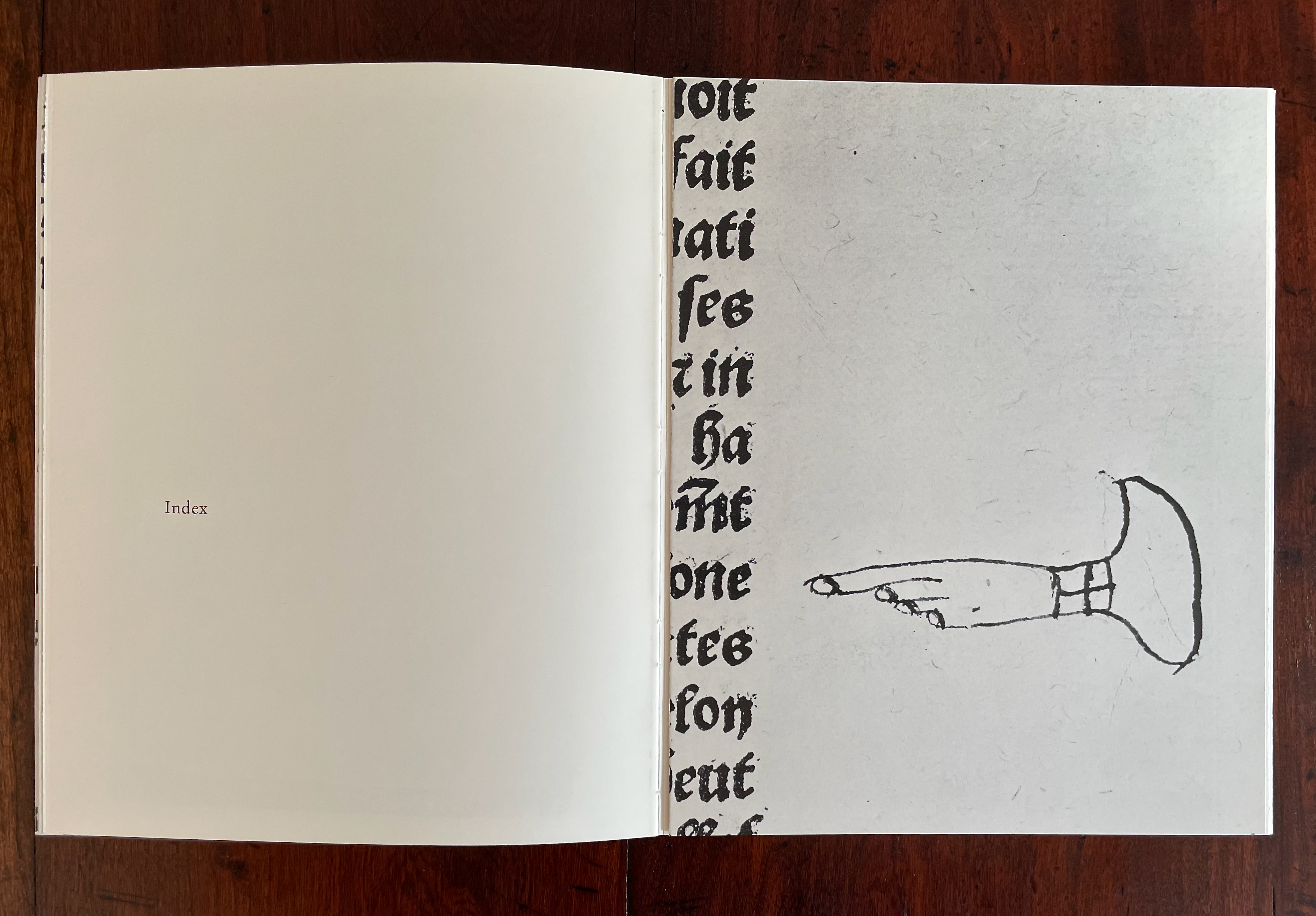
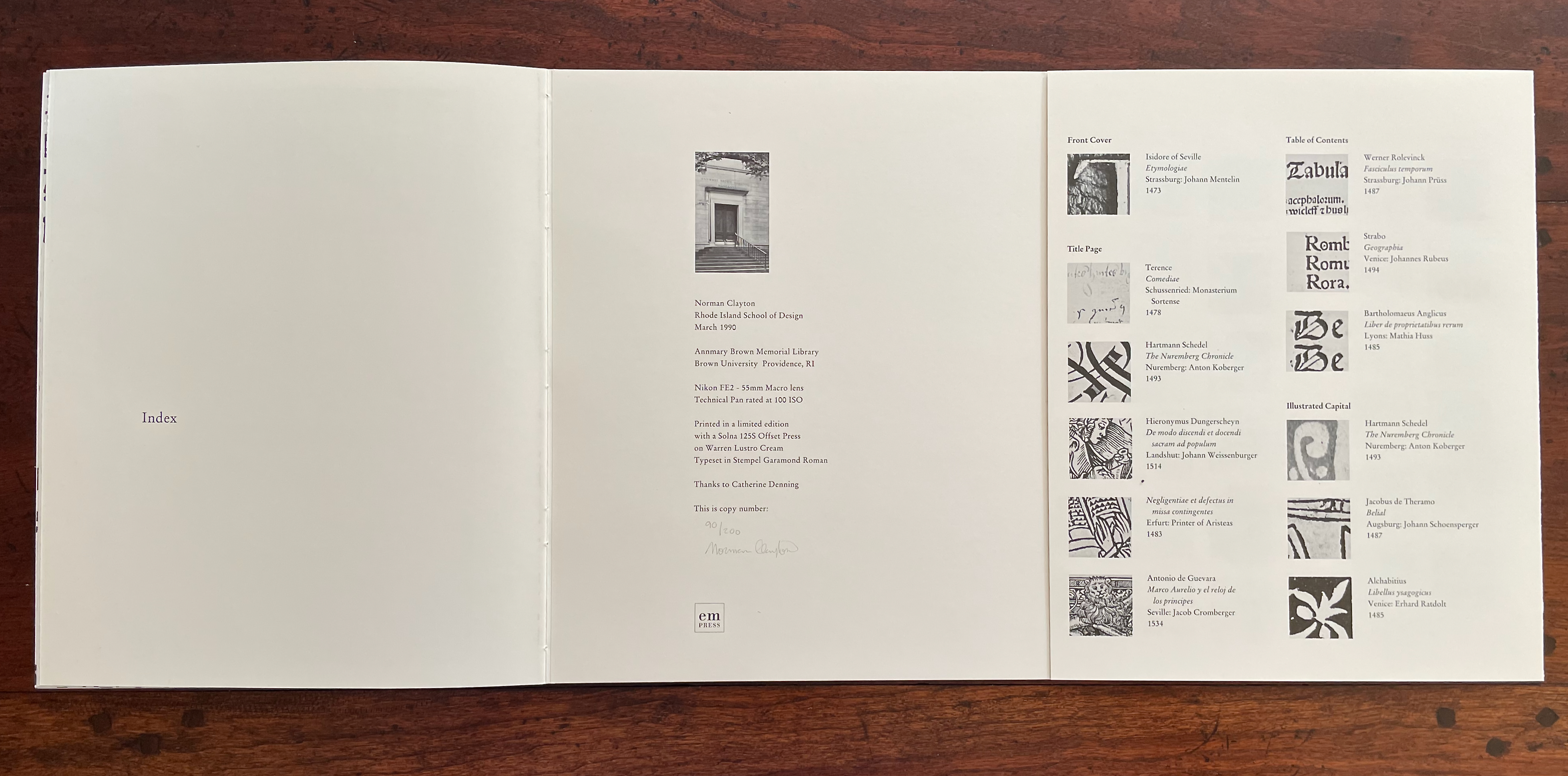
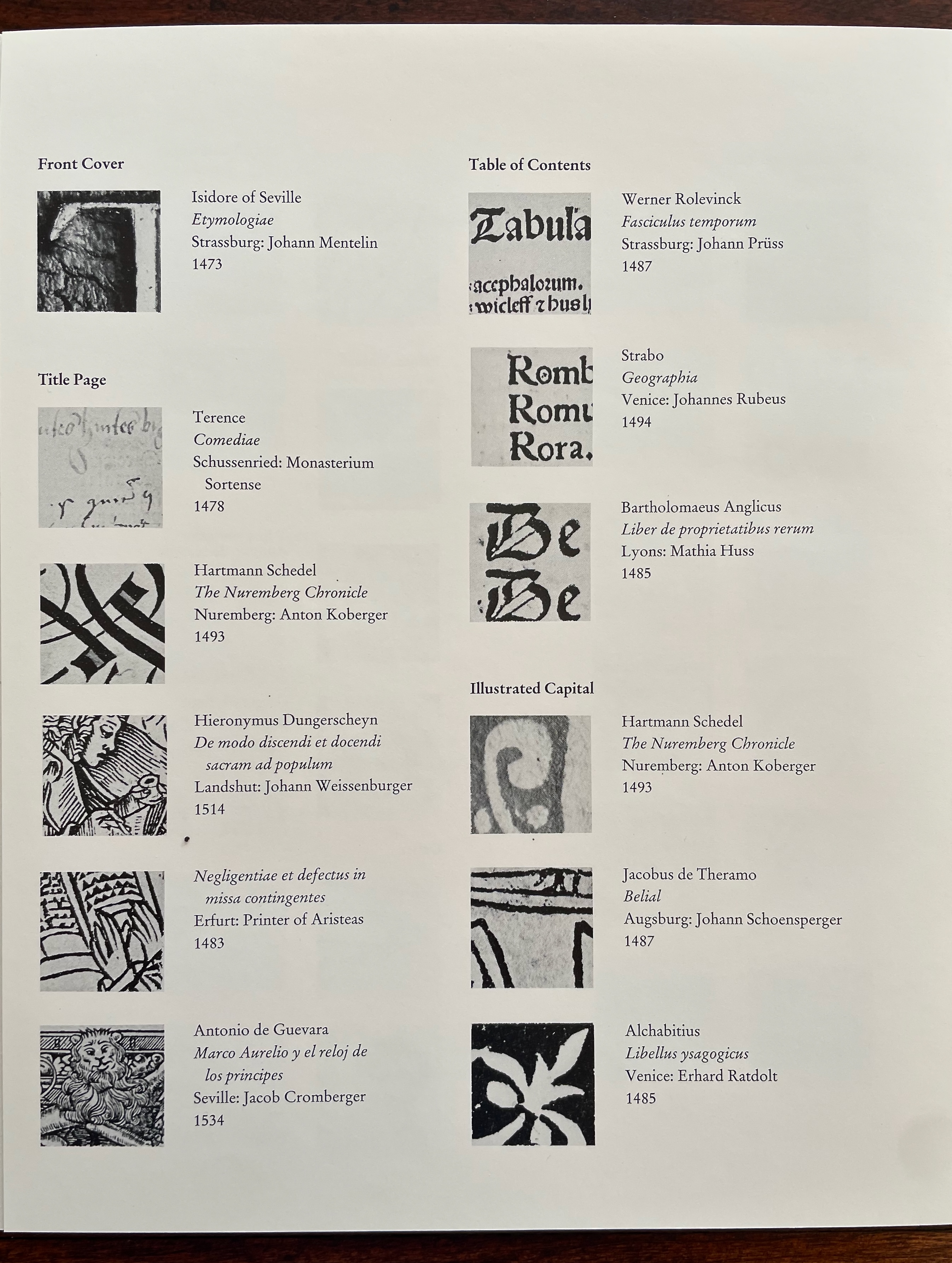
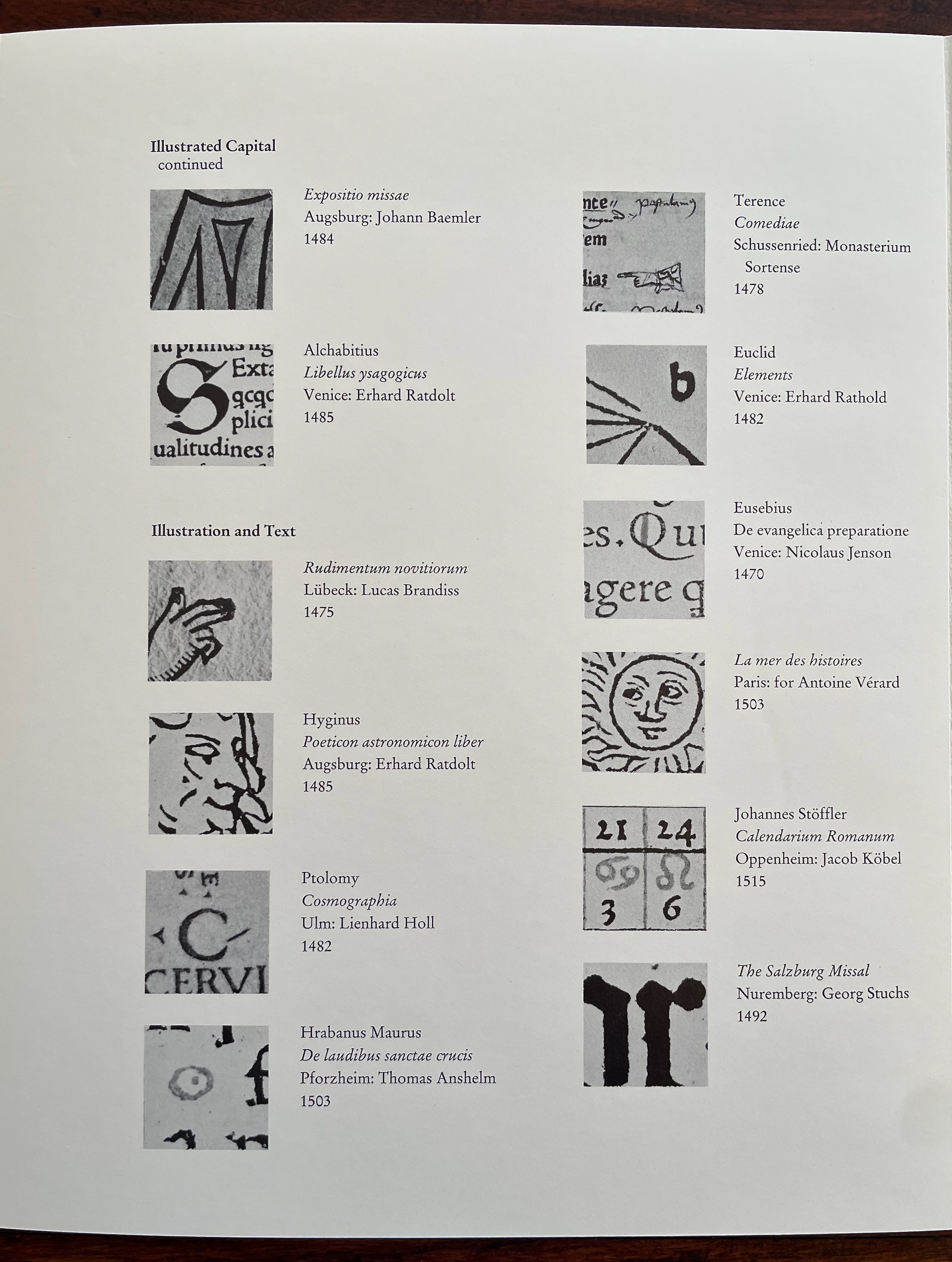
Deconstruction and Reconstruction of the Book (1990) Norman Clayton Softcover, exposed spine, hand sewn. H250 x W205 mm. [50] pages, including 4-page foldout. Edition of 200, of which this is #90. Acquired from the artist, 23 June 2026. Photos: Books On Books Collection.
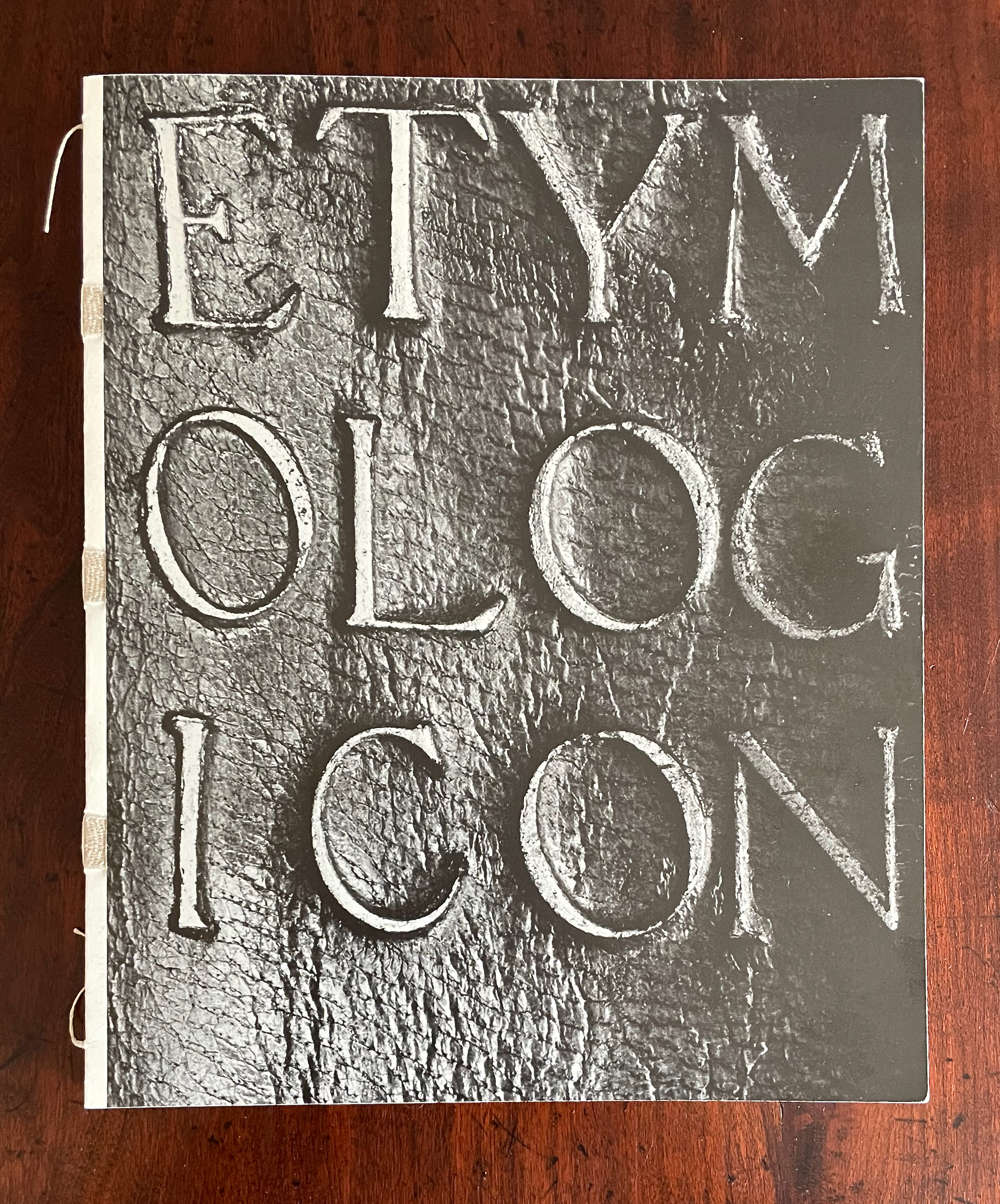
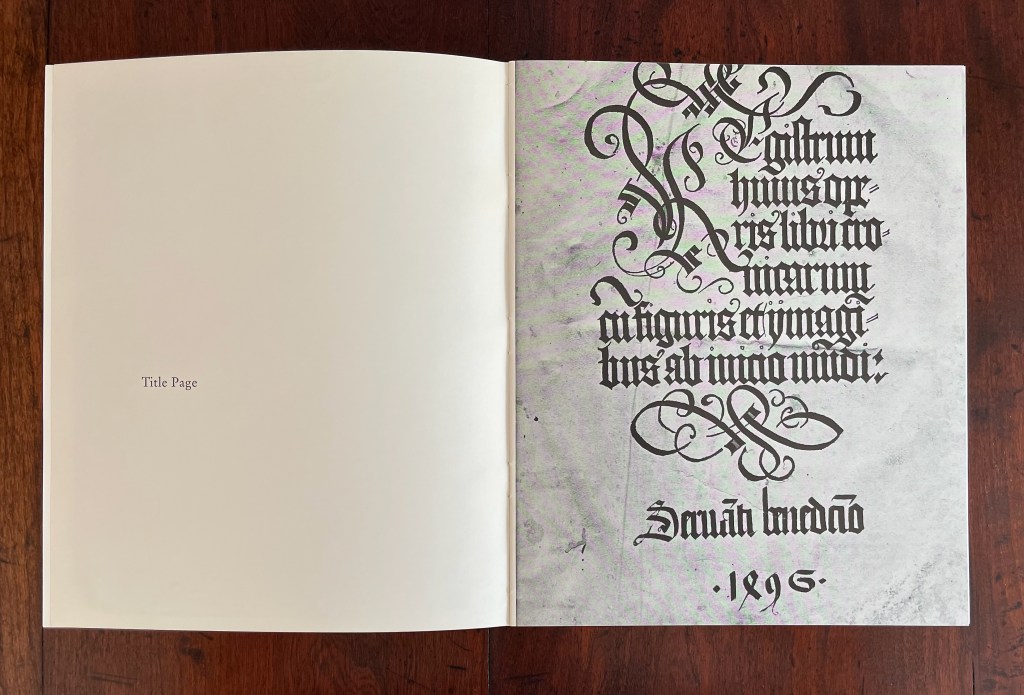
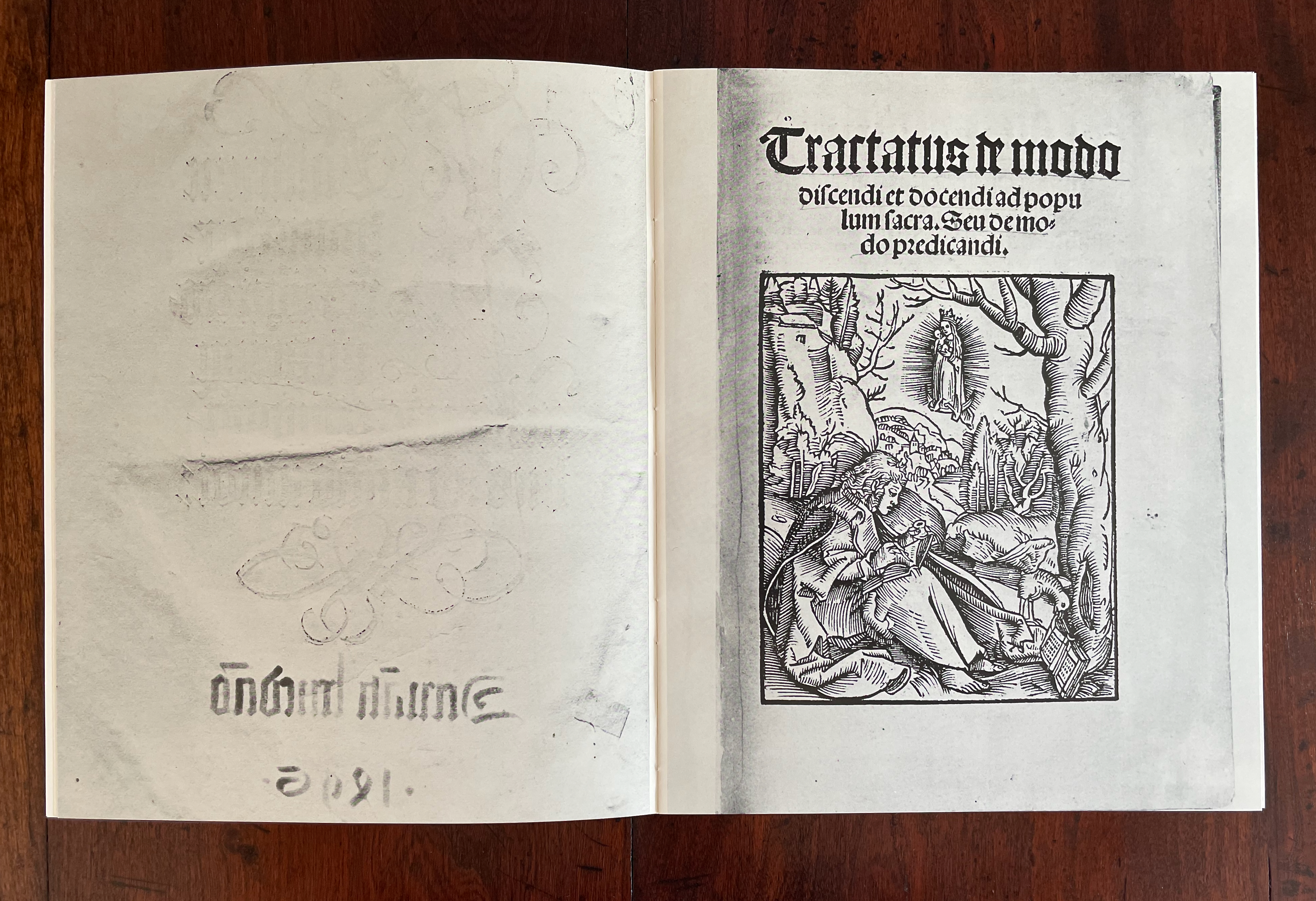
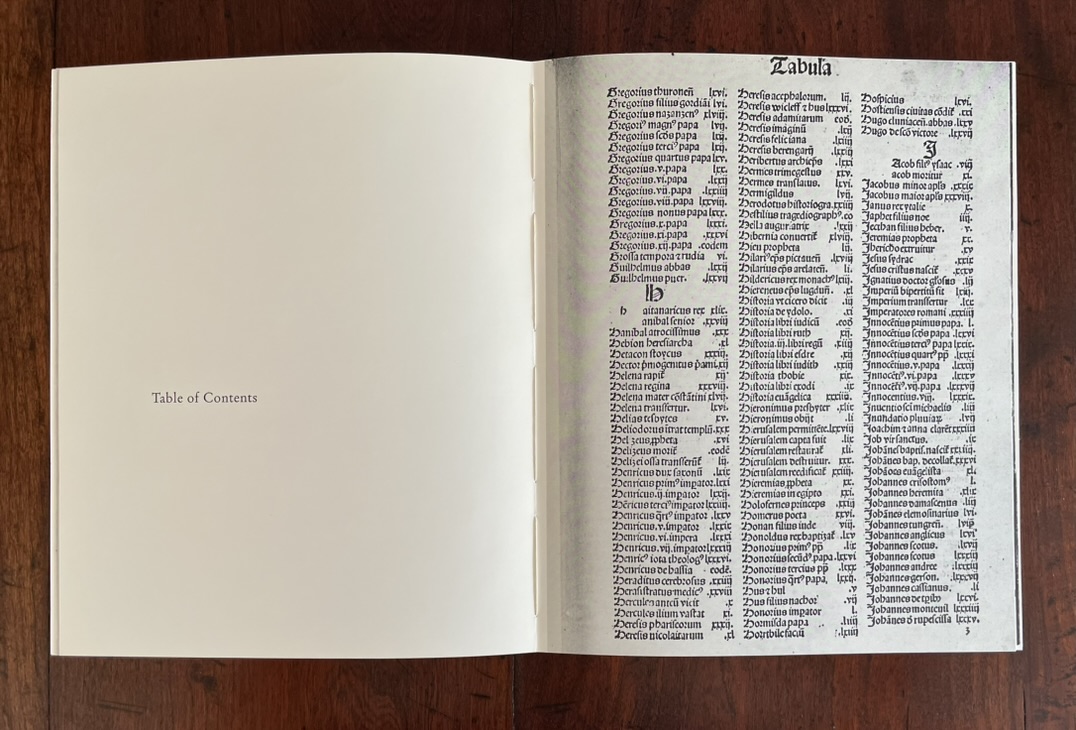
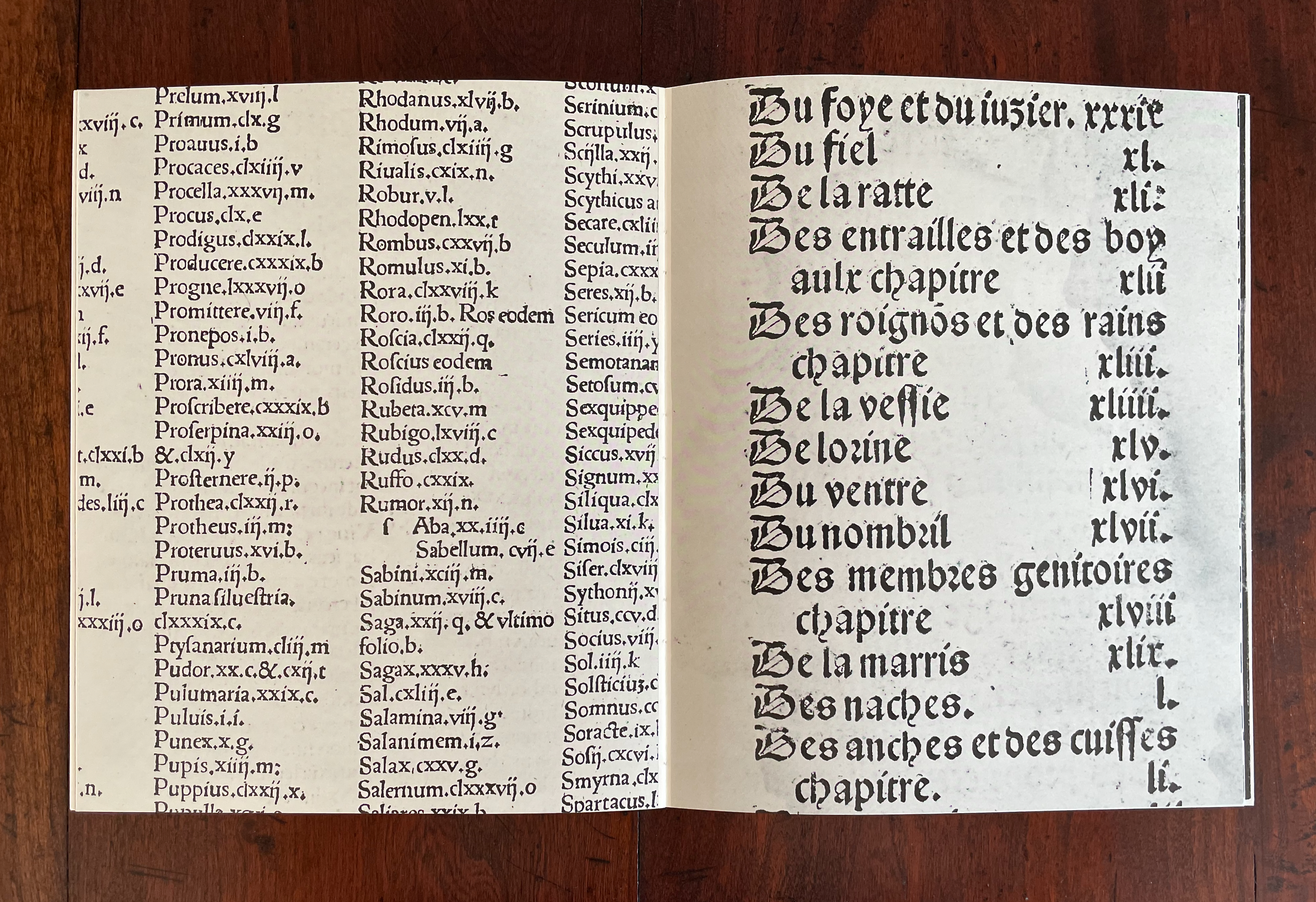
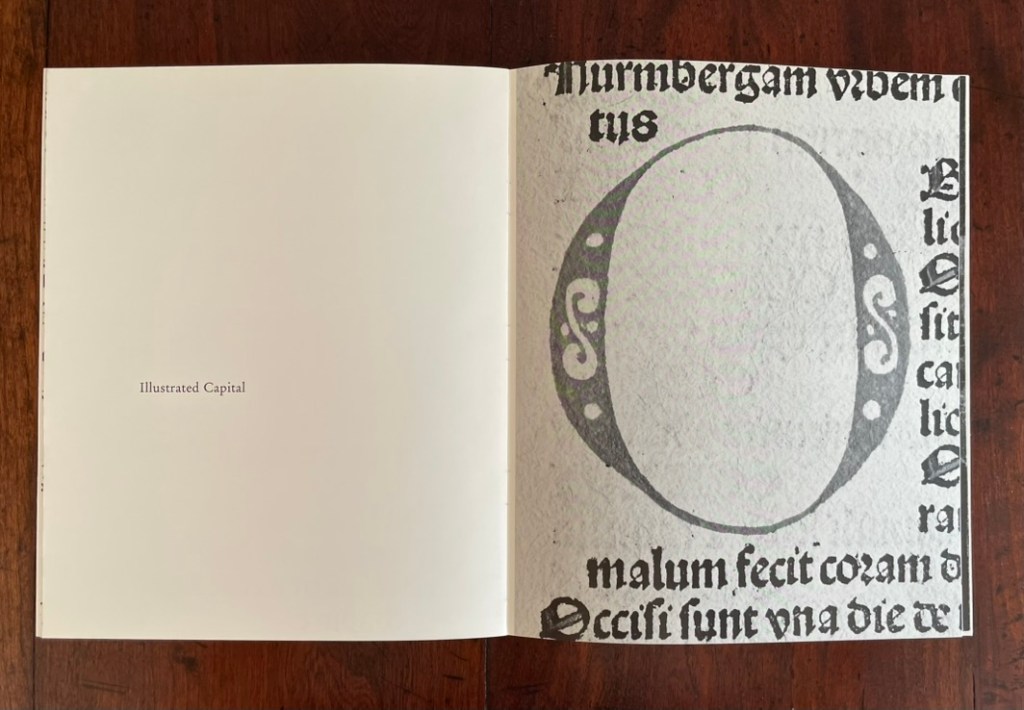
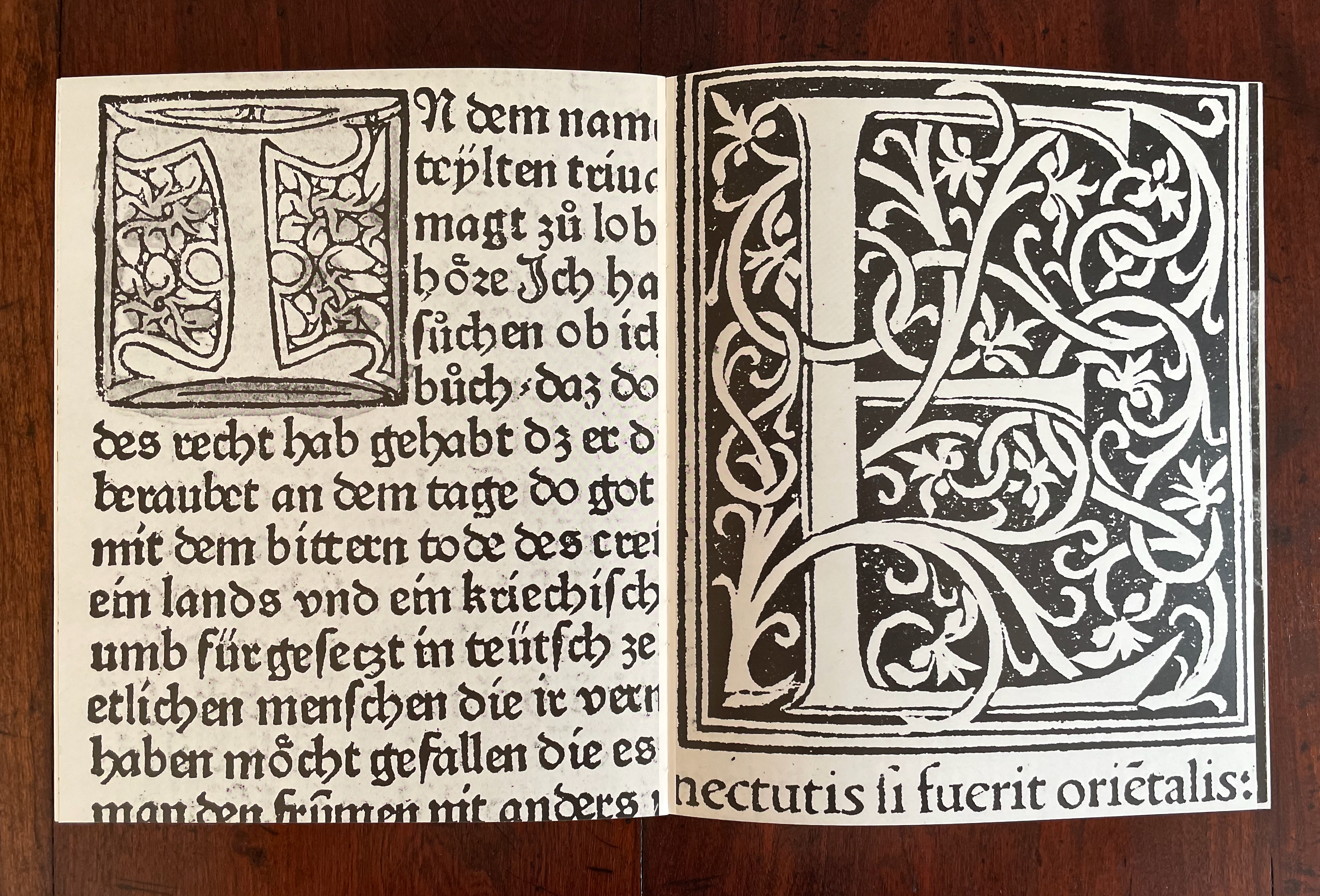
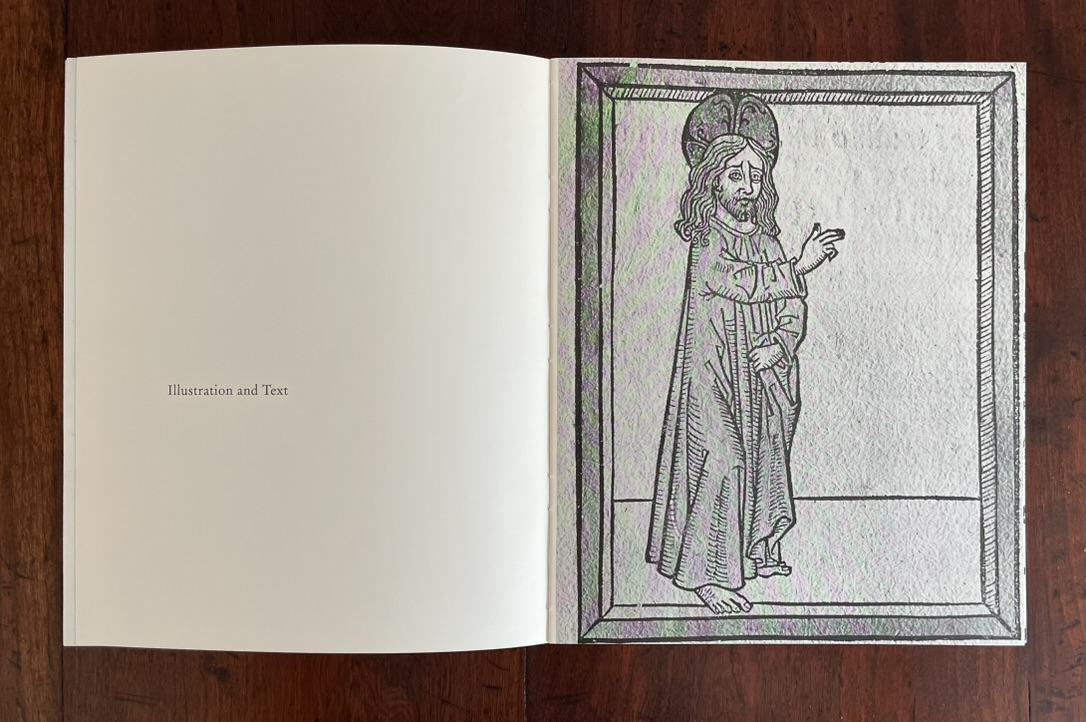
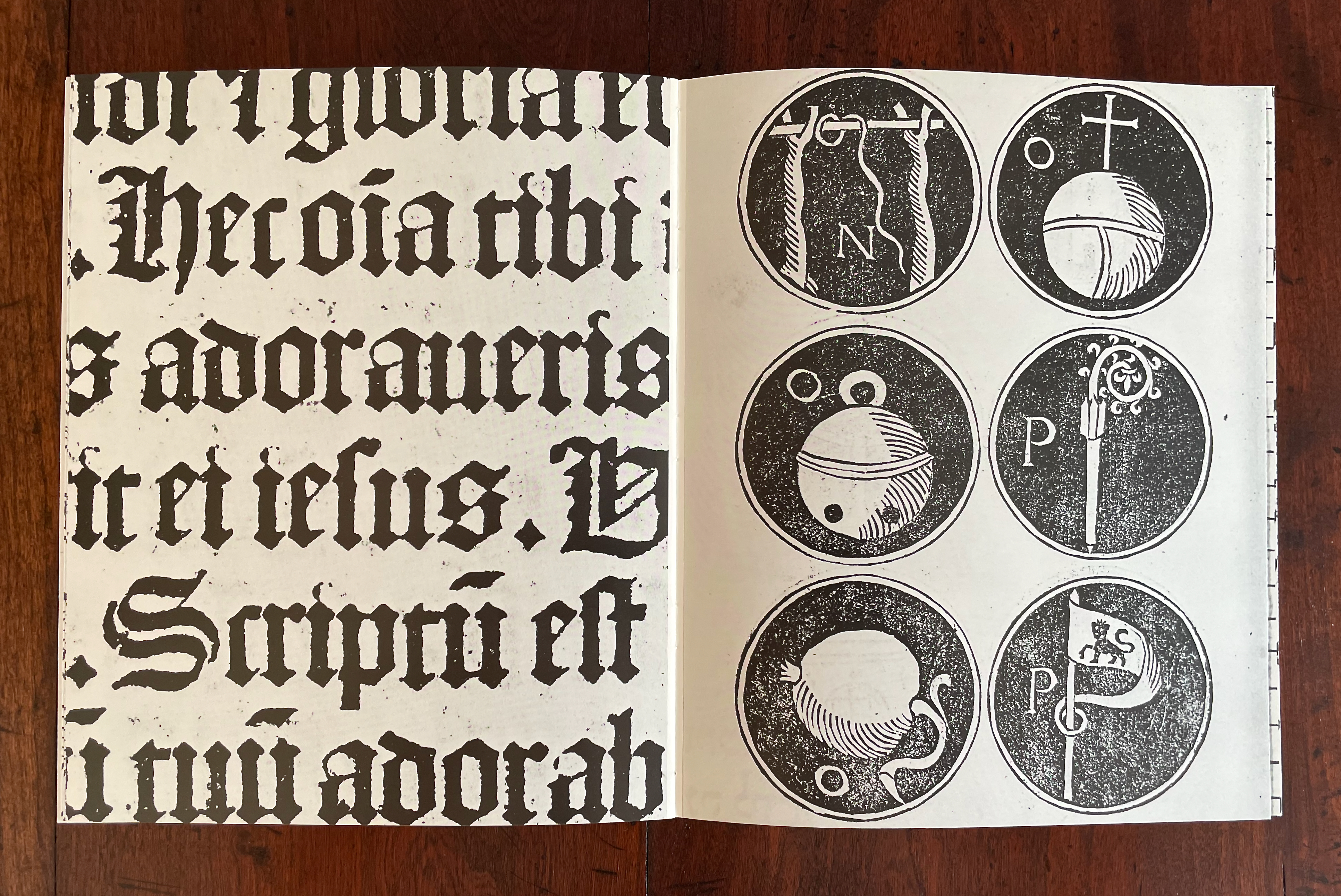
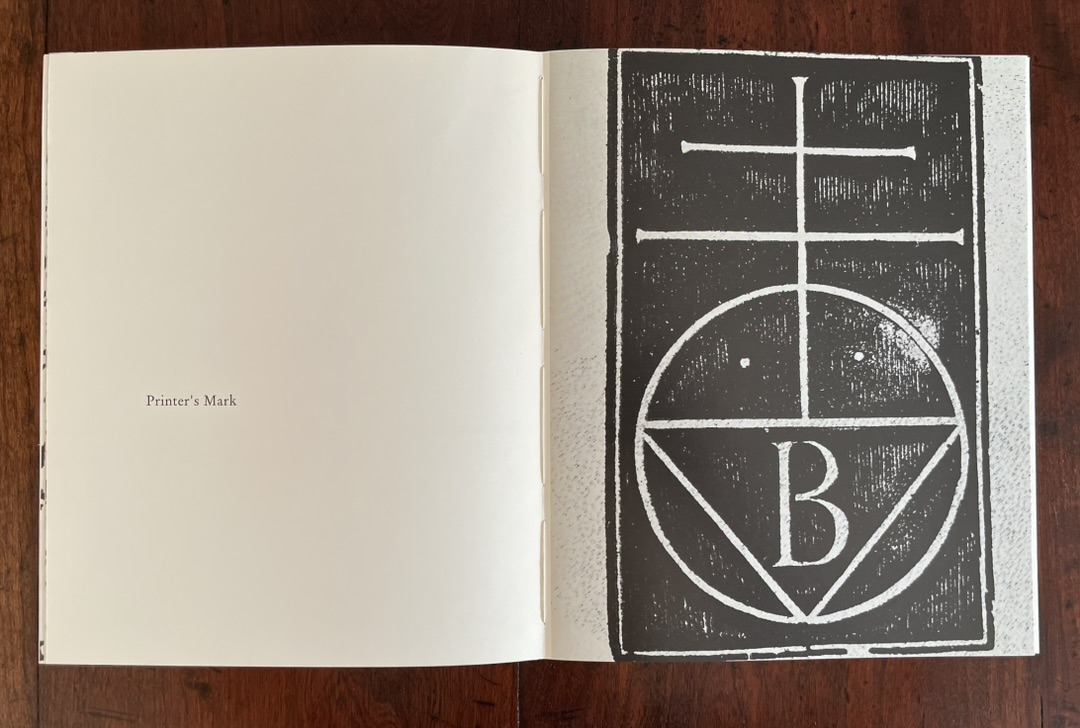
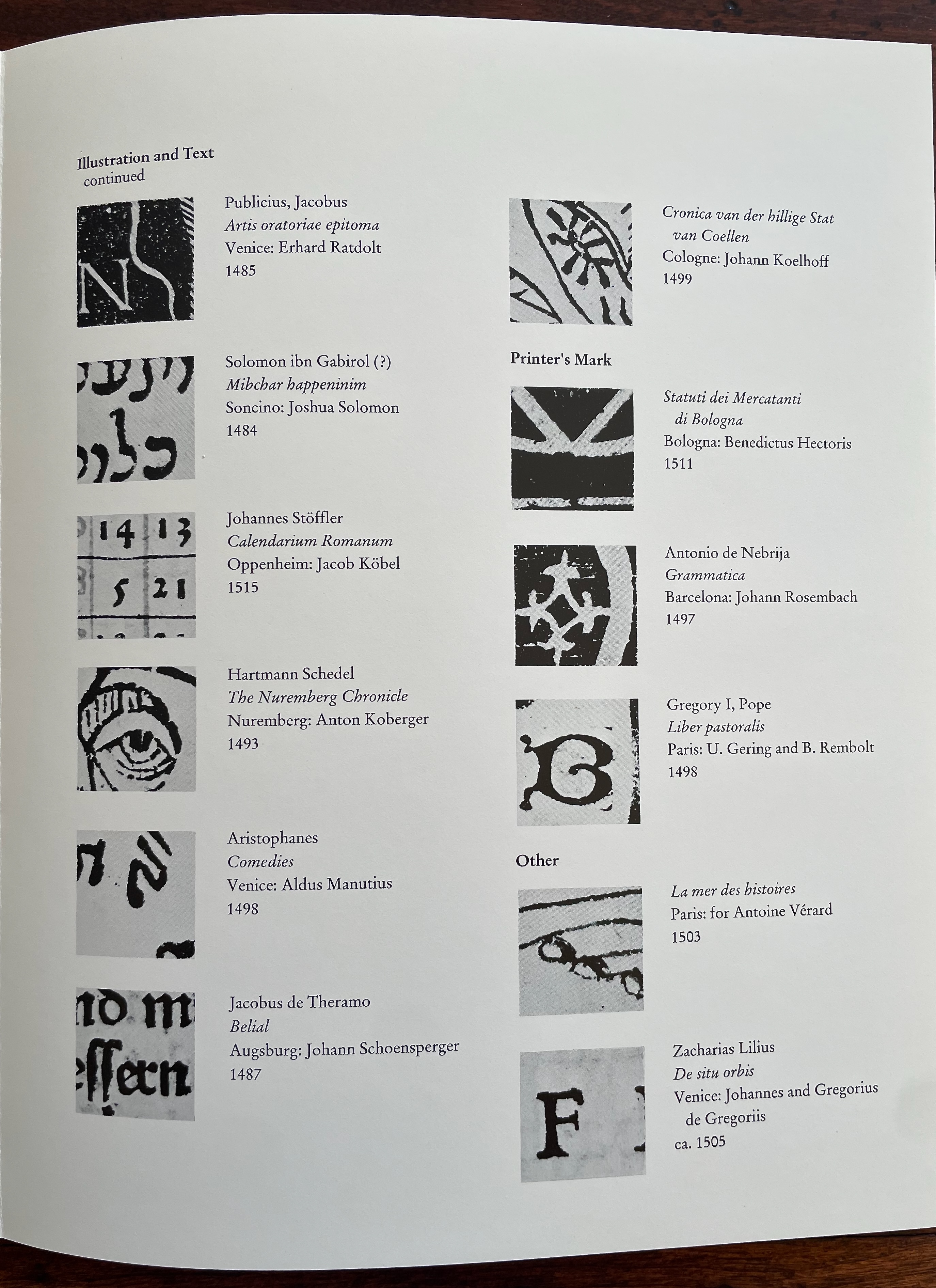
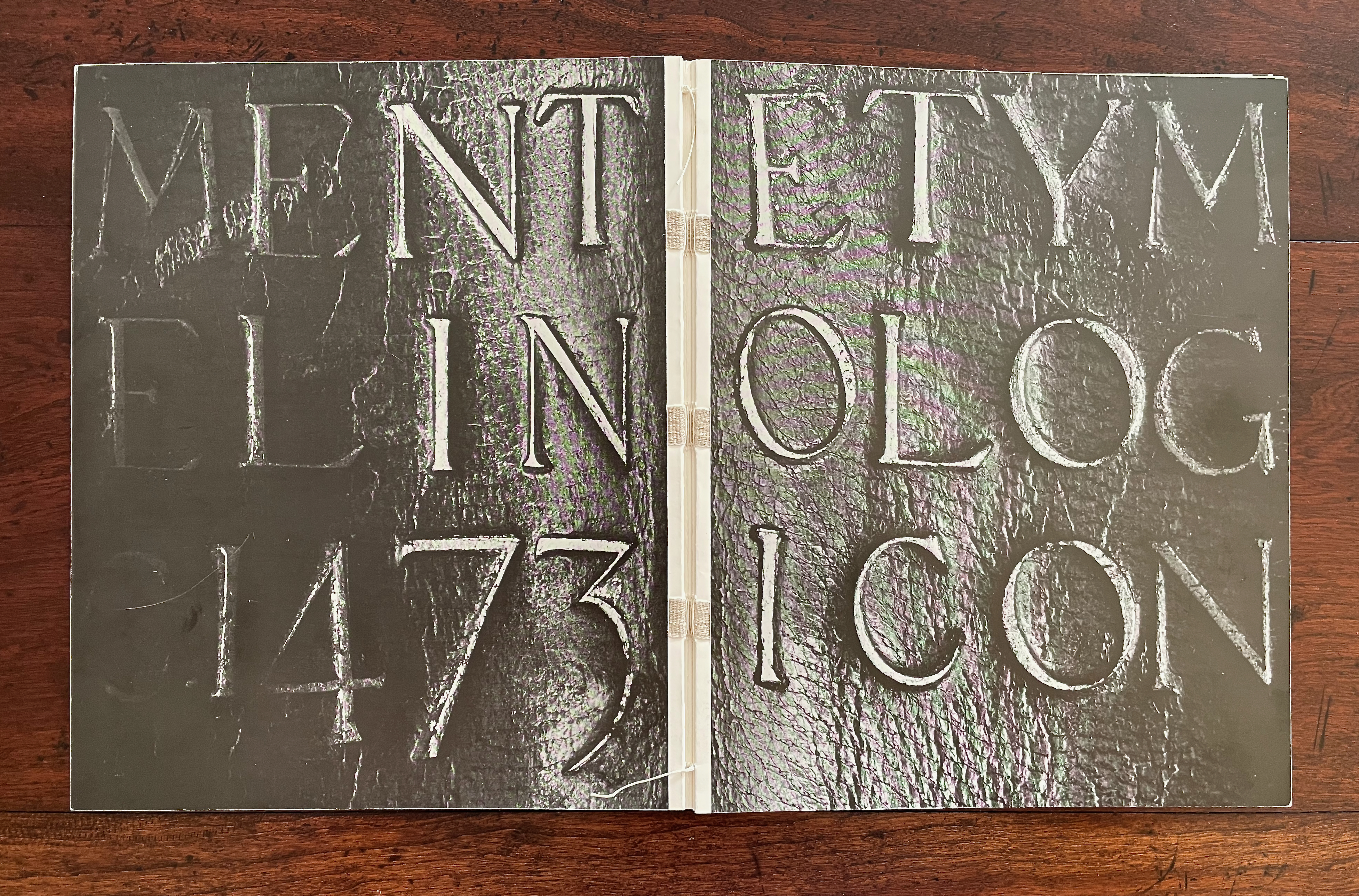
As a student at the Rhode Island School of Design, Norman Clayton journeyed back to the beginning of printed books in the western world with a Nikon FE2 and 55mm macro lens. He captured those elements that, during the age of incunabula (printed books before 1500), typesetters and printers-cum-editors were reshaping from manuscripts into what would become the received structure of the book. More satisfying, he poured those photos and the craft he was learning at RISD into an artist’s book. It is hand sewn over linen reinforcing tapes so that the booklet lies flat to offer up the images celebrating the title page, table of contents, illustrated capitals, illustrations and text, and printers’ marks — all drawn from thirty-six works in the Annmary Brown Memorial Library at Brown University in Providence, RI.
There are plenty of full color illustrated histories of the history of the book available, but Clayton’s black and white photographs, choice of font (Stempel Garamond Roman) and paper (Warren Lustro Cream), and neatly executed exposed-spine binding deliver a satisfying artist’s book with a sense of the texture and material of history.
Clayton’s introduction to his fold-out index elicits a smile and a wish that he had also captured a colophon or two. Perhaps there’s a revised edition project looking for an intern or future book artist.
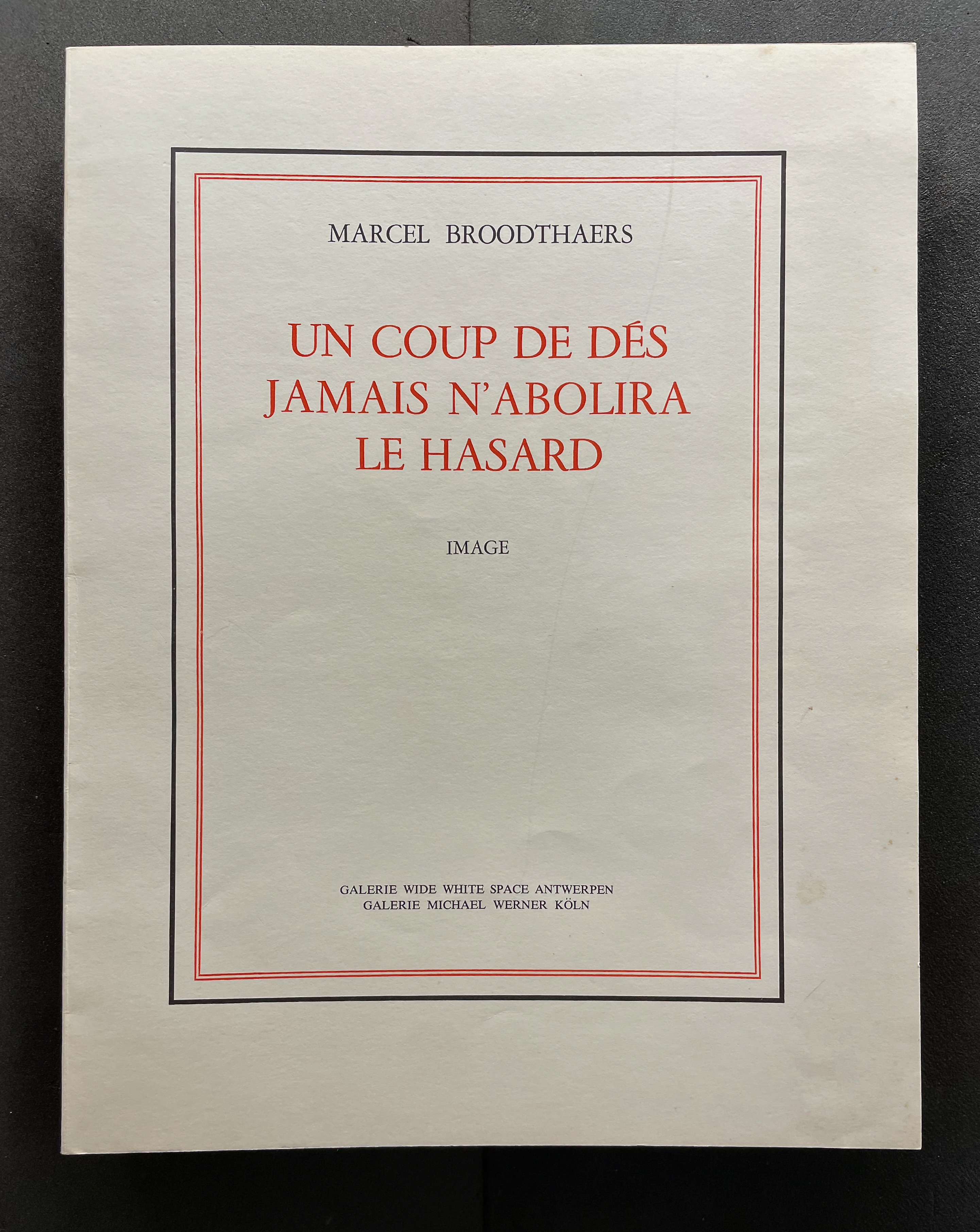
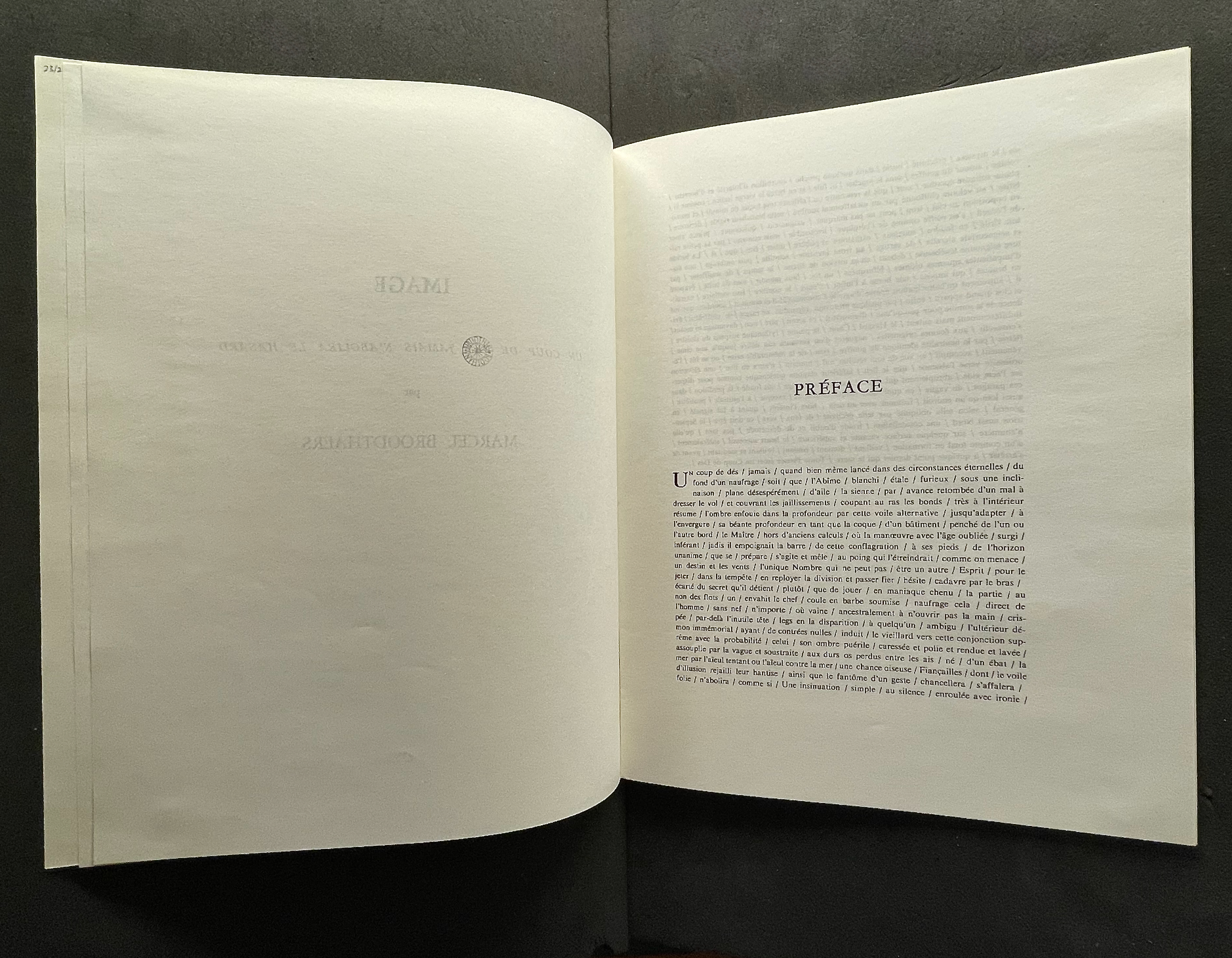
The story goes that in 1945 or 1946 René Magritte gave Marcel Broodthaers a copy of Mallarmé’s poem Un Coup de Dés Jamais N’Abolira le Hasard: Poème (1914). Twenty-three or twenty-four years later, Broodthaers organized an exhibition in homage to the poem. Entitled Exposition littéraire autour de Mallarmé: Marcel Broodthaers à la Deblioudebliou/S (“Literary exhibition around Mallarmé at the Deblioudebliou/S”), it presented three versions of an appropriation of the poem. The three versions consist of ten copies numbered I-X on anodized aluminum, ninety copies numbered 1-90 on transparent mechanographic paper (the original edition), and three hundred copies on opaque paper (the catalogue edition).
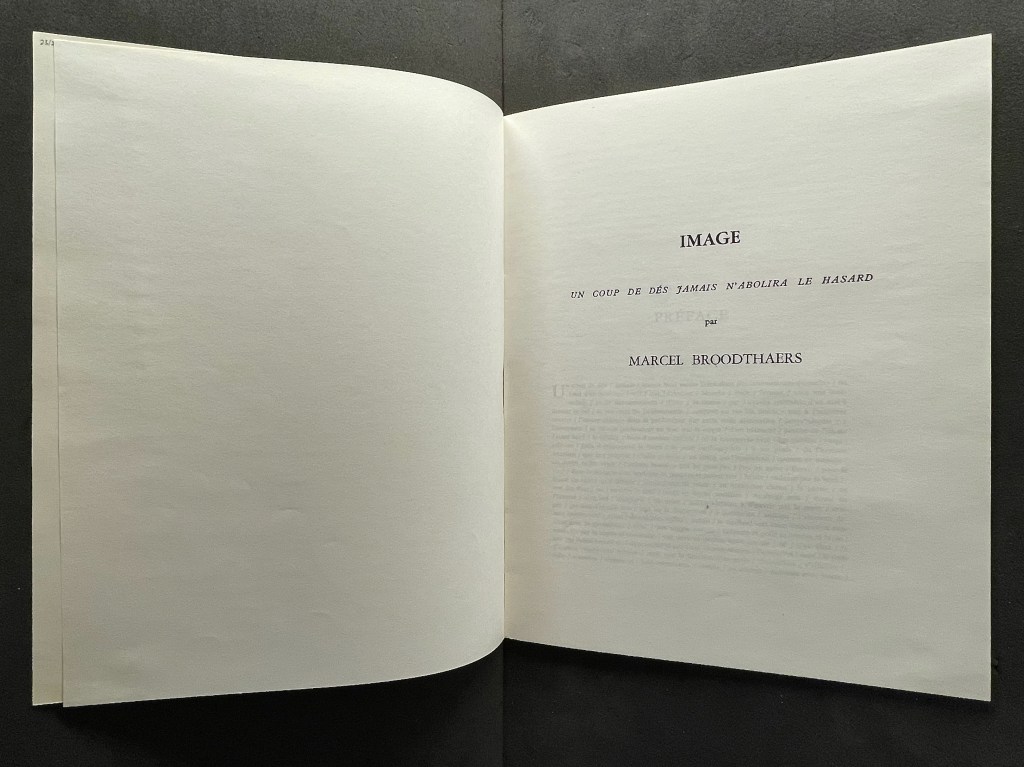
On Broodthaers’ cover, the word Image occupies the same space as Poème on the cover of the 1914 edition arranged by Mallarmé’s son-in-law. On the title page, however, Image comes first and in type larger than the poem’s title beneath it. The poem’s title is even smaller that Broodthaers’ name. Already this promises to be a bold appropriation of Mallarmé’s poem.
When the poem first appeared in the May 1897 issue of Cosmopolis, Mallarmé reluctantly provided a preface at the editors’ request. So reluctant was he that the preface urges readers not to read it. Broodthaers obliges. He displaces all of Mallarmé’s dismissive text with the poem’s entirety in a justified block of type with the line breaks indicated by slashes. Until the colophon, that will be the only legible text to appear in this homage.
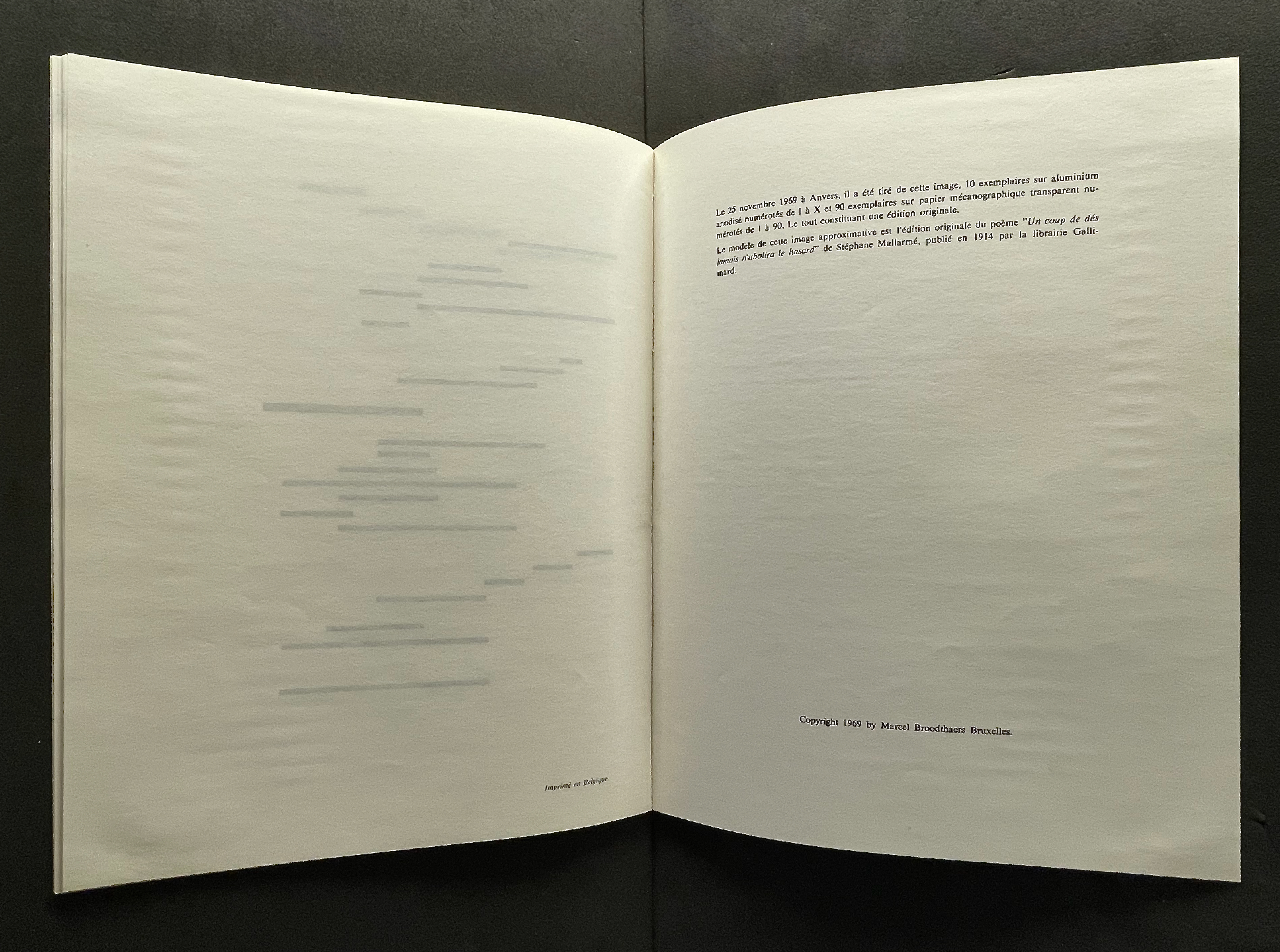
“Le modèle de cette image approximative est l’édition originale du poème ‘Un coup de dés jamais n’abolira le hasard’ de Stéphane Mallarmé, publié en 1914 par la librairie Gallimard.” Books On Books Collection.
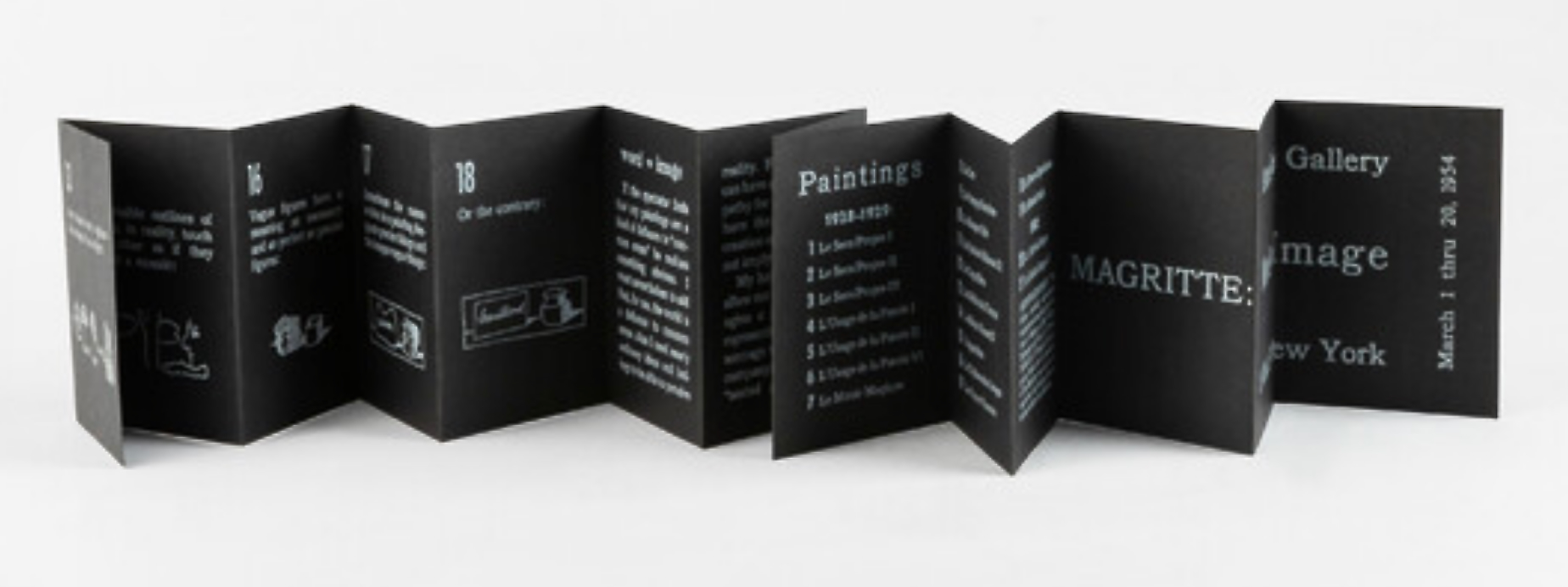
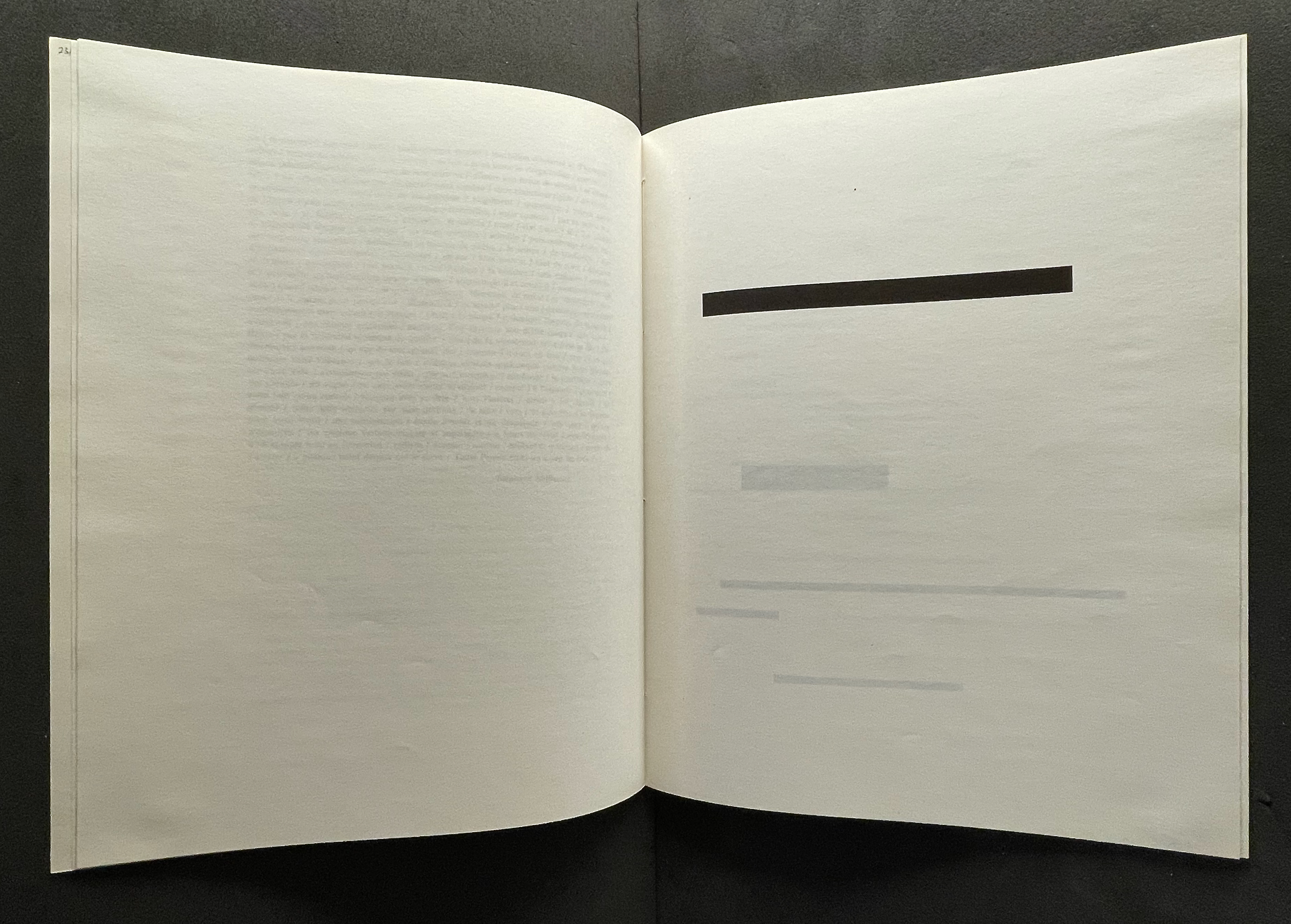
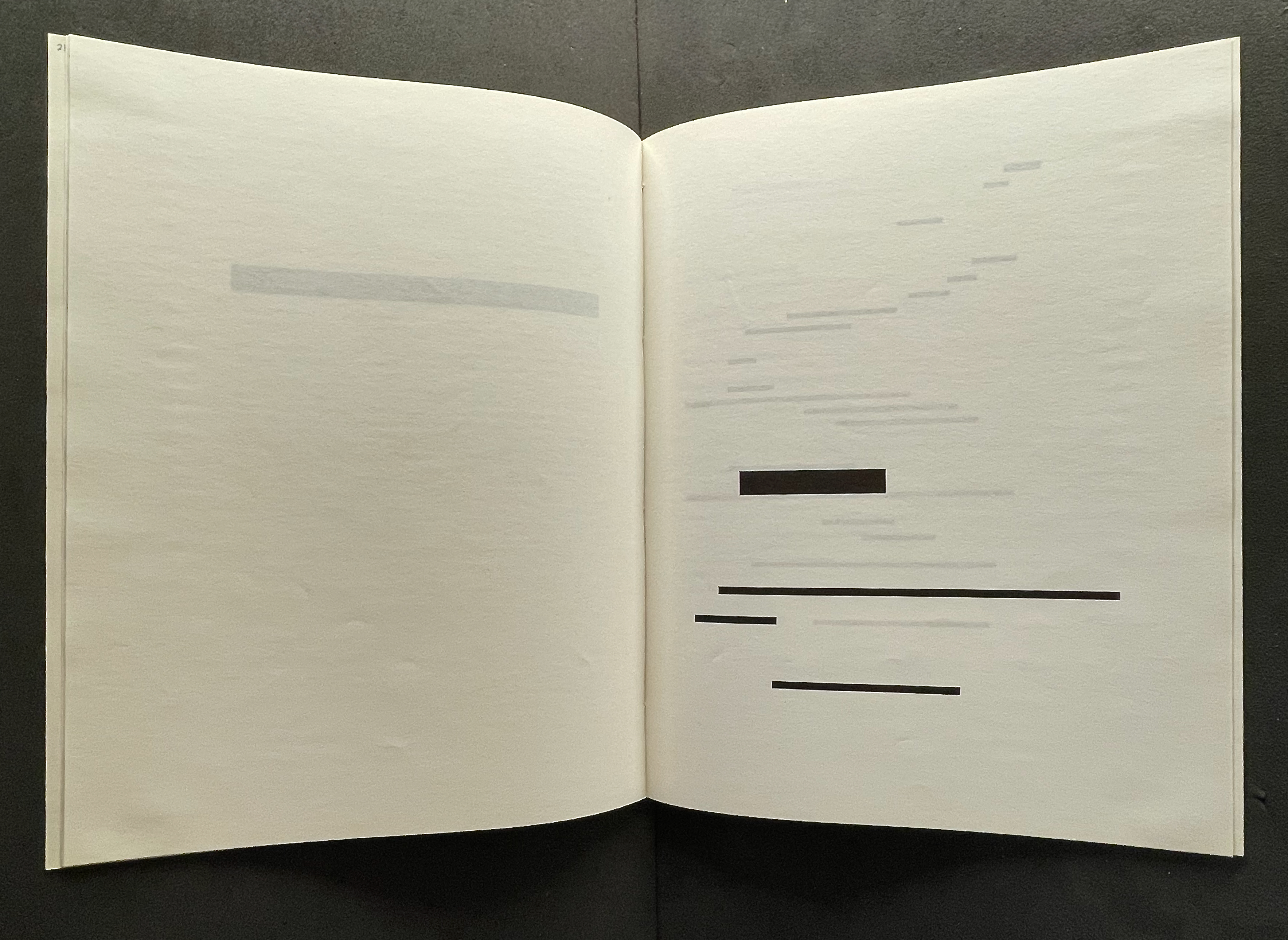
Between these two islands of text, Broodthaers offers his “image” of the poem: printer’s leading of the same dimensions as the types in the original edition of the poem. The image is the homage. In light of Magritte’s poster-essay “Les mots et les images” (1929) and its translation and appearance as an accordion-formatted catalogue for the Sidney Janis Gallery’s Magritte show in 1954, Broodthaers could equally have been paying homage to Magritte.
Top: Printer’s leading redacts “UN COUP DE DÉS”. Bottom: The leading redacts “JAMAIS” and the next three lines, which were set in smaller type. Books On Books Collection.
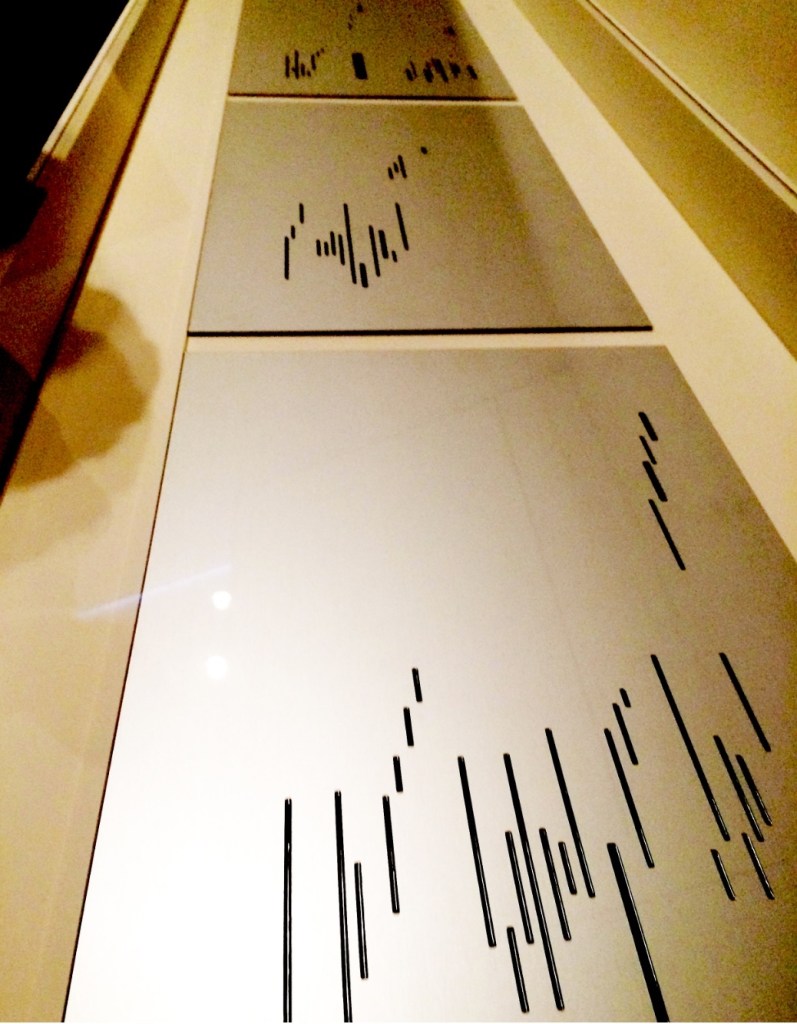
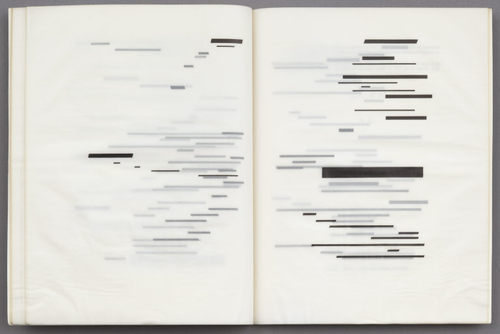
The other two versions were materially even more striking, and with the rest of the elements in play in the Wide White Space Gallery, Broodthaers made an innovative advance for post-Surrealism.
Top: the anodized aluminum edition; image courtesy of Charles Bernstein. Bottom: the translucent edition; image courtesy of MACBA.
As visitors to Broodthaers’ 1969 show perused the three editions, a tape recording of Broodthaers’ reading the poem played in the background. Broodthaers’ Image was not the only homage for Un Coup de Dés on display. Three hanging black shirts, allegedly taken from the Dallas Police Department, bore the full text of the poem transcribed in thin white chalk. With its floor painted black (the poem’s abyss?) and the works on display, the installation at the Wide White Space was also not Broodthaers’ first curation as art.
In 1968, Broodthaers established Le Musée d’art moderne, Département des aigles [The Museum of Modern Art, Department of Eagles]. Through 1972, museum shows occurred in various locations: his Brussels studio, the Städtischer Kunsthalle and a basement room at Burgplatz 12 both in Düsseldorf, at documenta 5 in Kassel, the A379089 alternative art center in Antwerp, and Galerie Michael Werner in Cologne. A 1968 manuscript in the Musées royaux des beaux-arts de Belgique in Brussels shows sketches of works of homage to Mallarmé that Broodthaers assigned to his museum’s “Literary Section”.
Broodthaers’ multimedia homage would provoke dozens of artists to create works of double-, triple- even quintuple-homage over the following decades into the new century. Among the most prolific of hommageurs, Michalis Pichler mounted Pichler: Exposition Littéraire autour de Mallarmé” in Milan in 2016. There he displayed many of those works of homage alongside his own. Later in 2024 at the Center for Book Art in New York, Pichler formalized Broodthaers’ concept of curation as art form in a show and book entitled Coup de dés (Collection) Books and Ideas after Mallarmé. Two years before, Galerie Michael Werner hosted an exhibition entitled “Footprints of a collector: Reiner Speck. Mallarmé, Broodthaers et les autres” (2 May – 23 July 2022). In addition to outstanding copies of the Image works, the curator Sabine Schiffer and Reiner Speck included Garniture Symbolique (1975), a blue-tinted glossy photo strip with nine photos on glossy paper, showing excerpts and phrases from the poem. Also included was a painting entitled Un coup de dés jamais quand bien même… (oil, gold paint, felt pen on canvas) from 1969, which is owned by Speck and, according to his afterword in the catalogue, has appeared in every exhibition of Broodthaers’ work since. For anyone looking for a description of Broodthaers’ 1969 exhibition, Sam Sackeroff ‘s “Literary Exhibitions” in the Speck catalogue is the gold standard.
The following collections offer more images of Image:
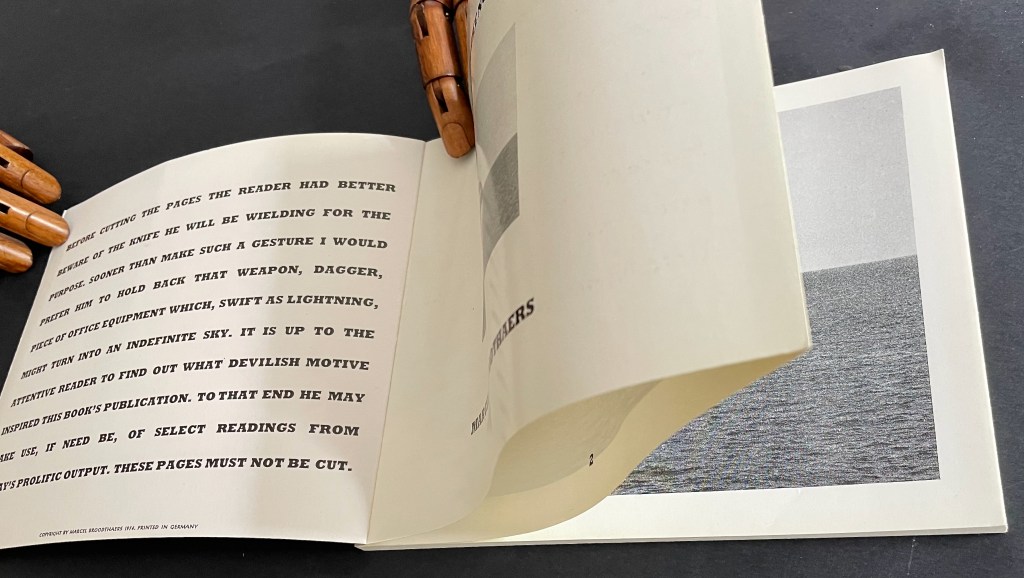
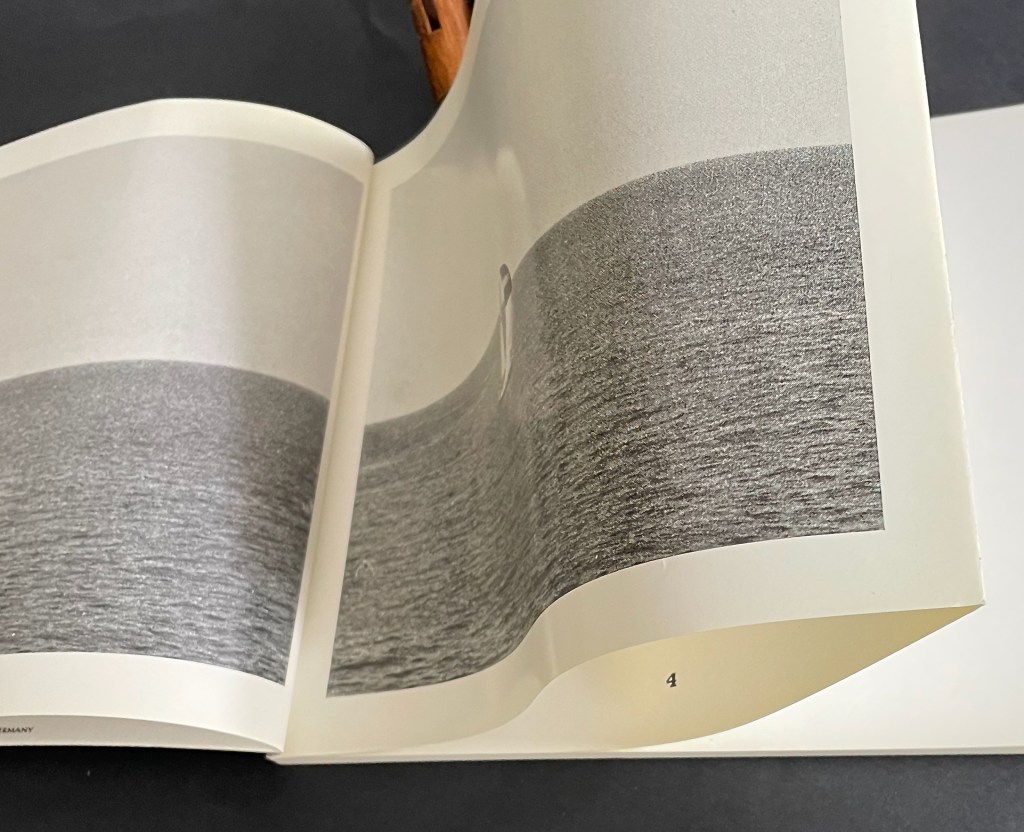
A Voyage on the North Sea (1974) Marcel Broodthaers Paperback (English version), Chinese wrapped-back binding. H148 x W178 mm. 38 pages. Edition of 1000. Acquired from Marcus Campbell Art Books, 9 October 2024. Photos: Books On Books Collection.
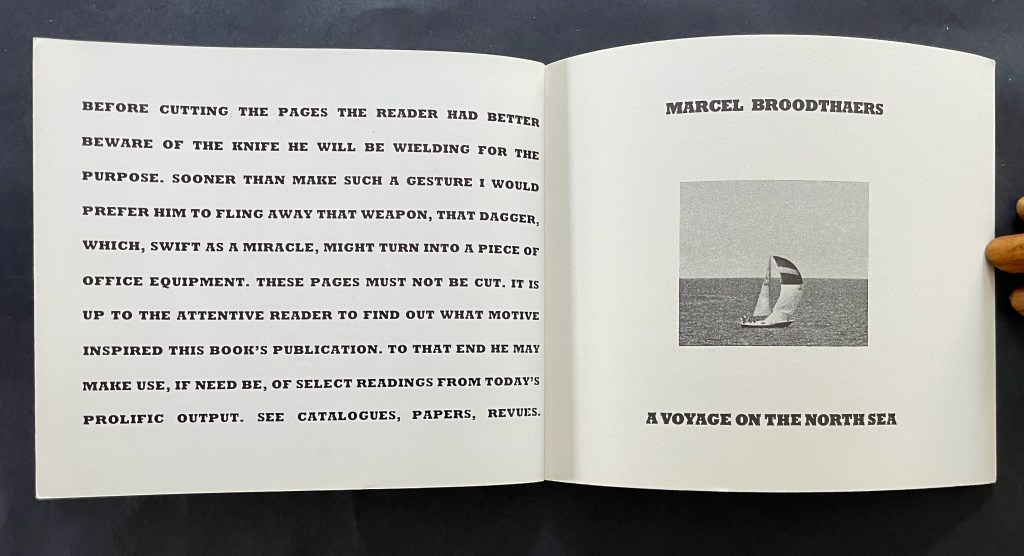
That over-elaborate and arch admonition to the reader on the inside cover doubles its mystery when it reappears on the last page of the book. If the warning has been ignored the first time, the reader knows that cutting the fore edge folds reveals the page numbers inside, but does its reappearance at the end prompt some doubt and regret? There’s no going back.
Last page and inside back cover.
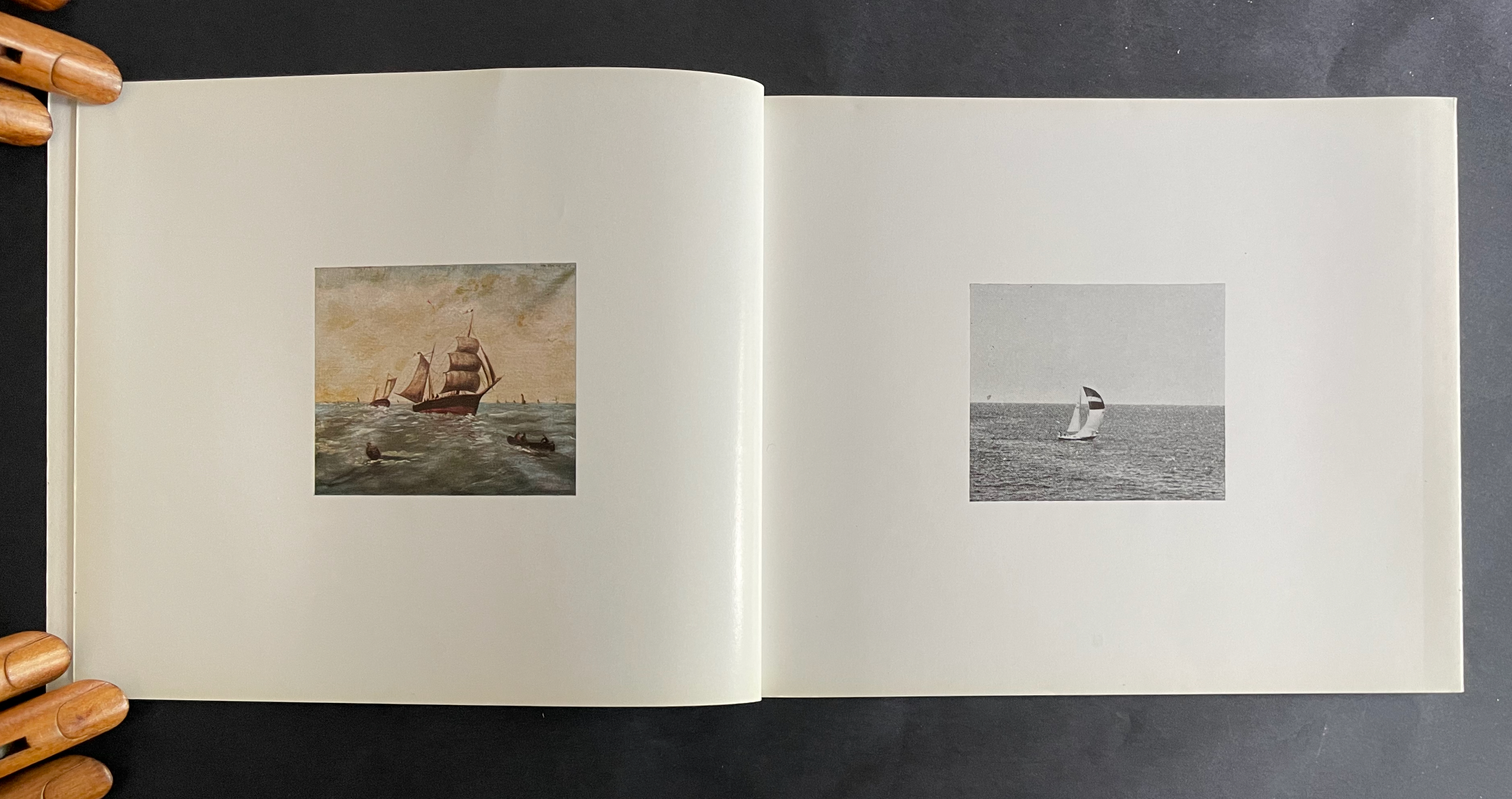
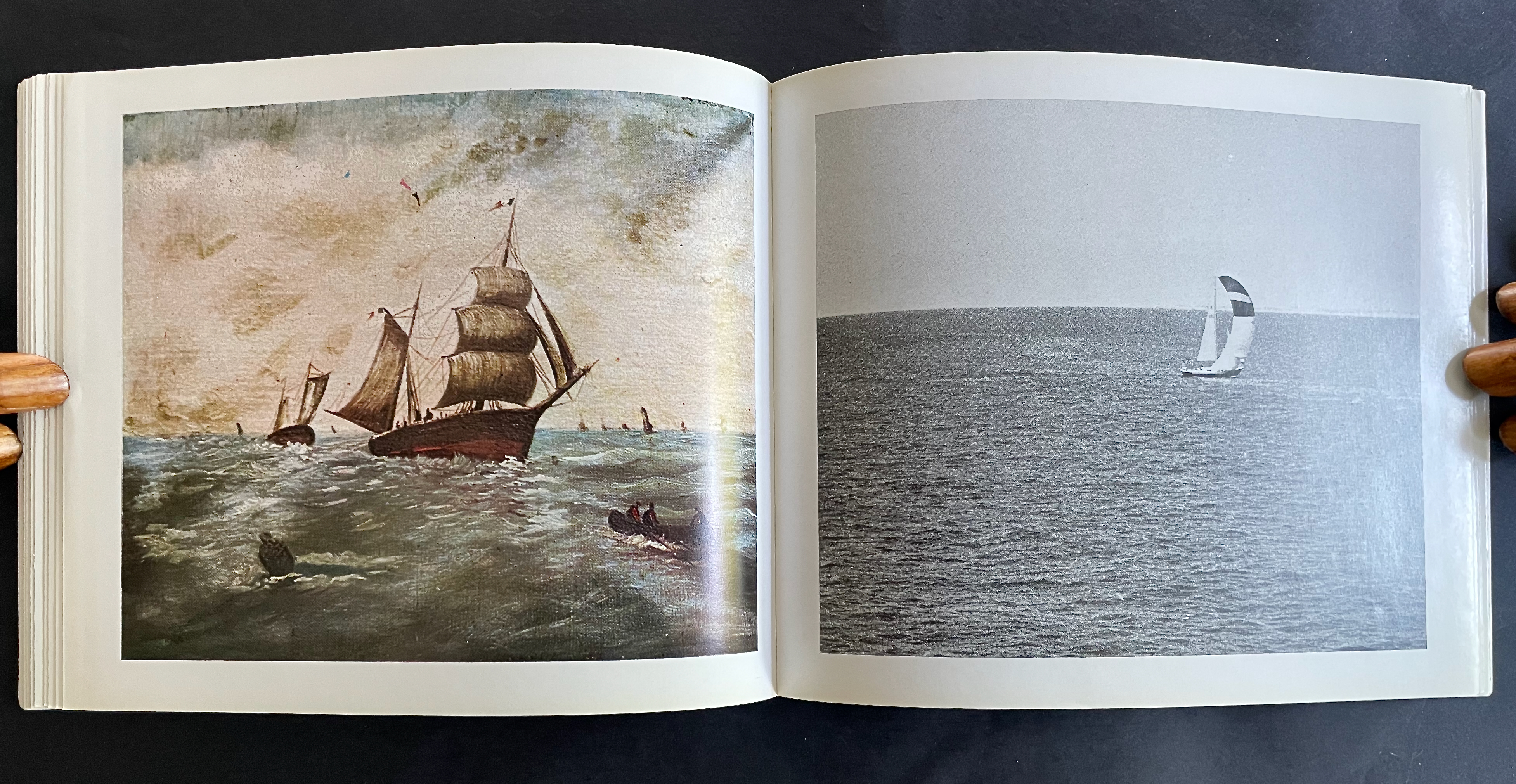
Alongside a 16mm film with the same title, the book premiered at the headquarters of the Petersburg Press, Portobello Road, London on 28 January 1974. In addition to the 1000 copies, Petersburg Press produced a numbered edition of 100 copies, signed by the artist, and distributed in a box with a copy of the film. Although developed together, the film preceded the book in 1973 and was originally entitled Analyse d’une Peinture. The painting in question is one found by Broodthaers at a Parisian flea market. To produce the film, Broodthaers added his own photographs of yachts at sea in the port of Ostend to stills of the painting and its details. With simple cuts and juxtapositions divided into “Page 1”, “Page 2”, etc., the film proceeds more like a book than a cinematic narrative, but there is no “booby-trap” in the film comparable to the prefatory warning once the book was prepared. The flea-market painting was also placed on display at the premiere.
To celebrate the peculiarity of the anniversaries of the artist’s birth (28 January 1924), the artist’s death (28 January 1976), and the book-film’s debut screening (28 January 1974), David Platzker organized his Specific Object exhibition Marcel Broodthaers : A Voyage on the North Sea on 28 January 2009. Platzker’s description provides just the right preface to the film and conclusion to this Books On Books Collection entry:
The subject of the exhibition focuses on Marcel Broodthaers’ film and book, both titled A Voyage on the North Sea which were distributed together as part and parcel of the same publishing plot. The ostensibly related subject of both book and film consists mutually of 19th and 20th century nautical images including: 1. photographic reproductions and details of an amateur’s 19th century painting of a fleet of fishing ships and 2. photographs of a contemporary sailboat. Bringing together film, books, ephemera, drawing, and the artist’s original maquette for the book, this specific exhibition sets out to map the local coordinates of A Voyage on the North Sea’s maiden launch on January 28, 1974 at the London offices of Petersburg Press. …
Referring a contemporary audience to the original screening context of Broodthaers’ book-film—itself very much like a reading lesson–this exhibition asks how a contemporary audience might begin to unpack the particular dialectics, obtuse poetics, and critical cargo of Broodthaers’ confounding enterprise. “It is up to the attentive reader,” Broodthaers writes in the preface of the book, “to find out what devilish motive inspired this book’s publication.”
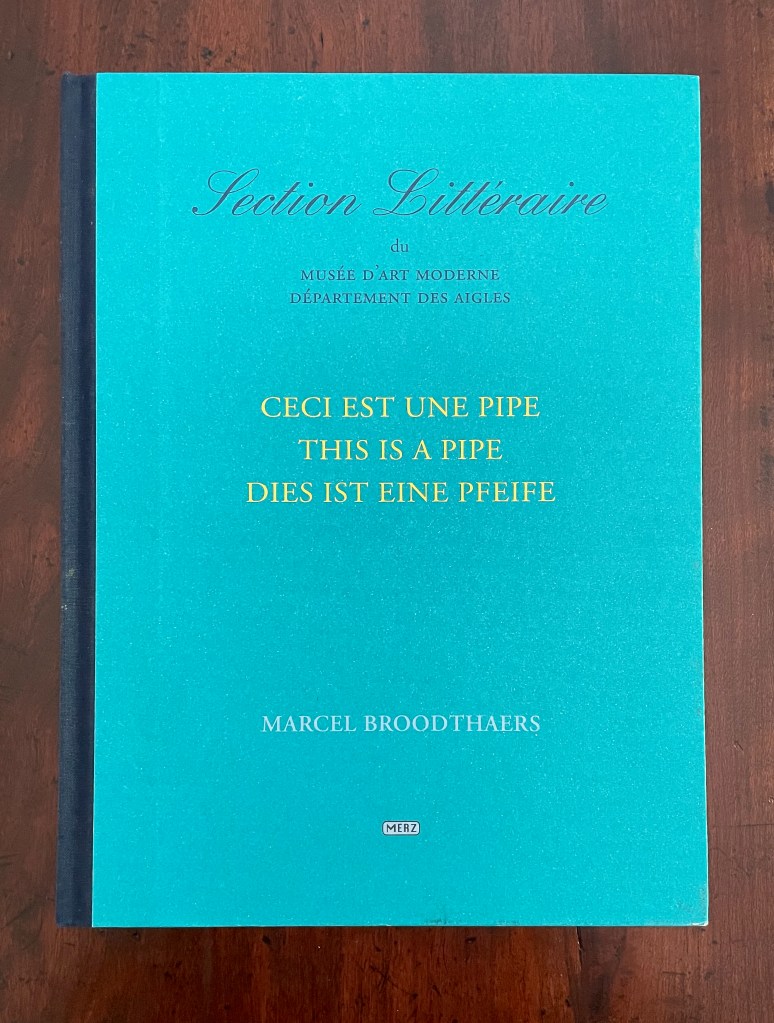
Ceci est une Pipe / This is a Pipe / Dies ist eine Pfeife (2001 )
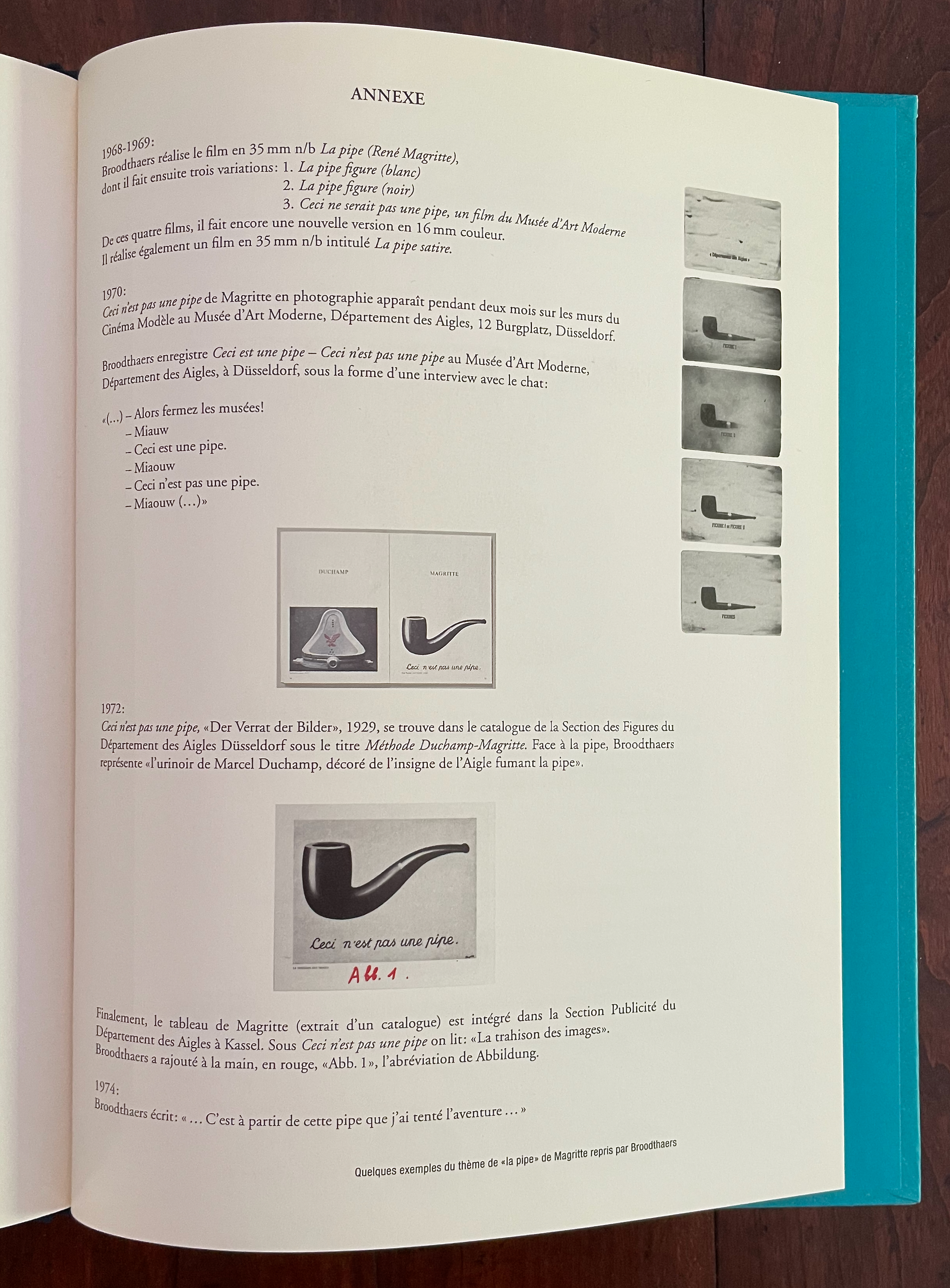
In 1972, Broodthaers renounced this project, initiated in 1969-1970. He did not want to associate his name or that of his Musée d’Art Moderne, Département des Aigles with it. Almost thirty years later, leaving aside the renunciation, Maria Gilissen Broodthaers and Reiner Borgemeister issued this volume that documents what can be gleaned from the archives. Honoring Broodthaers’ original aim to issue a work in French, English, and German, the volume is presented that way — except for an appendix that does not appear in English or German.
Here is an English version:
1968-1969: Broodthaers made the 50 mm black-and-white film n/b La pipe (René Magritte), from which he subsequently created three variations:
1. La pipe (white) 2. La pipe (black) 3. This Would Not Be a Pipe, a film from the Musée d’Art Moderne From these four films, he created yet another version in 16 mm color. He also made a 35 mm black-and-white film n/b titled La pipe satire.
1972: Broodthaers registered This Is a Pipe—This Is Not a Pipe at the Musée d’Art Moderne, Département des Aigles, in Düsseldorf, in the form of an interview with a cat:
“(…)—Then close the museums!
Meow
This is a pipe.
Meow
This is not a pipe.
Meow”
Finally, Magritte’s painting (taken from a catalog) is included in the Advertising Section of the Department of Eagles in Kassel. Under “This Is Not a Pipe,” we read: “The Betrayal of Images.” Broodthaers added “Abb. I” by hand in red, the abbreviation for Abbildung.
1974: Broodthaers wrote: “… It was with this pipe that I embarked on the adventure …”
Not only by Magritte’s exploration of image and text in his art but by giving Broodthaers a copy of Mallarmé’s Un Coup de Dés, Magritte exerted a great influence. Broodthaers’ realized works responding to that poem would suffice alone as evidence. Michel Foucault’s essay Ceci n’est pas une pipe (1968) expounding on his interpretation of Magritte’s Trahison des images as an unraveled calligramme apparently irked Broodthaers and became the likely seed for his idea to enroll Magritte’s pipe in the Musée d’Art Moderne, Département des Aigles along with asides on Foucault’s comments. If realized, the idea would have been a tribute that Magritte, who died in 1967, would likely have enjoyed.
In the end, though, Broodthaers was bothered over “useless text and reflections” from [André] Blavier (a fellow Belgian avant gardiste) and his own “ridiculous” interventions as well as dissatisfied with the prospective layout, so he abandoned the project. So what to make of Ceci est une pipe?
As an artist’s “unrealized” and abandoned conceptualization resurrected in an explanation of what the realized work might have been, it offers interesting insight into the concept of a concept. But it is not a pipe.
Foucault, Michel, and J. A. Harkness (trans.). 1983. This Is Not a Pipe. 25th anniversary ed. Berkeley, Calif.: University of California Press. The essay “Ceci n’est pas une pipe” appeared in Les Cahiers du chemin (no. 2), 1968.
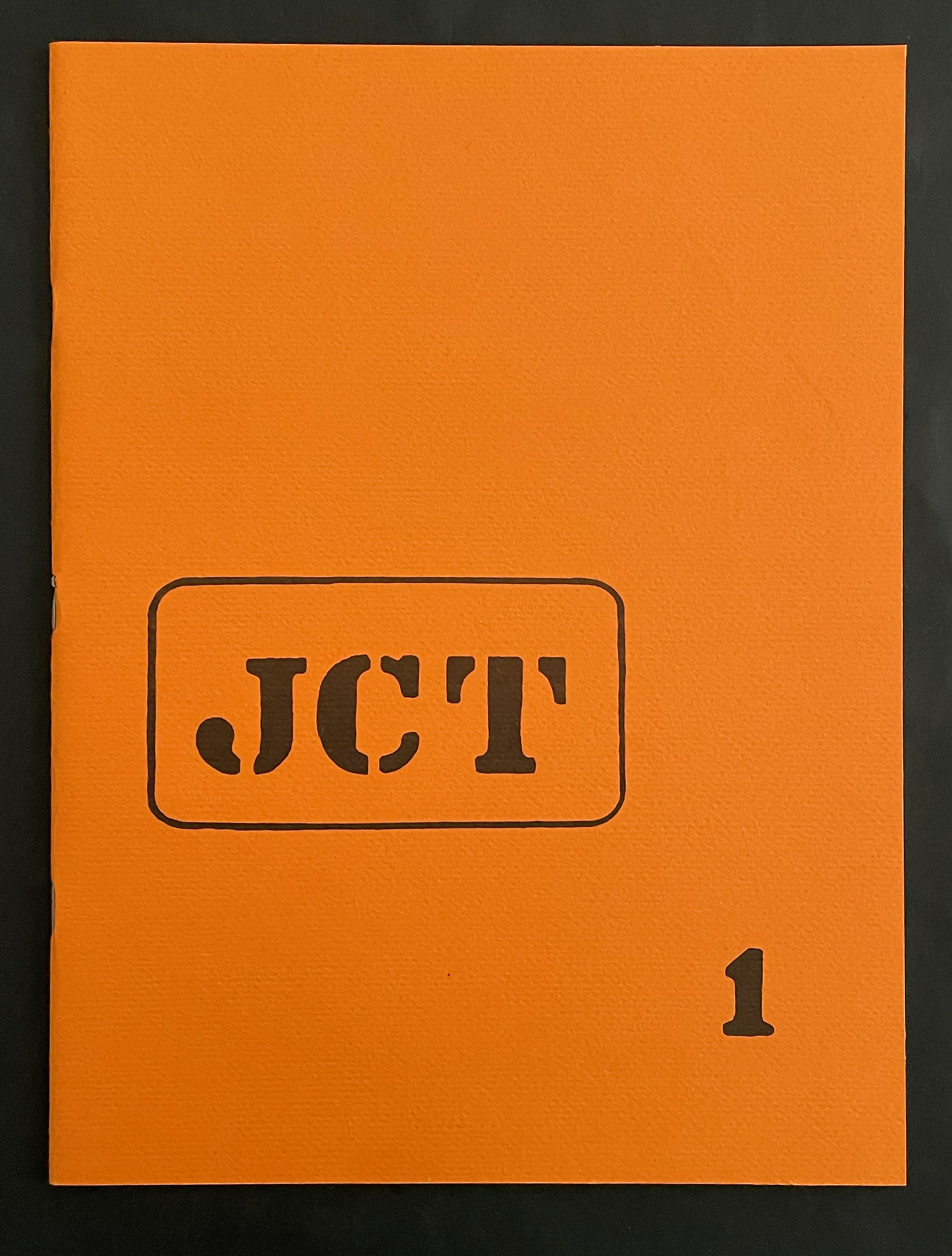
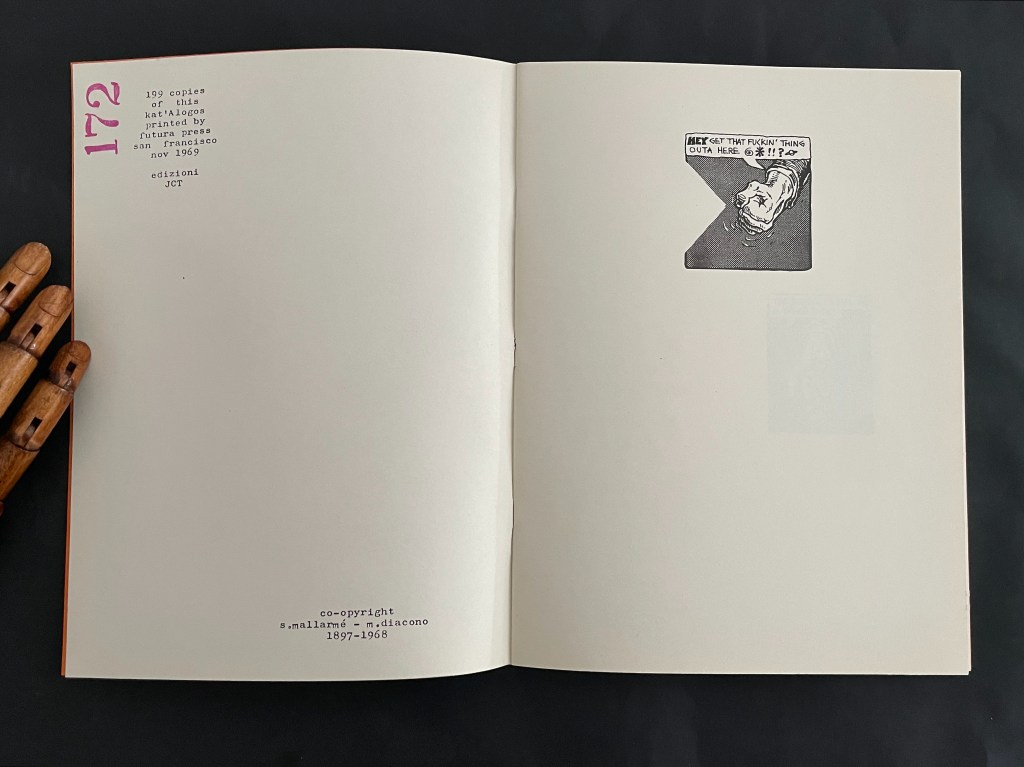
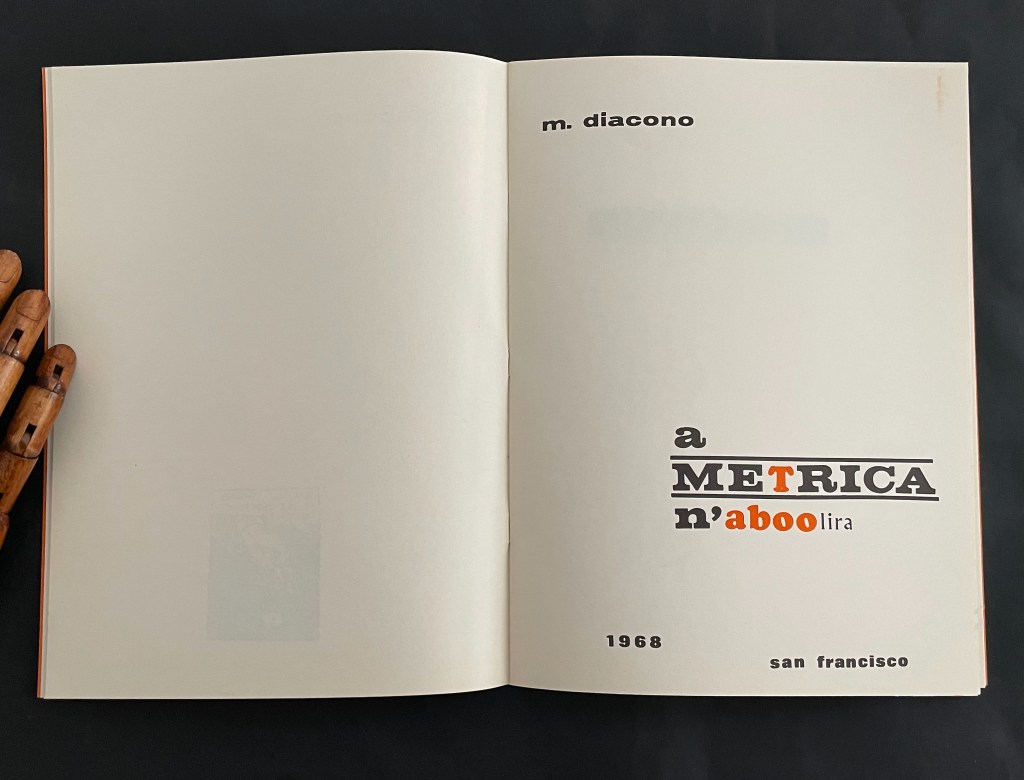
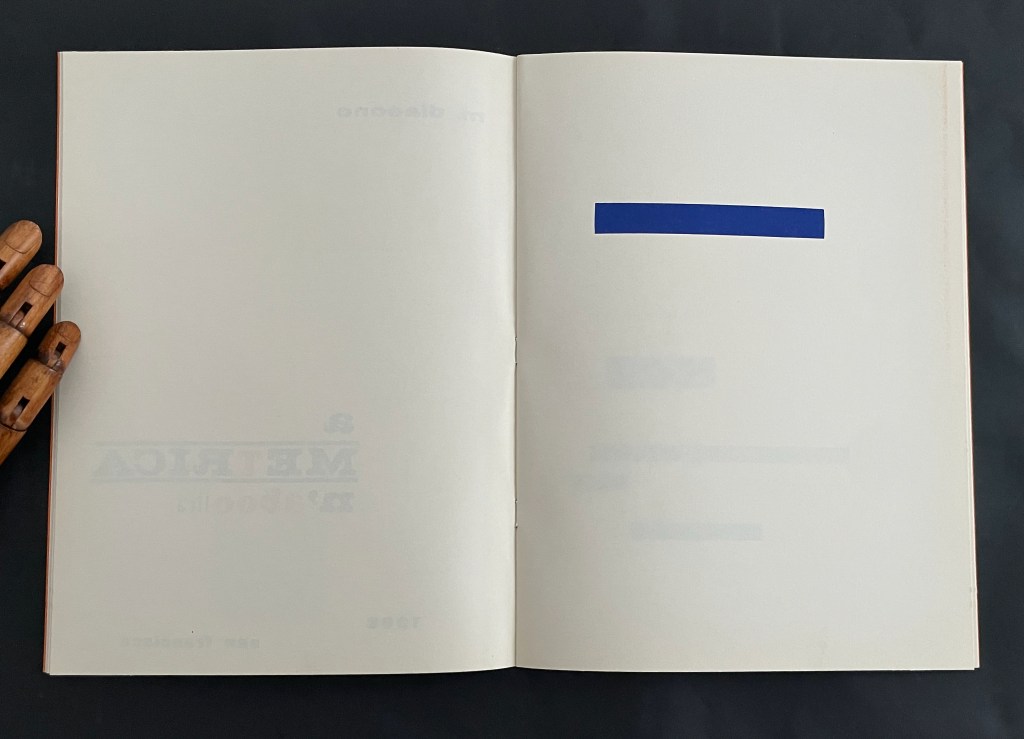
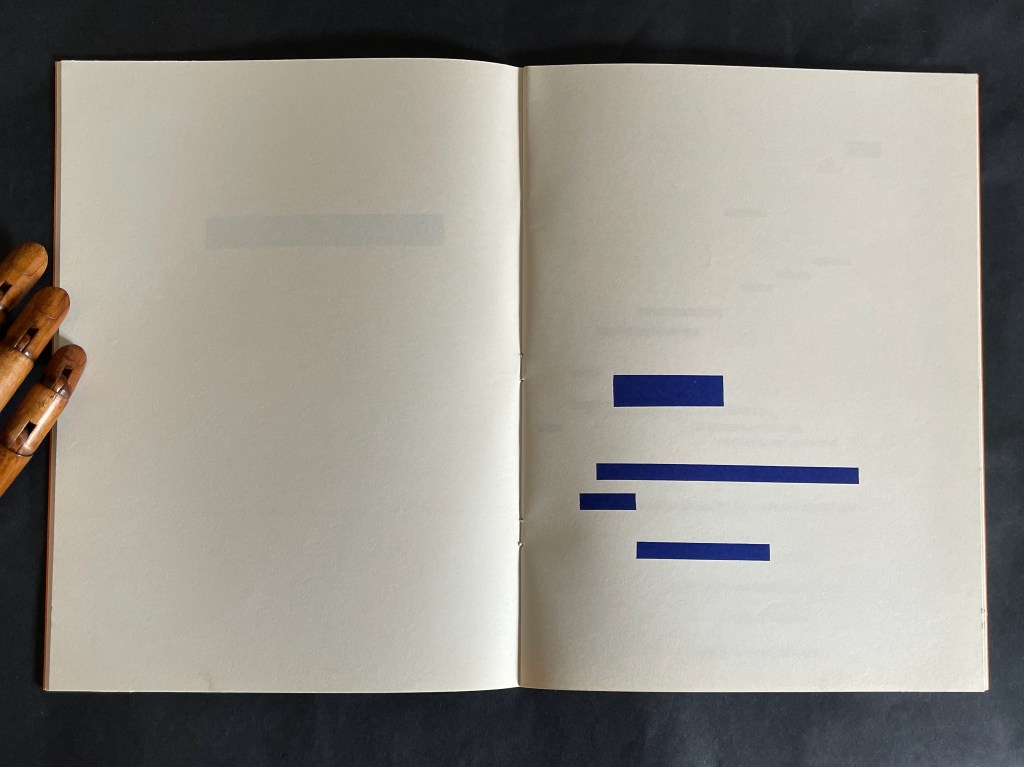
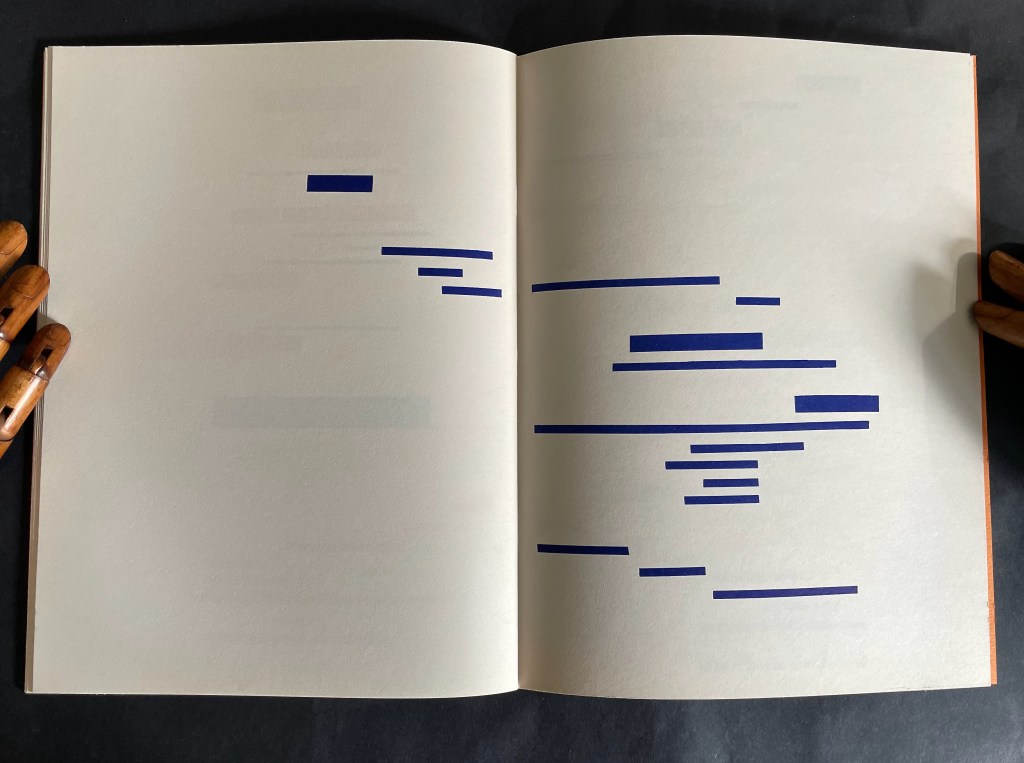
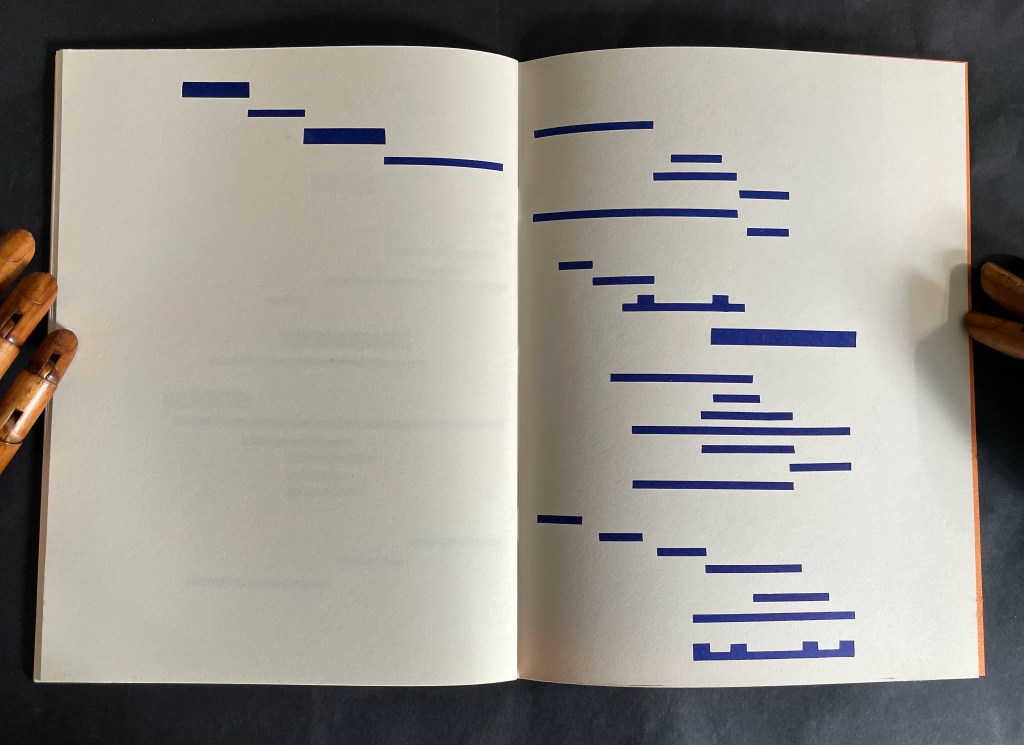
a METRICA n’aboolira JCT 1 (1968) Mario Diacono Booklet, saddle-stitched, staples. H259 x W190 mm. [32] pages. Edition of 199, of which this is #172. Acquired from Ars Libri Ltd, 18 February 2026. Photos: Arengario and Books On Books Collection. Displayed with permission of the artist.
From Ars Libri Ltd. description:
Mario Diacono relates that the manuscript of a METRICA n’aboolira was made in 1968 as a unique work, with no plans for its future publication. His idea to issue it as a limited edition artist’s book (and equally, as the first number of his review “JCT”) arose in the late summer of 1969, following a stay in New York, where he was in contact with Vito Acconci, Joseph Kosuth, and members of Art & Language. On his return to California in September, Diacono delivered the manuscript to the San Francisco printer, Futura Press, including with it a colophon which was dated November 1969, based on the expectation that the edition would take two months to complete.
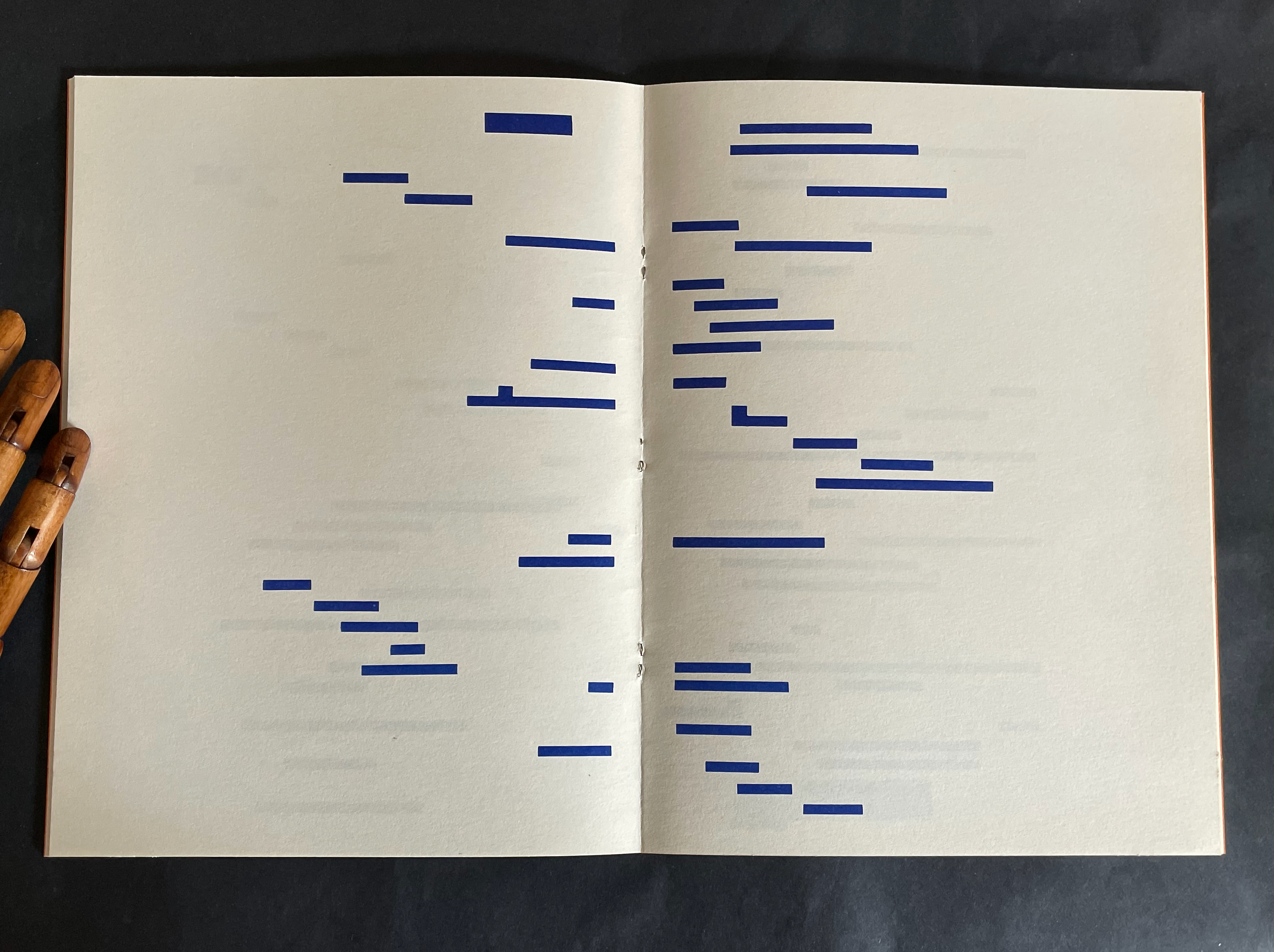
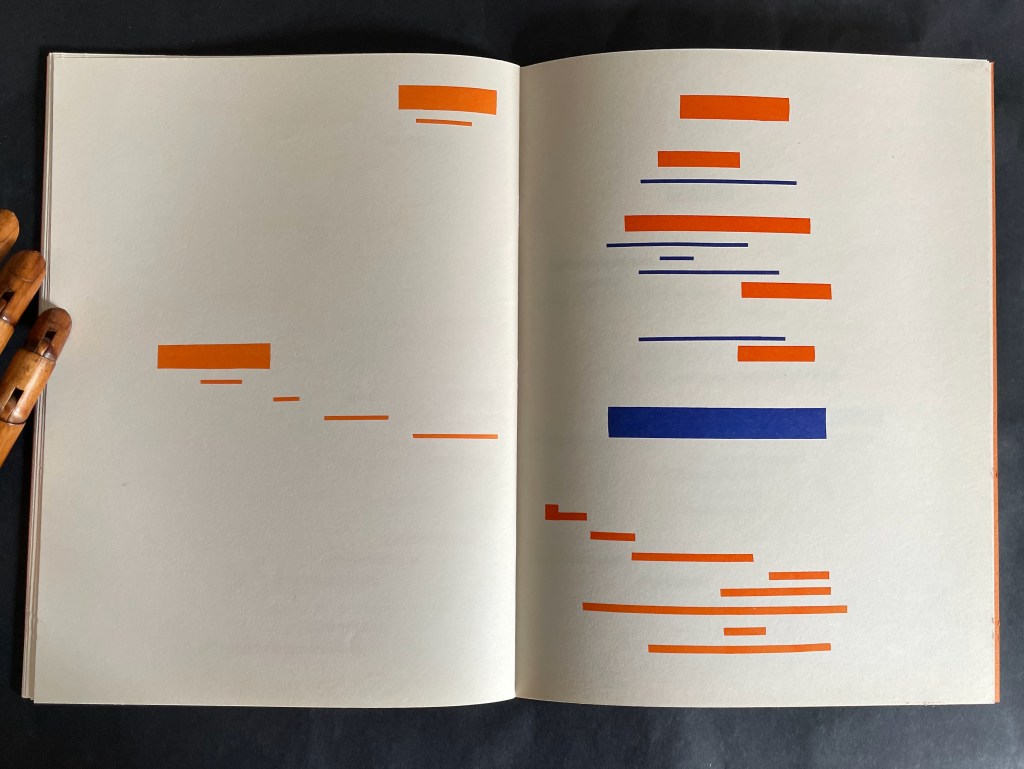
With the colophon offering 1968 or 1969, the title page picks 1968 and presents that as the date of publication. The date only matters in determining who came first with the idea of replacing Mallarmé’s text with solid blocks: Diacono or Marcel Broodthaers, whose three versions of Un Coup de Dés Jamais N’Abolira le Hasard: Image (on translucent paper, solid paper, and anodized aluminum) were published by Wide White Space in 1969.
Besides being first out of the gate with an “homage by redaction” of Un Coup de Dés, Mario Diacono is perhaps the first hommageur to give a sociopolitical cast to the effort. In an interview in Ursula, Diacono comments
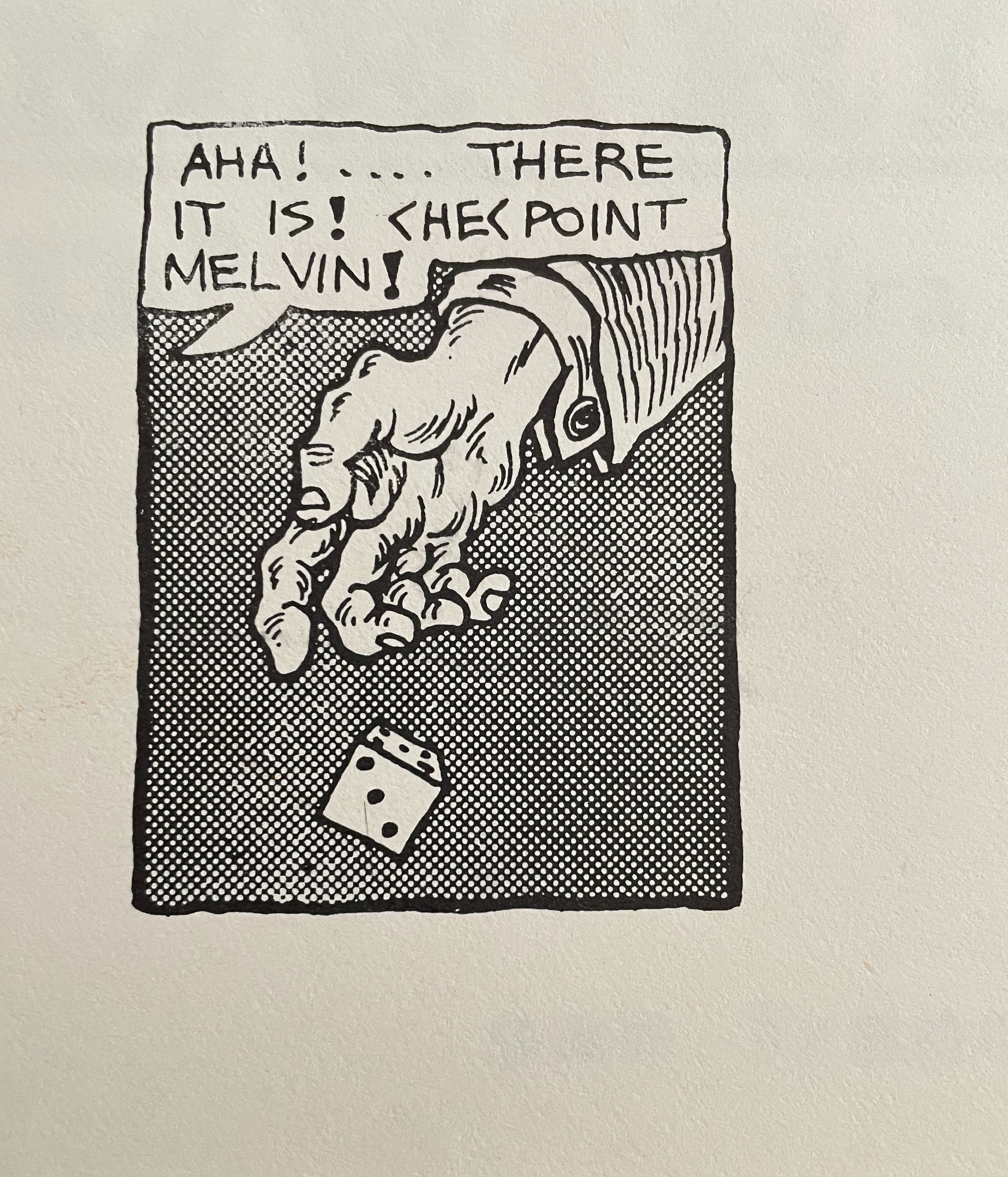
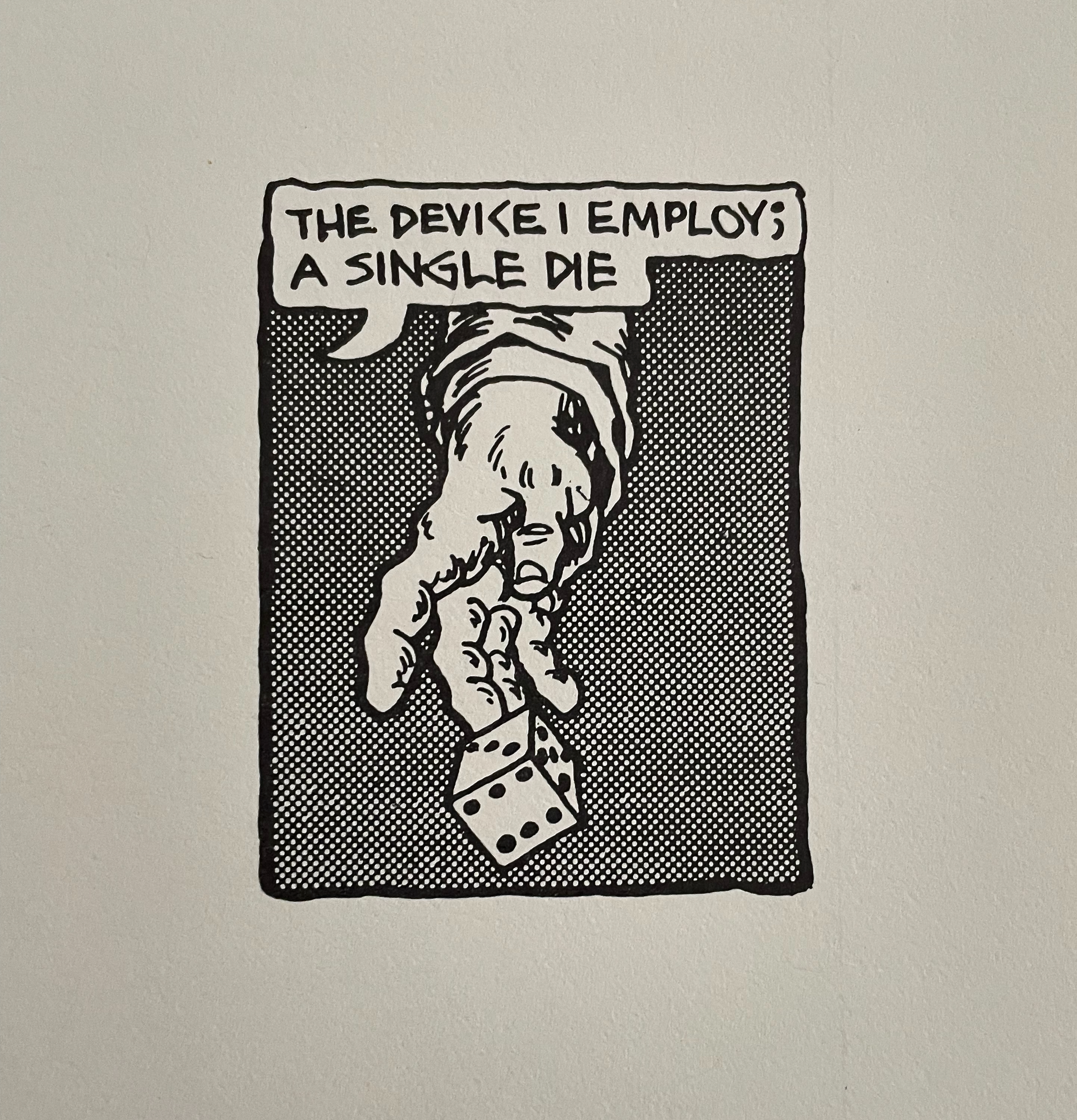
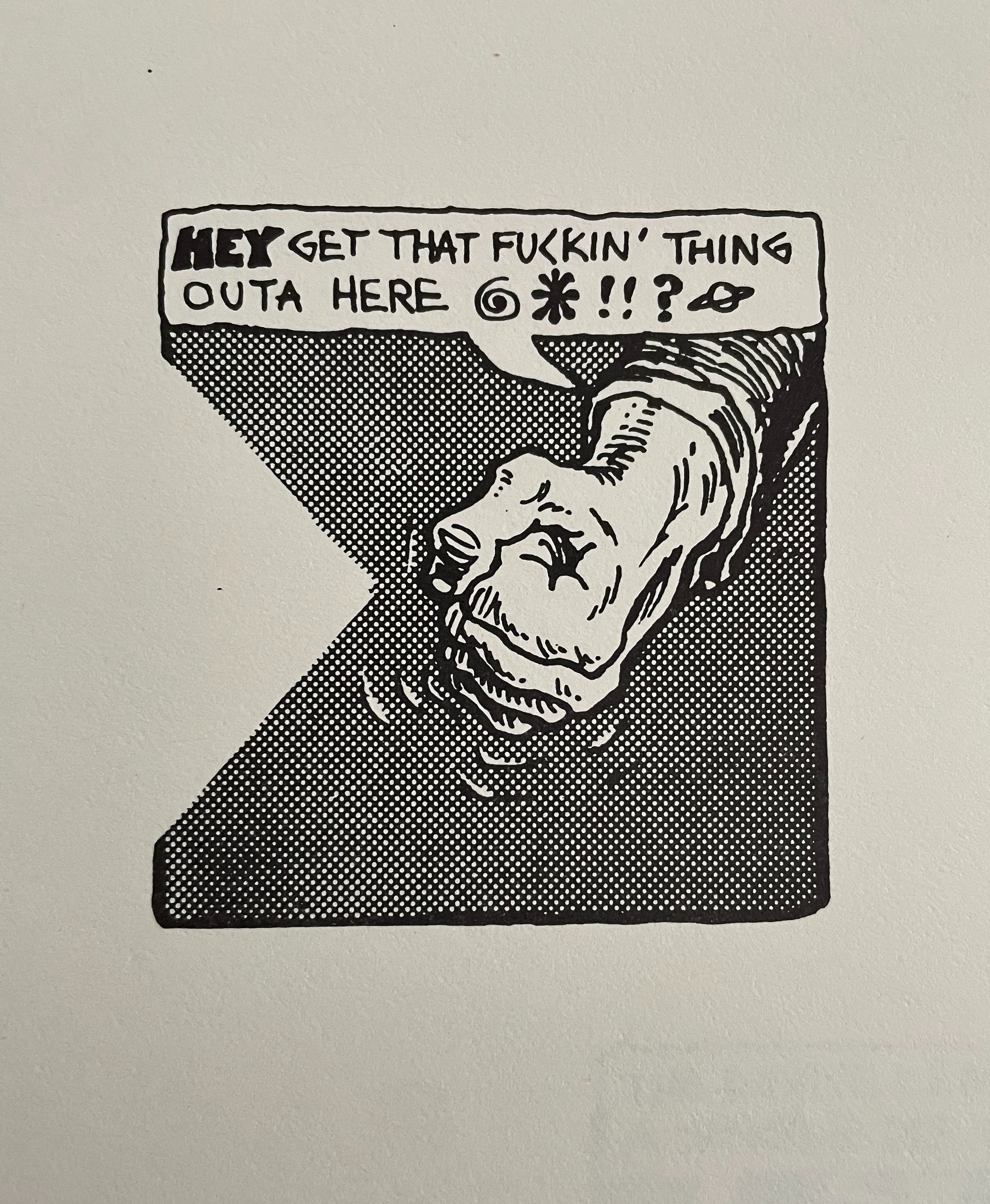
1968 was a year in which many things were abolished, or felt tempted to be abolished. Language was one of them, at least the traditional language of poetry, but also the language of ‘bourgeois/capitalist’ society. Berkeley is also present in the book through the reproduction of three frames from a cartoon in a local magazine, which functions as a kind of preface. The title alternates not only colors, black and orange, but also uppercase and lowercase letters. The wordplay in essence says: the absence of metrics, of language, will not abolish poetry. Neither will the American taboos.(Nickas, 2019).
Those comments align with the element of “pop” art and the underground comic in this homage.
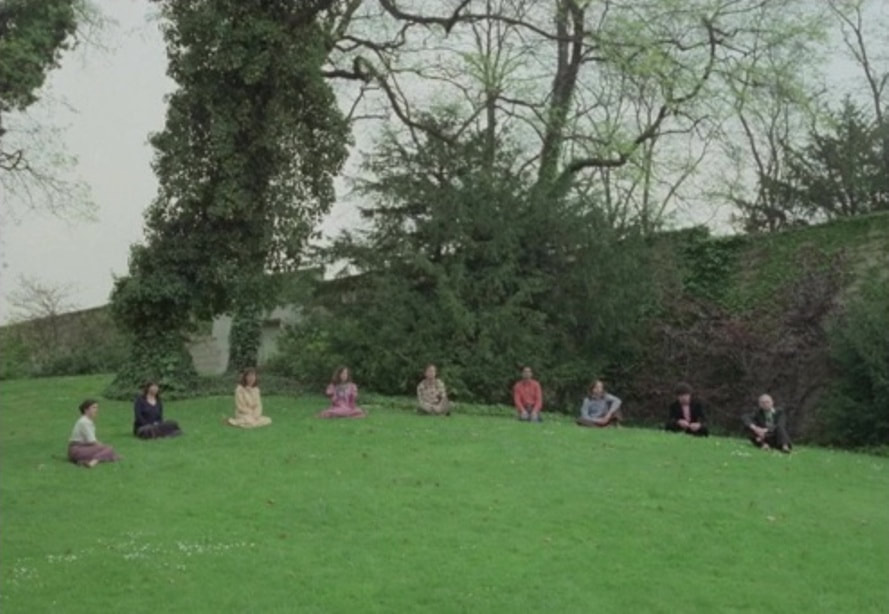
Later in the 1970s, Danièle Huillet and Jean-Marie Straub would pick up the thread of social critique by staging and filming a choral reading of the poem on the lawn of the Père Lachaise cemetery,
where there are the great memorials of the concentration camps: Ravensbrück, Auschwitz… it is in the corner of the cemetery where you can guess something about the city. Under this hill are buried the last members of the Paris Commune, who were shot in that same place. – Jean-Marie Straub
These three connected volumes explore graphic transpositioning from oral speeches to a visual representation. Though a new way to read/experience the speeches–to visualize their patterns–you can [still] not tell the truth from fiction. You can not tell what you are reading. “In the 3-part, 4 Speeches/Coup de Des, the images of audio waves are the same—but one purports to be a group of speeches by Bush 43 ; another, a group by Tony Blair; and the last—the real thing—is an unidentified man reading Mallarme’s “Un Coup de Dés Jamais N’Abolira Le Hasard”, that modern masterwork that launched a thousand artists’ books. The concept is trenchantly funny; the books are beautifully executed. [from the preface to Didier’s Manifesto by Tim Young]
Like Huillet, Straub and Mutel, Diacono is trying to balance his socio-political drive with the visual and historical homage to Un Coup de Dés. Huillet/Straub’s performative vocalization delivers its message only through the visual of its location. Mutel delivers his message by muting the poem with its sonographic visualization and sleight-of-hand substitution for political speeches. a METRICA n’aboolira delivers its message by balancing the textual and the visual, reminding us that Mallarmé wanted Un Coup de Dés to be looked at as well as read.
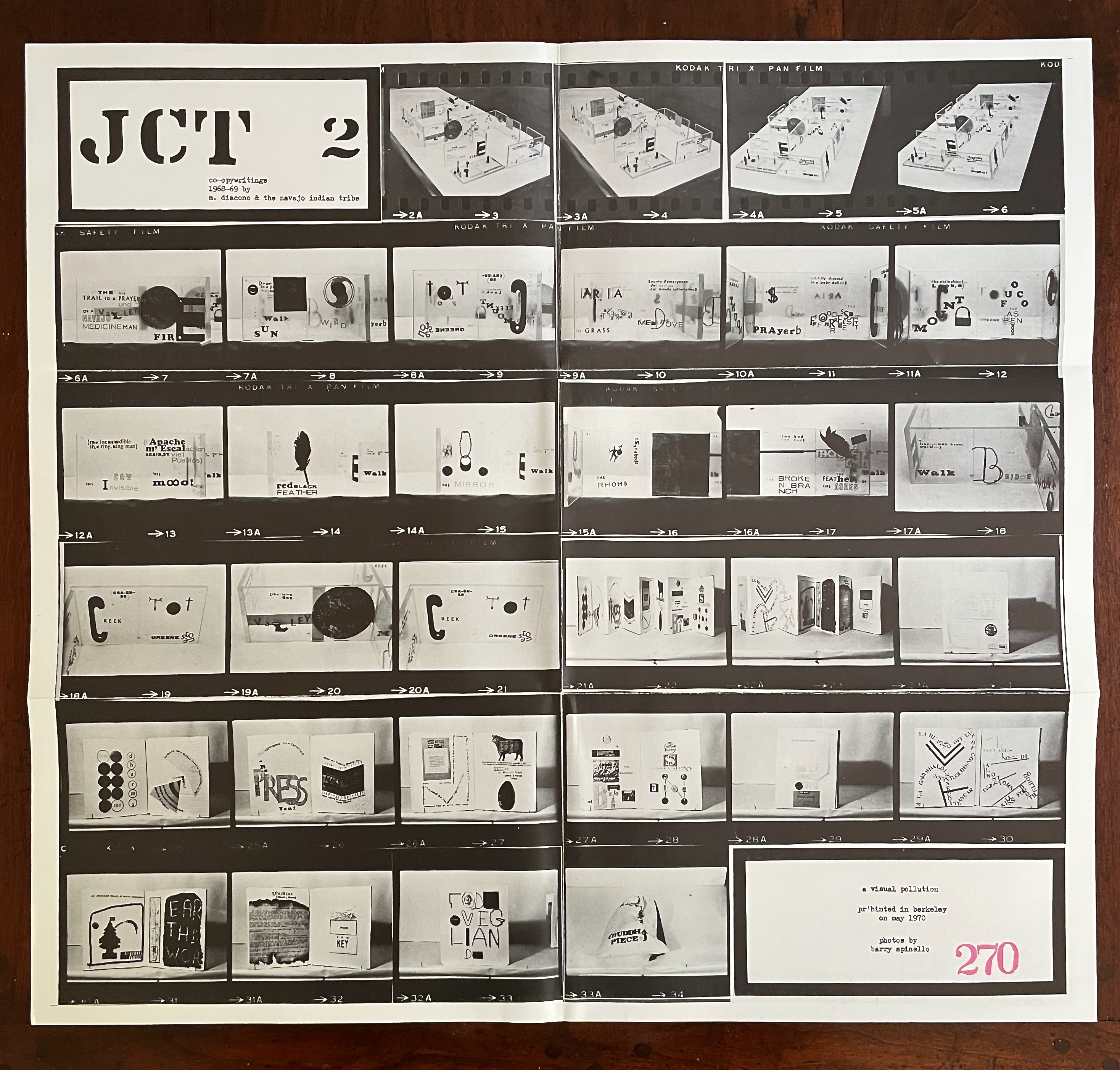
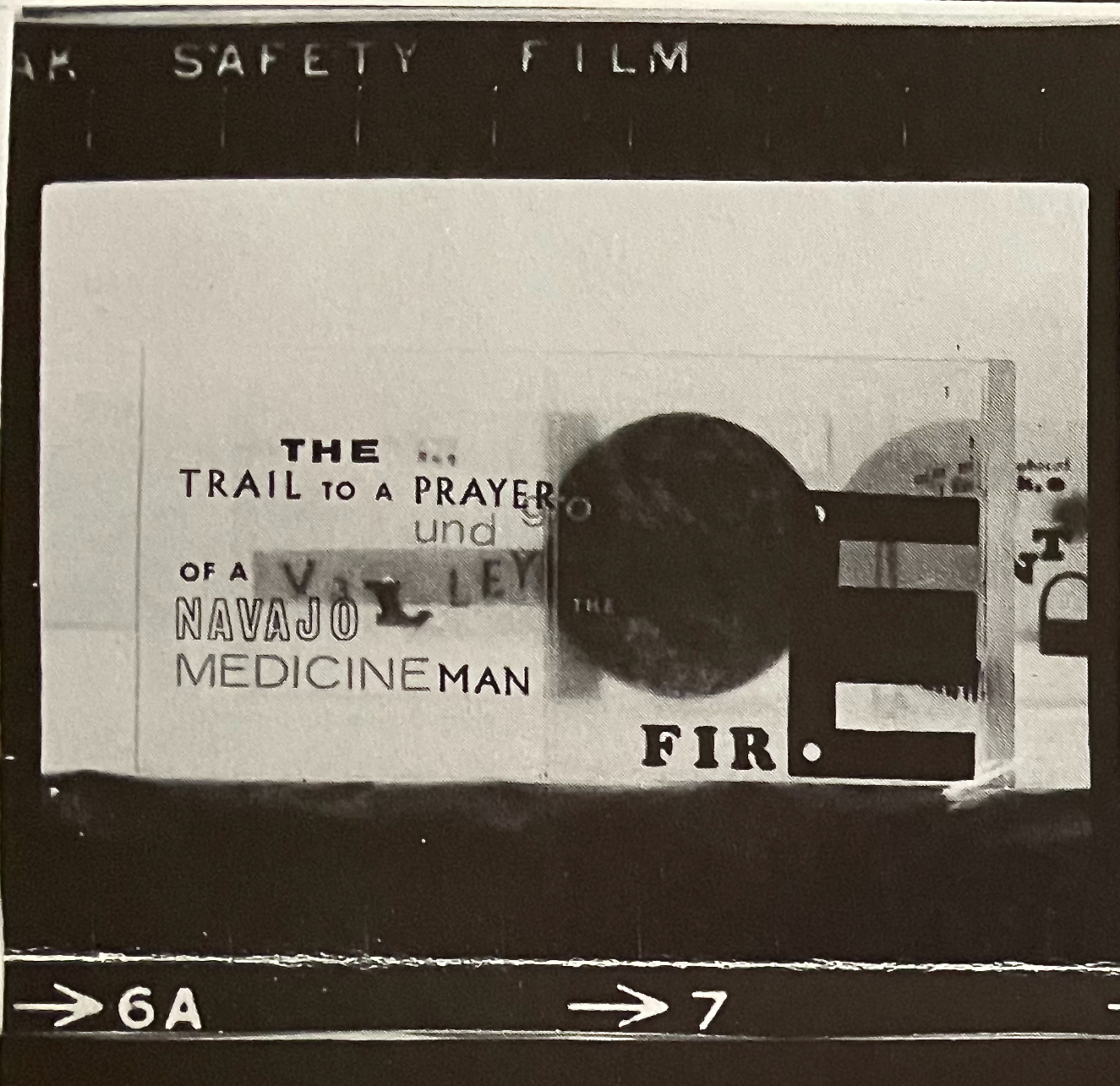
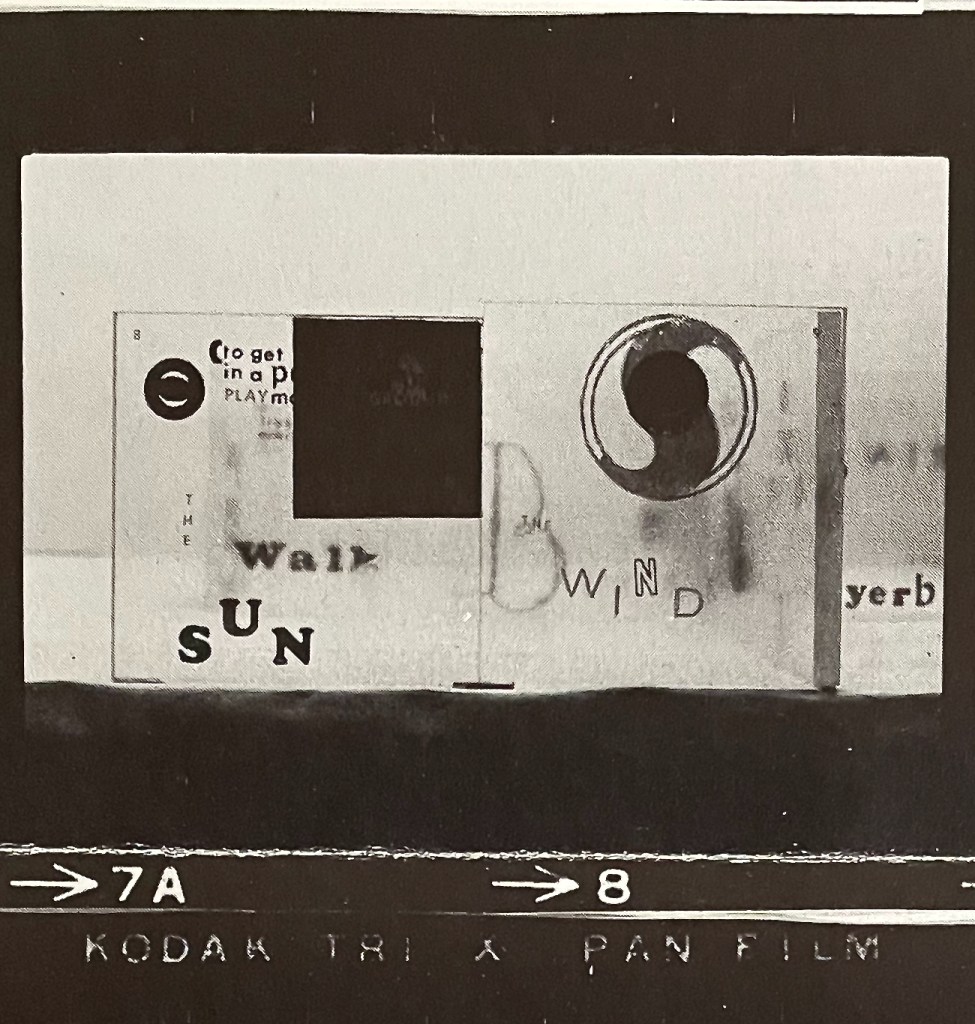
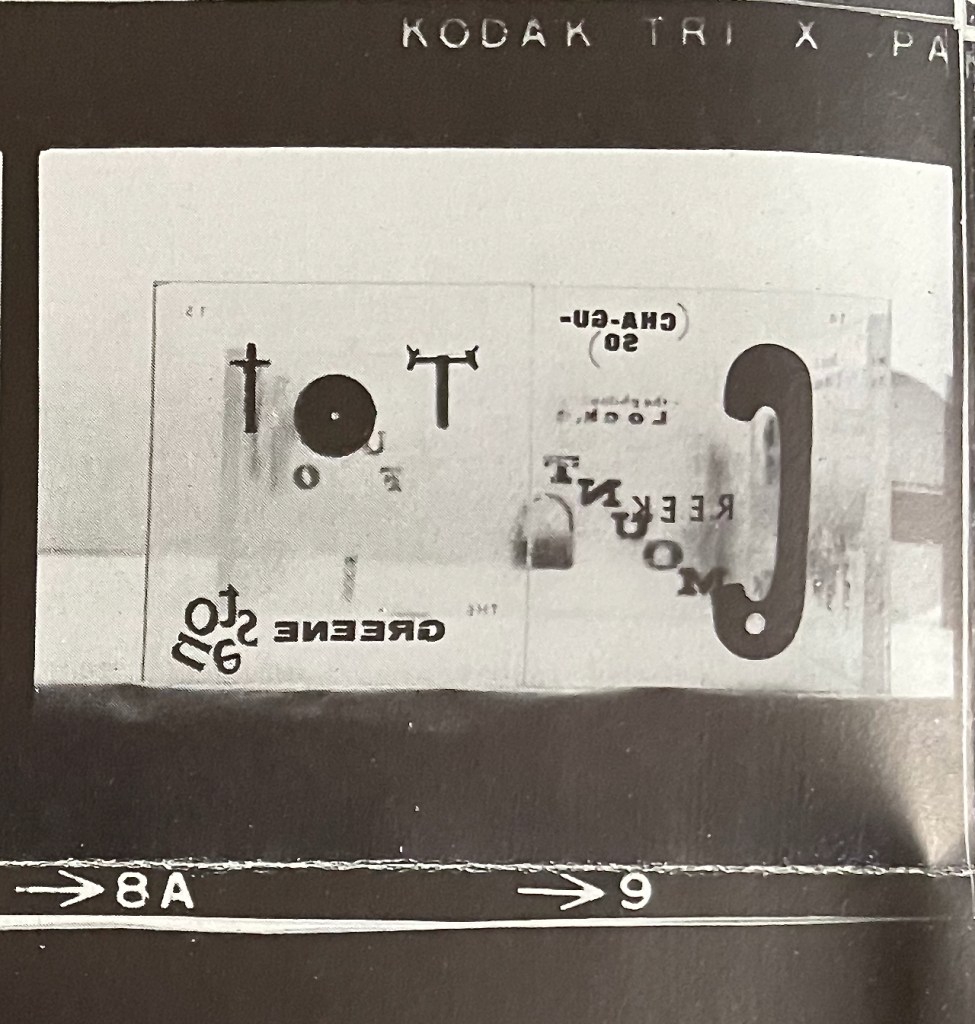
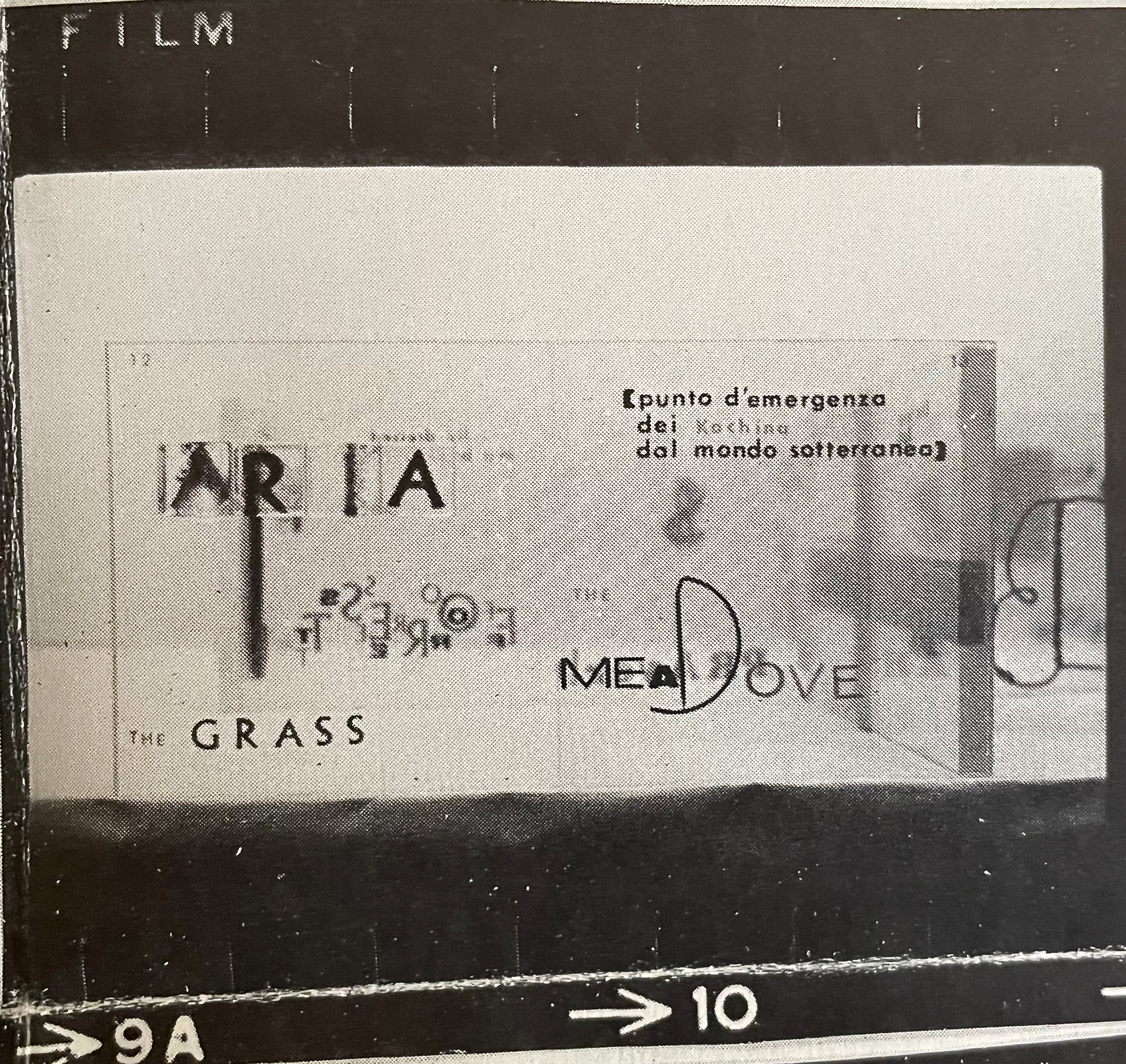
a visual pollution (1970) JCT 2 Mario Diacono & the Navajo Indian Tribe with photos by Barry Spinello Broadside, illustrated with 32 photographs in six strips. H157 x W254 mm (closed), H472 x W503 mm (open). #270. Acquired from Ars Libri Ltd, 18 February 2026. Photos: Books On Books Collection.
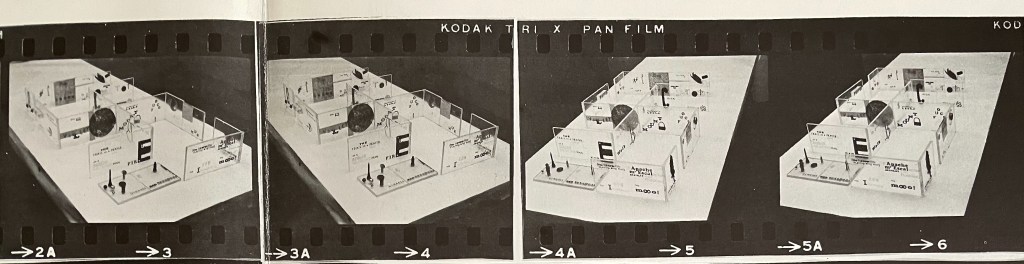
A broadside of books, or a photographic record of a display of three works of book art and some print works? On its surface, a visual pollution is a single sheet of paper displaying strips of Kodak film with frame numbers (2A to 34) appearing along the foot of the roll of film. The first four frames show photos of clear acetate blocks forming the Navajo ancestral emblem called the “Whirling Log” (tsil no’oli). On each block, double-page spreads have been printed containing phrases as text and images. In the fifteen frames that follow the first four, Diacono and Spinello give us close-ups of the acetate panels/pages. Page numbers can be seen in each spread’s upper left and right corners. The next eleven frames, starting with 21A/22, show two leporellos (one has eight panels, the other seven) with close-ups of the panels. The last two frames show two printed cards (or one double-sided one) in portrait and landscape orientations.
The first four frames, the arrangement of acetate blocks in the shape of the Navajo emblem “Whirling Log” (tsil no’oli). The Navajo Nation disavowed the totem in 1940 after its appropriation as the Nazi swastika.
In JCT 1, Diacono designated the work as “co-opywritings” of himself and Mallarmé. In JCT 2, the Navajo Indian tribes “join” Diacono. “Co-opywriting” is the perfect neologism to describe Diacono’s self-aware act of appropriation. There is no collaboration here; he has co-opted the French poet and the indigenous Americans. As an Italian and recent immigrant to the US, did his self-awareness extend to knowing that he was appropriating a disavowed emblem? “After the symbol was co-opted by the Nazi Party in Germany in 1920, the Navajo, Hopi, Apache, and Tohono O’odham tribes prohibited their communities’ use of the whirling logs motif by way of a 1940 intertribal proclamation. In the past few decades, Navajo people have begun to feature the motif in their weavings once again.” (Millicent Rogers Museum)
While it is nonsensical and inappropriate to assign authorship in this case to a tribe, the work’s title, the use of the tribal emblem, and the nature of the word mash-ups like (“U.S.A.lly dressed in a baby dollar“, “PRAyerb“, or “r’Apachem’EscalactionAGAIN,STviet Pueblos) suggest that something other than appropriation is at play. It is far from the offensive “playing Indian” in which the Italian artist Eliseo Mattiacci engaged (Salza). Diacono’s art seems to spring from an anti-establishment and counter-culture base. His assault on words as “visual pollution” and the need to mash them up into “object-oriented writing” (Martini) may or may not have appealed to the Diné-speaking people and the Red Power Movement of the 60s and 70s. But there is no denying Diacono’s critical enthusiasm and energetic claims of solidarity.
Book art always pushes at the edges. Whatever meets at the edges is book art’s business. Negative space and positive space. Letter stroke and counter. Margins and the gutter. Justified and unjustified. Legible and illegible. Bound and unbound. Art and craft. Unique and multiple. Self and other. Destruction and creation. Life and death.
Inscription 6 is about cuts and tears, mostly tears — creating edges. “Tears” is also a heteronym, a word whose meaning changes with the change of the sound of the vowel but whose spelling remains the same. We can have tears [/tɛ(ə)rz/ tairz] as in “torn parts or places, or rips asunder”. Or we can have tears [/tɪ(ə)rz/] as in “teardrops, or weeps”. Or, with art, we might paradoxically have both simultaneously as we shall see in this issue’s first contributed essay. Also, with art, we might find that tearing — creating edges — paradoxically binds what it divides.
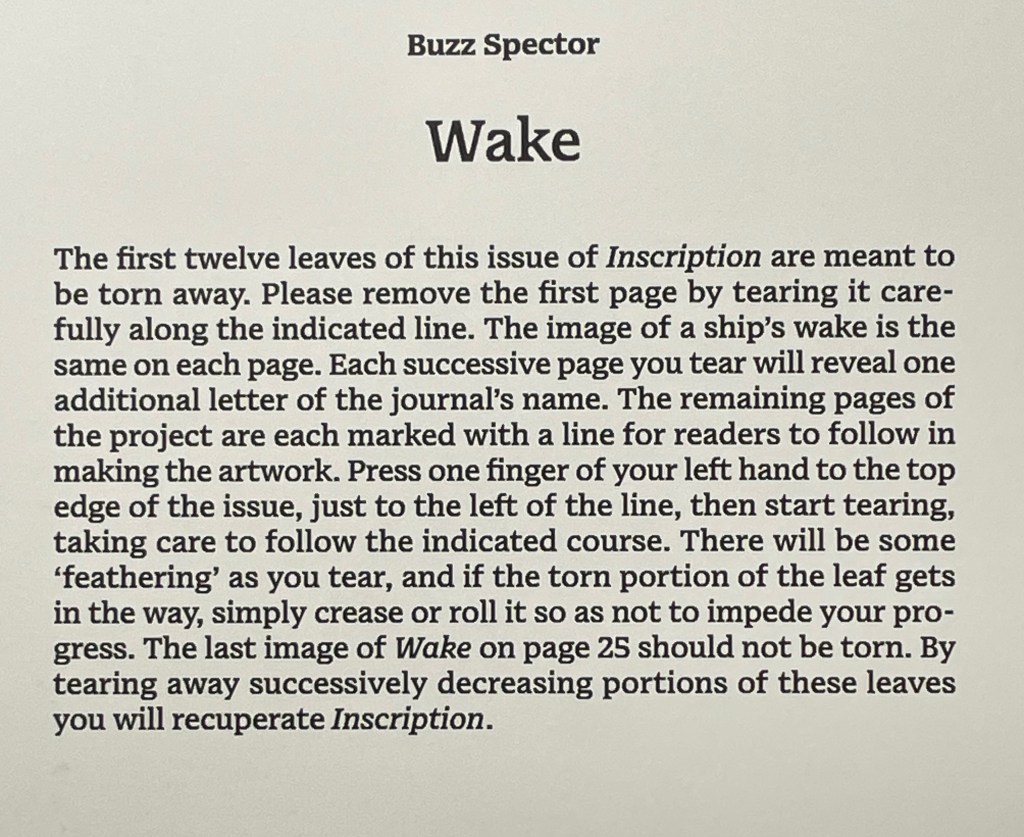
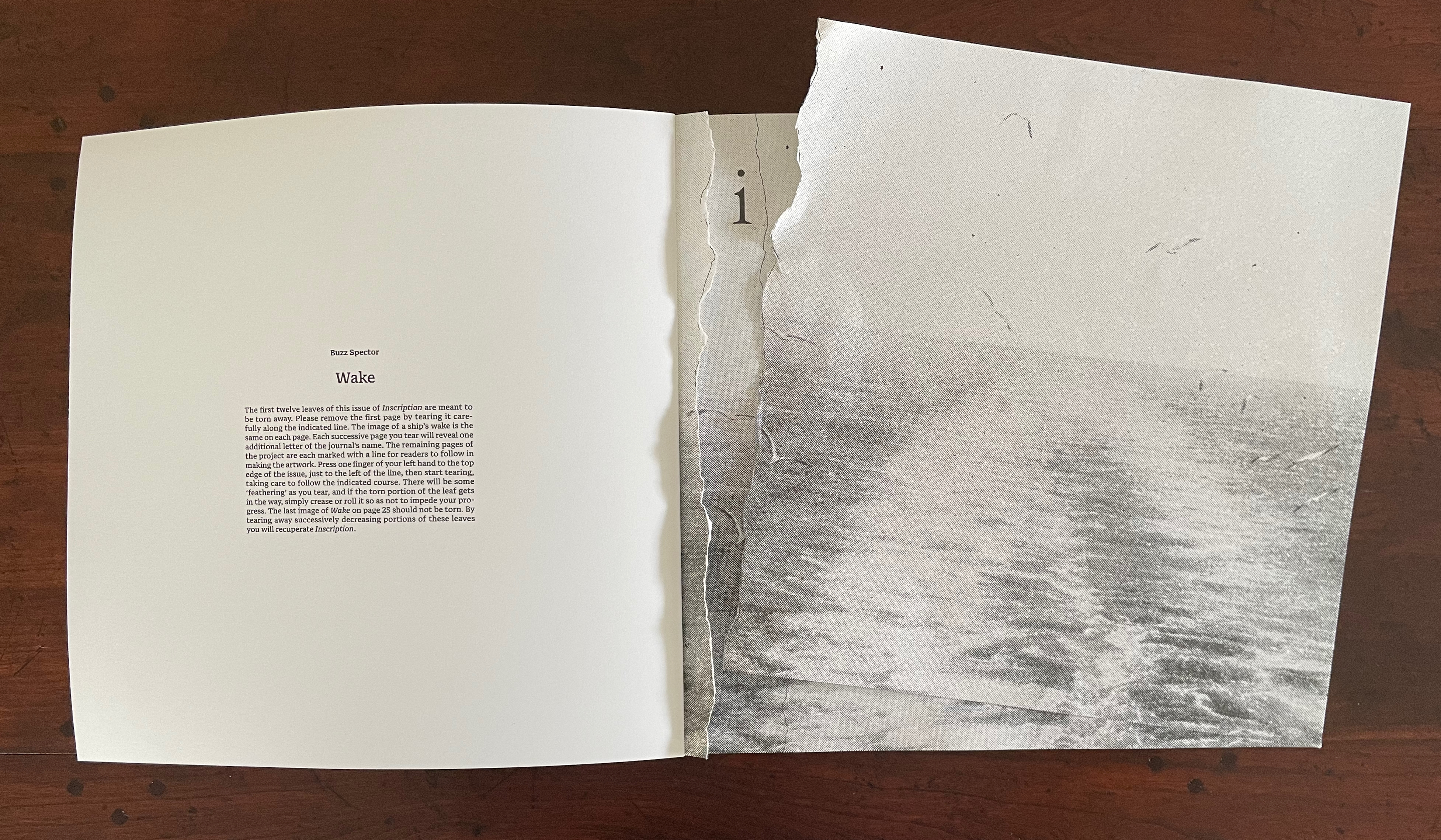
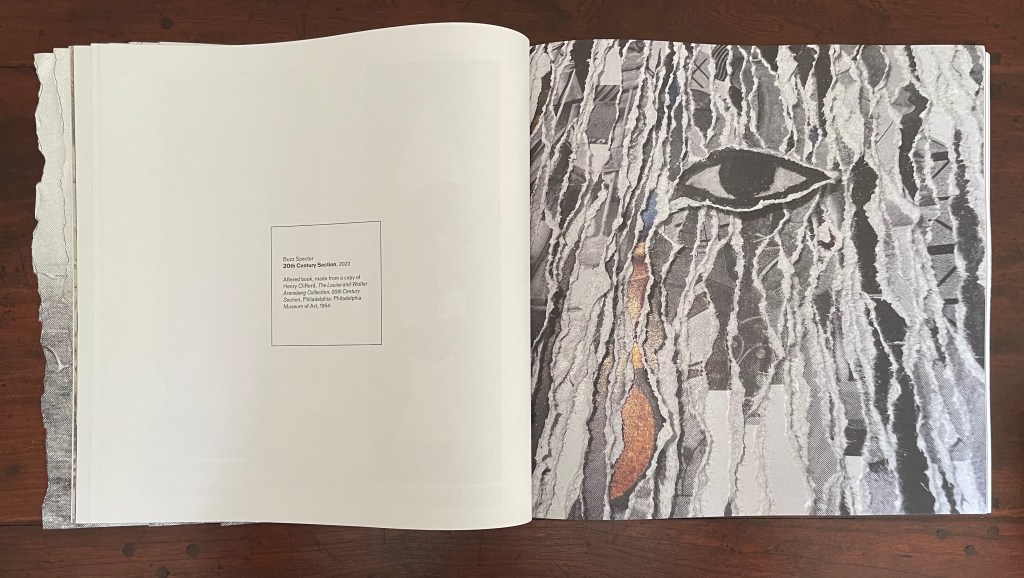
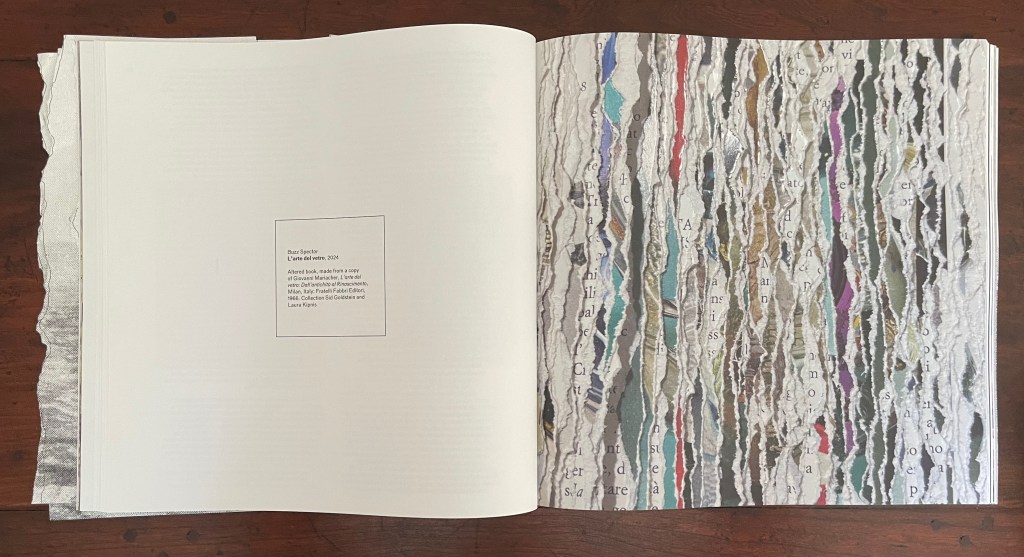
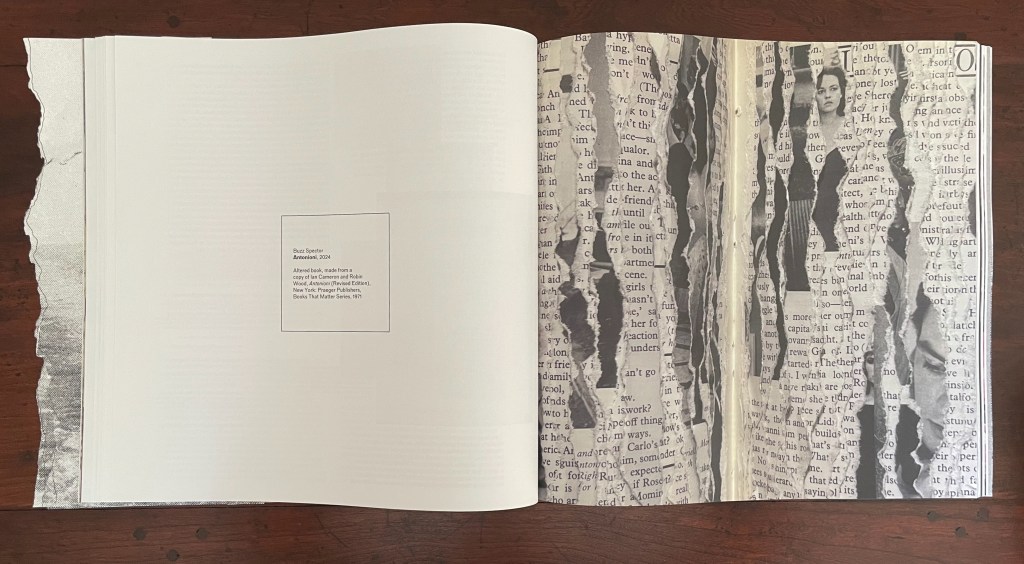
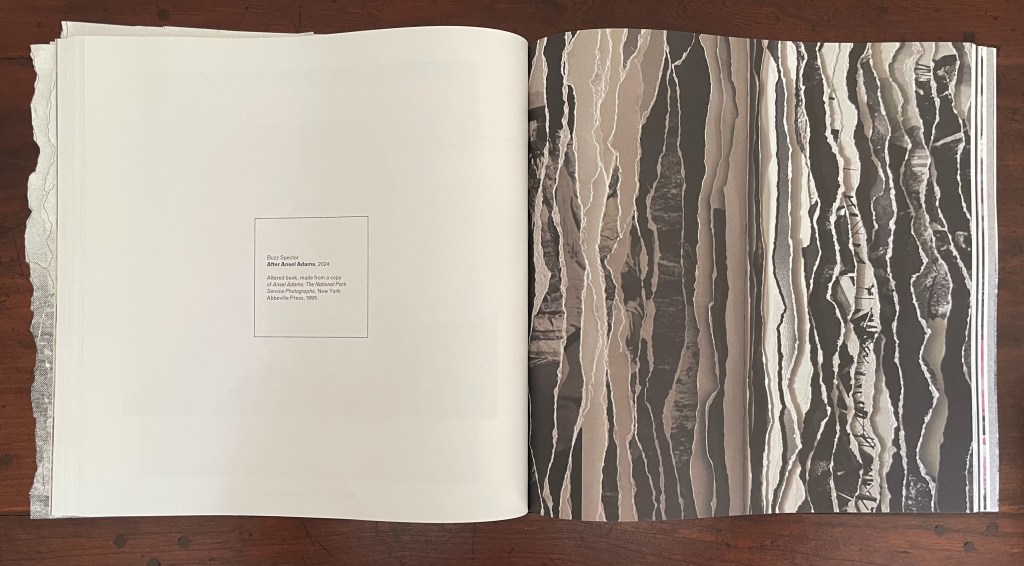
But first, as subscribers have come to expect, Inscription 6 opens with a surprise. Buzz Spector invites us to join in his artistic practice of tearing things up.
The artist says that he is asked all the time how he stands the tedium, to which he replies it is a meditative state he is sorry to see end. He is right. Once the initial unease over tearing pages from the issue subsides, a certain satisfaction ensues.
The “second” tear. (See further above for the first.)
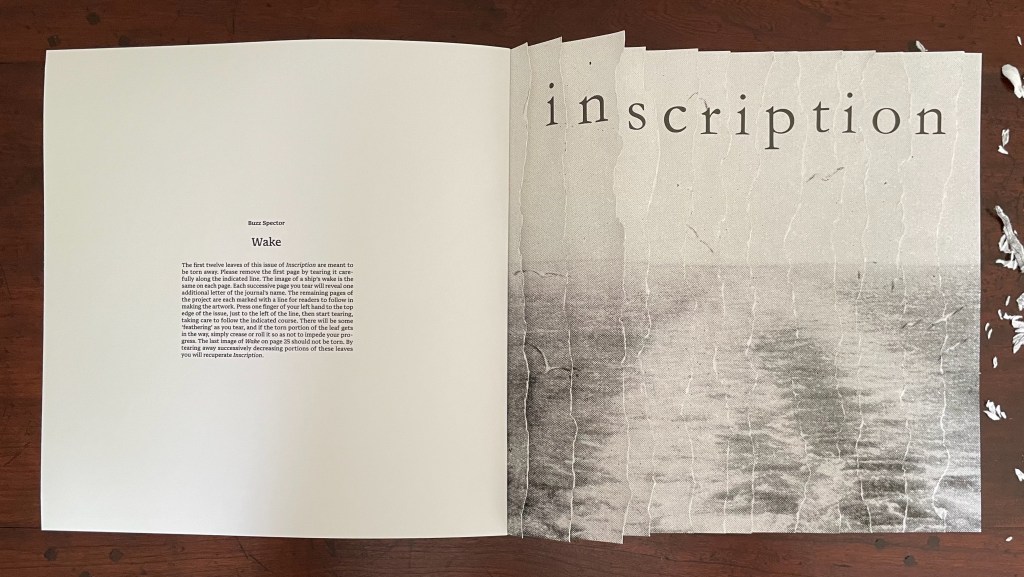
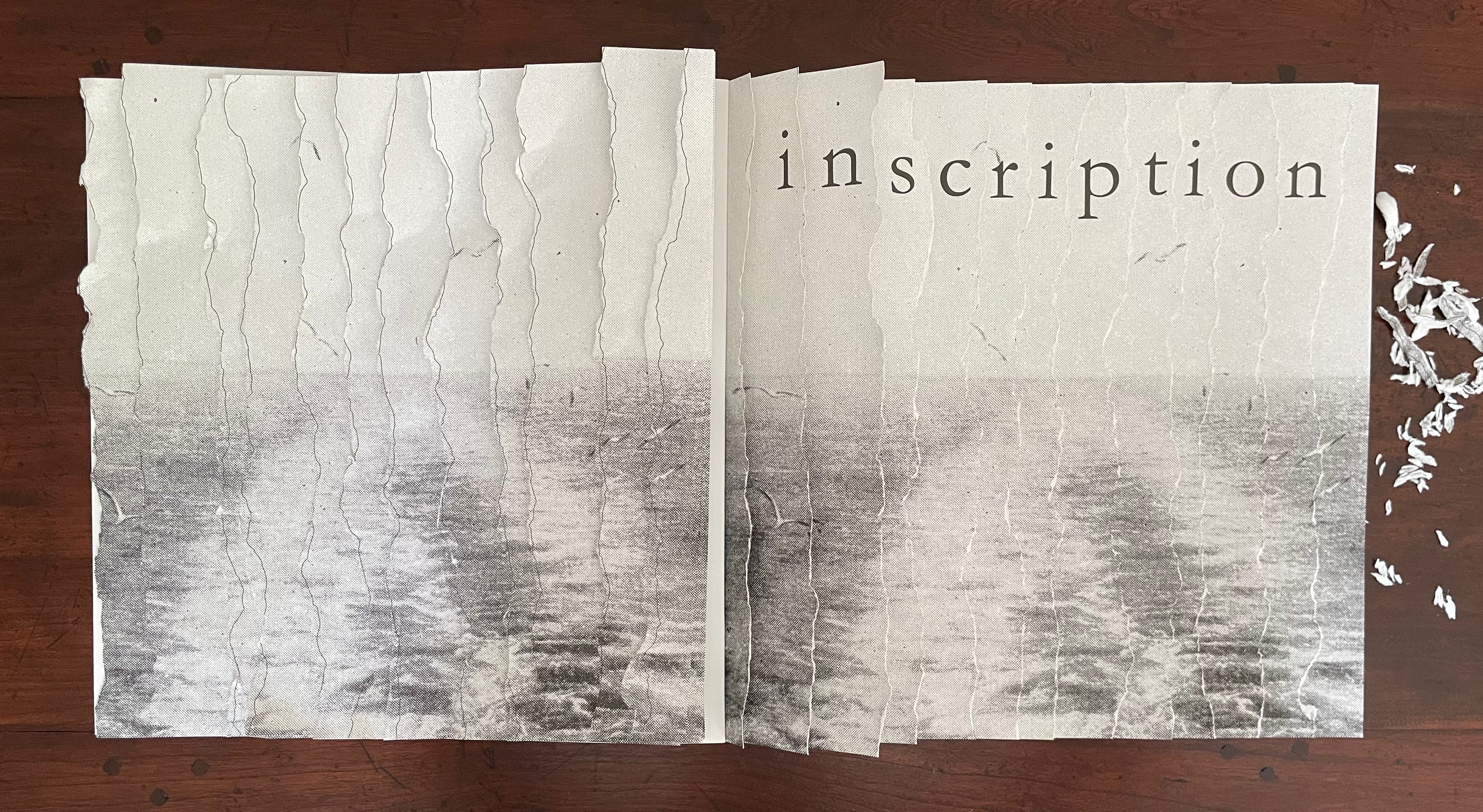
The result is the wake’s image restored in a composition of torn strips still bound to the book.
Rather than surrendering themselves to the bin, the removed strips beg to be reassembled for a wake on the other side of the gutter in keeping with the creative productivity of turning the singular into the plural.
Left: the Spector-esque result. Right: the removed strips rearranged.
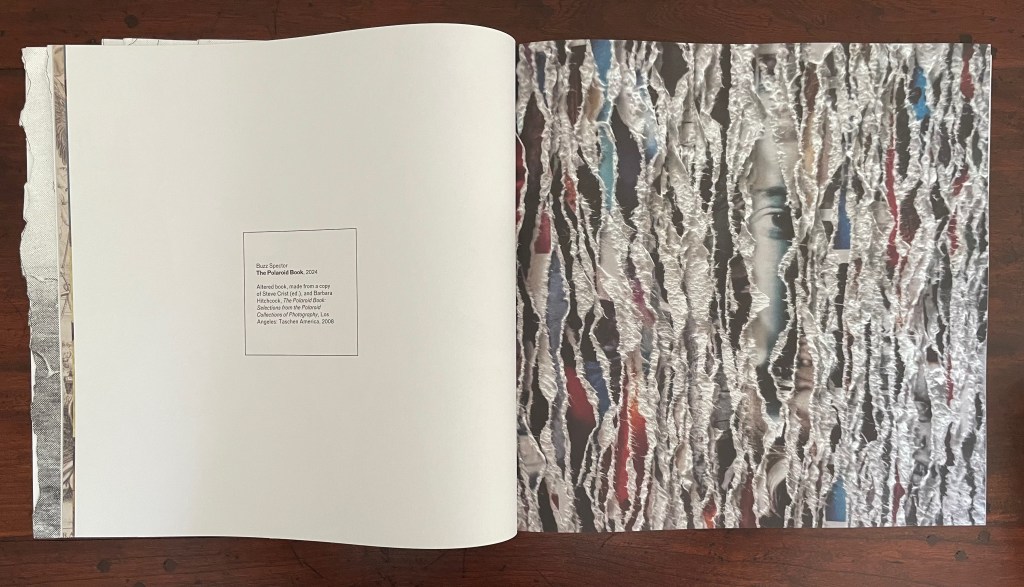
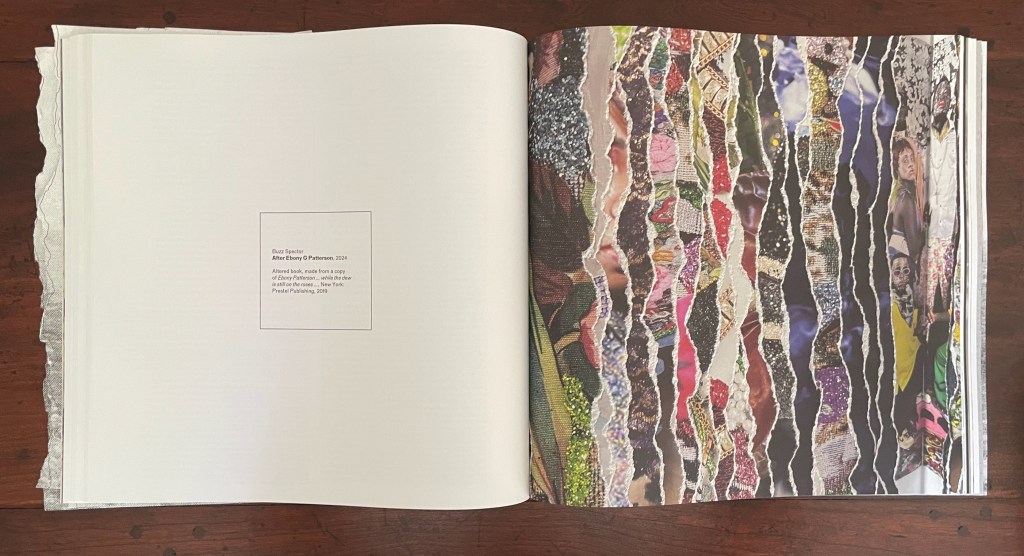
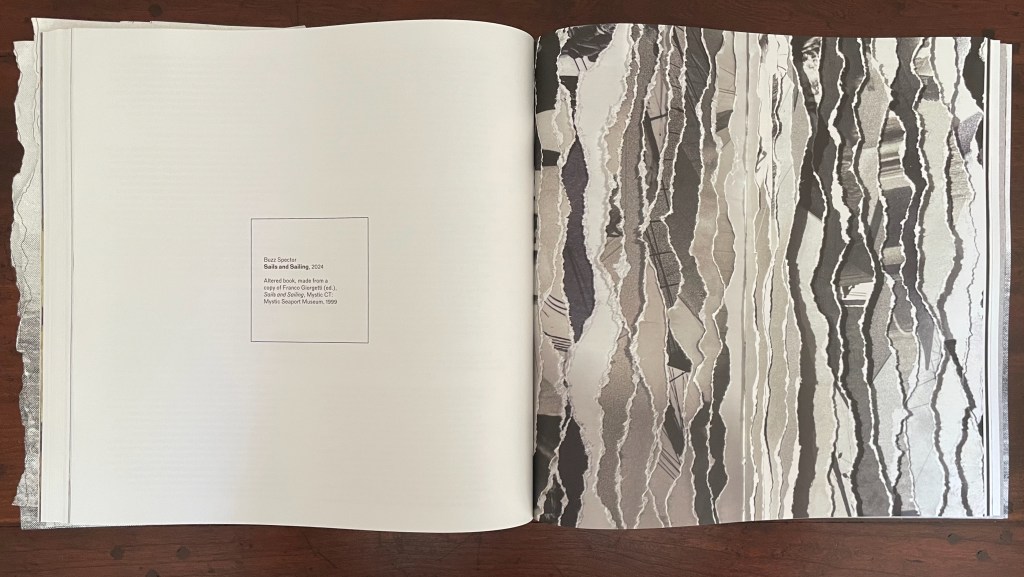
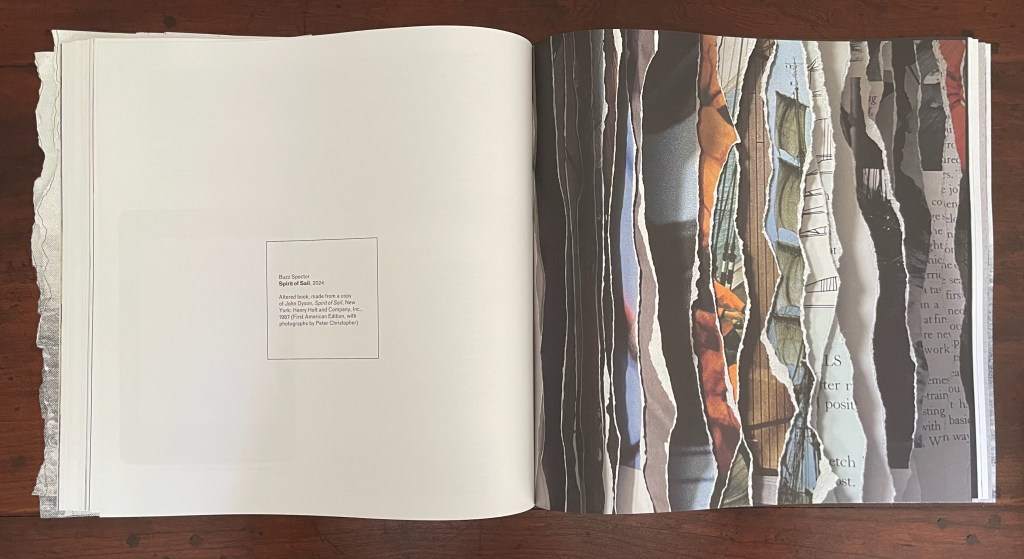
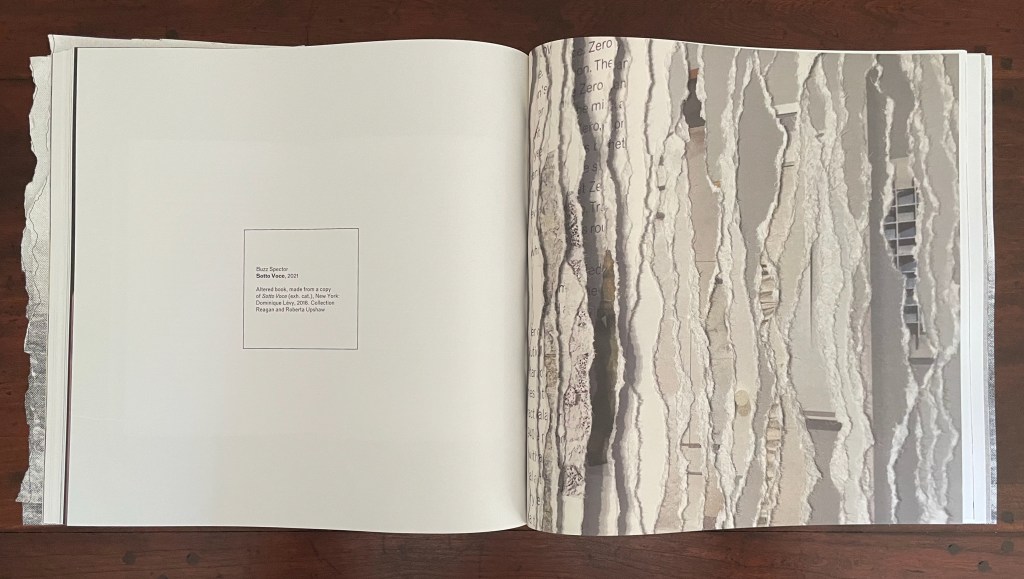
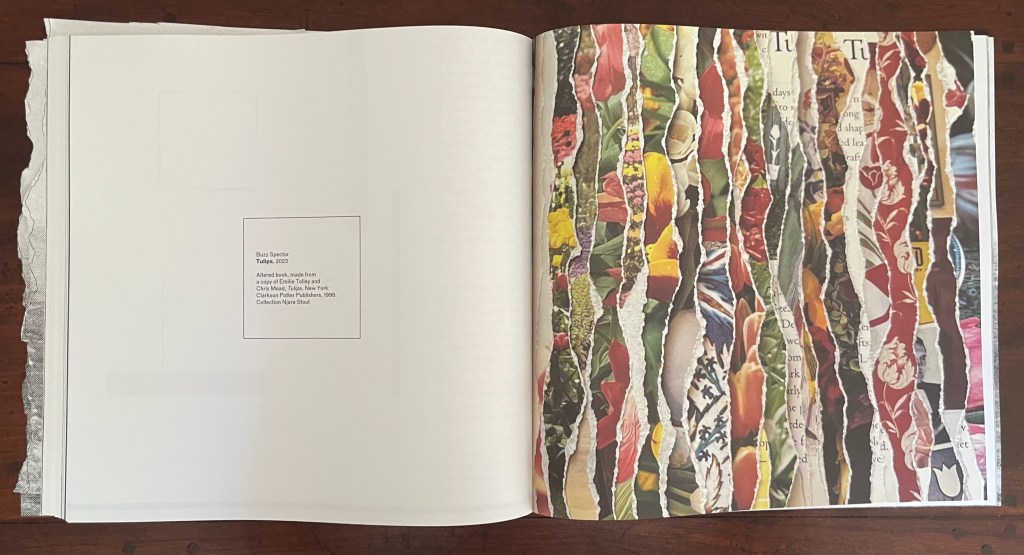
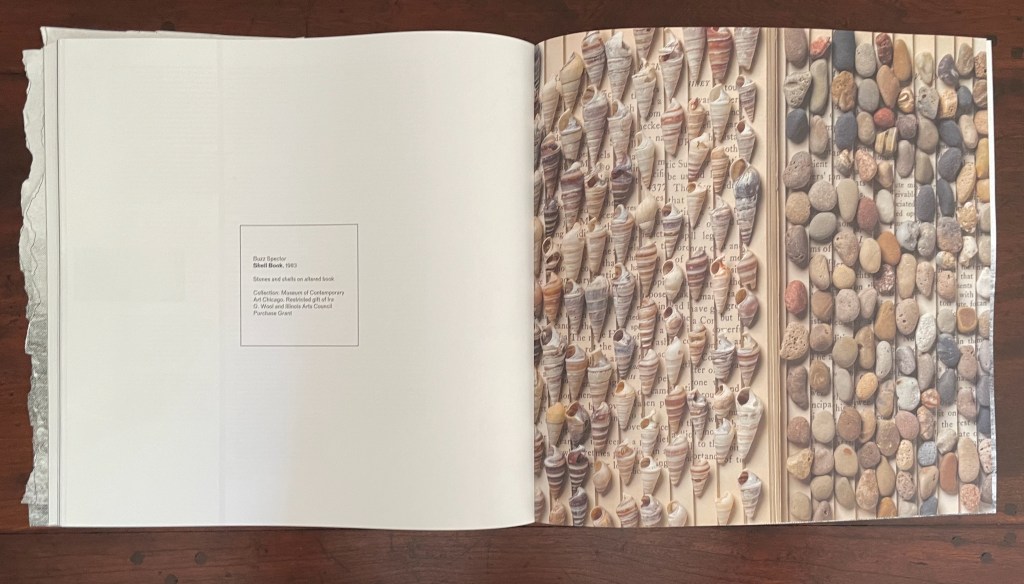
Buzz Spector is the star of this issue. Images from fourteen of his works divide the main sections and each contribution from one another. Works of torn edges create edges or boundaries between the issue’s contents. A stroke of genius from the issue’s editorial and design team. The range of Spector’s sources also draws attention to other boundaries inherent in the body of his work and the issue’s theme: the border between high and low in art, East and West, and Art and Nature. After the 12-page exercise, we have the altered Chinese translation of the self-help book Ego is the Enemy by Ryan Holiday; before the colophon, we have an array of shells and stones on an unidentified altered book, a sculpture held in the Museum of Contemporary Art Chicago. In between, there are alterations of catalogues of Ansel Adams’ photos and the Polaroid Collection, an academic study of Antonioni’s films, a foundational Italian volume on ancient and Renaissance glassmaking, a gardening book, and sailing photobooks.
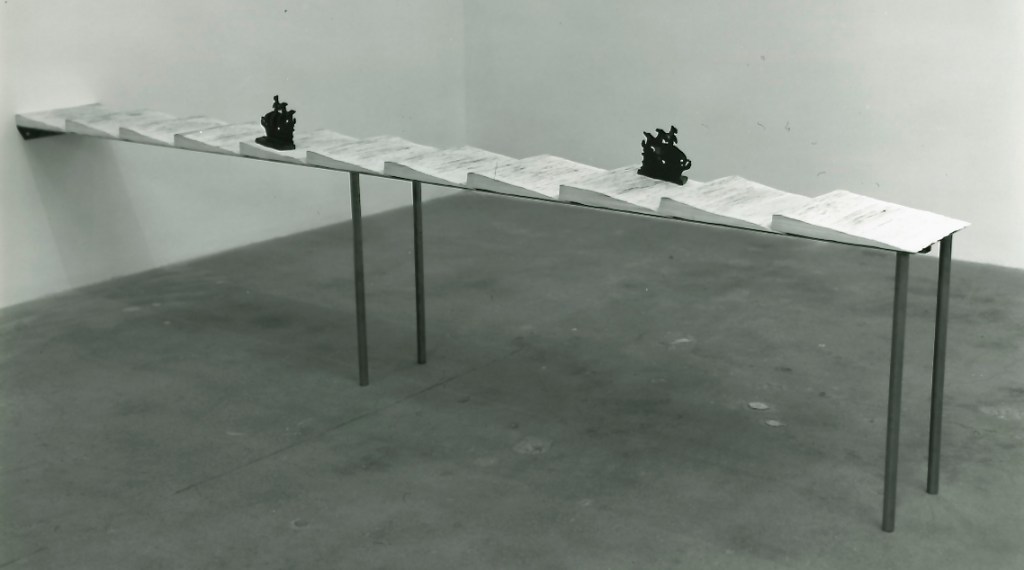
The altered sailing photobooks recall Spector’s North Sea (for M.B.) (1990), his homage to Marcel Broodthaers’ A Voyage on the North Sea (1974) in which Broodthaers juxtaposes a 19th century amateur painting of a tall-masted ship with his own photographs of a sailing ship. Tellingly for this issue of Inscription as well as the thrust of Spector’s homage, Broodthaers opens A Voyage with an elaborate warning not to cut the uncut pages of the book.
From A Voyage on the North Sea (1974) by Marcel Broodthaers. Photos: Books On Books Collection.
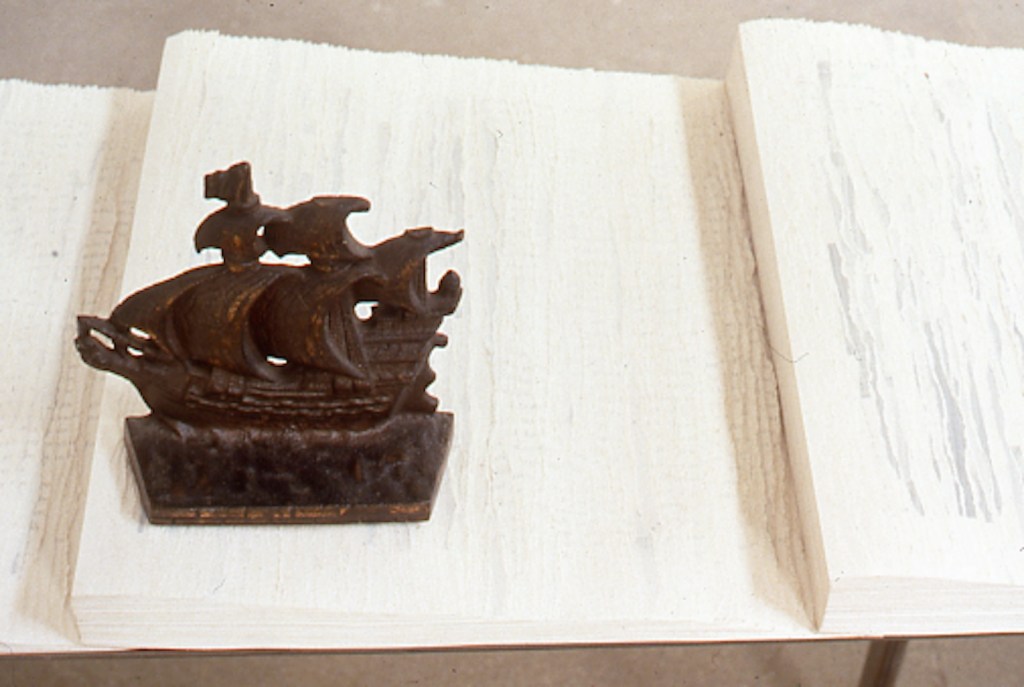
Spector’s homage is a work 10 feet long and presented on a table appropriately jutting out from the wall like a pier. The eleven “waves” of torn pages placed in a row on top of the steel shelf come from eleven copies of the Walker Art Center’s 1987 catalogue for Broodthaers’s first U.S. retrospective. Spector had all the pages in each copy painted with white gesso before tearing the pages. He saved the excised “wedges” and bound them at the fore edges. Because the gesso does not completely obscure the text and images from the catalogues, viewers who come close to the work can see slivers of some of Broodthaers’ works along with the word fragments typical of Spector’s altered books.
North Sea (for M.B.) (1990) by Buzz Spector
The echoes of Spector’s appropriation from the great appropriator (recall Broodthaers’ 1969 appropriation of Mallarmé’s poem in Image: Un Coup de Dés Jamais N’Abolira le Hasard) bring another set of boundaries into view: the space between originality and appropriation and the space between the auratic artwork and its mechanical reproduction raised in Walter Benjamin’s The Work of Art in the Age of Mechanical Reproduction (1936).
Across its 10 sections and 11 loose inserts, the sixth issue of Inscription takes the lead from Spector’s works and explores all these binaries and the cut or torn edges between them. As usual with Inscription, it isn’t all book art. There are prints, a vinyl record, bookmarks, postcards, installations, libraries, typography, a syllabary, and even moth-repellent cedarwood blocks, and its sources range from the London Missionary Society hospitals in early 20th century China, to an installation of Leonard and Virginia Woolf’s library shelves (at Washingon State University of all places), and to J.L. Carr’s home in Kettering. The eclecticism is a challenge to coherence as much as the number of contributors is a challenge to adherence to the theme. Complete success would be an issue that is an artwork of collage in itself.
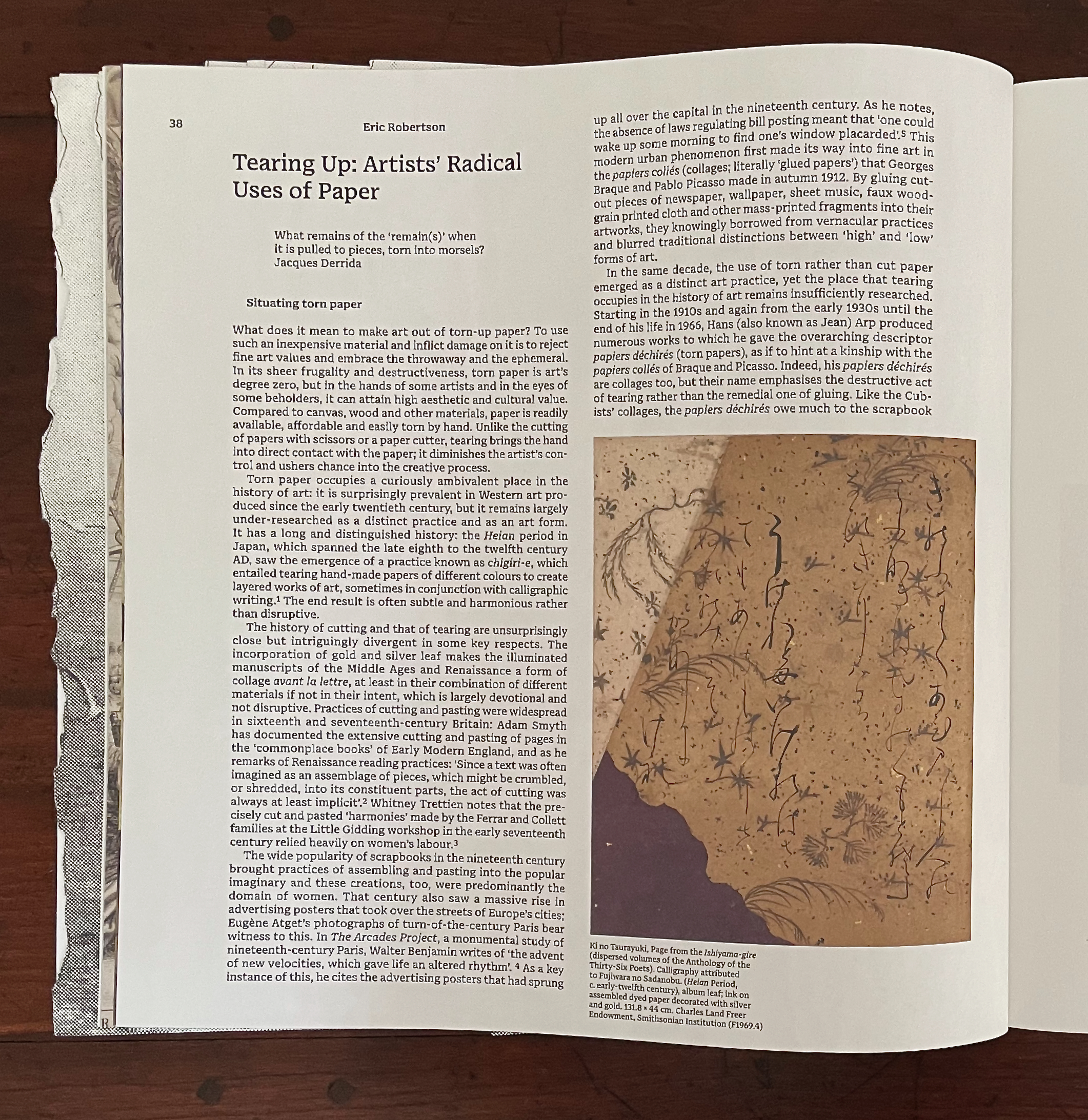
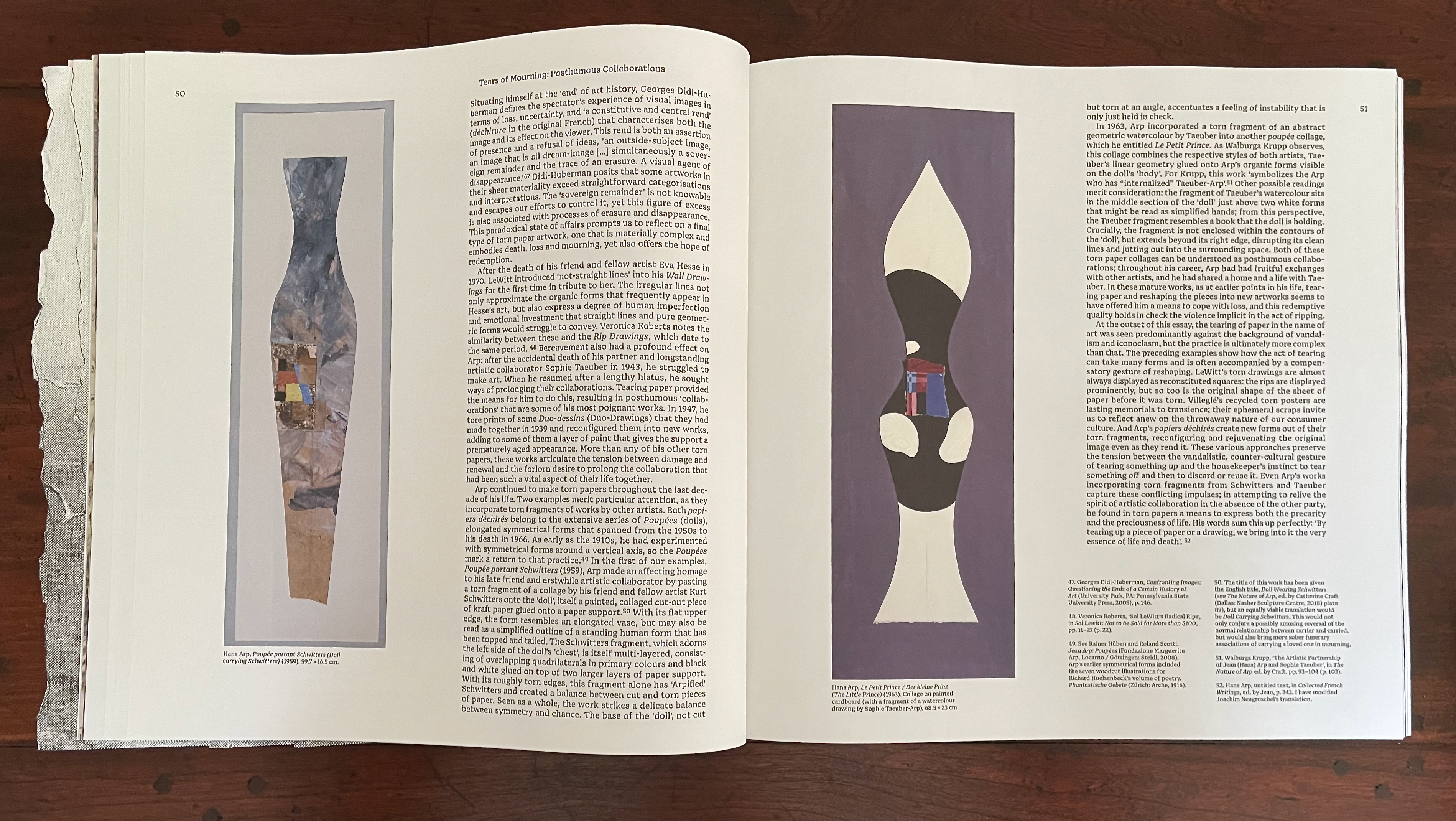
Collage is naturally where the first contributor’s article begins. “What does it mean to make art out of torn-up paper?” Eric Robertson uses Hans (Jean) Arp’s déchirés (torn pages), Raymon Hains’ and Jacques Villeglé’s torn posters, and Sol Lewitt’s “rip drawings” to take us beyond categorizing such works as vandalism, desecration, or iconoclasm.
By discussing Arp’s posthumous collaborations with friend Kurt Schwitters and partner Sophie Taeuber under the heading “Tears of Mourning”, Robertson bridges the dual meanings of the heteronym and well prepares the ground for his moving quotation of Arp in conclusion: “By tearing up a piece of paper or a drawing, we bring into it the very essence of life and death”.
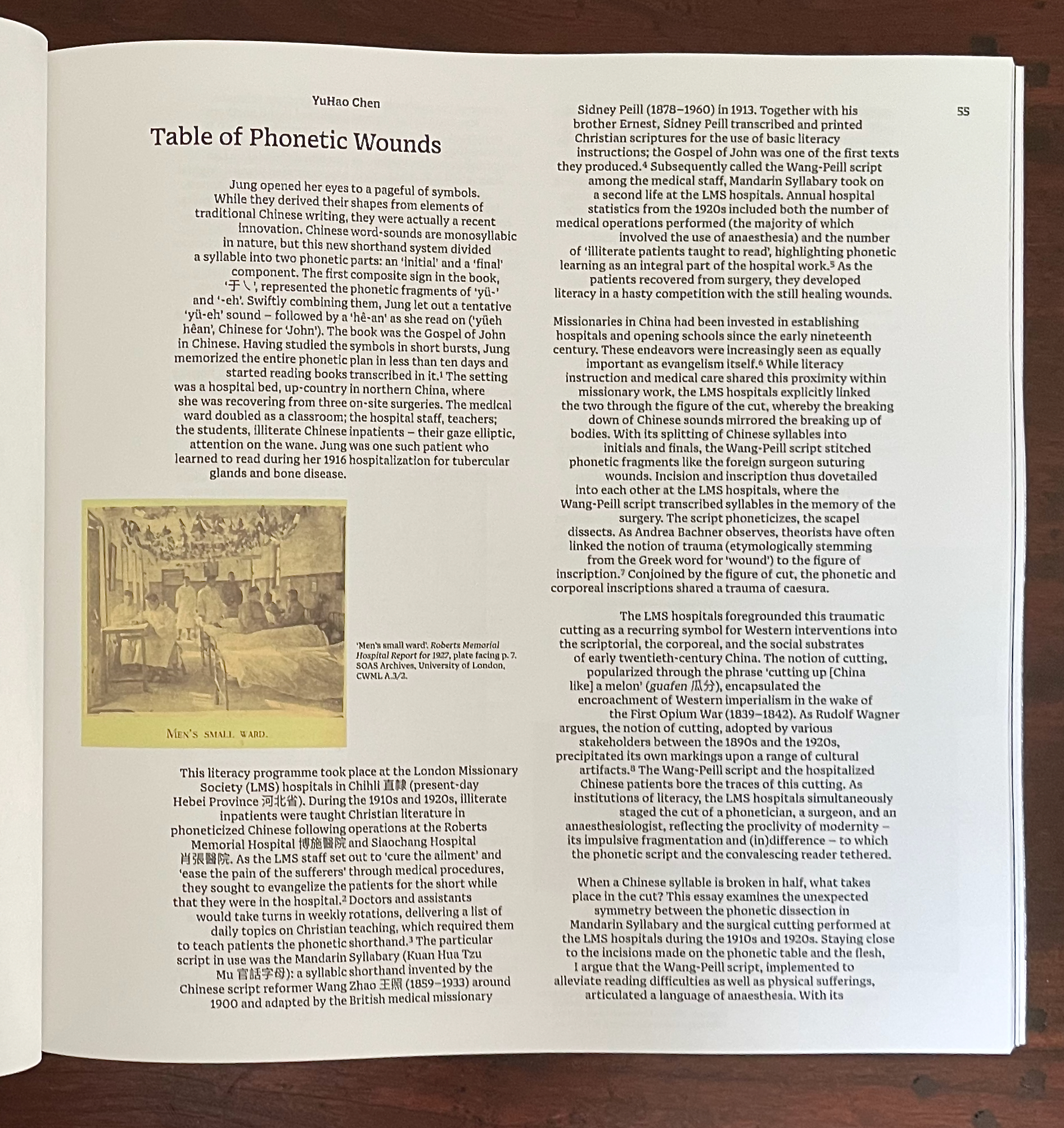
YuHao Chen‘s “Table of Phonetic Wounds” aims to make metaphorical connections among a host of pairings: surgical incision/skin, site of operation/cause for operation, the initial/final phoneme structure from the Wang-Peill Mandarin Syllabary, Western colonial intervention/China-the-sick-man-0f Asia, literacy/illiteracy, non-Christian/Christian, etc. Successful surgery equals achievement of literacy, healing equals conversion, etc., by which we should be convinced of causality (or not).
The justification running through the center of the article’s paragraphs offers a visual metaphor for all these binaries. Even the gap between the initial and final phonemes in the Mandarin Syllabary recalls the gap between the consonants of “tears”. It is a space in which something meaningful happens.
Reanna Brooks‘ “Cut and Paste: Virginia Woolf’s Bookcraft” provides a good case for looking carefully at the border between craft and art. Brooks finds a depth in Woolf’s bookbinding that should prompt us to ask more often, When do the book arts and book art overlap to create a new work of art?
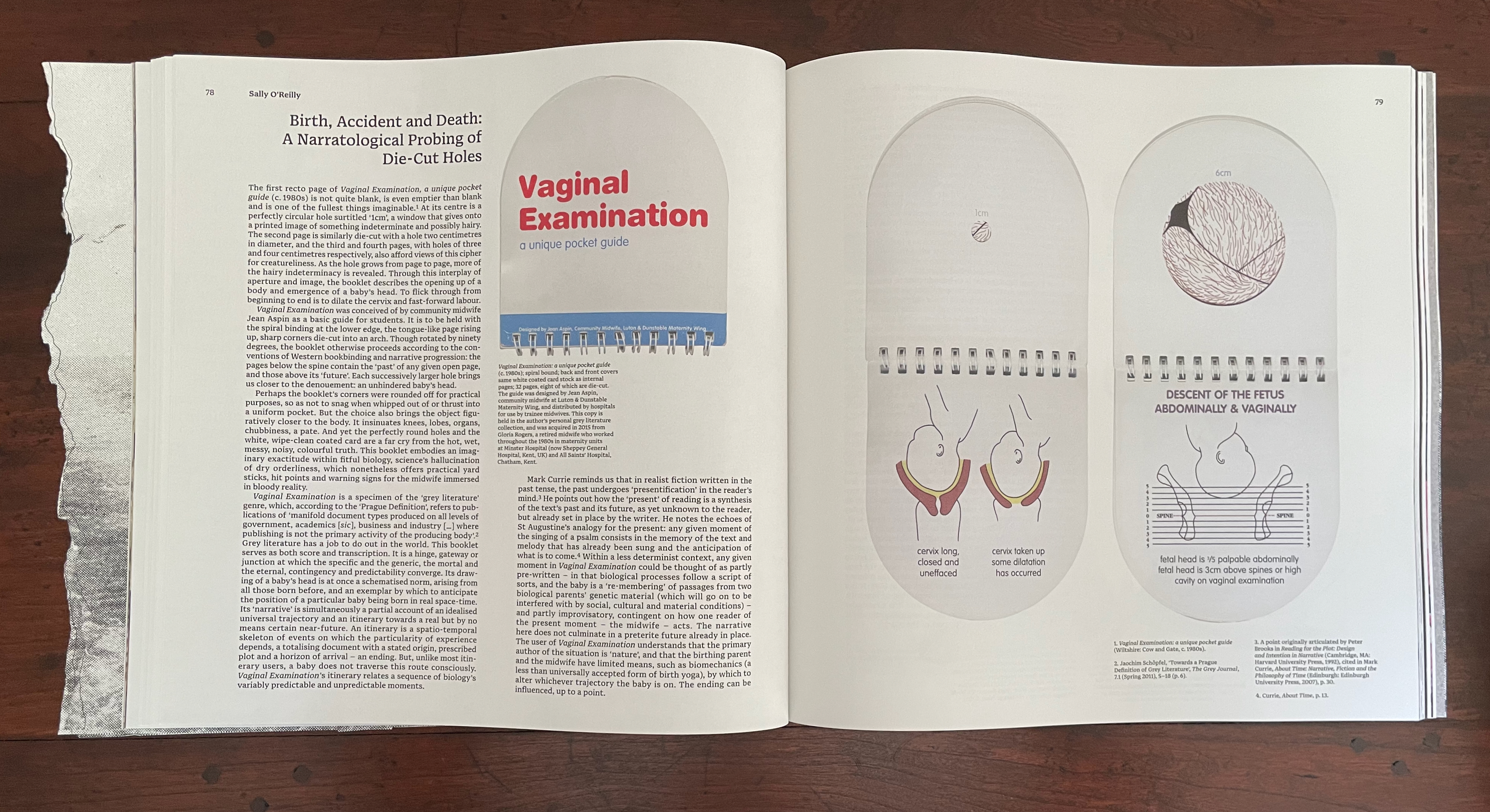
Sally O’Reilly‘s “Birth, Accident and Death: A Narratological Probing of Die-Cut Holes” would not have been out of place in Inscription No. 2 on “holes”. Its presence here demonstrates the extension of the theme of tearing to include cutting and holes. Removal by tearing or cutting may overlap, but the techniques are sharply different in their results as we saw with Arp’s “Doll carrying Schwitters” and “Le Petit Prince”. The differences here point to the messiness of giving birth contrasted with the tidiness of the neatly designed and pocketable guide for midwives that shows the growing diameter of the cervix stage by stage through a die-cut hole.
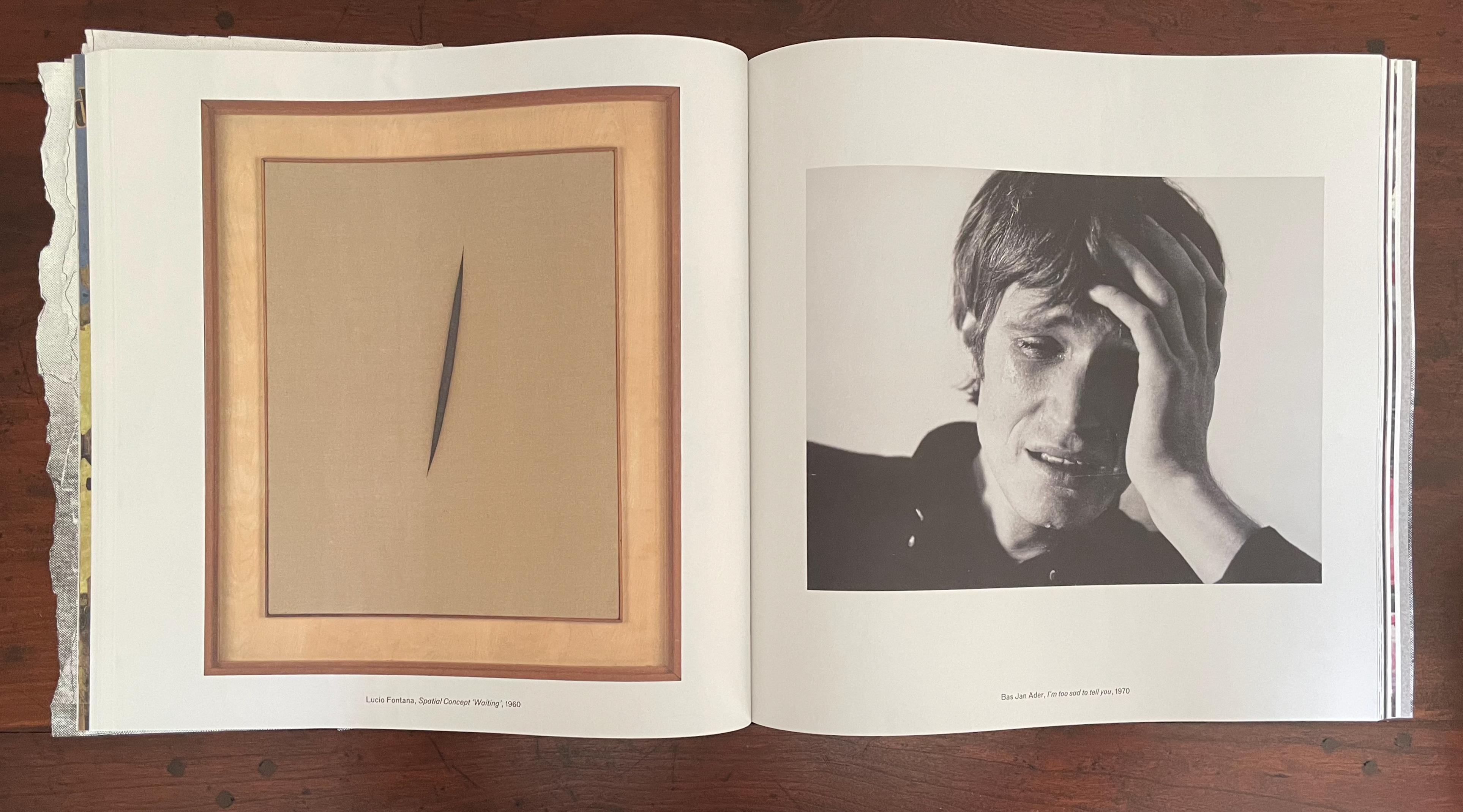
The following juxtaposition of Lucio Fontana‘s Spatial Concept “Waiting” and Bas Jan Ader‘s I’m too sad to tell you draws attention to the heteronym “tears”. It is set off in its own section, knowingly bracketed by Spector’s Displacement after Lawrence Weiner (2024) — conceptual artist — and After Ansel Adams (2024) — photographer. It is a meaningful curatorial gesture meant to be on a par with, say, Robertson’s effective bridging of the heteronymic meanings under the heading “Tears of Mourning”.
Tear: N1 A torn part or place; V1 To pull or split apart. Tear: N2 A secretion of the lachrymal gland; V2 To weep.
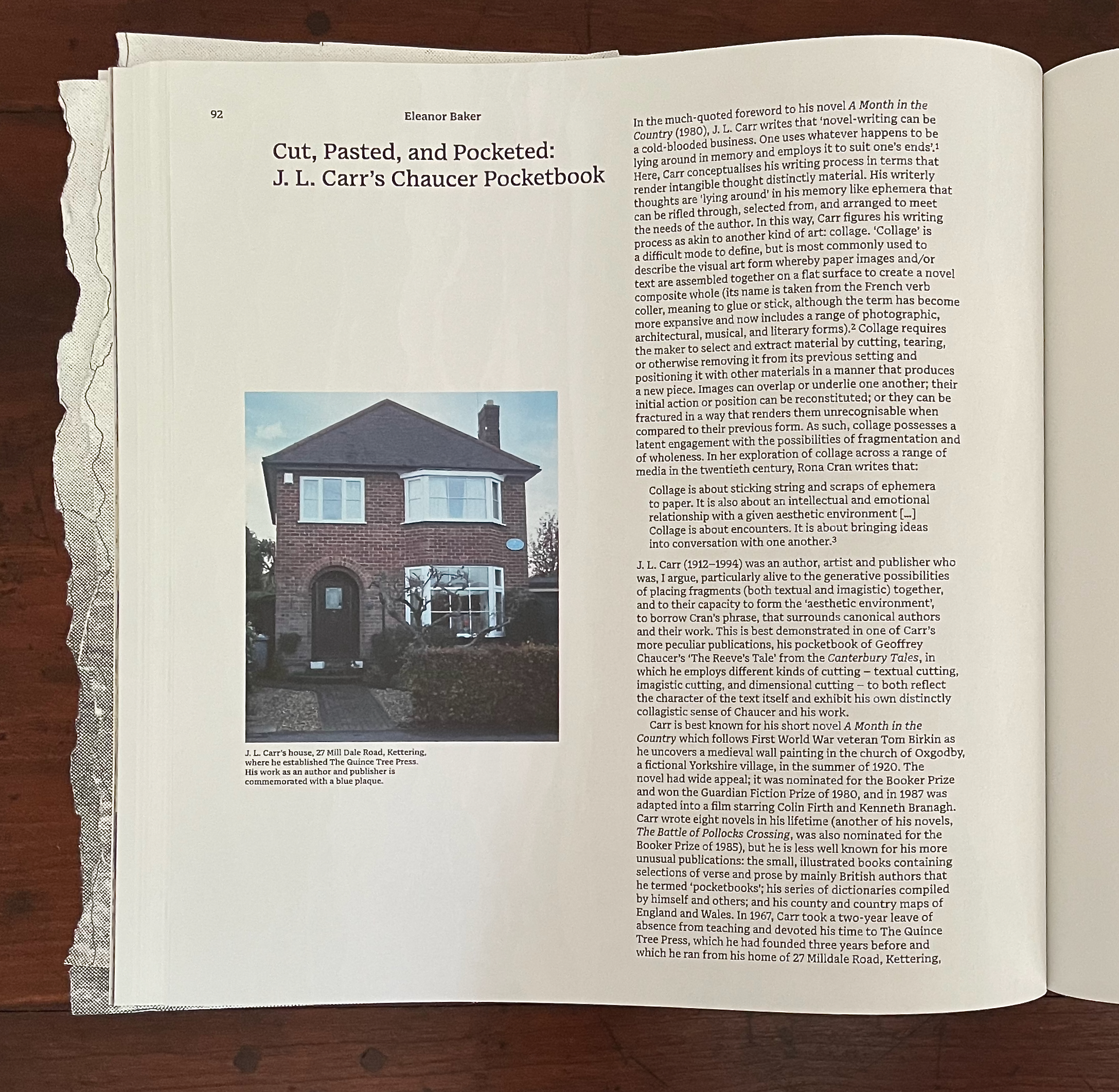
Eleanor Baker‘s “Cut, Paste, and Pocketed” explores J.L. Carr’s 1066 and All That treatment of Chaucer’s “The Reeve’s Tale”. While Carr would surely have been familiar with Sellar and Yeatman’s 1930 comic book history, Baker pegs Carr’s approach as a form of collage rather than comic strip. As we’ll see later with Angela Szczepaniak’s contribution, the two can be combined to drive a narrative forward. In Carr’s case, as Baker points out, the pocketbook approach and cheeky fragments of collage combine to deliver a comically modern sense of Chaucer’s world and an inventive match to the fragmentary nature of “The Reeve’s Tale”.
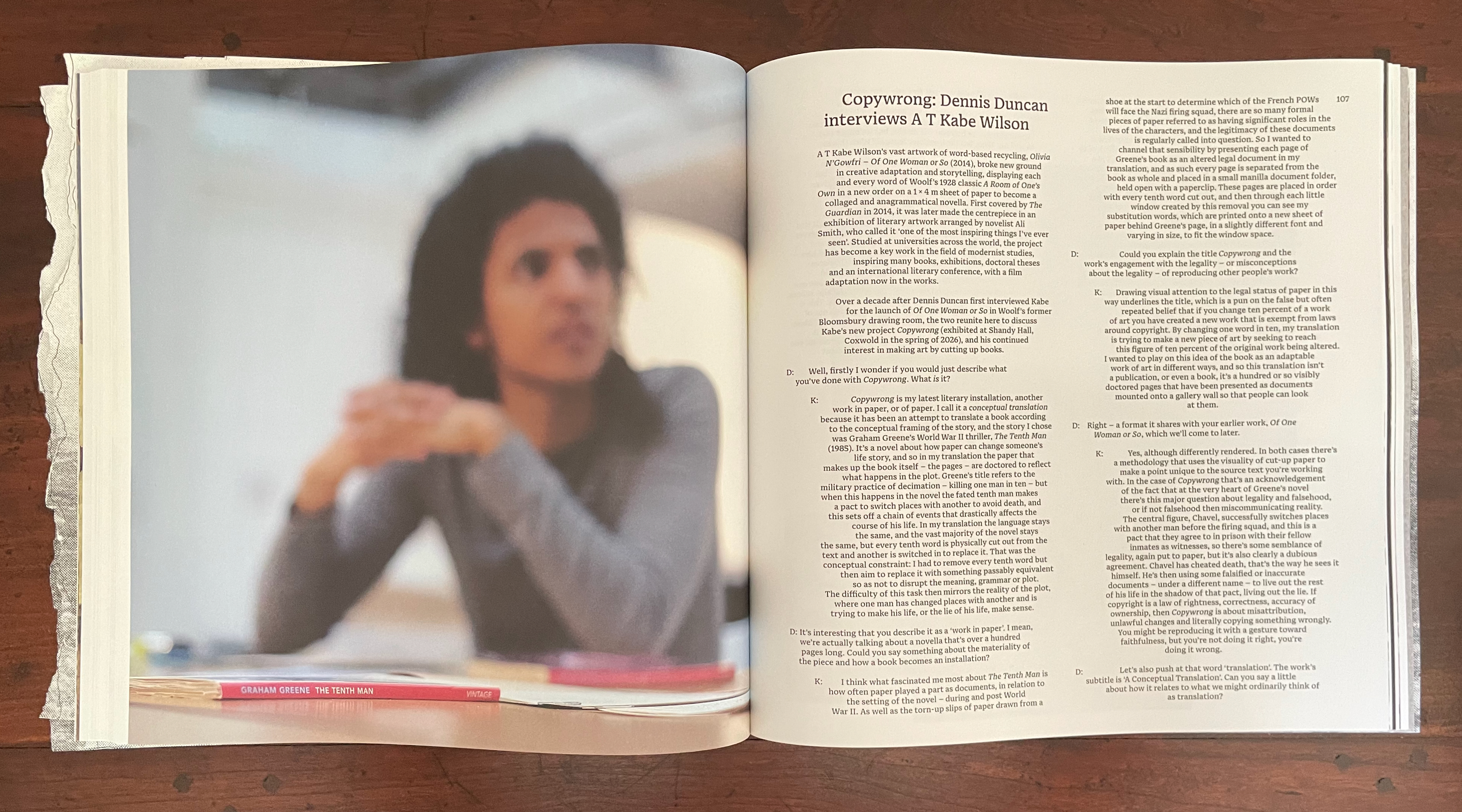
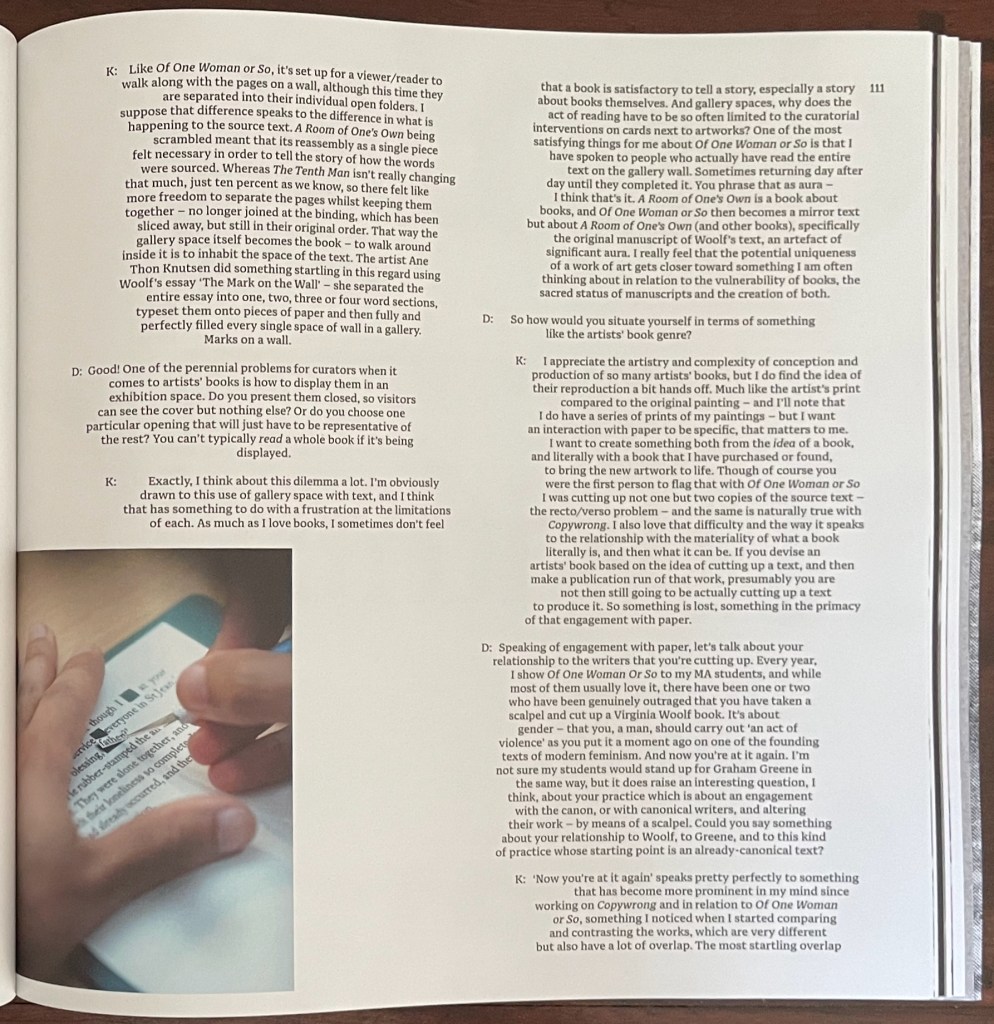
Using knives and punches, A T Kabe Wilson removes every tenth word in Graham Greene’s The Tenth Man and replaces it with a synonym or as near a proxy as he can manage to challenge the notion of copyright. The resulting pages are arranged to make up an installation where visitors can read the entire set of altered pages. There is no edition of Copywrong. It turns Walter Benjamin on his head: “The Unique Work of Art Produced from Two Copies of a Mechanical Reproduction”.
To bring this relevant work within the bounds of Inscription, the editors provide images of Wilson at work and rely on Dennis Duncan (University College of London) to elicit from Wilson where the work’s strange status places it in relationship to artists’ books and other visual art.
Kabe Wilson’s choice of every tenth word takes its impetus from the book’s story of collective punishment in wartime (“choose ten from among your number to be executed”). But it also turns on its head the common fallacy that ten percent of a work can be reproduced without violating copyright: hence the title Copywrong. In Greene’s novel, when the rich tenth man contracts with a poor man to trade places and switch identities in exchange for the rich man’s inheritance, a whole vein of copywrongs reveals itself for mining. Wilson sees his creative destruction of the novel as a form of translation and betrayal of the original. While challenging us to think where the line between book and not-book lies, and even to think of its sheets of paper as 3D objects, Copywrong becomes a way of asking where the line between original and copy, legal and illegal, and life and death lies.
The next contribution is Fraser Muggeridge‘s “Cuts and Tears as Justified and Unjustified Typesetting”. While the article gives an informative sketch of the history and development of the straight and ragged edges of print, its argument that unjustified typesetting is “torn typography” does not convince. An unjustified line does not begin with a justified line from which spacing is torn or cut. A justified setting may give a page the visual effect of having been evenly cut down the right, and a ragged right setting may give the visual effect of a tear down the right side, but whether they contribute to a work’s artistic meaning — not just an aesthetic effect on readability — needs convincing examples. With Apollinaire and his calligrammes, Stefan Themerson and his “internal vertical justification”, and Christian Bök’s Diamonds, Muggeridge make a good start. Most of the other variations on justified, unjustified, and mixed, however, are far cries from, say, Mallarmé’s breaks of the line and play with page layout in Un Coup de Dés Jamais N’Abolira le Hasard or from the meaningful typographical tearing and cutting that the avant-gardistes of the early 20th century perpetrated.
It’s odd, especially as the Fraser Muggeridge Studio designs Inscription, that the article does not mention the center justification used in several of the issue’s other articles. Their paragraphs decline to show off those even edges of justified-left and justified-right typesetting. Instead, they go for a ragged left and ragged right with a book-mimicking gutter of justified left and right in their center. When proofreaders were more a feature in typesetting houses, they not only had to catch “typos” but also to watch for “rivers in the type”, those breaks between words in one line that aligned with breaks in the next several lines to create a white rivulet of space trickling down the page and distracting the reader from the sense of the sentences. In Chen’s article, the “river” is a medial surgical cut. In Duncan’s interview with Wilson, the clear gutter in the middle of the paragraphs offers a sharp contrast with the uncomfortable binaries that Copywrong bids us to engage. Kudos to Fraser Muggeridge and studio.
Left: from Chen’s article. Right: from Wilson-Duncan interview.
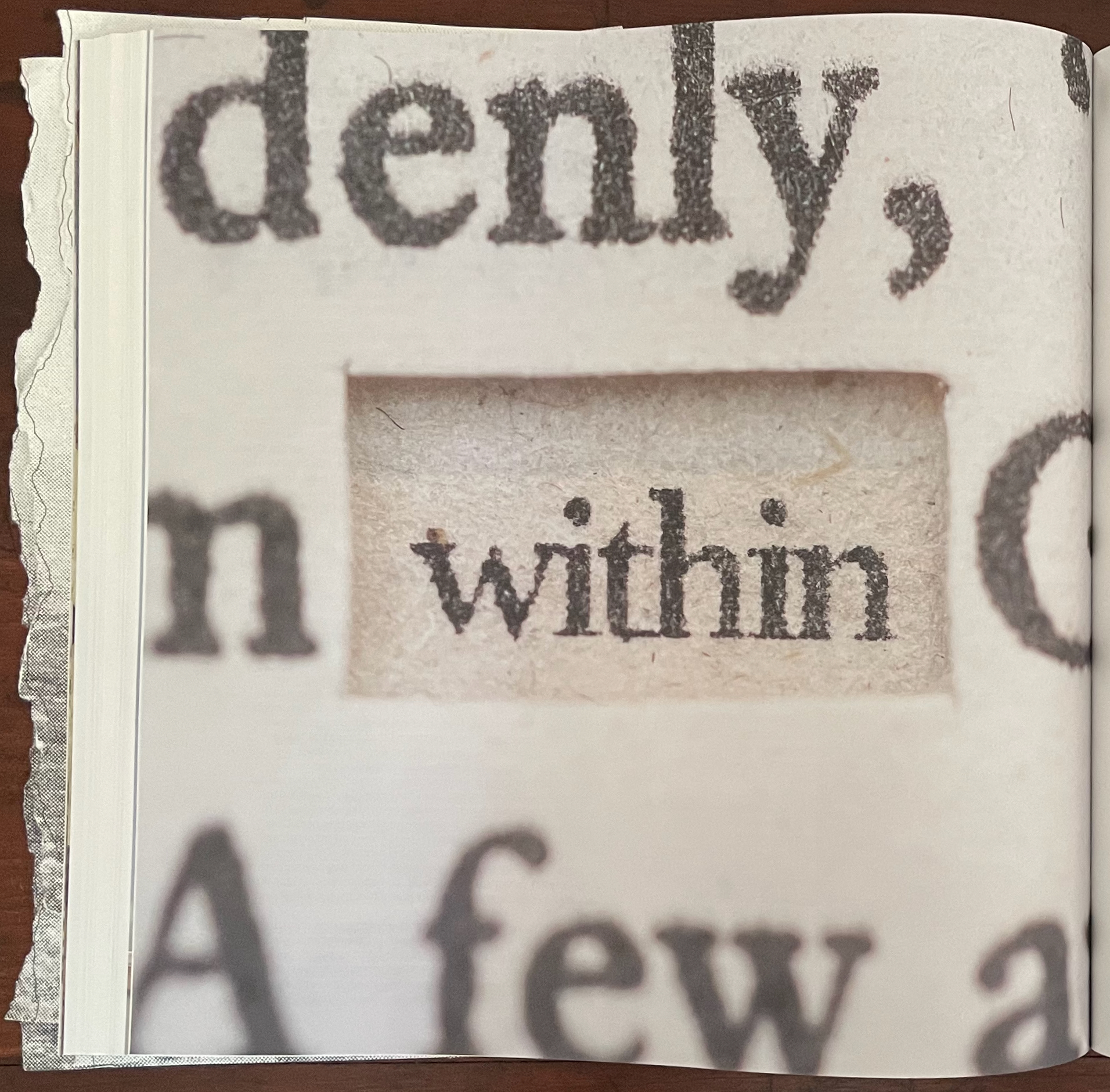
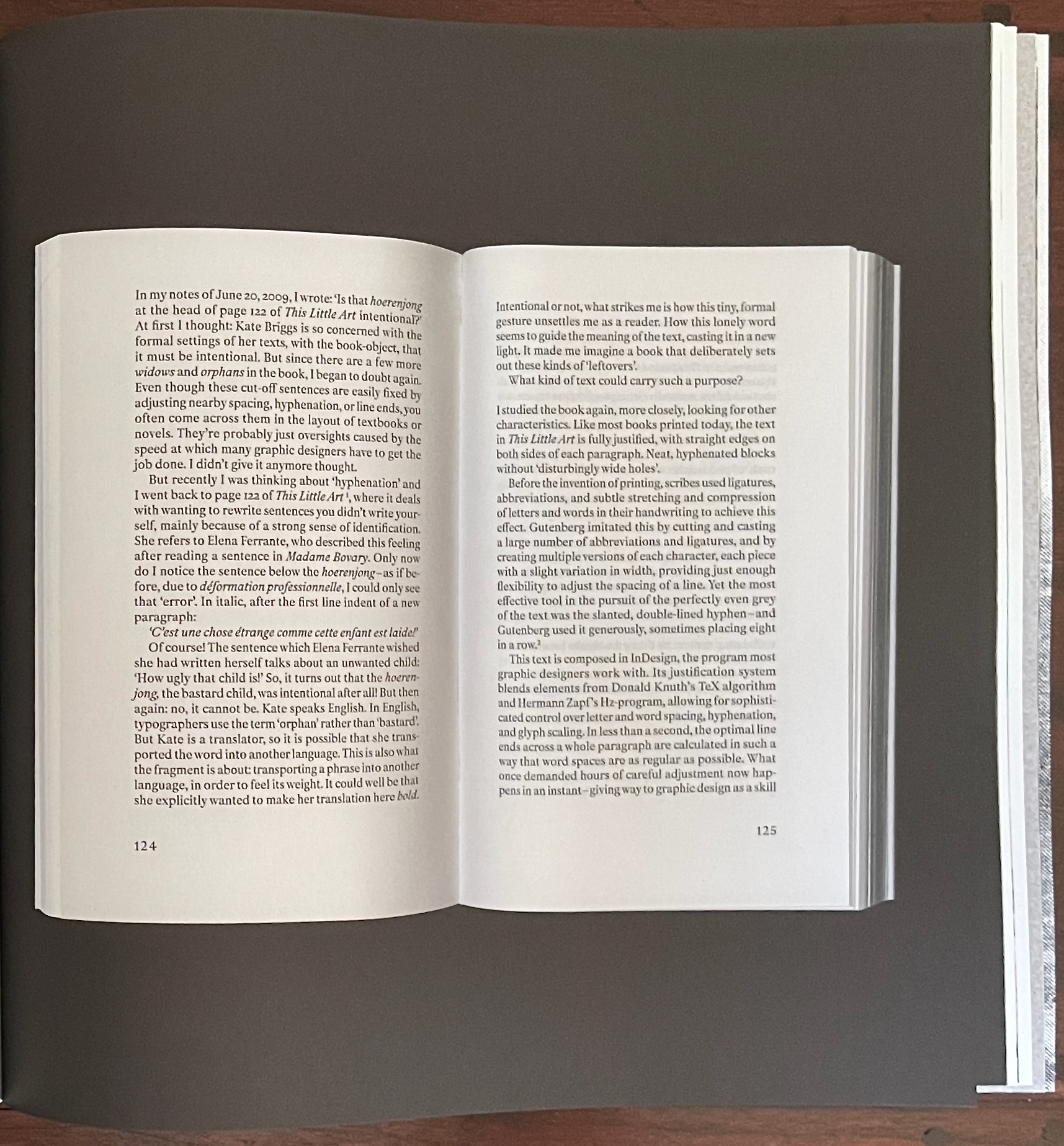
The next contribution — from the Leuven-based artists collective Rosetta, formed by Eva Moulaert, Anneleen Masschelein, and Willem Styfhals — continues with the topic of typesetting. Their starting point is those awkward phenomena of typesetting — widows and orphans. They are not deliberate renderings or loppings of words from a following or preceding sentence to be left stranded at the bottom or top of a page, respectively. But there they are. Are they tears or cuts, these weepy, abandoned strings of anthropomorphized type that are cause for tears among proofreaders, typesetters, and designers? No, they are cause for the fevered ponderings of the narrator in a book whose photographed pages make up this contribution.
No widows or orphans here.
This set of photographed double-page spreads (excised?) has plenty of widows and orphans. Even though they are likely deliberate, what is the point of them? And whose disembodied hand is that that keeps appearing, disappearing, and reappearing to hold the book facing out?
Orphan and widow.
The narrator winds “their” way through references to Gutenberg, Donald Knuth, Herman Zapf, Jean-François Lyotard, Martin Heidegger, Roland Barthes, Robert Bringhurst, Ellen Lupton, Frank Kermode, Amitav Ghosh, and half a dozen others to come to “a” point — an obsession with hyphenation. And the point of that? Why naturally for the narrator’s compound, hyphenated selves — Ro-set-ta — to hand over the pen to Rosetta, the widow at the end of “page 139”.
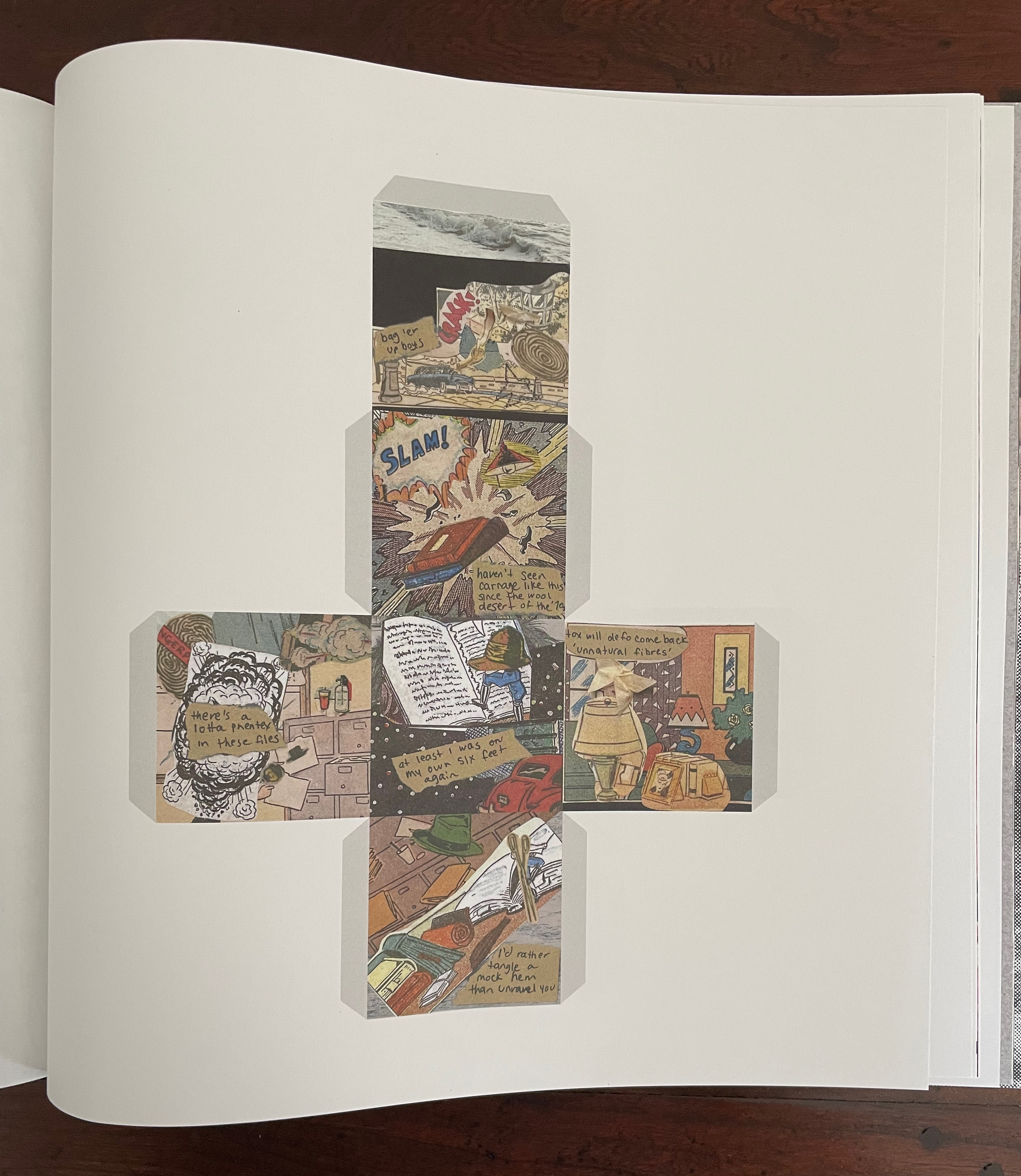
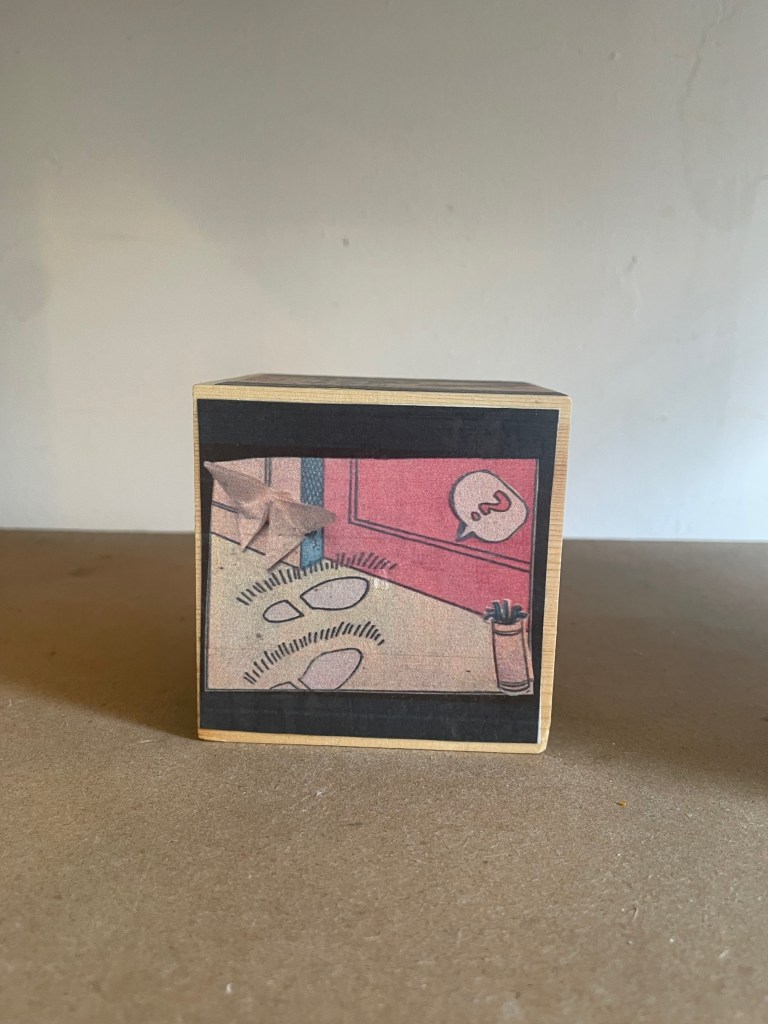
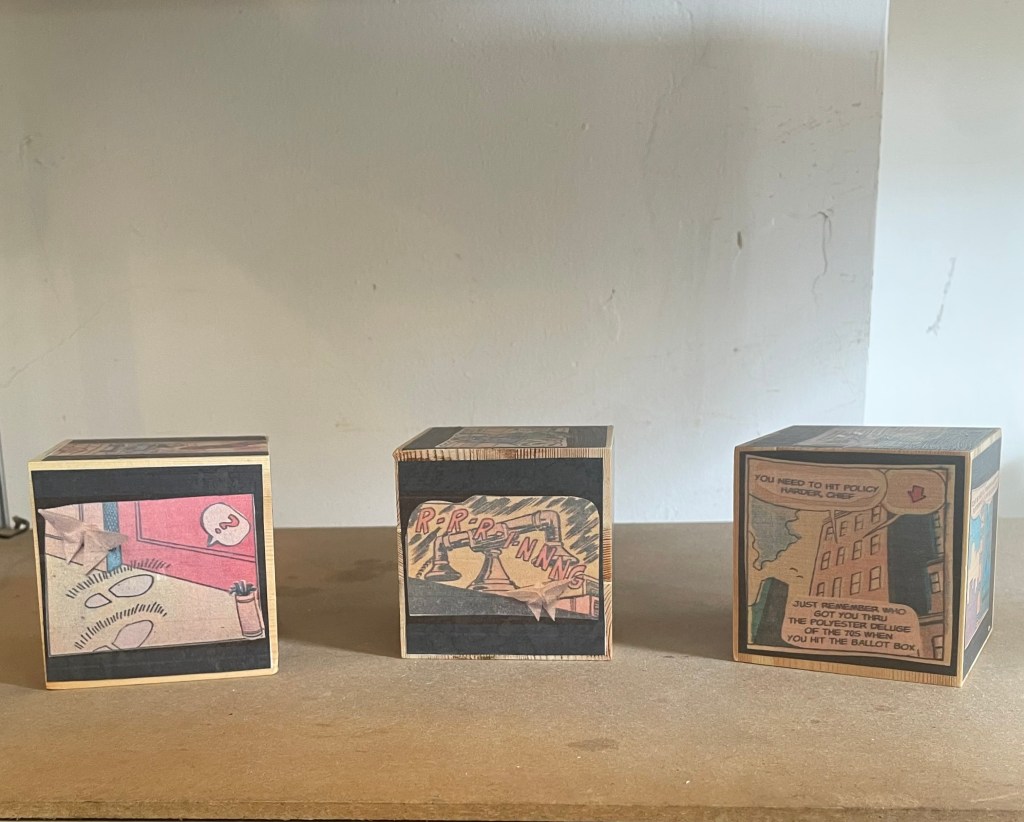
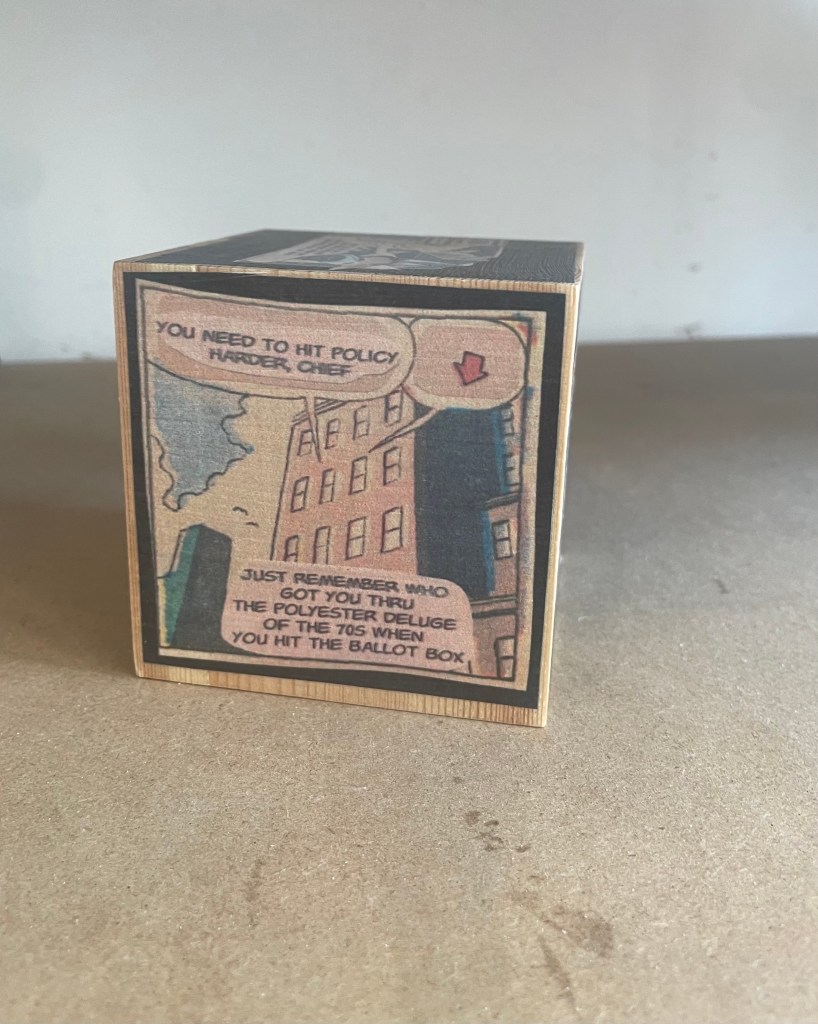
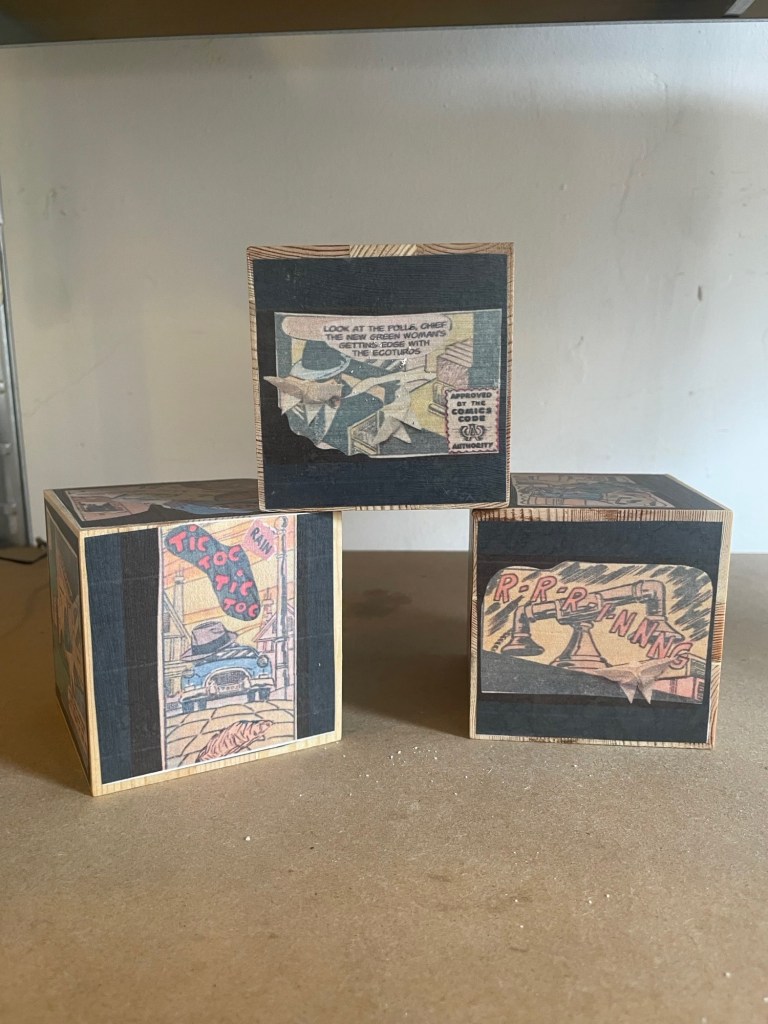
“The Extinctions Bureau” is a brilliant article with which to end this issue of Inscription. It offers readers a chance to wield scissors or papercutters if they are ready not to heed Broodthaers’ admonition above. It is also a clever conceptual extension of Will Eisner’s 1985 concept of “sequential art” that aimed to establish comics as a legitimate literary genre. Angela Szczepaniak first teases us with the narrative premise of a clothing moth-turned-detective on the trail of the Nylon Killer. If that is not hilarious enough, she posits conversion of the 2D linear narrative into a 3D existence around moth-repellent cedarwood. (She has created the blocks for exhibition display, but that’s not the point of the contribution.) Whether the blocks are more cruel to the detective or readers who now have to get their heads and hands around the idea of a “polysequential” story is a fine point. Readers who take up the challenge of cutting out the templates and folding them into cubes will have their own view.
By cutting and tearing the images for her collages from pulp comics, Szczepaniak rings all the bells of Inscription 6’s theme and reminds us of its subtitle: The Journal of Material Text.
Aside: below are images of the completed cedar block cubes on display in Nottingham. Photos courtesy of the artist.
Reminiscent of Aspen, Fluxus, The Journal of Artists’ Books, and the deluxe editions of Parenthesis, Inscription‘s artwork inserts contribute to the sense of the issue as an exhibition, a wunderkammer, a performance. No 33 LP this time; instead there is appropriately a cutdown 45-rpm record, albeit no instructions on “ripping” tracks from it to make up our own playlists. Putting together a thematically coherent journal is tricky. The artworks underscore and strengthen the issue’s theme of tearing and cutting. Two examples: Nick Thurston’s print Rips and Floods (2026) and Carolyn Thompson’s Tearjerker (2026) cover all the thematic notes of tearing, cutting, and weeping.
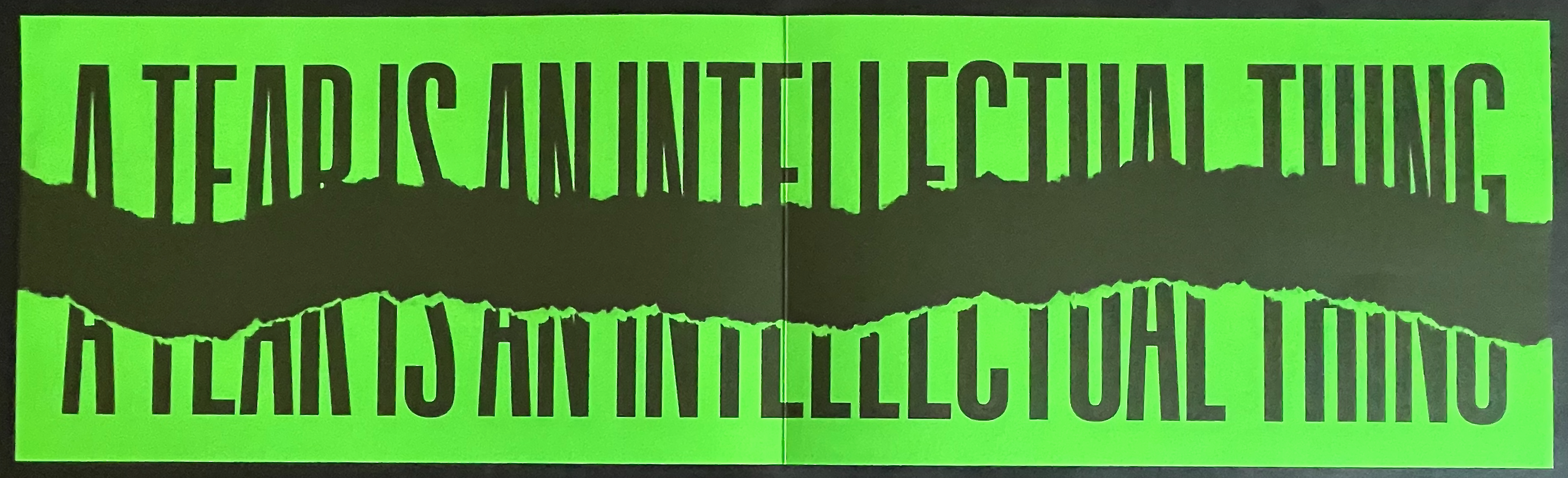
Thurston’s title for his print ensures that we don’t miss the heteronymic “tear”, which the visually torn phrase “A tear is an intellectual thing” might cause us to do. For those not well-versed in William Blake, a helpful note on page 160 identifies the phrase’s source as “The Grey Monk“. The editors mention Thurston’s truncation of Blake’s line, but leave it to us to supply the pun that it has been ripped from the poem. Blake’s preceding lines rule out the heteronymic meaning; for him, it’s the “Widow’s tear” that is ” an intellectual thing”. What makes Thurston’s print a strong work of art is how the tearing from the poem brings with it other key elements of the poem. For Blake, the Widow’s tears have more power than war to free the world from fear of the “Purple Tyrant”. In 2026, Thurston’s print reminds us that intellectual things — [/tɪ(ə)rz/] and [/tɛ(ə)rz/] — may have more power than Tangerine or Religious Tyrants.
Rips and Floods (2026), Nick Thurston
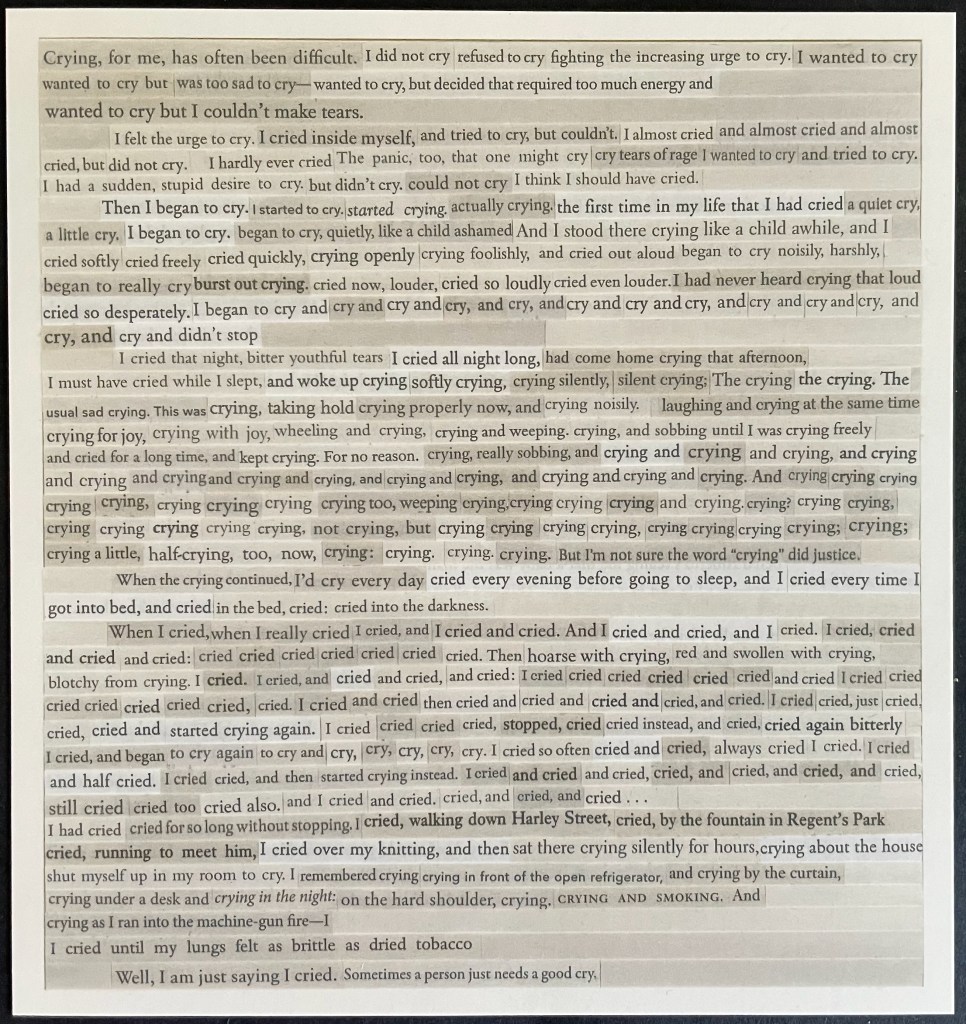
For her print, Carolyn Thompson excises words “from 30 works of literary fiction she has read since” 2016 to compose a sob story that well sums up the effects of Brexit (and the US election).
Tearjerker (2026) Carolyn Thompson
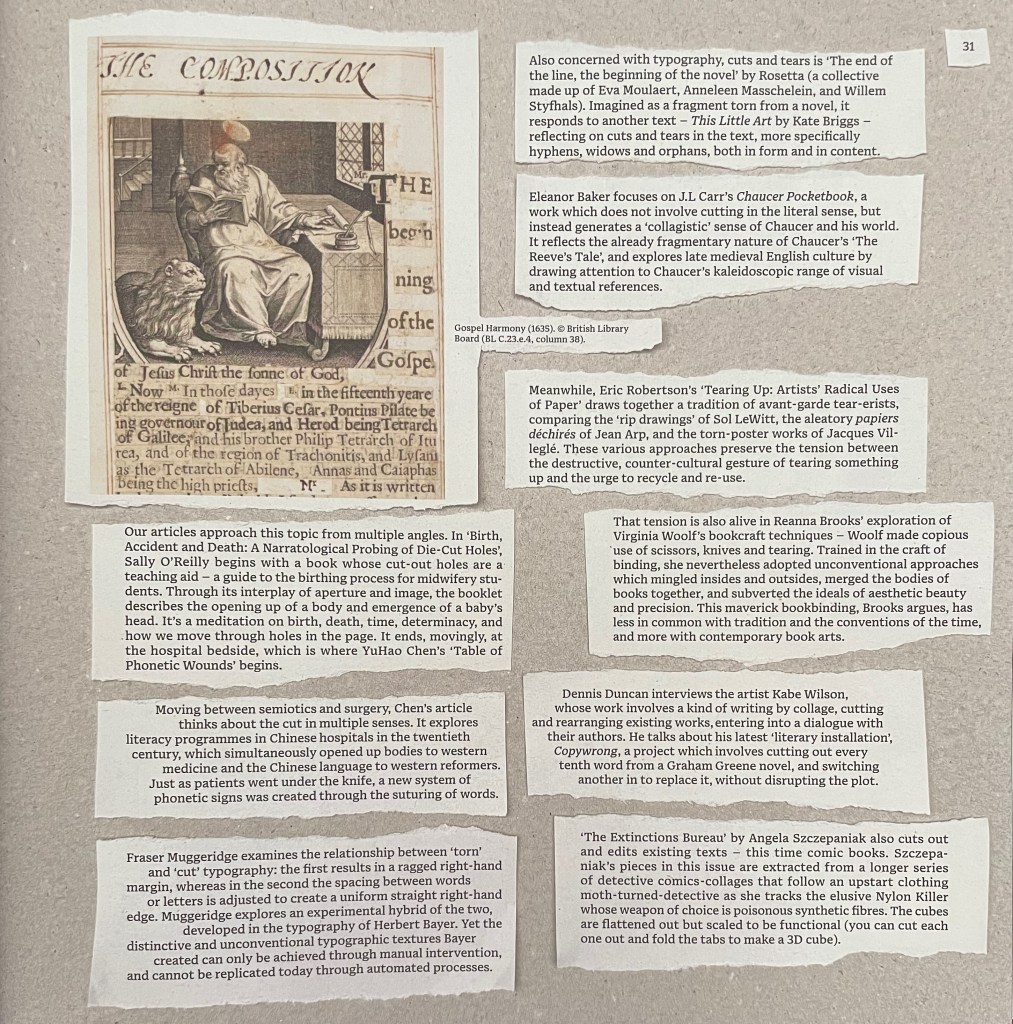
Pages 154-61 list the twenty-one artists/performers alphabetically with descriptions of their editions. Self-reflexively and in keeping with the issue’s theme, page 161 shows a blanked version of the torn segments from page 31 on which Partington and Smyth provide their introduction to the authors’ and artists’ contributions. (This blanked version is curious. If page 161 were showing the blank sides of the slips of paper, the four slips on the left would be flipped and on the right. Since one of the editors has let slip in correspondence that the theme of Issue 7 will be “blanks”, might this be an Easter egg?)
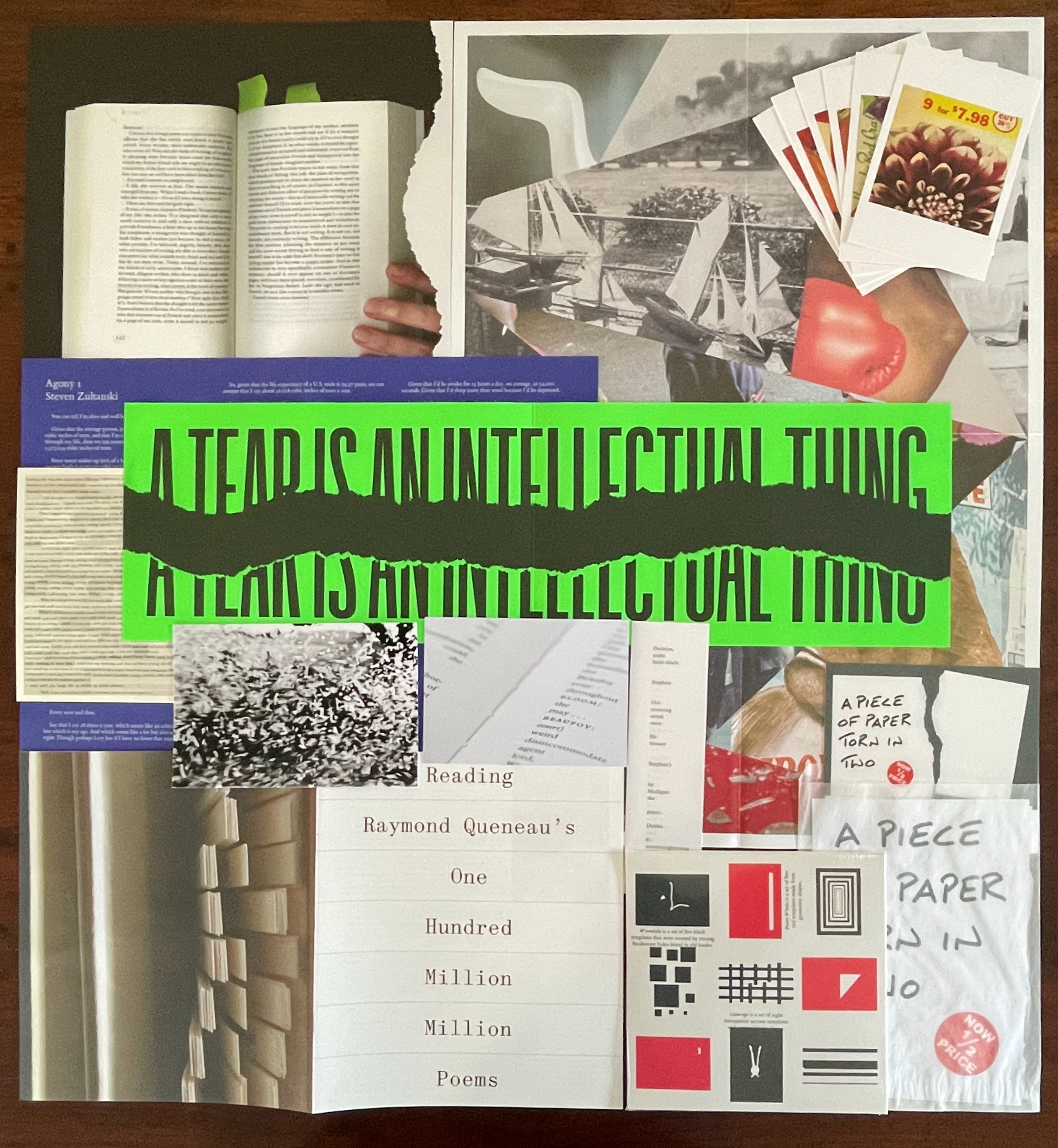
In homage to the journal and its edition contributors, below is a collage of the eleven loose inserts.
The wunderkammer nature of Inscription will send insatiable readers in search of more examples of creative destruction. To that end, here are a handful from the Books On Books Collection. If you can only find time for two, make it Eleonora Cumer’s Circoscrivere lo spazio No. 3 [Circumscribing space] (2021) and Cercare nella memoria [Searching Memory] (2021). They are her most sophisticated metaphoric works in the collection. They offer a circumvention of circumscription, which is another way of thinking about tears and the material text.
“Islam Aly“. 13 January 2020. Books On Books Collection. See 28 Letters (2013).
“Doug Beube“. 21 April 2020. Books On Books Collection. See Empty Talk (2016), Red Infinity #4 (2017), and Breaking the Codex (2011).
“Lizzie Brewer“. 4 July 2023. Books On Books Collection. See Babel(2019).
“Eleonora Cumer“. 6 September 2019. Books On Books Collection. See l’attesa/ l’attente (2010), visioni urbane/ visions urbane (2015), contaminazione (2015), Circoscrivere lo spazio No. 3 (2021), Cercare nella memoria (2021)