Books On Books Collection – Corinne Ringel Bailey

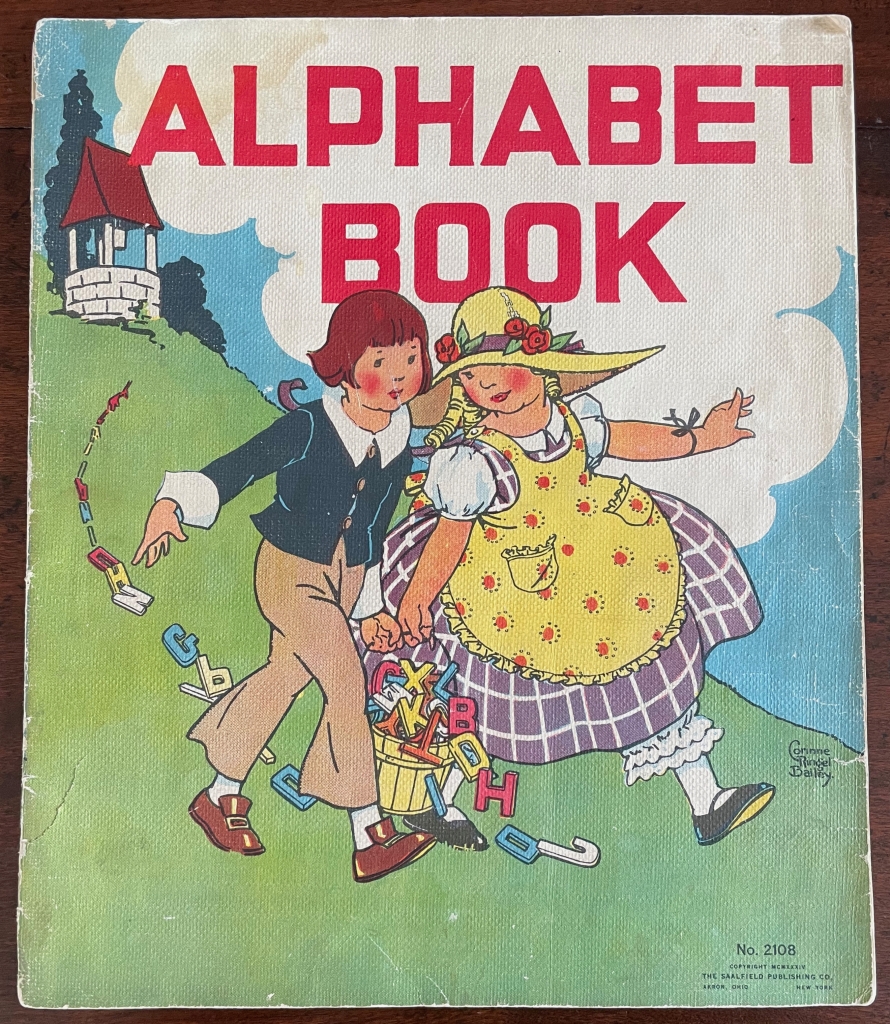
Alphabet Book No. 2108 (1934)

Alphabet Book No. 2108 (1934)
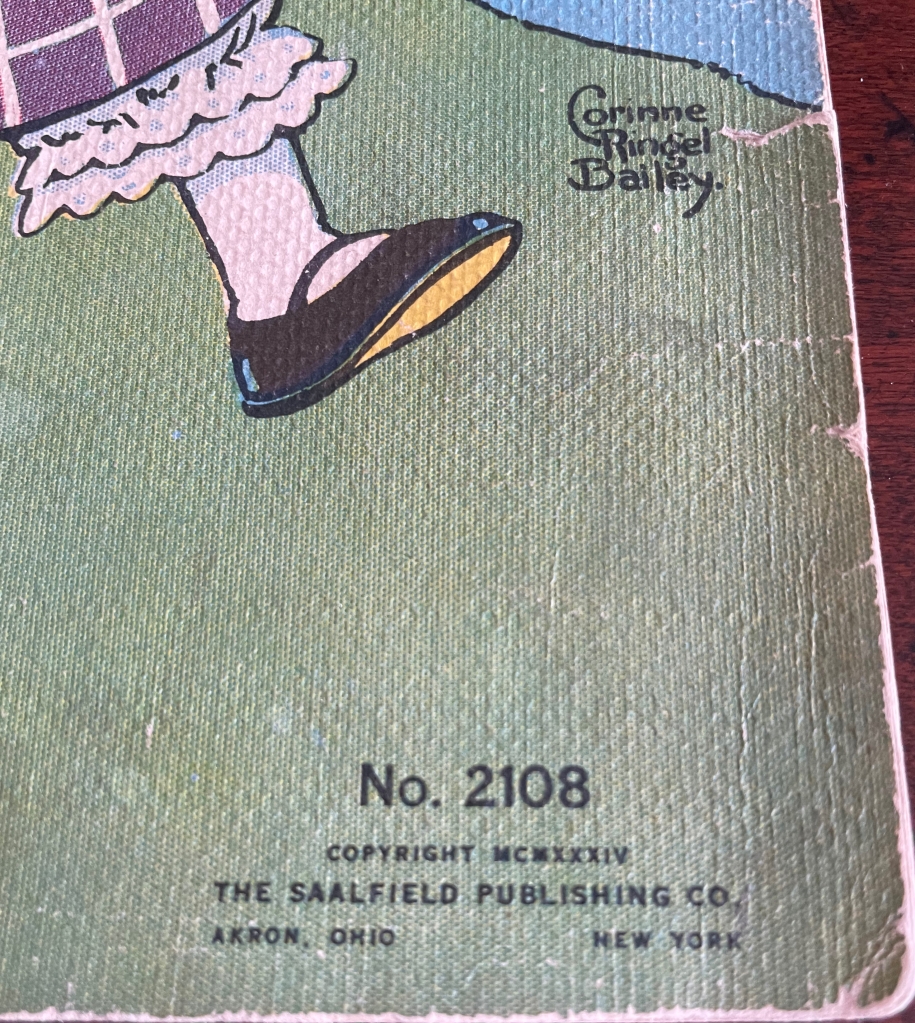
Corinne Ringel Bailey
Linen book. Saddle-stitch, staples, H305 x w255 mm. 8 linen leaves including cover. Acquired 19 January 2023.
Photos: Books On Books Collection.

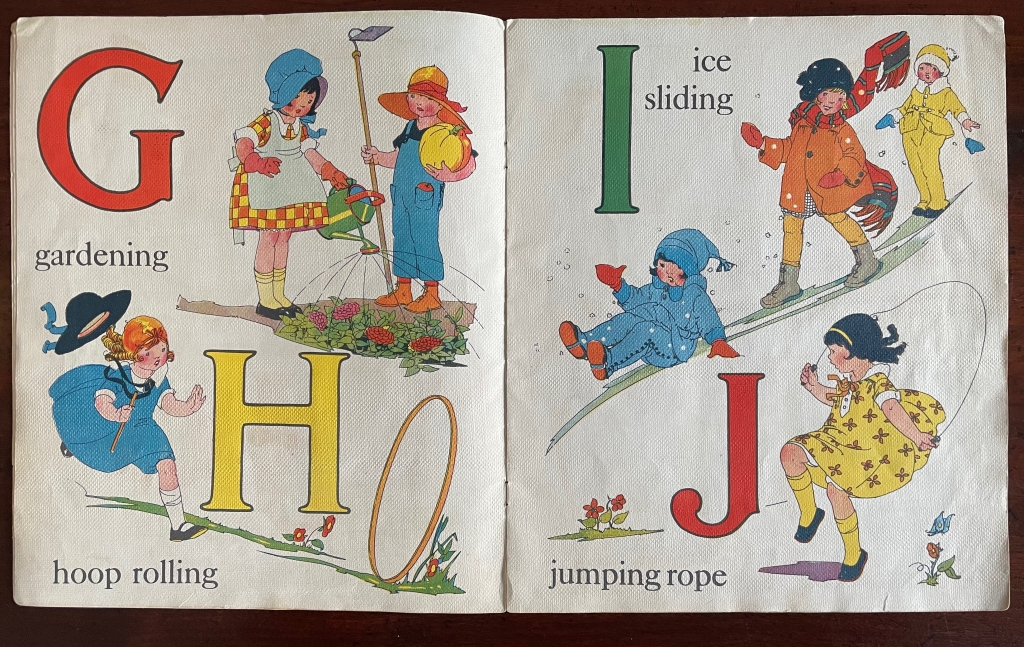
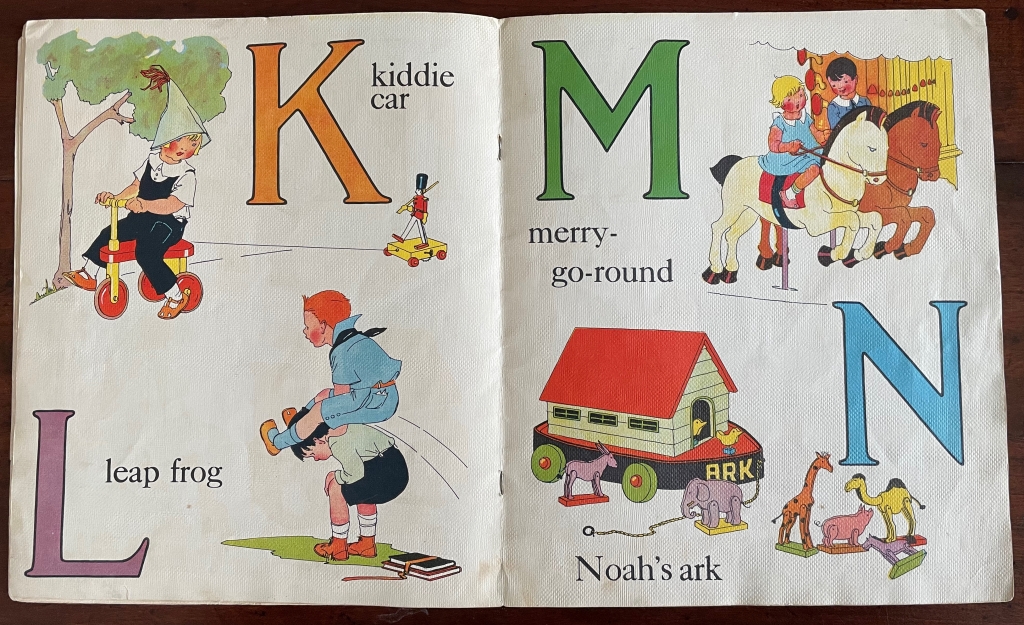
Known now primarily for its Raggedy Ann books, The Saalfield Publishing Company (1900-77) published a wide range of linen books for children, naturally including numerous alphabet books with different themes. This last of four editions over 1928-34 — an alphabet of games, toys and entertainments — is one of Corinne Ringel Bailey’s more popular illustrated works. Based on library holdings, the most popular was The Adventures of Tom Sawyer published in 1931.

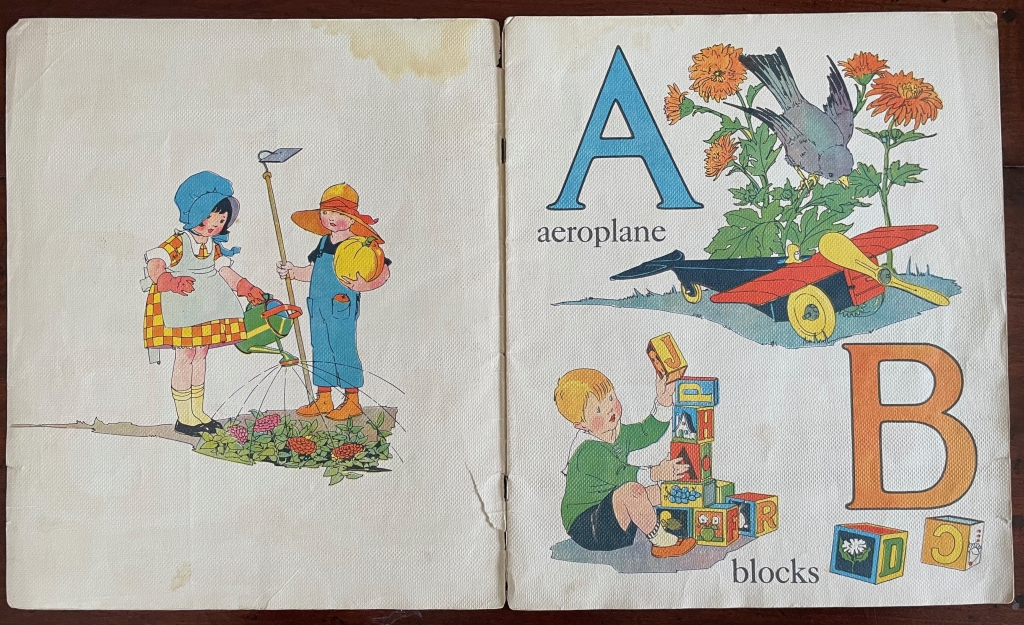
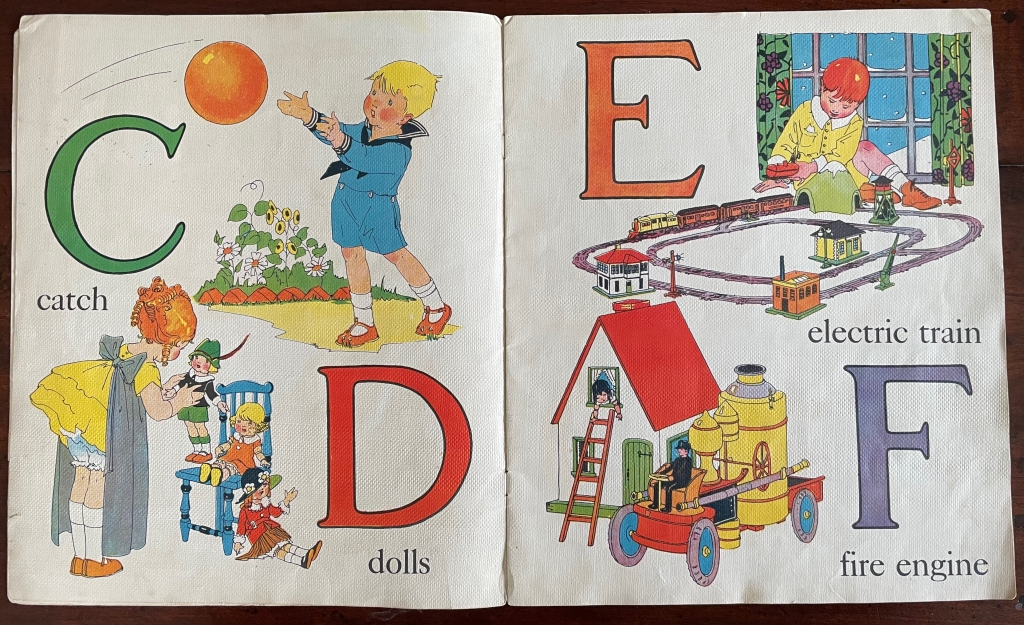
Although spanning the Great Depression, this abecedary depicts a world untouched by hardship. The “Jack & Jill” who come down this hill have a pail overflowing with letters. While the illustrations range back to inexpensive childhood activities (playing catch, hoop rolling, ice sliding and leapfrog), they also include a toy airplane, an electric train set, and a large radio cabinet for bedtime tales. Albeit not technologically advanced, both the pony cart for children under P and the tricycle under V (paying attention?) would have been luxuries — as would the replica steam-driven fire engine as well.

The booklet contains other peculiar leaps. While many of the activities have rural or suburban settings, the organ grinder was and remains an urban phenomenon. Words such as “aeroplane” and “quoits” have a British or European flavor to them (as do some of the dolls’ clothing), but a “yard” is where American children play while British children play in the “back garden”. The children’s clothing looks more American, and although animal crackers (biscuits) originated in England, the box depicted under Z (still paying attention?) looks suspiciously like the one created by Nabisco for its version of animal crackers.

Given the simplicity of most words in the book, “velocipede” seems a rather large one to include — even though it had been used since the mid-19th century on both sides of the Atlantic to cover bicycles and tricycles. Since other alphabet books of the period selected velocipede for V, the choice does not set Bailey’s apart from the crowd pedagogically. The absence of a more considered treatment of uppercase vs lowercase letters, however, does. From hornbooks onwards, most abecedaries present the uppercase and lowercase. In this respect and others, Bailey’s work is more picture book than alphabet book.

Illustration choices seem to have the upper hand. Echoing the animals in the image for Noah’s ark, there’s the clever illustration for “zoo” presenting a box of animal crackers with cookies shaped like those of Nabisco’s “Barnum’s Animals” escaping the box. Although the string attached to the box copies Nabisco’s that it introduced in 1902 for hanging the box as a treat on Christmas trees, the box is labeled “Kiddie Krackers” and does not look like the Nabisco brand box — probably to avoid trademark issues.

In fact, the intensity of colors — in the letters themselves, the bamboo umbrella’s pattern, the children’s ruddy cheeks and knees, and every image — delivers the overriding effect of this abecedary and looks back to the chromolithography of the 19th century, the woodcuts and posters of C.B. Falls and forward to such later 20th century abecedarians as Marie Angel, Sonia Delaunay, Carol DuBosch, Jean Holabird and many others in this collection.

Further Reading

Abecedaries I (in progress)“. Books On Books Collection.

Marie Angel“. 18 June 2021. Books On Books Collection.

Eulalie Minfred Banks“. 27 February 2023. Books On Books Collection.

Graeme Base“. [In progress]. Books On Books Collection.

Sonia Delaunay“. [In progress]. Books On Books Collection.

Carol DuBosch“. 6 January 2023. Books On Books Collection.

C.B. Falls“. 14 December 2022. Books On Books Collection.

David Hockney“. [In progress]. Books On Books Collection.

Jean Holabird“. 8 February 2022. Books On Books Collection.

Andrew White Tuer“. 26 December 2022. Books On Books Collection.

Arne Nixon Center. 2015. “The History of Cloth and ‘Cloth-like’ Books“. Arne Nixon Center for the Study of Children’s Literature. 2015. Accessed 6 February 2023.

Kirsch, Colin. n.d. “The Evolution of Children’s Tricycles: 1800s-1920s“. Online Bicycle Museum. Accessed 6 February 2023.

Books On Books Collection – Eulalie Minfred Banks

The ABC Book No. 764 (1927-29)

The ABC Book No. 764 (1927-29)
Eulalie Minfred Banks
Linen book. Saddle-stitch, staples. H307 x w255 mm. 8 linen leaves including cover. Acquired 19 January 2023.
Photos: Books On Books Collection.

The cloth alphabet book is the successor to the hornbook and battledore in the aim to provide learning material able to withstand sticky fingers, tantrums and other hard usage. The publisher Platt & Munk, eventually acquired by Grosset & Dunlap, had a strong line of cloth books for children and an equally strong host of competitors on both sides of the Atlantic: Dean’s Rag Books, Samuel Gabriel & Sons, McLoughlin Brothers, Routledge & Warne, Saalfield, Raphael Tuck & Sons, and many others.

Creating a competitive edge for one alphabet book over another was a challenge. The pedagogical features, choice of images, style of drawing, the colors, the quality of printing as well as the sturdiness of the material all played a role. For decades and numerous works for Platt & Munk, illustrator Eulalie Minfred Banks provided an edge. For this alphabet book, she served as author as well as illustrator, signing every page with her distinctive signature — “Eulalie”. She will probably be better remembered for her illustration of Watty Piper’s The Three Little Pigs, The Gingerbread Boy, The Little Engine that Could and The Story of Little Black Sambo (authored by Helen Bannerman, edited by Piper).

Further Reading

Abecedaries I (in progress)“. Books On Books Collection.

Corinne Ringel Bailey”. 27 February 2023. Books On Books Collection.

Andrew White Tuer“. 26 December 2022. Books On Books Collection.

Arne, Nixon Center. 2015. “The History of Cloth and ‘Cloth-like’ Books“. Arne Nixon Center for the Study of Children’s Literature. 2015. Accessed 6 February 2023.

Barton, Phyllis Settecase. 1992. An Annotated Bibliography Honoring Eulalie Banks Children’s Book Illustrator in Celebration of Her 97th Birthday June 12 1992. Old Town Temecula, CA: Pictus Orbis.

Books On Books Collection – Lisa McGarry

Be Amazed (and other words to live by) (2013)

Be Amazed (and other words to live by) (2013)
Lisa McGarry
Nine cards cut and glued to be formed into cubes. 70 mm. Acquired from the artist, 18 February 2023.
Photos: Books On Books Collection and courtesy of the artist.

A frequent activity in book art is the thematic challenge. In 2010 from her studio in Maleny, Queensland, Australia, Fiona Dempster initiated an annual global challenge to calligraphers to create a letter a week reflecting a particular set theme. The challenge ran through 2014 and generated not only outstanding works of calligraphy but artists’ books and installations as well. Here are the rules and theme for 2012:

Welcome to A Letter a Week 2012, a project that began in 2010 and is primarily about having fun, experimenting and having a regular, small project to focus on each week.

The aim is simply to:

  • Write/create a letter a week
  • Creating 52 letters
  • Which must form 2 x alphabets (that is not 52 x the letter ‘A’)
  • By the end of 2012

The main rule is that the letter must be presented on a piece of material measuring 7cm x 7cm

– this helps keep a sense of uniformity amongst the pieces which helps with exhibition coherence.

The other criterion for 2012 is that ONE alphabet has to meet the criteria of “Going dotty – polka dots and pixels”

– that means the alphabet uses dots or circles in some form, but is still presented on the square. It could mean dotted letters, dotted backgrounds, pixelated letters, nail heads into timber or letters within circles or…your imagination can have fun going dotty.

Each alphabet must be turned into a final piece which could be used for possible publication or exhibition.

– that is, you must put all the letters together into a final piece of art.

Apparently, Lisa McGarry’s studio and kitchen in Florence, Italy, enjoy a certain overlap, which led to her inspiration in answer to the dotty part of the challenge. In her own words:

As I was making polenta one day, the formation of circles when oil was added to the water caught my attention. I quickly photographed the pan of spotted water with the idea of indulging in some play time with Photoshop. By using the “Selective Color” sliders, I was able to introduce some vibrant colors into the rather bland photograph. I  further varied the colors, and ended up with a whole rainbow of “dotty” designs.

Dotty as the source of the image (or its result) may be, the effect is more of marbling than of boiling polenta. More stone than water. Of course, since Trajan’s Column and before, stone and alphabet go together in Italy. But for the challenge, what arrangement of letters, how many cubes? A minimum of five cubes (30 sides) would be needed for all the letters. Two simple sets of children’s alphabet blocks would then meet the basic requirement. But what about that phrase “still presented on the square” so open to multiple interpretations? Five cubes together would not make up a square, but nine cubes stacked 3×3 would.

Next I spent some time considering words of nine letters or less, with the idea that the letters of the various color could form a word.  Each letter of the alphabet is included at least once, for a complete “alphabet,” though there are multiples of several letters. I wanted to include each letter of the alphabet at least once, for a complete ‘alphabet’. Despite the flexibility gained from the availability of 54 faces, finding words that used all of the letters was much more difficult than I expected (perhaps because I limited myself to words that I associated with living a creative life).

Many words had to be eliminated because their letters were too ‘common’. After filling several journal pages with various letter/word combos, I got out the Scrabble tiles (which were immensely helpful).

These are the words I chose:


be amazed
explore
question
make/give
create joy
wish/find

After the flatpack of cubes arrived and had been constructed, the pleasure of letting them tumble from hand to hand and inspecting each panel had to yield to documenting them for the collection. The alphabetic order asserted itself over a grouping by colors. Failing to sort itself into the rhythm of the ABC song (certain pairs of letters appear on one block only), it slowly became obvious that the blocks would need to be paired for their photos (although WXYZ managed to slip by).

To spell out and display the words for those six words/phrases required letterless faces with just the right color on some of the cubes, which is apparent in the artist’s presentation of the first phrase: BE AMAZED.

Alternative displays (collector’s prerogative, of course) are possible. To see the unified color presentation for the other five words/phrases, the Books On Books Collection visitor should go to the artist’s site and be to prepared to …

Be Amazed was not McGarry’s only response to Fiona Dempster’s “A Letter a Week (ALaW)” challenge.

Twenty-six/Fragments (2012)

Twenty-six/Fragments (2012)
Lisa McGarry
Single sheet, collage, meander cut and fold. Closed: 70 x 70 x D15 mm. Open: 490 x 490 mm. Acquired from the artist, 20 March 2023.
Photos: Books On Books Collection.

How much of a letter still makes it a letter?

Looking at Lisa McGarry’s Twenty-six/Fragments might prompt thoughts of paleographers and philologists like Jacques-Joseph Champollion-Figeac, Flinders Petrie, Yu Xingwu or Ada Yardeni deciphering markings on bone, bamboo, papyrus, clay and stone …

or psychologists and linguists like Max Coltheart, Matthew Finkbeiner, James J. and Eleanor Gibson or Shimon Ullman pondering the data of visual experiments or the workings of algorithms …

or ancient poets like Anacreon, Archilochos or Sappho known primarily from their fragments.

Why not? Eyes, hands and mind cannot help but wander. Twenty-six/Fragments is a “meander” book. Against a 7 x 7 cm, purple-brown, creased and cut background, its tomato red shapes (inspired by the documentary Helvetica) take irregular but alphabetic steps that lead any viewer’s hands to fold, unfold and fold, shape and reshape the work to extract its signals and enjoyment over and over. The font size of 450 yields the right combination of abstraction vs figure. The texture of the 160 gsm Canson Mi-Teintes paper gives a firm tactility that contrasts with the plum color’s fluctuation between purple and brown. A simple but complex work of art.

Further Reading

Abecedaries I (in progress)“. Books On Books Collection.

Carol DuBosch“. 25 February 2023. Books On Books Collection.

Chen, Julie. 2013. 500 Handmade Books. Volume 2. New York: Lark. P. 345 (Where Sea and Sky Meet)

Salamony, Sandra, and Peter and Donna Thomas. 2012. 1,000 Artists’ Books : Exploring the Book as Art. Minneapolis: Quarto Publishing Group USA. P. 167 (A Florentine Alphabet).

Dempster, Fiona. 2010, 2011, 2012, 2013 and 2014. A Letter a Week.

Books On Books Collection – Experimental Jetset

Automatically Arranged Alphabets (2015)

Automatically Arranged Alphabets (2015)
Experimental Jetset
Staple-stitched “zine” with screenprinted silver cover. H180 x W160 mm. 24 pages. Acquired from the Newbridge Project, 18 September 2022.
Photos: Books On Books Collection.

On their website, the studio posted an automated gif of this typographic experiment involving software-generated compositions (archived here).

Beautiful typography meets beautiful calligraphy at the other end of the spectrum of technique in the Books On Books Collection with Francesca Lohmann’s later calligraphic work An Accumulated Alphabet (2017).

Experimental Jetset (a phrase excerpted from the title of a 1994 Sonic Youth album) is an Amsterdam-based design collective founded by Danny van den Dungen, Marieke Stolk and Erwin Brinker in 1997. New York’s MoMA, clearly a fan of the studio’s work, holds a significant collection of their work. From the studio’s description of it here, their participation in MoMA’s 2012 exhibition Ecstatic Alphabets/Heaps of Language clearly influenced Automatically Arranged Alphabets, whose series of automated sketches were made in 2014-15.

Further Reading

Abecedaries I (in progress)“. Books On Books Collection.

Francesca Lohmann“. 25 June 2021. Books On Books Collection.

Experimental Jetset. 2017. Statement and Counter-Statement: Notes on Experimental Jetset. Volume 1. Second ed. Arnhem, NL: Roma Publications.

Experimental Jetset. 2021. Superstructures: (Notes on Experimental Jetset. Volume 2. Amsterdam, NL: Roma Publications.

Hoptman, Laura, et al. 2012. Ecstatic Alphabets/ Heaps of Language. New York NY: Museum of Modern Art New York.

Tokyo Art Book Fair. 2020. “Experimental Jet Set“. Dutch Artists’ Books Then and Now, Virtual Artists’ Book Fair, Tokyo Art Book Fair.

Books On Books Collection – Mitsumasa Anno

anamorphosis, n.Oxford English Dictionary (1884-2011)

Etymology: < Greek ἀναμόρϕωσις transformation, n. of action < ἀναμορϕοῦν to transform, < ἀνά back, again + μορϕοῦν to form, < μορϕή form. Still by some pronounced anamorphōsis, after the Greek ω.

  1. A distorted projection or drawing of anything, so made that when viewed from a particular point, or by reflection from a suitable mirror, it appears regular and properly proportioned; a deformation.
    1728 E. Chambers Cycl. (at cited word), To draw the Anamorphosis, or Deformation of an Image upon the convex Surface of a Cone.
    1816 T. Jefferson Writings (1830) IV. 273 It was to correct their anamorphosis of the Deity, that Jesus preached.
    1846 J. Joyce Sci. Dialogues xiv. 306 These images are called anamorphoses.
    1873 Athenæum 25 Jan. This bewildering object is undoubtedly an anamorphosis of a human skull.

Anno’s Magical Alphabet (1981)

Anno’s Magical Alphabet (1981)
Mitsumasa Anno and Masaichirō Anno
Hardcover, illustrated paper over boards. Mirror paper in a pocket inside back cover. H260 x W215 mm 64 pages.
Acquired from Stella & Rose, 26 July 2022.
Photos: Books On Books Collection.

Like Tatyana Mavrina’s A Fairy Tale Alphabet (1969), this alphabet book is probably best enjoyed by child and adult together — at least if it is planned to be enjoyed more than once. The mirror paper that forms the tube to be placed on the center circle is delicate and requires a deft touch. Old heavy hands may require the assistance of younger, more nimble ones. Impatient young hands may require that of older, more deliberate ones.

A former mathematics teacher, Mitsumasa Anno conceived several children’s books that brought his delight in puzzles and complexity to life. In 1984, he received the Hans Christian Andersen Medal in 1984 for his “lasting contribution to children’s literature.” This one was chosen for the Books On Books Collection not only for its contribution to the theme of alphabet-related works but also for its design, color, execution and science.

The usual presentation of letter and animal image undergoes a transformation that requires the reader/viewer to move around the book (or turn the book, best aided with a Lazy Susan) to see the anamorphic letter and animal transform into their more easily recognizable shapes.

Anno and his son have taken the alphabet-teaching task of their book seriously and, in the second half of the book, present the lowercase letters along with a new set of distorted animals. For the more unusual items (like the Russian balalaika above), there is a helpful set of clues in the book’s backmatter.

The more precocious younger reader/viewer (and even a precocious elder one) may want to look at Parmigianino’s Self-Portrait (1524) or Hans Holbein the Younger’s The Ambassadors (1533) for earlier explorations of anamorphism.

Further Reading

Abecedaries I (in progress)“. Books On Books Collection.

Tatyana Mavrina“. 24 February 2023. Books On Books Collection.

Anno, Mitsumasa, Samuel Crowell Morse and Martin Gardner. 1980. The Unique World of Mitsumasa Anno: Selected Works 1968-1977. New York: Philomel Books.

Leeman, Fred, Joost Elffers and Michael Schuyt. 1975. Hidden Images: Games of Perception Anamorphic Art Illusion from the Renaissance to the Present. New York: H.N. Abrams.

Miller, Jonathan, and Valerie D. Mendes. 1998. On Reflection. London/ New Haven, CT: National Gallery Publications/ Distributed by Yale University Press.

Books On Books Collection – Carol DuBosch

In these additions to the Collection, Carol DuBosch joins the art of calligraphy and the art of the fold at the hip. The subtlety and fineness in her execution of both reward multiple viewings from multiple angles and repeated manipulation.

Rainbow Alphabet Snowflake (2013)

Rainbow Alphabet Snowflake (2013)
Carol DuBosch
Star book enclosed in flap purse. H4”x W5.5”x .D75” closed, W8.5” diameter open. Edition of 20, of which this is #1. Acquired from the artist, 17 November 2022.
Photos: Books On Books Collection. Displayed with artist’s permission.

A frequent activity in book art is the thematic challenge. In 2010 from her studio in Maleny, Queensland, Australia, Fiona Dempster initiated an annual global challenge to calligraphers to create a letter a week. The challenge ran through 2014 and generated not only outstanding works of calligraphy but artists’ books as well. Two of these works came from Carol DuBosch.

Standing at the check-out counter of my art supply shop, I found myself gazing at a cabinet filled with bright color note cards and envelopes. I decided to take home a handful and try to make a book I had just become familiar with: Snowflake Book. I realized that the colorful notecards would be perfect for the pages of a Snowflake Book. And indeed, they were! Each module page of this book is made from two of the folded notecards. I simply added another fold to one of them and cut out the rectangle window. I printed six of my alphabet designs on acetate transparencies and attached them to view in the windows. The book opens fully to form a star-shape. The front & back cover attach using hidden strong magnets. — Carol DuBosch, 16 November 2022, Correspondence with Books On Books.

No two snowflakes are alike, yet they are all snowflakes. Taking her cue from this, DuBosch offers up five distinctive alphabets in her star-cum-snowflake book structure and, in one view, goes twenty-six better with a distinctive style for each letter.

Video: Courtesy of Carol DuBosch

Following in the tradition of so many artists, DuBosch creates and teaches. This next work neatly exemplifies that, reveals some of the techniques by which she achieves the subtlety in her work, and demonstrates her mastery of each.

Alphabet of Calligraphic Tricks (2014)

Alphabet of Calligraphic Tricks (2014)
Carol DuBosch
Double-sided leporello. H4” x W4” x D0.75” closed, W4’8” open. Unique. Acquire from the artist, 17 November 2022.
Photos: Books On Books Collection. Displayed with artist’s permission.

I made this collection of techniques to share with students in class. It is compact and easy to transport and set up as a display in classes. Each page is a Gothic majuscule rendered with specified materials or tools. The caption outlines the process. The book was a project for A Letter A Week in 2014, administered by Fiona Dempster in Australia. Each participant organized a project incorporating letters and posted each week. I was able to complete two different alphabet books during the year. The binding style is a Leporello, a form of Concertina fold books. The entire book is created by overlapping pieces of cardstock folded in half. This method of binding creates a sturdy book that opens for display on both sides easily. — Carol DuBosch, 16 November 2022, Correspondence with Books On Books.

DuBosch’s concluding comment above highlights an abiding concern with what the structure of a work contributes to function. A similar function is achieved in the next very different structure that Hedi Kyle has labeled as “Interlocking Loops” and DuBosch calls a “gallery structure”.

Embossed Alphabet Gallery (2019)

Embossed Alphabet Gallery (2019)
Carol DuBosch
Gallery structure combining leporello, flag and star book forms. H6.25”x W1.25”x D.5” closed, W9” open for display. Edition of 15, of which this #1. Acquired from the artist, 17 November 2022.
Photos: Books On Books Collection. Displayed with artist’s permission.

This book was made as an edition for a book-exchange. I wanted to use the Gallery structure and chose the alphabet as the subject. I used an embossing stencil I had made thirty years ago for the letters. I found parent sheets of the linen textured card stock, and it was excellent for the folding and embossing. I’ve always enjoyed the quote about the mystic art of writing by William Massey and was delighted to find a place for it in this structure. — Carol DuBosch, 16 November 2022, Correspondence with Books On Books.

The many ways of displaying this sculpture and its gallery of letters might cause the viewer to miss how they counterpoint the end of the quotation from William Massey’s The Origin and Progress of Letters (1763). The effect recalls the gray-white of Greek and Roman sculpture, many of which originally were painted.

Further Reading/Watching

Abecedaries I (in progress)“. Books On Books Collection.

Dempster, Fiona. 2010, 2011, 2012, 2013 and 2014. A Letter a Week.

DuBosch, Carol. 2020. The Calligraphic Coronavirus Chronicles Book. Portland: Carol DuBosch. Posted on YouTube by The Oregon Food Bank, 18 November 2020. Accessed 1 November 2022.

DuBosch, Carol. 2018. Folded Pen Adventures. Portland: Carol DuBosch.

Kyle, Hedi, and Ulla Warchol. 2018. The Art of the Fold How to Make Innovative Books and Paper Structures. London: Laurence King Publishing. See review here.

Paper & Ink Arts. 5 June 2014. “Calligrapher’s Corner: Consulting with the Experts, Volume 4 Carol DuBosch“. Paper & Ink Arts. Accessed 1 November 2022.

Books On Books Collection – Tatyana Mavrina

Сказочная Азбука
Skazochnaia Azbuka
A Fairy Tale Alphabet
(1969)

Сказочная Азбука / Skazochnaia Azbuka / A Fairy Tale Alphabet (1969)
Tatyana Mavrina
Soft cover with dust jacket. H235 x W300 mm. 40 pages. Acquired from Design Archives, 4 February 2023.
Photos: Books On Books Collection.

Tatyana Mavrina’s A Fairy Tale Alphabet (1969) is both an artist’s book and, for the non-Russian reader, a puzzle. Its landscape format and rhythmic page layout offer an easily accessible playground of color, historiated letters, architectural fantasia and folk artistry mixed with the kind of flattened layers of time and space usually associated with ikons. As a puzzle, too, it presents layers. Making out the Cyrillic letters, transliterating them into Roman letters, then translating the text into English — those mark only the first stages of the puzzle. The next stage is to recognize the fairy or folk tale embedded in and around each letter of the Russian alphabet. Links to a few are provided below.

The book feels more like a handmade work than the trade book it is (3,000 copies were printed). The boldly illustrated endpapers and their wavily truncated fly leafs are one feature of the book’s integrated artistry that lies at the root of this effect.

Another feature of design artistry is the mirroring of verso and recto pages. On the left, the key character appears as an historiated letter followed by an image. On the right, an image comes first, then the letter. In the captions to the illustrations and images, the key character appears almost always as the initial letter of at least one of the words and in lowercase within a word.

Below, the historiated letter А refers to the story character Aлёнчшка (Alyonushka), a little orphan girl with similarities to Gretel. Next comes an illustration of Алмазный дворец (the Diamond Palace), probably from the story “Whirlwind the Whistler, or the Kingdoms of Copper, Silver, and Gold”. Then comes the image of the Бочка (barrel) in which a queen and her son are cast into the sea in “The Tale of Tsar Saltan”. And finally the historiated letter Б appears, containing images from three stories. The bowl of the letter refers to the story Барин и Mужик (The Master and the Man) in which the peasant catches a coin-producing fish. The sleigh above the peasant refers to another landlord-peasant encounter in which the peasant cons the landlord out of a fur coat. For the moment, the wolves pursuing the lamb are an unsolved part of the puzzle.

Below is another example of the pattern established from the start: first the letter Й historiated with characters from Эимовье Эверей (Zimove Zeverey “The Winter Hut of Animals” by Alexei Tolstoy); then a frequent character in Russian fairy tales and poems Эайка Kосой (the Cockeyed bunny); Kот Kотофей (Kotofey the Kat has several tales of adventures, a mixed associate of Puss-in-Boots and Felix the Cat); and finally the letter К historiated with images from Колобок (Kolobok “The little round bun”, a variant of the “The Gingerbread Man“). But this is a pattern only to be broken with another in which Mavrina uses the double-page spread for just one letter.

Three quarters of the verso below displays the historiated letter against a full-bleed background, and the rest of the verso combines with the recto to display an illustrative image that bleeds off the three edges. The curving line that separates the letter from the image recalls the truncated fly leafs. So below, for the letter И we have Ивашко и Ведьма (Ivashko and the Witch) and Иван- Царевич и СерЫй Волк (Ivan Tsarevich and the Grey Wolf, a variant on the Grimm’s “The Golden Bird“).

For the Russian characters Ъ ъ, Ы ы and Ь ь that are used to affect the pronunciations of other letters, the key character naturally appears only within the words but does receive treatment as an historiated letter. Below, the letter б follows the first letter in the Russian ВбЕЗД (for “entrance by vehicle”), and in a clever variation on her pattern for historiated letters, Mavrina has the procession entering behind the letter that is filled with the flowers thrown before the carriage. Similarly in the other two-thirds of the double-page spread, the digraph Ы is filled with leaves and flowers, which appropriately is printed over the ship-swallowing monster from the tale “The fish-whale [РыБа-Кит] on which the city stands”. Of course, displaying one letter per page introduces another recurring variant on double-page spread’s pattern.

For the genius of color, design and content of her other children’s books as well as in Skazochnaia Azbuka (considered the pinnacle of her work), Mavrina received the Hans Christian Andersen Award and, until 2018, was the only Russian to do so.

For students of Russian/Ukrainian art, a comparison of this work with that of Mavrina’s contemporary, the peasant artist Maria Prymachenko, might prove interesting. The development of Mavrina’s primitivism has been linked to her participation in the “group of 13”, but a glance at Prymachenko’s works prompts the question of Mavrina’s awareness of them.

ые русские сказки : из сборника А.Н. Афанасьева / Narodnye russkie skazki : iz sbornika A.N. Afanasʹeva / Russian Folk Tales from the Collection of A.N. Afanasʹeva

Народные русские сказки : из сборника А.Н. Афанасьева / Narodnye russkie skazki : iz sbornika A.N. Afanasʹeva
[Russian Folk Tales from the Collection of A.N. Afanasʹeva] (1991)
Tatyana Mavrina
Casebound, stamped and printed leather over boards. H240 х W170 mm. 269 pages. Acquired from Sovok, 7 March 2023.
Photos: Books On Books Collection.

Just as the Brothers Grimm died (1859 and 1863), the linguist and folklorist A.N. Afanasyev was completing his three volumes of hundreds of Russian fairy and folktales. The second half of the next century saw Warja Lavater and Tatyana Mavrina turn their very different styles to illustrating the former and the latter, respectively. With the support of Maeght Editions, Lavater’s contribution to artists’ books has been greater, and Mavrina might have contributed more with similar support. The production value of the fairy tale alphabet exceeds that of this illustrated selection from A. N. Afanasyev’s three volumes, but it had a low bar to clear. The paper quality and blurring of inks do not do the artist justice.

Most illustrations are illuminated initial letters as below. The reduced size must have increased the challenge to inking.

Jokes from folklore.

Tedious tales.

Fortuately there are a dozen full-page illustrations that depict characters and scenes from the longer folktales, and the strength of Mavrina’s use of color overcomes the production issues.

Ivan from “The Witch and Sun’s Sister” and Baba Yaga as the hut on chicken feet.

The three princesses from “Three Kingdoms – Copper, Silver and Gold” and the three brothers from “Ivan Bykovich [the Bull’s Son]”.

Illustrations for “The Tale of Ivan Tsarevich, the Firebird and the Gray Wolf” and “The Cockerel and the Hand-Mill”.

The three ships from “Go there, I don’t know where; bring me something, I don’t know what”.

The complete three volumes compiled by A.N. Afanasʹeva can be found here.

Further Reading

Abecedaries I (in progress)“. Books On Books Collection.

Warja Lavater“. 23 December 2022. Books On Books Collection.

Lisa Merkin“. 24 February. 2023. Books On Books Collection.

“Maria Prymachenko’s fantastic world of flowers and animals”blogs.bl.uk. Accessed 28 June 2023.

Bragaru, Natalia. n.d. “Fairytale ABC: a beautiful Russian folk alphabet by Tatyana Mavrina“. Kids’ Book Explorer. Accessed 1 February 2023.

Grimm’s Fairy Tales.

Leites, Irina. 2021. “A Journey to the Land of Colour“. Tretyakova Gallery Magazine, #2 (71). Accessed 1 February 2023.

Lemmens, Albert, and Serge-Aljosja Stommels. 2009. Russian Artists and the Children’s Book 1890-1992. Nijmegen: L.S.

Mothes, Kate. 27 June 2023. “Nearly Two Dozen Exuberant Works by Ukrainian Folk Artist Maria Prymachenko Go On View in the U.K. For the First Time“. Colossal. Accessed 28 June 2023.

Ottina, Laura. 15 May 2013. “Tatiana Mavrina“. Animalarium. Accessed 1 February 2023.

RGDB. n.d. “Fairy Alphabet”. The Russian State Children’s Library Catalog. Accessed 1 February.

Books On Books Collection – Lisa Merkin

Bodies Making Language (2021)

Bodies Making Language (2021)
Lisa Merkin
Brocade-covered box containing six blocks and compartment with three cards. Box: H95 x W225 x D155 mm. Blocks: cube 50 mm. Cards: H105 x W205 mm. Unique work. Acquired from the artist, 20 September 2021.
Photos: Books On Books Collection. Displayed with permission of artist.

In a play known from fragments as the Alphabet Tragedy (although it sounds more of a comedy), the ancient Greek playwright Kallias had his chorus and actors mime and dance the letters of alphabet. Lisa Merkin’s book of blocks in a box shows that bending bodies to make letters has never grown old. Appropriately, her most recent image comes from Diego Rodas Feroni’s typeface Adonis (2018), which seems to recall the Greek playwright’s actors. Also in the Books On Books Collection, Vítězslav Nezval & Karl Teige’s Abeceda (1926), Pilobolus Dance Company’s Human Alphabet (2010) and Marie Lancelin, Gestes Alphabétiques (2014) have carried on the tradition of the alphabet dance.

© Diego Feroni 2018. Displayed with permission of Diego Rodas Feroni.

Block 6: During his studies at UFRJ Universidade Federal do Rio de Janeiro, Diego Rodas Feroni designed the Greek God figurine typeface Adonis (2017).

Many of Merkin’s choices celebrate the more comic aspects of anthropomorphic letters: Carington Bowles’ The Comical Hotch-Potch (1782), Bowles & Carver’s The Man of Letters, or Pierrot’s Alphabet (1794), Honoré Daumier’s Alphabet comique (1836), Edward P. Cogger’s Funny Alphabet (c. 1850-64), Aaron McKinney’s The Unruly Alphabet (2010) and Jérôme Viguet’s caricatures Alphabet (2013).

Block 4: Funny Alphabet (c.1850 – 1864) by illustrator and engraver Edward P. Cogger. McLoughlin Brothers Publishing, NY.
Block 5: The Unruly Alphabet is a “lively and haunting abecedary“ book created in 2010 by the English illustrator Aaron McKinney, who sets the alphabet against a backdrop of rebellious behavior showcasing human nature. 

Maybe the human body and the perfect letter have something in common. Geofroy Tory (1529) and Anthon Beeke (1970) certainly thought so — the former in a neo-Platonic, religious way and the latter in a more secular way. Although Beeke is not represented among Merkin’s blocks, she does not neglect celebrations of the female form. Most of them come from the realm of fashion: Erté’s Alphabet (1927-67), Horst P. Horst’s Vogue cover (1940), Yvette Yang’s The Fashion Alphabet (2010) and Alexia Yang’s Grotesque Beauty (2011). From the collection, Rebecca Bingham’s miniature Lady Letters (1986) could qualify for the catwalk.

Champ Fleury by Geofroy Tory Translated into English and Annotated by George B. Ives, Designed and printed by Bruce Rogers (1529)[1927]
Alphabet by Anthon Beeke, Geert Kooiman and Ed van der Elsken (1970).

Block 6: The Fashion Alphabet by Korean-born, Dutch-educated, and Paris-based artist, Yvette Yang. In 2007, Yang began creating her font fashion series with bits and pieces from the runways and magazines. This T is from her interpretation of Spring/Summer 2010.
Lady Letters (1986) by June Sidwell and Rebecca Bingham. The miniature book captures Sidwell’s designs and poses.

Historiated and figurative letters from the 6th to 15th centuries so well represent the Latin alphabet in Merkin’s box of blocks it would be greedy and thematically problematic to wish for one of the Hebrew letters from the Kennicott Bible. If there is ever a second Merkin volume to celebrate anthropomorphic letters, though, another range of languages beckons. For Ukrainian, there are the letters of Tatyana Mavrina. For Arabic, there are Mahmoud Tammam’s inventions, but then the volume would have to admit the zoomorphic, which suggests perhaps a third Merkin volume of animal alphabets.

Block 6: Horae ad usum Parisiensem (Hours of Charles of Angoulême) (ca. 1475-1500) by the French illuminator and painter Robinet Testard (fl. 1470–1531). Bibliothèque nationale de France, Paris.
Block 2: Moralia in Job by Pope Gregory the Great (590-604). The Abbaye Notre-Dame, Cîteaux, France.

Hebrew Bible with David Kimhi’s Sefer Mikhlol (“Kennicott Bible“) (1476). Neubauer 2322. Bodleian Libraries, Oxford.
Сказочная Азбука / Skazochnaia Azbuka / A Fairy Tale Alphabet (1969) by Tatyana Mavrina.
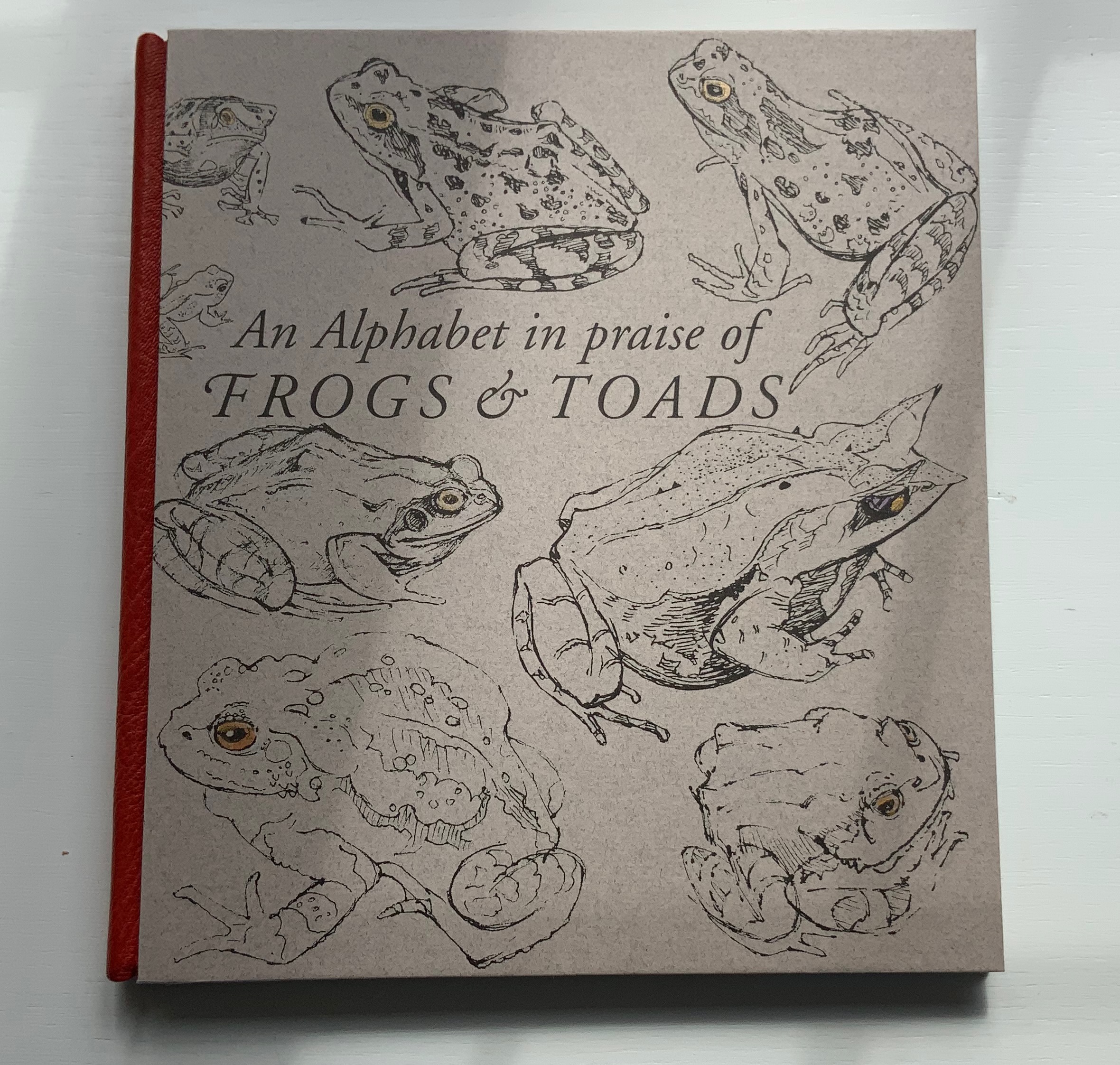
In his Arabic letters project, Mahmoud Tammam manipulates the Arabic script ضفدع meaning “frog” to illustrate its meaning.

As shown with the Adonis letter W, Merkin’s blocks remind us of the influence of past art on the alphabets of 20th- and 21st-century designers and artists. Among the modern alphabetic variants, Dada and Surrealism make a strong showing of influence on Yvette Yang’s letter T (above) and Roman Cieślewicz’s letter i (below), and who knows, perhaps Giuseppe Maria Mitelli’s letter O influenced the Dadaists and Surrealists themselves. More than a strong showing, these styles highlight something fundamental about the alphabet and art. Both the alphabet and art ask, Are we discovering meaning or making meaning?

Block 4: Alfabeto in Sogno (1683), etchings by Giuseppe Maria Mitelli (1634-1718).
Block 3: From the fantastical alphabet created by Roman Cieślewicz (1930 -1996) for Guide de la France Mystérieuse” (1964).

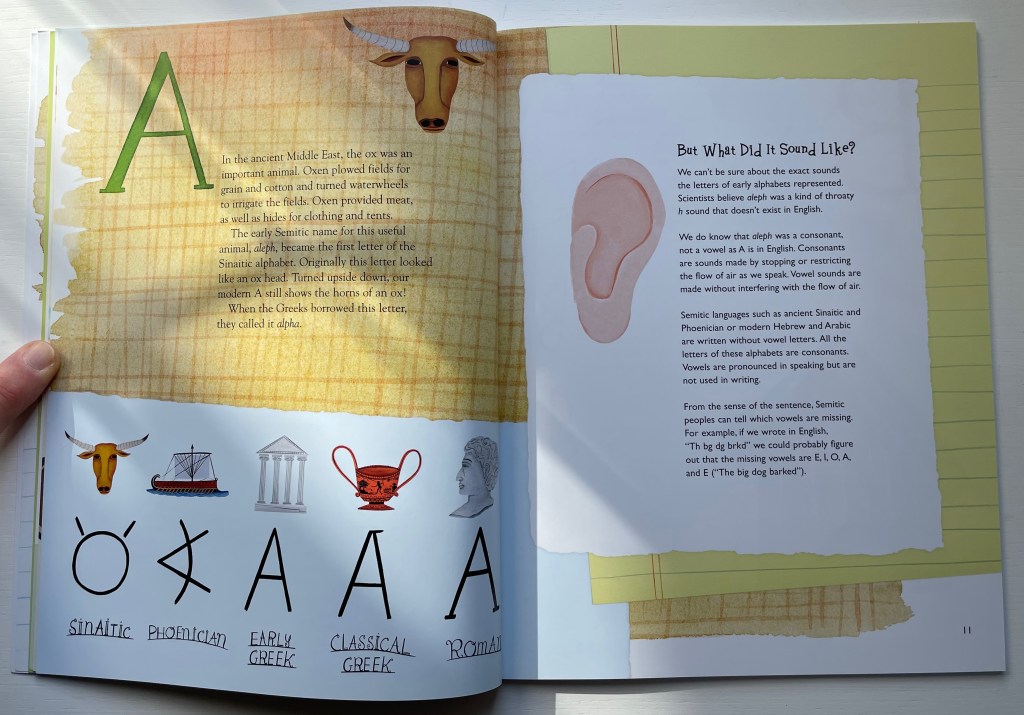
Every history of letters or script begins with the figuratively pictographic. Someone somewhere at some time scrawled a shape tied to a sound tied to an object — A is for Ox — and some other(s) in the same place and time recognized and accepted the discovery that this handmade shape could conjure up that object in the mind. It would have seemed magical, and they imagined that somehow meaning and reality inhered in that shape or sound waiting to be discovered.

Yet, the shapes of characters — whether Latin or Chinese or Arabic or any language — and their relationship to the sound or meaning they represent is arbitrary, a prehistorical and historical function of social convention, a collective making by individuals. That arbitrariness provides the opening for artists to use the alphabet to question our meaning-seeking behavior and our assumptions about reality, and modern artists’ anthropomorphizing the alphabet pokes fun at that behavior and those assumptions. Perhaps a fourth Merkin box — one for bodies making “asemic alphabets”?

Further Reading

Abecedaries I (in progress)“. Books On Books Collection.

Anthon Beeke“. 21 June 2021. Books On Books Collection.

Rebecca Bingham“. 30 December 2022. Books On Books Collection.

Lyn Davies“. 7 August 2022. Books On Books Collection. Reference and fine print.

Marie Lancelin“. 4 January 2023. Books On Books Collection.

Tatyana Mavrina“. 24 February 2023. Books On Books Collection.

Vítězslav Nezval“. 16 July 2021. Books On Books Collection.

Geofroy Tory“. 21 June 2021. Books On Books Collection.

Rudyard Kipling and Chloë Cheese“. 15 February 2023. Books On Books Collection. Illustrated children’s book. [In progress]

Abe Kuipers“. 15 February 2023. Books On Books Collection. Artist’s book. [In progress]

Don Robb and Anne Smith“. 26 March 20223. Books On Books Collection. Illustrated children’s book.
James Rumford. 21 November 2022. Books On Books Collection. Illustrated children’s book.
Tiphaine Samoyault“. 10 July 2023. Books On Books Collection. Illustrated children’s book.
Tommy Thompson“. 21 August 2022. Books On Books Collection. Reference.

Clodd, Edward. 1913. The Story of the Alphabet. London: Hodder and Stoughton. 1913. Superseded by several later works, but is freely available online with line illustrations and some black and white photos.

Davies, Lyn. 2006. A Is for Ox : A Short History of the Alphabet. London: Folio Society.

Demeude, Hugues. 1996. The animated alphabet. London: Thames and Hudson.

Diringer, David, and Reinhold Regensburger. 1968. The alphabet: a key to the history of mankind. London: Hutchinson. A standard, beginning to be challenged by late 20th and early 21st century archaeological findings and palaeographical studies.

Drucker, Johanna. 1999. The alphabetic labyrinth: the letters in history and imagination. New York, N.Y.: Thames and Hudson.

Dukes, Hunter. 27 April 2023. “Punctuation Personified (1824)“. The Public Domain Review. Not only could letters be formed with the human body, so could quotation marks and square brackets.

Ege, Otto. 1921/1998. The Story of the Alphabet, Its Evolution and Development… Embellished Typographically with Printer’s Flowers Arranged by Richard J. Hoffman. Van Nuys, CA: Richard J. Hoffman. A miniature. The type ornaments chosen by Hoffman are arranged chronologically by designer (Garamond, Granjon, Rogers) and printed in color.

Firmage, Richard A. 2001. The alphabet. London: Bloomsbury.

Fischer, Steven Roger. 2008. A history of writing. London: Reaktion Books.

Gagné, Renaud. 2013. “Dancing Letters: The Alphabetic Tragedy of Kallias”. In Choral Mediations in Greek Tragedy, ed. R. Gagné and M. Hopman, Cambridge University Press 282-307.

Goetz, Sair. 11 June 2020. “Letterforms / Humanforms“. Letterform Archive News. Accessed 30 January 2022.

Goldman, David. 1994. A is for ox: the story of the alphabet. New York: Silver Moon Press.

Heller Steven and Gail Anderson. 2014. The Typographic Universe : Letterforms Found in Nature the Built World and Human Imagination. New York New York: Thames & Hudson.

Jackson, Donald. 1997. The story of writing. Monmouth, England: Calligraphy Centre.

Jacquillat, Agathe, and Tomi Vollauschek. 2011. The 3d Type Book. London: Laurence King.
Pflughaupt, Laurent. 2008. Letter by letter: an alphabetical miscellany. New York: Princeton Architectural Press.

Public Domain Review. “The Human Alphabet“. 3 November 2016. The Public Domain Review. Accessed 10 February 2023.

Robinson, Andrew. 1995. The story of writing. London: Thames and Hudson.

Rosen, Michael. 2014. Alphabetical: how every letter tells a story. London: John Murray.

Raptis, Sotirios. 18 February 2011. “Human Alphabets 2“. Slideshare.net. Accessed 10 February 2023.

Raptis, Sotirios. 18 February 2011. “Human Alphabets 1“. Slideshare.net. Accessed 10 February 2023.

Raptis, Sotirios. 13 August 2016. “Human Alphabets 3“. Slideshare.net. Accessed 10 February 2023.

Raptis, Sotirios. 13 August 2016. “Human Alphabets 4“. Slideshare.net. Accessed 10 February 2023.

Sacks, David. 2003. Language visible unraveling the mystery of the alphabet from A to Z. New York: Broadway Books.

Wise, Jennifer. 1998. Dionysus Writes : The Invention of Theatre in Ancient Greece. Ithaca ; London: Cornell UP.

Zimmermann, Ingo. Menschenalphabet / Human Alphabet. Ingofonts. Accessed 10 February 2023.

Books On Books Collection – Roberto Beretta

The quick brown fox jumps over a lazy dog (2008)

The quick brown fox jumps over a lazy dog (2008)
Roberto Beretta
Hardcover. H180 xW125 mm. 52 pages. Acquired from Amazon.fr. 18 September 2022.
Photos: Books On books Collection.

The title of designer Robert Beretta’s alphabet artist’s book is a pangram; it contains all the letters in the alphabet. His photos demonstrate that a sharp look all around will find them, too. Beretta’s selection for the letters B and C reflect recurrent themes that cross paths in the Books On Books Collection: the alphabet and architecture. Further Reading provides examples of works in those categories.

The observation of the alphabet all around us, not just in architecture, was well-captured by the novelist Victor Hugo. In a letter to his wife, he wrote, “Human society, the world, man in his entirety is in the alphabet. … The alphabet is a source” (Hardacre). Hugo saw letters everywhere, not just in what humankind creates but in nature as well. Throughout his alphabet and in particular with the letters XYZ, Beretta neatly captures that.

Further Reading

Abecedaries I (in progress)“. Books On Books Collection.

Architecture“. 12 November 2018. Books on Books Collection.

Federico Babina“. 20 April 2021. Books On Books Collection.

Antonio Basoli“. 20 April 2021. Books On Books Collection.

Lanore Cady“. 16 December 2022. Books On Books Collection.

Nerma Prnjavorac Cridge“. 14 February 2021. Books On Books Collection.

Francesco Dondina“. 16 December 2022. Books On Books Collection.

Kenneth Hardacre“. 18 February 2023. Books On Books Collection.

Elliott Kaufman“. 21 January 2023. Books On Books Collection.

Jeffrey Morin & Steven Ferlauto“. 23 April 2021. Books On Books Collection.

Richard Niessen“. 20 April 2021. Books On Books Collection.

Paul Noble“. 23 April 2021. Books On Books Collection.

Antonio & Giovanni Battista de Pian“. 20 April 2021. Books On Books Collection.

Johann David Steingruber“. 23 April 2021. Books On Books Collection.

Edward Andrew Zega & Bernd H. Dams“. 23 April 2021. Books On Books Collection.

Côme, Tony. “The Typotectural Suites“, The Palace of Typographic Masonry. Accessed 5 April 2021.

De Looze, Laurence. 2018. The Letter and the Cosmos: How the Alphabet Has Shaped the Western View of the World. Toronto: University of Toronto Press.

Holl, Steven. 1980. The alphabetical city. New York: Princeton Architectural Press.

Hugo, Victor, and Jessie Haynes, trans. 1831 (1902). Nôtre Dame de Paris. New York: D. Appleton & Co.

Hugo, Victor, and Nathan Haskell Dole, trans. 1890 (1895). Victor Hugo’s Letters to His Wife and Others (The Alps and the Pyrenees). Boston, MA: Estes and Lauriat.

Macken, Marian. 2018. Binding Space: The Book as Spatial Practice. London and New York: Routledge.

McEwen, Hugh. Polyglot Buildings. 12 January 2012. Issuu. Accessed 13 March 2021.

Niessen, Richard. 2018. The Palace of Typographic Masonry. Leipzig: Spector Books.

Noble, Paul, and Georgina Starr. “N is for Nobson“, ARTtube, 21 October 2018. Accessed 13 March 2021.

Polano, Sergio. January 2019. “Architectural Abecedari“, Casabella, 893, pp. 62-75 + 100-101 (eng.). Milan.

Tsimourdagkas, Chrysostomos. 2014. Typotecture: Histories, Theories and Digital Futures of Typographic Elements in Architectural Design. Doctoral dissertation, Royal College of Art, London. Accessed 13 March 2021.

Books On Books Collection – Kenneth Hardacre

Man and his World in the Alphabet (1991)


Man and his World in the Alphabet
(1991)
Victor Hugo and Kenneth Hardacre
Softcover, sewn. H185 x W128 mm. 12 pages. Edition of 300. Acquired from Castle Hill Books, 9 June 2022.
Photos: Books On Books Collection.

In booklet form rather than broadside, Kenneth Hardacre pays homage to Victor Hugo and Hermann Zapf. The text is an extract from Hugo’s 1839 letters to his wife, published in 1910. The extract was translated by Paul Standard for Hermann Zapf’s Manuale Typographicum (1954), and Hardacre adds to his homage by typesetting the extract in Zapf’s Palatino. According to the booklet’s colophon, the papers for the cover, flyleaf and text are mould-made papers for private distribution by Hardacre and The Kit-Cat Press.

For the Books On Books Collection, Hardacre’s booklet has captured an idea that underlies both the alphabet-related and architecture-related themes in the collection. The list below provides some examples of the works reflecting those themes.

Further Reading

Abecedaries I (in progress)“. Books On Books Collection.

Architecture“. 12 November 2018. Books on Books Collection.

Federico Babina“. 20 April 2021. Books On Books Collection.

Antonio Basoli“. 20 April 2021. Books On Books Collection.

Roberto Beretta“. 18 February 2023. Books On Books Collection.

Lanore Cady“. 16 December 2022. Books On Books Collection.

Nerma Prnjavorac Cridge“. 14 February 2021. Books On Books Collection.

Francesco Dondina“. 16 December 2022. Books On Books Collection.

Elliott Kaufman“. 21 January 2023. Books On Books Collection.

Jeffrey Morin & Steven Ferlauto“. 23 April 2021. Books On Books Collection.

Richard Niessen“. 20 April 2021. Books On Books Collection.

Paul Noble“. 23 April 2021. Books On Books Collection.

Antonio & Giovanni Battista de Pian“. 20 April 2021. Books On Books Collection.

Johann David Steingruber“. 23 April 2021. Books On Books Collection.

Edward Andrew Zega & Bernd H. Dams“. 23 April 2021. Books On Books Collection.

Côme, Tony. “The Typotectural Suites“, The Palace of Typographic Masonry. Accessed 5 April 2021.

De Looze, Laurence. 2018. The Letter and the Cosmos: How the Alphabet Has Shaped the Western View of the World. Toronto: University of Toronto Press.

Holl, Steven. 1980. The alphabetical city. New York: Princeton Architectural Press.

Hugo Victor. 1910. France Et Belgique; Alpes Et Pyrenees [Et] Voyages Et Excursions. Paris: Ollendorff.

Hugo, Victor, and Nathan Haskell Dole, trans. 1890 (1895). Victor Hugo’s Letters to His Wife and Others (The Alps and the Pyrenees). Boston, MA: Estes and Lauriat. This translation from an earlier publication of Hugo’s letters can be accessed online.

Macken, Marian. 2018. Binding Space: The Book as Spatial Practice. London and New York: Routledge.

McEwen, Hugh. Polyglot Buildings. 12 January 2012. Issuu. Accessed 13 March 2021.

Niessen, Richard. 2018. The Palace of Typographic Masonry. Leipzig: Spector Books.

Noble, Paul, and Georgina Starr. “N is for Nobson“, ARTtube, 21 October 2018. Accessed 13 March 2021.

Polano, Sergio. January 2019. “Architectural Abecedari“, Casabella, 893, pp. 62-75 + 100-101 (eng.). Milan.

Tsimourdagkas, Chrysostomos. 2014. Typotecture: Histories, Theories and Digital Futures of Typographic Elements in Architectural Design. Doctoral dissertation, Royal College of Art, London. Accessed 13 March 2021.

Zapf, Hermann, and Paul Standard . 1954. Manuale Typographicum : Texte Und Übersetzungen in Deutscher Sprache. Germany: publisher not identified.