Books On Books Collection – Paul Noble

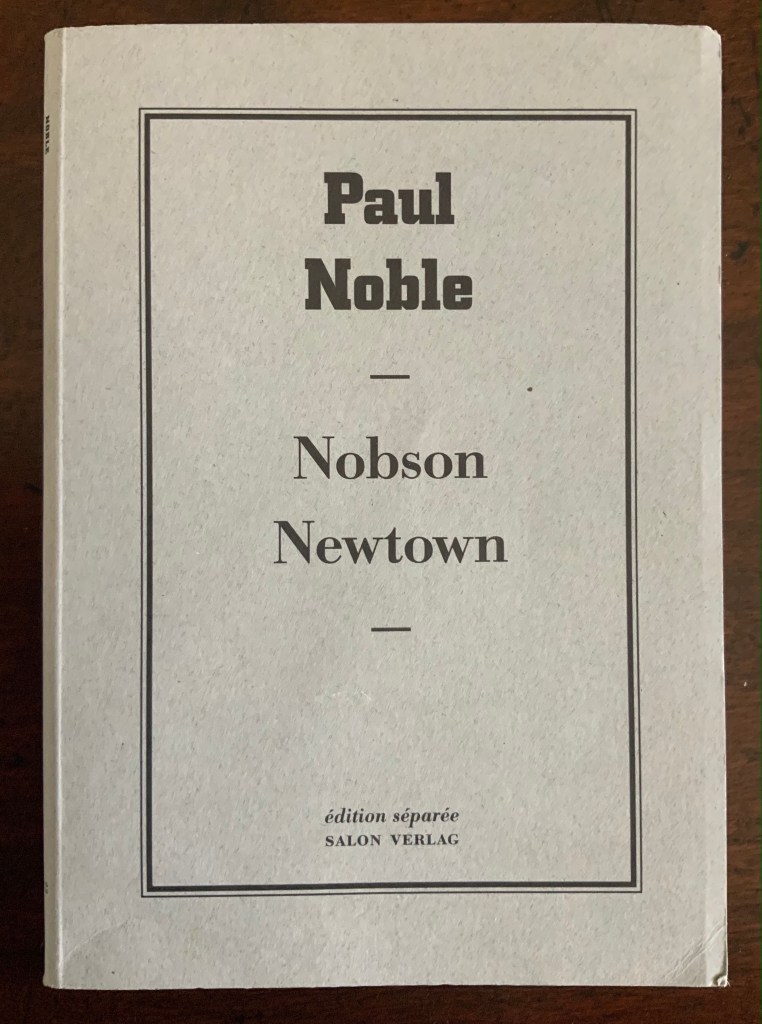
Nobson Newtown (1998)

Nobson Newtown (1998)
Paul Noble
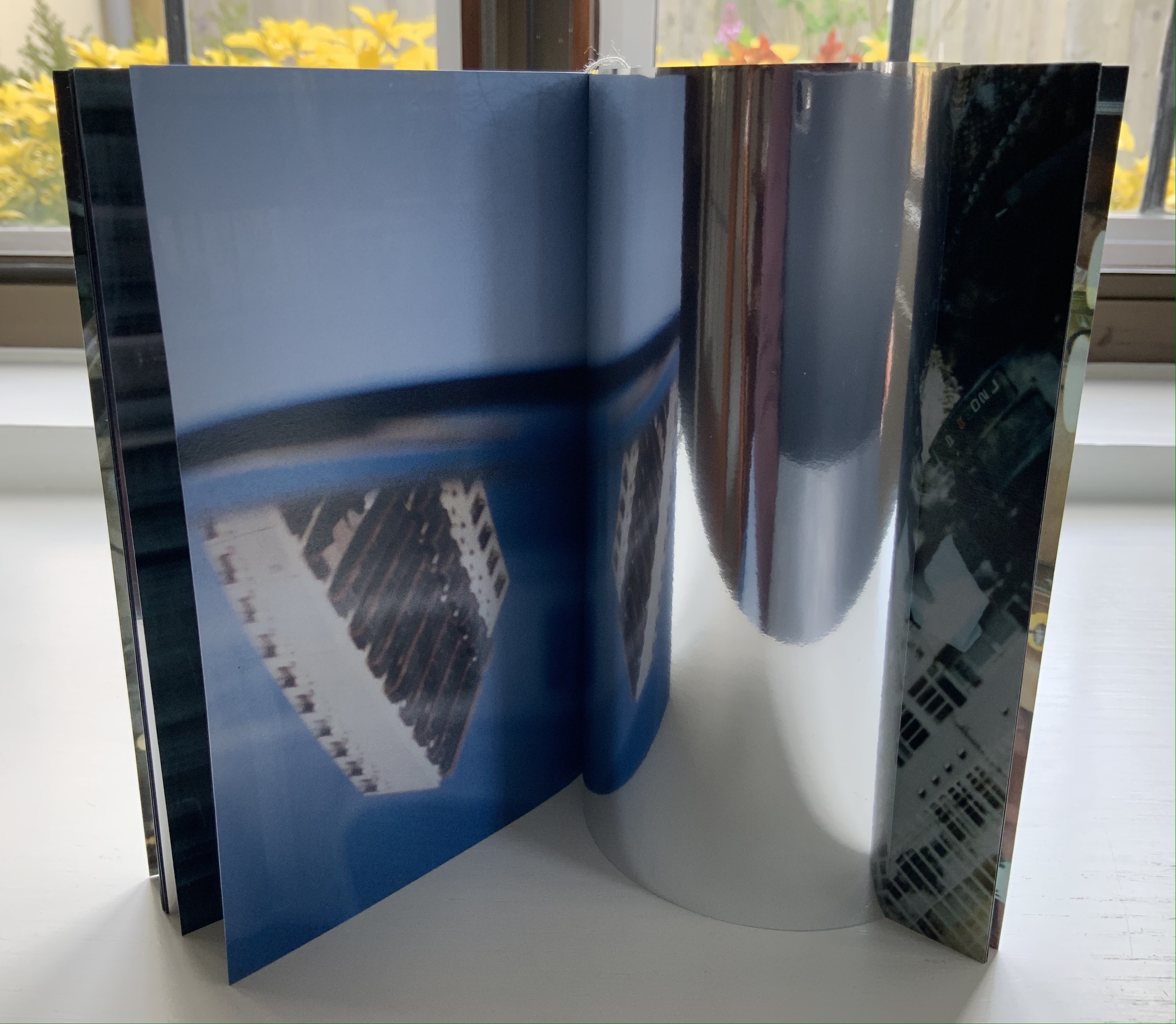
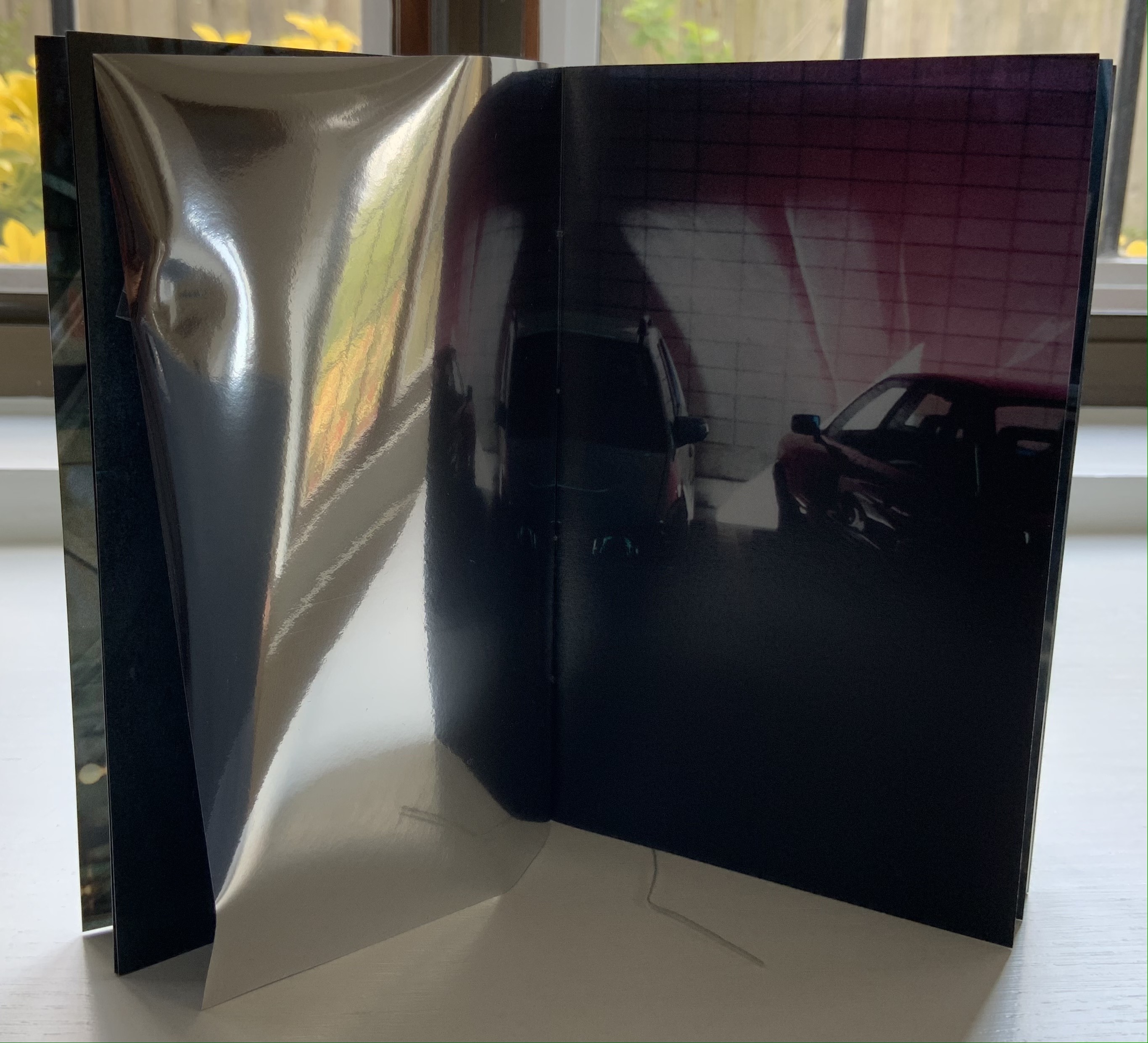
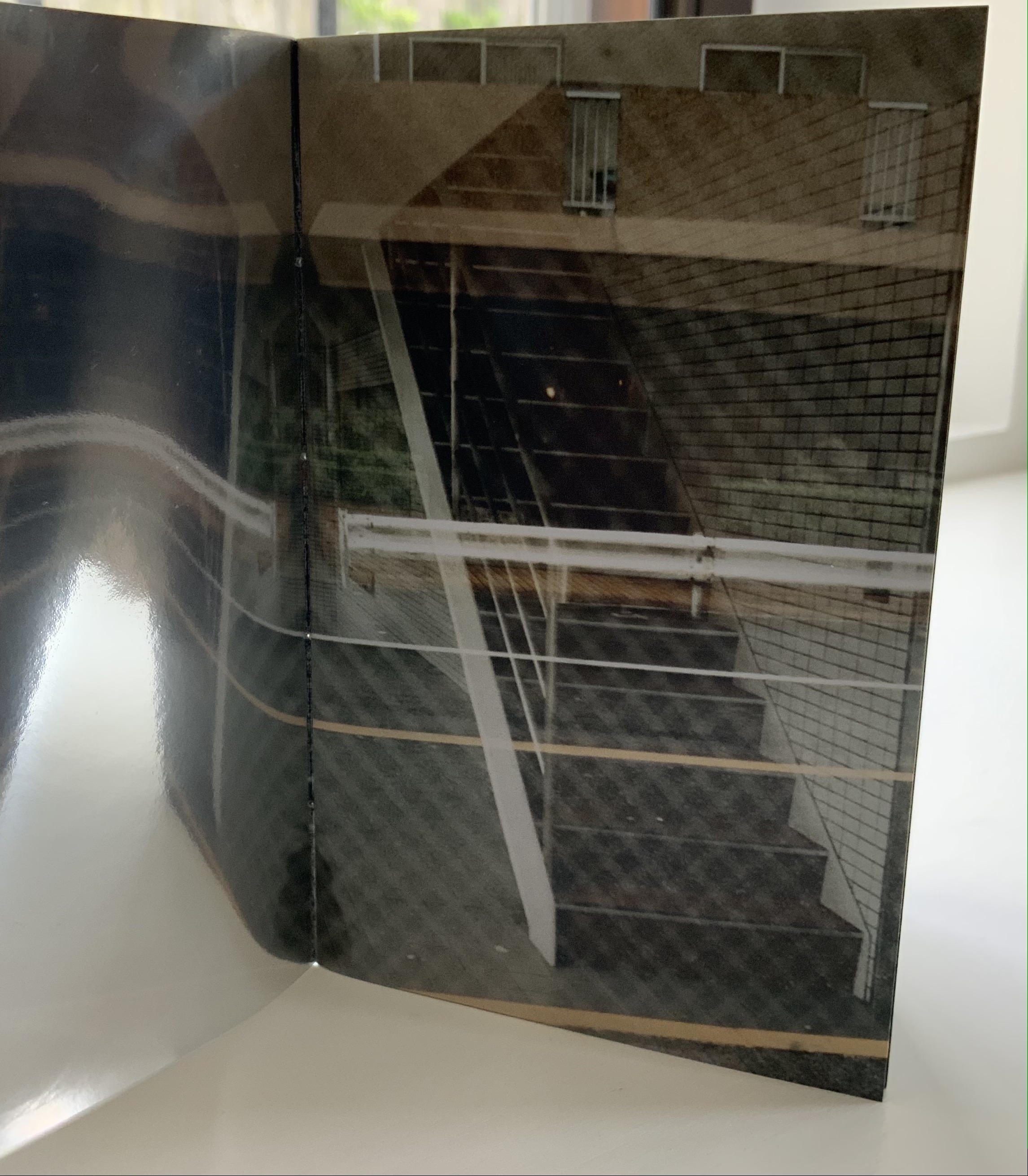
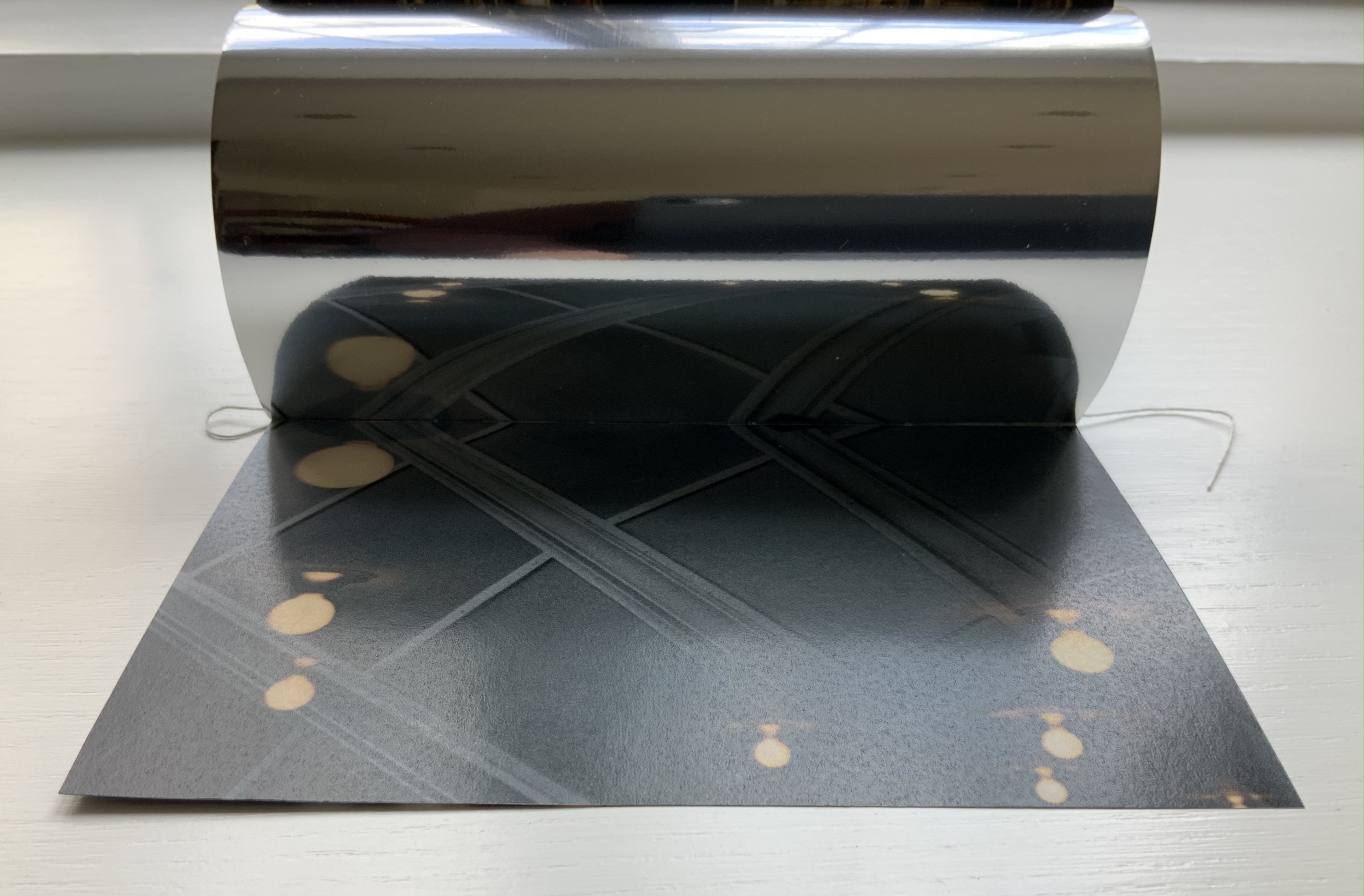
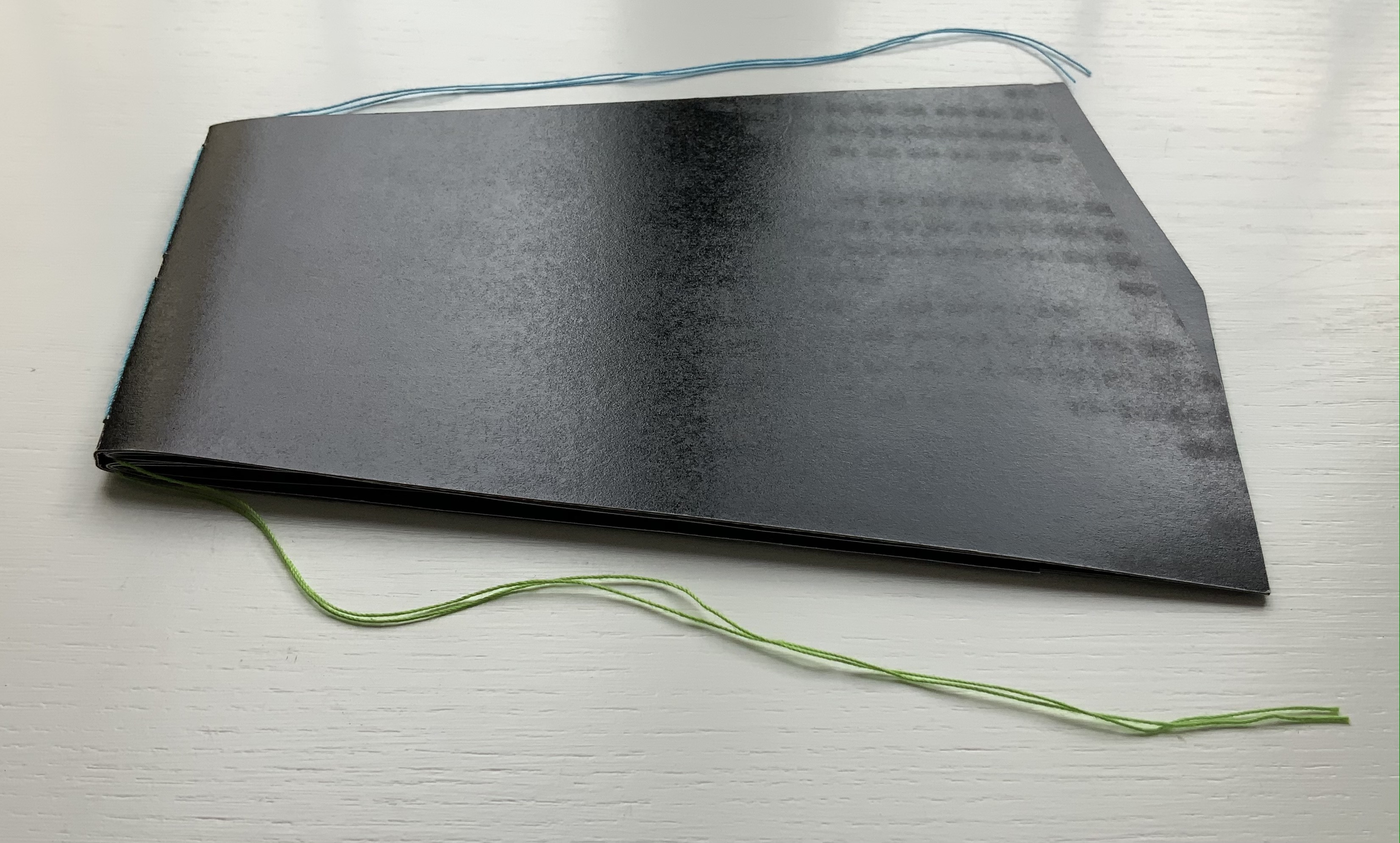
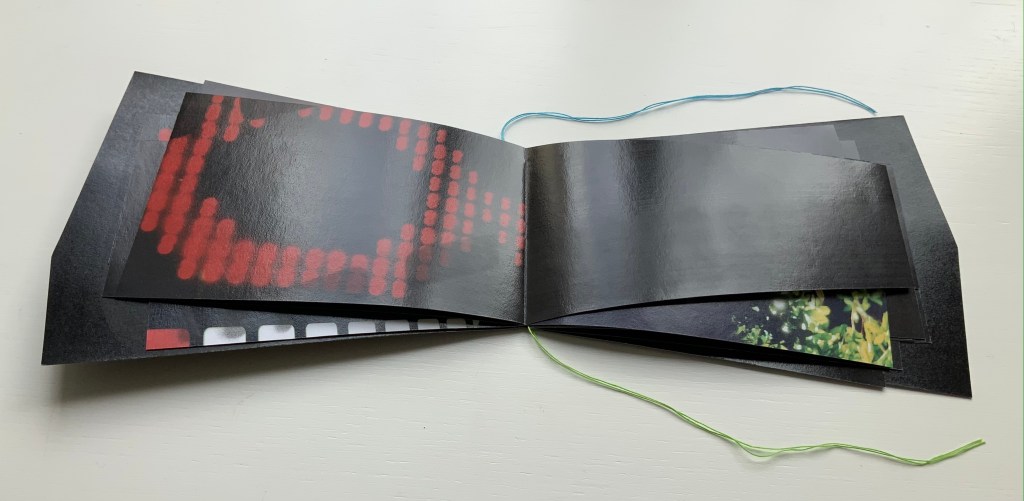
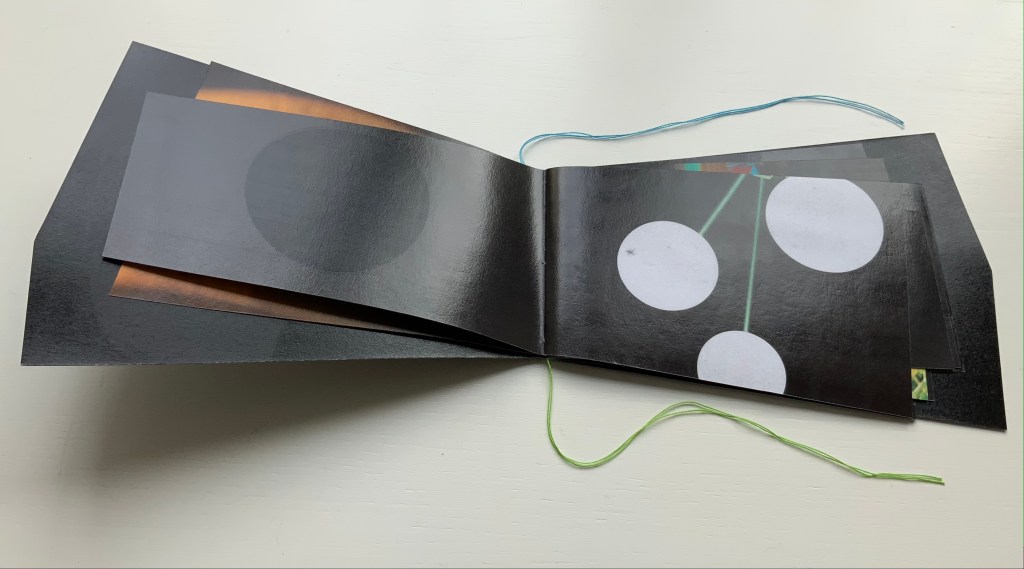
Paperback, H17 x W120 mm, 32 pages with foldout map. Acquired from Marcus Campbell Art Books, 13 March 2021.
Photos: Books On Books Collection.

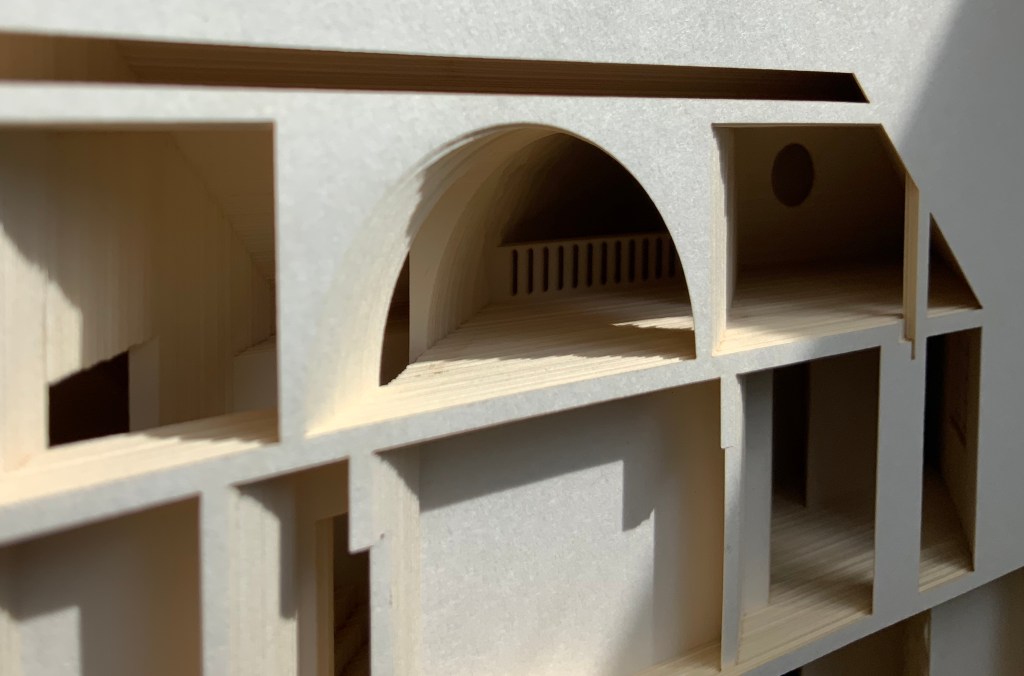
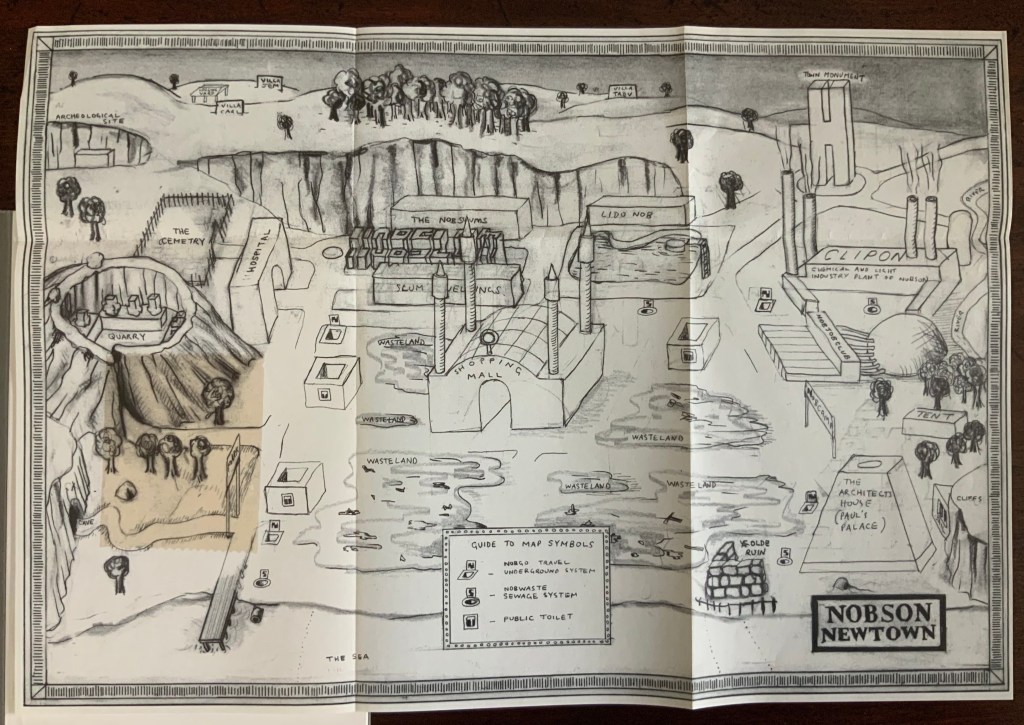
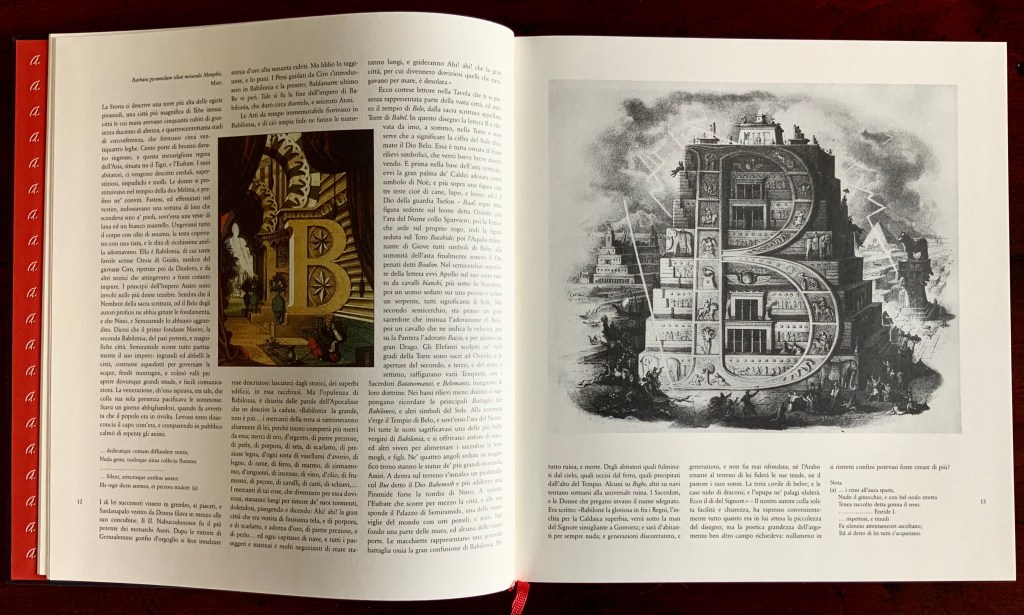
With Nobson Newtown, Paul Noble extends the tradition of alphabetical architecture to full-scale city planning and landscape architecture. Some of Antonio Basoli’s 19th-century designs — for example, the letter A — display a letter-shaped built environment, as does Steven Holl’s The Alphabetical City (1980), but in seaside Nobson Newtown, the buildings spell out words, and the mapped habitation (although without any depiction of inhabitants) rests on a founding myth as bizarre and misanthropic as its current civic arrangements.

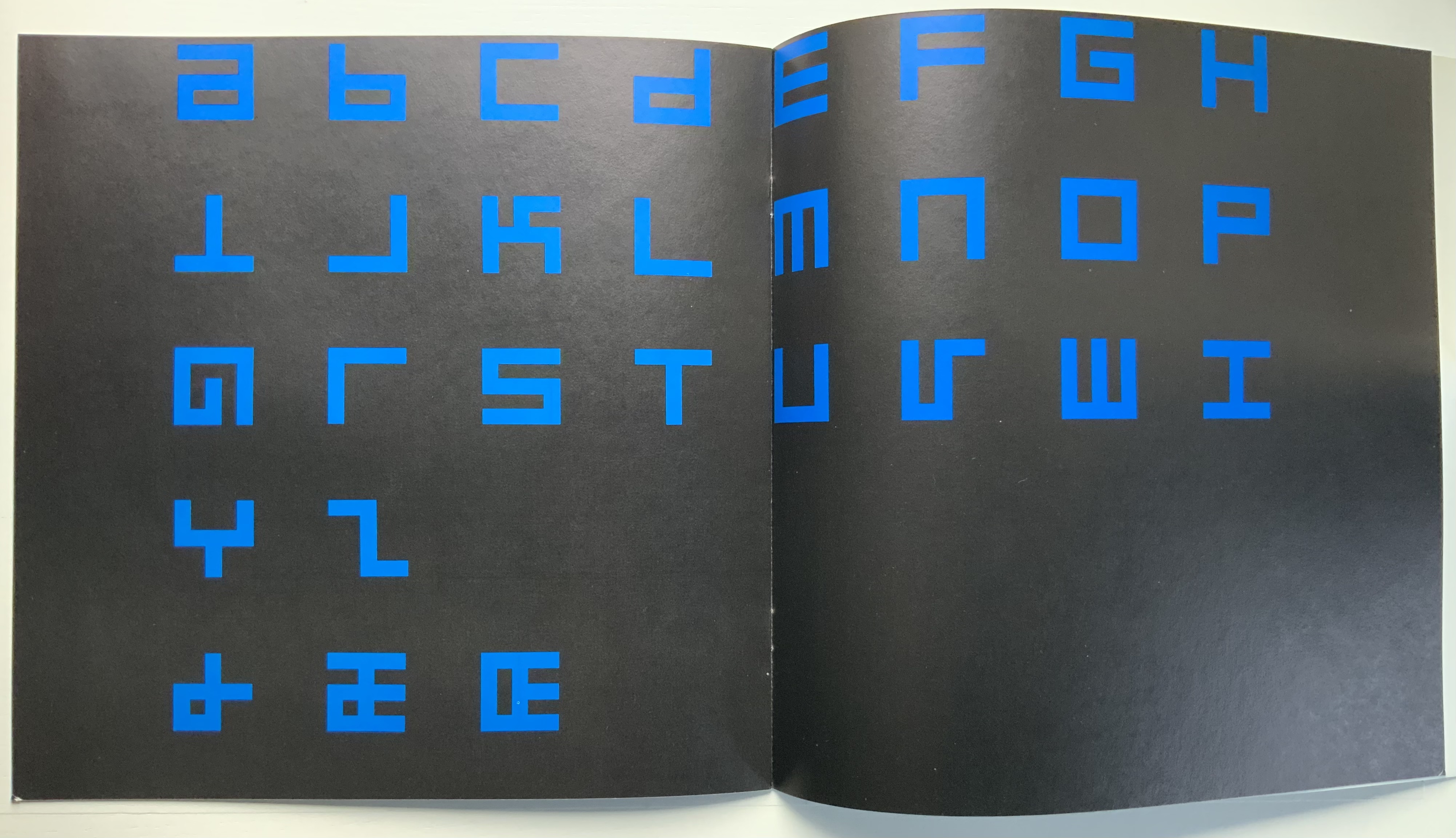
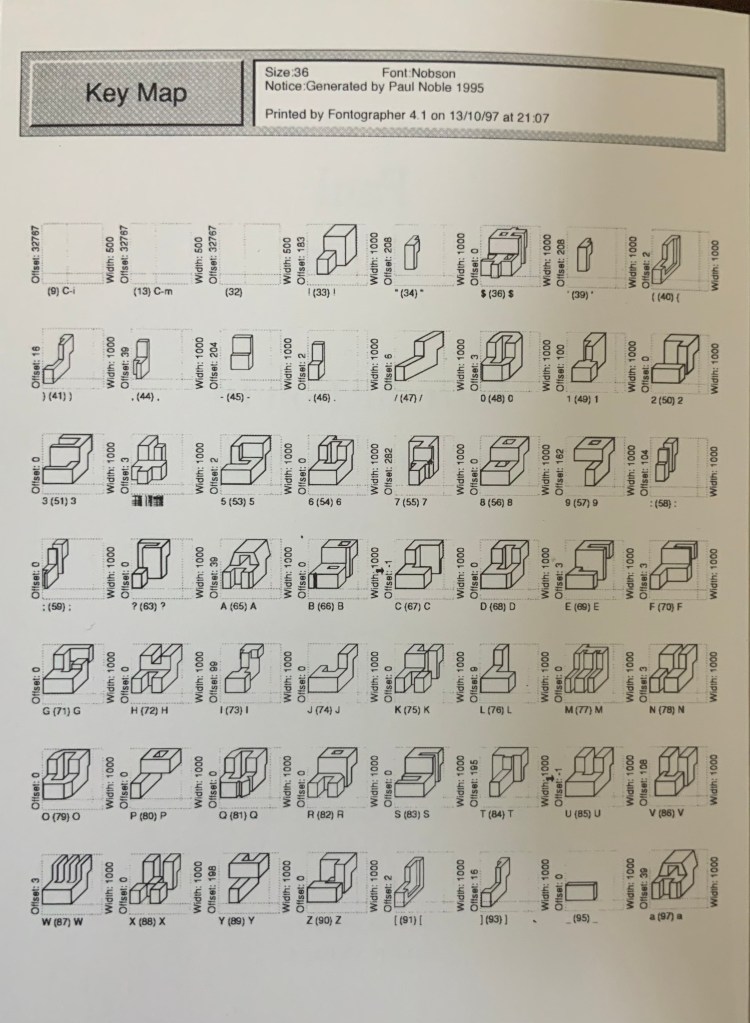
In addition to a map of the town and the environs, Nobson Newtown includes a key to its alphabetical and typographic building blocks, which are, of course, rendered in Nobfont. Easy legibility is not a characteristic.

The Museum Boijmans Van Beuningen commissioned a film from Noble exploring Nobson Newtown, insightfully characterized as “an ever-incomplete inner landscape of the person building the town”.

Further Reading

Abecedaries I (in progress)“, Books on Books Collection, 31 March 2020.

Architecture“, Books on Books Collection, 12 November 2018.

Federico Babina“, Books On Books Collection, 20 April 2021.

Antonio Basoli“, Books On Books Collection, 20 April 2021.

Antonio & Giovanni Battista de Pian“, Books On Books Collection, 20 April 2021.

Jeffrey Morin“, Books On Books Collection, 20 April 2021.

Richard Niessen“, Books On Books Collection, 20 April 2021.

Johann David Steingruber“, Books On Books Collection, 20 April 2021.

Côme, Tony. “The Typotectural Suites“, The Palace of Typographic Masonry. Accessed 5 April 2021.

Holl, Steven. 1980. The alphabetical city. New York: Princeton Architectural Press.

Macken, Marian. 2018. Binding Space: The Book as Spatial Practice. London and New York: Routledge.

McEwen, Hugh. Polyglot Buildings. 12 January 2012. Issuu. Accessed 13 March 2021.

Noble, Paul, and Georgina Starr. “N is for Nobson“, ARTtube, 21 October 2018. Accessed 13 March 2021.

Polano, Sergio. January 2019. “Architectural Abecedari“, Casabella, 893, pp. 62-75 + 100-101 (eng.). Milan.

Tsimourdagkas, Chrysostomos. 2014. Typotecture: Histories, Theories and Digital Futures of Typographic Elements in Architectural Design. Doctoral dissertation, Royal College of Art, London. Accessed 13 March 2021.

Books On Books Collection – Richard Niessen

The Palace of Typographic Masonry (2018)

The Palace of Typographic Masonry (2018)
Richard Niessen
Paperback, perfect bound. H300 x W215 mm, 348 pages. Acquired from Wordery, 29 March 2021.
Photos of the work: Books On Books Collection. Displayed with permission of Richard Niessen.

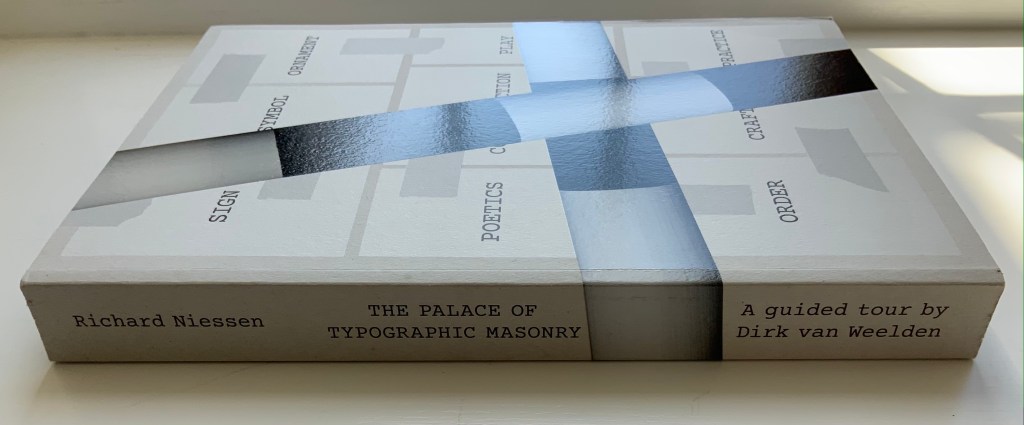
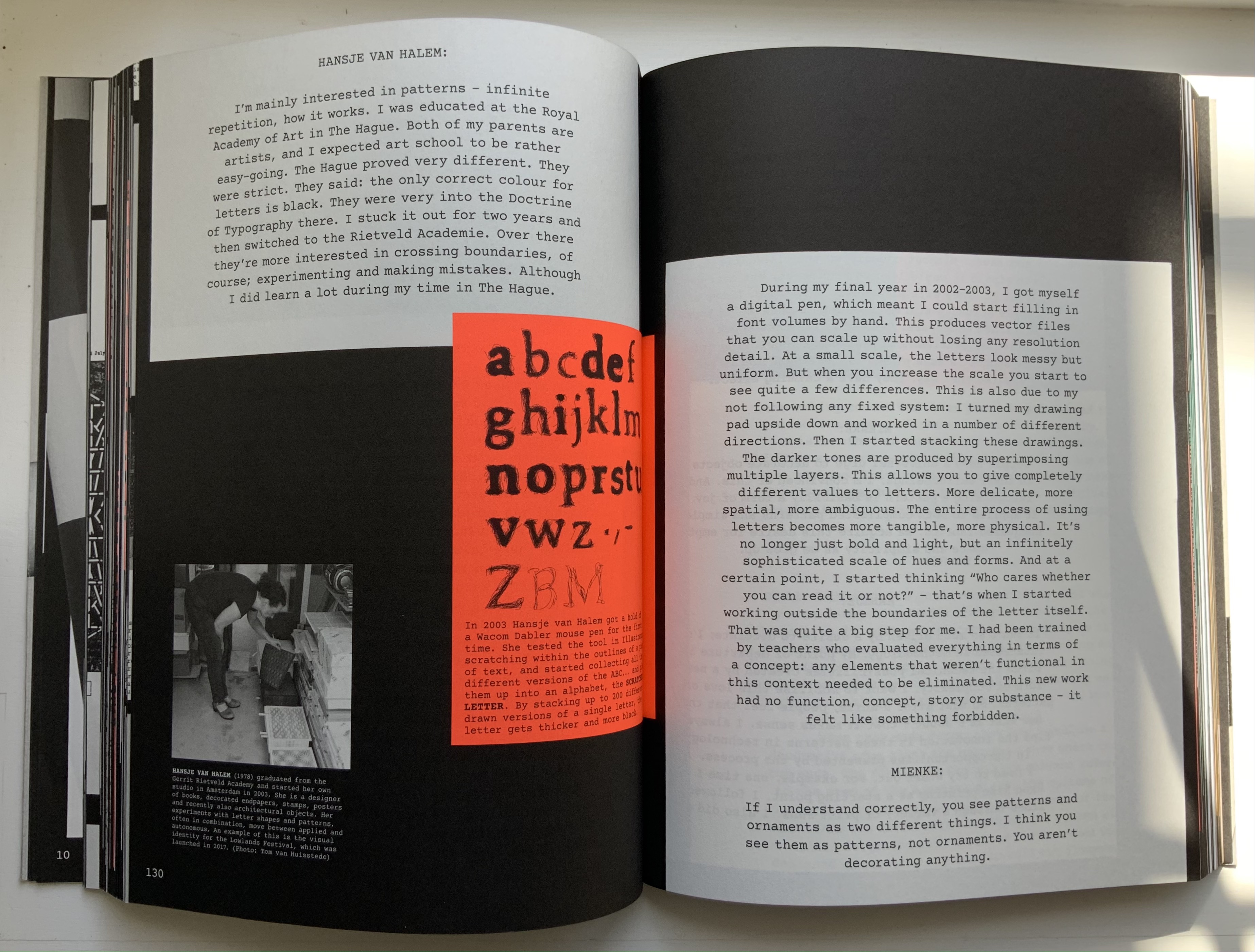
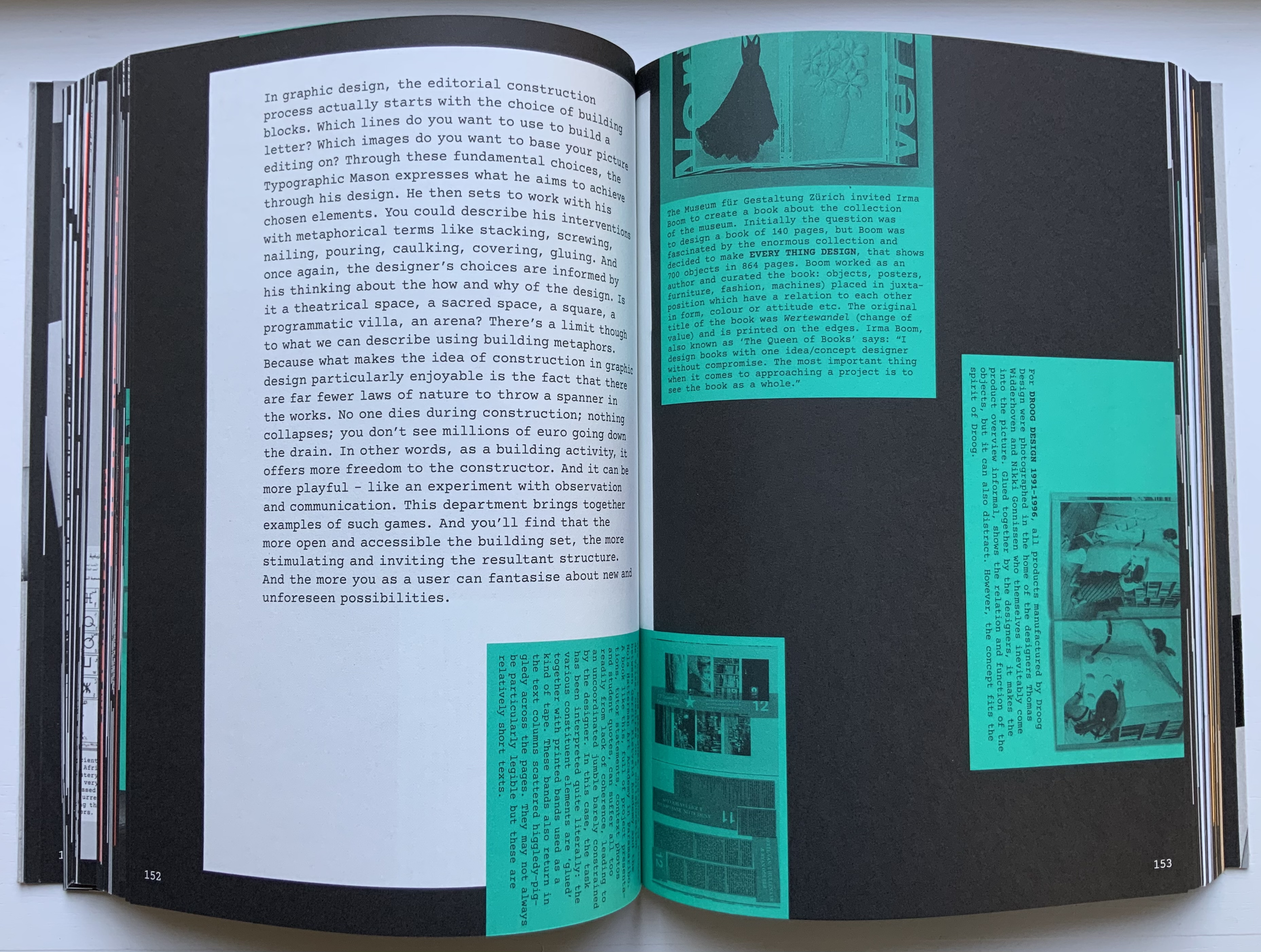
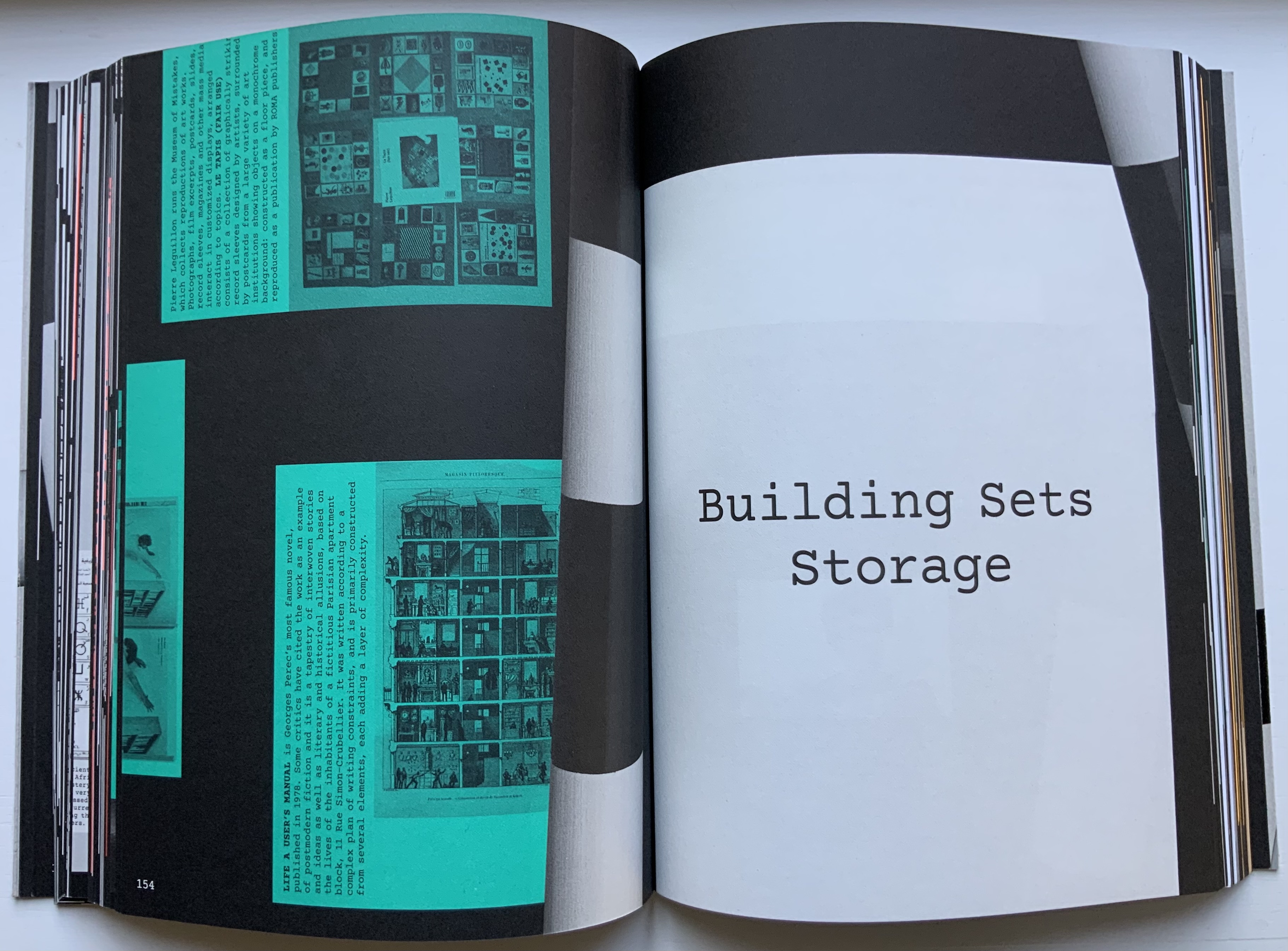
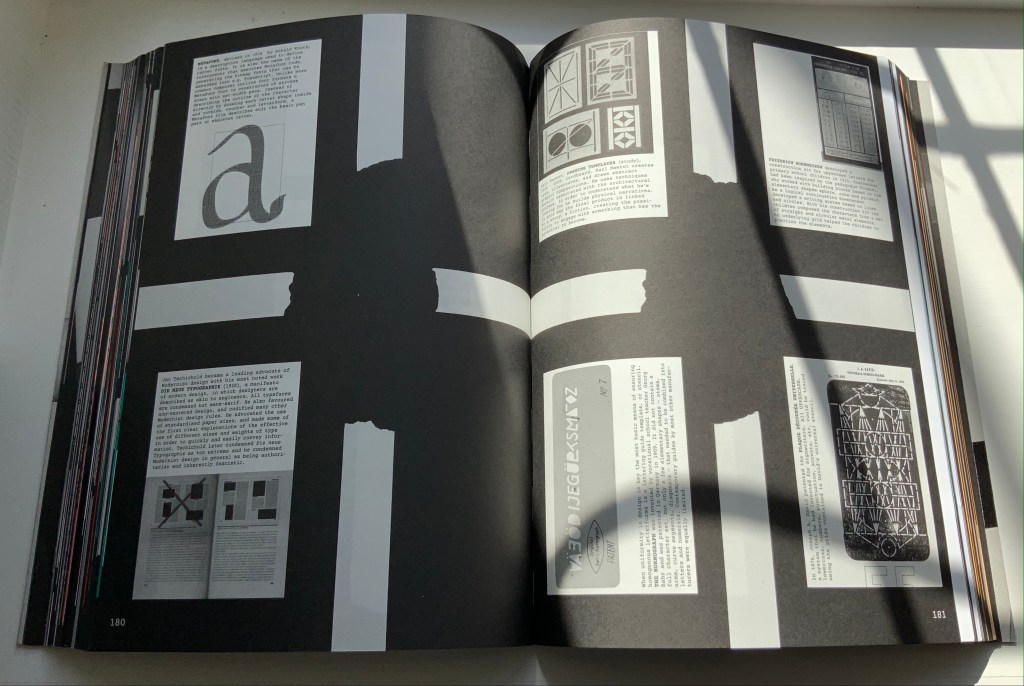
Website, perforated poster, exhibition and paperback, The Palace of Typographic Masonry occupies its place in the Books On Books Collection unlike any other work. The book itself is a shape shifter. Its size competes with those of museum catalogues. In fact, the Palace of Typographic Masonry is like a museum, so much so that it requires a tour guide, which is one shape the book takes. With its nine departments (Sign, Symbol, Ornament, Construction, Poetics, Play, Order, Craft and Practice), it is like a working museum of graphic design, and Dirk van Weelden, our tour guide, often hands us off to departmental “staff” for a lecture or overheard interview.

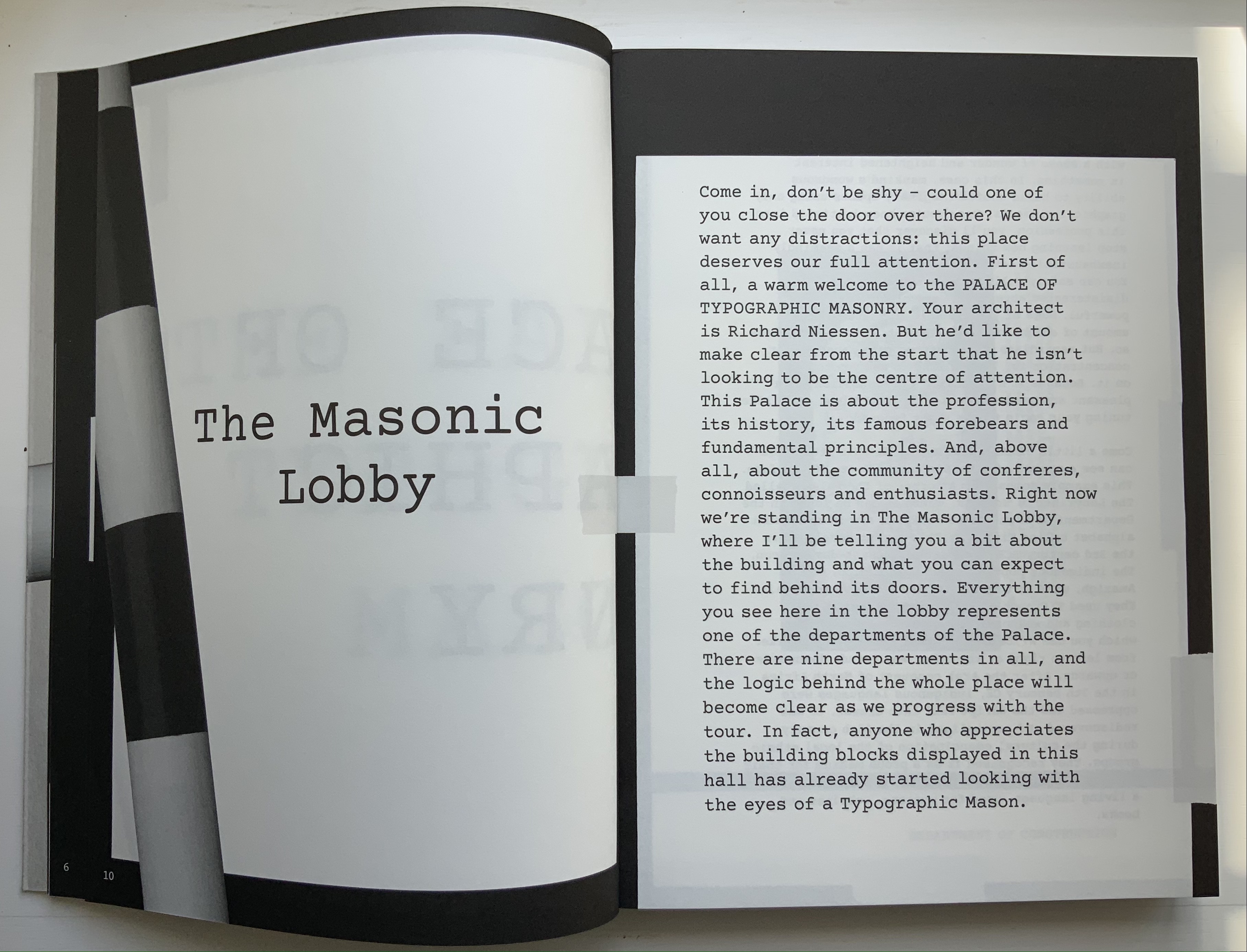
Given the guided-tour premise, the page layouts strangely, or perhaps appropriately, disorient. On almost every page, at almost every turn, we are rubbernecking and twisting to follow text that appears in a typewriter font on sheets and cards that seemingly have been stuck to a black surface with masking tape, photographed and then printed. Some of the text-bearing cards wrap from the recto page to the verso, leading the reader to think that perhaps the pages are on Chinese fold sheets. A card or sheet may be displayed complete on a page, but the next page may show its edge as if an overlapping photo had been taken. On some pages, the items overlap like a collage. At times, the effect is one of moving down a corridor of blackboards that are covered with notices and captioned photos on white, green and fluorescent orange paper. At other times, the page contains multiple cards as if lying on a flat surface — much the same as objects might be arranged in gallery glass cases — and in different orientations so that the book has to be turned clockwise or anti-clockwise to read each item — much the same as having to walk around a glass case to look at each object in it.

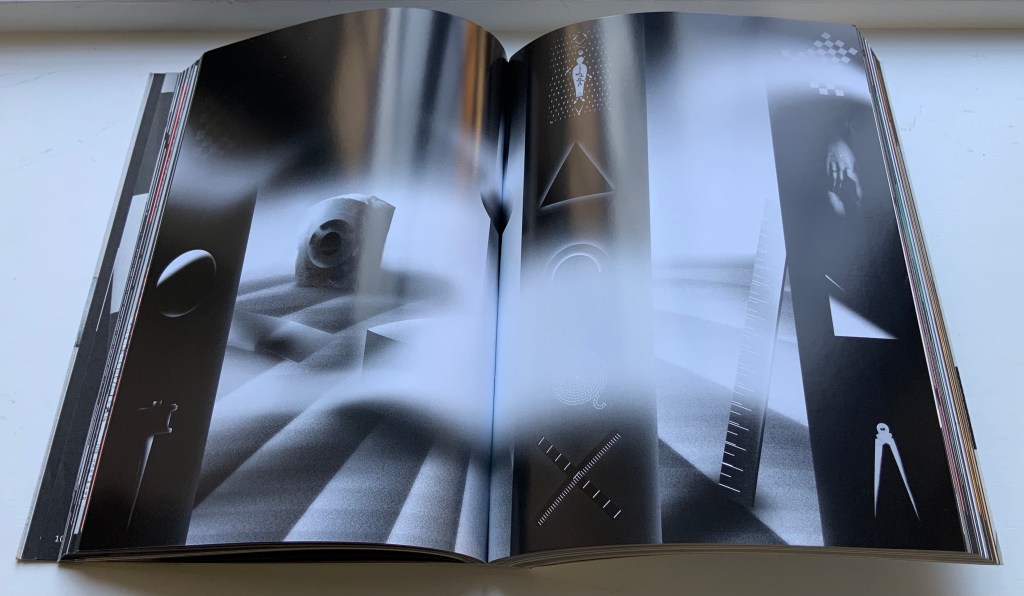
Interspersed glossy sections showcase projects illustrating or responding to the text or the department. For example, Slovenian graphic designer Nejc Prah delivers variations on Masonic tools for Symbols; Paris-based Fanette Mellier, on grid-based design for Poetics; and the Amsterdam-based studio Moniker, “board game cut-ups” for Play. While these sections fit their context in the book, their content and “slippery floor” substrate ratchet up the sense of disorientation. Museum visitors easily tire, and they can be bored in some departments.

Nejc Prah‘s variations on Masonic tools and symbols. Photo: Books On Books Collection. Displayed with artist’s permission.

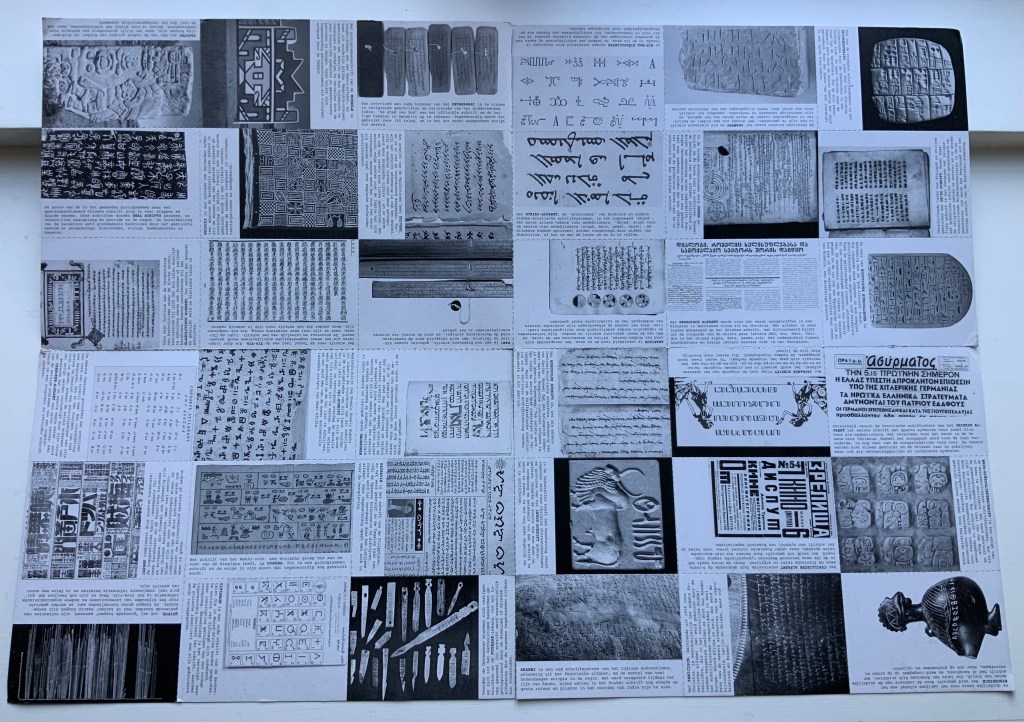
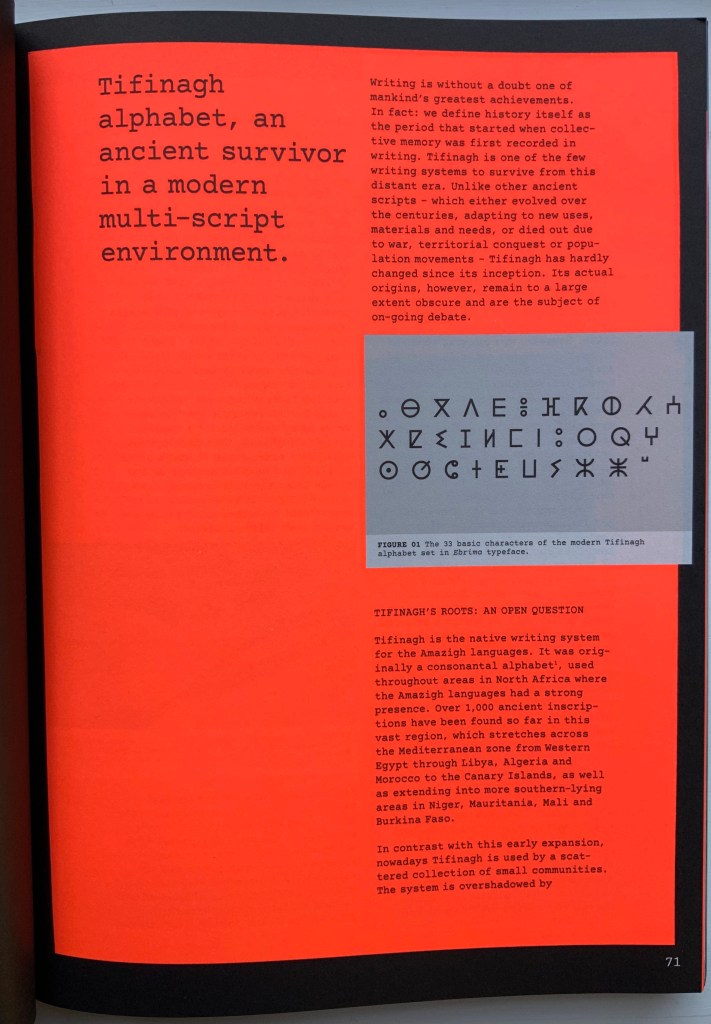
For example, the palace’s labyrinth of scripts — also reproduced separately on the perforated poster — is followed by a discussion of the revival of Tifinagh, the nearly extinct written language of the Tuareg in the Maghreb. The labyrinth presents thirty-six scripts in those varying orientations mentioned above and is wonderful in its breadth but also tiring — especially from the effort required by the font size and orientations. The story of Tifinagh’s revival and integration through typeface design is inspiring, usefully makes the point about the cultural conventionality of alphabets and more, but also makes for a long trek before our guide moves us along into the next department.

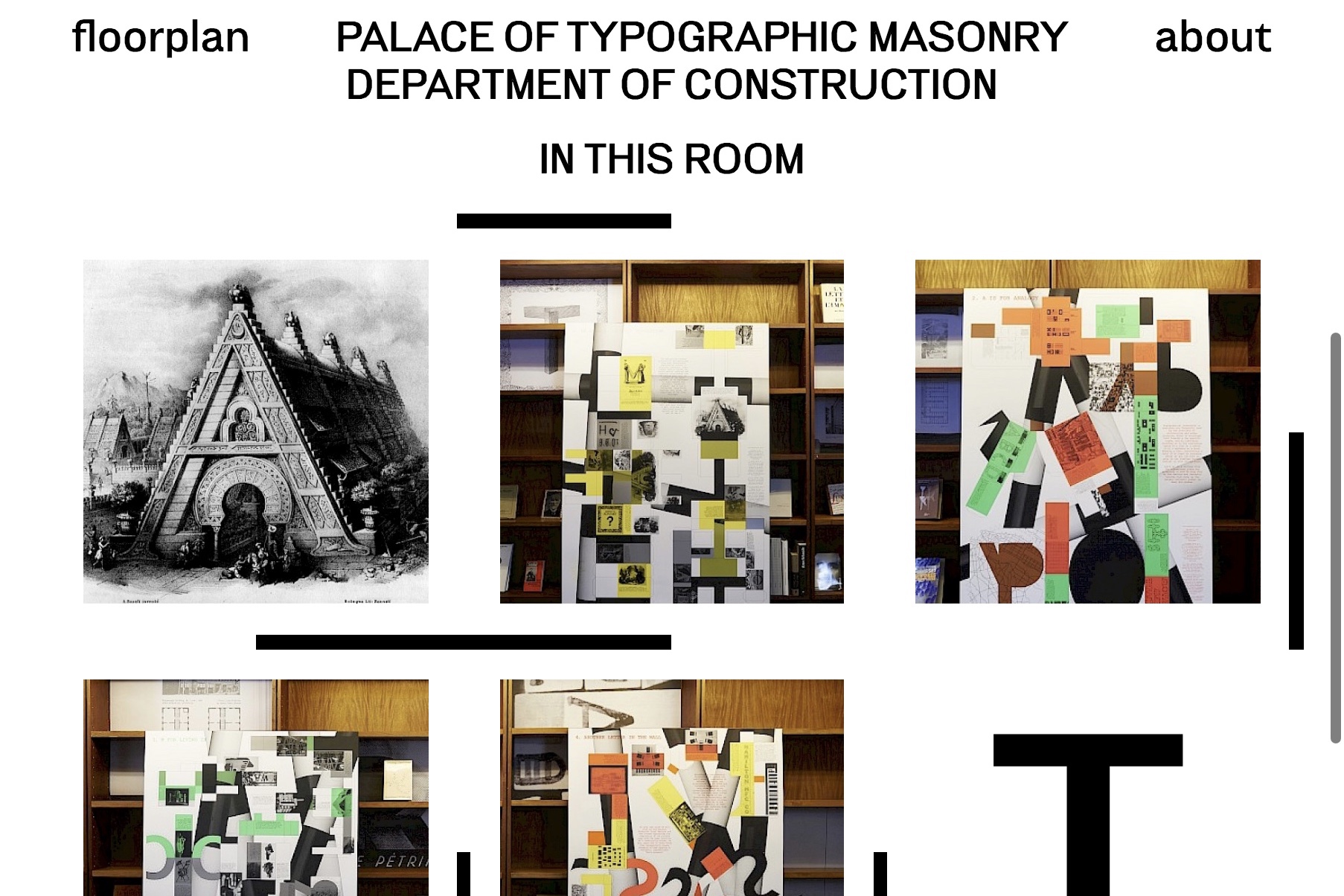
With the website for The Palace of Typographic Masonry, Richard Niessen aims for both a collective (imagined) building and an encyclopedic (digital) space, organized into those nine departments or frames. Contributors can add to the source collections or, within the departments and their subdivisions, create new rooms based on the source collections. One contribution particularly appropriate for the Books On Books Collection comes from Tony Côme: “The Typotectural Suites“. Here in one location, the visitor can find those “language towers, typographic islands, cities to decipher, plans in the shape of letters, encrypted walls, speaking bricks, habitable capitals” created by Johann David Steingruber, Antonio Basoli, Antonio and Giovanni Battista de Pian, Paul Noble and others.

The Departments of Sign, Symbol or Order could give more prominence to the role of numbers in the world of typographic masonry. Numerals do appear in the tables for Morse Code and International Maritime Signal Flags, but the visitor would not know that counting and numbers preceded writing and letters. Perhaps the curator could persuade the art historian and archaeologist Denise Schmandt-Besserat to contribute images of those clay tokens to which

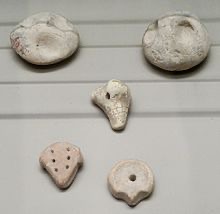
The Mesopotamian cuneiform script can be traced furthest back into prehistory to an eighth millennium BC counting system using clay tokens of multiple shapes. The development from tokens to script reveals that writing emerged from counting and accounting. (Schmandt-Besserat, 2015)

Clay counting tokens and bullae (containers).

Or perhaps the curator could persuade William Joyce to donate some clips from The Numberlys (2012) to the Palace source collection, even preferably some snippets of interactive code with which the visitor can help the five animated characters transform numbers into letters.

Universal languages are highlighted in an Annex, which has been compiled by Edgar Walthert. An update soon to come includes excerpts from Book from the Ground by Xu Bing. A link to Xu’s film The Character of Characters would make a useful addition. It will be interesting to see whether the Annex’s accompanying lecture covers the stir over a “post-text future” and whether typographic masons are returning full circle to pictographic language.

Further Reading

Architecture“. 12 November 2018. Books on Books Collection

The Art of Reading in a “Post-Text Future“. 21 February 2018. Bookmarking Book Art.

Federico Babina“. 20 April 2021. Books On Books Collection.

Antonio Basoli“. 20 April 2021. Books On Books Collection.

Giovanni Battista de Pian“. 20 April 2021. Books On Books Collection.

From a Visit to Art for the People, Xu Bing (Centro del Carme, Valencia, Spain, 2019)”. 22 May 2020. Bookmarking Book Art.

Jeffrey Morin“. 20 April 2021. Books On Books Collection.

Paul Noble“. 20 April 2021. Books On Books Collection.

Johann David Steingruber“. 20 April 2021. Books On Books Collection.

Côme, Tony. “The Typotectural Suites“. The Palace of Typographic Masonry. Accessed 12 March 2021.

de Looze, Laurence. 2018. The Letter and the Cosmos: How the Alphabet Has Shaped the Western View of the World. Toronto: University of Toronto Press.

Macken, Marian. 2018. Binding Space: The Book as Spatial Practice. London and New York: Routledge.

McEwen, Hugh. Polyglot Buildings. 12 January 2012. Issuu. Accessed 13 March 2021.

Schmandt-Besserat, Denise. 2006. How writing came about. Austin, Texas: University of Texas Press.

Schmandt-Besserat, Denise. 2015. “Writing, Evolution of”, in James Wright, ed., International Encyclopedia of Social and Behavioral Sciences, 2d. Edition. New York: Elsevier. Accessed 15 April 2021.

Tsimourdagkas, Chrysostomos. 2014. Typotecture: Histories, Theories and Digital Futures of Typographic Elements in Architectural Design. Doctoral dissertation, Royal College of Art, London. Accessed 13 March 2021.

Xu, Bing, Britta Erickson, and Jay Xu. 2012. The character of characters: an animation by Xu Bing. San Francisco: Asian Art Museum of San Francisco.

Xu, Bing. 2018. Book from the ground: from point to point. Cambridge, MA: MIT Press.

Books On Books Collection – Federico Babina

Archibet (2015)

Archibet (2015)
Federico Babina
Perfect bound card. H165 x W120 mm, 26 cards. Acquired from Laurence King Publishing, 12 March 2021.

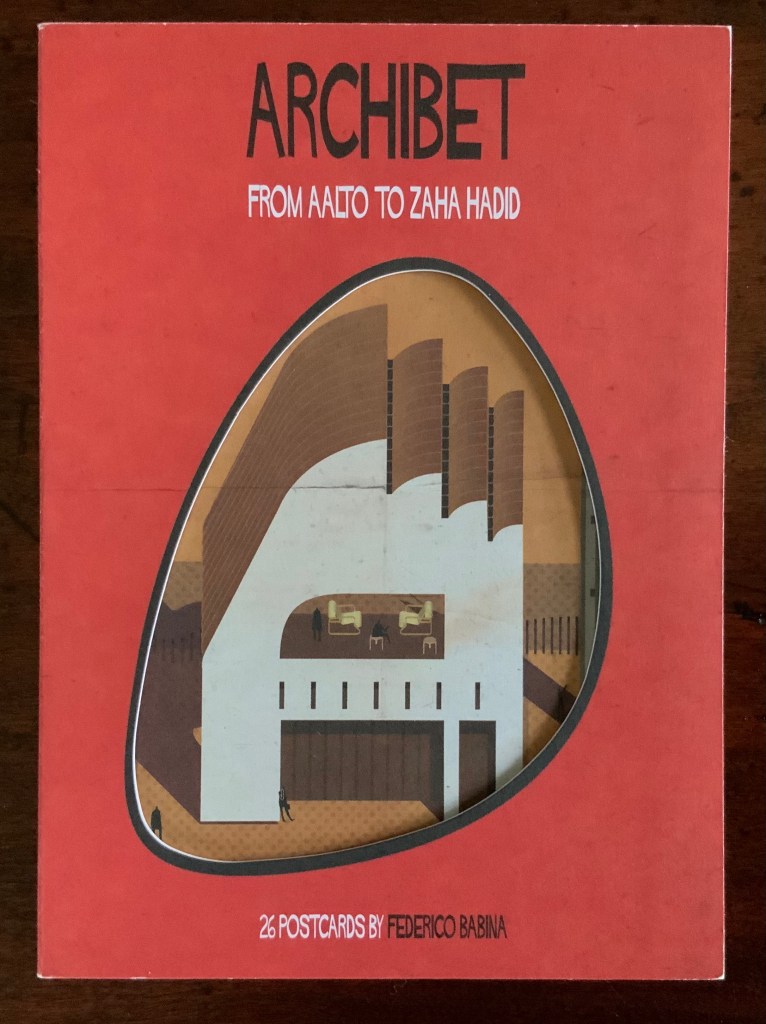
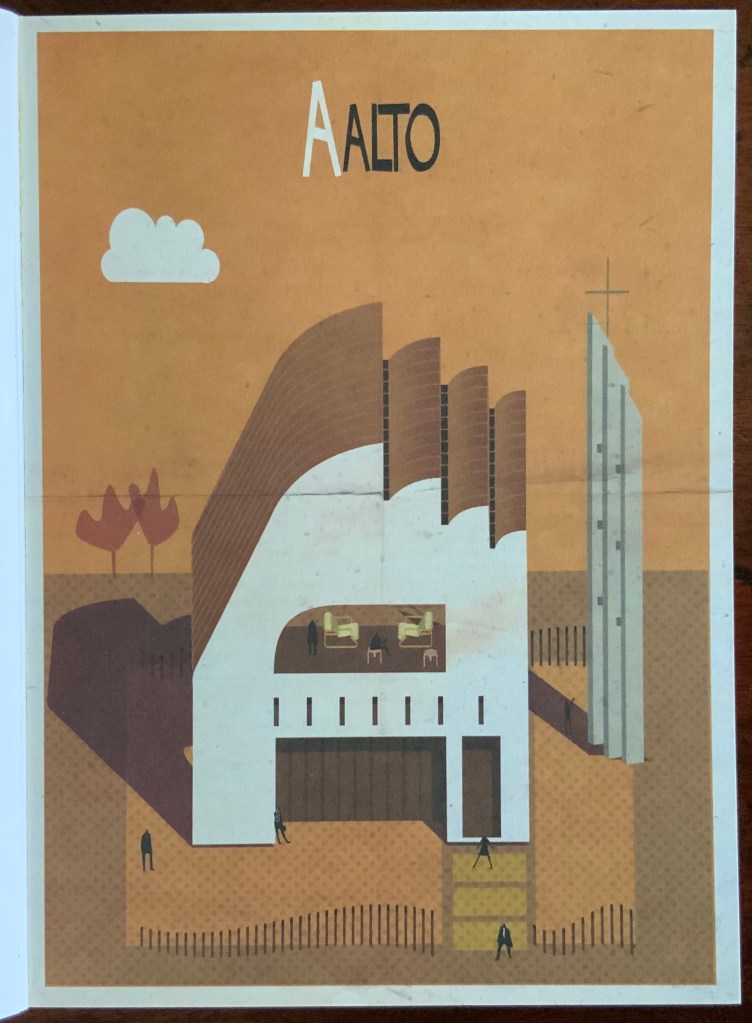
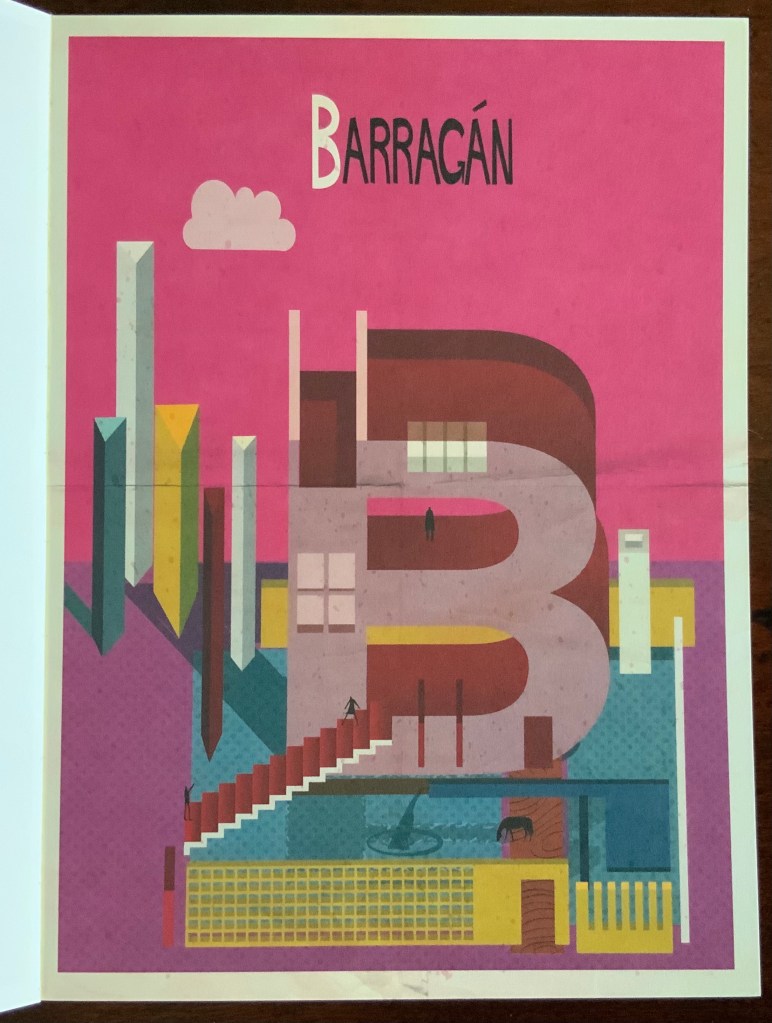
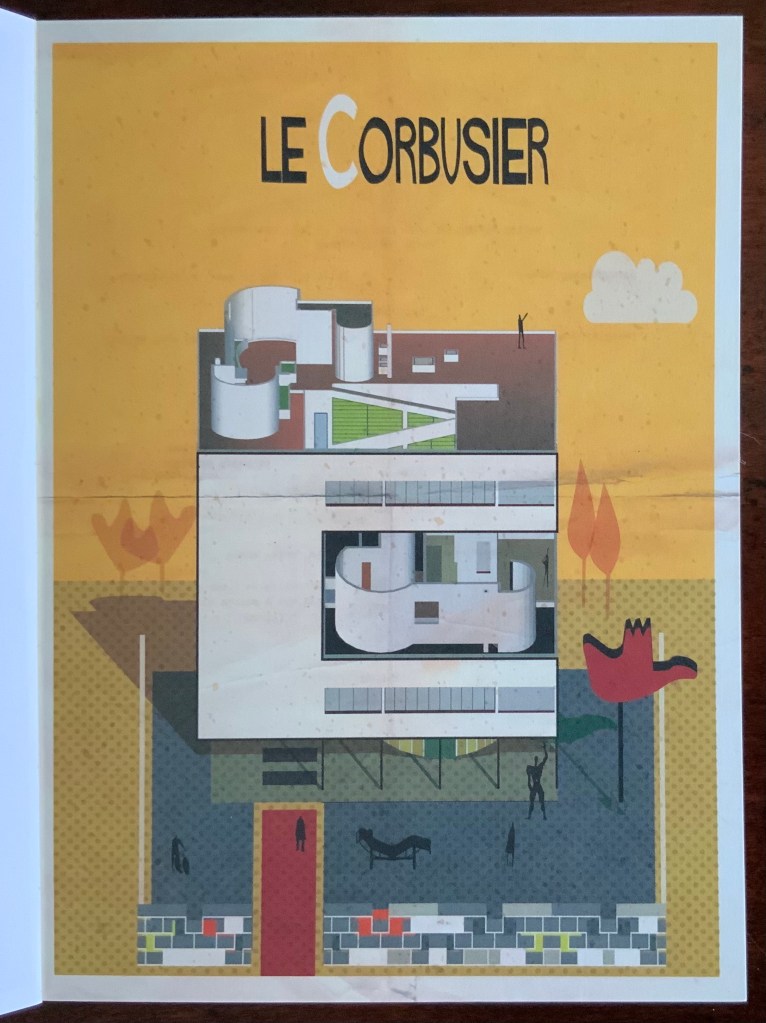
Mostly modern architects, the letters of their first or last names integrated with a surreal building reminiscent of their styles, but the handling of colors and flattening of perspective, which signal Babina’s style, dominate as can be seen below with Aalto, Barragán and Le Corbusier.

Further Reading

Abecedaries I (in progress),” Books On Books Collection, 31 March 2020.

Antonio Basoli“, Books On Books Collection, 20 April 2021.

Architecture“, Books on Books Collection, 12 November 2018.

Antonio & Giovanni Battista de Pian“, Books On Books Collection, 20 April 2021.

Jeffrey Morin“, Books On Books Collection, 20 April 2021.

Richard Niessen“, Books On Books Collection, 20 April 2021.

Paul Noble“, Books On Books Collection, 20 April 2021.

Johann David Steingruber“, Books On Books Collection, 20 April 2021.

Macken, Marian. 2018. Binding Space: The Book as Spatial Practice. London and New York: Routledge.

McEwen, Hugh. “Polyglot Buildings“. 12 January 2012. Issuu. Accessed 13 March 2021.

Tsimourdagkas, Chrysostomos. 2014. Typotecture: Histories, Theories and Digital Futures of Typographic Elements in Architectural Design. Doctoral dissertation, Royal College of Art, London. Accessed 13 March 2021.

Books On Books Collection – Antonio Basoli

Alfabeto Pittorico, ossia raccolta di pensieri pittorici composti di oggetti comincianti dalle singole lettere alfabetiche (“Pictorial Alphabet, a collection of pictorial thoughts composed of objects beginning with the individual letters of the alphabet”) (1839/1998)
Antonio Basoli
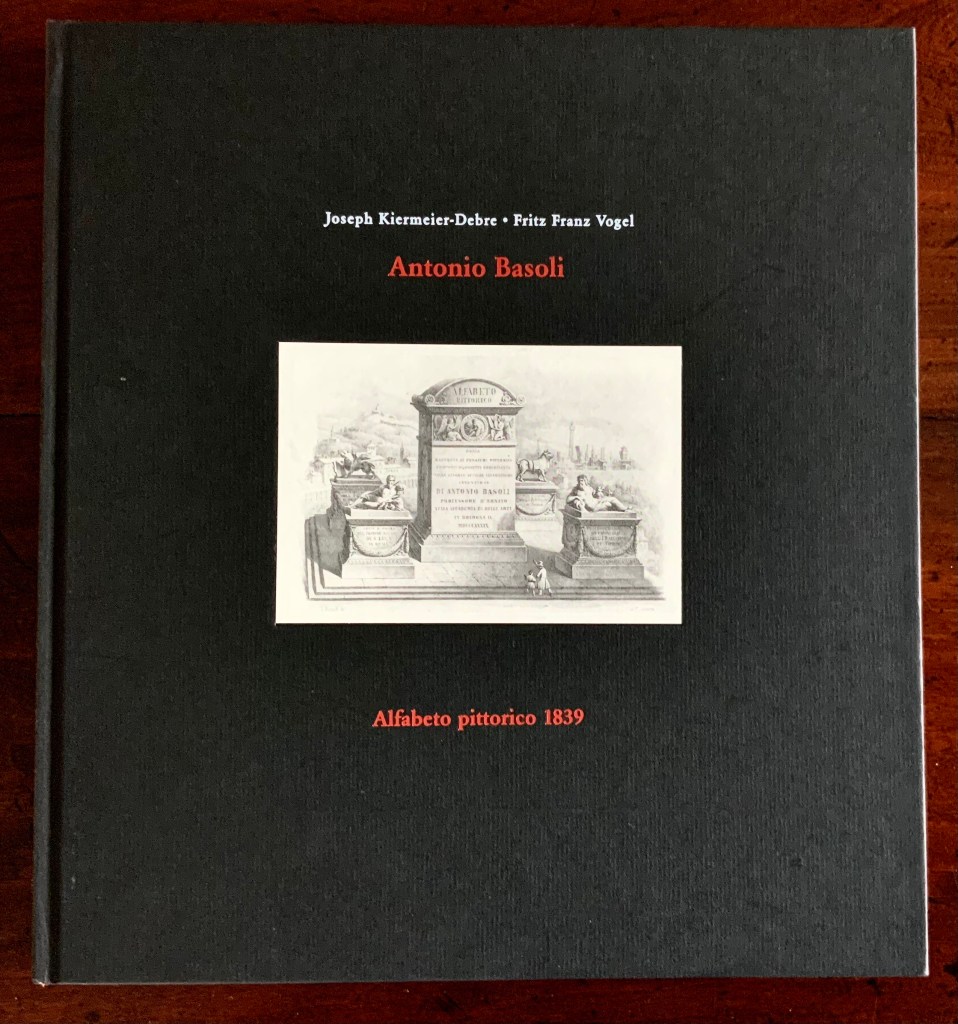
Facsimile edition created by Joseph Kiermeier-Debre and Fritz Franz Vogel (1998) as part of the boxed set Alphabets Buchstaben Calligraphy, published by Ravensburger Buchverlag. H275 x W255 mm, 144 pages. Acquired from Antiquariat Terrahe & Oswald, 14 March 2021. Photos: Books On Books Collection.

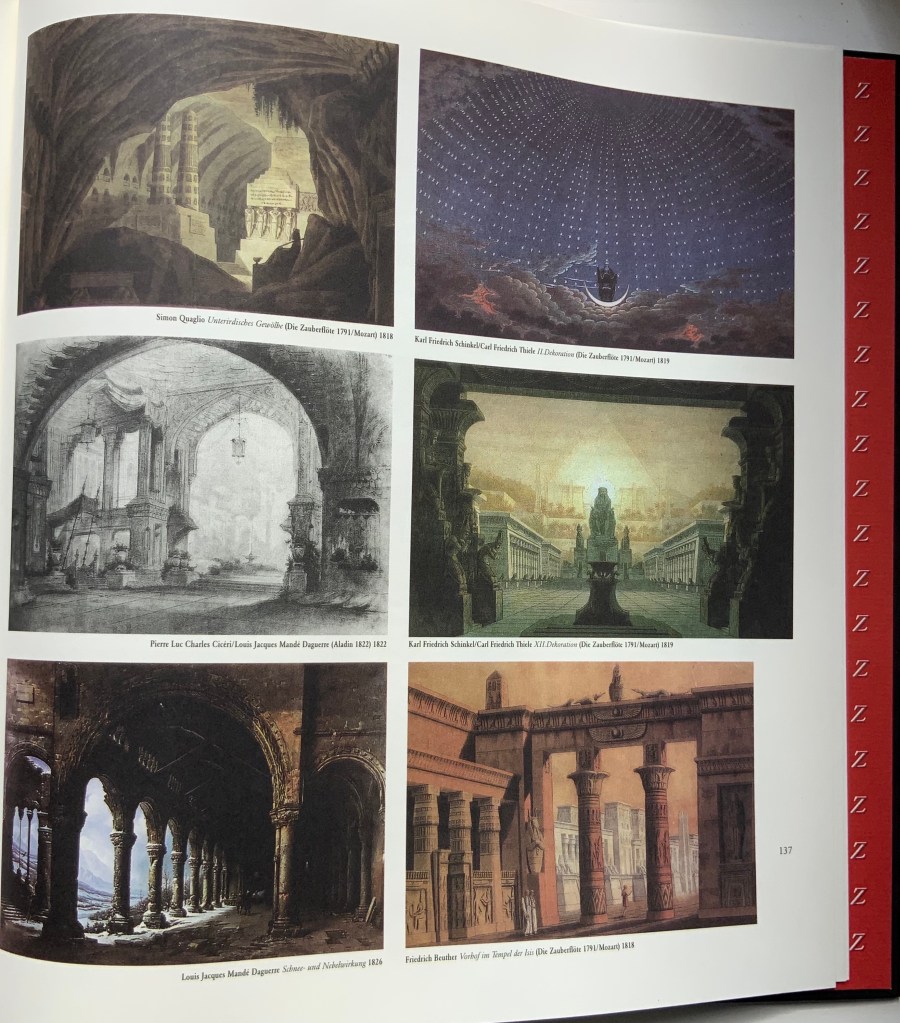
The Ravensburger Alfabeto pittorico is like a “Black Forest Cake” — a lot of ingredients. The recipe starts with Antonio Basoli’s design of monuments based on letters of the alphabet and his original Italian and French descriptions. To this, the chefs Joseph Kiermeier-Debre and Fritz Franz Vogel add German and English translations. Then, alongside Basoli’s inventions, they place reduced versions of Antonio and Giovanni Battista de Pian’s contemporaneous alphabetical/architectural fantasies. And sprinkled throughout, providing comparative context to Basoli’s career in Bologna as a professionally and academically recognized scenographer, there are dozens of reduced versions of lithographs of opera settings by the more renowned scenographers associated with Vienna, Milan, Venice, Naples and Munich. It is entirely a pudding in the spirit of Basoli.

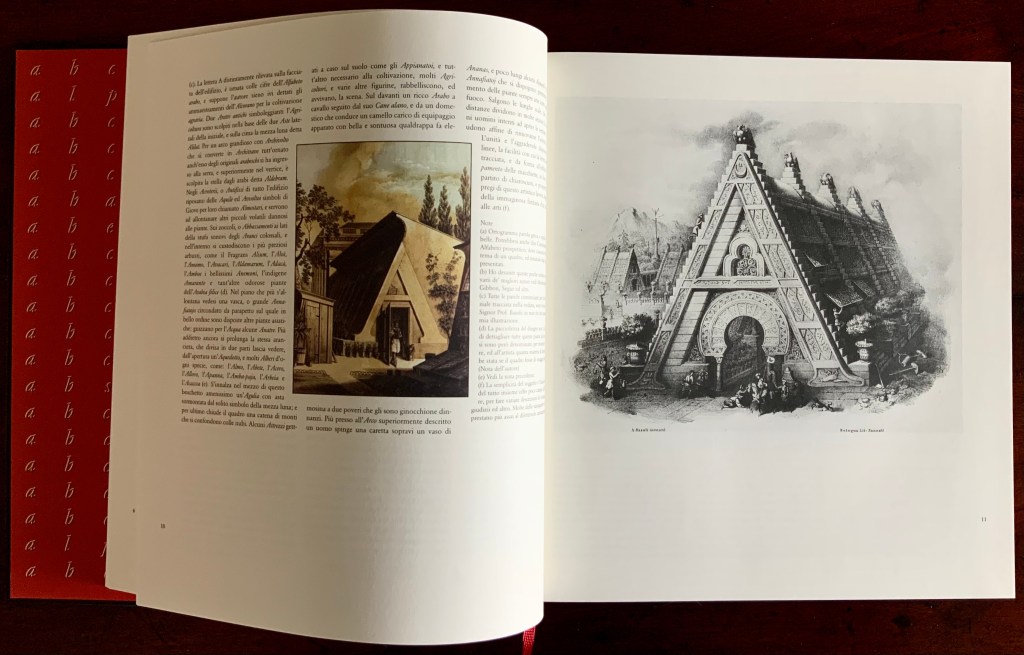
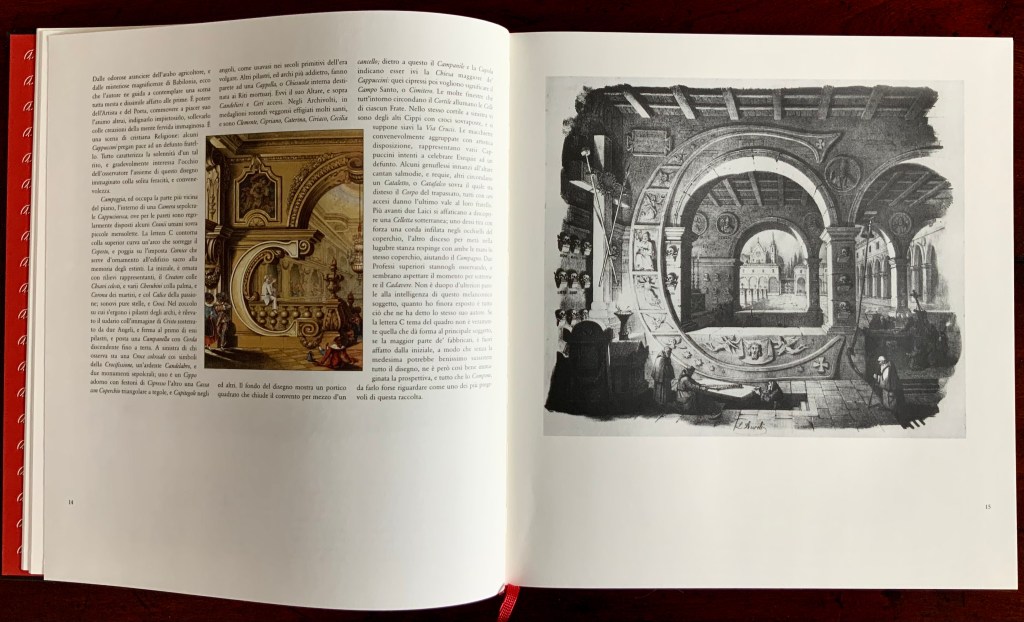
Basoli creates densely illustrated scenes based on each letter of the alphabet. For each view, his goal is to incorporate the letter structurally or ornamentally in a central building, which in the most successful attempts would begin with the letter. For instance, the large A-shaped building is an orangerie (as in arancia for oranges). B hints at the Tower of Babel and the destruction of the Babylonian empire. C stands for catafalque (or “crypt”) and the Capuchin monks attending to a burial.

Setting a further standard of success, the artist populates each scene with people, activities, objects and symbols that begin with the designated letter. Around the orangerie, agricultural attrezzi (“implements”) are strewn, stone aquile (“eagles”) perch on the building, alms are being distributed by a man in Arab dress, trees beginning with the letter A forest the background and pop up from pots, and the whole setting evokes Arabia according to the 19th-century perception of the region encompassing “Persia, Syria, Egypt and Ethiopia”.

As Kiermeier-Debre and Vogel point out in the preface and afterword, this scene and many others reflect the time’s preoccupation with the Orient and antiquity from the not-too-distant Napoleonic campaign in Egypt (1798-1801) that spawned the archaeological industry of Egyptology. They also reflect the scenography arising from a half century’s operas such as The Escape from the Seraglio(1782), The Caliph of Baghdad (1800), Abu Hassan (1811), Ciro in Babilonia (1812), L’Italiana in Algeri (1813), Il Turco in Italia (1814), Semiramis (1818), Maometto (1820) and Belsazar (1836). Drawing attention to the alphabetical scenes’ evidence of the wide range of Basoli’s cultural, historical, mythological and religious insights, Kiermeier-Debre and Vogel rightly conclude that the work is as much an encyclopedic pictorial dictionary as abecedary.

The author who provided the original commentary on Basoli’s scenes was G.C. Lossada, an art historian. He, too, notes Basoli’s erudition, but on the artistic success of each scene, he swings between acclamation and deprecation. Here is his concluding paragraph on the letter C:

Despite the fact that the shape of the letter C, the theme of this picture, does not lend itself to the main object that is depicted, and the larger part of the building actually lies outside of the initial, such that the whole design could well exist without it, despite all this the perspectives and proportions are so well thought out that this picture can be acclaimed as one of the best in the collection. P. 110.

Equally balanced in their appraisal of Basoli, Kiermeier-Debre and Vogel rank him behind his contemporary scenographers such as Karl Friedrich Schinkel but rate his alphabetical architecture over that of Giovanni Battista de Pian. The latter may be a matter of color and taste. Even reduced, Pian’s scenes draw the eye over Basoli’s, and if the criteria for ranking include a consistency in integrating concept, subject, technique and material, Pian’s letters strain less in their achievement. The letter C certainly takes the cake for Pian.

Basoli does, however, gain a point over Pian with his concluding ampersand. As Lossada remarks, in recapitulating the alphabet and images emblematic of each letter, Basoli’s “&” is entirely a scenic etcetera. The ampersand can be viewed online with the complete alphabet, thanks to the Civic Museum of the Risorgimento in Bologna and also RMR Productions (video, 7 June 2014; accessed 5 April 2021). Neither replicates the clarity of the Ravensburger reproductions.

Further Reading

Abecedaries I (in progress)“, Books on Books Collection, 31 March 2020.

Architecture“, Books on Books Collection, 12 November 2018.

Federico Babina“, Books On Books Collection, 20 April 2021.

Giovanni Battista de Pian“, Books On Books Collection, 20 April 2021.

Jeffrey Morin“, Books On Books Collection, 20 April 2021.

Richard Niessen“, Books On Books Collection, 20 April 2021.

Paul Noble“, Books On Books Collection, 20 April 2021.

Johann David Steingruber“, Books On Books Collection, 20 2021.

Côme, Tony. “The Typotectural Suites“, The Palace of Typographic Masonry. Accessed 5 April 2021.

de Looze, Laurence. 2018. The Letter and the Cosmos: How the Alphabet Has Shaped the Western View of the World. Toronto: University of Toronto Press.

Macken, Marian. 2018. Binding Space: The Book as Spatial Practice. London and New York: Routledge.

McEwen, Hugh. Polyglot Buildings. 12 January 2012. Issuu. Accessed 13 March 2021.

Tsimourdagkas, Chrysostomos. 2014. Typotecture: Histories, Theories and Digital Futures of Typographic Elements in Architectural Design. Doctoral dissertation, Royal College of Art, London. Accessed 13 March 2021.

Books On Books Collection – Antonio & Giovanni Battista de Pian

Top row: A, C and E from Alphabetto Latino Schizzato a Bena da Antonio de Pian, reproduced in Antonio Basoli: Alfabeto Pittorico 1839, edited by Joseph Kiermeier-Debre and Fritz Franz Vogel, published as part of the boxed set Alphabets Buchstaben Calligraphy by Ravensburger Buchverlag (1998). Hardback, sewn. H275 x W255 mm, 144 pages. Acquired from Antiquariat Terrahe & Oswald, 14 March 2021.
Bottom row: A, C and E from Alphabetto Pittoresque (1842) by Giovanni Battista de Pian, reproduced in Ein Schmuckalphabet aus Wien“Alphabet Jewelry from Vienna” by Anton Durstmüller, published by Fachhochschule f. Druck (1973). Perfect bound with pages in Chinese fold. H245 x W220 mm, 72 pages. Acquired from Versandantiquariat K. Stellrecht, 22 March 2021.
Photos: Books On Books Collection.

Father and son, Antonio de Pian (1784-1851) and Giovanni Battista de Pian (1813-57)) worked in Vienna during the 18th and 19th centuries. Born in Venice, Antonio came with his father to Vienna, where he became a court-appointed set designer and scene painter and was inducted by the Academy of Fine Arts in 1843. Giovanni Battista (or Jean Baptiste) was not as professionally or academically successful as his father, but his Alphabetto Pittoresque portfolio outshines his father’s Alphabetto Latino Schizzato a Bena and rivals the earlier Alfabeto Pittorico by Antonio Basoli, the elder Pian’s Bolognese contemporary, who was also an accomplished scenographer as well as an internationally honored academic. All three artists’ portfolios are scarce, and as they represent the next link in the chain of complete architectural alphabets that began with Johann David Steingruber’s Architectonisches Alphabeth in 1773, it is fortunate that the facsimile works produced by Durstmüller and Kiermeier-Debre/Vogel are available and accessible.

Antonio de Pian’s architectural alphabet portfolio is the rarest of the four. With its frontispiece/title page and twenty-two letters (B, D, J and W are missing), the only copy resides somewhere in Vienna. Fortunately, all of the twenty-two appear in the Basoli facsimile produced by Kiermeier-Debre/Vogel in 1998. The brown-tinted lithographs of the elder Pian’s portfolio echo not only the Basoli portfolio’s monochromatic character but also its emphases on Near or Middle Eastern or Oriental settings and on antiquity. As Kiermeier-Debre/Vogel point out, the dual emphasis was ushered in by Napoleon’s Egyptian campaign (1798-1801) and also showed itself in opera’s subject matter during Basoli’s and the Pians’ lifetimes. Twelve of Antonio’s scenes have settings in antiquity or the distant past, and seven in the Near or Middle East. Fifteen are based in Europe.

Letters M, N, O and P by Antonio de Pian

The original of Giovanni Battista’s portfolio is less rare, coming up for auction at five figures occasionally in the last few decades. It, too, appears in the Kiermeier-Dobre/Vogel’s Basoli volume but more prominently than his father’s. Anton Durstmüller’s earlier Ein Schmuckalphabet aus Wien/“Alphabet Jewelry from Vienna”(1973) showcases Giovanni’s portfolio. With its Chinese-fold leaves and laid paper, Durstmüller’s book matches and enhances the warmth and color of Giovanni’s invention and the chromolithographs by the Viennese lithographers Leopold Müller, Johann Höfelich, and M.R. Toma. Giovanni’s use of the arch’s reflection in the water to form the letter O, Pian places himself firmly in his father’s and Basoli’s company regardless of any lack of appointment or honors.

The Chinese fold of pages in the Durstmüller volume; the letter O by Giovanni Battista de Pian.

Sixteen of Giovanni’s scenes have European settings; eleven are Middle Eastern (he has an extra S). Of these, at least nine represent antiquity. From Basoli to the elder Pian and to the younger, there is the subtle shift in their scenes from the Classical to NeoClassical to Romantic styles, reflected in the diminishing emphasis on antiquity and growing emphasis on rustic European scenes. Typographically (or really calligraphically), the shift is less subtle. With almost every letter, Basoli used or tended toward a slab serif letter shape with blunt tips and sloping brackets. The Pians, however, leaned toward block serifs and sharply curving brackets, as seen in the letters A, C and E, above, and the letter M, below.

Kiermeier-Debre/Vogel’s side-by-side presentation of the letter M by Giovanni Battista de Pian and Antonio Basoli, respectively. Photo: Books On Books Collection.

Basoli’s serifs do not vary with the scene’s region, which might have created anomalies but somehow that does not happen. Only with certain letters do the Pians vary their letters with the region. At the top here, the serifs in the elder Pian’s letters C and E reflect their different regional settings. Below, his two S’s, however, fail on this score. The block serif S belongs more with the antique Roman scene; the nearly sans serif S belongs more with the antique Egyptian scene. The more exotic the setting from a Western perspective, the more the block serifs present difficulties — as in Giovanni’s letter G (the Turkish pirates below decks appear fed up with it) and letter T (the Africans depicted are certainly looking askance at the architecture) below.

Basoli’s and the Pians’ use of slab serif letter shapes reflects both their theatrical profession and the period’s infatuation with the shape in advertising in newspapers and on posters. Slab serifs were called Egyptian serifs, not that those letter shapes appear anywhere in Egyptian antiquity, but neither do the Keith Haring-like figures on the flanking columns in Giovanni’s L scene. See Further Reading for the story of slab serifs and their moniker.

For more on the operatic and theatrical context in which Basoli and the Pians worked, see the entry for Antonio Basoli in the Books On Books Collection.

Further Reading

Abecedaries I (in progress)“, Books on Books Collection, 31 March 2020.

Architecture“, Books on Books Collection, 12 November 2018.

Federico Babina“, Books On Books Collection, 20 April 2021.

Antonio Basoli“, Books On Books Collection, 20 April 2021.

Jeffrey Morin“, Books On Books Collection, 20 April 2021.

Richard Niessen“, Books On Books Collection, 20 April 2021.

Paul Noble“, Books On Books Collection, 20 April 2021.

Johann David Steingruber“, Books On Books Collection, 2021.

Côme, Tony. “The Typotectural Suites“, The Palace of Typographic Masonry. Accessed 5 April 2021.

de Looze, Laurence. 2018. The Letter and the Cosmos: How the Alphabet Has Shaped the Western View of the World. Toronto: University of Toronto Press.

Loxley, Simon. 2011. Type: the secret history of letters. London: Tauris. Chapter 5.

Lupton, Ellen. 2014. Thinking with type: a critical guide for designers, writers, editors, & students. New York, NY: Princeton Architectural Press. Pp. 22-23.

Macken, Marian. 2018. Binding Space: The Book as Spatial Practice. London and New York: Routledge.

McEwen, Hugh. Polyglot Buildings. 12 January 2012. Issuu. Accessed 13 March 2021.

McNeil, Paul. 2017. The visual history of type. London: Laurence King. Pp. 108-09, 114-15, 120-21

Tsimourdagkas, Chrysostomos. 2014. Typotecture: Histories, Theories and Digital Futures of Typographic Elements in Architectural Design. Doctoral dissertation, Royal College of Art, London.

Books On Books Collection – Johann David Steingruber

Architectural Alphabet (1773/1972)

Architectural alphabet (1773/1972)
Johann David Steingruber
Casebound, sewn, headbands. H356 x W260 mm, 112 pages, including 33 facsimile prints. Published by Merrion Press, London. Edition of 425, of which this is #9. Acquired from Chevin Books, 24 July 2020. Photos: Books On Books Collection.

Several professional and academic architects and designers as well as academics from other disciplines have delved into the intersection of the alphabet and architecture. A few of them have also noted the intersection’s expansion to include artist books and fine press works. Since Johann David Steingruber’s effort in the 18th century, it has become quite a busy intersection.

Originally published in installments at Steingruber’s own expense, the volume opens with its gloriously long title in an “arch of contents”, the columns inscribed with thumbnail images of the letter buildings to come. Although the title page lists 1773 as the publication date, the last installment came in March 1774. In his lifetime, Steingruber published three other works, illustrated and described toward the end of this facsimile, but Architectonisches Alphabeth became his most famous — “postcard” famous.

Architectonisches Alphabeth: bestehend aus dreyßig Rissen wovon Jeder Buchstab nach seiner kenntlichen Anlage auf eine ansehnliche und geräumige Fürstliche Wohnung, dann auf alle Religionen, Schloß-Capellen und ein Buchstab gänzlich zu einen Closter, übrigens aber der mehreste Theil nach teutscher Landes-Art mit Einheiz-Stätte auf Oefen und nur theils mit Camins eingerichtet, wobey auch Nach den mehrest irregulairen Grund-Anlagen vielerley Arten der Haupt- und Neben-Stiegen vorgefallen, dergleichen sonsten in Architectonischen Rissen nicht gefunden werden, zu welchen auch Die Façaden mit merklich abwechslender Architectur aufgezogen sind.

Steingruber dedicated his Architectural Alphabet to Christian Friedrich Carl Alexander, Margrave of Brandenburg-Ansbach, and his first wife Frederica Carolina, not to be confused with the paying dedicatee of Bach’s Brandenburg Concertos, the Margrave of Brandenburg-Schwedt. By a baroque coincidence, however, the first Brandenburg concertos, the ones composed by Giuseppe Torelli but not really influencing Bach, were dedicated to the Margrave of Brandenburg-Ansbach, then George Friedrich II, Alexander’s great-uncle who employed Torelli as court composer. Like Torelli, Steingruber too had to be satisfied with his payment as an appointee — court and public surveyor, and later principal architect of the board of works — even though he went to the trouble of making sure that his employers’ monograms and their associated buildings appeared in the span above the roman arch.

Steingruber seemed unaware of other building designs from alphabetical foundations. This facsimile’s editor gently and genially fills in the missing context. John Thorpe (1565–1655?), an English architect, drew up a property based on his initials. Thomas Gobert (1625-90), a French architect, produced Traitté d’Architecture dedié à Louis XIV, a manuscript whose building plans spelled out “LOVIS LE GRAND”. Anton Glonner (1723–1801) designed a Jesuit church and college around the monogram “IHS”.

There was not much chance of these letter-shaped edifices’ being built. Nevertheless, Steingruber adds matter-of-fact descriptions to his elevations and plans, calling out heating, kitchen, toilet and servants’ arrangements as if conferring with a prospective client ready to commission one of these typographic palaces. Who would not want a serif with a view? Or conduct guests on a tour of the bowl, capline, crossbar, stem, stroke and tail of the property?

The main text appears to be set in Van Dijck (before Robin Nicholas’ revision between 1982 and 1989) and printed on a cream laid paper. The special earmarks of Van Dijck — the sloped apex of the A, the stepped center strokes of the W, the non-lining numerals and especially the downward stroke at the top of the 5 , the tilted lower bowl of the g, etc., identifiable in Morison’s A Tally of Types and Rookledge’s Classic International Type Finder — all seem to be present.

The laid paper is not only tactilely pleasant, it visually supports the clarity of the facsimile prints. Their sharpness outdoes what is achieved even with the zoom function applied to the freely available digital version, which can be seen in the interactive comparison below.

Kiermeier-Debre and Vogel edition (1995)

Architectonisches Alphabeth (1773/1995)
Johann David Steingruber
Facsimile edition prepared by Joseph Kiermeier-Debre and Fritz Franz Vogel. H356 x W260 mm, 80 pages. Acquired from Antiquariat Terrahe & Oswald, 14 March 2021.

In smaller dimensions, this edition does not present the prints in their full size. Partially making up for the deficit is the Munken Pure paper’s brightness, against which the Garamond Berthold typeface and photolithography work well. Also, the book includes French, German and English text as well as illustrations that broaden the context to the present. Alongside Steingruber’s elevations and plans, Kiermeier-Debre and Vogel have included several birds-eye views of inventive roofing of 20th-century architectural models inspired by Steingruber’s plans.

Christian Friedrich Carl Alexander’s monogram buildings reduced alongside reductions of Steingruber’s original foreword and explanations of Federica Carolina’s and Alexander’s buildings.

Not satisfied with some of his efforts, Steingruber offered second options; here, for the letter A, and later, for the letters M, Q, R and X.

Verso: Paula Barreiro’s roofing design for Steingruber’s letter B.

Verso: Helge Huber’s and Alexandra Krull’s roofing designs for Steingruber’s letter C.

In another instance of positioning Steingruber’s book in the history of alphabetic architecture (or architectural alphabets), the editors include a complete set of small reproductions of Thomas Gobert’s designs and elevations spelling out “LOVIS LE GRAND” from his manuscript mentioned above. Although created a century before, his drawings do not seem as stylistically distant from Steingruber’s as those of the 20th-century rooftop drafts do. Driving home their point that “the design of alphabetical buildings must not be based slavishly on a Baroque roman type or a classicist roman version”, the editors conclude by drawing attention to Takenobu Igarashi‘s 20th-century sculptural celebrations of the alphabet in aluminum, concrete, wood, chrome and gold.

Photo: Mike Sullivan, “Igarashi Alphabets“, Typetoken, 25 November 2013. Accessed 26 March 2021. Displayed with permission of the reviewer.

In print and online as well, new original and secondary works have continued to busy the intersection of the alphabet, architecture and artist books. Richard Niessen’s The Palace of Typographic Masonry (2018) and Sergio Polano’s “Architectural Abecedari” (2019) are two recent examples. And, as if to confirm the busying of the intersection, we have Takenobu Igarashi: A to Z (2020) in print and making up for the scarcity of Igarashi Alphabets (1987).

Further Reading

Abecedaries I (in progress)“, Books on Books Collection, 31 March 2020.

Architecture“, Books on Books Collection, 12 November 2018.

Federico Babina“, Books On Books Collection, 20 April 2021.

Antonio Basoli“, Books On Books Collection, 20 April 2021.

Antonio & Giovanni Battista de Pian“, Books On Books Collection, 20 April 2021.

Jeffrey Morin“, Books On Books Collection, 20 April 2021.

Richard Niessen“, Books On Books Collection, 20 April 2021.

Paul Noble“, Books On Books Collection, 20 April 2021.

de Looze, Laurence. 2018. The Letter and the Cosmos: How the Alphabet Has Shaped the Western View of the World. Toronto: University of Toronto Press.

Igarashi, Takenobu. 1987. Igarashi alphabets. Zurich: ABC.

Macken, Marian. 2018. Binding Space: The Book as Spatial Practice. London and New York: Routledge.

McEwen, Hugh. Polyglot Buildings. 12 January 2012. Issuu. Accessed 13 March 2021.

Morison, Stanley, and Brooke Crutchley. 1999. A tally of types: with additions by several hands. Boston: D. R. Godine.

Nomiyama, Sakura, and Takenobu Igarashi. 2019. Takenobu Igarashi: A to Z. London: Thames and Hudson.

Perfect, Christopher, and Gordon Rookledge. 2004. Rookledge’s classic international typefinder: the essential handbook of typeface recognition and selection. London: L. King Publishing.

Polano, Sergio. January 2019. “Architectural Abecedari“, Casabella, 893, pp. 62-75 + 100-101 (eng.). Milan.

Tsimourdagkas, Chrysostomos. 2014. Typotecture: Histories, Theories and Digital Futures of Typographic Elements in Architectural Design. Doctoral dissertation, Royal College of Art, London. Accessed 13 March 2021.

Books On Books Collection – Ji Lee

Univers Revolved: A Three-Dimensional Alphabet (2004)

Univers Revolved: A Three-Dimensional Alphabet (2004)
Ji Lee
Sewn paper on board hardback. H338 x W238 mm, 64 unnumbered pages. Acquired from Unoriginal Sins, 12 December 2020. Photos: Books On Books Collection.
In his extended essay on Stéphane Mallarmé’s Un Coup de Dés Jamais N’Abolira le Hasard, Eric Zboya celebrates Ji Lee’s 3D typeface by rendering the entire poem in that face. The discovery of that essay led to the acquisition of Zboya’s artist book, which led to the acquisition of Ji Lee’s scarce volume Univers Revolved: A Three-Dimensional Alphabet (2004). Lee’s book resonates with several other works in the Books On Books Collection. Compare it, for example, with Johann David Steingruber’s alphabet book Architectonisches Alphabeth (1773/1973), Paul Noble’s alphabet book Nobson Newtown (1998) and Sammy Engramer’s three-dimensional rendition of Mallarmé’s poem.

This double-page spread displays the manipulation of the alphabet’s first four letters around their axes at two different angles to render their 3D shapes.

These two double-page spreads show the complete alphabet and punctuation marks at two different angles, which provide a key with which to begin reading text spelled out in the book.

Lee teases his reader by composing sentences with different sized letters. “Reading is Fun!” is one of the easier to decipher.

Further Reading

Abecedaries I (in progress)“, Books on Books Collection, 31 March 2020.

Sammy Engramer”, Books On Books Collection, 1 June 2020.

Paul Noble“, Books On Books Collection, 20 April 2021.

Johann David Steingruber“, Books On Books Collection, 20 April 2021.

Eric Zboya“, Books On Books Collection, 1 June 2020.

Zboya, Eric. 2011. Un Coup de Dés Jamais N’Abolira le Hasard: Translations in Higher Dimensions. Visual Writing 003. Ubu Editions. Accessed 1 February 2019.

Books On Books Collection – Jeffrey Morin & Steven Ferlauto

Sacred Space (2003)

Sacred Space (2003)
Jeffrey Morin and Steven Ferlauto
Book: Reduction linoleum prints with typographic illustrations using overprinting of letterforms; open spine sewn with brown cord binding; brown cloth-covered boards; title and design on front board; endpapers of handmade paper from Nepal. Book: 6 x 14.25″; 17 leaves.
Chapel kit: Six walls, roof, base. Walls: copper rod skeleton with Okawara rice paper skin covered with a casting resin. Book and kit housed in wooden box. Roof copper-leafed Davey board. Roof forms the tray in which the book rests. Base: Box lid becomes the base for the chapel. Brass holes in the base allow the rods to fit exactly. Print pattern on the base becomes the floor pattern. Box painted with copper leaf. Sculpture base 15.75 x 11.5″, height 12″.
Edition of 35, of which this is #23. Acquired from Vamp & Tramp, 7 February 2021.
Photos of the work: Books On Books Collection.

Jeffrey Morin calls Sacred Space an extension of Steven Ferlauto’s research into the role of geometry in the development of the Roman alphabet. As noted in Ferlauto’s site, this included the works by Fra Luca Pacioli (1509) and Geoffroy Tory(1529). Other works to consider include those by Giovannino de’ Grassi (1390-1405), Felice Feliciano (1463), Damianus Moyllus (1483), Hartmann Schedel (1498-1507), the Newberry Master (after 1498), Sigismondo Fanti (1514), Francesco Torniello (1517), Albrecht Dürer (1525) and Giovan Battisti Verini (1526). Morin and Ferlauto first displayed the artistic result of that research in The Sacred Abecedarium (1999).

To access sources for each, click on the images above.

The Sacred Abecedarium (1999)
Steven Ferlauto & Jeffrey Morin
Photo: University of Wisconsin-Milwaukee, Special Collections. Displayed with permission of the artists.

To access the source, click here.

But Sacred Space is more than an extension. It is an intimate monument of book art. Made intimate by the content and texture of its book, made more intimate by the viewer’s having to construct the chapel. Made monumental by the echo of typographic history, made more monumental in Galileo Galilei’s echo from its floor: Mathematics is the alphabet with which God has created the universe.

The book “attaches” to the structure in several ways. For its epigraph, the book uses Galilei’s actual words that led to those attributed to him and appearing on the floor of the chapel, and when stored away, the underside of the chapel’s roof serves as storage for the book. Following the epigraph in the book, three passages appear, sharing impressions of three different sacred spaces: William Bunce’s description of a plexiglas hunting shack on an island in a Canadian lake, Thomas Merton’s prayer on the hermitage in Kentucky, and Mother Maria Marthe‘s plan for her “shapel” in Lilies of the Field by William E. Barrett. Three very different sets of words create three very different settings on the common ground of oblong pages of papers made with Siberian iris leaf fiber at the Root River Mill in Wisconsin. Difference and commonality strike a recurring theme that links book and structure.

The book’s description of the shack’s sloping roof and its plexiglas walls echoes but contrasts with the chapel’s sloping roof and translucent panels. A shack (or “shapel”) may differ from a chapel and still have common physical features. The sans serif letters, linocut-printed and jumbled in the book’s gutter, echo but contrast with the serif letters, inkjet-printed and geometrically placed on the panels.

Okawara rice paper attached to the silver-soldered copper frame with epoxy resin created a shallow tray into which polymer coating was poured. In this process, the otherwise flimsy rice paper, which contrasts with the fibrous, opaque handmade paper of the book, assumes a stiff plasticity in common with the shack’s plexiglas and becomes the chapel walls set into brass-lined holes in the wooden base. The roofs may slope in common, but the chapel’s copper-leafed davey board roof contrasts with the shack’s clear one, down which birds skitter when trying to land. Despite its apparent metallic solidity, the chapel roof sits loosely on the front and rear panels, exerting a stabilizing pressure, whereas the shack’s plexiglas roof is fixed to a single roof beam.

The chapel’s structure, its stained-glass-like walls, patterned floor and copper-leafing echo Thomas Merton’s prayer, which is sandwiched between the humorous hunters and Mother Maria Marthe, just as the structure is sandwiched between its shack-like roof and wooden platform. In its text and construction, Sacred Space seems to say sacred spaces occur in the spaces in between — even where letter meets surface.

Further Reading

Abecedaries I (in progress)“, Books on Books Collection, 31 March 2020.

Architecture“, Books on Books Collection, 12 November 2018.

Federico Babina“, Books On Books Collection, 20 April 2021.

Antonio Basoli“, Books On Books Collection, 20 April 2021.

Antonio & Giovanni Battista de Pian“, Books On Books Collection, 20 April 2021.

Richard Niessen“, Books On Books Collection, 20 April 2021.

Paul Noble“, Books On Books Collection, 20 April 2021.

Johann David Steingruber“, Books On Books Collection, 20 April 2021.

Barrett, William E. 1962/1985. Lilies of the field. New York: Warner Books.

Bunce, William. n.d. Description provided to Caren Heft (Root River Mill). “Sacred Space“, sailorBOYpress. Accessed 10 March 2021.

Chen, Julie. 2013. 500 Handmade Books. Volume 2. New York: Lark. Pp. 236 (14 Stations), 357 (Crossing the Tigris).

Dürer, Albrecht, and Walter L. Strauss. The Painter’s Manual : A Manual of Measurement of Lines, Areas, and Solids by Means of Compass and Ruler Assembled by Albrecht Dürer for the Use of All Lovers of Art with Appropriate Illustrations Arranged to Be Printed in the Year MDXXV. New York: Abaris, 1977. Print.

Feliciano, Felice, and Giovanni Mardersteig. Alphabetum Romanum. Engl. Ed.] ed. Verona: Editiones Officinae Bodoni, 1960. Print.

Grassi, Giovannino de’. 1390-1405/1961. Taccuino di disegni. [Bergamo]: Edizioni “Monumenta bergomensia”.

Gray, Nicolete. 2005. “The Newberry Alphabet and the revival of the Roman capital in fifteenth-century Italy”, Typography Papers. Vol. 6.

Looze, Laurence de. 2018. The Letter and the Cosmos: How the Alphabet Has Shaped the Western View of the World. Toronto: University of Toronto Press.

Macken, Marian. 2018. Binding Space: The Book as Spatial Practice. London and New York: Routledge.

McEwen, Hugh. Polyglot Buildings. 12 January 2012. Issuu. Accessed 13 March 2021.

Merton, Thomas, and Jonathan Montaldo. 2001. Dialogues with silence: prayers & drawings. San Francisco: HarperSanFrancisco.

Miller, Steve. 2008. 500 Handmade Books : Inspiring Interpretations of a Timeless Form. Edited by Suzanne J. E. Tourtillott. New York: Lark Crafts. P. 165 (Martyr, Mercury, & Rooster).

Pacioli, Luca, Antonio Capella, Leonardo, and Piero. 1509. Divina proportione opera a tutti glingegni perspicaci e curiosi necessaria oue ciascun studioso di philosophia, prospectiua pictura sculpura, architectura, musica, e altre mathematice, suauissima, sottile, e admirabile doctrina consequira, e delectarassi, cõ varie questione de secretissima scientia. M. Antonio Capella eruditiss. recensente. [Venetiis]: A. Paganius Paganinus characteribus elegantissimis accuratissime imprimebat.

Salamony, Sandra, and Peter and Donna Thomas. 2012. 1,000 Artists’ Books : Exploring the Book as Art. Minneapolis: Quarto Publishing Group USA. P. 51 (The Sacred Abecedarium).

Torniello, Francisco. 1517. Opera del modo de fare le littere maiuscole antique, con mesura de circino: & resone de penna. Composita per Francisco Torniello da Nouaria scriptore professo. Milano: Gotardo qual de libri e stampatore: dicto da Ponte. Ambrosiana Library.

Tory, Geoffroy. 1529. Champ fleury: au quel est contenu lart & science de la deue & vraye proportio[n] des lettres attiques, quo[n] dit autreme[n]t lettres antiques, & vulgairement lettres romaines proportionnees selon le corps & visage humain. [Paris]: A vendre a Paris sus Petit Pont a Lenseigne du Pot Casse par Maistre Geofroy Tory de Bourges … et par Giles Gourmont … en la Rue sainct Iaques a Lenseigne des Trois Coronnes.

Tsimourdagkas, Chrysostomos. 2014. Typotecture: Histories, Theories and Digital Futures of Typographic Elements in Architectural Design. Doctoral dissertation, Royal College of Art, London. Accessed 13 March 2021.


Bookmarking Book Art – Nia Easley

a dozen deaths (2015)

a dozen deaths (2015)
Nia Easley
Case bound, cloth-covered book board, modified accordion structure. H7 x W9 x D1 inches, 24 pages. Text laser-printed on 90lb Neenah paper; interior images stencil-printed in acrylic, exterior pattern inkjet-printed on bamboo paper. Edition of 5.
Photo: Courtesy and permission of the artist.

Nia Easley’s birthday in 2012 felt very different. The day before, George Zimmerman had killed Trayvon Martin. Over the days, weeks and months after, the outpouring in the mainstream and social media in reaction to the event and the jury trial that followed only intensified and complicated the emotions and memories evoked on the day.

Turning to art, Easley asked twelve individuals to recount Trayvon Martin’s last moments based on their memories of the reported event. An implicit rule in Easley’s request led to the stories being told from the first person. Her only explicit rule for the retelling was that the imagined teller must die at the end. She recorded each retelling and, with the participant’s collaboration, polished it into a transcript.

Two double-sided bamboo-paper accordions are joined together, a structure influenced by The Diary of a Sparrow by Kazuko Watanabe. On their exterior is a horizontal gray-white pattern, ink-jet printed, that seems to shift between an image of house siding panels and that of backlit drawn venetian blinds. In the exterior valley folds of the accordions, gatherings of the twelve retellings, laserjet-printed, are sewn to book tape used to join the accordions together. With the twelve narrators, we are on the outside. For this white reader, here begins an uneasiness that will not ease.

The structural plan shows how the double-sided accordions attach to the cover and, in green, where the narratives attach.
Photos: Courtesy and permission of the artist.

On the inner side appear stencil-printed images in naples yellow, maroon, deep blue-violet, cobalt blue, moss green, neon orange and sienna brown; however, each copy in the edition differs in colors and orientation of the images made from two stencils of hoodie-wearing figures taken from neighborhood-watch signs. More uneasiness as the images’ shifting orientation creates a threatening abstraction, a suggestion of claws. Are they clawing to get in or out? Are the hooded figures real monsters whose shadows we see cast against the venetian blinds? Are they imagined from inside the house, projected on the venetian blinds?

Views of the stencil prints. Photos: Courtesy and permission of the artist.

The modified accordion structure lets the reader move through the work codex-fashion or extend it to its 4-foot length as a sculpture to be read/viewed in the round. When read the former way, the hooded images peek out from the edges of the interior; when viewed the latter way, the work takes on a sort of mise-en-scène of the event — or of Easley’s twelve gathered around a jurors’ table even though they are each taking on the role of the deceased Martin as witness to his own death.

Just as each copy of the edition differs in its colors and orientation of images, each of the twelve retellings differs. In selecting the twelve from her circle of acquaintances, Easley aimed for a representative diversity of members. Only at the end and then only their first names — Allison, Damien, Deandre, Derek, Doc, Jae, Molly#1, Molly#2, Natasha, Ronnie, Tanuja and Werner –are given and not in the order in which their retellings appear. As each of the twelve takes over Martin’s voice, we cannot tell whether it is actor, actress, young or old, or what race. The ground of identity and perspective under the reader/viewer’s feet keeps shifting.

Easley suggests, “the narratives are a meditation of sorts, into the kind of people we are together and how we see others.” The artwork’s epigraph — “Like narrative, imperialism has monopolized the entire system of representation” (Edward Said, Culture and Imperialism, 1993) — frames that meditation. By “destabilizing” narrative and perspective, a dozen deaths makes us uneasy. In that uneasy meditation, we may indeed recognize the kind of people we are together, how we see each other, and find a way to change the narrative.

Four copies of the work reside at Depaul University Library, Northwestern University, University of Iowa Libraries and the Joan Flasch Artists’ Books Collection, Art Institute of Chicago.

Easley’s other work includes For Safety’s Sake (2015), It’s Just OK (2019), And you hold power (2020-21) and Annotated Graphic Design Timeline, an ongoing Instagram project addressed to the book Graphic Design Timeline (2000) by Steve Heller and Elinor Pettit. At the School of the Art Institute of Chicago, where she works as an Administrative Coordinator, she also teaches the graduate seminar “History as Material” and the course “Drawn to Print”.

Further Reading

Tia Blassingame“, Books On Books Collection. 17 August 2020.

Clarissa Sligh“, Books On Books Collection. 2 September 2020.
Gleek, Charlie. “Centuries of Black Artists’ Books“, presented at “Black Bibliographia: Print/Culture/Art” conference at the Center for Material Culture Studies, University of Delaware, 27 April 2019, pp. 7-8. Accessed 20 July 2020.

Said, Edward W. 1993. Cultural imperialism. New York: Knopf.

Books On Books Collection – Michael Snow

I tried to “define the book” when I designed (one of my books) Cover to Cover hoping that the “reader” would have a multi-sensory experience of the nature of what she/he held in her/his hands. (from The Book: 101 Definitions)

Cover to Cover (1975)

Cover to Cover (1975)
Michael Snow
Cloth on board, sewn and casebound. H230 x W180 mm. 310 unnumbered pages. Published by Nova Scotia College of Art and Design. Unnumbered edition of 300. Acquired from Mast Books, 10 December 2020. Photos of the work: Books On Books Collection.
After a long search since first sight of it in 2016 at Washington, D.C.’s now defunct Corcoran Gallery library, the original hardback edition of Michael Snow’s Cover to Cover (1975) finally joins the Books On Books Collection. Thanks to Philip Zimmermann, more readers/viewers have the chance to experience Cover to Cover — if only through the screen — than the original’s 300 copies and Primary Information’s 1000 facsimile paperback copies will allow.

Amaranth Borsuk describes the work and experience of it in The Book (2018), as do Martha Langford in Michael Snow (2014), Marian Macken in Binding Spaces (2017) and Zimmermann in his comments for the exhibition “Book Show: Fifty Years of Photographic Books, 1968–2018” (for all, see links below). Like Chinese Whispers by Telfer Stokes and Helen Douglas and Theme and Permutation by Marlene MacCallum, Michael Snow’s Cover to Cover evokes an urge to articulate what is going, how the bookwork is re-imagining visual narrative, how it is making us look, and how it makes us think about our interaction with our environs and the structure of the book.

The already existing commentary about Cover to Cover sets a high hurdle for worthwhile additional words. One thing going on in the book, though, seems to have gone unremarked. Some critics have asserted that, other than its title on the spine, the book has no text. There is text, however. It occurs within what I would call the preliminaries, and they show us how to read the book.

On the front cover, we see a door from the inside. Then, on its pastedown endpaper, the author outside the door with his back to us.

Front cover; pastedown end paper and page “1”.

On turning the “inside door” (page “1” of the preliminaries), we see in small type a copyright assertion and the Library of Congress catalogue number appearing vertically along the gutter of pages “2-3” (a tiny clue as to what is going on).

Pages “2-3”

Over pages “4” through “14” from the same alternating viewpoints, the author reaches for the door handle, the door is seen opening from the inside, and the artist is seen walking through the door (from the outside) and into the room (from the inside). But who is recording these views?

Pages “10-11”, “12-13”, “14-15”

Over pages “16” through “24”, two photographers appear. Facing us, they are bent over their cameras — the one outside, clean shaven and wearing a short-sleeved shirt, is behind the author, and the one inside, bearded and wearing shorts, is in front of the author. As the author moves out of the frame, we see that the photographer inside is holding a piece of paper in his right hand. All of this occurs through the same alternating viewpoints. At page “21”, the corner of that paper descends into the frame of the inside photographer’s view of the outside photographer, and after the next switch in viewpoint that confirms what the inside photographer is doing, we see a completely white page “23”, presumably the blank sheet that is blocking the inside photographer’s camera aperture. Page “24” is the outside photographer’s view of the inside photographer whose face and camera are blocked by the piece of paper.

Pages “16-17”, pages “20-21” and pages “24-25”

After the sequence above, something stranger still happens: on the left, a photo of the inside photographer holding the blank paper in front of his face appears. We can tell it is a photo by the tip of the thumb holding it (look in the gutter) between pages “26 and 27”. It is the developed photo the outside photographer just took of the inside photographer with his face and camera hidden by the sheet of paper. The image on page “27” is the reverse of that photograph. We can tell by the fingers on the right holding it.

Pages “26-27”

We are looking at images of images. But on pages “30-31”, whose fingers are holding the image of images?

Pages “30-31”

From there on, we see images of this piece of paper being manipulated by one pair of hands. The thumbs appear on the verso (the view from the outside photographer’s perspective), the fingers on the recto (the view seen by the inside photographer). By page “34”, it has been flipped upside down (the inside photographer is standing on his head), and on page “35”, we see a close up of the blank reverse side of the paper being held between the two photographers. By page “37”, we can see the blank side of the photo paper being fed into a manual typewriter. The pair of hands feeding the paper into the typewriter cannot belong to one of the photographers. Who is the typist — the author?

For both pages “42” and “43”, the perspective is that of a typist advancing the photo paper and typing the title page of the book. On both pages, we can see the ribbon holder in the same position. As it progresses, more and more of the outside photographer’s camera appears above the typed page. Page “45” presents itself as the full text of the book’s title page, curling away from the typist and revealing the inside photographer on the other side of the typewriter. Page “46” shows the upside-down view of the title page as it moves toward the inside photographer and reveals the outside photographer on the other side of the typewriter. Not only are we seeing images of images, we are witnessing the making of the book’s preliminaries.

From page “48” through page “54”, the photographers alternate views of blank paper advancing through the typewriter. By pages “55” and “56”, the typewriter has moved out of the frame. Look carefully at page “56”, however, and you can see the impression of the typewriter’s rubber holders on the paper. As a book’s preliminaries come to a close, there is often a blank verso page before the start of the book. If Cover to Cover is following that tradition, page “56” is that blank page at the end of the preliminaries, and page “57”, showing a record player, is the start of the book.

Pages “56-57”.

Zimmermann notes that, at somewhere near the book’s midpoint, the images turn upside down, and that readers who then happen to “flip the book over and start paging from the back soon realize that they are looking at images of images produced by the two-sided system, and indeed the very book that they are holding in their hands”. He notes this as another mind-bender added to the puzzlement of the two-sided system with which the book begins. Yet the long set of preliminaries foretold us that the upside-downness, back-to-frontness and self-reflexivity of images of images were on their way. Without doubt, Cover to Cover is an iconic work of book art.

Further Reading

Afterimage (1970). No. 11, 1982/83. On the occasion of an exhibition of his films at Canada House in London, an entire issue on Snow’s work.

… Cover to Cover is the result of another distanced use of self in the course of art-making. Snow is subject/participant as he and his actions are observed and analyzed by two 35 mm cameras… simulataneously recording front and back, the images then placed recto-verso on the page… Snow is subject observed in the book at the same time that he is also choosing and making decisions about images. Cover to Cover in 360 pages, [sic] becomes a full circle — front door to back door or the reverse. The book is designed so that it can be read front to back and in such a way that one is forced to turn it around at its centre in order to carry on. Regina Cornwell in Snow Seen and “Posting Snow”, Luzern catalogue.

Borsuk, Amaranth. The Book (Cambridge, MA: MIT Press, 2018).

Borsuk, Amaranth, ed. 2021. The Book : 101 Definitions. First edition. Montreal: Centre for Expanded Poetics : Anteism Books.

Hayles, N. Katherine. 2002. Writing Machines. Cambridge, Mass.: MIT Press. See p. 68.

Ellen Lanyon“. 25 June 2024. Books On Books Collection. For comparison of Cover to Cover with Transformations I (1977).

Langford, Martha. Michael Snow: Life & Work (Toronto: Art Canada Institute, 2014).

Macken, Marian. Binding Space: The Book as Spatial Practice (London: Taylor and Francis, 2017).

Michelson, Annette, and Kenneth White. Michael Snow (Cambridge, MA: MIT Press, 2019).

Zimmermann, Philip. “Book Show: Fifty Years of Photographic Books, 1968–2018“, Spaceheater Editions Blog, 3 February 2019. Accessed 16 December 2020.
But as the scene “progresses,” an action is not completed within the spread, but loops back in the next one, so that the minimal “progress” extracted from reading left to right is systematically stalled each time a page is turned, and the verso page recapitulates the photographic event printed on the recto side from the opposite angle. This is the disorienting part: to be denied “progress” as one turns the page seems oddly like flashback, which it patently is not; it might be called “extreme simultaneity.” Two versions of the same thing (two sides of the story) are happening at the same time. Zimmerman.