Bookmarking Book Art — Noriko Ambe

I first came across Noriko Ambe’s book art in 2013 through her site and MoMA’s Inside/Out. Two years later and preparing to attend the closing of Yale University Art Gallery’s special exhibition of Allan Chasanoff’s collection of book art, I spotted her Basic Sketch Book. The latter provided me with a way of making sense of what seemed like a slight contradiction of assertions in her artist’s statement and the MoMA interview.
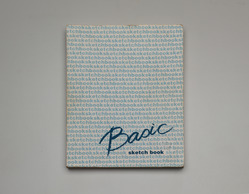
Noriko Ambe, Work of Linear – Actions, Found sketchbook (2000)
27.9 x 21.6 cm (11 x 8 1/2 in.)
The Allan Chasanoff, B.A. 1961, Book Art Collection, curated with Doug Beube- See more here.

Referring to the series Work of Linear – Actions, Ambe writes, “It looks like annual rings of a tree or topographical map or wave, but it isn’t. It is absolutely the traces of actions of a person, which is me.” So here is book art as abstract self-portraiture.
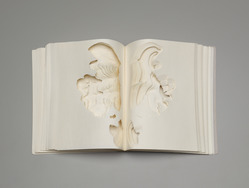
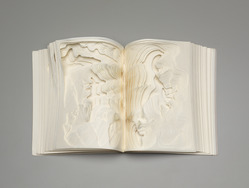
Noriko Ambe, Work of Linear – Actions  (2000)
Noriko Ambe, Work of Linear – Actions, 2000

But in her interview with Hanna Exel and referring to the seriesキル –Artist Books Project, Ambe comments, “I am not trying to express myself or insert myself into the other artist’s work by cutting their catalogue …”. In that series, Ambe selected 24 artists’ books and catalogues, and, studying each carefully , excavated or rather drew by excision. Aren’t these “absolutely the traces of actions of a person” — Noriko Ambe?
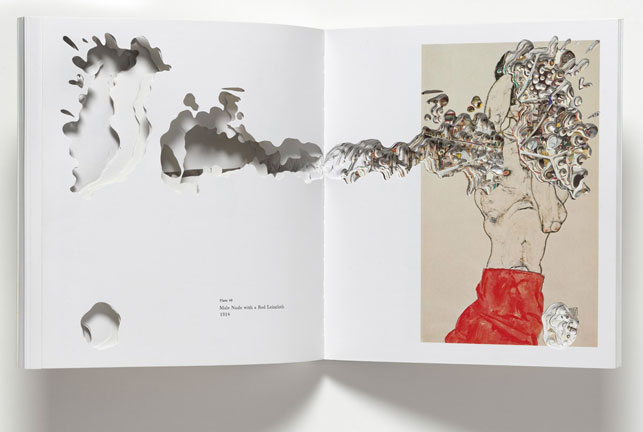
Noriko Ambe, CUT: Egon Schiele, 2009 Artist’s book The Museum of Modern Art, New York. Fund for the Twenty-First Century. © 2013 Noriko Ambe
Noriko Ambe, CUT: Egon Schiele, 2009 Artist’s book The Museum of Modern Art, New York. Fund for the Twenty-First Century. © 2013 Noriko Ambe Noriko Ambe, CUT: Egon Schiele, 2009
Artist’s book
The Museum of Modern Art, New York.
Fund for the Twenty-First Century.
© 2013 Noriko Ambe
Reproduced with the artist’s permission

Here is the list of works in the series:

His heart, his life: Andy Warhol
Collected Beauties: Damien Hirst
Art Victims: Damien Hirst
Prologue: Sugimoto + Foer
Sculpture: Richard Serra
Spiritual America: Richard Prince
Crash!: Takashi Murakami
Kiru- Cut : Egon Schiele
In the Studio: Arberto Giacometti
Current – War Cut: Gerhard Richter
Current – A Private Atlas: Gerhard Richter
In the bathtub?!: Jeff Koons
Diamond Dust Shoes: Andy Warhol
Warning!: Richard Pettibone
Sailing to…: Cy Twombly
Anatomy of Love: John Currin
Listning to Tom Freidman: Tom Freidman
Thoughts on Tom Freidman: Tom Freidman
Beautiful Inside of My Head Forever: Damien Hirst
Dots on Dots and Leyers: Roy Lichtenstein
To Perfect Lovers: Felix Gonzalez-Torres
A Study of Robert Therrein: Robert Therrien
Double sides: Gilbert & George
Artists, Believe in Yourself.: Piotr Uklanski

In her series statement, Ambe elaborates:

The process of creation was divided into roughly three stages. First, I earnestly established a deep respect for the artists and verified what they expressed through their art. After assimilating that information I decided on the theme (title) that needed to be expressed. Through a filter, the filter being me, the work was made while cutting as though I was having a dialogue with each single page.

When cutting something from the back I didn’t know what kind of image would appear next. Each time I decided to cut away or to leave behind and the process continued to a point where the book was on the verge of destruction, and then following my theme I re-constructed. Finally, while I clearly remained in the work as a filter, the essence of the artist was emphasized. It became a collaboration for the first time when these two things were balanced.

She calls the results dialogues and collaborations. I see unique works of art. Literally taking tradition as her material, Ambe delivers book art with its own unmistakeable, individual style. Each interpretation through her eyes, hands and scalpel is a unique, new work and a self-portrait in an abstract sense.

There is not the slightest contradiction.

Bookmarking Book Art – Werner Pfeiffer and Anselm Kiefer

Werner Pfeiffer, Zig Zag, 2010 Laid into drop spine case: One folded sheet (20 x 20 cm.) which unfolds into a paper structure with various panels containing text printed in red and black, including instructions for use of the work. "The structure used in this book is a combination of two accordion folds. Both are first creased, then each segment is cut halfway through at the center and finally the two strips are merged together where the cuts have been made." Sheet laid into case. Limited ed. of 60 copies.
Werner Pfeiffer, Zig Zag, 2010 Laid into drop spine case: One folded sheet (20 x 20 cm.) which unfolds into a paper structure with various panels containing text printed in red and black, including instructions for use of the work. "The structure used in this book is a combination of two accordion folds. Both are first creased, then each segment is cut halfway through at the center and finally the two strips are merged together where the cuts have been made." Sheet laid into case. Limited ed. of 60 copies. Werner Pfeiffer, Zig Zag, 2010
Laid into drop spine case: One folded sheet (20 x 20 cm.) which unfolds into a paper structure with various panels containing text printed in red and black, including instructions for use of the work. “The structure used in this book is a combination of two accordion folds. Both are first creased, then each segment is cut halfway through at the center and finally the two strips are merged together where the cuts have been made.” Limited edition of 60 copies.

“The book is one of the most powerful weapons ever invented.”  — Werner Pfeiffer, Book-Objects & Artist Books, online exhibition, Cornell University Library’s Division of Rare and Manuscript Collections.

Anselm Kiefer, The Rhine 1982-2013 Collages of woodcuts on canvas with acrylic and shellac in a leporello structure

Anselm Kiefer, Der Rhein, 1982-2013
Collages of woodcuts on canvas with acrylic and shellac in a leporello structure.

“The book, the idea of a book or the image of a book, is a symbol of learning, of transmitting knowledge … I make my own books to find my way through the old stories.”   — Anselm Kiefer, publication entry for Brünhilde schläft, in Toledo Museum of Art Masterworks (Toledo, 2009).

Like Anselm Kiefer, though eight years older, Werner Pfeiffer grew up in the shadow of Nazi Germany.  The works of both artists are rooted in the book and its peculiar place in that culture. Pfeiffer’s book-objects consist of deconstructed, dismantled library discards that are reassembled with glue and coated in gesso.  “Gagged and tormented” (with nails, screws, rope and various physical distortions), the works are “symbols of pain, of torture, of suppression which are inevitably brought on by the censor’s act”, the real remnants of which Pfeiffer recalls from his earliest childhood.

Pfeiffer’s artist books on the other hand run the gamut of foldouts, scrolls, flexagons, walk-in environments and rely on traditional bookmaking craft: handset type, letterpress printing, sophisticated binding as well as original print techniques such as wood cuts or linoleum blocks and etchings on archival papers. The emotional range of Pfeiffer’s art is also wide — humorous, playful, piquant, simultaneously angry and sorrowful, concerned. The overriding concerns are straightforwardly explained in the text to the online Cornell University exhibition.

The first schoolbooks I can remember, leftovers from the previous regime, were heavily “edited.” They were books with words and sentences blackened out. Chapters were deleted; entire pages were missing. This was information declared unsuitable for a post-war generation, a generation who six months earlier had been practically obliterated by the events now deemed unfit to be read about. Part of what they had lived through, their own history, had been blocked out, hidden behind those black marks.

Measured by the perceived fears an innocently bound codex seems capable of instilling, the book is one of the most powerful weapons ever invented. And yet we find ourselves at a threshold where its power and influence seem to be waning.

… As in the past, we find at the core of our current socio-political realignment the process of communication…. The new cultural footprint is a set of digits and their application, made possible by the microchip and the speed of electricity….

My book-objects have their origin partly in this ambiguous realm, a period of change as radical as it is dramatic. Superimposed over this perceived uncertainty is my personal concern about censorship. By making books which are deliberately mute I try to raise questions. Words are lost; they are no longer important. The books take on new forms; they become provocative statements. No longer instruments for reading they become sculptures, they become Book-Objects.

As with all superior sculpture, Pfeiffer’s works make the hands twitch to touch and manipulate them. In a few exhibitions, that interaction has even been encouraged. There is something inherently haptic about his book art (for example, Zig Zag and Abracadabra) and his book-objects (for example, Drawing Blood), which can be enjoyed vicariously in these videos: Youtube 1, Youtube 2, Youtube 3 and Youtube 4.

Kiefer’s materials are more varied, more monumental than Pfeiffer’s, and his concerns are decidedly not straightforward. Considering his sprawling studio complex at Barjac, in southeastern France, and its towers and installations, to say that Kiefer’s oeuvre extends beyond book art is an understatement. But for Books on Books, his most moving works — even those in which the book’s material presence is greatly subordinate — remain tethered to book art. The ache to touch Kiefer’s art, however, is different from what you feel with Pfeiffer’s. What little playfulness there may be in some of Kiefer’s earliest pieces is overshadowed by monumental works evoking an urge and dread at the same time.

You feel it walking up the stairs in the Royal Academy, looking up and seeing the sculpture Für Fulcanelli – die Sprache der Vögel, its great wings of beaten lead spread and rising above you.  Between the wings, the body is made of a stack of elephant and double elephant folio books lying flat (or rather gathered folios made of lead like the wings). Interleaved with the closed and open books are rusted metal folding chairs with wooden seats and backs, the kind found in city parks. Thick metal wedges that appear to be wood are inserted at various points to balance out the angular, tilting pile. Separate and lying before this huge bird is a carved wooden snake, elongated and heading right to left as you view the work. The pages of the books curl and fold and roll up as if sodden or aflame. Some are rusted. The bottom-most book has lead binder boards, water stained and looking like marbled paper. Not all of them have binding boards, but all are spineless. You want to touch but know that if you do, your fingers will come away with some alchemical residue of history that will not come off and may burn the skin.

Pfeiffer’s works from a major exhibition in 2011 at Cornell remain on view online. Another major exhibition followed in 2012 at Vassar College.  A new exhibition is scheduled for February 2015 in Toledo, Ohio. More about it in The Blade.

A major retrospective of Kiefer’s art at the Royal Academy of Art concluded in December 2014, coinciding with an hour-long BBC program. An interview with the artist and several podcasts are available on the RA’s site, and the rich and extensive exhibition catalogue provides articles exploring the complex themes of Kiefer’s art.

Bookmarking Book Art – Updating the Mystery Book Artist of Edinburgh

Still anonymous and still a mystery, the MBAE has given BBC Scotland an interview by email.

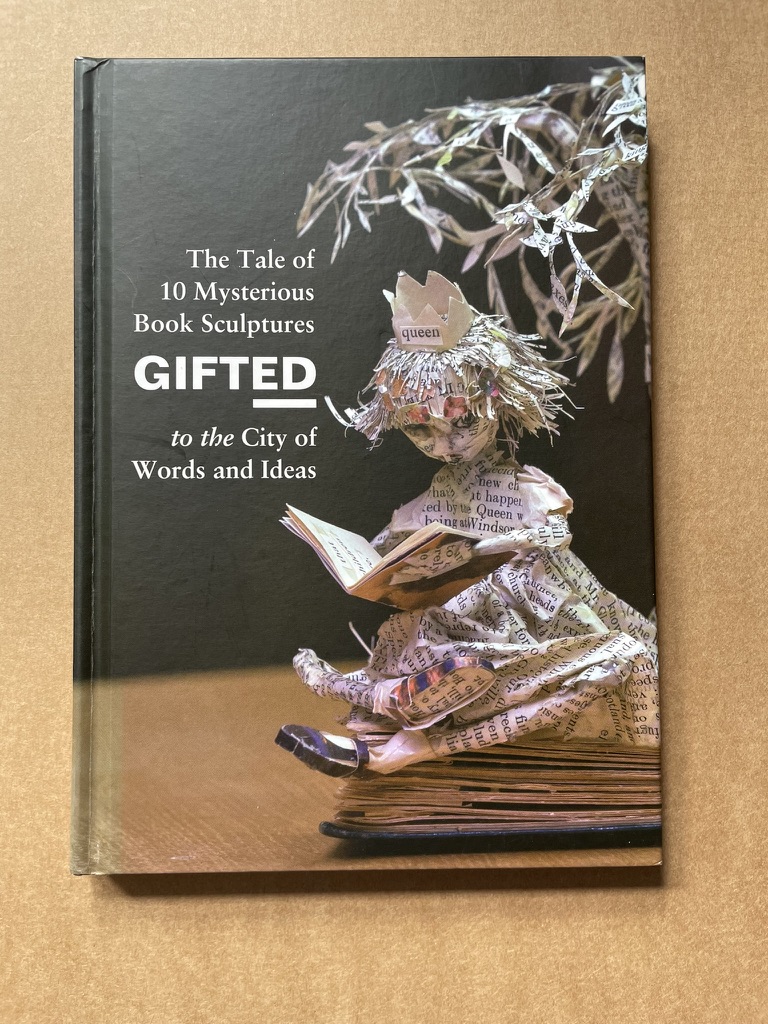
Below are past links on the Mystery Book Artist of Edinburgh, including links to ten videos on the MBAE’s first ten gifts to Edinburgh.  For those wishing for more than digital proximity to the MBAE’s work, GiftEd is the name of the book published last in 2014 about the ten gifts.

http://wp.me/p2AYQg-xz

http://wp.me/p2AYQg-ME

http://wp.me/p2AYQg-AI

http://wp.me/p2AYQg-uT

http://wp.me/p2AYQg-rR

http://wp.me/p2AYQg-p4

http://wp.me/p2AYQg-Li

http://wp.me/p2AYQg-xz

And here are the YouTube videos showing the first ten sculptures “GIFTed” to Edinburgh:

https://youtu.be/kpkEOOgdWps  Opening the first package

https://youtu.be/2nG1rTmYOyQ  Sculpture 1: Poetree

https://youtu.be/69alxg4skdk Sculpture 2: Coffin and Gramophone

https://youtu.be/WGg0CDCADu0  Sculpture 3: Cinema

https://youtu.be/vWVYC80ovQw  Sculpture 4: Dragon’s Nest

https://youtu.be/vaFiM1mnDxo  Sculpture 5: Tea, Cake and a Book

https://youtu.be/4HbqFaoRqzk  Sculpture 6:  Lost in a Good Book …

https://youtu.be/kavik9lg128  Sculpture 7:  Magnifying Glass

https://youtu.be/jlUlTA-W3pM  Sculpture 8:  Cap and Gloves

https://youtu.be/FBo0kzQ-Bxc  Sculpture 9:  Dinosaur

https://youtu.be/K7kIx7lv5CE  Sculpture 10: Street Scene


Bookmark on Reading “Actual Books”

The seasonal flu among expositors of the future of the book and the future of reading is upon us. No sooner does one town cryer sneeze about the latest reading device or software than a town de-cryer follows heralding the superiority of reading print – or vice versa.

Sure enough, here is the Guardian today: “Whisper it quietly, the book is back … and here’s the man leading the revival“. That would be James Daunt, CEO of the UK bookstore chain Waterstone’s, who has used a Russian oligarch’s money to bring the chain to breakeven.

And without a hint of irony, here’s the online-only .Mic demonstrating that variant strains can cross generations and oceans as well as media: “Science Has Great News for People Who Read Actual Books“.  That would be the oft-repeated Norwegian study of two groups of 10th graders, one of which – the print readers – comprehends and retains more than its ebook-reading counterpart.

There are plenty of days remaining before the year’s close for the digital riposte surely on its way to envelop us.  In the meantime, here is a combined and fortified reading list from Christmas bloggings past:

Reading List

Association for Psychological Science (2010, August 30).  Eye movements reveal readers’ wandering minds.  ScienceDaily. Accessed September 8, 2012.

Bookmark for “A Brief History of Reading” (and a Revisit of “The Future of Reading?”). BooksOnBooks. Posted February 13, 2013.

British Association for the Advancement of Science (2007, September 11). Reading Process Is Surprisingly Different Than Previously Thought, Technology Shows. ScienceDaily. Accessed September 8, 2012.

Dehaene, Stanislas. Reading in the Brain. New York: Viking, 2009.

Florida State University (2012, February 14). How Do Children Learn to Read Silently?. ScienceDaily. Accessed September 8, 2012.

Hill, Bill. The Magic of Reading. 1999.

Jabr, Ferris. The Reading Brain in the Digital Age: The Science of Paper versus ScreensScientific American. April 11, 2013.  Accessed 14 April 2013:

Kozlowski, Michael. Amazon Unleashes Immersion Reading and Whispersync for Voice. GoodEReader. Accessed September 8, 2012.

Mangen, Anne, et al. Reading linear texts on paper versus computer screen: Effects on reading comprehension. International Journal of Educational Research. 58 (2013) 61-68.

Mangen, Anne, et al. Evolution of reading in the age of digitisationISCH COST Action IS1404. Updated May 6, 2014. Accessed December 14, 2014.

Mangen, Anne, and Velay, Jean-Luc. Cognitive implications of new media. The Johns Hopkins Guide to Digital Media. Edited by Marie-Laure Ryan, Lori Emerson and Benjamin J. Robertson. Baltimore, MD: Johns Hopkins University Press, 2014.

O’Callaghan, Tiffany. Reading on screens is different – does it matter? New Scientist. October 30, 2014.

Rollins, H.A. Jr., Hendricks, R.  Processing of words presented simultaneously to eye and ear.  J. Exp. Psychol. Hum. Percept. Perform. 1980 Feb; 6(1): 99-109. Accessed September 8, 2012.

Vinall-Cox, JoanMoving From Paper to E-Book Reading.  eLearn Magazine. March 2012.  Accessed September 8, 2012.

Walker Reading Technologies, Inc. LiveInk® (four papers:  jaltcalljournal, National Educational Computing Conference, Reading Online and IEEE International Professional Computing Conference).

Bookmarking Book Art – The Mystery Book Artist of Edinburgh & the Trick of the Light Theatre

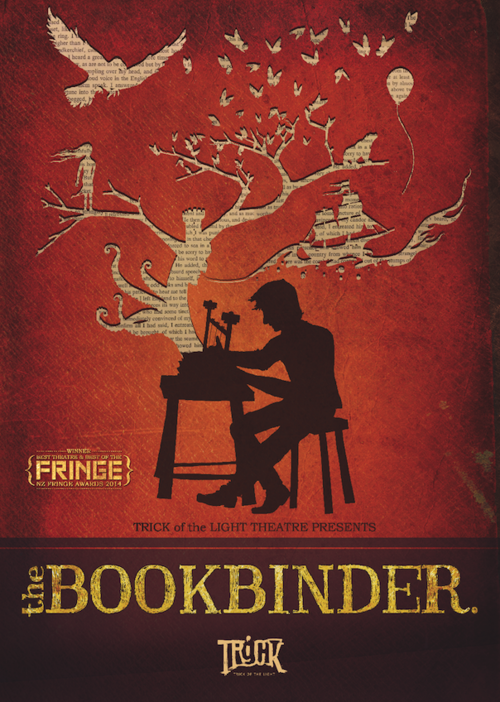
Drawing to its close, does 2014 have any more treats or presents to bestow beyond the return of the Mystery Book Artist of Edinburgh and the debut of “The Bookbinder” from New Zealand’s Trick of the Light Theatre?

The MBAE has donated a new sculpture — a fantastical paper replica of the 16th century merchant’s house known as Riddles Court set behind the Royal Mile — in support of its renovation as home to the Patrick Geddes Centre for Learning and Conservation.  The name of the building and that of the center could not be more appropriate.  This is the 12th gift to Edinburgh’s literary establishment from the artist whose identity remains a mystery.  As well, Geddes featured in the MBAE’s very first gift in 2011 to the Scottish Poetry Library, whose slogan “By leaves we live” originated with Geddes:

6f8915be82f058c2e4b8868455bedb6f
82a9c992efc5870305cf6dd8ff26c732
dd7112103e7cfcd76cb2325a8efc8c5c

read the source poem here). A regular but still anonymous frequenter of the Edinburgh International Book Festival, the MBAE posted this video

of the Riddles Court sculpture in progress, echoing serendipitously “The Bookbinder”, a performance piece on the other side and bottom half of the globe by Trick of the Light Theatre this year.

The Bookbinder Copyright 2014 Trick of the Light Theatre
The Bookbinder
Copyright 2014 Trick of the Light Theatre

Written and performed by Ralph McCubbin Howell, directed by Hannah Smith, with music by Tane Upjohn Beatson, “The Bookbinder” incorporates book sculpture as pop-up book theater and was first performed at Arty Bees Bookshop during the New Zealand Fringe Festival 2014.

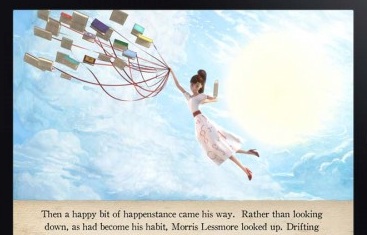
What a pleasure and gift that would be to find the MBAE and “The Bookbinder” in a common festival. If holiday wish lists are allowed, let’s add to it Moonbot Studios, home of The Fantastic Flying Books of Mr. Morris Lessmore.

Morris Lessmore
Copyright 2011 Moonbot Studios

Bookmarking Book Art – “I placed a jar in Tennessee,/ …”

cropped-bookartsHollie Berry has two brief posts on book art at Book Arts at The Open Press (BA@TOP), a supportive community of book artists in Chattanooga, Tennessee, for whom The Open Press provides access to printmaking, book arts, and letterpress classes, workshops and equipment. Her first post offers as examples of the breadth of book art: Dan EssigSandy WebsterBrian Dettmer and Maddy Rosenberg. A good start, if light on installation book artists (say Alicia Martín).

The Open Press is 225 miles from Elizabethton, TN, where Wallace Stevens wrote “Anecdote of the Jar” in 1918 and which is only 67 miles from Asheville Bookworks in West Asheville, NC, where Landon Godfrey hosts Vandercooked Poetry Nights dispatching listeners into the mountain air clutching poems printed on broadsheets from the resident Vandercook Press, on which the authority Paul Moxon lectured in March this year at The Open Press, 199 miles away by the backroads across the Appalachians.  …”And round it was, upon a hill.”

Bookmarking Book Art – Margins and making objects that live forever

Craig Mod modulates on margins here in Medium (18 August 2014).

Text printed on the best paper with no margins or unbalanced margins is vile. Or, if we’re being empathetic, sad. (For no book begins life aspiring to bad margins.) I know that sounds harsh. But a book with poorly set margins is as useful as a hammer with a one inch handle. Sure, you can pound nails, but it ain’t fun. A book with crass margins will never make a reader comfortable. Such a book feels cramped, claustrophobic. It doesn’t draw you in, certainly doesn’t make you want to spend time with the text….

On the other hand, cheap, rough paper with a beautifully set textblock hanging just so on the page makes those in the know, smile (and those who don’t, feel welcome). It says: We may not have had the money to print on better paper, but man, we give a shit. Giving a shit does not require capital, simply attention and humility and diligence. Giving a shit is the best feeling you can imbue craft with. Giving a shit in book design manifests in many ways, but it manifests perhaps most in the margins.

Reiterating his point by analogy, Mod channels the late designer George Nakashima:  “in order to produce a fine piece of furniture, the spirit of the tree must live on. You give it a second life … You can make an object that lives forever, if used properly.

For the fundamentals underlying Mod’s scatologically and poetically emphatic truth, you cannot find much better than Alexander Ross Charchar’s essay on the craft and calculations of “page canons” by Villard de Honnecourt (13th century!) , J.A. Van de Graaf, Raúl Rosarivo and Jan Tschichold:  “The Secret Law of Page Harmony“. Most delightful is Charchar’s dynamic diagram “The Dance of the Four Canons” illustrating the workings of each page canon:

Copyright 2010, Alexander Ross Charchar.

The Further Reading suggested by Charchar and his commenters is excellent, and I would only add Marshall Lee’s Bookmaking. For those who are irritated with the imposition of the print paradigm on the digital reading experience, there is a useful pointer to applying the page canons to website design that will cause a rethink of that irritation and equally make the imposers think harder as well.

For those who care about the book, what it is evolving into and the role that heart, mind and design still play in that process, read Charchar’s”The Secret Law of Page Harmony” –again and again.

Bookmarking Book Art – Metamorphosis and the MBAE

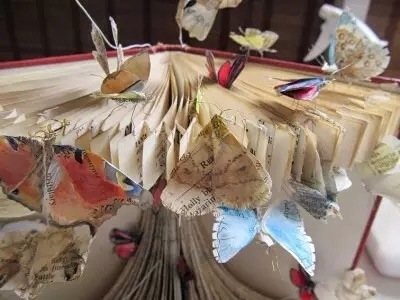
The Mystery Book Artist of Edinburgh has emerged again – this time from a chrysalis into a cloud of butterflies. The work shown will be auctioned for the benefit of Macmillan Cancer. The Macmillan Art Show will be opened this month by the mystery author Alexander McCall Smith: http://macmillanartshow.org/.

20140803-110035-39635657.jpg

Bookmarking Book Art — Francisca Prieto (I)

Trained at Central St Martins, Francisca Prieto is a Chilean artist living and working in London where her work has featured in collections at the Victoria and Albert Museum, the Tate Gallery and the British Library among others. From 29 May through 21 June, her solo exhibition Underlined runs at Jagged Art, off Marylebone High Street in London.

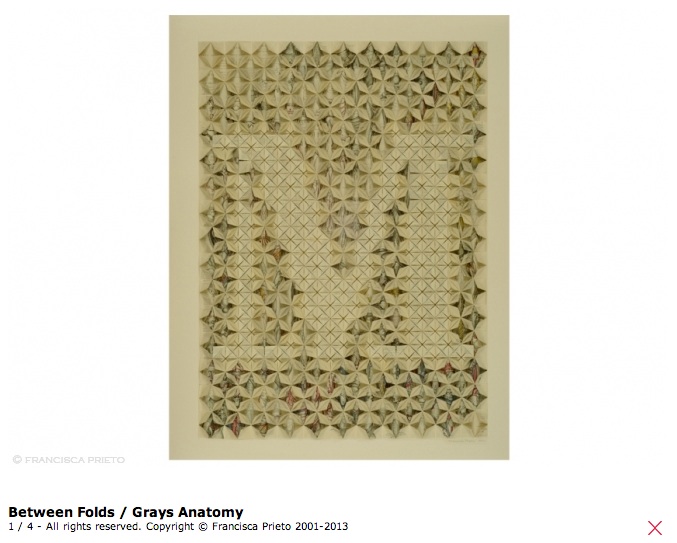
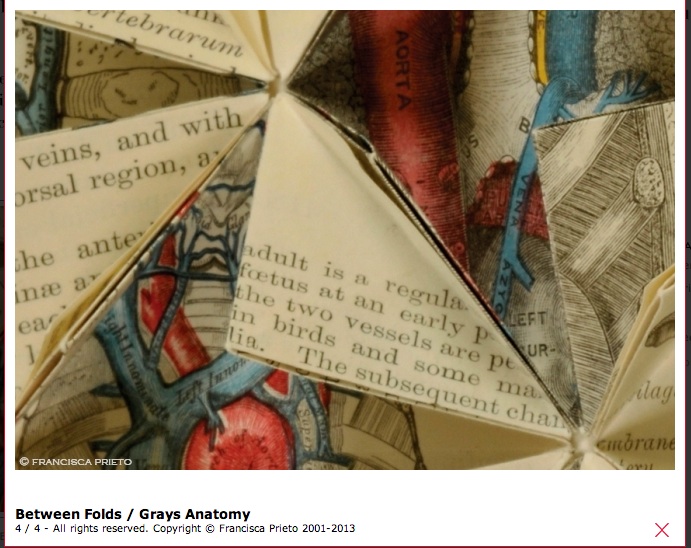
Underlined extends — or rather deepens — her series Between Folds, which according to her artist’s statement “explores pages of rare and damaged books or forgotten ephemera, emphasising the beauty and detail of print that would otherwise go unseen.” Prieto’s grounding in typographical design drives Between Folds as is obvious from the letters created from the pages of Grays Anatomy and Bartlett’s British Scenery.Between Folds - Anatomy - Letter M

Between Folds - British Scenery - Letter O


Detail of Between Folds/Anatomy

The precision of the folds in Prieto’s work becomes even more evident in the eight compositions of Underlined, which is fitting as she now delves through source material past the letterforms and down to the line. Look how the folds align and intersect with the lines of the source material in the detail below.

Detail - Composition No. 1 © Francisca Prieto, 2014
Detail – Composition No. 1: A Diagonal Line
© Francisca Prieto, 2014

The source material in this case is The Wanderers Cricket Club Logbook, whose red lines strike vertically down the diagonal, the folds of the work “playing with direction and motion, as the ball of the game dictated each log of play”.  Prieto’s art is not only playful but thought-provoking, the cause of a sudden intake of breath from delight or even shock — what we most seek in our experiences of art. Do you not draw in your breath as you read between the folds and past the title and shape of Composition No. 2: One Horizontal Line to see that it is the line drawn under the life from whose last will and testament Prieto has created this work?

This dialogue between the parts and the whole to which Prieto’s craft and vision continuously draw the eye, heart and mind elevate her work and its audience.

Additional commentary on her work can be found at www.blankproject.co.uk.


Bookmarking Book Art – Abigail Thomas

Image

Micro-Pages, a book arts exhibition curated by Abigail Thomas, toured throughout the UK in 2009 & 2010.

As a participating artist as well as being the curator and project instigator, and having worked in a library/archive for several years, I wanted to explore issues that affect libraries and archives as well as the book art world. Books have it in their nature to be handled; they are intimate objects whose feeling, texture, weight and smell are part of their artistic aura. Glass cases can remove the experience of the work, and you are unable to see it in its entirety, however, having books out also has its disadvantages. Should we treat artists’ books as archival material? This is the point that the project starts from. From the artist’s website.

The form of this exhibition also reflected Thomas’s concern with the book as machine, or reading machine. With microfilm, the reader is cast back into the age of scrolls and paginae, forerunners to the pages of the codex, yet is also suspended between the print codex and and arrival at what Thomas might agree is “an” imagined future escape from the page into the scrolling web.

Only “an” because Reading the Imagined Escape from the Page is Thomas’s live reading event, consisting of a projection, a leaflet/bookwork/handout and her lecture-style commentary. First delivered at the Arnolfini, Bristol in April 2013, the performance echoed and extended Micro-Pages in its collage/collision of visual projection, paper and screen.

Image
Image

Another instance of an imagined escape from the page can be explored in Thomas’s essay “Bob Brown’s Reading Machine and the Imagined Escape from the Page”published in Artist’s Book Yearbook 2014/15 (Impact Press, ISBN 978-1-906501-07-5). Here’s the author’s abstract:

Bob Brown imagined an escape from the page; the restrictive nature of the form of the ‘antiquated book’ following into new forms of technology and machine reading. This investigation functions as an inquiry into the idea of the reader as machine; in Bob Brown’s printed experiments in optical reading, can we ever escape the page? In writing for the imagined machine, and in using the page and its restrictions Brown was able to imagine these ideas and new ways of reading. Punctuation and page layout were devices used by Bob Brown and the poets involved with The Readies for Bob Brown’s Machine, The Readies, and Words to represent the movement and speed of a new form of reading through an imagined machine. This essay argues that they actually force the reader[s] themselves into becoming the reading machine perhaps without losing their humanity and without the need for the machine itself. The concepts contained within the writing, and the aspects of optical text design, challenges the page and the way we read, within all three books, and allows the machine to come alive within the text itself and so within the reader. From the author’s website.

Craig Saper (cited by Thomas) published a biography of Brown in 2016. More on Bob Brown and Abigail Thomas can be found in Amaranth Borsuk’s The Book (MIT Press, 2018), reviewed here

Thomas’s works and their conceptual challenges to the page reify in a thought-provoking way the more academic explorations in Stoicheff and Taylor’s The Future of the Page. Rich in its consistent conceptualization, her work articulates the loss of the haptic but only seems poised to instantiate or at least insinuate a palpable physicality that would lift her art to new levels.