Books On Books Collection – Don Robb and Anne Smith

Ox, House, Stick (2007)

Ox, House, Stick: The History of Our Alphabet (2007)
Don Robb (text) and Anne Smith (ills)
Casebound, illustrated paper over boards. H280 x W217 mm. 48 pages.Acquired from The Saint Bookstore, 14 August 2022. Photos: Books On Books Collection.
Text copyright © 2007 by Donald Robb. Illustrations copyright © 2007 by Anne Smith/Lilla Rogers Studio.
Used with permission by Charlesbridge Publishing, Inc. 9 Galen Street, Suite 220, Watertown, MA 02472. (617)-926 0329  

A fair number of fiction and non-fiction children’s books on the history of the alphabet have made their way into the Books On Books Collection.

Of the fiction variety, there is Rudyard Kipling’s “Just So Story” of the alphabet’s invention: How the Alphabet Was Made (1983), illustrated by Chloe Cheese. Another fiction entry is James Rumford’s retelling of Cadmus’ visit to Crete in There’s a Monster in the Alphabet (2002) and William Joyce’s inventive The Numberlys (2014).

In the non-fiction category are William Dugan’s How Our Alphabet Grew (1972), Tiphaine Samoyault’s Alphabetical Order (1998), Renzo Rossi’s The Revolution of the Alphabet (2009) and the entry here: Don Robb’s and Anne Smith’s Ox, House, Stick.
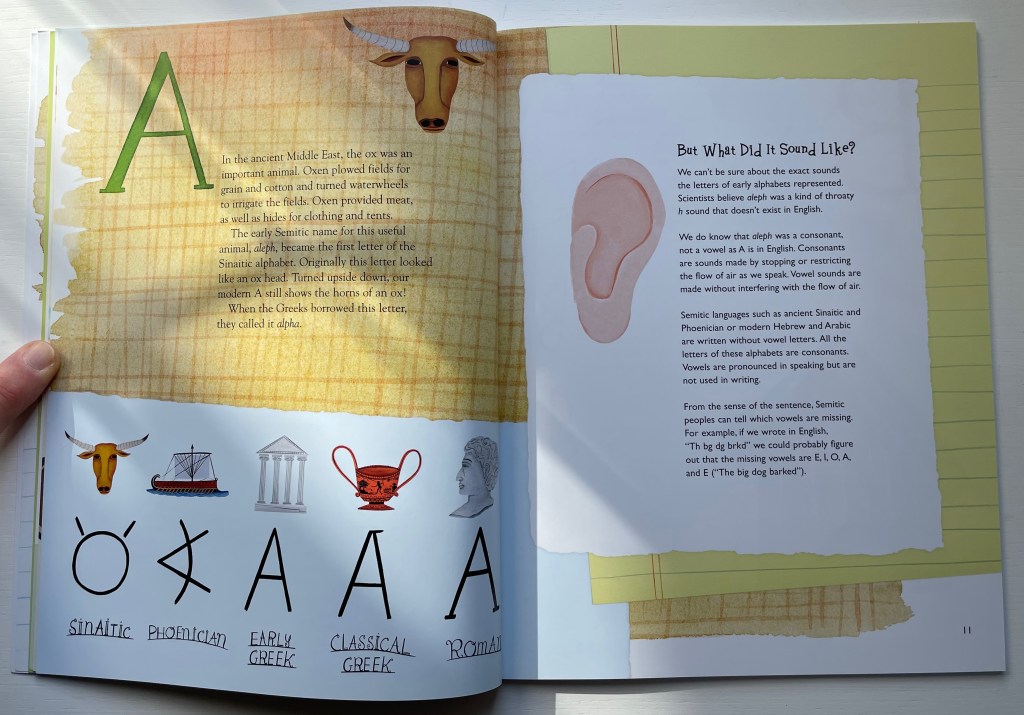
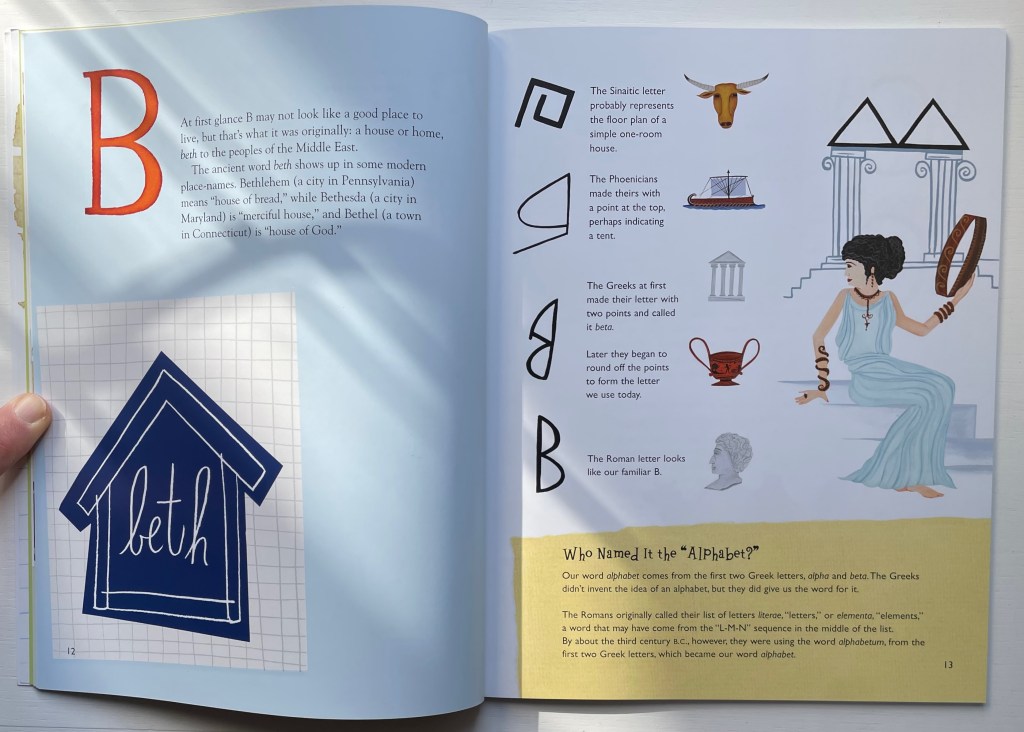
Ox, House, Stick is scheduled to appear as part of an exhibition at the Bodleian Libraries in Oxford (opening 15 July 2023). “A is for Ox” designates the display case devoted to the question: Where did the alphabet come from? It’s not just a question for archaeologists, historians, linguists and paleographers — or children’s book authors and illustrators. It’s one generating repeated inspiration for book artists as shown by Abe Kuipers’ Letters (1971), Lanore Cady’s Houses & Letters (1977), another rendition of the Kipling tale by Gerald Lange in The Neolithic Adventures of Taffi-Mai Metallu-Mai (1997), designed by Gerald Lange and produced with Robin Price, Dave Wood’s Alphabetica (2002), Cari Ferraro’s The First Writing (2004), and Helen Malone’s Alphabetic Codes (2005).

Artists’ books share much with children’s books in general. They both play with form and structure. They play with words and images, sometimes images without words and sometimes just shapes. Almost always an attention to all the senses. Children’s alphabet books in particular display features that appeal to book artists: play with animals, the Babel of languages, bodies, calligraphy, colors, design (of letters, page and book) and, as above, alphabet origin stories. Viewing and exploring alphabet books and artist’s books side by side heightens the enjoyment and appreciation of both.

Further Reading

Abecedaries I (in progress)“. Books On Books Collection.

Lanore Cady“. 16 December 2022. Books On Books Collection. Artist’s book.

William Dugan“. 10 July 2023. Books On Books Collection.

Cari Ferraro“. 1 February 2023. Books On Books Collection. Artist’s book.

William Joyce“. 18 June 2021. Books On Books Collection.Illustrated children’s book.

Rudyard Kipling and Chloë Cheese“. 15 February 2023. Books On Books Collection. Illustrated children’s book.

Rudyard Kipling and Gerald Lange“. 16 April 2023. Books On Books Collection. Artist’s book.

Abe Kuipers“. 15 February 2023. Books On Books Collection. Artist’s book.

Helen Malone“. 23 July 2020. Books On Books Collection. Artist’s book.

Renzo Rossi“. 10 July 2023. Books On Books Collection.  Illustrated children’s book. [In progress]

James Rumford. 21 November 2022. Books On Books Collection. Illustrated children’s book.

Tiphaine Samoyault“. 10 July 2023. Books On Books Collection. Illustrated children’s book. [In progress]

Animal alphabets & artists’ books

Marie Angel, An Animated Alphabet (1996)

Leonard Baskin, Hosie’s Alphabet (1972)

Paul Cox, Abstract Alphabet: A Book of Animals (2001)

E.N. Ellis, An Alphabet (1985)

C.B. Falls, ABC Book (1957)

David L. Kulhavy & Charles D. Jones, A Forest Insect Alphabet (2013)

Enid Marx, Marco’s Animal Alphabet (2000)

Carol Schwartzott, ABC of Birds (2020)

Borje Svensson & James Diaz, Animals (1982)

John Norris Wood, An Alphabet in Praise of Toads & Frogs (2002)

Babel, alphabets & artists’ books

Golnar Adili, Father Gave Water/Baabaa Aab Daad (2022)

Islam Aly, 28 Letters (2013)

Brynja Baldursdottír, Fuþorc (1992)

Ellen Heck, A is for Bee (2022)

Tatyana Mavrina, Сказочная Азбука / Skazochnaia Azbuka / A Fairy Tale Alphabet (1969)

Claire Jeanine Satin, Alphabook (1998/99)

Ben Shahn, The Alphabet of Creation (1954)

Jana Sim, Both but between (2021)

Sam Winston, One and Everything (2022)

Bodies & artists’ books

Anthon Beeke, Alphabet (1970)

Anthon Beeke & René Knip, Body Type (2011)

Edward Gorey, Figbash Acrobate (1994) In progress

Toshifumi Kawahara, Dancing Alphabet (1991)

Françoise and Douglas Kirkland, Physical Poetry Alphabet (2018)

Marie Lancelin, Gestes Alphabétiques (2014)

Lisa Merkin, Bodies of Language (2021)

Annette Messager, Mes Enluminaires (1988) [In progress]

Vítězslav Nezval, Abeceda/Alphabet (1926/2001)

Rowland Scherman, Love Letters (1975) [In progress]

Calligraphy, alphabets and artists’ books

Mari Angel, Marie Angel’s Exotic Alphabet (1992)

Tauba Auerbach, How to Spell the Alphabet (2007)

Rebecca Bingham, Lady Letters (1986)

Rebecca Bingham, Alphabet Salmagundi (1988)

Carol DuBosch, Alphabet of Calligraphic Tricks (2014)

Carol DuBosch, Embossed Alphabet Gallery (2019)

Francesca Lohmann, An Alphabetical Accumulation (2017)

Suzanne Moore, A Blind Alphabet (1986)

Edward Andrew Zega & Bernd H. Dams, An Architectural Alphabet : ABC (2008)

Colors, alphabets and artists’ books

Rebecca Bingham, Golden Alphabet (1986)

Rebecca Bingham, Defining the Rainbow (2018)

Sonia Delaunay, Alphabet (1972)

Carol DuBosch, Rainbow Alphabet Snowflake (2013)

Ursula Hochuli-Gamma, 26 farbige Buchstaben (1986)

Karen Hanmer, The Spectrum (2003)

Amy Lapidow, Spiralbet (1998)

Lisa McGarry, Be Amazed (and other words to live by) (2013)

Kveta Pacovská, A l’infini (2007)

Design (of letters), alphabets & artists’ books

Anne Bertier, Anne Dessine-moi une lettre(2004)

Roberto de Vicq de Cumptich, Bembo’s Zoo: An Animal ABC Book (2000)

Felice Feliciano & Jason Dewinetz, Alphabetum Romanum: The Letterforms of Felice Feliciano (c. 1460, 2010)

Jeff Morin and Steven Ferlauto, The Sacred Abecedarium (1999)

Andrew Morrison, Two Wood Press A-Z (2020

David Pelletier, The Graphic Alphabet (1996)

Bruce Rogers, Champ rosé (1933)

Kevin Steele, The Movable Book of Letterforms(2009)

Sharon Werner & Sharon Forss, Alphabeasties (2009)

Structures, alphabets & artist’s books

Kathleen Amt, Kaleidoscopic ABC’s (1991)

Matsumasa Anno, Anno’s Magical Alphabet (1981)

Marion Bataille, ABC3D (2008)

John Crombie, ABC in a maze (1987)

Carol DuBosch, Rainbow Alphabet Snowflake (2013)

Carol DuBosch, Embossed Alphabet Gallery (2019)

Helen Hajnoczky, alpha seltzer (2023)

Karen Hanmer, A2Z (2013)

Karen Hanmer, The Spectrum (2003)

Helen Hiebert, Alpha Beta (2010)

Ron King, Alphabeta Concertina majuscule (2007)

Ron King, alphabeta concertina miniscule (2007)

Ron King, The White Alphabet (1984) In progress

Ron King, ABC Paperweights (nd)

Amy Lapidow, Spiralbet (1998)

Scott McCarney, Alphabook 3 (1986)

Scott McCarney, Alphabook 10 (2015)

Scott McCarney, Alphabook 13 (1991)

Lisa McGarry, Twenty-six/Fragments (2012)

Patrice Miller (Edward Gorey), The Eclectic Abecedarium (2022)

Patrice Miller (Edward Gorey), Figbash Acrobate (2023)

Jeff Morin and Steven Ferlauto, The Sacred Abecedarium (1999)

Jeff Morin and Steven Ferlauto, Sacred Space (2003)

Moveable Book Society, A to Z Marvels in Paper Engineering (2018)

Bruno Munari, ABC con fantasia (2008)

Bruno Riboulot, ABCD’Air (2005)

Merrill Shatzman, Calligrafitti #3 (2011)

Borje Svensson & James Diaz, Letters (1982)

Emmett Williams, abcdefghijklmnopqrstuvwxyz (1963) In progress
Books On Books Collection – Abe Kuipers

Letters (1971)

Image removed. Fair use not accepted.

Letters (1971)
Abe Kuipers
Self-covered set of folios. H257 x W190 closed, W380 open. 8 folios. Edition of 80. Acquired from Bubb Kuypers Auction, 22 November 2022.

In the late 1960s and early ’70s, Pieter Brattinga‘s 250×250 mm Kwadraat Blad series championed the innovative typographic designs of Wim Crouwel, Gerard Unger, Timothy Epps and Christopher Evans. Theirs were radical explorations of the letterform. Even “bad boy” Anthon Beeke‘s cheeky Alphabet was based on the Baskerville typeface — at least as far as the nude female models could be posed to approximate it. At the same time, further north in The Netherlands, Abe Kuipers was pursuing a very different kind of offbeat presentation of the alphabet.

As far back as the ’40s and ’50s, Kuipers had been interested in the alphabet’s origins. In 1951, he had organized the Fifty Years of ABC for the Prinsenhof in Groningen and years later published a book based on it with Wolters-Noordhoff (Groningen). In 1971, drawing on that activity, he participated in the “Létteretét projekt”, aimed at educating the people of Groningen about letters and their origins. Like the enterprise and its manifestations, the name Létteretét is an offbeat construction. Office rooms in high rises were lit to form letters at night. A poster illustrating the origin of letters (and promoting his 1968 book) was posted on billboards, in shop windows and in schools and libraries.

Image removed. Fair use not accepted.

The bottom right corner panel reads:
this history of the letter was written and drawn by abe kuipers in may 1971. printed in silkscreen by De Ark
this print is part of the Létteretét project in Groningen.

Kuipers reconfigured this poster into an artist’s book of 80 copies. Its bright colors, ad-like images, cartoonish drawings, photos, typewriter lettering and hand-scrawled text pull the ancestors of A, B, C and D (aleph, beth, gimel and daleth) into the present in folios folded in half and loosely held by a folio formed from the poster’s title panel. Articulating aleph into the face of a cow, a cartoon businessman re-enacts the ancient Semitic sound’s naming of the animal, which wears an inverted A bridle recalling the letter’s first discovered shape. The be-suited cartoon character alludes to paleographical theory that the alphabet had its roots in signs for accounting and inventories. The letter B receives similar treatment in the vacation postcard. The character in desert clothing says beth at the pair of pup tents forming the letter B on its side, the swimsuited man explains that “tent” equals “house”, which beth designated, and, having drawn the development of the sign into its modern form, the swimsuited woman articulates the letter. And so on for all the letters of the alphabet.

Certainly Kuipers knew that there were books and exhibitions for educating the general populace about the origins of the alphabet. He had been there and done that. But it is a wonderful proposition that art and design should confront the general populace with it and that they should be aware of it in everyday life.

Further Reading

Abecedaries I (in progress)“. Books On Books Collection.

Lyn Davies“. 7 August 2022. Books On Books Collection.

Timothy Donaldson“. 1 February 2023. Books On Books Collection.

Cari Ferraro“. 1 February 2023. Books On Books Collection.

Rudyard Kipling and Chloë Cheese“. Books On Books Collection. [In process]

James Rumford. 21 November 2022. Books On Books Collection.

Ben Shahn“. 20 July 2022. Books On Books Collection.

Tommy Thompson“. 21 August 2022. Books On Books Collection.

Bernal, Martin. 1990. Cadmean Letters : The Transmission of the Alphabet to the Aegean and Further West Before 1400 B.C. Winona Lake IN: Eisenbrauns.

Diringer, David, and Reinhold Regensburger. 1968. The alphabet: a key to the history of mankind. London: Hutchinson. A standard, beginning to be challenged by late 20th and early 21st century archaeological findings and palaeographical studies.

Drucker, Johanna. 1999. The alphabetic labyrinth: the letters in history and imagination. New York, N.Y.: Thames and Hudson.

Firmage, Richard A. 2001. The alphabet. London: Bloomsbury.

Fischer, Steven Roger. 2008. A history of writing. London: Reaktion Books.

Jackson, Donald. 1997. The story of writing. Monmouth, England: Calligraphy Centre.

Kuipers, Abe Johannes. 1968/1969. Opschrift Op Schrift. Groningen: Wolters-Noordhoff.

Moziani, Eliyahu. 1984. Torah of the Alphabet or How the Art of Writing Was Taught Under the Judges of Israel (1441-1025) : -The Original Short Course in Alphabetic Writing Conceived by Israel in Sinai. Herborn: Baalschem.

Pflughaupt, Laurent. 2008. Letter by letter: an alphabetical miscellany. New York: Princeton Architectural Press.

Robinson, Andrew. 1995. The story of writing. London: Thames and Hudson.

Rosen, Michael. 2014. Alphabetical: how every letter tells a story. London: John Murray.

Sacks, David. 2003. Language visible unraveling the mystery of the alphabet from A to Z. New York: Broadway Books.

Shaw, Gary. 15 April 2021. “Ancient ABCs: The alphabet’s ‘missing link’ discovered in Israel“. The Art Newspaper.

Van Genderen, Ans. 2022. “Abe Kuipers“. Dutch Graphic Roots. Eindhoven: [Z]OO producties. Accessed 20 November 2022. Also available in print from [Z]OO producties.

Books On Books Collection – Timothy Donaldson

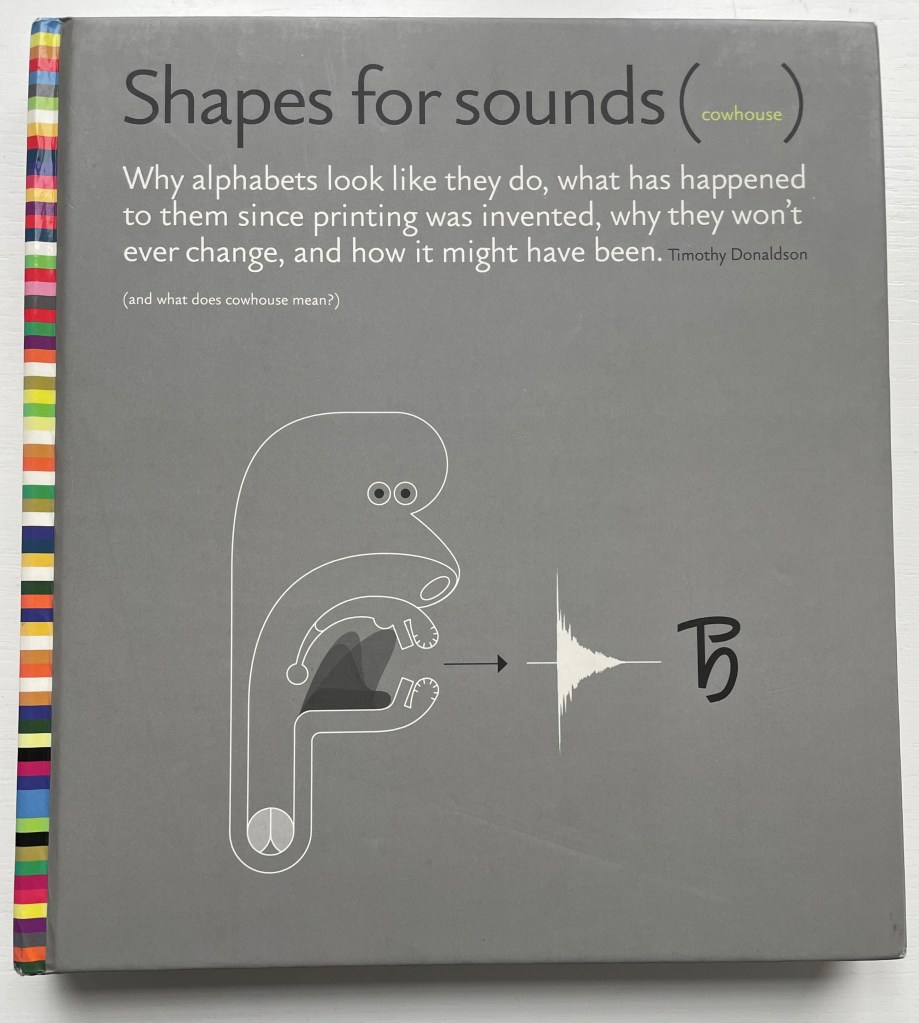
Shapes for Sounds (cowhouse) (2008)

Shapes for Sounds (cowhouse) (2008)
Timothy Donaldson
Casebound, paper over boards, illustrated doublures with foldouts, sewn book block, endbands. H250 x W225 mm. 176 pages. Acquired from KP Enterprise, 13 September 2022.
Photos: Books On Books Collection.

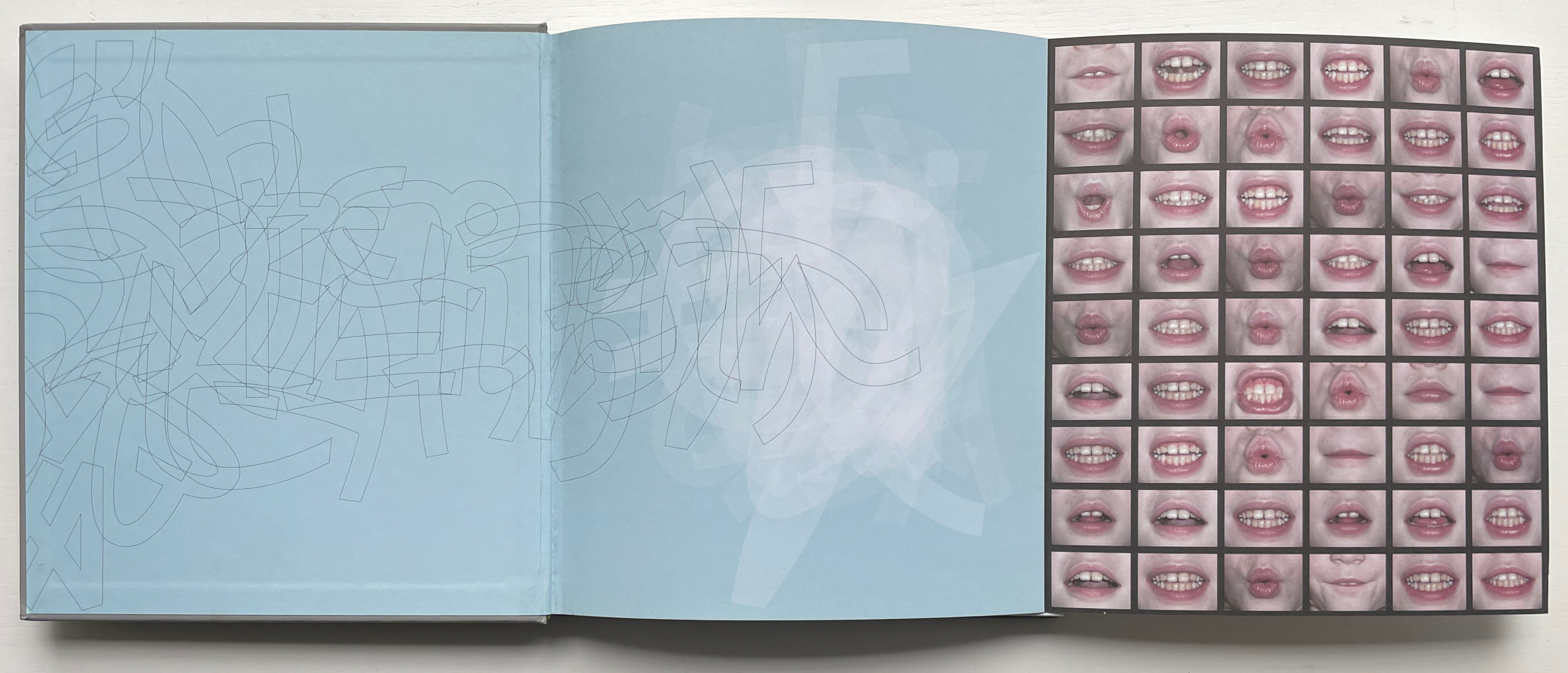
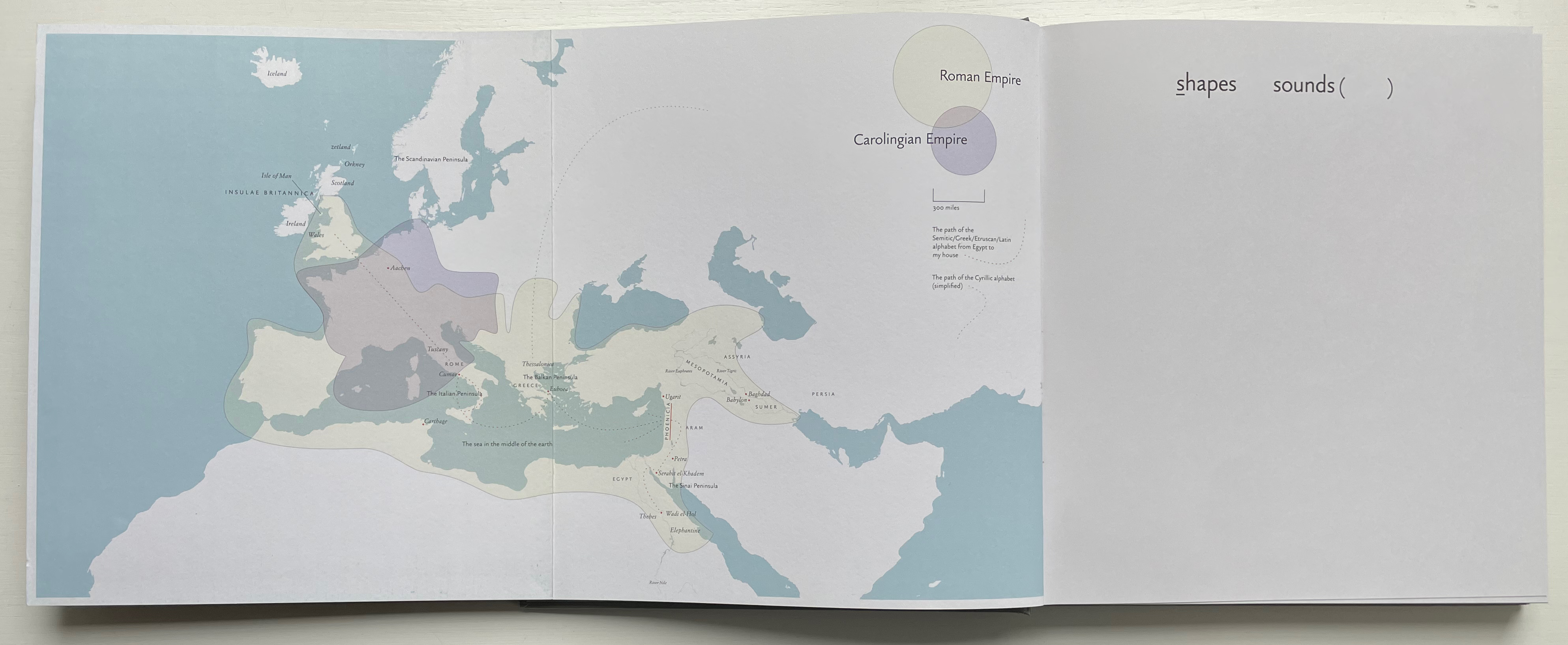
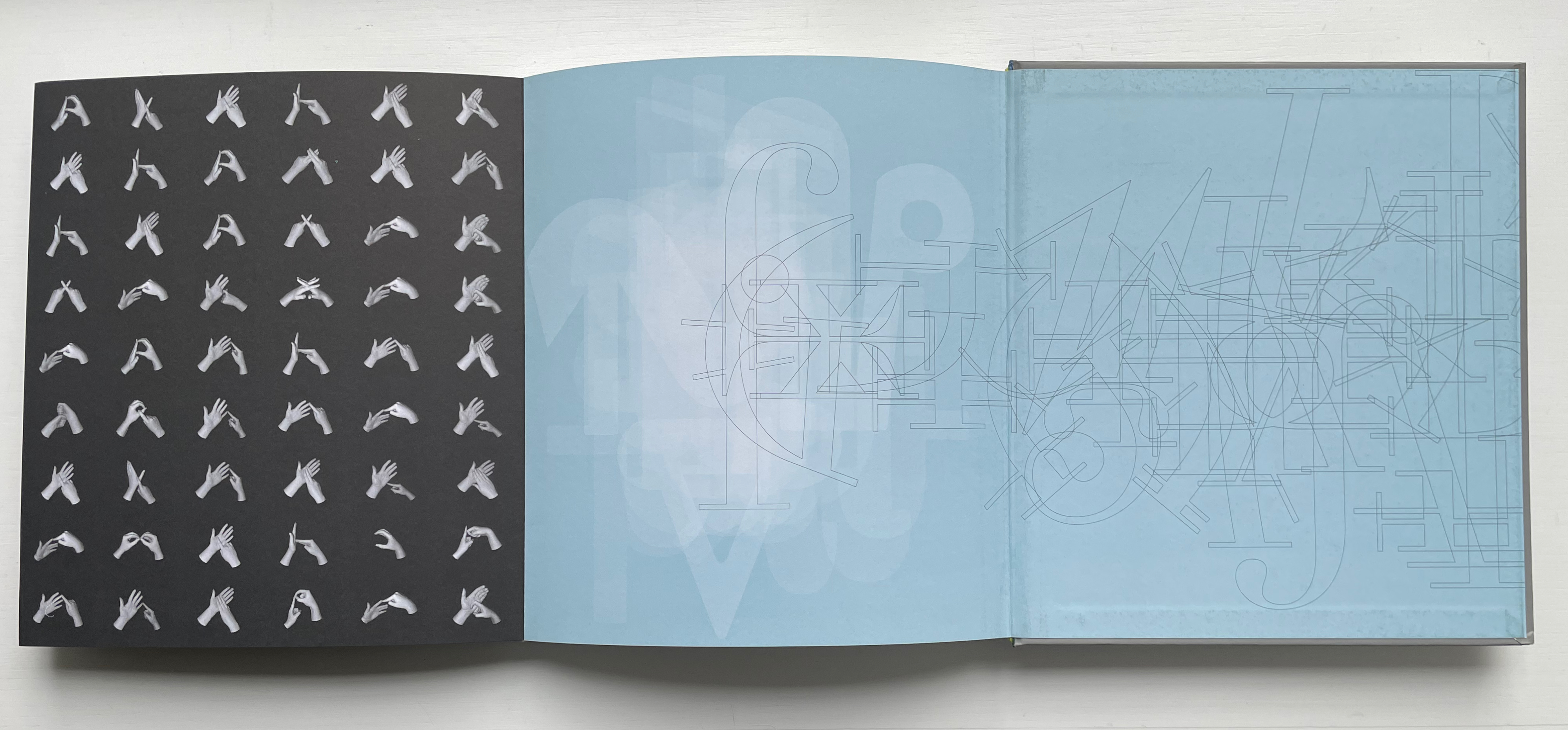
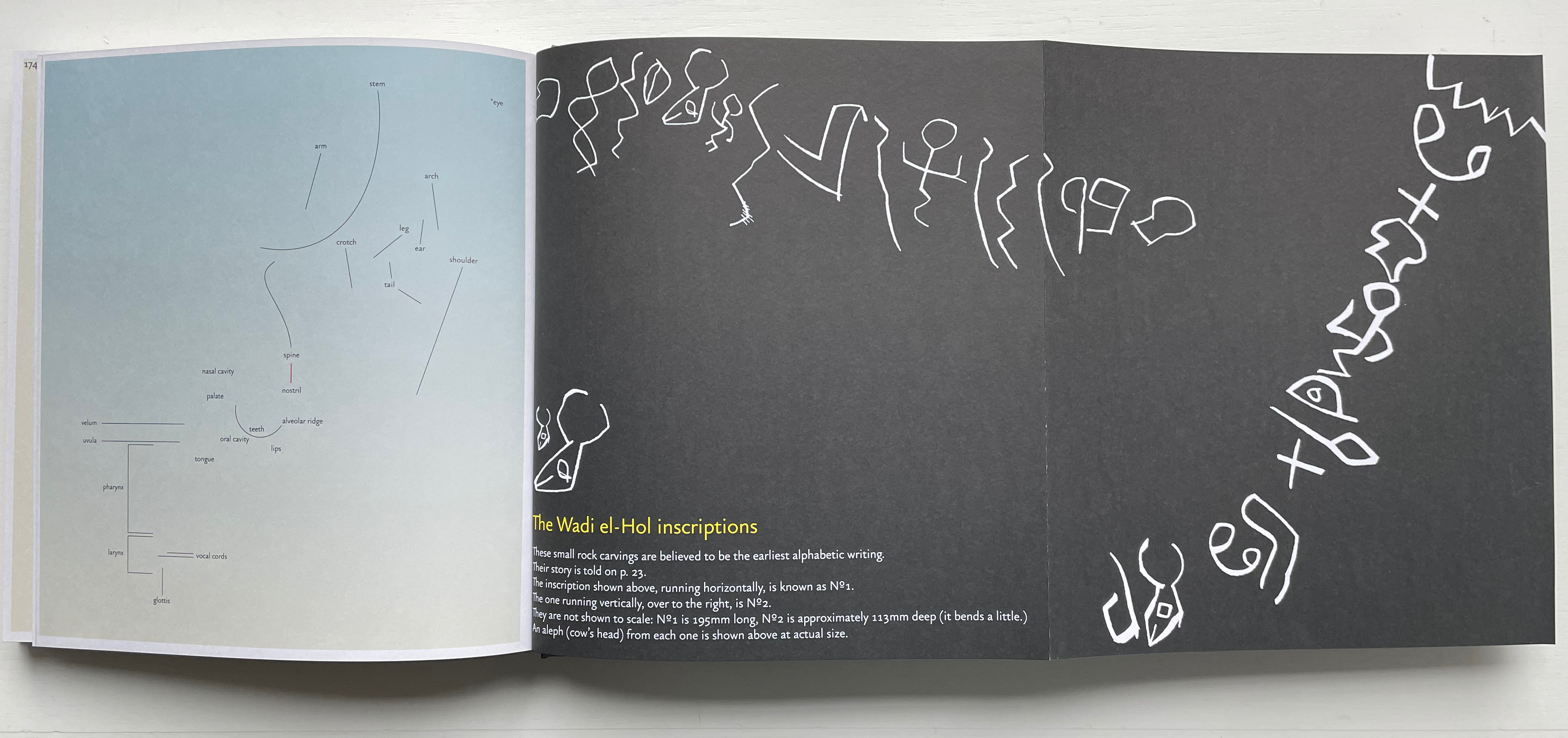
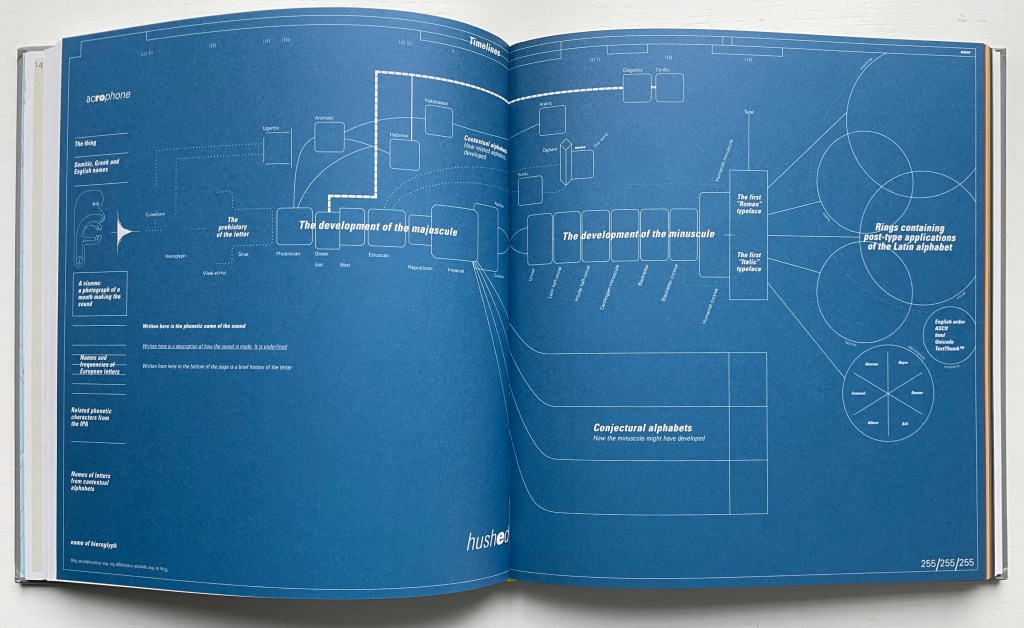
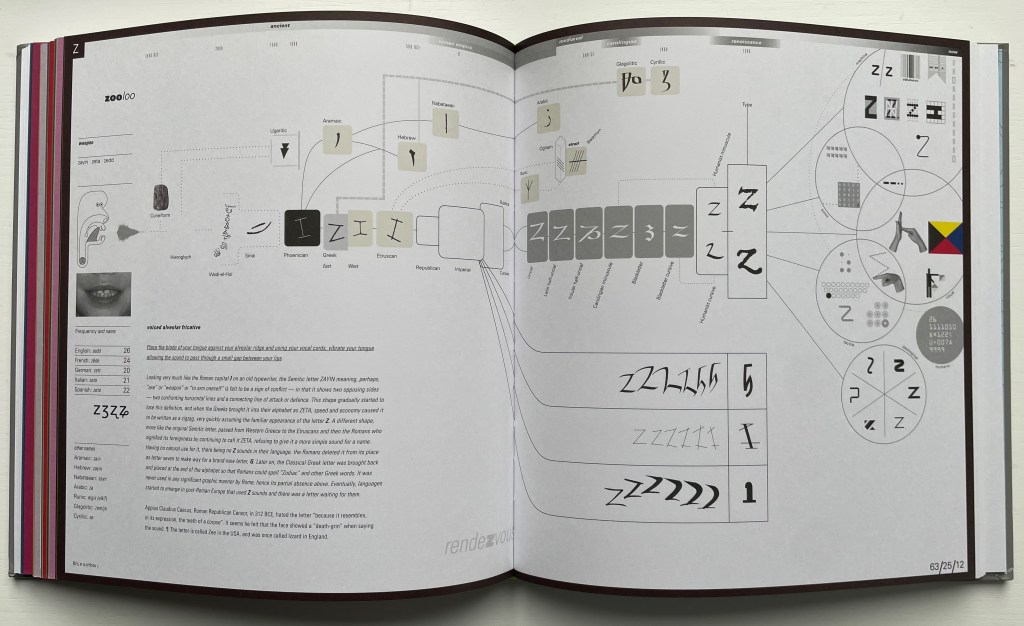
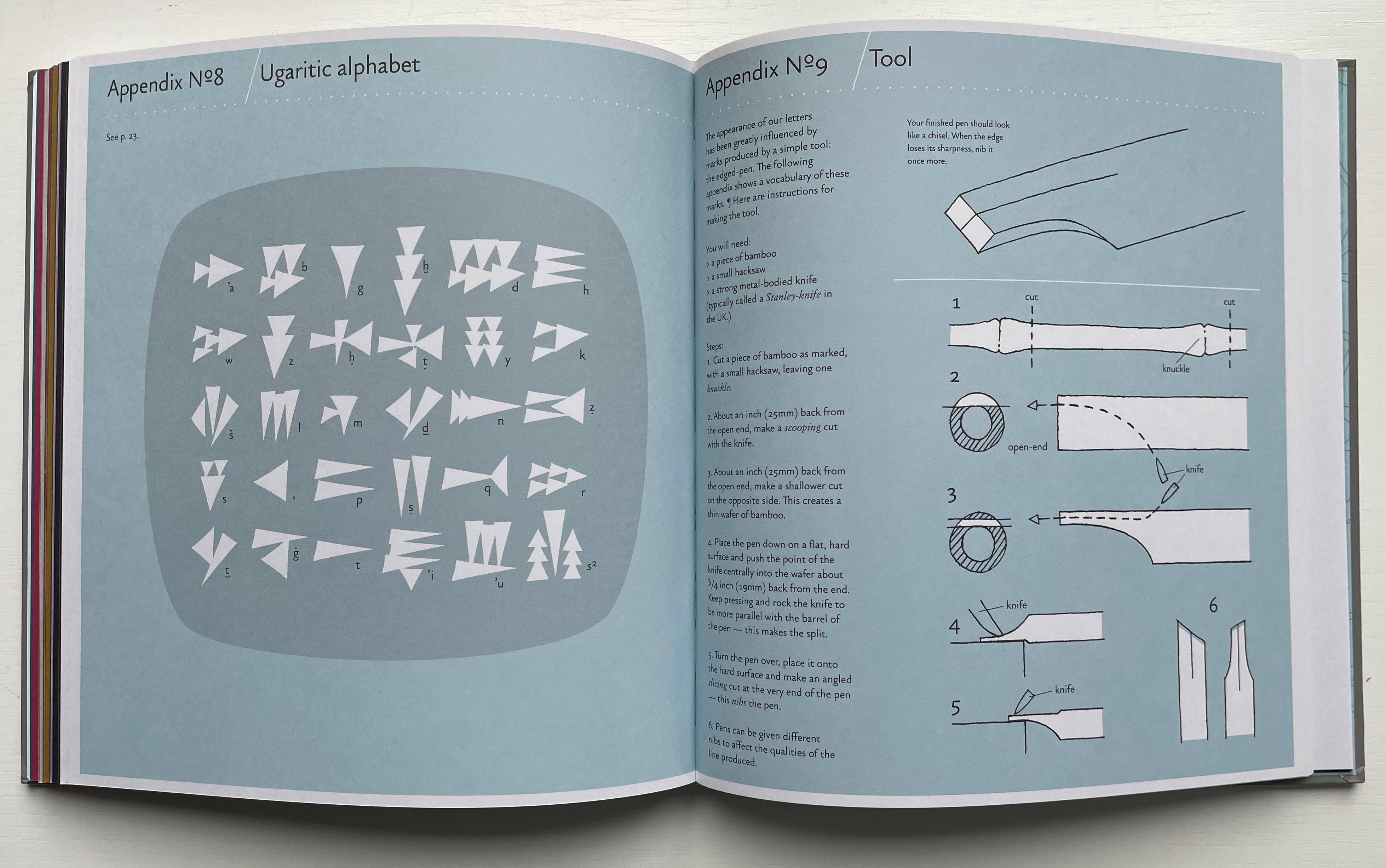
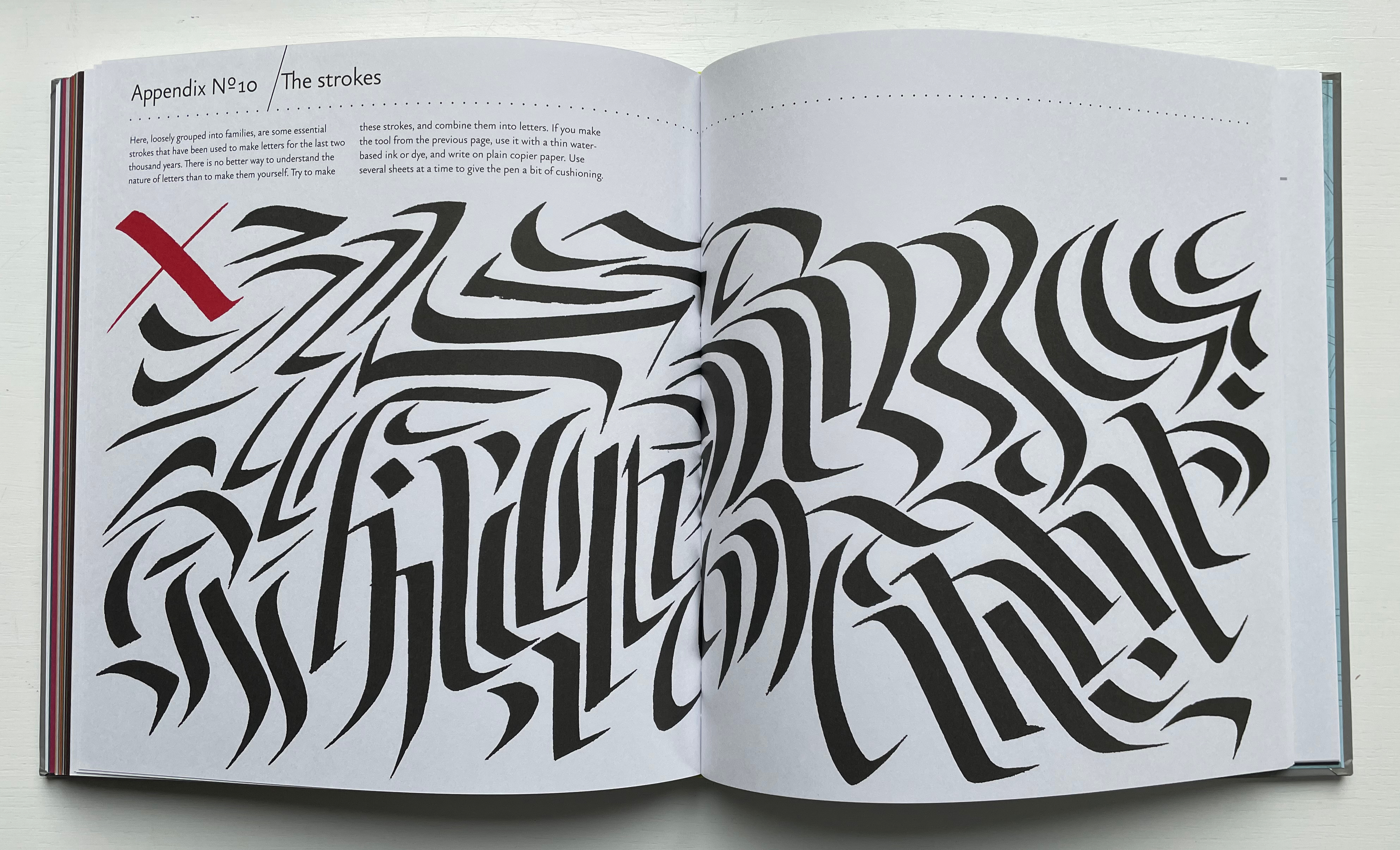
Timothy Donaldson’s Shapes for Sounds (cowhouse) gives the word infographics an amusing twist. Here the alphabet, which began in pictographs, winds up in an alpha-pictographic form of representation: twenty-six double-page spreads and thirty-seven appendices mapping almost all of the alphabet’s vast terrain. A tour de force of design (the main text is even set in a typeface of the author’s making, and the double-sided foldouts integrated with the endpapers are sheer showmanship), the book can almost be forgiven for missing out the ampersand.

Calligrapher, typographer, performer, letterworker (as he calls himself) and artist, Donaldson could rightly call Shapes for Sounds (cowhouse) an artist’s book if he wanted. Among the alphabet reference works in the Books On Books Collection (and those consulted elsewhere), it has these claims to singularity in addition to its artistry.

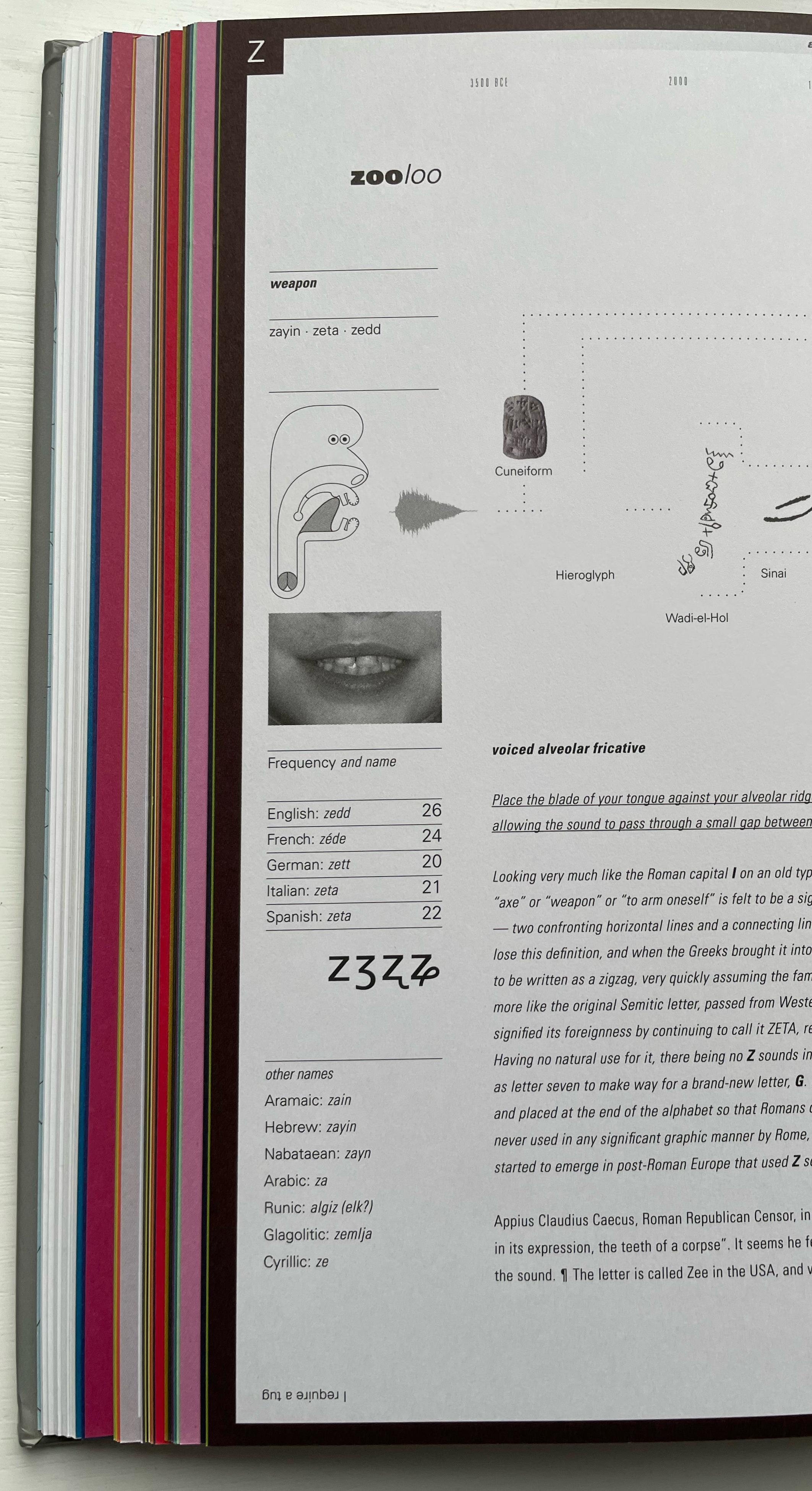
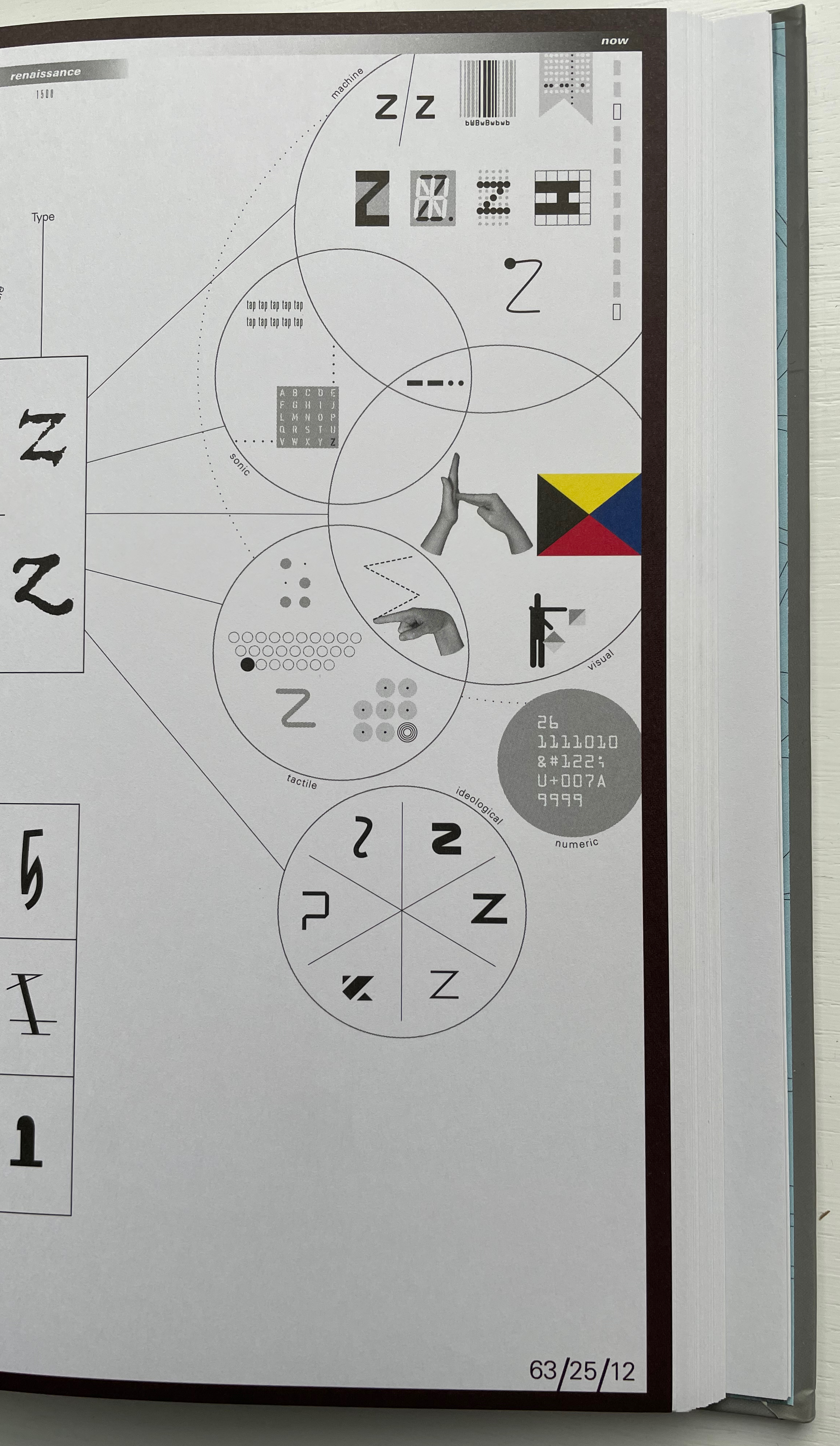
  • A: It uses a blueprint to create a broad and deep infographic of each letter’s historical development, features and representation in a variety of post-type systems (sonogram, sign language, maritime flags, semaphore, punch card, barcodes, dot matrix, segment display, OCR, ASCII, Unicode, HTML, Braille, prison tap code, etc.).
  • B: It demonstrates the interrelated historical developments of the majuscule and miniscule letterforms.
  • C: It makes a principled exploration of how the shapes of letters might have taken different forms from those they have today.

The text in the first third of the book presents discursively what the twenty-six infographics present in particular for each letter and also whet the reader’s appetite for the additional detail in the thirty-seven appendices, which delve deeper into such topics as the phonemehead (the author’s cartoon for illustrating per letter the positions of our sound-making apparatus), ductus (the order and direction of strokes for making a letter), Trajan’s column, the Ugaritic alphabet and more (including an explanation of cowhouse).

Being a tour de force of design, Shapes for Sound (cowhouse) might appeal mostly to students of design and typography, but students of the history of writing, linguistics, communications and book design in particular would be amiss to overlook it. As a reference work that enriches enjoyment of works of book art such as Lanore Cady’s Houses & Letters, Cari Ferraro’s The First Writing, Abe Kuipers’ Letters or Cathryn Miller’s L is for Lettering, it plays a valuable role in the alphabet-related subset of the Books On Books Collection.

Further Reading

Abecedaries I (in progress)“. Books On Books Collection.

Lanore Cady“. 16 December 2022. Books On Books Collection. Artist’s book.

Lyn Davies“. 7 August 2022. Books On Books Collection. Reference and fine print.

Cari Ferraro“. 1 February 2023. Books On Books Collection. Artist’s book.

Rudyard Kipling and Chloë Cheese“. 15 February 2023. Books On Books Collection. Illustrated children’s book.

Abe Kuipers“. 15 February 2023. Books On Books Collection. Artist’s book.

Cathryn Miller“. 1 September 2019. Books On Books Collection. Artist’s book.

Don Robb and Anne Smith“. Books On Books Collection. Illustrated children’s book. [In progress]

James Rumford. 21 November 2022. Books On Books Collection. Illustrated children’s book.

Tiphaine Samoyault“. Books On Books Collection. Illustrated children’s book. [In progress]

Ben Shahn“. 20 July 2022. Books On Books Collection. Artist’s book.

Tommy Thompson“. 21 August 2022. Books On Books Collection. Reference.

Catich, Edward M. 1948. A Theory of Development and Lineage for the Roman Alphabet. Davenport Iowa: St. Ambrose College. Donaldson’s Appendix 10 is useful in conjunction with this.

Hodgson, Jane. 30 September 2011. “Timothy Donaldson – a site specific text installation at Devon Guild“. Accessed 30 September 2022.