Books On Books Collection – Gerald Lange

The Neolithic Adventures of Taffi-Mai Metallu-Mai (1997)

The Neolithic Adventures of Taffi-Mai Metallu-Mai (1997)
Gerald Lange and Rudyard Kipling
H216 x W260 mm. 55 pages with 17 additional illustrated page inserts. Edition of 150, of which this is #149. Acquired from the artist, 11 Febuary 2023.
Photos: Books On Books Collection. Displayed with the artist’s permission.

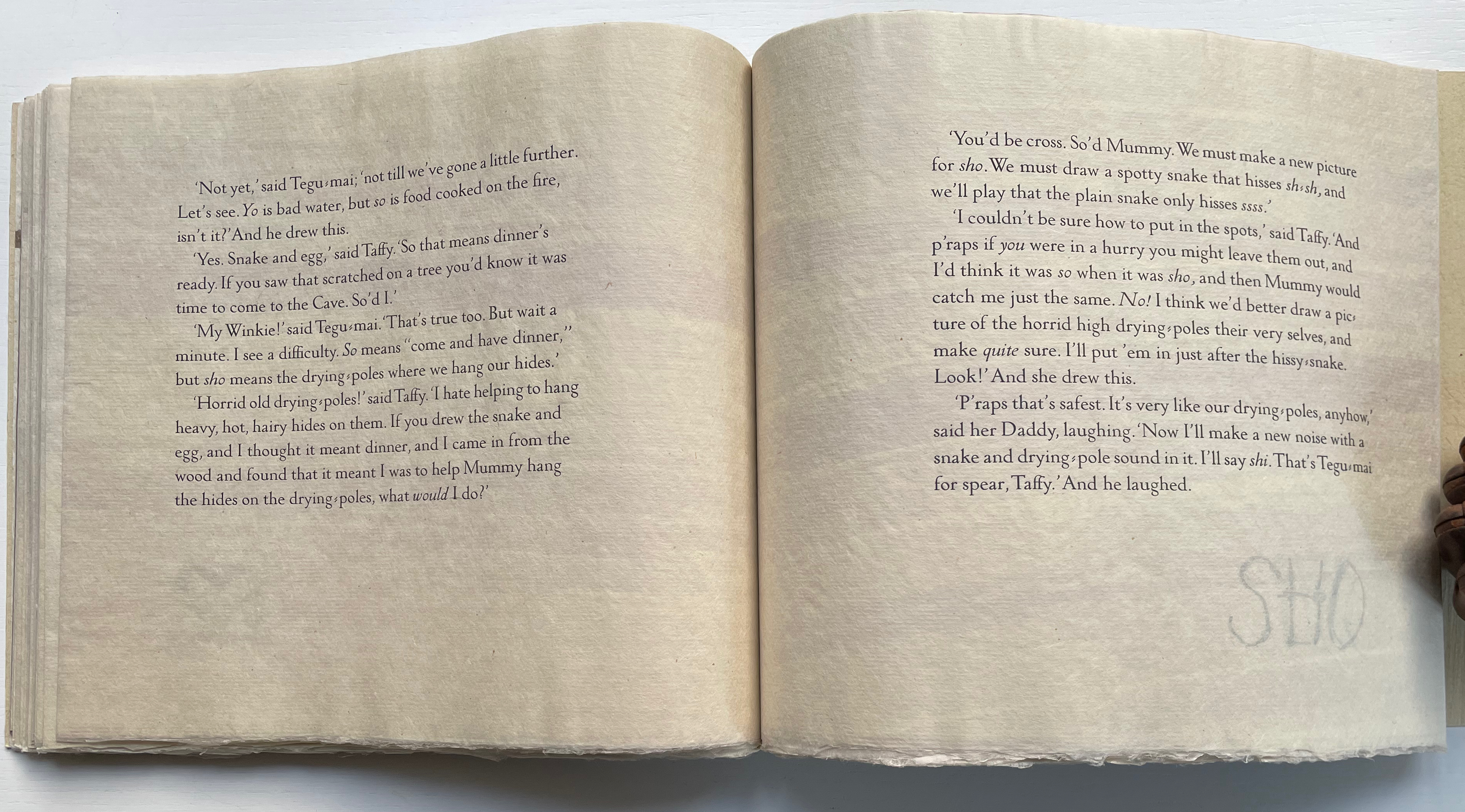
Gerald Lange’s choice of “How the First Letter Was Written” and “How the Alphabet Was Made” from Rudyard Kipling’s Just So Stories (1902) for this elaborate, delicate but robust edition was fitting. By 1997, he had founded the Bieler Press (1975), co-founded the Alliance for Contemporary Book Arts (1987) and edited its journal AbraCadaBrA for seven years, had been the Master Printer at USC Fine Arts Press and selected as the first recipient of the prestigious Carl Hertzog Award for Excellence in Book Design (1991) and was about to publish the first edition of his Printing Digital Type on the Hand-Operated Flatbed Cylinder Press (now in its fifth edition, 2018). In keeping with his interests leading up to this work, Lange letterpress-printed it from handset Monotype Pastonchi and a digitally altered version of Berthold Post Antiqua. More to the point, as he noted on the Bieler Press site, he chose the stories for “their affinity with subjects related to the lettering arts”. If that affinity is not clear enough from the text, Lange’s treatment underscores it in subtly ingenious ways.

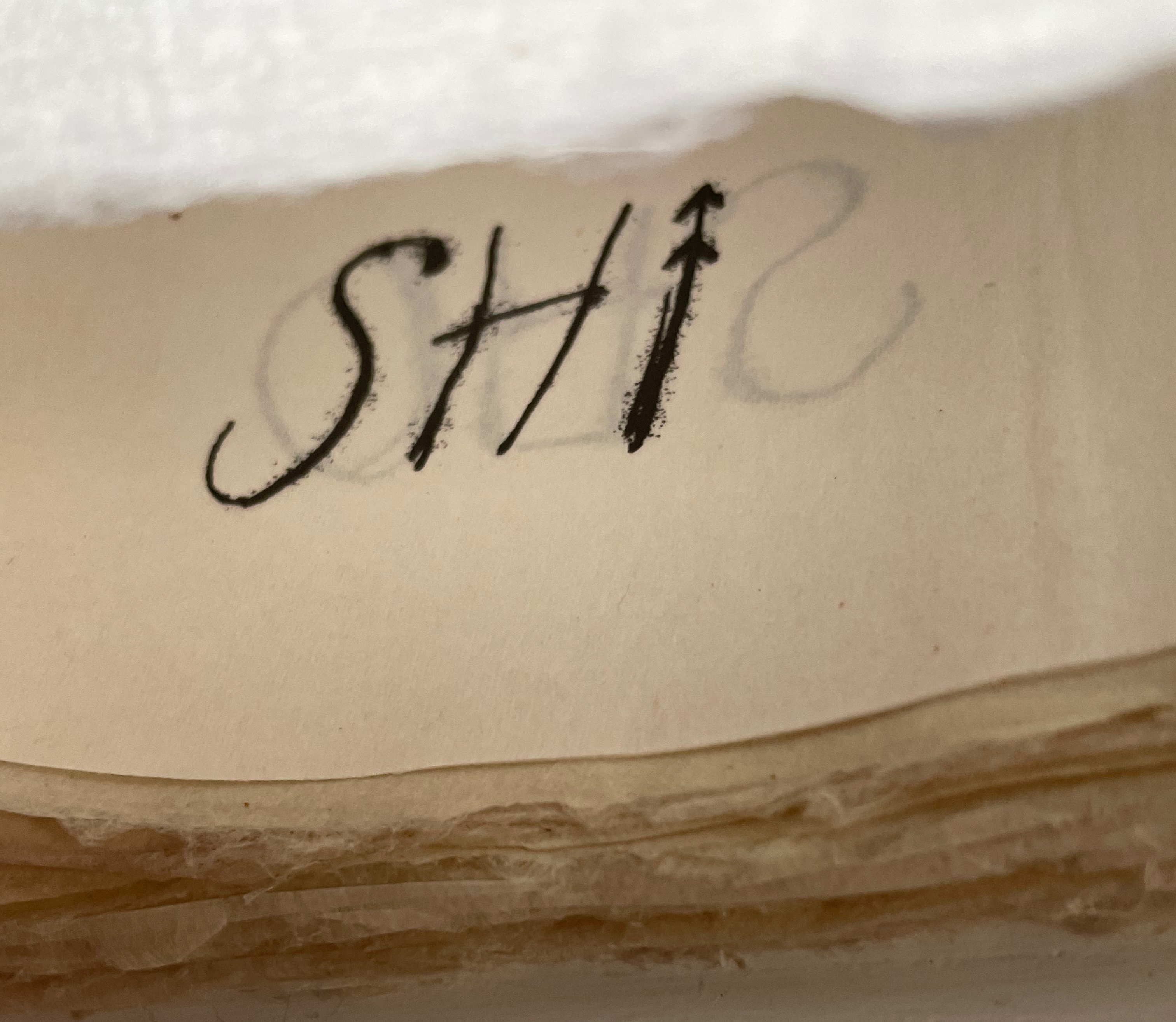
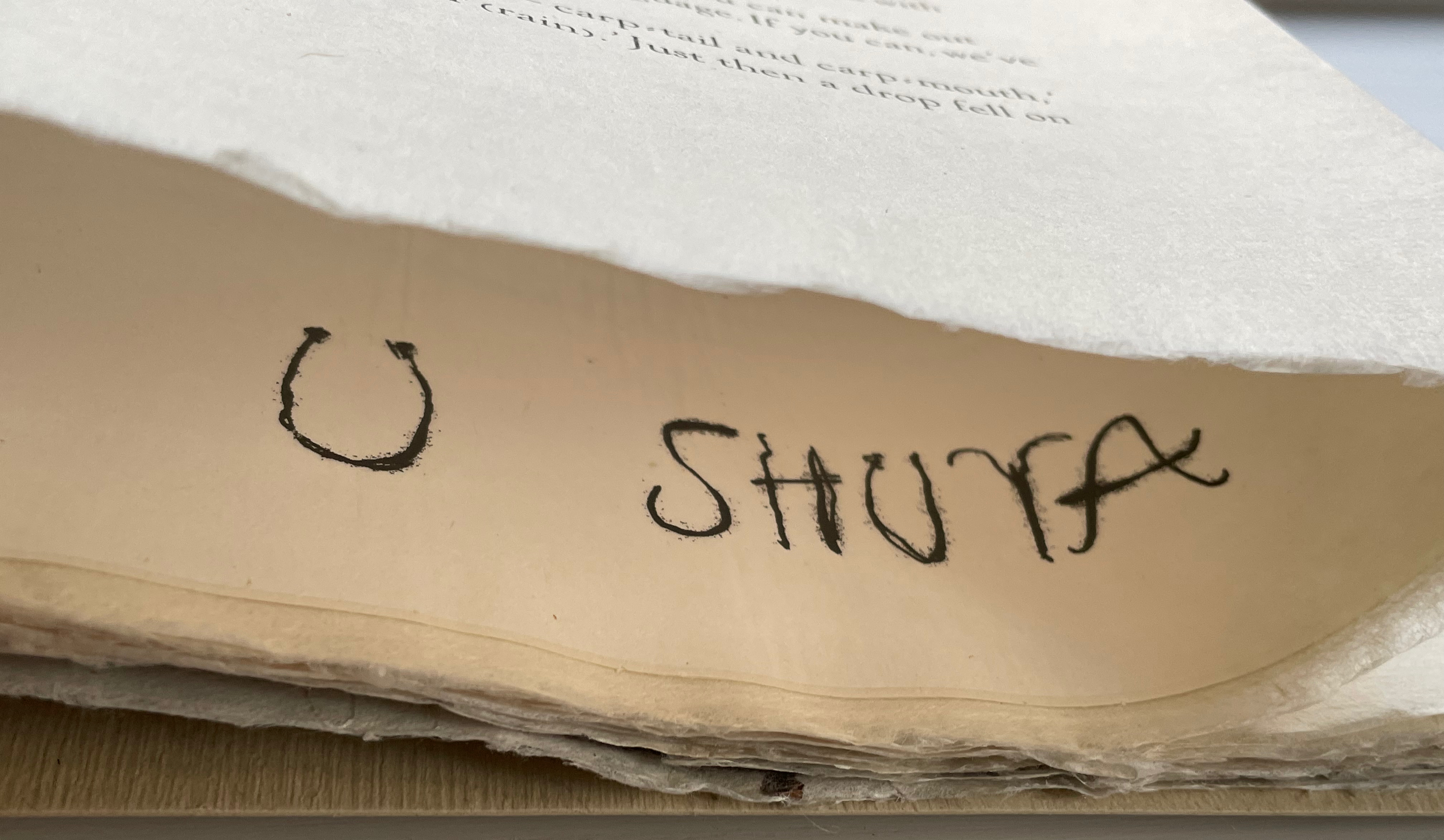
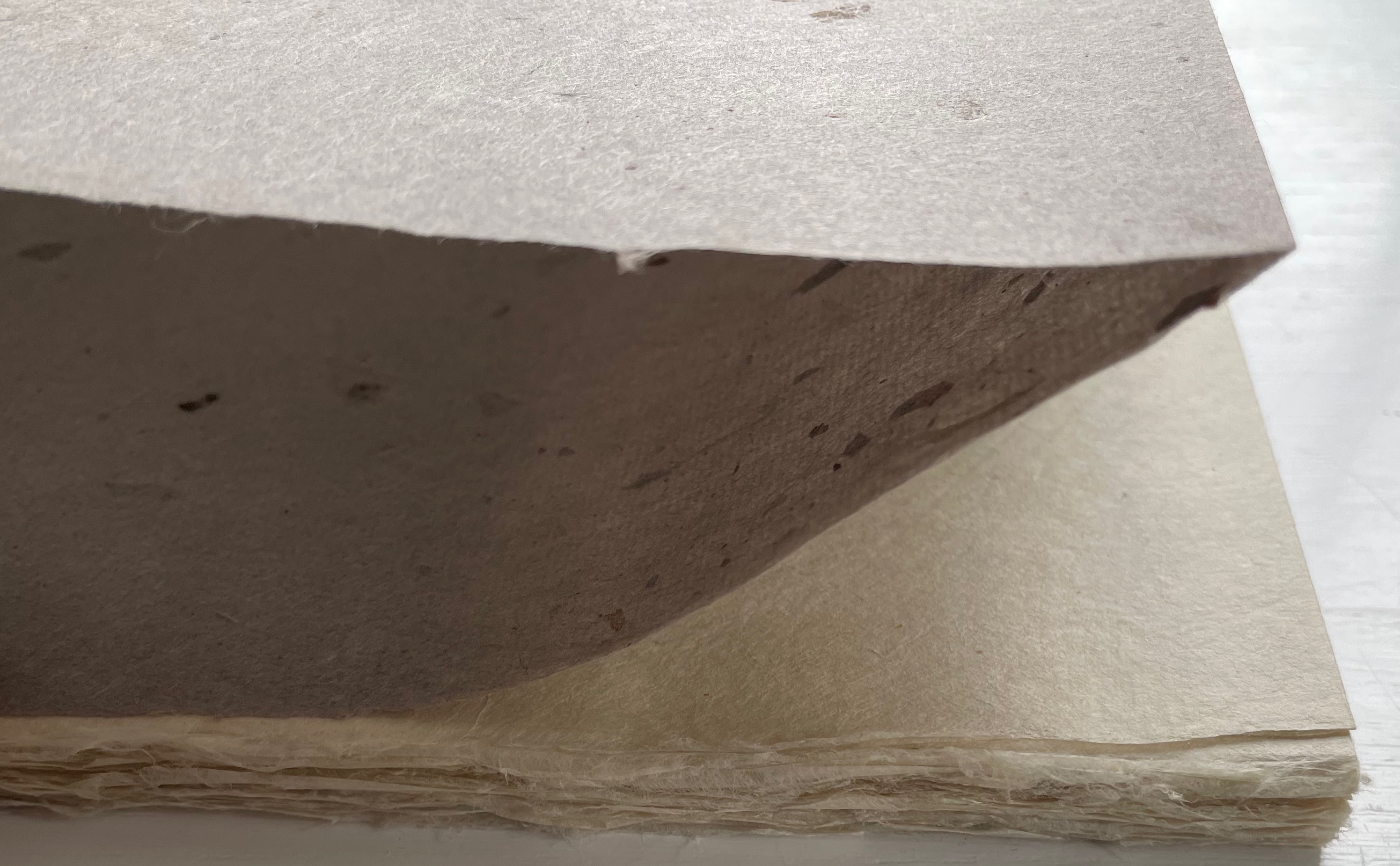
Kipling attributes the drawings throughout to his heroine, Taffi and her father. Where others like Macmillan Children’s Books have rendered them boldly, Lange prints the primitive petroglyph-like images on separate Gampi sheets inserted between the folded Kitakata text leaves of the tortoise shell edge-sewn binding. Those text leaves are individually water colored on their reverse sides (urazaiki manner based on nihonga painting) so that the pictographs beneath reveal themselves through a striated layer. The color and striations are reminiscent of cave paintings. Additional Asian papers (Kasuiri and Chirizome for end sheets, Cogan Grass for covers) increase the work’s tactility — simultaneously soft and rough, flimsy and tough — and contribute a grassy smell redolent of the stories’ physical setting.

The quality and rightness of choices in structure, material and process have placed several of Lange’s works in The British Library, University of California (various), Columbia University, Harvard University, University of Minnesota, New York Public Library, Princeton University, Stanford University, Victoria and Albert Museum, Yale University and others. The initial reason bringing this particular work into the Books On Books collection was its representation of book art inspired by the alphabet. That Robin Price, several of whose works are also in the Books On Books collection, assisted with the design came as a bonus. That this is one of the last bound copies of The Neolithic Adventures of Taffi-Mai Metallu-Mai makes it a treasure.

Further Reading

Abecedaries I (in progress)“. Books On Books Collection.

Lyn Davies“. 7 August 2022. Books On Books Collection. Reference and fine print.

Timothy Donaldson“. 1 February 2023. Books On Books Collection. Reference.

Cari Ferraro“. Books On Books Collection. Artist’s book.

David J. Goldman“. Books On Books Collection. Reference.

Rudyard Kipling and Chloë Cheese“. 15 February 2023. Books On Books Collection. Illustrated children’s book.

James Rumford. 21 November 2022. Books On Books Collection. Illustrated children’s books.

Tommy Thompson“. 21 August 2022. Books On Books Collection. Reference.

Drucker, Johanna. 1999. The alphabetic labyrinth: the letters in history and imagination. New York, N.Y.: Thames and Hudson. Reference.

Ege, Otto. 1921/1998. The Story of the Alphabet, Its Evolution and Development… Embellished Typographically with Printer’s Flowers Arranged by Richard J. Hoffman. Van Nuys, CA: Richard J. Hoffman. A miniature. The type ornaments chosen by Hoffman are arranged chronologically by designer (Garamond, Granjon, Rogers) and printed in color.

Firmage, Richard A. 2001. The alphabet. London: Bloomsbury. Reference.

Fischer, Steven Roger. 2008. A history of writing. London: Reaktion Books. Reference.

Jackson, Donald. 1997. The story of writing. Monmouth, England: Calligraphy Centre. Reference.

Lange Gerald. 2018. Printing Digital Type on the Hand-Operated Flatbed Cylinder Press. Fifth edition, revised, updated & expanded ed. Seattle: Chatwin Books.

Robb, Don, and Anne Smith. 2010. Ox, house, stick: the history of our alphabet. Watertown, MA: Charlesbridge. Children’s book.

Robinson, Andrew. 1995. The story of writing. London: Thames and Hudson. Reference.

Rosen, Michael. 2014. Alphabetical: how every letter tells a story. London: John Murray. Reference.

Sacks, David. 2003. Language visible unraveling the mystery of the alphabet from A to Z. New York: Broadway Books. Reference.

Samoyault, Tiphaine. 1996, 1998 trans. Alphabetical order: how the alphabet began. New York: Viking. Reference and illustrated children’s book.

Books On Books Collection – Don Robb and Anne Smith

Ox, House, Stick (2007)

Ox, House, Stick: The History of Our Alphabet (2007)
Don Robb (text) and Anne Smith (ills)
Casebound, illustrated paper over boards. H280 x W217 mm. 48 pages.Acquired from The Saint Bookstore, 14 August 2022. Photos: Books On Books Collection.
Text copyright © 2007 by Donald Robb. Illustrations copyright © 2007 by Anne Smith/Lilla Rogers Studio.
Used with permission by Charlesbridge Publishing, Inc. 9 Galen Street, Suite 220, Watertown, MA 02472. (617)-926 0329  

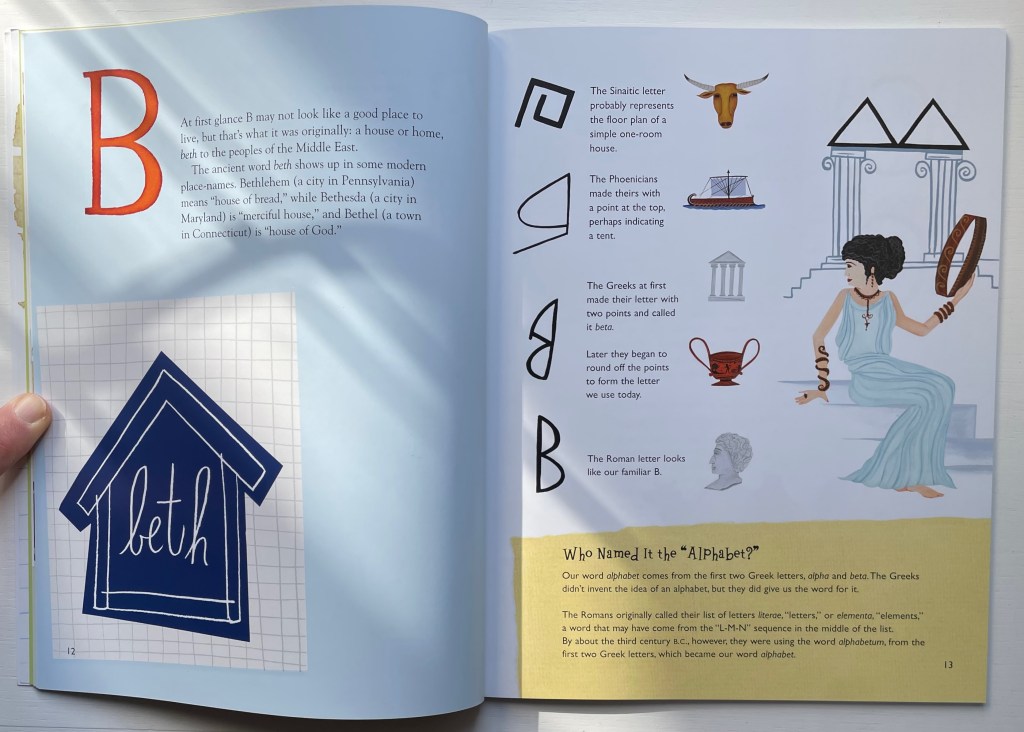
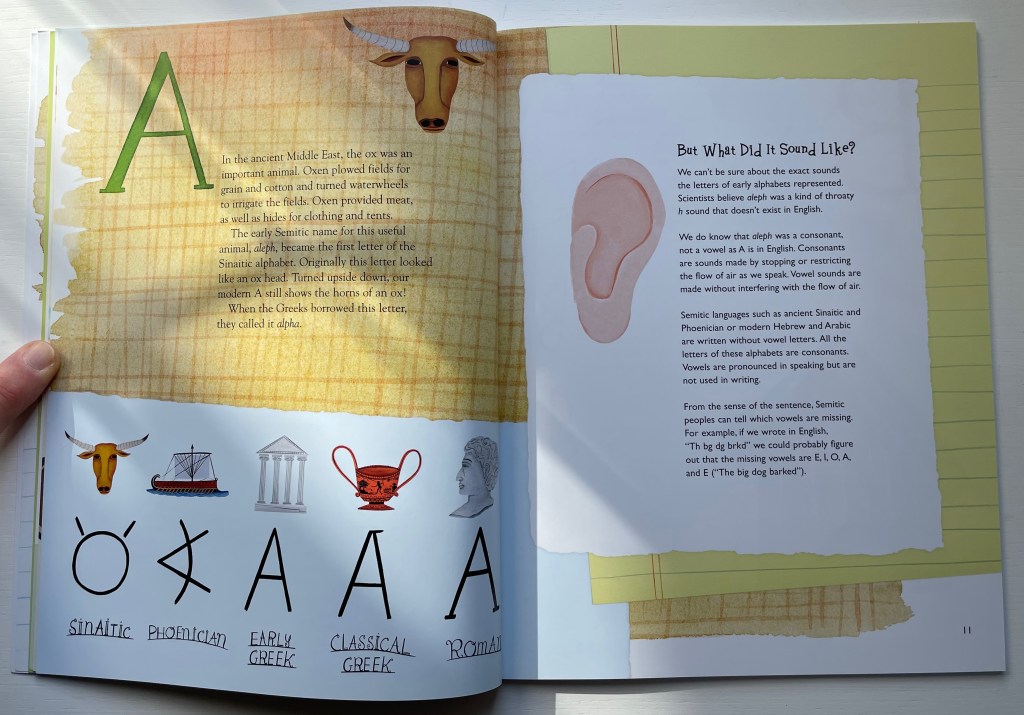
A fair number of fiction and non-fiction children’s books on the history of the alphabet have made their way into the Books On Books Collection.

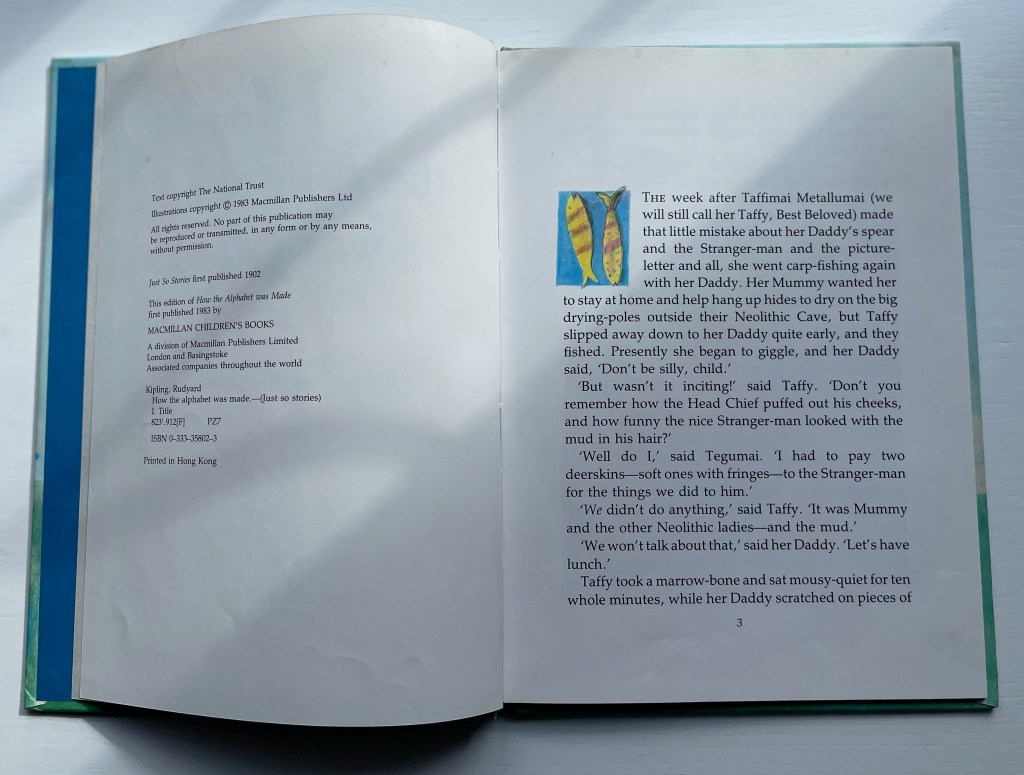
Of the fiction variety, there is Rudyard Kipling’s “Just So Story” of the alphabet’s invention: How the Alphabet Was Made (1983), illustrated by Chloe Cheese. Another fiction entry is James Rumford’s retelling of Cadmus’ visit to Crete in There’s a Monster in the Alphabet (2002) and William Joyce’s inventive The Numberlys (2014).

In the non-fiction category are William Dugan’s How Our Alphabet Grew (1972), Tiphaine Samoyault’s Alphabetical Order (1998), Renzo Rossi’s The Revolution of the Alphabet (2009) and the entry here: Don Robb’s and Anne Smith’s Ox, House, Stick.

Ox, House, Stick is scheduled to appear as part of an exhibition at the Bodleian Libraries in Oxford (opening 15 July 2023). “A is for Ox” designates the display case devoted to the question: Where did the alphabet come from? It’s not just a question for archaeologists, historians, linguists and paleographers — or children’s book authors and illustrators. It’s one generating repeated inspiration for book artists as shown by Abe Kuipers’ Letters (1971), Lanore Cady’s Houses & Letters (1977), another rendition of the Kipling tale by Gerald Lange in The Neolithic Adventures of Taffi-Mai Metallu-Mai (1997), designed by Gerald Lange and produced with Robin Price, Dave Wood’s Alphabetica (2002), Cari Ferraro’s The First Writing (2004), and Helen Malone’s Alphabetic Codes (2005).

Artists’ books share much with children’s books in general. They both play with form and structure. They play with words and images, sometimes images without words and sometimes just shapes. Almost always an attention to all the senses. Children’s alphabet books in particular display features that appeal to book artists: play with animals, the Babel of languages, bodies, calligraphy, colors, design (of letters, page and book) and, as above, alphabet origin stories. Viewing and exploring alphabet books and artist’s books side by side heightens the enjoyment and appreciation of both.

Further Reading

Abecedaries I (in progress)“. Books On Books Collection.

Lanore Cady“. 16 December 2022. Books On Books Collection. Artist’s book.

William Dugan“. 10 July 2023. Books On Books Collection.

Cari Ferraro“. 1 February 2023. Books On Books Collection. Artist’s book.

William Joyce“. 18 June 2021. Books On Books Collection.Illustrated children’s book.
Rudyard Kipling and Chloë Cheese“. 15 February 2023. Books On Books Collection. Illustrated children’s book.

Rudyard Kipling and Gerald Lange“. 16 April 2023. Books On Books Collection. Artist’s book.

Abe Kuipers“. 15 February 2023. Books On Books Collection. Artist’s book.

Helen Malone“. 23 July 2020. Books On Books Collection. Artist’s book.

Renzo Rossi“. 10 July 2023. Books On Books Collection.  Illustrated children’s book. [In progress]

James Rumford. 21 November 2022. Books On Books Collection. Illustrated children’s book.

Tiphaine Samoyault“. 10 July 2023. Books On Books Collection. Illustrated children’s book. [In progress]

Animal alphabets & artists’ books

Marie Angel, An Animated Alphabet (1996)

Leonard Baskin, Hosie’s Alphabet (1972)

Paul Cox, Abstract Alphabet: A Book of Animals (2001)

E.N. Ellis, An Alphabet (1985)

C.B. Falls, ABC Book (1957)

David L. Kulhavy & Charles D. Jones, A Forest Insect Alphabet (2013)

Enid Marx, Marco’s Animal Alphabet (2000)

Carol Schwartzott, ABC of Birds (2020)

Borje Svensson & James Diaz, Animals (1982)

John Norris Wood, An Alphabet in Praise of Toads & Frogs (2002)

Babel, alphabets & artists’ books

Golnar Adili, Father Gave Water/Baabaa Aab Daad (2022)

Islam Aly, 28 Letters (2013)

Brynja Baldursdottír, Fuþorc (1992)

Ellen Heck, A is for Bee (2022)

Tatyana Mavrina, Сказочная Азбука / Skazochnaia Azbuka / A Fairy Tale Alphabet (1969)

Claire Jeanine Satin, Alphabook (1998/99)

Ben Shahn, The Alphabet of Creation (1954)

Jana Sim, Both but between (2021)

Sam Winston, One and Everything (2022)

Bodies & artists’ books

Anthon Beeke, Alphabet (1970)

Anthon Beeke & René Knip, Body Type (2011)

Edward Gorey, Figbash Acrobate (1994) In progress

Toshifumi Kawahara, Dancing Alphabet (1991)

Françoise and Douglas Kirkland, Physical Poetry Alphabet (2018)

Marie Lancelin, Gestes Alphabétiques (2014)

Lisa Merkin, Bodies of Language (2021)

Annette Messager, Mes Enluminaires (1988) [In progress]

Vítězslav Nezval, Abeceda/Alphabet (1926/2001)

Rowland Scherman, Love Letters (1975) [In progress]

Calligraphy, alphabets and artists’ books

Mari Angel, Marie Angel’s Exotic Alphabet (1992)

Tauba Auerbach, How to Spell the Alphabet (2007)

Rebecca Bingham, Lady Letters (1986)

Rebecca Bingham, Alphabet Salmagundi (1988)

Carol DuBosch, Alphabet of Calligraphic Tricks (2014)

Carol DuBosch, Embossed Alphabet Gallery (2019)

Francesca Lohmann, An Alphabetical Accumulation (2017)

Suzanne Moore, A Blind Alphabet (1986)

Edward Andrew Zega & Bernd H. Dams, An Architectural Alphabet : ABC (2008)

Colors, alphabets and artists’ books

Rebecca Bingham, Golden Alphabet (1986)

Rebecca Bingham, Defining the Rainbow (2018)

Sonia Delaunay, Alphabet (1972)

Carol DuBosch, Rainbow Alphabet Snowflake (2013)

Ursula Hochuli-Gamma, 26 farbige Buchstaben (1986)

Karen Hanmer, The Spectrum (2003)

Amy Lapidow, Spiralbet (1998)

Lisa McGarry, Be Amazed (and other words to live by) (2013)

Kveta Pacovská, A l’infini (2007)

Design (of letters), alphabets & artists’ books

Anne Bertier, Anne Dessine-moi une lettre(2004)

Roberto de Vicq de Cumptich, Bembo’s Zoo: An Animal ABC Book (2000)

Felice Feliciano & Jason Dewinetz, Alphabetum Romanum: The Letterforms of Felice Feliciano (c. 1460, 2010)

Jeff Morin and Steven Ferlauto, The Sacred Abecedarium (1999)

Andrew Morrison, Two Wood Press A-Z (2020

David Pelletier, The Graphic Alphabet (1996)

Bruce Rogers, Champ rosé (1933)

Kevin Steele, The Movable Book of Letterforms(2009)

Sharon Werner & Sharon Forss, Alphabeasties (2009)

Structures, alphabets & artist’s books

Kathleen Amt, Kaleidoscopic ABC’s (1991)

Matsumasa Anno, Anno’s Magical Alphabet (1981)

Marion Bataille, ABC3D (2008)

John Crombie, ABC in a maze (1987)

Carol DuBosch, Rainbow Alphabet Snowflake (2013)

Carol DuBosch, Embossed Alphabet Gallery (2019)

Helen Hajnoczky, alpha seltzer (2023)

Karen Hanmer, A2Z (2013)

Karen Hanmer, The Spectrum (2003)

Helen Hiebert, Alpha Beta (2010)

Ron King, Alphabeta Concertina majuscule (2007)

Ron King, alphabeta concertina miniscule (2007)

Ron King, The White Alphabet (1984) In progress

Ron King, ABC Paperweights (nd)

Amy Lapidow, Spiralbet (1998)

Scott McCarney, Alphabook 3 (1986)

Scott McCarney, Alphabook 10 (2015)

Scott McCarney, Alphabook 13 (1991)

Lisa McGarry, Twenty-six/Fragments (2012)

Patrice Miller (Edward Gorey), The Eclectic Abecedarium (2022)

Patrice Miller (Edward Gorey), Figbash Acrobate (2023)

Jeff Morin and Steven Ferlauto, The Sacred Abecedarium (1999)

Jeff Morin and Steven Ferlauto, Sacred Space (2003)

Moveable Book Society, A to Z Marvels in Paper Engineering (2018)

Bruno Munari, ABC con fantasia (2008)

Bruno Riboulot, ABCD’Air (2005)

Merrill Shatzman, Calligrafitti #3 (2011)

Borje Svensson & James Diaz, Letters (1982)

Emmett Williams, abcdefghijklmnopqrstuvwxyz (1963) In progress

Books On Books Collection – Rudyard Kipling and Chloë Cheese

How the Alphabet Was Made (1983)

How the Alphabet Was Made (1983)
Rudyard Kipling and Chloë Cheese (ill.)
Hardback, paper on board. Acquired from Harry Righton, 17 September 2022.
Photos: Books On Books Collection. Permission to display from Macmillan Children’s Books.

Origin stories for the alphabet have charmed makers and their audiences for ages. Rudyard Kipling’s tale from his Just So series invents the cave-dwelling girl Taffy and her father Tegumai playfully voicing sounds and words then drawing shapes to remind them of the sounds. Although Kipling as the narrator follows the pictographic principle of the origin of the alphabet, he varies from the usual sources of the letters’ inspiration. Instead of the A’s being associated with the image of an ox’s head from the word “aleph” for ox, it emerges — — expressly as a reminder of the sound “ah” — from the image of a carp’s open mouth with a feeler making the crossbar while it roots upside down in the riverbottom for food. When a mnemonic for the “yer-yer-yer” element at the beginning of the sound “yah” is needed, the tail of the upside down carp that happens to be at hand serves the need with the shape of a Y.

The story carries on from the pictographic principle to the ideographic and logographic (shapes used to represent an idea and those only for the sounds made by a word). Metonymy makes a clever appearance when Taffy’s father tells her not to worry about her drawing abilities and to rely on just a part to represent the whole. The rebus makes an appearance in a reminder to Taffy to do her chores.

At the end, Kipling steps back into the present to describe the “archaeological find” — Taffy’s alphabet necklace, made by her father and missing some letters as might be expected of such an artifact — and to provide a drawing of it as proof for the origin story as told to his eldest daughter Josephine, the “O Best Beloved” addressed in the story. Never one to miss an opportunity for a pun, Kipling’s narrator explains that the missing letters — P and Q — are the source of the saying, “Mind your P’s and Q’s”.

The illustrations provided by Chloë Cheese, presumably at the behest of the publisher, suit a trade book for the 1980s. Although more colorful, they do not precisely reproduce Kipling’s drawings included with his manuscript, which the British Library has placed online.

Just So Stories (1902)
Rudyard Kipling
Manuscript printer’s copy with original illustrations, bequeathed by Mrs Elsie Bambridge (née Kipling, second daughter of Rudyard Kipling), 14 December 1976. Paper; ff. ii+148. 370 x 280mm. Ref. Add MS 59840.
Accessed 17 November 2022.

Further Reading

Abecedaries I (in progress)“. Books On Books Collection.

Lyn Davies“. 7 August 2022. Books On Books Collection. Reference and fine print.

Timothy Donaldson“. 1 February 2023. Books On Books Collection.

Gerald Lange“. March 2023. Books On Books Collection.

James Rumford. 21 November 2022. Books On Books Collection. Illustrated children’s book.

Tommy Thompson“. 21 August 2022. Books On Books Collection. Reference.

Drucker, Johanna. 1999. The alphabetic labyrinth: the letters in history and imagination. New York, N.Y.: Thames and Hudson.

Ege, Otto. 1921/1998. The Story of the Alphabet, Its Evolution and Development… Embellished Typographically with Printer’s Flowers Arranged by Richard J. Hoffman. Van Nuys, CA: Richard J. Hoffman. A miniature. The type ornaments chosen by Hoffman are arranged chronologically by designer (Garamond, Granjon, Rogers) and printed in color.

Firmage, Richard A. 2001. The alphabet. London: Bloomsbury.

Fischer, Steven Roger. 2008. A history of writing. London: Reaktion Books.

Jackson, Donald. 1997. The story of writing. Monmouth, England: Calligraphy Centre.

Robb, Don, and Anne Smith. 2010. Ox, house, stick: the history of our alphabet. Watertown, MA: Charlesbridge. Children’s book.

Robinson, Andrew. 1995. The story of writing. London: Thames and Hudson.

Rosen, Michael. 2014. Alphabetical: how every letter tells a story. London: John Murray.

Sacks, David. 2003. Language visible unraveling the mystery of the alphabet from A to Z. New York: Broadway Books.

Samoyault, Tiphaine. 1996, 1998 trans. Alphabetical order: how the alphabet began. New York: Viking. Children’s book.

Bookmark — The ABC of Bookmarking

romandelarose
Detail from Harley MS 4425, Roman de la Rose

767479
Historia Rerum Ubique Gestarum

The British Library‘s “Medieval and Earlier Manuscripts” blog is a reliable source of visual delight and provocation to think about the interplay of the print and digital worlds.  It also prompts the application of Ezra Pound’s critical technique of juxtaposing works, demonstrated so well in his The ABC of Reading.

Earlier this year, Ann Tomalak, Conservator, Greek Manuscripts Digitisation Project, posted “Digitising Manuscripts:  The Condition Assessment,” a wonderful essay that warrants reading alongside A Degree of Mastery by Annie Tremmel Wilcox.

I have read A Degree of Mastery from cover to cover twice.  Once in New York between 2002 and 2005 when I was teaching “Professional Book and Information Publishing” at NYU and wanted readings to help provide students with a sense of the history, art and craft of the book. The second time here and now in Windsor looking for the “right something” to include in “Books On Books.”

On both occasions ebooks and digital publishing pervaded my thoughts, but only on the second time around did these questions and observations I want to raise now shape themselves as they have.

Annie Tremmel Wilcox weaves a memoir of her apprenticeship under the renowned bookbinder and conservator William Anthony.  She weaves it with her diary entries, excerpts from an exhibit brochure “Saving Our Books and Words: The Conservation and Preservation of Books,” newspaper articles, correspondence, passages from “Japanese Woodworking Tools: Their Tradition, Spirit and Use” by Toshio Odate, step by step descriptions of mending torn pages and crumbling leather spines and plainspoken observation of fellow workers, conference attendees, librarians, government officials posing with restored documents, children making “books” from striped computer paper with wallpaper sewn on for covers and, of course, Bill Anthony, the “Johnny Appleseed of bookbinding.”

“Weaves” is the precise word for the structure of her book’s narrative, and it would be the right word for her ebook, if there were one.  As I re-read it, this game of word substitution yielded questions that make this memoir a useful means to bookmark the evolution of the book.

Writing about some of the tools she learns to use — lifting knives, translucent bone folders, the spokeshave and others — she says of Anthony’s, “His tools were smarter than mine. They knew the correct way to cut paper or pare leather. By using them I could feel in my hands how the tools were supposed to work.” (48)  For Wilcox and her reader, Bill Anthony is the master “shokunin,” craftsman or artisan.  And when she quotes from Odate “For the ‘shokunin,’ utility and appearance must be enhanced by the tool’s ‘presence,’ that is its refinement and dignity….,” this reader asks,

What are the tools of the ebook maker? From whence comes their refinement and dignity — their “presence” — with which the “shokunin” imbues his creation as a result of his commitment to his craft?  In what tools of the ebookmaker does “the spirit of the tool that records the ‘shokunin’s’ ability through the years to face the uncertainties of life, to overcome them, and to master the art of living” reside?

Too Zen? Perhaps.

An English grad student, Wilcox relished handling the University of Iowa‘s Sir Walter Scott Collection, its Leigh Hunt Collection and The Works of Rudyard Kipling.  Confronted with earlier slapdash and botched work on certain volumes of the Kipling, she writes, “Certainly these volumes of Kipling are found on the shelves of numerous libraries across the country, but the integrity of ‘these’ volumes as a complete set has been lost.” (179)  What constitutes the “integrity” of an ebook or its constituents? Are ebooks so “immaterial” that such a question is nonsensical?

The author’s apprenticeship included collaboration on the exhibit “Saving Our Books and Words.”  In addition to coauthoring the exhibit’s brochure, Wilcox contributed to completing Anthony’s special project of developing for the exhibit a unique collection of models demonstrating “the evolution of the codex – the form of the book as we know it.”(181)  In the brochure she touches on the immateriality and materiality of the Center’s work: “Simply defined, preservation is the attempt to save the intellectual content of books while conservation is the attempt to save both the intellectual content and its vehicle — the covers, paper, endbands, etc. The former is concerned with saving what the human record contains without regard to the forms it winds up in. The latter focuses on the artifact itself, attempts to save this book, this sheet.” (192)

What is the “form” of the ebook as we know it? Is the ebook as much “vehicle” as “content”?  What are its equivalencies to the page or to what “binds” the “text block”?  What does it mean to “conserve” an ebook?  Of a digital copy, what are the materials; what is the artifact to be conserved?

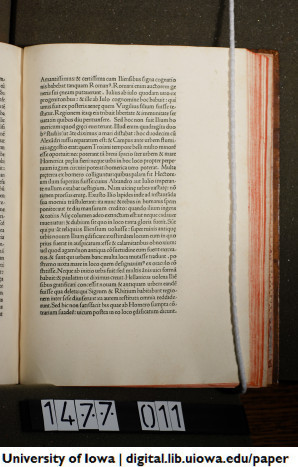
Wilcox ends her memoir with the completion of her “masterpiece,” the restoration of the incunabulum that Bill Anthony assigned her before his death and which she completed after it with the help of “The Restoration of Leather Bindings” by Bernard Middleton, author of the standard text “A History of English Craft Bookbinding Technique.”  The work assigned was Pope Pius II’s “Historia Rerum Ubique Gestarum,” printed by Johannes De Colonia and Johannes Manthen in Venice in 1477, which when restored was “not a deluxe edition, but … had great integrity.”  In the year 2547, of what will the preservation and conservation of today’s e-incunabula consist?  Will some apprentice conservator understand the “form” of these ebooks “in the cradle” and, master of smart tools, restore them to their integrity?

With Ann Tomalak’s essay, perhaps we can see that future through her present lense on the past.  Give it a read.