Books On Books Collection – Erwin Huebner

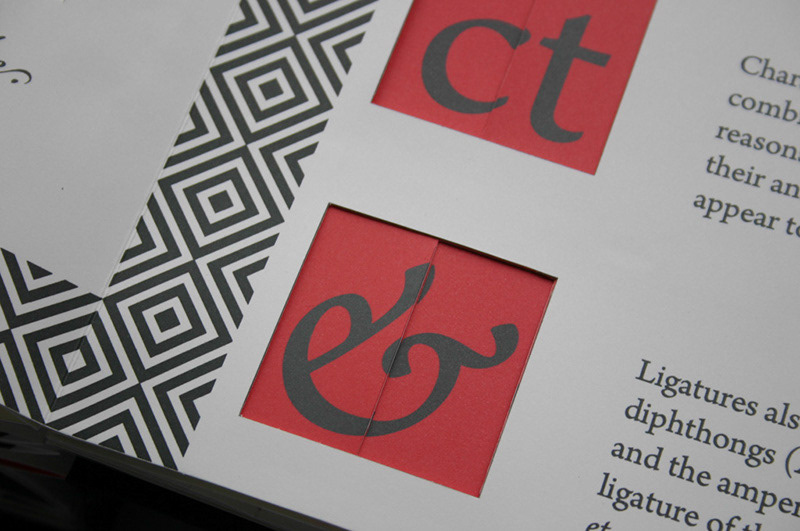
Erwin Huebner is a professor at the University of Manitoba engaged in research and teaching cell and developmental biology. He is also a book artist and miniaturist. Following his work, the Books On Books Collection has started small and hopes to grow into his larger works. At both ends of the spectrum, Huebner’s themes resonate with the integration of art and science, a recurrent focus of the collection (see Further Reading below).

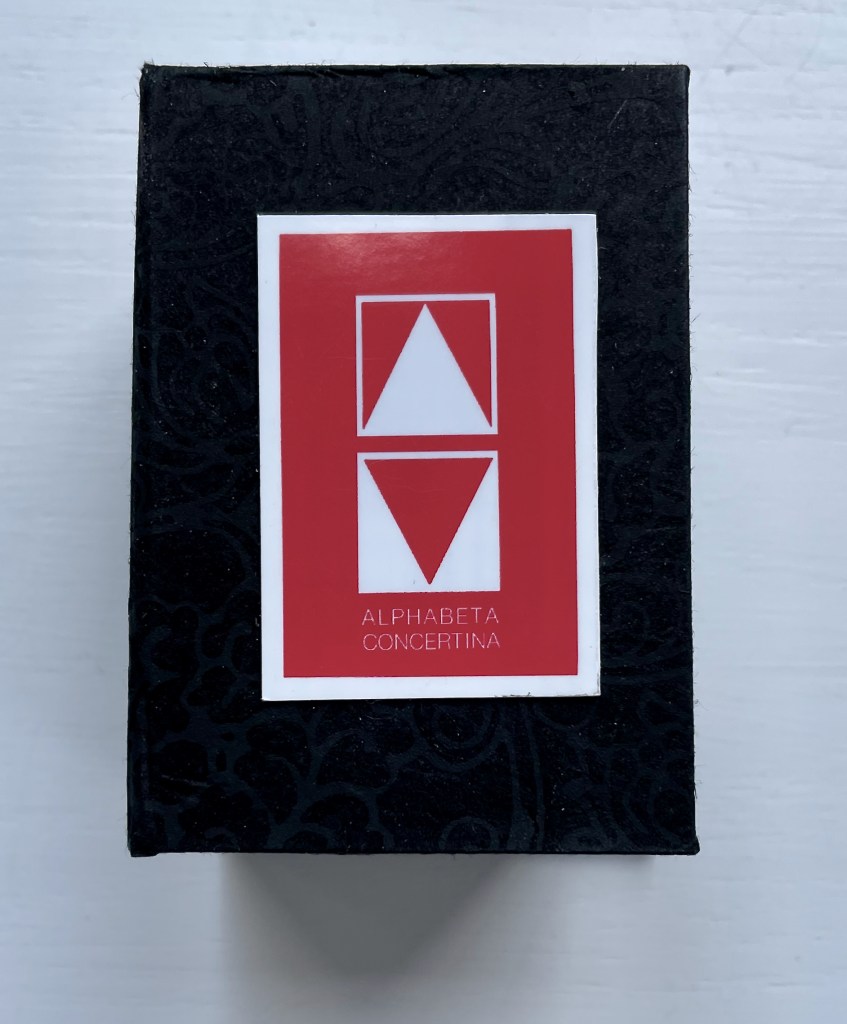
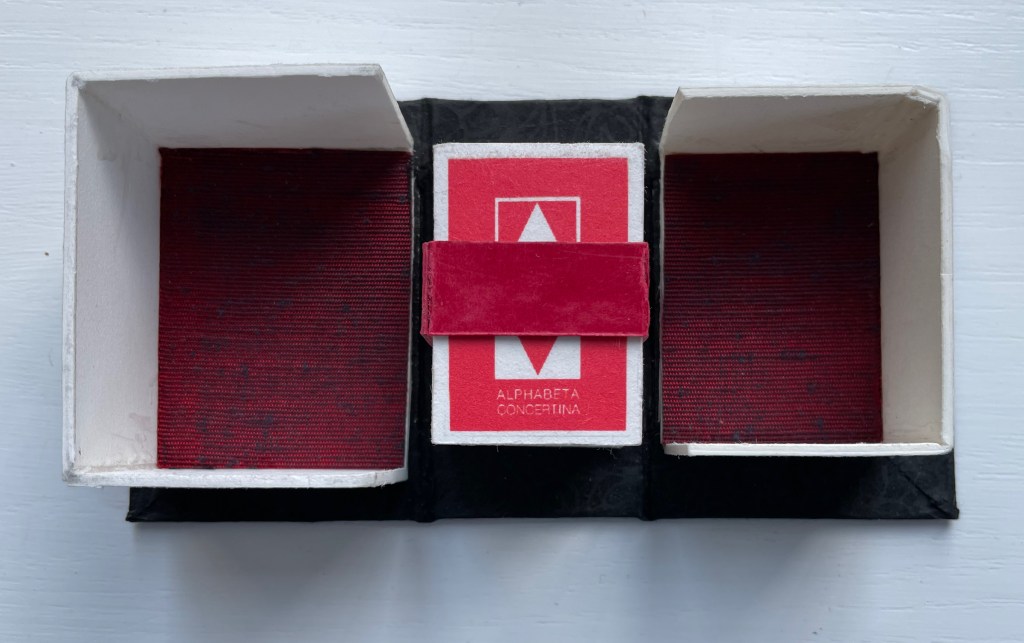
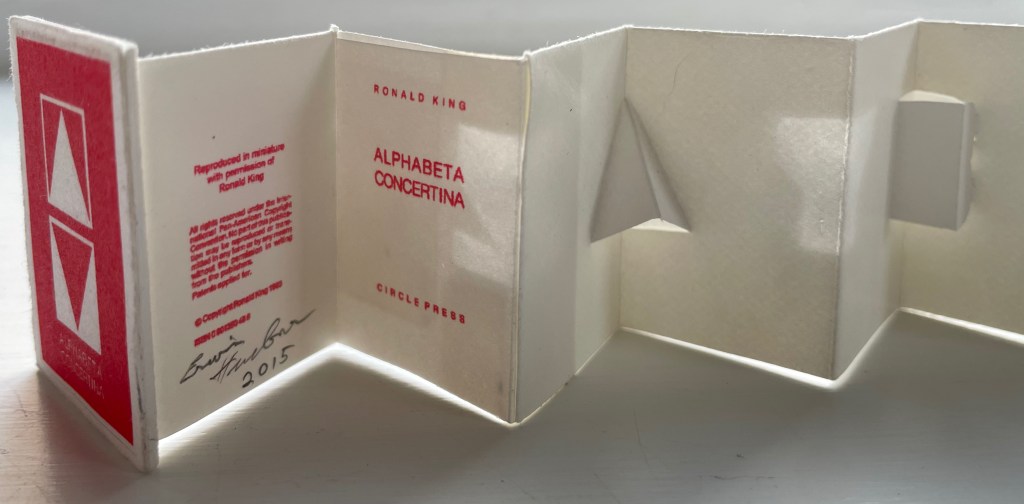
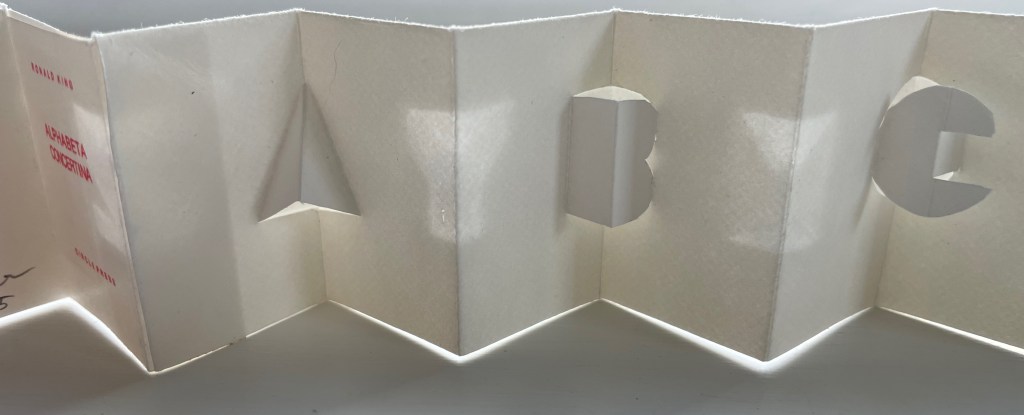
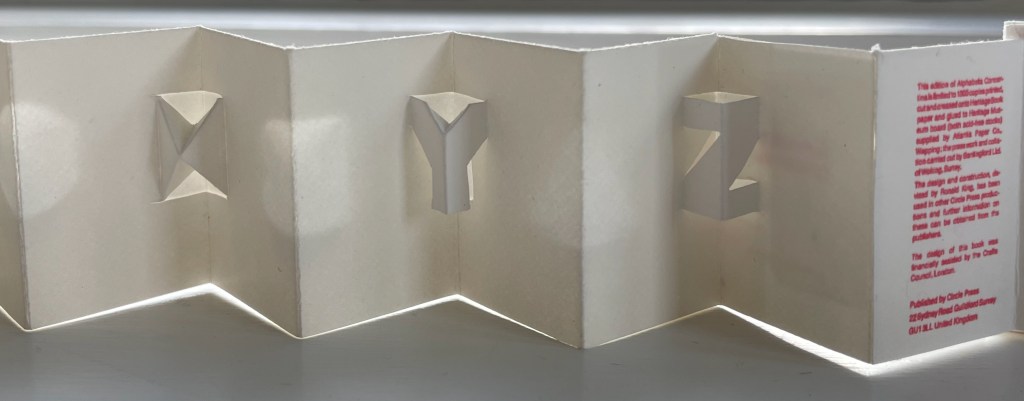
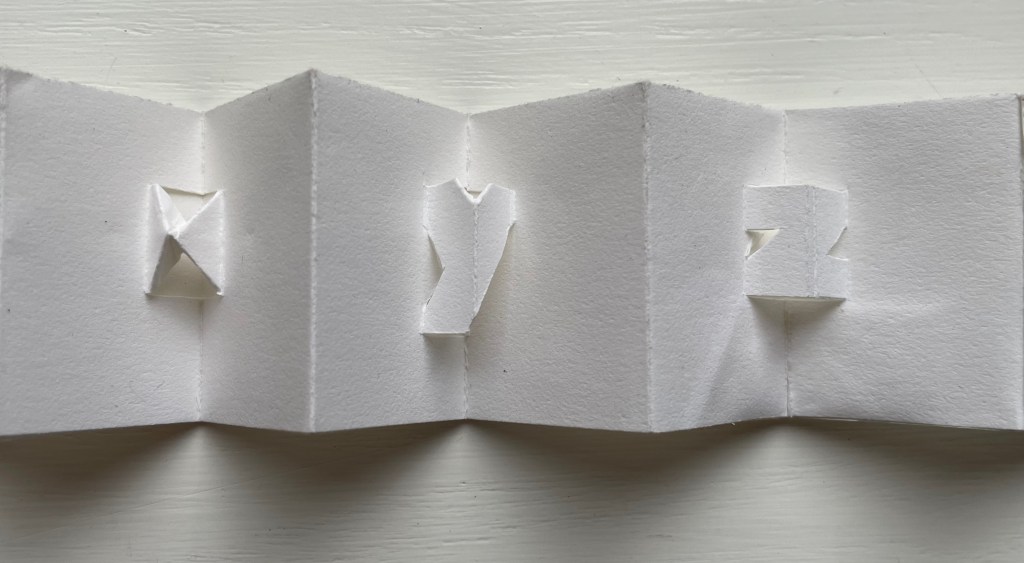
Alphabeta Concertina Majuscule (2015)

Alphabeta Concertina (2015)
Erwin Huebner (with permission of Ron King)
Miniature double-sided leporello. H 1.5 x W 1.0 x D 0.75 in. Edition of 4. Acquired from Erwin Huebner, 20 January 2023.
Photos: Books On Books Collection.

The geometry and invention of Ron King’s work must have appealed to a kindred spirit in Erwin Huebner. The classificatory nature of the alphabet must also have spoken to Huebner’s inner Linnaeus. As 2023 is the 270th anniversary of Linnaeus’ Species Plantarum, which introduced his classification system, it is an auspicious moment for Huebner’s miniature versions of King’s alphabet concertinas to join the Books On Books Collection and be included works in the Bodleian exhibition “Alphabets Alive!” (19 July 2023 to 24 January 2024, Weston Library, Oxford).

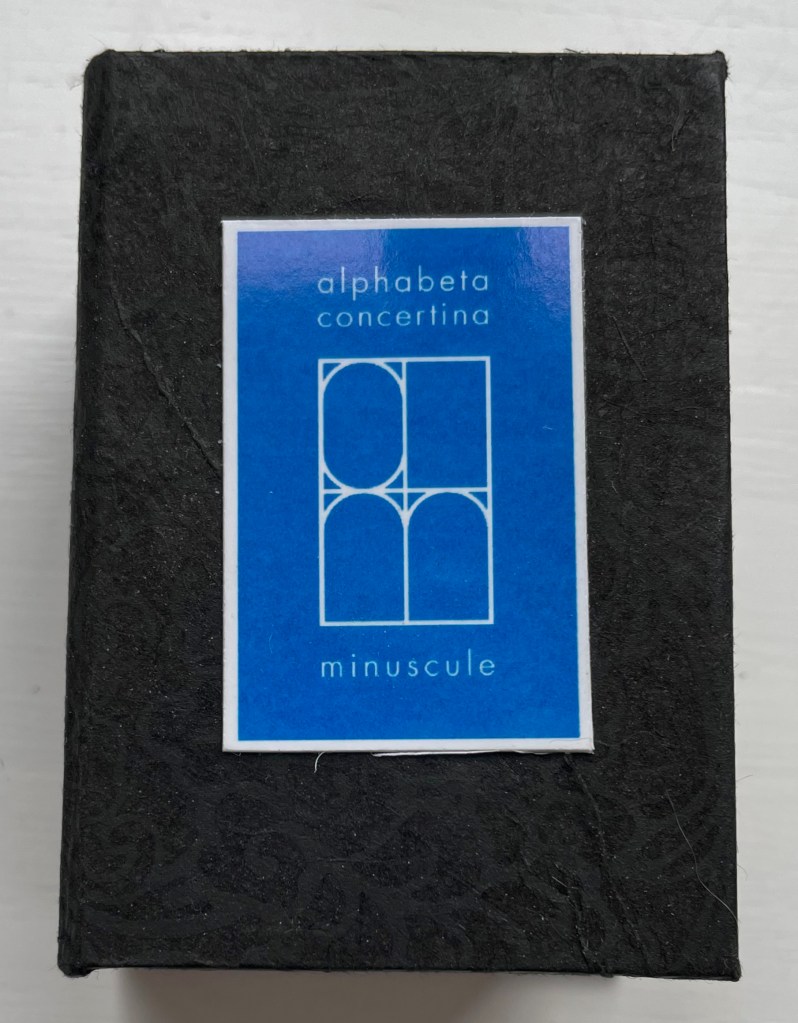
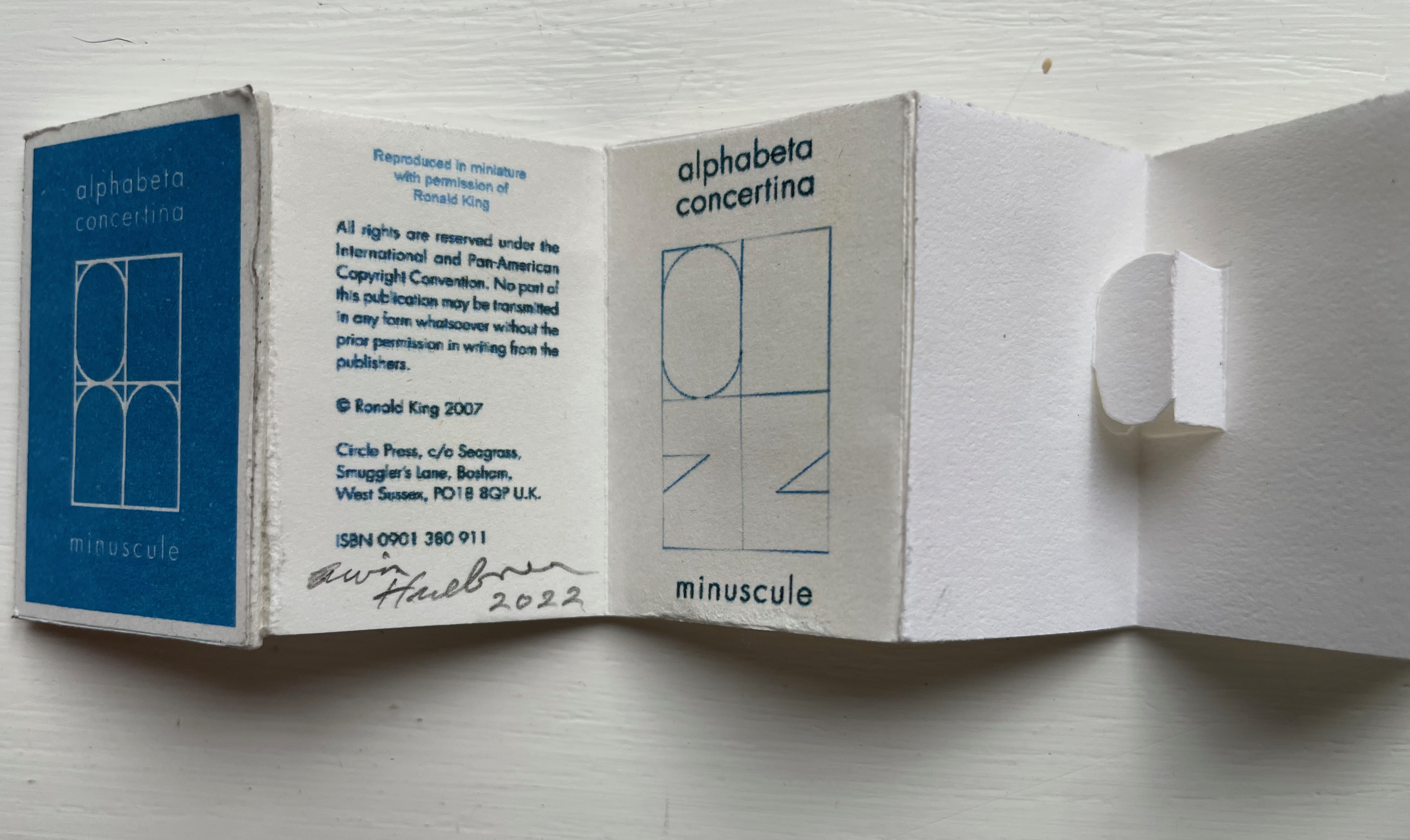
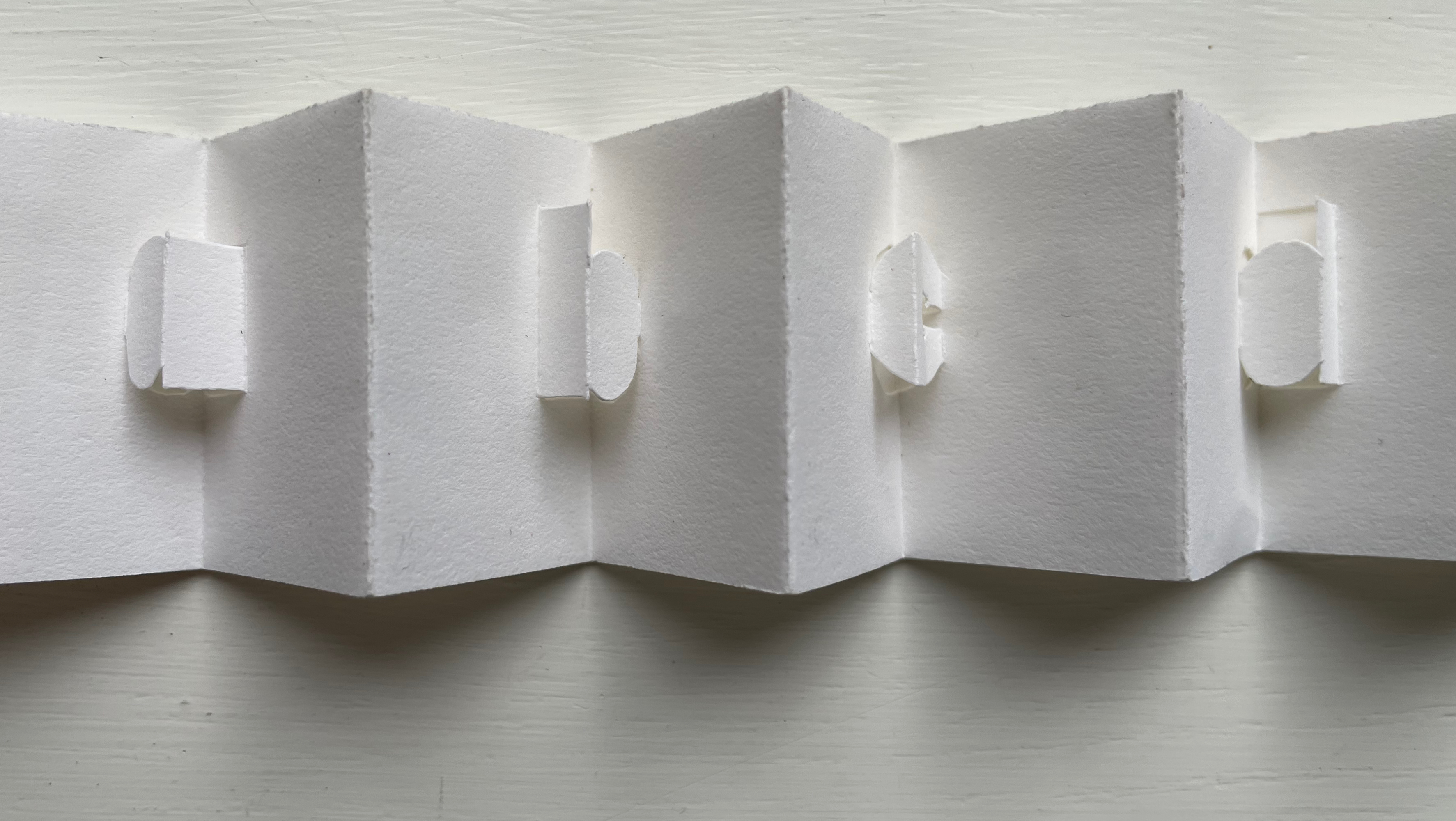
alphabet concertina miniscule (2022)


alphabet concertina miniscule
(2022)
Erwin Huebner (with permission of Ron King)
Miniature double-sided leporello. H 1.5 x W 1.0 x D 0.75 in. Acquired from Erwin Huebner, 20 January 2023.
Photos: Books On Books Collection.

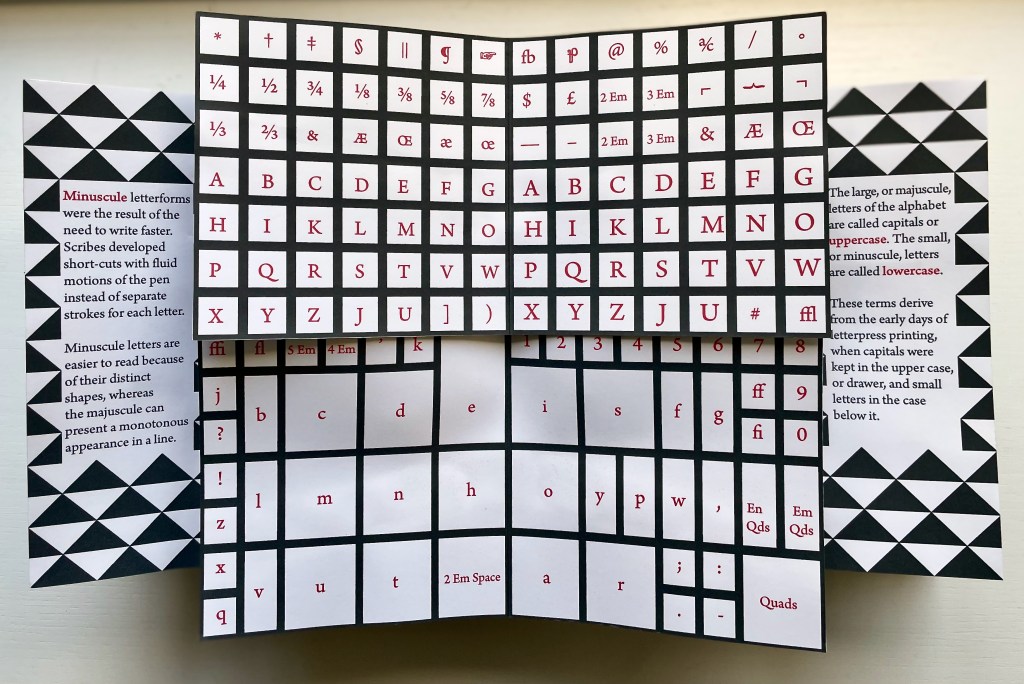
Both the majuscule and miniscule concertinas are double-sided with half the alphabet on one side and half on the other just as King designed from the first with The White Alphabet and the majuscule concertina in 1984 and subsequently 2007 with the miniscule.

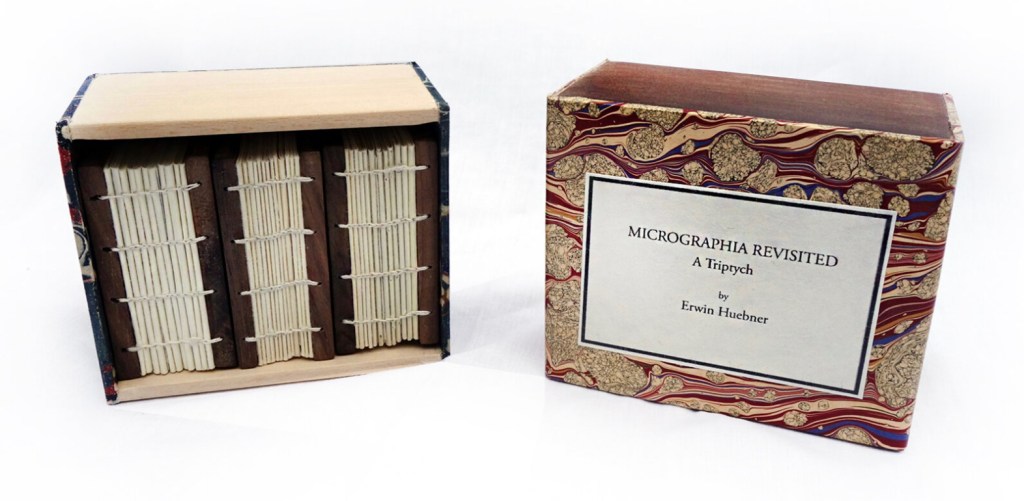
Micrographia Revisited (2017)

Micrographia Revisited: A Triptych (2017)
Erwin Huebner
Box with 3 Coptic-bound volumes, each H 2.625 x W 1.875 x variable depth. Edition of 3. Acquired from Erwin Huebner, 20 January 2023.
Photos: Courtesy of the artist.

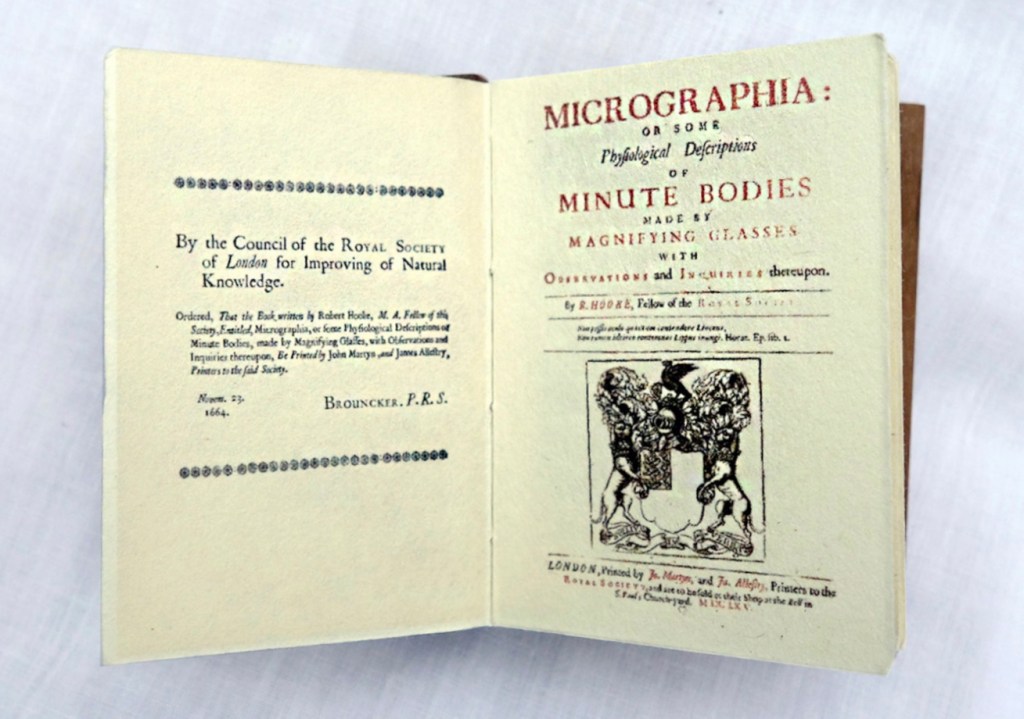
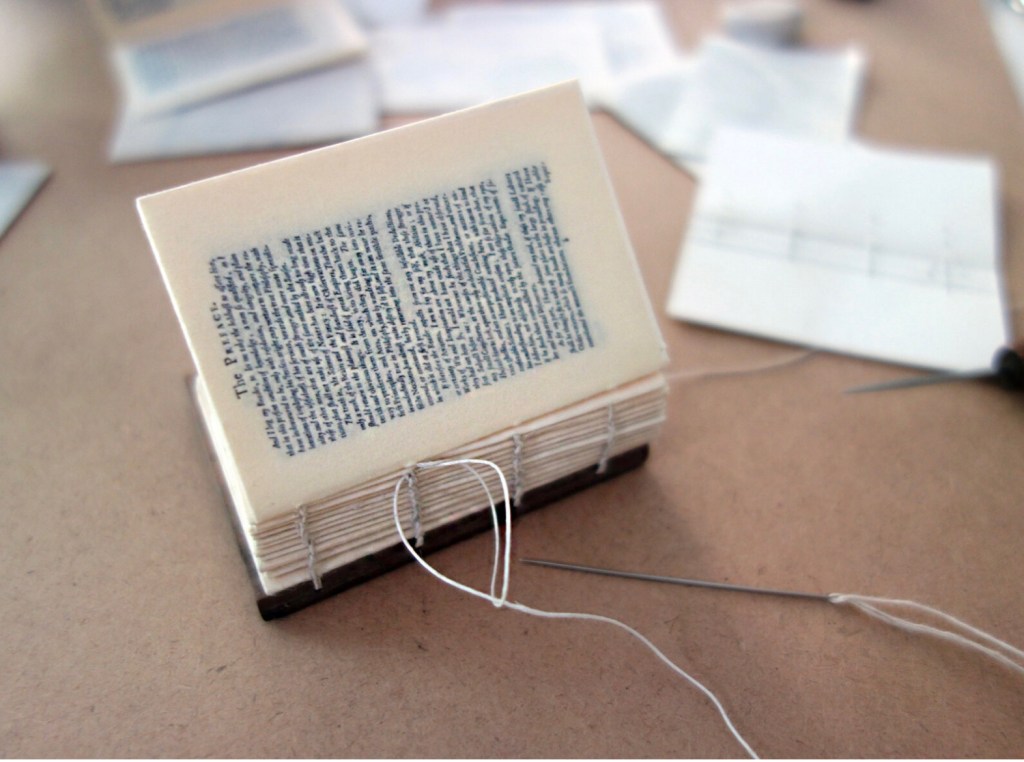
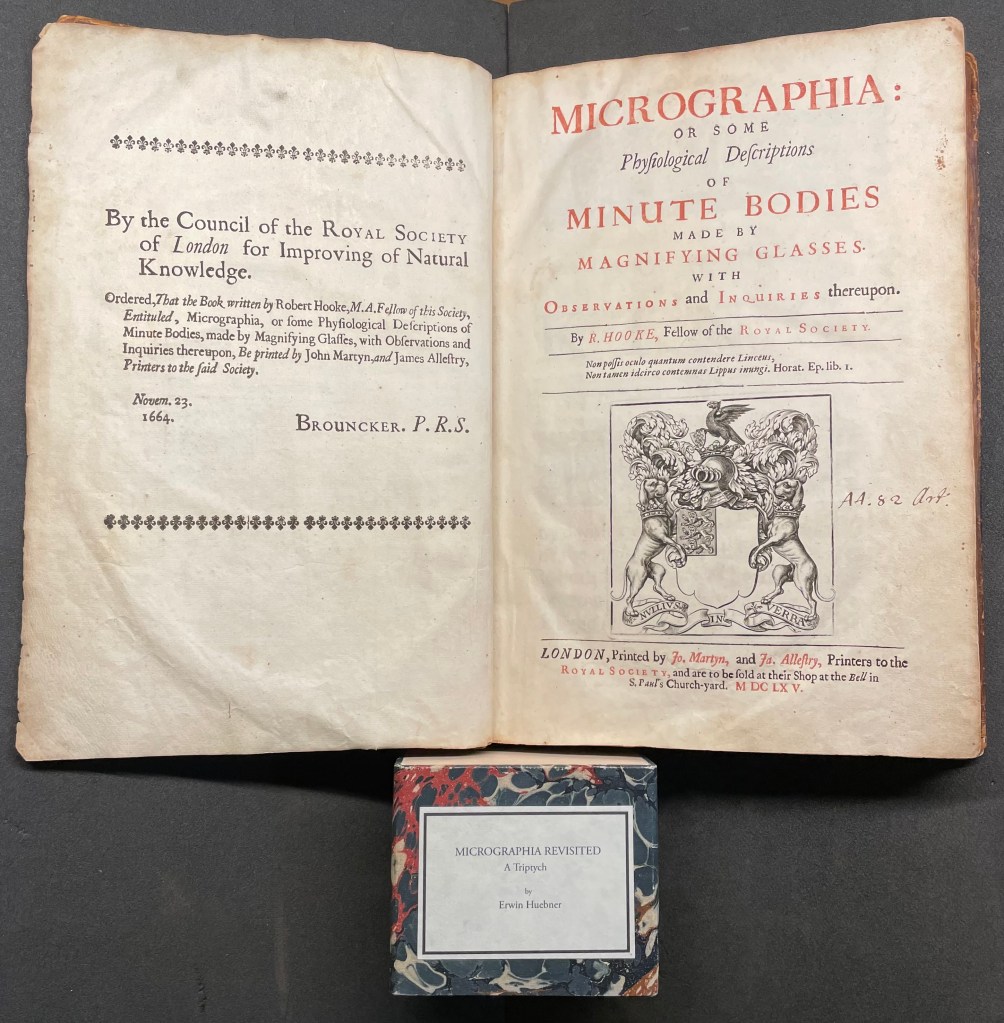
Despite Francesco Stelluti’s Melissographia (1625), Robert Hooke’s Micrographia: Or Some Physiological Descriptions of Minute Bodies Made by Magnifying Glasses with Observations and Inquiries Thereupon (1665) was long thought to be the first publication with illustrations drawn from observation with a microscope. Given Huebner’s scientific and artistic careers, it would seem impossible for him to resist paying homage to this work. Indeed, in his larger artist’s books, he has incorporated entire microscopes, but here, he exploits the technological advances of photography and electron microscopy and joins them with the craft of bookbinding to produce just as wondrous a work. Using Scanning Electron Microscopy (SEM), Huebner has created images of the same or similar objects to those Robert Hooke observed in the 1600’s. One of the volumes in the triptych presents these photographic results, and the other two present a reprint of Micrographia.

The coptic binding to black walnut covers, the wooden case covered in marbled paper and the subtitle create a suitable medieval/Renaissance air for this homage.

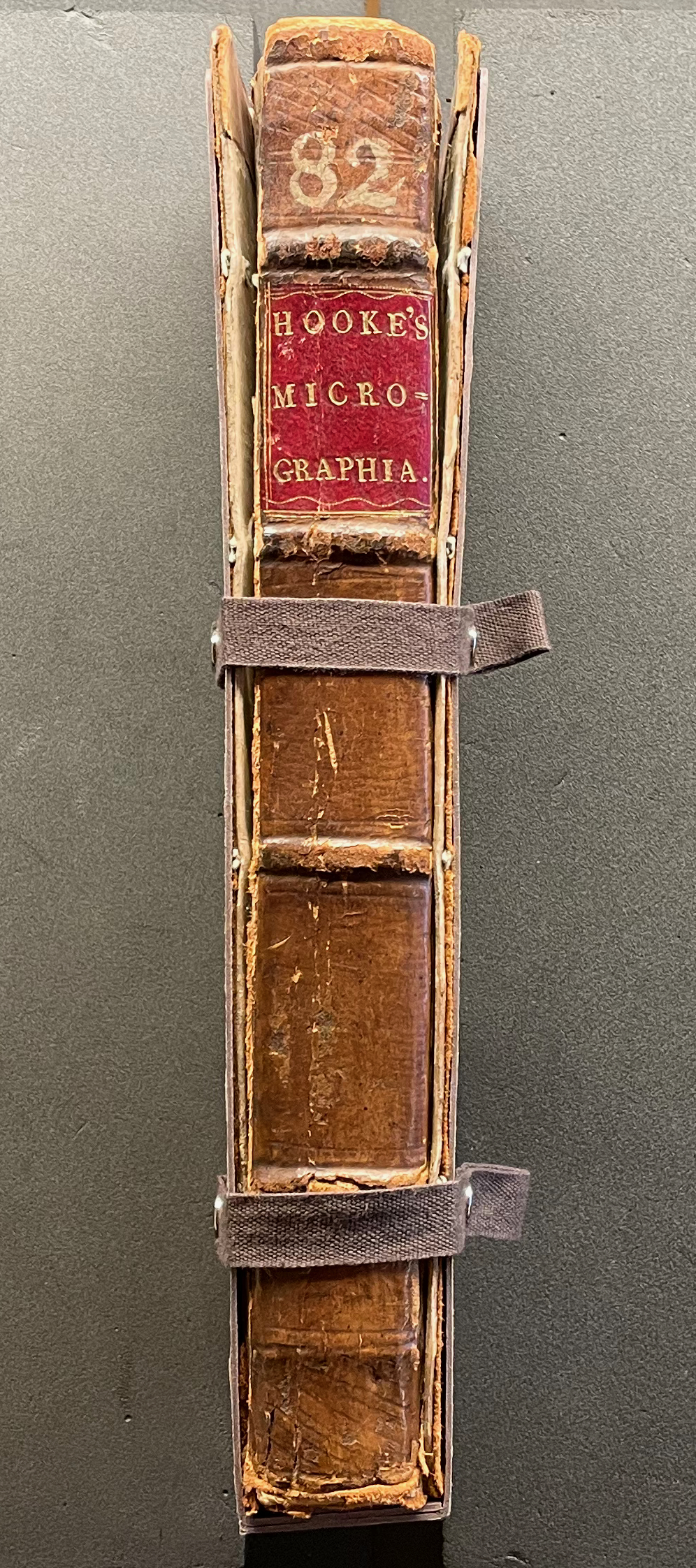
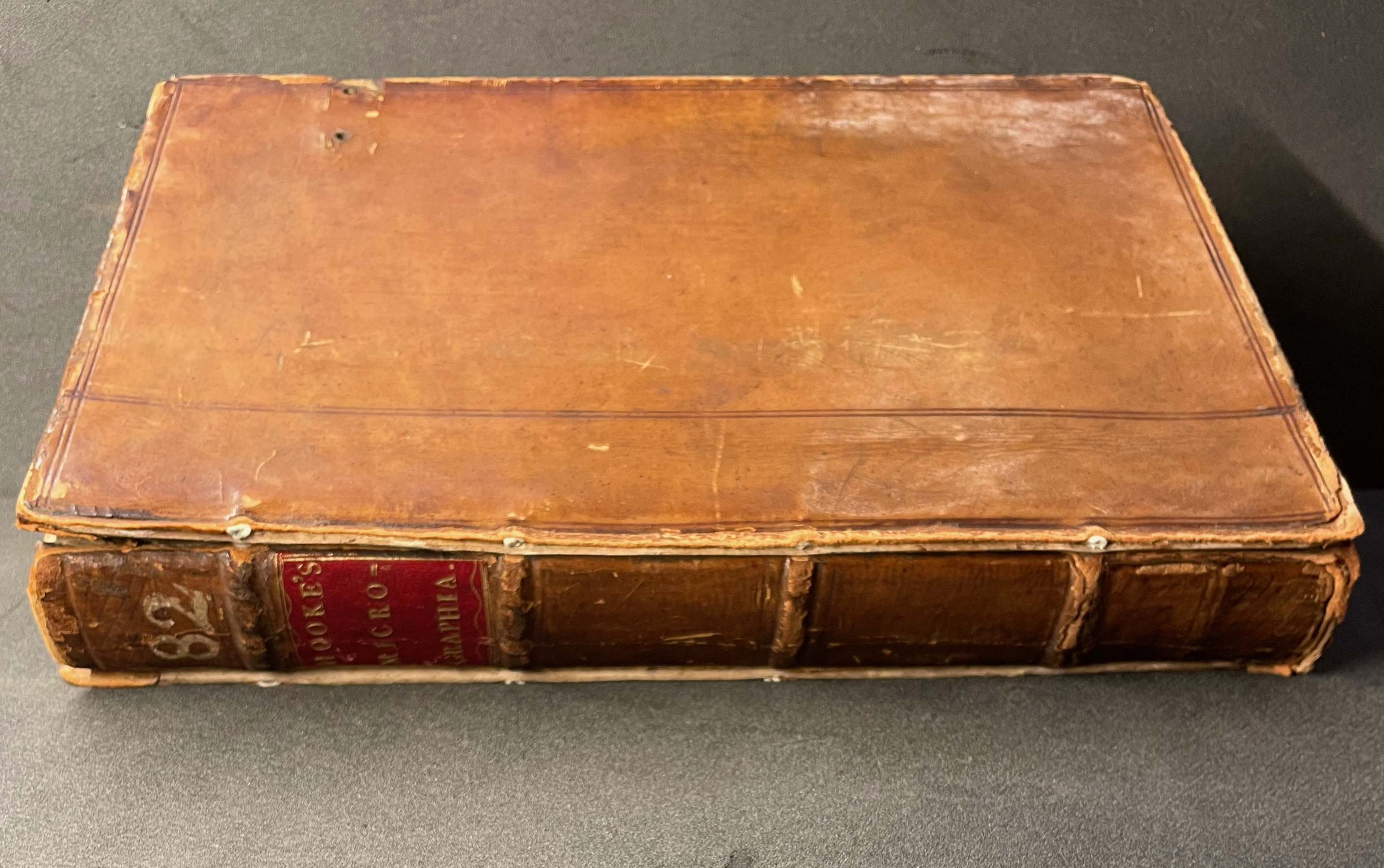
Living in a village near Oxford and having access to the Bodleian Libraries, I took Micrographia Revisited on a pilgrimage to compare it with a copy of the original not far from Hooke’s alma mater Wadham College.


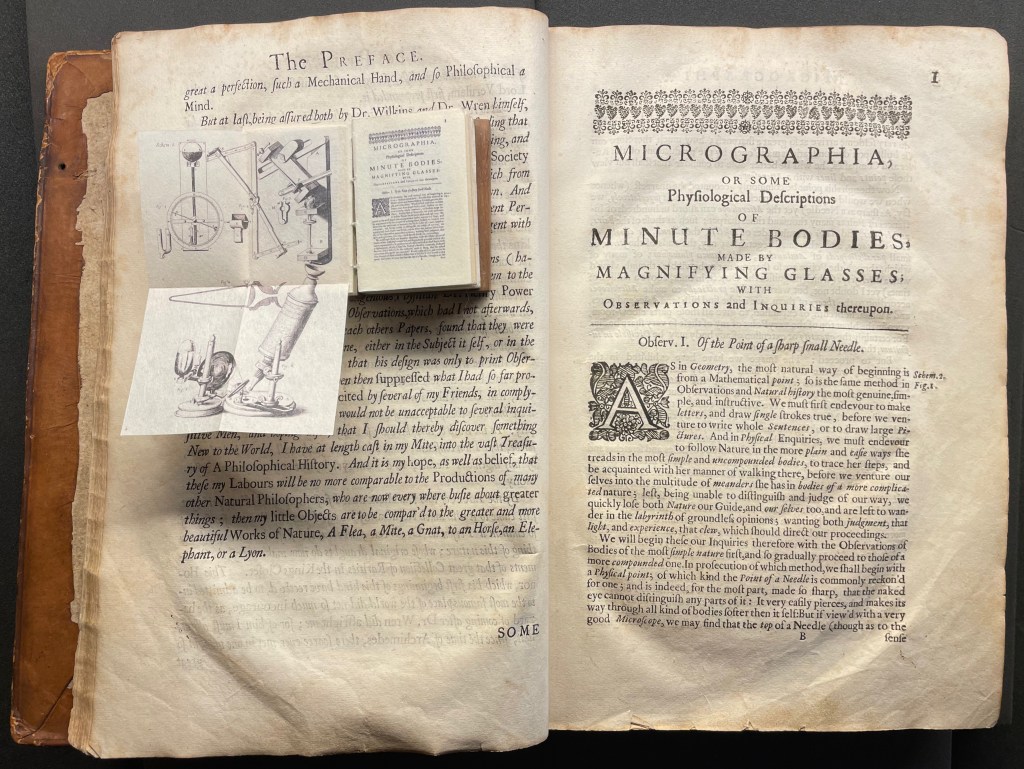
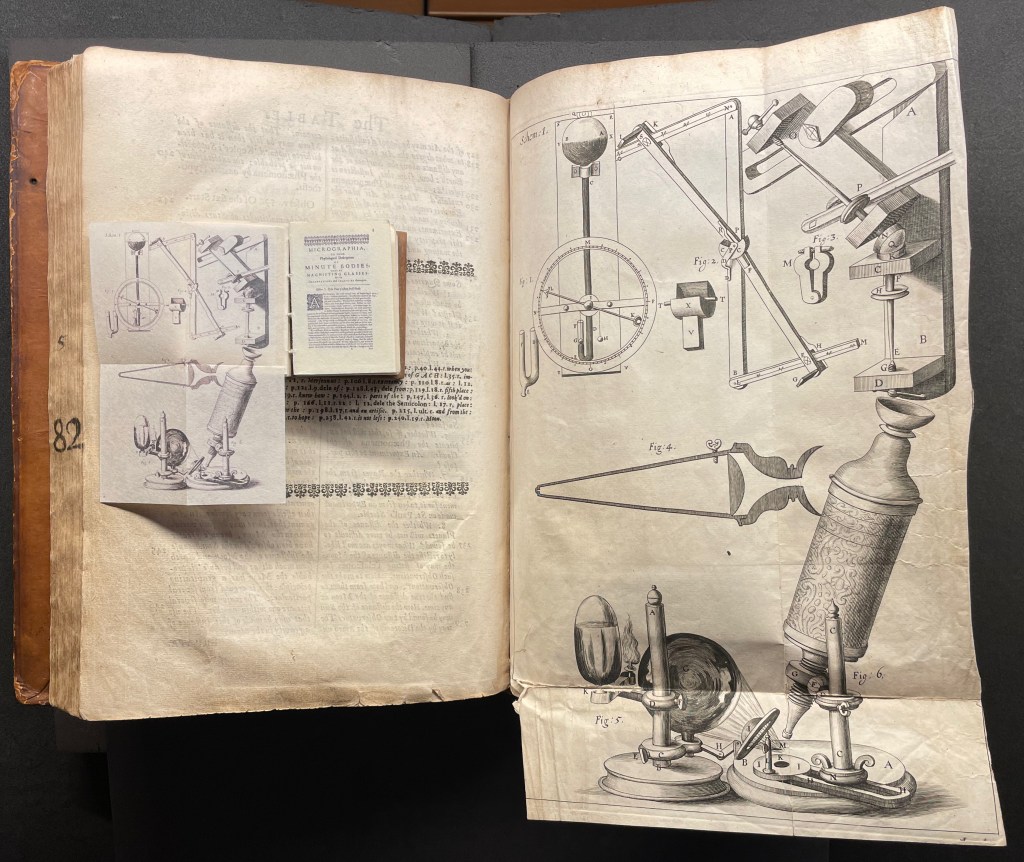
Among the many outstanding features of Huebner’s homage is his use and placement of fold-outs to capture the larger plates in Hooke’s original, all of which were placed in an appendix and some of which were also printed as fold-outs. In the juxtapositions below, note how Huebner has placed Hooke’s illustration of his equipment at the end of the Preface.

Sitting atop the double-page spread showing the end of the Preface and page 1 of Hooke’s original is Micrographia Revisited, open to Huebner’s fold-out of Hooke’s illustration of his equipment. Hooke’s same fold-out illustration from the appendix is juxtaposed below with Huebner’s.

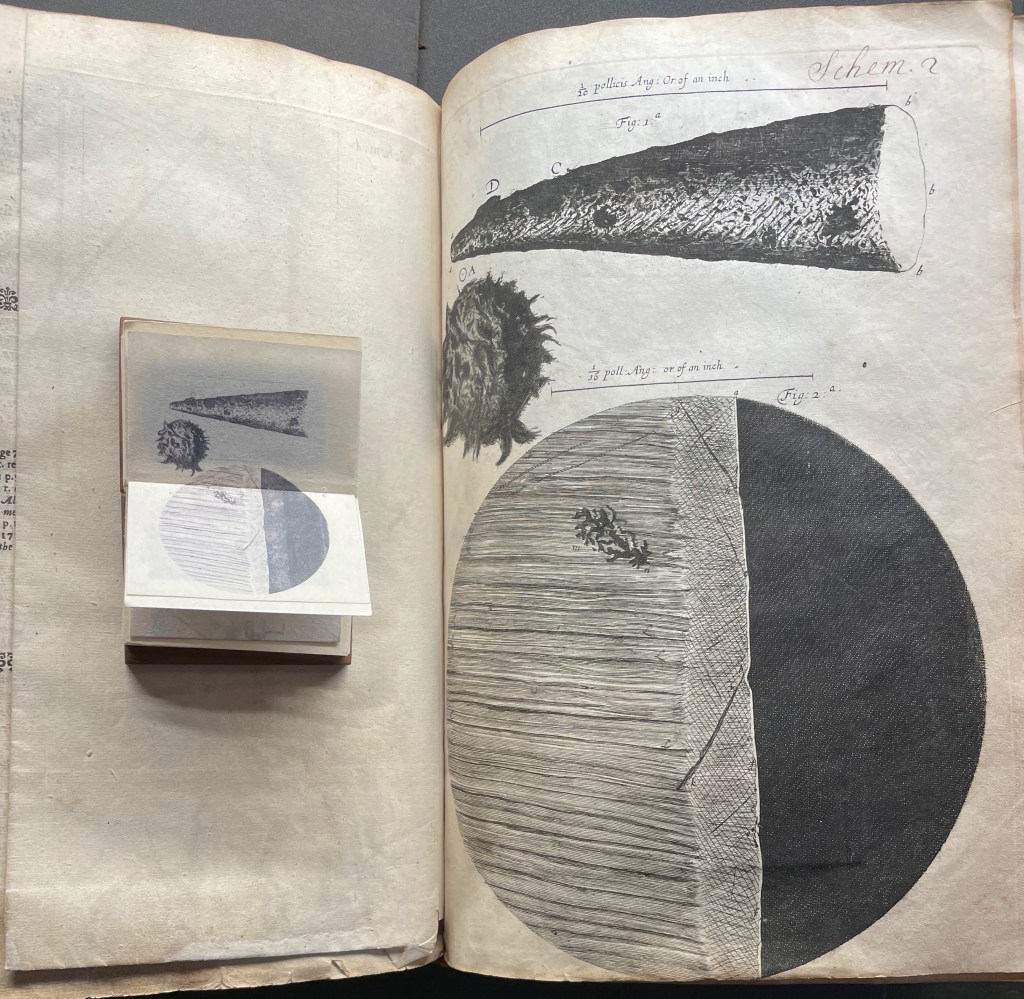
Hooke’s first two objects under the microscope Hooke are the point of a needle (described on pages 1-3) and the edge of a razor (described on pages 4-5). Huebner transforms Hooke’s single-page plate illustrating what he describes into a double-page spread between pages 2 and 3 of Micrographia Revisited.

Juxtaposing Huebner’s double-page presentation of Hooke’s drawings of a needle point and edge a razor with Hooke’s single-page presentation.

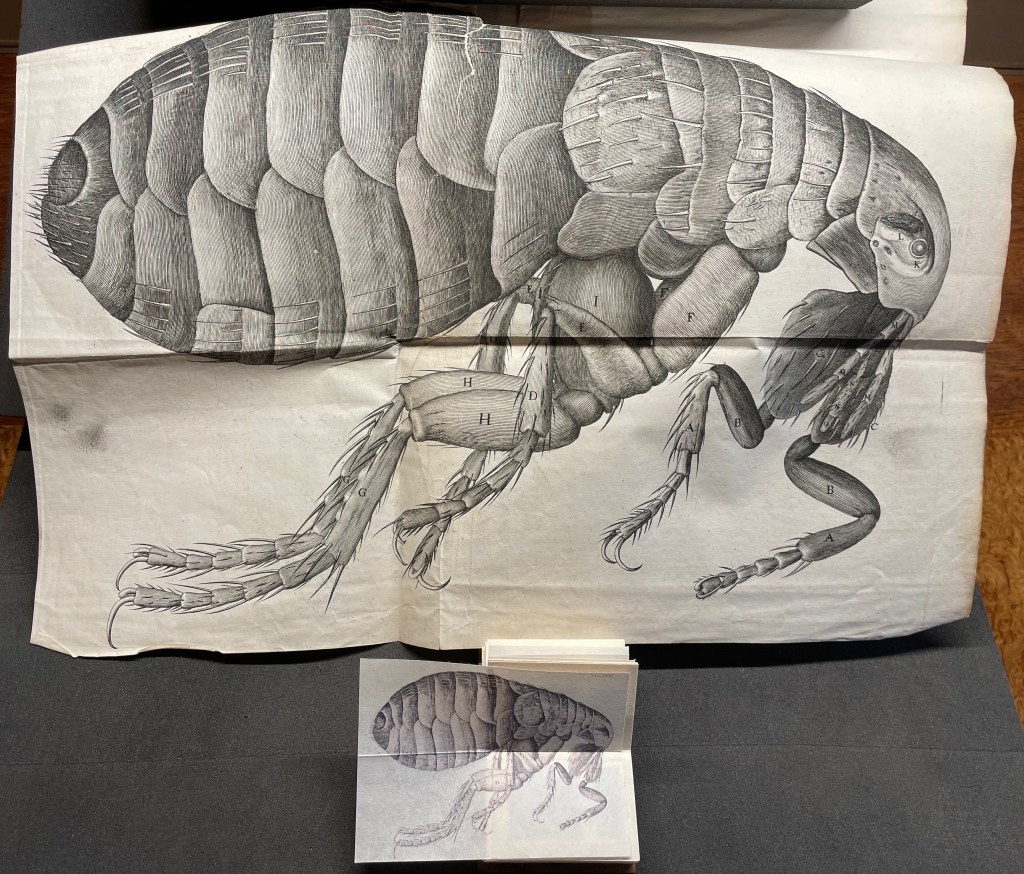
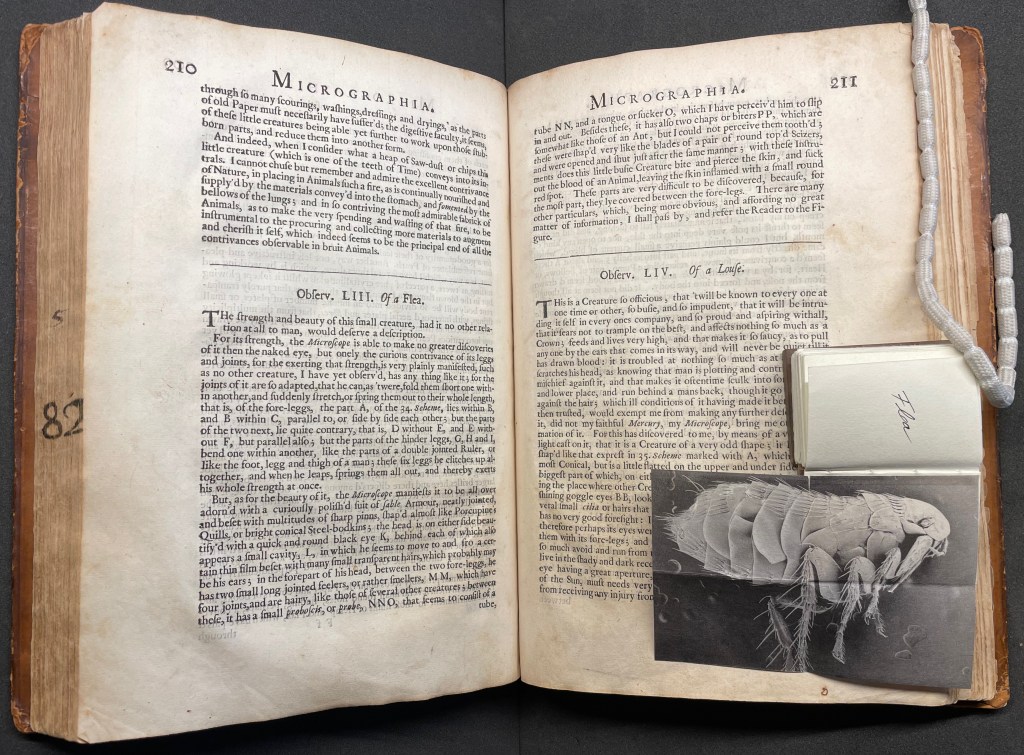
Hooke’s large fold-out of his flea may display the most impressive drawing in the book. The description appears on page 210, and the fold-out is in the appendix. Huebner’s double-fold fold-out of the illustration falls between pages 210 and 211.

The flea from Micrographia juxtaposed with that from Micrographia Revisited.

But most impressive of all is Huebner’s SEM image of a flea and its testament to Hooke’s powers of observation and skills as a draughtsman.

In the spirit of “standing on the shouders of giants”.

Further Reading

Abecedaries I (in progress)“. Books On Books Collection.

Alphabets Alive! – ABCs in Miniature“. 19 July 2023. Books On Books Collection.

Ron King“. 1 March 2021. Books On Books Collection.

Willow Legge“. 16 February 2021. Books On Books Collection.

Bignami, G. 2000. “The microscope’s coat of arms“. Nature. 405:999.

Freedberg, David. 1998. “Iconography between the History of Art and the History of Science: Art, Science and the Case of the Urban Bee“. In Jones, Caroline A., Peter Galison and Amy E Slaton. 1998. Picturing Science Producing Art. New York: Routledge.

Books On Books Collection – Kevin M. Steele

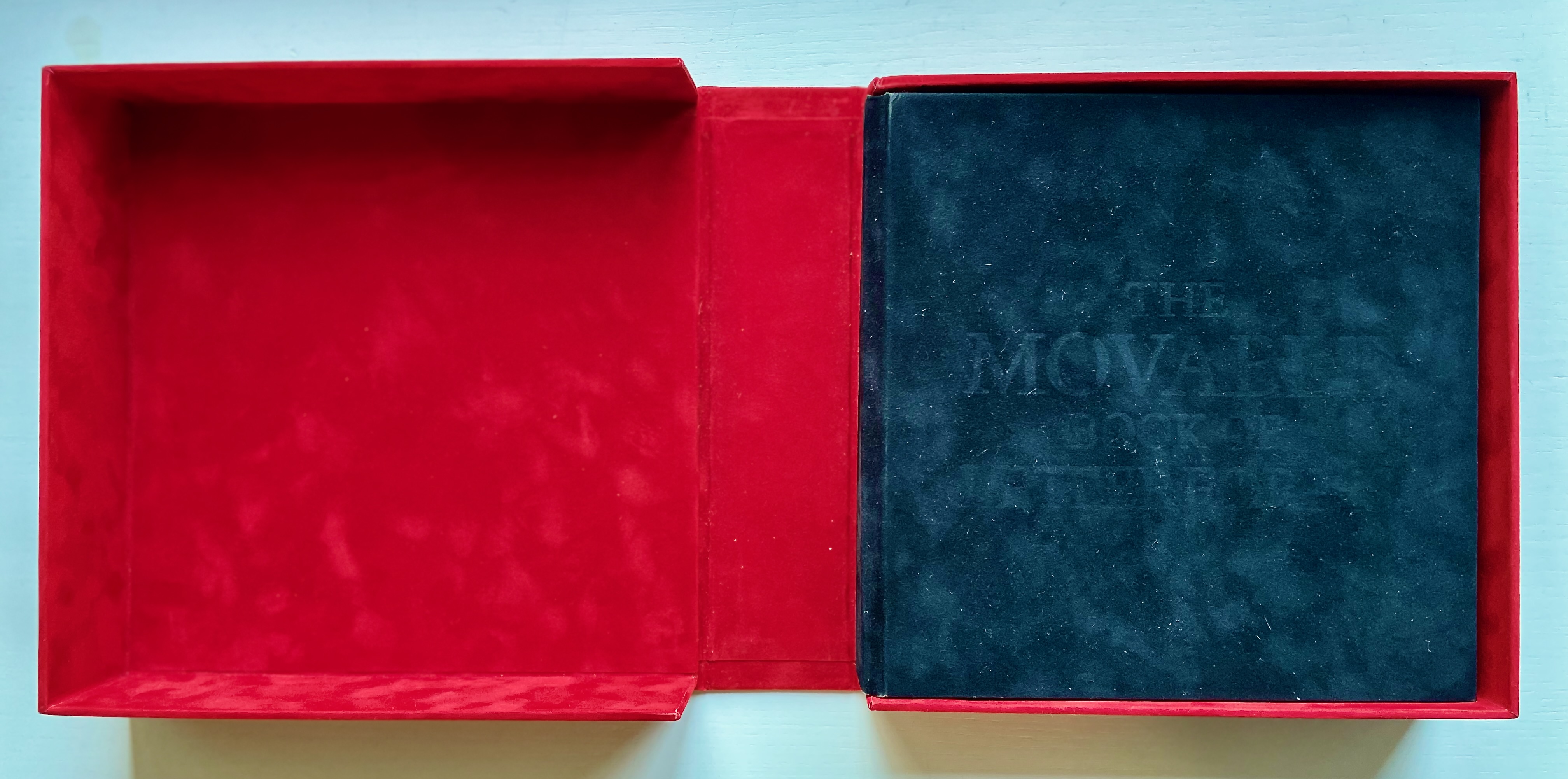
The Movable Book of Letterforms (2009)

The Movable Book of Letterforms (2009)
Kevin M. Steele
Pop-up book. 210 x 210 mm. 22 pages. Edition of 3. Acquired from the artist, November 2022.
Photos: Books On Books Collection. Displayed with permission of the artist.


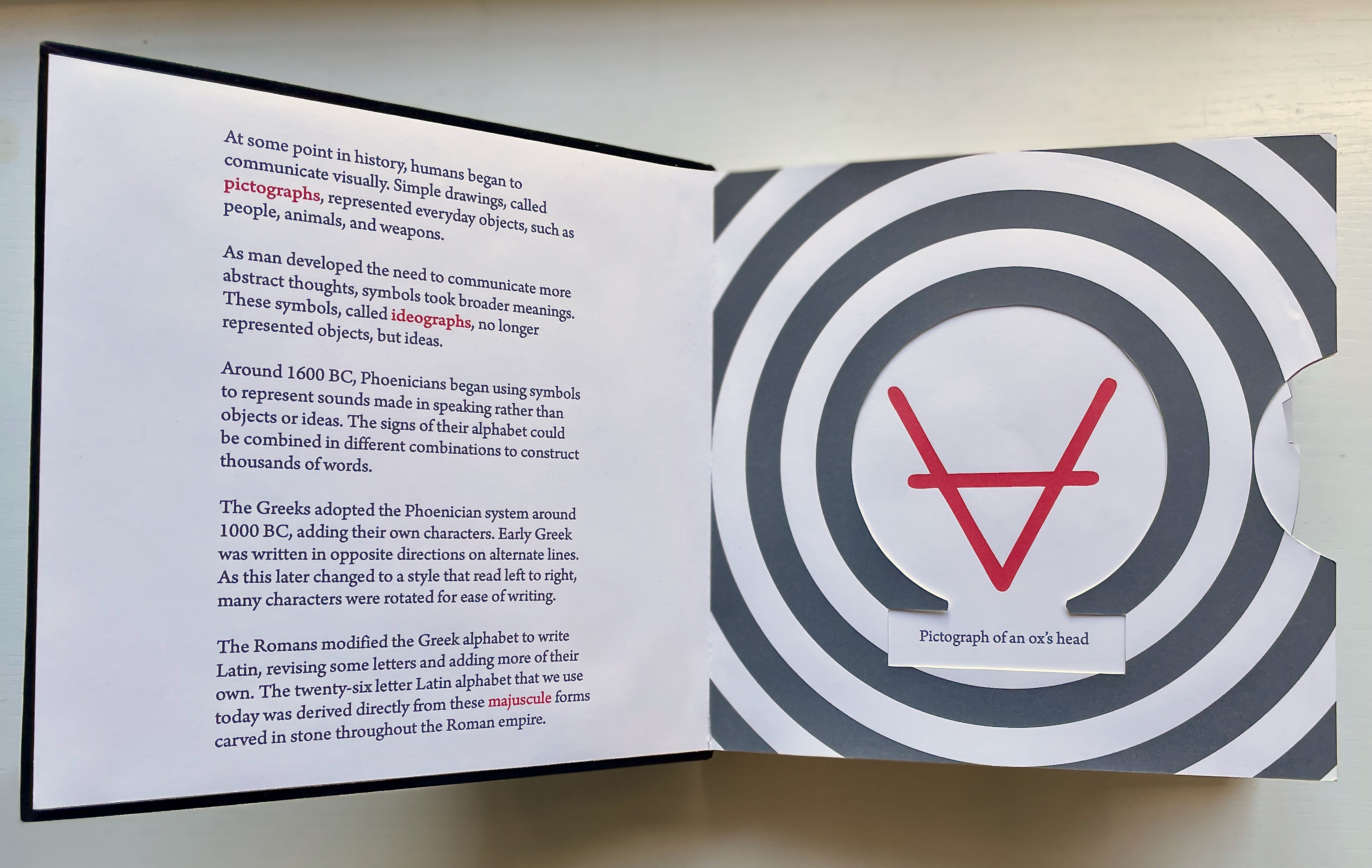
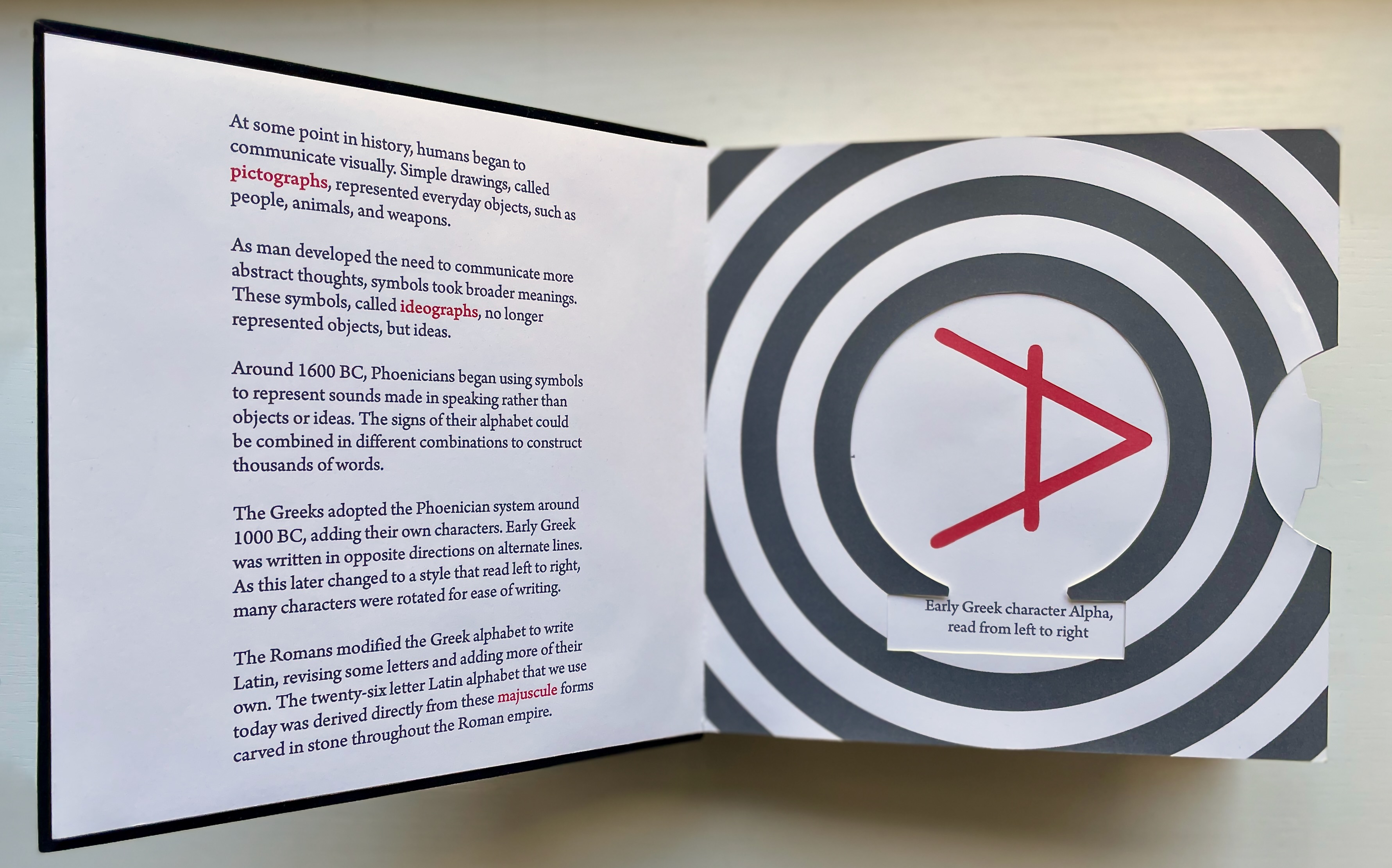
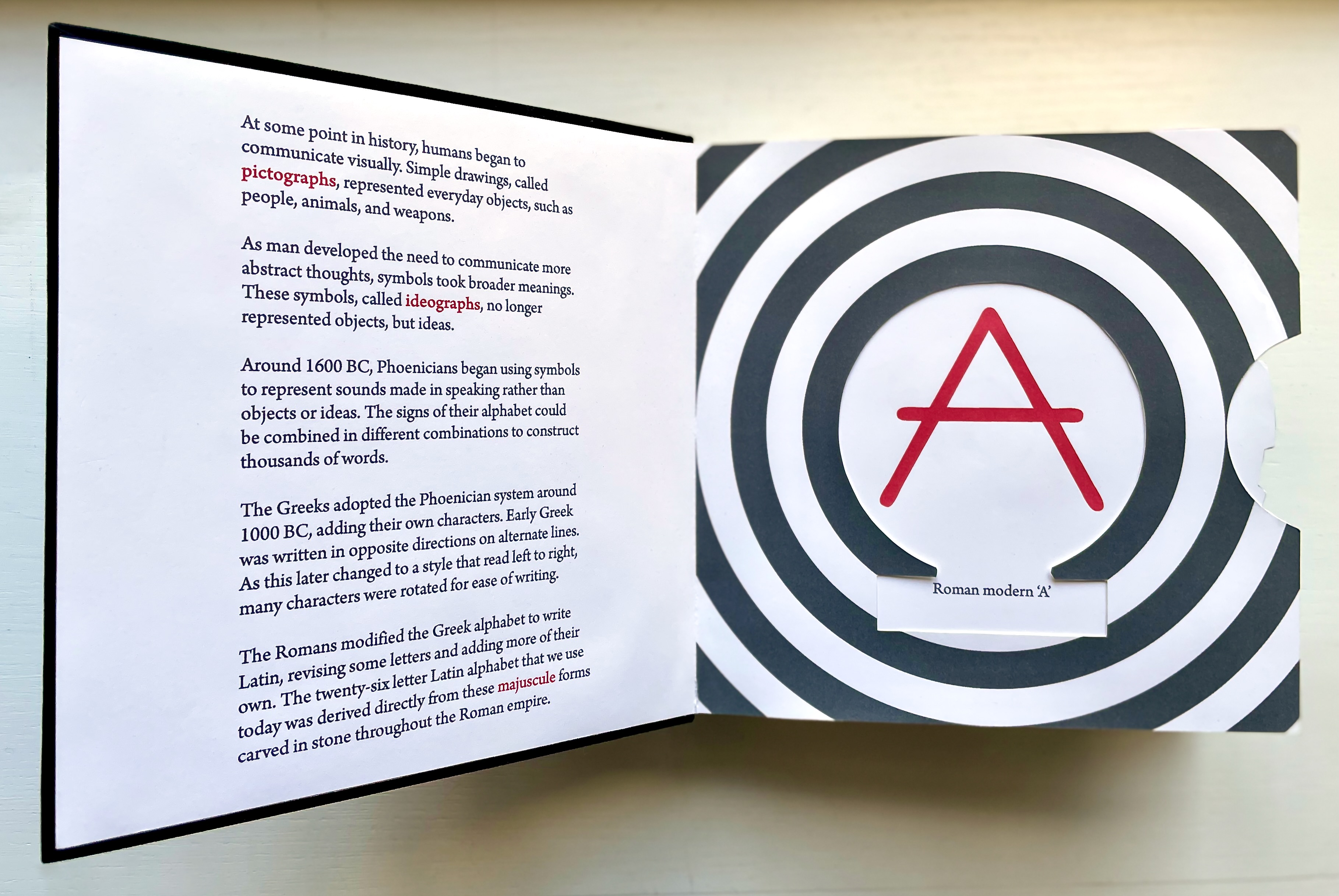
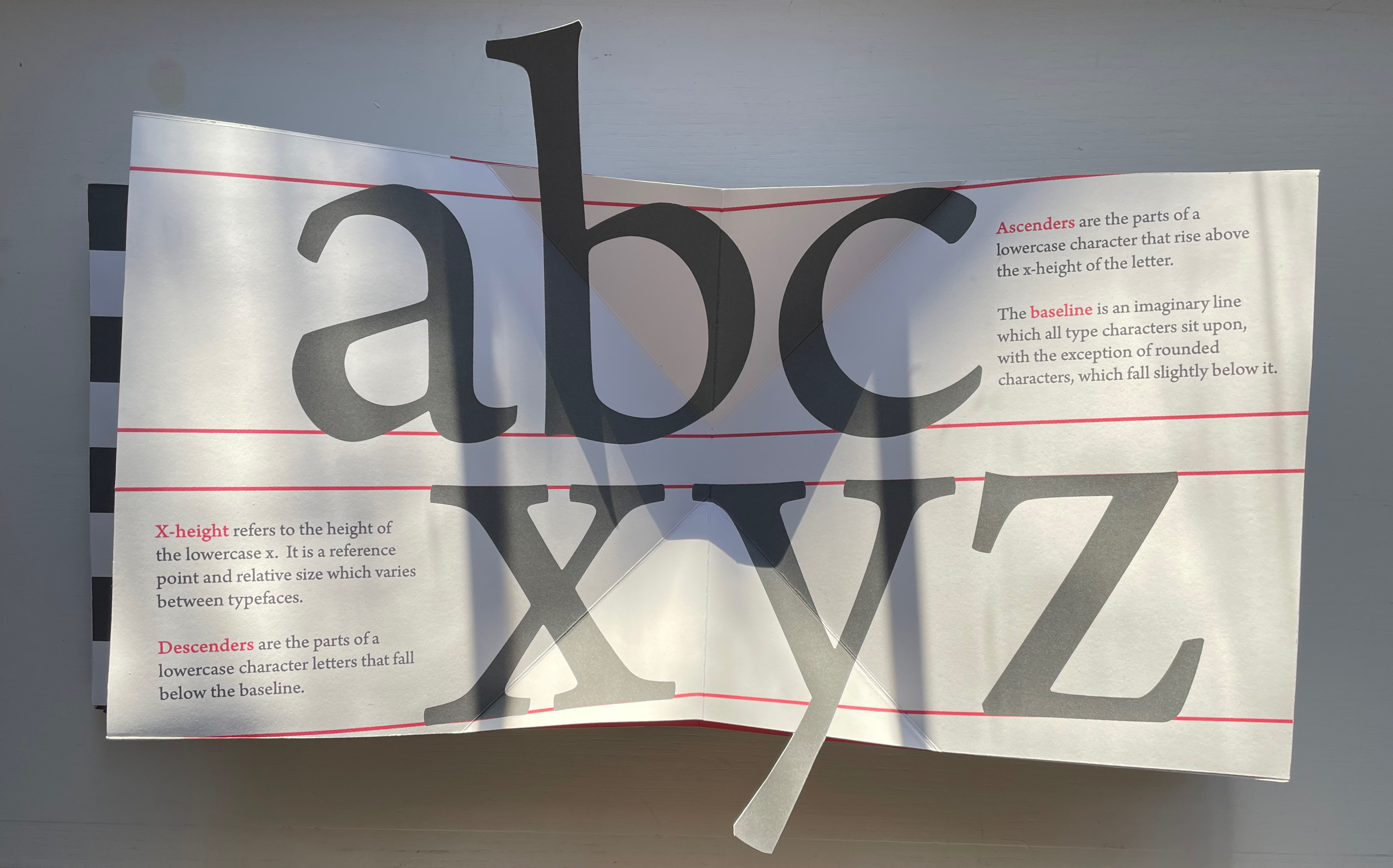
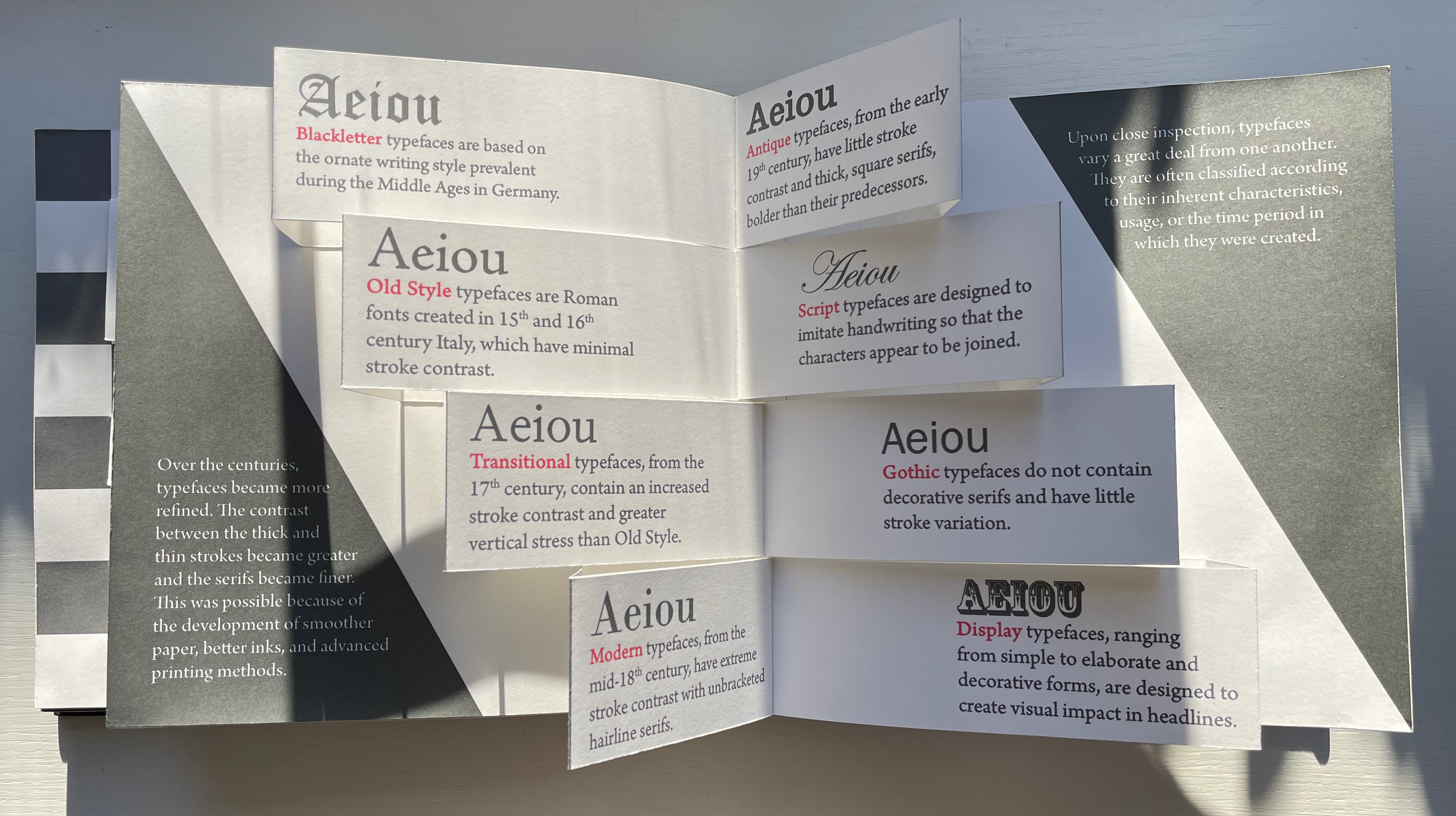
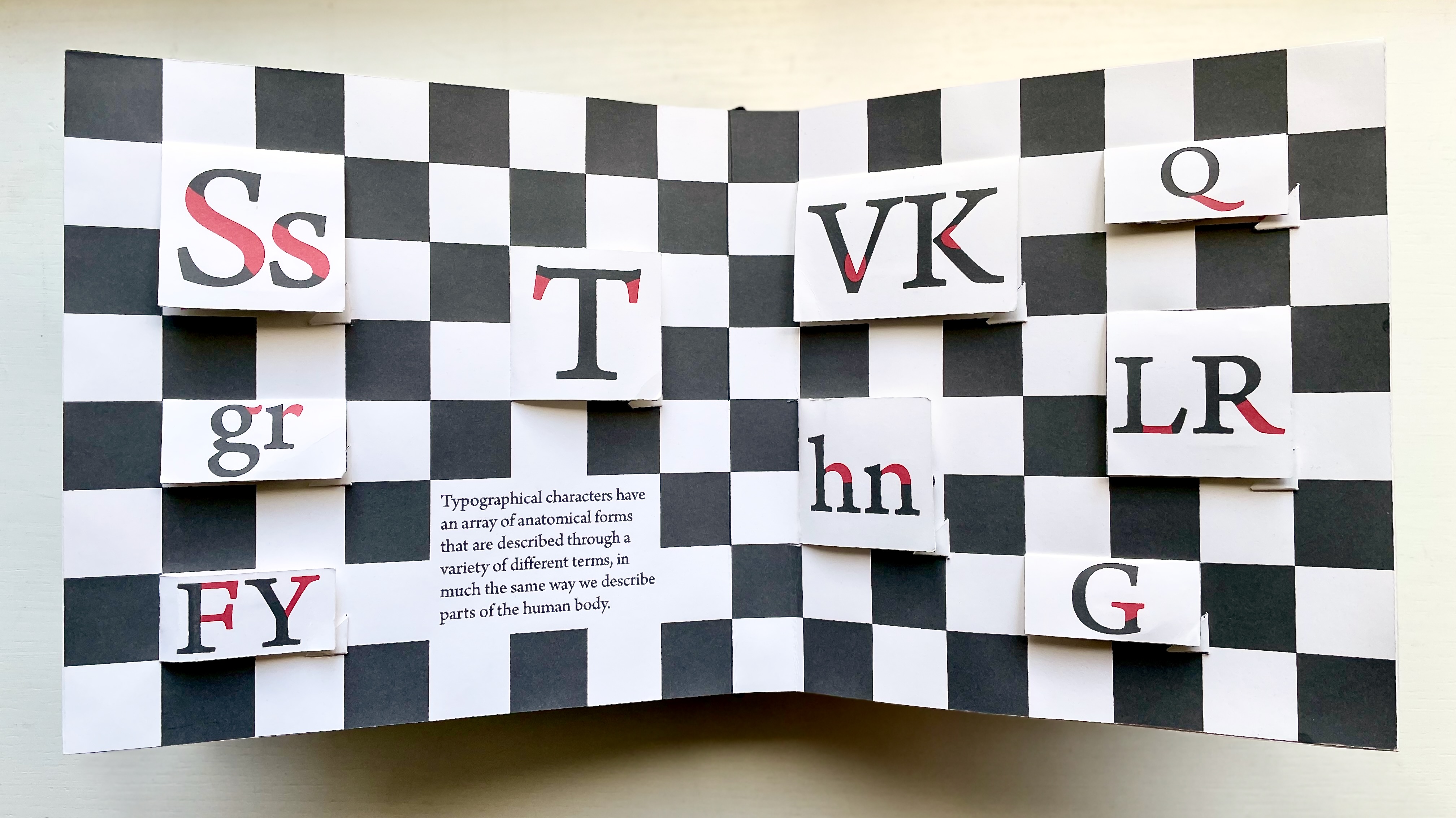
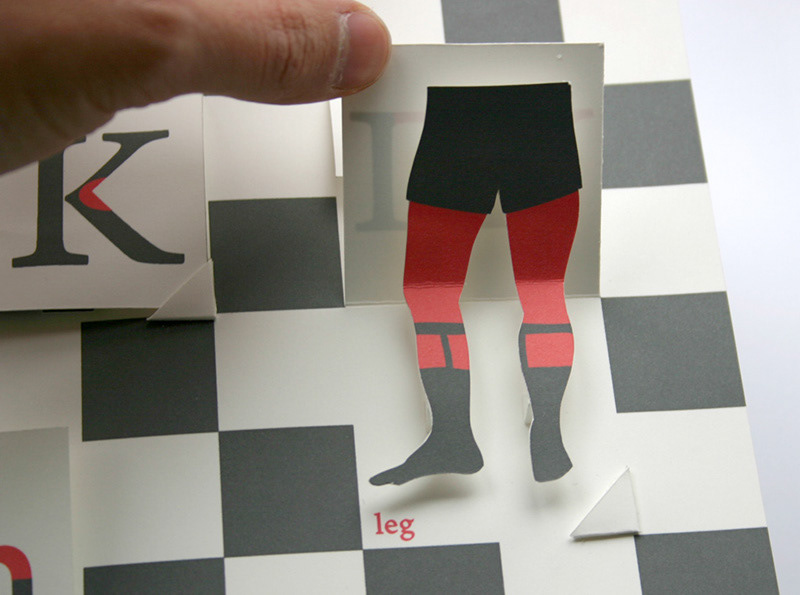
Letterforms have a tangibility that exceeds their two-dimensional representation on paper and even on screen. How better to educate the viewer to their tactility and three-dimensionality than with movable book techniques such as the volvelle, pop-ups, flaps and tab pulls?

The Movable Book of Letterforms (2009) is a work of art that does just that: it enacts a basic introduction to the origins and unique characteristics of letterforms. A limited edition of three, all of its movable parts have been cut and assembled by hand. The printing is digital on Mohawk Superfine 80lb, and the box and book are covered in Laval velour bookcloth debossed with polymer plate. The only element the artifact is missing is metal.

For a monumental display of Steele’s book and paper engineering, a visit in the UK to the National Maritime Museum in Greenwich is urged. It can also be found in the following collections:

Metropolitan Museum of Art, New York
Wits Art Museum, Johannesburg
University of Iowa, Iowa City
Indiana University, Bloomington
Western Michigan University, Kalamazoo
Michigan State University, East Lansing

Further Reading

Abecedaries I (in progress)“. Books On Books Collection.

BOOKNESS speaks to Kevin Steele“. 18 December 2023. Oxford: Bodleian Libraries.

Chen, Julie. 2013. 500 Handmade Books. Volume 2. New York: Lark. P. 29 (The Deep).

Lawson, Alexander S. 2010. Anatomy of a Typeface. 5th print ed. Boston: David R. Godine.

McNeil, Paul. 2017. The Visual History of Type. London: Laurence King Publishing.

Salamony, Sandra, and Peter and Donna Thomas. 2012. 1,000 Artists’ Books : Exploring the Book as Art. Minneapolis: Quarto Publishing Group USA. P. 181 (Le Meschere della Commedia dell’Arte).

Books On Books Collection – William Dugan

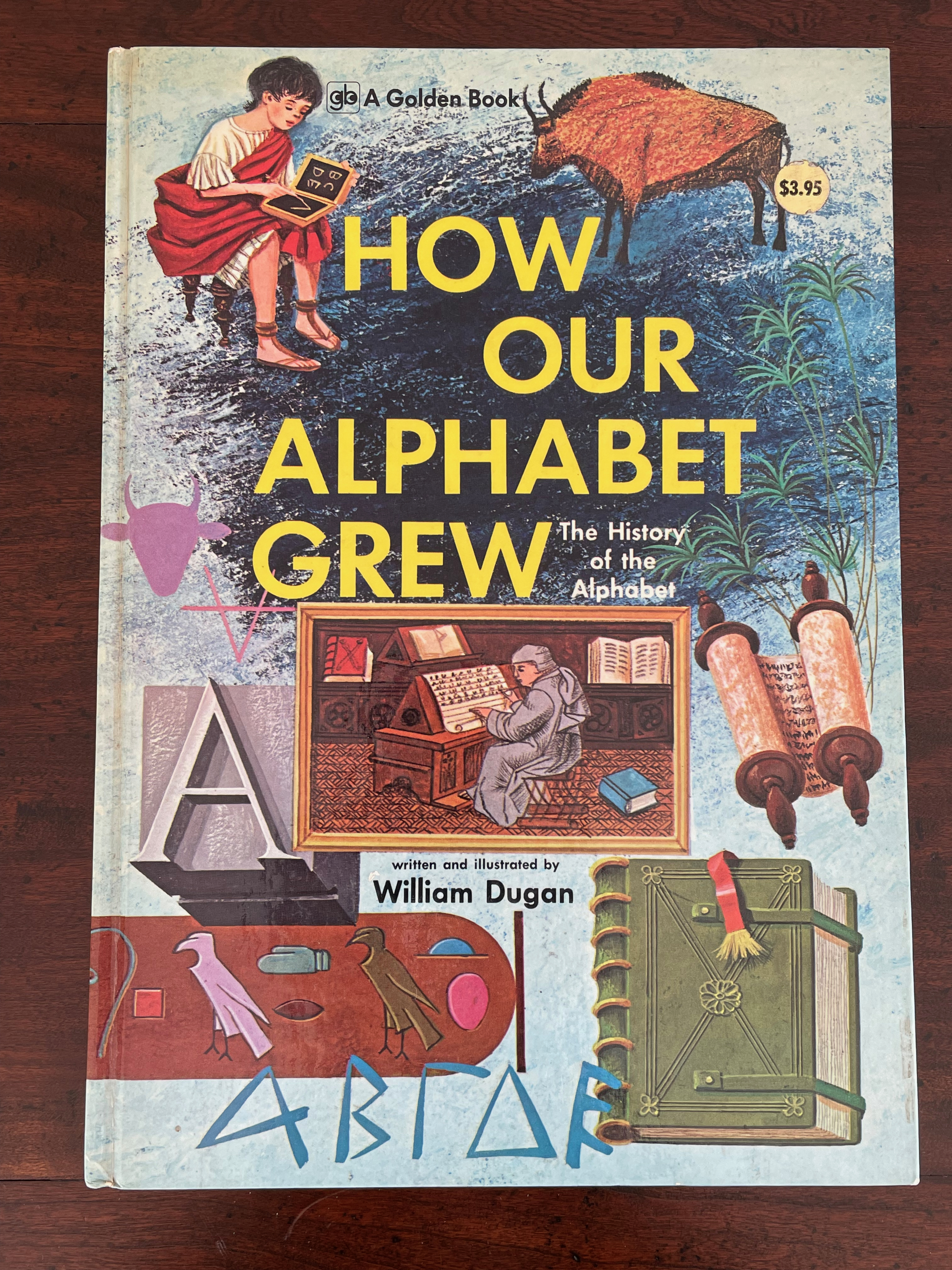
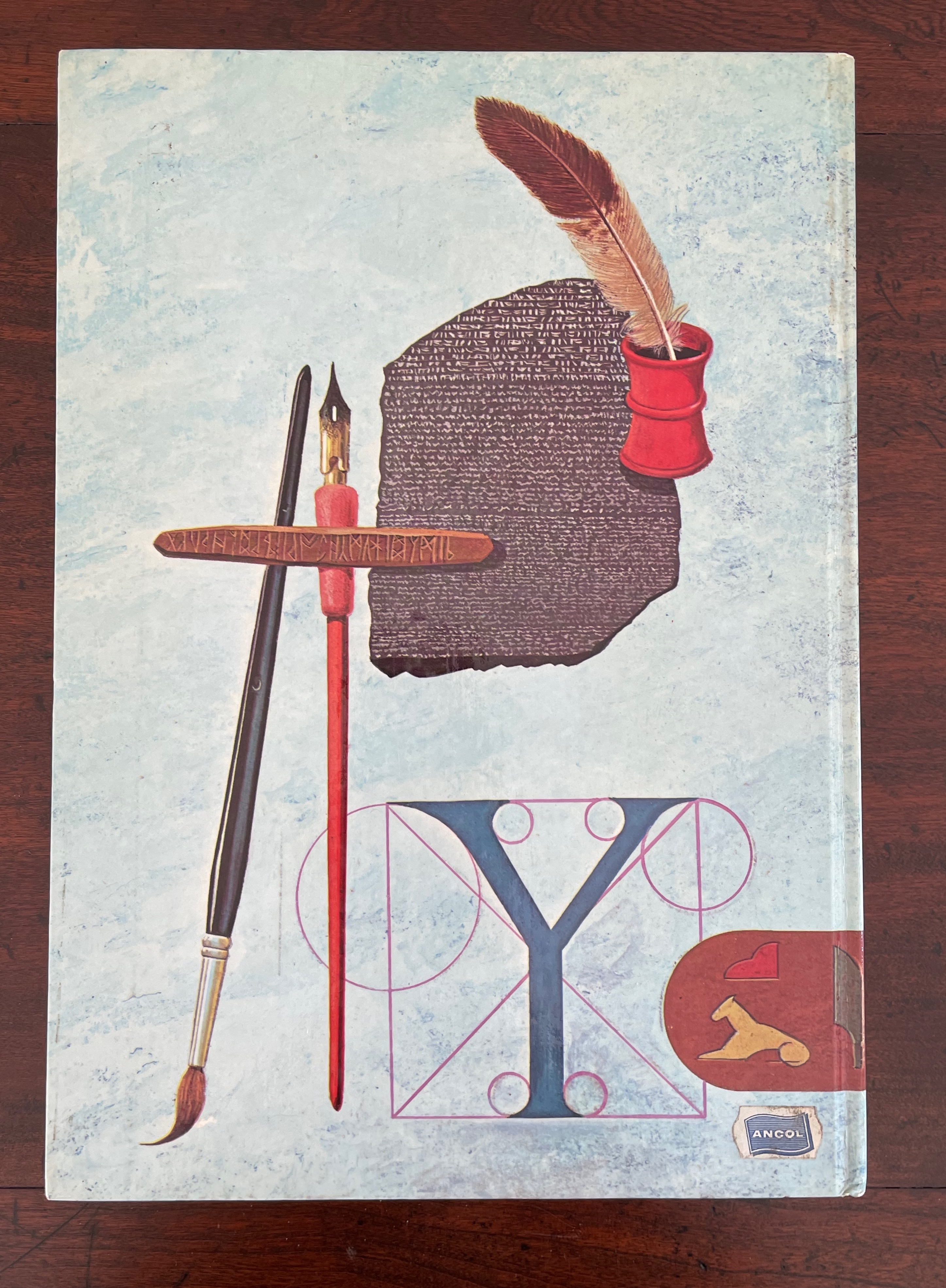
How Our Alphabet Grew (1972)

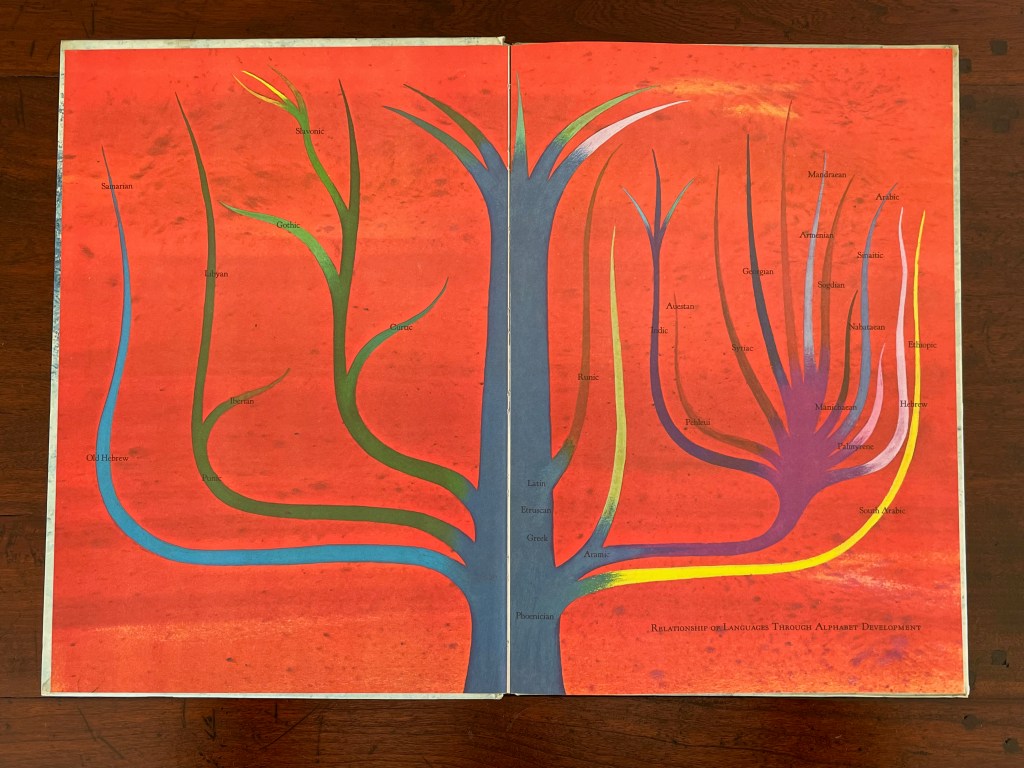
How Our Alphabet Grew: The History of the Alphabet (1972)
William Dugan
Casebound, illustrated paper on board, illustrated endpapers and pastedowns. H320 x W227 mm. 72 pages. Acquired 14 March 2023.
Photos: Books On Books Collection.

Curiously, little information about William Dugan appears online. He was a prolific illustrator of children’s books — especially those published by Golden Press in the 1960s and 1970s. He also authored as well as illustrated several early childhood books — on insects, signs, machines and vehicles. Two of his books, however, are meant for older children — this one and All about Houses (1975), which is a forerunner to Dorling Kindersley‘s children’s reference books.

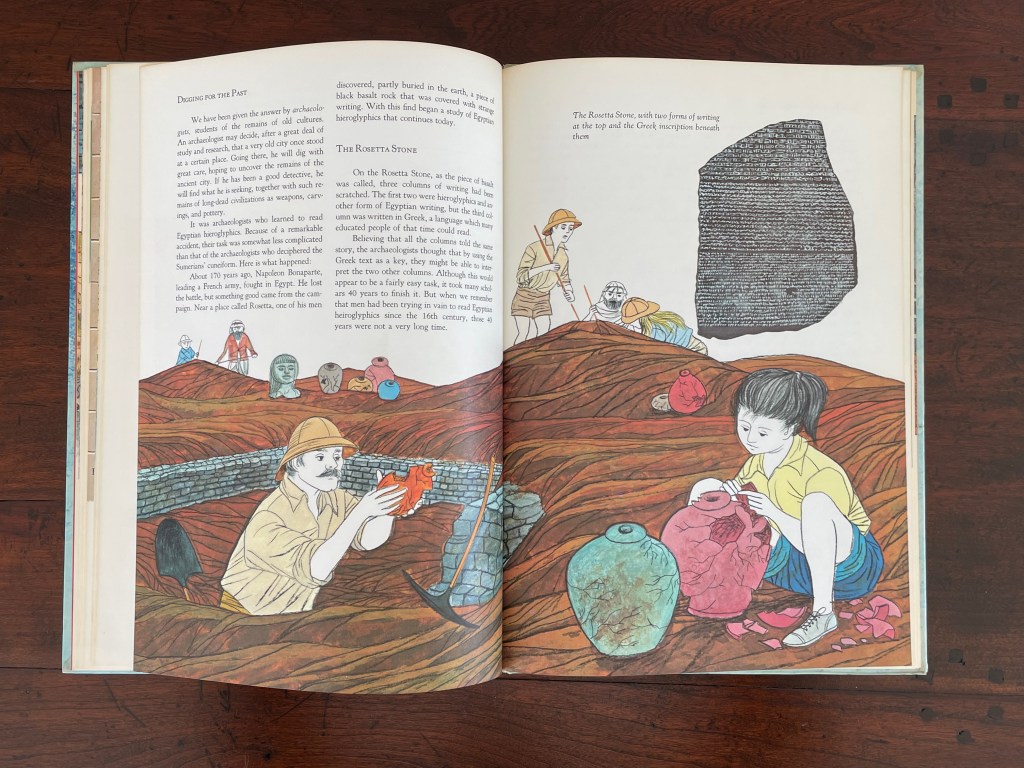
Dugan’s ability to alter his style as writer and illustrator to the ages of his audience is notable. Even more notable is the diversity and inclusiveness of his reference works for older children. Despite the date of publication, a young girl occupies the foreground of the illustration of archaeologists, a feature that would have brought a smile to Ada Yardeni and still might to Tiphaine Samoyault.

Further Reading

Abecedaries I (in progress)“. Books On Books Collection.

Lanore Cady“. 16 December 2022. Books On Books Collection.

Lyn Davies“. 7 August 2022. Books On Books Collection.

Timothy Donaldson“. 1 February 2023. Books On Books Collection.

Cari Ferraro“. 1 February 2023. Books On Books Collection.

David J. Goldman“. Books On Books Collection. [In progress]
Rudyard Kipling and Chloë Cheese“. 15 February 2023. Books On Books Collection.

Abe Kuipers“. 15 February 2023. Books On Books Collection.

Don Robb and Anne Smith“. 26 March 2023. Books On Books Collection.

Renzo Rossi“. 10 July 2023. Books On Books Collection.

James Rumford. 21 November 2022. Books On Books Collection.

Tiphaine Samoyault“. 10 July 2023. Books On Books Collection.

Ben Shahn“. 20 July 2022. Books On Books Collection.

Tommy Thompson“. 21 August 2022. Books On Books Collection.

Ada Yardeni“. 10 July 2023. Books On Books Collection.

Bernal, Martin. 1990. Cadmean Letters : The Transmission of the Alphabet to the Aegean and Further West Before 1400 B.C. Winona Lake IN: Eisenbrauns.

Diringer, David, and Reinhold Regensburger. 1968. The alphabet: a key to the history of mankind. London: Hutchinson. A standard, beginning to be challenged by late 20th and early 21st century archaeological findings and palaeographical studies.

Drucker, Johanna. 1999. The alphabetic labyrinth: the letters in history and imagination. New York, N.Y.: Thames and Hudson.

Ege, Otto. 1921/1998. The Story of the Alphabet, Its Evolution and Development… Embellished Typographically with Printer’s Flowers Arranged by Richard J. Hoffman. Van Nuys, CA: Richard J. Hoffman. A miniature. The type ornaments chosen by Hoffman are arranged chronologically by designer (Garamond, Granjon, Rogers) and printed in color.

Firmage, Richard A. 2001. The alphabet. London: Bloomsbury.

Fischer, Steven Roger. 2008. A history of writing. London: Reaktion Books.

Jackson, Donald. 1997. The story of writing. Monmouth, England: Calligraphy Centre.

Moziani, Eliyahu. 1984. Torah of the Alphabet or How the Art of Writing Was Taught Under the Judges of Israel (1441-1025) : -The Original Short Course in Alphabetic Writing Conceived by Israel in Sinai. Herborn: Baalschem.

Pflughaupt, Laurent. 2008. Letter by letter: an alphabetical miscellany. New York: Princeton Architectural Press.

Robb, Don, and Anne Smith. 2010. Ox, house, stick: the history of our alphabet. Watertown, MA: Charlesbridge. Children’s book.

Robinson, Andrew. 1995. The story of writing. London: Thames and Hudson.

Rosen, Michael. 2014. Alphabetical: how every letter tells a story. London: John Murray.

Sacks, David. 2003. Language visible unraveling the mystery of the alphabet from A to Z. New York: Broadway Books.

Shaw, Gary. 15 April 2021. “Ancient ABCs: The alphabet’s ‘missing link’ discovered in Israel“. The Art Newspaper.

Books On Books Collection – John Crombie

John Crombie formed Kickshaws in 1979 in Paris. Joined by Sheila Bourne, they published over 150 works. Apparent as the esoteric influence of visual poetry and the Oulipo movement may be, their works have the combined smell of the printer and typesetter’s workshop and artist’s studio that distinguish them from that crowd.

ABC in a maze (1987)


ABC in a maze
(1987)
John Crombie
Spiral bound on four sides, double gate fold. H95 xW95 mm, 17 leaves. Edition of 300 (150 in English, 150 in French), of which this is Letter of 26 numbered A-Z. Acquired from Librairie Jean-Étienne Huret, 17 March 2022.
Photos: Books On Books Collection.

The cover of this work hides its title, just as the proper order of the pages hides in the reiterations of the alphabet across 17 leaves of this double gatefold puzzle and book.

The French title ABC Dédale carries more freight than the English. Not only does it convey the idea of the maze by reference to its inventor Daedulus, it refers to Cadmus, the Phoenician prince who brought the alphabet to Greece while on his quest to find his sister Europa, mother by Zeus to the Minotaur — the “monster in the alphabet”. If that seems a far-fetched allusion, then consider the additional hint in the name of the chosen typeface: Hélios, the Greek god and personification of the sun, to which Daedulus’ son Icarus flew too close in their escape from Crete.

Portrait évolutif du typographe
Evolving portrait of the typographer” (1988)


Portrait évolutif du typographe. Fait par lui-même en collaboration avec sa presse en douze passages a partir des trois couleurs primaires

Evolving portrait of the typographer. Made by himself in collaboration with his press in twelve passes using the three primary colors)”(1988)
John Crombie
Softcover, sewn and glued. 162 x 162 mm. 28 unnumbered pages. Edition of 60, of which this is #42. Acquired from Antiquariat Heinzelmännchen, 2 October 2022.
Photos: Books On Books Collection.

If a selection of works from the Books On Books Collection were made based on the theme of “artists’ books and color”, this small work would have to make the cut. Moving from five small splashes of color in the first pass, subsequent passes build up a multi-colored cartoon image of the typographer in a head-on eyeless gaze. At the seventh pass, however, the colors begin to fade; in the ninth, the features of the portrait begin to erode, and by the twelfth, only streaks of gray and the faintest impression of the outline remain.

A close look at the title reveals that same faint impression of the portrait’s outline. Were it not for its reference to the three primary colors, the title would have to be amended to a baker’s dozen of passes in collaboration with the press.

Further Reading

Abecedaries I (in progress)“. Books On Books Collection.

Sonia Delaunay“. Books On Books Collection. In progress.

Klaus Groh and Hermann Havekost“. 2 July 2021. For another strange four-way binding.

Karen Hanmer“. 25 October 2021. Books On Books Collection.

Ursula Hochuli-Gamma“. 18 November 2022. Books On Books Collection.

Jean Holabird“. 8 February 2022. Books On Books Collection.

Tatyana Mavrina“. 24 February 2023. Books On Books Collection.

Kveta Pacovska“. Books On Books Collection. In progress.

Shirley Sharoff (1)“. 27 March 2019. Books On Books Collection.

Shirley Sharoff (2)“.1 August 2020. Books On Books Collection.

Books On Books Collection – Alan James Robinson

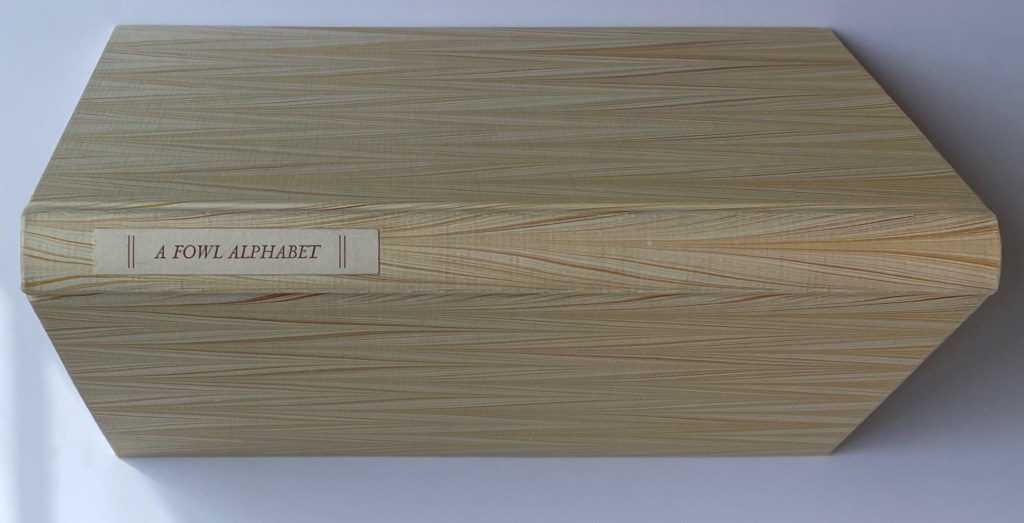
A Fowl Alphabet (1986)

A Fowl Alphabet (1986)
Alan James Robinson (etchings), Suzanne Moore (calligraphy)
Casebound. Marbled paper over boards. Doublures and flyleaves. H218 x W145 mm. 26 Folios untrimmed at head. Four-page prospectus loose. Acquired from Bromers Bookseller, 16 August 2022.
Photos: Books On Books Collection. Displayed with permission of the artists.

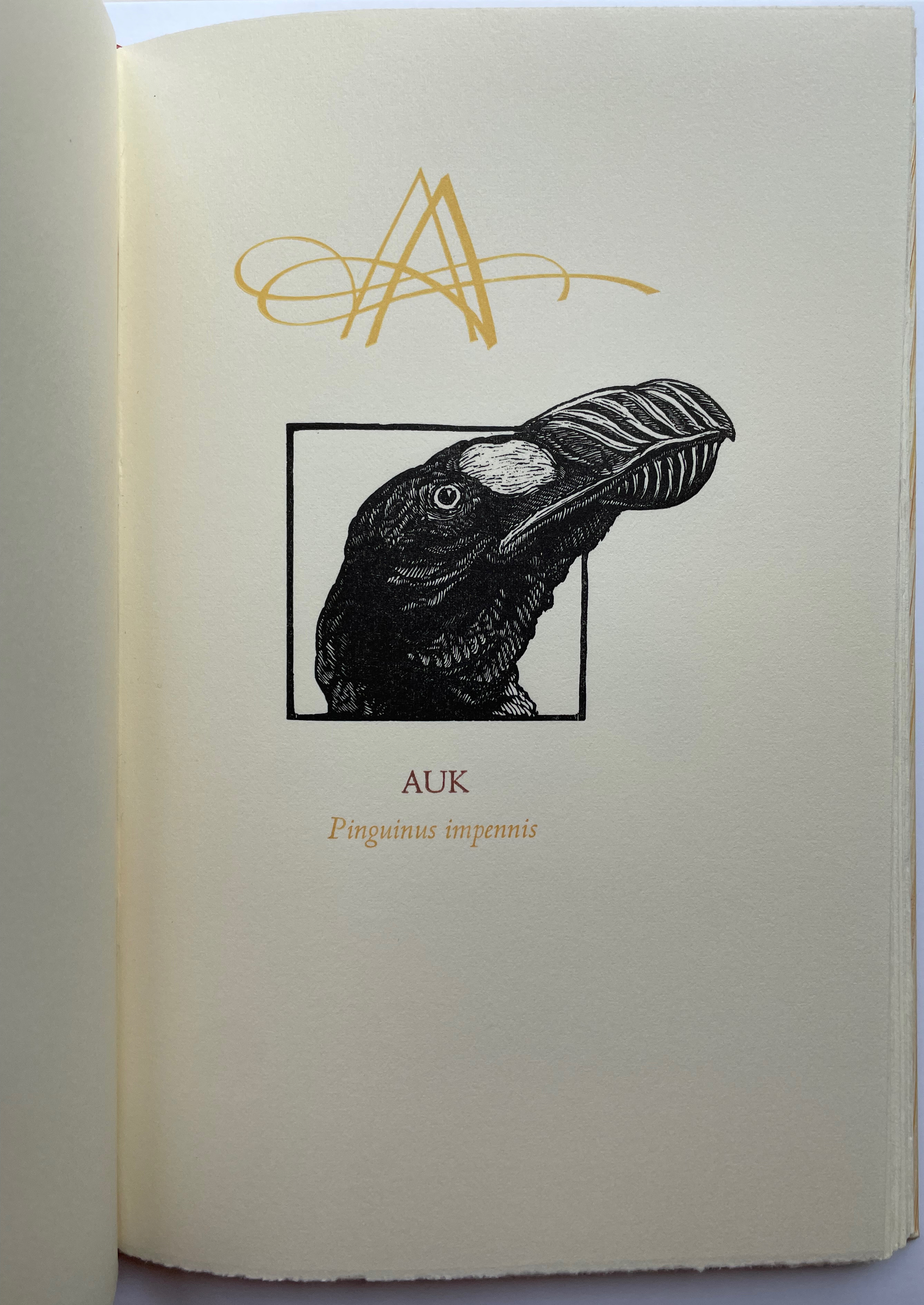
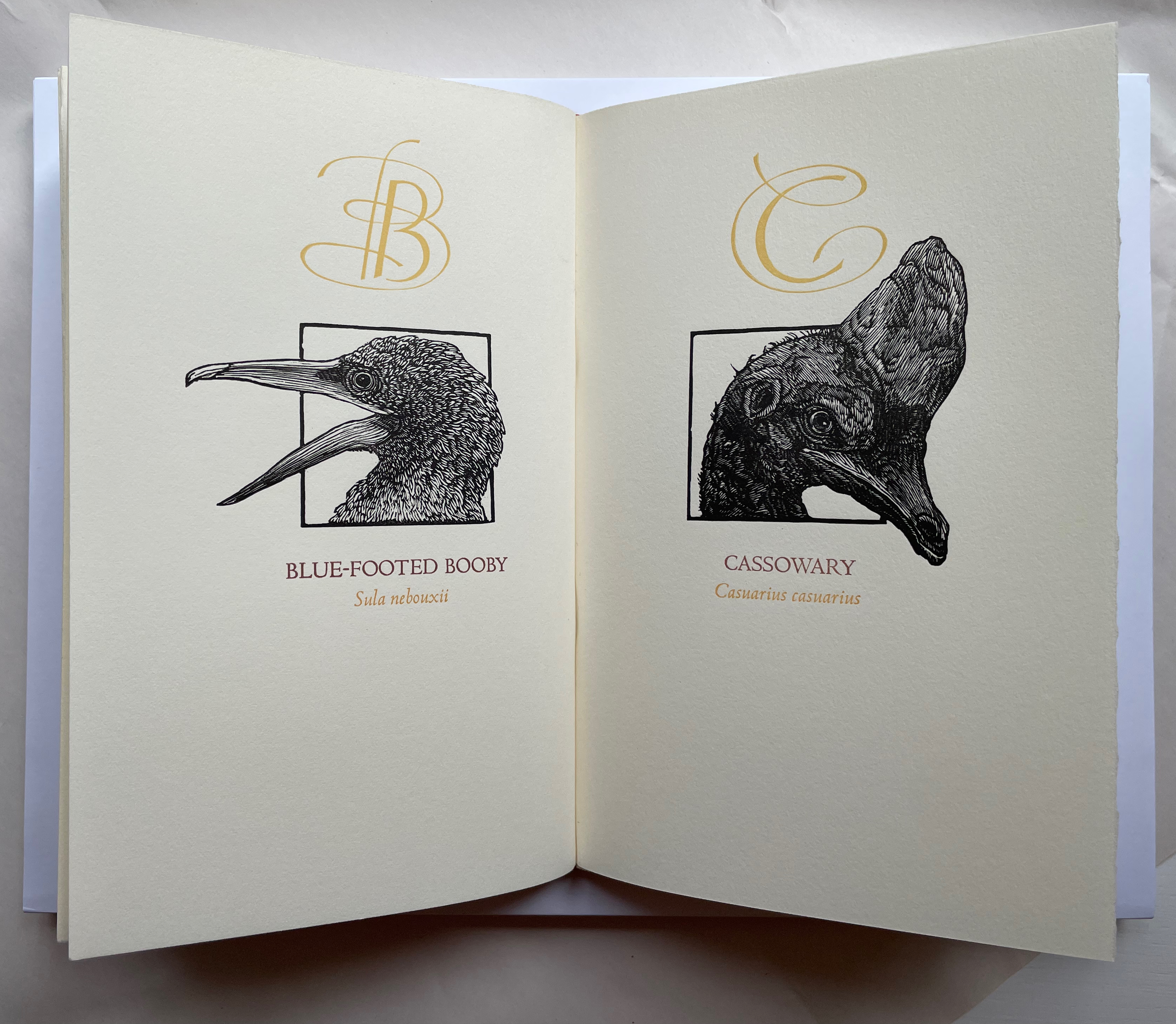
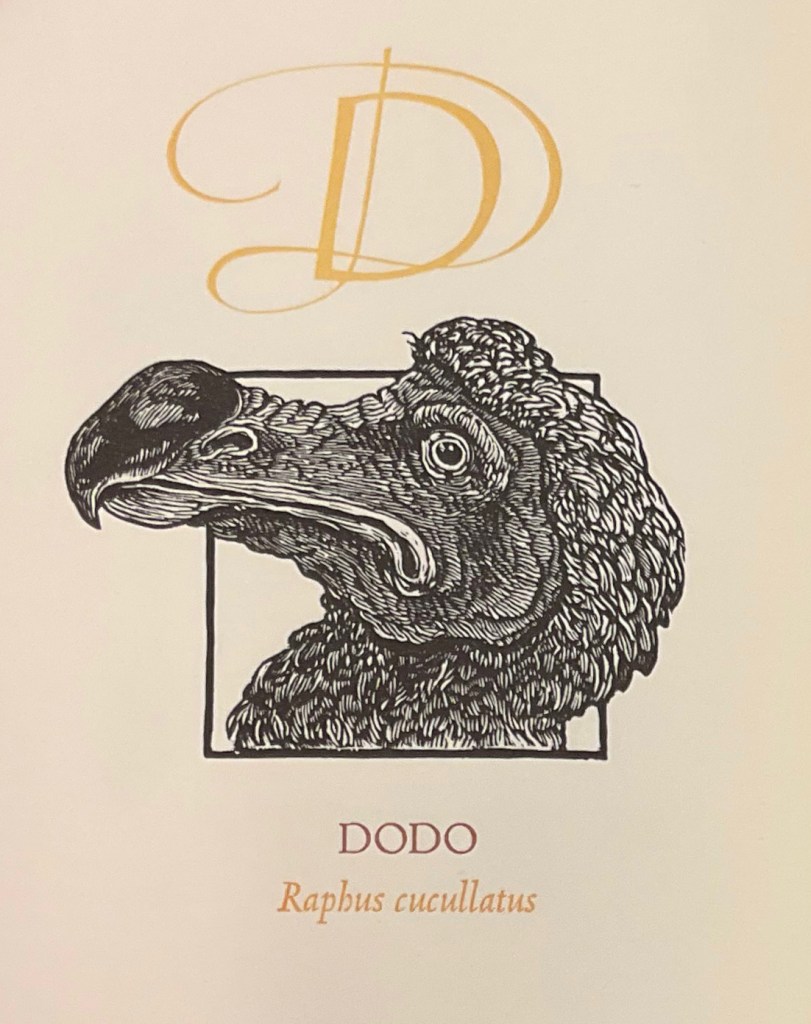
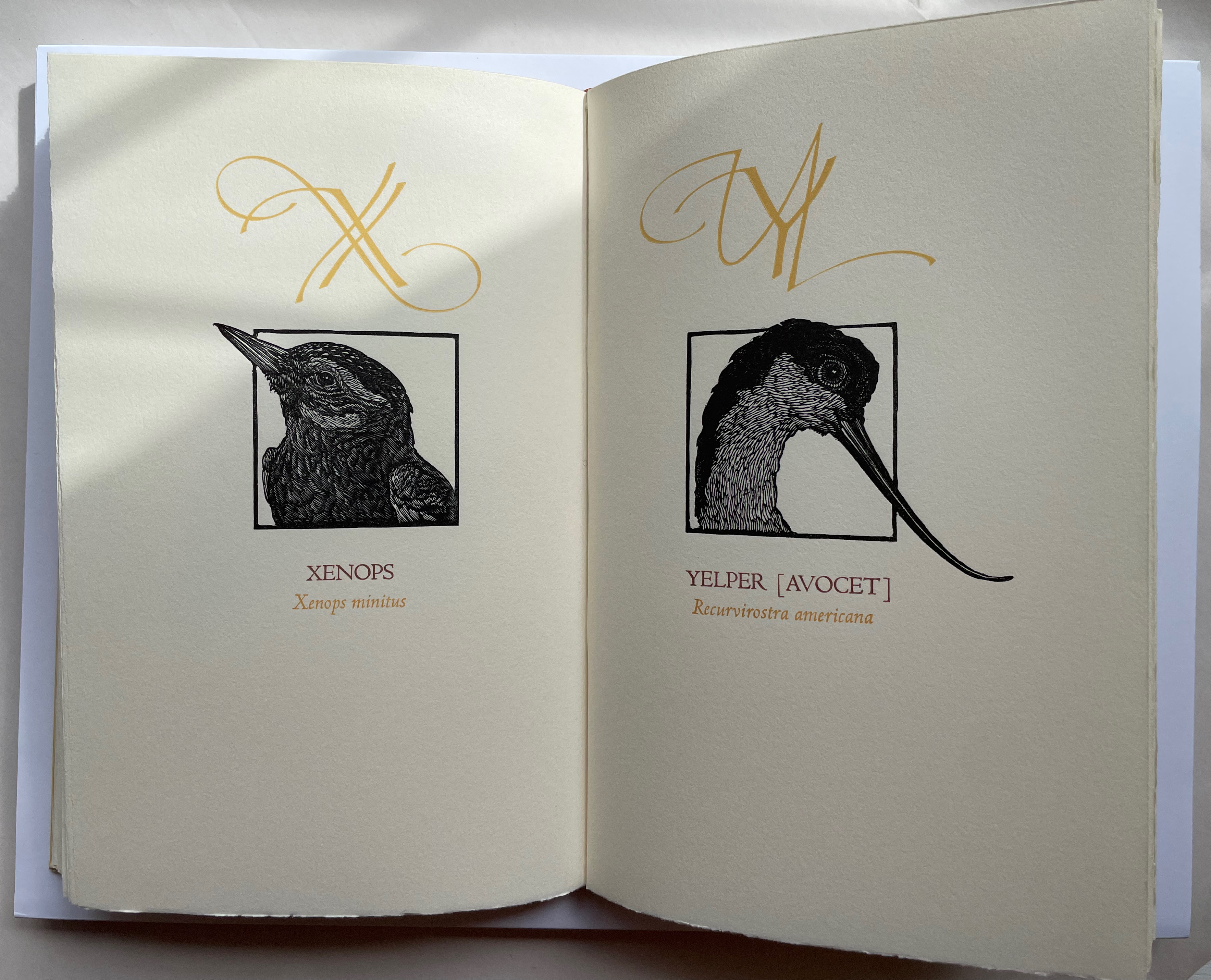
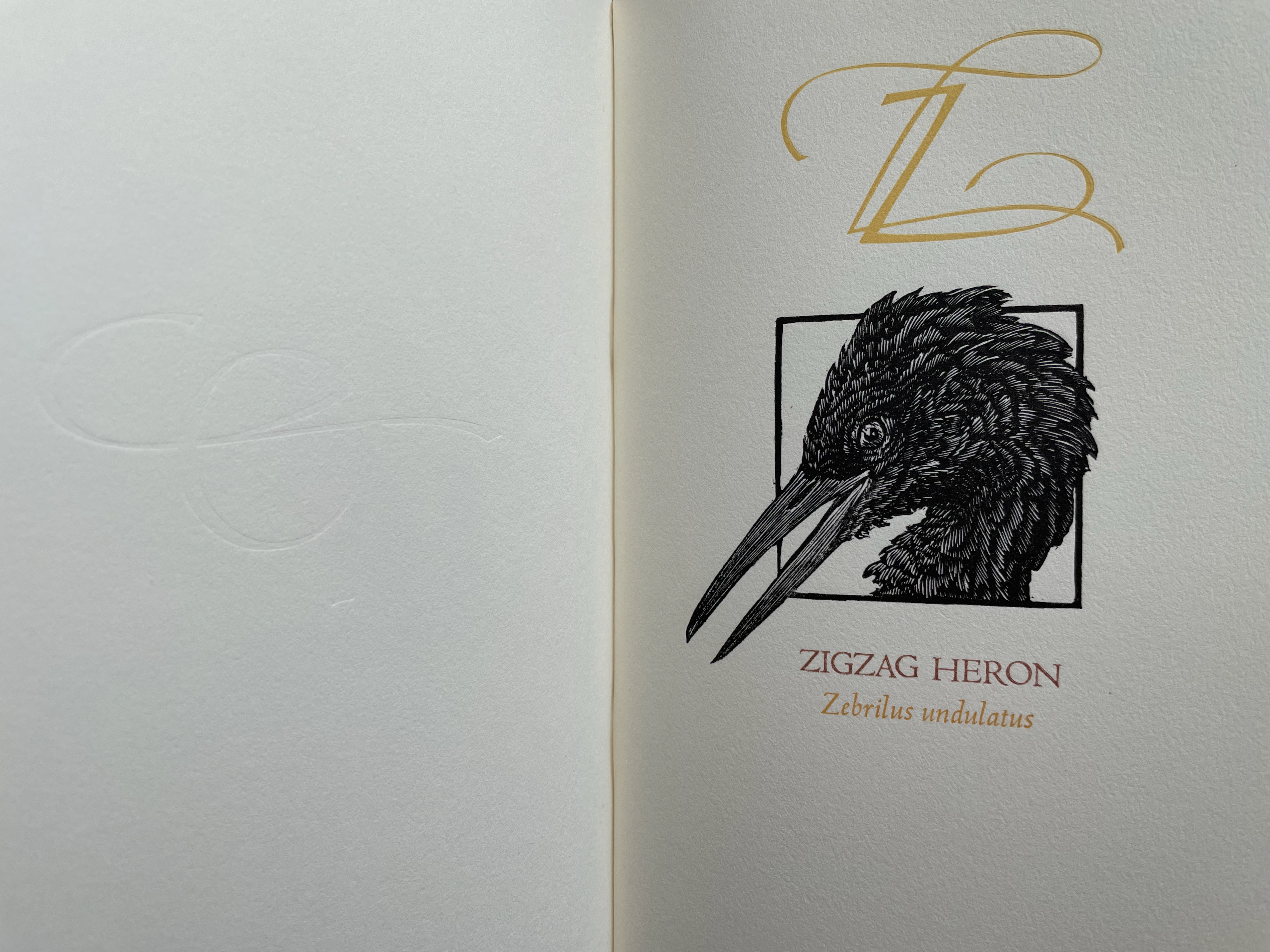
Under his Cheloniidae Press imprint, Alan James Robinson created three artist’s alphabets: A Fowl Alphabet with Suzanne Moore; An Odd Bestiary (1982) and The Birds and Beasts of Shakespeare (1990), arranged as a double abecedary, first the birds and then the beasts. Although this copy of A Fowl Alphabet comes from the regular edition and does not have the color of the deluxe editions of all three abecedaries, it does demonstrate the extraordinary fineness of Robinson’s wood engraving as well as his compositional talent, which also informs the book’s design. The positioning of the birds’ heads in their printed black frames conveys a sense of movement and three dimensionality on the individual page, but notice how Robinson varies the positioning from page to page and across double-page spreads to enhance the sense of movement.

With its core thick strokes shadowed and entwined with thinner flourishes, Suzanne Moore’s calligraphy creatively complements the way that the heft of Robinson’s engraved heads plays against those compositional features.

“Cheloniidae” is the scientific term for the family of sea turtles, and much of Robinson’s art is marine related. But the dominant and consistent impression conveyed by the ouput of Cheloniidae Press is that of Robinson’s artistic skill as an impresario and conductor of artistic talents. Added to the background of his duet with Moore are Master Printer Harold Patrick McGrath, Faith Harrison and her hand marbled paper, Arthur Larson and his hand typesetting and the binding skills of Claudia Cohen.

Further Reading

Abecedaries I (in progress)“. Books On Books Collection.

Gerard Brender à Brandis.” 29 November 2022. Books On Books Collection.

Brian D. Cohen“. 28 December 2022. Books On Books Collection.

Suzanne Moore“. 6 June 2023. Books On Books Collection.

Shelli Ogilvy“. 28 December 2022. Books On Books Collection.

Gaylord Schanilec“. 16 September 2019. Books On Books Collection.

Carol Schwartzott“. 28 December 2022. Books On Books Collection.

Books On Books Collection – Dave Wood

Alphabetica (2002)

Alphabetica (2002)
Dave Wood
Bound in vellum; open-spine binding sewn on vellum strips. H210 x W290 x D30 mm. 54 pages. Loosely inserted colophon. Edition of 26. Acquired from the artist, 27 July 2022.
Photos: Books On Books Collection. Displayed with permission of the artist.

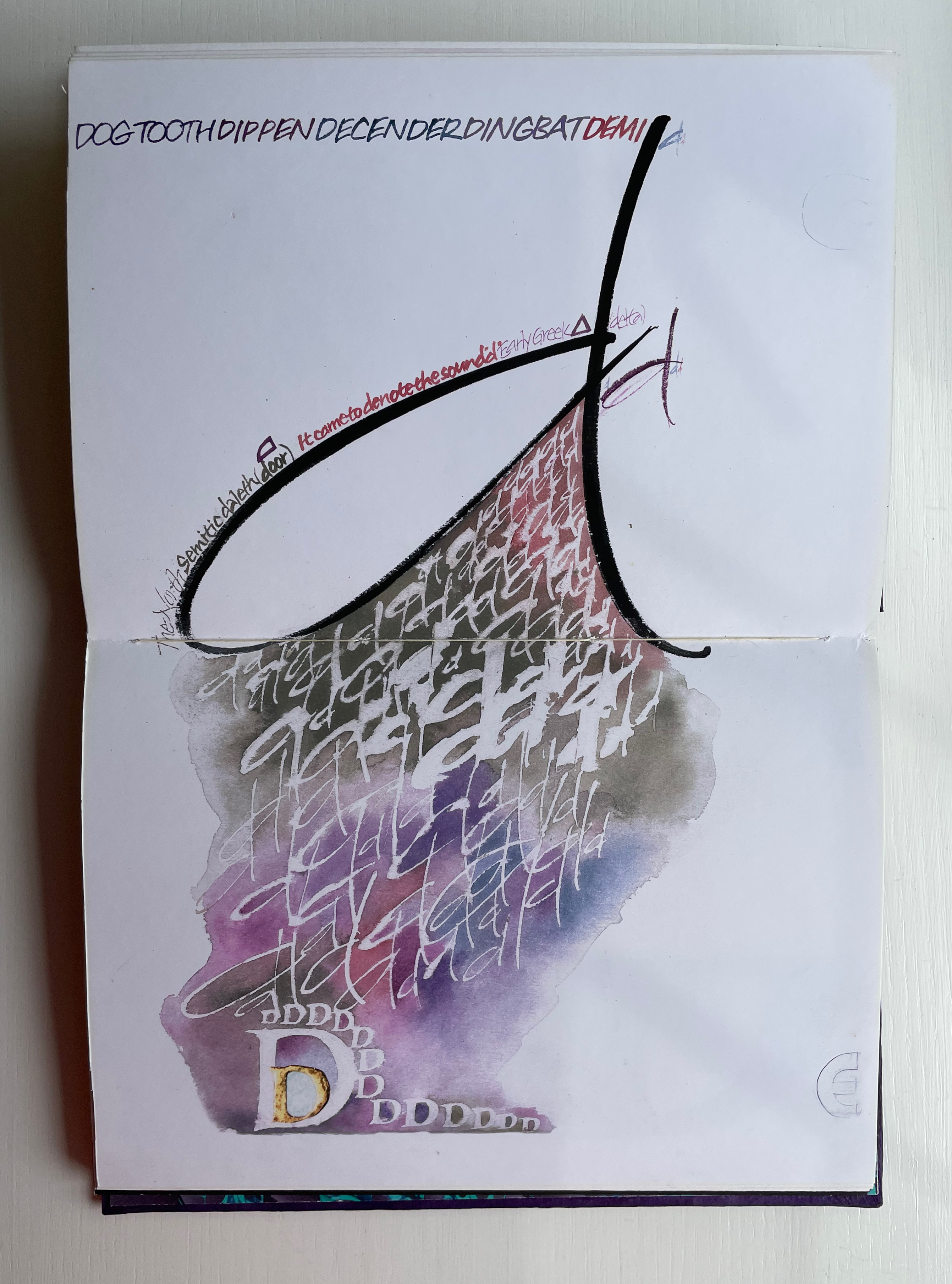
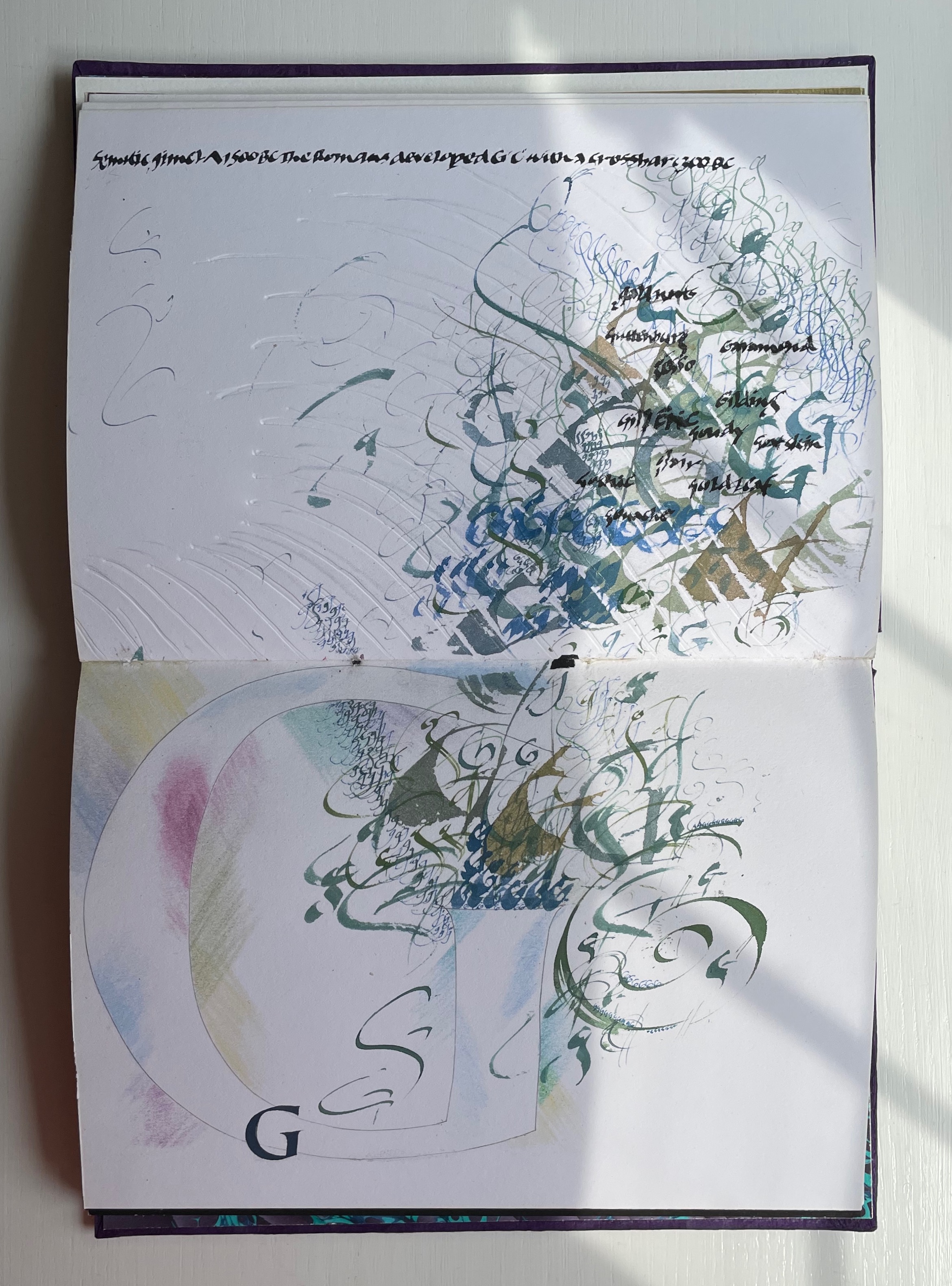
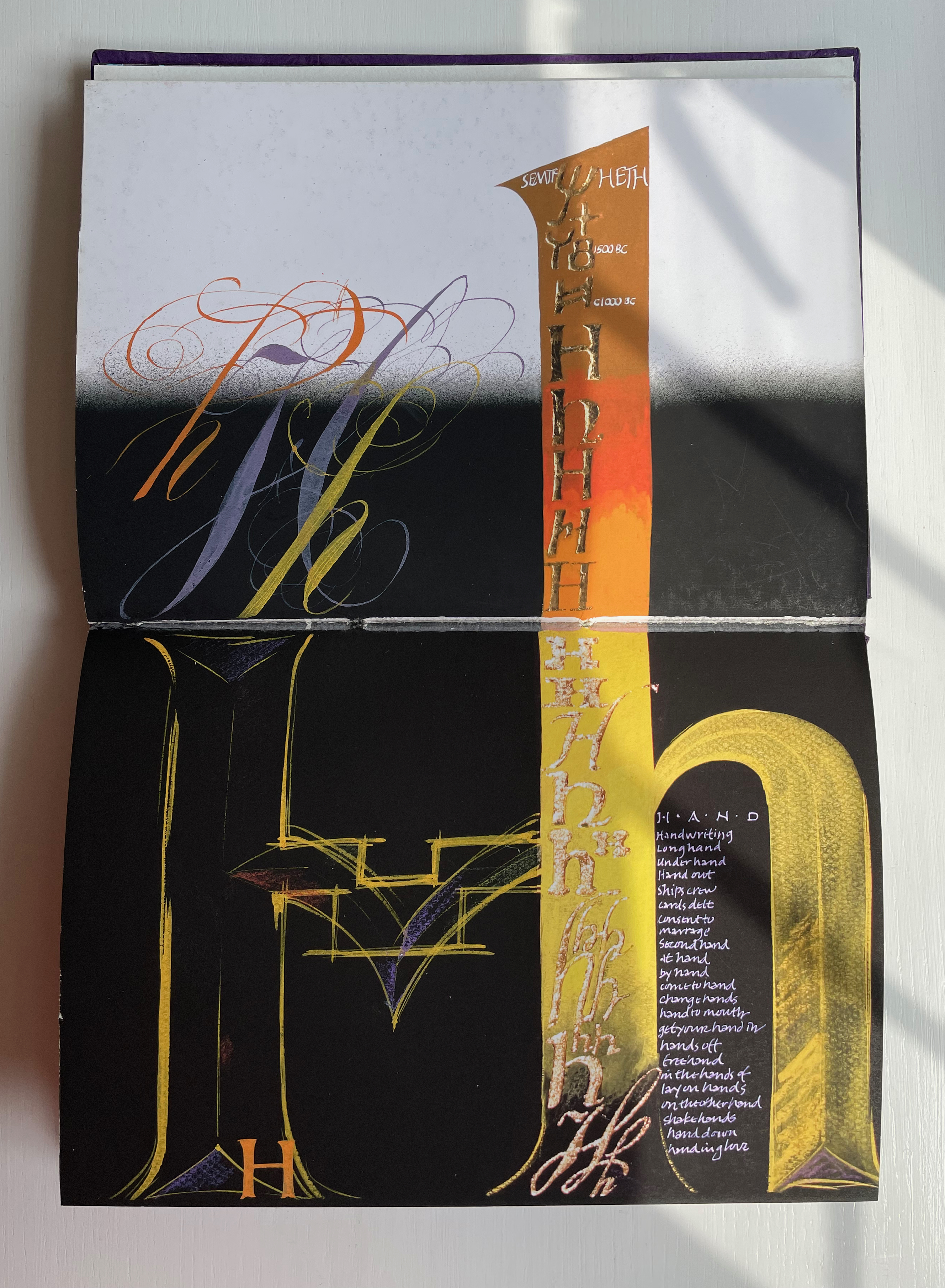
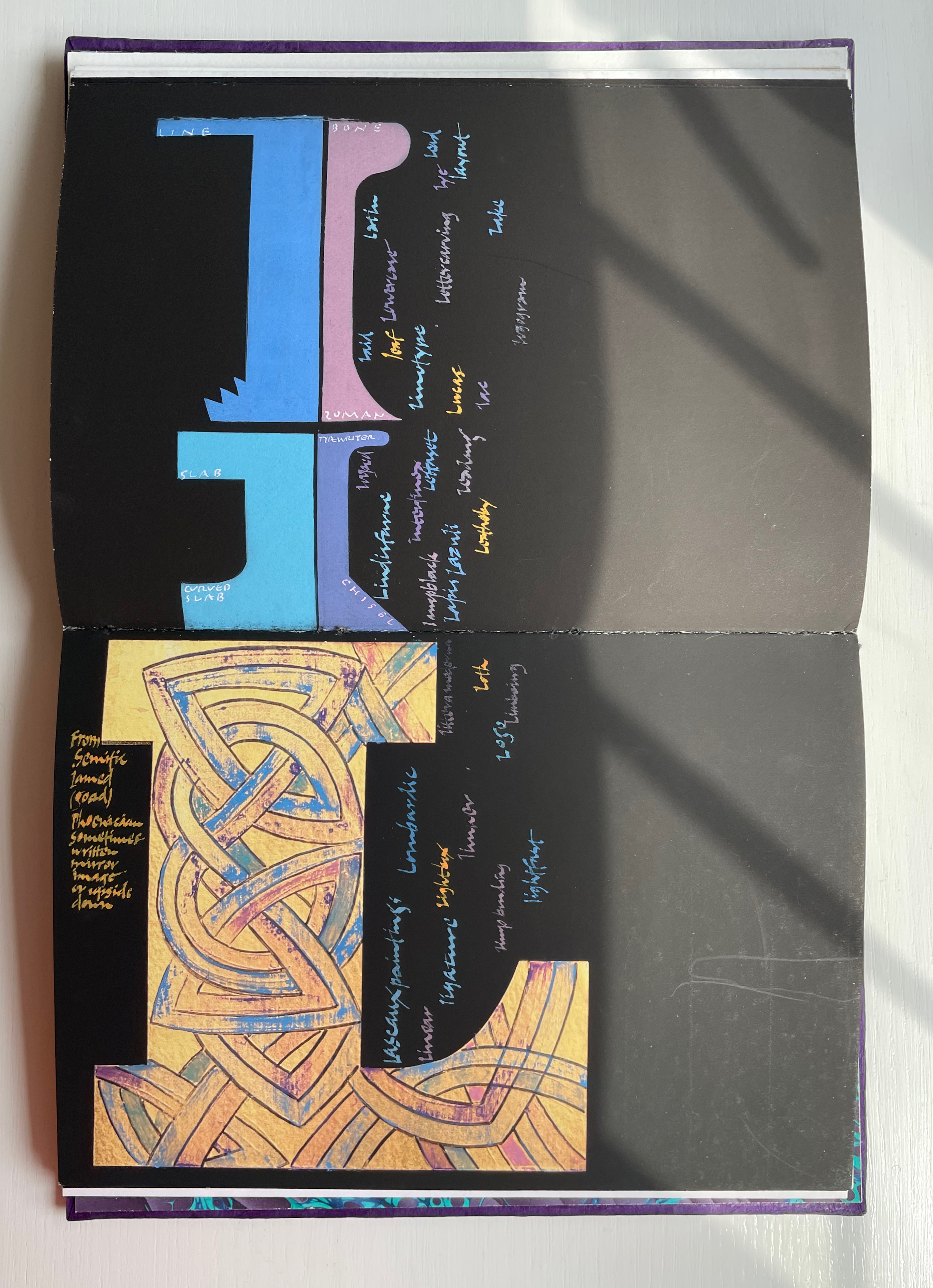
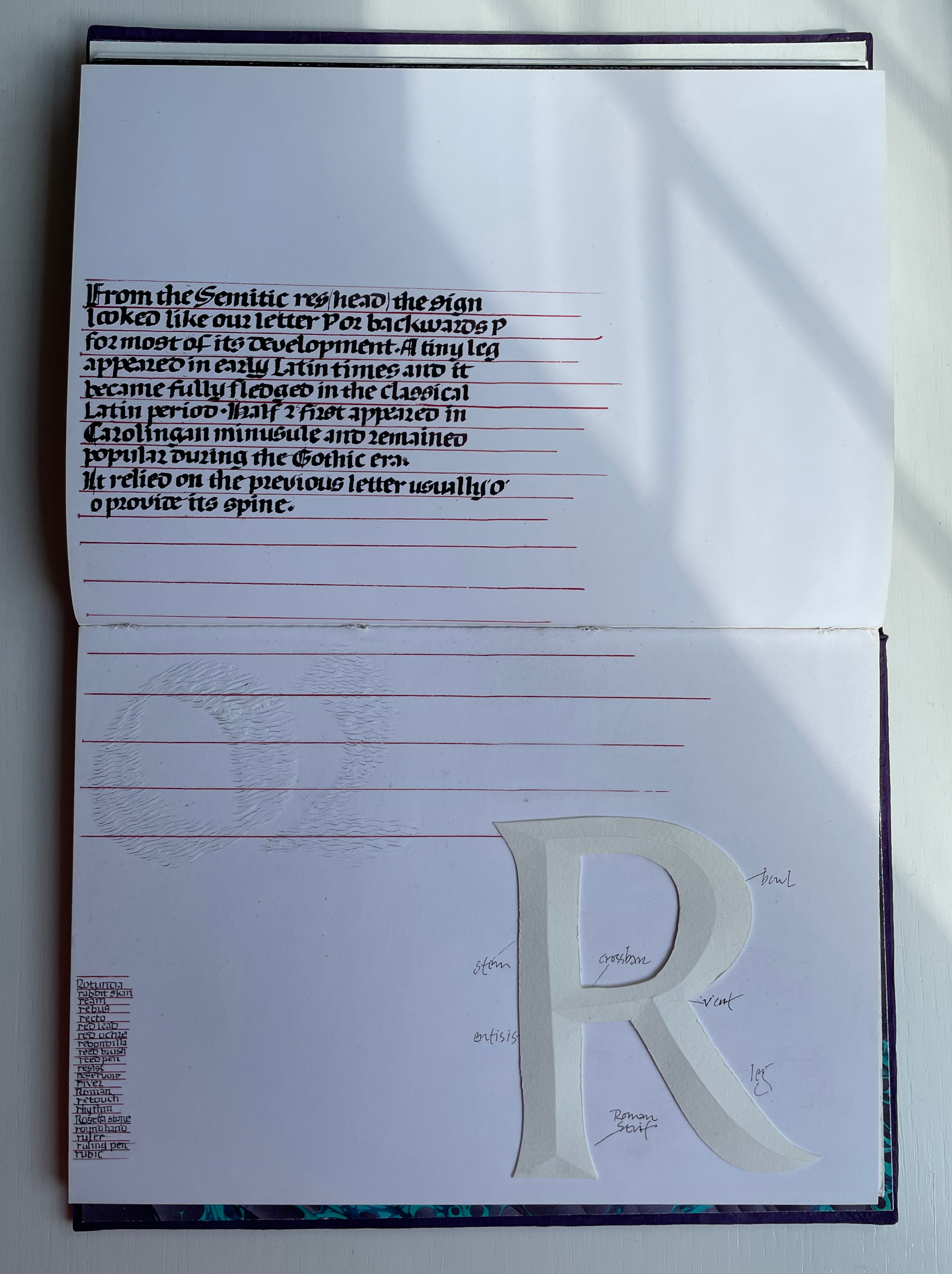
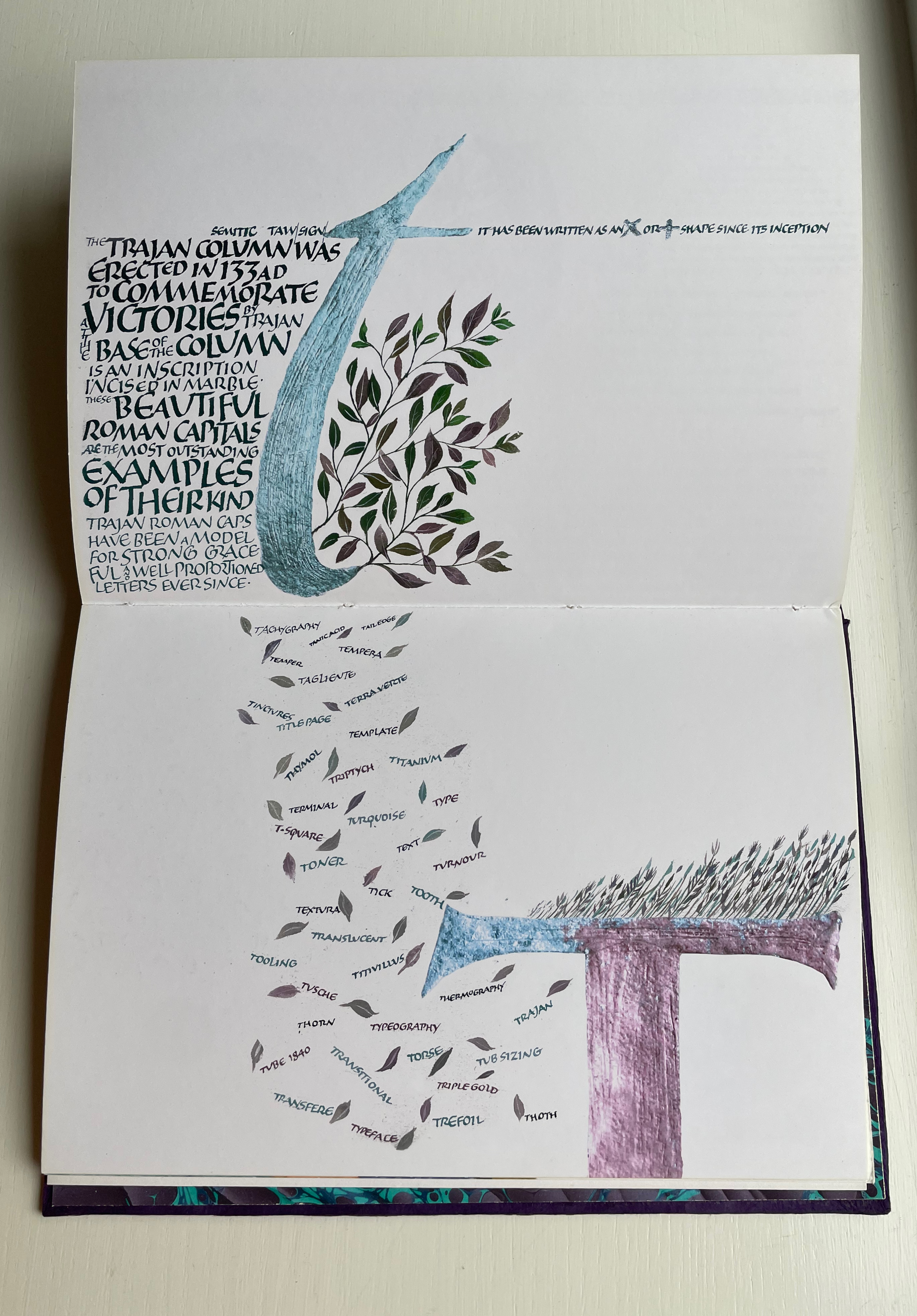
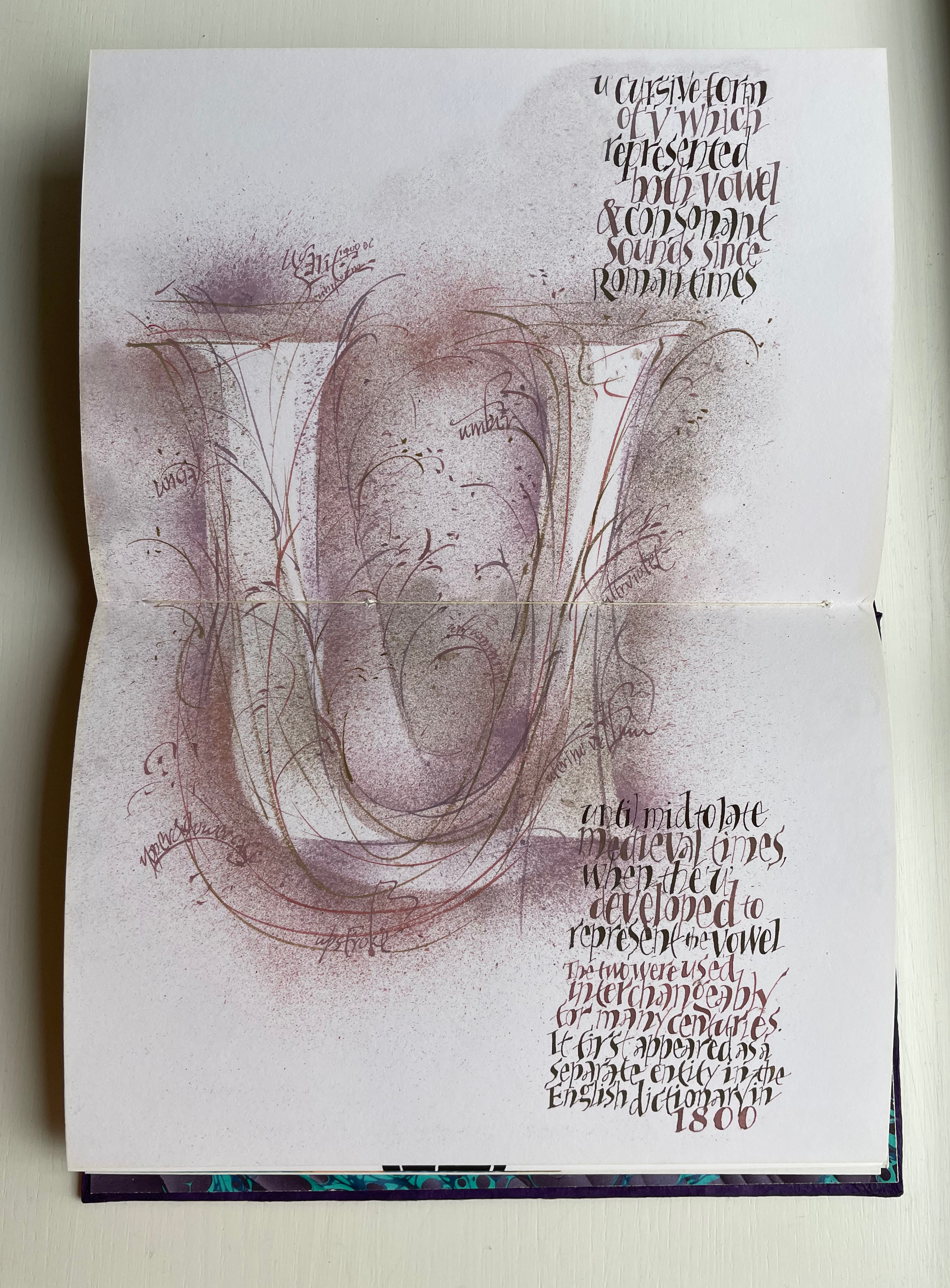
From Alphabetica‘s description as an exploration of the alphabet’s “diverse development from historic shapes to the infinite variations we see today in typefaces and calligraphic forms of the Western alphabet”, the reader might expect an academic work. The deeply embossed and debossed royal purple cover presenting the title in landscape format suggests otherwise as do the marbled endpapers and embossed gold foil title page. The cover is built up with a very strong paper made in Nepal, painted with acrylic then sprayed with semi-matte varnish. Inside, the reader finds a portfolio of twenty-five distinct “canvases” in which Wood demonstrates both historical sensitivity and artistic inspiration.

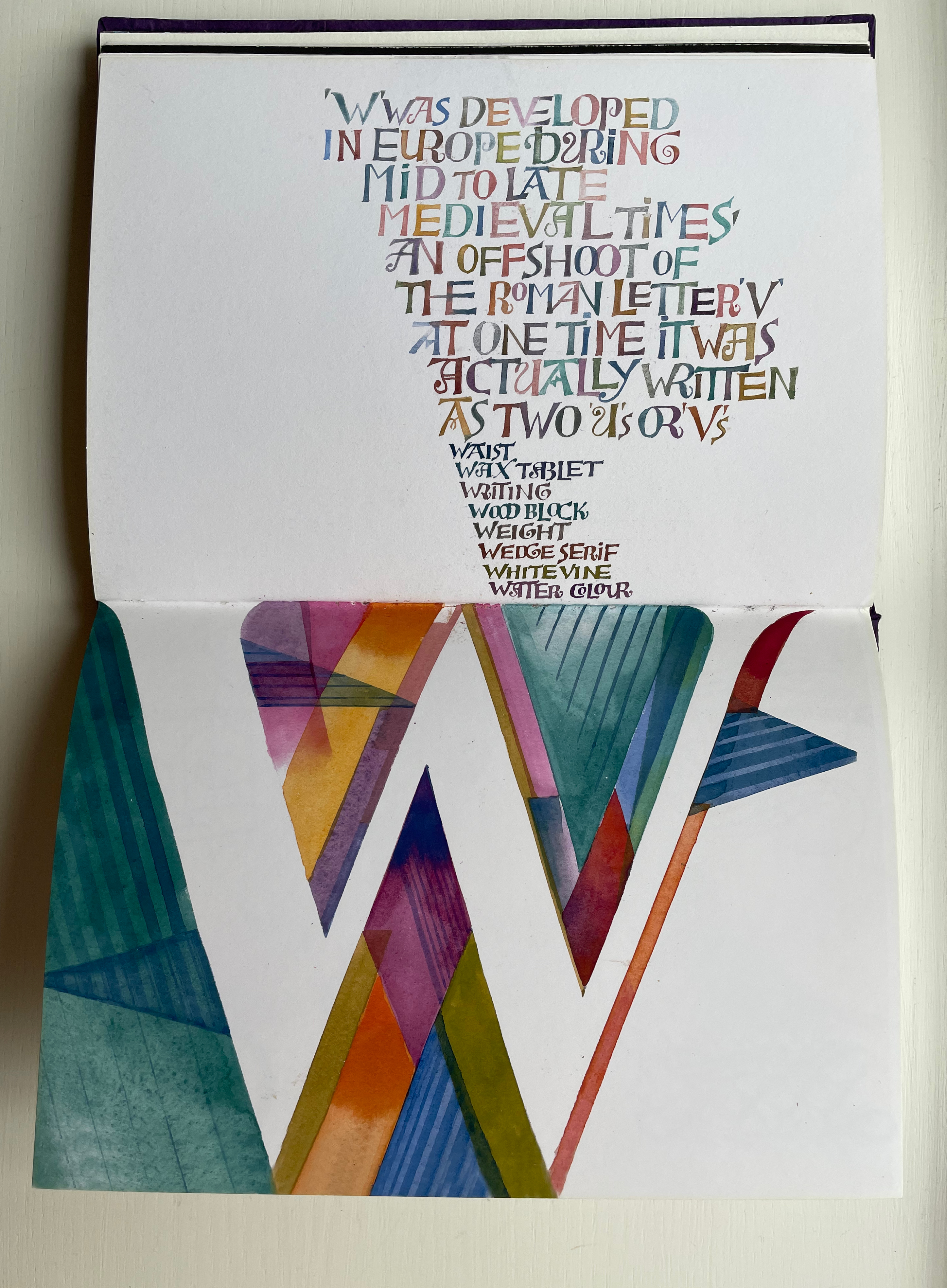
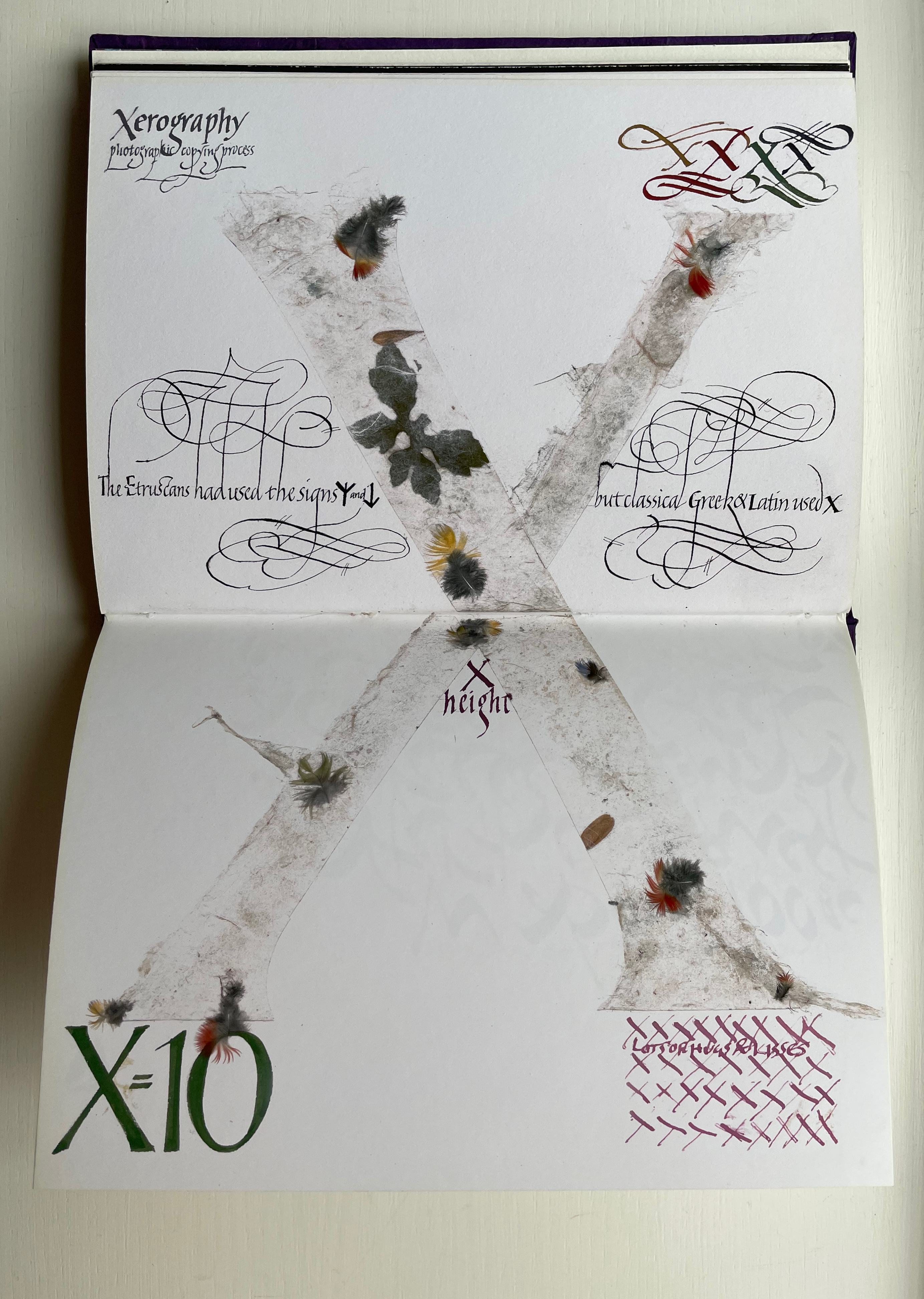
Across the twenty-six spreads, Dave Wood has captured each letter’s distinct story with multiple styles of calligraphy in Sumi ink and gouache paints as well as varying textures and techniques (Canson and Arches paper, glassine, foil, embossing, stamping, feathering and cutting), colors and layouts.

The letters’ developing shapes and periods are labeled. Starting with the letter B, Wood adds names of typefaces, structural terms for type, palaeographical terms and terms from the crafts of calligraphy, typesetting and printing — all beginning with /b/. Similar labeling occurs for the letter C but with a different layout. Across the twenty-five canvases, Wood excels at this balancing of difference and similarity. Notice, for example, how letters B and C incorporate the Renaissance style of illumination called bianchi girari (white vine stem decoration).

The ways in which uppercase-to-lowercase movements interact with the layout’s variations make for a dynamic experience. Sometime it’s subtle, sometimes vigorous. Note, for example, how the letter D de-emphasizes the gutter whereas the letter E emphasizes it.

With letters H through Q, a shift from Arches white to Canson black paper and back adds to the overall dynamic movement. Yet Wood is attentive to elements of unity; for example, his playful handling of the gutter in the transition from letter H to letters I/J echoes that from letters D to E.

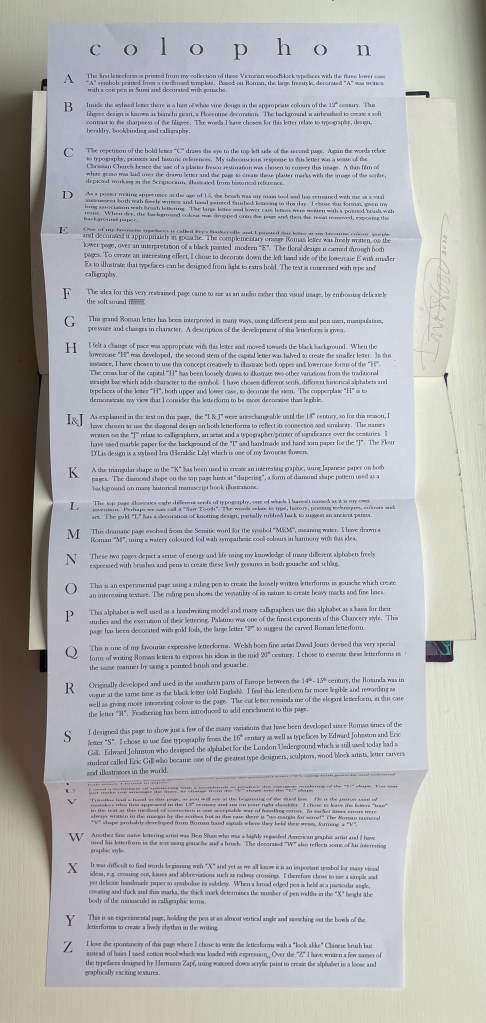
Only six letters perform the trick of extending across the gutter — lowercase H and uppercase K, M, O, U and X. While O, U and X take the similar approach of almost evenly straddling the gutter, each of the other three succeed differently. M is perhaps the most striking and interesting of them all. M derives from the Semitic word for “water” mem. As Wood points out in the loose insert colophon, the watery blue that fills the letter is intentional — as must be the precise alignment of the inner peaks of the letter with the gutter. Such attention to detail in the midst of so much activity on the page demands a similar attentiveness from the reader.

For example, the long tail of the Q does not show up until the bottom of the spread. And the reader may need to pick out the the word “or” in the text to spot the lowercase r in the textured, oversized written word “or” directly below the text.

Visual puns abound. Celtic knots in a capital L (for the Lindisfarne gospels). An S formed of stones. Leaves falling from a lowercase t (for tree or tea, of course). A U growing underground.

Fortunately, the accordion-fold colophon loosely inserted in the book offers pointers to some (not all) allusions. For example, the beginning of the third line for the letter V pays homage to Titivillus, the 13th-century patron demon of scribes’ mistakes. The illustrated W is an homage to Ben Shahn’s letter design. The highly contrasting thicks and thins in the letter X allude, in calligraphic terms, to the thick mark’s determining the number of pen widths making up the x height (the body of the miniscule).

And while the colophon may be necessary to know that the typefaces written in color below were created by Hermann Zapf, any viewer can enjoy Wood’s incorporating the entire alphabet in the Sumi ink design culminating in the letter Z as a fitting self-referential conclusion to Alphabetica.

Further Reading and Viewing

Abecedaries I (in progress)“. Books On Books Collection.

Lyn Davies“. 7 August 2022. Books On Books Collection.

Timothy Donaldson“. Books On Books Collection.

Cari Ferraro“. Books On Books Collection.

David J. Goldman“. Books On Books Collection.

Rudyard Kipling and Chloë Cheese“. Books On Books Collection.

Abe Kuipers“. Books On Books Collection.

Don Robb and Anne Smith“. Books On Books Collection.

James Rumford. 21 November 2022. Books On Books Collection.

Tiphaine Samoyault“. Books On Books Collection.

Ben Shahn“. 20 July 2022. Books On Books Collection.

Tommy Thompson“. 21 August 2022. Books On Books Collection.

Mark Van Stone“. 1 June 2023. Books On Books Collection.

Demeude, Hugues. 1996. The Animated Alphabet. London: Thames and Hudson.

Shaw, Henry. 1845. Alphabets, Numerals and Devices of the Middle Ages. London: W. Pickering.

Books On Books Collection – Rose Sanderson

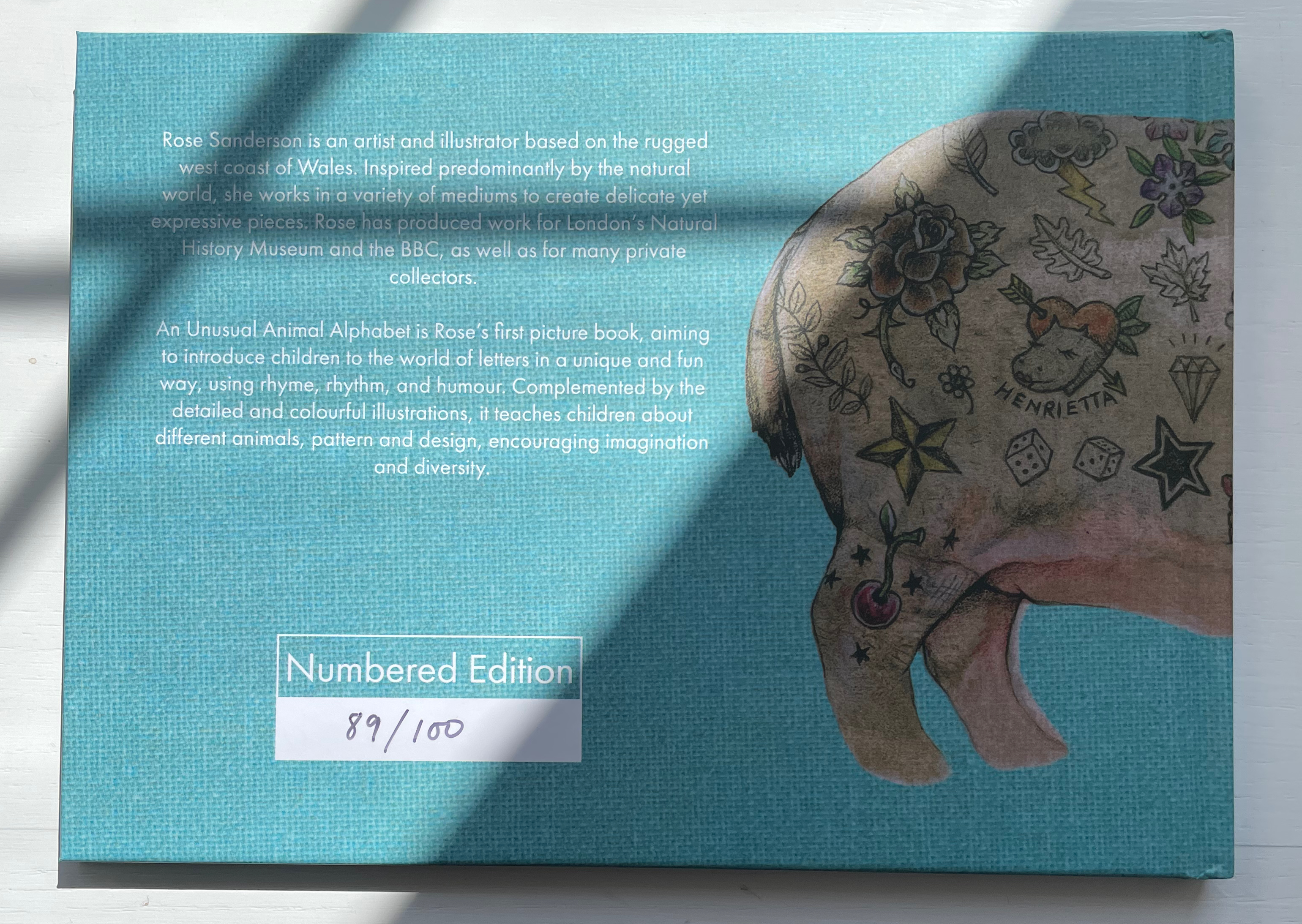
An Unusual Animal Alphabet (2021)

An Unusual Animal Alphabet (2021)
Rose Sanderson
Casebound with illustrated paper over boards and patterned doublures, perfect bound. H155 x W215 mm 54pages. Edition of 100, of which this is #89. Acquired from the artist, 17 April 2023.
Photos: Books On Books Collection. Displayed with artist’s permission.

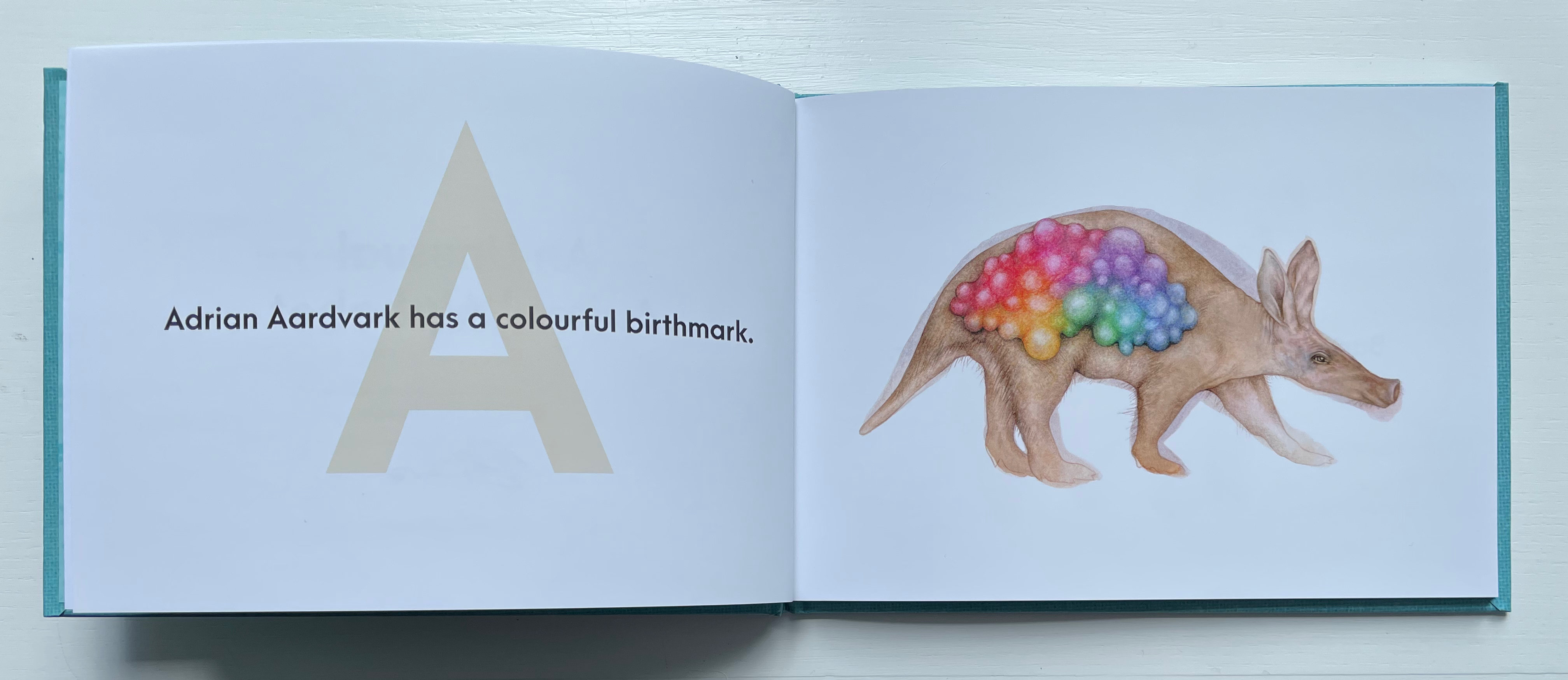
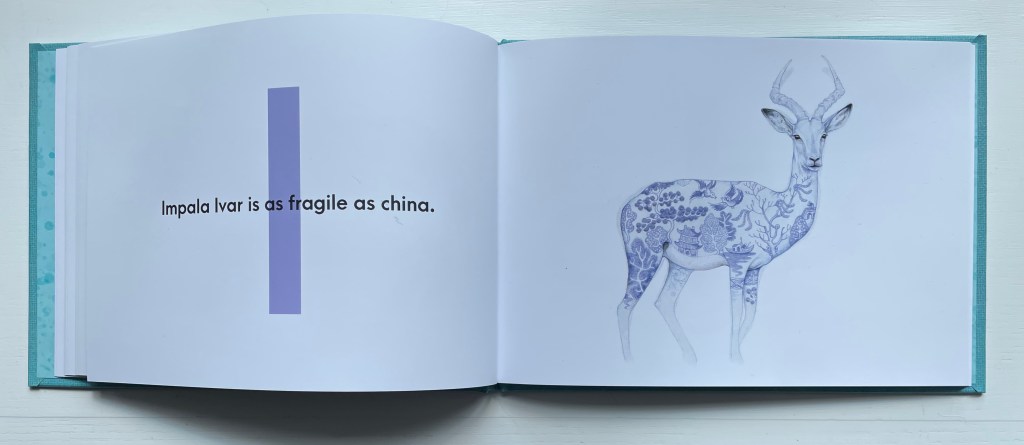
Written and illustrated by Rose Sanderson, this abecedary introduces children to the alphabet with humorous clashes of colors and animals (a pink bear or blue and white impala?) as well as odd combinations of concepts (topiaries and mammals, skyscapes and kangaroos). It all tips over into the surreal, which, with the vocabulary (spirograph, topiary, uakari), implies an audience of older children and adults.

Adding to the humor are other incongruities such as a paisley-patterned dingo and a camouflaged goat. The many half- or near-rhymes also enhance the humor: “Elephant Etta looks good in a sweater” and “Impala Ivar is as fragile as china”).

The production is of high quality. The text is printed on 170gsm silk paper and in full color. The cover comes from a scan of linen/canvas overlayed with a color layer with a balanced transparency that softly merges the two together. Whether or not inspired by the book’s half-rhymes, the designer (Emrys Plant) contributes an effective visual “half rhyme” of Arca Majora for the text type with Futura for the display type. Along with Sanderson’s conceptualization, imagination and craft, such touches nudge this work toward the category of artist’s book or, at least, sophisticated alphabet book.

Further Reading

Abecedaries I (in progress)“. Books On Books Collection.

Leslie Haines“. 4 November 2022. Books On Books Collection.

Rudolf Kur“. Books On Books Collection. In progress.

Judy Pelikan“. Books On Books Collection. In progress.

Annie Newnham“. Books On Books Collection. In progress.

P.K. Page“. Books On Books Collection. In progress.

Books On Books Collection – Peter & Donna Thomas (I)

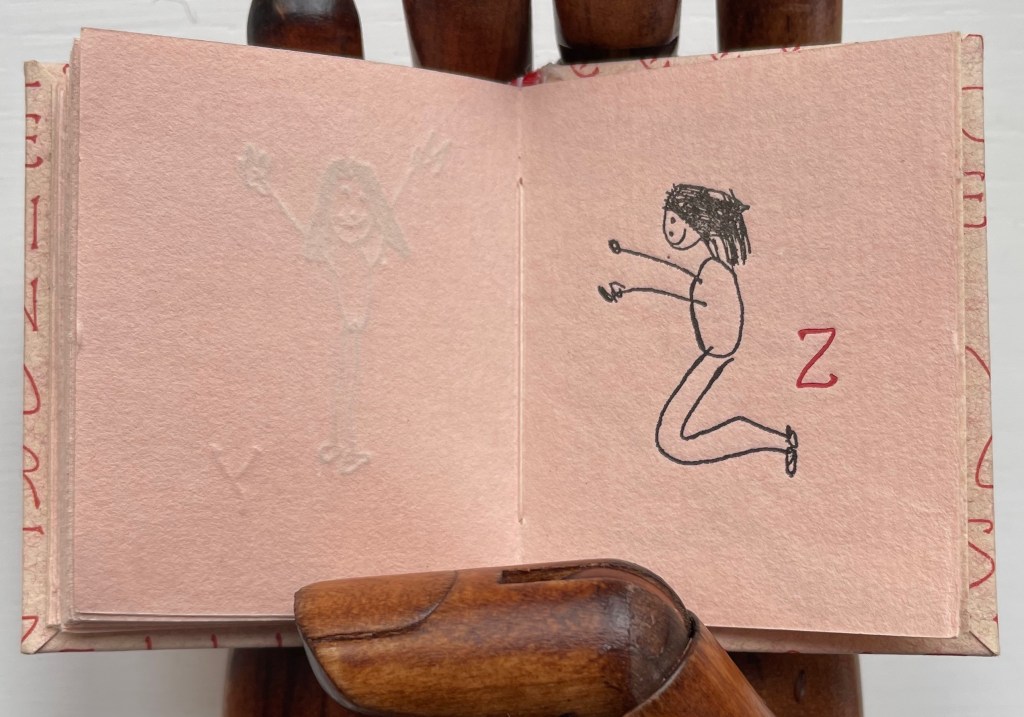
Alphabet People (1989)

Alphabet People (1989)
Peter and Donna Thomas
Miniature codex with illustrated paper over boards, endband, sewn. H60.5 x W47.5 mm. 64 pages. Edition of 200, of which this is an artist’s proof. Acquired from Bromer’s Books, 16 February 2023.
Photos: Books On Books Collection.

Peter and Donna Thomas have made several alphabet artists’ books. One made in the shape of an Apple MAC, one in the shape of mushrooms, one celebrating views of Yosemite, one for musical instruments (accordion to zither, of course), one for spring wildflowers and one, of course, just for the letters themselves.

This one may be their earliest. Handset in Greeting Monotone and letterpress printed by Peter Thomas on peach-colored handmade paper. The same paper is used for covering the boards. As with all the initials in the book, the alphabet on the cover and pastedown title card is inked in red. The illustrations are reproductions of twenty-seven line drawings by their daughter Tanya Thomas.

Seen end-on, the book shows some of its fine press features, especially the two-color sewn endbands and tight turn-ends of the cover paper. Handmade paper characterizes much of the Thomases’ output, and their interest in papermaking has extended as far as Africa, the Philippines and Totnes, Devon, England.

They Made the Paper at Tuckenhay Mill (2016)

They Made the Paper at Tuckenhay Mill (2016)
Peter and Donna Thomas, ed.
Paperback, perfect bound. H280 x W220 mm. 120 pages. Acquired from the artists, 22 June 2022.
Photo of cover: Books On Books Collection.

From the publisher’s description of the second edition:

A self-taught hand papermaker, Peter Thomas became interested in knowing how apprentice-trained hand papermakers working in production hand papermills made paper. He especially wanted to learn the “vatman’s shake,” the series of motions that papermakers used to form their sheets of paper. This desire circuitously led him and Donna to Tuckenhay, near Totnes, Devon, in England, where beginning in 1988, they recorded several hand papermakers, returning to make others in 1990 and 1994. The book begins with a short history of Tuckenhay Mill and the story about meeting the papermakers and recording their interviews. This is followed by eight interviews of men and women, some of whom worked in the Mill from between the World Wars until it closed in 1970. All of the papermakers are now deceased, but the stories – in their own words – remain an extraordinary, entertaining, and timeless record of their lives and work. In the 1830s, Richard Turner started manufacturing paper by hand in the Tuckenhay Mill, and paper was continuously made by hand there until 1962. From then until 1970, the Mill produced pulp (half-stuff) until the business went bankrupt….

The Thomases’ works are well represented at in University of Wisconsin-Madison’s Special Collections. Some of the several particularly related to papermaking — as well as other paper-related ones from the Books On Books Collection — are listed below. Any study of the intersection of book art and paper could not help but include Peter and Donna Thomas.

Further Reading

Abecedaries I (in progress)“, Books On Books Collection, 31 March 2020.

The First Seven Years of the Rijswijk Paper Biennial“. 10 October 2019. Books On Books Collection.

Looking Back and Forward from the Paper Biennial 2018“. 24 June 2018. Books On Books Collection.

Helen Hiebert“. 18 June 2021. Books On Books Collection.

Maureen Richardson“. 28 September 2019. Books On Books Collection.

Fred Siegenthaler“. 10 January 2021. Books On Books Collection.

Hunter, Dard. 1978. Papermaking: The History and Technique of an Ancient Craft, 2nd ed. New York: Dover. Republication of the second, revised and enlarged 1947 edition.

Hiebert, Helen. 2000. The papermaker’s companion: the ultimate guide to making and using handmade paper. North Adams, MA: Storey Pub.

Hiebert, Helen. “Strange Papers“, Helen Hiebert Studio, 12 August 2014. Accessed 3 November 2020.

Hiebert, Helen, and Melissa Potter. 2016. The secret life of paper: 25 years of works in paper. Kalamazoo, MI: Kalamazoo Book Arts Center.

Kurlansky, Mark. 2017. Paper: Paging through History. New York, NY: W.W. Norton.

Müller, Lothar. 2016. White Magic: The Age of Paper. Cambridge, UK: Polity Press.

Sansom, Ian. 2012. Paper: an elegy. New York, NY: Wm. Morrow.

Thomas, Donna. 2001. A Mushroom ABC. Santa Cruz, CA: Peter & Donna Thomas.

Thomas, Peter. 1988. Shakespeare on Papermills. Santa Cruz, CA: The Good Book Press.

Thomas, Peter. 1990. Papermaking in Seventeenth Century England. Santa Cruz, CA: Peter & Donna Thomas.

Thomas, Peter and Donna, eds. 1994. A Collection of Paper Samples from Hand Paper Mills in the United States of America. Santa Cruz, CA: Peter & Donna Thomas.

Thomas, Peter and Donna. 1996. MAC’s ABCs. Santa Cruz, CA: Peter & Donna Thomas.

Thomas, Peter and Donna, compilers. 1999. Paper From Plants. Santa Cruz, CA: Peter & Donna Thomas.

Thomas, Peter and Donna. 2001. Yosemite ABC. Santa Cruz, CA: Peter & Donna Thomas.

Thomas, Peter and Donna. 2002. Accordion to Zither. Santa Cruz, CA: Peter & Donna Thomas.

Thomas, Peter and Donna. 2006. Spring Wildflower ABC. Santa Cruz, CA: Peter & Donna Thomas.

Thomas, Peter and Donna. 2015. Letters. Santa Cruz, CA: Peter & Donna Thomas.

Vincent, Jessica. Indigenous Women Are Publishing the First Maya Works in Over 400 Years, Atlas Obscura, 08 August 2019. Accessed 27 October 2020.

Weber, Therese. 2008. The language of paper: a history of 2000 years. Bangkok, Thailand: Orchid Press.

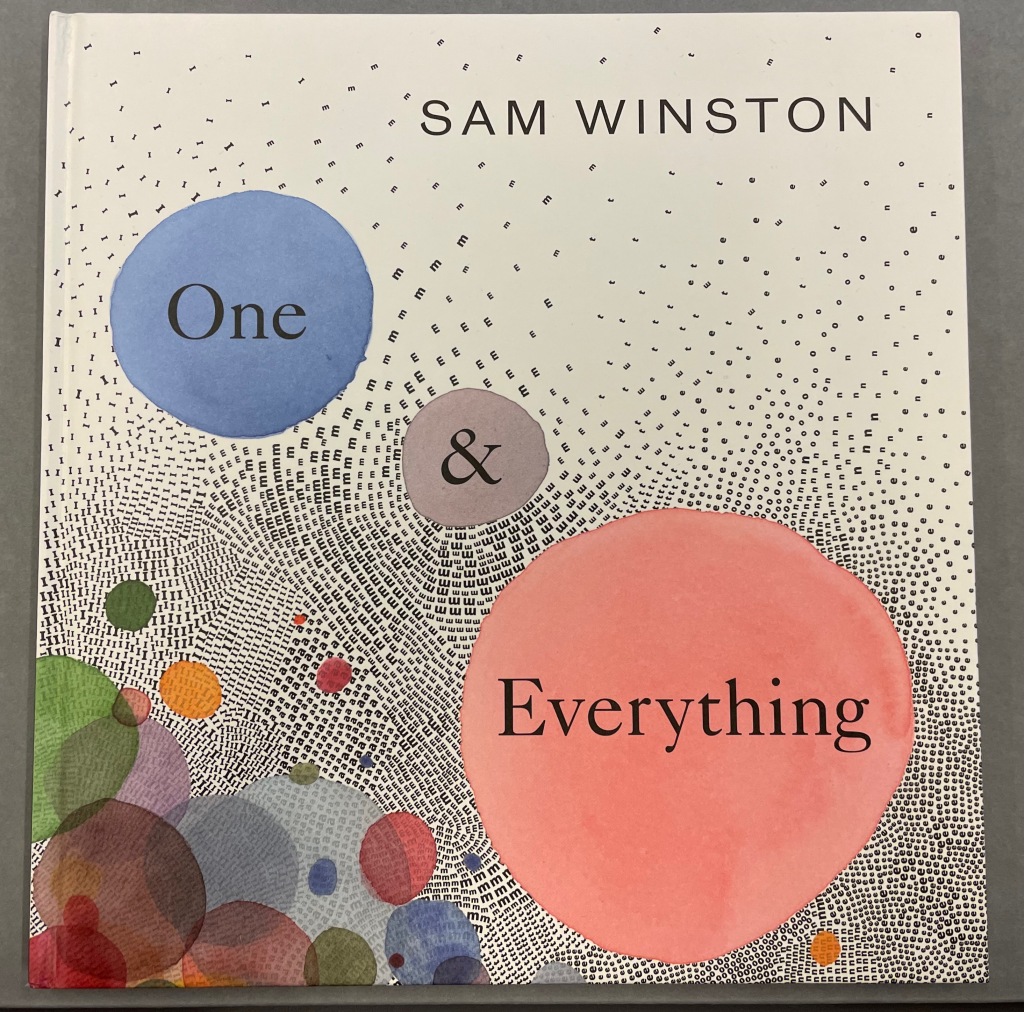
Books On Books Collection – Sam Winston

One & Everything (2022)

One & Everything (2022)
Sam Winston
Casebound with illustrated paper over boards. H265 x W255 mm. 48 unnumbered pages. Acquired 23 November 2022.
Photos: Books On Books Collection. Displayed with artist’s permission.

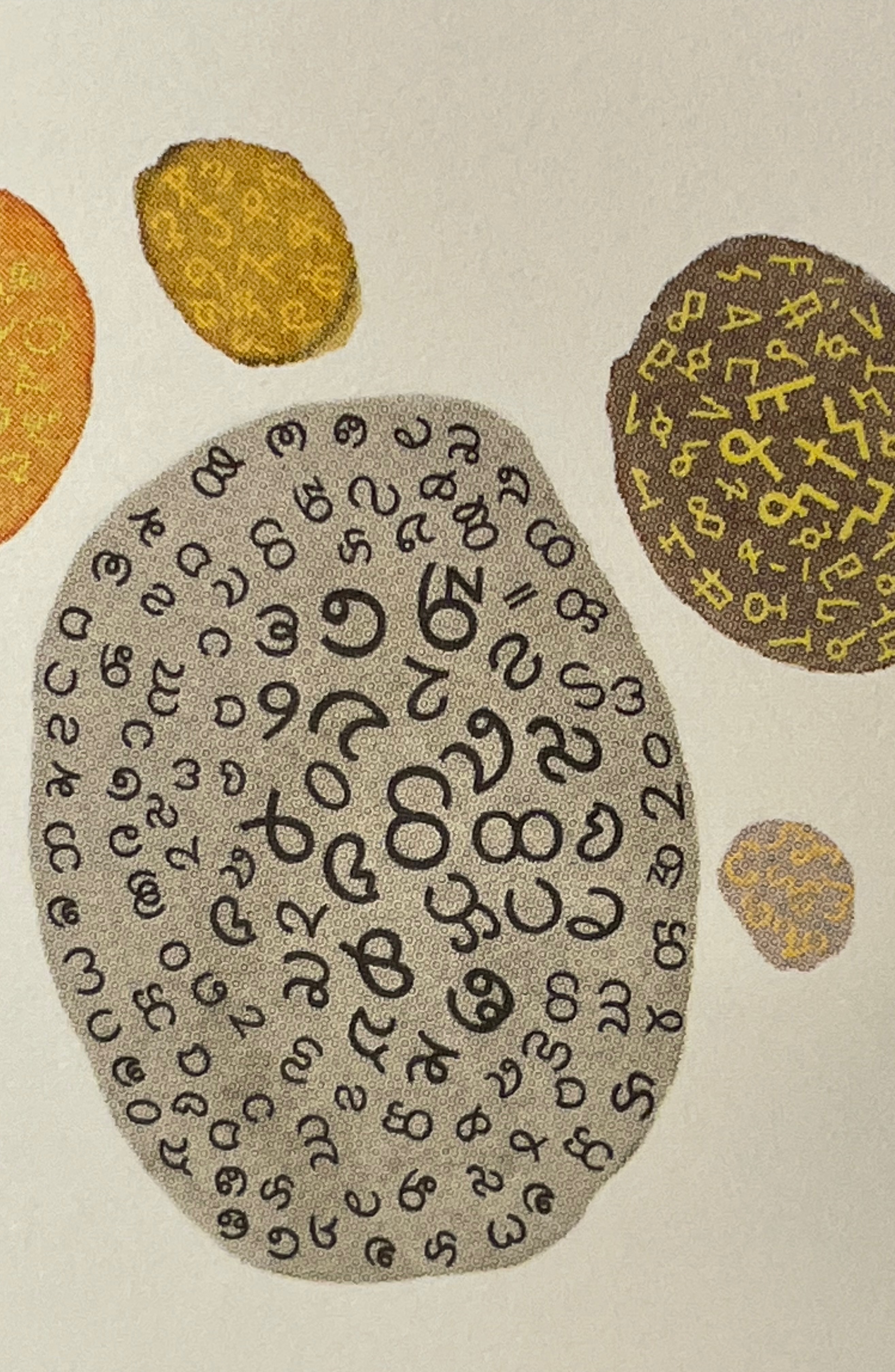
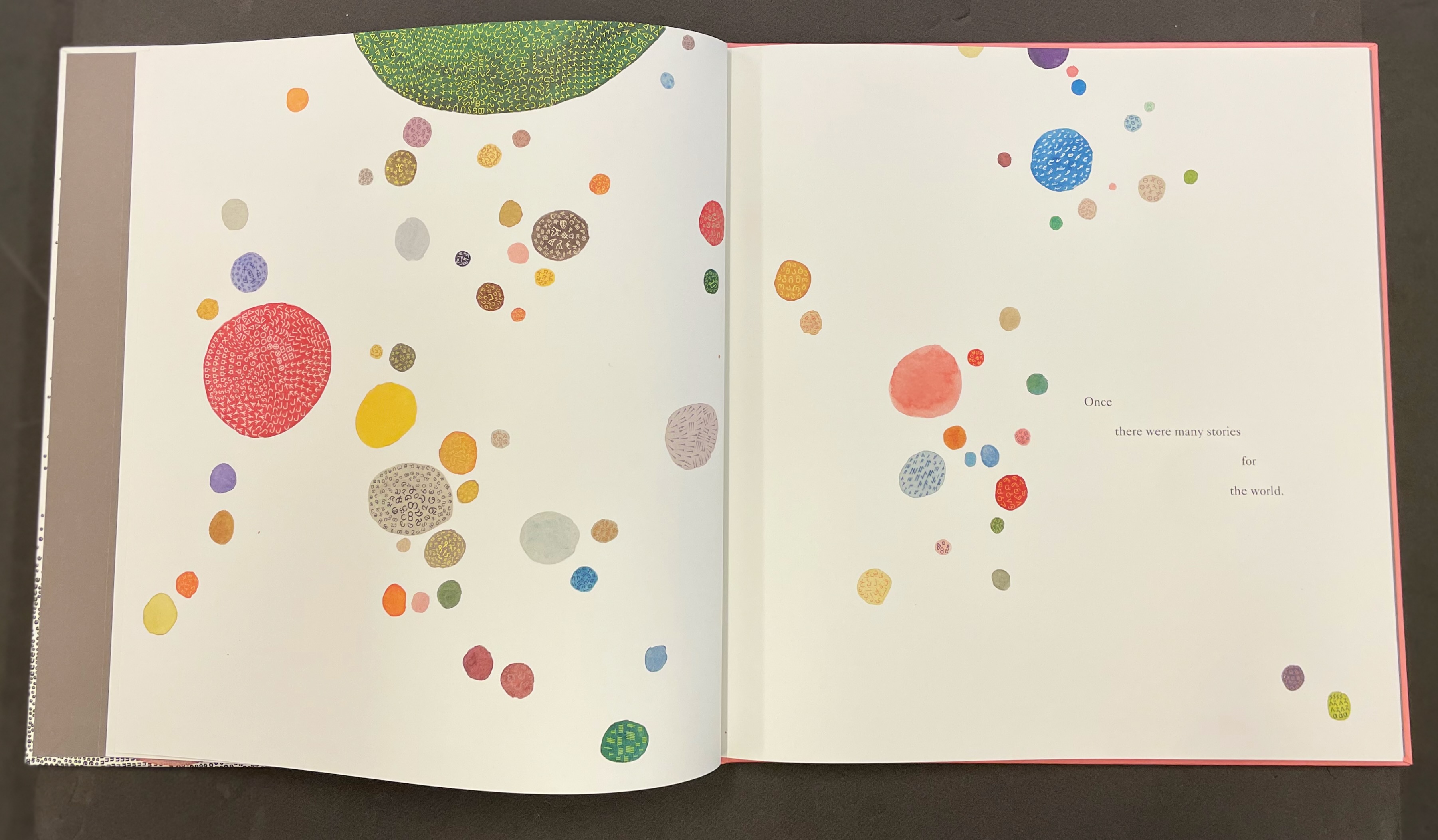
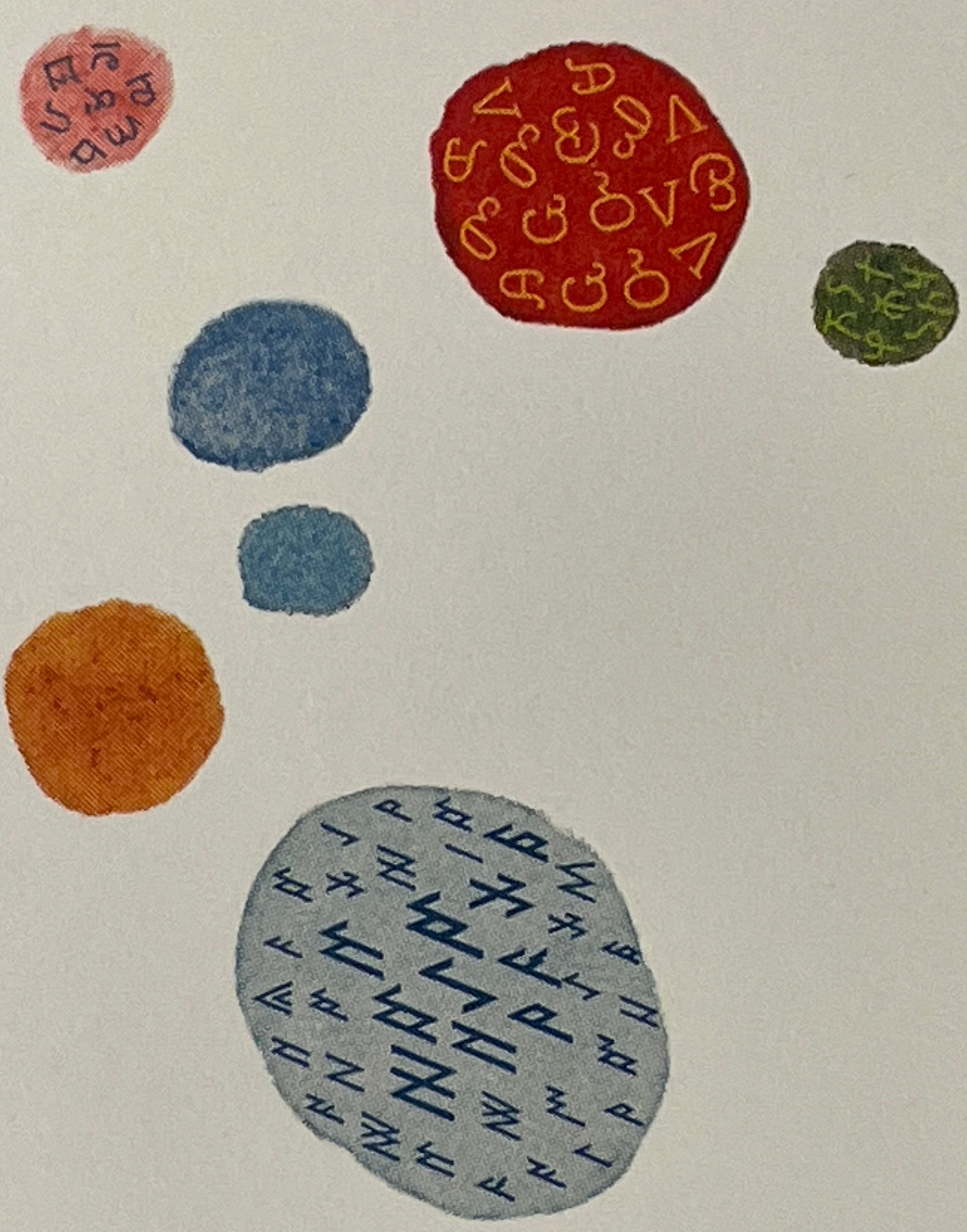
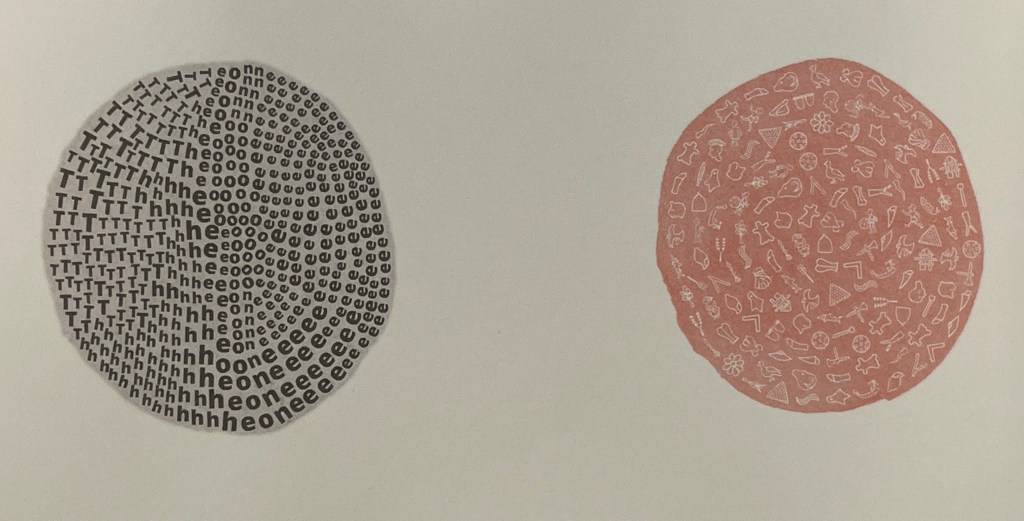
Sometimes you just know that you have read a classic. This is one of those times. Winston and Candlewick Press (Walker Books in the UK) have worked a fresh tale, tone and meaning together with image, color, design and production values to an extraordinary level. Inspired by Tim Brookes’ “Endangered Alphabets Project“, Winston uses the striking shapes of letters and scripts from the Latin, Ogham, Cherokee, Armenian, Hebrew, Tibetan and dozens more alphabets and syllabaries to create the characters in his fable about the story that decides one day that it is the One and Only story.

Shapes like single-celled creatures (each filled with a different alphabet) represent the many stories existing before “The One” arrives.

“The One” is made of the English (i.e., Latin or Roman) alphabet. Will it listen to and make sense of all these other stories?

The fable of One & Everything does more than support the notion that alphabets and languages can be endangered. Implicit in the fate of the “One & Everything” story” is the message that Babel was more of a blessing than a curse.

Readers familiar with Winston’s A Dictionary Story and his collaboration with Oliver Jeffers in A Child of Books (both below) will recognize a growing refinement and, now, breadth and depth in Winston’s storytelling. The youngest audience and beginning readers will be held by the shapes, colors and simplicity of the story. Older readers will easily grasp its underlying meanings and be intrigued by the variety of letters and scripts and the idea that languages and alphabets can die. Still older readers and teachers will appreciate the helpful resources following the story’s ending invitation. At all levels, the audience will delight in Winston’s creation of his characterful abstractions with letters from the alphabets and scripts identified in those resources. Those with an eye for such artistry will appreciate Winston’s extension of a tradition embraced by Paul Cox, Roberto de Vicq de Cumptich, Sharon Forss and Nicolas McDowall.

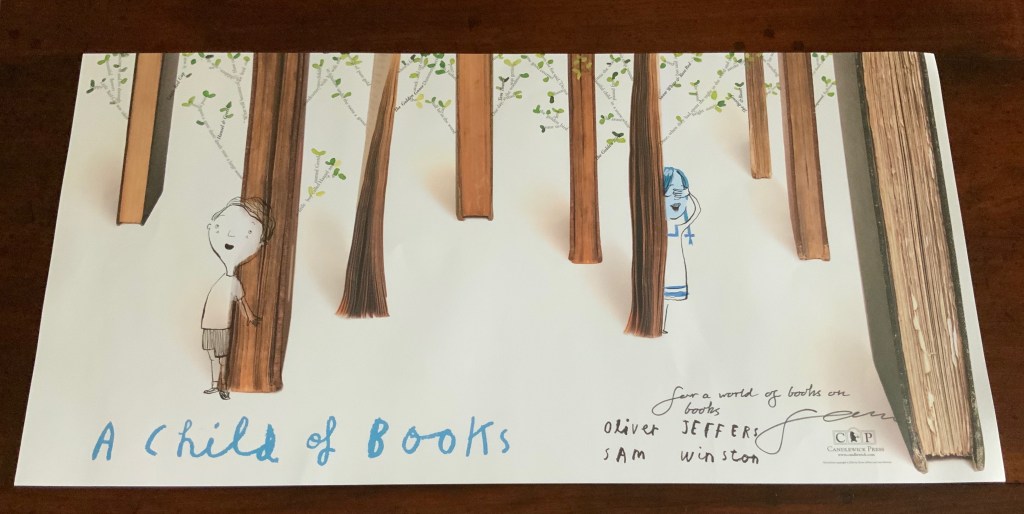
A Child of Books (2019)

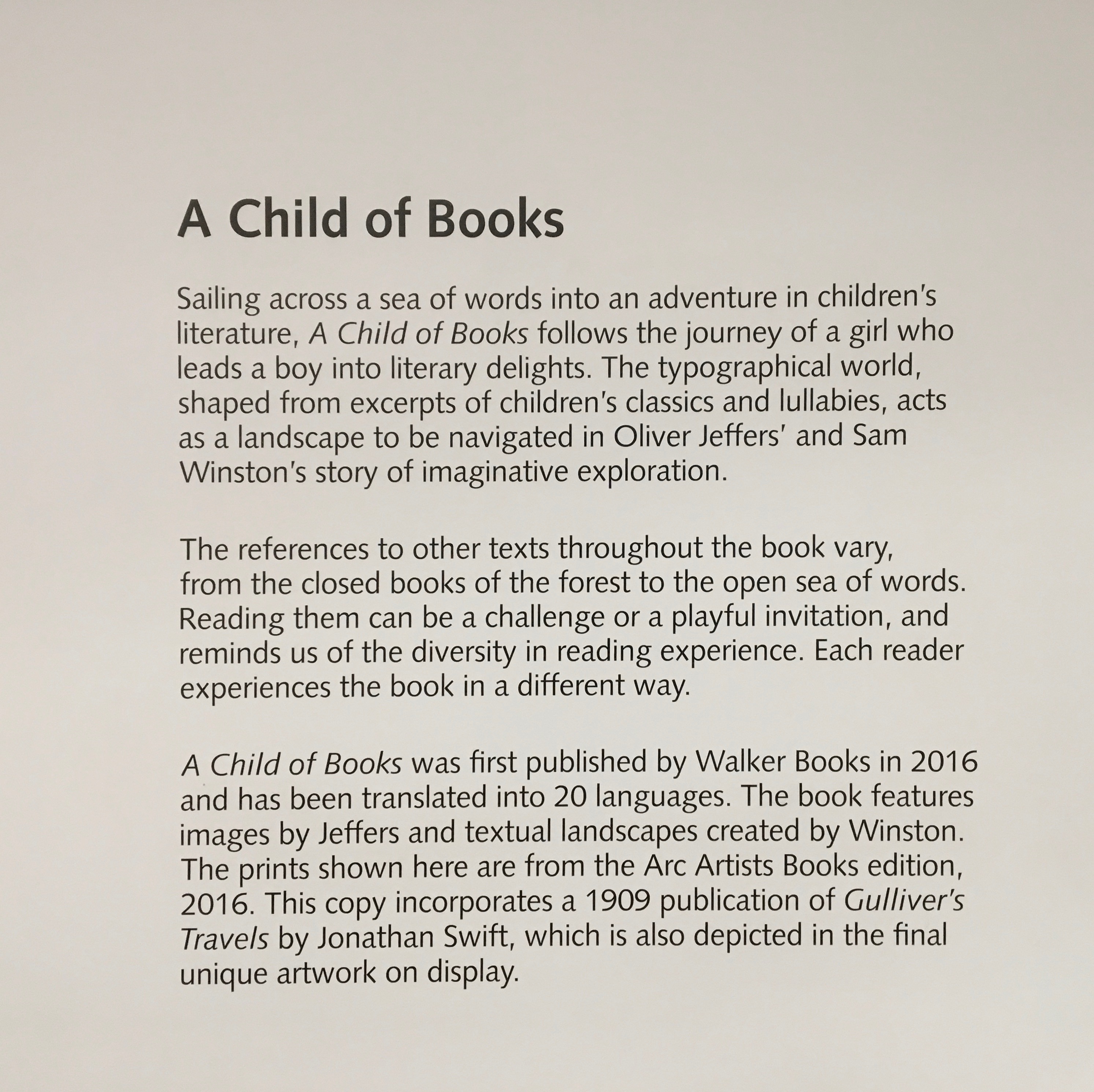
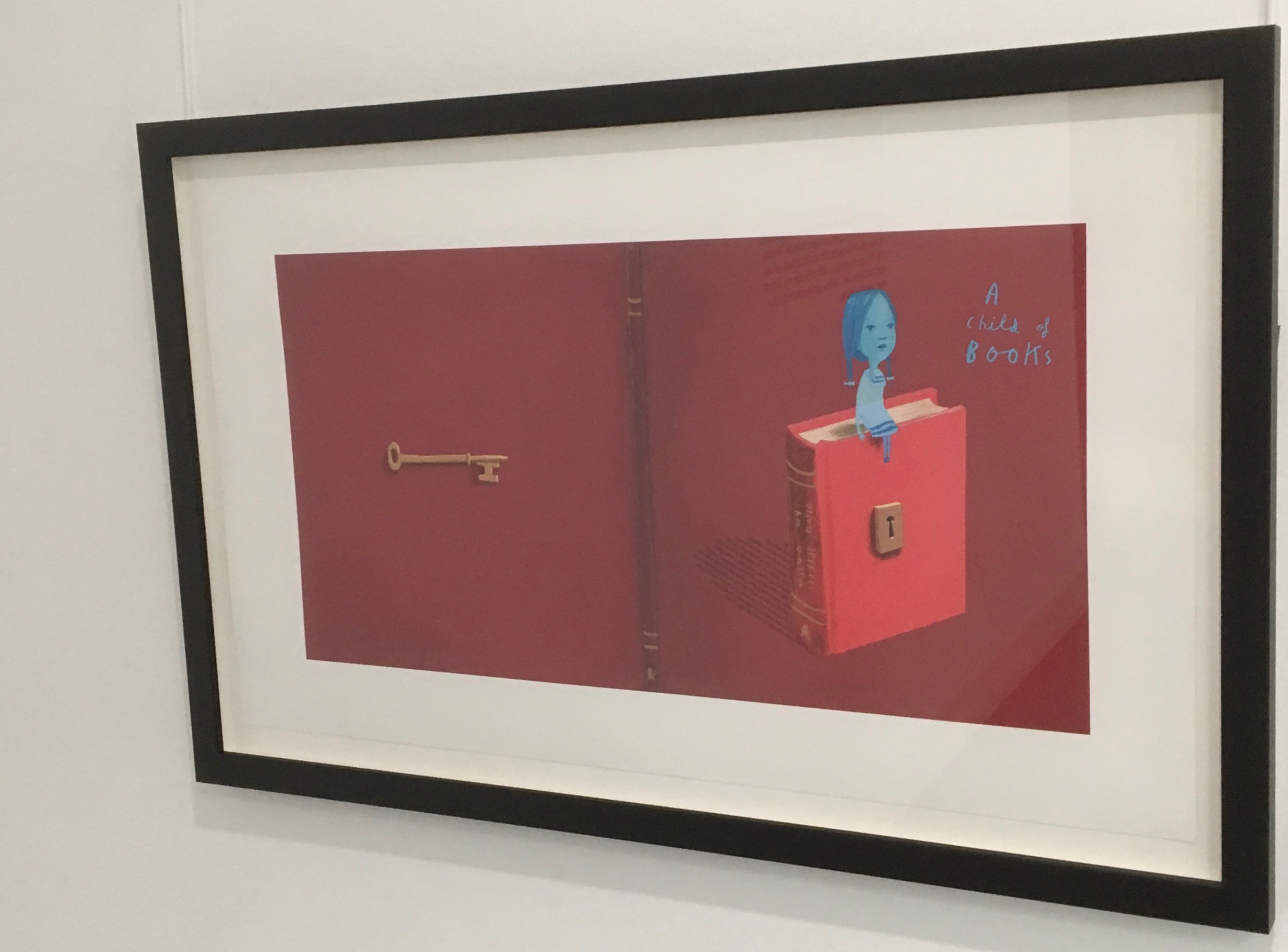
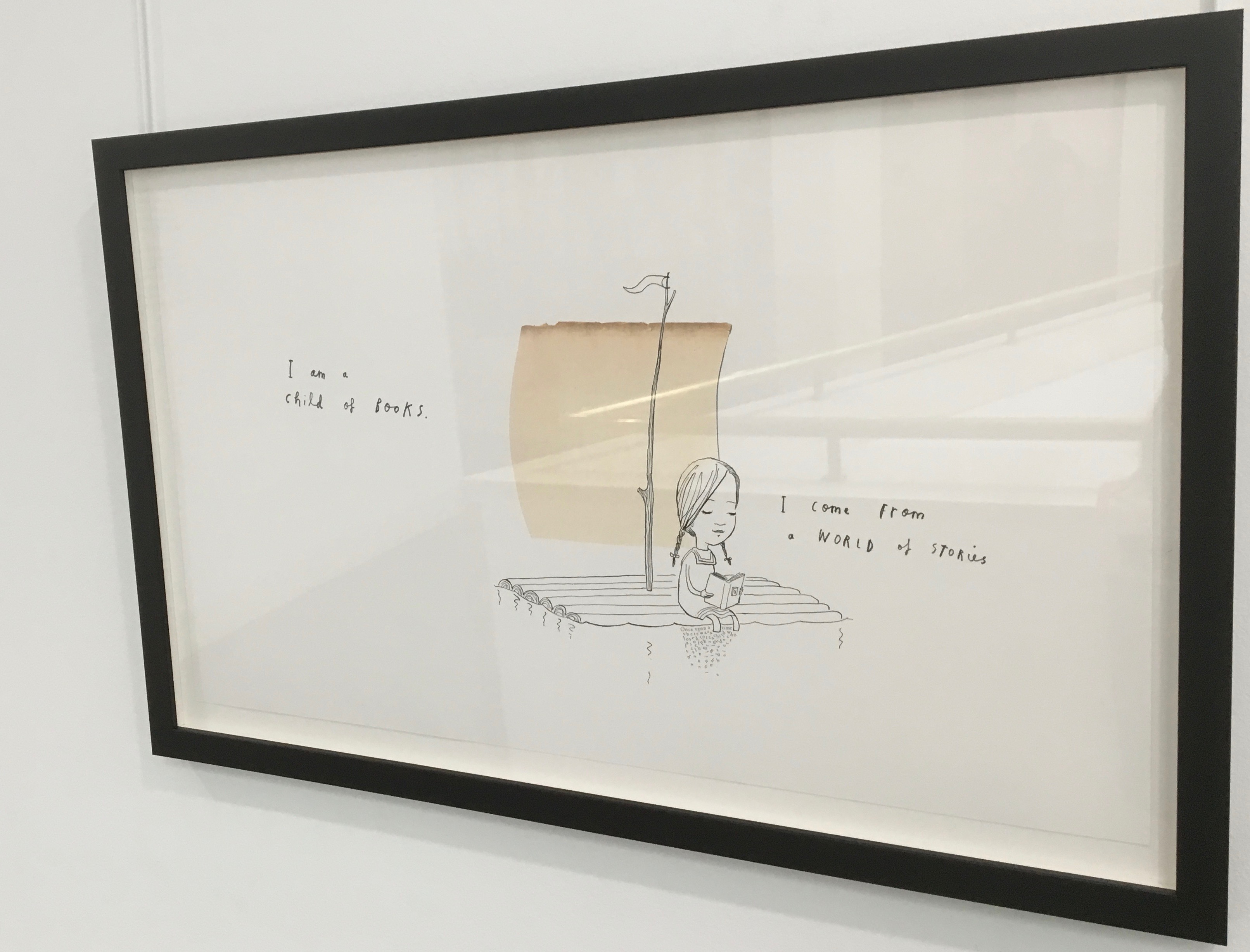
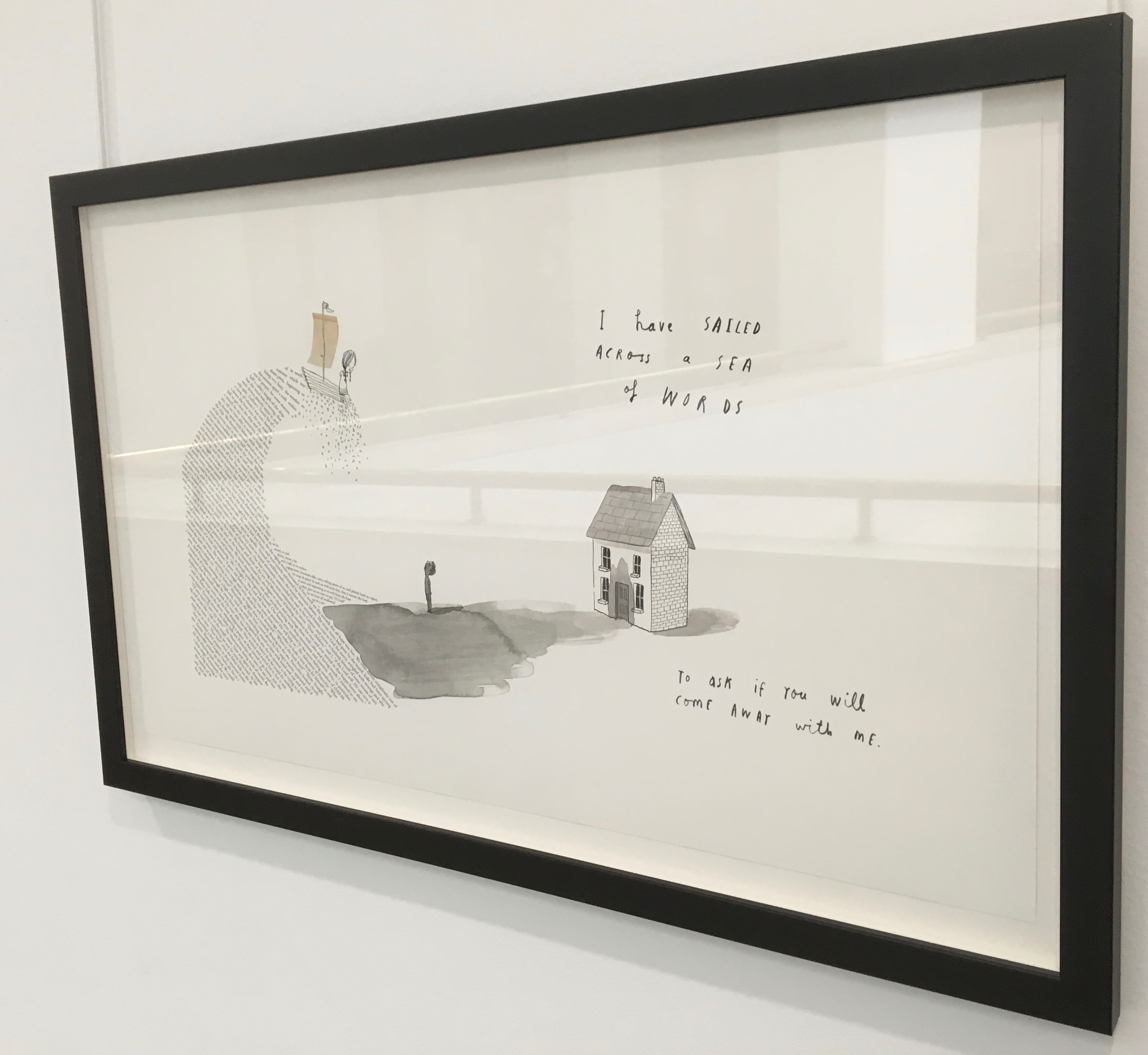
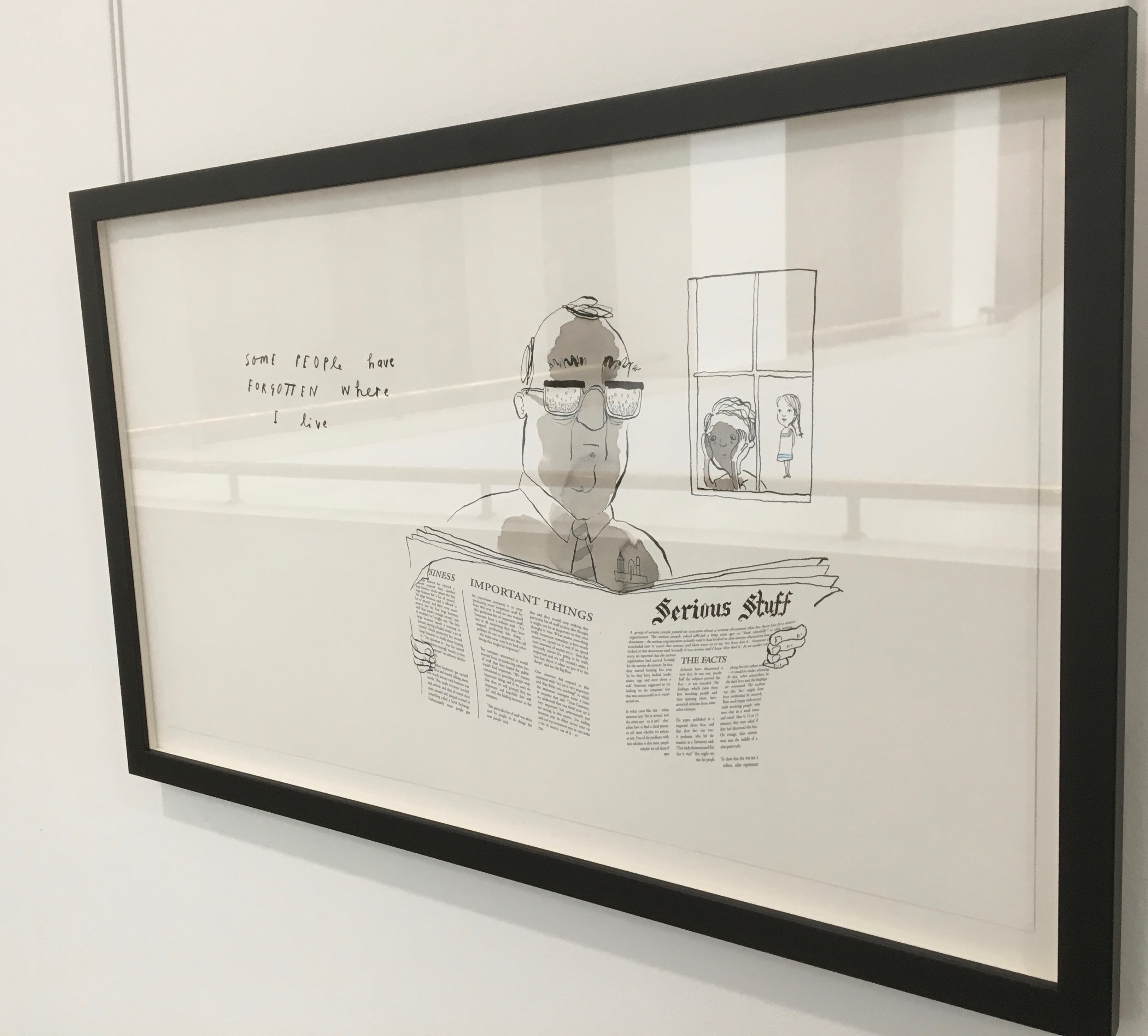
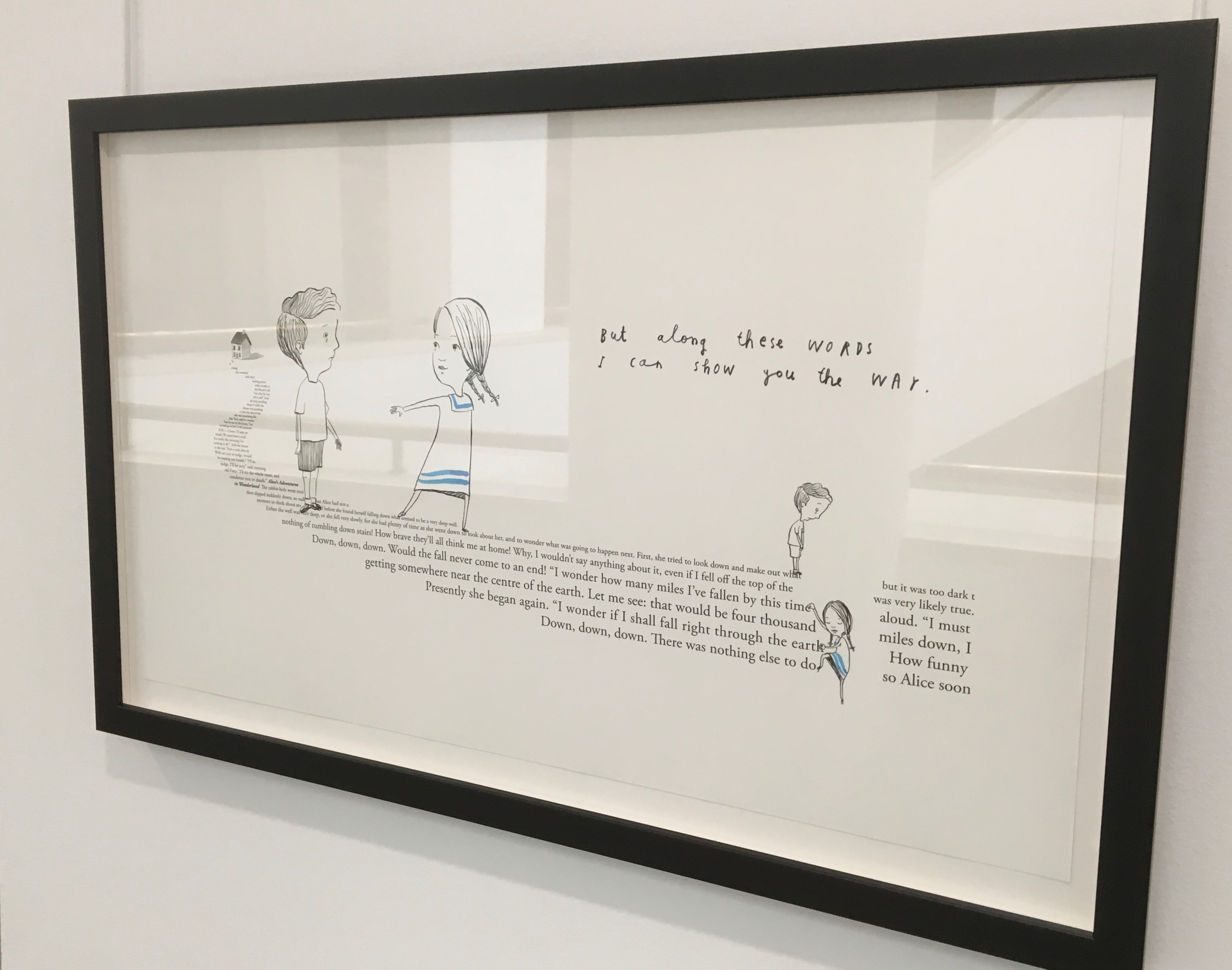
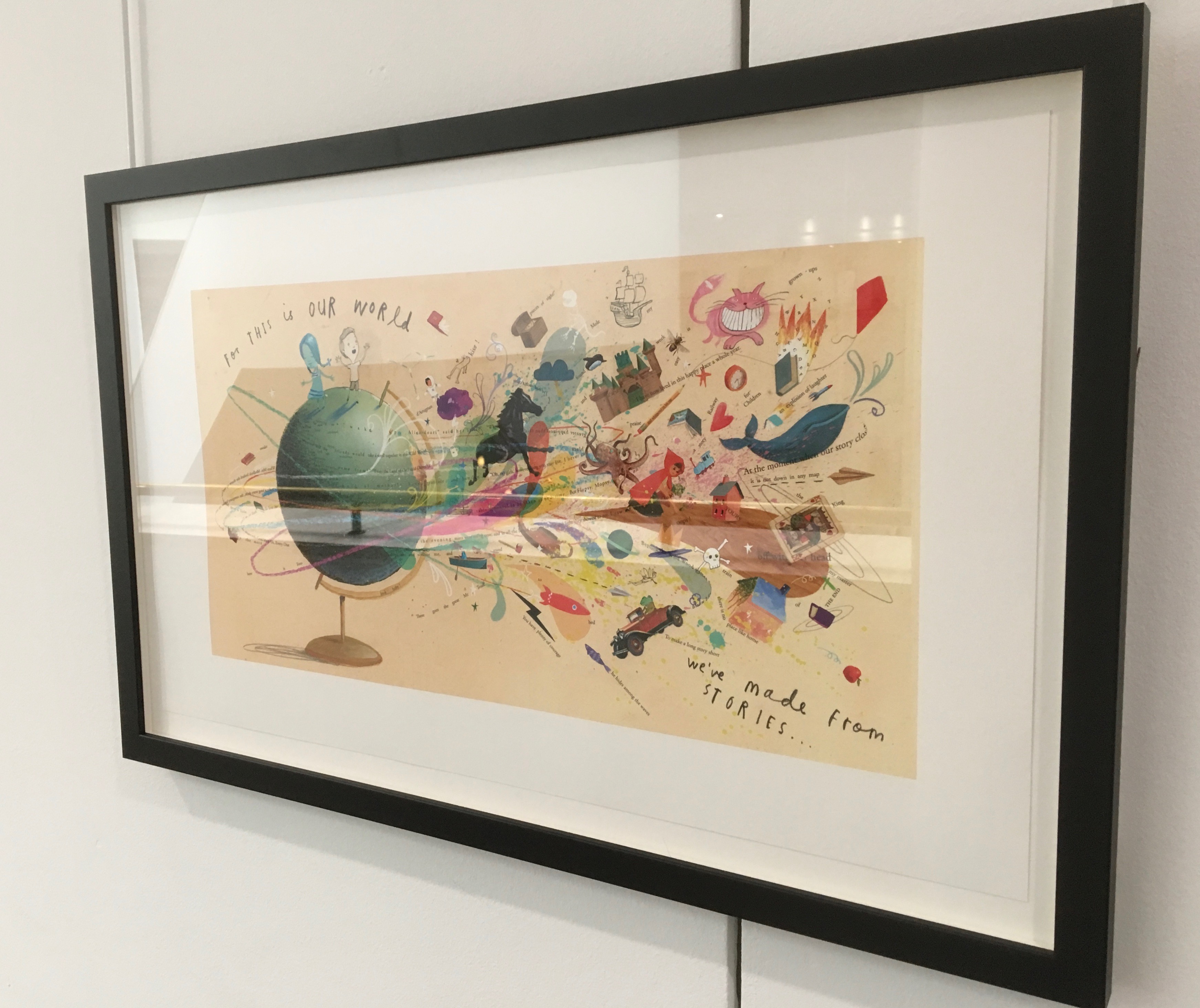
A forest made of fore-edges. A raft made of spines and its sail a book page. A wave and a path made of excerpts from books. In this fabulous world made from the features of books, the simpatico imaginations of Oliver Jeffers and Sam Winston deliver a heroine and an invitation that are hard to resist.

Promotional poster. Displayed with permission of Sam Winston.

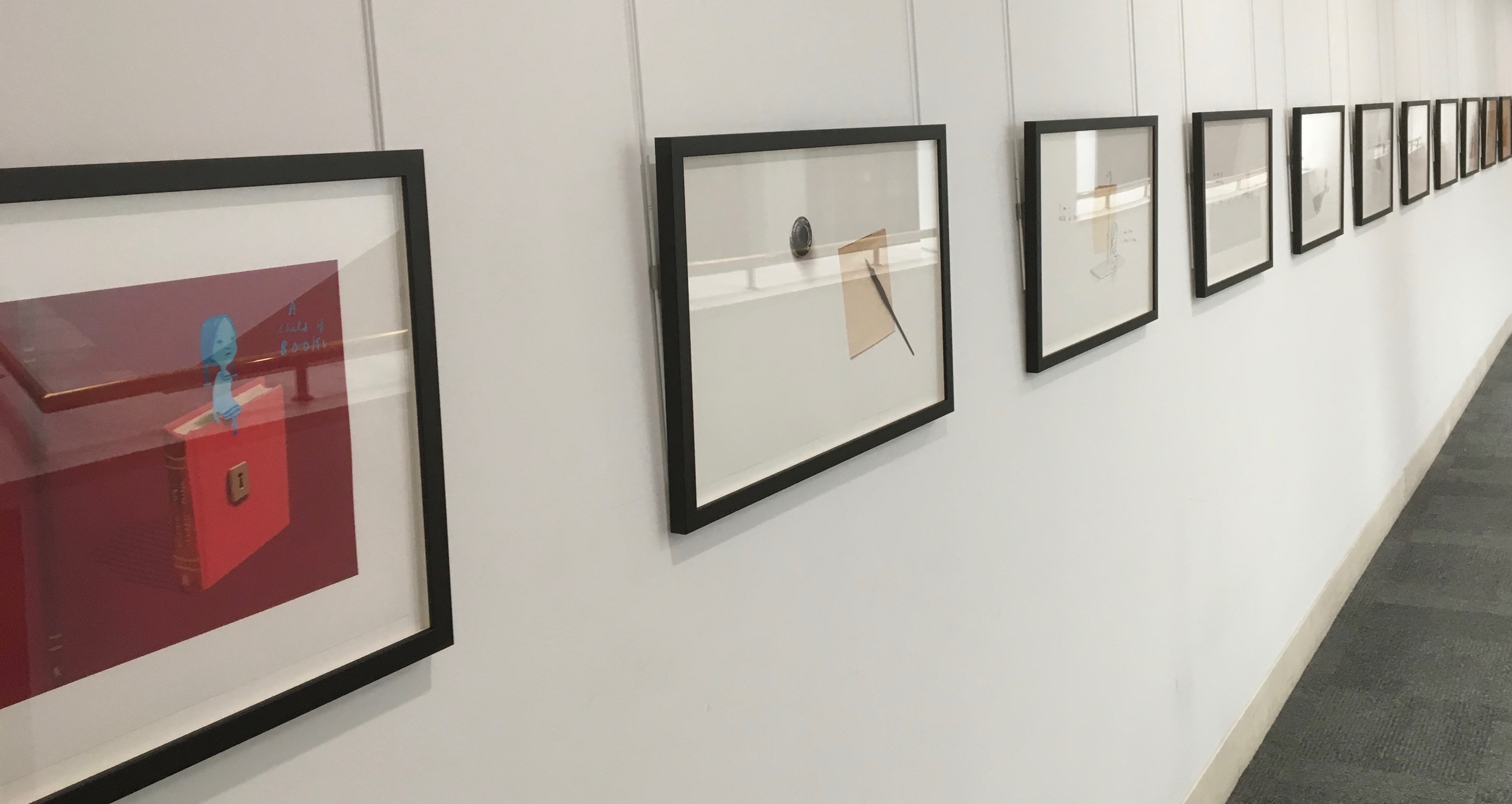
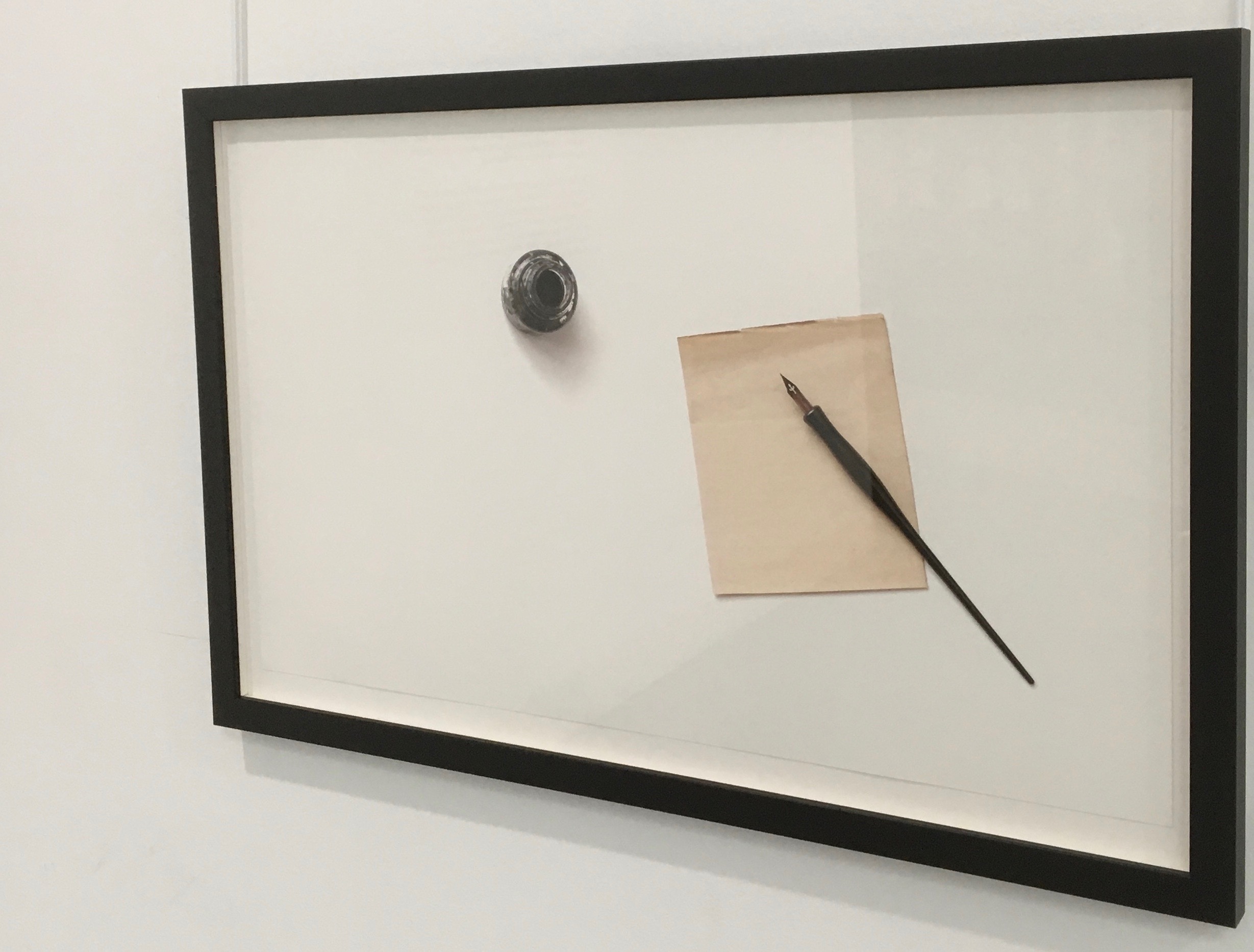
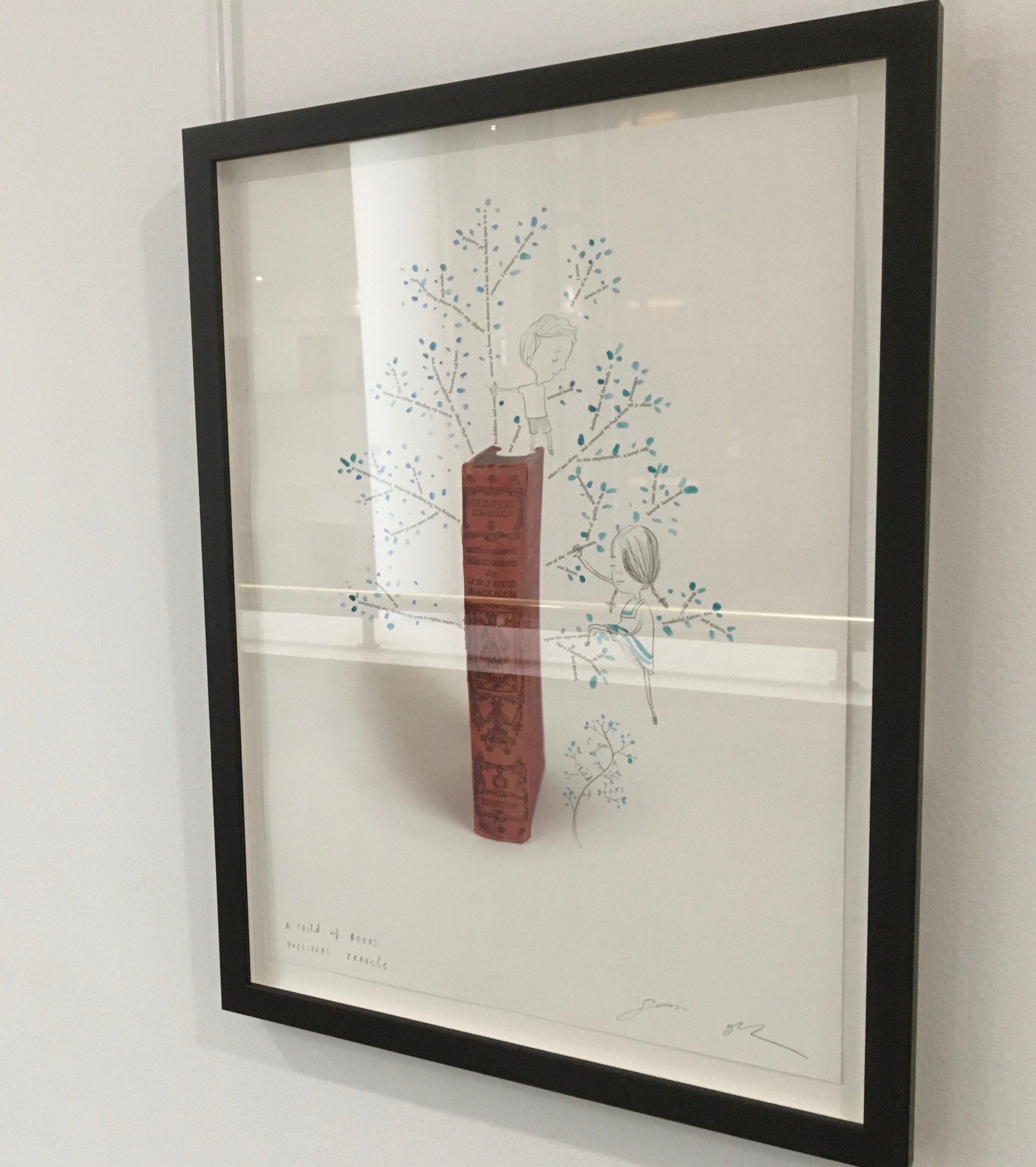
In addition to the poster above and the trade book it promotes, Winston created an artist’s book edition celebrated by this hallway gallery below mounted by the British Library shortly after its appearance.

A Child of Books prints displayed at the British Library, 9 August – 27 September 2019.

Winston’s abiding love of letters, words and stories shines through in A Child of Books. Arguably, it has its origins in an earlier work whose story is told by his invention of a very different “child of books”.

A Dictionary Story (2001 – 2020)

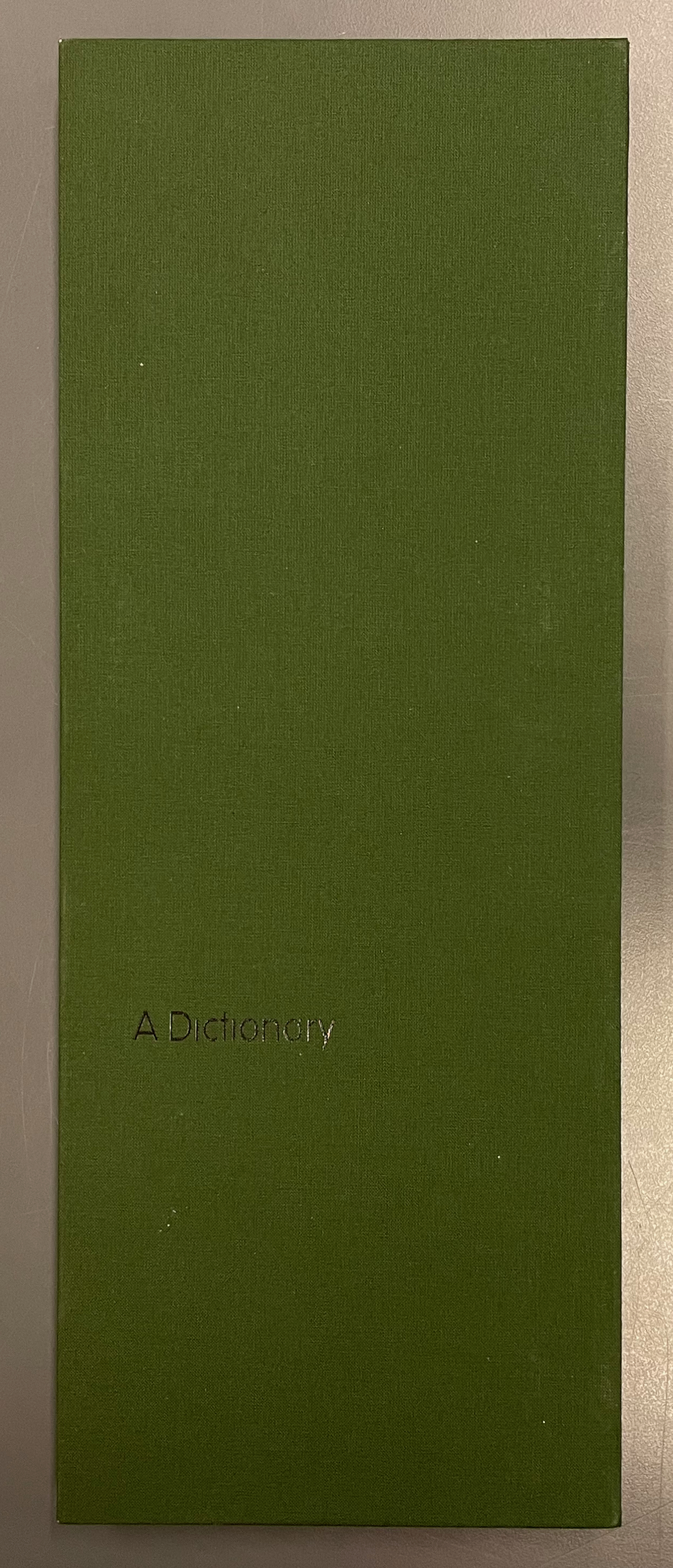
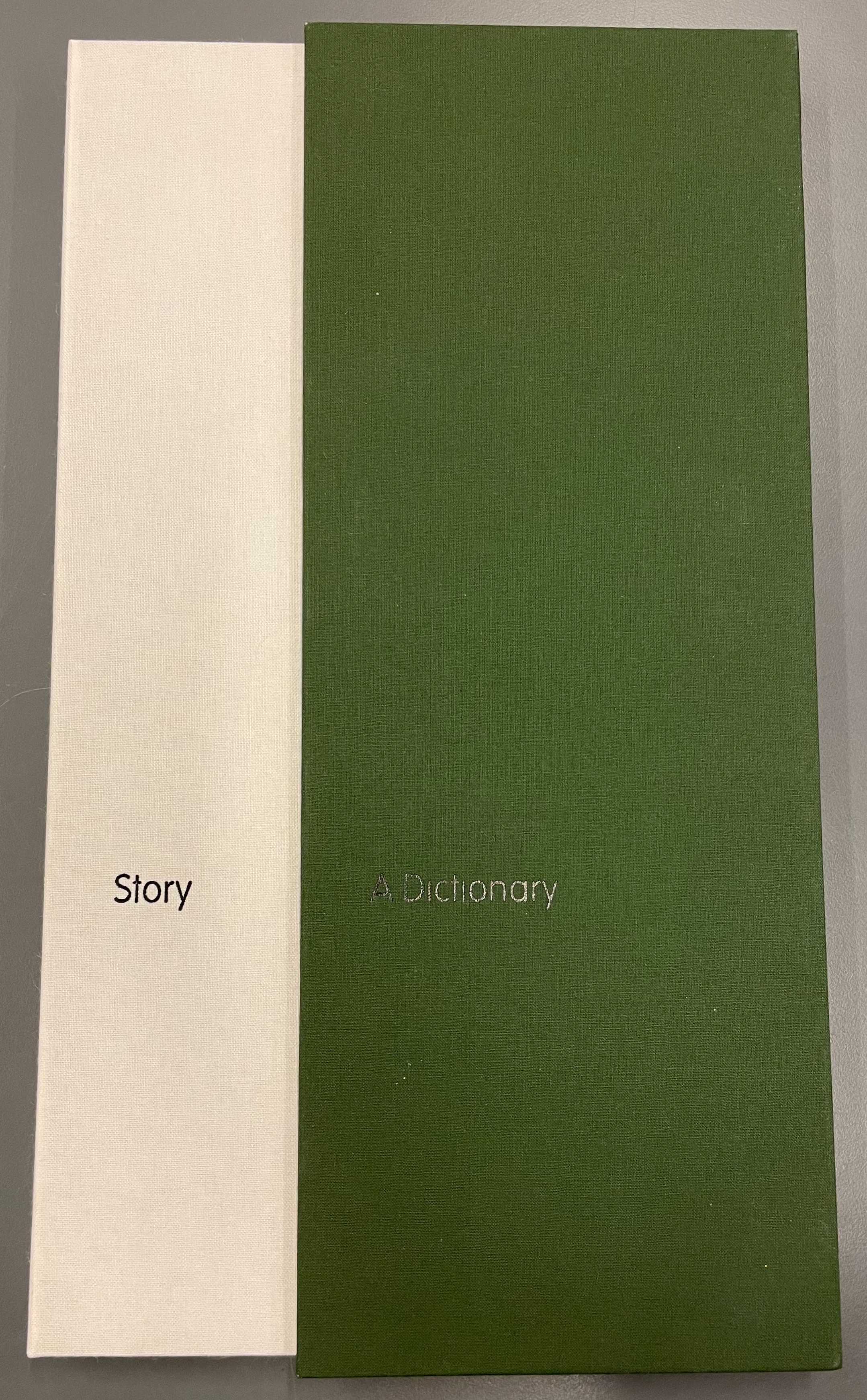
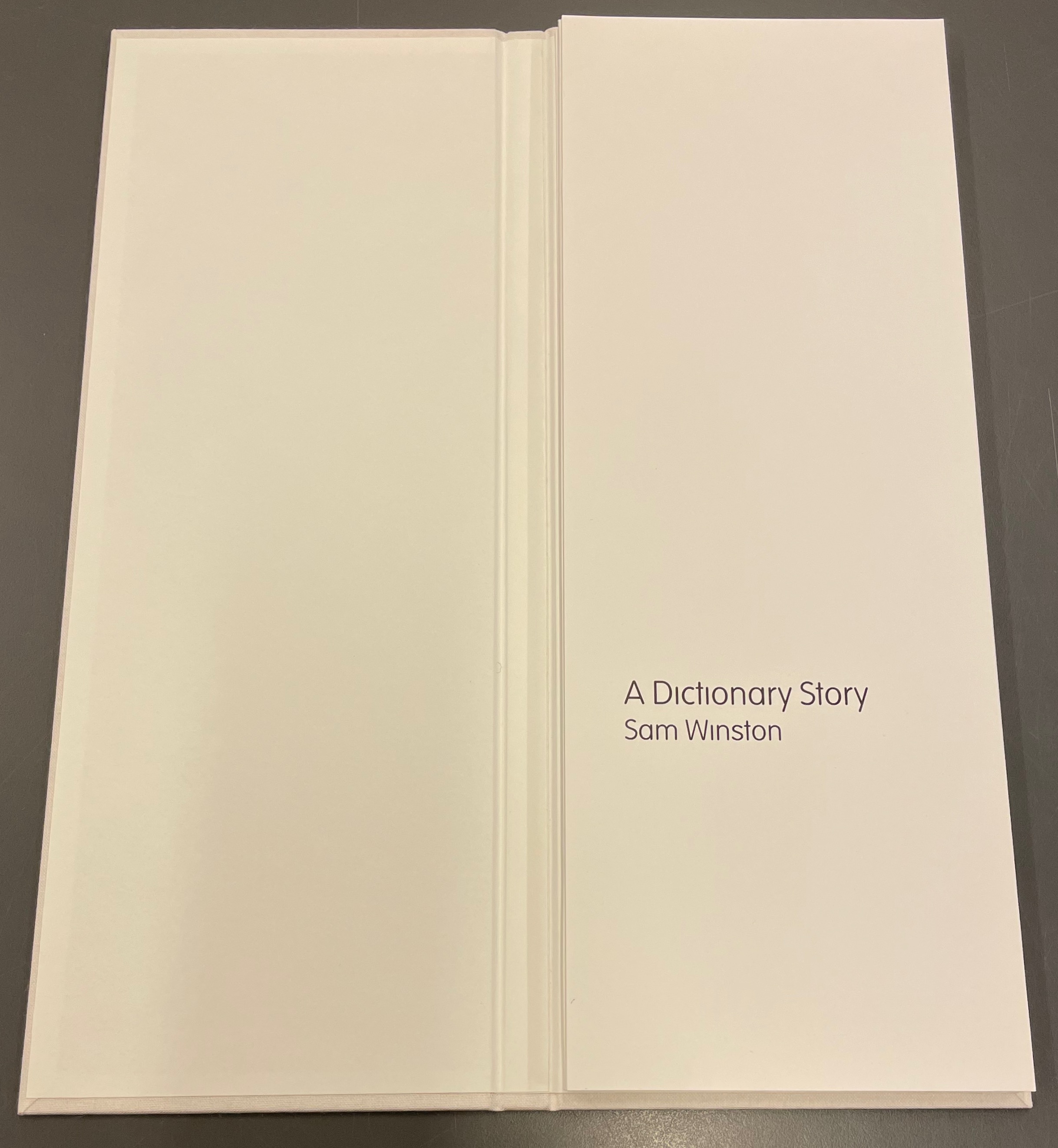
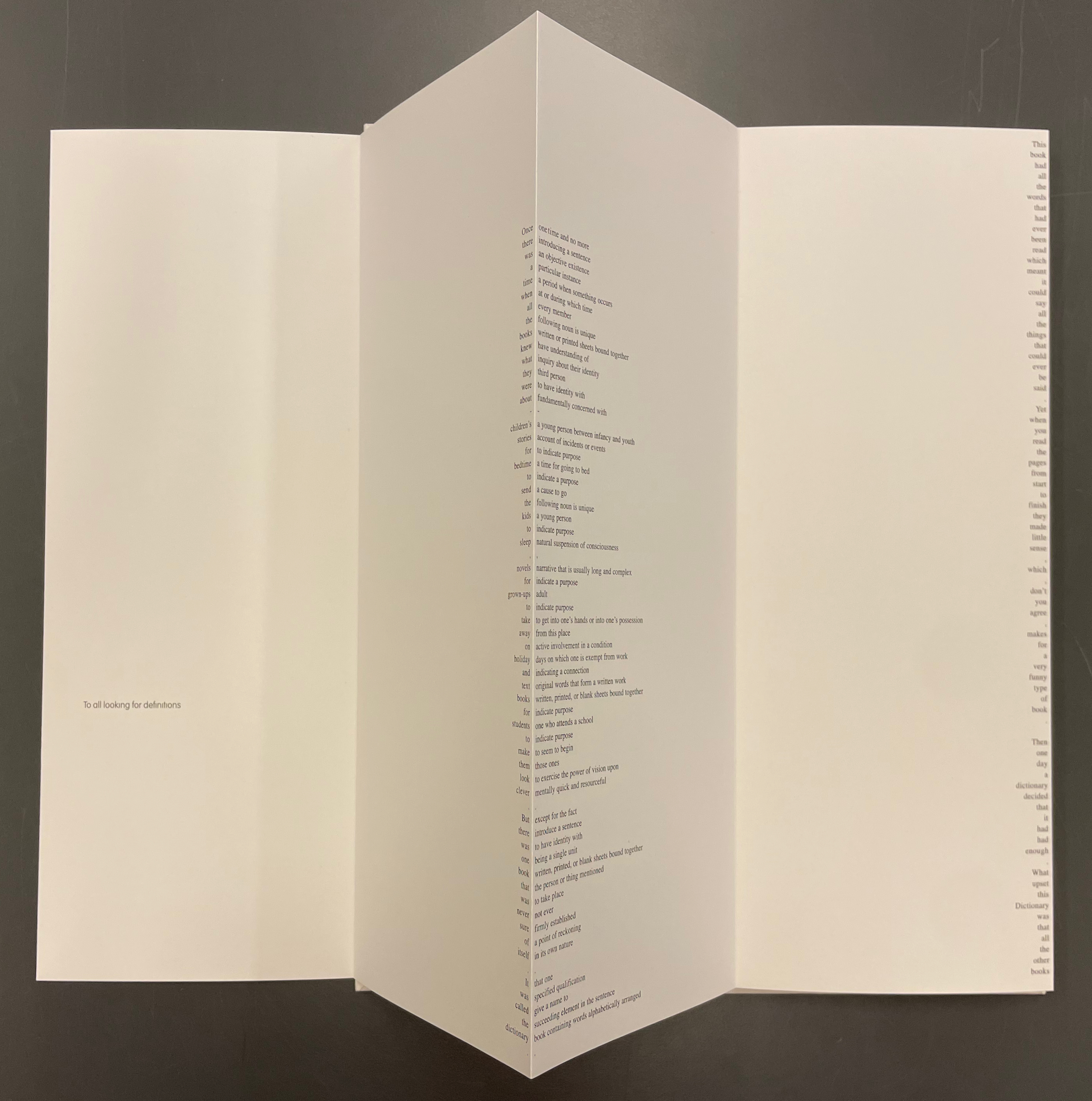
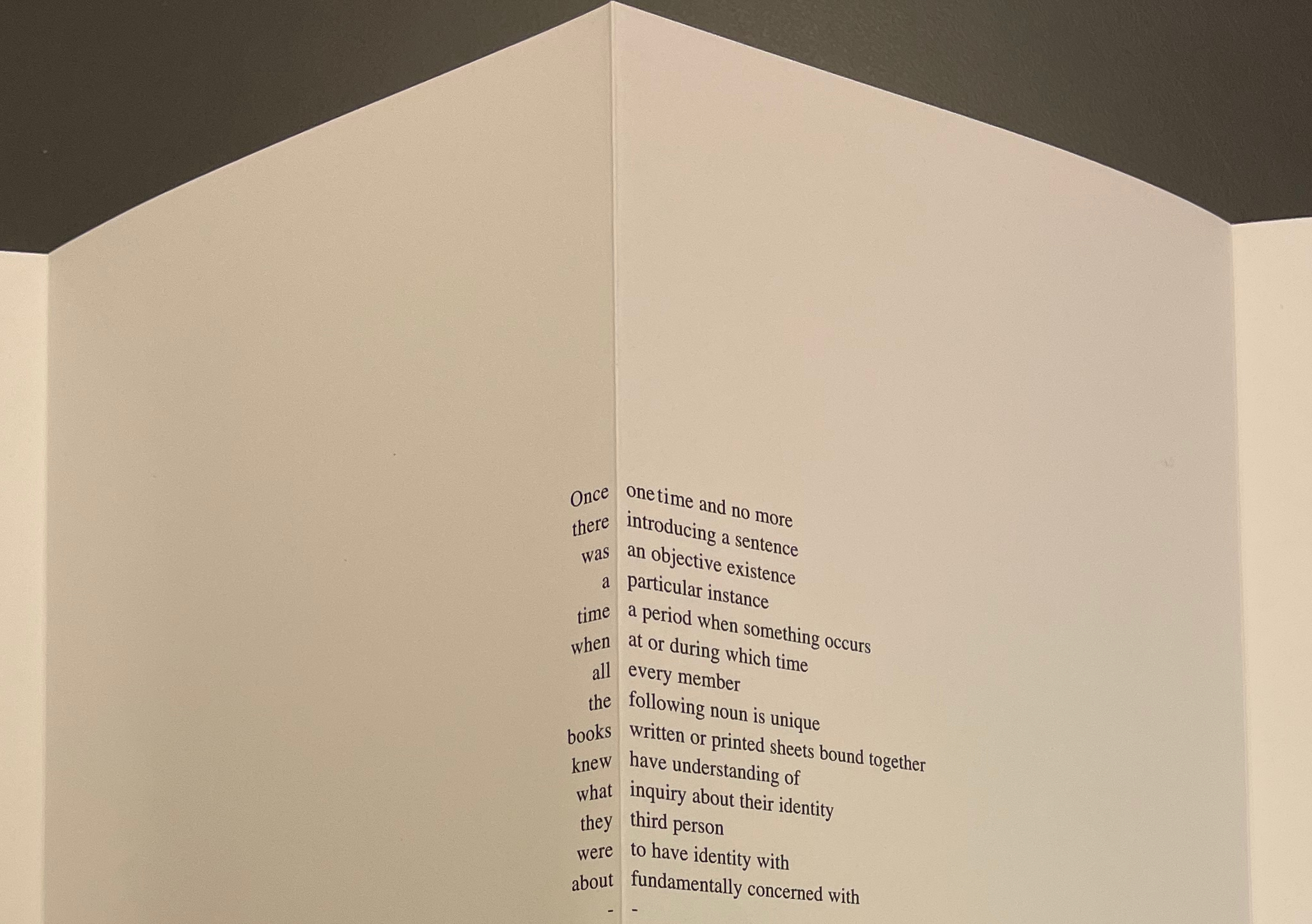
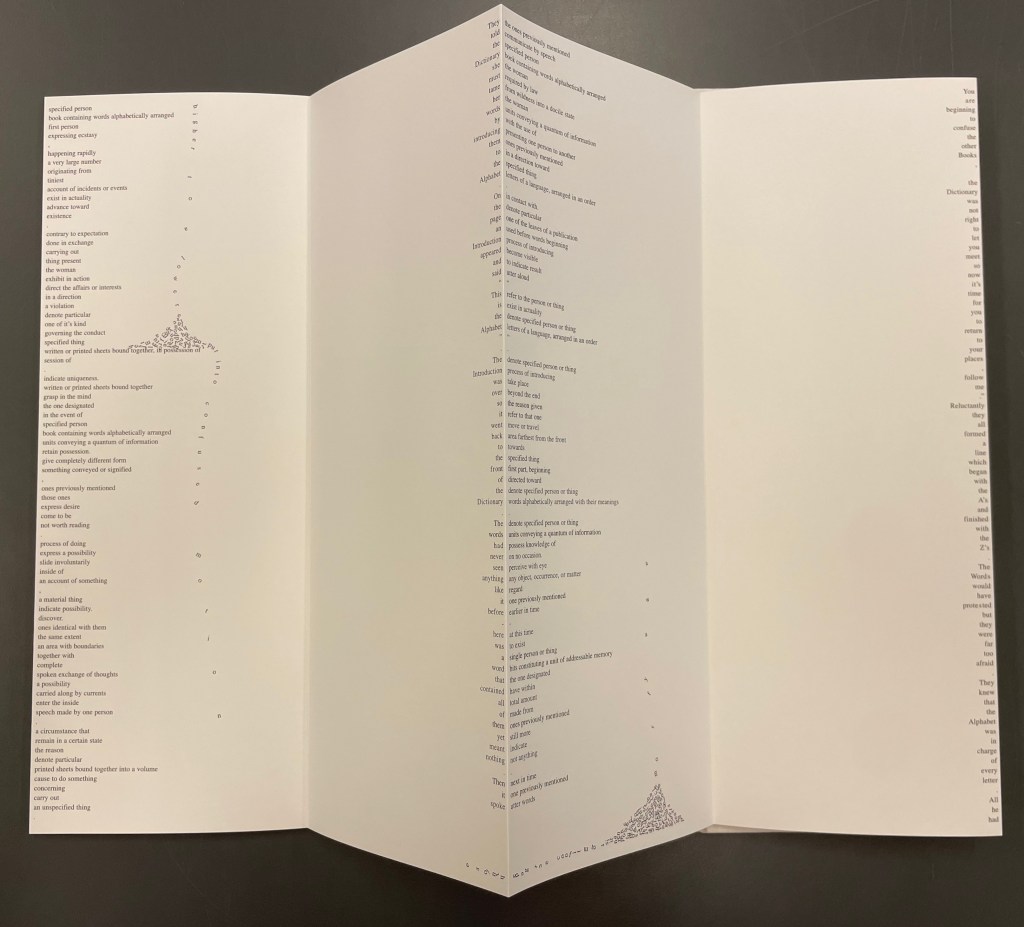
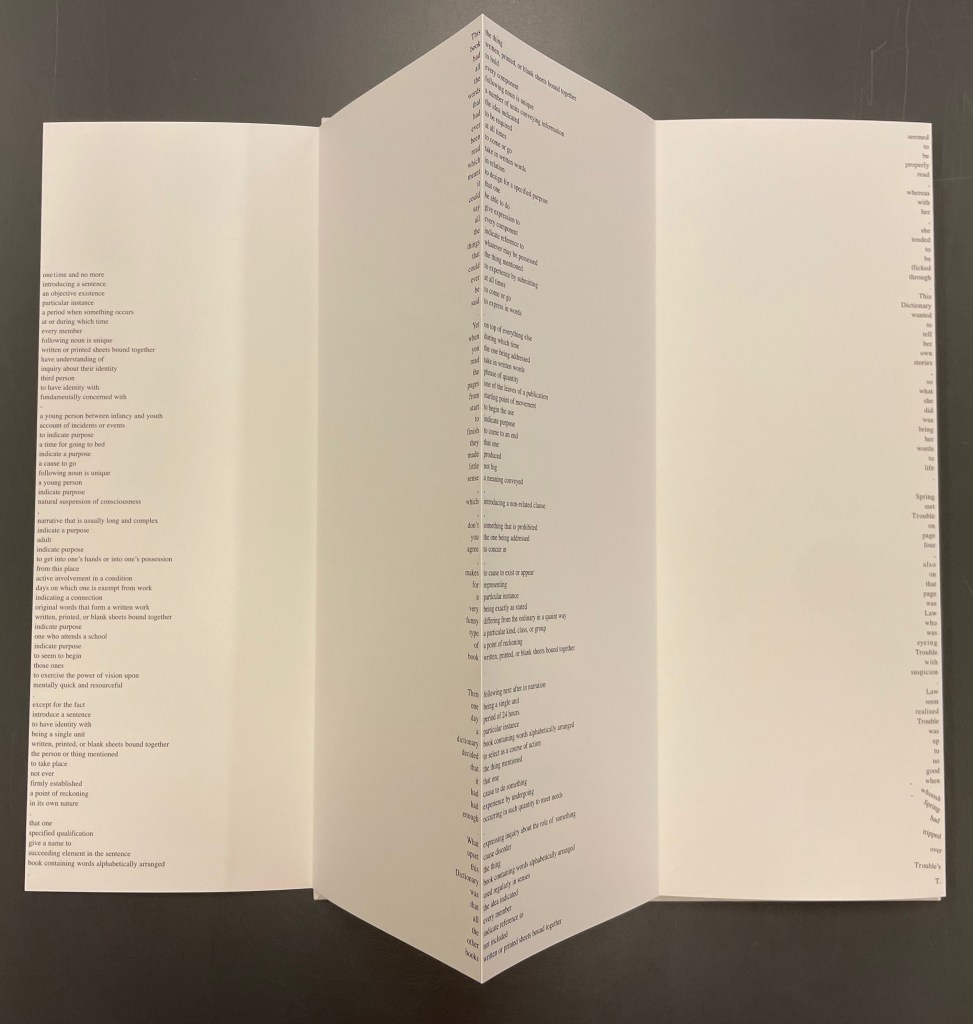
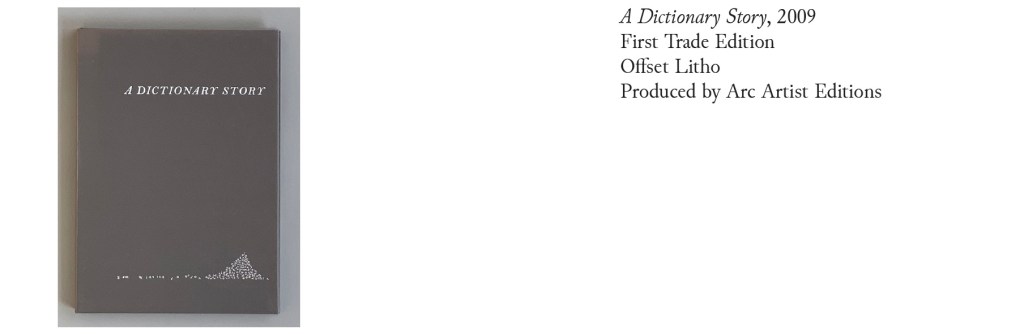
Since its origin as a student project in 2001, A Dictionary Story has appeared in an accordion book form as a fine press edition and two trade editions and as single-sheet prints. The Books On Books Collection holds the fine press edition and the second trade edition, both of which have in common a vertical flush-right single-word column that tells the story and the immediately adjacent vertical flush-left column of definitions of the words in the story. In the fine press edition, the two columns meet at each mountain peaks of the accordion fold.

A Dictionary Story (2006)

A Dictionary Story (2006)
Sam Winston
Slipcased leporello between cloth-covered boards.H360 x W140 mm, 25 panels. Story text set in 9 point Times Roman by Sam Winston. Book designed by Richard Bonner-Morgan and Sam Winston. Printed by David Holyday at Trichrom Limited. Bound at Quality Art Reproductions, England. Published by Circle Press. Edition of 100, of which this is #68. Acquired from the artist, 30 May 2018.
Photos: Books On Books Collection. Displayed with artist’s permission.

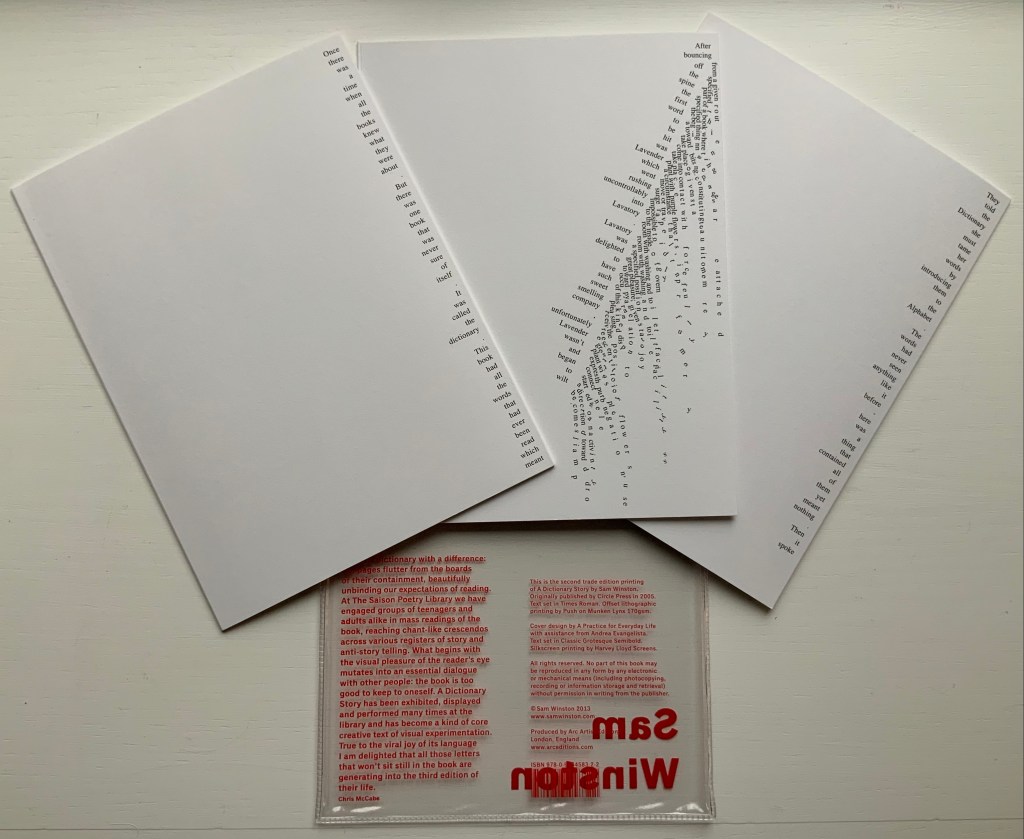
“Once there was a time when all the books knew what they were about. But there was one book that was never sure of itself.”

Panels 2-5 from the fine press edition; detail of panels 2-3.

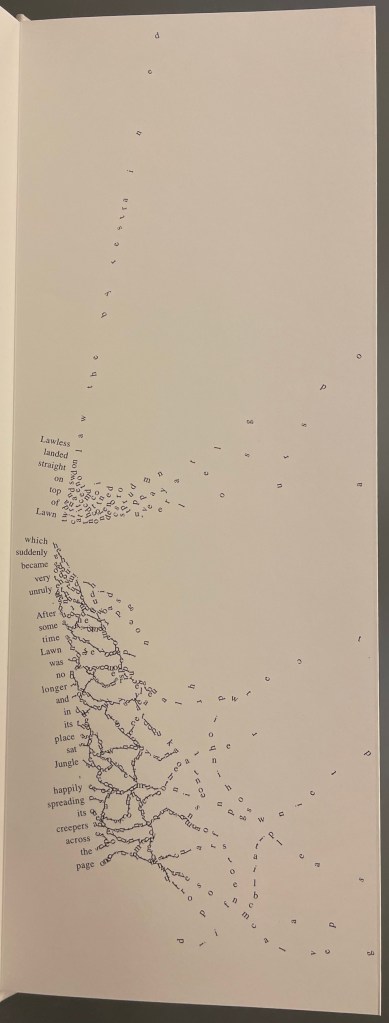
So begins Winston’s tale about this uncertain book. The book never sure of itself is the Dictionary, which of course it must be, otherwise the tale would not be called “A Dictionary Story”. The Dictionary is jealous of all the other books because they are “properly read”, whereas she is just flicked through from time to time. A bit like the “One” in One and Everything, the Dictionary seems to think she contains all the stories imaginable, because she contain all the words — just not in the right order. So she decides to bring her words to life as characters to see what will happen. Words and letters fly about, enacting the story as if in a concrete poem. A meaningful tussle between text and image is a frequent feature for artists’ books as well as visual poetry.

Another defining aspect of book art is its self-referential nature. In an interview with Typeroom, Winston captures this in his response to the question “What is Dictionary Story all about?”:

Dictionary Story is a playful way of exploring some of our presumptions around the printed word. Or you could say that it looks towards a tool we are given at a very young age – the Dictionary – and invites us to actually think about how that works. Here’s a device that is designed to explain a word’s meaning by offering further words in its place – to me that is remarkable. This is a type of knowledge that can only explain itself through referencing itself. As a visual person the image that comes to mind is a giant, never ending, Möbius strip of language twisting back on itself.

Of course for less visual persons, the Dictionary’s whim engenders chaos, which Winston, a dyslexic, can appreciate. So he brings onstage (or “onpage”) the Books, of whom the Dictionary was jealous, to remonstrate that if words become disconnected from their definitions, how will they the Books know what they are about? Insisting that she tame her words, they have the Dictionary’s Introduction introduce her bewildered words to the character “Alphabet”.

Making the journey over the hills and valleys of A Dictionary Story is satisfying, and re-making it is even more satisfying and delightful each time. The making and re-making of A Dictionary Story must also have been satisfying and delightful for Sam Winston; he has done it so many times.

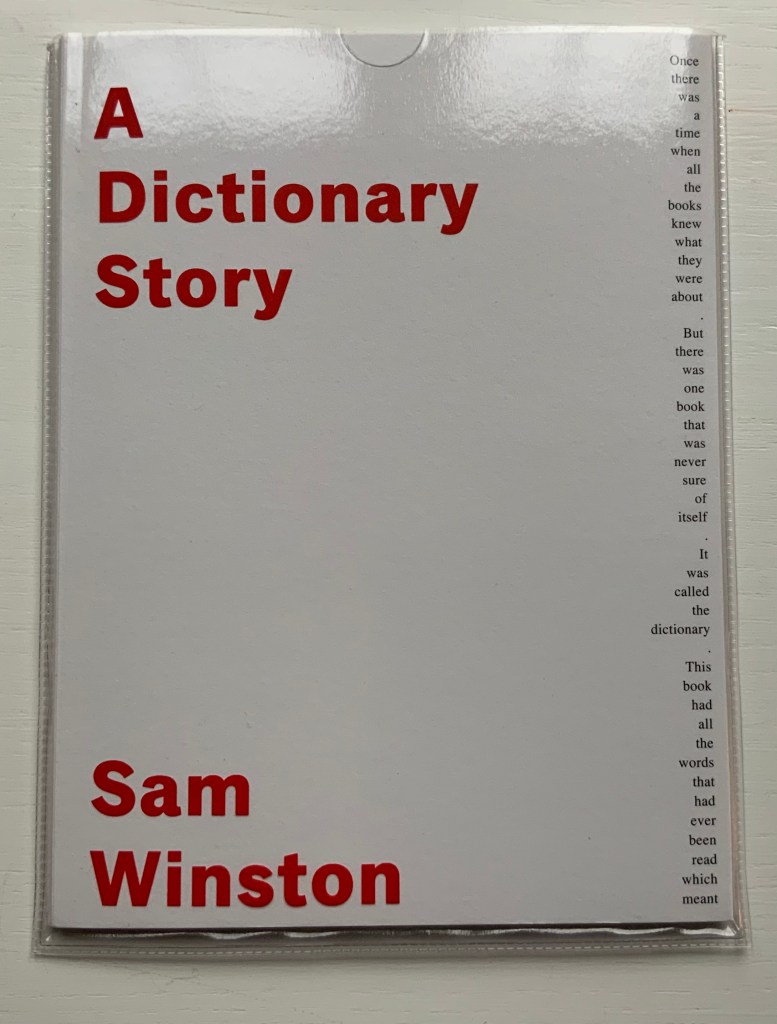
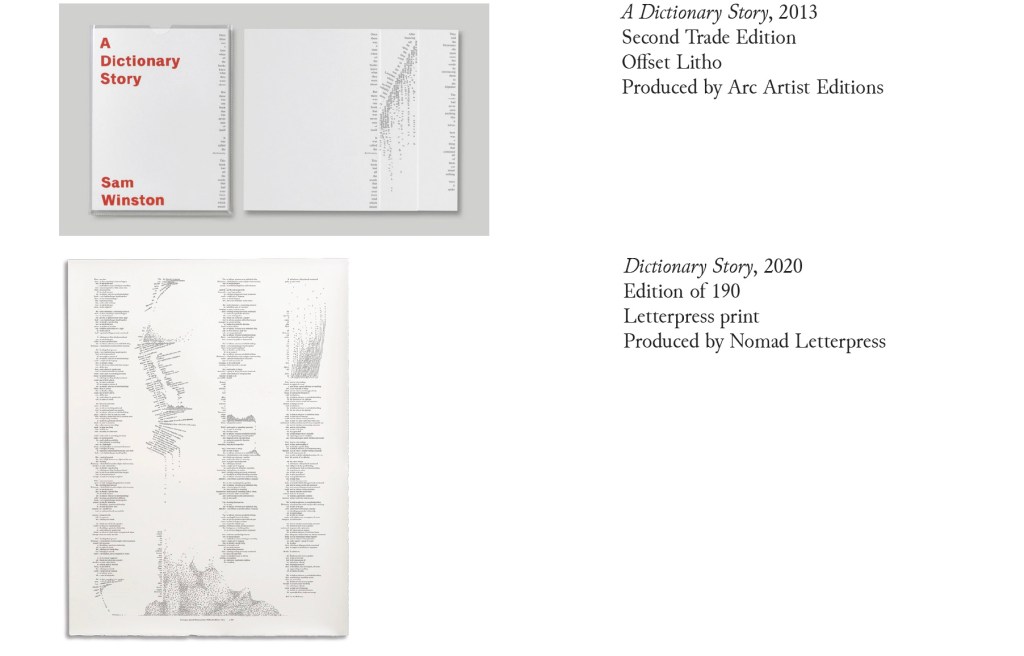
A Dictionary Story (2013)

A Dictionary Story (2013)
Sam Winston
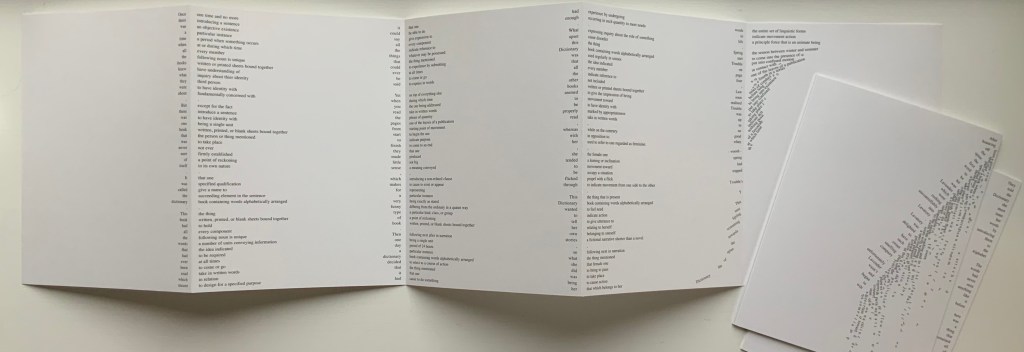
Three five-panel accordion folded sections in a plastic sleeve cover. Second trade edition. Sleeve: H205 x W160 mm. Sections: H200 x W150 mm, 15 panels. Acquired from the artist, 13 December 2020.
Photos: Books On Books Collection.

Watching the artist adjust the typography of A Dictionary Story to changing dimensions is like watching a star tennis player who is also a star basketball player and star soccer (football) player. There’s always a ball, there’s always a net, there’s always genius.

The trade edition splits the fine press edition into three less narrow leporellos and nudges some of the two columns (story/definition) into the valley fold. Below, in the trade edition across panels 3 and 4 is where the Dictionary decides to bring her words to life, and on the right side of the fourth panel, the words begin to slip away from the fold.

The same part of the story in the fine press edition occurs on the fourth panel below, and the words tilt against the fold.

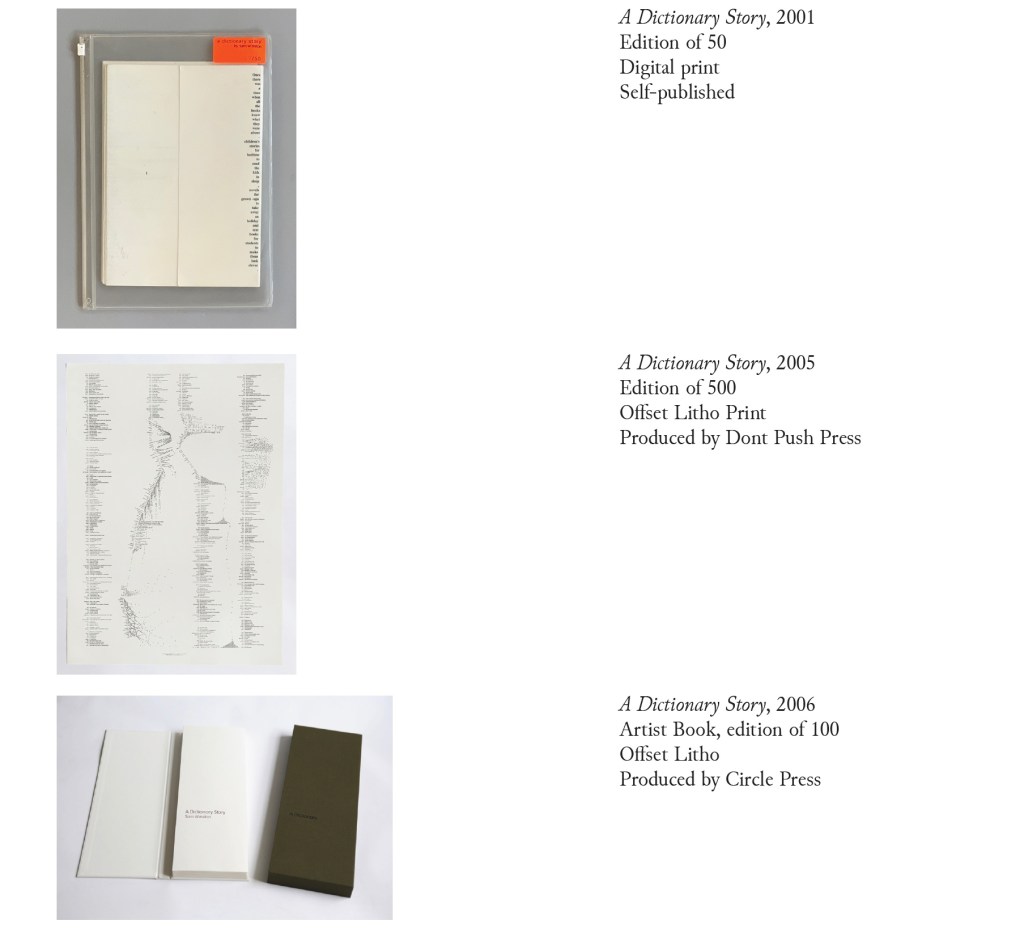
These variations create subtly different narrative paces and visual impressions in the two editions. Not one better than the other, just different. The poster variations, however, subordinate narrative pace entirely to visual impression. At present, the posters are not in the collection, but the images below help to make the point. As with movie goers, some will like the prints more than the books, others the books more than the prints, and still others will marvel at the genius in all of them.

Further Reading

“‘Darkness Visible’, Sam Winston’s performative installation”. Books On Books, 30 December 2017.

Sam Winston”. Bookmarking Book Art. 22 June 2013.

Howard, Alex. 16 February 2015. “Sam Winston – Art as a Spiritual Practice“. Conscious Life. Interview.

Jeffers, Oliver, and Sam Winston. 31 August 2016. “A Child of Books“. Entry at Picturebook Makers. Ed. dPictus. Accessed 30 July 2023.

Lambert, Léopold. 9 February 2011. # Fine Arts /// Dictionary Story by Sam Winston“. The Funambulist. Accessed 20 April 2018. Brief note.

Perkins, Stephen. 11 March 2021. “Sam Winston, A Dictionary Story, Arc Artist Editions, London, 2005/2013“. Accordion Publications. Accessed 26 March 2023.

Russell, Lindsay Rose. “Dictionary, Shaped: Artists’ Books and Lexicography”. Dictionaries: Journal of the Dictionary Society of North America, Volume 41, Issue 2, 2020, pp. 115-146

Sant’Ana Pereira, Felipe. 27 August 2020. “The World’s 5 Most Beautiful Alphabets You’ll Never Learn To Read“. Matador Network. Accessed 26 March 2023. Re One and Everything.

Sperling, Matthew. 28 November 2013. “Open Book“. Apollo Magazine. Mention of Folded Dictionary. Accessed 20 April 2018. Re Folded Dictionary.

Valentino, Andrea. 21 January 2020. “The alphabets at risk of extinction“. BBC Future. Accessed 26 March 2023. Re One and Everything.

Typeroom. 15 July 2016. “An interview with Sam Winston“. Typeroom. Accessed 17 September 2017. Accessed 20 April 2018.

Typeroom. 25 November 2020. “Dictionary Story: Sam Winston’s letterpress classic typographic tale just got upgraded“. Typeroom. Accessed 1 December 2020.

Wood, Heloise. 15 February 2017. “A Child of Books wins Bologna Ragazzi Award for fiction“. The Bookseller. Accessed 2o April 2018.

Yin, Maryann. 26 May 2016. “Book Trailer Unveiled for ‘A Child of Books”. GalleyCat, Adweek. Accessed 20 April 2018.

Images: Courtesy of the artist.

Books On Books Collection – Tupoka Ogette

Ein rassismuskritisches Alphabet (2022)


Ein rassismuskritisches Alphabet
(2022)
Tupoka Ogette
Softcover, perfect bound with endbands. H215 x W160 mm. 124 pages. Acquired from Great Book Prices, 1 March 2023.
Photos: Books On Books Collection.

The title of Tupoka Ogette’s book translates literally as “A Racism-critical Alphabet”, but “An Anti-Racist Alphabet” seems more idiomatic. More than an alphabet book, it is a workbook arising from her consultancy for companies, organizations and associations wanting to understand how racism manifests itself and how to address it. Given the consultancy’s focus on German-speaking countries, the book relates tightly to the firm’s workshops, podcasts, etc., so it is not too surprising that it hasn’t been translated into English yet.

The depth of the problem in English-speaking countries, however, results in most of the terms’ being in the English language: terms like “Ally”, “Blackfacing”, “Colorism”, “Derailing”, “Emotional Tax”, “Gaslighting”, “Happyland”, “Jim Crow”, “Liberation”, “Othering”, “Queer”, “Race-based Traumatic Stress”, “Tokenism”, “White Gaze” and “Yellowfacing”. Add to those terms such cognates as Kolonialismus, N-wort and Xenophobie and it is almost a shock that the text is not in English.

Zurück zum Anfang (“Back to the Beginning”).
“The anti-racist alphabet ends here, but the anti-racist journey, and especially your conscious decision to be an Ally, begins anew every day. Every morning you face the choice: Am I looking? Do I stand up as an ally against a racist system? Do I continue to learn? Or do I stay in good old Happyland today? If you are White, you have that choice, but you also have a responsibility.
Reminder: A person who actively and continuously stands up against a discriminatory system of which he himself is privileged and therefore not negatively affected.” P. 115.

The book’s interior display pages are striking and reminiscent of Ursula Hochuli-Gamma’s 26 farbige Buchstaben (1986) / “26 Colored Letters“, but the cover and text design are very much in the vein of professional trade books for the German market. Adapting the design for the English-language market might present more of a challenge than adapting the text.

Further Reading

Abecedaries I (in progress)“. Books On Books Collection.

Tia Blassingame“. 17 August 2022. Books On Books Collection.

Wendy Ewald“. 15 May 2023. Books On Books Collection.

Ursula Hochuli-Gamma“. 18 November 2022. Books On Books Collection.

Arial Robinson“. 15 May 2023. Books On Books Collection.

Clarissa Sligh“. 2 September 2020. Books On Books Collection.

Kendi, Ibram X. 2019. How to Be an Antiracist. London: Bodley Head.