Books On Books Collection – Ron King

The Burning of the Books (2009)

The Burning of the Books (2009)
George Szirtes (poems) and Ron King (prints)
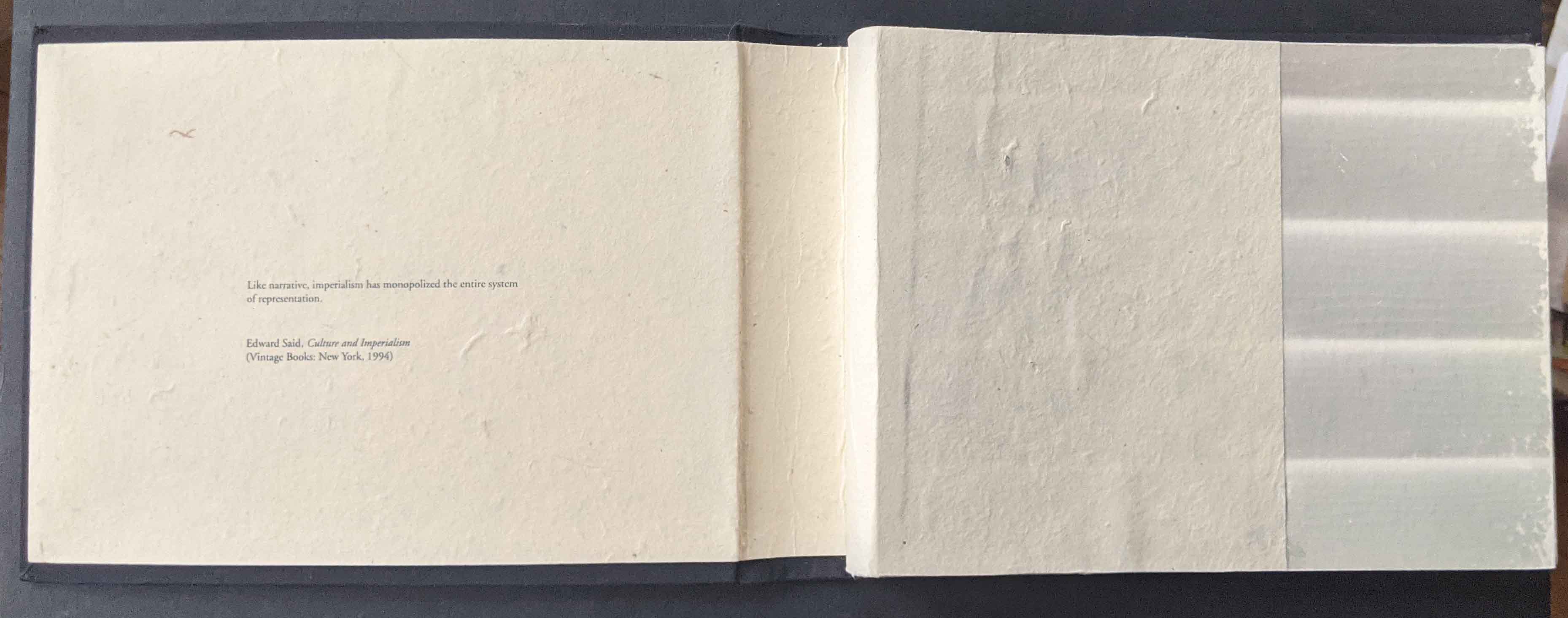
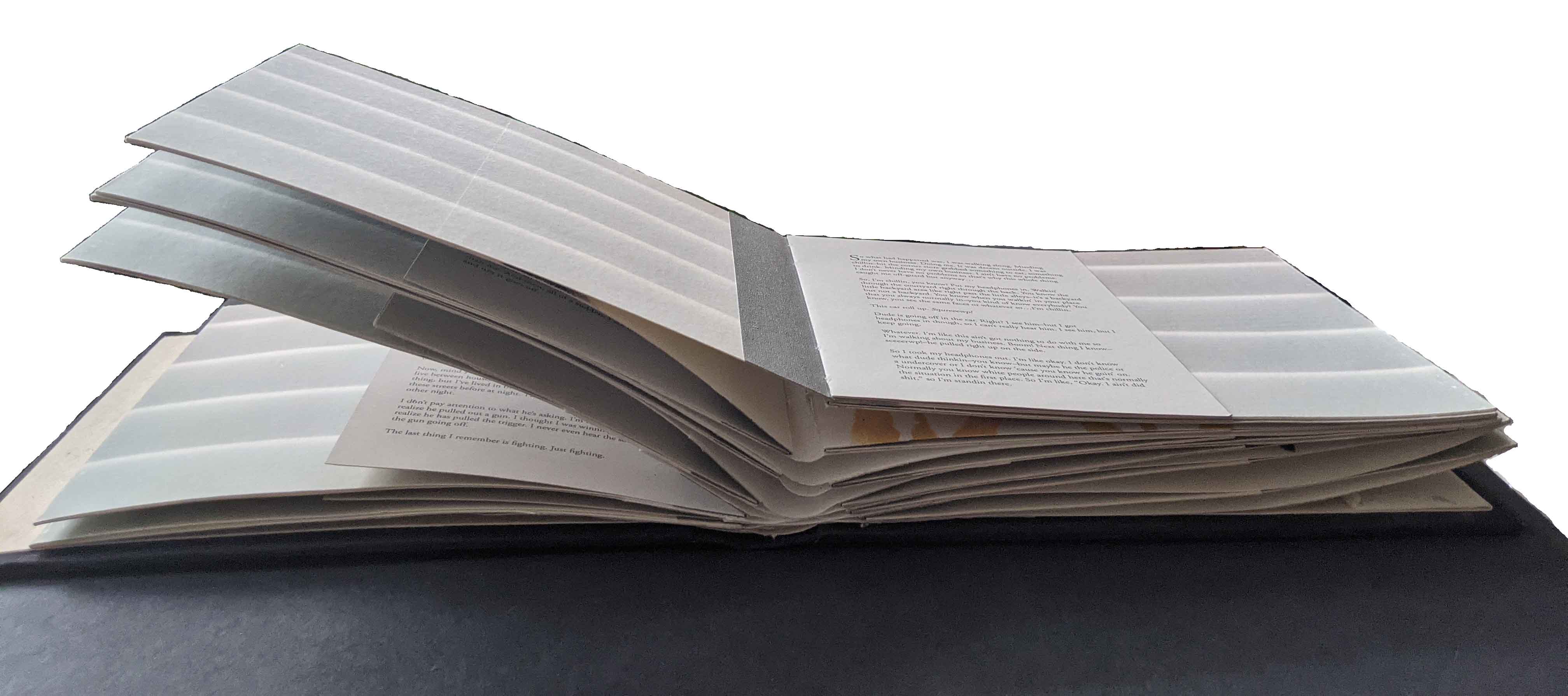
Slipcase with sewn hardback, duotone letterpress reproduction of the 2008 artist book version. H220 x W160 mm, 66 unnumbered pages. Edition of 1000, the first 100 signed and numbered by the author and artist and presented in a specially designed slipcase. Acquired from the artist, 28 January 2021. Photos of the work: Books On Books Collection.
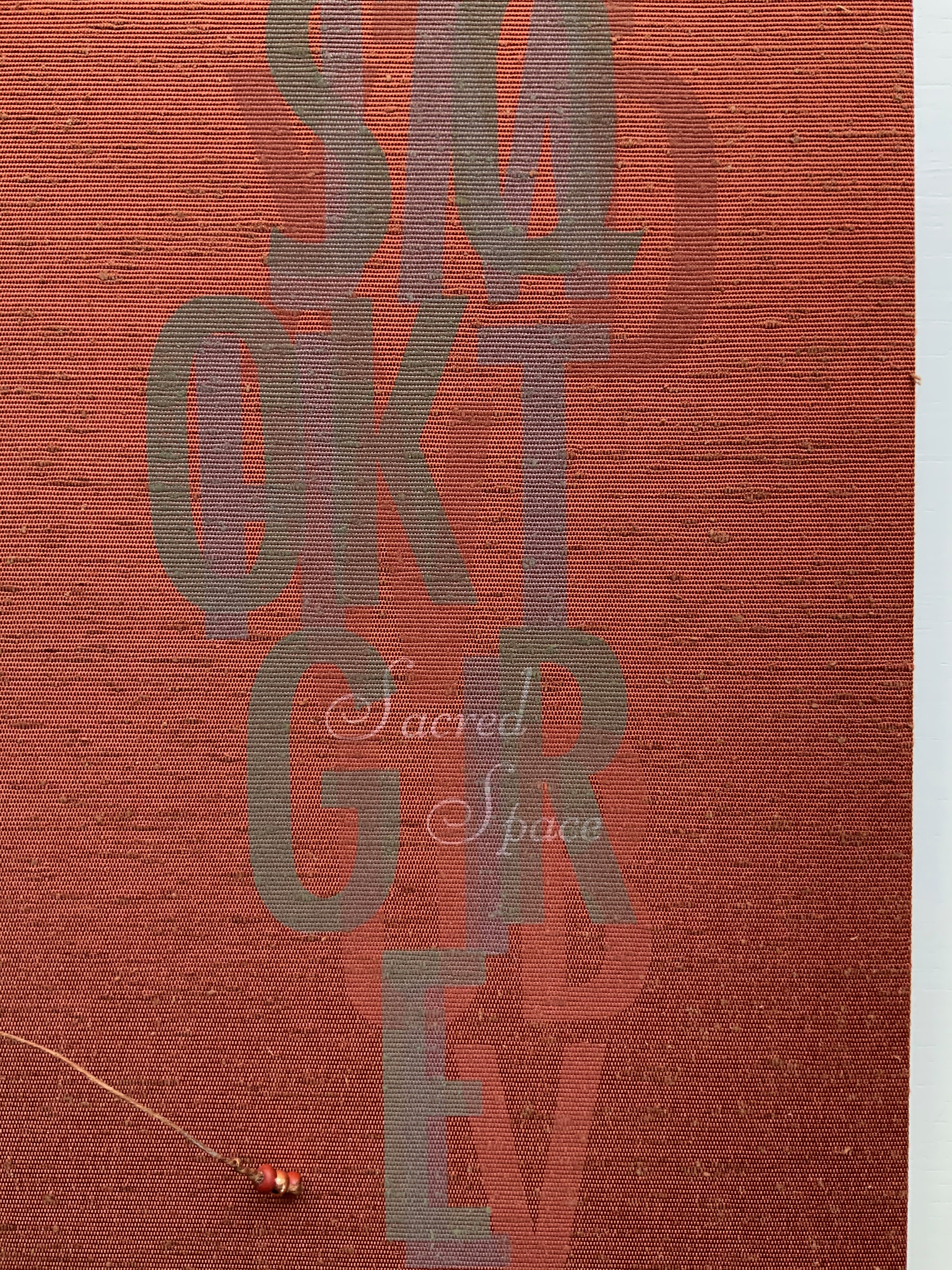
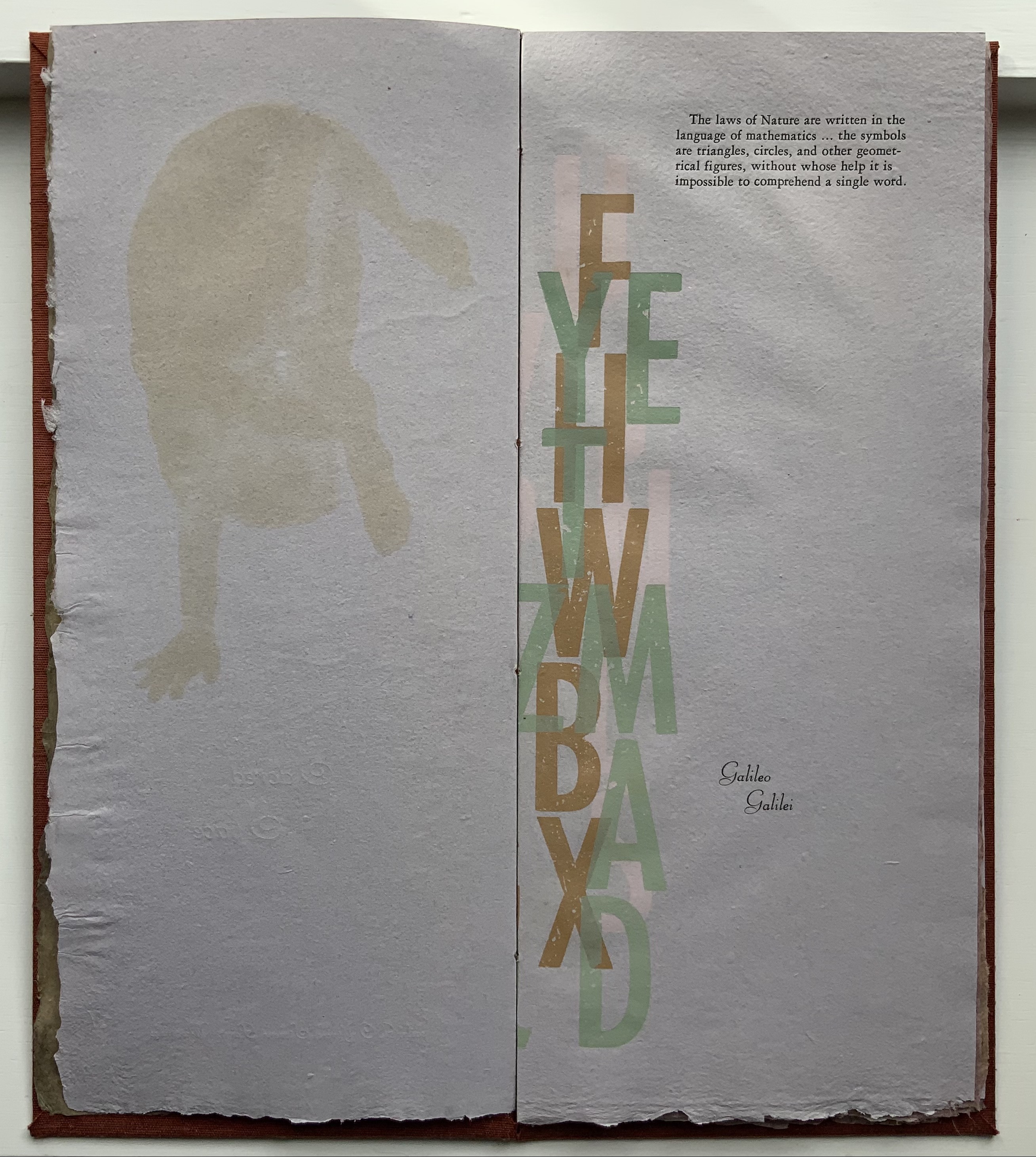
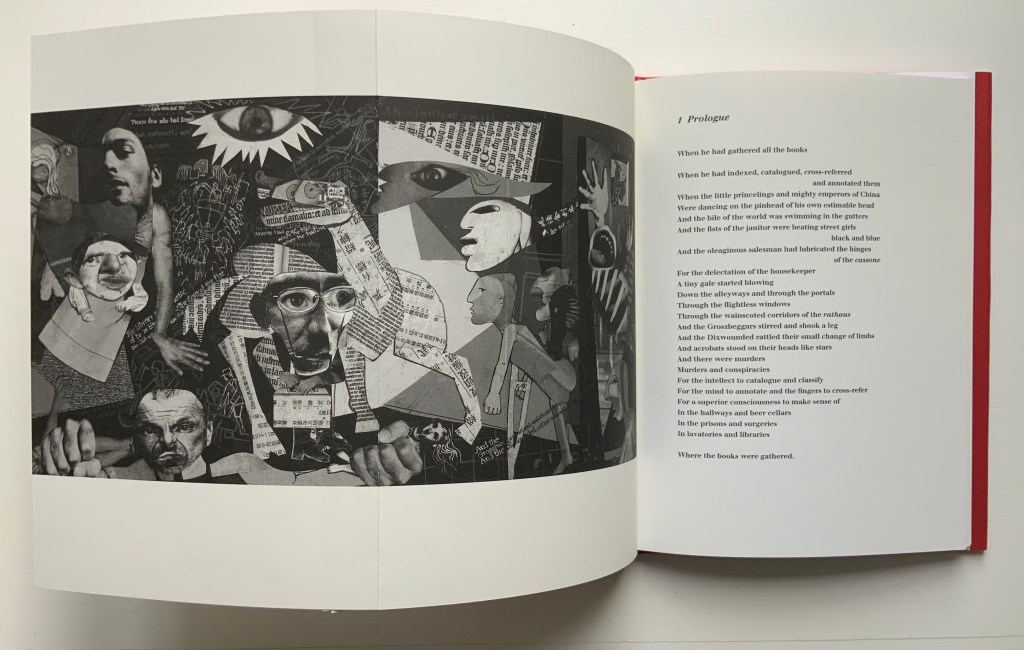
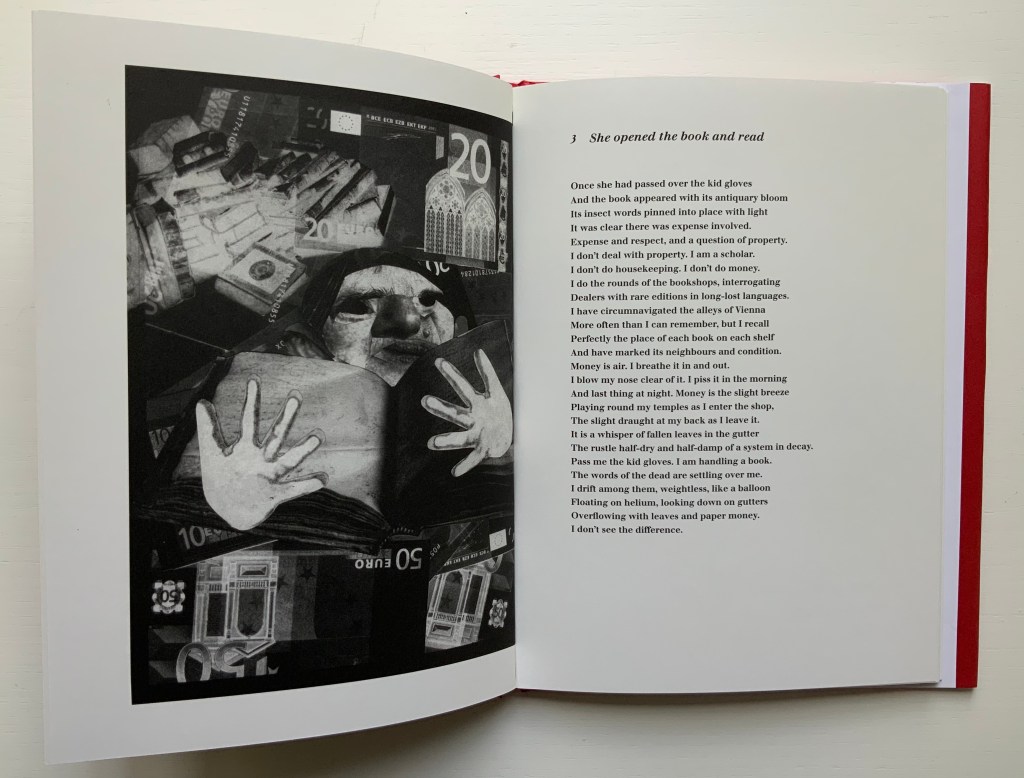
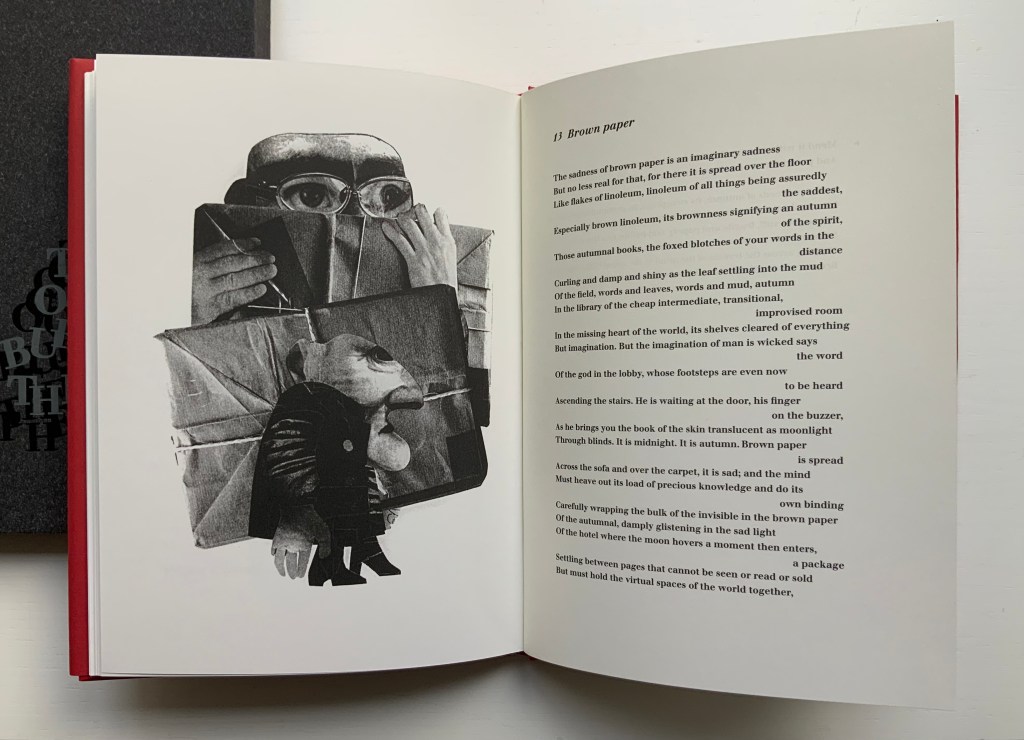
The Burning of the Books is the harshest of Ron King’s work in the Books On Books Collection. According to the artist, this work’s genesis was his long fascination with Elias Canetti’s Auto da Fe (1946). King commissioned Szirtes to respond to Canetti’s work with a text to accompany the etchings that King had been holding in abeyance. The result in 2008 was a large format artist book, of which this work is a reproduction.
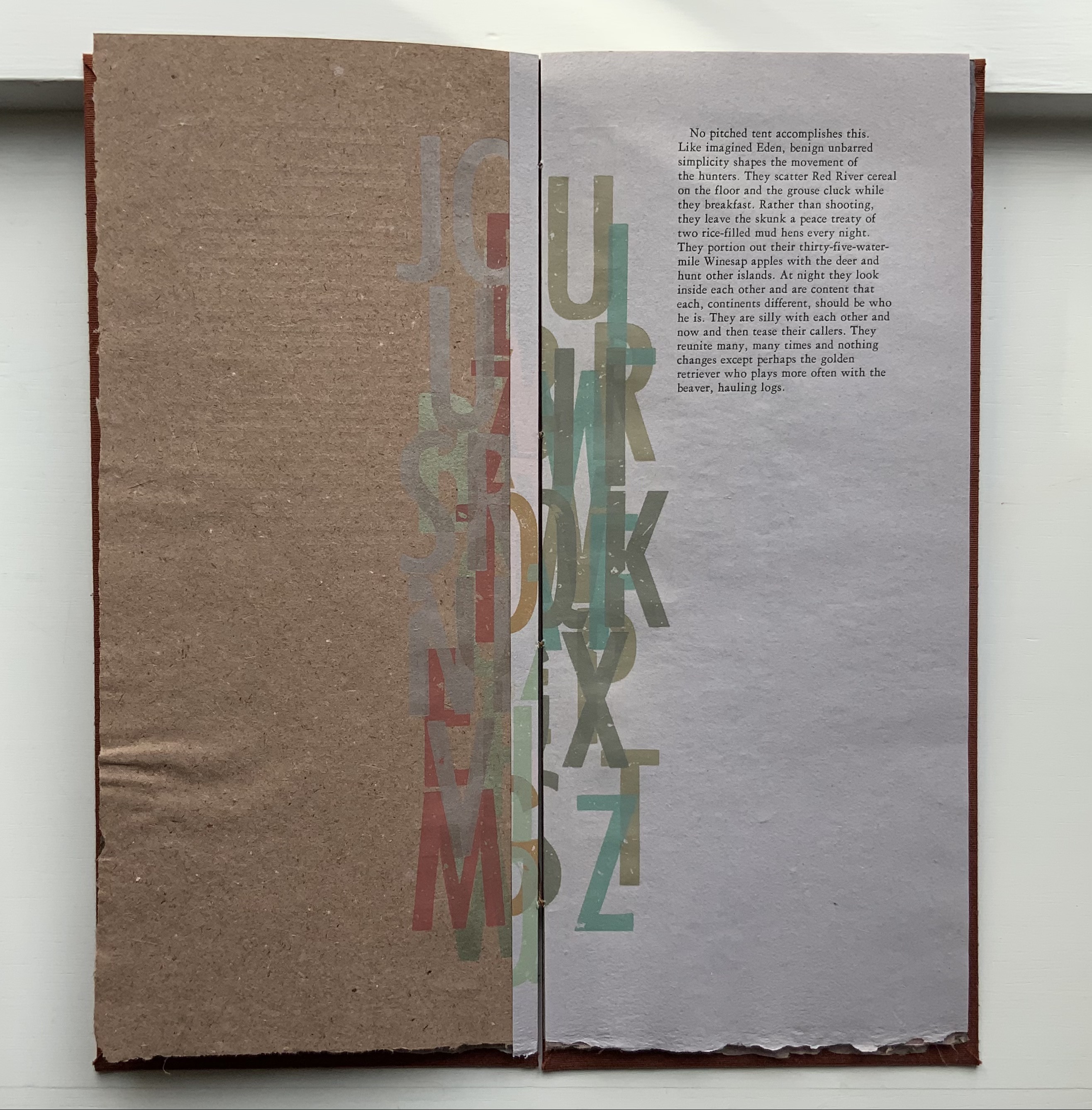
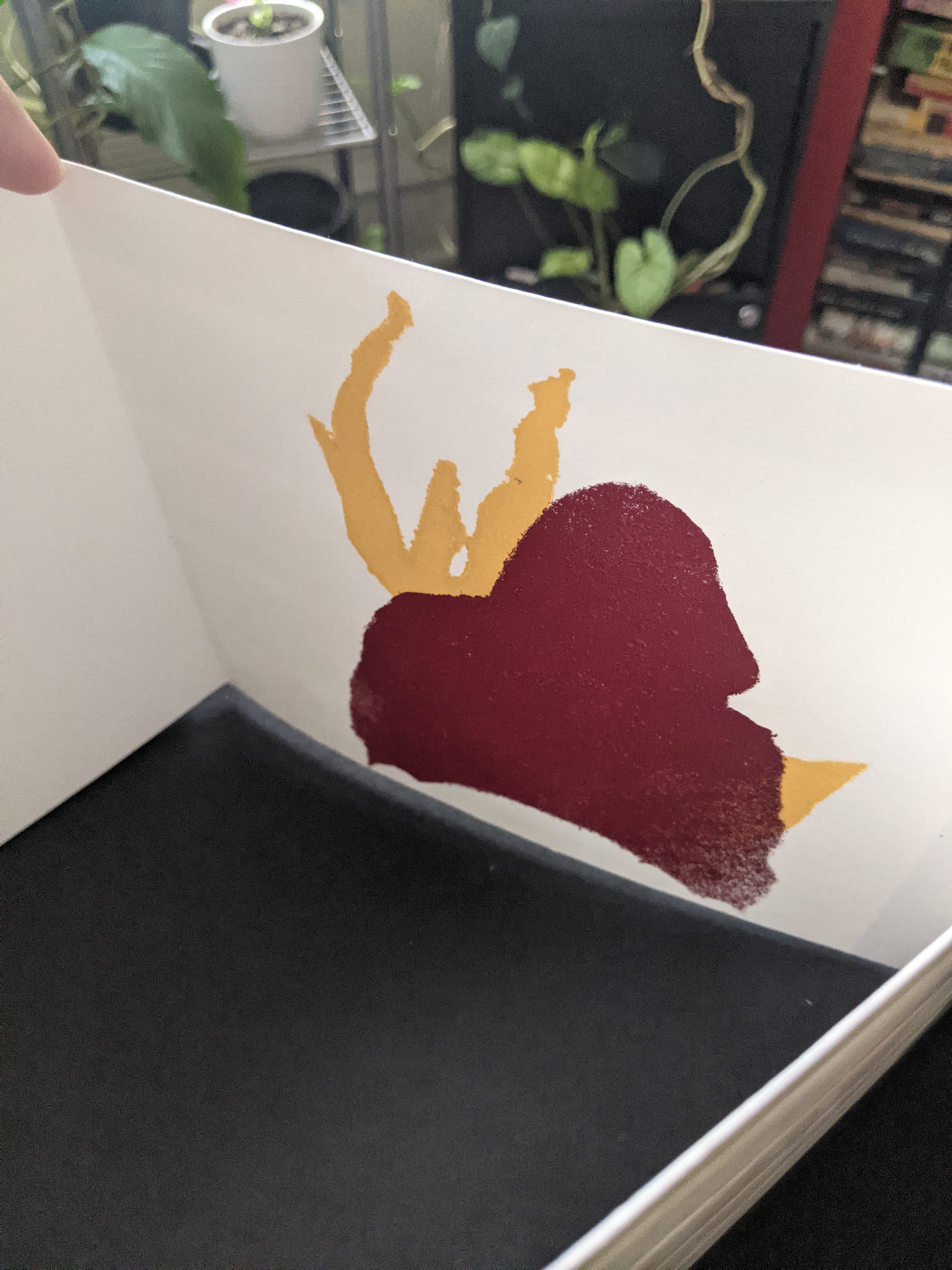
With its photo-collages of a Guernica-like fold-out, newspaper clippings of shamed collaborators, fists and human limbs, The Burning of the Books delivers a visual indictment of the 20th century that creeps into the 21st century with the added images of celebrity police ID photos and Euro currency notes. Szirtes’ take on King’s take on Canetti’s take on his main character’s solipsistic slip from obsession into madness in a world of alienating -isms is the work of art with which we — sadly, more than a decade later — keep catching up.

This work’s fascination with horrors may have its roots in a childhood experience in Brazil — seeing a photograph of a bandit gang’s mass beheading — but, more often than not, King’s works emphasize a humor in blackness (as does this work in its recurrent image of Mr. Punch-like figures). Most often, though, a sheer joy of making and material prevails.

Alphabeta Concertina and alphabeta concertina (2007)

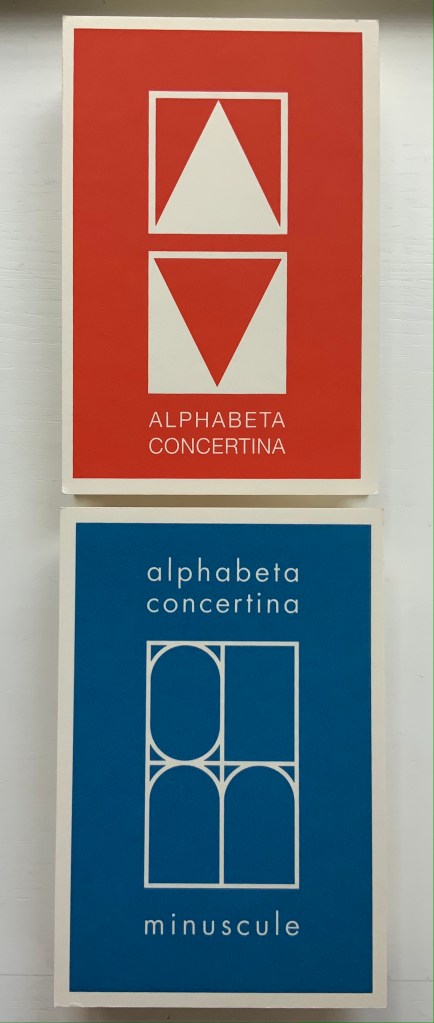
Alphabeta Concertina and alphabeta concertina miniscule (2007)
Ron King
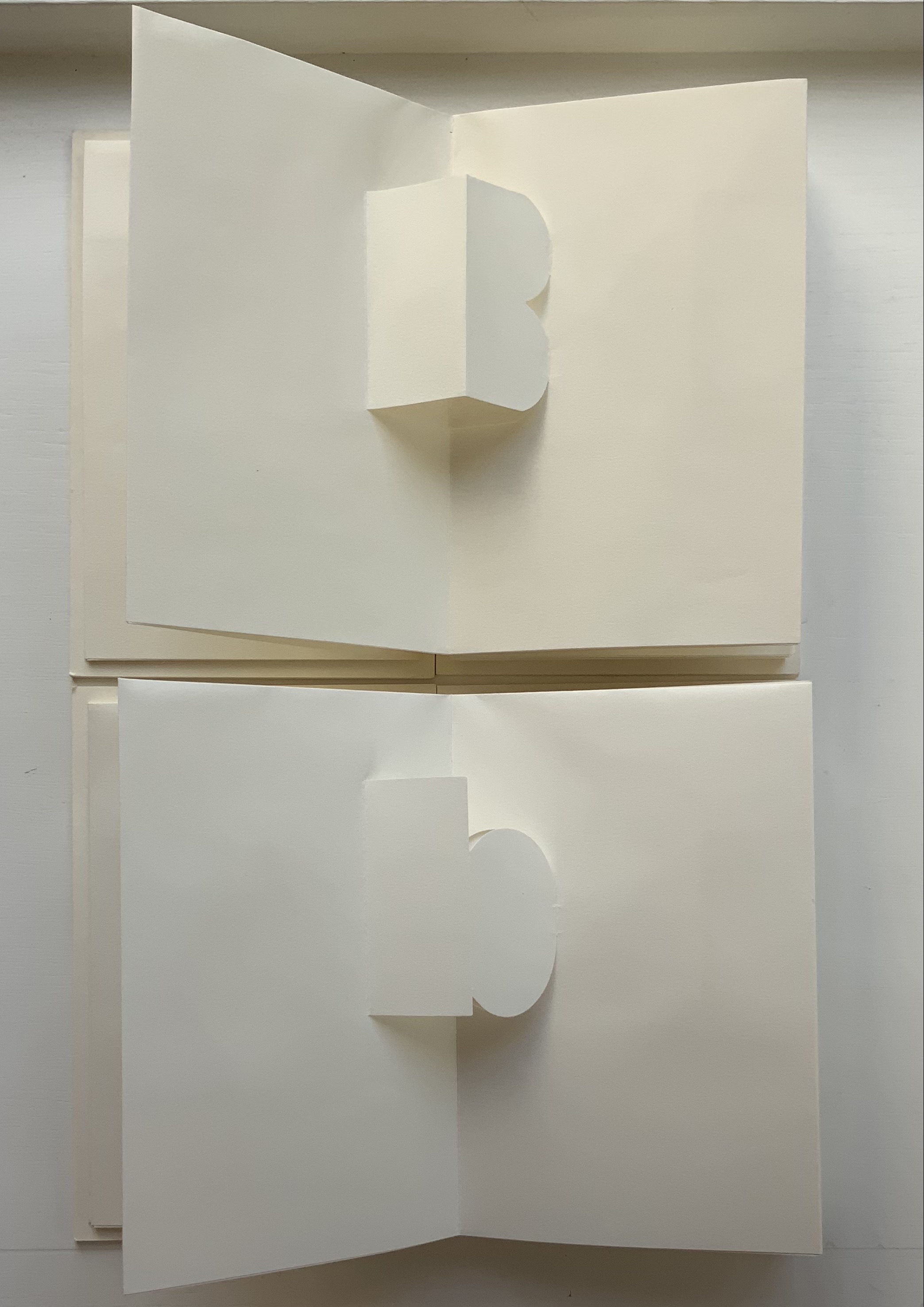
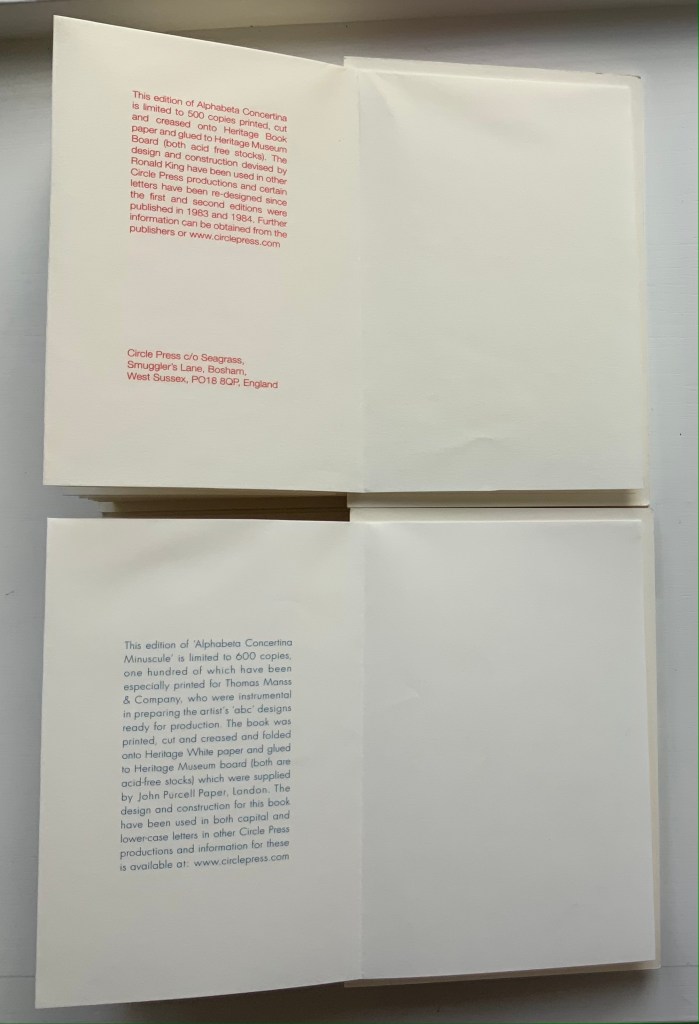
Printed, cut and creased onto Heritage paper and glued to Heritage Museum board. H170 x W110 x D30 mm,stretching to 3 meters. Edition of 600. Majuscule acquired from the artist, 24 July 2021; miniscule acquired from Sophie Schneideman Rare Books and Prints, 27 November 2020.
Photos: Books On Books Collection.
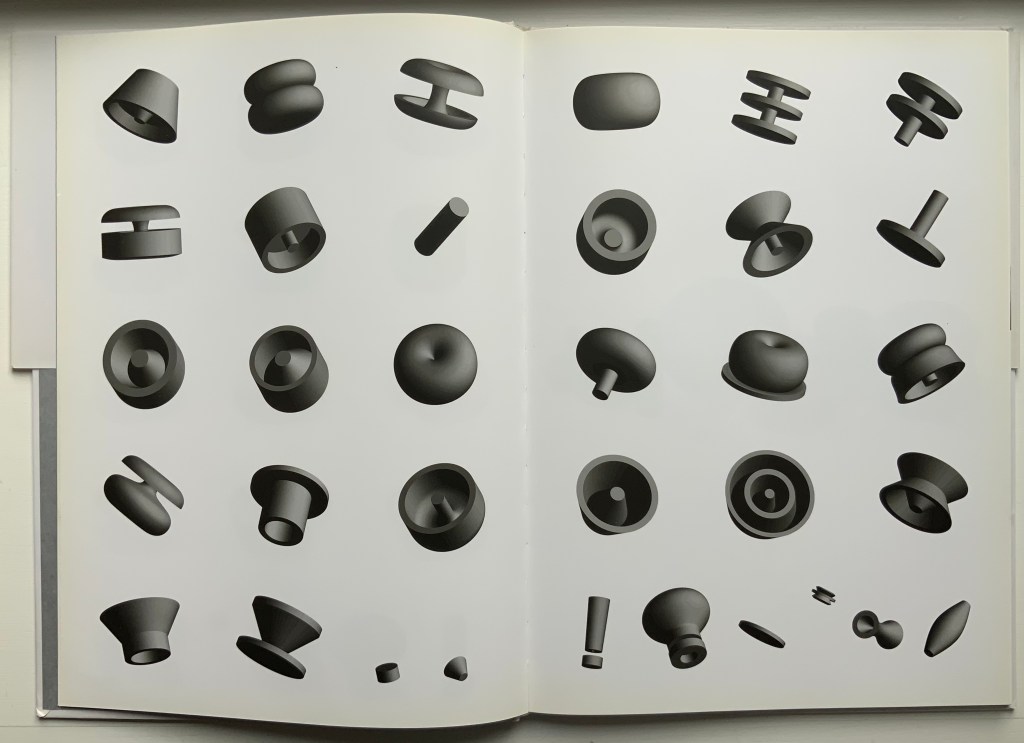
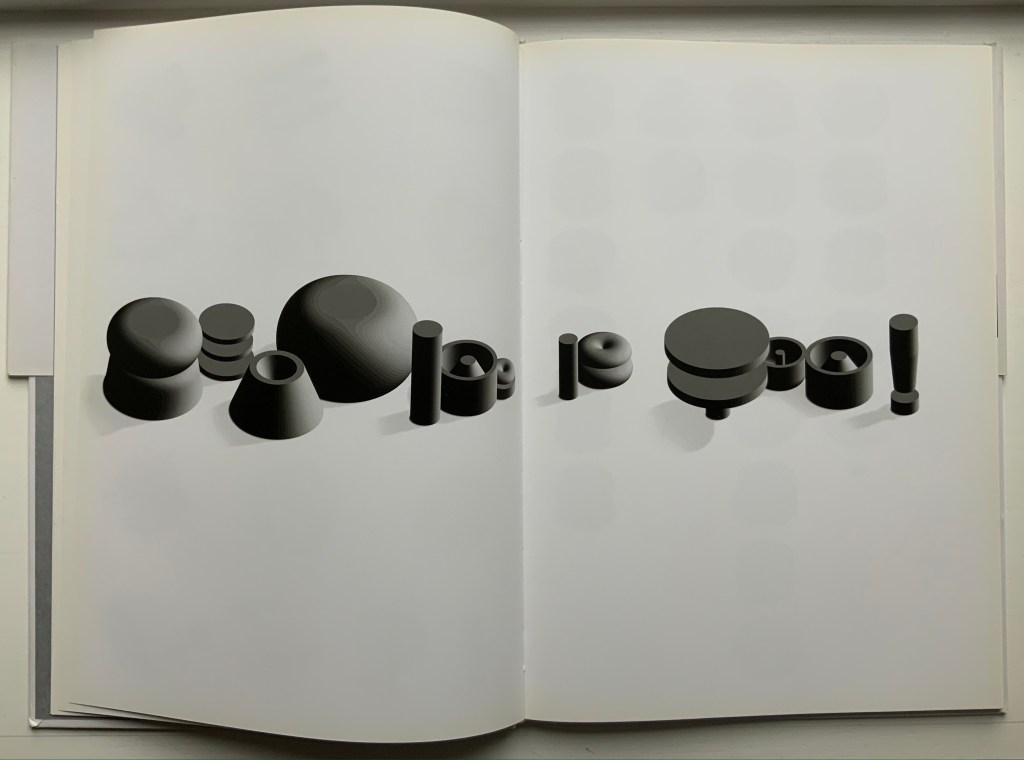
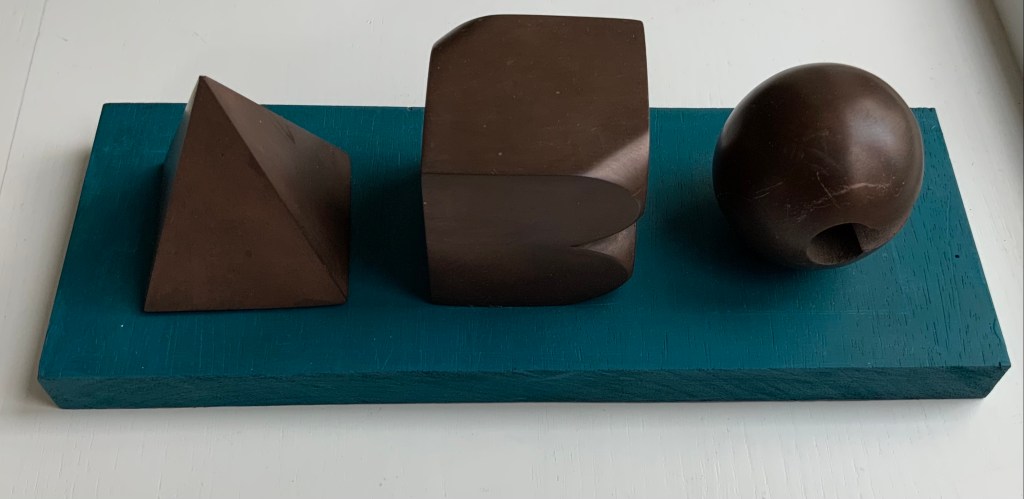
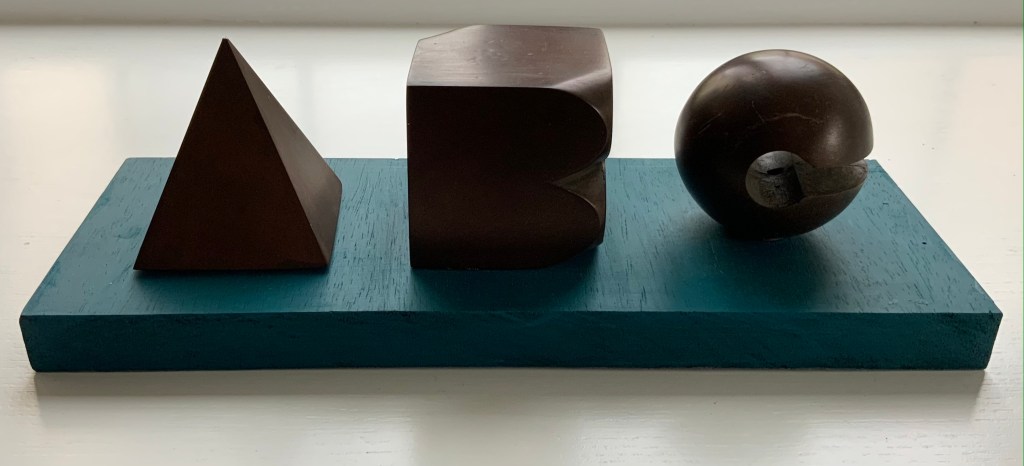
The “abc” series displays the restrained, minimalist side of King’s inventiveness. With more than one of these works to hand, his enjoyment and humor come through — especially in the subtle and not-so-subtle variations. Take alphabeta concertina miniscule as an example. It arrived like a long awaited chuckle after the majuscule version — Alphabeta Concertina (1983) — which had been expanded into the poster versions Alphabet I and Alphabet II (below). Size and surprise seem to matter in King’s sense of humor. For size, see the large-scale steel version of the alphabet in 2016. For surprise, consider his catalogue raisonné Cooking the Books or this set of paperweights.
ABC [nd]
Ron King
Resin sculptures on painted wooden board Acquired from the artist, 24 July 2021.
Photos: Books On Books Collection.

Further down are Alphabet II (1999) and The White Alphabet (1984). Compare their uppercase letter C with that above to see how King developed his sculpting over time.

Cooking the Books (2002)

Cooking the Books: Ron King and the Circle Press (2002)
Ron King, Andrew Lambirth
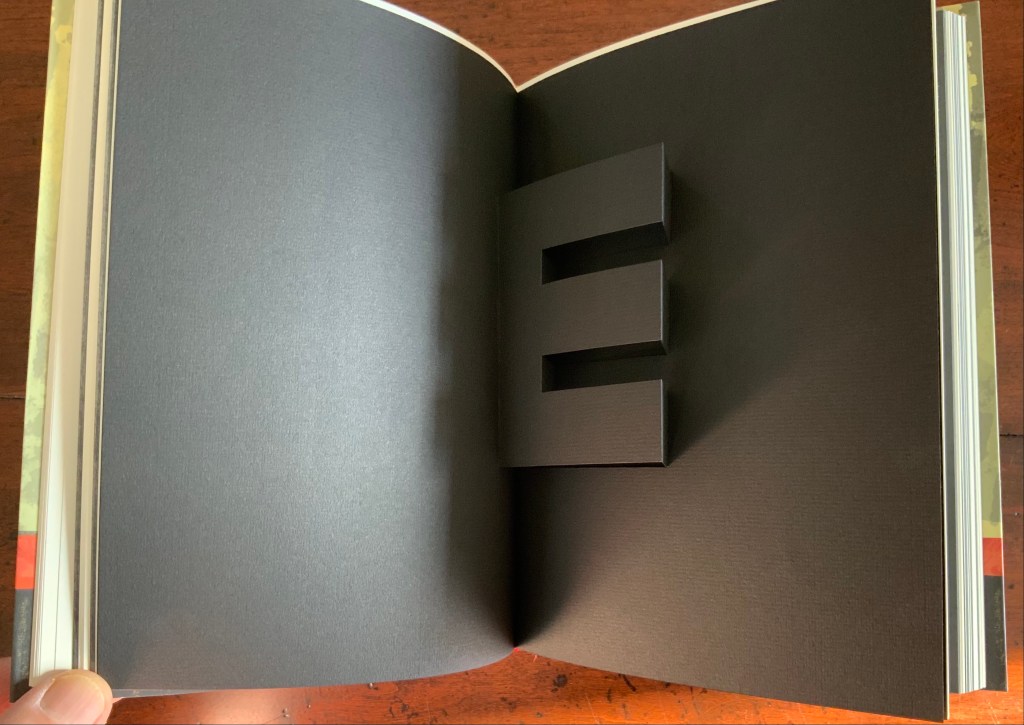
Paperback with end flaps, sewn with headbands. Pop-up and metallic paper inserts. H225 x W165 x D20 mm, 180 pages. Acquired from the artist, 24 December 2020. Photo: Books On Books Collection.

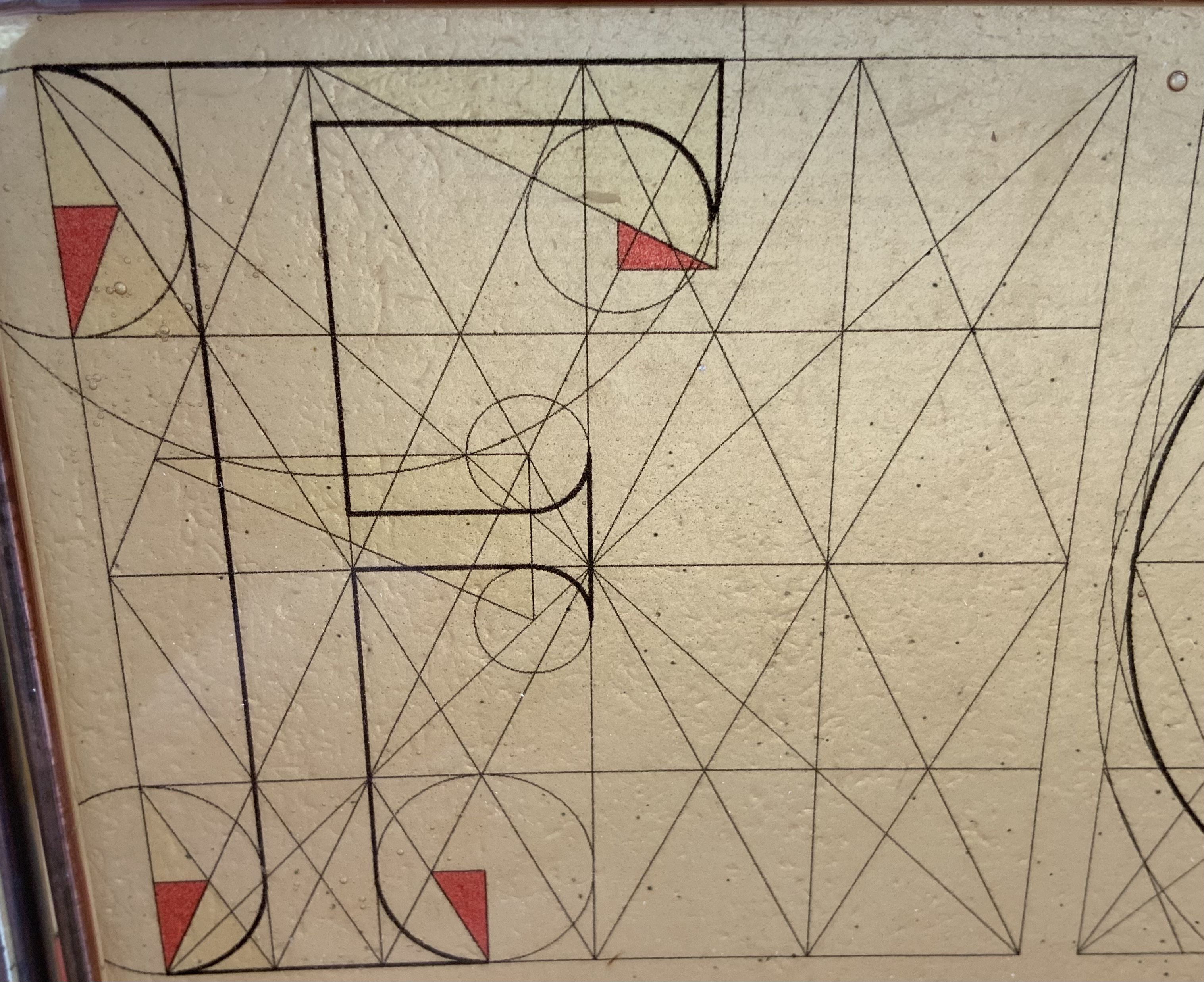
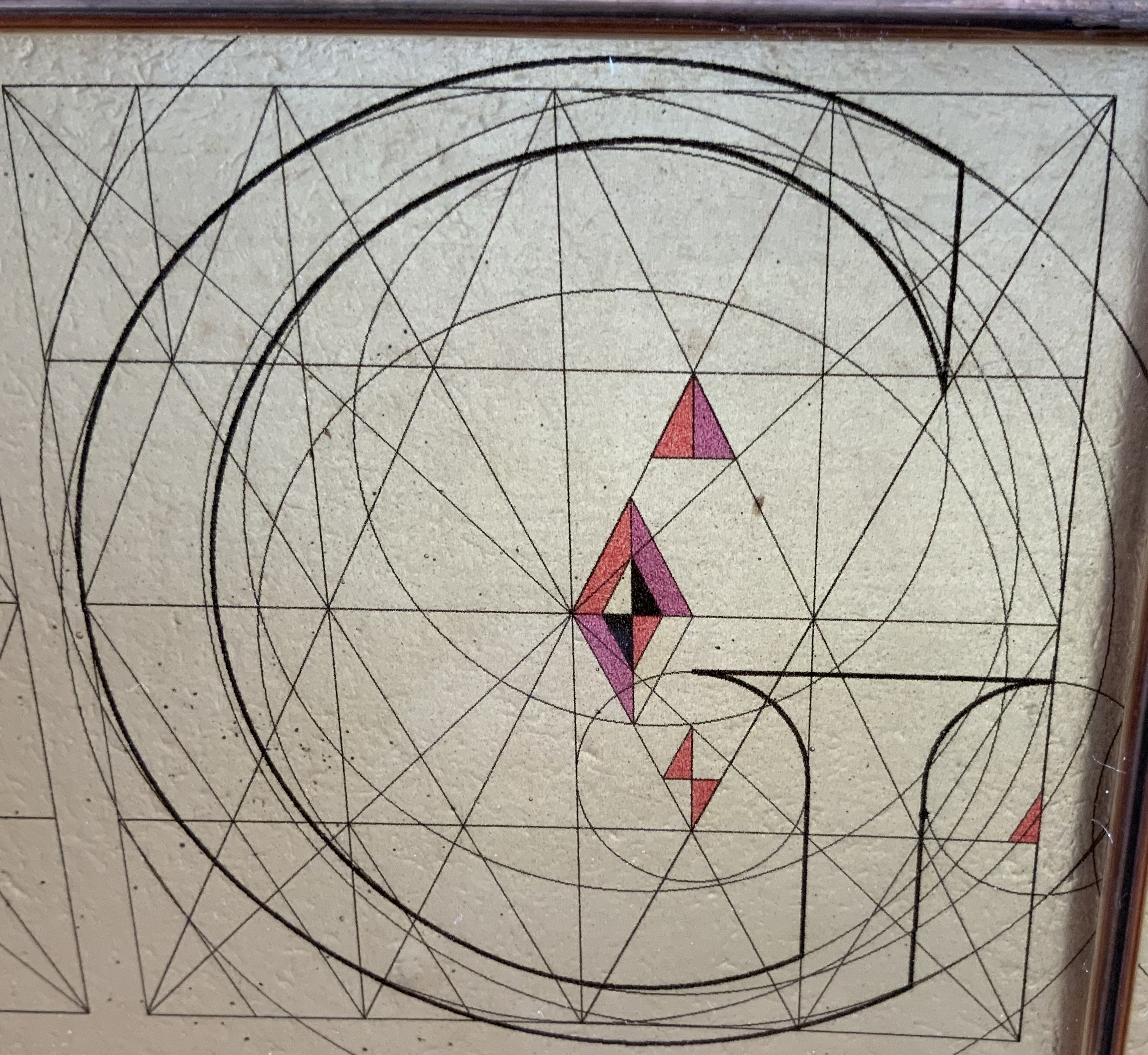
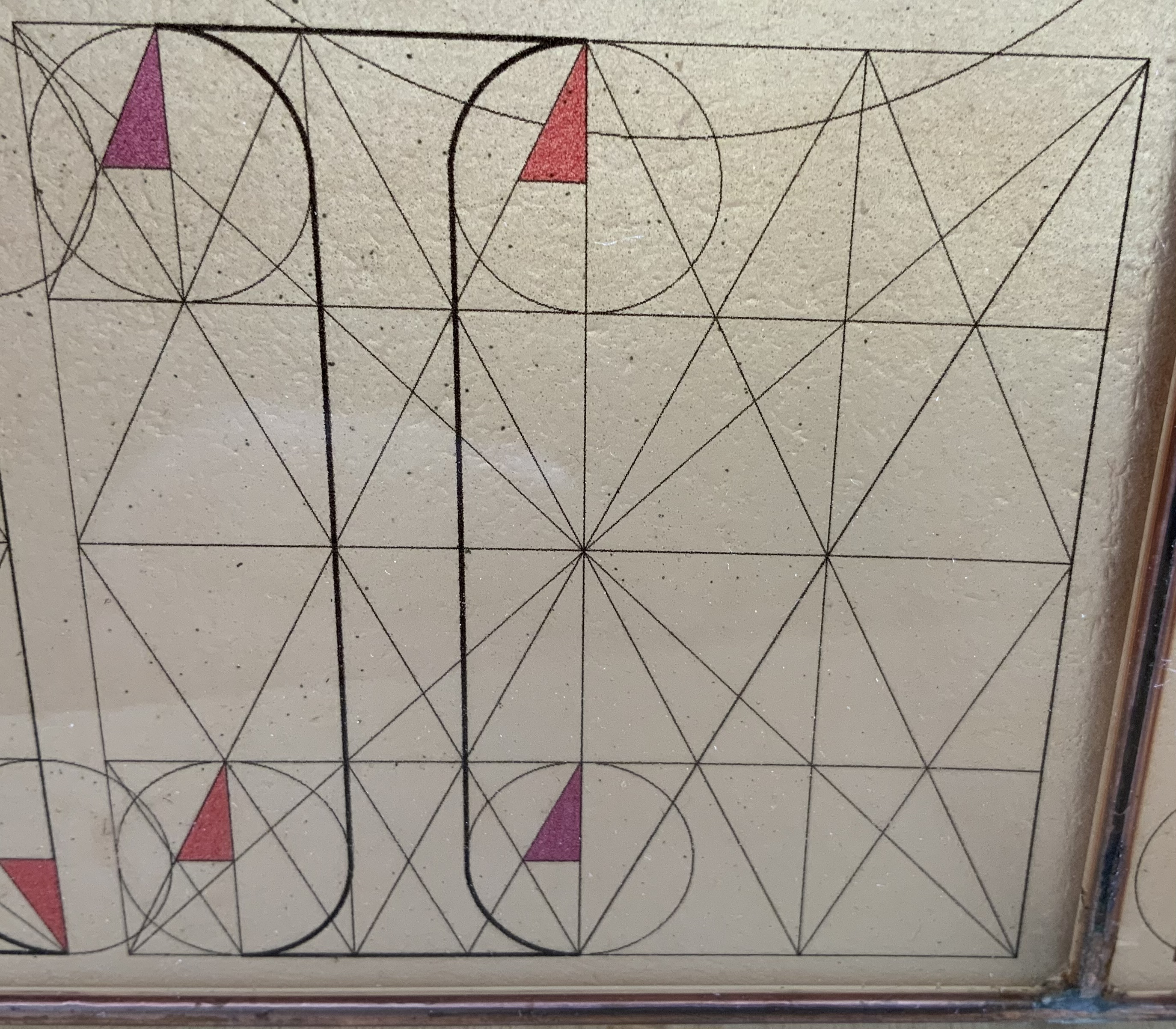
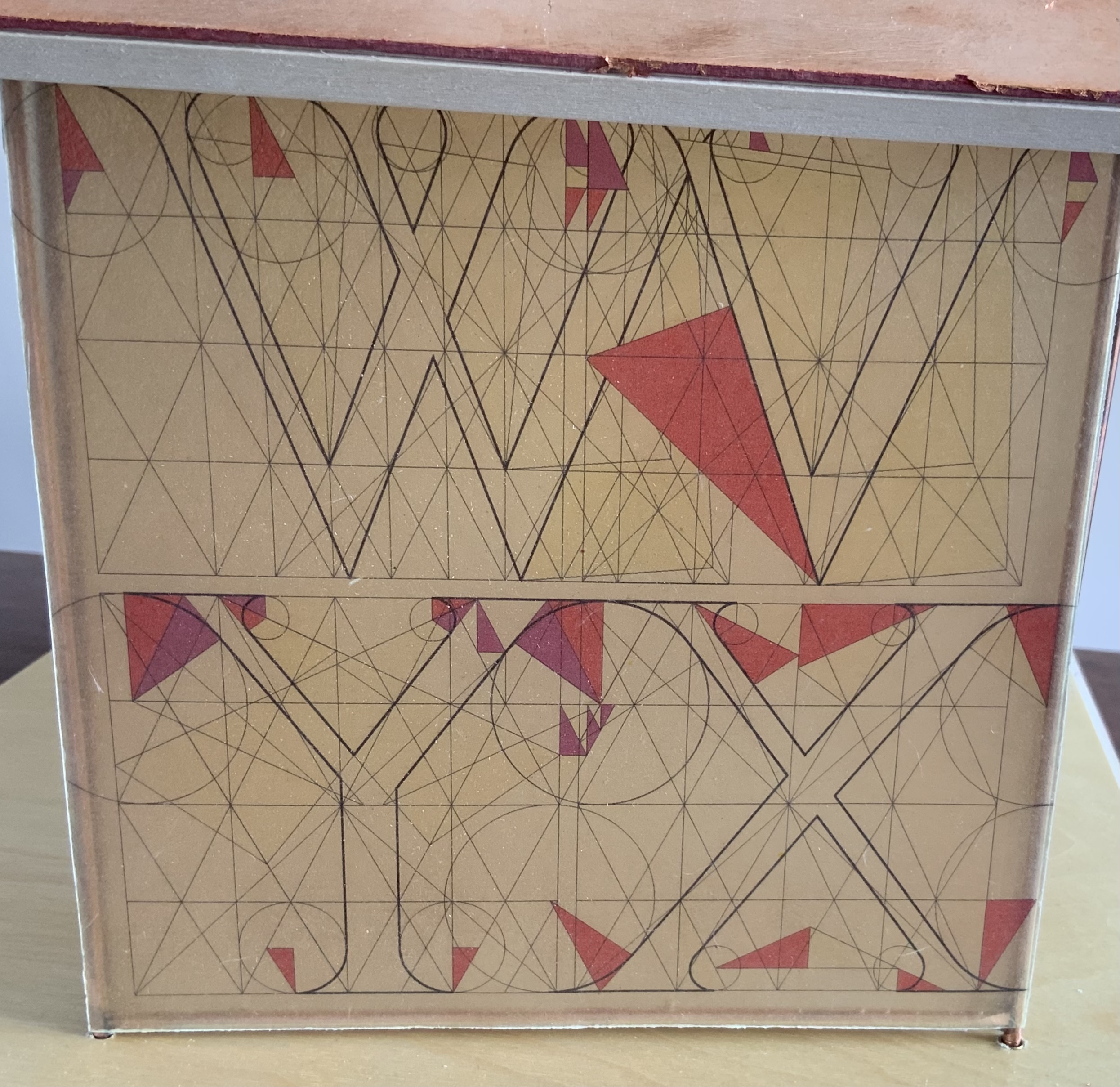
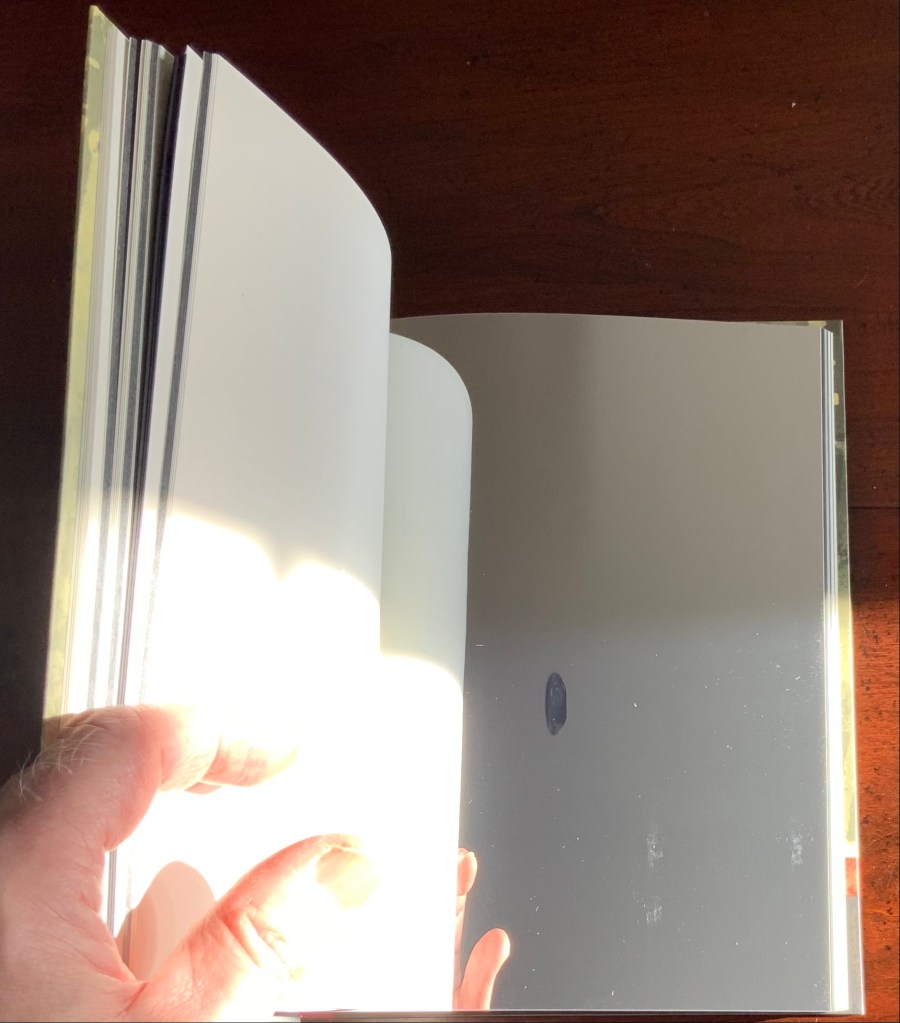
King’s catalogue raisonné does not merely illustrate his work, it illustrates it. Inserts of mirror paper, wax paper and a pop-up letter E transform what appears to be a simple codex into a treasure chest.

Alphabet II (1999)

Alphabet II (1999)
Ron King
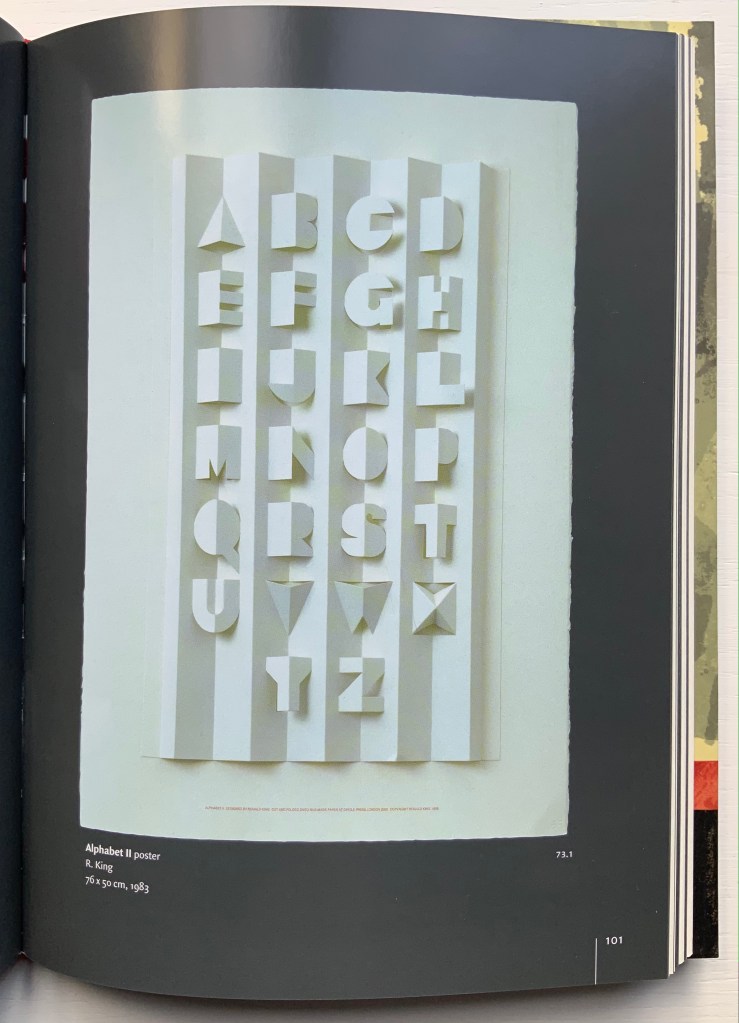
Pop-up poster. H760 x W500 mm. The letters have been cut onto a 190lb Waterford paper and mounted onto a heavier version of the same stock. Edition of 200 signed. Acquired from Circle Press, 26 June 2015. Photo of Cooking the Books, p. 101: Books On Books Collection.

The collection’s framed poster interferes with photography, but Cooking the Books provides the alternative.

Matisse’s Model (1996)

Matisse’s Model (1996)
Ron King
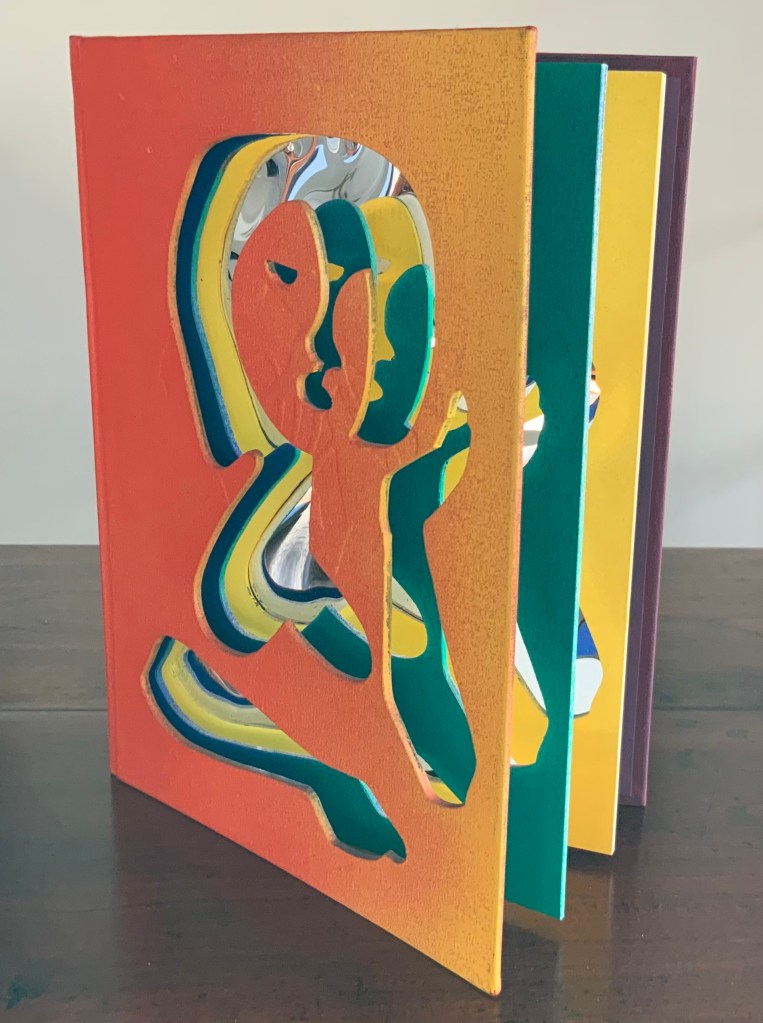
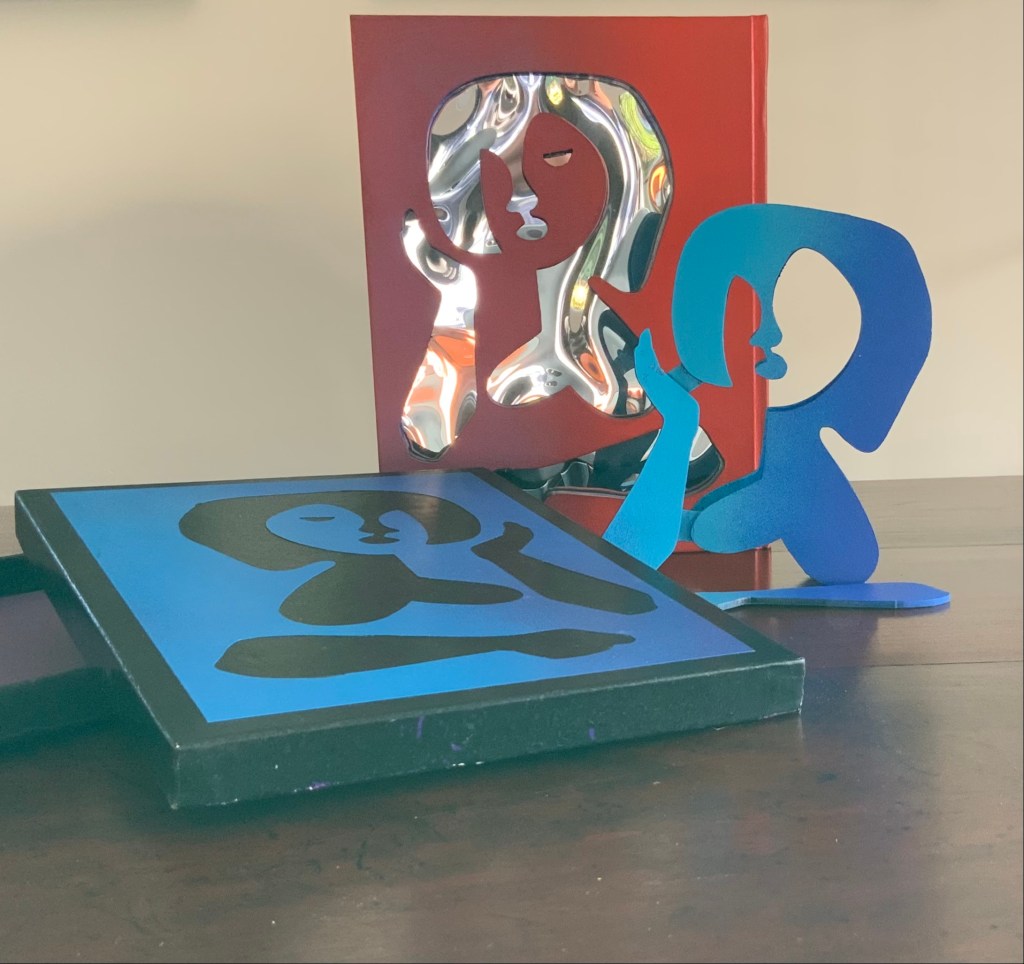
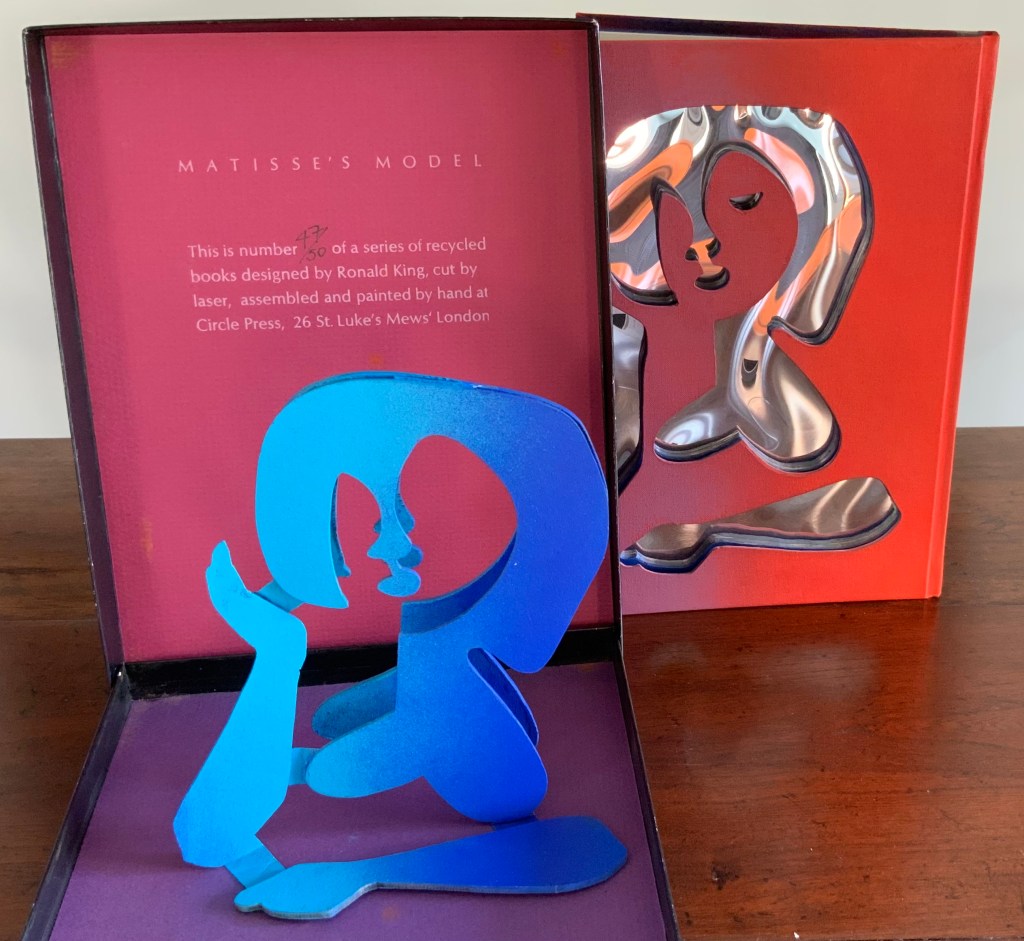
An edition of 50 signed book-works made by the same process as Acrobats. 23 x 17 cm with mirror-foil, sprayed pages, and a removable freestanding figure in collaged cardboard box. Photos: Books On Books Collection.

The sculptural element toward which King’s work has always turned is on display in the title and forms of Matisse’s Model. The mirror paper appears as it must for any attractive model.

The Looking Book (1996)

The Looking Book: A Pocket History of Circle Press, 1967-96 (1996)
Cathy Courtney
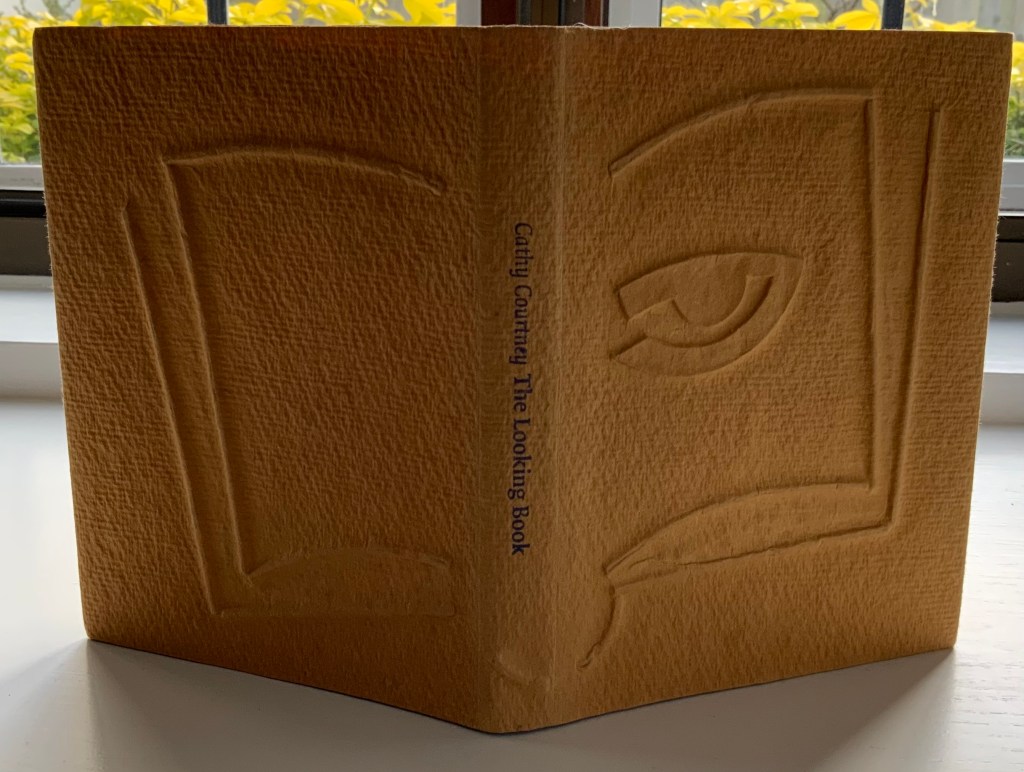
Casebound in wire print paper. H160 x W120 xD20 mm Edition of 1000, of which this #67 and initialled by Ron King. Acquired from Peter J. Hadley Bookseller ABA ILAB, 25 June 2015. Photos: Books On Books Collection

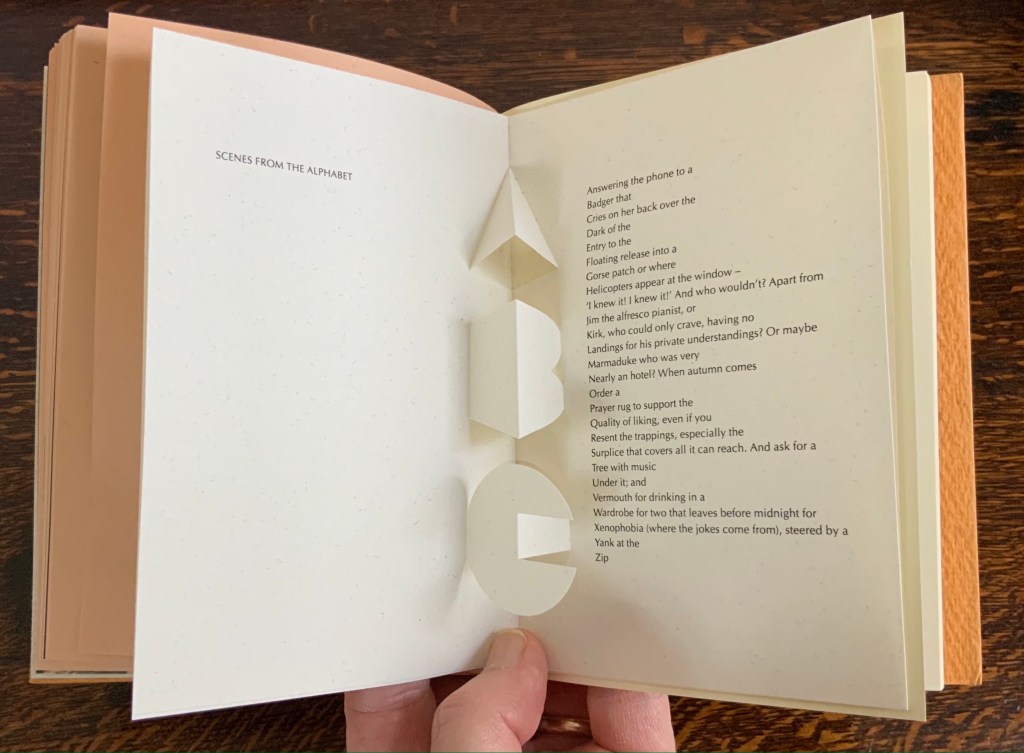
Pop-up insert of “Scenes from the Alphabet” by Roy Fisher. Photo: Books On Books Collection.

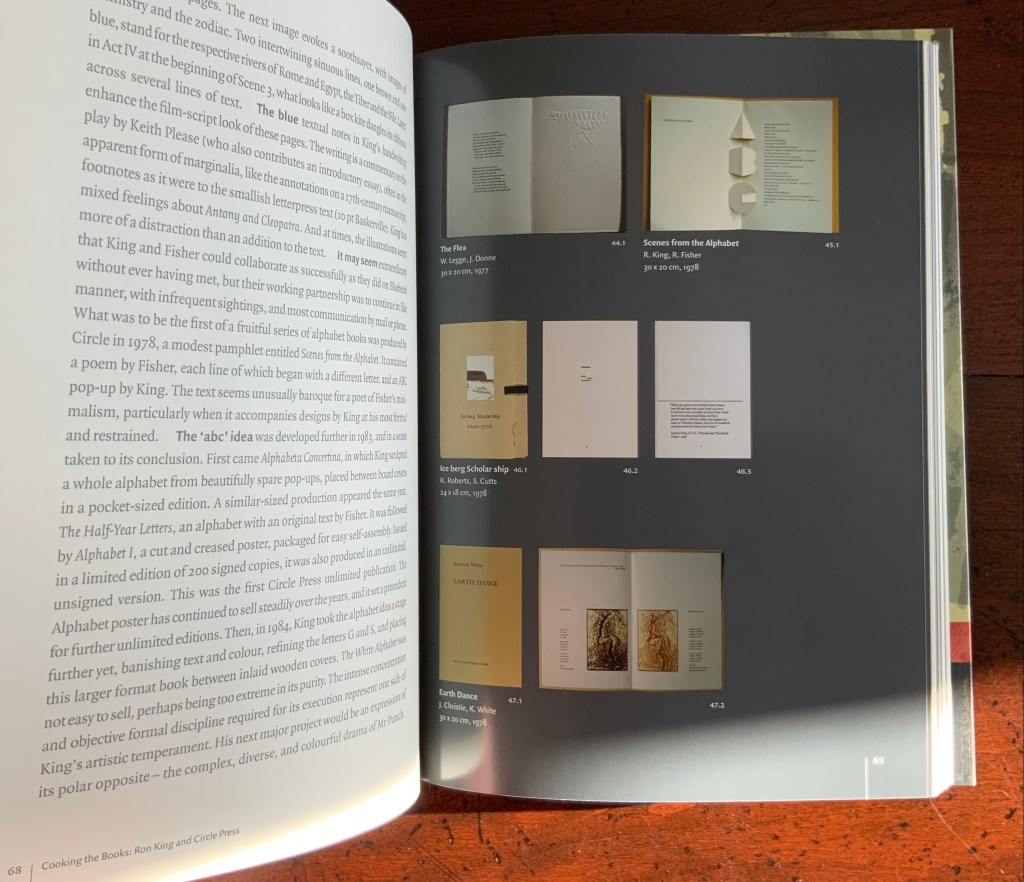
As with Cooking the Books, this catalogue raisonné, prepared by Cathy Courtney, provides samples of the artist’s work. They appear in the wire debossed cover and this centrepiece of “Scenes from the Alphabet” done with Roy Fisher, which led to a full-scale alphabet book at Fisher’s suggestion.

Turn Over Darling (1994)

Turn Over Darling (1994)
Ron King
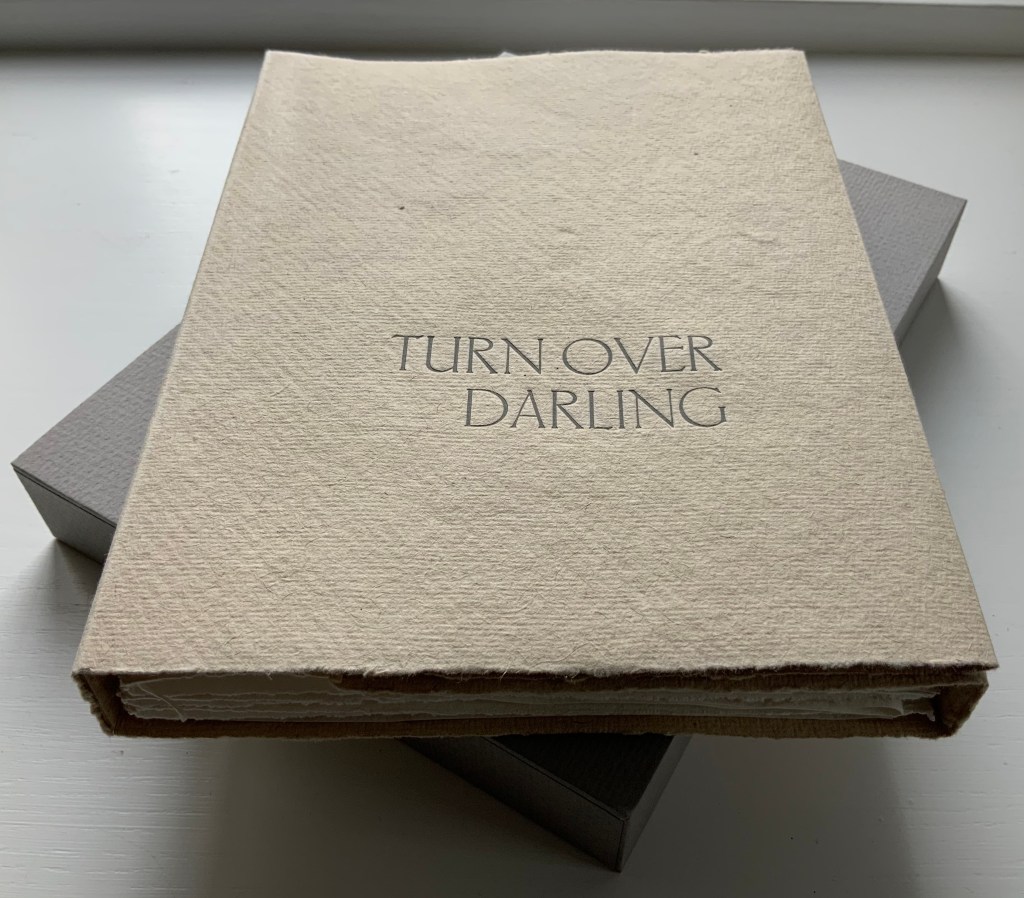
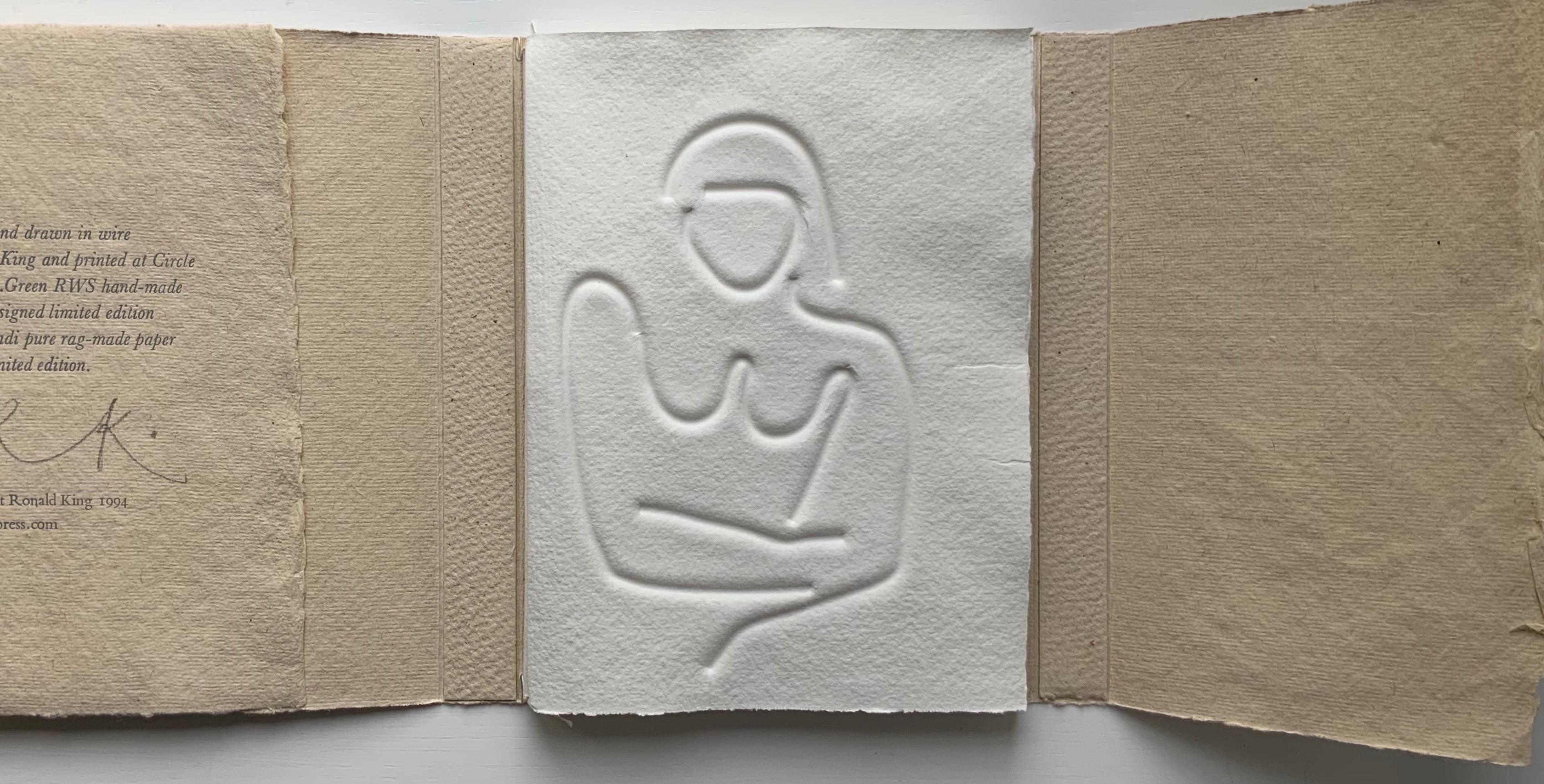
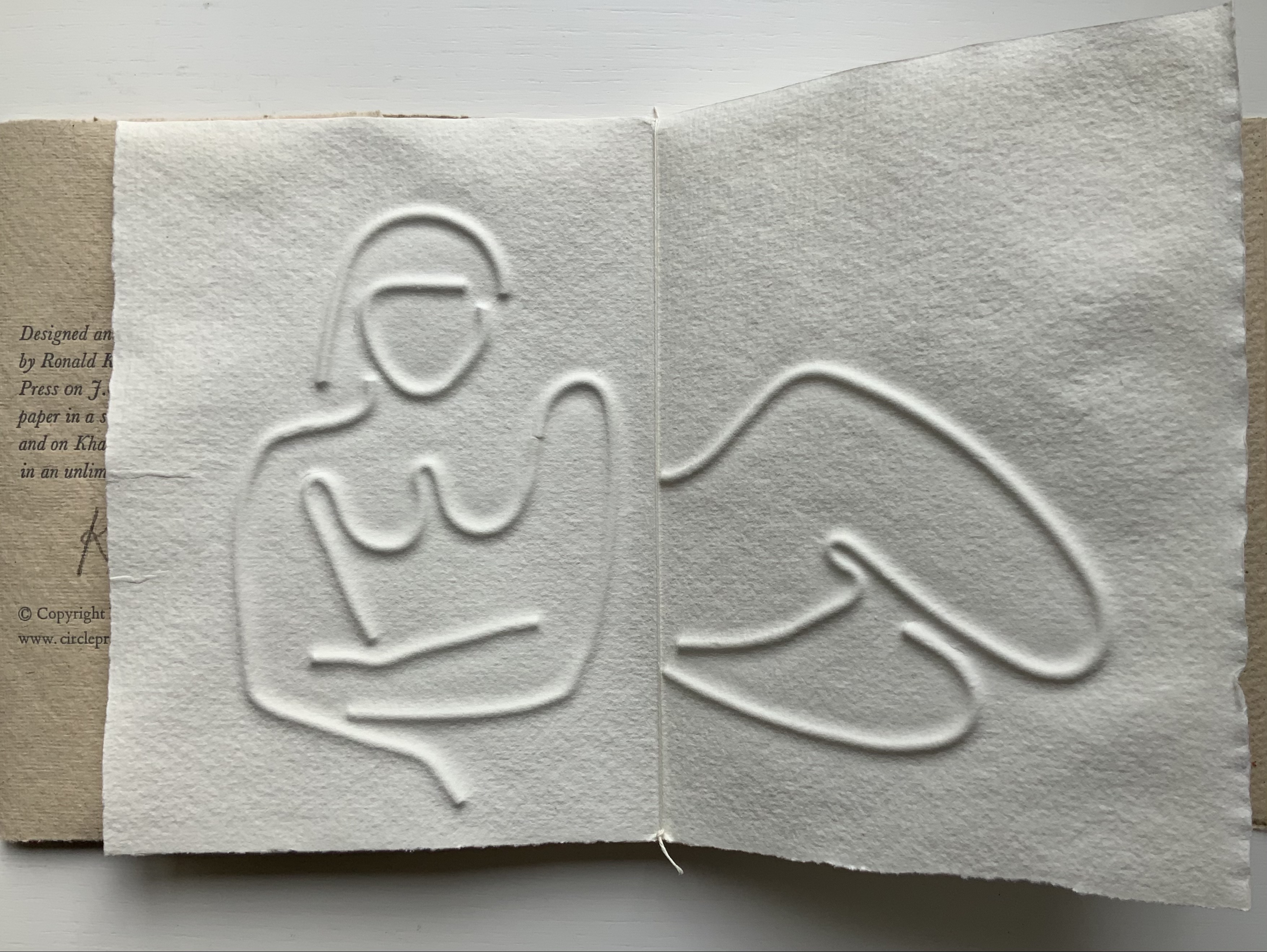
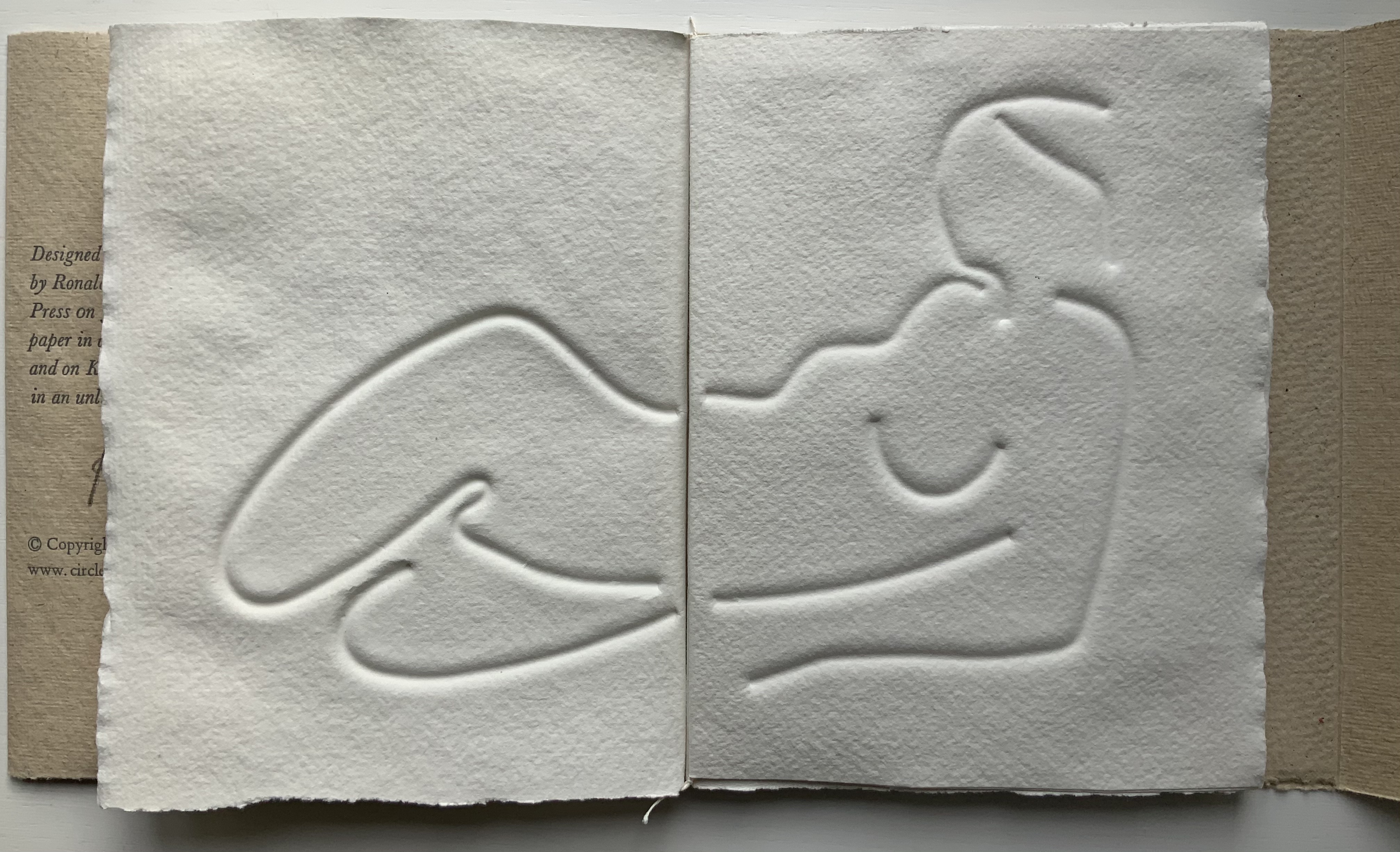
Slipcase (H204 x W153 x D28 mm) containing a light brown paper portfolio (H195 x W150 x D24) into which are hand-sewn six sheets (H190 x W282) of J. Green RWS hand-made paper, folded in half, bearing embossed and debossed images of a female figure. A signed copy from the limited edition of 75. Acquired from the artist, 1 December 2020. Photos: Books On Books Collection, displayed with artist’s permission.

The six embossed and debossed drawings were created from wire forms pressed into dampened sheets of paper. Turn Over Darling elegantly combines King’s sculptural skills with his printer’s skills. When folded and juxtaposed in sequence, they make for eleven reclining female nude images that change position from front to back view as the pages turn. Determining the folds and sequence is a form of imposition, although quite different from the usual imposition for a single sheet with twelve pages on either side as shown below. Again, here is a work that evokes a joy in the material and in its handling.

JBG 1984 watermark in J. Green RWS paper

The White Alphabet (1984)

The White Alphabet (1984)
Ron King
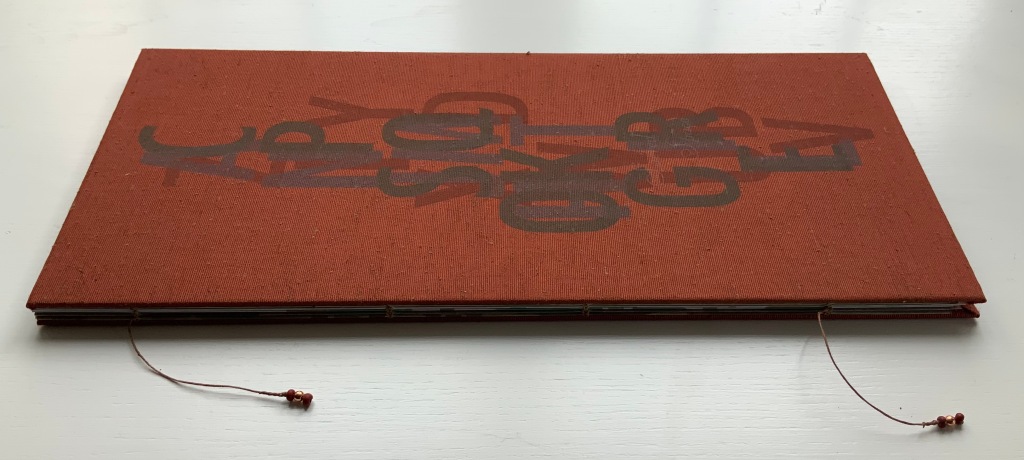
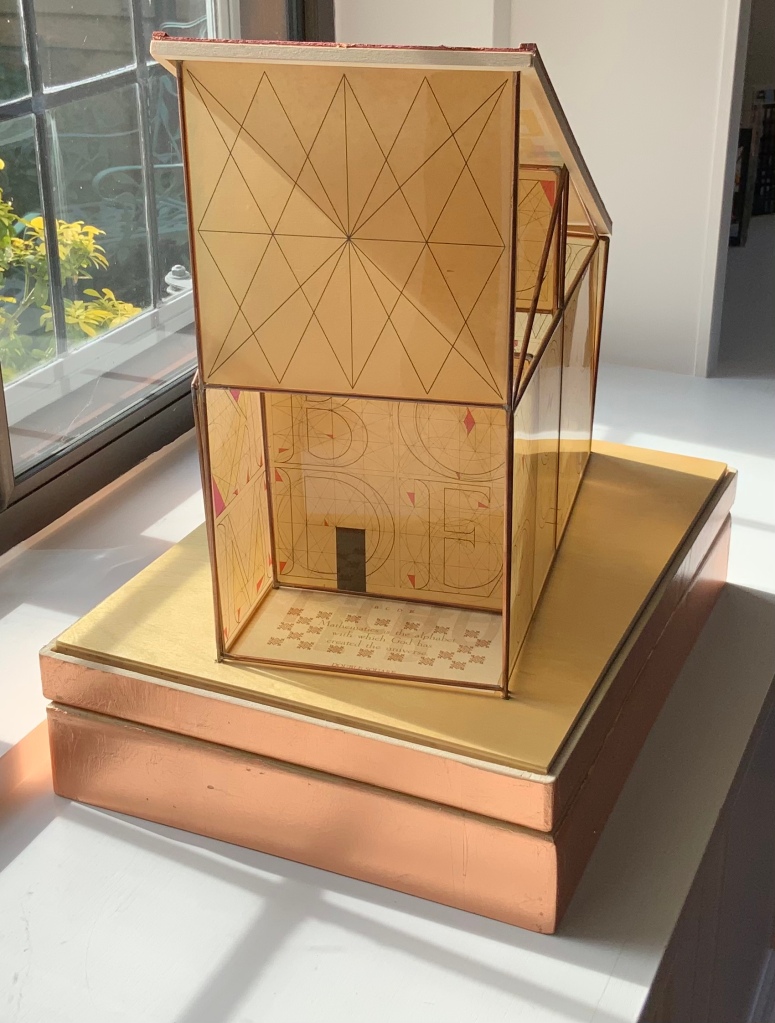
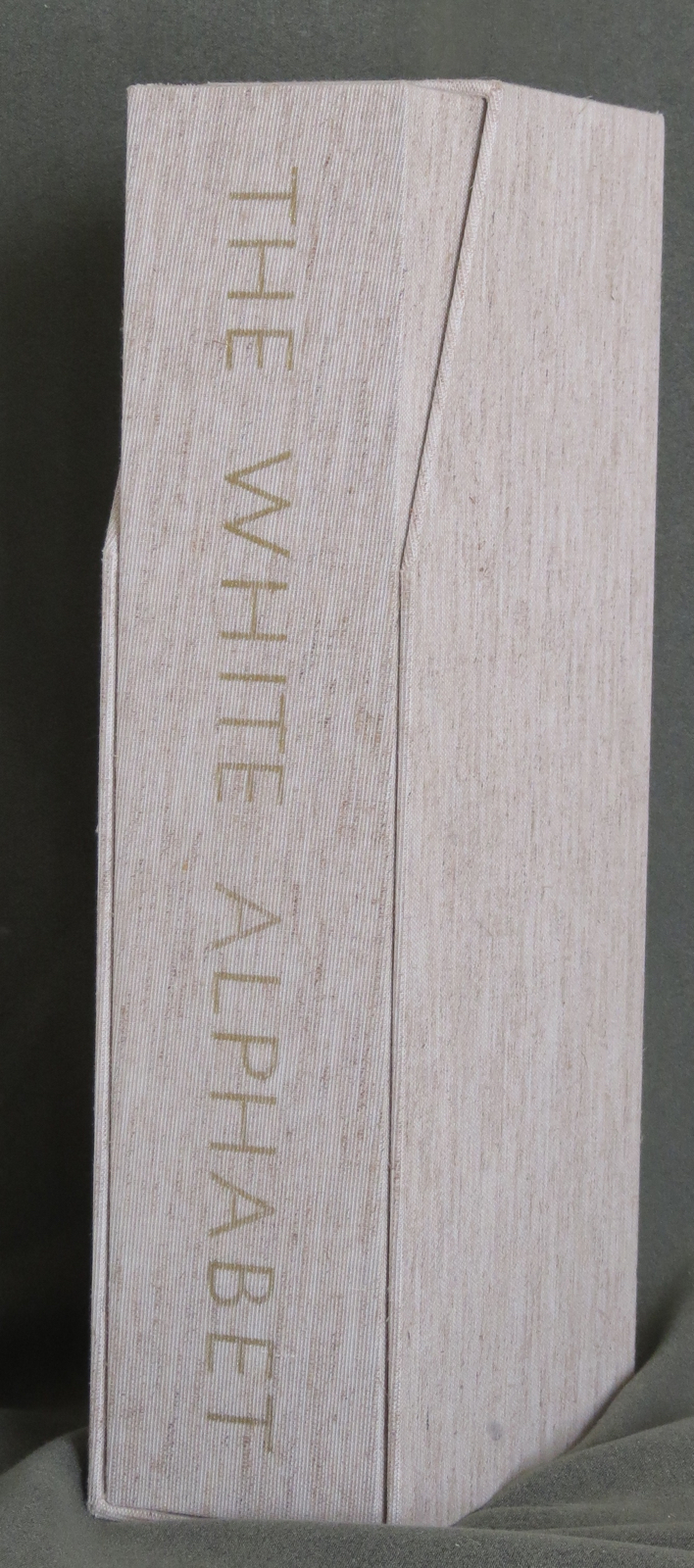
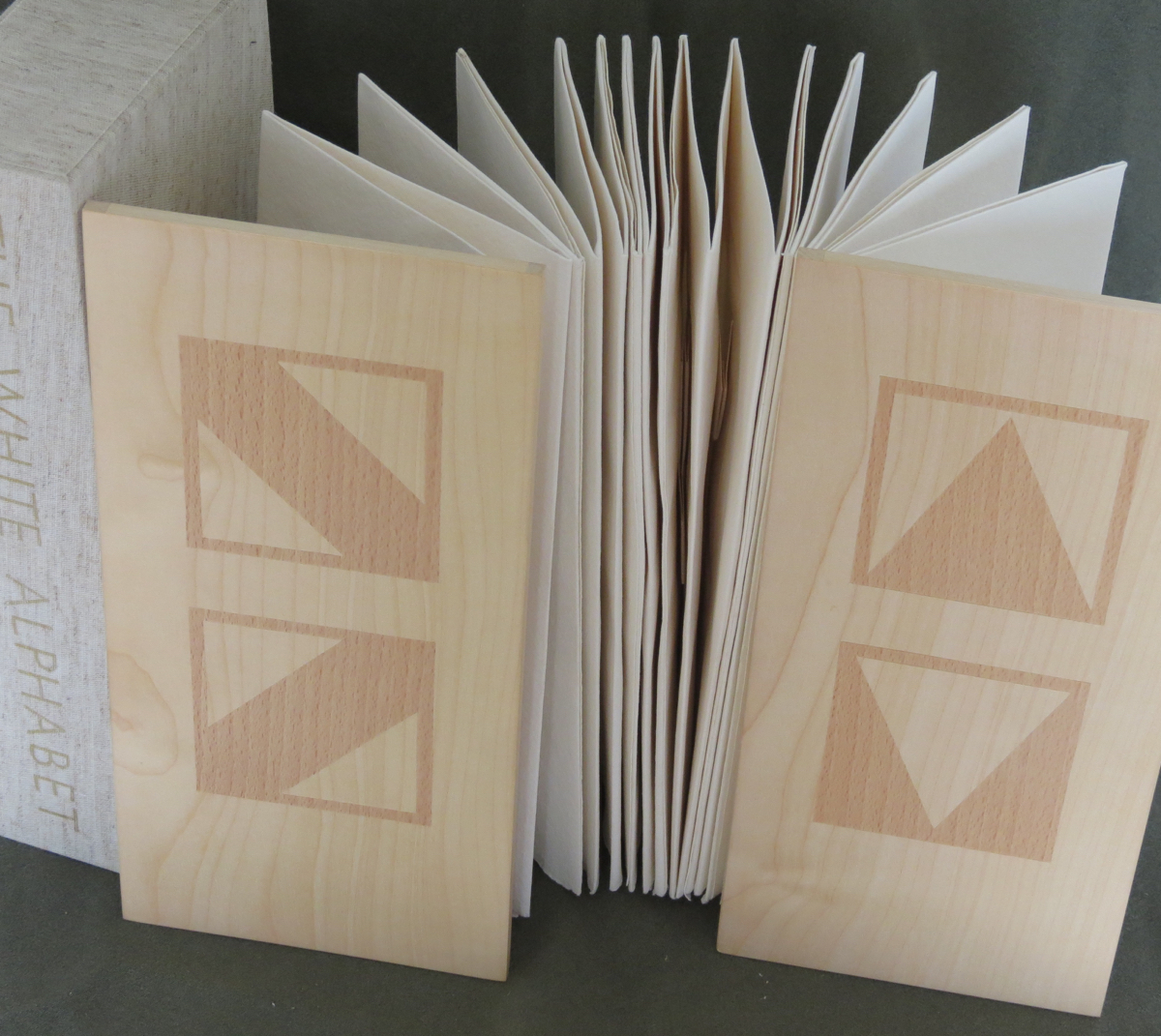
Box made of two slipcases, one inside the other. Gilt lettering on spine of inner slipcase. Back-to-back leporellos with wooden front and back covers. Outer slipcase: H305 x W140 x D70 mm. Leoprello: H290 x W135 mm. Edition of 150, of which this is #99. Acquired from Veatch’s, 11 June 2021.
Photos: Books On Books Collection.

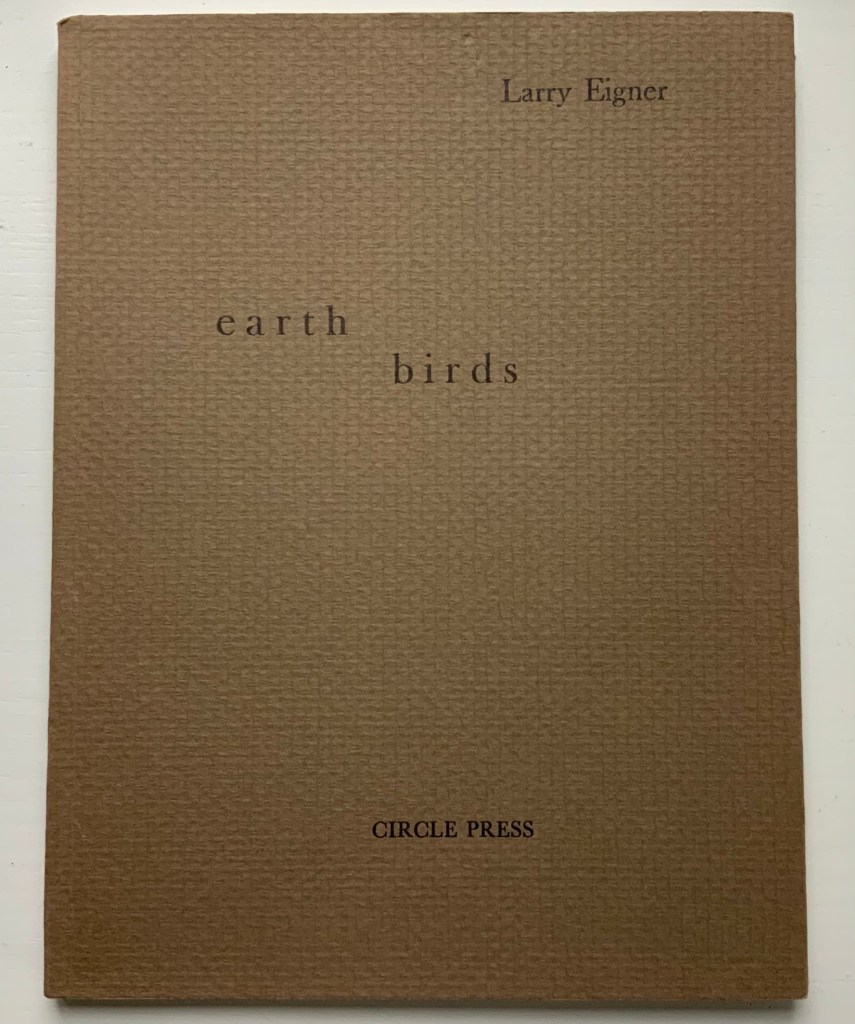
Earth Birds (1981)

Earth Birds: forty six poems written between May 1964 and June 1972 (1981)
Larry Eigner (poems) and Ron King (plates)
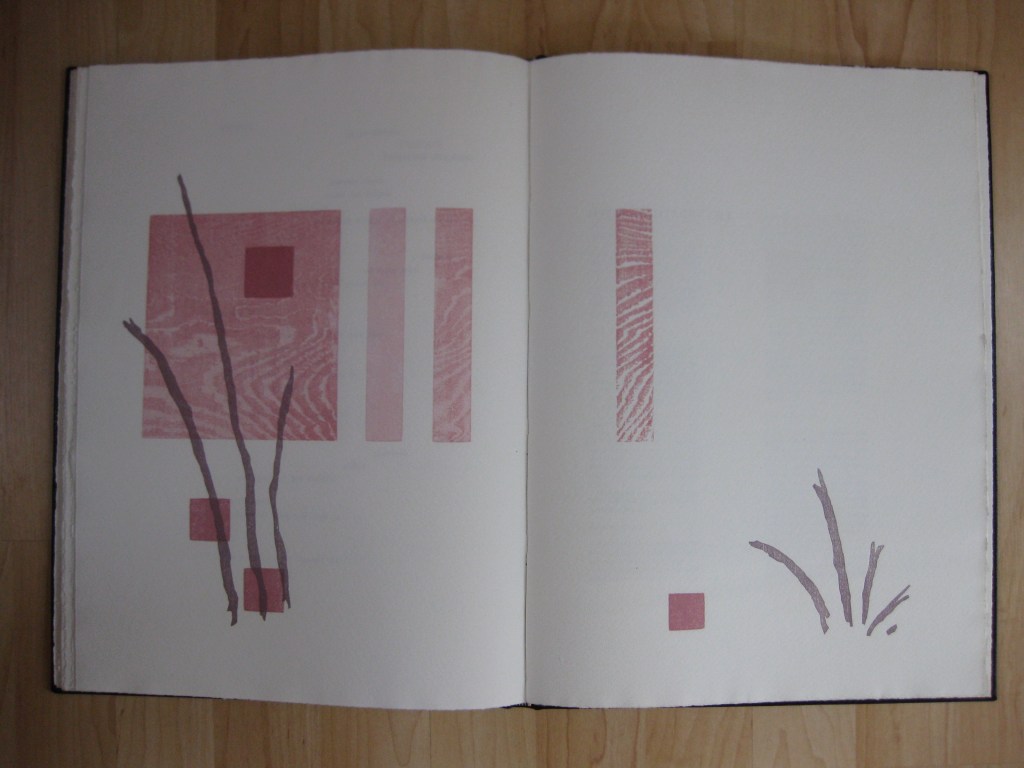
Fifty hard-bound copies, I-L, printed on pure rag-made paper with six plates printed blind intaglio and one hundred and fifty copies, 51-200, printed on Glastonbury Book stock with the same plates printed relief, in one color. Photos: Books On Books Collection.

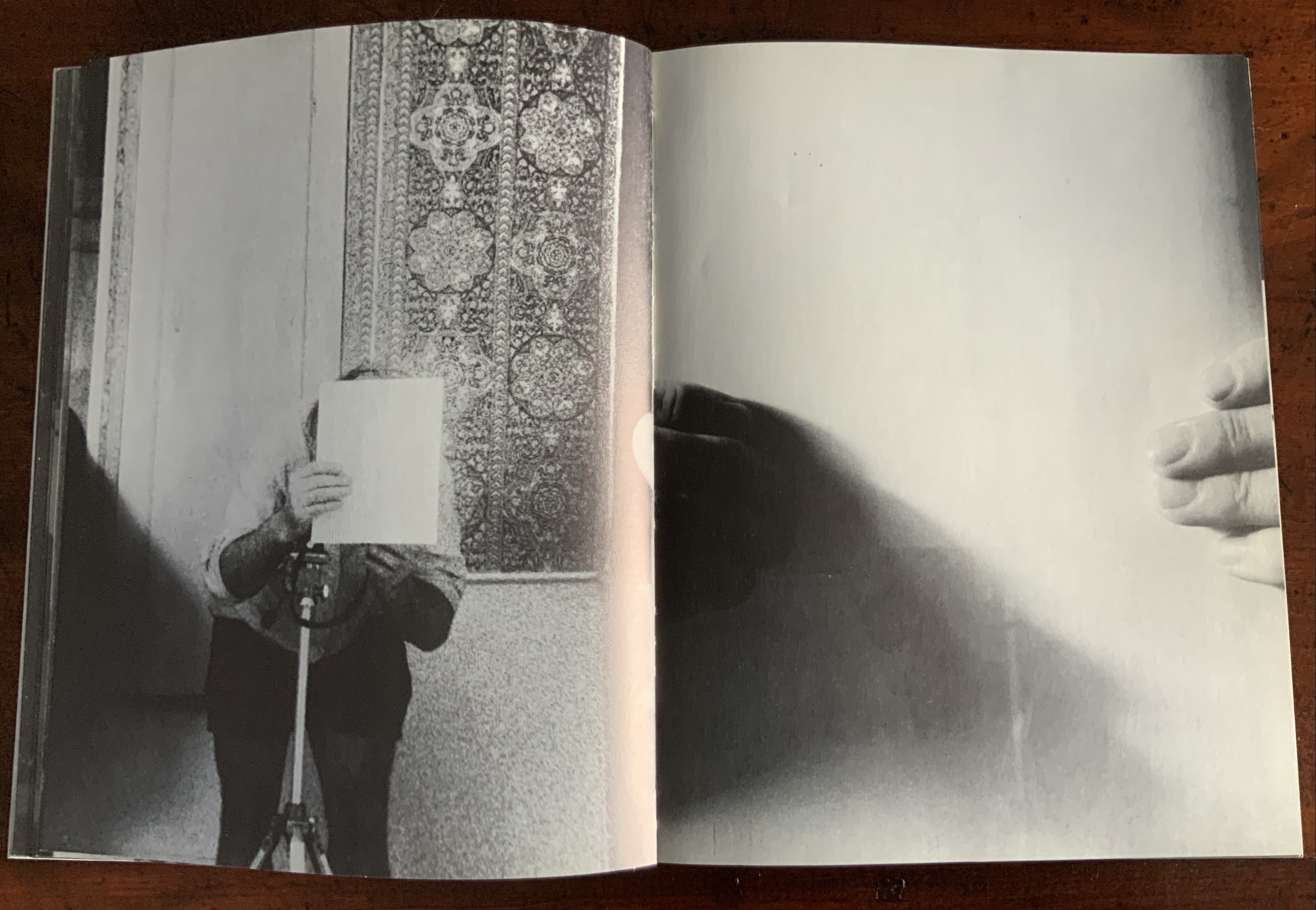
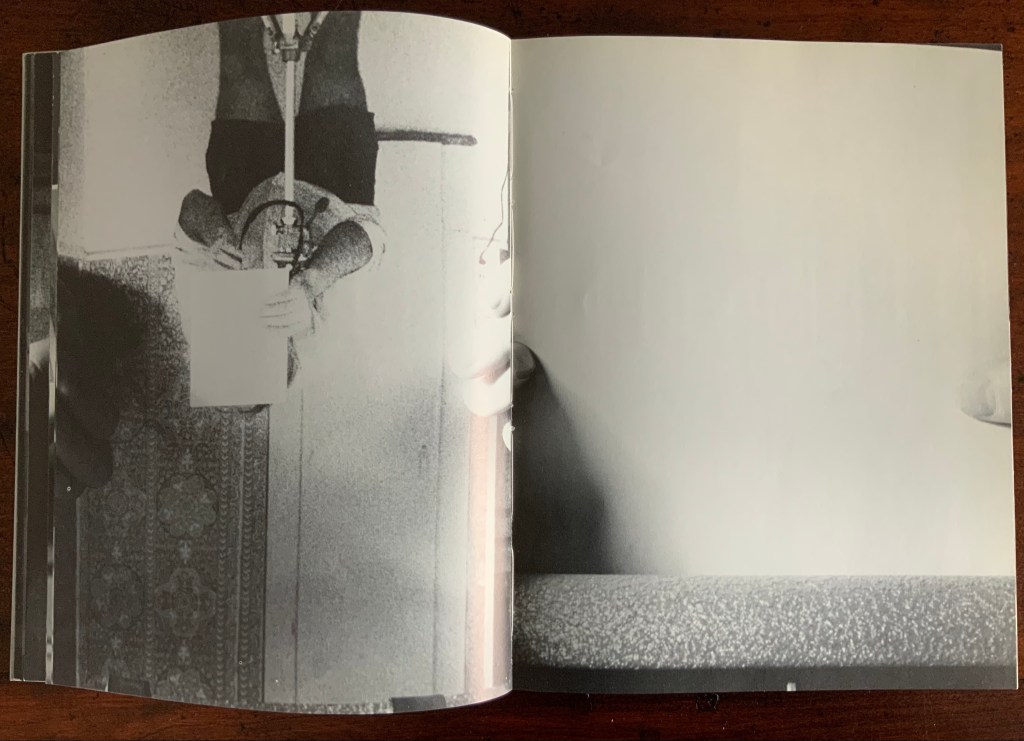
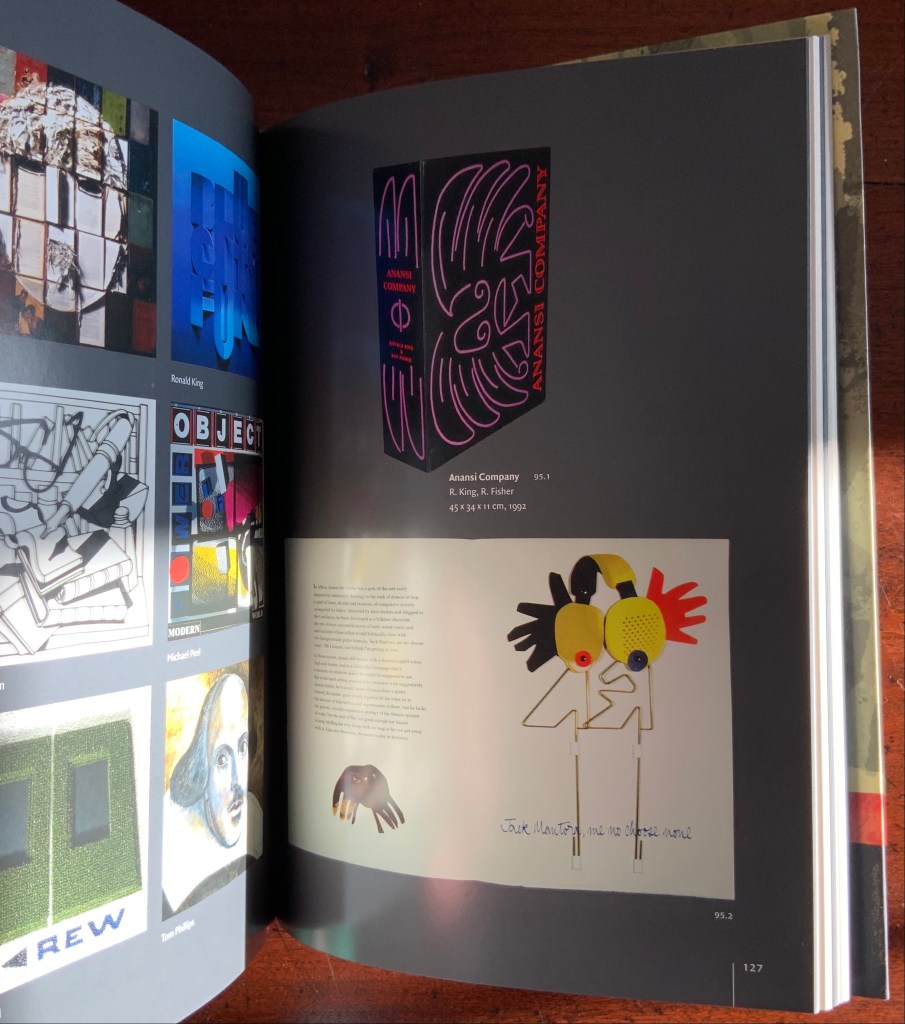
As with George Szirtes, King has collaborated more than once with Larry Eigner. Looks like nothing, the shadow through air (1972) was the earlier joint effort. Compared to Earth Birds, later works like The Burning of the Books (2008) and Anansi Company (1992) with Roy Fisher show King’s development toward more deeply collaborative efforts.

Earth Birds does recall the wide range of similar works by others at Circle Press that King made possible: Hadrian’s Dream (1990) by Asa Benveniste and Ken Campbell and Machines (1986) by Michael Donaghy and Barbara Tetenbaum.

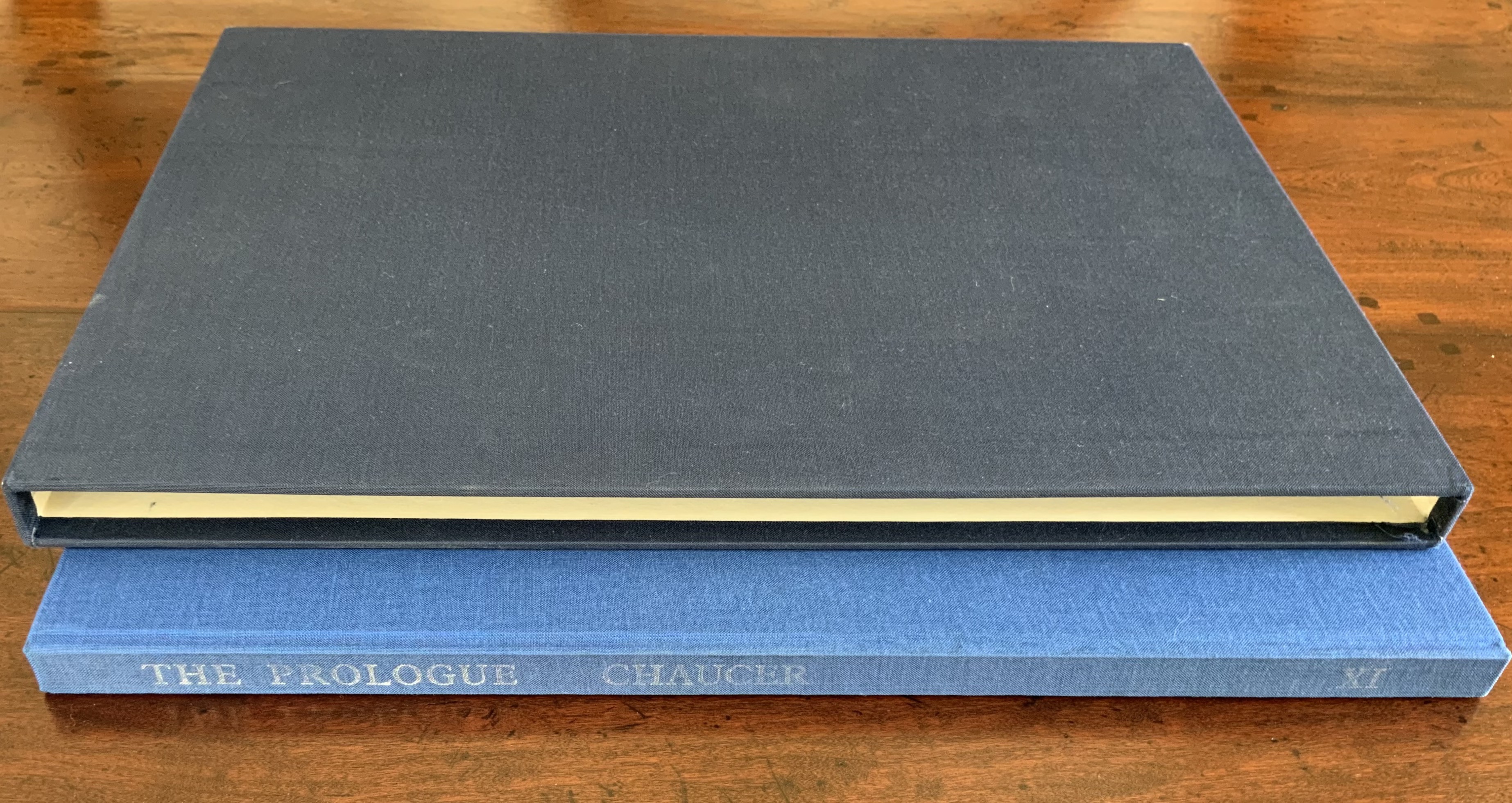
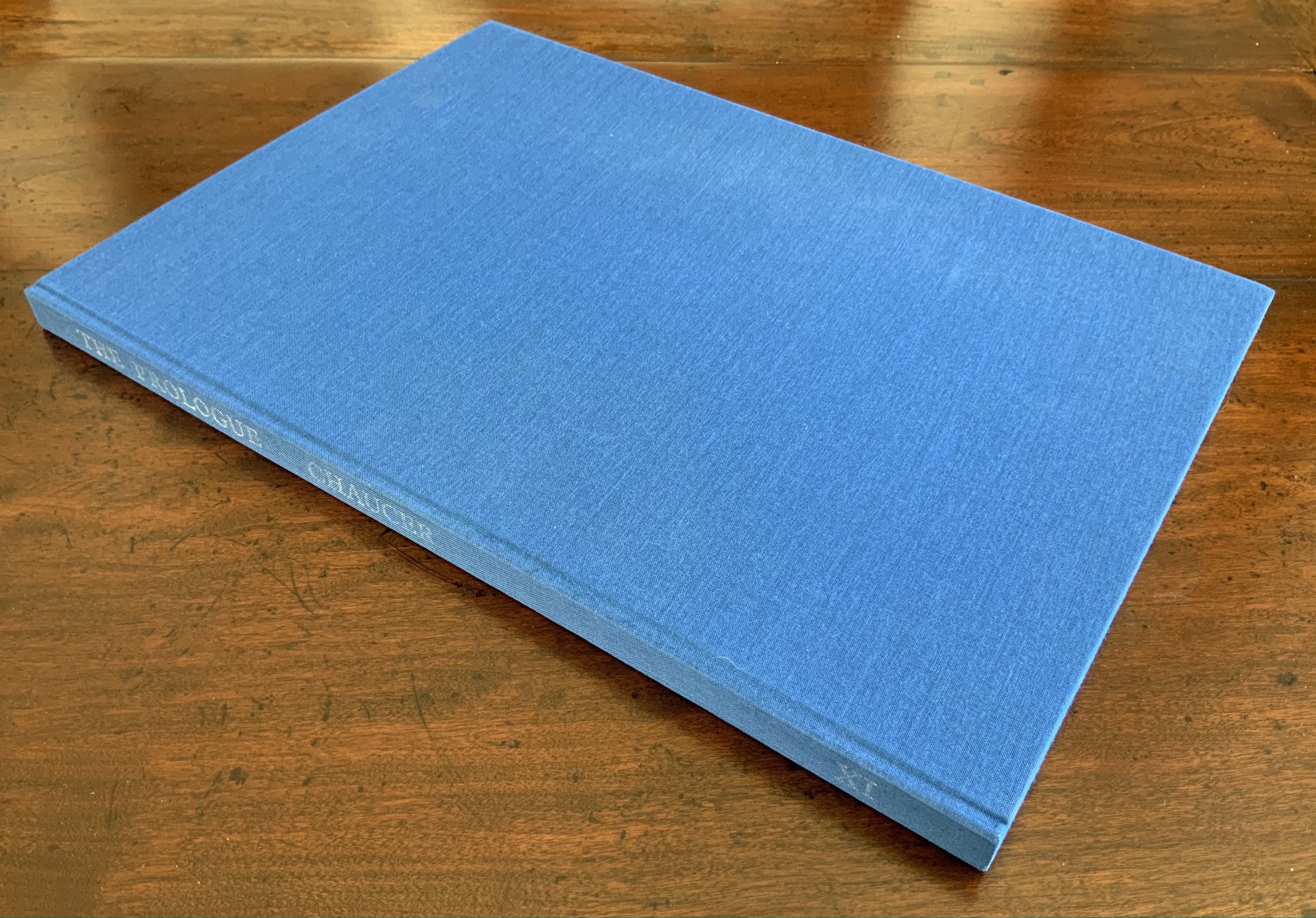
Chaucer’s The Prologue, 2nd Edition (1978)

Chaucer’s The Prologue, 2nd Edition (1978)
Ron King
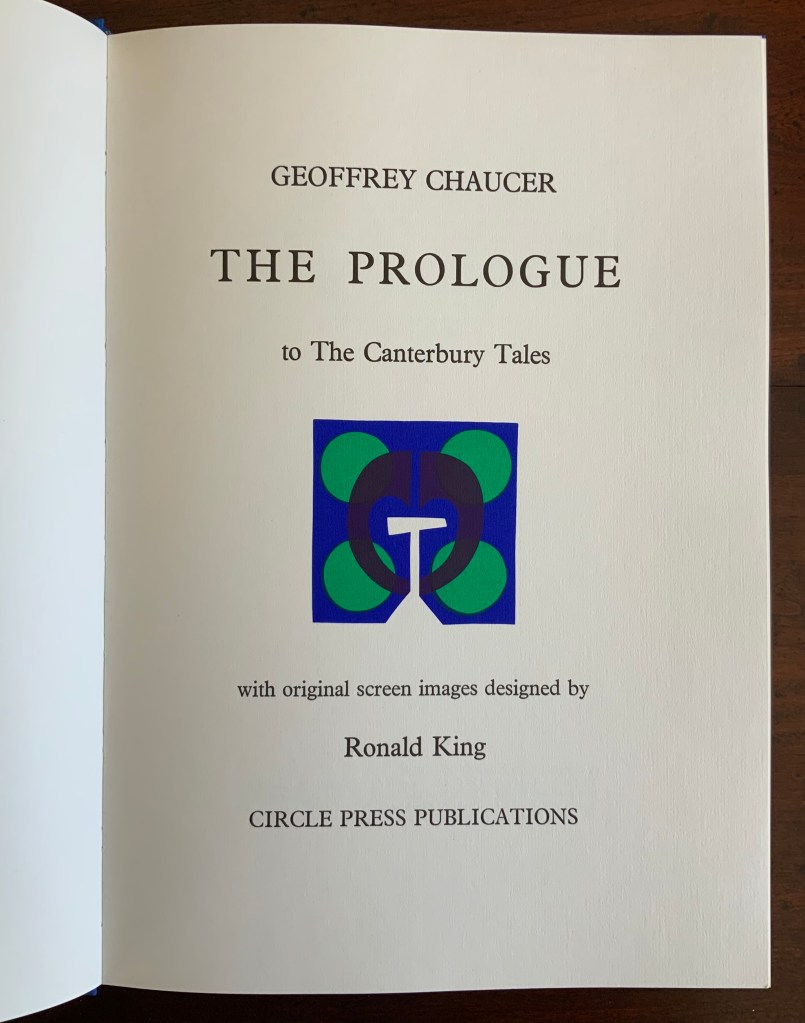
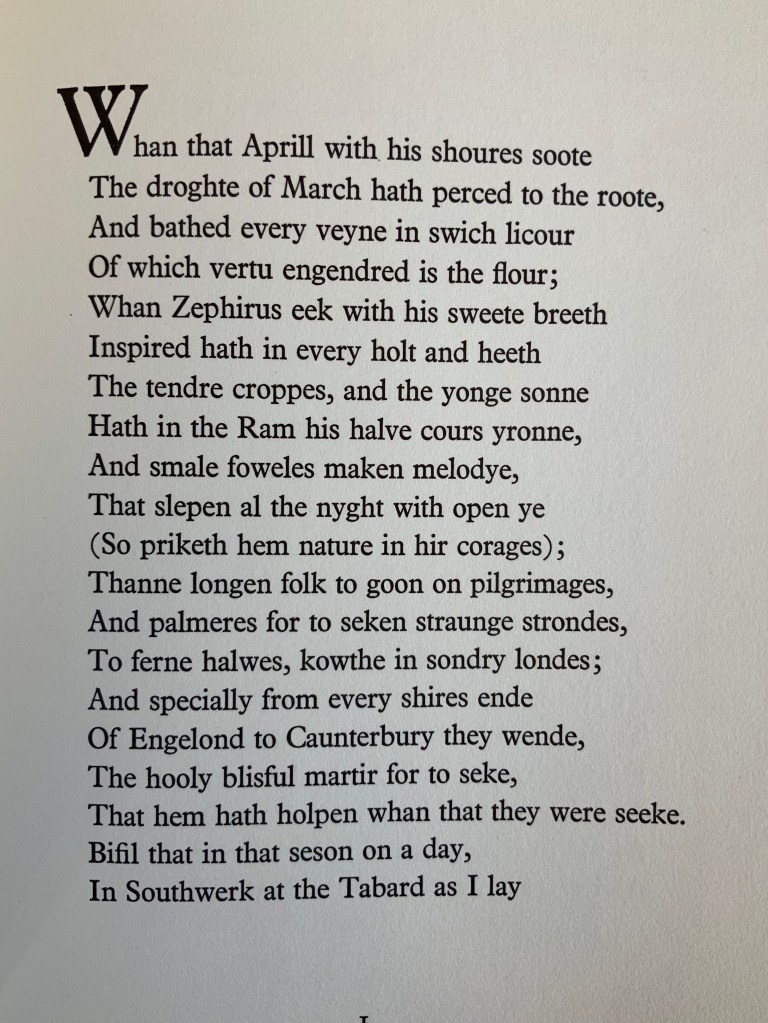
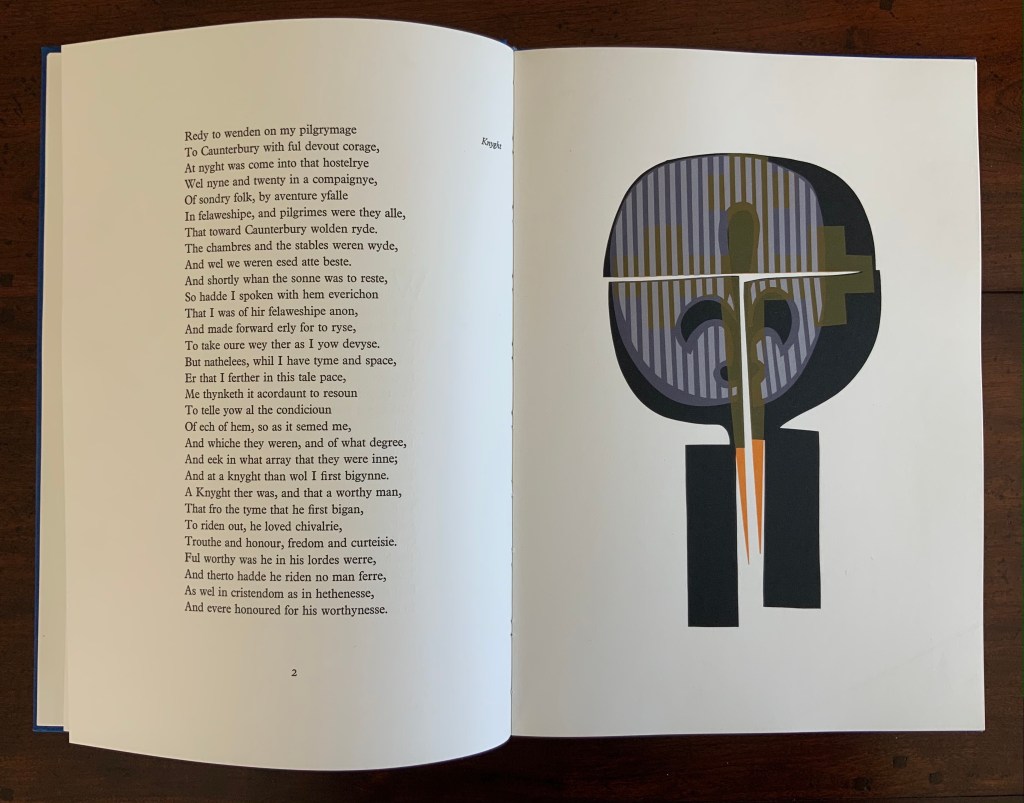
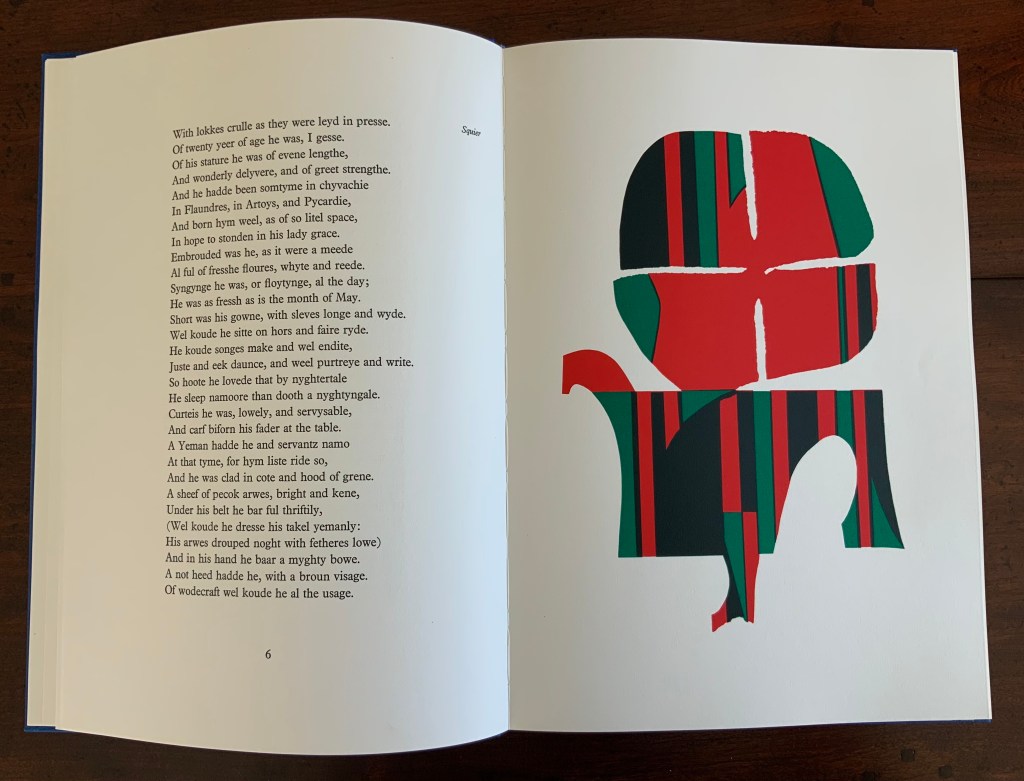
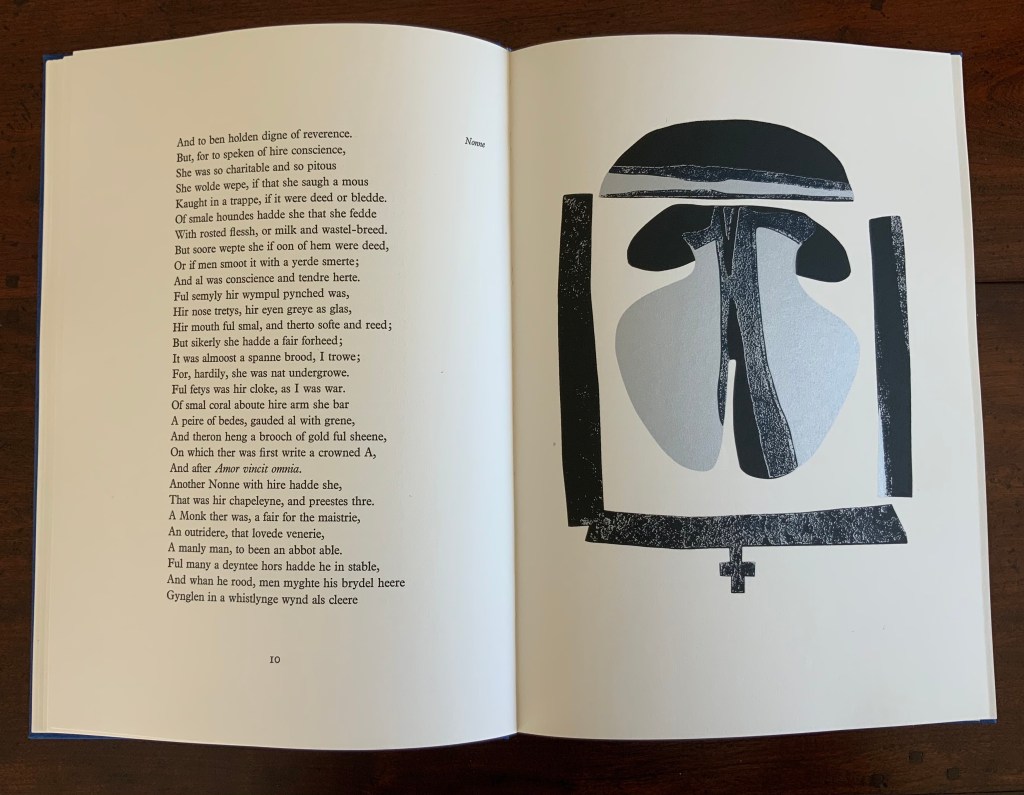
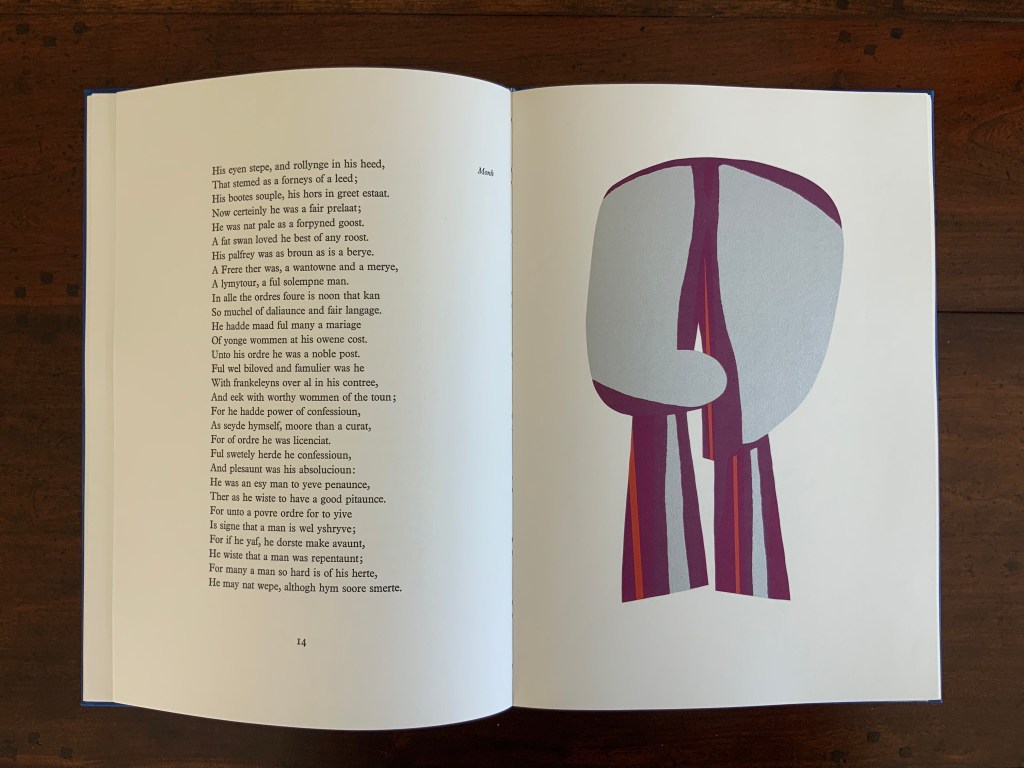
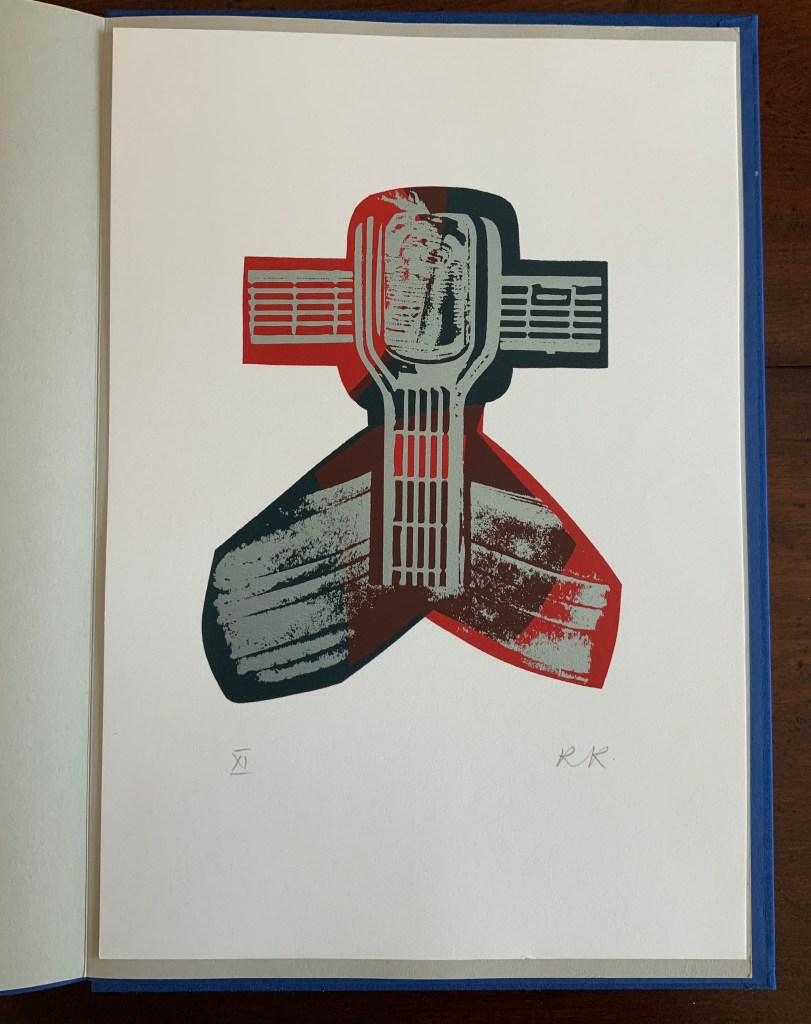
Casebound sewn, letterpress printed on 190 gsm Queen Anne Antique White. Hand-set in Monotype Plantin series 110. H405 x W281 mm, 72 pages. Edition of twenty separate versions I-XX each of 250 copies, of which this is XI, #131, and includes a folder of Buckler Light Grey Plain with a poem by Roy Fisher and screen-print on 190 gsm Bockingfordby Ron King entitled “Webbe”. Acquired from private seller, 27 February 2021. Photos of work: Books On Books Collection. Displayed with permission of artist.

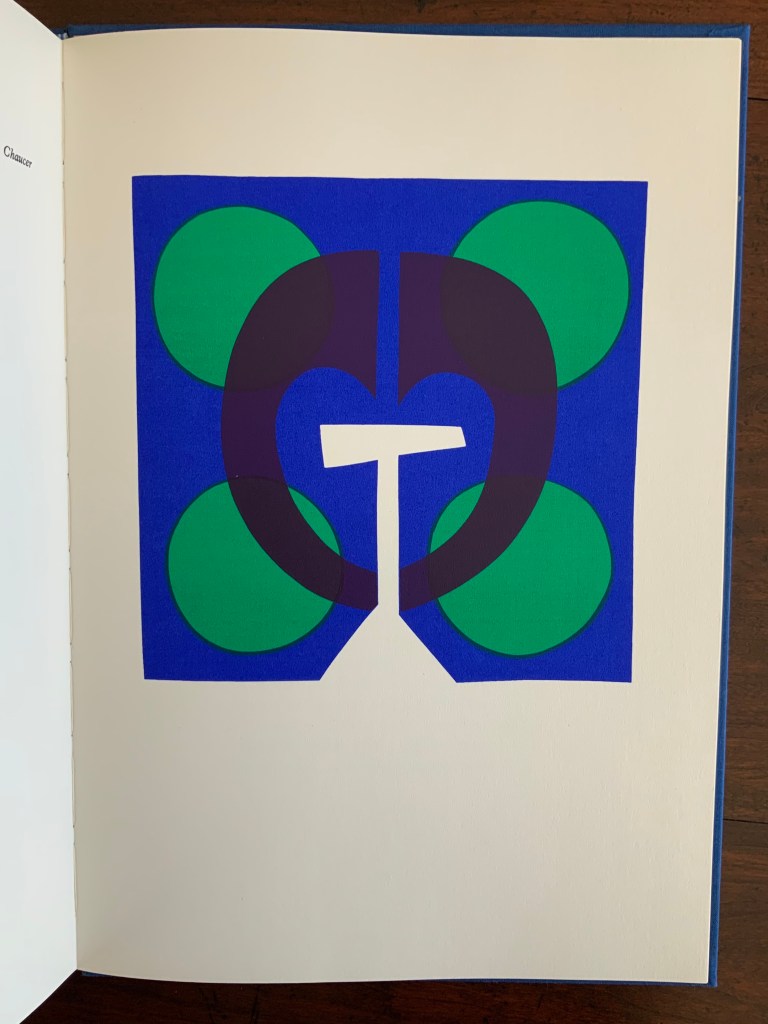
King originally prepared The Prologue for Editions Electo in 1966, then published a limited edition of 125 copies in 1967 under the Circle Press imprint. In this collection, the work represents King’s straightforward fine press work and a successful livre d’artiste. The screenprints of Chaucer’s characters and Chaucer himself are based on African and Brazilian masks as well as heraldic symbols. King’s inspiration to match these richly colored masks to the personae captures the pageantry and individuals within the social hierarchy of Chaucer’s Canterbury Tales. Opening this oversized fine press edition, turning its stiff, creamy pages with their 18 pt Plantin type and confronting these human-sized masks are reminders of the monumentality that this human-scale work of literature has achieved.

Knight and Squire masks

Nun and Monk masks

Chaucer’s mask and King’s original print “Webbe”

Ephemera

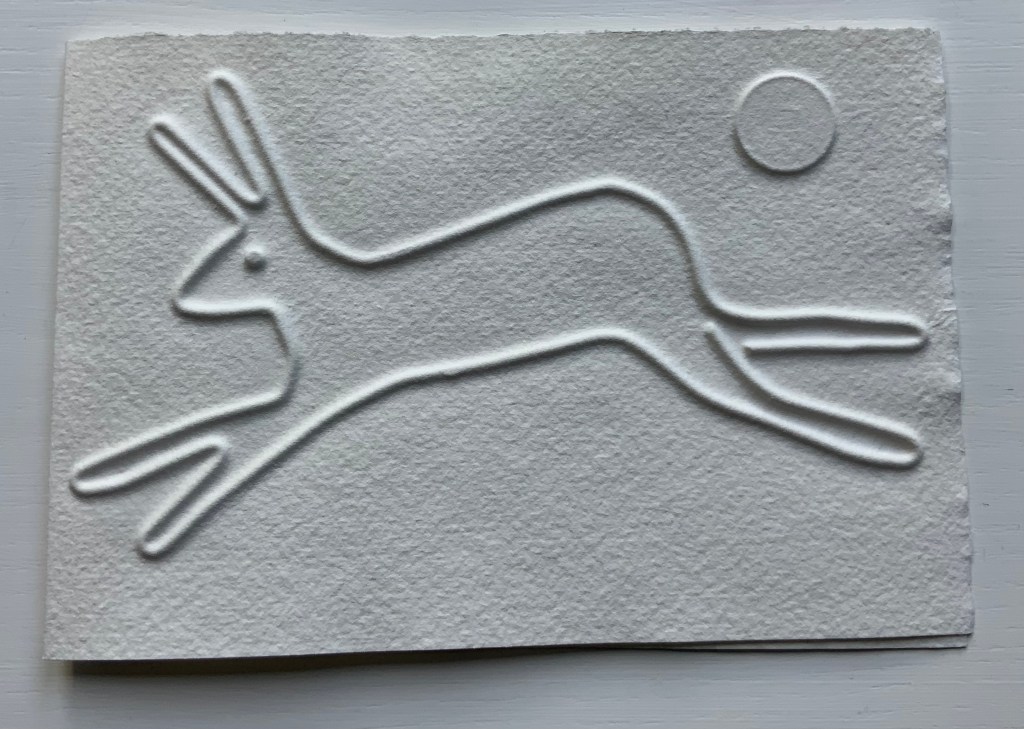
Almost always, small gifts of ephemera arrive with purchases from the Ron King Studio. They illustrate how King marshals his artistry even in marketing his art and that of those he has published.

Hare (single-fold card, H125 x W180 mm), blind-embossed. 2021.

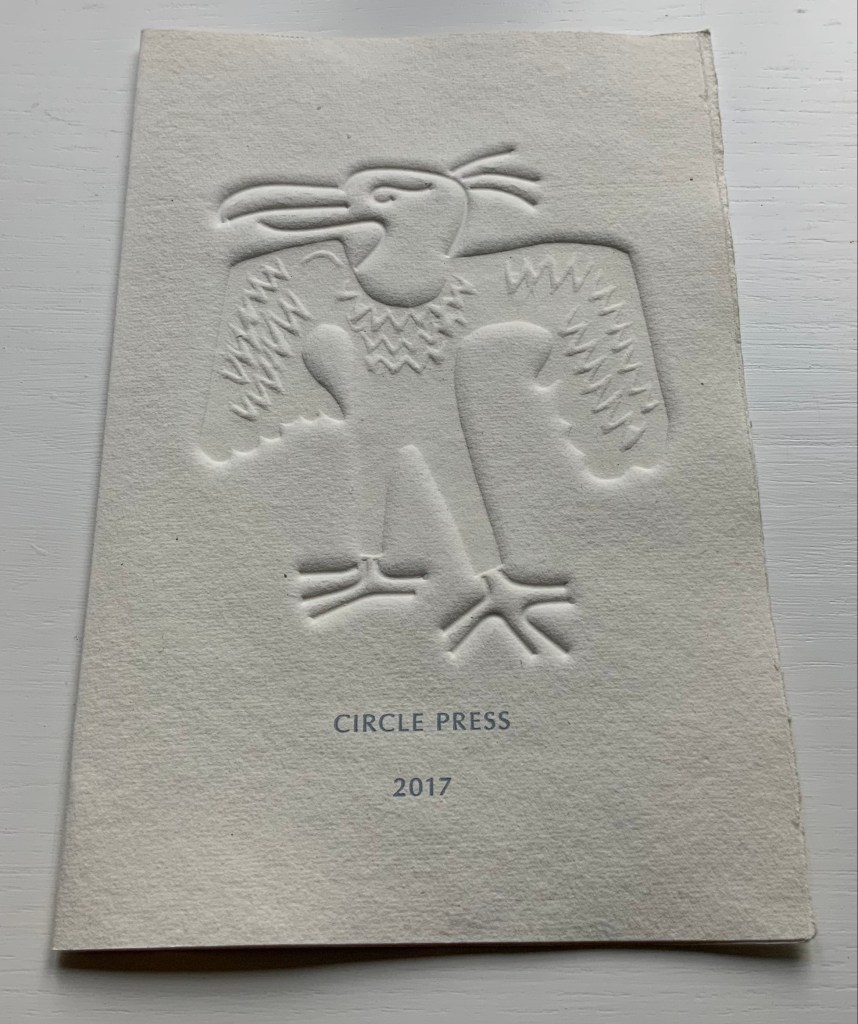
Announcement (single-fold card, H216 x W140 mm) with blind embossed image of a fulmar. Describes artist book Sednar and the Fulmar with Richard Price’s poems. 2017.

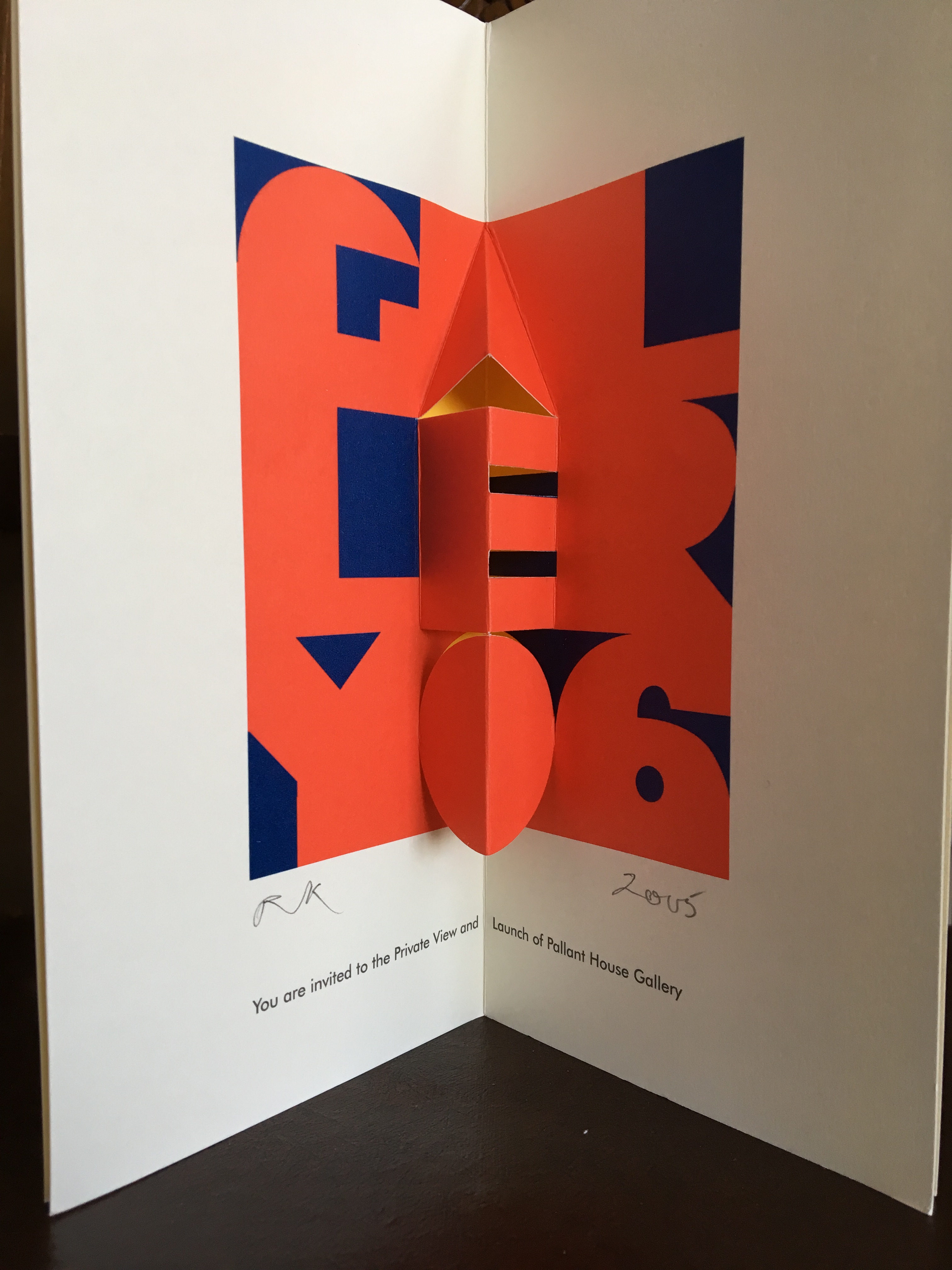
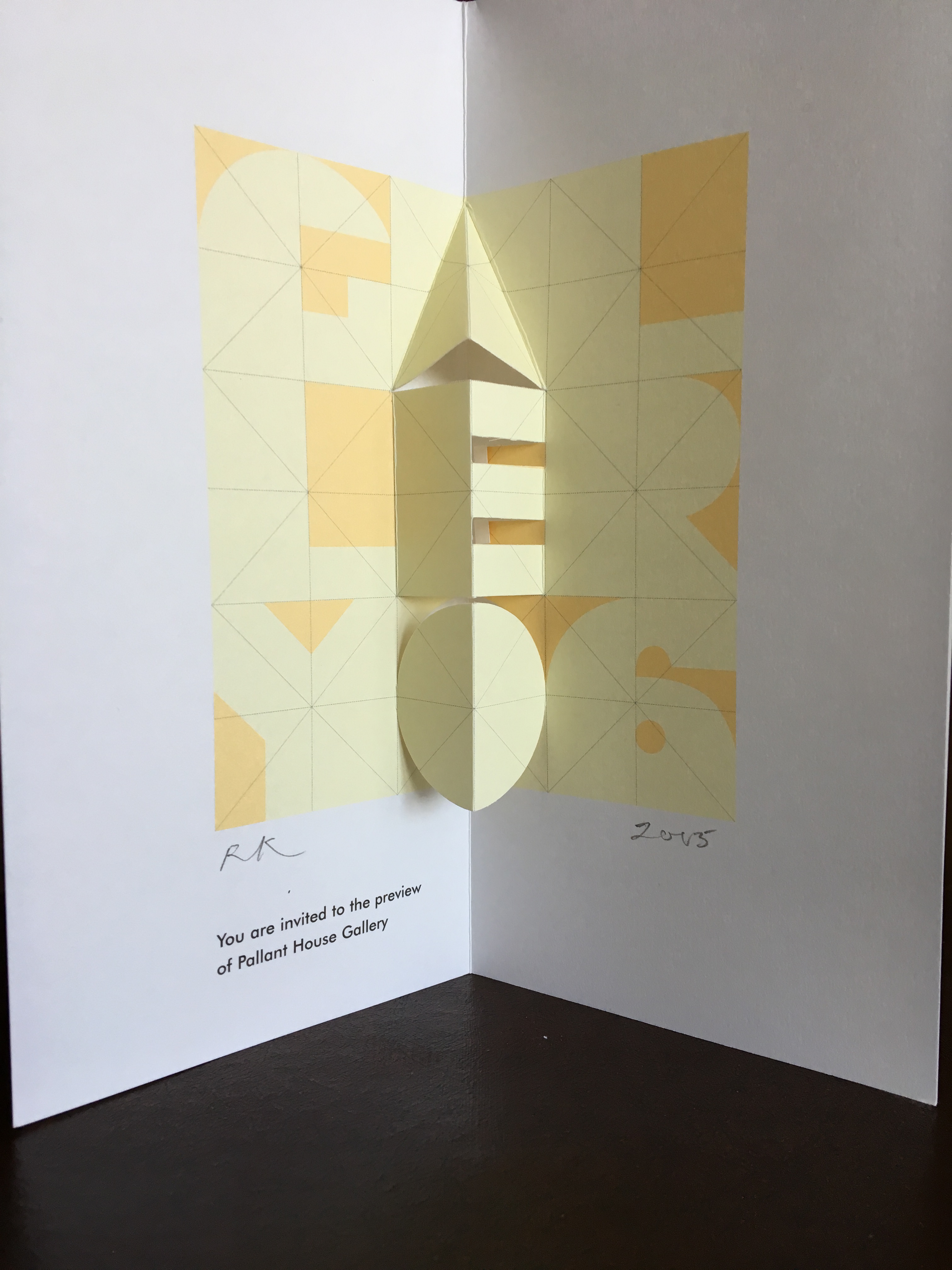
Invitations (four-fold pop-up cards) to Pallant House Gallery opening preview. 2005.

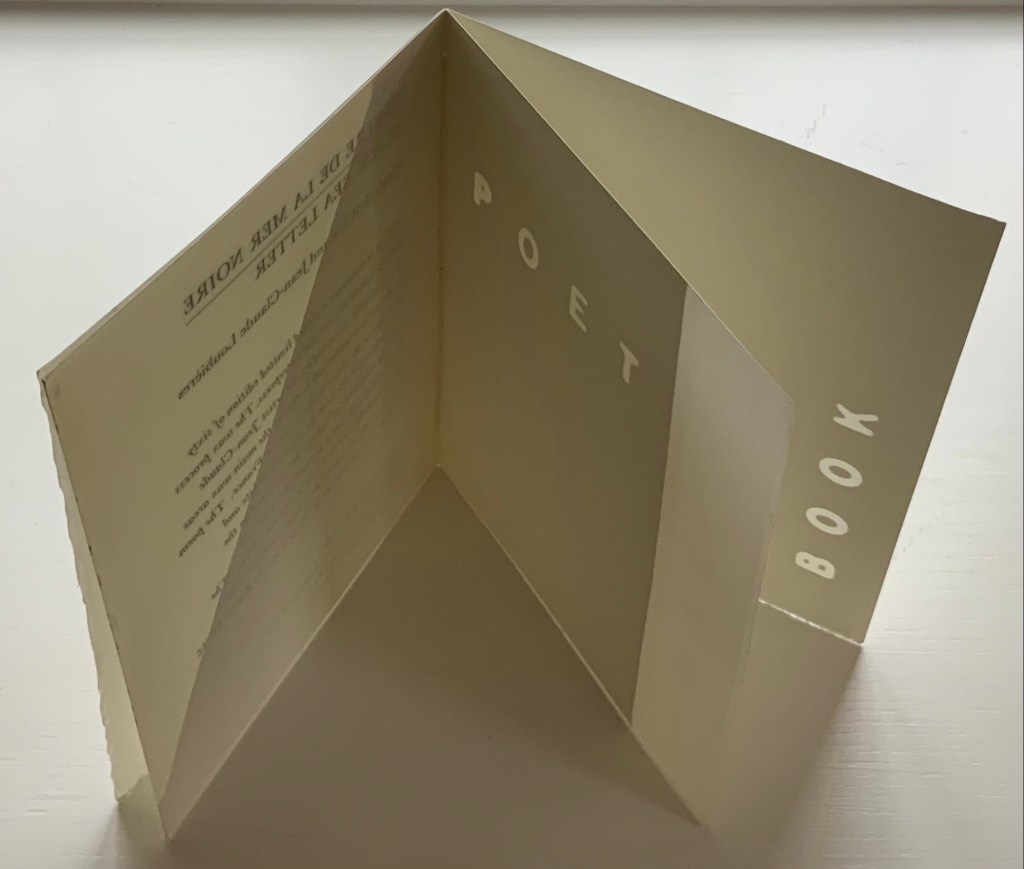
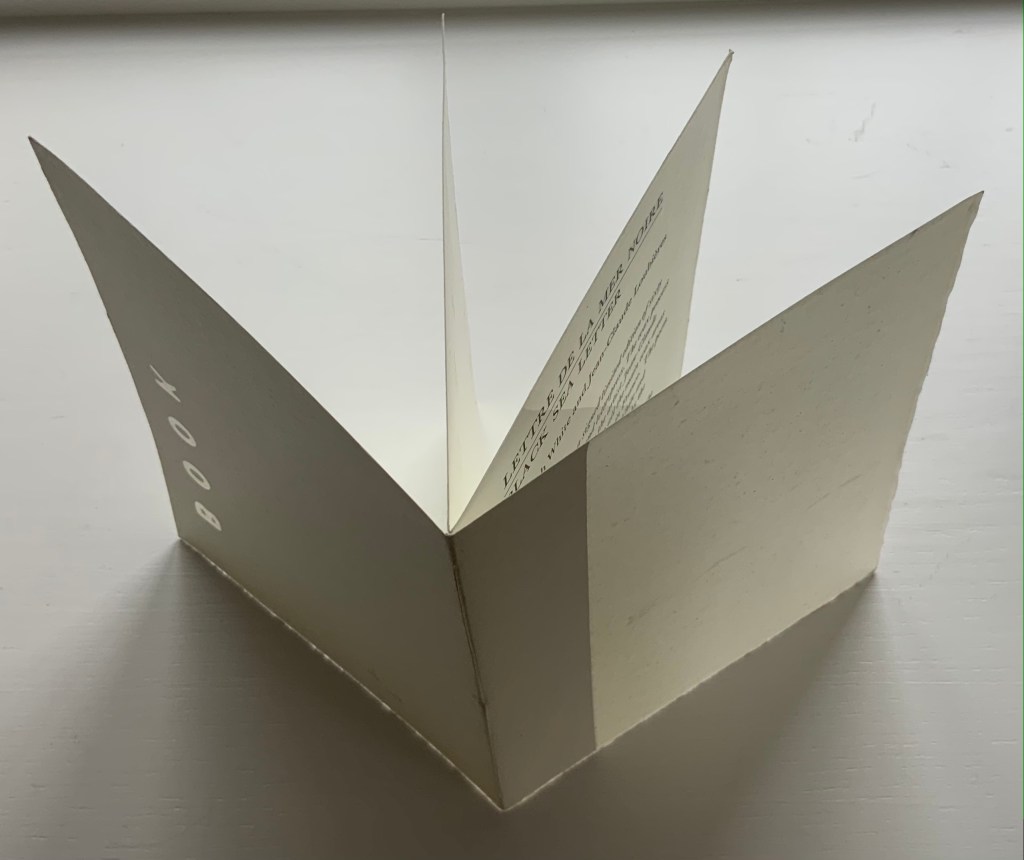
Announcement (wax and paper pamphlet, H174 x W134 mm) of Lettre de la Mer Noire/Black Sea Letter by Kenneth White (poem) and Jean-Claude Loubières (images and wax dipping). 1997.

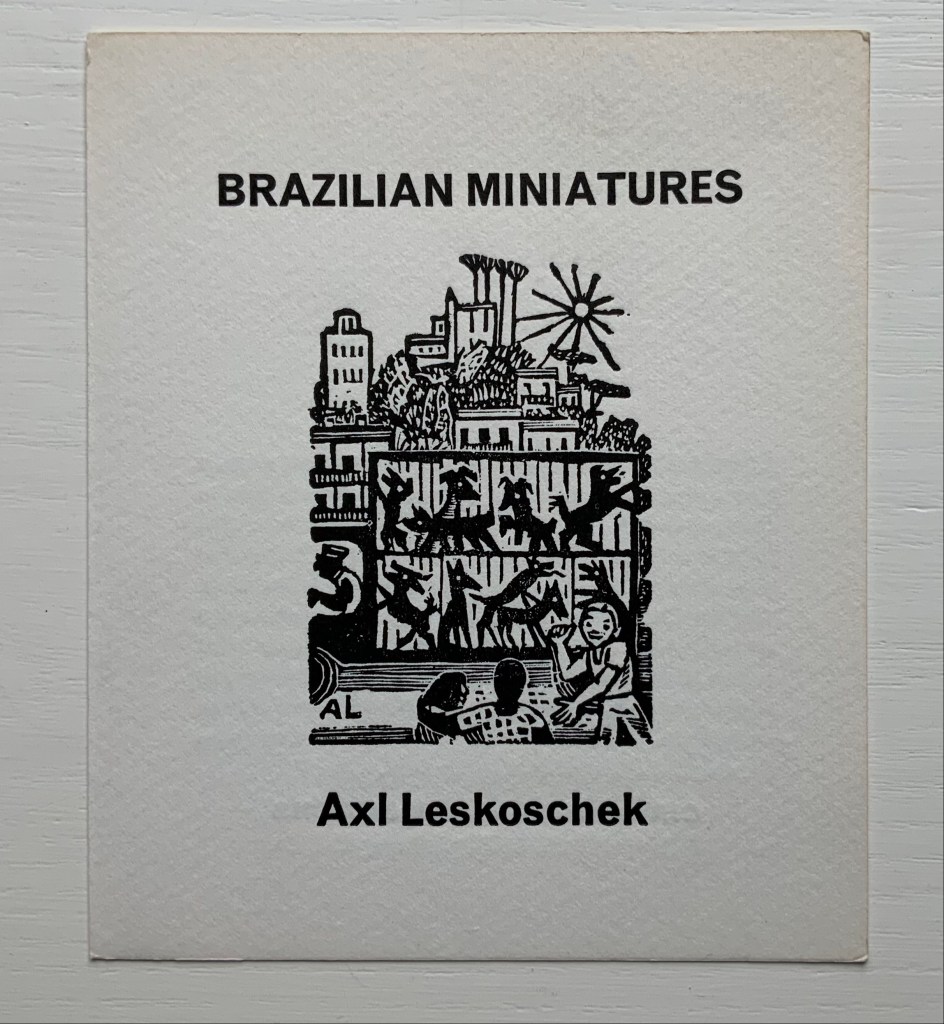
Announcement (card, line block reproduction, H150 x W125 mm) of the 200 portfolios of fifty-one woodcut designs reproduced from the only remaining proofs of Brazilian Miniatures, an unpublished book with a bilingual introduction; printed in two versions. 1973?

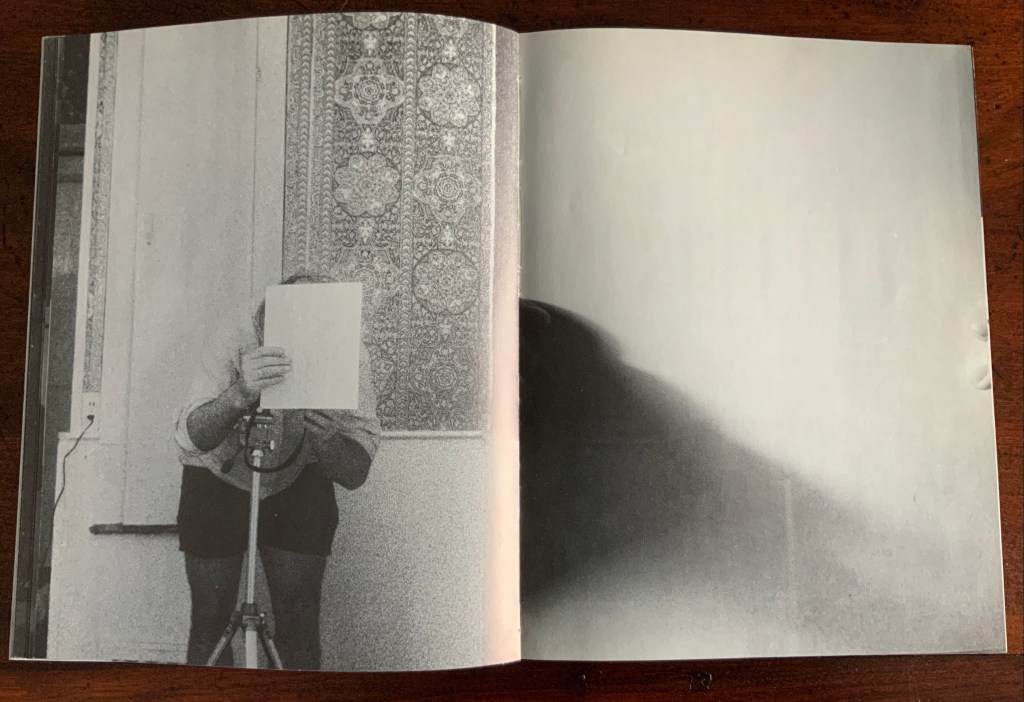
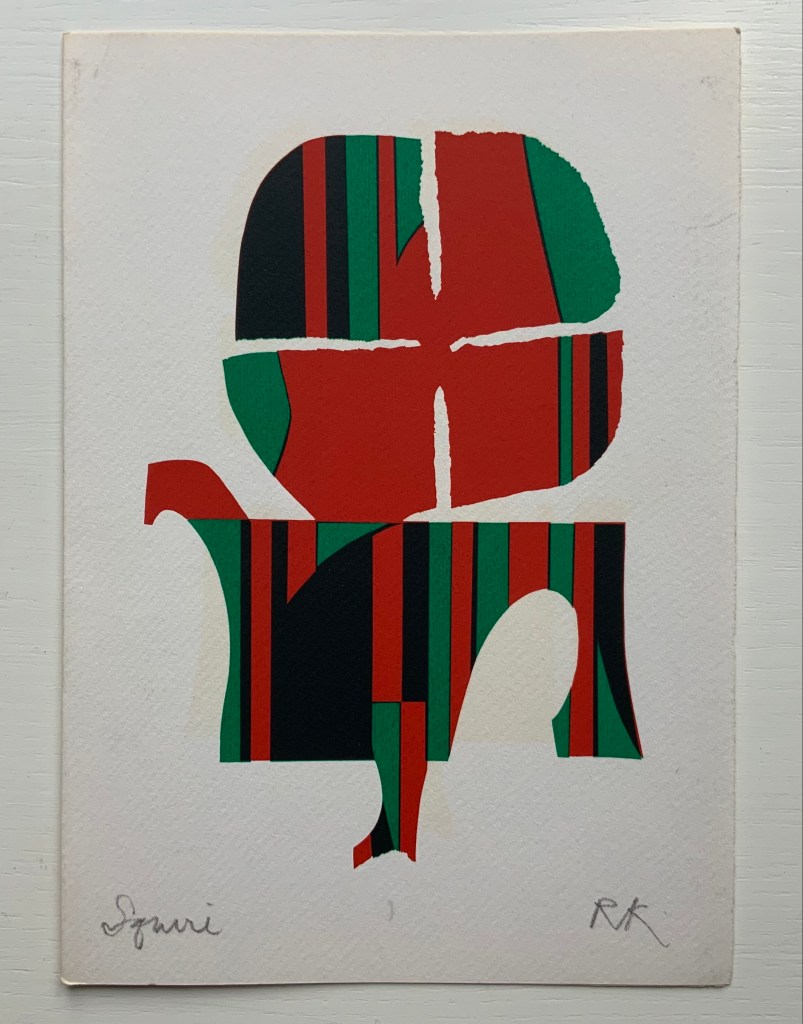
“Squire” (single-fold card, H235 x W165 mm) with hand-printed serigraph from Chaucer’s “Prologue” to The Canterbury Tales. 1969?

Further Reading

Abecedaries I (in progress)”, Books On Books Collection, 31 March 2020.

Willow Legge“, Books On Books Collection, 14 February 2021.

Bury, Stephen. “Ron King and the Circle Press.” Print Quarterly 20, no. 4 (2003): 434-37. Accessed February 7, 2021.

Courtney, Cathy. 1999. Speaking of book art: interviews with British and American book artists. Los Altos Hills, Calif: Anderson-Lovelace.

Goldmark Gallery. 2019. Alphabets, Bandits & Collaborations: Ron King Documentary. Uppingham, UK. Video

Hill, Emma. “Artists’ Books and Circle Press”, Pallant House Gallery Magazine, No. 8, June 2006, pp. 66-68. Accessed 22 March 2020.

Lambirth, Andrew. 2019. Ron King : Alphabets, Bandits & Collaborations. Oakham: Goldmark Gallery. Exhibition catalogue.

Bookmarking Book Art – Gary Young and Felicia Rice

Poem: a throw of the dice will never abolish chance (1990)

Mallarmé, Stéphane, D. J. Waldie (trans.), Gary Young, and Felicia Rice. 1990. Poem: a throw of the dice will never abolish chance. [Santa Cruz, Calif.]: Greenhouse Review Press. The binding is full goatskin leather, 15.5 x 11.375 in, 44 pages. Edition of 60. Photos: Courtesy of D. J. Waldie and Gary Young.

To the growing body of homage to Un Coup de Dés, D.J. Waldie and Gary Young added this fine press livre d’artiste. In keeping with Waldie’s reading of Danielle Mihram’s analysis of the proofs of the intended Mallarmé/Vollard livre d’artiste and Waldie’s own examination of the proofs at Harvard, Young’s four woodcuts are presented separately from the text and aim to honor Mallarmé’s desire for images that are “blond and pale” in relation to the white of les blancs and the sharp black of the type. The design by Young and Felicia Rice used several cuttings of Bodoni to approximate the Firmin-Didot of the original proofs.

Further Reading

Robert Bononno & Jeff Clark“, Books On Books Collection, 26 October 2020.

Mitsou Ronat & Tibor Papp“, Books On Books Collection, 6 November 2020.

Hubert, Renée Riese, and Judd David Hubert, eds. 2003. A Throw of the Dice: Artists Inspired by a Visual Text. Claremont, CA: Scripps College.

Mihram, Danielle. 1979. “The Abortive Didot/Vollard Edition of Un Coup de Dés“. French Studies, 33.1: 39–56.

Waldie, D.J. 2001.”The Ghost of an Obsession: Translating Mallarmé’s A Throw of the Dice will Never Abolish Chance“. Parnassus: Poetry in Review , 26.1: 180-85.

Books On Books Collection – Christopher Brennan

Prose-Verse-Poster-Algebraic-Symbolico-Riddle Musicopoematographoscope and Pocket Musicopoematographoscope (1897/1981)

Prose-Verse-Poster-Algebraic-Symbolico-Riddle Musicopoematographoscope and Pocket Musicopoematographoscope (Hale & Iremonger, 1897/1981)
Christopher Brennan
Hardback, facsimile edition of the handwritten manuscript. H390 x W270 x 16 mm, 40 pages. Acquired from Richard Axe Books, 12 November 2020.

Just as Stéphane Mallarmé’s Un coup de Dés jamais n’abolira le Hasard (1897) launched a new host of visual poems in the 20th and 21st centuries, it also launched a host of homage and parodies. Perhaps the quickest off the dock was the Australian Christopher Brennan. Already a fan of Mallarmé, Brennan, who worked at the New South Wales Public Library, seized on the May 1897 issue of Cosmopolis when it arrived and found in Mallarmé’s poem just the form with which to respond to the rough ride Australian critics had given to his own XXI Poems: MDCCCXCIII-MDCCCXCVII: Towards the Source (1897).

Not until 1981, though, was his tinker’s damn published. Given the debated choices of layout, typeface and illustrations that Un coup de Dés in book form had faced since 1897 and would continue to face after 1981, the choice to publish a facsimile of Brennan’s calligraphic effort was well made — perhaps even artistically original. Book artists have blotted out the poem, excised it, collaged, illustrated, performed, recorded (and cast the sonographs in three-dimensional PVC), programmed it into computer graphics, typed it out on a modified typewriter, and more. André Masson‘s may be the only calligraphic treatment so far…

Further Reading

Jim Clinefelter“, Books On Books Collection, 17 July 2020. An American-English mis-translation.

Chris Edwards“, Books On Books Collection, 7 December 2020. An Australian-English mis-translation.

Rodney Graham“, Books On Books Collection, 3 July 2020. Un coup de Dés as instructions to a tattoo artist.

Barnes, Katherine E. “With a smile barely wrinkling the surface: Christopher Brennan’s large Musicopoematographoscope and Mallarmé’s Un Coup de dés“, Dix-Neuf, Vol. 9, No.1 (2007), pp. 44-56. Accessed 25 November 2020.

Fagan, Kate. “‘A Fluke? [N]ever!’: Reading Chris Edwards“, Journal for the Association for the Study of Australian Literature, Vol. 12, No. 1 (2012). Accessed 25 November 2020.

Fitch, Toby. 1 May 2019. “Aussi / Or: Un Coup de dés and Mistranslation in the Antipodes“. Cordite Poetry Review. Accessed 27 April 2022.

Books On Books Collection – Chris Edwards

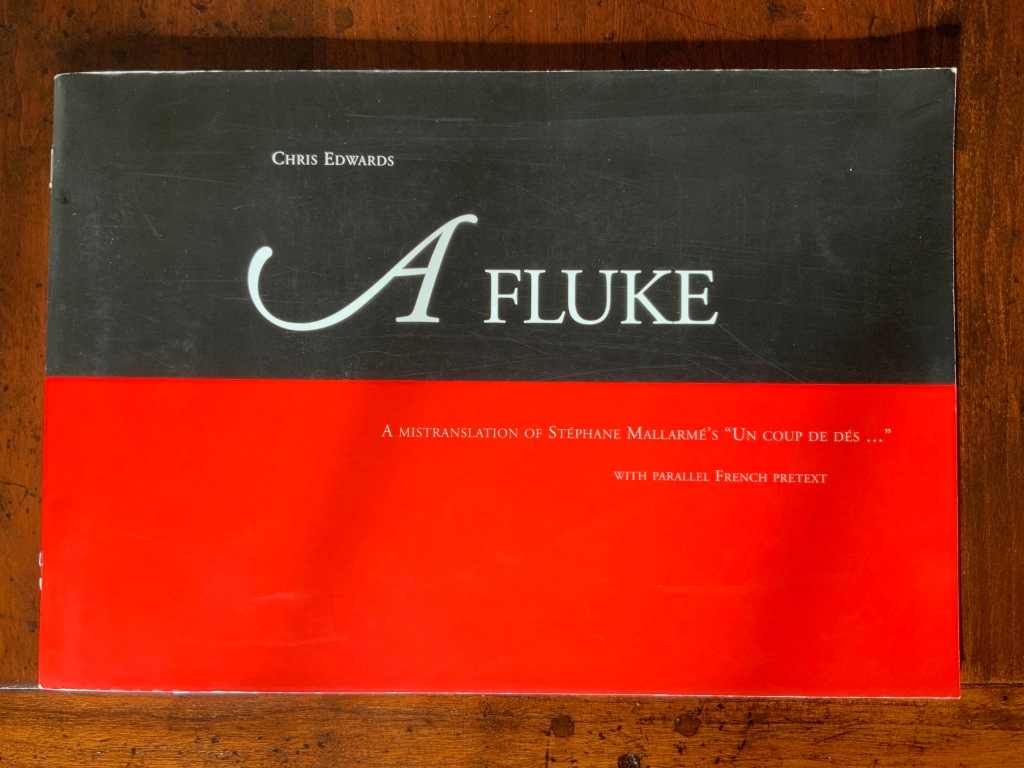
A Fluke: A Mistranslation of Stéphane Mallarmé’s “Un Coup De Dés…” with Parallel French Pretext (2005)

A Fluke: A Mistranslation of Stéphane Mallarmé’s “Un Coup De Dés…” with Parallel French Pretext (2005)
Chris Edwards
Softcover. H195 x W290 mm, 32 pages. Acquired from Chris Edwards, 14 August 2020.
Photos: Books On Books Collection. Displayed with permission of the Christopher Edwards.

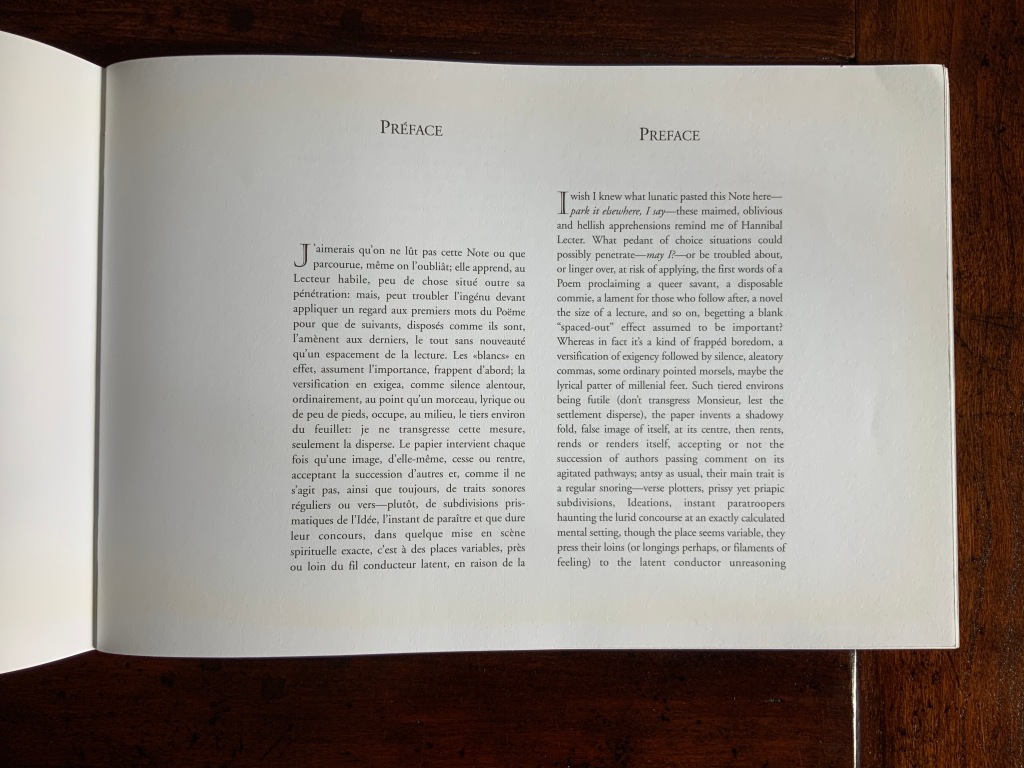
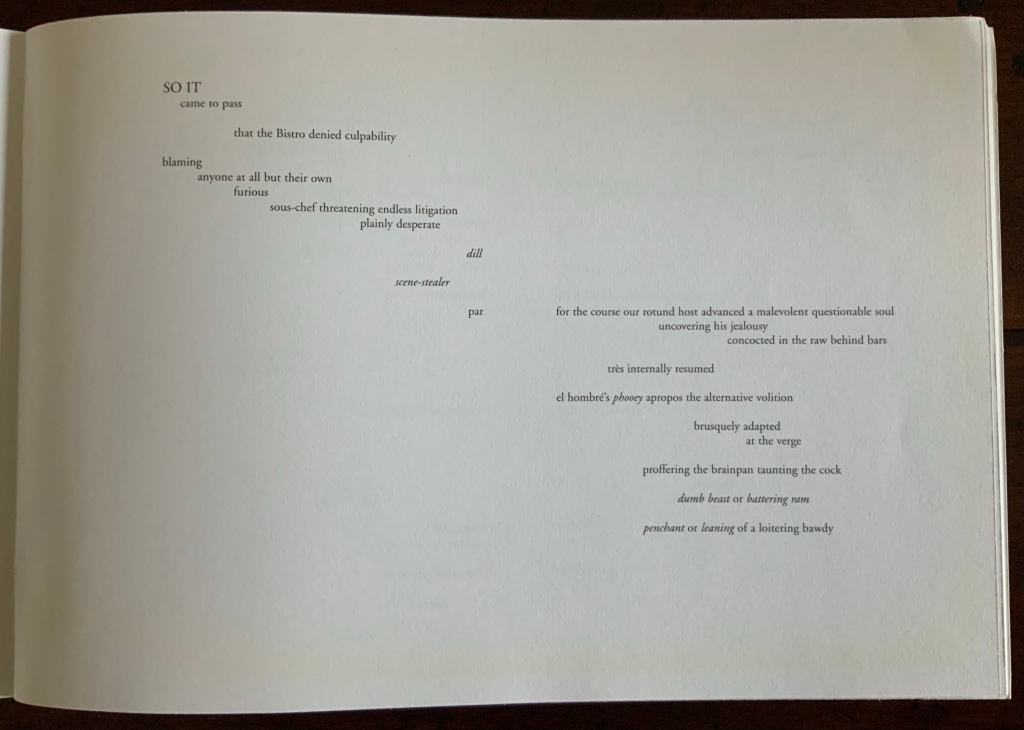
A Fluke follows in the footsteps of several parodists of Un coup de Dés and even more “homageurs”. Edwards mingles bilingual homophonic mistranslation with the monolingual variety, false cognates, mis-contextualization and more to deliver his “fluke”. Part of that “more” leads off with the subtitle and the side-by-side prefaces.

The pun in “pretext” plays out not just in the word itself but in Edwards’ squeezing into one page the French predecessor alongside its English exaggeration. The squeeze harks back to Mallarmé’s “Note” being added to the Cosmopolis issue, where it first appeared, at the insistence of the editors. Having led with the pun and clown-car layout, Edwards follows on with a fright wig (mixed metaphors, too, are part of the “more”). He turns Mallarmé’s tongue-in-cheek “I would prefer that one not read this Note or that having read it, one forgets it” into “I wish I knew what lunatic pasted this Note here– …”.

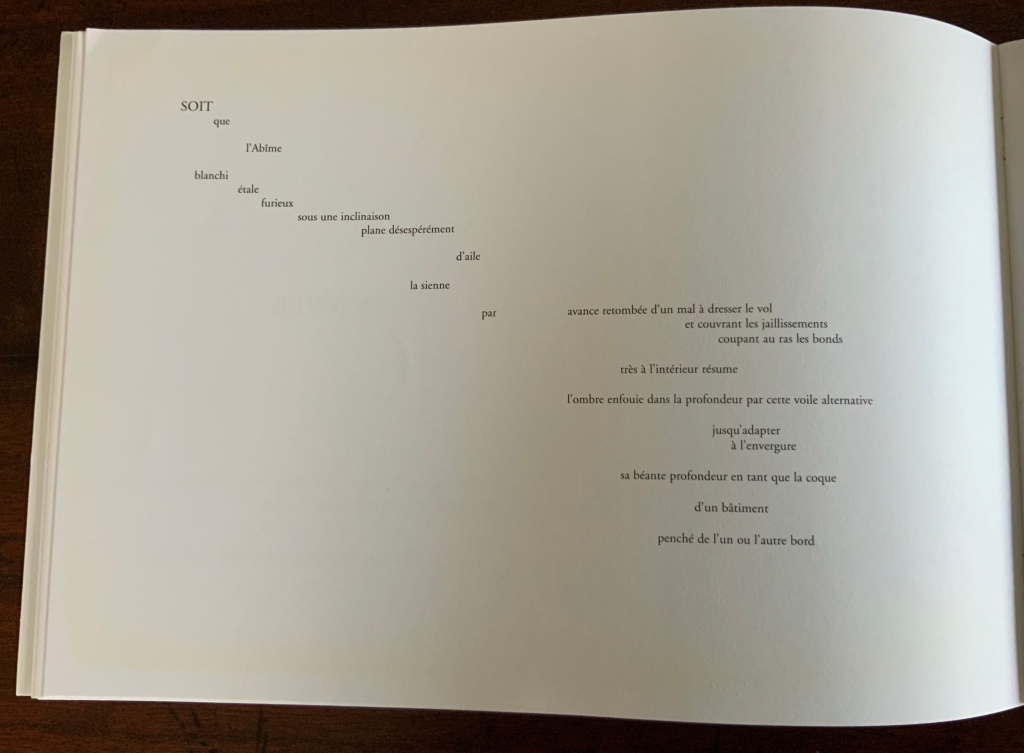
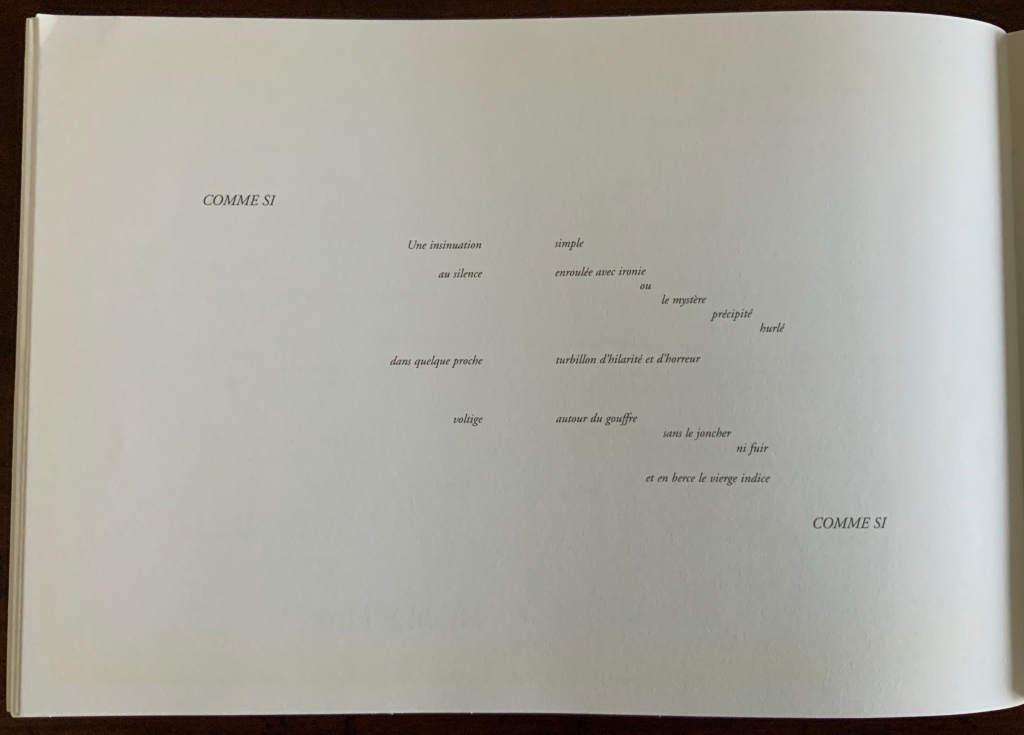
Edwards’ preface is proleptic — to use the word with which the overlording associate professor interrupted the teaching assistant’s nervous first lecture on how a poem’s opening line can encapsulate the working of the whole. (But nevermind the digression, though digression is another part of Edwards’ “more”). In transforming “Lecteur habile” [“practiced Reader”] into “Hannibal Lecter”, Edwards forecasts such transformations as “SOIT / que” [“Whether”] to “SO IT / came to pass”, “l’Abîme” [“the Abyss”] to “the Bistro” and “LE HASARD” [“CHANCE”] to “BIO-HAZARD”. After the preface, Edwards spreads his sails — so to speak. The French moves to the verso, the English to the recto. The double-page spreads of the 1914 edition of Un coup de Dés are nevertheless crammed into a single page to facilitate enjoyment of the pretext’s mistranslation.

But no, “proleptic” is not le mot juste (which juste goes to prove that the professor remains mal dit, if not maudit). Nothing in the side-by-side prefaces prepares the reader (or Hannibal Lecter) for Mallarmé’s “COMME SI …. COMME SI” becoming Edwards’ exactly mapped, appropriately italicized, all caps loan phrase “COMME SI … COMME ÇA“. And so it goes — linguistic, spatial, typographic, cultural antics piled atop each other.

Edwards’ madcapping his way to A Fluke must have been part of a global warming trend in pastiche. How else to explain Jim Clinefelter’s A Throw of the Snore Will Surge the Potatoes (1998), John Tranter’s “Desmond’s Coupé” (2006) and Rodney Graham’s Poème: Au Tatoueur (2011)? The trend had its beginning distant in time but close in proximity to Edwards.

In New South Wales Public Library in 1897, when that issue of Cosmopolis arrived, a cataloger-cum-poet/scholar named Christopher Brennan seized on it. Shortly after publishing his own XXI Poems: MDCCCXCIII-MDCCCXCVII: Towards the Source (1897), Brennan received several negative reviews of his Mallarmé-influenced poetry. Turning to Un coup de Dés for solace and a format with which to tear the critics to shreds, he performed his own coup in calligraphied manuscript where it remained undelivered until 1981, when it was published in facsimile by Hale & Iremonger (see below). In length alone, its title — Prose-Verse-Poster-Algebraic-Symbolico-Riddle Musicopoematographoscope — must have had some influence on Edwards’ subtitle. Or perhaps it was just a coincidence, a fluke.

A perceptive reading of Brennan, Edwards and Tranter has become available from Toby Fitch, courtesy of the Cordite Poetry Review. It is a dynamite work itself.

Further Reading

Jim Clinefelter“, Books On Books Collection, 17 July 2020. An American-English mis-translation.

Rodney Graham“, Books On Books Collection, 3 July 2020. Un coup de Dés as instructions to a tattoo artist.

Barnes, Katherine E. “With a smile barely wrinkling the surface: Christopher Brennan’s large Musicopoematographoscope and Mallarmé’s Un Coup de dés“, Dix-Neuf, Vol. 9, No.1 (2007), pp. 44-56. Accessed 25 November 2020.

Brennan, Christopher. XXI Poems: MDCCCXCIII-MDCCCXCVII: Towards the Source (Sydney: Angus & Robertson, 1897).

Edwards, Chris. People of Earth: Poems (Sydney: Vagabond Press, 2011). The mistranslation is printed without the “French pretext”. The briefest comparison provides a convincing argument for the artistic and comic genius of the 2005 version. People of the Earth itself does reveal more of Edwards’ poetic and philosophical grasp of the issues that preoccupied Mallarmé and the avant garde when it comes to language, glyphs, meaning and the technique of collage.

Fagan, Kate. “‘A Fluke? [N]ever!’: Reading Chris Edwards“, Journal for the Association for the Study of Australian Literature, Vol. 12, No. 1 (2012). Accessed 25 November 2020.

Fitch, Toby. 1 May 2019. “Aussi / Or: Un Coup de dés and Mistranslation in the Antipodes“. Cordite Poetry Review. Accessed 27 April 2022.

Tranter, John. “Desmond’s Coupé“, Jacket 29, April 2006. Accessed 1 July 2020. Another Australian spoof of Un coup de Dés.

Books On Books Collection – Claire Jeanine Satin

Alphabook (1998/9)

 Alphabook (1998/9)
Claire Jeanine Satin
Circular box containing four segments of post-bound pages. Diameter 356 x D51 mm. Limited variable edition of 11, this copy with a segment on the Cherokee syllabary and a Cherokee sign tile on the cover. Acquired from the artist, 15 December 2022. Photos: Books On Books Collection. Displayed with artist’s permission.  

From the artist’s description:

Alphabook is photo-etched and printed on 360 gm/m2 Fabriano Murillo with inks and metallic colors.   The sets of pages are grouped in four segments. Three consist of alphabetic notations, images, phrases, and poetry.   The fourth set consists of accompanying texts describing the alphabet or notations,  (in this case Cherokee).   The pages form circles when fully opened. A colophon page is included and signed at the end.   The circular containers were constructed and bound in Italian Ciralux cloth and topped with a water-jet cut tile designed by the artist.   The rim is gold stamped with the Latin phrase:   VERBA VOLENT, SCRIPTA MANENT.

This work has no externally visible title, only the Cherokee letter Ꮉ (for the sound “ma”) on the tile and that gold-stamped Latin phrase. Traditionally the proverb runs in the indicative — Verba volant, scripta manent (“Words fly, writing remains”) — but presumably to draw yet more attention to the solidity of the written word over the iffy ephemerality of the spoken word, the subjunctive volent (“Words may fly” or “If words fly”) comes into play. As the lid lifts, the work’s title Alphabook appears, indicating that, at its heart, this work of art is a book. The container’s circular shape, its inner segmentation and the post-bound segments may challenge the traditional notion of a book, but the segments’ text just as strongly asserts a bookish purpose, highlighting eleven prewriting and writing systems: Prehistoric, Hieroglyphs, Mayan, Hebrew, Arabic, Greek, Roman, Chinese, Tibetan, Cyrillic and Cherokee.

With their pages pivoting on their central posts, the segments can sometimes display wingspans, nudging forward an interpretation of Verba volent, scripta manent that a writing system’s shapes permanently out-soar sounds on the air.

Segment open to Chinese page on the left, Arabic page on the right.

Fully opened, the segments evoke the Phaistos Disc, resident in the Archaeological Museum of Heraklion on Crete. Dating sometime between 1850 B.C. and 1600 B.C, the disc remains undeciphered, hovers indeterminately among statuses of hieroglyph, syllabary and alphabet and is still subject to speculation about its source — Linear A or Linear B.

Phaistos disc, sides A and B after the 2014 renovation. Photos by C. Messier – Own work, CC BY-SA 4.0.

Drawing on pebble and cave art images from France and Spain created as long as 36,000 years ago, Alphabook reaches back further than the Phaistos Disc. The depicted shapes along the rim of the Prehistoric segment mark the millennia-long trail to the formation of any writing system, alphabetic or non-alphabetic.

Sequoya’s Cherokee syllabary is the youngest of the eleven marking and writing systems that Alphabook covers, a distinction that made this particular version of the limited variable edition attractive. In the Books On Books Collection, works of book art such as Gerald Lange’s The Neolithic Adventures of Taffi-Mai Metallu-Mai (1997), Cari Ferraro’s The First Writing (2004) and Helen Malone’s Alphabetic Codes (2005) among others address the origin period, but besides James Rumford’s children’s book Sequoyah (2004), no others address this remarkable single-handed creation of the Cherokee script.

Opportunities for book art inspired by newly invented alphabets and syllabaries or even by endangered languages abound. There is the Odùduwà alphabet (for the Yorùbá people) and ADLaM (for the Fulani language) as well as the syllabary that “comes with” its own artist: Frederic Bruly Bouabré and his syllabary for the Bété language (Ivory Coast). The Endangered Languages Project and Endangered Alphabets Project can both offer inspiration. In fact, the latter sparked Sam Winston’s One and Everything (2023), now part of the collection.

The Hebrew Alphabet Expressing the Celestial Constellations (2017)

The concept of the celestial alphabet is simple: the forms of the letters are supposedly derived from observation of configurations of stars in the heavens which can be ‘read’ as a form of sacred writing. These alphabets are visually recognizable by the use of nodal points to indicate the stars at the intersection of the bars or lines in their forms, the empty spots in the ink lines signalling the bright point of light in the dark sky. — Johanna Drucker, The Alphabetic Labyrinth, p. 125.

A volume in New York’s Morgan Library by Jacques Gaffarel (1601–1681), a French scholar and astrologer, provides inspiration and material for Satin’s artist’s book The Hebrew Alphabet Expressing the Celestial Constellations (2017). More precisely, two woodcuts from the 1650 English translation of Gaffarel’s Curiositez inouyes sur la sculpture talismanique des Persans, horoscope des Patriarches et lecture des estoiles (1629) are the source.

Unheard-of Curiosities : Concerning the Talismanical Sculpture of the Persians, the Horoscope of the Patriarkes, and the Reading of the Stars (1650)
Jacques Gaffarel

The Hebrew Alphabet Expressing the Celestial Constellations (2017)
Claire Jeanine Satin
Saddle stitched with fishline. Box: H277 x W225 mm. Book: H 240 x W165 x D42 mm. 16 pages. Unique edition. Acquired from the artist, 12 April 2023.
Photos: Books On Books Collection. Displayed with permission of the artist.

In addition to its astrological character, Gaffarel’s work sits in the traditions of gematria, the Kabbalah and alchemy, which Satin conjures up with gold and silver beads, and crystals. Among the earlier contributors to these traditions is Heinrich Cornelius Agrippa. Like his mentor Johannes Trithemius, Agrippa was a polymath, occultist and theologian as well as physician, legal scholar and soldier. The Latinized Hebrew letters and their corresponding characters in the celestial alphabet seen below come from Agrippa’s De occulta philosophia (1533), which is more legible than Gaffarel’s above.

Henrici Cornelii Agrippae ab Nettesheym à consiliis & archiuis inditiarii sacrae Caesareae maiestatis De occulta philosophia libri tres (1533)
Heinrich Cornelius Agrippa von Nettesheim

But there’s a much later inspirational source of esoterica at play elsewhere in the book and in the silver letter adhering to the black box that holds the book. The letter on the box is He, the fifth letter of the Hebrew alphabet, which according to Satin was chosen at random in homage to John Cage’s theory of chance and its role in music and creativity.

The rules printed on the acetate pages suggest a school composition book, an ordered contrast to Cage’s indeterminacy. Or perhaps they are recurring lines of musical staves, and the beads clamped to the fish line are meant to suggest a chaos of errant musical notation. The alphabetic order projected on the heavens in earlier centuries is belied by the disorder of chance projected in later centuries.

With the transparency of the pages, with gold on one side of them and silver on the other, and with two distinct “projections”, Satin leaves us in suspense or a suspenseful state of simultaneity.

Alphabet Cordenons paper book (2020)

Alphabet Cordenons paper book (2020)
Claire Jeanine Satin
One of a series of unique works, each created with Cordenons paper, a fine paper that has been manufactured in Italy since 1630. This book uses alphabet letters, glittery strips of ribbon, sequins, crystals, and monofilament to create precise and inventive designs on the cover and each page. In a lavender cloth bag. Measures 9 x 7 inches. 10 unnumbered pages. Acquired from The Kelmscott Bookshop, 8 February 2021. Photos of the work: Books On Books Collection. Displayed with permission of the artist.

In Alphabet Cordenons, as the title suggests, the elemental meets the material. The ancient Greeks called the letters of the alphabet stoicheia (“elements”). In a sense, the elemental yields to the material. Not every letter of the alphabet appears in Alphabet Cordenons, and those that do, appear out of sequence, upside down, sideways, in varied colors and types of paper appearing through their cut stencil shapes. These aspects of materiality draw attention to the paper itself, which comes from a mill established in Corden0ns, Italy in 1630 and is still produced there.

Also drawing attention to the paper are satin ribbon with graduated shifts of color, colored foil backing that lightens and darkens, and glittering beads threaded on multi-colored fish line. Each calls attention to the encaustic-like sheen that comes from the inclusion of mica in making Cordenons Stardream (285 gms) paper.

The finish’s indeterminacy under shifting light seems to find a mirror in the random order, selection and placement of the letters as well as the changing orientation of the ribbon.

Even more indeterminate is the fish line that flips about, curls within, and slips without the turning pages. But while materiality seems to outshine the elemental at every turn, the elemental reasserts itself in the peculiar orientation of the letters and the incompleteness of the alphabet.

Further Reading and Viewing

Abecedaries I (in progress)“. Books On Books Collection.

Lyn Davies“. 7 August 2022. Books On Books Collection. Reference and fine print.

Timothy Donaldson“. 1 February 2023. Books On Books Collection. Reference.

Cari Ferraro“. 1 February 2023. Books On Books Collection. Artist’s book.

Edmund Fry“. Books On Books Collection. (For more on the “begats” of the celestial alphabet, see this entry for the near-facsimile copy of Fry’s Pantographia.)

David J. Goldman“. Books On Books Collection. Reference. [In progress]

Rudyard Kipling and Chloë Cheese“. 15 February 2023. Books On Books Collection. Illustrated children’s book.

Abe Kuipers“. 15 February 2023. Books On Books Collection. Artist’s book.

Gerald Lange“. Books On Books Collection. Artist’s . [In progress]

Helen Malone“. 23 July 2020. Books On Books Collection. Artist’s book.

James Rumford. 21 November 2022. Books On Books Collection. Illustrated children’s book.

Tiphaine Samoyault“. Books On Books Collection. Illustrated children’s book. [In progress]

Ben Shahn“. 20 July 2022. Books On Books Collection. Artist’s book.

Tommy Thompson“. 21 August 2022. Books On Books Collection. Reference.

Sam Winston. Illustrated children’s book. [In progress]

Clodd, Edward. 1913. The Story of the Alphabet. London: Hodder and Stoughton. 1913. Superseded by several later works, but is freely available online with line illustrations and some black and white photos.

Diringer, David, and Reinhold Regensburger. 1968. The alphabet: a key to the history of mankind. London: Hutchinson. A standard, beginning to be challenged by late 20th and early 21st century archaeological findings and palaeographical studies.

Drucker, Johanna. 1999. The alphabetic labyrinth: the letters in history and imagination. New York, N.Y.: Thames and Hudson.

Drucker Johanna. 2022. Inventing the Alphabet : The Origins of Letters from Antiquity to the Present. Chicago: University of Chicago Press.

Dukes, Hunter. 10 October 2023. “Pantographia: A Specimen Book of All the Alphabets Known on Earth (1799)“. Public Domain Review.

Düsterhöft, Jan. 2022. “Foreword”. In Fry, Edmund. 1799. Pantographia, Containing accurate Copies of all the known Alphabets in the World. Turin, Ialy: Black Letter Press.

Ege, Otto. 1921/1998. The Story of the Alphabet, Its Evolution and Development… Embellished Typographically with Printer’s Flowers Arranged by Richard J. Hoffman. Van Nuys, CA: Richard J. Hoffman. A miniature. The type ornaments chosen by Hoffman are arranged chronologically by designer (Garamond, Granjon, Rogers) and printed in color.

Firmage, Richard A. 2001. The alphabet. London: Bloomsbury.

Fischer, Steven Roger. 2008. A history of writing. London: Reaktion Books.

Gannon, Megan. 10 April 2019. “Cave Markings Tell of Cherokee Life in the Years Before Indian Removal“. Smithsonian Magazine. Accessed 14 July 2023.

Goldman, David. 1994. A is for ox: the story of the alphabet. New York: Silver Moon Press. Children’s book.

Jackson, Donald. 1997. The story of writing. Monmouth, England: Calligraphy Centre.

Pflughaupt, Laurent. 2008. Letter by letter: an alphabetical miscellany. New York: Princeton Architectural Press.

Robb, Don, and Anne Smith. 2010. Ox, house, stick: the history of our alphabet. Watertown, MA: Charlesbridge. Children’s book.

Robinson, Andrew. 1995. The story of writing. London: Thames and Hudson.

Rosen, Michael. 2014. Alphabetical: how every letter tells a story. London: John Murray.

Sacks, David. 2003. Language visible unraveling the mystery of the alphabet from A to Z. New York: Broadway Books.

Samoyault, Tiphaine. 1996/1998 trans. Alphabetical order: how the alphabet began. New York: Viking. Children’s book.

Satin, Claire Jeanine. 1997. Claire Jeanine Satin : Artist Books: Verba Volent : Scripta Manent. New York: HarperCollins Exhibition Space.

Thompson, Tommy. 1952. The ABC of our alphabet. London: Studio Publications. Not a fine press publication, but its layout, illustrations and use of two colors bear comparison with the Davies book. It too is out of print and unfortunately more rare.

Vermeer, Beth. May 2016. “Claire Jeanine Satin and her research on Henry James”, Design of the Universe. Accessed 17 February 2020.

Books On Books Collection – Marian Macken

Ise Jingū: Beginning Repeated (2011)

Ise Jingū: Beginning Repeated (2011)
Marian Macken
Black Cotona bookcloth portfolio, with embossed base; 61 sheets of handmade washi paper, made from kozo, with watermark images. H245 x W330 x D80 mm. Papermaking undertaken at Primrose Paper Arts, Sydney, with assistance from Jill Elias. Unique. Acquired from the artist, 5 February 2021.
Photos of the work: Books On Books Collection. Displayed with permission of the artist.

Ise Jingū is a Shinto shrine complex in the Mie Prefecture, Japan, consisting of the Kōtai Kaijijingū, or Naikū (Inner Shrine), and the Toyouke Kaijingū, or Gekū (Outer Shrine). “Once every 20 years, since the reign of Emperor Tenmu in the seventh century, every fence and building is completely rebuilt on an identical adjoining site, a practice of transposition known as shikinen-zōkan. While empty and awaiting the next iteration of building, the unused site or kodenchi sits silently, covered with an expanse of pebbles” (Binding Space, p. 101). For Macken, this ritualistic rebuilding poses architecture as performative process rather than as inert object; it “manifests the replication of a beginning, of a process” (“Reading time”, p. 100).

What better suited phenomenon to be captured with book art?

Referring to the shikinen-zōkan process, Ise Jingū: Beginning Repeated consists of 61 loose sheets with a watermarked image within each, the number reflecting the 61 iterations of the shrine up until the making of Ise Jingū: Beginning Repeated. The watermark is a perspective image based on Yoshio Watanabe’s photograph of the East Treasure House of the Inner Shrine, taken in 1953 on the occasion of the 59th rebuilding. The contrast of the reduction of a photo to a drawing with the subtle embodiment of that image in kozo entices reflection on the phenomenon of representation.

By shifting the image’s placement on every other sheet to mirror its placement on the preceding one, Macken makes the reader’s page-turning replicate the process of shikinen-zōkan. As one sheet yields to the next, the differences between them, arising from the washi papermaking process, reflect the subtle variations within similarity arising in the shrine’s transposition from one site to the other. When the last sheet is removed from the portfolio, the position of the temple supports are revealed.

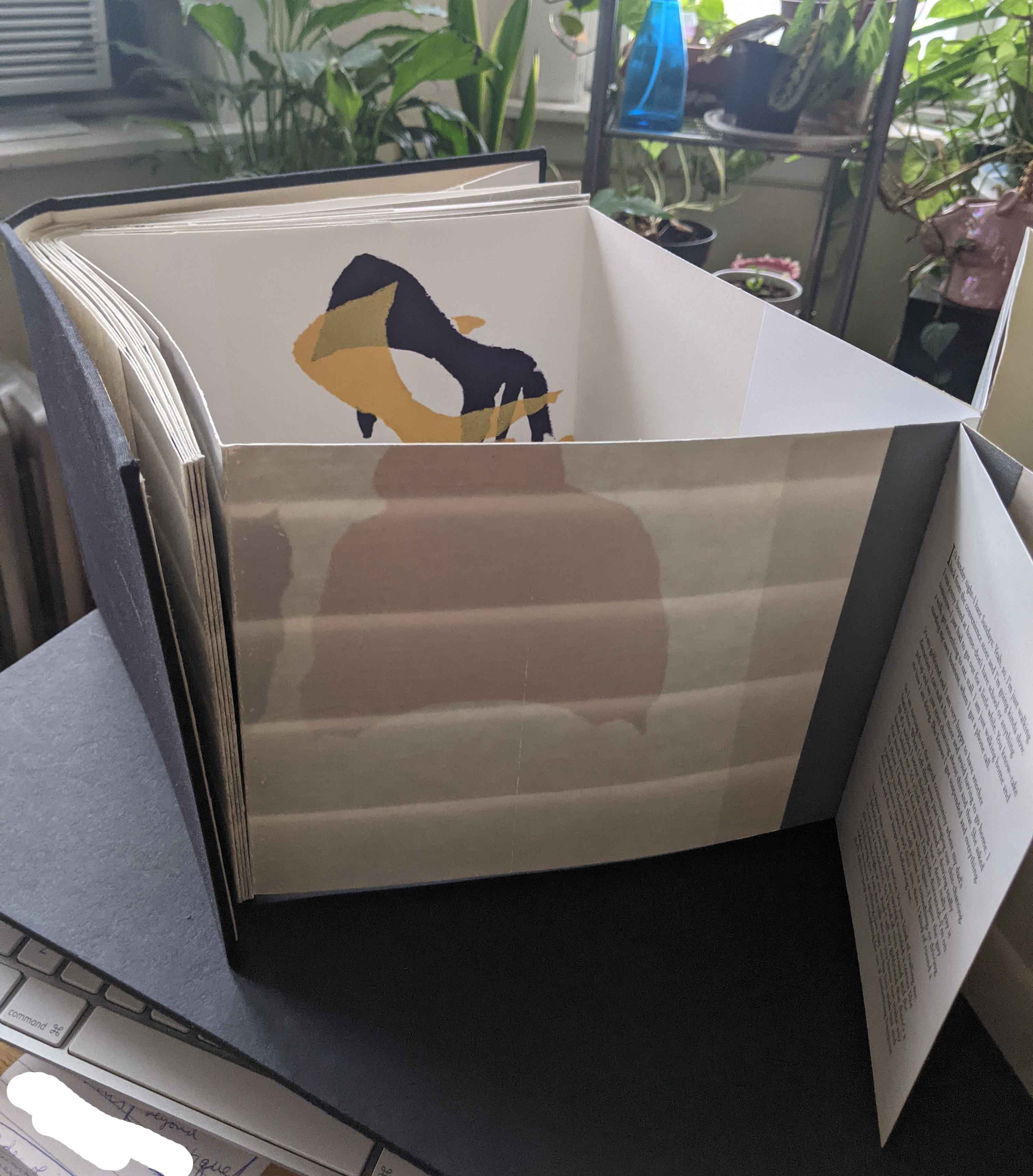
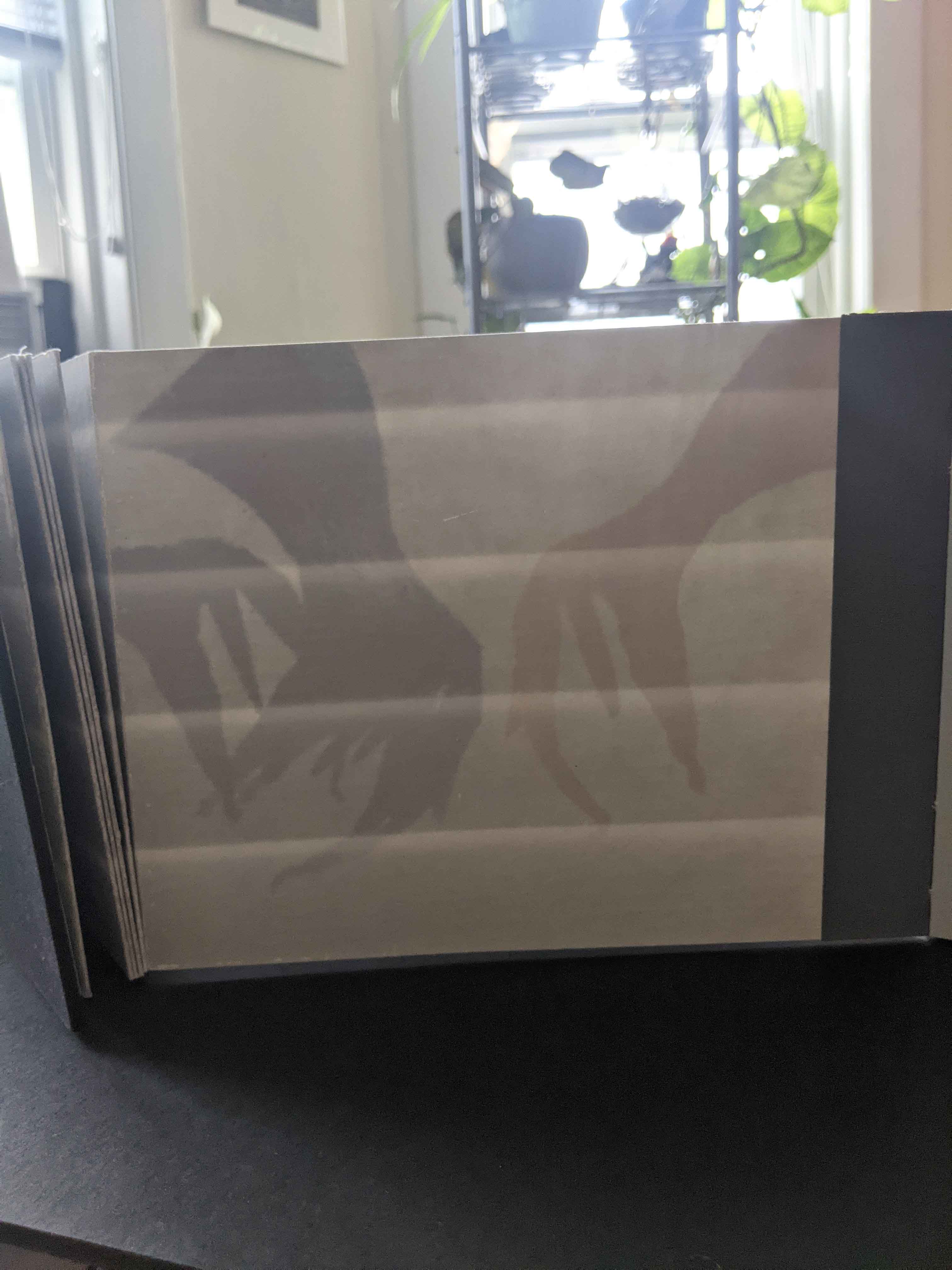
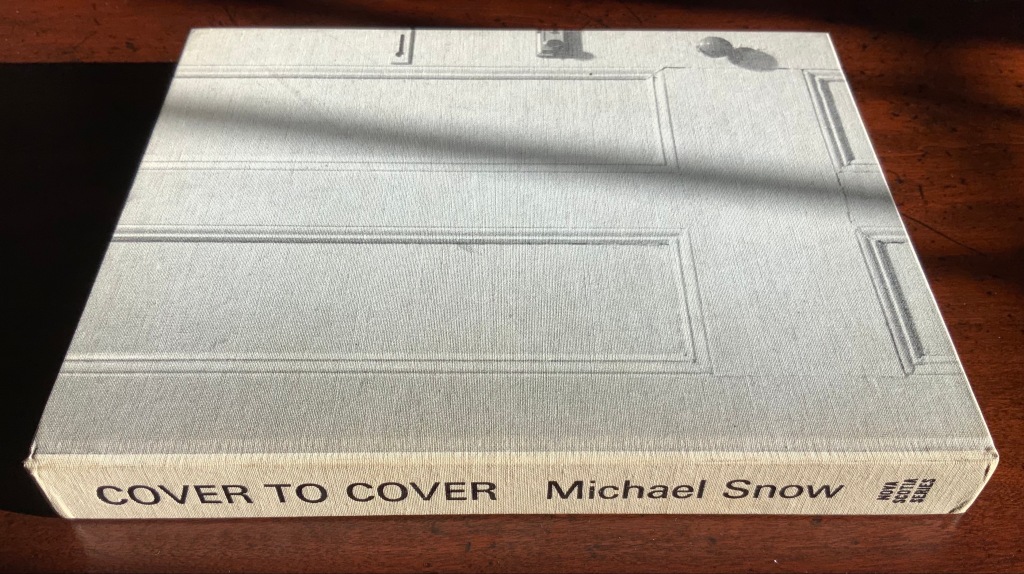
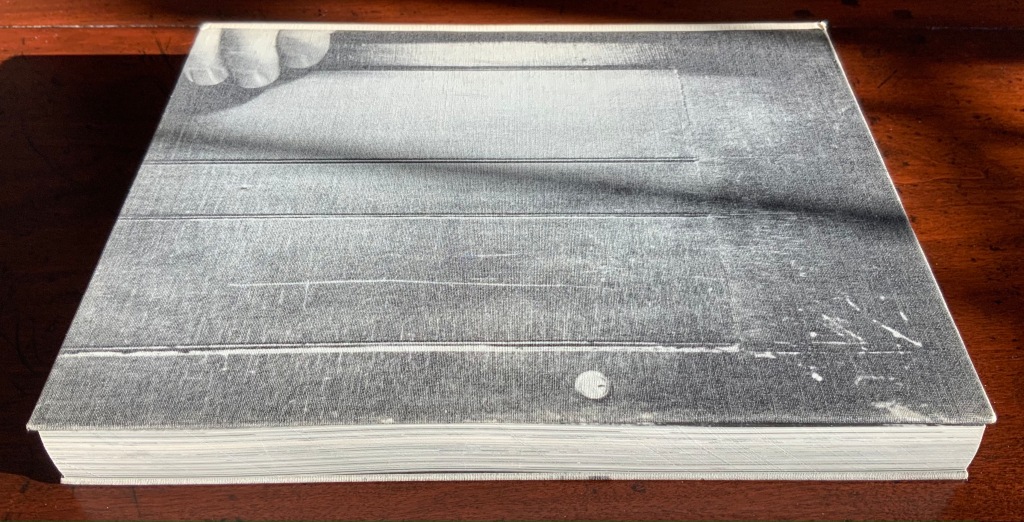
Macken’s book Binding Space: The Book as Spatial Practice offers further insight into Ise Jingū: Beginning Repeated, but more than that, it provides penetrating discussion of various forms of book art and specific works such as Olafur Eliasson’s Your House, Michael Snow’s Cover to Cover and Johann Hybschmann’s Book of Space. Although the book’s principal argument is why and how the artist book can serve as an important tool for design, documentation and critique of architecture, Macken’s perceptive descriptions show how to observe materiality and its functioning and understand how they contribute to the making of art. Reading Macken’s book will sharpen the ability of any reader or viewer to appreciate book art.

Exhibition: “The Book as Site”, Research Gallery, Sydney College of the Arts, University of Sydney, Australia, 2012. Photos: Joshua Morris. Displayed with permission of the artist.

Further Reading

Architecture“, Bookmarking Book Art, 12 November 2018.

Fred Siegenthaler“, Books On Books Collection, 10 January 2021. For more on “watermark art”.

Küng, Moritz, and John McDowall. 2022. “Of Artists’ Books and Architecture“. In Bodman, Sarah (ed.) 2022. Artist’s Book Yearbook. 2022-2023. Bristol: Impact Press at the Centre for Print Research, University of the West of England.

Macken, Marian. 2018. Binding Space: The Book as Spatial Practice. London and New York: Routledge.

Macken, Marian. 2015. “Reading time: the book as alternative architectural practice“. Cowley, Des, Robert Heather, and Anna Welch. Creating and collecting artists’ books in Australia. Special issue of The LaTrobe Journal.

Pallasmaa, Juhani. 2019. The eyes of the skin: architecture and the senses. Chichester: Wiley. Another whetstone for sharpening the ability to appreciate book art.

Tange, Kenzō, Noboru Kawazoe, Yoshio Watanabe, and Yusaku Kamekura. 1965. Ise. Prototype of Japanese architecture. Kenzo Tange, Noboru Kawazoe. Photographs by Yoshio Watanabe. Layout and book design by Yusaku Kamekura. Cambridge, Mass: MIT Press.

Books On Books Collection – Willow Legge

An African Folktale (1979)

An African Folktale (1979)
Willow Legge
Cloth-covered case. H405 x W308 mm. Nine unbound folios. H380 x W 285 mm. Acquired from Upstate Treasures, 4 March 2022.
Photos: Books On Books Collection.

The Flea (1980)

The Flea (1980, 2nd edition)
Willow Legge
Sewn pamphlet, J. Green mould-made paper; dark brown card cover with one-eighth fold for end leaves. H300 x W200 mm cover; H285 x W190 mm, 8 pages. Blind-embossed intaglio design printed from carved linoleum in combination with a reversed photo-engraving. Text printed letter-press in 14 pt Baskerville. Acquired from Ron King Studio, 2 February 2021.

The Gnat and the Lion (1982)

The Gnat and the Lion (1982)
Willow Legge
Sewn pamphlet, 300 gsm Somerset rag-made paper; gold brown card with two-thirds fold for end leaves. H290 x W203 mm cover; H290 x W190 mm, 8 pages. Two blind-intaglio designs carved from lino. Printed letter-press in 14 pt Optima. Acquired from Ron King Studio, 2 February 2021. Photos: Books On Books Collection.

Further Reading

Willow Legge“, Society of Portrait Sculptors, n.d. Accessed 4 February 2021.

Courtney, Cathy. 1996. The Looking Book: A Pocket History of Circle Press 1967-96. London: Circle Press.

Dayrell, Elphinstone. 1910. Folk Stories from Southern Nigeria, West Africa. London: Longman, Green.

Hancock, Nicola. “A studio interview with Ron King and Willow Legge“, Artist Interview, Chichester Art Trail Artists, 2 May 2018. Accessed 4 February 2021.

Radin, Paul, editor. 1952. Reprinted 1964. African Folktales and Sculpture. New York: Bollingen Foundation; distributed by Pantheon Books. page 41.

Books On Books Collection – Nerma Prnjavorac Cridge

Sarajevska Abeceda (2019)

Sarajevska Abeceda (2019)
Nerma Prnjavorac Cridge
Paperback coloring book. H217 x W215 mm, 34 pages. Acquired from Amazon, 3 January 2021. Photos: Books On Books Collection.

Сapajeвск Aзбукa (2020)

Сapajeвск Aзбукa (2020)
Нермa Прњaворaџ Криџ
Paperback coloring book. H217 x W215 mm, 36 pages. Acquired from Amazon, 6 January 2021. Photos: Books On Books Collection.

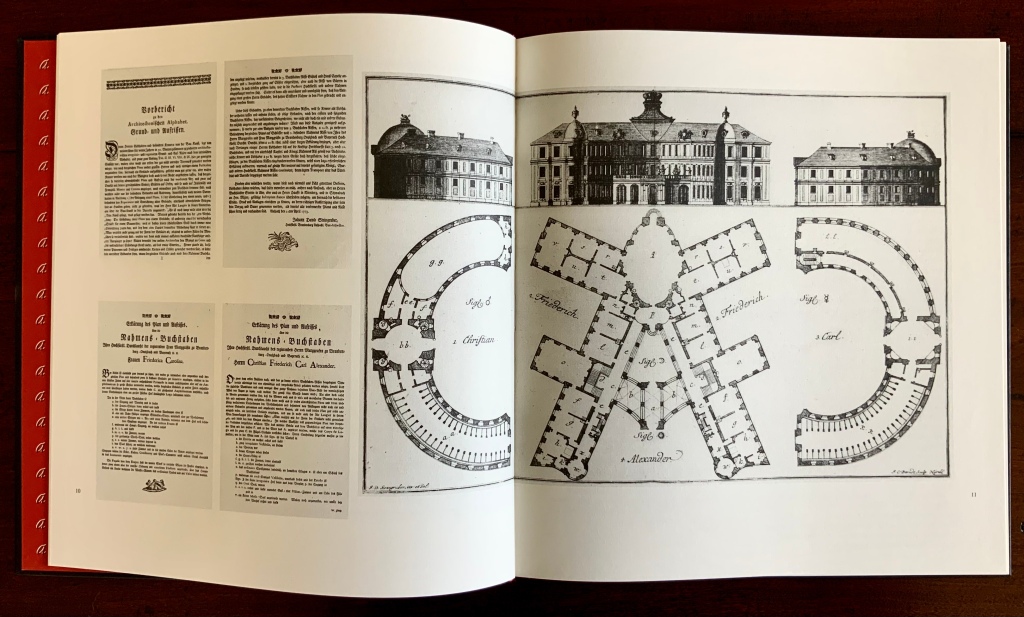
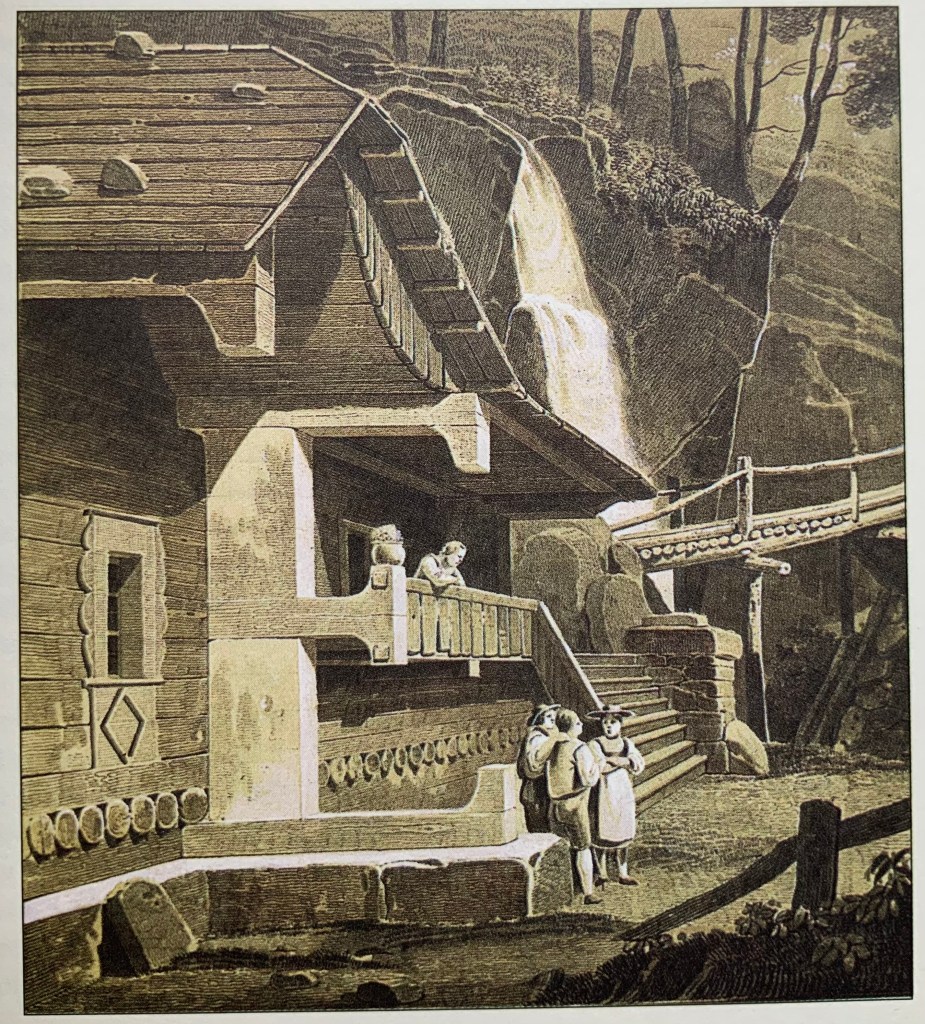
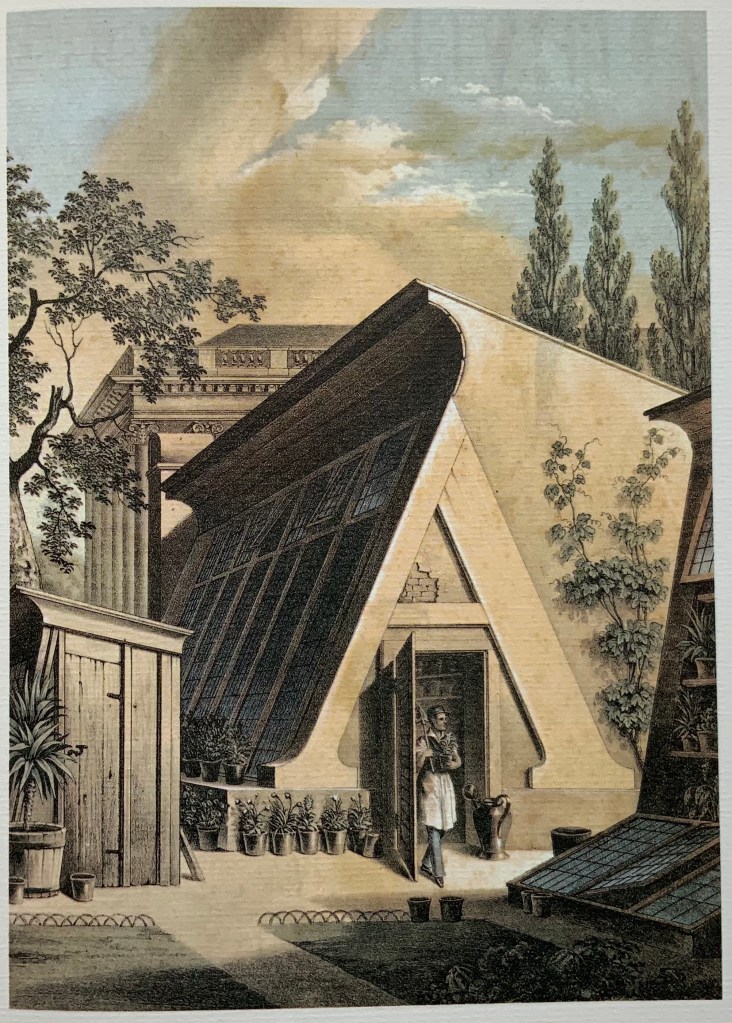
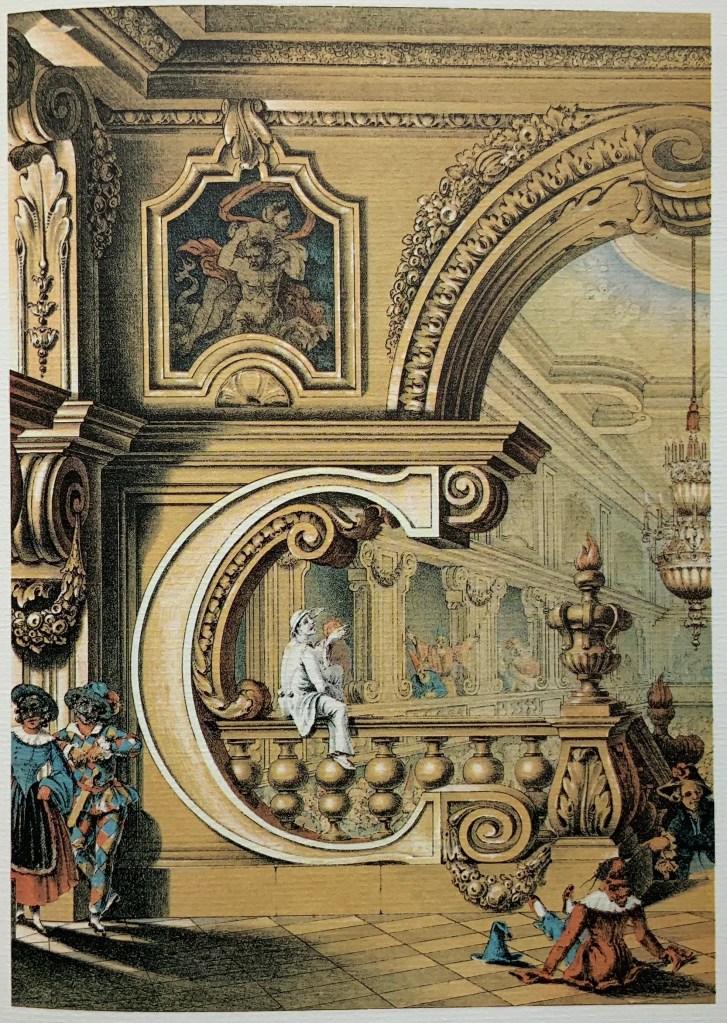
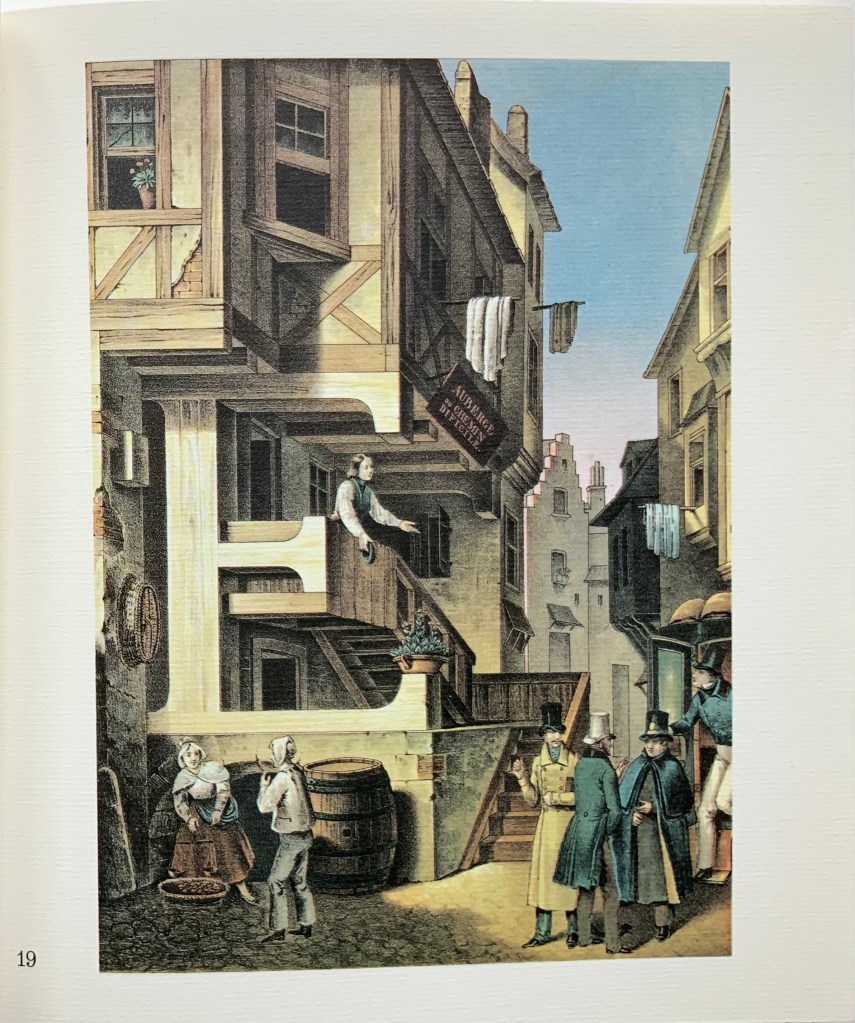
These two coloring books do not integrate letters and buildings as Johann David Steingruber’s Architectural Alphabet does, but they speak to the multilingual theme recurrent in book art and the abecedaries in the Books On Books Collection (see Further Reading). In this case, the artist uses the two alphabets and the besieged city’s architecture as a memorial to her father, who was wounded in the siege.

The books also act as an entry point to Cridge’s installation art, which engages with what Ian Wallace has called “the literature of images”. Two particular installations — both curated by Cambridge’s Art Language Location (ALL) — serve to demonstrate the affinity of her art with themes in the Books On Books Collection: comm(o)nism (2018) and Antonym/Synonym (2019).

Further Reading

Abecedaries I (in progress), Books On Books Collection, 31 March 2020.

Architecture“, Books On Books Collection, 12 November 2018.

Cridge, Nerma Prnjavorac. 2017. Drawing the unbuildable: Seriality and reproduction in architecture. London: Routledge, Taylor & Francis Group. See also “Antoine Lefebvre Éditions“, Books On Books Collection, 28 September 2020, for a work of book art related to the “unbuildable” Tatlin Monument.

Books On Books Collection – Roberto de Vicq de Cumptich

Bembo’s Zoo: An Animal ABC Book (2000)

Bembo’s Zoo: An Animal ABC Book (2000)
Roberto de Vicq de Cumptich
Hardback. H222 x W340 x D1.0 mm, 32 pages.

Each animal is drawn using the Roman letters of the Bembo font family, based on a letter cut by Francesco Griffo (1450-1518) for the Venetian printer for Aldus Manutius (1450-1515) and named after the prolific Renaissance scholar Pietro Bembo (1470-1547). Stanley Morison (1889-1967) revived the font while at the Monotype Corporation.

For the Books On Books Collection, Bembo’s Zoo is a light-hearted reminder of the abecedaries and typographic themes of more serious works.

Further Reading

Abecedaries ( (in progress), Books On Books Collection, 31 March 2020.

Aldus Manutius, 6 February 1515 – 6 February 2015“, Bookmarking Book Art, 8 February 2015.

Heavenly Monkey“, Books On Books Collection, 23 November 2020. For a bio-bibliography of Francesco Griffo.

More Manutius in Manchester and More to Come“, Bookmarking Book Art, 1 June 2015.

Books On Books Collection – Masoumeh Mohtadi

“I AM SEEKING TO UNEARTH A SOLUTION BEYOND THE CONVENTIONAL SYSTEM OF LANGUAGE FOR MAKING CONNECTIONS.” Masoumeh Mohtadi

Blindness (2020)

Blindness (2020)
Masoumeh Mohtadi
Altered paperback, Persian/Farsi translation of Blindness by José Saramago. H210 x W145 x D20 mm, ۳۱۸ (318) pages. Unique. Acquired from Bavan Gallery, 9 January 2021.

As would be expected, the binding of this Persian trade paperback is on the right, but its front cover and copyright page promise the unexpected. Excising lines of text from every page in the book, Mohtadi then physically reweaves Saramago’s gripping tale of a pandemic of sudden blindness into illegibility, varied patterns and heightened tactility.

The flimsiness of the pages slows their turning. As does their frequent catching at one another as they turn. In the slow turning, different woven patterns appear — some suddenly, some gradually. Some patterns bring to mind the streets and cityscape the novel’s characters can no longer see. Some, the hospital warrens the quarantined inhabit. Some, the tradition of carpet weaving.

The excised and woven pages inflate the book as if it had been read and re-read. Closed, it compresses in the hand, feels airy and weighty at the same time; opened, it pricks at the fingers, casts shadow and light and drags the eyes to surface and depth simultaneously.

Mohtadi’s cutting, weaving, pasting and patterning appropriates Saramago’s novel in a thoroughly integral way. And for a Western reader, the Persian translation and script introduce another layer between text and mind that challenges perception and enhances appreciation of this work of book art. She succeeds in connecting.

Blindness (2017)

Blindness (2017)
Masoumeh Mohtadi
Artist’s book. H400 x 300 x 36 mm. Unique. Purchased from NY Center for Book Arts, 15 March 2021.
Photos: Books On Books Collection.

This larger format work conveys the artist’s reaction to Saramago’s Blindness in a completely different manner. Text is absent, replaced by tangible excisions that vary from leaf to leaf, but overlapping as they do, the excisions have a visual effect.

Further Reading

A Reading Room with No Books: A Discussion on Artists’ Books”, Center for Book Arts, New York, NY. 28 January 2021. Accessed 1 February 2021. Mohtadi begins speaking about her works at the 13’49” mark in the video.

Guy Laramée”, Books On Books Collection, 18 September 2019. For Laramée’s response to Saramago’s A Caverna.

Francesca Capone”, Books On Books Collection, 5 November 2020. For Capone’s exploration of integrating weaving and language.