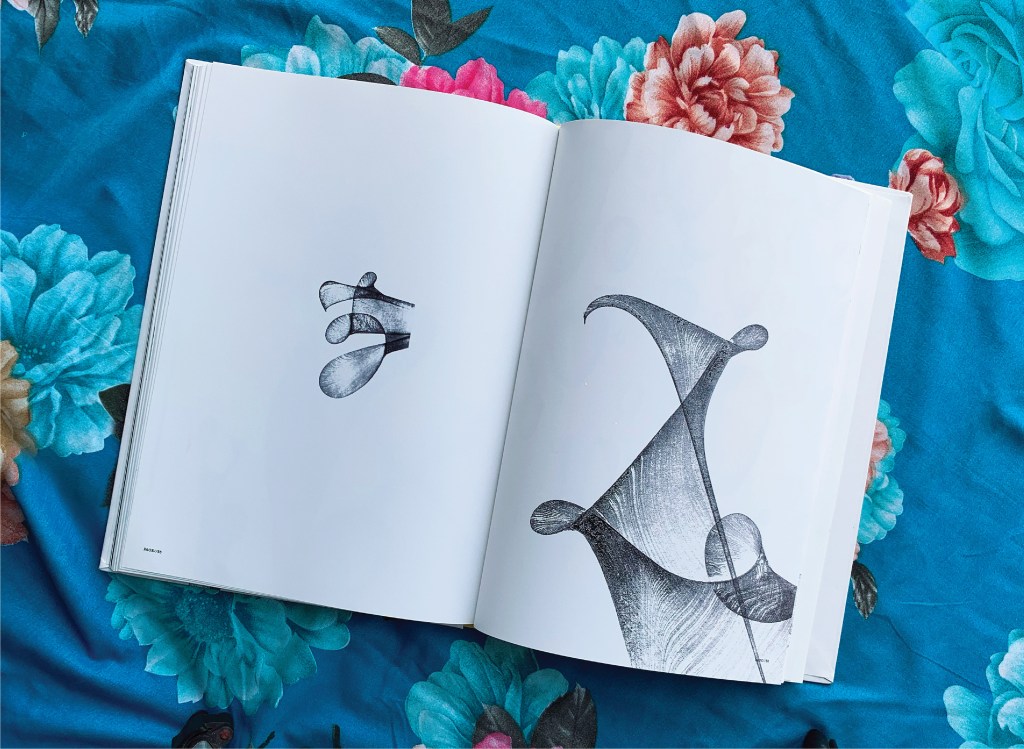
The Voice of the Yarn (2022) Pramod Chavan Casebound, glued, illustrated paper over boards, plain doublures. H325 x W235 mm. 66 pages. Acquired from the Artist, 20 May 2023. Photos: Courtesy of the artist.
The technique of painting or printing by pulling a soaked string from a folded sheet of paper will be familiar to Western kindergarten and elementary school teachers. In India, the technique has been raised to an art form. The tradition of painting with rope, string or thread had its champion in the late B.K.S. Varma. Joining that tradition to the tradition of alphabet-inspired art is a new champion: Pramod Chavan.
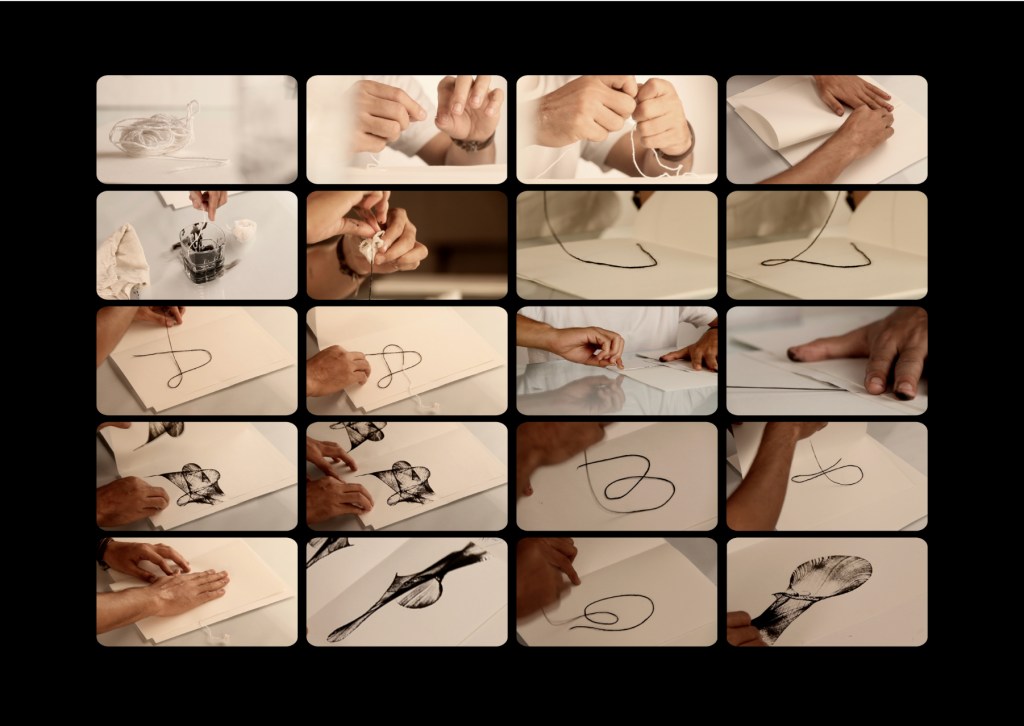
Chavan calls his art “thread typography”. These process photos showing his manipulation of inked thread between folds of paper suggest that “thread calligraphy” might be just as apt. Whichever term, the results achieved — without direct sight of ink, tool and surface — are astonishing. It evokes the Punch cartoon of the kingfisher sitting on a branch and calculating in its speech bubble Snell’s law for entering the water to catch the fish swimming below the surface. Pramod Chavan must have a similar speech bubble filled with calculations for Bézier curves.
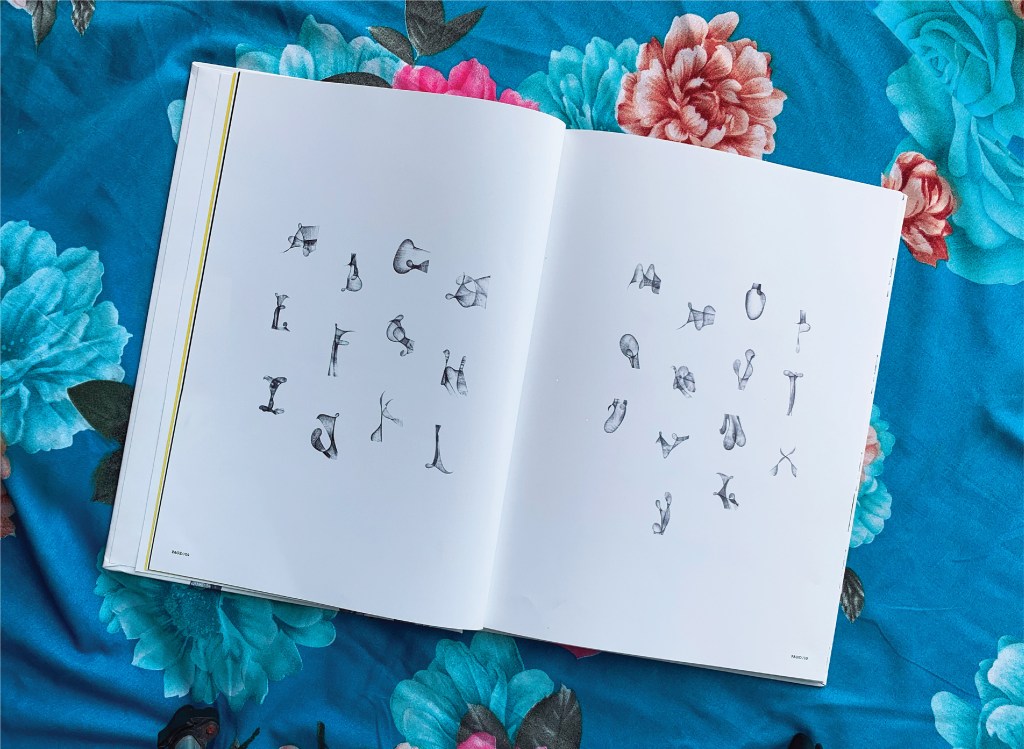
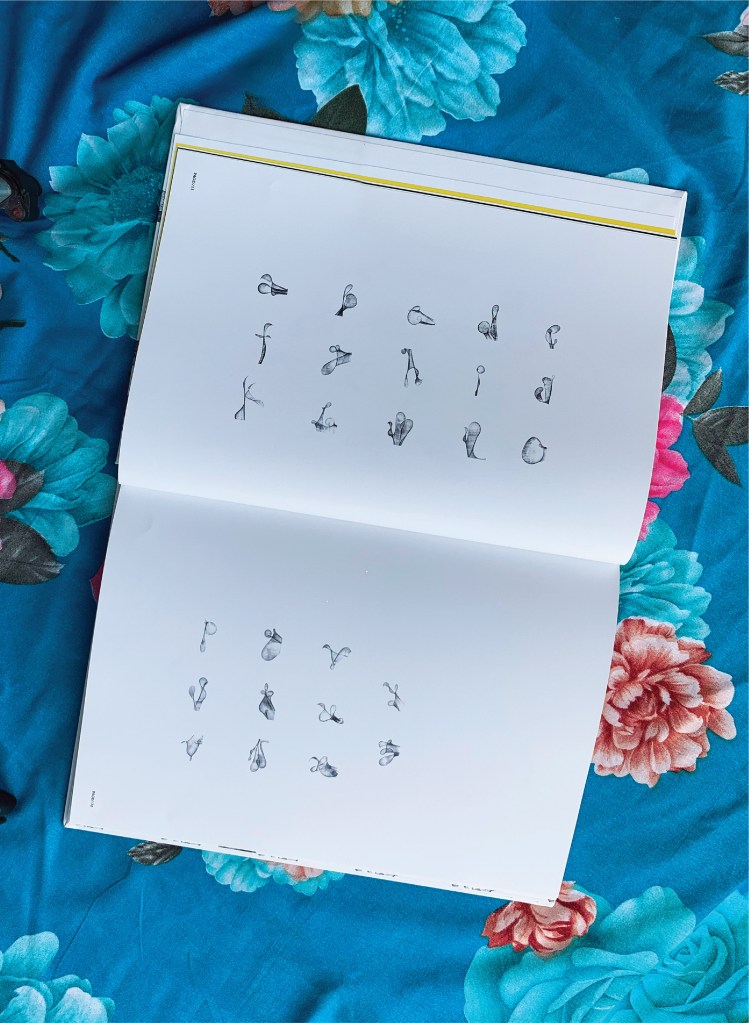
Between A and Z, The Voice of the Yarn lays out both the upper- and lower-case letters individually and the alphabet entire on double-page spreads like that above and below. The role of the fold in this technique is echoed in similar but very different ways by Jim Clinefelter’s A Rohrshach Alphabet (1999) and Étienne Pressager’s Mis-en-pli (2016).
The choice of background for photographing the double-page spreads makes a nod and smile to the usual floral images that arise when the technique is introduced for school — or after-school — art projects. Chavan’s thread typography springs from simple elements and opens into complex images — very much in the spirit of the alphabet itself.
“Carol DuBosch“. 25 February 2023. Books On Books Collection. If DuBosch recapitulates her Alphabet of Calligraphic Tricks (2014), perhaps she can persuade Chavan to contribute an ampersand!
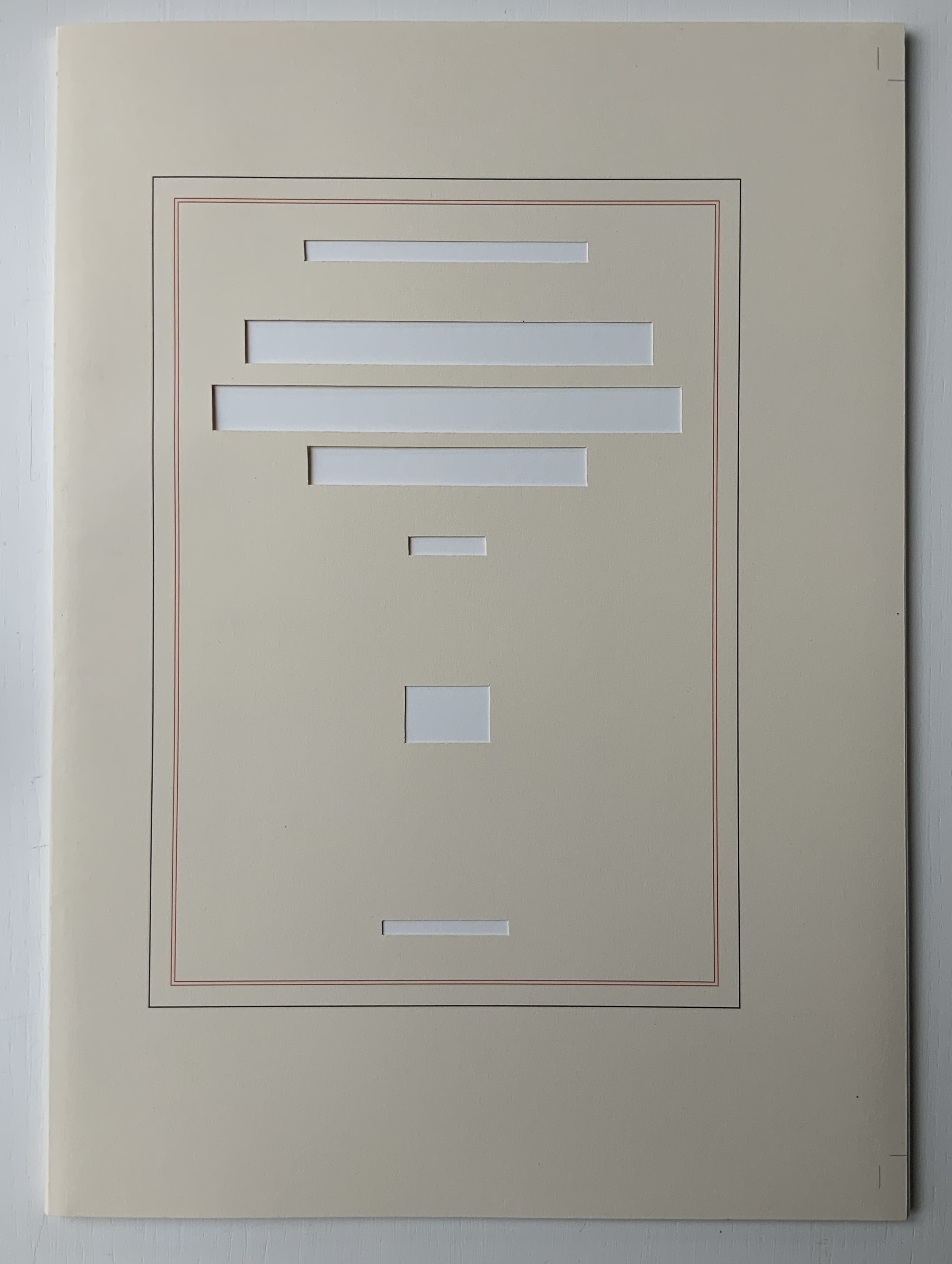
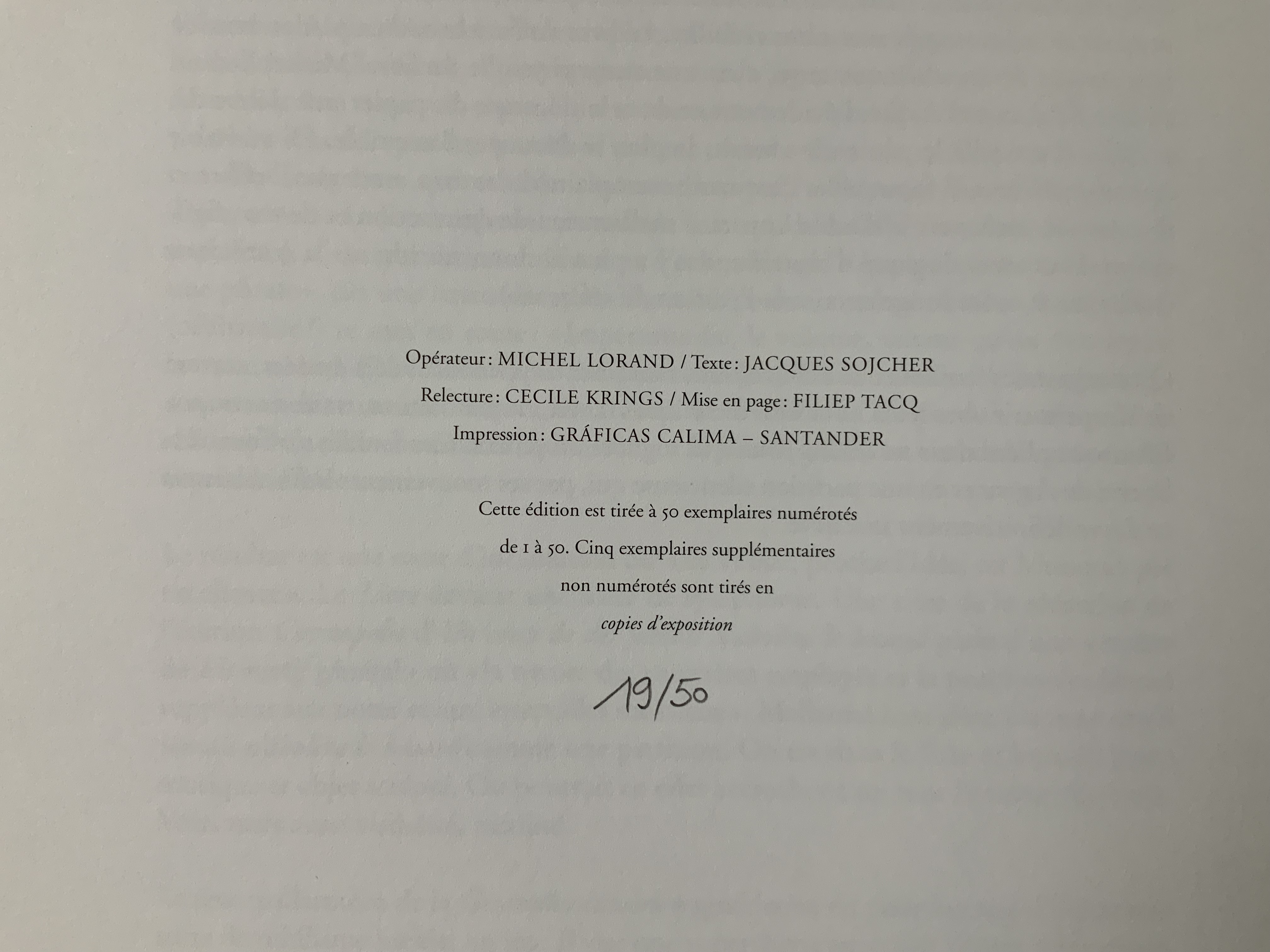
Après Un Coup de Dés (2015) Michel Lorand Cover and gatherings, untrimmed and unbound, in glassine envelope. Cover: H362 x W260; gatherings: H362 x W256 mm; 32 unnumbered pages. Edition of 50, of which this is #19. Acquired from the artist, 22 October 2021. Photos: Books On Books Collection. Displayed with the artist’s permission.
Since the 1960s when Ernest Fraenkel, Mario Diacono and Marcel Broodthaers blotted out the text of Mallarmé’s poem Un Coup de Dés Jamais N’Abolira le Hasard (1897) to create their works of homage, numerous others have expanded on the technique: substituting images of sonograms (Sammy Engramer, 2009) or algorithmically generated abstractions (Eric Zboya, 2018, and Benjamin Lord, 2019), or excising the text (Michalis Pichler, 2008, and Cerith Wyn Evans, 2008) or algorithmically erasing it (Jérémie Bennequin, 2009) — just to name a few.
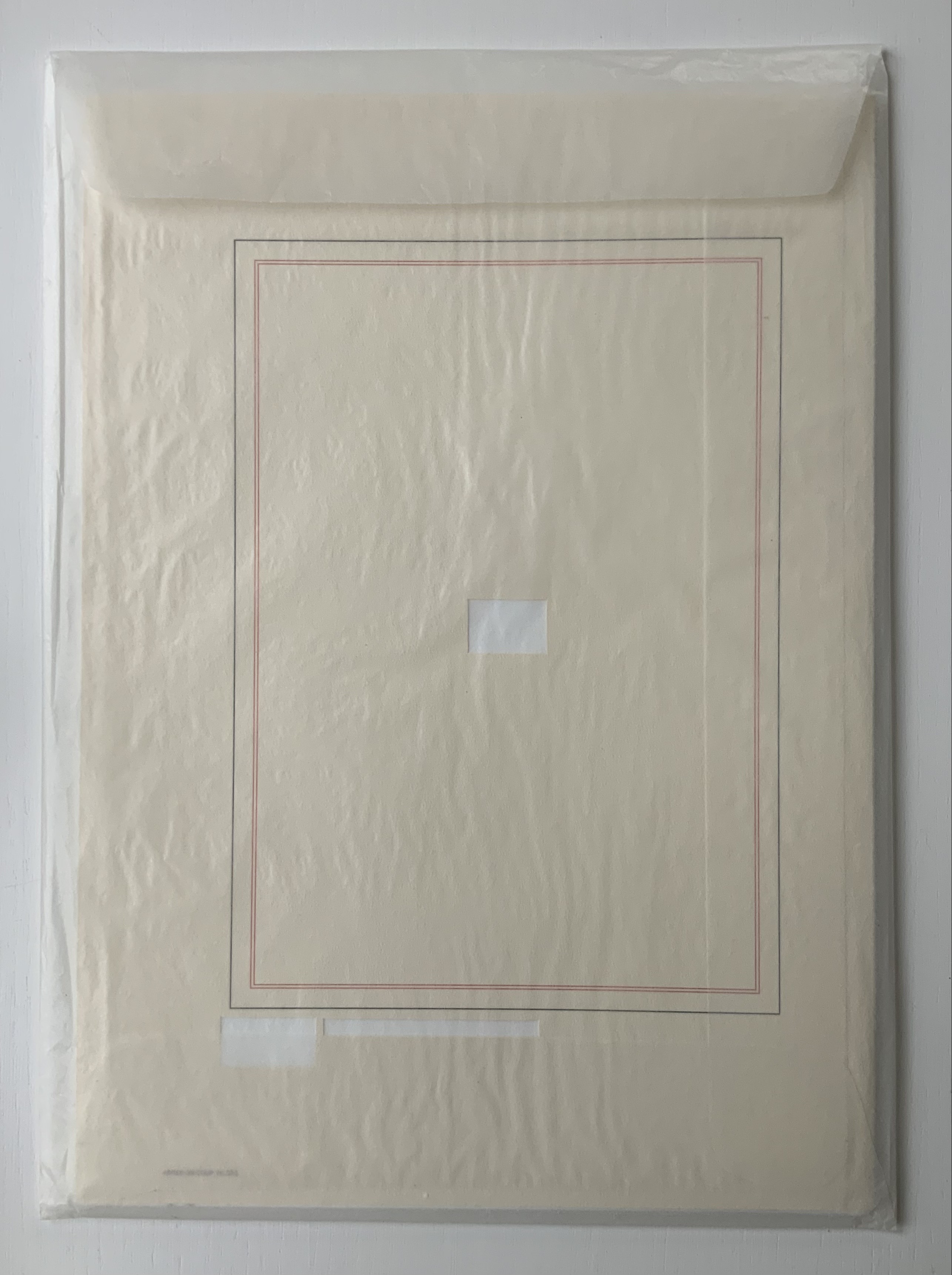
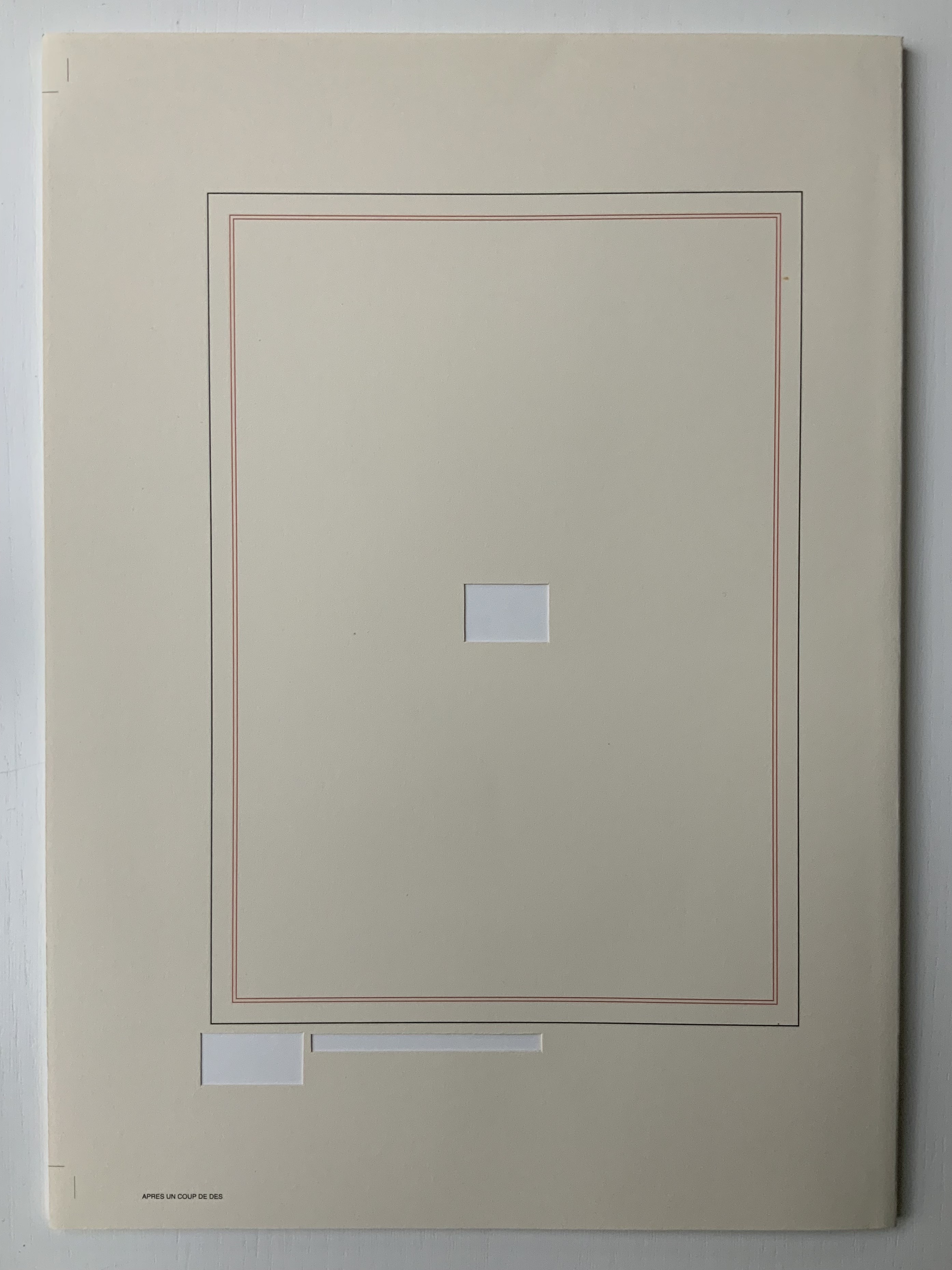
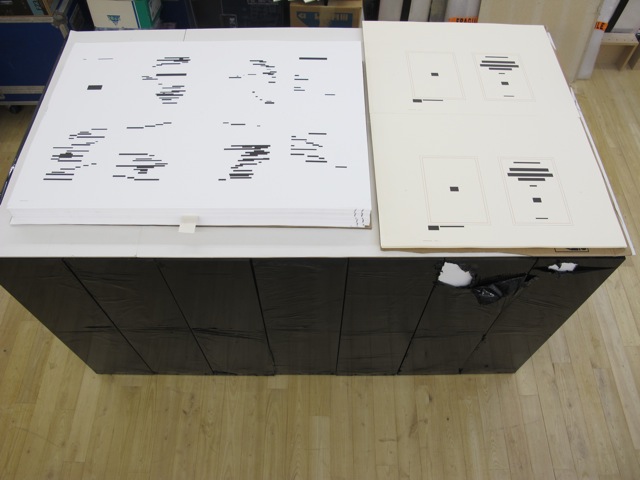
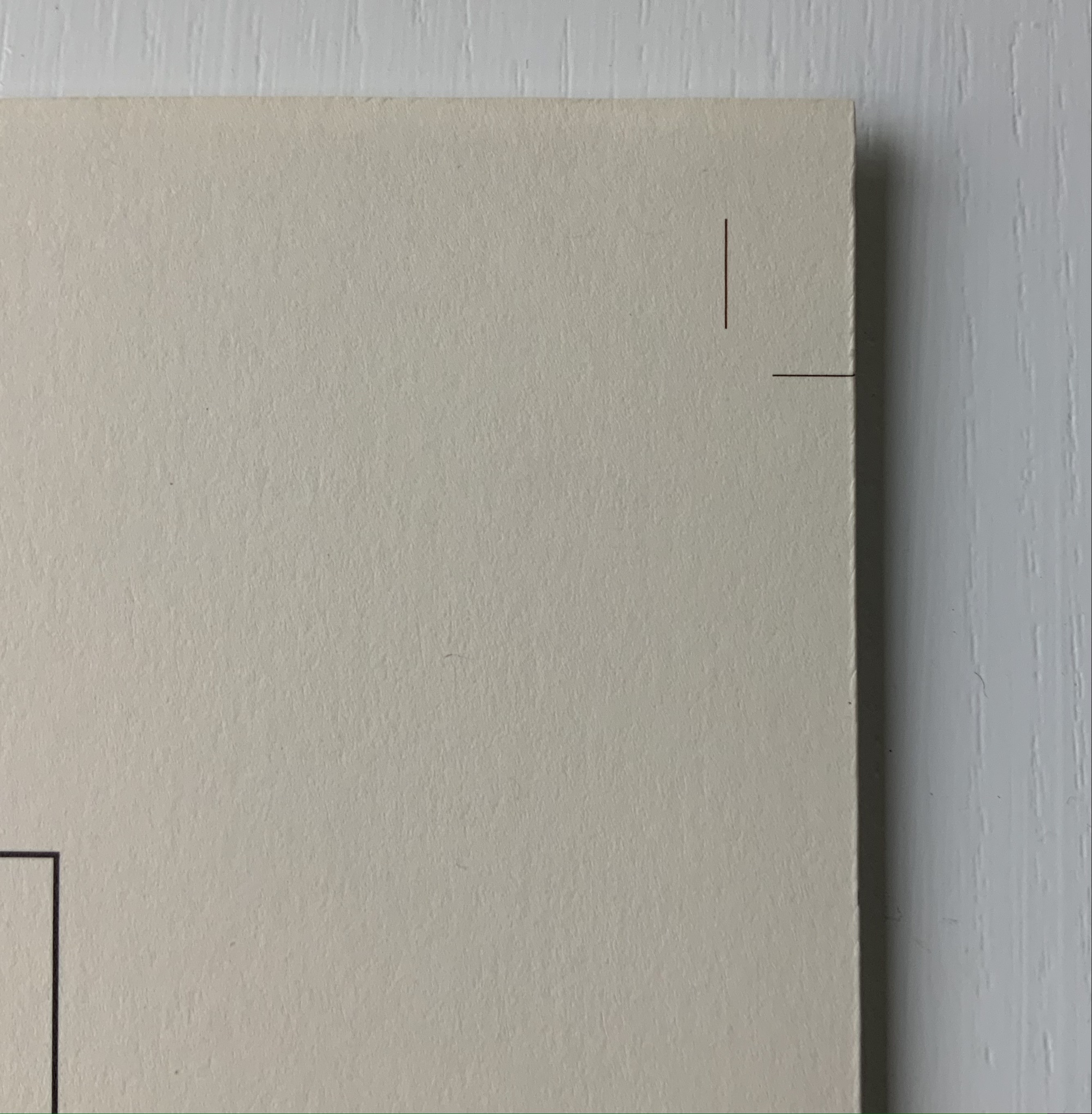
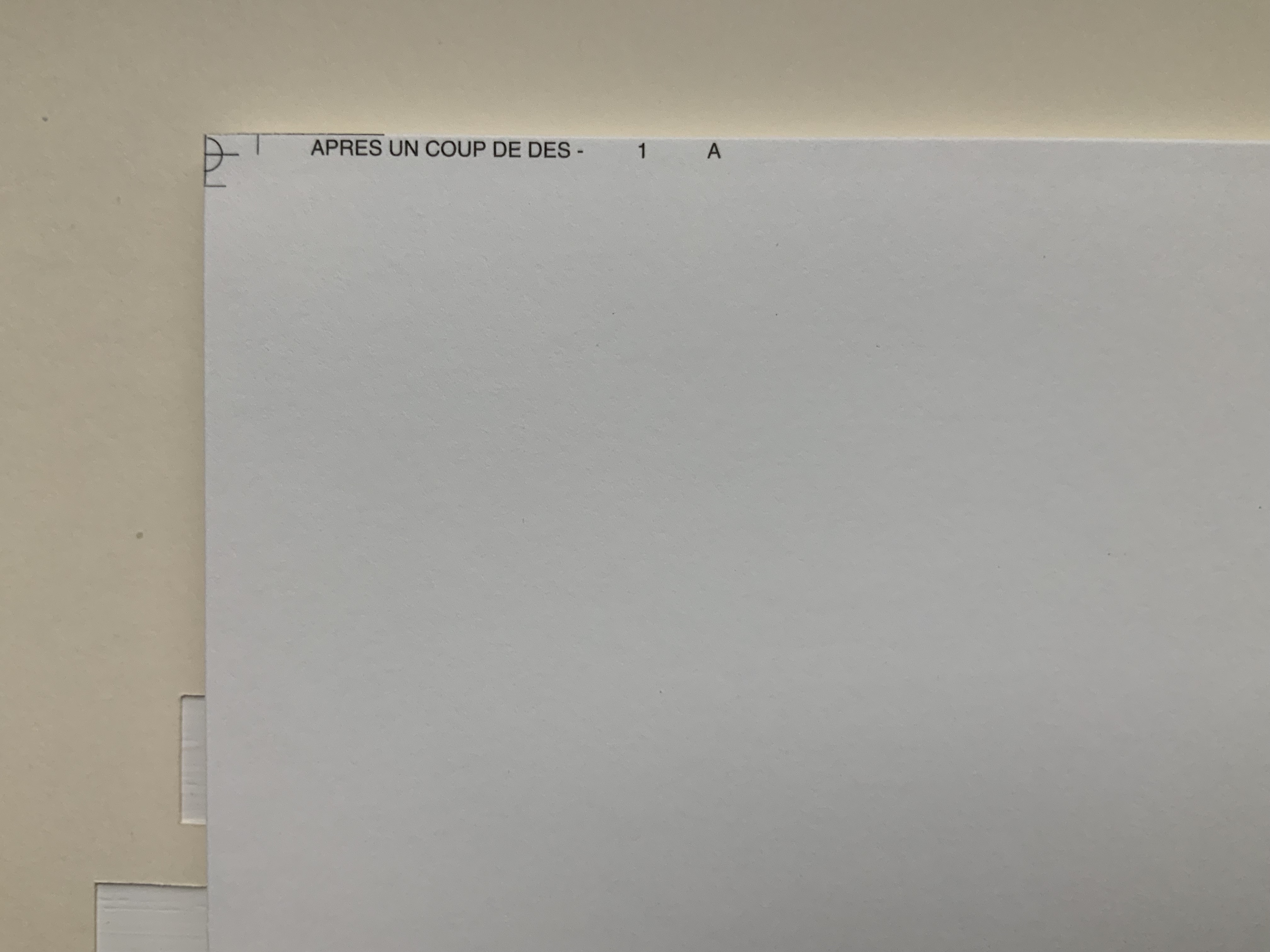
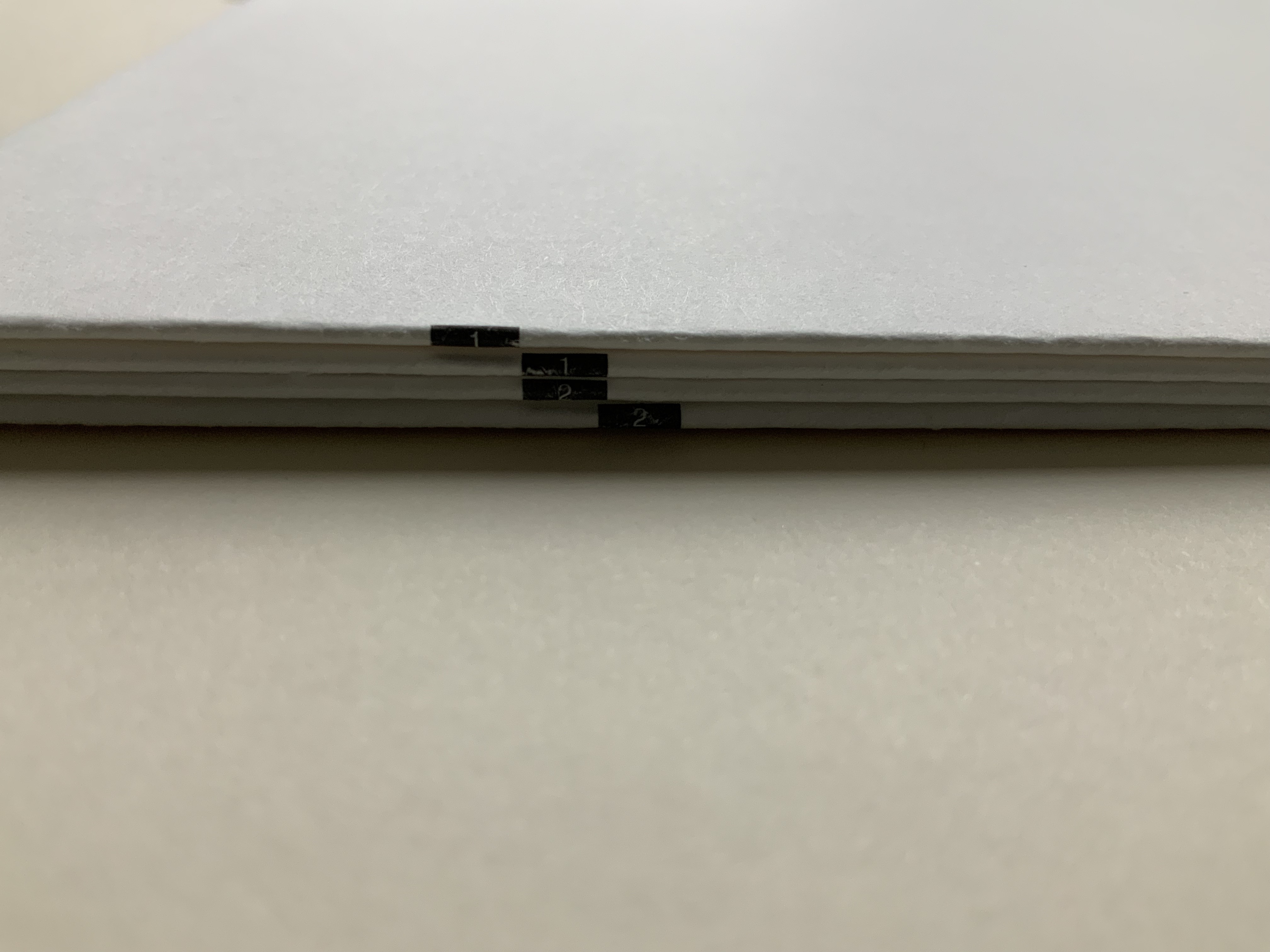
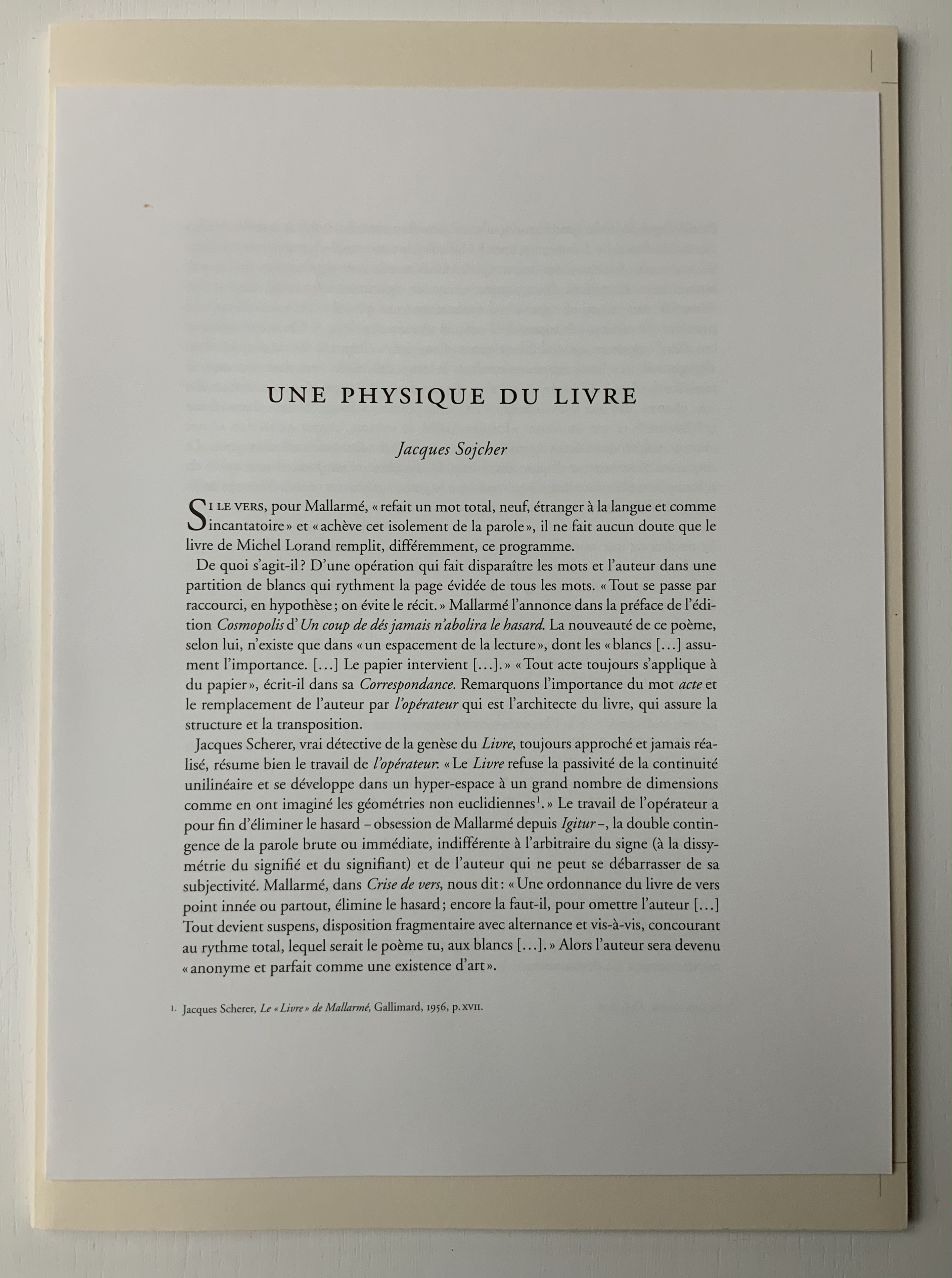
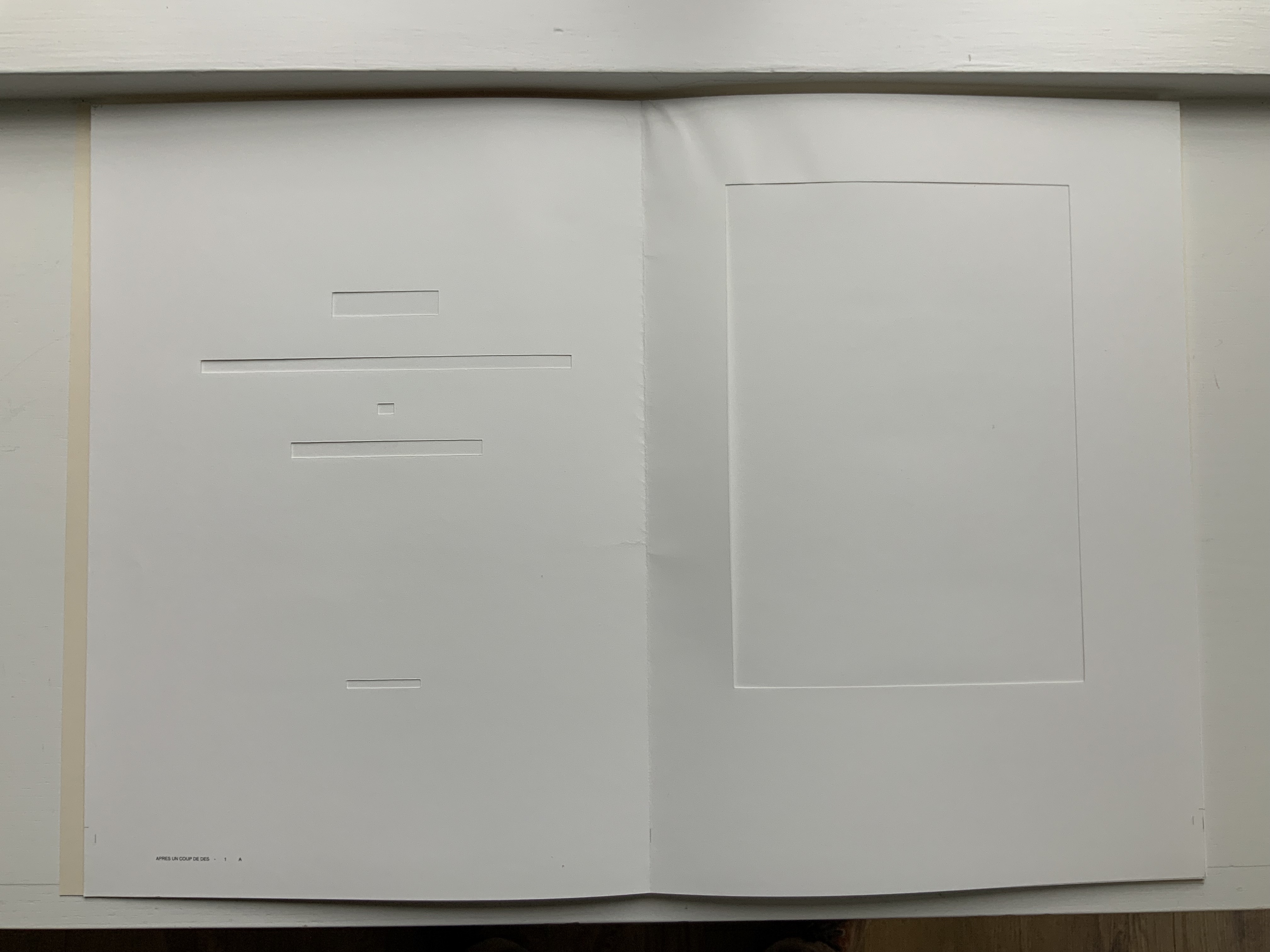
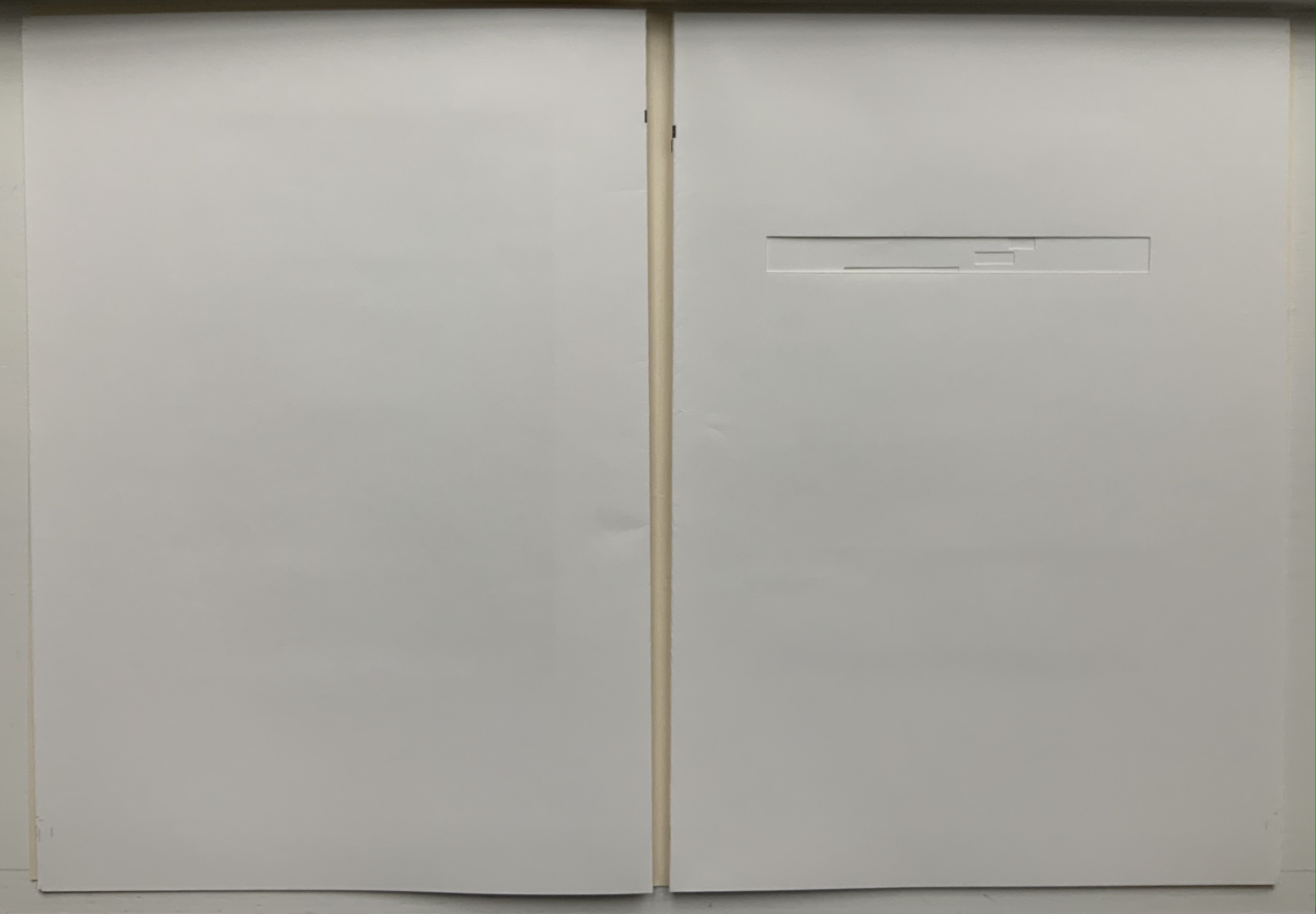
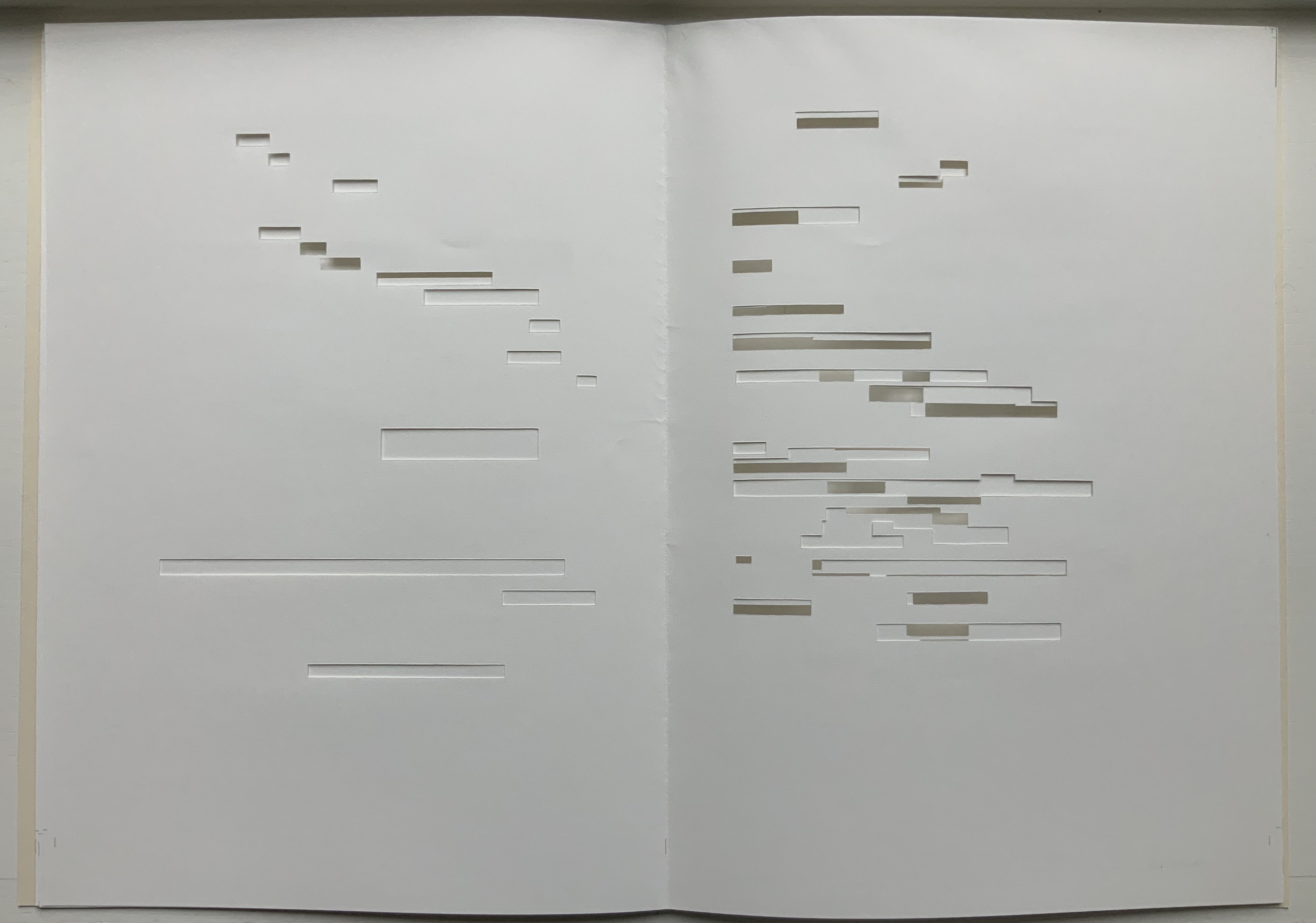
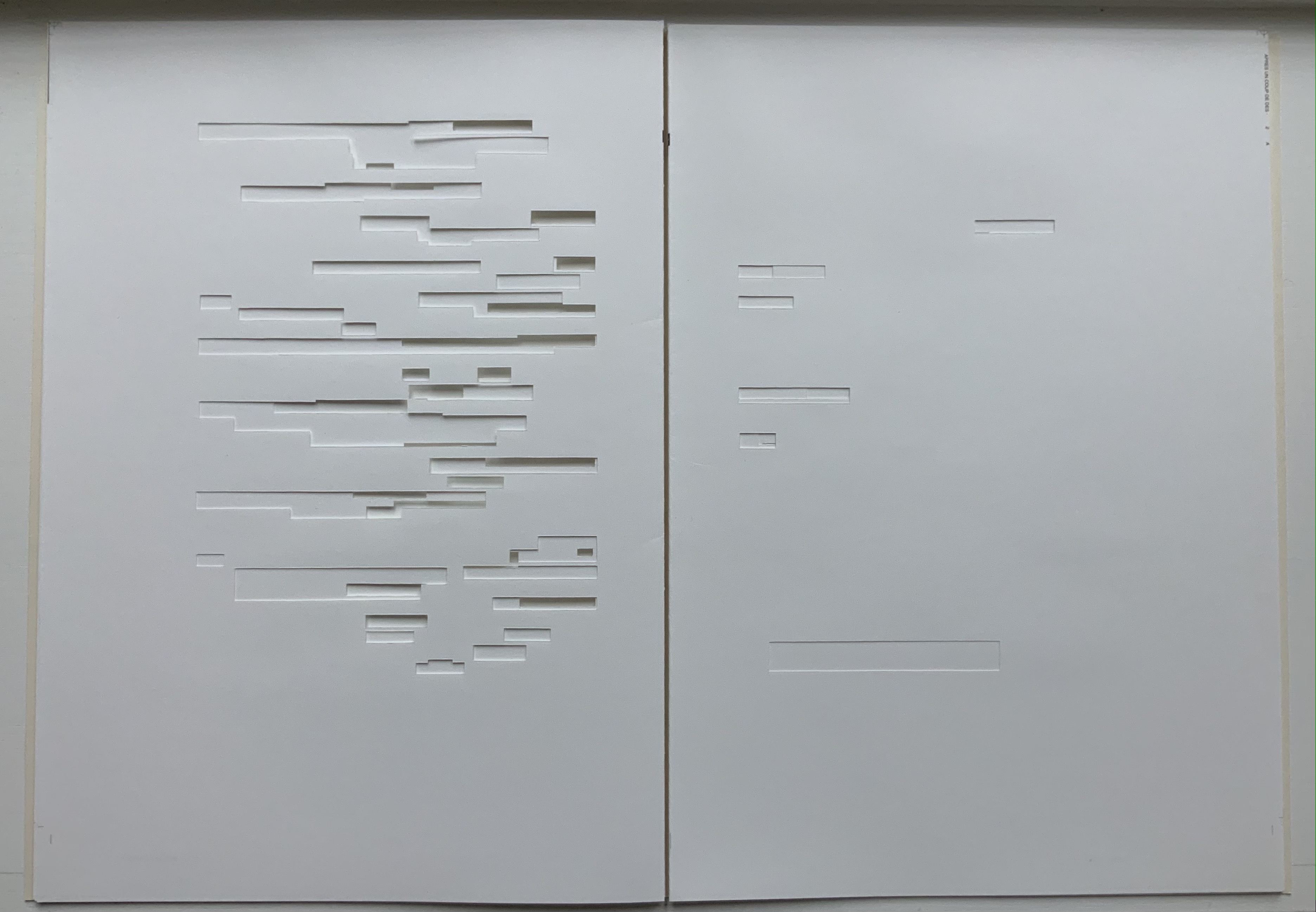
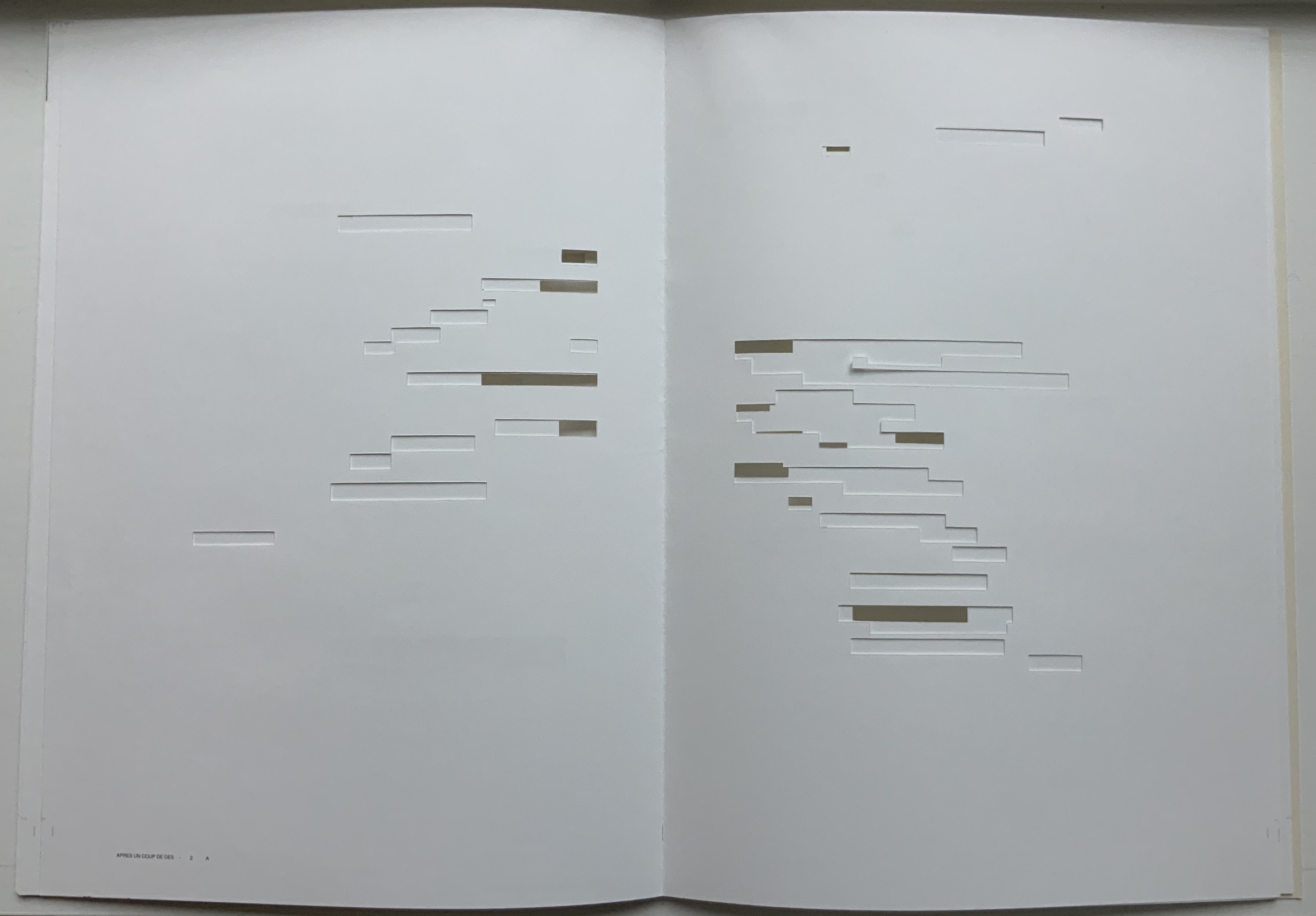
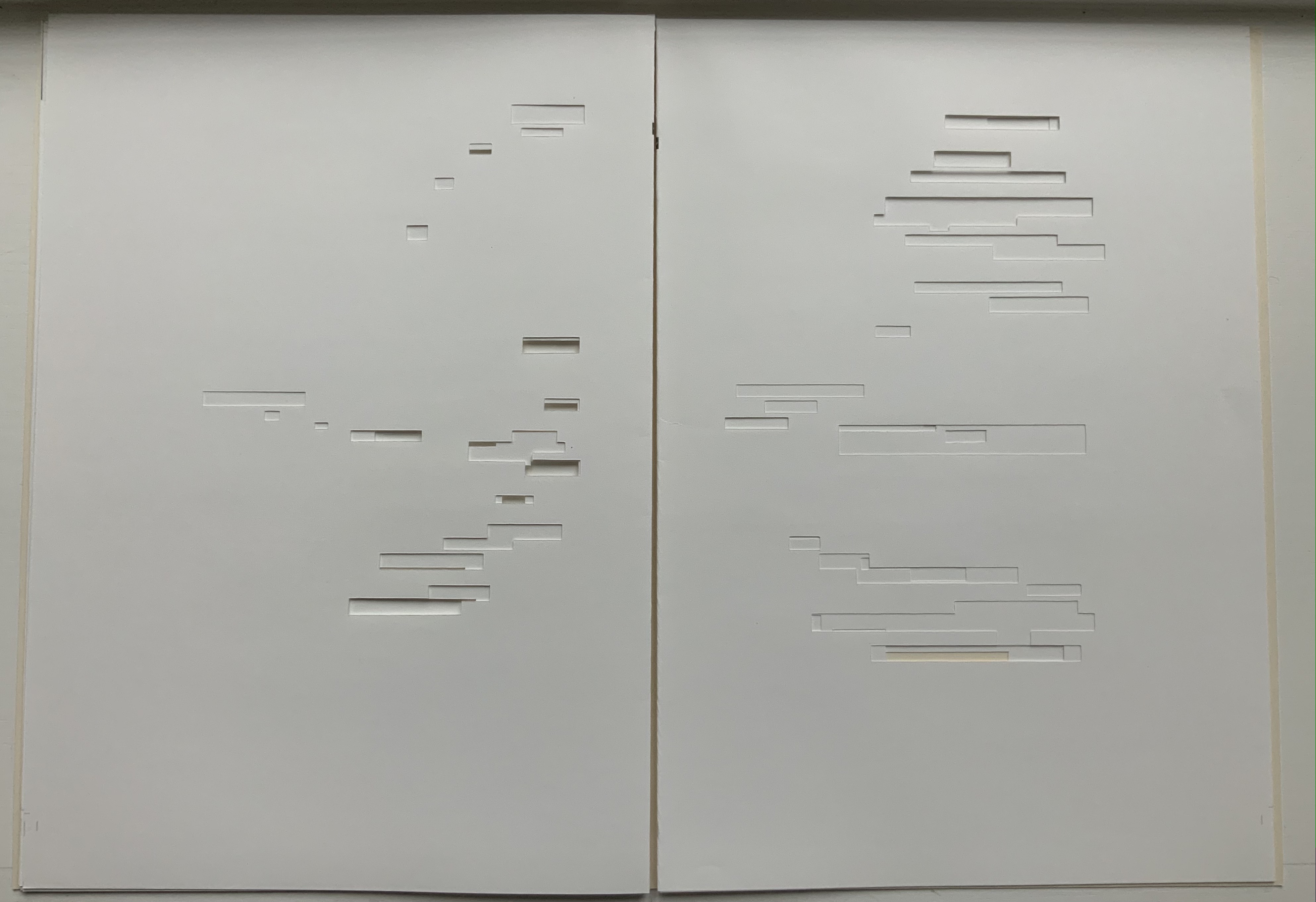
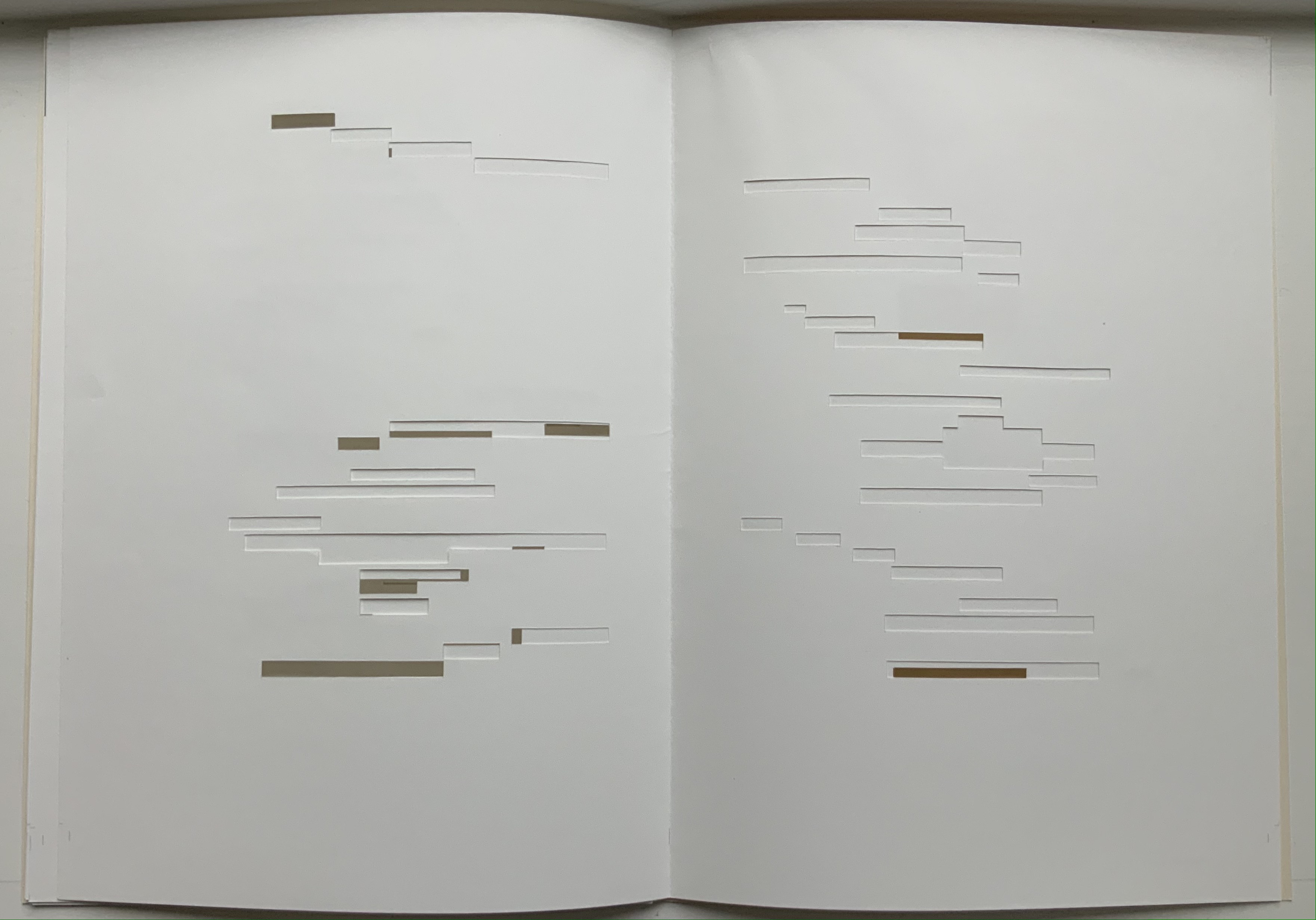
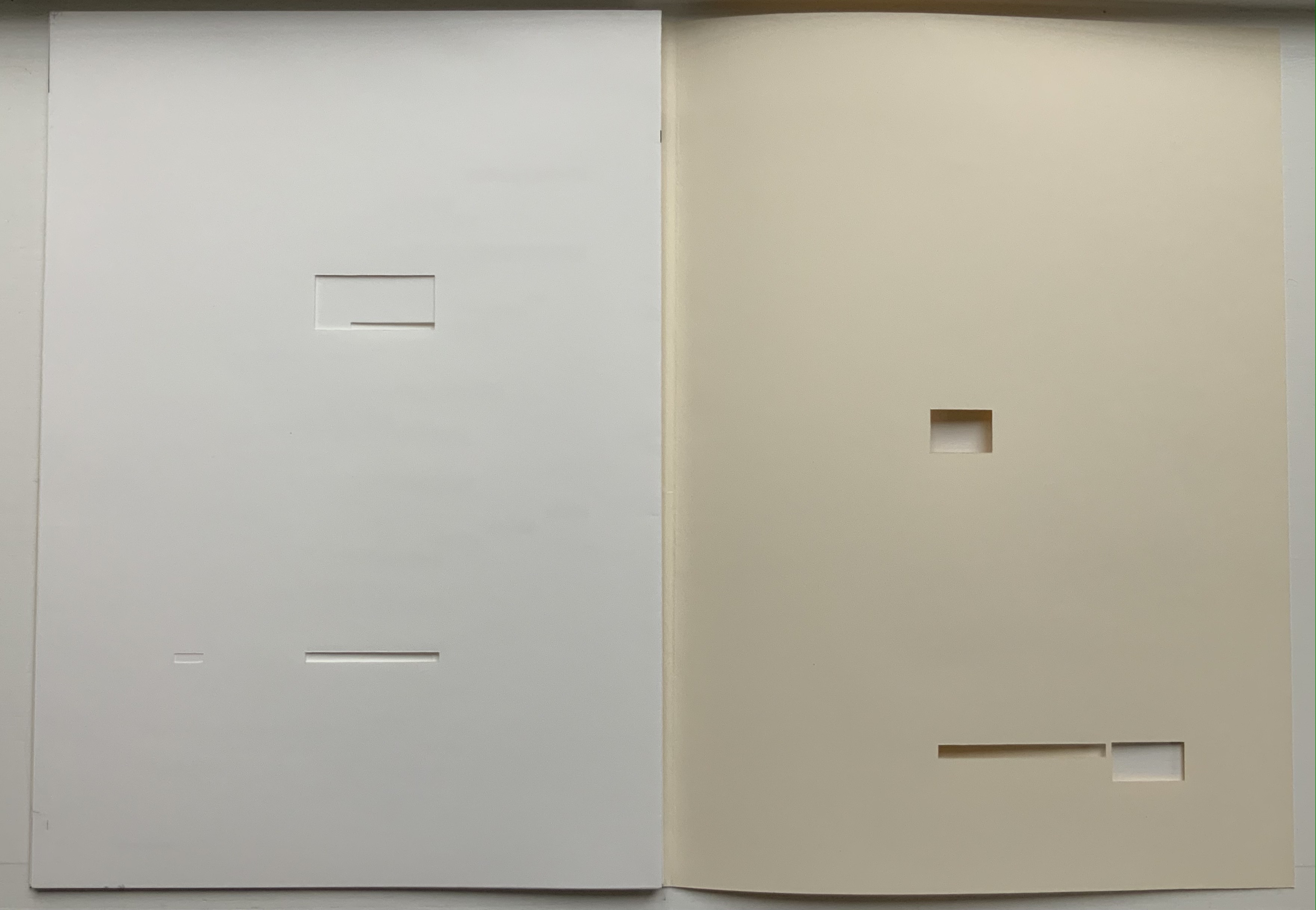
In Après Un Coup de Dés (2015), the only printed marks are the cover’s traditional black and red borders and the printer’s registration and gathering marks on the sheets. Wherever else Mallarmé’s text would have been printed has been excised. In reply to a question about the process involved, Lorand explains that he had asked the designer Filiep Tacq to create a layout that would cover in black exactly the blocks of text as it appears in the current Gallimard book edition of Mallarmé’s poem, including the front and back covers (correspondence with the artist, 1 November 2021). Lorand took a scalpel to the offset printed sheets, removed the blackened blocks, folded the sheets by hand into the four gatherings, assembled them in the correct order and laid them untrimmed and loose inside the cover. Each of fifty copies was placed inside its own handmade glassine envelope along with a flyer including introductory text by Jacques Sojcher (emeritus professor, University of Brussels) and the colophon for the work. It is a book that is not-yet a book.
Lorand’s and all of these other works of homage give us inverse ekphrasis. They are the visual, tactile and conceptual works of art that come after Mallarmé’s text. We are more used to ekphrasis where the object, painting or sculpture comes before the text — like Achilles’ shield before Homer’s description, or the Grecian urn before Keats’ ode, or Brueghel’s Fall of Icarus before Auden’s Musée des Beaux Arts. Homer, Keats and Auden vie with the art of the crafted object to put that object (and more) in front of us with words. With the inverse, the crafted objects vie without the words to put Mallarmé’s poem (and more — and sometimes less!) in front of us.
Many of the hommageurs hint at the “and more” with a subtitle to Un Coup de Dés Jamais N’Abolira le Hasard. With Broodthaers, it is Image; with Pichler, Sculpture; with Engramer, Onde (Wave as in soundwave); and with Bennequin, Omage (as in hommage with the “h” and “m” missing). With Lorand, there is no subtitle. Instead, we have the word après prefacing the truncated title of the poem. But, “after” Mallarmé’s poem, what is Lorand proposing? An homage in the form of something that restates, reproduces the poem but without the words? An homage in the form of something else presented in the manner of Un Coup de Dés but without the words? Or something else that simply occurs after the poem’s roll of the dice? As it turns out, all that and more.
Paul Valèry was probably the first of Mallarmé’s circle to see and hear Un Coup de Dés. His reaction picks out one of the themes that make up Lorand’s “and more”:
It seemed to me that I was looking at the form and pattern of a thought, placed for the first time in a finite space. Here space itself truly spoke, dreamed, and gave birth to temporal forms. Expectancy, doubt, concentration, all were visible things. With my own eye I could see silences that had assumed bodily shapes. Inappreciable instants became clearly visible: the fraction of a second during which an idea flashes into being and dies away; atoms of time that serve as the germs of infinite consequences lasting through psychological centuries — at last these appeared as beings, each surrounded with a palpable emptiness…. there in the same void with them, like some new form of matter arranged in systems or masses or trailing lines, coexisted the Word! — Paul Valéry, Collected Works of Paul Valery, Volume 8: Leonardo, Poe, Mallarmé (1972).
Lorand writes:
My <<Après un Coup de Dés>> introduces a corpus of approaches to what might be “the movement” that constitutes speech: “A language that speaks” as Martin Heidegger calls it (Unterwegs zur Sprache, Verlag Günther Jeske, Pfullingen, FRG, 1959).
How can we think, how can we imagine this movement within language itself? What path to take to allow us to experience this movement, the one that constitutes the word itself. This word is sound. The object of all my work is the identification of what could be the image of this movement, of this word. This exploration attempts to approach the nature of this movement: a word beyond language when the latter is silent. (Correspondence with the artist, 1 November 2021.)
Like his others, Heidegger’s On the Way to Language is a dense book; more than the others, it is poetical, an invitation to experience language. In it is a series of lectures entitled “The Nature of Language” in which Heidegger uses two poems, one by Stefan George and one by Gottfried Benn, to question language about its nature. Although George’s poem is the one that Heidegger deeply explicates, Benn’s is the one that, echoing Valèry, sheds the most light on Lorand’s Après Un Coup de Dés — especially with its last two lines.
A Word
A word, a phrase –: from cyphers rise Life recognized, a sudden sense, The sun stands still, mute are the skies, And compacts it, stark and dense.
A word — a gleam, a light, a spark, A thrust of flames, a stellar trace — And then again — immense — the dark Round world and I in empty space.
Après Un Coup de Dés seems to be a wordless invitation to experience language. But in a sense, Mallarmé’s words have not disappeared, not entirely. Their shapes — embodied in the voids — move silently and rhythmically across the unfolded sheets; in the gatherings, they cascade over one another much as they do syntactically and typographically in print. And even though the text is not before (in front of) us, Lorand’s artwork delivers a wordless experience of a key paradox of language with which Mallarmé sought to imbue his poem: the language of the void or abyss — the void or abyss of language. One of the ways in which the poem presents this self-enveloping paradox is that it begins and ends with the words un coup de dés, the act that can never abolish chance and the act that all thought emits. Similarly, Après un Coup de Dés displays the presence of language by displaying the absence of language, or les blancs defined by and defining empty space.
Mallarmé’s invitation in Un Coup de Dés, however, beckons us to a slightly different concept of language than that articulated by Heidegger. For Mallarmé, chance plays a prominent role in what Heidegger would call the “neighborhood of poetry and thought”. But chance, hazard or a roll of the dice plays a much less prominent role for Heidegger, and in Lorand’s work of art, with its registration and gathering marks and glassine enclosure, there seems little allusion to it — perhaps naturally so since Lorand’s work comes after the dice have been rolled.
Even though it comes after Mallarmé’s completed poem and after the Gallimard book edition, Après presents as an unfinished work, a book not yet trimmed and bound, which reflects not only Mallarmé’s unfinished realization of the poem as a book but also his unfinished life’s pursuit: le Livre, the thing in which everything in the world would end up — the thing that, by virtue of a spacious mobility of typographic layout and the interplay of its elements, would be “the total expansion of the letter”. Lorand’s attention and manual precision in excising the blackened blocks where the text would otherwise appear evoke Mallarmé’s attention to the minute details of typeface, size and font shown in his handwritten mark-up of the proofs for the book edition he was planning before he died.
Après also comes after the efforts of Broodthaers and Pichler, both of whom organized exhibitions for their works of homage. In fact, Pichler paid homage to Broodthaers by naming his exhibition “Pichler: Exposition Littéraire autour de Mallarmé” (Milan, December 2016) after “Broodthaers: Exposition littéraire autour de Mallarmé” (Antwerp, December 1969). Pichler’s exhibition was also daring in its exposure of the works to the visitors.
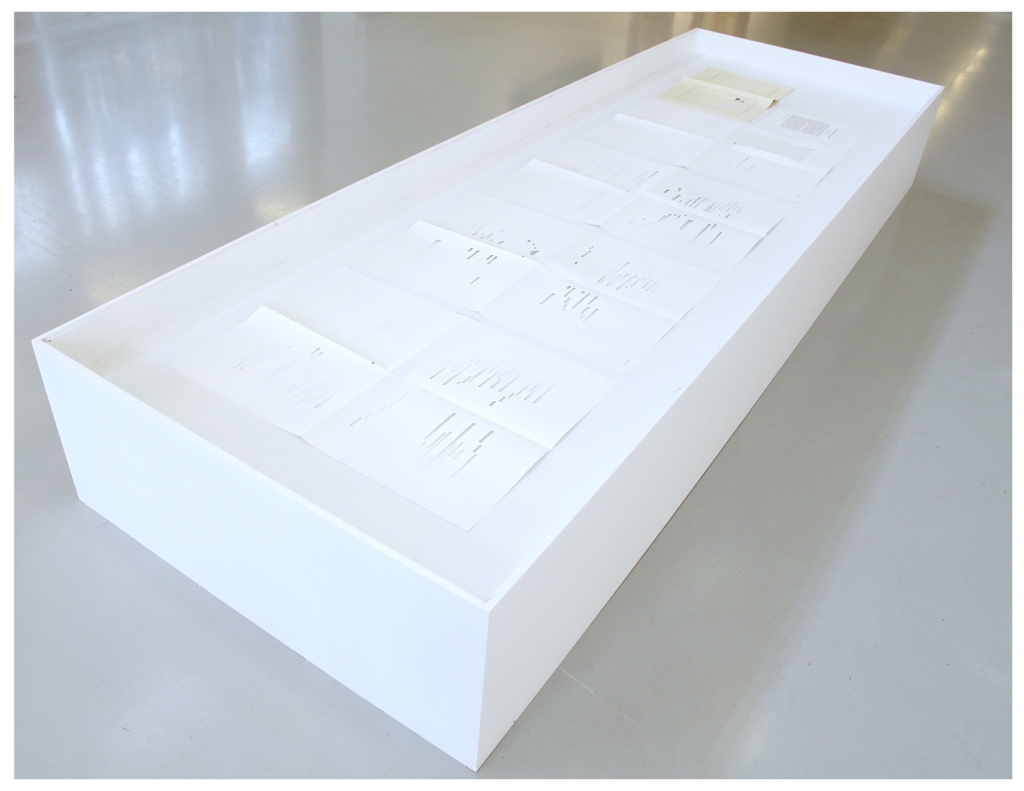
In the 2018 display of Après Un Coup de Dés, the previously gathered but now unfolded sheets and cover lie side by side under glass. Often this is cause for complaint about the distanced display of artist books. In the case of Après Un Coup de Dés, the distance effectively draws point-blank attention to what the privileged reader gradually discovers in handling the work. The unprivileged reader may have to imagine the making, unmaking and remaking of the book but, confronted with the gestalt of the undone gatherings and their registration marks, that reader immediately sees/witnesses the void defined by a void.
Après Un Coup de Dés in the group exhibition Reading Hand Writing Bodies at Les Abattoirs de Bomel, Centre d’art de Namur, Belgium, 8 February – 11 March 2018. Photo: Courtesy of the artist.
In relation to Broodthaer’s Image and Pichler’s Sculpture, Après comes both before and after. The positioning of the words après, image and sculpture vis à vis the poem’s title has been noted already. Of all three visual, tactile and conceptual works, Lorand’s stands as the chronologically “after” yet unfinished “before” to Broodthaers’ and Pichler’s finished works. In yet another “afterness” to Mallarmé’s poem, Lorand likens Après to a silent score of music or a piano roll (correspondence with the artist, 1 November 2021). This echoes — if that is not too perverse a verb — Mallarmé’s reference to “score” in his preface to Un Coup de Dés. In premonitory, if not coincidental, irony, Lorand’s piano-roll-like 2015 work precedes a work that Michalis Pichler created for his 2016 Milan exhibition: a piano roll playable on a foot-pumped pianola and entitled Un Coup de Dés Jamais N’Abolira le Hasard: Musique (see video above).
The interplay of its philosophical roots with its mechanically produced print and its manual cuts makes Lorand’s AprèsUn Coup de Dés one of the more challenging works of homage to Mallarmé’s poem. To “hear” it side by side with the others in the Books On Books Collection (see below) is rewarding.
Further Reading
“Derek Beaulieu“. Books On Books Collection. 19 June 2020.
“Eric Zboya“. Books On Books Collection. 01 June 2020.
Heidegger, Martin, and Peter D. Hertz, trans. 1959/2009. On the Way to Language. San Francisco: HarperOne. Reprint. “No matter how we put our questions to language about its nature, first of all it is needful that language vouchsafe itself to us. If it does, the nature of language becomes the grant of its essential being, that is, the being of language becomes the language of being” (p. 72).
Just as Stéphane Mallarmé’s Un coup de Dés jamais n’abolira le Hasard (1897) launched a new host of visual poems in the 20th and 21st centuries, it also launched a host of homage and parodies. Perhaps the quickest off the dock was the Australian Christopher Brennan. Already a fan of Mallarmé, Brennan, who worked at the New South Wales Public Library, seized on the May 1897 issue of Cosmopolis when it arrived and found in Mallarmé’s poem just the form with which to respond to the rough ride Australian critics had given to his own XXI Poems: MDCCCXCIII-MDCCCXCVII: Towards the Source (1897).
Not until 1981, though, was his tinker’s damn published. Given the debated choices of layout, typeface and illustrations that Un coup de Dés in book form had faced since 1897 and would continue to face after 1981, the choice to publish a facsimile of Brennan’s calligraphic effort was well made — perhaps even artistically original. Book artists have blotted out the poem, excised it, collaged, illustrated, performed, recorded (and cast the sonographs in three-dimensional PVC), programmed it into computer graphics, typed it out on a modified typewriter, and more. André Masson‘s may be the only calligraphic treatment so far…
Further Reading
“Jim Clinefelter“, Books On Books Collection, 17 July 2020. An American-English mis-translation.
“Chris Edwards“, Books On Books Collection, 7 December 2020. An Australian-English mis-translation.
“Rodney Graham“, Books On Books Collection, 3 July 2020. Un coup de Dés as instructions to a tattoo artist.
Fagan, Kate. “‘A Fluke? [N]ever!’: Reading Chris Edwards“, Journal for the Association for the Study of Australian Literature, Vol. 12, No. 1 (2012). Accessed 25 November 2020.
Clinefelter’s is not the first parody or spoof of Mallarmé’s Un Coup de Dés Jamais N’Abolira le Hasard. That claim belongs to a nineteenth-century Australian poet and aficionado of Mallarmé’s poetry — Christopher Brennan. Brennan’s Prose-Verse-Poster-Algebraic-Symbolico-Riddle Musicopoematographoscope appeared in manuscript in 1897 but wasn’t published until 1981.
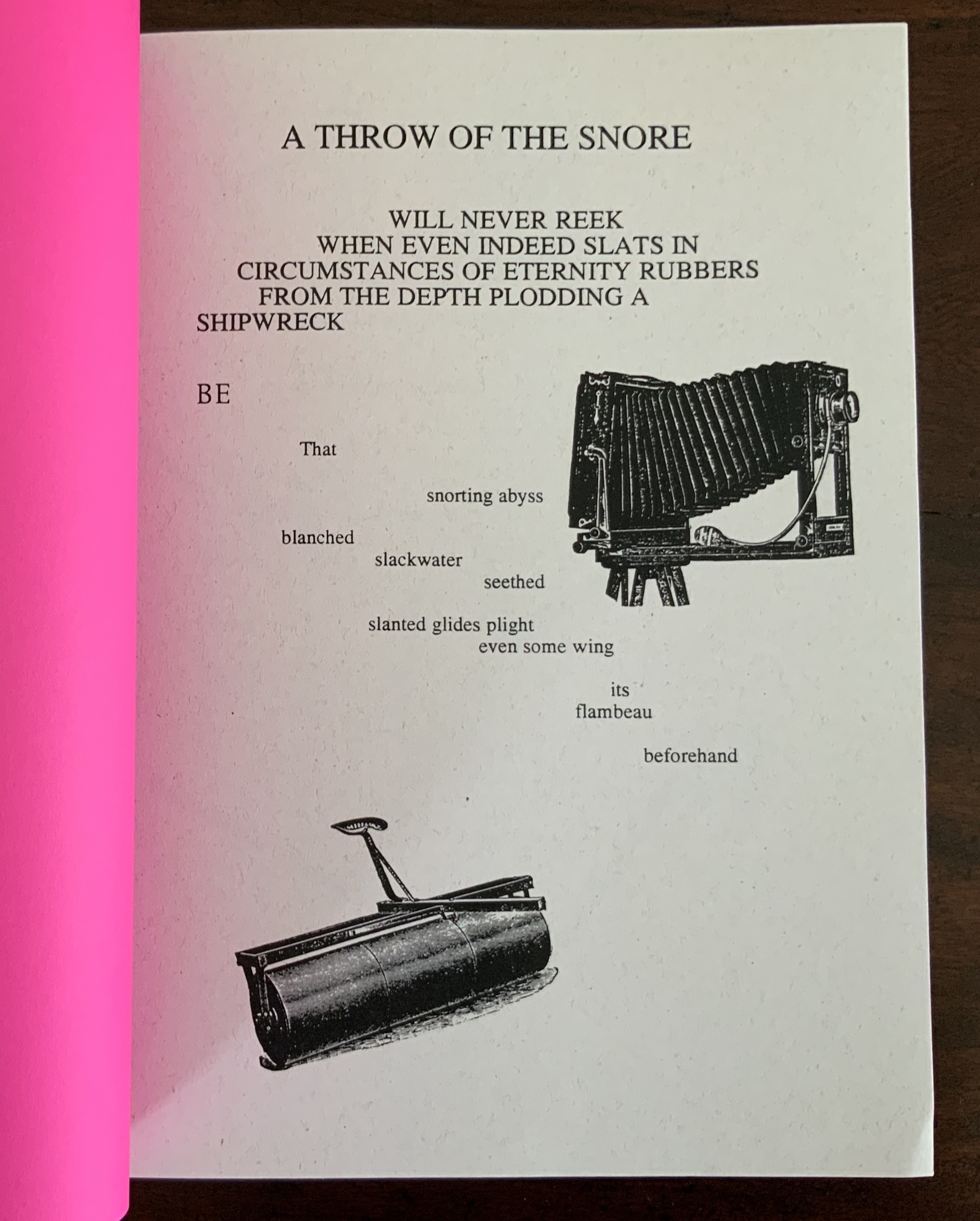
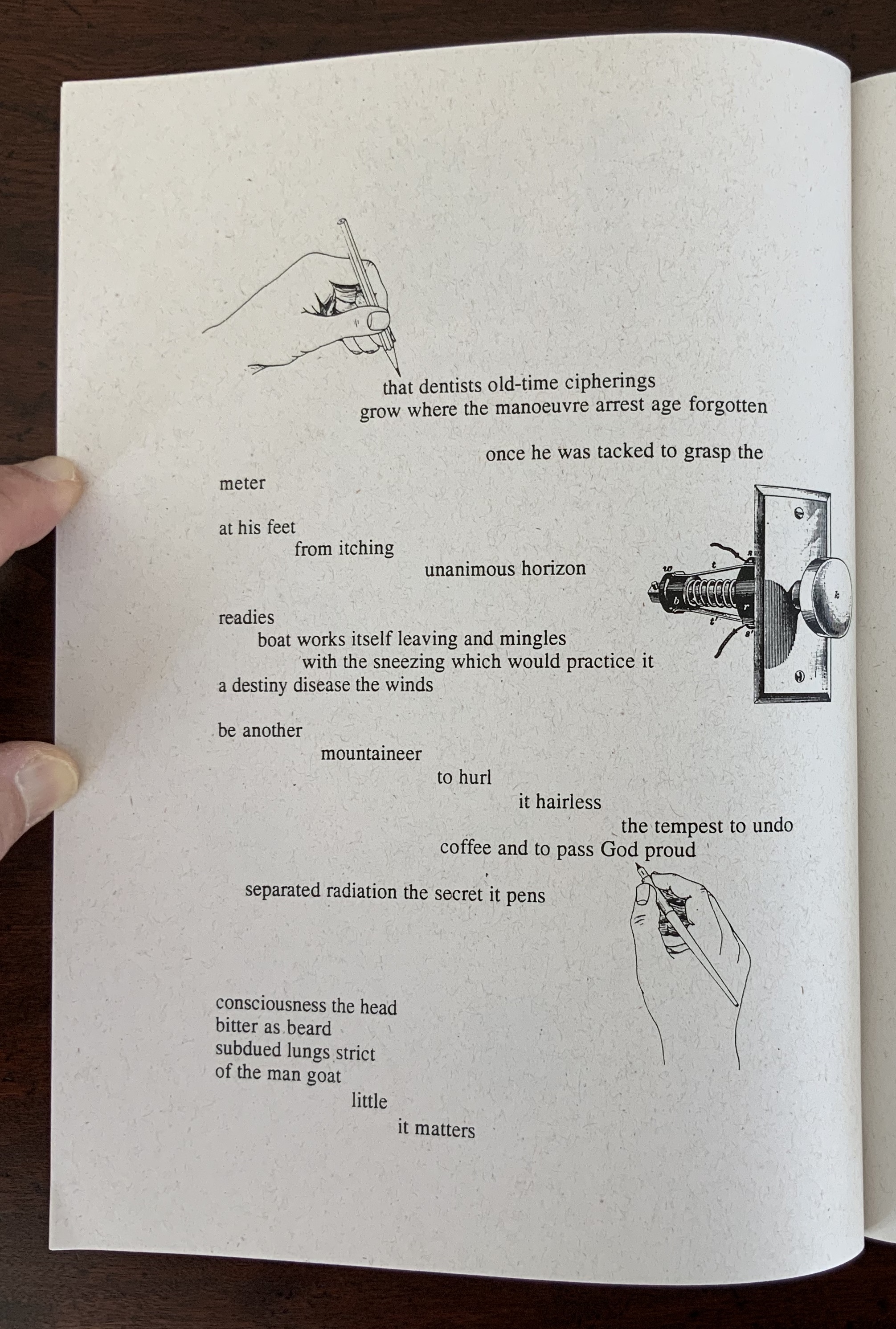
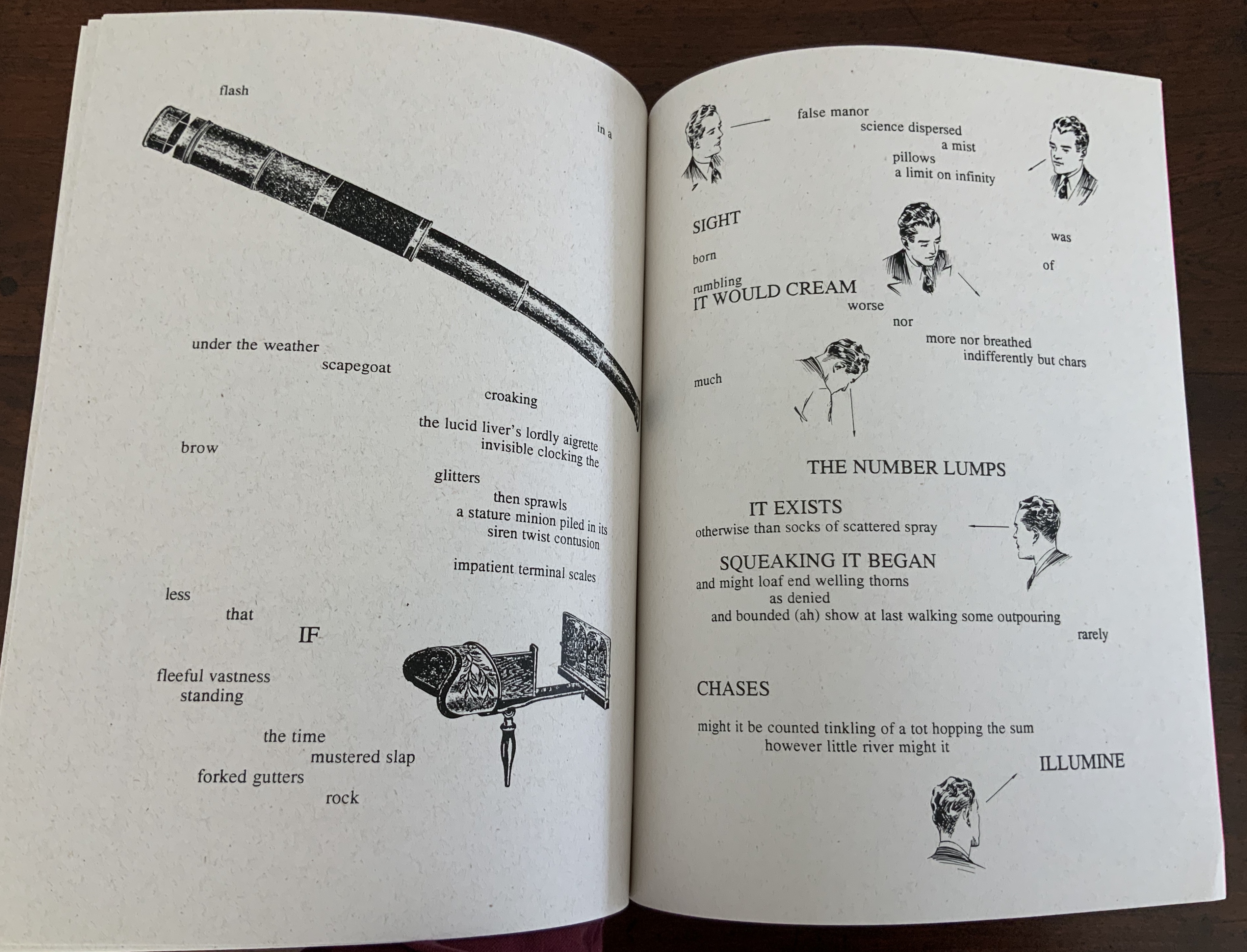
With images from a reprint of an early Sears Roebuck Catalogue and drawing on John M. Bennett‘s poetry as well as Un Coup de Dés, Clinefelter composed his book on a borrowed Macintosh SE — the late twentieth-century substitute for penmanship. Mallarmé only thought of having some images from his friend Odilon Redon separated from the text Un Coup de Dés. Clinefelter’s sense of fun and close attention to the original led him to integrate those Sears images throughout with the text to mimic Mallarmé’s textual and typographic road signs. Notice in the third row of the photos above how the hands holding pencils point toward lines (or perhaps enclose the lines between them like single quotation marks) and how the figure of the man’s head with directional arrows indicates the order or path in which the text should be read.
Clinefelter’s text, which draws on Bennett’s boisterous poems, pokes fun at the original’s emphasis on sonority even at the expense of semantic or syntactic clarity. It also pokes fun at some of the lines that have challenged readers and translators alike:
LE MAÎTRE surgi inférant de cette conflagration à ses piedsde l’horizon unanime que se prépare s’agite et mêle au poing qui l’étreindrait … becomes
“THE MASTER knees inferring from this conflagration drips there as soft threatens the unique clam”
and cadavre par le bras écarté du secret qu’il détient … becomes
“corpse mud the arm”.
For their parody, Clinefelter and Bennett may have to apply for honorary Australian citizenship. It seems that, starting with Christopher Brennan, the Australians cannot stop teasing Mallarmé. We have Chris Edwards’ A Fluke: A Mistranslation of Stéphane Mallarmé’s “Un Coup De Dés…” with Parallel French Pretext (2005) and John Tranter’s Desmond’s Coupé (2006). Parody, pastiche or spoof — Clinefelter’s and these other responses enrich the genre of Un Coup de Dés. Somehow in their exuberance they are all saying “yes” to the abyss or, at least, managing one more guffaw of the dice.
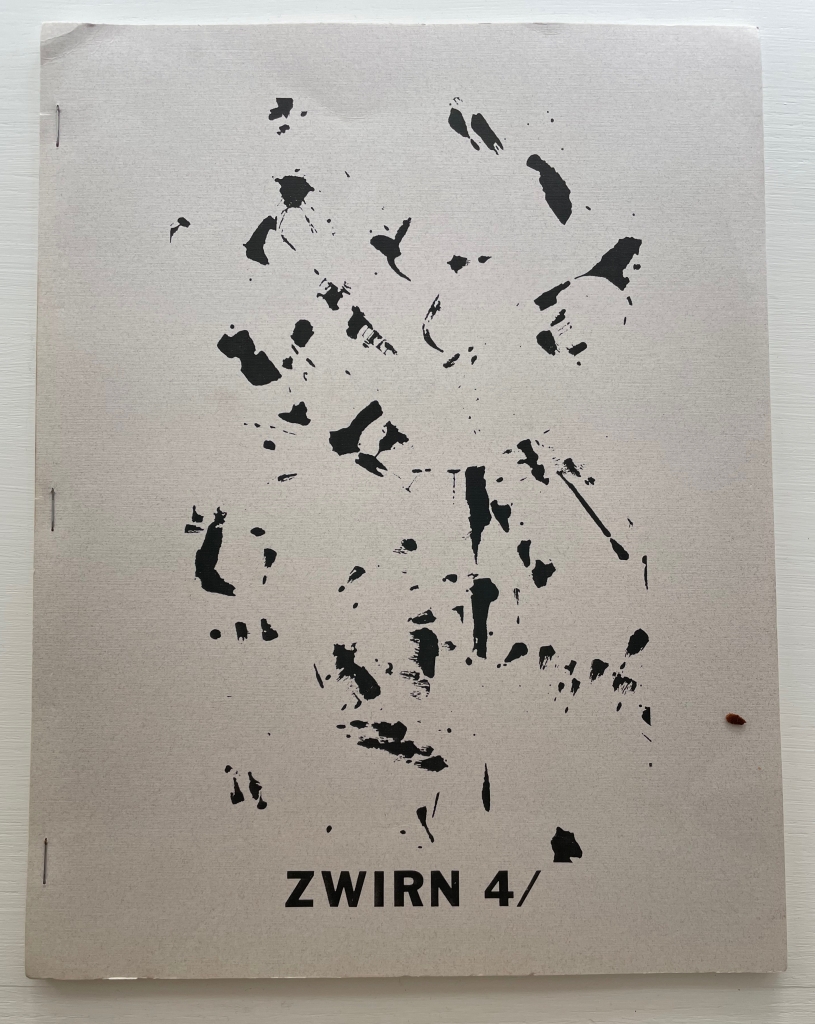
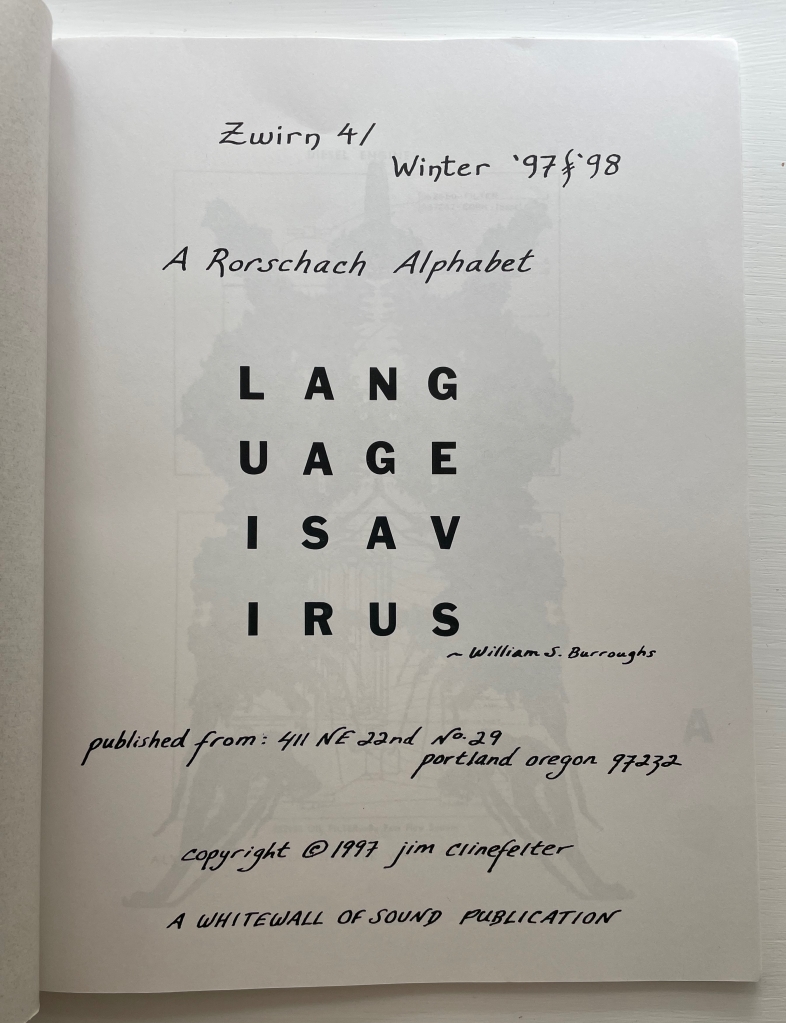
A Rohrshach Alphabet: Zwirn 4 (1999)
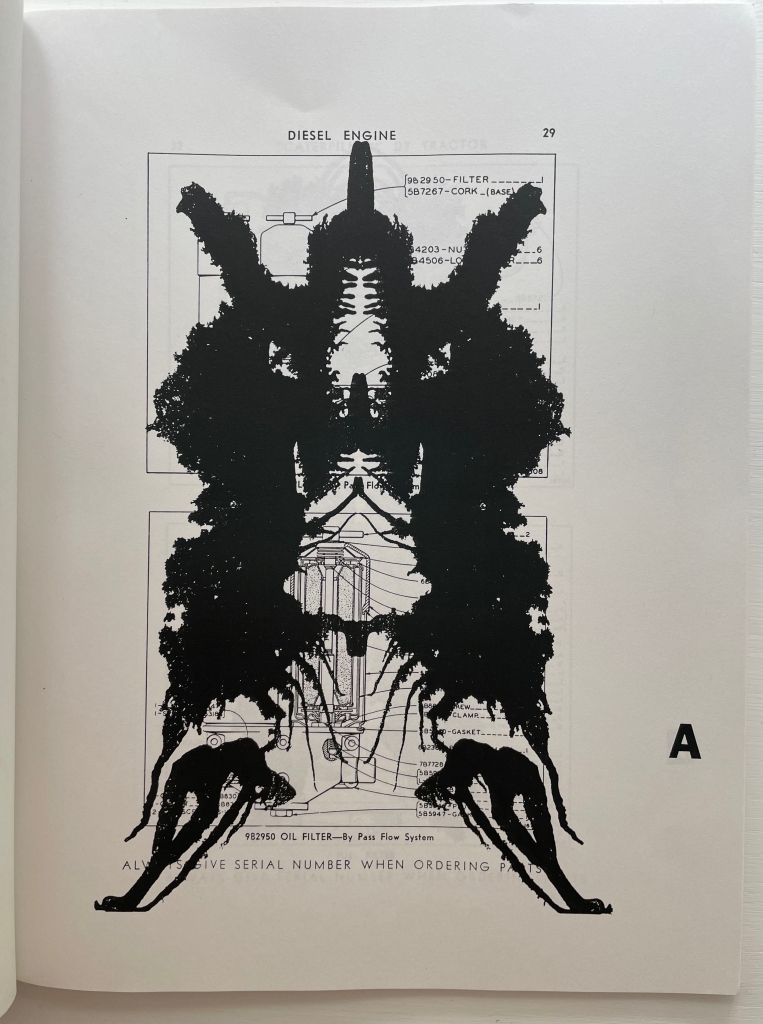
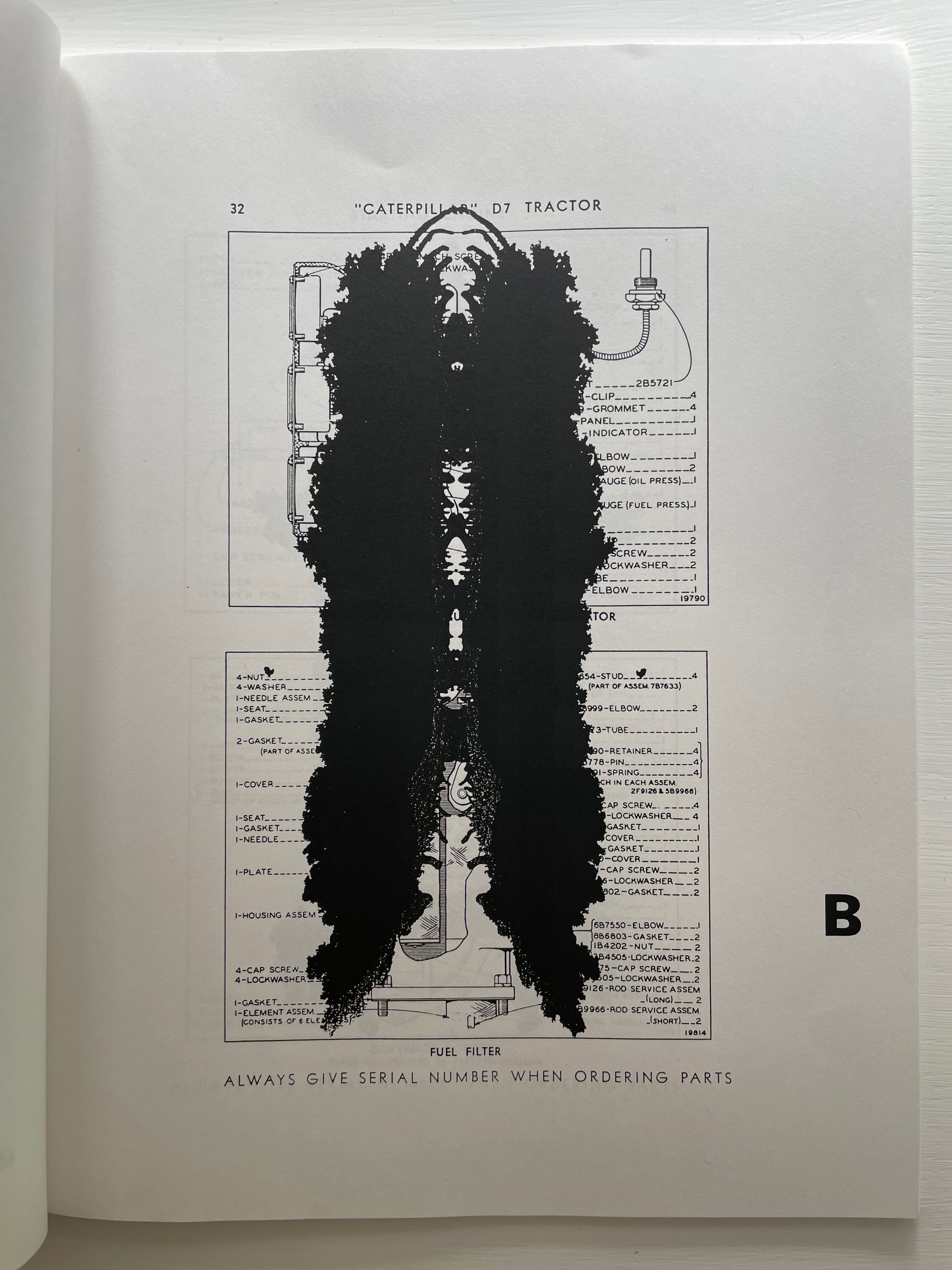
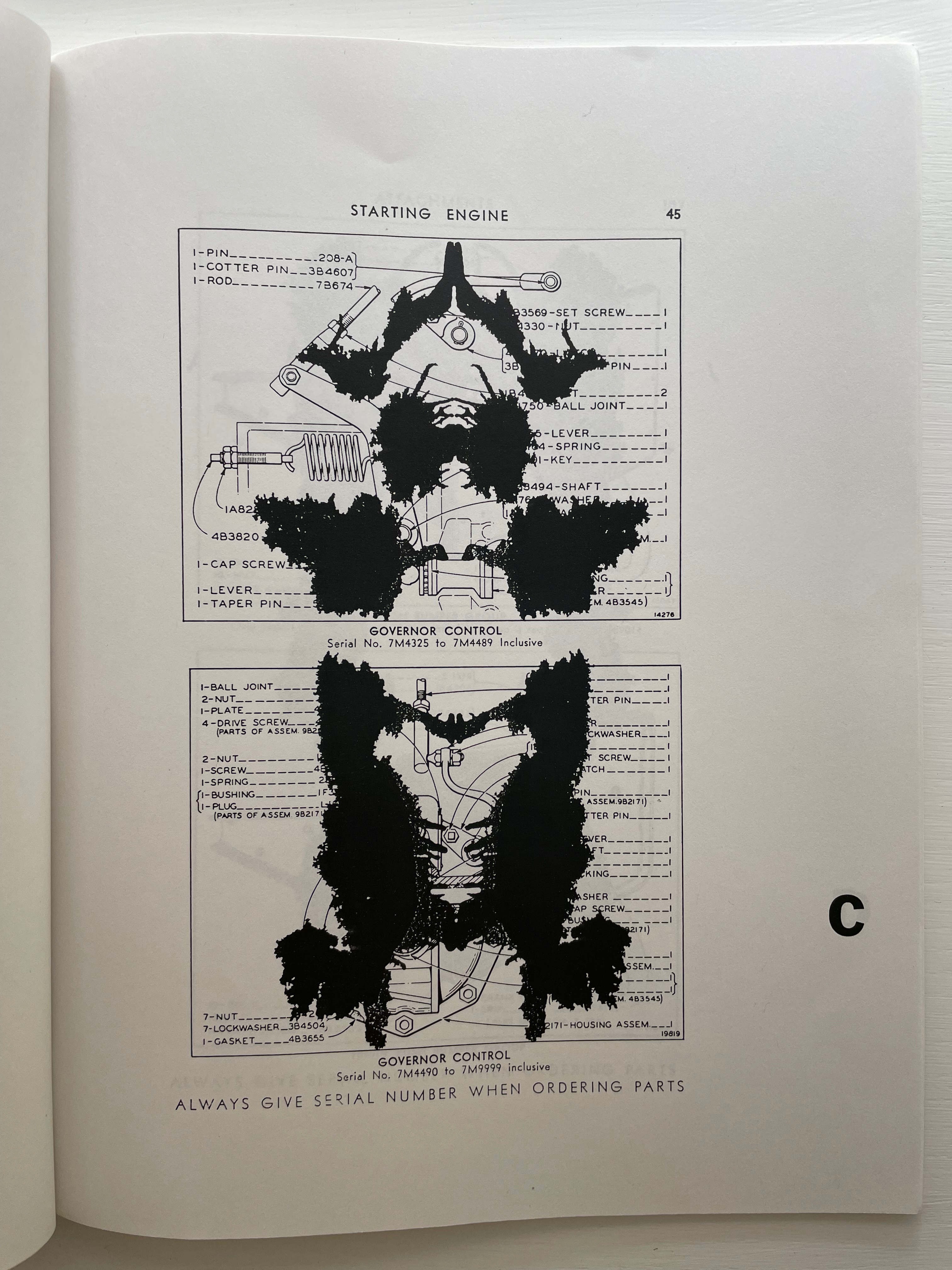
A Rohrshach Alphabet: Zwirn 4 (1999) Jim Clinefelter Stapled loose leaf, card covers. H280 x W211 mm. 27 folios. Twenty-six Rohrshach inkblots printed over BW copy of motor parts ordering catalogue. Acquired from Zubal Books, 15 August 2022. Photos: Books On Books Collection.
If the juxtaposition of the alphabet with the utterly unrelated pages of an engine parts catalogue has not disabused you of your pattern-seeking hopes, do not let approximation of the letter A resurrect them.
Like the letter A, several other letters of the alphabet have that characteristic of bilateral symmetry (H, I, M, O, T, U, V, W and X). Occasionally, Clinefelter lets it slip through (as with T), but in general, his zaniness will not allow it (as with the “blotted” rear wheel for O).
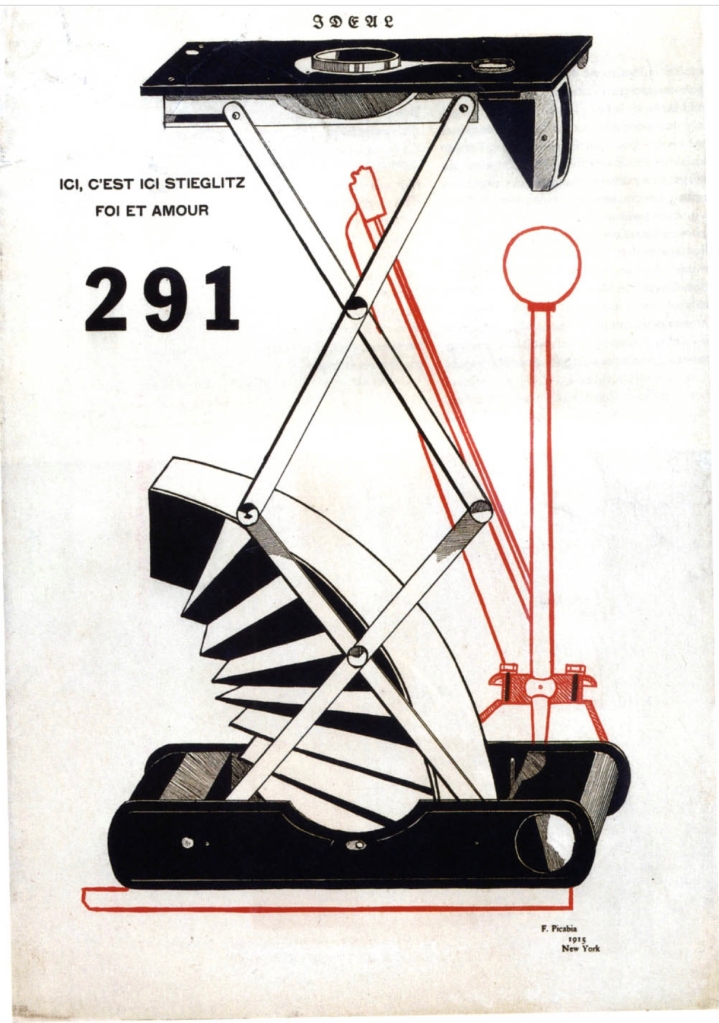
This use of catalogue pages and mechanical parts finds some ancestry in Francis Picabia and the Dadaists. In 2015, there was a journal called 291. Its July-August cover was Picabia’s Here, This is Stieglitz / Faith and Love. The artist’s visual pun of substituting the mechanical diagram for the artist is less puzzling or disconcerting than Clinefelter’s visual puns in A Throw of the Snore. But then along came Henri Matisse Ceci n’est pas une pipe (1929) and later Marcel Broodthaers to layer on that filter of “huh?” before Clinefelter and other book artists began adding their take.
Clinefelter’s take on the complement and clash of image and text brings together two related but unrelated tools: the Rohrshach test and the parts catalogue. Both are tools for searching. One for the mind. One for machinery. It’s a jokey, subversive take on searches for meaning and order, for patterns and structures, in parts that may not add up. The alphabet, which is rooted in images, also serves for ordering things as well as for making meaning or making sense of the world. Or does it? What can you spell out with a Rohrshach alphabet? And what if your catalogue for ordering parts is incomplete and out of order?
For related but very different explorations of bilateral symmetry and the art of the fold, see Étienne Pressager’s Mis-en-pli (2016) and Pramod Chavan’s The Voice of the Yarn (2022), but not before reveling further in Clinefelter’s throwback to Dada.
Further Reading
“Rodney Graham“, Books On Books Collection, 3 July 2020.
H500 x W350 mm. Edition of 200, of which this is #162. Acquired from the artist, 15 April 2019.
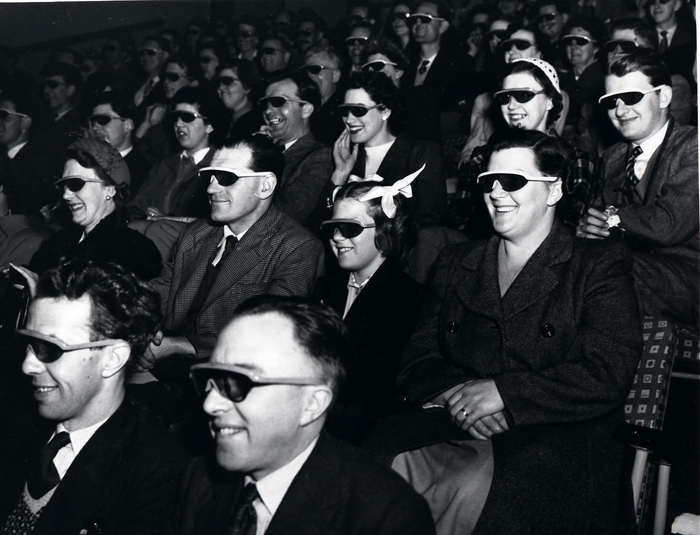
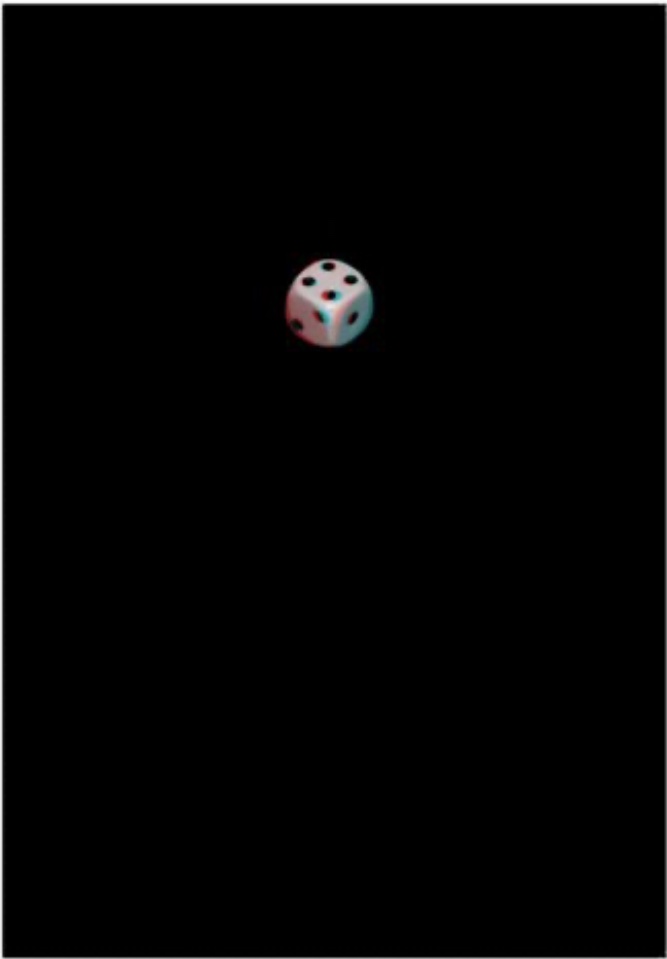
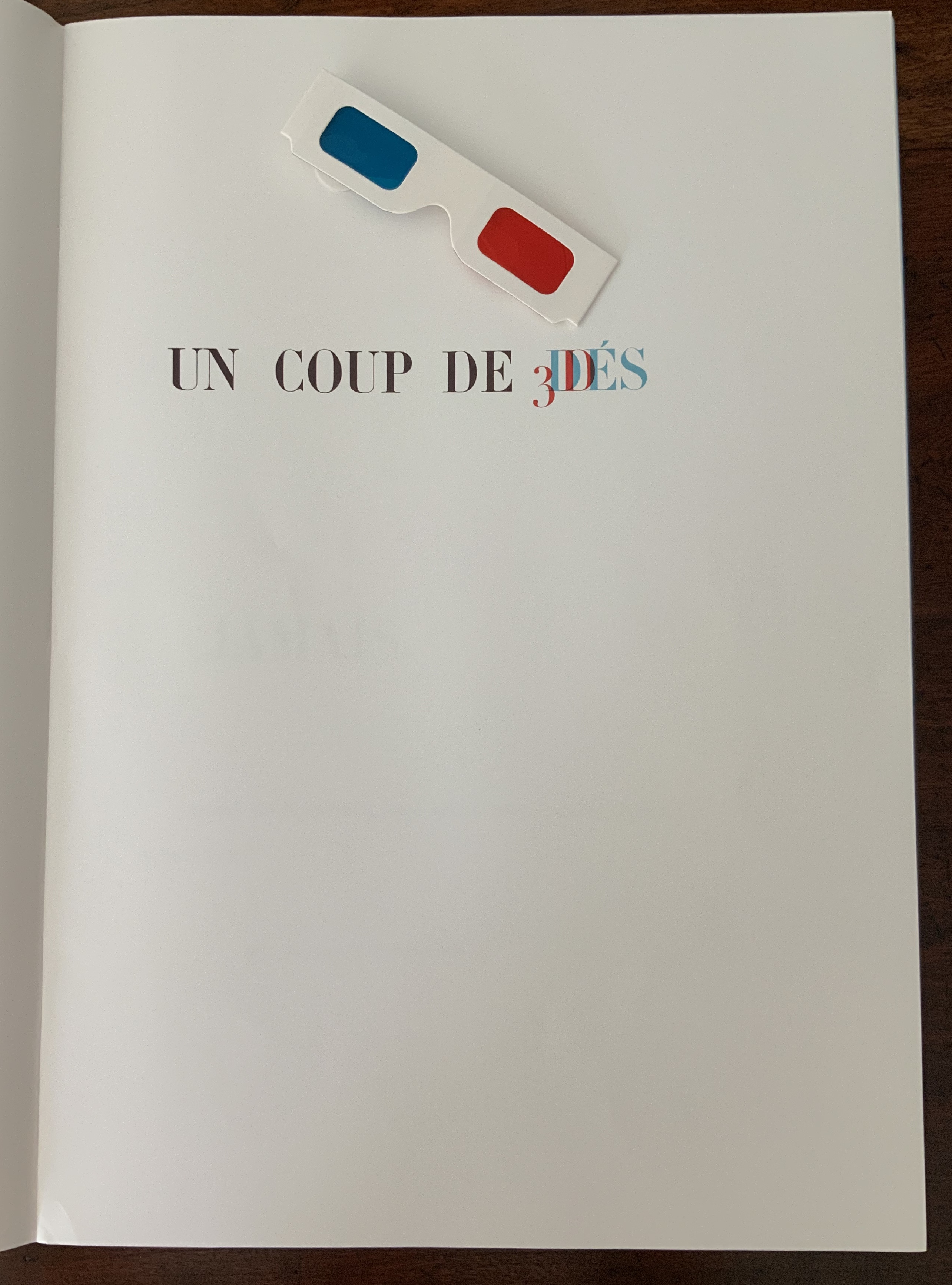
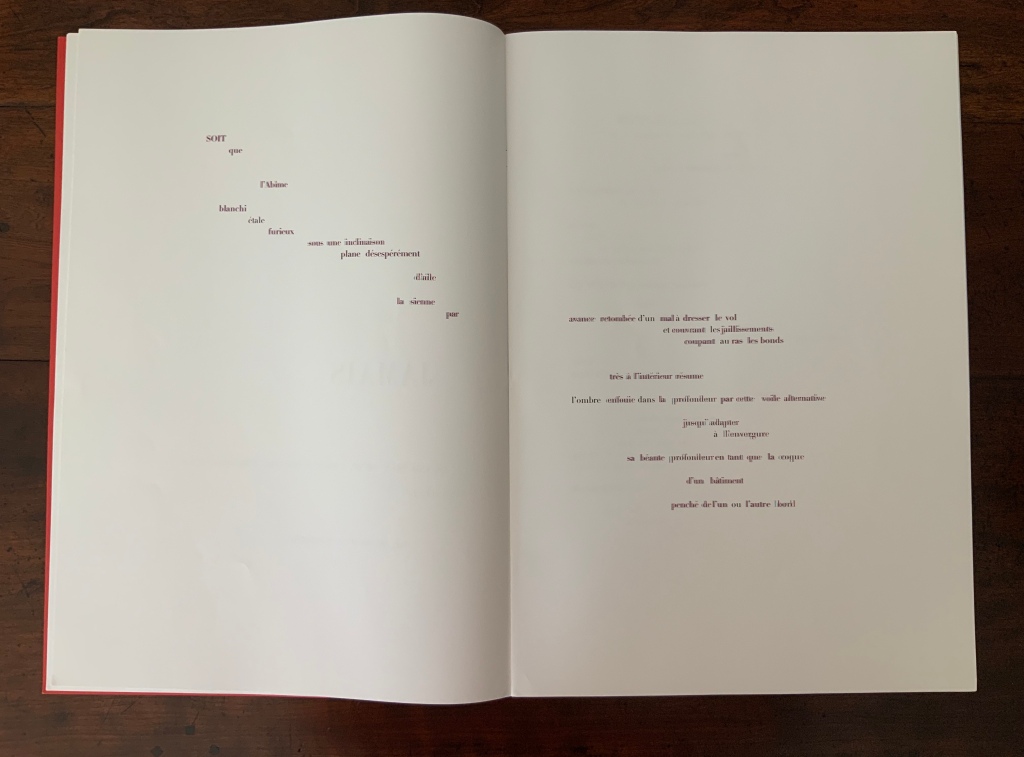
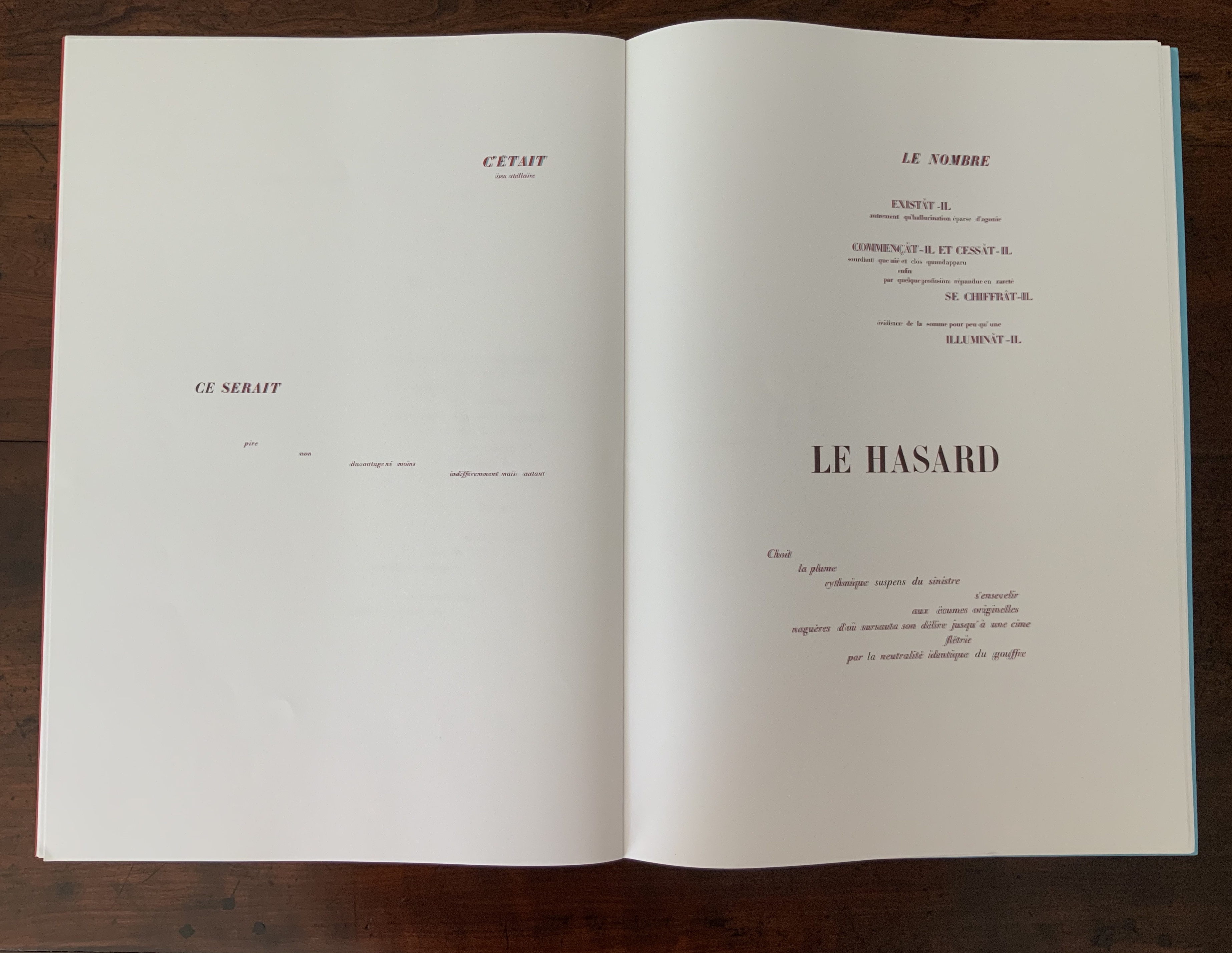
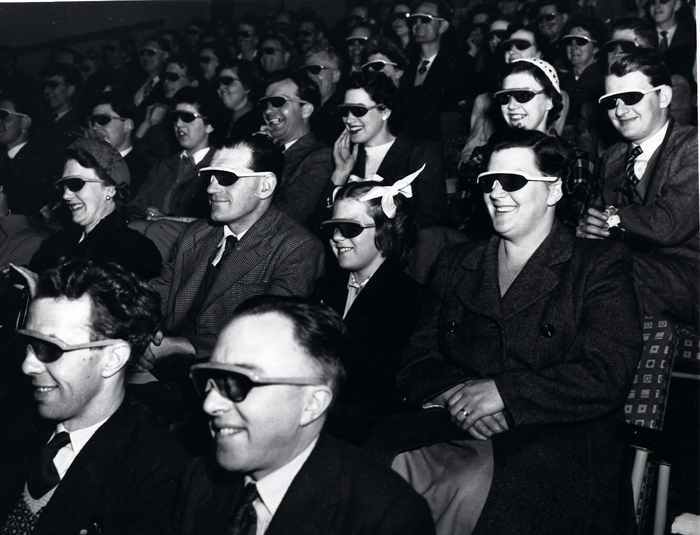
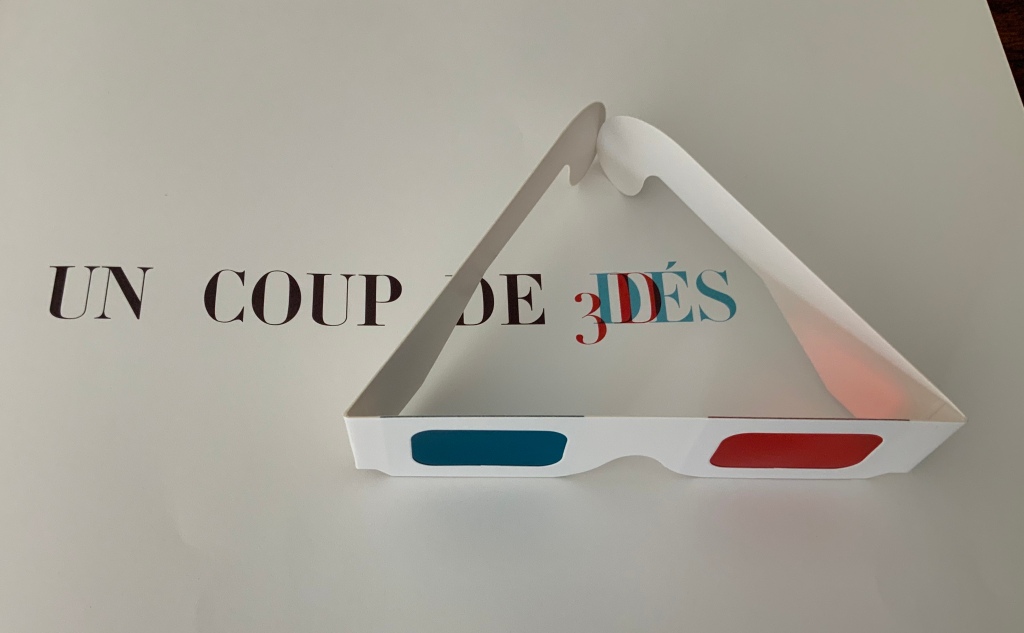
In size, Larosche’s Un Coup de Dés outdoes most other versions and homage — except those that are installations. The large black cover suggests a dark movie screen on which Larosche’s version of the poem will play out in 3D. But why 3D? Trying to read Un Coup de Dés while wearing a pair of 3D glasses challenges the eyes’ patience just as much as the poem’s ambiguities challenge the mind’s. Within the Coup de Dés genre, there is a necessary strain of strained humor. Without it, art runs the risk of taking us too seriously.
Confirming this joking intention behind his version, Larosche commented to Books On Books:
I originally handmade the book so that it was to worn on the nose like a large pair of glasses, which was another practical joke because the letters were too close to read, as in so 3D that it was literally in your face. — Brian Larosche, 2 April 2020.
Even with puns and slapstick there is often a point. The anaglyphic print technique and sheer size of Larosche’s version draw attention to Mallarmé’s sculptural play with type size and layout on a 2D surface as well as the poem’s spatial metaphors that align with it. In Mallarmé’s original, the staggering and dispersal of lines and single words on the page buttress, and are buttressed by, the word images of a roiling sea, shipwreck and constellation. Other artists with other techniques have drawn attention to that sculptural play and those spatial metaphors: Marcel Broodthaers‘ superimposed black bars, Michalis Pichler‘s and Cerith Wyn Evans‘ cut-outs, Sammy Engramer‘s sonograms sculpted in PVC and Eric Zboya‘s computer graphic “translation”.
Other artists have also poked serious fun at Un Coup de Dés and each others’ homage. Jim Clinefelter teases the sonority of the poem with his A Throw of the Snore Will Surge the Potatoes (1998). With her Rubik’s cube version (2005), Aurélie Noury needles the poem’s and poet’s puzzle pose. With their piano-roll versions, Rainier Lericolais (2009) and Pichler (2016) pick on Broodthaers (1969) as well as Mallarmé (1897) for their spatial metaphors and, in Mallarme’s case, his assertions of musicality. In Rodney Graham’s version (2011), Popeye substitutes for le Maître as the ship’s captain.
Larosche’s perceptively humorous rendering of Un Coup de Dés has earned it a secure perch among the other birds of the homage feather, and the use of 3D glasses seems to invite another layer of homage from artists interested in virtual reality headgear and augmented reality devices.
Further Reading
“Sammy Engramer”, Books On Books Collection, 1 June 2020.











 Books On Books