Why do some books of photography lodge themselves in our minds as book art or artist’s books? Ed Ruscha’s books have done that, so much so that it seems almost odd to call them photobooks, although their deadpan presentation as such is essential to their artistic status. Why do works like Sean Kernan’s The Secret Books and Abelardo Morell’s A Book of Books defy relegation to the coffee table?
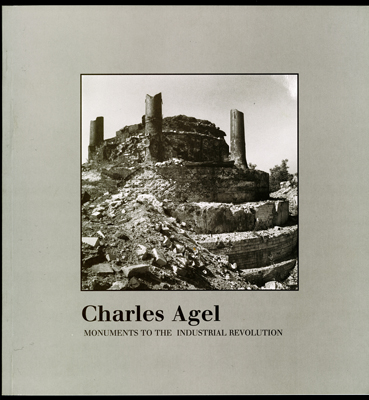
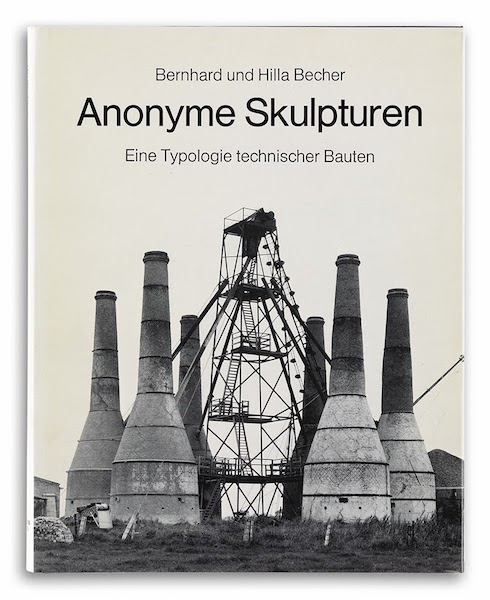
In juxtaposing his photos with text from John Lloyd Stephens, the 19th century explorer of Mesoamerica, Charles Agel positions Monuments to the Industrial Revolution (1998) as more than a book of photos. Quite a different conceptualizing strategy from the typologizing pursued from the 1970s onward by Bernd and Hilla Becher, mentioned by photographer John Pfahl in his introduction to Monuments.
Seeking the differences and similarities in strategies of composing the works as well as those of composing the photos adds to the appreciation and understanding of them.
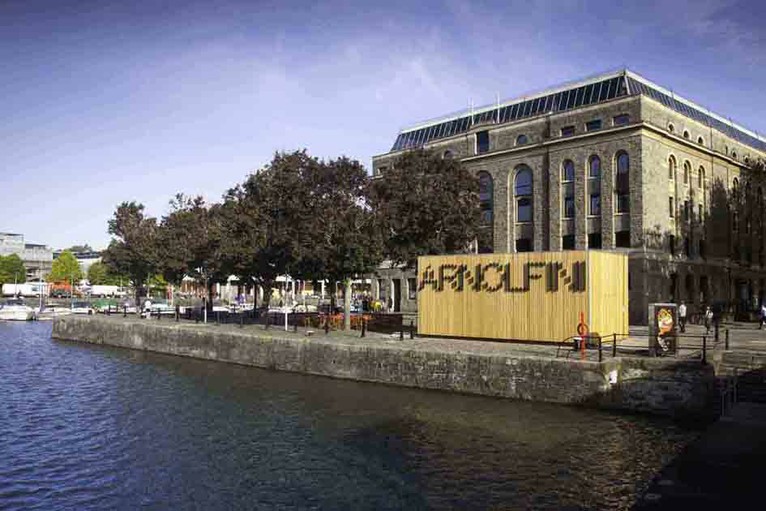
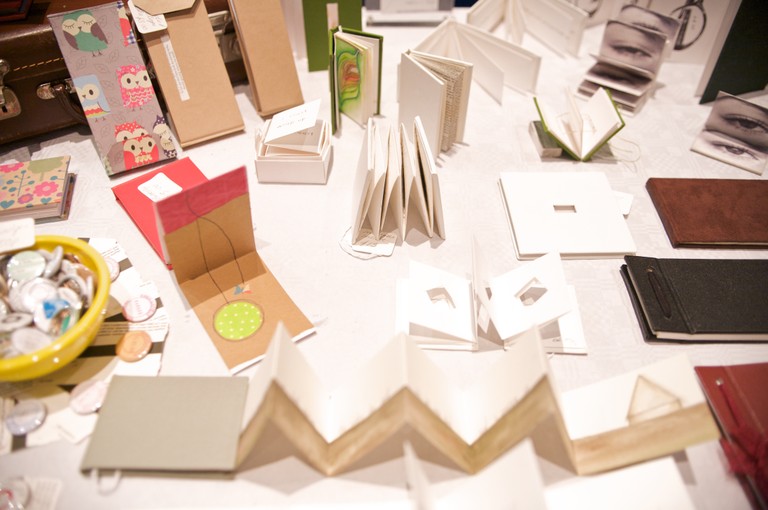
Containing over 700 items, the Arnolfini artists’ book collection is one of the largest UK collections of contemporary book art. It leans toward the 1970s and 1980s. The US-based Franklin Furnace Archive Artists Book Bibliography is representative, as are European works such as those of Vito Acconci, Marcel Broodthaers, Stanley Brouwn, Hanne Darboven, Jan Dibbetts, Helen Douglas, Dieter Roth and Telfer Stokes.
Franklin Furnace Archive Artists Book Bibliography (1977) Unbound notecards of artists’ books catalogues 3 v. ; 430 cards ; 11 x 16cm
The collection is not without later representative works such as those by SooMin Leong, Jonathan Monk and Grayson Perry, but there seem to be no works after 2012. The Arnolfini, Bristol’s center for contemporary art, also hosts the biennial Bristol Artists Book Event.
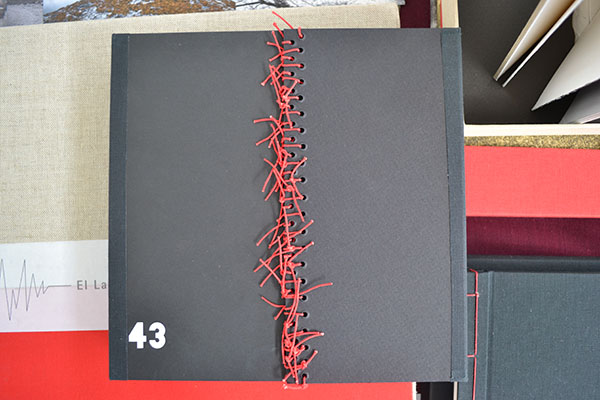
43: Cuarenta y Tres (2015) Lorena Velázquez Book 21.5 x 21.5 cm; box 30.3 X 24.2 cm; mixed technique, interventions with acrylic and serigraphy; edition: 43.
Josh Hockensmith, curator at the University of North Carolina’s Joseph C. Sloane Art Library, made it possible for me to handle this searing work memorializing the 43 students from the Raúl Isidro Burgos Rural Teachers’ School of Ayotzinapa who disappeared in September 2014 near Iguala, Mexico. The driving rain outside the windows that day compounded the work’s effect.
The hard work of describing Velázquez’s book has been done by Stephen Dingler, rare book cataloger at the University of Texas, Austin, Below is an excerpt of online comments on the 13th copy of the edition of 43.
The use of the number 43 is not restricted to the title in Ms. Velázquez’s work. Forty-three numbered copies of the book were made; the book, constructed in concertina (accordion) style, has 43 unnumbered pages; the numbers from one to 43 are printed across several pages; on one page the number 43 is produced in braille. There is little text but the book artist’s use of photographs showing demonstrations and rallies, as well as portrait photographs of the 43 missing, convey a sense of outrage and a demand for justice. The book’s pages are colored black, with most splashed or streaked with red paint, which further conveys a sense of horror and tragedy at what happened.
Stephen Dingler, “The Significance of Numbers”, The Top Shelf, 15 August 2016. Accessed 7 September 2018.
Even with more than 100 people arrested in relation to the case and a key suspect in custody in March 2018, the facts remained unknown. The 43 would have graduated in July 2018. Mexico’s new president Andrés Manuel López Obrador has committed to launching an independent commission on 1 December 2018 to to re-open the investigation in compliance with a federal court ruling.
One among the names of the 43 has been redacted because his remains have been identified. 43: Cuarenta y Tres (2015) Lorena Velázquez
The Spiral Lady (2013) Book 21.5 X 20.0 cm; box 56.5 X 21.5 cm; edition 20 + 2 a/p. Collaboration with Lola Argemí. WorldCat link.
El Vuelo/Flying (2012) Book 21.5 x 18.0 cm; box: 23.0 cm x 19.5 cm; mixed technique, fine art printing, interventions with chinese ink and acrylic; edition: 10 + 2 a/p. WorldCat link.
El Latido del Corazón/Heartbeat (2011) Book 24.5 x 35.5 cm; box 38.5 x 37 x 4.5 cm; mixed media, digital printing over plaques of collodion and several objects; edition: 4 + 2 a/p.
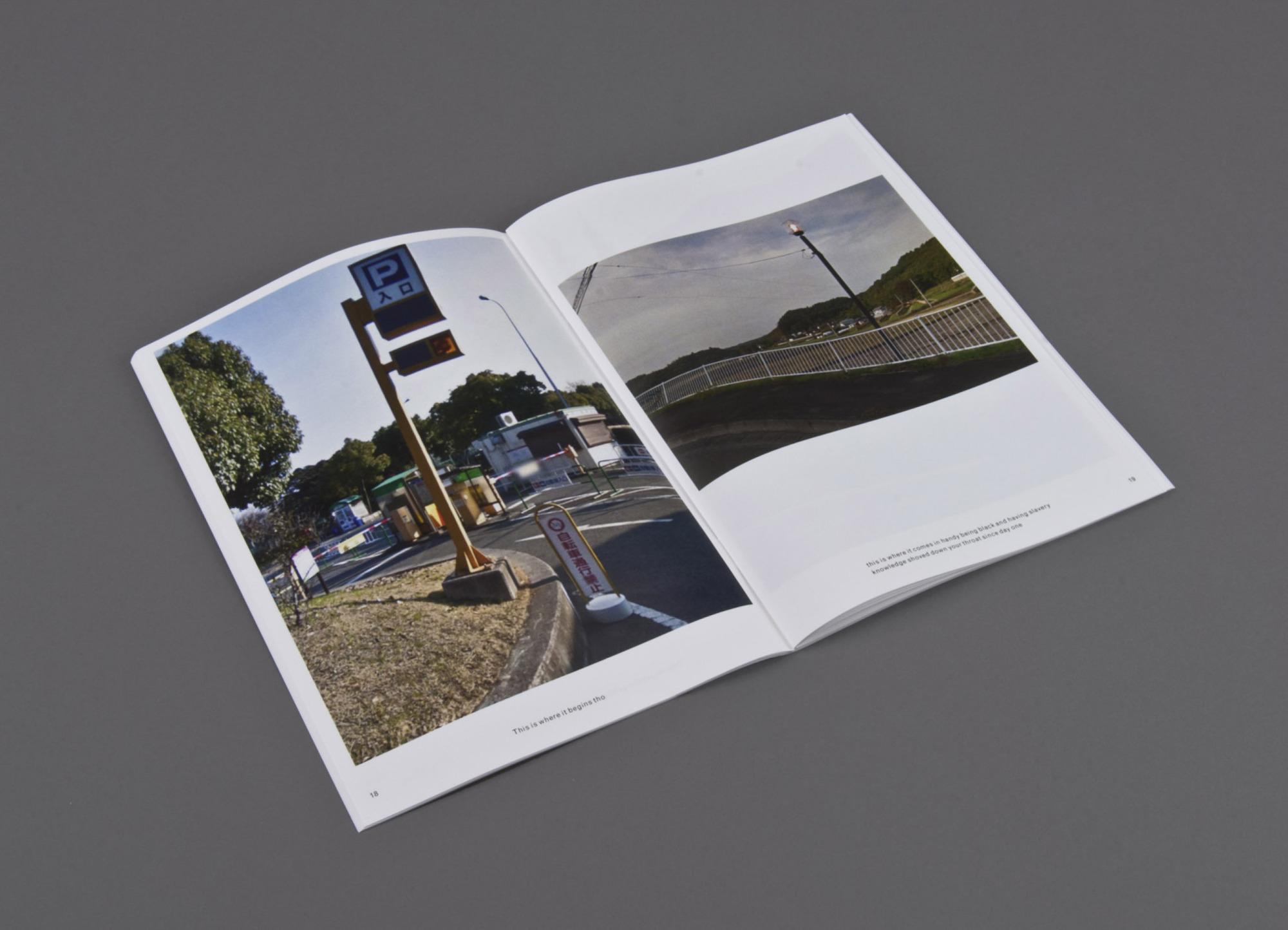
This is where (2014) Print on demand, three booklets Erin Zwaska
An ongoing chance-based publication project in the spirit of Ed Ruscha. Images are randomly-selected Google streetviews (which are often captured at noon to avoid shadowing) of cities like Paris, Tokyo, etc. The copy is compiled from all tweets containing the phrase “this is where” between noon and 12:15pm local time for each city. Consequently the text and imagery for each 15-minute issue originates from the same, albeit ambiguous, time and place. And though text and image are randomly paired, surprising narratives often emerge. Included in the collection of the Library of the Printed Web.
This is where is where the tradition of Ed Ruscha meets the Web. Go there and see for yourself.
A search of Lafayette College’s Artists’ Books Collection on the genre yields 1284 entries, including works by Alicia Bailey, Julie Chen, Maureen Cummins, Steven Daiber, Karen Hanmer, Margaret Kaufman, Clifton Meador, Lois Morrison, Werner Pfeiffer, Gerhard Richter, Maryann Riker, Edward Ruscha, Buzz Spector, Barbara Tetenbaum, Erica Van Horn and Sam Winston.
Check out the archives for the Werner Pfeiffer exhibition.
Worth a visit to the Skillman Library if you’re in Easton, PA.
If you are anywhere near Minneapolis in July or August, bookmark these items in your calendar and make your way to the Traffic Zone and the Minnesota Center for Book Arts:
15 June through 21 October 2018 — “Formation: A Juried Exhibition of the Guild of Book Workers”, Minnesota Center for Book Arts, 1011 Washington Avenue South, Suite 100
20 July through 30 September 2018 — “Freud on the Couch: Psyche in the Book”, Minnesota Center for Book Arts, 1011 Washington Avenue South, Suite 100
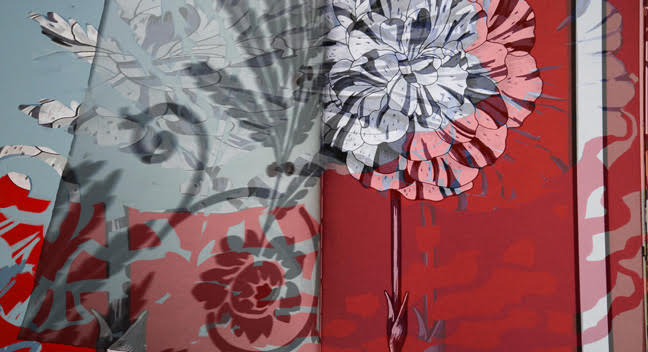
Harriet Bart and Jon Neuse are curating the intriguing exhibition “Wallpaper”. They invited twelve artists, known for their engagement with the art of the book, to participate in an experiment. The artists were each given a copy of the book Wallpaper: A Collection of Modern Printsby Charlotte Abrahams and tasked with using it, its form and/or content, to deliver an original work.
A screen grab from an iPad alteration (2018) Yu-Wen Wu Photo: Courtesy of the curators
The result of the Neuse/Barton effort is a mixed media exhibition well worth pondering. Below is a sampling of photos from the exhibition (links lead to the artists’ sites).
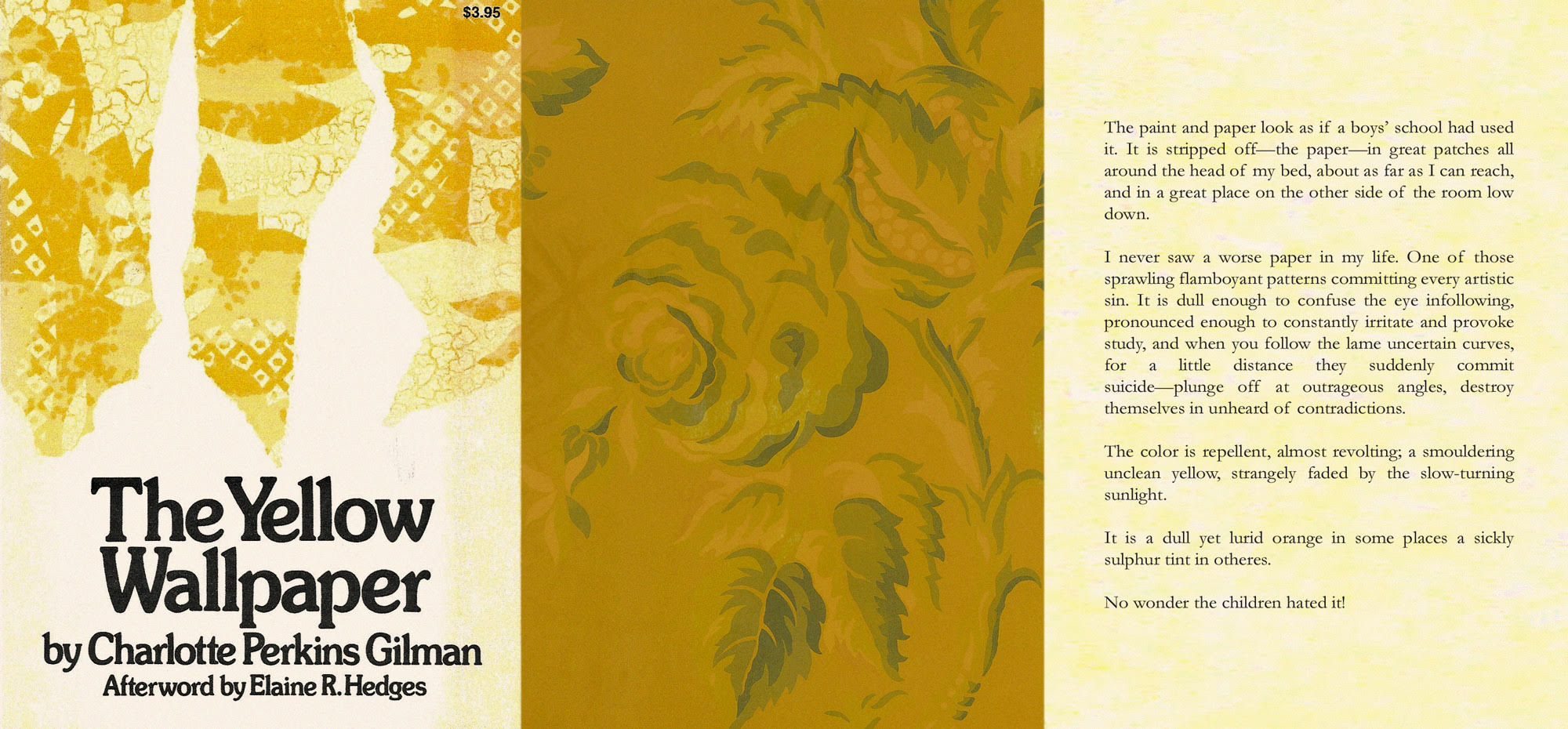
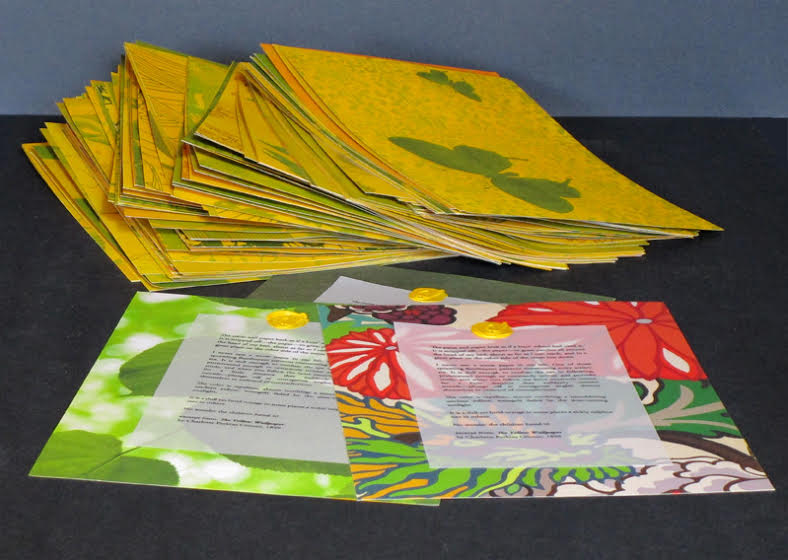
The Yellow Wallpaper (2018) Harriet Bart Photo: Courtesy of the curators
The Yellow Wallpaper (2018) Harriet Bart Photo: Courtesy of the curators The individual pages of the Abrahams book, removed and painted cadmium yellow with text from Gilman’s story added, will be given away.
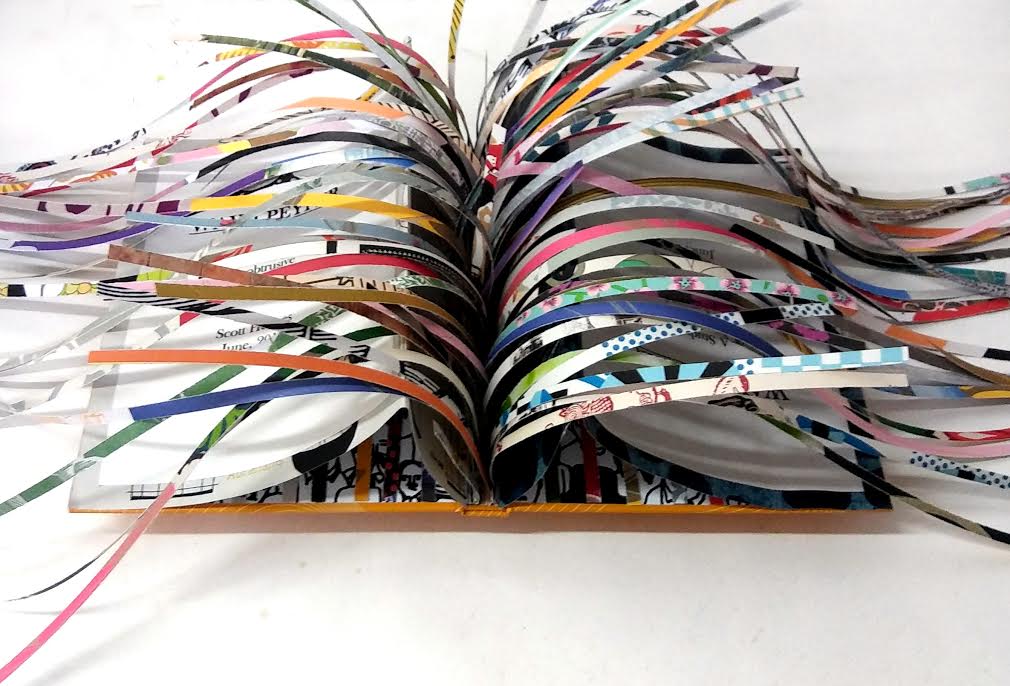
Wawlpeyper – A Study in Unobtrusive Backgrounds (2018) Scott Helmes Photo: Courtesy of the curators
Vesna’s Altered Wallpaper Book (2018) Vesna Kittelson Photo: Courtesy of the curators
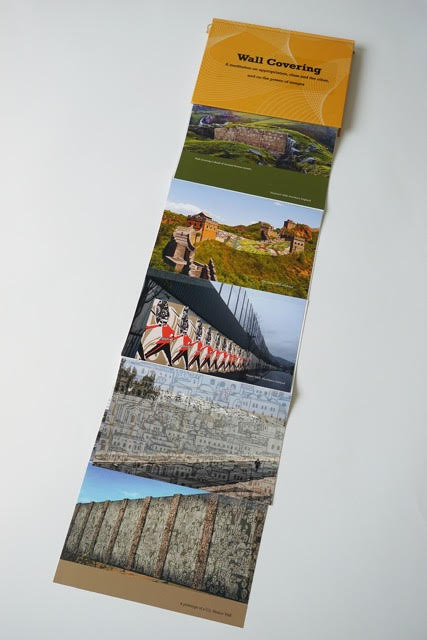
Wall Covering: A meditation on appropriation, class and the other, and on the power of images (2018) Joyce Lyon Photo: Courtesy of the curators
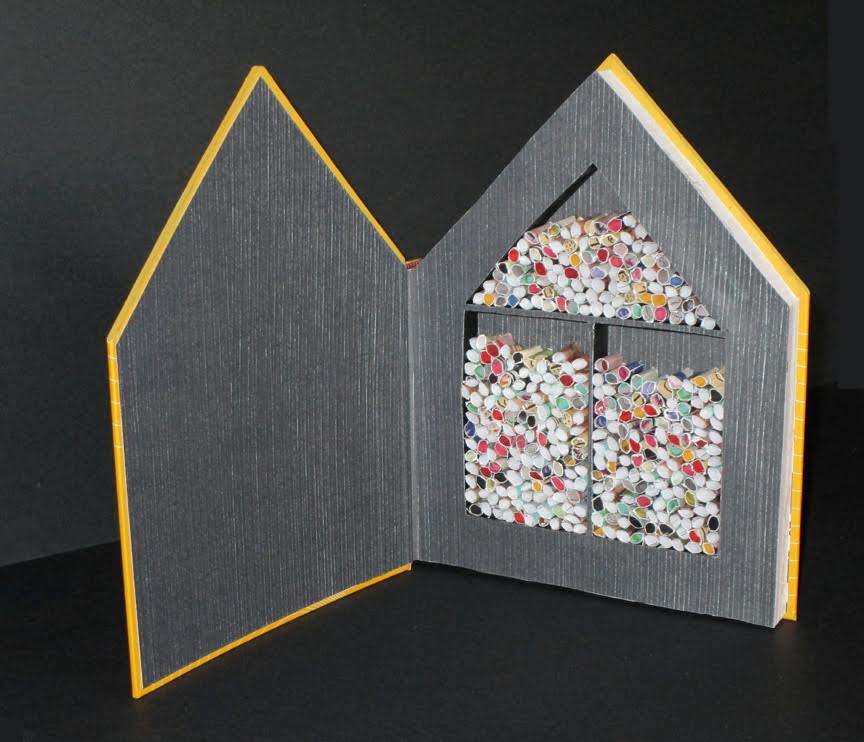
Scrolls (2018) Jon Neuse Photo: Courtesy of the curators
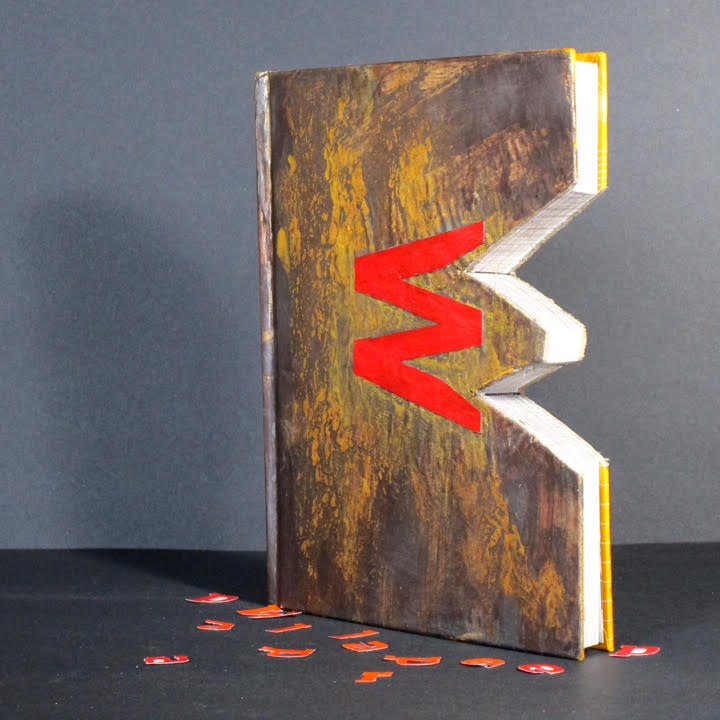
As always with book art, there is the self-reflexive, self-referring humor: Jon Neuse’s pun on the book scroll housed in a house-shaped codex in which miniature scrolls of wallpaper are housed and Scott Helmes’ pronunciation-entitled work subtitled with a joke to which the work’s sculpture is the punchline. The exhibition also covers a good variety of the forms book art has taken and may pursue even further in the future: Vesna Kittelson’s carving, Joyce Lyon’s accordion book, Doug Beube’s excavated book (shown below), and Harriet Bart’s painted-book homage to Charlotte Perkins Gilmore’s short story “The Yellow Wall-Paper” and Yu-wen Wu’s digital take on the challenge.
It is not far from Traffic Zone to the MCBA: a 5-minute drive, a 24-minute walk or bus ride. A rare occurrence to have three book art exhibitions within such close proximity.
Subsequent to this notice, one of the participants – Doug Beube – posted the following demonstration of his contribution Wallpaper Selfie.
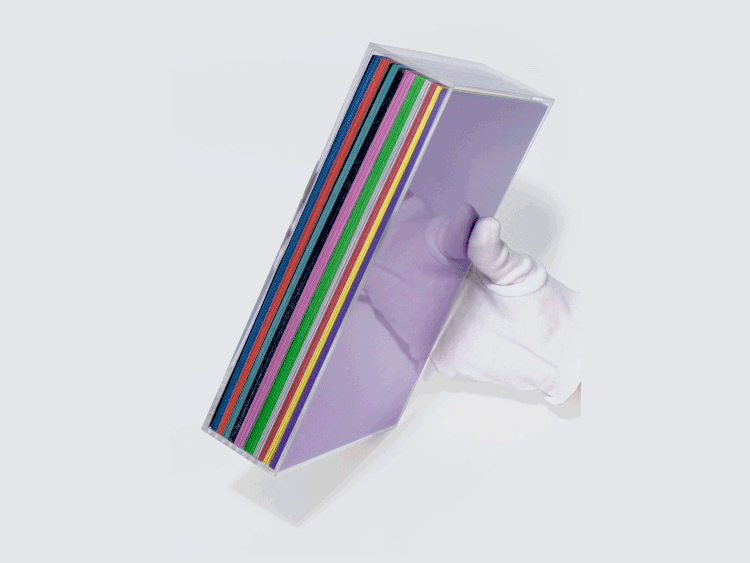
Rotch Library offers a small but growing collection of contemporary artists’ books. The collection focuses on artists’ books published from the 20th century to the present and explores a range of techniques and technologies employed by the books’ creators.
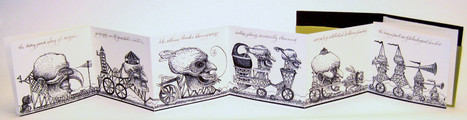
Yellow Submarine? Monty Python? Heath Robinson? Rube Goldberg? Hieronymus Bosch? Albrecht Durer? Quentin Massys? Whatever the influence, David M. Moyer has created choice work under The Red Howler Press. MIT has chosen well.
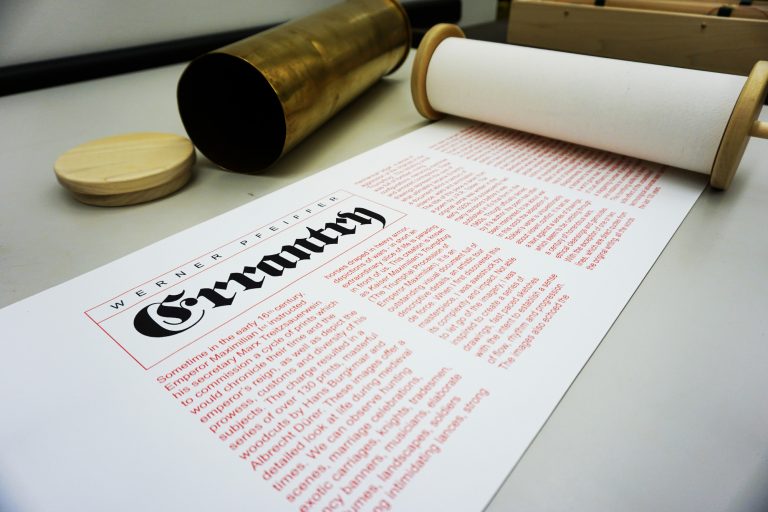
Errantry (2008) Werner Pfeiffer
Errantry, a 27-foot scroll housed in a howitzer shell casing, is inspired by Der Triumphzug Kaiser Maximilians or The Triumphal Procession of the Emperor Maximilian (1515), a series of 130 woodcuts by Hans Burgkmair the Elder (1473-1531) and others, about which Pfeiffer comments: “One of the dominant features in this document is the militant nature of many of the characters depicted, as well as their posture in parading their arms on horse, by carriage or on foot.” The text in Errantry draws from a poem of the same name in J.R.R. Tolkien’s Middle Earth mythology. The source poem, composed by Bilbo Baggins, describes one of his quest adventures in the usual self-aggrandizing yet self-pitying tone. As a model for Pfeiffer’s text, it makes the digitally printed images of war all the more horrible.
In the hands and mind of Anouk Kruithof, book art is made to sound intimate notes (Automagic, 2016) and grand notes (Enclosed Content Chatting Away in the Colour Invisibility, 2009 ongoing). She has packed so much art, enterprise and life into her life that it is hard to find sufficient time and resource to keep up with her activity. In 2017 and at the turn of 2018, a flurry of commentary arrived to mark her show ¡Aguas! at Foam Fotografiemuseum in Amsterdam. A fortunate effect of social media and the Web is that current news seems to pull retrospective links in its wake.
For Max Van Steen’s perceptive review of AUTOMAGIC (pictured above), click here.
Here are some of the videos and sites featuring Kruithof, her activities and art:
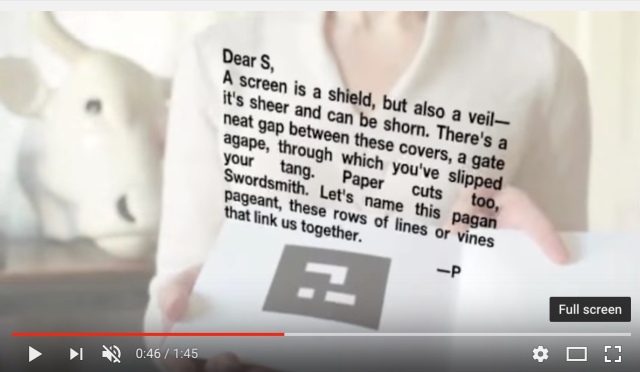
Between Page and Screen (2012) Amaranth Borsuk and Brad Bouse Website: Accessed 16 May 2014. Book: Perfect bound, H178 x W179 mm, 44 pages. Acquired 16 May 2014.
Between Page and Screen chronicles a love affair between the characters, P and S…. The book has no words, only inscrutable black and white geometric patterns that — when seen by a webcam — conjure the written word. Reflected on screen, the reader sees himself with open book in hand, language springing alive and shape-shifting with each turn of the page. The story unfolds through a playful and cryptic exchange of letters between P and S as they struggle to define their relationship. Rich with innuendo, anagrams, etymological and sonic affinities between words, Between Page and Screen revels in language and the act of reading.Publisher’s description.
The finitude of a bound codex quite literally defines its limits in analogue form. Even … gesturing outward to the world of lived and imagined phenomena that comprise a shared realm of cultural knowledge, the book’s dimensions remain linked to its physical form. But where is such a book located in the spatial-temporal realms of networked environments? And when is a work produced? … Borsuk and Bouse’s depends on a linked connection between quick response (QR) codes on pages and files stored online. The capacity to conjure stored material that projects itself in augmented screens onto the perceived world further erodes the boundaries of interior/exterior edge and periphery that were traditionally defining features of an aesthetic work.
Between Page and Screen has been displayed in exhibitions such as “The Art of Reading (18 November 2017 — 4 March 2018)” held at the Meermanno Museum in The Hague. Unusually, at that exhibition, the art was not simply on display. Touching was allowed. Paul van Capelleveen, one of the curators organizing the show, insisted that each work be touchable. As a curator at the Dutch national library and advisor to the Meermanno, he felt strongly that the challenges of multimodal literacy cannot be understood “under glass”. Apparently, the market agrees: Between Page and Screen is now in its second edition.
Further Reading
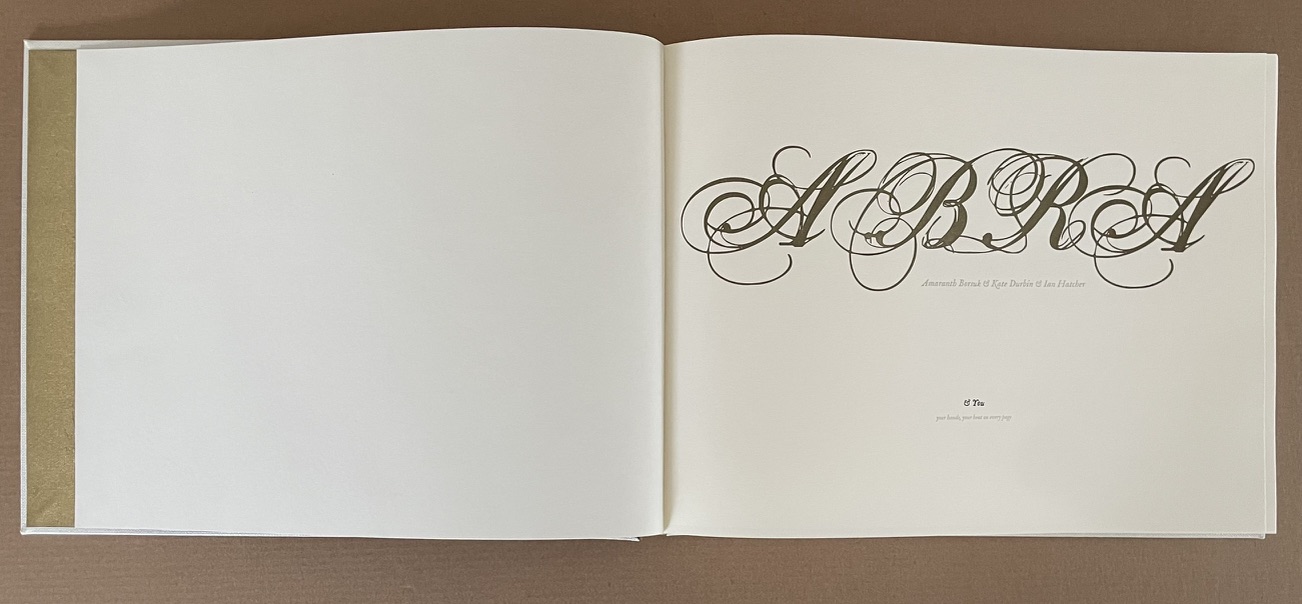
Created for the November 2016 issue of The Bellingham Review, “Abra: The Kinetic Page” is a polymorphic tour de force – online prose poem, video, review of and homage to an installation at the Henry Art Gallery in Seattle, WA, in 2014 and a promotion of the artists’ book Abra: The Living Bookby Kate Durbin, Amaranth Borsuk and Ian Hatcher, published in 2014.
From where did such work spring? From a project called “Expanded Artists’ Books: Envisioning the Future of the Book”. Inspired by the advent of the iPad in 2009 and a symposium held in 2011 with Bob Stein, Director of the Institute for the Future of the Book, Steve Woodall, then Director of Columbia College’s Center for Book and Paper Arts, secured funding for that project from the National Endowment for the Arts in 2012. Woodall later explained the intent of the project in that same workshop where Johanna Drucker drew attention to Between Page and Screen:
In its first phase, our project takes existing artist books and creates iPad applications that both represent and contextualise them. The apps will be made available as free downloads. With the many millions of portable devices running on the iOS platform, the reasoning goes that an under-distributed and too-obscure art form can gain wider reach and achieve greater public awareness. We will soon expand to include Android and other platforms, but we expect to stay within the ‘walled garden’ world of the app, as opposed to the open range of a purely browser-based platform – we feel that the smoother functionality and higher-quality user experience of the app work well with the expanded practices of authorship and craft engagement that define artist books.
In the project’s second phase we shall commission media artists to create born-digital artist book/apps, which will then be reverse engineered as physical books, or created in parallel with them. Owing to the creative countercharge it represents, we find this to be an extremely interesting phase of the project from a research standpoint.
…
It is the dialogue between the physical books and their digital avatars that provides a great part of the value of this project. … it is in the artist’s studio, whether that be an electronic workstation or a more traditional book art studio, where the dialogue will play out in the creative process. Artists will explore ways in which expression can take both virtual and physical manifestations, examining the advantages of each and how the interplay between the two can be leveraged to provide a comprehensive and powerful expression. Woodall, “Artists, Writers and the Future of the Book“.
Abra was funded by a grant from this project, and with Abra, Borsuk, Durbin and Hatcher have manifestly “embodied” the sponsor’s intent as will become clear as you read. But pause first on Borsuk’s Bellingham Review piece.
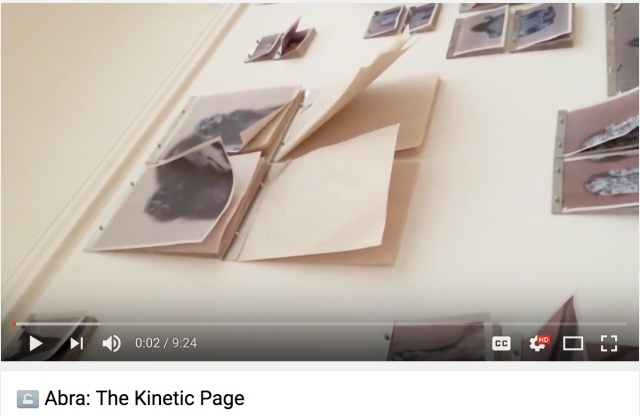
Borsuk is an inspired writer, a gifted conceptual and haptic artist. “Abra: The Kinetic Page” starts as a reflection on experiencing Ann Hamilton’s installation the common SENSE with its exploration and celebration of “touch”:
As I walked through the upper galleries, where newsprint images of the undersides of birds and small animals fluttered in the HVAC breeze, I thought about the way the exhibit invited us to read space. Hamilton’s juxtapositions, like the lines of a poem, rely on the visitor to bridge the between with their body. We provide the spark that leaps across the enjambed line where the tale of Cock Robin meets a downy hide.
○
I’ve strayed from what I wanted to tell you because Hamilton’s work requires it. It is, as she says, a form of attention she seeks to share with her audience—she creates installations as spaces animated by the viewer. She sets up the conditions for an experience or interaction, and then withdraws, trusting the reader / viewer / visitor to make meaning. To limn the contours of the work with their own gentle touch.
○ [Now note here how she pivots to experiencing Abra.]
As I trace my finger along Abra’s cover, whose title is also the incipit, silently voiced by the reader, which activates the text, I’m invoking not only the magic word that brings things to pass as they are spoken, I’m invoking Hamilton, whose “handseeing” videos of the late 90s and early 2000s turn the fingertip into an eye, uniting reading and writing in a gesture that links dactyl and stylus, through the digital that fits like pen in glove.
Whether read on screen or heard in the video, Borsuk’s words and sentences are tactile. Listen:
Click on the image above for the video “Abra: The Kinetic Page” by Amaranth Borsuk
“Abra: The Kinetic Page” explores and celebrates the “fundamental relationship between the eye, the brain, and, critically, the hand” as Woodall hoped. It is a work of art as much as Abra itself.
If its artistry were not enough, The Bellingham Review piece takes things a bit further than might have been expected from the “Expanded Artists’ Book” project. Interestingly, The Bellingham Review piece also addresses changes in the value chain that hybrid books and hybrid book art must confront. As originally set out by Harvard’s Michael Porter, the value chain is the “set of activities that a firm operating in a specific industry performs in order to deliver a valuable product or service for the market.” Marketing is one of those key activities in the set. In The Bellingham Review, an online and print literary magazine, Borsuk has found not only a platform for marketing Abra, but a platform from which to offer a complementary work of art in the form of a video. An example of “art for art’s sake” that finally makes sense to the business school.
The example does not end there. Reflecting in the Tate Britain workshop on the “Expanded Artist Book” project, Woodall remarked on “digitally trained designers … being drawn back to the fundamental relationship between the eye, the brain, and, critically, the hand, … photographers … combining digital processes with nineteenth-century ‘alternative’ techniques. … [and] … the enthusiasm most contemporary graphic designers have for letterpress printing.” Web skills, videographics and the YouTube/Vimeo channels are just as remarkably important, which is clear not only from the Abrasite, The Bellingham Review piece but from this shorter directly promotional video:
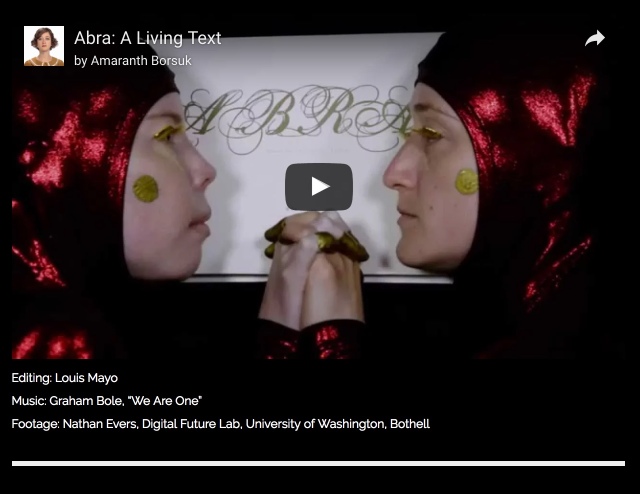
Abra: A Living Text Video editing by Louis Mayo Shot by Nathan Evers at the Digital Future Lab, University of Washington, Bothell Music: Graham Bole, “We Are One”
Woodall did wonder whether the project’s prompting a dialogue of the physical and digital would have implications for practical matters such as distribution. While Abra has a paperback version as an entry in the traditional channels to market, that offers little insight into such implications — not like the insight realized by the combination of website, promotional video and The Bellingham Review piece.
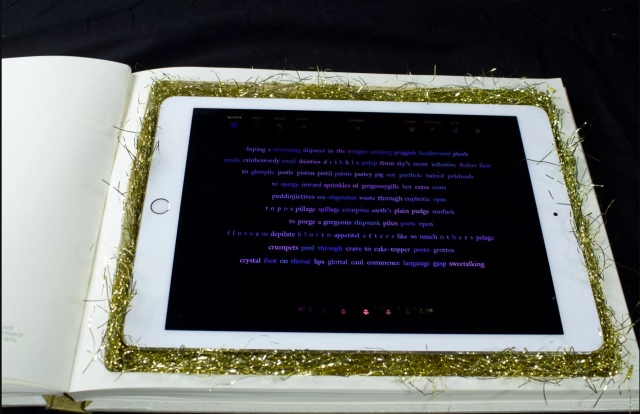
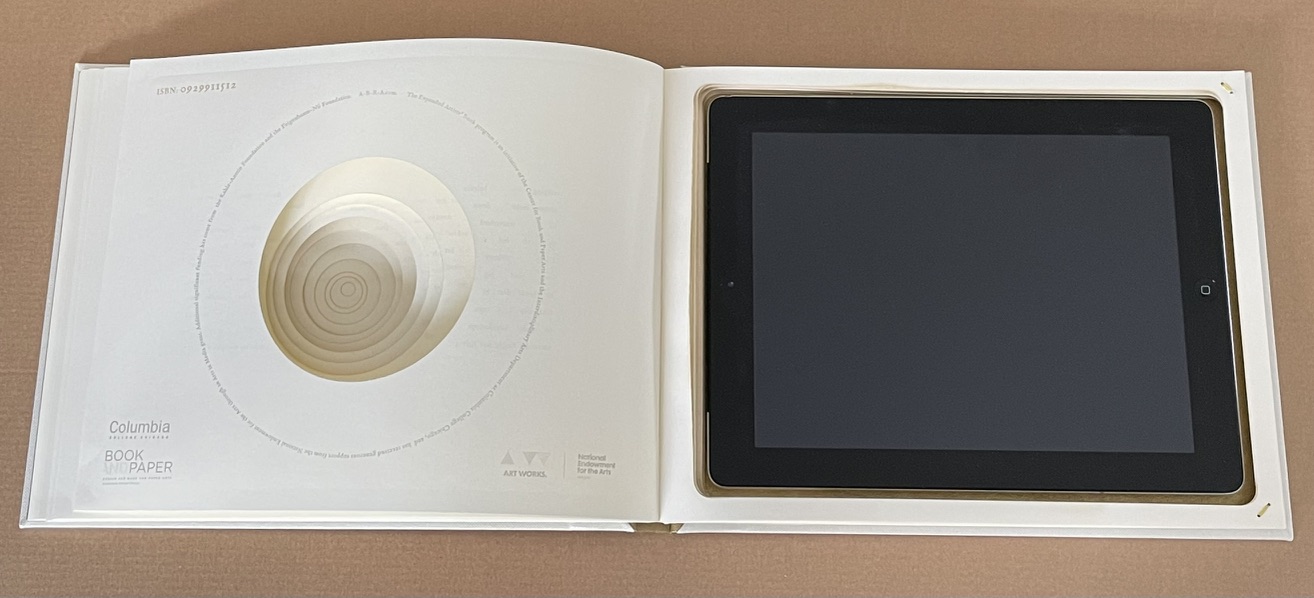
In fact, from a perspective of craft and product, the experience promised by the videos and website is completely available only if you download the app and have a copy of the limited edition of the artists’ book. Constructed by Amy Rabas, the artists’ book allows you to insert an iPad in the back of the book creating a continuous touch-screen interface. This interactivity with the reader is one more aspect of the work that realizes perhaps more than was expected from the “Expanded Artists’ Book” project.
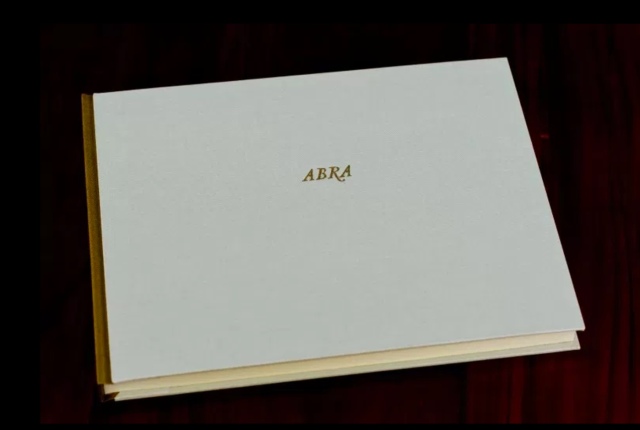
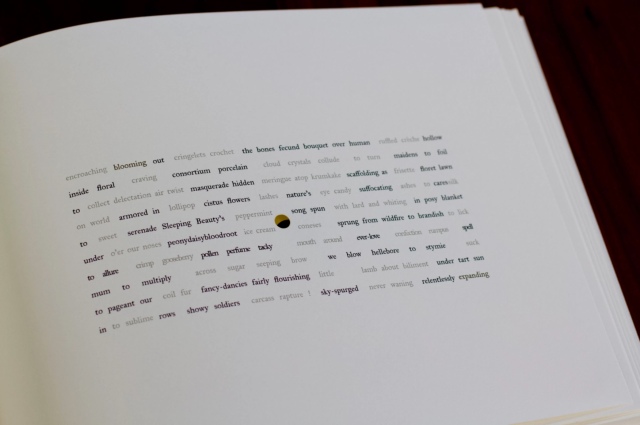
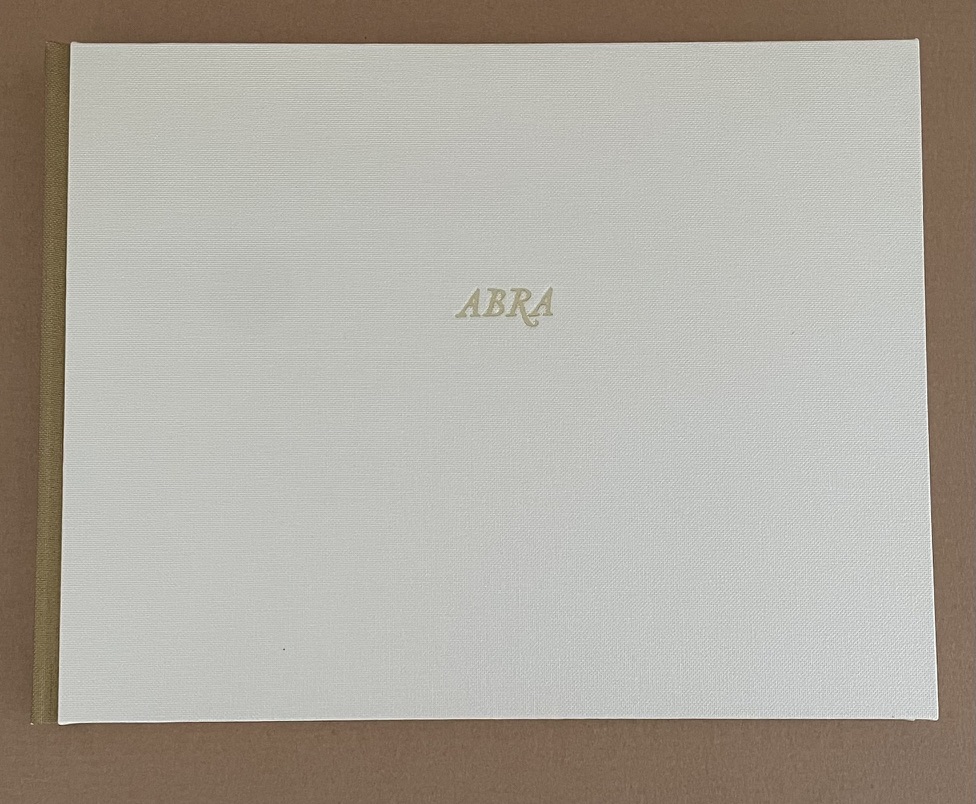
The book’s simple, mysterious foil-stamped cover. Created by book artist Amy Rabas. Courtesy of the artists.
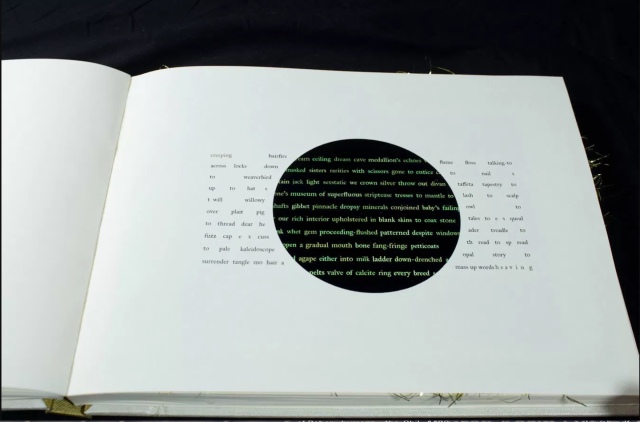
The laser-cut openings coalesce into a pinhole that begins to reveal the iPad below. Courtesy of the artists.
Readers can begin to interact with the iPad, on which the book’s text is mutating on its own. Courtesy of the artists.
At the end of the book, the iPad is revealed, and the reader can make Abra their own using the menu at the top of the screen to “Mutate,” “Erase,” “Graft,” “Prune,” and cast an unpredictable “Cadabra” spell. Courtesy of the artists.
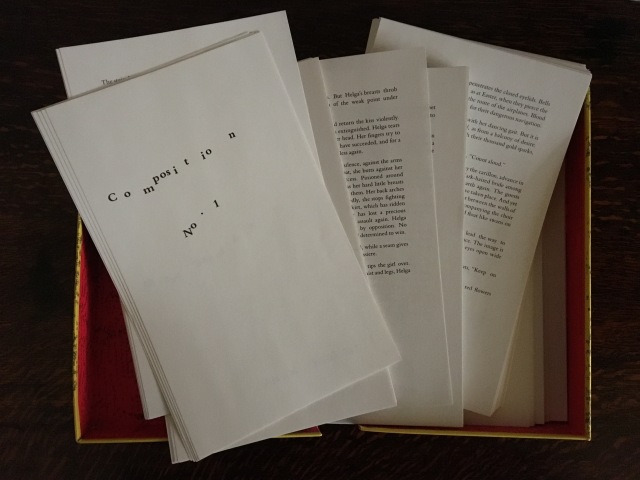
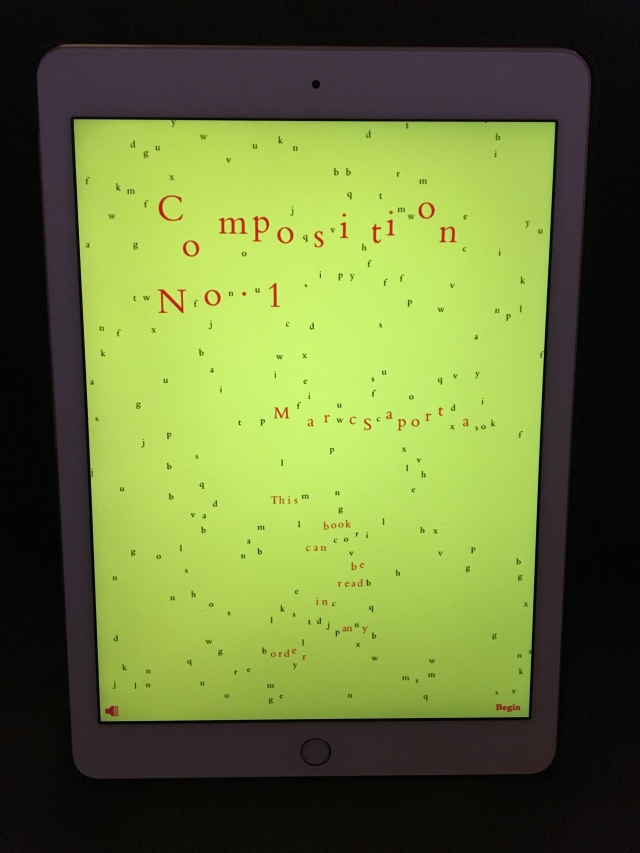
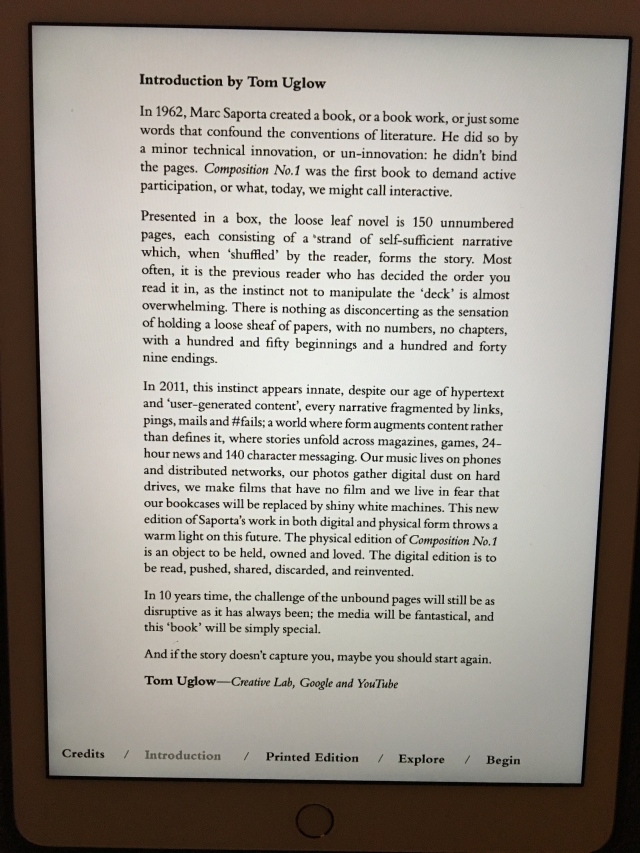
With its poems mutating on the iPad screen, Abra challenges the play with boundedness beyond the effect Drucker explained when describing Between Page and Screen in 2012. In its digital challenge to boundedness, Abra has much in common with Visual Editions’ reimagining of Marc Saporta’s Composition No. 1 in an app format. The original work was published by Le Seuil in 1962 and translated by Richard Howard for Simon & Schuster the next year.
Marc Saporta Composition No. 1 Translated by Richard Howard Redesigned and reissued by Visual Editions (2011). Photo: Books On Books Collection.
Composition No. 1 (the app) Marc Saporta, Composition No. 1 Diagrams by Salvador Plascencia, Designed by Universal Everything (2011). Photo: Books On Books Collection.
Introduction by T.L. Uglow, Google Creative Lab and YouTube (2011). Photo: Books On Books Collection.
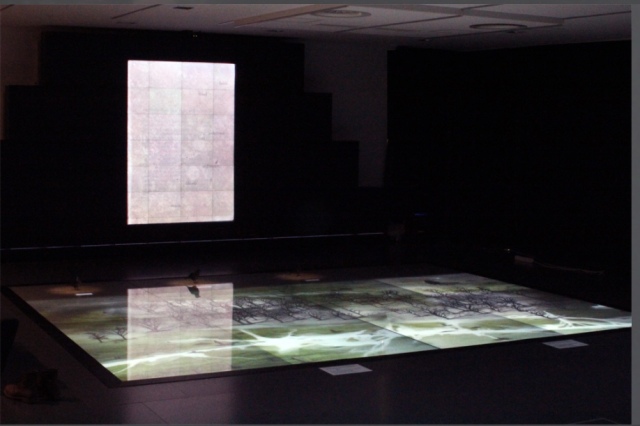
The unboundedness of Abra also has echoes in Field, the book, visual art and installation all in one produced by Johannes Heldén about the same time as Abra and The Bellingham Review piece. Field‘s interactivity, however, relies on a floor touchscreen of 20 square meters, one effect of which is to remove words from pages projected on a screen and another to animate a series of sculptural mutations of the Eurasian Jackdaw. The ephemerality of an installation combined with the effective of personal interactivity intensifies the challenge and play of unboundedness.
Johannes Heldén Field (2015) Produced and premiered at HUMlab, Umeå University. Screenshot: Courtesy of the artist.
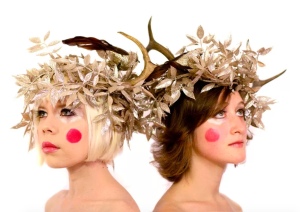
Which brings us full circle to the installation-inspired “Abra: The Kinetic Page” and the last aspect of Abra: The Living Text that carries it beyond the expectations of the “Expanded Artists’ Book”. The work began as a collaborative book-length poem between Borsuk and Durbin. Writing separately using a series of constraints, then weaving their words together and editing them side by side, the authors found a new voice emerging from the conjoined poem, that of ABRA herself. To give a body to that voice, they created a series of conjoined costumes, each an avatar reflecting various aspects of the poems.
Abra Woodnymph Courtesy of the artists.
When I hear sad tales of “The End of Books“, I think of these artists and authors and the distances between them – Borsuk in Washington State, Durbin in southern California, Hatcher in New York, Hamilton in Ohio, Rabas and Woodall in Illinois and Heldén in Sweden. Then I look at the distance between my finger and screen, between my hand and the copy of Borsuk’s Between Page and Screen lying on the table here. Those sad tales fade before the palpable vibrancy of book art and the transformative effect of the digital.
Abra features in Anne Royston’s piece on the media-bending of book art today at the College Book Art Association’s site.
See also Borsuk’s “Books and Bodies“, Cuaderno Waldhuter, August 2020. Accessed 25 September 2020.
And finally, see Borsuk’s The Book (MIT Press, 2018).
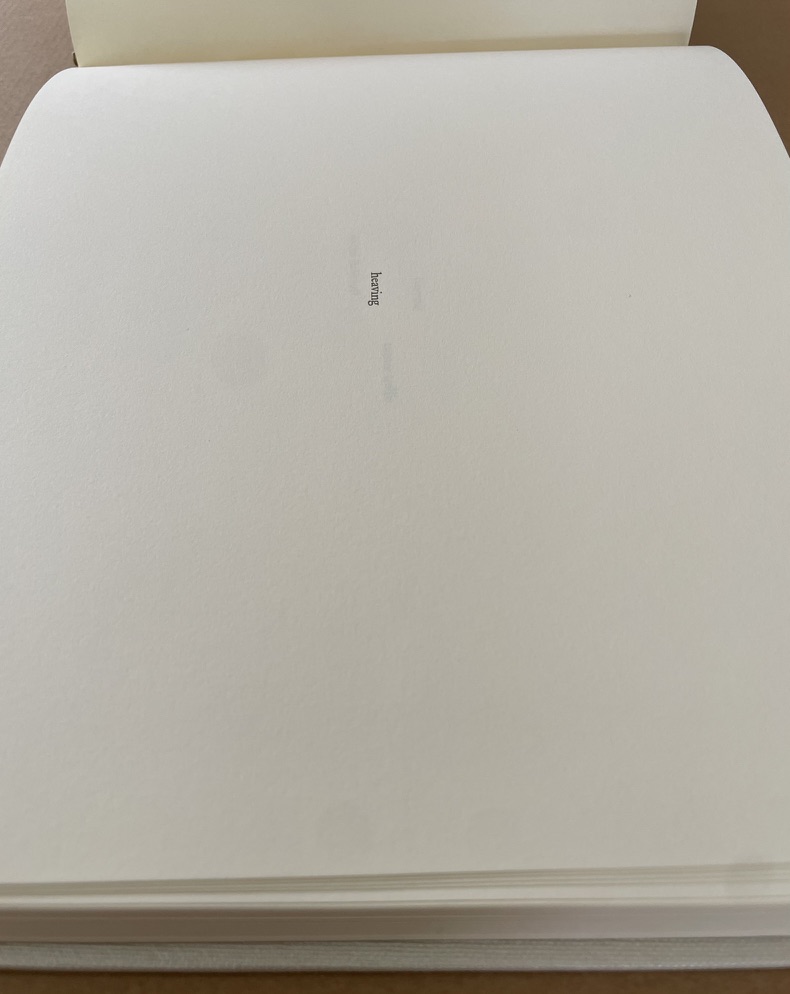
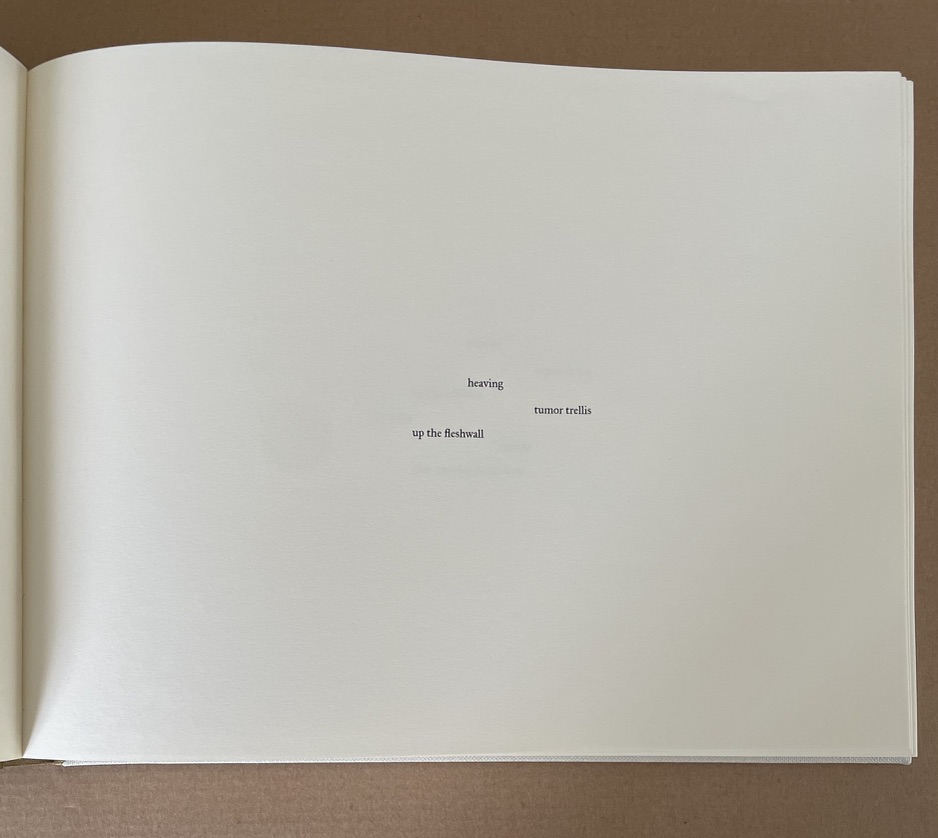
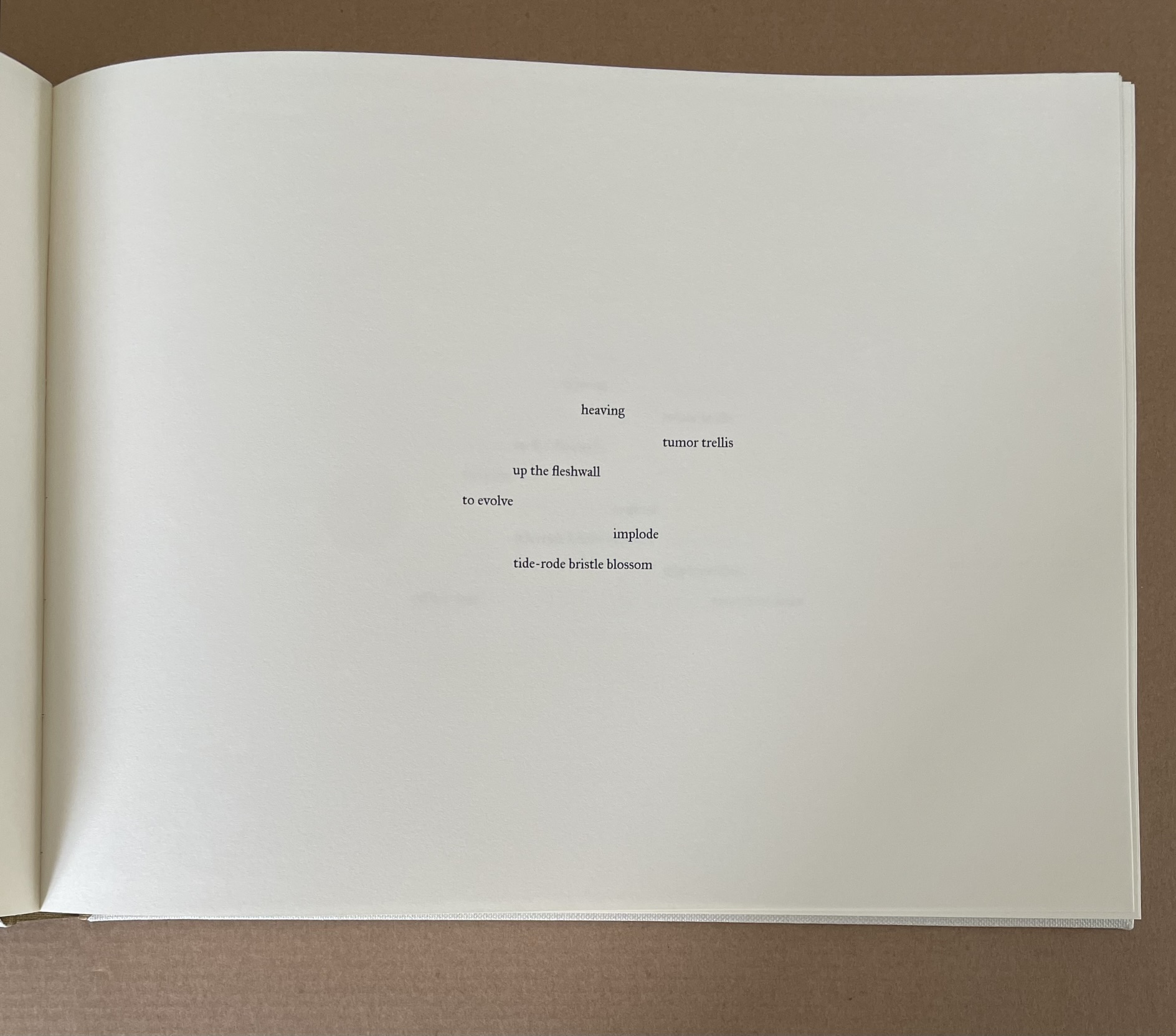
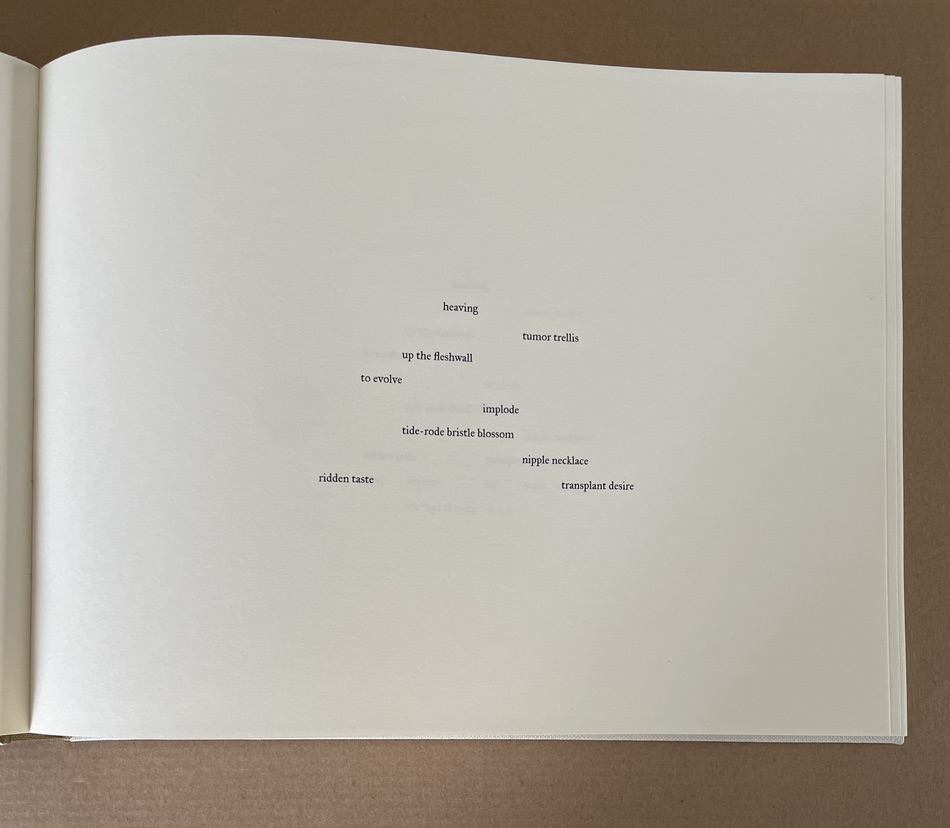
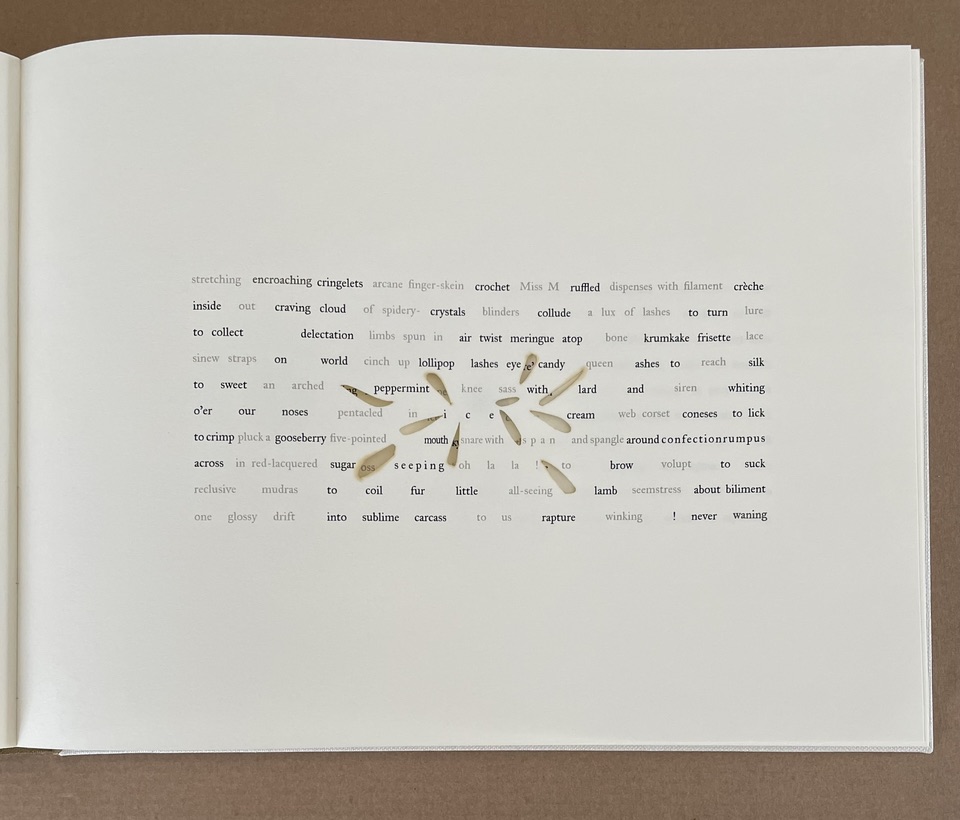
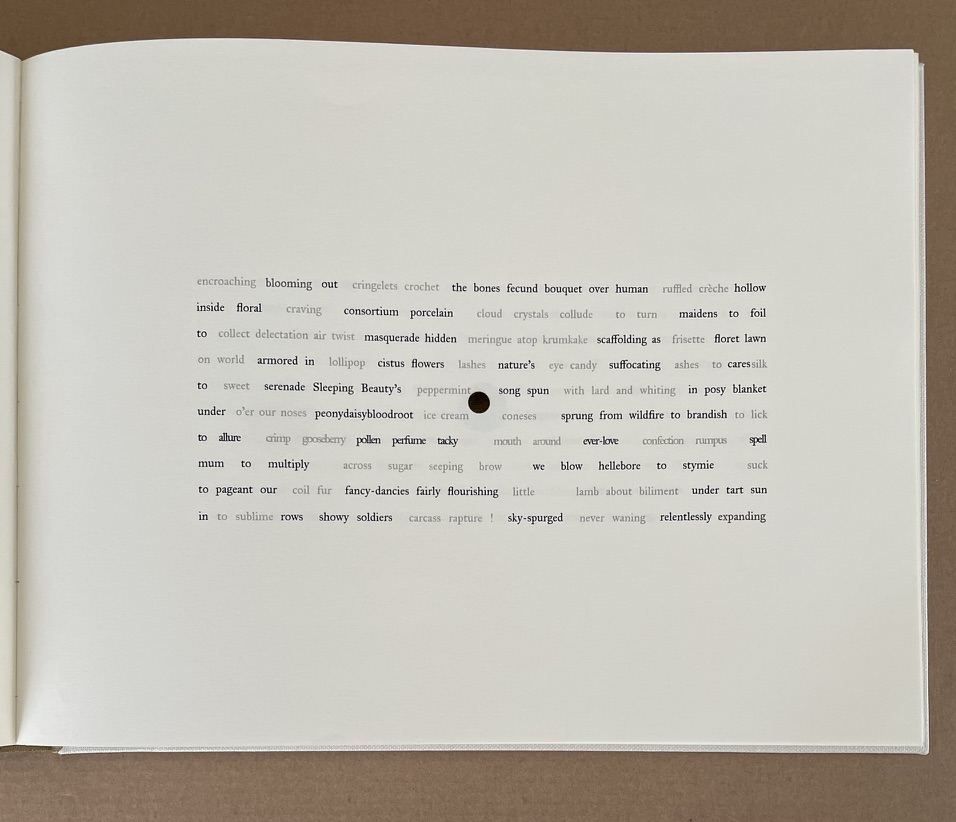
Images of ABRA from Books On Books Collection (not including iPad app)




 Books On Books
