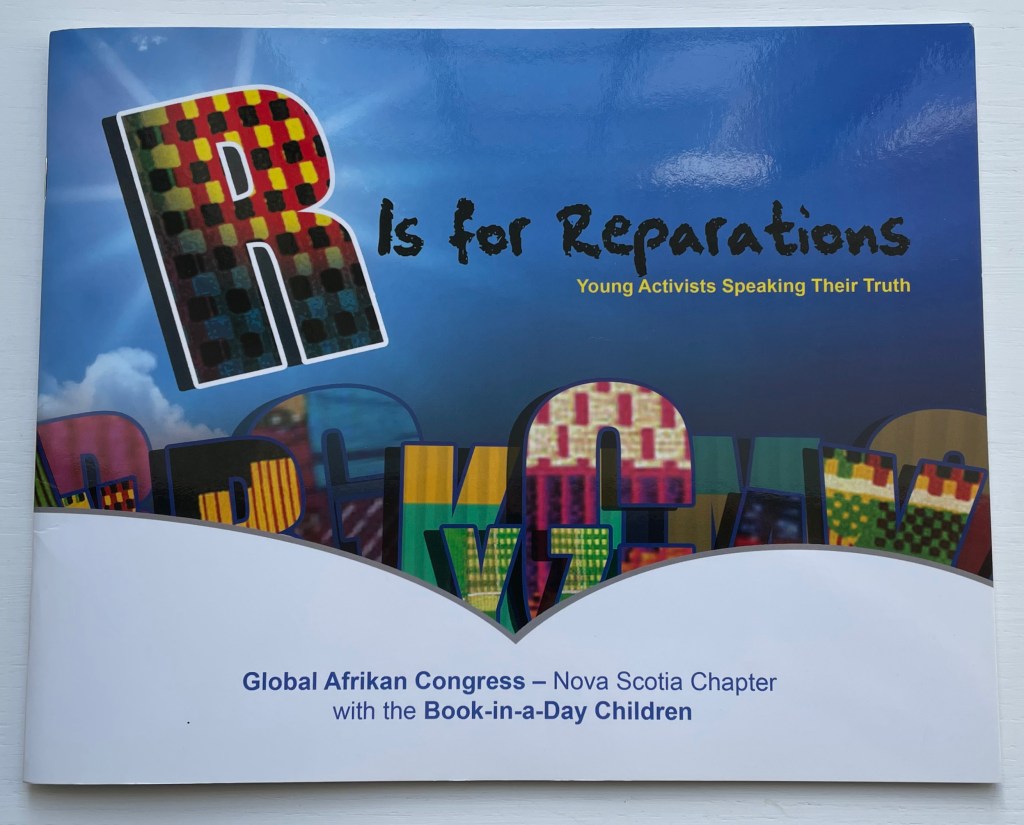
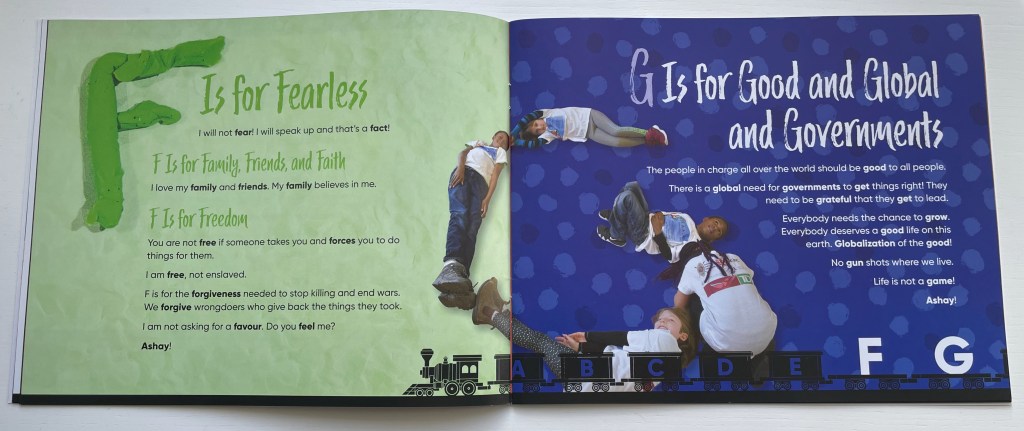
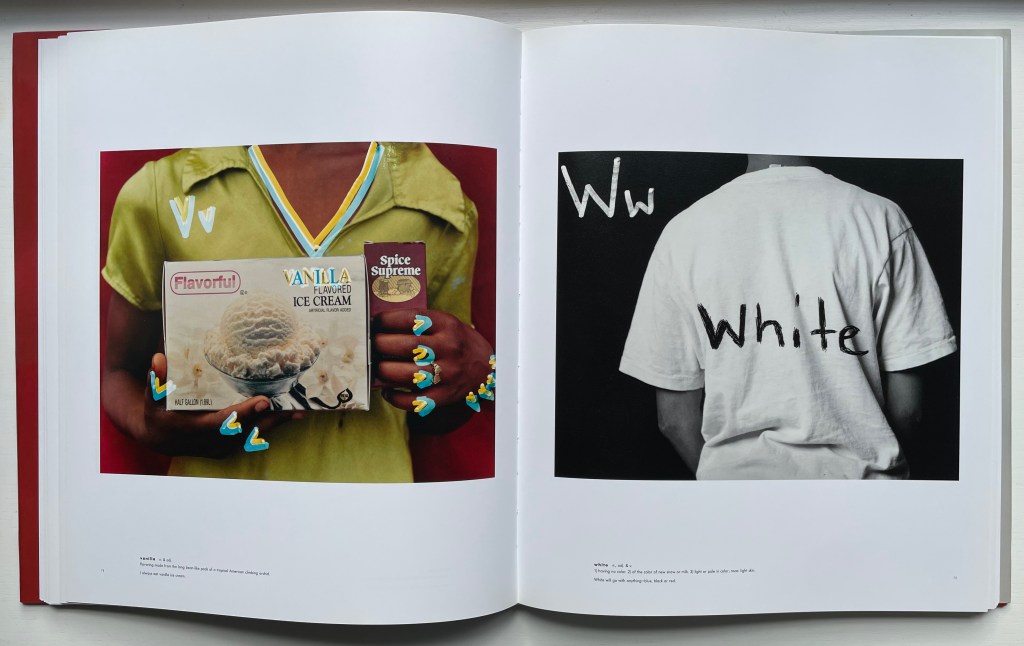
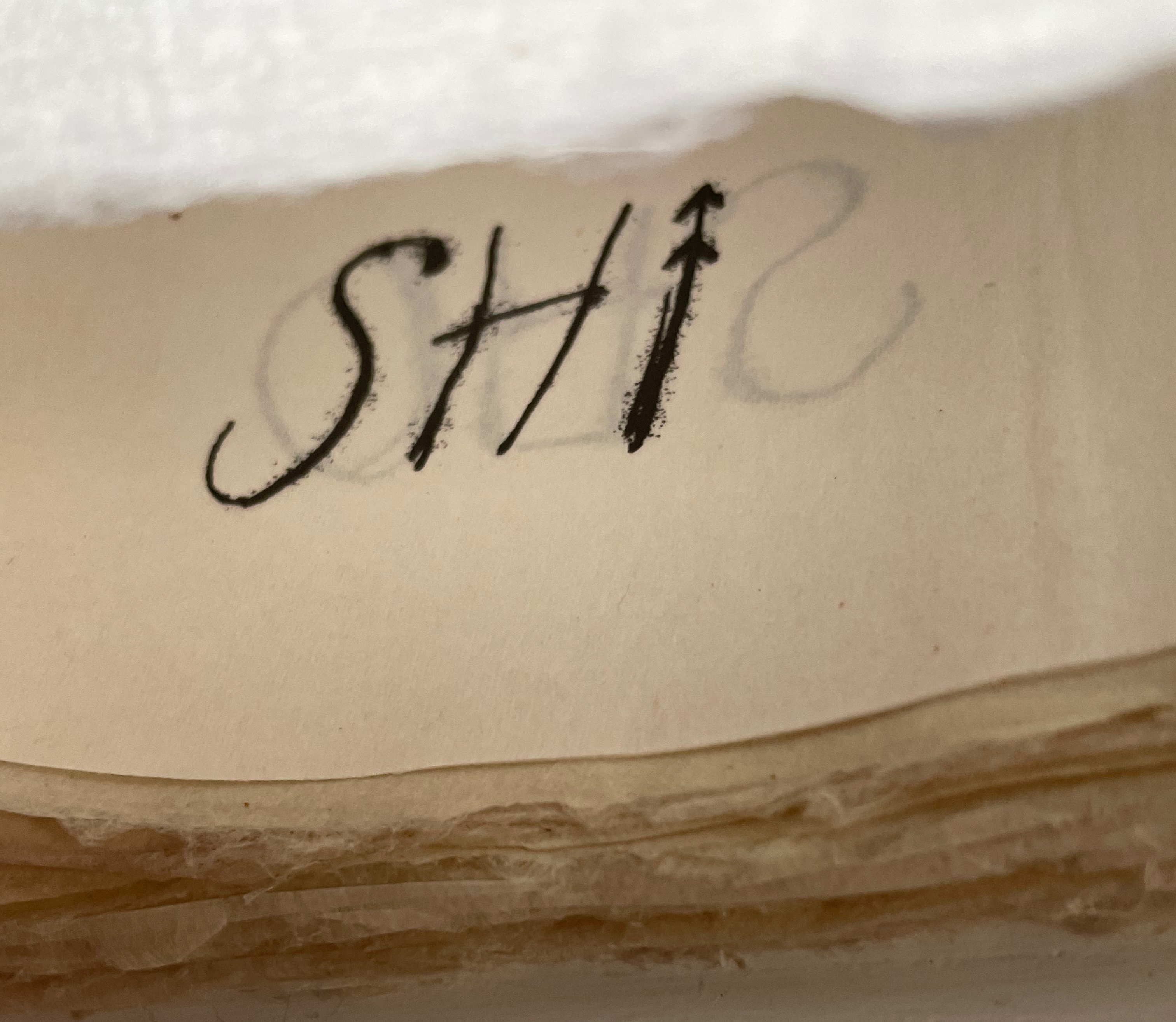
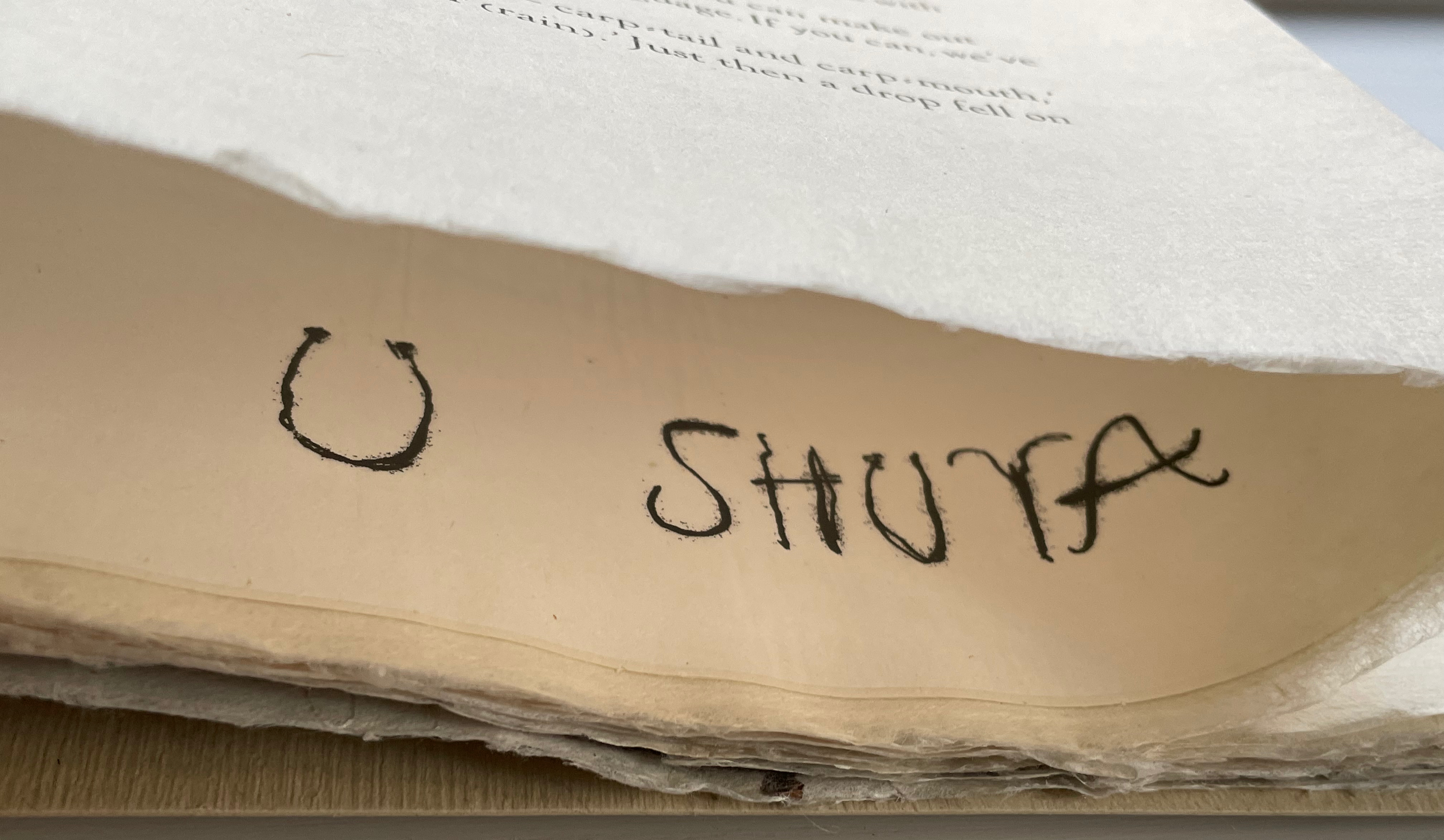
R is for Reparations (2019) Global Afrikan Congress (Nova Scotia Chapter) Denise Gillard, ed. Paperback saddlestitched with staples. H260 x W210 mm. 40 pages. Acquired from the Book Depository, 1 March 2023. Photos of the book: Books On Books Collection.
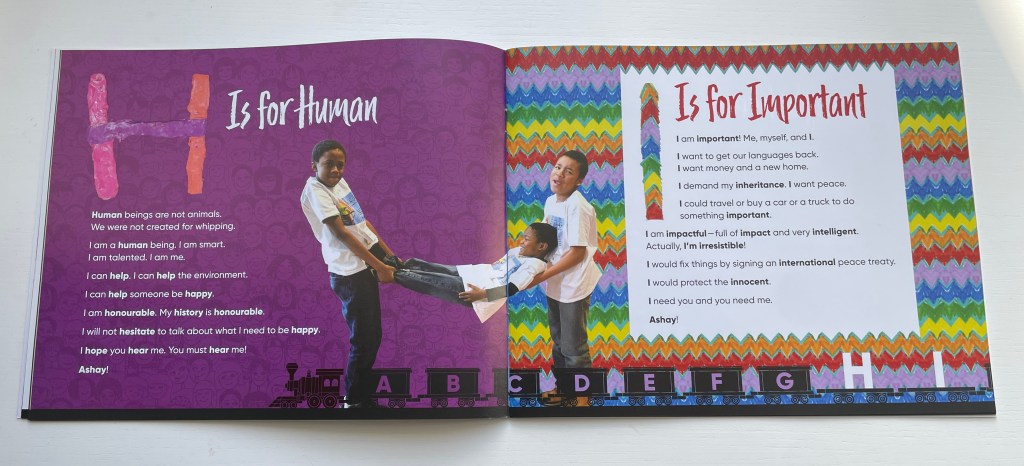
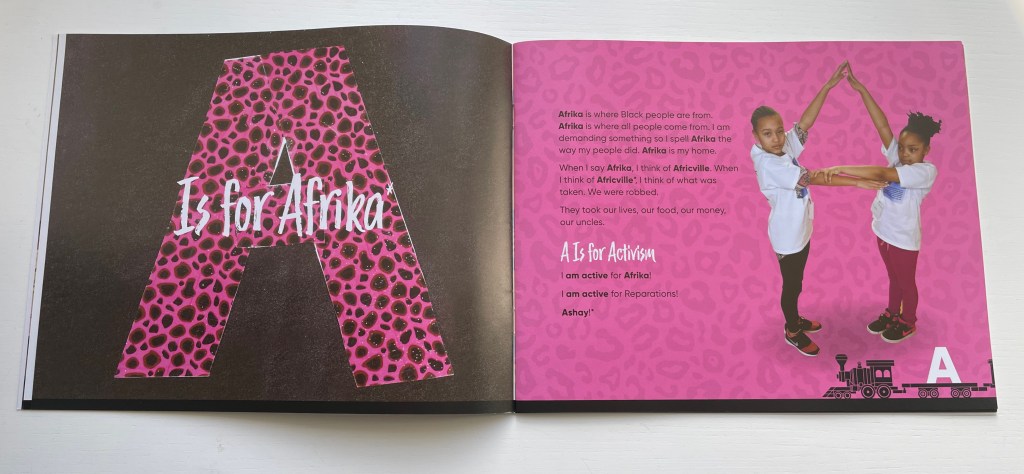
If all alphabets have a world view, can an alphabet be bent and arranged into a new world view? In 2018, the Nova Scotia Chapter of the Global Afrikan Congress facilitated a “book-in-a-day” event to help the children of Halifax create an alphabet book that answers that question. Bending and arranging the human body to make letters has a long tradition in book illustration. Drawing on that tradition, the participating children gave voice and body to create R is for Reparations, an alphabet book calling for a new world view on reparations for the damage and legacy of the Atlantic Slave Trade.
The Reparations Movement has a long history, and Halifax, Nova Scotia has played a part. In 2010, the City of Halifax issued a formal apology and $5 million in general compensation for the razing of the Black community Africville in the 1960s (see Further Reading).
Anticipating it final report in July 2023 to the state legislature, the Californian Task Force to Study and Develop Reparation Proposals for African Americans called for significant financial compensation. The governor issued a tepid if not cool response, which may be unsurprising even in the wake of his earlier signing and endorsing of legislation returning Bruce’s Beach to the Black family from whom the government appropriated it in 1924 (see Further Reading). It is an emotionally and politically complicated issue for some.
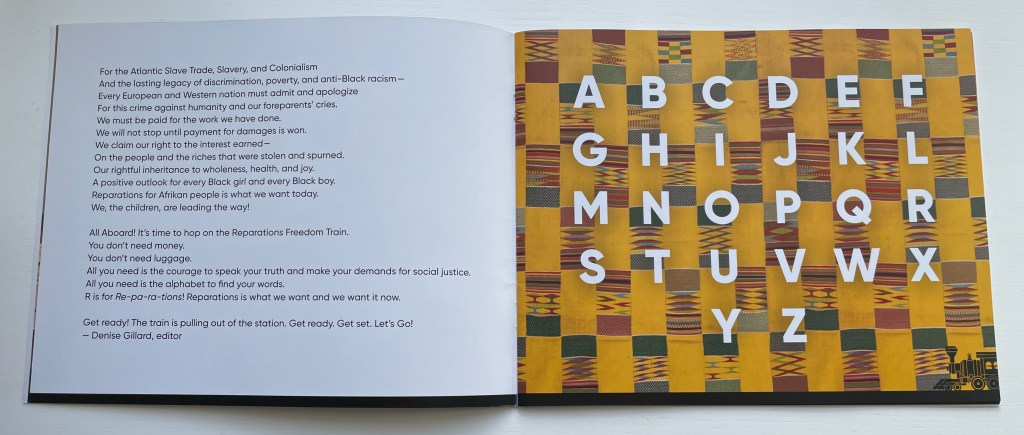
The foreword by Denise Gillard takes a less complicated view as might be expected in a children’s book, and as R is for Reparations addresses primarily Afrikans and Afrikan Descendants both on the Afrikan Continent and in the Diaspora, that view is strong and forceful. It is the sort of children’s book that would be banned in some US school libraries, but as the voices and bodies of its multi-racial cast of participants imply, it is the sort of book that those schools’ children could fearlessly manage.
Not every page is as strong as the next, but the influence of Amos Paul Kennedy Jr., Master Printer, who attended to support the children in making posters for the book launch, is evident in the colors, collage and overprinting. The book deserves comparison and contrast with the Books On Books Collection’s related holdings (see Further Reading).
Task Force to Study and Develop Reparation Proposals for African Americans. 1 June 2022. Reparations Report. State of California Department of Justice. Accessed 1 May 2023.
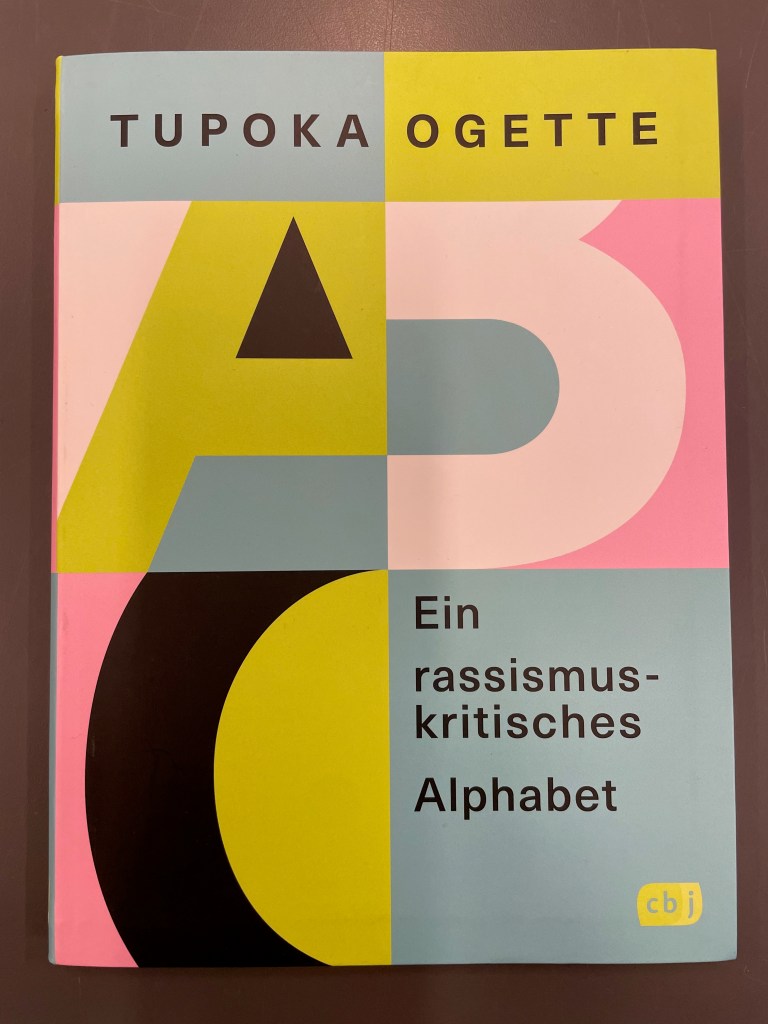
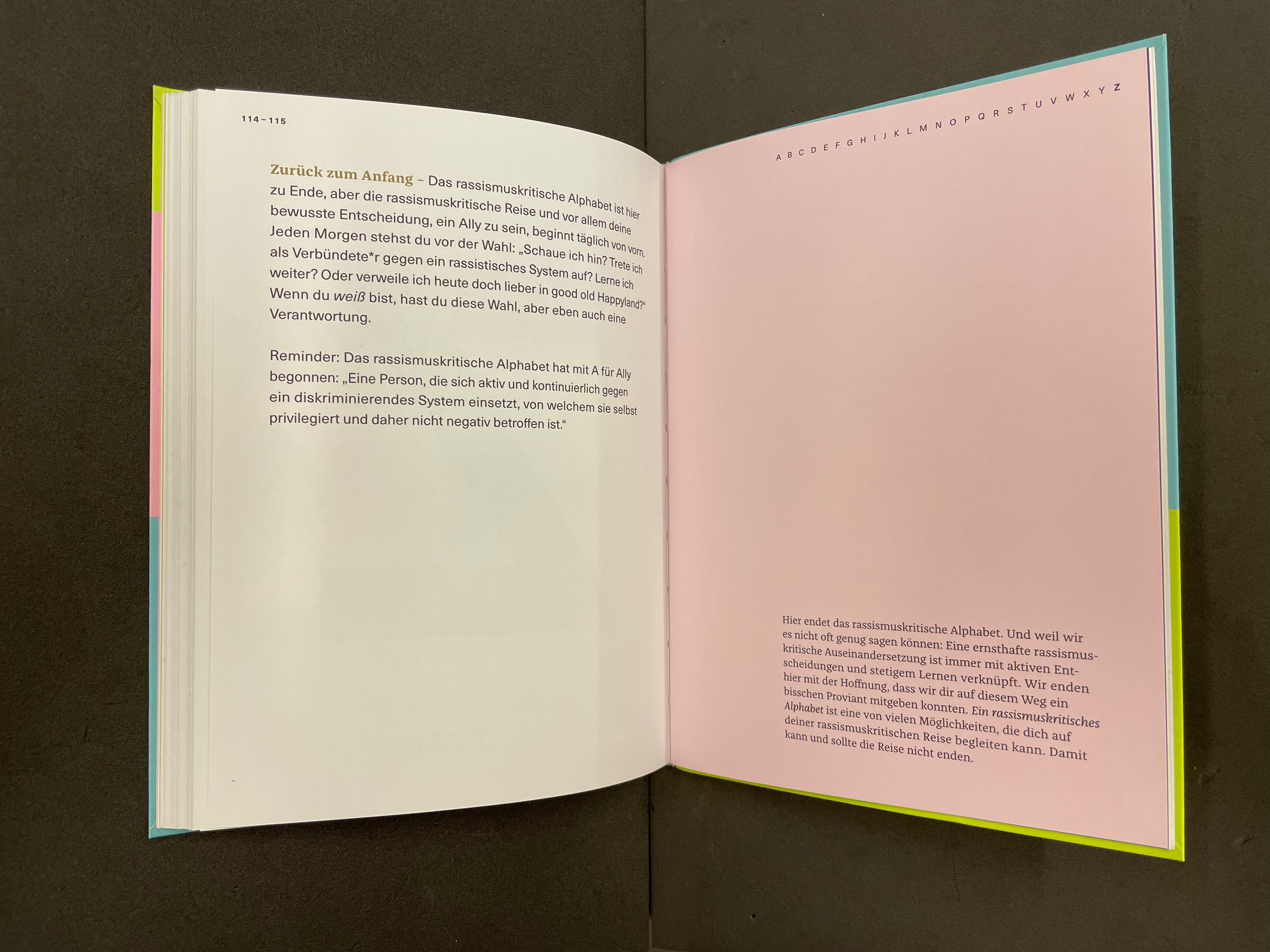
Ein rassismuskritisches Alphabet (2022) Tupoka Ogette Softcover, perfect bound with endbands. H215 x W160 mm. 124 pages. Acquired from Great Book Prices, 1 March 2023. Photos: Books On Books Collection.
The title of Tupoka Ogette’s book translates literally as “A Racism-critical Alphabet”, but “An Anti-Racist Alphabet” seems more idiomatic. More than an alphabet book, it is a workbook arising from her consultancy for companies, organizations and associations wanting to understand how racism manifests itself and how to address it. Given the consultancy’s focus on German-speaking countries, the book relates tightly to the firm’s workshops, podcasts, etc., so it is not too surprising that it hasn’t been translated into English yet.
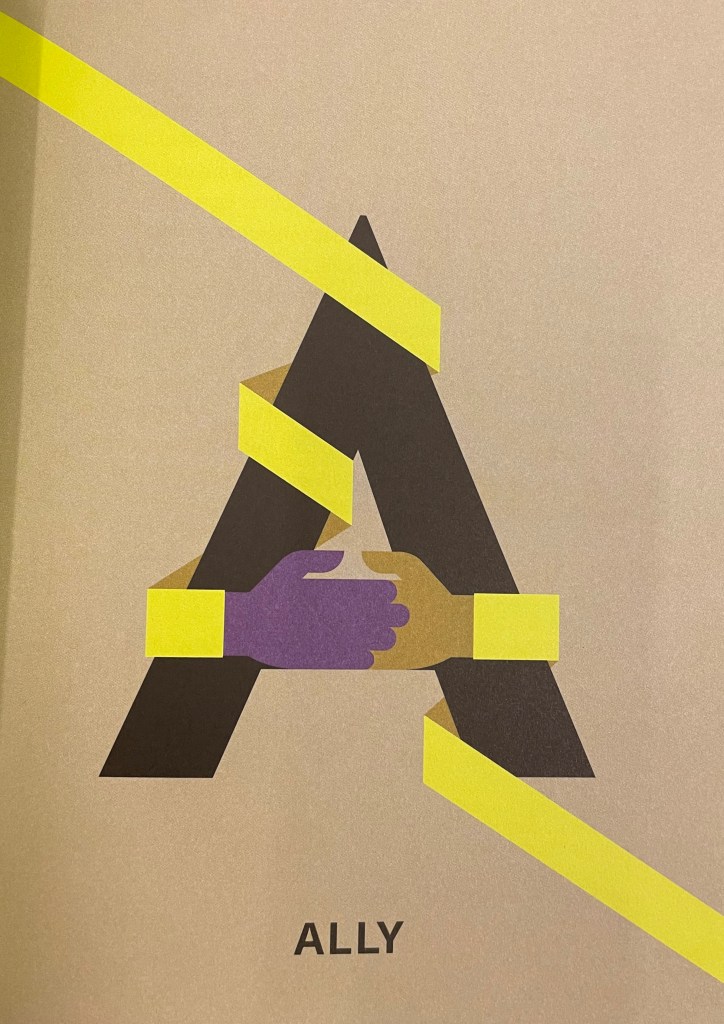
The depth of the problem in English-speaking countries, however, results in most of the terms’ being in the English language: terms like “Ally”, “Blackfacing”, “Colorism”, “Derailing”, “Emotional Tax”, “Gaslighting”, “Happyland”, “Jim Crow”, “Liberation”, “Othering”, “Queer”, “Race-based Traumatic Stress”, “Tokenism”, “White Gaze” and “Yellowfacing”. Add to those terms such cognates as Kolonialismus, N-wort and Xenophobie and it is almost a shock that the text is not in English.
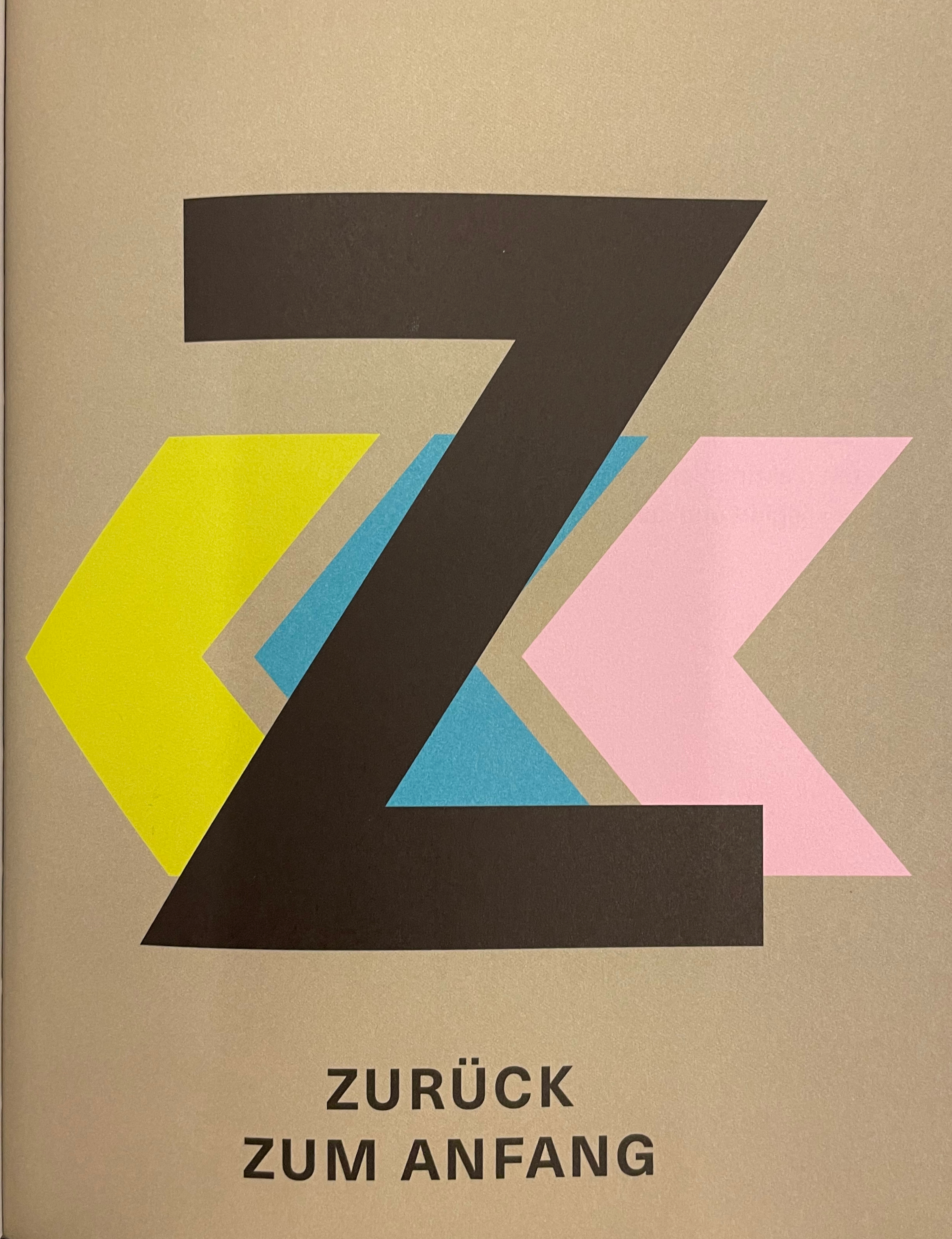
Zurück zum Anfang (“Back to the Beginning”). “The anti-racist alphabet ends here, but the anti-racist journey, and especially your conscious decision to be an Ally, begins anew every day. Every morning you face the choice: Am I looking? Do I stand up as an ally against a racist system? Do I continue to learn? Or do I stay in good old Happyland today? If you are White, you have that choice, but you also have a responsibility. Reminder: A person who actively and continuously stands up against a discriminatory system of which he himself is privileged and therefore not negatively affected.” P. 115.
The book’s interior display pages are striking and reminiscent of Ursula Hochuli-Gamma’s 26 farbige Buchstaben (1986) / “26 Colored Letters“, but the cover and text design are very much in the vein of professional trade books for the German market. Adapting the design for the English-language market might present more of a challenge than adapting the text.
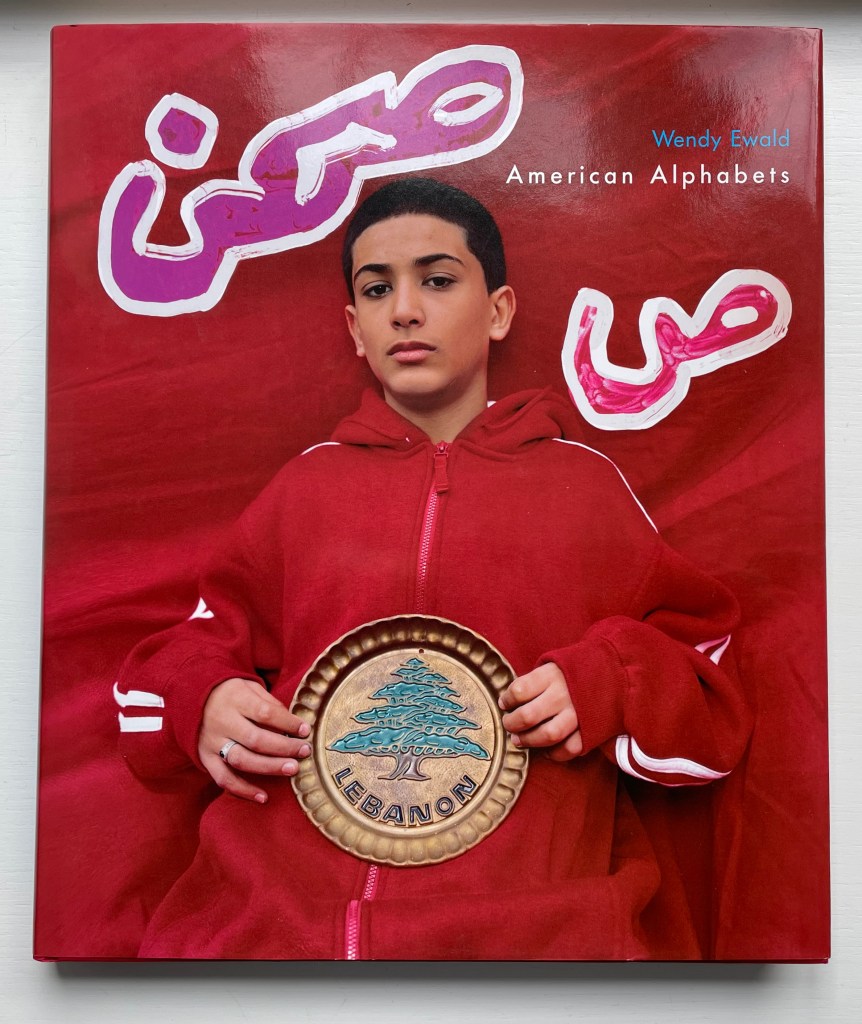
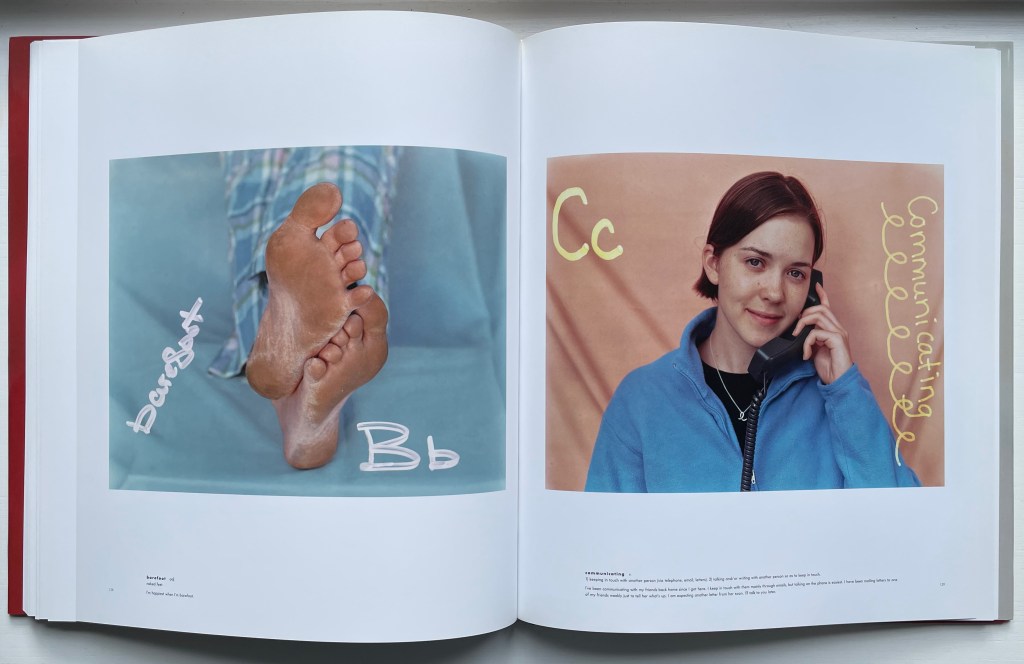
American Alphabets(2005) Wendy Ewald Casebound with white headbands and colored doublures. H305 x W260 mm. 168 pages. Acquired from Judd Books, 17 September 2022. Photos of book: Books On Books Collection. Displayed with artist’s permission.
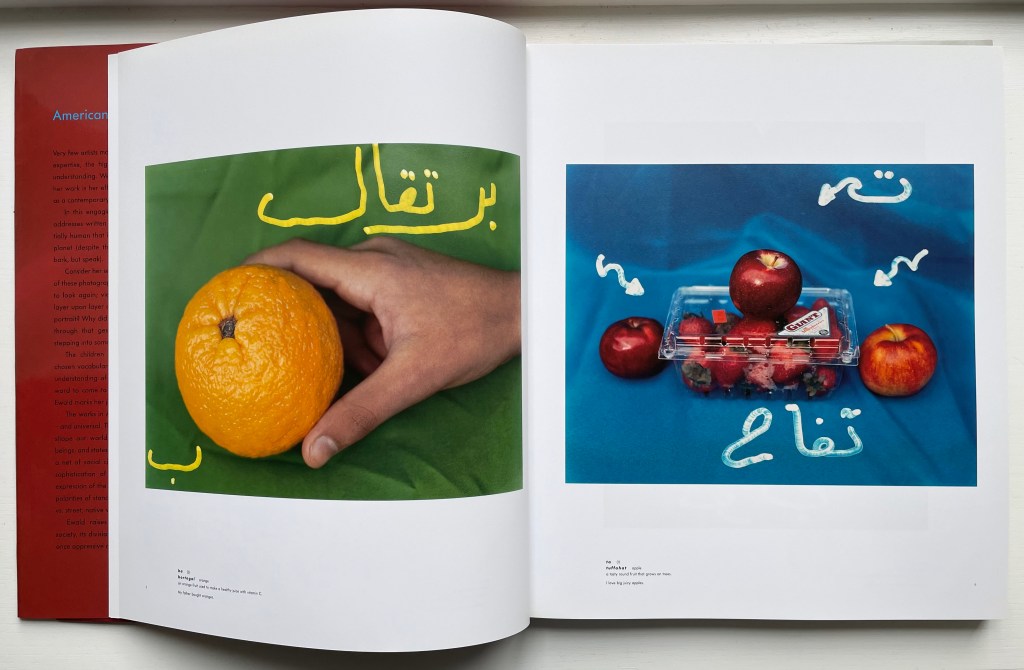
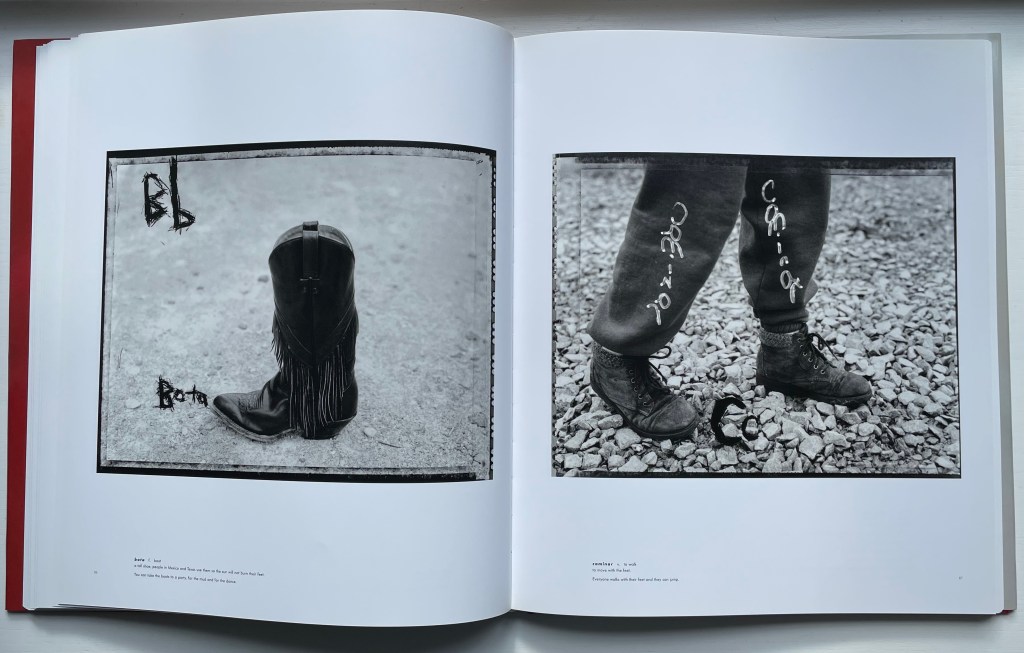
As seen throughout the Books On Books Collection, book art is more often than not a collaborative effort — even if only in the final stages of printing and binding. Ewald’s works, however, depend from the start on collaboration with her subjects — the children. Another recurrent aspect — perhaps the core aspect — in book art is the interaction of the visual and verbal. So, too, in Ewald’s art. In American Alphabets, she brings the collaborative and visual/verbal aspects of book art together at the elemental level of the alphabet. It is the children who pick the letters, words and their illustrative objects to be photographed. In the book’s “Afterword”, Ewald writes:
Like most everyone I know, I first encountered written language in children’s alphabet primers. Looking back, I now see that the words and visual examples used to represent letters reinforced the world view of the middle-class white girl I happened to be. … Putting together these various alphabets — each of them at once American and foreign — taught me a lot about written language, especially about how we have come to take this sophisticated and fundamental medium for granted. … The shape of letters mimicked the objects for which they were named. The letter R, for example, came from the Egyptian hieroglyphic for head or chief: resh. … When Woroud, one of my students from Queens, chose the word raas, or “head,” to represent the letter R, it seemed natural enough. I was startled, though, when she insisted that her head be photographed in profile, just as in the drawing of the ancient letter.
An abiding aim of Ewald’s art is to elicit or allow her collaborators’ voices and world views to create communities that overcome differences by celebrating differences. The reduced, screen-bound images here do not do justice to her four alphabets in one volume or her portraiture and photographic artistry. They may, however, convey the breadth and racial inclusivity of her vision. Arab-American, Latinx-American, White American and Black American are the American alphabets that Ewald aims to capture in this volume.
Another of Ewald’s projects ripe for an artist’s book — or rather artists’ book — is Black Self/White Self (1994-1997). Imagine the book she might create from her young collaborators’ efforts if they were brought to Penland, Women’s Studio Workshop or Art Metropole. Here is the North Carolina-based project in her own words:
When I began working in Durham’s inner city, more and more of the white population had moved to the suburbs and the public schools became segregated along city-county lines. Proposals to merge the school systems were stymied by objections from both sides.
In 1994, after the Durham school systems were finally merged, I designed a collaborative project that looked directly at the issue of race. I asked children to write about themselves, then to write another version, this time imagining themselves as members of another race.
This was greeted first with silence, then laughter, and finally with an enthusiastic barrage of questions.
Once the children had completed their written portraits, I photographed them posing as their “black” and “white” selves, using props they had brought from home. I gave them the large-format negatives to alter or write on, in keeping with ideas from their written portraits, so they could further describe the characters they had imagined themselves to be.
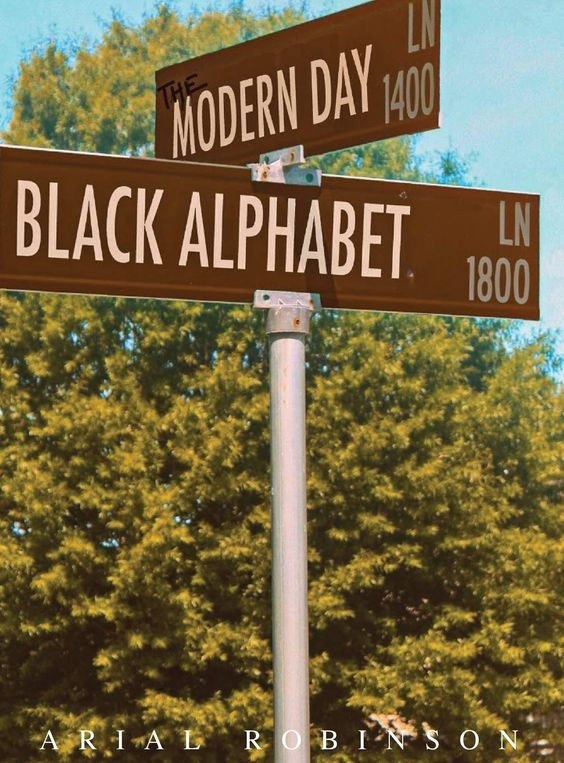
The Modern Day Black Alphabet(2020) Arial Robinson Casebound. Paper over boards. H290 x W220 mm. 64 pages. Acquired from Amazon, 24 June 2021. Photos of the book: Books On Books Collection. Displayed with artist’s permission.
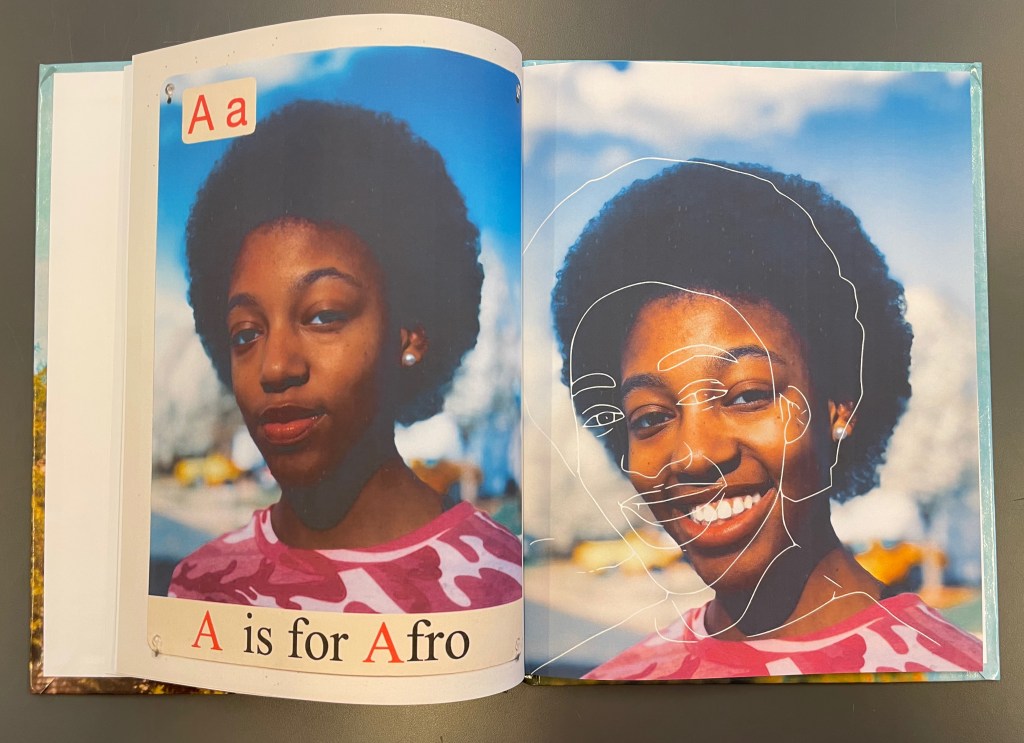
Arial Robinson is a multidisciplinary artist based in North Carolina. Her photography captures the air, sky, suburban streets and heat of the state, and her book captures its Black community in a way that pushes through any “White gaze” that it encounters.
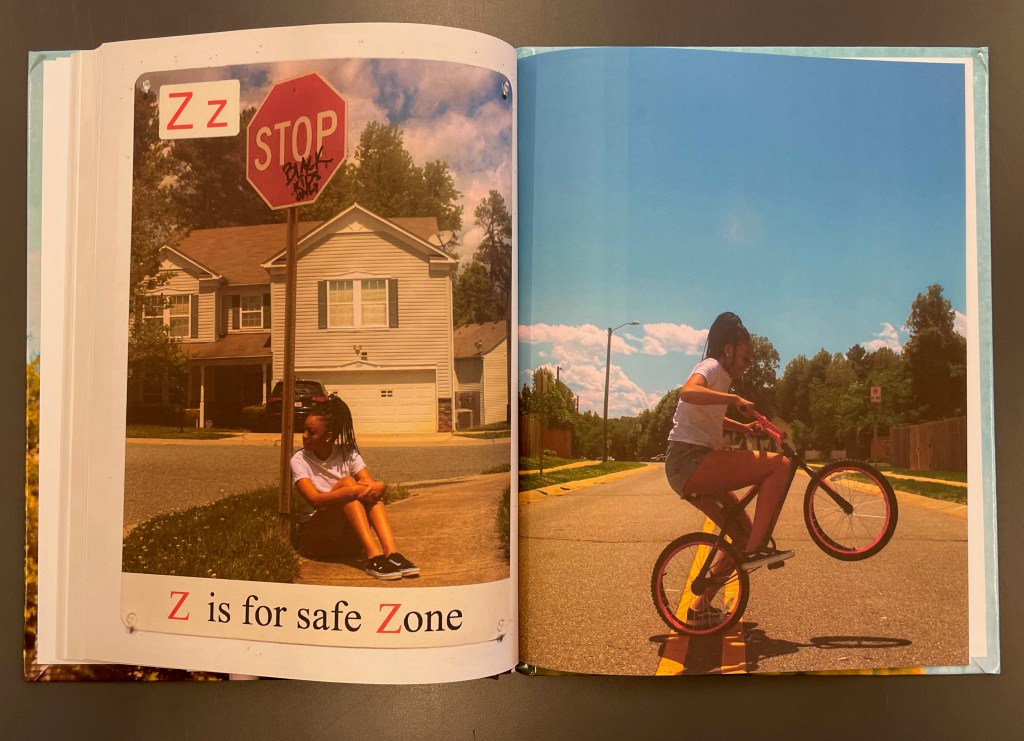
Letter A’s pair of looks — one coolly appraising its viewer and the other warmly smiling but outlined off center in white ink — begins the push with subtlety. The dual images of “Z is for safe Zone”– addressing the viewer with a Stop sign graffitied “Black Kids Only” and a young girl forming a letter Z with her bike, occupying the whole street under a Carolina blue sky — end it more directly.
Between A and Z, The Modern Day Black Alphabet primarily addresses young Black readers, celebrates them eating a popsicle, studying, cooking or drinking from a spigot and takes pride in taking care of appearances — especially hair and dress. Throughout, most of the double-page spreads have an edginess. Sometimes it’s an edgy, out-loud humor, as in “O is for Outside” with its can of “air freshener” labeled “You Smell like Outside”. Sometimes it’s the loud-quiet edginess of “X is for eXcellence” which juxtaposes a pile of certificates of accomplishment with a black-jacketed self-portrait and lapel pin that reads “We Call BS”. Always it’s the edginess of an artist in control of technique, material and vision directing her gaze on herself and her world.
We see the world through our letters. Horn-books with their Christian catechisms. Moralizing Victorian alphabet books.
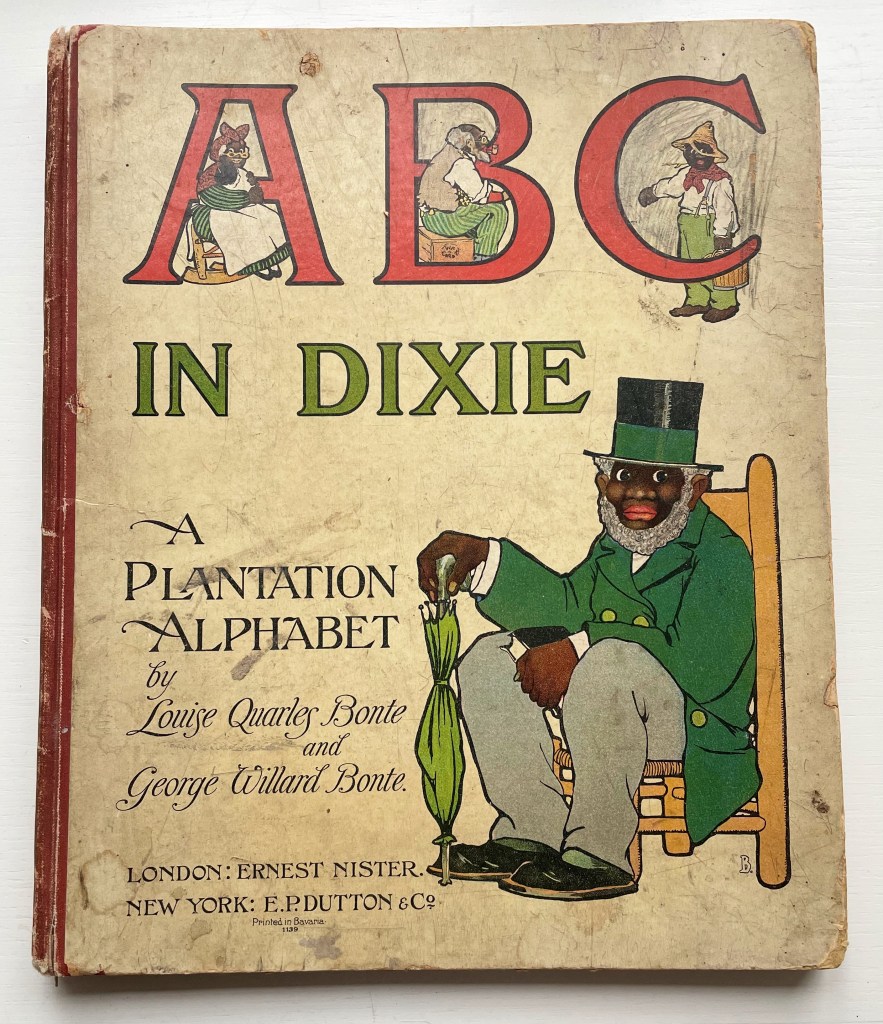
George Willard Bonte from Cincinnati, Ohio and Marie Louise Quarles from Richmond, Virginia were both born in 1873. When they were four years old, Republican Rutherford B. Hayes cut a deal with southern Democrats to remove federal troops from the Reconstruction South, which tipped the balance in the Electoral College, made him president and ushered in the Jim Crow Era that would see the Civil Rights Act of 1875 declared unconstitutional, new state-level constitutions and voting laws designed to disenfranchise Blacks, the Plessy v. Ferguson decision establishing the “separate but equal” doctrine as constitutional and Woodrow Wilson’s institutionalizing of segregation in the federal civil service. Fifteen Blacks were lynched in Ohio between 1877 and 1950; eighty-four in Virginia for the same period (Equal Justice Initiative). Sometime between 1900 and before 1908, the Bontes, who were married in 1902, published ABC in Dixie: A Plantation Alphabet with the firm Ernest Nister.
Ernest Nister had established his eponymous printing company in Nuremburg, Germany in 1877 and launched his London-based publishing company under the management of Robert Ellice Mack in 1888. Nister ranks with other German innovators of movable books such as Lothar Meggendorfer and Raphael Tuck. He came up with multiple versions of the dissolving-picture book in which the pull of a tab would transform one image into another. He also excelled at applying chromolithography to his books. Nister’s and Mack’s world view would seem mostly reflected in their titles: A Rabbit’s Tale, The Dandy Lion, The Animals’ Trip to Sea, Peeps into Fairyland, Surprising Pictures, Playtime Surprises and More Pleasant Surprises.
ABC in Dixie might seem surprising for a publisher with such a world view. Of course not so surprising for White Americans raised in the Jim Crow era. To whom this copy of the book belonged is unknown. Its cover’s colored-in letter C suggests that it reached at least one child — most likely White. Why was the page opposite “N is fer Noah …” violently torn out? Did a child named Olive take offense at the lines on its reverse?
“O is fer Olive who looks like she’s white. She brushes de missus’ hair mo’nin’ en night”.
The illustrator’s “light-skinned” caricature speaks volumes to the engrained racism laughingly passed along to young readers. But they were v0lumes no one at Nister’s firm read. Nister’s must have thought it was on to a winner and followed up with a series of postcards based on the book. The one for Valentine’s Day drew on the publisher’s movable book devices and included rolling eyes. Following in the footsteps of W.H. Heinemann with William Nicholson’s Alphabet (1897) and An Almanac of Twelve Sports (1897), Nister’s also signed up George Bonte for The Coon Calendar for 1905.
Why have a work like this in the Books On Books Collection? For its chromolithography? Yes. For its connection with Ernest Nister? And yes. But the full answer is to be found in another collector’s viewpoint. In 2012, now retired professor of sociology David Pilgrim established the Jim Crow Museum of Racist Memorabilia at Ferris State University in Michigan. The museum presents over 10,000 objects of hate that were part of growing up Black in the Jim Crow era. It exists to “use items of intolerance to teach tolerance”. Pilgrim’s 2005 essay explaining how the museum came to be and how it works is powerful. It needs to be. Jim Crow 2.0 is with us. The museum’s voice is still needed against ongoing violence, book-banning, voter suppression driven by legislatures and Supreme Court decisions and anti-immigrant measures taken around the world.
ABC in Dixie is here for its representation of how alphabets construct a world view. It is also here to be confronted with other world views. Rather than being coddled among rosy-cheeked children’s books — as it once was in Ernest Nister’s catalogue — ABC in Dixie sits here to be discomfited by American Alphabets (2005) by Wendy Ewald, Mourning/Warning (2015) by Tia Blassingame, Transforming Hate (2016) by Clarissa Sligh, R is for Reparations (2019) by the Global Afrikan Congress, The Modern Day Black Alphabet (2020) by Arial Robinson and Ein rassismuskritisches Alphabet (An Anti-Racist Alphabet) (2022) by Tupoka Ogette. By way of apology, if these other world views are seen alongside that of ABC in Dixie, maybe the arc of history can be bent a bit further toward justice a bit sooner.
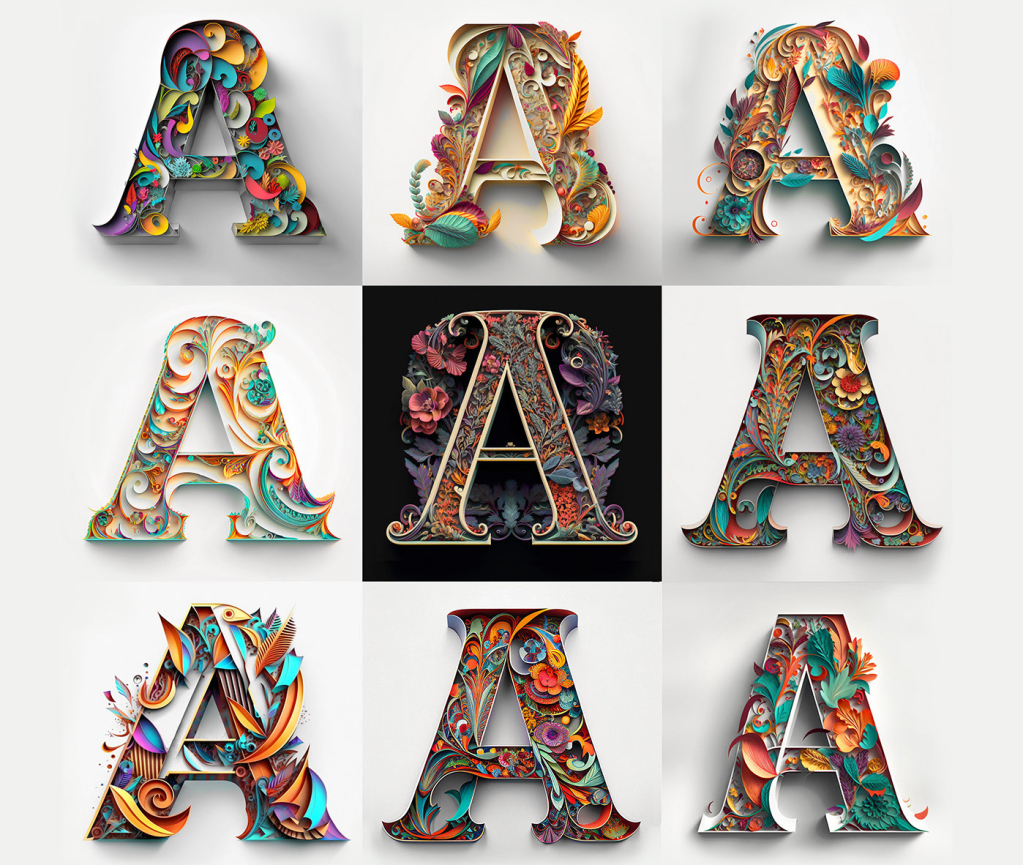
While working on the “Alphabets Alive!” exhibition with the Bodleian to open in July 2023, I came across this project site page by Yevhen Berdnikov, a calligrapher based in Kyiv, Ukraine.
Since “Alphabets Alive!” would primarily concern the creative relationship of artists’ books with alphabets and other writing systems, an AI-generated rendition of the alphabet (humankind’s second-greatest invention, language being the first) was a natural for inclusion. Given the short notice, the artist’s lack of bookmaking experience and — oh yes — the ongoing Russian invasion of Ukraine and attacks on Kyiv, a book was out of the question. Still, with one of the exhibition’s display cases being devoted to artists’ books driven by calligraphy and another to ones driven by color, some way of including these letter images prompted by Yevhen Berdnikov and generated by the text-to-image AI Midjourney from the company of the same name begged to be found.
Paper Cut Alphabet (2023)
Paper Cut Alphabet (2023) Yevhen Berdnikov Poster. H x W. Acquired from Yevhen Berdnikov, 8 March 2023. Images courtesy of Yevhen Berdnikov and reproduced with permission.
When the digital file for the poster first arrived, the treatment of letter Z was a surprise. Even without its current caption, the implication of the treatment was obvious to anyone who knew Berdnikov’s nationality and had seen news images of Russian tanks and military vehicles with Z painted on them. An AI-generated letter Z exists in the Paper Cut Alphabet Project’s files, but, in preparing the poster for a public exhibition, Berdnikov could not bring himself to prompt the AI to generate a symbol that had become intolerable and particularly loathsome on the anniversary of the invasion.
Chance is a well-known muse to many artists. Midjourney, the application, requires an extensive amount of “prompting” — detailed text describing the image it will create. As Berdnikov notes above, the same text can generate different results, which implies an element of randomization at work in the application. But how could a randomizing function yield a meaningful absence of image in response to prompting text? How could machine learning enable Midjourney on its own to compile this version of the alphabet without that particular and human creative intervention?
Even while acknowledging his intervention in Paper Cut Alphabet, Berdnikov insists that he is not the artist, but isn’t his use of Midjourney analogous to Vermeer’s presumed use of a camera obscura to achieve the detail and perspective we see in his paintings? If he did use that technology, does it warrant calling his paintings “device-generated”? Even so, this viewer “feels” the human artists behind View of Houses in Delft (c. 1658) and Paper Cut Alphabet (2023).
Berdnikov’s comments above and his demurrer at being named the “artist” of Paper Cut Alphabet reflect an inquisitive, open and thoughtful mind. Whatever its undetermined implications, the result of his wielding this new artist’s tool is decidedly art.
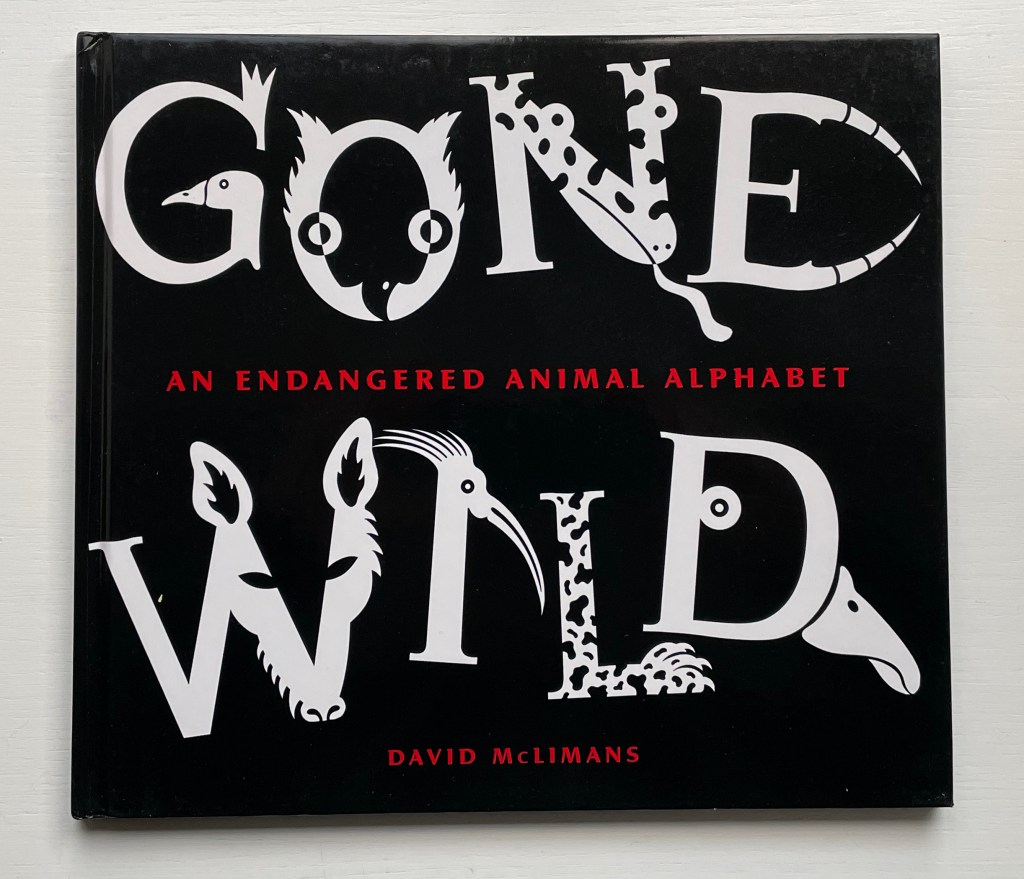
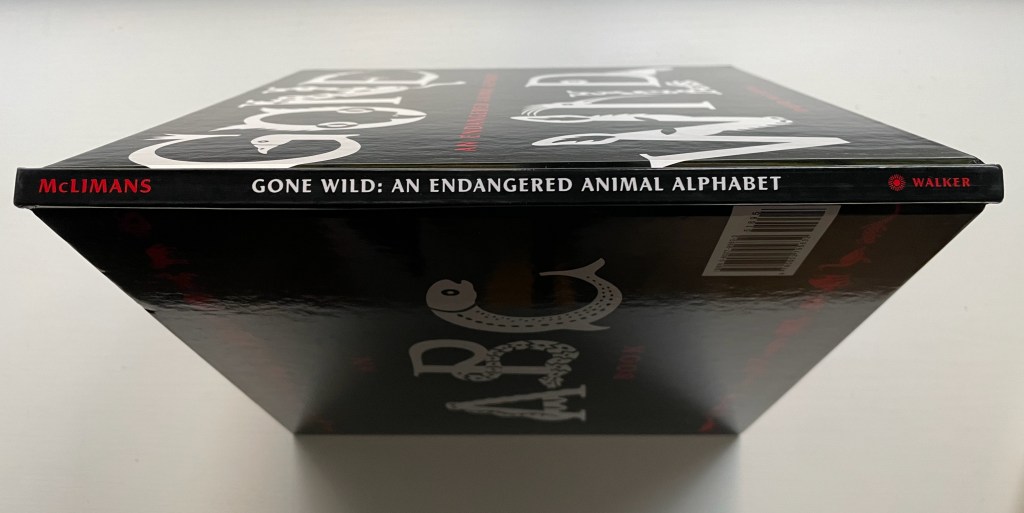
Gone Wild: An Endangered Animal Alphabet(2016) David McLimans Casebound, illustrated paper over boards, illustrated doublures, sewn book block. Illustrated, debossed glossy paper dustjacket. H255 x W285 mm. 36 unnumbered pages. Acquired from Gargoyle Books, 25 August 2022. Photos: Books On Books Collection.
In the history of children’s books, the alphabet looms large, and among alphabet books, animal alphabets make up the largest category. But why animals?
For learning and teaching letters, they are easily recognized and mnemonically effective. Illustrators can wrap them around letters, make them twist themselves into letters or hide them behind letters. Designers can hide them on tabs behind letters, make them pop out, parade them across leporellos (accordion books), let them lurk in tunnel books or put them on a paper disk to appear and disappear in a volvelle’s window. Writers can weave stories with animals and letters, put animals and letters together in puns and surprising scenarios or use alliteration and rhyme with them to reinforce letter recognition and reading. For authors more paleographically and philosophically inclined, the answer to “Why animals?” might be sought in the origins of the alphabet’s first letter as James Rumford does in There’s a Monster in the Alphabet (2002) and Don Robb and Anne Smith do in Ox, House, Stick (2007).
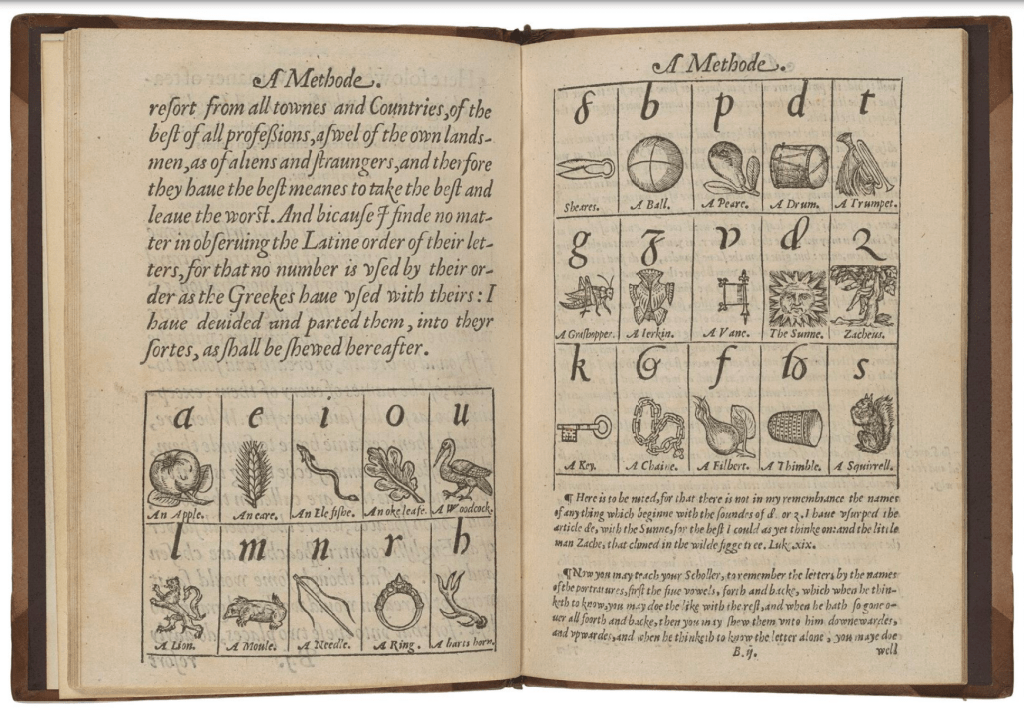
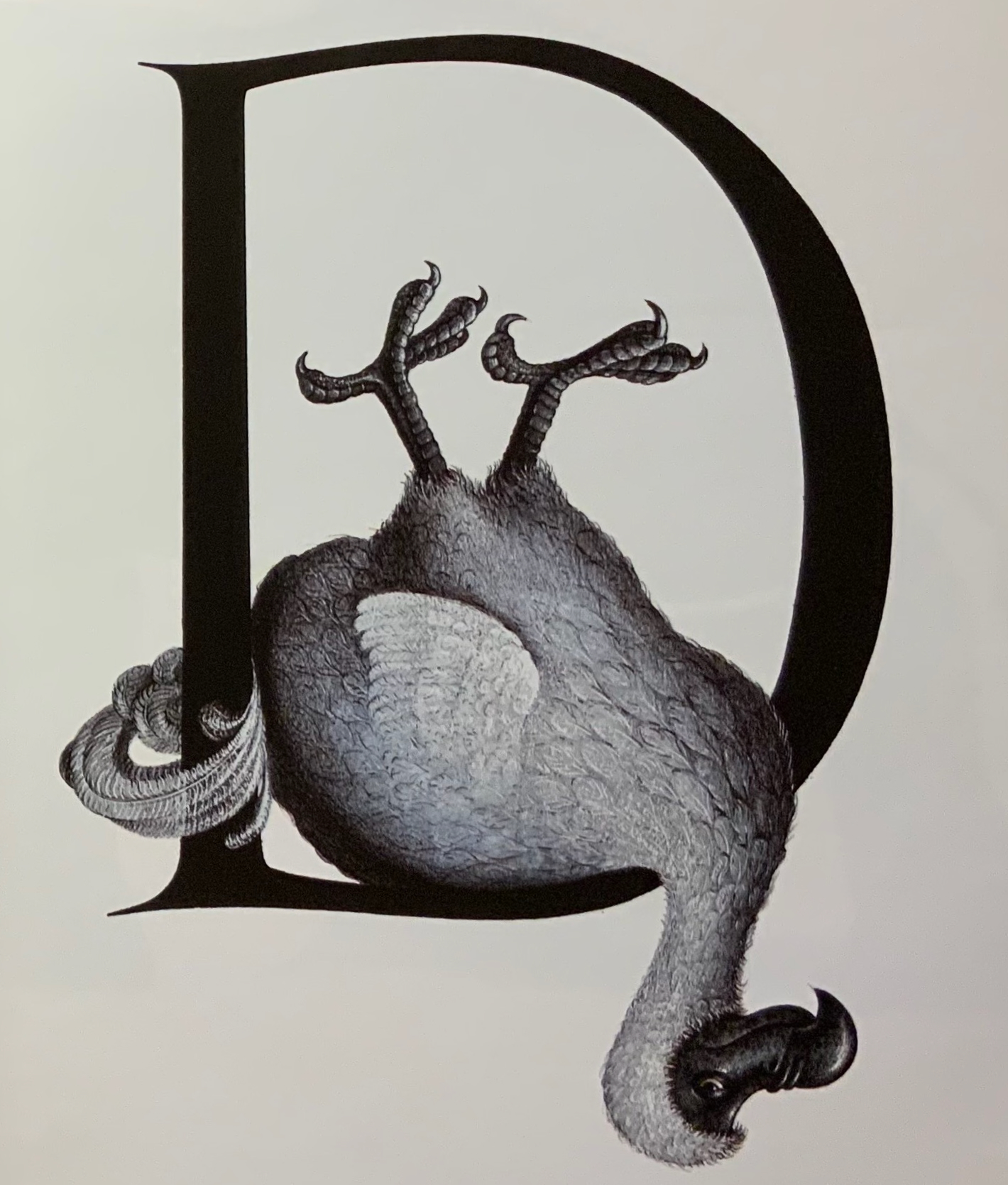
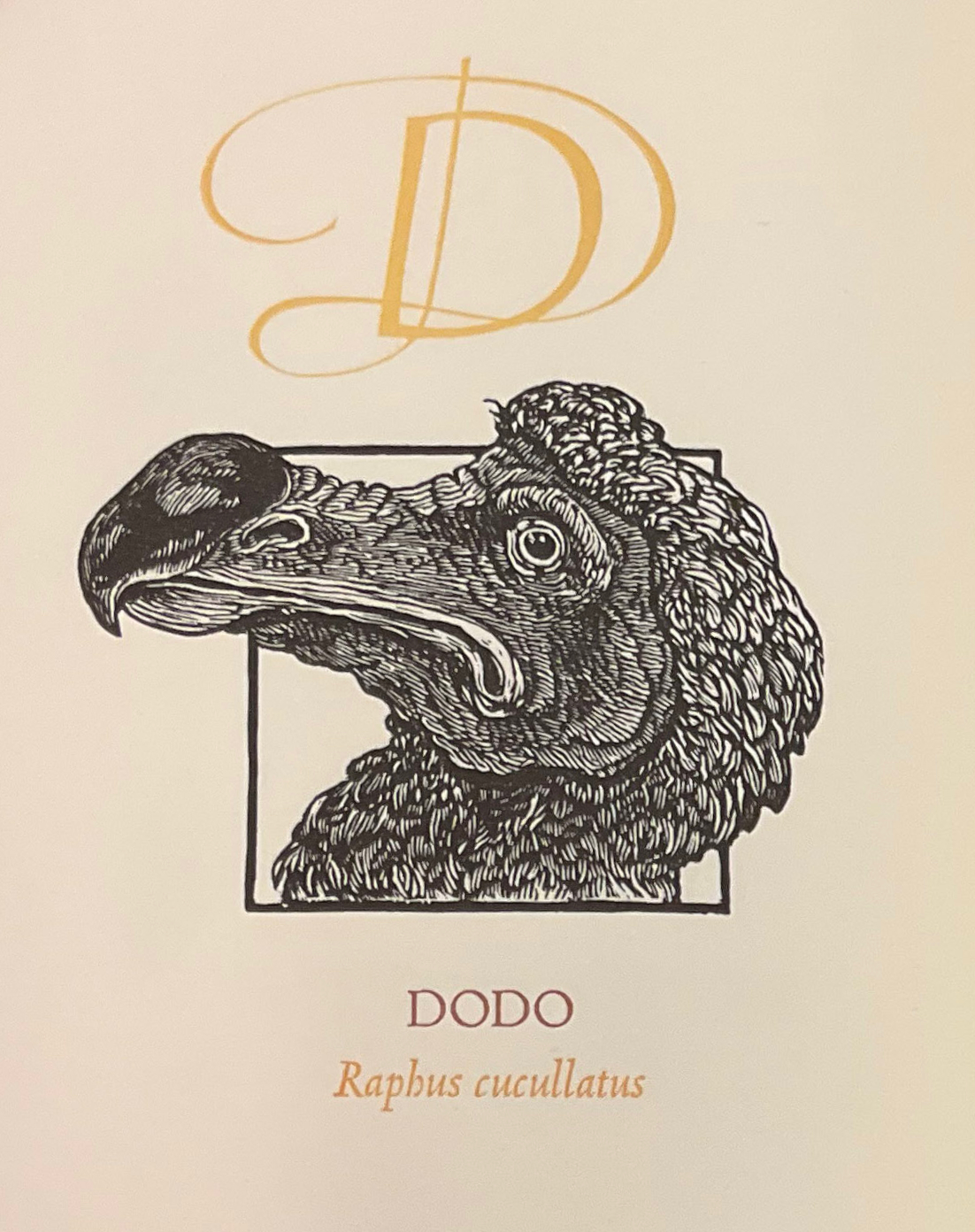
Whatever the cause, ever since John Hart’s A Methode, or Comfortable Beginning for All Unlearned (1570), which appears to be the first example of teaching the English alphabet with illustrations, we have had an explosion of imagination and wit choosing, finding or making up animals, birds, fish, insects and reptiles with which to decorate the letters, to make from letters (or make letters with), to be disguised with abstractions or to be hidden, revealed or popped out from behind letters. Now, in reverse over four centuries later, the alphabet has been mustered for teaching the endangered state of those creatures.
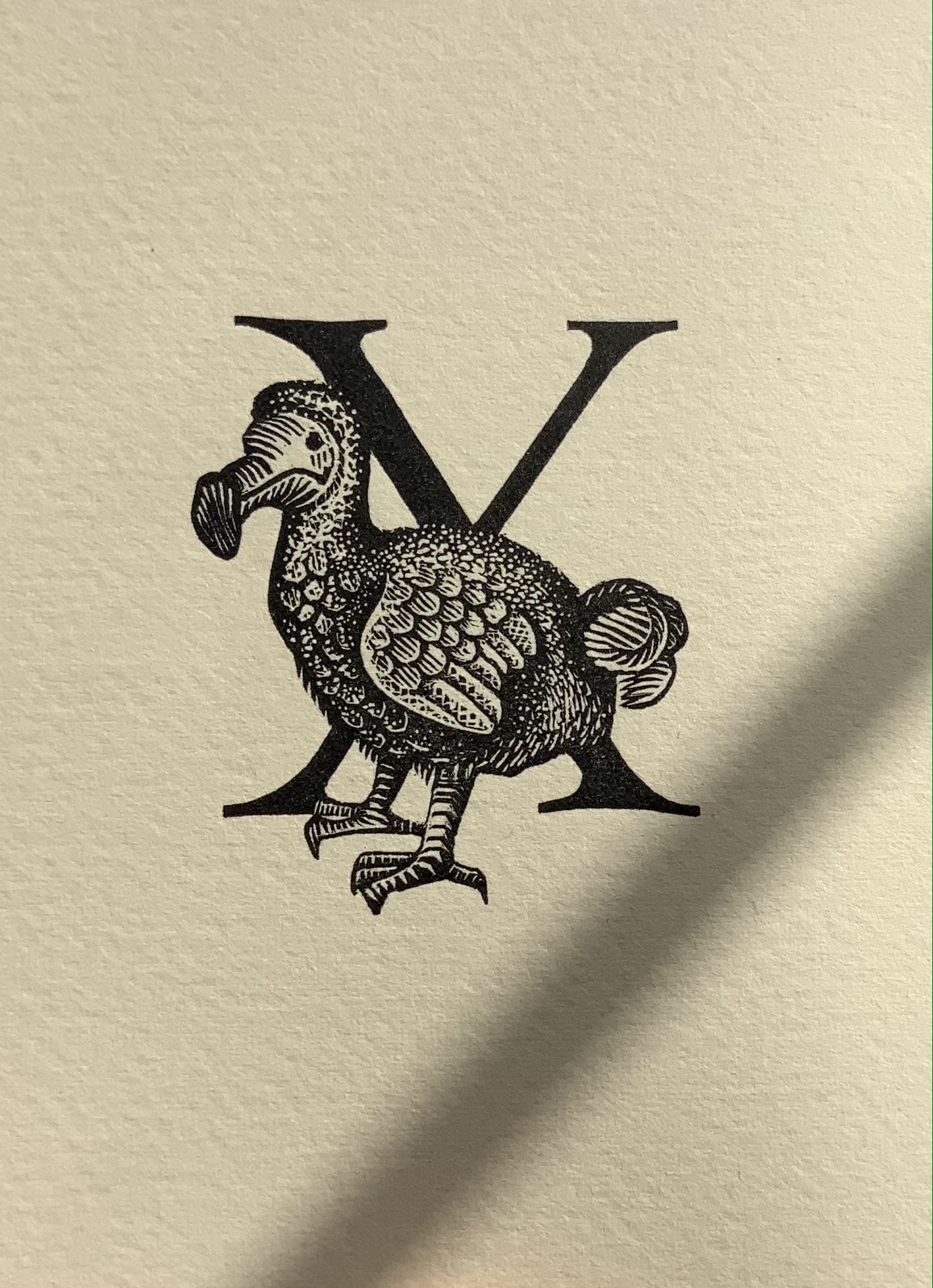
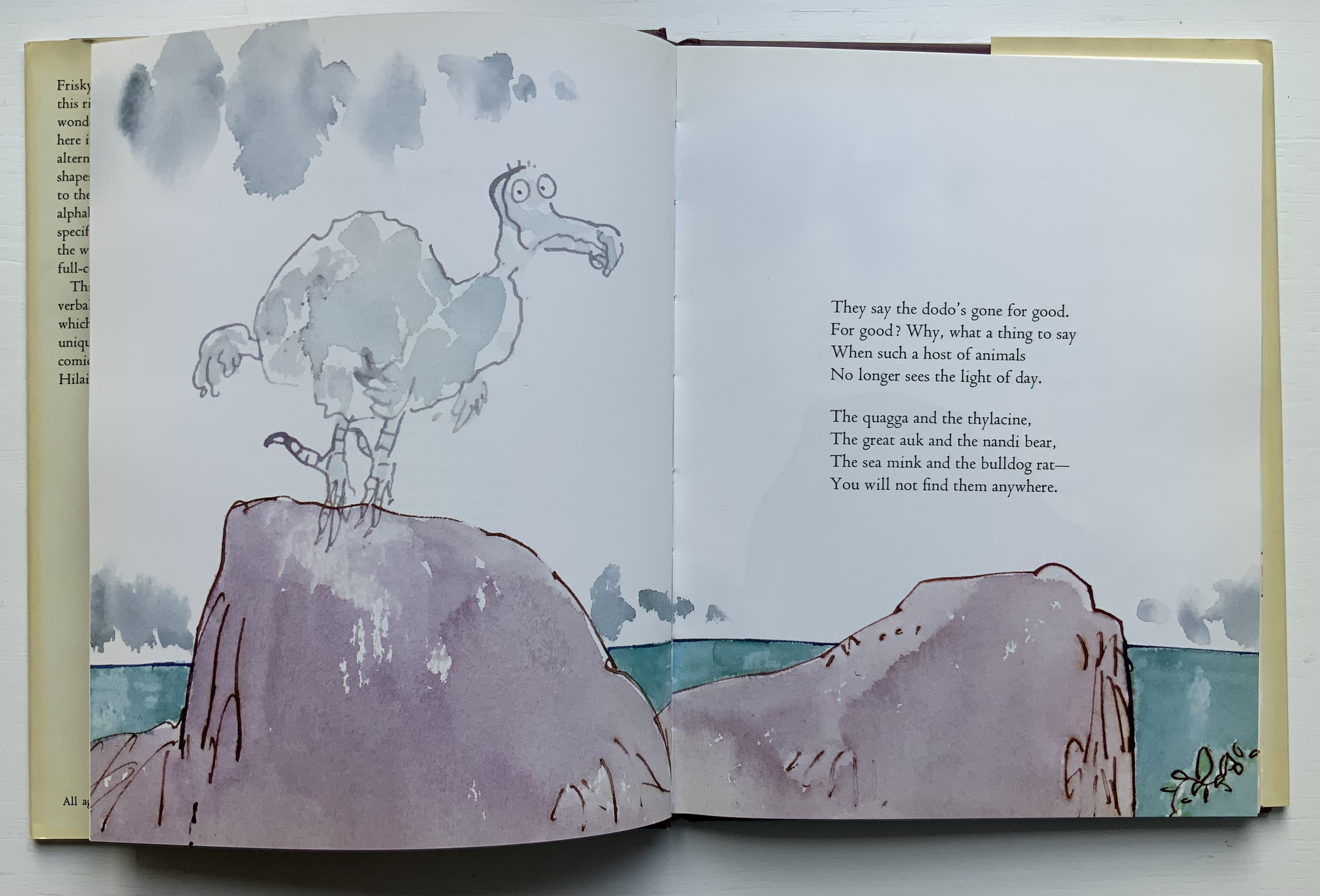
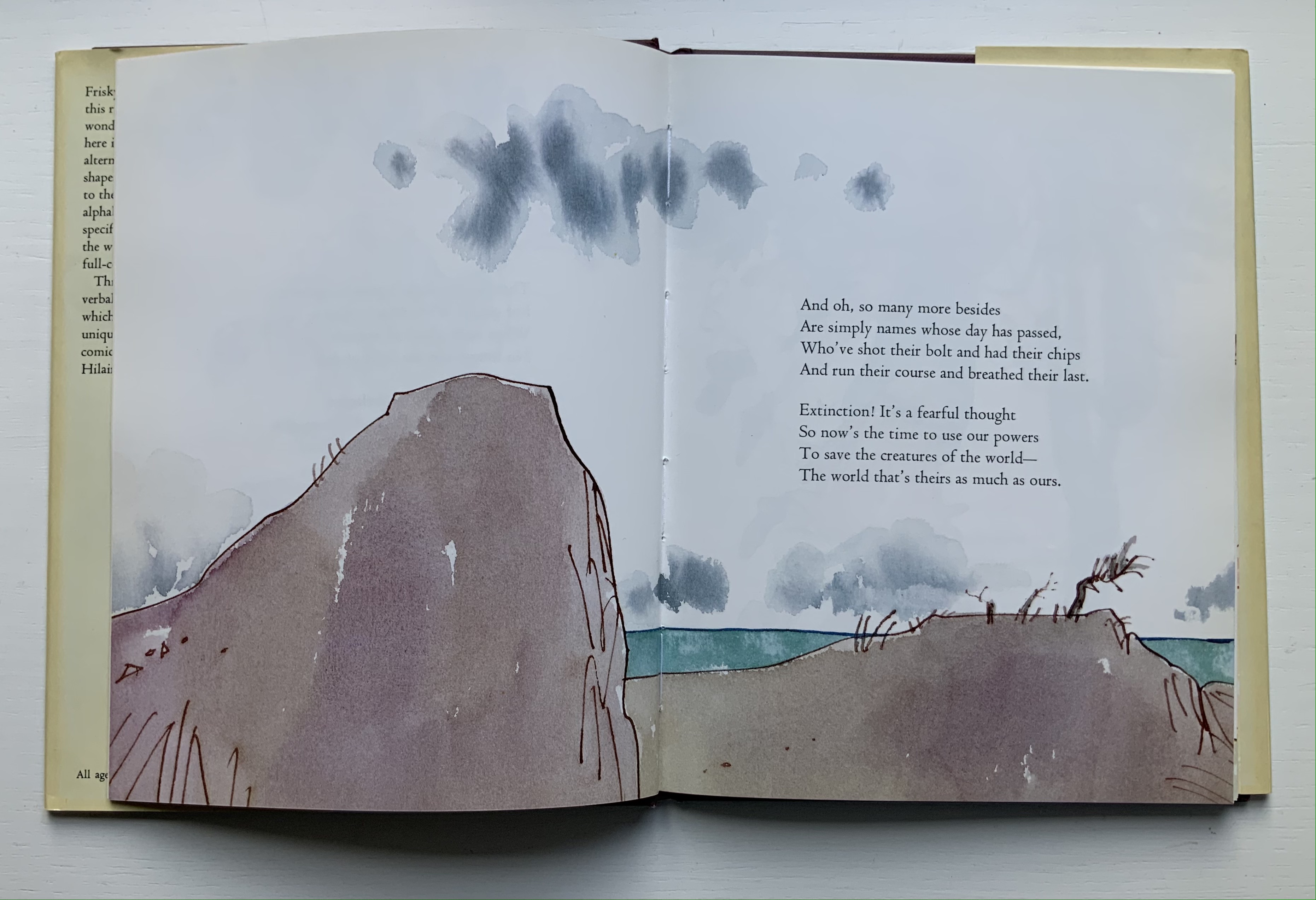
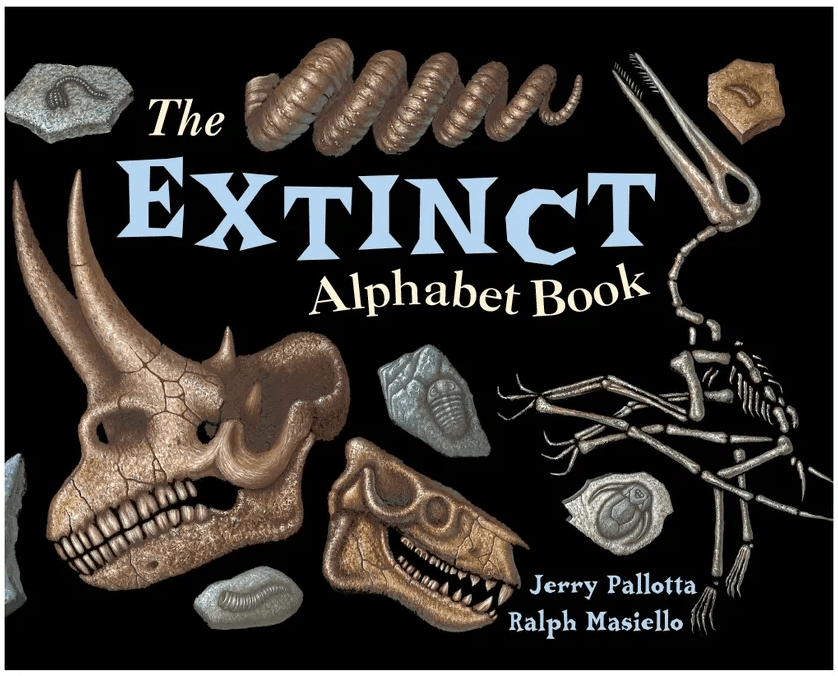
While E.N. Ellis, Bert Kitchen, the team of Alan Robinson and Suzanne Moore all allot only one letter and the dodo to make the point, Dick King-Smith and Quentin Blake together devote almost all of their Alphabeasts (1990) to examples of extinction, as do Jerry Pallotta and Ralph Masiello in The Extinction Alphabet Book (1993).
Left to right: from E.N. Ellis’s An Alphabet; Bert Kitchen’s Animal Alphabet; Alan Robinson and Suzanne Moore’s A Fowl Alphabet.
Quentin Blake’s page-by-page visual narrative married to Dick King-Smith’s opening verses in Alphabeasts.
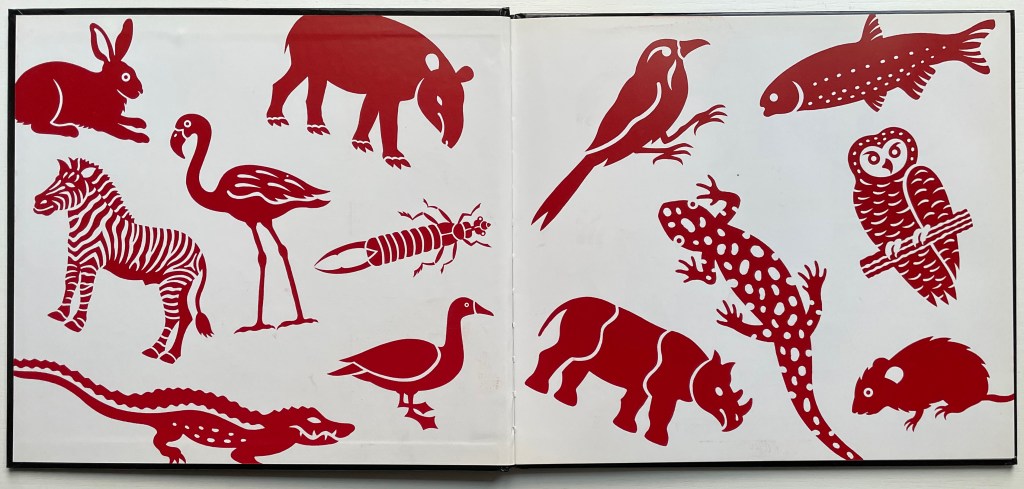
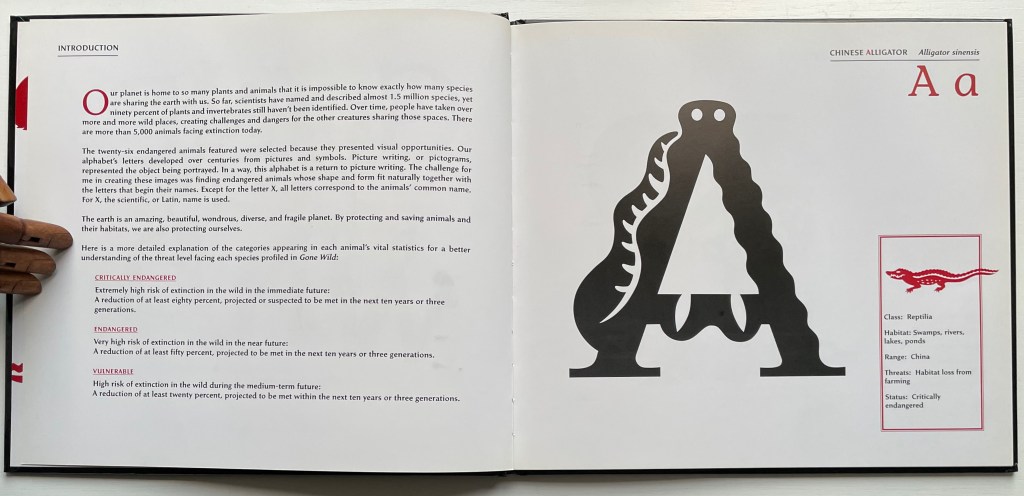
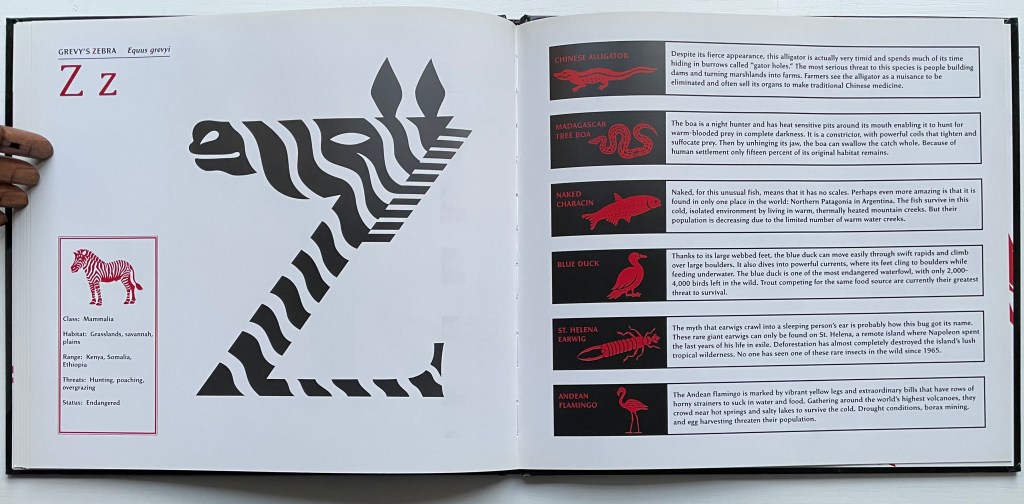
With Gone Wild, David McLimans adds a complex and subtle device to the explosion. The book is not so much about learning the alphabet with animals as learning about animals with the alphabet — or rather with “alphabetic art”. Wielding computer, pencil, pen, brush and India ink on bristol board, David McLimans redraws the alphabet’s capital letters to look like animals not yet extinct but on the Red List of the International Union for Conservation of Nature. Even the design of the traditional alphabet book subtly serves as a teaching tool about these animals. Notice how McLimans and John Candell, the book’s designer, turn the traditional presentation of uppercase and lowercase letters into a kind of running head that underscores the common and scientific names of each animal. Even the list of facts on each species — their habitats, geographic ranges, threats to survival and statuses — receives meaningful thematic design touches from the use of two-color printing — blood red and extinction black.
After the brief red-on-black thumbnails and descriptions following Grevy’s Zebra, McLimans provides further reading (online and in print). You have to go beyond a quick dive into the address he provides for the IUCN to find the Red List (see address above). There you will learn how up to the minute this book was in 2016 — and, unfortunately, still is.
Kitchen, Bert. 1991. Animal Alphabet. London: Walker Books. For letters decorated with animals other than the dodo.
Mackey, Bonnie and Hedy Schiller Watson. 2017. Alphabet Books : The K-12 Educators’ Power Tool. Santa Barbara California: Libraries Unlimited. For a brief history and extended categorization of alphabet books.
Markle, Sandra; Markle, William; and Dávalos, Felipe. 1998. Gone Forever! : An Alphabet of Extinct Animals. 1st ed. New York N.Y: Atheneum Books for Young Readers. For letters in aid of animals rather than vice versa.
Pallotta, Jerry, and Masiello, Ralph. 1993. The Extinct Alphabet Book. Watertown Mass: Charlesbridge. For letters in aid of animals rather than vice versa.
The Neolithic Adventures of Taffi-Mai Metallu-Mai (1997)
The Neolithic Adventures of Taffi-Mai Metallu-Mai(1997) Gerald Lange and Rudyard Kipling H216 x W260 mm. 55 pages with 17 additional illustrated page inserts. Edition of 150, of which this is #149. Acquired from the artist, 11 Febuary 2023. Photos: Books On Books Collection. Displayed with the artist’s permission.
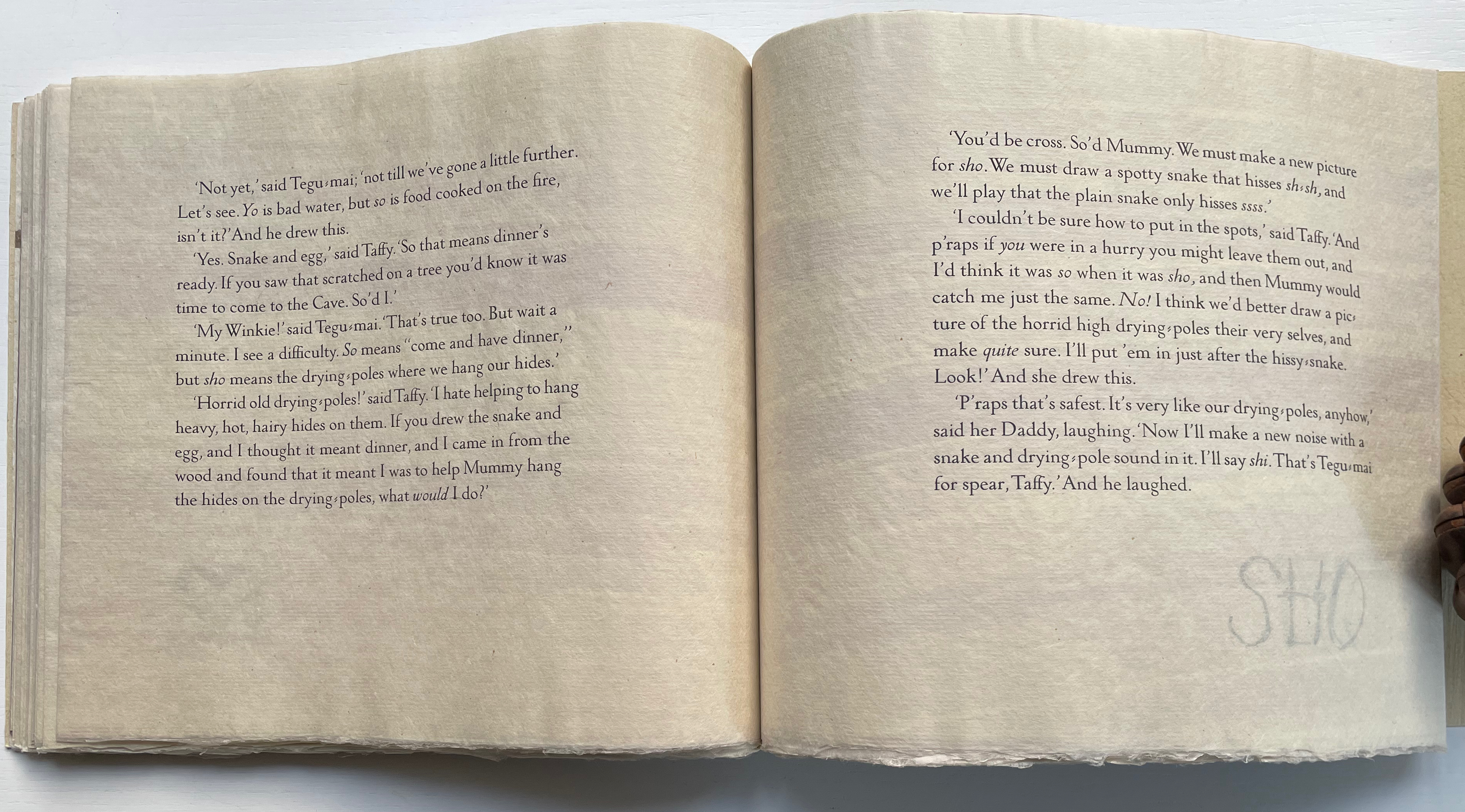
Gerald Lange’s choice of “How the First Letter Was Written” and “How the Alphabet Was Made” from Rudyard Kipling’s Just So Stories (1902) for this elaborate, delicate but robust edition was fitting. By 1997, he had founded the Bieler Press (1975), co-founded the Alliance for Contemporary Book Arts (1987) and edited its journal AbraCadaBrA for seven years, had been the Master Printer at USC Fine Arts Press and selected as the first recipient of the prestigious Carl Hertzog Award for Excellence in Book Design (1991) and was about to publish the first edition of his Printing Digital Type on the Hand-Operated Flatbed Cylinder Press (now in its fifth edition, 2018). In keeping with his interests leading up to this work, Lange letterpress-printed it from handset Monotype Pastonchi and a digitally altered version of Berthold Post Antiqua. More to the point, as he noted on the Bieler Press site, he chose the stories for “their affinity with subjects related to the lettering arts”. If that affinity is not clear enough from the text, Lange’s treatment underscores it in subtly ingenious ways.
Kipling attributes the drawings throughout to his heroine, Taffi and her father. Where others like Macmillan Children’s Books have rendered them boldly, Lange prints the primitive petroglyph-like images on separate Gampi sheets inserted between the folded Kitakata text leaves of the tortoise shell edge-sewn binding. Those text leaves are individually water colored on their reverse sides (urazaiki manner based on nihonga painting) so that the pictographs beneath reveal themselves through a striated layer. The color and striations are reminiscent of cave paintings. Additional Asian papers (Kasuiri and Chirizome for end sheets, Cogan Grass for covers) increase the work’s tactility — simultaneously soft and rough, flimsy and tough — and contribute a grassy smell redolent of the stories’ physical setting.
The quality and rightness of choices in structure, material and process have placed several of Lange’s works in The British Library, University of California (various), Columbia University, Harvard University, University of Minnesota, New York Public Library, Princeton University, Stanford University, Victoria and Albert Museum, Yale University and others. The initial reason bringing this particular work into the Books On Books collection was its representation of book art inspired by the alphabet. That Robin Price, several of whose works are also in the Books On Books collection, assisted with the design came as a bonus. That this is one of the last bound copies of The Neolithic Adventures of Taffi-Mai Metallu-Mai makes it a treasure.
A fair number of fiction and non-fiction children’s books on the history of the alphabet have made their way into the Books On Books Collection.
Of the fiction variety, there is Rudyard Kipling’s “Just So Story” of the alphabet’s invention: How the Alphabet Was Made (1983), illustrated by Chloe Cheese. Another fiction entry is James Rumford’s retelling of Cadmus’ visit to Crete in There’s a Monster in the Alphabet (2002) and William Joyce’s inventive The Numberlys (2014).
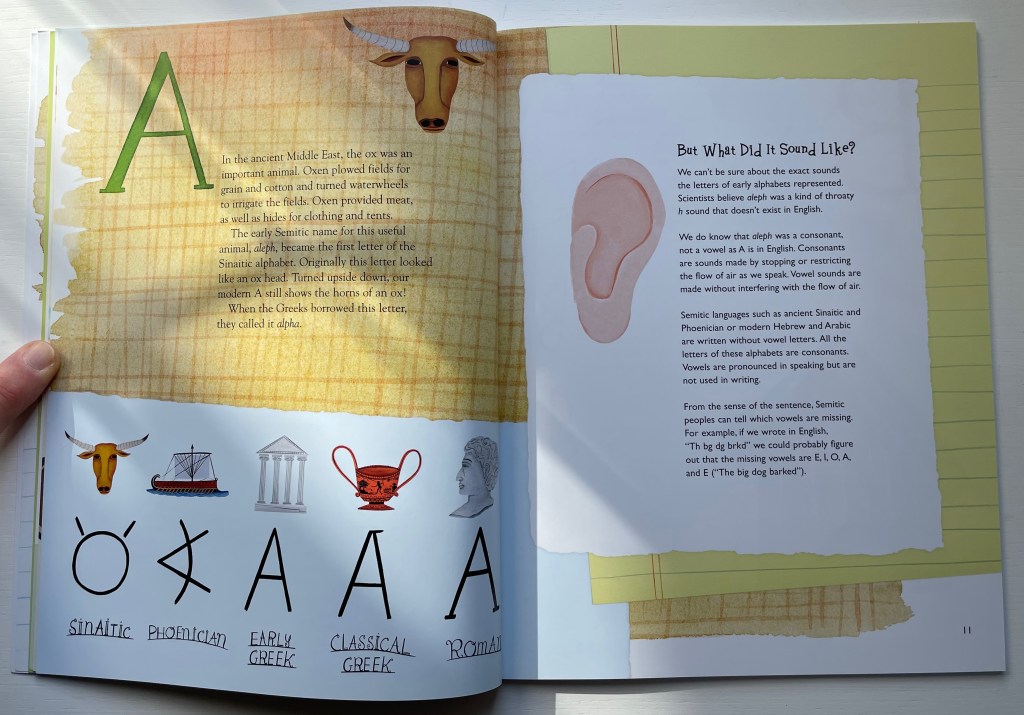
In the non-fiction category are William Dugan’s How Our Alphabet Grew (1972), Tiphaine Samoyault’s Alphabetical Order (1998), Renzo Rossi’s The Revolution of the Alphabet (2009) and the entry here: Don Robb’s and Anne Smith’s Ox, House, Stick.
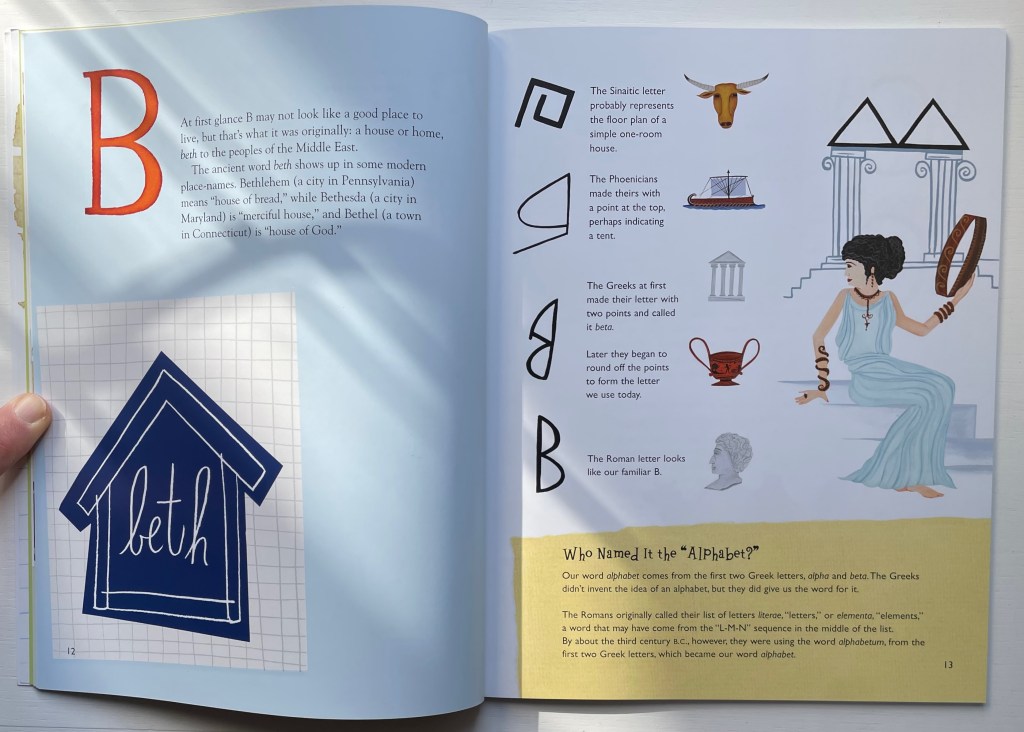
Ox, House, Stick is scheduled to appear as part of an exhibition at the Bodleian Libraries in Oxford (opening 15 July 2023). “A is for Ox” designates the display case devoted to the question: Where did the alphabet come from? It’s not just a question for archaeologists, historians, linguists and paleographers — or children’s book authors and illustrators. It’s one generating repeated inspiration for book artists as shown by Abe Kuipers’ Letters (1971), Lanore Cady’s Houses & Letters (1977), another rendition of the Kipling tale by Gerald Lange in The Neolithic Adventures of Taffi-Mai Metallu-Mai (1997), designed by Gerald Lange and produced with Robin Price, Dave Wood’s Alphabetica (2002), Cari Ferraro’s The First Writing (2004), and Helen Malone’s Alphabetic Codes (2005).
Artists’ books share much with children’s books in general. They both play with form and structure. They play with words and images, sometimes images without words and sometimes just shapes. Almost always an attention to all the senses. Children’s alphabet books in particular display features that appeal to book artists: play with animals, the Babel of languages, bodies, calligraphy, colors, design (of letters, page and book) and, as above, alphabet origin stories. Viewing and exploring alphabet books and artist’s books side by side heightens the enjoyment and appreciation of both.
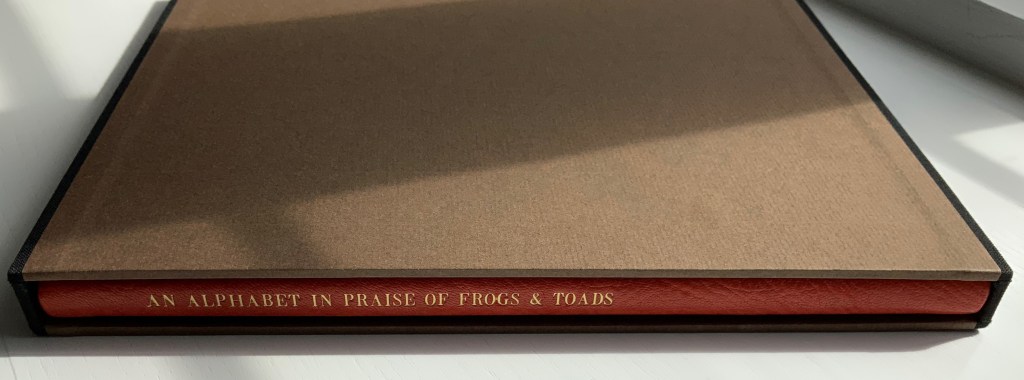
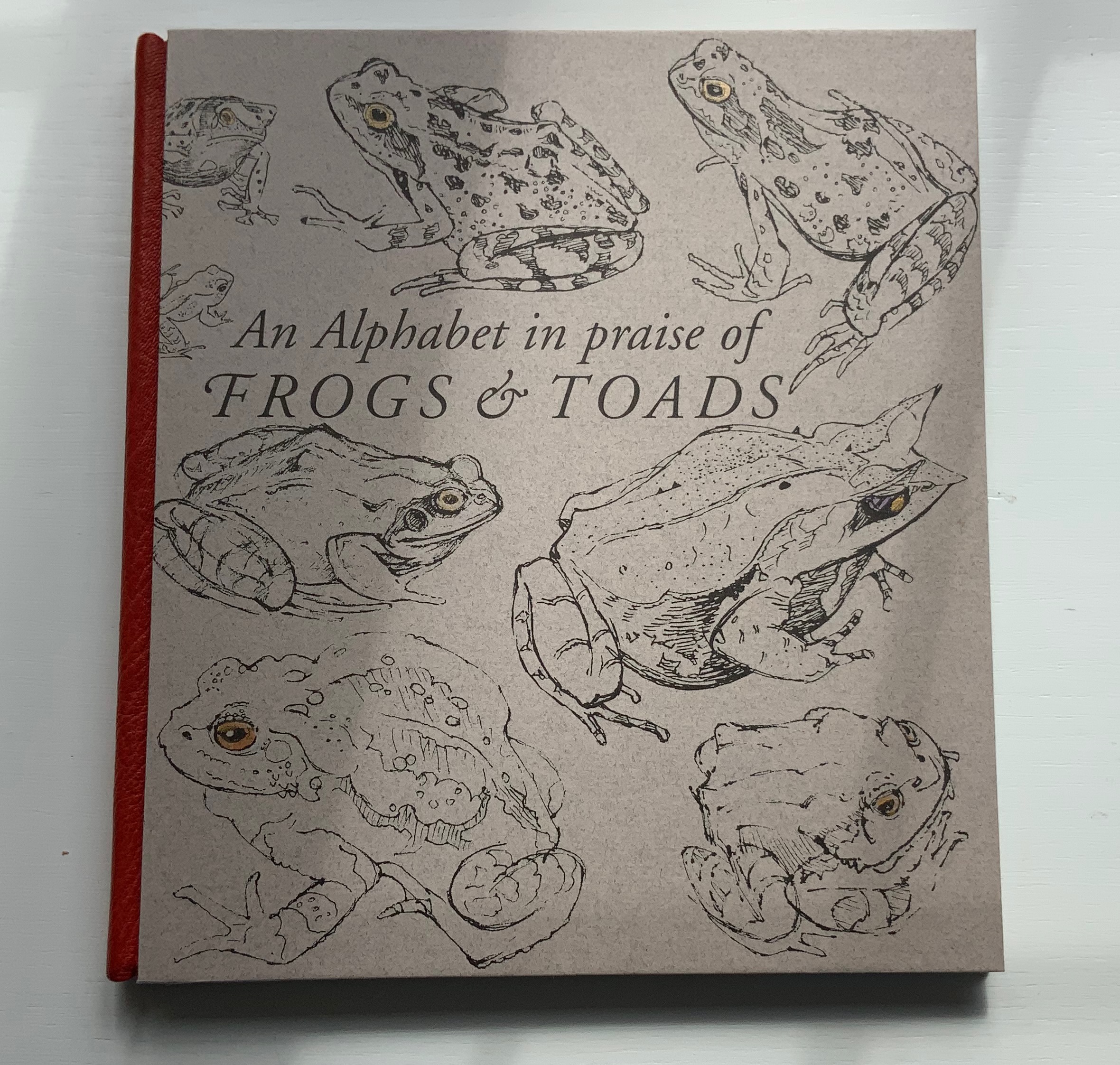
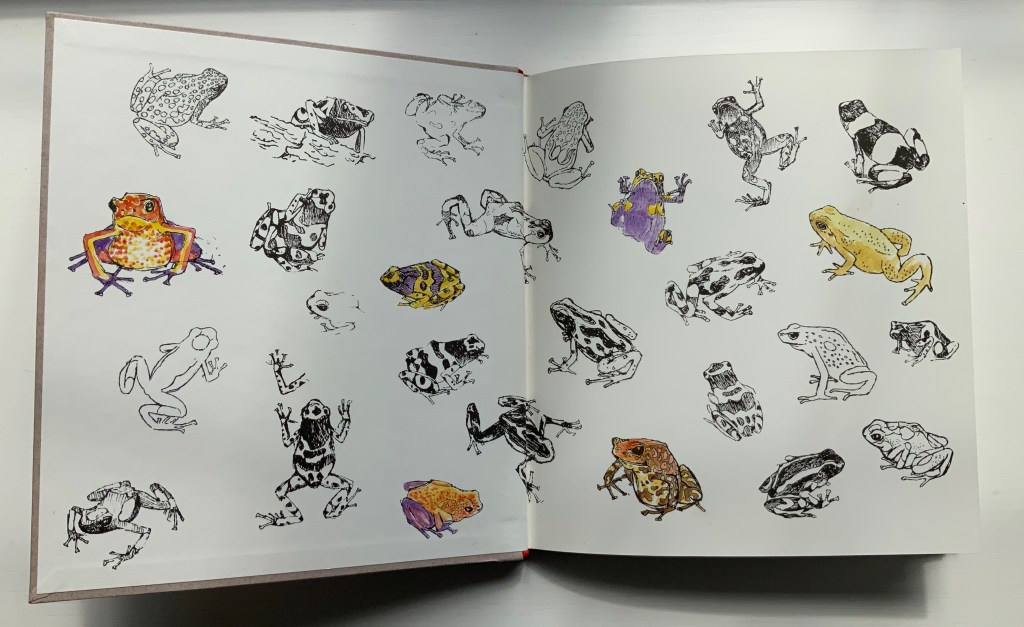
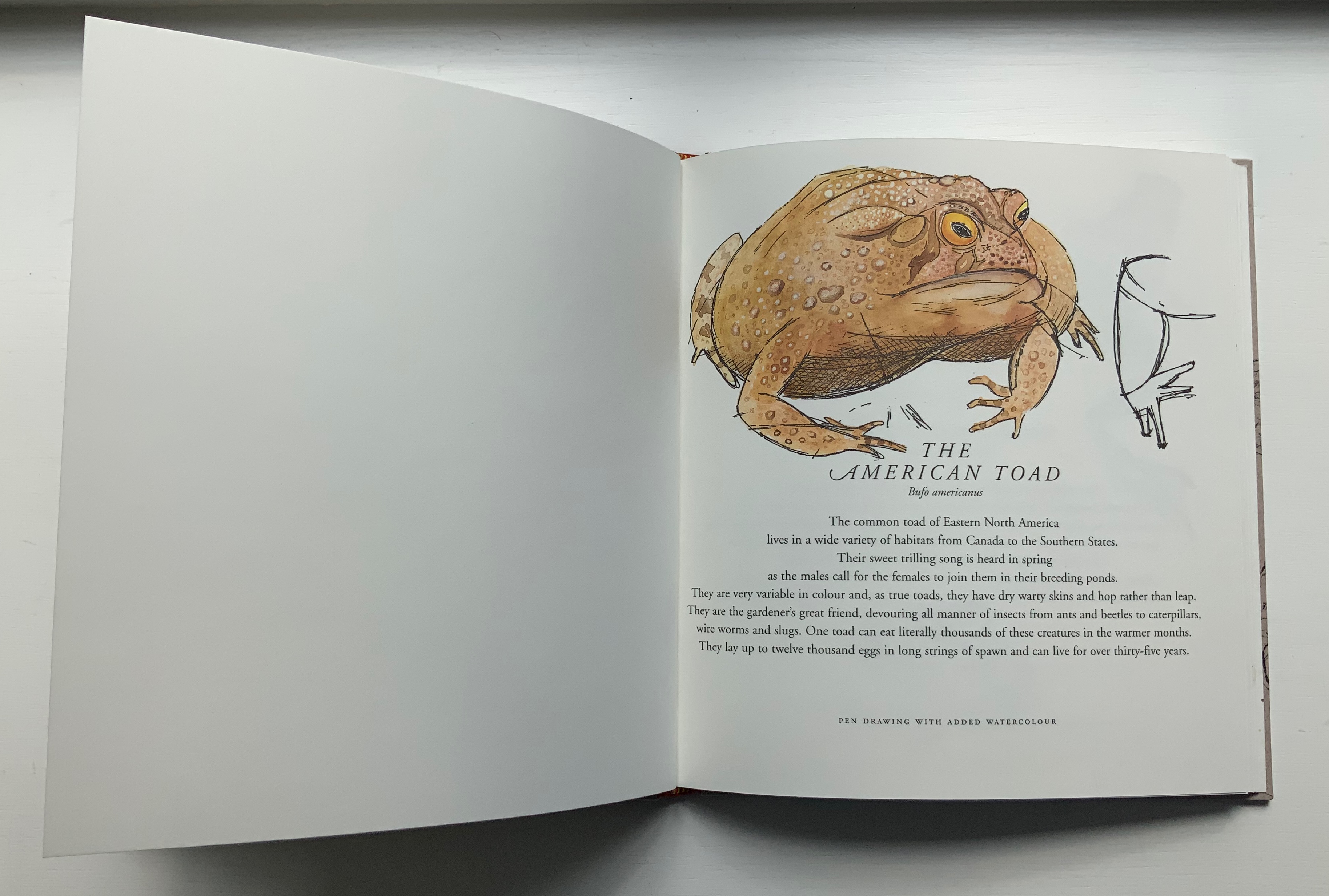
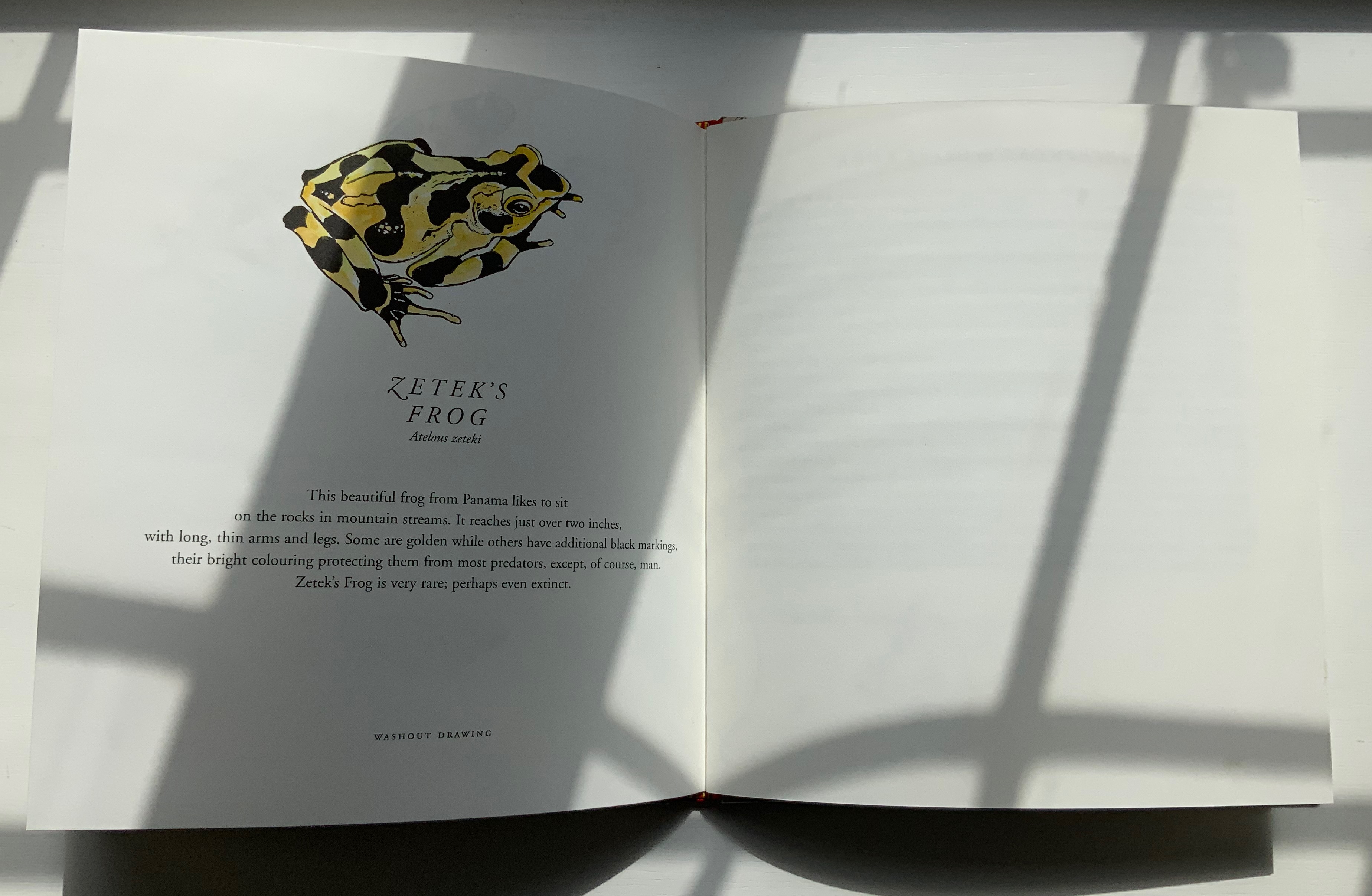
An Alphabet in Praise of Frogs and Toads (2002) John Norris Wood Quarter red morocco over illustrated paper boards, lettered in gilt to spine, housed in black cloth and brown paper slipcase. Slipcase: H245 x W217 x D 20 mm. Book: H235 x W215 mm. 40 pages. Edition of 360, of which this is No. XXI of XXXVI, hand colored by Sylvia Stokeld under the artist’s supervision. Acquired from Sophie Schneideman Rare Books & Prints, 30 March 2022. Photos: Books On Books Collection.
A passionate lover of animals, [John Norris Wood] opened his home to them (literally: he converted a bedroom to ‘jungle’ conditions, to support tree frogs and snakes, and housed something approaching a private zoo in his extended garden) and maintained an unexpected aviary on the the top floor of the 1960s Brutalist Royal College of Art building. He also undertook natural history expeditions around the world. Writing and broadcasting for television on a number of natural history subjects, he acted as a consultant to the iconic 1979 BBC television series presented by David Attenborough, Life on Earth. Also a committed conservationist, he supported environmental campaigners including Friends of the Earth, the World Land Trust, Fauna and Flora International, the Programme for Belize, the Egyptian Tortoise Appeal and the Environmental Investigation Agency. [Royal College of Art]
Among the subgenres of alphabet books, the animal abecedary reigns. From the animal kingdom, though, frogs and toads are not the highest ranking of the sub-subgenres. Among artists’ books from fine presses, however, this counts among the finest in the Books On Books Collection. Norris Wood drew from life, but it is hard to credit that all 26 of these creatures inhabited his bedroom!