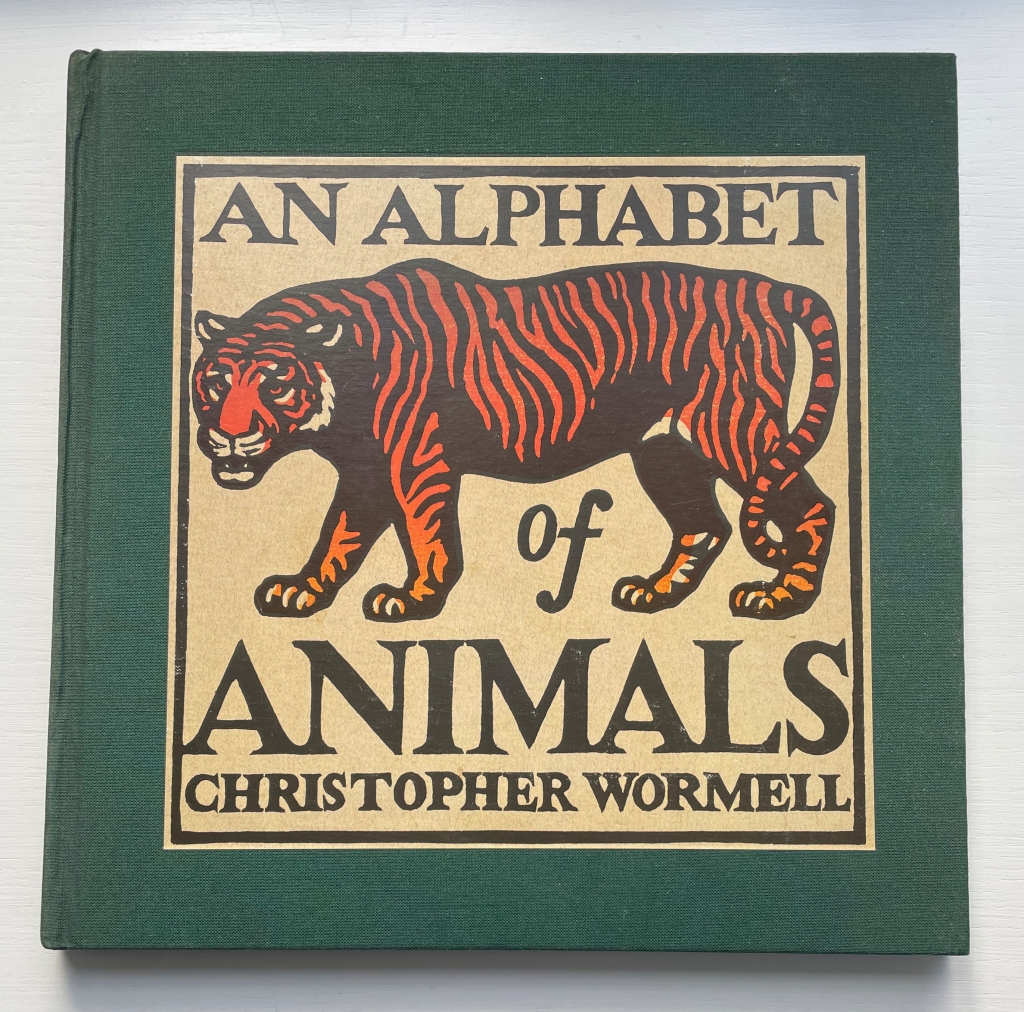
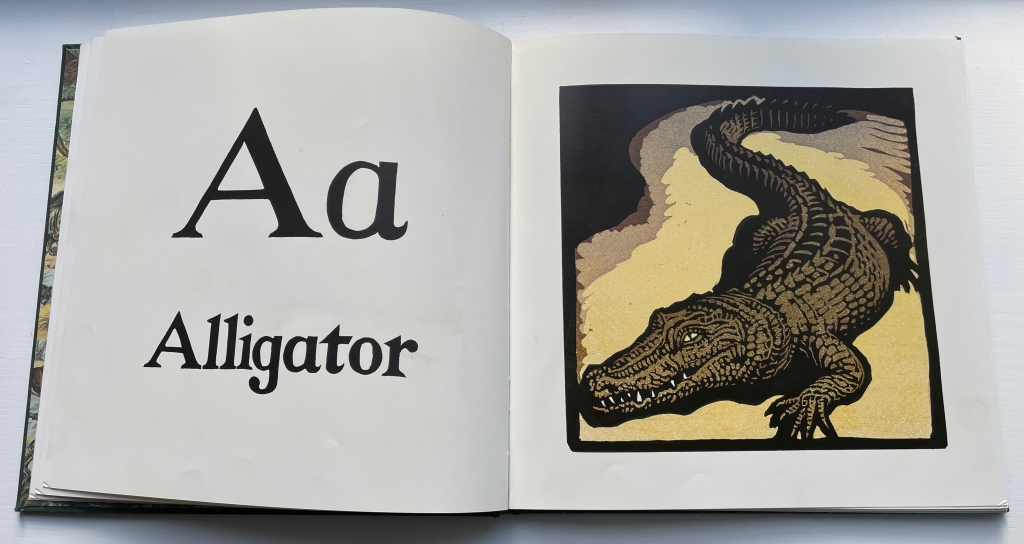
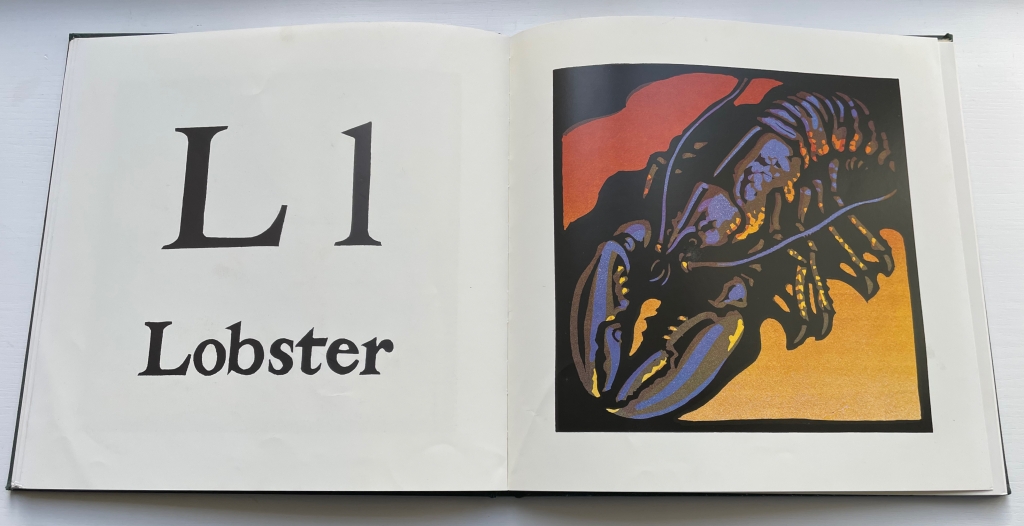
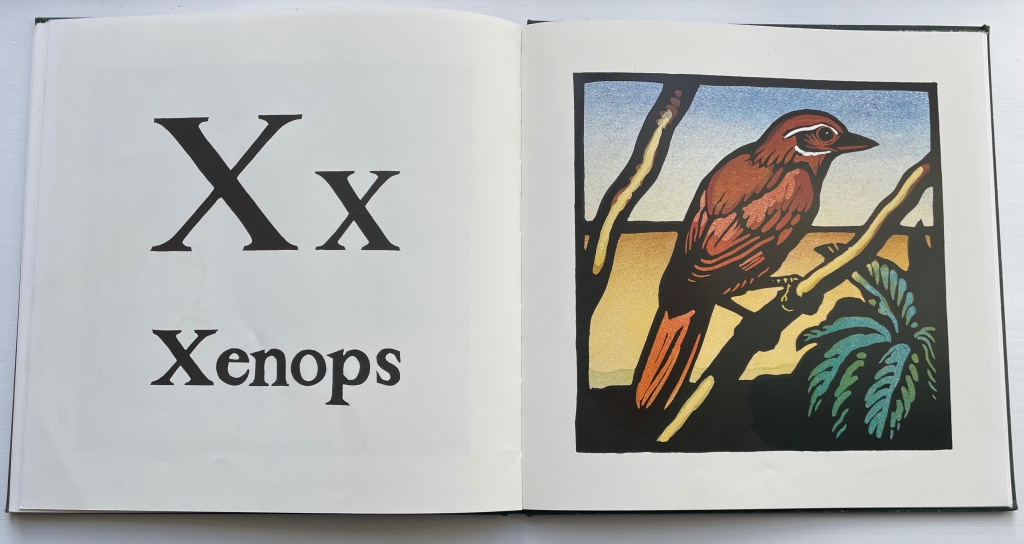
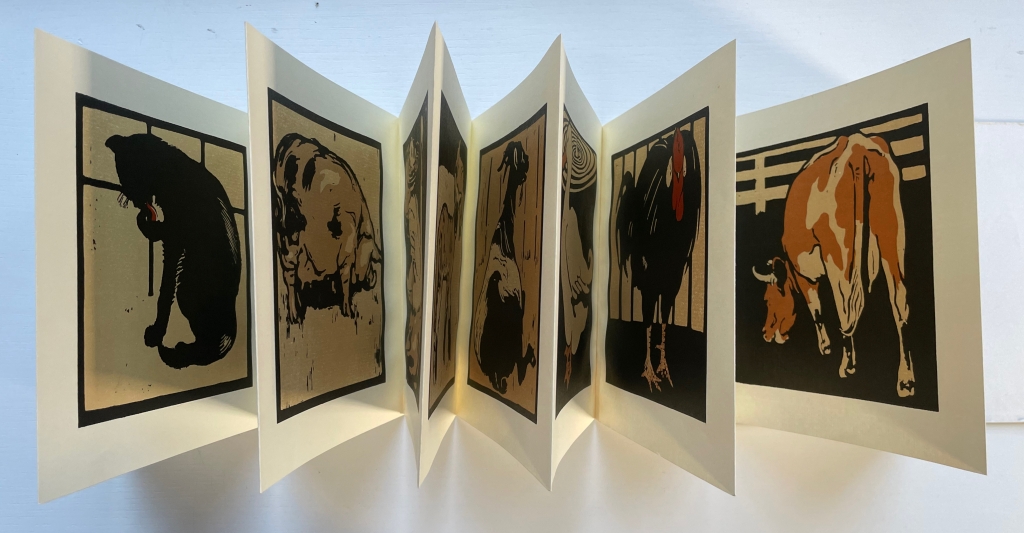
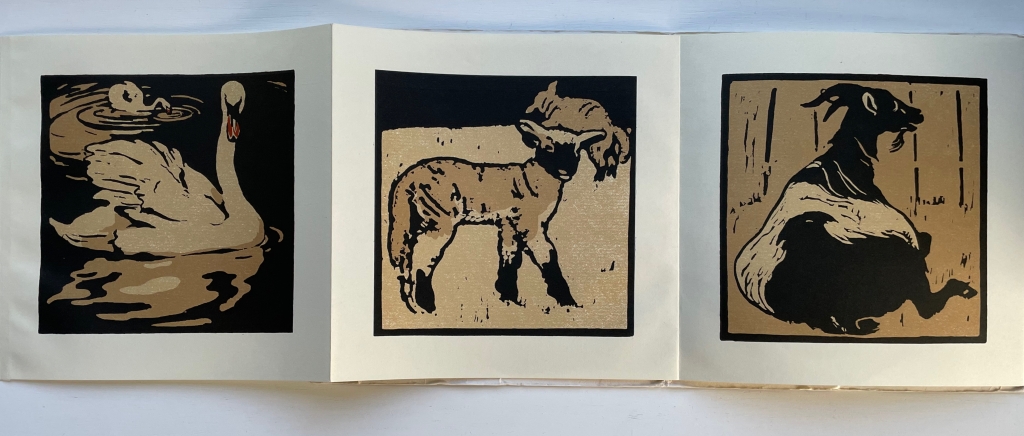
An Alphabet of Animals(1990) Christopher Wormell Casebound in cloth, sewn, title label on front cover. 272 x 272 mm. 64 pages. Acquired from MacKellar Art & Books, 14 March 2023. Photos: Books On Books Collection.
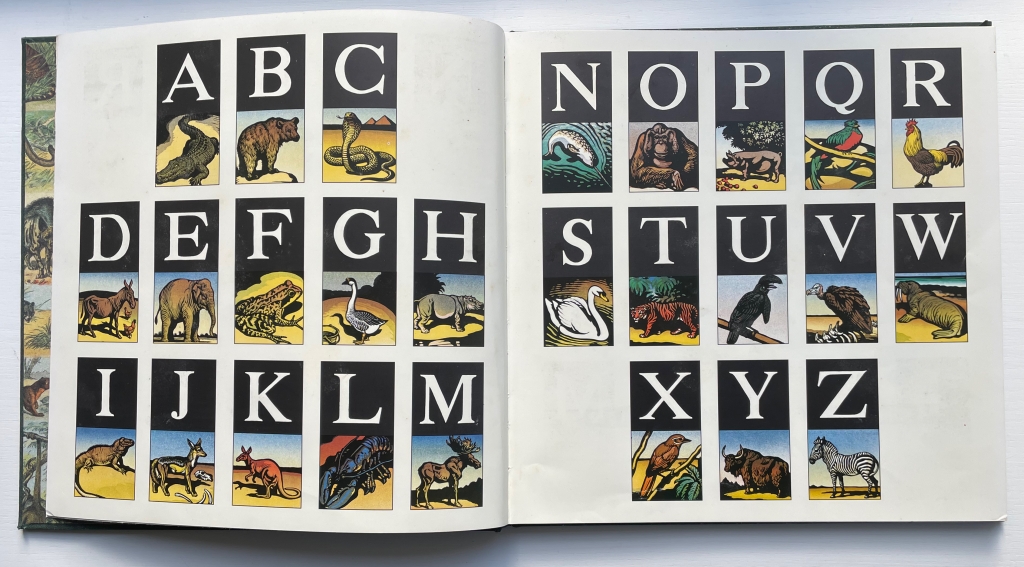
An Alphabet of Animals has several distinguishing features. Its art and lettering come from handcut lino block prints. Each picture would require multiple blocks. To produce the images and color, each block would be inked and printed separately by hand.
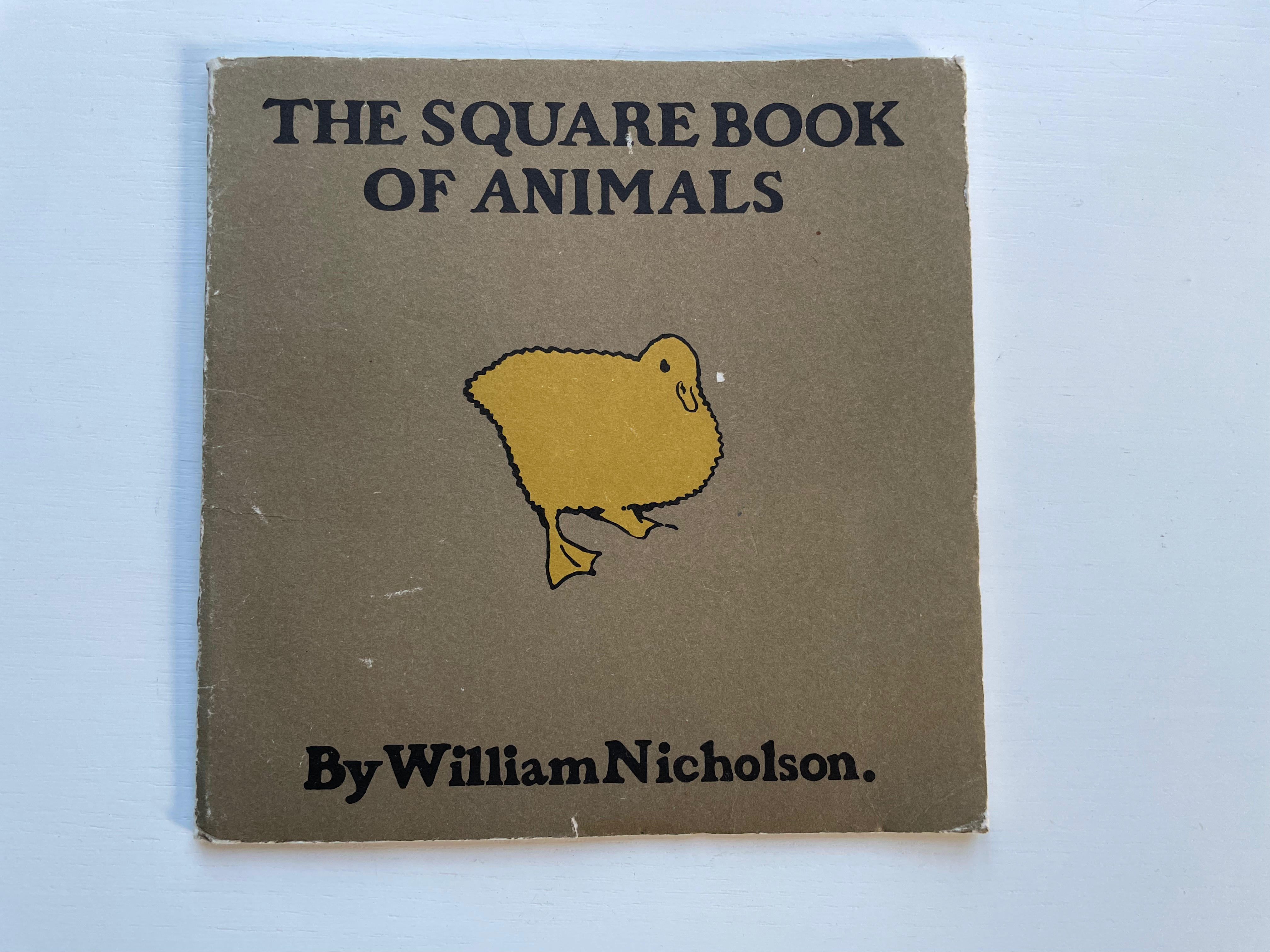
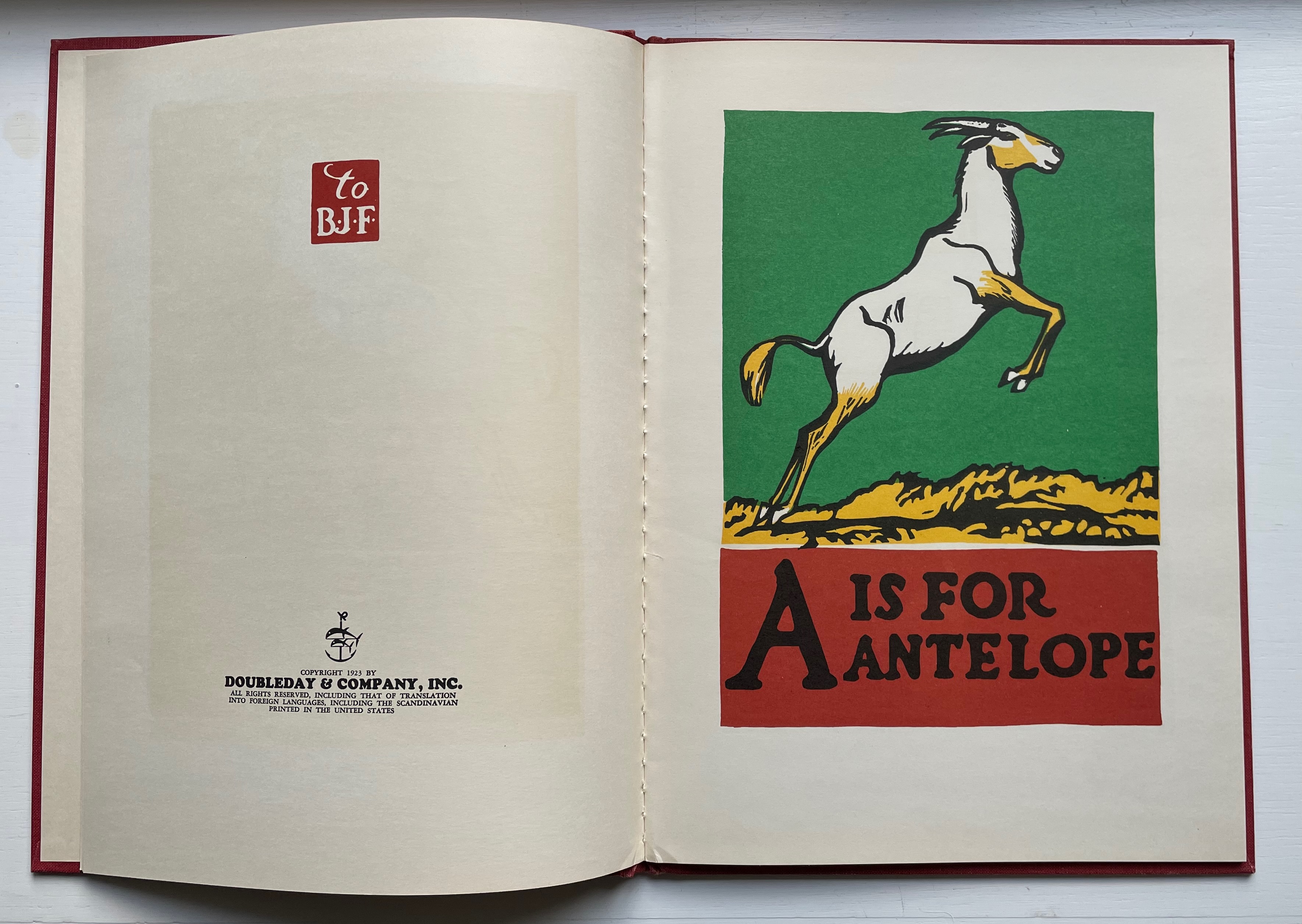
Another distinguishing feature is how Wormell’s art and lettering recall that of William Nicholson’s The Square Book of Animals (1899), Carton Moore Park’s Alphabet of Animals (1899) and C.B. Falls’ ABC Book (1923).
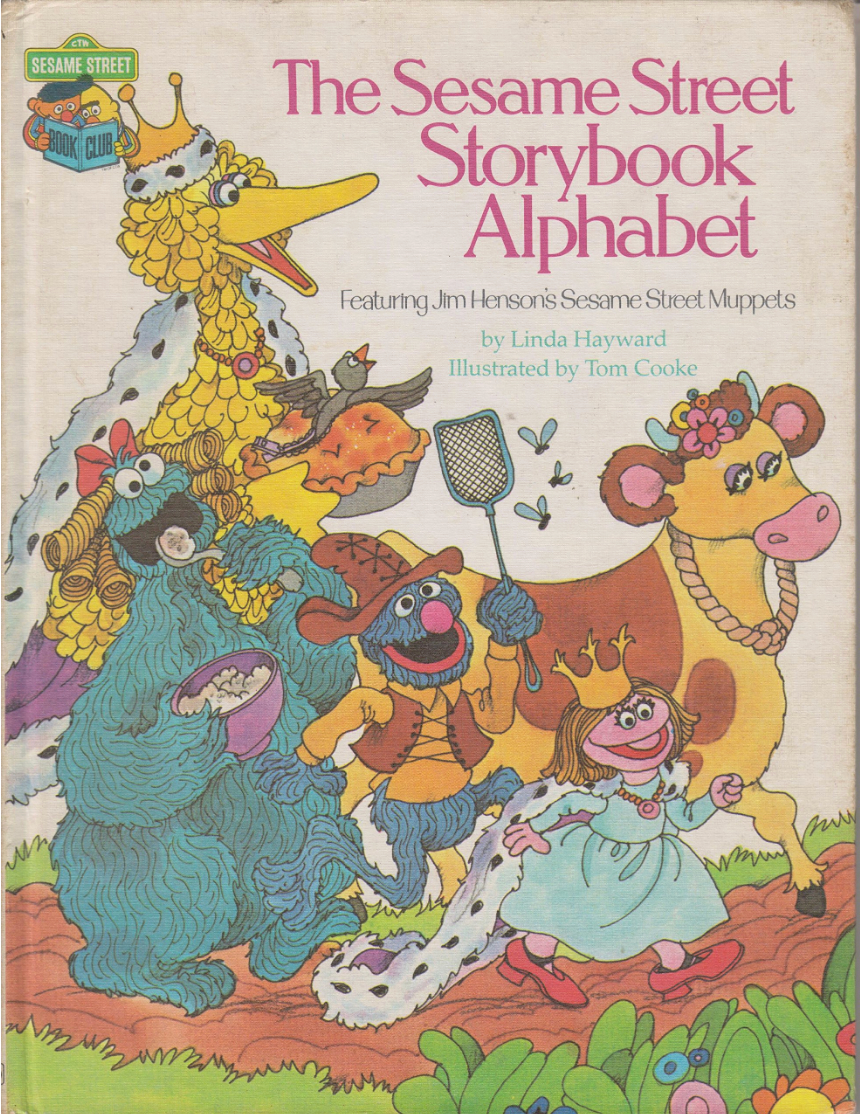
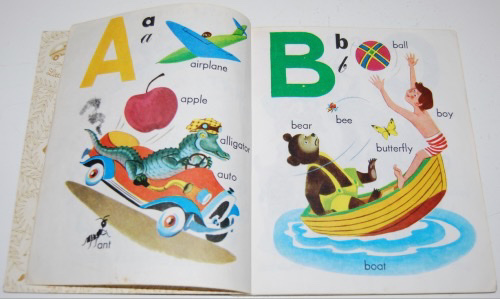
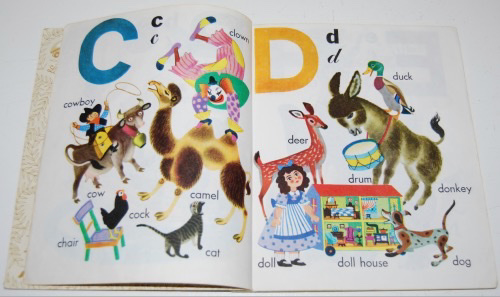
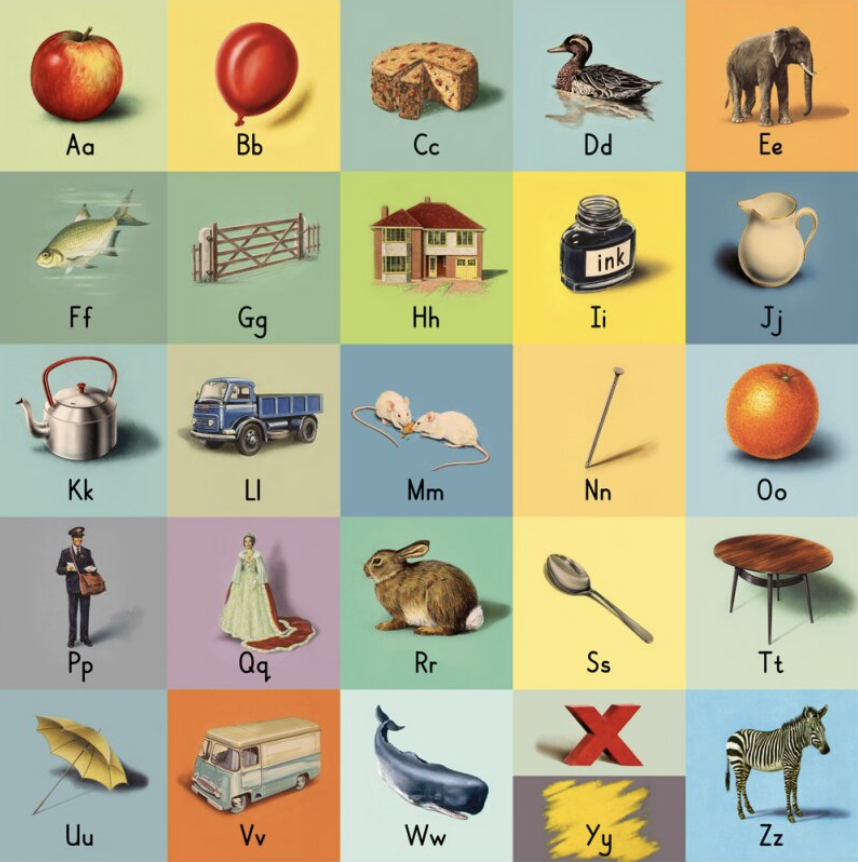
A century after the heyday of Nicholson, Park and Falls, Wormell found himself in an entirely different tradition of alphabet books and style of art: the world of The Sesame Street Storybook Alphabet (1980), the Little Golden Books (1970s/80s) and the Ladybird alphabet of the 1960s.
Alphabets from Sesame Street, Golden Books and Ladybird.
Wormell’s range of color across the animals is also a distinguishing feature as is the color gradient technique. The alligator’s colors are almost murky, the lobster’s electric, and the xenops’ soft in comparison.
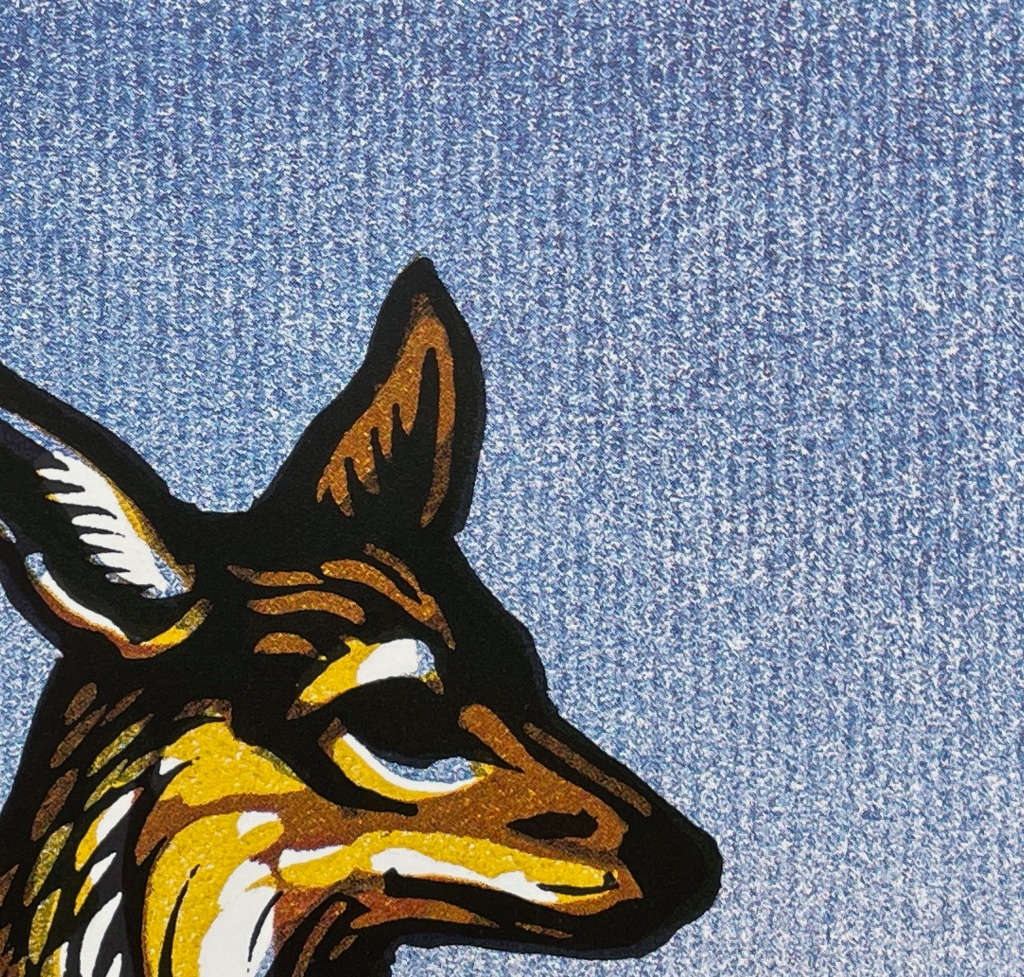
Lino printing a color gradient is tricky. More than one color of ink has to be applied to the same block. The gradients achieved by Wormell are genius. In some of the images, the gradation benefits from the texture of the paper showing through, captured in the color separation by scanner and offset printing of the book and demonstrating Wormell’s touch.
Note how the grain of the paper on which the print was made peeks through.
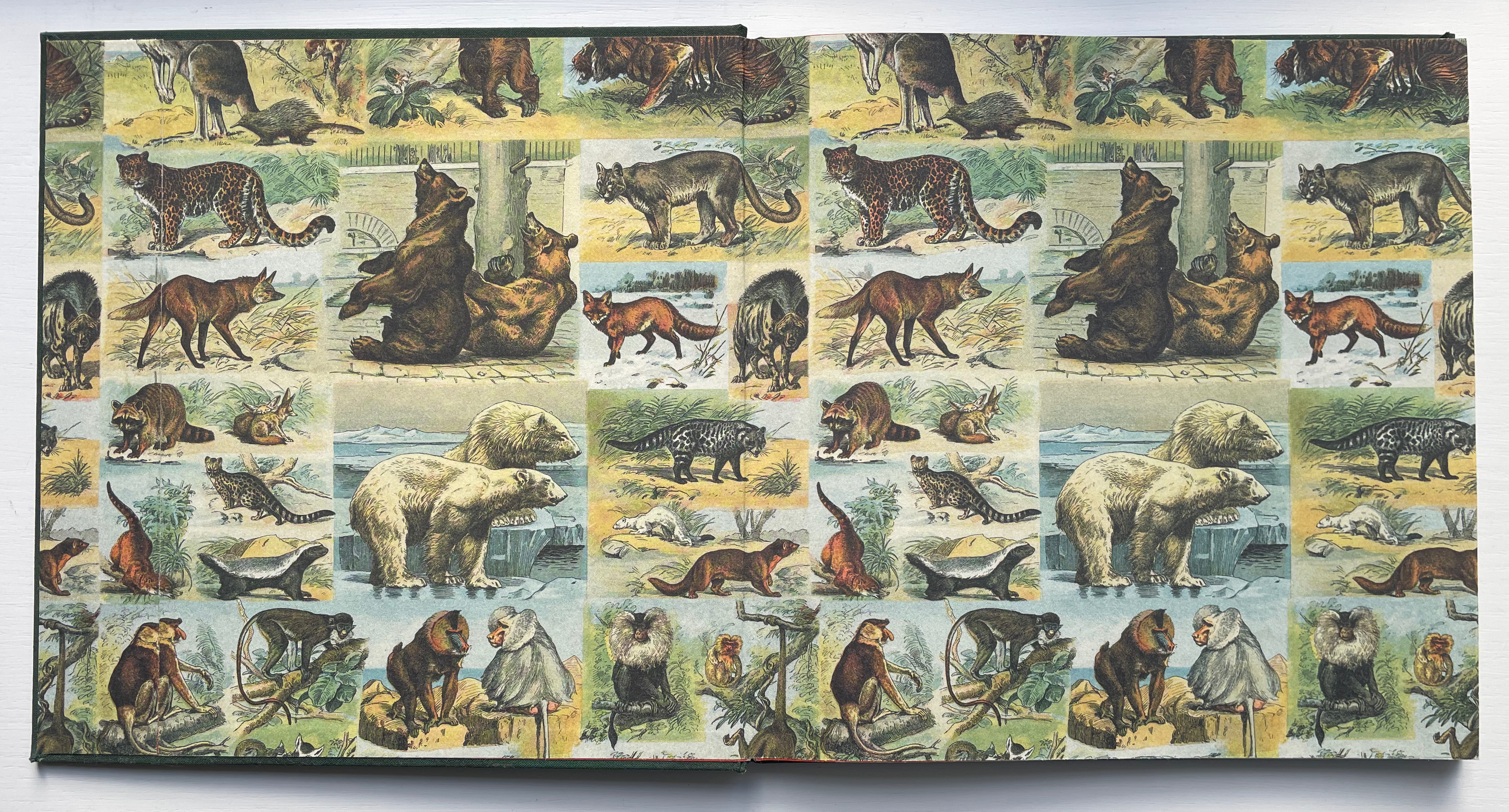
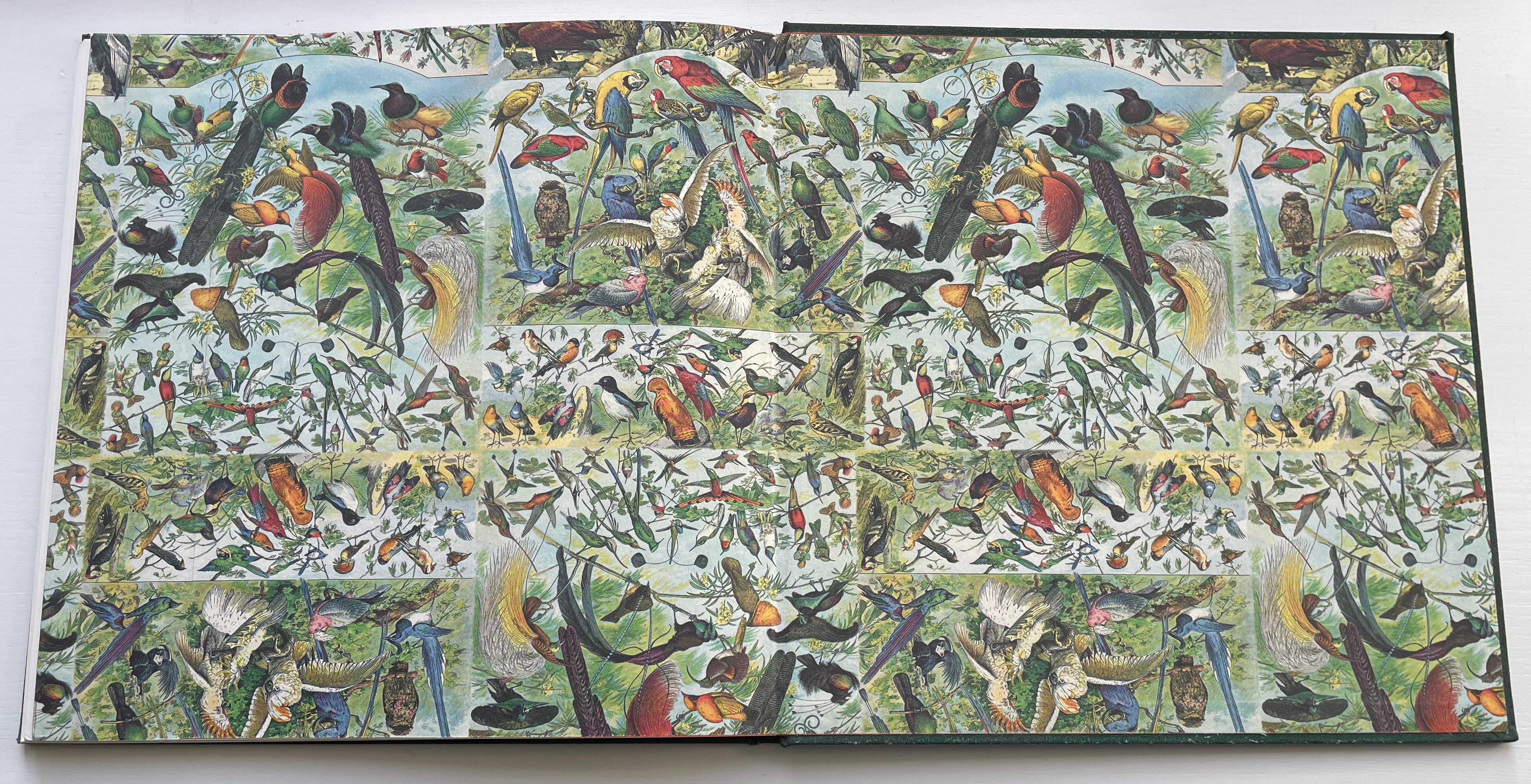
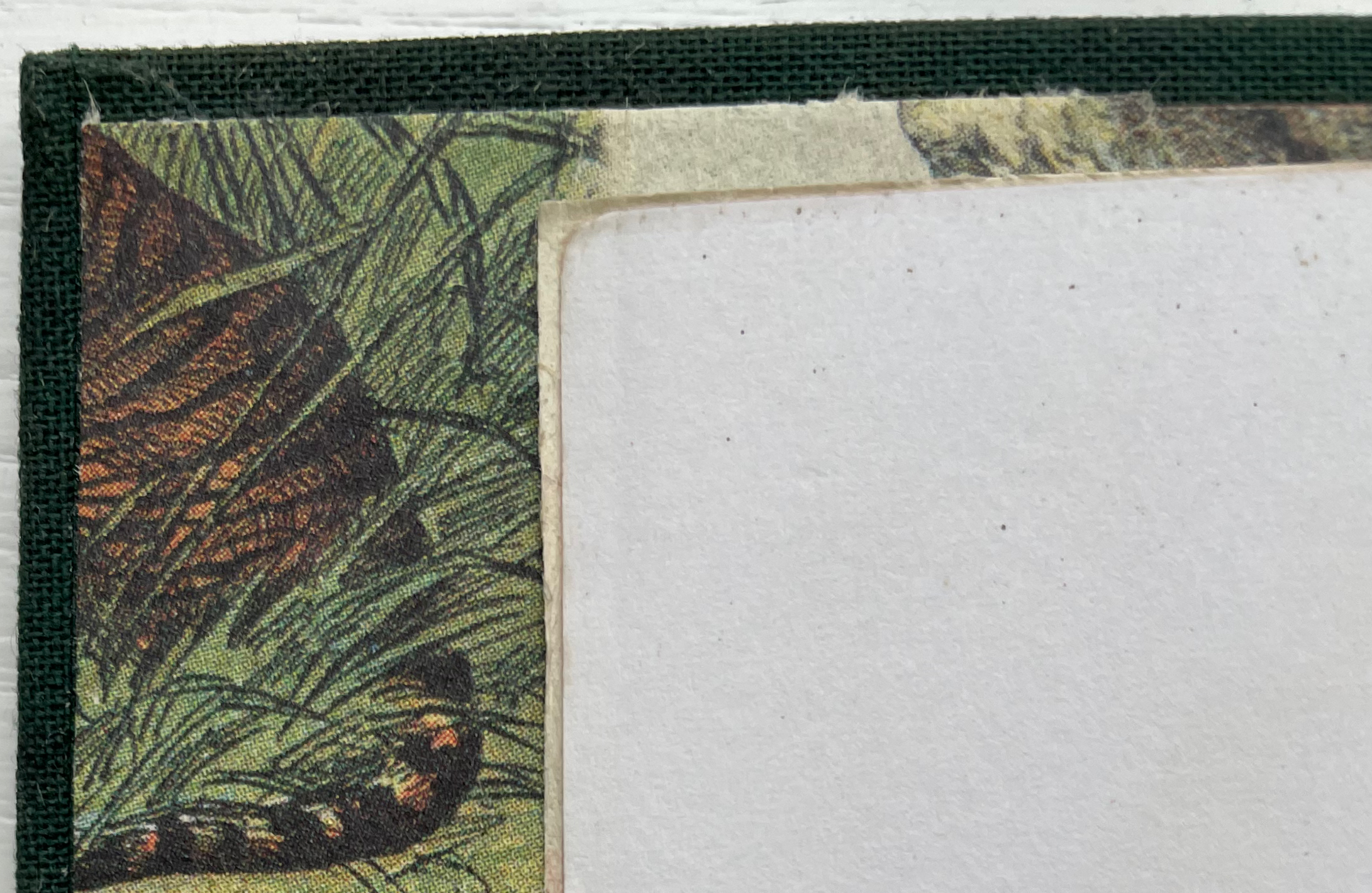
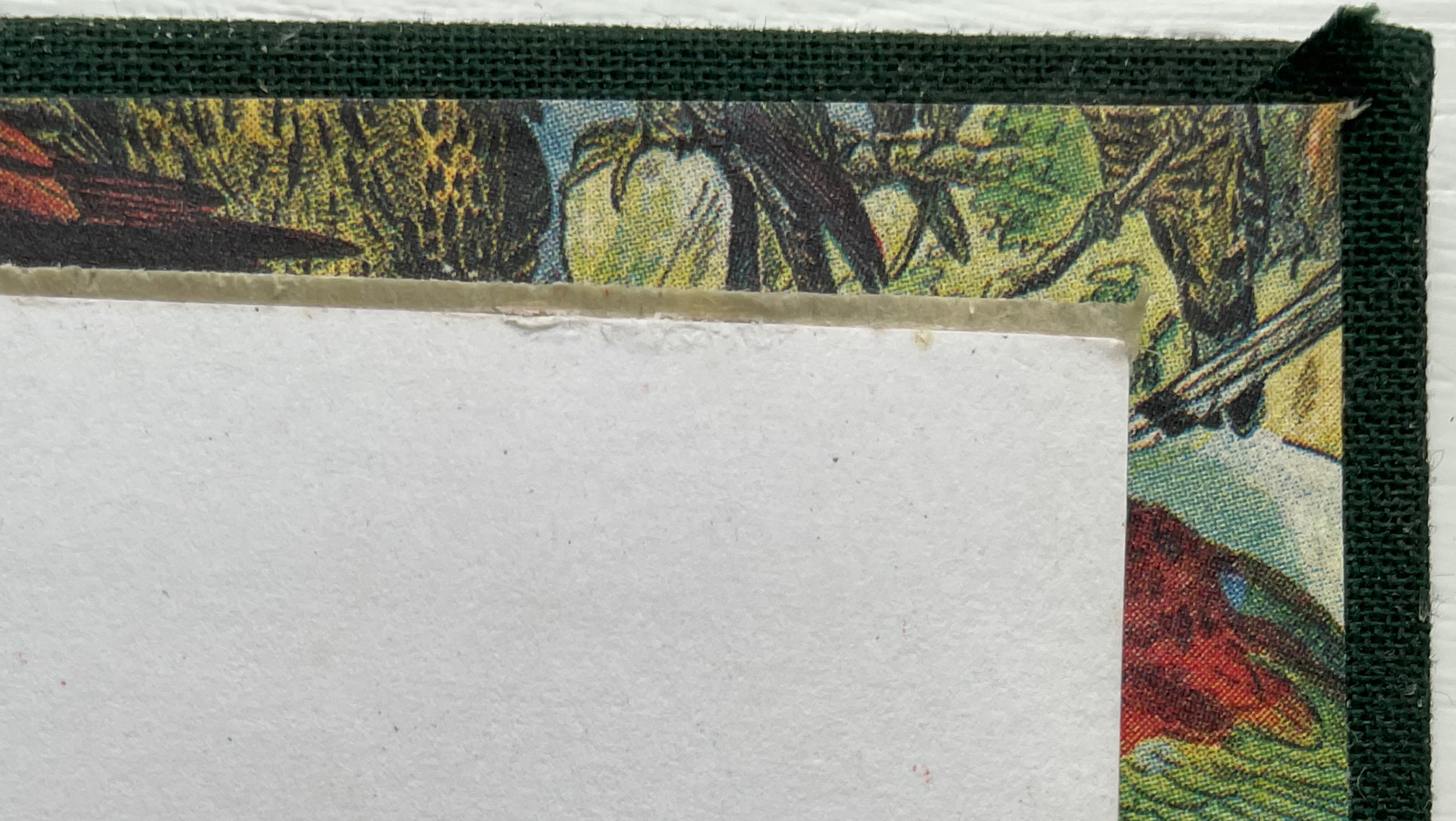
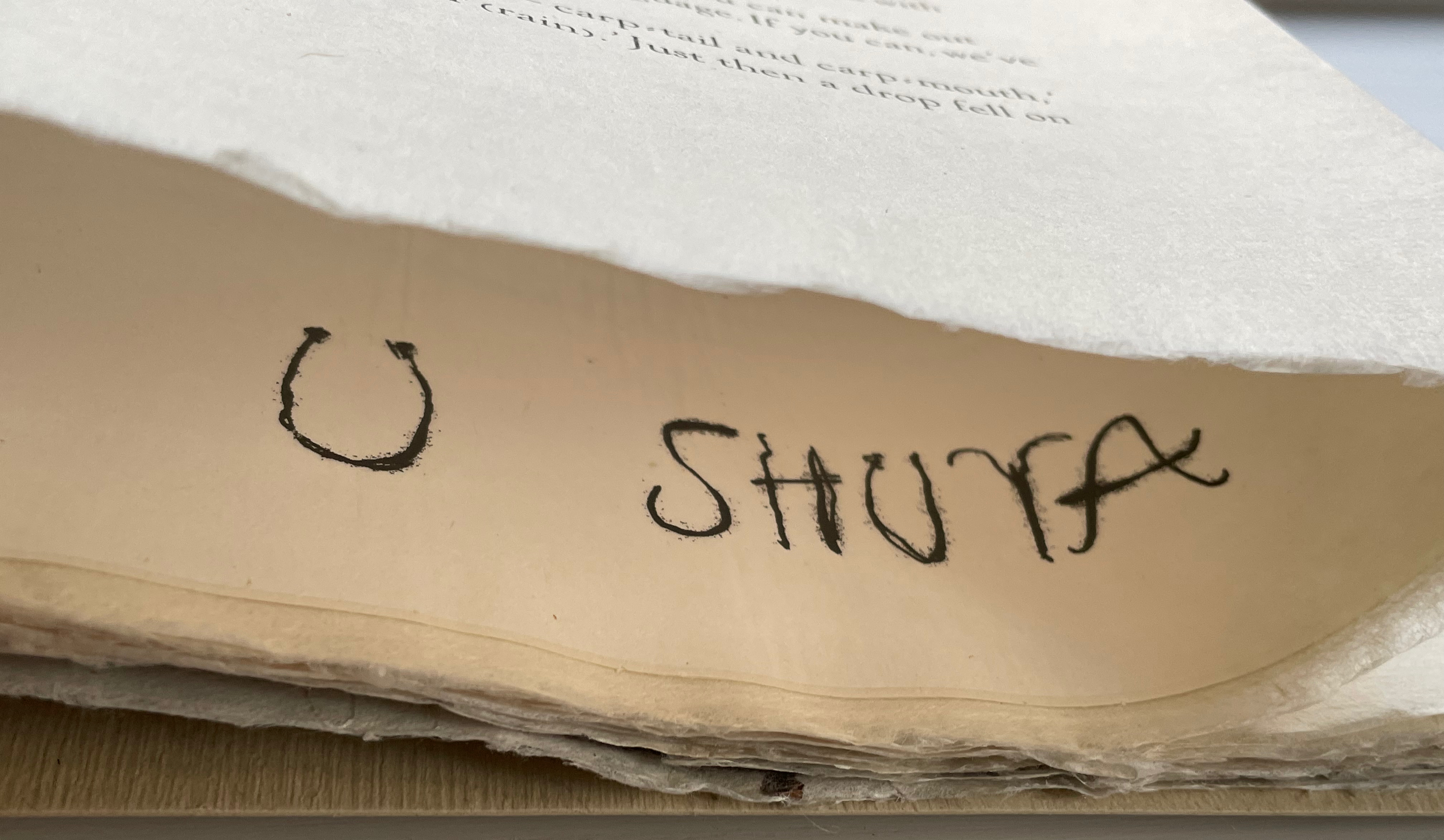
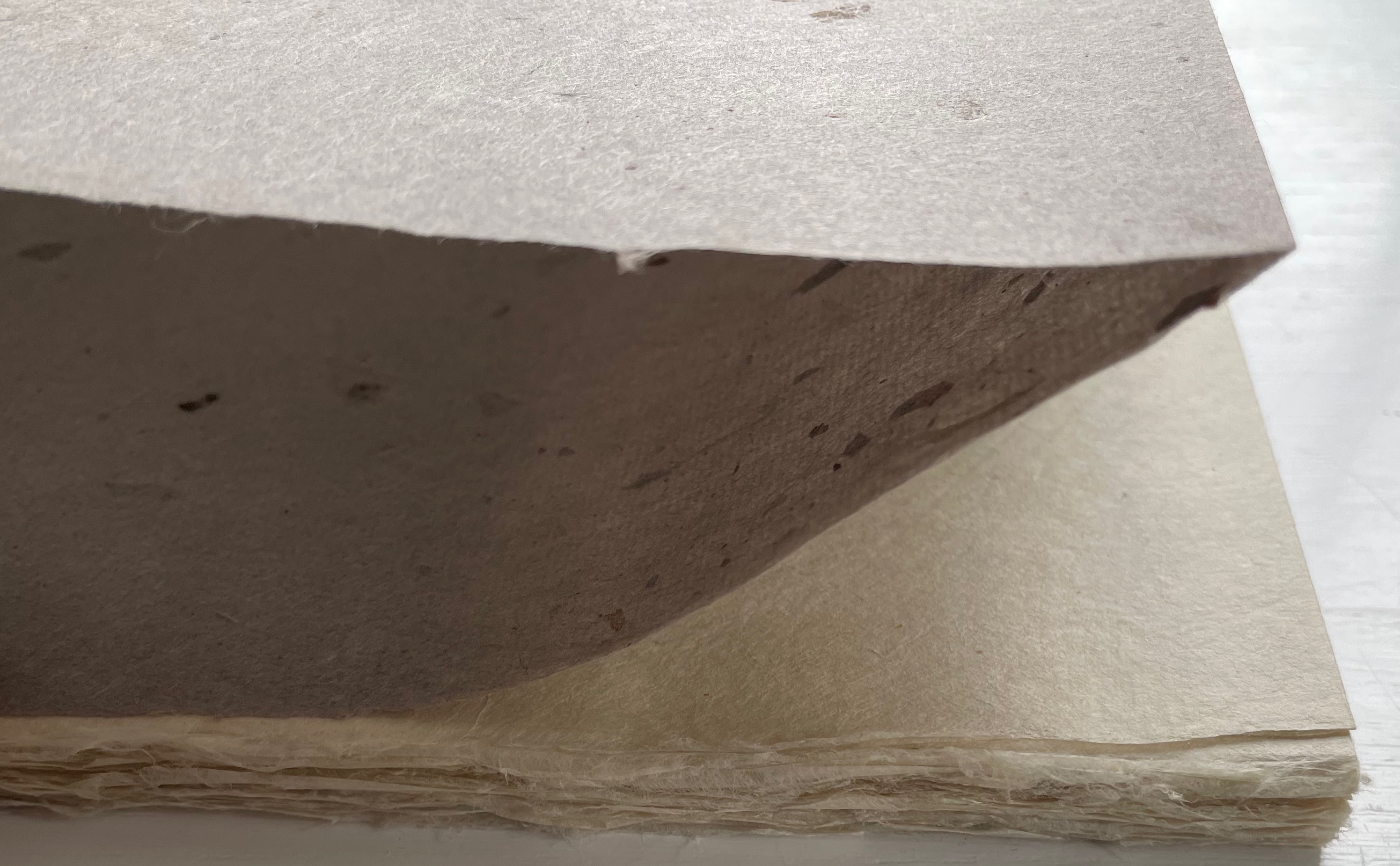
Another distinction — unintentional and for this particular copy only — is the endpaper treatment. The front endpapers — a doublure, one leaf of the end paper pasted to the board and one leaf free — present vintage images of animals, and the back doublure presents the same of birds. The free leaf is not actually free though.
At the front and back, these wallpaper-like leaves are glued to an original separate plain flyleaf in each case, which is detectable at the edges where one slightly overlaps the other.
The style of the decorated endpapers harks back to works like The Child’s Picture Book of Alphabets, published by Thomas Nelson & Sons in 1880 (see below). While the previous owner may have had good reason for adding these endpapers (and did or received a pretty good job of it), the contrast with Wormell’s book block is jarring.
From A Child’s Picture Book of Alphabets (1880), in the Osborne Collection of Early Children’s Books, Toronto Public Library.
The upside is that this copy inadvertently provides the student of alphabet books and illustration with a handy juxtaposition of the style of illustration against which Nicholson, Moore Park and Falls were reacting with Wormell’s distinctive revival of their approach, which in turn set his book apart from the late 20th century’s crowd.
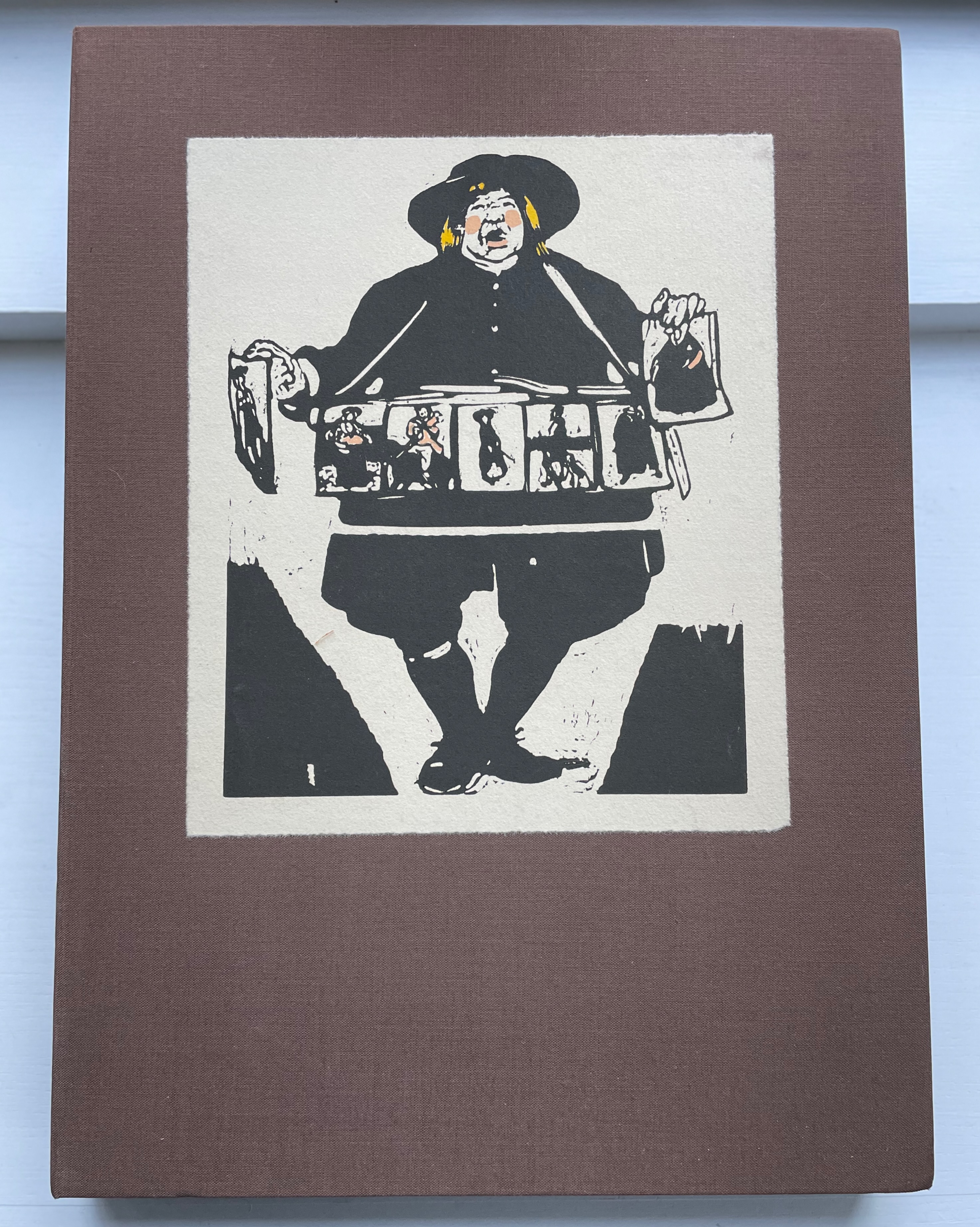
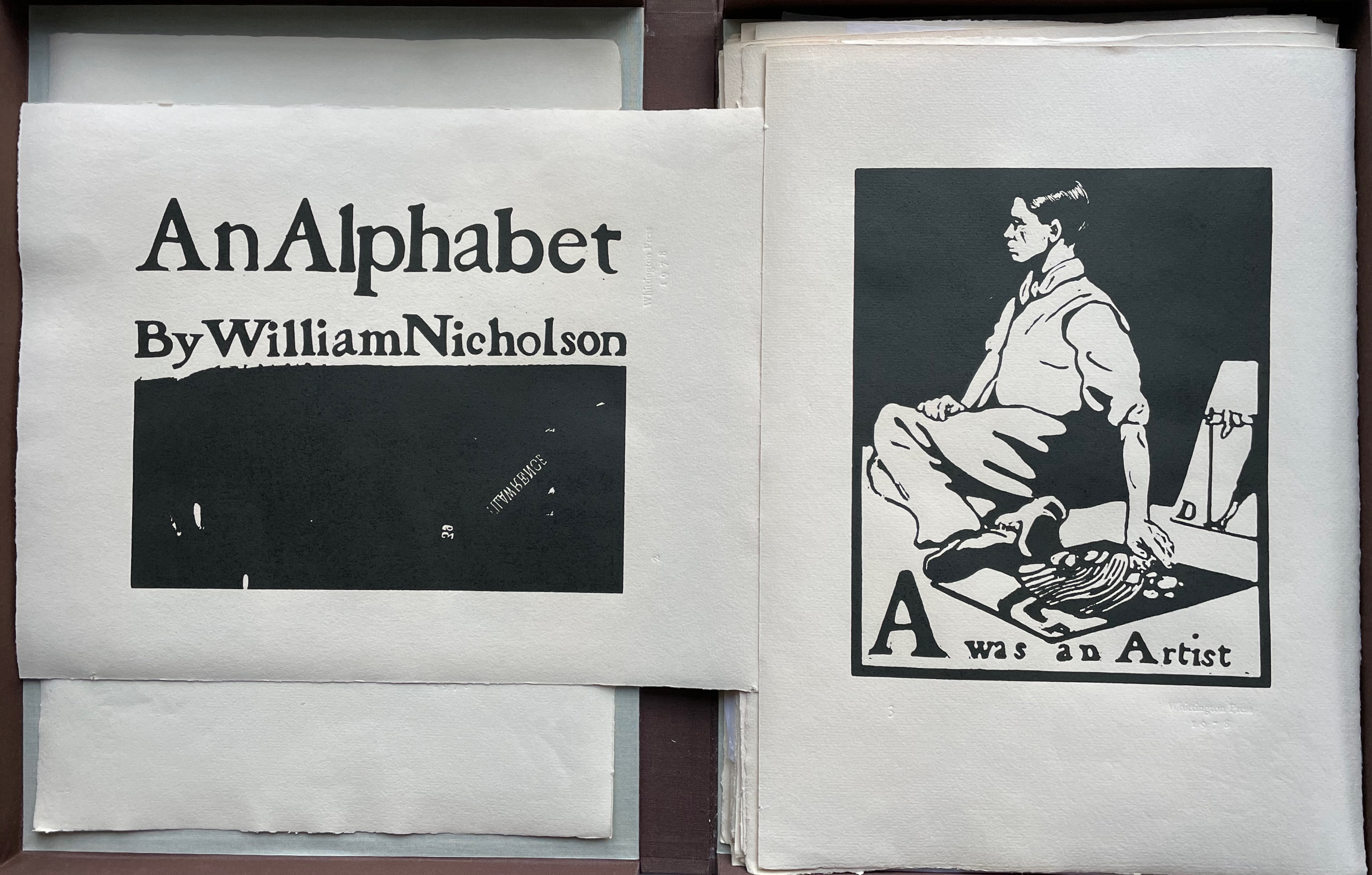
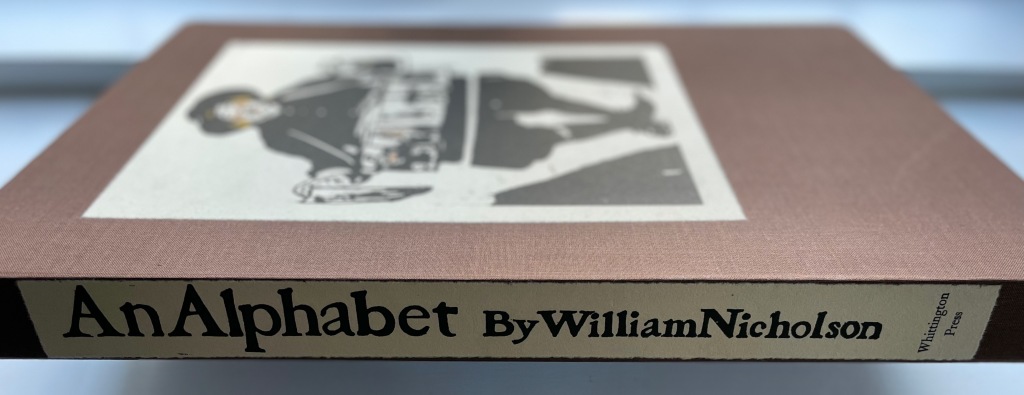
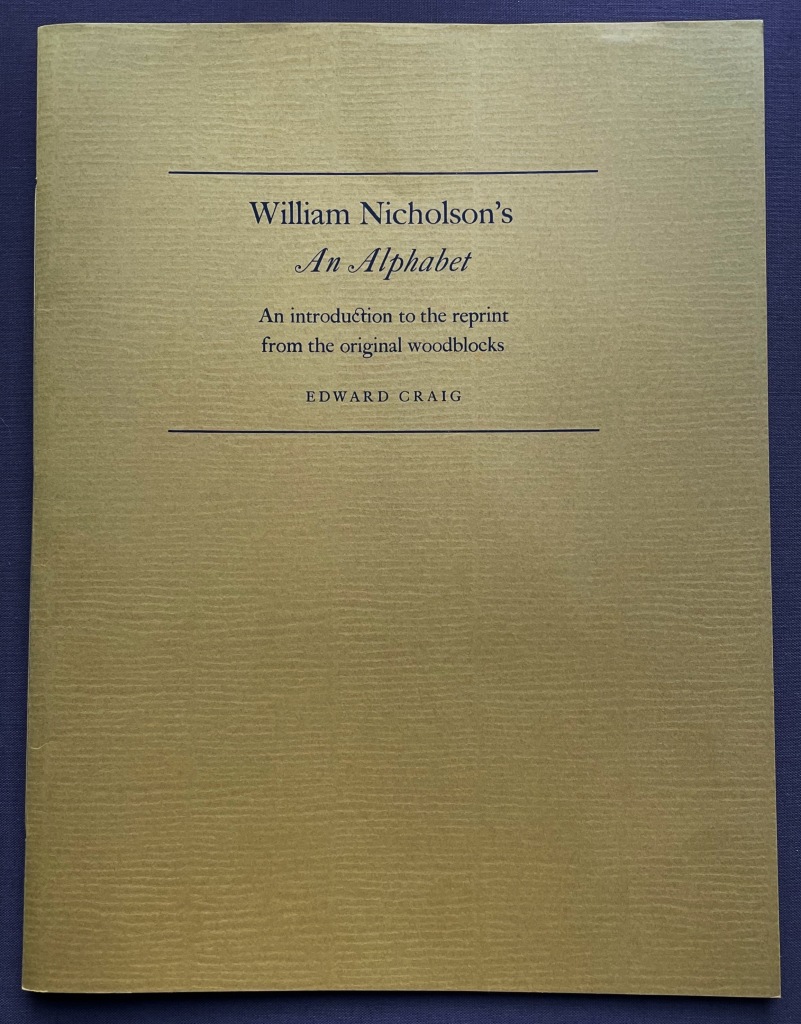
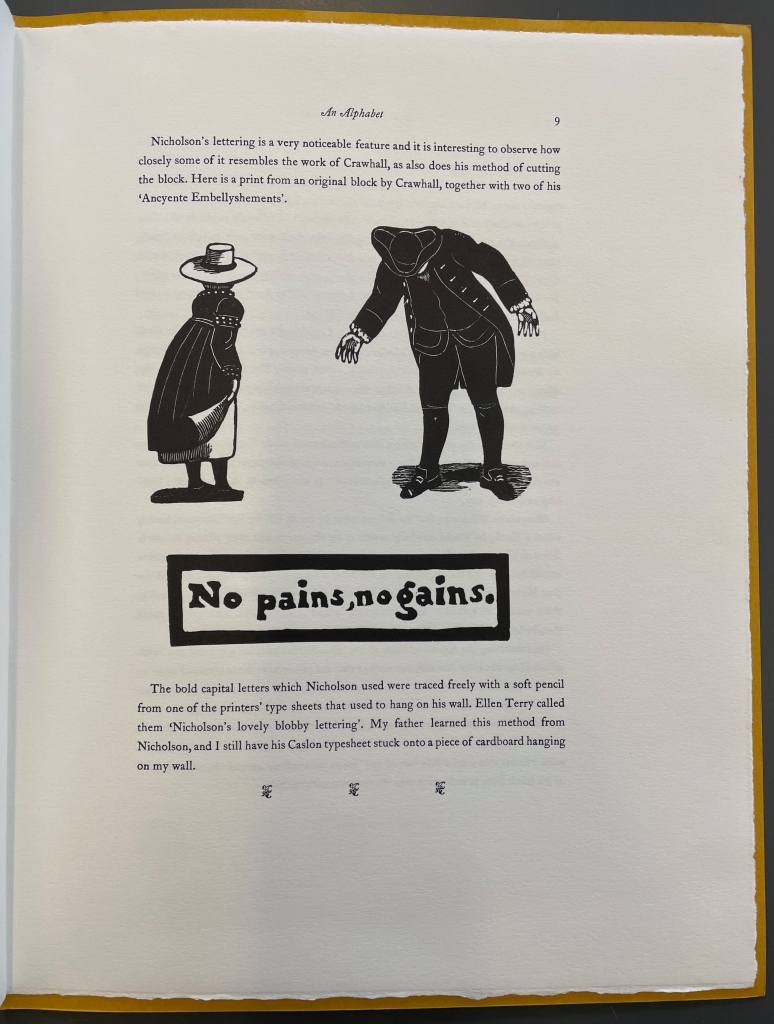
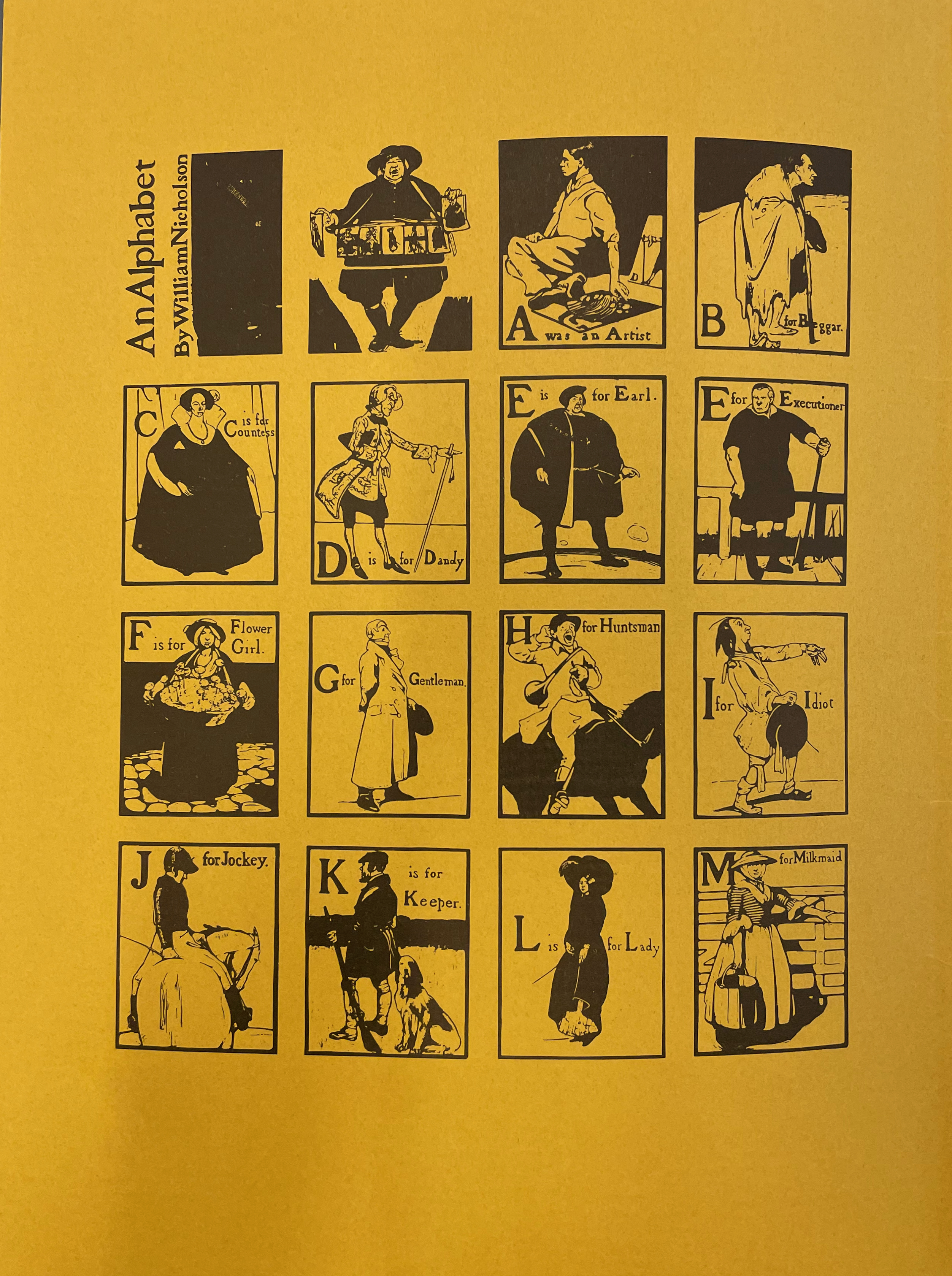
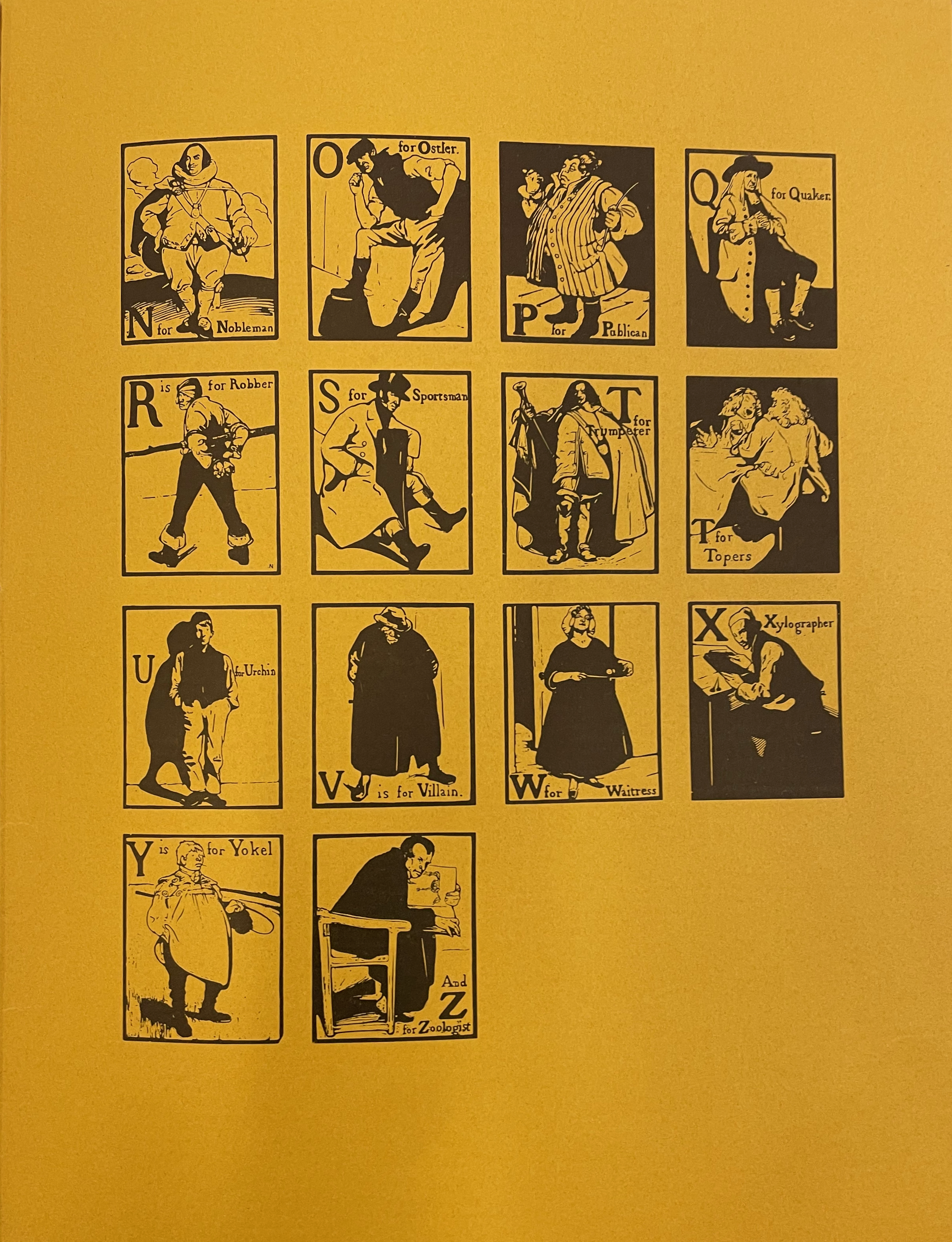
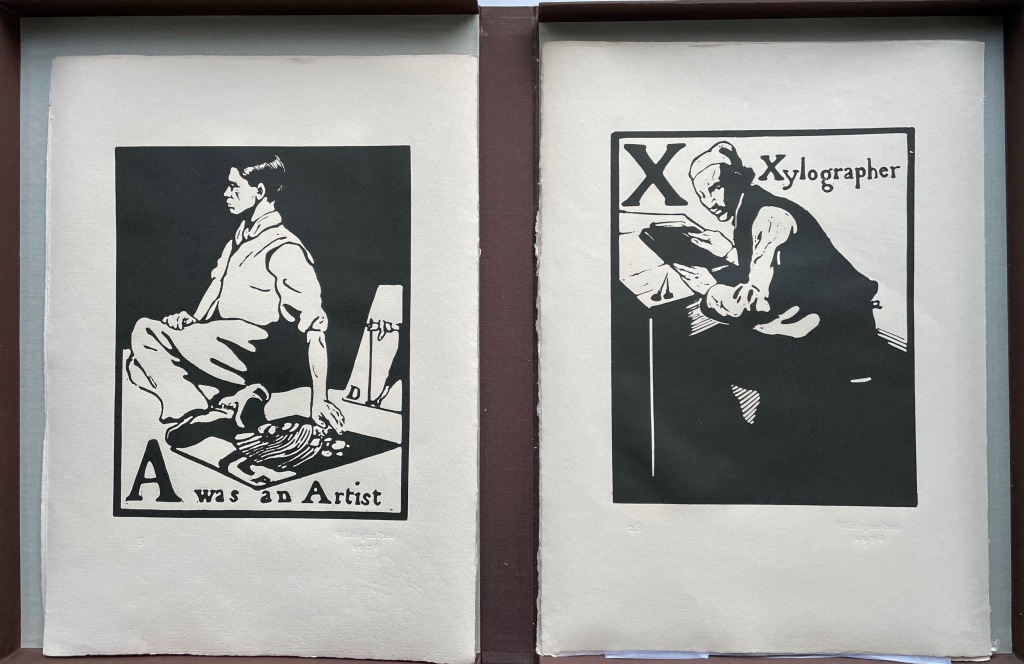
William Nicholson’s An Alphabet appeared in 1898. Eighty years later, with access to the original woodblocks (thanks to William Heinemann Ltd, which subsequently placed them with the Victoria & Albert Museum), Whittington Press and Edward Craig found themselves in a position to reproduce this famous alphabet. Craig, the son of Edward (Ted) Gordon Craig, who learned wood engraving from Nicholson, also had his father’s diaries as well as his own memories on which to draw for the booklet that accompanies the prints in this folio box. It provides a rich and diverse background that adds to their enjoyment. Craig brings to life the context and ties of friendship in which Nicholson’s art came on the scene. He even includes prints from three blocks cut by Joseph Crawhall (he of Old Aunt Elspa’s ABC fame) to show the affinities between Nicholson’s lettering and images and those of Crawhall.
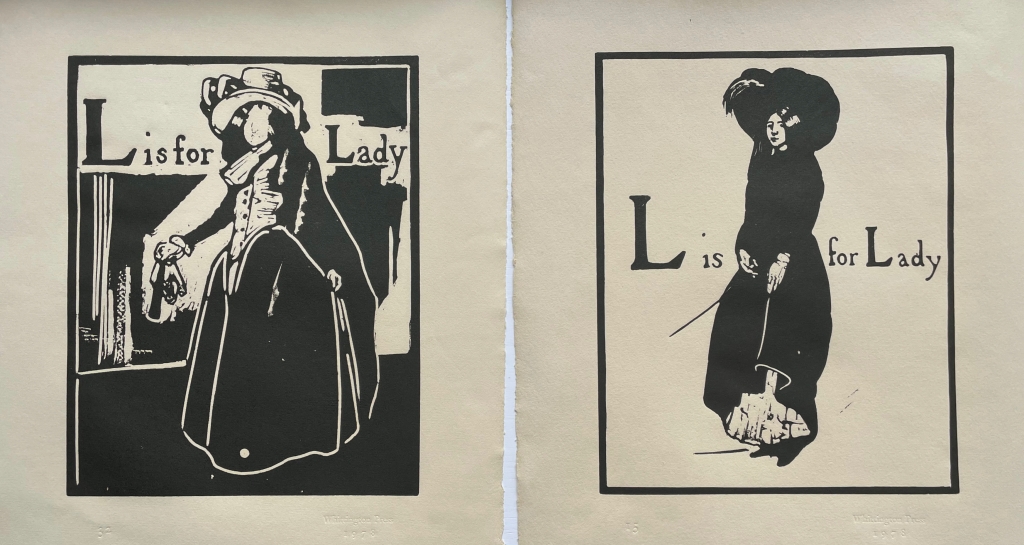
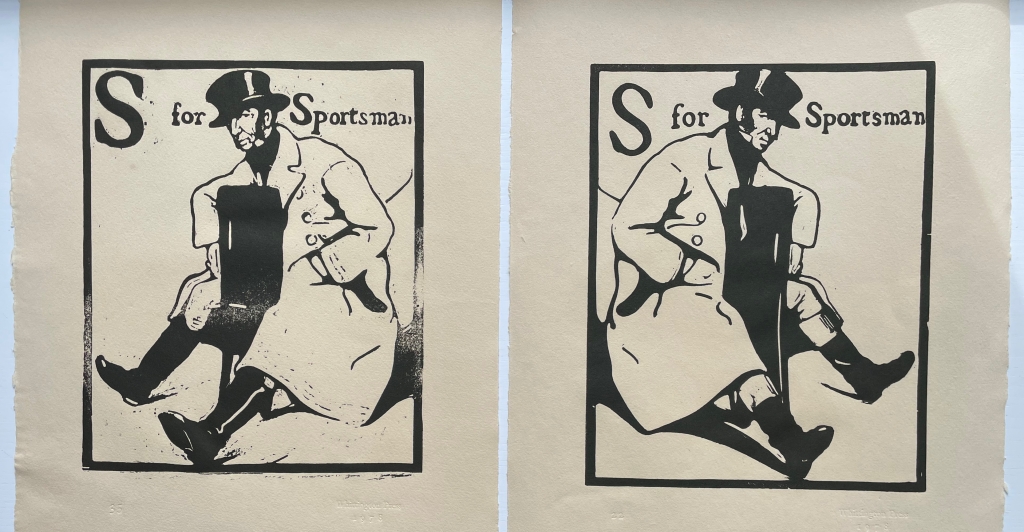
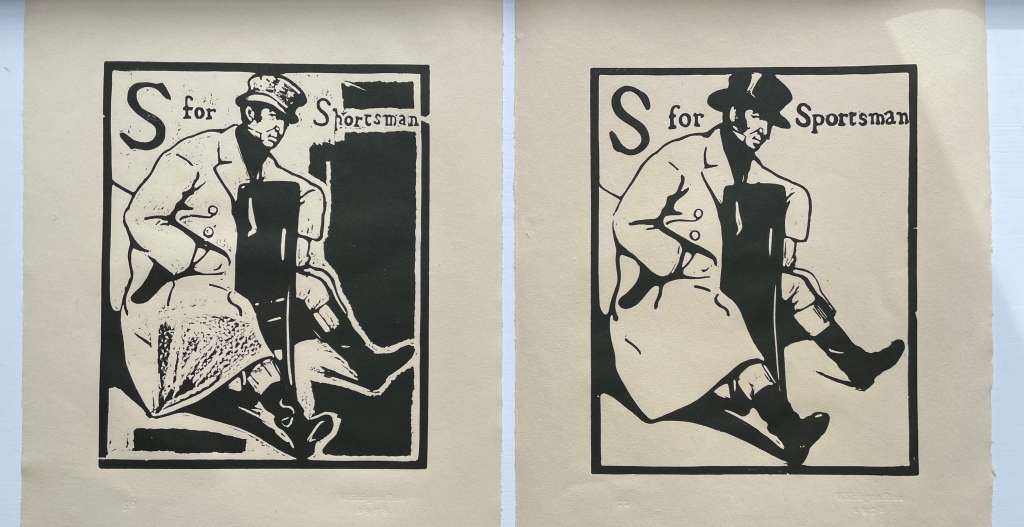
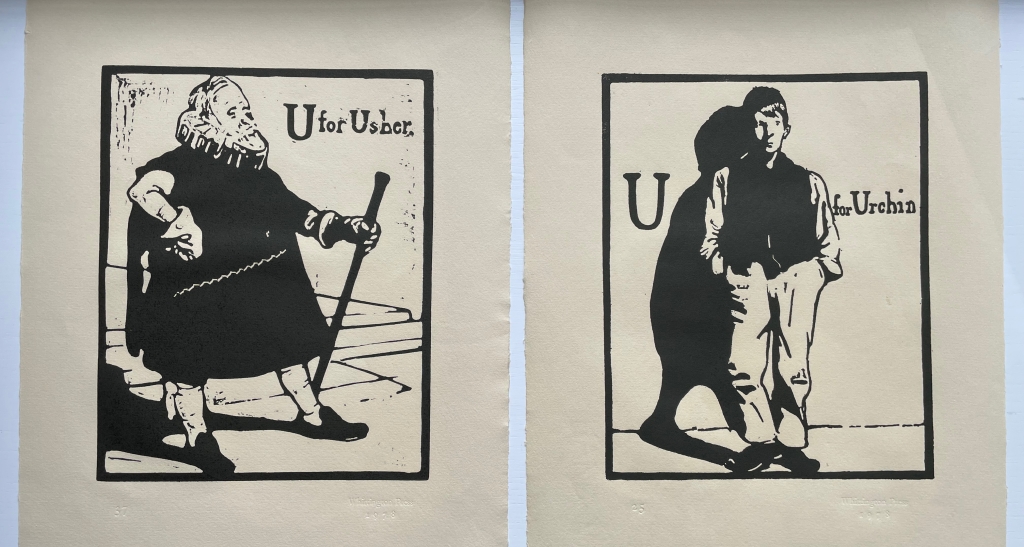
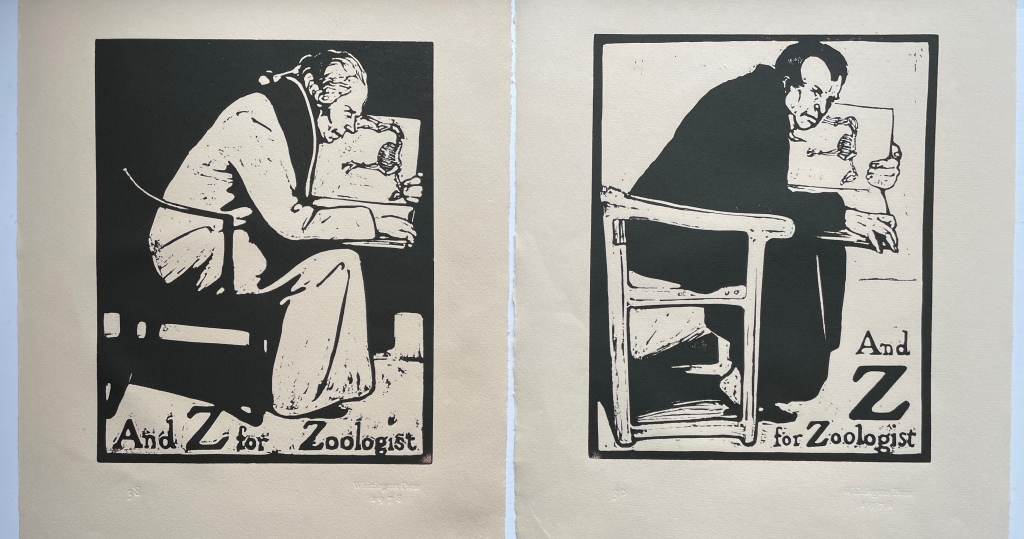
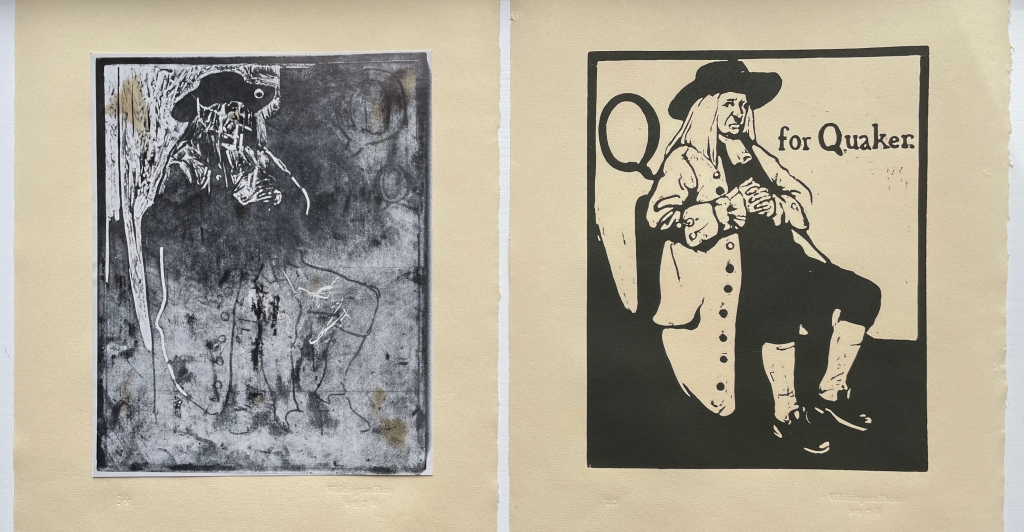
The booklet’s inclusion of 28 thumbnails of the reproduced prints is a helpful quick guide to the portfolio, but this particular edition contains 38 prints. Among them are some unused prints — a Quakeress, an Usher replaced by the Urchin, and alternative versions of the Jockey, Lady, Sportsman and Zoologist. Also included is a photo of the woodblock for the Quaker. Alongside Craig’s description of Nicholson’s two preferred courses of design and drawing, the discards and the photo offer a very real sense of Nicholson at work when placed side by side with the final designs:
After some preliminary scribbling … he would convey what he wanted from that scribble to a piece of very thin paper, or tracing paper, by inserting a black transfer paper between the two layers, then, peering into the maze of lines, he would select just those that he fancied and trace them through. …. His other method … was to draw direct onto the block with a brush heavily loaded with India ink, then, when it was dry, to refine the design by drawing over it with great care, using a softish pencil. The lead pencil shone like silver on the Indian ink and added to the excitement when the next process, that of cutting, revealed the beautiful honey-coloured boxwood below.
Discarded vs final
Discarded vs final
Discarded vs final
Discarded vs final
Discarded vs final
Discarded vs final
Photo of discarded block, final design
Craig’s booklet draws on Marguerite Steen’s 1943 biography as well as his father’s diaries, both sources rich in anecdotes and observations about Nicholson, James Pryde (his colorful partner in their J&W Beggarstaff Brothers venture), moments of time and place and the social circles in which they moved. Steen must have had access to Ted’s diaries or heard the tales directly from him. Here are Steen and Craig on a scene at the Denham “Eight Bells”, a defunct pub where William Nicholson, his wife Mabel and her brother James lived (Jimmy came to visit for two days and stayed two years):
Steen: The floor was littered with scraps of brown paper, black paper, red paper, William and Jimmy argued for hours about spacing–for which Jimmy had a great eye. Oddly enough, he was impatient and clumsy-handed when it came to execution…. With the scissors he was completely outclassed by William–who used a knife on glass, and on whom fell most of the execution of the schemes they planned together. … From all accounts, William did the lion’s share of the Beggarstaff work, so it is amusing to find in a published interview of the period Jimmy taking the lead, “telling the tale,” with only an occasional, rather lordly, reference to his partner. (p. 56)
Craig from Ted’s diary: One visit to Denham found Nicholson on the floor pinning out rolls of brown paper. With a brief ‘Hello Ted’, he carried on working at great speed with a penknife, cutting up pieces of black paper on which were scribbled a few guide lines in chalk and arranging the shapes to resemble a huge figure in a cloak. A face and hands from some buff-coloured paper were being produced by Jimmy, who was draped over a chair in the corner; these were ‘floated’ into position, then pinned. They stood on chairs to look down on their work, then added a few extra shapes in coloured paper here and there. Suddenly a figure like one of the Three Musketeers materialised. They seemed pleased enough, and Jimmy remarked that ‘it would be good for something’. (p. 3)
Several sources identify “A was an Artist” as Nicholson’s self-portrait, but might that three-quarters portrait of the Xylographer also be a self-portrait? Or is it his partner James Pryde in a portrait additional to the one of him in “B for Beggar”? Such is the speculation to which the warm color of Craig’s text and the vibrant reproductions created with Whittington Press would lead anyone exploring this portfolio.
The Square Book of Animals (1900/1979)
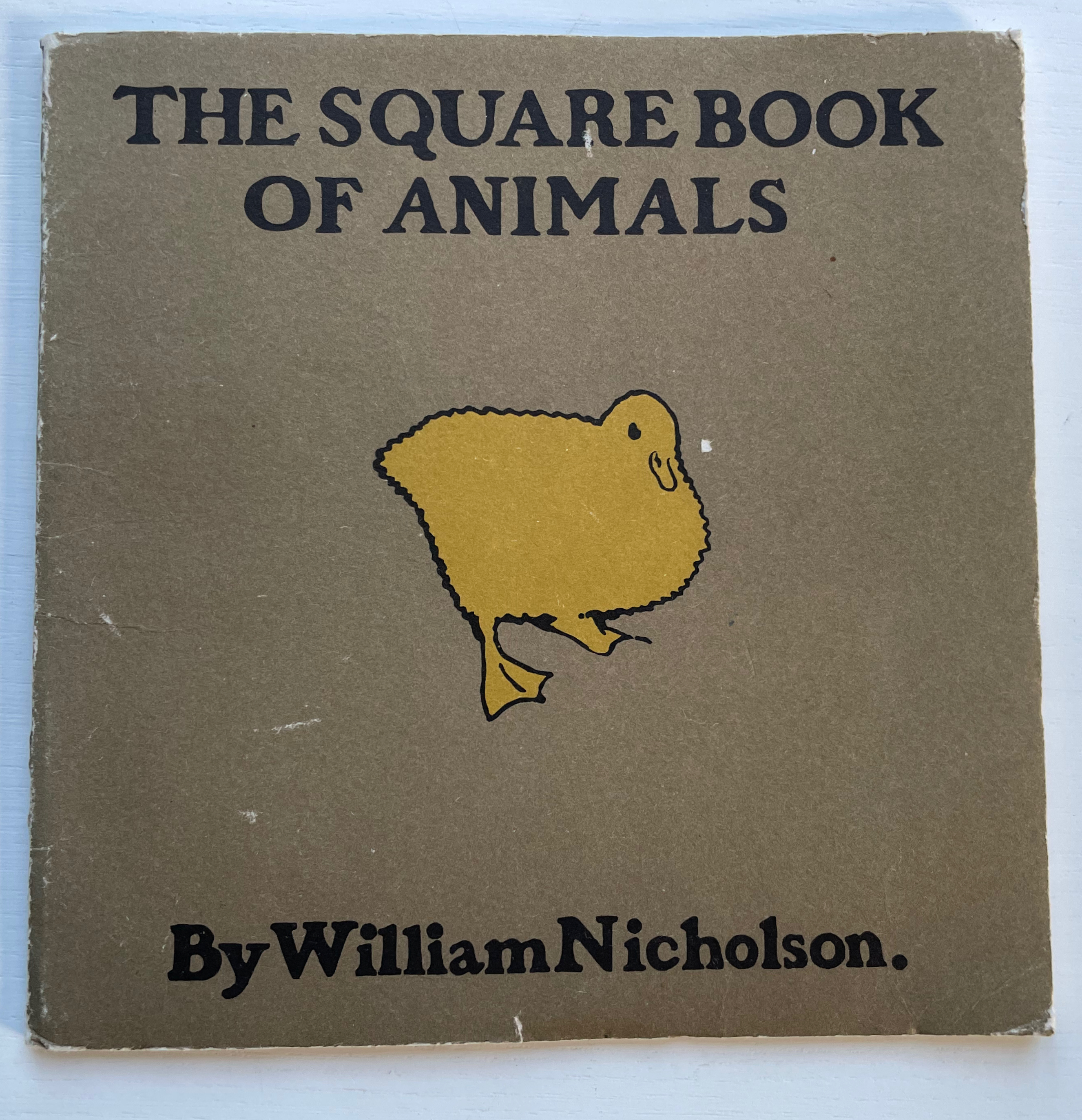
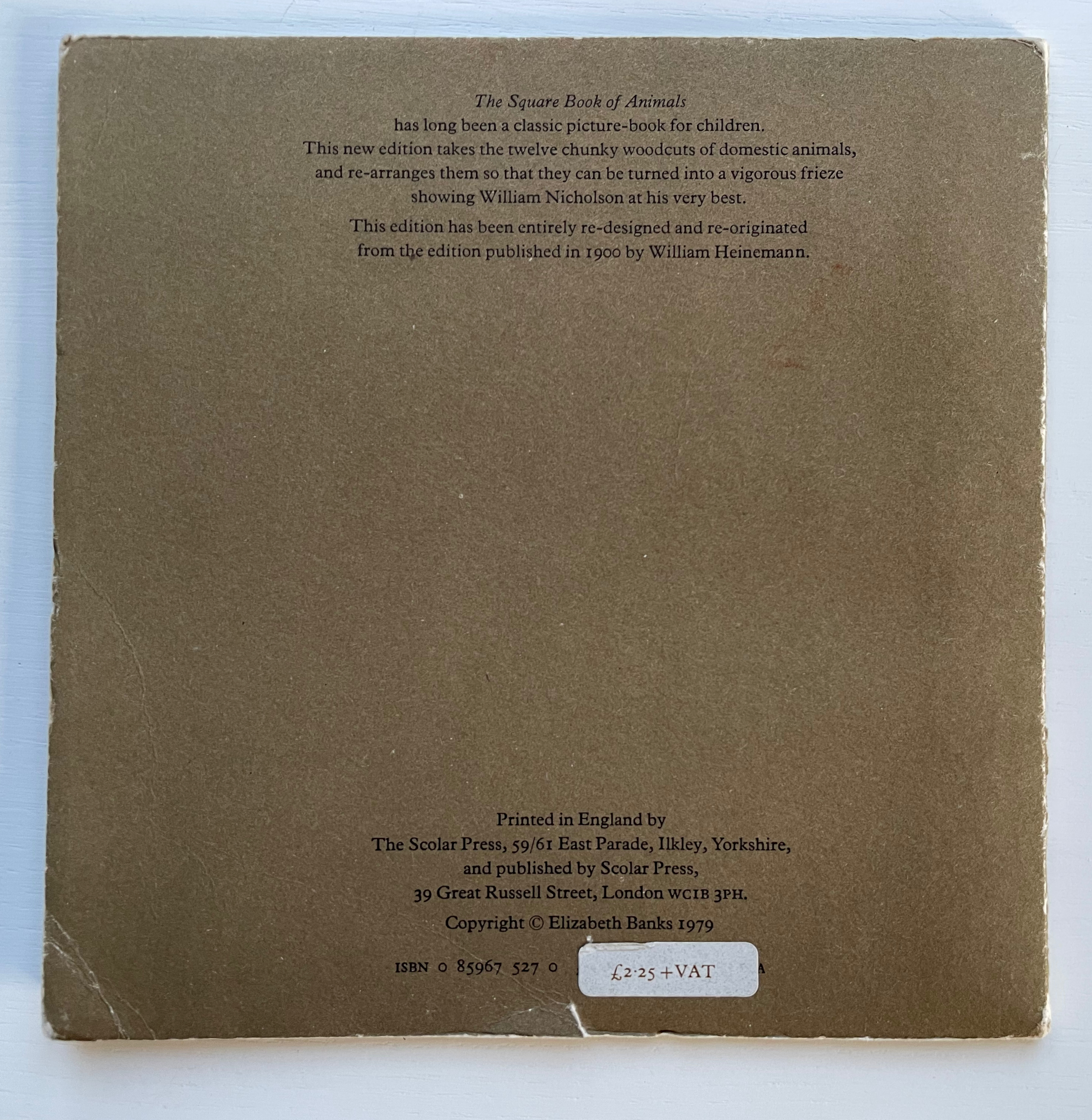
The Square Book of Animals(1900/1979) William Nicholson Softcover, leporello. 290 x 290 mm. 12 panels. 2nd edition. Acquired from M.G. Manwaring, 2 April 2023. Photos: Books On Books Collection.
Scolar Press redesigned and re-originated the 1900 edition and brilliantly chose this leporello format, which makes one wish that Nicholson had added the book as artistic medium to his toolkit, which besides woodcuts and wood engraving included lithographs, oils, watercolors, tempera, frescos, painting on glass and photography. Given his poster work for the theater and exposure to the stage (the actor Henry Irving was a family friend and source of free tickets, and actress Ellen Terry was the mother of his friend Ted Craig) and given his facility with paper as a medium, Nicholson could have made pop-up and tunnel books of genius. But portraits, landscapes and still life beckoned as Colin Campbell tracks and explores so well in his two books (see below).
In the Books On Books collection, several works provide enjoyable comparison with Nicholson’s art: Carton Moore Park’s Alphabet of Animals (1899), C.B. Falls’ ABC Book (1923), Christopher Wormell’s An Alphabet of Animals (1990), Enid Marx’s Marco’s Animal Alphabet (2000) and Nick Wonham’s A Charm of Magpies (2018).
Campbell, Colin; James, Merlin; Reed, Patricia; and Schwarz, Sanford. 2004. The Art of William Nicholson. London; New York: Royal Academy of Arts ; Distributed in the U.S. and Canada by H.N. Abrams.
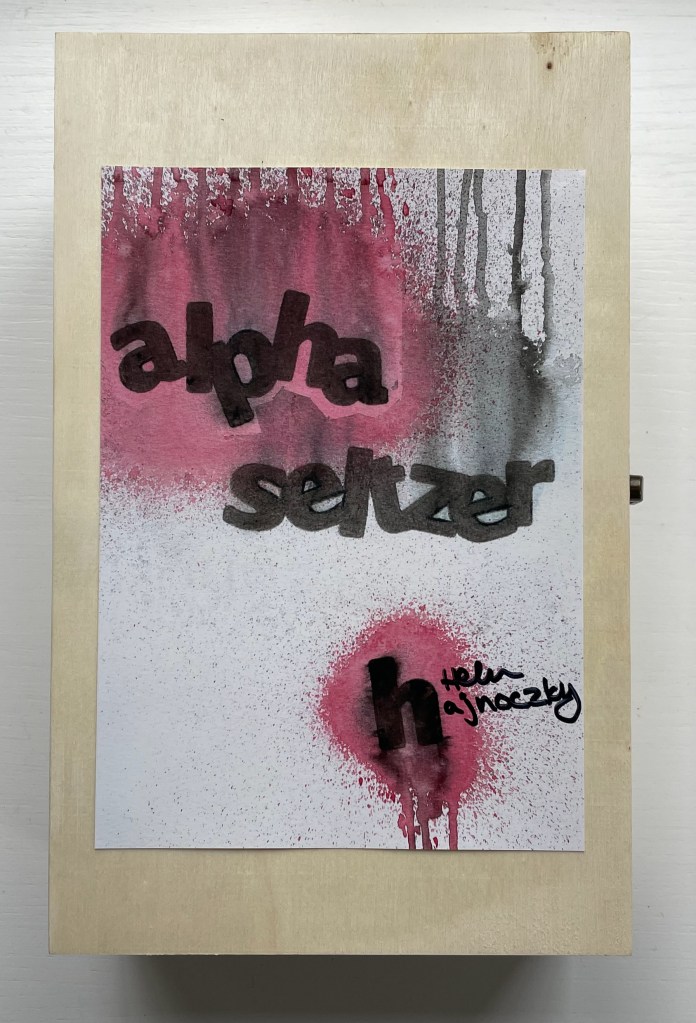
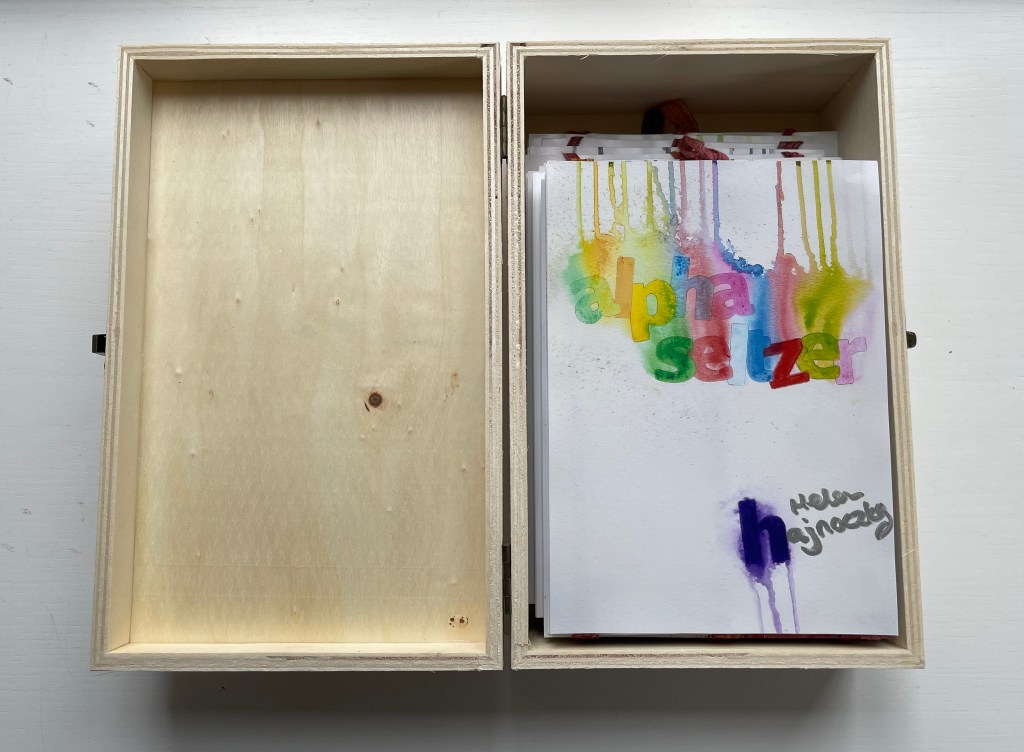
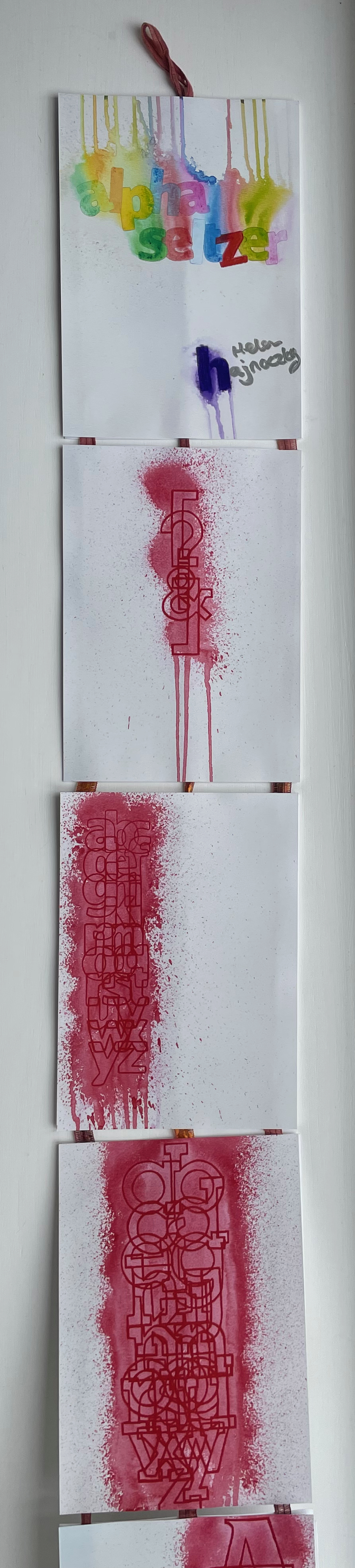
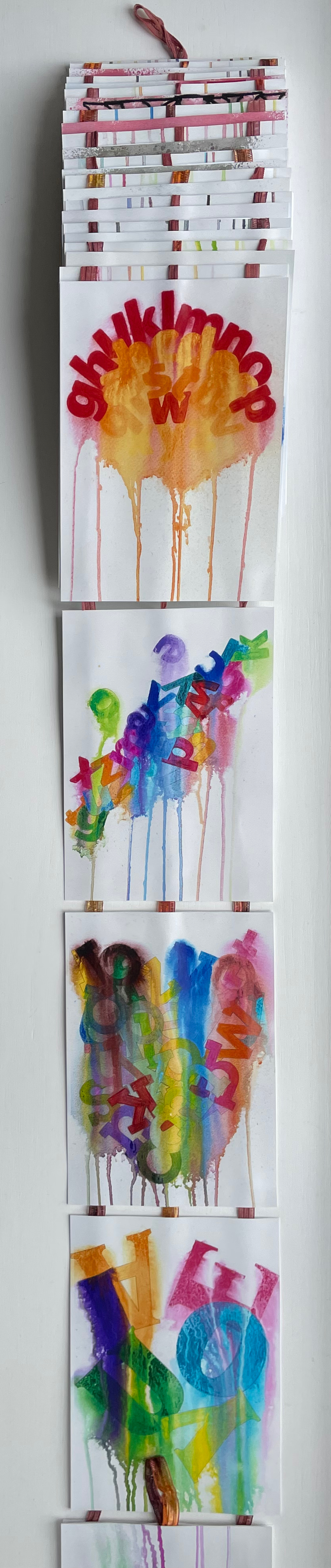
alpha seltzer (2023) Helen Hajnoczky Canada balsa wood, hinged and clasped box, double-sided accordion structure attached to multicolored ribbons for vertical display. Box: H240 x W155 x D80 mm. Leporello panel: H178 x W126 mm. Open: 1041 cm. 56 panels. Acquired from the artist, 10 April 2023. Photos: Books On Books Collection.
Letters and punctuation marks fall and rise and tumble in alpha seltzer like so many tablets of Alka-Seltzer. With her use of color, technique and orientation of the images, Hajnoczky holds to and takes the concept far beyond a one-trick visual metaphor. Anyone who has observed those dissolving heart-burn relief tablets closely will recognize how the colorless effervescing bubbles spin off each tablet in upwards and downwards directions. So, on the box cover’s title plate and on the first panel, colored drips surrounded by spatters rise from the title and fall from the artist’s name.
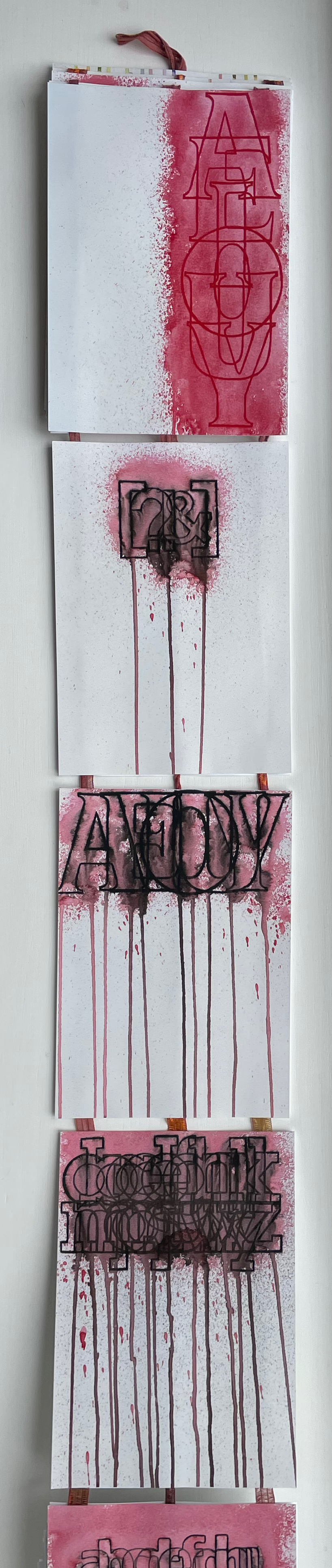
But what is it that the characters are dissolving in, and what are they dissolving into? Of course it’s just paper, but the Kodak Moment matte photo paper has a glossy shine suggesting a solution of water. As the accordion emerges from the box, a spattered and dripping red column made of overlapping characters (brackets, question mark, exclamation mark and ampersand) appears on the first panel; then with a shift to the left, the red column widens into one made of all the lowercase letters of the alphabet; then shifting back to the center, the column widens and comes closer; and then shifting to the right, it becomes a column of all the uppercase vowels overlapping. What is going on?
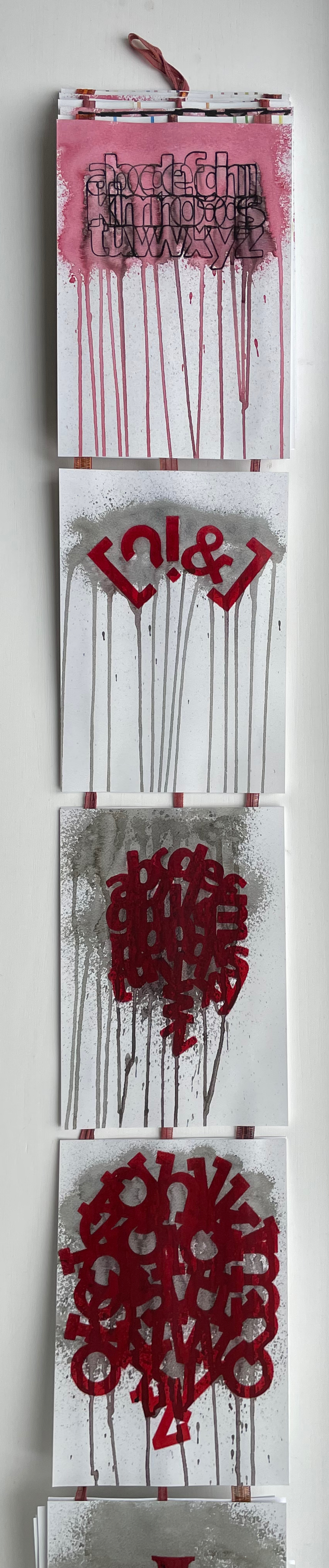
Now, the originally vertical column of brackets, question mark, exclamation point and ampersand goes horizontal and black, dripping pink and gray into the next panel of horizontal uppercase vowels in black, dripping gray, pink and black into a horizontal jumble of lowercase letters.
Then the characters bend into a deep red curve spattered and dripping in gray, eventually morphing into a ball of red vowels. Beneath that, the palette goes entirely black and gray, and the characters begin to angle down the panel into a heap of letters sliding downwards from right to left across the panel and squeezed at the bottom …
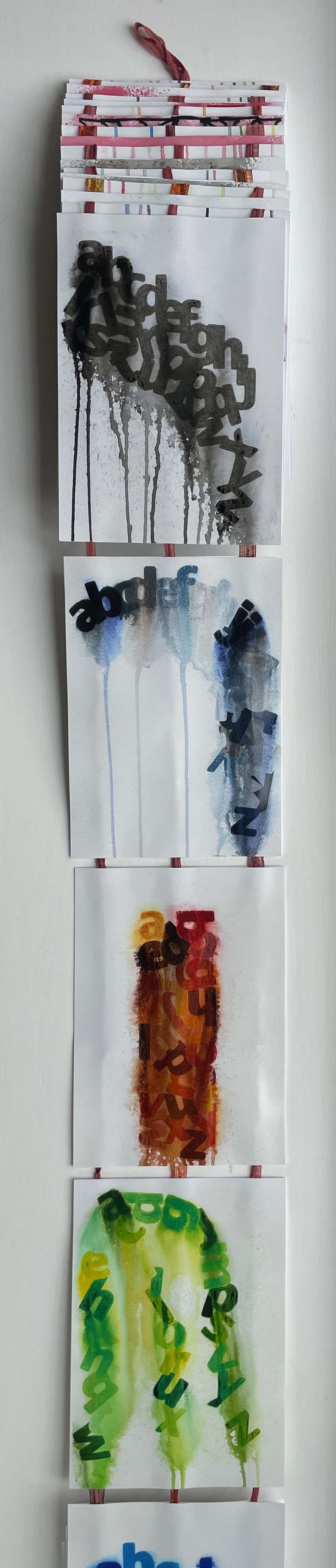
… until they have to cascade down from left to right, which is when a riot of color breaks out. At the end of the accordion, you realize there’s another loop; which side is up, which is down?
On the other side of the accordion, the riot of colors continues, but each panel presents a single-color uppercase letter that seems to be dissolving like an Alka-Seltzer tablet into multicolor lowercase versions of itself.
With layout, color, technique and metaphor, Hajnockzky has coaxed an element of abstraction from the alphabet that differs from the semiotic abstraction by which letters have come to be what they are. But in the end, it’s not a confusion from which relief is wanted. Rather it’s one in which to fall, be immersed and enjoy. And to have a laugh at the expense of the Dr. Miles Medicine Company of Elkhart, Indiana and its subsequent owner Bayer AG for missing a marketing trick for Alka-Seltzer tablets.
Magyarázni (2016)
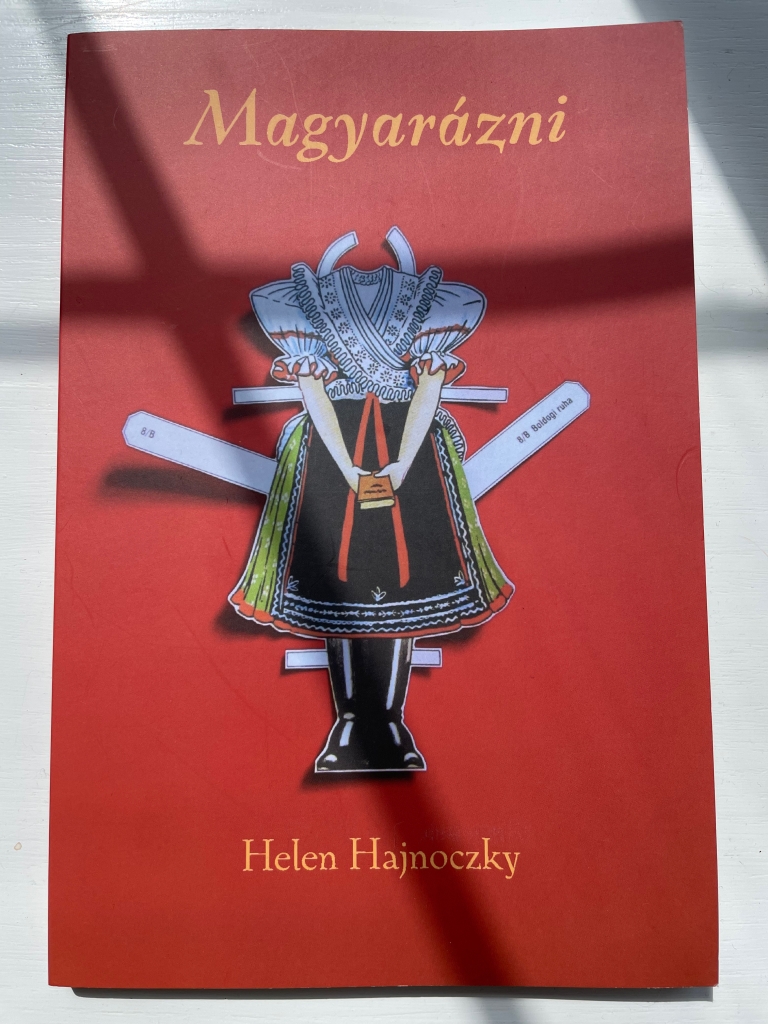
Magyarázni (2016) Helen Hajnoczky Perfect bound paperback. H210 x W140 mm. 104 pages. Acquired from the author, 14 December 2021. Photos: Books On Books Collection.
With all its diacritics and dipthongs, if there is an alphabet song in Hungarian, it must be operatic in length. It is fortunate, though, that it is as long as it is; otherwise we would have fewer poems in this volume by Helen Hajnoczky.
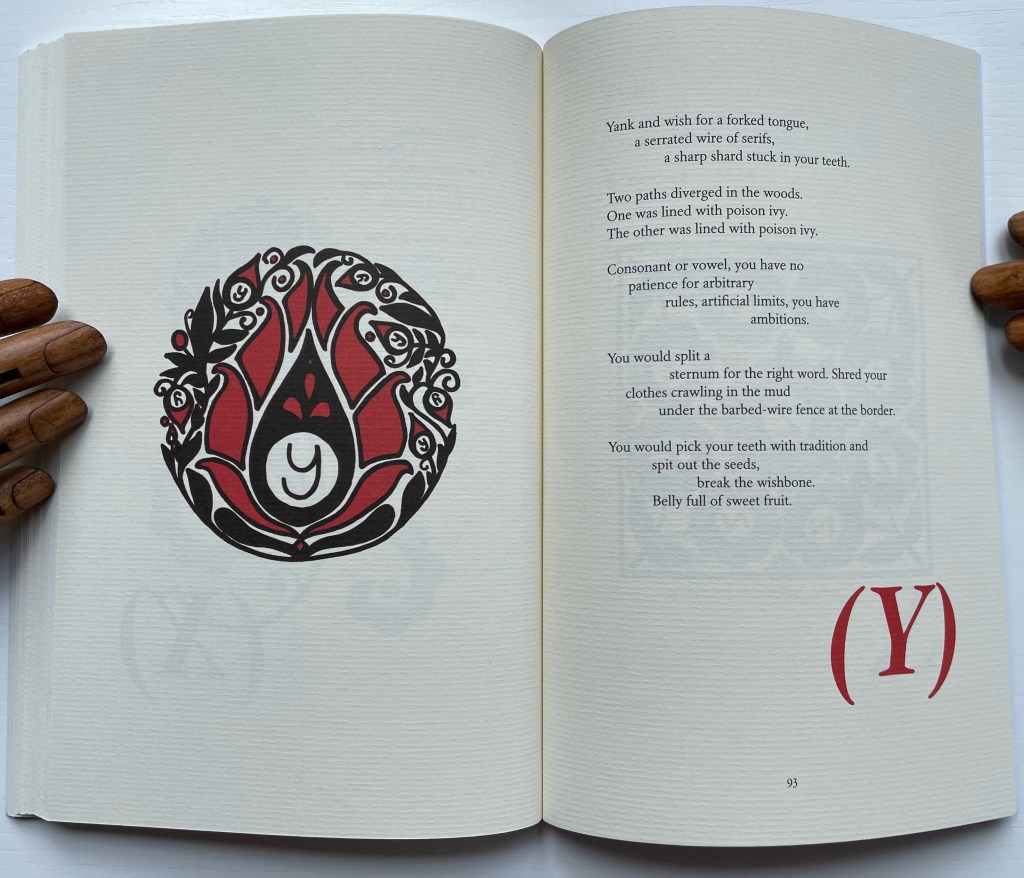
Hajnoczky is second-generation Hungarian-Canadian. These poems use the two languages to reflect on her dual roots of culture and the roots of memory. And for both, what better vehicle than an alphabet book. Even though there are 44 letters in Hungarian compared to 26 in English, Hajnoczky is a greedy poet, and taking her title literally — Magyarázni means “make it Hungarian” — she includes poems for the letters Q, W, X and Y even though Hungarian has no need of the phonemes behind them except for borrowed words.
Hajnoczky does not shy away from growing up in the English-language poetic tradition. In the poem below, she appropriates Robert Frost’s “The Road Not Taken”, turning and twisting its metaphor into one for her experience of growing up with two languages, making the letter Y and Robert Frost Hungarian.
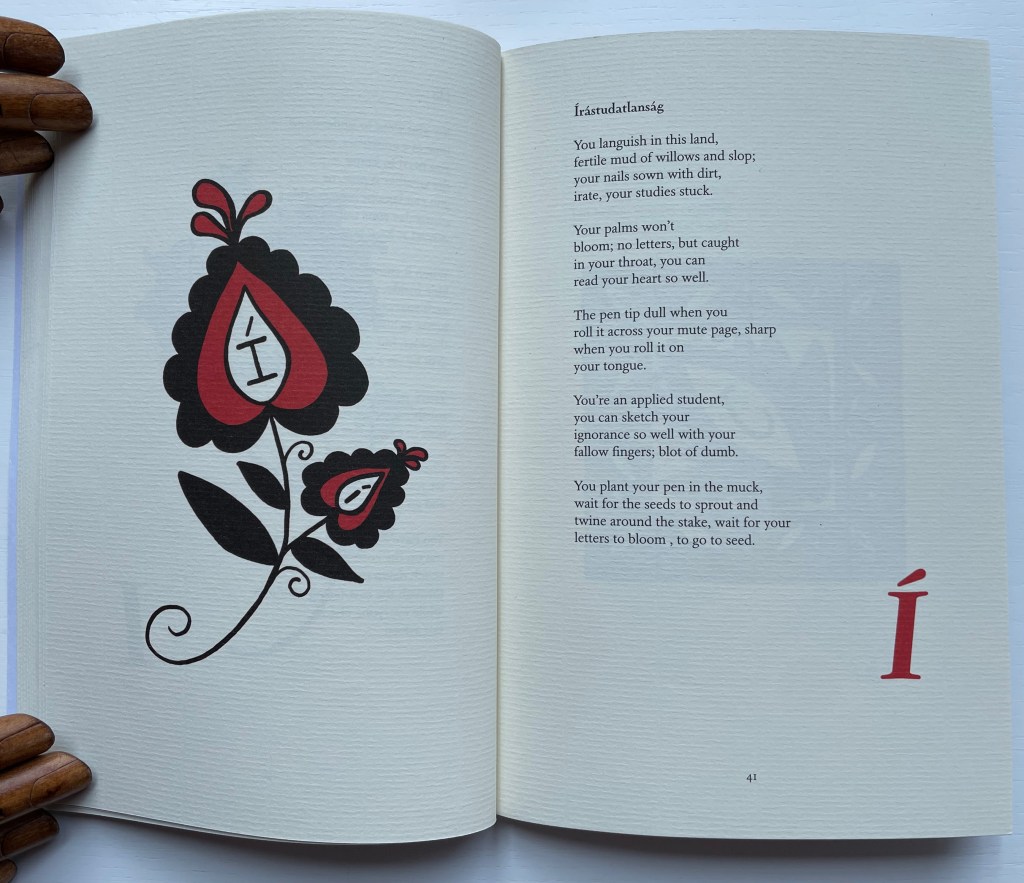
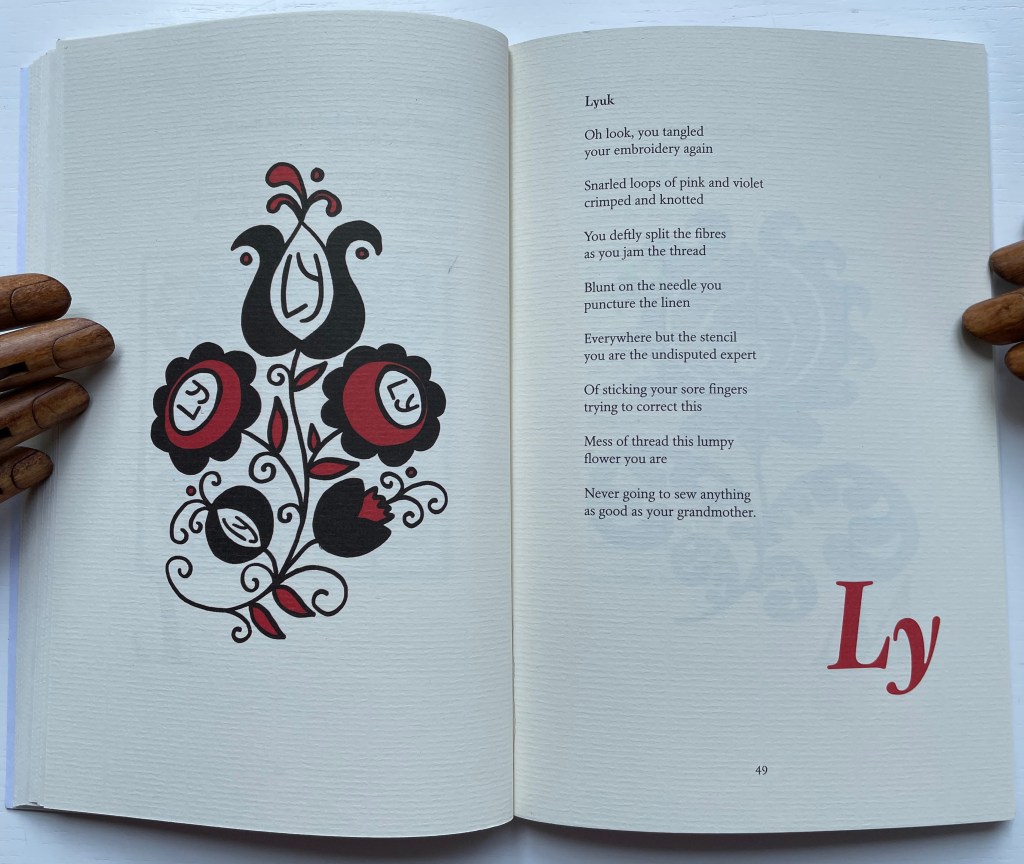
Some of the poems might remind readers of Seamus Heaney. For the letter í (for Írástudatlanság/”ignorance, illiteracy”), Hajnoczky delves into the metaphor of the pen in a way that surely would have brought a smile to Heaney as a nod to his “Digging”; or he might have heard an echo of “Clearances” in Lyuk/”hole”) for the dipthong Ly when she hears a relative commenting on her needle-wielding: “you are/ Never going to sew anything/ as good as your grandmother”.
Hajnoczky calls the images facing the text “visual poems”. To create them, she has drawn from a difficult-to-find spiral bound book put together by Péter Czink and Lorraine Weideman. As with Alphaseltzer, the results are visually striking. Coach House Books has nicely complemented the images and type with vegetable-based ink and Zephyr Antique Laid paper.
Alphabet People (1989) Peter and Donna Thomas Miniature codex with illustrated paper over boards, endband, sewn. H60.5 x W47.5 mm. 64 pages. Edition of 200, of which this is an artist’s proof. Acquired from Bromer’s Books, 16 February 2023. Photos: Books On Books Collection.
Peter and Donna Thomas have made several alphabet artists’ books. One made in the shape of an Apple MAC, one in the shape of mushrooms, one celebrating views of Yosemite, one for musical instruments (accordion to zither, of course), one for spring wildflowers and one, of course, just for the letters themselves.
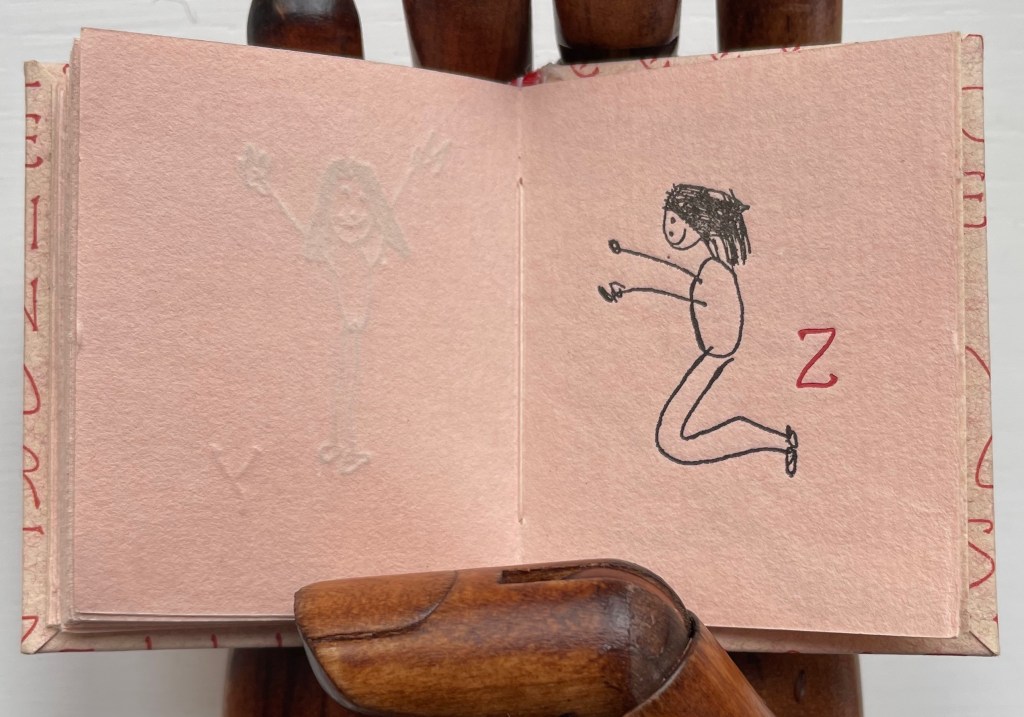
This one may be their earliest. Handset in Greeting Monotone and letterpress printed by Peter Thomas on peach-colored handmade paper. The same paper is used for covering the boards. As with all the initials in the book, the alphabet on the cover and pastedown title card is inked in red. The illustrations are reproductions of twenty-seven line drawings by their daughter Tanya Thomas.
Seen end-on, the book shows some of its fine press features, especially the two-color sewn endbands and tight turn-ends of the cover paper. Handmade paper characterizes much of the Thomases’ output, and their interest in papermaking has extended as far as Africa, the Philippines and Totnes, Devon, England.
From the publisher’s description of the second edition:
A self-taught hand papermaker, Peter Thomas became interested in knowing how apprentice-trained hand papermakers working in production hand papermills made paper. He especially wanted to learn the “vatman’s shake,” the series of motions that papermakers used to form their sheets of paper. This desire circuitously led him and Donna to Tuckenhay, near Totnes, Devon, in England, where beginning in 1988, they recorded several hand papermakers, returning to make others in 1990 and 1994. The book begins with a short history of Tuckenhay Mill and the story about meeting the papermakers and recording their interviews. This is followed by eight interviews of men and women, some of whom worked in the Mill from between the World Wars until it closed in 1970. All of the papermakers are now deceased, but the stories – in their own words – remain an extraordinary, entertaining, and timeless record of their lives and work. In the 1830s, Richard Turner started manufacturing paper by hand in the Tuckenhay Mill, and paper was continuously made by hand there until 1962. From then until 1970, the Mill produced pulp (half-stuff) until the business went bankrupt….
The Thomases’ works are well represented at in University of Wisconsin-Madison’s Special Collections. Some of the several particularly related to papermaking — as well as other paper-related ones from the Books On Books Collection — are listed below. Any study of the intersection of book art and paper could not help but include Peter and Donna Thomas.
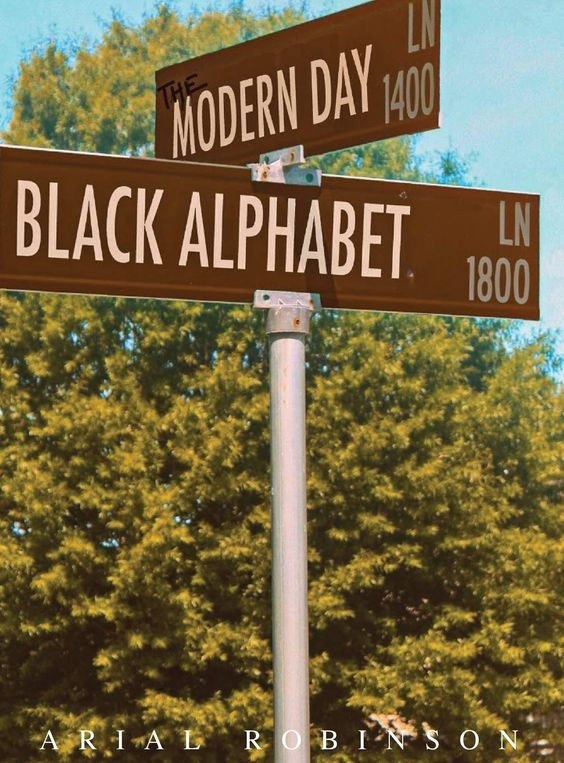
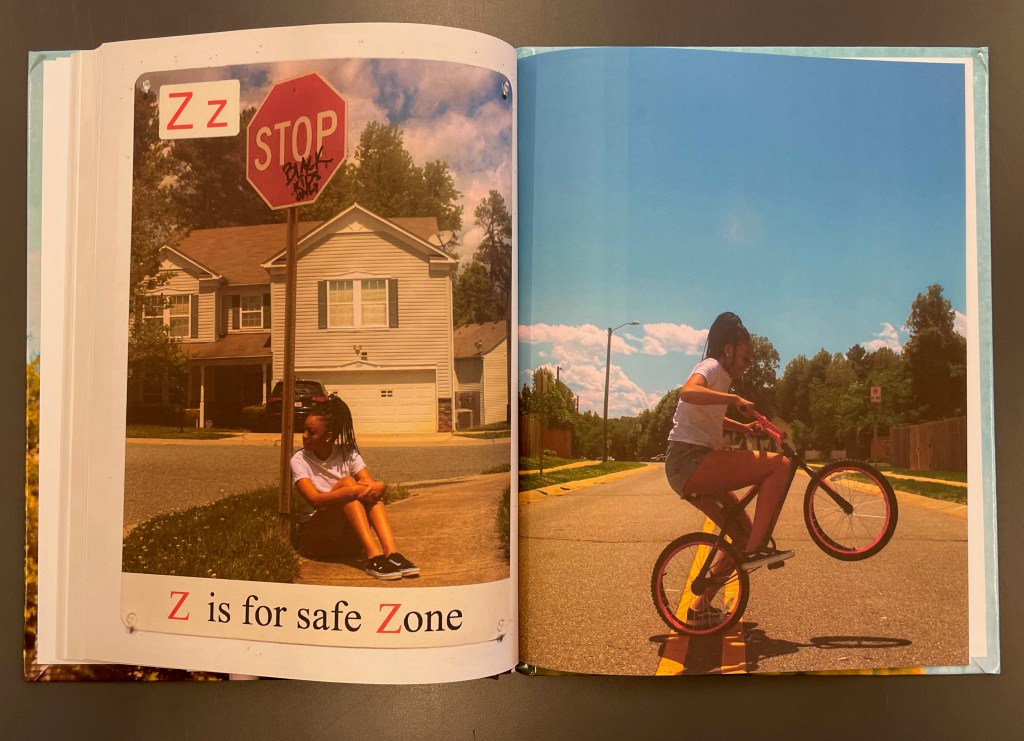
The Modern Day Black Alphabet(2020) Arial Robinson Casebound. Paper over boards. H290 x W220 mm. 64 pages. Acquired from Amazon, 24 June 2021. Photos of the book: Books On Books Collection. Displayed with artist’s permission.
Arial Robinson is a multidisciplinary artist based in North Carolina. Her photography captures the air, sky, suburban streets and heat of the state, and her book captures its Black community in a way that pushes through any “White gaze” that it encounters.
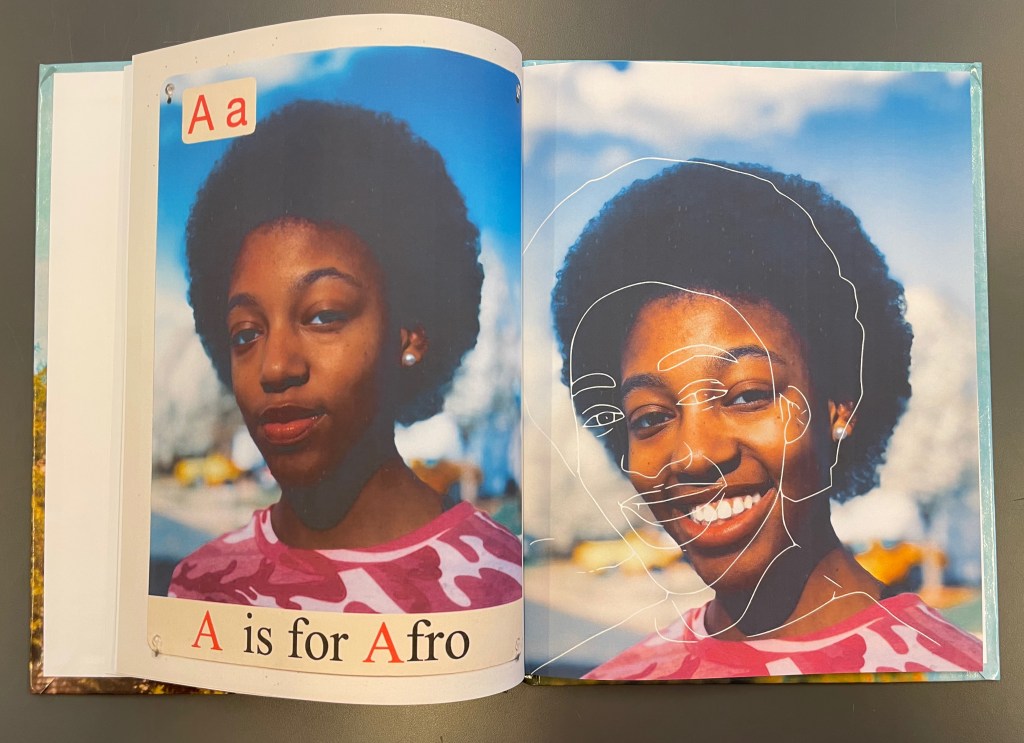
Letter A’s pair of looks — one coolly appraising its viewer and the other warmly smiling but outlined off center in white ink — begins the push with subtlety. The dual images of “Z is for safe Zone”– addressing the viewer with a Stop sign graffitied “Black Kids Only” and a young girl forming a letter Z with her bike, occupying the whole street under a Carolina blue sky — end it more directly.
Between A and Z, The Modern Day Black Alphabet primarily addresses young Black readers, celebrates them eating a popsicle, studying, cooking or drinking from a spigot and takes pride in taking care of appearances — especially hair and dress. Throughout, most of the double-page spreads have an edginess. Sometimes it’s an edgy, out-loud humor, as in “O is for Outside” with its can of “air freshener” labeled “You Smell like Outside”. Sometimes it’s the loud-quiet edginess of “X is for eXcellence” which juxtaposes a pile of certificates of accomplishment with a black-jacketed self-portrait and lapel pin that reads “We Call BS”. Always it’s the edginess of an artist in control of technique, material and vision directing her gaze on herself and her world.
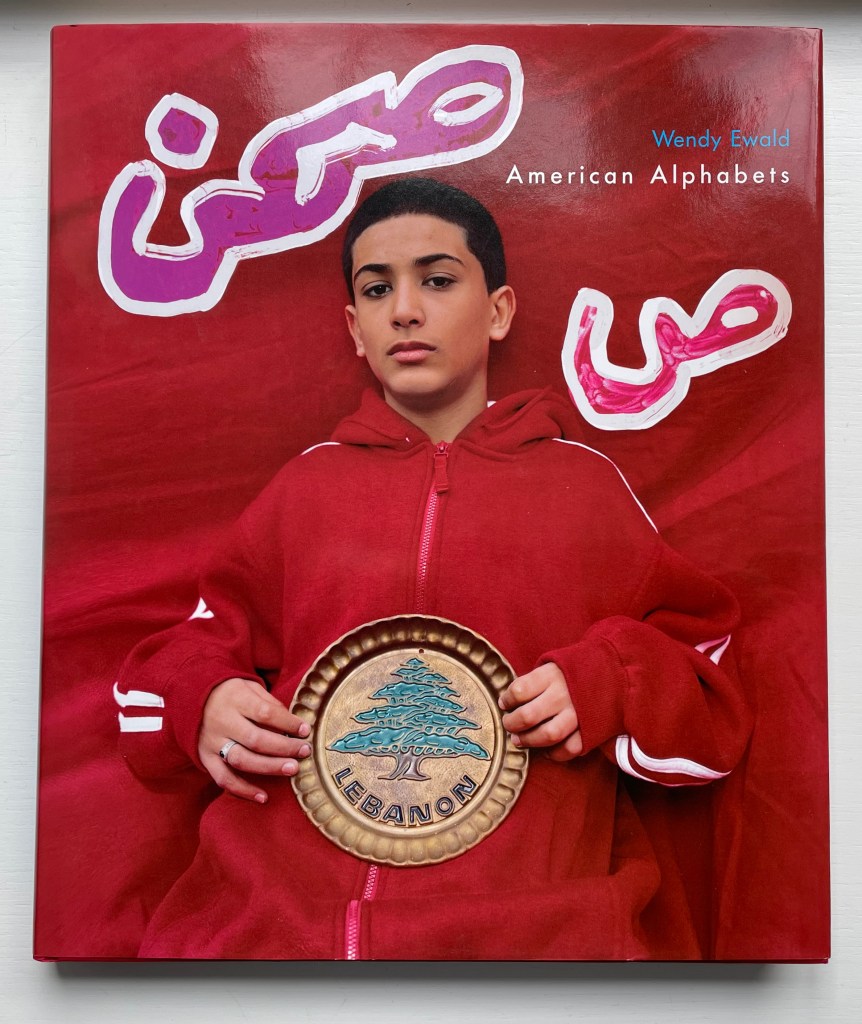
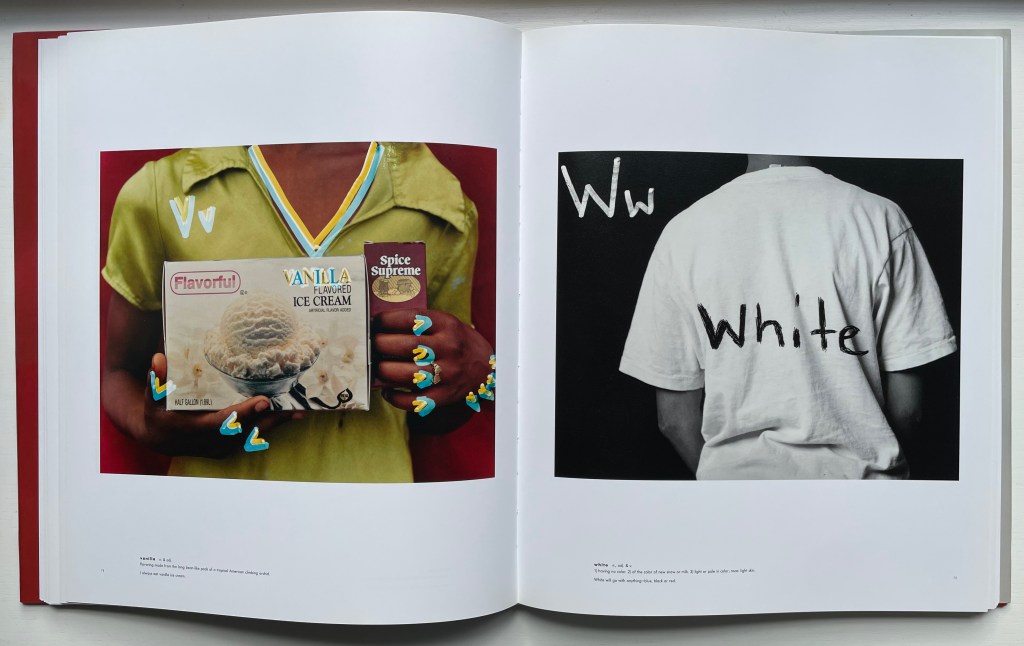
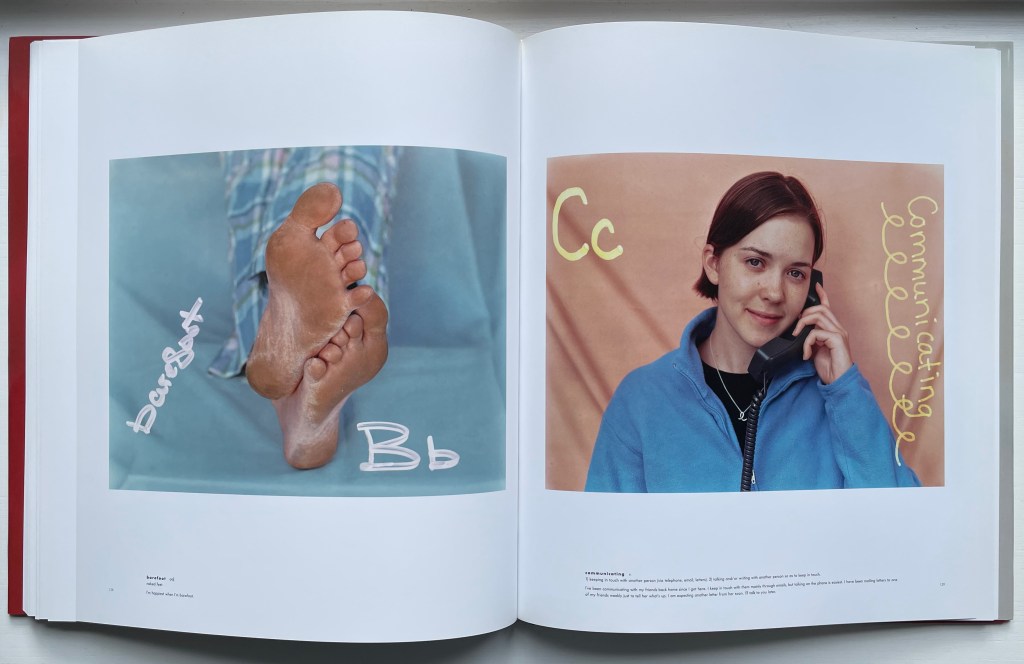
American Alphabets(2005) Wendy Ewald Casebound with white headbands and colored doublures. H305 x W260 mm. 168 pages. Acquired from Judd Books, 17 September 2022. Photos of book: Books On Books Collection. Displayed with artist’s permission.
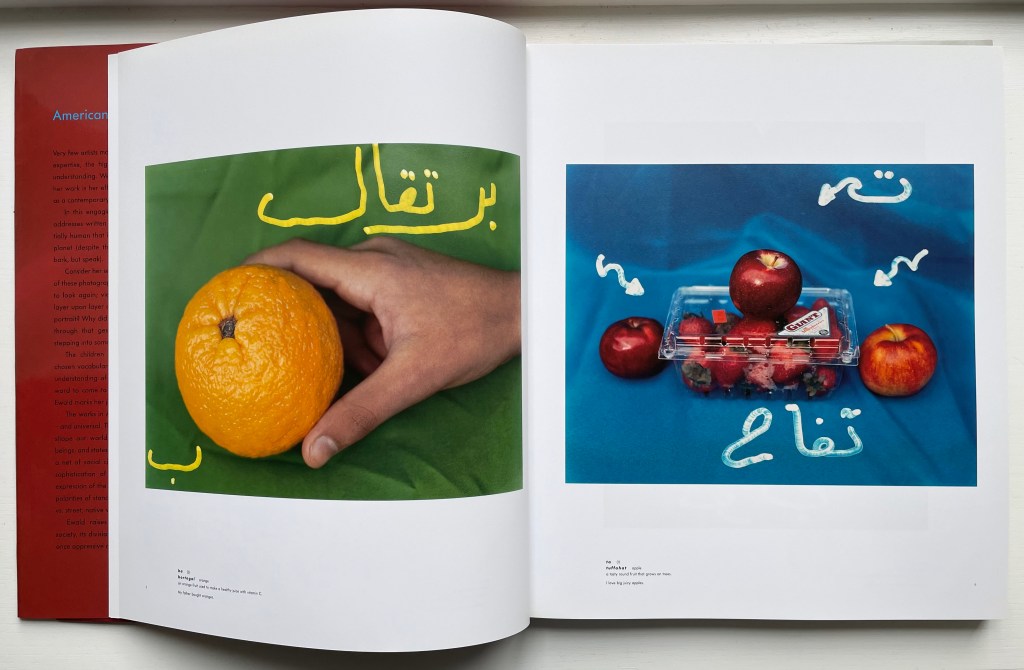
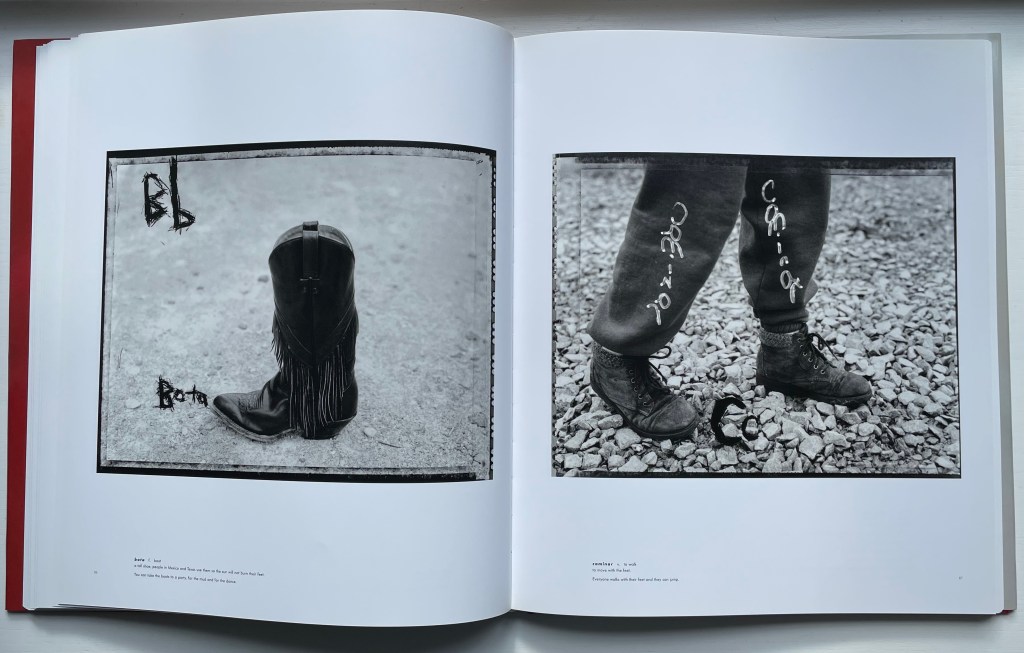
As seen throughout the Books On Books Collection, book art is more often than not a collaborative effort — even if only in the final stages of printing and binding. Ewald’s works, however, depend from the start on collaboration with her subjects — the children. Another recurrent aspect — perhaps the core aspect — in book art is the interaction of the visual and verbal. So, too, in Ewald’s art. In American Alphabets, she brings the collaborative and visual/verbal aspects of book art together at the elemental level of the alphabet. It is the children who pick the letters, words and their illustrative objects to be photographed. In the book’s “Afterword”, Ewald writes:
Like most everyone I know, I first encountered written language in children’s alphabet primers. Looking back, I now see that the words and visual examples used to represent letters reinforced the world view of the middle-class white girl I happened to be. … Putting together these various alphabets — each of them at once American and foreign — taught me a lot about written language, especially about how we have come to take this sophisticated and fundamental medium for granted. … The shape of letters mimicked the objects for which they were named. The letter R, for example, came from the Egyptian hieroglyphic for head or chief: resh. … When Woroud, one of my students from Queens, chose the word raas, or “head,” to represent the letter R, it seemed natural enough. I was startled, though, when she insisted that her head be photographed in profile, just as in the drawing of the ancient letter.
An abiding aim of Ewald’s art is to elicit or allow her collaborators’ voices and world views to create communities that overcome differences by celebrating differences. The reduced, screen-bound images here do not do justice to her four alphabets in one volume or her portraiture and photographic artistry. They may, however, convey the breadth and racial inclusivity of her vision. Arab-American, Latinx-American, White American and Black American are the American alphabets that Ewald aims to capture in this volume.
Another of Ewald’s projects ripe for an artist’s book — or rather artists’ book — is Black Self/White Self (1994-1997). Imagine the book she might create from her young collaborators’ efforts if they were brought to Penland, Women’s Studio Workshop or Art Metropole. Here is the North Carolina-based project in her own words:
When I began working in Durham’s inner city, more and more of the white population had moved to the suburbs and the public schools became segregated along city-county lines. Proposals to merge the school systems were stymied by objections from both sides.
In 1994, after the Durham school systems were finally merged, I designed a collaborative project that looked directly at the issue of race. I asked children to write about themselves, then to write another version, this time imagining themselves as members of another race.
This was greeted first with silence, then laughter, and finally with an enthusiastic barrage of questions.
Once the children had completed their written portraits, I photographed them posing as their “black” and “white” selves, using props they had brought from home. I gave them the large-format negatives to alter or write on, in keeping with ideas from their written portraits, so they could further describe the characters they had imagined themselves to be.
The Neolithic Adventures of Taffi-Mai Metallu-Mai (1997)
The Neolithic Adventures of Taffi-Mai Metallu-Mai(1997) Gerald Lange and Rudyard Kipling H216 x W260 mm. 55 pages with 17 additional illustrated page inserts. Edition of 150, of which this is #149. Acquired from the artist, 11 Febuary 2023. Photos: Books On Books Collection. Displayed with the artist’s permission.
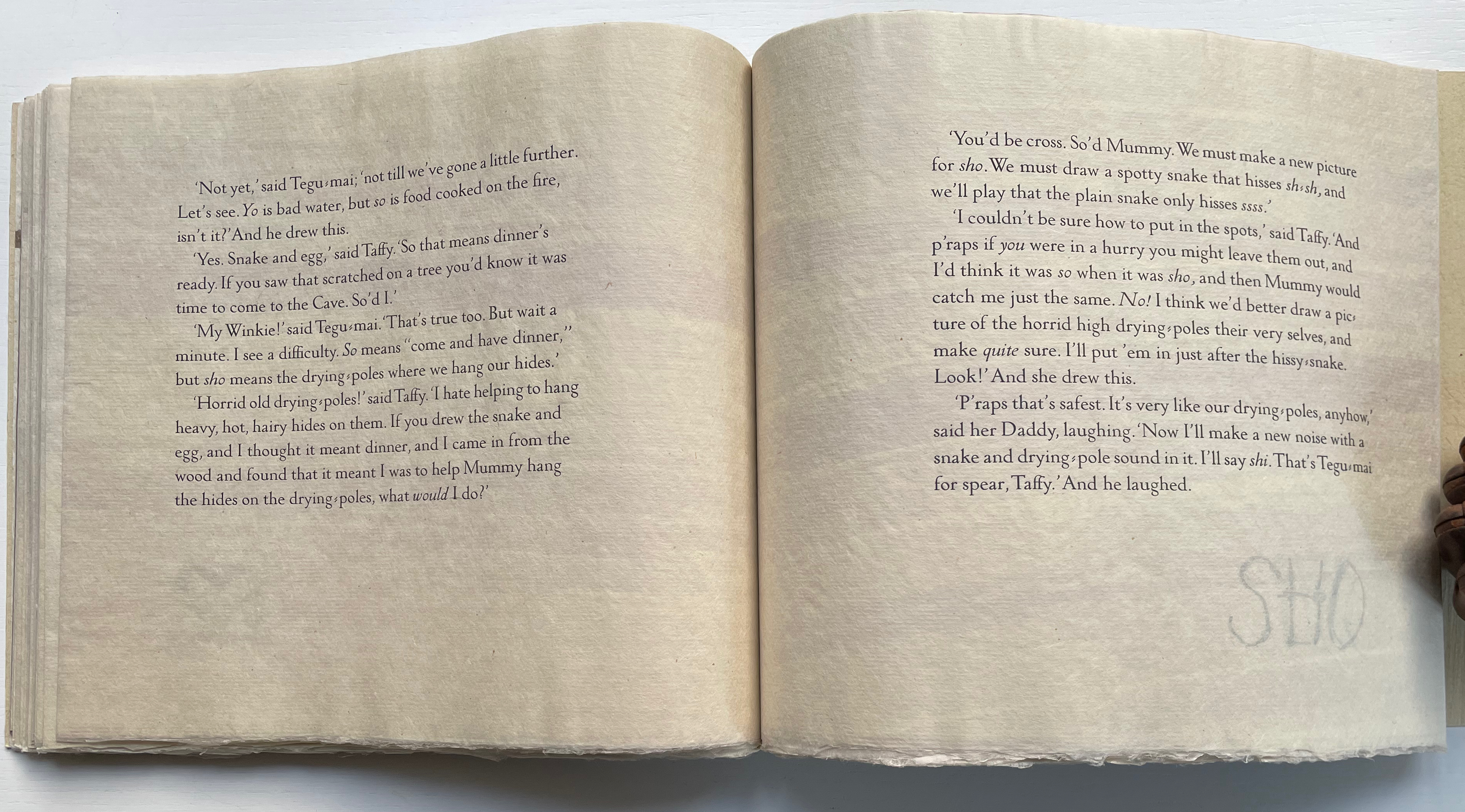
Gerald Lange’s choice of “How the First Letter Was Written” and “How the Alphabet Was Made” from Rudyard Kipling’s Just So Stories (1902) for this elaborate, delicate but robust edition was fitting. By 1997, he had founded the Bieler Press (1975), co-founded the Alliance for Contemporary Book Arts (1987) and edited its journal AbraCadaBrA for seven years, had been the Master Printer at USC Fine Arts Press and selected as the first recipient of the prestigious Carl Hertzog Award for Excellence in Book Design (1991) and was about to publish the first edition of his Printing Digital Type on the Hand-Operated Flatbed Cylinder Press (now in its fifth edition, 2018). In keeping with his interests leading up to this work, Lange letterpress-printed it from handset Monotype Pastonchi and a digitally altered version of Berthold Post Antiqua. More to the point, as he noted on the Bieler Press site, he chose the stories for “their affinity with subjects related to the lettering arts”. If that affinity is not clear enough from the text, Lange’s treatment underscores it in subtly ingenious ways.
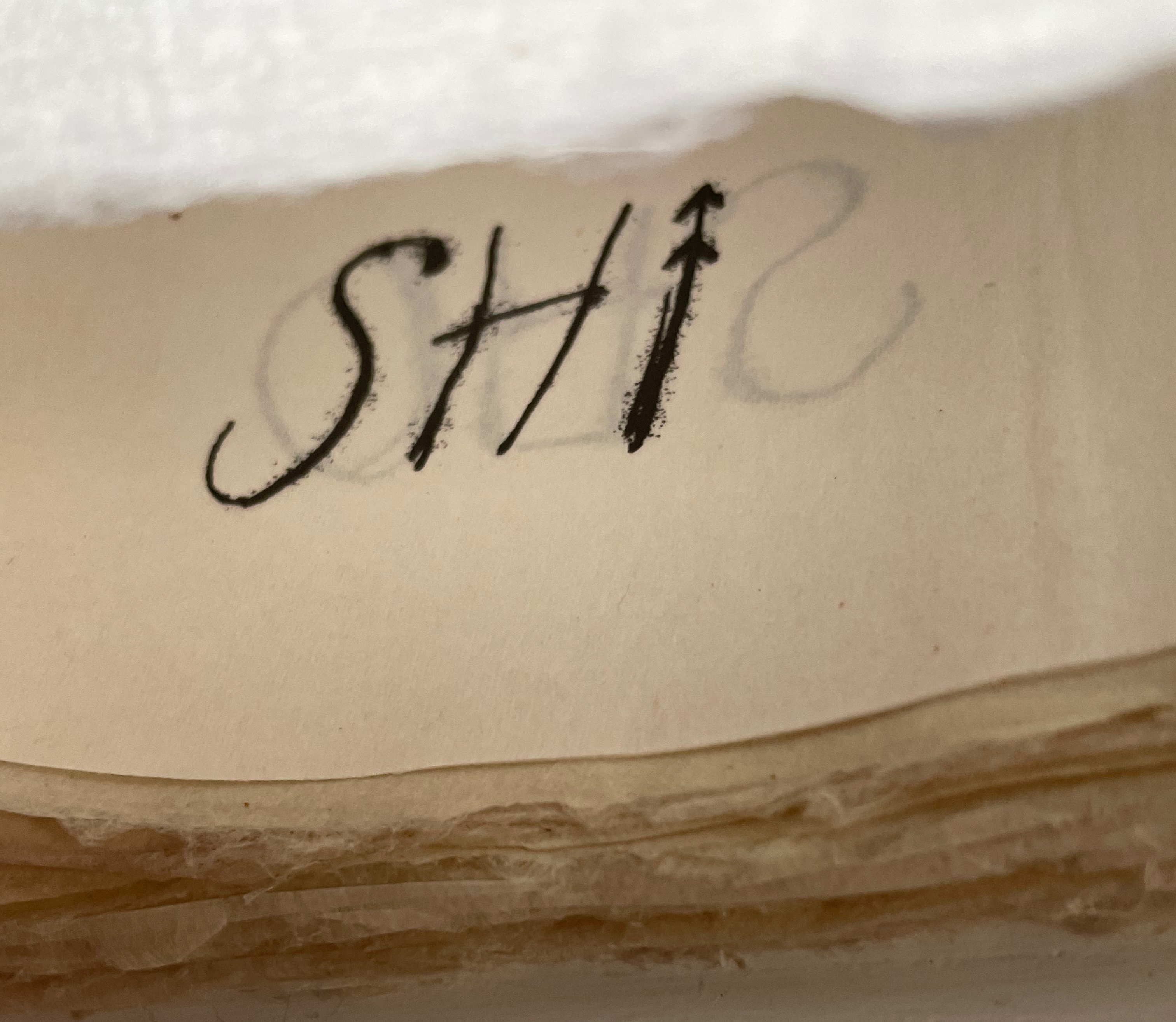
Kipling attributes the drawings throughout to his heroine, Taffi and her father. Where others like Macmillan Children’s Books have rendered them boldly, Lange prints the primitive petroglyph-like images on separate Gampi sheets inserted between the folded Kitakata text leaves of the tortoise shell edge-sewn binding. Those text leaves are individually water colored on their reverse sides (urazaiki manner based on nihonga painting) so that the pictographs beneath reveal themselves through a striated layer. The color and striations are reminiscent of cave paintings. Additional Asian papers (Kasuiri and Chirizome for end sheets, Cogan Grass for covers) increase the work’s tactility — simultaneously soft and rough, flimsy and tough — and contribute a grassy smell redolent of the stories’ physical setting.
The quality and rightness of choices in structure, material and process have placed several of Lange’s works in The British Library, University of California (various), Columbia University, Harvard University, University of Minnesota, New York Public Library, Princeton University, Stanford University, Victoria and Albert Museum, Yale University and others. The initial reason bringing this particular work into the Books On Books collection was its representation of book art inspired by the alphabet. That Robin Price, several of whose works are also in the Books On Books collection, assisted with the design came as a bonus. That this is one of the last bound copies of The Neolithic Adventures of Taffi-Mai Metallu-Mai makes it a treasure.
A fair number of fiction and non-fiction children’s books on the history of the alphabet have made their way into the Books On Books Collection.
Of the fiction variety, there is Rudyard Kipling’s “Just So Story” of the alphabet’s invention: How the Alphabet Was Made (1983), illustrated by Chloe Cheese. Another fiction entry is James Rumford’s retelling of Cadmus’ visit to Crete in There’s a Monster in the Alphabet (2002) and William Joyce’s inventive The Numberlys (2014).
In the non-fiction category are William Dugan’s How Our Alphabet Grew (1972), Tiphaine Samoyault’s Alphabetical Order (1998), Renzo Rossi’s The Revolution of the Alphabet (2009) and the entry here: Don Robb’s and Anne Smith’s Ox, House, Stick.
Ox, House, Stick is scheduled to appear as part of an exhibition at the Bodleian Libraries in Oxford (opening 15 July 2023). “A is for Ox” designates the display case devoted to the question: Where did the alphabet come from? It’s not just a question for archaeologists, historians, linguists and paleographers — or children’s book authors and illustrators. It’s one generating repeated inspiration for book artists as shown by Abe Kuipers’ Letters (1971), Lanore Cady’s Houses & Letters (1977), another rendition of the Kipling tale by Gerald Lange in The Neolithic Adventures of Taffi-Mai Metallu-Mai (1997), designed by Gerald Lange and produced with Robin Price, Dave Wood’s Alphabetica (2002), Cari Ferraro’s The First Writing (2004), and Helen Malone’s Alphabetic Codes (2005).
Artists’ books share much with children’s books in general. They both play with form and structure. They play with words and images, sometimes images without words and sometimes just shapes. Almost always an attention to all the senses. Children’s alphabet books in particular display features that appeal to book artists: play with animals, the Babel of languages, bodies, calligraphy, colors, design (of letters, page and book) and, as above, alphabet origin stories. Viewing and exploring alphabet books and artist’s books side by side heightens the enjoyment and appreciation of both.
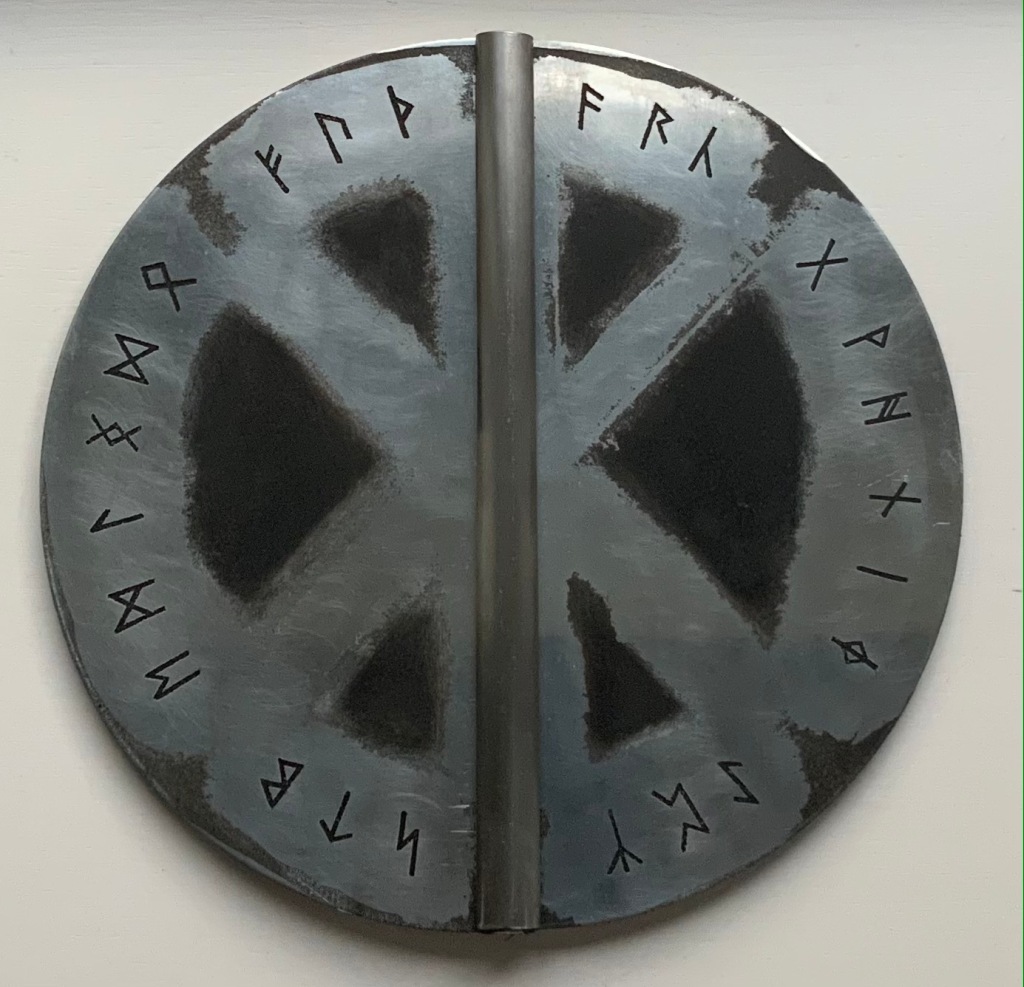
Fuþorc (1992) Brynja Baldursdottír Casebound in brushed and inked 1.6 mm zinc plate cover. Decorated doublures. Closed: H290 x W160 mm. Open: 320 mm. 32 folios. Edition of 144, of which this is #98. Acquired from the artist, 15 November 2021. Photos of the work: Books On Books Collection. Displayed with permission of the artist.
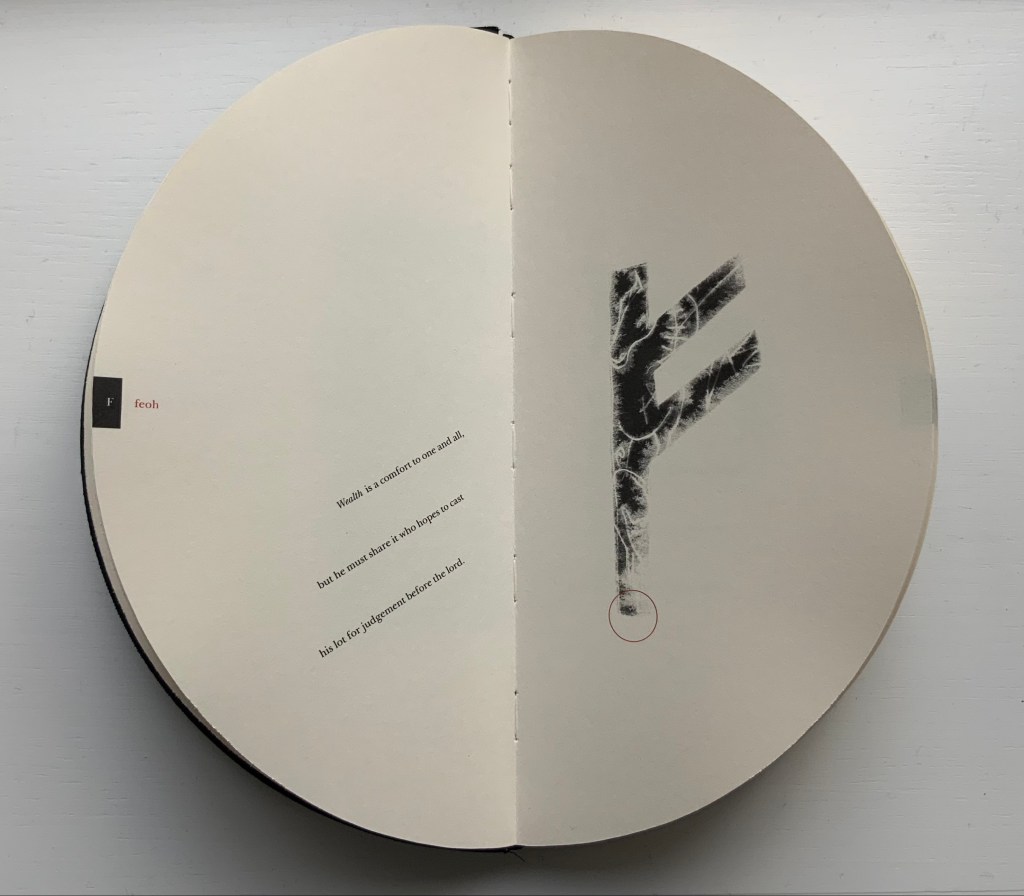
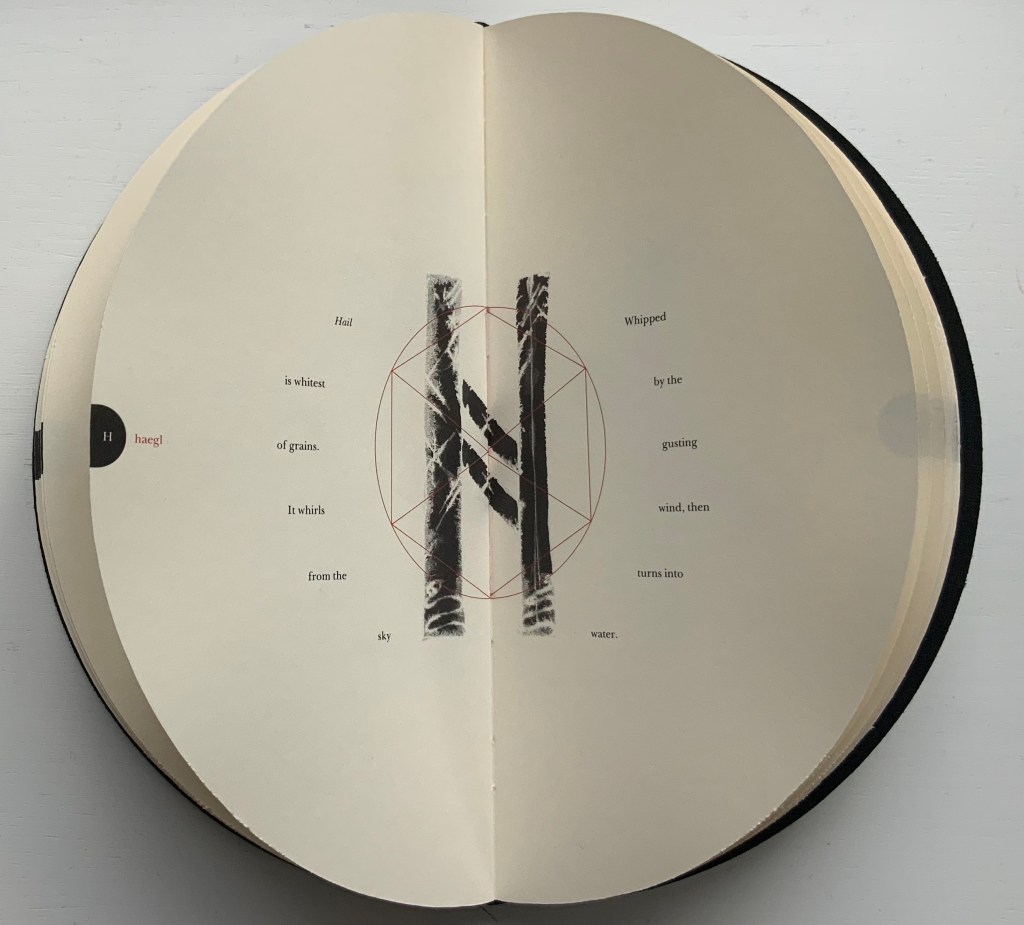
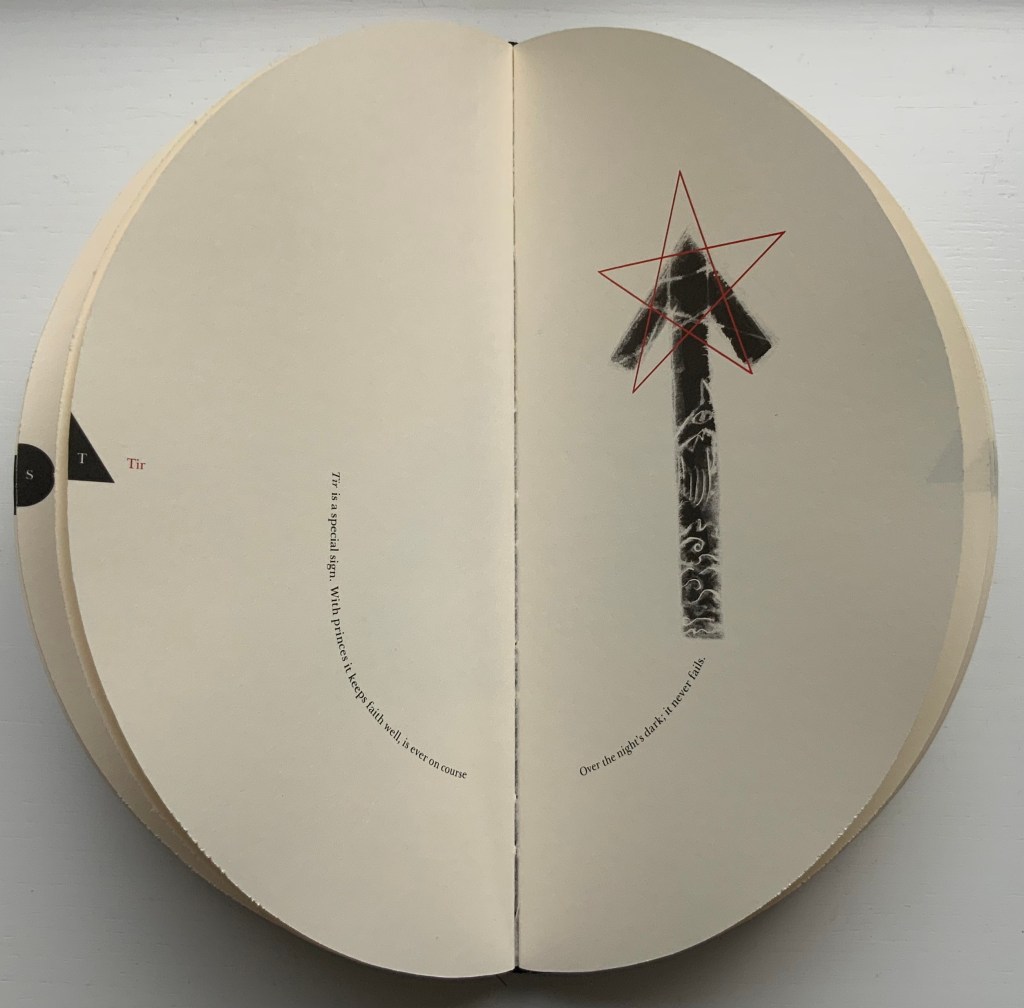
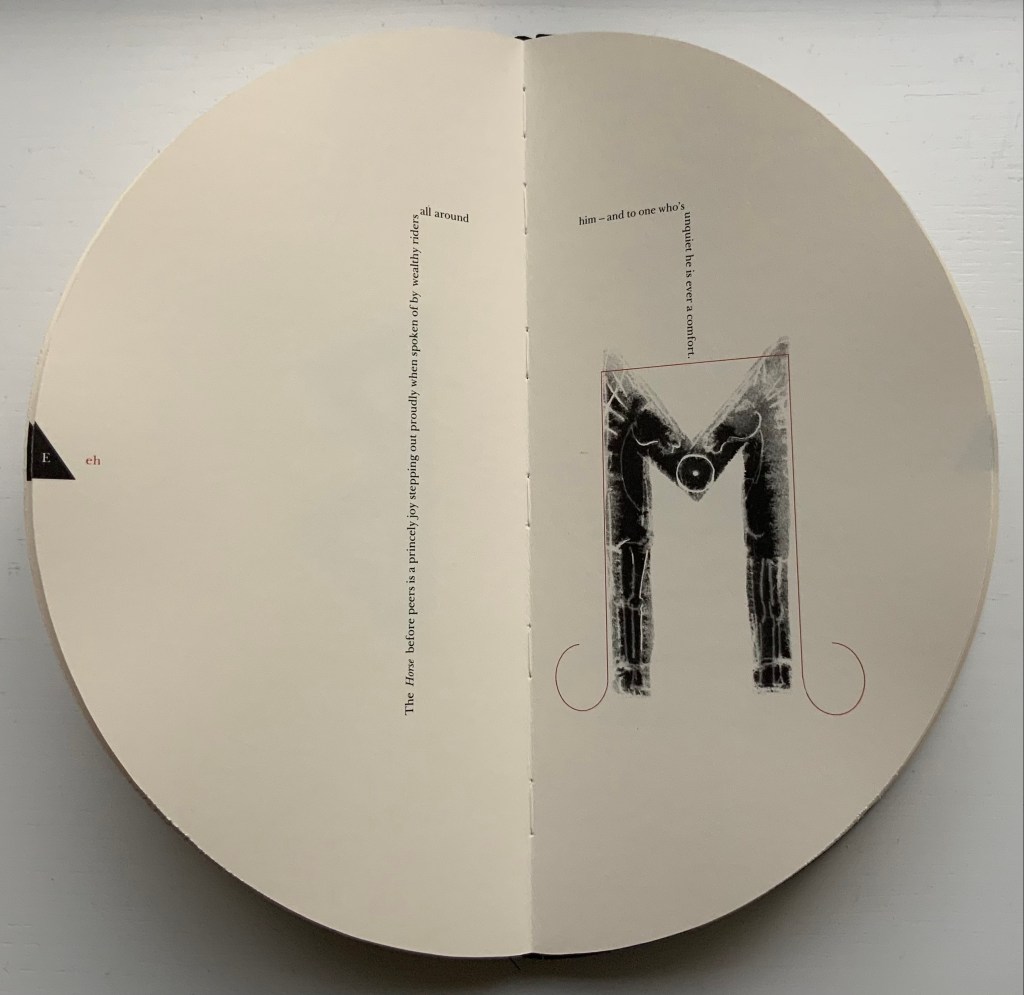
Fuþorc, the name of Brynja Baldursdottír’s artist’s book, is the word made from the first six runes of the Runic alphabet, much as alphabet derives from the first two Greek letters alpha and beta. The shield-like covers, laid face down, display all twenty-four runes of the fuþorc. Over time and geography, the runes have changed in number, spelling and meaning, reflected in the explanatory and interpretive Norwegian, Icelandic and Anglo-Saxon versions of the “Rune Poem”. Baldursdottír’s version is “The Old English Rune Poem”, translated by Marijane Osborn and Stella Longland, which is we have the Old English fuþorc rather than the Scandinavian fuþark.
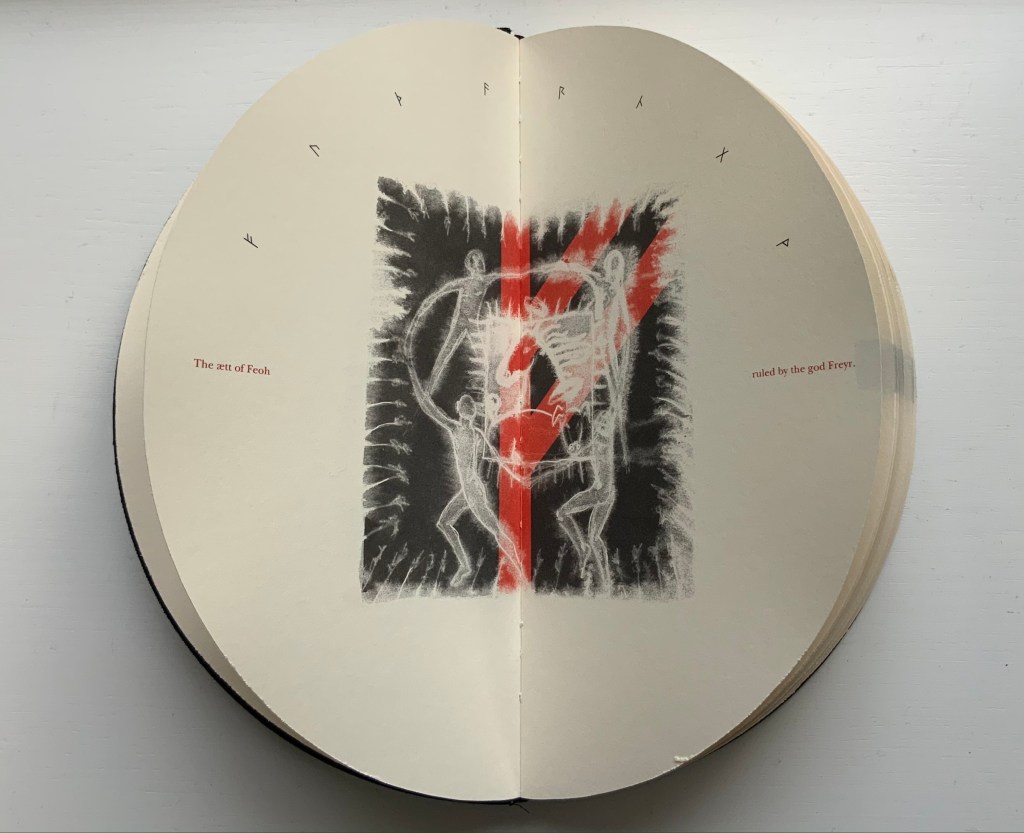
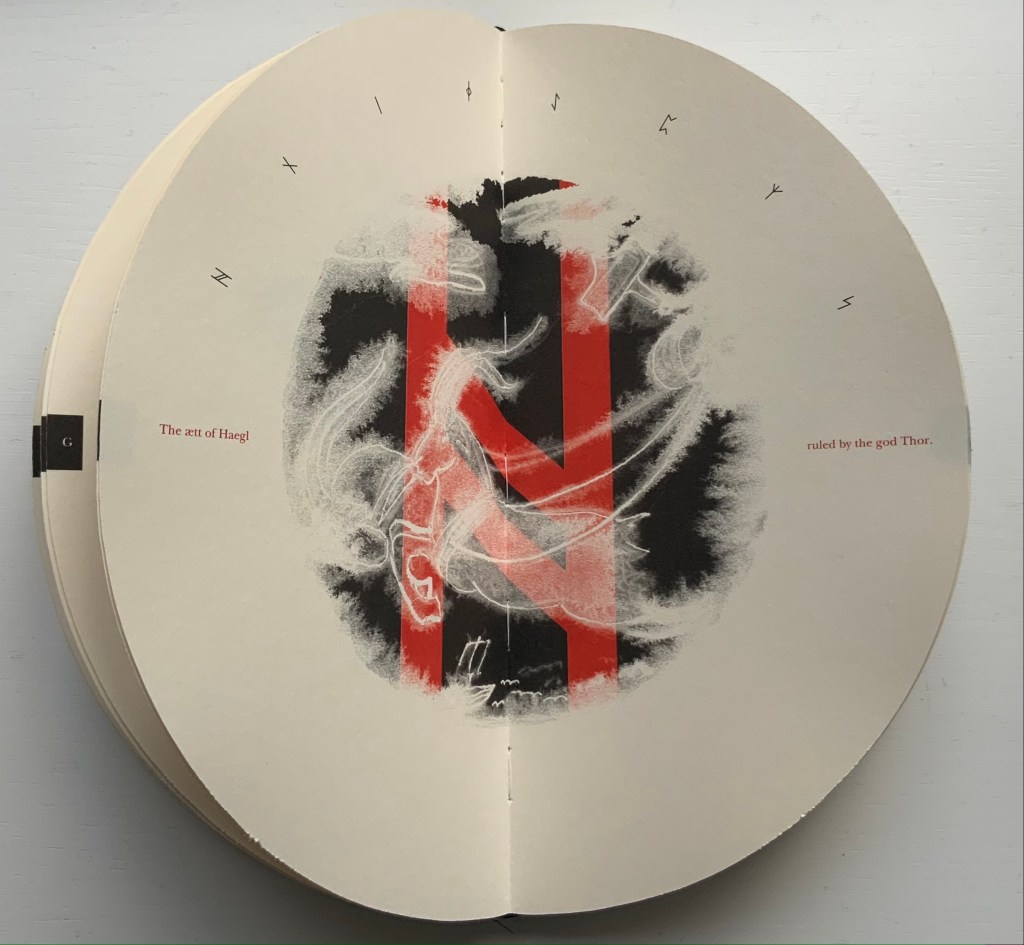
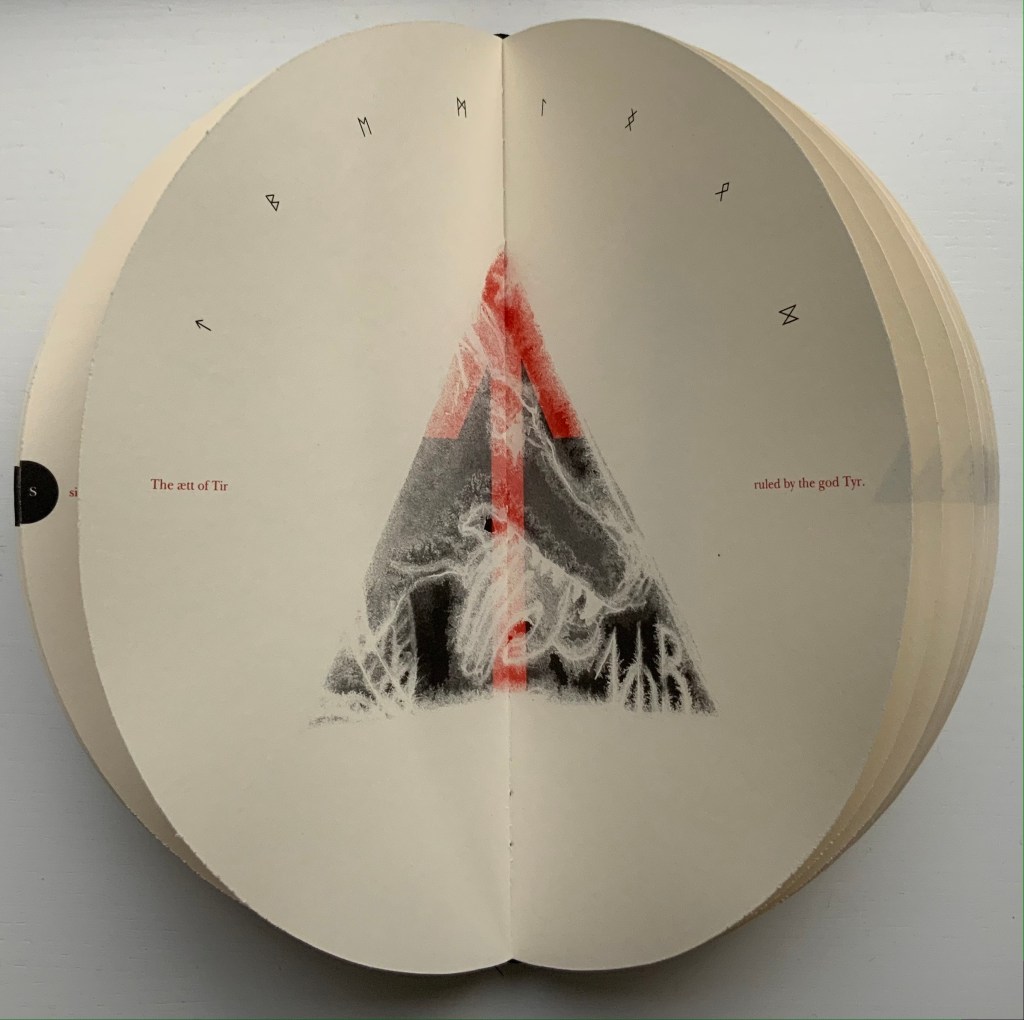
The Runic alphabet divides into three equal parts or ættir (pl. of ætt). In Fuþorc, Baldursdottír signals the beginning of each ætt with a double-page spread in which the eight runes of the ætt arc over a central image containing the ætt’s first letter. Different attributes attach to the ættir and each of the runes they embrace. Using layout of the text and imagery embedded in or surrounding the rune, Baldursdottír has evoked these attributes.
So, for the Ætt of Feoh, figures dance around the Maypole-like rune feoh, which is the first letter of Freyr and Freya who rule over this ætt associating it with agriculture, fertility and sexuality. Although Baldursdottír has Thor ruling over the Ætt of Haegl, it is the Watcher god and goddess Heimdall and Mordgud who rule over it. The seacliff-dwelling goat refers to Heimdall’s usual watch post. The snake to the left of the goat may be Jörmungandr, for which Thor goes fishing in the Prose Edda, which explains the presence of Thor’s hammer in the upper right of the image. Haegl means “hail”, and Heimdall is associated with the kind of disruptive weather threatening the ship at the foot of the image. For the Ætt of Tir, the arrowhead or spear shape of the rune evokes Tyr, the god of war, who rules over this ætt. By shaping each ætt with one of the fundamental geometric shapes of square, circle and triangle, Baldursdottír highlights the elemental nature of the Runic alphabet.
Ætt of Feoh, Ætt of Haegl, Ætt of Tir
In displaying each rune, it is as if Baldursdottír invites the viewer to peer through a rune-shaped stencil to that other world of associated attributes, but as with most divination, the images are partial and ambiguous. Is that a horse or a dragon behind feoh? Hail descending and melting behind haegl? A warship’s prow behind tir?
The runes feoh, haegl and tir
No doubt, more familiarity with the lore of runes would increase the reward of close attention to each image. But many are easily accessible. The image of horses shows well enough through the rune eh (or ehwaz), which means horse, horses or transport, but if there is any doubt, the explanatory text is laid out like reins and a bridle.
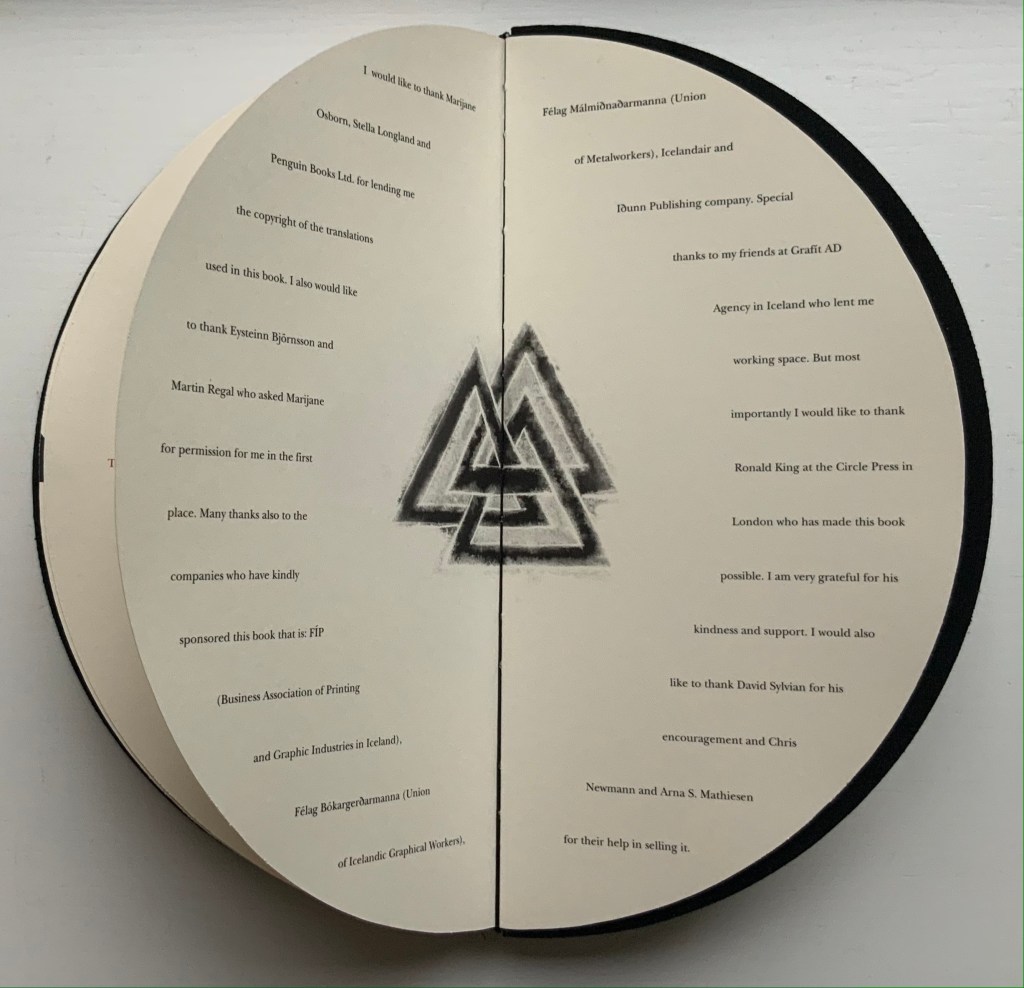
The book closes with the Valknut, sometimes called Odin’s knot, at the center of the Acknowledgments. Although runes and symbols such as this may be susceptible to misappropriation, the Acknowlegments themselves serve the Books On Books Collection as a welcome reminder that Fuþorc was first seen among other treasures at Ron King’s home.
Ekphrasis (2020) Serena Smith Case bound with letterpress printed cloth cover H700 x W460 x D20 mm. 23 folios: 2 end leaves, 1 title, 10 hand-colored images printed on to 225gsm Simili Japon, 10 bronzed text printed onto translucent paper. Edition of 5, of which this is #5. Acquired from the artist, 5 January 2023. Photos: Books On Books Collection. Photos and videos: Courtesy of the artist. Displayed with permission of the artist.
The word ekphrasis refers to the literary practice of verbally representing a visual representation. Think of the poets Keats, Auden and Jarrell using words to “recreate”, re-present, evoke or respond to works of art — an antique urn, a painting by Brueghel, or Donatello’s sculpture of David. Novelists, too. Think of Henry James’ The Ambassadors in which the narrator Lambert Strether describes an imagined stroll through a landscape painting he’s viewing.
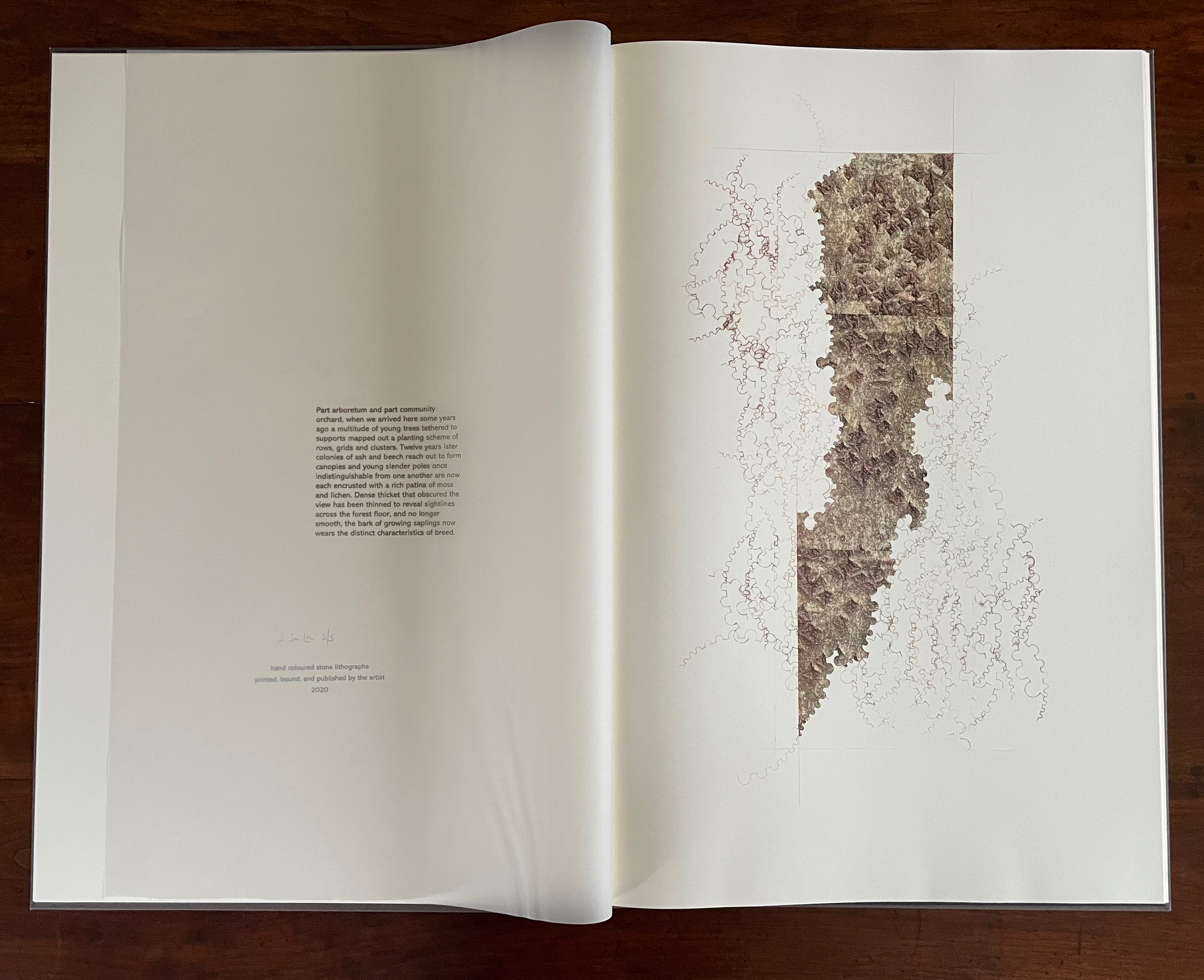
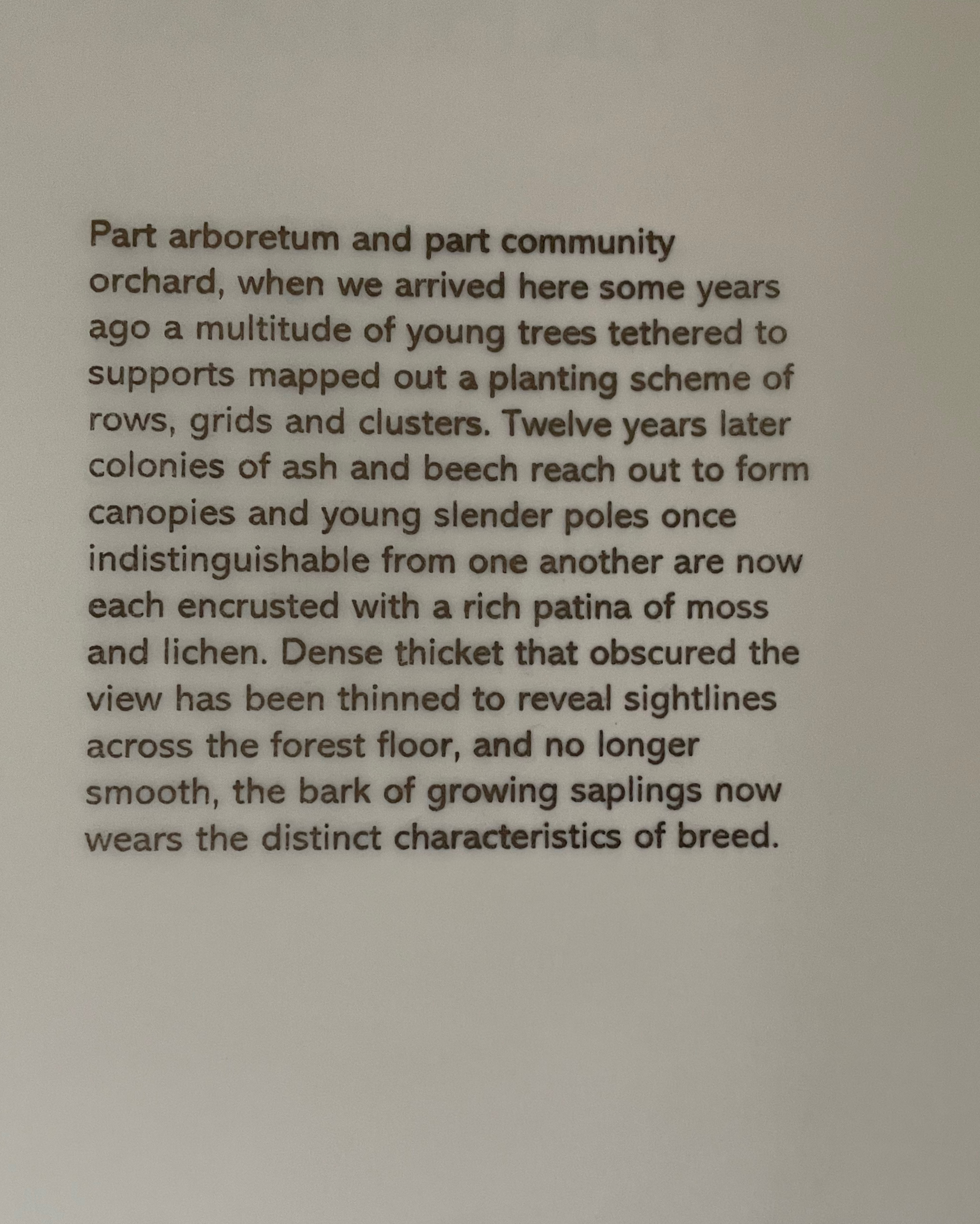
Serena Smith has a different point of departure for Ekphrasis. Her dwelling and studio back onto a Leicestershire country park — “part arboretum and part community”. Highlighted with maple, Tibetan cherry and Himalayan birch, the planted woodland of ash and beech with its defined paths offers up “artefact of living trees” as much a constructed work of visual art as any urn, painting or sculpture.
In this bookwork, ten pages of text printed on translucent paper overlay ten images printed from stone. The text reflects on the “wandering, watching and thinking that happens in the parkland”, but then it turns internally to the studio, the ephemera collected from the woodland, and the stage before the images come into being. The process of making becomes an object of the ekphrastic text: smoothing the stone, using a tool to guide the pencil, sharpening the pencil. And gradually the work reveals itself as a self-reflexive meditation on natural and artificial creation, on word and image, and on trace lines of growth and decay.
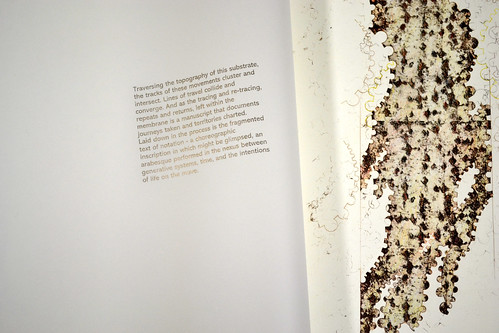
The translucent pages of text create a palimpsest-like effect over the folios of images. Until the translucent folio turns, the text is indecipherable. As the pages turn, the textual and pictorial play off one another.
Close-up of text
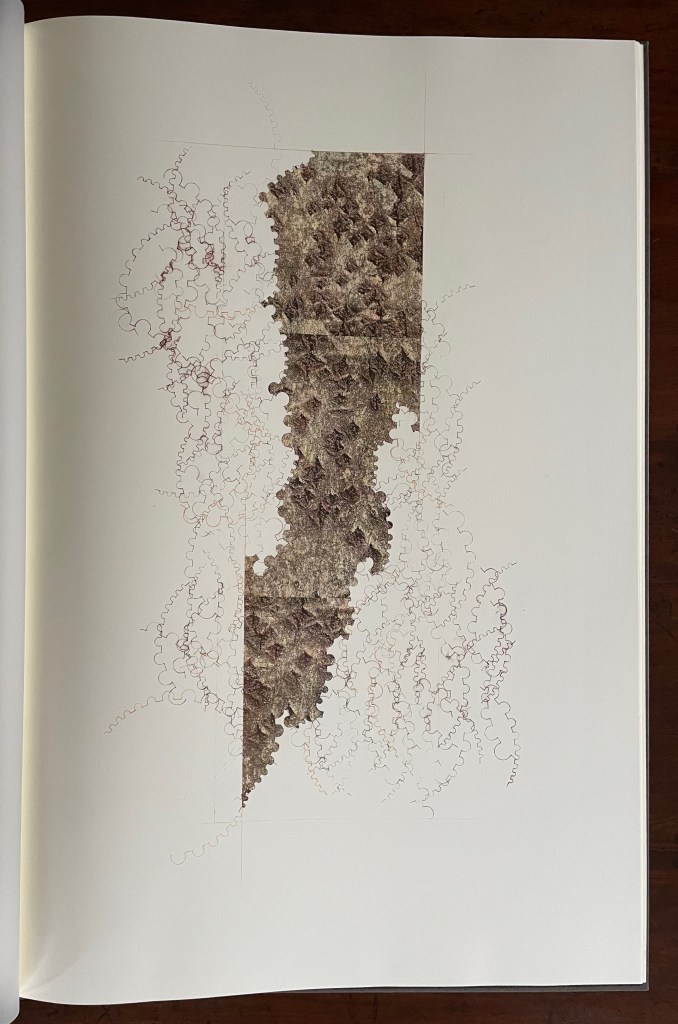
Single-page view of first lithograph
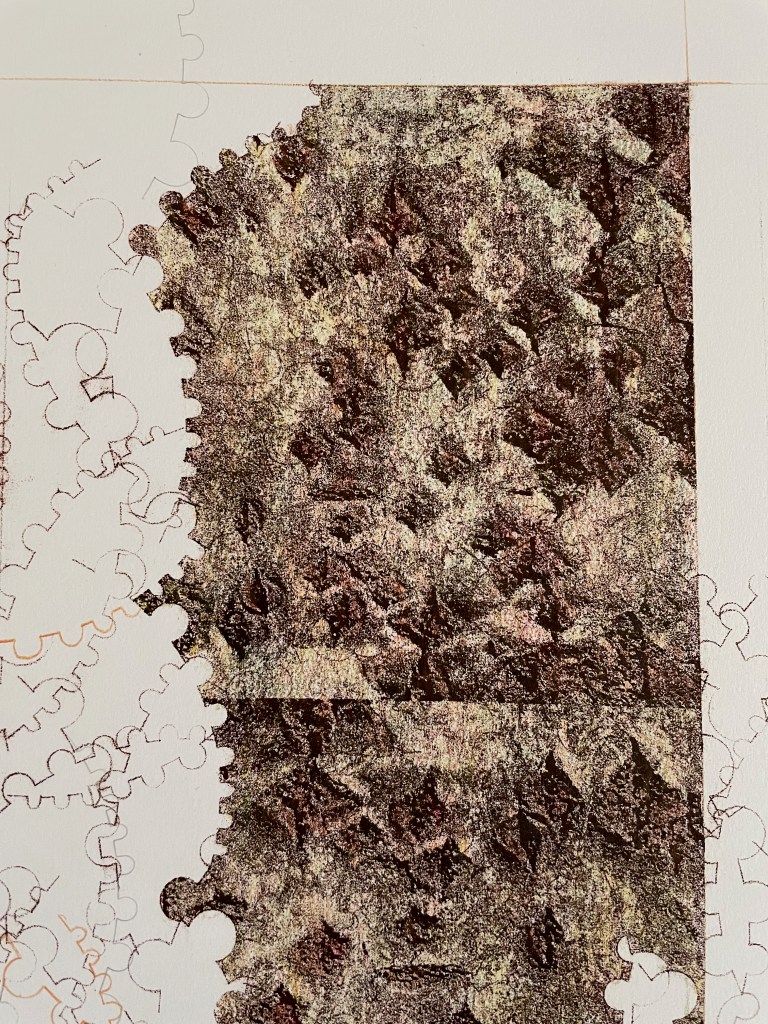
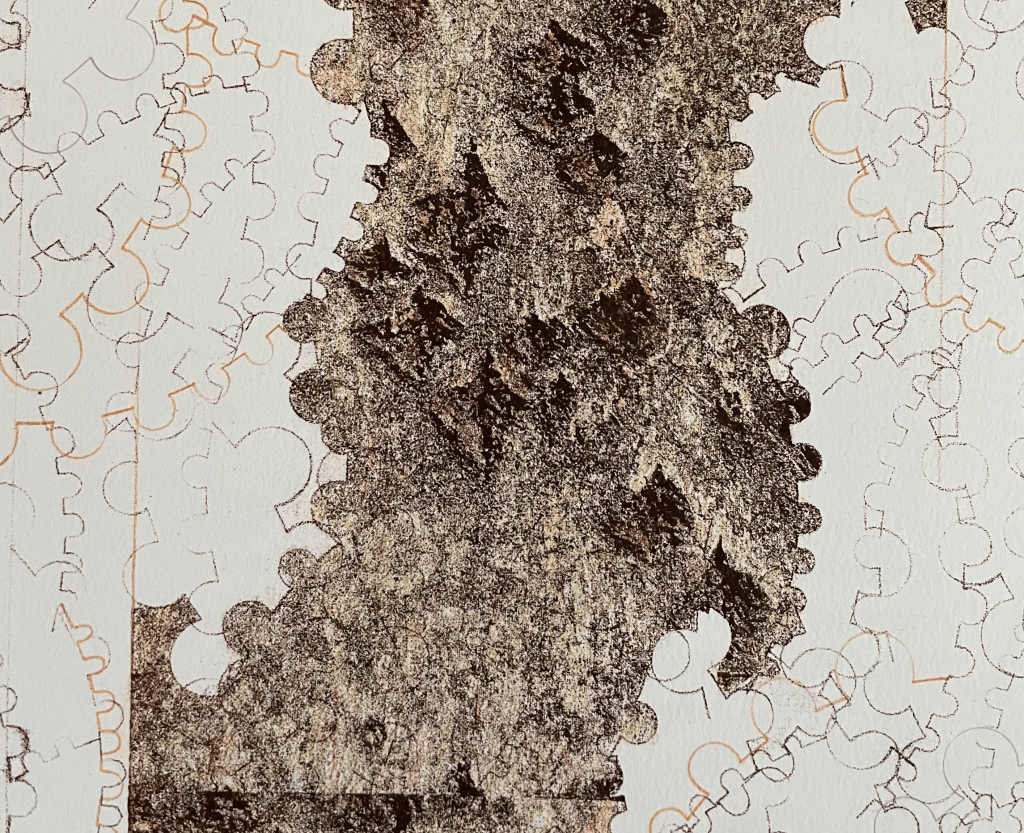
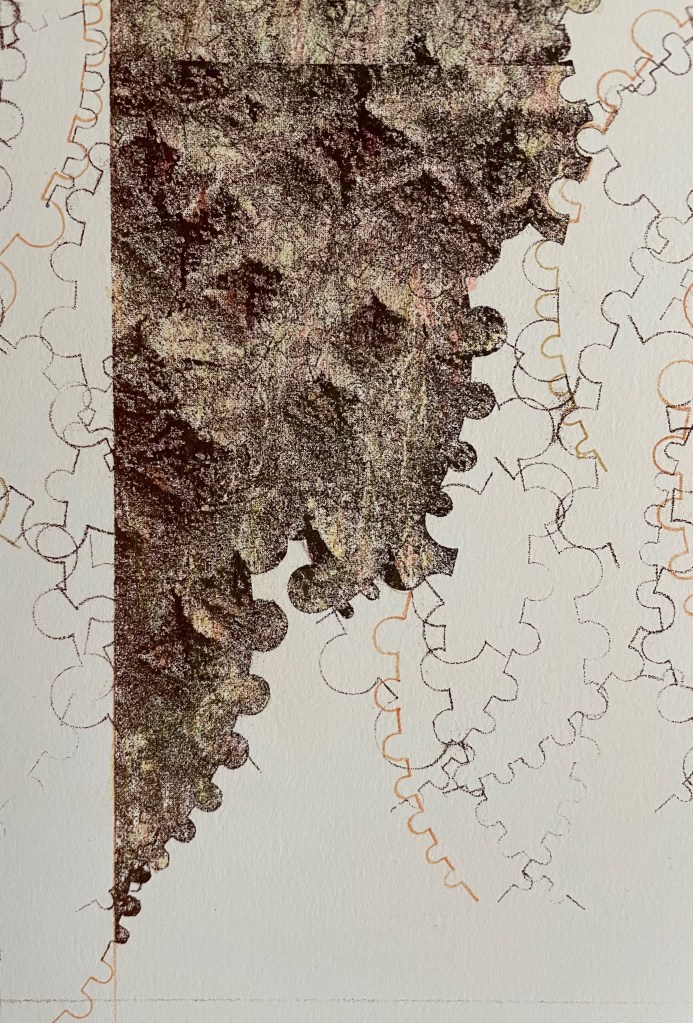
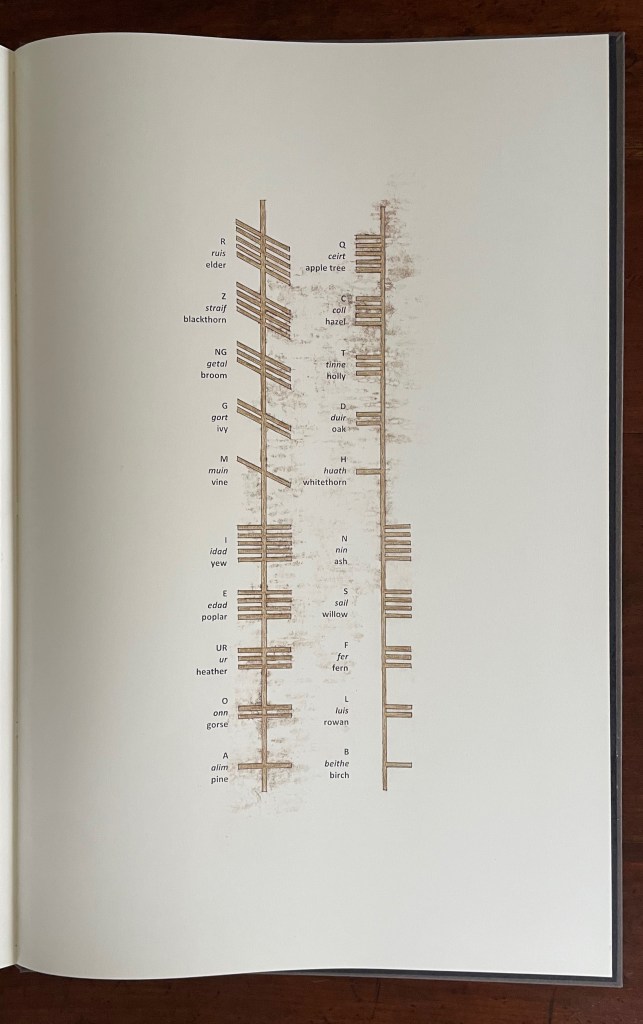
The lithographic image divides into three parts. The jigsaw-like lines around the image of bark come from a stencil tool, and the result chimes with planning lines of landscape architecture, feeding insects’ tracks in the bast, the shape of lichen and ultimately the Ogham runes mentioned in the text and depicted at the end.
First of three-part close-up of the first lithograph
Second of three-part close-up of the first lithograph
Third of three-part close-up of the first lithograph
Glossary
The following ekphrastic words bring the lithographic process to life. Taken together, the glossary, Smith’s descriptive text, and its ekphrastic focus on the lithographic process transform her stone into a kind of Ogham stone itself.
As the drawing progresses I wonder if the hands of Celtic scribes also tired, whilst scoring the lines of Ogham script into fragments of wood. Cutting short repeated grooves against the grain an effort would have been felt, different to that which allowed the tool to willingly travel along the pathways of growth. Perhaps they too made use of a device to control the errant gesture, and aid inscription of measured lines of written text. This can only be speculated.
What the remaining Ogham stones do tacitly share are ciphered incisions that scale their lichen clad faces with a purposeful regularity that resists embellishment. Contouring the edges, the cut lines navigate uneven corners without detour, and prompt me to ask if these scribes, flesh pressed into stone, also briefly held their breath while negotiating the changes in direction prescribed by the matrix.
A version of the text and all of the images can be found in Smith’s brief essay published by IMPACT Printmaking Journal (Spring 2020) and in the following slide show (courtesy of the artist).