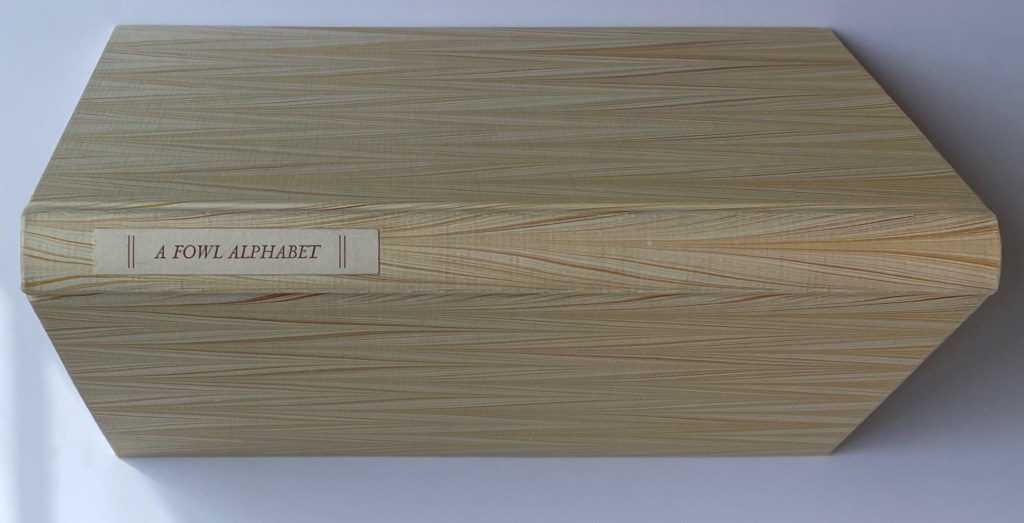
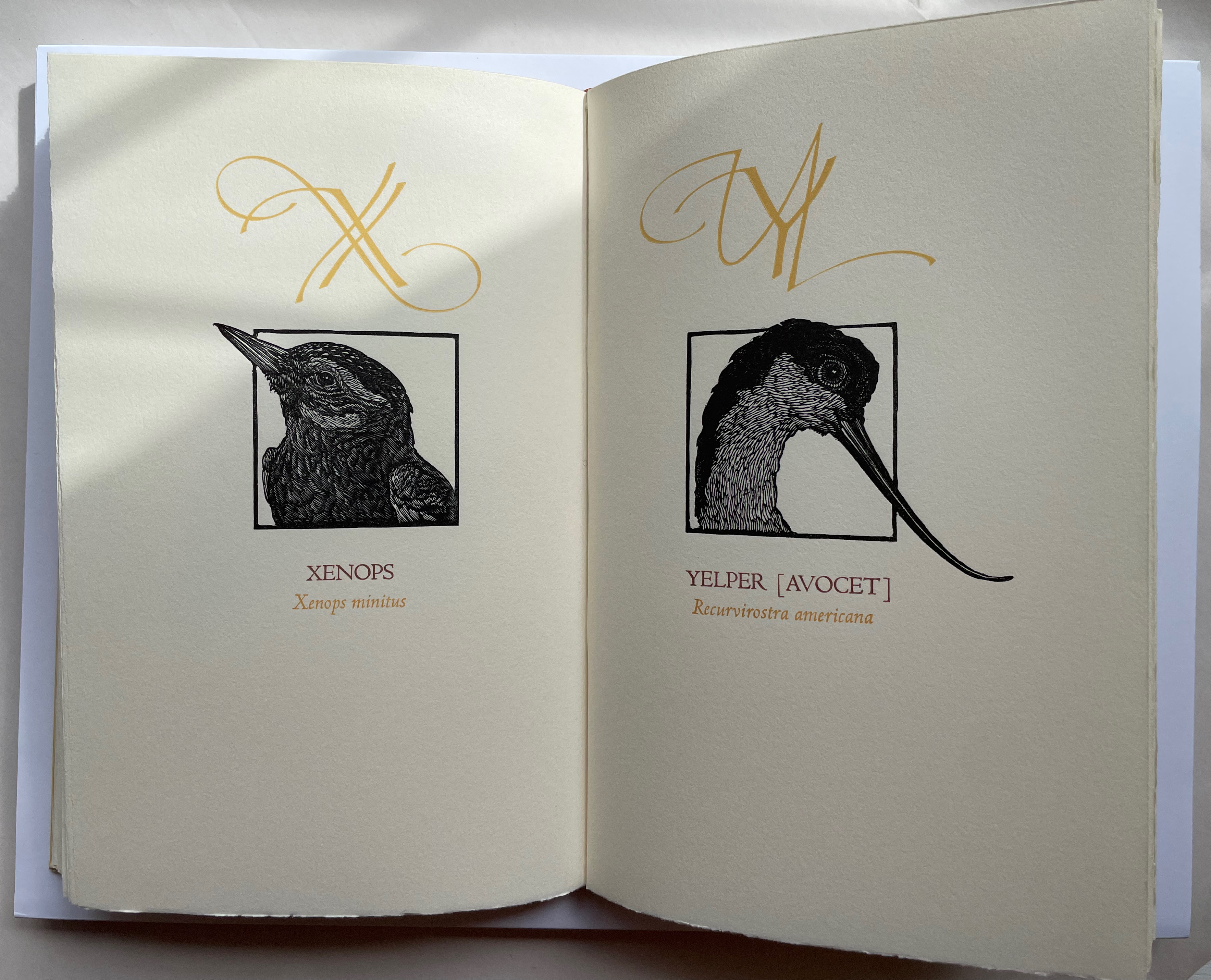
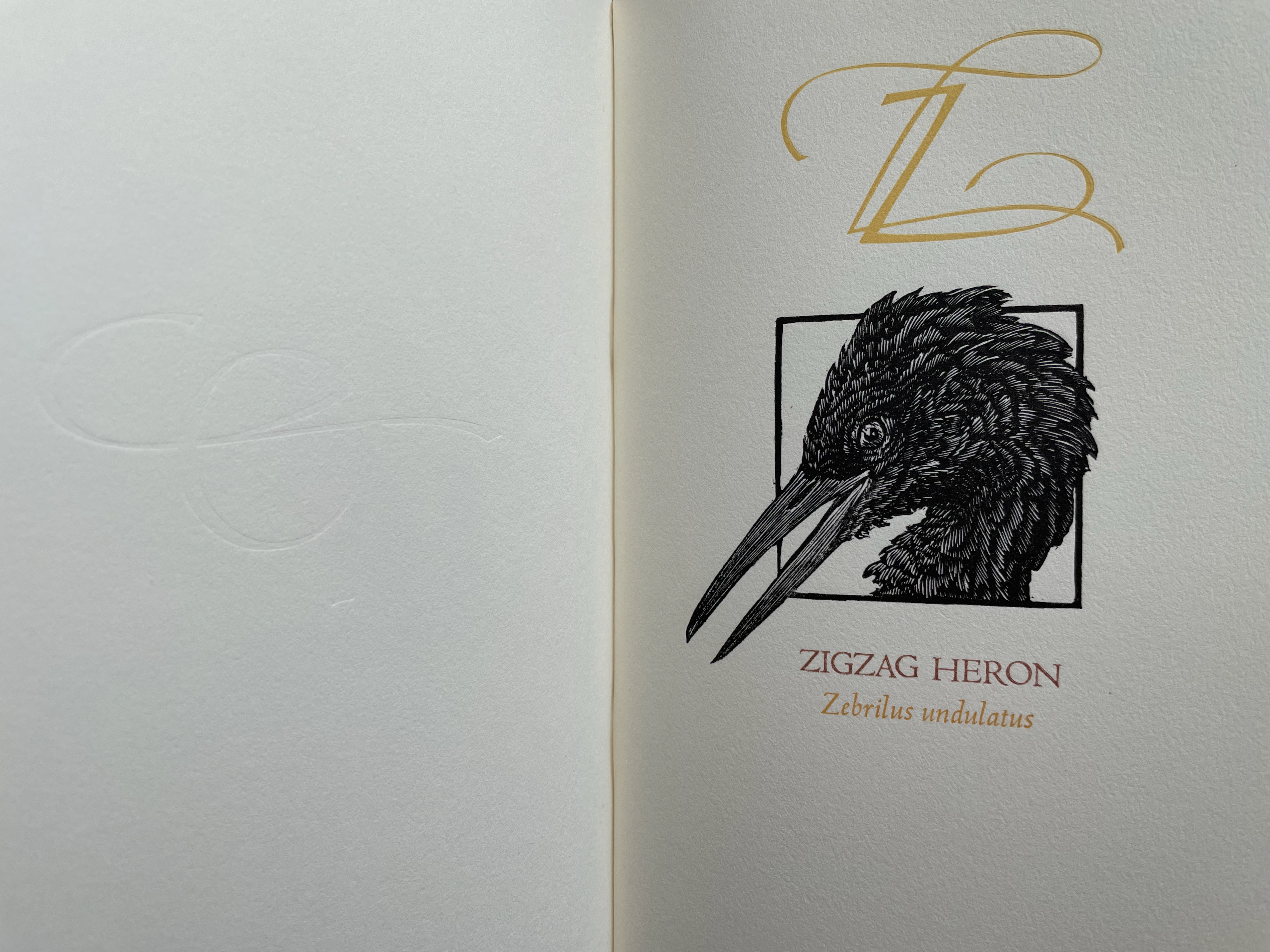
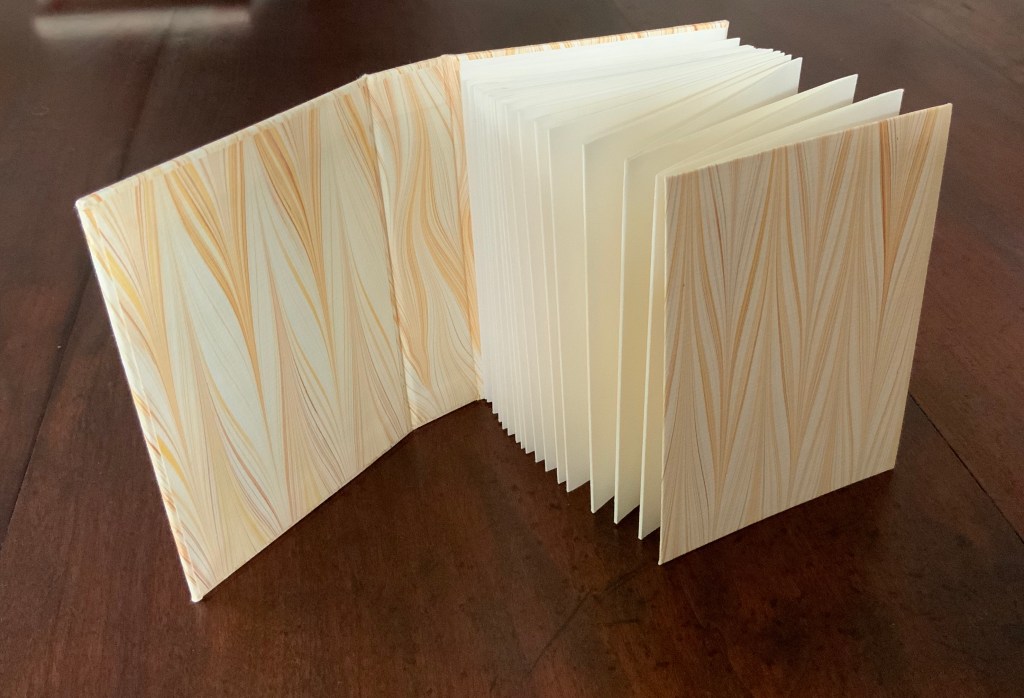
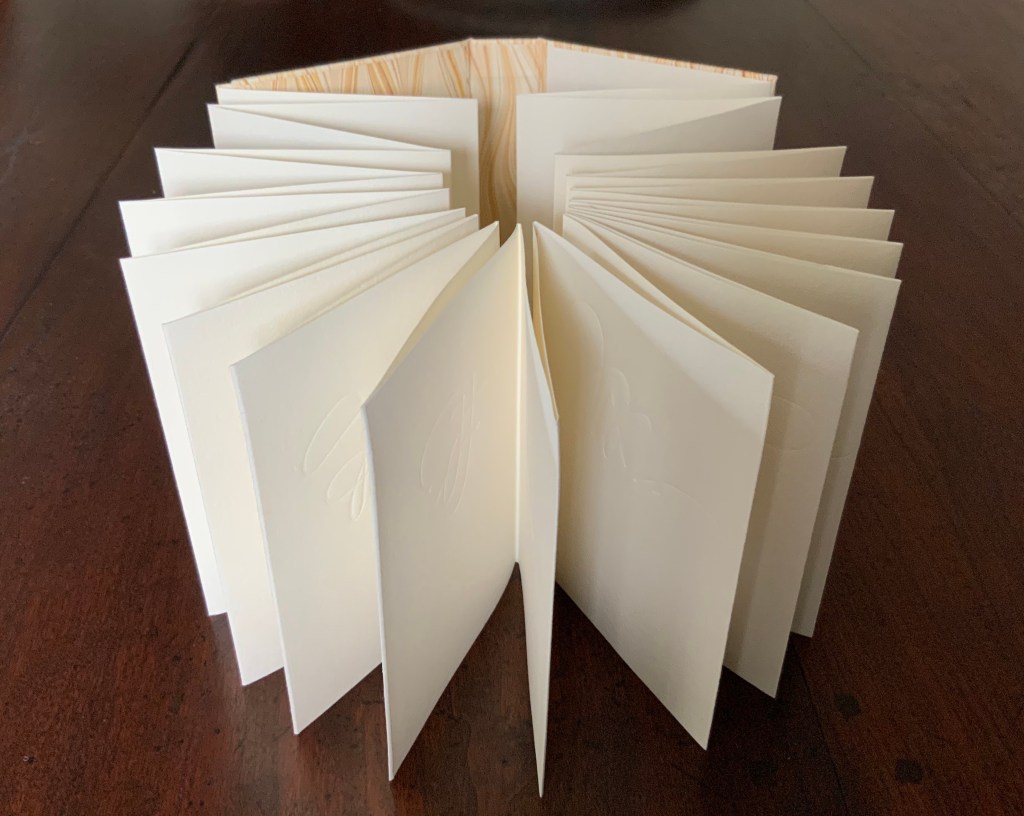
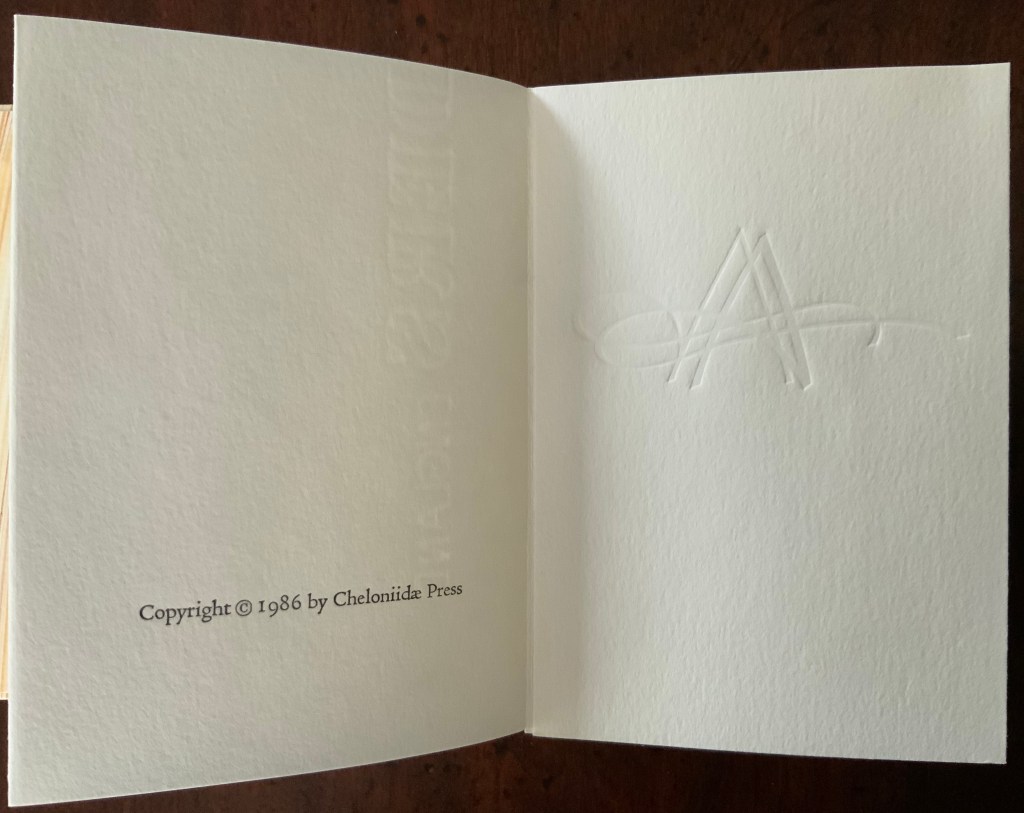
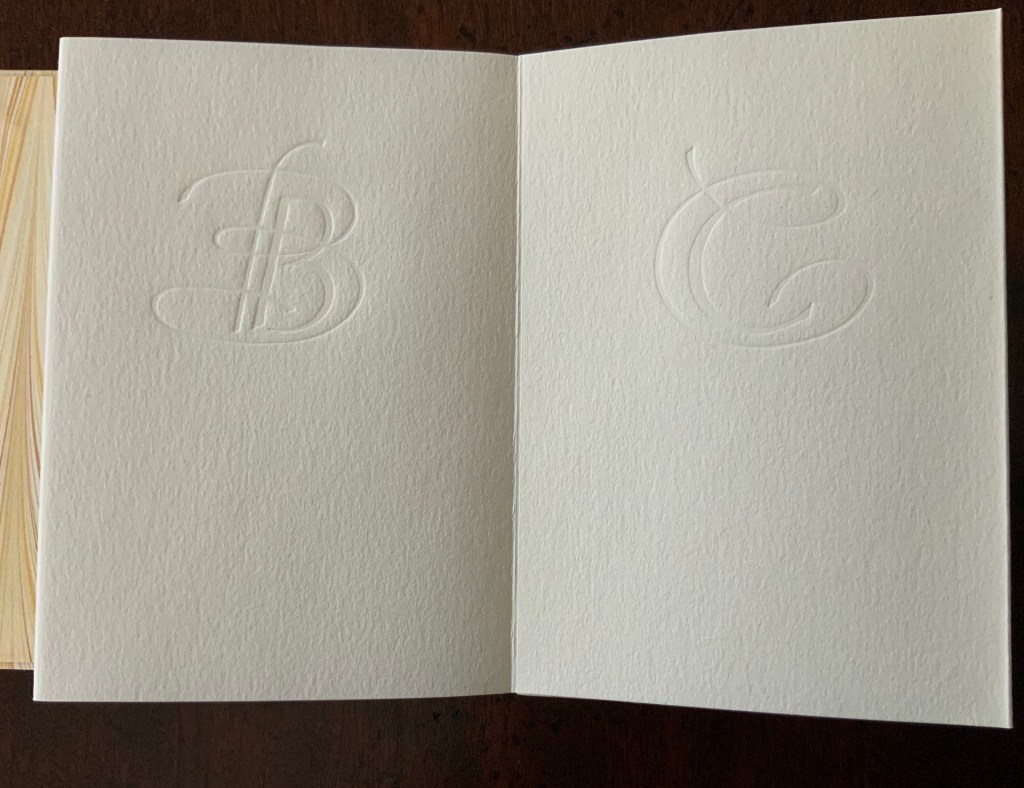
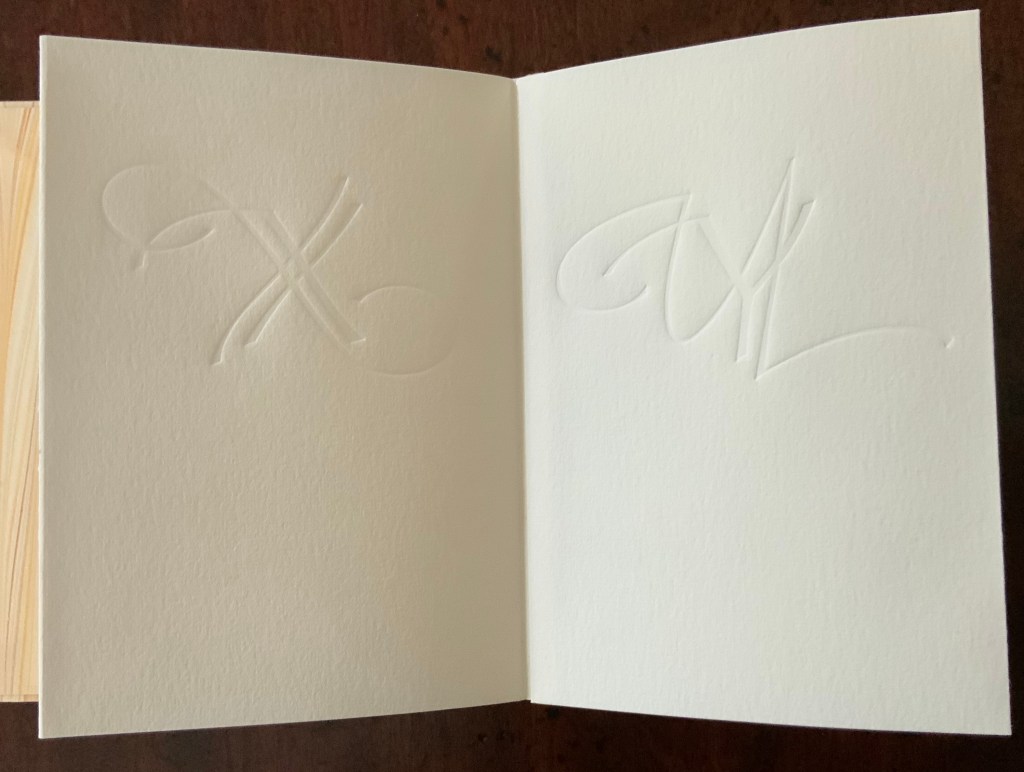
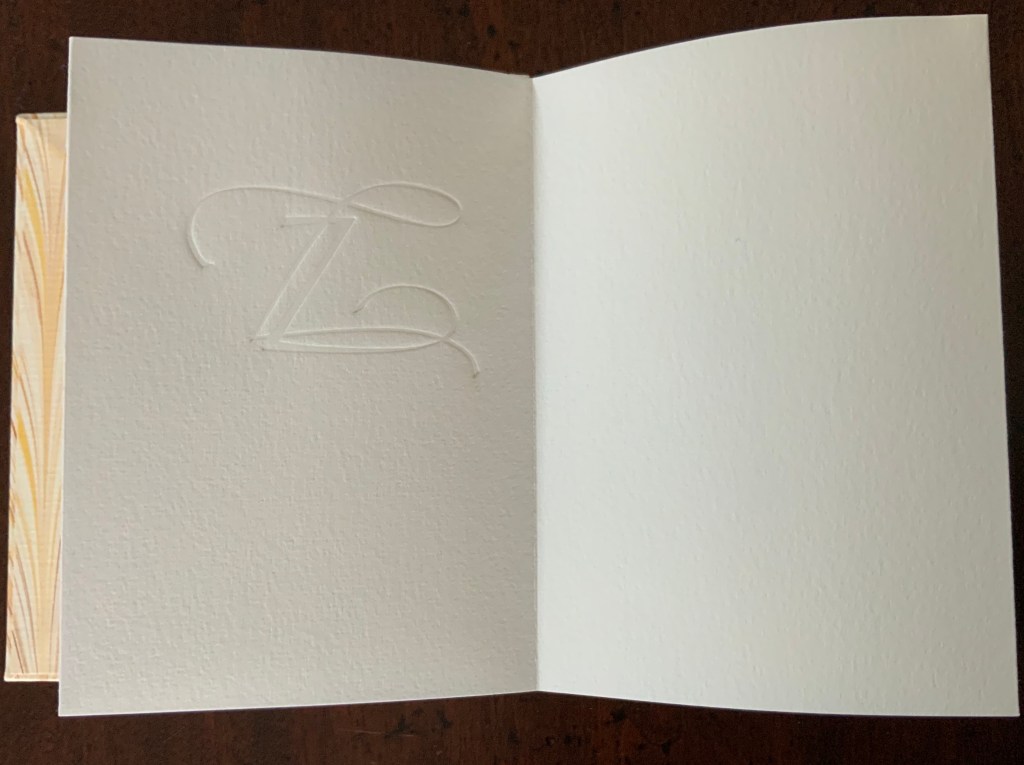
A Fowl Alphabet (1986) Alan James Robinson (etchings), Suzanne Moore (calligraphy) Casebound. Marbled paper over boards. Doublures and flyleaves. H218 x W145 mm. 26 Folios untrimmed at head. Four-page prospectus loose. Acquired from Bromers Bookseller, 16 August 2022. Photos: Books On Books Collection. Displayed with permission of the artists.
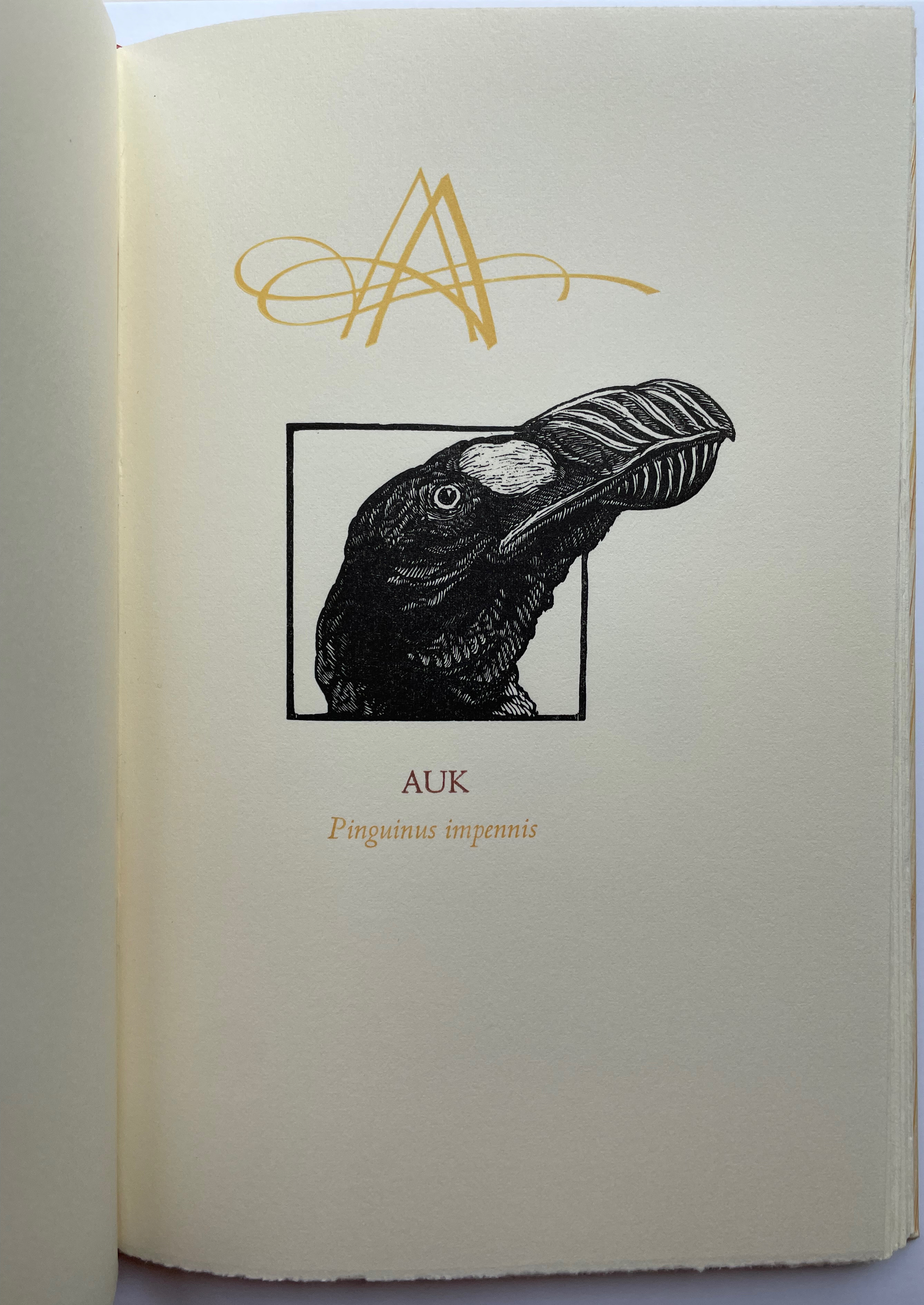
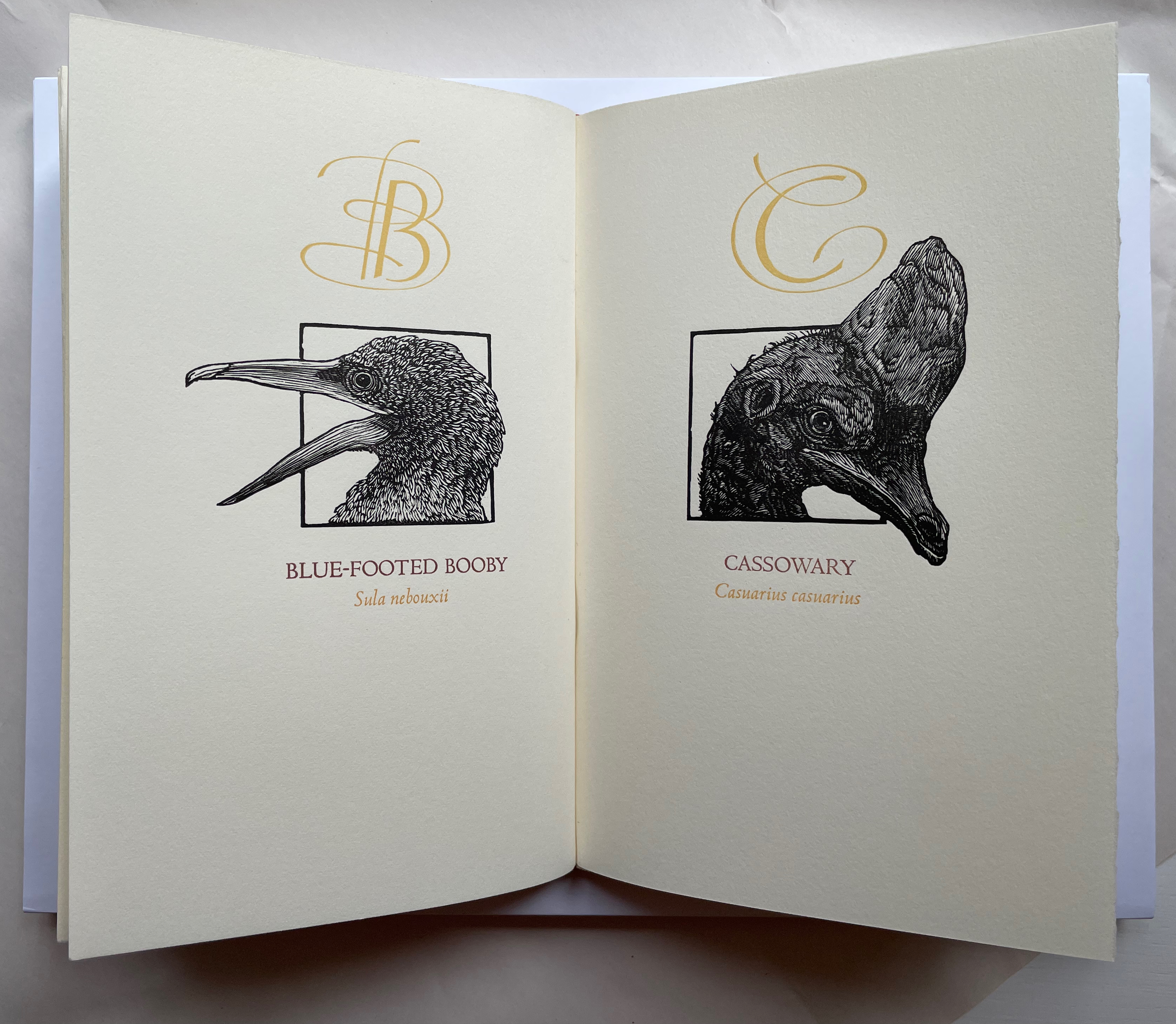
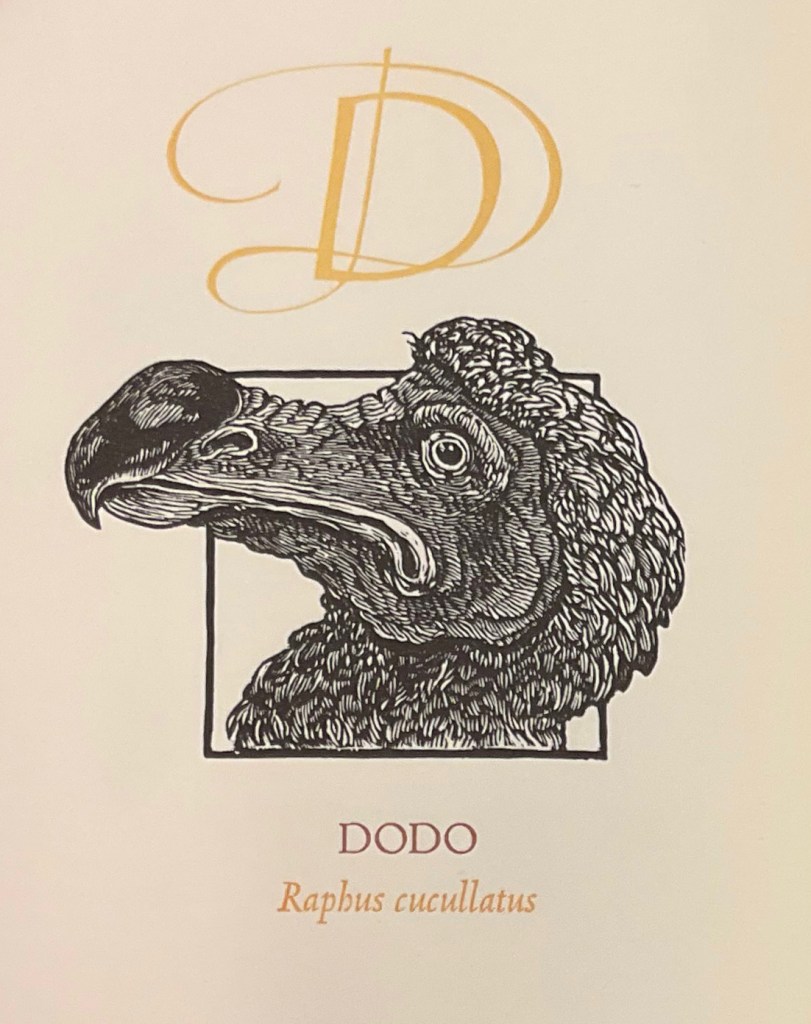
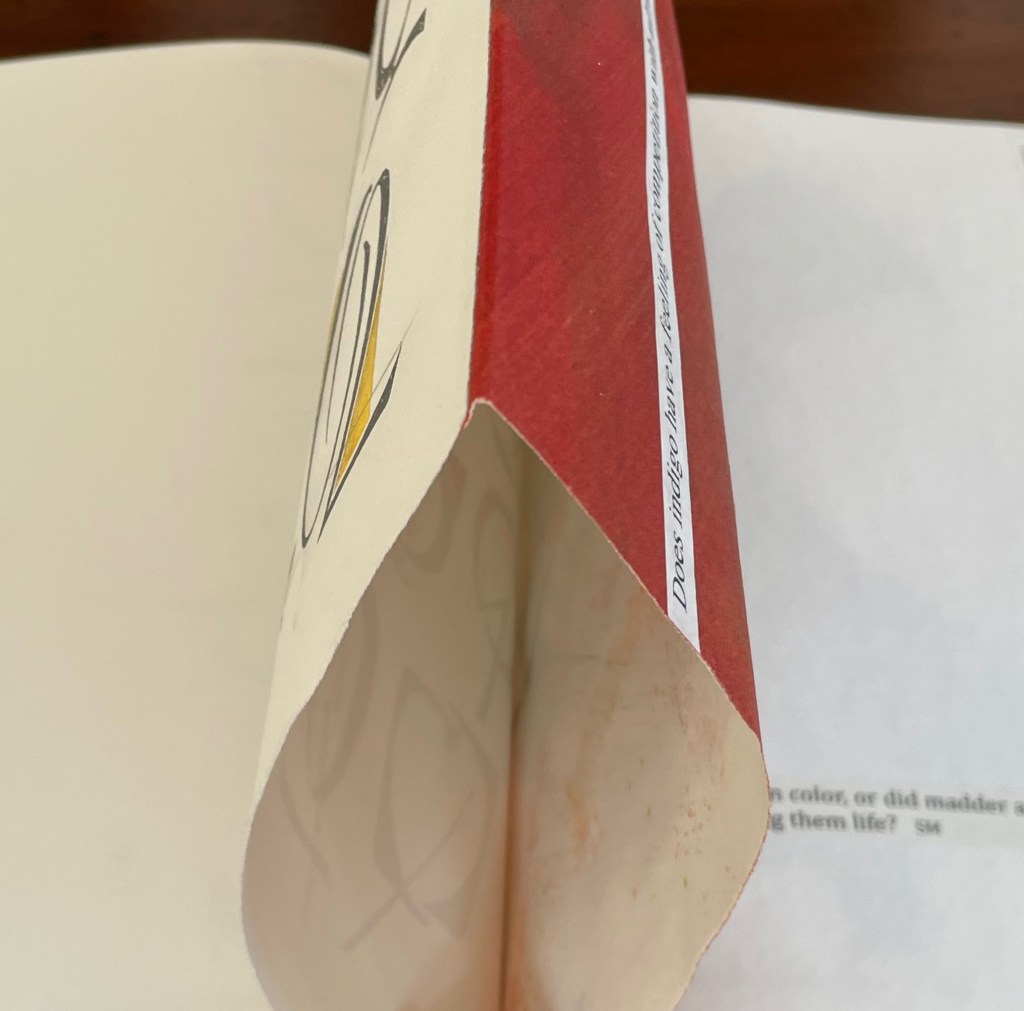
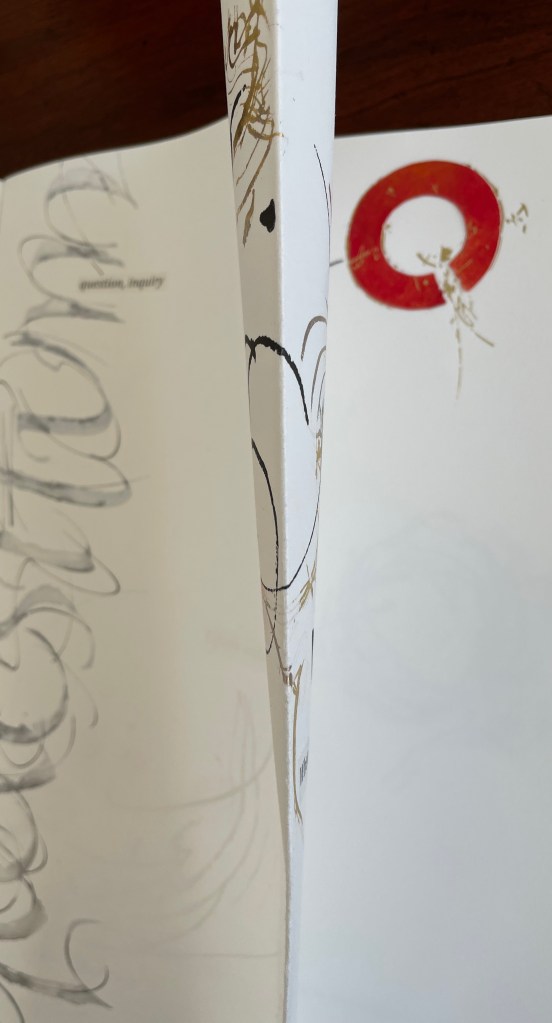
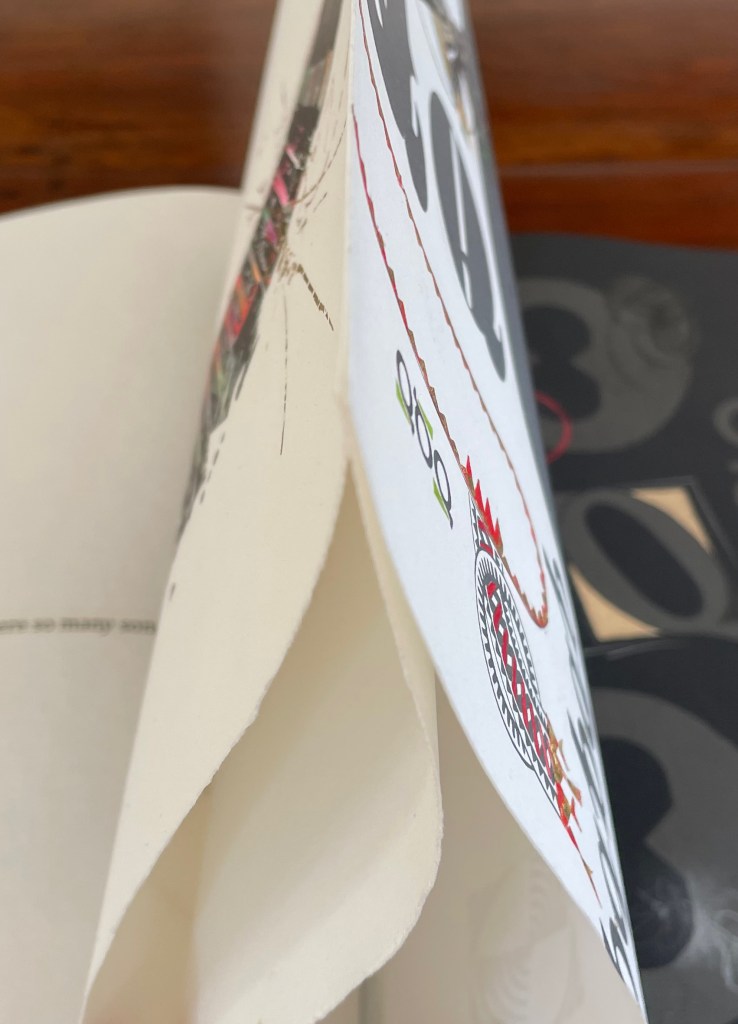
Under his Cheloniidae Press imprint, Alan James Robinson created three artist’s alphabets: A Fowl Alphabet with Suzanne Moore; An Odd Bestiary (1982) and The Birds and Beasts of Shakespeare (1990), arranged as a double abecedary, first the birds and then the beasts. Although this copy of A Fowl Alphabet comes from the regular edition and does not have the color of the deluxe editions of all three abecedaries, it does demonstrate the extraordinary fineness of Robinson’s wood engraving as well as his compositional talent, which also informs the book’s design. The positioning of the birds’ heads in their printed black frames conveys a sense of movement and three dimensionality on the individual page, but notice how Robinson varies the positioning from page to page and across double-page spreads to enhance the sense of movement.
With its core thick strokes shadowed and entwined with thinner flourishes, Suzanne Moore’s calligraphy creatively complements the way that the heft of Robinson’s engraved heads plays against those compositional features.
“Cheloniidae” is the scientific term for the family of sea turtles, and much of Robinson’s art is marine related. But the dominant and consistent impression conveyed by the ouput of Cheloniidae Press is that of Robinson’s artistic skill as an impresario and conductor of artistic talents. Added to the background of his duet with Moore are Master Printer Harold Patrick McGrath, Faith Harrison and her hand marbled paper, Arthur Larson and his hand typesetting and the binding skills of Claudia Cohen.
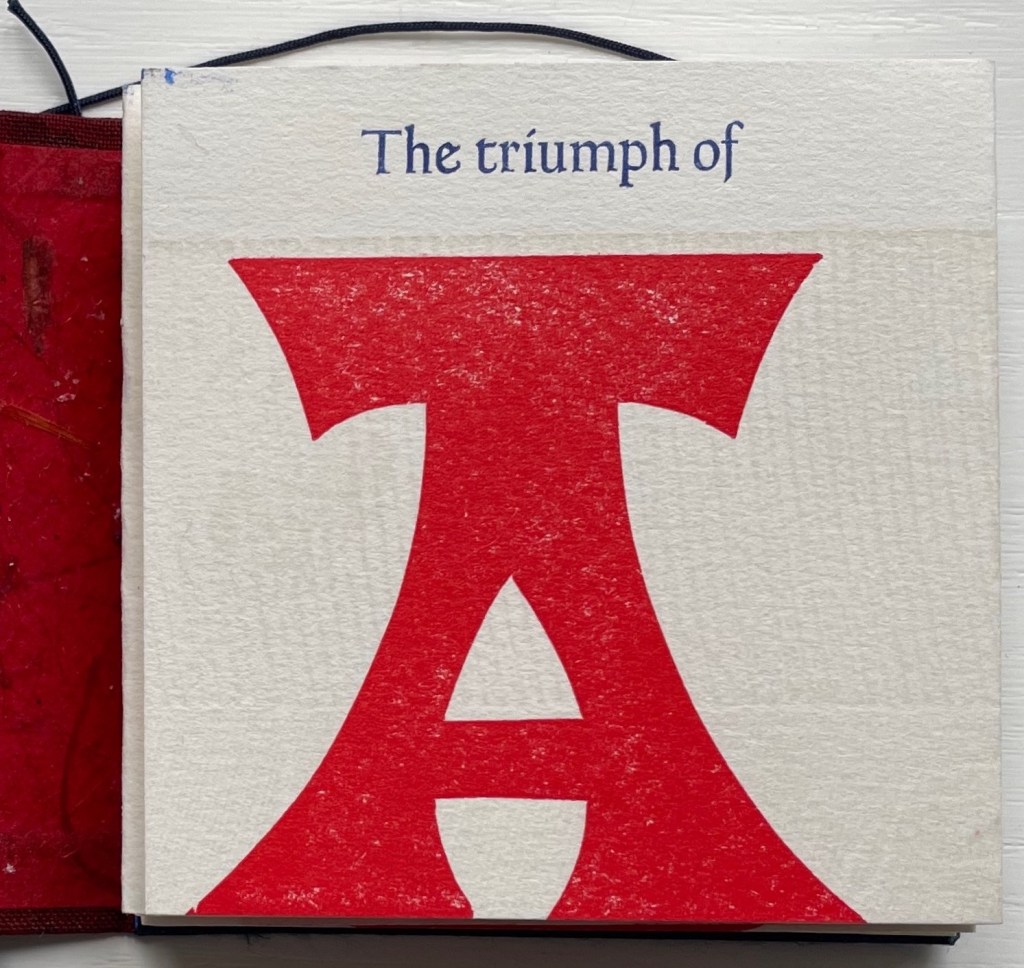
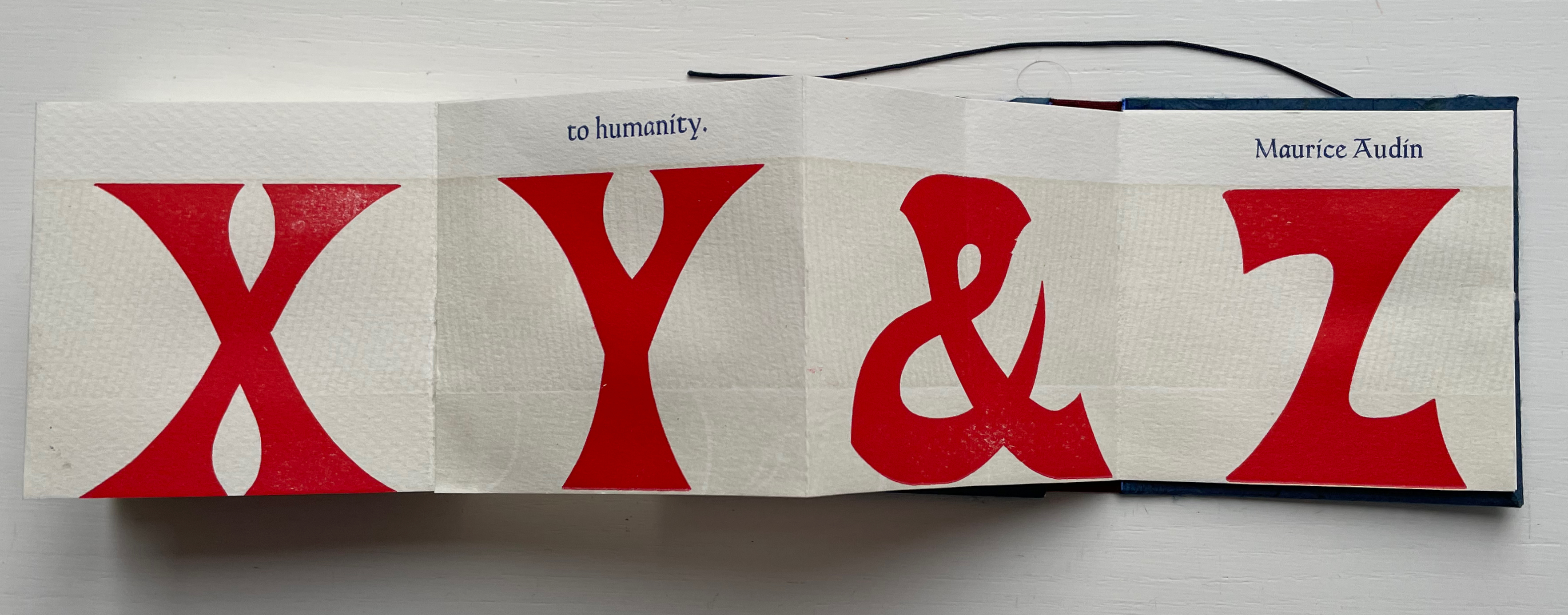
The Triumph of the Alphabet(2017) William Rueter Accordion fold extending from the back page. Bound in paper-covered boards with printed paper title on spine. Twine tie closure. 82.6 x 82.6 mm. 27 panels. Acquired from Vamp&Tramp Booksellers, 7 October 2022. Photos: Books On Books Collection.
From the colophon: “This nameless wood type alphabet was made c. 1900 by the Hamilton Mfg. Co. Here at The Aliquando Press it is affectionately called ‘Ali-oops!'”
The full quotation from Audin is “The triumph of the alphabet gave true impetus to our Western civilization … The alphabet made it possible to transmit all-embracing concepts and truths to humanity”. There was more than one Audin interested in letters. Marius was father to Maurice and Amable, and the three of them produced a multi-volume history of printing called Somme Typographique. Amable contributed the section on the birth of the alphabet, and Maurice wrote the section on the discovery of typography. A scan of this volume does not yield the pronouncement in the Aliquando Press miniature. Luc Devroye‘s entry on Marius Audin cites him as a major influence on the French typographical world, and his number of books exceeds those by his sons combined. Given his livelier style, it seems more likely that the quotation in The Triumph of the Alphabet belongs to Marius. If so, “Ali-oops” might deserve an erratum slip. Slip or no, the panels with their tripartite texture and dual contrast of colors and font make The Triumph of the Alphabet a triumph of printing pleasure.
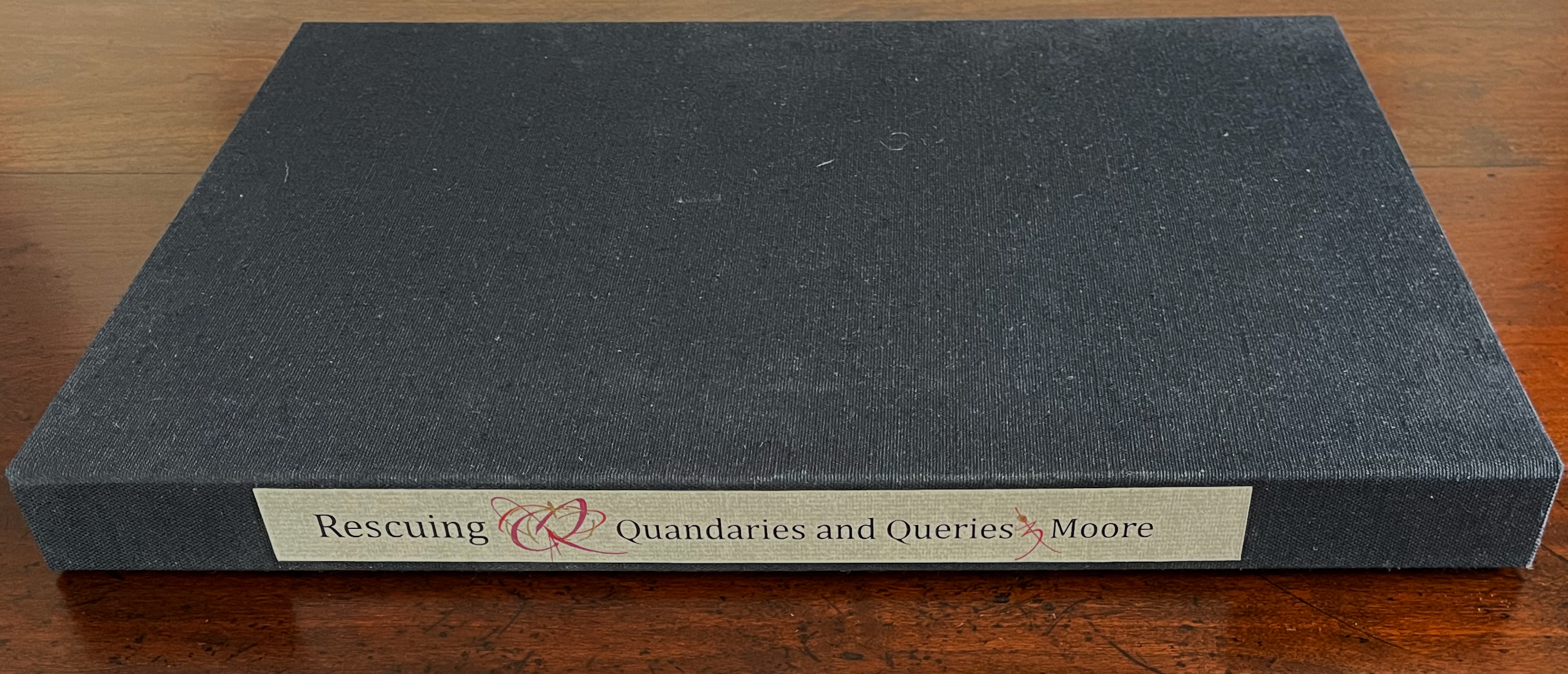
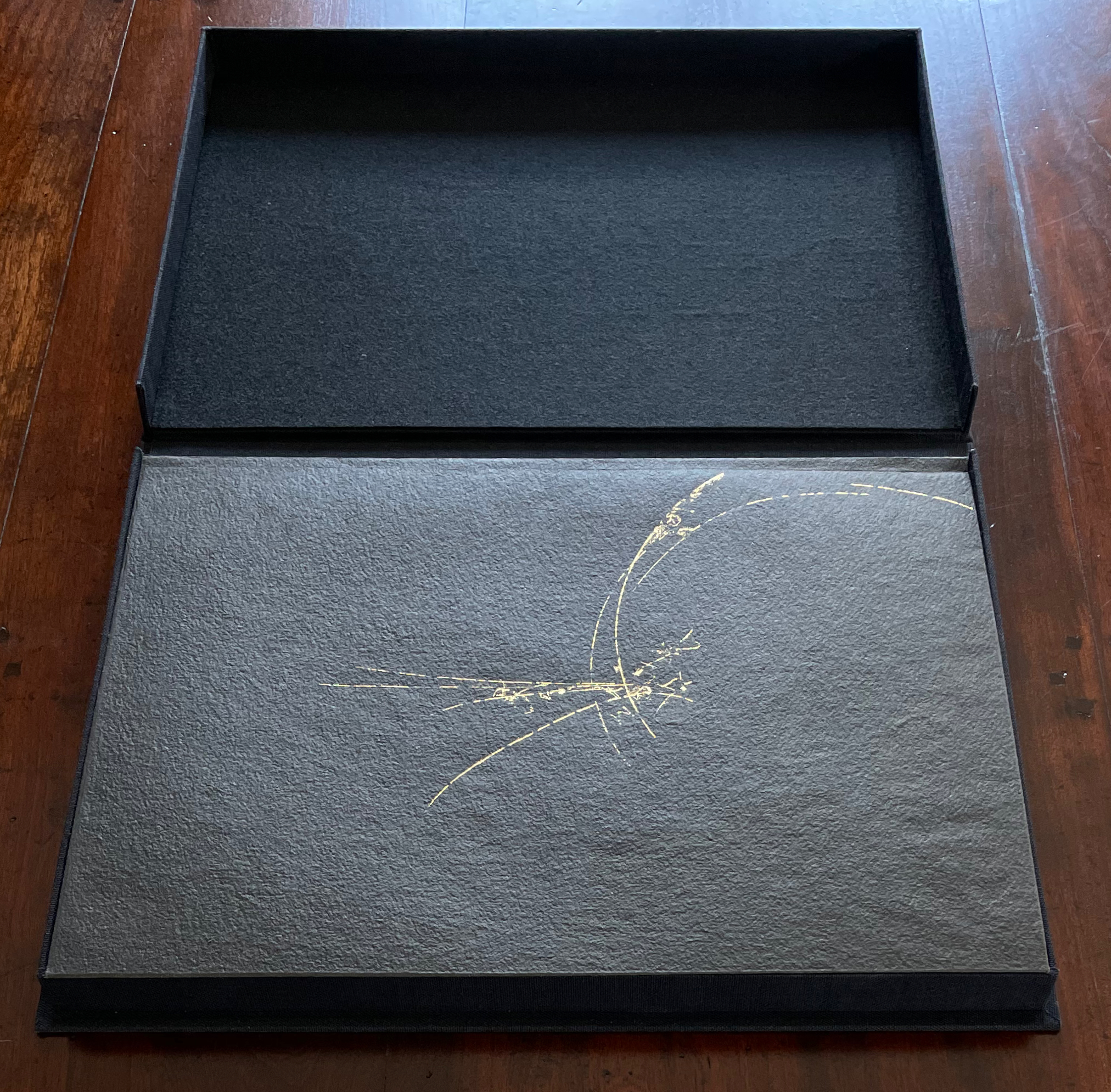
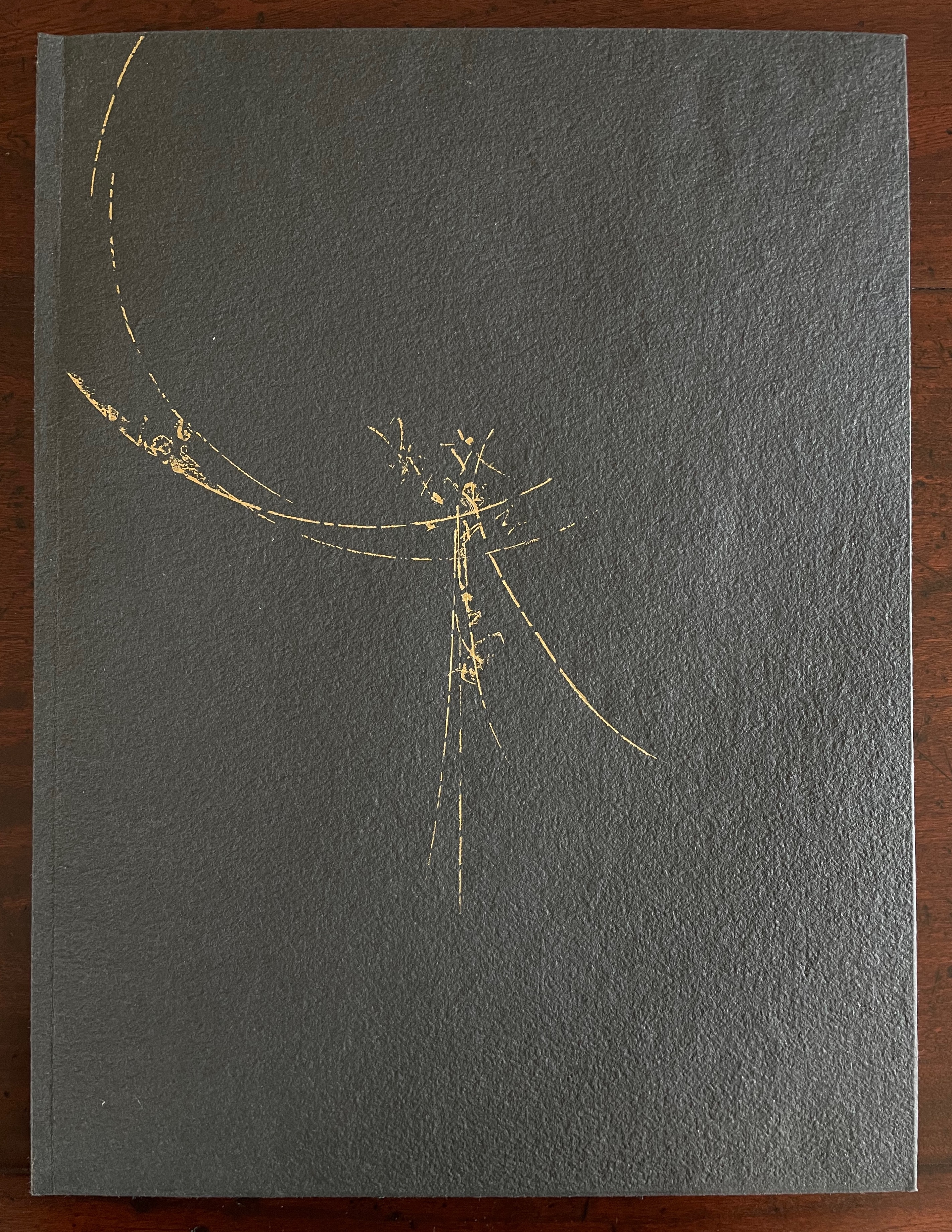
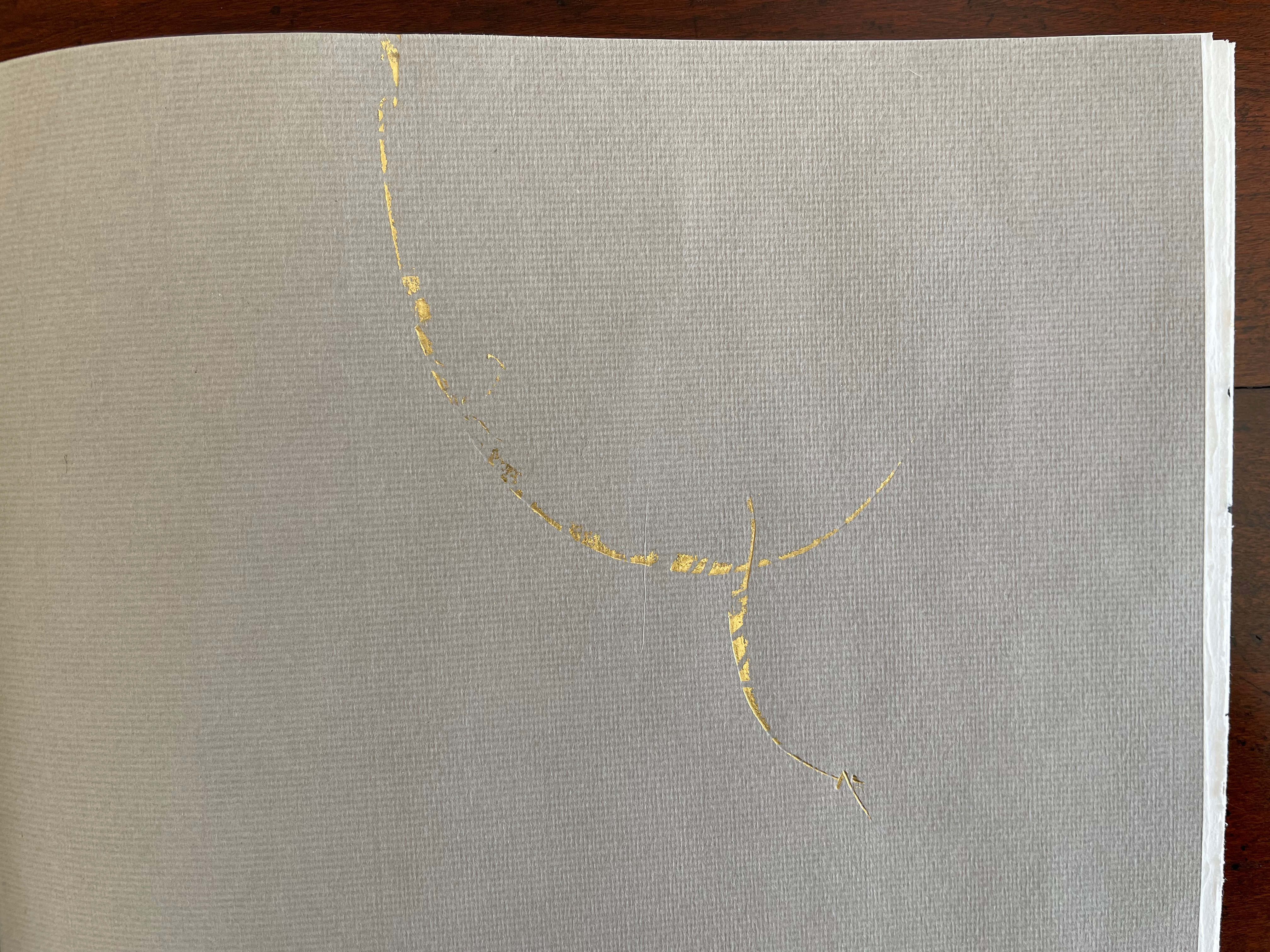
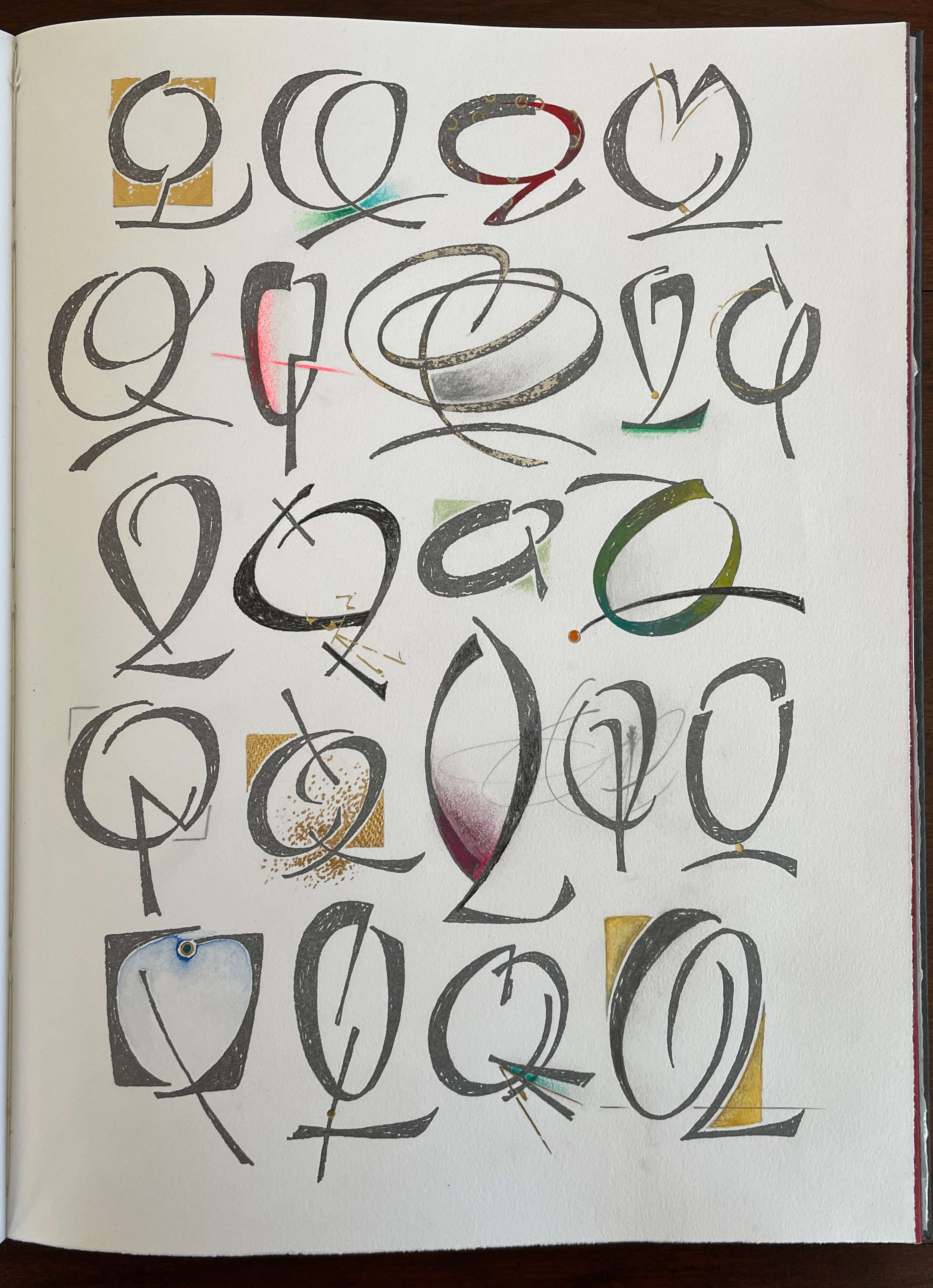
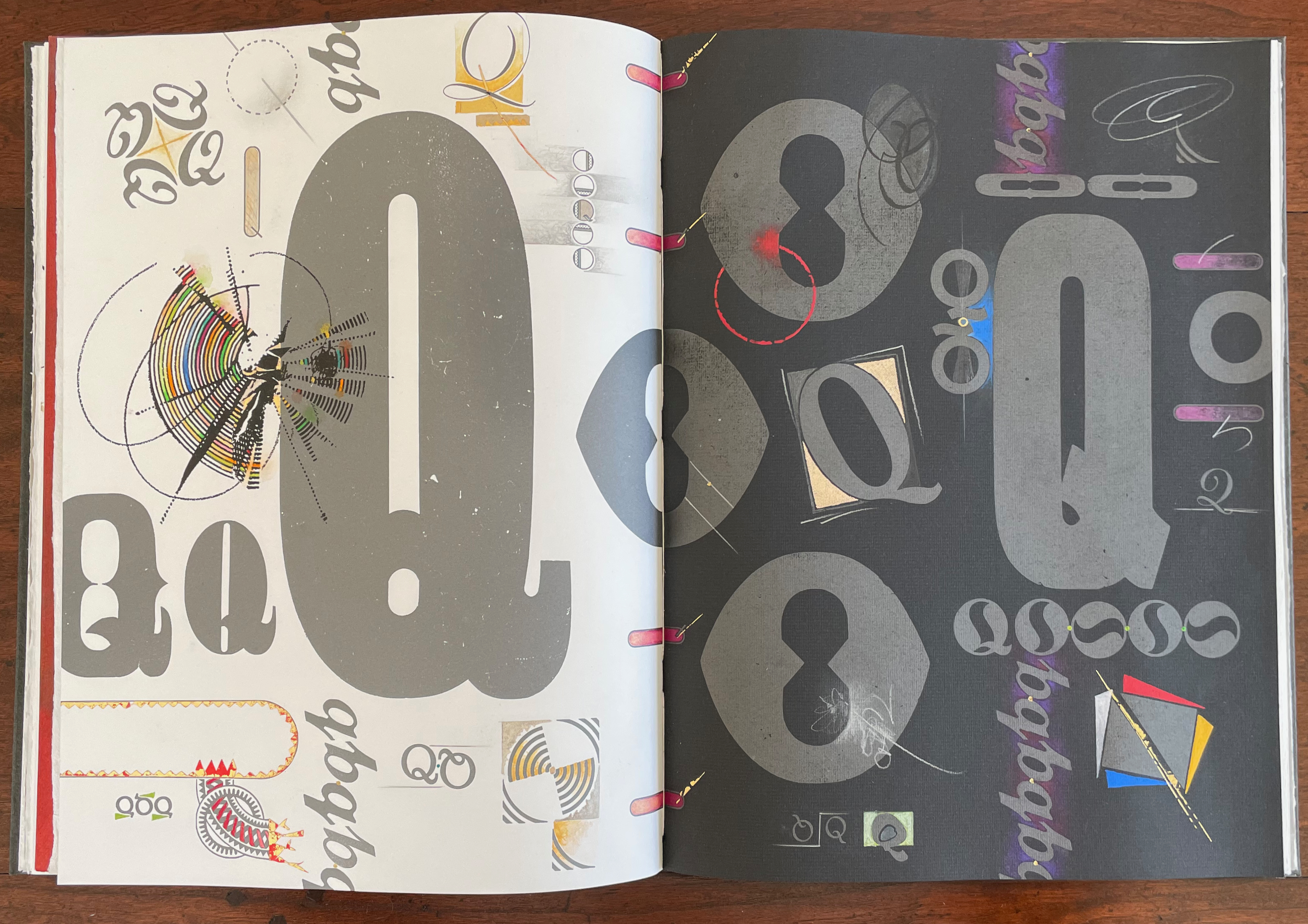
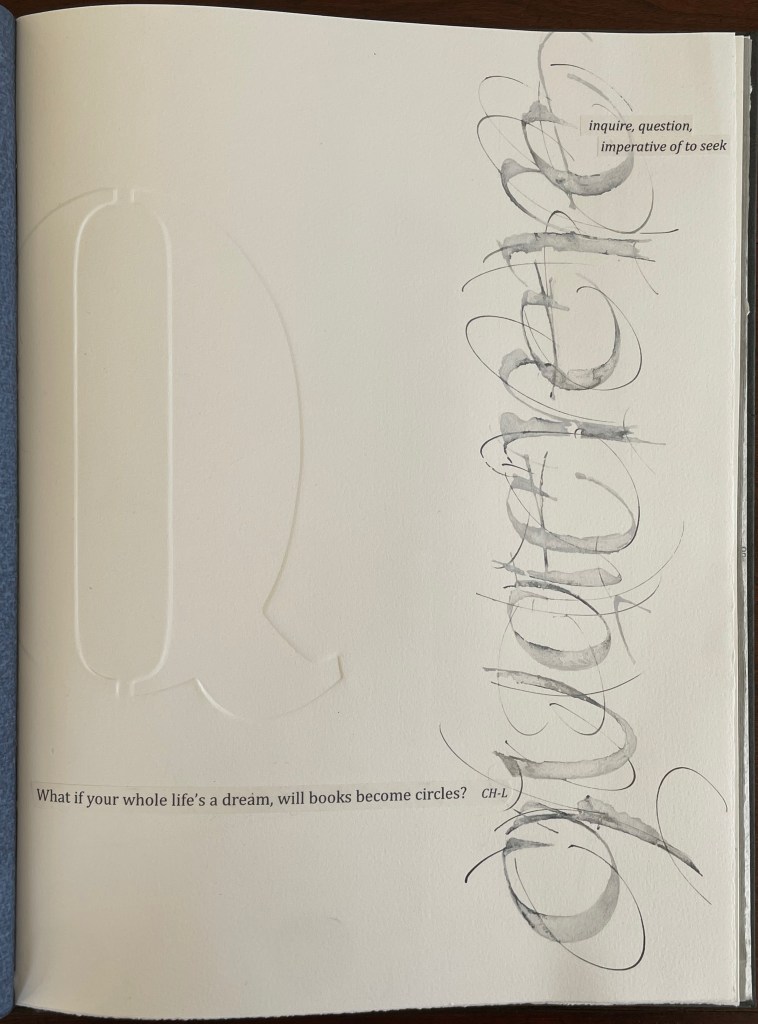
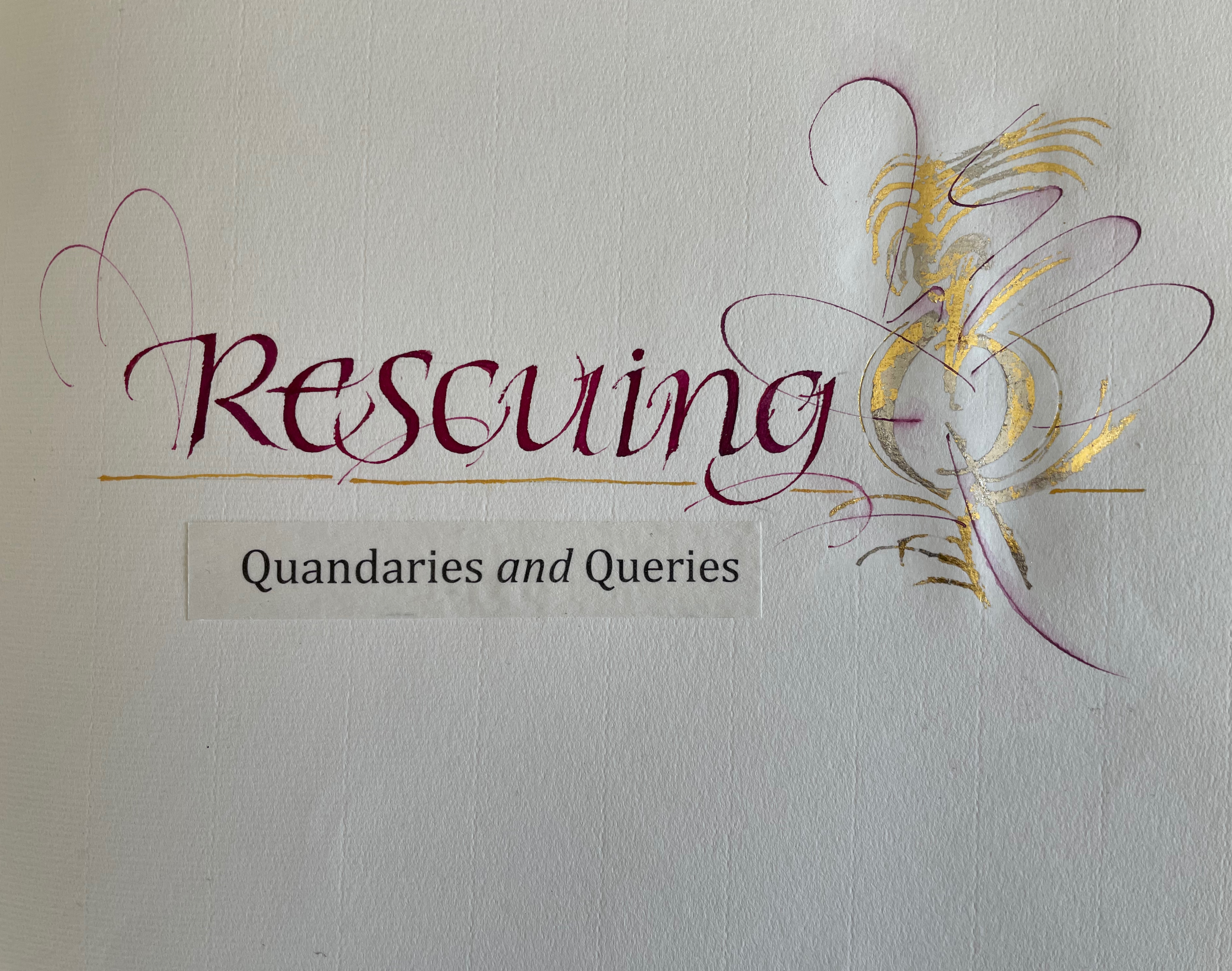
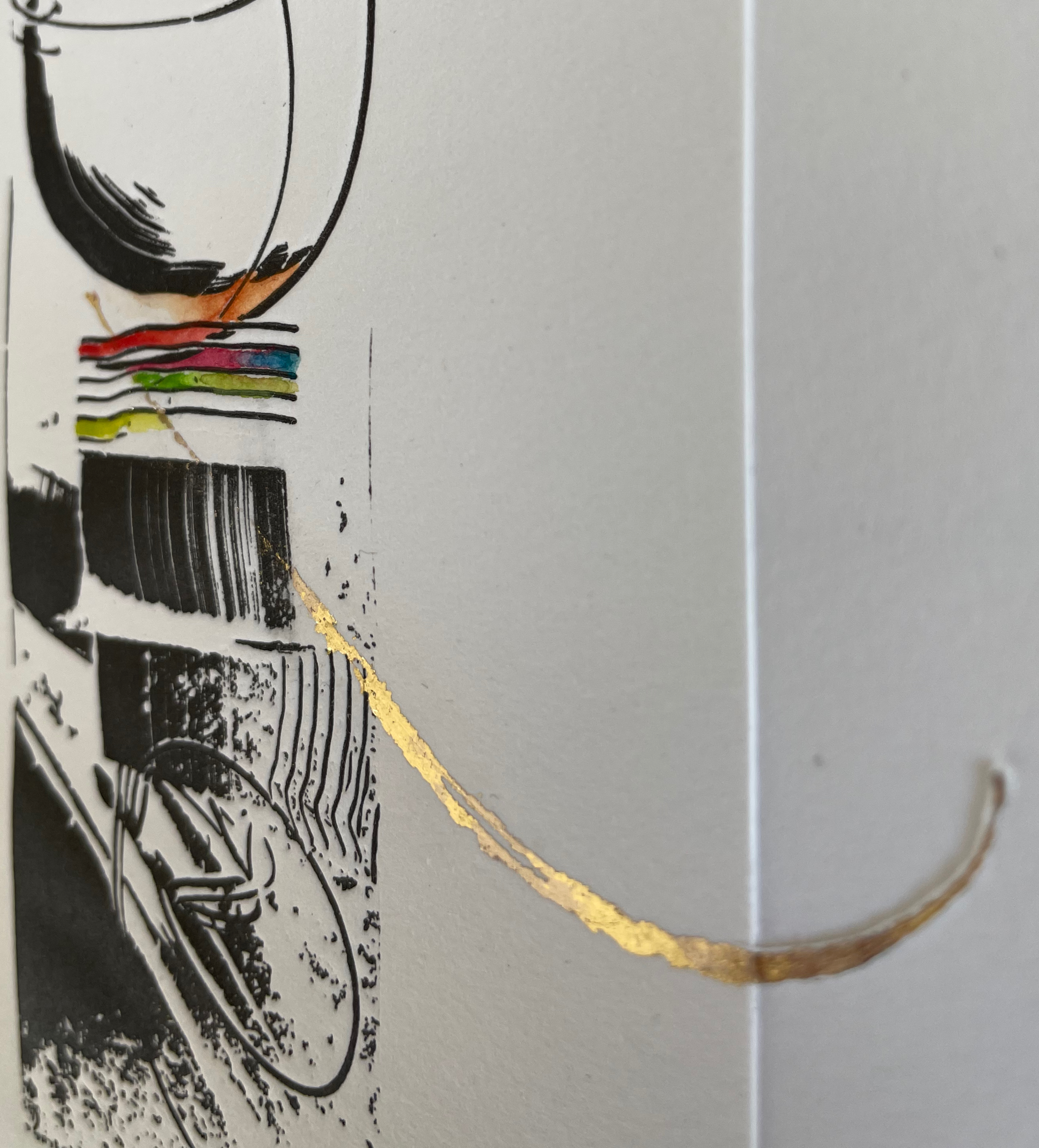
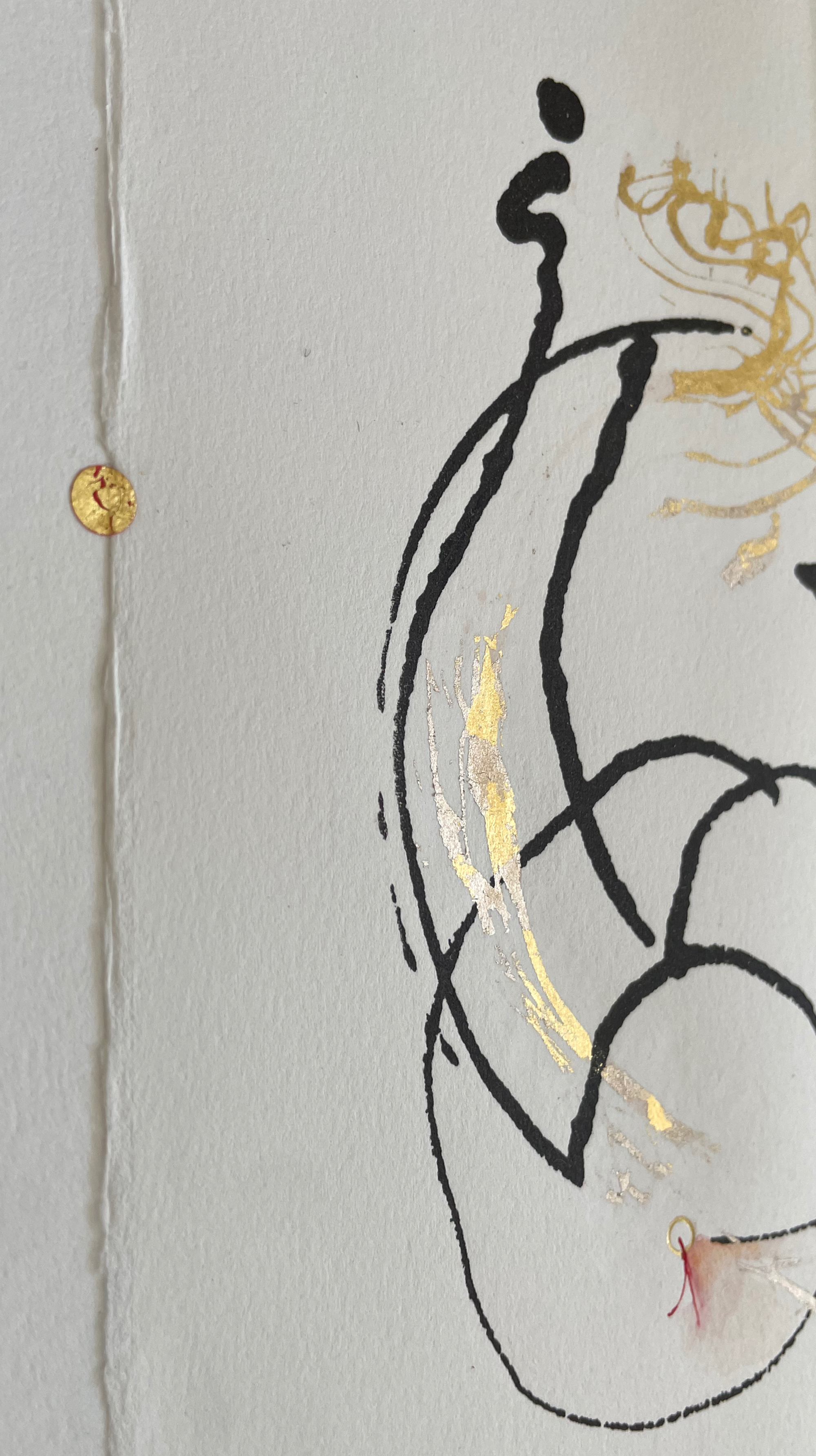
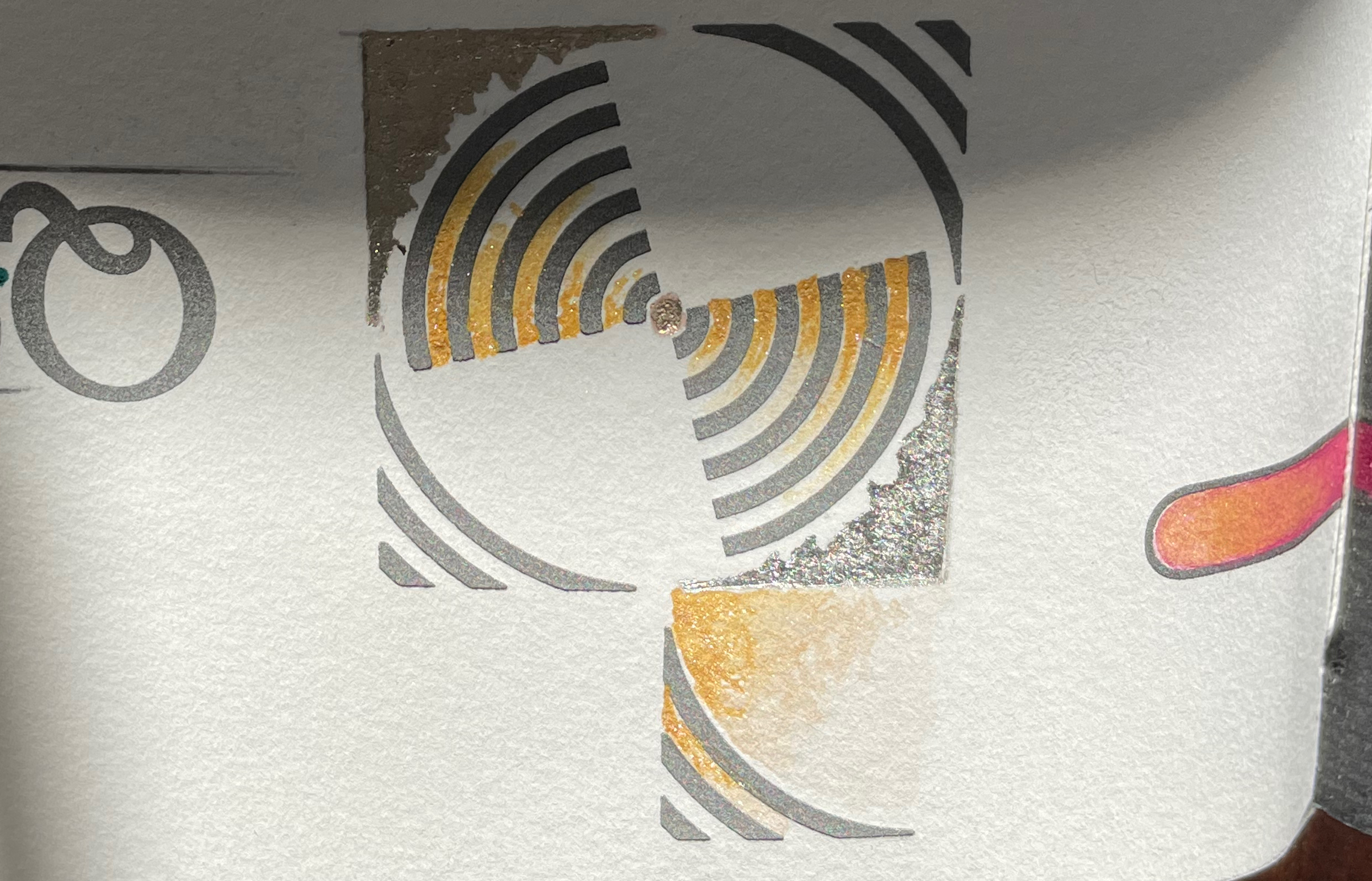
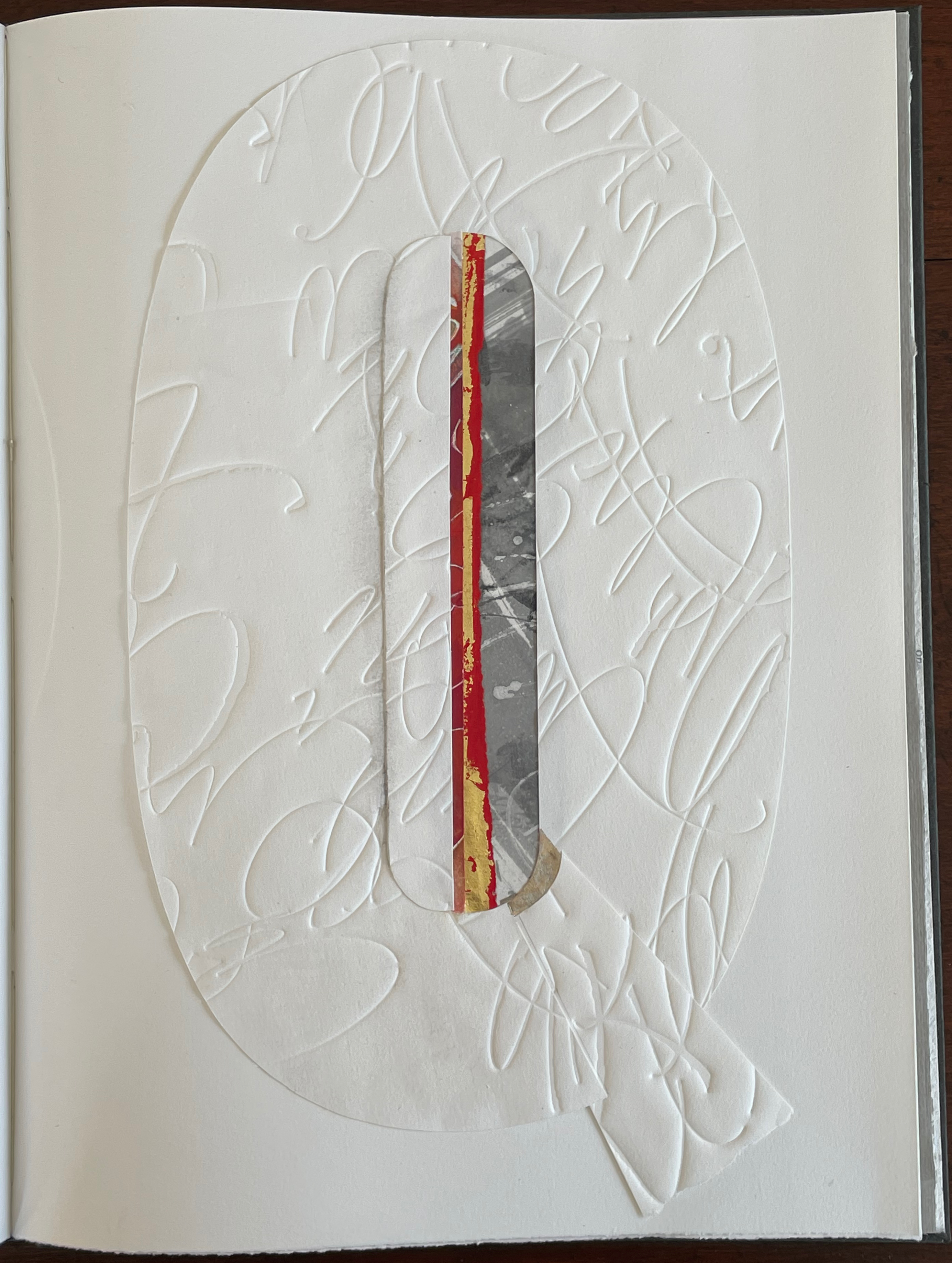
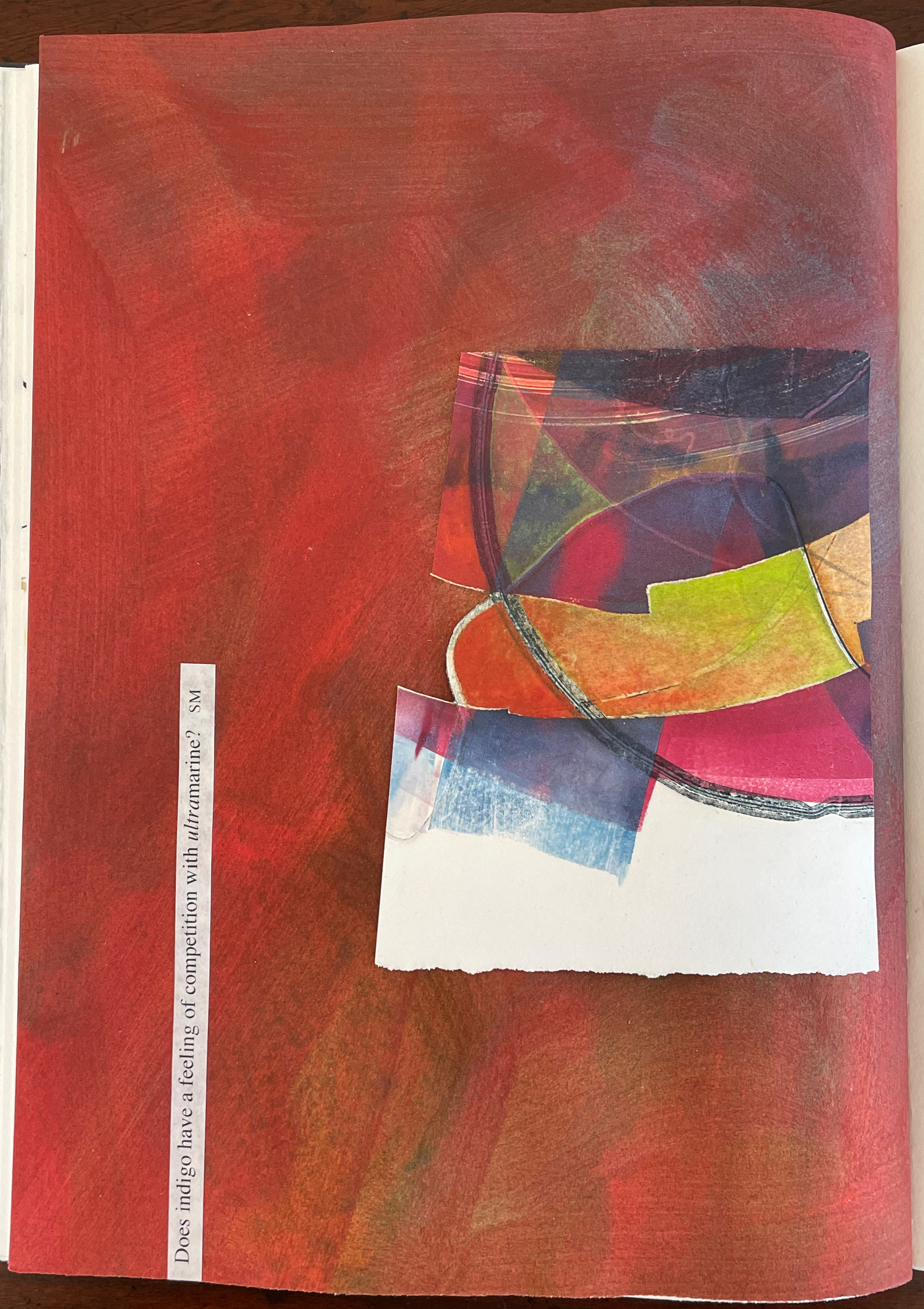
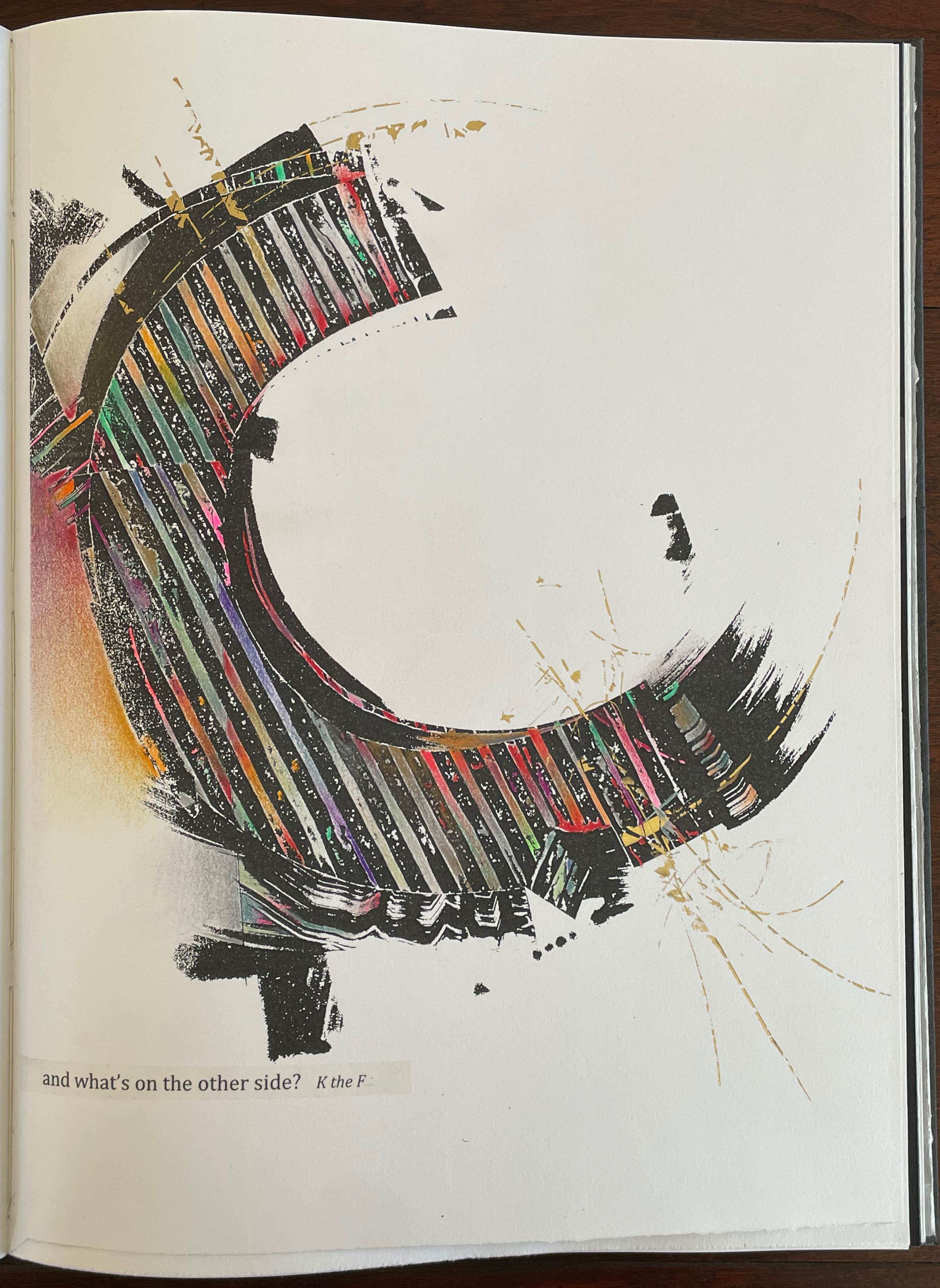
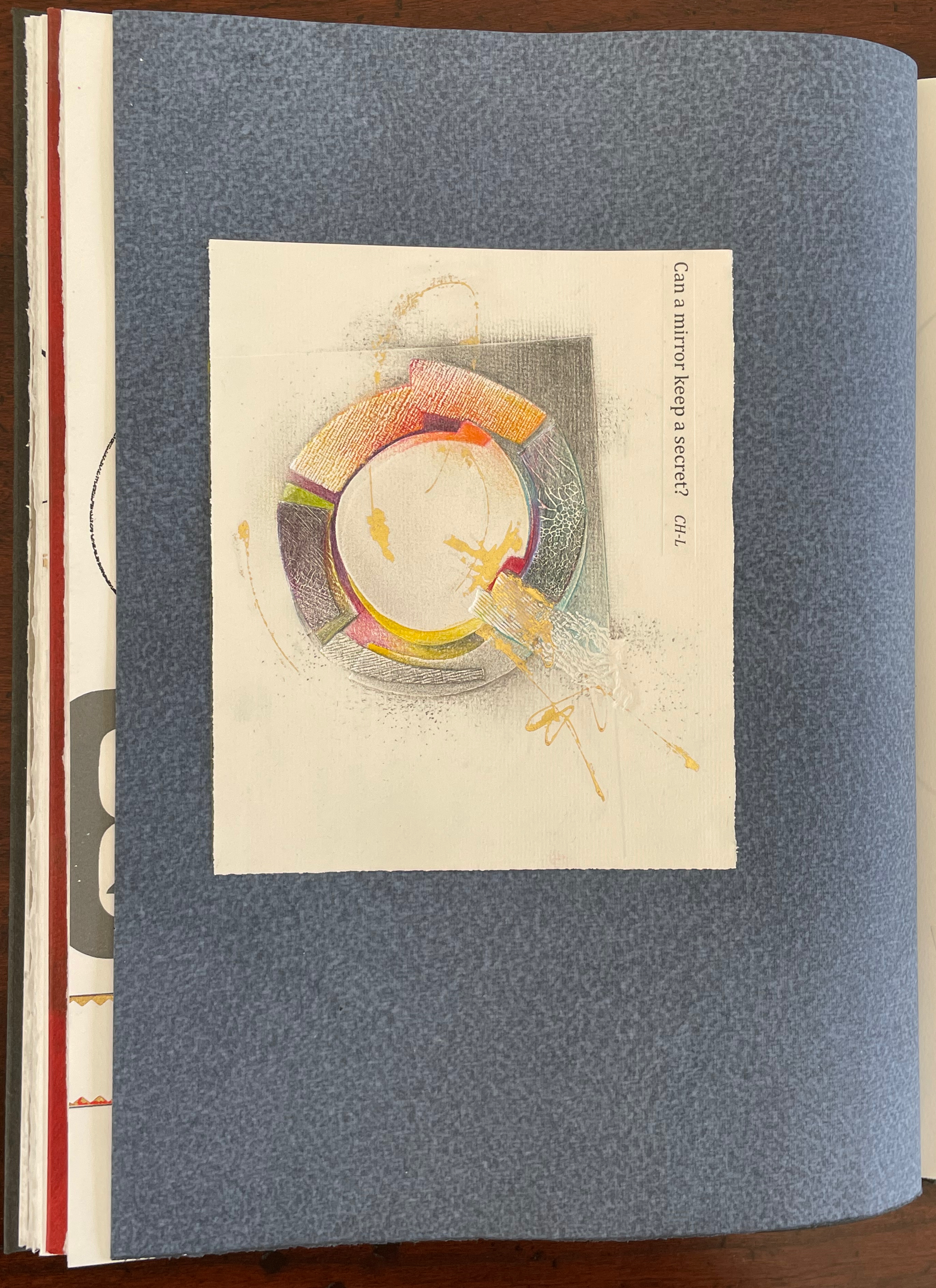
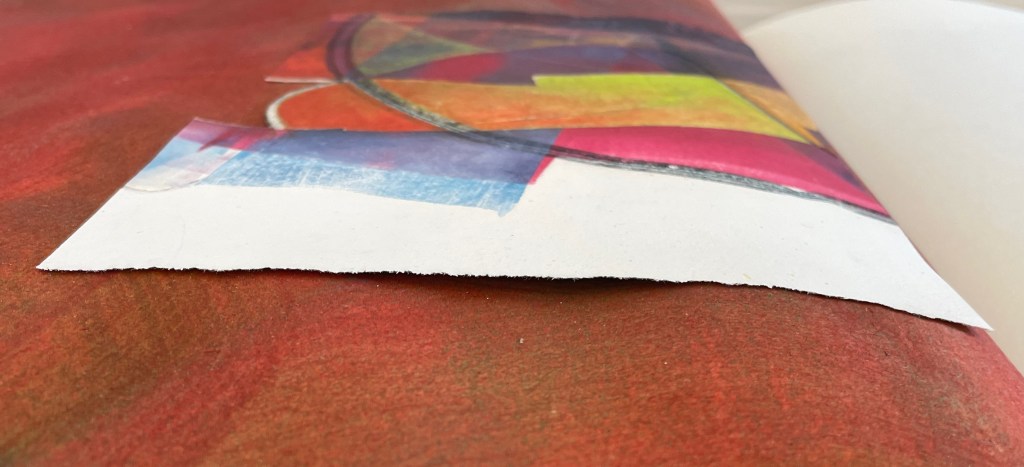
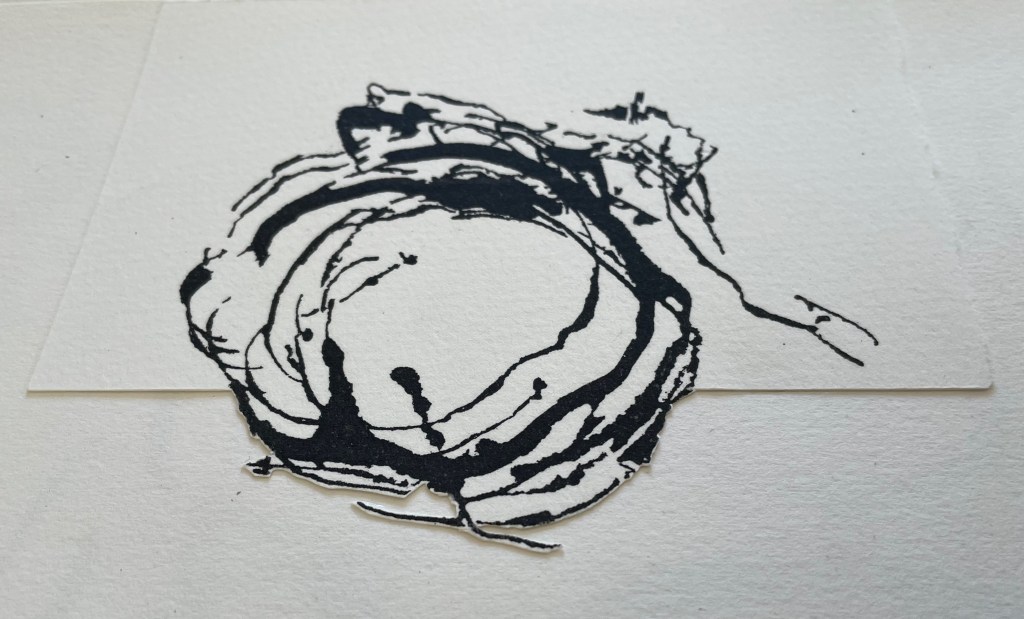
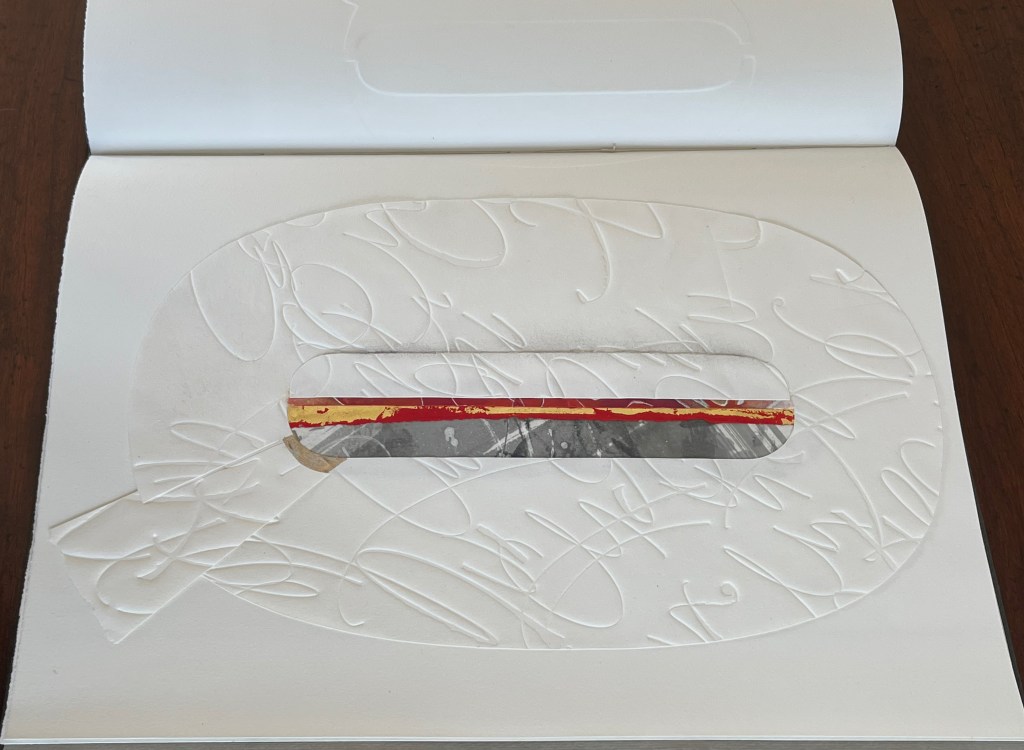
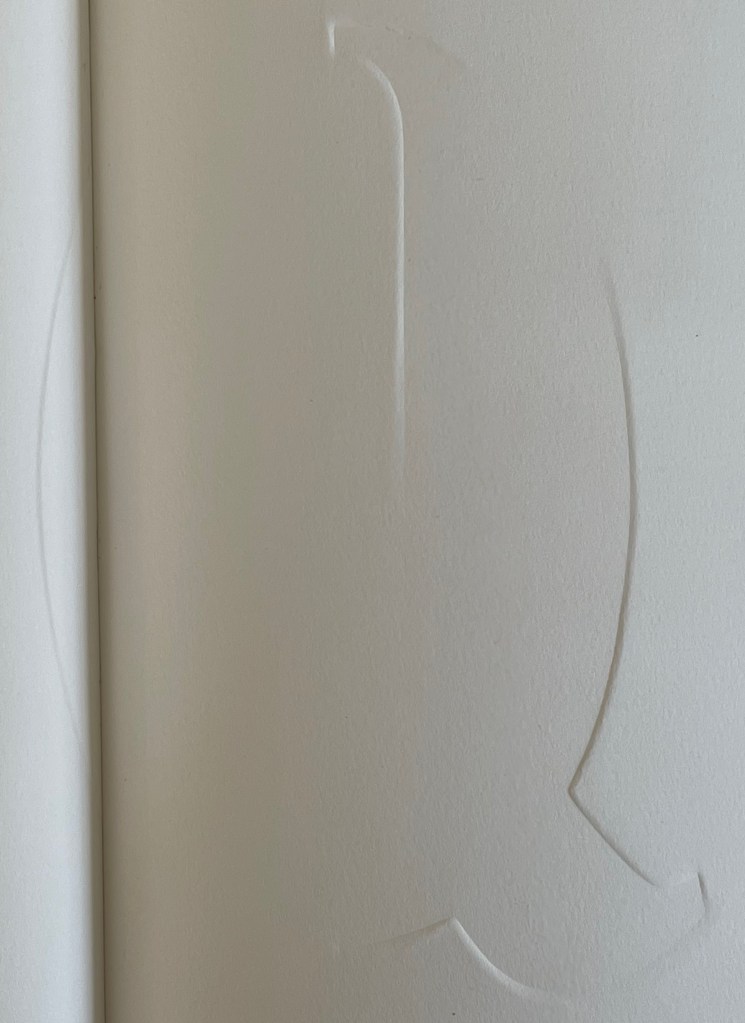
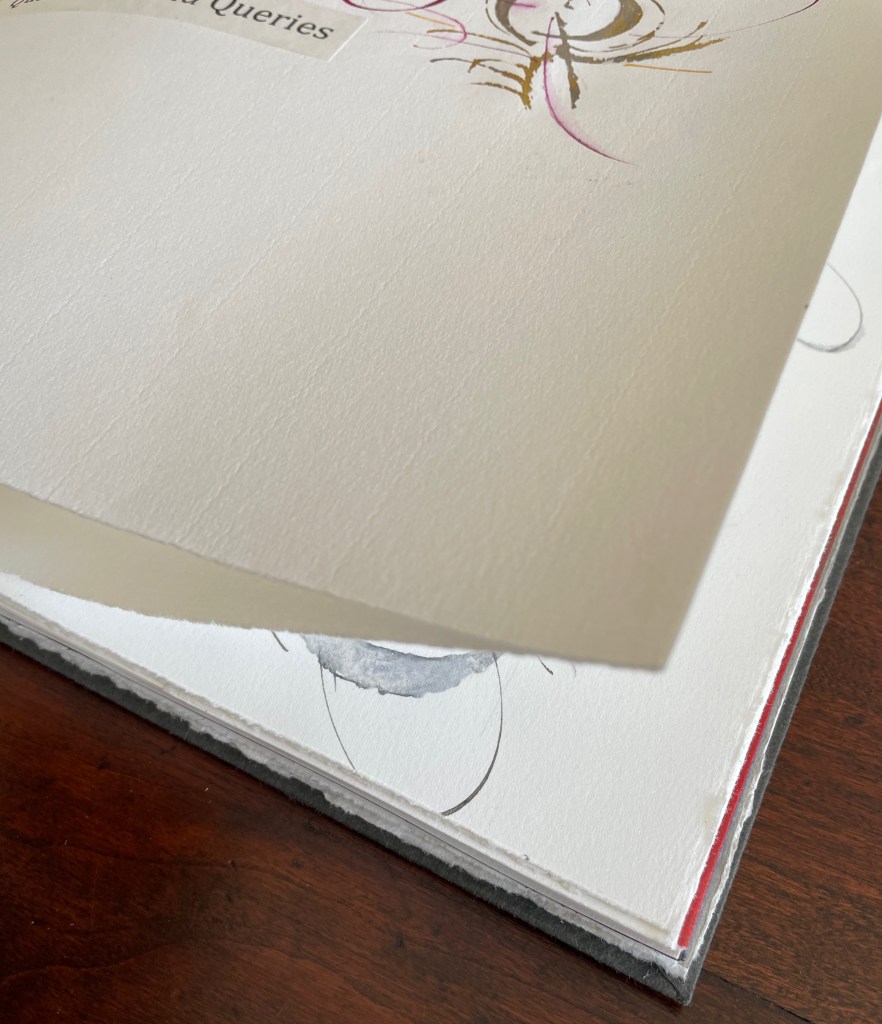
Rescuing Q (2023) Suzanne Moore Box enclosing softcover book. Box: H400 x W300 x D30 mm. Book: H380 x W285 mm. 32 pages. Printing by Sandy Tilcock (and Phoebe) at Lone Goose Press and Jessica Spring, Springtide Press. Unique edition. Acquired from the artist, 25 April 2023. Photos: Books On Books Collection. Displayed with permission of the artist.
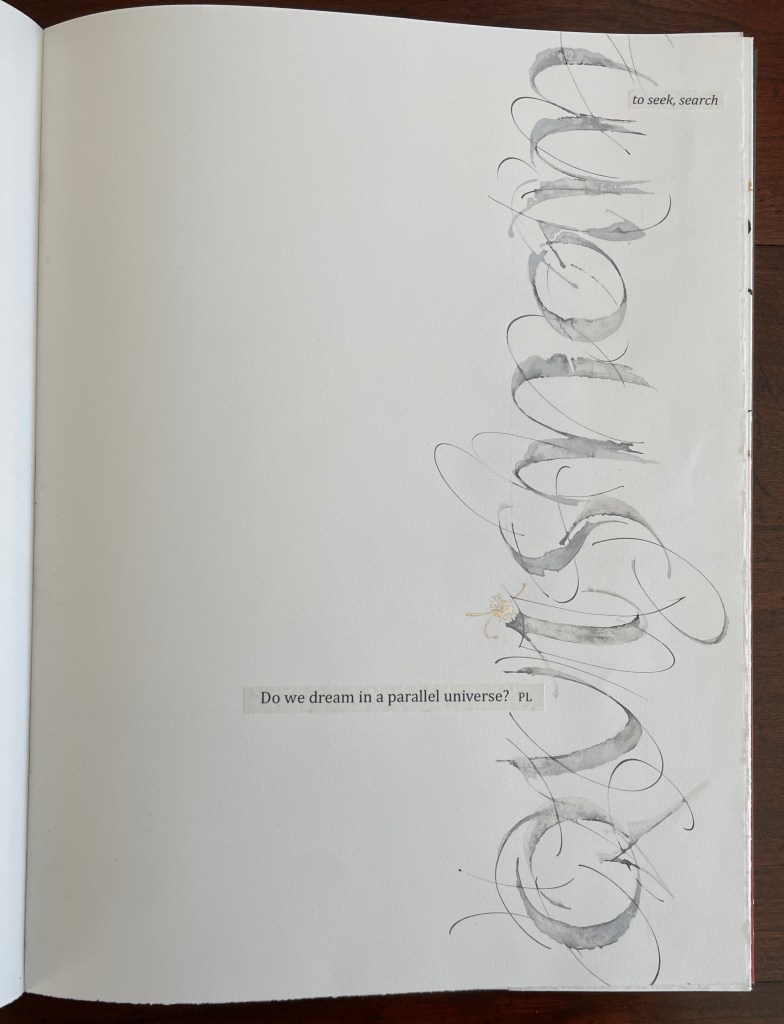
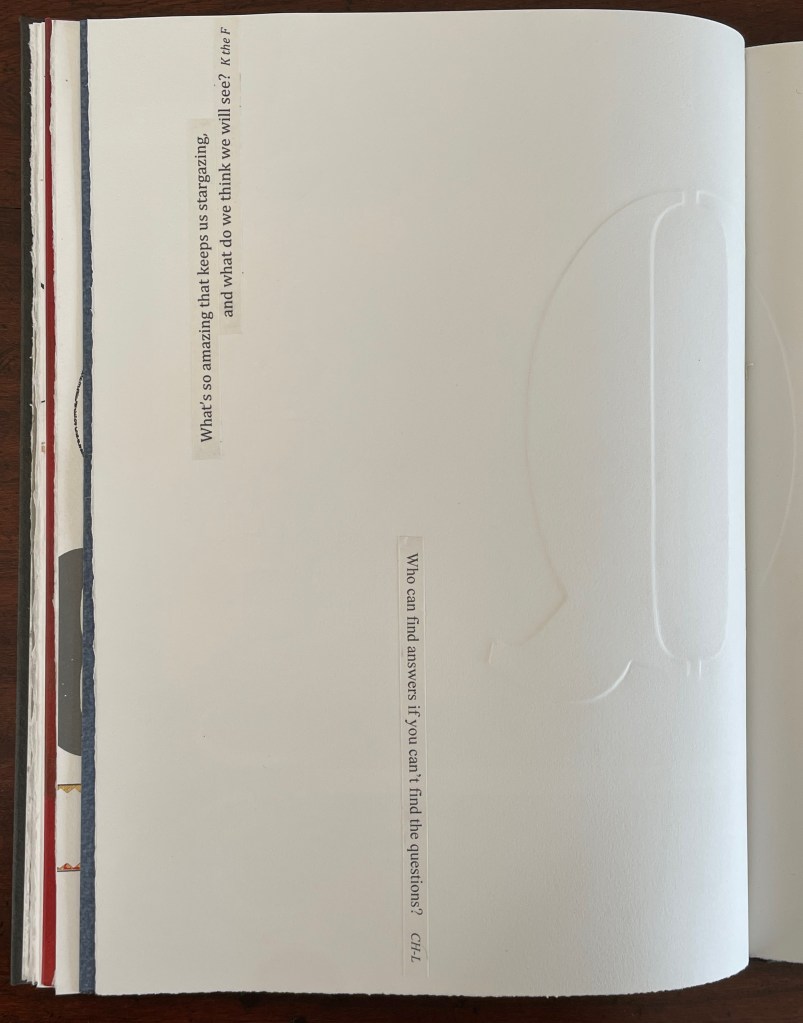
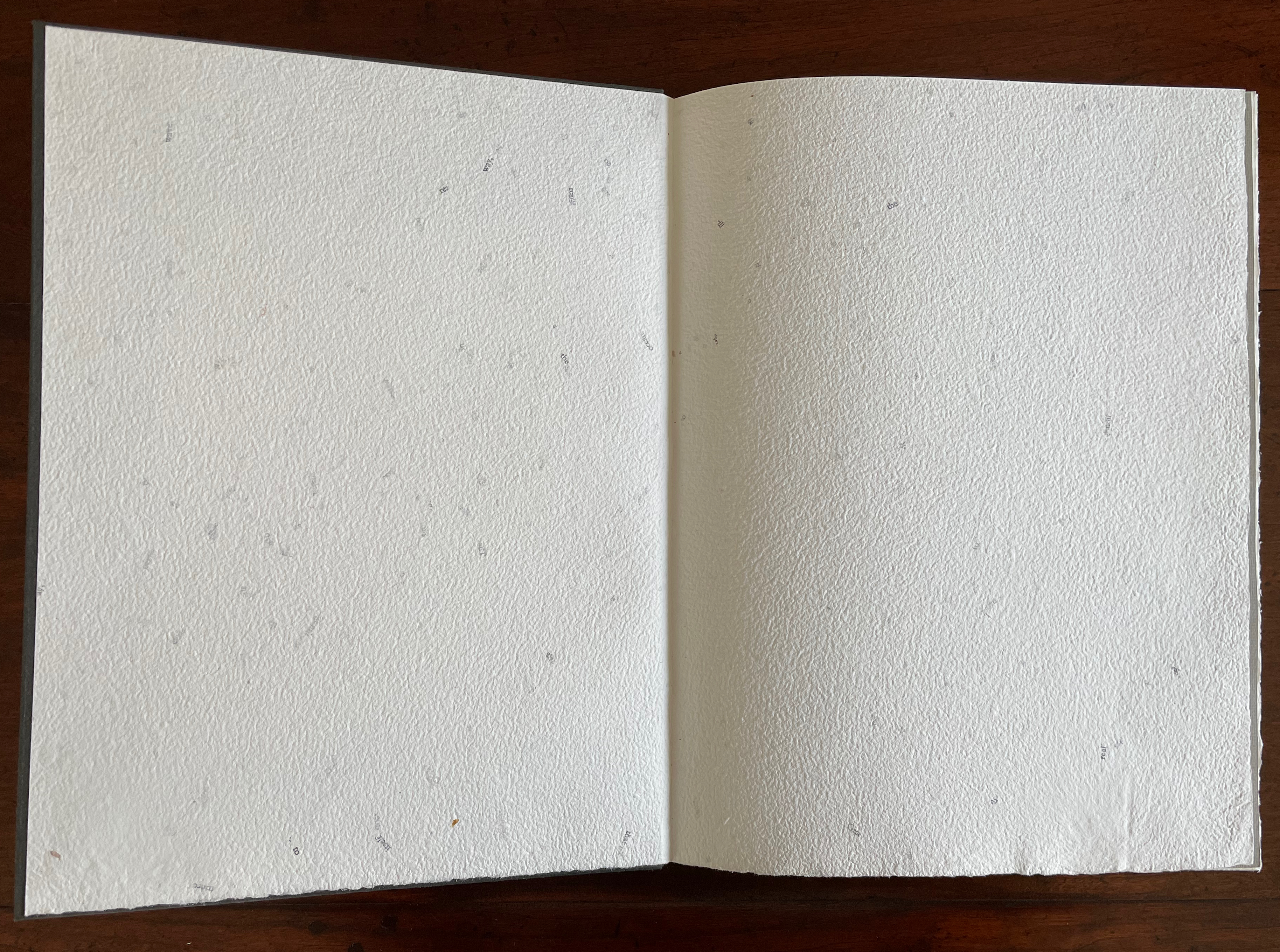
Rescuing Q is a manuscript book, consisting of original paintings, monoprints, collage, pigmented prints, embossing, debossing, gilding and handwork complementing the letterpress printing. It is one of several such works designed and created by Suzanne Moore after more than 20 years of experimentation.
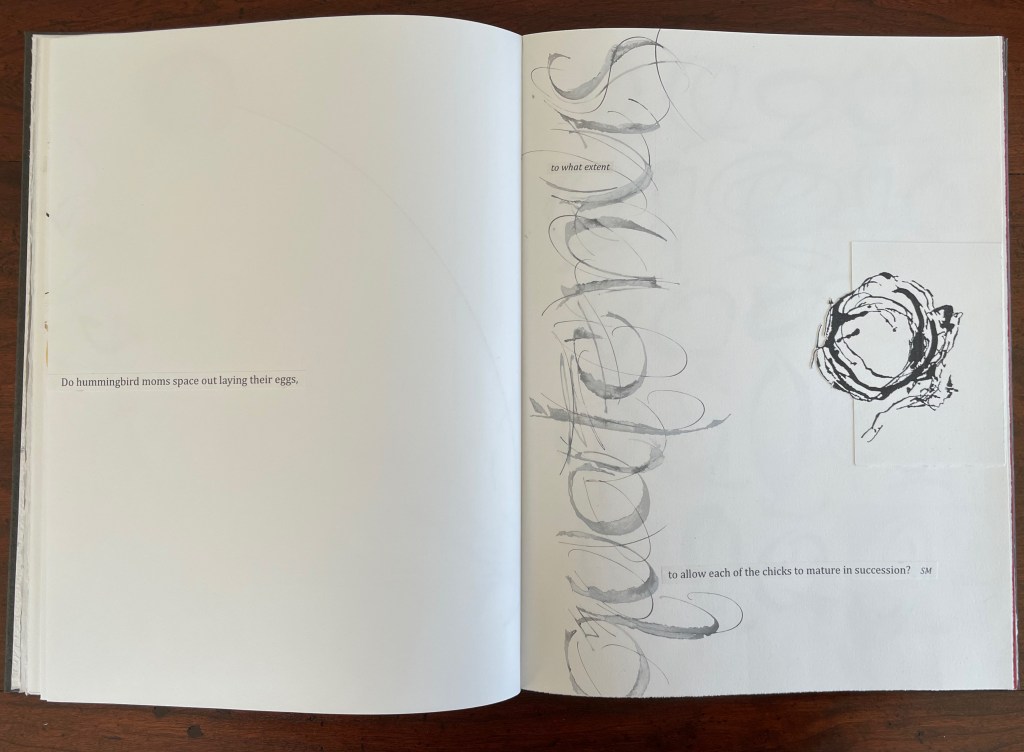
Q is not normal. Q is quirky. Q floats away. Q comes in too many shapes and sizes and colors. So attractive, Q was bound to be hijacked by Q-Anon, political operatives and social anarchists.
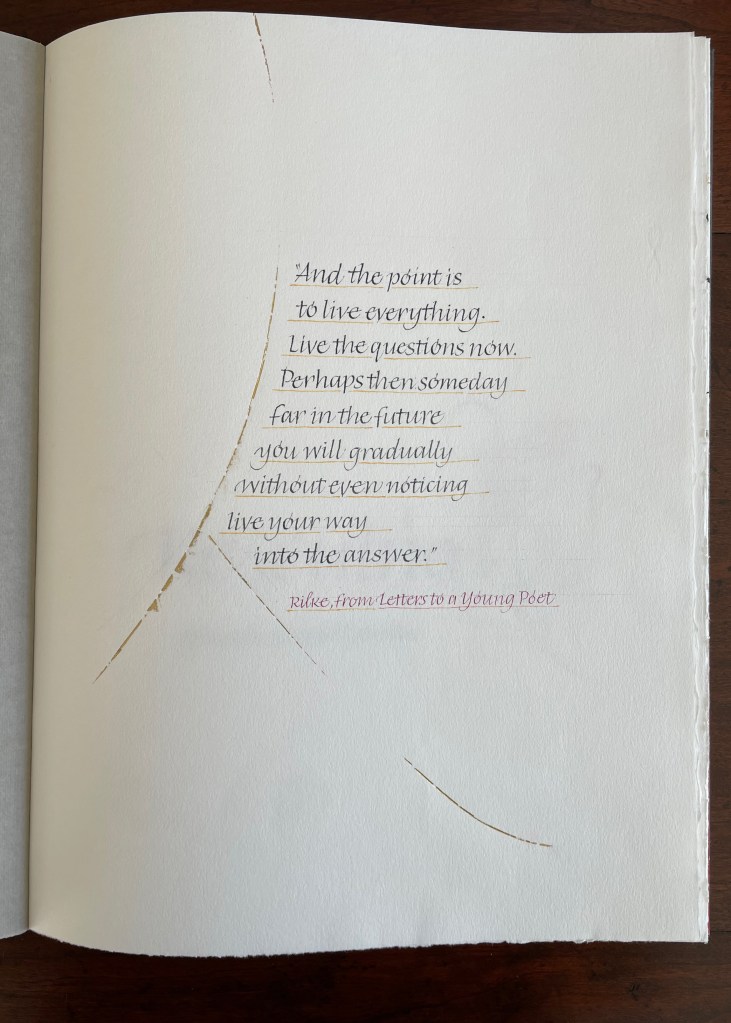
But Q will not remain captive for long because it is always asking questions. And, if we want answers, then as Rilke says, we must “live the questions now”.
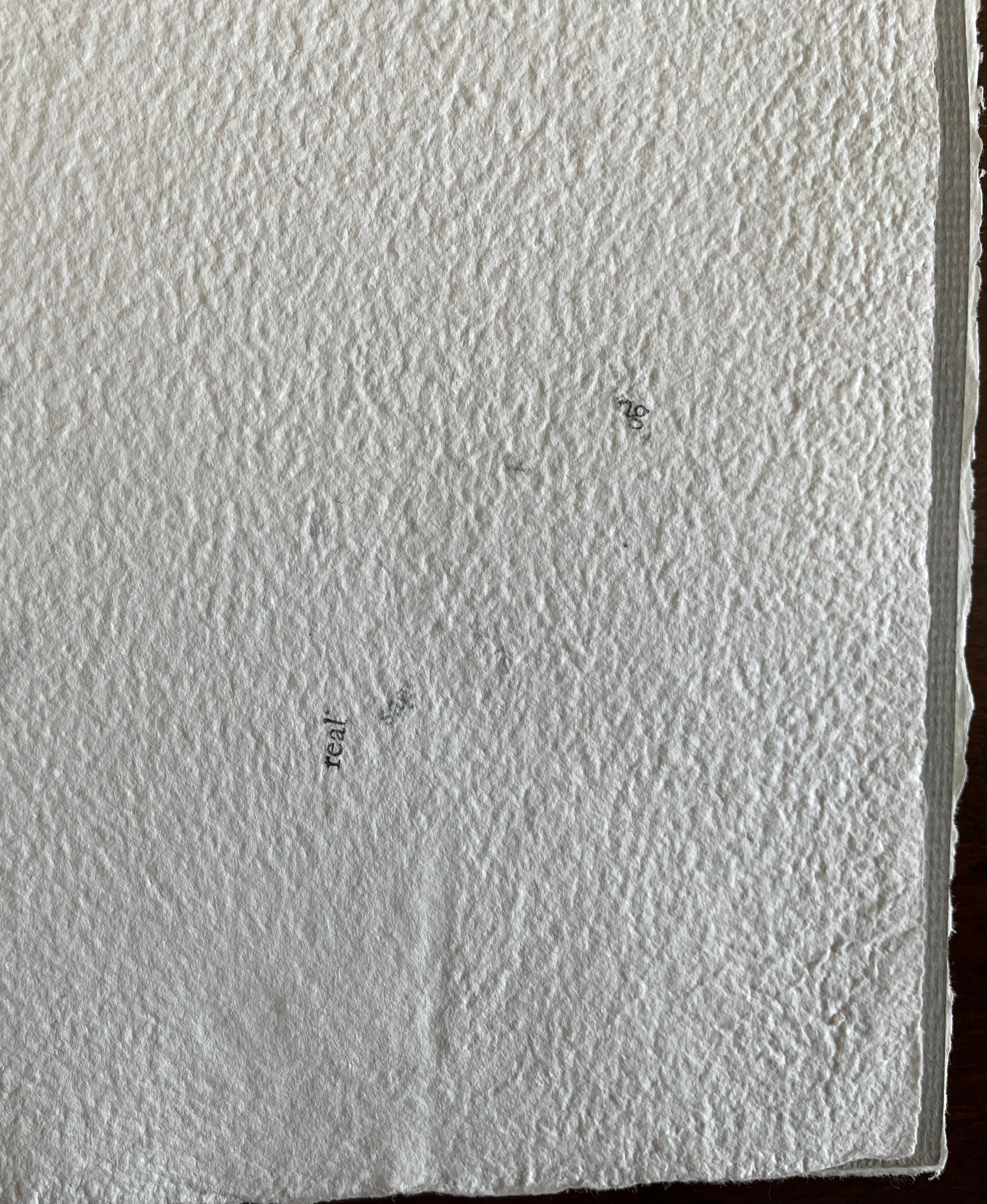
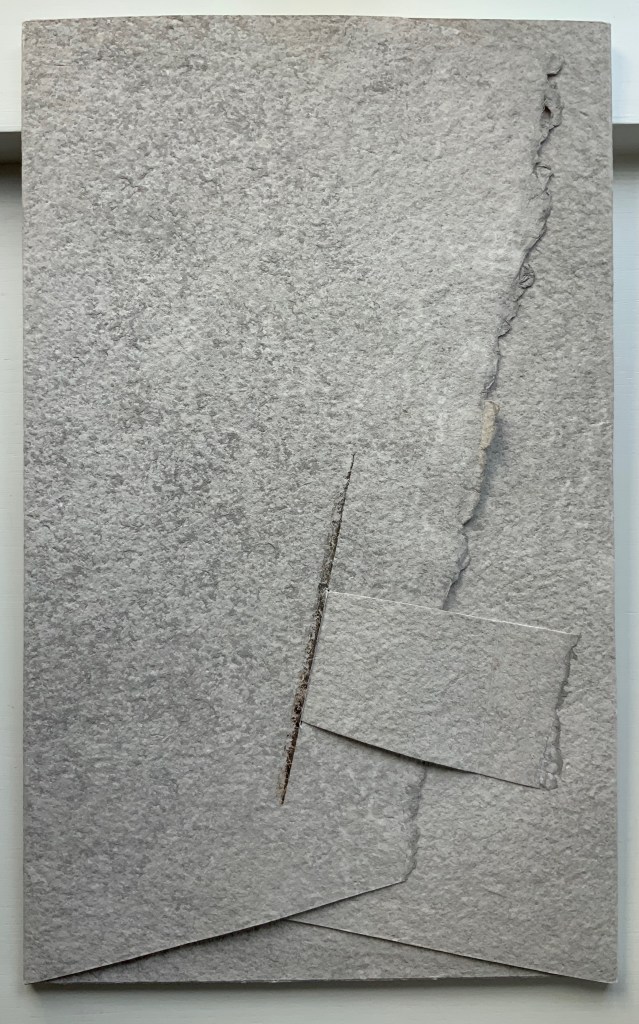
For most readers though, the question that will be uppermost is “How did she do that?” Moore is quick in her generosity and would insist on amending that question to “How did they do that?” Consider the selection of paper. More than Arches (a laid paper with visible mesh and watermark) had to be considered for these interactions of ink, gouache, gold leaf, palladium, debossing/embossing by etching press and hand, cuts and overlays.
What notes, movements and rhythms were playing when these colors and the sequences were chosen?
How do they think of paper and ink in three dimensions?
Who saw Q and questions in a bird’s nest?
And someone’s memory called up Cave Alphabet paper for the endpapers.
The fact that Moore and her colleagues can do all that (and more) and the fact that their gentle and pointed questions fuse with the art ensure that Rescuing Q does and will succeed.
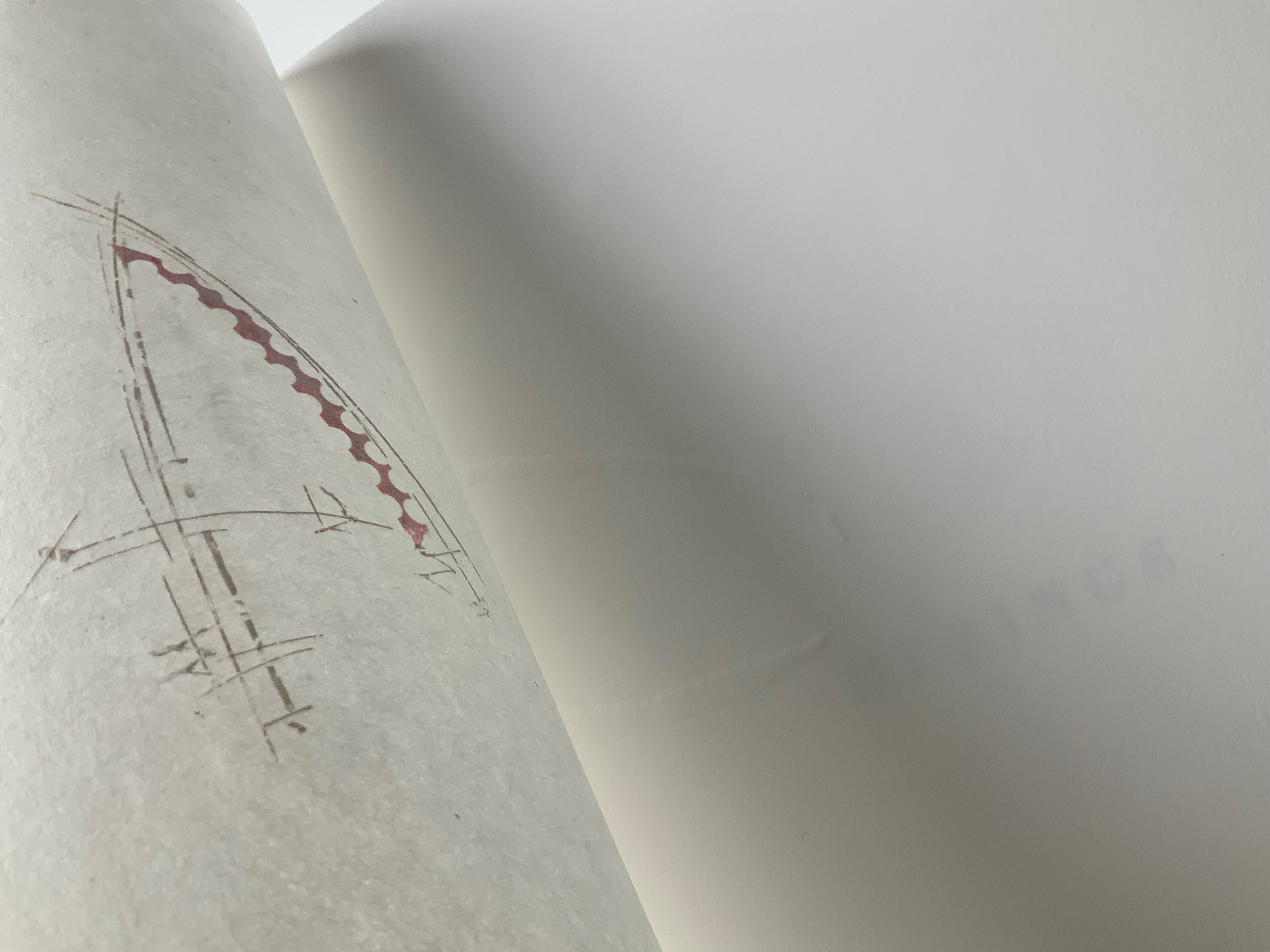
A Musings (2015)
A Musings (2015) Suzanne Moore Tab-insert portfolio around softcover book. H370 x W230 mm, 24 pages. Edition of 26 variants, of which this is N. Acquired from Abecedarian Gallery, 13 February 2022. Photos: Books On Books Collection. Displayed with permission of Suzanne Moore.
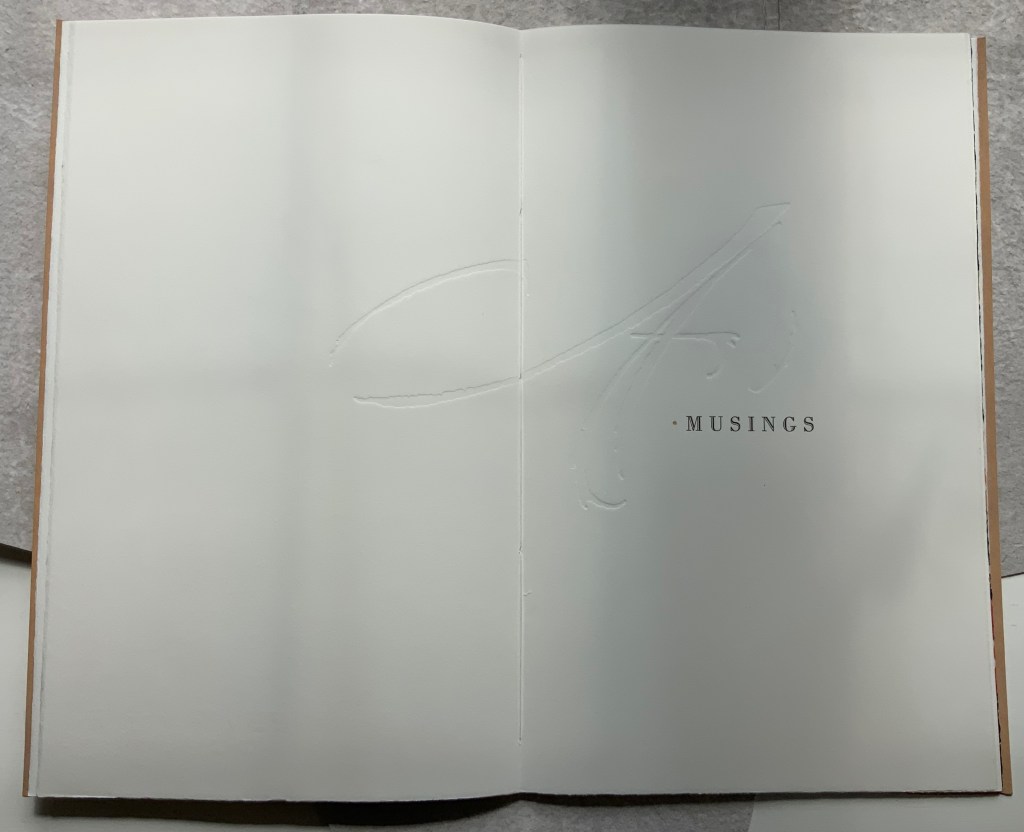
Title page
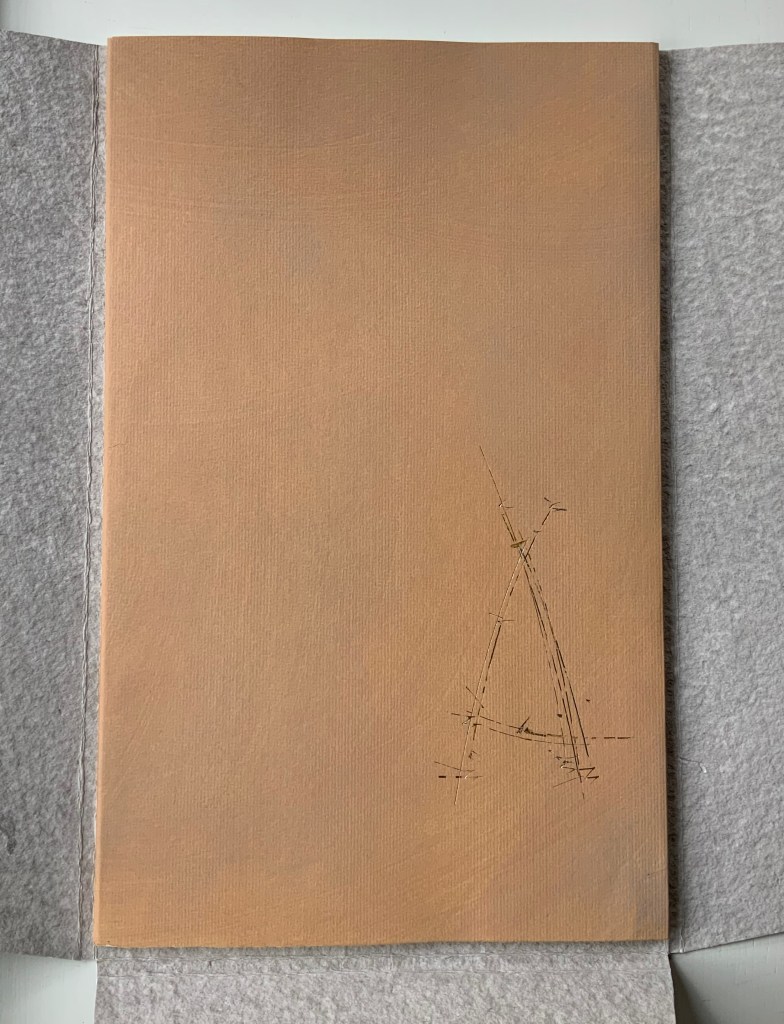
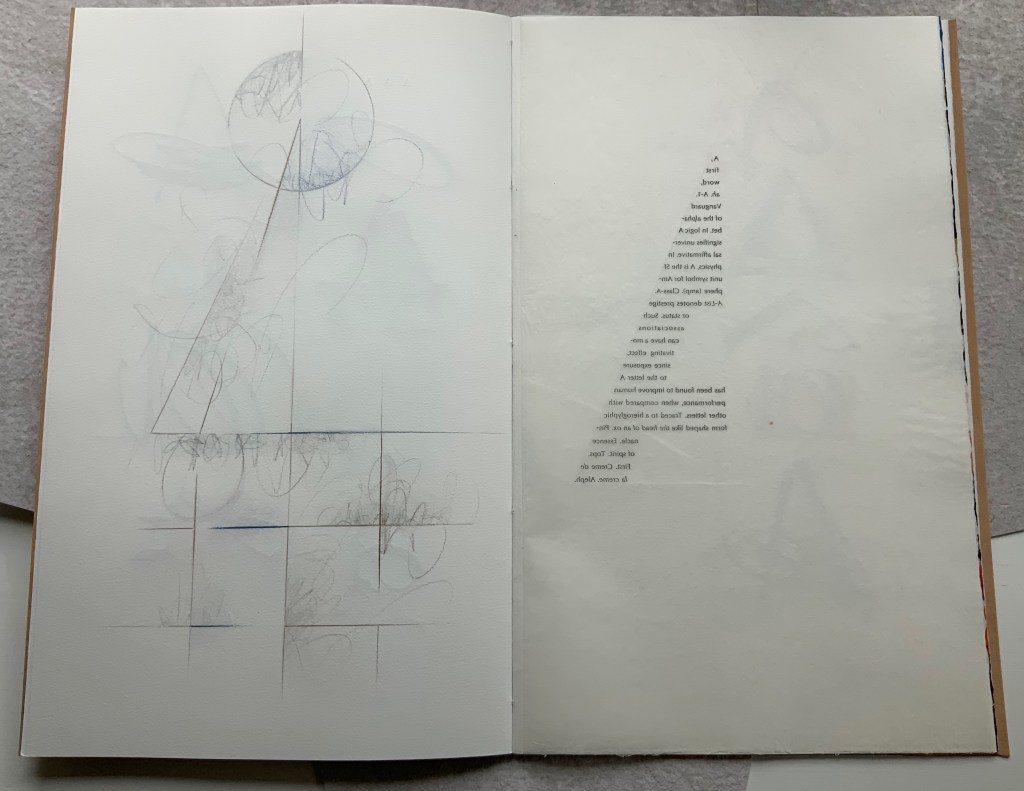
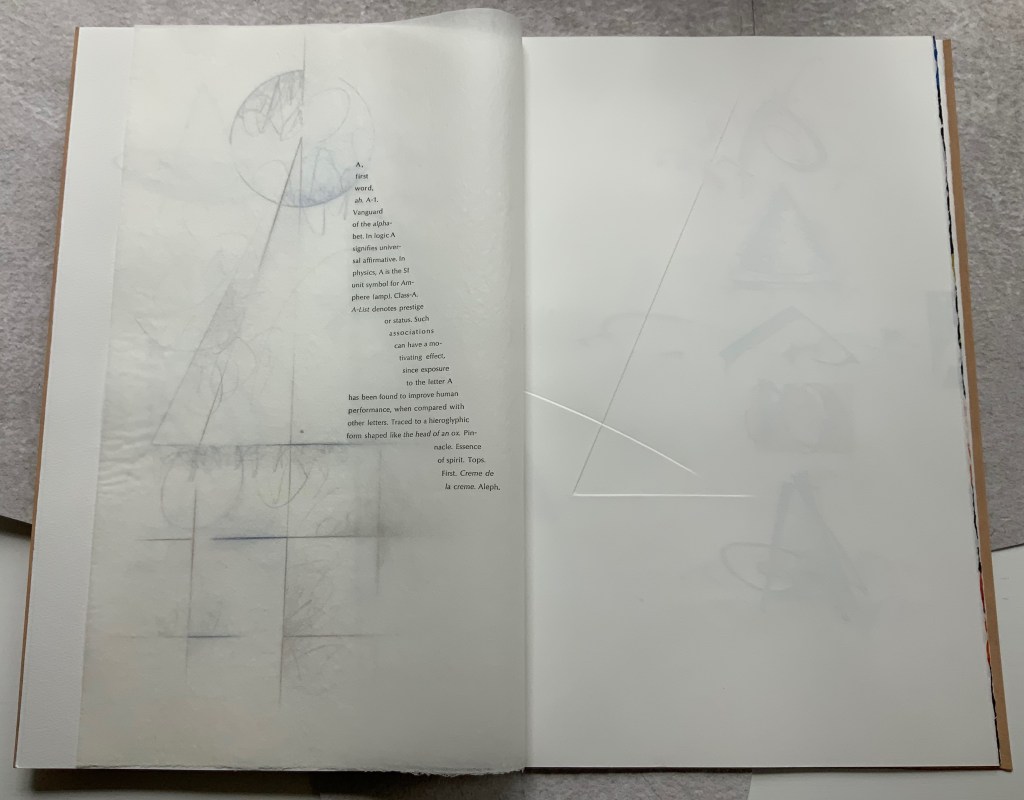
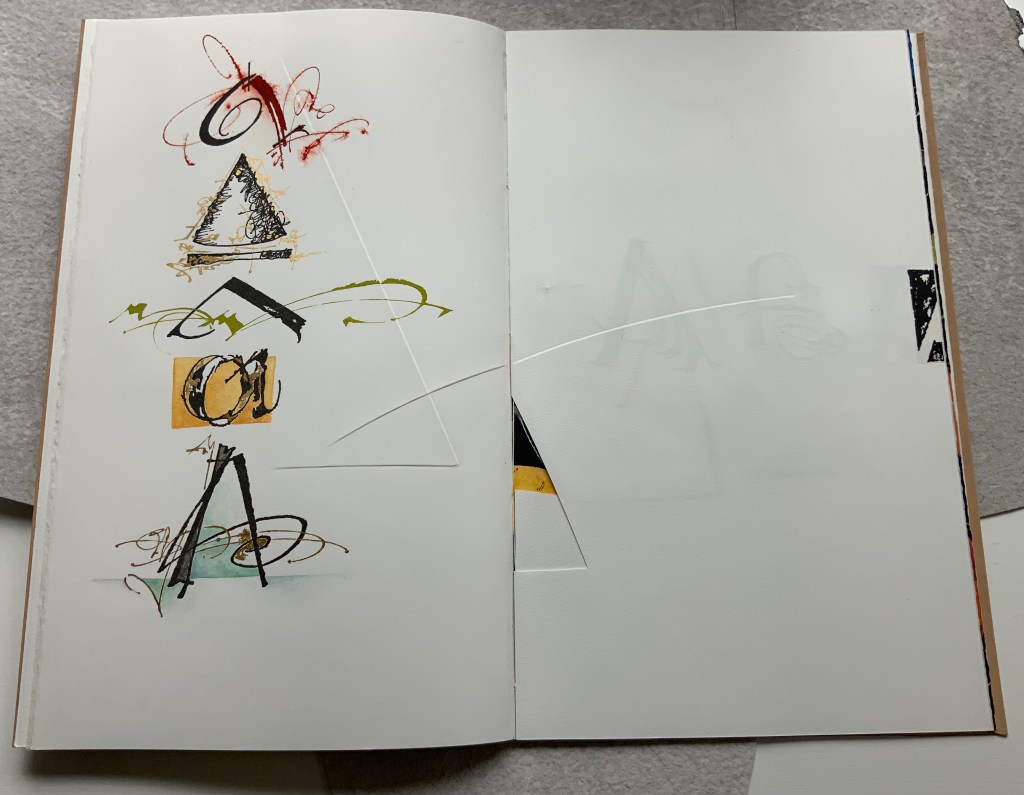
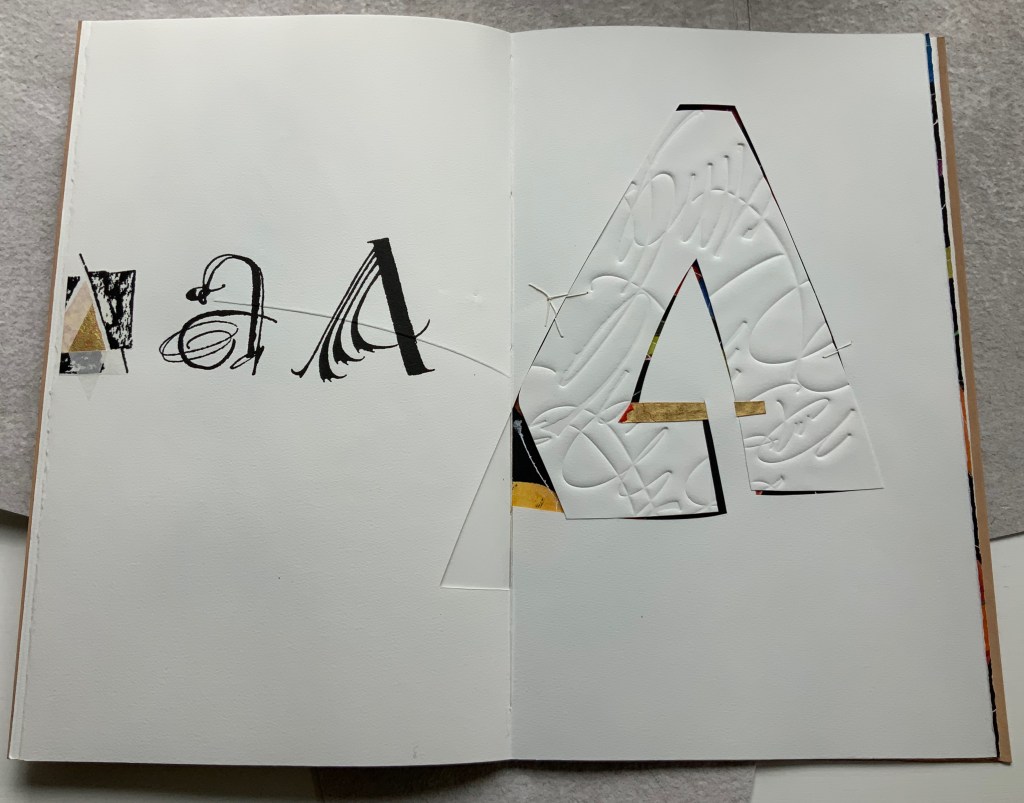
Another manuscript book, A Musings is an encounter between Suzanne Moore and the letter A, one of her 26 muses. As with any artist and muse, this naturally leads to portrayals of A in such varied positions, with such varied tools and techniques and such varied materials that the boxed and bound portfolio must take the amusing title A Musings. The muse finds itself posed across Magnani Aquaforte, Arches Text Wove, transparent kozo and other handmade papers enveloped by a stiffened, painted handmade paper. Moore’s musings fall on the historical, symbolic and spiritual aspects of the letter A with acrylic paint, pencil, freehand foil tooling, gold and palladium leaf, collage, debossing and embossing, sumi ink and gouache, sizing and varnish, monoprint, letterpress, folds and cutouts.
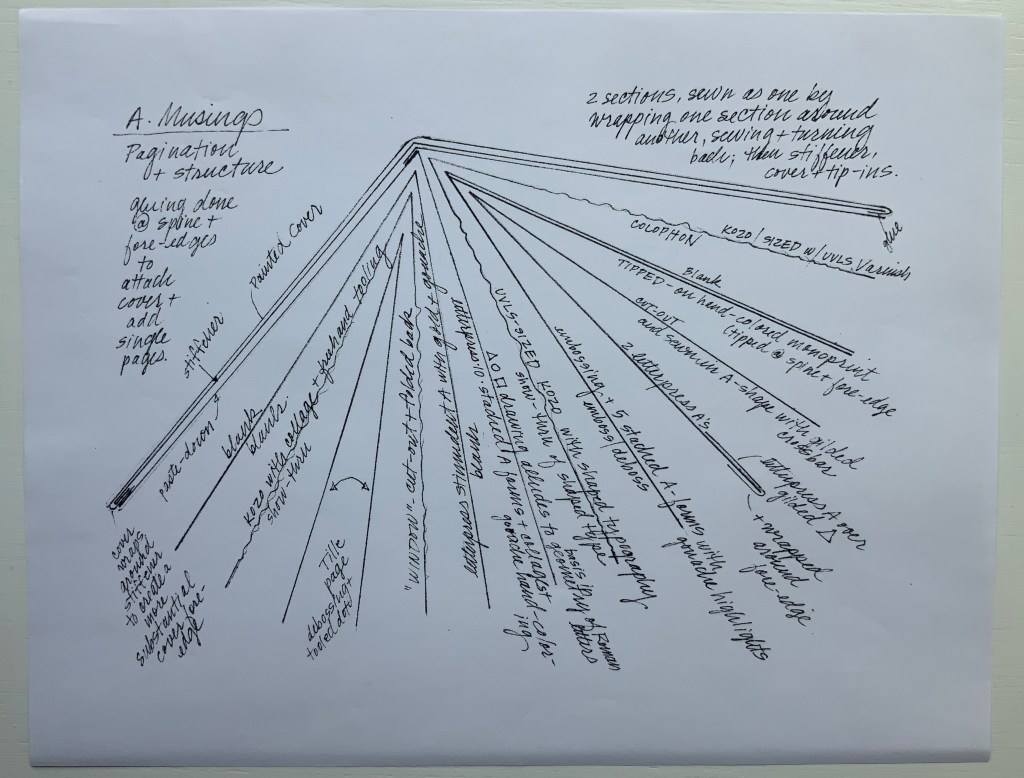
A separately provided copy of the artist’s plan for the pagination, structure and treatment per page offers a useful insight into the questions of how such a work is thought through and made. Page layout and the type of paper, in particular, play together sometimes like a clockwork mechanism and sometimes organically.
Painted cover
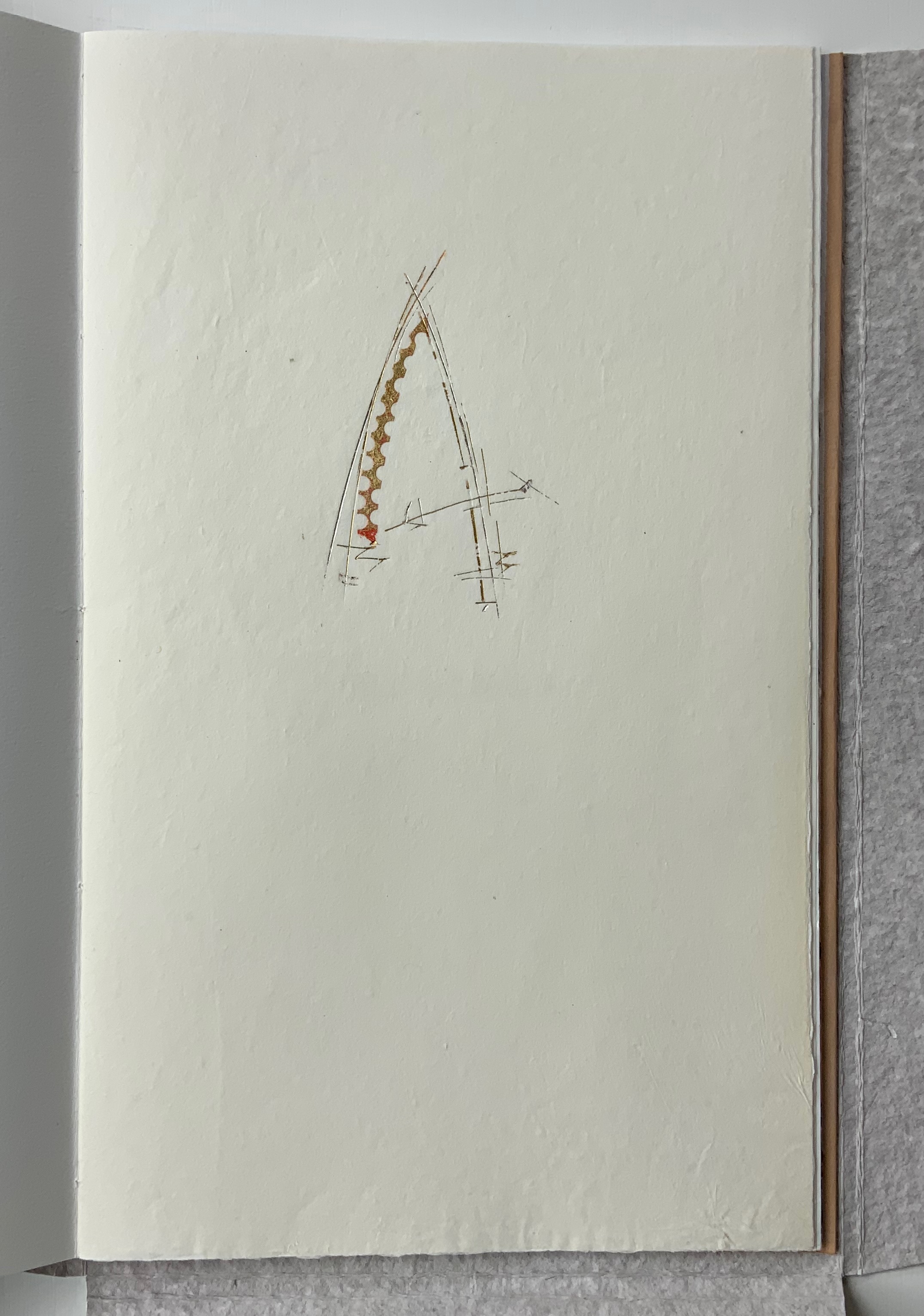
Left: Half-title. Right: Half-title turned to show translucency of kozo; note on the facing recto how the stroke from the debossed A on the title peeks through.
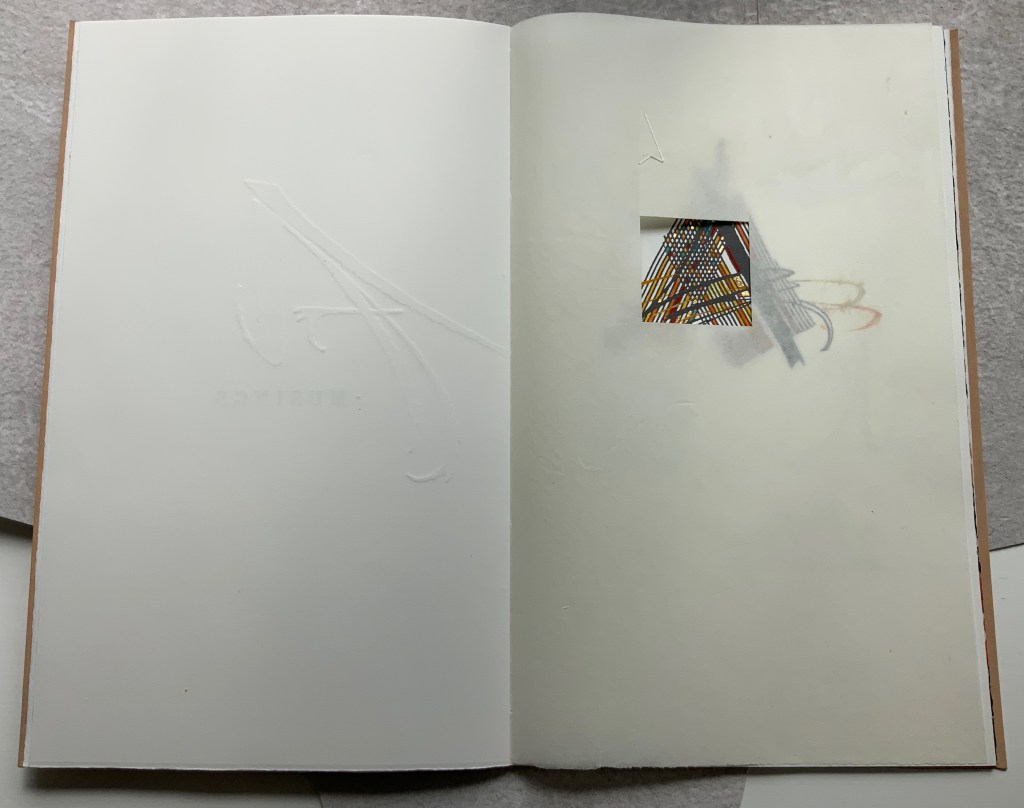
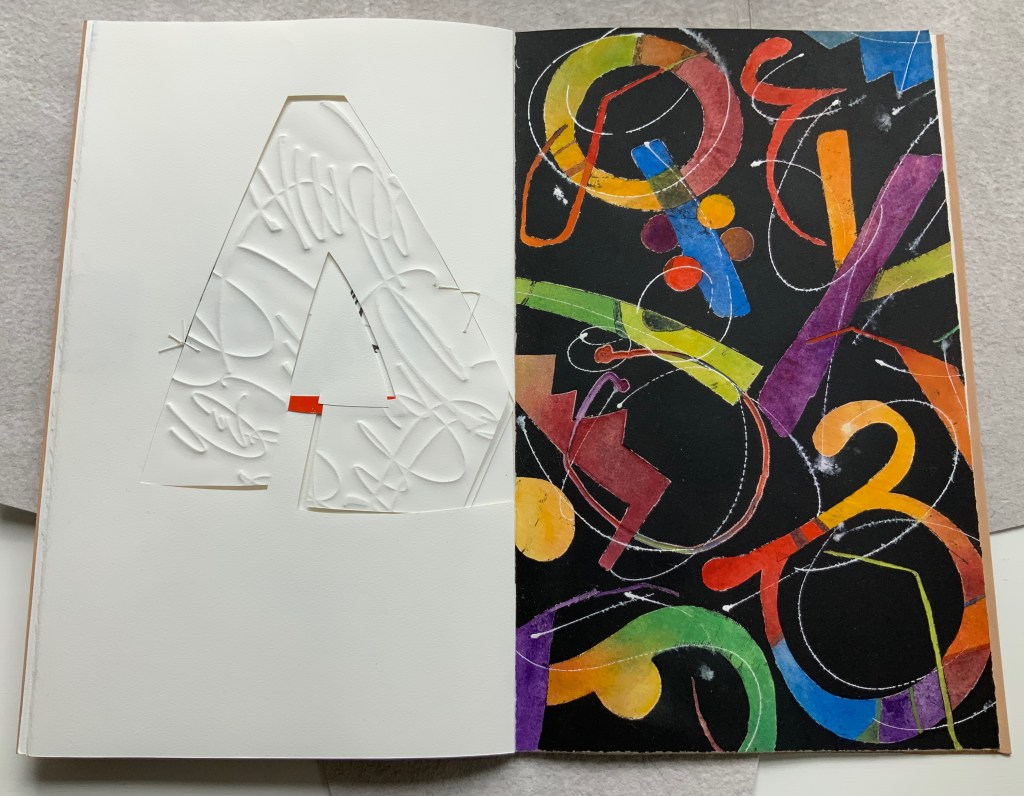
After the title page (see further above), the next double-page spread shows the title page’s debossed A in reverse on the verso page. Facing it is a square cutout through which multicolored lines forming overlapping As appear. Because the cutout page is translucent paper, we can see that the multicolored lines extend into a larger A on the next recto page. Turning the cutout page reveals that the cutout is actually a flap folded up and secured with white thread sewn in the shape of an A. This three-dimensionality of the flap is echoed by the way the crossbar swashes of the facing A seem to swirl around its two legs implying a spinning A.
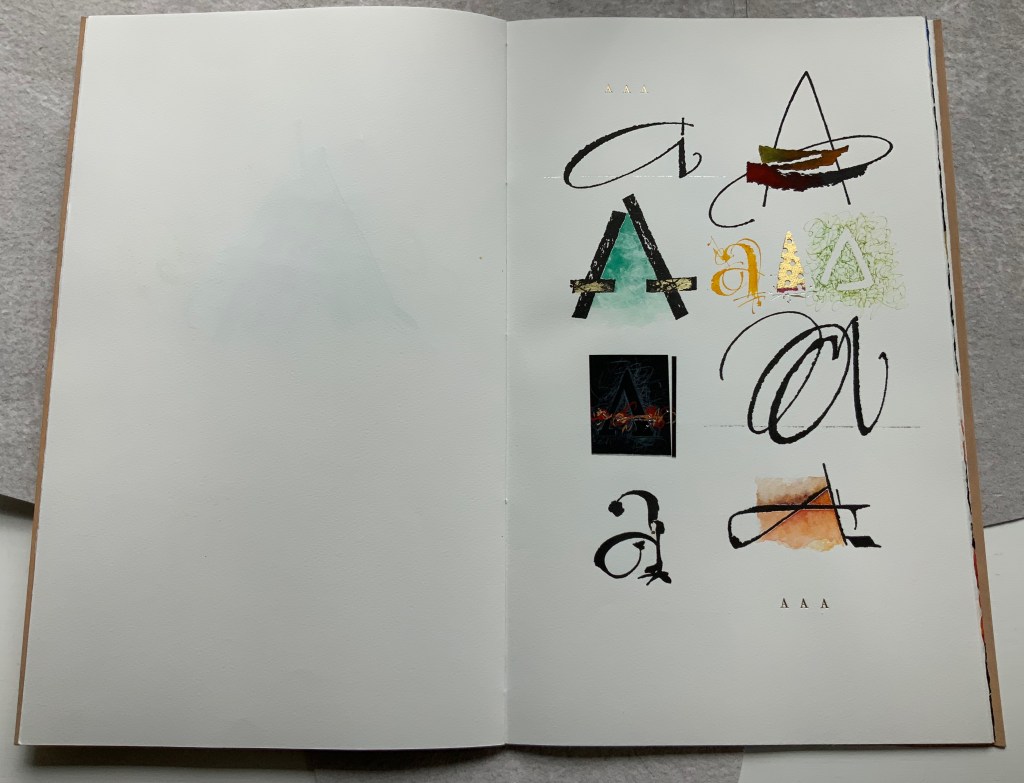
From the single A interacting with a cutout, we move to a dozen evocations of the historic forms that the lowercase and uppercase A have taken. The lowercase “closed a” from the semi-uncial hand starting in the 5th century appears second down in the lefthand column, and the “perfected” Roman uppercase A appears at the bottom of the right column. Amusingly, some evocations blend periods of history. In the lower left, the drawing of a lowercase “open a”, which comes from the 8th century Carolingian miniscule hand, takes on the stylization of the 15th century’s bianchi girari (white-vine stem decoration). Just across from it, the stylized version of the Proto-Sinaitic (1700 BCE) form of aleph, meaning “ox”, has a burnt umber background that suggests markings in early cave dwellings.
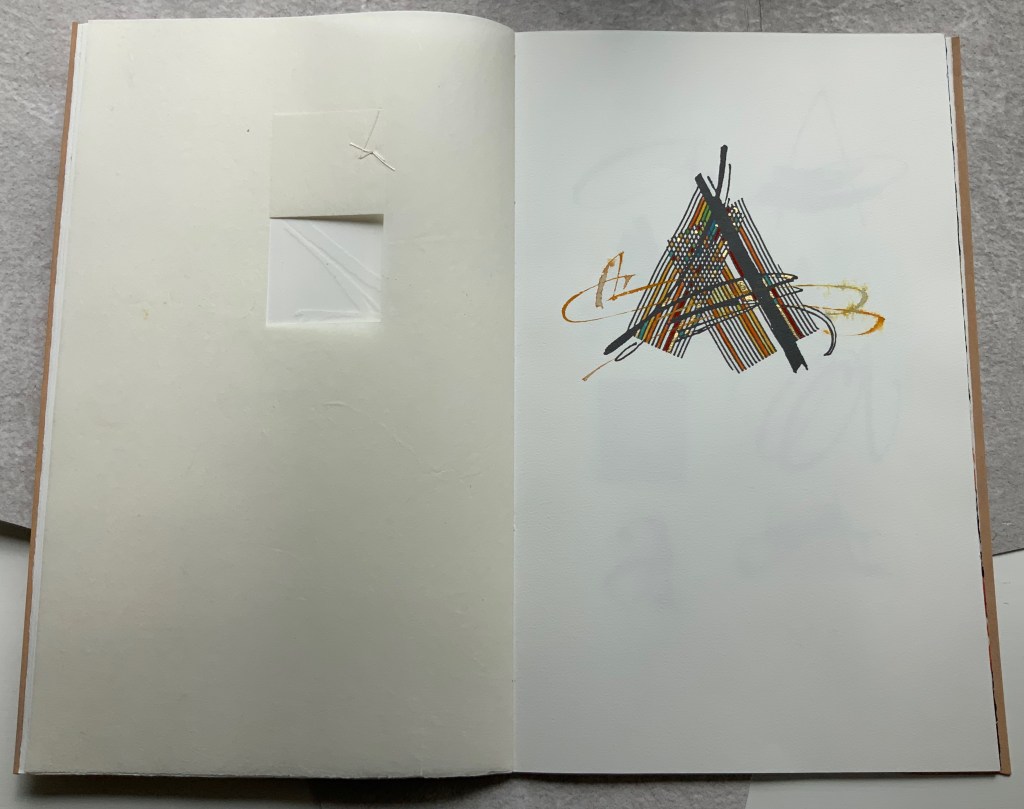
Using a translucent leaf with set type shaping half an A, the next two double-page spreads play (or muse) on uppercase A’s bilateral symmetry poised between geometric and freehand approaches to lettering, between typography and calligraphy and between inking and debossing.
When the recto page above with its debossed line and angle is turned, another extraordinary integration of composition, paper, printing (inking, debossing and “embossing”) and, now, cutting occurs. Notice how the ink of the first and third As overlaps the now “embossed” angle, how the now “embossed” line becomes debossed as it crosses the gutter, how the previous double-page spread’s themes of geometry/freehand, printing/drawing and lowercase/uppercase likewise cross over, and how the cutout triangle uses the yellow ink showing through to form the crossbar of an A and the gutter to form the A’s lefthand stem.
There is much else to muse upon in the spreads above, but it’s in the last two spreads where Moore builds and unfolds a fantasia of calligraphy, color, debossing, cutting, gilding and painting. Notice how the gilt crossbar slots through the page and helps secure the debossed piece behind the cutout to the page.
And when the page turns, notice how its gilt crossbar reveals its red paper beneath and becomes the spot of red completing the crossbar for the cutout A. The red spot against white seems to set off the explosion of color and calligraphy on the black final page, printed by Jessica Spring from polymer. The different shapes for A here come from African alphabets. The images are unique monoprints, done on an etching press. With the letters placed to block out the black and overlap one another, a sense of depth and texture arises. Contributing to that sense of texture, the white letters are hand-painted in gouache — sometimes layered, sometimes blended.
Books are inherently collaborative affairs, and for artists’ books, collaboration can become almost another tool for the artist. Jessica Spring, mentioned above, also debossed the opening A, hand-set the half-A composition and contributed to Rescuing Q. Now a fine binder in her own right, Gabby Cooksey, a studio assistant to Moore and Don Glaister, was essential to A Musing‘s hand work, binding and wrapper. Part of Moore’s creative progression from contributing to overseeing to orchestrating can be traced from here across three other works in the Books On Books Collection.
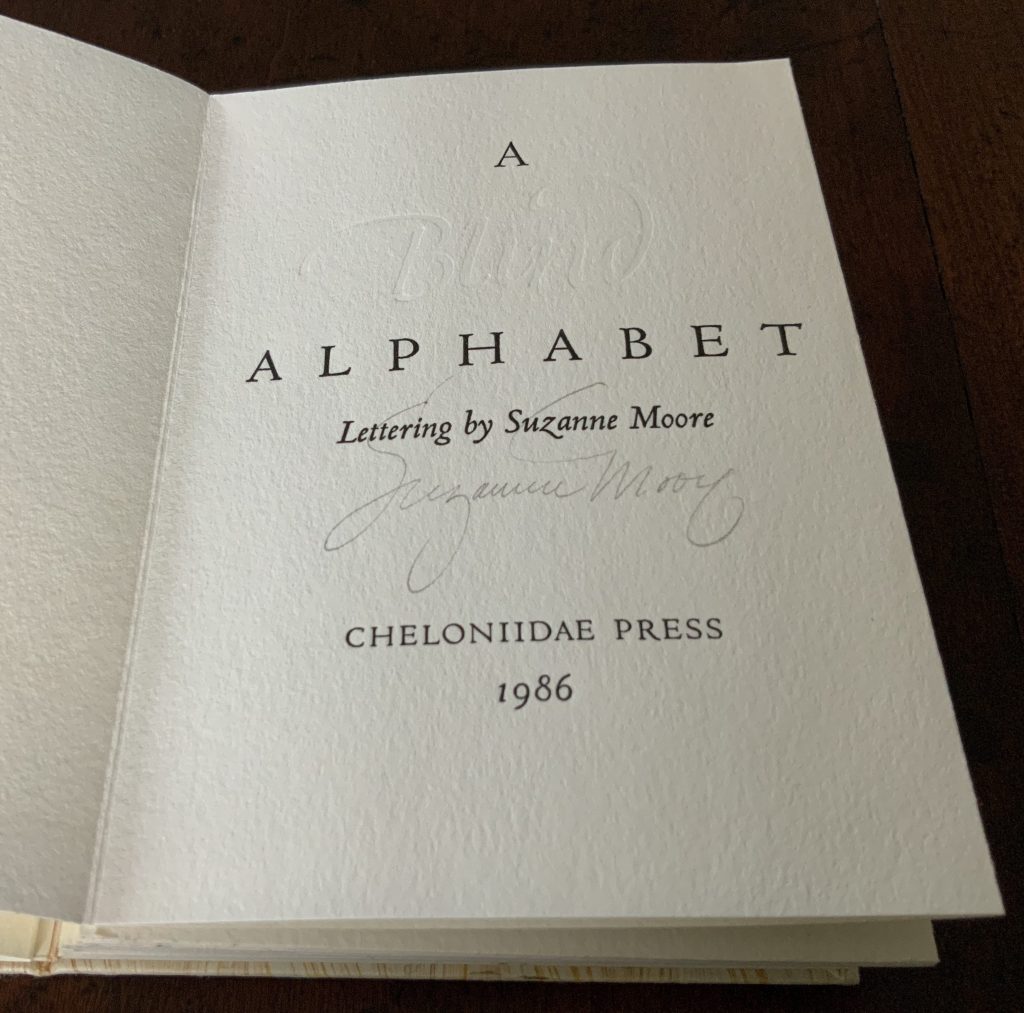
A Blind Alphabet (1986)
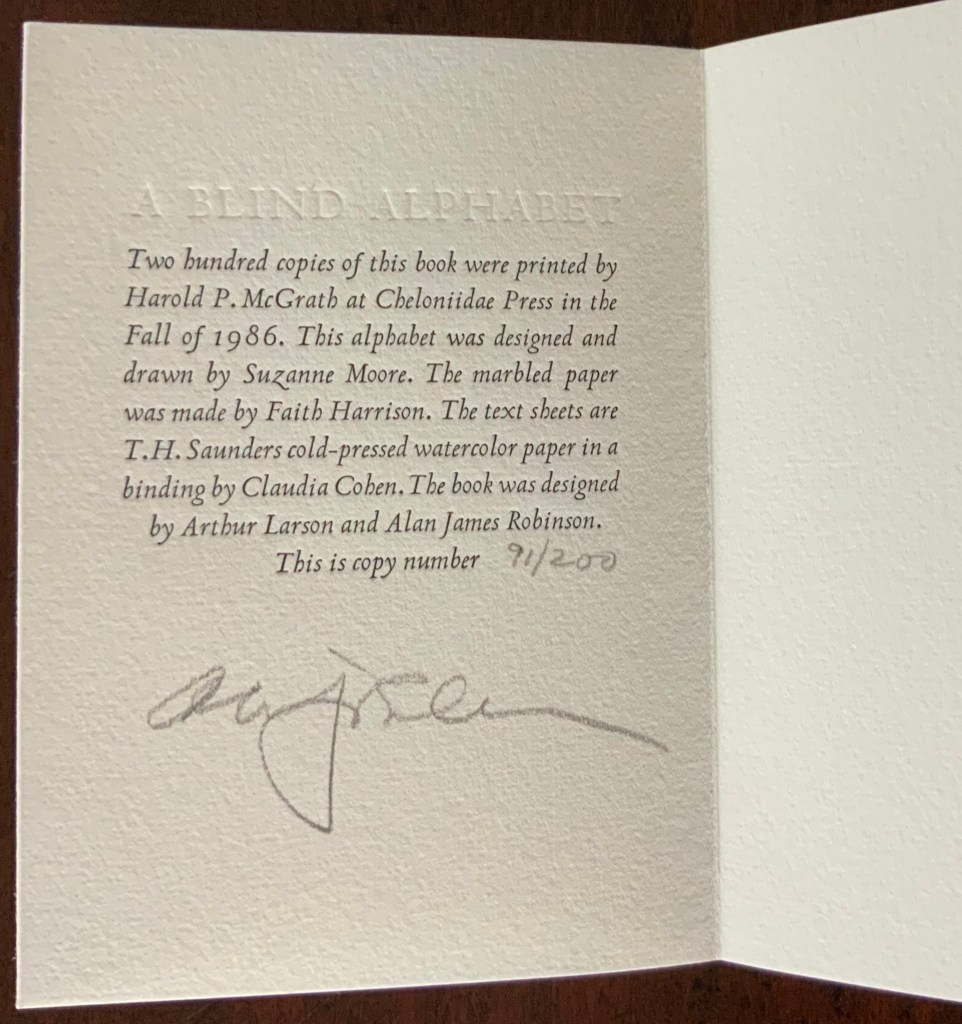
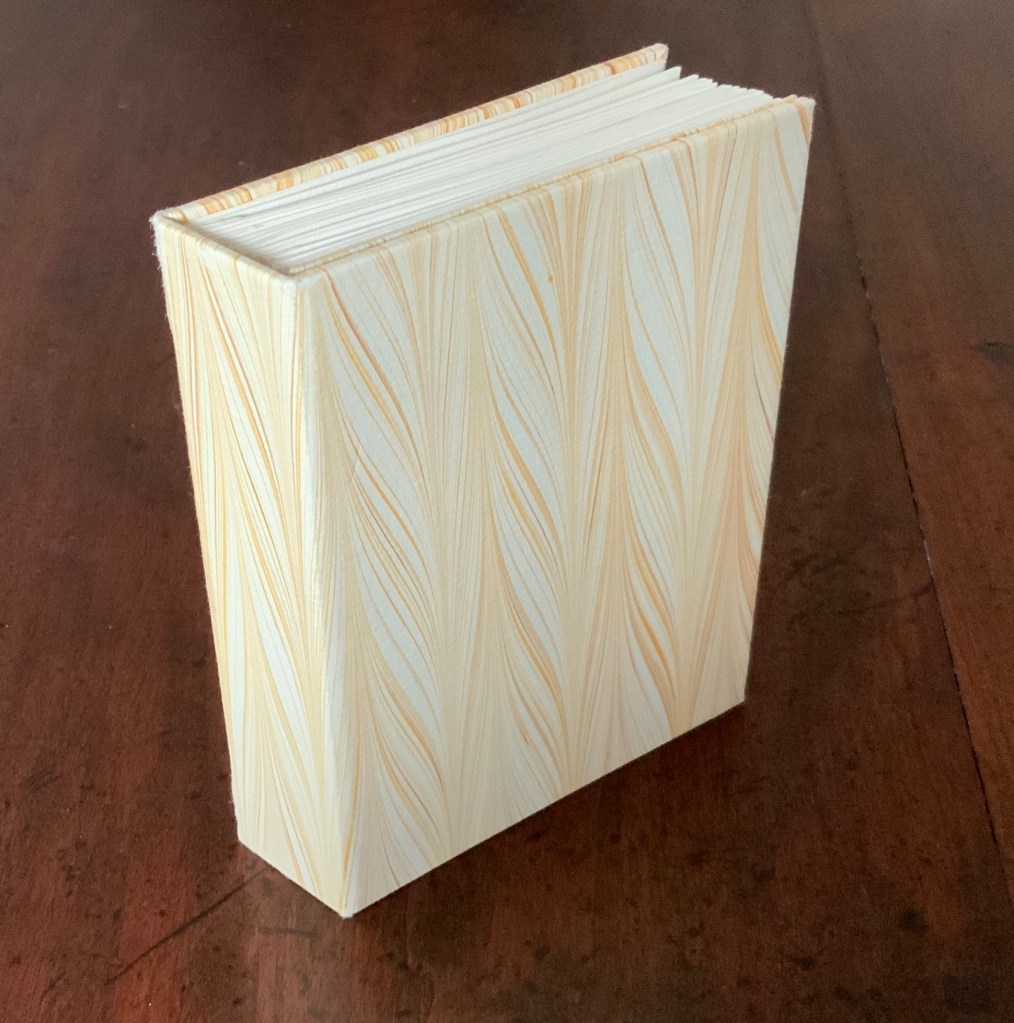
A Blind Alphabet (1986) Suzanne Moore Accordion-fold. Closed H128 x W93 D28 (spine) D22 (fore-edge) mm; open 3200 mm. 34 pages. Edition of 200 of which this is #91. Calligraphic letters designed and drawn by Suzanne Moore, printed by Harold McGrath on T.H. Saunders cold-pressed watercolour paper, bound by Claudia Cohen in marbled paper by Faith Harrison. Acquired from Veatchs, 1 May 2018.
Here, as noted in the colophon to A Blind Alphabet, Moore has the creative role of originating artist, designing and drawing the alphabet — soloist, as it were, in the Cheloniidae Press reportory orchestrated by Alan James Robinson.
In Robinson’s wood engravings of birds, Moore plays a creative contributing role with much the same repertory company.
A Fowl Alphabet (1986)
A Fowl Alphabet(1986) Alan James Robinson (etchings), Suzanne Moore(calligraphy) Casebound. Marbled paper over boards. Doublures and flyleaves. H218 x W145 mm. 26 Folios untrimmed at head. Four-page prospectus loose. Acquired from Bromers Bookseller, 16 August 2022. Photos: Books On Books Collection. Displayed with Suzanne Moore’s permission.
Again, Cheloniidae Press’ master printer Harold Patrick McGrath and “usual suspects” Arthur Larson (hand typesetting), Faith Harrison (hand marbling) and Claudia Cohen (binding) played their roles in this book. Here, Moore has the creative contributing role of designing the alphabet and, for the deluxe and full vellum editions (not shown), hand lettering.
In book art, an artist’s progression from contributor to orchestrator is not necessarily linear as can be seen in this subsequent work.
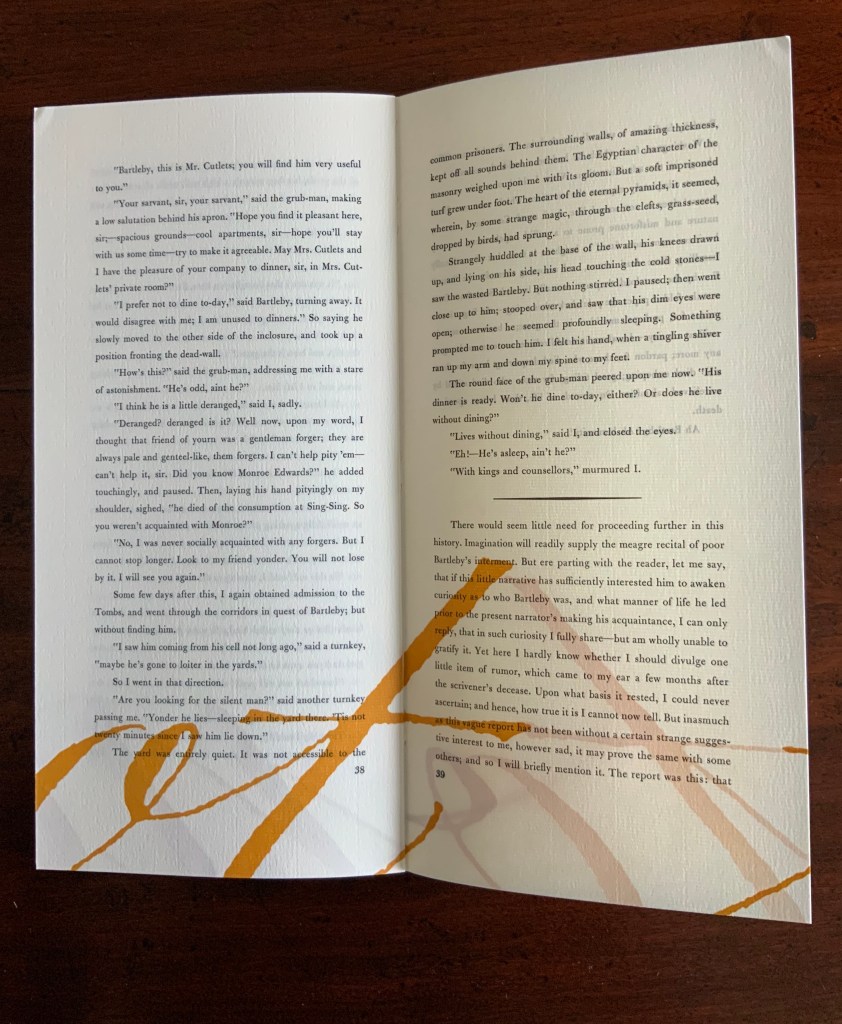
Bartleby, The Scrivener: A Story of Wall Street (1995)
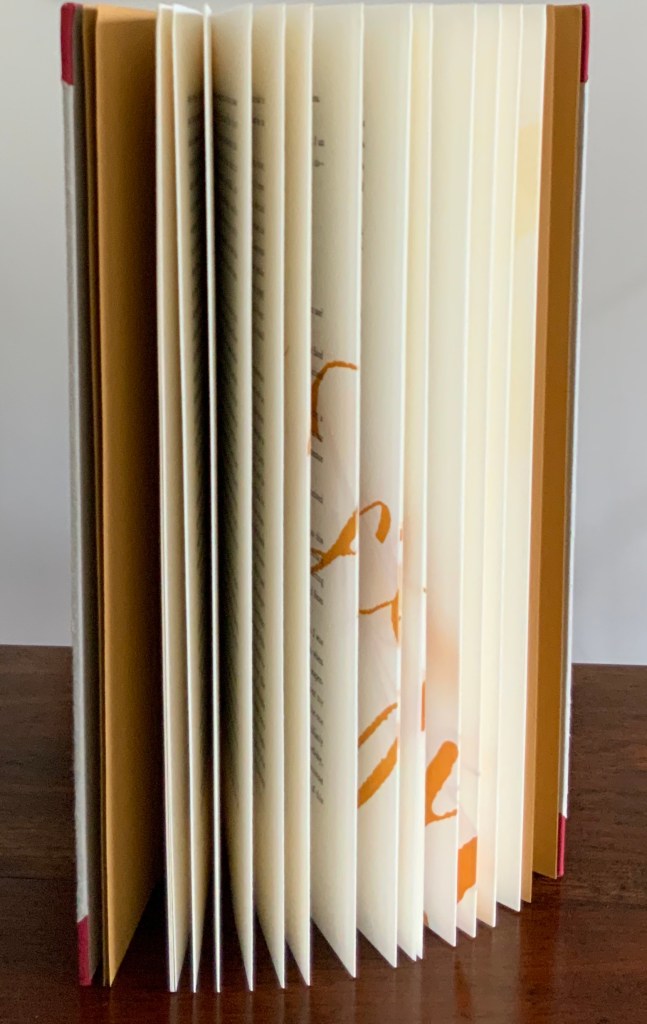
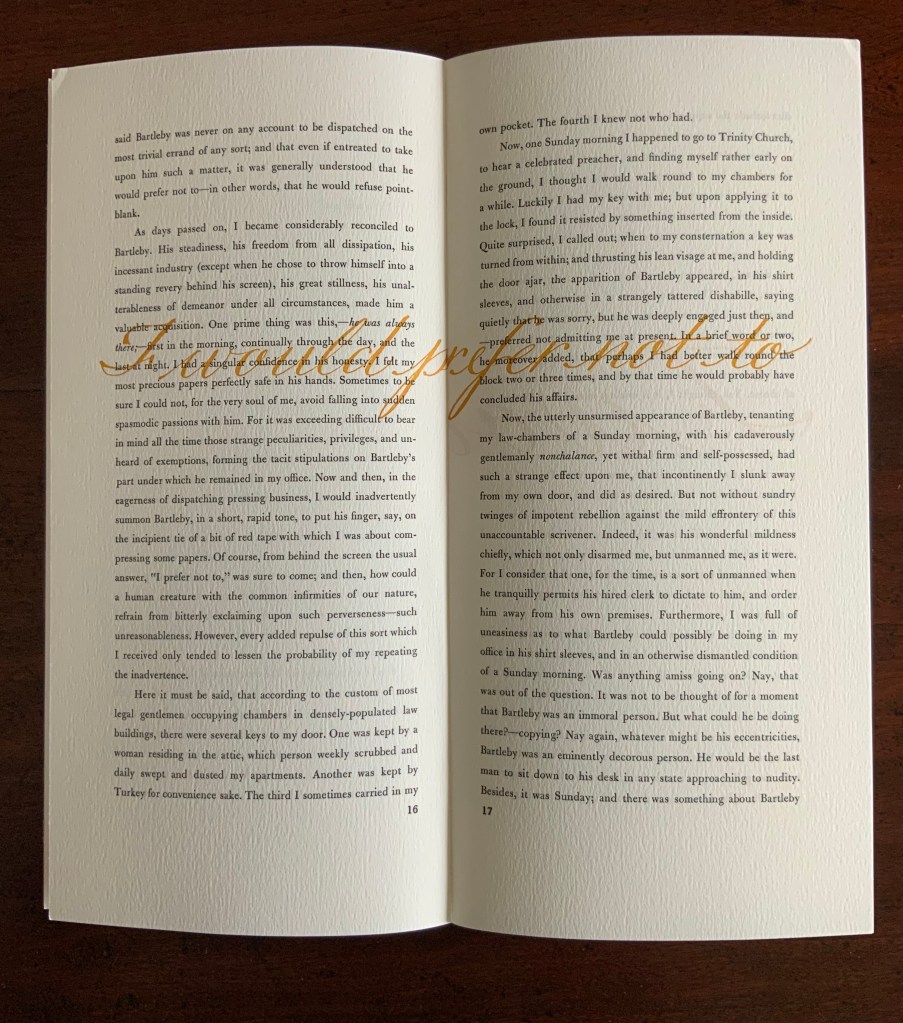
Herman Melville, Bartleby the Scrivener: A Tale of Wall Street, 1853. Indulgence Press, 1995. Typeetting, printing and binding by Wilber Schilling; Calligraphy by Suzanne Moore. Text paper by Janus Press. Endpapers by MacGregor & Vinzani. Edition of 100 of which this is #71. H320 x W158 x D14 mm. Acquired from Indulgence Press, 17 December 2015. Photos: Books On Books Collection. Displayed with permission of the publisher.
Wilber Schilling (Indulgence Press) orchestrated this edition of Herman Melville’s well-known story. Part of Schilling’s genius was to invite Moore to provide the calligraphy for Bartleby’s hallmark (his only) words “I prefer not to”. Another part was to print Moore’s calligraphy in ever-increasing size in ghostly ochre and in descending position across the pages of the book.
For more of Suzanne Moore’s works and artistic roles as well as others’ insight into them, see below.
Moore, Suzanne. 2016. Studies in Love the Question. Handlettered pages in book bound by the artist. 34 images available at Letterform Archives. ______________. 2014. Zero – Cypher of Infinity. 24-page handlettered pages in book bound by the artist. Letterpress pages by Jessica Spring. 20 images available at Letterform Archives.
______________. 2014. Origins and Spectrum. Process portfolio for Zero — Cypher of Infinity. Includes notes from the artist. 28 images available at Letterform Archives.
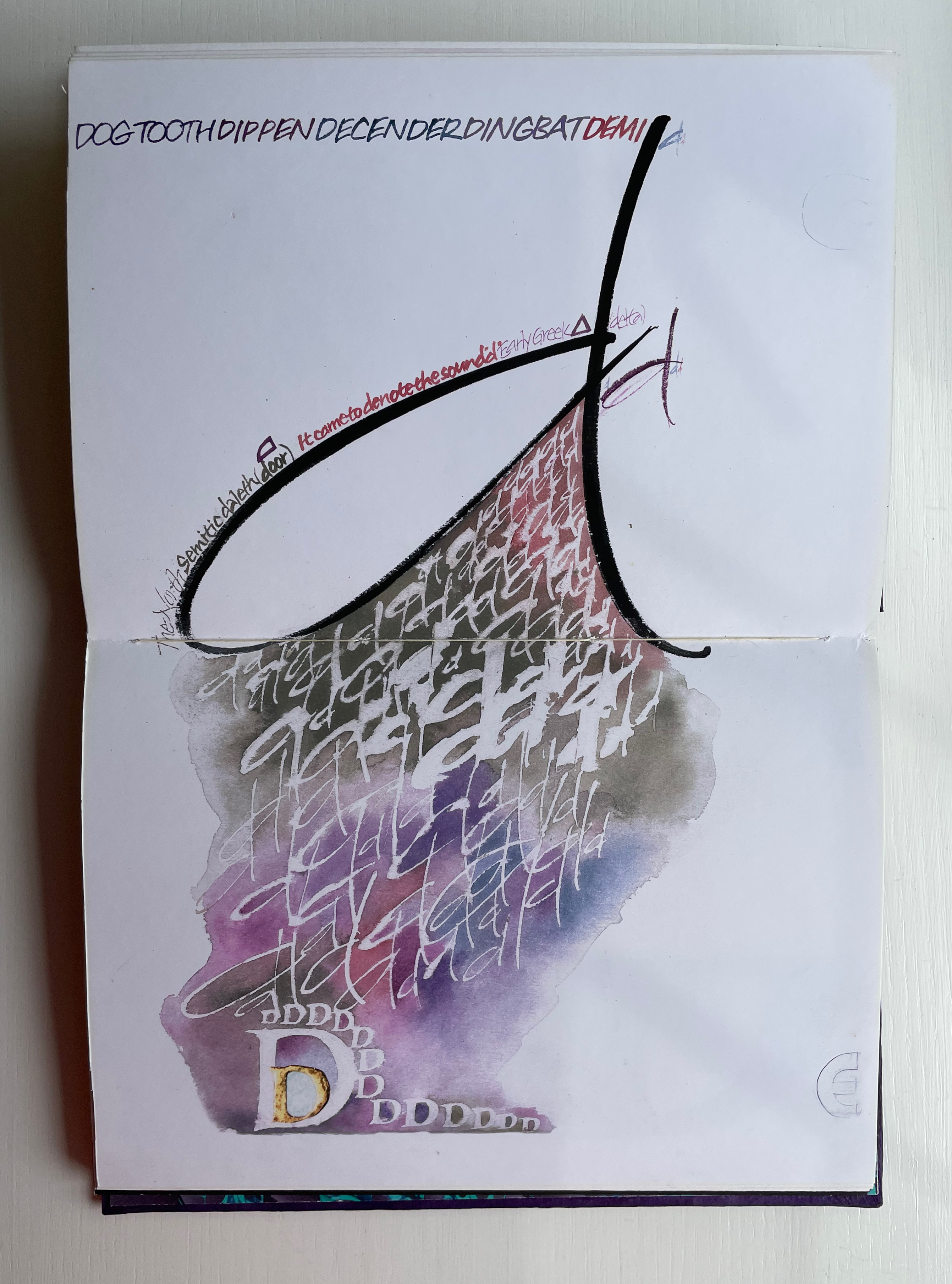
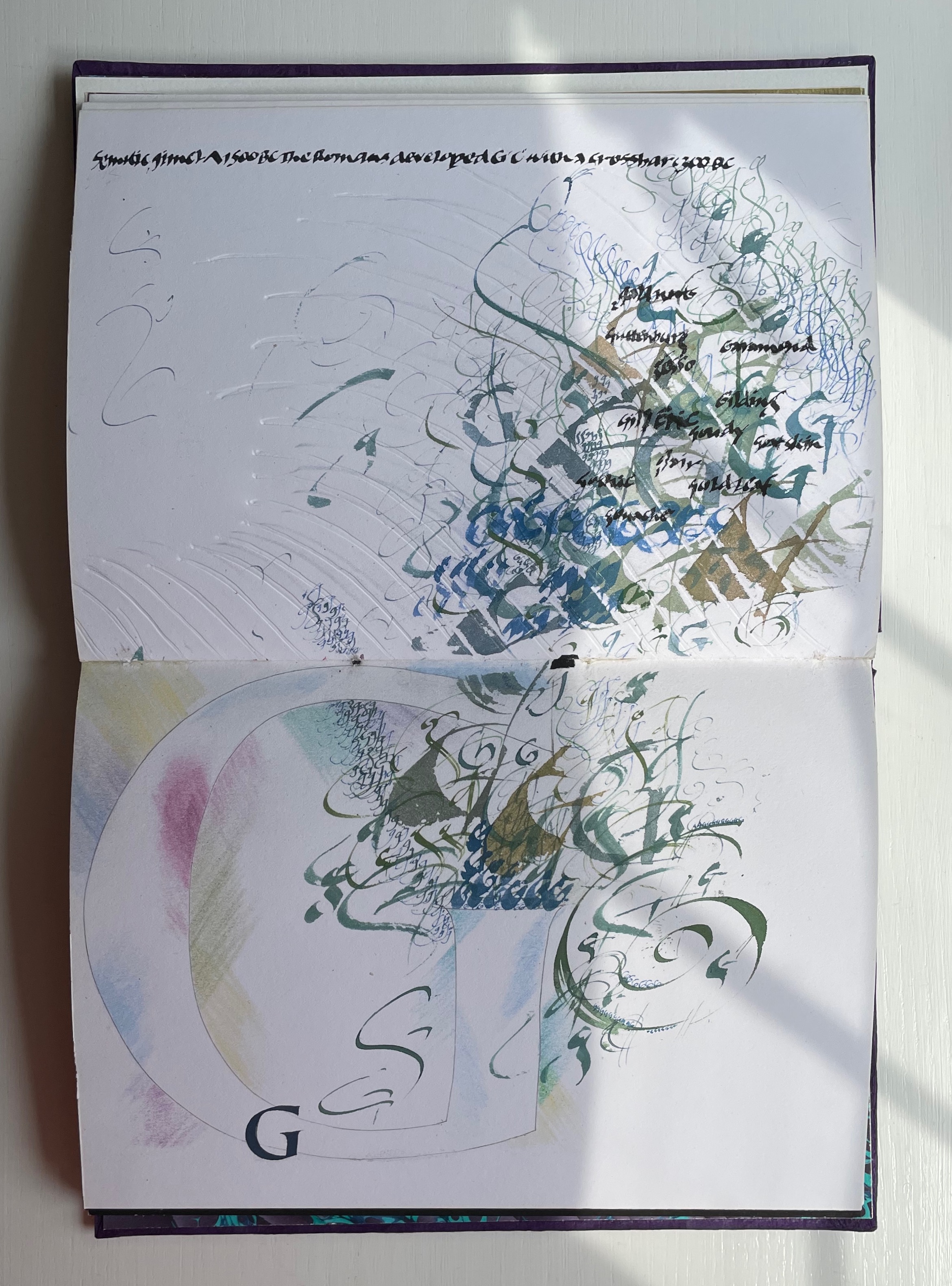
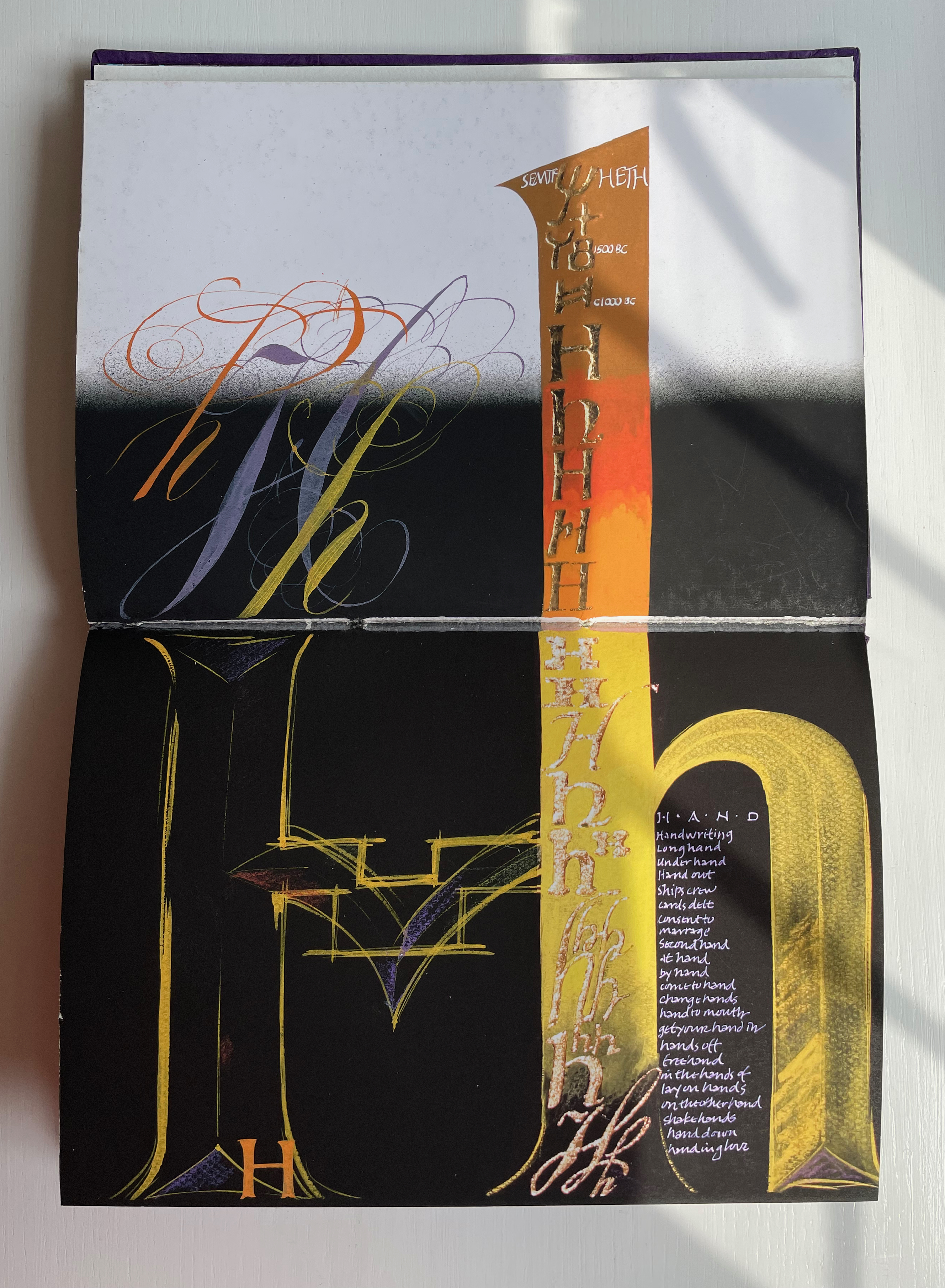
Alphabetica (2002) Dave Wood Bound in vellum; open-spine binding sewn on vellum strips. H210 x W290 x D30 mm. 54 pages. Loosely inserted colophon. Edition of 26. Acquired from the artist, 27 July 2022. Photos: Books On Books Collection. Displayed with permission of the artist.
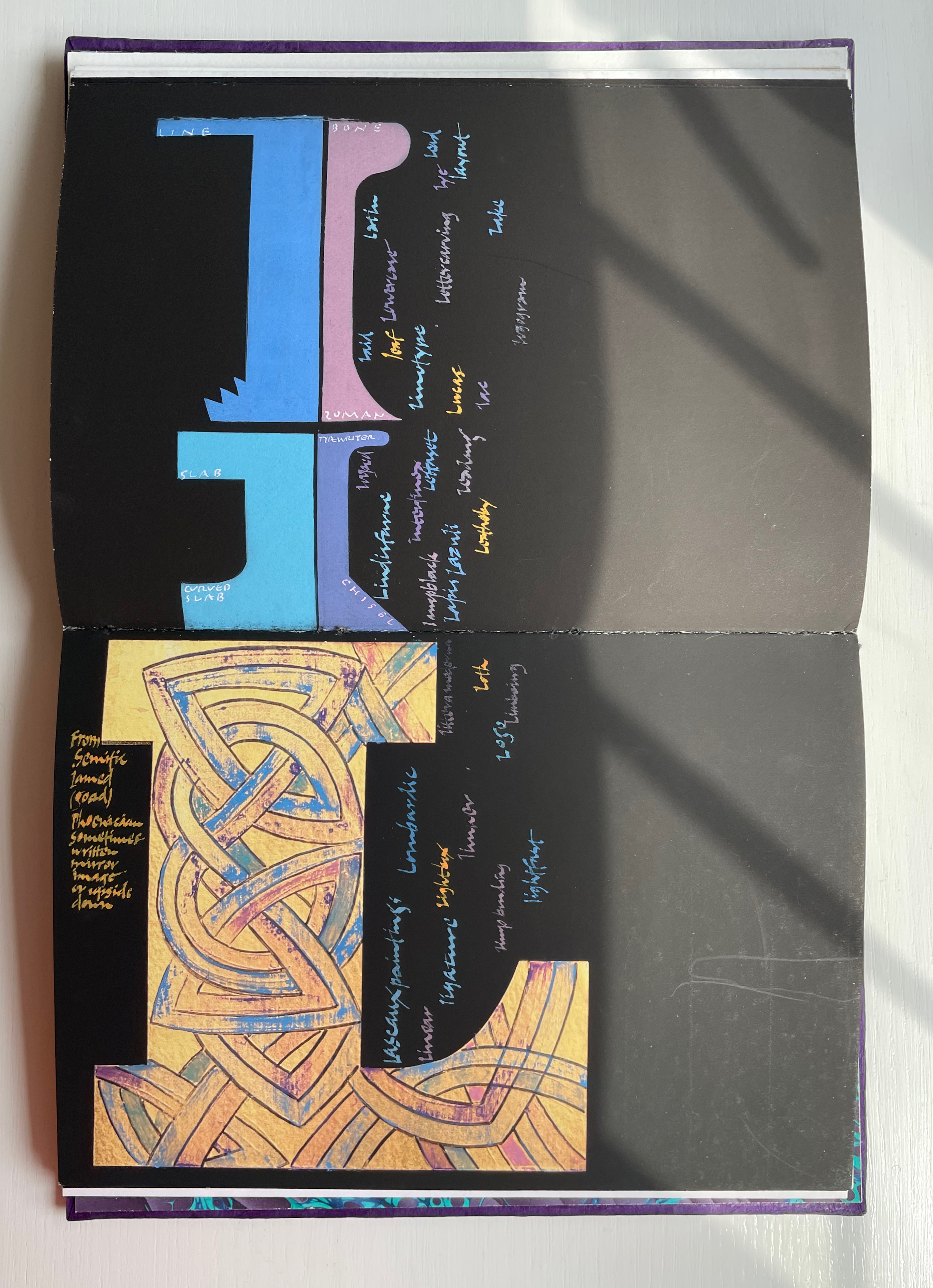
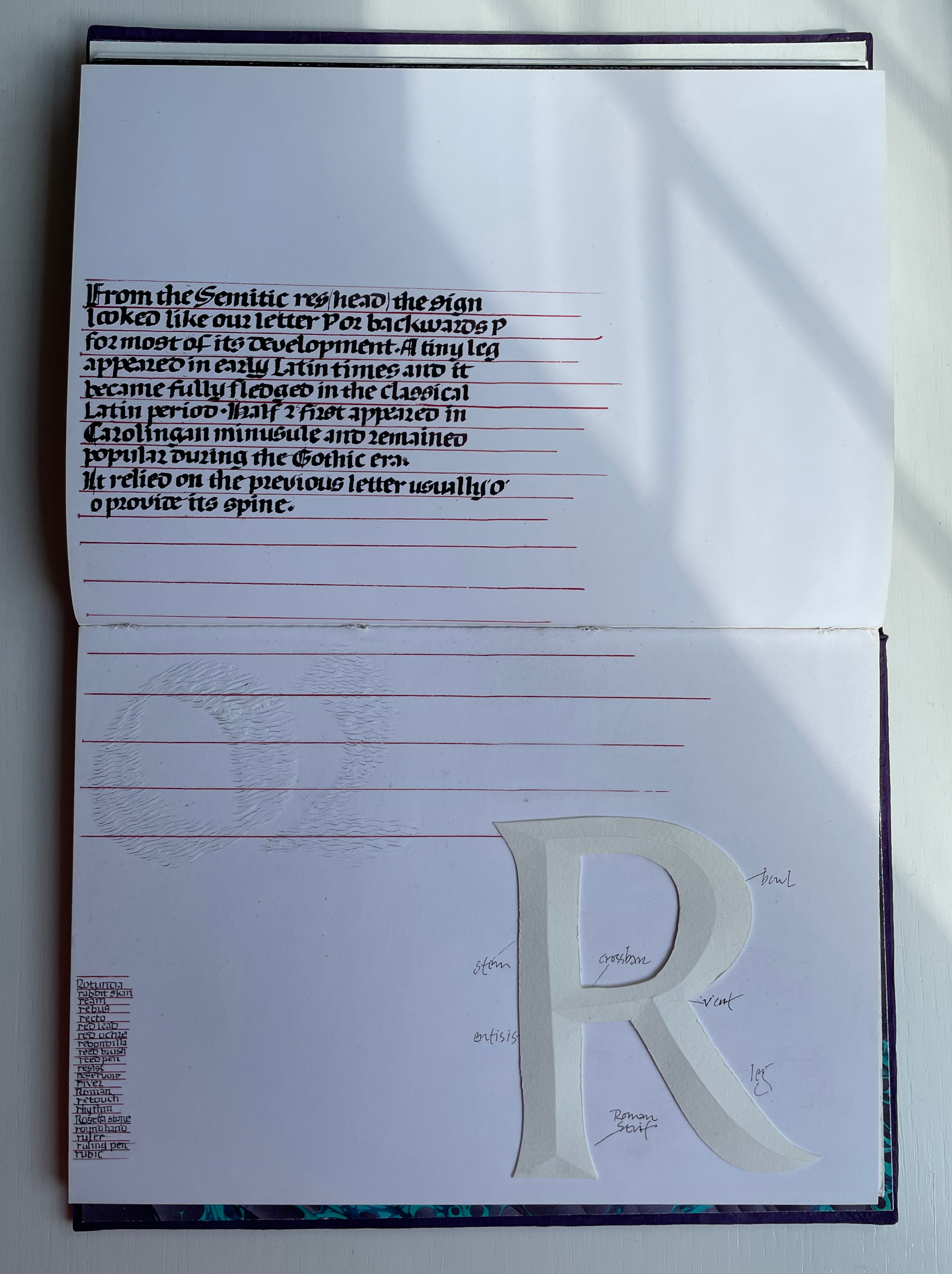
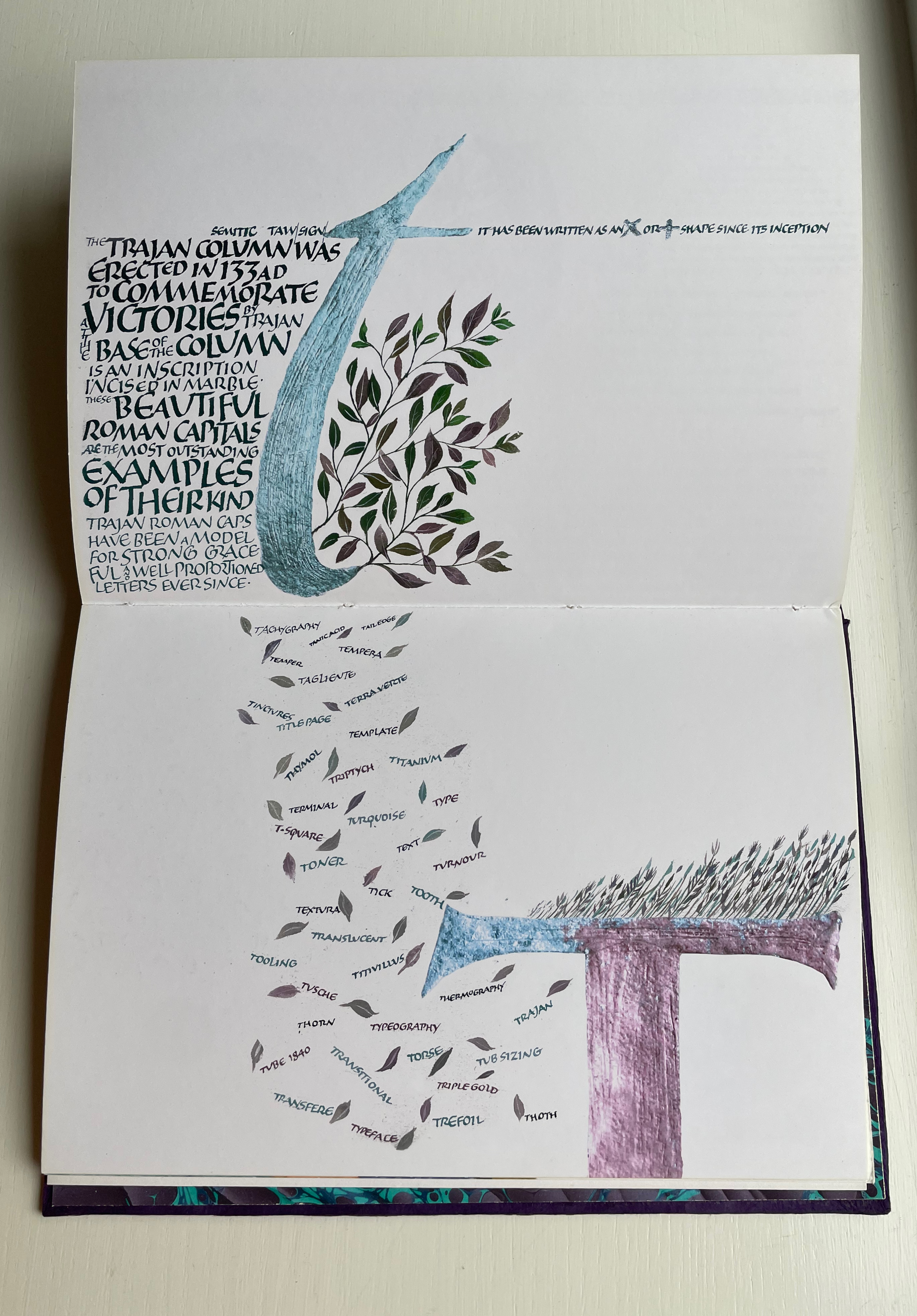
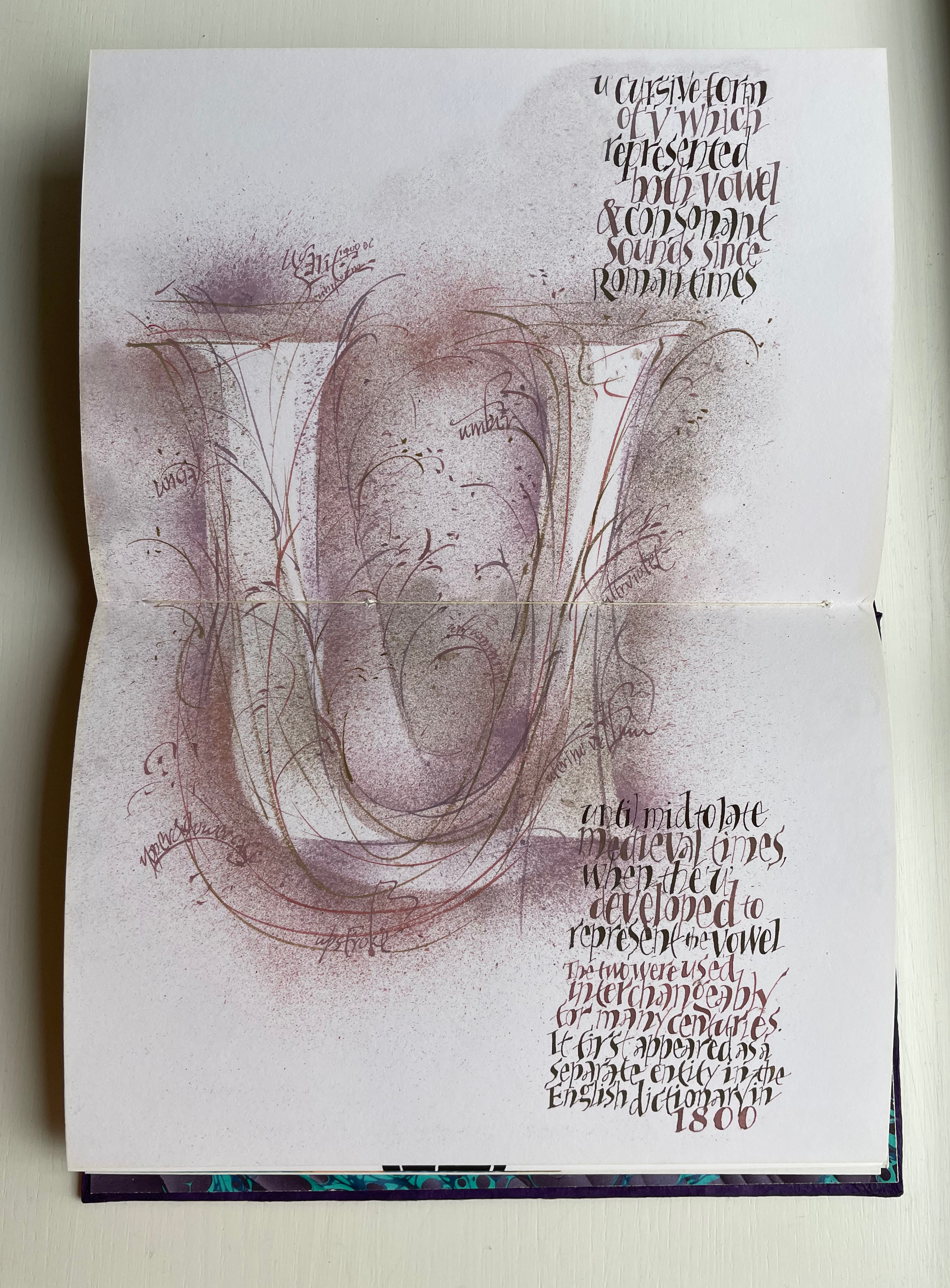
From Alphabetica‘s description as an exploration of the alphabet’s “diverse development from historic shapes to the infinite variations we see today in typefaces and calligraphic forms of the Western alphabet”, the reader might expect an academic work. The deeply embossed and debossed royal purple cover presenting the title in landscape format suggests otherwise as do the marbled endpapers and embossed gold foil title page. The cover is built up with a very strong paper made in Nepal, painted with acrylic then sprayed with semi-matte varnish. Inside, the reader finds a portfolio of twenty-five distinct “canvases” in which Wood demonstrates both historical sensitivity and artistic inspiration.
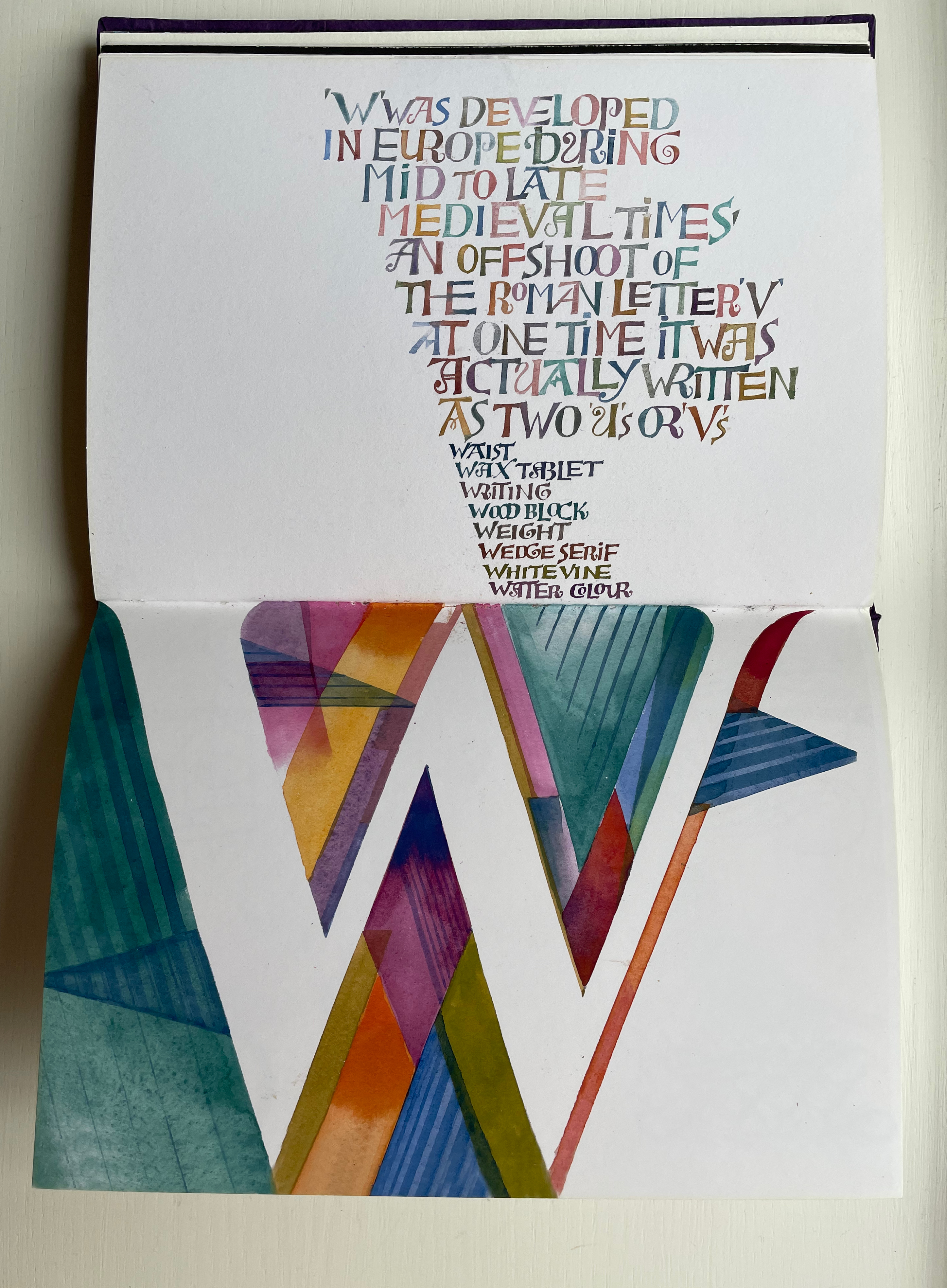
Across the twenty-six spreads, Dave Wood has captured each letter’s distinct story with multiple styles of calligraphy in Sumi ink and gouache paints as well as varying textures and techniques (Canson and Arches paper, glassine, foil, embossing, stamping, feathering and cutting), colors and layouts.
The letters’ developing shapes and periods are labeled. Starting with the letter B, Wood adds names of typefaces, structural terms for type, palaeographical terms and terms from the crafts of calligraphy, typesetting and printing — all beginning with /b/. Similar labeling occurs for the letter C but with a different layout. Across the twenty-five canvases, Wood excels at this balancing of difference and similarity. Notice, for example, how letters B and C incorporate the Renaissance style of illumination called bianchi girari (white vine stem decoration).
The ways in which uppercase-to-lowercase movements interact with the layout’s variations make for a dynamic experience. Sometime it’s subtle, sometimes vigorous. Note, for example, how the letter D de-emphasizes the gutter whereas the letter E emphasizes it.
With letters H through Q, a shift from Arches white to Canson black paper and back adds to the overall dynamic movement. Yet Wood is attentive to elements of unity; for example, his playful handling of the gutter in the transition from letter H to letters I/J echoes that from letters D to E.
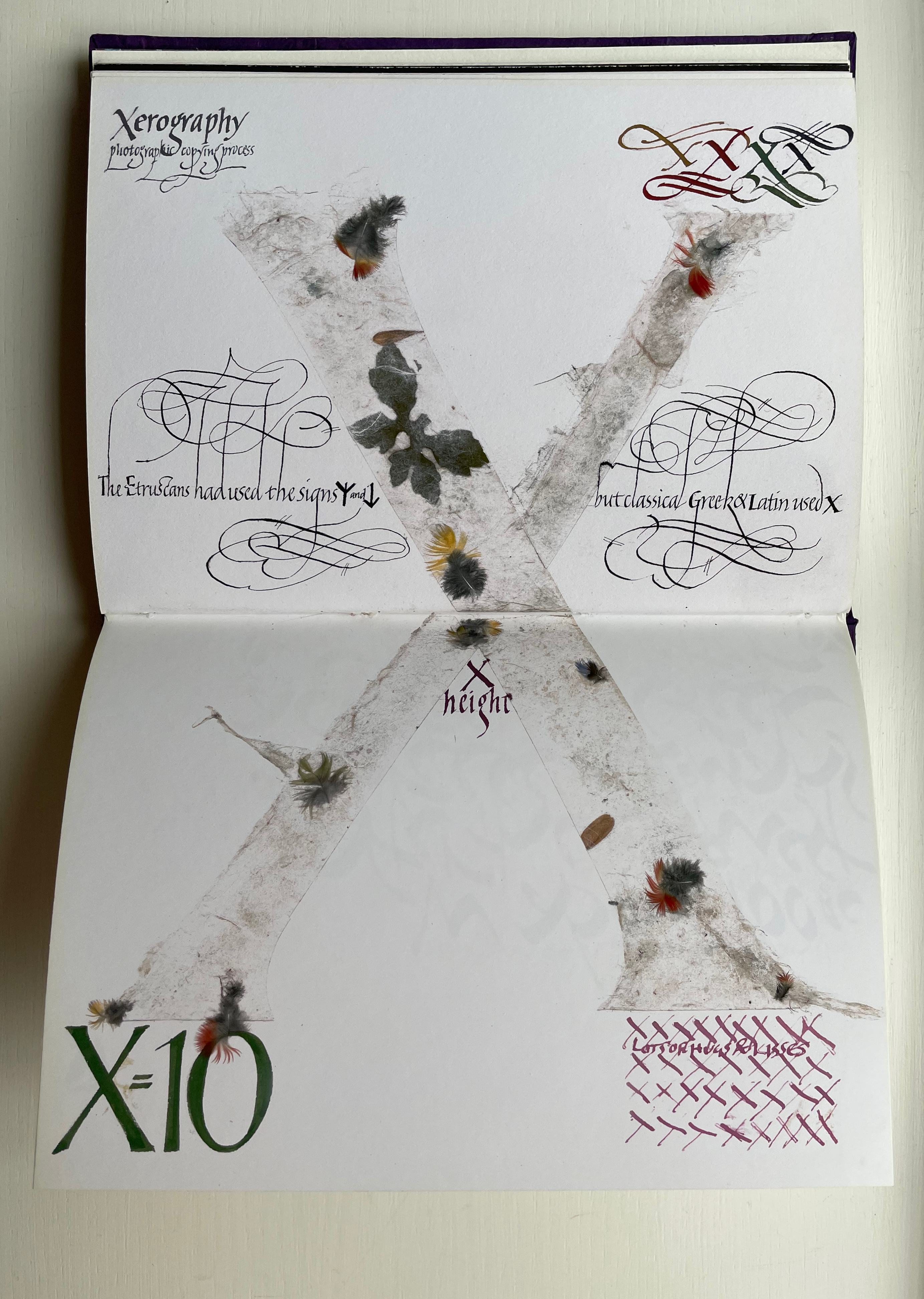
Only six letters perform the trick of extending across the gutter — lowercase H and uppercase K, M, O, U and X. While O, U and X take the similar approach of almost evenly straddling the gutter, each of the other three succeed differently. M is perhaps the most striking and interesting of them all. M derives from the Semitic word for “water” mem. As Wood points out in the loose insert colophon, the watery blue that fills the letter is intentional — as must be the precise alignment of the inner peaks of the letter with the gutter. Such attention to detail in the midst of so much activity on the page demands a similar attentiveness from the reader.
For example, the long tail of the Q does not show up until the bottom of the spread. And the reader may need to pick out the the word “or” in the text to spot the lowercase r in the textured, oversized written word “or” directly below the text.
Visual puns abound. Celtic knots in a capital L (for the Lindisfarne gospels). An S formed of stones. Leaves falling from a lowercase t (for tree or tea, of course). A U growing underground.
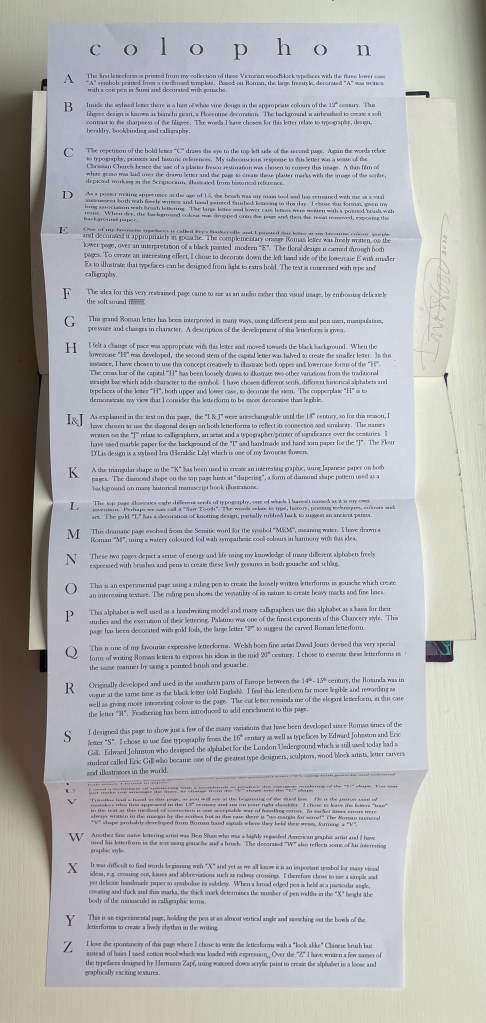
Fortunately, the accordion-fold colophon loosely inserted in the book offers pointers to some (not all) allusions. For example, the beginning of the third line for the letter V pays homage to Titivillus, the 13th-century patron demon of scribes’ mistakes. The illustrated W is an homage to Ben Shahn’s letter design. The highly contrasting thicks and thins in the letter X allude, in calligraphic terms, to the thick mark’s determining the number of pen widths making up the x height (the body of the miniscule).
And while the colophon may be necessary to know that the typefaces written in color below were created by Hermann Zapf, any viewer can enjoy Wood’s incorporating the entire alphabet in the Sumi ink design culminating in the letter Z as a fitting self-referential conclusion to Alphabetica.
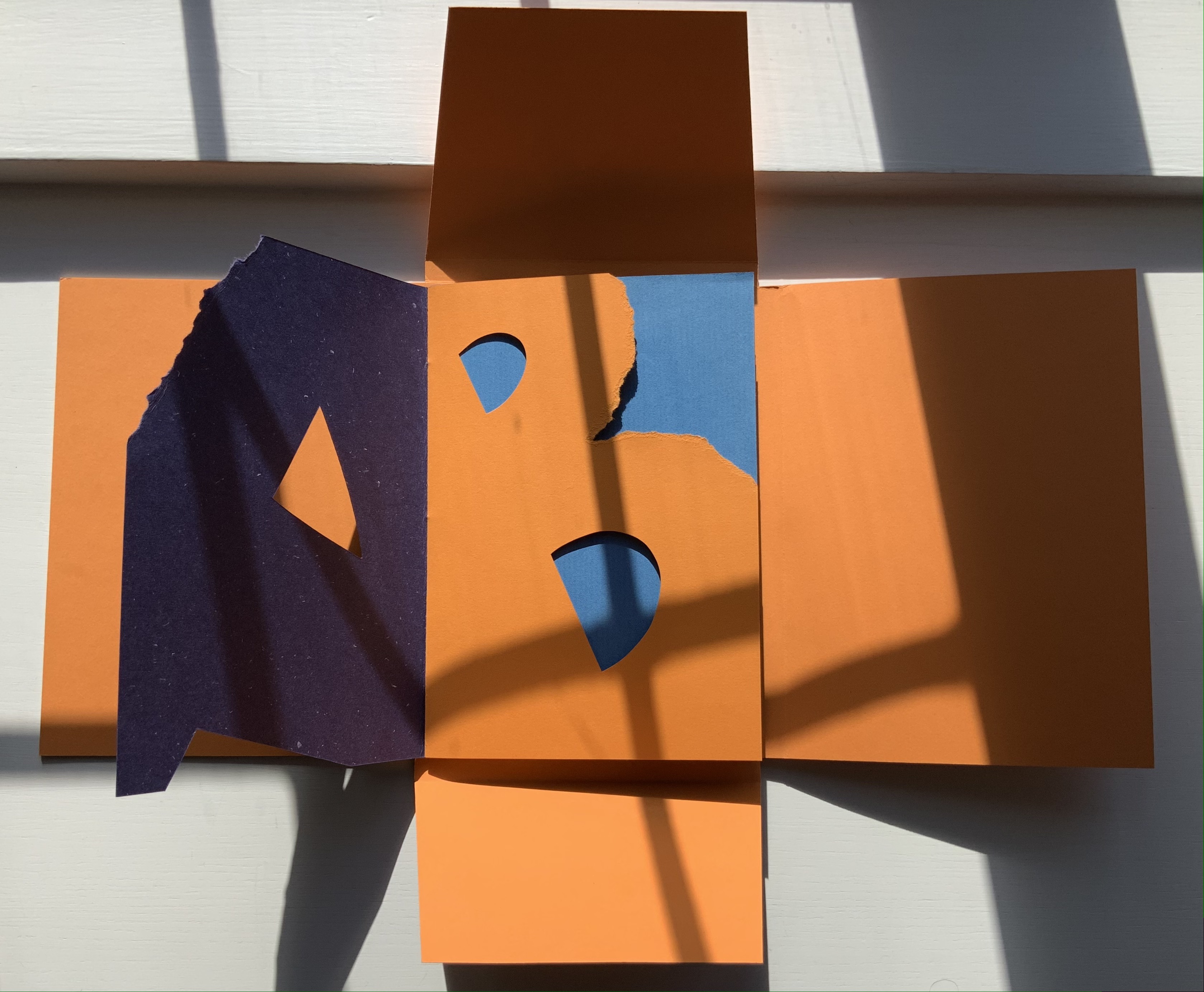
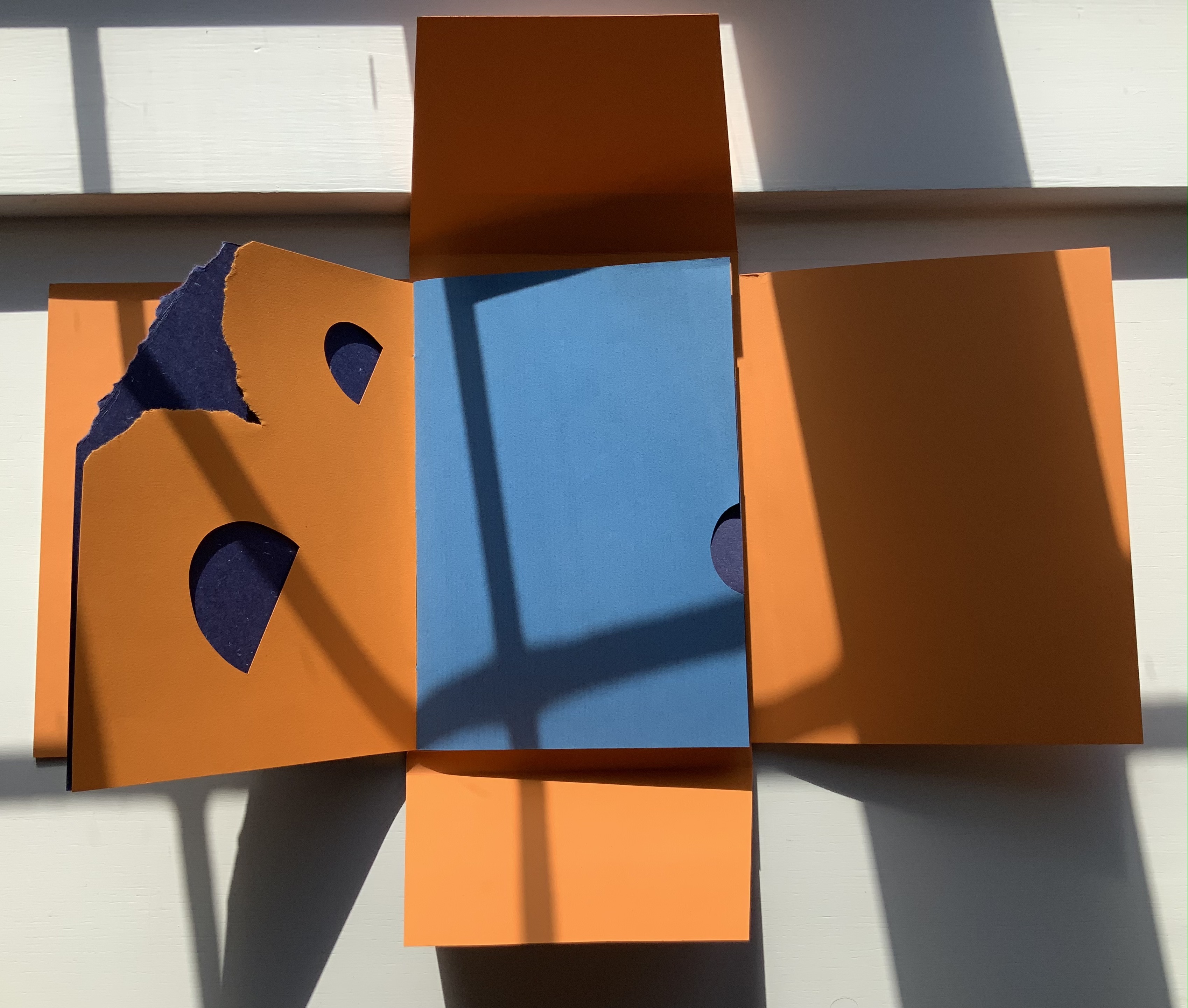
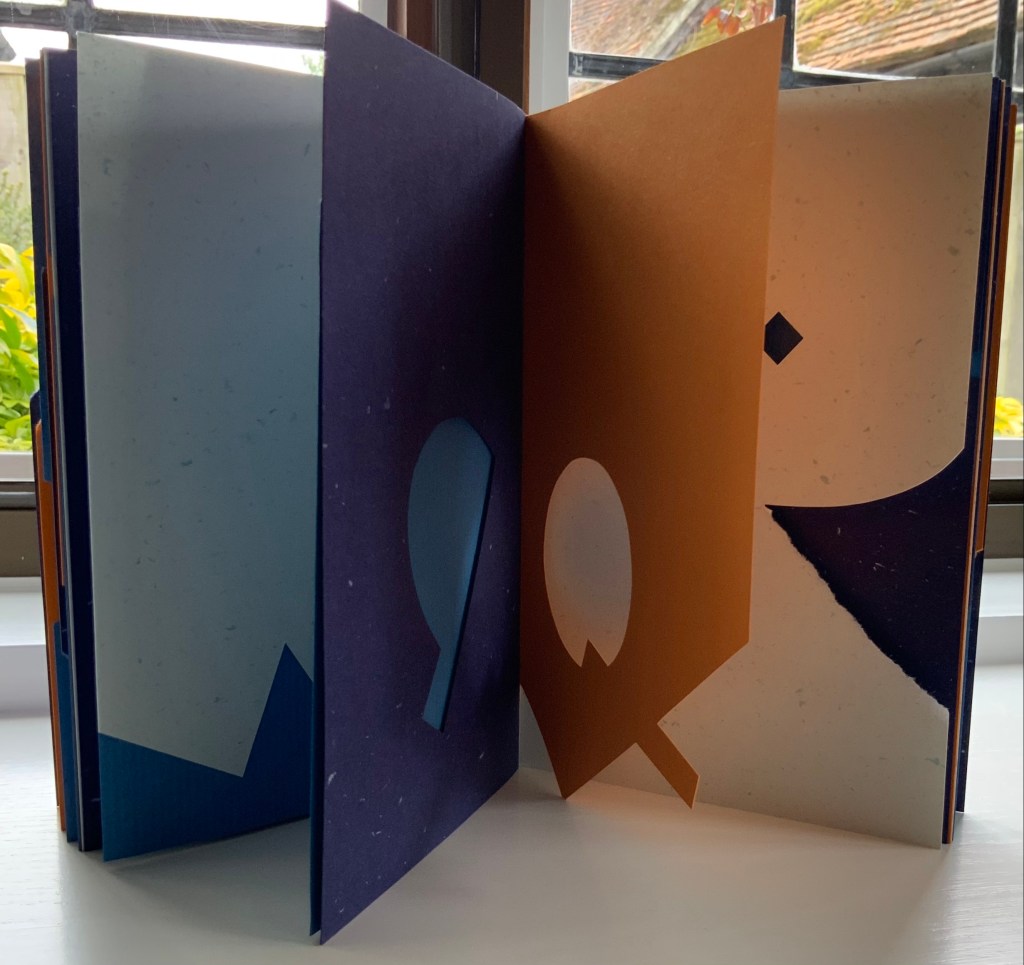
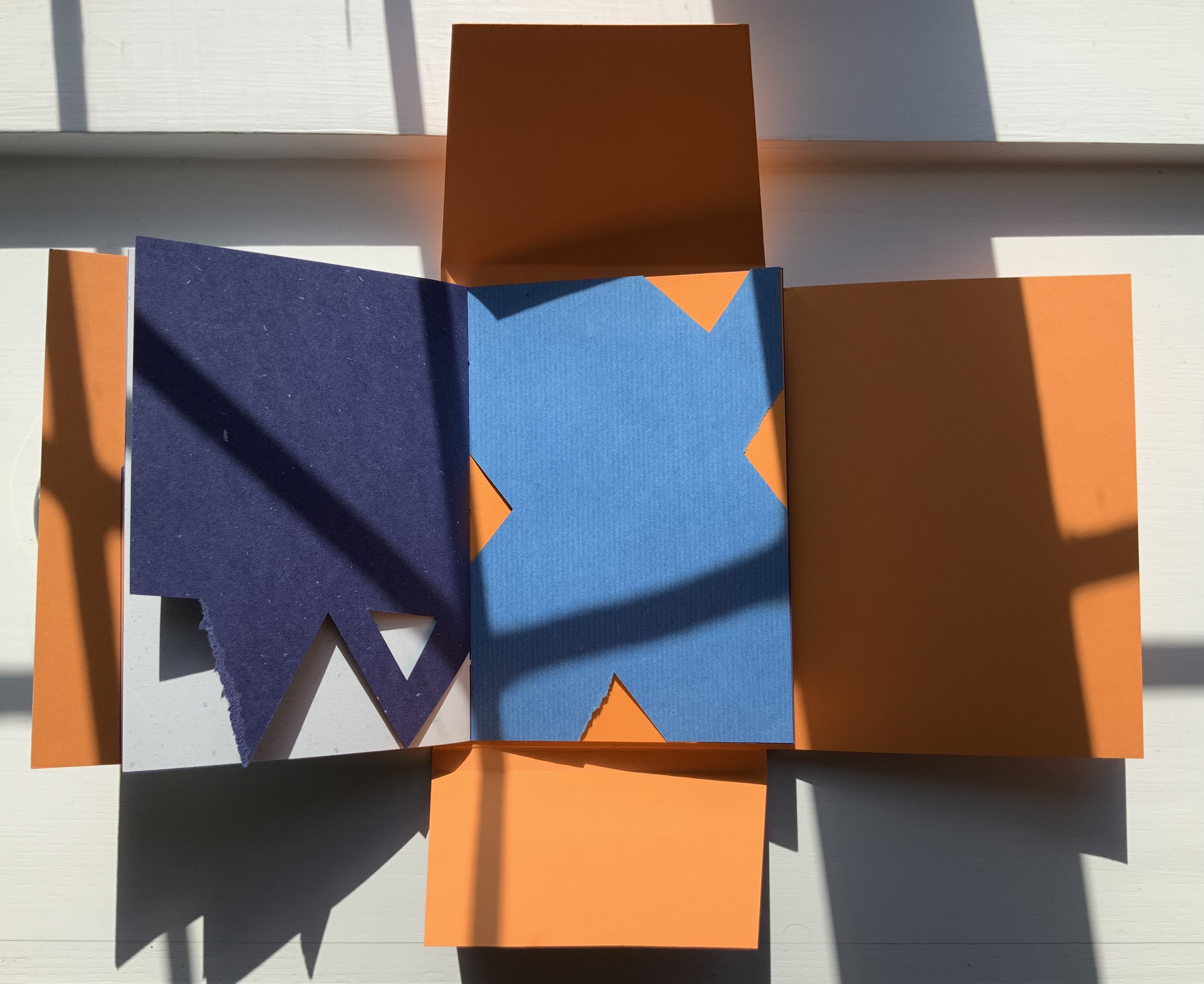
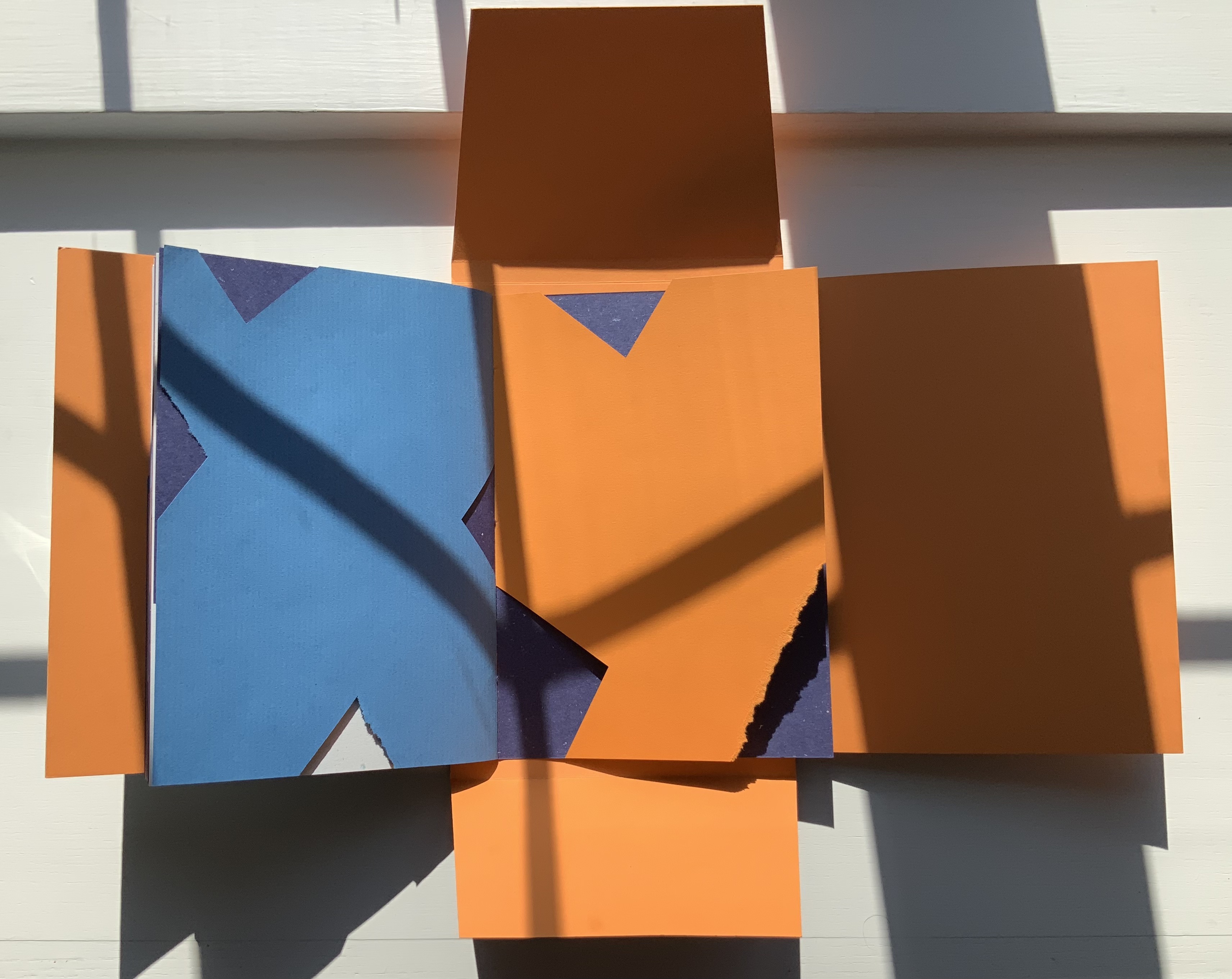
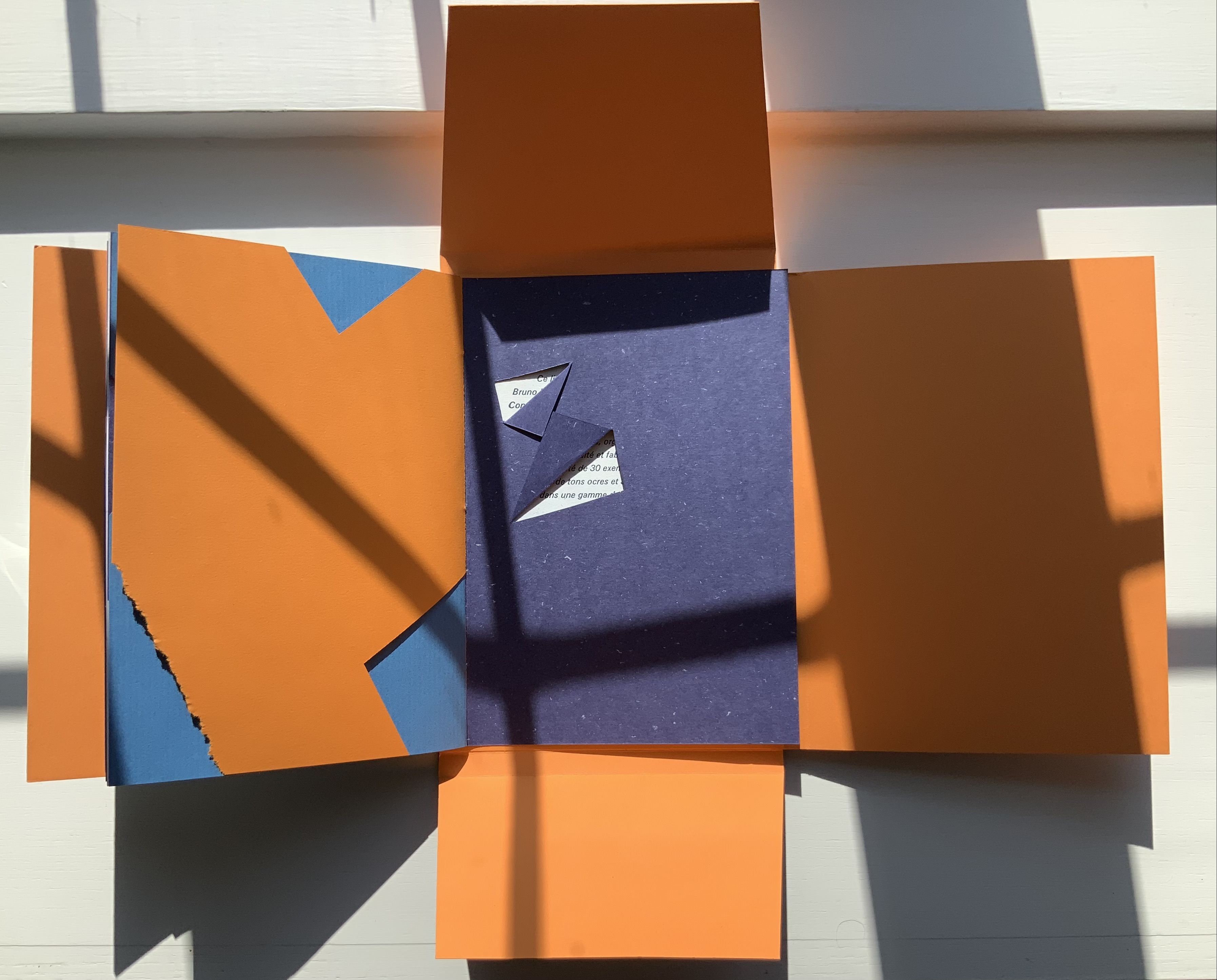
ABCD’Air (2005) Bruno Riboulotand Marjon Mudde Greyboard covers on four-flap paper case, handsewn booklet. Case: H212 x W153 mm; Booklet H210 x W145 mm. 26 folios. Edition of 60, of which this is #30. Acquired from Abecedarian Gallery, 10 March 2022. Photos: Books On Books Collection.
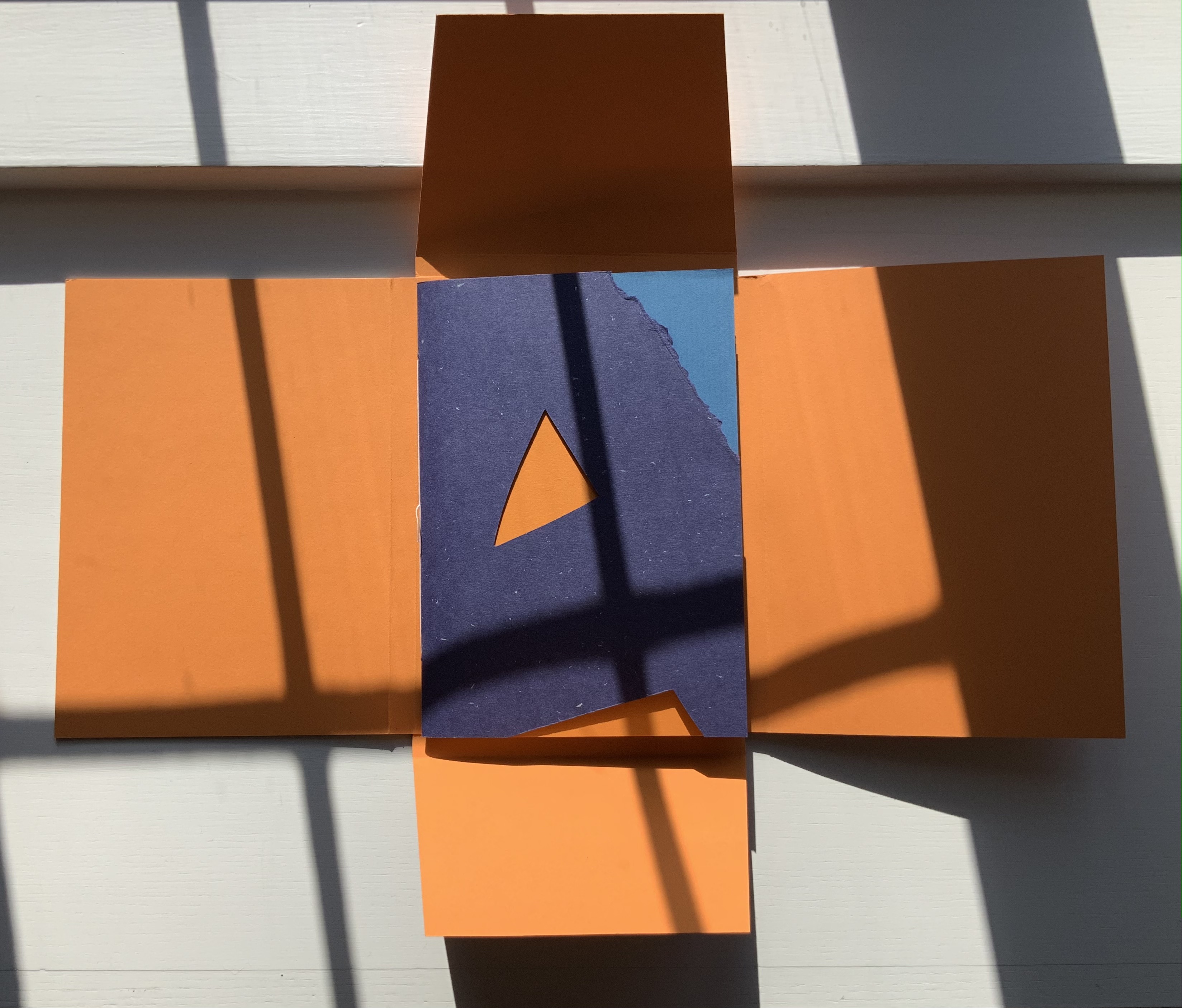
The shape of a letter depends on the “air” — the space — within and around it. Bruno Riboulot’s concept, executed here by Marjon Mudde, demonstrates how those spaces can be formed by cuts, tears, folds, “reveals” and contrasting colors. Truly an abecedary of space. (Thanks to Colin Cohen of Missing Portraits for the reminder of the title’s pun on abécédaire.)
A revealing B revealing C
The book consists of thirteen leaves sewn together with linen thread. Each leaf is divided in half, and each half is dedicated to a letter of the alphabet.
Standing, the open book takes on the air of an abstract sculpture.
W revealing X revealing Y revealing Z.
The “reveals” evoke the harlequinade (“flap-book”, “turn-up”, “metamorphosis” or “lift-the-flap”) structure invented in 17th century, in which the book’s narrative unfolds as each flap is lifted. To appreciate how differently this structure can be used with the alphabet, compare it with Scott McCarney’s Alphabook 10 (2015) and Thomas Ockerse’s The A-Z Book (1969/2014).
About the artists:
French calligrapher Bruno Riboulot works with traditional watercolors, pen and ink but also experiments widely with paper (as above), stone, stop motion animation, light and calligraphy performed to music. Visual artist Marjon Mudde currently works as an engraver, printmaker, ceramicist, book artist and editor of handmade artists’ books.
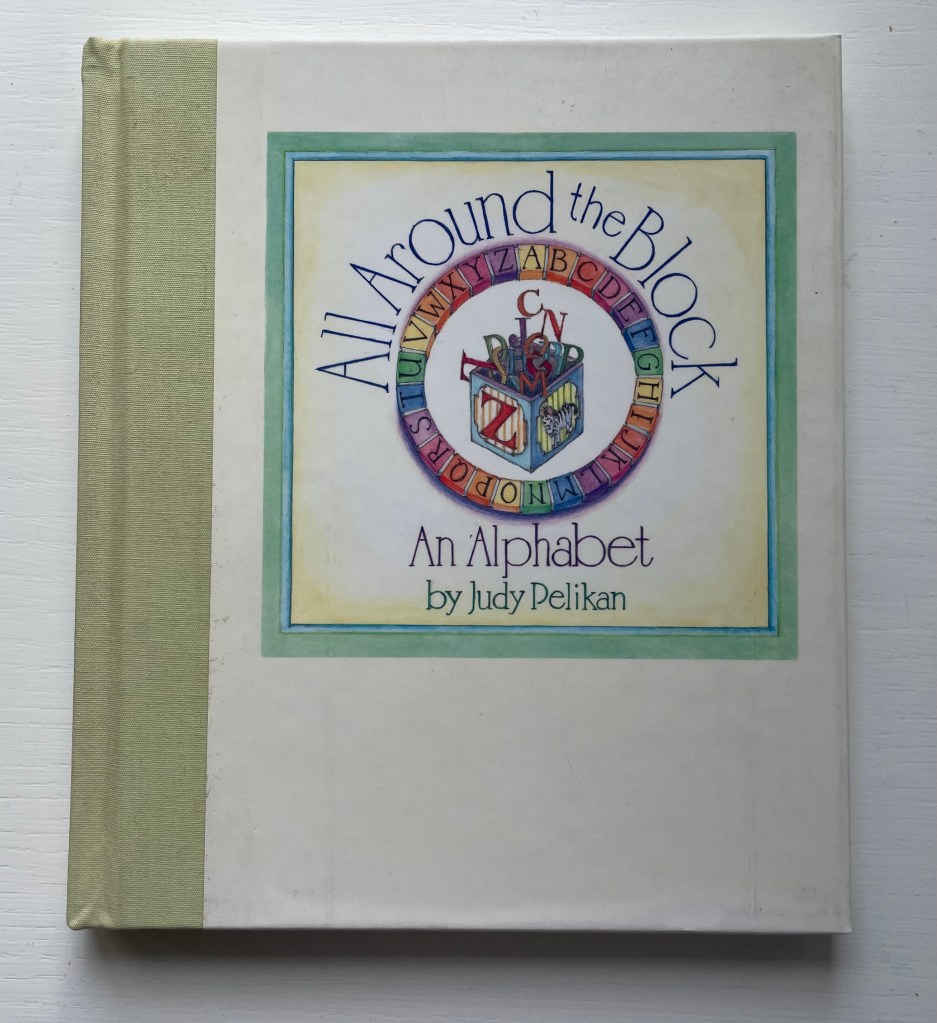
All Around the Block: An Alphabet (2008) Judy Pelikan Hardcover H168 x W145 mm. 56 pages. Acquired from Amazon, 24 September 2022. Photos: Books On Books Collection. Displayed with permission of the artist.
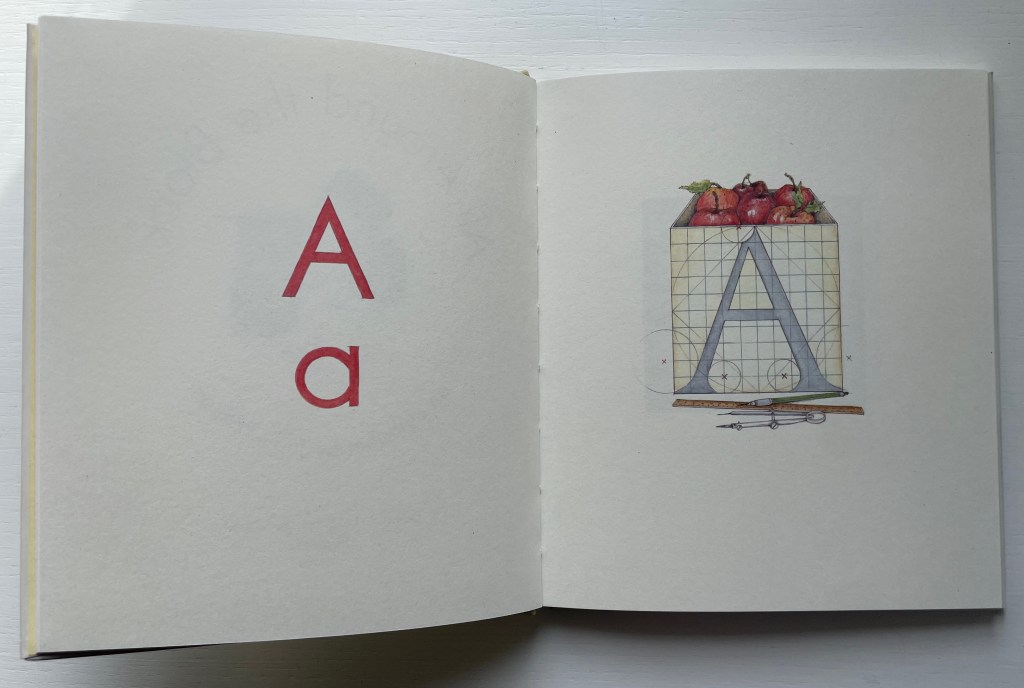
From the cover to the last letter, Judy Pelikan’s book is an extended visual pun with more puns in between. Some of the resulting images (like that for the letter A) are deeply clever; others (like that for the letter Z) are surreal. Obviously A is for a box of apples, but the uppercase serif A on yellowed grid paper with drawn guidelines recalls the early designers of geometrically created letters such as Feliciano, Pacioli, Durer, Tory and others. Driving home the recollection, the artist has laid out the tools for such typographical design: compass, straightline and pen. Here, “all around the block” is all about the square.
Most of the visual puns are simple like B for books and blocks; others are straightforward but dense like C for crate, cloud, curl, cup, coffee and castle (that’s six for all sides of the block!); others are strange. For the letter Z, we have the surreality of a zebra and her foal grazing on top of the block on whose front panel a zebra moth or butterfly hovers by a ziggurat behind an old-fashioned console (Zenith?) with a third zebra peering from its screen.
All Around the Block warrants a closer look on each page as well as favorable comparison and contrast with any of the works noted below.
The Evolution of the Medieval Decorated Letter (1985)
The Evolution of the Medieval Decorated Letter (1985) Mark Van Stone Leporello attached to black boards with ribbon tie and pocket for folded information sheet. Leporello: H65 x W68 mm closed; W1630 mm (including board) open. Sheet: H280 x W215 mm. 25 panels. Acquired from Lorson’s, 5 December 2022. Photos: Books On Books Collection. Displayed with permission of the artist.
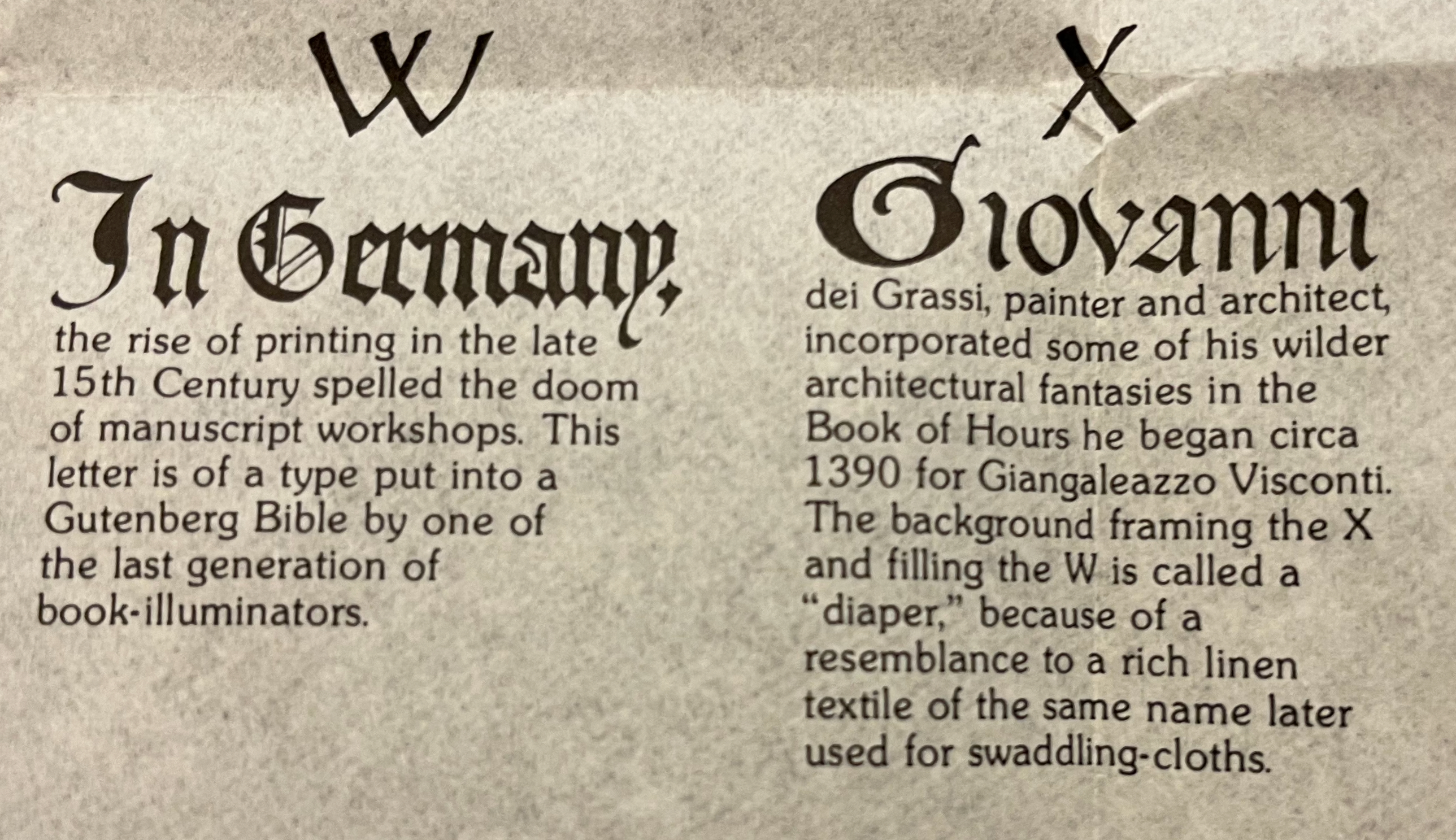
Mark Van Stone is a professor of art history at Southwestern College in California. Scholarly books and a documentary attest to his expertise in his academic specialty: the interpretation of Mayan hieroglyphs and calligraphy. He also teaches workshops in versals and white vine decoration. His workshop qualification needs no endorsement beyond this miniaturized history of medieval illuminated letters: a calligraphic, bookmaking and scholarly tour de force.
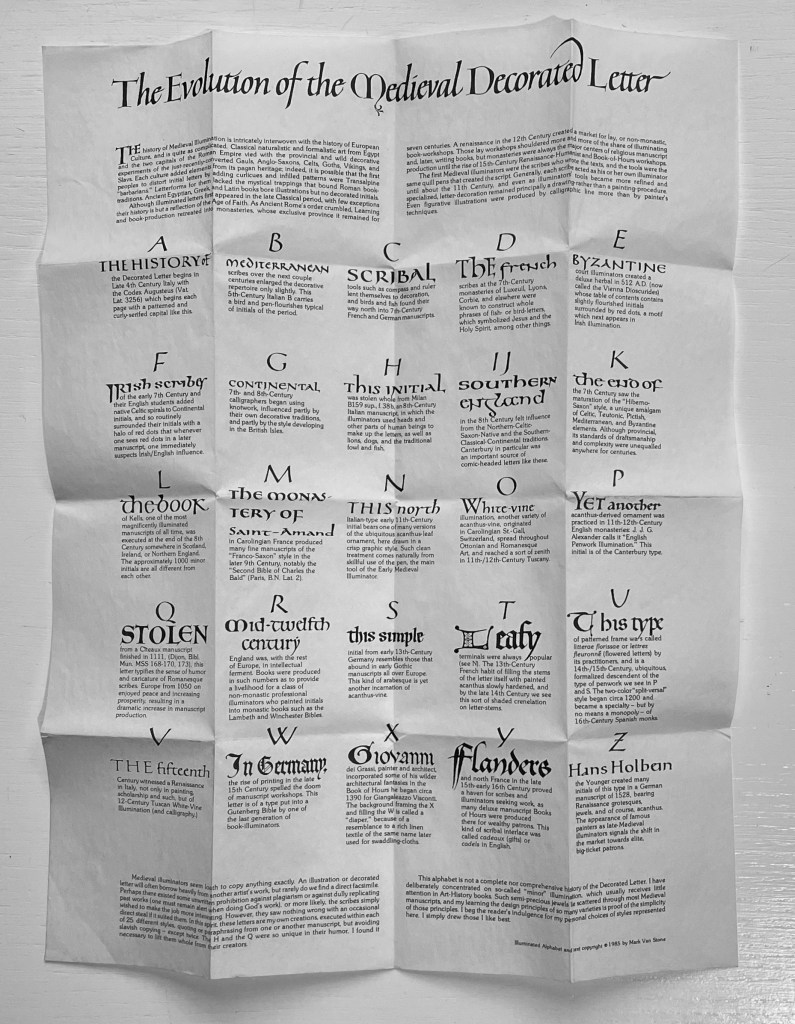
In the spirit of medieval illuminators, Van Stone has imitated the hand of twenty-three of what he calls the “semi-precious jewels” of “‘minor’ illumination that usually receives little attention in the Art-History books”. Because of their medieval humor, two initials were copied outright rather than imitated. Below, you will find eight of these semi-precious jewels along with Van Stone’s commentary on each. Use the WorldCat link to find your way to the closest institution holding a copy of this work to revel in the rest.
The folded onionskin of text contained in the binding pocket is like a miniature poster. On it, Van Stone documents each of the 25 styles of illumination that he reproduces in the leporello between the soft black boards stiffened by folding. The black-on-white parchment-like appearance of the “poster” complements beautifully what unfolds between those boards, and each of its 25 notes begins with the calligraphic bookhand that would be appropriate to the period of its initial. Correspondence with the artist reveals a possible origin story for the poster-like nature of the insert.
The project began life as a portfolio of individual letters of six inches square. For each letterform, Van Stone “drew the color-separations individually in black ink, rather than making finished illuminated initials in color and photographically color-separating”. After specifying the colors for the four plates and learning that the project would require eight dozen separate screens far outstripping the budget, Van Stone — without a Renaissance patron to come to the rescue — transformed the project into a poster. This involved finding another printer and photographing the separations in a ganged and reduced size. “An unfortunate accident in the pressroom resulted in the printing of 1000 copies with a marred title-line, but with the body of the sheet undamaged.”
After the poster was reprinted, Van Stone turned his attention to the 1000 posters he couldn’t use:
… we cut them all into strips, I folded and pasted them all by hand (with archival polyvinyl acetate), designed and folded the black covers to slip on the stubs at each end, and threaded the ribbon through the hand-cut slits. Like a 15th-century publisher, much of the work was performed by hand.
So if you find your closest institution holding a copy of The Evolution of the Medieval Decorated Letter, keep in mind the work’s real-life evolution and that you might have been looking at individual letter prints or a poster ready for framing rather than this red-ribboned treasure ready to unfold and display gem after gem.
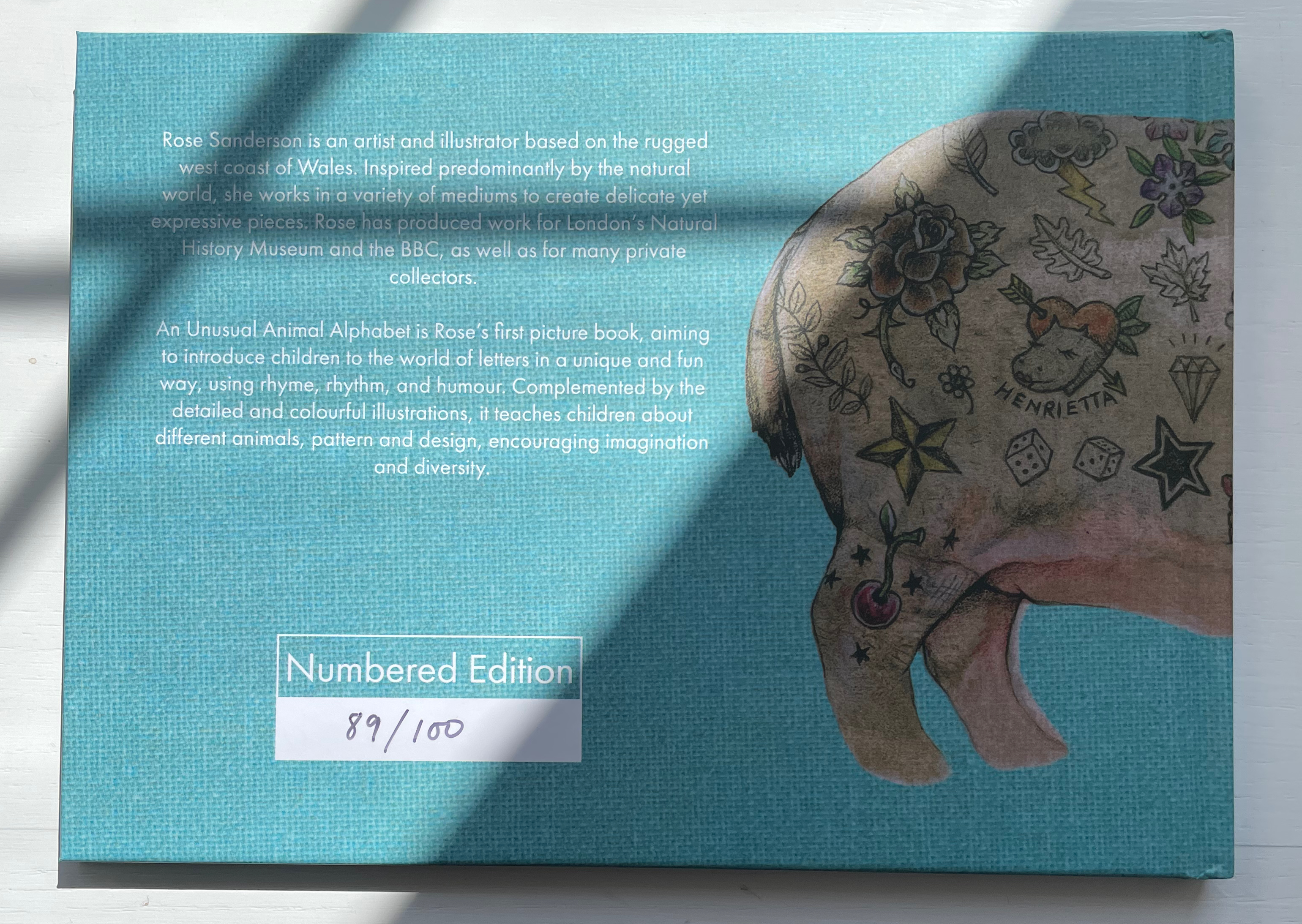
An Unusual Animal Alphabet (2021) Rose Sanderson Casebound with illustrated paper over boards and patterned doublures, perfect bound. H155 x W215 mm 54pages. Edition of 100, of which this is #89. Acquired from the artist, 17 April 2023. Photos: Books On Books Collection. Displayed with artist’s permission.
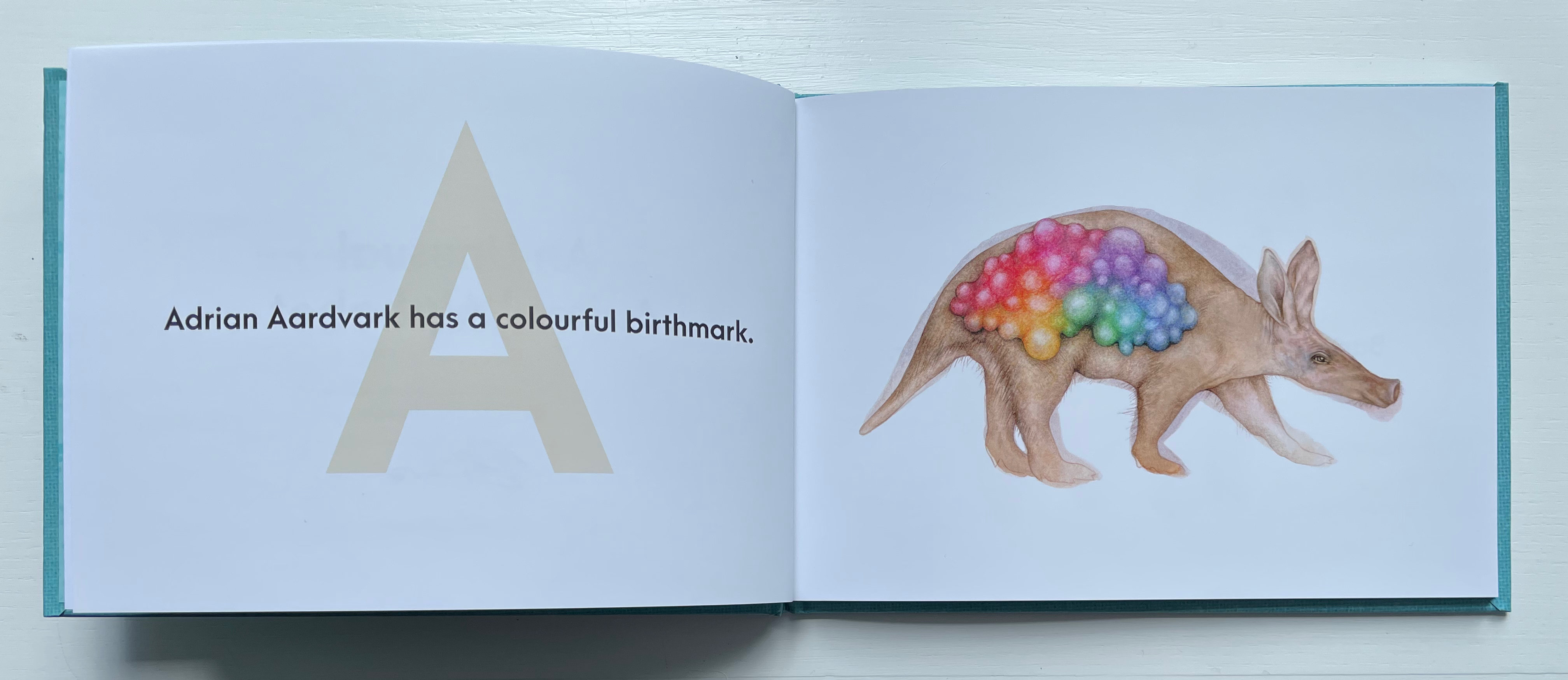
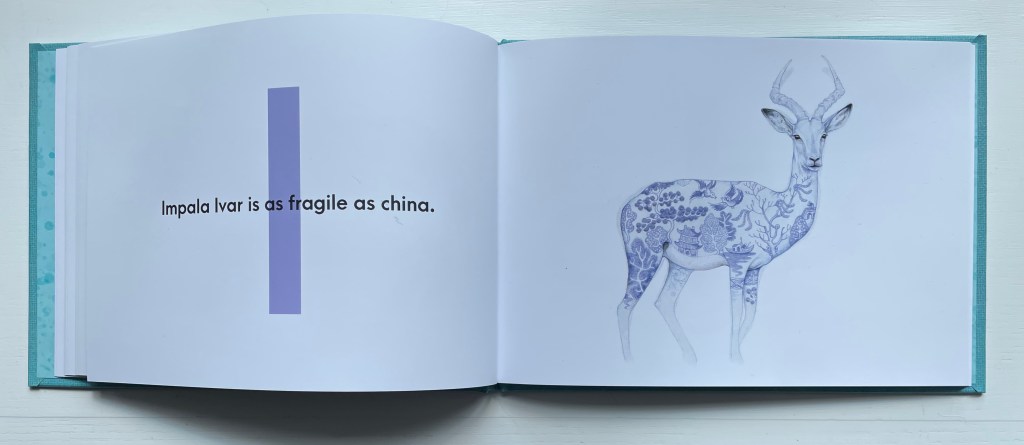
Written and illustrated by Rose Sanderson, this abecedary introduces children to the alphabet with humorous clashes of colors and animals (a pink bear or blue and white impala?) as well as odd combinations of concepts (topiaries and mammals, skyscapes and kangaroos). It all tips over into the surreal, which, with the vocabulary (spirograph, topiary, uakari), implies an audience of older children and adults.
Adding to the humor are other incongruities such as a paisley-patterned dingo and a camouflaged goat. The many half- or near-rhymes also enhance the humor: “Elephant Etta looks good in a sweater” and “Impala Ivar is as fragile as china”).
The production is of high quality. The text is printed on 170gsm silk paper and in full color. The cover comes from a scan of linen/canvas overlayed with a color layer with a balanced transparency that softly merges the two together. Whether or not inspired by the book’s half-rhymes, the designer (Emrys Plant) contributes an effective visual “half rhyme” of Arca Majora for the text type with Futura for the display type. Along with Sanderson’s conceptualization, imagination and craft, such touches nudge this work toward the category of artist’s book or, at least, sophisticated alphabet book.
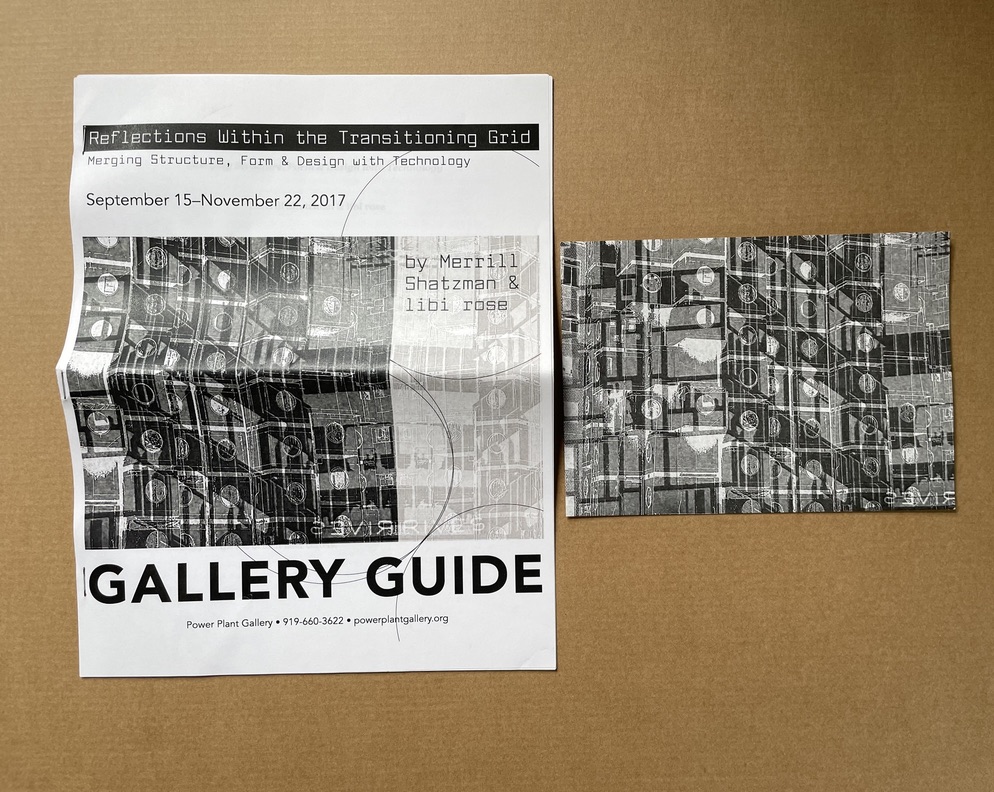
Calligrafitti #3 (2011) Merrill Shatzman Leporello. Closed: 235 x235 mm. Open: W282 cm. 10 panels.Unique. Acquired from the artist, 6 October 2017. Photos: Courtesy of the artist.
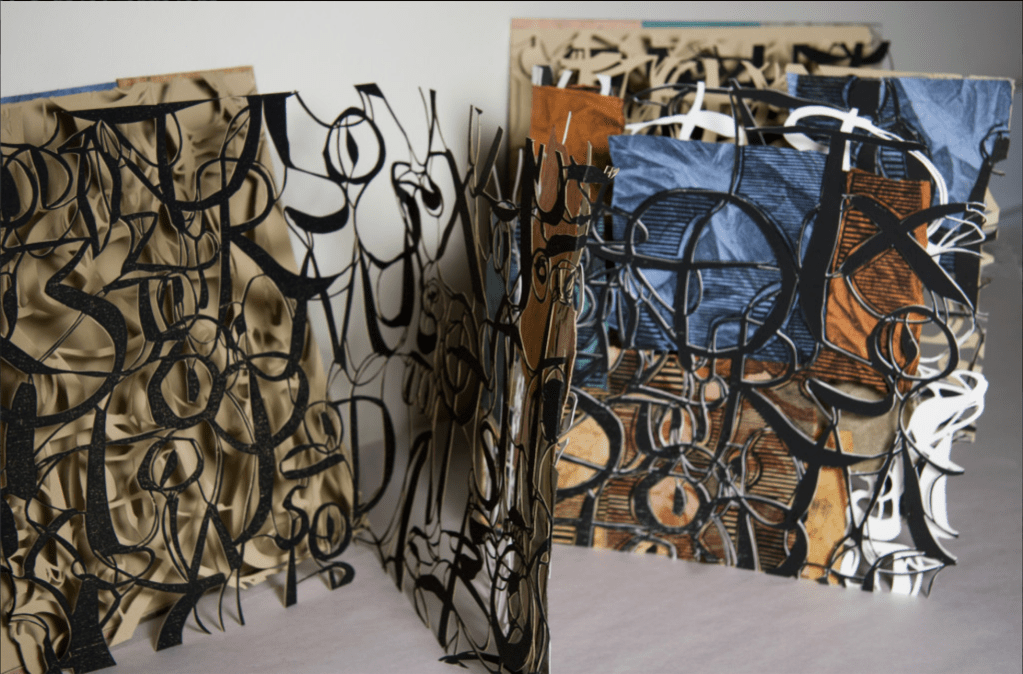
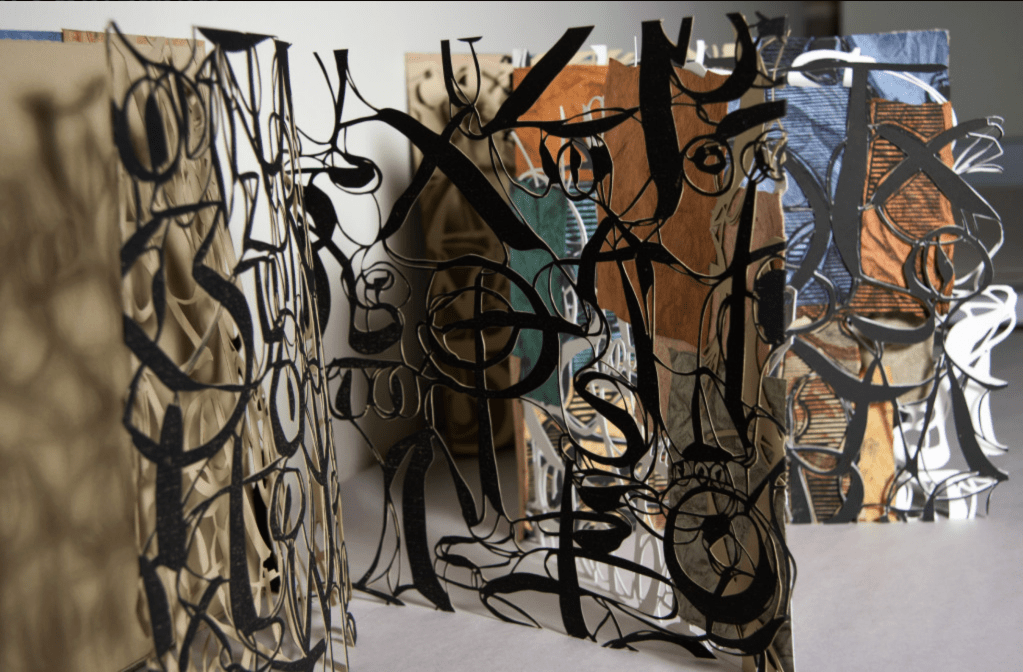
An extraordinarily fragile and rich work of print and sculpture, Calligrafitti #3 displays the inspiration that alphabets can provide for artists’ books. There are, of course, more inspirations or influence at work here.
One artist mentioned by Merrill Shatzman as an influence on her art is Friedensreich Hundertwasser. The book’s three dimensionality, its colors throughout and the background striations echo the Hundertwasser House as well as the pattern of striations in several of the Hundertwasser paintings that can be found here. Certainly like Hundertwasser, Schatzman fuses the static and dynamic. In Calligrafitti #3, there’s something vegetative, almost animistic, and still architectural as carved letters can be.
Hundertwasser House, Greece
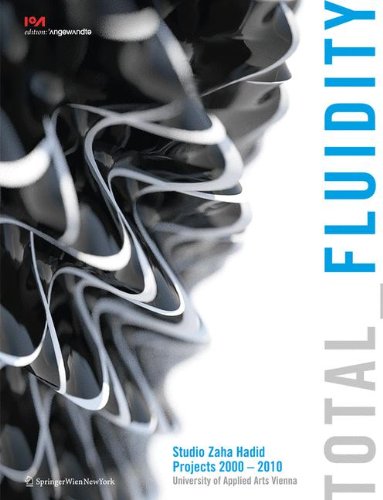
The fluidity and structure in Calligrafitti #3 recall another influence: Zaha Hadid.
Two other visual influences that shine through — although disparate in time and dimensionality — are Rachid Koraïchi and Stuart Davis. The influences are more visual and formal than substantive, and the works below are emblematic selections.
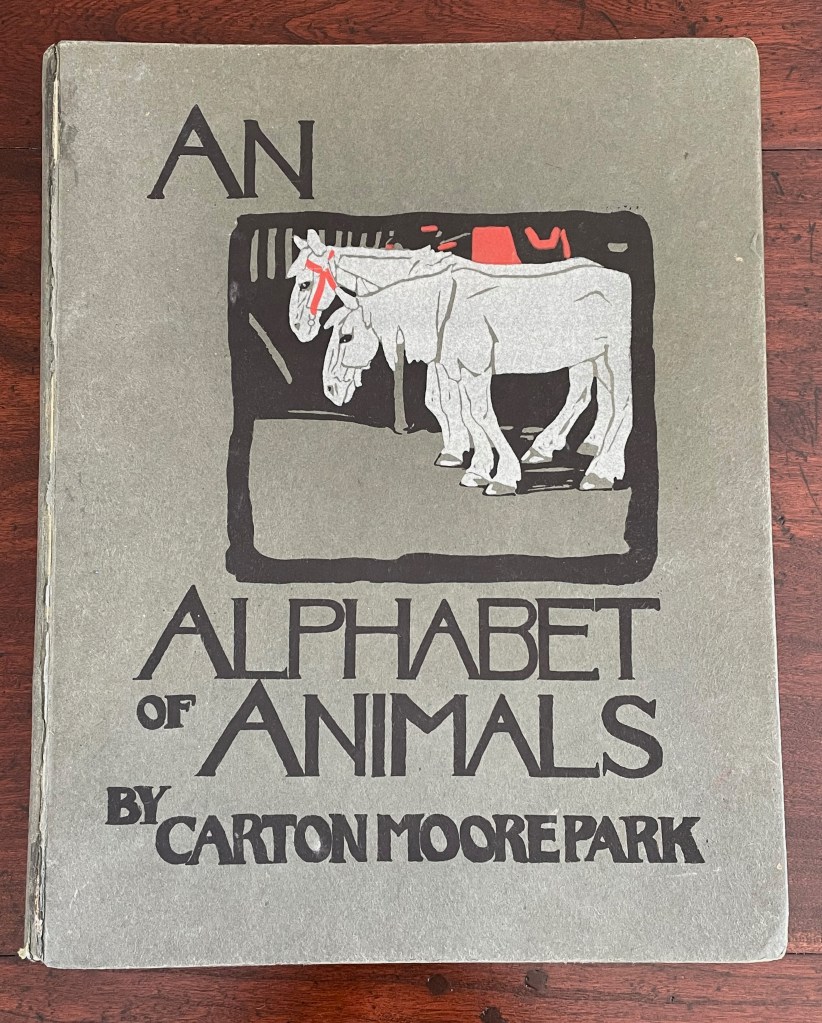
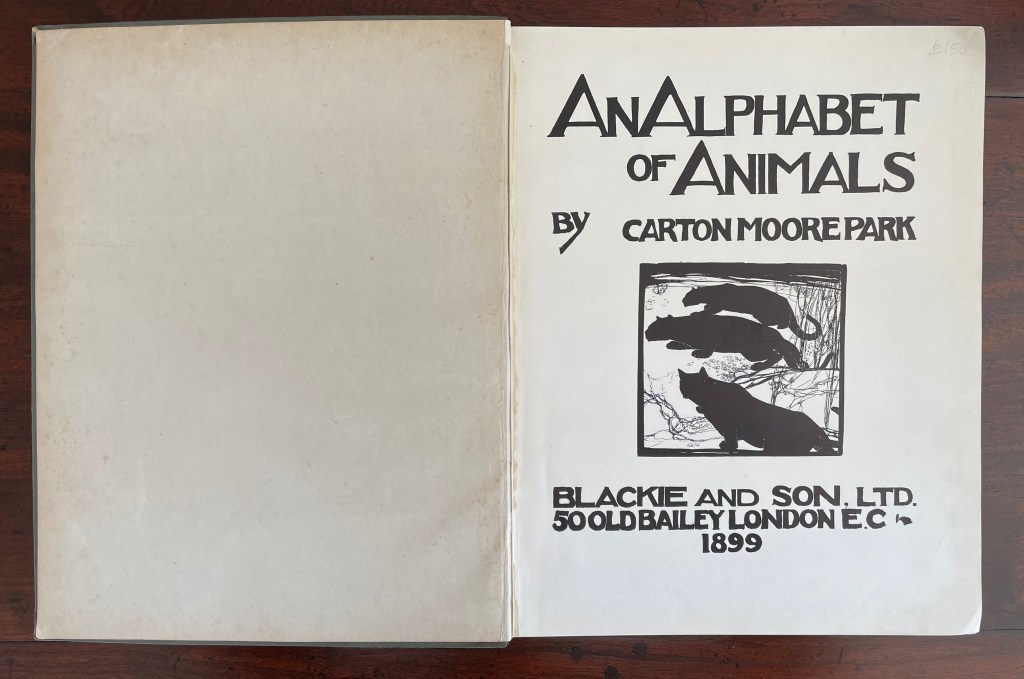
An Alphabet of Animals (1899) Carton Moore Park Casebound, illustrated paper over boards. H335 x W265 mm. 54 pages. Acquired from Books & Things, 23 March 2023. Photos: Books On Books Collection.
Scots-Canadian illustrator and painter Carton Moore Park (1877-1956) would have been 22 when Blackie & Son published An Alphabet of Animals. Like William Nicholson with An Alphabet (1898), Moore Park was responding to a publisher’s commission (for Nicholson it was W.H. Heinemann); like Nicholson, he aimed for an audience of adults as well as children; like Nicholson, who followed up his alphabet with similarly successful and applauded works, Moore Park did the same with In Doors and Out (1899) and A Book of Birds (1899); and like Nicholson’s, his preferred career path was painting, particularly portraits. But unlike Nicholson, Moore Park did not find any prolonged acclaim for his work.
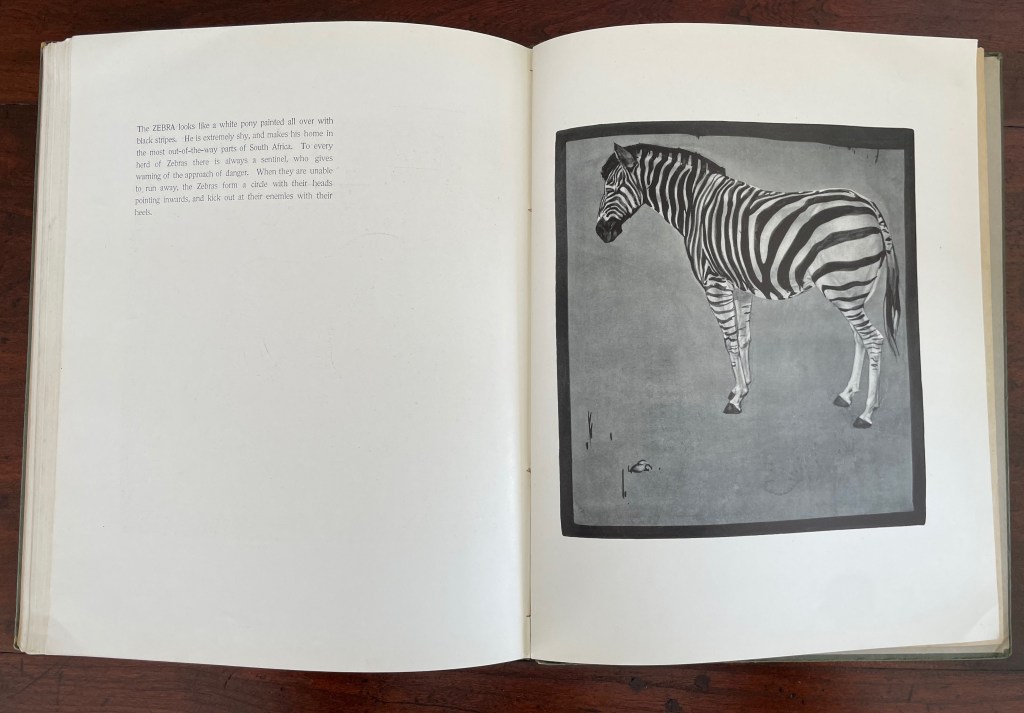
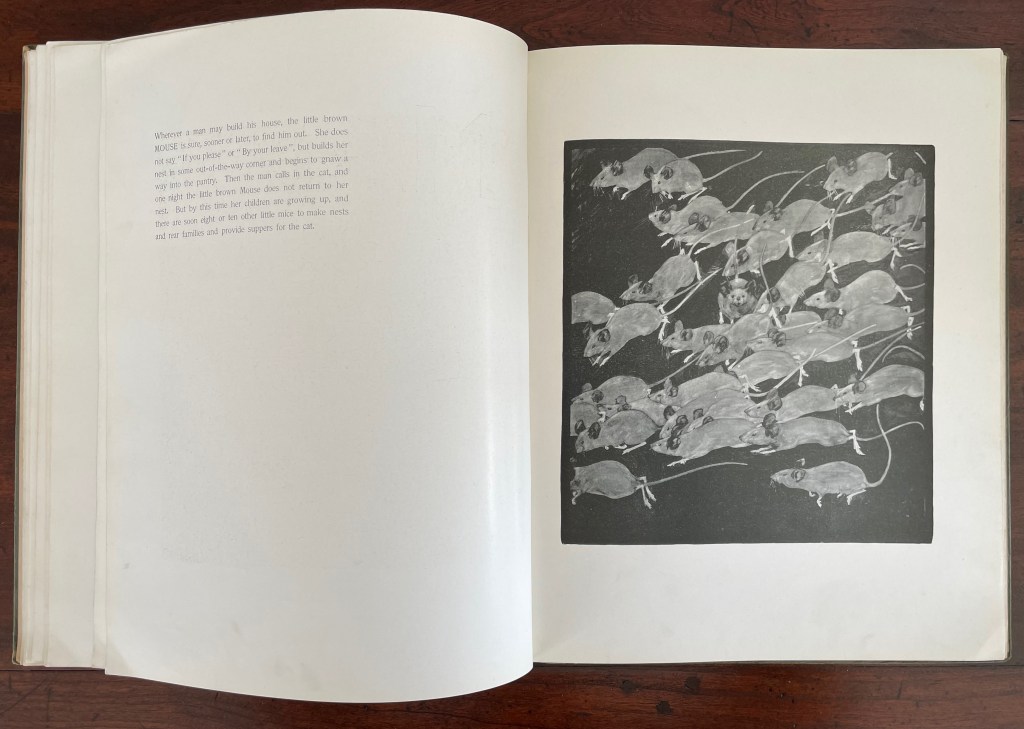
Recent efforts to revive interest in his work are an extended bio-bibliographical essay in Studies in Illustration, a thesis from the University of Delaware and a reissue of An Alphabet of Animals and A Book of Elfin Rhymes (see below). Marvelous as Moore Park’s grisaille technique is, it must have been a hard sell for children more used to colorful alphabet books. The grisaille and influence of Japanese wood engraving — especially with the unusual framing of the subjects — likely make this work appeal more to adults interested in artists’ books and the history of children’s books.
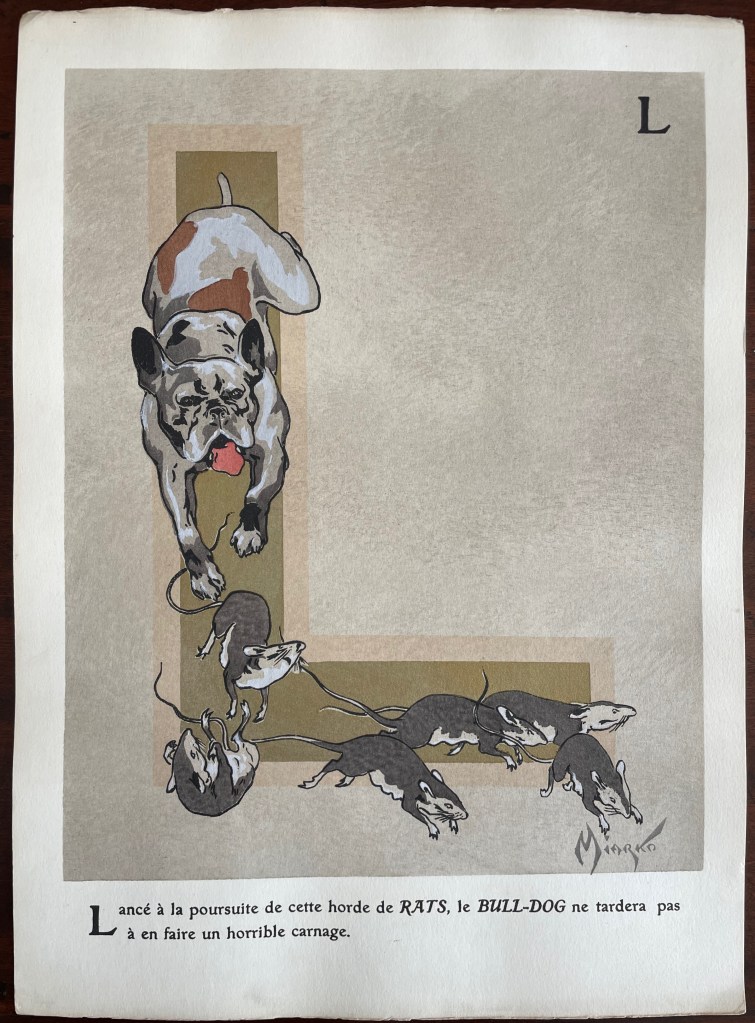
Anyone interested in whether there is a subgenre in the overlap of artists’ books and alphabet books might consider trim size as a telltale sign here. Moore Park’s and Nicholson’s books were oversized. By choosing a trim size far too large for small hands and short arms, Blackie and Son and W.H. Heinemann may have simply been hedging their bets on the two alphabet books by aiming to appeal to adults and children and as a way to test the art book market. By 1917 in France, Louis Dorbon must have seen the success of Ambroise Vollard in the art book market and felt no need to hedge with Edmond (“Miarko”) Bouchard. Even though Bouchard was primarily a caricaturist, Dorbon published ABC d’Art in portfolio format at 380 x 280 mm and with gold ink. If that is not a clear sign of aiming for adults and the art book market, the carnage in Miarko’s plates is sign enough that it was not catering to kiddies. Likewise Miarko abandons the traditional alphabet book’s usual purpose and method of fostering literacy by associating each letter with an object on the page. Instead, each letter is merely the initial letter of the plate’s caption.
From ABC d’Art (1917) Miarko (Edmond Bouchard), colored by J. Saudé. Portfolio, corner closures with ribbon, Portfolio: H385 x W285 mm. Prints: H380 x W280 mm. 27 plates. Acquired from ADER Nordmann & Dominique, 16 March 2023. Photos: Books On Books Collection.
From An Alphabet of Animals (1899)
The Japonisme in Moore Park’s pages and Miarko’s plates would also have been another feature appealing more to adults than children. Whether it is the mice scampering on to and off the page or the bulk of the porcupine’s quills bristling just off the upper left of the page, the influence of Japanese wood engraving leaps off Moore Park’s pages. So, too, does his humor with the near tailless armadillo pursuing another armadillo’s tail or, more likely, its own in the lower right corner of the page. In Miarko’s case, the images break the frame of the large gold letters rather than the frame of the images.
The Art Nouveau period (1880s to 1920s) can be thanked not only for the advent of the artist’s book but also for drawing the alphabet book into its palette of material with which to make art.