Bookmarking Book Art – Aldus Manutius, 6 February 1515 – 6 February 2015

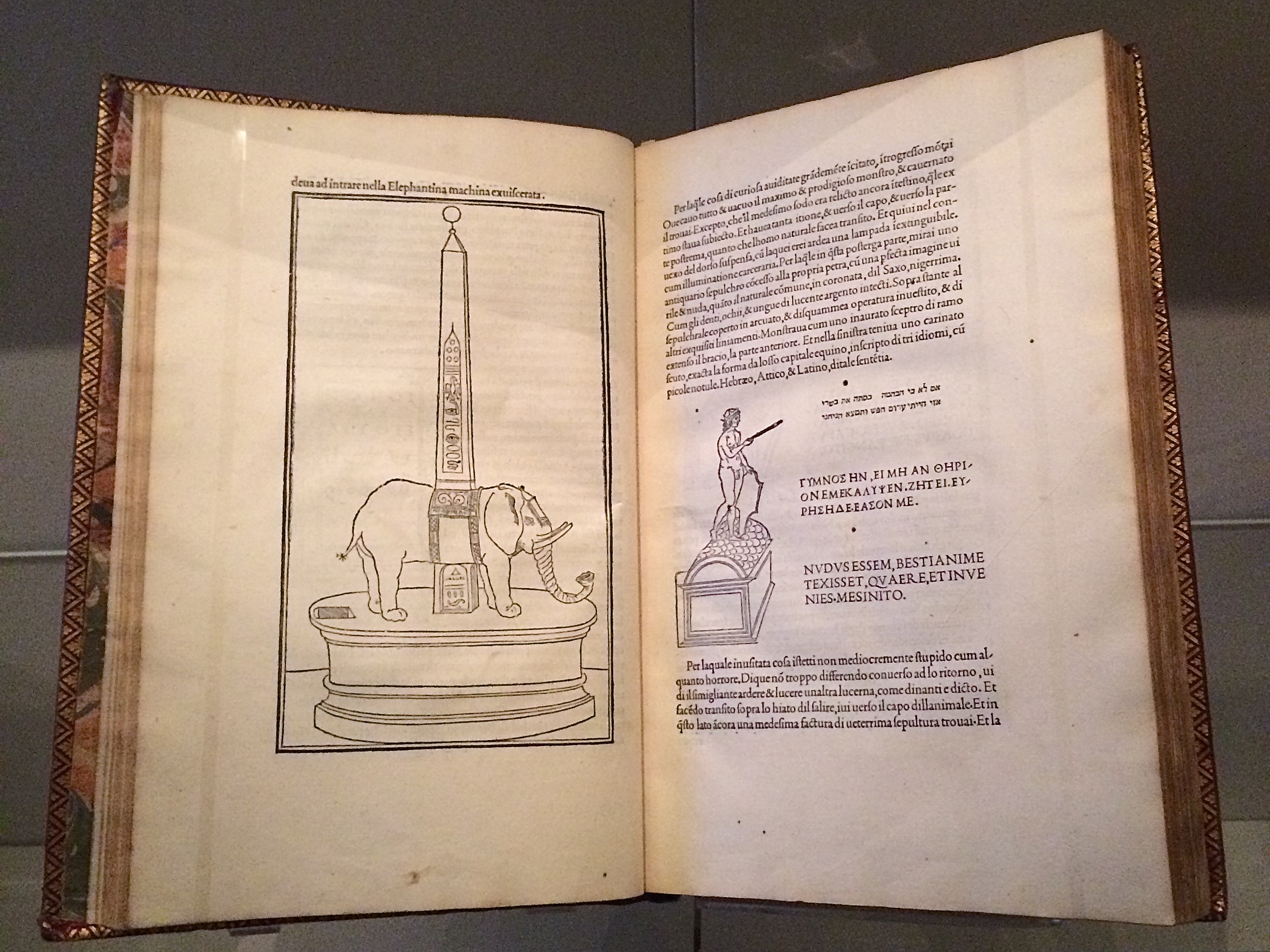
Hypnerotomachia Poliphili, Venice: Aldine Press, 1499.
Hypnerotomachia Poliphili. Venice: Aldine Press, 1499.

Late afternoon before the long worn wooden benches in the Bodleian’s Convocation Hall, 500 years after the death of Aldus Manutius, Oren Margolis served his audience well, providing them with a richer appreciation of the “finest printed book of the entire Renaissance”* – the Hypnerotomachia Poliphili – and of its publisher Aldus Manutius.

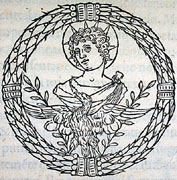
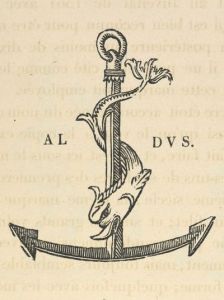
Drawing our attention to the more sculptural qualities of Venetian Renaissance printed books over the Florentine and to the  evidence of the humanist agenda that drove Manutius, he led us to the page where Poliphilo (lover of all things, but in particular Polia, the ideal woman pursued to the end of the book) stands before a carving that foreshadows the Aldine Press device: a dolphin entwined around the shank of an anchor. The Aldine Press device was inspired by a similar image on an ancient Roman coin given by Pietro Bembo to Aldus, who wrongly associated it with Augustus and his proverb Festina lente (“Make haste slowly”) and adopted both for his printing and publishing business.

Erasmus praised Aldus, saying that he was “building a library which knows no walls save those of the world itself”.

For all of 2015, the world enjoyed a multitude of celebrations of the contribution of Aldus Manutius to publishing, printing and the book. After Gutenberg, Fust and Schoeffer, Aldus Manutius was perhaps the most important printer of the Renaissance. His portable books are still here, although locked away or displayed under glass, no longer so portable. Until now.

The Manutius Network 2015 provides a running list, links for some of which are provided below, including the online exhibition associated with Margolis’s talk.  See also below, added in May 2016, the belated exhibition “Aldo Manutius: The Renaissance in Venice” at the Gallerie dell’Accademia in Venice.

IMG_1604

In the Proscholium, The Bodleian Library   Oxford

Invitation from the Biblioteca Nazionale Marciana

Invitation from the Biblioteca Nazionale Marciana

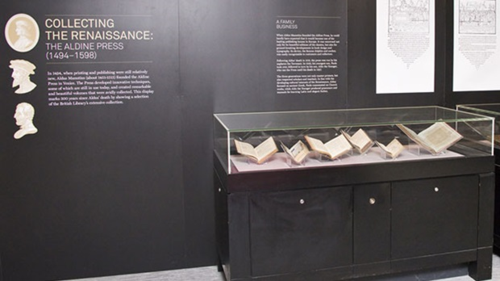
The British Library

The British Library

The Grolier Club exhibition. See the New York Times coverage here.

In aedibus Aldi The Brigham Young University's Harold B. Lee Library

In aedibus Aldi
The Brigham Young University’s Harold B. Lee Library

John Rylands Library University of Manchester

John Rylands Library
University of Manchester

The afterlife of Aldus : posthumous fame, collectors and the book trade
Edited by Jill Kraye and Paolo Sachet.
London : The Warburg Institute, 2018.

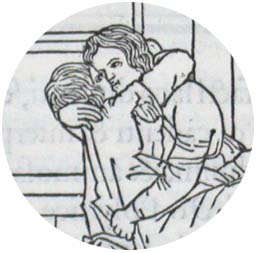
from Hypnerotomachia Poliphili, 1499 University of Glasgow

from Hypnerotomachia Poliphili, 1499
University of Glasgow

International Conference Celebrating Aldu Manutius University of California, Los Angeles

International Conference
Celebrating Aldus Manutius
University of California, Los Angeles

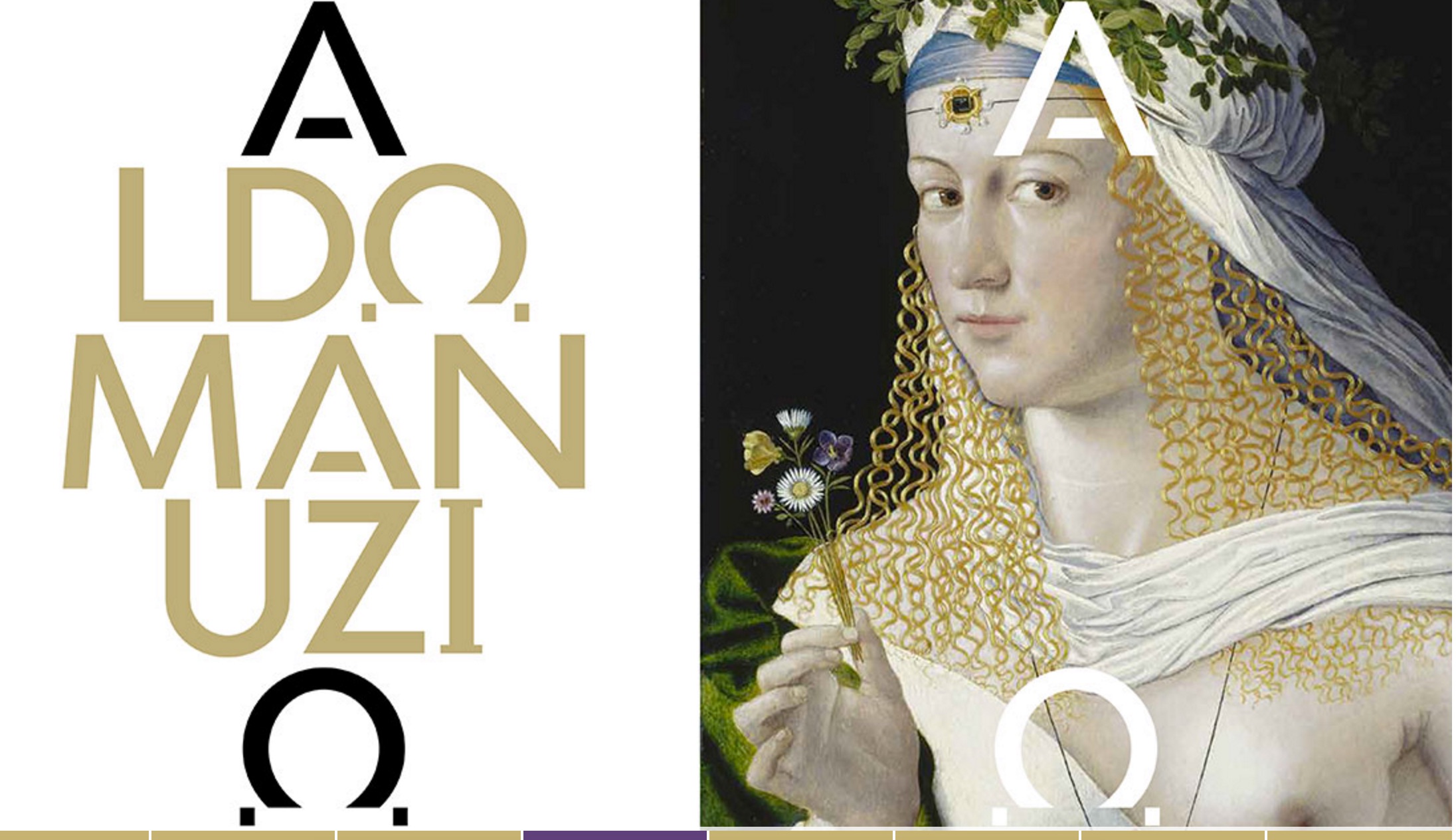
Aldo Manutius: The Renaissance in Venice http://www.mostraaldomanuzio.it/exhibition Exhibition poster containing detail of ‘Portrait of a Woman as Flora’ (c1520), by Bartolomeo Veneto © Eton College

Aldo Manutius: The Renaissance in Venice
Exhibition poster containing detail of ‘Portrait of a Woman as Flora’ (c1520), by Bartolomeo Veneto © Eton College

From Crispin Elsted’s review of the Thames & Hudson facsimile edition of the Hypnerotomachia Poliphili. Parenthesis, December 2000, No. 5:

I once spent three hours in a library with a copy of the Aldine edition of Hypnerotomachia Poliphili, and I have never known a book take my breath away so consistently. Every page is a masterpiece: the dance of text with the more than 170 woodcuts; the firm, male stature of the typeface; the crisp spring of the impression; the elegant proportion of the page — all combine to an end in which the craft of printing and design carry the text into an atmosphere not of its own making. This new edition has the appearance of a fine actor in a part lately played by a great one. Here are the signs of the grace that greatness lent the commonplace five centuries ago; and in these signs, the commonplace finds here another advocate for its small claims to our time. 

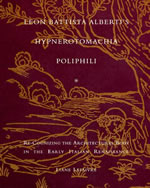
Timelines are, of course, for looking further back as well as forward.   Earlier this year, April 2012 marked the fifteenth anniversary of the publication of Liane Lefaivre’s Leon Battista Alberti’s Hypnerotomachia PoliphiliRe-Configuring the Architectural Body in the Early Italian Renaissance (Cambridge, MA: MIT Press, 1997) and the online publication of The Electronic Hypnerotomachia, which contains the facsimile text and illustrations.   The online publication of extracts from Lefaivre’s book illustrates the linking prefigured by the “card stack” approach of HyperCard.  What MIT Press and TU Delft,  Lefaivre’s affiliation, host on their servers are not ebooks or even e-incunabula of the sort we experience today, but they are clearly forerunners to them.

In twenty-eight more months, December 2014, we will see the 515th anniversary of the original work’s publication by Aldine Press (Venice, December 1499).   The founder Aldus Manutius did not normally publish heavily illustrated books.  The Hypnerotomachia Poliphili was the exception and the only commissioned work that Manutius undertook.   The exception reflects favorably on the overall success of his business and supports the view that Venice had become the capital of printing and publishing very shortly after the invention of printing by moveable type.

The book unveils an inscrutable, almost comic-book-illustrated story, glittering with made-up words in Greek, Latin, Hebrew and Arabic (including proto-Greek, -Hebrew and -Arabic fonts).  In addition to the page displays sculpted into shapes such as goblets, this one volume displayed the technological mastery of and improvement on the new Roman (as opposed to the heavy Gothic) typeface Bembo.  According to Norma Levarie in The Art & History of Books (New York, 1968), this singular volume revolutionized typography in France in less than twenty-five years.

Somewhat like software releases, though, the 1499 edition came with bugs.  The colophon to the Hypnerotomachia Poliphili falls at the end of a full page of errata.

“Venice Month December. 1499. in the house of Aldus Manutius, most accurately done.”

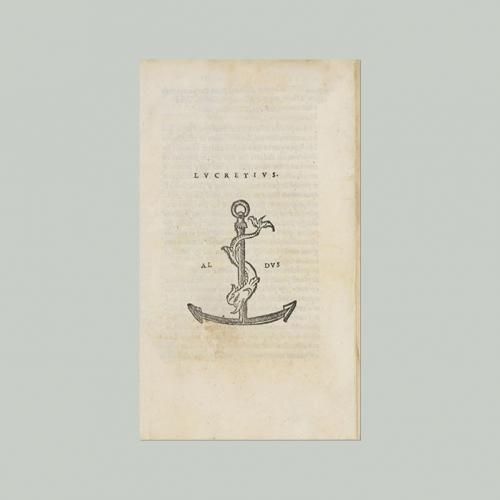
Initiated in 2015 in celebration of the anniversary and acknowledgement of the more than 100 Aldine editions in the Wosk McDonald Collection, Simon Fraser University’s Aldus@SFU is the digitization of 21 Aldine volumes published between 15011 and 1515. The image above is the edition of Lucretius’ De rerum naturam, published just after Manutius’ death in 1515.

See also “More Manutius in Manchester and More to Come“, Bookmarking Book Art, 1 June 2015.

Bookmarking Book Art – Helen Douglas

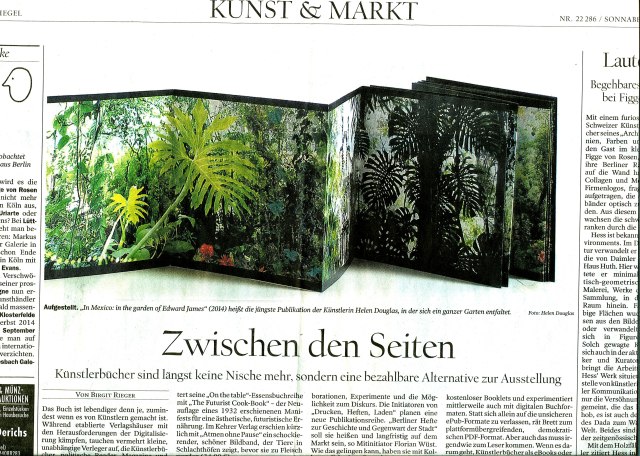
Helen Douglas, In Mexico: in the garden of Edward James (2014). Reviewed in Der Tagesspeigel

Helen Douglas has been kind enough to forward the notice above of her most recent work — In Mexico: in the garden of Edward James Based on her invited residency in Mexico City, this concertina book takes the viewer through Edward James’ jungle garden Las Pozas, its buildings and staircases, James’s surreal imagination and, best of all, Douglas’s own imaginative experience of them. See the interview at BookArtBookBlog that preceded the work’s unveiling at the London Art Book Fair at the Whitechapel Gallery and Berlin Art Book Fair.

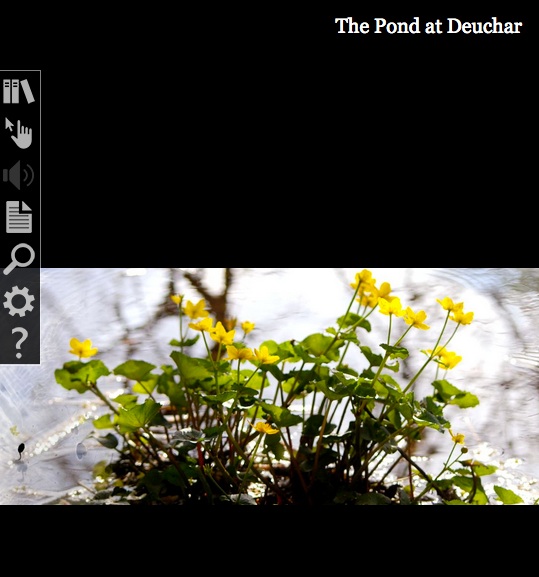
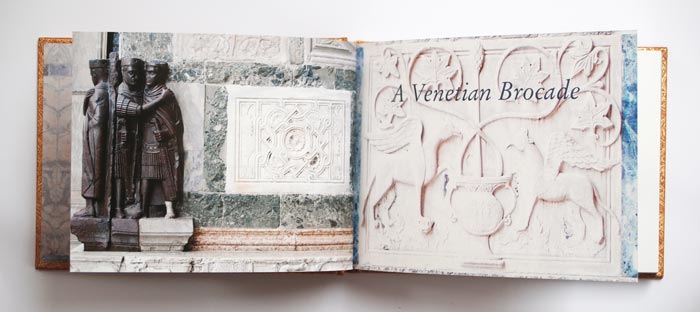
When I go to Weproductions, the website of founding partners, Telfer Stokes and Helen Douglas, it is like taking a walk in Yarrow, Scotland, or taking the measure of paper samples between forefinger and thumb, or browsing in a bookstore, or lingering in an art gallery. Two of Helen Douglas’s works in particular elicit this: The Pond at Deuchar (2013) and A Venetian Brocade (2010).

The Pond at Deuchar (2012)
“The Pond at Deuchar” E-Scroll artwork ©Helen Douglas
Application “Turning the Pages” © Armadillo Systems

Was it London Book Fair where I first saw this bookwork, appwork, scrollwork … this work of art?  What you see above leads you to the app. Clive Philpott’s postscript to this work, featured on Weproductions and published by the Tate, offers all the background and appreciation of the work you need to read. Read it, then go to The Pond at Deuchar*, lean forward and trail your fingers through its waters.

Helen Douglas and Marina Warner. A Venetian Brocade (Weproductions, 2010)

A Venetian Brocade equally makes the “act of looking” tactile and the “act of touching” insightful. The work reminds me of this passage from Joseph Brodsky’s Watermark (New York: Farrar Straus Giroux, 1992):

… bipeds go ape about shopping and dressing-up in Venice for reasons not exactly practical; they do so because the city, as it were, challenges them. We all harbor all sorts of misgivings about the flaws in our appearance, anatomy, about the imperfection of our very features. What one sees in this city at every steep, turn, perspective, and dead end worsens one’s complexes and insecurities. That’s why one—a woman especially, but a man also—hits the stores as soon as one arrives here, and with a vengeance. The surrounding beauty is such that one instantly conceives of an incoherent animal desire to match it, to be on par. This has nothing to do with vanity or with the natural surplus of mirrors here, the main one being the very water. It is simply that the city offers bipeds a notion of visual superiority absent in their natural lairs, in their habitual surroundings. That’s why furs fly here, as do suede, silk, linen, wool, and every other kind of fabric.

If you are lucky enough to buy one of the few remaining copies of A Venetian Brocade, you will see and feel how it leads to In Mexico: in the garden of Edward James. Appreciation of that double-sided leporello work’s extension of the Douglas’s concept of Visual Narrative and its kinship with James’s surrealism can only be enhanced by viewing The Secret Life of Edward JamesGeorge Melly’s documentary film from 1975.

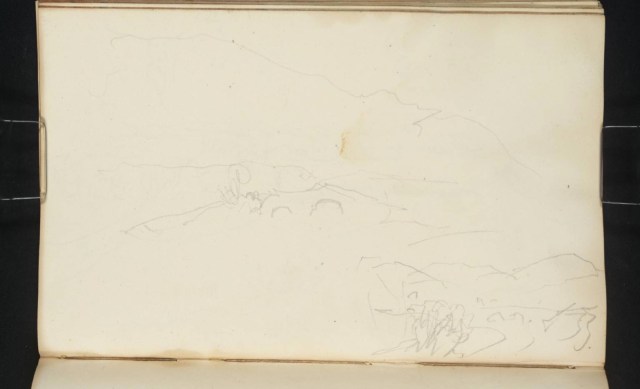
But having indulged the surreal elements, think back to the pond at Deuchar, think back to the Tate’s association with Douglas’s work, then consider this work also held at the Tate:

Joseph Mallard William Turner, “Deuchar Old Bridge, near Yarrow, Selkirkshire”, 1834, in The Edinburgh Sketchbook 1831-34, graphite on paper, 111×181 mm. Reference: D26161
Turner Bequest CCLXVIII 34 a

Here is a narrative of art across time and place to touch by looking and, by looking, to be touched by.

*Deuchar is pronounced “dew-ker”, the “k” as in “loch”.

Bookmarking Book Art – Margins and making objects that live forever

Craig Mod modulates on margins here in Medium (18 August 2014).

Text printed on the best paper with no margins or unbalanced margins is vile. Or, if we’re being empathetic, sad. (For no book begins life aspiring to bad margins.) I know that sounds harsh. But a book with poorly set margins is as useful as a hammer with a one inch handle. Sure, you can pound nails, but it ain’t fun. A book with crass margins will never make a reader comfortable. Such a book feels cramped, claustrophobic. It doesn’t draw you in, certainly doesn’t make you want to spend time with the text….

On the other hand, cheap, rough paper with a beautifully set textblock hanging just so on the page makes those in the know, smile (and those who don’t, feel welcome). It says: We may not have had the money to print on better paper, but man, we give a shit. Giving a shit does not require capital, simply attention and humility and diligence. Giving a shit is the best feeling you can imbue craft with. Giving a shit in book design manifests in many ways, but it manifests perhaps most in the margins.

Reiterating his point by analogy, Mod channels the late designer George Nakashima:  “in order to produce a fine piece of furniture, the spirit of the tree must live on. You give it a second life … You can make an object that lives forever, if used properly.

For the fundamentals underlying Mod’s scatologically and poetically emphatic truth, you cannot find much better than Alexander Ross Charchar’s essay on the craft and calculations of “page canons” by Villard de Honnecourt (13th century!) , J.A. Van de Graaf, Raúl Rosarivo and Jan Tschichold:  “The Secret Law of Page Harmony“. Most delightful is Charchar’s dynamic diagram “The Dance of the Four Canons” illustrating the workings of each page canon:

Copyright 2010, Alexander Ross Charchar.

The Further Reading suggested by Charchar and his commenters is excellent, and I would only add Marshall Lee’s Bookmaking. For those who are irritated with the imposition of the print paradigm on the digital reading experience, there is a useful pointer to applying the page canons to website design that will cause a rethink of that irritation and equally make the imposers think harder as well.

For those who care about the book, what it is evolving into and the role that heart, mind and design still play in that process, read Charchar’s”The Secret Law of Page Harmony” –again and again.

Bookmarking Book Art — Francisca Prieto (I)

Trained at Central St Martins, Francisca Prieto is a Chilean artist living and working in London where her work has featured in collections at the Victoria and Albert Museum, the Tate Gallery and the British Library among others. From 29 May through 21 June, her solo exhibition Underlined runs at Jagged Art, off Marylebone High Street in London.

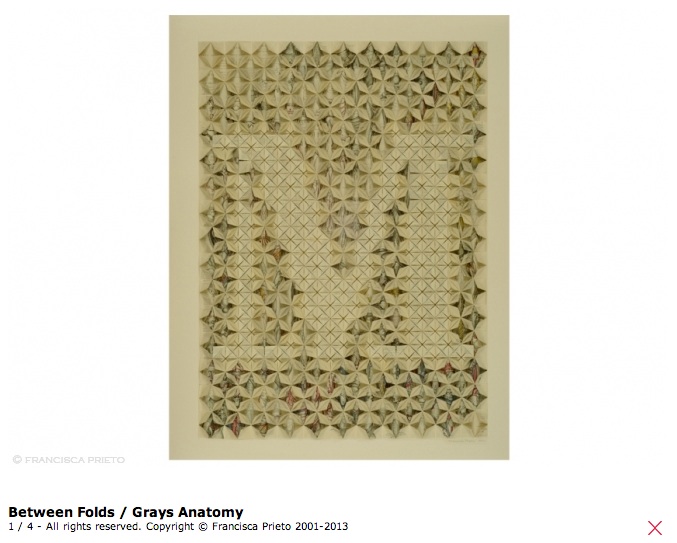
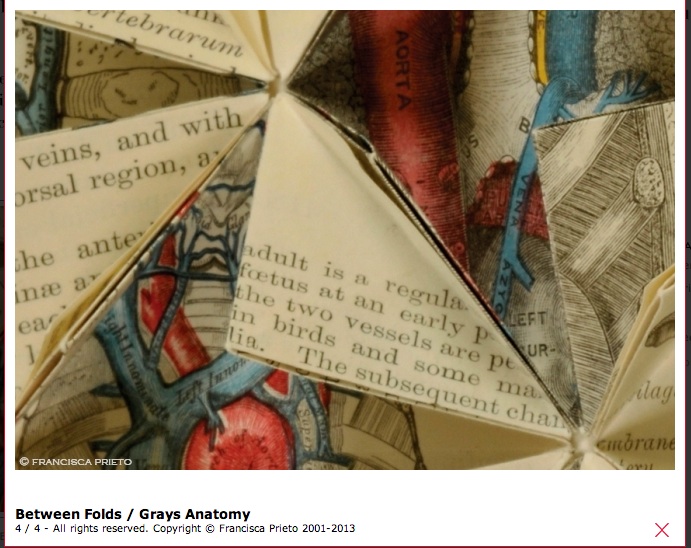
Underlined extends — or rather deepens — her series Between Folds, which according to her artist’s statement “explores pages of rare and damaged books or forgotten ephemera, emphasising the beauty and detail of print that would otherwise go unseen.” Prieto’s grounding in typographical design drives Between Folds as is obvious from the letters created from the pages of Grays Anatomy and Bartlett’s British Scenery.Between Folds - Anatomy - Letter M

Between Folds - British Scenery - Letter O


Detail of Between Folds/Anatomy

The precision of the folds in Prieto’s work becomes even more evident in the eight compositions of Underlined, which is fitting as she now delves through source material past the letterforms and down to the line. Look how the folds align and intersect with the lines of the source material in the detail below.

Detail - Composition No. 1 © Francisca Prieto, 2014
Detail – Composition No. 1: A Diagonal Line
© Francisca Prieto, 2014

The source material in this case is The Wanderers Cricket Club Logbook, whose red lines strike vertically down the diagonal, the folds of the work “playing with direction and motion, as the ball of the game dictated each log of play”.  Prieto’s art is not only playful but thought-provoking, the cause of a sudden intake of breath from delight or even shock — what we most seek in our experiences of art. Do you not draw in your breath as you read between the folds and past the title and shape of Composition No. 2: One Horizontal Line to see that it is the line drawn under the life from whose last will and testament Prieto has created this work?

This dialogue between the parts and the whole to which Prieto’s craft and vision continuously draw the eye, heart and mind elevate her work and its audience.

Additional commentary on her work can be found at www.blankproject.co.uk.


Bookmark – Phoenix in an Elegy for Paper?

fahrenheit-451In another elegy for paper, Mark Fox in Designers & Books leaps from the famous conversation between Ray Bradbury’s characters Professor Faber and Fireman Montag in Fahrenheit 451 that begins, “Do you know why books such as this are so important? Because they have quality. And what does the word quality mean?” to Jaron Lanier’s assertion that the remix culture is responsible for “the digital flattening of expression into a global mush.” Fox sets this against Professor Faber’s elaboration of what he means by “quality”: 

To me it means texture. This book has pores. It has features. This book can go under the microscope. You’d find life under the glass, streaming past in infinite profusion. The more pores, the more truthfully recorded details of life per square inch you can get on a sheet of paper, the more ‘literary’ you are. That’s my definition, anyway. Telling detailFresh detail. The good writers touch life often. The mediocre ones run a quick hand over her. The bad ones rape her and leave her for the flies.

Consider, however, this conversation between the artists Stefan Saalfeld and Gerhard Mantz published in the February 2013 issue of the Lumas Gallery Magazine, “The Liberation of Art“:

Saalfeld – … I’m interested in the changes that take place over time. In nature, the old sits alongside the new. There are always tensions, and injuries.

Mantz – That is exactly what characterises your images. This breaking apart and breaking through as if the colours were peeling off to reveal fragments of completely different pictures behind.

Saalfeld – Gaps appear through these breaks and dislocations. This allows something different to emerge from the image. There is always an unexplained story behind the story, another version. I no longer believe in a single, individual image.

Here is a healthy “anxiety of influence” that overcomes qualms about tradition, builds upon it and, yes, perhaps devours it as if it were seed corn. Its analogs in book publishing can be found in the work of Tom Abba, Duncan Speakman and others associated with WeAreCircumstance or in the works of Jonathan Safran Foer and others published by Visual Editions, all of which represent an intersection of narrative and the plastic visual arts.

Paper is not dead, digital is not still-born, creativity is a phoenix.

These Pages Fall Like AshThese Pages Fall Like Ash, Tom Abba

Short Films for YouShort Films for You, Tom Abba, Els Viaene, Reinout Hiel and Yoko Ishiguro

Foer2Tree of Codes, Jonathan Safran Foer

Composition-1Composition No. 1, Marc Saporta

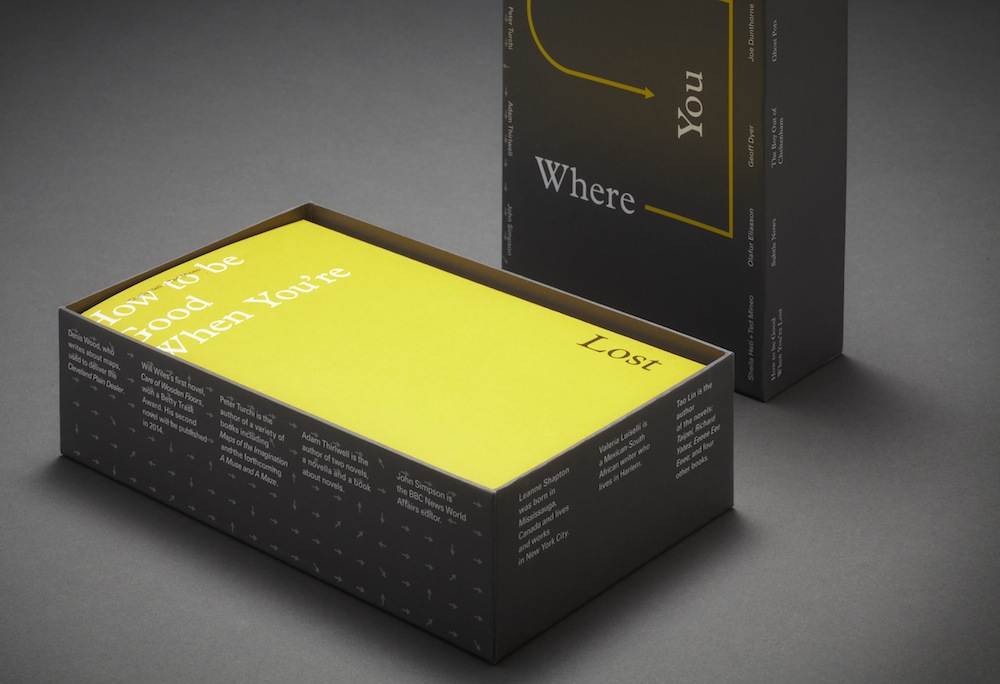
WhereYouAreWhere You Are, Visual Editions

Bookmarking Book Art – A Good Book

What is “A Good Book“?

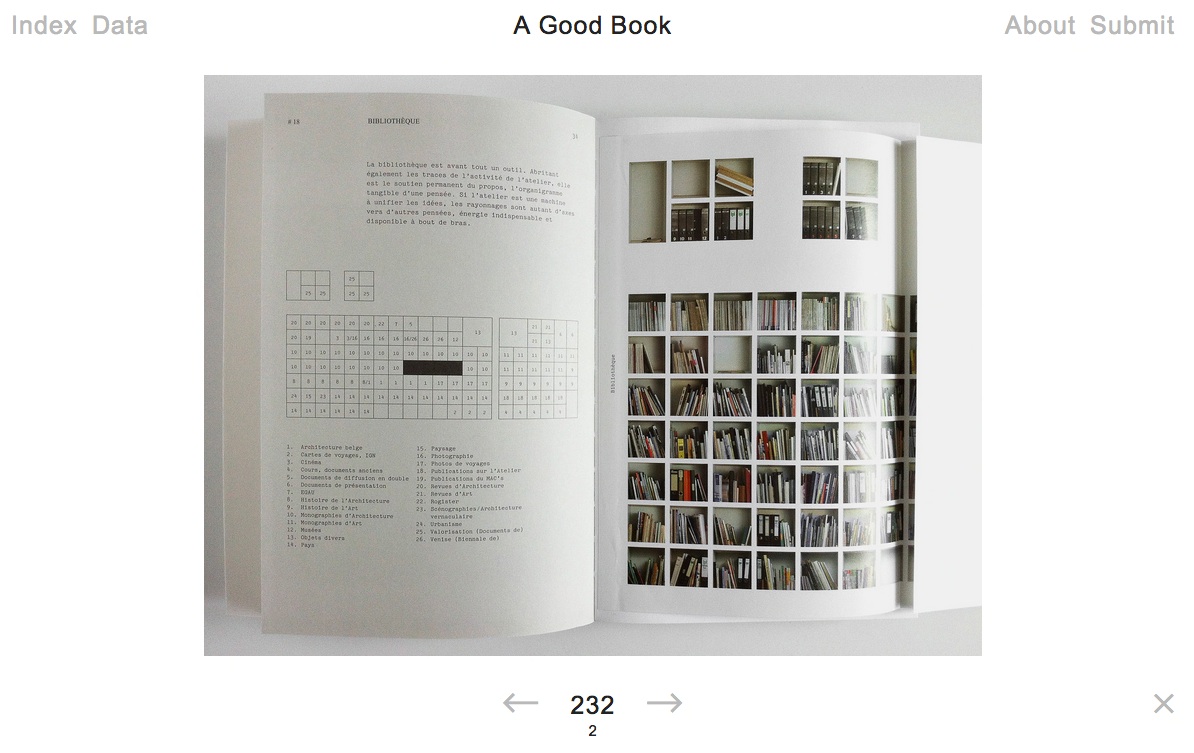
A hard question? A trick question? Yes and no. Since 2011, Bernd Kuchenbeiser, the Munich-based book designer, has been attempting an answer. He began by posting entries to a database on Twitter. With the demise of Twitter’s gallery function, Kuchenbeiser migrated the diary-like collection of photos and comments to A Good Book site with help from Simon Zirkunow. Below is a screenshot of part of the 232nd entry.

A Good Book
Screenshot of Méthodes, cover designed by Manuela Dechamps Otamendi, Entry #232 in A Good Book.

Until recently, the entries were Kuchenbeiser’s alone. The entries started on a daily basis, but as with many diary projects, the execution flagged. With 349 entries of his own (plus 3 from friends), he is now inviting entries from far and wide. Notice “Submit” in the upper righthand corner of the screenshot. Behind it lie the instructions and requirements for submission. Kuchenbeiser’s own entries are often brief, but his choices and comments are interesting because Kuchenbeiser and his oeuvre are interesting. See Michael Cina’s interview with him in The New Graphic (15 August 2011). For this venture to reward constant revisiting beyond that interest, however, Kuchenbeiser wisely holds potential contributors to the following standard:

Here’s what you need in order to submit a book:

– A short description of your book or the aspect that makes it ‘good’. From 140 characters to a maximum of 560, including spaces.

– The bibliographic details: author, title, year of publication, publisher, designer (if known). A questionnaire is already set up within the email that opens when you click ‘Submit now’.

– One to five photos of your book (at least 1400 pixels wide for landscape format and 1200 pixels high for portrait format).

Think of Pinterest or Flickr with serious feeling and intellectual rigor behind them. Kuchenbeiser’s design work and his own words exude that feeling:

Books have personalities. They can be our companions and friends. A good book doesn’t deserve to languish on a bookshelf; it wants to be opened, read, savoured, displayed, recommended. That’s why this website exists.

This site is like a message in a bottle hoping to be discovered. It will work only if it manages to generate communication.

The London Centre for Book Arts must have picked up the bottle from one of the Thames overswellings last week and placed a notice on its home page about the website. Although Kuchenbeiser does not promote it as such, if A Good Book thrives, it could generate a rich database worth semantic analysis for the book art and book arts community. All materials on A Good Book are being made available for noncommercial and educational use only.

Bernd Kuchenbeiser Projects, Schwanthalerstraße 7780336 München (Germany)

Bookmarking Book Art – Helen Yentus

 
On Such a Full Sea Chang-rae Lee credit: Riverhead Books
On Such a Full Sea
Chang-rae Lee
credit: Riverhead Books

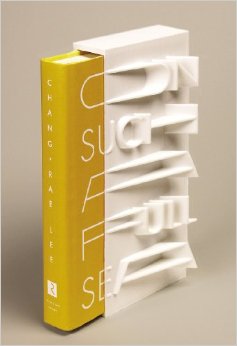
“This limited, numbered edition of Chang-rae Lee’s On Such a Full Sea will be available on January 7th, 2014. Riverhead art director Helen Yentus and members of the MakerBot team designed the slipcase, and 200 of them will be made with the MakerBot® Replicator® 2 Desktop 3D Printer with MakerBot PLA filament, a bioplastic made of corn, fabricated by MakerBot in Brooklyn, New York. Each copy is signed and numbered by the author.” From www.riverheadbooks.com  Is this the first 3D-printed slipcase?  Yea or nay, this effort is clever.  As the book slips from its case, the words of the title on the slipcase are completed. The design will surely make purchasers give “pride of space” to this book on their bookshelves and renewed sense to the word “outstanding”.

Additional cover design and art direction by Helen Yentus can be viewed here.

Related articles:

Lindsay Ballant, “Helen Yentus”, Print, 1 June 2007, accessed 5 January 2014: http://www.printmag.com/article/nva_2007_helen_yentus/

Todd Halterman, “Print Is Not Dead – Pulitzer Prize Hopeful Wraps His Novel In A 3D Printed Slipcase”, 3D Printer World, 12 December 2013, accessed 5 January 2014: http://www.3dprinterworld.com/article/print-not-dead-pulitzer-prize-hopeful-wraps-his-novel-3d-printed-slipcase

“Cover Designer: Helen Yentus”, DecorWrite, 1o February 2011, accessed 5 January 2014: http://www.decorwrite.com/?p=458

“Helen Yentus”, The Book Cover Archive, nd, accessed 5 January 2014: http://bookcoverarchive.com/Helen_Yentus

“MakerBot Creates First-of-Its-Kind 3D Printed Hardcover Book Slipcase for Award—Winning and New York Times—Bestselling Author Chang-rae Lee”, press release, 10 December 2013, accessed 5 January 2014: http://investors.stratasys.com/releasedetail.cfm?releaseid=812980

“Riverhead Goes 3D for Chang-rae Lee”, Publishers Weekly, 11 December 2013, accessed 5 January 2014: http://www.publishersweekly.com/pw/by-topic/industry-news/publisher-news/article/60331-riverhead-goes-3d-for-chang-rae-lee.html

Bookmark – Bodoni’s Bicentennial

English: Comparative Bauer Bodoni versus Bodon...
English: Comparative Bauer Bodoni versus Bodoni Català: Comparativa Bauer Bodoni vs Bodoni (Photo credit: Wikipedia)

This year marks the 200th anniversary of the passing of a great contributor to the linked histories of the book and typography:  Giambattista Bodoni (1740-1813).  Bodoni among others such as Fournier and Didot established the “Modern” fonts, typefaces characterized by the extreme contrast of their thick and thin strokes, delicate and sharp serifs and a chilly sparkling engraving-like quality heightened by generous leading and made possible by improvements in 18th and 19th century typecasting and manufacture of ink and paper.  Bodoni planned and formed the royal printing house for the Duke of Parma in the Palazzo della Pilotta, where the Museo Bodoniano resides today.  Associated with Pope Sixtus V, Carlos III of Spain and the Duke of Parma, Bodoni became one of the most celebrated printers in Europe.

View of Palazzo della Pilotta. The rebuilt par...
View of Palazzo della Pilotta. (Photo credit: Wikipedia)

Although Bodoni’s fame in his lifetime was of a piece with that of the Romantic figures Chopin, Liszt, Byron, Goethe and Shelley, his output was Neoclassical with editions of Homer, Catullus, Virgil, Horace and the English poets Thomas Gray and James Thomson.  His two-volume Manuale Tipografico (1788, 1818) is a meticulous monument of typographic art with more than 14 sets of roman and italic typefaces, a wide selection of decorative designs and symbols and alphabets from the Greek, Hebrew, Russian, Arabic, Phoenician, Armenian, Coptic, and Tibetan languages.  The 1818 two-volume edition can be viewed online at the Bibiloteca Bodoni.

Portrait of Bodoni (c. 1805-1806), by Giuseppe...
Portrait of Bodoni (c. 1805-1806), by Giuseppe Lucatelli. Museo Glauco Lombardi. (Photo credit: Wikipedia)

This flowering of typography and design – reflective of the age and technical developments of book printing – prompts a thought toward the impact of today’s technology – screen display, ereaders, XML and HTML, cascading style sheets, etc. – not only on type and design but their purpose as well.

“The type and pages beg to be admired – that is looked at – which is well and good, except that looking and reading are quite different, actually contradictory, acts…. To look at things, we either disengage and let them flow by on their own or we stop them in their tracks.  To look we hold our breath or (in the worst of cases) pant.  To read we breathe.”  So say Warren Chappell and Robert Bringhurst in their critical comments on Bodoni and the Moderns. (A Short History of the Printed Word, pp. 173-74; 1970,1999.)

Perhaps we are still in the age of e-incunabula and have not reached the point where type and design on the screen beg to be admired.   The improvements delivered by Readmill and Readability have been welcome for their contribution to ease of reading.  It may be perverse to wish for developments that may interfere as Chappell and Bringhurst assert the Modern faces interfere with reading.  But that assumes that they are right in their hieratic statement “To read we breathe.”   Might it be as legitimate to assert “To read we click.  To read we link.  To read we dim or brighten.  To read we tilt from portrait to landscape causing the page to reflow.”?  

Will High Definition play the role that improved paper surfaces played to allow those thinner strokes and delicate serifs in the 18th and 19th centuries?  And if it does, what on-screen design, comparable to Bodoni’s increased leading, will perform the same heightening effect for new faces and design that beg to be admired?  

Bodoni Ornaments
Bodoni Ornaments (Photo credit: Bene*)

For more on the subject of Bodoni, see “Biblioteca Bodoni Launched on Bicentennial Anniversary of Giambattista Bodoni’s Death” by Yves Peters, The Font Feed, 11 December 2013.

Bookmark for your browser or ereader? | Anniversary Update

Book with florentine paper bookmark.
Book with florentine paper bookmark. (Photo credit: Wikipedia)

Publishing and editorial folk who wish to educate themselves in the changing craft of the book should track this ongoing discussion on the merits of browsers versus apps/devices –even if at times it becomes finely technical.

Books On Books logged several articles on this last year when Jason Pontin declared MIT Technology Review’s colors (decidedly HTML5).  Here is another worth a quick read:   5 Myths About Mobile Web Performance | Blog | Sencha.  A quick read?  Yes, publishers and editors need not be HTML jockeys or Java connoisseurs, but they need to have a business-like grasp of what they are choosing to ride or drink.

Understanding why to publish an ebook through an app or in a browser-friendly format — or both — and what the implications are for crafting finds its rough print analogs in selecting the primary channel and form of  publication (trade or academic, hardback or paperback) as well as  the structure of the work (design, layout and organization) and working out the financial case for deciding whether to publish and how.

Bookmark – Education for the Future of Publishing

The Elements, Theodore Gray

When it comes to acquiring skills and professional training in book publishing, from the early days of the printing press onwards, learning by doing has been book publishing’s order of the day.  Consider the following interview exchange between Mac Slocum (Tools of Change) and Theodore Gray (The Elements):

.

MS: What skills — or people with those skills — must be incorporated into the editorial process to produce something like the iPad/iPhone editions?

TG: Specifically in the case of “The Elements,” the skills required were writing, commercial-style stills photography, Objective-C programming, and a whole, whole lot of Mathematica programming to create the design and layout tool and image processing software we used to create all the media assets that went into the ebook.

Other ebooks might well require different skills. My next one, for example, is going to include a lot more video, so we’re gearing up to produce high-grade stereo 3D video. That’s one of the challenges in producing interesting ebooks: You need a wider range of skills than to produce a conventional print book.

Starting out in book publishing late in the last century, a novice would have consulted Marshall Lee’s Bookmaking and the Chicago Manual of Style to learn the basics of design, editorial and production.  If it were Trade publishing that beckoned, a familiarity with A. Scott Berg’s biography of Maxwell Perkins (“Editor of Genius”) would have been likely.

Maxwell Perkins, half-length portrait, seated ...
Maxwell Perkins, half-length portrait, seated at desk, facing slightly right / World Telegram & Sun photo by Al Ravenna. (Photo credit: Wikipedia)

If scholarly book publishing, then Harman’s The Thesis and the Book, Turabian’s A Manual for Writers and maybe Bailey’s The Art & Science of Book Publishing.

But as with the acquisition of print publishing skills through learning by commissioning, designing, editing, printing, marketing and selling, the acquisition of the skills required for ebook publishing could use a hand up from appropriate resources.   People like Joshua Tallent, Joel Friedlander, Liz Castro, Craig Mod, Matthew Diener are those resources — either by example or authoring — and novices today would do well to start bookmarking their output.

For notes on the availability of formal training and career conditions in publishing, see Thad McIlroy’s The Future of Publishing.

Related sources:

“Joshua Tallent of Ebook Architects on the State of Digital Publishing,” Bill Crawford, Publishing Perspectives

“Understanding Fonts & Typography,” Joel Friedlander, The Book Designer

html, xhtml, and css: 6th edition, Elizabeth Castro

“Our Future Book,” Craig Mod

“Resources,” Matthew Diener, David Blatner and Anne-Marie Concepcion, ePUBSecrets

The Chicago Manual of Style Online

English: Image of the cover of the 1906, 1st E...
English: Image of the cover of the 1906, 1st Edition of the Chicago Manual of Style (Photo credit: Wikipedia)