Books On Books Collection – Anne Lydiat

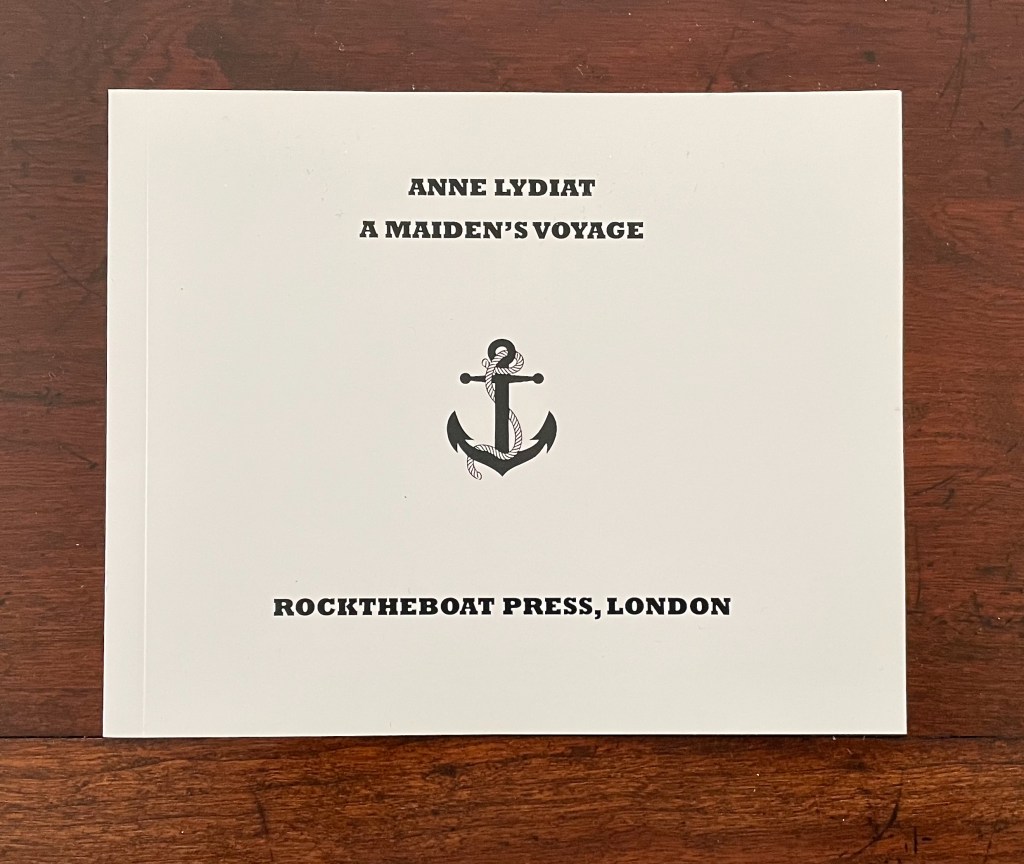
Cover of a book titled 'A Maiden's Voyage' by Anne Lydiat, featuring an anchor graphic and the publisher Rocktheboat Press, London.

A Maiden’s Voyage (2015)
Anne Lydiat
Paperback. H145 x W180 mm. 36 pages. Edition of 50, of which this #31. Acquired from the artist, 28 August 2026.
Photos: Books On Books Collection.

Anne Lydiat’s A Maiden’s Voyage (2015) pays homage to the Belgian conceptual artist Marcel Broodthaer’s “book-film’” A Voyage on the North Sea (1973).
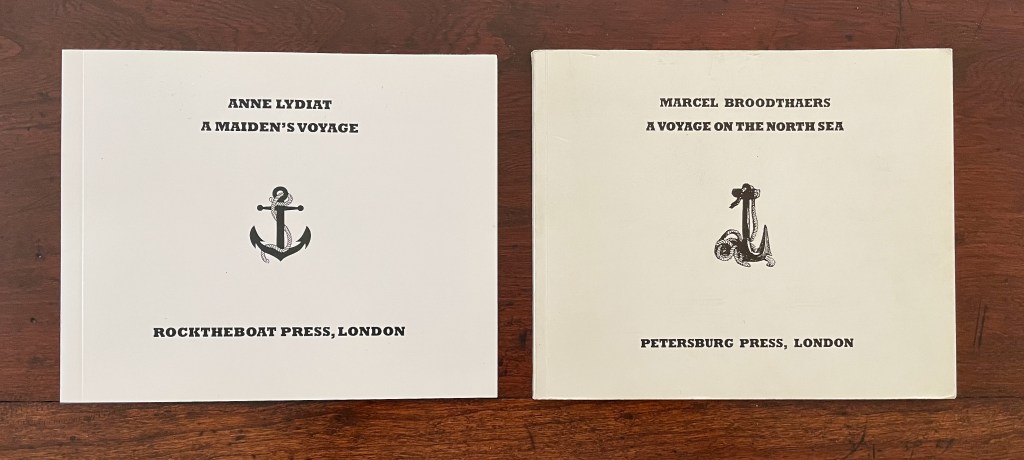
Two art books displayed side by side. The left book is titled 'A Maiden's Voyage' by Anne Lydiat, published by Rocktheboat Press, London, featuring an anchor illustration. The right book is titled 'A Voyage on the North Sea' by Marcel Broodthaers, published by Petersburg Press, London, featuring a nautical illustration.

The reader/viewer of Broodthaers’ book faced three challenges, the first two of which are outlined in its preface. The first, whether to cut or not cut its uncut pages and reveal or leave hidden its page numbers. The second, to make sense of its juxtaposition and manipulation of images of a 19th century sailing ship painting and a photographed 20th century yacht. The third challenge was access to its associated film (which only came with the deluxe edition) and make sense of its relation to the book.

The reader/viewer of Lydiat’s homage does not face that first challenge. She is explicit in her preface —”there are no cutting remarks” — and the book is fully trimmed top, bottom, and fore edge. Her disavowal’s phrasing, however, slyly envelopes the reader/viewer in a different challenge. Does this homage really have no “cutting remarks”, no rebukes? Noting the rarity of depictions of women in maritime history, the second paragraph concludes otherwise: “this artist’s book is a space that marks this gendered absence”. A Maiden’s Voyage pays a passive/aggressive homage to a male artist and his work that unconsciously participates in that gendered absence.
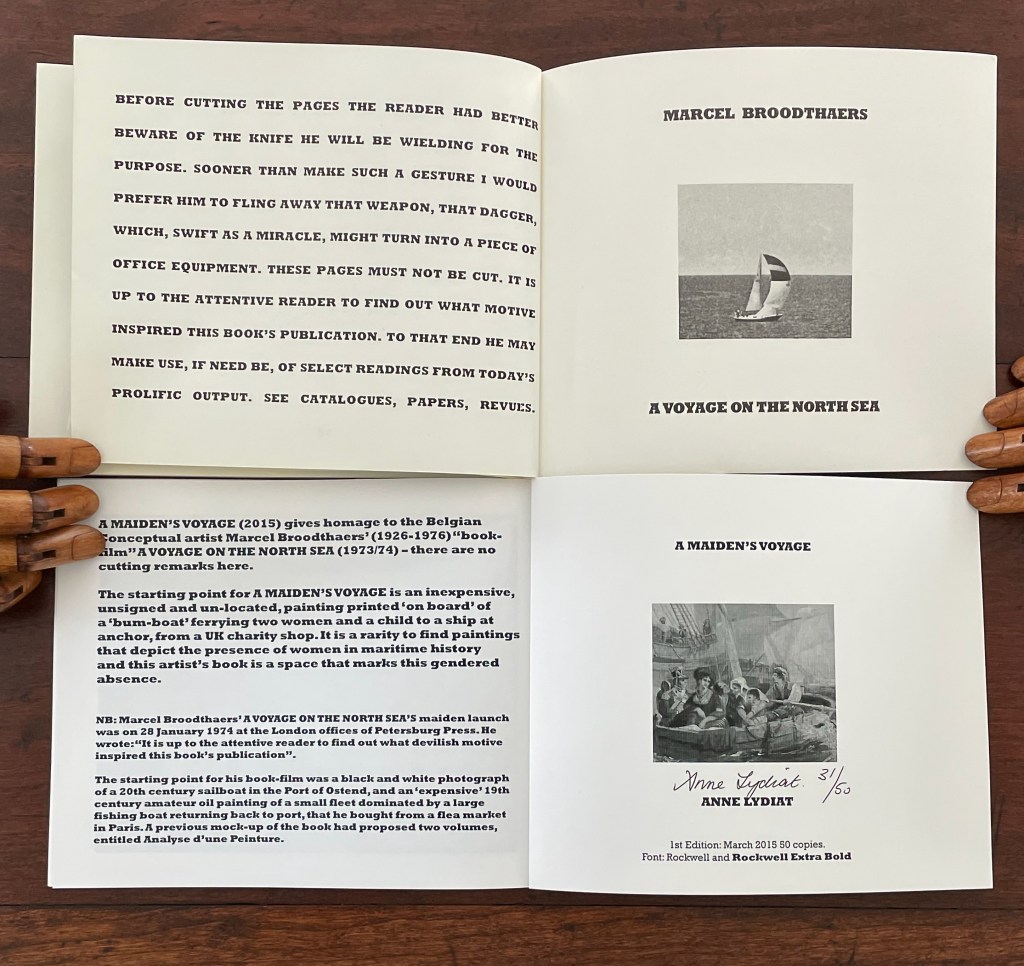
Open book pages with text discussing Marcel Broodthaers and his work, including 'A Maiden's Voyage' and 'A Voyage on the North Sea'. The left page features a black and white photo of a boat at sea, while the right page shows a historical image of women and a child on a ship.

We still have the second challenge with A Maiden’s Voyage: to make sense of its juxtaposition and manipulation of images.

Lydiat is an accomplished artist working in photography, sculpture, and installations as well as books. She could have chosen to work her found painting and subject of gendered absence into another medium, another frame. But she chose the medium of the book and the frame of Broodthaers’ A Voyage and his projected Analyse d’une Peinture. While A Voyage juxtaposes present and past images, A Maiden’s Voyage contains no such juxtapositions. Paradoxically it makes itself the juxtaposition of present and past. Lydiat has juxtaposed her “space” with Broodthaers’ artist’s book and intent. Her space is the present; his space is the past.

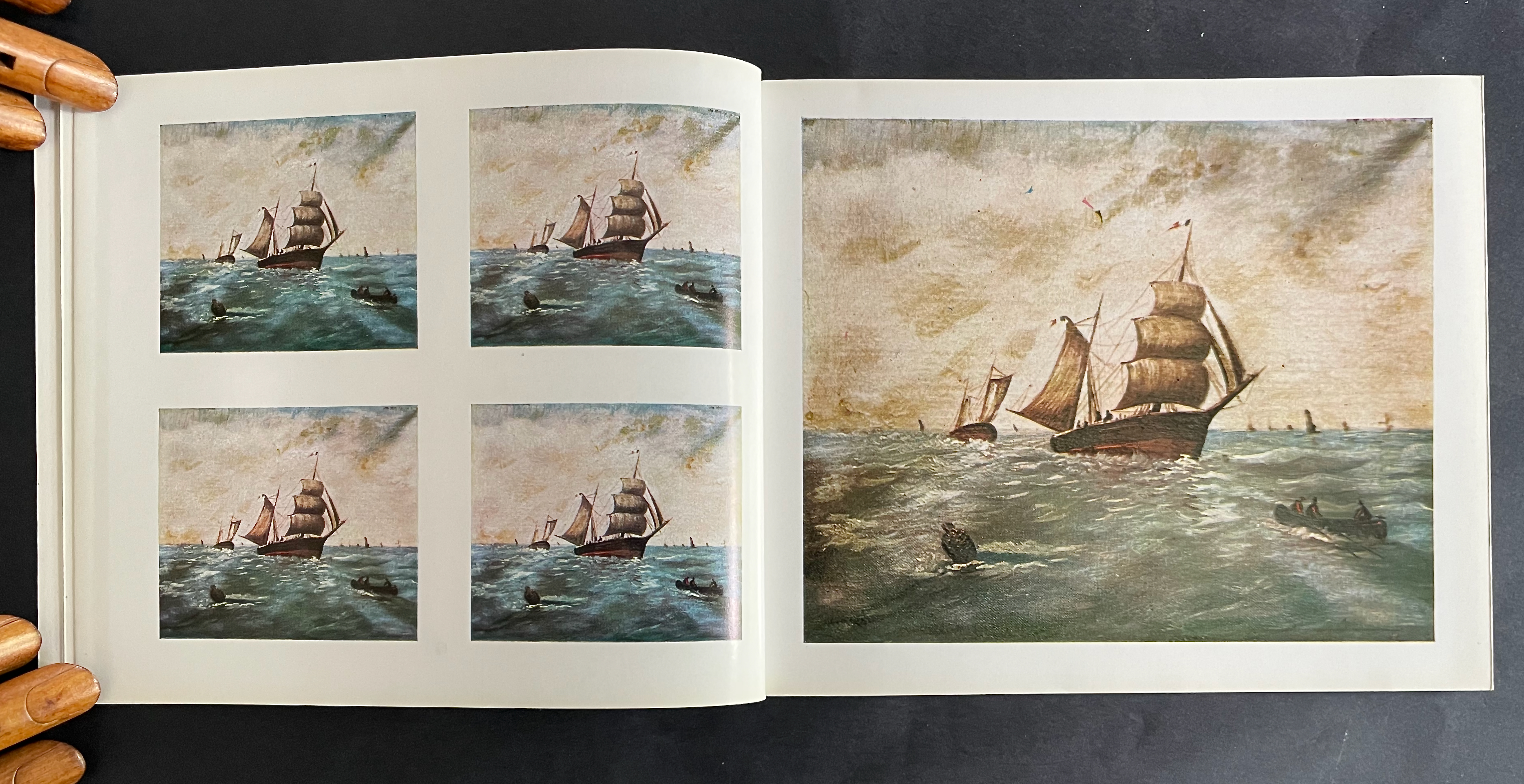
The title of Broodthaers’ projected project implies that the subject of A Voyage concerns the analysis of a painting, an expensive one at that. In parallel and contrast, Lydiat takes a cheap found painting of the past and “analyzes” it, breaking it down into clipped details, stripping it of color, and framing the results as Broodthaers did in A Voyage. In doing so, she underscores that her present space is shaped by the past, implicitly arguing that “gendered absence” in the past shapes the present. It is not a situation that Lydiat lets lie. By contrasting the costs of the found paintings, she neatly slips in one of those disavowed “cutting remarks”.
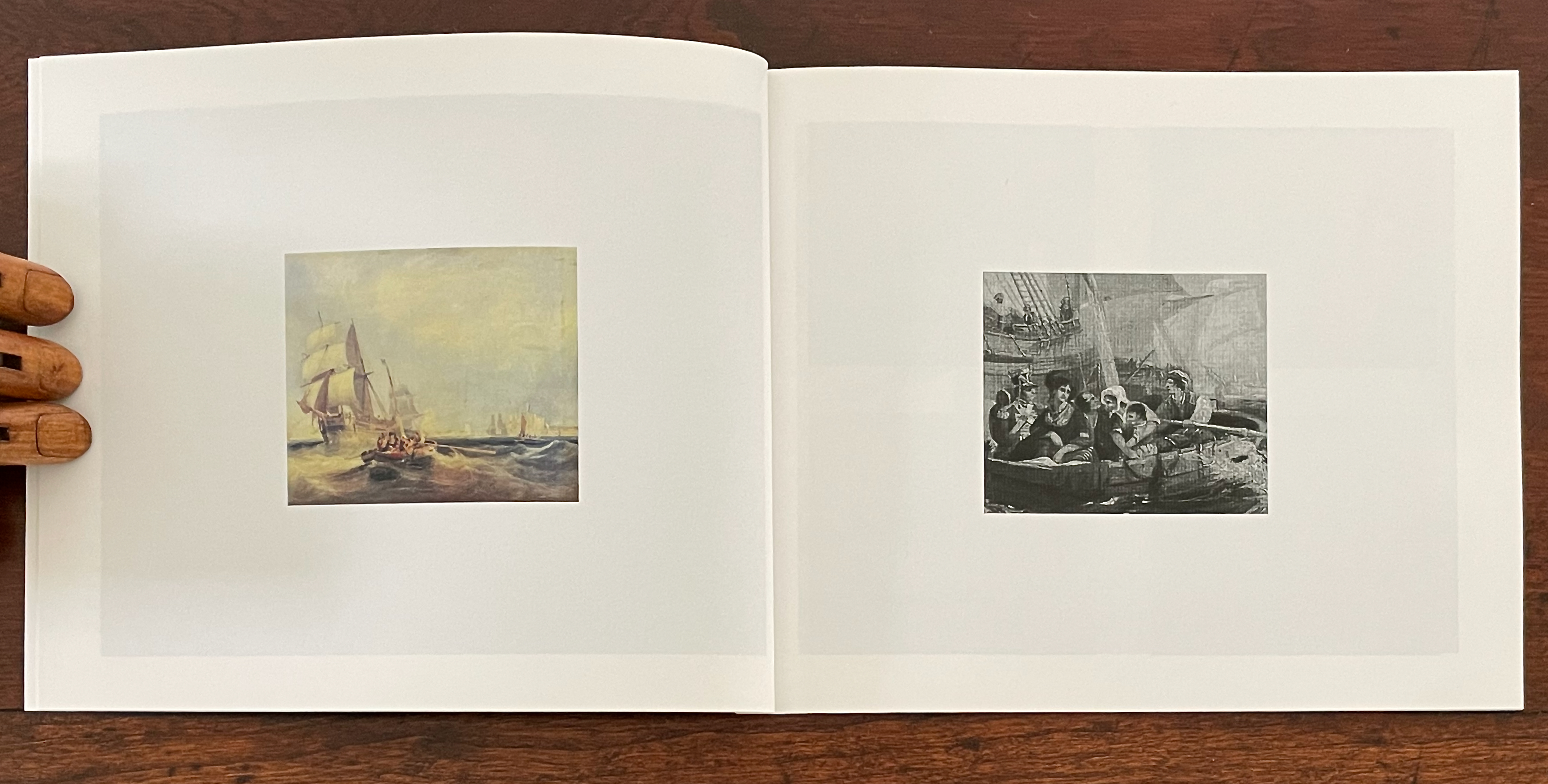
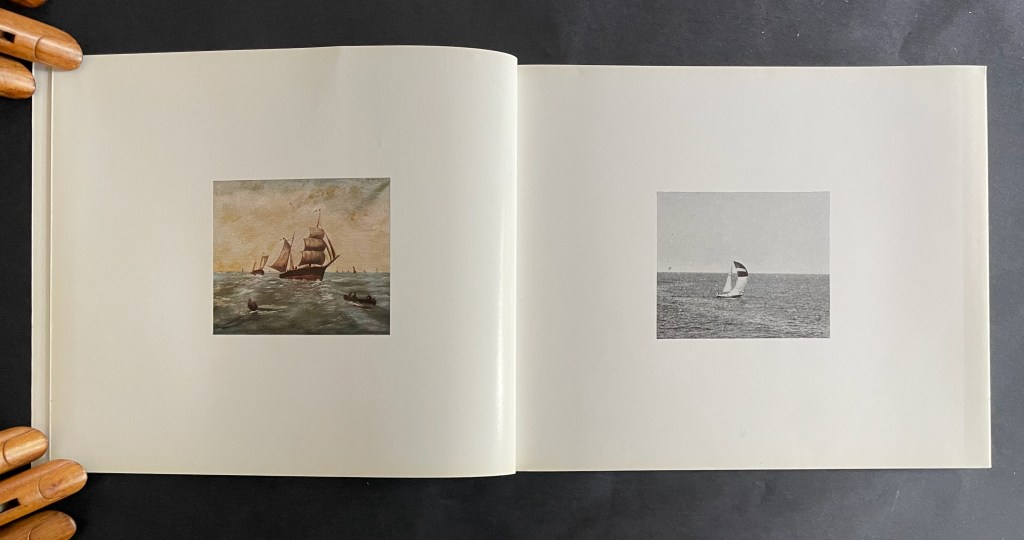
An open book displaying two pages: on the left, a colorful painting of ships sailing in rough waters, and on the right, a black-and-white illustration featuring a group of people in a small boat, surrounded by sails.

From A Maiden’s Voyage.

An open book displaying two images: on the left, a color painting of a classic sailing ship on the water; on the right, a black and white photograph of a sailboat sailing on the ocean.

From A Voyage on the North Sea © Broodthaers Estate. Photo: Books On Books Collection.
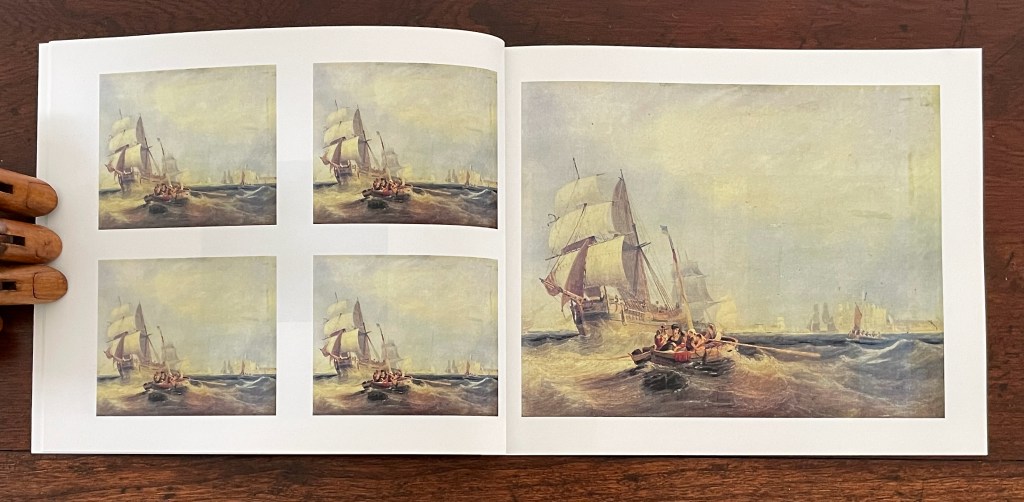
A spread of a book page featuring five maritime paintings, including ships on water and a group of people in a small boat.

From A Maiden’s Voyage.

An open book page displaying four small images of sailing ships on water, alongside a larger, vibrant painting of similar boats navigating the ocean.

From A Voyage on the North Sea © Broodthaers Estate. Photo: Books On Books Collection.
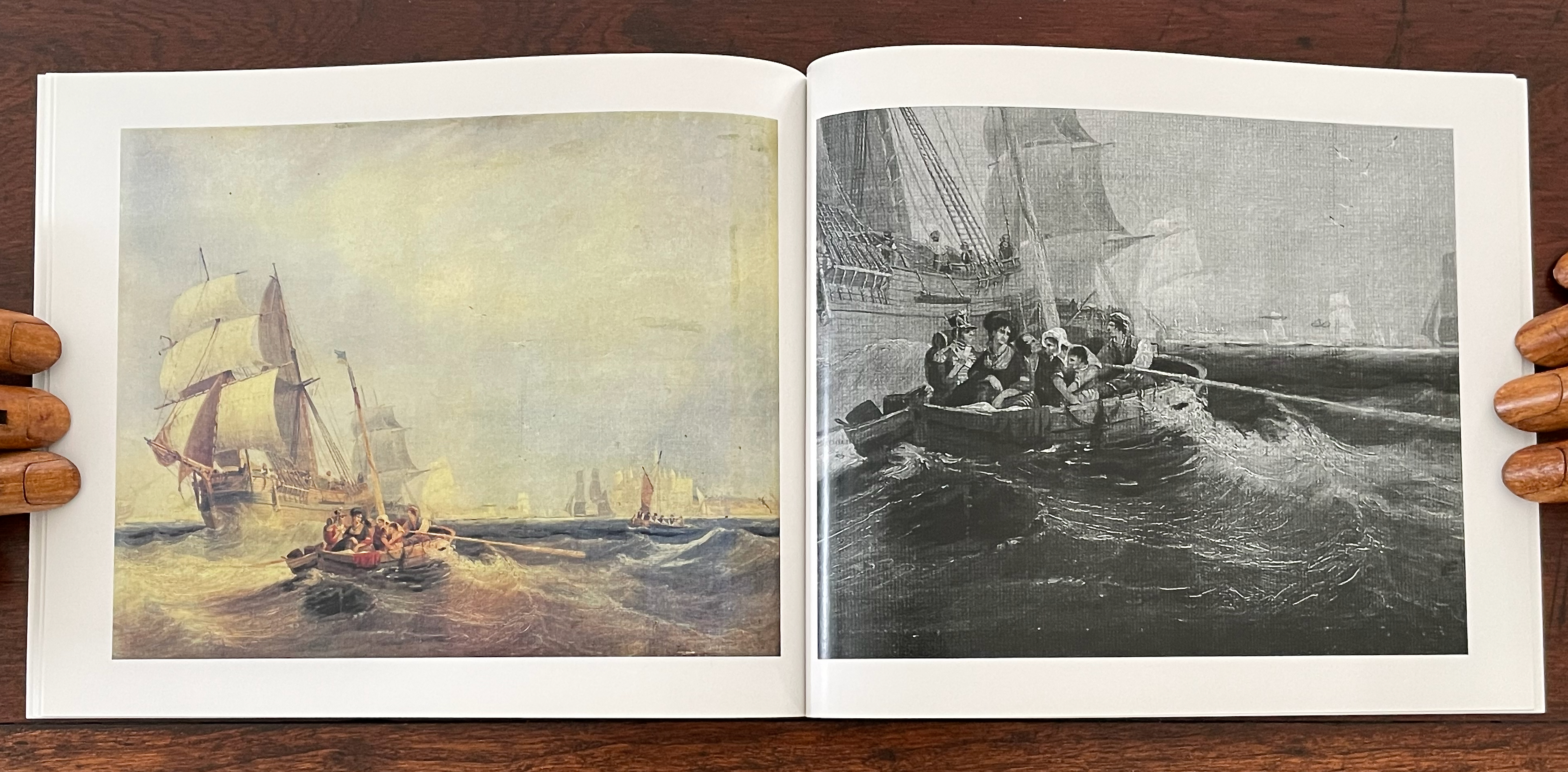
An open book featuring two pages with paintings of maritime scenes; the left page shows a colorful image of sailing ships on calm waters, while the right page displays a black-and-white illustration of a small boat with several people navigating through rough seas.

From A Maiden’s Voyage.

As for the third challenge, the Fondation Marcel Broodthaers provided a solution for access. Likewise, Anne Lydiat provides a link to her film that accompanied the maiden launch of A Maiden Voyage at Chelsea Cafe Project (Chelsea College of Arts).

Like Broodthaers’ “book-film” (his term), Lydiat’s book-film presents image frames as numbered pages. At least since Dick Higgins’ introduction of the term “intermedia” in the mid ’60s, interest in the hybrid work that crosses media and occupies the space between painting, film, music, performance, installation, sculpture, the book, computers, and now the Web has grown — especially among book artists. In 2013, the topic held center stage at the MCBA Book Art Biennial in an exhibition entitled “Directed: The Intersection of Book, Film and Visual Narrative”. Works recently added to the Books On Books Collection occupy this intermedial space (see examples below). Anne Lydiat’s book-film A Maiden Voyage brings the added edge of appropriating form, technique, and content from an arch-appropriator and focusing them on a persistent social blindspot.

I first came across Anne Lydiat’s work at the Wittockiana in Brussels. There in the a minima exhibition was Lost for Words … (1999). Displayed as below, no one could tell that it is a blank book. Not even the subtlety of the blind embossed ISBN on the back could be seen, nor could the quotation from Maurice Blanchot on the inside flap (“About this book I had promised myself to say nothing …”). The context of the exhibition was a hint about the book’s theme — or an aspect of it — “absence, loss and nothingness” — as Lydiat’s website notes.
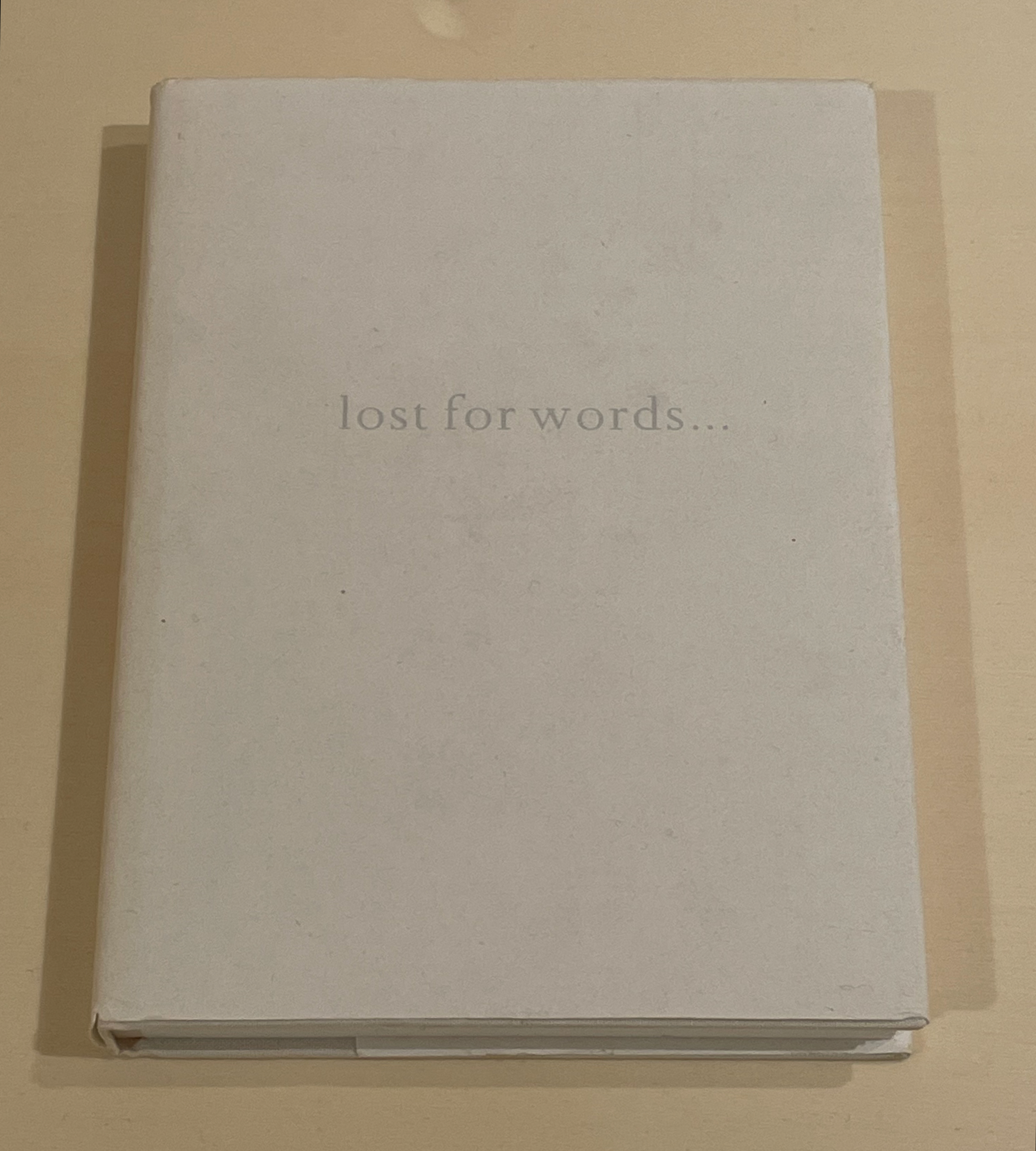
A closed book with a plain cover featuring the title 'lost for words...' in gray text.

Lost for Words… (1999) by Anne Lydiat also appeared in the exhibition Blank. Raw. Illegible…Artists Books as Statements, 1960-2022 (2023) organized by Moritz Küng.

Although not a part of the Books On Books Collection (at least not yet), it is mentioned here as an additional gloss on her intermedial style of conceptual art. Lost for Words … first appeared in an exhibition at the Freud Museum entitled “Permission to Speak”, after which it was deposited in Sigmund Freud’s library. So where is the intermediality? It lies in her performance of secretly depositing Lost for Words … in libraries that she has visited around the world. The only means of knowing where they are is the follow-up volume — … of the book — which lists the libraries.

Further Reading

Amaranth Borsuk“. 19 February 2017. Books On Books Collection. See Between Page and Screen (2012) and ABRA (2014) for examples of intermedia.

Marcel Broodthaers“. 25 July 2026. Books On Books Collection.

Laure Catugier“. 2 February 2026. Books On Books Collection. See her Architecture as Frozen Music (2022) for an example of intermedia.

Inscription: The Journal of Material Text, Issue 6 (Tears)“. 14 July 2026. Books On Books Collection. See this and all back issues for examples of intermedia.

William Kentridge“. 23 July 2021. Books On Books Collection. See for a wide variety of intermediality.

Anouk Kruithof“. 19 July 2021. Books On Books Collection. See their Universal Tongue (2021) for an example of intermedia.

Moritz Küng“. 30 November 2025. Books On Books Collection.

Camden Richards & Deborah Sibony“. 14 February 2024. Books On Books Collection. See their Water, Calling (2021) for its intermediality.

Buzz Spector 24 September 2021. Books On Books Collection. See his North Sea (for M.B.) (1990) for another treatment of Broodthaers’ A Voyage.

‘Un Coup de Dés Jamais N’Abolira l’Appropriation’ — An Online Exhibition“. 1 May 2022. Bookmarking Book Art. See for a wide range of intermedial works of homage to Mallarmé’s Un Coup de Dés Jamais N’abolira le Hasard (1897/1914).

The Wittockiana, Museum of Book Arts and Bookbinding in Brussels“. 1 August 2026. Bookmarking Book Art.

Higgins, Dick. 2001. “Intermedia.” Leonardo 34, no. 1: 49–54.
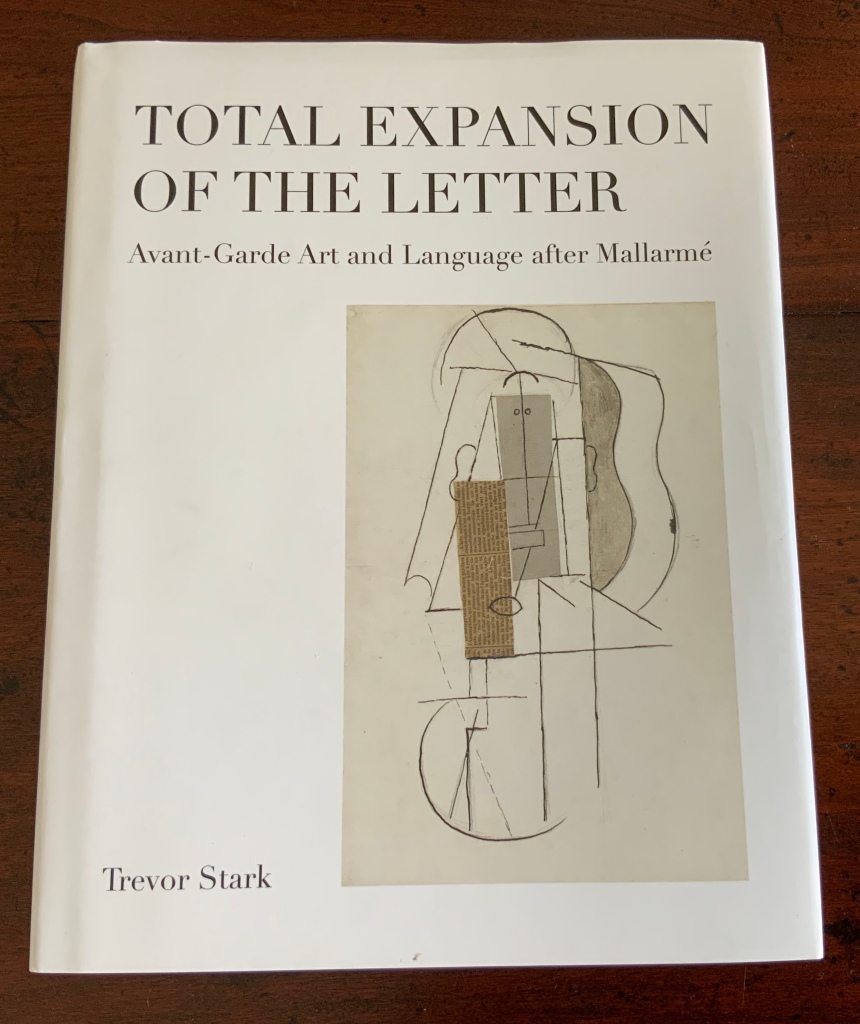
“Total Expansion of the Letter”, Trevor Stark (MIT Press, 2020): Review

The 125th anniversary of the publication of Stéphane Mallarmé’s Un Coup de Dés Jamais N’Abolira le Hasard (1897) approaches, and Trevor Stark’s book is a welcome harbinger. Its title comes from Mallarmé’s essay/poem “The Book, Intellectual Instrument”:

The book, total expansion of the letter, should derive from it directly a spacious mobility, and by correspondences institute a play of elements that confirms the fiction (p. 6).

Often with Mallarmé, context is all (not to mention translation in the face of elliptical syntax!) — context is wrapped in self-enshrouded context. His seemingly cryptic sentence above becomes clearer only when the precedent to the word “it” (elle) is understood as la composition typographique from the essay/poem’s preceding paragraph, extolling the alphabet, language and typography.

Un miracle prime ce bienfait, au sens haut ou les mots, originellement, se réduisent à l’emploi, doué d’infinité jusqu’à sacrer une langue, des quelque vingt lettres — leur devenir, tout y rentre pour tantôt sourdre, principe — approchant d’un rite la composition typographique. (my emphasis)

So, the sentence is a proscription for what “the book” should get from typographic composition. Metaphorically (fictionally), the book is a total expansion of the typeset letter, or mark. As such, it should derive from the “near rite of typographic composition” a spaciousness and mobility and a play among elements that confirms the metaphor that it is a “total expansion of the letter”. Still a bit cryptic, but after all, this is what Mallarmé calls a “critical poem”, and the sentence is hardly more cryptic than the opening pronouncement: “everything in the world exists to end up in a book”.

It is a good choice of title for Stark’s endeavor. “Total expansion of the letter” juggles Mallarmé’s “heroic” vision for the book with the material world of metal type, idea with ink, the sacred with the profane. In painting, sculpture, music, dance, theater and film, the avant-gardists certainly brought together intellectuality and physicality forcefully. Stark shows that, in doing so, they also consciously and unconsciously raided Mallarmé’s open larder of skepticism about language and communication. The letter (or any mark of signifying, for that matter), scraps of newspaper, musical scores, dance notation, dresses and costumes (or lack thereof), wanted posters, financial bonds, and much more became ready objects for avant-garde art but only on the condition of their “becoming dysfunctional and incommunicative” (p. 7). Stark wants to know why.

Total Expansion of the Letter : Avant-Garde Art and Language after Mallarmé
Trevor Stark
(Cambridge, MA: MIT Press, 2020)

Mallarmé’s skepticism about language and communication is Stark’s touchstone throughout: that language has an “ineradicable degree of chance built into” it; that there is inherently a suspension — a temporal gap, blank, void, lacuna, an “unfinished” state — between the sign’s expressed materiality and its meaning; and that, therefore, every act of communication as a historical and aesthetic phenomenon is like an anonymous, “impersonified” throw of the dice, “tossed into eternal circumstances’” (p.29). Applying that touchstone, he crosses the borders insightfully time and again “between the nineteenth and twentieth centuries, between dance, music, and letters, and between art history, the philosophy of language, politics, and poetics” (p. 30). Never reductive, he explores the continuities and variations between Mallarmé’s achievements and those of Paul Cezanne, Pablo Picasso, Georges Braque, Francis Picabia, Tristan Tzara, Hugo Ball, F.T. Marinetti, Marcel Duchamp, the Laban school of dance and others of the avant-garde. As he offers a reciprocal interpretation of Mallarmé and of avant-garde art, individual poems, paintings, collages, performances of dance and theater yield new clarities and sharpened expression of received assessments.

Consider Stark’s comparative reading/viewing of Mallarmé’s “Sonnet en X” (1887) and Picasso’s The Dressing Table (1910). Across eight pages of text and photographs of art, Stark helps the reader to follow Mallarmé’s “quest for a word that literally means nothing, ptyx, a word produced by the frolic of language”, a signifier that “attains a materiality and an opacity, allowing the poem to display a linguistic Void, to raise it from the latent to the patent.” The materiality to which Stark draws our attention is twofold: the bright rhymes (-yx, -ix, -ixe) that almost single-handedly drive the invention of the word ptyx and the mirror on the credenza in the poem that captures the empty room, its window and the constellation Ursa Major showing through it. Across the same pages, Stark conducts the viewer through Picasso’s painting — again a mirror, the surface of a dressing table, the drawer from which a key protrudes, a drawer handle, a glass with the long handle of a toothbrush and its bristles poking out, but all scattered into planes of reflection and refraction, their shapes “mutually implicated to the point of structural ambiguity”. Then, he draws them together: “In Mallarmé and Picasso, representation destroyed the object in order to proclaim its own mute materiality and, thereby, regain continuity with the world by becoming simply one more thing within it”(pp. 101-108).

In pursuing these reciprocal readings of Mallarmé and his avant-garde descendants, Stark keeps a bright light on the “between” — between an object and its reflection, between a word’s or sound’s utterance and its meaning, the blanks between words, the blanks between brushstrokes or those between them and the boundary of the painting, between the cosmic and domestic, between one media and another when brought together in a work, between the individualism of subjective imagination and impersonal modes of production, between author/artist and word/image and reader/viewer. His term for these spaces is intermedial. In her endorsement of Stark’s book, Julia Robinson (New York University) calls his neologism “luminous”. The term refers to “the zone of indeterminacy between mediums, social practices, and temporalities” into which Mallarmé found himself outwardly propelled even as he inwardly sought “absolute language”.

Looking back on the avant-gardists and his own contemporaries, Dick Higgins — the late twentieth century language-, book-, and publishing-artist — rejuvenated Samuel Taylor Coleridge’s term intermediation, a neologism similar and related to intermedial. It is not the same thing as intermediality or mixed media. As Higgins expressed it, “Many fine works are being done in mixed media: paintings which incorporate poems within their visual fields, for instance. But one knows which is which. In intermedia, on the other hand, the visual element (painting) is fused conceptually with the words” (p. 52). It can be argued that works of intermedia are one way in which artists address intermediality — that zone of indeterminacy.

The argument is ultimately a phenomenological one, a perspective that Stark embraces. When he applies the ideas of Edmund Husserl, Martin Heidegger, Maurice Merleau-Ponty, Theodor Adorno, Maurice Blanchot and others to Mallarmé’s poems and the artistic expressions of his “descendants”, both the philosophers and the artists become more accessible. Consider this passage summarizing Maurice Blanchot’s account of the history and function of language and its four stages:

The first was that of an Adamic or nomenclaturist model of language, which conceived words as names for the objects of the world. The second, dominant from Plato to Descartes, was the idealist model in which language constituted the link between sensible reality and the eternal realm of the Idea, and thus the guarantee of our ‘entrance into the intelligible world.’ [fn 223] Third, the ‘expressionist model’ of Hegel and Leibniz considered language itself the embodiment of what is sayable, thinkable, and possible at any given historical juncture, serving, therefore, as the medium of the progress of Spirit. Finally, illustrated with a quote from Valèry, the fourth stage was the ‘dialectical function of discourse,’ in which language regained an ‘essential power of constestation’ in the negativity of modern literature:

‘Literature seeks to revoke from language the properties that give linguistic signification, that make language appear as an affirmation of universality and intelligibility. But it doesn’t arrive at this goal (if it does arrive at this goal) by destroying language or through contempt of its rules. It wants to render language to what it believes to be its veritable destiny, which is to communicate silence through words and to express liberty through rules, which is to say to evoke language itself as destroyed by the circumstances that make it what it is.’ [fn 224] (pp. 110-11)

Clearly that passage links back to the touchstone of Mallarmé’s skepticism about language and communication. The strength of the touchstone is that it can also be fruitfully applied to the numerous works of homage to Mallarmé from contemporary book artists such as Jérémie Bennequin, Michael Maranda, Michalis Pichler, Eric Zboya and many others. Likewise it can used to shed light on the “material text” approach to understanding book art. A case in point is the first issue of Inscription: the Journal of Material Text – Theory, Practice, History, a work of book art in its own right.

Consider the hole drilled through the center of the journal. Does it not echo Stark’s reminder of Braque’s citing Mallarmé’s utterance: “‘The point of departure is the void'” (p. 88)? Consider the journal’s spatial challenge to the act of reading (a dos-à-dos binding, a text block that rotates around that hole). Does that not echo this passage from Total Expansion of the Letter?

But what remains after the ‘suspension’ of the represented object and the objectification of the means of representation? For Mallarmé, the ‘residuum’ was the act of reading itself, conceived not as a process of cognitive reconstruction, but instead as a gamble on the very possibility of forging meaning out of opacity and contingency of linguistic matter. As Mallarmé wrote in ‘The Mystery of Letters’

‘To read —

That practice —

To lean, according to the page, on the blank, whose innocence inaugurates it, forgetting even the title that would speak too loud: and when, in a hinge [brisure], the most minor and disseminated, chance is conquered word by word, unfailingly the blank returns, gratuitous earlier but certain now, concluding that there is nothing beyond it [rien au-delà] and authenticating the silence –‘” (pp. 108-109).

Not since Anna Sigrídur Arnar’s The Book as Instrument: Stéphane Mallarmé, the Artist’s Book and the Transformation of Print Culture (2011) has there been as useful a tool for appreciating Mallarmé, art and artist’s books as Trevor Stark’s Total Expansion of the Letter. On the eve of the 125th anniversary of Un Coup de Dés, it will be interesting to see whether Stark and others extend his work to art and book art after the avant-garde.

Further Reading

Arnar, Anna Sigrídur. The Book as Instrument: Stéphane Mallarmé, the Artist’s Book and the Transformation of Print Culture (Chicago, IL: University of Chicago Press, 2011).

Higgins, Dick, and Hannah Higgins. “Intermedia“, republished in Leonardo, Volume 34, Number 1, February 2001, pp. 49-54.

McCombie, Elizabeth. Mallarmé and Debussy: Unheard Music, Unseen Text (Oxford: Oxford University Press, 2004). It would have been interesting to see how Stark would relate his exploration with McCombie’s exploration of Mallarmé’s views on poetry and music.

Willette, Jeanne. “Cubism As Applied Design: Sonia Terk-Delaunay“, Art History Unstuffed, 16 August 2019. Although Robert and Sonia Delaunay are briefly mentioned in the third chapter (p. 248), it would have been interesting to see how Stark would use his touchstone to explicate the first “simultaneous poem”: La Prose du Transsibérien et de la Petite Jehanne de France (1913) by Blaise Cendrars and Sonia Delaunay.

The Yale University Press offset facsimile. Image courtesy of Accordion Publications