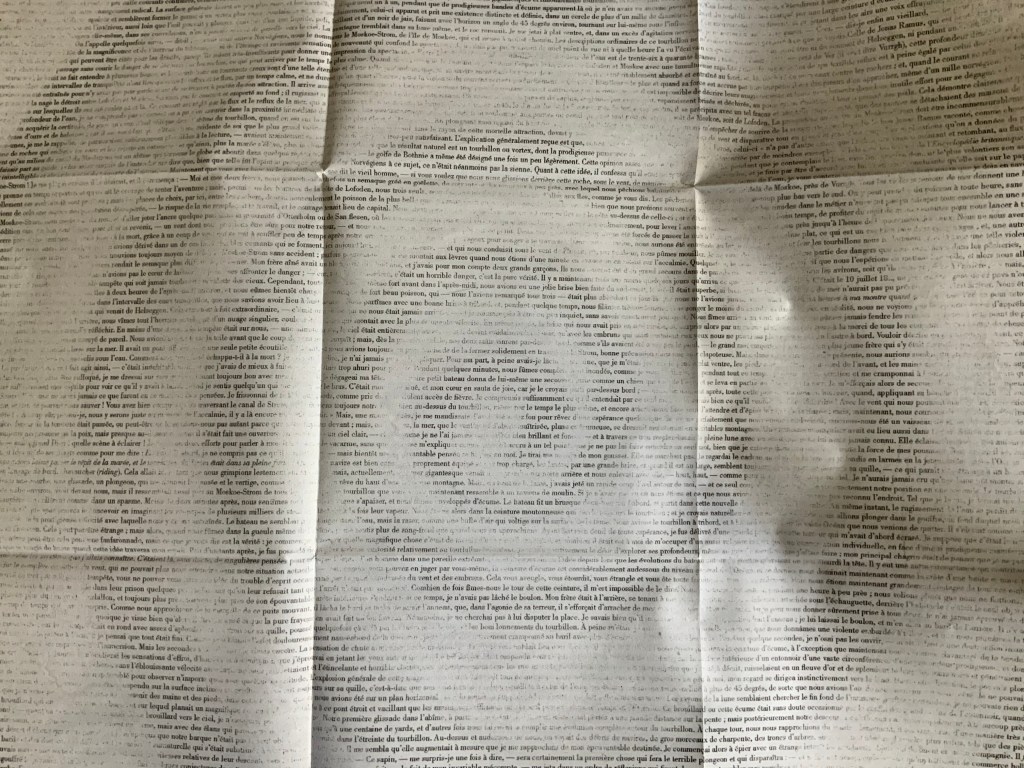
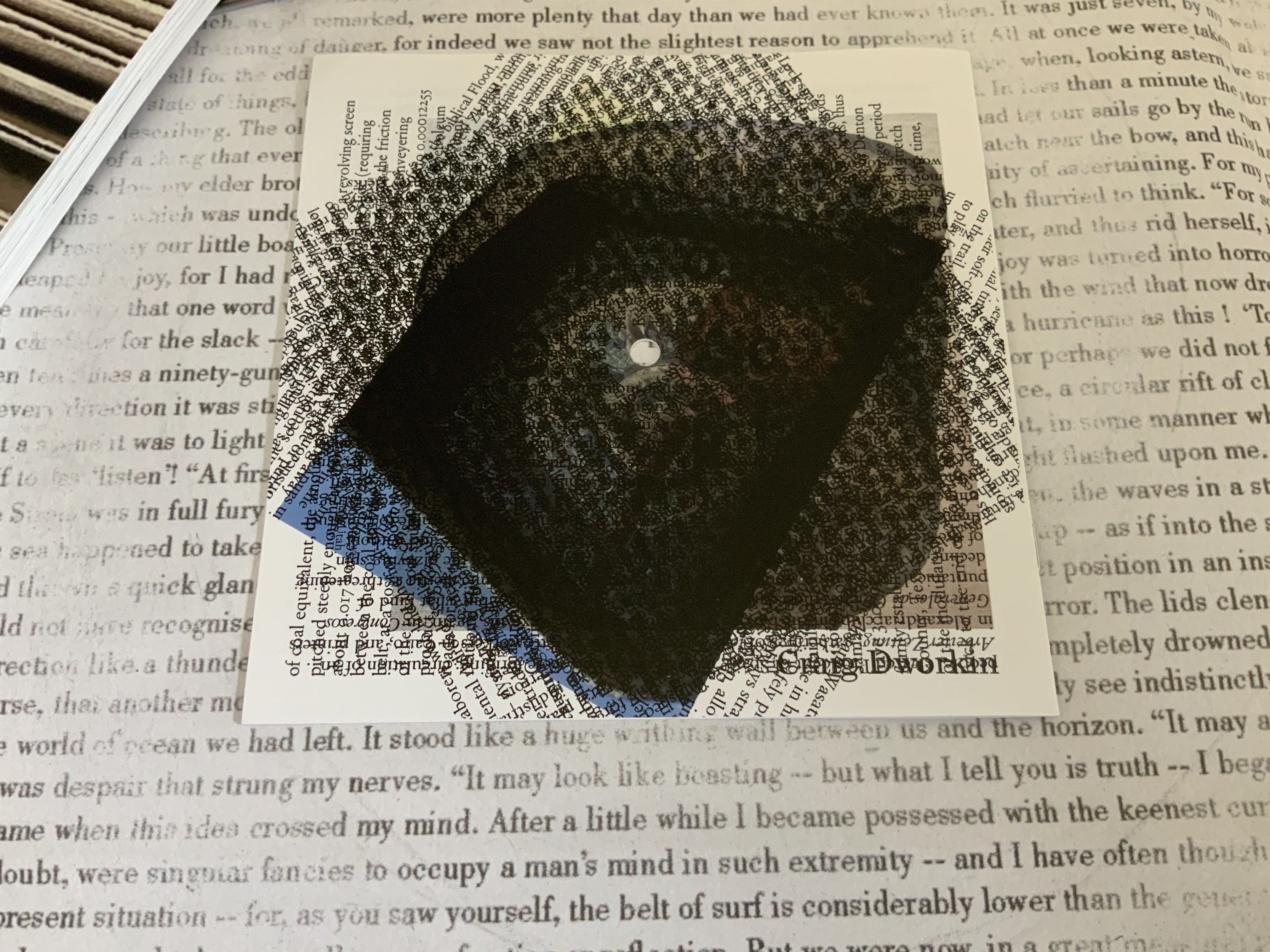
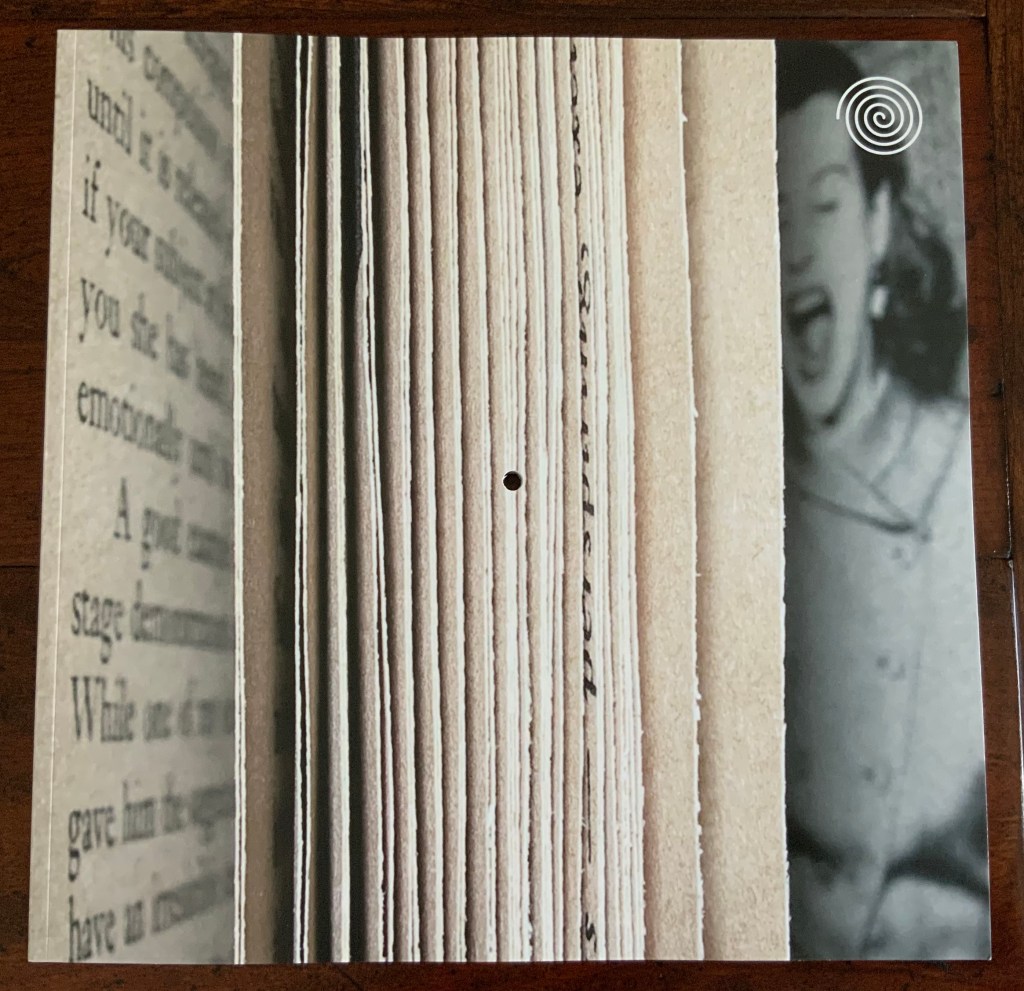
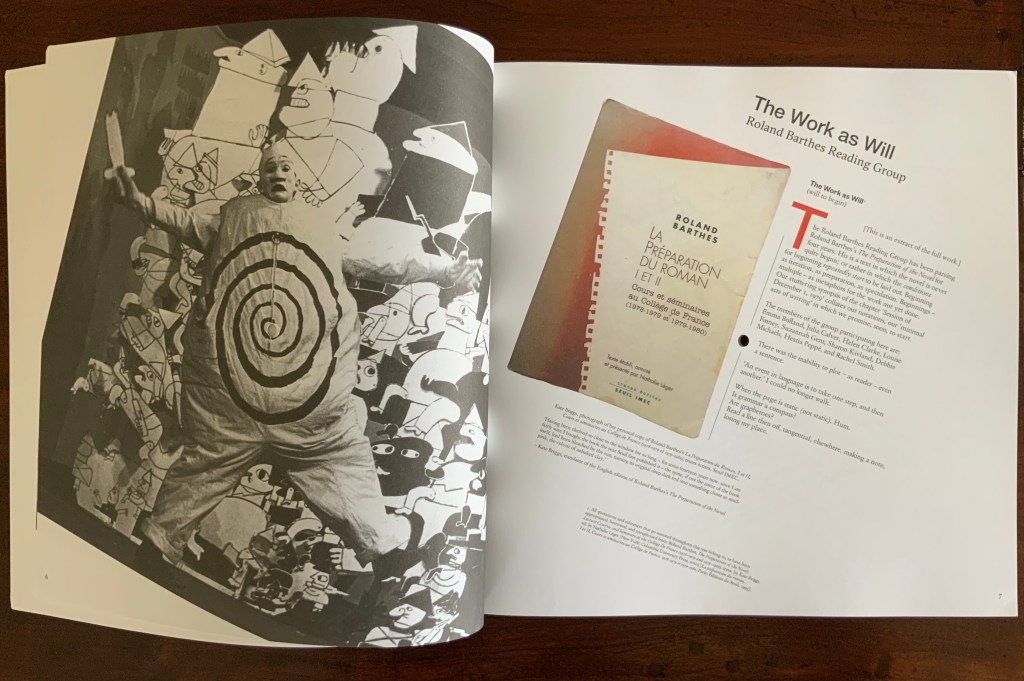
Books On Books Collection – Alexandra Leykauf

Alexandra Leykauf: Chateau de Bagatelle (2010)

Alexandra Leykauf: Chateau de Bagatelle (2010)

Alexandra Leykauf

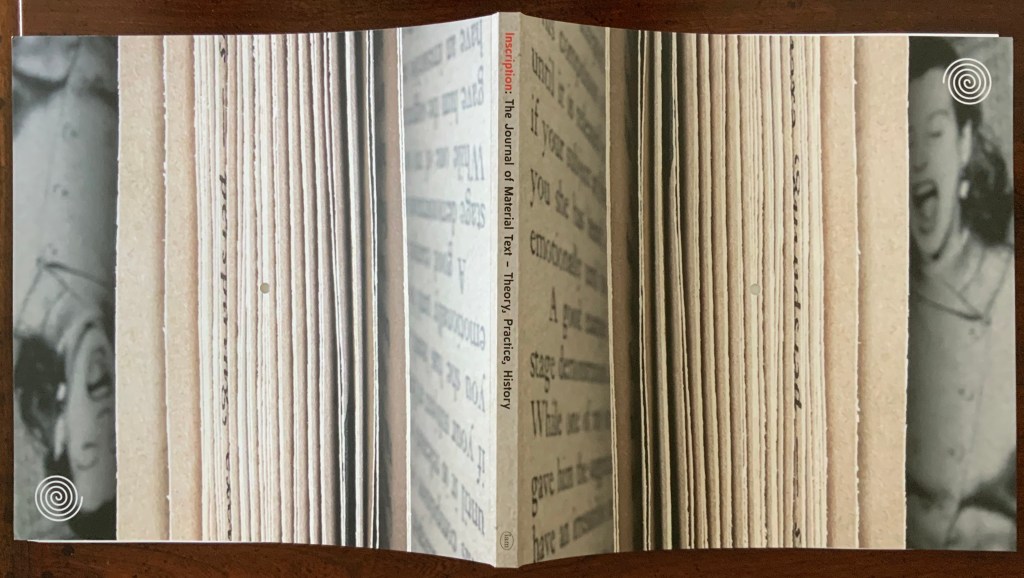
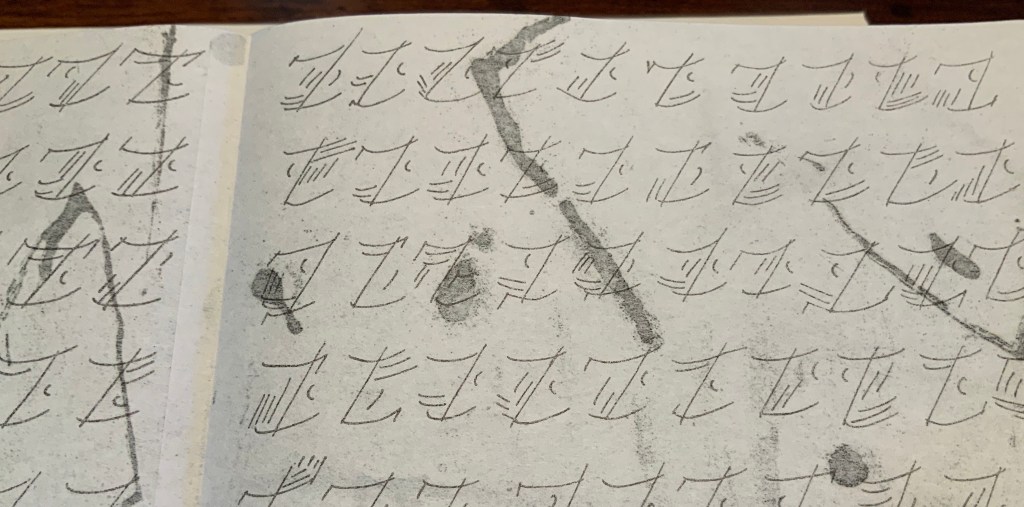
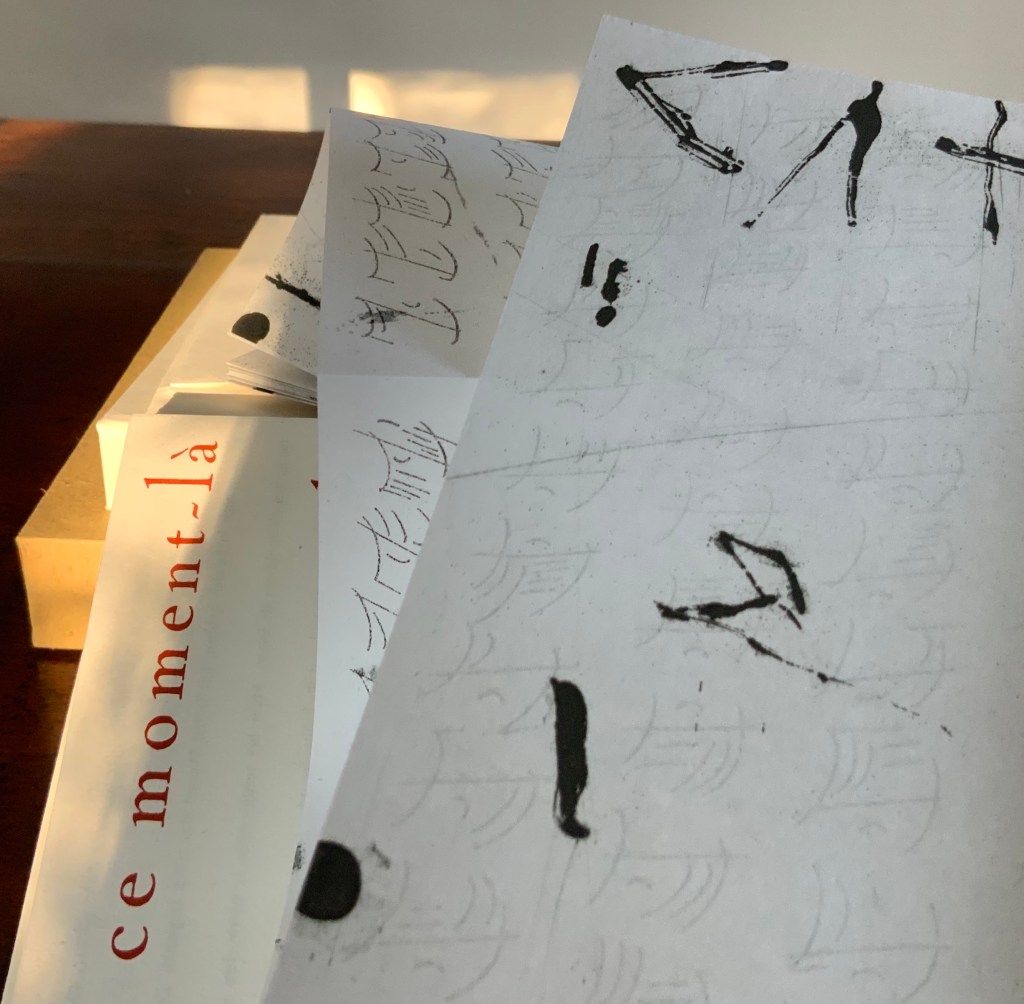
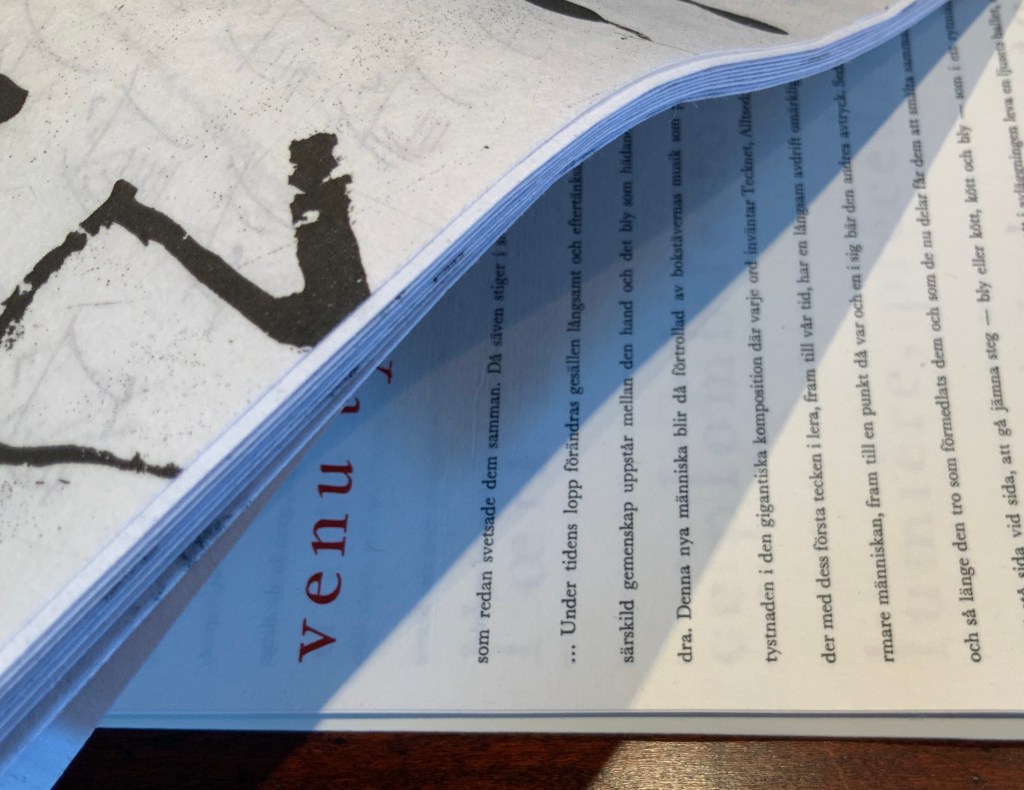
Perfect bound softcover in black case (Claro Bulk 135 gsm) and dust jacket (Gmund Colors 300 gsm). H210 x 182 mm, xxx unpaginated sheets for photos (Claro Bulk 115 gsm) and 24 concluding text pages (Claro Bulk 90 gsm). Acquired from Saint George’s Bookshop, 6 July 2020. Photos: Books On Books Collection. Shown with permission of the artist.

When a book enters a collection because of one photo, the collector needs to ask whether the theme driving the collection has become a hammer and every item collected a nail.

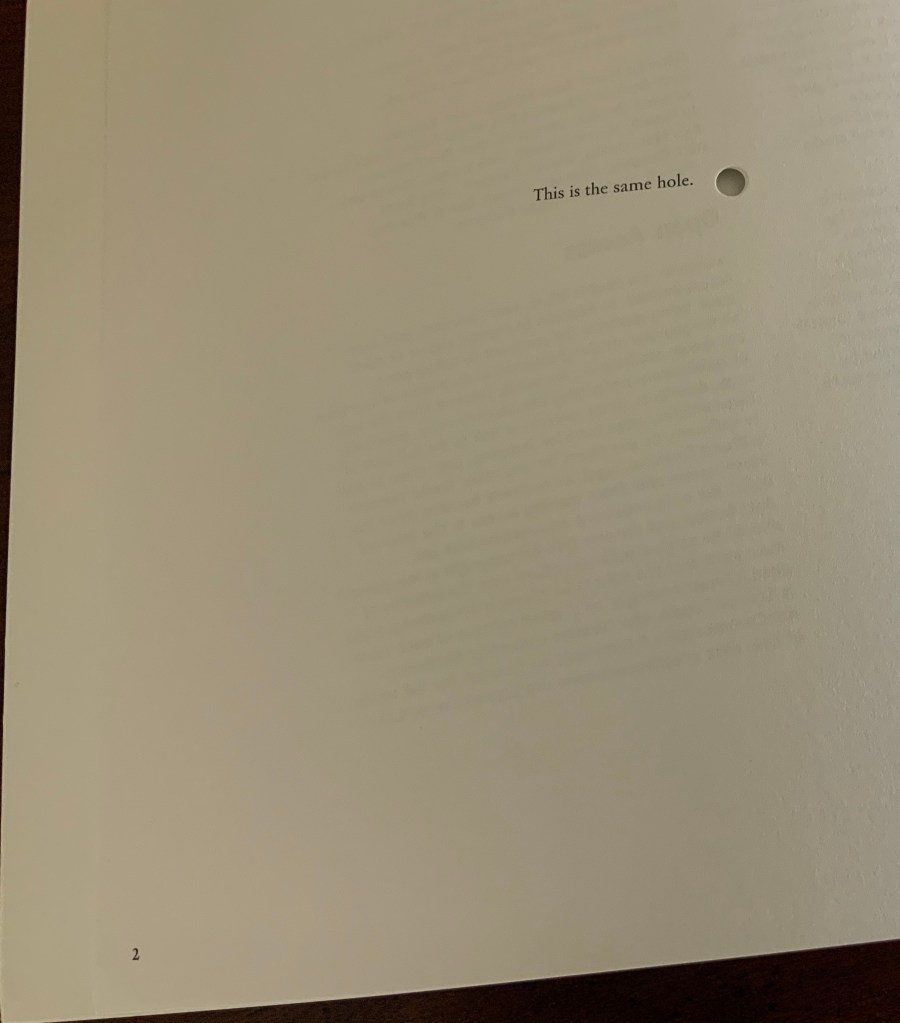
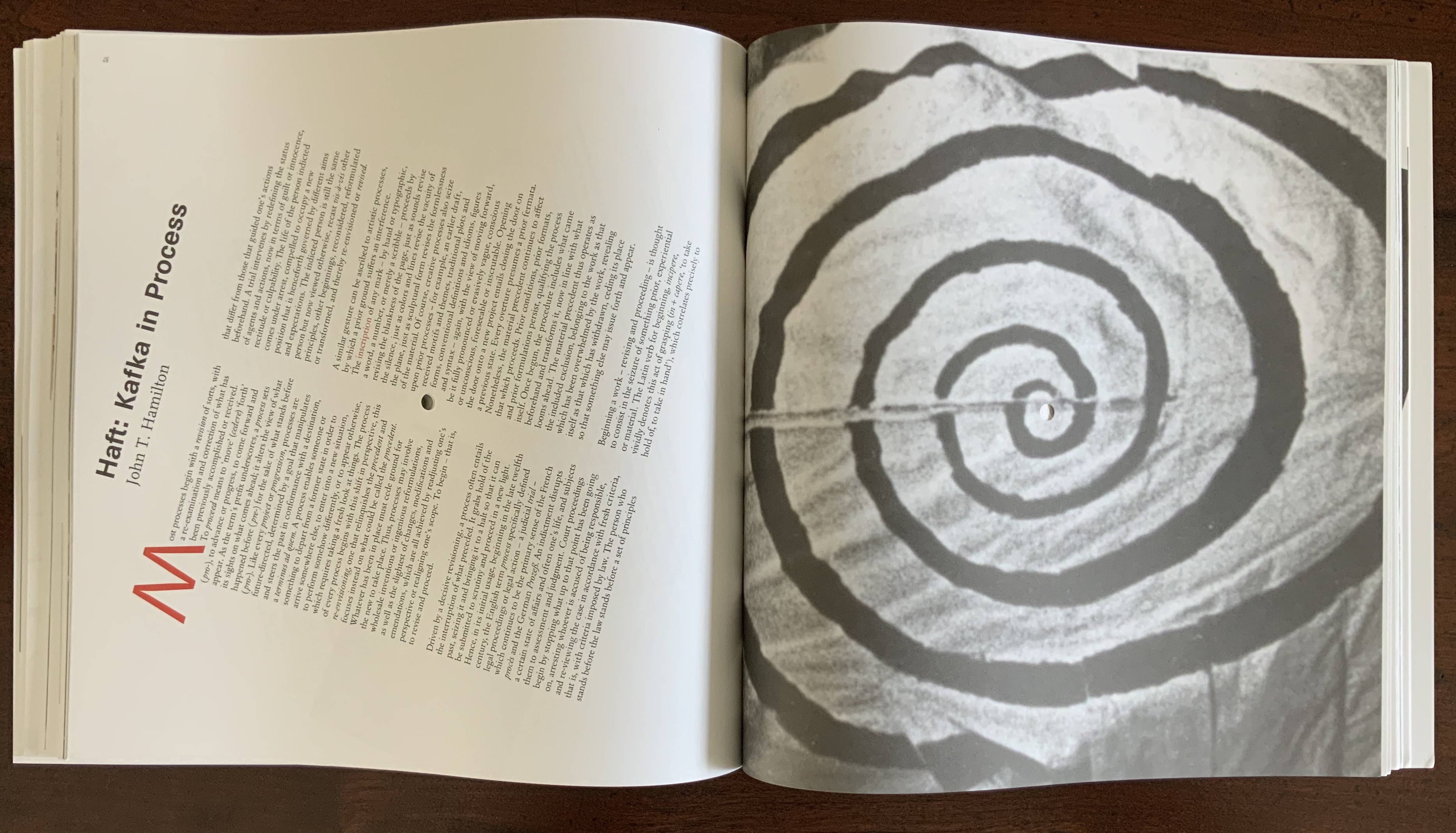
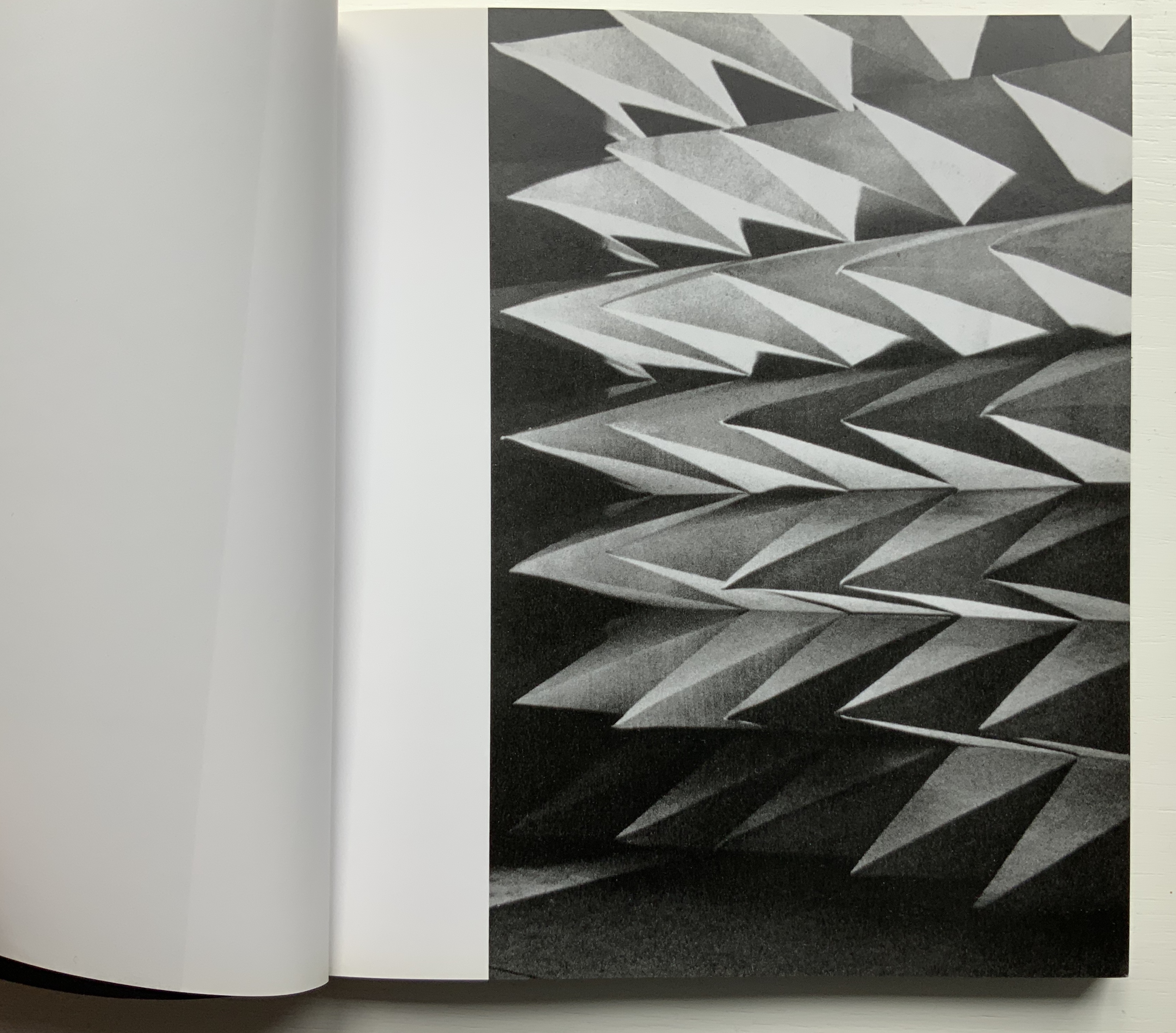
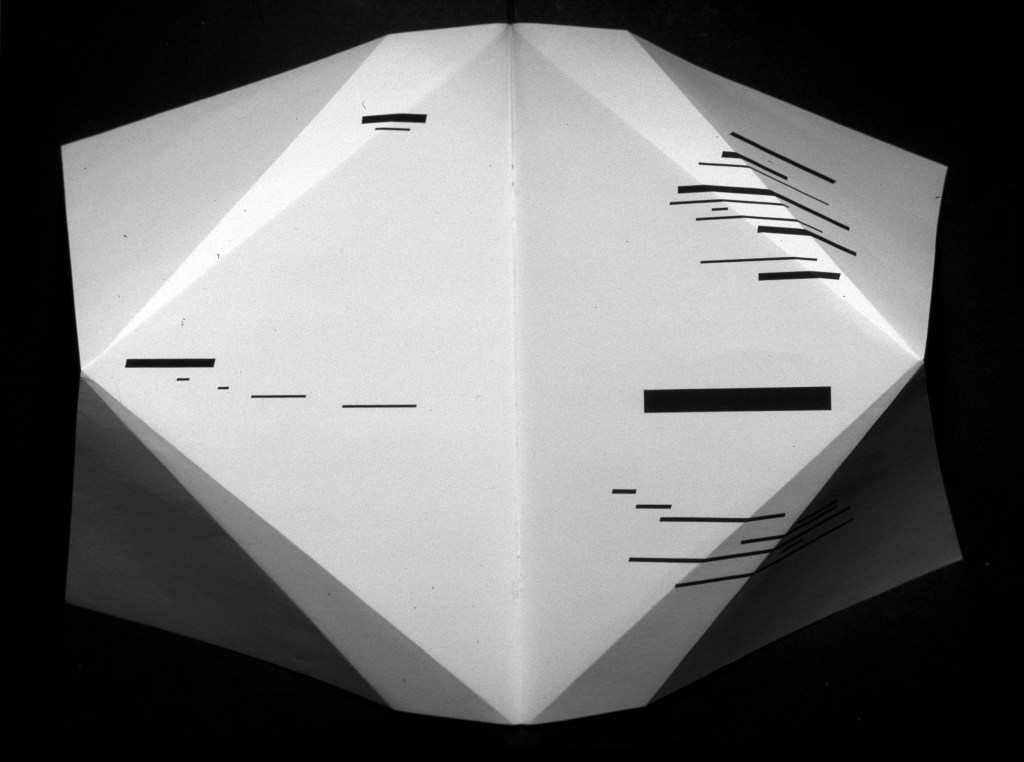
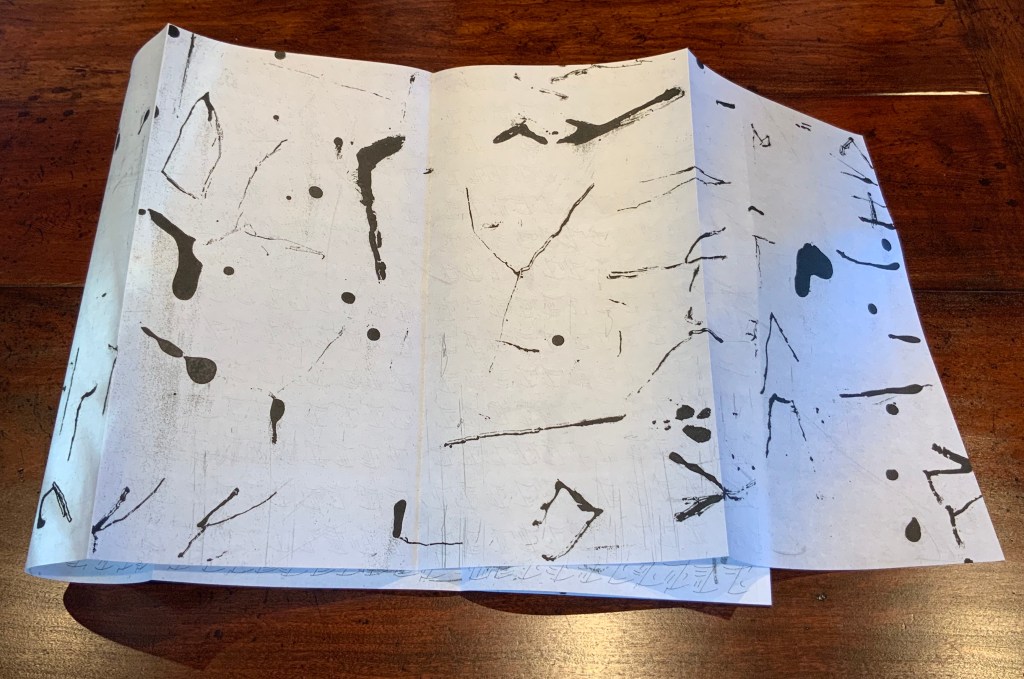
The photo in question is the 78th among 81 photos that mirror and document an installation exhibited at the Musée d’Art Moderne de la Ville de Paris in 2010. In the photo, a double-page spread has been removed from a book, folded and creased into a three-dimensional shape. Or perhaps, as hinted in the interview at the end of the book, it is an enlarged re-creation staged for the photo. The catalogue provides no caption for it or any other image. The text concluding the catalogue does not clarify what it is. Only for someone familiar with Marcel Broodthaers’ homage to Un Coup de Dés Jamais N’Abolira le Hasard are the pages recognizable.

So, for the collector with a hammer, there sits the nail: this photo of a manipulated double-page spread from Broodthaers’ Image version of Mallarmé’s poem. Across the book’s gutter, the image in the double-page spread seems to take on the face of a tilted die. The tilt and multiple creases at the edges of the die face create an illusion of motion. Behind the die, the shadowed edges of the pages add their blur to the imagined throw. Are there clues/clews embedded in the book’s other photos — the suggestion of a shipwreck, a hint of a constellation? As with Un Coup de Dés, images of the surreal and real interleave. Motifs on one page carry over to others. The images play with the white space (les blancs) to the left and around them. As with the various homage by Broodthaers, Michalis Pichler, Jorge Méndez Blake, Cerith Wyn Evans and many others that eschew text in favor of the image and three-dimensional shape, Leykauf’s photos convey motion and simultaneity. (Too strained? The hammer hesitates.)

So from there, the collector’s eye turns back to the occasion of the catalogue: “Salle Noire, Château de Bagatelle”, Musée d’Art Moderne, Paris, 6 May – 27 June 2010. The Salle Noire is an exhibition space in the basement of the Musée d’Art Moderne in Paris. According to François Michaud, Leykauf said she wanted to turn the Salle Noire inside out like a glove. To that end, she surveyed and photographed its rooms, its auditorium-like space and, from three viewpoints, its longest wall.

Installation views. Photos: Courtesy of the artist.

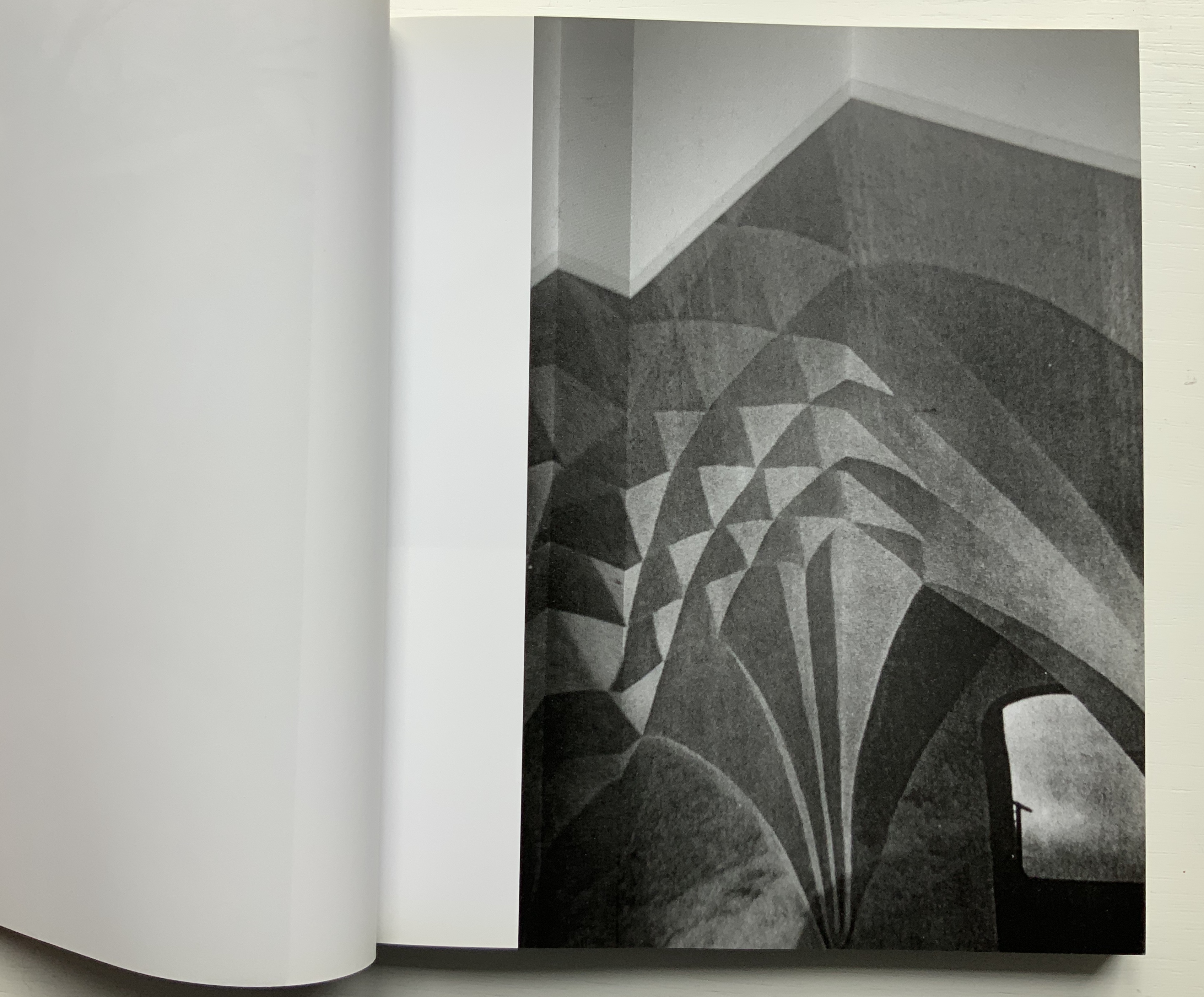
These monochrome photos along with others — wooden triangles comprising a psychological test, segments of a gothic arch, a Walter Gropius building, a stained glass window, an image from a paper activities book, the folded pages from Broodthaers’ Image, etc., and collaged in some instances — were made into slides. For the exhibition, five slide projectors, each holding 81 slides and running at different speeds, shone the images against the walls at different angles. In the interview concluding the book, Leykauf comments:

I consider the totality of the images to be a kaleidoscope … There is no development, no narrative — for example, nothing which might chart an architectural history. The kaleidoscope image or indeed, that of a round dance, sums it up very nicely! Leykauf to Rahn, p. 18.

Kaleidoscope! Does that not describe Mallarmé’s juxtaposition of fragments of verses in different sizes and styles of type and their imagery, which the homageurs highlight?

No development, no narrative! Does that not echo Mallarmé’s preface to Un Coup de Dés — “Everything takes place in a foreshortened, hypothetical state; narrative is avoided” (Collected Poems, p. 263)?

Salle Noire! Could the choice of the black room be a reference to the nothingness, the abyss of the poem?

Château de Bagatelle, a slide show! Could it be a reference to that other great photographer’s cinematic homage to Mallarmé — Man Ray’s Les Mystères du Château de Dés?

As intriguing as it is to tap-tap-tap away at the Château de Bagatelle, the impact of the book’s 81 images and the imagined disorientation from the barrage of five simultaneous, differently paced slideshows overcomes and defeats the most determined, hammer-wielding collector. All that motion and simultaneity echoing the modernists — the Cubists, the Delaunays, Dada, Bauhaus, Schwitters, the Surrealists, the Vorticists — cannot be reduced to an homage to Mallarmé, even if his was the poem that made us modern.

Photos of pages from Château de Bagatelle: Books On Books Collection. Shown with permission of the artist.

Folded Paper (2010)
Alexandra Leykauf
Print. H500 x W700 mm. Photo: Courtesy and permission of the artist.

For the book art collector taking a wider view with a lowered and stilled hammer, Leykauf’s works subsume aspects of the book. Works such as Katoptrische Experimente (2012), A Student at Ease Among the Books, (2013) Everybody’s Autobiography (2014), La Statue Intèrieure (2015), Cumberland Farm (Ben Nichols) (2017) — all challenge perspective. Wall-sized photos of a double-page spread turn the corner of the display room; book covers larger than the viewer are coated in reflective material and form a fun house maze of angled mirrors and open title-page spreads; aerial views, recto/verso views, proscenium views, and inside/outside views play with the structures of landscapes, the theater and amphitheater, cupolas and arches, trees and caves, and the structure of the book. Perhaps everything in the world does not exist to end up as a book — or a photo — but as perspective.

Further Reading

“Alexandra Leykauf in conversation with Kathleen Rahn”, 19 February 2010, trans. Timothy Connell, in Alexandra Leykauf: Chateau de Bagatelle (Nürnberg : Verlag für moderne Kunst Nürnberg, 2010), pp. 15-18.

Alexandra Leykauf en conversation avec Sophie Berrebi”, 6 Mai 2010. Accessed 6 September 2020.

Salle Noire, Château de Bagatelle”, 2010. Accessed 27 March 2019.

Mallarmé, Stéphane. Trans. E.H. and A.M. Blackmore. Collected Poems and Other Verse (Oxford: Oxford University Press, 2008.

Michaud, François. “The Sense of Loss”, 26 February 2010, trans. John Tittensor, in Alexandra Leykauf: Chateau de Bagatelle (Nürnberg : Verlag für moderne Kunst Nürnberg, 2010), pp. 4-6.

Books On Books Collection – François Da Ros

Anakatabase: en hommage au Sacré d’avant le Temps du Signe et du Verbe (1991)

Anakatabase: en hommage au Sacré d’avant le Temps du Signe et du Verbe (1991)

François Da Ros

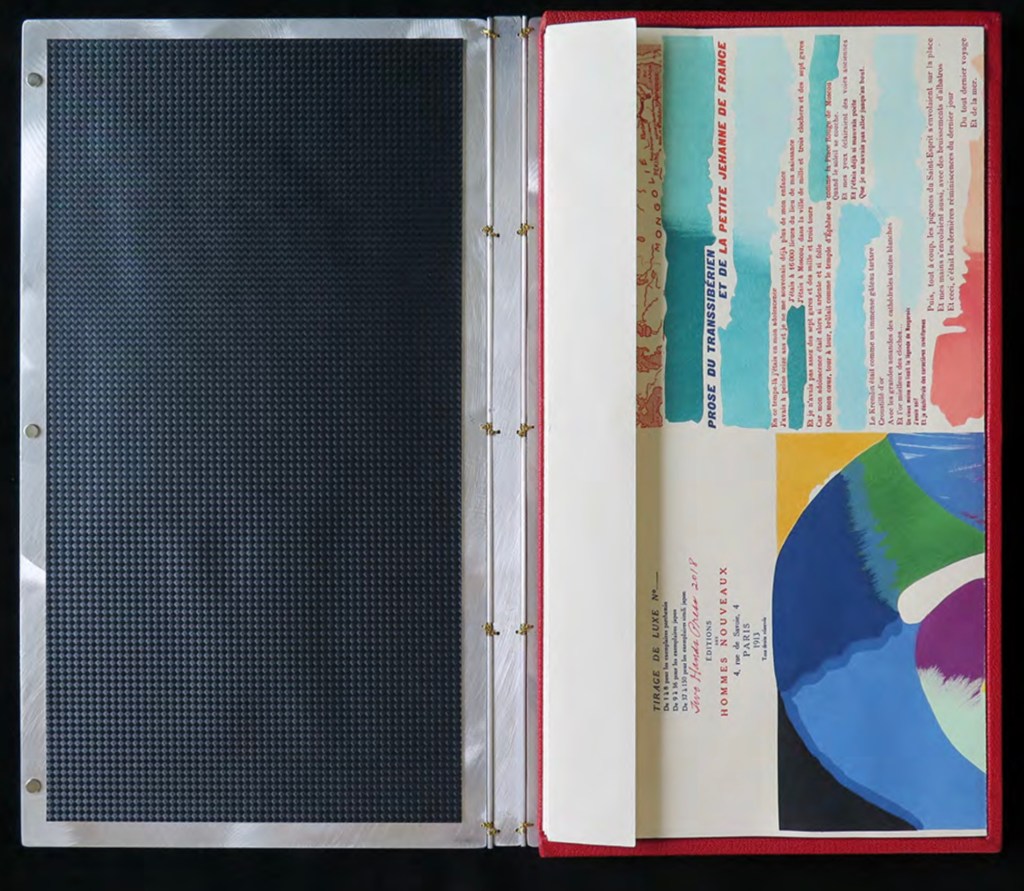
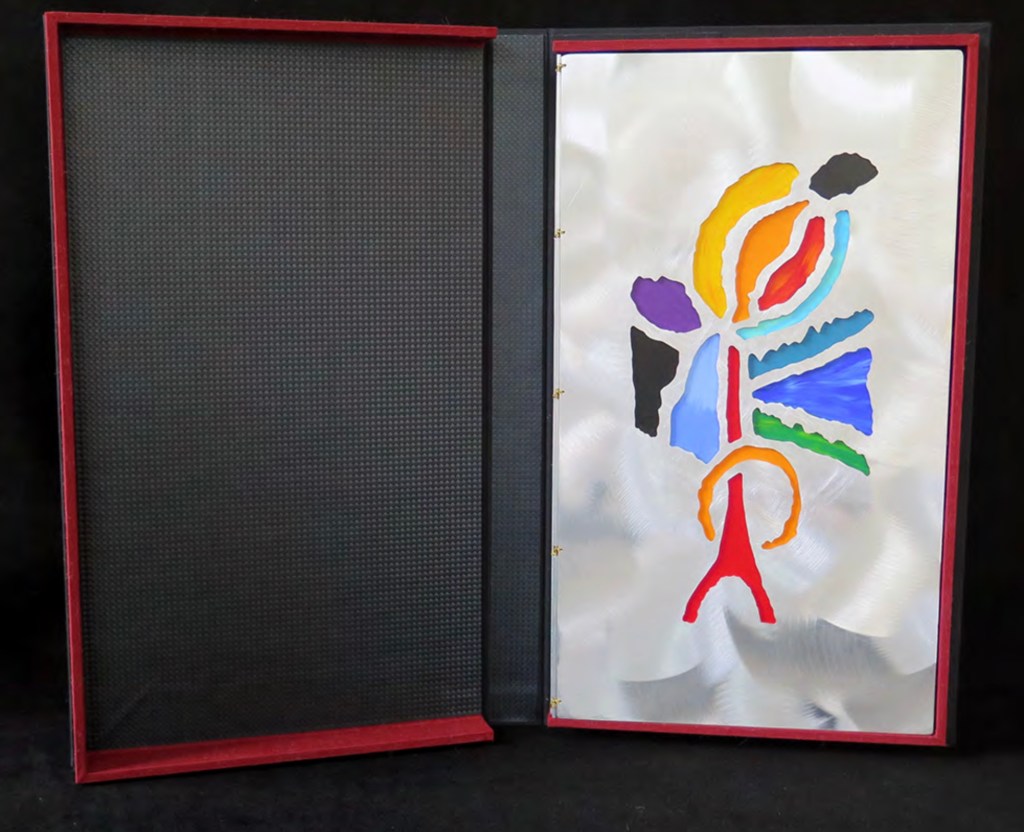
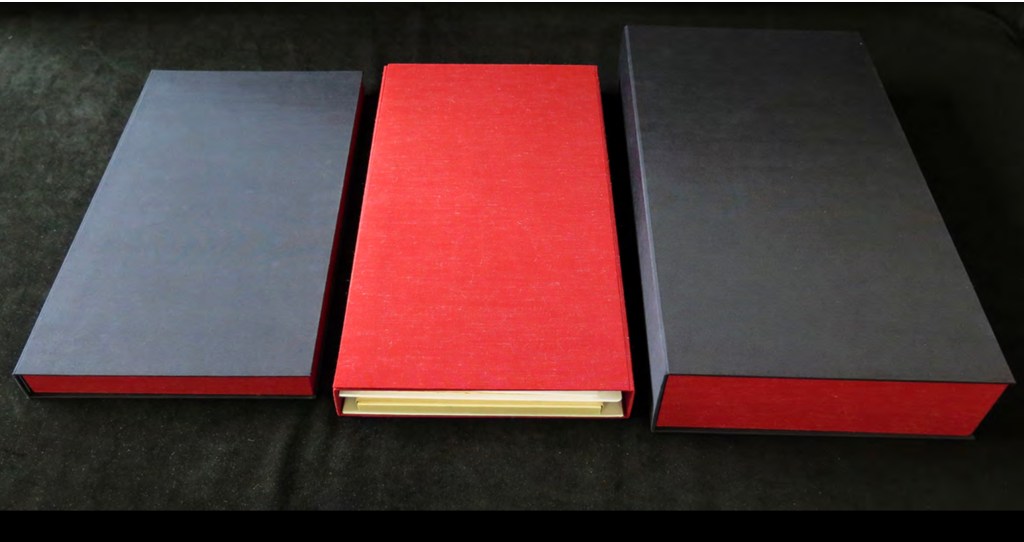
Slipcase: H331 x W179 mm. Board case: H323 x W177 mm. Paper case: H319 x W169 mm. Loose folios (9): H315 x W164 mm. Leporello: H312 x W168 mm (closed) and W3024 mm (open). Acquired from the artist, 19 August 2020. Edition of 63, of which this is #7 signed by the artist and engraver. Photos: Books On Books Collection. Displayed with permission of the artist.

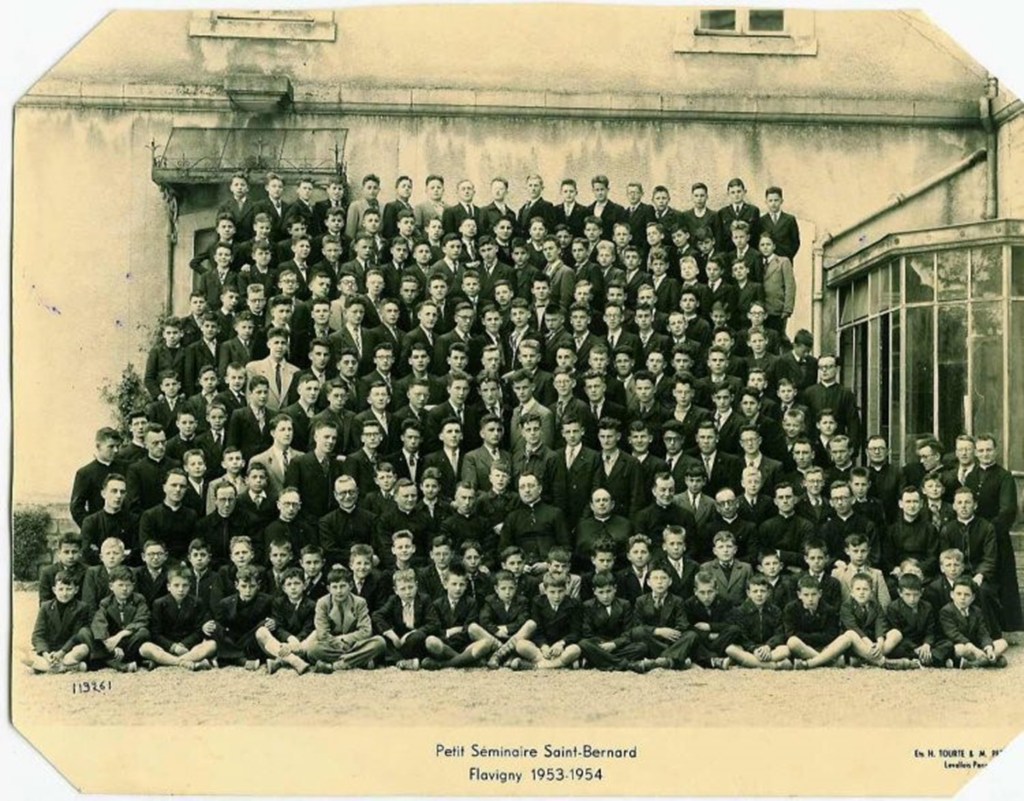
In the Petit Sèminaire de Flavigny-sur-Ozerain, where François Da Ros was enrolled in 1953, a metal staircase led from the playground to the chapel. From an onomatopoeic word game, passed down through generations of classical Greek students ascending (ana) and descending (kata) those steps (base), it came to be known as ana-kata-base. The word game followed Da Ros in his choice of typography and printing over religious orders, with Anakatabase becoming the name of the typesetting/publishing house, founded with Martine Rassineux in 1991.
Photo: Books On Books Collection.

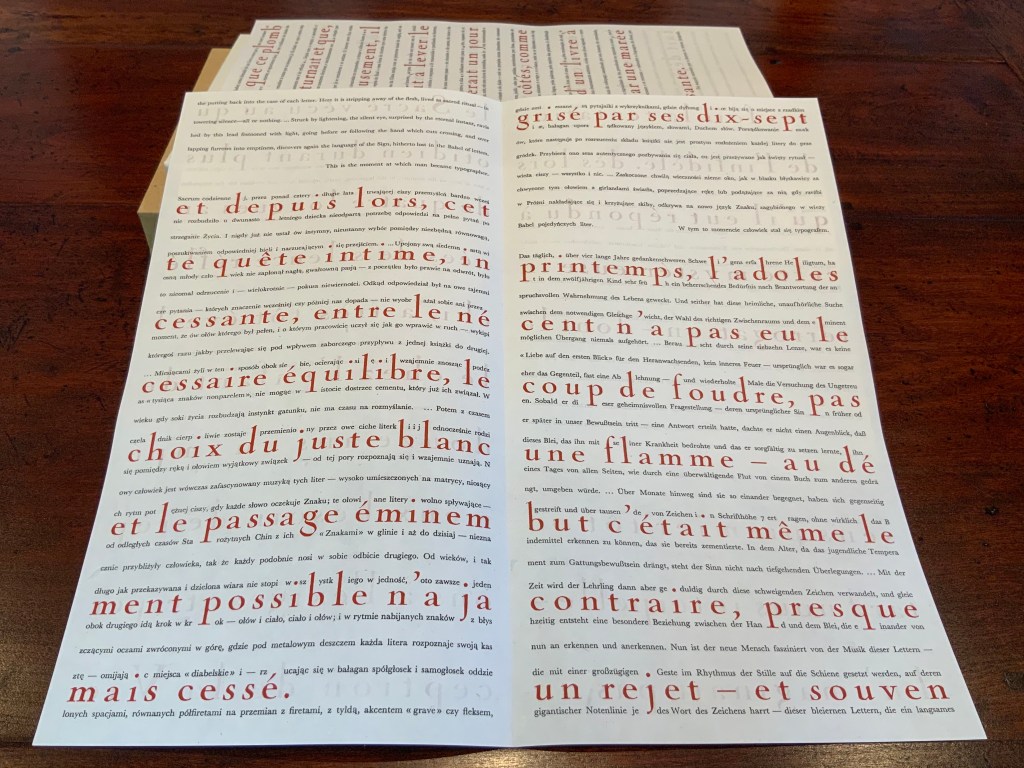
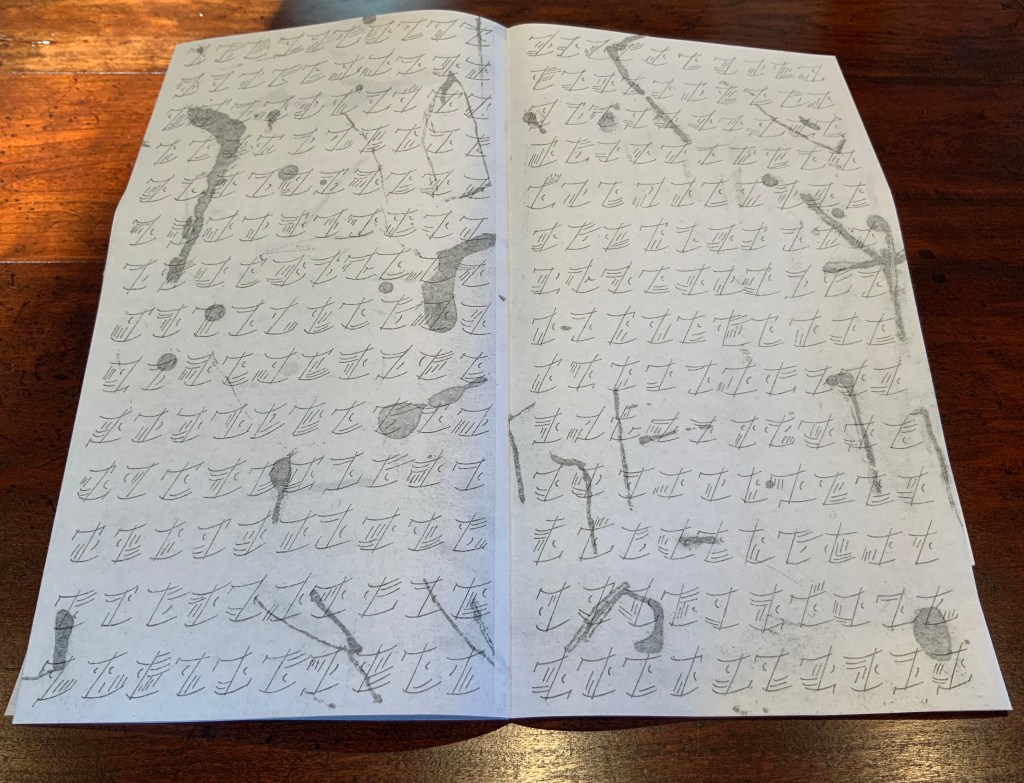
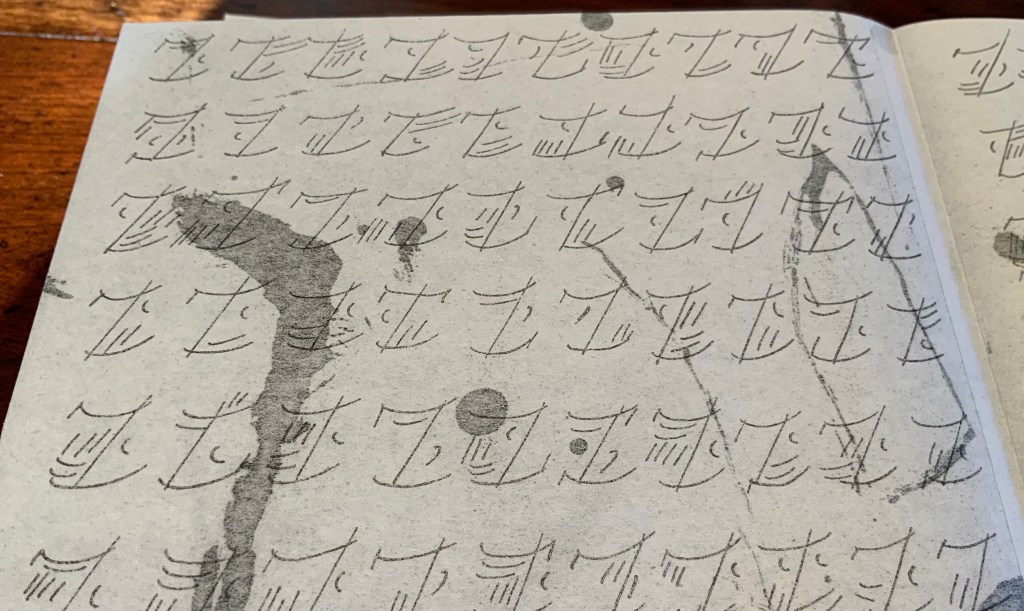
Anakatabase celebrates the alphabet as the root of its maker’s art. Indeed, it presents an entirely invented alphabet. It displays the artist’s manifesto in anakatabasien and twenty other languages. In its play with the letter, languages as well as the structural, functional and material elements of the book, this work of art gives life to Mallarmé’s cryptic pronouncement: Le livre, expansion totale de la lettre, doit d’elle tirer, directement, une mobilité et spacieux, par correspondances, instituer un jeu, on ne sait, qui confirme la fiction (“The book, total expansion of the letter, must directly depict a mobility and spaciousness that — by analogy — constructs an unknown game that confirms the fiction”).

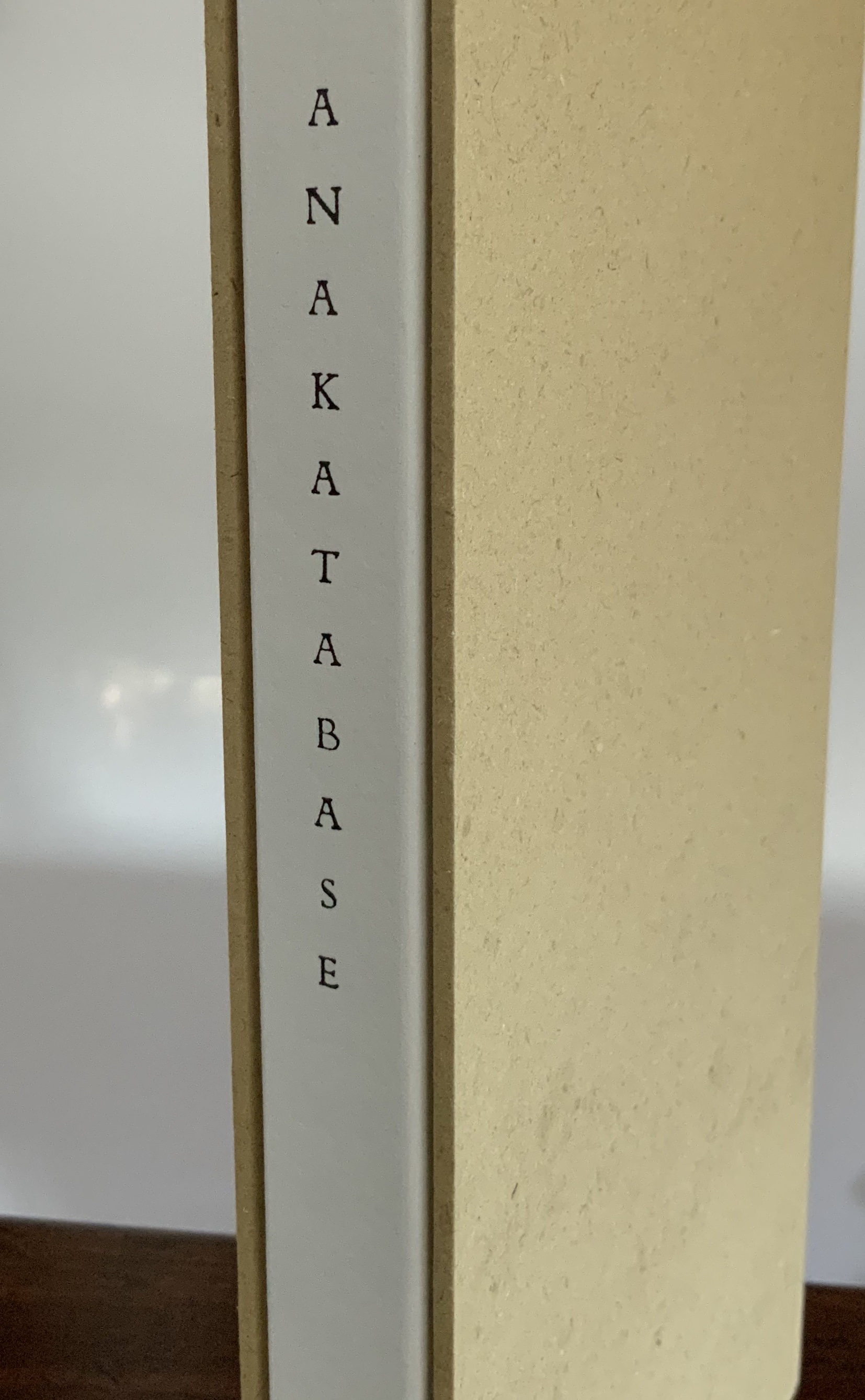
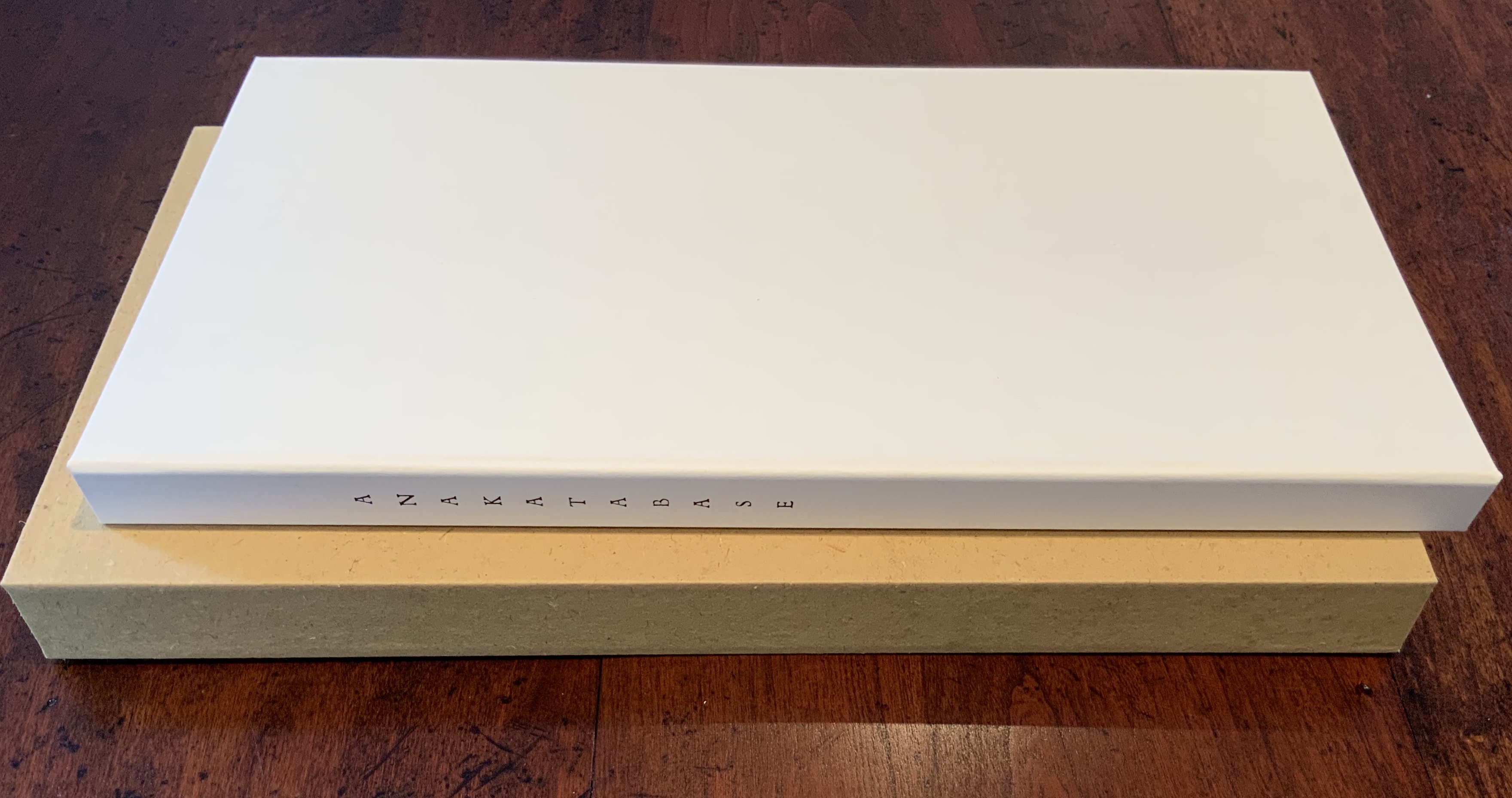
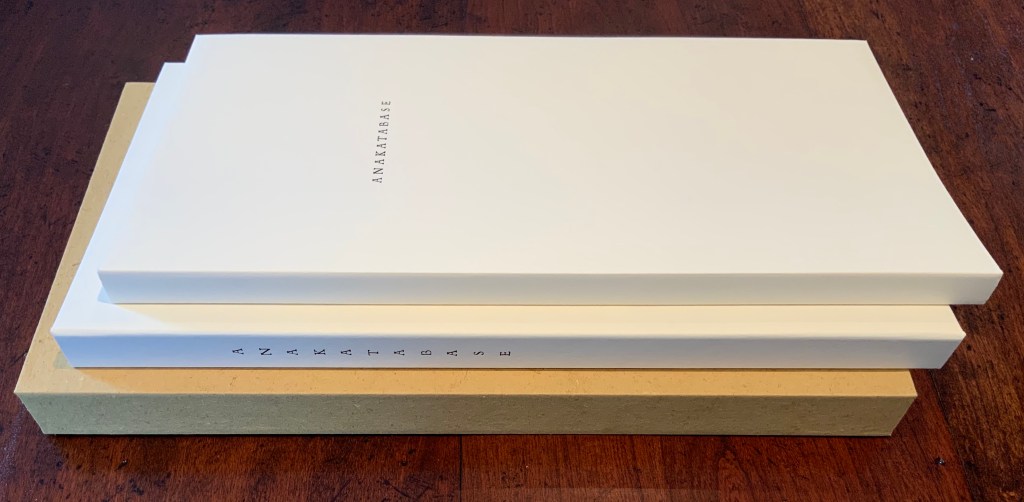
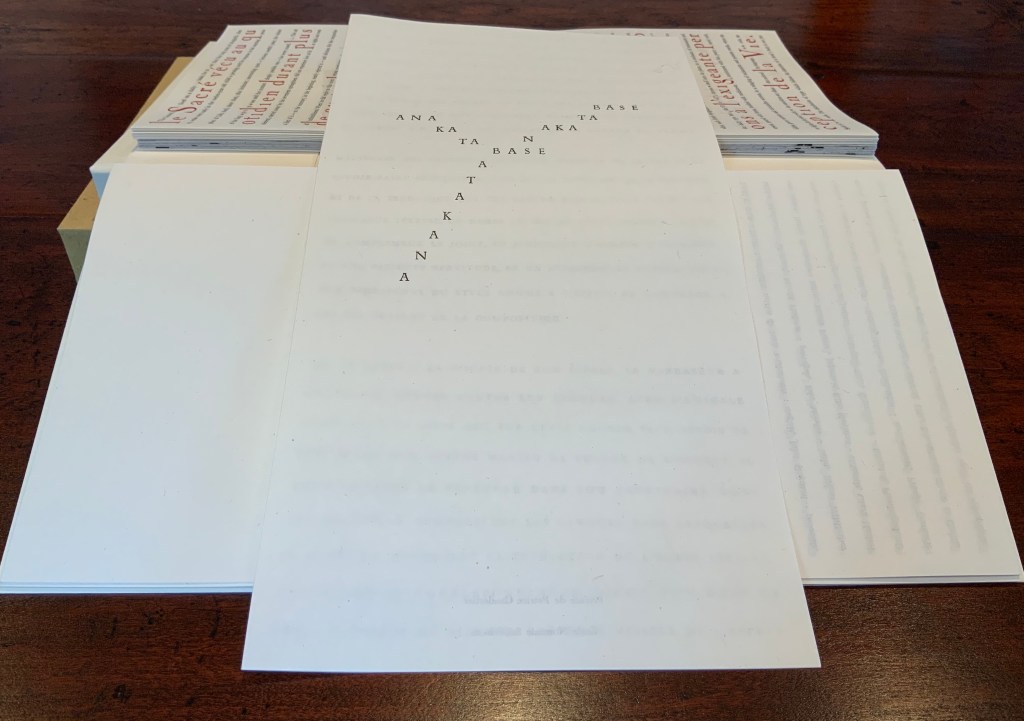
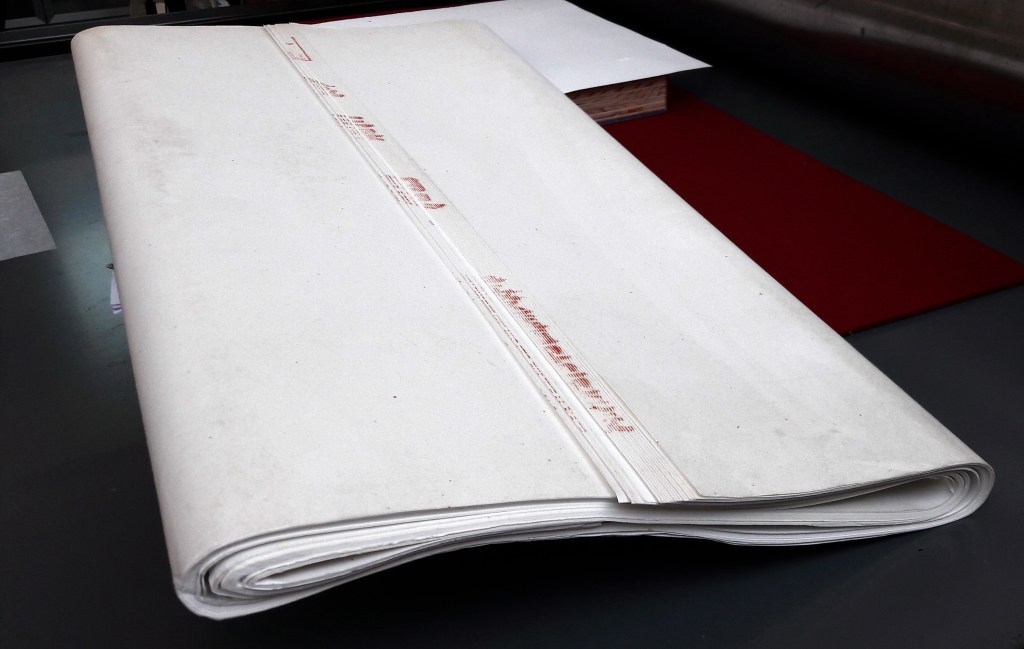
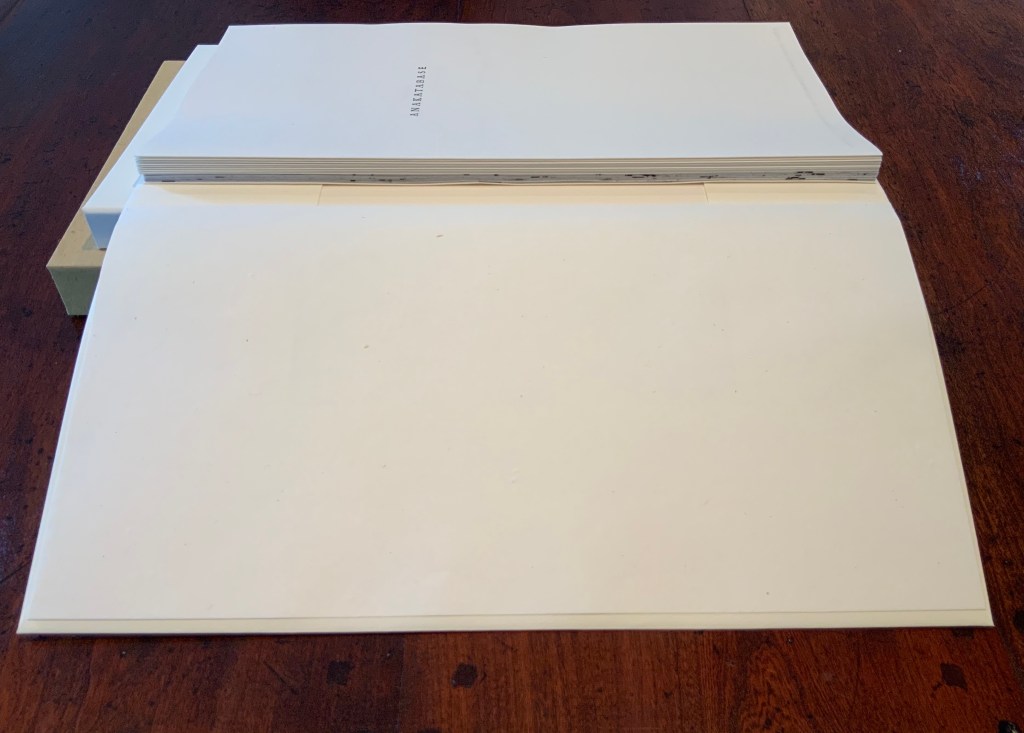
Consider first the structural, functional and material elements. If judged by its cover (or rather, covers), Anakatabase has depths, a roughness and smoothness, a stiffness and suppleness, yet harmonious in its contrasts and variety. A tightly turned-in slipcase, covered in rough papier de paille (a paper made of straw, traditionally for packaging sugar), holds a case of board. In turn, the board case — with the book’s title set vertically in Nicolas Cochin (36pt) on smoother almost parchment-like paper covering the neatly chamfered spine, front and back boards — holds a paper case. Not attached to the board case, the paper case made of Lana Pur Fil folds around a single sheet of Arches Velin 160 gsm, which rests between the paper case and the loose endpapers. The loose endpapers are handmade papier de Chine au liseré rouge (60 or 65 gsm). It is the same paper used for the nine loose single-fold folios. For the leporello making up the last “gathering” in the “book block”, the artist and engraver selected a Japanese paper more commonly used to make interior walls. 

Left: supply of papier de Chine au liseré rouge. Photo: Courtesy of the artist. Right: paper case open to show of “book block” of nine loose folios and leporello. Photo: Books On Books Collection.

These multiple papers of differing weights, finish, opacity, drape or stiffness, rattle and color work together loosely yet harmoniously to cover and uncover (or dis-cover) the artist’s statement.

Like many artist’s statements, Anakatabase is also a philosophical statement. It is also as much an ode to a lifelong coming of age as typographer, printer and master of the book — even, as much, a love letter to “the language of the Sign”. As a work of book art, it lovingly enacts the letter.

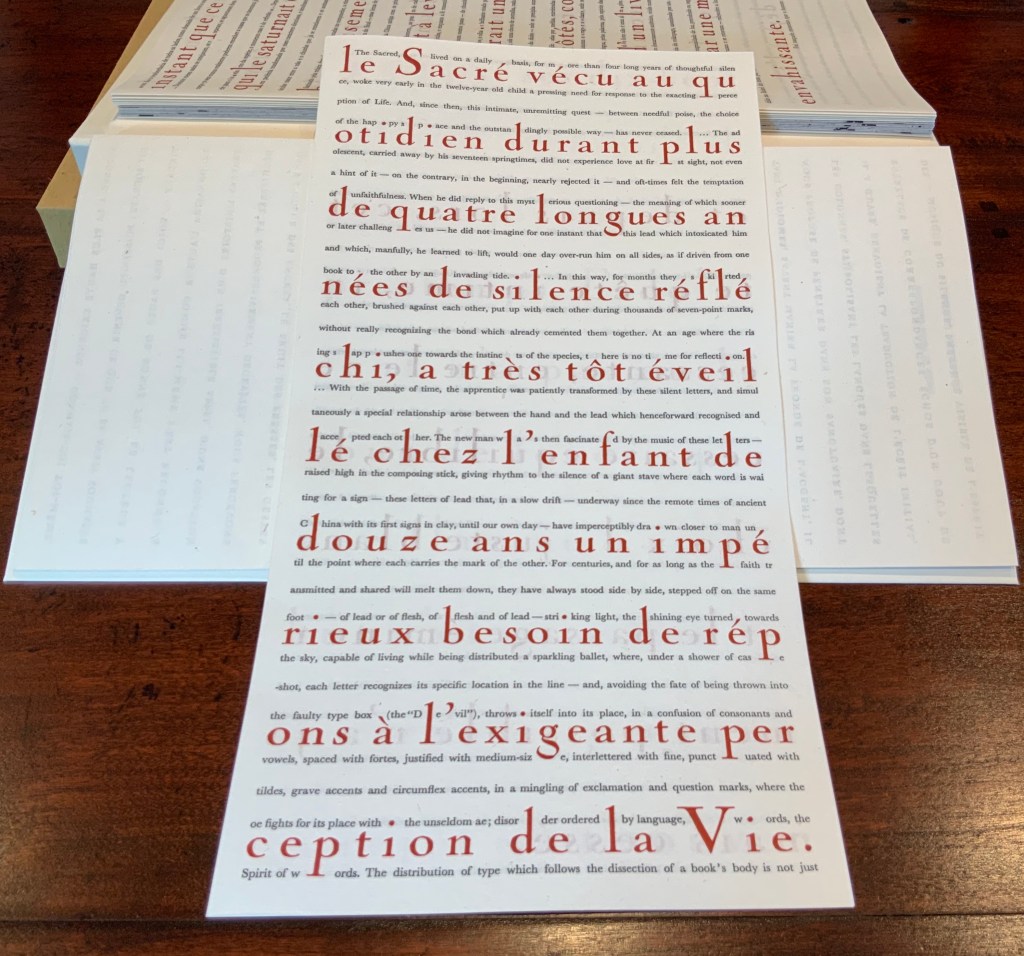
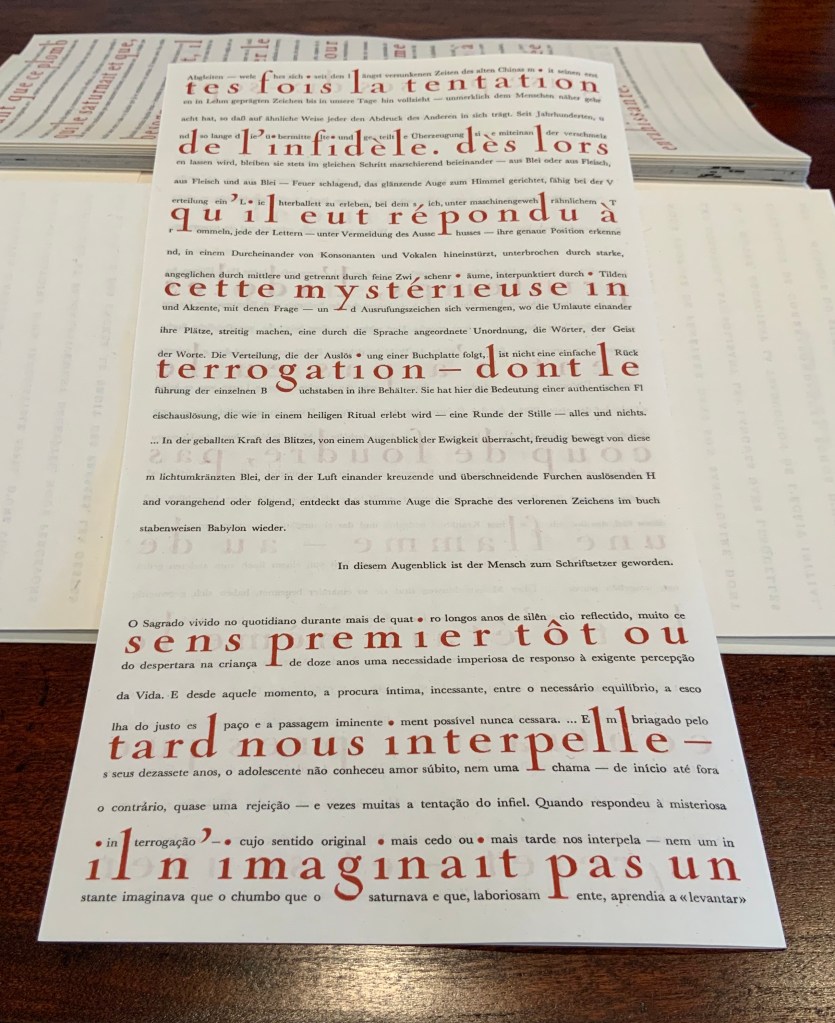
The Sacred, lived on a daily basis, for more than four long years of thoughtful silence, woke very early in the twelve-year old child a pressing need for response to the exacting perception of Life. And, since then, this intimate, unremitting quest — between needful poise, the choice of the happy space and the outstandingly possible way — has never ceased. …The adolescent, carried away by his seventeen springtime’s, did not experience love at first sight, not even a hint of it — on the contrary, in the beginning, nearly rejected it — and oft-times felt the temptation of unfaithfulness. When he did reply to this mysterious questioning — the meaning of which sooner or later challenges us — he did not imagine for one instant that this lead which intoxicated him and which, manfully, he learned to lift, would one day over-run him on all sides, as if driven from one book to the other by an invading tide. …In this way, for months they skirted each other, brushed against each other, put up with each other during thousands of seven-point marks, without really recognizing the bond which already cemented them together. At an age where the rising sap pushes one towards the instinct of the species, there is no time for reflection. … With the passage of time, the apprentice was patiently transformed by these silent letters, and simultaneously a special relationship arose between the hand and the lead which henceforward recognized and accepted each other. The new man was then fascinated by the music of these letters — raised high in the composing stick, giving rhythm to the silence of a giant stave where each word is waiting for a sign — these letters of lead that, in a slow drift — underway since the remote times of ancient China with its first signs in clay, until our own day — have imperceptibly drawn closer to man until the point where each carries the mark of the other. For centuries, and for as long as the faith transmitted and shared will melt them down, they have always stood side by side, stepped off on the same foot — of lead or flesh, flesh and of lead — striking light, the shining eye turned towards the sky, capable of living while being distributed a sparkling ballet, where, under a shower of caseshot, each letter recognizes its specific location in the line — and, avoiding the fate of being thrown into the faulty type box (the “Devil”), throws itself into its place, in a confusion of consonants and vowels, spaced with fortes, justified with medium-size, interlettered with fine, punctuated with tildes, grave accents and circumflex accents, in a mingling of exclamation and question marks, where the oe fights for its place with the unseldom ae; disorder ordered by language, words, the Spirit of words. The distribution of type which follows the dissection of as book’s body is not just the putting back into the case of each letter. Here it is stripping away of the flash, lived as sacred ritual — in towering silence — all or nothing. …Struck by lightning, the silent eye, surprised by the eternal instant, ravished by this lead festooned with light, going before or following the hand which cuts crossing, and overlapping furrows into emptiness, discovers again the language of the Sign, hitherto lost in the Babel of letters. This is the moment at which man became typographer. Trans. John Gaynard.

Spaced out across six folios, the statement’s French version appears in large display type and carmine ink. It also appears in nineteen other languages in smaller type in black ink between the lines of the French, their words broken up by the red characters’ ascenders and descenders. At the end of measures, words break without hyphens. This is “the Babel of letters” in Baskerville type. The more ancient leporello form presents the statement in the calligraphy-like anakatabasien face and language. For the reverse of the leporello, Rassineux used the technique of gravure au sucre (“sugar lift”) on her etching plates. The effect’s appearance is suminagashi-like. Underlying the characters on the front of the leporello, those hand-drawn elements on the reverse side evoke the strokes and marks that precede the anakatabasien characters or perhaps all letters.

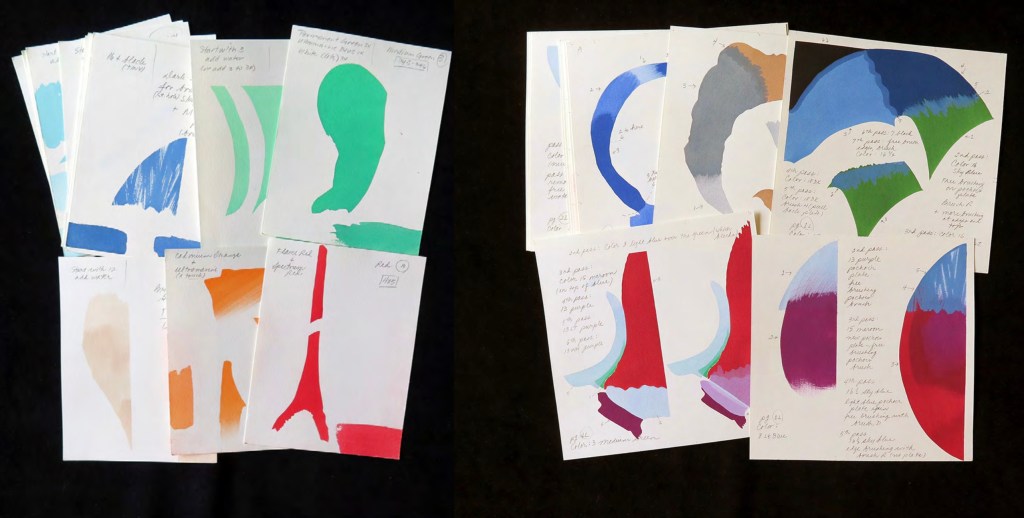
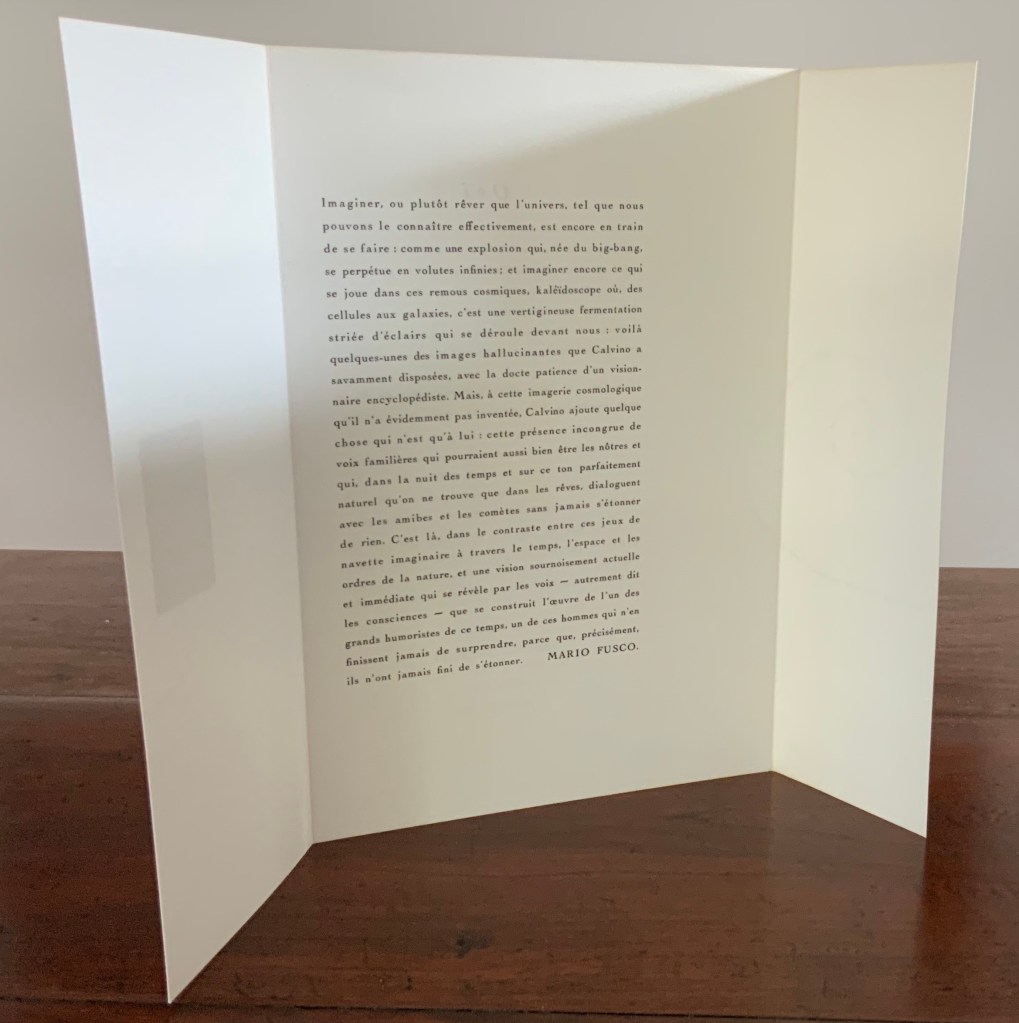
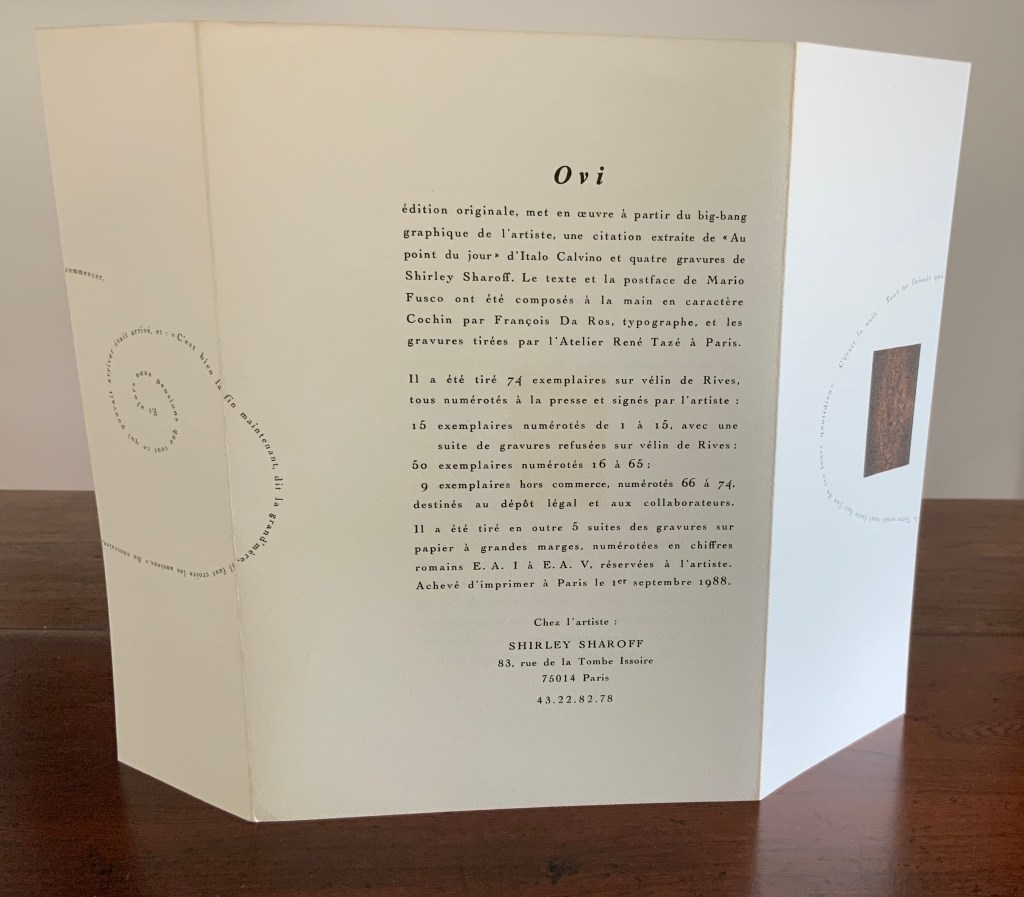
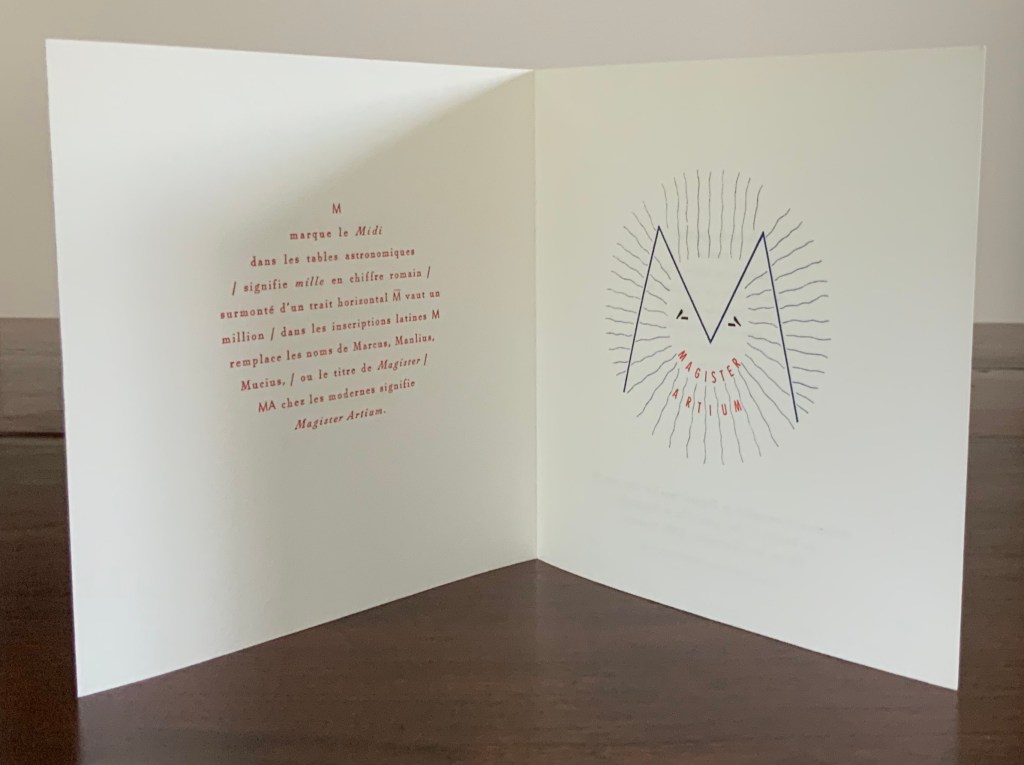
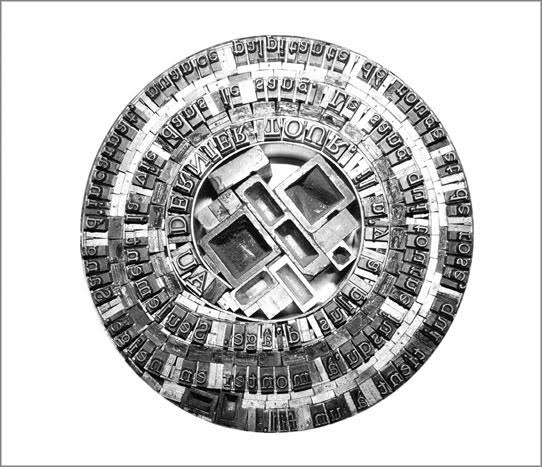
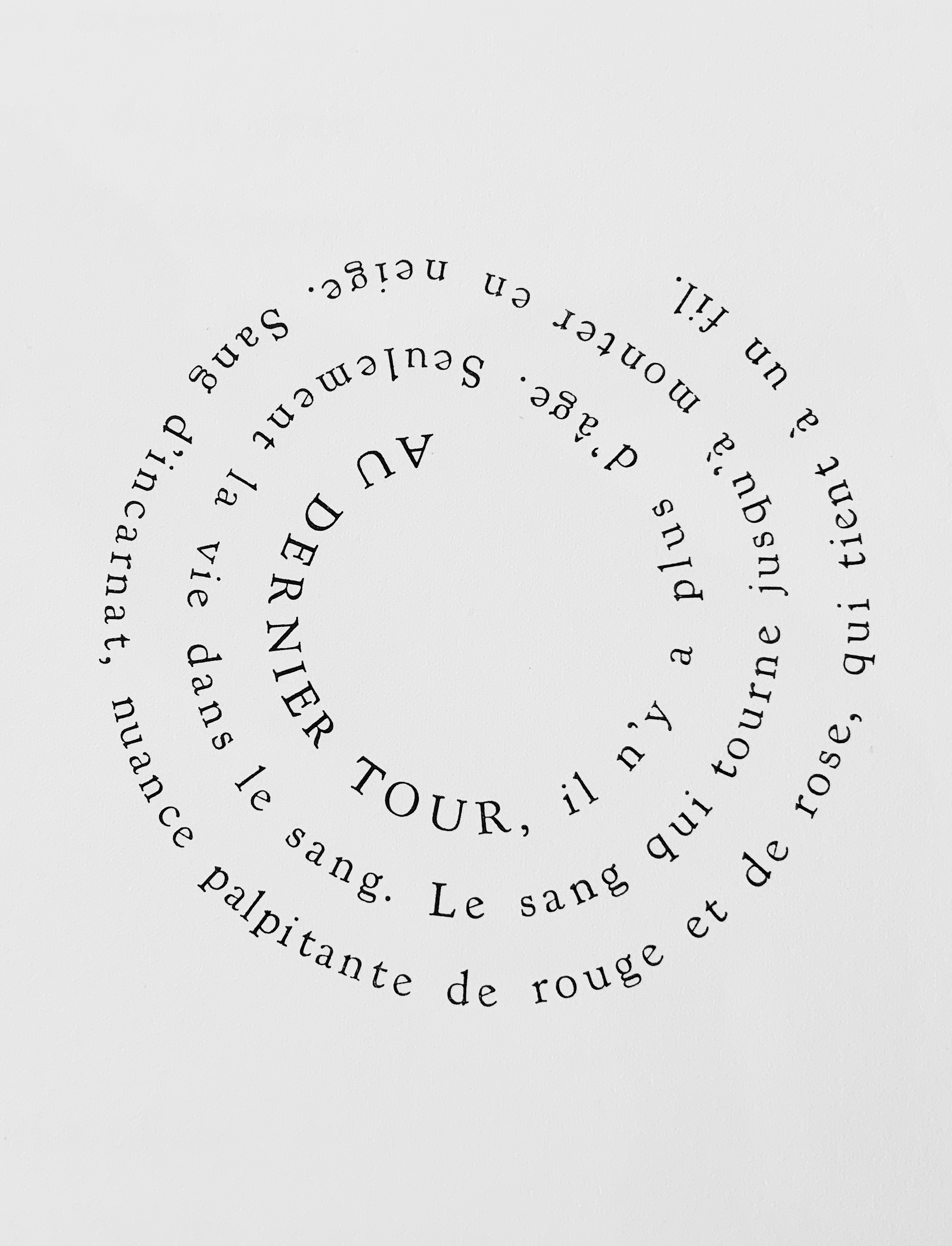
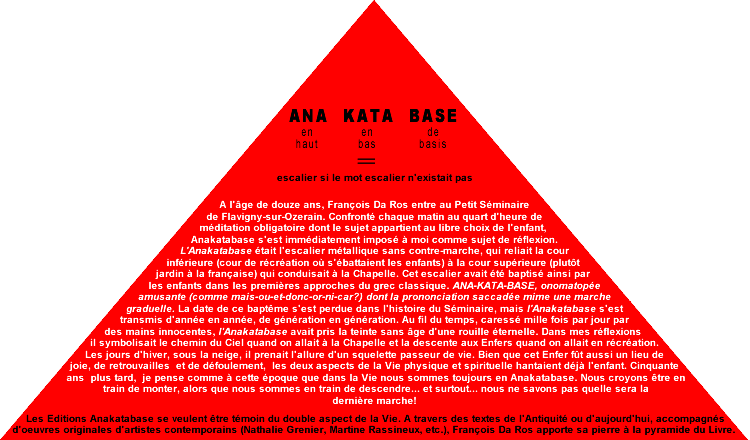
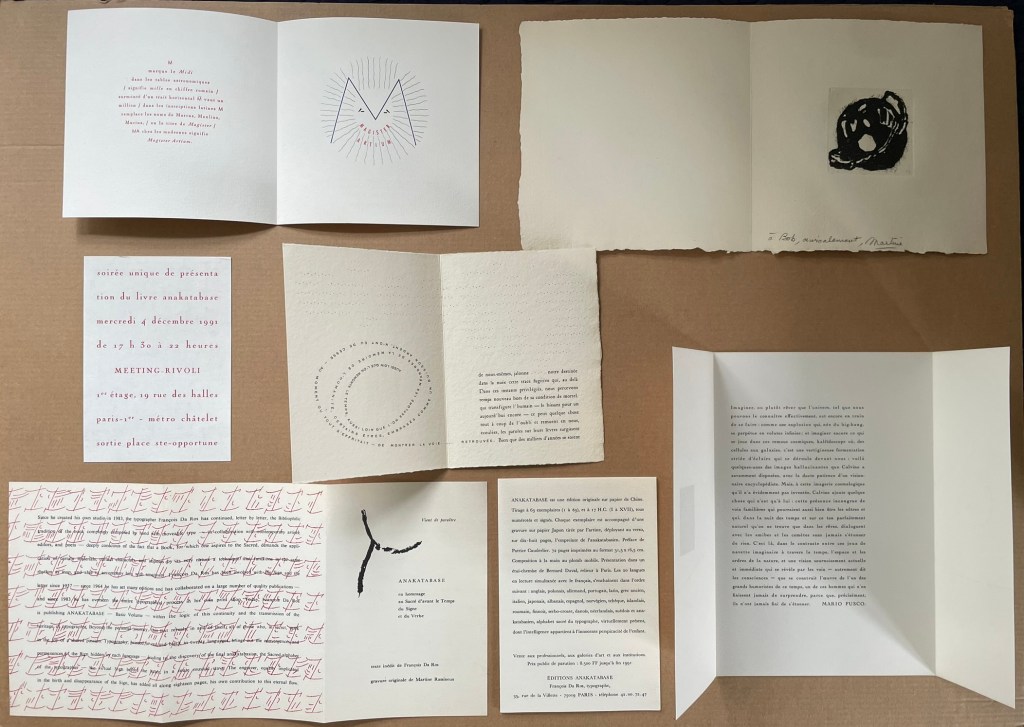
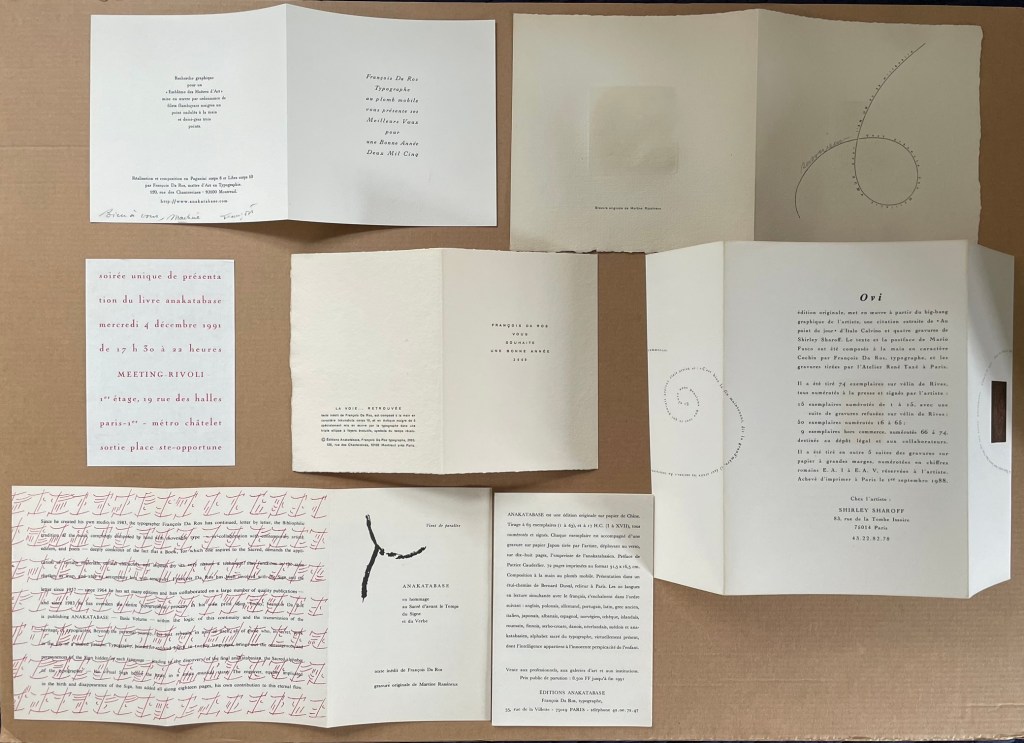
The artist and engraver (his wife and co-founder of Éditions Anakatabase, Martine Rassineux) kindly provided much-appreciated ephemera for the Books On Books Collection. In addition to the 1991 announcement of Anakatabase, they include items that show a characteristic of Da Ros’s craft that is otherwise hidden away in the linearity of Anakatabase — the magic he performs with the “furniture” of letterpress typesetting.
Photos: Books On Books Collection. Shown with permission of the artist.

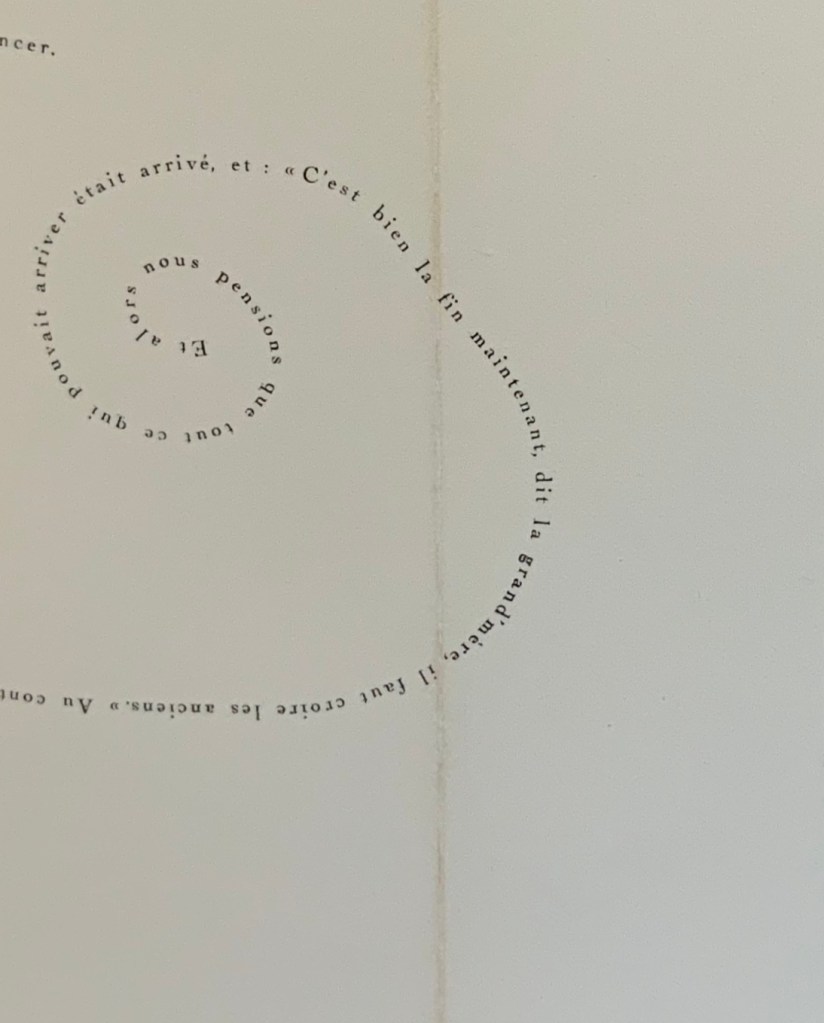
The outward-spiralling sentence in the announcement above of Ovi (1988) by Shirley Sharoff exemplifies this legerdemain, as does the open Christmas card celebrating the designation Magister Artium awarded to François Da Ros in 1998. Another example of the mastery of furniture behind the scenes can be seen in the following photo sent by Martine Rassineux of type prepared for a page in Ilinx, also in the Books On Books Collection.

Type preparation; Ilinx (2010)

Régine Detambel (original text), Martine Rassineux (original etchings), François Da Ros (typography). Photos: Courtesy of Martine Rassineux.

For the Books On Books Collection, Anakatabase is at once a work of fine art and an unusual fusion of the collection’s themes of interest in the alphabet, the multilingual, typography, the structural and material elements of the book, and aesthetic enquiry into the very nature of the book.

François Da Ros is third in the second row from the right, in a light jacket and tie. Photo: Courtesy and permission of the artist.

Further Reading

Birchem, Nathalie. “François Da Ros, poète du plomb“, La Croix, 16 July 2007. Accessed 1 September 2017.

Capelleveen, Paul Van; Sophie Ham; Jordy Joubij. Voices and Visions: The Koopman Collection and the Art of the French Book (Zwolle: Wanders, 2009) , pp. 196-98.

Capelleveen, Paul Van. Artist & Others: The Imaginative French book in the 21st century (Nijmegen: Vantilt, 2016), pp. 30-37.

Da Ros, François. “Le Mystère du Livre“, Éditions Anakatabase, 2000. Accessed 12 September 2020.
Da Ros, François. “La lettre de plomb mobile“, Éditions Anakatabase, 2001. Accessed 12 September 2020.
Mallarmé, Stéphane. “Le livre, instrument spirituelle”. Trans. Barbara Johnson. Divagations (Cambridge, MA: Harvard University Press, 2009).
Ephemera

Books On Books Collection – Klaus Detjen
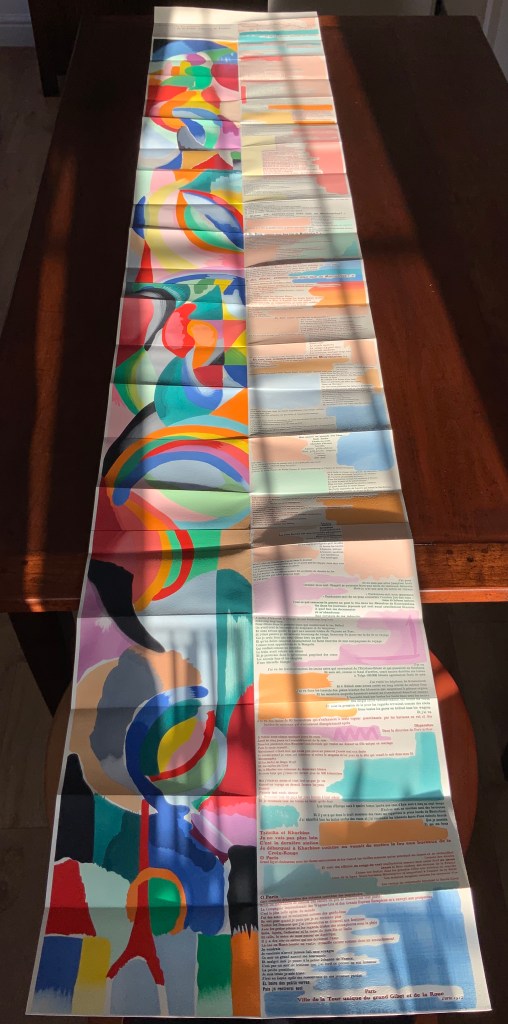
Un Coup de Dés Jamais N’Abolira le Hasard – Ein Würfelwurf niemals tilgt den Zufall (1995)

Un Coup de Dés jamais n’abolira le Hasard: Poème – Ein Würfelwurf niemals tilgt den Zufall: Ein Gedicht (1995)
Klaus Detjen
Casebound. H300 x W255 mm, 85 pages. Acquired from Stefan Schuelke Fine Books, 30 June 2020.
Photos: Books On Books Collection.

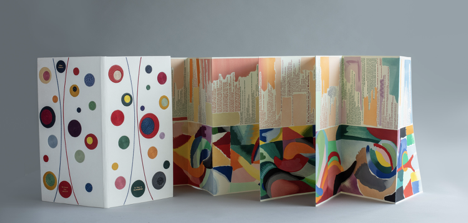
This work strikes a curious chord with two exhibitions from 2016 and 2018 — “Reading as Art” at the Bury Art Museum and “The Art of Reading” at the Museum Meermanno, respectively. The works in both exhibitions not only challenged notions of the book and ways of reading but posed the act of making as a form of reading and the act of reading as a form of making. By prefacing this French-German edition of Un Coup de Dés with a book-arts-driven “transcreation”, Klaus Detjen demonstrates that the act of making also implies the act of translating. Typographer, designer, scholar and recipient of the Leipzig Gutenberg Prize for 2017, Detjen has used color, shape, line and binding here as his tools of translation and interpretation.

To use the term “transcreation” here may be taking liberties with Haroldo de Campos’s portmanteau for the idea of “translation as recreation”, or translating with creativity and therefore making “translation-art”. The term and definition perhaps better describe works such as those shown in The New Concrete: Visual Poetry in the 21st Century edited by Victoria Bean and Chris McCabe. But then De Campos and his brother, Augusto, singled out Un Coup de Dés as one of the cornerstones (along with Ezra Pound, James Joyce and e.e. cummings) for their group Noigrandres, and Mallarmé’s poem certainly fits the bill of the ideal target of transcreation:

The more intricate the text is the more seducing it is to “recreate” it. Of course in a translation of this type, not only the signified but also the sign itself is translated, that is, the sign’s tangible self, its very materiality (sonorous properties, graphical-visual properties…. Haroldo de Campos, “Translation as Creation and Criticism”, p. 315.

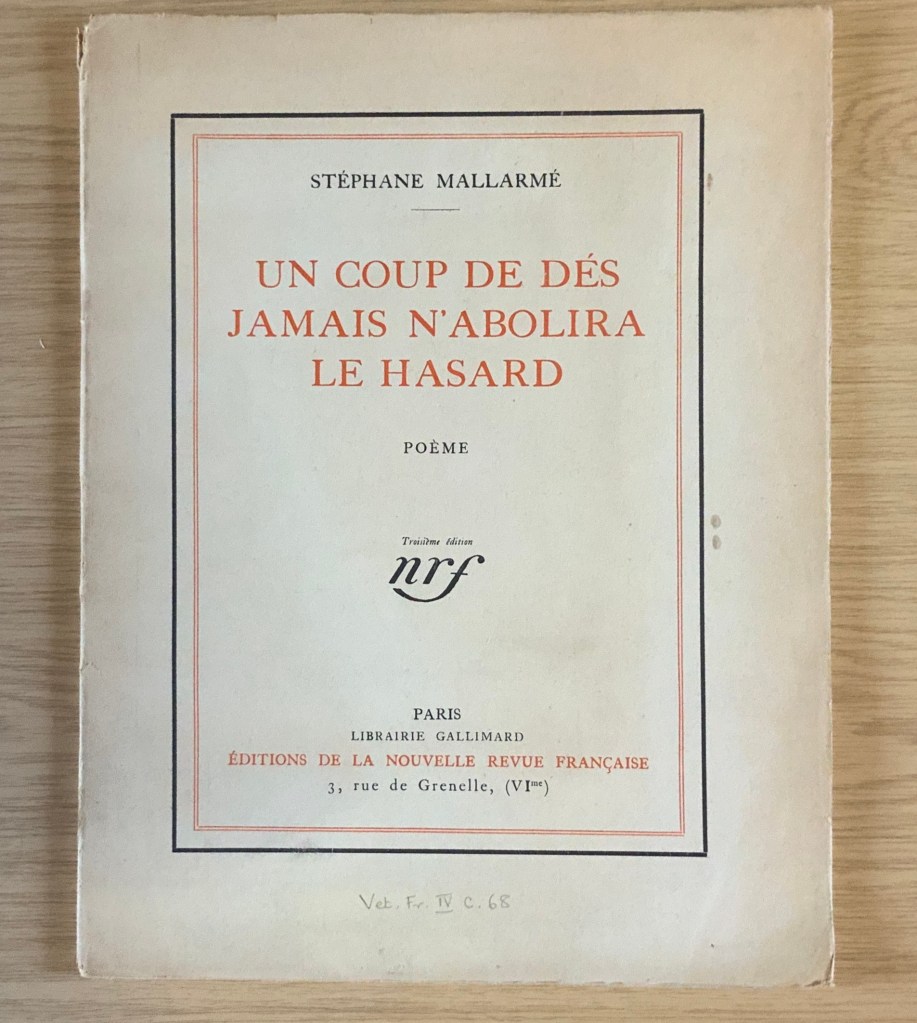
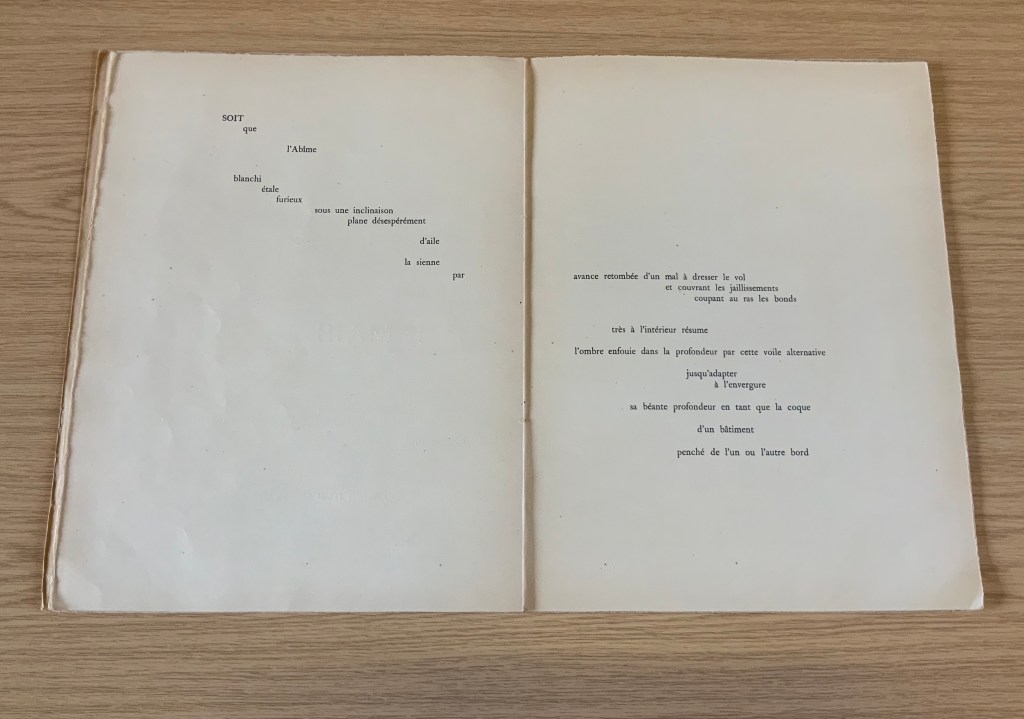
This notoriously difficult poem to translate (or even comprehend) with its cascade of metaphors and symbols (the central ones being a shipwreck and a constellation) appears three times in Detjen’s volume: first, in French with Detjen’s interpretive design, then in French and finally in German. All three instances follow the typography and layout of the first book edition of the poem as published in 1914 by Gallimard. Detjen’s own treatment of the poem very much focuses on the edition’s graphical-visual properties.

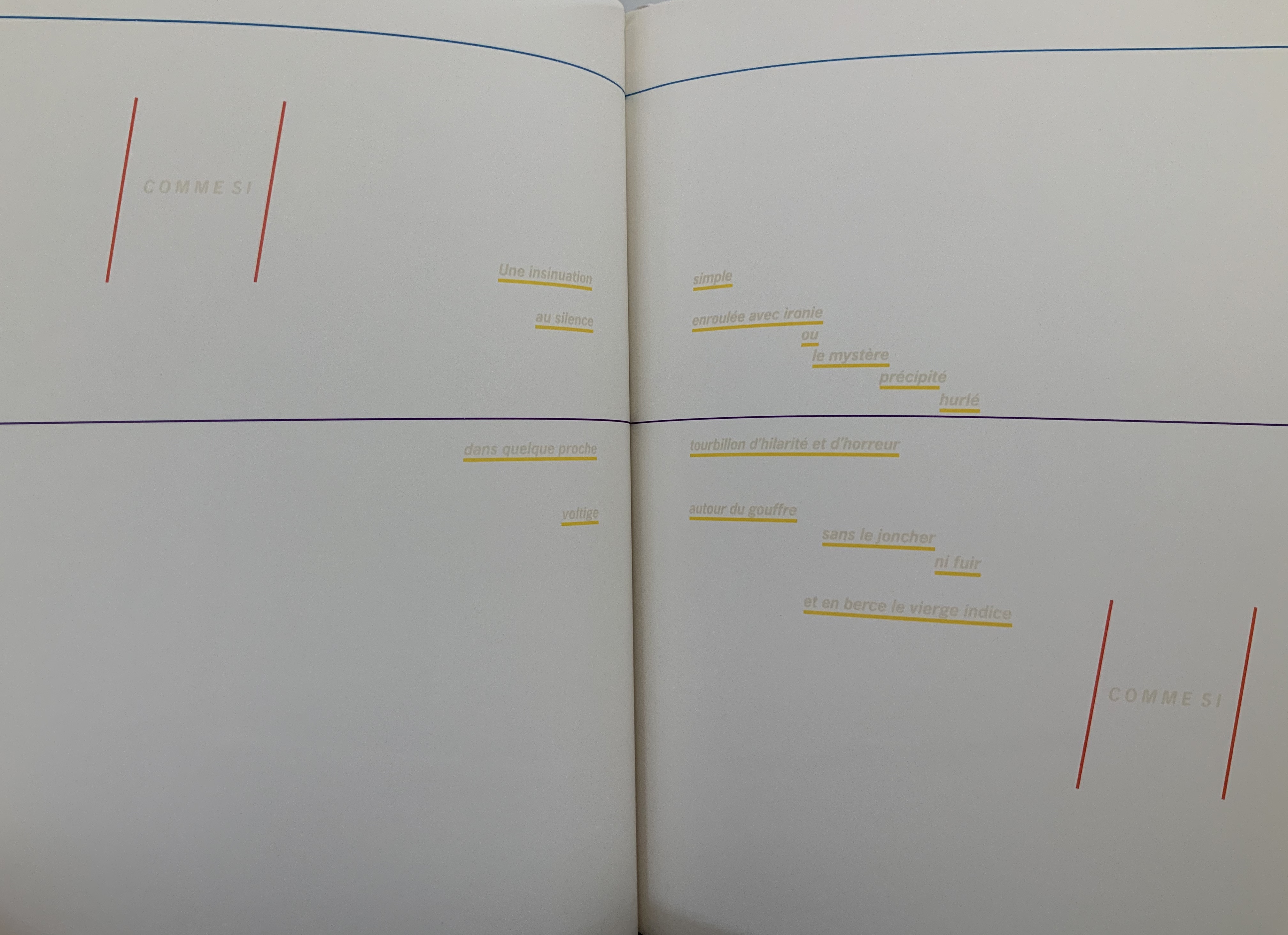
In that edition, the rhythm and position of the lines, the font and all the font sizes are precisely specified. Nine typographical motifs structure the poem. They are additionally highlighted in the front part of our book with colors, the meaning of which will be discussed later. Font sizes, styles (roman or italics) and the colors of the motifs used are as follows: First double-page spread: UN COUP DE DÉS, 11.25 mm, blue-violet / Second DS: QUAND BIEN MEME, 3.5 mm, cyan-blue / Third DS: que, 3.5 mm, green / Sixth DS: COMME SI, 5.25 mm, magenta; Une insinuation, 3.5 mm, yellow / Eighth DS 8: SI, 5.25 mm, magenta red / Ninth DS: C’ÉTAIT, 4.5 mm, orange red; autrement qu’hallucination, 2.5 mm, yellow; issu stellaire, 2.5 mm yellow. Klaus Detjen, “Zum Gestaltung”, p.81 (my translation).

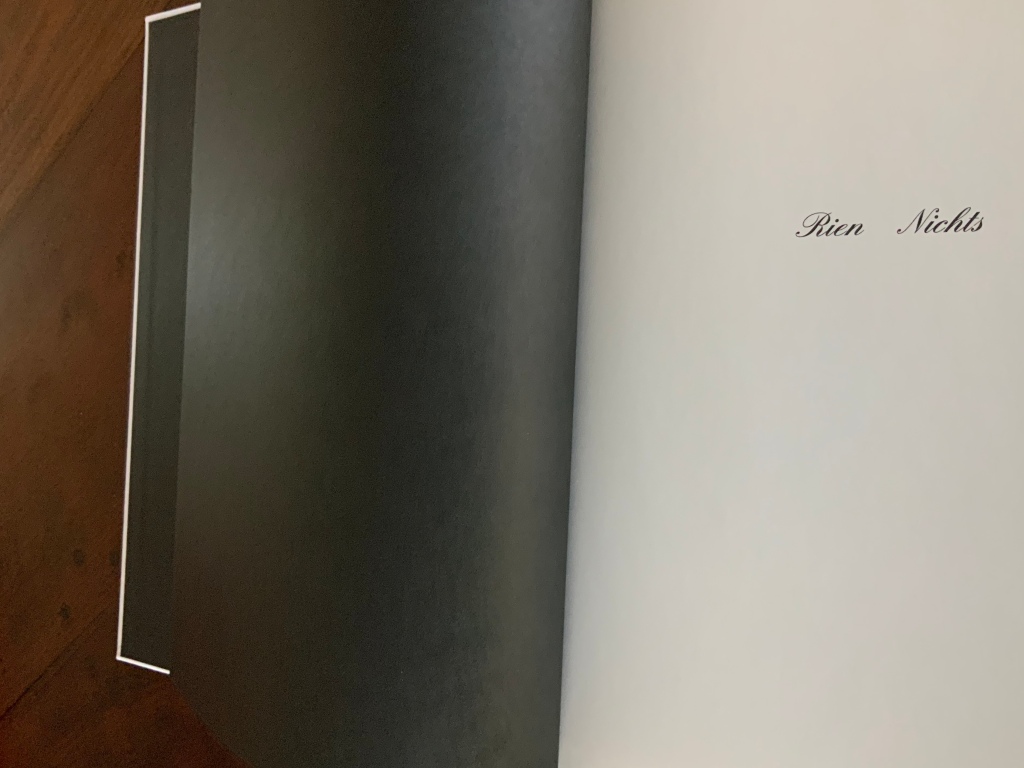
The colored linear frames, threads and markings give the nine typographical motifs additional structuring. Detjen intends them to highlight the reading order to guide the reader through the text like a score. Detjen’s later discussion of their meaning, however, focuses mainly on les blancs, the white space around the text of the poem. Taking Mallarmé at his word in the poem’s foreword, Detjen seizes on the whiteness of the surrounding space and runs to the prismatic metaphor that the spectrum of colors is simply the decomposition of white light. Detjen also notes that the unorthodox Rien/Nichts printed on the volume’s opening page alludes to the expanse of blank space enclosing the lines of text and, in support, quotes from Mallarmé’s “Crisis of Verse”:

Everything is suspended, an arrangement of fragments with alternations and confrontations, adding up to a total rhythm, which would be the poem stilled, in the blanks; … Mallarmé, “Crisis of Verse”, p. 209.

From all this, Detjen avers that it is

as if Mallarmé did not want to have his poem depicted, that is, printed, but perhaps only thought or, at best, whispered. Or did the author see the poem printed in white on white paper? Detjen, “Zum Gestaltung”, p. 82 (my translation).

Following that line of thought, Detjen switched from Mallarmé’s preferred classical serif typeface to News Gothic Bold after experimentation showed that sans serif enabled him to print legibly in flat white on white paper. Confirming his primary focus on the expanse of blank whiteness, Detjen even concludes his afterword by quoting Jorge Luis Borges on Mallarmé:

The impersonal color white itself — is it not utterly Mallarmé? Borges, “Narrative Art and Magic”, p. 79.

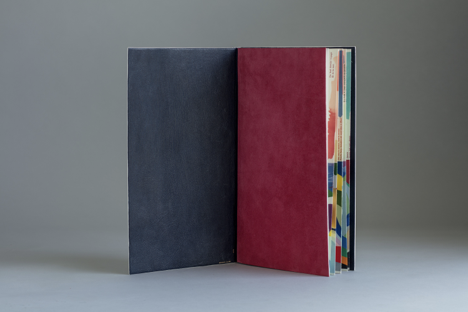
In his heavy emphasis on les blancs, Detjen ends up not doing justice to other more subtle aspects of his design artistry. Before he comes to the poem’s expanse of whiteness, note how the opening page of Rien/Nichts follows the black pastedowns and endpapers — the absence of light contrasting as much with the cover’s pure white as with the poem’s blank spaces.

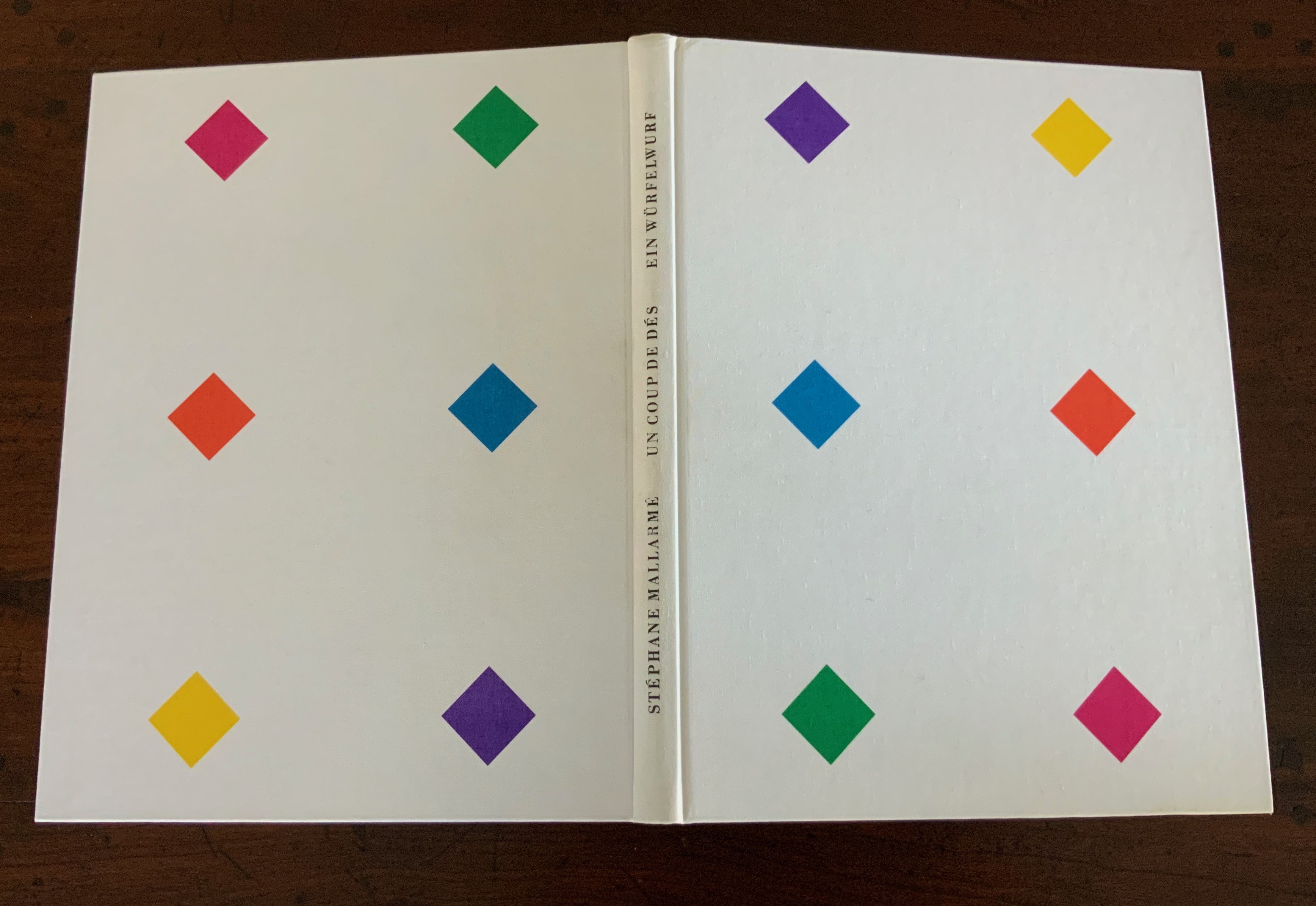
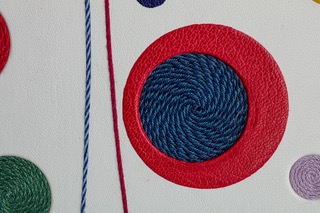
Note how the colors to come in his interpretive version appear in dice shapes arranged on the front and back white covers to suggest the faces of a pair of dice. The whole volume becomes ein Würfelwurf, un coup de dés, a throw of the dice, which echoes Mallarmé’s obsession with le Livre — that work that everything in the world comes to be.

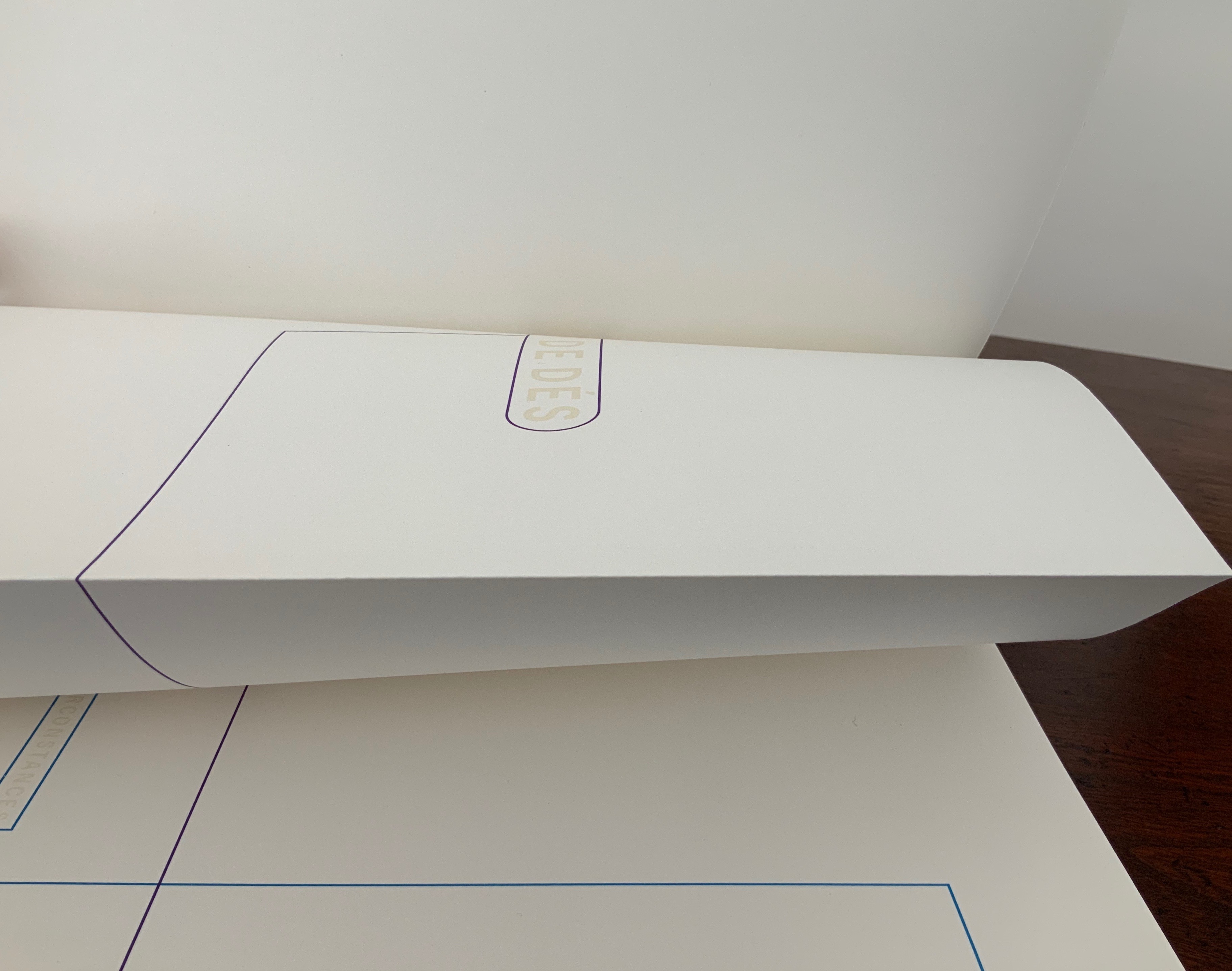
More subtly, Detjen combines the uncut folios with the colored shapes and markings to suggest “rigging” for the foundering ship and a “mapping” for the constellation. The turning uncut folios become billowing sails or rising and falling waves, across which the rigging cuts and the constellation shines.

Detjen’s visual and physical “transcreation” underscores why the French and German translations are not side by side, page for page. How could they be given the way the poem’s words work with the type, the page, the double-page spread and folios? All of which meets de Campos’s definition of the ideal target for transcreation — where the work’s signified, sign and materiality are intricately bound to one another.

In Detjen’s version preceding the French and German versions, the act of translation and interpretation meets the act of creating a work of art.

Further Reading

Bean, Victoria, and Chris McCabe, eds. The New Concrete: Visual Poetry in the 21st Century (London: Hayward Publishing, 2015).

Borges, Jorge Luis. “Narrative Art and Magic” [1932]. Trans. Suzanne Jill Levine; ed. Eliot Weinberger. In Selected Non-Fictions (New York: Penguin Books, 1999), pp. 75-82.

Campos, Haroldo de. “Translation as Creation and Criticism” [1963]. Trans. Diana Gibson and Haroldo de Campos. In A. S. Bessa and O. Cisneros, eds., Novas: Selected Writings (Evanston, IL: Northwestern University Press, 2007), pp. 312-326.

Cisneros, Odile. “From Isomorphism to Cannibalism: The Evolution of Haroldo de Campos’s Translation Concepts“, Érudit: At the crossroads of translating and writing: Poetics and experiments, Volume 25, Number 2, 2012, pp.15-44. Posted 8 October 2013. Accessed 22 August 2020.

Jaruga, Rodolfo. “Ezra Pound’s Arrival in Brazil“, Make It New: The Ezra Pound Society Magazine, Volume 4.1-2, September 2017. Accessed 22 August 2020.

Mallarmé, Stéphane. “Crisis of Verse” [1897]. Trans. Barbara Johnson. In Divagations (Cambridge, MA: Harvard University Press, 2009), pp. 201-11.
Paola, Modesta de. “Translation in Visual Arts”, Interartive, August 2013. Accessed 22 August 2020.

Books On Books Collection – Michael Maranda

Un Coup de Dés Jamais N’Abolira le Hasard: Poème, Image, Livre (2008)

Un Coup de Dés Jamais N’Abolira le Hasard: Poème, Image, Livre (2008)

Michael Maranda

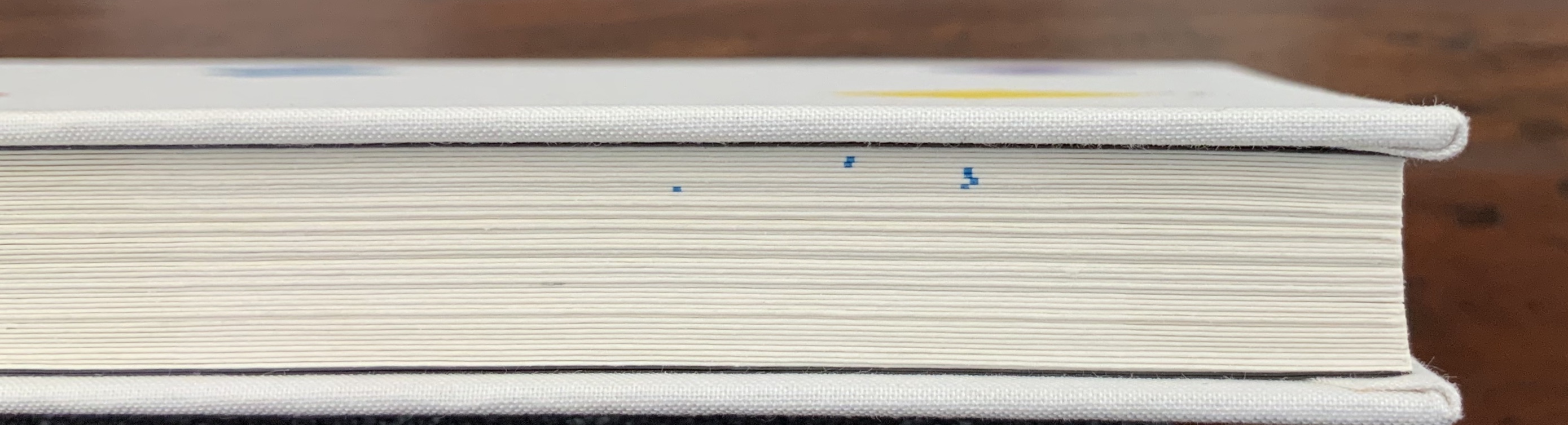
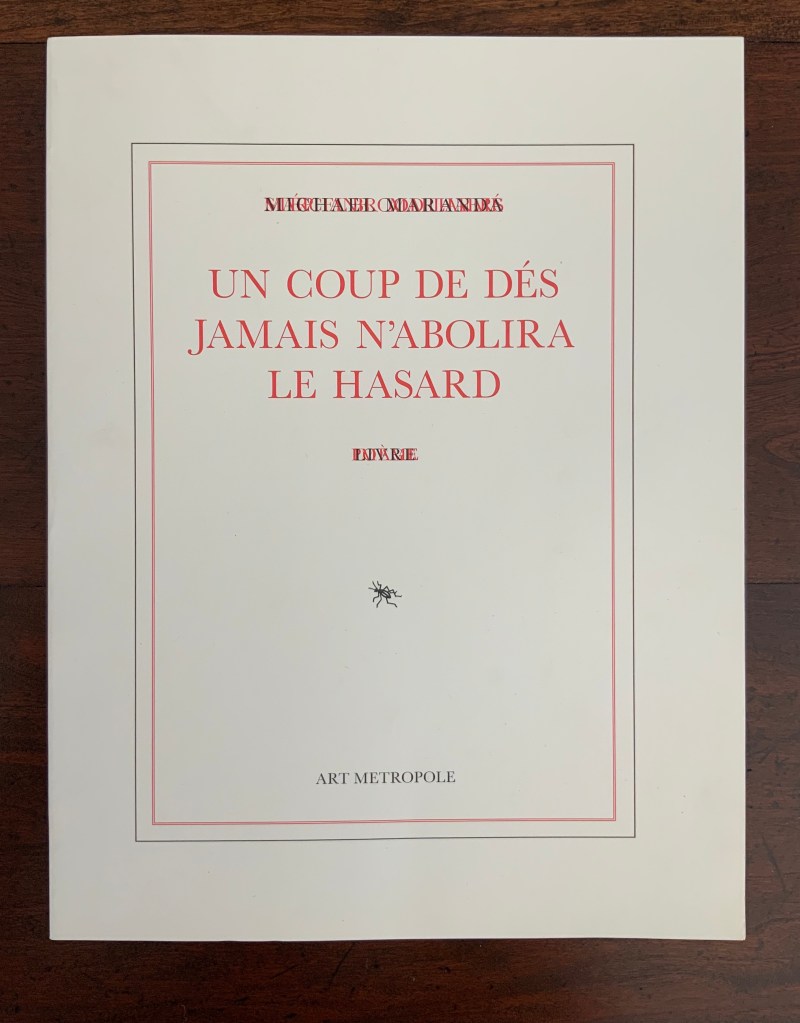
Hand bound. H325 x W250 mm, 32 pages. Edition of 400, of which this is #8. Acquired from Stefan Schuelke, 30 June 2020. Photos: Books On Books Collection.

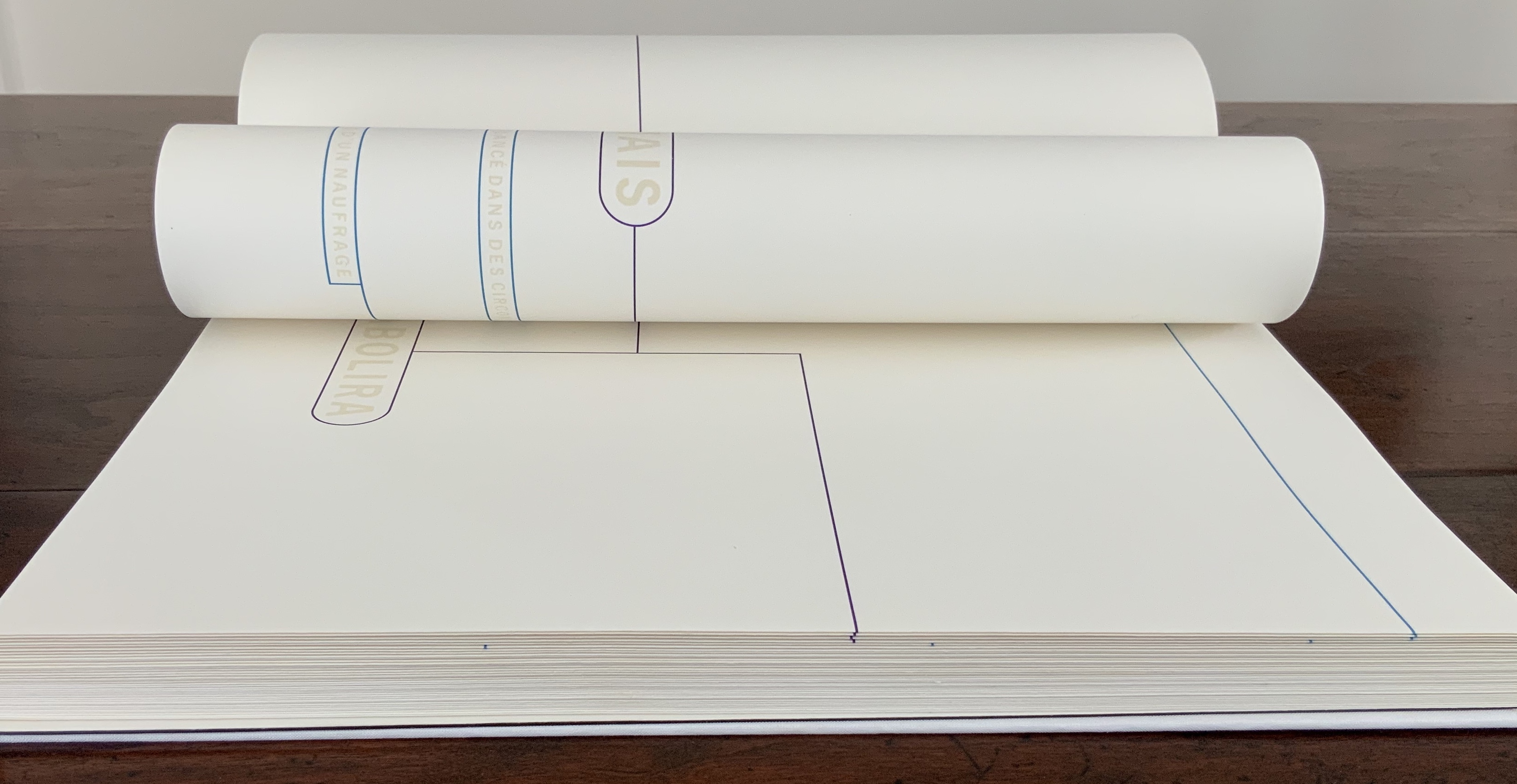
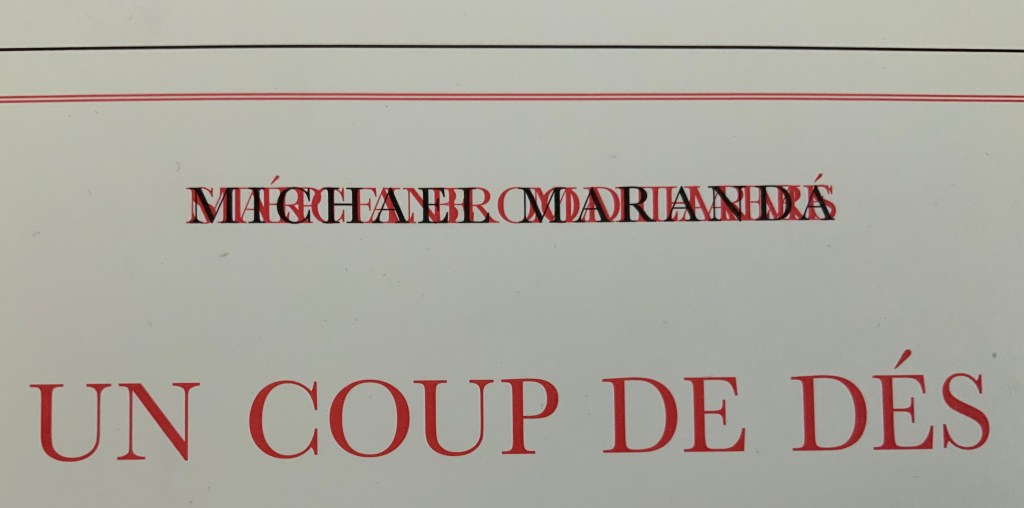
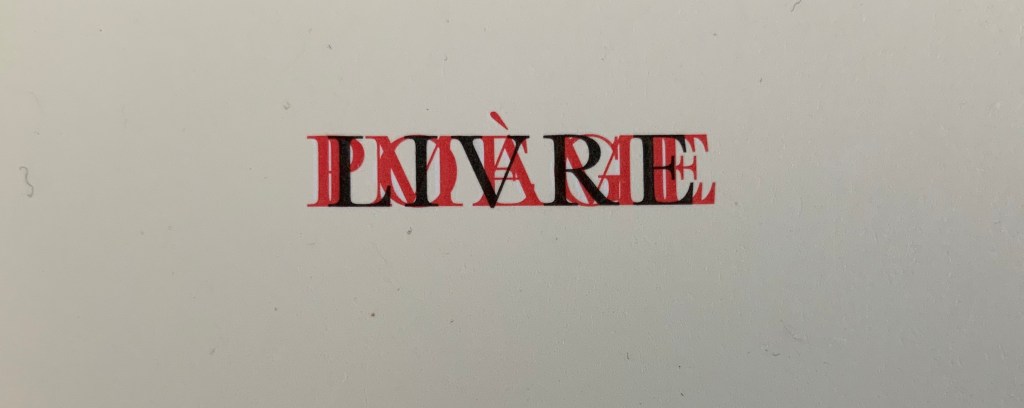
Look carefully at this work’s text and images. On its cover, the author’s and artists’ names are hard to make out, overlapping one another as they do, as do the subtitles: Mallarmé and Poème in red, Broodthaers and Image also in red, and Maranda and Livre in black. Between Mallarmé and Broodthaers, it is hard to say technically whose name and subtitle came first in the printing; who and what are overprinting whom and whose? Unbroken as the letters are, though, Michael Maranda and Livre must have come last.

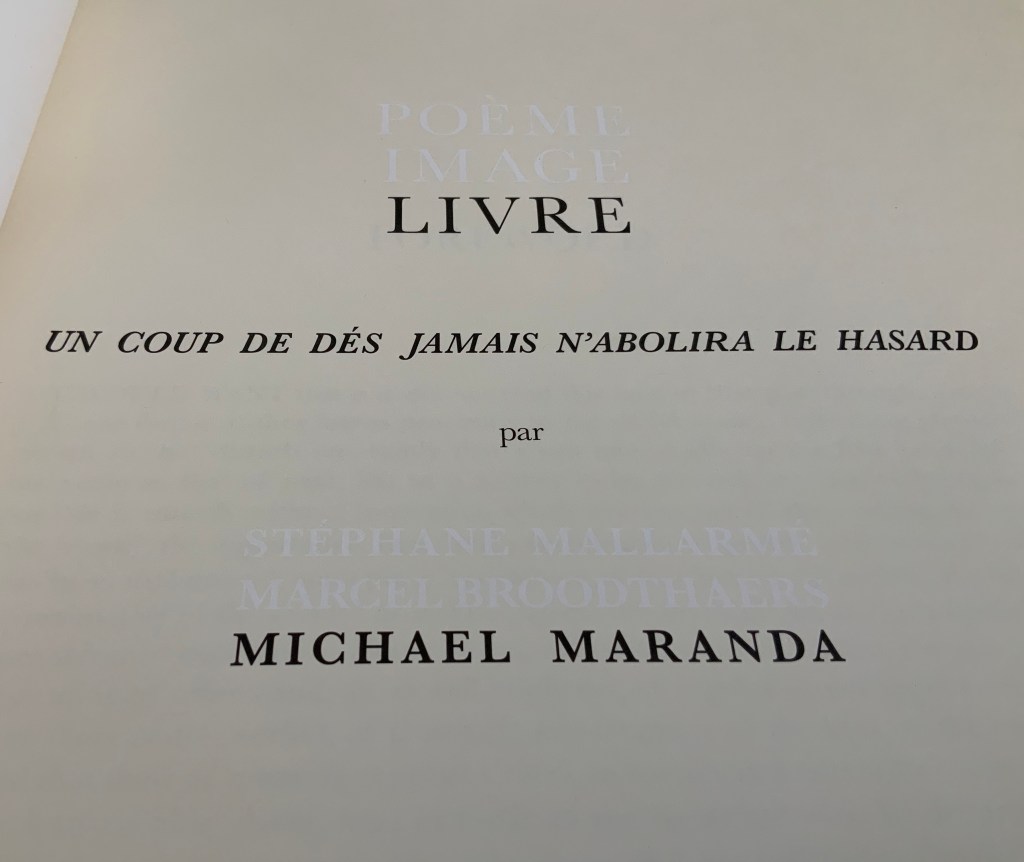
The title page offers a bit more legibility, but the printing hijinks continue. Poème/Mallarmé and Image/Broodthaers no longer occupy the same space and are just perceptible in white lettering created by the ocean of cream-colored ink surrounding them. Along with the poem’s title, Livre/Maranda appear in black.

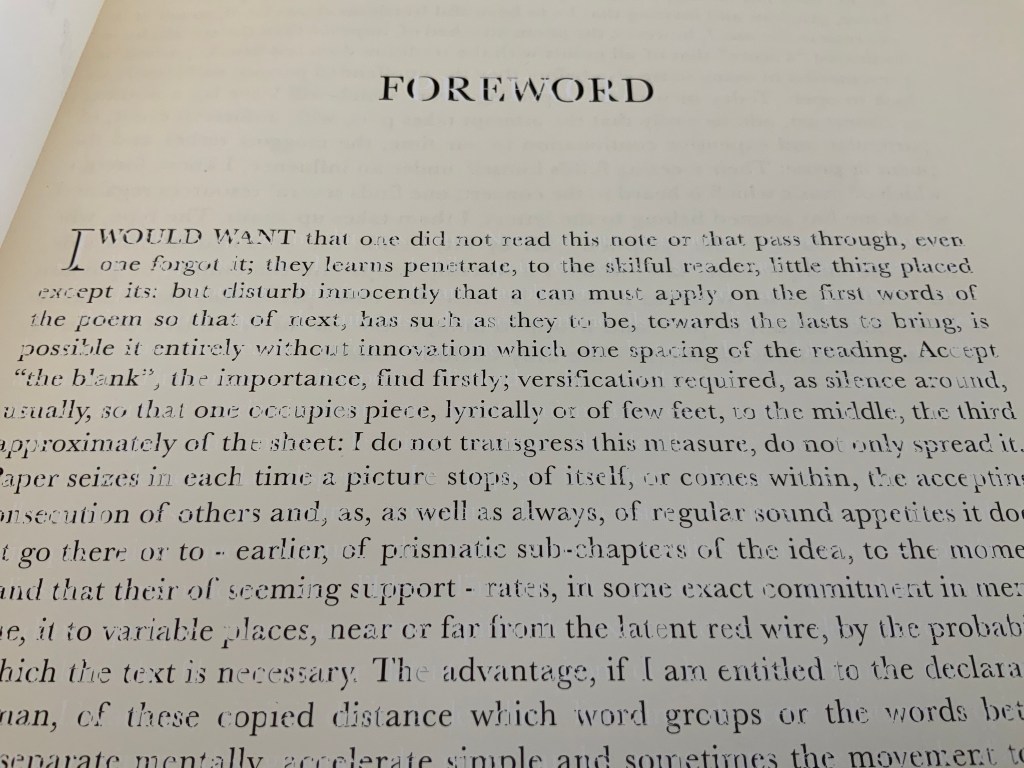
Then comes the Foreword, and the hijinks strain the eyes even more. At first, it seems that the Foreword has been badly printed. Not only badly printed, but badly translated from Mallarmé’s original: “I would want that one did not read this note or that pass through, even one forgot it”!? Only Maranda’s online artist’s statement explains the how and why of the poor translation:

To highlight the transformation of the reception of the poem by Broodthaers edition, the preface of this edition is Mallarmé’s original one, translated from French to Dutch and then to English using the online translator, Babble [sic] Fish. Michael Maranda, “Statement“, 2008. Accessed 6 August 2020.
That may explain the poor English translation, but what about the poor printing job? Actually, the printwork is precise, and the cover and title page offer the clues to this in their overprinting and reversed-out inking, respectively. The mangled English of the foreword has been printed in black, but the French of the préface appears as the absence of the cream-colored ink. Organizing the printing so that the black ink is broken up by those letters formed from the absence of ink is precision indeed.

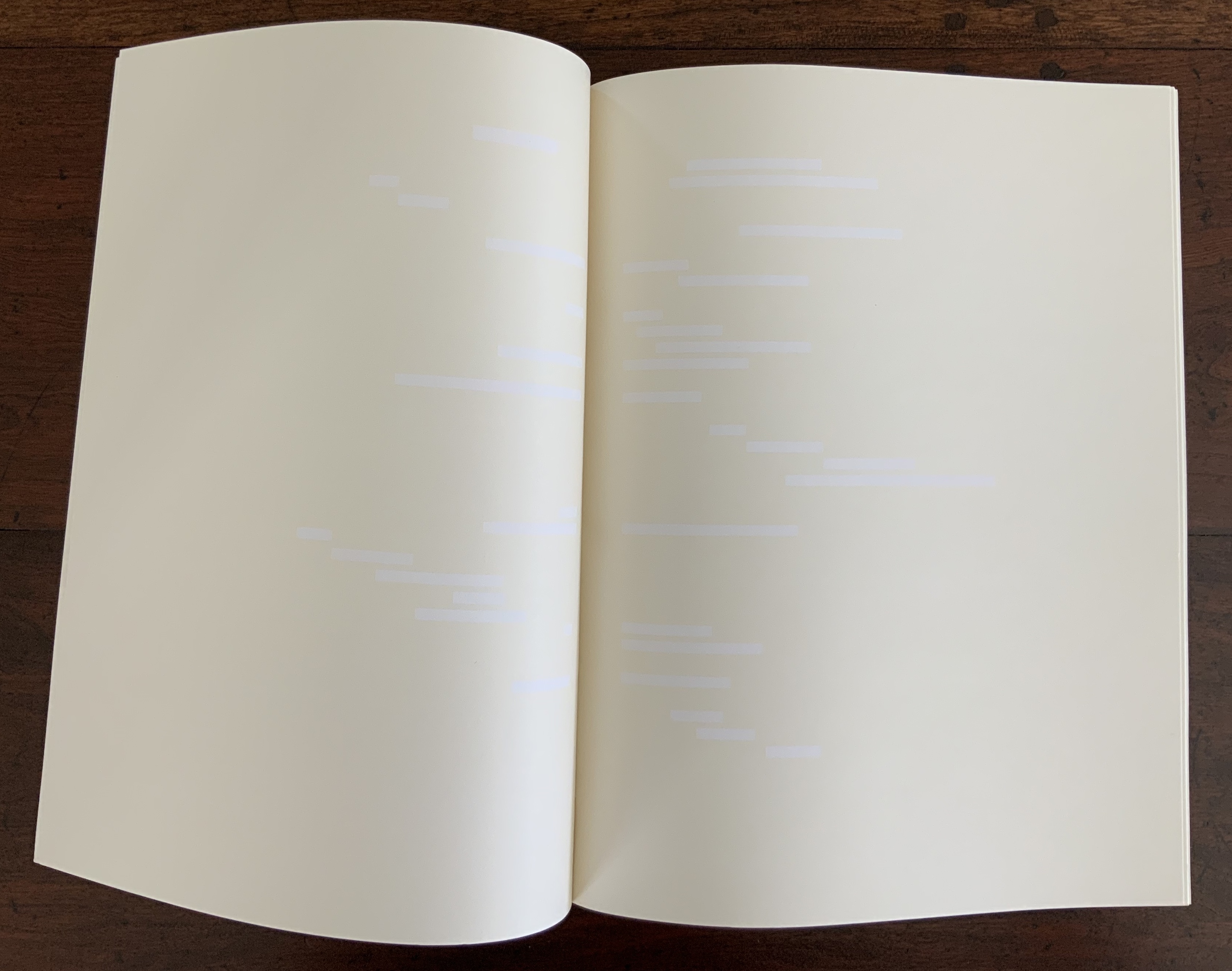
Maranda calls his work a “meditation on les blancs“, the term that Mallarmé used in his 1897 preface to Un Coup de Dés to draw attention to the blank spaces surrounding the carefully scattered lines of verse. Taking Mallarmé at his word, Broodthaers drew attention to les blancs by blacking out the text with rectangles and parallelograms reflecting the type’s sizes and styles. In all of the pages that follow the preface, Maranda fills in Mallarmé’s and Broodthaers’ blancs with cream-colored ink. Paradoxically, Mallarmé’s text and Broodthaers’ black stripes have become blank spaces, and les blancs to which they drew attention have been printed in cream.

This strange reversed-out palimpsest recalls a passage from Ulises Carrión’s “The New Art of Making Books” (1975):

The most beautiful and perfect book in the world is a book with only blank pages, in the same way that the most complete language is that which lies beyond all that the words of a man can say. Carrión.

Maranda’s Livre stands among several works of erasure and excision paying homage to Un Coup de Dés in its 1914/1969 iterations — think of those by Jérémie Bennequin, Cerith Wyn Evans and Michalis Pichler — but by titling his work as he does, Maranda also pays homage to Mallarmé’s lifelong conceptual holy grail of le Livre — that work that everything in the world comes to be. By overlaying Mallarmé’s Poème and Broodthaers’ Image with his meditation on les blancs, Maranda may be implying that visual language is the complete language in which that most beautiful and perfect book can be written.

Yet Maranda’s Livre ends with a colophon that suggests he takes himself no more seriously than his immediate predecessor in the palimpsest did:

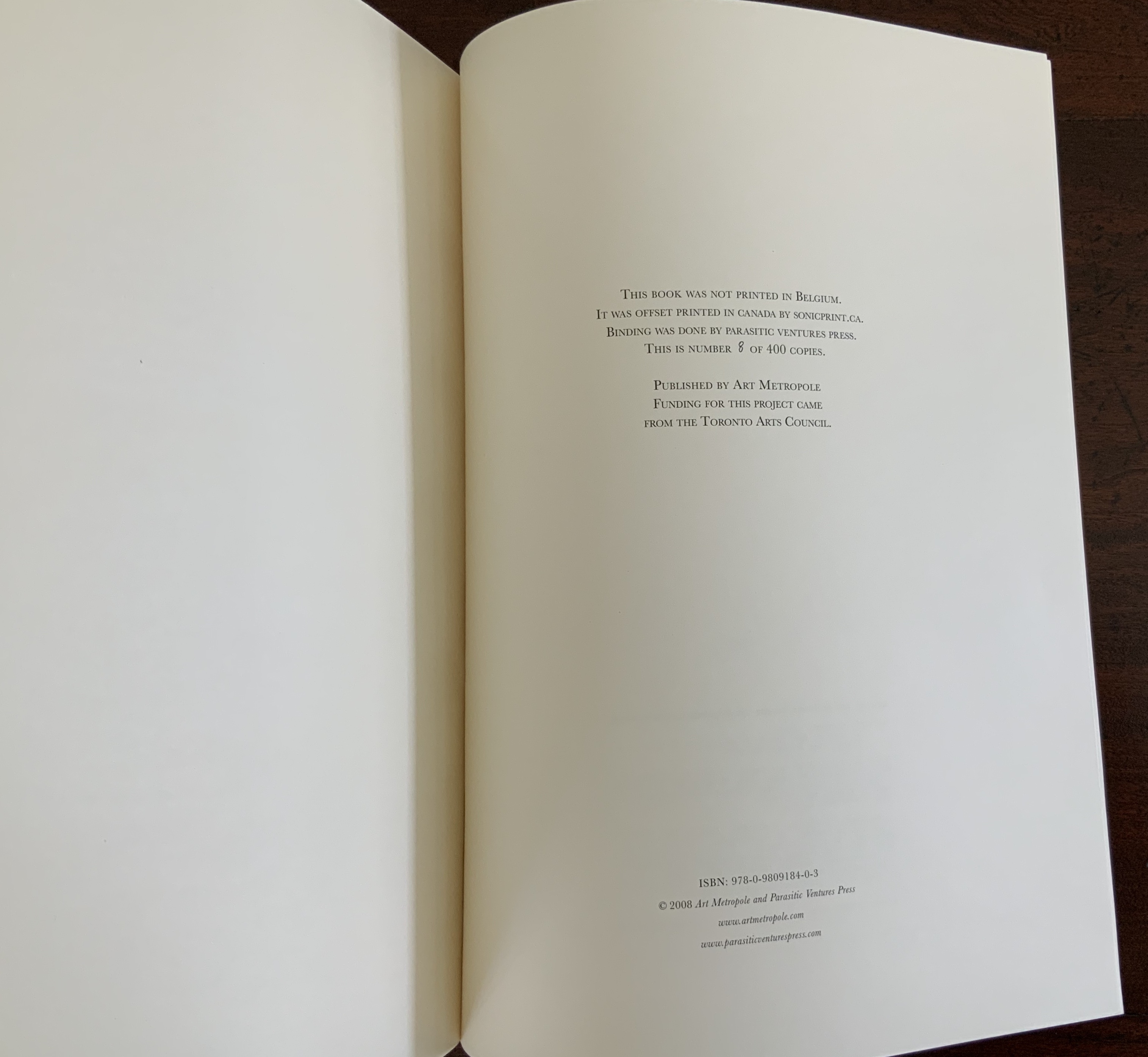
This edition is published by Art Metropole. It was not printed in Belgium.

Further Reading

Jérémie Bennequin”, Books On Books Collection, 11 April 2020.

Cerith Wyn Evans”, Books On Books Collection, 16 April 2020.

Michalis Pichler”, Books On Books Collection, 19 August 2020.

Carrión, Ulises. “The New Art of Making Books” (1975), reprinted in Second Thoughts (Amsterdam: Void, 1980).

Scherer, Jacques. Le “Livre” de Mallarmé; premières recherches sur des documents inédits (Paris: Gallimard, 1977).

Wieland, Magnus. “Sculpture Lecture Reading Un coup de dés“. Accessed 6 August 2020.

Exhibitions

“Excision,” Twenty+3 (Manchester UK), 2008. Curated by Cheryl Sourkes.

“Exposition littéraire autour de Mallarmé”, Kunstverein Milano. Curated by Maria Anguelova.

Books On Books Collection – Jim Clinefelter

A Throw of the Snore Will Surge the Potatoes: John M. Bennett meets Stéphane Mallarmé (1998)

A Throw of the Snore Will Surge the Potatoes: John M. Bennett meets Stéphane Mallarmé (1998)
Jim Clinefelter
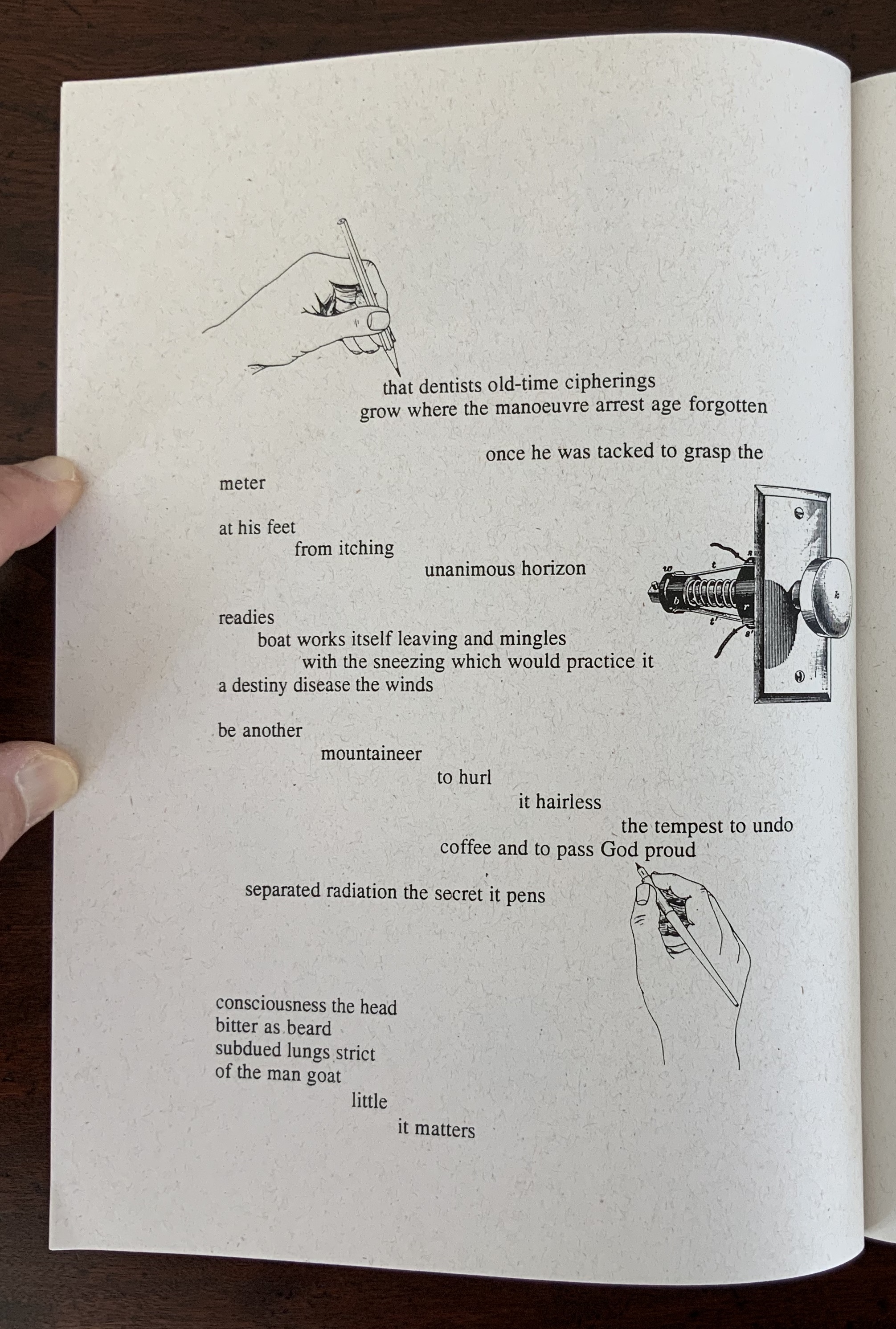
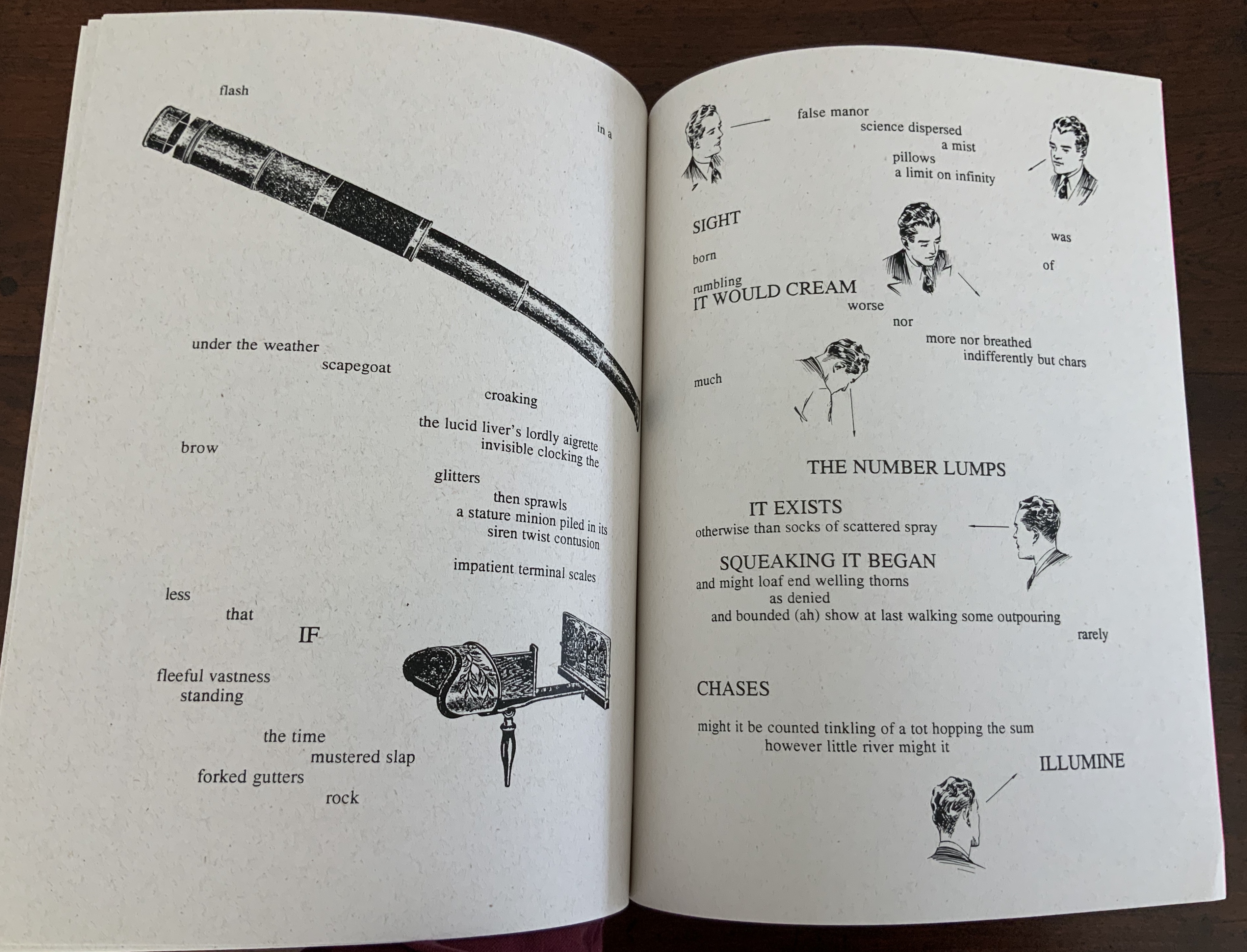
Saddle-stitched with staples, card and pink end sheets over twelve sheets of copier paper, H280 x W215 mm. Acquired from John M. Bennett, 8 July 2020.
Photos: Books On Books Collection.

Clinefelter’s is not the first parody or spoof of Mallarmé’s Un Coup de Dés Jamais N’Abolira le Hasard. That claim belongs to a nineteenth-century Australian poet and aficionado of Mallarmé’s poetry — Christopher Brennan. Brennan’s Prose-Verse-Poster-Algebraic-Symbolico-Riddle Musicopoematographoscope appeared in manuscript in 1897 but wasn’t published until 1981.

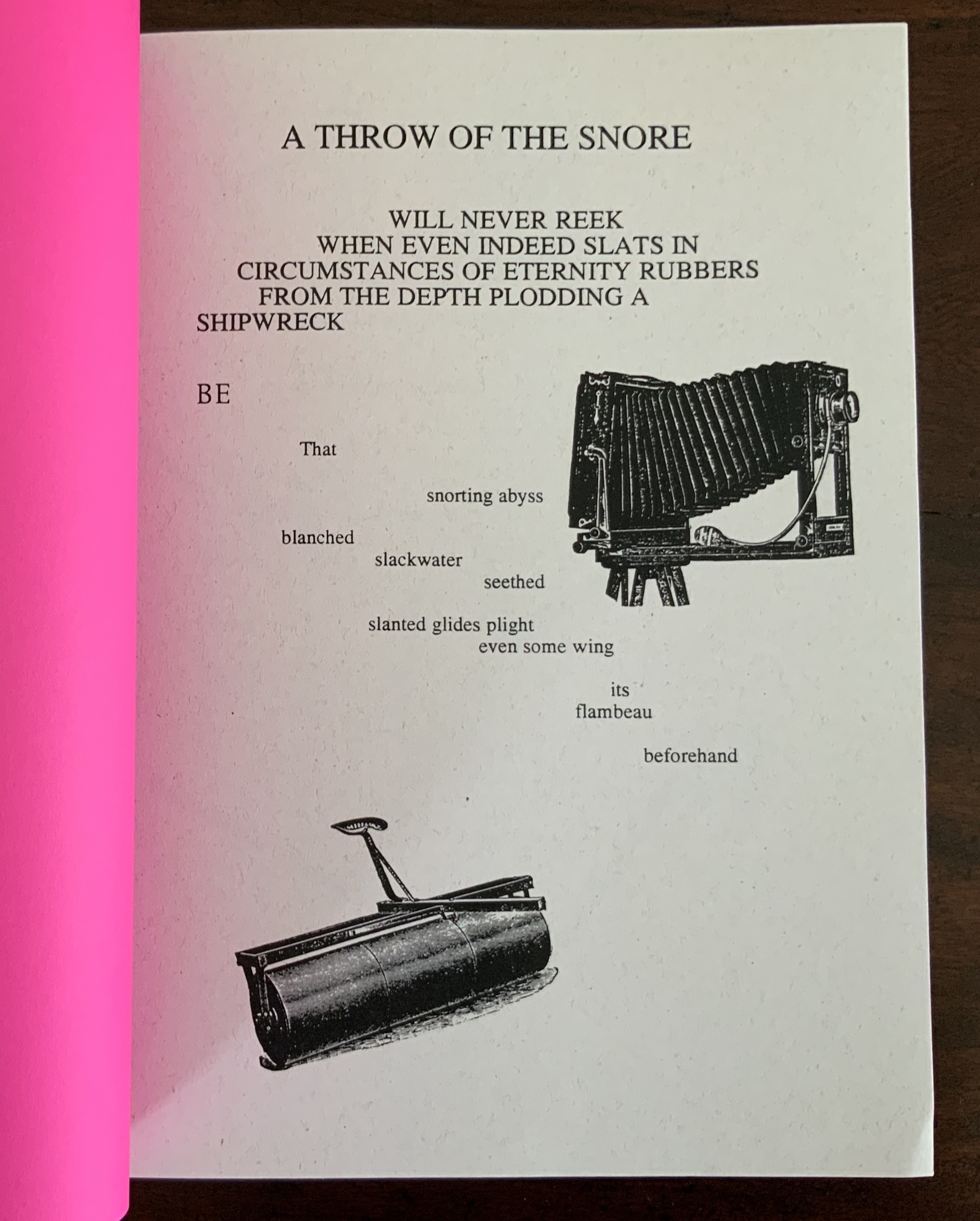
With images from a reprint of an early Sears Roebuck Catalogue and drawing on John M. Bennett‘s poetry as well as Un Coup de Dés, Clinefelter composed his book on a borrowed Macintosh SE — the late twentieth-century substitute for penmanship. Mallarmé only thought of having some images from his friend Odilon Redon separated from the text Un Coup de Dés. Clinefelter’s sense of fun and close attention to the original led him to integrate those Sears images throughout with the text to mimic Mallarmé’s textual and typographic road signs. Notice in the third row of the photos above how the hands holding pencils point toward lines (or perhaps enclose the lines between them like single quotation marks) and how the figure of the man’s head with directional arrows indicates the order or path in which the text should be read.

Clinefelter’s text, which draws on Bennett’s boisterous poems, pokes fun at the original’s emphasis on sonority even at the expense of semantic or syntactic clarity. It also pokes fun at some of the lines that have challenged readers and translators alike:

LE MAÎTRE surgi inférant de cette conflagration à ses pieds de l’horizon unanime que se prépare s’agite et mêle au poing qui l’étreindrait … becomes

“THE MASTER knees inferring from this conflagration drips there as soft threatens the unique clam”

and cadavre par le bras écarté du secret qu’il détient … becomes

“corpse mud the arm”.

For their parody, Clinefelter and Bennett may have to apply for honorary Australian citizenship. It seems that, starting with Christopher Brennan, the Australians cannot stop teasing Mallarmé. We have Chris Edwards’ A Fluke: A Mistranslation of Stéphane Mallarmé’s “Un Coup De Dés…” with Parallel French Pretext (2005) and John Tranter’s Desmond’s Coupé (2006). Parody, pastiche or spoof — Clinefelter’s and these other responses enrich the genre of Un Coup de Dés. Somehow in their exuberance they are all saying “yes” to the abyss or, at least, managing one more guffaw of the dice.

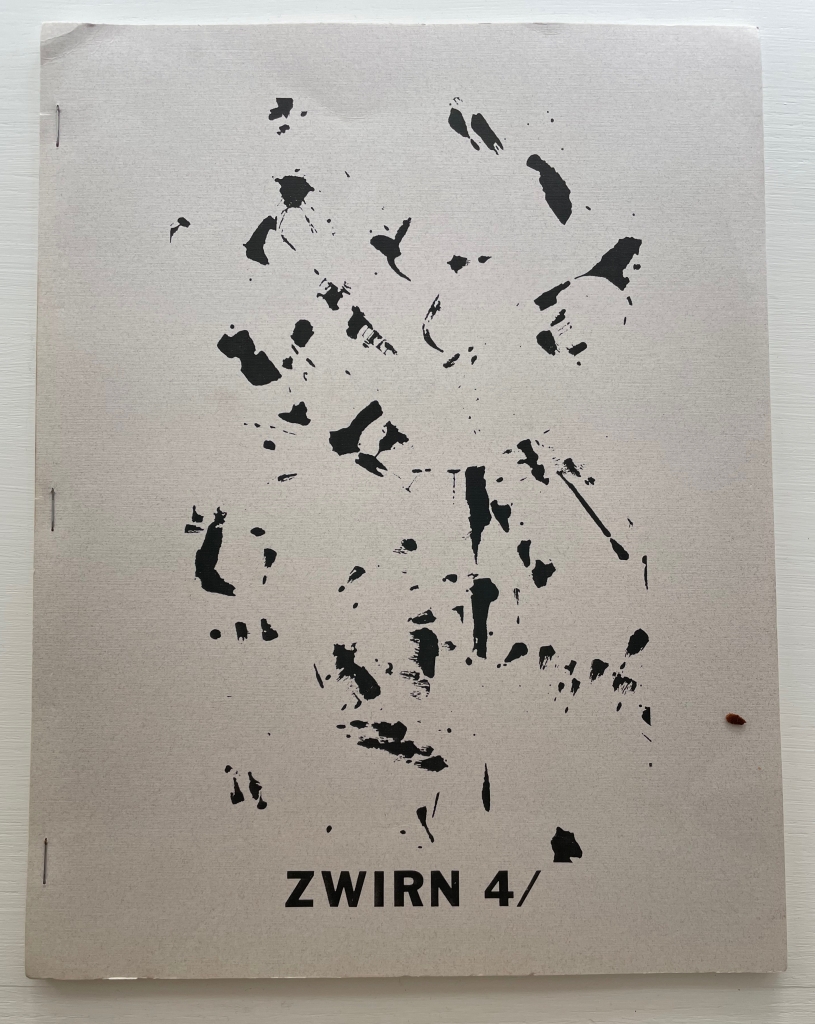
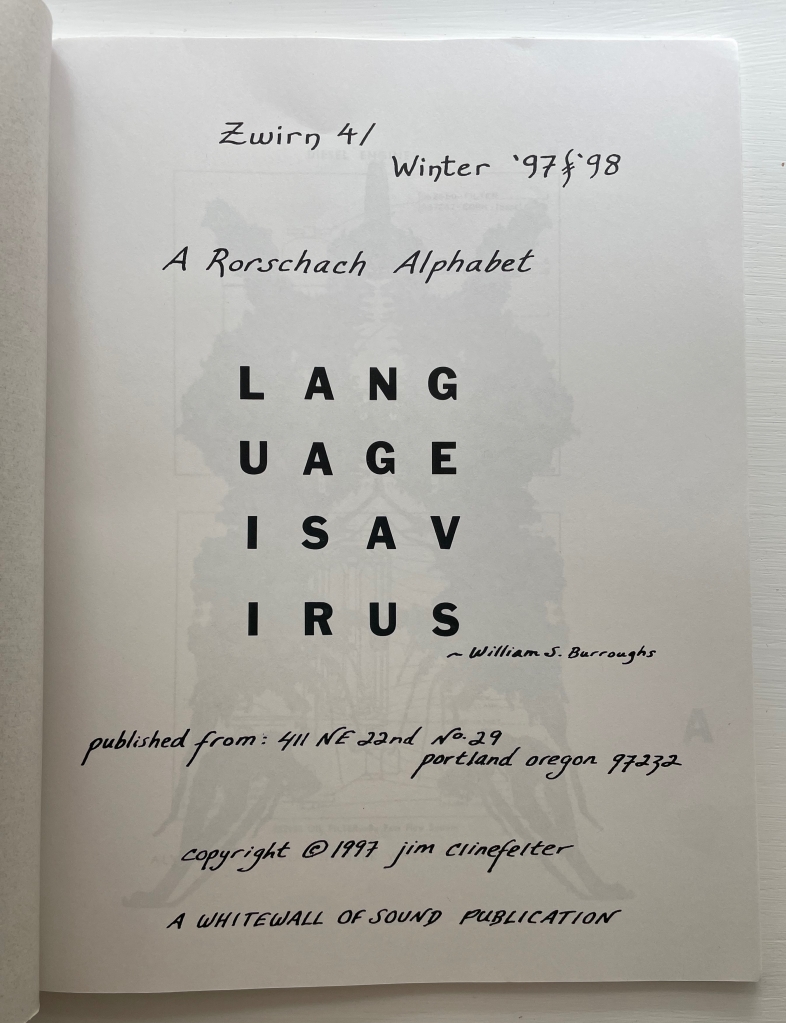
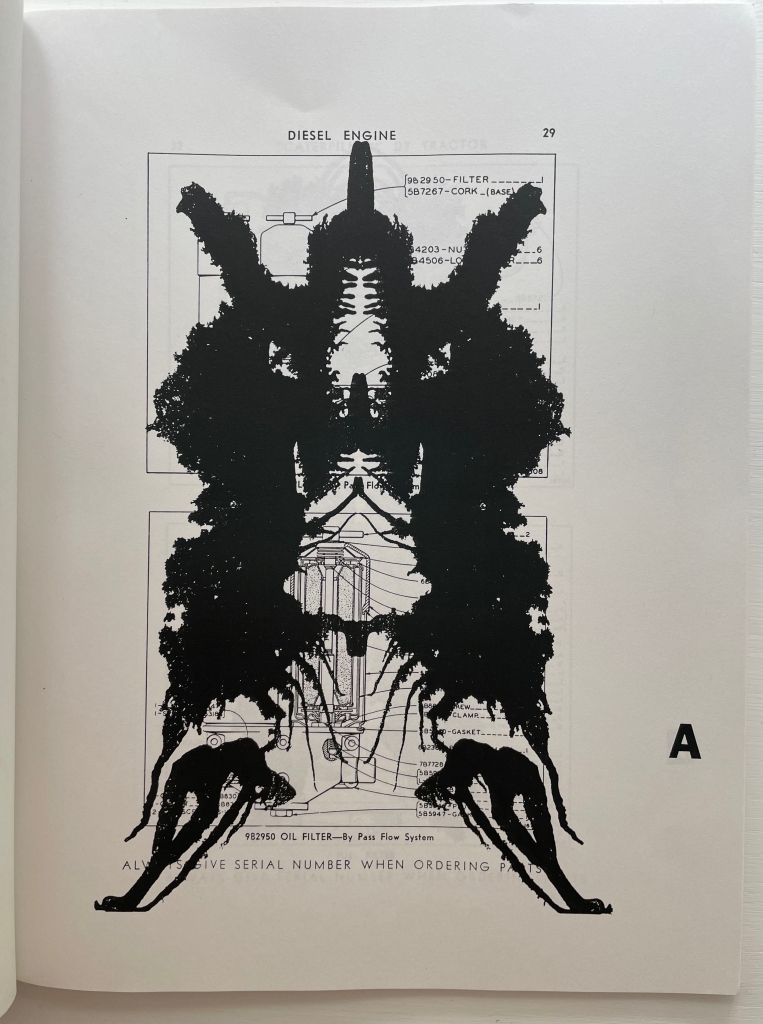
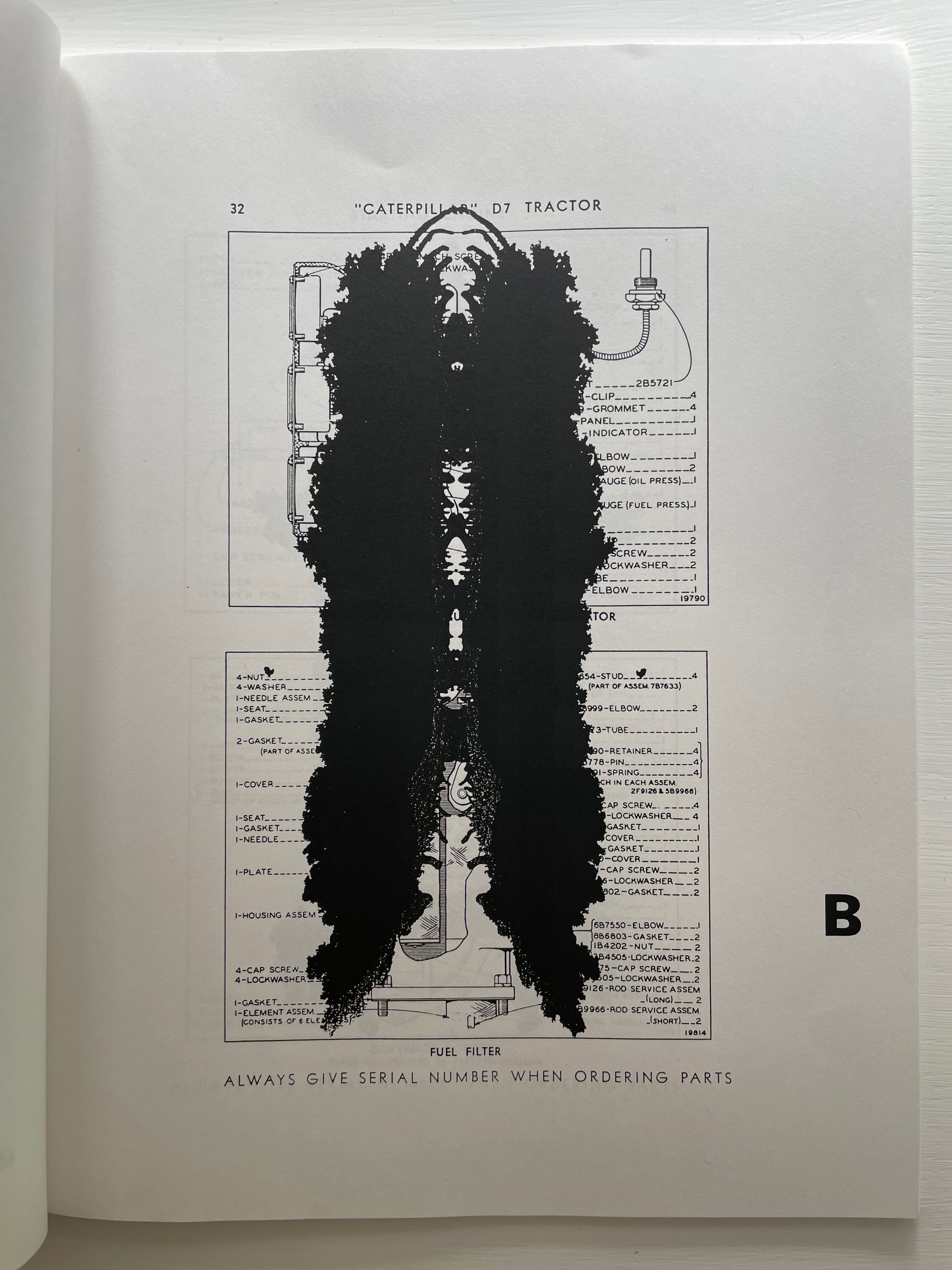
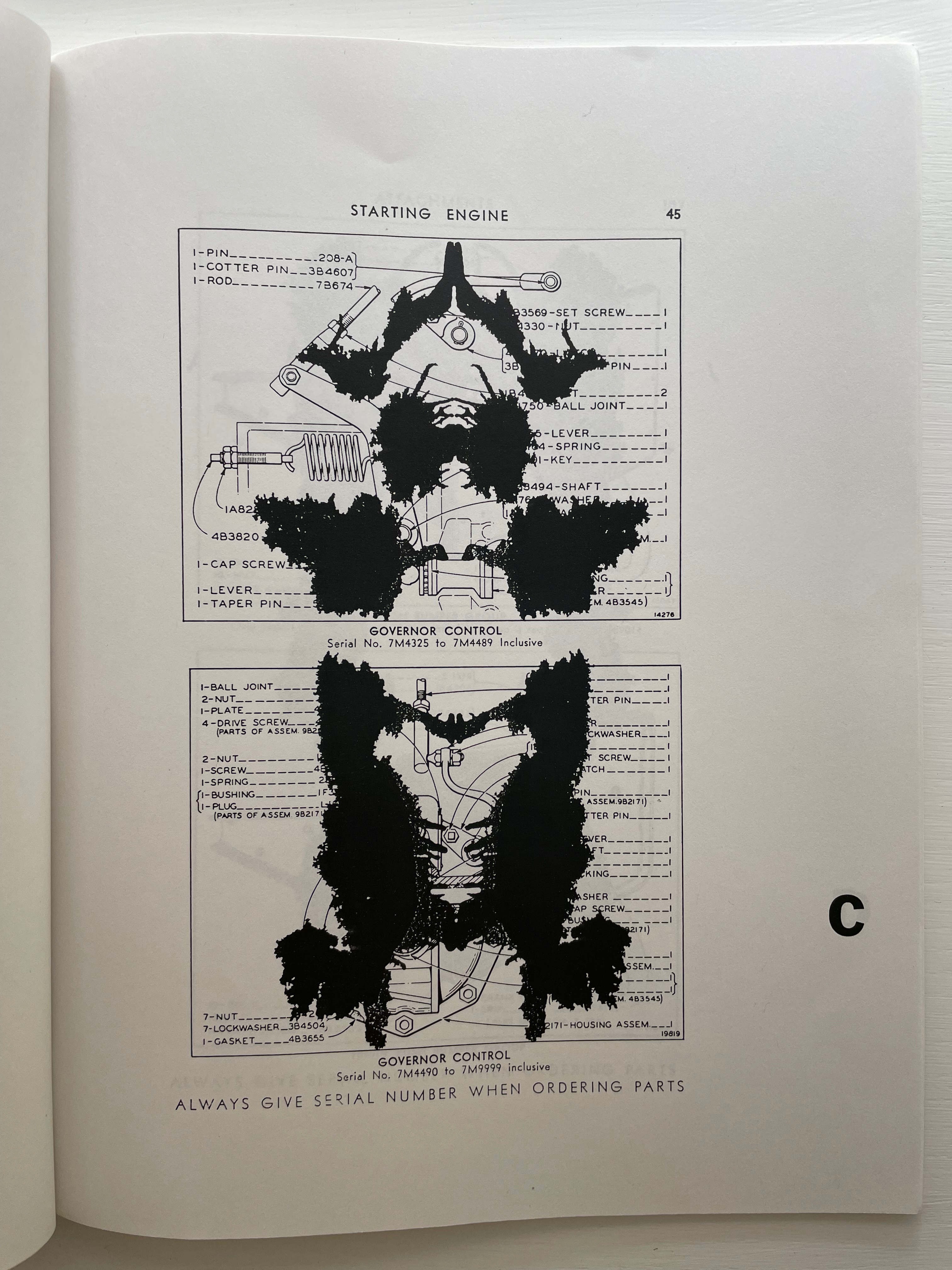
A Rohrshach Alphabet: Zwirn 4 (1999)

A Rohrshach Alphabet: Zwirn 4 (1999)
Jim Clinefelter
Stapled loose leaf, card covers. H280 x W211 mm. 27 folios. Twenty-six Rohrshach inkblots printed over BW copy of motor parts ordering catalogue. Acquired from Zubal Books, 15 August 2022.
Photos: Books On Books Collection.

If the juxtaposition of the alphabet with the utterly unrelated pages of an engine parts catalogue has not disabused you of your pattern-seeking hopes, do not let approximation of the letter A resurrect them.

Like the letter A, several other letters of the alphabet have that characteristic of bilateral symmetry (H, I, M, O, T, U, V, W and X). Occasionally, Clinefelter lets it slip through (as with T), but in general, his zaniness will not allow it (as with the “blotted” rear wheel for O).

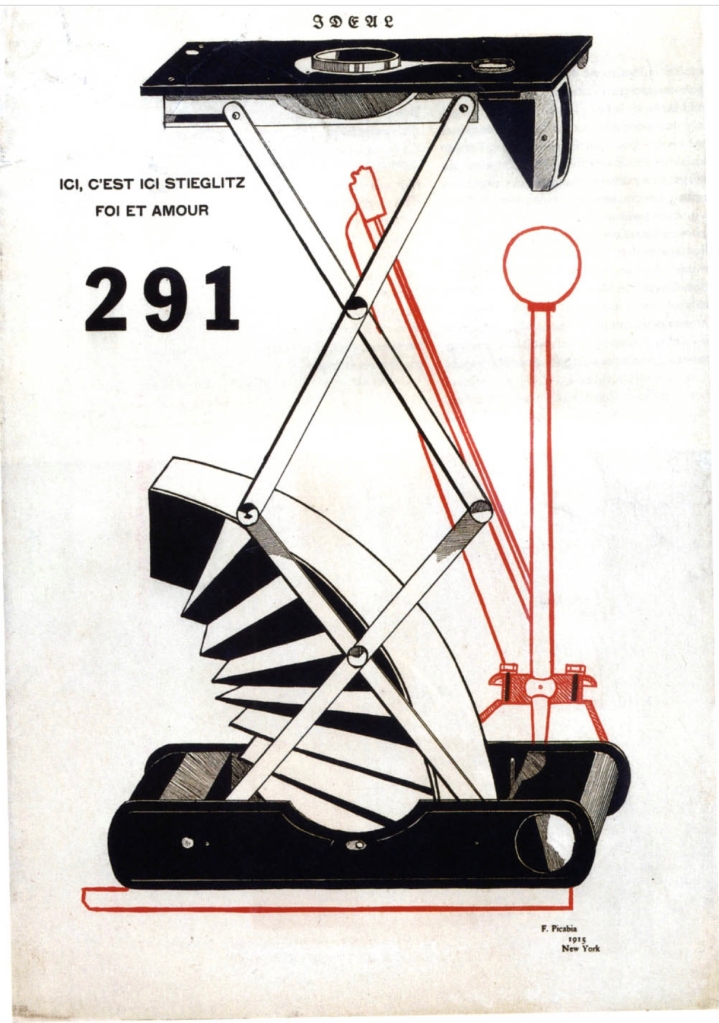
This use of catalogue pages and mechanical parts finds some ancestry in Francis Picabia and the Dadaists. In 2015, there was a journal called 291. Its July-August cover was Picabia’s Here, This is Stieglitz / Faith and Love. The artist’s visual pun of substituting the mechanical diagram for the artist is less puzzling or disconcerting than Clinefelter’s visual puns in A Throw of the Snore. But then along came Henri Matisse Ceci n’est pas une pipe (1929) and later Marcel Broodthaers to layer on that filter of “huh?” before Clinefelter and other book artists began adding their take.

Francis Picabia, Ici, c’est ici Stieglitz, foi et amour. Cover of 291, No.1, 1915.

Clinefelter’s take on the complement and clash of image and text brings together two related but unrelated tools: the Rohrshach test and the parts catalogue. Both are tools for searching. One for the mind. One for machinery. It’s a jokey, subversive take on searches for meaning and order, for patterns and structures, in parts that may not add up. The alphabet, which is rooted in images, also serves for ordering things as well as for making meaning or making sense of the world. Or does it? What can you spell out with a Rohrshach alphabet? And what if your catalogue for ordering parts is incomplete and out of order?

For related but very different explorations of bilateral symmetry and the art of the fold, see Étienne Pressager’s Mis-en-pli (2016) and Pramod Chavan’s The Voice of the Yarn (2022), but not before reveling further in Clinefelter’s throwback to Dada.

Further Reading

Rodney Graham“, Books On Books Collection, 3 July 2020.

Alphabets Alive!” 19 July 2023.

Guest, Stephanie. “Barbecued sunrise: Translation and transnationalism in Australian poetry“, Journal of the Association for the Study of Australian Literature, 18.3.

Lomas, David. 2010. “‘New in art, they are already soaked in humanity’: Word and Image, 1900-45,” in Art, Word and Image: Two Thousand Years of Visual/Textual Interaction. Eds. John Dixon Hunt, David Lomas and Michael Corris. London: Reaktion Books.

Books On Books Collection – Brian Larosche

Un Coup de 3Dés (2012)

Un Coup de 3Dés (2012)

Brian Larosche

H500 x W350 mm. Edition of 200, of which this is #162. Acquired from the artist, 15 April 2019.

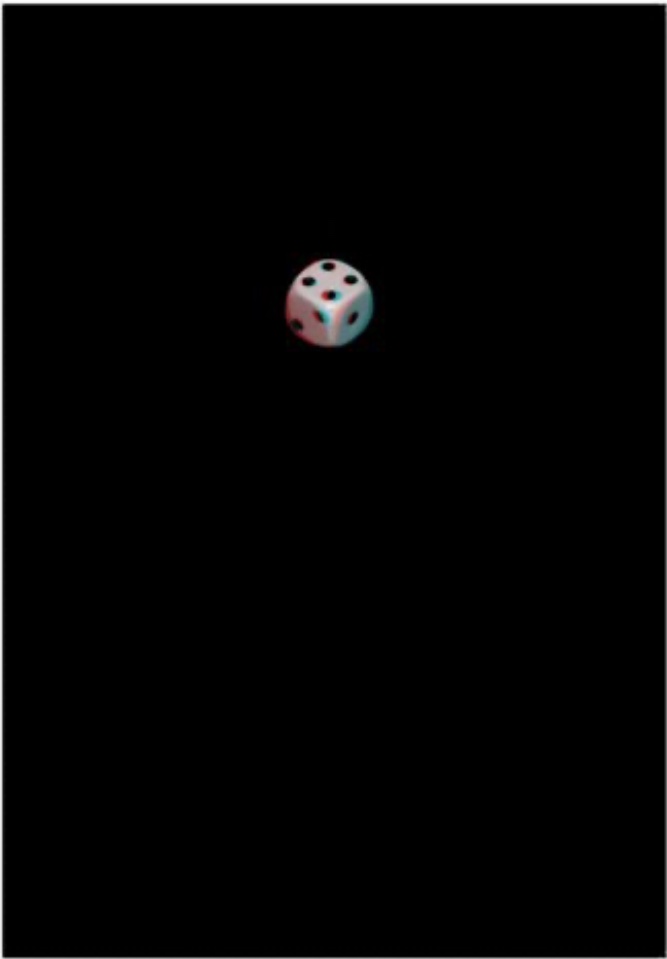
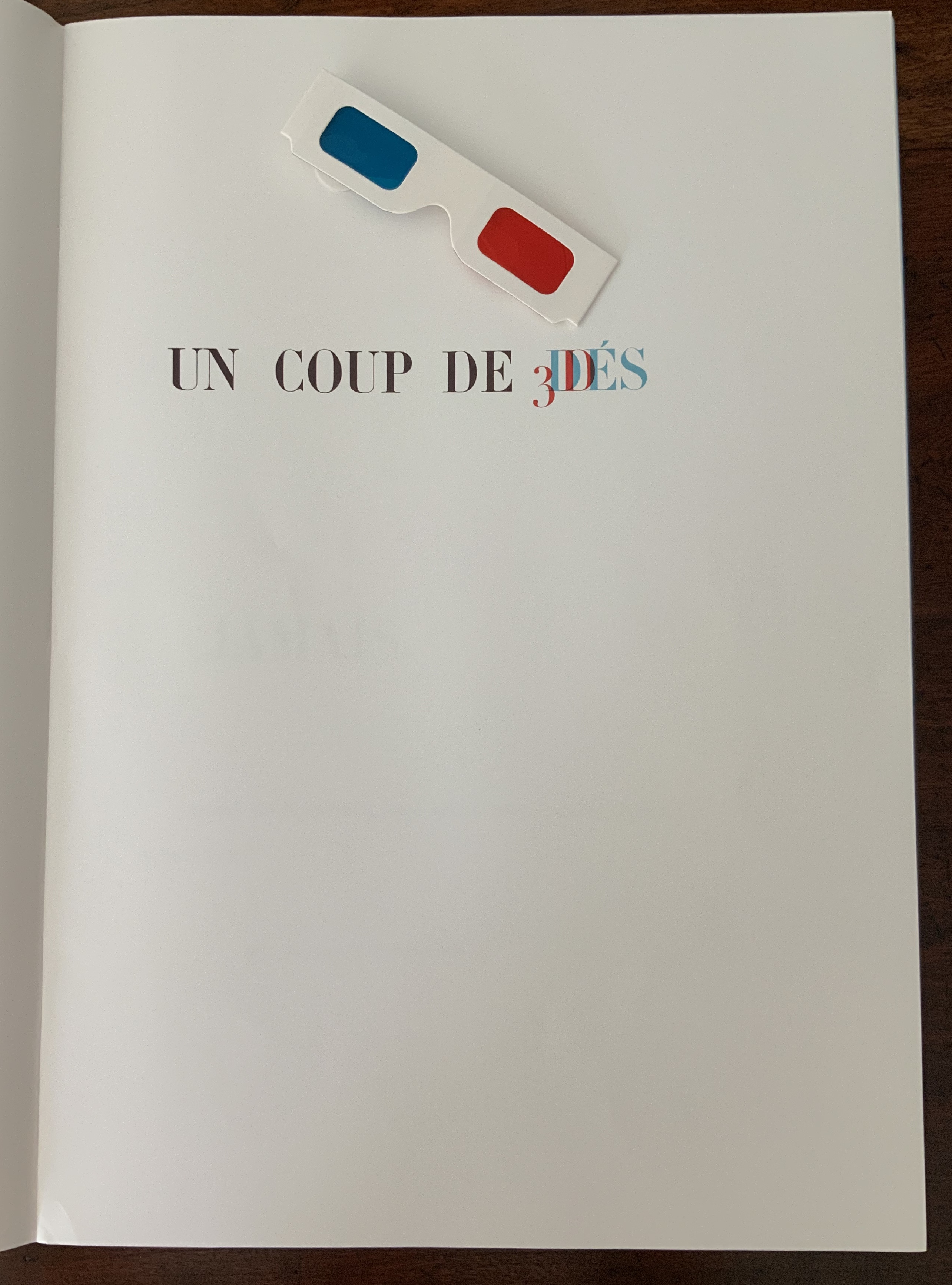
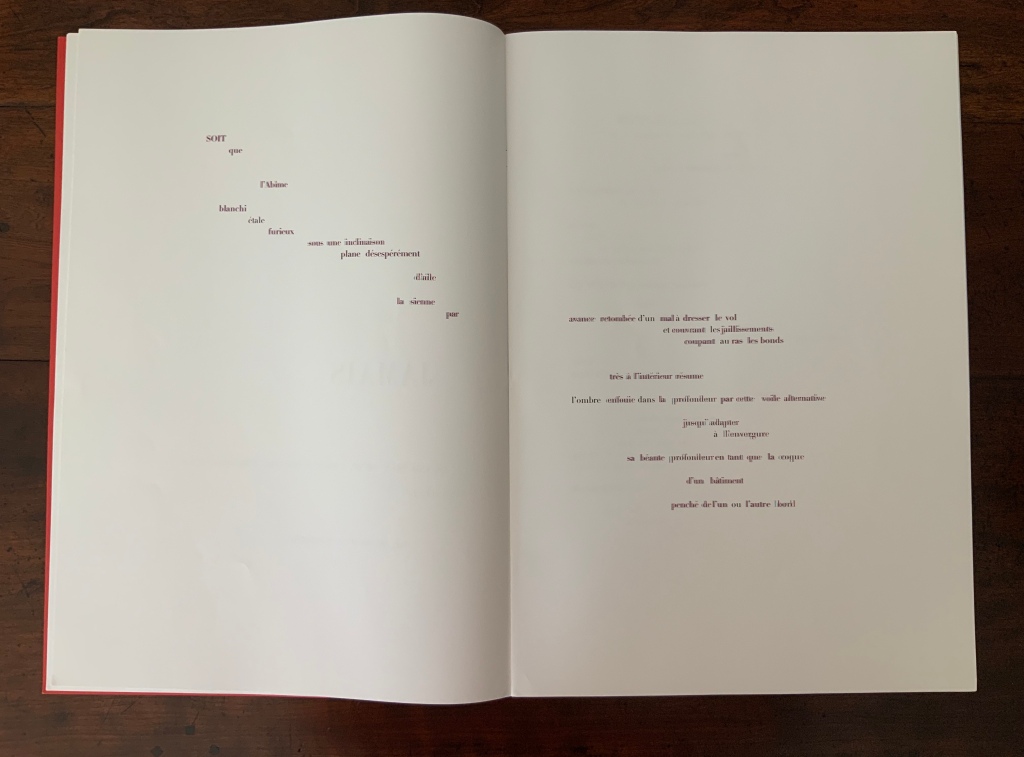
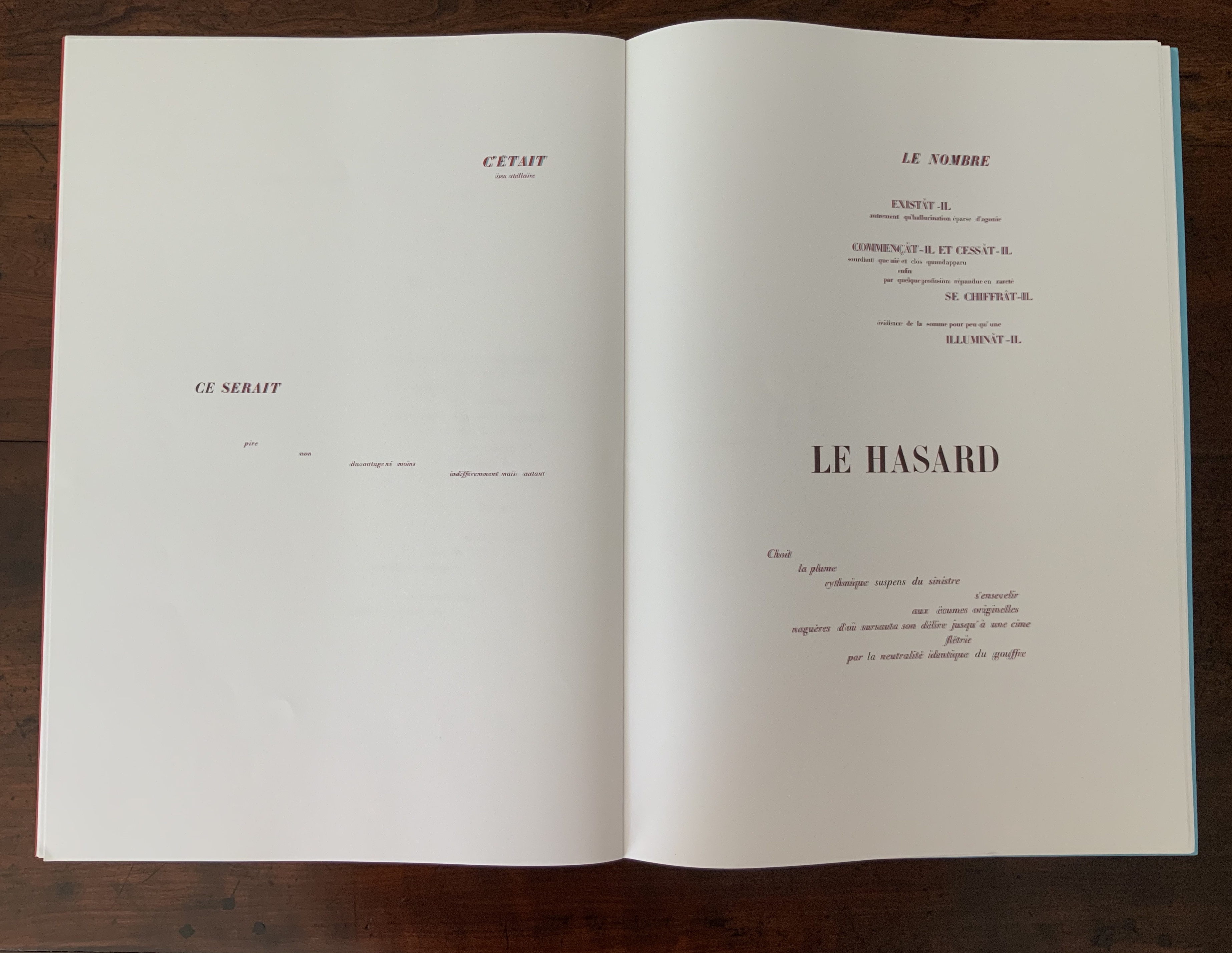
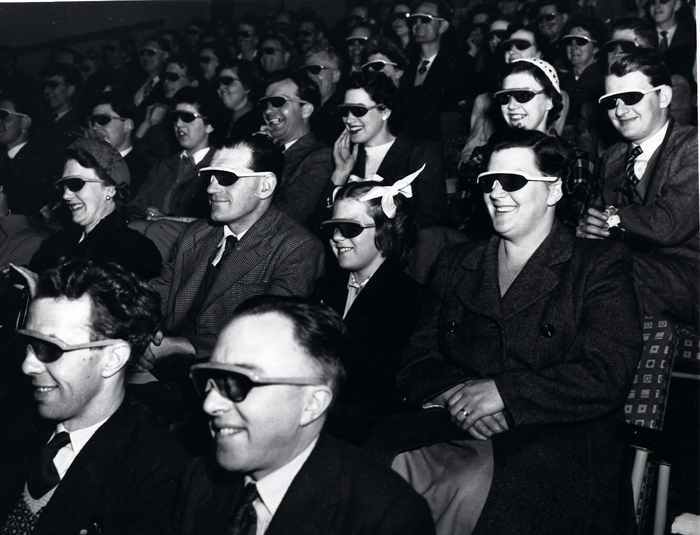
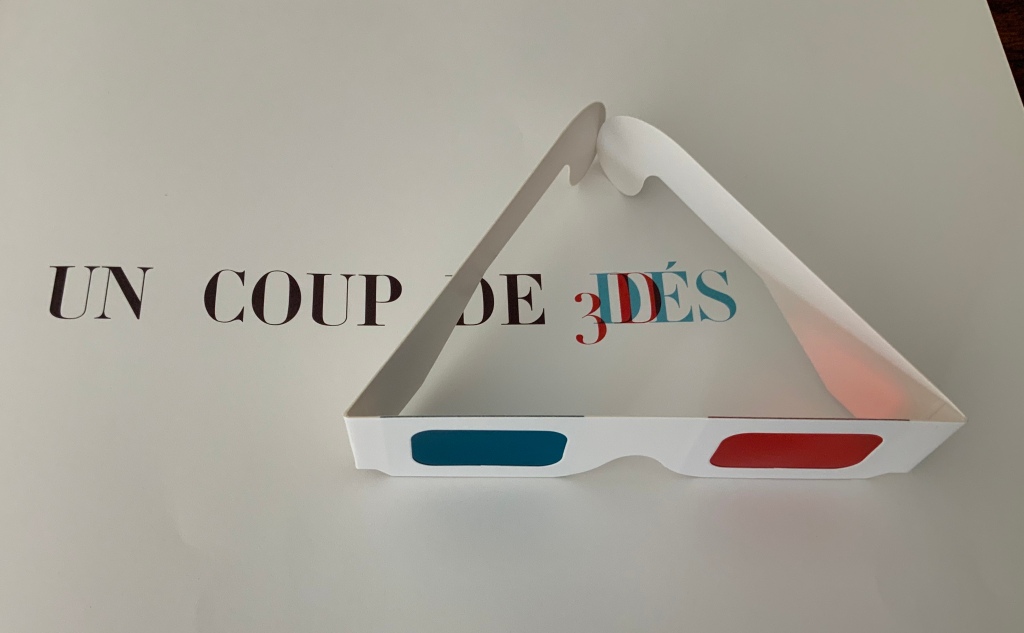
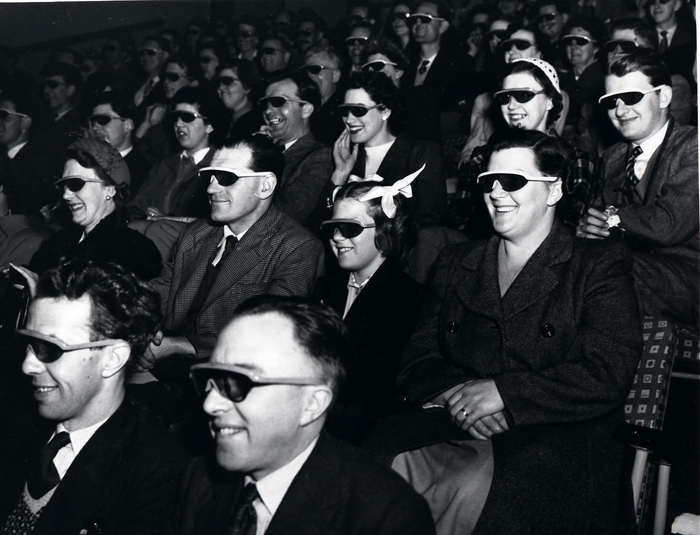
In size, Larosche’s Un Coup de Dés outdoes most other versions and homage — except those that are installations. The large black cover suggests a dark movie screen on which Larosche’s version of the poem will play out in 3D. But why 3D? Trying to read Un Coup de Dés while wearing a pair of 3D glasses challenges the eyes’ patience just as much as the poem’s ambiguities challenge the mind’s. Within the Coup de Dés genre, there is a necessary strain of strained humor. Without it, art runs the risk of taking us too seriously.

L: Ultimate History Project; R: The_National_Archives_UK. Accessed 27 June 2020.

Confirming this joking intention behind his version, Larosche commented to Books On Books:

I originally handmade the book so that it was to worn on the nose like a large pair of glasses, which was another practical joke because the letters were too close to read, as in so 3D that it was literally in your face. — Brian Larosche, 2 April 2020.

Even with puns and slapstick there is often a point. The anaglyphic print technique and sheer size of Larosche’s version draw attention to Mallarmé’s sculptural play with type size and layout on a 2D surface as well as the poem’s spatial metaphors that align with it. In Mallarmé’s original, the staggering and dispersal of lines and single words on the page buttress, and are buttressed by, the word images of a roiling sea, shipwreck and constellation. Other artists with other techniques have drawn attention to that sculptural play and those spatial metaphors: Marcel Broodthaers‘ superimposed black bars, Michalis Pichler‘s and Cerith Wyn Evans‘ cut-outs, Sammy Engramer‘s sonograms sculpted in PVC and Eric Zboya‘s computer graphic “translation”.

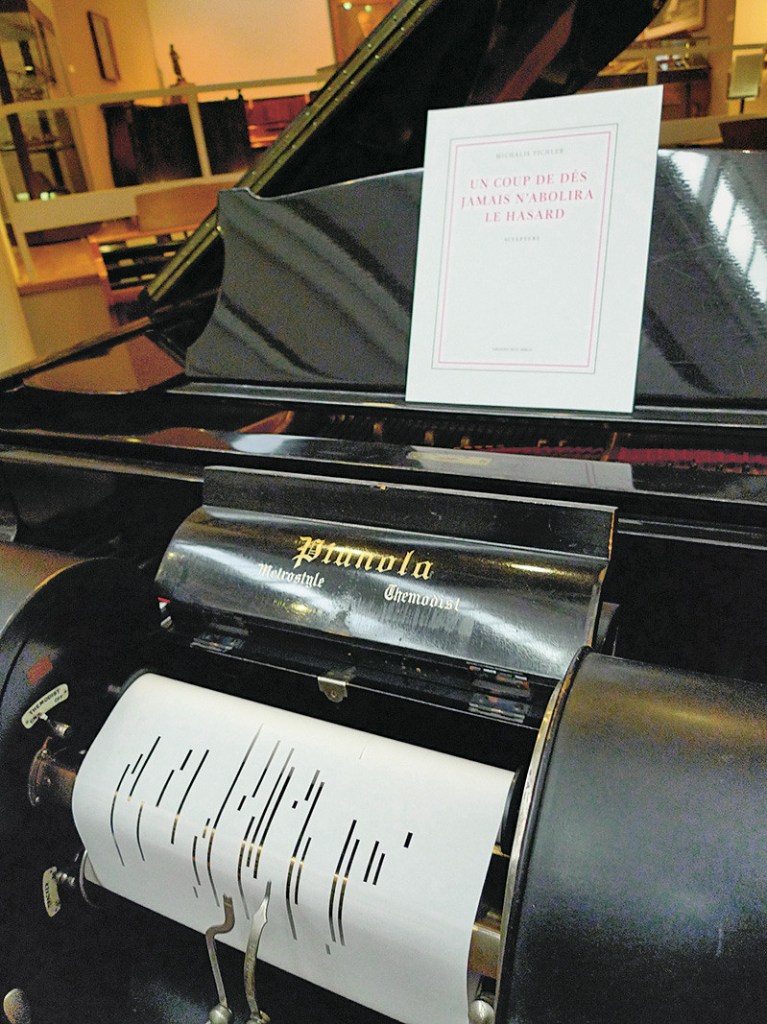
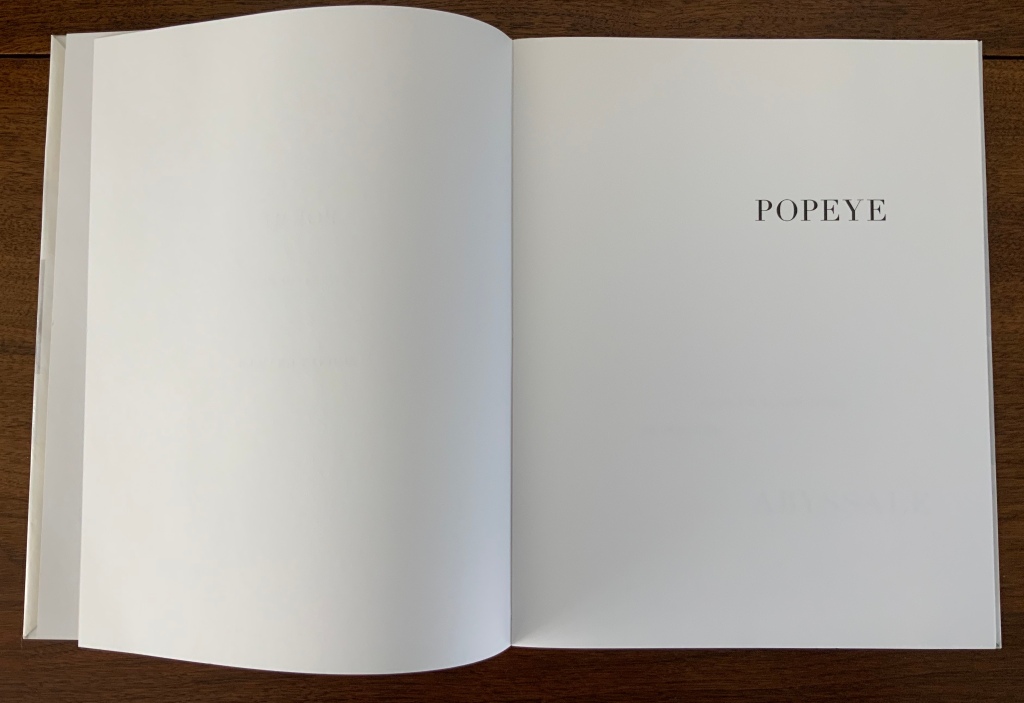
Other artists have also poked serious fun at Un Coup de Dés and each others’ homage. Jim Clinefelter teases the sonority of the poem with his A Throw of the Snore Will Surge the Potatoes (1998). With her Rubik’s cube version (2005), Aurélie Noury needles the poem’s and poet’s puzzle pose. With their piano-roll versions, Rainier Lericolais (2009) and Pichler (2016) pick on Broodthaers (1969) as well as Mallarmé (1897) for their spatial metaphors and, in Mallarme’s case, his assertions of musicality. In Rodney Graham’s version (2011), Popeye substitutes for le Maître as the ship’s captain.

Larosche’s perceptively humorous rendering of Un Coup de Dés has earned it a secure perch among the other birds of the homage feather, and the use of 3D glasses seems to invite another layer of homage from artists interested in virtual reality headgear and augmented reality devices.

Further Reading

Sammy Engramer”, Books On Books Collection, 1 June 2020.

Cerith Wyn Evans”, Books On Books Collection, 16 April 2020.

French, Thomas. “3-D : Of Decidedly Victorian Origins“, The Ultimate History Project. Accessed 27 June 2020.

Rodney Graham“, Books On Books Collection, 2 July 2020.

Noury, Aurélie. Un coup de dés (rubik’s cube) (Rennes: Éditions lorem ipsum, 2005). Accessed 27 June 2020.

Pichler, Michalis. Un coup de dés jamais n’abolira le hasard (SCULPTURE) (2008). Accessed 27 June 2020.

Eric Zboya“, Books On Books Collection, 1 June 2020.

Books On Books Collection – Rodney Graham

Poème : “Au Tatoueur” (2011)

Poème : “Au Tatoueur” (2011)
Rodney Graham
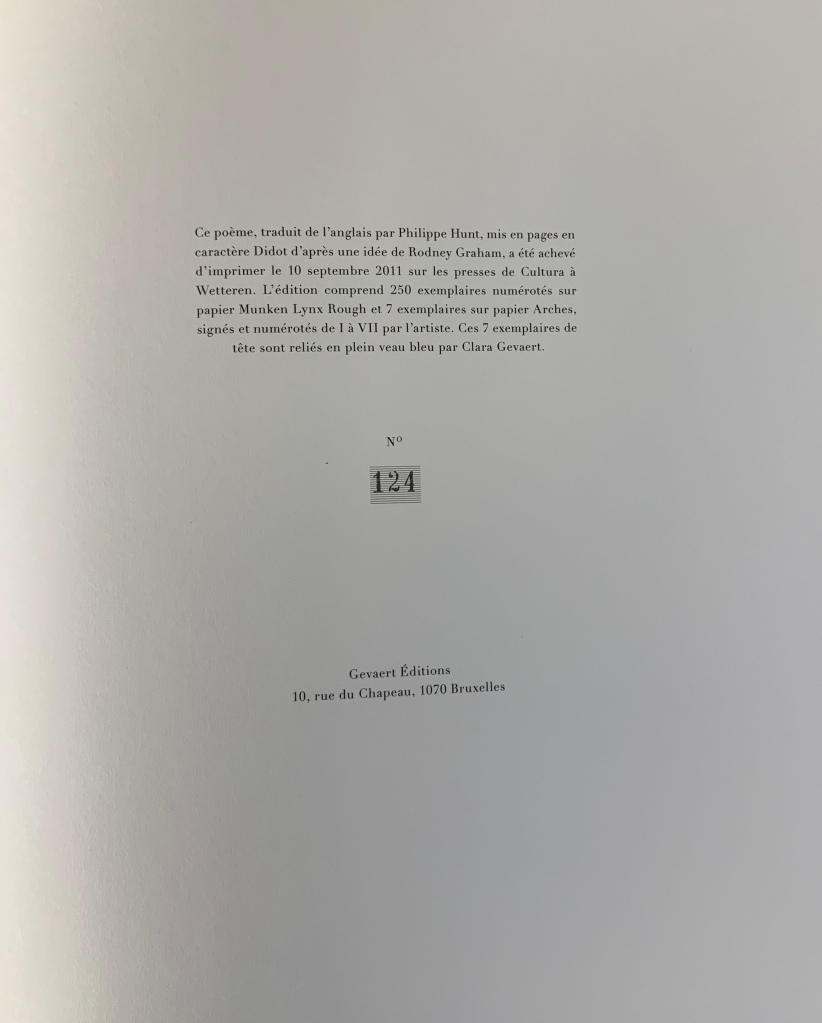
Sewn soft cover. H320 x W250 mm, 16 pages. Translated from English by Philip Hunt. Edition of 250, of which this is #124. Acquired from Stefan Schuelke Fine Books.
Photos: Books On Books Collection.

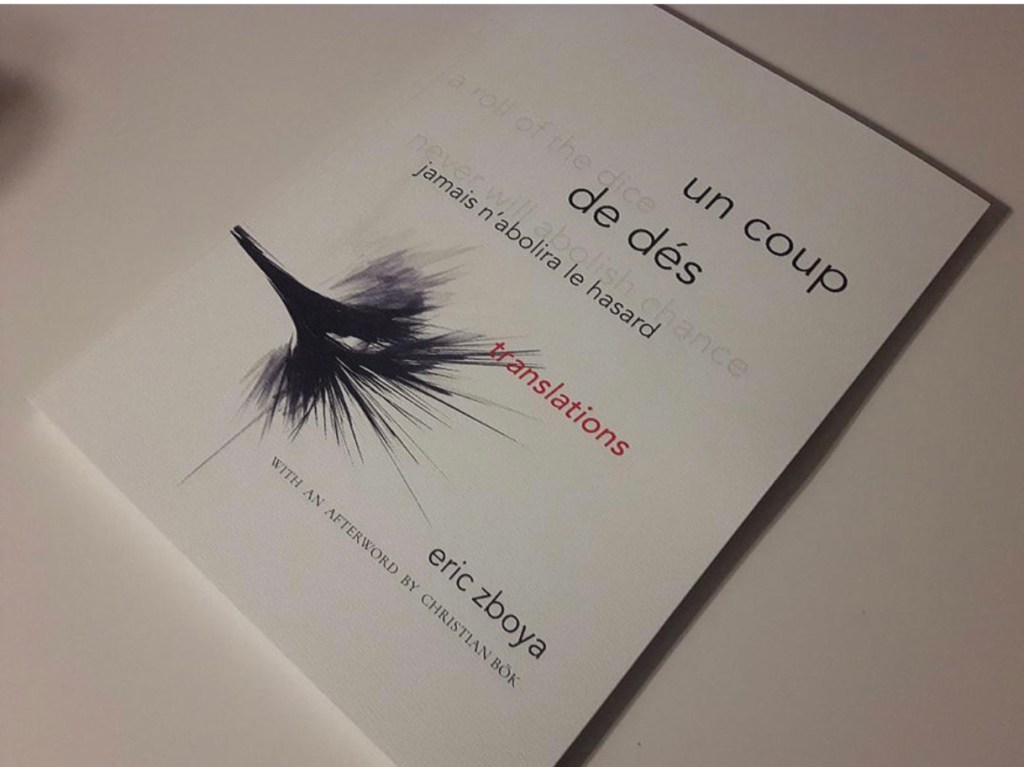
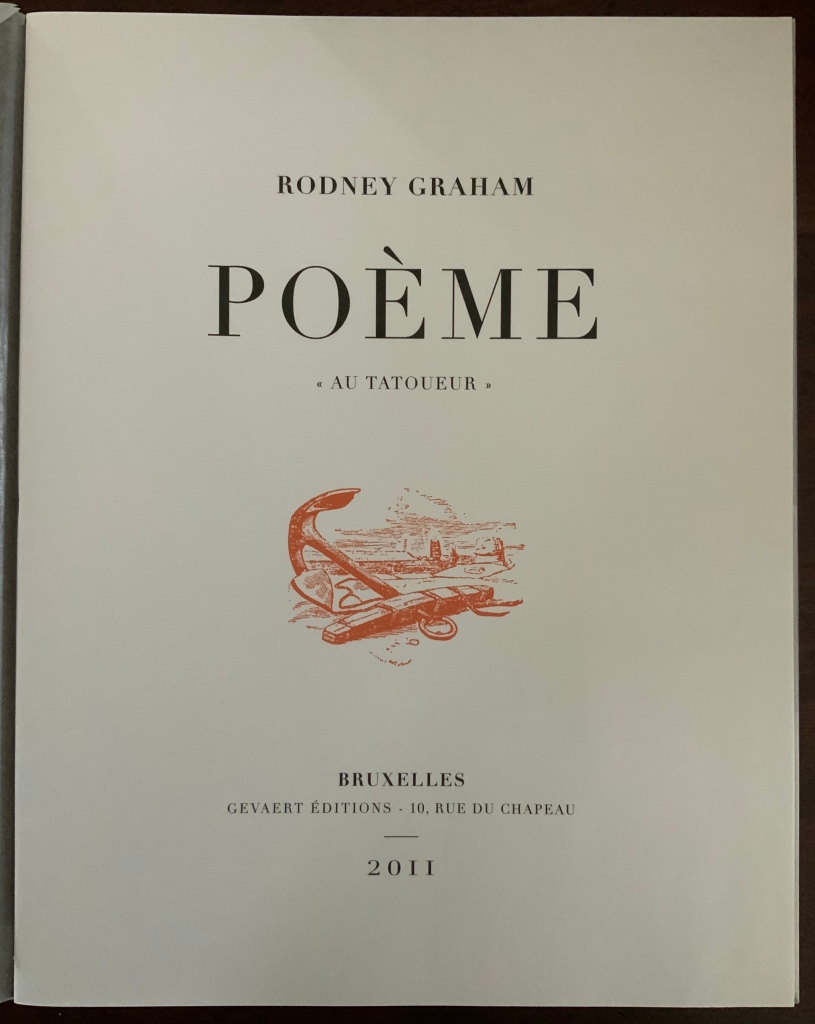
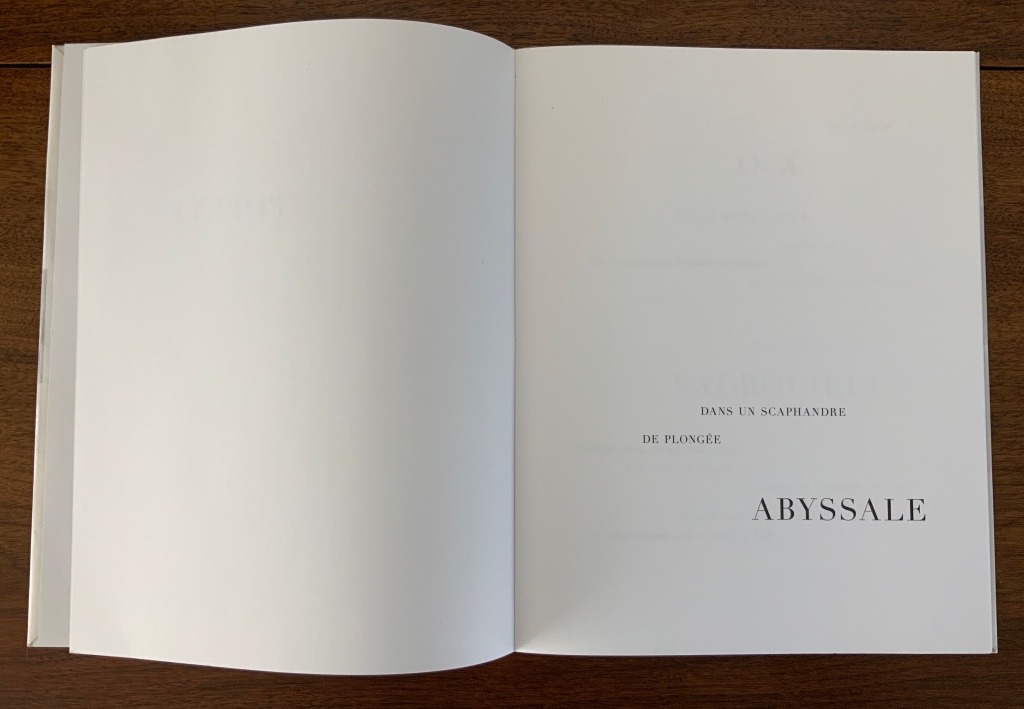
As with many of the homage to Un Coup de Dés, the subtitle here matters. For Bennequin, it was “Homage” with it missing “m” from the French; for Broodthaers, “Image”; for Engramer, “Wave”; for Pichler, “Sculpture” and “Musique”; for Zboya, “Translations”. Graham’s subtitle, being in quotation marks, indicates that what follows is a missive, not a form. The missive addressed to a local tattoo artist was arranged à la Mallarmé and described an image of Popeye that Graham wanted. But the twist that makes Graham’s version work is the translation of the instructions into French and their publication in the 1913 format of Mallarmé’s poem. This is an intricate “set-up”. In a way, it is analogous to Mallarmé’s careful attention to the positioning of words and lines, the kind of mise-en-scène that characterizes much of Graham’s photography and painting.

The set-ups extend across time and works as well. Au Tatoueur inspired Tattooed Man On Balcony 2018, the story of which is told here. Further evidence of Graham’s humor in book art and intricate set-ups can be found in White Shirt (for Mallarmé) Spring 1993 (1992), [La Véranda] (1989) and The System of Landor’s Cottage. A Pendant to Poe’s Last Story (1987), all at the Tate Modern.

Further Reading

Sammy Engramer”, Books On Books Collection, 1 June 2020.

Cerith Wyn Evans”, Books On Books Collection, 16 April 2020.

French, Thomas. “3-D : Of Decidedly Victorian Origins“, The Ultimate History Project. Accessed 27 June 2020.

Gardner, Allan. “Confessions Of A Window Cleaner: Rodney Graham Interviewed“, The Quietus, 21 October 2018. Accessed 28 June 2020.

Rodney Graham Art Exhibition“, NY Art Beat, 11 January 2019. Accessed 28 June 2020.

Brian Larosche“, Books On Books Collection, 2 July 2020.

Noury, Aurélie. Un coup de dés (rubik’s cube) (Rennes: Éditions lorem ipsum, 2005). Accessed 27 June 2020.

Pichler, Michalis. Un coup de dés jamais n’abolira le hasard (SCULPTURE) (2008). Accessed 27 June 2020.

Eric Zboya“, Books On Books Collection, 1 June 2020.

Books On Books Collection – Benjamin Lord

The Abolition of Chance: Sequence (2019)

The Abolition of Chance: Sequence (2019)
Benjamin Lord
Laid finish card cover; hand-assembled perfect binding with inlaid red linen thread;
70 pages printed on translucent cellulose paper. H10 1/2″ x W8 1/4.
Edition of 50, unnumbered. Acquired from the artist, 24 April 2020. Photos: Books On Books Collection.

The title of Benjamin Lord’s book names what Mallarmé’s Un Coup de Dés declares can never be accomplished by a throw of the dice: the abolition of chance. Taking the predicate of Mallarmé’s title (its verb and object), elevating it to the title position, substituting the word “sequence” for the subtitle Poéme, and placing it in a cover layout reminiscent of the 1913 NRF edition of Mallarmé’s book, Lord’s cover raises expectations and questions. Perhaps chance can be abolished? Perhaps by a certain sequence — of words?

Bowling over the textual expectations raised by the cover, the interior pages offer only images — images that gradually shift from linearly arranged black rectangles to what seem to be digitally generated Rorschach tests, shifting QR codes or snapshots of a bitmap computer game, all blurred by the turning of the translucent paper. The translucency and images add another layer to each page and double-spread of images and also add another set of expectations and questions. What determined the starting point of those arranged rectangles? What drives the sequence of their change?

Without Lord’s own description of the work, a highly developed form of art-historical, science-historical visual genius is required to answer those questions. A genius with the visual recall to recognize that “The first spread of the book copies the last spread of Marcel Broodthaer’s book Un coup de dés jamais n’abolira le hasard (A throw of the dice will never abolish chance), made in 1969.” A genius that can recognize the sequence as being “generated using a simple mathematical formula known as the Game of Life, originally devised by the mathematician John Conway, also in the year 1969.

Blocking out Mallarmé’s words with black bars of varying sizes corresponding to the poem’s typography and turning Poème into Image, Broodthaers’s homage has provided the starting point to several works of visual homage: Derek Beaulieu, Jérémie Bennequin, Klaus Detjen, Sammy Engramer, Cerith Wyn Evans, Rainier Lericolais, Alexandra Leykauf, Michael Maranda, Guido Molinari, Michalis Pichler and Eric Zboya. To their common starting point, each brings to bear his or her own approach. For Lord’s approach, the term “starting point” is more properly “seed”. In Conway’s Game of Life, a seed is any pattern of square cells, some filled (“live”), some unfilled (“dead”). Here are two basic patterns:

On the left is a “still-life” seed known as “Boat”; on the right is “Gosper’s glider gun”, an obviously more complicated pattern named after its creator, Bill Gosper. A forerunner of simulation games, Conway’s game poses a set of simple rules to be played out within an infinite grid:

  1. Any live cell with fewer than two live neighbours dies, as if by underpopulation.
  2. Any live cell with two or three live neighbours lives on to the next generation.
  3. Any live cell with more than three live neighbours dies, as if by overpopulation.
  4. Any dead cell with exactly three live neighbours becomes a live cell, as if by reproduction.

Here is Gosper’s glider gun, activated by the Game of Life’s rules encoded in a GIF:

Lord’s seed is the image of the last double-page spread in Broodthaers’ version of Un Coup de Dés.

Like a more complex glider gun, it generates the subsequent double-page spread images, each image being the seed for the next image. As Lord puts it,

The lines of Mallarmé’s poem inflate into balloons which expand and then pop into nothingness, or collide with each other to generate debris, or collapse into thicker bars. The image fragments into a vibratory bitmap constellation of expansions and contractions, in which interactions between forms continuously generate new forms, in a way that is neither random nor intuitive.

This 21st century American artist turning with a 20th century paintbrush dipped into the words of a 19th century French poet via a 20th century Belgian artist calls to mind The Education of Henry Adams. Throughout, Adams refers to himself in the third person. Post-Broodthaers, there is something “third-person-ish” — of being at two removes — in Lord’s homage and those of Beaulieu et al. above. But there is more to the recollection than grammar. Consider this passage from The Education in which “one” writes,

Historians undertake to arrange sequences,–called stories, or histories–assuming in silence a relation of cause and effect. These assumptions, hidden in the depths of dusty libraries, have been astounding, but commonly unconscious and childlike; so much so, that if any captious critic were to drag them to light, historians would probably reply, with one voice, that they had never supposed themselves required to know what they were talking about. Adams, for one, had toiled in vain to find out what he meant….he insisted on a relation of sequence, and if he could not reach it by one method, he would try as many methods as science knew. Satisfied that the sequence of men led to nothing and that the sequence of their society could lead no further, while the mere sequence of time was artificial, and the sequence of thought was chaos, he turned at last to the sequence of force; and thus it happened that, after ten years’ pursuit, he found himself lying in the Gallery of Machines at the Great Exposition of 1900, his historical neck broken by the sudden irruption of forces totally new. Chapter XXV

Adams and his third-person self were in Paris in May 1897, when Un Coup de Dés first appeared in the quarterly Cosmopolis. Despite their proximity, a common interest in quarterlies and the popular press, and a near obsession with the electrical forces of the dynamo, the men’s two paths did not cross. Adams mentions Mallarmé in a letter only in passing.

Sartre called Mallarmé the poet of nothingness. Its title and Lord’s description of The Abolition of Chance as a “constellation of expansions and contractions, in which interactions between forms continuously generate new forms, in a way that is neither random nor intuitive” suggest an alternative to nothingness. The final double-page spread does present a pattern of live cells. Lord, perhaps like his fellow American, responds to nothingness with a type of Buddhist repose, if not affirmation, much as Adams responded to the memorial for his wife that he had commissioned from Augustus St. Gaudens:

His first step, on returning to Washington, took him out to the cemetery known as Rock Creek, to see the bronze figure which St. Gaudens had made for him in his absence. Naturally every detail interested him; every line; every touch of the artist; every change of light and shade; every point of relation; every possible doubt of St. Gaudens’s correctness of taste or feeling; so that, as the spring approached, he was apt to stop there often to see what the figure had to tell him that was new; but, in all that it had to say, he never once thought of questioning what it meant. … From the Egyptian Sphinx to the Kamakura Daibuts; from Prometheus to Christ; from Michael Angelo to Shelley, art had wrought on this eternal figure almost as though it had nothing else to say. The interest of the figure was not in its meaning, but in the response of the observer. Chapter XXI

Solution of the Cosmological Idea of the Totality of the Composition of the Appearances of a Cosmic Whole (2010)

Solution of the Cosmological Idea of the Totality of the Composition of the Appearances of a Cosmic Whole (2010)
Benjamin Lord
Perfect bound softcover. H203 x W164 mm [68] pages. Acquired from Veatch’s, 11 June 2021.
Photos: Books On Books Collection.

Further Reading

Derek Beaulieu”, Books On Books Collection, 19 June 2020.

Jérémie Bennequin“, Books On Books Collection, 11 April 2020.

Sammy Engramer”, Books On Books Collection, 1 June 2020.

Cerith Wyn Evans”, Books On Books Collection, 16 April 2020.

Michaud, François. Alexandra Leykauf: Chateau de Bagatelle (Nürnberg: Verlag fur moderne Kunst Nürnberg, 2010)

Guido Molinari”, Books On Books Collection, 13 April 2020.

Eric Zboya“, Books On Books Collection, 1 June 2020.

Books On Book Collection – Sammy Engramer

Un Coup de Dés Jamais N’abolira le Hasard: Onde/Wave (2009)

Mallarmé’s strange poem, first published in the London-based journal Cosmopolis in 1897, had to wait until 1914 before appearing in a format close to the one Stéphane Mallarmé envisioned with the gallerist and publisher Ambroise Vollard.

Taking the poem’s self-referential line about its words appearing as a constellation, first Ernest Fraenkel, then Mario Diacono and Marcel Broodthaers transformed the poem into a series of images by substituting solid blocks of ink in place of the poem’s lines of verse.

From left to right: Ernest Fraenkel, Les dessins trans-conscients de Stéphane Mallarmé, à propos de la typographie de Un coup de dés. Avant-propos par Étienne Souriau, avec 68 planches en hors-textes (1960); Mario Diacono, a MeTrica n’ABOOlira (1968/69); Marcel Broodthaers, Un coup de dés jamais n’abolira le hasard: Image (1969).

Subsequently, dual homages to Mallarmé and Broodthaers arose. One of them is Engramer’s. Where Fraenkel, Diacono and Broodthaers focused on layout, size and space to generate their visual translations, Engramer added a sonic element, albeit by visual display. Recording his own reading aloud of the poem, Engramer then ran the recording through sonographic equipment. The rendering of each line’s soundwave became his graphic substitute for Mallarmé’s line of verse and, by extension, each black block that Broodthaers used to displace Mallarmé’s text.

Un Coup de Dés Jamais N’Abolira le Hasard: Wave (2009)
Sammy Engramer
H340 x W240 mm, 32 pages. Acquired from Florence Loewy, Paris, 27 March 2019.

In 2010, Engramer took his inspiration one step further and put together an exhibition called “JAMAIS”. As soon as the idea or sensation of visualizing the sound of a poem is mooted, the choice of ink, type, brush, paint, surface, chisel, mold, material, camera, computer and, again, surface opens up. In JAMAIS, Engramer chooses a multiplicity of tools and media (or they choose him): sound recording, computer output, ink, printed book, mold and plastic, camera and animation.

In the video below, pages of the book undulate in a wave along the wall to which they are loosely attached. Alongside them are eighteen 3D PVC renderings of the sonograms. At the end of the hall, a large screen shows a 3D animation of a rolling die whose dots spell out hasard in Braille. The juxtaposition of fluttering pages of sonographs, the physical instantiation of the sonograms and the animated Braille die that cannot be read by touch generates a confounding conundrum for the senses. Text has become sound, sound has become image, and image has become object and animation.

Video: Courtesy of the artist.

Since, according to the artist, his recording of the poem was not played in the exhibition, the conundrum focuses on perception of sound through the eyes. Whether listening/hearing can be performed by seeing a visual or physical representation of what has been listened to/or heard (or is being listened to/or heard) is a neurological question. Rendered in ink and plastic, Engramer’s sonographic images and objects are metaphoric assertions: “hear with your eyes the words no longer printed or carved before you, hear through your eyes the decibels increasing or attenuating according to an unheard recording of those words spoken”.

Further Reading

Eric Zboya“, Books On Books Collection, 1 June 2020.

Boglione, Riccardo. 22 September 2010. “Dadi illeggibili. il Mallarme cancellato di Mario Diacono e Marcel Broodthaers“. The Free Library. Accessed 1 May 2020.

Halliday, Sam. Sonic Modernity: Representing Sound in Literature, Culture and the Arts: Representing Sound in Literature, Culture and the Arts (Edinburgh: Edinburgh University Press, 2015).

Dick Higgins, Hannah Higgins, “Intermedia”, Leonardo, Volume 34, Number 1, February 2001, pp. 49-54.

Pichler, Michalis. Un Coup de Dés Jamais N’Abolira le Hasard: Sculpture (Berlin: “Greatest Hits”, 2008).

Rasula, Jed. Modernism and Poetic Inspiration: The Shadow Mouth (New York: Palgrave Macmillan, 2009).

Schaffner, Anna Katharina and Kim Knowles, Ulrich Weger and Andrew Michael Roberts, “Reading Space in Visual Poetry: New Cognitive Perspectives“, Writing Technologies, vol. 4 (2012), 75-106.

Books On Books Collection – Nicolas Guyot

POÉME: UN COUP DE DÉS JAMAIS N’ABOLIRA LE HASARD par STÉPHANE MALLARMÉ (2019)

Poème: Un coup dés jamais n’abolira le hasard (2019)
Nicolas Guyot
Unique cover with silver bromide printed image on Wenzhou paper mounted on handcrafted canvas. H150 x W200 mm, 16 leaves, 11 pages of text with silver bromide printed images on 160 gm drawing paper. Edition of 76, of which this is #16 and signed by the artist.

Detail of front cover © Nicholas Guyot

Details of pages © Nicholas Guyot

Back cover © Nicholas Guyot.

Guyot’s livre d’artiste sits self-assuredly in a long line of works inspired by Stéphane Mallarmé’s seminal 1897 poem Un Coup de Dés. Unlike Ellsworth Kelly (1992) but like Christiane Vielle (1989) and others, Guyot integrates his images with the text. In print technique, his silver bromide echoes the silver gelatine of Ian Wallace (1979), but Guyot’s unique cover prints and hand binding distinguish his work from any other in the long line. His technique and layout evoke a feeling of the late 19th century, the contemporary images respond creatively to the original poem’s own cryptic imagery, and altogether the effect is a simultaneity across time, poet and artist.

Guyot writes that Alain Badiou’s Petit manuel d’inethéstique (Éditions du Seuil, 1998) and Quentin Mellaissoux’s Le nombre et la siréne (Éditions Fayard, 2014) were particularly inspiring for this work (correspondence, 21 April 2020). In addition to the artist’s book, Guyot created several paintings (H39 x W65 cm) inspired by the poem and these philosophical reflections.

Further Reading

Badiou, Alain. Petit manuel d’inesthétique (Éditions du Seuil, 1998). Available in translation: Handbook of Inaesthetics (Stanford, CA: Stanford University Press, 2006).

Meillassoux, Quentin. Le nombre et la sirène : un déchiffrage du Coup de dés de Mallarmé (Paris: Éditions Fayard, 2014). Available in translation: The Number and the Siren: A Decipherment of Mallarmé’s Coup de Dés (New York: Sequence Press, 2012).