Aldus Manutius, John Rylands Library, University of Manchester
Merchants of Print from Venice to Manchester, 29 January to 21 June 2015, John Rylands Library, University of Manchester, UK:
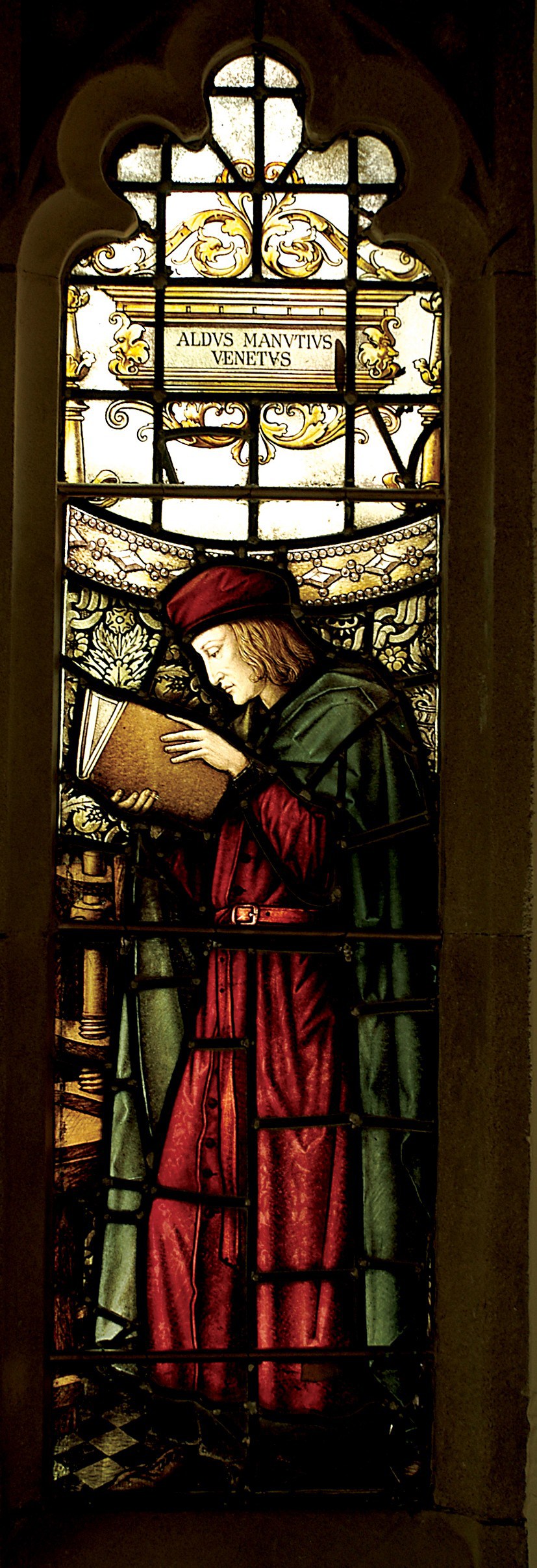
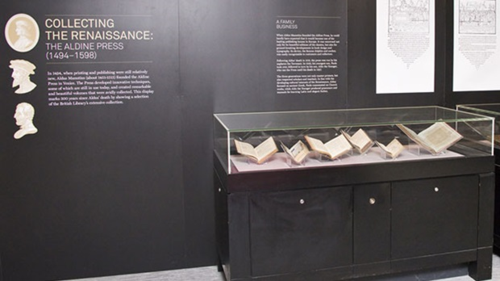
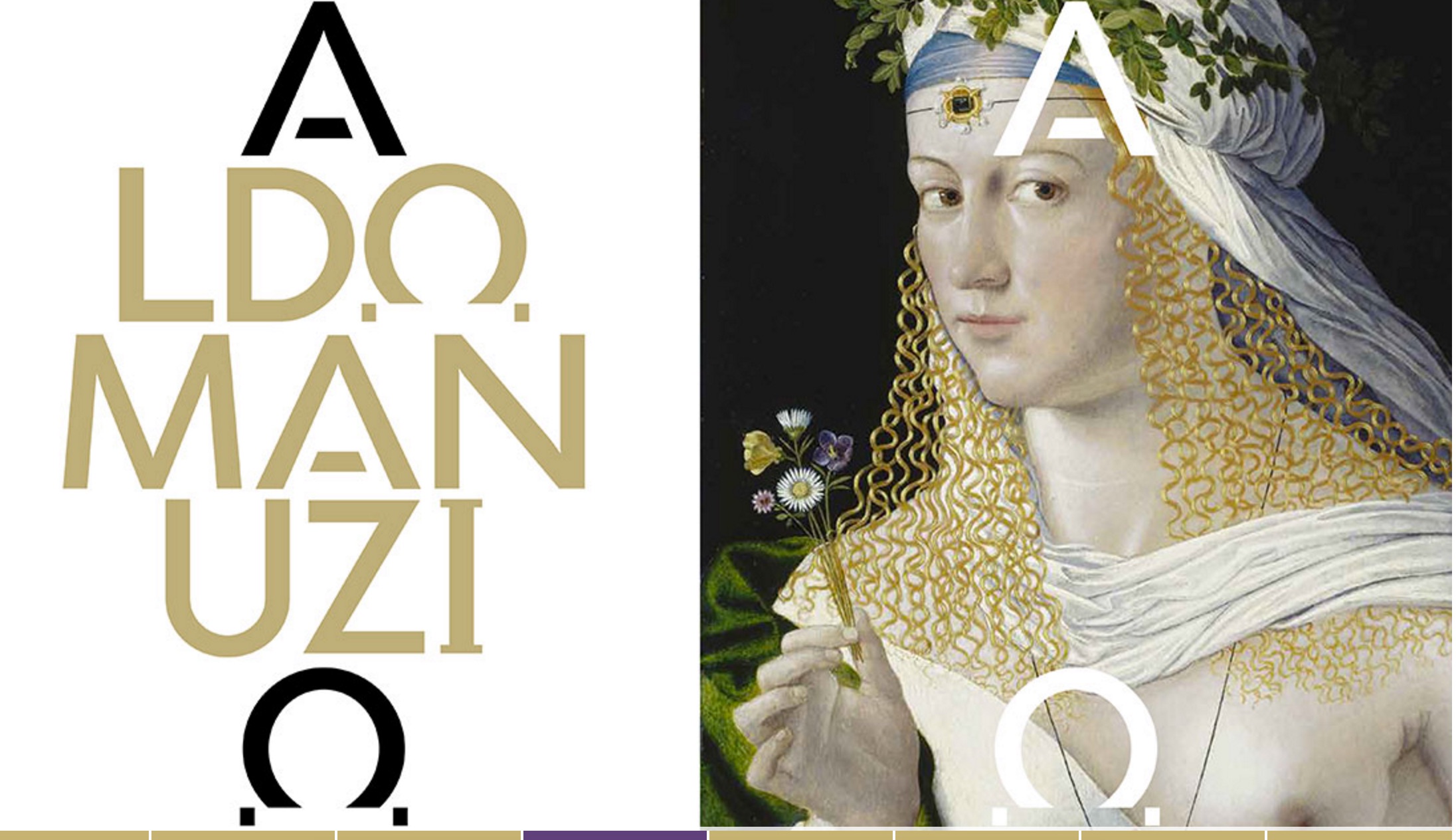
This exhibition celebrates the legacy of Aldus Manutius (1449 – 1515), an Italian humanist scholar who founded the Aldine Press at Venice. His publishing legacy includes scholarly editions of classical authors, the introduction of italic type, and the development of books in small formats that were read much like modern paperbacks. The firm was continued after his death by his son and grandson until 1598. John Rylands Library, University of Manchester website, accessed 17 May 2015
Back in February as I enjoyed Oxford’s recognition of the 500th anniversary of the death of Teobaldo Manucci, the Manchester exhibition was already running. Where the Oxford event focused on the more architectural motifs distinguishing early Venetian from Roman printing, the Manchester event dwelt more on the educational thrust, technical and business aspects of the Aldine legacy and provenance of the Manchester collection.
The Manchester focus on provenance wends its way back through the library’s donors dedicated to the cause of education (if not to impressing its practitioners with the importance of the woolen industry’s contribution to it) to the Renaissance circle on which Manutius depended:
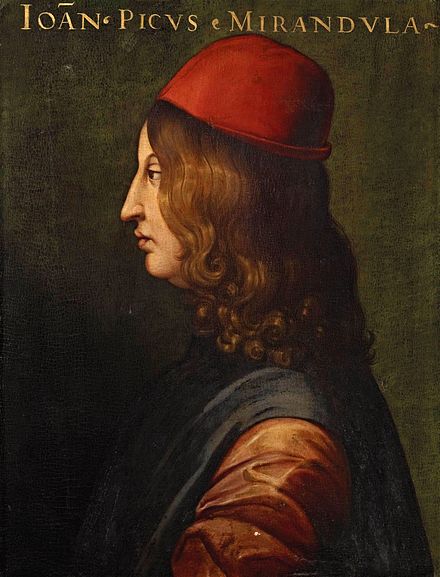
Giovanni Pico della Mirandola, 1463-1494 Uffizi Gallery, Florence
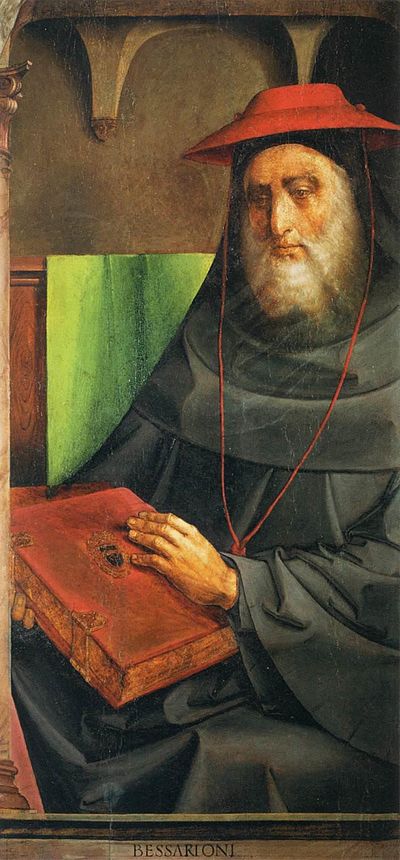
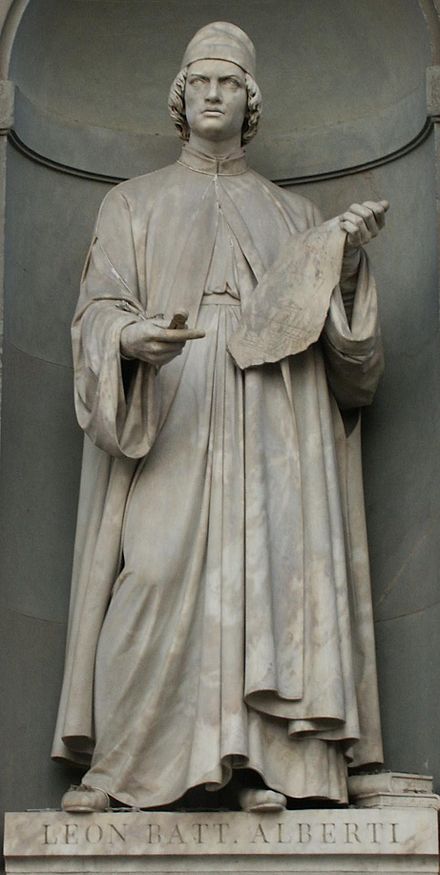
In 1482 Manutius lived with Pico della Mirandola and served as tutor to his nephews, the sons of the Princess of Carpi. Like the later, beneficent Manchester merchants, Pico’s family contributed financially to the cause: they funded the opening of the Aldine printing office in Venice in 1494. Of course, Pico made more than a patron’s financial contribution to the cause. Along with Cardinal Bessarion, Marsilio Ficino, Leon Battista Alberti and Erasmus – all known intimately to Manutius – Pico drove the revival of learning embodied in the output of the Aldines and numerous other printers (John Addington Symonds, Renaissance in Italy, Volume 2 (of 7): The Revival of Learning, John Murray, 1914).
Cardinal Bessarion, Justus van Gent and Pedro Berruguete , (Les Hommes Illustres)
Marsilio Ficino, Duomo, Florence
Leon Battista Alberti, Piazza degli Uffizi, Florence
Desiderius Erasmus, 1523?, Hans Holbein the YoungerThe Manchester exhibition closes this month.
The next major Aldine event is the summer school hosted by The Catholic University in Siena (31 August – 3 September) and jointly organized by the Centro di ricerca europeo libro editoria biblioteca (CRELEB). Other events with dates still to be confirmed are planned in Brighton, Treviso, Milan and Arezzo.
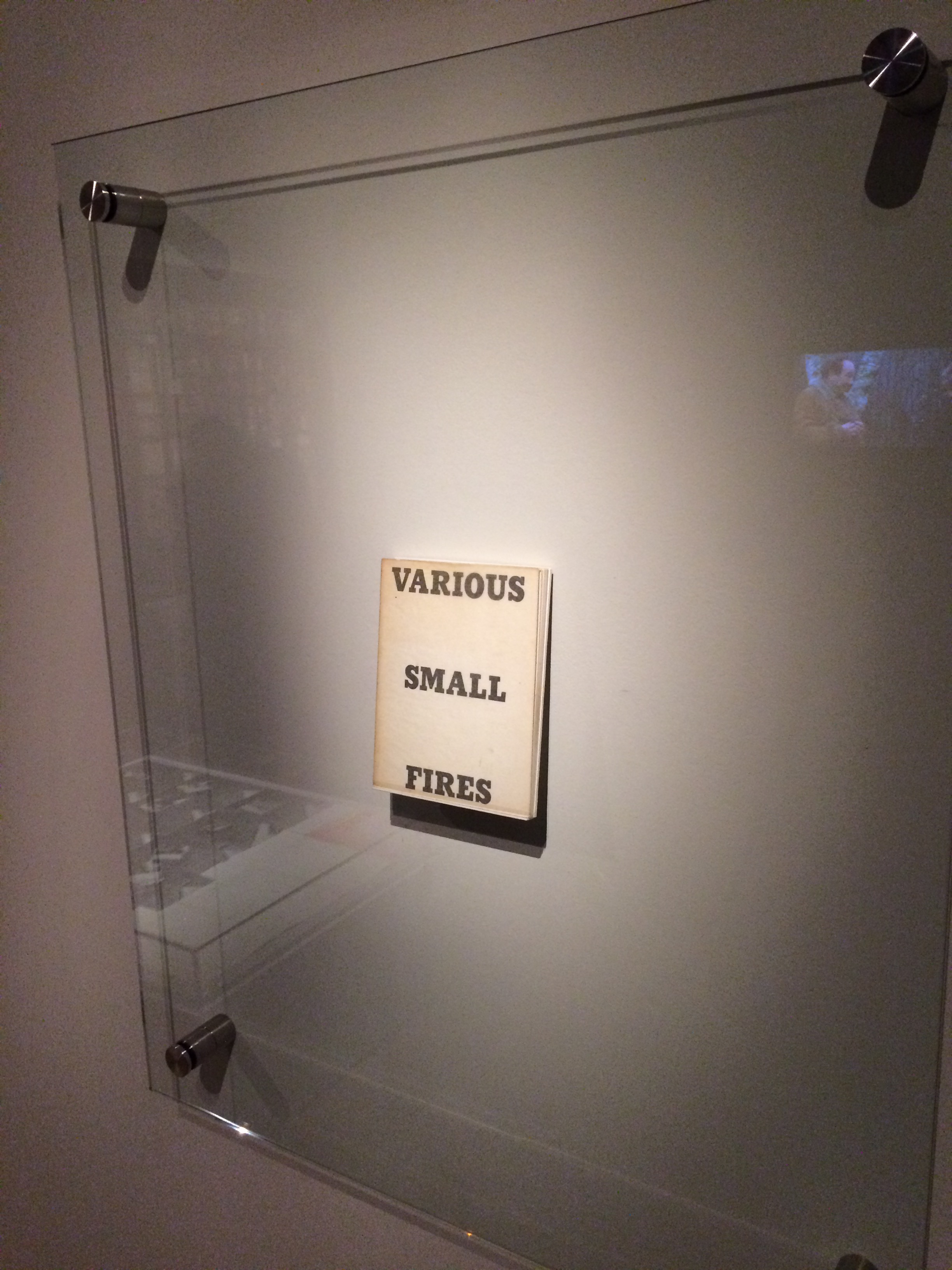
Display of Ed Ruscha’s Various Small Fires and Milk, 1964 Pliure: La Part du Feu, 2 February – 12 April 2015, Paris, Fondation Calouste-Gulbenkian. Photo by Robert Bolick, 11 April 2015. Reflected in the lower left hand corner is the display of Bruce Nauman’s Burning Small Fires, 1968; in the upper right corner, the film clip of Truffaut’s 1966 Fahrenheit 451; and in the upper left, Maria Helena Vieira da Silva’s La bibliotheque en feu, 1974.
The Studio Bibliografico Giorgio Maffei specializes in original texts and book art by twentieth century visual and literary avant-garde artists such Baldessari, Lewitt, Munari, Man Ray, Ruscha and Warhol among others. Recently the owner’s son – Giulio Maffei – “started making film as a side activity” and introduced a series of short animations “to put on the social networks and reach new potential customers”. An anonymous pair of hands displays a variety of the books and book art in stock.
But Giulio’s videos are not always the straightforward marketing effort intended. They provide an experience of book art or artists’ books that most of us will never hold or touch. And that may be Maffei’s point in his series “Le Vite dei Libri” (The Lives of Books) in which these usually glassed-off works are playfully handled, gently made fun of and still honored.
Some of the videos are derivative artworks in their own right in the same vein as Bruce Nauman’s Burning Small Fires, 1968. Nauman poked fun at Ed Ruscha’s Various Small Fires and Milk, 1964, by composing a book of photos recording the burning of a copy of Various Small Fires. Maffei’s Nauman-esque handling of Various Small Fires and Milk involves flash paper or its Photoshop equivalent. His celebration of Ruscha’s The Sunset Strip is still more endearing with its soundtrack and toy convertible. His cheeky animations of the pop-ups in Warhol’s Index (Book) and the ironically daring destruction of Papa Maffei’s copy of Some/Thing No.3 are even better. In the latter, the plastering of a Banksy-like mural with Warhol’s “Bomb Hanoi” stickers torn from the perforated cover is a sharp-edged example of the arch, reflective commentaries throughout Maffei’s videos.
Most of the films’ credits pay typographical homage to the work at hand, which is a nice self-deprecating and affectionate touch. At my last viewing, there were twenty-two works in the Lives series. They are listed below, but once you reach one on YouTube, the others follow. Giulio Maffei has also created a longer video catalogue for his father’s enterprise: Tra Libro e Oggetto (Between Book and Object). The Maffeis are a knowing team. The catalog title can be read as the beginning of a statement displayed on the cover.
BETWEEN BOOK AND OBJECT
The artists’ book, the multiple and the object
become an artwork
A statement that refers not only to the works in the catalog but to the video catalog itself and to the elder Maffei’s lifework of collecting, selling and writing about book art.
The Parthenon of Books, 1983/2017 Marta Minujín Kassel, Germany
In her note in BookRiot, Nikki Steele takes Brian Dettmer’s TED talk remark that books are created to relate to our human scale and builds on it elegantly, if all too briefly, by bringing together the installation works “Literature versus Traffic”, “Scanner”, “Book Cell”, “Singularity”, “Biographies” and “Contemporaries”. She’s not the first to provide a Pinterest– or Flickr-style burst of “ooh, look at this”, but unlike her predecessors, she makes the point worth pondering: this art that is not on a human scale evokes wonder and awe.
This challenges and expands on Dettmer’s point that people are disturbed by book art because we think of the book as a body, a living thing. As John Milton said, “As good almost kill a man as kill a good book: who kills a man kills a reasonable creature, God’s image; but he who destroys a good book kills reason itself”. That was in the context of book licensing laws that led to the confiscation and destruction of unlicensed books. Still, Milton would probably react as angrily to individual works of book art, and he might view the installations as if they were on the scale of the massacre of the Waldensians in the Piedmont.
Dettmer’s justification of book art that books “also have the potential to continue to grow and to continue to become new things”, that “books really are alive”, leaves us still squirming on the hook when Steele asks, “what happens when artists explode the scale and take books much, much larger?”. If you think cutting up or destroying a book is sacrilegious, what is your reaction to the 10,000 splayed in the streets of Melbourne by Luzinterruptus or the equal number cast by Alicia Martín into frozen defenestrations in Madrid and elsewhere in Spain or the even greater number in Marta Minujín’s The Parthenon of Books, installed for documenta in Kassel, Germany?
Miltonic eruption? Or Steele-ish delight, awe and love of the art?
Let’s raise the stakes and confusion. What if the books used in the single-volume work and installations were the Koran, the Bible or the Torah? Art and ethics are rarely happy bedfellows. Is there such a thing as “responsible art” that does not run afoul of the principle of the creative spirit or the integrity of art? Is art wholly without cultural, ethical or social contextual obligations?
This is why I like book art. It provokes just by coming into being. Its existence and appreciation are hard won.
Late afternoon before the long worn wooden benches in the Bodleian’s Convocation Hall, 500 years after the death of Aldus Manutius, Oren Margolis served his audience well, providing them with a richer appreciation of the “finest printed book of the entire Renaissance”* – the Hypnerotomachia Poliphili – and of its publisher Aldus Manutius.
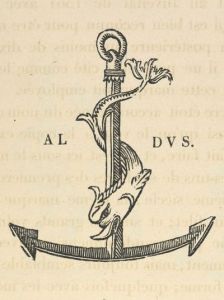
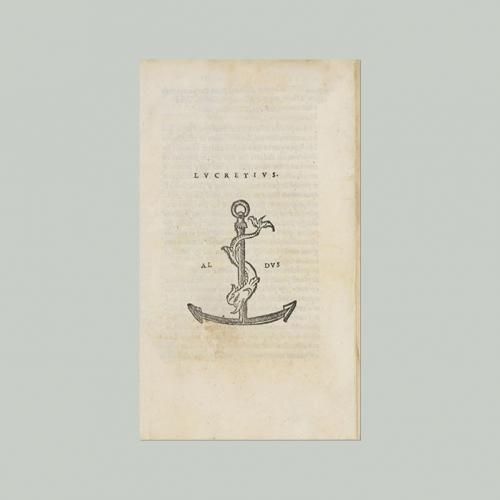
Drawing our attention to the more sculptural qualities of Venetian Renaissance printed books over the Florentine and to the evidence of the humanist agenda that drove Manutius, he led us to the page where Poliphilo (lover of all things, but in particular Polia, the ideal woman pursued to the end of the book) stands before a carving that foreshadows the Aldine Press device: a dolphin entwined around the shank of an anchor. The Aldine Press device was inspired by a similar image on an ancient Roman coin given by Pietro Bembo to Aldus, who wrongly associated it with Augustus and his proverb Festina lente (“Make haste slowly”) and adopted both for his printing and publishing business.
Erasmus praised Aldus, saying that he was “building a library which knows no walls save those of the world itself”.
For all of 2015, the world enjoyed a multitude of celebrations of the contribution of Aldus Manutius to publishing, printing and the book. After Gutenberg, Fust and Schoeffer, Aldus Manutius was perhaps the most important printer of the Renaissance. His portable books are still here, although locked away or displayed under glass, no longer so portable. Until now.
The Manutius Network 2015 provides a running list, links for some of which are provided below, including the online exhibition associated with Margolis’s talk. See also below, added in May 2016, the belated exhibition “Aldo Manutius: The Renaissance in Venice” at the Gallerie dell’Accademia in Venice.
From Crispin Elsted’s review of the Thames & Hudson facsimile edition of the Hypnerotomachia Poliphili. Parenthesis, December 2000, No. 5:
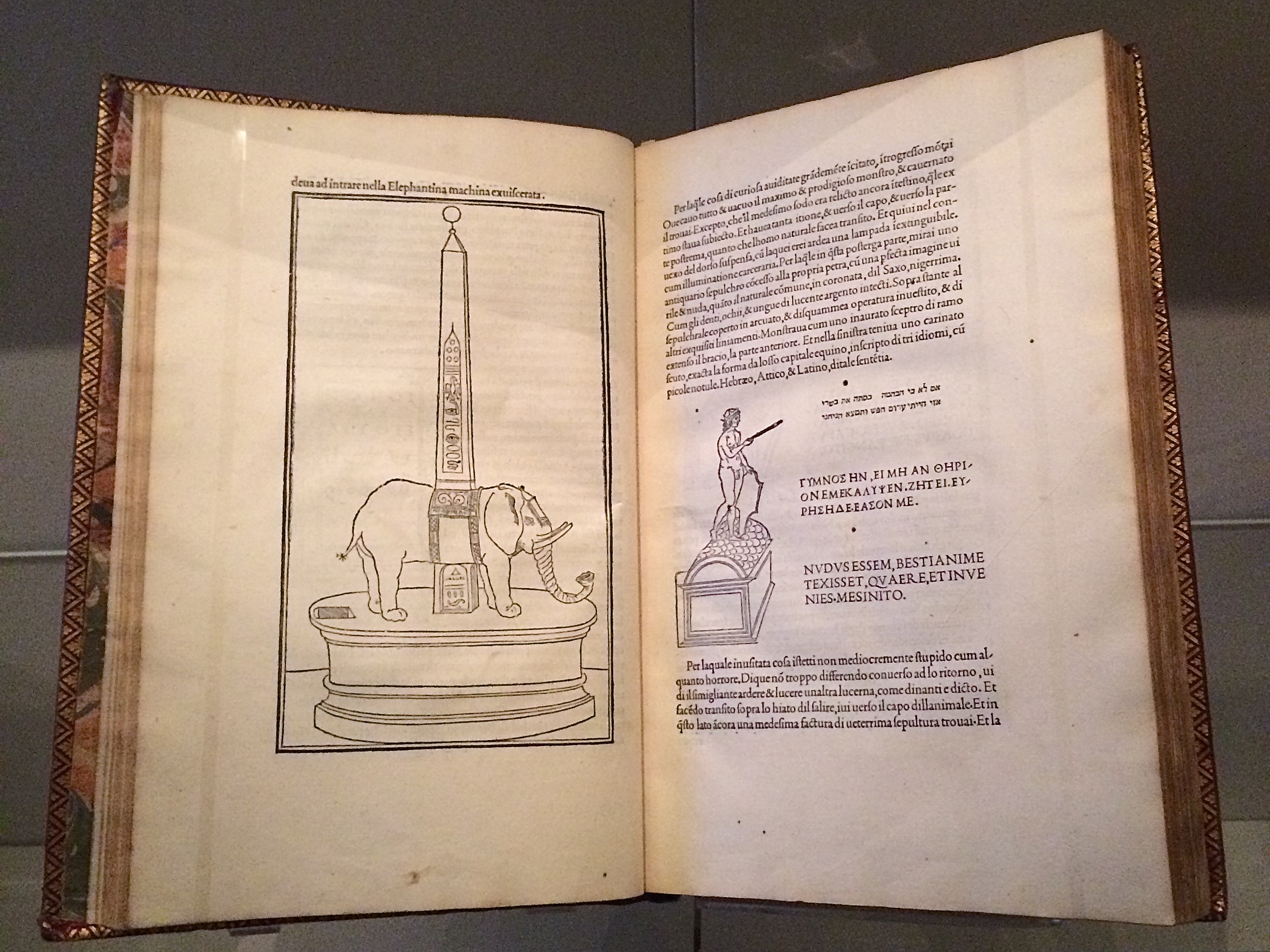
I once spent three hours in a library with a copy of the Aldine edition of Hypnerotomachia Poliphili, and I have never known a book take my breath away so consistently. Every page is a masterpiece: the dance of text with the more than 170 woodcuts; the firm, male stature of the typeface; the crisp spring of the impression; the elegant proportion of the page — all combine to an end in which the craft of printing and design carry the text into an atmosphere not of its own making. This new edition has the appearance of a fine actor in a part lately played by a great one. Here are the signs of the grace that greatness lent the commonplace five centuries ago; and in these signs, the commonplace finds here another advocate for its small claims to our time.
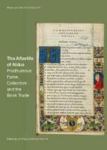
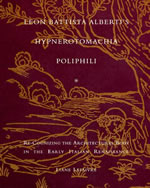
Timelines are, of course, for looking further back as well as forward. Earlier this year, April 2012 marked the fifteenth anniversary of the publication of Liane Lefaivre’sLeon Battista Alberti’sHypnerotomachia Poliphili: Re-Configuring the Architectural Body in the Early Italian Renaissance (Cambridge, MA: MIT Press, 1997) and the online publication of The Electronic Hypnerotomachia, which contains the facsimile text and illustrations. The online publication of extracts from Lefaivre’s book illustrates the linking prefigured by the “card stack” approach of HyperCard. What MIT Press and TU Delft, Lefaivre’s affiliation, host on their servers are not ebooks or even e-incunabula of the sort we experience today, but they are clearly forerunners to them.
In twenty-eight more months, December 2014, we will see the 515th anniversary of the original work’s publication by Aldine Press (Venice, December 1499). The founder Aldus Manutius did not normally publish heavily illustrated books. The Hypnerotomachia Poliphili was the exception and the only commissioned work that Manutius undertook. The exception reflects favorably on the overall success of his business and supports the view that Venice had become the capital of printing and publishing very shortly after the invention of printing by moveable type.
The book unveils an inscrutable, almost comic-book-illustrated story, glittering with made-up words in Greek, Latin, Hebrew and Arabic (including proto-Greek, -Hebrew and -Arabic fonts). In addition to the page displays sculpted into shapes such as goblets, this one volume displayed the technological mastery of and improvement on the new Roman (as opposed to the heavy Gothic) typeface Bembo. According to Norma Levarie in The Art & History of Books (New York, 1968), this singular volume revolutionized typography in France in less than twenty-five years.
Somewhat like software releases, though, the 1499 edition came with bugs. The colophon to the Hypnerotomachia Poliphili falls at the end of a full page of errata.
“Venice Month December. 1499. in the house of Aldus Manutius, most accurately done.”
Initiated in 2015 in celebration of the anniversary and acknowledgement of the more than 100 Aldine editions in the Wosk McDonald Collection, Simon Fraser University’s Aldus@SFU is the digitization of 21 Aldine volumes published between 15011 and 1515. The image above is the edition of Lucretius’ De rerum naturam, published just after Manutius’ death in 1515.
The seasonal flu among expositors of the future of the book and the future of reading is upon us. No sooner does one town cryer sneeze about the latest reading device or software than a town de-cryer follows heralding the superiority of reading print – or vice versa.
And without a hint of irony, here’s the online-only .Mic demonstrating that variant strains can cross generations and oceans as well as media: “Science Has Great News for People Who Read Actual Books“. That would be the oft-repeated Norwegian study of two groups of 10th graders, one of which – the print readers – comprehends and retains more than its ebook-reading counterpart.
There are plenty of days remaining before the year’s close for the digital riposte surely on its way to envelop us. In the meantime, here is a combined and fortified reading list from Christmas bloggings past:
Mangen, Anne, and Velay, Jean-Luc. Cognitive implications of new media. The Johns Hopkins Guide to Digital Media. Edited by Marie-Laure Ryan, Lori Emerson and Benjamin J. Robertson. Baltimore, MD: Johns Hopkins University Press, 2014.
Hollie Berry has two brief posts on book art at Book Arts at The Open Press (BA@TOP), a supportive community of book artists in Chattanooga, Tennessee, for whom The Open Press provides access to printmaking, book arts, and letterpress classes, workshops and equipment. Her first post offers as examples of the breadth of book art: Dan Essig, Sandy Webster, Brian Dettmer and Maddy Rosenberg. A good start, if light on installation book artists (say Alicia Martín).
The Open Press is 225 miles from Elizabethton, TN, where Wallace Stevens wrote “Anecdote of the Jar” in 1918 and which is only 67 miles from Asheville Bookworks in West Asheville, NC, where Landon Godfrey hosts Vandercooked Poetry Nights dispatching listeners into the mountain air clutching poems printed on broadsheets from the resident Vandercook Press, on which the authority Paul Moxon lectured in March this year at The Open Press, 199 miles away by the backroads across the Appalachians. …”And round it was, upon a hill.”
Craig Mod modulates on margins here in Medium (18 August 2014).
Text printed on the best paper with no margins or unbalanced margins is vile. Or, if we’re being empathetic, sad. (For no book begins life aspiring to bad margins.) I know that sounds harsh. But a book with poorly set margins is as useful as a hammer with a one inch handle. Sure, you can pound nails, but it ain’t fun. A book with crass margins will never make a reader comfortable. Such a book feels cramped, claustrophobic. It doesn’t draw you in, certainly doesn’t make you want to spend time with the text….
On the other hand, cheap, rough paper with a beautifully set textblock hanging just so on the page makes those in the know, smile (and those who don’t, feel welcome). It says: We may not have had the money to print on better paper, but man, we give a shit. Giving a shit does not require capital, simply attention and humility and diligence. Giving a shit is the best feeling you can imbue craft with. Giving a shit in book design manifests in many ways, but it manifests perhaps most in the margins.
Reiterating his point by analogy, Mod channels the late designer George Nakashima: “in order to produce a fine piece of furniture, the spirit of the tree must live on. You give it a second life … You can make an object that lives forever, if used properly.
For the fundamentals underlying Mod’s scatologically and poetically emphatic truth, you cannot find much better than Alexander Ross Charchar’s essay on the craft and calculations of “page canons” by Villard de Honnecourt (13th century!) , J.A. Van de Graaf, Raúl Rosarivo and Jan Tschichold: “The Secret Law of Page Harmony“. Most delightful is Charchar’s dynamic diagram “The Dance of the Four Canons” illustrating the workings of each page canon:
Copyright 2010, Alexander Ross Charchar.
The Further Reading suggested by Charchar and his commenters is excellent, and I would only add Marshall Lee’s Bookmaking. For those who are irritated with the imposition of the print paradigm on the digital reading experience, there is a useful pointer to applying the page canons to website design that will cause a rethink of that irritation and equally make the imposers think harder as well.
For those who care about the book, what it is evolving into and the role that heart, mind and design still play in that process, read Charchar’s”The Secret Law of Page Harmony” –again and again.
In another elegy for paper, Mark Fox in Designers & Booksleaps from the famous conversation between Ray Bradbury’s characters Professor Faber and Fireman Montag in Fahrenheit 451 that begins, “Do you know why books such as this are so important? Because they have quality. And what does the word quality mean?” to Jaron Lanier’s assertion that the remix culture is responsible for “the digital flattening of expression into a global mush.” Fox sets this against Professor Faber’s elaboration of what he means by “quality”:
To me it means texture. This book has pores. It has features. This book can go under the microscope. You’d find life under the glass, streaming past in infinite profusion. The more pores, the more truthfully recorded details of life per square inch you can get on a sheet of paper, the more ‘literary’ you are. That’s my definition, anyway. Telling detail. Fresh detail. The good writers touch life often. The mediocre ones run a quick hand over her. The bad ones rape her and leave her for the flies.
Saalfeld – … I’m interested in the changes that take place over time. In nature, the old sits alongside the new. There are always tensions, and injuries.
Mantz – That is exactly what characterises your images. This breaking apart and breaking through as if the colours were peeling off to reveal fragments of completely different pictures behind.
Saalfeld – Gaps appear through these breaks and dislocations. This allows something different to emerge from the image. There is always an unexplained story behind the story, another version. I no longer believe in a single, individual image.
Here is a healthy “anxiety of influence” that overcomes qualms about tradition, builds upon it and, yes, perhaps devours it as if it were seed corn. Its analogs in book publishing can be found in the work of Tom Abba, Duncan Speakman and others associated with WeAreCircumstance or in the works of Jonathan Safran Foer and others published by Visual Editions, all of which represent an intersection of narrative and the plastic visual arts.
Paper is not dead, digital is not still-born, creativity is a phoenix.
These Pages Fall Like Ash, Tom Abba
Short Films for You, Tom Abba, Els Viaene, Reinout Hiel and Yoko Ishiguro
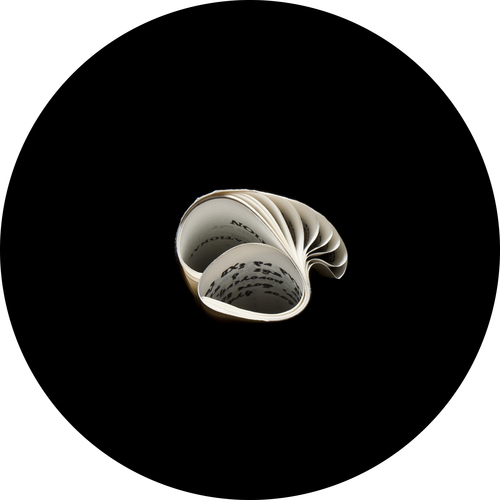
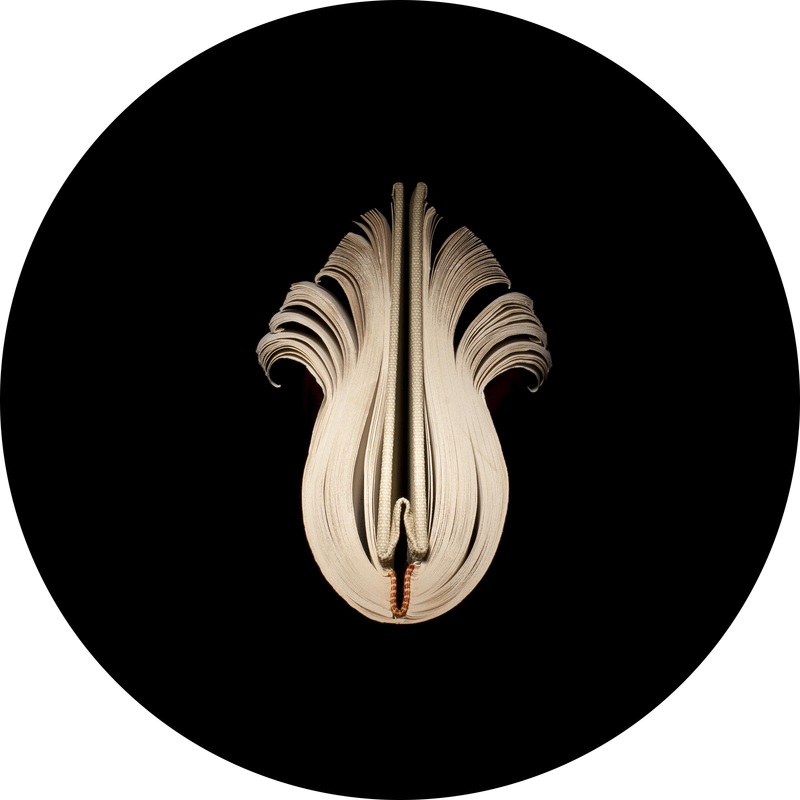
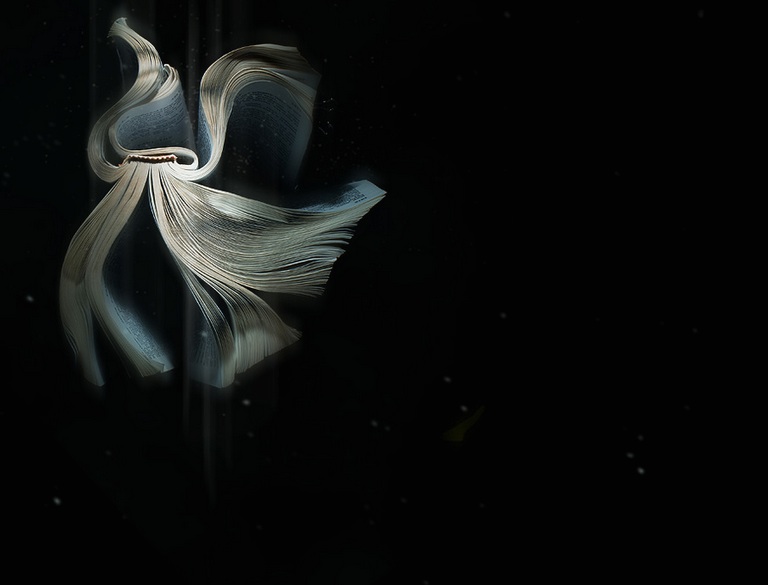
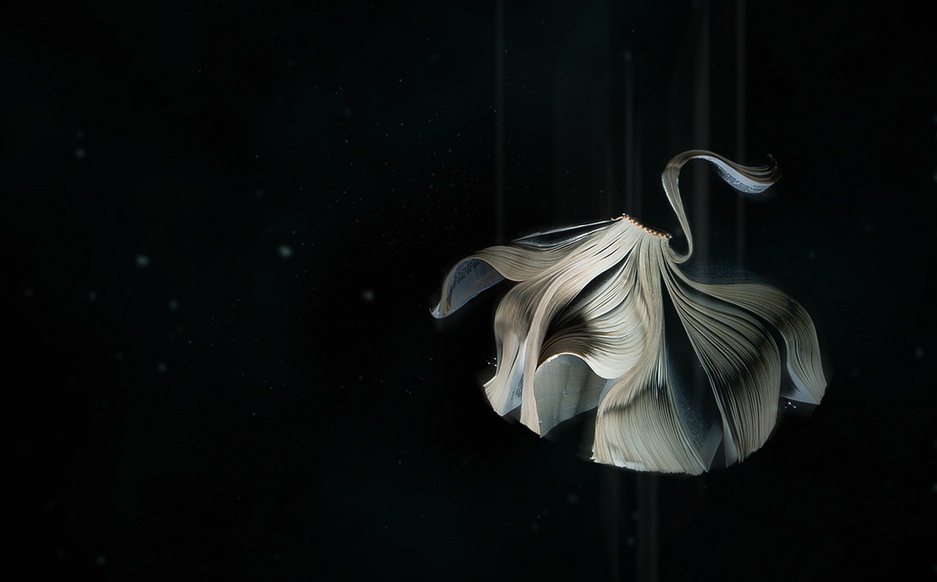
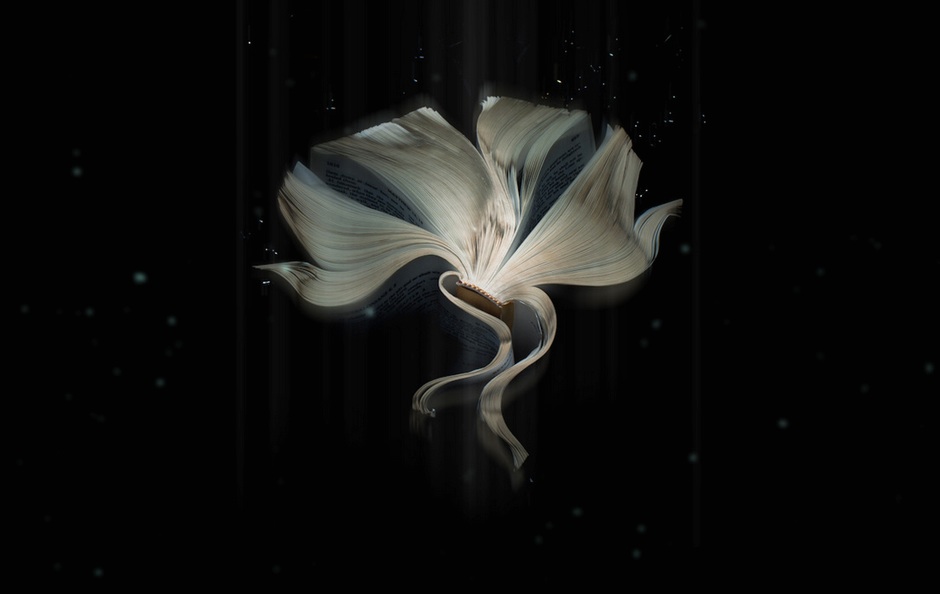
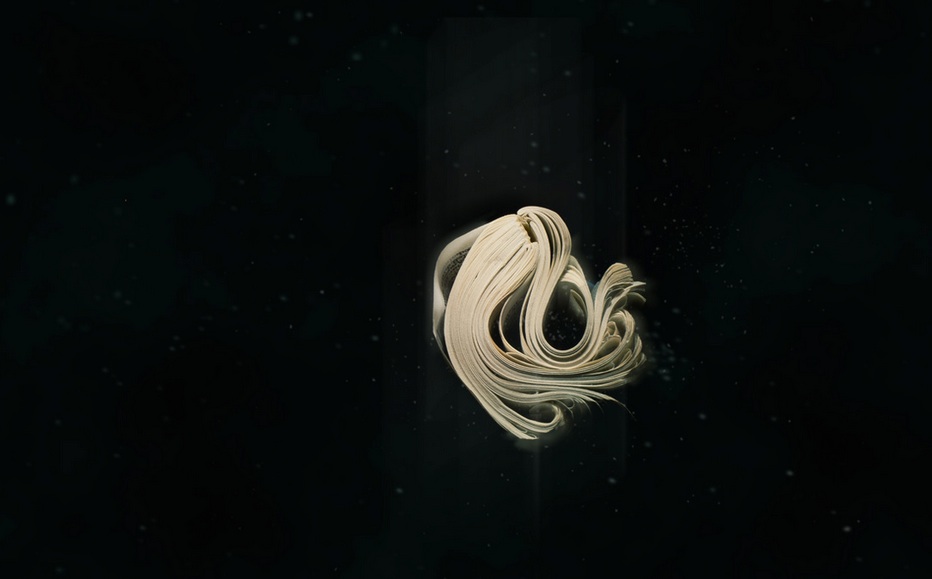
[ The book is an organism. It lived, spread all over the world and, some would consider, is endangered today. These creatures have a life of their own. They manifest themselves in many forms but where did they come from? If they are animals of paper and text, from what kind of beast did they evolve? This series studies those primordial creatures that became the developed beings colonizing our homes and libraries. By looking at growth patterns, mutations, and morphological similarities we can better understand this animal’s rise in population for so many years, as well as its current decline toward extinction. ]
The images above constitute a mesmerizing series on Monahan’s site. It is as if we are looking at photographs of deep-sea creatures or impressions of fossils or slides of microscopic organisms. The latter impression is reinforced by the petri dishes in which the circular images are framed, but of late, the organisms, shown in the rectangular photos, have escaped the petri dish to occupy an undefined abyss. Like snorkeling or diving for the first time in strange waters, the experience of viewing Specimen is beautiful, exhilarating and a bit scary. The words quoted above and fixed alongside the images are humorous, wistful but still, in the end, a bit scary. The book: evolution or extinction?
Monahan hails from the Master of Fine Arts program at the University of Michigan Ann Arbor, whose library by chance was one of the original five library partners in the Google Library Print Project that began in 2004. In March 2012, Jennifer Howard reported in The Chronicle of Higher Education that Google’s book-scanning project had reached its 20 millionth volume but was slowing down. Even so, at its average rate, Google should have about 25 million books scanned now. As if foreshadowing Monahan’s metaphor literally and using the Google collection like a literary genome project, Harvard’s Steven Pinker, Jean-Baptiste Michel and the Google Books Team “constructed a corpus of digitized texts containing about 4% of all books ever printed [enabling them] … to investigate cultural trends quantitatively”. From this reservoir of digital strands, they plucked out the references to each year between 1875 and 1975 in the books, plotted them and found
The plots had a characteristic shape. For example, “1951” was rarely discussed until the years immediately preceding 1951. Its frequency soared in 1951, remained high for 3 years, and then underwent a rapid decay, dropping by half over the next 15 years. Finally, the plots enter a regime marked by slower forgetting: Collective memory has both a short-term and a long-term component.
But there have been changes. The amplitude of the plots is rising every year: Precise dates are increasingly common. There is also a greater focus on the present. For instance, “1880” declined to half its peak value in 1912, a lag of 32 years. In contrast, “1973” declined to half its peak by 1983, a lag of only 10 years. We are forgetting our past faster with each passing year.
Ironic that. Analysis of the “DNA” extracted from over 5 million specimens of the organism designed to preserve our past tells us that we are forgetting it more quickly year by year.
Curious about his interactions with the book species, I wrote to Math Monahan to ask if we could conduct the “in medias res” experiment: to go to his bookshelf, select a volume from the middle of any shelf, open the volume to its center pages, tell me what is there and answer a set of questions.
What are the objects immediately on either side of the selected book? As you take the book from its place, what are your physical sensations? How does the book feel to you? As you open to its middle page, what do you hear, smell or see about it or around it?
Do you recall the circumstances of acquiring the book? What were you doing when you acquired it? Why this book?
As an artist whose work has an intimate relationship to “the book,” could you describe the effect this has on you when you are reading books in general?
Turning the question on its head, when the act of creating a work rather than the act of reading is in flight, how do books feed your working process?
MM: I decided to choose from my “to read” shelf. The book I found in the center felt “right” as soon as I saw it there. Although it was on my “to read” shelf, I decided to read it before replying. I wasn’t sure if I wanted to or not, I think it was the right choice. Anyway, here is my choice. As you can see, the book I’m using has a slightly different layout.
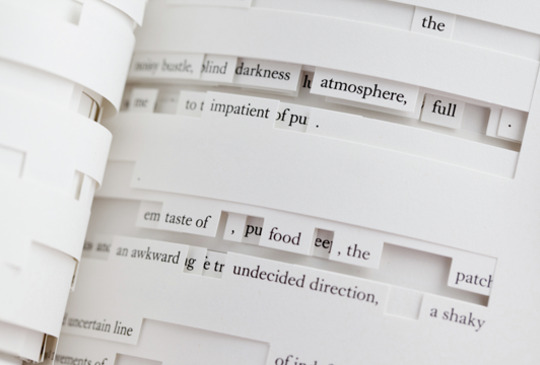
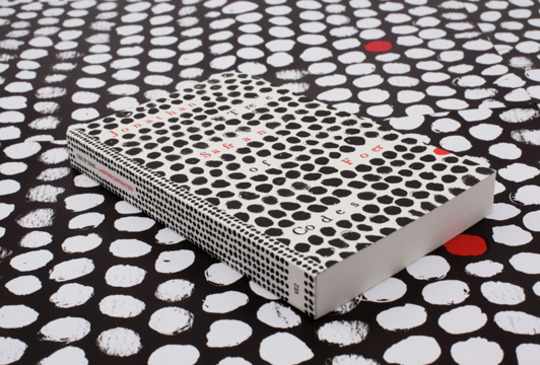
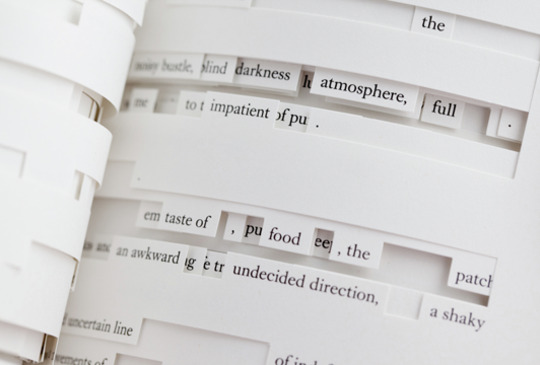
Image from Visual Editions. Author of Everything is Illuminated, Foer took one of his favorite books, The Street of Crocodiles by Polish-Jewish writer Bruno Schulz, and used it as a canvas, cutting into and out of the pages, to arrive at Tree of Codes.
BoB: And what about the books and things around it, and what you felt as took Tree of Codes from the shelf?
MM: To the left stands the book, Folklore and Book Culture by Kevin Hayes. To the right, two wooden boxes stacked, act as a book end/space filler, followed by more books. The larger box on the bottom contains various samples of handmade papers. The smaller box on top contains blank note cards. As I removed the book I felt the unfamiliar squeezing of pages that I was surprised by when I first bought the book. It was caused by the cutouts on each page. They create the different densities that differ from the standard solid-block feel of a book. When I opened the book to its estimated middle page, I remember being very gentle. The layout of the book made the pages delicate lattices that I am very careful to keep intact. The carefulness must have overridden my other senses, because I don’t remember anything else. I thought the book felt “right” when I found it because, as a book artist, I work with the form of the book and the book as an object. That is my main interest. This book is published by Visual Editions, a publishing company that believes “books should be as visually interesting as the stories they tell” (www.visual-editions.com). This idea meshes well with ideas in my own work.
BoB: Now that you’ve read Tree of Codes, you will have noticed how The Street of Crocodiles has pretty much disappeared. Almost but not completely. Are there echoes of that phenomena in your own work?
MM: Yes. Often the content of the books I’m using in my work is irrelevant. I am exploring the book as a physical form. Through folding, braiding, warping or any other alteration, I am revealing the transformative nature of the book. Each one holds different possibilities. My struggle is in convincing the viewer of this. We have a tendency to immediately read text, almost instinctual. Can text be texture? Is there more information contained in a book than words and images?
While a part of my process is (what I have been calling) relieving the book of text, I don’t feel this is an act of violence against any author(s). It is clear in Tree of Codes that the removal of text is an act of love or admiration for the primary story. My admiration is for the object itself. The text will live on in many forms. I am not using rare or one-of-a-kind books here.
BoB: Do you recall the circumstances of buying Tree of Codes? What were you doing when you decided to buy it? What prompted the purchase?
MM: I found it in a Barnes and Noble. I remember being surprised to see it there because it is a sort of unconventional book. I quickly put together that the author, Jonathan Safran Foer, recently had one of his books made into a movie and that could prompt the store to have all his works in stock. Still, I was very pleased to find it. I was introduced to the book about a year earlier by a friend. It was coming home with me that day, no question.
BoB: As an artist whose work has an intimate relationship to “the book,” could you describe the effect this has on you when you are reading books in general? The question may have different answers depending on the type of book or your intention on opening the book, so feel free to qualify your answer as you like.
MM: I think my relationship to “the book” changed how I approach books in any context. For better or for worse, I have noticed this change. The phrase, “Don’t judge a book by its cover.” comes to mind here. I find myself judging a book not only by its cover but also by its weight, size and shape, the textures of its cover and pages. Even by the fonts used in the body of the text are included in this analysis. Of course I read the summary and printed comments on the back, but these often fall after the book passes the physical tests.
BoB: Turning the question on its head, when the act of creating a work rather than the act of reading is in flight, how do books feed your working process?
MM: This is where all the information gathered through the process described above come into use. Understanding how paper textures interact with colors and fonts, how negative space in a text block affects how quickly you move through the book, how the lines of text change as you curl and warp the pages; all are now the backdrop to the creation of my own work. Sometimes this raw data is in the forefront of my thoughts while I’m working, while other times it is synthesized into a cloud of intuitive responses. The latter is often what I’m referring to when I say something “feels right”.
BoB: Decades ago, Peter Frank commented that exhibiting artists books behind glass was to confine them ” in some anaerobic chamber”. Unless your “organisms” in Specimen present themselves in the equivalent of a petting zoo, their exhibition requires us to stand at a distance and prompts us to view the book as an object to be regarded rather than “read” in the usual sense.
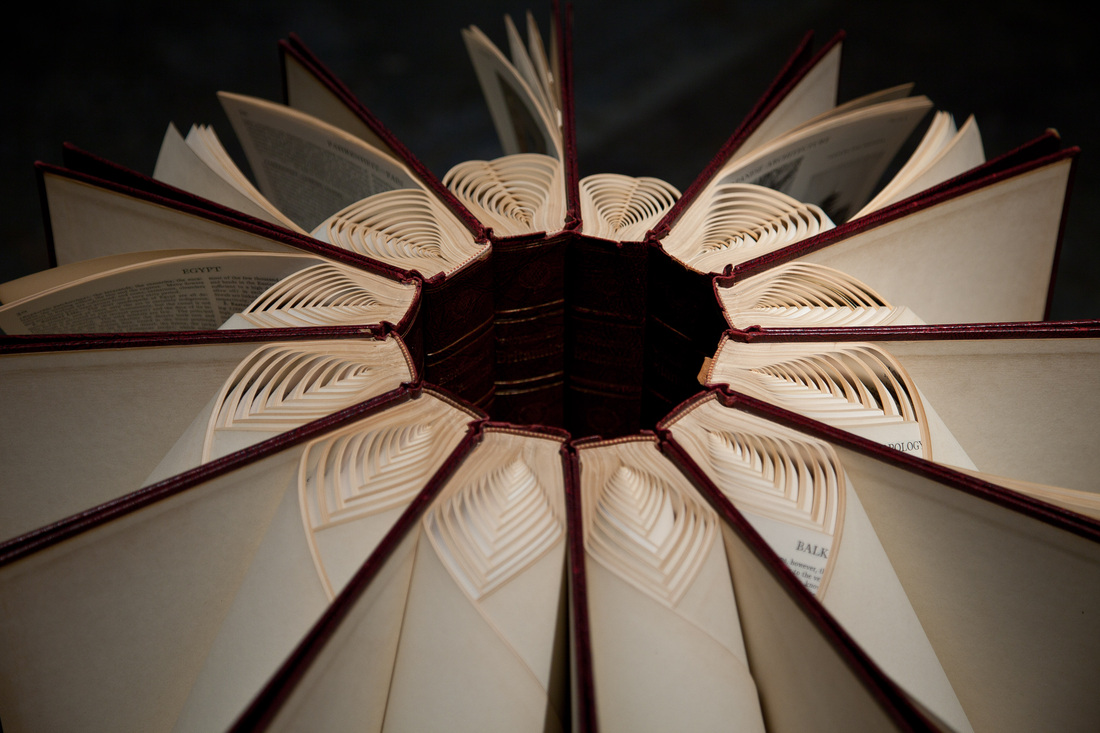
Your installation Between is another case in point but intriguingly different. There, you have taken two sets of books, opened each book, braided its pages so that it stands open and arranged each set of braided books in a circle spine to spine.
The circle arrangement holds the set together, without adhesives or mechanical apparatus, and the pages slowly unbraid themselves, each book returning to its original form. Although the installations, one in the Penny Stamps Graduate Studio and the other in the Hatcher Graduate library of the University of Michigan, are not under glass or otherwise fenced away from the “reader”, the “reading” or art experience can only occur as the unfolding occurs. And, of course, being in two separate locations, the installations do not allow us to experience them simultaneously. Yet, you intend “the installations [to] form a whole existing between the two spaces”.
So while Specimen is “at a distance” from us in one way, Between is so in another. With Specimen, we are relatively passive viewers. With Between, although we are not reading the unbraiding volumes, we are more active, almost participating. Our “witness” to the unbraiding is a necessary element of the artwork, but is that unbraiding toward forgetfulness and extinction or memory and renewal?
MM: Participation is the point of books. They are meant to be interacted with. That interaction has become a recent focus, especially thinking of library books and other books as they pass through several hands. I can admit, reading a good book leaves its mark on me. But what marks do we leave of books? What are the traces of these intimate interactions? Through time, whole communities are embedded in these artifacts. Find a book from a library or thrift store and try to imagine everyone that has ever handled that specific edition. Can you feel them around you? I aim to reveal that community.
BoB: One last question. Between forgetfulness and extinction, on the one hand, and memory and renewal, on the other, where would you bookmark us and the book?
MM: Whether book sales are up or down, it’s irrelevant. Even if the extinction of books never happens, the fact that text CAN be read digitally opens the book to possibilities beyond text, similar to (in my opinion) what happened to painting with the invention of photography. Artists are still working in representation, even hyperrealism, but the rapid expanse of painting and thought behind what a painting is – that is the direction that I’d like to see our interaction with books move in.
Klima, Stefan.Artists Books: A Critical Survey of the Literature. New York: Granary Books, 1998, p.67, citing Jacqueline Brody, “Peter Frank: A Case for Marginal Collectors”, Print Collector’s Newsletter, IX, no. 2, March-April 1978, p. 44.
Michel, Jean-Baptiste et al. “Quantitative Analysis of Culture Using Millions of Digitized Books”, Science, 14 January 2011, Vol. 331, no. 6014, pp. 176-182, accessed 19 September 2013: DOI: 10.1126/science.1199644.
The Repository of Primary Sources has been running since 1995 at the University of Idaho. Under the wing of Terry Abraham, it lists “over 5000 websites describing holdings of manuscripts, archives, rare books, historical photographs, and other primary sources for the research scholar”, and “[all] links have been tested for correctness and appropriateness”.
So what has this to do with the evolution of the book? Well, in the world of book publishing, whose job has it been to make sure that a book is known about and can be found — not only on publication but after? Marketing, Promotion and Publicity, undoubtedly, but they would be among the first to shout if Editorial or someone had not registered the book’s metadata with Bowker or the equivalent local ISBN registry.
According to Google, there are 129,864,880 books in the entire world (as of 5 August 2010, 8:26AM), but that is a semi-statistical estimate for the modern era drawn from sources such as ISBN registrars and OCLC’s WorldCat. Bookfinder/JustBooks, launched in 1997 by Anirvan Chatterjee, claims that through its network, it searches over 150 million books for sale. With the great hoohah over Hugh Howey’s Amazonian extrapolation, we can safely assume that there are many, many more books out there probably without ISBNs, which after all only came into effect in the 1970s and, even so, now there are vociferous opponents to the ISBN calling it an offline anachronism.
There is no question to beg about the usefulness of metadata. So is there a Terry Abraham and cohort out there to whom publishers and self-publishing authors can turn to deposit metadata whose links will be “tested for correctness and appropriateness”? Of course, that begs the question of whether there should be someone or organizations out there to perform that function. Why not leave it to the power of the Internet or the power of the market? Even if a book goes unnoticed or after a time becomes an “orphan work“, the power has spoken.
Let’s leave the power politics for another bookmark. Whoever performs the function, what exactly is it? Let’s call it the “findability” function. It goes beyond the usual social media marketing of a book or ebook that most publishers assign to Marketing. It goes beyond the usual search engine optimization (SEO), although it is arguably a part of it.
It goes to making the book as locatable an object as it can be, endowing it with “ambient findability.” See Peter Morville’s book of that title and judge for yourself whether “endowing something with ambient findability” misconstrues what he is saying or how the Web works. Nevertheless, …
Superfluous as they are claimed to be becoming, should publishers leave findability to the ISBN registries and librarians (until they become superfluous as well) or to the technorati?
As the book evolves, this “findability” function currently falls between the stools of Commissioning (where the editor discovers the author and pumps him or her not only for the ms but for connections leading to sales/marketing opportunities and further editorial opportunities), Editorial/Production (where the copyeditor, designer and production editor ensure that metadata is assigned and link-checks are run and the work is registered with the Library of Congress), Sales/Marketing (where marketeers scour the author’s questionnaire if it has arrived, create lists of mailing and emailing lists, compile the list of offline and online reviewers/bloggers and design the social media campaign and where a sales account manager with responsiblity for Amazon and other online accounts worries whether IT has included the work in the scheduled ONIX, EDI and customized catalog feeds) and Operations/Finance (where an accountant, analyst or inventory controller assigns the ISBN usually upon receipt of contract approval).
So if you are self-publishing or publishing books/ebooks, who attends to the ambient findability of what you are publishing? As more and more books go online, isn’t this part of the new craft and art of the book?
By the way, I found Morville’s book one rainy Saturday afternoon while shelving books at the local Oxfam bookstore. I bought it instead of shelving it.








 Books On Books