Books On Books Collection – Louis Lüthi

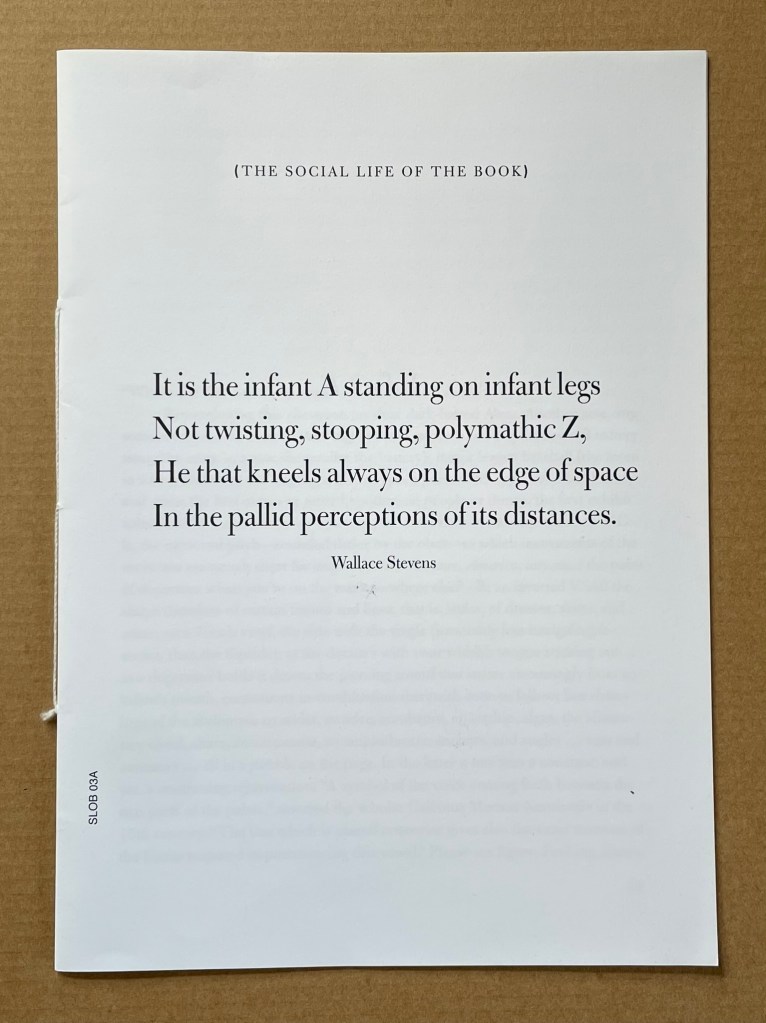
Infant A (2012)

Infant A (2012)
Louis Lüthi
Thread-stitched signature. H225 x W160 16 pages. Edition of 1000. Acquired from Torpedo Books, 8 January 2024.
Photos: Books On Books Collection

Infant A is part of a collection of essays commissioned by castillo/corrales and published by Paraguay Press under the series title The Social Life of the Book. Lüthi’s contribution fits the Books On Books Collection on several scores. First is the epigram’s invocation of the alphabet, which echoes the collection’s concentration of alphabet-related artists’ books and children’s books. See Alphabets Alive! Second is the epigram’s source: Wallace Stevens, whose poetry has inspired Ximena Pérez Grobet’s Words (2016). Would that other book artists be so inspired. Third is the narrator’s fictional conversation with Ulises Carrión in a celebration of all things A-related, in particular Andy Warhol’s novel a: a novel (1968), which finds analogues in Warren Lehrer’s A Life in Books: The Rise and Fall of Bleu Mobley (2013) and Derek Beaulieu’s a, A Novel by Andy Warhol (2017) (entry in progress). Fifth is how the dialogue reminds me of Suzanne Moore’s A Musings (2015).

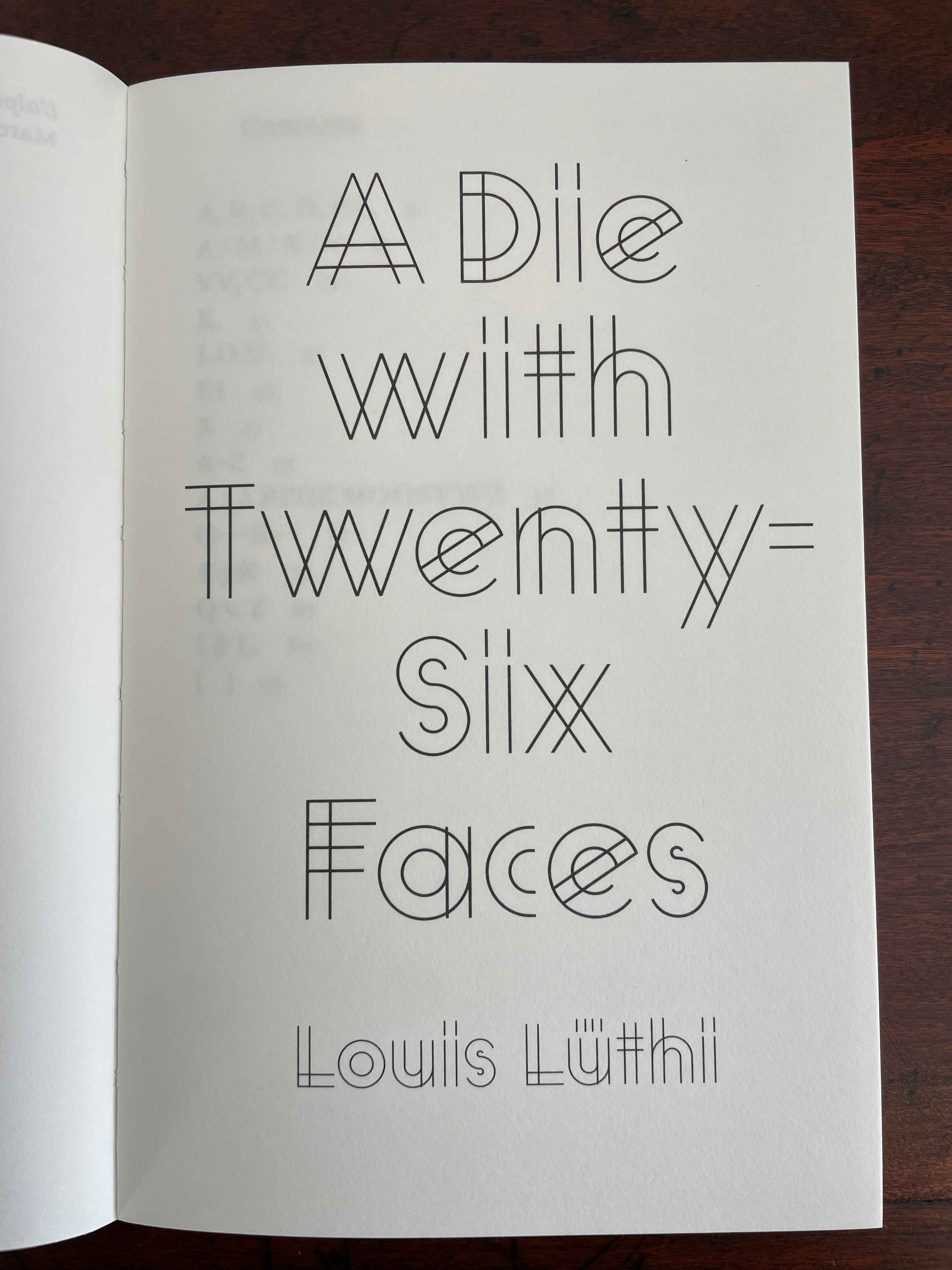
A Die With Twenty-six Faces (2019)
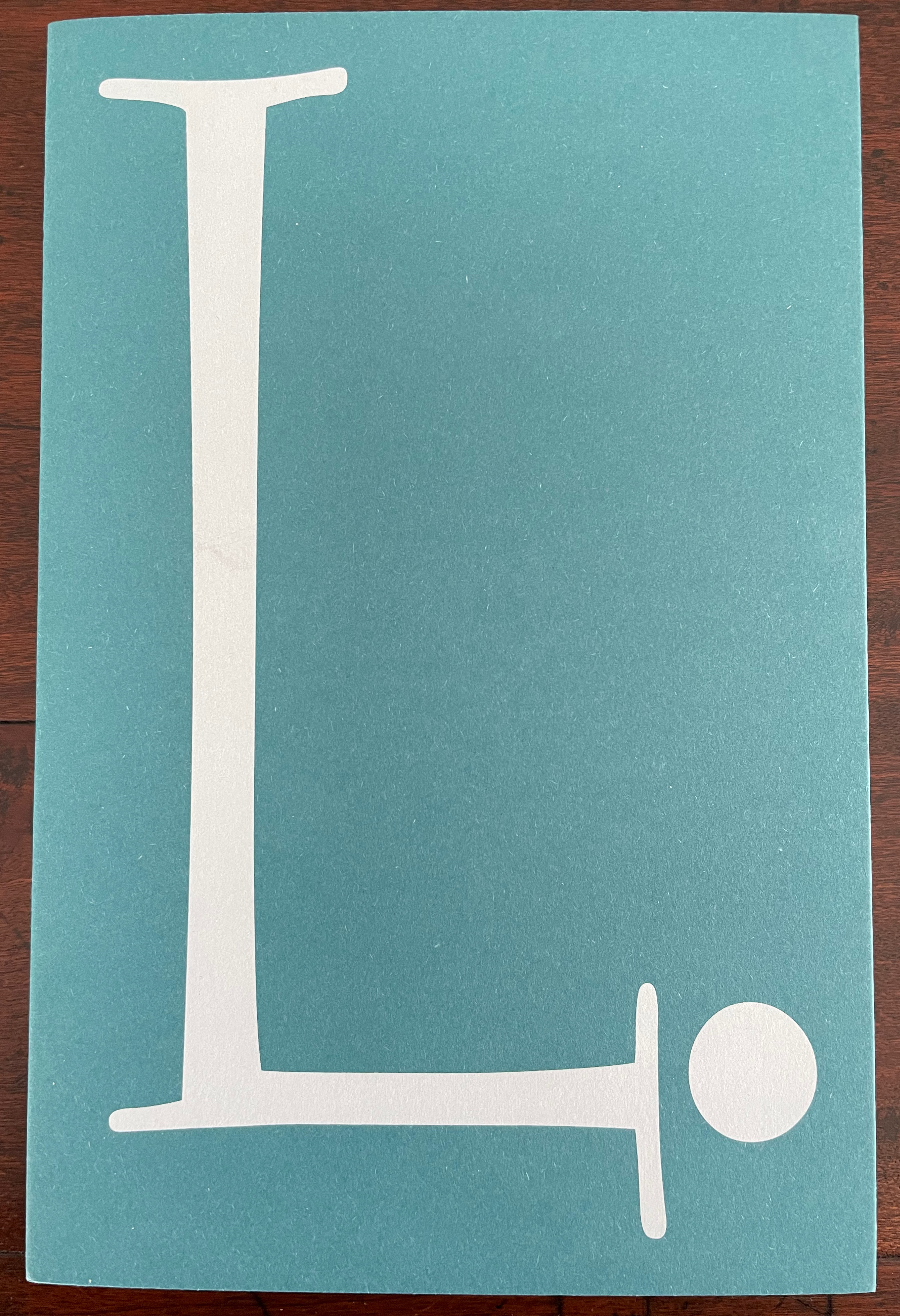
A Die With Twenty-six Faces (2019)
Louis Lüthi
Paperback. H200 x W130 mm. 104 pages. Acquired from Amazon, 18 September 2022.
Photos: Books On Books Collection

Walter Benjamin’ unpacking of his library has a lot to answer for. Not only do we have Buzz Spector‘s take on it in 1995, but Jo Steffens’ Unpacking trilogy of photos of architects’, artists’ and writers’ bookshelves, Alberto Manguel’s elegiac Packing My Library (2018), and here is Louis Lüthi’s.

Publisher’s website: In A Die with Twenty-Six Faces, the author — let’s call him L. — guides the reader through his collection of alphabet books, that is, books with letters for titles. Some of these titles are well known: Andy Warhol’s “a,” Louis Zukofsky’s “A”, Georges Perec’s W. Others are obscure, perhaps even imaginary: Zach Sodenstern’s A, Arnold Skemer’s C and D. Tracing connections between these books, L. elaborates on what the critic Guy Davenport has called the “Kells effect”: “the symbolic content of illuminated lettering serving a larger purpose than its decoration of geometry, imps, and signs.”
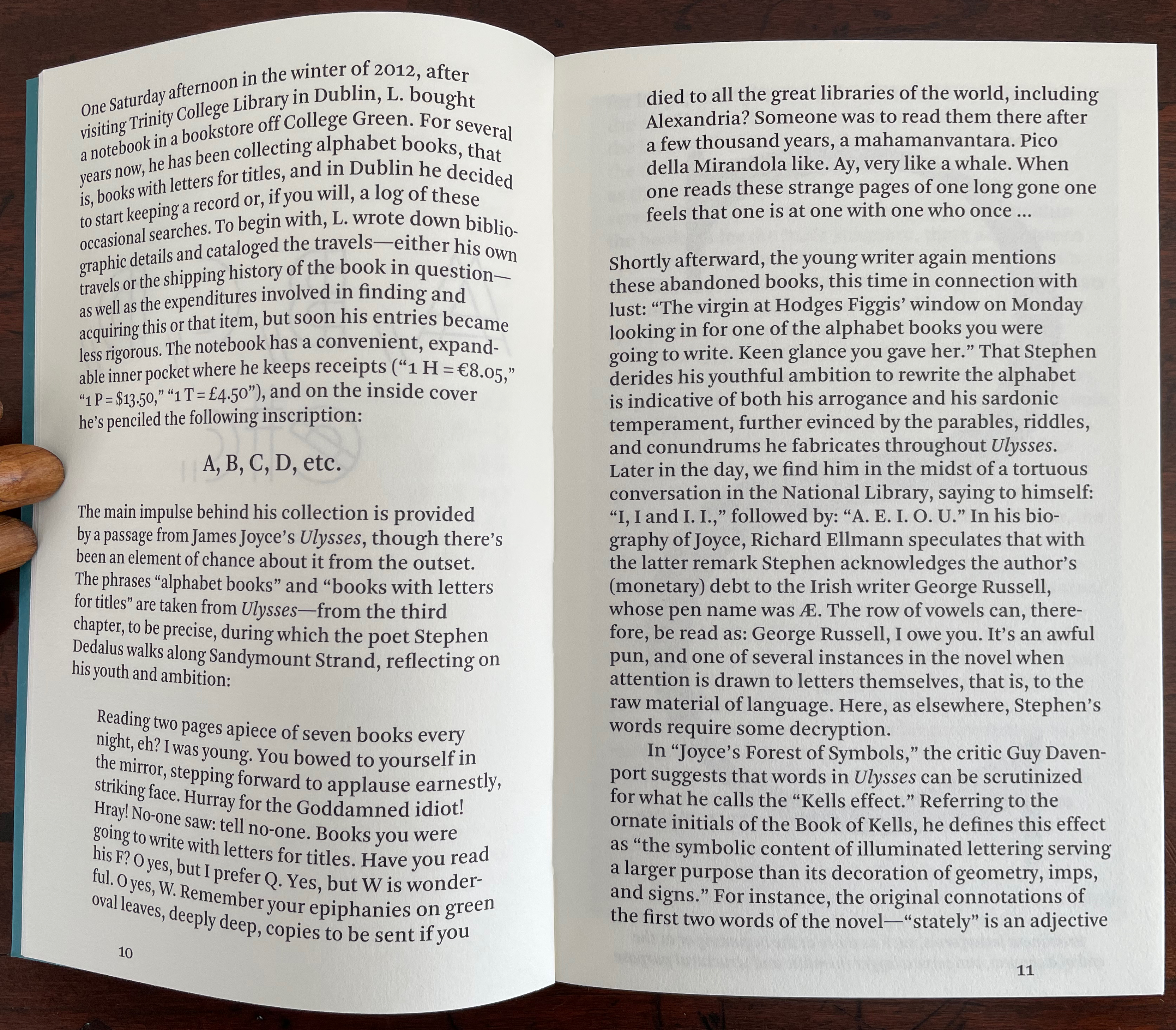
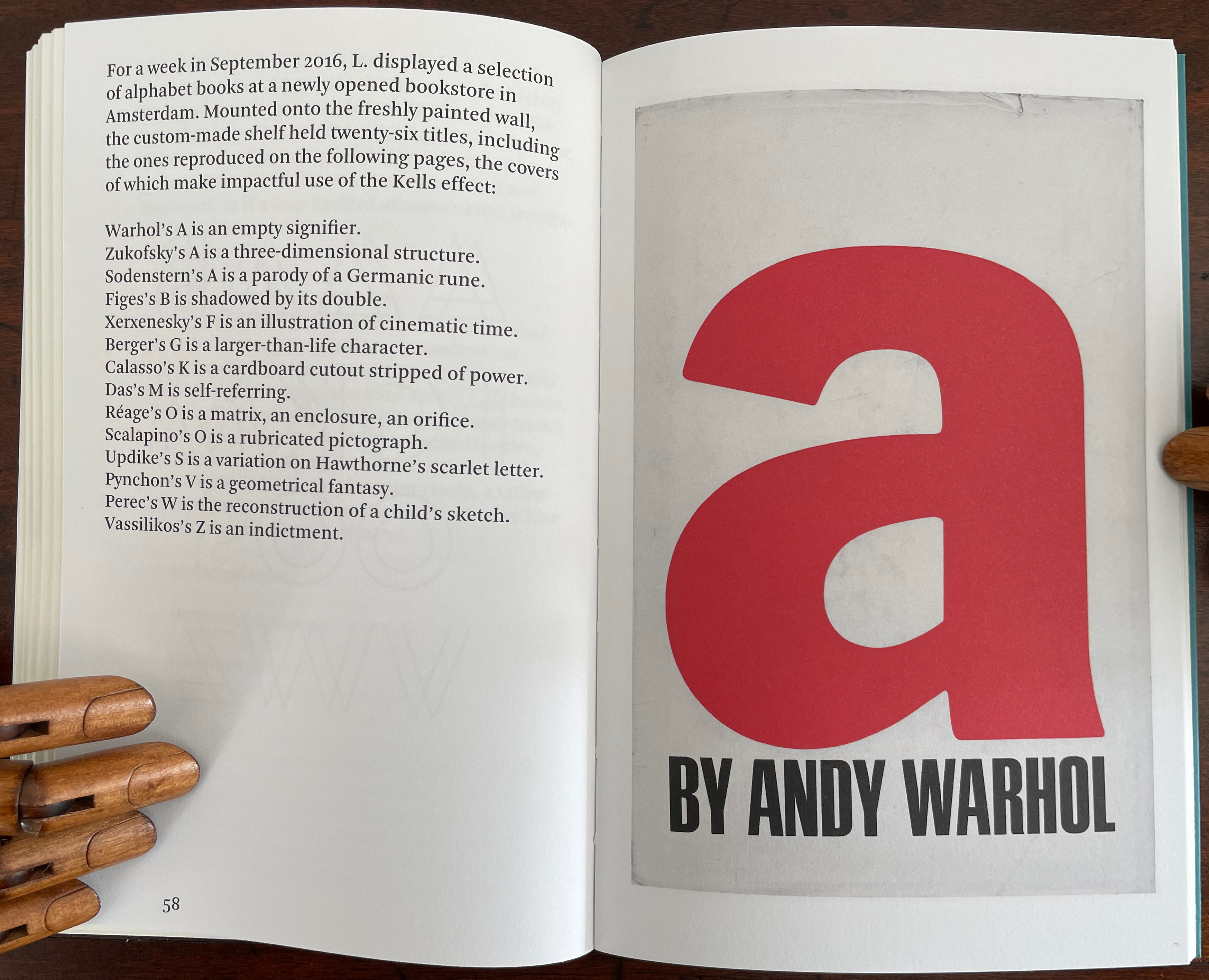
The title stirs thoughts of Marcel Broodthaers’ oracular statement in 1974 “I see new horizons approaching me and the hope of another alphabet”. An alphabet that unrolls across the twenty-six faces of a die would certainly qualify as another alphabet. Broodthaers and the die also stir thoughts of Stéphane Mallarmé’s Un Coup de Dés Jamais N’Abolira le Hasard to which Broodthaers paid repeated homage. Throwing a twenty-six-sided die would certainly no more abolish chance than would a roll of Mallarmé’s six-sided die. Lüthi’s game, however, has little to do with chance unless we count his luck in finding the works to build his library of single-letter-entitled books. Even less to do with luck if some of the library is fictitious, a likelihood that the “publisher’s” statement suggests. Lüthi’s die is loaded!
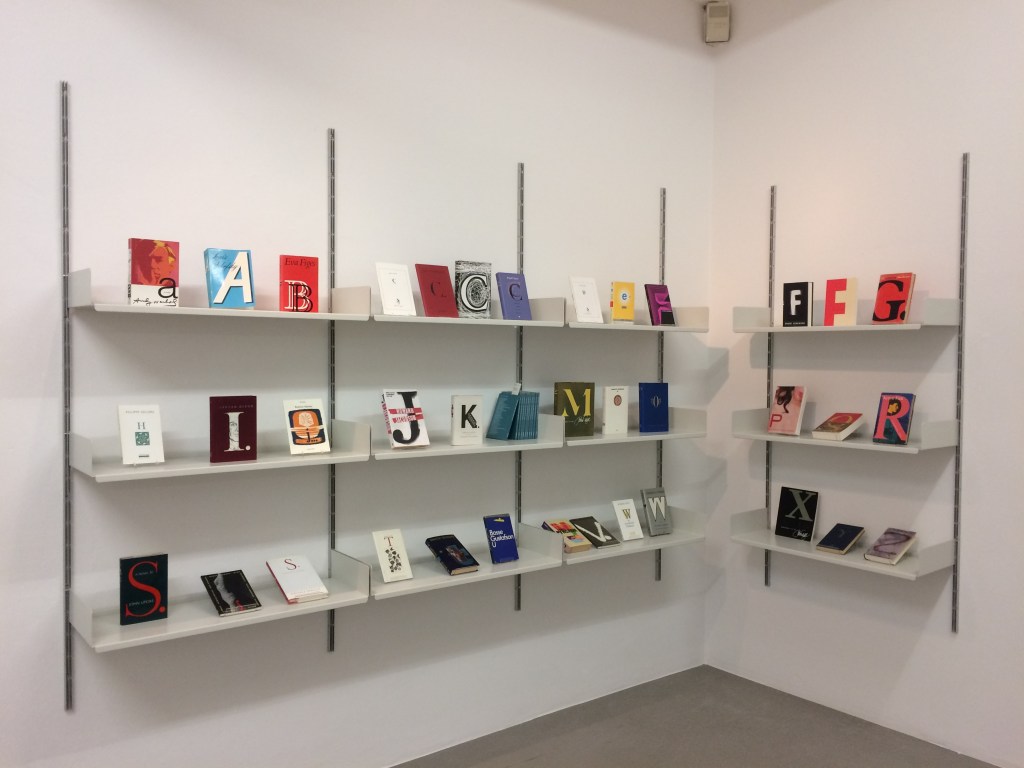
A selection of Lüthi’s “alphabet” books on display. Courtesy of the author.
Photo: Gesellschaft für Aktuelle Kunst Bremen

On the Self-Reflexive Page II (2021)

On the Self-Reflexive Page II (2021)
Louis Lüthi
Paperback. H200 x W130 mm. 304 pages. Acquired from Idea Books, 18 September 2022.
Photos: Books On Books Collection.

This is a peculiar book in its order and nature. After two variant half-title pages, it begins with a section entitled “Black Pages”. Only on flipping through the volume can we find the remaining front matter — just after page 208. There’s another half-title and then the Table of Contents. Reproducing the marbled page from Laurence Sterne’s The Life and Opinions of Tristram Shandy, Gentleman (1759–1767), the book’s cover gives a clue to this peculiarity. Sure enough, Lüthi spells it out later in the section entitled “On Drawing Pages”.

So much in Tristram Shandy is presented out of order: a second dedication comes not after the first but on page 27, the preface is not at the beginning of the novel but in chapter 20 of volume three, and chapters 18 and 19 of volume nine come not after chapter 17 but are inserted after chapter 25. In a similar act of transposition, we find a marbled page in volume three, even though hand marbling is customarily used to decorate covers and endpapers. As Viktor Shklovsky observed, “It is precisely the unusual order of even common, traditional elements that is characteristic of Sterne.” (p. 240)

This one paragraph confers on Lüthi’s entire book the very self-reflexivity that it explores across a range of literature and artists’ books. Reflecting the custom to which it refers, On The Self-Reflexive Page II carries Sterne’s marbled pages on its front and back covers. In the text before his marbled leaf, Sterne refers to it as the “(motly emblem of my work!)“. Lüthi has taken that exclamation to heart (and cover) as if it were advice in creating this hybrid, motley work of his own: “part artist’s book and part essay, part literary excavation and part typographical miscellany” as he calls it in his middle-of-the-book Foreword.

Lüthi’s work is just one in the Books on Books collection of several inspired by Tristram Shandy. There is Erica Van Horn’s Born in Clonmel (2011), Simon Morris’ Do or DIY (2012), Abra Ancliffe’s The Secret Astronomy of Tristram Shandy (2015), and Shandy Hall‘s The Black Page Catalogue (2010), Emblem of My Work (2013), Paint Her To Your Own Mind (2018) and The Flourish of Liberty (2019). Outside the collection, there is Brian Dettmer’s Tristram Shandy (2004), commissioned by Shandy Hall’s Laurence Sterne Trust, and also Sean Silver’s Shandean online venture called The Motley Emblem (2022~) celebrating Sterne’s marbled leaf and the analytical chemistry of marbling. The latter may become a book, even an artist’s books to add to the tally. In The Century of Artists’ Books, Johanna Drucker draws attention to Sterne’s novel twice as an example of self-reflexivity or self-interrogation, but in 1994 and 2004, Sterne did not rise to the same level of precursor to book artists as William Blake or Stéphane Mallarmé in Drucker’s view. With these later works of book art inspired by Uncle Toby’s nephew in the bag, a dozen or so more might nudge Sterne up the scale.

In the meantime, anyone interested in artists’ books could fruitfully apply to the medium Sterne’s exhortation to his own readers:

Read, read, read, read, my unlearned reader! read, — or by the knowledge of the great faint Paraleipomenon — I tell you before-hand, you had better throw down the book at once; for without much reading , by which your reverence knows, I mean much knowledge, you will no more be able to penetrate the moral of the next marbled page (motly emblem of my work!) than the world with all its sagacity has been able to unraval the many opinions, transactions and truths which still lie mystically hid under the dark veil of the black one.

Artists’ books are to be read, handled and digested, not stored away in the archives.

Further Reading

The First Seven Books of the Papier Biënnale Rijswijk“. 10 October 2019. Books On Books Collection.

Maureen Richardson“. 28 September 2019. Books On Books Collection.

Silver, Sean. 2022~. The Motley Emblem. Rutgers: Rutgers University. A website that celebrates Sterne, paper marbling and much more related to them.

Books On Books Collection – J. J. Abrams & Doug Dorst

S: Ship of Theseus (2013)

S: Ship of Theseus by V.M. Straka (2013)
J.J. Abrams and Doug Dorst
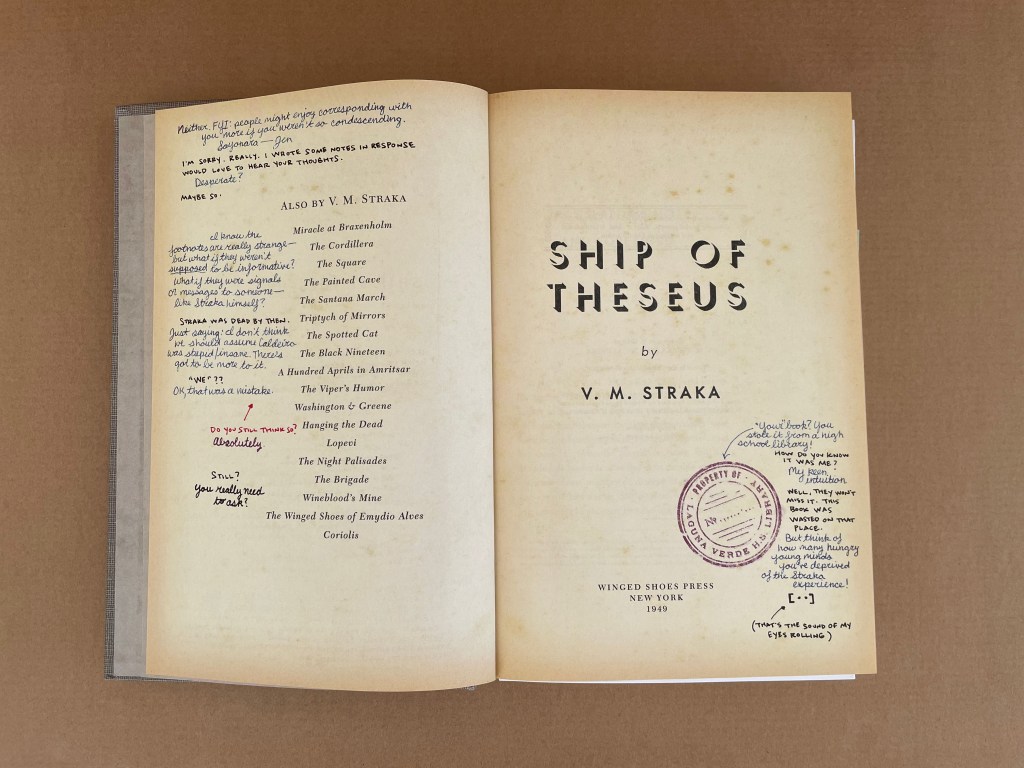
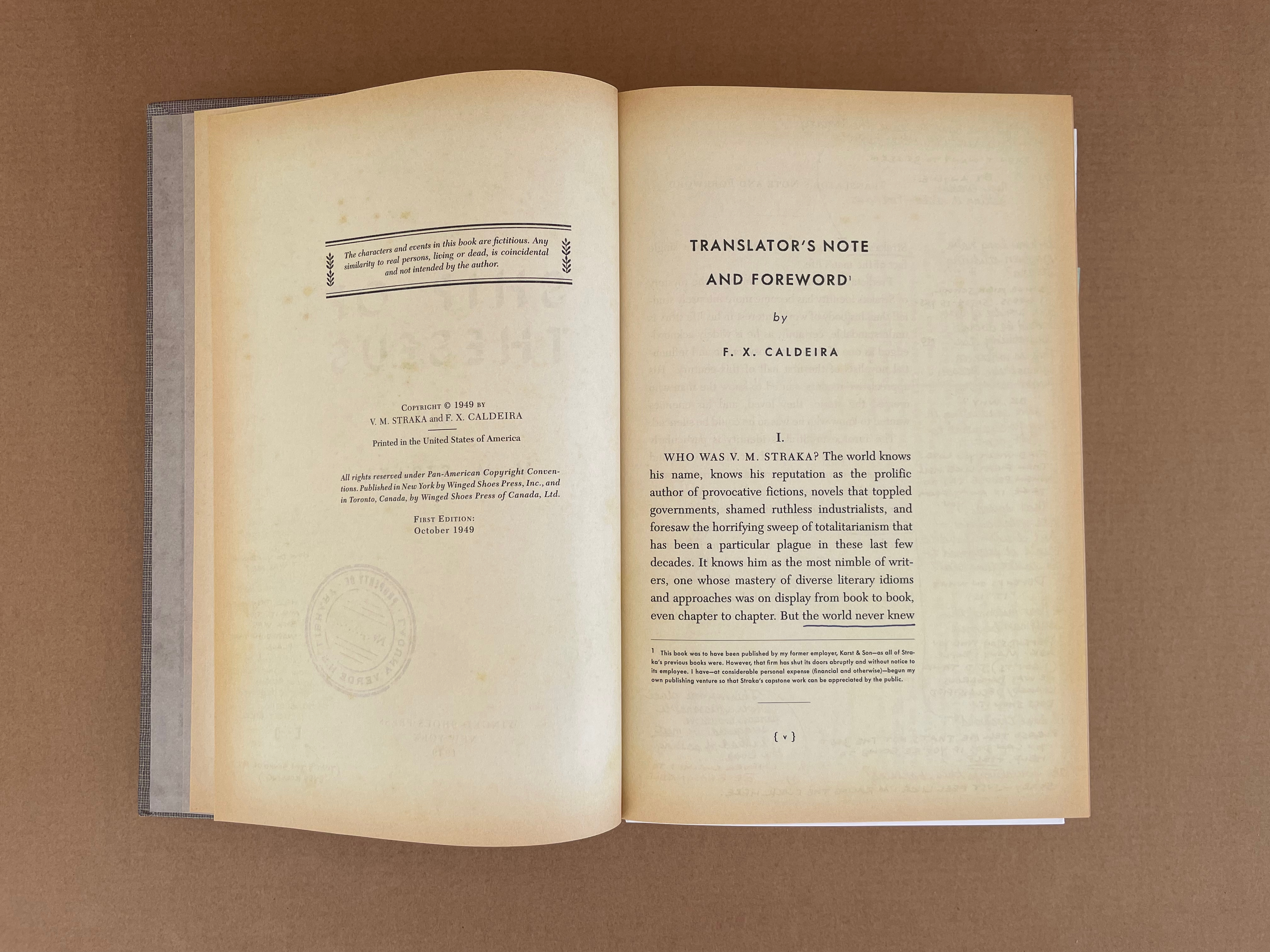
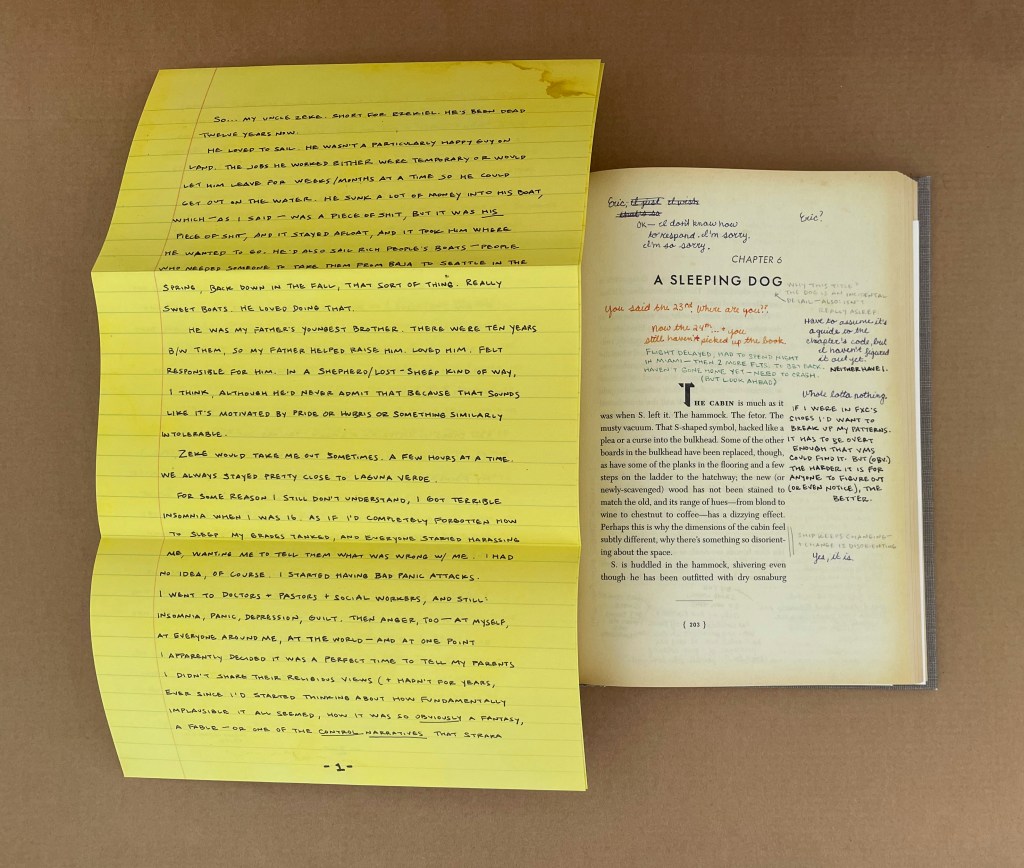
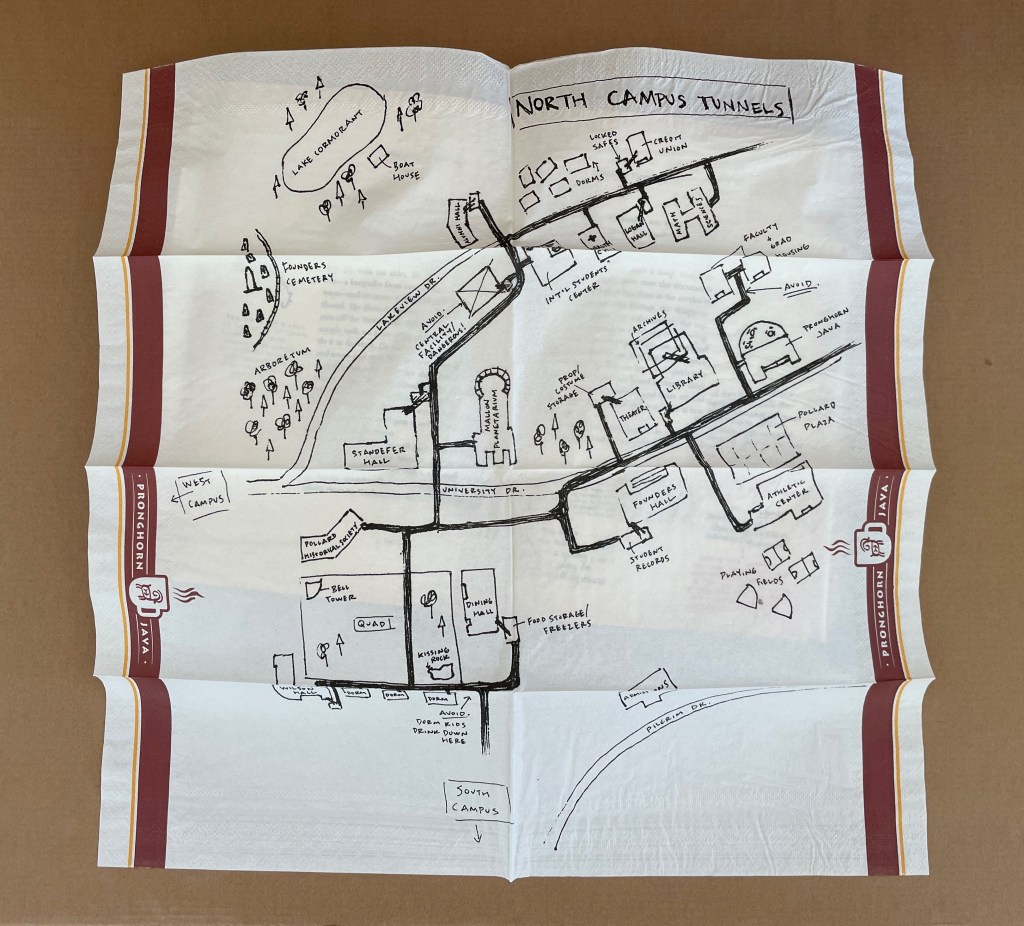
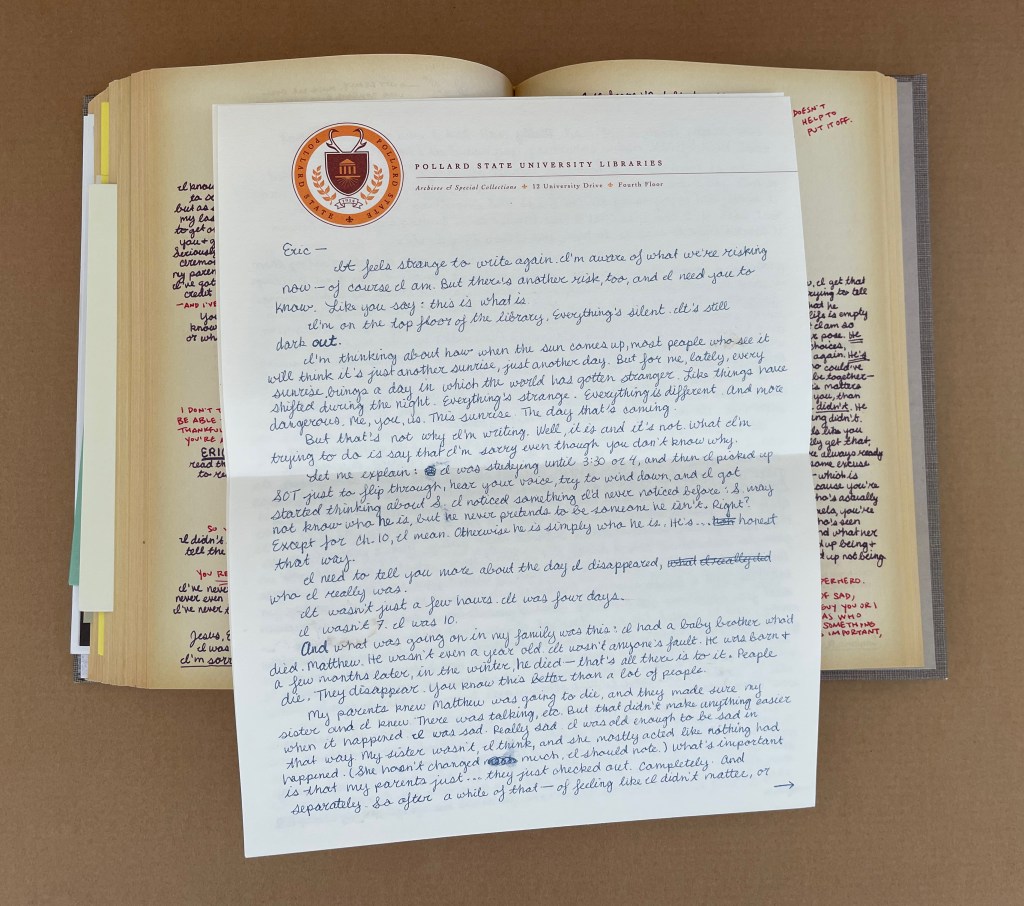
Printed card slipcase. Casebound stamped and printed cloth over boards, gray doublures, yellow head- and endbands. H242 x W162 mm. 472 pages. 22 inserts (postcards, photocopies, photo, prayer card, circular cipher device, campus café napkin, etc.). Acquired from AbeBooks, 5 March 2024.
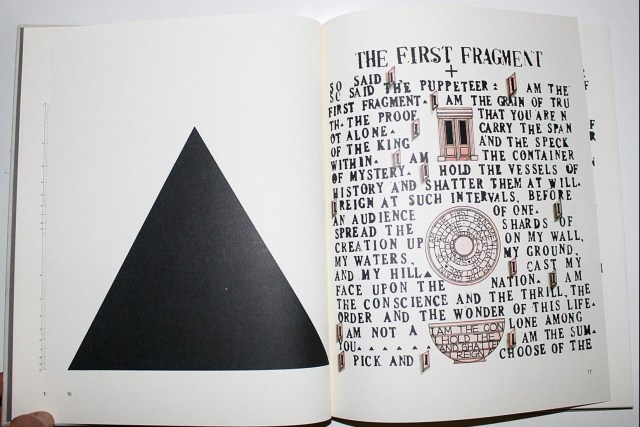
Photos: Books On Books Collection.

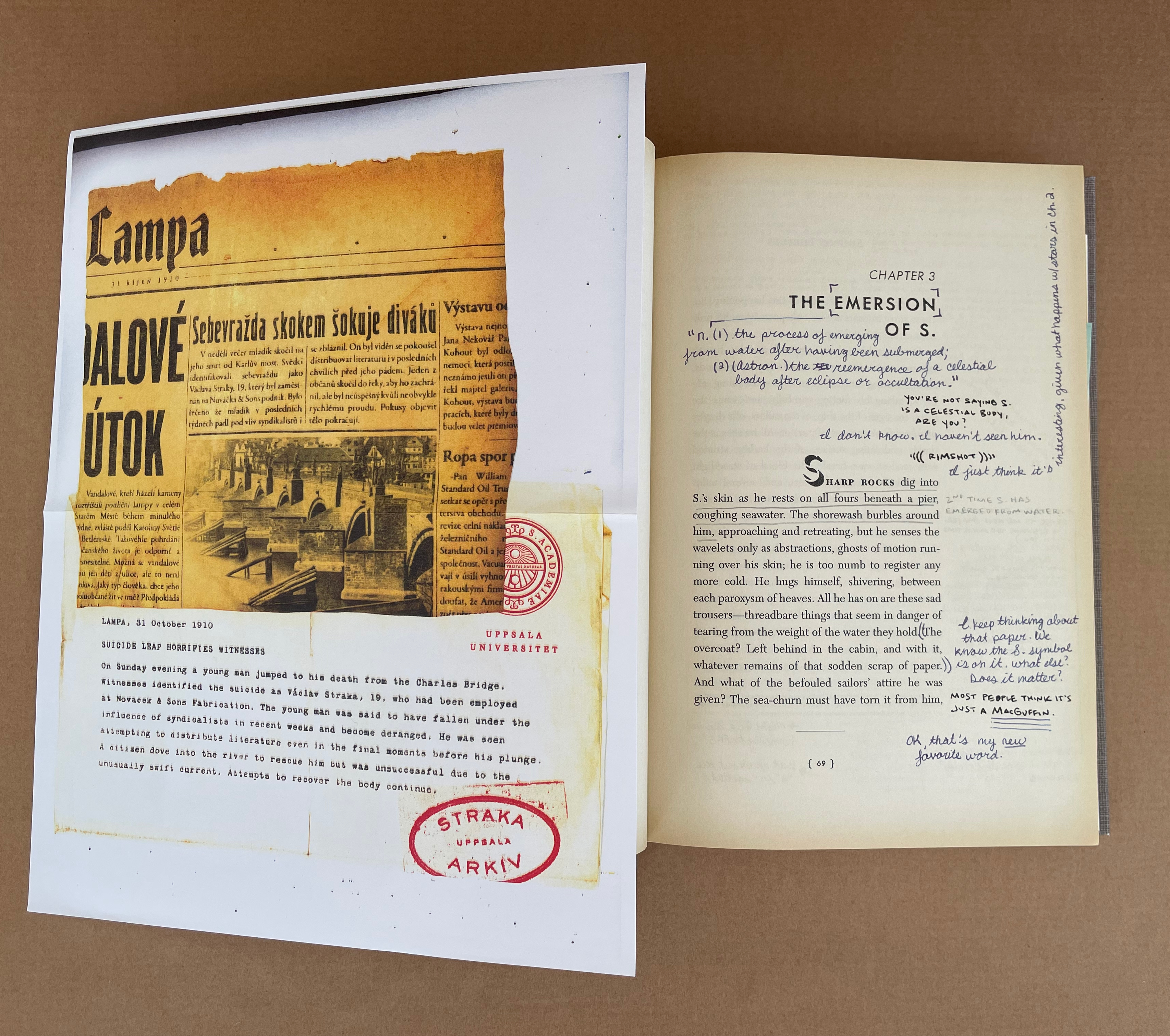
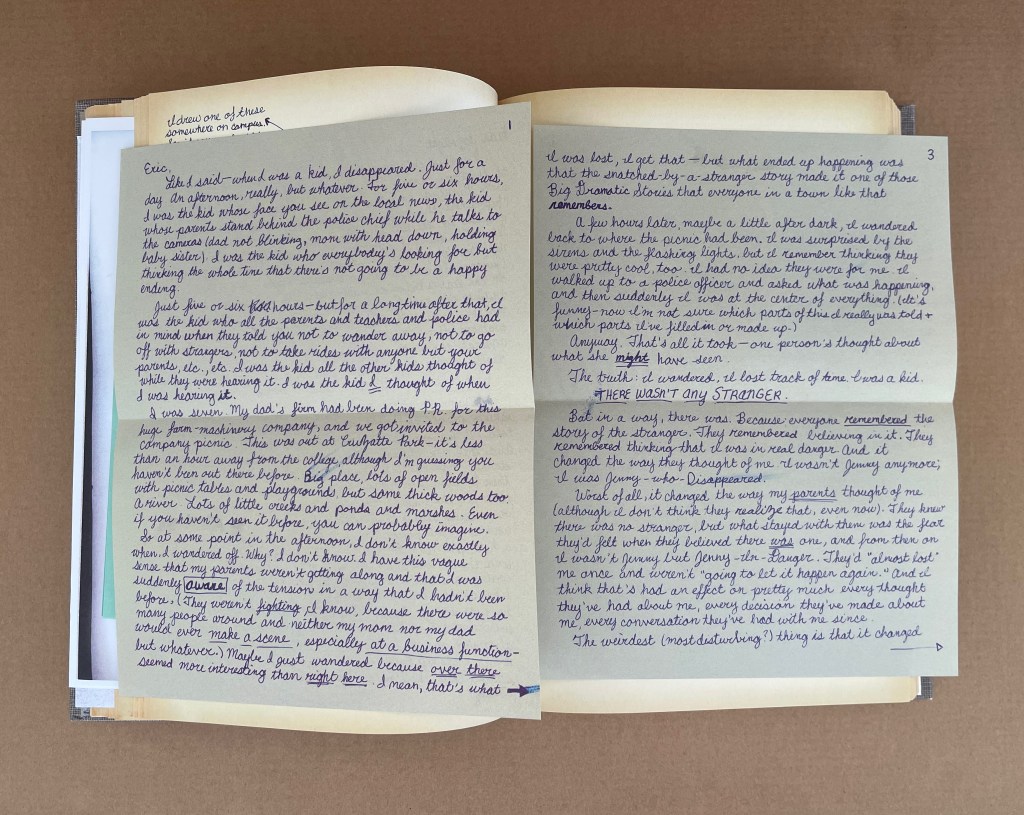
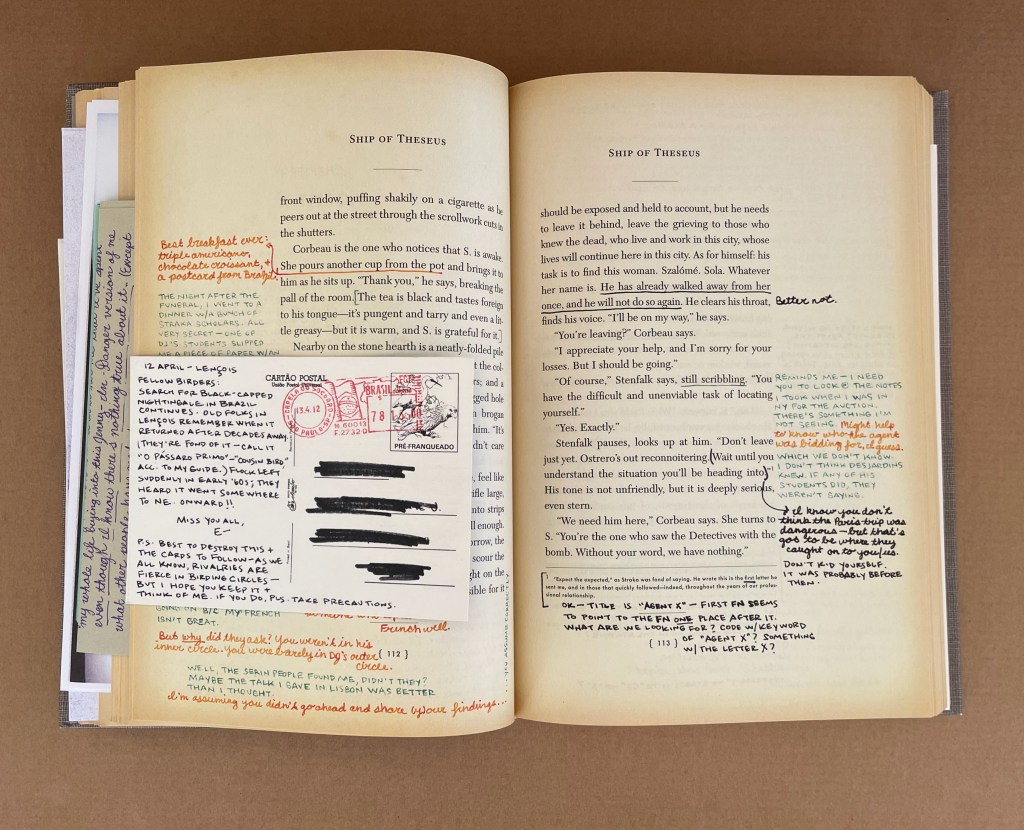
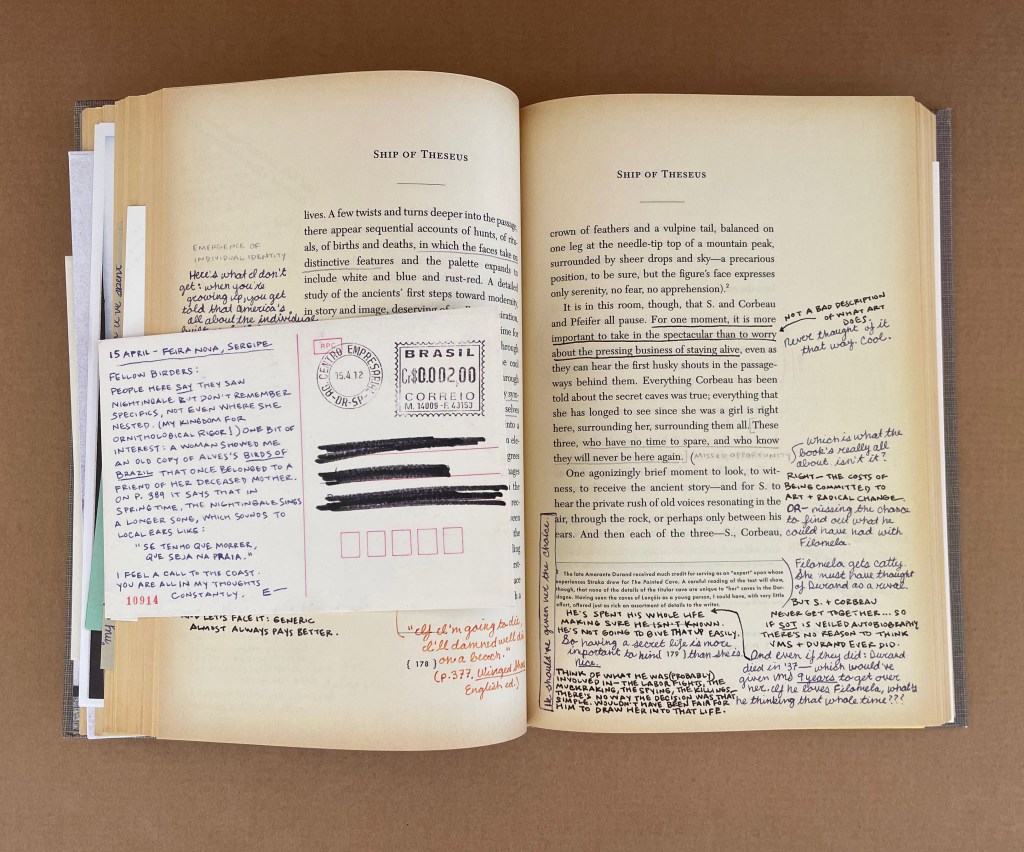
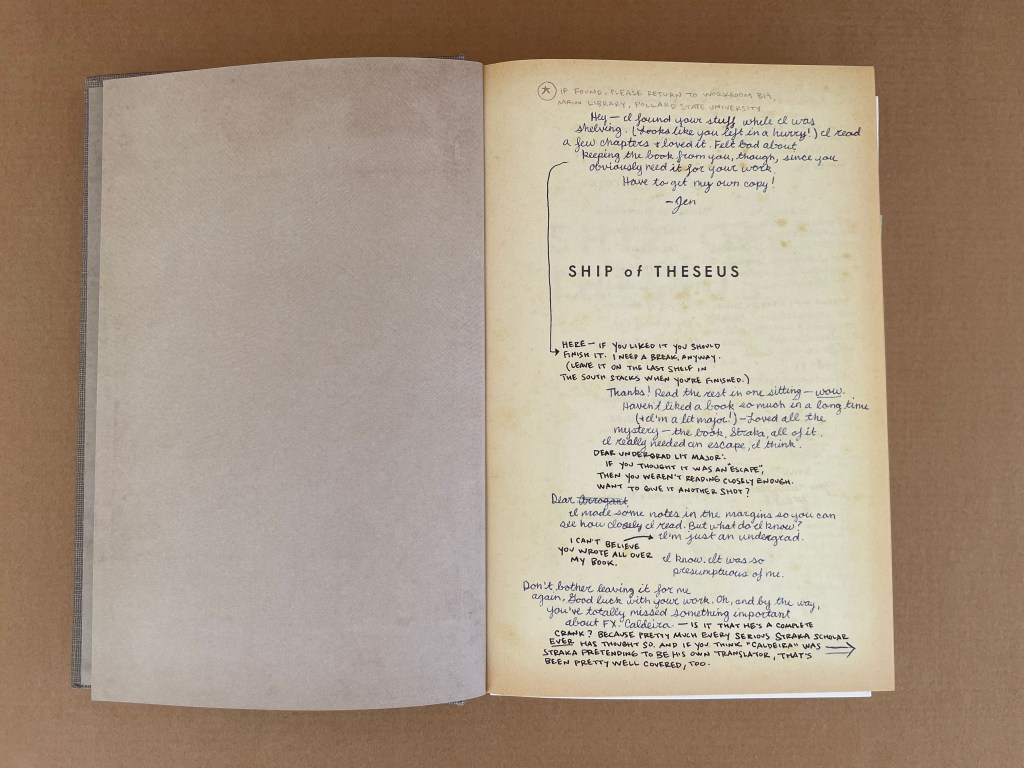
A young woman picks up a book left behind by a stranger. Inside it are his margin notes, which reveal a reader entranced by the story and by its mysterious author. She responds with notes of her own, leaving the book for the stranger, and so begins an unlikely conversation that plunges them both into the unknown. The book: Ship of Theseus, the final novel by a prolific but enigmatic writer named V.M. Straka, in which a man with no past is shanghaied onto a strange ship with a monstrous crew and launched onto a disorienting and perilous journey. The writer: Straka, the incendiary and secretive subject of one of the world’s greatest mysteries, a revolutionary about whom the world knows nothing apart from the words he wrote and the rumors that swirl around him. The readers: Jennifer and Eric, a college senior and a disgraced grad student, both facing crucial decisions about who they are, who they might become, and how much they’re willing to trust another person with their passions, hurts, and fears.— Publisher’s description on the slipcase.

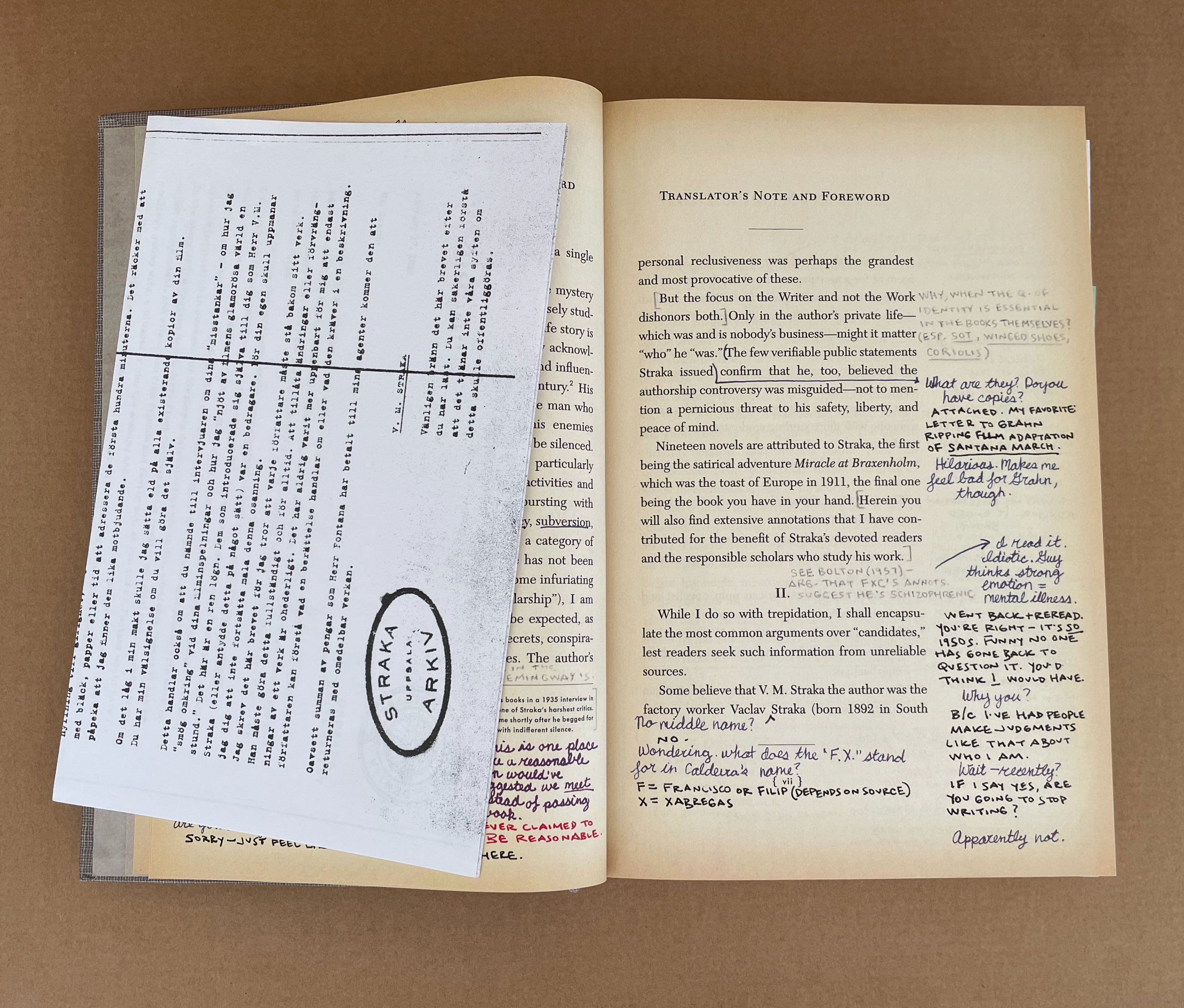
Most of the reviewers’ and libraries’ summaries of Ship of Theseus describe it as a traditional narrative with a second story in the form of marginal notes, letters and objects left by two readers of the main narrative, but I count five, possibly six, narrative lines or plots in this strange book. First is the story of the main character “S”, the shanghaied man with no past. Second is the story of the author V.M. Straka and his mysterious identity told by the fictitious translator F. X. Caldeira in his “Translator’s Note and Foreword” and footnotes. Third is the story of the two readers, Jennifer Heyward and Eric Husch, and their pursuit of Straka’s identity and his novel’s “meaning”. Fourth is Jennifer’s and Eric’s personal narratives of their academic lives to be found in their notes and left objects. Fifth is their love story that unfolds in the margins and objects as they discover each other’s identity and share their stories.

As for the sixth, in his Bibliography and the Sociology of Texts (1986), the scholar D.F. McKenzie writes: “every book tells a story quite apart from that recounted by its text”. Of course, McKenzie means the historical and social story told by the font, typesetting, binding, paper and so on. So the story of the production of Ship of Theseus would be its sixth narrative to be deduced from the book as object. Fortunately, Abrams and Dorst were interviewed in 2013 by Joshua Rothman in The New Yorker and told him a large part of that story. Sociologists of the book will revel in Abrams’ comparison of the book’s creation with that of a screenplay and movie, and they will marvel that, with all of its of seemingly one-off insertions and its realistic appearance as a used library book, it was produced as a trade book. A decade later, there are still copies available for purchase online. Speaking of online, S: Ship of Theseus has its own Wikipedia page and countless fan sites (academic and non-academic).

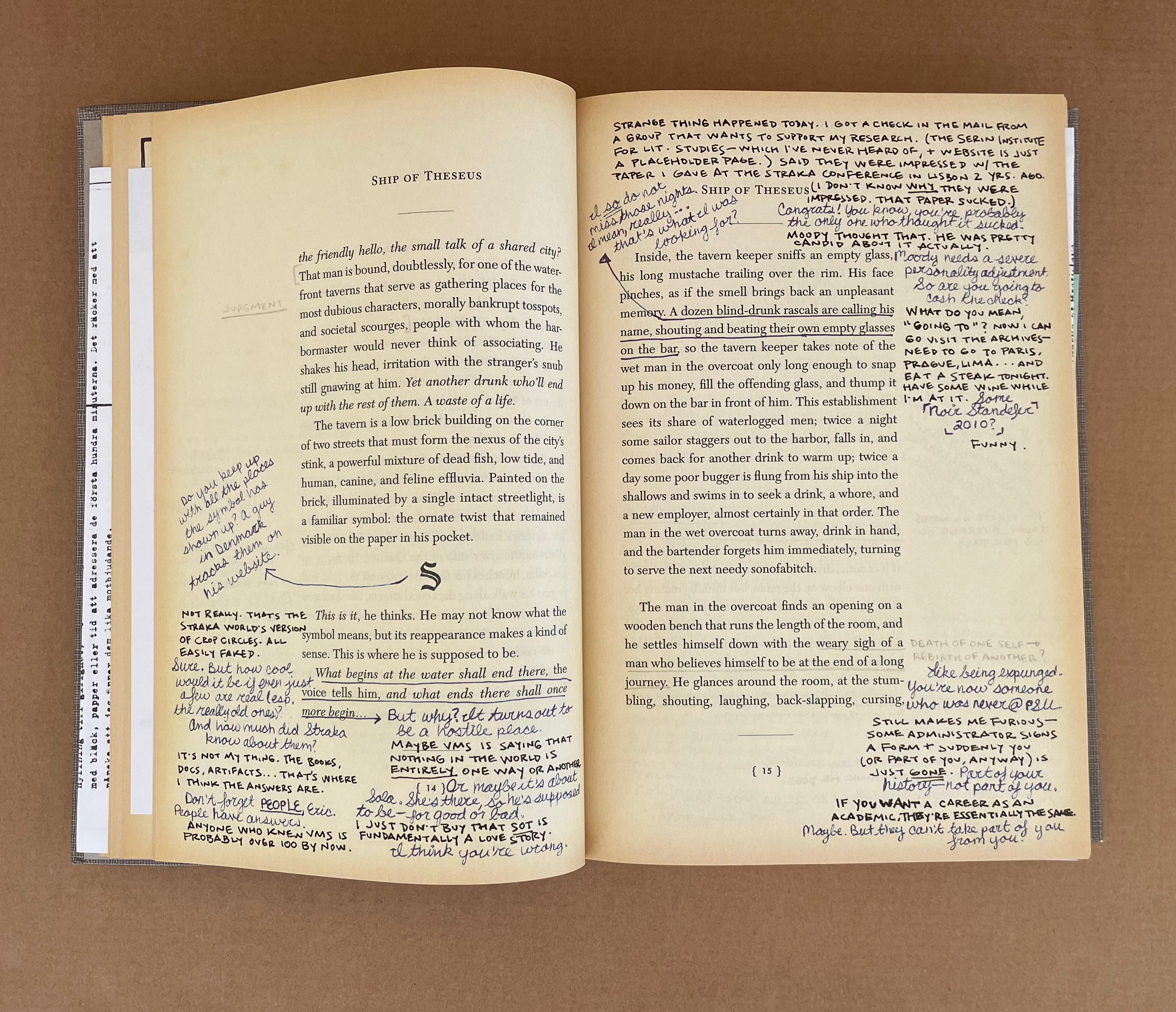
Like many artist’s books, S; Ship of Theseus has layers of self-referentiality “interrogating” the nature of the Book. Like many artist’s books, it challenges the act of reading — in this case with narrative frames, parallel color-coded narratives and objects of evidence each related to different narratives. The verisimilitude of its inserts and used-book appearance speaks to levels of craft and craftiness offered by many limited-edition works of book art. Like many artist’s books, it is the result of an intricate collaboration. But somehow it bulges the genre of the artist’s book.

After acquiring it, I came across Brian Davis’ two essays for the College Book Arts Association, which comment on S: Ship of Theseus. He must have felt the same “bulge” and found a sufficient number of similar works to coin a name for them: “Multimodal Book-Archives”. Yes, more academic jargon, but with a genre of art that has had its troubles with apostrophes and coinages such as “bookwork”, can we complain? Probably not, but we can cavil.

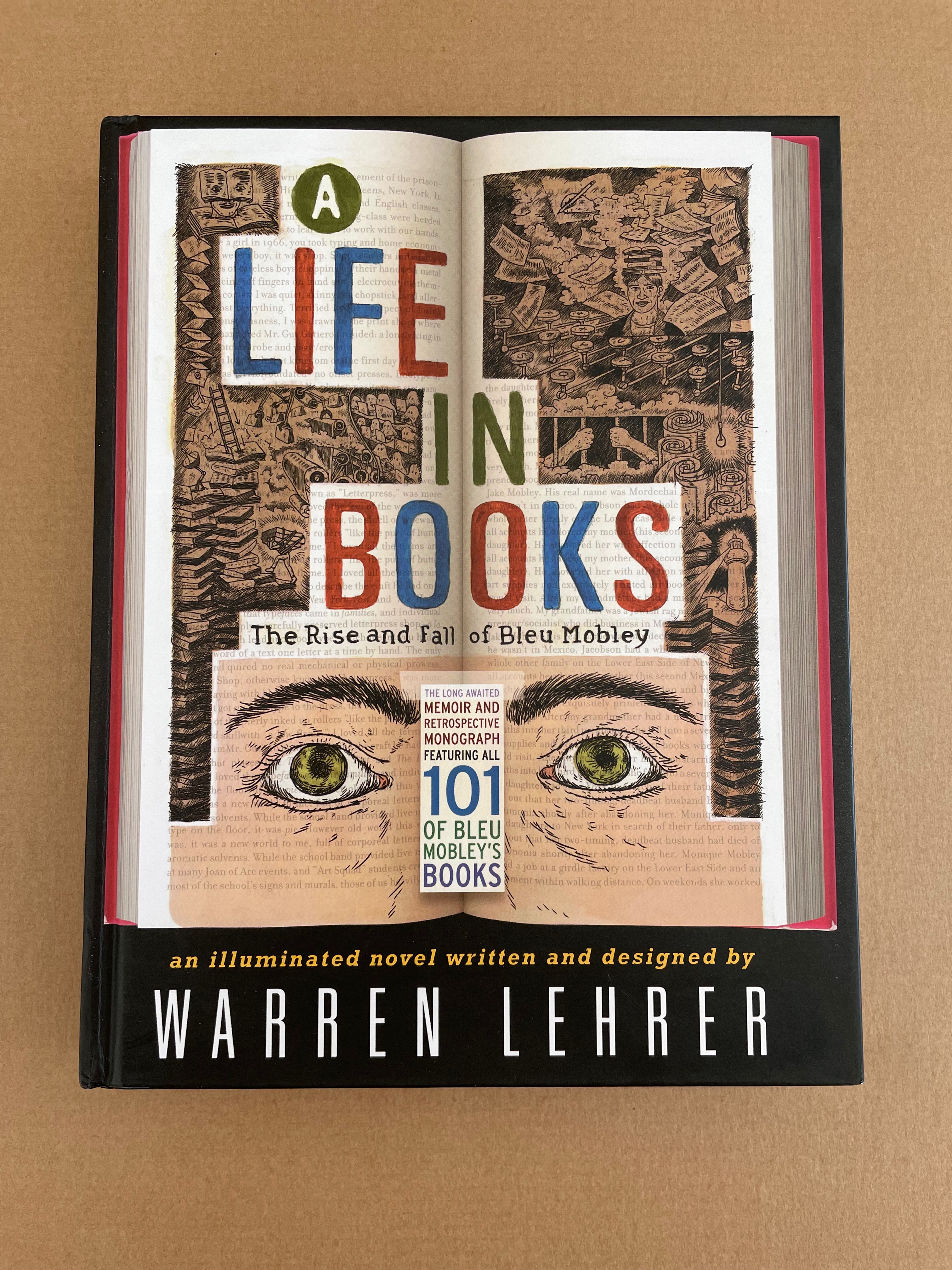
“Archives”can be temporally and spatially open ended without even hinting at boundedness. Works like S: Ship of Theseus and Warren Lehrer’s A Life in Books (2013), among others, do seem to “exploit the material and expressive possibilities of the book” through documentation, curation or compilation and preservation of artifacts. These two works, however, have not only a trade book boundedness, even allowing for loose inserts, but also a sense of narrative closure that makes “archives” not quite on the money. Faced with an artist’s book relying on narrative framing, documentation, and loose artifacts, we usually fall back on the terms of collage and assemblage to describe them, but then neither of the two examples has the pasted-down single view of collage or the sometimes disjointedness of assemblage.

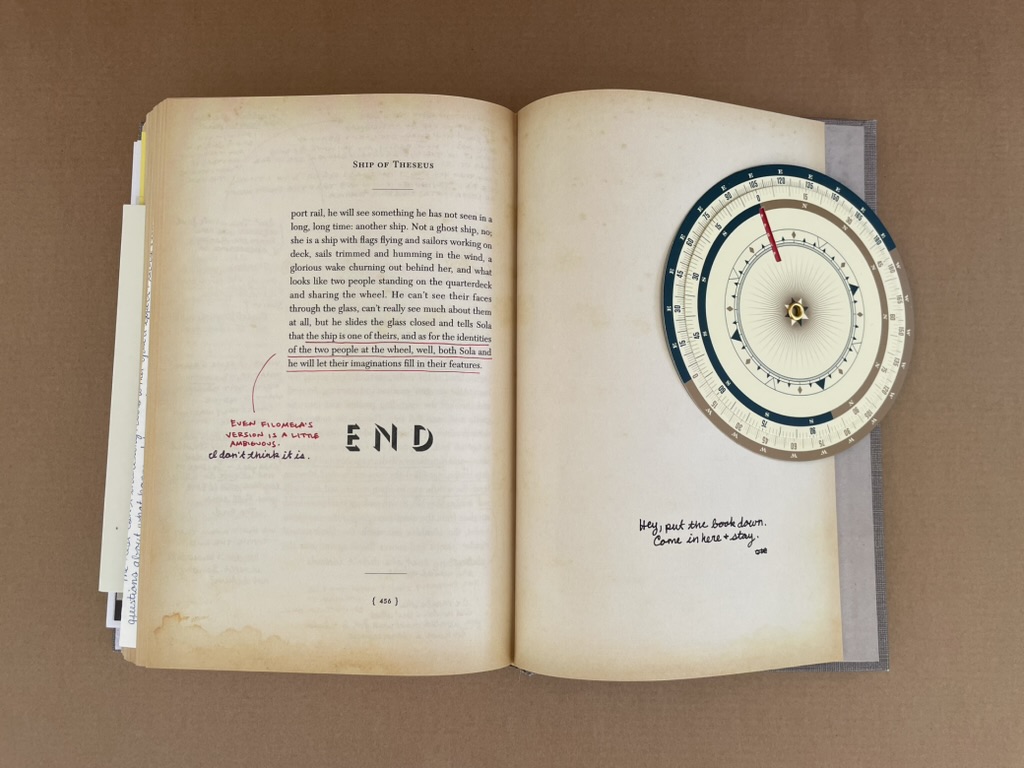
Narrative closure: “END” and “Hey, put the book down. Come in here & stay.”

“Archives” may not hit the mark, but Davis is right that these two works are multimodal. And/or, maybe they are instances of Dick Higgins’ “intermedia”, in which case I am reminded of his closing caveat:

And with this I would leave the matter of intermedia. It is today, as it was in 1965, a useful way to approach some new work; one asks oneself, “what that I know does this new work lie between?” But it is more useful at the outset of a critical process than at the later stages of it. Perhaps I did not see that at the time, but it is clear to me now. Perhaps, in all the excitement of what was, for me, a discovery, I overvalued it. I do not wish to compensate with a second error of judgment and to undervalue it now. But it would seem that to proceed further in the understanding of any given work, one must look elsewhere—to all the aspects of a work and not just to its formal origins, and at the horizons which the work implies, to find an appropriate hermeneutic process for seeing the whole of the work in my own relation to it.

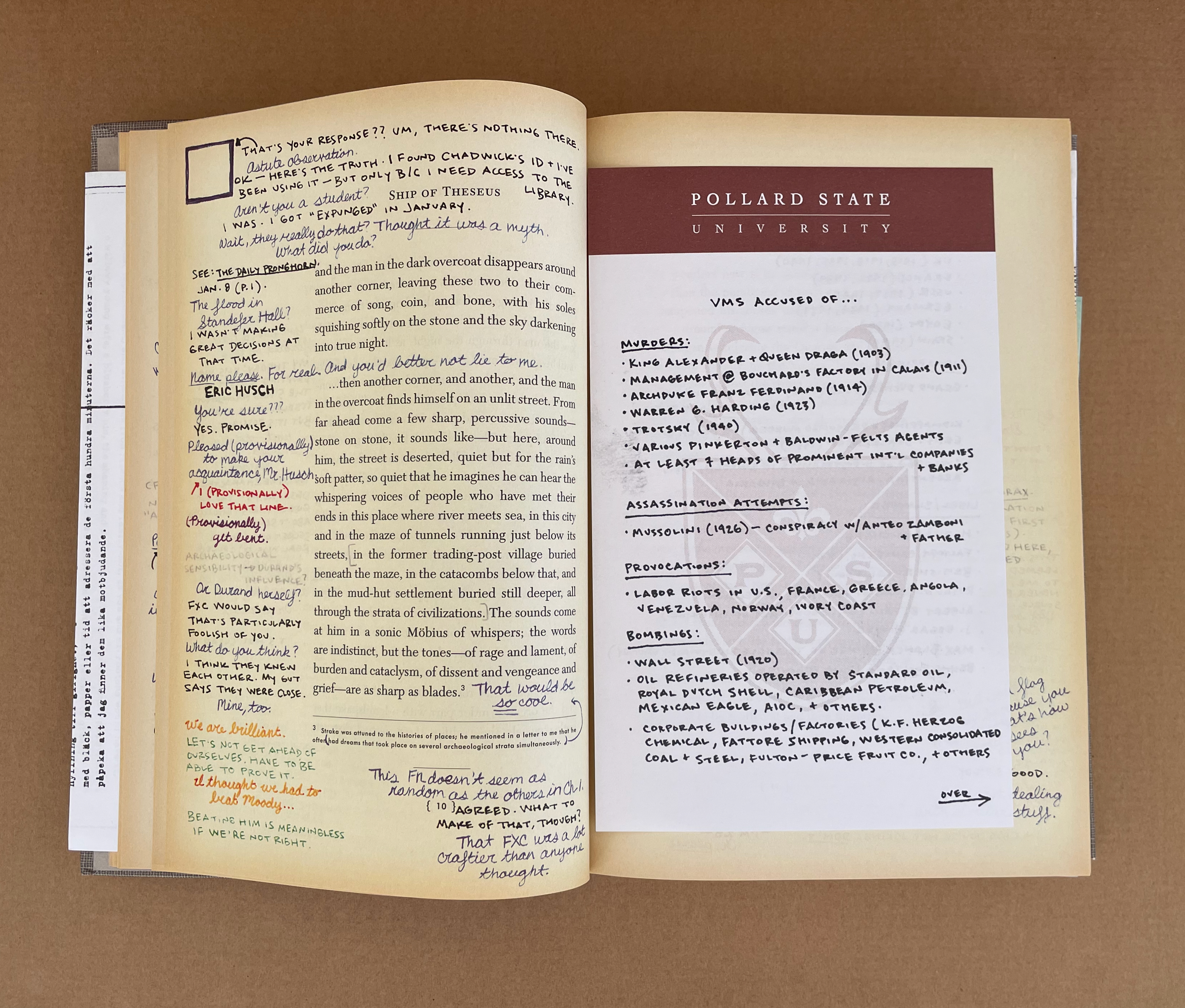
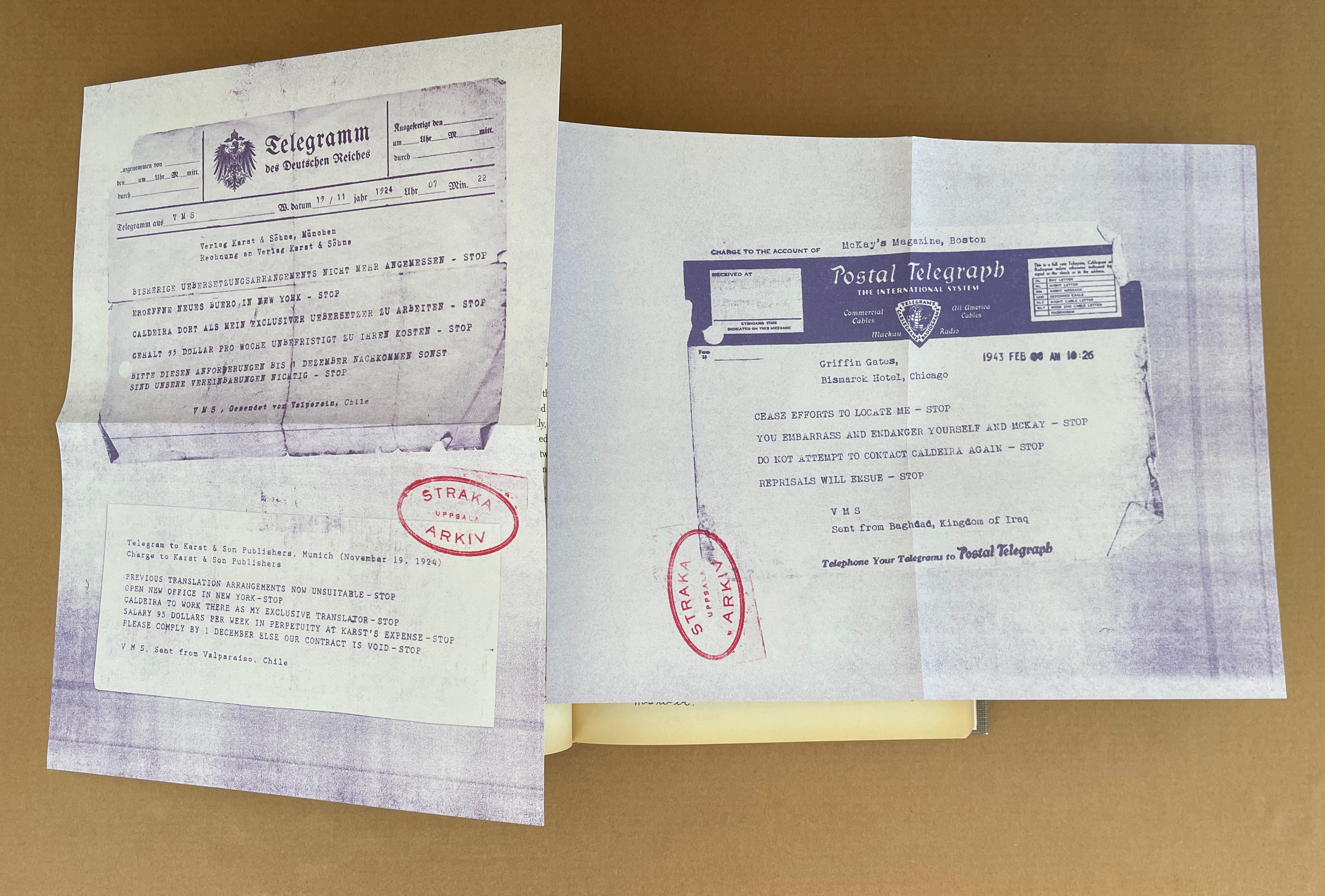
Below are a few images of S: Ship of Theseus and its types of media. Below that is the product of “a poor devil of a Sub-Sub” librarian at the Fleet Library of the Rhode Island School of Design, who took the trouble to list all of the inserts and describe them as well as the features of the slipcase, spine, title page, etc., that contribute to its success.

Konfidentiell letter (2 leaves) [insert between pages viii-ix] + Pollard State University : VMS accused of … (1 leaf) [insert between pages 10-11] + Xerox copy of journal article (1 leaf) [insert between pages 20-21] + Newspaper clipping (2 pages) [insert between pages 32 -33] + Telegram (2 leaves) [insert between pages 54-55] + 1 newspaper clipping/memo (1 leaf) [insert between pages 68-69] + Letter from Desjardins (1 leaf) [insert between pages 86-87] + Letter from Jen (4 pages) [insert between pages 100-101] + 1 Brazil postcard [insert between pages 112-113] + 1 photograph of stone wall [insert between pages 130-131] + 1 Birds of Brazil postcard [insert between pages 178-179] + 1 postcard of palms [insert between pages 190-191] + 1 postcard of a beach [insert between pages 192-193] + 1 Pictorial Brazil postcard (20 April near Marau) [insert between pages 200-201] + So … My Uncle Zeke (5 pages) [insert between pages 202-203] + 1 photograph of woman [insert between pages 242-243] + 1 newspaper clipping within 1 greeting card [insert between pages 256-257] + 1 map on napkin [insert between pages 306-307] + 1 in memoriam card [insert between pages 360-361] + Letter from J (4 pages) [insert between pages 376-377] + Letter from Esmerlinda Pega (1 leaf) [insert between pages 416-417] + 1 decoder wheel [insert between end leaf and pages 3 of cover]. Altered book. Issued in slipcase. Title and statement of responsibility from slipcase.”Bad Robot, Melcher Media.”–Spine of slipcase. Title page and cover title of volume inside slipcase: Ship of Theseus / V.M. Straka. Imprint on title page: Winged Shoes Press, New York, 1949. Title page and page [3] of cover printed with “stamps” of Laguna Verde High School Library; spine includes a Dewey call number label. Includes 23 items purporting to be documents concerning the “author,” V.M. Straka, and his “translator,” F.X. Caldeira from the Straka Arkiv; decoding wheel, letters, postcards and notes by the “readers,” Jennifer and Eric; and other related materials.Marginalia printed in various colors. Description from Fleet Library Special Collections, Rhode Island School of Design.

Further Reading

Warren Lehrer“. 28 May 2024. Books On Books Collection.

Davis, Brian. 1 May 2024. “Part One: The Rise of Multimodal Book-Archives“. Book Art Theory. Starkville, MS: College Book Arts Association.

Davis, Brian. 15 May 2024. “Part Two: Warren Lehrer’s Life in Books“. Book Art Theory. Starkville, MS: College Book Arts Association.

Higgins, Dick and Hannah Higgins. 2001. “Intermedia“. Leonardo 2001; 34 (1): 49–54. Cambridge, MA: MIT Press.

McKenzie, D. F. 1986. Bibliography and the Sociology of Texts. London: British Library.

Rothman, Joshua. 23 November 2013. “The Story of ‘S’: Talking With J. J. Abrams and Doug Dorst“. The New Yorker.

Books On Books Collection – Warren Lehrer

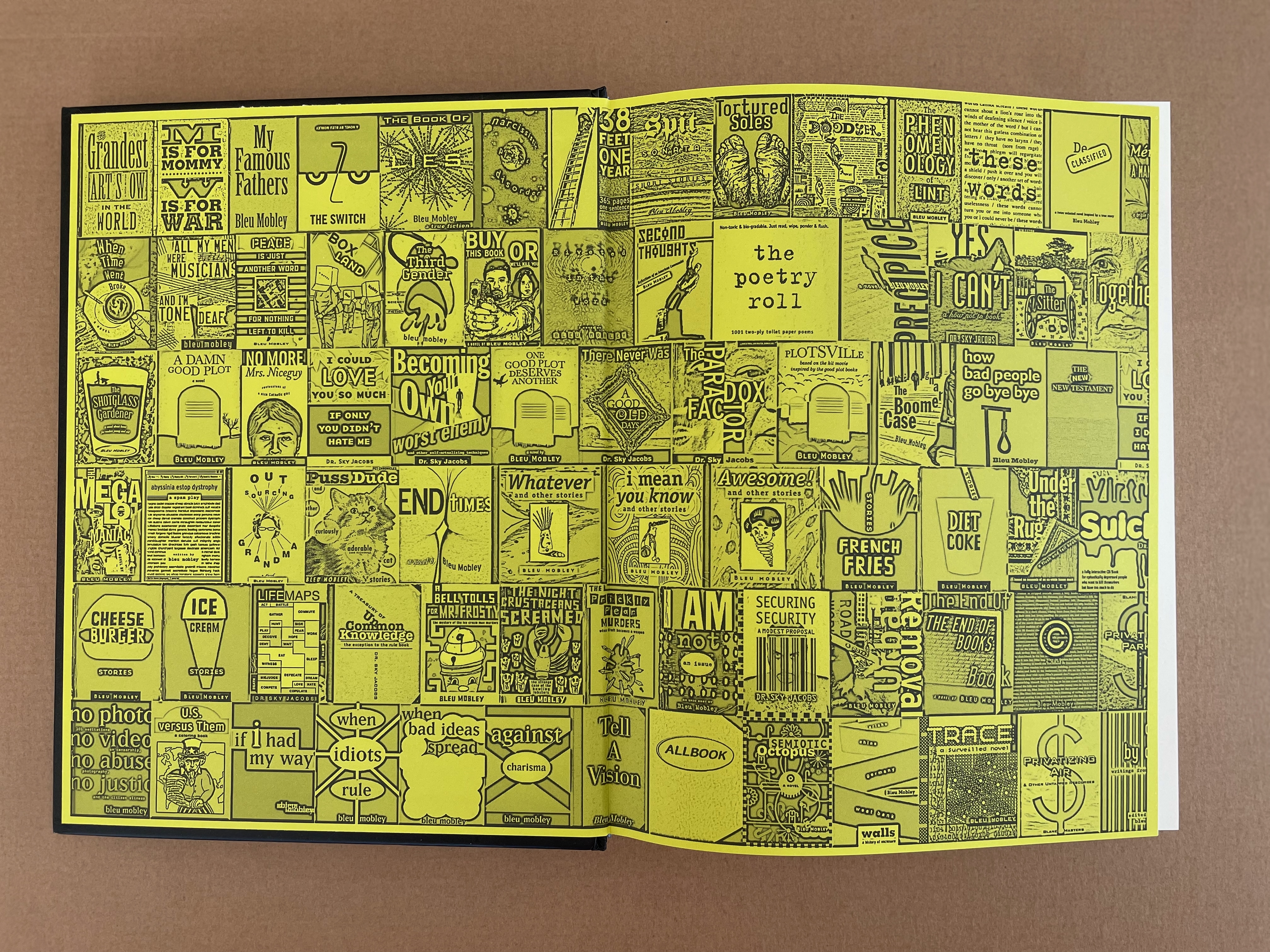
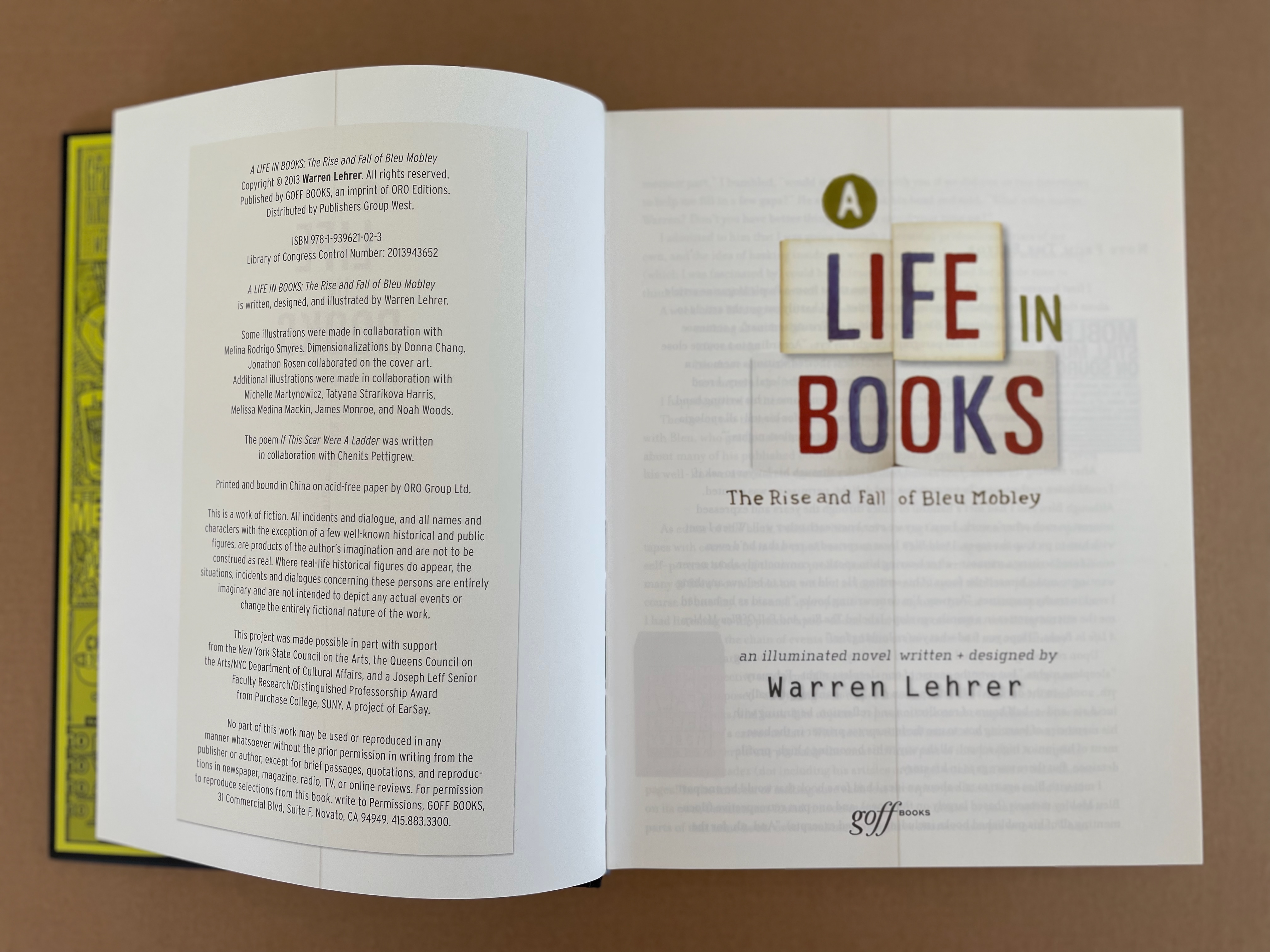
A Life in Books: The Rise and Fall of Bleu Mobley (2013)

A Life in Books: The Rise and Fall of Bleu Mobley. An Illuminated Novel Written & Designed by Warren Lehrer (2013)
Warren Lehrer
Casebound, illustrated paper over boards with illustrated doublures. H254 x W198 x D28 mm. 300 pages. Acquired from Amazon, 3 March 2015.
Photos: Books On Books Collection.

Continue reading

Bookmarking Book Art – An Online Annotation of “The Cutting Edge of Reading: Artists’ Books”

Renée Riese Hubert and Judd D. Hubert’s The Cutting Edge of Reading: Artists’ Books (Granary Books, 1999) is a signal work of appreciation and analysis of book art.  Nearly twenty years on, it can be read and appreciated itself more vibrantly with a web browser open alongside it.

To facilitate that for others, here follows a linked version of the bibliography in The Cutting Edge of Reading — a “webliography” Because web links do break, multiple, alternative links per entry and permanent links from libraries, repositories and collections have been used wherever possible. These appear in the captions as well as the text entries. Also included are links to videos relating to the works or the artists. At the end of the webliography, links for finding copies of The Cutting Edge (now out of print) are provided.

βΟβσβΟβσβΟβσβΟβσβΟβσβΟβσβΟβσβΟβσβΟβσβΟβσβΟβσβΟβσβΟβσβΟβσβΟβσβΟβσ

Alechinsky, Pierre; Matta, Sebastian; Mansour, Joyce. Le Grand jamais. Paris: Aimé-Maeght Éditions , 1981. [See also video 1, video 2.]

Arnal, André-Pierre. Conviction du contresens. Paris. Self-published, 1994. [See also video.]

Barrett, Virginia. Sometimes Feeling Like Eve. San Francisco: VB Press, 1992.

Blais, Jean-Charles; Artaud, Antonin. Tuguri. Paris: Ric Gadella, ed.; Frank Bordas, Printer, 1996. [See also video.]

Boltanski, Christian. La Maison manquante. Paris: La Hune, 1990. [See also video.]

Boltanski, Christian. Inventory of Objects Belonging to an Inhabitant of Oxford introduced by a preface and followed by some answers to my proposalWestfalicher Kunstverein, 1973. [The entry here corrects and extends the title given in the book’s entry. The exhibition itself, held in different locations, appeared with a different title and at different dates.]

Boltanski, Christian. Sachlich. Wien/Munchen: Gina Kehayoff Verlag, 1995.

Boni, Paolo; Butor, Michel. La Chronique des asteroïdes. Paris: Jacqueline de Champvalins, 1982.

Paolo Boni and Michel Butor
La Chronique des asteroïdes (1982)

Braunstein, Terry. On Wrinkles. Self-published, 1978.

Broaddus, John Eric. France I. Altered book, n.d. [See also video 1video 2, video 3, video 4.]

Broaddus, John Eric. Satyricon. Altered book, 1973.

Broaddus, John Eric. Space Shot. One-of-a-kind book, n.d. Wellesley College Library, Special Collections.

Broaddus, John Eric. Sphinx and the Bird of Paradise. New York: Kaldewey, n.d. [See also video.]

Broaddus, John Eric. Turkestan Chronicle. One-of-a-kind book, n.d. Private collection.

Broel, Elisabeth. Aus dem Liederbuch des Mirza Schaffy. Unikatbuch no. 2. Altered book of Bodenstedt’s, 1992.

Broodthaers, Marcel. Reading Lorelei. Paris: Yvon Lambert, 1975.

Brunner, Helen. Primer of Ritual Elements (Book 1). Washington, D.C.: Offset Works, The Writing Center, Glen Echo, MD, 1992.

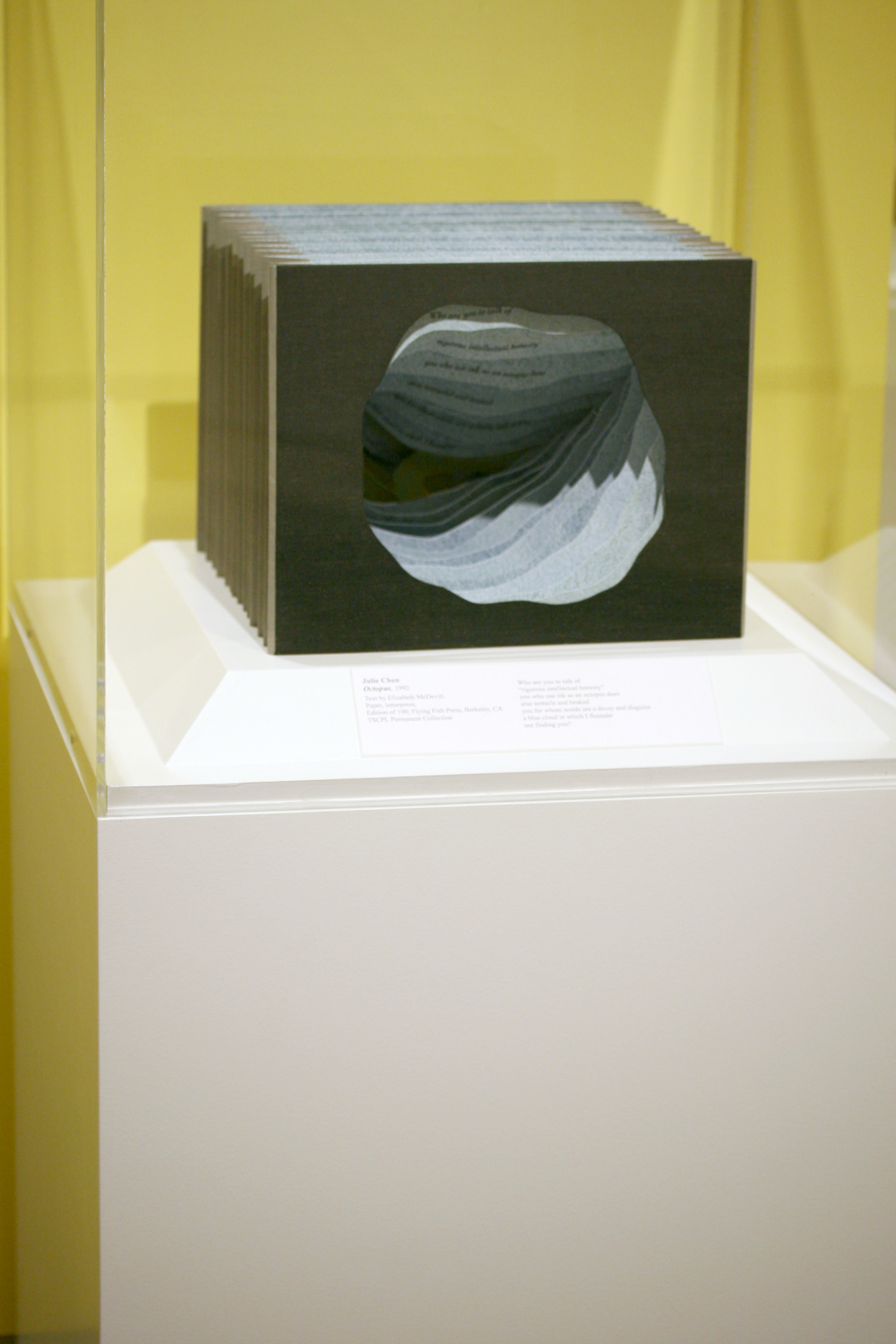
Chen, Julie. Octopus. Berkeley: Flying Fish Press, 1992. [See also video.]

Octopus (1992)
Julie Chen
Poem by Elizabeth McDevitt
Letterpress on paper
13.4 X 10.75 in.

Chopin, Henri. L’Écriture à L’ENDROIT. Limoges: Sixtus Editions, 1993.

Chopin, Henri. Graphèmes en vibrances. Paris: Les Petits Classiques du Grand Pirate, 1990.

Chopin, Henri; Zumthor, Paul. Les Riches heures de l’alphabet. Paris: Les Éditions de la Traversiere, 1995.

Closky, Claude. De A à Z. Paris: n.p., 1991. [Compare with Scott McCarney’s Alphabook 13 (1991).]

Crombie, John; Rimbaud, Arthur. Une illumination. Paris: Kickshaws Press, 1990.

Dautricourt, Joelle. Sentences. Paris: Self-published, 1991.

Delaunay, Sonia; Cendrars, Blaise. La Prose du Transsibérien et de la petite Jehanne de France. Paris: Les Éditions des Hommes Nouveaux, 1913. [Title corrected.]

Dorny, Bertrand; Butor, Michel. Caractères. Paris: Imprimerie Nationale, 1993.

Dorny, Bertrand; Butor, Michel.  Lug à Lucinges. Paris: Self-published, 1993. [Butor added; title corrected.]

Dorny, Bertrand. Supermarché. Paris: Self-published, 1992.  [Butor added.]

Dorny, Bertrand; Deguy, Michel. Composition 7. Paris: Self-published, 1992.

Dorny, Bertrand; Deguy, Michel. Écrire. Self-published, 1992.

Dorny, Bertrand; Deguy, Michel. Éléments pour un Narcisse. Paris: Self-published, 1993.

Dorny, Bertrand; Deguy, Michel. Le Métronome. Paris: Self-published, 1984.

Dorny, Bertrand; Guillevic, Eugène. Si. Nice: Jacques Matarasso, 1986. [First name of Guillevic corrected.]

Dorny, Bertrand; Noel, Bernard. Matière de la nuit. Paris: Self-published, 1990.

Dorny, Bertrand; Smith, William Jay. The Pyramid of the Louvre. Self-published, 1990.

Drucker, Johanna. Narratology. New York: Druckwerk, 1994.

Ely, Timothy; McKenna, Terence. Synesthesia. New York: Granary Books, 1992. [See also video.]

Ely, Timothy. Approach to the Site. New York: Waterstreet Press , 1986. [See also Getty interview; see also video.]

Ely, Timothy. Octagon 3. One-of-a-kind book, 1987. Houghton Library, Harvard University.

Ely, Timothy. Saturnia. One-of-a-kind book, 1995. Private collection.

Ely, Timothy; Kelm, Daniel E. Turning to Face. One-of-a-kind book, 1989. Houghton Library, Harvard University.

Epping, Ed. Abstract Refuse: A Heteronymic Primer. New York: Granary Books, 1995.

Ernst, Max; Eluard, Paul. Les Malheurs des immortels. Paris: Librairie Six, 1922.

Ernst, Max. Une Semaine de bonté. Paris: Pauvert, 1963. [See also video.]

Fahrner, Barbara; Cage, John. Nods. New York: Granary Books, 1991.

Fahrner, Barbara; Schwitters, Kurt. A Flower Like a Raven. Translations by Jerome Rothenberg. New York: Granary Books, 1996.

Finlay, Ian Hamilton. Ocean Stripe Series 3, Wild Hawthorn Press, 1965.

Gerz, Jochen. 2146 Steine: Mahnmal gegen Rassismus. Saarbrucken and Stuttgart: Haje Verlag, 1993. [See also video.]

Gerz, Jochen. Die Beschreibung des Papieres. Darmstadt: Luchterhand, 1973.

Gerz, Jochen. Les Livres de Gandelu.  Liège: Yellow Now, 1976.

Golden, Alisa. They Ran Out. Berkeley: Nevermind the Press, 1991.

Groborne, Robert. Une lecture du Livre des ressemblances [d’] Edmond Jabès. [Xonrupt-Longemer, France]: Æncrages, 1981.

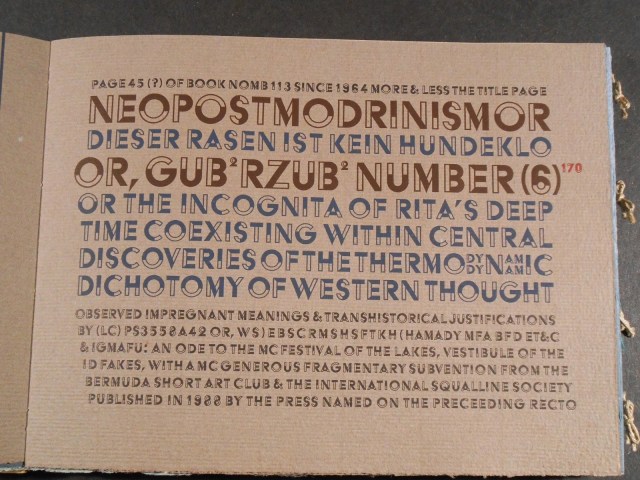
Hamady, Walter. Gabberjab 6. Mount Horeb, WI: The Perishable Press Limited, 1988.

Gabberjab No. 6 (1988)
Walter Hamady

Hamady Walter. Gabberjab 7. Mount Horeb, WI: The Perishable Press Limited, 1997.

King, Ron; Fisher, Roy. Anansi Company. London: Circle Press, 1992. [See also video.]

King, Ron; Fisher, Roy. Bluebeard’s Castle. Guilford, England: Circle Press, 1972. [See also video.]

King, Susan E. Always a Bridesmaid, Never a Bride. Los Angeles: Paradise Press, 1978.

King, Susan E. HomeStead. Los Angeles: The Power of Place, 1990.

King, Susan E. I Spent Summer in Paris. Rochester NY: Paradise Press at Visual Studies Workshop Press, 1984.

King, Susan E.  Salem Witch Trial Memorial. Santa Monica, CA: Paradise Press, 1994.

King, Susan E. Treading the Maze. Rochester, NY: Montage 93: International Festival of the Image, 1993.

King, Susan E. Women and Cars. Rosendale, NY: Paradise Press, 1983. [See also video.]

Koch, Peter; McEvilley, Thomas. Diogenes Defictions. Berkeley: Peter Koch, Printers, 1994.

Kosuth, Joseph. Two Oxford Reading Rooms. London: Book Works, 1994.

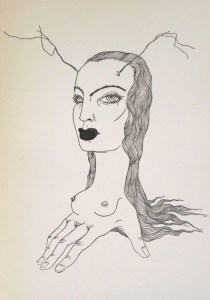
Labisse, Félix. Histoire naturelle. Paris: Chavane, 1948.

Histoire naturelle (1948)
Félix Labisse
Histoire naturelle (1948)
Félix Labisse

Lacalmontie, Jean-François. Le Chant de sirènes. Limoges: Sixtus Editions, 1995. [See also video.]

Laxson, Ruth. [H0 + G0]² = It. Atlanta: Nexus Press, 1982. [See also video.]

[H0 + G0]² = It  (1982)
Ruth Laxson

Laxson, Ruth. Measure/Cut/Stitch. Atlanta: Nexus Press, 1987. [See also video.]

Laxson, Ruth. Wheeling. Atlanta: Nexus Press, 1992.

Le Gac, Jean. La Boîte de couleurs. Amiens: Fonds Régional d’Art Contemporain de Picardie, 1995. [See also video at 4’55”.]

Lehrer, Warren; Bernstein, Dennis. French Fries. Rochester/Purchase: Visual Studies Press, 1984.

French Fries (1984)
Warren Lehrer and Dennis Bernstein

Ligorano, Reese. The Corona Palimpsest. New York: Granary Books, 1996.

Lohr, Helmut. Visual Poetry. Berlin: Galerie Horst Dietrich, 1987.

Visual Poetry (1987)
Helmut Lohr

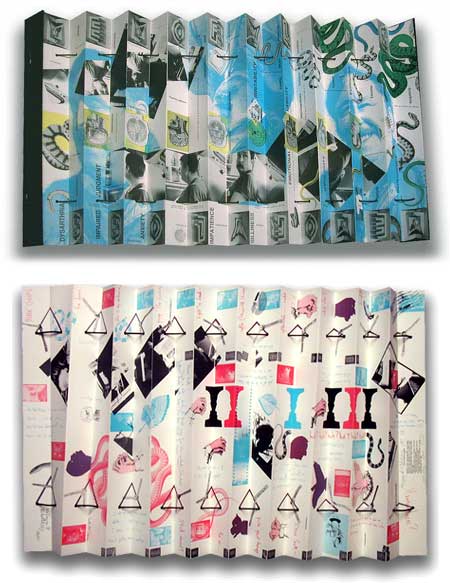
Lovejoy, Margot. The Book of Plagues. Purchase, NY: SUNY Visual Arts Division, 1994.

Lown, Rebecca. Procrustes’ Bed. Purchase, NY: Center for Editions, 1990.

Lyons, Joan. The Gynecologist. Rochester, NY: Visual Studies Workshop Press, 1989.

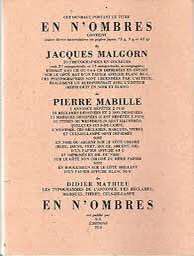
Malgorn, Jacques; Mabille, Pierre. En N’Ombres. Limoges: Sixtus Editions, 1993.

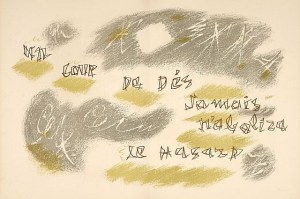
Mallarmé, Stéphane. Un coup de dés jamais n’abolira le hasardCosmopolis, mai, 417-28, 1897.

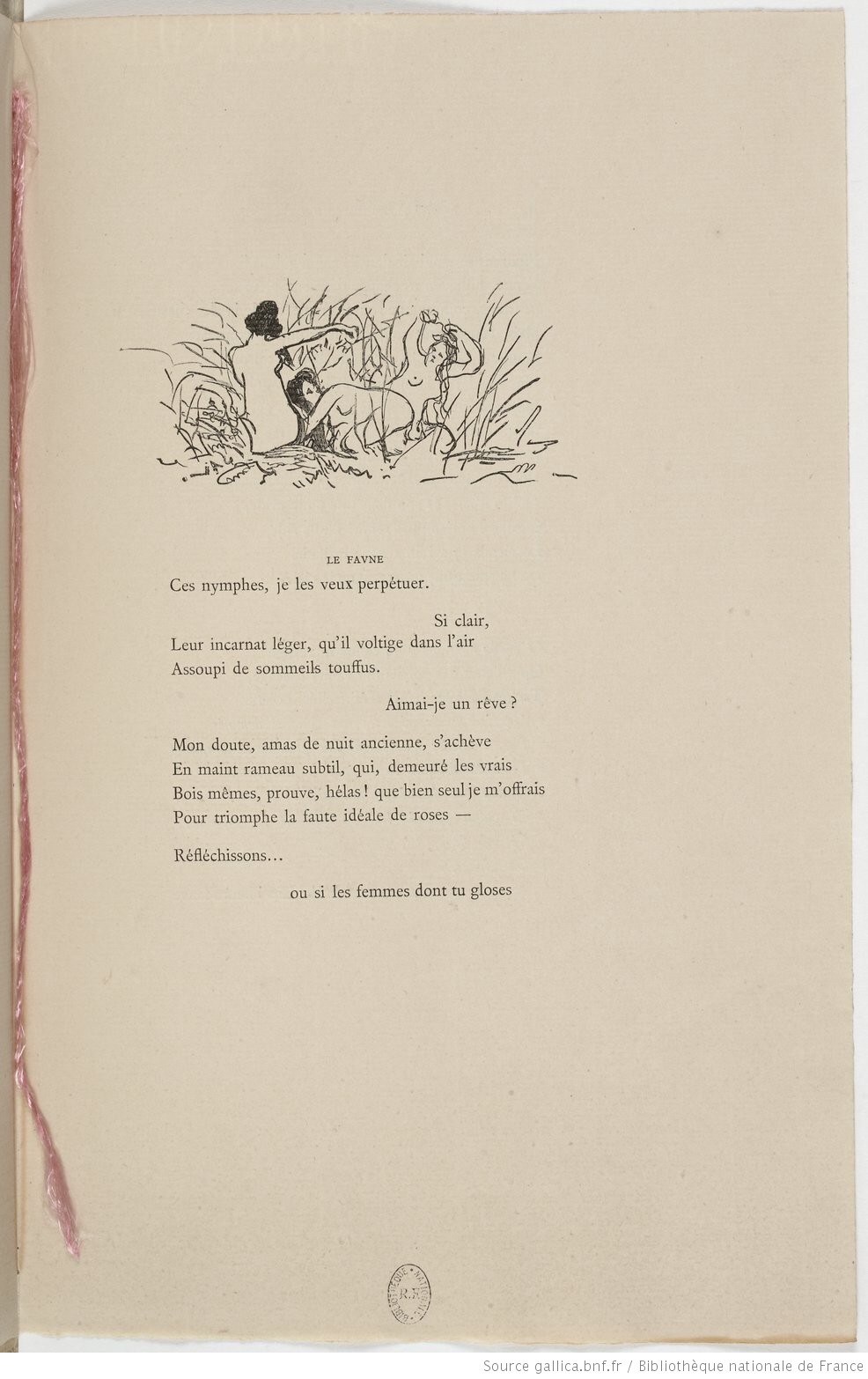
Manet, Edouard; Mallarmé, Stéphane. L’Après-midi d’un faune. Paris: Derenne, 1876.

Martinez, Roberto. Moi Aussi j’aurais peur si je recontrais un ange. 1. La Bataille de Midway. Paris: n.p., 1991.

Martinez, Roberto. Moi Aussi j’aurais peur si je recontrais un ange. 2. L’Anatomie d’un ange. Paris: n.p., 1991.

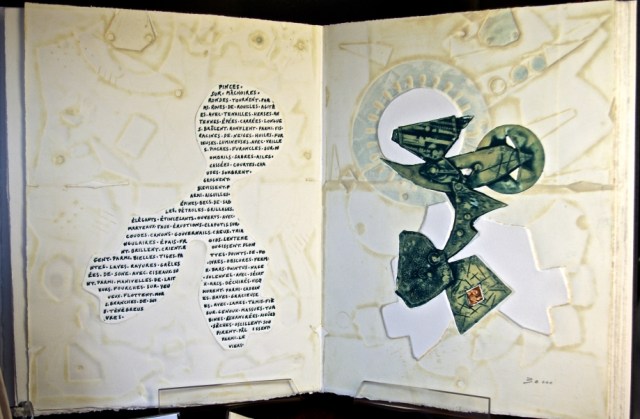
Masson, André; Mallarmé, Stéphane. Un coup de dés jamais n’abolira le hasard. Paris: Amateurs du Livre et de l’Estampe Modernes, 1961.

Un coup de dés jamais n’abolira le hasard (1897; 1961)
Stéphane Mallarmé; André Masson

Masson, André; Rimbaud, Arthur. Une saison en enfer. Paris: Société de femmes bibliophiles Le Cent Une, 1961.

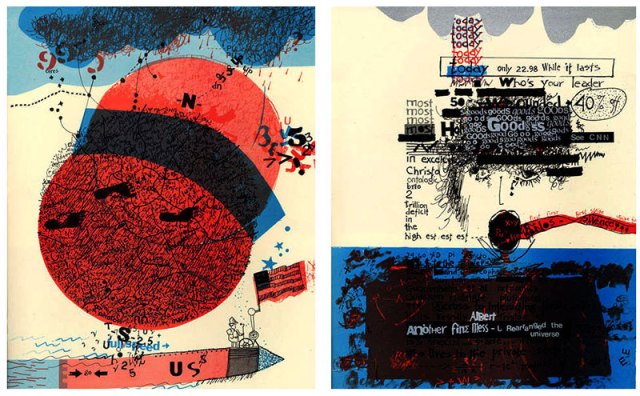
Matta, Sebastian; Jarry, Alfred. Ubu roi. Paris: Atelier Dupont Visat, 1982.

Matta, Sebastian. Garganta-tua. Florence: Edizioni della Bejuga, 1981.

McCarney, Scott. Diderot/Doubleday/Deconstruction. Rochester, NY: Visual Studies Workshop Press, 1994. [See also video.]

McCarney, Scott. Memory Loss. Rochester, NY: Visual Studies Workshop Press, 1988. [See also video.]

Memory Loss (1988)
Scott McCarney
2 1/2 x 22 in., 40 pp.
offset edition of 500

Meador, Clifton. Anecdote of the Jar. Purchase, NY: SUNY Visual Arts Division, 1989. [See also video.]

Meador, Clifton. The Book of Doom. Barrytown, NY: Zimmerman Multiples, 1984. [See also video.]

Messager, Annette. D’Approche. Paris: Jean-Dominique Carré Archives Librairie, 1995. [See also video at 5’56”.]

Messager, Annette. Mes ouvrages. Arles: Actes Sud, 1989.

Nannucci, Maurizio. Art as Social Environment. Amsterdam: Lugo, 1978.

Nannucci, Maurizio. Provisoire et définitif. Écarts, 1975.

Newell, Peter. Slant Book. New York: Harper Bros., 1910.

Osborn, Kevin. Real Lush. Arlington, VA: Bookworks, 1991.

Osborn, Kevin. Tropos. Arlington, VA: Osbornbook, 1988.

Tropos (1988)
Kevin Osborn

Osborn, Kevin. Wide Open. Arlington, VA: Bookworks, 1984.

Penck, A.R. Analysis. Berlin: Edition Klaus Staeck, 1990.

Phillips, Tom. A Humument. London: Thames & Hudson, 1980.

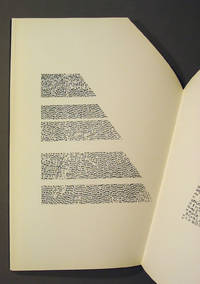
Polkinhorn, Harry. Summary Dissolution. Port Charlotte, FL: Runaway Spoon Press, 1988.

Reese, Harry. Arplines. Isla Vista, CA: Turkey Press, 1988.

Roth, Dieter. Daily Mirror. Köln: Hansörg Mayer, 1961. [See also video.]

Roth, Dieter. Bok 3C. Stuttgart: Hansörg Mayer, n.d. [See also video.]

Rullier, Jean-Jacques. 10 exemples. Limoges: Sixtus Editions, 1994.

Ruscha, Edward. Twentysix Gasoline Stations. Los Angeles: National Excelsior Press, 1963. [Publisher added; see also video.]

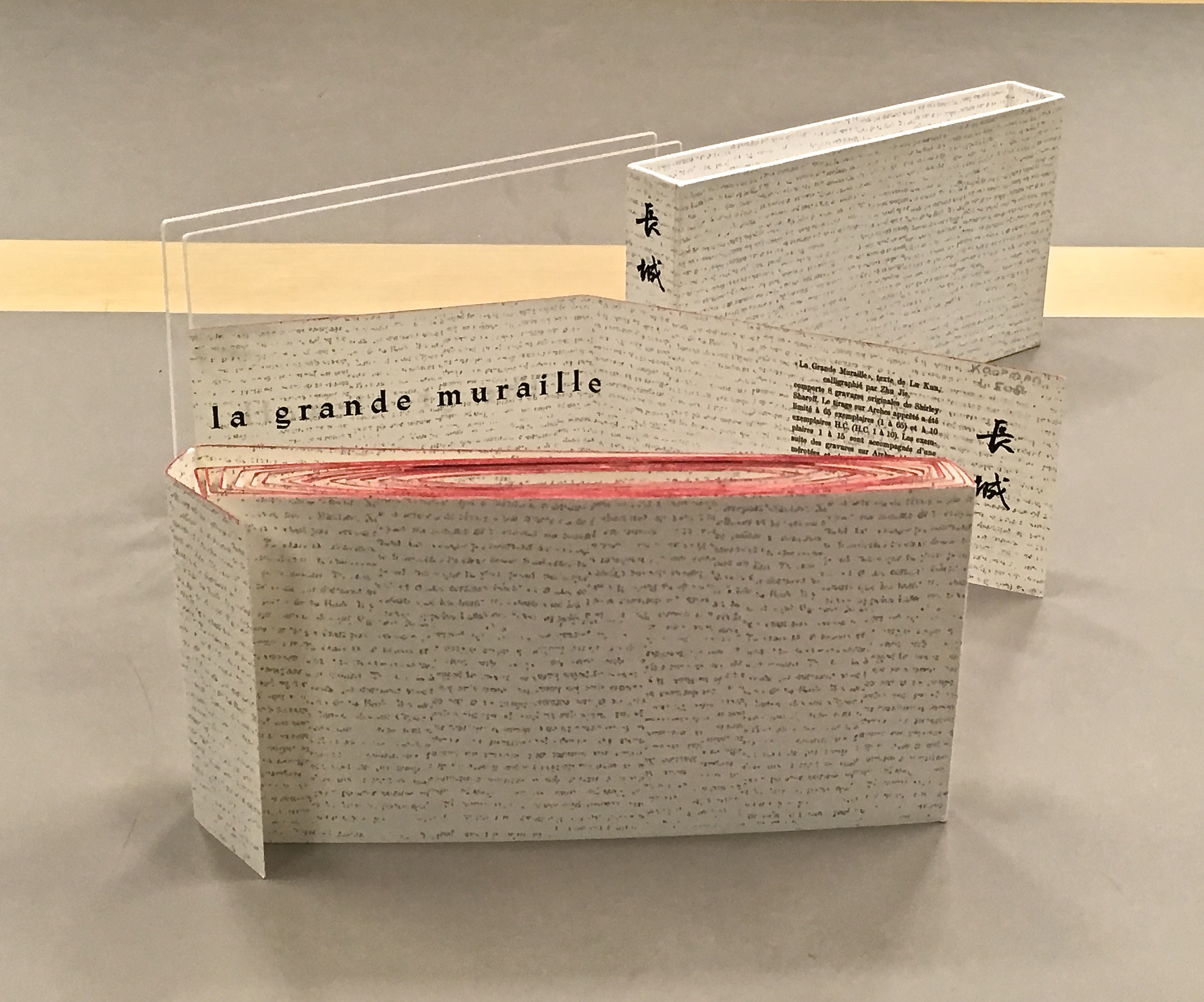
Sharoff, Shirley; Lu Xun. La Grande Muraille/The Great Wall. Paris: Self-published, 1991.

La grande muraille/The Great Wall (1991), Shirley Sharoff
All Books On Books photos are reproduced here with permission of the artist.

Sicilia, Jose Maria; Lux, Thomas. You Are Alone. Paris: Michael Woolworth, 1992.

Sligh, Clarissa. Reading Dick and Jane with Me. Rochester, NY: Visual Studies Workshop Press, 1989. [See also video.]

Sligh, Clarissa. What’s Happening with Momma? Rosendale, NY: Women’s Studio Workshop, 1988.

Smith, Keith. Construct. Rochester, NY: Visual Studies Workshop Press, 1985. [See also video.]

Spector, Buzz. Broodthaers. 1988. Altered book. [See also video links embedded in the artist’s name below.]

Spector, Buzz. Kafka. 1988. Altered book.

Spector, Buzz. Malevich. 1988. Altered book.

Spector, Buzz. A Passage. NY: Granary Books, 1994.

Spector, Buzz. The Picture of Dorian Gray. 1987. Altered book.

Spector, Buzz. Silence. 1989. Altered book.

Staritsky, Anna; Albert-Birot, Pierre. La Belle histoire. Veilhes, Tarn: Gaston Puel, 1966.

Staritsky, Anna; Butor, Michel. Allumettes pour un bûcher dans la cour de la vieille Sorbonne. Paris: Self-published, 1975.

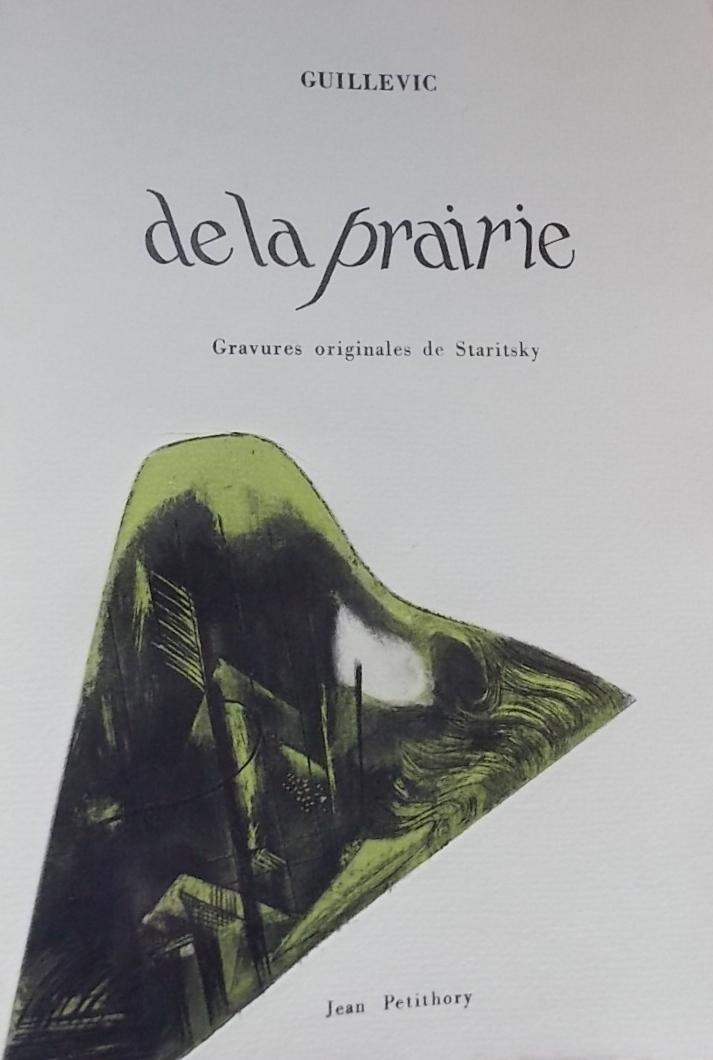
Staritsky, Anna; Guillevic, Eugène. De la prairie. Paris: Jean Petithory, 1970.

De la prairie (1970)
Eugene Guillevic (text)
Anna Staritsky (art)

Staritsky, Anna; Iliazd. Un de la brigade. Paris:Atelier Lacourière-Frelaut, 1982. [Publisher identified.]

Staritsky, Anna; Lemaire, Jacques. Le Zotte et la moche. Moulin du Verger de Puymoyen, 1969.

Stokes, Telfer; Douglas, Helen. MIM. Deuchar Mill, Yarrow, Scotland: Weproductions, 1986. [See also video.]

Stokes, Telfer; Douglas, HelenReal Fiction: An Inquiry into the Bookeresque. Rochester, NY: Visual Studies Workshop Press, 1987.

Stokes, Telfer; Douglas, Helen. Spin Off. Deuchar Mill, Yarrow, Scotland: Weproductions, 1985.

Van Horn, Erica. Scraps of an Aborted Collaboration. Docking, Norfolk: Coracle Press, 1994.

Van Horn, Erica. Seven Lady Saintes. New York: Women’s Studio Workshop, 1985. [Publisher identified.]

Van Horn, Erica. Ville aux dames.Vitry-sur-Seine: n.p., 1983. One-of-a-kind. [Title corrected.]

Walker, Anne; Coppel, Georges. Les Formes de l’univers (ou l’univers des formes). Paris: L’Oeil du Griffon, 1995. [Name of publisher corrected.]

Wegewitz, Olaf. Mikrokosmos. Edition Staeck, 1992. [Publisher identified; date reflects publisher’s information; see also video.]

Yvert, Fabienne. Transformation. Marseille: Éditions des Petits Livres. 1995.

Zelevansky, Paul. The Case for the Burial of Ancestors. New York: Zartscarp, Inc. and Visual Studies Workshop Press, 1981.

The Case for the Burial of Ancestors (1981)
Paul Zelevansky

Zimmermann, Philip. High Tension. Rochester, NY: Visual Studies Workshop Press, 1993. [See also Craft in America video and video of High Tension.]

Zimmermann, Philip. Elektromagnetism. Barrytown, NY: Space Heater Multiples, 1995.

Elektromagnetism (1995)
Philip Zimmerman

Zubeil, Francine. Panique générale. Marseille:  Éditions de l’Observatoire, 1993.

Zweig, Janet. This Book is Extremely Receptive. Cambridge, MA: Pyramid Atlantic, 1989.

βΟβσβΟβσβΟβσβΟβσβΟβσβΟβσβΟβσβΟβσβΟβσβΟβσβΟβσβΟβσβΟβσβΟβσβΟβσβΟβς

The Cutting Edge of Reading: Artists’ Books by Renée Riese Hubert and Judd D. Hubert available:

Amazon

AbeBooks

OCLC WorldCat