Books On Books Collection – Ofer Lellouche

UN COUP DE DÉS JAMAIS N’ABOLIRA LE HASARD
(1997)

UN COUP DE DÉS JAMAIS N’ABOLIRA LE HASARD (1997)
Stéphane Mallarmé
Ofer Lellouche (and Uzy Agassi, ed.)
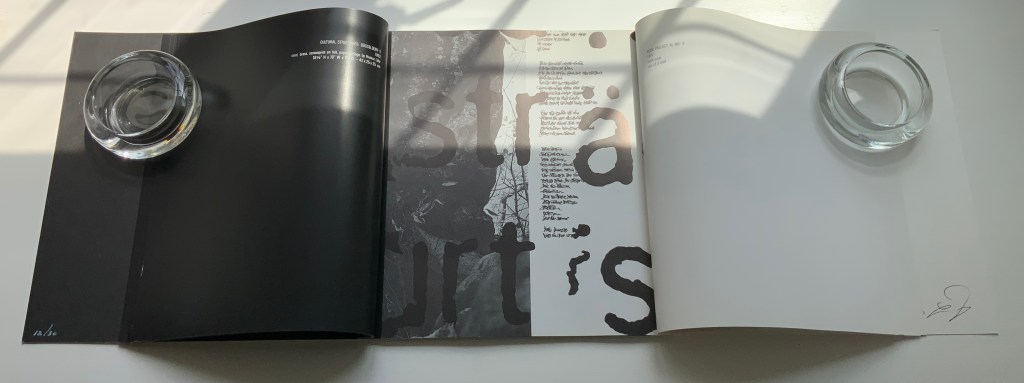
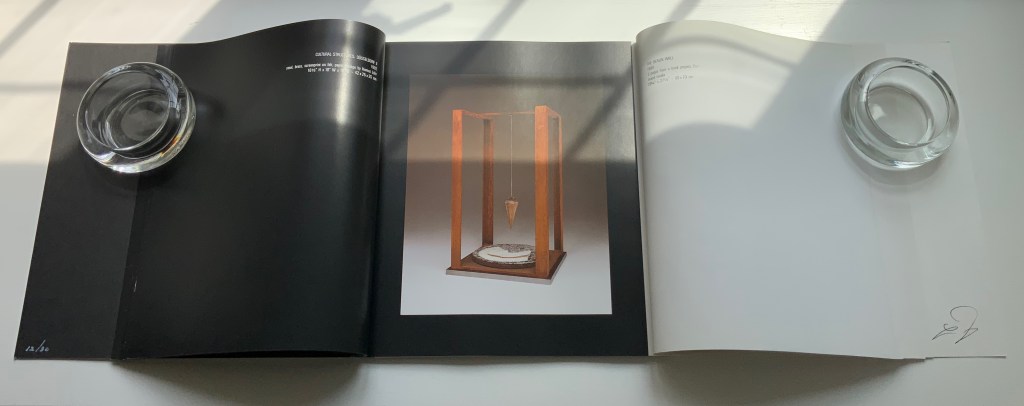
Full black leather binding over marine plywood with dice, on a stand. H760 x W560 mm, 28 pages with 9 engravings. Edition of 40, of which this is #6. Acquired from Ido Agassi, 28 February 2022.
Photos: Courtesy of Ido Agassi; Books On Books Collection. Displayed with permission of Ido Agassi and the artist.

Ever since his “brick wall” encounter with Un Coup de Dés and its white-on-black, black-on-white aesthetic, Ofer Lellouche has felt its influence on his art — including self-portraiture, the figurative and landscapes. When first approached by the publisher Ido Agassi (Even Hoshen) to create an artist’s book, he considered working from the ground up with a contemporary but that longstanding influence turned him to Mallarmé. 

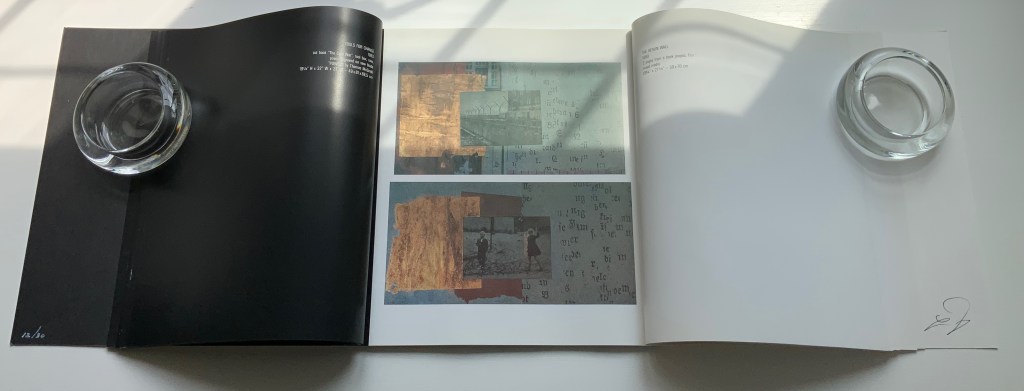
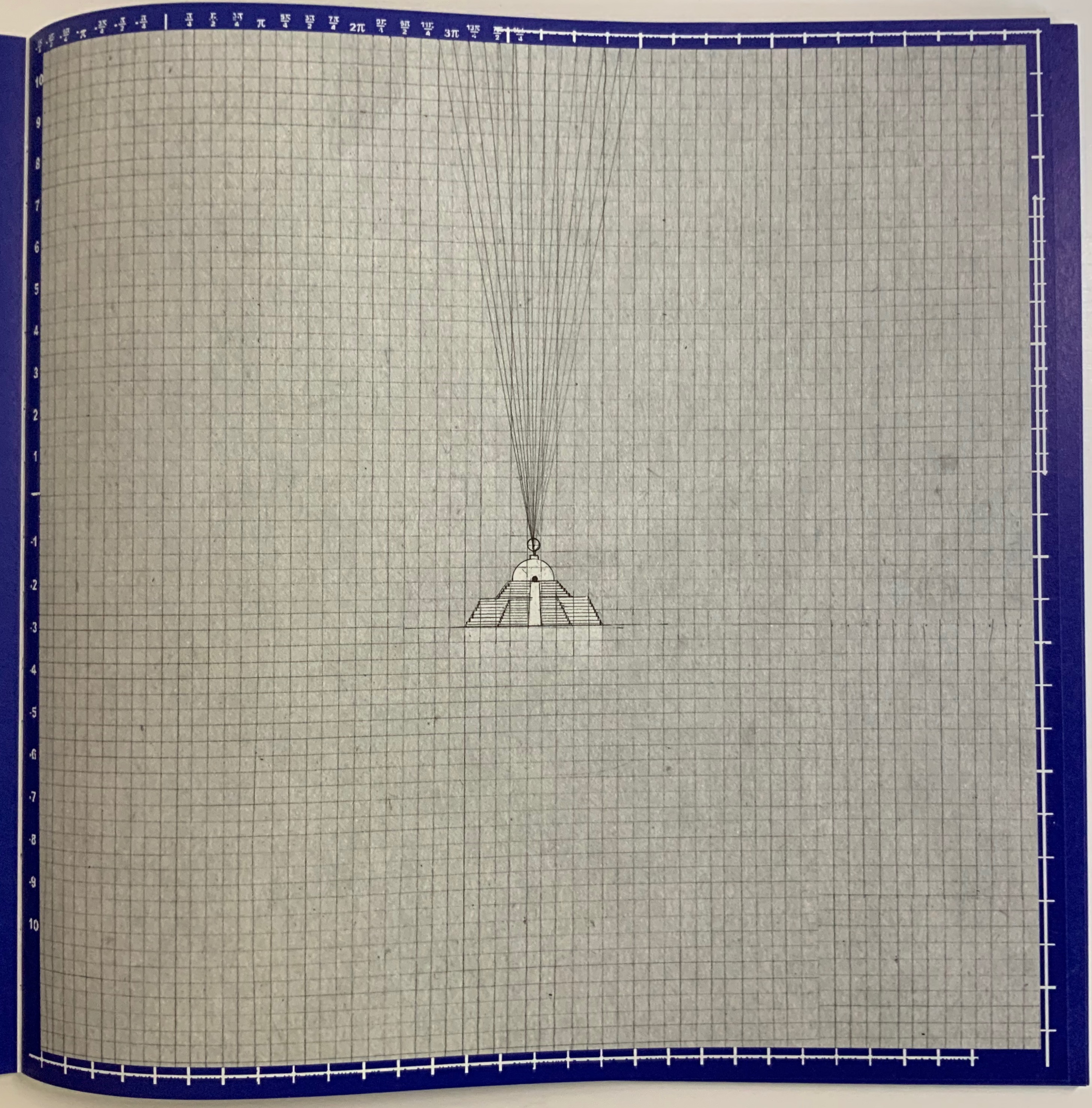
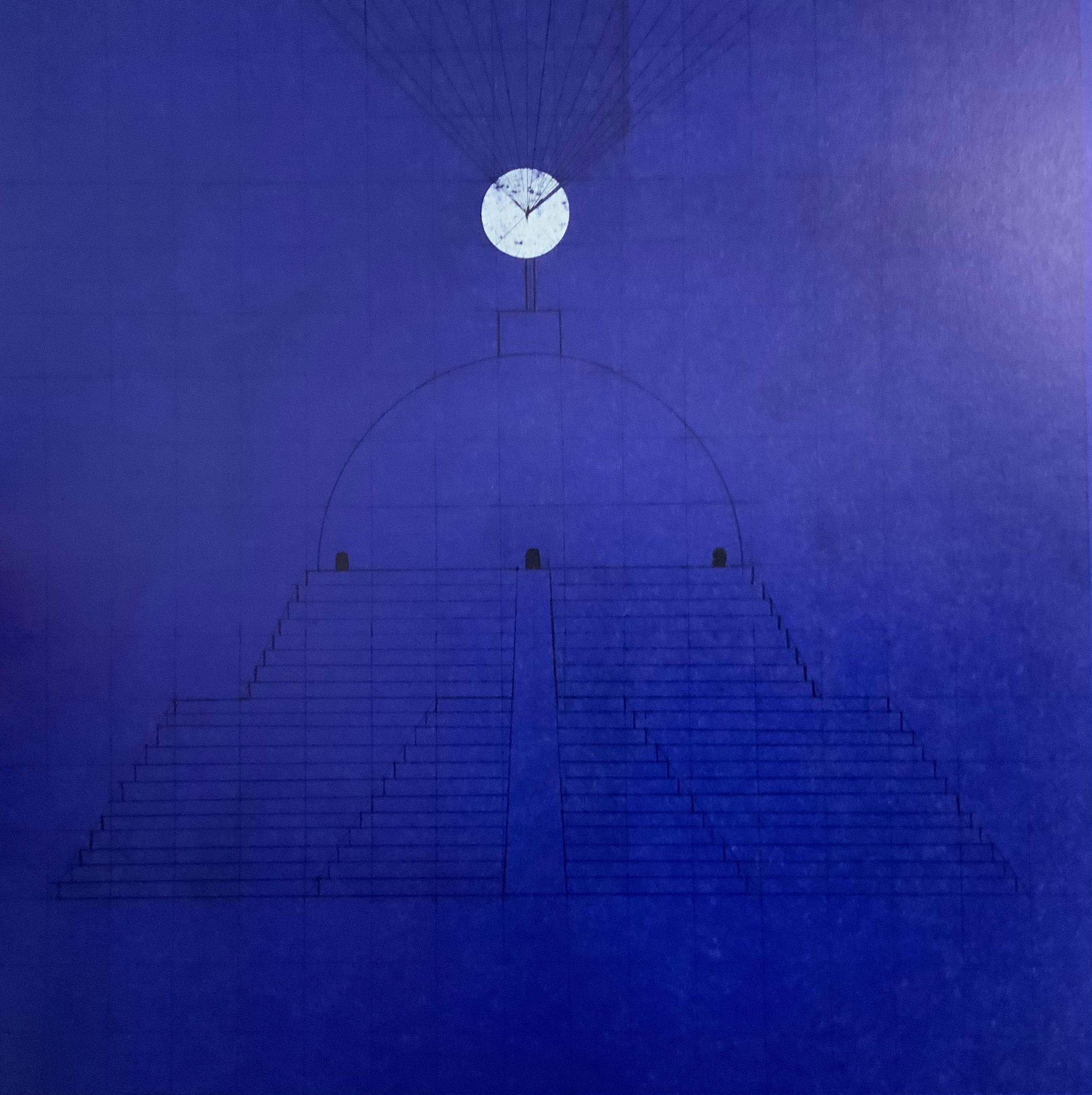
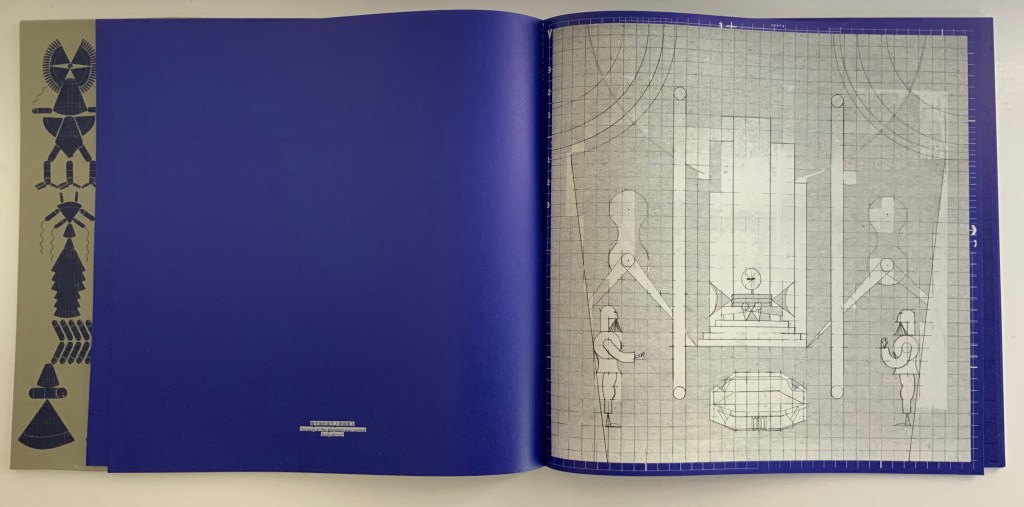
The homage consists of marine plywood covered in black leather, dice embedded in the spine and stand, trim size of H760 x W560 mm, Arches 250gsm printed in 22 pt Times New Roman and 9 etchings by Lellouche. The pages of text replicate those of the then-current Pléiade edition of Mallarmé’s Complete Works. Obviously from the size of the work, the pages have been scaled up. The replication of those pages means that the layout is not precisely as Mallarmé designated in the proofs for the deluxe edition. It also means that page numbers appear, and it accounts for the use of Times New Roman. But there are underlying reasons for the scaling up and replication despite the variance from Mallarmé’s plans. 

First, the scale accommodates the size of Lellouche’s largest prints. Tellingly, they require a double-page spread. The use of double-page spreads pays homage to Mallarmé’s elevation of the double-page spread over the single page as a basic structural unit in Un Coup de Dés

Second, the replication of the Pléiade pages begins a set of interconnected allusions and indirect homage to Mallarmé. Picasso was rumored to have used his copy of Mallarmé’s poems as a sketchbook. By replicating the Pléiade pages for his artist’s book, Lellouche inverts Picasso’s habit, draws Mallarmé’s double-page spreads into his artist’s book rather than drawing on them, and thus pays homage to both LES MAÎTRES. Also, through Picasso as inheritor of Mallarmé’s “invention” of modern art’s conception of space (according to Marcel Broodthaers), Lellouche pays a further indirect homage to the poem. The interconnectedness does not end there.

Considering that the main figure in the poem is LE MAÎTRE  (the captain of the shipwreck), the fact that Lellouche’s prints pass from an abstract human figure to self-portraits implies Lellouche’s identification with LE MAÎTRE. When the self-portraits give way to the first full double-page spread (the seventh image, an abstract seascape or image of the abyss to which the poem refers), the shift confirms that self-identification, for LE MAÎTRE likewise seemingly succumbs to l’Abîme. But it is not merely the captain with whom Lellouche is identifying. LE MAÎTRE is the term by which Mallarmé’s contemporaries referred to him. Still it is not so much that Lellouche identifies himself with Mallarmé the poet and social lion as it is that he identifies with the paradoxical and impersonal creative process that lies at the heart of Un Coup de Dés.  Indeed, it is through his own process that Lellouche asserts the identification. Beginning with black on white and progressing through aquatints to white on black, the self-portraits allude in an inverted way to Mallarmé’s paradoxical les blancs. The blank white space means as much as what it surrounds on the page, or rather it makes meaning along with the semantic and typographic elements that it surrounds.

Neither the poem nor the prints end with a definitive yielding to the abyss. The poem progresses to UNE CONSTELLATION. In Mallarmé’s case, the constellation comes at the end of the sentence RIEN N’AURA EU LIEU QUE LE LIEU / EXCEPTÉ PEUT-ÊTRE UNE CONSTELLATION (Nothing will have taken place but the place, except perhaps a constellation). In Lellouche’s case, the constellation takes the form of the multiple female figures ranged white on black across the two final double-page spreads. Again, Lellouche mirrors Mallarmé’s semantic and typographic juggling of symmetry and asymmetry across the center line of the double-page spread.

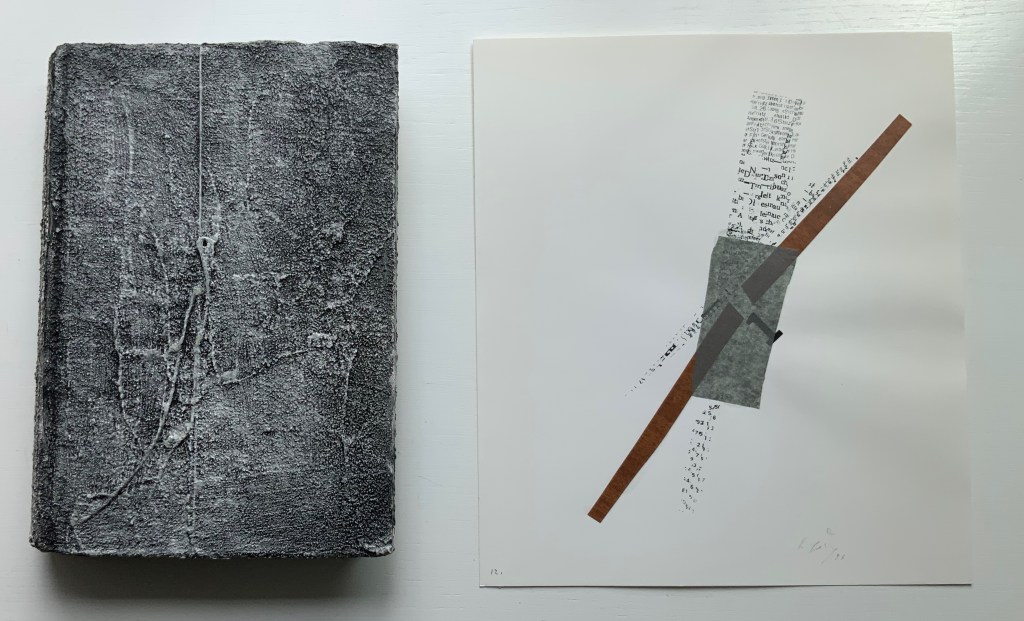
This brief note about this addition to the collection comes nowhere near exhausting Lellouche’s interaction with and interpretation of Un Coup de Dés. The artist’s book is also only one instance. Later etchings not in the collection underline this. By courtesy and with permission of the artist, here are three in which Lellouche pays even more direct homage to Picasso’s act of sketching on the pages of his copy of Mallarmé’s poems and by which he explores his own identification with this poem.

Further Reading

Arnar, Anna Sgrídur. 2011. The Book as Instrument: Stéphane Mallarmé, the Artist’s Book and the Transformation of Print Culture. Chicago: University of Chicago Press.

Lellouche, Ofer. ND. “Ebauche pour une ébauche de “Un coup de dés jamais n’abolira le hasard” de Stéphane Mallarmé“. Artist’s site. Accessed 19 March 2022.

Restany, Pierre. April-May, 2001. “The Hand that Thinks“. Artist’s site. Accessed 19 March 2022.

Stark, Trevor. 2020. Total Expansion of the Letter: Avant-Garde Art and Language after Mallarmé. Cambridge, MA: MIT Press.

Books On Books – Return to CODEX (VIII, 2022)

Two renegades from the CODEX talk upstairs at the Graduate (the organizers’ Berkeley hotel of choice) sat themselves down in the lobby and allowed me to eavesdrop.

The first asked the second. “Why are you not upstairs?” To which the second replied, “I got there on time for the talk, but they were running early, and I’d missed half of it, so I just gave up and told the person next to me ‘Excuse me, I have an email’.” The first laughed, “And they bought that?” Before the first could give his excuse, a third renegade showed up. “Uh oh,” said the first, “we were just talking about you; now we’ll have to stop.” The third drew up her mask and told them she was in disguise so they should carry on, admitting she’d skipped the talk upstairs, to which the first commented, “Oh, so that’s why the speaker looked so surprised when he praised your work and then couldn’t spot you in the audience.” The third replied, “I’ll just tell him I was there with you way at the back.” The second piped up, “I’ll confirm that: I saw you in the back row just as I had to step out for an ‘urgent’ email!” The third riposted, “No one will believe that; the organizers know I requested not to have a stand next to yours since you poached the Bancroft buyer away from me at the fair three years ago.” They carried on with this, looking askance in my direction as I joined their laughter. What can you do; some things are infectious no matter the mask or vaccination.
After the long pandemic-driven gap, the pent-up creatures had escaped their studios. The buzz in the cavernous Craneway Pavilion was muted by the carefully observed mask-wearing requirement, but the works shouted in the harbor’s April air blowing in.

Some works shouted about the pandemic and isolation.

Phil Zimmerman‘s Spaceheater Editions; Gaylord Schanilec‘s corvid Covid series; Emily Martin‘s madness.

Some shouted about the pandemic and climate crisis.

Barb Tetenbaum‘s These Days

Some spoke gently about the unseen, but leapt from boxes and pages nevertheless.

Islam Aly‘s Mare Nostrum; Colette Fu’s pop-ups.

Others shouted see what we have done.

Clifton Meador’s layering on cloth of Rijksmuseum portraits from a Golden Age built on slavery.

Some raised a mirror to the world and thundered at hells on earth, while slipping Mickey Mouse into the firmament to laugh at classical scholars.

Peter Koch‘s Ur-text: Speculum Mundi

Some announced long-awaited posings of ancient riddles.

The Tetenbaum-Tisdale work in progress.

And some simply put The Question.

Suzanne Moore‘s calligraphic manuscript celebrating the letter Q.

Others looked serenely to the sidereal for the answers.

Sara Langworthy‘s Sidereal (2020 MCBA Prize winner) and other works.

Others said listen to the water.

Camden Richards’ Water, Calling in the foreground; Luz Marina Ruiz’s water, moon and boat series.

Others said listen to the mountain.

Diane Jacob’s monumental Owed to the Mountain.

Others said, Breathe.

Sam Winston‘s Follow the Breath

Others said look at how we perceive.

Ken Botnick’s Table of Contents, a riff started by J.J. Gibson’s perceptual psychology.

And all shouted, Welcome back.

Here’s to 2024.

Previously …

Jim Blaine and His Grandfather’s Ram” – Or How to Enjoy Codex VII. Books On Books. 18 February 2019.

Bookmarking Book Art – Marine Hugonnier

The Bedside Book Project (2006-07)

The Bedside Book Project is a quintuple homage — Stéphane Mallarmé (1842-1898), Marcel Broodthaers (1924-1976), Odilon Redon (1840-1916), Kurt Schwitters (1887-1948) and Richard Hamilton (1922-2011) — and approaches its subjects in cinematic fashion. It begins with this anecdote:

In 1945 René Magritte gave Marcel Broodthaers a copy of Mallarmé’s poem as ‘a way of explaining his art to a young admirer without explaining it literally’. In 1969, Broodthaers modified an edition of the poem by covering all its words with black stripes that correspond directly to the typographic layout used by Mallarmé to articulate the text. In this way, Mallarmé’s poem, which Broodthaers considered had unconsciously invented modern space, is reduced to its structure. 

From here, Marine Hugonnier‘s imagination takes hold. As if in a film scene, she moves into the bedrooms of Redon, Schwitters and Hamilton, steals their copies of Un Coup de Dés from their bedside tables, alters each one by inserting images and then replaces them. The result is a series of installations in which the pages of their altered books are displayed on the gallery walls. Each has its “book title”: La forme du mystère (Odilon Redon), Altération (Kurt Schwitters) and L’espace social (Richard Hamilton). Here is Hugonnier’s description of Redon’s book and the installation performance in which it is presented:
Redon’s bedside book has been stolen and its pages have been folded to extend the space and time of the poem’s interlude bringing his dreams to a deeper sleep. ... The mise-en-scène is composed of a white space with an open window, a spider and a man dressed in a tuxedo who will change a solitary frame, containing a folded page of the poem, on the wall every hour. On the 12th hour, the room will be left empty.

The Bedside Book Project: La forme du mystère (Odilon Redon). Source: Museu d’Art Contemporani de Barcelona, displayed with permission of the artist.

Staging a performance in which the pages of Redon’s bedside book are parceled out over 12 hours is ambitious. As she introduces Schwitters and Hamilton into The Bedside Book Project, Hugonnier creates an even more ambitious immersion for the reader/viewer in different times, spaces and influence. Further temporal instability is involved as well: the pages on Redon’s 19th century bedside table come from a 2006 Gallimard edition of the poem.

Time travelling from Redon’s bedside table to that of Kurt Schwitters, Hugonnier also introduces a bit of temporal and linguistic instability: Schwitters’ bedside copy comes from the Tiber Press edition of Daisy Aldan’s translation into English, published in 1956 eight years after Schwitters’ death. Colored paper cut-outs conceal words, disrupt the gaps of the poem and alter its reading.

The Bedside Book Project: Altération (Kurt Schwitters). Source: Museu d’Art Contemporani de Barcelona, displayed with permission of the artist.

With Richard Hamilton, Hugonnier gives him the same edition as Redon — the Gallimard 2006 — and fills its interstices with images as a way to change its reading.

The Bedside Book Project: L’espace social No.2 (Richard Hamilton). Source: Museu d’Art Contemporani de Barcelona, displayed with permission of the artist.

As ghostly film director and actress in the film, Hugonnier wonders how these altered bedside books might have affected the way those three artists perceived art and practiced it in their times. As Hugonnier’s audience, we must surely wonder how she has altered the way we perceive Un Coup de Dés and its influence and very possibly how we perceive time, space and art.

Further Reading

Un Coup de Dés Jamais N’abolira le Hasard – L’Espace Social N2, 2007“. MACBA Collection. MACBA Foundation. Fundación Repsol Collection. Acquired 2009.

Books On Books Collection – Honorine Tepfer

UN COUP DE DÉS JAMAIS N’ABOLIRA LE HASARD: POÈME (1989)

UN COUP DE DÉS JAMAIS N’ABOLIRA LE HASARD: POÈME (1989)
Stéphane Mallarmé (text); Honorine Tepfer (art & design)
Accordion fold with embossed paper cover. Cover – H325 x W255 mm; Book – H320 x W250 mm, 34 pages. Edition of 48, of which this is #5. Acquired from Studio Montespecchio, 2 February 2022.
Photos: Books On Books Collection. Displayed with permission of the artist.

Before his sudden death in 1898, Stéphane Mallarmé was planning a deluxe edition of Un Coup de Dés Jamais N’Abolira le Hasard with Ambroise Vollard, an entrepreneur and publisher. A single-volume version of the poem did not appear until 1914. Issued under the direction of Mallarmé’s son-in-law Dr. Edmond Bonniot through the Nouvelle Revue de France (NRF), it omitted intended prints by Odilon Redon, used the typeface Elzevir rather than the Didot that Mallarmé preferred, and did not precisely follow his layout. We know all this because of correspondence between the poet, Redon and Vollard and because the Sorbonne’s Bibliothèque littéraire Jacques Doucet and Harvard’s Houghton Library hold proofs of the deluxe edition with Mallarmé’s handwritten corrections and instructions.

Mallarmé’s placement of words and lines was intentional and precise. Even before the planning for the deluxe edition, he wrote of what could be achieved with type size and layout:

Pourquoi — un jet de grandeur, de pensée ou d’émoi, considérable, phrase poursuivie, en gros caractère, une ligne par page à emplacement gradué, ne maintiendrait-il le lecteur en haleine, la durée du livre, avec appel à sa puissance d’enthousiasme: autour, menus, des groupes, secondairement d’après leur importance, explicatifs ou dérivés — un semis de fioritures. [Oeuvres Complètes, 2 227]

“Why — couldn’t a considerable burst of greatness of thought or emotion, carried in a sentence in large typeface, gradually placed with one line per page, hold the reader’s bated breath throughout the entire book by appealing to his or her power of enthusiasm: around this [burst], smaller groups of secondary importance, explicating or deriving from the primary phrase — a scattering of flourishes.” [Arnar, 234]

The NRF edition 1914 edition makes quite a few sad missteps as Robert Cohn pointed out in 1967. Tepfer’s inspiration to restore the intended layout follows in the footsteps of Mitsou Ronat & Tibor Papp (1980) and Neil Crawford (1985). She visited the Doucet library to examine the proofs and layout. Following the layout was not difficult, but with the scarcity of Didot, Tepfer needed to select another typeface. She chose Baskerville. Given that Firmin Didot was inspired by John Baskerville’s experimentation with thick and thin strokes, the choice adds historical interest, although Bodoni might have been nearer the mark. Below are Tepfer’s double-page spreads across which Mallarmé’s burst of thought appears one line per page among the “scattering of flourishes”.

The book’s central double-page spread, beginning with COMME SI / “AS IF”) in the upper left and ending with COMME SI / “AS IF” in the lower right, mimics the throw and fall of the dice and provides another example of the semantic and typographic play that Mallarmé describes above.

Like the artists before her — Redon (1897), André Masson (1961), Mario Diacono (1968), Marcel Broodthaers (1969), Jean Lecoultre (1975), Ian Wallace (1979) and Ian Tyson (1985) — Tepfer had to solve the puzzle of relating image to text. This is the difficult path of inverse ekphrasis: what and how the visual, tactile and conceptual works of art that come after Mallarmé’s text can be. We are more used to ekphrasis where the object, painting or sculpture comes before the text — like Achilles’ shield before Homer’s description, or the Grecian urn before Keats’ ode, or Brueghel’s Fall of Icarus before Auden’s Musée des Beaux Arts. Homer, Keats and Auden vie with the art of the crafted object to put that object (and more) in front of us with words. With the inverse, the crafted objects vie without the words to put Mallarmé’s poem (and more — and sometimes less!) in front of us. Tepfer’s solution?

A simple line runs across the debossed front and back covers. As Tepfer wrote in June 1990 about her journey into Un Coup de Dés: La ligne d’horizon était un sujet de ma hantise / “The horizon line was my obsession”. As the folded paper cover opens, a single geometric, abstract image appears — debossed and embossed on blank paper. Except for a single round dot, everything is linear. Two separate lines angle across the space. One cuts through the debossed horizon line that lies beneath a series of closely spaced horizontal lines — suggesting clouds? The other, longer one cuts at a different angle, creating a foreground from two sets of parallel lines that have slipped or shifted like tectonic plates. Could the round dot be the single-dot side of a die rolling down a slanted deck or broken mast? Could the longer slanted line be a broken mast? Could the shifted parallel lines be a broken handrail?

Rather than trying to track back to verbal images in the poem, though, perhaps we should recognize Tepfer’s prefatory image as a kind of substitute for Mallarmé’s preface in 1897 — the one he preferred we not read. He wanted us to look. To see les blancs. To hold thought and emotion like our breath across the space of the book. With her simple rectangle of blank paper, with the absence of ink, with the geometric solidity of the horizontal and slanting lines, and with the velvet softness of the velin d’Arches across her version’s accordion folds, Tepfer encourages us to look, see, hold meaning in abeyance and sense it.

Further Reading

“Mitsou Ronat & Tibor Papp“. 16 November 2020. Books On Books Collection.

Ian Tyson & Neil Crawford“. 7 February 2022. Books On Books Collection.

Arnar, Anna Sigrídur. 2011. The book as instrument: Stéphane Mallarmé, the artist’s book, and the transformation of print culture. Chicago: The University of Chicago Press. Pp. 231-35, 348n.

Cohn, Robert Greer. 1967. Mallarme’s masterwork: new findings. The Hague: Mouton.

Mosley, James M. 7 November 2011. “Elzevir Letter“. Typefoundry: Documents for the History of Type and Letterforms. Accessed 28 March 2022.

Tepfer, Honorine. June 1990. “Toute realité se dissout”. La Part du Livre, No. 2. Paris: Ed. Le Temps qu’il fait.

Books On Books Collection – Estelle J.

STÉPHANE MALLARMÉ: Un coup de dés jamais n’abolira le hasard (ND)

STÉPHANE MALLARMÉ: Un coup de dés n’abolira le hasard (ND)
Estelle J.
Self-covering accordion format with three tipped-in pages. H245 x 185 mm closed, 2100 mm open. Twenty-four panels and flap-insert for closing. Edition of 6 variations, of which this #6. Acquired from Studio Montespecchio, 22 February 2022.
Photos: Books On Books Collection.

Little information has emerged about this artist or her work that arrived in a shipment from a dealer based in Italy. He seemed to recall that she was young and at a table of her own at an exhibition in … was it Barcelona or Madrid? There is only the artist’s signature at the end of the work and an indication that it is the sixth of six copies. The dealer remembers that each of the six varied due to their handmade nature.

With its three tipped-in pages inside a double-sided accordion structure, with their mix of laser-cut and printed text, with the bright collage of abstract and figurative images (screen printed?), the work speaks for itself. But where in the collection does this work belong? First and foremost, it belongs among the many works of homage to Stéphane Mallarmé’s Un Coup de Dés Jamais N’Abolira le Hasard such as those by Christopher Brennan or Benjamin Lord.

The cover gives the poem’s title in French, but the abridged text is in English, some of it laser-cut and some printed, all on tipped-in pages. The unhappy translation comes from the Oxford University Press’ World Classics. The cuts place it among the “works of homage by redaction”, for example, those by Jérémie Bennequin or Michel Lorand. As the burnt edges suggest, it comes chronologically after the adoption of laser cutting in artists’ books, which has growing representation in the collection, for example, in works by Jaz Graf or Islam Aly. In its combination of letter and geometric shapes, the work falls between Scott McCarney and Aaron Cohick.
A collage of abstract and figurative images, letters and numbers rolls across both sides of the accordion, structurally recollecting the works of Helen Douglas or Sibyl Rubottom and Jim Machacek.

The paper is a heavy card, susceptible to fine cuts and sturdy enough to hold them.Colors of black, yellow, orange, silver and red cover the inner side, while those on the outer side adhere to an orange-gold-yellow palette. Its bright colors place it among the bursts of color from Shirley Sharoff and Andrew Morrison.

Perhaps the mystery artist will stumble across this entry, have a view on where it belongs and share some of its background, technique, process and materials — and what the other five versions look like.

Books On Books Collection – Sibyl Rubottom & Jim Machacek

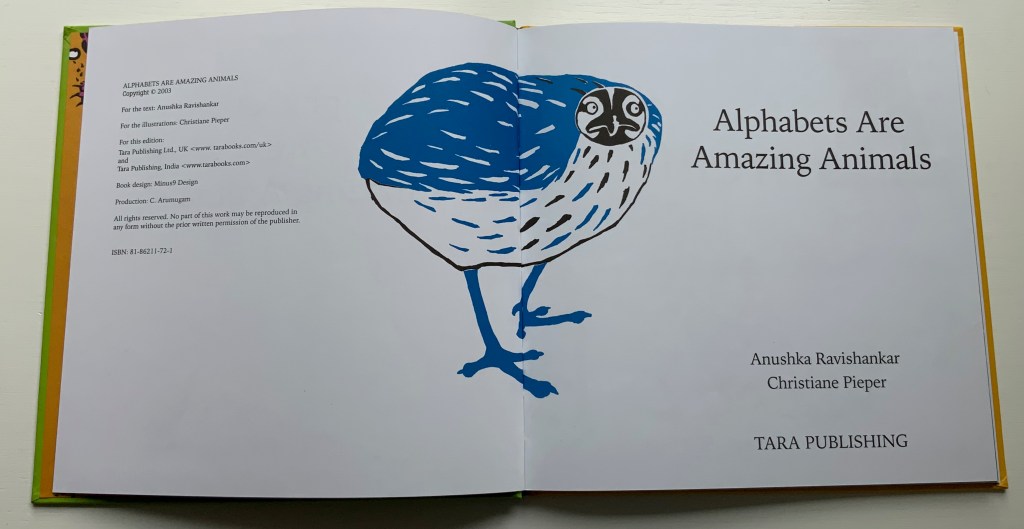
Spice Market: An Alphabetical Melange of Spices (2004)

Spice Market: An Alphabetical Melange of Spices (2004)
Sibyl Rubottom & Jim Machacek
Accordion fold book in drawstring bag with tag. 4.5 x 5″, 24 panels. Edition of 40, of which this is #34. panels. Acquired from Vamp & Tramp, 15 August 2021.
Photos: Books On Books Collection.

The number of abecedaries from Sibyl Rubottom and Jim Machacek abounds. It is hard to choose among them. For this collection, Spice Market just nudges ahead of The Cosmic Sidereal Galactic Abecedarium of the Universe (& Other Tangential Star Ephemera)(2001), The Alphabet of Time (2002), O is for Opera (2006) and The ABC of Yiddish (2007).

The BFK tan pages, some of which had 14 runs through the press, were hand tinted with color and infused with curry, cinnamon, and paprika. Its fonts include Bernhard Modern & Tango and Albertus.

The double-sided accordion incorporates flaps that allude to gathering and selling.

The technique of collage and the variation of the botanical images are perfect for the theme of melange.

Likewise, the colors shifting across the panels.

The effect of the tinting is just as striking — perhaps more so — on the reverse panels.

Below, as displayed in the Bodleian exhibition “Sensational Books”, June-November 2022.

Further Reading and Viewing

Abecedaries I (in progress)“. Books On Books Collection. 31 March 2020.

Athenaeum Music and Arts. 25 May 2021. “What Athenaeum Artists Create in Quarantine“. Video.

Gast, Michael. “The Kincade Chronicles: An Exhibit by Jim Machacek“. Video.

Rubottom, Sibyl. 31 December 2020. “Athenaeum Art Center – Print Studio“. Video.

Books On Books Collection – Robert Filliou

Eins. Un. One. (1984)

Eins. Un. One. (1984)
Robert Filliou
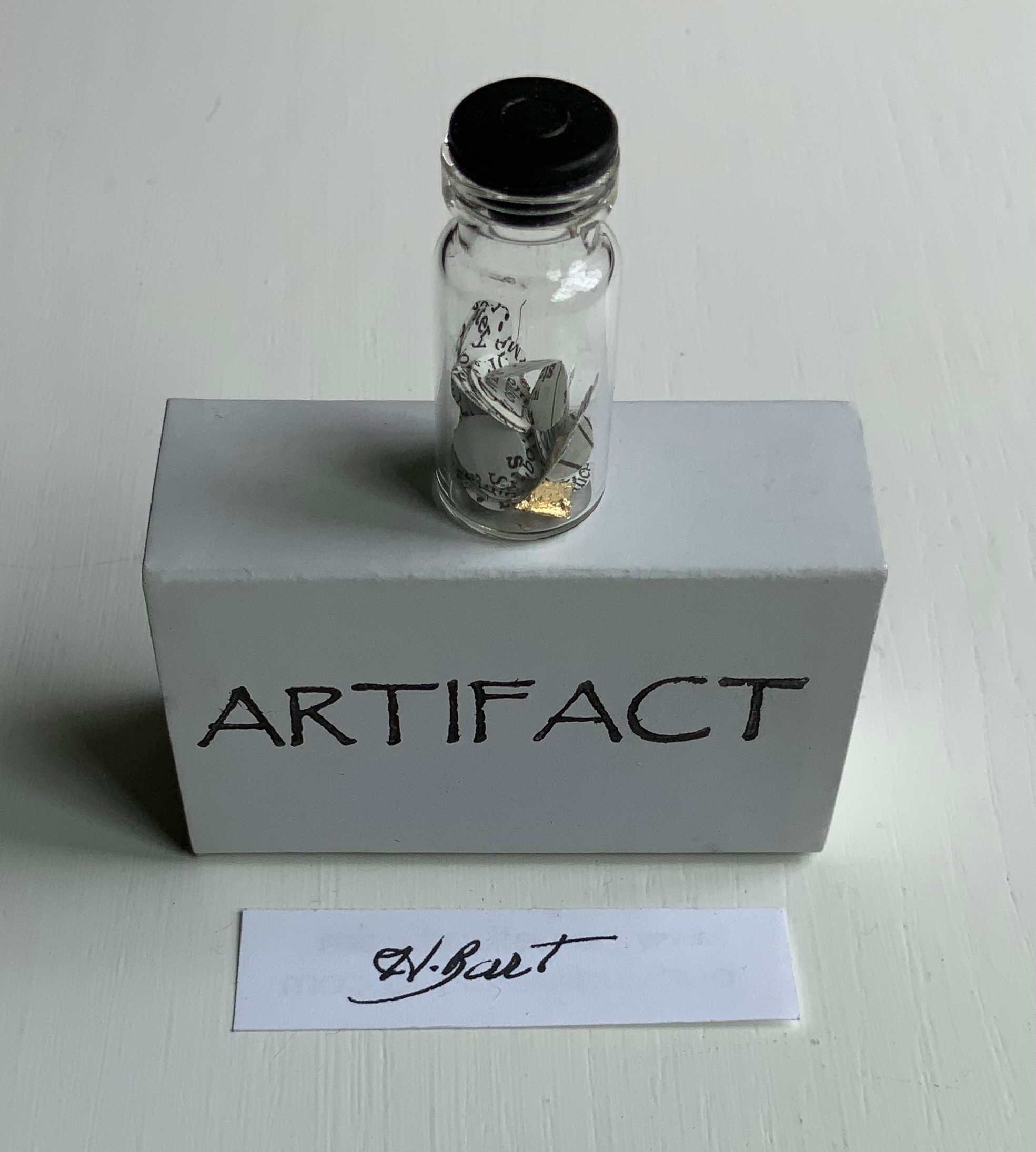
Wooden die. 3 x 3 x 3 cm. Edition of 150 dice with handwritten signatures, signed ”r.f.’’. Edition by Armin Hundertmark. Acquired from Galerie van Gelder, 22 February 2022. Photos: Books On Books Collection.

This work first appeared in 1984 and has been displayed in several 21st-century exhibitions, including Robert Filliou’s first solo exhibition at the Henry Moore Institute in Leeds in 2013. The constellation of 16,000 multicolored dice, each with all six sides bearing a single dot, delivers one of the more humorous works of homage to Stéphane Mallarmé’s Un Coup de Dés Jamais N’Abolira le Hasard. With the guarantee of a single dot, it might be thought that chance has been abolished, whichever and however many dice are rolled. The multiple sizes and colors of the dice and the varied constellations into which they might fall per installation suggest otherwise.
Just a thought.

As Mallarmé’s last line — Toute Pensé émet un Coup de Dés — implies, even this thought emits a throw of the dice.

© Estate Robert Filliou. Photos: Ilmari Kalkkinen for Mamco, Genève; Matthew Noah Smith for University of Leeds; Books On Books Collection. Displayed with permission of Estate Robert Filliou & Peter Freeman, Inc., New York / Paris.

Further Reading

Filliou, Robert, and Sylvie Jouval. 2003. Robert Filliou: éditions & multiples. Dijon: Les presses du réel. See p. 91 for documentation of Eins. Un. One.

Henry Moore Foundation, Institute exhibition, Galleries 1, 2 and 3, 21st March 2013 – 23rd June 2013. Video of installation preparation

Patrick, Martin. September 2021. “Iconoclastic and Irreverent (Buddhist-inflected) Simplicity in Fluxus Performance and Artworks“. On Curating. Issue 51, Fluxus.

Books On Books Collection – Jean Lecoultre

STÉPHANE MALLARMÉ, UN COUP DE DÉS JAMAIS N’ABOLIRA LE HASARD: POÈME (1975)

STÉPHANE MALLARMÉ, UN COUP DE DÉS JAMAIS N’ABOLIRA LE HASARD: POÈME (1975)
Jean Lecoultre
Double canvas slipcase/folder enclosing a folded-paperbound book. Slipcase: 340 x 260 mm; Book: 330 x 250 mm, 62 pages inclusive of the 5 foldouts. Edition of 115, of which this is #78.
Acquired from OH 7e Ciel, 10 March 2022.
Photos: Books On Books Collection. Displayed with permission of Jean Lecoultre

Among the many distinguishing features of Jean Lecoultre’s homage to Stéphane Mallarmé’s poem, three of the most striking are the typeface, the paper and the images. In deliberate ways, each differs from the deluxe edition that Ambroise Vollard and Mallarmé planned after the poem first appeared in 1897.

Sabon is the typeface, designed by Jan Tschichold in 1964 under commission from Walter Cunz of Stempel. The Linotype, Monotype and Stempel foundries released it jointly in 1967, which makes its use only eight years later a little bit daring. Only a “little bit” because anything more modern (say, Garamond) would have been preferable to Mallarmé rather than the Elzevir chosen by NRF when it published the 1914 edition. Lecoultre and the publisher Galerie Edwin Engelberts followed the 1914 layout but, thank goodness, not the typeface. Sabon’s thin and thick strokes do not contrast as much as those of Didot, and it does not have the same verticality. Although rooted in Garamond, Sabon comes closer than Garamond to the narrowness of Didot. Walbaum might have been a still closer option, but with its more substantial thin strokes, Sabon has to have been a more suitable choice for the handmade paper in this work.

Screenshots of adaptations: Didot © Apple; Sabon © Adobe, Linotype and ™Monotype; Garamond © Microsoft; Walbaum © Linotype and Monotype; comparisons made possible by Identifont.

Georges Duchêne (1926-2012) (Moulin de Larroque and Moulin de Pombié) fabricated the paper (vélin de cuve) especially for the project. The paper bears Duchêne’s watermark as well as a rough “tooth” (surface texture that grips the ink) and uneven deckled edges. With his semantic and typographic innovation, Mallarmé intended to draw attention to les blancs (the spaces around the lines, phrases and single words). With its smoothness interrupted by bumps, its simultaneous softnesss and stiffness, the paper draws the eye and touch even more to the space around the verses.

The surface must have presented a challenge for the technique of “soft varnish” etching used by Lecoultre. Crown Point Press defines it this way:

A process that involves applying a beeswax ground made soft by the addition of tallow or petroleum jelly evenly over a heated plate with a brayer. After the plate has cooled, the artist draws on paper laid over it. The soft wax comes off on the back of the paper exactly where the artist has pressed, exposing the metal in the pattern of the grain of the paper. More pressure in drawing removes more wax and produces a darker line after the plate has been bitten. In general, soft ground lines look like lines made by the drawing instrument, usually a pencil or crayon. Soft ground can also be used to take a direct impression of any flexible material—a fingerprint, a leaf, a piece of cloth, for example.

The technique resonates metaphorically with Mallarmé’s dictum peindre non la chose mais l’effet qu’elle produit (“to depict not the object but the effect the object produces”). The technique allows Lecoultre to depict the fine details of easily identifiable objects (a stone, fingerprints, a rope and more) and less easily identifiable ones (a blurred wall and windows, a pair of draped rectangular columns being sliced by a cheese-cutter-like cable and so on). Identifiable or not, the objects yield to the effects their juxtaposition, layering and blurring produce.

Lecoultre is also Mallarméan in his mastery of the technique. In an invitation booklet included with the book, Pietro Sarto, who pulled the prints, points out that, due to its delicacy, the soft varnish technique is most often associated with spontaneity and the chance effect. In Lecoultre’s case, Sarto makes the startling revelation that, for some of the images, the plates went through thirteen states. Thirteen chances for precision to be marred. Lecoultre even extends his chance-taking to the paper in pursuit of effect: note how the image of the rock bleeds across the deckle edge. The strange juxtaposition of objects and the way some objects seem to float on the page (or fall off it) — these also mirror Mallarmé’s arrangement of words and lines among les blancs of the pages, the precision of his images and the suggestiveness of his metaphors.

Finally Lecoultre and his publisher strike out in a novel direction with the number and placement of the prints. Unlike Mallarmé/Vollard’s plan to segregate the poem from Odile Redon’s three to four images, Lecoultre integrates his seven with the poem. This entails “bookending” the poem with two double-page spreads, each taken up entirely by a print: one spread before the half-title and one after the final page of the poem. For the remaining five prints to appear on double-page spreads, the publisher urged the use of five foldout pages. This solution, which Lecoultre approvingly embraced, simultaneously challenges and celebrates Mallarmé’s unit of the double-page spread.

Further Reading and Viewing

Jean Lecoultre: l’oeil à vif : peintures & dessins, estampes. Genève: La Dogana ; Vevey: Fondation William Cuendet & Atelier de Saint-Prex, 2021.

Baldwin, Andrew. “Soft Ground Part 1” and “Part 2“. Trefeglwys Print Studio, Wales. Videos accessed 26 March 2022.

Carr-Pringle, Sam. 18 July 2018. “The Softground Etching Process“. Crown Point Press. Video accessed 26 March 2022.

Cheyrou, Françoise. 25 March 2015. “Georges Duchêne, Maître Papetier, Pionnier du Papier d’Art“. Esprit de Pays. Accessed 24 March 2022.

Johansen-Ellis, Mariann. 24 January 2012. “Basic Softground Etching“. Denmark. Video accessed 26 March 2022.

McNeil, Paul. 2017. The Visual History of Type. London: Laurence King. Pp 48-49 (Garamond), 106-07 (Walbaum), 90-91 (Didot), 378-79 (Sabon).

Monotype. ND. “Sabon“. MyFonts.com. Accessed 26 March 2022.

Truszkowski, Robert. 7 September 2020. “Soft Ground pencil drawing“. University of Regina. Video accessed 26 March 2022.

Books On Books Collection – Tauba Auerbach

How to Spell the Alphabet (2007)

How to Spell the Alphabet (2007)
Tauba Auerbach
H255 x W220 mm, 112 pages. Acquired from Zubal Books, 26 October 2021.
Photos: Books On Books Collection. Displayed with artist’s permission.

Auerbach writes in her preface:

The intention of this work is to take an inquisitive look at language, and to apply the unique properties of the system to the system itself. Subjecting language to its own idiosyncrasies and inconsistencies in iteration after iteration in turn brings about major changes and remarkable patterns. … My focus on the flaws or glitches of language is not in the spirit of criticism, but in the interest of cultivating a new idea of possibility or perfection.

It is also in the spirit of artistic playfulness. “How to Spell the Alphabet” is the title of one of Auerbach’s best-known works. A work of ink and pencil on paper (2005), it begins “EY BEE CEE DEE” and was featured in MoMA’s “Ecstatic Alphabet” exhibition (6 May – 27 August 2012). That shows just one way in which How to Spell the Alphabet‘s artistic playfulness makes the letters of the alphabet ecstatic (“to stand outside themselves”). In keeping with the book’s cover and the name of Auerbach’s publishing operation established in 2013 (Diagonal Press), each of those ways adds another angle, another way into, another perspective on her work. This entry, however, deals with only one of them: what Auerbach calls “letter worship”. Expanding on that, she writes:

These pieces are an exaggeration of the slowness of hand-drawing letters. Taking several weeks to draw, each one is a meditation on the form of a single letter on its own, isolated from meaning or context. … These specific letters are inspired by a German alphabet designed by Paulus Franck in 1601. In the tradition of illuminated manuscripts, such an ornamental font treats each letter both as an object of worship and as a means of expressing worship towards what is written. But … they are also an expression of the idea that celebration — in this case, through embellishment — can lead to obliteration. They are meant to teeter on the edge of decipherability, oscillating between legibility and abstraction.

“A” by Tauba Auerbach (left) and Paulus Franck (right). Photos: Books On Books Collection.

“E” by Auerbach (left); “E” and “F” by Franck (center); “F” by Auerbach (right).

“I” by Auerbach (left) and by Franck (right).

“Q” by Auerbach (left); “Q” and “R” by Franck (center); “R” by Auerbach.

That reference to oscillation between legibility and abstraction also draws attention to Auerbach’s fascination with helix-like and chiral (handedness) images and phenomena, which lies at the heart of her major 2021-22 exhibition and even finds expression in its title SvZ. Auerbach’s work oscillates between the world of the alphabet and the world of science and math, just as the letter and the world oscillate when we grasp at the meaning of their relationship.

NO (2005) (left); Stacking (NO) (2007) and Stacking (YES) (2007) (center); YES (2005)(left).Photos: Courtesy of Tauba Auerbach.

Further Reading

Abecedaries I (in progress)“, Books On Books Collection, 31 March 2020 to present.

Paulus Franck“, Books On Books Collection, 23 March 2022.

Auerbach, Tauba. 2020. Tauba Auerbach: S v Z. San Francisco, CA: San Francisco Museum of Modern Art.

Bravo, Tony. 23 December 2021. “Science and Math Entwined with Art”, San Francisco Chronicle.

Jones, Caroline A. November 2021. “Tauba Medium”, ArtForum.

Franck, Paulus, and Joseph Kiermeier-Debre. 1998. Schatzkammer Allerhand Versalien. Ravensburg: Ravensburger Verlag.

Provan, Alexander. December 2021. “Playing Dice with the Universe”. Art in America.

Books On Books Collection – Paulus Franck

Schatzkammer Allerhand Versalien (1601/1995)

Schatzkammer Allerhand Versalien (1601/1995)
Paulus Franck
Facsimile edition created by Joseph Kiermeier-Debre and Fritz Franz Vogel as part of the boxed set Alphabets Buchstaben Calligraphy, published by Ravensburger Buchverlag (1998). Hardback. H275 x W255 mm, 80 pages. Acquired from Antiquariat Terrahe & Oswald, 14 March 2021. Photos: Books On Books Collection.

Little is known of Paulus Franck himself (although the editors reveal a Caravaggesque manslaughter charge in his home town of Memmingen), so the focus rests mainly on Schatzkammer, Allerhand Versalien Lateinisch vnnd Teutsch: allen Cantzleyen Schreibstuben Notaren Schreibern vnd denen so sich des zierlichen schreibens befleissigen zudienst vnd wolgefallen von neüen in Druckh also verferttiget (as the full title goes). The editors position Franck’s Treasury in the context of the phenomena of the writing master, penmanship and calligraphy from 1500 to 1800, even regaling the reader with tales of poor Franck’s castigation by Nuremberg’s calligraphic dynasty the Neudörffers. The editors neatly use the margins of their book to add to the historical context. Below, on the verso page, they have the geometrically controlled design of Albrecht Durer (1525), and on the recto, the exuberance of John Seddon (1695).

One element not extolled by the editors is the printing from woodcuts. The quality of the woodcuts can be better appreciated by looking at the scanned original available from the Bayerische Staats Bibliothek (BSB). Conveniently, the site BibliOdyssey has downloaded the letters and provided additional links. At his Type Design Information Page, Luc Devroye also reproduces Franck’s ornate letters from the 1601 manual as well as from a later volume produced by Paul Fürst (better known for his print “Der Doctor Schnabel von Rom“) and printed by Christoph Gerhard in 1655.

This facsimile of Franck’s Treasury makes up one of four volumes in a box set, edited by Joseph Kiermeier-Debre and Fritz Franz Vogel. The other three present works by Antonio Basoli, Johann Theodor de Bry and Johann David Steingruber. To see Franck’s continuing influence, visit the collection entry on Tauba Auerbach.

Further Reading

Tauba Auerbach“, Books On Books Collection, 23 March 2021.

Johann Theodor de Bry“, Books On Books Collection, 2021.

Jeffrey Morin“, Books On Books Collection, 23 April 2021.

Richard Niessen“, Books On Books Collection, 23 April 2021.

Paul Noble“, Books On Books Collection, 23 April 2021.

Devroye, Luc. n.d. “Paulus Franck“. Type Design Information Page. Accessed 20 March 2022.

Peacay. 17 December 2013. “Uppercase Treasure“, BibliOdyssey. Accessed 19 March 2022.