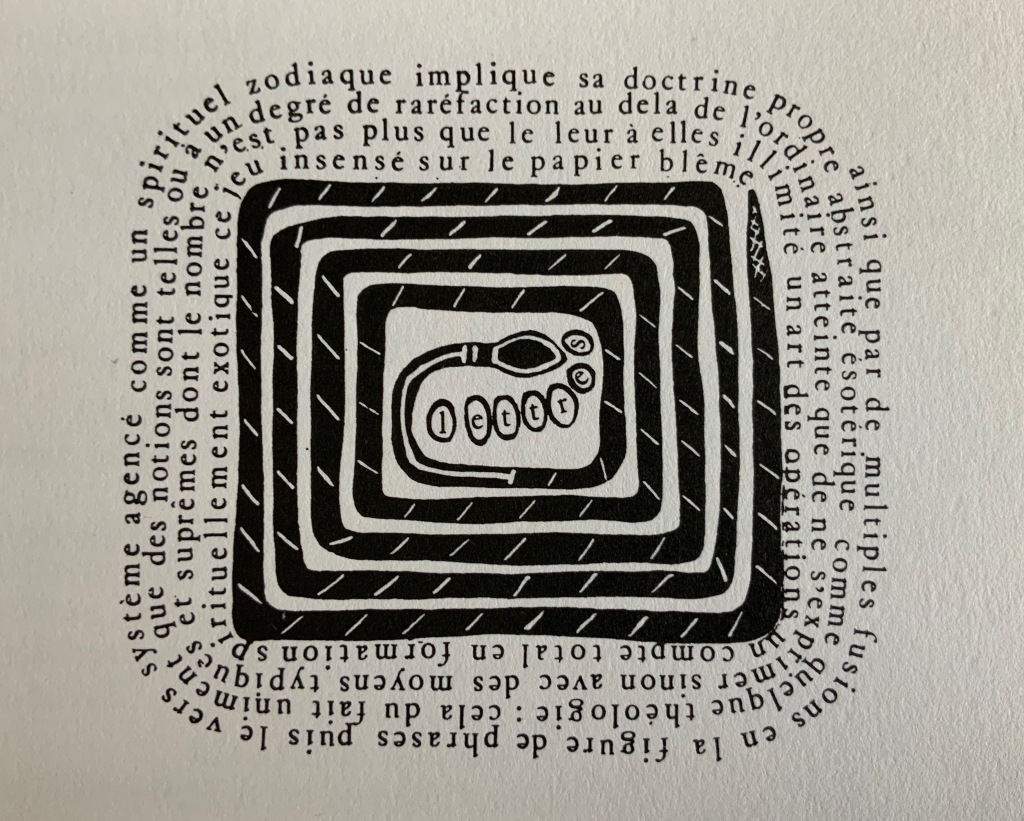
Bookmarking Book Art – Adam Smyth

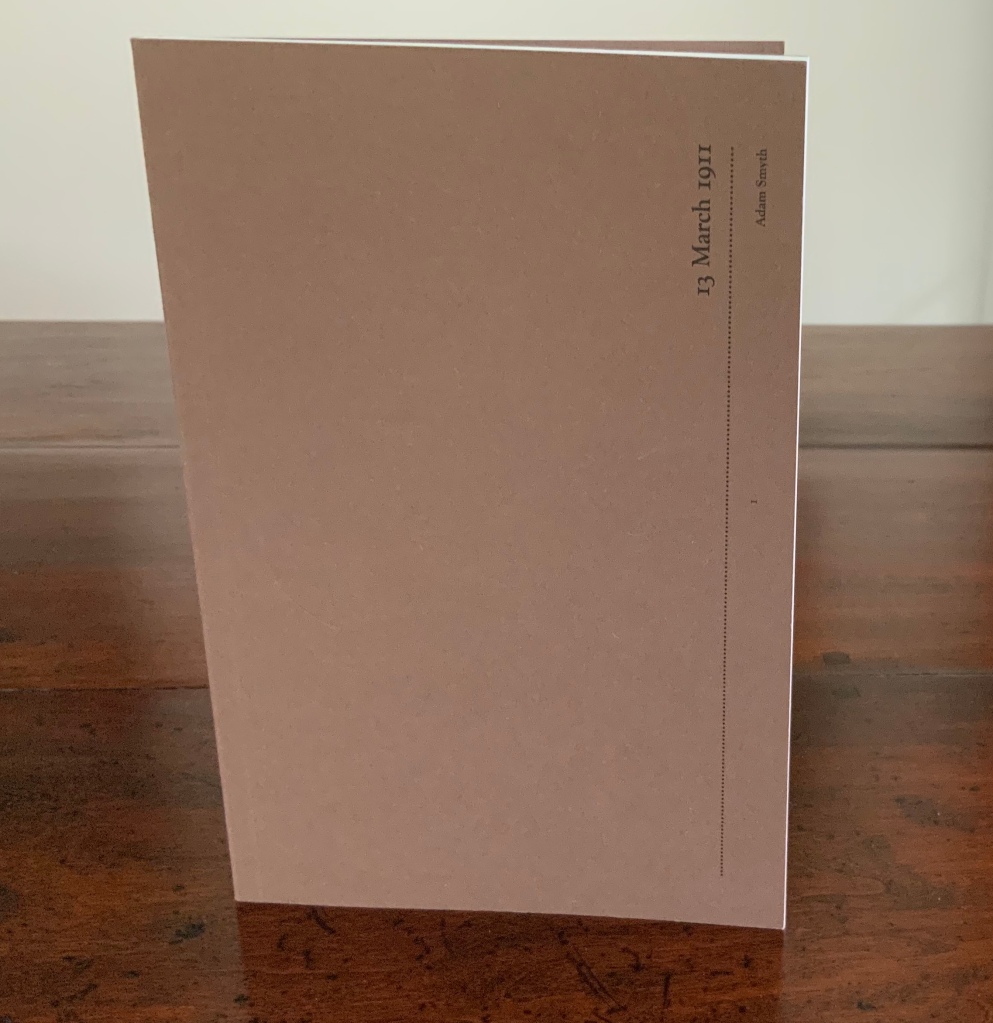
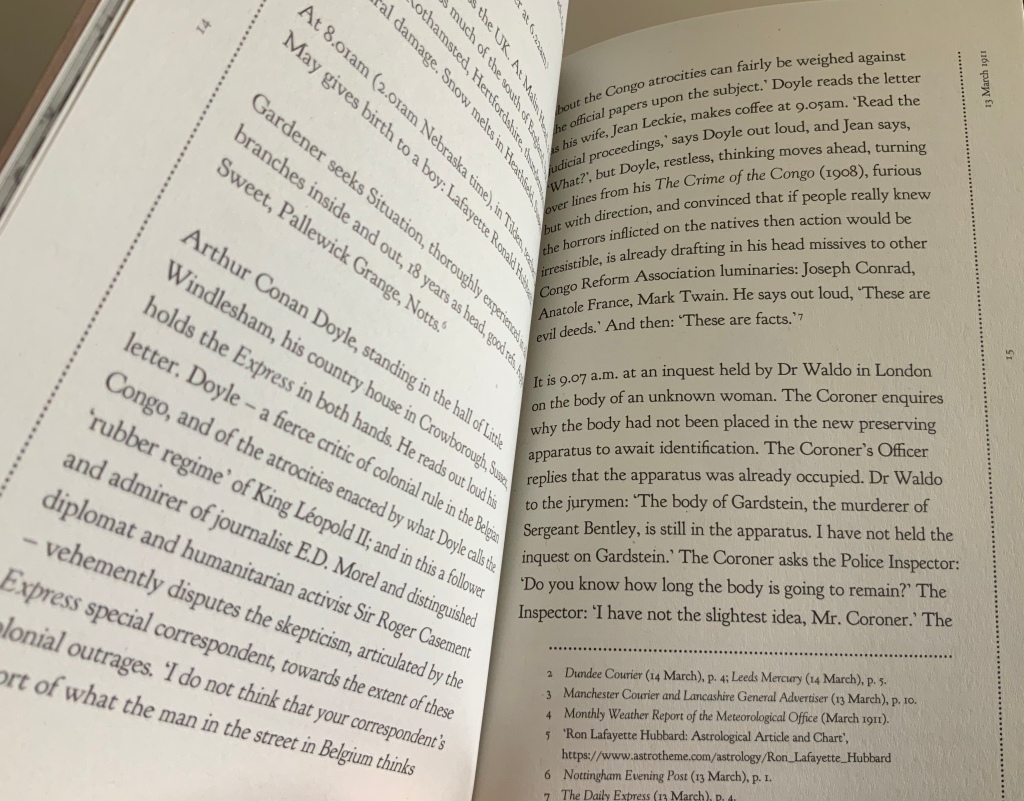
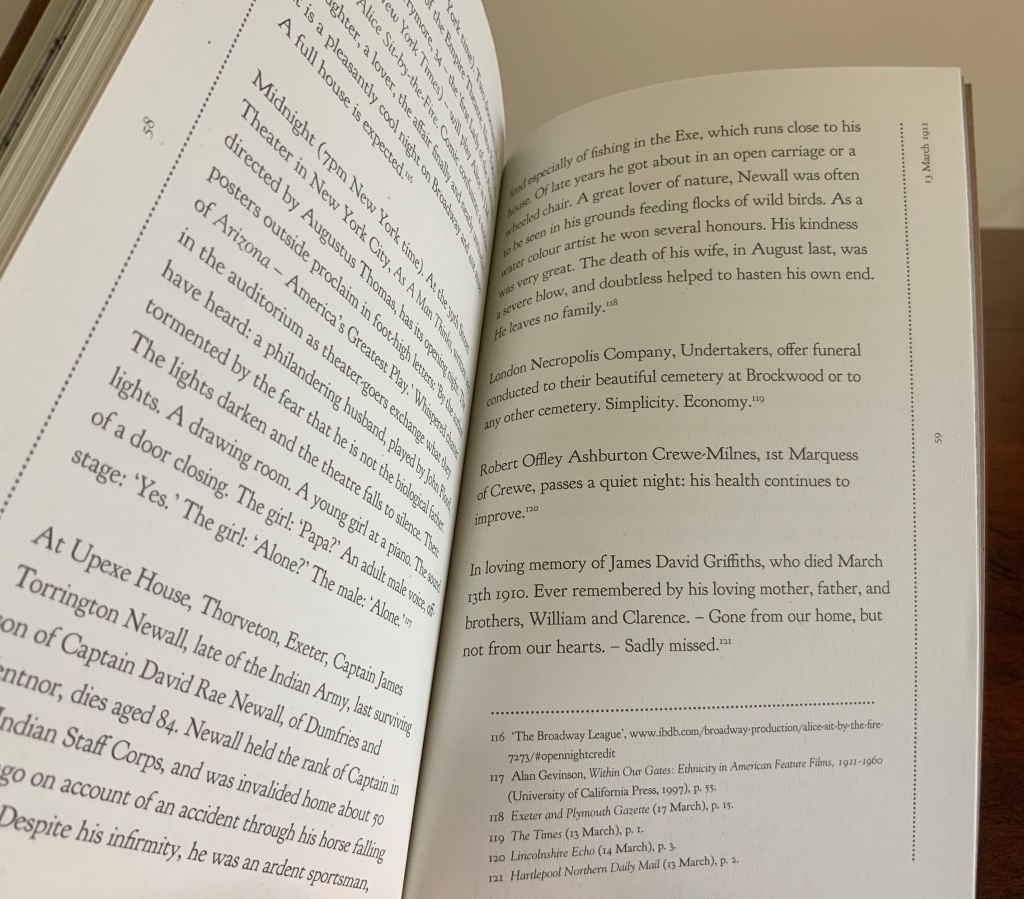
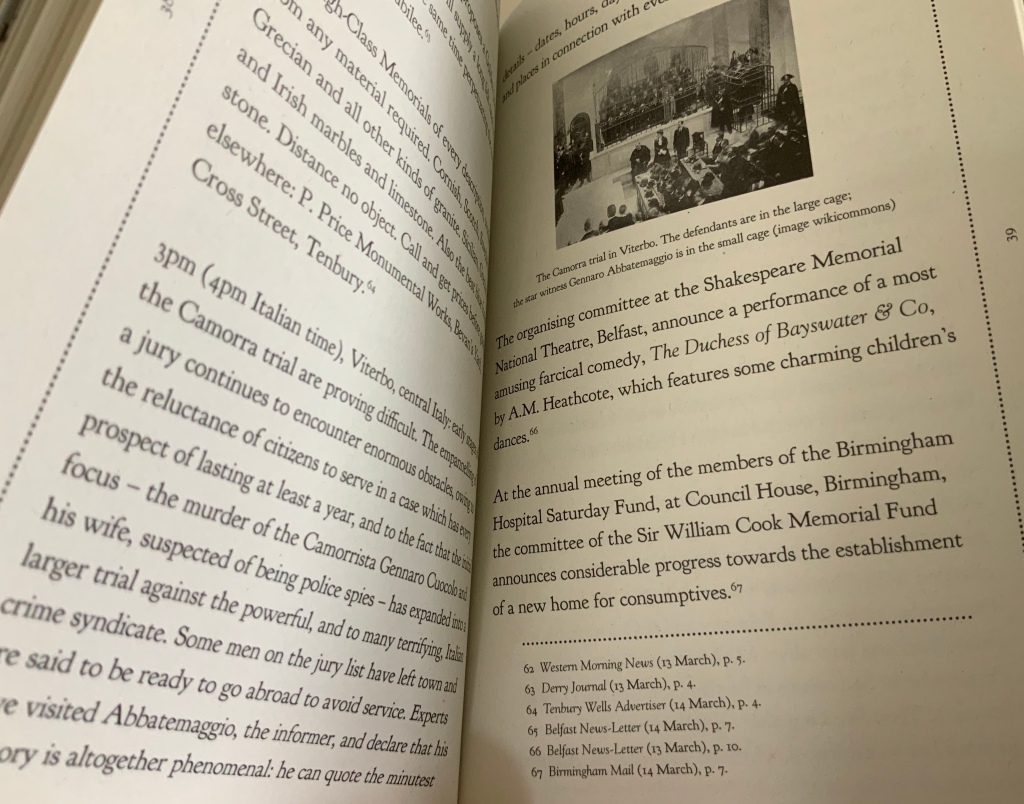
13 March 1911 (2019)

13 March 1911 (2019)
Adam Smyth
Perfect bound paperback. H175x W115 mm, 64 pages. Edition of 500. Acquired from Information as Material, 10 October 2020.

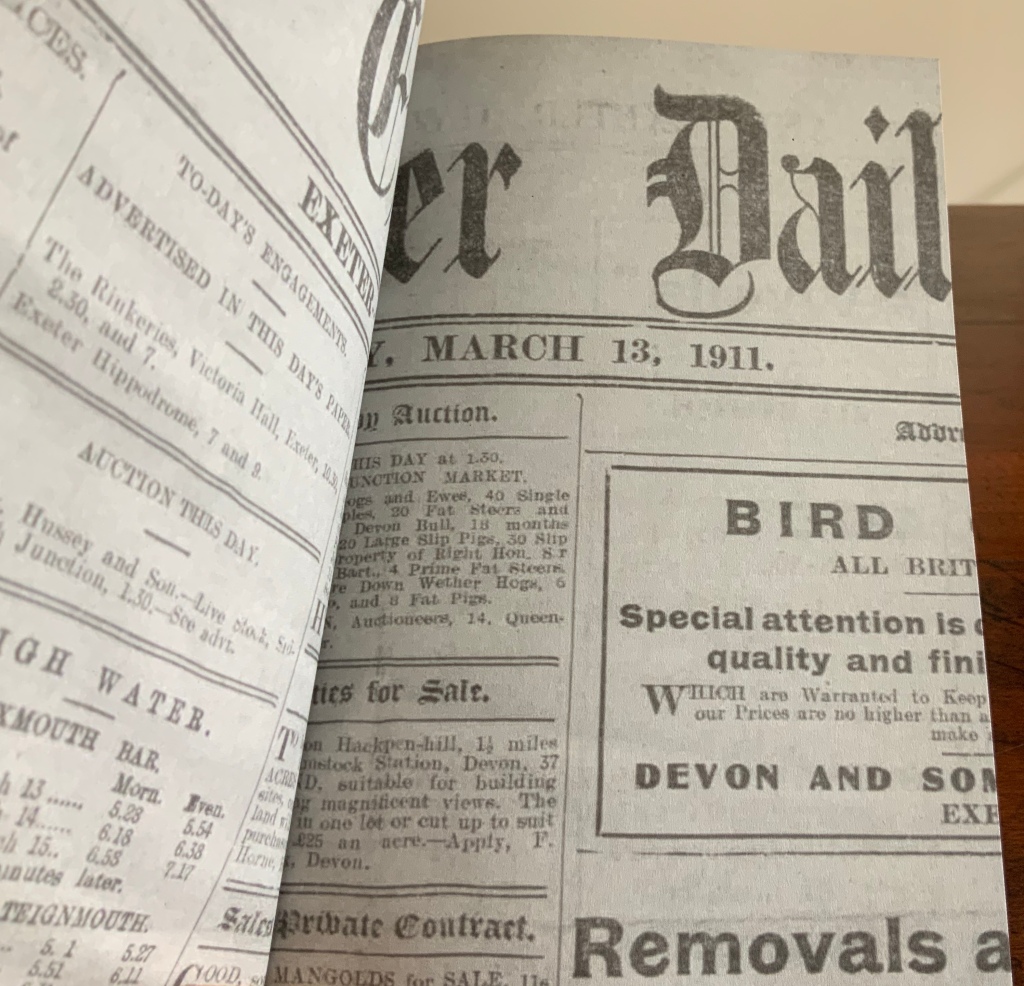
Although unremarkable in its production values, 13 March 1911 enters the collection as a brilliant composite with roots in OuLiPo, Grangerism and the collage technique, Walter Benjamin’s Illuminations and The Arcades Project and Stéphane Mallarmé’s “The Book, Spiritual Instrument”. The date is the birth date of Smyth’s grandfather, and it is what confronts us in a photographic detail of a newspaper masthead.

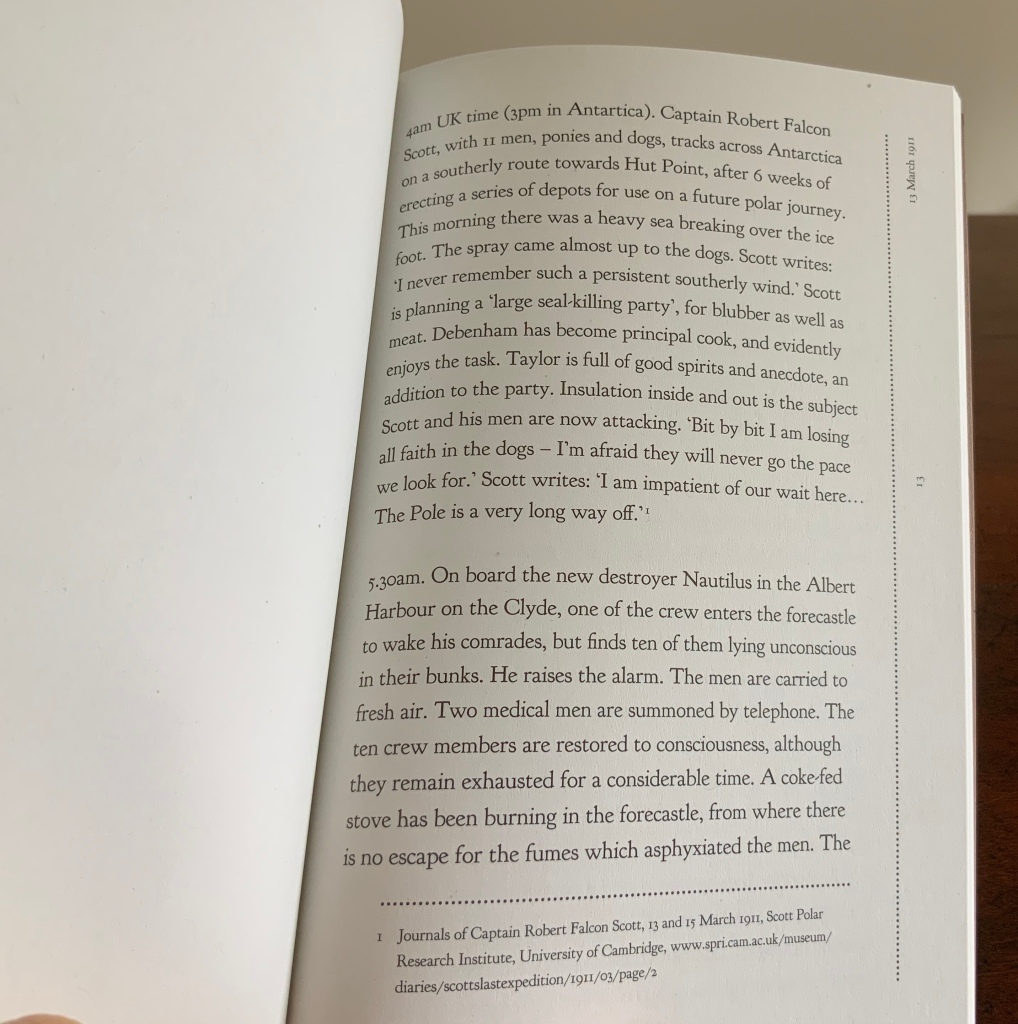
From OuLiPo, Smyth takes the rule of constraint to guide his creation. The constraint is that the content presented must refer to events occurring on 13 March 1911 and in chronological order. Added to the constraint are citability of each source, which often takes Smyth to the Internet and Wayback Machine. Although focused on a single day in time, the writer, book and reader fly back and forth as if tethered together in a time machine composed of print and digital reference material.

Strictly with Grangerism, there should be a previously published book into and onto which the reader/actor inserts, pastes and attaches clippings relevant to the book in hand. Instead of a book in hand, Smyth has a date in hand to which the clippings accrue. And in keeping with this non-material target for Grangerizing, Smyth’s collage technique eschews visual and physical overlapping, rather it lies more in overlapping different types of sources of “data”: newspaper articles, classified ads, advertisements, Captain Scott’s journal, weather reports, obituaries, theater reviews and much more.

In a sort of reversal of Benjamin’s unpacking his library, Smyth packs snippets from history into this one book that turns on his grandfather’s birth date. It is not that Smyth can recreate him with all these snippets, or that the reader can ever know the man from those snippets — anymore than a reader of every single book in Benjamin’s library could recreate Benjamin or know him from doing so.

Like Benjamin in Arcades, Smyth is a collector of fragments by which he tries to make the past present. But Smyth’s time machine is also richly multi-dimensional — especially in its being digitally and print powered. What Smyth gives himself and the reader is an extended moment of recognizing the wide-flung welter around any of us at any time and the wryness, despair, amusement, inspiration and poignancy of trying to define, find and memorialize others (however close) or ourselves by that welter — however retrievable or citable the elements of it.

Finally, Smyth gives us one day’s proof of Mallarmé’s dictum: “everything in the world exists to end up in a book”. And so it ends up in the Books On Books Collection.

Further Browsing

Information as Material (Smyth’s 13 March 1911 is a publication with IAM, which offers works from authors such as Derek Beaulieu, Francesca Capone, Craig Dworkin, Andrew Dodds, Sharon Kivland, Simon Morris and Nick Thurston).

Books On Books Collection – Aurélie Noury

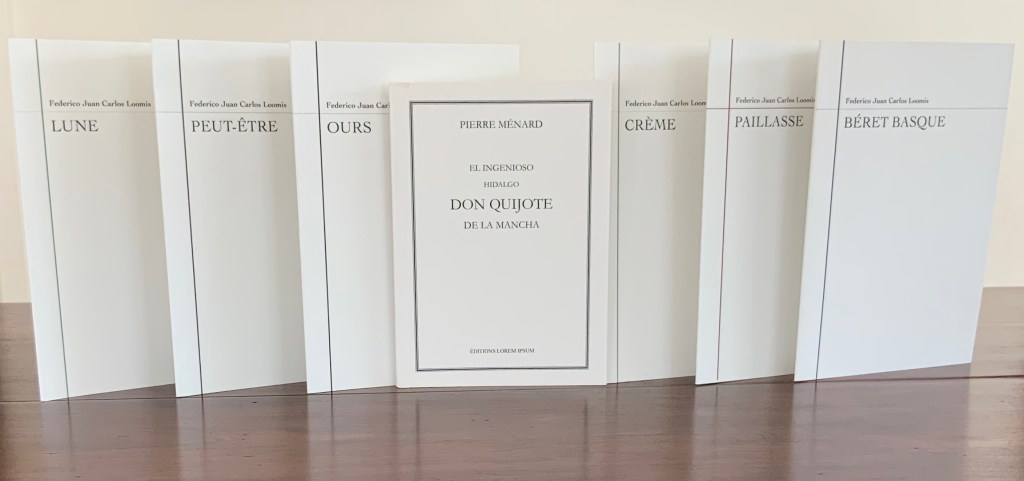
Perhaps there is some peculiar feature of “the book as intellectual instrument” that explains the phenomenon of book-artist-cum-impresari. In the last century, we had Ulises Carrión and Dick Higgins among others. In this century, we have Alicia Bailey, Sarah Bodman, Hubert Kretschmer, Antoine Lefebvre, Laura Russell to mention only a few. They flourish and with such variety. Some manifest as curators, others as gallerists, and others as publishers. Some transform that manifestation into a form of art itself. Aurélie Noury verges on doing this with the works under her imprint Éditions Lorem Ipsum.

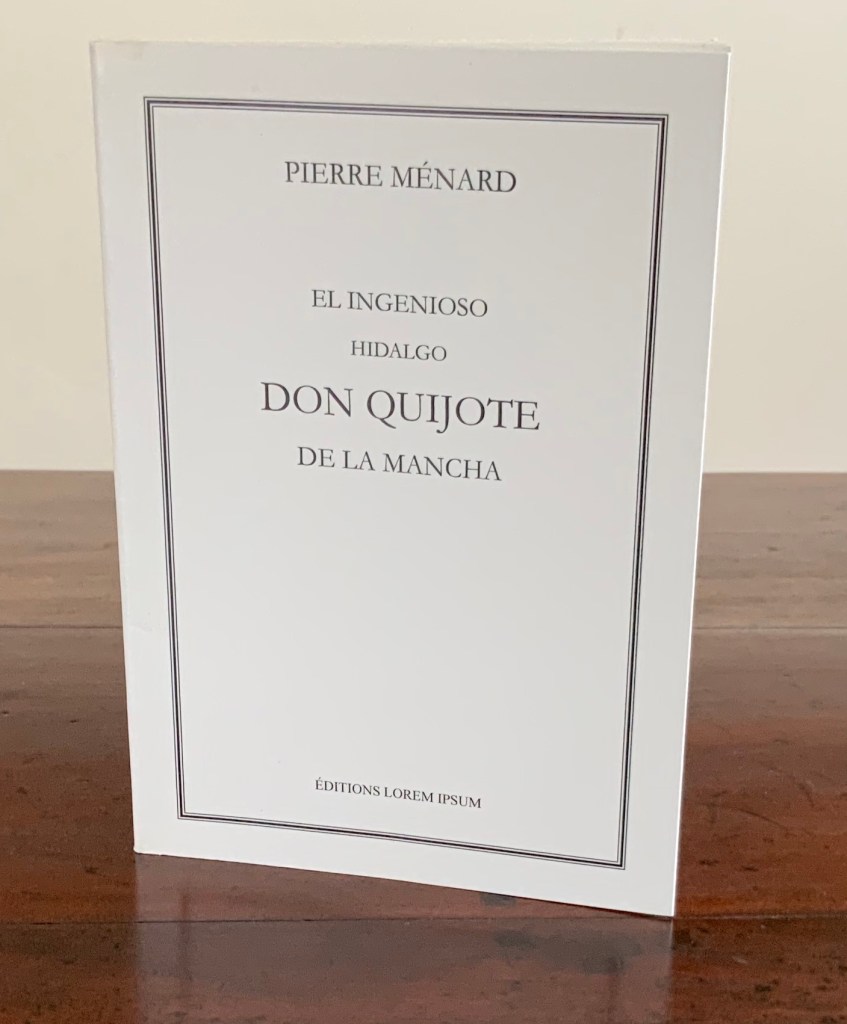
El Ingenioso Hidalgo Don Quijote de la Mancha by Pierre Ménard (after Jorge Luis Borges, “Pierre Ménard, auteur du Quichotte” in Fictions) (2009)

El Ingenioso Hidalgo Don Quijote de la Mancha by Pierre Ménard (after Jorge Luis Borges, “Pierre Ménard, auteur du Quichotte” in Fictions) (2009)
Aurélie Noury
Perfect bound with folded cover, H170 × W120 mm, 38 pages.
Photos: Books On Books Collection.

Borges would be the first to congratulate Noury on her persistence, diligence and taste. Of course, he would be biased, but what else to call her recovery of these pages so briefly mentioned in his short story “Pierre Ménard, author of Quixote”, how else to describe their careful resetting in the precise order mentioned, and what other choice of fonts could be suggested than Garamond for the cover and Times New Roman for the text?

For any reader finishing the discourse on what the narrator calls Ménard’s unfinished oeuvre, it is a solace to turn to Noury’s reproduction and see exactly where Ménard left things hanging in the fragment of Chapter XXII that the narrator mentions so tantalizingly. It is a vicarious thrill to share with the narrator the strangeness of that fragment appearing after the ninth and thirty-eighth chapters!

Given the intrepidness of our artiste éditrice, it may seem churlish to mention the acute accent that appears in the last name of the latter-day author of Don Quixote. No such accent appears in the original Spanish of Borges’ story. Perhaps the Argentinian or his secretary had a momentary lapse. Then again, to give Noury the benefit of doubt and Borges the gift of future vision, the narrator’s Pierre Ménard (or Menard) could very well have been the ancestor of the eponymous founder of a micro vineyard in the Loire Valley who cannot seem to settle on one spelling or the other. It cannot be an accident that this vineyard recently produced a vintage named “Chaos” (2017), a wine that, one critic writes, “should not exist”.

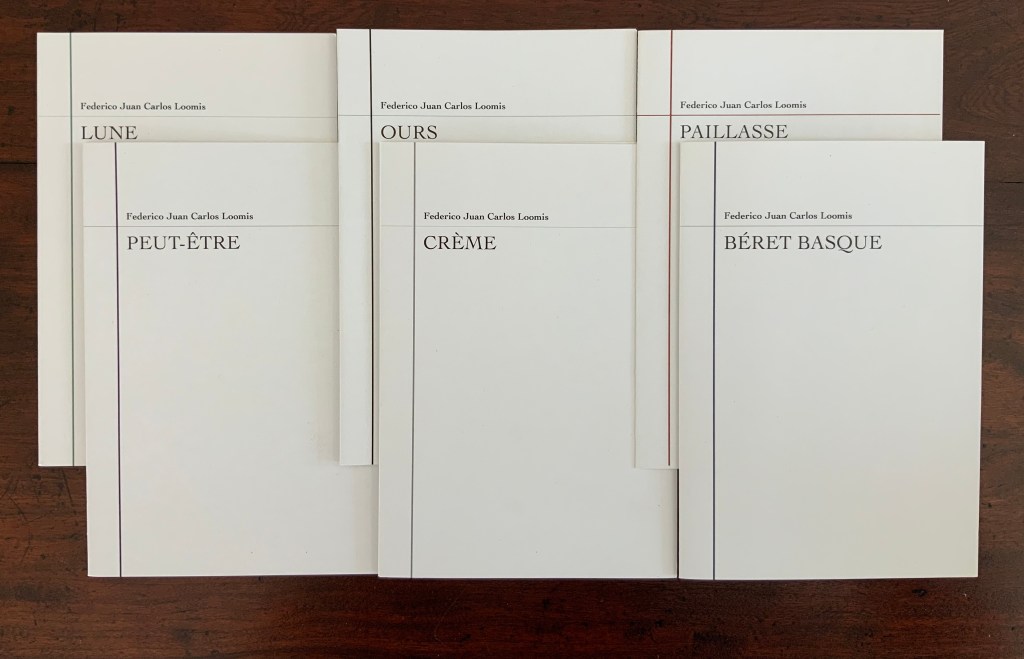
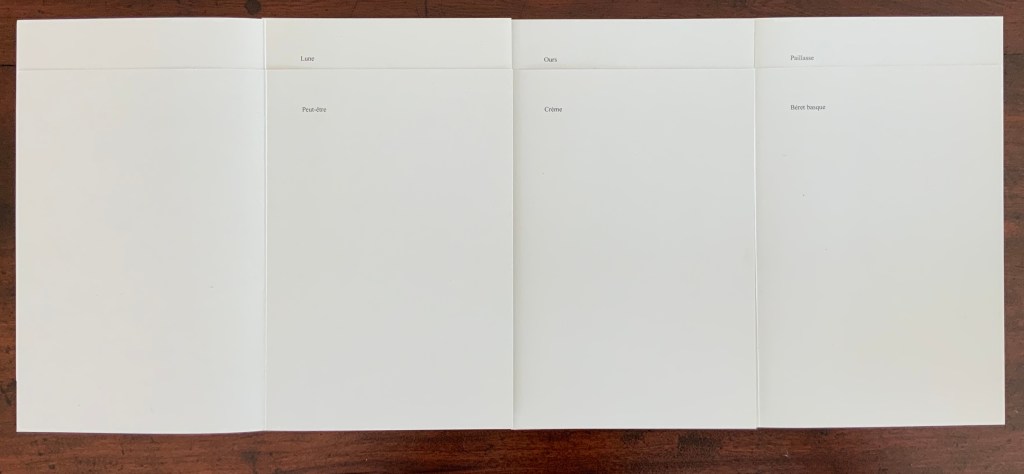
Borges invented other authors besides Ménard and his bio-bibliographical narrator. Borges and his life-long friend Adolfo Bioy Casares came up with Honorio Bustos Domecq, a fictitious detective under whose name they wrote numerous short stories and through whom they introduced other fictitious authors — one such was Federico Juan Carlos Loomis. In “A List and Analysis of the Sundry Books of F. J. C. Loomis”, “Bugsy” Domecq chronicles the work of the legendary writer and critic. Loomis’s chief claim to fame is his collection of six books, whose contents consist solely of their titles.

Were it not for Aurélie Noury’s translating and publishing skills, the Francophone population would have to remain content with Domecq’s Spanish listing and analysis. (Saving, of course, the one title that Loomis wrote in French: Béret Basque.) Regardless of fluency in French or Spanish, the attentive reader will appreciate how the publisher’s sensitive translations capture the denotative, connotative, spiritual and cultural intent of Federico Juan Carlos Loomis’s singular texts.

Each of the French versions is tastefully set in Cochin on the cover and Times Roman in the text. The works’ restrained design (H190 x W130 mm, four pages, three covers in black & white, three with the addition of colored rule) complements their minimal contents.

Many book artists have paid homage to Borges (see Further Reading below). These seven works surely secure a place of honor and humor among them for Aurélie Noury.

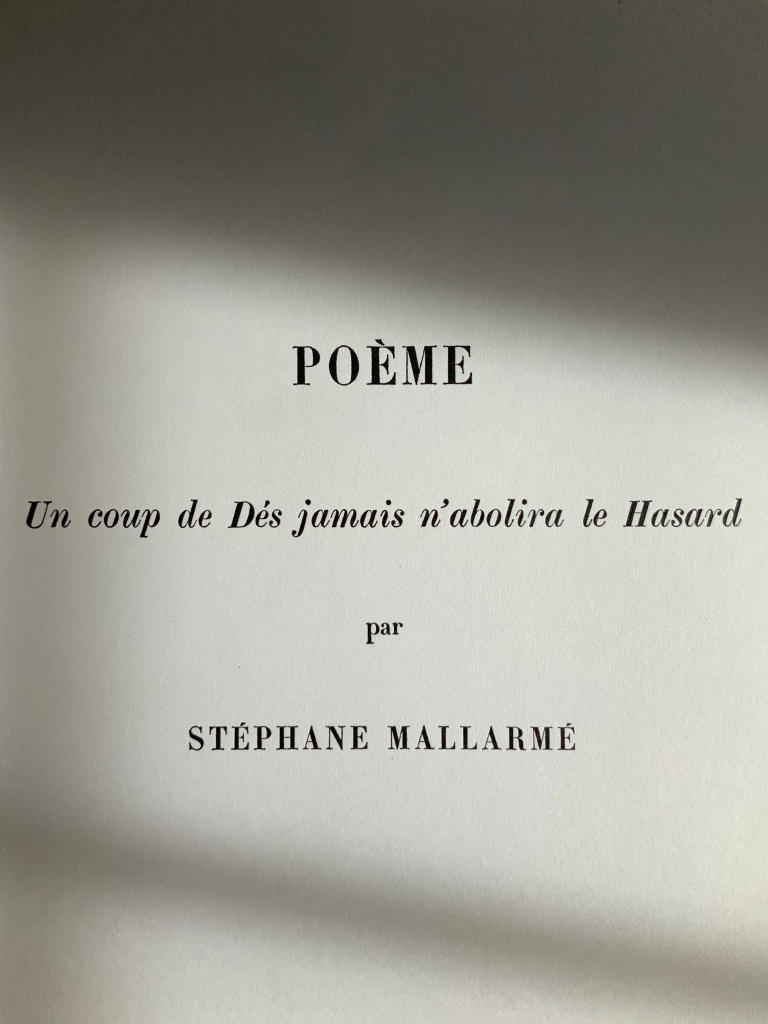
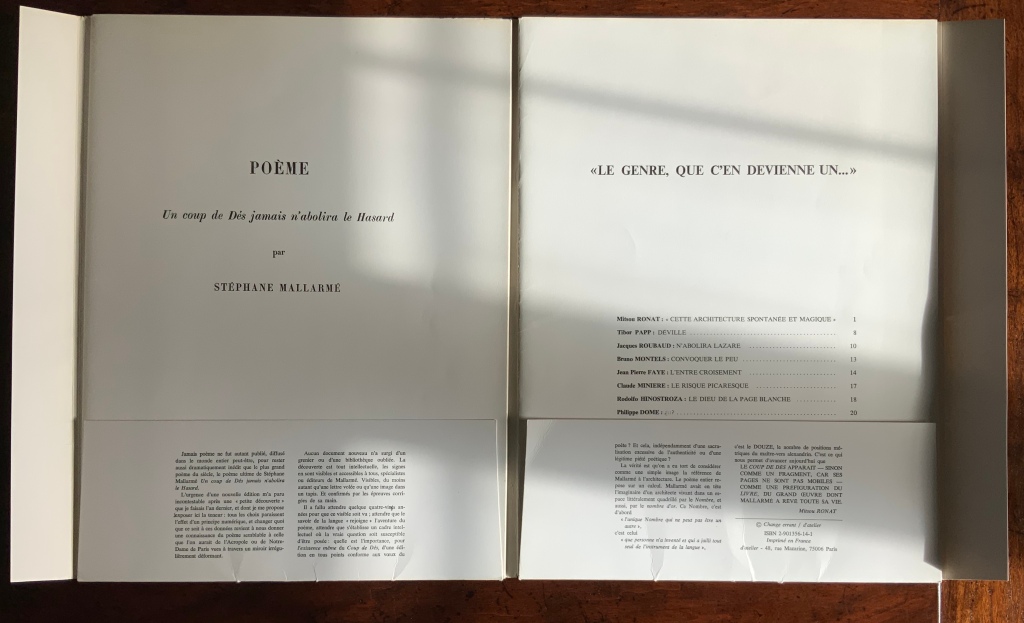
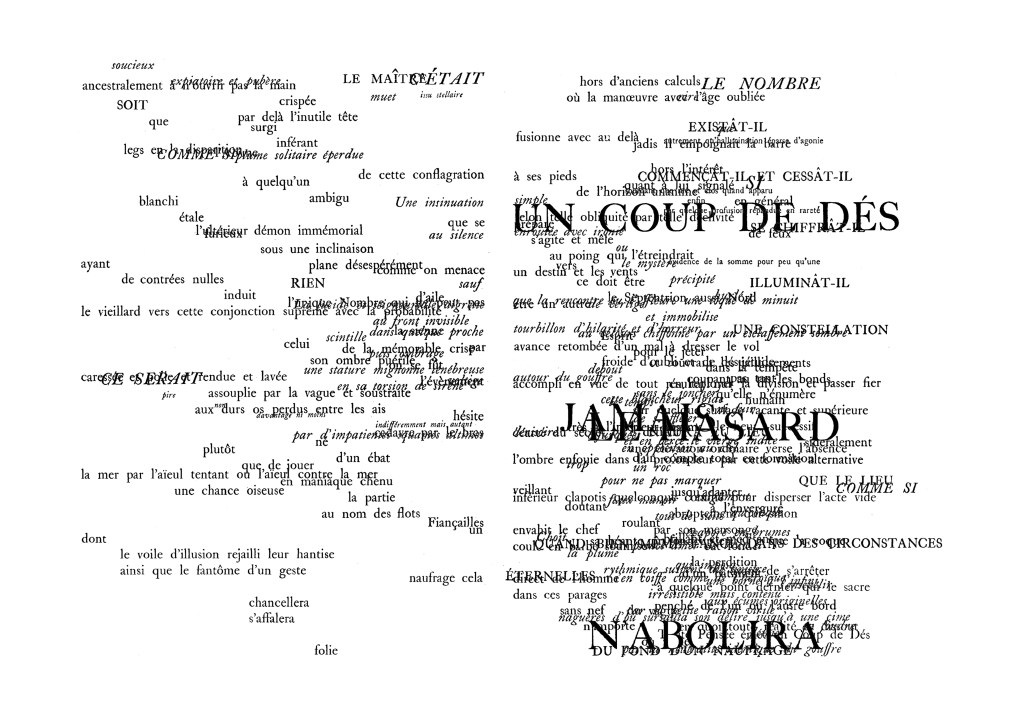
Un coup de dés jamais n’abolira le hasard (poster) (2008)

Un coup de dés jamais n’abolira le hasard (poster) (2008)
Aurélie Noury
H100 x W700 mm. Photo: Courtesy of the artist.

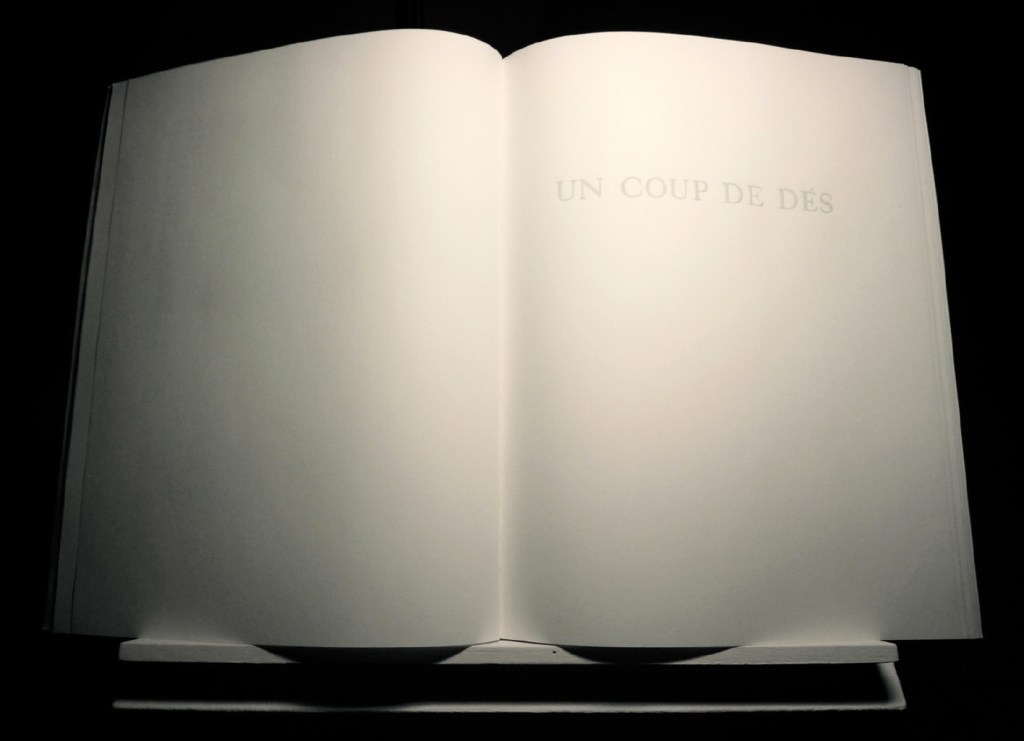
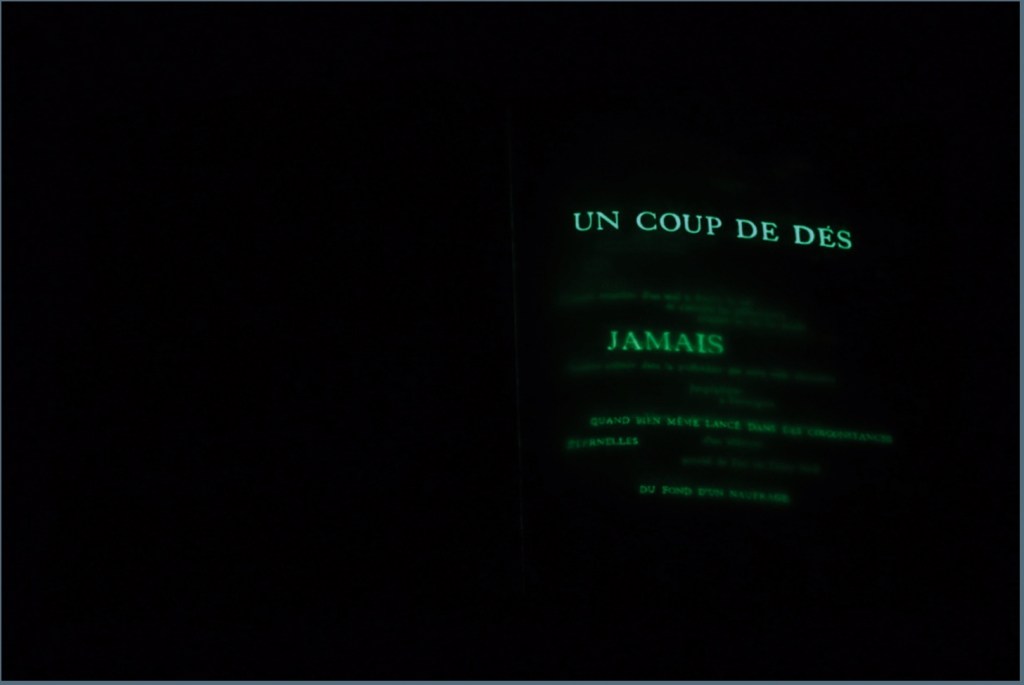
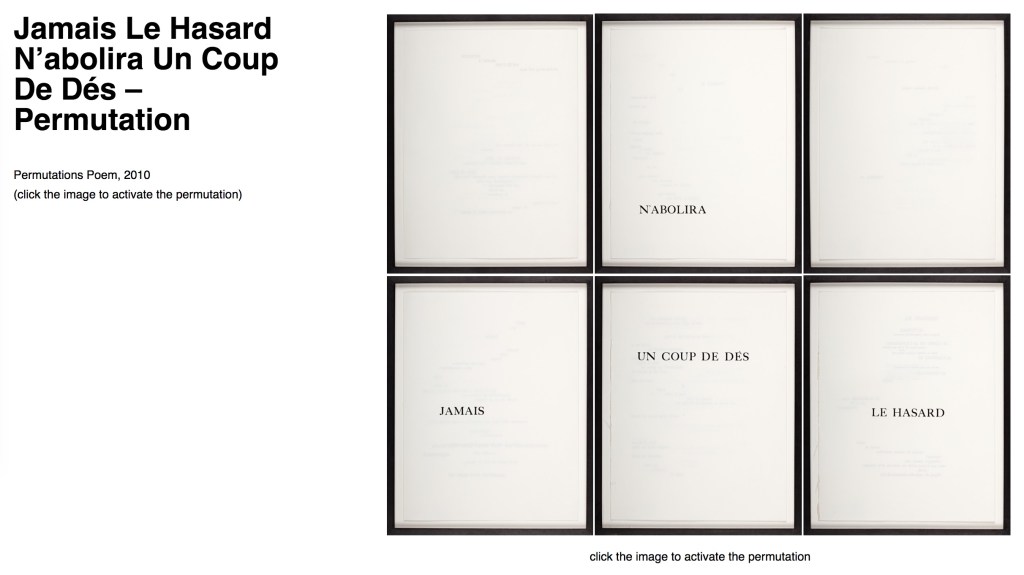
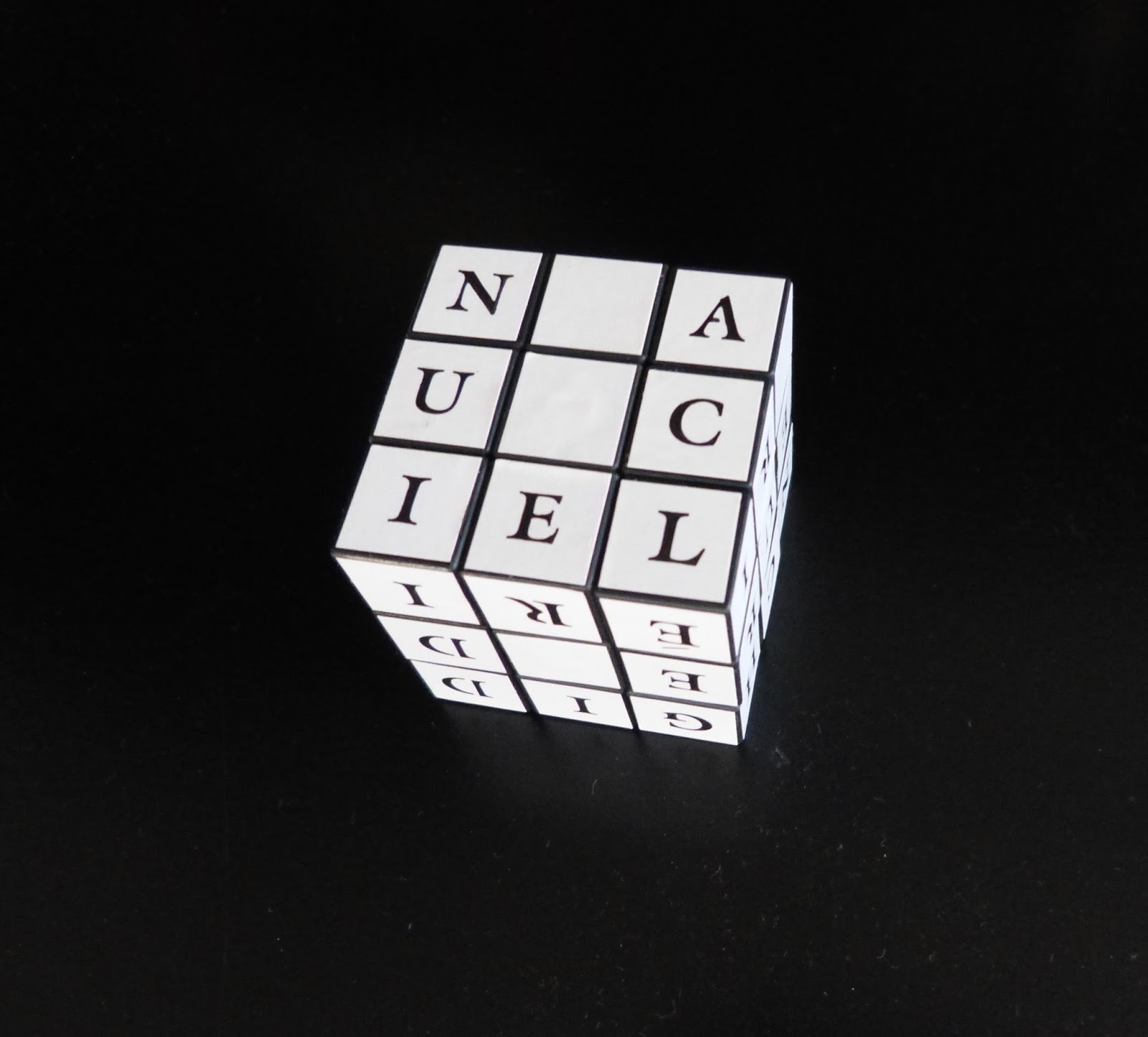
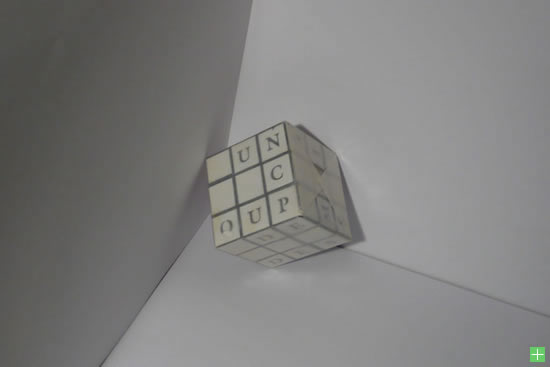
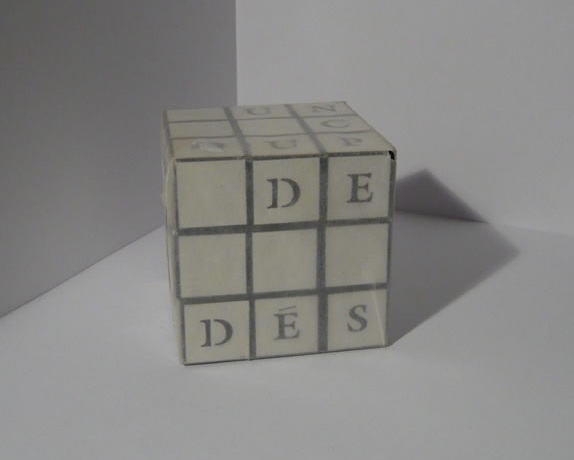
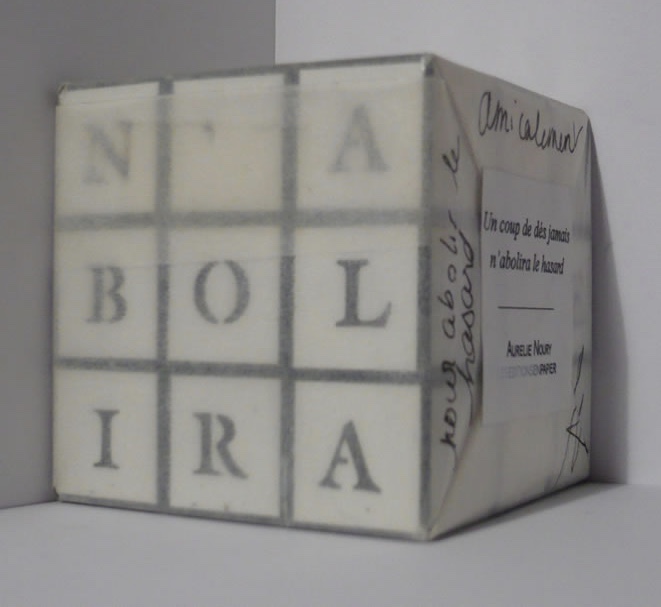
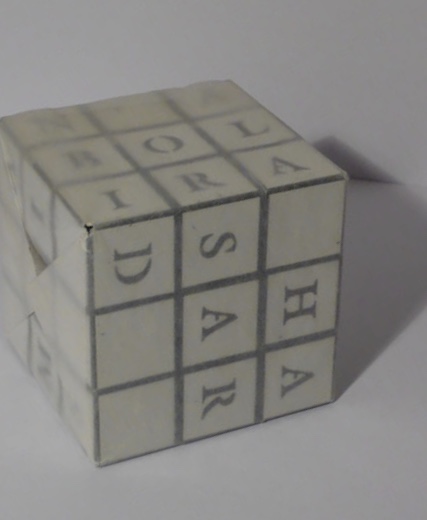
Except for her Rubik’s Coup de Dés, Noury’s poster version of Mallarmé’s poem would be the thing for summarizing, critiquing, parodying and paying homage to le Maître‘s work. Why not collapse all of the spacing and text in its varied type sizes and styles into one double-page spread? But then, if the game is “the total expansion of the letter”, the dispersal of letters from keywords in the poem across the 54 spaces on a Rubik’s cube would be the thing. Unfortunately, at the moment, this particular thing does not reside in the Books On Books Collection, so the following photos (courtesy of the artist) stand as a collector’s reminder.

Noury’s inventive literary/artistic appropriation does not end with Borges and Mallarmé. Marcel Duchamp, Honoré de Balzac, John Irving and Louis Aragon also come in for varying treatments at her hands. Her choices for these reversals of ekphrasis — proceeding from an existing text to a newly created work of art, rather vice versa — are clever. But it is her combination of the techniques of appropriation, homage and parody and intermedial play with the various techniques of print and digital publications in a distinctive way for each target text that is ingenious.

No doubt there could be many more such works to come, but even the most ingenious of appropriators finds her time appropriated by other ventures. As directrice of the imprint Éditions Incertain Sens, she engages with the works acquired for Le Cabinet du livre d’artiste (CLA) at the University of Rennes 2 as well as with their documentation in the CLA’s newspaper Sans niveau ni mètre. These ventures have been apropos and obviously influential for Noury. Éditions Incertain Sens and the CLA were founded by Leszek Brogowski, who has written extensively on book artists such as Bernard Villers. The furniture of CLA was made by artist and writer Bruno di Rosa, who has appropriated and extended the works of Gustave Flaubert and Joachim du Bellay. The situation could be only more apropos if Éditions Incertain Sens had been founded by Mallarmé and Borges at some point in the future!

Further Reading

A Maze of Books for the Cultural Olympiad“, Bookmarking Book Art, 15 August 2012. For a sculptural homage to Borges.

Sean Kernan“, Books On Books Collection, 23 February 2013. For a photographic homage to Borges.

acqueline Rush Lee”, Books On Books Collection, 8 October 2019. For more on reverse-ekphrasis.

Antoine Lefebvre”, Books On Books Collection, 28 September 2020. For another artiste éditeur.

Peter Malutzki“, Books On Books Collection, 11 November 2019. For an homage to Borges’ Encyclopedia of Tlön from the short story “Tlön, Uqbar, Orbis Tertius”.

Michalis Pichler”, Books On Books Collection, 19 August 2020. For a prolific hommageur of Mallarmé.

Hanna Piotrowska (Dyrcz)“, Books On Books Collection, 13 December 2019. For an “earthy” homage to Borges.

Benjamin Shaykin“. 3 December 2022. Books On Books Collection. For another homage to Borges.

Rachel Smith“. In progress. Books On Books Collection. For another homage to Borges.

Barbara Tetenbaum”, Bookmarking Book Art, 26 June 2013. For more on reverse-ekphrasis.

Basile, Jonathan. 2015~. The Library of Babel. Website. Accessed 3 July 2023.

Gilbert, Annette (ed.). Publishing as Artistic Practice (Berlin: Sternberg Press, 2016).

Books On Books Collection – Francesca Capone

we have a trick that we call language. Actually, we have many kinds of language, each of which is based on a formal system of codes and/or symbols through which we represent states of the world.
Frank R. Wilson, The Hand (2000)

Weaving Language: Lexicon (2022)

Weaving Language: Language is Image, Paper, Code & Cloth (2018)


Weaving Language: Lexicon (2022) and Weaving Language: Language is Image, Paper, Code & Cloth (2018)
Francesca Capone
Perfect bound paperbacks. H230 x W155 mm, 104 and 116 pages. Acquired from Amazon, 19 November 2022; Book Depository, 10 October 2020.
Photos: Books On Books Collection. Displayed with permission of the artist.

Weaving Language examines the poetics of weaving traditions through historical research as well as contemporary practices. Attempting to dismantle and rebuild commonplace understandings of the history of writing, Weaving Language focuses on fiber-based forms as a longstanding but often overlooked medium for record keeping, storytelling, and poetry. The book is both a mapping of instances that exemplify textile poetics from the beginning of time to the present day, as well as a creative experiment in utilizing textile as code. Capone invites the reader to experience textile as something to be read, along with its tactile and visual functions. — Publisher’s description.

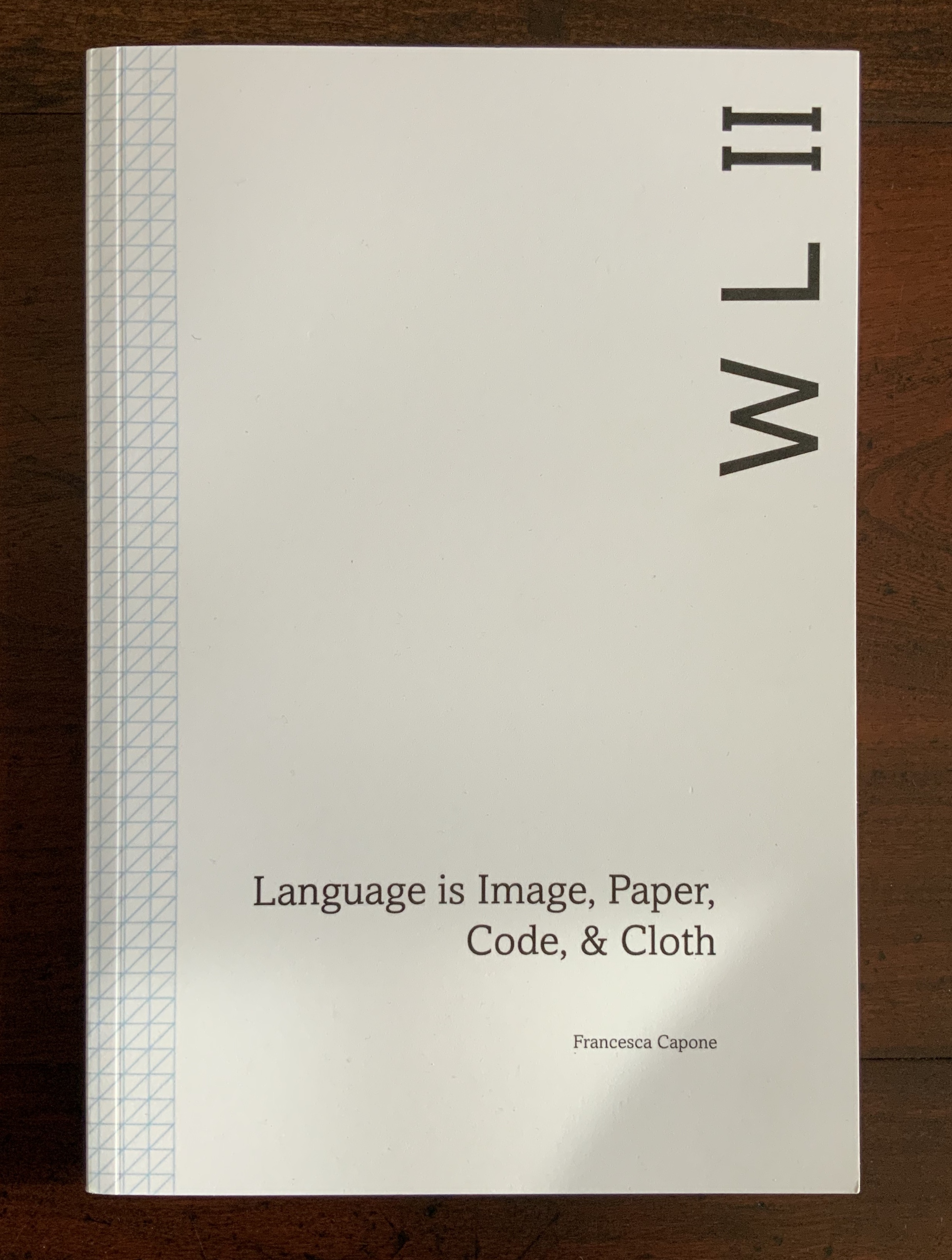
Weaving Language: Lexicon (2022) and Weaving Language: Language is Image, Paper, Code & Cloth (2018) are the first and second parts of a trilogy (all three parts first appeared in 2015 as a limited edition artists’ book, the first and second have been expanded reissued, the third is out of print). The brilliant content and typography of the first two make the absence of the third morely felt acute. WL I’s title and table of contents indicate that it is about laying down the definitions, but this belies the richness of the content, particularly of the color section with its collaboration from Adjua Gargi Nzinga Greaves, Amaranth Borsuk, Imani Elizabeth Jackson and Anni Albers.

As WL II’s table of contents shows, it is composed of three parts. Initially the first part seems to be a chronologically organized commonplace book with a rich collection of quotations from primary and secondary sources (citations in gray), with some guiding comments interspersed from Capone. But with the source material printed in black, the citation lines in gray and author’s comments in blue, the feeling turns to that of holding a patchwork quilt or the Bayeux tapestry of weaving’s history. The image below provides an example of the color-coded typography, including the single and apt exception in red.

Photos: Books On Books Collection.

Capone’s choice not to reproduce an image of Elizabeth Parker’s sampler stitched in red (see below) but rather to use type and red ink draws subtle and effective attention to how the book’s own visual motif underpins the way Capone weaves her choices of content together into a unified fabric.

Linen, embroidered with red silk in cross stitch (c. 1830)
Elizabeth Parker (1813-89)
H858 x W744 mm. Photo: Victoria & Albert Museum, Textiles & Fashion Collection, T.6-1956.

The second part — “Woven Codes” — begins like a “how to” book with a key page followed by examples. Structurally more profoundly, it links to the first part’s concluding quotation of a quotation: the poet Susan Howe citing Gertrude Stein’s “Sentences” notebooks, in which she wrote “Think in stitches”. The link is made by coding three selections from Stein’s Tender Buttons into three forms — gridded writing, an erasure poem and then a woven draft. Again, aptly, Capone chooses for her samplers “A Cloth”, “A Paper” and “A Drawing”. The next two pages — one illustrating the grid-based coding of Braille, one showing the method of tying coded Quipu knots — also reach back into the first part to pick up threads introduced by citations of Joyce Carol Oates and David Antin.

The last page of this black-and-white section of “Woven Codes” alludes even more subtly to the first part. The page’s text describing the illustration below it reads

The weaving of alternating S and Z twisted yarns results in a historically sturdy cloth composition.

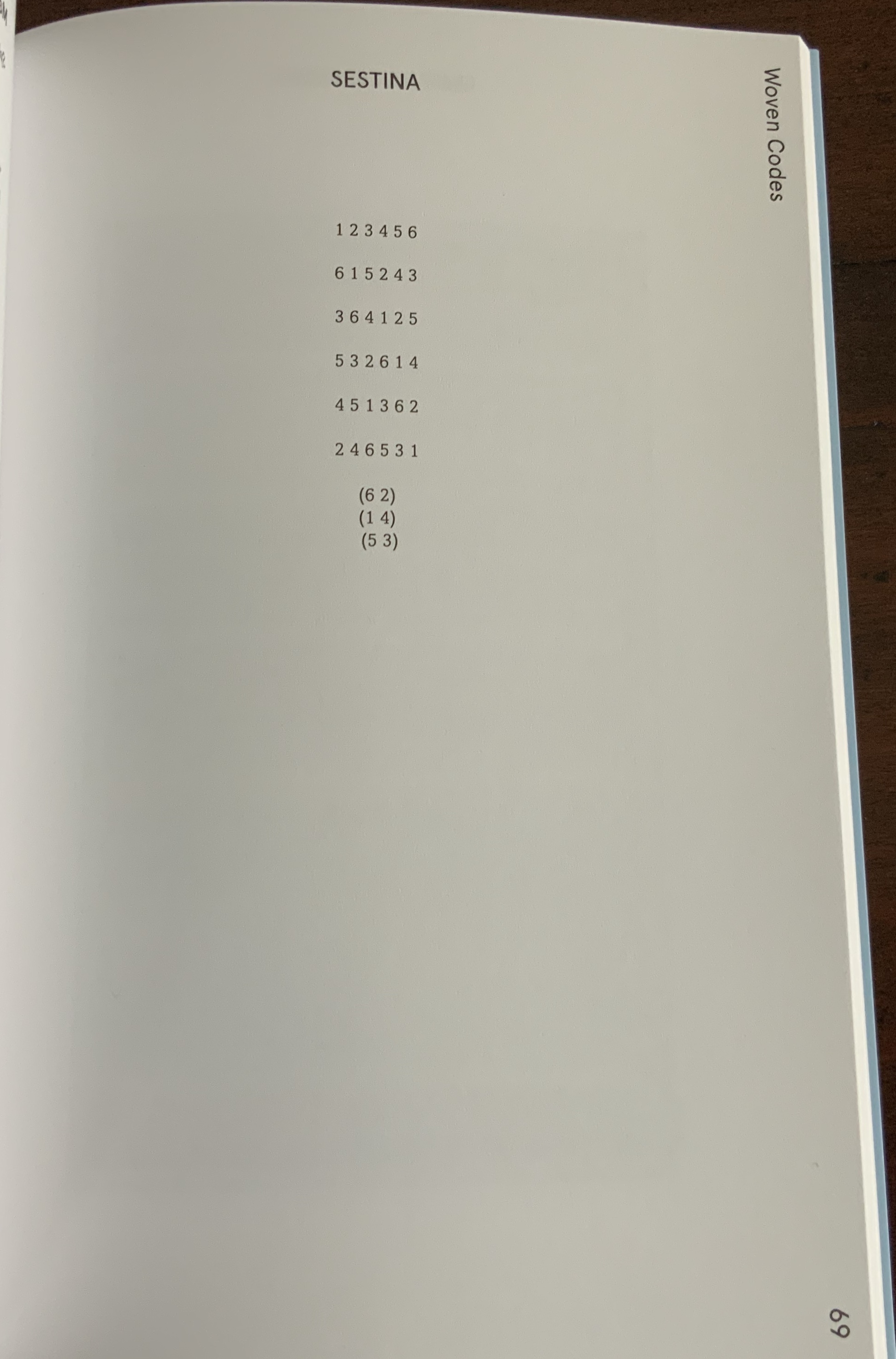
Among the patchwork sources in the first part, there is a brief quotation from one of Roland Barthes’ lectures in which he “introduced the metaphor of ‘unthreading’ for the act of describing”. Could the weaving of “S and Z” yarns refer to Barthes’ S/Z, the seminal structuralist deciphering of codes of meaning in Honoré de Balzac’s short story “Sarrasine”? Only if “historically sturdy” is tongue in cheek, as the post-structuralists would have it. Allusion notwithstanding, this illustration of sturdy woven cloth sets us up for the more colorful concluding section of “Woven Codes” in which Capone demonstrates the color coding of various verse forms such as the sestina (below).

By pairing the drawn plan with the front and rear views of the woven sestina from Dante and then pairing a right-reading setting with a reversed setting of the poem in color-coded type, Capone underscores her equation of language = image, paper, code and cloth.

The third part of the book — “Weaving>>Writing” — brings all of the elements together in reverse: fabric comes first and is translated into words. It is a reversal that depends on Weaving Language I: Lexicon, in which Capone set out the code where “fiber informs pronouns, weave structure informs verb, interlacing and tapestry techniques are prepositions, color informs nouns & adjectives, and any two colors beside each other result in conjunctions”.

Five of Capone’s woven>>written poems are followed by five works by artists Ruth Laskey, Alicia Scardetta, Tauba Auerbach, Kayla Mattes, and New Friends (Alexandra Segreti and Kelly Rakowski). As individually whole works, they are not illustrated here. To view them, buy WL II from its publisher Information as Material or a bookstore or consult a library.

As noted, WL III still out of print, perhaps Essay Press or Information as Material will come to the rescue and make it possible for Books On Books to complete its set of the trilogy without dropping a stitch.

Further Reading

Capone, Francesca, ed. Writing in Threads: Weaving Language III (Troy, NY: Publication Studio Hudson, 2015).

Costello, Lindsey. “Francesca Capone: Think of Seashells at Nationale“, 60 Inch Center, 2018.

Snack, Rachel. Interview with Warp & Weft Magazine, 2020.

Wilson, Frank R. The Hand (New York: Random House International, 2000).

Books On Books Collection – David Dernie & Olivia Laing

Shipwreck (2016)
David Dernie and Olivia Laing
Perfect bound softcover. H256 x W210 mm, 48 unnumbered pages. Edition of 100, of which this is #88 and signed. Acquired from the artist, 27 August 2020. Photos: Books On Books Collection.

Shipwreck, a collaboration between artist/architect David Dernie and writer Olivia Lang, first appeared as an installation at the Cambridge School of Art’s Ruskin Gallery (3-19 November 2016). There are three works one might consider here: 1) the installation as event and environment, 2) its accompanying book presenting two parallel narratives, one composed of Laing’s text and the other of images of Dernie’s collages displayed at the exhibition and 3) Dernie’s essay juxtaposing those images with pages from Mallarmé’s Un Coup de Dés Jamais N’Abolira le Hasard.

In his extensively illustrated textbook Exhibition Design, Dernie asserts that exhibition-making is an art in itself — “synonymous with image-making, communication, and the creation of a powerful experience”. Like the “book of the movie”, the exhibition catalogue rarely rises to that powerful experience. More rarely still does it surpass the exhibition. Unlike movies that can be purchased or rented, exhibitions are time-limited experiences. Even if revisited multiple times, an exhibition will close, move on and be replaced by another. The catalogue or online website may be the only media that document an exhibition. Attendees and non-attendees will experience them differently, and without that documentation, the exhibition as a work of art belongs only to the memories of its attendees and organizers.

Shipwreck is not a catalogue of the exhibition. More like an artist’s book, it juxtaposes a literary narrative with a set of prints. There’s no indication that the text was performed in the exhibition hall — live or recorded. If it was, then the attendees may have the memories to recall to make Shipwreck a satisfactory reminder of the event. Whether attendees and non-attendees find Shipwreck “the book” satisfactory as a standalone work is problematic given the third work to consider.

In his essay in Buildings, Dernie describes the collages as

Working in the tradition of the collage novel, and with original engravings from the popular French newspaper Le Grande Illustré (1904), [they] work with the thematic structure and spatiality of Stéphane Mallarmé’s revolutionary poem Un Coup de Dés written a few years earlier. (P. 324)

Like the poem, the collages are heterogeneous and their protagonists are “found”, both in terms of their scale and detail, in the dramatized newspaper of the period. The engravings are a snapshot of the terrible uncertainties, reported disasters and social unrest that colored Parisian life at the time. The re-invented figures, scenes and architectural settings are offered as spatial analogues to the poetic passages, exploring the non-perspectival space of the text, its content and poetic imagery as much as its solipsism and incoherence. (Pp. 330-31)

Drawing his collage material from Le Grande Illustré and analogizing the collage to Mallarmé’s imagery and use of the page’s non-perspectival space, Dernie replays in an original way what the Cubists, Futurists and Dada-ists learned from Un Coup de Dés and Mallarmé. In Total Expansion of the Letter (2020), Trevor Stark has laid out clearly how the collages of Picasso and Braque traced their technique back to Mallarmé. As for what they incorporated from the newspapers, however, the avant-gardists turned to the text of headlines and articles rather than illustrations. Dernie’s result is more reminiscent of Max Ernst’s surrealist novels than the Cubist collages of 1912.

Photos: Books on Books Collection.

The collages are clearly not simple illustrations of Mallarmé’s poem, but as Dernie points out, they work with the poem. Only in Dernie’s essay, however, can the pairings with pages from Un Coup de Dés be found and enjoyed. The eye moves from collage image to the shape of the text, from the verse and its images back to the collage, and back again.

From “Elevating Mallarmé’s Shipwreck”, pp. 334 and 337. Reproduced with permission of the author.

FromElevating Mallarmé’s Shipwreck“, pp. 331-32. Reproduced with permission of the author.

Were it not for the limited edition state of Shipwreck, the reader/viewer might be tempted to obtain a spare copy of Un Coup de Dés from the publisher Gallimard, “grangerize” it with Dernies’ collages and gaze on it at leisure.

Further Reading

Derek Beaulieu“, Books On Books Collection, 19 June 2020.

Dernie, David. “Elevating Mallarmé’s Shipwreck”, Buildings, 3, 2013, pp. 324-340.

Dernie, David. Exhibition Design (London: Laurence King, 2007).

Stark, Trevor. Total expansion of the letter : Avant-Garde art and language after Mallarmé (Cambridge, MA: MIT Press, 2020).

Books On Books Collection – La Perruque

La Perruque (2015 ~)
Olivier Bertrand, ed.
Box housing one complete set of “unbound” editions (Nos. 00-21) with one binding spool; two “bound” rolls including fourteen available issues; one offset paper sheet (70 × 100 cm, folded) with issues Nos. 9 & 10 printed in margins; “servez vous” tickets for Talk #2, a typographic discussion at Atelier BEK, Brussels, Belgium, 19 April 2017. Collector’s edition of 5, of which this is #2. Acquired from Olivier Bertrand, 30 October 2020. Photos: Books On Books Collection.

In French, une perruque is a wig but also the slang term for something made for home on the sly while on the employer’s clock. In English, it’s called a “homer”. In the case of La Perruque, the entire typography magazine is a “homer”; it literally exists in the otherwise unused margins of print shop production sheets. As founder Olivier Bertrand explains on his site, however, this magazine “hack” is completely above board:

Year 2015. A first unspoken agreement with the print shop Media Graphic in Rennes allows Oliver Bertrand to use a blank surface in the margins of their regular prints. Ever since that founding experience, materials (unused print surfaces) and large scale production techniques (offset printing) have been the playgrounds for type designers, print shops and publishers to collaborate. Production time, number of copies, colors and type of paper depend on this economy of means.

Each issue is a 1 x 90 cm ribbon. A pointer to an issue printed in the otherwise blank margin of a sheet for another printing job.

Each issue is rolled up on a card spindle.

La Perruque’s unusual binding as well as its subject make it a desirable addition to the Books On Books Collection. Each issue is a tiny but long type specimen book. It is the combination rather than solely its status as specimen book that attracts. Some bookworks play with codex, scroll, folio and box structures, others play with paper’s folding, unfolding and self-encasing as in accordion and palm-leaf books. While spooled, spindled or bobbined books can replicate the scroll book structure, the narrow, ticker-tape-like linearity of La Perruque feels like a different structural game.

With La Perruque, this structural game has two fields: that of the otherwise unused margins of printed sheets for other products and that of the card spindle on which the issue is wound. The marginal space from which each issue comes comments on the subject of every issue. The comment may be socioeconomic, political, philosophical, aesthetic or all of these. Michel Anteby’s article cited below explores in general that kind of commentary. The way in which the “unwinding binding” forces us to examine these type specimens and to “close” the book also comments on each issue: look closely at both sides of the ribbon, look hard, watch and think how the words and letters unravel, and watch and think as they roll back onto their spindle.

Offset paper sheet (70 × 100 cm, folded) with issues Nos. 9 & 10 printed in the lower margin.

A card spindle may hold one issue (as with the first spindle above) or several (as with the spindle beneath the first).

La Perruque is more than its issues. It is also an online archive for the issues and online point of access to the type designers’ documented font design processes. The type specimens are mainly for the Web, but their material publication makes us read and think with our hands. This is publishing as artistic practice to which you can subscribe here for your own collection.

Further Reading

Anteby, Michel. “Factory ‘homers’: Understanding a highly elusive, marginal, and illegal practice“, Sociologie du travail, 45, 2003, pp. 453-71.

Books On Books Collection – Emily Speed

Unfolding Architecture (2007)

For a collection following architecturally themed book art, Emily Speed’s Unfolding Architecture (2007) is essential. The video above shows how the box’s opening and the title revealed hint at the substance of this work. What cannot be sensed from the video is how the feather weight of the box and balsa-bound book of Mohawk Superfine resonate with the unbearable lightness of being that the main character Gordon experiences as he witnesses his city structure unfold across the twenty-two panels of his story. Here is Elaine Speight and Charles Quick on the work and Gordon:

The diversity of experience enabled by the fold is made explicit in Speed’s Unfolding Architecture (2007) …, an accordion-folded book that recounts the tale of Gordon, a city dweller who witnesses the collapse of public buildings and, ultimately, his own home as the urban fabric begins to unfold around him. Housed in a balsa wood box that, somewhat alarmingly, unfolds upon opening, the fragility of the folded sheet provokes something of the protagonist’s anxiety about the undoing of his city. Yet, … the act of unfolding also produces “an open plain full of possibility” (Speed 2019). As Gordon asserts, unfolding is not the same as falling apart, and the artist’s book suggests that hope and potential may be achieved through the dismantling of existing structures.

The silk-screening adds texture and a just perceptible raised depth to the varying textures of the wood and the Canson Opalux slip that protects the colophon in the bottom of the box. Depth and varying texture repeat themselves in the accordion’s folds and paper attached to wooden covers that seem light as paper.

Gordon’s story ends with paper — an old, rolled up newspaper that reminds him of a tower (an image that appears on the colophon’s cover slip). It is a reminder that comes to him in his recognition that, in the end, “all he was able to do now was to contribute to the re-making” of his flattened world. The newspaper reminds me of the newsprint typo “manmoth” for “mammoth” that inspired Elizabeth Bishop to invent her poem “The Man-Moth”. The Man-Moth and Gordon share a surreality and a hope that resides in the imagination — that solitary tear, the man-moth’s only possession, that slipping from his eyelid, he will palm and swallow if you’re not watching …

… However, if you watch, he’ll hand it over,
cool as from underground springs and pure enough to drink.

The fusion of title, metaphor, narrative, image, technique of silk-screening, letterpress, texture of paper and wood, the workings of the accordion and box enclosure — all — with one another makes Unfolding Architecture as satisfying as the Man-Moth’s tear.

Unfolding Architecture (2007)
Emily Speed
Double-sided accordion book, attached to balsa wood covers, housed in a hinged, covered box of balsa wood. Book – H190 x W70 x D18 mm (closed), H190 x ~W2280 (open); Box – H203 x W88 x D63 mm; 24 panels, including cover panels. Edition of 90, of which this is #7. Acquired from the artist, 24 October 2020.

Further Reading

Architecture“, Bookmarking Book Art, 12 November 2018.

Emily Speed“, The Aesthetic Trust, 30 January 2012. Accessed 24 October 2020.

Petz, Yuka. 20 June 2024. “Spaces We Knew“. Artists’ Books Unshelved. Bainbridge Island Museum of Art. Video presentation of Unfolding Architecture.

Speight, Elaine, and Charles Quick, “‘Fragile Possibilities’: The Role of the Artist’s Book in Public Art“, MDPI Arts 2020, 9(1), 32. Accessed 24 October 2020.

Books On Books Collection – Robert Bononno and Jeff Clark

A Roll of the Dice Will Never Abolish Chance/Un coup de Dés jamais n’abolira le Hasard (2015)

A Roll of the Dice Will Never Abolish Chance (2015)
Robert Bononno and Jeff Clark
Hardback, H280 x W192 mm, 96 pages, illustrations.

Jeff Clark has designed this book for a dramatic entrance: eleven double-page spreads presenting in large type the English title (interrupted with a full-bleed double-page spread of random-light burst-mode photographs of black-and-white laserprints) followed by Mallarmé’s name in equally large type. The words in all caps Helvetica type bounce across the pages like dice, or rise and fall like waves.

Three more double-page spreads of an ominously darkening sea display the translator’s and designer’s names and the copyright page printed in reverse.

And then the poem begins. Both the English and French versions of the preface and poem occur without interruption by images (as Mallarmé would have wished) and in the layout implied by Mallarmé’s mark up of proofs before his death. Their relatively plain sailing, contrasted with the book’s dramatic opening, actually draws attention to the disruptive and groundbreaking nature of the poem’s intended layout and variations in typography.

The dramatic opening of double-page spreads returns at the end of the English version. Four spreads of undulating photographs of the seabed separate it from the French version. The spreads begin with a blow-up shot of seaweed or coracle and encrusted wreckage, then back off to a slightly longer shot in the next two spreads and return to a blow-up in the fourth spread. Although these are stills, their manipulation over the pages conveys a sense of underwater movement.

Four more double-page spreads conclude the book with photographs so blown-up and darkening that they leave the reader/viewer wondering if the phosphorescent underwater world has metamorphosed into a constellation.

The design work is carefully considered and meaningful. In choice of type, the English version’s sans serif type, Helvetica, contrasts with and complements the French version’s serif type, Didot, Mallarmé’s preferred font. Although in the Helvetica family the roman font does not contrast with its italic font as much as those fonts contrast in the Didot family, the Helvetica “places” Bononno’s and Clark’s work as a contemporary translation that complements its original.

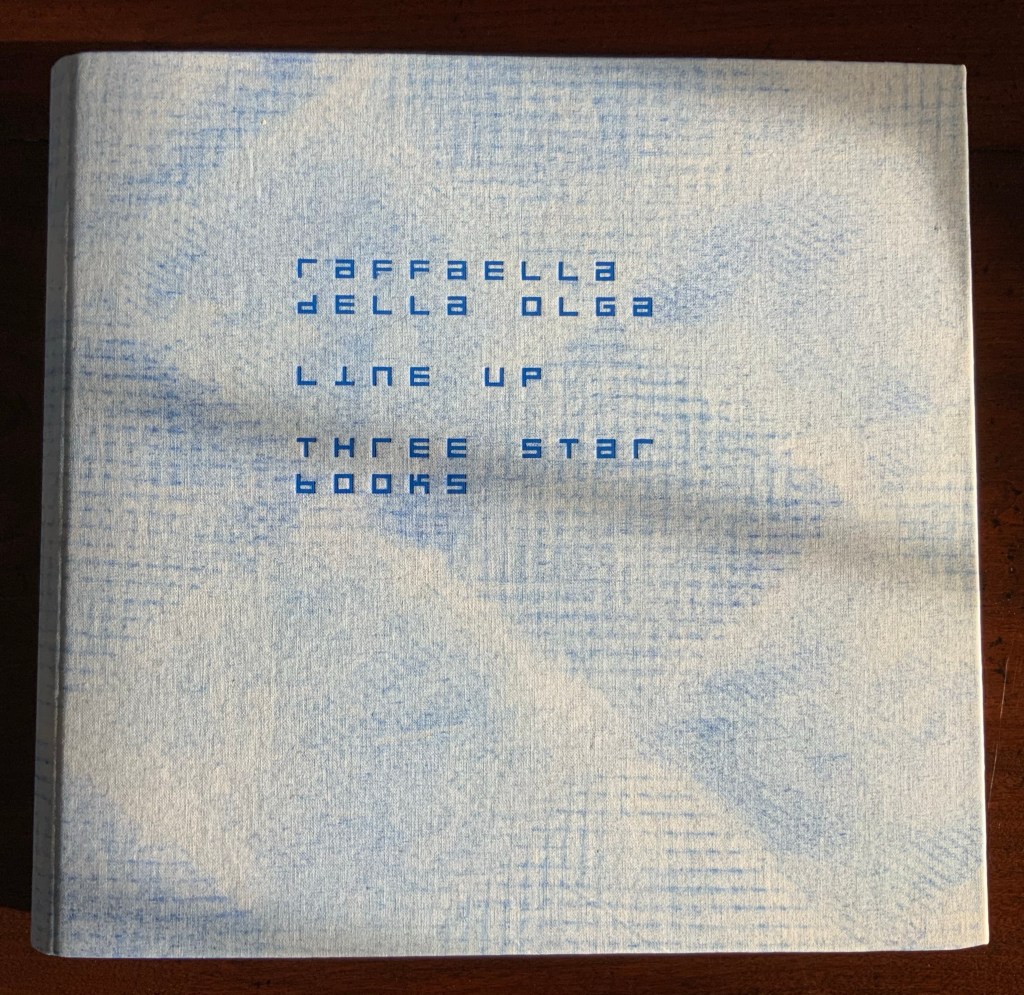
The handling of the images is deeply subtle — not merely in their thematic affinity with the imagery and thrust of the poem, but also in their technique. They are random-light, burst-mode photographs of laser-printed photographs, a meta-technique that echoes the poem’s metaphysical struggle with meaning’s and thought’s being at a chance-driven remove from language. In commenting on Raffaella della Olga‘s phosphorescent light installation of the poem, the critic Raimundas Malašauskas makes a comment that is also apropos of these photographic images and technique:

Conversations about light often end up in conversations about time because light is far from ageless. Two reasons compliment [sic] each other: first, the emission of photons starts at one point in time and finishes at another one. Second, the scope of light brings an unforeseen scale of time if one has chosen to read this evocation under the light of stars. Just imagine it (when hopefully no one sees you.)

Malašauskas’ comments should be read in full to appreciate how important the theme of temporal perspective is for della Olga’s work. In his poem, Mallarmé evokes a temporal perspective through numerous images, not least of which is the constellation, and links that perspective to chance and the space (gap or abyss) between word (mark or utterance) and meaning. Likewise, in the privacy of this book, the chance-driven burst-mode images of images shift perspective from surface to depth to the microscopic — and out to the stars — placing the viewer in that solitary place where “no one sees you” to imagine macro- and micro-scopic vastness and relate them to this poem that proclaims across its last two double-page spreads:

NOTHING

WILL HAVE TAKEN PLACE

BUT THE PLACE

EXCEPT

PERHAPS

A CONSTELLATION

Further Reading


Glazier, Jeremy. “Un Coup d’idées: A New Translation of Mallarmé’s ‘A Roll of the Dice’“, Los Angeles Review of Books, 1 June 2015.

Malašauskas, Raimundas. “Coup de dés“, Raffaella della Olga website, 2010. Accessed 15 April 2020.

N.A. “Translators Jeff Clark and Robert Bononno on Stéphane Mallarmé’s ‘A Roll of the Dice’“, Poetry Society of America, N.D. Accessed 20 October 2020.

Ross, Alex. “Encrypted: Translators confront the enigma of Stéphane Mallarmé’s poetry“, The New Yorker, 4 April 2016.

Stark, Trevor. Total Expansion of the Letter (Cambridge, MA: MIT Press, 2020). Reviewed here. For a clear exploration of Mallarmé’s themes of chance, temporal perspective, thought and language.

Books On Books Collection – Mandy Brannan

30 St Mary Axe is a skyscraper in London's mai...

30 St Mary Axe is a skyscraper in London’s main financial district. Designed by Sir Norman Foster architectural studio, built in 2001-2003. (Photo credit: Wikipedia)

London’s 30 St Mary Axe is referred to as “the Gherkin,” which a glimpse of the building on the skyline proves unmistakably appropriate.  Mandy Brannan’s bookwork homage to the Gherkin is as architecturally intricate as the building’s cladding, and somehow more satisfying, perhaps because it’s less pickled.

30 St Mary Axe: Cladding (2009)

30 St Mary Axe: Cladding (2009)
Mandy Brannan
Flagbook. H102 x W134 mm. Edition of 20, unnumbered. Acquired from the artist, 20 March 2019. Photo: Books On Books Collection

This work 30 St. Mary Axe: Cladding (2009) and 30 St Mary Axe: Diagrid (2009) are among several architecture-inspired works of book art that Brannan has created. The text in the one called Situated could have come straight from Pallasmaa, Bachelard or Merleau-Ponty:

Being situated is generally considered to be part of being embodied, but it is useful to consider each perspective individually. The situated perspective emphasizes that intelligent behaviour derives from the environment and the agent’s interactions with it.

Clearly we are not dealing with some mere mimetic piece of craftwork.

30 St Mary Axe: Diagrid (2009)

30 St Mary Axe: Diagrid (2009)
Mandy Brannan
Modified flagbook. H121 x W154 mm. Edition of 20, unnumbered. Acquired from the artist, 20 March 2019.
Photos: Books On Books Collection

Cladding uses a straightforward flagbook structure, but not only is it double-sided with the architectural photographs, it also places text on the inner side of the accordion support and a statement about the 5,500 panels of glass cladding on the Gherkin. The modification in Diagrid is the inward curving of the flags and their formation of the shape recalling the Gherkin. The wording on the reverse of the accordion is the definition of the architectural term diagrid: “a design element used for constructing large buildings with steel that creates triangular structures with diagonal support beams”.

In addition to the flagbook- and modified-flagbook arrangements of the photos, Brannan has enriched the substance of these works with her manipulation of her photograph of 30 St Mary Axe, reflecting a nearby building. Using several different methods, digital programs and then printer settings for digitally printing, she delivers an almost kaleidoscopic, reflective and self-reflexive effect in each work. In a sense, the work demonstrates the artist’s behavior — her choices of material, subject, text and technique in each work’s making — and how it derives from her environment and her interactions with it. By integration of text, image, color, structure and material, Brannan also situates the “Gherkin’s” architecture in our hands and gives us the opportunity to contemplate, appreciate and perhaps experience the sense of being situated and embodiment.

Further Reading

Architecture“, Bookmarking Book Art, 12 November 2018.

Bachelard, Gaston. The poetics of space (Boston: Beacon Press, 1994).

Hale, Jonathan A. Merleau-Ponty for architects (New York: Routledge, 2017.

Pallasmaa, Juhani. The eyes of the skin : architecture and the senses (Chichester: John Wiley, 2005).

Books On Books Collection – James Roberts

Last (2018)

Last (2018)
James Roberts
Chapbook, saddle-stitched with staples. Cover: Futura and Goudy Trajan printed on Nettuno 350gsm. Text: Bodoni printed on FSC paper. H210 x W98 mm, 12 pages. Edition of 100, of which this is #36. Acquired from the author/artist, 24 August 2020. Photos: Books On Books Collection. With permission of the author/artist.

Before starting his reading of his poem “The Bear” many years ago, Galway Kinnell commented that someone at another reading had expressed surprise that Kinnell was not an Eskimo, the description of the hunter and the bear being so real, so obviously based on first-hand experience.

A reader/viewer of James Roberts’ exquisite “Last” would be similarly surprised that he is not a time traveller or shape-shifter. While there are sanctuaries, conservation trusts and an effort at “rewilding”, wolves in the wild have been extinct in the UK since the reign of Henry VII. Perhaps Roberts’ close observation of timber wolves in Canada explains what happens in “Last”. Voice, tone, diction, pace and rhythm are in perfect balance with the subject. So much so that the poet seems to inhabit the animal’s breathing, loping and howling.

The poem often sends the reader back to the cover image:

she was already a ghost

a last exhalation/ from the last of her kind/ breathed out of the world

like snowfall/ like snow thawed/ and gone to ground

fragments of a trace

casting shadows

The unusual texture and color of the cover’s ghostly image come from both the choice of paper and artist’s technique:

The wolf image is an illustration created using black ink and salt. The ink is applied inside a sketched outline of the wolf very quickly then the salt is scattered over it while wet. I then scan it and play with the image in Photoshop. I convert to a duotone setting using a deep blue and a much lighter tone. Correspondence with Books On Books, 15 September 2020.

Poem and image come to the very edge of stepping outside the anthropomorphic, anthropocentric circle, but inevitably they are addressed to us in “this forest we’re lost inside”.

Further Reading

Roberts, James. Winged (2020). Review, Caught by the River, 16 August 2020.

Roberts, James. Night River Wood (2018~).

Zoomorphic (online magazine founded and edited by James Roberts).

“Total Expansion of the Letter”, Trevor Stark (MIT Press, 2020): Review

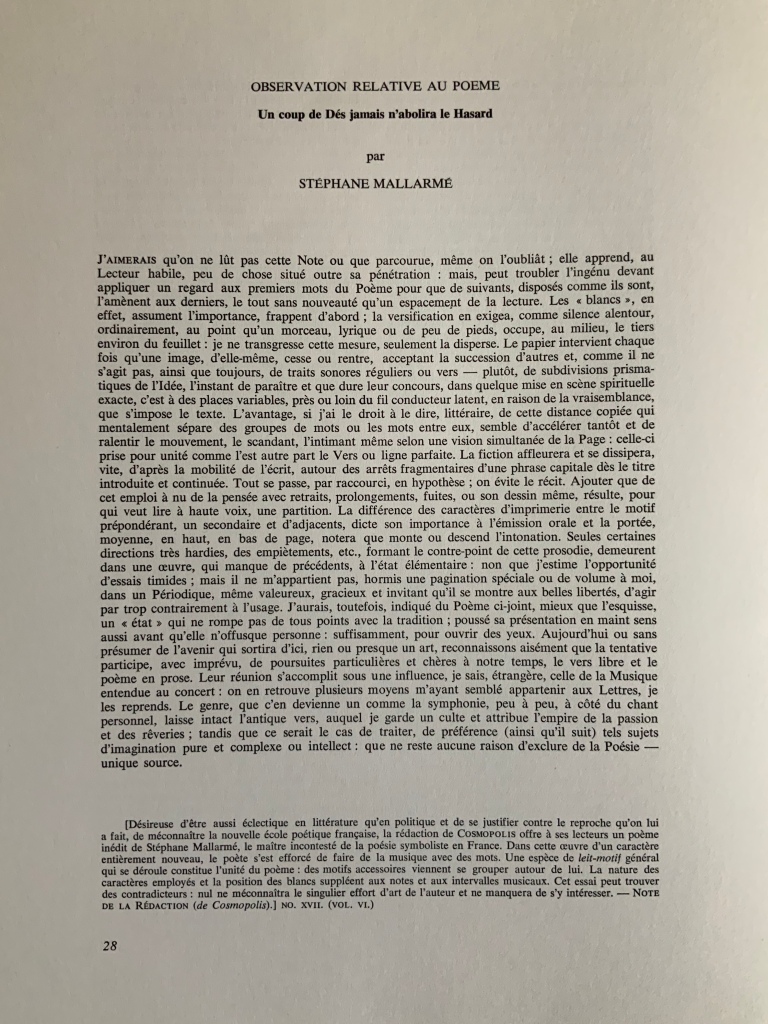
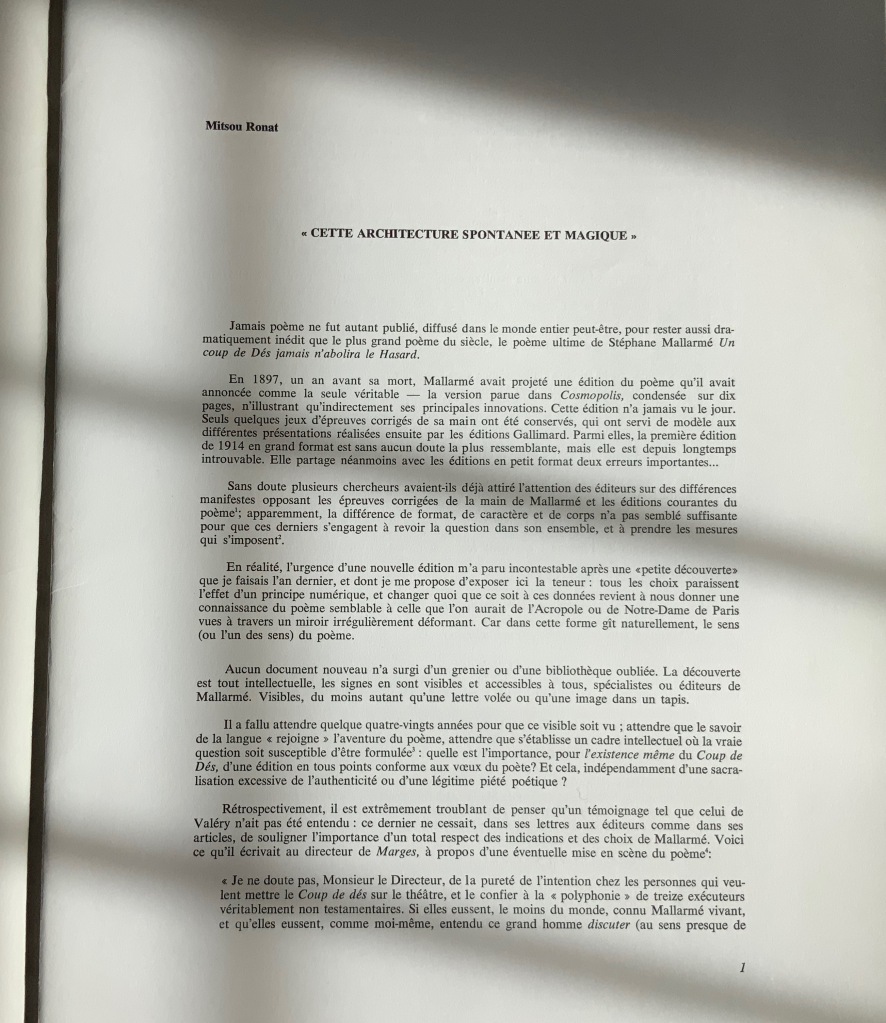
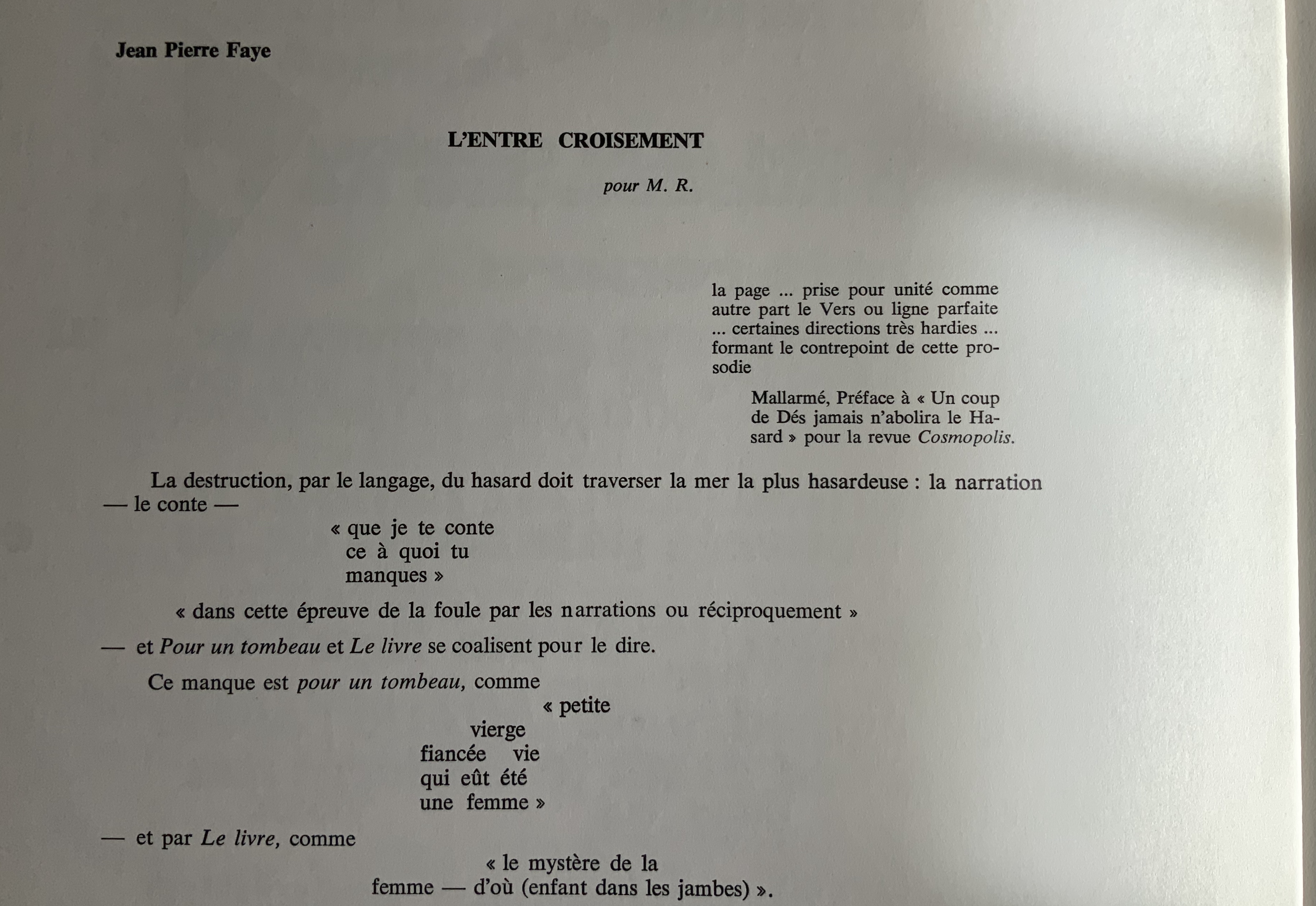
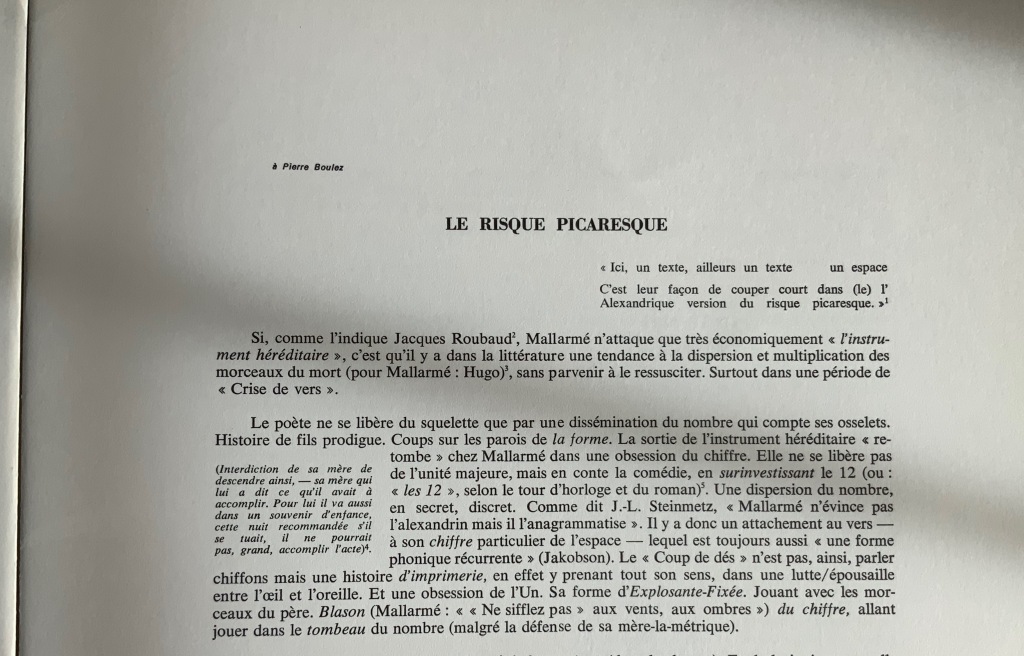
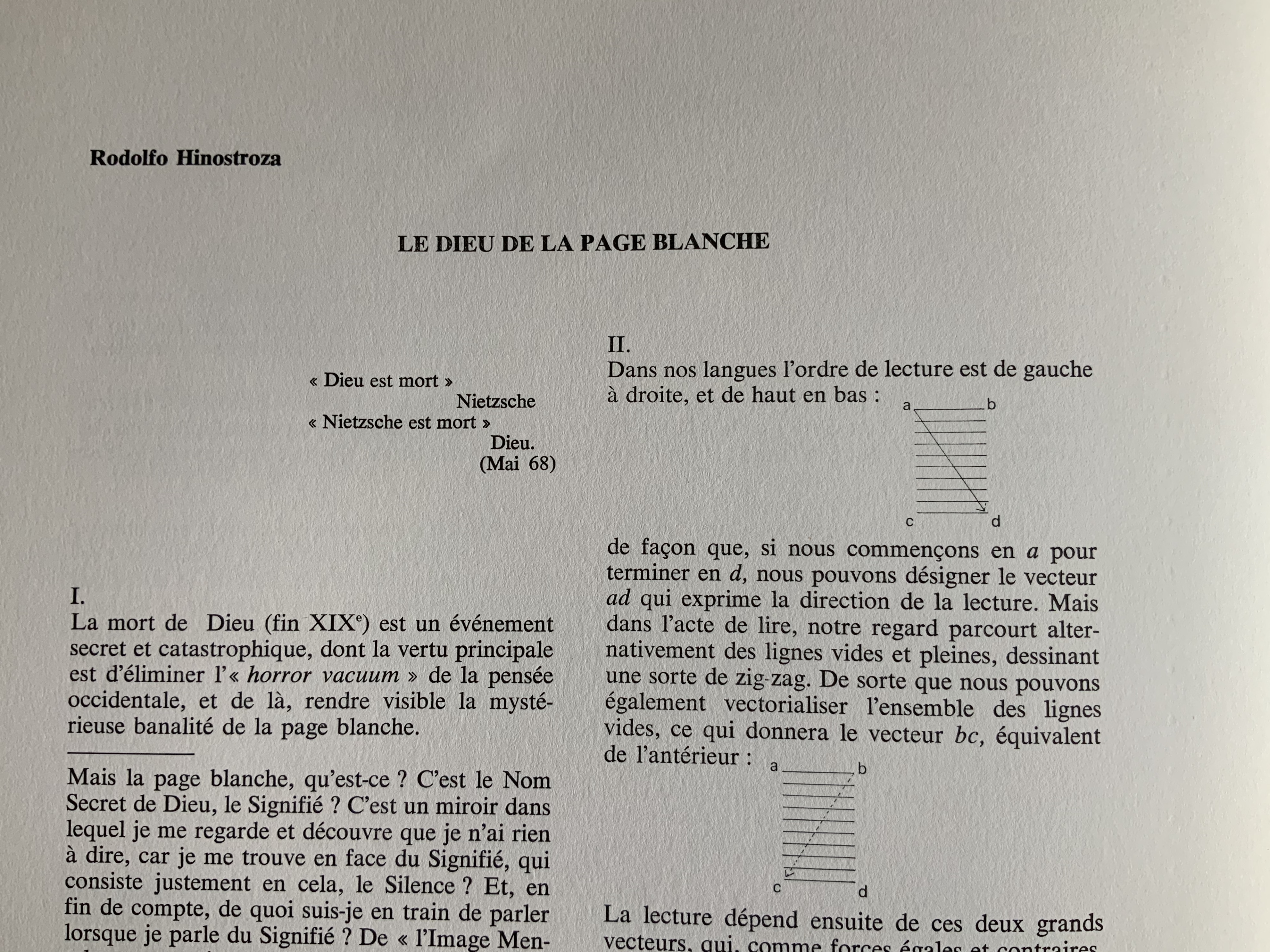
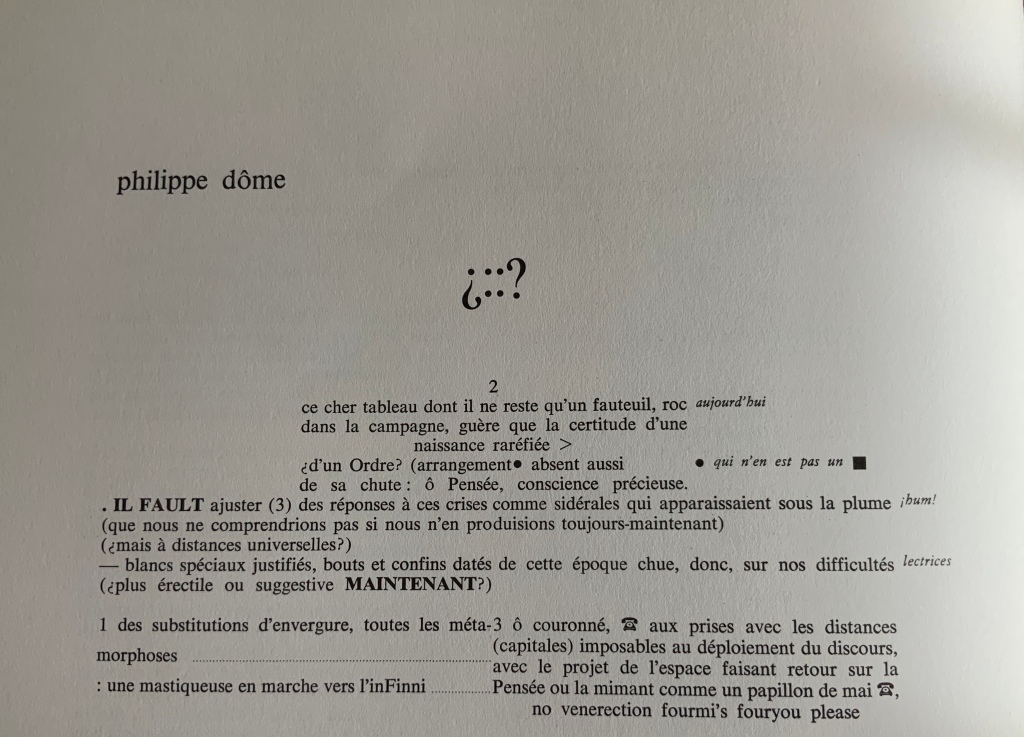
The 125th anniversary of the publication of Stéphane Mallarmé’s Un Coup de Dés Jamais N’Abolira le Hasard (1897) approaches, and Trevor Stark’s book is a welcome harbinger. Its title comes from Mallarmé’s essay/poem “The Book, Intellectual Instrument”:

The book, total expansion of the letter, should derive from it directly a spacious mobility, and by correspondences institute a play of elements that confirms the fiction (p. 6).

Often with Mallarmé, context is all (not to mention translation in the face of elliptical syntax!) — context is wrapped in self-enshrouded context. His seemingly cryptic sentence above becomes clearer only when the precedent to the word “it” (elle) is understood as la composition typographique from the essay/poem’s preceding paragraph, extolling the alphabet, language and typography.

Un miracle prime ce bienfait, au sens haut ou les mots, originellement, se réduisent à l’emploi, doué d’infinité jusqu’à sacrer une langue, des quelque vingt lettres — leur devenir, tout y rentre pour tantôt sourdre, principe — approchant d’un rite la composition typographique. (my emphasis)

So, the sentence is a proscription for what “the book” should get from typographic composition. Metaphorically (fictionally), the book is a total expansion of the typeset letter, or mark. As such, it should derive from the “near rite of typographic composition” a spaciousness and mobility and a play among elements that confirms the metaphor that it is a “total expansion of the letter”. Still a bit cryptic, but after all, this is what Mallarmé calls a “critical poem”, and the sentence is hardly more cryptic than the opening pronouncement: “everything in the world exists to end up in a book”.

It is a good choice of title for Stark’s endeavor. “Total expansion of the letter” juggles Mallarmé’s “heroic” vision for the book with the material world of metal type, idea with ink, the sacred with the profane. In painting, sculpture, music, dance, theater and film, the avant-gardists certainly brought together intellectuality and physicality forcefully. Stark shows that, in doing so, they also consciously and unconsciously raided Mallarmé’s open larder of skepticism about language and communication. The letter (or any mark of signifying, for that matter), scraps of newspaper, musical scores, dance notation, dresses and costumes (or lack thereof), wanted posters, financial bonds, and much more became ready objects for avant-garde art but only on the condition of their “becoming dysfunctional and incommunicative” (p. 7). Stark wants to know why.

Total Expansion of the Letter : Avant-Garde Art and Language after Mallarmé
Trevor Stark
(Cambridge, MA: MIT Press, 2020)
Mallarmé’s skepticism about language and communication is Stark’s touchstone throughout: that language has an “ineradicable degree of chance built into” it; that there is inherently a suspension — a temporal gap, blank, void, lacuna, an “unfinished” state — between the sign’s expressed materiality and its meaning; and that, therefore, every act of communication as a historical and aesthetic phenomenon is like an anonymous, “impersonified” throw of the dice, “tossed into eternal circumstances’” (p.29). Applying that touchstone, he crosses the borders insightfully time and again “between the nineteenth and twentieth centuries, between dance, music, and letters, and between art history, the philosophy of language, politics, and poetics” (p. 30). Never reductive, he explores the continuities and variations between Mallarmé’s achievements and those of Paul Cezanne, Pablo Picasso, Georges Braque, Francis Picabia, Tristan Tzara, Hugo Ball, F.T. Marinetti, Marcel Duchamp, the Laban school of dance and others of the avant-garde. As he offers a reciprocal interpretation of Mallarmé and of avant-garde art, individual poems, paintings, collages, performances of dance and theater yield new clarities and sharpened expression of received assessments.

Consider Stark’s comparative reading/viewing of Mallarmé’s “Sonnet en X” (1887) and Picasso’s The Dressing Table (1910). Across eight pages of text and photographs of art, Stark helps the reader to follow Mallarmé’s “quest for a word that literally means nothing, ptyx, a word produced by the frolic of language”, a signifier that “attains a materiality and an opacity, allowing the poem to display a linguistic Void, to raise it from the latent to the patent.” The materiality to which Stark draws our attention is twofold: the bright rhymes (-yx, -ix, -ixe) that almost single-handedly drive the invention of the word ptyx and the mirror on the credenza in the poem that captures the empty room, its window and the constellation Ursa Major showing through it. Across the same pages, Stark conducts the viewer through Picasso’s painting — again a mirror, the surface of a dressing table, the drawer from which a key protrudes, a drawer handle, a glass with the long handle of a toothbrush and its bristles poking out, but all scattered into planes of reflection and refraction, their shapes “mutually implicated to the point of structural ambiguity”. Then, he draws them together: “In Mallarmé and Picasso, representation destroyed the object in order to proclaim its own mute materiality and, thereby, regain continuity with the world by becoming simply one more thing within it”(pp. 101-108).
In pursuing these reciprocal readings of Mallarmé and his avant-garde descendants, Stark keeps a bright light on the “between” — between an object and its reflection, between a word’s or sound’s utterance and its meaning, the blanks between words, the blanks between brushstrokes or those between them and the boundary of the painting, between the cosmic and domestic, between one media and another when brought together in a work, between the individualism of subjective imagination and impersonal modes of production, between author/artist and word/image and reader/viewer. His term for these spaces is intermedial. In her endorsement of Stark’s book, Julia Robinson (New York University) calls his neologism “luminous”. The term refers to “the zone of indeterminacy between mediums, social practices, and temporalities” into which Mallarmé found himself outwardly propelled even as he inwardly sought “absolute language”.

Looking back on the avant-gardists and his own contemporaries, Dick Higgins — the late twentieth century language-, book-, and publishing-artist — rejuvenated Samuel Taylor Coleridge’s term intermediation, a neologism similar and related to intermedial. It is not the same thing as intermediality or mixed media. As Higgins expressed it, “Many fine works are being done in mixed media: paintings which incorporate poems within their visual fields, for instance. But one knows which is which. In intermedia, on the other hand, the visual element (painting) is fused conceptually with the words” (p. 52). It can be argued that works of intermedia are one way in which artists address intermediality — that zone of indeterminacy.

The argument is ultimately a phenomenological one, a perspective that Stark embraces. When he applies the ideas of Edmund Husserl, Martin Heidegger, Maurice Merleau-Ponty, Theodor Adorno, Maurice Blanchot and others to Mallarmé’s poems and the artistic expressions of his “descendants”, both the philosophers and the artists become more accessible. Consider this passage summarizing Maurice Blanchot’s account of the history and function of language and its four stages:

The first was that of an Adamic or nomenclaturist model of language, which conceived words as names for the objects of the world. The second, dominant from Plato to Descartes, was the idealist model in which language constituted the link between sensible reality and the eternal realm of the Idea, and thus the guarantee of our ‘entrance into the intelligible world.’ [fn 223] Third, the ‘expressionist model’ of Hegel and Leibniz considered language itself the embodiment of what is sayable, thinkable, and possible at any given historical juncture, serving, therefore, as the medium of the progress of Spirit. Finally, illustrated with a quote from Valèry, the fourth stage was the ‘dialectical function of discourse,’ in which language regained an ‘essential power of constestation’ in the negativity of modern literature:

‘Literature seeks to revoke from language the properties that give linguistic signification, that make language appear as an affirmation of universality and intelligibility. But it doesn’t arrive at this goal (if it does arrive at this goal) by destroying language or through contempt of its rules. It wants to render language to what it believes to be its veritable destiny, which is to communicate silence through words and to express liberty through rules, which is to say to evoke language itself as destroyed by the circumstances that make it what it is.’ [fn 224] (pp. 110-11)

Clearly that passage links back to the touchstone of Mallarmé’s skepticism about language and communication. The strength of the touchstone is that it can also be fruitfully applied to the numerous works of homage to Mallarmé from contemporary book artists such as Jérémie Bennequin, Michael Maranda, Michalis Pichler, Eric Zboya and many others. Likewise it can used to shed light on the “material text” approach to understanding book art. A case in point is the first issue of Inscription: the Journal of Material Text – Theory, Practice, History, a work of book art in its own right.

Consider the hole drilled through the center of the journal. Does it not echo Stark’s reminder of Braque’s citing Mallarmé’s utterance: “‘The point of departure is the void'” (p. 88)? Consider the journal’s spatial challenge to the act of reading (a dos-à-dos binding, a text block that rotates around that hole). Does that not echo this passage from Total Expansion of the Letter?

But what remains after the ‘suspension’ of the represented object and the objectification of the means of representation? For Mallarmé, the ‘residuum’ was the act of reading itself, conceived not as a process of cognitive reconstruction, but instead as a gamble on the very possibility of forging meaning out of opacity and contingency of linguistic matter. As Mallarmé wrote in ‘The Mystery of Letters’

‘To read —

That practice —

To lean, according to the page, on the blank, whose innocence inaugurates it, forgetting even the title that would speak too loud: and when, in a hinge [brisure], the most minor and disseminated, chance is conquered word by word, unfailingly the blank returns, gratuitous earlier but certain now, concluding that there is nothing beyond it [rien au-delà] and authenticating the silence –‘” (pp. 108-109).

Not since Anna Sigrídur Arnar’s The Book as Instrument: Stéphane Mallarmé, the Artist’s Book and the Transformation of Print Culture (2011) has there been as useful a tool for appreciating Mallarmé, art and artist’s books as Trevor Stark’s Total Expansion of the Letter. On the eve of the 125th anniversary of Un Coup de Dés, it will be interesting to see whether Stark and others extend his work to art and book art after the avant-garde.

Further Reading

Arnar, Anna Sigrídur. The Book as Instrument: Stéphane Mallarmé, the Artist’s Book and the Transformation of Print Culture (Chicago, IL: University of Chicago Press, 2011).

Higgins, Dick, and Hannah Higgins. “Intermedia“, republished in Leonardo, Volume 34, Number 1, February 2001, pp. 49-54.

McCombie, Elizabeth. Mallarmé and Debussy: Unheard Music, Unseen Text (Oxford: Oxford University Press, 2004). It would have been interesting to see how Stark would relate his exploration with McCombie’s exploration of Mallarmé’s views on poetry and music.

Willette, Jeanne. “Cubism As Applied Design: Sonia Terk-Delaunay“, Art History Unstuffed, 16 August 2019. Although Robert and Sonia Delaunay are briefly mentioned in the third chapter (p. 248), it would have been interesting to see how Stark would use his touchstone to explicate the first “simultaneous poem”: La Prose du Transsibérien et de la Petite Jehanne de France (1913) by Blaise Cendrars and Sonia Delaunay.

The Yale University Press offset facsimile. Image courtesy of Accordion Publications